
A English
Time and Work Questions in English
Competitive Exam Quantitative Aptitude · Time and Work and Wages · Time and Work
331+
Questions
English
Language
100%
With Solutions
Showing 50 of 331 questions in English
51
EasyMCQ
$8$ children and $12$ men complete a certain piece of work in $9$ days. If each child takes twice the time taken by a man to finish the work,in how many days will $12$ men finish the same work?
A
$8$
B
$10$
C
$11$
D
$12$
Solution
(D) Let the time taken by $1$ man to complete the work be $x$ days. Then,the time taken by $1$ child is $2x$ days.
Since work is inversely proportional to time,the efficiency of $1$ child is half the efficiency of $1$ man.
Therefore,$1$ man $= 2$ children,or $1$ child $= 0.5$ men.
Given that $8$ children and $12$ men complete the work in $9$ days.
Converting children to men: $8$ children $= 8 \times 0.5 = 4$ men.
Total men $= 4 + 12 = 16$ men.
So,$16$ men complete the work in $9$ days.
Using the formula $M_1 D_1 = M_2 D_2$:
$16 \times 9 = 12 \times D_2$
$D_2 = \frac{16 \times 9}{12} = \frac{144}{12} = 12$ days.
Thus,$12$ men will finish the work in $12$ days.
Since work is inversely proportional to time,the efficiency of $1$ child is half the efficiency of $1$ man.
Therefore,$1$ man $= 2$ children,or $1$ child $= 0.5$ men.
Given that $8$ children and $12$ men complete the work in $9$ days.
Converting children to men: $8$ children $= 8 \times 0.5 = 4$ men.
Total men $= 4 + 12 = 16$ men.
So,$16$ men complete the work in $9$ days.
Using the formula $M_1 D_1 = M_2 D_2$:
$16 \times 9 = 12 \times D_2$
$D_2 = \frac{16 \times 9}{12} = \frac{144}{12} = 12$ days.
Thus,$12$ men will finish the work in $12$ days.
0 likes
View Solution52
MediumMCQ
$A, B$ and $C$ together earn $Rs. 2700$ in $18$ days. $A$ and $C$ together earn $Rs. 940$ in $10$ days. $B$ and $C$ together earn $Rs. 1520$ in $20$ days. Find the daily earning of $C$ (in $Rs.$).
A
$20$
B
$40$
C
$10$
D
$15$
Solution
(A) Daily earning of $(A+B+C) = 2700 / 18 = Rs. 150$ ... $(i)$
Daily earning of $(A+C) = 940 / 10 = Rs. 94$ ... $(ii)$
Daily earning of $(B+C) = 1520 / 20 = Rs. 76$ ... $(iii)$
From $(i)$ and $(ii)$,we get $B = (A+B+C) - (A+C) = 150 - 94 = Rs. 56$.
Substitute $B = 56$ into $(iii)$:
$56 + C = 76$
$C = 76 - 56 = Rs. 20$.
Therefore,the daily earning of $C$ is $Rs. 20$.
Daily earning of $(A+C) = 940 / 10 = Rs. 94$ ... $(ii)$
Daily earning of $(B+C) = 1520 / 20 = Rs. 76$ ... $(iii)$
From $(i)$ and $(ii)$,we get $B = (A+B+C) - (A+C) = 150 - 94 = Rs. 56$.
Substitute $B = 56$ into $(iii)$:
$56 + C = 76$
$C = 76 - 56 = Rs. 20$.
Therefore,the daily earning of $C$ is $Rs. 20$.
0 likes
View Solution53
MediumMCQ
Two women,Sita and Gita,working separately can mow a field in $8$ and $12 \, hrs$ respectively. If they work in stretches of one hour alternatively,with Sita beginning at $9:00 \, a.m.$,when will the mowing be finished? (in $p.m.$)
A
$6:30$
B
$5:30$
C
$7:00$
D
$8:00$
Solution
(A) Sita's work rate is $\frac{1}{8}$ field/hr and Gita's work rate is $\frac{1}{12}$ field/hr.
In the first $2 \, hrs$ (one hour each),the work done is $\frac{1}{8} + \frac{1}{12} = \frac{3+2}{24} = \frac{5}{24}$ of the field.
In $8 \, hrs$ ($4$ cycles of $2 \, hrs$),the work done is $\frac{5}{24} \times 4 = \frac{5}{6}$ of the field.
Remaining work $= 1 - \frac{5}{6} = \frac{1}{6}$.
In the $9^{th} \, hr$,Sita works and completes $\frac{1}{8}$ of the field.
Remaining work after $9 \, hrs = \frac{1}{6} - \frac{1}{8} = \frac{4-3}{24} = \frac{1}{24}$.
In the $10^{th} \, hr$,Gita works. She completes $\frac{1}{12}$ of the field in $1 \, hr$,so she will complete $\frac{1}{24}$ of the field in $\frac{1}{24} \div \frac{1}{12} = 0.5 \, hr$.
Total time $= 9.5 \, hrs$.
Starting at $9:00 \, a.m.$,$9.5 \, hrs$ later is $6:30 \, p.m.$
In the first $2 \, hrs$ (one hour each),the work done is $\frac{1}{8} + \frac{1}{12} = \frac{3+2}{24} = \frac{5}{24}$ of the field.
In $8 \, hrs$ ($4$ cycles of $2 \, hrs$),the work done is $\frac{5}{24} \times 4 = \frac{5}{6}$ of the field.
Remaining work $= 1 - \frac{5}{6} = \frac{1}{6}$.
In the $9^{th} \, hr$,Sita works and completes $\frac{1}{8}$ of the field.
Remaining work after $9 \, hrs = \frac{1}{6} - \frac{1}{8} = \frac{4-3}{24} = \frac{1}{24}$.
In the $10^{th} \, hr$,Gita works. She completes $\frac{1}{12}$ of the field in $1 \, hr$,so she will complete $\frac{1}{24}$ of the field in $\frac{1}{24} \div \frac{1}{12} = 0.5 \, hr$.
Total time $= 9.5 \, hrs$.
Starting at $9:00 \, a.m.$,$9.5 \, hrs$ later is $6:30 \, p.m.$
0 likes
View Solution54
MediumMCQ
If the wages of $45$ women amount to $Rs. 46575$ in $48$ days,how many men must work for $16$ days to receive $Rs. 17250$,given that the daily wage of a man is double that of a woman?
A
$20$
B
$25$
C
$30$
D
$15$
Solution
(B) Let the daily wage of a woman be $w$. Then,the daily wage of a man is $2w$.
Total wages for $45$ women in $48$ days: $45 \times 48 \times w = 46575$.
Therefore,$w = \frac{46575}{45 \times 48} = \frac{1035}{48} = Rs. 21.5625$.
Let the number of men be $x$. The total wages for $x$ men in $16$ days is $x \times 16 \times (2w) = 17250$.
Substituting $w = \frac{46575}{2160}$:
$x \times 32 \times \frac{46575}{2160} = 17250$.
$x = \frac{17250 \times 2160}{32 \times 46575} = \frac{37260000}{1490400} = 25$.
Thus,$25$ men are required.
Total wages for $45$ women in $48$ days: $45 \times 48 \times w = 46575$.
Therefore,$w = \frac{46575}{45 \times 48} = \frac{1035}{48} = Rs. 21.5625$.
Let the number of men be $x$. The total wages for $x$ men in $16$ days is $x \times 16 \times (2w) = 17250$.
Substituting $w = \frac{46575}{2160}$:
$x \times 32 \times \frac{46575}{2160} = 17250$.
$x = \frac{17250 \times 2160}{32 \times 46575} = \frac{37260000}{1490400} = 25$.
Thus,$25$ men are required.
0 likes
View Solution55
MediumMCQ
$5$ men or $7$ women can earn $Rs. 5,250$ per day. How much would $7$ men and $13$ women earn per day? (in $Rs.$)
A
$11600$
B
$11700$
C
$16100$
D
$17100$
Solution
(D) Given that $5$ men $= 7$ women earn $Rs. 5,250$ per day.
Therefore,the daily earning of $1$ woman $= \frac{5250}{7} = Rs. 750$.
Since $5$ men $= 7$ women,the daily earning of $1$ man $= \frac{7}{5} \times 750 = Rs. 1,050$.
We need to find the earning of $7$ men and $13$ women.
Total earning $= (7 \times 1050) + (13 \times 750)$.
Total earning $= 7350 + 9750 = Rs. 17,100$.
Therefore,the daily earning of $1$ woman $= \frac{5250}{7} = Rs. 750$.
Since $5$ men $= 7$ women,the daily earning of $1$ man $= \frac{7}{5} \times 750 = Rs. 1,050$.
We need to find the earning of $7$ men and $13$ women.
Total earning $= (7 \times 1050) + (13 \times 750)$.
Total earning $= 7350 + 9750 = Rs. 17,100$.
0 likes
View Solution56
MediumMCQ
$A, B$ and $C$ together can finish a piece of work in $4$ days. $A$ alone can do it in $12$ days and $B$ alone in $18$ days. How many days will be taken by $C$ to do it alone?
A
$21$
B
$16$
C
$14$
D
$9$
Solution
(D) The work done by $A, B$ and $C$ in $1$ day is $\frac{1}{4}$.
The work done by $A$ in $1$ day is $\frac{1}{12}$.
The work done by $B$ in $1$ day is $\frac{1}{18}$.
Let the work done by $C$ in $1$ day be $x$.
Then,$\frac{1}{12} + \frac{1}{18} + x = \frac{1}{4}$.
$x = \frac{1}{4} - (\frac{1}{12} + \frac{1}{18})$.
$x = \frac{1}{4} - (\frac{3+2}{36}) = \frac{1}{4} - \frac{5}{36}$.
$x = \frac{9-5}{36} = \frac{4}{36} = \frac{1}{9}$.
Therefore,$C$ can complete the work alone in $9$ days.
The work done by $A$ in $1$ day is $\frac{1}{12}$.
The work done by $B$ in $1$ day is $\frac{1}{18}$.
Let the work done by $C$ in $1$ day be $x$.
Then,$\frac{1}{12} + \frac{1}{18} + x = \frac{1}{4}$.
$x = \frac{1}{4} - (\frac{1}{12} + \frac{1}{18})$.
$x = \frac{1}{4} - (\frac{3+2}{36}) = \frac{1}{4} - \frac{5}{36}$.
$x = \frac{9-5}{36} = \frac{4}{36} = \frac{1}{9}$.
Therefore,$C$ can complete the work alone in $9$ days.
0 likes
View Solution57
DifficultMCQ
$A$ and $B$ can do a piece of work in $20$ days and $12$ days respectively. $A$ started the work alone and then after $4$ days $B$ joined him until the completion of the work. How long did the work last? (in days)
A
$10$
B
$20$
C
$15$
D
$6$
Solution
(A) 's $1$ day's work $= \frac{1}{20}$.
$A$'s $4$ days' work $= \frac{4}{20} = \frac{1}{5}$.
Remaining work $= 1 - \frac{1}{5} = \frac{4}{5}$.
This remaining work is completed by $A$ and $B$ together.
$(A+B)$'s $1$ day's work $= \frac{1}{20} + \frac{1}{12} = \frac{3+5}{60} = \frac{8}{60} = \frac{2}{15}$.
Time taken by $(A+B)$ to complete $\frac{4}{5}$ of the work $= \frac{4/5}{2/15} = \frac{4}{5} \times \frac{15}{2} = 6$ days.
Total time for which the work lasted $= 4 + 6 = 10$ days.
$A$'s $4$ days' work $= \frac{4}{20} = \frac{1}{5}$.
Remaining work $= 1 - \frac{1}{5} = \frac{4}{5}$.
This remaining work is completed by $A$ and $B$ together.
$(A+B)$'s $1$ day's work $= \frac{1}{20} + \frac{1}{12} = \frac{3+5}{60} = \frac{8}{60} = \frac{2}{15}$.
Time taken by $(A+B)$ to complete $\frac{4}{5}$ of the work $= \frac{4/5}{2/15} = \frac{4}{5} \times \frac{15}{2} = 6$ days.
Total time for which the work lasted $= 4 + 6 = 10$ days.
0 likes
View Solution58
EasyMCQ
$A$ man,a woman,and a boy can together complete a piece of work in $3$ days. If a man alone can do it in $6$ days and a boy alone in $18$ days,how long will a woman alone take to complete the work? (in days)
A
$9$
B
$21$
C
$24$
D
$27$
Solution
(A) Let the work done by a man,a woman,and a boy in $1$ day be $M, W,$ and $B$ respectively.
Given that $(M + W + B) = \frac{1}{3}$ of the work per day.
Given that $M = \frac{1}{6}$ of the work per day.
Given that $B = \frac{1}{18}$ of the work per day.
To find the work done by a woman in $1$ day $(W)$:
$W = (M + W + B) - M - B$
$W = \frac{1}{3} - \frac{1}{6} - \frac{1}{18}$
Taking the least common multiple $(LCM)$ of $3, 6,$ and $18$,which is $18$:
$W = \frac{6 - 3 - 1}{18} = \frac{2}{18} = \frac{1}{9}$
Therefore,a woman alone will take $9$ days to complete the work.
Given that $(M + W + B) = \frac{1}{3}$ of the work per day.
Given that $M = \frac{1}{6}$ of the work per day.
Given that $B = \frac{1}{18}$ of the work per day.
To find the work done by a woman in $1$ day $(W)$:
$W = (M + W + B) - M - B$
$W = \frac{1}{3} - \frac{1}{6} - \frac{1}{18}$
Taking the least common multiple $(LCM)$ of $3, 6,$ and $18$,which is $18$:
$W = \frac{6 - 3 - 1}{18} = \frac{2}{18} = \frac{1}{9}$
Therefore,a woman alone will take $9$ days to complete the work.
0 likes
View Solution59
MediumMCQ
$A$ certain job was assigned to a group of men to do in $20$ days. But,$12$ men did not turn up for the job and the remaining men did the job in $32$ days. The original number of men in the group was:
A
$32$
B
$34$
C
$36$
D
$40$
Solution
(A) Let the original number of men be $x$.
According to the problem,$x$ men can complete the job in $20$ days.
Total work = $20x$ man-days.
When $12$ men did not turn up,the number of men remaining is $(x - 12)$.
These $(x - 12)$ men completed the job in $32$ days.
Total work = $32(x - 12)$ man-days.
Since the total work remains the same,we equate the two expressions:
$20x = 32(x - 12)$
$20x = 32x - 384$
$384 = 32x - 20x$
$384 = 12x$
$x = \frac{384}{12} = 32$.
Therefore,the original number of men was $32$.
According to the problem,$x$ men can complete the job in $20$ days.
Total work = $20x$ man-days.
When $12$ men did not turn up,the number of men remaining is $(x - 12)$.
These $(x - 12)$ men completed the job in $32$ days.
Total work = $32(x - 12)$ man-days.
Since the total work remains the same,we equate the two expressions:
$20x = 32(x - 12)$
$20x = 32x - 384$
$384 = 32x - 20x$
$384 = 12x$
$x = \frac{384}{12} = 32$.
Therefore,the original number of men was $32$.
0 likes
View Solution60
DifficultMCQ
If $16$ men or $20$ women can do a piece of work in $25$ days,in what time will $28$ men and $15$ women do it? (in days)
A
$14 \frac{2}{7}$
B
$33 \frac{1}{3}$
C
$18 \frac{3}{4}$
D
$10$
Solution
(D) Given that $16$ men = $20$ women,which implies $4$ men = $5$ women.
$16$ men can complete the work in $25$ days.
Total work = $16 \times 25 = 400$ man-days.
We need to find the time taken by $28$ men and $15$ women.
Convert the group into equivalent men: $15$ women = $15 \times (4/5)$ men = $12$ men.
Total men = $28 + 12 = 40$ men.
Time taken = $\frac{\text{Total work}}{\text{Total men}} = \frac{400}{40} = 10$ days.
$16$ men can complete the work in $25$ days.
Total work = $16 \times 25 = 400$ man-days.
We need to find the time taken by $28$ men and $15$ women.
Convert the group into equivalent men: $15$ women = $15 \times (4/5)$ men = $12$ men.
Total men = $28 + 12 = 40$ men.
Time taken = $\frac{\text{Total work}}{\text{Total men}} = \frac{400}{40} = 10$ days.
0 likes
View Solution61
MediumMCQ
$A$ certain number of men can do a piece of work in $40 \, days$. If there were $45 \, men$ more,the work could have been finished in $25 \, days$. Find the original number of men employed in the work.
A
$70$
B
$85$
C
$65$
D
$75$
Solution
(D) Let the original number of men be $x$.
According to the formula for work done,$M_1 \times D_1 = M_2 \times D_2$,where $M$ is the number of men and $D$ is the number of days.
Given: $M_1 = x$,$D_1 = 40$,$M_2 = (x + 45)$,and $D_2 = 25$.
Substituting the values into the equation:
$x \times 40 = (x + 45) \times 25$
Divide both sides by $5$:
$x \times 8 = (x + 45) \times 5$
$8x = 5x + 225$
$8x - 5x = 225$
$3x = 225$
$x = 75$
Therefore,the original number of men employed was $75$.
According to the formula for work done,$M_1 \times D_1 = M_2 \times D_2$,where $M$ is the number of men and $D$ is the number of days.
Given: $M_1 = x$,$D_1 = 40$,$M_2 = (x + 45)$,and $D_2 = 25$.
Substituting the values into the equation:
$x \times 40 = (x + 45) \times 25$
Divide both sides by $5$:
$x \times 8 = (x + 45) \times 5$
$8x = 5x + 225$
$8x - 5x = 225$
$3x = 225$
$x = 75$
Therefore,the original number of men employed was $75$.
0 likes
View Solution62
DifficultMCQ
$7$ men can complete a piece of work in $12$ days. How many additional men will be required to complete double the work in $8$ days?
A
$28$
B
$21$
C
$14$
D
$7$
Solution
(C) Given: $M_1 = 7$,$D_1 = 12$,$W_1 = 1$.
Let the total number of men required for the second task be $M_2$. We are given $D_2 = 8$ and $W_2 = 2$ (double the work).
Using the formula $\frac{M_1 D_1}{W_1} = \frac{M_2 D_2}{W_2}$:
$\frac{7 \times 12}{1} = \frac{M_2 \times 8}{2}$
$84 = 4 M_2$
$M_2 = \frac{84}{4} = 21$.
The number of additional men required is $M_2 - M_1 = 21 - 7 = 14$.
Let the total number of men required for the second task be $M_2$. We are given $D_2 = 8$ and $W_2 = 2$ (double the work).
Using the formula $\frac{M_1 D_1}{W_1} = \frac{M_2 D_2}{W_2}$:
$\frac{7 \times 12}{1} = \frac{M_2 \times 8}{2}$
$84 = 4 M_2$
$M_2 = \frac{84}{4} = 21$.
The number of additional men required is $M_2 - M_1 = 21 - 7 = 14$.
0 likes
View Solution63
MediumMCQ
$6$ men or $12$ women can do a piece of work in $20$ days. In how many days can $8$ men and $16$ women do twice as big as this work?
A
$2$
B
$5$
C
$15$
D
$10$
Solution
(C) $6$ men $= 12$ women,which implies $1$ man $= 2$ women.
Now,$8$ men $+ 16$ women $= (8 \times 2 + 16)$ women $= 32$ women.
Let the initial work be $W_1 = 1$ unit and the new work be $W_2 = 2$ units.
Using the formula $\frac{M_1 D_1}{W_1} = \frac{M_2 D_2}{W_2}$:
$\frac{12 \times 20}{1} = \frac{32 \times D_2}{2}$
$240 = 16 \times D_2$
$D_2 = \frac{240}{16} = 15$ days.
Now,$8$ men $+ 16$ women $= (8 \times 2 + 16)$ women $= 32$ women.
Let the initial work be $W_1 = 1$ unit and the new work be $W_2 = 2$ units.
Using the formula $\frac{M_1 D_1}{W_1} = \frac{M_2 D_2}{W_2}$:
$\frac{12 \times 20}{1} = \frac{32 \times D_2}{2}$
$240 = 16 \times D_2$
$D_2 = \frac{240}{16} = 15$ days.
0 likes
View Solution64
MediumMCQ
$A$ and $B$ working separately can do a piece of work in $9$ and $12$ days,respectively. If they work for a day alternatively with $A$ beginning,the work would be completed in (in days):
A
$10 \frac{2}{3}$
B
$10 \frac{1}{2}$
C
$10 \frac{1}{4}$
D
$10 \frac{1}{3}$
Solution
(C) Work done by $A$ in $1$ day $= \frac{1}{9}$.
Work done by $B$ in $1$ day $= \frac{1}{12}$.
Work done in a cycle of $2$ days (starting with $A$) $= \frac{1}{9} + \frac{1}{12} = \frac{4+3}{36} = \frac{7}{36}$.
In $10$ days ($5$ cycles),work done $= 5 \times \frac{7}{36} = \frac{35}{36}$.
Remaining work $= 1 - \frac{35}{36} = \frac{1}{36}$.
On the $11$th day,it is $A$'s turn. $A$ does $\frac{1}{9}$ work in $1$ day.
Time taken by $A$ to complete $\frac{1}{36}$ work $= \frac{1/36}{1/9} = \frac{9}{36} = \frac{1}{4}$ day.
Total time $= 10 + \frac{1}{4} = 10 \frac{1}{4}$ days.
Work done by $B$ in $1$ day $= \frac{1}{12}$.
Work done in a cycle of $2$ days (starting with $A$) $= \frac{1}{9} + \frac{1}{12} = \frac{4+3}{36} = \frac{7}{36}$.
In $10$ days ($5$ cycles),work done $= 5 \times \frac{7}{36} = \frac{35}{36}$.
Remaining work $= 1 - \frac{35}{36} = \frac{1}{36}$.
On the $11$th day,it is $A$'s turn. $A$ does $\frac{1}{9}$ work in $1$ day.
Time taken by $A$ to complete $\frac{1}{36}$ work $= \frac{1/36}{1/9} = \frac{9}{36} = \frac{1}{4}$ day.
Total time $= 10 + \frac{1}{4} = 10 \frac{1}{4}$ days.
0 likes
View Solution65
MediumMCQ
If $10$ men or $18$ boys can do a work in $15$ days,then the number of days required by $15$ men and $33$ boys to do twice the work is
A
$9$
B
$36$
C
$4\frac{1}{2}$
D
$8$
Solution
(A) Given: $10$ men = $18$ boys,which implies $5$ men = $9$ boys.
To convert $15$ men into boys: $15$ men = $3 \times (5$ men) = $3 \times 9$ boys = $27$ boys.
Total workers = $15$ men + $33$ boys = $27$ boys + $33$ boys = $60$ boys.
Using the formula $\frac{M_1 D_1}{W_1} = \frac{M_2 D_2}{W_2}$:
Here,$M_1 = 18$ boys,$D_1 = 15$ days,$W_1 = 1$ unit of work.
$M_2 = 60$ boys,$D_2 = x$ days,$W_2 = 2$ units of work.
$\frac{18 \times 15}{1} = \frac{60 \times x}{2}$.
$270 = 30x$.
$x = \frac{270}{30} = 9$ days.
To convert $15$ men into boys: $15$ men = $3 \times (5$ men) = $3 \times 9$ boys = $27$ boys.
Total workers = $15$ men + $33$ boys = $27$ boys + $33$ boys = $60$ boys.
Using the formula $\frac{M_1 D_1}{W_1} = \frac{M_2 D_2}{W_2}$:
Here,$M_1 = 18$ boys,$D_1 = 15$ days,$W_1 = 1$ unit of work.
$M_2 = 60$ boys,$D_2 = x$ days,$W_2 = 2$ units of work.
$\frac{18 \times 15}{1} = \frac{60 \times x}{2}$.
$270 = 30x$.
$x = \frac{270}{30} = 9$ days.
0 likes
View Solution66
MediumMCQ
$20$ women together can complete a work in $16$ days. $16$ men together can complete the same work in $15$ days. The ratio of the working capacity of a man to that of a woman is
A
$3:4$
B
$4:3$
C
$5:3$
D
$4:5$
Solution
(B) Let the efficiency of one woman be $W$ and one man be $M$.
Total work done by $20$ women in $16$ days $= 20 \times 16 \times W = 320W$.
Total work done by $16$ men in $15$ days $= 16 \times 15 \times M = 240M$.
Since the work is the same,we equate the two:
$320W = 240M$.
Dividing both sides by $80$,we get $4W = 3M$.
Therefore,the ratio of the working capacity of a man to that of a woman is $\frac{M}{W} = \frac{4}{3}$,which is $4:3$.
Total work done by $20$ women in $16$ days $= 20 \times 16 \times W = 320W$.
Total work done by $16$ men in $15$ days $= 16 \times 15 \times M = 240M$.
Since the work is the same,we equate the two:
$320W = 240M$.
Dividing both sides by $80$,we get $4W = 3M$.
Therefore,the ratio of the working capacity of a man to that of a woman is $\frac{M}{W} = \frac{4}{3}$,which is $4:3$.
0 likes
View Solution67
MediumMCQ
Ram can finish a work in $15 \text{ days}$ working $8 \text{ hrs/day}$. Fari can finish it in $6 \frac{2}{3} \text{ days}$ at $9 \text{ hrs/day}$. Find in how many days both can finish it together,if both work $10 \text{ hrs/day}$?
A
$2$
B
$3$
C
$4$
D
Cannot be determined
Solution
(C) First,calculate the total time taken by each person in hours:
Ram's total time $= 15 \text{ days} \times 8 \text{ hrs/day} = 120 \text{ hrs}$.
Fari's total time $= \frac{20}{3} \text{ days} \times 9 \text{ hrs/day} = 60 \text{ hrs}$.
Now,calculate the combined rate of work per hour:
Combined work per hour $= \frac{1}{120} + \frac{1}{60} = \frac{1+2}{120} = \frac{3}{120} = \frac{1}{40} \text{ of the work per hour}$.
So,they finish the work together in $40 \text{ hrs}$.
Given that they work $10 \text{ hrs/day}$,the number of days required is:
$\text{Days} = \frac{40 \text{ hrs}}{10 \text{ hrs/day}} = 4 \text{ days}$.
Ram's total time $= 15 \text{ days} \times 8 \text{ hrs/day} = 120 \text{ hrs}$.
Fari's total time $= \frac{20}{3} \text{ days} \times 9 \text{ hrs/day} = 60 \text{ hrs}$.
Now,calculate the combined rate of work per hour:
Combined work per hour $= \frac{1}{120} + \frac{1}{60} = \frac{1+2}{120} = \frac{3}{120} = \frac{1}{40} \text{ of the work per hour}$.
So,they finish the work together in $40 \text{ hrs}$.
Given that they work $10 \text{ hrs/day}$,the number of days required is:
$\text{Days} = \frac{40 \text{ hrs}}{10 \text{ hrs/day}} = 4 \text{ days}$.
0 likes
View Solution68
DifficultMCQ
$3$ men and $2$ women can do a piece of work in $15$ days. $2$ men and $3$ women can do the same work in $18$ days. The number of days to be taken by $1$ man and $1$ woman to do the work is:
A
$20 \frac{10}{11}$
B
$30 \frac{10}{11}$
C
$40 \frac{10}{11}$
D
$45 \frac{10}{11}$
Solution
(C) Let $M$ be the work done by $1$ man per day and $W$ be the work done by $1$ woman per day.
From the given information:
$(3M + 2W) \times 15 = (2M + 3W) \times 18$
Dividing by $3$:
$(3M + 2W) \times 5 = (2M + 3W) \times 6$
$15M + 10W = 12M + 18W$
$3M = 8W \Rightarrow M = \frac{8}{3}W$
Total work = $(3M + 2W) \times 15 = (3(\frac{8}{3}W) + 2W) \times 15 = (8W + 2W) \times 15 = 10W \times 15 = 150W$
We need to find the time taken by $1$ man and $1$ woman $(M + W)$:
$M + W = \frac{8}{3}W + W = \frac{11}{3}W$
Time taken = $\frac{\text{Total Work}}{\text{Work per day}} = \frac{150W}{\frac{11}{3}W} = \frac{150 \times 3}{11} = \frac{450}{11} = 40 \frac{10}{11}$ days.
From the given information:
$(3M + 2W) \times 15 = (2M + 3W) \times 18$
Dividing by $3$:
$(3M + 2W) \times 5 = (2M + 3W) \times 6$
$15M + 10W = 12M + 18W$
$3M = 8W \Rightarrow M = \frac{8}{3}W$
Total work = $(3M + 2W) \times 15 = (3(\frac{8}{3}W) + 2W) \times 15 = (8W + 2W) \times 15 = 10W \times 15 = 150W$
We need to find the time taken by $1$ man and $1$ woman $(M + W)$:
$M + W = \frac{8}{3}W + W = \frac{11}{3}W$
Time taken = $\frac{\text{Total Work}}{\text{Work per day}} = \frac{150W}{\frac{11}{3}W} = \frac{150 \times 3}{11} = \frac{450}{11} = 40 \frac{10}{11}$ days.
0 likes
View Solution69
MediumMCQ
$A$ takes twice as much time as $B$ and $C$ takes thrice as much time as $B$ to finish a piece of work. Working together they can finish the work in $12$ days. The number of days needed for $A$ to do the work alone is:
A
$20$
B
$22$
C
$33$
D
$44$
Solution
(D) Let $B$ take $x$ days to finish the work.
Then,$A$ takes $2x$ days and $C$ takes $3x$ days to complete the same work.
The work done by $A, B,$ and $C$ in one day is $\frac{1}{2x}, \frac{1}{x},$ and $\frac{1}{3x}$ respectively.
Given that working together they finish the work in $12$ days,their combined one-day work is $\frac{1}{12}$.
Therefore,$\frac{1}{2x} + \frac{1}{x} + \frac{1}{3x} = \frac{1}{12}$.
Finding a common denominator $(6x)$: $\frac{3 + 6 + 2}{6x} = \frac{1}{12}$.
$\frac{11}{6x} = \frac{1}{12}$.
Cross-multiplying: $6x = 11 \times 12 = 132$.
$x = \frac{132}{6} = 22$ days.
Since $A$ takes $2x$ days,the time taken by $A$ alone is $2 \times 22 = 44$ days.
Then,$A$ takes $2x$ days and $C$ takes $3x$ days to complete the same work.
The work done by $A, B,$ and $C$ in one day is $\frac{1}{2x}, \frac{1}{x},$ and $\frac{1}{3x}$ respectively.
Given that working together they finish the work in $12$ days,their combined one-day work is $\frac{1}{12}$.
Therefore,$\frac{1}{2x} + \frac{1}{x} + \frac{1}{3x} = \frac{1}{12}$.
Finding a common denominator $(6x)$: $\frac{3 + 6 + 2}{6x} = \frac{1}{12}$.
$\frac{11}{6x} = \frac{1}{12}$.
Cross-multiplying: $6x = 11 \times 12 = 132$.
$x = \frac{132}{6} = 22$ days.
Since $A$ takes $2x$ days,the time taken by $A$ alone is $2 \times 22 = 44$ days.
0 likes
View Solution70
MediumMCQ
Hemant decided to build a farmhouse in $40$ days. He employed $100$ men in the beginning and $100$ more after $35$ days and completed the construction in the stipulated time. If he had not employed the additional men,how many days behind schedule would it have been finished? (in days)
A
$5$
B
$6$
C
$8$
D
$10$
Solution
(A) Let the total work be completed by $100$ men in $x$ days.
Work done by $100$ men in $35$ days + work done by $200$ men in $5$ days = $1$ (total work).
Using the formula $\frac{M_1 D_1}{W_1} = \frac{M_2 D_2}{W_2}$:
$\frac{100 \times 35}{W} + \frac{200 \times 5}{W} = 1$,where $W$ is the total work in man-days.
$W = (100 \times 35) + (200 \times 5) = 3500 + 1000 = 4500$ man-days.
If only $100$ men were employed,the time taken would be $\frac{4500}{100} = 45$ days.
The stipulated time was $40$ days.
Therefore,the delay would be $45 - 40 = 5$ days.
Work done by $100$ men in $35$ days + work done by $200$ men in $5$ days = $1$ (total work).
Using the formula $\frac{M_1 D_1}{W_1} = \frac{M_2 D_2}{W_2}$:
$\frac{100 \times 35}{W} + \frac{200 \times 5}{W} = 1$,where $W$ is the total work in man-days.
$W = (100 \times 35) + (200 \times 5) = 3500 + 1000 = 4500$ man-days.
If only $100$ men were employed,the time taken would be $\frac{4500}{100} = 45$ days.
The stipulated time was $40$ days.
Therefore,the delay would be $45 - 40 = 5$ days.
0 likes
View Solution71
MediumMCQ
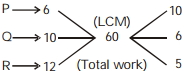
$P$,$Q$ and $R$ contracted to do a work for $Rs. 4200$. $P$ can do the work in $6$ days,$Q$ in $10$ days and $R$ in $12$ days. If they work together to do the work,what is the share of $R$ (in $Rs.$)?
A
$2000$
B
$1200$
C
$1000$
D
$1500$
Solution
(C) The work done by $P$,$Q$,and $R$ in one day is proportional to their efficiency.
Efficiency of $P = 1/6$,$Q = 1/10$,$R = 1/12$.
Ratio of efficiencies $= 1/6 : 1/10 : 1/12$.
To simplify,multiply by the $LCM$ of $6, 10, 12$,which is $60$.
Ratio $= (60/6) : (60/10) : (60/12) = 10 : 6 : 5$.
Total parts $= 10 + 6 + 5 = 21$.
Share of $R = (5 / 21) \times 4200 = 5 \times 200 = Rs. 1000$.
Efficiency of $P = 1/6$,$Q = 1/10$,$R = 1/12$.
Ratio of efficiencies $= 1/6 : 1/10 : 1/12$.
To simplify,multiply by the $LCM$ of $6, 10, 12$,which is $60$.
Ratio $= (60/6) : (60/10) : (60/12) = 10 : 6 : 5$.
Total parts $= 10 + 6 + 5 = 21$.
Share of $R = (5 / 21) \times 4200 = 5 \times 200 = Rs. 1000$.
0 likes
View Solution72
DifficultMCQ
If $8$ men or $10$ women can do a piece of work in $50$ days,in what time will $28$ men and $15$ women do it? (in days)
A
$14 \frac{2}{7}$
B
$33 \frac{1}{7}$
C
$18 \frac{3}{4}$
D
$10$
Solution
(D) Given that $8$ men $= 10$ women,which implies $4$ men $= 5$ women.
Since $8$ men can complete the work in $50$ days,the total work is $8 \times 50 = 400$ man-days.
We need to find the time taken by $28$ men and $15$ women.
Convert the group into a single unit (women):
$28$ men $= (28 / 4) \times 5 = 7 \times 5 = 35$ women.
Total group $= 35$ women $+ 15$ women $= 50$ women.
Since $10$ women take $50$ days,$50$ women will take $D$ days.
Using the formula $M_1 D_1 = M_2 D_2$:
$10 \times 50 = 50 \times D$
$D = (10 \times 50) / 50 = 10$ days.
Since $8$ men can complete the work in $50$ days,the total work is $8 \times 50 = 400$ man-days.
We need to find the time taken by $28$ men and $15$ women.
Convert the group into a single unit (women):
$28$ men $= (28 / 4) \times 5 = 7 \times 5 = 35$ women.
Total group $= 35$ women $+ 15$ women $= 50$ women.
Since $10$ women take $50$ days,$50$ women will take $D$ days.
Using the formula $M_1 D_1 = M_2 D_2$:
$10 \times 50 = 50 \times D$
$D = (10 \times 50) / 50 = 10$ days.
0 likes
View Solution73
DifficultMCQ
If $3$ men and $4$ boys can earn $Rs. 2100$ in $7$ days,and $11$ men and $13$ boys can earn $Rs. 8300$ in $8$ days,in what time will $7$ men and $9$ boys earn $Rs. 11000$? (in days)
A
$16$
B
$18$
C
$14$
D
$20$
Solution
(A) Let the daily wage of $1$ man be $m$ and the daily wage of $1$ boy be $b$.
From the first condition:
$(3m + 4b) \times 7 = 2100 \Rightarrow 3m + 4b = 300$ .....$(i)$
From the second condition:
$(11m + 13b) \times 8 = 8300 \Rightarrow 11m + 13b = 1037.5$ .....$(ii)$
Multiply equation $(i)$ by $11$ and equation $(ii)$ by $3$:
$33m + 44b = 3300$ .....$(iii)$
$33m + 39b = 3112.5$ .....$(iv)$
Subtracting $(iv)$ from $(iii)$:
$5b = 187.5 \Rightarrow b = 37.5$
Substitute $b = 37.5$ into $(i)$:
$3m + 4(37.5) = 300 \Rightarrow 3m + 150 = 300 \Rightarrow 3m = 150 \Rightarrow m = 50$
Daily earnings of $7$ men and $9$ boys $= 7(50) + 9(37.5) = 350 + 337.5 = 687.5$.
Number of days required $= \frac{11000}{687.5} = 16$ days.
From the first condition:
$(3m + 4b) \times 7 = 2100 \Rightarrow 3m + 4b = 300$ .....$(i)$
From the second condition:
$(11m + 13b) \times 8 = 8300 \Rightarrow 11m + 13b = 1037.5$ .....$(ii)$
Multiply equation $(i)$ by $11$ and equation $(ii)$ by $3$:
$33m + 44b = 3300$ .....$(iii)$
$33m + 39b = 3112.5$ .....$(iv)$
Subtracting $(iv)$ from $(iii)$:
$5b = 187.5 \Rightarrow b = 37.5$
Substitute $b = 37.5$ into $(i)$:
$3m + 4(37.5) = 300 \Rightarrow 3m + 150 = 300 \Rightarrow 3m = 150 \Rightarrow m = 50$
Daily earnings of $7$ men and $9$ boys $= 7(50) + 9(37.5) = 350 + 337.5 = 687.5$.
Number of days required $= \frac{11000}{687.5} = 16$ days.
0 likes
View Solution74
MediumMCQ
There is sufficient food for $400$ men for $31$ days. After $28$ days,$280$ men leave the place. For how many days will the rest of the food last for the rest of the men? (in days)
A
$5$
B
$10$
C
$12$
D
$15$
Solution
(B) Total food available is for $400$ men for $31$ days.
After $28$ days,the food consumed is for $400$ men for $28$ days.
The remaining food is enough for $400$ men for $(31 - 28) = 3$ days.
Number of men remaining $= 400 - 280 = 120$.
Let the remaining food last for $x$ days for $120$ men.
Since the total amount of food is constant,we use the relation: $M_1 \times D_1 = M_2 \times D_2$.
$400 \times 3 = 120 \times x$.
$1200 = 120x$.
$x = 1200 / 120 = 10$ days.
After $28$ days,the food consumed is for $400$ men for $28$ days.
The remaining food is enough for $400$ men for $(31 - 28) = 3$ days.
Number of men remaining $= 400 - 280 = 120$.
Let the remaining food last for $x$ days for $120$ men.
Since the total amount of food is constant,we use the relation: $M_1 \times D_1 = M_2 \times D_2$.
$400 \times 3 = 120 \times x$.
$1200 = 120x$.
$x = 1200 / 120 = 10$ days.
0 likes
View Solution75
EasyMCQ
If $28$ men complete $\frac{7}{8}$ of a piece of work in a week,then the number of men,who must be engaged to get the remaining work completed in another week is
A
$5$
B
$6$
C
$4$
D
$3$
Solution
(C) We use the formula $\frac{M_1 D_1}{W_1} = \frac{M_2 D_2}{W_2}$,where $M$ is the number of men,$D$ is the number of days (or weeks),and $W$ is the work done.
Given: $M_1 = 28$,$D_1 = 1$ week,$W_1 = \frac{7}{8}$.
Remaining work $W_2 = 1 - \frac{7}{8} = \frac{1}{8}$.
Time for remaining work $D_2 = 1$ week.
Let $x$ be the number of men required.
Substituting the values: $\frac{28 \times 1}{7/8} = \frac{x \times 1}{1/8}$.
$\frac{28 \times 8}{7} = x \times 8$.
$4 \times 8 = x \times 8$.
$x = 4$.
Thus,$4$ men are required to complete the remaining work.
Given: $M_1 = 28$,$D_1 = 1$ week,$W_1 = \frac{7}{8}$.
Remaining work $W_2 = 1 - \frac{7}{8} = \frac{1}{8}$.
Time for remaining work $D_2 = 1$ week.
Let $x$ be the number of men required.
Substituting the values: $\frac{28 \times 1}{7/8} = \frac{x \times 1}{1/8}$.
$\frac{28 \times 8}{7} = x \times 8$.
$4 \times 8 = x \times 8$.
$x = 4$.
Thus,$4$ men are required to complete the remaining work.
0 likes
View Solution76
MediumMCQ
$A$ contractor undertakes to dig a canal $12 \, km$ long in $350 \, days$ and employs $45$ men. After $200 \, days$ he finds that only $4.5 \, km$ of the canal has been completed. Find the number of extra men he must employ to finish the work in time (in $men$).
A
$45$
B
$55$
C
$65$
D
$75$
Solution
(B) The formula for work completion is $\frac{M_1 D_1}{W_1} = \frac{M_2 D_2}{W_2}$.
Given:
$M_1 = 45$ men,
$D_1 = 200$ days,
$W_1 = 4.5 \, km$.
Remaining work $W_2 = 12 - 4.5 = 7.5 \, km$.
Remaining time $D_2 = 350 - 200 = 150$ days.
Let $M_2$ be the total number of men required to complete the remaining work in time.
Substituting the values:
$\frac{45 \times 200}{4.5} = \frac{M_2 \times 150}{7.5}$
$M_2 = \frac{45 \times 200 \times 7.5}{4.5 \times 150}$
$M_2 = \frac{45 \times 200 \times 7.5}{675}$
$M_2 = 100$ men.
Extra men required $= M_2 - M_1 = 100 - 45 = 55$ men.
Given:
$M_1 = 45$ men,
$D_1 = 200$ days,
$W_1 = 4.5 \, km$.
Remaining work $W_2 = 12 - 4.5 = 7.5 \, km$.
Remaining time $D_2 = 350 - 200 = 150$ days.
Let $M_2$ be the total number of men required to complete the remaining work in time.
Substituting the values:
$\frac{45 \times 200}{4.5} = \frac{M_2 \times 150}{7.5}$
$M_2 = \frac{45 \times 200 \times 7.5}{4.5 \times 150}$
$M_2 = \frac{45 \times 200 \times 7.5}{675}$
$M_2 = 100$ men.
Extra men required $= M_2 - M_1 = 100 - 45 = 55$ men.
0 likes
View Solution77
DifficultMCQ
$A$ and $B$ undertook to do a piece of work for $Rs. 4500$. $A$ alone could do it in $8$ days and $B$ alone in $12$ days. With the assistance of $C$,they finished the work in $4$ days. Then,$C$'s share of the money is (in $Rs.$)
A
$2250$
B
$1500$
C
$750$
D
$375$
Solution
(C) Total money $= Rs. 4500$.
$A$'s one day's work $= \frac{1}{8}$.
$B$'s one day's work $= \frac{1}{12}$.
$(A+B+C)$'s one day's work $= \frac{1}{4}$.
$C$'s one day's work $= \frac{1}{4} - (\frac{1}{8} + \frac{1}{12}) = \frac{1}{4} - (\frac{3+2}{24}) = \frac{1}{4} - \frac{5}{24} = \frac{6-5}{24} = \frac{1}{24}$.
Ratio of their one day's work $A:B:C = \frac{1}{8} : \frac{1}{12} : \frac{1}{24} = 3:2:1$ (by taking $LCM$ as $24$).
Sum of the ratio $= 3+2+1 = 6$.
$C$'s share $= (\frac{1}{6} \times 4500) = Rs. 750$.
$A$'s one day's work $= \frac{1}{8}$.
$B$'s one day's work $= \frac{1}{12}$.
$(A+B+C)$'s one day's work $= \frac{1}{4}$.
$C$'s one day's work $= \frac{1}{4} - (\frac{1}{8} + \frac{1}{12}) = \frac{1}{4} - (\frac{3+2}{24}) = \frac{1}{4} - \frac{5}{24} = \frac{6-5}{24} = \frac{1}{24}$.
Ratio of their one day's work $A:B:C = \frac{1}{8} : \frac{1}{12} : \frac{1}{24} = 3:2:1$ (by taking $LCM$ as $24$).
Sum of the ratio $= 3+2+1 = 6$.
$C$'s share $= (\frac{1}{6} \times 4500) = Rs. 750$.
0 likes
View Solution78
DifficultMCQ
$A$ can do a piece of work in $16$ days and $B$ in $24$ days. They take the help of $C$ and all three together finish the work in $6$ days. If the total remuneration for the work is $Rs. 400$,what is the amount (in $Rs.$) each will receive in proportion to the work done?
A
$A: 150, B: 100, C: 150$
B
$A: 100, B: 150, C: 150$
C
$A: 150, B: 150, C: 150$
D
$A: 100, B: 150, C: 100$
Solution
(A) Work done by $A$ in $1$ day $= 1/16$.
Work done by $B$ in $1$ day $= 1/24$.
Work done by $A, B,$ and $C$ in $1$ day $= 1/6$.
Work done by $C$ in $1$ day $= (A+B+C)$'s $1$ day work $- (A+B)$'s $1$ day work.
$1/C = 1/6 - (1/16 + 1/24) = 1/6 - (3+2)/48 = 1/6 - 5/48 = (8-5)/48 = 3/48 = 1/16$.
The ratio of work done by $A, B,$ and $C$ is $1/16 : 1/24 : 1/16$.
To simplify,multiply by $48$: $48/16 : 48/24 : 48/16 = 3 : 2 : 3$.
Total parts $= 3 + 2 + 3 = 8$.
Share of $A = (3/8) \times 400 = Rs. 150$.
Share of $B = (2/8) \times 400 = Rs. 100$.
Share of $C = (3/8) \times 400 = Rs. 150$.
Work done by $B$ in $1$ day $= 1/24$.
Work done by $A, B,$ and $C$ in $1$ day $= 1/6$.
Work done by $C$ in $1$ day $= (A+B+C)$'s $1$ day work $- (A+B)$'s $1$ day work.
$1/C = 1/6 - (1/16 + 1/24) = 1/6 - (3+2)/48 = 1/6 - 5/48 = (8-5)/48 = 3/48 = 1/16$.
The ratio of work done by $A, B,$ and $C$ is $1/16 : 1/24 : 1/16$.
To simplify,multiply by $48$: $48/16 : 48/24 : 48/16 = 3 : 2 : 3$.
Total parts $= 3 + 2 + 3 = 8$.
Share of $A = (3/8) \times 400 = Rs. 150$.
Share of $B = (2/8) \times 400 = Rs. 100$.
Share of $C = (3/8) \times 400 = Rs. 150$.
0 likes
View Solution79
MediumMCQ
$A, B$ and $C$ completed a work costing $Rs. 1800$. $A$ worked for $6$ days,$B$ for $4$ days and $C$ for $9$ days. If their daily wages are in the ratio of $5: 6: 4$,how much amount will be received by $A$ (in $Rs.$)?
A
$800$
B
$600$
C
$900$
D
$750$
Solution
(B) Total money $= Rs. 1800$.
The ratio of daily wages of $A, B$ and $C$ is $5: 6: 4$.
The total work done by each person is proportional to the product of their daily wage and the number of days worked.
Ratio of total earnings $= (5 \times 6) : (6 \times 4) : (4 \times 9) = 30 : 24 : 36$.
Simplifying the ratio by dividing by $6$,we get $5 : 4 : 6$.
Sum of ratio parts $= 5 + 4 + 6 = 15$.
Amount received by $A = \frac{5}{15} \times 1800 = \frac{1}{3} \times 1800 = Rs. 600$.
The ratio of daily wages of $A, B$ and $C$ is $5: 6: 4$.
The total work done by each person is proportional to the product of their daily wage and the number of days worked.
Ratio of total earnings $= (5 \times 6) : (6 \times 4) : (4 \times 9) = 30 : 24 : 36$.
Simplifying the ratio by dividing by $6$,we get $5 : 4 : 6$.
Sum of ratio parts $= 5 + 4 + 6 = 15$.
Amount received by $A = \frac{5}{15} \times 1800 = \frac{1}{3} \times 1800 = Rs. 600$.
0 likes
View Solution80
MediumMCQ
$A$ man can do a work in $10\, days$. With the help of a boy,he can do the same work in $6\, days$. If they get $Rs.\, 50$ for that work,what is the share of that boy? (in $Rs.$)
A
$20$
B
$40$
C
$50$
D
$60$
Solution
(A) man can complete a work in $10\, days$.
(Man + boy) can complete the same work in $6\, days$.
Let the total work be the Least Common Multiple of $10$ and $6$,which is $30\, units$.
Efficiency of the man $= 30 / 10 = 3\, units/day$.
Efficiency of (man + boy) $= 30 / 6 = 5\, units/day$.
Efficiency of the boy $= 5 - 3 = 2\, units/day$.
Since wages are distributed in proportion to the work done,the share of the boy is calculated based on his efficiency relative to the total efficiency.
Share of the boy $= (2 / 5) \times 50 = Rs.\, 20$.
(Man + boy) can complete the same work in $6\, days$.
Let the total work be the Least Common Multiple of $10$ and $6$,which is $30\, units$.
Efficiency of the man $= 30 / 10 = 3\, units/day$.
Efficiency of (man + boy) $= 30 / 6 = 5\, units/day$.
Efficiency of the boy $= 5 - 3 = 2\, units/day$.
Since wages are distributed in proportion to the work done,the share of the boy is calculated based on his efficiency relative to the total efficiency.
Share of the boy $= (2 / 5) \times 50 = Rs.\, 20$.
0 likes
View Solution81
DifficultMCQ
$A$ $10\, \text{hectare}$ field is reaped by $2\, \text{men},$ $3\, \text{women},$ and $4\, \text{children}$ together in $10\, \text{days}.$ If the working capabilities of a man, a woman, and a child are in the ratio $5: 4: 2,$ then a $16\, \text{hectare}$ field will be reaped by $6\, \text{men},$ $4\, \text{women},$ and $7\, \text{children}$ in how many days?
A
$5$
B
$6$
C
$7$
D
$8$
Solution
(D) Let the efficiency of a man, a woman, and a child be $5k, 4k,$ and $2k$ respectively.
Total work done by $(2\, \text{men} + 3\, \text{women} + 4\, \text{children})$ in $10\, \text{days}$ is:
$\text{Work} = (2 \times 5k + 3 \times 4k + 4 \times 2k) \times 10 = (10k + 12k + 8k) \times 10 = 30k \times 10 = 300k$.
Given that this work corresponds to $10\, \text{hectares},$ so $10\, \text{hectares} = 300k,$ which means $1\, \text{hectare} = 30k$.
Now, we need to reap $16\, \text{hectares},$ which is equivalent to $16 \times 30k = 480k$ units of work.
The group of $(6\, \text{men} + 4\, \text{women} + 7\, \text{children})$ has a daily efficiency of:
$\text{Efficiency} = (6 \times 5k + 4 \times 4k + 7 \times 2k) = (30k + 16k + 14k) = 60k$.
Let the number of days required be $x$.
$\text{Total Work} = \text{Efficiency} \times \text{Days} \rightarrow 480k = 60k \times x$.
$x = \frac{480k}{60k} = 8\, \text{days}$.
Total work done by $(2\, \text{men} + 3\, \text{women} + 4\, \text{children})$ in $10\, \text{days}$ is:
$\text{Work} = (2 \times 5k + 3 \times 4k + 4 \times 2k) \times 10 = (10k + 12k + 8k) \times 10 = 30k \times 10 = 300k$.
Given that this work corresponds to $10\, \text{hectares},$ so $10\, \text{hectares} = 300k,$ which means $1\, \text{hectare} = 30k$.
Now, we need to reap $16\, \text{hectares},$ which is equivalent to $16 \times 30k = 480k$ units of work.
The group of $(6\, \text{men} + 4\, \text{women} + 7\, \text{children})$ has a daily efficiency of:
$\text{Efficiency} = (6 \times 5k + 4 \times 4k + 7 \times 2k) = (30k + 16k + 14k) = 60k$.
Let the number of days required be $x$.
$\text{Total Work} = \text{Efficiency} \times \text{Days} \rightarrow 480k = 60k \times x$.
$x = \frac{480k}{60k} = 8\, \text{days}$.
0 likes
View Solution82
MediumMCQ
$A$ can do a certain work in the same time in which $B$ and $C$ together can do it. If $A$ and $B$ together could do it in $10$ days and $C$ alone in $50$ days,then $B$ alone could do the work in (in days)
A
$15$
B
$20$
C
$25$
D
$30$
Solution
(C) Let the work done by $A$ in $1$ day be $a$,by $B$ be $b$,and by $C$ be $c$.
Given that $A$ does the work in the same time as $B$ and $C$ together,so $a = b + c$.
Given $(A+B)$'s $1$ day work is $\frac{1}{10}$,so $a + b = \frac{1}{10}$.
Given $C$'s $1$ day work is $c = \frac{1}{50}$.
Since $a = b + c$,we substitute $b = a - c$ into the equation $a + b = \frac{1}{10}$:
$a + (a - c) = \frac{1}{10}$
$2a - c = \frac{1}{10}$
$2a - \frac{1}{50} = \frac{1}{10}$
$2a = \frac{1}{10} + \frac{1}{50} = \frac{5+1}{50} = \frac{6}{50} = \frac{3}{25}$
$a = \frac{3}{50}$.
Now,find $b$ using $a + b = \frac{1}{10}$:
$b = \frac{1}{10} - a = \frac{1}{10} - \frac{3}{50} = \frac{5-3}{50} = \frac{2}{50} = \frac{1}{25}$.
Thus,$B$ alone can complete the work in $25$ days.
Given that $A$ does the work in the same time as $B$ and $C$ together,so $a = b + c$.
Given $(A+B)$'s $1$ day work is $\frac{1}{10}$,so $a + b = \frac{1}{10}$.
Given $C$'s $1$ day work is $c = \frac{1}{50}$.
Since $a = b + c$,we substitute $b = a - c$ into the equation $a + b = \frac{1}{10}$:
$a + (a - c) = \frac{1}{10}$
$2a - c = \frac{1}{10}$
$2a - \frac{1}{50} = \frac{1}{10}$
$2a = \frac{1}{10} + \frac{1}{50} = \frac{5+1}{50} = \frac{6}{50} = \frac{3}{25}$
$a = \frac{3}{50}$.
Now,find $b$ using $a + b = \frac{1}{10}$:
$b = \frac{1}{10} - a = \frac{1}{10} - \frac{3}{50} = \frac{5-3}{50} = \frac{2}{50} = \frac{1}{25}$.
Thus,$B$ alone can complete the work in $25$ days.
0 likes
View Solution83
DifficultMCQ
One man,$3$ women,and $4$ boys can do a work in $96$ hours,$2$ men and $8$ boys can do it in $80$ hours,and $2$ men and $3$ women can do it in $120$ hours. In how many hours can it be done by $5$ men and $12$ boys? (in hours)
A
$41 \frac{5}{11}$
B
$43 \frac{7}{11}$
C
$43 \frac{5}{11}$
D
$42 \frac{7}{11}$
Solution
(B) Let $M, W, B$ be the work done by $1$ man,$1$ woman,and $1$ boy in $1$ hour respectively.
From the given data:
$1M + 3W + 4B = \frac{1}{96}$ ...$(i)$
$2M + 8B = \frac{1}{80} \implies 1M + 4B = \frac{1}{160}$ ...$(ii)$
$2M + 3W = \frac{1}{120}$ ...$(iii)$
Subtracting $(ii)$ from $(i)$:
$(1M + 3W + 4B) - (1M + 4B) = \frac{1}{96} - \frac{1}{160}$
$3W = \frac{5-3}{480} = \frac{2}{480} = \frac{1}{240}$
So,$3$ women can do the work in $240$ hours.
From $(iii)$,$2M = \frac{1}{120} - 3W = \frac{1}{120} - \frac{1}{240} = \frac{2-1}{240} = \frac{1}{240}$.
So,$2$ men can do the work in $240$ hours,which means $1$ man can do it in $480$ hours.
From $(ii)$,$4B = \frac{1}{160} - 1M = \frac{1}{160} - \frac{1}{480} = \frac{3-1}{480} = \frac{2}{480} = \frac{1}{240}$.
So,$4$ boys can do the work in $240$ hours,which means $1$ boy can do it in $960$ hours.
Now,for $5$ men and $12$ boys:
Work per hour $= 5 \times (\frac{1}{480}) + 12 \times (\frac{1}{960}) = \frac{5}{480} + \frac{12}{960} = \frac{10}{960} + \frac{12}{960} = \frac{22}{960} = \frac{11}{480}$.
Time taken $= \frac{480}{11} = 43 \frac{7}{11}$ hours.
From the given data:
$1M + 3W + 4B = \frac{1}{96}$ ...$(i)$
$2M + 8B = \frac{1}{80} \implies 1M + 4B = \frac{1}{160}$ ...$(ii)$
$2M + 3W = \frac{1}{120}$ ...$(iii)$
Subtracting $(ii)$ from $(i)$:
$(1M + 3W + 4B) - (1M + 4B) = \frac{1}{96} - \frac{1}{160}$
$3W = \frac{5-3}{480} = \frac{2}{480} = \frac{1}{240}$
So,$3$ women can do the work in $240$ hours.
From $(iii)$,$2M = \frac{1}{120} - 3W = \frac{1}{120} - \frac{1}{240} = \frac{2-1}{240} = \frac{1}{240}$.
So,$2$ men can do the work in $240$ hours,which means $1$ man can do it in $480$ hours.
From $(ii)$,$4B = \frac{1}{160} - 1M = \frac{1}{160} - \frac{1}{480} = \frac{3-1}{480} = \frac{2}{480} = \frac{1}{240}$.
So,$4$ boys can do the work in $240$ hours,which means $1$ boy can do it in $960$ hours.
Now,for $5$ men and $12$ boys:
Work per hour $= 5 \times (\frac{1}{480}) + 12 \times (\frac{1}{960}) = \frac{5}{480} + \frac{12}{960} = \frac{10}{960} + \frac{12}{960} = \frac{22}{960} = \frac{11}{480}$.
Time taken $= \frac{480}{11} = 43 \frac{7}{11}$ hours.
0 likes
View Solution84
MediumMCQ
$40$ men can complete a work in $40$ days. They started the work together. But at the end of each $10^{th}$ day,$5$ men left the job. The work would have been completed in (in days):
A
$56 \frac{2}{3}$
B
$56 \frac{1}{3}$
C
$52$
D
$50$
Solution
(A) Total work = $40 \times 40 = 1600$ man-days.
Work done in first $10$ days by $40$ men = $40 \times 10 = 400$ units.
Work done in next $10$ days by $35$ men = $35 \times 10 = 350$ units.
Work done in next $10$ days by $30$ men = $30 \times 10 = 300$ units.
Work done in next $10$ days by $25$ men = $25 \times 10 = 250$ units.
Work done in next $10$ days by $20$ men = $20 \times 10 = 200$ units.
Total work done in $50$ days = $400 + 350 + 300 + 250 + 200 = 1500$ units.
Remaining work = $1600 - 1500 = 100$ units.
Now,$15$ men are left. Time taken to complete the remaining work = $\frac{100}{15} = \frac{20}{3} = 6 \frac{2}{3}$ days.
Total time = $50 + 6 \frac{2}{3} = 56 \frac{2}{3}$ days.
Work done in first $10$ days by $40$ men = $40 \times 10 = 400$ units.
Work done in next $10$ days by $35$ men = $35 \times 10 = 350$ units.
Work done in next $10$ days by $30$ men = $30 \times 10 = 300$ units.
Work done in next $10$ days by $25$ men = $25 \times 10 = 250$ units.
Work done in next $10$ days by $20$ men = $20 \times 10 = 200$ units.
Total work done in $50$ days = $400 + 350 + 300 + 250 + 200 = 1500$ units.
Remaining work = $1600 - 1500 = 100$ units.
Now,$15$ men are left. Time taken to complete the remaining work = $\frac{100}{15} = \frac{20}{3} = 6 \frac{2}{3}$ days.
Total time = $50 + 6 \frac{2}{3} = 56 \frac{2}{3}$ days.
0 likes
View Solution85
MediumMCQ
$3$ women and $18$ children together take $2$ days to complete a piece of work. How many days will $9$ children alone take to complete the piece of work,if $6$ women alone can complete the piece of work in $3$ days?
A
$9$
B
$7$
C
$5$
D
$6$
Solution
(D) Let the work done by $1$ woman in $1$ day be $W$ and by $1$ child in $1$ day be $C$.
Given that $6$ women complete the work in $3$ days,the total work is $6 \times 3 = 18$ units (in terms of woman-days).
Thus,$1$ woman's $1$ day work $= 1/18$ of the total work.
Given that $3$ women and $18$ children complete the work in $2$ days,their combined $1$ day work is $1/2$.
So,$3(1/18) + 18C = 1/2$.
$1/6 + 18C = 1/2$.
$18C = 1/2 - 1/6 = 3/6 - 1/6 = 2/6 = 1/3$.
$C = 1/(3 \times 18) = 1/54$.
This means $1$ child completes $1/54$ of the work in $1$ day.
Therefore,$9$ children will complete $9 \times (1/54) = 9/54 = 1/6$ of the work in $1$ day.
To complete the whole work,$9$ children will take $1 / (1/6) = 6$ days.
Given that $6$ women complete the work in $3$ days,the total work is $6 \times 3 = 18$ units (in terms of woman-days).
Thus,$1$ woman's $1$ day work $= 1/18$ of the total work.
Given that $3$ women and $18$ children complete the work in $2$ days,their combined $1$ day work is $1/2$.
So,$3(1/18) + 18C = 1/2$.
$1/6 + 18C = 1/2$.
$18C = 1/2 - 1/6 = 3/6 - 1/6 = 2/6 = 1/3$.
$C = 1/(3 \times 18) = 1/54$.
This means $1$ child completes $1/54$ of the work in $1$ day.
Therefore,$9$ children will complete $9 \times (1/54) = 9/54 = 1/6$ of the work in $1$ day.
To complete the whole work,$9$ children will take $1 / (1/6) = 6$ days.
0 likes
View Solution86
DifficultMCQ
$A$ can do a piece of work in $120$ days and $B$ can do it in $150$ days. They work together for $20$ days. Then $B$ leaves and $A$ alone continues the work. After $12$ days,$C$ joins $A$ and the work is completed in $48$ days more. In how many days can $C$ do it if he works alone?
A
$230$
B
$225$
C
$240$
D
$220$
Solution
(C) 's $1$ day's work $= \frac{1}{120}$.
$B$'s $1$ day's work $= \frac{1}{150}$.
$(A+B)$'s $1$ day's work $= \frac{1}{120} + \frac{1}{150} = \frac{5+4}{600} = \frac{9}{600} = \frac{3}{200}$.
$(A+B)$ work together for $20$ days,so work done $= 20 \times \frac{3}{200} = \frac{3}{10}$.
After $B$ leaves,$A$ works alone for $12$ days. $A$'s $12$ day's work $= 12 \times \frac{1}{120} = \frac{1}{10}$.
Then $C$ joins $A$ and they work for $48$ days to complete the remaining work.
$A$'s work during these $48$ days $= 48 \times \frac{1}{120} = \frac{2}{5}$.
Total work done by $A$ and $B$ before $C$ joined $= \frac{3}{10} + \frac{1}{10} = \frac{4}{10} = \frac{2}{5}$.
Total work done by $A$ in the final $48$ days $= \frac{2}{5}$.
Total work done by $A$ and $B$ throughout $= \frac{3}{10} + \frac{1}{10} + \frac{2}{5} = \frac{4}{10} + \frac{4}{10} = \frac{8}{10} = \frac{4}{5}$.
Remaining work $= 1 - \frac{4}{5} = \frac{1}{5}$.
This remaining work is done by $C$ in $48$ days.
$C$'s $1$ day's work $= \frac{1/5}{48} = \frac{1}{240}$.
Therefore,$C$ alone can finish the work in $240$ days.
$B$'s $1$ day's work $= \frac{1}{150}$.
$(A+B)$'s $1$ day's work $= \frac{1}{120} + \frac{1}{150} = \frac{5+4}{600} = \frac{9}{600} = \frac{3}{200}$.
$(A+B)$ work together for $20$ days,so work done $= 20 \times \frac{3}{200} = \frac{3}{10}$.
After $B$ leaves,$A$ works alone for $12$ days. $A$'s $12$ day's work $= 12 \times \frac{1}{120} = \frac{1}{10}$.
Then $C$ joins $A$ and they work for $48$ days to complete the remaining work.
$A$'s work during these $48$ days $= 48 \times \frac{1}{120} = \frac{2}{5}$.
Total work done by $A$ and $B$ before $C$ joined $= \frac{3}{10} + \frac{1}{10} = \frac{4}{10} = \frac{2}{5}$.
Total work done by $A$ in the final $48$ days $= \frac{2}{5}$.
Total work done by $A$ and $B$ throughout $= \frac{3}{10} + \frac{1}{10} + \frac{2}{5} = \frac{4}{10} + \frac{4}{10} = \frac{8}{10} = \frac{4}{5}$.
Remaining work $= 1 - \frac{4}{5} = \frac{1}{5}$.
This remaining work is done by $C$ in $48$ days.
$C$'s $1$ day's work $= \frac{1/5}{48} = \frac{1}{240}$.
Therefore,$C$ alone can finish the work in $240$ days.
0 likes
View Solution87
DifficultMCQ
$2$ men and $1$ woman can do a piece of work in $14$ days,while $4$ women and $2$ men can do the same work in $8$ days. If a man gets $Rs. 90$ per day,what should be the wages per day of a woman? (in $Rs.$)
A
$48$
B
$60$
C
$72$
D
$135$
Solution
(B) Let the efficiency of $1$ man be $m$ and $1$ woman be $w$ units of work per day.
According to the problem:
$14(2m + 1w) = 1$ (Total work) ...$(i)$
$8(2m + 4w) = 1$ (Total work) ...$(ii)$
Equating $(i)$ and $(ii)$:
$14(2m + w) = 8(2m + 4w)$
$28m + 14w = 16m + 32w$
$28m - 16m = 32w - 14w$
$12m = 18w$
$\frac{m}{w} = \frac{18}{12} = \frac{3}{2}$
The ratio of the efficiency of a man to a woman is $3:2$. Since wages are proportional to the work done (efficiency),the ratio of their daily wages will also be $3:2$.
Let the daily wage of a woman be $x$.
$\frac{90}{x} = \frac{3}{2}$
$3x = 180$
$x = 60$
Therefore,the daily wage of a woman is $Rs. 60$.
According to the problem:
$14(2m + 1w) = 1$ (Total work) ...$(i)$
$8(2m + 4w) = 1$ (Total work) ...$(ii)$
Equating $(i)$ and $(ii)$:
$14(2m + w) = 8(2m + 4w)$
$28m + 14w = 16m + 32w$
$28m - 16m = 32w - 14w$
$12m = 18w$
$\frac{m}{w} = \frac{18}{12} = \frac{3}{2}$
The ratio of the efficiency of a man to a woman is $3:2$. Since wages are proportional to the work done (efficiency),the ratio of their daily wages will also be $3:2$.
Let the daily wage of a woman be $x$.
$\frac{90}{x} = \frac{3}{2}$
$3x = 180$
$x = 60$
Therefore,the daily wage of a woman is $Rs. 60$.
0 likes
View Solution88
MediumMCQ
Heena can do a work in $20$ days,while Himani can do the same work in $25$ days. They started the work jointly. $A$ few days later,Mayuri also joined them,and thus all of them completed the whole work in $10$ days. All of them were paid a total of $Rs. 700$. What is the share of Mayuri (in $Rs.$)?
A
$130$
B
$185$
C
$70$
D
$80$
Solution
(C) Efficiency of Heena $= 1/20$ of the work per day.
Efficiency of Himani $= 1/25$ of the work per day.
Since Heena and Himani worked for the entire $10$ days,the work done by them is:
Work done by Heena $= 10 \times (1/20) = 1/2 = 50\%$ of the total work.
Work done by Himani $= 10 \times (1/25) = 10/25 = 2/5 = 40\%$ of the total work.
Total work done by Heena and Himani $= 50\% + 40\% = 90\%$.
Remaining work done by Mayuri $= 100\% - 90\% = 10\%$.
Since wages are distributed based on the work done,Mayuri's share $= 10\%$ of $Rs. 700 = Rs. 70$.
Efficiency of Himani $= 1/25$ of the work per day.
Since Heena and Himani worked for the entire $10$ days,the work done by them is:
Work done by Heena $= 10 \times (1/20) = 1/2 = 50\%$ of the total work.
Work done by Himani $= 10 \times (1/25) = 10/25 = 2/5 = 40\%$ of the total work.
Total work done by Heena and Himani $= 50\% + 40\% = 90\%$.
Remaining work done by Mayuri $= 100\% - 90\% = 10\%$.
Since wages are distributed based on the work done,Mayuri's share $= 10\%$ of $Rs. 700 = Rs. 70$.
0 likes
View Solution89
MediumMCQ
$A$ and $B$ can complete a piece of work in $12$ and $18 \text{ days}$ respectively. $A$ begins to do the work and they work alternatively one at a time for $1 \text{ day}$ each. The whole work will be completed in (in $\text{days}$):
A
$14\frac{1}{3}$
B
$15\frac{2}{3}$
C
$16\frac{1}{3}$
D
$18\frac{2}{3}$
Solution
(A) 's $1 \text{ day}$'s work $= \frac{1}{12}$.
$B$'s $1 \text{ day}$'s work $= \frac{1}{18}$.
Part of work done by $A$ and $B$ in the first $2 \text{ days} = \frac{1}{12} + \frac{1}{18} = \frac{3+2}{36} = \frac{5}{36}$.
In $14 \text{ days}$ ($7$ cycles of $2 \text{ days}$),the work done $= 7 \times \frac{5}{36} = \frac{35}{36}$.
Remaining work $= 1 - \frac{35}{36} = \frac{1}{36}$.
On the $15^{\text{th}}$ day,$A$ works. Since $A$ completes $\frac{1}{12}$ work in $1 \text{ day}$,$A$ will complete $\frac{1}{36}$ work in $\frac{1}{36} \times 12 = \frac{1}{3} \text{ day}$.
Total time taken $= 14 + \frac{1}{3} = 14\frac{1}{3} \text{ days}$.
$B$'s $1 \text{ day}$'s work $= \frac{1}{18}$.
Part of work done by $A$ and $B$ in the first $2 \text{ days} = \frac{1}{12} + \frac{1}{18} = \frac{3+2}{36} = \frac{5}{36}$.
In $14 \text{ days}$ ($7$ cycles of $2 \text{ days}$),the work done $= 7 \times \frac{5}{36} = \frac{35}{36}$.
Remaining work $= 1 - \frac{35}{36} = \frac{1}{36}$.
On the $15^{\text{th}}$ day,$A$ works. Since $A$ completes $\frac{1}{12}$ work in $1 \text{ day}$,$A$ will complete $\frac{1}{36}$ work in $\frac{1}{36} \times 12 = \frac{1}{3} \text{ day}$.
Total time taken $= 14 + \frac{1}{3} = 14\frac{1}{3} \text{ days}$.
0 likes
View Solution90
MediumMCQ
$A, B$ and $C$ can do a piece of work individually in $8, 10$ and $15$ days respectively. $A$ and $B$ start working,but $A$ quits after working for $2$ days. After this,$C$ joins $B$ until the completion of the work. In how many days will the work be completed?
A
$\frac{53}{9}$
B
$\frac{34}{7}$
C
$\frac{85}{13}$
D
$\frac{53}{10}$
Solution
(D) $(A + B)$'s $2$ days' work $= 2 \times (\frac{1}{8} + \frac{1}{10}) = 2 \times \frac{5+4}{40} = 2 \times \frac{9}{40} = \frac{9}{20}$.
Remaining work $= 1 - \frac{9}{20} = \frac{11}{20}$.
$(B + C)$'s $1$ day's work $= \frac{1}{10} + \frac{1}{15} = \frac{3+2}{30} = \frac{5}{30} = \frac{1}{6}$.
Days taken by $B$ and $C$ to complete the remaining work $= \frac{\text{Remaining work}}{\text{Efficiency of } (B+C)} = \frac{11/20}{1/6} = \frac{11}{20} \times 6 = \frac{33}{10}$ days.
Total days to complete the work $= 2 + \frac{33}{10} = \frac{20+33}{10} = \frac{53}{10}$ days.
Remaining work $= 1 - \frac{9}{20} = \frac{11}{20}$.
$(B + C)$'s $1$ day's work $= \frac{1}{10} + \frac{1}{15} = \frac{3+2}{30} = \frac{5}{30} = \frac{1}{6}$.
Days taken by $B$ and $C$ to complete the remaining work $= \frac{\text{Remaining work}}{\text{Efficiency of } (B+C)} = \frac{11/20}{1/6} = \frac{11}{20} \times 6 = \frac{33}{10}$ days.
Total days to complete the work $= 2 + \frac{33}{10} = \frac{20+33}{10} = \frac{53}{10}$ days.
0 likes
View Solution91
DifficultMCQ
$A$ can complete a work in $10$ days,$B$ can complete the same work in $20$ days,and $C$ in $40$ days. $A$ starts working on the first day,$B$ works on the second day,and $C$ works on the third day. Again,$A$ works on the fourth day,$B$ on the fifth day,and so on. If they continue working in the same way,in how many days will the work be completed?
A
$15$
B
$16.5$
C
$15.5$
D
$17$
Solution
(B) 's work for the first day $= 1/10$.
$B$'s work for the second day $= 1/20$.
$C$'s work for the third day $= 1/40$.
Work done in $3$ days by them $= 1/10 + 1/20 + 1/40 = (4+2+1)/40 = 7/40$.
Hence,$7/40$ part of the work is completed in $3$ days.
In $15$ days ($5$ cycles of $3$ days),the work completed $= 5 \times (7/40) = 35/40 = 7/8$.
Remaining work $= 1 - 7/8 = 1/8$.
On the $16^{th}$ day,$A$ works. $A$ completes $1/10$ of the work.
Remaining work after $16$ days $= 1/8 - 1/10 = (5-4)/40 = 1/40$.
On the $17^{th}$ day,$B$ works. $B$ completes $1/20$ of the work in $1$ day.
Time taken by $B$ to complete $1/40$ of the work $= 20 \times (1/40) = 1/2$ day.
Total time $= 15 + 1 + 1/2 = 16.5$ days.
$B$'s work for the second day $= 1/20$.
$C$'s work for the third day $= 1/40$.
Work done in $3$ days by them $= 1/10 + 1/20 + 1/40 = (4+2+1)/40 = 7/40$.
Hence,$7/40$ part of the work is completed in $3$ days.
In $15$ days ($5$ cycles of $3$ days),the work completed $= 5 \times (7/40) = 35/40 = 7/8$.
Remaining work $= 1 - 7/8 = 1/8$.
On the $16^{th}$ day,$A$ works. $A$ completes $1/10$ of the work.
Remaining work after $16$ days $= 1/8 - 1/10 = (5-4)/40 = 1/40$.
On the $17^{th}$ day,$B$ works. $B$ completes $1/20$ of the work in $1$ day.
Time taken by $B$ to complete $1/40$ of the work $= 20 \times (1/40) = 1/2$ day.
Total time $= 15 + 1 + 1/2 = 16.5$ days.
0 likes
View Solution92
MediumMCQ
$A$ can complete a work in $10$ days,$B$ in $12$ days,and $C$ in $15$ days. All of them began the work together; but $A$ had to leave the work after $2$ days of the start and $B$ also left $3$ days before the completion of the work. How long did the work last? (in days)
A
$7$
B
$8$
C
$10$
D
$12$
Solution
(A) Let the total work be completed in $x$ days.
The work done by $A$ in $2$ days is $2 \times \frac{1}{10} = \frac{1}{5}$.
$B$ left $3$ days before the completion,so $B$ worked for $(x - 3)$ days. The work done by $B$ is $(x - 3) \times \frac{1}{12}$.
$C$ worked for the entire duration of $x$ days. The work done by $C$ is $x \times \frac{1}{15}$.
The sum of the work done by $A, B,$ and $C$ equals $1$ (the total work).
$\frac{1}{5} + \frac{x-3}{12} + \frac{x}{15} = 1$
Multiply the entire equation by the least common multiple of $5, 12,$ and $15$,which is $60$:
$12 + 5(x - 3) + 4x = 60$
$12 + 5x - 15 + 4x = 60$
$9x - 3 = 60$
$9x = 63$
$x = 7$ days.
Thus,the work lasted for $7$ days.
The work done by $A$ in $2$ days is $2 \times \frac{1}{10} = \frac{1}{5}$.
$B$ left $3$ days before the completion,so $B$ worked for $(x - 3)$ days. The work done by $B$ is $(x - 3) \times \frac{1}{12}$.
$C$ worked for the entire duration of $x$ days. The work done by $C$ is $x \times \frac{1}{15}$.
The sum of the work done by $A, B,$ and $C$ equals $1$ (the total work).
$\frac{1}{5} + \frac{x-3}{12} + \frac{x}{15} = 1$
Multiply the entire equation by the least common multiple of $5, 12,$ and $15$,which is $60$:
$12 + 5(x - 3) + 4x = 60$
$12 + 5x - 15 + 4x = 60$
$9x - 3 = 60$
$9x = 63$
$x = 7$ days.
Thus,the work lasted for $7$ days.
0 likes
View Solution93
MediumMCQ
$A$ piece of work was to be completed in $40$ days. $A$ number of men employed upon it did only half the work in $24$ days. $16$ more men were then set on,and the work was completed in the specified time. How many men were employed at first?
A
$16$
B
$32$
C
$24$
D
$48$
Solution
(B) Let $x$ be the number of men employed at first.
$x$ men complete $\frac{1}{2}$ of the work in $24$ days.
Therefore,$1$ man would complete the whole work in $24 \times 2 \times x = 48x$ days.
Now,$(x + 16)$ men do the remaining work $\left(1 - \frac{1}{2} = \frac{1}{2}\right)$ in $(40 - 24 = 16)$ days.
Therefore,$1$ man would complete the whole work in $16 \times 2 \times (x + 16) = 32(x + 16)$ days.
Since the total work is the same,we equate the two expressions:
$48x = 32(x + 16)$
$48x = 32x + 512$
$16x = 512$
$x = 32$.
Thus,$32$ men were employed at first.
$x$ men complete $\frac{1}{2}$ of the work in $24$ days.
Therefore,$1$ man would complete the whole work in $24 \times 2 \times x = 48x$ days.
Now,$(x + 16)$ men do the remaining work $\left(1 - \frac{1}{2} = \frac{1}{2}\right)$ in $(40 - 24 = 16)$ days.
Therefore,$1$ man would complete the whole work in $16 \times 2 \times (x + 16) = 32(x + 16)$ days.
Since the total work is the same,we equate the two expressions:
$48x = 32(x + 16)$
$48x = 32x + 512$
$16x = 512$
$x = 32$.
Thus,$32$ men were employed at first.
0 likes
View Solution94
DifficultMCQ
$A$ contract is to be completed in $50 \text{ days}$ and $105 \text{ men}$ were set to work,each working $8 \text{ hours a day}$. After $25 \text{ days}$,$\frac{2}{5}$ of the work is finished. How many additional men must be employed so that the work may be completed on time,with each man now working $9 \text{ hours a day}$?
A
$34$
B
$36$
C
$35$
D
$37$
Solution
(C) Using the formula: $\frac{M_1 D_1 H_1}{W_1} = \frac{M_2 D_2 H_2}{W_2}$
Given:
$M_1 = 105, D_1 = 25, H_1 = 8, W_1 = \frac{2}{5}$
Let the additional men be $x$.
Then,$M_2 = 105 + x, D_2 = 50 - 25 = 25, H_2 = 9, W_2 = 1 - \frac{2}{5} = \frac{3}{5}$
Substituting the values into the formula:
$\frac{105 \times 25 \times 8}{2/5} = \frac{(105 + x) \times 25 \times 9}{3/5}$
$\frac{105 \times 25 \times 8 \times 5}{2} = \frac{(105 + x) \times 25 \times 9 \times 5}{3}$
$105 \times 4 = (105 + x) \times 3$
$420 = 315 + 3x$
$3x = 105$
$x = 35$
Therefore,$35$ additional men must be employed.
Given:
$M_1 = 105, D_1 = 25, H_1 = 8, W_1 = \frac{2}{5}$
Let the additional men be $x$.
Then,$M_2 = 105 + x, D_2 = 50 - 25 = 25, H_2 = 9, W_2 = 1 - \frac{2}{5} = \frac{3}{5}$
Substituting the values into the formula:
$\frac{105 \times 25 \times 8}{2/5} = \frac{(105 + x) \times 25 \times 9}{3/5}$
$\frac{105 \times 25 \times 8 \times 5}{2} = \frac{(105 + x) \times 25 \times 9 \times 5}{3}$
$105 \times 4 = (105 + x) \times 3$
$420 = 315 + 3x$
$3x = 105$
$x = 35$
Therefore,$35$ additional men must be employed.
0 likes
View Solution95
MediumMCQ
$A$ can do a work in $5 \, \text{days}$ less than the time taken by $B$ to do it. If both of them together take $11 \frac{1}{9} \, \text{days}$, then the time taken by $B$ alone to do the same work (in $\text{days}$) is
A
$15$
B
$20$
C
$25$
D
$30$
Solution
(C) Let the time taken by $B$ to complete the work be $x \, \text{days}$.
Then, the time taken by $A$ to complete the work is $(x-5) \, \text{days}$.
Given that both together take $11 \frac{1}{9} = \frac{100}{9} \, \text{days}$.
The work done by $A$ and $B$ in one day is $\frac{1}{x-5} + \frac{1}{x} = \frac{9}{100}$.
Solving the equation: $\frac{x + x - 5}{x(x-5)} = \frac{9}{100}$.
$\frac{2x - 5}{x^2 - 5x} = \frac{9}{100}$.
$100(2x - 5) = 9(x^2 - 5x)$.
$200x - 500 = 9x^2 - 45x$.
$9x^2 - 245x + 500 = 0$.
Factoring the quadratic equation: $9x^2 - 225x - 20x + 500 = 0$.
$9x(x - 25) - 20(x - 25) = 0$.
$(9x - 20)(x - 25) = 0$.
So, $x = \frac{20}{9}$ or $x = 25$.
Since $x$ must be greater than $5$ (as $A$ takes $x-5$ days), we have $x = 25$.
Therefore, the time taken by $B$ alone is $25 \, \text{days}$.
Then, the time taken by $A$ to complete the work is $(x-5) \, \text{days}$.
Given that both together take $11 \frac{1}{9} = \frac{100}{9} \, \text{days}$.
The work done by $A$ and $B$ in one day is $\frac{1}{x-5} + \frac{1}{x} = \frac{9}{100}$.
Solving the equation: $\frac{x + x - 5}{x(x-5)} = \frac{9}{100}$.
$\frac{2x - 5}{x^2 - 5x} = \frac{9}{100}$.
$100(2x - 5) = 9(x^2 - 5x)$.
$200x - 500 = 9x^2 - 45x$.
$9x^2 - 245x + 500 = 0$.
Factoring the quadratic equation: $9x^2 - 225x - 20x + 500 = 0$.
$9x(x - 25) - 20(x - 25) = 0$.
$(9x - 20)(x - 25) = 0$.
So, $x = \frac{20}{9}$ or $x = 25$.
Since $x$ must be greater than $5$ (as $A$ takes $x-5$ days), we have $x = 25$.
Therefore, the time taken by $B$ alone is $25 \, \text{days}$.
0 likes
View Solution96
DifficultMCQ
$A$ and $B$ can complete a piece of work in $45$ and $40$ days respectively. Both started to work together,but after some days $A$ left and $B$ alone completed the remaining work in $23$ days. For how many days did $A$ work?
A
$12$
B
$10$
C
$8$
D
$9$
Solution
(D) Let $A$ work for $x$ days.
$A$'s $1$ day's work $= \frac{1}{45}$.
$B$'s $1$ day's work $= \frac{1}{40}$.
Both $A$ and $B$ worked together for $x$ days.
Work done by $(A+B)$ in $x$ days $= x \times (\frac{1}{45} + \frac{1}{40}) = x \times (\frac{8+9}{360}) = \frac{17x}{360}$.
Remaining work $= 1 - \frac{17x}{360} = \frac{360-17x}{360}$.
This remaining work is completed by $B$ in $23$ days.
So,$23 \times (\text{B's } 1 \text{ day's work}) = \frac{360-17x}{360}$.
$23 \times \frac{1}{40} = \frac{360-17x}{360}$.
$\frac{23}{40} = \frac{360-17x}{360}$.
$23 \times 9 = 360 - 17x$.
$207 = 360 - 17x$.
$17x = 360 - 207 = 153$.
$x = \frac{153}{17} = 9$ days.
Therefore,$A$ worked for $9$ days.
$A$'s $1$ day's work $= \frac{1}{45}$.
$B$'s $1$ day's work $= \frac{1}{40}$.
Both $A$ and $B$ worked together for $x$ days.
Work done by $(A+B)$ in $x$ days $= x \times (\frac{1}{45} + \frac{1}{40}) = x \times (\frac{8+9}{360}) = \frac{17x}{360}$.
Remaining work $= 1 - \frac{17x}{360} = \frac{360-17x}{360}$.
This remaining work is completed by $B$ in $23$ days.
So,$23 \times (\text{B's } 1 \text{ day's work}) = \frac{360-17x}{360}$.
$23 \times \frac{1}{40} = \frac{360-17x}{360}$.
$\frac{23}{40} = \frac{360-17x}{360}$.
$23 \times 9 = 360 - 17x$.
$207 = 360 - 17x$.
$17x = 360 - 207 = 153$.
$x = \frac{153}{17} = 9$ days.
Therefore,$A$ worked for $9$ days.
0 likes
View Solution97
MediumMCQ
$4$ men and $6$ women together can complete a work in $8$ days,while $3$ men and $7$ women together can complete it in $10$ days. How many days will $20$ women working together take to complete the same work?
A
$36$
B
$32$
C
$24$
D
$20$
Solution
(D) Let $m$ be the work done by one man per day and $w$ be the work done by one woman per day.
According to the problem:
$8(4m + 6w) = 10(3m + 7w)$
$32m + 48w = 30m + 70w$
$2m = 22w \Rightarrow m = 11w$
Now,calculate the total work in terms of women:
Total work = $8(4m + 6w) = 8(4(11w) + 6w) = 8(44w + 6w) = 8(50w) = 400w$
If $20$ women work together,the time taken $D_2$ is:
$D_2 = \frac{\text{Total work}}{20w} = \frac{400w}{20w} = 20$ days.
According to the problem:
$8(4m + 6w) = 10(3m + 7w)$
$32m + 48w = 30m + 70w$
$2m = 22w \Rightarrow m = 11w$
Now,calculate the total work in terms of women:
Total work = $8(4m + 6w) = 8(4(11w) + 6w) = 8(44w + 6w) = 8(50w) = 400w$
If $20$ women work together,the time taken $D_2$ is:
$D_2 = \frac{\text{Total work}}{20w} = \frac{400w}{20w} = 20$ days.
0 likes
View Solution98
MediumMCQ
Two workers $A$ and $B$ working together completed a job in $5$ days. If $A$ worked twice as efficiently as he actually did and $B$ worked $\frac{1}{3}$ as efficiently as he actually did,the work would have completed in $3$ days. Find the time for $A$ to complete the job alone (in days).
A
$6 \frac{1}{2}$
B
$6 \frac{1}{4}$
C
$6 \frac{3}{4}$
D
$12 \frac{1}{2}$
Solution
(B) Let the efficiency of $A$ be $a$ and $B$ be $b$ units per day.
Total work $= 5(a + b)$.
According to the second condition,the work is completed in $3$ days with efficiencies $2a$ and $\frac{b}{3}$.
So,$3(2a + \frac{b}{3}) = 5(a + b)$.
$6a + b = 5a + 5b$.
$a = 4b$,which means $\frac{a}{b} = \frac{4}{1}$.
Total work $= 5(4 + 1) = 25$ units.
Time taken by $A$ alone $= \frac{\text{Total Work}}{\text{Efficiency of } A} = \frac{25}{4} = 6 \frac{1}{4}$ days.
Total work $= 5(a + b)$.
According to the second condition,the work is completed in $3$ days with efficiencies $2a$ and $\frac{b}{3}$.
So,$3(2a + \frac{b}{3}) = 5(a + b)$.
$6a + b = 5a + 5b$.
$a = 4b$,which means $\frac{a}{b} = \frac{4}{1}$.
Total work $= 5(4 + 1) = 25$ units.
Time taken by $A$ alone $= \frac{\text{Total Work}}{\text{Efficiency of } A} = \frac{25}{4} = 6 \frac{1}{4}$ days.
0 likes
View Solution99
DifficultMCQ
$A$ contract is to be completed in $92$ days and $234$ men were set to work,each working $16$ hours a day. After $66$ days,$\frac{4}{7}$ of the work is completed. How many additional men may be employed,so that the work may be completed in time,each man now working $18$ hours a day?
A
$162$
B
$234$
C
$262$
D
$81$
Solution
(A) Remaining work $= (1 - \frac{4}{7}) = \frac{3}{7}$.
Remaining period $= (92 - 66) = 26$ days.
Let the number of additional men be $x$.
Using the formula $\frac{M_1 D_1 H_1}{W_1} = \frac{M_2 D_2 H_2}{W_2}$:
$M_1 = 234, D_1 = 66, H_1 = 16, W_1 = \frac{4}{7}$.
$M_2 = (234 + x), D_2 = 26, H_2 = 18, W_2 = \frac{3}{7}$.
Substituting the values:
$\frac{234 \times 66 \times 16}{4/7} = \frac{(234 + x) \times 26 \times 18}{3/7}$.
$234 \times 66 \times 16 \times 3 = (234 + x) \times 26 \times 18 \times 4$.
$234 + x = \frac{234 \times 66 \times 16 \times 3}{26 \times 18 \times 4}$.
$234 + x = 9 \times 11 \times 4 = 396$.
$x = 396 - 234 = 162$.
Therefore,$162$ additional men are required.
Remaining period $= (92 - 66) = 26$ days.
Let the number of additional men be $x$.
Using the formula $\frac{M_1 D_1 H_1}{W_1} = \frac{M_2 D_2 H_2}{W_2}$:
$M_1 = 234, D_1 = 66, H_1 = 16, W_1 = \frac{4}{7}$.
$M_2 = (234 + x), D_2 = 26, H_2 = 18, W_2 = \frac{3}{7}$.
Substituting the values:
$\frac{234 \times 66 \times 16}{4/7} = \frac{(234 + x) \times 26 \times 18}{3/7}$.
$234 \times 66 \times 16 \times 3 = (234 + x) \times 26 \times 18 \times 4$.
$234 + x = \frac{234 \times 66 \times 16 \times 3}{26 \times 18 \times 4}$.
$234 + x = 9 \times 11 \times 4 = 396$.
$x = 396 - 234 = 162$.
Therefore,$162$ additional men are required.
0 likes
View Solution100
MediumMCQ
$A, B$ and $C$ can complete a piece of work in $15, 30$ and $40$ days respectively. They started the work together,but $A$ left $2$ days before the completion of the work and $B$ left $4$ days before the completion of the work. In how many days was the work completed?
A
$7\frac{3}{10}$
B
$10\frac{2}{15}$
C
$10\frac{7}{10}$
D
$10\frac{7}{15}$
Solution
(B) $1$. Calculate the efficiency of each person:
Efficiency of $A = 120 / 15 = 8$ units/day.
Efficiency of $B = 120 / 30 = 4$ units/day.
Efficiency of $C = 120 / 40 = 3$ units/day.
$2$. Assume $A$ and $B$ did not leave the work. Add the work they would have done if they had stayed until the end:
Work done by $A$ in $2$ days $= 2 \times 8 = 16$ units.
Work done by $B$ in $4$ days $= 4 \times 4 = 16$ units.
$3$. Calculate the new total work:
Total work $= 120 + 16 + 16 = 152$ units.
$4$. Calculate the total time taken by $A, B$ and $C$ working together:
Combined efficiency $= 8 + 4 + 3 = 15$ units/day.
Total time $= 152 / 15 = 10\frac{2}{15}$ days.
Efficiency of $A = 120 / 15 = 8$ units/day.
Efficiency of $B = 120 / 30 = 4$ units/day.
Efficiency of $C = 120 / 40 = 3$ units/day.
$2$. Assume $A$ and $B$ did not leave the work. Add the work they would have done if they had stayed until the end:
Work done by $A$ in $2$ days $= 2 \times 8 = 16$ units.
Work done by $B$ in $4$ days $= 4 \times 4 = 16$ units.
$3$. Calculate the new total work:
Total work $= 120 + 16 + 16 = 152$ units.
$4$. Calculate the total time taken by $A, B$ and $C$ working together:
Combined efficiency $= 8 + 4 + 3 = 15$ units/day.
Total time $= 152 / 15 = 10\frac{2}{15}$ days.
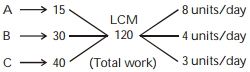
0 likes
View SolutionTime and Work and Wages — Time and Work · Frequently Asked Questions
1Are these Time and Work and Wages questions useful for JEE and NEET?
Yes. All questions in this section are mapped to JEE Main and NEET exam patterns. Previous year questions from JEE Main, NEET, GUJCET and state-level exams are included with full solutions.
2Can I switch to Hindi or Gujarati for these questions?
Yes. Use the language tabs in the hero section or the sidebar to view the same questions and solutions in English, Hindi or Gujarati.
3How do I generate a question paper from this subtopic?
Use the Vedclass Exam Paper Generator — select the chapter and subtopic, set difficulty, and generate Sets A, B, C, D automatically. First 3 chapters of every subject are free.
Vedclass Products
For Students
Vedclass Test Series
Mock tests in real JEE/NEET style with performance analysis. 5-day free trial.
Start Free TrialFor Teachers
Exam Paper Generator
Generate Set A/B/C/D papers from this chapter in 2 minutes. 3 chapters free.
Try FreeFor Institutes
Online Exam Module
Live online exams with unlimited students, 360° analytics & white-label branding.
See DemoFor Teachers & Institutes
Generate a Time and Work and Wages Exam Paper in 2 Minutes
Select subtopic & difficulty — Sets A, B, C, D auto-generated with No Repeat logic.
First 3 chapters of every subject are free — no payment required.