
A English
Heights and Distances Questions in English
Competitive Exam Quantitative Aptitude · Heights and Distances · Heights and Distances
73+
Questions
English
Language
100%
With Solutions
Showing 23 of 73 questions in English
51
MediumMCQ
If $x = a \cos \theta + b \sin \theta$ and $y = b \cos \theta - a \sin \theta,$ then $x^{2} + y^{2}$ is equal to
A
$ab$
B
$a^{2} + b^{2}$
C
$a^{2} - b^{2}$
D
$1$
Solution
(B) Given:
$x = a \cos \theta + b \sin \theta$
$y = b \cos \theta - a \sin \theta$
Squaring both equations:
$x^{2} = (a \cos \theta + b \sin \theta)^{2} = a^{2} \cos^{2} \theta + b^{2} \sin^{2} \theta + 2ab \sin \theta \cos \theta$
$y^{2} = (b \cos \theta - a \sin \theta)^{2} = b^{2} \cos^{2} \theta + a^{2} \sin^{2} \theta - 2ab \cos \theta \sin \theta$
Adding $x^{2}$ and $y^{2}$:
$x^{2} + y^{2} = (a^{2} \cos^{2} \theta + b^{2} \sin^{2} \theta + 2ab \sin \theta \cos \theta) + (b^{2} \cos^{2} \theta + a^{2} \sin^{2} \theta - 2ab \cos \theta \sin \theta)$
$x^{2} + y^{2} = a^{2} (\cos^{2} \theta + \sin^{2} \theta) + b^{2} (\sin^{2} \theta + \cos^{2} \theta)$
Since $\sin^{2} \theta + \cos^{2} \theta = 1$,we get:
$x^{2} + y^{2} = a^{2}(1) + b^{2}(1) = a^{2} + b^{2}$
$x = a \cos \theta + b \sin \theta$
$y = b \cos \theta - a \sin \theta$
Squaring both equations:
$x^{2} = (a \cos \theta + b \sin \theta)^{2} = a^{2} \cos^{2} \theta + b^{2} \sin^{2} \theta + 2ab \sin \theta \cos \theta$
$y^{2} = (b \cos \theta - a \sin \theta)^{2} = b^{2} \cos^{2} \theta + a^{2} \sin^{2} \theta - 2ab \cos \theta \sin \theta$
Adding $x^{2}$ and $y^{2}$:
$x^{2} + y^{2} = (a^{2} \cos^{2} \theta + b^{2} \sin^{2} \theta + 2ab \sin \theta \cos \theta) + (b^{2} \cos^{2} \theta + a^{2} \sin^{2} \theta - 2ab \cos \theta \sin \theta)$
$x^{2} + y^{2} = a^{2} (\cos^{2} \theta + \sin^{2} \theta) + b^{2} (\sin^{2} \theta + \cos^{2} \theta)$
Since $\sin^{2} \theta + \cos^{2} \theta = 1$,we get:
$x^{2} + y^{2} = a^{2}(1) + b^{2}(1) = a^{2} + b^{2}$
0 likes
View Solution52
EasyMCQ
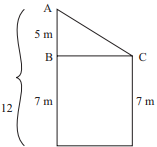
Two poles of height $7 \ m$ and $12 \ m$ stand on a plane ground. If the distance between their feet is $12 \ m$,the distance between their tops will be (in $m$):
A
$13$
B
$19$
C
$17$
D
$15$
Solution
(A) Let the heights of the two poles be $h_1 = 12 \ m$ and $h_2 = 7 \ m$. The distance between their feet is $d = 12 \ m$.
When we draw a horizontal line from the top of the shorter pole to the taller pole,we form a right-angled triangle.
The base of this triangle is equal to the distance between the poles,which is $12 \ m$.
The vertical height of this triangle is the difference between the heights of the two poles: $12 \ m - 7 \ m = 5 \ m$.
Using the Pythagorean theorem,the distance between the tops $(AC)$ is:
$AC^2 = (12)^2 + (5)^2$
$AC^2 = 144 + 25 = 169$
$AC = \sqrt{169} = 13 \ m$.
When we draw a horizontal line from the top of the shorter pole to the taller pole,we form a right-angled triangle.
The base of this triangle is equal to the distance between the poles,which is $12 \ m$.
The vertical height of this triangle is the difference between the heights of the two poles: $12 \ m - 7 \ m = 5 \ m$.
Using the Pythagorean theorem,the distance between the tops $(AC)$ is:
$AC^2 = (12)^2 + (5)^2$
$AC^2 = 144 + 25 = 169$
$AC = \sqrt{169} = 13 \ m$.
0 likes
View Solution53
EasyMCQ
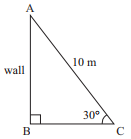
$A$ $10 \ m$ long ladder is placed against a wall. It is inclined at an angle of $30^{\circ}$ to the ground. The distance (in $m$) of the foot of the ladder from the wall is (Given $\sqrt{3} = 1.732$)
A
$7.32$
B
$8.26$
C
$8.66$
D
$8.16$
Solution
(C) Let the ladder be $AC$,where $AC = 10 \ m$. Let the wall be $AB$ and the ground be $BC$. The ladder makes an angle of $30^{\circ}$ with the ground,so $\angle C = 30^{\circ}$.
In the right-angled triangle $ABC$,we need to find the distance of the foot of the ladder from the wall,which is $BC$.
Using the trigonometric ratio $\cos \theta = \frac{\text{base}}{\text{hypotenuse}}$:
$\cos 30^{\circ} = \frac{BC}{AC}$
$\frac{\sqrt{3}}{2} = \frac{BC}{10}$
$BC = 10 \times \frac{\sqrt{3}}{2} = 5 \times \sqrt{3}$
Given $\sqrt{3} = 1.732$,we have:
$BC = 5 \times 1.732 = 8.66 \ m$.
In the right-angled triangle $ABC$,we need to find the distance of the foot of the ladder from the wall,which is $BC$.
Using the trigonometric ratio $\cos \theta = \frac{\text{base}}{\text{hypotenuse}}$:
$\cos 30^{\circ} = \frac{BC}{AC}$
$\frac{\sqrt{3}}{2} = \frac{BC}{10}$
$BC = 10 \times \frac{\sqrt{3}}{2} = 5 \times \sqrt{3}$
Given $\sqrt{3} = 1.732$,we have:
$BC = 5 \times 1.732 = 8.66 \ m$.
0 likes
View Solution54
EasyMCQ
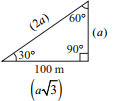
The angle of elevation of a tower from a distance of $100 \ m$ from its foot is $30^{\circ}$. Then the height of the tower is (in $m$):
A
$100 \sqrt{3}$
B
$\frac{50}{\sqrt{3}}$
C
$50 \sqrt{3}$
D
$\frac{100}{\sqrt{3}}$
Solution
(D) Let the height of the tower be $h$ meters.
Given that the distance from the foot of the tower is $100 \ m$ and the angle of elevation is $30^{\circ}$.
In a right-angled triangle,$\tan(\theta) = \frac{\text{opposite side}}{\text{adjacent side}}$.
Here,$\tan(30^{\circ}) = \frac{h}{100}$.
We know that $\tan(30^{\circ}) = \frac{1}{\sqrt{3}}$.
So,$\frac{1}{\sqrt{3}} = \frac{h}{100}$.
Therefore,$h = \frac{100}{\sqrt{3}} \ m$.
Given that the distance from the foot of the tower is $100 \ m$ and the angle of elevation is $30^{\circ}$.
In a right-angled triangle,$\tan(\theta) = \frac{\text{opposite side}}{\text{adjacent side}}$.
Here,$\tan(30^{\circ}) = \frac{h}{100}$.
We know that $\tan(30^{\circ}) = \frac{1}{\sqrt{3}}$.
So,$\frac{1}{\sqrt{3}} = \frac{h}{100}$.
Therefore,$h = \frac{100}{\sqrt{3}} \ m$.
0 likes
View Solution55
MediumMCQ
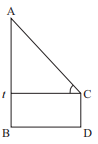
$A$ person of height $6 \ ft$ wants to pluck a fruit which is on a $\frac{26}{3} \ ft$ high tree. If the person is standing $\frac{8}{\sqrt{3}} \ ft$ away from the base of the tree,then at what angle should he throw a stone so that it hits the fruit (in $^{\circ}$)?
A
$45$
B
$60$
C
$75$
D
$30$
Solution
(D) Let the height of the person be $CD = 6 \ ft$.
Let the height of the tree be $AB = \frac{26}{3} \ ft$.
The distance between the person and the tree is $BD = \frac{8}{\sqrt{3}} \ ft$.
Let $E$ be a point on $AB$ such that $CE$ is parallel to $BD$. Thus,$BE = CD = 6 \ ft$.
The height of the fruit above the person's eye level is $AE = AB - BE = \frac{26}{3} - 6 = \frac{26 - 18}{3} = \frac{8}{3} \ ft$.
The horizontal distance is $CE = BD = \frac{8}{\sqrt{3}} \ ft$.
In the right-angled triangle $\Delta AEC$,$\tan \theta = \frac{AE}{CE}$.
$\tan \theta = \frac{8/3}{8/\sqrt{3}} = \frac{8}{3} \times \frac{\sqrt{3}}{8} = \frac{\sqrt{3}}{3} = \frac{1}{\sqrt{3}}$.
Since $\tan \theta = \frac{1}{\sqrt{3}}$,we have $\theta = 30^{\circ}$.
Let the height of the tree be $AB = \frac{26}{3} \ ft$.
The distance between the person and the tree is $BD = \frac{8}{\sqrt{3}} \ ft$.
Let $E$ be a point on $AB$ such that $CE$ is parallel to $BD$. Thus,$BE = CD = 6 \ ft$.
The height of the fruit above the person's eye level is $AE = AB - BE = \frac{26}{3} - 6 = \frac{26 - 18}{3} = \frac{8}{3} \ ft$.
The horizontal distance is $CE = BD = \frac{8}{\sqrt{3}} \ ft$.
In the right-angled triangle $\Delta AEC$,$\tan \theta = \frac{AE}{CE}$.
$\tan \theta = \frac{8/3}{8/\sqrt{3}} = \frac{8}{3} \times \frac{\sqrt{3}}{8} = \frac{\sqrt{3}}{3} = \frac{1}{\sqrt{3}}$.
Since $\tan \theta = \frac{1}{\sqrt{3}}$,we have $\theta = 30^{\circ}$.
0 likes
View Solution56
MediumMCQ
$A$ kite is flying at a height of $75 \ m$ from the ground. The string makes an angle $\Theta$ (where $\cot \Theta = 8/15$) with the level ground. Assuming that there is no slack in the string,the length of the string is equal to (in $m$):
A
$75$
B
$85$
C
$40$
D
$65$
Solution
(B) Let the height of the kite from the ground be $AB = 75 \ m$.
Let the angle made by the string with the ground be $\angle ACB = \Theta$.
Given that $\cot \Theta = 8/15$.
In the right-angled triangle $\triangle ABC$,$\cot \Theta = \frac{\text{Base}}{\text{Perpendicular}} = \frac{BC}{AB}$.
Therefore,$\frac{BC}{75} = \frac{8}{15}$.
$BC = \frac{8 \times 75}{15} = 8 \times 5 = 40 \ m$.
The length of the string is the hypotenuse $AC$.
Using the Pythagorean theorem,$AC = \sqrt{AB^2 + BC^2}$.
$AC = \sqrt{75^2 + 40^2} = \sqrt{5625 + 1600} = \sqrt{7225}$.
$AC = 85 \ m$.
Let the angle made by the string with the ground be $\angle ACB = \Theta$.
Given that $\cot \Theta = 8/15$.
In the right-angled triangle $\triangle ABC$,$\cot \Theta = \frac{\text{Base}}{\text{Perpendicular}} = \frac{BC}{AB}$.
Therefore,$\frac{BC}{75} = \frac{8}{15}$.
$BC = \frac{8 \times 75}{15} = 8 \times 5 = 40 \ m$.
The length of the string is the hypotenuse $AC$.
Using the Pythagorean theorem,$AC = \sqrt{AB^2 + BC^2}$.
$AC = \sqrt{75^2 + 40^2} = \sqrt{5625 + 1600} = \sqrt{7225}$.
$AC = 85 \ m$.

0 likes
View Solution57
EasyMCQ
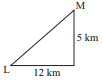
If a person travels from a point $L$,towards east for $12 \ km$ and then travels $5 \ km$ towards north and reaches a point $M$,then the shortest distance from $L$ to $M$ is: (in $km$)
A
$14$
B
$12$
C
$17$
D
$13$
Solution
(D) The path taken by the person forms a right-angled triangle where the base is $12 \ km$ (east) and the perpendicular is $5 \ km$ (north).
The shortest distance between the starting point $L$ and the final point $M$ is the hypotenuse of this right-angled triangle.
Using the Pythagorean theorem:
$\text{Shortest distance} = \sqrt{(\text{base})^2 + (\text{perpendicular})^2}$
$= \sqrt{12^2 + 5^2}$
$= \sqrt{144 + 25}$
$= \sqrt{169}$
$= 13 \ km$
The shortest distance between the starting point $L$ and the final point $M$ is the hypotenuse of this right-angled triangle.
Using the Pythagorean theorem:
$\text{Shortest distance} = \sqrt{(\text{base})^2 + (\text{perpendicular})^2}$
$= \sqrt{12^2 + 5^2}$
$= \sqrt{144 + 25}$
$= \sqrt{169}$
$= 13 \ km$
0 likes
View Solution58
DifficultMCQ
From a point $P$ on the ground,the angle of elevation of the top of a $10 \ m$ tall building is $30^{\circ}$. $A$ flag is hoisted at the top of the building,and the angle of elevation of the top of the flagstaff from $P$ is $45^{\circ}$. Find the length of the flagstaff. (Take $\sqrt{3} = 1.732$) (In $m$)
A
$10(\sqrt{3}+2)$
B
$10(\sqrt{3}+1)$
C
$10 \sqrt{3}$
D
$7.32$
Solution
(D) Let the building be $BC = 10 \ m$ and the flagstaff be $AB$. Let $P$ be the point on the ground.
In $\Delta BCP$,$\tan 30^{\circ} = \frac{BC}{CP} = \frac{10}{CP}$.
Since $\tan 30^{\circ} = \frac{1}{\sqrt{3}}$,we have $\frac{1}{\sqrt{3}} = \frac{10}{CP}$,so $CP = 10\sqrt{3} \ m$.
In $\Delta ACP$,$\tan 45^{\circ} = \frac{AC}{CP} = \frac{AB + BC}{CP}$.
Since $\tan 45^{\circ} = 1$,we have $1 = \frac{AB + 10}{10\sqrt{3}}$.
Therefore,$AC = 10\sqrt{3} \ m$.
Length of flagstaff $AB = AC - BC = 10\sqrt{3} - 10$.
$AB = 10(1.732) - 10 = 17.32 - 10 = 7.32 \ m$.
In $\Delta BCP$,$\tan 30^{\circ} = \frac{BC}{CP} = \frac{10}{CP}$.
Since $\tan 30^{\circ} = \frac{1}{\sqrt{3}}$,we have $\frac{1}{\sqrt{3}} = \frac{10}{CP}$,so $CP = 10\sqrt{3} \ m$.
In $\Delta ACP$,$\tan 45^{\circ} = \frac{AC}{CP} = \frac{AB + BC}{CP}$.
Since $\tan 45^{\circ} = 1$,we have $1 = \frac{AB + 10}{10\sqrt{3}}$.
Therefore,$AC = 10\sqrt{3} \ m$.
Length of flagstaff $AB = AC - BC = 10\sqrt{3} - 10$.
$AB = 10(1.732) - 10 = 17.32 - 10 = 7.32 \ m$.
0 likes
View Solution59
DifficultMCQ
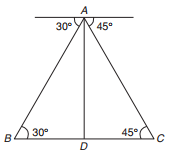
From the top of a tower of height $108 \; m$,the angles of depression of two objects on either side of the tower are $30^{\circ}$ and $45^{\circ}$. The distance between the objects is:
A
$108(3+\sqrt{3}) \; m$
B
$108(3-\sqrt{3}) \; m$
C
$108(\sqrt{3}-1) \; m$
D
$108(\sqrt{3}+1) \; m$
Solution
(D) Let $AD$ be the tower of height $108 \; m$,and $B$ and $C$ be the two objects on either side of the tower.
Given: $AD = 108 \; m$,$\angle ABD = 30^{\circ}$,and $\angle ACD = 45^{\circ}$.
In right-angled $\triangle ABD$:
$\tan 30^{\circ} = \frac{AD}{BD}$
$\frac{1}{\sqrt{3}} = \frac{108}{BD}$
$BD = 108\sqrt{3} \; m$
In right-angled $\triangle ADC$:
$\tan 45^{\circ} = \frac{AD}{DC}$
$1 = \frac{108}{DC}$
$DC = 108 \; m$
The distance between the objects is $BC = BD + DC$.
$BC = 108\sqrt{3} + 108 = 108(\sqrt{3} + 1) \; m$.
Given: $AD = 108 \; m$,$\angle ABD = 30^{\circ}$,and $\angle ACD = 45^{\circ}$.
In right-angled $\triangle ABD$:
$\tan 30^{\circ} = \frac{AD}{BD}$
$\frac{1}{\sqrt{3}} = \frac{108}{BD}$
$BD = 108\sqrt{3} \; m$
In right-angled $\triangle ADC$:
$\tan 45^{\circ} = \frac{AD}{DC}$
$1 = \frac{108}{DC}$
$DC = 108 \; m$
The distance between the objects is $BC = BD + DC$.
$BC = 108\sqrt{3} + 108 = 108(\sqrt{3} + 1) \; m$.
0 likes
View Solution60
EasyMCQ
The shadow of a tower standing on a level ground is found to be $40 \ m$ longer when the sun's altitude is $30^{\circ}$ than when it is $60^{\circ}$. Find the length of the tower. (In $m$)
A
$20$
B
$20 \sqrt{3}$
C
$10$
D
$10 \sqrt{3}$
Solution
(B) Let the height of the tower be $h \ m$.
Let the length of the shadow when the sun's altitude is $60^{\circ}$ be $x \ m$.
In the right-angled triangle formed by the tower and the shadow at $60^{\circ}$,we have $\tan 60^{\circ} = h / x$,so $x = h / \sqrt{3}$.
When the sun's altitude is $30^{\circ}$,the length of the shadow is $(x + 40) \ m$.
In the right-angled triangle formed by the tower and the shadow at $30^{\circ}$,we have $\tan 30^{\circ} = h / (x + 40)$,so $x + 40 = h / \tan 30^{\circ} = h \sqrt{3}$.
Substituting $x = h / \sqrt{3}$ into the equation: $h / \sqrt{3} + 40 = h \sqrt{3}$.
$40 = h \sqrt{3} - h / \sqrt{3} = h (\sqrt{3} - 1 / \sqrt{3}) = h ( (3 - 1) / \sqrt{3} ) = 2h / \sqrt{3}$.
$2h = 40 \sqrt{3}$,which gives $h = 20 \sqrt{3} \ m$.
Let the length of the shadow when the sun's altitude is $60^{\circ}$ be $x \ m$.
In the right-angled triangle formed by the tower and the shadow at $60^{\circ}$,we have $\tan 60^{\circ} = h / x$,so $x = h / \sqrt{3}$.
When the sun's altitude is $30^{\circ}$,the length of the shadow is $(x + 40) \ m$.
In the right-angled triangle formed by the tower and the shadow at $30^{\circ}$,we have $\tan 30^{\circ} = h / (x + 40)$,so $x + 40 = h / \tan 30^{\circ} = h \sqrt{3}$.
Substituting $x = h / \sqrt{3}$ into the equation: $h / \sqrt{3} + 40 = h \sqrt{3}$.
$40 = h \sqrt{3} - h / \sqrt{3} = h (\sqrt{3} - 1 / \sqrt{3}) = h ( (3 - 1) / \sqrt{3} ) = 2h / \sqrt{3}$.
$2h = 40 \sqrt{3}$,which gives $h = 20 \sqrt{3} \ m$.
0 likes
View Solution61
EasyMCQ
The length of the shadow of a tower is $9 \text{ m}$ when the sun's altitude is $30^{\circ}$. What is the height of the tower? (In $m$)
A
$4.5 \sqrt{3}$
B
$3 \sqrt{3}$
C
$4.5$
D
$9 \sqrt{3}$
Solution
(B) Let the height of the tower be $h$ and the length of the shadow be $L = 9 \text{ m}$.
Given the angle of elevation (sun's altitude) $\theta = 30^{\circ}$.
In a right-angled triangle formed by the tower and its shadow,we have $\tan \theta = \frac{\text{height}}{\text{shadow length}}$.
Substituting the values: $\tan 30^{\circ} = \frac{h}{9}$.
Since $\tan 30^{\circ} = \frac{1}{\sqrt{3}}$,we get $\frac{1}{\sqrt{3}} = \frac{h}{9}$.
Solving for $h$: $h = \frac{9}{\sqrt{3}} = \frac{9 \times \sqrt{3}}{\sqrt{3} \times \sqrt{3}} = \frac{9 \sqrt{3}}{3} = 3 \sqrt{3} \text{ m}$.
Given the angle of elevation (sun's altitude) $\theta = 30^{\circ}$.
In a right-angled triangle formed by the tower and its shadow,we have $\tan \theta = \frac{\text{height}}{\text{shadow length}}$.
Substituting the values: $\tan 30^{\circ} = \frac{h}{9}$.
Since $\tan 30^{\circ} = \frac{1}{\sqrt{3}}$,we get $\frac{1}{\sqrt{3}} = \frac{h}{9}$.
Solving for $h$: $h = \frac{9}{\sqrt{3}} = \frac{9 \times \sqrt{3}}{\sqrt{3} \times \sqrt{3}} = \frac{9 \sqrt{3}}{3} = 3 \sqrt{3} \text{ m}$.
0 likes
View Solution62
MediumMCQ
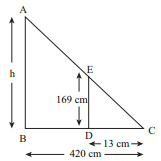
$A$ man having height $169 \; cm$ is standing near a pole. He casts a shadow $130 \; cm$ long. What is the length (in $cm$) of the pole if it casts a shadow $420 \; cm$ long?
A
$323$
B
$546$
C
$550$
D
$589$
Solution
(B) Let $AB = h$ be the height of the pole.
Let $DE = 169 \; cm$ be the height of the man.
Let $CD = 130 \; cm$ be the shadow of the man.
Let $BC = 420 \; cm$ be the shadow of the pole.
Since the sun's rays are parallel,$\Delta CED$ is similar to $\Delta ABC$ by $AA$ similarity criterion.
Therefore,the ratio of their corresponding sides is equal:
$\frac{DE}{AB} = \frac{CD}{BC}$
Substituting the given values:
$\frac{169}{h} = \frac{130}{420}$
$h = \frac{169 \times 420}{130}$
$h = \frac{169 \times 42}{13}$
$h = 13 \times 42$
$h = 546 \; cm$
Thus,the height of the pole is $546 \; cm$.
Let $DE = 169 \; cm$ be the height of the man.
Let $CD = 130 \; cm$ be the shadow of the man.
Let $BC = 420 \; cm$ be the shadow of the pole.
Since the sun's rays are parallel,$\Delta CED$ is similar to $\Delta ABC$ by $AA$ similarity criterion.
Therefore,the ratio of their corresponding sides is equal:
$\frac{DE}{AB} = \frac{CD}{BC}$
Substituting the given values:
$\frac{169}{h} = \frac{130}{420}$
$h = \frac{169 \times 420}{130}$
$h = \frac{169 \times 42}{13}$
$h = 13 \times 42$
$h = 546 \; cm$
Thus,the height of the pole is $546 \; cm$.
0 likes
View Solution63
MediumMCQ
From a point $20 \; m$ away from the foot of a tower,the angle of elevation of the top of the tower is $30^{\circ}$. The height of the tower is:
A
$\frac{10}{\sqrt{3}} \; m$
B
$\frac{20}{\sqrt{3}} \; m$
C
$10 \sqrt{3} \; m$
D
$20 \sqrt{3} \; m$
Solution
(B) Let $AB$ be the height of the tower and $C$ be the point on the ground.
Given that the distance from the foot of the tower $B$ to the point $C$ is $BC = 20 \; m$.
The angle of elevation $\angle ACB = 30^{\circ}$.
In the right-angled triangle $\triangle ABC$,we have:
$\tan(30^{\circ}) = \frac{\text{Perpendicular}}{\text{Base}} = \frac{AB}{BC}$
Since $\tan(30^{\circ}) = \frac{1}{\sqrt{3}}$,we get:
$\frac{1}{\sqrt{3}} = \frac{AB}{20}$
$AB = \frac{20}{\sqrt{3}} \; m$.
Therefore,the height of the tower is $\frac{20}{\sqrt{3}} \; m$.
Given that the distance from the foot of the tower $B$ to the point $C$ is $BC = 20 \; m$.
The angle of elevation $\angle ACB = 30^{\circ}$.
In the right-angled triangle $\triangle ABC$,we have:
$\tan(30^{\circ}) = \frac{\text{Perpendicular}}{\text{Base}} = \frac{AB}{BC}$
Since $\tan(30^{\circ}) = \frac{1}{\sqrt{3}}$,we get:
$\frac{1}{\sqrt{3}} = \frac{AB}{20}$
$AB = \frac{20}{\sqrt{3}} \; m$.
Therefore,the height of the tower is $\frac{20}{\sqrt{3}} \; m$.
0 likes
View Solution64
DifficultMCQ
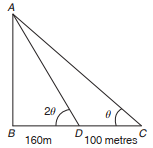
$A$ tower standing on a horizontal plane subtends a certain angle at a point $160 \; m$ apart from the foot of the tower. On advancing $100 \; m$ towards it,the tower is found to subtend an angle twice as before. The height of the tower is (in $m$):
A
$80$
B
$100$
C
$160$
D
$200$
Solution
(A) Let $AB$ be the tower of height $h \; m$.
Let $C$ be the initial point such that $BC = 160 \; m$ and $\angle ACB = \theta$.
After moving $100 \; m$ towards the tower,we reach point $D$,such that $CD = 100 \; m$. Thus,$BD = BC - CD = 160 - 100 = 60 \; m$.
At point $D$,the angle subtended is $2\theta$,so $\angle ADB = 2\theta$.
In $\triangle ABC$,$\tan \theta = \frac{AB}{BC} = \frac{h}{160}$.
In $\triangle ABD$,$\tan 2\theta = \frac{AB}{BD} = \frac{h}{60}$.
Using the formula $\tan 2\theta = \frac{2 \tan \theta}{1 - \tan^2 \theta}$,we have:
$\frac{h}{60} = \frac{2(h/160)}{1 - (h/160)^2}$.
$\frac{h}{60} = \frac{h/80}{1 - h^2/25600}$.
Dividing by $h$ (since $h \neq 0$):
$\frac{1}{60} = \frac{1/80}{(25600 - h^2)/25600} = \frac{25600}{80(25600 - h^2)} = \frac{320}{25600 - h^2}$.
$25600 - h^2 = 320 \times 60 = 19200$.
$h^2 = 25600 - 19200 = 6400$.
$h = \sqrt{6400} = 80 \; m$.
Let $C$ be the initial point such that $BC = 160 \; m$ and $\angle ACB = \theta$.
After moving $100 \; m$ towards the tower,we reach point $D$,such that $CD = 100 \; m$. Thus,$BD = BC - CD = 160 - 100 = 60 \; m$.
At point $D$,the angle subtended is $2\theta$,so $\angle ADB = 2\theta$.
In $\triangle ABC$,$\tan \theta = \frac{AB}{BC} = \frac{h}{160}$.
In $\triangle ABD$,$\tan 2\theta = \frac{AB}{BD} = \frac{h}{60}$.
Using the formula $\tan 2\theta = \frac{2 \tan \theta}{1 - \tan^2 \theta}$,we have:
$\frac{h}{60} = \frac{2(h/160)}{1 - (h/160)^2}$.
$\frac{h}{60} = \frac{h/80}{1 - h^2/25600}$.
Dividing by $h$ (since $h \neq 0$):
$\frac{1}{60} = \frac{1/80}{(25600 - h^2)/25600} = \frac{25600}{80(25600 - h^2)} = \frac{320}{25600 - h^2}$.
$25600 - h^2 = 320 \times 60 = 19200$.
$h^2 = 25600 - 19200 = 6400$.
$h = \sqrt{6400} = 80 \; m$.
0 likes
View Solution65
MediumMCQ
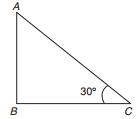
The angle of elevation of a tower from a distance $50 \; m$ from its foot is $30^{\circ}$. The height of the tower is
A
$50 \sqrt{3} \; m$
B
$\frac{50}{\sqrt{3}} \; m$
C
$75 \sqrt{3} \; m$
D
$\frac{75}{\sqrt{3}} \; m$
Solution
(B) Let $AB$ be the height of the tower,$h \; m$.
Let $C$ be the point at a distance of $50 \; m$ from the foot of the tower $B$.
Thus,$BC = 50 \; m$.
The angle of elevation is given as $\angle ACB = 30^{\circ}$.
In the right-angled triangle $\triangle ABC$,we have:
$\tan 30^{\circ} = \frac{\text{Perpendicular}}{\text{Base}} = \frac{AB}{BC}$
Substituting the values,we get:
$\frac{1}{\sqrt{3}} = \frac{h}{50}$
$h = \frac{50}{\sqrt{3}} \; m$.
Therefore,the height of the tower is $\frac{50}{\sqrt{3}} \; m$.
Let $C$ be the point at a distance of $50 \; m$ from the foot of the tower $B$.
Thus,$BC = 50 \; m$.
The angle of elevation is given as $\angle ACB = 30^{\circ}$.
In the right-angled triangle $\triangle ABC$,we have:
$\tan 30^{\circ} = \frac{\text{Perpendicular}}{\text{Base}} = \frac{AB}{BC}$
Substituting the values,we get:
$\frac{1}{\sqrt{3}} = \frac{h}{50}$
$h = \frac{50}{\sqrt{3}} \; m$.
Therefore,the height of the tower is $\frac{50}{\sqrt{3}} \; m$.
0 likes
View Solution66
MediumMCQ
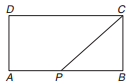
$ABCD$ is a rectangle where the ratio of the lengths of $AB$ and $BC$ is $3:2$. If $P$ is the midpoint of $AB$,then the value of $\sin(\angle CPB)$ is
A
$\frac{3}{5}$
B
$\frac{2}{5}$
C
$\frac{3}{4}$
D
$\frac{4}{5}$
Solution
(D) Let $AB = 3x$ units and $BC = 2x$ units.
Since $P$ is the midpoint of $AB$,$PB = \frac{AB}{2} = \frac{3x}{2}$ units.
In the right-angled triangle $\triangle CPB$,by the Pythagorean theorem:
$CP = \sqrt{PB^2 + BC^2} = \sqrt{(\frac{3x}{2})^2 + (2x)^2}$
$CP = \sqrt{\frac{9x^2}{4} + 4x^2} = \sqrt{\frac{9x^2 + 16x^2}{4}} = \sqrt{\frac{25x^2}{4}} = \frac{5x}{2}$ units.
Now,in $\triangle CPB$,$\sin(\angle CPB) = \frac{\text{Opposite side}}{\text{Hypotenuse}} = \frac{BC}{CP}$.
$\sin(\angle CPB) = \frac{2x}{\frac{5x}{2}} = 2x \cdot \frac{2}{5x} = \frac{4}{5}$.
Since $P$ is the midpoint of $AB$,$PB = \frac{AB}{2} = \frac{3x}{2}$ units.
In the right-angled triangle $\triangle CPB$,by the Pythagorean theorem:
$CP = \sqrt{PB^2 + BC^2} = \sqrt{(\frac{3x}{2})^2 + (2x)^2}$
$CP = \sqrt{\frac{9x^2}{4} + 4x^2} = \sqrt{\frac{9x^2 + 16x^2}{4}} = \sqrt{\frac{25x^2}{4}} = \frac{5x}{2}$ units.
Now,in $\triangle CPB$,$\sin(\angle CPB) = \frac{\text{Opposite side}}{\text{Hypotenuse}} = \frac{BC}{CP}$.
$\sin(\angle CPB) = \frac{2x}{\frac{5x}{2}} = 2x \cdot \frac{2}{5x} = \frac{4}{5}$.
0 likes
View Solution67
MediumMCQ
The expression $\frac{\sin A}{1+\cos A}+\frac{\sin A}{1-\cos A}$ is equal to:
A
$2 \operatorname{cosec} A$
B
$2 \sec A$
C
$2 \sin A$
D
$2 \cos A$
Solution
(A) To simplify the expression $\frac{\sin A}{1+\cos A}+\frac{\sin A}{1-\cos A}$,we find a common denominator:
$= \frac{\sin A(1-\cos A) + \sin A(1+\cos A)}{(1+\cos A)(1-\cos A)}$
$= \frac{\sin A - \sin A \cos A + \sin A + \sin A \cos A}{1 - \cos^2 A}$
$= \frac{2 \sin A}{\sin^2 A}$
$= \frac{2}{\sin A} = 2 \operatorname{cosec} A$
$= \frac{\sin A(1-\cos A) + \sin A(1+\cos A)}{(1+\cos A)(1-\cos A)}$
$= \frac{\sin A - \sin A \cos A + \sin A + \sin A \cos A}{1 - \cos^2 A}$
$= \frac{2 \sin A}{\sin^2 A}$
$= \frac{2}{\sin A} = 2 \operatorname{cosec} A$
0 likes
View Solution68
EasyMCQ
If $r \sin \theta = 1$ and $r \cos \theta = \sqrt{3}$,then the value of $(\sqrt{3} \tan \theta + 1)$ is
A
$\sqrt{3}$
B
$\frac{1}{\sqrt{3}}$
C
$1$
D
$2$
Solution
(D) Given equations are:
$r \sin \theta = 1$ --- $(1)$
$r \cos \theta = \sqrt{3}$ --- $(2)$
Dividing equation $(1)$ by equation $(2)$:
$\frac{r \sin \theta}{r \cos \theta} = \frac{1}{\sqrt{3}}$
$\tan \theta = \frac{1}{\sqrt{3}}$
Now,substitute the value of $\tan \theta$ into the expression $(\sqrt{3} \tan \theta + 1)$:
$= \sqrt{3} \times \left( \frac{1}{\sqrt{3}} \right) + 1$
$= 1 + 1 = 2$
Thus,the correct option is $(d)$.
$r \sin \theta = 1$ --- $(1)$
$r \cos \theta = \sqrt{3}$ --- $(2)$
Dividing equation $(1)$ by equation $(2)$:
$\frac{r \sin \theta}{r \cos \theta} = \frac{1}{\sqrt{3}}$
$\tan \theta = \frac{1}{\sqrt{3}}$
Now,substitute the value of $\tan \theta$ into the expression $(\sqrt{3} \tan \theta + 1)$:
$= \sqrt{3} \times \left( \frac{1}{\sqrt{3}} \right) + 1$
$= 1 + 1 = 2$
Thus,the correct option is $(d)$.
0 likes
View Solution69
DifficultMCQ
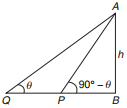
The angles of elevation of the top of a tower from the points $P$ and $Q,$ at distances of $a$ and $b$ respectively from the base of the tower and in the same straight line with it,are complementary. The height of the tower is
A
$\sqrt{ab}$
B
$\frac{a}{b}$
C
$ab$
D
$a^2 b^2$
Solution
(A) Let $AB$ be the tower of height $h$ units.
Let the points $P$ and $Q$ be at distances $PB = a$ and $QB = b$ from the base $B$ of the tower.
Given that the angles of elevation are complementary,let $\angle AQB = \theta$ and $\angle APB = 90^{\circ} - \theta$.
In $\triangle AQB$,$\tan \theta = \frac{AB}{QB} = \frac{h}{b}$.
In $\triangle APB$,$\tan(90^{\circ} - \theta) = \frac{AB}{PB} = \frac{h}{a}$.
Since $\tan(90^{\circ} - \theta) = \cot \theta$,we have $\cot \theta = \frac{h}{a}$.
Multiplying the two equations: $\tan \theta \cdot \cot \theta = \left(\frac{h}{b}\right) \cdot \left(\frac{h}{a}\right)$.
Since $\tan \theta \cdot \cot \theta = 1$,we get $1 = \frac{h^2}{ab}$.
Therefore,$h^2 = ab$,which implies $h = \sqrt{ab}$.
Let the points $P$ and $Q$ be at distances $PB = a$ and $QB = b$ from the base $B$ of the tower.
Given that the angles of elevation are complementary,let $\angle AQB = \theta$ and $\angle APB = 90^{\circ} - \theta$.
In $\triangle AQB$,$\tan \theta = \frac{AB}{QB} = \frac{h}{b}$.
In $\triangle APB$,$\tan(90^{\circ} - \theta) = \frac{AB}{PB} = \frac{h}{a}$.
Since $\tan(90^{\circ} - \theta) = \cot \theta$,we have $\cot \theta = \frac{h}{a}$.
Multiplying the two equations: $\tan \theta \cdot \cot \theta = \left(\frac{h}{b}\right) \cdot \left(\frac{h}{a}\right)$.
Since $\tan \theta \cdot \cot \theta = 1$,we get $1 = \frac{h^2}{ab}$.
Therefore,$h^2 = ab$,which implies $h = \sqrt{ab}$.
0 likes
View Solution70
DifficultMCQ
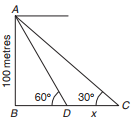
$A$ man from the top of a $100 \ m$ high tower sees a car moving towards the tower at an angle of depression of $30^{\circ}$. After some time,the angle of depression becomes $60^{\circ}$. The distance (in $m$) travelled by the car during this time is
A
$100 \sqrt{3}$
B
$\frac{200 \sqrt{3}}{3}$
C
$\frac{100 \sqrt{3}}{3}$
D
$200 \sqrt{3}$
Solution
(B) Let $AB$ be the tower of height $100 \ m$.
Let $C$ be the initial position of the car and $D$ be the final position after some time.
Let the distance travelled by the car be $CD = x \ m$.
In $\Delta ABD$,the angle of elevation is $60^{\circ}$.
$\tan 60^{\circ} = \frac{AB}{BD} \Rightarrow \sqrt{3} = \frac{100}{BD} \Rightarrow BD = \frac{100}{\sqrt{3}} \ m$.
In $\Delta ABC$,the angle of elevation is $30^{\circ}$.
$\tan 30^{\circ} = \frac{AB}{BC} = \frac{AB}{BD + CD} \Rightarrow \frac{1}{\sqrt{3}} = \frac{100}{\frac{100}{\sqrt{3}} + x}$.
$\frac{100}{\sqrt{3}} + x = 100 \sqrt{3}$.
$x = 100 \sqrt{3} - \frac{100}{\sqrt{3}} = \frac{300 - 100}{\sqrt{3}} = \frac{200}{\sqrt{3}} \ m$.
Rationalizing the denominator,$x = \frac{200 \sqrt{3}}{3} \ m$.
Let $C$ be the initial position of the car and $D$ be the final position after some time.
Let the distance travelled by the car be $CD = x \ m$.
In $\Delta ABD$,the angle of elevation is $60^{\circ}$.
$\tan 60^{\circ} = \frac{AB}{BD} \Rightarrow \sqrt{3} = \frac{100}{BD} \Rightarrow BD = \frac{100}{\sqrt{3}} \ m$.
In $\Delta ABC$,the angle of elevation is $30^{\circ}$.
$\tan 30^{\circ} = \frac{AB}{BC} = \frac{AB}{BD + CD} \Rightarrow \frac{1}{\sqrt{3}} = \frac{100}{\frac{100}{\sqrt{3}} + x}$.
$\frac{100}{\sqrt{3}} + x = 100 \sqrt{3}$.
$x = 100 \sqrt{3} - \frac{100}{\sqrt{3}} = \frac{300 - 100}{\sqrt{3}} = \frac{200}{\sqrt{3}} \ m$.
Rationalizing the denominator,$x = \frac{200 \sqrt{3}}{3} \ m$.
0 likes
View Solution71
MediumMCQ
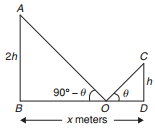
Two posts are $x \text{ m}$ apart and the height of one is double that of the other. If from the midpoint of the line joining their feet,an observer finds the angular elevations of their tops to be complementary,then the height (in $\text{m}$) of the shorter post is
A
$\frac{x}{2 \sqrt{2}}$
B
$\frac{x}{4}$
C
$x \sqrt{2}$
D
$\frac{x}{\sqrt{2}}$
Solution
(A) Let the height of the shorter post be $h \text{ m}$ and the height of the taller post be $2h \text{ m}$.
Let the posts be $CD$ and $AB$ respectively,with $CD = h$ and $AB = 2h$.
The distance between their feet $B$ and $D$ is $x \text{ m}$.
Let $O$ be the midpoint of $BD$,so $OB = OD = \frac{x}{2} \text{ m}$.
From $\triangle OCD$,$\tan \theta = \frac{CD}{OD} = \frac{h}{x/2} = \frac{2h}{x}$.
From $\triangle OAB$,the angle of elevation is $(90^{\circ} - \theta)$,so $\tan(90^{\circ} - \theta) = \frac{AB}{OB} = \frac{2h}{x/2} = \frac{4h}{x}$.
Since $\tan(90^{\circ} - \theta) = \cot \theta$,we have $\cot \theta = \frac{4h}{x}$.
Multiplying the two equations: $\tan \theta \cdot \cot \theta = \left(\frac{2h}{x}\right) \cdot \left(\frac{4h}{x}\right)$.
Since $\tan \theta \cdot \cot \theta = 1$,we get $1 = \frac{8h^2}{x^2}$.
Thus,$h^2 = \frac{x^2}{8}$,which gives $h = \sqrt{\frac{x^2}{8}} = \frac{x}{2\sqrt{2}} \text{ m}$.
Let the posts be $CD$ and $AB$ respectively,with $CD = h$ and $AB = 2h$.
The distance between their feet $B$ and $D$ is $x \text{ m}$.
Let $O$ be the midpoint of $BD$,so $OB = OD = \frac{x}{2} \text{ m}$.
From $\triangle OCD$,$\tan \theta = \frac{CD}{OD} = \frac{h}{x/2} = \frac{2h}{x}$.
From $\triangle OAB$,the angle of elevation is $(90^{\circ} - \theta)$,so $\tan(90^{\circ} - \theta) = \frac{AB}{OB} = \frac{2h}{x/2} = \frac{4h}{x}$.
Since $\tan(90^{\circ} - \theta) = \cot \theta$,we have $\cot \theta = \frac{4h}{x}$.
Multiplying the two equations: $\tan \theta \cdot \cot \theta = \left(\frac{2h}{x}\right) \cdot \left(\frac{4h}{x}\right)$.
Since $\tan \theta \cdot \cot \theta = 1$,we get $1 = \frac{8h^2}{x^2}$.
Thus,$h^2 = \frac{x^2}{8}$,which gives $h = \sqrt{\frac{x^2}{8}} = \frac{x}{2\sqrt{2}} \text{ m}$.
0 likes
View Solution72
MediumMCQ
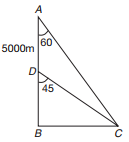
An aeroplane flying at a height of $5000 \; m$ from the ground passes vertically above another aeroplane at an instant. At that instant,the angles of elevation of the two aeroplanes from the same point on the ground are $60^{\circ}$ and $45^{\circ}$ respectively. The vertical distance between the aeroplanes at that instant is:
A
$5000(\sqrt{3}-1) \; m$
B
$5000(3-\sqrt{3}) \; m$
C
$5000\left(1-\frac{1}{\sqrt{3}}\right) \; m$
D
$4500 \; m$
Solution
(C) Let the two aeroplanes be at points $A$ and $D$. Let the point on the ground be $C$. The height of the first aeroplane $A$ is $AB = 5000 \; m$.
Let the height of the second aeroplane $D$ be $DB = h$.
The distance of the point $C$ from the point $B$ (directly below the aeroplanes) is $BC = x$.
In $\Delta ABC$,$\tan 60^{\circ} = \frac{AB}{BC} = \frac{5000}{x}$.
Since $\tan 60^{\circ} = \sqrt{3}$,we have $x = \frac{5000}{\sqrt{3}} \; m$.
In $\Delta DBC$,$\tan 45^{\circ} = \frac{DB}{BC} = \frac{h}{x}$.
Since $\tan 45^{\circ} = 1$,we have $h = x = \frac{5000}{\sqrt{3}} \; m$.
The vertical distance between the aeroplanes is $AD = AB - DB = 5000 - h$.
$AD = 5000 - \frac{5000}{\sqrt{3}} = 5000\left(1 - \frac{1}{\sqrt{3}}\right) \; m$.
Let the height of the second aeroplane $D$ be $DB = h$.
The distance of the point $C$ from the point $B$ (directly below the aeroplanes) is $BC = x$.
In $\Delta ABC$,$\tan 60^{\circ} = \frac{AB}{BC} = \frac{5000}{x}$.
Since $\tan 60^{\circ} = \sqrt{3}$,we have $x = \frac{5000}{\sqrt{3}} \; m$.
In $\Delta DBC$,$\tan 45^{\circ} = \frac{DB}{BC} = \frac{h}{x}$.
Since $\tan 45^{\circ} = 1$,we have $h = x = \frac{5000}{\sqrt{3}} \; m$.
The vertical distance between the aeroplanes is $AD = AB - DB = 5000 - h$.
$AD = 5000 - \frac{5000}{\sqrt{3}} = 5000\left(1 - \frac{1}{\sqrt{3}}\right) \; m$.
0 likes
View Solution73
EasyMCQ
The length of a shadow of a vertical tower is $\frac{1}{\sqrt{3}}$ times its height. The angle of elevation of the Sun is (in $^{\circ}$)
A
$30$
B
$45$
C
$60$
D
$90$
Solution
(C) Let $AB$ be the tower and $BC$ be its shadow.
Let the height of the tower $AB = x$.
According to the problem,the length of the shadow $BC = \frac{1}{\sqrt{3}} \times AB = \frac{x}{\sqrt{3}}$.
In the right-angled triangle $ABC$,the angle of elevation $\theta$ is given by:
$\tan \theta = \frac{\text{Perpendicular}}{\text{Base}} = \frac{AB}{BC}$
$\tan \theta = \frac{x}{\frac{x}{\sqrt{3}}} = \sqrt{3}$
Since $\tan 60^{\circ} = \sqrt{3}$,we have $\theta = 60^{\circ}$.
Therefore,the angle of elevation of the Sun is $60^{\circ}$.
Let the height of the tower $AB = x$.
According to the problem,the length of the shadow $BC = \frac{1}{\sqrt{3}} \times AB = \frac{x}{\sqrt{3}}$.
In the right-angled triangle $ABC$,the angle of elevation $\theta$ is given by:
$\tan \theta = \frac{\text{Perpendicular}}{\text{Base}} = \frac{AB}{BC}$
$\tan \theta = \frac{x}{\frac{x}{\sqrt{3}}} = \sqrt{3}$
Since $\tan 60^{\circ} = \sqrt{3}$,we have $\theta = 60^{\circ}$.
Therefore,the angle of elevation of the Sun is $60^{\circ}$.

0 likes
View SolutionHeights and Distances — Heights and Distances · Frequently Asked Questions
1Are these Heights and Distances questions useful for JEE and NEET?
Yes. All questions in this section are mapped to JEE Main and NEET exam patterns. Previous year questions from JEE Main, NEET, GUJCET and state-level exams are included with full solutions.
2Can I switch to Hindi or Gujarati for these questions?
Yes. Use the language tabs in the hero section or the sidebar to view the same questions and solutions in English, Hindi or Gujarati.
3How do I generate a question paper from this subtopic?
Use the Vedclass Exam Paper Generator — select the chapter and subtopic, set difficulty, and generate Sets A, B, C, D automatically. First 3 chapters of every subject are free.
Vedclass Products
For Students
Vedclass Test Series
Mock tests in real JEE/NEET style with performance analysis. 5-day free trial.
Start Free TrialFor Teachers
Exam Paper Generator
Generate Set A/B/C/D papers from this chapter in 2 minutes. 3 chapters free.
Try FreeFor Institutes
Online Exam Module
Live online exams with unlimited students, 360° analytics & white-label branding.
See DemoFor Teachers & Institutes
Generate a Heights and Distances Exam Paper in 2 Minutes
Select subtopic & difficulty — Sets A, B, C, D auto-generated with No Repeat logic.
First 3 chapters of every subject are free — no payment required.