
A English
Set Theory Questions in English
Competitive Exam Quantitative Aptitude · Algebra · Set Theory
202+
Questions
English
Language
100%
With Solutions
Showing 50 of 202 questions in English
1
EasyMCQ
Which of the following is the empty set?
A
{ $x : x$ is a real number and $x^2 - 1 = 0$ }
B
{ $x : x$ is a real number and $x^2 + 1 = 0$ }
C
{ $x : x$ is a real number and $x^2 - 9 = 0$ }
D
{ $x : x$ is a real number and $x^2 = x + 2$ }
Solution
(B) The empty set is a set that contains no elements.
For option $A$: $x^2 - 1 = 0 \Rightarrow x^2 = 1 \Rightarrow x = \pm 1$. These are real numbers,so the set is $\{1, -1\}$.
For option $B$: $x^2 + 1 = 0 \Rightarrow x^2 = -1$. There is no real number whose square is $-1$. Thus,this set contains no elements and is the empty set.
For option $C$: $x^2 - 9 = 0 \Rightarrow x^2 = 9 \Rightarrow x = \pm 3$. These are real numbers,so the set is $\{3, -3\}$.
For option $D$: $x^2 - x - 2 = 0 \Rightarrow (x - 2)(x + 1) = 0 \Rightarrow x = 2, -1$. These are real numbers,so the set is $\{2, -1\}$.
Therefore,the correct option is $B$.
For option $A$: $x^2 - 1 = 0 \Rightarrow x^2 = 1 \Rightarrow x = \pm 1$. These are real numbers,so the set is $\{1, -1\}$.
For option $B$: $x^2 + 1 = 0 \Rightarrow x^2 = -1$. There is no real number whose square is $-1$. Thus,this set contains no elements and is the empty set.
For option $C$: $x^2 - 9 = 0 \Rightarrow x^2 = 9 \Rightarrow x = \pm 3$. These are real numbers,so the set is $\{3, -3\}$.
For option $D$: $x^2 - x - 2 = 0 \Rightarrow (x - 2)(x + 1) = 0 \Rightarrow x = 2, -1$. These are real numbers,so the set is $\{2, -1\}$.
Therefore,the correct option is $B$.
0 likes
View Solution2
EasyMCQ
The set $A = \{ x: x \in R, x^2 = 16 \text{ and } 2x = 6 \}$ equals
A
$\phi$
B
$\{4, 3, -4\}$
C
$\{3\}$
D
$\{4\}$
Solution
(A) The set $A$ is defined by the intersection of two conditions: $x^2 = 16$ and $2x = 6$.
First,solving $x^2 = 16$ gives $x = 4$ or $x = -4$.
Second,solving $2x = 6$ gives $x = 3$.
Since there is no value of $x$ that satisfies both conditions simultaneously,the set $A$ contains no elements.
Therefore,$A = \phi$ (the empty set).
First,solving $x^2 = 16$ gives $x = 4$ or $x = -4$.
Second,solving $2x = 6$ gives $x = 3$.
Since there is no value of $x$ that satisfies both conditions simultaneously,the set $A$ contains no elements.
Therefore,$A = \phi$ (the empty set).
0 likes
View Solution3
EasyMCQ
Given the sets $A = \{1, 2, 3\}$,$B = \{3, 4\}$,and $C = \{4, 5, 6\}$,then $A \cup (B \cap C)$ is:
A
$\{3\}$
B
$\{1, 2, 3, 4\}$
C
$\{1, 2, 4, 5\}$
D
$\{1, 2, 3, 4, 5, 6\}$
Solution
(B) Step $1$: Find the intersection of sets $B$ and $C$,denoted as $B \cap C$.
The intersection contains elements common to both $B$ and $C$.
$B = \{3, 4\}$,$C = \{4, 5, 6\}$.
$B \cap C = \{4\}$.
Step $2$: Find the union of set $A$ with the result from Step $1$,denoted as $A \cup (B \cap C)$.
The union contains all elements present in either $A$ or the set $\{4\}$.
$A = \{1, 2, 3\}$.
$A \cup \{4\} = \{1, 2, 3, 4\}$.
Therefore,the correct option is $B$.
The intersection contains elements common to both $B$ and $C$.
$B = \{3, 4\}$,$C = \{4, 5, 6\}$.
$B \cap C = \{4\}$.
Step $2$: Find the union of set $A$ with the result from Step $1$,denoted as $A \cup (B \cap C)$.
The union contains all elements present in either $A$ or the set $\{4\}$.
$A = \{1, 2, 3\}$.
$A \cup \{4\} = \{1, 2, 3, 4\}$.
Therefore,the correct option is $B$.
0 likes
View Solution4
EasyMCQ
If $A$ and $B$ are two given sets,then $A \cap (A \cap B)^c$ is equal to
A
$A$
B
$B$
C
$\phi$
D
$A \cap B^c$
Solution
(D) Using De Morgan's Law,$(A \cap B)^c = A^c \cup B^c$.
Therefore,$A \cap (A \cap B)^c = A \cap (A^c \cup B^c)$.
Applying the Distributive Law,we get $(A \cap A^c) \cup (A \cap B^c)$.
Since $A \cap A^c = \phi$ (the empty set),the expression becomes $\phi \cup (A \cap B^c)$.
Thus,the final result is $A \cap B^c$.
Therefore,$A \cap (A \cap B)^c = A \cap (A^c \cup B^c)$.
Applying the Distributive Law,we get $(A \cap A^c) \cup (A \cap B^c)$.
Since $A \cap A^c = \phi$ (the empty set),the expression becomes $\phi \cup (A \cap B^c)$.
Thus,the final result is $A \cap B^c$.
0 likes
View Solution5
MediumMCQ
If the sets $A$ and $B$ are defined as $A = \{ (x, y) : y = \frac{1}{x}, x \in R, x \neq 0 \}$ and $B = \{ (x, y) : y = -x, x \in R \}$,then:
A
$A \cap B = A$
B
$A \cap B = B$
C
$A \cap B = \phi$
D
None of these
Solution
(C) To find the intersection $A \cap B$,we need to find the points $(x, y)$ that satisfy both equations simultaneously.
Given equations are $y = \frac{1}{x}$ and $y = -x$.
Substituting the value of $y$ from the second equation into the first,we get $-x = \frac{1}{x}$.
This simplifies to $-x^2 = 1$,or $x^2 = -1$.
Since $x$ must be a real number $(x \in R)$,the equation $x^2 = -1$ has no real solutions because the square of any real number is non-negative.
Therefore,there are no points $(x, y)$ that belong to both sets $A$ and $B$.
Hence,$A \cap B = \phi$.
Given equations are $y = \frac{1}{x}$ and $y = -x$.
Substituting the value of $y$ from the second equation into the first,we get $-x = \frac{1}{x}$.
This simplifies to $-x^2 = 1$,or $x^2 = -1$.
Since $x$ must be a real number $(x \in R)$,the equation $x^2 = -1$ has no real solutions because the square of any real number is non-negative.
Therefore,there are no points $(x, y)$ that belong to both sets $A$ and $B$.
Hence,$A \cap B = \phi$.
0 likes
View Solution6
DifficultMCQ
Let $A = \{x : x \in R, |x| < 1\}$; $B = \{x : x \in R, |x - 1| \ge 1\}$ and $A \cup B = R - D$,then the set $D$ is
A
$\left\{x : 1 < x \le 2\right\}$
B
$\left\{x : 1 \le x < 2\right\}$
C
$\left\{x : 1 \le x \le 2\right\}$
D
None of these
Solution
(B) Given $A = \{x : x \in R, |x| < 1\}$. This implies $-1 < x < 1$,so $A = (-1, 1)$.
Given $B = \{x : x \in R, |x - 1| \ge 1\}$. This implies $x - 1 \le -1$ or $x - 1 \ge 1$,which simplifies to $x \le 0$ or $x \ge 2$. So $B = (-\infty, 0] \cup [2, \infty)$.
Now,$A \cup B = (-1, 1) \cup (-\infty, 0] \cup [2, \infty)$.
Combining these intervals,we get $A \cup B = (-\infty, 1) \cup [2, \infty)$.
We are given $A \cup B = R - D$. This means $D$ is the complement of $A \cup B$ in $R$.
The complement of $(-\infty, 1) \cup [2, \infty)$ is the set $[1, 2)$.
Therefore,$D = \{x : x \in R, 1 \le x < 2\}$.
Given $B = \{x : x \in R, |x - 1| \ge 1\}$. This implies $x - 1 \le -1$ or $x - 1 \ge 1$,which simplifies to $x \le 0$ or $x \ge 2$. So $B = (-\infty, 0] \cup [2, \infty)$.
Now,$A \cup B = (-1, 1) \cup (-\infty, 0] \cup [2, \infty)$.
Combining these intervals,we get $A \cup B = (-\infty, 1) \cup [2, \infty)$.
We are given $A \cup B = R - D$. This means $D$ is the complement of $A \cup B$ in $R$.
The complement of $(-\infty, 1) \cup [2, \infty)$ is the set $[1, 2)$.
Therefore,$D = \{x : x \in R, 1 \le x < 2\}$.
0 likes
View Solution7
EasyMCQ
If the sets $A$ and $B$ are defined as $A = \{ (x, y) : y = e^x, x \in R \}$ and $B = \{ (x, y) : y = x, x \in R \}$,then
A
$B \subseteq A$
B
$A \subseteq B$
C
$A \cap B = \phi$
D
$A \cup B = A$
Solution
(C) The set $A$ represents the graph of the exponential function $y = e^x$. The set $B$ represents the graph of the linear function $y = x$.
For any real number $x$,it is a known property that $e^x > x$. Specifically,the function $f(x) = e^x - x$ has a minimum value of $1$ at $x = 0$,meaning $e^x - x \ge 1$ for all $x \in R$.
Since $e^x$ is never equal to $x$ for any $x \in R$,there are no common points between the two sets.
Therefore,$A \cap B = \phi$.
For any real number $x$,it is a known property that $e^x > x$. Specifically,the function $f(x) = e^x - x$ has a minimum value of $1$ at $x = 0$,meaning $e^x - x \ge 1$ for all $x \in R$.
Since $e^x$ is never equal to $x$ for any $x \in R$,there are no common points between the two sets.
Therefore,$A \cap B = \phi$.
0 likes
View Solution8
MediumMCQ
Let $n(U) = 700, n(A) = 200, n(B) = 300$ and $n(A \cap B) = 100,$ then $n(A^c \cap B^c) = $
A
$400$
B
$600$
C
$300$
D
$200$
Solution
(C) According to De Morgan's Law,$A^c \cap B^c = (A \cup B)^c$.
Therefore,$n(A^c \cap B^c) = n(U) - n(A \cup B)$.
Using the formula for the union of two sets: $n(A \cup B) = n(A) + n(B) - n(A \cap B)$.
Substituting the given values: $n(A \cup B) = 200 + 300 - 100 = 400$.
Now,$n(A^c \cap B^c) = 700 - 400 = 300$.
Therefore,$n(A^c \cap B^c) = n(U) - n(A \cup B)$.
Using the formula for the union of two sets: $n(A \cup B) = n(A) + n(B) - n(A \cap B)$.
Substituting the given values: $n(A \cup B) = 200 + 300 - 100 = 400$.
Now,$n(A^c \cap B^c) = 700 - 400 = 300$.
0 likes
View Solution9
MediumMCQ
In a town of $10,000$ families,it was found that $40\%$ of families buy newspaper $A$,$20\%$ buy newspaper $B$,$10\%$ buy newspaper $C$,$5\%$ buy $A$ and $B$,$3\%$ buy $B$ and $C$,and $4\%$ buy $A$ and $C$. If $2\%$ of families buy all three newspapers,then the number of families that buy newspaper $A$ only is:
A
$3100$
B
$3300$
C
$2900$
D
$1400$
Solution
(B) Given total families $= 10,000$.
$n(A) = 40\% \text{ of } 10,000 = 4,000$
$n(B) = 20\% \text{ of } 10,000 = 2,000$
$n(C) = 10\% \text{ of } 10,000 = 1,000$
$n(A \cap B) = 5\% \text{ of } 10,000 = 500$
$n(B \cap C) = 3\% \text{ of } 10,000 = 300$
$n(A \cap C) = 4\% \text{ of } 10,000 = 400$
$n(A \cap B \cap C) = 2\% \text{ of } 10,000 = 200$
To find the number of families that buy newspaper $A$ only,we use the formula:
$n(A \text{ only}) = n(A) - [n(A \cap B) + n(A \cap C) - n(A \cap B \cap C)]$
$n(A \text{ only}) = 4000 - [500 + 400 - 200]$
$n(A \text{ only}) = 4000 - [700] = 3300.$
$n(A) = 40\% \text{ of } 10,000 = 4,000$
$n(B) = 20\% \text{ of } 10,000 = 2,000$
$n(C) = 10\% \text{ of } 10,000 = 1,000$
$n(A \cap B) = 5\% \text{ of } 10,000 = 500$
$n(B \cap C) = 3\% \text{ of } 10,000 = 300$
$n(A \cap C) = 4\% \text{ of } 10,000 = 400$
$n(A \cap B \cap C) = 2\% \text{ of } 10,000 = 200$
To find the number of families that buy newspaper $A$ only,we use the formula:
$n(A \text{ only}) = n(A) - [n(A \cap B) + n(A \cap C) - n(A \cap B \cap C)]$
$n(A \text{ only}) = 4000 - [500 + 400 - 200]$
$n(A \text{ only}) = 4000 - [700] = 3300.$
0 likes
View Solution10
EasyMCQ
In a city $20$ percent of the population travels by car,$50$ percent travels by bus and $10$ percent travels by both car and bus. Then the percentage of persons travelling by car or bus is......$\%$.
A
$80$
B
$40$
C
$60$
D
$70$
Solution
(C) Let $C$ be the set of people travelling by car and $B$ be the set of people travelling by bus.
Given: $n(C) = 20\%$,$n(B) = 50\%$,and $n(C \cap B) = 10\%$.
We need to find the percentage of persons travelling by car or bus,which is given by $n(C \cup B)$.
Using the formula for the union of two sets:
$n(C \cup B) = n(C) + n(B) - n(C \cap B)$
Substituting the values:
$n(C \cup B) = 20 + 50 - 10 = 60$.
Therefore,the percentage of persons travelling by car or bus is $60\%$.
Given: $n(C) = 20\%$,$n(B) = 50\%$,and $n(C \cap B) = 10\%$.
We need to find the percentage of persons travelling by car or bus,which is given by $n(C \cup B)$.
Using the formula for the union of two sets:
$n(C \cup B) = n(C) + n(B) - n(C \cap B)$
Substituting the values:
$n(C \cup B) = 20 + 50 - 10 = 60$.
Therefore,the percentage of persons travelling by car or bus is $60\%$.
0 likes
View Solution11
MediumMCQ
In a class of $55$ students,the number of students studying different subjects are $23$ in Mathematics,$24$ in Physics,$19$ in Chemistry,$12$ in Mathematics and Physics,$9$ in Mathematics and Chemistry,$7$ in Physics and Chemistry and $4$ in all the three subjects. The number of students who have taken exactly one subject is
A
$6$
B
$9$
C
$7$
D
$22$
Solution
(D) Let $M, P,$ and $C$ represent the sets of students studying Mathematics,Physics,and Chemistry,respectively.
Given: $n(M) = 23, n(P) = 24, n(C) = 19, n(M \cap P) = 12, n(M \cap C) = 9, n(P \cap C) = 7, n(M \cap P \cap C) = 4$.
To find the number of students who have taken exactly one subject,we calculate:
$1$. Exactly Mathematics: $n(M) - [n(M \cap P) + n(M \cap C) - n(M \cap P \cap C)] = 23 - [12 + 9 - 4] = 23 - 17 = 6$.
$2$. Exactly Physics: $n(P) - [n(P \cap M) + n(P \cap C) - n(M \cap P \cap C)] = 24 - [12 + 7 - 4] = 24 - 15 = 9$.
$3$. Exactly Chemistry: $n(C) - [n(C \cap M) + n(C \cap P) - n(M \cap P \cap C)] = 19 - [9 + 7 - 4] = 19 - 12 = 7$.
The total number of students who have taken exactly one subject is $6 + 9 + 7 = 22$.
Given: $n(M) = 23, n(P) = 24, n(C) = 19, n(M \cap P) = 12, n(M \cap C) = 9, n(P \cap C) = 7, n(M \cap P \cap C) = 4$.
To find the number of students who have taken exactly one subject,we calculate:
$1$. Exactly Mathematics: $n(M) - [n(M \cap P) + n(M \cap C) - n(M \cap P \cap C)] = 23 - [12 + 9 - 4] = 23 - 17 = 6$.
$2$. Exactly Physics: $n(P) - [n(P \cap M) + n(P \cap C) - n(M \cap P \cap C)] = 24 - [12 + 7 - 4] = 24 - 15 = 9$.
$3$. Exactly Chemistry: $n(C) - [n(C \cap M) + n(C \cap P) - n(M \cap P \cap C)] = 19 - [9 + 7 - 4] = 19 - 12 = 7$.
The total number of students who have taken exactly one subject is $6 + 9 + 7 = 22$.
0 likes
View Solution12
EasyMCQ
If $A = \{ 2, 4, 5 \}$ and $B = \{ 7, 8, 9 \}$,then $n(A \times B)$ is equal to
A
$6$
B
$9$
C
$3$
D
$0$
Solution
(B) The Cartesian product $A \times B$ is the set of all ordered pairs $(a, b)$ such that $a \in A$ and $b \in B$.
Given $A = \{ 2, 4, 5 \}$,the number of elements in $A$ is $n(A) = 3$.
Given $B = \{ 7, 8, 9 \}$,the number of elements in $B$ is $n(B) = 3$.
The number of elements in the Cartesian product is given by the formula $n(A \times B) = n(A) \times n(B)$.
Therefore,$n(A \times B) = 3 \times 3 = 9$.
Given $A = \{ 2, 4, 5 \}$,the number of elements in $A$ is $n(A) = 3$.
Given $B = \{ 7, 8, 9 \}$,the number of elements in $B$ is $n(B) = 3$.
The number of elements in the Cartesian product is given by the formula $n(A \times B) = n(A) \times n(B)$.
Therefore,$n(A \times B) = 3 \times 3 = 9$.
0 likes
View Solution13
EasyMCQ
If $A = \{a, b\}$,$B = \{c, d\}$,$C = \{d, e\}$,then the set $\{(a, c), (a, d), (a, e), (b, c), (b, d), (b, e)\}$ is equal to:
A
$A \cap (B \cup C)$
B
$A \cup (B \cap C)$
C
$A \times (B \cup C)$
D
$A \times (B \cap C)$
Solution
(C) Given sets are $A = \{a, b\}$,$B = \{c, d\}$,and $C = \{d, e\}$.
First,find the union of sets $B$ and $C$:
$B \cup C = \{c, d\} \cup \{d, e\} = \{c, d, e\}$.
Now,calculate the Cartesian product of set $A$ and the resulting set $(B \cup C)$:
$A \times (B \cup C) = \{a, b\} \times \{c, d, e\}$.
This results in the set of ordered pairs:
$\{(a, c), (a, d), (a, e), (b, c), (b, d), (b, e)\}$.
Thus,the given set is equal to $A \times (B \cup C)$.
First,find the union of sets $B$ and $C$:
$B \cup C = \{c, d\} \cup \{d, e\} = \{c, d, e\}$.
Now,calculate the Cartesian product of set $A$ and the resulting set $(B \cup C)$:
$A \times (B \cup C) = \{a, b\} \times \{c, d, e\}$.
This results in the set of ordered pairs:
$\{(a, c), (a, d), (a, e), (b, c), (b, d), (b, e)\}$.
Thus,the given set is equal to $A \times (B \cup C)$.
0 likes
View Solution14
EasyMCQ
If $A$ and $B$ are two sets,then $A \cup B = A \cap B$ if and only if:
A
$A \subseteq B$
B
$B \subseteq A$
C
$A = B$
D
None of these
Solution
(C) Given $A \cup B = A \cap B$.
Let $x \in A$. Since $A \subseteq A \cup B$,it follows that $x \in A \cup B$.
Because $A \cup B = A \cap B$,we have $x \in A \cap B$.
By the definition of intersection,$x \in A \cap B \implies x \in A$ and $x \in B$. Thus,$x \in B$.
Since $x \in A \implies x \in B$,we conclude $A \subseteq B$.
Similarly,let $y \in B$. Since $B \subseteq A \cup B$,it follows that $y \in A \cup B$.
Because $A \cup B = A \cap B$,we have $y \in A \cap B$.
By the definition of intersection,$y \in A \cap B \implies y \in A$ and $y \in B$. Thus,$y \in A$.
Since $y \in B \implies y \in A$,we conclude $B \subseteq A$.
Since $A \subseteq B$ and $B \subseteq A$,it must be that $A = B$.
Let $x \in A$. Since $A \subseteq A \cup B$,it follows that $x \in A \cup B$.
Because $A \cup B = A \cap B$,we have $x \in A \cap B$.
By the definition of intersection,$x \in A \cap B \implies x \in A$ and $x \in B$. Thus,$x \in B$.
Since $x \in A \implies x \in B$,we conclude $A \subseteq B$.
Similarly,let $y \in B$. Since $B \subseteq A \cup B$,it follows that $y \in A \cup B$.
Because $A \cup B = A \cap B$,we have $y \in A \cap B$.
By the definition of intersection,$y \in A \cap B \implies y \in A$ and $y \in B$. Thus,$y \in A$.
Since $y \in B \implies y \in A$,we conclude $B \subseteq A$.
Since $A \subseteq B$ and $B \subseteq A$,it must be that $A = B$.
0 likes
View Solution15
MediumMCQ
Let $A = \{(x, y) : y = e^x, x \in R\}$ and $B = \{(x, y) : y = e^{-x}, x \in R\}$. Then:
A
$A \cap B = \phi$
B
$A \cap B \neq \phi$
C
$A \cup B = R^2$
D
None of these
Solution
(B) To find the intersection $A \cap B$,we set the $y$-values equal: $e^x = e^{-x}$.
Multiplying both sides by $e^x$,we get $e^{2x} = 1$.
Taking the natural logarithm on both sides,$2x = 0$,which implies $x = 0$.
Substituting $x = 0$ into either equation,we get $y = e^0 = 1$.
Thus,the point $(0, 1)$ belongs to both sets $A$ and $B$.
Since there exists at least one common point,$A \cap B \neq \phi$.
Multiplying both sides by $e^x$,we get $e^{2x} = 1$.
Taking the natural logarithm on both sides,$2x = 0$,which implies $x = 0$.
Substituting $x = 0$ into either equation,we get $y = e^0 = 1$.
Thus,the point $(0, 1)$ belongs to both sets $A$ and $B$.
Since there exists at least one common point,$A \cap B \neq \phi$.
0 likes
View Solution16
EasyMCQ
If $A = \{2, 3, 4, 8, 10\}, B = \{3, 4, 5, 10, 12\}, C = \{4, 5, 6, 12, 14\}$,then $(A \cap B) \cup (A \cap C)$ is equal to
A
$\{3, 4, 10\}$
B
$\{2, 8, 10\}$
C
$\{4, 5, 6\}$
D
$\{3, 5, 14\}$
Solution
(A) Given sets are $A = \{2, 3, 4, 8, 10\}$,$B = \{3, 4, 5, 10, 12\}$,and $C = \{4, 5, 6, 12, 14\}$.
First,find the intersection $A \cap B$:
$A \cap B = \{2, 3, 4, 8, 10\} \cap \{3, 4, 5, 10, 12\} = \{3, 4, 10\}$.
Next,find the intersection $A \cap C$:
$A \cap C = \{2, 3, 4, 8, 10\} \cap \{4, 5, 6, 12, 14\} = \{4\}$.
Finally,find the union $(A \cap B) \cup (A \cap C)$:
$(A \cap B) \cup (A \cap C) = \{3, 4, 10\} \cup \{4\} = \{3, 4, 10\}$.
First,find the intersection $A \cap B$:
$A \cap B = \{2, 3, 4, 8, 10\} \cap \{3, 4, 5, 10, 12\} = \{3, 4, 10\}$.
Next,find the intersection $A \cap C$:
$A \cap C = \{2, 3, 4, 8, 10\} \cap \{4, 5, 6, 12, 14\} = \{4\}$.
Finally,find the union $(A \cap B) \cup (A \cap C)$:
$(A \cap B) \cup (A \cap C) = \{3, 4, 10\} \cup \{4\} = \{3, 4, 10\}$.
0 likes
View Solution17
EasyMCQ
Let $A = \{a, b, c\}, B = \{b, c, d\}, C = \{a, b, d, e\}$. Then $A \cap (B \cup C)$ is
A
$\{a, b, c\}$
B
$\{b, c, d\}$
C
$\{a, b, d, e\}$
D
$\{e\}$
Solution
(A) First,find the union of sets $B$ and $C$:
$B \cup C = \{b, c, d\} \cup \{a, b, d, e\} = \{a, b, c, d, e\}$.
Next,find the intersection of set $A$ with the result $(B \cup C)$:
$A \cap (B \cup C) = \{a, b, c\} \cap \{a, b, c, d, e\}$.
The common elements in both sets are $a, b,$ and $c$.
Therefore,$A \cap (B \cup C) = \{a, b, c\}$.
The correct option is $A$.
$B \cup C = \{b, c, d\} \cup \{a, b, d, e\} = \{a, b, c, d, e\}$.
Next,find the intersection of set $A$ with the result $(B \cup C)$:
$A \cap (B \cup C) = \{a, b, c\} \cap \{a, b, c, d, e\}$.
The common elements in both sets are $a, b,$ and $c$.
Therefore,$A \cap (B \cup C) = \{a, b, c\}$.
The correct option is $A$.
0 likes
View Solution18
EasyMCQ
If $A$ and $B$ are sets,then $A \cap (B - A)$ is
A
$\phi$
B
$A$
C
$B$
D
None of these
Solution
(A) By the definition of set difference,$B - A$ is the set of all elements that are in $B$ but not in $A$.
Therefore,for any element $x \in (B - A)$,it is guaranteed that $x \notin A$.
Since $A \cap (B - A)$ represents the set of elements common to both $A$ and $(B - A)$,and there are no elements common to $A$ and $(B - A)$,the intersection must be the empty set.
Thus,$A \cap (B - A) = \phi$.
Therefore,for any element $x \in (B - A)$,it is guaranteed that $x \notin A$.
Since $A \cap (B - A)$ represents the set of elements common to both $A$ and $(B - A)$,and there are no elements common to $A$ and $(B - A)$,the intersection must be the empty set.
Thus,$A \cap (B - A) = \phi$.
0 likes
View Solution19
MediumMCQ
If $A$ and $B$ are two sets,then $A \cap (A \cup B)'$ is equal to
A
$A$
B
$B$
C
$\phi$
D
None of these
Solution
(C) Using De Morgan's Law,we know that $(A \cup B)' = A' \cap B'$.
Substituting this into the expression,we get $A \cap (A' \cap B')$.
By the associative law of sets,this can be rewritten as $(A \cap A') \cap B'$.
Since $A \cap A' = \phi$ (the empty set),the expression becomes $\phi \cap B'$.
Any set intersected with the empty set results in the empty set,so $\phi \cap B' = \phi$.
Substituting this into the expression,we get $A \cap (A' \cap B')$.
By the associative law of sets,this can be rewritten as $(A \cap A') \cap B'$.
Since $A \cap A' = \phi$ (the empty set),the expression becomes $\phi \cap B'$.
Any set intersected with the empty set results in the empty set,so $\phi \cap B' = \phi$.
0 likes
View Solution20
EasyMCQ
Let $U = \{ 1, 2, 3, 4, 5, 6, 7, 8, 9, 10 \}$,$A = \{ 1, 2, 5 \}$,and $B = \{ 6, 7 \}$. Then $A \cap B'$ is:
A
$B'$
B
$A$
C
$A'$
D
$B$
Solution
(B) Given the universal set $U = \{ 1, 2, 3, 4, 5, 6, 7, 8, 9, 10 \}$.
First,find the complement of set $B$,denoted as $B'$.
$B' = U \setminus B = \{ 1, 2, 3, 4, 5, 8, 9, 10 \}$.
Now,find the intersection of set $A$ and $B'$.
$A \cap B' = \{ 1, 2, 5 \} \cap \{ 1, 2, 3, 4, 5, 8, 9, 10 \}$.
The common elements are $\{ 1, 2, 5 \}$.
Since $\{ 1, 2, 5 \} = A$,the result is $A$.
First,find the complement of set $B$,denoted as $B'$.
$B' = U \setminus B = \{ 1, 2, 3, 4, 5, 8, 9, 10 \}$.
Now,find the intersection of set $A$ and $B'$.
$A \cap B' = \{ 1, 2, 5 \} \cap \{ 1, 2, 3, 4, 5, 8, 9, 10 \}$.
The common elements are $\{ 1, 2, 5 \}$.
Since $\{ 1, 2, 5 \} = A$,the result is $A$.
0 likes
View Solution21
MediumMCQ
If ${N_a} = \{an : n \in N\}$,then ${N_5} \cap {N_7} = $
A
${N_7}$
B
$N$
C
${N_{35}}$
D
${N_5}$
Solution
(C) Given that ${N_a} = \{an : n \in N\}$,which represents the set of all multiples of $a$.
Thus,${N_5} = \{5, 10, 15, 20, 25, 30, 35, 40, \dots\}$ and ${N_7} = \{7, 14, 21, 28, 35, 42, \dots\}$.
The intersection ${N_5} \cap {N_7}$ consists of numbers that are multiples of both $5$ and $7$.
Since $5$ and $7$ are relatively prime,their least common multiple $(LCM)$ is $5 \times 7 = 35$.
Therefore,the common multiples are multiples of $35$,which is denoted as ${N_{35}}$.
Thus,${N_5} = \{5, 10, 15, 20, 25, 30, 35, 40, \dots\}$ and ${N_7} = \{7, 14, 21, 28, 35, 42, \dots\}$.
The intersection ${N_5} \cap {N_7}$ consists of numbers that are multiples of both $5$ and $7$.
Since $5$ and $7$ are relatively prime,their least common multiple $(LCM)$ is $5 \times 7 = 35$.
Therefore,the common multiples are multiples of $35$,which is denoted as ${N_{35}}$.
0 likes
View Solution22
MediumMCQ
If $aN = \{ ax : x \in N \}$,then the set $3N \cap 7N$ is equal to .....$N$.
A
$21N$
B
$10N$
C
$4N$
D
None of these
Solution
(A) Given that $aN = \{ ax : x \in N \}$,which represents the set of all multiples of $a$.
$3N = \{ x \in N : x \text{ is a multiple of } 3 \}$.
$7N = \{ x \in N : x \text{ is a multiple of } 7 \}$.
The intersection $3N \cap 7N$ consists of elements that are multiples of both $3$ and $7$.
Since $3$ and $7$ are coprime,their least common multiple is $3 \times 7 = 21$.
Therefore,$3N \cap 7N = \{ x \in N : x \text{ is a multiple of } 21 \} = 21N$.
$3N = \{ x \in N : x \text{ is a multiple of } 3 \}$.
$7N = \{ x \in N : x \text{ is a multiple of } 7 \}$.
The intersection $3N \cap 7N$ consists of elements that are multiples of both $3$ and $7$.
Since $3$ and $7$ are coprime,their least common multiple is $3 \times 7 = 21$.
Therefore,$3N \cap 7N = \{ x \in N : x \text{ is a multiple of } 21 \} = 21N$.
0 likes
View Solution23
MediumMCQ
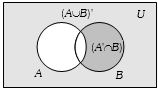
Let $A$ and $B$ be two sets,then $(A \cup B)' \cup (A' \cap B)$ is equal to
A
$A'$
B
$A$
C
$B'$
D
None of these
Solution
(A) Using De Morgan's Law,$(A \cup B)' = A' \cap B'$.
So,the expression becomes $(A' \cap B') \cup (A' \cap B)$.
By the distributive law,we can factor out $A'$:
$(A' \cap B') \cup (A' \cap B) = A' \cap (B' \cup B)$.
Since $B' \cup B = U$ (the universal set),the expression simplifies to:
$A' \cap U = A'$.
Thus,$(A \cup B)' \cup (A' \cap B) = A'$.
So,the expression becomes $(A' \cap B') \cup (A' \cap B)$.
By the distributive law,we can factor out $A'$:
$(A' \cap B') \cup (A' \cap B) = A' \cap (B' \cup B)$.
Since $B' \cup B = U$ (the universal set),the expression simplifies to:
$A' \cap U = A'$.
Thus,$(A \cup B)' \cup (A' \cap B) = A'$.
0 likes
View Solution24
MediumMCQ
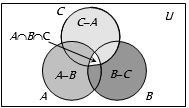
Let $U$ be the universal set and $A \cup B \cup C = U$. Then $\{ (A - B) \cup (B - C) \cup (C - A)\} '$ is equal to
A
$A \cup B \cup C$
B
$A \cup (B \cap C)$
C
$A \cap B \cap C$
D
$A \cap (B \cup C)$
Solution
(C) From the Venn diagram,the set $S = (A - B) \cup (B - C) \cup (C - A)$ represents the region containing elements that belong to exactly one of the sets $A, B,$ or $C$,or elements that belong to exactly two of the sets,but excludes the intersection of all three sets $A \cap B \cap C$.
Specifically,the region $(A - B) \cup (B - C) \cup (C - A)$ covers all parts of the union $A \cup B \cup C$ except for the central region where all three sets overlap.
Therefore,the complement of this set within the universal set $U$ (where $U = A \cup B \cup C$) is the region that remains,which is exactly the intersection of all three sets:
$\{ (A - B) \cup (B - C) \cup (C - A)\} ' = A \cap B \cap C$.
Specifically,the region $(A - B) \cup (B - C) \cup (C - A)$ covers all parts of the union $A \cup B \cup C$ except for the central region where all three sets overlap.
Therefore,the complement of this set within the universal set $U$ (where $U = A \cup B \cup C$) is the region that remains,which is exactly the intersection of all three sets:
$\{ (A - B) \cup (B - C) \cup (C - A)\} ' = A \cap B \cap C$.
0 likes
View Solution25
EasyMCQ
If $n(A) = 3$,$n(B) = 6$ and $A \subseteq B$,then the number of elements in $A \cup B$ is equal to
A
$3$
B
$9$
C
$6$
D
None of these
Solution
(C) Given that $A \subseteq B$,which means every element of set $A$ is also an element of set $B$.
Therefore,the union of sets $A$ and $B$ is equal to set $B$,i.e.,$A \cup B = B$.
Consequently,the number of elements in $A \cup B$ is equal to the number of elements in $B$.
$n(A \cup B) = n(B) = 6$.
Therefore,the union of sets $A$ and $B$ is equal to set $B$,i.e.,$A \cup B = B$.
Consequently,the number of elements in $A \cup B$ is equal to the number of elements in $B$.
$n(A \cup B) = n(B) = 6$.
0 likes
View Solution26
DifficultMCQ
In a battle,$70\%$ of the combatants lost one eye,$80\%$ an ear,$75\%$ an arm,$85\%$ a leg,and $x\%$ lost all the four limbs. What is the minimum value of $x$?
A
$10$
B
$12$
C
$15$
D
None of these
Solution
(A) Let the total number of combatants be $100$.
Let $A, B, C, D$ be the sets of combatants who lost an eye,an ear,an arm,and a leg,respectively.
Given: $n(A) = 70, n(B) = 80, n(C) = 75, n(D) = 85$.
The number of people who did $NOT$ lose these parts are:
$n(A^c) = 100 - 70 = 30$
$n(B^c) = 100 - 80 = 20$
$n(C^c) = 100 - 75 = 25$
$n(D^c) = 100 - 85 = 15$
The number of people who lost at least one part is $100 - n(A^c \cap B^c \cap C^c \cap D^c)$.
To minimize $x$ (the intersection of all four),we maximize the union of the complements.
The maximum number of people who lost at least one part is $100$.
Using the principle of inclusion-exclusion for the complements:
$n(A^c \cup B^c \cup C^c \cup D^c) \leq n(A^c) + n(B^c) + n(C^c) + n(D^c) = 30 + 20 + 25 + 15 = 90$.
Thus,the number of people who lost all four parts is at least $100 - 90 = 10$.
Therefore,the minimum value of $x$ is $10$.
Let $A, B, C, D$ be the sets of combatants who lost an eye,an ear,an arm,and a leg,respectively.
Given: $n(A) = 70, n(B) = 80, n(C) = 75, n(D) = 85$.
The number of people who did $NOT$ lose these parts are:
$n(A^c) = 100 - 70 = 30$
$n(B^c) = 100 - 80 = 20$
$n(C^c) = 100 - 75 = 25$
$n(D^c) = 100 - 85 = 15$
The number of people who lost at least one part is $100 - n(A^c \cap B^c \cap C^c \cap D^c)$.
To minimize $x$ (the intersection of all four),we maximize the union of the complements.
The maximum number of people who lost at least one part is $100$.
Using the principle of inclusion-exclusion for the complements:
$n(A^c \cup B^c \cup C^c \cup D^c) \leq n(A^c) + n(B^c) + n(C^c) + n(D^c) = 30 + 20 + 25 + 15 = 90$.
Thus,the number of people who lost all four parts is at least $100 - 90 = 10$.
Therefore,the minimum value of $x$ is $10$.
0 likes
View Solution27
DifficultMCQ
Out of $800$ boys in a school,$224$ played cricket,$240$ played hockey,and $336$ played basketball. Of the total,$64$ played both basketball and hockey,$80$ played cricket and basketball,and $40$ played cricket and hockey; $24$ played all three games. The number of boys who did not play any game is:
A
$128$
B
$216$
C
$240$
D
$160$
Solution
(D) Let $C$,$H$,and $B$ represent the sets of boys who play cricket,hockey,and basketball,respectively.
Given:
$n(C) = 224, n(H) = 240, n(B) = 336$
$n(H \cap B) = 64, n(C \cap B) = 80, n(C \cap H) = 40$
$n(C \cap H \cap B) = 24$
Total boys $n(U) = 800$
Using the Principle of Inclusion-Exclusion:
$n(C \cup H \cup B) = n(C) + n(H) + n(B) - n(C \cap H) - n(H \cap B) - n(C \cap B) + n(C \cap H \cap B)$
$n(C \cup H \cup B) = 224 + 240 + 336 - 40 - 64 - 80 + 24$
$n(C \cup H \cup B) = 800 - 184 + 24 = 640$
The number of boys who did not play any game is $n(U) - n(C \cup H \cup B) = 800 - 640 = 160$.
Given:
$n(C) = 224, n(H) = 240, n(B) = 336$
$n(H \cap B) = 64, n(C \cap B) = 80, n(C \cap H) = 40$
$n(C \cap H \cap B) = 24$
Total boys $n(U) = 800$
Using the Principle of Inclusion-Exclusion:
$n(C \cup H \cup B) = n(C) + n(H) + n(B) - n(C \cap H) - n(H \cap B) - n(C \cap B) + n(C \cap H \cap B)$
$n(C \cup H \cup B) = 224 + 240 + 336 - 40 - 64 - 80 + 24$
$n(C \cup H \cup B) = 800 - 184 + 24 = 640$
The number of boys who did not play any game is $n(U) - n(C \cup H \cup B) = 800 - 640 = 160$.
0 likes
View Solution28
DifficultMCQ
$A$ survey shows that $63\%$ of the Americans like cheese whereas $76\%$ like apples. If $x\%$ of the Americans like both cheese and apples,then
A
$x = 39$
B
$x = 63$
C
$39 \le x \le 63$
D
None of these
Solution
(C) Let $A$ be the set of Americans who like cheese and $B$ be the set of Americans who like apples.
Let the total population of Americans be $100$.
Given: $n(A) = 63$ and $n(B) = 76$.
Using the formula for the union of two sets: $n(A \cup B) = n(A) + n(B) - n(A \cap B)$.
$n(A \cup B) = 63 + 76 - n(A \cap B) = 139 - n(A \cap B)$.
Since $n(A \cup B) \le 100$,we have $139 - n(A \cap B) \le 100$,which implies $n(A \cap B) \ge 39$.
Also,the intersection of two sets is a subset of each set,so $n(A \cap B) \le n(A)$ and $n(A \cap B) \le n(B)$.
Therefore,$n(A \cap B) \le 63$ and $n(A \cap B) \le 76$. The tighter bound is $n(A \cap B) \le 63$.
Combining these,we get $39 \le n(A \cap B) \le 63$.
Since $x = n(A \cap B)$,we have $39 \le x \le 63$.
Let the total population of Americans be $100$.
Given: $n(A) = 63$ and $n(B) = 76$.
Using the formula for the union of two sets: $n(A \cup B) = n(A) + n(B) - n(A \cap B)$.
$n(A \cup B) = 63 + 76 - n(A \cap B) = 139 - n(A \cap B)$.
Since $n(A \cup B) \le 100$,we have $139 - n(A \cap B) \le 100$,which implies $n(A \cap B) \ge 39$.
Also,the intersection of two sets is a subset of each set,so $n(A \cap B) \le n(A)$ and $n(A \cap B) \le n(B)$.
Therefore,$n(A \cap B) \le 63$ and $n(A \cap B) \le 76$. The tighter bound is $n(A \cap B) \le 63$.
Combining these,we get $39 \le n(A \cap B) \le 63$.
Since $x = n(A \cap B)$,we have $39 \le x \le 63$.
0 likes
View Solution29
EasyMCQ
In a school,$20$ teachers teach either mathematics or physics. If $12$ of them teach mathematics and $4$ teach both subjects,then the number of teachers teaching physics is:
A
$12$
B
$8$
C
$16$
D
None of these
Solution
(A) Let $M$ be the set of teachers who teach mathematics and $P$ be the set of teachers who teach physics.
Given:
Total teachers $n(M \cup P) = 20$
Teachers teaching mathematics $n(M) = 12$
Teachers teaching both subjects $n(M \cap P) = 4$
Using the formula for the union of two sets:
$n(M \cup P) = n(M) + n(P) - n(M \cap P)$
Substituting the given values:
$20 = 12 + n(P) - 4$
$20 = 8 + n(P)$
$n(P) = 20 - 8 = 12$
Therefore,the number of teachers teaching physics is $12$.
Given:
Total teachers $n(M \cup P) = 20$
Teachers teaching mathematics $n(M) = 12$
Teachers teaching both subjects $n(M \cap P) = 4$
Using the formula for the union of two sets:
$n(M \cup P) = n(M) + n(P) - n(M \cap P)$
Substituting the given values:
$20 = 12 + n(P) - 4$
$20 = 8 + n(P)$
$n(P) = 20 - 8 = 12$
Therefore,the number of teachers teaching physics is $12$.
0 likes
View Solution30
MediumMCQ
Of the members of three athletic teams in a school,$21$ are in the cricket team,$26$ are in the hockey team,and $29$ are in the football team. Among them,$14$ play hockey and cricket,$15$ play hockey and football,and $12$ play football and cricket. Eight play all the three games. The total number of members in the three athletic teams is:
A
$43$
B
$76$
C
$49$
D
None of these
Solution
(A) Let $C, H, F$ denote the sets of members who are on the cricket team,hockey team,and football team,respectively.
We are given:
$n(C) = 21, n(H) = 26, n(F) = 29$
$n(H \cap C) = 14, n(H \cap F) = 15, n(F \cap C) = 12$
$n(C \cap H \cap F) = 8$
We need to find the total number of members,which is $n(C \cup H \cup F)$.
Using the Principle of Inclusion-Exclusion:
$n(C \cup H \cup F) = n(C) + n(H) + n(F) - [n(C \cap H) + n(H \cap F) + n(F \cap C)] + n(C \cap H \cap F)$
Substituting the values:
$n(C \cup H \cup F) = (21 + 26 + 29) - (14 + 15 + 12) + 8$
$n(C \cup H \cup F) = 76 - 41 + 8$
$n(C \cup H \cup F) = 43$
Thus,there are $43$ members in total.
We are given:
$n(C) = 21, n(H) = 26, n(F) = 29$
$n(H \cap C) = 14, n(H \cap F) = 15, n(F \cap C) = 12$
$n(C \cap H \cap F) = 8$
We need to find the total number of members,which is $n(C \cup H \cup F)$.
Using the Principle of Inclusion-Exclusion:
$n(C \cup H \cup F) = n(C) + n(H) + n(F) - [n(C \cap H) + n(H \cap F) + n(F \cap C)] + n(C \cap H \cap F)$
Substituting the values:
$n(C \cup H \cup F) = (21 + 26 + 29) - (14 + 15 + 12) + 8$
$n(C \cup H \cup F) = 76 - 41 + 8$
$n(C \cup H \cup F) = 43$
Thus,there are $43$ members in total.
0 likes
View Solution31
EasyMCQ
In a class of $100$ students,$55$ students have passed in Mathematics and $67$ students have passed in Physics. Then the number of students who have passed in Physics only is
A
$22$
B
$33$
C
$10$
D
$45$
Solution
(D) Let $n(M)$ be the number of students who passed in Mathematics and $n(P)$ be the number of students who passed in Physics.
Given: $n(M) = 55$,$n(P) = 67$,and the total number of students $n(M \cup P) = 100$.
Using the formula for the union of two sets: $n(M \cup P) = n(M) + n(P) - n(M \cap P)$.
Substituting the values: $100 = 55 + 67 - n(M \cap P)$.
$100 = 122 - n(M \cap P)$.
Therefore,$n(M \cap P) = 122 - 100 = 22$.
This represents the number of students who passed in both Mathematics and Physics.
The number of students who passed in Physics only is given by $n(P \text{ only}) = n(P) - n(M \cap P)$.
$n(P \text{ only}) = 67 - 22 = 45$.
Given: $n(M) = 55$,$n(P) = 67$,and the total number of students $n(M \cup P) = 100$.
Using the formula for the union of two sets: $n(M \cup P) = n(M) + n(P) - n(M \cap P)$.
Substituting the values: $100 = 55 + 67 - n(M \cap P)$.
$100 = 122 - n(M \cap P)$.
Therefore,$n(M \cap P) = 122 - 100 = 22$.
This represents the number of students who passed in both Mathematics and Physics.
The number of students who passed in Physics only is given by $n(P \text{ only}) = n(P) - n(M \cap P)$.
$n(P \text{ only}) = 67 - 22 = 45$.
0 likes
View Solution32
EasyMCQ
If $A$ and $B$ are two sets,then $A \times B = B \times A$ if and only if
A
$A \subseteq B$
B
$B \subseteq A$
C
$A = B$
D
None of these
Solution
(C) In general,the Cartesian product of two sets is not commutative,i.e.,$A \times B \neq B \times A$.
For the condition $A \times B = B \times A$ to hold,the sets must be equal,i.e.,$A = B$.
If $A = B$,then $A \times B = A \times A$ and $B \times A = A \times A$,which satisfies the equality.
For the condition $A \times B = B \times A$ to hold,the sets must be equal,i.e.,$A = B$.
If $A = B$,then $A \times B = A \times A$ and $B \times A = A \times A$,which satisfies the equality.
0 likes
View Solution33
EasyMCQ
If $A = \{1, 2, 4\}, B = \{2, 4, 5\}, C = \{2, 5\},$ then $(A - B) \times (B - C)$ is
A
$\{(1, 2), (1, 5), (2, 5)\}$
B
$\{(1, 4)\}$
C
$(1, 4)$
D
None of these
Solution
(B) Given sets are $A = \{1, 2, 4\}$,$B = \{2, 4, 5\}$,and $C = \{2, 5\}$.
First,find the set difference $(A - B)$:
$A - B$ represents elements that are in $A$ but not in $B$.
$A - B = \{1, 2, 4\} - \{2, 4, 5\} = \{1\}$.
Next,find the set difference $(B - C)$:
$B - C$ represents elements that are in $B$ but not in $C$.
$B - C = \{2, 4, 5\} - \{2, 5\} = \{4\}$.
Finally,calculate the Cartesian product $(A - B) \times (B - C)$:
$(A - B) \times (B - C) = \{1\} \times \{4\} = \{(1, 4)\}$.
First,find the set difference $(A - B)$:
$A - B$ represents elements that are in $A$ but not in $B$.
$A - B = \{1, 2, 4\} - \{2, 4, 5\} = \{1\}$.
Next,find the set difference $(B - C)$:
$B - C$ represents elements that are in $B$ but not in $C$.
$B - C = \{2, 4, 5\} - \{2, 5\} = \{4\}$.
Finally,calculate the Cartesian product $(A - B) \times (B - C)$:
$(A - B) \times (B - C) = \{1\} \times \{4\} = \{(1, 4)\}$.
0 likes
View Solution34
EasyMCQ
If $(1, 3), (2, 5)$ and $(3, 3)$ are three elements of $A \times B$ and the total number of elements in $A \times B$ is $6$,then the remaining elements of $A \times B$ are
A
$(1, 5), (2, 3), (3, 5)$
B
$(5, 1), (3, 2), (5, 3)$
C
$(1, 5), (2, 3), (5, 3)$
D
None of these
Solution
(A) Given that $(1, 3), (2, 5), (3, 3) \in A \times B$.
From the definition of the Cartesian product $A \times B$,the set $A$ consists of all first coordinates and the set $B$ consists of all second coordinates.
Thus,$A = \{1, 2, 3\}$ and $B = \{3, 5\}$.
The total number of elements in $A \times B$ is $n(A) \times n(B) = 3 \times 2 = 6$.
The set $A \times B$ is given by the set of all ordered pairs $(a, b)$ where $a \in A$ and $b \in B$.
$A \times B = \{(1, 3), (1, 5), (2, 3), (2, 5), (3, 3), (3, 5)\}$.
We are given three elements: $(1, 3), (2, 5), (3, 3)$.
The remaining elements are $(1, 5), (2, 3), (3, 5)$.
From the definition of the Cartesian product $A \times B$,the set $A$ consists of all first coordinates and the set $B$ consists of all second coordinates.
Thus,$A = \{1, 2, 3\}$ and $B = \{3, 5\}$.
The total number of elements in $A \times B$ is $n(A) \times n(B) = 3 \times 2 = 6$.
The set $A \times B$ is given by the set of all ordered pairs $(a, b)$ where $a \in A$ and $b \in B$.
$A \times B = \{(1, 3), (1, 5), (2, 3), (2, 5), (3, 3), (3, 5)\}$.
We are given three elements: $(1, 3), (2, 5), (3, 3)$.
The remaining elements are $(1, 5), (2, 3), (3, 5)$.
0 likes
View Solution35
EasyMCQ
If $A = \{1, 2, 3\}$ and $B = \{3, 8\}$,then $(A \cup B) \times (A \cap B)$ is
A
$\{(3, 1), (3, 2), (3, 3), (3, 8)\}$
B
$\{(1, 3), (2, 3), (3, 3), (8, 3)\}$
C
$\{(1, 2), (2, 2), (3, 3), (8, 8)\}$
D
$\{(8, 3), (8, 2), (8, 1), (8, 8)\}$
Solution
(B) Given sets are $A = \{1, 2, 3\}$ and $B = \{3, 8\}$.
First,find the union of sets $A$ and $B$: $A \cup B = \{1, 2, 3, 8\}$.
Next,find the intersection of sets $A$ and $B$: $A \cap B = \{3\}$.
Now,find the Cartesian product $(A \cup B) \times (A \cap B)$:
$(A \cup B) \times (A \cap B) = \{1, 2, 3, 8\} \times \{3\} = \{(1, 3), (2, 3), (3, 3), (8, 3)\}$.
First,find the union of sets $A$ and $B$: $A \cup B = \{1, 2, 3, 8\}$.
Next,find the intersection of sets $A$ and $B$: $A \cap B = \{3\}$.
Now,find the Cartesian product $(A \cup B) \times (A \cap B)$:
$(A \cup B) \times (A \cap B) = \{1, 2, 3, 8\} \times \{3\} = \{(1, 3), (2, 3), (3, 3), (8, 3)\}$.
0 likes
View Solution36
EasyMCQ
If $A = \{2, 3, 5\}$ and $B = \{2, 5, 6\}$,then $(A - B) \times (A \cap B)$ is:
A
$\{(3, 2), (3, 3), (3, 5)\}$
B
$\{(3, 2), (3, 5), (3, 6)\}$
C
$\{(3, 2), (3, 5)\}$
D
None of these
Solution
(C) Given sets are $A = \{2, 3, 5\}$ and $B = \{2, 5, 6\}$.
First,find the set difference $(A - B)$,which contains elements present in $A$ but not in $B$: $A - B = \{3\}$.
Next,find the intersection $(A \cap B)$,which contains elements common to both $A$ and $B$: $A \cap B = \{2, 5\}$.
Finally,calculate the Cartesian product $(A - B) \times (A \cap B) = \{3\} \times \{2, 5\} = \{(3, 2), (3, 5)\}$.
First,find the set difference $(A - B)$,which contains elements present in $A$ but not in $B$: $A - B = \{3\}$.
Next,find the intersection $(A \cap B)$,which contains elements common to both $A$ and $B$: $A \cap B = \{2, 5\}$.
Finally,calculate the Cartesian product $(A - B) \times (A \cap B) = \{3\} \times \{2, 5\} = \{(3, 2), (3, 5)\}$.
0 likes
View Solution37
MediumMCQ
In a class of $30$ pupils,$12$ take needle work,$16$ take physics,and $18$ take history. If all the $30$ students take at least one subject and no one takes all three,then the number of pupils taking $2$ subjects is:
A
$16$
B
$6$
C
$8$
D
$20$
Solution
(A) Let $N$,$P$,and $H$ represent the sets of students taking needle work,physics,and history,respectively.
Given: $n(N) = 12$,$n(P) = 16$,$n(H) = 18$,and $n(N \cup P \cup H) = 30$.
Since no one takes all three subjects,$n(N \cap P \cap H) = 0$.
Using the principle of inclusion-exclusion for three sets:
$n(N \cup P \cup H) = n(N) + n(P) + n(H) - [n(N \cap P) + n(P \cap H) + n(N \cap H)] + n(N \cap P \cap H)$.
Substituting the values:
$30 = 12 + 16 + 18 - [n(N \cap P) + n(P \cap H) + n(N \cap H)] + 0$.
$30 = 46 - [n(N \cap P) + n(P \cap H) + n(N \cap H)]$.
Therefore,$n(N \cap P) + n(P \cap H) + n(N \cap H) = 46 - 30 = 16$.
The number of students taking exactly two subjects is given by $[n(N \cap P) + n(P \cap H) + n(N \cap H)] - 3n(N \cap P \cap H)$.
Since $n(N \cap P \cap H) = 0$,the number of students taking exactly two subjects is $16 - 3(0) = 16$.
Given: $n(N) = 12$,$n(P) = 16$,$n(H) = 18$,and $n(N \cup P \cup H) = 30$.
Since no one takes all three subjects,$n(N \cap P \cap H) = 0$.
Using the principle of inclusion-exclusion for three sets:
$n(N \cup P \cup H) = n(N) + n(P) + n(H) - [n(N \cap P) + n(P \cap H) + n(N \cap H)] + n(N \cap P \cap H)$.
Substituting the values:
$30 = 12 + 16 + 18 - [n(N \cap P) + n(P \cap H) + n(N \cap H)] + 0$.
$30 = 46 - [n(N \cap P) + n(P \cap H) + n(N \cap H)]$.
Therefore,$n(N \cap P) + n(P \cap H) + n(N \cap H) = 46 - 30 = 16$.
The number of students taking exactly two subjects is given by $[n(N \cap P) + n(P \cap H) + n(N \cap H)] - 3n(N \cap P \cap H)$.
Since $n(N \cap P \cap H) = 0$,the number of students taking exactly two subjects is $16 - 3(0) = 16$.
0 likes
View Solution38
EasyMCQ
If $n(A) = 4$,$n(B) = 3$,and $n(A \times B \times C) = 24$,then $n(C) = $
A
$288$
B
$1$
C
$12$
D
$2$
Solution
(D) Given that $n(A) = 4$,$n(B) = 3$,and $n(A \times B \times C) = 24$.
We know that for the Cartesian product of three sets,the number of elements is given by $n(A \times B \times C) = n(A) \times n(B) \times n(C)$.
Substituting the given values into the formula:
$4 \times 3 \times n(C) = 24$
$12 \times n(C) = 24$
$n(C) = \frac{24}{12}$
$n(C) = 2$.
We know that for the Cartesian product of three sets,the number of elements is given by $n(A \times B \times C) = n(A) \times n(B) \times n(C)$.
Substituting the given values into the formula:
$4 \times 3 \times n(C) = 24$
$12 \times n(C) = 24$
$n(C) = \frac{24}{12}$
$n(C) = 2$.
0 likes
View Solution39
DifficultMCQ
The number of elements in the set $\{ (a, b) : 2a^2 + 3b^2 = 35, a, b \in \mathbb{Z} \}$,where $\mathbb{Z}$ is the set of all integers,is
A
$2$
B
$4$
C
$8$
D
$12$
Solution
(C) The given set is defined by the equation $2a^2 + 3b^2 = 35$,where $a, b \in \mathbb{Z}$.
We test integer values for $a$ and $b$:
If $a = \pm 2$,then $2(4) + 3b^2 = 35 \implies 8 + 3b^2 = 35 \implies 3b^2 = 27 \implies b^2 = 9 \implies b = \pm 3$.
This gives the pairs: $(2, 3), (2, -3), (-2, 3), (-2, -3)$.
If $a = \pm 4$,then $2(16) + 3b^2 = 35 \implies 32 + 3b^2 = 35 \implies 3b^2 = 3 \implies b^2 = 1 \implies b = \pm 1$.
This gives the pairs: $(4, 1), (4, -1), (-4, 1), (-4, -1)$.
Checking other values of $a$: if $a = 0, 3b^2 = 35$ (no integer solution); if $a = \pm 1, 2 + 3b^2 = 35 \implies 3b^2 = 33 \implies b^2 = 11$ (no integer solution); if $a = \pm 3, 18 + 3b^2 = 35 \implies 3b^2 = 17$ (no integer solution).
Thus,the total number of elements is $4 + 4 = 8$.
We test integer values for $a$ and $b$:
If $a = \pm 2$,then $2(4) + 3b^2 = 35 \implies 8 + 3b^2 = 35 \implies 3b^2 = 27 \implies b^2 = 9 \implies b = \pm 3$.
This gives the pairs: $(2, 3), (2, -3), (-2, 3), (-2, -3)$.
If $a = \pm 4$,then $2(16) + 3b^2 = 35 \implies 32 + 3b^2 = 35 \implies 3b^2 = 3 \implies b^2 = 1 \implies b = \pm 1$.
This gives the pairs: $(4, 1), (4, -1), (-4, 1), (-4, -1)$.
Checking other values of $a$: if $a = 0, 3b^2 = 35$ (no integer solution); if $a = \pm 1, 2 + 3b^2 = 35 \implies 3b^2 = 33 \implies b^2 = 11$ (no integer solution); if $a = \pm 3, 18 + 3b^2 = 35 \implies 3b^2 = 17$ (no integer solution).
Thus,the total number of elements is $4 + 4 = 8$.
0 likes
View Solution40
EasyMCQ
If $A = \{ 1, 2, 3, 4 \}$ and $B = \{ a, b \}$,and $f$ is a mapping such that $f: A \to B$,then the Cartesian product $A \times B$ is:
A
$\{(a, 1), (3, b)\}$
B
$\{(a, 2), (4, b)\}$
C
$\{(1, a), (1, b), (2, a), (2, b), (3, a), (3, b), (4, a), (4, b)\}$
D
None of these
Solution
(C) The Cartesian product of two sets $A$ and $B$,denoted by $A \times B$,is defined as the set of all ordered pairs $(x, y)$ such that $x \in A$ and $y \in B$.
Given $A = \{ 1, 2, 3, 4 \}$ and $B = \{ a, b \}$.
Therefore,$A \times B = \{ (1, a), (1, b), (2, a), (2, b), (3, a), (3, b), (4, a), (4, b) \}$.
Thus,option $C$ is the correct answer.
Given $A = \{ 1, 2, 3, 4 \}$ and $B = \{ a, b \}$.
Therefore,$A \times B = \{ (1, a), (1, b), (2, a), (2, b), (3, a), (3, b), (4, a), (4, b) \}$.
Thus,option $C$ is the correct answer.
0 likes
View Solution41
EasyMCQ
If $A = \{1, 2, 3, 4, 5\}, B = \{2, 4, 6\}, C = \{3, 4, 6\},$ then $(A \cup B) \cap C$ is
A
$\{3, 4, 6\}$
B
$\{1, 2, 3\}$
C
$\{1, 4, 3\}$
D
None of these
Solution
(A) First,find the union of sets $A$ and $B$:
$A \cup B = \{1, 2, 3, 4, 5\} \cup \{2, 4, 6\} = \{1, 2, 3, 4, 5, 6\}$.
Next,find the intersection of the resulting set $(A \cup B)$ with set $C$:
$(A \cup B) \cap C = \{1, 2, 3, 4, 5, 6\} \cap \{3, 4, 6\} = \{3, 4, 6\}$.
Therefore,the correct option is $A$.
$A \cup B = \{1, 2, 3, 4, 5\} \cup \{2, 4, 6\} = \{1, 2, 3, 4, 5, 6\}$.
Next,find the intersection of the resulting set $(A \cup B)$ with set $C$:
$(A \cup B) \cap C = \{1, 2, 3, 4, 5, 6\} \cap \{3, 4, 6\} = \{3, 4, 6\}$.
Therefore,the correct option is $A$.
0 likes
View Solution42
EasyMCQ
If $A = \{x, y\}$,then the power set of $A$ is
A
$\{x^x, y^y\}$
B
$\{\phi, x, y\}$
C
$\{\phi, \{x\}, \{2y\}\}$
D
$\{\phi, \{x\}, \{y\}, \{x, y\}\}$
Solution
(D) The power set of a set $A$,denoted by $P(A)$,is the set of all possible subsets of $A$.
Given $A = \{x, y\}$.
The subsets of $A$ are:
$1$. The empty set: $\phi$
$2$. Single-element sets: $\{x\}$ and $\{y\}$
$3$. The set itself: $\{x, y\}$
Therefore,the power set $P(A) = \{\phi, \{x\}, \{y\}, \{x, y\}\}$.
Given $A = \{x, y\}$.
The subsets of $A$ are:
$1$. The empty set: $\phi$
$2$. Single-element sets: $\{x\}$ and $\{y\}$
$3$. The set itself: $\{x, y\}$
Therefore,the power set $P(A) = \{\phi, \{x\}, \{y\}, \{x, y\}\}$.
0 likes
View Solution43
DifficultMCQ
$A$ set contains $2n + 1$ elements. The number of subsets of this set containing more than $n$ elements is equal to
A
$2^{n - 1}$
B
$2^n$
C
$2^{n + 1}$
D
$2^{2n}$
Solution
(D) Let the set $S$ contain $N = 2n + 1$ elements.
We need to find the number of subsets containing more than $n$ elements,which means subsets with $(n + 1), (n + 2), \dots, (2n + 1)$ elements.
The number of such subsets is given by the sum: $S = \binom{2n+1}{n+1} + \binom{2n+1}{n+2} + \dots + \binom{2n+1}{2n+1}$.
Using the property of binomial coefficients $\binom{n}{r} = \binom{n}{n-r}$,we can rewrite the terms:
$\binom{2n+1}{n+1} = \binom{2n+1}{n}$,$\binom{2n+1}{n+2} = \binom{2n+1}{n-1}$,and so on.
Thus,$S = \binom{2n+1}{n} + \binom{2n+1}{n-1} + \dots + \binom{2n+1}{0}$.
We know that the sum of all binomial coefficients for a set of size $m$ is $2^m$,i.e.,$\sum_{k=0}^{m} \binom{m}{k} = 2^m$.
For $m = 2n + 1$,the total sum is $\sum_{k=0}^{2n+1} \binom{2n+1}{k} = 2^{2n+1}$.
Since $\binom{2n+1}{k} = \binom{2n+1}{2n+1-k}$,the sum of the first half of the coefficients is equal to the sum of the second half.
Therefore,$S = \frac{1}{2} \times 2^{2n+1} = 2^{2n}$.
We need to find the number of subsets containing more than $n$ elements,which means subsets with $(n + 1), (n + 2), \dots, (2n + 1)$ elements.
The number of such subsets is given by the sum: $S = \binom{2n+1}{n+1} + \binom{2n+1}{n+2} + \dots + \binom{2n+1}{2n+1}$.
Using the property of binomial coefficients $\binom{n}{r} = \binom{n}{n-r}$,we can rewrite the terms:
$\binom{2n+1}{n+1} = \binom{2n+1}{n}$,$\binom{2n+1}{n+2} = \binom{2n+1}{n-1}$,and so on.
Thus,$S = \binom{2n+1}{n} + \binom{2n+1}{n-1} + \dots + \binom{2n+1}{0}$.
We know that the sum of all binomial coefficients for a set of size $m$ is $2^m$,i.e.,$\sum_{k=0}^{m} \binom{m}{k} = 2^m$.
For $m = 2n + 1$,the total sum is $\sum_{k=0}^{2n+1} \binom{2n+1}{k} = 2^{2n+1}$.
Since $\binom{2n+1}{k} = \binom{2n+1}{2n+1-k}$,the sum of the first half of the coefficients is equal to the sum of the second half.
Therefore,$S = \frac{1}{2} \times 2^{2n+1} = 2^{2n}$.
0 likes
View Solution44
MediumMCQ
Which of the following is a true statement?
A
${a} \subseteq {a,b,c}$
B
${a} \in {a,b,c}$
C
$\phi \in {a,b,c}$
D
None of these
Solution
(A) In set theory, the symbol $\subseteq$ denotes a subset relationship, while $\in$ denotes an element relationship.
For the set $A = \{a, b, c\}$:
$1$. The set ${a}$ is a subset of $A$ because every element of ${a}$ is also an element of $A$. Thus, ${a} \subseteq {a, b, c}$ is a true statement.
$2$. The set ${a}$ is not an element of $A$; only $a$ is an element of $A$. Thus, ${a} \in {a, b, c}$ is false.
$3$. The empty set $\phi$ is a subset of every set, but it is not an element of $A$ unless explicitly stated. Thus, $\phi \in {a, b, c}$ is false.
Therefore, the correct statement is ${a} \subseteq {a, b, c}$.
For the set $A = \{a, b, c\}$:
$1$. The set ${a}$ is a subset of $A$ because every element of ${a}$ is also an element of $A$. Thus, ${a} \subseteq {a, b, c}$ is a true statement.
$2$. The set ${a}$ is not an element of $A$; only $a$ is an element of $A$. Thus, ${a} \in {a, b, c}$ is false.
$3$. The empty set $\phi$ is a subset of every set, but it is not an element of $A$ unless explicitly stated. Thus, $\phi \in {a, b, c}$ is false.
Therefore, the correct statement is ${a} \subseteq {a, b, c}$.
0 likes
View Solution45
MediumMCQ
If $A = \{x : x \text{ is a multiple of } 4\}$ and $B = \{x : x \text{ is a multiple of } 6\}$,then $A \cap B$ consists of all multiples of
A
$16$
B
$12$
C
$8$
D
$4$
Solution
(B) Given sets are $A = \{4, 8, 12, 16, 20, 24, \dots\}$ and $B = \{6, 12, 18, 24, 30, \dots\}$.
To find $A \cap B$,we look for the common elements in both sets $A$ and $B$.
The common elements are multiples of both $4$ and $6$.
The least common multiple $(LCM)$ of $4$ and $6$ is $12$.
Therefore,the intersection $A \cap B = \{12, 24, 36, \dots\}$,which represents all multiples of $12$.
To find $A \cap B$,we look for the common elements in both sets $A$ and $B$.
The common elements are multiples of both $4$ and $6$.
The least common multiple $(LCM)$ of $4$ and $6$ is $12$.
Therefore,the intersection $A \cap B = \{12, 24, 36, \dots\}$,which represents all multiples of $12$.
0 likes
View Solution46
MediumMCQ
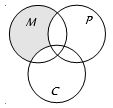
$A$ class has $175$ students. The following data shows the number of students obtaining one or more subjects: Mathematics $100$,Physics $70$,Chemistry $40$; Mathematics and Physics $30$,Mathematics and Chemistry $28$,Physics and Chemistry $23$; Mathematics,Physics and Chemistry $18$. How many students have offered Mathematics alone?
A
$35$
B
$48$
C
$60$
D
$22$
Solution
(C) Let $M$,$P$,and $C$ represent the sets of students taking Mathematics,Physics,and Chemistry,respectively.
Given:
$n(M) = 100$
$n(P) = 70$
$n(C) = 40$
$n(M \cap P) = 30$
$n(M \cap C) = 28$
$n(P \cap C) = 23$
$n(M \cap P \cap C) = 18$
To find the number of students who have offered Mathematics alone,we use the formula:
$n(M \text{ only}) = n(M) - [n(M \cap P) + n(M \cap C) - n(M \cap P \cap C)]$
$n(M \text{ only}) = 100 - [30 + 28 - 18]$
$n(M \text{ only}) = 100 - [40]$
$n(M \text{ only}) = 60$
Thus,$60$ students have offered Mathematics alone.
Given:
$n(M) = 100$
$n(P) = 70$
$n(C) = 40$
$n(M \cap P) = 30$
$n(M \cap C) = 28$
$n(P \cap C) = 23$
$n(M \cap P \cap C) = 18$
To find the number of students who have offered Mathematics alone,we use the formula:
$n(M \text{ only}) = n(M) - [n(M \cap P) + n(M \cap C) - n(M \cap P \cap C)]$
$n(M \text{ only}) = 100 - [30 + 28 - 18]$
$n(M \text{ only}) = 100 - [40]$
$n(M \text{ only}) = 60$
Thus,$60$ students have offered Mathematics alone.
0 likes
View Solution47
EasyMCQ
Consider the following relations:
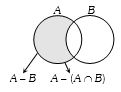
$(1) \, A - B = A - (A \cap B)$
$(2) \, A = (A \cap B) \cup (A - B)$
$(3) \, A - (B \cup C) = (A - B) \cup (A - C)$
Which of these is/are correct?
$(1) \, A - B = A - (A \cap B)$
$(2) \, A = (A \cap B) \cup (A - B)$
$(3) \, A - (B \cup C) = (A - B) \cup (A - C)$
Which of these is/are correct?
A
$1$ and $3$
B
$2$ only
C
$2$ and $3$
D
$1$ and $2$
Solution
(D) Let us analyze each relation:
$(1) \, A - B = A - (A \cap B)$: This is a standard set identity. The set $A - B$ consists of elements in $A$ that are not in $B$. Since $A \cap B$ is the set of elements common to both $A$ and $B$,removing these from $A$ leaves exactly $A - B$. Thus,$(1)$ is correct.
$(2) \, A = (A \cap B) \cup (A - B)$: This represents the partition of set $A$ into two disjoint sets: the part common to $B$ $(A \cap B)$ and the part not in $B$ $(A - B)$. Their union is indeed $A$. Thus,$(2)$ is correct.
$(3) \, A - (B \cup C) = (A - B) \cup (A - C)$: According to De Morgan's laws for set difference,$A - (B \cup C) = (A - B) \cap (A - C)$. Therefore,the given relation is incorrect.
Conclusion: Relations $(1)$ and $(2)$ are correct.
$(1) \, A - B = A - (A \cap B)$: This is a standard set identity. The set $A - B$ consists of elements in $A$ that are not in $B$. Since $A \cap B$ is the set of elements common to both $A$ and $B$,removing these from $A$ leaves exactly $A - B$. Thus,$(1)$ is correct.
$(2) \, A = (A \cap B) \cup (A - B)$: This represents the partition of set $A$ into two disjoint sets: the part common to $B$ $(A \cap B)$ and the part not in $B$ $(A - B)$. Their union is indeed $A$. Thus,$(2)$ is correct.
$(3) \, A - (B \cup C) = (A - B) \cup (A - C)$: According to De Morgan's laws for set difference,$A - (B \cup C) = (A - B) \cap (A - C)$. Therefore,the given relation is incorrect.
Conclusion: Relations $(1)$ and $(2)$ are correct.
0 likes
View Solution48
DifficultMCQ
If two sets $A$ and $B$ have $99$ elements in common,then the number of elements common to each of the sets $A \times B$ and $B \times A$ is:
A
$2^{99}$
B
$99^2$
C
$100$
D
$18$
Solution
(B) The number of elements common to the Cartesian products $A \times B$ and $B \times A$ is given by the intersection of the two sets:
$n((A \times B) \cap (B \times A))$
Using the property of Cartesian products,$(A \times B) \cap (B \times A) = (A \cap B) \times (B \cap A)$.
Since $n(A \cap B) = 99$,we have $n(B \cap A) = 99$.
Therefore,the number of elements is $n(A \cap B) \times n(B \cap A) = 99 \times 99 = 99^2$.
$n((A \times B) \cap (B \times A))$
Using the property of Cartesian products,$(A \times B) \cap (B \times A) = (A \cap B) \times (B \cap A)$.
Since $n(A \cap B) = 99$,we have $n(B \cap A) = 99$.
Therefore,the number of elements is $n(A \cap B) \times n(B \cap A) = 99 \times 99 = 99^2$.
0 likes
View Solution49
EasyMCQ
Given $n(U) = 20$,$n(A) = 12$,$n(B) = 9$,$n(A \cap B) = 4$,where $U$ is the universal set,$A$ and $B$ are subsets of $U$,then $n((A \cup B)^C) = $
A
$17$
B
$9$
C
$11$
D
$3$
Solution
(D) First,we find the number of elements in the union of sets $A$ and $B$ using the formula:
$n(A \cup B) = n(A) + n(B) - n(A \cap B)$
Substituting the given values:
$n(A \cup B) = 12 + 9 - 4 = 17$
Now,to find the number of elements in the complement of $(A \cup B)$,we use the formula:
$n((A \cup B)^C) = n(U) - n(A \cup B)$
Substituting the values:
$n((A \cup B)^C) = 20 - 17 = 3$
Thus,the correct option is $D$.
$n(A \cup B) = n(A) + n(B) - n(A \cap B)$
Substituting the given values:
$n(A \cup B) = 12 + 9 - 4 = 17$
Now,to find the number of elements in the complement of $(A \cup B)$,we use the formula:
$n((A \cup B)^C) = n(U) - n(A \cup B)$
Substituting the values:
$n((A \cup B)^C) = 20 - 17 = 3$
Thus,the correct option is $D$.
0 likes
View Solution50
EasyMCQ
Let $A = \{1, 2, 3\}$. The total number of distinct relations that can be defined over $A$ is
A
$2^9$
B
$6$
C
$8$
D
None of these
Solution
(A) relation over a set $A$ is defined as any subset of the Cartesian product $A \times A$.
Given $A = \{1, 2, 3\}$,the number of elements in $A$ is $n(A) = 3$.
The number of elements in the Cartesian product $A \times A$ is $n(A \times A) = n(A) \times n(A) = 3 \times 3 = 9$.
The total number of subsets of a set with $m$ elements is $2^m$.
Therefore,the total number of distinct relations that can be defined over $A$ is the number of subsets of $A \times A$,which is $2^9$.
Given $A = \{1, 2, 3\}$,the number of elements in $A$ is $n(A) = 3$.
The number of elements in the Cartesian product $A \times A$ is $n(A \times A) = n(A) \times n(A) = 3 \times 3 = 9$.
The total number of subsets of a set with $m$ elements is $2^m$.
Therefore,the total number of distinct relations that can be defined over $A$ is the number of subsets of $A \times A$,which is $2^9$.
0 likes
View SolutionAlgebra — Set Theory · Frequently Asked Questions
1Are these Algebra questions useful for JEE and NEET?
Yes. All questions in this section are mapped to JEE Main and NEET exam patterns. Previous year questions from JEE Main, NEET, GUJCET and state-level exams are included with full solutions.
2Can I switch to Hindi or Gujarati for these questions?
Yes. Use the language tabs in the hero section or the sidebar to view the same questions and solutions in English, Hindi or Gujarati.
3How do I generate a question paper from this subtopic?
Use the Vedclass Exam Paper Generator — select the chapter and subtopic, set difficulty, and generate Sets A, B, C, D automatically. First 3 chapters of every subject are free.
Vedclass Products
For Students
Vedclass Test Series
Mock tests in real JEE/NEET style with performance analysis. 5-day free trial.
Start Free TrialFor Teachers
Exam Paper Generator
Generate Set A/B/C/D papers from this chapter in 2 minutes. 3 chapters free.
Try FreeFor Institutes
Online Exam Module
Live online exams with unlimited students, 360° analytics & white-label branding.
See DemoFor Teachers & Institutes
Generate a Algebra Exam Paper in 2 Minutes
Select subtopic & difficulty — Sets A, B, C, D auto-generated with No Repeat logic.
First 3 chapters of every subject are free — no payment required.