
A English
Set Theory Questions in English
Competitive Exam Quantitative Aptitude · Algebra · Set Theory
202+
Questions
English
Language
100%
With Solutions
Showing 50 of 202 questions in English
51
EasyMCQ
Let $X = \{ 1, 2, 3, 4, 5 \}$ and $Y = \{ 1, 3, 5, 7, 9 \}$. Which of the following is/are relations from $X$ to $Y$?
A
$R_1 = \{ (x, y) | y = 2 + x, x \in X, y \in Y \}$
B
$R_2 = \{ (1, 1), (2, 1), (3, 3), (4, 3), (5, 5) \}$
C
$R_3 = \{ (1, 1), (1, 3), (3, 5), (3, 7), (5, 7) \}$
D
Both $(B)$ and $(C)$
Solution
(D) relation from $X$ to $Y$ is a subset of the Cartesian product $X \times Y$.
For $R_1$: If $x=1, y=3 \in Y$; $x=2, y=4 \notin Y$; $x=3, y=5 \in Y$; $x=4, y=6 \notin Y$; $x=5, y=7 \in Y$. Since $y$ must be in $Y$ for all $x \in X$,$R_1$ is not a relation from $X$ to $Y$ because it contains pairs where $y \notin Y$.
For $R_2$: All pairs $(x, y)$ satisfy $x \in X$ and $y \in Y$. Thus,$R_2 \subseteq X \times Y$,so it is a relation.
For $R_3$: All pairs $(x, y)$ satisfy $x \in X$ and $y \in Y$. Thus,$R_3 \subseteq X \times Y$,so it is a relation.
Therefore,both $(B)$ and $(C)$ are relations from $X$ to $Y$.
For $R_1$: If $x=1, y=3 \in Y$; $x=2, y=4 \notin Y$; $x=3, y=5 \in Y$; $x=4, y=6 \notin Y$; $x=5, y=7 \in Y$. Since $y$ must be in $Y$ for all $x \in X$,$R_1$ is not a relation from $X$ to $Y$ because it contains pairs where $y \notin Y$.
For $R_2$: All pairs $(x, y)$ satisfy $x \in X$ and $y \in Y$. Thus,$R_2 \subseteq X \times Y$,so it is a relation.
For $R_3$: All pairs $(x, y)$ satisfy $x \in X$ and $y \in Y$. Thus,$R_3 \subseteq X \times Y$,so it is a relation.
Therefore,both $(B)$ and $(C)$ are relations from $X$ to $Y$.
0 likes
View Solution52
EasyMCQ
Given two finite sets $A$ and $B$ such that $n(A) = 2$ and $n(B) = 3$. Then,the total number of relations from $A$ to $B$ is:
A
$4$
B
$8$
C
$64$
D
None of these
Solution
(C) Given that $n(A) = 2$ and $n(B) = 3$.
The number of elements in the Cartesian product $A \times B$ is given by $n(A \times B) = n(A) \times n(B) = 2 \times 3 = 6$.
$A$ relation from set $A$ to set $B$ is defined as any subset of the Cartesian product $A \times B$.
The total number of subsets of a set with $m$ elements is $2^m$.
Therefore,the total number of relations from $A$ to $B$ is $2^{n(A \times B)} = 2^6 = 64$.
The number of elements in the Cartesian product $A \times B$ is given by $n(A \times B) = n(A) \times n(B) = 2 \times 3 = 6$.
$A$ relation from set $A$ to set $B$ is defined as any subset of the Cartesian product $A \times B$.
The total number of subsets of a set with $m$ elements is $2^m$.
Therefore,the total number of relations from $A$ to $B$ is $2^{n(A \times B)} = 2^6 = 64$.
0 likes
View Solution53
EasyMCQ
The relation $R$ defined on the set of natural numbers as $\{(a, b) : a\}$ differs from $b$ by $\{3\}$,is given by
A
$\{(1, 4), (2, 5), (3, 6), .....\}$
B
$\{(4, 1), (5, 2), (6, 3), .....\}$
C
$\{(1, 3), (2, 6), (3, 9), .....\}$
D
None of these
Solution
(B) The relation $R$ is defined on the set of natural numbers $N$ as $\{(a, b) : a - b = 3\}$ or $\{(a, b) : b - a = 3\}$.
Given the options,we look for pairs where the difference is $3$.
If $b = n$,then $a = n + 3$.
For $n = 1, a = 4 \implies (4, 1)$.
For $n = 2, a = 5 \implies (5, 2)$.
For $n = 3, a = 6 \implies (6, 3)$.
Thus,the relation is $R = \{(4, 1), (5, 2), (6, 3), .....\}$.
Given the options,we look for pairs where the difference is $3$.
If $b = n$,then $a = n + 3$.
For $n = 1, a = 4 \implies (4, 1)$.
For $n = 2, a = 5 \implies (5, 2)$.
For $n = 3, a = 6 \implies (6, 3)$.
Thus,the relation is $R = \{(4, 1), (5, 2), (6, 3), .....\}$.
0 likes
View Solution54
MediumMCQ
If ${N_a} = \{ an : n \in N \} ,$ then ${N_3} \cap {N_4} = $
A
${N_7}$
B
${N_{12}}$
C
${N_3}$
D
${N_4}$
Solution
(B) Given that ${N_a} = \{ an : n \in N \}$.
This represents the set of all multiples of $a$.
Therefore,${N_3} = \{ 3, 6, 9, 12, 15, 18, 21, 24, \dots \}$ and ${N_4} = \{ 4, 8, 12, 16, 20, 24, \dots \}$.
The intersection ${N_3} \cap {N_4}$ consists of elements that are common to both sets,which are the common multiples of $3$ and $4$.
The least common multiple of $3$ and $4$ is $12$.
Thus,${N_3} \cap {N_4} = \{ 12, 24, 36, \dots \} = {N_{12}}$.
In general,${N_a} \cap {N_b} = {N_{\text{lcm}(a, b)}}$.
This represents the set of all multiples of $a$.
Therefore,${N_3} = \{ 3, 6, 9, 12, 15, 18, 21, 24, \dots \}$ and ${N_4} = \{ 4, 8, 12, 16, 20, 24, \dots \}$.
The intersection ${N_3} \cap {N_4}$ consists of elements that are common to both sets,which are the common multiples of $3$ and $4$.
The least common multiple of $3$ and $4$ is $12$.
Thus,${N_3} \cap {N_4} = \{ 12, 24, 36, \dots \} = {N_{12}}$.
In general,${N_a} \cap {N_b} = {N_{\text{lcm}(a, b)}}$.
0 likes
View Solution55
MediumMCQ
Sets $A$ and $B$ have $3$ and $6$ elements respectively. What can be the minimum number of elements in $A \cup B$?
A
$3$
B
$6$
C
$9$
D
$18$
Solution
(B) The number of elements in the union of two sets is given by the formula: $n(A \cup B) = n(A) + n(B) - n(A \cap B)$.
Given $n(A) = 3$ and $n(B) = 6$.
To find the minimum number of elements in $A \cup B$,we need to maximize the number of elements in the intersection $n(A \cap B)$.
The maximum possible value for $n(A \cap B)$ is the number of elements in the smaller set,which is $3$ (since $A \subseteq B$ is possible).
Substituting these values: $n(A \cup B) = 3 + 6 - 3 = 6$.
Therefore,the minimum number of elements in $A \cup B$ is $6$.
Given $n(A) = 3$ and $n(B) = 6$.
To find the minimum number of elements in $A \cup B$,we need to maximize the number of elements in the intersection $n(A \cap B)$.
The maximum possible value for $n(A \cap B)$ is the number of elements in the smaller set,which is $3$ (since $A \subseteq B$ is possible).
Substituting these values: $n(A \cup B) = 3 + 6 - 3 = 6$.
Therefore,the minimum number of elements in $A \cup B$ is $6$.
0 likes
View Solution56
DifficultMCQ
If $A = \{(x, y) : x^2 + y^2 = 25\}$ and $B = \{(x, y) : x^2 + 9y^2 = 144\}$,then $A \cap B$ contains
A
One point
B
Three points
C
Two points
D
Four points
Solution
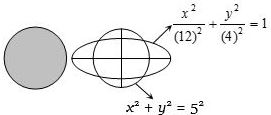
(D) The set $A$ represents a circle with center $(0, 0)$ and radius $r = 5$. The equation is $x^2 + y^2 = 25$.
The set $B$ represents an ellipse with the equation $x^2 + 9y^2 = 144$. Dividing by $144$,we get $\frac{x^2}{144} + \frac{9y^2}{144} = 1$,which simplifies to $\frac{x^2}{12^2} + \frac{y^2}{4^2} = 1$.
This is an ellipse with semi-major axis $a = 12$ and semi-minor axis $b = 4$.
Since the circle has a radius of $5$,and the ellipse has a minor axis of $4$ and a major axis of $12$,the circle intersects the ellipse at four distinct points because the circle's radius is greater than the semi-minor axis but less than the semi-major axis of the ellipse.
Therefore,$A \cap B$ contains four points.
The set $B$ represents an ellipse with the equation $x^2 + 9y^2 = 144$. Dividing by $144$,we get $\frac{x^2}{144} + \frac{9y^2}{144} = 1$,which simplifies to $\frac{x^2}{12^2} + \frac{y^2}{4^2} = 1$.
This is an ellipse with semi-major axis $a = 12$ and semi-minor axis $b = 4$.
Since the circle has a radius of $5$,and the ellipse has a minor axis of $4$ and a major axis of $12$,the circle intersects the ellipse at four distinct points because the circle's radius is greater than the semi-minor axis but less than the semi-major axis of the ellipse.
Therefore,$A \cap B$ contains four points.
0 likes
View Solution57
MediumMCQ
If $A = \{x : x \text{ is a multiple of } 3\}$ and $B = \{x : x \text{ is a multiple of } 5\}$,then $A - B$ is ($\bar A$ denotes the complement of $A$).
A
$\bar A \cap B$
B
$A \cap \bar B$
C
$\bar A \cap \bar B$
D
$\overline{A \cap B}$
Solution
(B) The set difference $A - B$ is defined as the set of all elements that are in $A$ but not in $B$.
Mathematically,$A - B = \{x : x \in A \text{ and } x \notin B\}$.
Since $x \notin B$ is equivalent to $x \in \bar B$ (where $\bar B$ is the complement of $B$),we can write:
$A - B = A \cap \bar B$.
Therefore,the correct option is $B$.
Mathematically,$A - B = \{x : x \in A \text{ and } x \notin B\}$.
Since $x \notin B$ is equivalent to $x \in \bar B$ (where $\bar B$ is the complement of $B$),we can write:
$A - B = A \cap \bar B$.
Therefore,the correct option is $B$.
0 likes
View Solution58
EasyMCQ
If $A = \{ x : x^2 - 5x + 6 = 0 \}, B = \{ 2, 4 \}, C = \{ 4, 5 \}$,then $A \times (B \cap C)$ is
A
$\{(2, 4), (3, 4)\}$
B
$\{(4, 2), (4, 3)\}$
C
$\{(2, 4), (3, 4), (4, 4)\}$
D
$\{(2, 2), (3, 3), (4, 4), (5, 5)\}$
Solution
(A) First,we solve the quadratic equation for set $A$: $x^2 - 5x + 6 = 0$.
Factoring the quadratic,we get $(x - 2)(x - 3) = 0$,so $x = 2$ or $x = 3$. Thus,$A = \{2, 3\}$.
Next,we find the intersection of sets $B$ and $C$: $B \cap C = \{2, 4\} \cap \{4, 5\} = \{4\}$.
Finally,we calculate the Cartesian product $A \times (B \cap C) = \{2, 3\} \times \{4\}$.
This results in the set of ordered pairs $\{(2, 4), (3, 4)\}$.
Factoring the quadratic,we get $(x - 2)(x - 3) = 0$,so $x = 2$ or $x = 3$. Thus,$A = \{2, 3\}$.
Next,we find the intersection of sets $B$ and $C$: $B \cap C = \{2, 4\} \cap \{4, 5\} = \{4\}$.
Finally,we calculate the Cartesian product $A \times (B \cap C) = \{2, 3\} \times \{4\}$.
This results in the set of ordered pairs $\{(2, 4), (3, 4)\}$.
0 likes
View Solution59
DifficultMCQ
In a college of $300$ students,every student reads $5$ newspapers and every newspaper is read by $60$ students. The number of newspapers is:
A
At least $30$
B
At most $20$
C
Exactly $25$
D
None of these
Solution
(C) Let the number of newspapers be $x$.
Each student reads $5$ newspapers,so the total number of readings by all $300$ students is $300 \times 5 = 1500$.
Each newspaper is read by $60$ students,so the total number of readings is also $x \times 60$.
Equating the two,we get $60x = 1500$.
Solving for $x$,we get $x = 1500 / 60 = 25$.
Therefore,the number of newspapers is $25$.
Each student reads $5$ newspapers,so the total number of readings by all $300$ students is $300 \times 5 = 1500$.
Each newspaper is read by $60$ students,so the total number of readings is also $x \times 60$.
Equating the two,we get $60x = 1500$.
Solving for $x$,we get $x = 1500 / 60 = 25$.
Therefore,the number of newspapers is $25$.
0 likes
View Solution60
EasyMCQ
Let $A = \{1, 2, 3, 4, 5\}$ and $B = \{2, 3, 6, 7\}$. Then the number of elements in $(A \times B) \cap (B \times A)$ is
A
$18$
B
$6$
C
$4$
D
$0$
Solution
(C) The Cartesian product of two sets $A$ and $B$ is defined as $A \times B = \{(a, b) : a \in A, b \in B\}$.
For the intersection $(A \times B) \cap (B \times A)$,an element $(x, y)$ must satisfy $(x, y) \in A \times B$ and $(x, y) \in B \times A$.
This implies $x \in A, y \in B$ and $x \in B, y \in A$.
Therefore,$x \in (A \cap B)$ and $y \in (A \cap B)$.
Given $A = \{1, 2, 3, 4, 5\}$ and $B = \{2, 3, 6, 7\}$,the intersection is $A \cap B = \{2, 3\}$.
The number of elements in $A \cap B$ is $n(A \cap B) = 2$.
The number of elements in $(A \times B) \cap (B \times A)$ is given by $n(A \cap B) \times n(A \cap B) = 2 \times 2 = 4$.
For the intersection $(A \times B) \cap (B \times A)$,an element $(x, y)$ must satisfy $(x, y) \in A \times B$ and $(x, y) \in B \times A$.
This implies $x \in A, y \in B$ and $x \in B, y \in A$.
Therefore,$x \in (A \cap B)$ and $y \in (A \cap B)$.
Given $A = \{1, 2, 3, 4, 5\}$ and $B = \{2, 3, 6, 7\}$,the intersection is $A \cap B = \{2, 3\}$.
The number of elements in $A \cap B$ is $n(A \cap B) = 2$.
The number of elements in $(A \times B) \cap (B \times A)$ is given by $n(A \cap B) \times n(A \cap B) = 2 \times 2 = 4$.
0 likes
View Solution61
EasyMCQ
The equivalent function of $\log {x^2}$ is
A
$2\log x$
B
$2\log |x|$
C
$|\log {x^2}|$
D
$(\log x)^2$
Solution
(B) The function $f(x) = \log(x^2)$ is defined for all $x \in \mathbb{R} \setminus \{0\}$ because $x^2 > 0$ for all non-zero real numbers.
Using the logarithmic property $\log(a^n) = n \log a$,we must ensure the domain remains consistent.
Since $x^2 = |x|^2$,we can write $\log(x^2) = \log(|x|^2) = 2 \log |x|$.
The function $2 \log |x|$ is also defined for all $x \in \mathbb{R} \setminus \{0\}$.
Therefore,the equivalent function is $2 \log |x|$.
Using the logarithmic property $\log(a^n) = n \log a$,we must ensure the domain remains consistent.
Since $x^2 = |x|^2$,we can write $\log(x^2) = \log(|x|^2) = 2 \log |x|$.
The function $2 \log |x|$ is also defined for all $x \in \mathbb{R} \setminus \{0\}$.
Therefore,the equivalent function is $2 \log |x|$.
0 likes
View Solution62
EasyMCQ
If $f(x) = \frac{x - |x|}{|x|}$,then $f(-1) = $
A
$1$
B
$-2$
C
$0$
D
$\pm 2$
Solution
(B) Given the function $f(x) = \frac{x - |x|}{|x|}$.
To find $f(-1)$,substitute $x = -1$ into the function.
$f(-1) = \frac{-1 - |-1|}{|-1|}$.
Since $|-1| = 1$,we have:
$f(-1) = \frac{-1 - 1}{1} = \frac{-2}{1} = -2$.
To find $f(-1)$,substitute $x = -1$ into the function.
$f(-1) = \frac{-1 - |-1|}{|-1|}$.
Since $|-1| = 1$,we have:
$f(-1) = \frac{-1 - 1}{1} = \frac{-2}{1} = -2$.
0 likes
View Solution63
EasyMCQ
If $f(x) = 4x^3 + 3x^2 + 3x + 4$,then $x^3 f\left( \frac{1}{x} \right)$ is
A
$f(-x)$
B
$\frac{1}{f(x)}$
C
$\left( f\left( \frac{1}{x} \right) \right)^2$
D
$f(x)$
Solution
(D) Given $f(x) = 4x^3 + 3x^2 + 3x + 4$.
To find $x^3 f\left( \frac{1}{x} \right)$,first substitute $\frac{1}{x}$ for $x$ in the function $f(x)$:
$f\left( \frac{1}{x} \right) = 4\left( \frac{1}{x} \right)^3 + 3\left( \frac{1}{x} \right)^2 + 3\left( \frac{1}{x} \right) + 4$
$f\left( \frac{1}{x} \right) = \frac{4}{x^3} + \frac{3}{x^2} + \frac{3}{x} + 4$
Now,multiply this expression by $x^3$:
$x^3 f\left( \frac{1}{x} \right) = x^3 \left( \frac{4}{x^3} + \frac{3}{x^2} + \frac{3}{x} + 4 \right)$
$x^3 f\left( \frac{1}{x} \right) = 4 + 3x + 3x^2 + 4x^3$
Rearranging the terms,we get:
$x^3 f\left( \frac{1}{x} \right) = 4x^3 + 3x^2 + 3x + 4 = f(x)$
Therefore,the correct option is $D$.
To find $x^3 f\left( \frac{1}{x} \right)$,first substitute $\frac{1}{x}$ for $x$ in the function $f(x)$:
$f\left( \frac{1}{x} \right) = 4\left( \frac{1}{x} \right)^3 + 3\left( \frac{1}{x} \right)^2 + 3\left( \frac{1}{x} \right) + 4$
$f\left( \frac{1}{x} \right) = \frac{4}{x^3} + \frac{3}{x^2} + \frac{3}{x} + 4$
Now,multiply this expression by $x^3$:
$x^3 f\left( \frac{1}{x} \right) = x^3 \left( \frac{4}{x^3} + \frac{3}{x^2} + \frac{3}{x} + 4 \right)$
$x^3 f\left( \frac{1}{x} \right) = 4 + 3x + 3x^2 + 4x^3$
Rearranging the terms,we get:
$x^3 f\left( \frac{1}{x} \right) = 4x^3 + 3x^2 + 3x + 4 = f(x)$
Therefore,the correct option is $D$.
0 likes
View Solution64
EasyMCQ
Let $f:R \to R$ be defined by $f(x) = 2x + |x|$,then $f(2x) + f(-x) - f(x) = $
A
$2x$
B
$2|x|$
C
$-2x$
D
$-2|x|$
Solution
(B) Given the function $f(x) = 2x + |x|$.
First,calculate $f(2x)$:
$f(2x) = 2(2x) + |2x| = 4x + 2|x|$.
Next,calculate $f(-x)$:
$f(-x) = 2(-x) + |-x| = -2x + |x|$.
Now,substitute these into the expression $f(2x) + f(-x) - f(x)$:
$= (4x + 2|x|) + (-2x + |x|) - (2x + |x|)$.
$= 4x + 2|x| - 2x + |x| - 2x - |x|$.
Combine the like terms:
$= (4x - 2x - 2x) + (2|x| + |x| - |x|)$.
$= 0x + 2|x| = 2|x|$.
First,calculate $f(2x)$:
$f(2x) = 2(2x) + |2x| = 4x + 2|x|$.
Next,calculate $f(-x)$:
$f(-x) = 2(-x) + |-x| = -2x + |x|$.
Now,substitute these into the expression $f(2x) + f(-x) - f(x)$:
$= (4x + 2|x|) + (-2x + |x|) - (2x + |x|)$.
$= 4x + 2|x| - 2x + |x| - 2x - |x|$.
Combine the like terms:
$= (4x - 2x - 2x) + (2|x| + |x| - |x|)$.
$= 0x + 2|x| = 2|x|$.
0 likes
View Solution65
MediumMCQ
If $f(x) = \cos([\pi^2]x) + \cos([- \pi^2]x)$,then which of the following is true?
A
$f\left( \frac{\pi}{4} \right) = 2$
B
$f(-\pi) = 2$
C
$f(\pi) = 1$
D
$f\left( \frac{\pi}{2} \right) = -1$
Solution
(D) Given $f(x) = \cos([\pi^2]x) + \cos([- \pi^2]x)$.
Since $\pi^2 \approx 9.86$,we have $[\pi^2] = 9$.
Also,$[-\pi^2] = [-9.86] = -10$.
Thus,$f(x) = \cos(9x) + \cos(-10x) = \cos(9x) + \cos(10x)$.
Using the sum-to-product formula $\cos A + \cos B = 2\cos\left(\frac{A+B}{2}\right)\cos\left(\frac{A-B}{2}\right)$:
$f(x) = 2\cos\left(\frac{19x}{2}\right)\cos\left(\frac{x}{2}\right)$.
Now,evaluate $f\left(\frac{\pi}{2}\right)$:
$f\left(\frac{\pi}{2}\right) = 2\cos\left(\frac{19\pi}{4}\right)\cos\left(\frac{\pi}{4}\right)$.
Since $\cos\left(\frac{19\pi}{4}\right) = \cos\left(4\pi + \frac{3\pi}{4}\right) = \cos\left(\frac{3\pi}{4}\right) = -\frac{1}{\sqrt{2}}$ and $\cos\left(\frac{\pi}{4}\right) = \frac{1}{\sqrt{2}}$:
$f\left(\frac{\pi}{2}\right) = 2 \times \left(-\frac{1}{\sqrt{2}}\right) \times \left(\frac{1}{\sqrt{2}}\right) = 2 \times \left(-\frac{1}{2}\right) = -1$.
Since $\pi^2 \approx 9.86$,we have $[\pi^2] = 9$.
Also,$[-\pi^2] = [-9.86] = -10$.
Thus,$f(x) = \cos(9x) + \cos(-10x) = \cos(9x) + \cos(10x)$.
Using the sum-to-product formula $\cos A + \cos B = 2\cos\left(\frac{A+B}{2}\right)\cos\left(\frac{A-B}{2}\right)$:
$f(x) = 2\cos\left(\frac{19x}{2}\right)\cos\left(\frac{x}{2}\right)$.
Now,evaluate $f\left(\frac{\pi}{2}\right)$:
$f\left(\frac{\pi}{2}\right) = 2\cos\left(\frac{19\pi}{4}\right)\cos\left(\frac{\pi}{4}\right)$.
Since $\cos\left(\frac{19\pi}{4}\right) = \cos\left(4\pi + \frac{3\pi}{4}\right) = \cos\left(\frac{3\pi}{4}\right) = -\frac{1}{\sqrt{2}}$ and $\cos\left(\frac{\pi}{4}\right) = \frac{1}{\sqrt{2}}$:
$f\left(\frac{\pi}{2}\right) = 2 \times \left(-\frac{1}{\sqrt{2}}\right) \times \left(\frac{1}{\sqrt{2}}\right) = 2 \times \left(-\frac{1}{2}\right) = -1$.
0 likes
View Solution66
EasyMCQ
Domain and range of $f(x) = \frac{|x - 3|}{x - 3}$ are respectively
A
$R, [-1, 1]$
B
$R - \{3\}, \{1, -1\}$
C
$R^+, R$
D
None of these
Solution
(B) The function is defined as $f(x) = \frac{|x - 3|}{x - 3}$.
For the function to be defined,the denominator must not be zero,so $x - 3 \neq 0$,which implies $x \neq 3$. Thus,the domain is $R - \{3\}$.
Now,consider the two cases for the absolute value:
Case $1$: If $x > 3$,then $|x - 3| = x - 3$. Therefore,$f(x) = \frac{x - 3}{x - 3} = 1$.
Case $2$: If $x < 3$,then $|x - 3| = -(x - 3)$. Therefore,$f(x) = \frac{-(x - 3)}{x - 3} = -1$.
Thus,the range of the function is the set $\{1, -1\}$.
For the function to be defined,the denominator must not be zero,so $x - 3 \neq 0$,which implies $x \neq 3$. Thus,the domain is $R - \{3\}$.
Now,consider the two cases for the absolute value:
Case $1$: If $x > 3$,then $|x - 3| = x - 3$. Therefore,$f(x) = \frac{x - 3}{x - 3} = 1$.
Case $2$: If $x < 3$,then $|x - 3| = -(x - 3)$. Therefore,$f(x) = \frac{-(x - 3)}{x - 3} = -1$.
Thus,the range of the function is the set $\{1, -1\}$.
0 likes
View Solution67
EasyMCQ
Domain of the function $\log |x^2 - 9|$ is
A
$R$
B
$R - [-3, 3]$
C
$R - \{-3, 3\}$
D
None of these
Solution
(C) The function $f(x) = \log |x^2 - 9|$ is defined only when the argument of the logarithm is strictly positive.
That is,$|x^2 - 9| > 0$.
Since the absolute value $|x^2 - 9|$ is always non-negative,the condition $|x^2 - 9| > 0$ is satisfied for all real numbers $x$ except where $|x^2 - 9| = 0$.
Setting $x^2 - 9 = 0$,we get $x^2 = 9$,which implies $x = 3$ or $x = -3$.
Therefore,the function is undefined at $x = 3$ and $x = -3$.
Thus,the domain of the function is all real numbers except $\{-3, 3\}$,which is written as $R - \{-3, 3\}$.
That is,$|x^2 - 9| > 0$.
Since the absolute value $|x^2 - 9|$ is always non-negative,the condition $|x^2 - 9| > 0$ is satisfied for all real numbers $x$ except where $|x^2 - 9| = 0$.
Setting $x^2 - 9 = 0$,we get $x^2 = 9$,which implies $x = 3$ or $x = -3$.
Therefore,the function is undefined at $x = 3$ and $x = -3$.
Thus,the domain of the function is all real numbers except $\{-3, 3\}$,which is written as $R - \{-3, 3\}$.
0 likes
View Solution68
EasyMCQ
Domain of $f(x) = \log |\log x|$ is
A
$(0, \infty)$
B
$(1, \infty)$
C
$(0, 1) \cup (1, \infty)$
D
$(-\infty, 1)$
Solution
(C) The function $f(x) = \log |\log x|$ is defined if the argument of the logarithm is strictly positive.
$1$. The inner logarithm $\log x$ is defined only when $x > 0$.
$2$. The outer logarithm $\log |\log x|$ is defined when $|\log x| > 0$.
$3$. The condition $|\log x| > 0$ implies $\log x \neq 0$,which means $x \neq 1$.
$4$. Combining both conditions,we require $x > 0$ and $x \neq 1$.
Therefore,the domain is $x \in (0, 1) \cup (1, \infty)$.
$1$. The inner logarithm $\log x$ is defined only when $x > 0$.
$2$. The outer logarithm $\log |\log x|$ is defined when $|\log x| > 0$.
$3$. The condition $|\log x| > 0$ implies $\log x \neq 0$,which means $x \neq 1$.
$4$. Combining both conditions,we require $x > 0$ and $x \neq 1$.
Therefore,the domain is $x \in (0, 1) \cup (1, \infty)$.
0 likes
View Solution69
EasyMCQ
The domain of $f(x) = \frac{\log_2(x + 3)}{x^2 + 3x + 2}$ is
A
$R - \{-1, -2\}$
B
$(-2, +\infty)$
C
$R - \{-1, -2, -3\}$
D
$(-3, +\infty) - \{-1, -2\}$
Solution
(D) For the function $f(x) = \frac{\log_2(x + 3)}{x^2 + 3x + 2}$ to be defined:
$1$. The argument of the logarithm must be positive: $x + 3 > 0 \implies x > -3$.
$2$. The denominator must not be zero: $x^2 + 3x + 2 \neq 0$.
Factoring the denominator: $(x + 1)(x + 2) \neq 0$,which implies $x \neq -1$ and $x \neq -2$.
Combining these conditions,we require $x > -3$ and $x \notin \{-1, -2\}$.
Thus,the domain is $(-3, \infty) - \{-1, -2\}$.
$1$. The argument of the logarithm must be positive: $x + 3 > 0 \implies x > -3$.
$2$. The denominator must not be zero: $x^2 + 3x + 2 \neq 0$.
Factoring the denominator: $(x + 1)(x + 2) \neq 0$,which implies $x \neq -1$ and $x \neq -2$.
Combining these conditions,we require $x > -3$ and $x \notin \{-1, -2\}$.
Thus,the domain is $(-3, \infty) - \{-1, -2\}$.
0 likes
View Solution70
EasyMCQ
If the domain of the function $f(x) = x^2 - 6x + 7$ is $(-\infty, \infty)$,then the range of the function is:
A
$(-\infty, \infty)$
B
$[-2, \infty)$
C
$(-2, 3)$
D
$(-\infty, -2)$
Solution
(B) Given the function $f(x) = x^2 - 6x + 7$.
To find the range,we complete the square:
$f(x) = (x^2 - 6x + 9) - 9 + 7$
$f(x) = (x - 3)^2 - 2$
Since $(x - 3)^2 \ge 0$ for all real $x$,the minimum value of the expression is $0 - 2 = -2$.
As $x \to \infty$ or $x \to -\infty$,$f(x) \to \infty$.
Therefore,the range of the function is $[-2, \infty)$.
To find the range,we complete the square:
$f(x) = (x^2 - 6x + 9) - 9 + 7$
$f(x) = (x - 3)^2 - 2$
Since $(x - 3)^2 \ge 0$ for all real $x$,the minimum value of the expression is $0 - 2 = -2$.
As $x \to \infty$ or $x \to -\infty$,$f(x) \to \infty$.
Therefore,the range of the function is $[-2, \infty)$.
0 likes
View Solution71
EasyMCQ
The domain of the function $f(x) = \sqrt{\log \frac{1}{|\sin x|}}$ is
A
$R - \{ 2n\pi, n \in I \}$
B
$R - \{ n\pi, n \in I \}$
C
$R - \{ -\pi, \pi \}$
D
$(-\infty, \infty)$
Solution
(B) For the function $f(x) = \sqrt{\log \frac{1}{|\sin x|}}$ to be defined,the expression inside the square root must be non-negative:
$\log \frac{1}{|\sin x|} \ge 0$
Since $\log_a x \ge 0$ implies $x \ge 1$ (for base $10$ or $e$),we have:
$\frac{1}{|\sin x|} \ge 1$
$1 \ge |\sin x|$
This inequality is always true for all $x$ where $\sin x$ is defined,provided $|\sin x| \neq 0$.
Since $\sin x = 0$ at $x = n\pi$ for $n \in I$,the term $\frac{1}{|\sin x|}$ becomes undefined at these points.
Therefore,the domain is all real numbers except where $\sin x = 0$.
Domain $= R - \{ n\pi, n \in I \}$.
$\log \frac{1}{|\sin x|} \ge 0$
Since $\log_a x \ge 0$ implies $x \ge 1$ (for base $10$ or $e$),we have:
$\frac{1}{|\sin x|} \ge 1$
$1 \ge |\sin x|$
This inequality is always true for all $x$ where $\sin x$ is defined,provided $|\sin x| \neq 0$.
Since $\sin x = 0$ at $x = n\pi$ for $n \in I$,the term $\frac{1}{|\sin x|}$ becomes undefined at these points.
Therefore,the domain is all real numbers except where $\sin x = 0$.
Domain $= R - \{ n\pi, n \in I \}$.
0 likes
View Solution72
EasyMCQ
The domain of the function $f(x) = \log (\sqrt {x - 4} + \sqrt {6 - x} )$ is
A
$[4, \infty )$
B
$( - \infty , 6]$
C
$[4, 6]$
D
None of these
Solution
(C) For the function $f(x) = \log (\sqrt {x - 4} + \sqrt {6 - x} )$ to be defined,the expression inside the logarithm must be positive,and the expressions inside the square roots must be non-negative.
$1$. For $\sqrt {x - 4}$ to be defined,$x - 4 \ge 0$,which implies $x \ge 4$.
$2$. For $\sqrt {6 - x}$ to be defined,$6 - x \ge 0$,which implies $x \le 6$.
$3$. The sum $\sqrt {x - 4} + \sqrt {6 - x}$ must be strictly greater than $0$. Since both square root terms are non-negative,their sum is always $\ge 0$. The sum is $0$ only if $x-4=0$ and $6-x=0$ simultaneously,which is impossible ($x=4$ and $x=6$). Thus,the sum is always positive for $x \in [4, 6]$.
Combining these conditions,we get $4 \le x \le 6$.
Therefore,the domain is $[4, 6]$.
$1$. For $\sqrt {x - 4}$ to be defined,$x - 4 \ge 0$,which implies $x \ge 4$.
$2$. For $\sqrt {6 - x}$ to be defined,$6 - x \ge 0$,which implies $x \le 6$.
$3$. The sum $\sqrt {x - 4} + \sqrt {6 - x}$ must be strictly greater than $0$. Since both square root terms are non-negative,their sum is always $\ge 0$. The sum is $0$ only if $x-4=0$ and $6-x=0$ simultaneously,which is impossible ($x=4$ and $x=6$). Thus,the sum is always positive for $x \in [4, 6]$.
Combining these conditions,we get $4 \le x \le 6$.
Therefore,the domain is $[4, 6]$.
0 likes
View Solution73
MediumMCQ
Domain of the function $f(x) = {\left[ {{{\log }_{10}}\left( {\frac{{5x - {x^2}}}{4}} \right)} \right]^{1/2}}$ is
A
$ - \infty < x < \infty $
B
$1 \le x \le 4$
C
$4 \le x \le 16$
D
$ - 1 \le x \le 1$
Solution
(B) For the function $f(x) = {\left[ {{{\log }_{10}}\left( {\frac{{5x - {x^2}}}{4}} \right)} \right]^{1/2}}$ to be defined,the expression inside the square root must be non-negative:
${\log _{10}}\left( {\frac{{5x - {x^2}}}{4}} \right) \ge 0$
Since the base of the logarithm is $10 > 1$,the inequality remains unchanged when we exponentiate:
$\frac{{5x - {x^2}}}{4} \ge {10^0}$
$\frac{{5x - {x^2}}}{4} \ge 1$
$5x - {x^2} \ge 4$
${x^2} - 5x + 4 \le 0$
Factoring the quadratic expression:
$(x - 1)(x - 4) \le 0$
This inequality holds when $x$ lies between the roots $1$ and $4$ inclusive.
Therefore,the domain is $[1, 4]$.
${\log _{10}}\left( {\frac{{5x - {x^2}}}{4}} \right) \ge 0$
Since the base of the logarithm is $10 > 1$,the inequality remains unchanged when we exponentiate:
$\frac{{5x - {x^2}}}{4} \ge {10^0}$
$\frac{{5x - {x^2}}}{4} \ge 1$
$5x - {x^2} \ge 4$
${x^2} - 5x + 4 \le 0$
Factoring the quadratic expression:
$(x - 1)(x - 4) \le 0$
This inequality holds when $x$ lies between the roots $1$ and $4$ inclusive.
Therefore,the domain is $[1, 4]$.
0 likes
View Solution74
MediumMCQ
The domain of the function $f(x) = \log_{3 + x}(x^2 - 1)$ is
A
$(-3, -1) \cup (1, \infty)$
B
$[-3, -1) \cup [1, \infty)$
C
$(-3, -2) \cup (-2, -1) \cup (1, \infty)$
D
$[-3, -2) \cup (-2, -1) \cup [1, \infty)$
Solution
(C) For the function $f(x) = \log_{3 + x}(x^2 - 1)$ to be defined,the following conditions must be satisfied:
$1$. The argument of the logarithm must be positive: $x^2 - 1 > 0$,which implies $x^2 > 1$,so $x < -1$ or $x > 1$.
$2$. The base of the logarithm must be positive and not equal to $1$: $3 + x > 0$ and $3 + x \neq 1$.
From $3 + x > 0$,we get $x > -3$.
From $3 + x \neq 1$,we get $x \neq -2$.
Combining all these conditions: $x > -3$,$x \neq -2$,and ($x < -1$ or $x > 1$).
Intersection of these sets gives the domain: $D_f = (-3, -2) \cup (-2, -1) \cup (1, \infty)$.
$1$. The argument of the logarithm must be positive: $x^2 - 1 > 0$,which implies $x^2 > 1$,so $x < -1$ or $x > 1$.
$2$. The base of the logarithm must be positive and not equal to $1$: $3 + x > 0$ and $3 + x \neq 1$.
From $3 + x > 0$,we get $x > -3$.
From $3 + x \neq 1$,we get $x \neq -2$.
Combining all these conditions: $x > -3$,$x \neq -2$,and ($x < -1$ or $x > 1$).
Intersection of these sets gives the domain: $D_f = (-3, -2) \cup (-2, -1) \cup (1, \infty)$.
0 likes
View Solution75
EasyMCQ
If $n$ is an integer,the domain of the function $\sqrt{\sin 2x}$ is
A
$[n\pi - \frac{\pi}{2}, n\pi]$
B
$[n\pi, n\pi + \frac{\pi}{2}]$
C
$[(2n - 1)\pi, 2n\pi]$
D
$[2n\pi, (2n + 1)\pi]$
Solution
(B) For the function $f(x) = \sqrt{\sin 2x}$ to be defined,the expression inside the square root must be non-negative.
Therefore,$\sin 2x \ge 0$.
We know that $\sin \theta \ge 0$ when $\theta$ lies in the first or second quadrant,i.e.,$2n\pi \le \theta \le 2n\pi + \pi$.
Substituting $\theta = 2x$,we get $2n\pi \le 2x \le 2n\pi + \pi$.
Dividing the entire inequality by $2$,we get $n\pi \le x \le n\pi + \frac{\pi}{2}$.
Thus,the domain is $[n\pi, n\pi + \frac{\pi}{2}]$.
Hence,option $(b)$ is correct.
Therefore,$\sin 2x \ge 0$.
We know that $\sin \theta \ge 0$ when $\theta$ lies in the first or second quadrant,i.e.,$2n\pi \le \theta \le 2n\pi + \pi$.
Substituting $\theta = 2x$,we get $2n\pi \le 2x \le 2n\pi + \pi$.
Dividing the entire inequality by $2$,we get $n\pi \le x \le n\pi + \frac{\pi}{2}$.
Thus,the domain is $[n\pi, n\pi + \frac{\pi}{2}]$.
Hence,option $(b)$ is correct.
0 likes
View Solution76
MediumMCQ
The domain of definition of the function $f(x) = \frac{3}{4 - x^2} + \log_{10}(x^3 - x)$ is
A
$(1, 2)$
B
$(-1, 0) \cup (1, 2)$
C
$(1, 2) \cup (2, \infty)$
D
$(-1, 0) \cup (1, 2) \cup (2, \infty)$
Solution
(D) For the function $f(x) = \frac{3}{4 - x^2} + \log_{10}(x^3 - x)$ to be defined:
$1$. The denominator must not be zero: $4 - x^2 \neq 0 \Rightarrow x^2 \neq 4 \Rightarrow x \neq \pm 2$.
$2$. The argument of the logarithm must be positive: $x^3 - x > 0$.
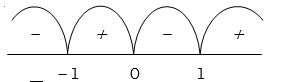
Factorizing the expression: $x(x^2 - 1) > 0 \Rightarrow x(x - 1)(x + 1) > 0$.
Using the wavy curve method (sign scheme) for the critical points $x = -1, 0, 1$,the expression is positive in the intervals $(-1, 0) \cup (1, \infty)$.
Combining these conditions,we must exclude $x = 2$ from the interval $(1, \infty)$.
Thus,the domain is $(-1, 0) \cup (1, 2) \cup (2, \infty)$.
$1$. The denominator must not be zero: $4 - x^2 \neq 0 \Rightarrow x^2 \neq 4 \Rightarrow x \neq \pm 2$.
$2$. The argument of the logarithm must be positive: $x^3 - x > 0$.
Factorizing the expression: $x(x^2 - 1) > 0 \Rightarrow x(x - 1)(x + 1) > 0$.
Using the wavy curve method (sign scheme) for the critical points $x = -1, 0, 1$,the expression is positive in the intervals $(-1, 0) \cup (1, \infty)$.
Combining these conditions,we must exclude $x = 2$ from the interval $(1, \infty)$.
Thus,the domain is $(-1, 0) \cup (1, 2) \cup (2, \infty)$.
0 likes
View Solution77
MediumMCQ
Domain of the function $f(x) = \sqrt{2 - 2x - x^2}$ is
A
$-\sqrt{3} \le x \le \sqrt{3}$
B
$-1 - \sqrt{3} \le x \le -1 + \sqrt{3}$
C
$-2 \le x \le 2$
D
$-2 + \sqrt{3} \le x \le -2 - \sqrt{3}$
Solution
(B) For the function $f(x) = \sqrt{2 - 2x - x^2}$ to be defined,the expression under the square root must be non-negative.
Thus,$2 - 2x - x^2 \ge 0$.
Multiplying by $-1$,we get $x^2 + 2x - 2 \le 0$.
To solve this inequality,we complete the square:
$x^2 + 2x + 1 - 1 - 2 \le 0$
$(x + 1)^2 - 3 \le 0$
$(x + 1)^2 \le 3$
Taking the square root on both sides,we get:
$-\sqrt{3} \le x + 1 \le \sqrt{3}$
Subtracting $1$ from all parts:
$-1 - \sqrt{3} \le x \le -1 + \sqrt{3}$.
Therefore,the domain is $[-1 - \sqrt{3}, -1 + \sqrt{3}]$.
Thus,$2 - 2x - x^2 \ge 0$.
Multiplying by $-1$,we get $x^2 + 2x - 2 \le 0$.
To solve this inequality,we complete the square:
$x^2 + 2x + 1 - 1 - 2 \le 0$
$(x + 1)^2 - 3 \le 0$
$(x + 1)^2 \le 3$
Taking the square root on both sides,we get:
$-\sqrt{3} \le x + 1 \le \sqrt{3}$
Subtracting $1$ from all parts:
$-1 - \sqrt{3} \le x \le -1 + \sqrt{3}$.
Therefore,the domain is $[-1 - \sqrt{3}, -1 + \sqrt{3}]$.
0 likes
View Solution78
EasyMCQ
Domain of the function $f(x) = \frac{x - 3}{(x - 1)\sqrt{x^2 - 4}}$ is
A
$(1, 2)$
B
$( - \infty, - 2) \cup (2, \infty)$
C
$( - \infty, - 2) \cup (1, \infty)$
D
$( - \infty, \infty) - \{ 1, \pm 2\}$
Solution
(B) For the function $f(x) = \frac{x - 3}{(x - 1)\sqrt{x^2 - 4}}$ to be defined,the expression inside the square root must be strictly greater than zero,and the denominator must not be zero.
$1$. The condition for the square root is $x^2 - 4 > 0$,which implies $x^2 > 4$. This gives $x > 2$ or $x < -2$.
$2$. The condition for the denominator is $(x - 1)\sqrt{x^2 - 4} \neq 0$. This implies $x - 1 \neq 0$ (so $x \neq 1$) and $\sqrt{x^2 - 4} \neq 0$ (so $x^2 - 4 \neq 0$,which means $x \neq \pm 2$).
$3$. Combining these conditions,we need $x \in ( - \infty, - 2) \cup (2, \infty)$ and $x \neq 1$. Since $1$ is not in the interval $( - \infty, - 2) \cup (2, \infty)$,the domain is $( - \infty, - 2) \cup (2, \infty)$.
$1$. The condition for the square root is $x^2 - 4 > 0$,which implies $x^2 > 4$. This gives $x > 2$ or $x < -2$.
$2$. The condition for the denominator is $(x - 1)\sqrt{x^2 - 4} \neq 0$. This implies $x - 1 \neq 0$ (so $x \neq 1$) and $\sqrt{x^2 - 4} \neq 0$ (so $x^2 - 4 \neq 0$,which means $x \neq \pm 2$).
$3$. Combining these conditions,we need $x \in ( - \infty, - 2) \cup (2, \infty)$ and $x \neq 1$. Since $1$ is not in the interval $( - \infty, - 2) \cup (2, \infty)$,the domain is $( - \infty, - 2) \cup (2, \infty)$.
0 likes
View Solution79
EasyMCQ
The domain of the function $\sqrt{\log \left( \frac{5x - x^2}{6} \right)}$ is
A
$(2, 3)$
B
$[2, 3]$
C
$[1, 2]$
D
$[1, 3]$
Solution
(B) For the function $f(x) = \sqrt{\log \left( \frac{5x - x^2}{6} \right)}$ to be defined,the expression inside the square root must be non-negative:
$\log \left( \frac{5x - x^2}{6} \right) \ge 0$
Since the base of the logarithm is $10$ (implied),this inequality is equivalent to:
$\frac{5x - x^2}{6} \ge 10^0$
$\frac{5x - x^2}{6} \ge 1$
$5x - x^2 \ge 6$
$x^2 - 5x + 6 \le 0$
Factoring the quadratic expression,we get:
$(x - 2)(x - 3) \le 0$
The inequality holds when $x$ lies between the roots of the quadratic equation,inclusive:
$2 \le x \le 3$
Thus,the domain is $[2, 3]$.
$\log \left( \frac{5x - x^2}{6} \right) \ge 0$
Since the base of the logarithm is $10$ (implied),this inequality is equivalent to:
$\frac{5x - x^2}{6} \ge 10^0$
$\frac{5x - x^2}{6} \ge 1$
$5x - x^2 \ge 6$
$x^2 - 5x + 6 \le 0$
Factoring the quadratic expression,we get:
$(x - 2)(x - 3) \le 0$
The inequality holds when $x$ lies between the roots of the quadratic equation,inclusive:
$2 \le x \le 3$
Thus,the domain is $[2, 3]$.
0 likes
View Solution80
EasyMCQ
The domain of the function $f(x) = \sqrt{2 - x} - \frac{1}{\sqrt{9 - x^2}}$ is:
A
$(-3, 1)$
B
$[-3, 1]$
C
$(-3, 2]$
D
$[-3, 1)$
Solution
(C) For the function $f(x) = \sqrt{2 - x} - \frac{1}{\sqrt{9 - x^2}}$ to be defined:
$1$. The expression under the square root in the numerator must be non-negative: $2 - x \ge 0 \Rightarrow x \le 2$.
$2$. The expression under the square root in the denominator must be strictly positive: $9 - x^2 > 0 \Rightarrow x^2 < 9 \Rightarrow |x| < 3$,which means $-3 < x < 3$.
$3$. Combining these two conditions: $x \le 2$ $AND$ $-3 < x < 3$.
$4$. The intersection of these intervals is $(-3, 2]$.
Therefore,the domain is $(-3, 2]$.
$1$. The expression under the square root in the numerator must be non-negative: $2 - x \ge 0 \Rightarrow x \le 2$.
$2$. The expression under the square root in the denominator must be strictly positive: $9 - x^2 > 0 \Rightarrow x^2 < 9 \Rightarrow |x| < 3$,which means $-3 < x < 3$.
$3$. Combining these two conditions: $x \le 2$ $AND$ $-3 < x < 3$.
$4$. The intersection of these intervals is $(-3, 2]$.
Therefore,the domain is $(-3, 2]$.
0 likes
View Solution81
EasyMCQ
Domain of the function $\frac{\sqrt{1 + x} - \sqrt{1 - x}}{x}$ is
A
$(-1, 1)$
B
$(-1, 1) - \{0\}$
C
$[-1, 1]$
D
$[-1, 1] - \{0\}$
Solution
(D) For the function $f(x) = \frac{\sqrt{1 + x} - \sqrt{1 - x}}{x}$ to be defined:
$1$. The expression under the square root must be non-negative:
$1 + x \ge 0 \implies x \ge -1$
$1 - x \ge 0 \implies x \le 1$
Combining these,we get $x \in [-1, 1]$.
$2$. The denominator cannot be zero:
$x \neq 0$
Combining both conditions,the domain is $[-1, 1] - \{0\}$.
$1$. The expression under the square root must be non-negative:
$1 + x \ge 0 \implies x \ge -1$
$1 - x \ge 0 \implies x \le 1$
Combining these,we get $x \in [-1, 1]$.
$2$. The denominator cannot be zero:
$x \neq 0$
Combining both conditions,the domain is $[-1, 1] - \{0\}$.
0 likes
View Solution82
EasyMCQ
The domain of the function $f(x) = \sqrt{x - x^2} + \sqrt{4 + x} + \sqrt{4 - x}$ is
A
$[-4, \infty)$
B
$[-4, 4]$
C
$[0, 4]$
D
$[0, 1]$
Solution
(D) For the function $f(x) = \sqrt{x - x^2} + \sqrt{4 + x} + \sqrt{4 - x}$ to be defined,the expressions under the square roots must be non-negative.
$1$. For $\sqrt{4 + x}$,we require $4 + x \ge 0$,which implies $x \ge -4$.
$2$. For $\sqrt{4 - x}$,we require $4 - x \ge 0$,which implies $x \le 4$.
$3$. For $\sqrt{x - x^2}$,we require $x - x^2 \ge 0$,which is $x(1 - x) \ge 0$. This inequality holds when $0 \le x \le 1$.
To find the domain,we take the intersection of these intervals:
$x \in [-4, \infty) \cap (- \infty, 4] \cap [0, 1]$.
The intersection of these sets is $[0, 1]$.
Therefore,the domain of the function is $[0, 1]$.
$1$. For $\sqrt{4 + x}$,we require $4 + x \ge 0$,which implies $x \ge -4$.
$2$. For $\sqrt{4 - x}$,we require $4 - x \ge 0$,which implies $x \le 4$.
$3$. For $\sqrt{x - x^2}$,we require $x - x^2 \ge 0$,which is $x(1 - x) \ge 0$. This inequality holds when $0 \le x \le 1$.
To find the domain,we take the intersection of these intervals:
$x \in [-4, \infty) \cap (- \infty, 4] \cap [0, 1]$.
The intersection of these sets is $[0, 1]$.
Therefore,the domain of the function is $[0, 1]$.
0 likes
View Solution83
EasyMCQ
The domain of the function $f(x) = \frac{1}{1 + e^x}$ is
A
$(-\infty, \infty)$
B
$[0, \infty)$
C
$(-\infty, 0)$
D
$(0, 1)$
Solution
(A) The domain of a function $f(x)$ is the set of all possible input values $(x)$ for which the function is defined.
For the function $f(x) = \frac{1}{1 + e^x}$,the denominator must not be zero.
Since $e^x > 0$ for all real values of $x$,it follows that $1 + e^x > 1$.
Therefore,$1 + e^x$ is never zero for any real number $x$.
Thus,the function is defined for all real numbers.
The domain is $(-\infty, \infty)$.
For the function $f(x) = \frac{1}{1 + e^x}$,the denominator must not be zero.
Since $e^x > 0$ for all real values of $x$,it follows that $1 + e^x > 1$.
Therefore,$1 + e^x$ is never zero for any real number $x$.
Thus,the function is defined for all real numbers.
The domain is $(-\infty, \infty)$.
0 likes
View Solution84
MediumMCQ
The domain of the function $\sqrt{\log(x^2 - 6x + 6)}$ is
A
$( - \infty, \infty )$
B
$( - \infty, 3 - \sqrt{3} ) \cup (3 + \sqrt{3}, \infty )$
C
$( - \infty, 1 ] \cup [ 5, \infty )$
D
$[ 0, \infty )$
Solution
(C) The function $f(x) = \sqrt{\log(x^2 - 6x + 6)}$ is defined when the expression inside the square root is non-negative,i.e.,$\log(x^2 - 6x + 6) \ge 0$.
Since $\log(y) \ge 0$ implies $y \ge 1$ (assuming base $10$ or $e$),we have:
$x^2 - 6x + 6 \ge 1$
$x^2 - 6x + 5 \ge 0$
Factoring the quadratic expression:
$(x - 5)(x - 1) \ge 0$
To solve this inequality,we find the critical points $x = 1$ and $x = 5$. Testing the intervals $(-\infty, 1]$,$(1, 5)$,and $[5, \infty)$,we find that the expression is non-negative in the intervals $(-\infty, 1]$ and $[5, \infty)$.
Additionally,we must ensure the argument of the logarithm is positive: $x^2 - 6x + 6 > 0$. Since $x^2 - 6x + 6 \ge 1$ is already satisfied,the condition $x^2 - 6x + 6 > 0$ is automatically satisfied.
Therefore,the domain is $( - \infty, 1 ] \cup [ 5, \infty )$.
Since $\log(y) \ge 0$ implies $y \ge 1$ (assuming base $10$ or $e$),we have:
$x^2 - 6x + 6 \ge 1$
$x^2 - 6x + 5 \ge 0$
Factoring the quadratic expression:
$(x - 5)(x - 1) \ge 0$
To solve this inequality,we find the critical points $x = 1$ and $x = 5$. Testing the intervals $(-\infty, 1]$,$(1, 5)$,and $[5, \infty)$,we find that the expression is non-negative in the intervals $(-\infty, 1]$ and $[5, \infty)$.
Additionally,we must ensure the argument of the logarithm is positive: $x^2 - 6x + 6 > 0$. Since $x^2 - 6x + 6 \ge 1$ is already satisfied,the condition $x^2 - 6x + 6 > 0$ is automatically satisfied.
Therefore,the domain is $( - \infty, 1 ] \cup [ 5, \infty )$.
0 likes
View Solution85
EasyMCQ
The largest possible set of real numbers which can be the domain of $f(x) = \sqrt {1 - \frac{1}{x}} $ is
A
$(0, 1] \cup (0, \infty)$
B
$(-1, 0) \cup (1, \infty)$
C
$(-\infty, -1) \cup (0, \infty)$
D
$(-\infty, 0) \cup [1, \infty)$
Solution
(D) For the function $f(x) = \sqrt{1 - \frac{1}{x}}$ to be defined,the expression under the square root must be non-negative:
$1 - \frac{1}{x} \ge 0$
$\frac{x - 1}{x} \ge 0$
To solve this inequality,we find the critical points where the numerator and denominator are zero,which are $x = 1$ and $x = 0$.
Using the sign scheme (Wavy Curve Method):
For $x > 1$,$\frac{x-1}{x} > 0$ (positive).
For $0 < x < 1$,$\frac{x-1}{x} < 0$ (negative).
For $x < 0$,$\frac{x-1}{x} > 0$ (positive).
Since we need the expression to be $\ge 0$,the solution is $x \in (-\infty, 0) \cup [1, \infty)$.
Note: $x = 0$ is excluded because the denominator cannot be zero.
$1 - \frac{1}{x} \ge 0$
$\frac{x - 1}{x} \ge 0$
To solve this inequality,we find the critical points where the numerator and denominator are zero,which are $x = 1$ and $x = 0$.
Using the sign scheme (Wavy Curve Method):
For $x > 1$,$\frac{x-1}{x} > 0$ (positive).
For $0 < x < 1$,$\frac{x-1}{x} < 0$ (negative).
For $x < 0$,$\frac{x-1}{x} > 0$ (positive).
Since we need the expression to be $\ge 0$,the solution is $x \in (-\infty, 0) \cup [1, \infty)$.
Note: $x = 0$ is excluded because the denominator cannot be zero.
0 likes
View Solution86
EasyMCQ
Domain of $f(x) = (x^2 - 1)^{-1/2}$ is
A
$( - \infty, -1) \cup (1, \infty)$
B
$( - \infty, -1] \cup (1, \infty)$
C
$( - \infty, -1] \cup [1, \infty)$
D
None of these
Solution
(A) The function is defined as $f(x) = \frac{1}{\sqrt{x^2 - 1}}$.
For $f(x)$ to be defined,the expression inside the square root must be strictly greater than zero because it is in the denominator.
Therefore,$x^2 - 1 > 0$.
This implies $x^2 > 1$.
Solving the inequality $x^2 > 1$,we get $|x| > 1$.
This means $x > 1$ or $x < -1$.
In interval notation,this is expressed as $x \in ( - \infty, -1) \cup (1, \infty)$.
For $f(x)$ to be defined,the expression inside the square root must be strictly greater than zero because it is in the denominator.
Therefore,$x^2 - 1 > 0$.
This implies $x^2 > 1$.
Solving the inequality $x^2 > 1$,we get $|x| > 1$.
This means $x > 1$ or $x < -1$.
In interval notation,this is expressed as $x \in ( - \infty, -1) \cup (1, \infty)$.
0 likes
View Solution87
EasyMCQ
The domain of the function $y = \frac{1}{\sqrt{|x| - x}}$ is
A
$( - \infty, 0)$
B
$( - \infty, 0]$
C
$( - \infty, -1)$
D
$( - \infty, \infty)$
Solution
(A) For the function $y = \frac{1}{\sqrt{|x| - x}}$ to be defined,the expression inside the square root must be strictly positive:
$|x| - x > 0$
$|x| > x$
We know that by definition of the absolute value function:
If $x \ge 0$,then $|x| = x$,which implies $x > x$,which is impossible.
If $x < 0$,then $|x| = -x$,which implies $-x > x$,or $0 > 2x$,which simplifies to $x < 0$.
Therefore,the function is defined for all $x < 0$.
The domain is $( - \infty, 0)$.
$|x| - x > 0$
$|x| > x$
We know that by definition of the absolute value function:
If $x \ge 0$,then $|x| = x$,which implies $x > x$,which is impossible.
If $x < 0$,then $|x| = -x$,which implies $-x > x$,or $0 > 2x$,which simplifies to $x < 0$.
Therefore,the function is defined for all $x < 0$.
The domain is $( - \infty, 0)$.
0 likes
View Solution88
EasyMCQ
The natural domain of the real-valued function defined by $f(x) = \sqrt{x^2 - 1} + \sqrt{x^2 + 1}$ is
A
$1 < x < \infty$
B
$-\infty < x < \infty$
C
$-\infty < x < -1$
D
$(-\infty, \infty) - (-1, 1)$
Solution
(D) The function is given by $f(x) = \sqrt{x^2 - 1} + \sqrt{x^2 + 1}$.
For the function to be defined in the set of real numbers,the expressions under the square roots must be non-negative.
For the first term $\sqrt{x^2 - 1}$,we require $x^2 - 1 \ge 0$,which implies $x^2 \ge 1$. This inequality holds when $x \in (-\infty, -1] \cup [1, \infty)$.
For the second term $\sqrt{x^2 + 1}$,we require $x^2 + 1 \ge 0$. Since $x^2 \ge 0$ for all real $x$,$x^2 + 1 \ge 1$ is always true for all $x \in \mathbb{R}$.
The domain of the function $f(x)$ is the intersection of the domains of the two terms.
Thus,the domain is $(-\infty, -1] \cup [1, \infty)$,which can be written as $(-\infty, \infty) - (-1, 1)$.
For the function to be defined in the set of real numbers,the expressions under the square roots must be non-negative.
For the first term $\sqrt{x^2 - 1}$,we require $x^2 - 1 \ge 0$,which implies $x^2 \ge 1$. This inequality holds when $x \in (-\infty, -1] \cup [1, \infty)$.
For the second term $\sqrt{x^2 + 1}$,we require $x^2 + 1 \ge 0$. Since $x^2 \ge 0$ for all real $x$,$x^2 + 1 \ge 1$ is always true for all $x \in \mathbb{R}$.
The domain of the function $f(x)$ is the intersection of the domains of the two terms.
Thus,the domain is $(-\infty, -1] \cup [1, \infty)$,which can be written as $(-\infty, \infty) - (-1, 1)$.
0 likes
View Solution89
EasyMCQ
The domain of the function $f(x) = \exp (\sqrt {5x - 3 - 2{x^2}} )$ is
A
$[1, 3/2]$
B
$[3/2, \infty)$
C
$(-\infty, 1]$
D
$[1, 3/2]$
Solution
(D) For the function $f(x) = \exp (\sqrt {5x - 3 - 2{x^2}} )$ to be defined,the expression under the square root must be non-negative.
Thus,$5x - 3 - 2{x^2} \ge 0$.
Multiplying by $-1$,we get $2{x^2} - 5x + 3 \le 0$.
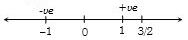
Factoring the quadratic expression: $2{x^2} - 2x - 3x + 3 \le 0 \implies 2x(x - 1) - 3(x - 1) \le 0 \implies (2x - 3)(x - 1) \le 0$.
This can be written as $2(x - 3/2)(x - 1) \le 0$.
Using the wavy curve method (sign scheme),the expression is $\le 0$ for $x \in [1, 3/2]$.
Therefore,the domain is $[1, 3/2]$.
Thus,$5x - 3 - 2{x^2} \ge 0$.
Multiplying by $-1$,we get $2{x^2} - 5x + 3 \le 0$.
Factoring the quadratic expression: $2{x^2} - 2x - 3x + 3 \le 0 \implies 2x(x - 1) - 3(x - 1) \le 0 \implies (2x - 3)(x - 1) \le 0$.
This can be written as $2(x - 3/2)(x - 1) \le 0$.
Using the wavy curve method (sign scheme),the expression is $\le 0$ for $x \in [1, 3/2]$.
Therefore,the domain is $[1, 3/2]$.
0 likes
View Solution90
MediumMCQ
The range of $f(x) = \sec \left( \frac{\pi}{4} \cos^2 x \right)$ for $-\infty < x < \infty$ is
A
$[1, \sqrt{2}]$
B
$[1, \infty)$
C
$[-\sqrt{2}, -1] \cup [1, \sqrt{2}]$
D
$(-\infty, -1] \cup [1, \infty)$
Solution
(A) Given the function $f(x) = \sec \left( \frac{\pi}{4} \cos^2 x \right)$.
We know that the range of $\cos^2 x$ is $[0, 1]$.
Therefore,the argument of the secant function,$\theta = \frac{\pi}{4} \cos^2 x$,varies in the interval $[0, \frac{\pi}{4}]$.
Since the secant function $\sec(\theta)$ is strictly increasing on the interval $[0, \frac{\pi}{4}]$,we evaluate the function at the endpoints:
At $\cos^2 x = 0$,$f(x) = \sec(0) = 1$.
At $\cos^2 x = 1$,$f(x) = \sec \left( \frac{\pi}{4} \right) = \sqrt{2}$.
Thus,the range of the function is $[1, \sqrt{2}]$.
We know that the range of $\cos^2 x$ is $[0, 1]$.
Therefore,the argument of the secant function,$\theta = \frac{\pi}{4} \cos^2 x$,varies in the interval $[0, \frac{\pi}{4}]$.
Since the secant function $\sec(\theta)$ is strictly increasing on the interval $[0, \frac{\pi}{4}]$,we evaluate the function at the endpoints:
At $\cos^2 x = 0$,$f(x) = \sec(0) = 1$.
At $\cos^2 x = 1$,$f(x) = \sec \left( \frac{\pi}{4} \right) = \sqrt{2}$.
Thus,the range of the function is $[1, \sqrt{2}]$.
0 likes
View Solution91
DifficultMCQ
Range of the function $f(x) = \frac{x^2 + x + 2}{x^2 + x + 1}; x \in R$ is
A
$(1, \infty)$
B
$(1, 11/7]$
C
$(1, 7/3]$
D
$(1, 7/5]$
Solution
(C) Let $y = \frac{x^2 + x + 2}{x^2 + x + 1}$.
We can rewrite the function as $y = \frac{(x^2 + x + 1) + 1}{x^2 + x + 1} = 1 + \frac{1}{x^2 + x + 1}$.
To find the range,we need to find the range of the expression $g(x) = x^2 + x + 1$.
Completing the square for $g(x)$,we get $g(x) = (x + 1/2)^2 + 3/4$.
The minimum value of $g(x)$ is $3/4$ (at $x = -1/2$) and the maximum value is $\infty$.
Thus,the range of $g(x)$ is $[3/4, \infty)$.
Now,the range of $\frac{1}{g(x)}$ is $(0, 1/(3/4)] = (0, 4/3]$.
Adding $1$ to this range,the range of $f(x)$ is $(1, 1 + 4/3] = (1, 7/3]$.
We can rewrite the function as $y = \frac{(x^2 + x + 1) + 1}{x^2 + x + 1} = 1 + \frac{1}{x^2 + x + 1}$.
To find the range,we need to find the range of the expression $g(x) = x^2 + x + 1$.
Completing the square for $g(x)$,we get $g(x) = (x + 1/2)^2 + 3/4$.
The minimum value of $g(x)$ is $3/4$ (at $x = -1/2$) and the maximum value is $\infty$.
Thus,the range of $g(x)$ is $[3/4, \infty)$.
Now,the range of $\frac{1}{g(x)}$ is $(0, 1/(3/4)] = (0, 4/3]$.
Adding $1$ to this range,the range of $f(x)$ is $(1, 1 + 4/3] = (1, 7/3]$.
0 likes
View Solution92
EasyMCQ
If $f(x) = a\cos(bx + c) + d$,then the range of $f(x)$ is
A
$[d + a, d + 2a]$
B
$[a - d, a + d]$
C
$[d + a, a - d]$
D
$[d - a, d + a]$
Solution
(D) Given the function $f(x) = a\cos(bx + c) + d$.
We know that the range of the cosine function $\cos(\theta)$ is $[-1, 1]$.
Therefore,$-1 \le \cos(bx + c) \le 1$.
Multiplying by $a$ (assuming $a > 0$),we get $-a \le a\cos(bx + c) \le a$.
Adding $d$ to all parts,we get $d - a \le a\cos(bx + c) + d \le d + a$.
Thus,the range of $f(x)$ is $[d - a, d + a]$.
We know that the range of the cosine function $\cos(\theta)$ is $[-1, 1]$.
Therefore,$-1 \le \cos(bx + c) \le 1$.
Multiplying by $a$ (assuming $a > 0$),we get $-a \le a\cos(bx + c) \le a$.
Adding $d$ to all parts,we get $d - a \le a\cos(bx + c) + d \le d + a$.
Thus,the range of $f(x)$ is $[d - a, d + a]$.
0 likes
View Solution93
EasyMCQ
The range of $f(x) = \cos x - \sin x$ is
A
$(-1, 1)$
B
$[-1, 1)$
C
$[-\frac{\pi}{2}, \frac{\pi}{2}]$
D
$[-\sqrt{2}, \sqrt{2}]$
Solution
(D) Given the function $f(x) = \cos x - \sin x$.
We know that any expression of the form $a \cos x + b \sin x$ can be written as $R \cos(x + \alpha)$ or $R \sin(x + \beta)$,where $R = \sqrt{a^2 + b^2}$.
Here,$a = 1$ and $b = -1$.
So,$R = \sqrt{(1)^2 + (-1)^2} = \sqrt{1 + 1} = \sqrt{2}$.
Thus,$f(x) = \sqrt{2} \left( \frac{1}{\sqrt{2}} \cos x - \frac{1}{\sqrt{2}} \sin x \right) = \sqrt{2} \cos(x + \frac{\pi}{4})$.
Since the range of $\cos(\theta)$ is $[-1, 1]$,the range of $\sqrt{2} \cos(x + \frac{\pi}{4})$ is $[-\sqrt{2}, \sqrt{2}]$.
Therefore,the correct option is $D$.
We know that any expression of the form $a \cos x + b \sin x$ can be written as $R \cos(x + \alpha)$ or $R \sin(x + \beta)$,where $R = \sqrt{a^2 + b^2}$.
Here,$a = 1$ and $b = -1$.
So,$R = \sqrt{(1)^2 + (-1)^2} = \sqrt{1 + 1} = \sqrt{2}$.
Thus,$f(x) = \sqrt{2} \left( \frac{1}{\sqrt{2}} \cos x - \frac{1}{\sqrt{2}} \sin x \right) = \sqrt{2} \cos(x + \frac{\pi}{4})$.
Since the range of $\cos(\theta)$ is $[-1, 1]$,the range of $\sqrt{2} \cos(x + \frac{\pi}{4})$ is $[-\sqrt{2}, \sqrt{2}]$.
Therefore,the correct option is $D$.
0 likes
View Solution94
EasyMCQ
If $f: R \to R$,then the range of the function $f(x) = \frac{x^2}{x^2 + 1}$ is
A
$[0, 1)$
B
$(0, 1)$
C
$[0, 1]$
D
$R$
Solution
(A) Let $y = \frac{x^2}{x^2 + 1}$.
Since $x^2 \ge 0$ for all $x \in R$,the numerator is non-negative and the denominator is always greater than the numerator.
As $x \to \pm \infty$,$y \to 1$,but $y$ never reaches $1$ because $x^2 < x^2 + 1$.
At $x = 0$,$y = 0$.
Thus,the range of the function is $[0, 1)$.
Since $x^2 \ge 0$ for all $x \in R$,the numerator is non-negative and the denominator is always greater than the numerator.
As $x \to \pm \infty$,$y \to 1$,but $y$ never reaches $1$ because $x^2 < x^2 + 1$.
At $x = 0$,$y = 0$.
Thus,the range of the function is $[0, 1)$.
0 likes
View Solution95
EasyMCQ
The range of $f(x) = \cos 2x - \sin 2x$ contains the set
A
$[2, 4]$
B
$[-1, 1]$
C
$[-2, 2]$
D
$[-4, 4]$
Solution
(B) Given function is $f(x) = \cos 2x - \sin 2x$.
We can rewrite this as $f(x) = \sqrt{2} \left( \frac{1}{\sqrt{2}} \cos 2x - \frac{1}{\sqrt{2}} \sin 2x \right)$.
Using the identity $\cos(A + B) = \cos A \cos B - \sin A \sin B$,we get $f(x) = \sqrt{2} \cos(2x + \frac{\pi}{4})$.
Since the range of $\cos \theta$ is $[-1, 1]$,the range of $f(x)$ is $[-\sqrt{2}, \sqrt{2}]$.
Since $\sqrt{2} \approx 1.414$,the interval $[-\sqrt{2}, \sqrt{2}]$ is approximately $[-1.414, 1.414]$.
The set $[-1, 1]$ is a subset of $[-1.414, 1.414]$.
Therefore,the range of $f(x)$ contains the set $[-1, 1]$.
We can rewrite this as $f(x) = \sqrt{2} \left( \frac{1}{\sqrt{2}} \cos 2x - \frac{1}{\sqrt{2}} \sin 2x \right)$.
Using the identity $\cos(A + B) = \cos A \cos B - \sin A \sin B$,we get $f(x) = \sqrt{2} \cos(2x + \frac{\pi}{4})$.
Since the range of $\cos \theta$ is $[-1, 1]$,the range of $f(x)$ is $[-\sqrt{2}, \sqrt{2}]$.
Since $\sqrt{2} \approx 1.414$,the interval $[-\sqrt{2}, \sqrt{2}]$ is approximately $[-1.414, 1.414]$.
The set $[-1, 1]$ is a subset of $[-1.414, 1.414]$.
Therefore,the range of $f(x)$ contains the set $[-1, 1]$.
0 likes
View Solution96
EasyMCQ
Range of the function $f(x) = \frac{1}{2 - \sin 3x}$ is
A
$[1, 3]$
B
$[\frac{1}{3}, 1]$
C
$(1, 3)$
D
$(\frac{1}{3}, 1)$
Solution
(B) Given the function $f(x) = \frac{1}{2 - \sin 3x}$.
We know that the range of $\sin 3x$ is $[-1, 1]$.
Let $u = \sin 3x$,then $u \in [-1, 1]$.
The function becomes $f(u) = \frac{1}{2 - u}$.
To find the range,we evaluate the function at the boundaries of $u$:
When $u = -1$,$f(-1) = \frac{1}{2 - (-1)} = \frac{1}{3}$.
When $u = 1$,$f(1) = \frac{1}{2 - 1} = 1$.
Since the function is continuous and monotonic within this interval,the range of the function is $[\frac{1}{3}, 1]$.
We know that the range of $\sin 3x$ is $[-1, 1]$.
Let $u = \sin 3x$,then $u \in [-1, 1]$.
The function becomes $f(u) = \frac{1}{2 - u}$.
To find the range,we evaluate the function at the boundaries of $u$:
When $u = -1$,$f(-1) = \frac{1}{2 - (-1)} = \frac{1}{3}$.
When $u = 1$,$f(1) = \frac{1}{2 - 1} = 1$.
Since the function is continuous and monotonic within this interval,the range of the function is $[\frac{1}{3}, 1]$.
0 likes
View Solution97
EasyMCQ
Range of the function $f(x) = 9 - 7\sin x$ is
A
$(2, 16)$
B
$[2, 16]$
C
$[-1, 1]$
D
$(2, 16]$
Solution
(B) We know that the range of the sine function $\sin x$ is $[-1, 1]$.
This means $-1 \le \sin x \le 1$.
Multiplying by $-7$,we get $7 \ge -7 \sin x \ge -7$,which can be written as $-7 \le -7 \sin x \le 7$.
Adding $9$ to all parts of the inequality,we get $9 - 7 \le 9 - 7 \sin x \le 9 + 7$.
Thus,$2 \le 9 - 7 \sin x \le 16$.
Therefore,the range of the function $f(x) = 9 - 7 \sin x$ is $[2, 16]$.
This means $-1 \le \sin x \le 1$.
Multiplying by $-7$,we get $7 \ge -7 \sin x \ge -7$,which can be written as $-7 \le -7 \sin x \le 7$.
Adding $9$ to all parts of the inequality,we get $9 - 7 \le 9 - 7 \sin x \le 9 + 7$.
Thus,$2 \le 9 - 7 \sin x \le 16$.
Therefore,the range of the function $f(x) = 9 - 7 \sin x$ is $[2, 16]$.
0 likes
View Solution98
DifficultMCQ
The range of $f(x) = \frac{x^2 + 34x - 71}{x^2 + 2x - 7}$ is
A
$[5, 9]$
B
$( - \infty, 5] \cup [9, \infty)$
C
$(5, 9)$
D
None of these
Solution
(B) Let $y = \frac{x^2 + 34x - 71}{x^2 + 2x - 7}$.
Rearranging the terms,we get $y(x^2 + 2x - 7) = x^2 + 34x - 71$.
$x^2(y - 1) + x(2y - 34) - 7y + 71 = 0$.
For $x$ to be a real number,the discriminant $D = B^2 - 4AC \ge 0$.
$D = (2y - 34)^2 - 4(y - 1)(-7y + 71) \ge 0$.
$4(y - 17)^2 - 4(-7y^2 + 71y + 7y - 71) \ge 0$.
$(y^2 - 34y + 289) - (-7y^2 + 78y - 71) \ge 0$.
$y^2 - 34y + 289 + 7y^2 - 78y + 71 \ge 0$.
$8y^2 - 112y + 360 \ge 0$.
Dividing by $8$,we get $y^2 - 14y + 45 \ge 0$.
$(y - 5)(y - 9) \ge 0$.
Thus,the range is $y \in ( - \infty, 5] \cup [9, \infty)$.
Rearranging the terms,we get $y(x^2 + 2x - 7) = x^2 + 34x - 71$.
$x^2(y - 1) + x(2y - 34) - 7y + 71 = 0$.
For $x$ to be a real number,the discriminant $D = B^2 - 4AC \ge 0$.
$D = (2y - 34)^2 - 4(y - 1)(-7y + 71) \ge 0$.
$4(y - 17)^2 - 4(-7y^2 + 71y + 7y - 71) \ge 0$.
$(y^2 - 34y + 289) - (-7y^2 + 78y - 71) \ge 0$.
$y^2 - 34y + 289 + 7y^2 - 78y + 71 \ge 0$.
$8y^2 - 112y + 360 \ge 0$.
Dividing by $8$,we get $y^2 - 14y + 45 \ge 0$.
$(y - 5)(y - 9) \ge 0$.
Thus,the range is $y \in ( - \infty, 5] \cup [9, \infty)$.
0 likes
View Solution99
EasyMCQ
The interval for which ${\sin ^{ - 1}}\sqrt x + {\cos ^{ - 1}}\sqrt x = \frac{\pi }{2}$ holds is:
A
$[0, \infty)$
B
$[0, 3]$
C
$[0, 1]$
D
$[0, 2]$
Solution
(C) We know that the identity ${\sin ^{ - 1}} \theta + {\cos ^{ - 1}} \theta = \frac{\pi }{2}$ is valid for all $\theta \in [-1, 1]$.
In this problem,$\theta = \sqrt x$.
For $\sqrt x$ to be defined,we must have $x \ge 0$.
For the inverse trigonometric functions to be defined,we must have $-1 \le \sqrt x \le 1$.
Since $\sqrt x$ is always non-negative,the condition $-1 \le \sqrt x \le 1$ simplifies to $0 \le \sqrt x \le 1$.
Squaring the inequality,we get $0^2 \le x \le 1^2$,which results in $0 \le x \le 1$.
Therefore,the interval for which the equation holds is $x \in [0, 1]$.
In this problem,$\theta = \sqrt x$.
For $\sqrt x$ to be defined,we must have $x \ge 0$.
For the inverse trigonometric functions to be defined,we must have $-1 \le \sqrt x \le 1$.
Since $\sqrt x$ is always non-negative,the condition $-1 \le \sqrt x \le 1$ simplifies to $0 \le \sqrt x \le 1$.
Squaring the inequality,we get $0^2 \le x \le 1^2$,which results in $0 \le x \le 1$.
Therefore,the interval for which the equation holds is $x \in [0, 1]$.
0 likes
View Solution100
MediumMCQ
The function $f:R \to R$ is defined by $f(x) = \cos^2 x + \sin^4 x$ for $x \in R$,then $f(R) \in $
A
$\left( \frac{3}{4}, 1 \right]$
B
$\left[ \frac{3}{4}, 1 \right)$
C
$\left[ \frac{3}{4}, 1 \right]$
D
$\left( \frac{3}{4}, 1 \right)$
Solution
(C) Given $f(x) = \cos^2 x + \sin^4 x$.
We can rewrite the expression as:
$f(x) = \cos^2 x + \sin^2 x \cdot \sin^2 x$
$f(x) = \cos^2 x + (1 - \cos^2 x) \sin^2 x$
Alternatively,using $\sin^2 x = 1 - \cos^2 x$:
$f(x) = \cos^2 x + (1 - \cos^2 x)^2$
$f(x) = \cos^2 x + 1 - 2\cos^2 x + \cos^4 x$
$f(x) = \cos^4 x - \cos^2 x + 1$
Let $t = \cos^2 x$,where $t \in [0, 1]$.
Then $g(t) = t^2 - t + 1$.
This is a parabola opening upwards with vertex at $t = -(-1)/(2 \cdot 1) = 1/2$.
Since $1/2 \in [0, 1]$,the minimum value is $g(1/2) = (1/4) - (1/2) + 1 = 3/4$.
The maximum value occurs at the boundaries $t=0$ or $t=1$:
$g(0) = 1$ and $g(1) = 1 - 1 + 1 = 1$.
Thus,the range is $[3/4, 1]$.
We can rewrite the expression as:
$f(x) = \cos^2 x + \sin^2 x \cdot \sin^2 x$
$f(x) = \cos^2 x + (1 - \cos^2 x) \sin^2 x$
Alternatively,using $\sin^2 x = 1 - \cos^2 x$:
$f(x) = \cos^2 x + (1 - \cos^2 x)^2$
$f(x) = \cos^2 x + 1 - 2\cos^2 x + \cos^4 x$
$f(x) = \cos^4 x - \cos^2 x + 1$
Let $t = \cos^2 x$,where $t \in [0, 1]$.
Then $g(t) = t^2 - t + 1$.
This is a parabola opening upwards with vertex at $t = -(-1)/(2 \cdot 1) = 1/2$.
Since $1/2 \in [0, 1]$,the minimum value is $g(1/2) = (1/4) - (1/2) + 1 = 3/4$.
The maximum value occurs at the boundaries $t=0$ or $t=1$:
$g(0) = 1$ and $g(1) = 1 - 1 + 1 = 1$.
Thus,the range is $[3/4, 1]$.
0 likes
View SolutionAlgebra — Set Theory · Frequently Asked Questions
1Are these Algebra questions useful for JEE and NEET?
Yes. All questions in this section are mapped to JEE Main and NEET exam patterns. Previous year questions from JEE Main, NEET, GUJCET and state-level exams are included with full solutions.
2Can I switch to Hindi or Gujarati for these questions?
Yes. Use the language tabs in the hero section or the sidebar to view the same questions and solutions in English, Hindi or Gujarati.
3How do I generate a question paper from this subtopic?
Use the Vedclass Exam Paper Generator — select the chapter and subtopic, set difficulty, and generate Sets A, B, C, D automatically. First 3 chapters of every subject are free.
Vedclass Products
For Students
Vedclass Test Series
Mock tests in real JEE/NEET style with performance analysis. 5-day free trial.
Start Free TrialFor Teachers
Exam Paper Generator
Generate Set A/B/C/D papers from this chapter in 2 minutes. 3 chapters free.
Try FreeFor Institutes
Online Exam Module
Live online exams with unlimited students, 360° analytics & white-label branding.
See DemoFor Teachers & Institutes
Generate a Algebra Exam Paper in 2 Minutes
Select subtopic & difficulty — Sets A, B, C, D auto-generated with No Repeat logic.
First 3 chapters of every subject are free — no payment required.