
A English
Mix Example - TISSUES Questions in English
Class 9 Science · TISSUES · Mix Example - TISSUES
197+
Questions
English
Language
100%
With Solutions
Showing 50 of 197 questions in English
101
Medium
Name the type of parenchyma tissue present in aquatic plants. State its role.
Solution
(N/A) The type of parenchyma tissue present in aquatic plants is known as $Aerenchyma$.
Role: $Aerenchyma$ contains large air cavities that provide buoyancy to the aquatic plants,which helps them to float in water.
Role: $Aerenchyma$ contains large air cavities that provide buoyancy to the aquatic plants,which helps them to float in water.
0 likes
View Solution102
Medium
Animal tissues are different from plant tissues. State the reasons.
Solution
(N/A) Animal tissues differ from plant tissues due to their distinct structural and functional requirements. The primary differences are summarized below:
| Characteristic | Plant Tissues vs Animal Tissues |
|---|---|
| $1$. Living/Dead | Most plant tissues are dead,providing structural strength,whereas most animal tissues are living. |
| $2$. Growth | Plant growth is restricted to specific regions (meristematic),while animal growth is generally uniform throughout the body. |
| $3$. Classification | Plant tissues are classified as meristematic and permanent tissues. Animal tissues are classified as epithelial,connective,muscular,and nervous tissues. |
0 likes
View Solution103
Medium
Identify the tissues present in the following and give one specific feature of each:
$(i)$ Leaf stalks below epidermis.
$(ii)$ In stem,around vascular bundles.
$(iii)$ At root and shoot tip.
$(i)$ Leaf stalks below epidermis.
$(ii)$ In stem,around vascular bundles.
$(iii)$ At root and shoot tip.
Solution
(N/A)
| Location | Tissue Present | Specific Feature |
|---|---|---|
| $(i)$ Leaf stalks below epidermis | Collenchyma | Provides mechanical support and allows easy bending without breaking. |
| $(ii)$ In stem,around vascular bundles | Sclerenchyma | Provides strength and makes the plant part hard and stiff. |
| $(iii)$ At root and shoot tip | Meristematic tissue (Apical meristem) | Cells are actively dividing,leading to the primary growth of the plant. |
0 likes
View Solution104
Medium
Mention the role of epidermis in the following:
$(a)$ In the aerial parts of the plant.
$(b)$ In leaves.
$(c)$ In roots.
$(a)$ In the aerial parts of the plant.
$(b)$ In leaves.
$(c)$ In roots.
Solution
(N/A) Epidermal cells on the aerial parts of the plant often secrete a waxy,water-resistant layer on their outer surface. This layer,known as the cuticle,aids in protection against water loss,mechanical injury,and invasion by parasitic fungi.
$(b)$ The epidermis of the leaf contains small pores called stomata,which are essential for gaseous exchange (oxygen and carbon dioxide) and the process of transpiration.
$(c)$ The epidermal cells of roots possess long,hair-like extensions called root hairs. These structures significantly increase the total surface area available for the absorption of water and dissolved minerals from the soil.
$(b)$ The epidermis of the leaf contains small pores called stomata,which are essential for gaseous exchange (oxygen and carbon dioxide) and the process of transpiration.
$(c)$ The epidermal cells of roots possess long,hair-like extensions called root hairs. These structures significantly increase the total surface area available for the absorption of water and dissolved minerals from the soil.
0 likes
View Solution105
Medium
Write six functions of the epithelial tissue.
Solution
(N/A) $(1)$ Intercellular transport
$(2)$ Protection of underlying tissues from mechanical injury,drying,and chemical damage
$(3)$ Prevention of wear and tear of body surfaces
$(4)$ Absorption of water and nutrients
$(5)$ Extrusive movement (pushing materials like mucus or gametes forward)
$(6)$ Secretion of various substances like enzymes,hormones,and mucus.
$(2)$ Protection of underlying tissues from mechanical injury,drying,and chemical damage
$(3)$ Prevention of wear and tear of body surfaces
$(4)$ Absorption of water and nutrients
$(5)$ Extrusive movement (pushing materials like mucus or gametes forward)
$(6)$ Secretion of various substances like enzymes,hormones,and mucus.
0 likes
View Solution106
Medium
Name two types of $(i)$ fibres,$(ii)$ cells present in areolar connective tissue. $(iii)$ Where is this tissue located?
Solution
(N/A) $(i)$ Two types of fibres in areolar connective tissue are collagen fibres and elastic fibres (or reticular fibres).
$(ii)$ Two types of cells present in areolar connective tissue are fibroblasts,mast cells,macrophages,or plasma cells (any two).
$(iii)$ Areolar connective tissue is located between the skin and muscles,around blood vessels and nerves,and in the bone marrow.
$(ii)$ Two types of cells present in areolar connective tissue are fibroblasts,mast cells,macrophages,or plasma cells (any two).
$(iii)$ Areolar connective tissue is located between the skin and muscles,around blood vessels and nerves,and in the bone marrow.
0 likes
View Solution107
Medium
Explain the basic characteristics for the classification of permanent tissues in plants.
Solution
(N/A) $(1)$ Composition: Whether the tissue is made up of one type of cell (simple) or more than one type of cells (complex).
$(2)$ Function: Whether the tissue is supportive (parenchyma),protective (epidermis),or conducting (xylem and phloem).
$(3)$ Cell wall structure: Whether the cell wall is thick or thin.
$(4)$ Viability: Whether the cells are living or dead at maturity.
$(2)$ Function: Whether the tissue is supportive (parenchyma),protective (epidermis),or conducting (xylem and phloem).
$(3)$ Cell wall structure: Whether the cell wall is thick or thin.
$(4)$ Viability: Whether the cells are living or dead at maturity.
0 likes
View Solution108
Difficult
Justify by giving two points that cartilage is a tissue. What is its matrix made of? Where are these tissues found in our body?
Solution
(N/A) Cartilage is considered a tissue because:
$1$. It consists of a group of cells that are similar in structure and perform a common function.
$2$. It has a distinct intercellular matrix that supports the cells.
Matrix Composition: The matrix of cartilage is composed of proteins and sugars.
Location: Cartilage is found in the ear,nose,trachea,and at the ends of bones at joints.
Functions:
$(i)$ Provides flexibility and support to body parts.
$(ii)$ Smoothens bone surfaces at joints to reduce friction.
$1$. It consists of a group of cells that are similar in structure and perform a common function.
$2$. It has a distinct intercellular matrix that supports the cells.
Matrix Composition: The matrix of cartilage is composed of proteins and sugars.
Location: Cartilage is found in the ear,nose,trachea,and at the ends of bones at joints.
Functions:
$(i)$ Provides flexibility and support to body parts.
$(ii)$ Smoothens bone surfaces at joints to reduce friction.
0 likes
View Solution109
Medium
$(i)$ What is epidermis?
$(ii)$ List three functions of epidermis.
$(ii)$ List three functions of epidermis.
Solution
(N/A) $(i)$ Epidermis is the outermost single layer of cells that covers all parts of the plant externally.
$(ii)$ Functions of epidermis:
$(a)$ Protection: It protects the plant against water loss,mechanical injury,and invasion by parasitic fungi.
$(b)$ Secretion: Epidermal cells on the aerial parts of the plant often secrete a waxy,water-resistant layer (cuticle) which further helps in protection from mechanical injury and water loss.
$(c)$ Absorption: Root hairs present on the epidermis of roots help in the absorption of water and minerals from the soil.
$(ii)$ Functions of epidermis:
$(a)$ Protection: It protects the plant against water loss,mechanical injury,and invasion by parasitic fungi.
$(b)$ Secretion: Epidermal cells on the aerial parts of the plant often secrete a waxy,water-resistant layer (cuticle) which further helps in protection from mechanical injury and water loss.
$(c)$ Absorption: Root hairs present on the epidermis of roots help in the absorption of water and minerals from the soil.
0 likes
View Solution110
Medium
What are stomata? Write two functions of stomata.
Solution
(N/A) Stomata are small,microscopic pores found primarily in the epidermis of plant leaves.
Functions of Stomata:
$(i)$ Gaseous Exchange: Stomata serve as the primary sites for the exchange of gases,such as carbon dioxide $(CO_2)$ and oxygen $(O_2)$,between the plant's internal tissues and the external environment.
$(ii)$ Transpiration: $A$ significant portion of transpiration,the process of water loss in the form of water vapor,occurs through stomata. This process helps in the upward movement of water and minerals from the roots and keeps the plant surface cool.
Functions of Stomata:
$(i)$ Gaseous Exchange: Stomata serve as the primary sites for the exchange of gases,such as carbon dioxide $(CO_2)$ and oxygen $(O_2)$,between the plant's internal tissues and the external environment.
$(ii)$ Transpiration: $A$ significant portion of transpiration,the process of water loss in the form of water vapor,occurs through stomata. This process helps in the upward movement of water and minerals from the roots and keeps the plant surface cool.
0 likes
View Solution111
Medium
Give reasons for the following:
$(i)$ Cells of sclerenchyma tissue have a narrow lumen.
$(ii)$ Branches of a tree move and bend freely in high wind velocity.
$(iii)$ It is difficult to pull out the husk of coconut.
$(i)$ Cells of sclerenchyma tissue have a narrow lumen.
$(ii)$ Branches of a tree move and bend freely in high wind velocity.
$(iii)$ It is difficult to pull out the husk of coconut.
Solution
(N/A) $(i)$ Sclerenchyma cells have extremely thick cell walls due to the deposition of lignin,which significantly reduces the internal space or lumen of the cell.
$(ii)$ Branches of a tree contain collenchyma tissue,which provides mechanical support and flexibility,allowing them to bend without breaking in high wind.
$(iii)$ The husk of a coconut is made of sclerenchyma tissue,which consists of dead,thick-walled,and tightly packed fibres that provide great strength and rigidity,making it difficult to pull apart.
$(ii)$ Branches of a tree contain collenchyma tissue,which provides mechanical support and flexibility,allowing them to bend without breaking in high wind.
$(iii)$ The husk of a coconut is made of sclerenchyma tissue,which consists of dead,thick-walled,and tightly packed fibres that provide great strength and rigidity,making it difficult to pull apart.
0 likes
View Solution112
Medium
Give reasons for the following:
$(i)$ Bark of a tree is impervious to gases and water.
$(ii)$ In desert plants,epidermis has a thick waxy coating.
$(iii)$ Epidermal cells of the roots generally have hair-like parts.
$(i)$ Bark of a tree is impervious to gases and water.
$(ii)$ In desert plants,epidermis has a thick waxy coating.
$(iii)$ Epidermal cells of the roots generally have hair-like parts.
Solution
(N/A) $(i)$ Cells of the bark are dead and compactly arranged without intercellular spaces. They contain a chemical substance called suberin in their cell walls,which makes them impervious to gases and water.
$(ii)$ The thick waxy coating on the epidermis is composed of cutin,a chemical substance with waterproof properties. This coating helps in protecting the plant against water loss and parasitic fungi.
$(iii)$ The primary function of epidermal cells in roots is water absorption. The hair-like extensions,known as root hairs,significantly increase the total surface area available for absorption.
$(ii)$ The thick waxy coating on the epidermis is composed of cutin,a chemical substance with waterproof properties. This coating helps in protecting the plant against water loss and parasitic fungi.
$(iii)$ The primary function of epidermal cells in roots is water absorption. The hair-like extensions,known as root hairs,significantly increase the total surface area available for absorption.
0 likes
View Solution113
Medium
$(i)$ Draw a diagram of the epidermis of a leaf showing the surface view and label the stomata,guard cells,and epidermal cells.
$(ii)$ Answer the following:
$(a)$ How is the epidermis of plants living in very dry habitats adapted?
$(b)$ Write the functions of guard cells of stomata in the leaf.
$(ii)$ Answer the following:
$(a)$ How is the epidermis of plants living in very dry habitats adapted?
$(b)$ Write the functions of guard cells of stomata in the leaf.
Solution
(N/A) $(i)$ The diagram should show a layer of tightly packed epidermal cells with stomatal openings surrounded by two bean-shaped guard cells.
$(ii)$ $(a)$ Plants living in very dry habitats have a thick,waxy,and water-resistant layer of cutin on their epidermis. This adaptation helps in preventing excessive water loss through transpiration,protecting the plant from mechanical injury,and preventing parasitic invasion.
$(b)$ The primary function of guard cells is to regulate the opening and closing of the stomatal pore. When water enters the guard cells,they become turgid and swell,causing the stomatal pore to open. Conversely,when water leaves the guard cells,they become flaccid and shrink,causing the stomatal pore to close.
$(ii)$ $(a)$ Plants living in very dry habitats have a thick,waxy,and water-resistant layer of cutin on their epidermis. This adaptation helps in preventing excessive water loss through transpiration,protecting the plant from mechanical injury,and preventing parasitic invasion.
$(b)$ The primary function of guard cells is to regulate the opening and closing of the stomatal pore. When water enters the guard cells,they become turgid and swell,causing the stomatal pore to open. Conversely,when water leaves the guard cells,they become flaccid and shrink,causing the stomatal pore to close.
0 likes
View Solution114
Medium
State any three points of difference between your limb and heart muscles.
Solution
(N/A) $(i)$ Muscles present in our limbs are voluntary,meaning they move or pause when we consciously decide to do so. In contrast,heart muscles are involuntary,exhibiting rhythmic contraction and relaxation throughout life without conscious control.
$(ii)$ Limb muscles are typically attached to bones and facilitate body movement,whereas heart muscles are not attached to bones and are specialized for the continuous pumping of blood.
$(iii)$ The cells of limb tissue (skeletal muscles) are long,cylindrical,unbranched,and multinucleate,while heart muscles (cardiac muscles) are cylindrical,branched,and uninucleate.
$(ii)$ Limb muscles are typically attached to bones and facilitate body movement,whereas heart muscles are not attached to bones and are specialized for the continuous pumping of blood.
$(iii)$ The cells of limb tissue (skeletal muscles) are long,cylindrical,unbranched,and multinucleate,while heart muscles (cardiac muscles) are cylindrical,branched,and uninucleate.
0 likes
View Solution115
Medium
Differentiate between bone and cartilage with respect to structure,function and location.
Solution
(N/A)
| Point of Difference | Bone | Cartilage |
|---|---|---|
| Structure | It is a strong and non-flexible tissue whose cells are embedded in a hard matrix composed of calcium and phosphorus compounds. | It is a soft and flexible tissue whose solid matrix is composed of proteins and sugars. It has widely spaced cells. |
| Function | It forms the framework that supports the body and anchors the muscles that support the main organs of the body. | It smoothens bone surfaces at joints and provides support and flexibility to body parts. |
| Location | It is present in the skeletal system. | It is present in the nose,ear,trachea,and larynx. |
0 likes
View Solution116
Easy
What is the difference between simple permanent tissue and complex permanent tissue?
Solution
(N/A)
| Simple permanent tissue | Complex permanent tissue |
|---|---|
| $1$. These tissues are made up of only one type of cells that perform a common function. | $1$. These tissues are made up of more than one type of cells that work together as a unit to perform a common function. |
| $2$. They are primarily involved in support,storage,and photosynthesis. | $2$. They are primarily involved in the transport of water,minerals,and food. |
| $3$. Examples include parenchyma,collenchyma,and sclerenchyma. | $3$. Examples include xylem and phloem. |
0 likes
View Solution117
Medium
Give differences between ligaments and tendons.
Solution
(N/A)
| Ligaments | Tendons |
|---|---|
| $1$. Ligaments connect two bones. | $1$. Tendons connect bones to muscles. |
| $2$. This tissue is very elastic with considerable strength. | $2$. This tissue has great strength but limited flexibility. |
| $3$. Ligaments contain very little matrix. | $3$. Tendons contain more matrix compared to ligaments. |
| $4$. It is formed of yellow fibrous connective tissue. | $4$. It is formed of white fibrous connective tissue. |
0 likes
View Solution118
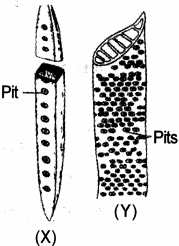
Medium
$(a)$ Identify the given figures.
$(b)$ State in brief their structure.
$(c)$ Describe the role performed by the two.
$(b)$ State in brief their structure.
$(c)$ Describe the role performed by the two.
Solution
(N/A) $(X)$ is a tracheid,and $(Y)$ is a vessel.
$(b)$ Both are tubular structures. They consist of dead cells with thick,lignified walls.
$(c)$ Both tracheids and vessels are components of the xylem tissue and are primarily responsible for the vertical transport of water and dissolved minerals from the roots to the rest of the plant.
$(b)$ Both are tubular structures. They consist of dead cells with thick,lignified walls.
$(c)$ Both tracheids and vessels are components of the xylem tissue and are primarily responsible for the vertical transport of water and dissolved minerals from the roots to the rest of the plant.
0 likes
View Solution119
Medium
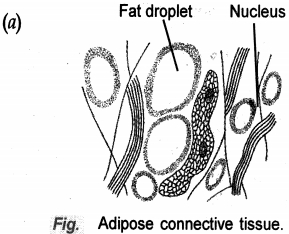
$(a)$ Draw the adipose connective tissue.
$(b)$ Mention one region in the body where this tissue is present and state one function of this tissue.
$(b)$ Mention one region in the body where this tissue is present and state one function of this tissue.
Solution
(N/A) The diagram of adipose connective tissue shows cells filled with fat globules and a peripheral nucleus.
$(b)$ $(i)$ Location: Adipose connective tissue is found below the skin and between internal organs.
$(ii)$ Function: It stores fats and thus acts as an insulator,helping to maintain body temperature.
$(b)$ $(i)$ Location: Adipose connective tissue is found below the skin and between internal organs.
$(ii)$ Function: It stores fats and thus acts as an insulator,helping to maintain body temperature.
0 likes
View Solution120
Medium
$(a)$ State the constituents of phloem.
$(b)$ How does cork act as a protective tissue?
$(b)$ How does cork act as a protective tissue?
Solution
(N/A) The constituents of phloem are:
$(i)$ Sieve tubes
$(ii)$ Companion cells
$(iii)$ Phloem fibres
$(iv)$ Phloem parenchyma
$(b)$ Cork acts as a protective tissue because its cells are dead and compactly arranged without intercellular spaces,which prevents the entry of pathogens. Furthermore,the cell walls of cork contain a chemical substance called suberin,which makes them impervious to gases and water,thereby protecting the plant from mechanical injury and desiccation.
$(i)$ Sieve tubes
$(ii)$ Companion cells
$(iii)$ Phloem fibres
$(iv)$ Phloem parenchyma
$(b)$ Cork acts as a protective tissue because its cells are dead and compactly arranged without intercellular spaces,which prevents the entry of pathogens. Furthermore,the cell walls of cork contain a chemical substance called suberin,which makes them impervious to gases and water,thereby protecting the plant from mechanical injury and desiccation.
0 likes
View Solution121
Medium
Give the location and functions of the following tissues:
$(a)$ Cartilage
$(b)$ Areolar tissue
$(c)$ Adipose tissue
$(a)$ Cartilage
$(b)$ Areolar tissue
$(c)$ Adipose tissue
Solution
(N/A) Cartilage:
Location: Present on the bone surface at joints,in the nose,ear,trachea,and larynx.
Function: It smoothens the bone surface at joints and provides structural support to the nose,ear,trachea,and larynx.
$(b)$ Areolar tissue:
Location: Found between the skin and muscles,around blood vessels and nerves,and in the bone marrow.
Function: It fills the space inside organs,supports internal organs,and helps in the repair of tissues.
$(c)$ Adipose tissue:
Location: Found below the skin and between internal organs.
Function: It acts as a storage site for fats and provides insulation to the body.
Location: Present on the bone surface at joints,in the nose,ear,trachea,and larynx.
Function: It smoothens the bone surface at joints and provides structural support to the nose,ear,trachea,and larynx.
$(b)$ Areolar tissue:
Location: Found between the skin and muscles,around blood vessels and nerves,and in the bone marrow.
Function: It fills the space inside organs,supports internal organs,and helps in the repair of tissues.
$(c)$ Adipose tissue:
Location: Found below the skin and between internal organs.
Function: It acts as a storage site for fats and provides insulation to the body.
0 likes
View Solution122
Difficult
Give one reason for the following statements:
$(a)$ Blood is called a connective tissue.
$(b)$ Muscles are able to contract and relax to bring about movements.
$(c)$ Muscles of the heart are called involuntary muscles.
$(a)$ Blood is called a connective tissue.
$(b)$ Muscles are able to contract and relax to bring about movements.
$(c)$ Muscles of the heart are called involuntary muscles.
Solution
(N/A) Blood is considered a connective tissue because it connects different body organs by transporting gases,digested food,hormones,and waste materials throughout the body.
$(b)$ Muscles contain special proteins known as contractile proteins (actin and myosin),which contract and relax to facilitate movement.
$(c)$ Muscles of the heart are called involuntary muscles because they undergo rhythmic contraction and relaxation throughout life without conscious control and without getting fatigued.
$(b)$ Muscles contain special proteins known as contractile proteins (actin and myosin),which contract and relax to facilitate movement.
$(c)$ Muscles of the heart are called involuntary muscles because they undergo rhythmic contraction and relaxation throughout life without conscious control and without getting fatigued.
0 likes
View Solution123
Medium
Why is parenchyma called a permanent tissue? Name the two special types of parenchyma. Mention their specific roles in plants.
Solution
(N/A) Parenchyma is called a permanent tissue because its cells have differentiated and lost the ability to divide,taking up a specific role in the plant body.
The two special types of parenchyma are:
$1$. Chlorenchyma
$2$. Aerenchyma
Their specific roles are:
- Chlorenchyma contains chlorophyll and performs photosynthesis.
- Aerenchyma contains large air cavities and provides buoyancy to aquatic plants,helping them to float.
The two special types of parenchyma are:
$1$. Chlorenchyma
$2$. Aerenchyma
Their specific roles are:
- Chlorenchyma contains chlorophyll and performs photosynthesis.
- Aerenchyma contains large air cavities and provides buoyancy to aquatic plants,helping them to float.
0 likes
View Solution124
Medium
Write one term for the following tissues:
$(a)$ That joins muscle to bone.
$(b)$ Fat reservoir of our body.
$(c)$ Supporting,fills the space inside the organs,and helps in the repair of tissues.
$(a)$ That joins muscle to bone.
$(b)$ Fat reservoir of our body.
$(c)$ Supporting,fills the space inside the organs,and helps in the repair of tissues.
Solution
(N/A) Tendon: $A$ fibrous connective tissue that attaches muscle to bone.
$(b)$ Adipose tissue: $A$ specialized connective tissue that stores fat.
$(c)$ Areolar tissue: $A$ loose connective tissue that acts as a supporting framework,fills the space inside organs,and aids in tissue repair.
$(b)$ Adipose tissue: $A$ specialized connective tissue that stores fat.
$(c)$ Areolar tissue: $A$ loose connective tissue that acts as a supporting framework,fills the space inside organs,and aids in tissue repair.
0 likes
View Solution125
Medium
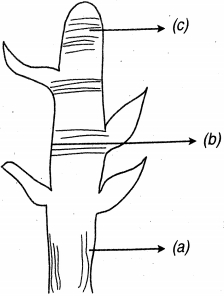
Identify the parts labeled $(a)$,$(b)$,and $(c)$ in the given diagram and state one function for each.
Solution
(N/A) Lateral meristem: It is responsible for the increase in the girth (thickness) of the stem and root.
$(b)$ Intercalary meristem: It is responsible for the growth of internodes and the formation of leaves and branches.
$(c)$ Apical meristem: It is responsible for the increase in the length of the stem and the root.
$(b)$ Intercalary meristem: It is responsible for the growth of internodes and the formation of leaves and branches.
$(c)$ Apical meristem: It is responsible for the increase in the length of the stem and the root.
0 likes
View Solution126
Medium
$A$ lion and a mango tree are both complex living organisms with specialised yet different tissue systems to perform basic life processes. Give two reasons for possessing different tissues to perform similar functions.
Solution
(N/A) lion is an animal,whereas a mango tree is a plant.
Plants and animals have different types of tissues because:
$(i)$ Plants are stationary and do not show locomotion,while most animals move from one place to another to search for food,shelter,and mates.
$(ii)$ They have different patterns of growth. Plant growth is limited to certain regions (meristematic tissues),whereas animal growth is more or less uniform throughout the body.
Plants and animals have different types of tissues because:
$(i)$ Plants are stationary and do not show locomotion,while most animals move from one place to another to search for food,shelter,and mates.
$(ii)$ They have different patterns of growth. Plant growth is limited to certain regions (meristematic tissues),whereas animal growth is more or less uniform throughout the body.
0 likes
View Solution127
Medium
Identify the simple permanent plant tissue with the following descriptions and also mention their location in the plant body:
$(a)$ Cells have irregular wall thickenings.
$(b)$ Tissues with large intercellular spaces and cells having large air cavity.
$(c)$ Cells are long,narrow,and dead in nature.
$(a)$ Cells have irregular wall thickenings.
$(b)$ Tissues with large intercellular spaces and cells having large air cavity.
$(c)$ Cells are long,narrow,and dead in nature.
Solution
(N/A) Collenchyma: These cells have irregular thickenings of pectin and cellulose at the corners. Location: Found in the leaf stalks below the epidermis.
$(b)$ Aerenchyma: $A$ type of parenchyma tissue with large intercellular spaces and air cavities to provide buoyancy. Location: Found in the stems and leaves of aquatic plants.
$(c)$ Sclerenchyma: These cells are long,narrow,and dead at maturity due to lignin deposition. Location: Found in the hard parts of the plant such as seed coats,fruit walls,and vascular bundles.
$(b)$ Aerenchyma: $A$ type of parenchyma tissue with large intercellular spaces and air cavities to provide buoyancy. Location: Found in the stems and leaves of aquatic plants.
$(c)$ Sclerenchyma: These cells are long,narrow,and dead at maturity due to lignin deposition. Location: Found in the hard parts of the plant such as seed coats,fruit walls,and vascular bundles.
0 likes
View Solution128
Medium
Name the kinds of muscles found in your limbs and lungs. How do they differ from each other structurally and functionally?
Solution
(N/A) Limbs: Striated muscles (Skeletal muscles).
Structure: Cells are long,cylindrical,multinucleated,and unbranched with alternate dark and light bands (striations).
Function: They are voluntary muscles,meaning they work under our conscious control.
$(b)$ Lungs: Smooth muscles (Non-striated muscles).
Structure: Cells are spindle-shaped (fusiform),uninucleated,and unbranched,lacking any striations.
Function: They are involuntary muscles,meaning they function automatically without conscious control.
Structure: Cells are long,cylindrical,multinucleated,and unbranched with alternate dark and light bands (striations).
Function: They are voluntary muscles,meaning they work under our conscious control.
$(b)$ Lungs: Smooth muscles (Non-striated muscles).
Structure: Cells are spindle-shaped (fusiform),uninucleated,and unbranched,lacking any striations.
Function: They are involuntary muscles,meaning they function automatically without conscious control.
0 likes
View Solution129
Medium
Name the following and give one characteristic of each:
$(a)$ Living tissue that provides mechanical support in plants.
$(b)$ Highly specialised cells for being stimulated and then transmitting the stimulus very rapidly within the body of animals.
$(c)$ Animal tissue with elongated cells and contractile proteins responsible for movement.
$(a)$ Living tissue that provides mechanical support in plants.
$(b)$ Highly specialised cells for being stimulated and then transmitting the stimulus very rapidly within the body of animals.
$(c)$ Animal tissue with elongated cells and contractile proteins responsible for movement.
Solution
(N/A) Collenchyma: It is a living mechanical tissue characterized by irregular thickenings of cellulose and pectin at the corners of the cells.
$(b)$ Nervous tissue (Neurons): These are highly specialized cells capable of receiving stimuli and transmitting impulses rapidly throughout the body.
$(c)$ Striated (Skeletal) muscles: These tissues consist of long,cylindrical,unbranched fibers that contain contractile proteins (actin and myosin) and exhibit characteristic light and dark bands (striations).
$(b)$ Nervous tissue (Neurons): These are highly specialized cells capable of receiving stimuli and transmitting impulses rapidly throughout the body.
$(c)$ Striated (Skeletal) muscles: These tissues consist of long,cylindrical,unbranched fibers that contain contractile proteins (actin and myosin) and exhibit characteristic light and dark bands (striations).
0 likes
View Solution130
Medium
$(a)$ Name the animal tissue which is present in the larynx.
$(b)$ Write the chemical constituents of this tissue.
$(c)$ What functions does this tissue perform?
$(b)$ Write the chemical constituents of this tissue.
$(c)$ What functions does this tissue perform?
Solution
(N/A) The animal tissue present in the larynx is cartilage.
$(b)$ The chemical constituents of cartilage are proteins and sugars (specifically,the matrix is composed of proteins and carbohydrates).
$(c)$ Cartilage provides support and flexibility to body parts. It smoothens bone surfaces at joints and allows for easy bending and movement.
$(b)$ The chemical constituents of cartilage are proteins and sugars (specifically,the matrix is composed of proteins and carbohydrates).
$(c)$ Cartilage provides support and flexibility to body parts. It smoothens bone surfaces at joints and allows for easy bending and movement.
0 likes
View Solution131
Medium
Name the tissue found in the following locations:
$(a)$ Haversian canal
$(b)$ Chondrocyte
$(c)$ Eosinophils
Give one function of each of these.
$(a)$ Haversian canal
$(b)$ Chondrocyte
$(c)$ Eosinophils
Give one function of each of these.
Solution
(N/A) Bone: It forms the structural framework that supports the body,anchors muscles,and protects vital organs.
$(b)$ Cartilage: It smoothens bone surfaces at joints and provides flexibility for easy movement.
$(c)$ Blood: It transports gases,nutrients,hormones,waste products,and salts,and plays a key role in the body's defense mechanism.
$(b)$ Cartilage: It smoothens bone surfaces at joints and provides flexibility for easy movement.
$(c)$ Blood: It transports gases,nutrients,hormones,waste products,and salts,and plays a key role in the body's defense mechanism.
0 likes
View Solution132
Medium
$(a)$ Give reasons for the following:
$(i)$ Multicellular organisms are considered more efficient.
$(ii)$ Sclerenchyma cells have a narrow lumen.
$(iii)$ Epidermis is thicker in desert plants though it is usually single layered.
$(b)$ Name the following:
$(i)$ Tissue that occurs in specific regions of growth.
$(ii)$ Tissue present at the growing tips of stems and roots.
$(iii)$ Tissue at the base of the leaves or internodes on twigs.
$(iv)$ Basic packing tissue in the form of a few layers of cells.
$(i)$ Multicellular organisms are considered more efficient.
$(ii)$ Sclerenchyma cells have a narrow lumen.
$(iii)$ Epidermis is thicker in desert plants though it is usually single layered.
$(b)$ Name the following:
$(i)$ Tissue that occurs in specific regions of growth.
$(ii)$ Tissue present at the growing tips of stems and roots.
$(iii)$ Tissue at the base of the leaves or internodes on twigs.
$(iv)$ Basic packing tissue in the form of a few layers of cells.
Solution
(N/A) $(i)$ Multicellular organisms are composed of millions of different types of cells which form specific tissues to perform specific functions more efficiently. There is a division of labour amongst cells,making these organisms more efficient.
$(ii)$ Sclerenchyma cells have a narrow lumen due to the heavy deposition of lignin on their cell walls. These walls become so thick that there is hardly any internal space left inside the cell.
$(iii)$ The epidermis is thicker in desert plants to prevent water loss through transpiration. This is achieved by the presence of a thick,waxy,water-resistant coating of cutin.
$(b)$ $(i)$ Meristematic tissue
$(ii)$ Apical meristem
$(iii)$ Intercalary meristem
$(iv)$ Parenchyma
$(ii)$ Sclerenchyma cells have a narrow lumen due to the heavy deposition of lignin on their cell walls. These walls become so thick that there is hardly any internal space left inside the cell.
$(iii)$ The epidermis is thicker in desert plants to prevent water loss through transpiration. This is achieved by the presence of a thick,waxy,water-resistant coating of cutin.
$(b)$ $(i)$ Meristematic tissue
$(ii)$ Apical meristem
$(iii)$ Intercalary meristem
$(iv)$ Parenchyma
0 likes
View Solution133
Difficult
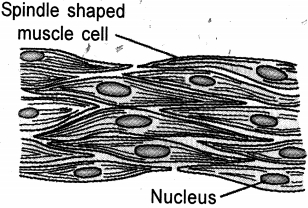
Draw a labelled diagram of unstriated (smooth) muscle tissue and mention its occurrence,features,and functions.
Solution
(N/A) Occurrence: These tissues are found in the walls of the alimentary canal,urinary bladder,oesophagus,and blood vessels.
Features:
$(i)$ They do not have any striations (bands).
$(ii)$ Cells are long,thin,and spindle-shaped.
$(iii)$ Each cell has a single,central nucleus.
Function:
$(i)$ These muscles are involuntary,meaning they do not work according to our will.
$(ii)$ They produce rhythmic movements in the alimentary canal,urinary bladder,and gall bladder to facilitate the transport of substances.
Features:
$(i)$ They do not have any striations (bands).
$(ii)$ Cells are long,thin,and spindle-shaped.
$(iii)$ Each cell has a single,central nucleus.
Function:
$(i)$ These muscles are involuntary,meaning they do not work according to our will.
$(ii)$ They produce rhythmic movements in the alimentary canal,urinary bladder,and gall bladder to facilitate the transport of substances.
0 likes
View Solution134
Medium
$(i)$ Define tissue. What is the utility of tissues in multicellular organisms?
$(ii)$ Are plants and animals made of the same types of tissues? If no, then write three points of difference.
$(ii)$ Are plants and animals made of the same types of tissues? If no, then write three points of difference.
Solution
(N/A) $(i)$ Tissue: $A$ group of cells that are similar in structure and work together to achieve a particular function is called a tissue. In multicellular organisms, the division of labour is due to the presence of tissues. Each tissue performs a specific function efficiently.
$(ii)$ No, plants and animals are not made of the same types of tissues.
$(ii)$ No, plants and animals are not made of the same types of tissues.
| Plant tissues | Animal tissues |
| $(a)$ Most of the plant tissues are dead. | $(a)$ Mostly animal tissues are living. |
| $(b)$ In plants, cell growth is limited to certain regions. | $(b)$ In animals, cell growth is more uniform. |
| $(c)$ These are classified as meristematic and permanent tissues. | $(c)$ These are classified as epithelial, connective, muscular, and nervous tissues. |
0 likes
View Solution135
Medium
$(a)$ Differentiate between meristematic and permanent tissues in plants.
$(b)$ Define the process of differentiation.
$(c)$ Name any two simple and two complex permanent tissues in plants.
$(b)$ Define the process of differentiation.
$(c)$ Name any two simple and two complex permanent tissues in plants.
Solution
(N/A)
$(b)$ The process by which cells derived from meristematic tissue take up a permanent shape, size, and function, thereby losing their ability to divide, is called differentiation.
$(c)$ Simple permanent tissues: Parenchyma, Collenchyma, or Sclerenchyma (any two).
Complex permanent tissues: Xylem and Phloem.
| Meristematic tissue | Permanent tissue |
| $1.$ Cells of this tissue divide throughout their life. | $1.$ They lose the ability to divide to take up specific functions. |
$(b)$ The process by which cells derived from meristematic tissue take up a permanent shape, size, and function, thereby losing their ability to divide, is called differentiation.
$(c)$ Simple permanent tissues: Parenchyma, Collenchyma, or Sclerenchyma (any two).
Complex permanent tissues: Xylem and Phloem.
0 likes
View Solution136
Medium
Explain the significance of the following:
$(a)$ Hair-like structures on epidermal cells
$(b)$ Epidermis has a thick waxy coating of cutin in desert plants
$(c)$ Small pores in the epidermis of a leaf
$(d)$ Numerous layers of epidermis in cactus
$(e)$ Presence of a chemical suberin in cork cells.
$(a)$ Hair-like structures on epidermal cells
$(b)$ Epidermis has a thick waxy coating of cutin in desert plants
$(c)$ Small pores in the epidermis of a leaf
$(d)$ Numerous layers of epidermis in cactus
$(e)$ Presence of a chemical suberin in cork cells.
Solution
(N/A) These structures,known as root hairs,increase the total surface area for the absorption of water and minerals from the soil.
$(b)$ Cutin is a waterproof,waxy substance. In desert plants,it prevents excessive water loss through transpiration and protects the plant from intense heat by reflecting sunlight.
$(c)$ These pores,known as stomata,facilitate gaseous exchange (oxygen and carbon dioxide) and the process of transpiration.
$(d)$ Multiple layers of epidermis in cactus act as a protective barrier to prevent excessive water loss in arid environments.
$(e)$ Suberin is a chemical that makes the cell walls of cork cells impervious to gases and water,providing protection and preventing desiccation.
$(b)$ Cutin is a waterproof,waxy substance. In desert plants,it prevents excessive water loss through transpiration and protects the plant from intense heat by reflecting sunlight.
$(c)$ These pores,known as stomata,facilitate gaseous exchange (oxygen and carbon dioxide) and the process of transpiration.
$(d)$ Multiple layers of epidermis in cactus act as a protective barrier to prevent excessive water loss in arid environments.
$(e)$ Suberin is a chemical that makes the cell walls of cork cells impervious to gases and water,providing protection and preventing desiccation.
0 likes
View Solution137
EasyMCQ
Name the animal tissue which acts as a heat insulator.
A
Epithelial tissue
B
Adipose tissue
C
Muscular tissue
D
Nervous tissue
Solution
(B) Adipose tissue is a type of connective tissue that stores fat. It is located below the skin and between internal organs. Because fat is a poor conductor of heat,this tissue acts as an insulator,helping the body to retain heat and maintain a constant body temperature.
0 likes
View Solution138
EasyMCQ
Name a connective tissue which has a hard matrix.
A
Blood
B
Bone
C
Cartilage
D
Areolar tissue
Solution
(B) Bone is a type of connective tissue that forms the framework of the body. It has a hard and non-pliable matrix that is rich in calcium and phosphorus compounds.
0 likes
View Solution139
EasyMCQ
What are the two basic components of a connective tissue?
A
Cells and Fibers
B
Cells and Matrix
C
Matrix and Fibers
D
Cells and Ground Substance
Solution
(B) Connective tissues are composed of two primary components:
$1$. Cells: These include various types such as fibroblasts,mast cells,and macrophages.
$2$. Matrix: This is the intercellular substance,which consists of fibers (collagen,elastin) and a ground substance (a gel-like material).
$1$. Cells: These include various types such as fibroblasts,mast cells,and macrophages.
$2$. Matrix: This is the intercellular substance,which consists of fibers (collagen,elastin) and a ground substance (a gel-like material).
0 likes
View Solution140
Medium
Name the tissue that smoothens bone surface at joints.
Solution
(N/A) The tissue that smoothens the bone surface at joints is known as cartilage. Cartilage is a type of connective tissue that provides flexibility and reduces friction between bones at the joints,allowing for smooth movement.
0 likes
View Solution141
Medium
Name the muscular tissue which is present in the iris of the eye. What is the shape of these cells?
Solution
(N/A) The muscular tissue present in the iris of the eye is $Smooth$ muscle (also known as $Unstriated$ or $Involuntary$ muscle).
The cells of $Smooth$ muscle are $Spindle-shaped$ (fusiform),meaning they are wide in the middle and tapered at both ends.
The cells of $Smooth$ muscle are $Spindle-shaped$ (fusiform),meaning they are wide in the middle and tapered at both ends.
0 likes
View Solution142
Medium
Write two similarities between striated and cardiac muscles.
Solution
(N/A) $(i)$ Both types of muscles possess alternating dark and light bands,which give them a striated appearance.
$(ii)$ Both muscle types are composed of cylindrical,elongated fibers that contain multiple nuclei (in the case of striated) or are branched with central nuclei (in the case of cardiac),but both share the fundamental structural organization of myofibrils.
$(ii)$ Both muscle types are composed of cylindrical,elongated fibers that contain multiple nuclei (in the case of striated) or are branched with central nuclei (in the case of cardiac),but both share the fundamental structural organization of myofibrils.
0 likes
View Solution143
DifficultMCQ
Note the relationship between the first pair of words and accordingly fill in the blank.
$(a)$ Salivary Gland : Glandular Epithelium : : Respiratory tract : . . . . . .
$(b)$ Flexibility : Collenchyma : : Hardness : . . . . . .
$(c)$ Cutin : Epidermis : : Suberin : . . . . . .
$(d)$ Plasma : Blood : : Axon : . . . . . .
$(a)$ Salivary Gland : Glandular Epithelium : : Respiratory tract : . . . . . .
$(b)$ Flexibility : Collenchyma : : Hardness : . . . . . .
$(c)$ Cutin : Epidermis : : Suberin : . . . . . .
$(d)$ Plasma : Blood : : Axon : . . . . . .
A
Salivary Gland : Glandular Epithelium : : Respiratory tract : . . . . . .
B
Flexibility : Collenchyma : : Hardness : . . . . . .
C
Cutin : Epidermis : : Suberin : . . . . . .
D
Plasma : Blood : : Axon : . . . . . .
Solution
(N/A) The respiratory tract is lined with ciliated epithelium,which helps in moving mucus and trapped particles out of the airways.
$(b)$ Sclerenchyma provides mechanical strength and hardness to plant parts due to its thick,lignified cell walls.
$(c)$ Suberin is a waxy substance found in the cell walls of cork cells,providing protection and preventing water loss.
$(d)$ An axon is a specialized part of a neuron (nerve cell) that transmits electrical impulses away from the cell body.
$(b)$ Sclerenchyma provides mechanical strength and hardness to plant parts due to its thick,lignified cell walls.
$(c)$ Suberin is a waxy substance found in the cell walls of cork cells,providing protection and preventing water loss.
$(d)$ An axon is a specialized part of a neuron (nerve cell) that transmits electrical impulses away from the cell body.
0 likes
View Solution144
Difficult
How will you classify permanent tissues in plants?
Solution
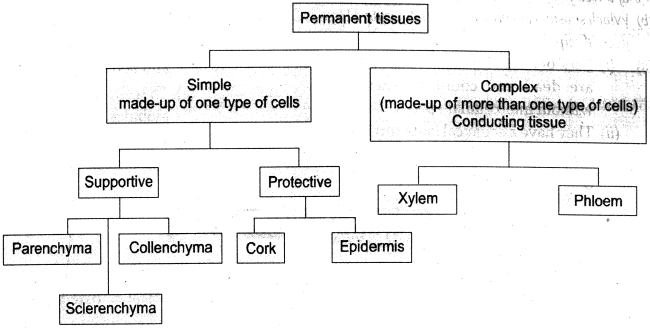
(N/A) Permanent tissues in plants are classified into two main categories based on the types of cells they contain:
$1$. Simple Permanent Tissues: These are made up of only one type of cell that performs a similar function. They are further divided into:
- Supportive tissues: Includes $Parenchyma$,$Collenchyma$,and $Sclerenchyma$.
- Protective tissues: Includes $Cork$ and $Epidermis$.
$2$. Complex Permanent Tissues: These are made up of more than one type of cell working together to perform a common function. These are also known as conducting tissues and include:
- $Xylem$
- $Phloem$
$1$. Simple Permanent Tissues: These are made up of only one type of cell that performs a similar function. They are further divided into:
- Supportive tissues: Includes $Parenchyma$,$Collenchyma$,and $Sclerenchyma$.
- Protective tissues: Includes $Cork$ and $Epidermis$.
$2$. Complex Permanent Tissues: These are made up of more than one type of cell working together to perform a common function. These are also known as conducting tissues and include:
- $Xylem$
- $Phloem$
0 likes
View Solution145
Medium
Identify the following tissues:
$(a)$ The epithelial tissue which has pillar-like tall cells.
$(b)$ The cells of this tissue are filled with fat globules.
$(c)$ The movement of this tissue pushes the mucus forward to clear the respiratory tract.
$(d)$ It gives buoyancy to the lotus to help it float.
$(e)$ This tissue is present in lung alveoli.
$(a)$ The epithelial tissue which has pillar-like tall cells.
$(b)$ The cells of this tissue are filled with fat globules.
$(c)$ The movement of this tissue pushes the mucus forward to clear the respiratory tract.
$(d)$ It gives buoyancy to the lotus to help it float.
$(e)$ This tissue is present in lung alveoli.
Solution
(A-D) Columnar epithelial tissue: These are tall,pillar-like cells often found in the lining of the stomach and intestine.
$(b)$ Adipose tissue: These cells are specialized to store fats in the form of fat globules.
$(c)$ Ciliated columnar epithelium: These cells possess hair-like projections called cilia that move to push mucus and other substances forward.
$(d)$ Aerenchyma: This is a type of parenchyma tissue with large air cavities that provides buoyancy to aquatic plants like the lotus.
$(e)$ Squamous epithelial tissue: These are thin,flat,and delicate cells found in the walls of lung alveoli where exchange of gases occurs.
$(b)$ Adipose tissue: These cells are specialized to store fats in the form of fat globules.
$(c)$ Ciliated columnar epithelium: These cells possess hair-like projections called cilia that move to push mucus and other substances forward.
$(d)$ Aerenchyma: This is a type of parenchyma tissue with large air cavities that provides buoyancy to aquatic plants like the lotus.
$(e)$ Squamous epithelial tissue: These are thin,flat,and delicate cells found in the walls of lung alveoli where exchange of gases occurs.
0 likes
View Solution146
Medium
$(a)$ Why do sclerenchyma cells have a narrow lumen?
$(b)$ Where are these tissues present and why?
$(b)$ Where are these tissues present and why?
Solution
(N/A) Sclerenchyma cells have a narrow lumen because of the excessive deposition of lignin on their cell walls,which makes the walls extremely thick and reduces the internal space.
$(b)$ Sclerenchyma tissues are present in stems,around vascular bundles,in the veins of leaves,and in the hard covering of seeds and nuts. They are present in these locations to provide mechanical strength,rigidity,and structural support to the plant parts.
$(b)$ Sclerenchyma tissues are present in stems,around vascular bundles,in the veins of leaves,and in the hard covering of seeds and nuts. They are present in these locations to provide mechanical strength,rigidity,and structural support to the plant parts.
0 likes
View Solution147
Medium
Find out the reason behind the following statements:
$(a)$ Epidermis is thicker in desert plants,though it is usually single-layered.
$(b)$ Presence of a waxy layer (secreted by the epidermis) on the outer surface of plants.
$(c)$ Meristematic cells have a prominent nucleus and dense cytoplasm but lack a vacuole.
$(a)$ Epidermis is thicker in desert plants,though it is usually single-layered.
$(b)$ Presence of a waxy layer (secreted by the epidermis) on the outer surface of plants.
$(c)$ Meristematic cells have a prominent nucleus and dense cytoplasm but lack a vacuole.
Solution
(N/A) In desert plants,the epidermis is thicker due to the presence of a thick waxy coating of cutin to prevent water loss.
$(b)$ The waxy layer of cutin present on the outer surface of plants is water-resistant and protects the plant against excessive loss of water through transpiration.
$(c)$ Vacuoles provide turgidity and rigidity to mature plant cells. Since the primary role of meristematic tissue cells is to divide continuously to facilitate growth,they do not require large vacuoles,which would otherwise hinder the rapid process of cell division.
$(b)$ The waxy layer of cutin present on the outer surface of plants is water-resistant and protects the plant against excessive loss of water through transpiration.
$(c)$ Vacuoles provide turgidity and rigidity to mature plant cells. Since the primary role of meristematic tissue cells is to divide continuously to facilitate growth,they do not require large vacuoles,which would otherwise hinder the rapid process of cell division.
0 likes
View Solution148
Medium
$(a)$ Why are complex tissues called so?
$(b)$ Why is connective tissue called so?
$(c)$ What is the function of the tissue present in the lining of kidney tubules?
$(b)$ Why is connective tissue called so?
$(c)$ What is the function of the tissue present in the lining of kidney tubules?
Solution
(N/A) Tissues that are made up of more than one type of cell,which work together to perform a common function,are called complex tissues.
$(b)$ Connective tissue is named so because its primary function is to bind,support,and connect different tissues and organs of the body together.
$(c)$ The lining of kidney tubules is composed of cuboidal epithelium,which provides mechanical support and helps in absorption and secretion.
$(b)$ Connective tissue is named so because its primary function is to bind,support,and connect different tissues and organs of the body together.
$(c)$ The lining of kidney tubules is composed of cuboidal epithelium,which provides mechanical support and helps in absorption and secretion.
0 likes
View Solution149
Medium
Correlate the first pair of words given below and accordingly write a suitable word in the second pair.
$(i)$ Heart : Cardiac muscles : : . . . . . . : Smooth muscles.
$(ii)$ Tissue repair : Areolar : : Insulation : . . . . . .
$(iii)$ Squamous epithelium : Protection : : . . . . . . : Absorption and secretion.
$(i)$ Heart : Cardiac muscles : : . . . . . . : Smooth muscles.
$(ii)$ Tissue repair : Areolar : : Insulation : . . . . . .
$(iii)$ Squamous epithelium : Protection : : . . . . . . : Absorption and secretion.
Solution
(A) $(i)$ The heart is composed of cardiac muscles. Similarly,organs like the stomach,intestines,and ureters are composed of smooth muscles. Thus,the blank is filled by $Ureters$ (or $Stomach/Intestines$).
$(ii)$ Areolar tissue is responsible for tissue repair. Adipose tissue is responsible for fat storage and insulation. Thus,the blank is filled by $Adipose$ tissue.
$(iii)$ Squamous epithelium is primarily involved in protection (e.g.,skin). Columnar epithelium is specialized for absorption and secretion (e.g.,lining of the intestine). Thus,the blank is filled by $Columnar$ $epithelium$.
$(ii)$ Areolar tissue is responsible for tissue repair. Adipose tissue is responsible for fat storage and insulation. Thus,the blank is filled by $Adipose$ tissue.
$(iii)$ Squamous epithelium is primarily involved in protection (e.g.,skin). Columnar epithelium is specialized for absorption and secretion (e.g.,lining of the intestine). Thus,the blank is filled by $Columnar$ $epithelium$.
0 likes
View Solution150
Medium
$(a)$ What is the function of the tissue present in the bark of a tree?
$(b)$ Which substance is present in the adipocyte? How does it help?
$(b)$ Which substance is present in the adipocyte? How does it help?
Solution
(N/A) $(i)$ The bark of a tree consists of dead cells that are compactly arranged without intercellular spaces.
$(ii)$ Their cell walls contain a chemical substance called suberin,which makes them impervious to gases and water.
$(iii)$ It serves as an outer protective layer for the plant.
$(b)$ Adipocytes are fat-storing cells.
$(i)$ These cells are found below the skin and between internal organs.
$(ii)$ The cytoplasm of these cells is filled with fat globules.
$(iii)$ They act as an insulator because they store fat,which helps in conserving body heat.
$(ii)$ Their cell walls contain a chemical substance called suberin,which makes them impervious to gases and water.
$(iii)$ It serves as an outer protective layer for the plant.
$(b)$ Adipocytes are fat-storing cells.
$(i)$ These cells are found below the skin and between internal organs.
$(ii)$ The cytoplasm of these cells is filled with fat globules.
$(iii)$ They act as an insulator because they store fat,which helps in conserving body heat.
0 likes
View SolutionTISSUES — Mix Example - TISSUES · Frequently Asked Questions
1Are these TISSUES questions useful for JEE and NEET?
Yes. All questions in this section are mapped to JEE Main and NEET exam patterns. Previous year questions from JEE Main, NEET, GUJCET and state-level exams are included with full solutions.
2Can I switch to Hindi or Gujarati for these questions?
Yes. Use the language tabs in the hero section or the sidebar to view the same questions and solutions in English, Hindi or Gujarati.
3How do I generate a question paper from this subtopic?
Use the Vedclass Exam Paper Generator — select the chapter and subtopic, set difficulty, and generate Sets A, B, C, D automatically. First 3 chapters of every subject are free.
Vedclass Products
For Students
Vedclass Test Series
Mock tests in real JEE/NEET style with performance analysis. 5-day free trial.
Start Free TrialFor Teachers
Exam Paper Generator
Generate Set A/B/C/D papers from this chapter in 2 minutes. 3 chapters free.
Try FreeFor Institutes
Online Exam Module
Live online exams with unlimited students, 360° analytics & white-label branding.
See DemoFor Teachers & Institutes
Generate a TISSUES Exam Paper in 2 Minutes
Select subtopic & difficulty — Sets A, B, C, D auto-generated with No Repeat logic.
First 3 chapters of every subject are free — no payment required.