
A English
Textbook - TISSUES Questions in English
Class 9 Science · TISSUES · Textbook - TISSUES
25+
Questions
English
Language
100%
With Solutions
Showing 25 of 25 questions in English
1
EasyMCQ
What is a tissue?
A
$A$ group of different types of cells performing different functions.
B
$A$ group of cells similar in structure and organized to perform a specific function.
C
$A$ single cell performing all life processes.
D
$A$ collection of organs working together.
Solution
(B) group of cells that are similar in structure and are organized together to achieve a particular function is called a tissue.
In multicellular organisms,tissues are specialized to perform specific tasks efficiently.
In multicellular organisms,tissues are specialized to perform specific tasks efficiently.
0 likes
View Solution2
Easy
What is the utility of tissues in multicellular organisms?
Solution
(N/A) In multicellular organisms,the body system is based on the division of labour (e.g.,muscle cells form muscular tissue,which helps in movement).
This means that cells performing a specific function are grouped together to form a particular tissue.
The different tissues are organized in a way to provide the highest efficiency in the functioning of the body.
This means that cells performing a specific function are grouped together to form a particular tissue.
The different tissues are organized in a way to provide the highest efficiency in the functioning of the body.
0 likes
View Solution3
Easy
Name the types of simple tissues.
Solution
(N/A) The three main types of simple tissues are:
$1.$ Parenchyma: These are living cells with thin cell walls and are responsible for storage and photosynthesis.
$2.$ Collenchyma: These are living cells with thickened corners,providing mechanical support and flexibility to the plant.
$3.$ Sclerenchyma: These are dead cells with thick,lignified walls,providing structural strength and rigidity to the plant.
$1.$ Parenchyma: These are living cells with thin cell walls and are responsible for storage and photosynthesis.
$2.$ Collenchyma: These are living cells with thickened corners,providing mechanical support and flexibility to the plant.
$3.$ Sclerenchyma: These are dead cells with thick,lignified walls,providing structural strength and rigidity to the plant.
0 likes
View Solution4
EasyMCQ
Where is apical meristem found?
A
At the base of leaves
B
At the growing tips of stems and roots
C
In the middle of the stem
D
In the bark of the tree
Solution
(B) Apical meristem is found at the growing tips of stems and roots of plants. It is responsible for the primary growth of the plant,which involves increasing the length of the stem and the root.
1 likes
View Solution5
EasyMCQ
Which tissue makes up the husk of coconut?
A
Parenchyma
B
Collenchyma
C
Sclerenchyma
D
Xylem
Solution
(C) The husk of coconut is made up of sclerenchymatous tissue. Sclerenchyma is a type of permanent tissue in plants that provides mechanical strength and rigidity. These cells are dead at maturity and have thick,lignified cell walls.
0 likes
View Solution6
Medium
What are the constituents of phloem?
Solution
(N/A) The constituents of phloem tissue are:
$1.$ Sieve tubes (tubular living cells with perforated end walls)
$2.$ Companion cells (living cells)
$3.$ Phloem parenchyma (living cells)
$4.$ Phloem fibres (non-living and sclerenchyma cells)
$1.$ Sieve tubes (tubular living cells with perforated end walls)
$2.$ Companion cells (living cells)
$3.$ Phloem parenchyma (living cells)
$4.$ Phloem fibres (non-living and sclerenchyma cells)
0 likes
View Solution7
MediumMCQ
Name the tissue responsible for movement in our body.
A
Epithelial tissue
B
Connective tissue
C
Muscular tissue
D
Nervous tissue
Solution
(C) Muscular tissue is responsible for movement in our body. It consists of specialized cells called muscle fibers that have the ability to contract and relax,which facilitates body movement and locomotion.
0 likes
View Solution8
EasyMCQ
What does a neuron look like?
A
It has a cell body,a single long axon,and many short,branched dendrites.
B
It is a spherical cell with no extensions.
C
It consists of only a long axon without any cell body.
D
It is a cluster of many cell bodies without any nerve fibers.
Solution
(A) neuron consists of a cell body (cyton) containing a nucleus and cytoplasm.
It has two types of extensions: axons and dendrites.
Each neuron has a single long process called the axon and many short,branched processes called dendrites.
Many nerve fibers are bound together by connective tissue to form a nerve.
It has two types of extensions: axons and dendrites.
Each neuron has a single long process called the axon and many short,branched processes called dendrites.
Many nerve fibers are bound together by connective tissue to form a nerve.
0 likes
View Solution9
Medium
Give three features of cardiac muscles.
Solution
(N/A) The features of cardiac muscles are as follows:
$1.$ These are involuntary muscles that exhibit rhythmic contraction and relaxation throughout life.
$2.$ The cells are cylindrical,branched,and uninucleate,possessing faint cross-striations.
$3.$ These muscles do not get fatigued under normal physiological conditions.
$1.$ These are involuntary muscles that exhibit rhythmic contraction and relaxation throughout life.
$2.$ The cells are cylindrical,branched,and uninucleate,possessing faint cross-striations.
$3.$ These muscles do not get fatigued under normal physiological conditions.
0 likes
View Solution10
Medium
What are the functions of areolar tissue?
Solution
(N/A) Functions of areolar tissue :
$1.$ It fills the space inside the organs,thus acts as a packing tissue between the organs.
$2.$ It supports many delicate organs in the body.
$3.$ It plays a role in the repair of tissues.
$1.$ It fills the space inside the organs,thus acts as a packing tissue between the organs.
$2.$ It supports many delicate organs in the body.
$3.$ It plays a role in the repair of tissues.
0 likes
View Solution11
Easy
Define the term "tissue".
Solution
(N/A) A group of cells that are similar in structure and are organized together to perform a specific function is called a tissue.
0 likes
View Solution12
Medium
How many types of elements together make up the xylem tissue? Name them.
Solution
(N/A) The xylem tissue is composed of four different types of elements:
$1.$ Xylem tracheids.
$2.$ Xylem vessels.
$3.$ Xylem parenchyma.
$4.$ Xylem fibres.
$1.$ Xylem tracheids.
$2.$ Xylem vessels.
$3.$ Xylem parenchyma.
$4.$ Xylem fibres.
0 likes
View Solution13
Medium
How are simple tissues different from complex tissues in plants?
Solution
(N/A) Simple tissues are composed of only one type of cells that perform a common function. They are mainly responsible for mechanical support and storage. Examples include parenchyma,collenchyma,and sclerenchyma.
Complex tissues are composed of more than one type of cells that work together as a unit. They are mainly responsible for the transport of water,minerals,sugars,and other metabolites throughout the plant. Examples include xylem and phloem.
Complex tissues are composed of more than one type of cells that work together as a unit. They are mainly responsible for the transport of water,minerals,sugars,and other metabolites throughout the plant. Examples include xylem and phloem.
0 likes
View Solution14
Difficult
Differentiate between parenchyma,collenchyma,and sclerenchyma on the basis of their cell wall.
Solution
(N/A) The differences between parenchyma,collenchyma,and sclerenchyma based on their cell walls are as follows:
$1$. $\text{Parenchyma}$: These are living cells with thin cell walls composed of cellulose. The cell walls are uniformly thin,and the cells are loosely packed with large intercellular spaces.
$2$. $\text{Collenchyma}$: These are living cells with unevenly thickened cell walls. The thickening is primarily due to the deposition of pectin and cellulose,specifically at the corners of the cells. They have very little intercellular space.
$3$. $\text{Sclerenchyma}$: These are dead cells with extremely thick,lignified cell walls. The deposition of lignin makes the walls rigid and impermeable to water. Due to this heavy thickening,the internal lumen (cell cavity) is often absent or significantly reduced.
$1$. $\text{Parenchyma}$: These are living cells with thin cell walls composed of cellulose. The cell walls are uniformly thin,and the cells are loosely packed with large intercellular spaces.
$2$. $\text{Collenchyma}$: These are living cells with unevenly thickened cell walls. The thickening is primarily due to the deposition of pectin and cellulose,specifically at the corners of the cells. They have very little intercellular space.
$3$. $\text{Sclerenchyma}$: These are dead cells with extremely thick,lignified cell walls. The deposition of lignin makes the walls rigid and impermeable to water. Due to this heavy thickening,the internal lumen (cell cavity) is often absent or significantly reduced.
0 likes
View Solution15
EasyMCQ
What are the functions of the stomata?
A
Photosynthesis
B
Gas exchange and transpiration
C
Absorption of water
D
Storage of food
Solution
(B) Stomata are small pores present on the surface of leaves.
Their primary functions are:
$1$. Gas exchange: They allow the exchange of gases like $CO_2$ and $O_2$ between the plant and the atmosphere for processes like photosynthesis and respiration.
$2$. Transpiration: They facilitate the loss of water in the form of water vapour from the aerial parts of the plant,which helps in the upward movement of water and minerals.
Their primary functions are:
$1$. Gas exchange: They allow the exchange of gases like $CO_2$ and $O_2$ between the plant and the atmosphere for processes like photosynthesis and respiration.
$2$. Transpiration: They facilitate the loss of water in the form of water vapour from the aerial parts of the plant,which helps in the upward movement of water and minerals.
0 likes
View Solution16
Difficult
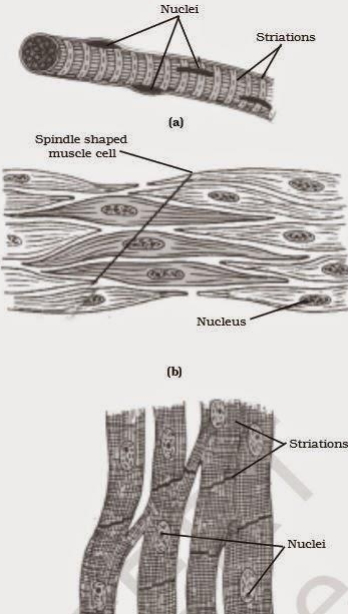
Diagrammatically show the difference between the three types of muscle fibres.
Solution
(N/A) The three types of muscle fibres are:
$1.$ Striated muscle: These are cylindrical,unbranched,and multinucleated cells with alternating light and dark bands (striations).
$2.$ Smooth muscle: These are spindle-shaped,uninucleated cells that lack striations and are found in the walls of internal organs.
$3.$ Cardiac muscle: These are cylindrical,branched,and uninucleated cells with faint striations,found exclusively in the heart.
$1.$ Striated muscle: These are cylindrical,unbranched,and multinucleated cells with alternating light and dark bands (striations).
$2.$ Smooth muscle: These are spindle-shaped,uninucleated cells that lack striations and are found in the walls of internal organs.
$3.$ Cardiac muscle: These are cylindrical,branched,and uninucleated cells with faint striations,found exclusively in the heart.
0 likes
View Solution17
MediumMCQ
What is the specific function of the cardiac muscle?
A
To facilitate voluntary movement of limbs.
B
To bring about rhythmic contraction and relaxation of the heart.
C
To store energy in the form of fat.
D
To provide structural support to the skeletal system.
Solution
(B) The uninucleated,striated,tubular,and branched muscles that form the wall of the heart are known as cardiac muscles.
They serve to bring about rhythmic contraction and relaxation of the heart to allow the pumping of blood throughout life.
Since these muscles contract without any nerve stimulation or conscious control,they are involuntary in nature.
They serve to bring about rhythmic contraction and relaxation of the heart to allow the pumping of blood throughout life.
Since these muscles contract without any nerve stimulation or conscious control,they are involuntary in nature.
0 likes
View Solution18
Difficult
Differentiate between striated,unstriated,and cardiac muscles on the basis of their structure and site/location in the body.
Solution
(N/A) The differences between the three types of muscles are as follows:
$1$. Striated (Skeletal) Muscles: These are cylindrical,unbranched,and multinucleated cells with light and dark bands (striations). They are attached to bones and are responsible for voluntary movements.
$2$. Unstriated (Smooth) Muscles: These are spindle-shaped,uninucleated,and lack striations. They are found in the walls of internal organs like the stomach,intestines,and blood vessels,and are responsible for involuntary movements.
$3$. Cardiac Muscles: These are cylindrical,branched,and uninucleated cells with faint striations. They are found exclusively in the walls of the heart and are responsible for the rhythmic contraction and relaxation of the heart throughout life.
$1$. Striated (Skeletal) Muscles: These are cylindrical,unbranched,and multinucleated cells with light and dark bands (striations). They are attached to bones and are responsible for voluntary movements.
$2$. Unstriated (Smooth) Muscles: These are spindle-shaped,uninucleated,and lack striations. They are found in the walls of internal organs like the stomach,intestines,and blood vessels,and are responsible for involuntary movements.
$3$. Cardiac Muscles: These are cylindrical,branched,and uninucleated cells with faint striations. They are found exclusively in the walls of the heart and are responsible for the rhythmic contraction and relaxation of the heart throughout life.
0 likes
View Solution19
Medium
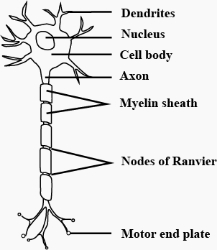
Draw a labelled diagram of a neuron.
Solution
(N/A) neuron (nerve cell) consists of three main parts: the cell body (cyton),dendrites,and the axon.
$1$. Cell body (Cyton): It contains the nucleus and cytoplasm. It is the metabolic center of the neuron.
$2$. Dendrites: These are short,branched extensions that receive signals from other neurons or sensory receptors.
$3$. Axon: It is a long,slender projection that conducts electrical impulses away from the cell body.
Key structures include the myelin sheath (insulating layer),nodes of Ranvier (gaps in the myelin sheath),and the motor end plate (synaptic terminal) which transmits signals to the next cell.
$1$. Cell body (Cyton): It contains the nucleus and cytoplasm. It is the metabolic center of the neuron.
$2$. Dendrites: These are short,branched extensions that receive signals from other neurons or sensory receptors.
$3$. Axon: It is a long,slender projection that conducts electrical impulses away from the cell body.
Key structures include the myelin sheath (insulating layer),nodes of Ranvier (gaps in the myelin sheath),and the motor end plate (synaptic terminal) which transmits signals to the next cell.
0 likes
View Solution20
Medium
Name the following:
$(a)$ Tissue that forms the inner lining of our mouth.
$(b)$ Tissue that connects muscle to bone in humans.
$(c)$ Tissue that transports food in plants.
$(d)$ Tissue that stores fat in our body.
$(e)$ Connective tissue with a fluid matrix.
$(f)$ Tissue present in the brain.
$(a)$ Tissue that forms the inner lining of our mouth.
$(b)$ Tissue that connects muscle to bone in humans.
$(c)$ Tissue that transports food in plants.
$(d)$ Tissue that stores fat in our body.
$(e)$ Connective tissue with a fluid matrix.
$(f)$ Tissue present in the brain.
Solution
(N/A) The inner lining of the mouth is formed by Squamous Epithelium.
$(b)$ Tendons are the fibrous connective tissues that connect muscle to bone.
$(c)$ Phloem is the vascular tissue responsible for the transport of food in plants.
$(d)$ Adipose tissue is the specialized connective tissue that stores fat in our body.
$(e)$ Blood is a connective tissue that has a fluid matrix called plasma.
$(f)$ Nervous tissue is the primary tissue present in the brain,composed of neurons.
$(b)$ Tendons are the fibrous connective tissues that connect muscle to bone.
$(c)$ Phloem is the vascular tissue responsible for the transport of food in plants.
$(d)$ Adipose tissue is the specialized connective tissue that stores fat in our body.
$(e)$ Blood is a connective tissue that has a fluid matrix called plasma.
$(f)$ Nervous tissue is the primary tissue present in the brain,composed of neurons.
0 likes
View Solution21
Medium
Identify the type of tissue in the following: skin,bark of tree,bone,lining of kidney tubule,vascular bundle. Name the regions in which parenchyma tissue is present.
Solution
(N/A) The classification of the given tissues is as follows:
$1$. Skin: Epithelial tissue (specifically stratified squamous epithelium).
$2$. Bark of tree: Cork (protective tissue).
$3$. Bone: Connective tissue.
$4$. Lining of kidney tubule: Cuboidal epithelial tissue.
$5$. Vascular bundle: Complex permanent tissue (xylem and phloem).
Parenchyma tissue is present in the following regions:
- It is found in the soft parts of plants such as the cortex of roots,ground tissue of stems,and mesophyll of leaves.
- It is also present in the pith and the pericycle of stems and roots.
$1$. Skin: Epithelial tissue (specifically stratified squamous epithelium).
$2$. Bark of tree: Cork (protective tissue).
$3$. Bone: Connective tissue.
$4$. Lining of kidney tubule: Cuboidal epithelial tissue.
$5$. Vascular bundle: Complex permanent tissue (xylem and phloem).
Parenchyma tissue is present in the following regions:
- It is found in the soft parts of plants such as the cortex of roots,ground tissue of stems,and mesophyll of leaves.
- It is also present in the pith and the pericycle of stems and roots.
0 likes
View Solution22
Easy
Name the regions in which parenchyma tissue is present.
Solution
(N/A) Parenchyma is a type of simple permanent tissue that serves as the packing tissue in plants. It is found in the following regions:
$1$. It is present in the soft parts of the plant such as the cortex of stems and roots.
$2$. It is found in the ground tissue of stems and roots.
$3$. It forms the bulk of the leaves (mesophyll tissue).
$4$. It is also present in the pith of stems and roots.
$5$. In some cases,it contains chlorophyll and is called chlorenchyma,which performs photosynthesis.
$1$. It is present in the soft parts of the plant such as the cortex of stems and roots.
$2$. It is found in the ground tissue of stems and roots.
$3$. It forms the bulk of the leaves (mesophyll tissue).
$4$. It is also present in the pith of stems and roots.
$5$. In some cases,it contains chlorophyll and is called chlorenchyma,which performs photosynthesis.
0 likes
View Solution23
MediumMCQ
What is the role of epidermis in plants?
A
Protection against loss of water
B
Mechanical support
C
Photosynthesis
D
Storage of food
Solution
(A) The epidermis is the outermost layer of cells in plants. Its primary roles include:
$1$. Protection: It protects all parts of the plant from external environmental factors.
$2$. Water Conservation: In aerial parts,the epidermal cells often secrete a waxy,water-resistant layer on their outer surface,which helps in protection against loss of water,mechanical injury,and invasion by parasitic fungi.
$3$. Gas Exchange: Small pores called stomata present in the epidermis allow for gaseous exchange and transpiration.
$1$. Protection: It protects all parts of the plant from external environmental factors.
$2$. Water Conservation: In aerial parts,the epidermal cells often secrete a waxy,water-resistant layer on their outer surface,which helps in protection against loss of water,mechanical injury,and invasion by parasitic fungi.
$3$. Gas Exchange: Small pores called stomata present in the epidermis allow for gaseous exchange and transpiration.
0 likes
View Solution24
Medium
How does the cork act as a protective tissue?
Solution
(N/A) Cork is a protective tissue composed of dead cells rich in $Suberin$,which forms a thick and waterproof covering on older stems and roots.
$Suberin$ is a waxy,waterproof substance that restricts the movement of water.
The presence of $Suberin$ in the dead cells of the cork and the absence of intercellular spaces make these cells impermeable to water and gases.
This structure protects the underlying tissues from desiccation,mechanical injury,and pathogenic infection.
$Suberin$ is a waxy,waterproof substance that restricts the movement of water.
The presence of $Suberin$ in the dead cells of the cork and the absence of intercellular spaces make these cells impermeable to water and gases.
This structure protects the underlying tissues from desiccation,mechanical injury,and pathogenic infection.
0 likes
View Solution25
Difficult
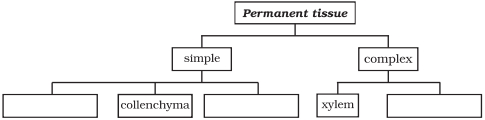
Complete the following chart regarding permanent tissues in plants:
Solution
(N/A) Permanent tissues in plants are classified into two main types: Simple and Complex.
$1$. Simple permanent tissues are composed of only one type of cell. They are further divided into:
- Parenchyma
- Collenchyma
- Sclerenchyma
$2$. Complex permanent tissues are composed of more than one type of cell that work together as a unit. They are divided into:
- Xylem
- Phloem
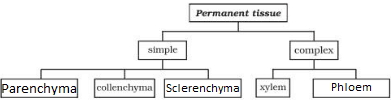
Therefore,the completed chart should have 'Parenchyma' and 'Sclerenchyma' under 'Simple' tissues,and 'Phloem' under 'Complex' tissues.
$1$. Simple permanent tissues are composed of only one type of cell. They are further divided into:
- Parenchyma
- Collenchyma
- Sclerenchyma
$2$. Complex permanent tissues are composed of more than one type of cell that work together as a unit. They are divided into:
- Xylem
- Phloem
Therefore,the completed chart should have 'Parenchyma' and 'Sclerenchyma' under 'Simple' tissues,and 'Phloem' under 'Complex' tissues.
0 likes
View SolutionTISSUES — Textbook - TISSUES · Frequently Asked Questions
1Are these TISSUES questions useful for JEE and NEET?
Yes. All questions in this section are mapped to JEE Main and NEET exam patterns. Previous year questions from JEE Main, NEET, GUJCET and state-level exams are included with full solutions.
2Can I switch to Hindi or Gujarati for these questions?
Yes. Use the language tabs in the hero section or the sidebar to view the same questions and solutions in English, Hindi or Gujarati.
3How do I generate a question paper from this subtopic?
Use the Vedclass Exam Paper Generator — select the chapter and subtopic, set difficulty, and generate Sets A, B, C, D automatically. First 3 chapters of every subject are free.
Vedclass Products
For Students
Vedclass Test Series
Mock tests in real JEE/NEET style with performance analysis. 5-day free trial.
Start Free TrialFor Teachers
Exam Paper Generator
Generate Set A/B/C/D papers from this chapter in 2 minutes. 3 chapters free.
Try FreeFor Institutes
Online Exam Module
Live online exams with unlimited students, 360° analytics & white-label branding.
See DemoFor Teachers & Institutes
Generate a TISSUES Exam Paper in 2 Minutes
Select subtopic & difficulty — Sets A, B, C, D auto-generated with No Repeat logic.
First 3 chapters of every subject are free — no payment required.