
A English
Mix Example - TISSUES Questions in English
Class 9 Science · TISSUES · Mix Example - TISSUES
197+
Questions
English
Language
100%
With Solutions
Showing 50 of 197 questions in English
51
Medium
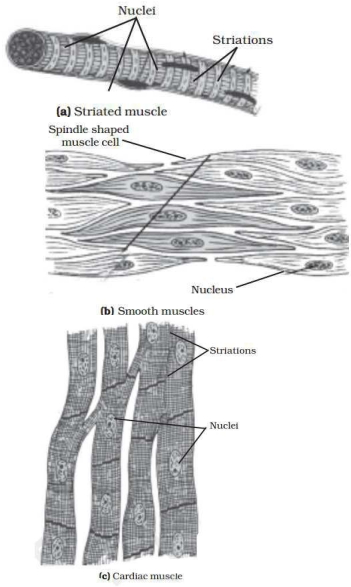
Draw well-labelled diagrams of various types of muscles found in the human body.
Solution
(N/A) The three main types of muscles found in the human body are as follows:
$1$. Striated Muscles (Skeletal Muscles): These are cylindrical,unbranched,and multinucleated. They show alternate light and dark bands (striations) and are attached to bones.
$2$. Smooth Muscles (Unstriated Muscles): These are spindle-shaped (fusiform) with a single central nucleus. They do not show striations and are found in the walls of internal organs like the stomach and intestines.
$3$. Cardiac Muscles: These are cylindrical,branched,and uninucleated. They show striations and are involuntary muscles found exclusively in the heart.
(Please refer to the provided image for the diagrams of these muscle types.)
$1$. Striated Muscles (Skeletal Muscles): These are cylindrical,unbranched,and multinucleated. They show alternate light and dark bands (striations) and are attached to bones.
$2$. Smooth Muscles (Unstriated Muscles): These are spindle-shaped (fusiform) with a single central nucleus. They do not show striations and are found in the walls of internal organs like the stomach and intestines.
$3$. Cardiac Muscles: These are cylindrical,branched,and uninucleated. They show striations and are involuntary muscles found exclusively in the heart.
(Please refer to the provided image for the diagrams of these muscle types.)
0 likes
View Solution52
Medium
Give reasons for:
$(a)$ Meristematic cells have a prominent nucleus and dense cytoplasm but they lack vacuoles.
$(b)$ Intercellular spaces are absent in sclerenchymatous tissues.
$(c)$ We get a crunchy and granular feeling when we chew pear fruit.
$(d)$ Branches of a tree move and bend freely in high wind velocity.
$(e)$ It is difficult to pull out the husk of a coconut.
$(a)$ Meristematic cells have a prominent nucleus and dense cytoplasm but they lack vacuoles.
$(b)$ Intercellular spaces are absent in sclerenchymatous tissues.
$(c)$ We get a crunchy and granular feeling when we chew pear fruit.
$(d)$ Branches of a tree move and bend freely in high wind velocity.
$(e)$ It is difficult to pull out the husk of a coconut.
Solution
(N/A) Meristematic cells are actively dividing cells. $A$ prominent nucleus and dense cytoplasm are required to support rapid metabolic activity and cell division. Vacuoles are absent because these cells do not need to store food or maintain turgidity for structural support.
$(b)$ Sclerenchymatous cells have thick,lignified cell walls that are tightly packed together,leaving no intercellular spaces.
$(c)$ Pear fruit contains specialized sclerenchyma cells known as stone cells or sclereids,which provide a gritty and granular texture.
$(d)$ Collenchyma tissue is present in the stalks and branches of plants. It provides both structural support and flexibility,allowing branches to bend without breaking in high wind.
$(e)$ The husk of a coconut is made of sclerenchyma tissue,which is dead and heavily lignified,making it extremely hard and tough to remove.
$(b)$ Sclerenchymatous cells have thick,lignified cell walls that are tightly packed together,leaving no intercellular spaces.
$(c)$ Pear fruit contains specialized sclerenchyma cells known as stone cells or sclereids,which provide a gritty and granular texture.
$(d)$ Collenchyma tissue is present in the stalks and branches of plants. It provides both structural support and flexibility,allowing branches to bend without breaking in high wind.
$(e)$ The husk of a coconut is made of sclerenchyma tissue,which is dead and heavily lignified,making it extremely hard and tough to remove.
0 likes
View Solution53
Medium
List the characteristics of cork. How are they formed? Mention their role.
Solution
(N/A) Characteristics:
- The cells of cork are dead at maturity.
- These cells are compactly arranged without any intercellular spaces.
- The cell walls possess a chemical substance called $suberin$, which makes them impervious to gases and water.
- They are several layers thick.
Formation:
- As plants grow older, the epidermis of the stem is replaced by a strip of secondary meristem known as the $phellogen$ or cork cambium.
- The cells cut off on the outer side by this meristem differentiate into cork cells.
Role:
- Cork acts as a protective tissue for older stems, twigs, and branches.
- It prevents water loss and protects the plant from mechanical injury and microbial infection.
- The cells of cork are dead at maturity.
- These cells are compactly arranged without any intercellular spaces.
- The cell walls possess a chemical substance called $suberin$, which makes them impervious to gases and water.
- They are several layers thick.
Formation:
- As plants grow older, the epidermis of the stem is replaced by a strip of secondary meristem known as the $phellogen$ or cork cambium.
- The cells cut off on the outer side by this meristem differentiate into cork cells.
Role:
- Cork acts as a protective tissue for older stems, twigs, and branches.
- It prevents water loss and protects the plant from mechanical injury and microbial infection.
0 likes
View Solution54
Medium
Why are xylem and phloem called complex tissues? How are they different from one another?
Solution
(N/A) Xylem and phloem are called complex tissues because they are made up of more than one type of cells that work together as a unit to perform a common function.
| Xylem | Phloem |
|---|---|
| Consists of tracheids,vessels,xylem parenchyma,and xylem fibres. | Consists of sieve tubes,companion cells,phloem parenchyma,and phloem fibres. |
| Transports water and minerals vertically from the soil to the aerial parts of the plant. | Transports food (photosynthates) from the leaves to other parts of the plant. |
| Most of the cells,except xylem parenchyma,are dead at maturity. | Most of the cells,except phloem fibres,are living at maturity. |
0 likes
View Solution55
Medium
$(a)$ Differentiate between meristematic and permanent tissues in plants.
$(b)$ Define the process of differentiation.
$(c)$ Name any two simple and two complex permanent tissues in plants.
$(b)$ Define the process of differentiation.
$(c)$ Name any two simple and two complex permanent tissues in plants.
Solution
(N/A)
$(b)$ The process by which cells derived from meristematic tissue take up a permanent shape,size,and function and lose the ability to divide is called differentiation.
$(c)$ Simple permanent tissues: Parenchyma,Collenchyma (any two).
Complex permanent tissues: Xylem,Phloem.
| Meristematic Tissue | Permanent Tissue |
|---|---|
| Cells of this tissue divide throughout their life. | They lose the ability to divide to take up specific functions. |
| They are located at specific regions of the plant,viz.,apical,lateral,and intercalary. | They are distributed throughout the plant body. |
| Cells are very active,have dense cytoplasm,thin walls,and prominent nuclei. They lack vacuoles. | They are vacuolated,vary in shape and size. Their cell wall may be thick. |
| Cell wall is cellulosic. | Cell wall is made up of cellulose,lignin,or suberin. |
$(b)$ The process by which cells derived from meristematic tissue take up a permanent shape,size,and function and lose the ability to divide is called differentiation.
$(c)$ Simple permanent tissues: Parenchyma,Collenchyma (any two).
Complex permanent tissues: Xylem,Phloem.
0 likes
View Solution56
Easy
Write any one characteristic of meristematic tissue.
Solution
(N/A) The cells that make up meristematic tissue have dense cytoplasm,thin cellulose cell walls,and prominent nuclei. Additionally,they lack vacuoles.
0 likes
View Solution57
EasyMCQ
Which one of the following types of meristematic tissue is also known as cambium?
A
Apical meristem
B
Intercalary meristem
C
Lateral meristem
D
Primary meristem
Solution
(C) Lateral meristem is the type of meristematic tissue that is responsible for the secondary growth in plants.
It increases the girth or diameter of the stem and root.
This tissue is commonly referred to as cambium.
It increases the girth or diameter of the stem and root.
This tissue is commonly referred to as cambium.
0 likes
View Solution58
EasyMCQ
Name the muscular tissue whose cells are spindle-shaped and uninucleate.
A
Striated muscle
B
Cardiac muscle
C
Smooth muscle
D
Skeletal muscle
Solution
(C) The muscular tissue whose cells are spindle-shaped and uninucleate is known as $Smooth$ $muscle$ (also called $Unstriated$ $muscle$ or $Involuntary$ $muscle$).
These cells are long with pointed ends (spindle-shaped) and contain a single central nucleus (uninucleate).
They are found in the walls of internal organs such as the stomach, intestines, and blood vessels.
These cells are long with pointed ends (spindle-shaped) and contain a single central nucleus (uninucleate).
They are found in the walls of internal organs such as the stomach, intestines, and blood vessels.
0 likes
View Solution59
Easy
State the chemical composition of the solid matrix of cartilage.
Solution
(N/A) The solid matrix of cartilage is composed of proteins and sugars. These components are primarily organized as proteoglycans,which provide the tissue with its characteristic flexibility and strength.
0 likes
View Solution60
EasyMCQ
Name the animal tissue which acts as a heat insulator.
A
Epithelial tissue
B
Adipose tissue
C
Muscular tissue
D
Nervous tissue
Solution
(B) Adipose tissue is a type of connective tissue that stores fat. It is found below the skin and between internal organs. Due to the presence of fat,it acts as an insulator and prevents the loss of heat from the body,thereby helping to maintain body temperature.
0 likes
View Solution61
EasyMCQ
Name the tissue which is present in the veins of leaves.
A
Parenchyma
B
Collenchyma
C
Sclerenchyma
D
Xylem and Phloem
Solution
(D) The veins of leaves contain vascular tissues known as $Xylem$ and $Phloem$. $Xylem$ is responsible for the conduction of water and minerals,while $Phloem$ is responsible for the translocation of food. Additionally,$Sclerenchyma$ fibers are often present around the vascular bundles to provide mechanical support.
0 likes
View Solution62
EasyMCQ
The dividing cells at the tip of root and stem are known as?
A
Permanent cells
B
Meristematic cells
C
Parenchyma cells
D
Collenchyma cells
Solution
(B) The cells present at the growing tips of roots and stems are called meristematic cells (or meristem).
These cells have the ability to divide continuously,which leads to the growth of the plant in length.
This specific type of meristem is known as apical meristem.
These cells have the ability to divide continuously,which leads to the growth of the plant in length.
This specific type of meristem is known as apical meristem.
0 likes
View Solution63
EasyMCQ
What is the function of the ligament?
A
Connects bone to muscle
B
Connects bone to bone
C
Connects muscle to muscle
D
Provides elasticity to skin
Solution
(B) ligament is a specialized type of connective tissue that connects bone to bone. It is highly elastic and provides stability to joints.
0 likes
View Solution64
EasyMCQ
Name the tissue in which food in plants is stored.
A
Parenchyma
B
Collenchyma
C
Sclerenchyma
D
Xylem
Solution
(A) The tissue in which food is stored in plants is known as $Parenchyma$.
$Parenchyma$ is a type of simple permanent tissue that acts as a packing tissue and provides support to plants.
Specifically,when $Parenchyma$ contains chlorophyll and performs photosynthesis,it is called $Chlorenchyma$,and when it stores food and water,it serves as a storage tissue.
$Parenchyma$ is a type of simple permanent tissue that acts as a packing tissue and provides support to plants.
Specifically,when $Parenchyma$ contains chlorophyll and performs photosynthesis,it is called $Chlorenchyma$,and when it stores food and water,it serves as a storage tissue.
0 likes
View Solution65
Easy
What are vascular bundles?
Solution
(N/A) Vascular bundles are complex tissues found in plants that consist of two primary conducting tissues: xylem and phloem.
Xylem is responsible for the transport of water and dissolved minerals from the roots to the rest of the plant.
Phloem is responsible for the transport of food (sugars) synthesized during photosynthesis from the leaves to other parts of the plant.
Together,these tissues form a structural unit known as a vascular bundle,which is essential for the transport system in vascular plants.
Xylem is responsible for the transport of water and dissolved minerals from the roots to the rest of the plant.
Phloem is responsible for the transport of food (sugars) synthesized during photosynthesis from the leaves to other parts of the plant.
Together,these tissues form a structural unit known as a vascular bundle,which is essential for the transport system in vascular plants.
0 likes
View Solution66
EasyMCQ
What is the main function of $WBC$?
A
Transport of oxygen
B
Clotting of blood
C
Protection against infections
D
Regulation of body temperature
Solution
(C) $WBC$ (White Blood Cells),also known as leukocytes,are an essential part of the immune system.
Their primary function is to defend the body against pathogens such as bacteria,viruses,and other foreign substances.
They achieve this by engulfing foreign particles or by producing antibodies,thereby providing immunity to the body.
Their primary function is to defend the body against pathogens such as bacteria,viruses,and other foreign substances.
They achieve this by engulfing foreign particles or by producing antibodies,thereby providing immunity to the body.
0 likes
View Solution67
EasyMCQ
What is the function of $RBCs$?
A
To fight against infection
B
To transport oxygen and carbon dioxide
C
To help in blood clotting
D
To provide immunity
Solution
(B) $RBCs$ (Red Blood Cells) contain a respiratory pigment called haemoglobin.
Haemoglobin binds with $O_{2}$ to form oxyhaemoglobin,which facilitates the transport of oxygen from the lungs to the body tissues.
It also plays a role in the transport of $CO_{2}$ from the tissues back to the lungs for exhalation.
Haemoglobin binds with $O_{2}$ to form oxyhaemoglobin,which facilitates the transport of oxygen from the lungs to the body tissues.
It also plays a role in the transport of $CO_{2}$ from the tissues back to the lungs for exhalation.
0 likes
View Solution68
EasyMCQ
What are blood platelets?
A
Red blood cells
B
White blood cells
C
Cell fragments that help in blood clotting
D
Plasma proteins
Solution
(C) Blood platelets,also known as thrombocytes,are cell fragments derived from megakaryocytes in the bone marrow.
They play a crucial role in the process of blood clotting (coagulation) at the site of an injury to prevent excessive blood loss.
They play a crucial role in the process of blood clotting (coagulation) at the site of an injury to prevent excessive blood loss.
0 likes
View Solution69
Easy
What are stomata?
Solution
(N/A) Stomata are microscopic apertures or pores primarily found on the epidermis of leaves. They are surrounded by two specialized cells known as guard cells. Their main functions include the exchange of gases ($CO_2$ and $O_2$) between the plant and the atmosphere and the process of transpiration,which is the loss of water vapor from the plant surface.
0 likes
View Solution70
EasyMCQ
Why are skeletal muscles known as striated muscles?
A
Due to their attachment to bones.
B
Due to the presence of alternate light and dark bands.
C
Due to their voluntary nature.
D
Due to their cylindrical shape.
Solution
(B) Skeletal muscles are known as striated muscles because,when observed under a microscope,they exhibit a characteristic pattern of alternate light and dark bands or striations when stained appropriately. These bands are caused by the regular arrangement of contractile proteins,specifically actin and myosin,within the muscle fibers. Consequently,they are referred to as striated muscles.
0 likes
View Solution71
Easy
Why do tracheids and vessels have tubular structures?
Solution
(N/A) Tracheids and vessels are the main conducting elements of the xylem tissue in plants.
Their tubular structure provides a low-resistance pathway for the bulk flow of water and dissolved minerals from the roots to the leaves.
This vertical,pipe-like arrangement allows for efficient long-distance transport against gravity,which is essential for the survival of vascular plants.
Their tubular structure provides a low-resistance pathway for the bulk flow of water and dissolved minerals from the roots to the leaves.
This vertical,pipe-like arrangement allows for efficient long-distance transport against gravity,which is essential for the survival of vascular plants.
0 likes
View Solution72
Medium
Write the location and function of collenchyma tissue.
Solution
(N/A) Location: Collenchyma is found in the leaf stalks (petioles) and below the epidermis of dicot stems.
Function: It provides mechanical support and flexibility to the plant,allowing parts like leaf stalks to bend easily without breaking.
Function: It provides mechanical support and flexibility to the plant,allowing parts like leaf stalks to bend easily without breaking.
0 likes
View Solution73
EasyMCQ
Name the connective tissue that is found between skin and muscles.
A
Adipose tissue
B
Areolar connective tissue
C
Ligament
D
Tendon
Solution
(B) The connective tissue found between the skin and muscles is known as areolar connective tissue. It acts as a supporting and packing tissue between organs and fills the space inside the organs,supporting internal organs and helping in the repair of tissues.
0 likes
View Solution74
EasyMCQ
Name the meristem which is responsible for the increase of girth of root.
A
Apical meristem
B
Intercalary meristem
C
Lateral meristem
D
Primary meristem
Solution
(C) The meristem responsible for the increase in the girth (diameter) of the stem and root is known as the $Lateral$ $meristem$ (also called $Cambium$).
It is a secondary meristem that adds to the thickness of the plant body.
It is a secondary meristem that adds to the thickness of the plant body.
0 likes
View Solution75
Medium
Name the tissue which:
$(i)$ allows aquatic plants to float.
$(ii)$ provides flexibility to plants.
$(i)$ allows aquatic plants to float.
$(ii)$ provides flexibility to plants.
Solution
(N/A) $(i)$ Aerenchyma: This is a type of parenchyma tissue containing large air cavities that provide buoyancy to aquatic plants,allowing them to float.
$(ii)$ Collenchyma: This is a mechanical tissue that provides structural support and flexibility to the plant,allowing easy bending without breaking.
$(ii)$ Collenchyma: This is a mechanical tissue that provides structural support and flexibility to the plant,allowing easy bending without breaking.
0 likes
View Solution76
Easy
Name the two types of complex tissues.
Solution
(N/A) The two types of complex tissues in plants are $Xylem$ and $Phloem$.
$Xylem$ is responsible for the conduction of water and minerals from the roots to the leaves.
$Phloem$ is responsible for the translocation of food (photosynthates) from the leaves to other parts of the plant.
$Xylem$ is responsible for the conduction of water and minerals from the roots to the leaves.
$Phloem$ is responsible for the translocation of food (photosynthates) from the leaves to other parts of the plant.
0 likes
View Solution77
MediumMCQ
How is stratified squamous epithelial tissue different from simple squamous epithelial tissue?
A
Simple squamous is single-layered,while stratified squamous is multi-layered.
B
Simple squamous is multi-layered,while stratified squamous is single-layered.
C
Both are identical in structure.
D
Stratified squamous is found in the alveoli,while simple squamous is found in the skin.
Solution
(A) Simple squamous epithelial tissue consists of a single layer of extremely thin and flat cells,forming a delicate lining,such as in the blood vessels or lung alveoli.
Stratified squamous epithelial tissue consists of cells arranged in many layers to prevent wear and tear.
This multi-layered arrangement is specifically found in areas subjected to mechanical stress,such as the skin,the lining of the mouth,and the oesophagus.
Stratified squamous epithelial tissue consists of cells arranged in many layers to prevent wear and tear.
This multi-layered arrangement is specifically found in areas subjected to mechanical stress,such as the skin,the lining of the mouth,and the oesophagus.
0 likes
View Solution78
Easy
Name the muscular tissue which is present in the iris of the eye. What is the shape of these cells?
Solution
(N/A) The muscular tissue present in the iris of the eye is the $Smooth$ muscle (also known as involuntary muscle).
These cells are $spindle-shaped$ (fusiform), meaning they are wide in the middle and tapered at both ends.
These cells are $spindle-shaped$ (fusiform), meaning they are wide in the middle and tapered at both ends.
0 likes
View Solution79
Easy
Determine the location of the following tissues:
$1$. Unstriated muscle fibres
$2$. Cuboidal epithelium
$3$. Adipose tissue
$4$. Striated muscle fibres
$1$. Unstriated muscle fibres
$2$. Cuboidal epithelium
$3$. Adipose tissue
$4$. Striated muscle fibres
Solution
(N/A) $1$. Unstriated muscle fibres are found in the walls of the alimentary canal,iris of the eye,ureters,and bronchi.
$2$. Cuboidal epithelium is found in the lining of kidney tubules and ducts of salivary glands.
$3$. Adipose tissue is found below the skin and between internal organs.
$4$. Striated muscle fibres are found in the limbs,tongue,and body wall.
$2$. Cuboidal epithelium is found in the lining of kidney tubules and ducts of salivary glands.
$3$. Adipose tissue is found below the skin and between internal organs.
$4$. Striated muscle fibres are found in the limbs,tongue,and body wall.
0 likes
View Solution80
Medium
Answer the following:
$(i)$ How is the epidermis of plants living in very dry habitats adapted?
$(ii)$ Write the functions of guard cells of stomata in the leaf.
$(i)$ How is the epidermis of plants living in very dry habitats adapted?
$(ii)$ Write the functions of guard cells of stomata in the leaf.
Solution
(N/A) $(i)$ In very dry habitats,the epidermis is often thicker to provide protection against water loss. Additionally,the aerial parts of these plants often secrete a waxy,water-resistant layer (cuticle) on the outer surface to protect against water loss,mechanical injury,and invasion by parasitic fungi.
$(ii)$ The primary functions of guard cells are:
$1.$ To regulate the opening and closing of stomata.
$2.$ To facilitate the exchange of gases (like $CO_2$ and $O_2$) between the plant and the atmosphere.
$3.$ To control transpiration by regulating water vapor loss.
$(ii)$ The primary functions of guard cells are:
$1.$ To regulate the opening and closing of stomata.
$2.$ To facilitate the exchange of gases (like $CO_2$ and $O_2$) between the plant and the atmosphere.
$3.$ To control transpiration by regulating water vapor loss.
0 likes
View Solution81
Easy
Which parts of our body are composed of nervous tissue? Name the cells that make up the nervous tissue.
Solution
(N/A) The nervous tissue is primarily found in the following parts of the body:
$(i)$ Brain
$(ii)$ Spinal cord
$(iii)$ Nerves
The cells that make up the nervous tissue are called neurons (or nerve cells).
$(i)$ Brain
$(ii)$ Spinal cord
$(iii)$ Nerves
The cells that make up the nervous tissue are called neurons (or nerve cells).
0 likes
View Solution82
Medium
$(a)$ Why is connective tissue called so?
$(b)$ What is the function of the areolar connective tissue?
$(c)$ Which substance is present in the adipocyte? How does it help?
$(b)$ What is the function of the areolar connective tissue?
$(c)$ Which substance is present in the adipocyte? How does it help?
Solution
(N/A) Connective tissue is called so because its primary function is to bind,support,and connect different tissues and organs of the body together.
$(b)$ Areolar connective tissue fills the space inside the organs,supports internal organs,and helps in the repair of tissues.
$(c)$ Adipocytes contain fat globules. This stored fat acts as an insulator against heat loss and provides energy to the body.
$(b)$ Areolar connective tissue fills the space inside the organs,supports internal organs,and helps in the repair of tissues.
$(c)$ Adipocytes contain fat globules. This stored fat acts as an insulator against heat loss and provides energy to the body.
0 likes
View Solution83
Medium
What is the difference between xylem and phloem?
Solution
(N/A)
| Xylem | Phloem |
|---|---|
| $(i)$ It conducts water and minerals from roots to all parts of the plant. | $(i)$ It conducts organic food synthesized in the leaves and hormones synthesized at the shoot and root tips to other parts of the plant. |
| $(ii)$ The elements which help in conduction are tracheids and vessels. Both are non-living and have thick walls. | $(ii)$ Sieve-tube cells are responsible for the movement of material through phloem. They are living cells. |
| $(iii)$ The material in xylem moves only in one direction (unidirectional). | $(iii)$ The material in phloem can move in both directions (bidirectional). |
| $(iv)$ Except for xylem parenchyma,all other xylem elements are non-living. | $(iv)$ Except for phloem fibres,all other phloem elements are living. |
0 likes
View Solution84
Medium
What is the difference between sclerenchyma and collenchyma?
Solution
(N/A)
| Sclerenchyma | Collenchyma |
|---|---|
| $1$. It consists of dead cells. | $1$. It consists of living cells. |
| $2$. Its cell walls are lignified. | $2$. Its cell walls are cellulosic. |
| $3$. Lumen of the cell is narrow. | $3$. Lumen of the cell is wide. |
| $4$. It provides mechanical support to the plant. | $4$. It provides mechanical support and elasticity to the plant body. |
0 likes
View Solution85
Medium
What are the distinctive features of cardiac muscles?
Solution
(N/A) Features of cardiac muscles are:
$(i)$ These are involuntary muscles that exhibit rhythmic contraction and relaxation throughout life.
$(ii)$ These muscles are composed of non-tapering cells with faint cross-striations.
$(iii)$ The cells of these muscles are cylindrical,branched,and uninucleate.
$(iv)$ These muscles do not get fatigued under normal conditions.
$(i)$ These are involuntary muscles that exhibit rhythmic contraction and relaxation throughout life.
$(ii)$ These muscles are composed of non-tapering cells with faint cross-striations.
$(iii)$ The cells of these muscles are cylindrical,branched,and uninucleate.
$(iv)$ These muscles do not get fatigued under normal conditions.
0 likes
View Solution86
Easy
Name the element$(s)$ of xylem which
$(i)$ help in transport of water and minerals,
(ii) stores food,and
(iii) provides mechanical support.
$(i)$ help in transport of water and minerals,
(ii) stores food,and
(iii) provides mechanical support.
Solution
(N/A) $(i)$ Tracheids and vessels are the main conducting elements that help in the transport of water and minerals.
(ii) Xylem parenchyma is the only living component of xylem that stores food materials in the form of starch or fat.
(iii) Xylem fibres (also known as xylem sclerenchyma) are dead cells with thick walls that provide mechanical support to the plant.
(ii) Xylem parenchyma is the only living component of xylem that stores food materials in the form of starch or fat.
(iii) Xylem fibres (also known as xylem sclerenchyma) are dead cells with thick walls that provide mechanical support to the plant.
0 likes
View Solution87
Medium
List any four salient features of meristematic tissue.
Solution
(N/A) $(1)$ Cells divide repeatedly.
$(2)$ Cell walls are thin and made of cellulose.
$(3)$ Vacuoles are either absent or very small.
$(4)$ They are metabolically very active.
$(5)$ They possess dense cytoplasm.
$(6)$ They have a prominent and large nucleus.
$(2)$ Cell walls are thin and made of cellulose.
$(3)$ Vacuoles are either absent or very small.
$(4)$ They are metabolically very active.
$(5)$ They possess dense cytoplasm.
$(6)$ They have a prominent and large nucleus.
0 likes
View Solution88
Medium
What are the two main components of blood? Why is blood considered a type of connective tissue?
Solution
(N/A) The two main components of blood are plasma and blood cells (corpuscles).
Blood is considered a type of connective tissue because it consists of a fluid matrix,known as plasma,in which various blood cells are suspended. Connective tissues are defined by having cells embedded in an extracellular matrix,and blood fits this definition as the plasma acts as the matrix connecting different parts of the body by transporting nutrients,gases,and waste products.
Blood is considered a type of connective tissue because it consists of a fluid matrix,known as plasma,in which various blood cells are suspended. Connective tissues are defined by having cells embedded in an extracellular matrix,and blood fits this definition as the plasma acts as the matrix connecting different parts of the body by transporting nutrients,gases,and waste products.
0 likes
View Solution89
Easy
What is the chemical substance that makes the cells of the sclerenchyma hard? Mention where this tissue is likely to be present.
Solution
(N/A) The chemical substance that makes the cell walls of sclerenchyma hard is $Lignin$. This substance acts as a cement and hardens the cell wall.
Sclerenchyma tissue is typically found in the following locations:
$1$. Around vascular bundles.
$2$. In the veins of leaves.
$3$. In the hard covering of seeds and nuts (e.g.,the shell of a coconut).
Sclerenchyma tissue is typically found in the following locations:
$1$. Around vascular bundles.
$2$. In the veins of leaves.
$3$. In the hard covering of seeds and nuts (e.g.,the shell of a coconut).
0 likes
View Solution90
Easy
Name the liquid matrix of the blood. What does it contain? List any two functions of blood.
Solution
(N/A) The liquid matrix of the blood is called $Plasma$.
$Plasma$ contains water,proteins (such as $albumin$,$globulin$,and $fibrinogen$),salts (electrolytes),hormones,glucose,and waste products.
Two functions of blood are:
$1$. It transports respiratory gases ($O_2$ and $CO_2$) between the lungs and body tissues.
$2$. It transports digested food,hormones,and waste materials to different parts of the body.
$Plasma$ contains water,proteins (such as $albumin$,$globulin$,and $fibrinogen$),salts (electrolytes),hormones,glucose,and waste products.
Two functions of blood are:
$1$. It transports respiratory gases ($O_2$ and $CO_2$) between the lungs and body tissues.
$2$. It transports digested food,hormones,and waste materials to different parts of the body.
0 likes
View Solution91
Medium
List any two differences between the structure and location of striated and unstriated muscles.
Solution
(N/A)
| Striated Muscles | Unstriated Muscles |
|---|---|
| $1.$ The cells are long,cylindrical,unbranched,and multinucleate. | $1.$ The cells are long,spindle-shaped (pointed at both ends),and uninucleate. |
| $2.$ These are mostly attached to bones and help in voluntary body movements. | $2.$ These are present in the walls of the alimentary canal,blood vessels,iris of the eye,ureters,and bronchi. |
0 likes
View Solution92
Easy
State one important function of each of the following:
$(a)$ Areolar tissue
$(b)$ Cuboidal epithelium
$(a)$ Areolar tissue
$(b)$ Cuboidal epithelium
Solution
(N/A) Areolar tissue fills the space inside the organs,supports internal organs,and helps in the repair of tissues. (Any $1$)
$(b)$ Cuboidal epithelium provides mechanical support and is involved in secretion and absorption.
$(b)$ Cuboidal epithelium provides mechanical support and is involved in secretion and absorption.
0 likes
View Solution93
Easy
Write the functions of parenchyma cells.
Solution
(N/A) It provides mechanical support to plants.
$(b)$ It stores food materials like starch,proteins,and fats.
$(c)$ In aquatic plants,parenchyma cells contain large air cavities (aerenchyma) which provide buoyancy and help the plant float.
$(b)$ It stores food materials like starch,proteins,and fats.
$(c)$ In aquatic plants,parenchyma cells contain large air cavities (aerenchyma) which provide buoyancy and help the plant float.
0 likes
View Solution94
EasyMCQ
Differentiate between chlorenchyma and aerenchyma.
A
Chlorenchyma contains chlorophyll,while aerenchyma contains air cavities.
B
Chlorenchyma performs photosynthesis,while aerenchyma provides buoyancy.
C
Chlorenchyma is found in green stems and leaves,while aerenchyma is found in aquatic plants.
D
All of the above.
Solution
(D) Chlorenchyma: These are specialized parenchyma cells that contain chlorophyll and are primarily responsible for performing photosynthesis.
Aerenchyma: These are specialized parenchyma cells found in aquatic plants that contain large air cavities. These cavities help the plants to float (buoyancy) and facilitate gas exchange.
Aerenchyma: These are specialized parenchyma cells found in aquatic plants that contain large air cavities. These cavities help the plants to float (buoyancy) and facilitate gas exchange.
0 likes
View Solution95
Medium
Name the tissue that transmits stimuli in our body. How does this tissue enable animals to move rapidly in response to stimuli?
Solution
(N/A) The tissue that transmits stimuli in our body is the nervous tissue.
$(b)$ Nervous tissue contains specialized cells called neurons that receive and transmit electrical impulses. When a stimulus is received,the nervous tissue sends a signal to the muscle tissue. The muscle tissue then contracts or relaxes in response to these signals,which allows animals to move rapidly.
$(b)$ Nervous tissue contains specialized cells called neurons that receive and transmit electrical impulses. When a stimulus is received,the nervous tissue sends a signal to the muscle tissue. The muscle tissue then contracts or relaxes in response to these signals,which allows animals to move rapidly.
0 likes
View Solution96
Medium
Write two basic structural differences between parenchyma and collenchyma tissues.
Solution
(N/A) The two basic structural differences are as follows:
$1$. Cell Wall: Parenchyma cells have thin cell walls made of cellulose,whereas collenchyma cells have unevenly thickened cell walls due to the deposition of cellulose,hemicellulose,and pectin at the corners.
$2$. Intercellular Spaces: Parenchyma cells are loosely packed with large intercellular spaces,whereas collenchyma cells are closely packed with very little or no intercellular space.
$1$. Cell Wall: Parenchyma cells have thin cell walls made of cellulose,whereas collenchyma cells have unevenly thickened cell walls due to the deposition of cellulose,hemicellulose,and pectin at the corners.
$2$. Intercellular Spaces: Parenchyma cells are loosely packed with large intercellular spaces,whereas collenchyma cells are closely packed with very little or no intercellular space.
0 likes
View Solution97
Medium
Give reasons for the following:
Tissue $A$: Cells are filled with fat globules and the tissue acts as an insulator.
Tissue $B$: Has cylindrical,branched cells and the tissue shows rhythmic contraction and relaxation throughout life.
Tissue $A$: Cells are filled with fat globules and the tissue acts as an insulator.
Tissue $B$: Has cylindrical,branched cells and the tissue shows rhythmic contraction and relaxation throughout life.
Solution
(N/A) Tissue $A$ is Adipose tissue.
Reason: It is a type of connective tissue where cells are specialized to store fats in the form of globules. This fat layer acts as an insulator against heat loss from the body.
Tissue $B$ is Cardiac muscle.
Reason: Cardiac muscle cells are cylindrical,branched,and uninucleate. They are involuntary muscles that exhibit rhythmic contraction and relaxation throughout the life of an organism to pump blood.
Reason: It is a type of connective tissue where cells are specialized to store fats in the form of globules. This fat layer acts as an insulator against heat loss from the body.
Tissue $B$ is Cardiac muscle.
Reason: Cardiac muscle cells are cylindrical,branched,and uninucleate. They are involuntary muscles that exhibit rhythmic contraction and relaxation throughout the life of an organism to pump blood.
0 likes
View Solution98
Medium
$(a)$ Voluntary muscles are also known as skeletal muscles. Justify.
$(b)$ Give two structural characteristics of these voluntary muscles.
$(b)$ Give two structural characteristics of these voluntary muscles.
Solution
(N/A) These muscles are called skeletal muscles because they are primarily attached to the bones of the skeleton and facilitate body movement.
$(b)$ Two structural characteristics are:
$(i)$ They exhibit alternating light and dark bands (striations) under a microscope.
$(ii)$ They are multinucleated (contain many nuclei) and the cells are cylindrical and unbranched.
$(b)$ Two structural characteristics are:
$(i)$ They exhibit alternating light and dark bands (striations) under a microscope.
$(ii)$ They are multinucleated (contain many nuclei) and the cells are cylindrical and unbranched.
0 likes
View Solution99
Medium
Name the following tissues:
$(a)$ The connective tissue found between the skin and muscles.
$(b)$ The tissue which connects two bones.
$(c)$ The epithelial tissue which forms the lining of the kidney tubules.
$(d)$ The tissue which is present in the veins of leaves.
$(a)$ The connective tissue found between the skin and muscles.
$(b)$ The tissue which connects two bones.
$(c)$ The epithelial tissue which forms the lining of the kidney tubules.
$(d)$ The tissue which is present in the veins of leaves.
Solution
(N/A) Areolar tissue: It is a loose connective tissue that acts as a supporting and packing tissue between the skin and muscles.
$(b)$ Ligament: It is a fibrous connective tissue that connects two bones together.
$(c)$ Cuboidal epithelium: This tissue consists of cube-shaped cells and is found in the lining of kidney tubules and ducts of salivary glands,providing mechanical support.
$(d)$ Sclerenchyma: This is a permanent plant tissue composed of dead cells with thick lignified walls,providing structural strength to the veins of leaves.
$(b)$ Ligament: It is a fibrous connective tissue that connects two bones together.
$(c)$ Cuboidal epithelium: This tissue consists of cube-shaped cells and is found in the lining of kidney tubules and ducts of salivary glands,providing mechanical support.
$(d)$ Sclerenchyma: This is a permanent plant tissue composed of dead cells with thick lignified walls,providing structural strength to the veins of leaves.
0 likes
View Solution100
Medium
Name the tissue that:
$(a)$ connects muscle to the bone in humans
$(b)$ forms the inner lining of alveoli
$(c)$ stores fat in our body
$(d)$ transports water and minerals in plants.
$(a)$ connects muscle to the bone in humans
$(b)$ forms the inner lining of alveoli
$(c)$ stores fat in our body
$(d)$ transports water and minerals in plants.
Solution
(N/A) Tendons: These are fibrous connective tissues that attach skeletal muscle to bone.
$(b)$ Squamous epithelium: Specifically,simple squamous epithelium forms the delicate inner lining of the alveoli in the lungs to facilitate gas exchange.
$(c)$ Adipose tissue: This is a specialized connective tissue that stores fat in the form of fat globules.
$(d)$ Xylem: This is a complex permanent tissue in plants responsible for the conduction of water and dissolved minerals from the roots to the rest of the plant.
$(b)$ Squamous epithelium: Specifically,simple squamous epithelium forms the delicate inner lining of the alveoli in the lungs to facilitate gas exchange.
$(c)$ Adipose tissue: This is a specialized connective tissue that stores fat in the form of fat globules.
$(d)$ Xylem: This is a complex permanent tissue in plants responsible for the conduction of water and dissolved minerals from the roots to the rest of the plant.
0 likes
View SolutionTISSUES — Mix Example - TISSUES · Frequently Asked Questions
1Are these TISSUES questions useful for JEE and NEET?
Yes. All questions in this section are mapped to JEE Main and NEET exam patterns. Previous year questions from JEE Main, NEET, GUJCET and state-level exams are included with full solutions.
2Can I switch to Hindi or Gujarati for these questions?
Yes. Use the language tabs in the hero section or the sidebar to view the same questions and solutions in English, Hindi or Gujarati.
3How do I generate a question paper from this subtopic?
Use the Vedclass Exam Paper Generator — select the chapter and subtopic, set difficulty, and generate Sets A, B, C, D automatically. First 3 chapters of every subject are free.
Vedclass Products
For Students
Vedclass Test Series
Mock tests in real JEE/NEET style with performance analysis. 5-day free trial.
Start Free TrialFor Teachers
Exam Paper Generator
Generate Set A/B/C/D papers from this chapter in 2 minutes. 3 chapters free.
Try FreeFor Institutes
Online Exam Module
Live online exams with unlimited students, 360° analytics & white-label branding.
See DemoFor Teachers & Institutes
Generate a TISSUES Exam Paper in 2 Minutes
Select subtopic & difficulty — Sets A, B, C, D auto-generated with No Repeat logic.
First 3 chapters of every subject are free — no payment required.