
A English
Mix Example - TISSUES Questions in English
Class 9 Science · TISSUES · Mix Example - TISSUES
197+
Questions
English
Language
100%
With Solutions
Showing 50 of 197 questions in English
1
EasyMCQ
Which of the following tissues has dead cells?
A
Sclerenchyma
B
Parenchyma
C
Collenchyma
D
Epithelial tissue
Solution
(A) Sclerenchyma is a permanent tissue that is entirely composed of dead cells with thick,lignified walls.
In contrast,Parenchyma and Collenchyma are simple permanent tissues composed of living cells.
Epithelial tissue is an animal tissue composed of living cells.
In contrast,Parenchyma and Collenchyma are simple permanent tissues composed of living cells.
Epithelial tissue is an animal tissue composed of living cells.
0 likes
View Solution2
MediumMCQ
Find out the incorrect sentence.
A
Parenchymatous tissues have intercellular spaces.
B
Apical and intercalary meristems are permanent tissues.
C
Collenchymatous tissues are irregularly thickened at corners.
D
Meristematic tissues,in their early stage,lack vacuoles.
Solution
(B) Meristematic tissues are actively dividing cells and are not permanent tissues. They are characterized by dense cytoplasm,thin cell walls,and the absence of vacuoles. Permanent tissues are derived from meristematic tissues after they lose the ability to divide. Therefore,the statement that apical and intercalary meristems are permanent tissues is incorrect.
0 likes
View Solution3
MediumMCQ
Girth of stem increases due to
A
apical meristem
B
intercalary meristem
C
lateral meristem
D
vertical meristem
Solution
(C) The apical meristem is responsible for the increase in the length of the stem and root.
Intercalary meristem is found at the internodes and helps in the growth of leaves and internodes.
Lateral meristem (also known as cambium) is responsible for the increase in the girth or diameter of the stem and root in plants.
Intercalary meristem is found at the internodes and helps in the growth of leaves and internodes.
Lateral meristem (also known as cambium) is responsible for the increase in the girth or diameter of the stem and root in plants.
0 likes
View Solution4
MediumMCQ
Which cell does not have a perforated cell wall?
A
Tracheids
B
Vessels
C
Sieve tubes
D
Companion cells
Solution
(D) perforated cell wall is a characteristic feature of conducting elements in plants that facilitate the transport of materials.
$1$. Tracheids and Vessels are xylem elements involved in water transport and possess perforated or pitted walls.
$2$. Sieve tubes are phloem elements involved in food transport and have perforated end walls called sieve plates.
$3$. Companion cells are specialized parenchyma cells associated with sieve tubes. They are living cells with a dense cytoplasm and a nucleus,and they do not possess perforated cell walls.
$1$. Tracheids and Vessels are xylem elements involved in water transport and possess perforated or pitted walls.
$2$. Sieve tubes are phloem elements involved in food transport and have perforated end walls called sieve plates.
$3$. Companion cells are specialized parenchyma cells associated with sieve tubes. They are living cells with a dense cytoplasm and a nucleus,and they do not possess perforated cell walls.
0 likes
View Solution5
EasyMCQ
The intestine absorbs digested food materials. Which type of epithelial cells are responsible for this?
A
Columnar epithelium
B
Stratified squamous epithelium
C
Spindle fibres
D
Cuboidal epithelium
Solution
(A) The intestine is lined with columnar epithelium,which is specialized for absorption and secretion.
Stratified squamous epithelium is found in the skin and provides protection against wear and tear.
Cuboidal epithelium is typically found in ducts of glands and kidney tubules,providing structural support and secretion.
Spindle fibres are part of the cytoskeleton involved in cell division,not a type of epithelial tissue.
Stratified squamous epithelium is found in the skin and provides protection against wear and tear.
Cuboidal epithelium is typically found in ducts of glands and kidney tubules,providing structural support and secretion.
Spindle fibres are part of the cytoskeleton involved in cell division,not a type of epithelial tissue.
0 likes
View Solution6
MediumMCQ
$A$ person met with an accident in which two long bones of the hand were dislocated. Which among the following may be the possible reason?
A
Tendon break
B
Ligament break
C
Break of skeletal muscle
D
Areolar tissue break
Solution
(B) Ligaments are specialized connective tissues that connect one bone to another bone at joints. When a person meets with an accident,the excessive force can cause these ligaments to tear or break. Since ligaments provide stability to the joints,their rupture leads to the displacement of bones from their normal position,which is known as dislocation.
0 likes
View Solution7
MediumMCQ
While doing work and running,you move your organs like hands,legs etc. Which among the following is correct?
A
Smooth muscles contract and pull the ligament to move the bones
B
Smooth muscles contract and pull the tendons to move the bones
C
Skeletal muscles contract and pull the tendon to move the bones
D
Skeletal muscles contract and pull the ligament to move the bones
Solution
(C) Skeletal muscles are responsible for voluntary movement,and therefore,movement in limbs like hands and legs is facilitated by the contraction or relaxation of skeletal muscles.
$A$ tendon is a fibrous connective tissue that attaches a muscle to a bone.
When skeletal muscles contract,they pull on the tendons,which in turn pull the bones to create movement.
Therefore,option $C$ is correct.
$A$ tendon is a fibrous connective tissue that attaches a muscle to a bone.
When skeletal muscles contract,they pull on the tendons,which in turn pull the bones to create movement.
Therefore,option $C$ is correct.
0 likes
View Solution8
MediumMCQ
Which muscles act involuntarily?
$(i)$ Striated muscles
$(ii)$ Smooth muscles
$(iii)$ Cardiac muscles
$(iv)$ Skeletal muscles
$(i)$ Striated muscles
$(ii)$ Smooth muscles
$(iii)$ Cardiac muscles
$(iv)$ Skeletal muscles
A
$(i)$ and $(ii)$
B
$(i)$ and $(iv)$
C
$(iii)$ and $(iv)$
D
$(ii)$ and $(iii)$
Solution
(D) Muscles can be classified based on their control as voluntary or involuntary.
Skeletal muscles are voluntary muscles because their movement is under our conscious control. They are also known as striated muscles due to their striped appearance.
Smooth muscles are involuntary muscles found in the walls of internal organs,and their movement is not under conscious control.
Cardiac muscles are involuntary muscles found in the heart,responsible for rhythmic contractions.
Therefore,both smooth muscles $(ii)$ and cardiac muscles $(iii)$ act involuntarily.
Skeletal muscles are voluntary muscles because their movement is under our conscious control. They are also known as striated muscles due to their striped appearance.
Smooth muscles are involuntary muscles found in the walls of internal organs,and their movement is not under conscious control.
Cardiac muscles are involuntary muscles found in the heart,responsible for rhythmic contractions.
Therefore,both smooth muscles $(ii)$ and cardiac muscles $(iii)$ act involuntarily.
0 likes
View Solution9
EasyMCQ
Meristematic tissues in plants are
A
localised and dividing cells
B
not limited to certain regions
C
localised and permanent
D
growing in volume
Solution
(A) Meristematic tissues consist of actively dividing cells that are restricted to specific regions of the plant,such as the tips of roots and shoots.
These tissues are responsible for the growth of the plant body.
Unlike permanent tissues,meristematic cells retain the ability to divide throughout their life.
These tissues are responsible for the growth of the plant body.
Unlike permanent tissues,meristematic cells retain the ability to divide throughout their life.
0 likes
View Solution10
EasyMCQ
Which is not a function of epidermis?
A
Protection from adverse conditions
B
Conduction of water
C
Gaseous exchange
D
Transpiration
Solution
(B) The epidermis is the outermost protective layer of the plant body. Its primary functions include protection against mechanical injury,prevention of water loss,and regulation of gaseous exchange through stomata. Conduction of water is the primary function of the $Xylem$ tissue,not the epidermis.
0 likes
View Solution11
MediumMCQ
Select the incorrect sentence.
A
Blood has a matrix containing proteins,salts,and hormones.
B
Two bones are connected with ligaments.
C
Tendons are non-fibrous tissue and fragile.
D
Cartilage is a form of connective tissue.
Solution
(C) Tendons are fibrous connective tissues that are very strong and have limited flexibility,not fragile. Therefore,the statement that tendons are non-fibrous and fragile is incorrect.
0 likes
View Solution12
MediumMCQ
Cartilage is not found in
A
nose
B
ear
C
larynx
D
kidney
Solution
(D) Cartilage is a type of specialized connective tissue. It is found in the nose,ear,larynx,and trachea. The kidney is an organ composed primarily of epithelial tissues and nephrons,not cartilage.
0 likes
View Solution13
EasyMCQ
Fats are stored in the human body in which of the following?
A
Adipose tissue
B
Cuboidal epithelium
C
Bones
D
Cartilage
Solution
(A) Adipose tissue is a specialized type of connective tissue that functions primarily to store fat. It consists of adipocytes,which are cells specialized for the storage of lipids. These tissues are found beneath the skin,around internal organs,and in the bone marrow,providing insulation and energy reserves for the body.
0 likes
View Solution14
MediumMCQ
Bone matrix is rich in
A
fluoride and calcium
B
calcium and phosphorus
C
calcium and potassium
D
phosphorus and potassium
Solution
(B) Bone is a connective tissue that provides a structural framework to the body. The bone cells (osteocytes) are embedded in a hard,non-pliable matrix. This matrix is primarily composed of calcium and phosphorus salts,which provide strength and rigidity to the bones.
0 likes
View Solution15
MediumMCQ
Contractile proteins are found in
A
bones
B
blood
C
muscles
D
cartilage
Solution
(C) Muscles possess the unique ability to contract and relax,which allows for movement. This property is due to the presence of specialized contractile proteins,primarily $Actin$ and $Myosin$,within the muscle fibers. Therefore,contractile proteins are found in muscles.
0 likes
View Solution16
EasyMCQ
Voluntary muscles are found in
A
alimentary canal
B
bronchi of lungs
C
iris of the eye
D
limbs
Solution
(D) Voluntary muscles,also known as skeletal muscles,are attached to bones and are under our conscious control.
They are responsible for the movement of body parts like arms and legs.
The muscles in the alimentary canal,bronchi of lungs,and iris of the eye are involuntary muscles,meaning they are not under our conscious control.
They are responsible for the movement of body parts like arms and legs.
The muscles in the alimentary canal,bronchi of lungs,and iris of the eye are involuntary muscles,meaning they are not under our conscious control.
0 likes
View Solution17
DifficultMCQ
Nervous tissue is not found in
A
tendons
B
spinal cord
C
brain
D
nerves
Solution
(A) Nervous tissue is primarily composed of neurons and neuroglia, which are responsible for the transmission and processing of electrical signals. The $brain$, $spinal cord$, and $nerves$ are the primary components of the nervous system and are rich in nervous tissue. $Tendons$, on the other hand, are a type of dense regular connective tissue that connects muscles to bones. Therefore, nervous tissue is not found in tendons.
0 likes
View Solution18
EasyMCQ
Nerve cell does not contain
A
axon
B
tendons
C
nerve endings
D
dendrites
Solution
(B) nerve cell,also known as a neuron,is the fundamental unit of the nervous system. It consists of a cell body (cyton),dendrites,and an axon with nerve endings. Tendons are a type of dense regular connective tissue that connects muscle to bone. Therefore,tendons are not a component of a nerve cell.
0 likes
View Solution19
MediumMCQ
Which of the following helps in the repair of tissue and fills up the space inside the organ?
A
Tendon
B
Adipose tissue
C
Areolar tissue
D
Cartilage
Solution
(C) Areolar tissue is a type of loose connective tissue that acts as a supporting and packing tissue between organs. It fills the space inside the organs,supports internal organs,and plays a crucial role in the repair of tissues after an injury.
0 likes
View Solution20
EasyMCQ
The muscular tissue which functions throughout life continuously without fatigue is
A
skeletal muscle
B
voluntary muscle
C
smooth muscle
D
cardiac muscle
Solution
(D) Cardiac muscles are involuntary muscles present in the heart.
They are specialized to contract and relax rhythmically throughout an individual's life without getting fatigued.
This continuous action ensures that the heart keeps pumping blood to all parts of the body without stopping.
They are specialized to contract and relax rhythmically throughout an individual's life without getting fatigued.
This continuous action ensures that the heart keeps pumping blood to all parts of the body without stopping.
0 likes
View Solution21
EasyMCQ
Which of the following cells is found in the cartilaginous tissue of the body?
A
Chondrocytes
B
Basophils
C
Osteocytes
D
Mast cells
Solution
(A) Chondrocytes are the specialized cells found in the cartilaginous tissue (cartilage) of the body.
$A$. Chondrocytes: Found in cartilage.
$B$. Basophils: $A$ type of white blood cell found in the blood.
$C$. Osteocytes: Mature bone cells found in bone tissue.
$D$. Mast cells: Found in connective tissues like areolar tissue.
$A$. Chondrocytes: Found in cartilage.
$B$. Basophils: $A$ type of white blood cell found in the blood.
$C$. Osteocytes: Mature bone cells found in bone tissue.
$D$. Mast cells: Found in connective tissues like areolar tissue.
0 likes
View Solution22
EasyMCQ
The dead element present in the phloem is
A
companion cells
B
phloem fibres
C
phloem parenchyma
D
sieve tubes
Solution
(B) Phloem is a complex permanent tissue responsible for the translocation of food in plants. It consists of four types of elements: sieve tubes,companion cells,phloem parenchyma,and phloem fibres. Among these,phloem fibres (also known as bast fibres) are the only dead elements,as they possess thick lignified cell walls and lack protoplasm at maturity. The other three elements are living at maturity.
0 likes
View Solution23
MediumMCQ
Which of the following does not lose their nucleus at maturity?
A
Vessel
B
Red blood cells
C
Companion cells
D
Sieve tube cells
Solution
(C) Companion cells are specialized parenchyma cells found in the phloem of angiosperms. Unlike sieve tube elements,which lose their nucleus and other organelles at maturity to facilitate the transport of food,companion cells retain their nucleus and dense cytoplasm to regulate the metabolic activities of the sieve tube elements.
0 likes
View Solution24
MediumMCQ
In desert plants, the rate of water loss is reduced due to the presence of:
A
suberin
B
stomata
C
lignin
D
cuticle
Solution
(D) The $cuticle$ is a waxy, water-repellent protective layer covering the epidermis of leaves and stems. In desert plants, this layer is often thick to minimize transpiration and protect the plant from excessive heat, thereby reducing the rate of water loss.
0 likes
View Solution25
MediumMCQ
$A$ tall tree has many branches. Which tissue helps in the lateral conduction of water in these branches?
A
Xylem vessels
B
Xylem parenchyma
C
Parenchyma
D
Collenchyma
Solution
(B) Xylem parenchyma is the only living component of the xylem tissue. It is responsible for the lateral conduction of water and the storage of food materials in plants. Xylem vessels are primarily involved in the vertical conduction of water. Parenchyma and collenchyma are simple permanent tissues that do not participate in the conduction of water.
0 likes
View Solution26
MediumMCQ
If the tip of a sugarcane plant is removed from the field,even then it keeps on growing in length. It is due to the presence of
A
cambium
B
intercalary meristem
C
lateral meristem
D
apical meristem
Solution
(B) Intercalary meristem is located at the base of leaves or internodes (the region between two nodes).
It facilitates the longitudinal growth of the internodes in monocots like sugarcane.
Therefore,even if the apical meristem (responsible for primary growth at the tip) is removed,the plant continues to grow in length due to the activity of the intercalary meristem.
It facilitates the longitudinal growth of the internodes in monocots like sugarcane.
Therefore,even if the apical meristem (responsible for primary growth at the tip) is removed,the plant continues to grow in length due to the activity of the intercalary meristem.
0 likes
View Solution27
MediumMCQ
$A$ nail is inserted in the trunk of a tree at a height of $1$ metre from the ground level. After $3$ years,the nail will:
A
move downwards
B
move upwards
C
remain at the same position
D
move sideways
Solution
(C) The longitudinal growth (increase in height) in a tree stem occurs primarily at the apical meristem located at the tips of the branches and the main trunk.
Since the nail is inserted into the mature,differentiated tissue below the apical meristem,this region does not undergo further vertical elongation.
Therefore,the nail will remain at the same height of $1$ metre from the ground level even after $3$ years of growth.
Since the nail is inserted into the mature,differentiated tissue below the apical meristem,this region does not undergo further vertical elongation.
Therefore,the nail will remain at the same height of $1$ metre from the ground level even after $3$ years of growth.
0 likes
View Solution28
MediumMCQ
Parenchyma cells are
A
thick walled and specialised
B
lignified
C
none of these
D
relatively unspecified and thin walled
Solution
(D) Parenchyma is the simplest among simple permanent tissues.
The cells of parenchyma are generally isodiametric,thin-walled,and relatively unspecified,meaning they retain the ability to divide and perform various functions like storage,photosynthesis,and secretion.
The cells of parenchyma are generally isodiametric,thin-walled,and relatively unspecified,meaning they retain the ability to divide and perform various functions like storage,photosynthesis,and secretion.
0 likes
View Solution29
EasyMCQ
Flexibility in plants is due to
A
collenchyma
B
sclerenchyma
C
parenchyma
D
chlorenchyma
Solution
(A) Collenchyma is a type of permanent tissue that provides both mechanical support and flexibility to plant parts like young stems and petioles.
This flexibility is possible because of the uneven thickening of cell walls at the corners due to the deposition of cellulose,hemicellulose,and pectin.
This flexibility is possible because of the uneven thickening of cell walls at the corners due to the deposition of cellulose,hemicellulose,and pectin.
0 likes
View Solution30
EasyMCQ
Cork cells are made impervious to water and gases by the presence of
A
cellulose
B
suberin
C
lipids
D
lignin
Solution
(B) Cork cells are the outer protective tissues of older stems and roots.
As these cells mature,they develop a waxy substance in their cell walls known as suberin.
Suberin makes these cells impervious to water and gases,thereby preventing water loss and protecting the plant from mechanical injury and pathogens.
As these cells mature,they develop a waxy substance in their cell walls known as suberin.
Suberin makes these cells impervious to water and gases,thereby preventing water loss and protecting the plant from mechanical injury and pathogens.
0 likes
View Solution31
EasyMCQ
Survival of plants in terrestrial environment has been made possible by the presence of
A
intercalary meristem
B
apical meristem
C
conducting tissue
D
parenchymatous tissue
Solution
(C) The survival of plants in terrestrial environments is primarily due to the presence of conducting tissues,specifically $Xylem$ and $Phloem$.
$Xylem$ is responsible for the conduction of water and minerals from the soil to the aerial parts of the plant,which is essential for survival in environments where water is not directly available to all plant parts.
$Phloem$ transports food synthesized in the leaves to other parts of the plant.
Therefore,conducting tissues allow plants to overcome the challenge of water scarcity and nutrient distribution in terrestrial habitats.
$Xylem$ is responsible for the conduction of water and minerals from the soil to the aerial parts of the plant,which is essential for survival in environments where water is not directly available to all plant parts.
$Phloem$ transports food synthesized in the leaves to other parts of the plant.
Therefore,conducting tissues allow plants to overcome the challenge of water scarcity and nutrient distribution in terrestrial habitats.
0 likes
View Solution32
MediumMCQ
Choose the wrong statement.
A
Epithelial tissues have intercellular spaces between them.
B
Fats are stored below the skin and in between the internal organs.
C
The nature of matrix differs according to the function of the tissue.
D
Cells of striated muscles are multinucleate and unbranched.
Solution
(A) Epithelial tissues do not have intercellular spaces between them. Instead,the cells are tightly packed together to form a continuous sheet with very little intercellular material.
0 likes
View Solution33
EasyMCQ
The water conducting tissue generally present in gymnosperms is
A
vessels
B
tracheids
C
sieve tubes
D
xylem fibres
Solution
(B) The primary water-conducting elements in gymnosperms are tracheids.
$1$. Sieve tubes are components of the phloem and are involved in the transport of food,not water.
$2$. Xylem fibres provide mechanical support and structural rigidity to the plant but do not participate in water conduction.
$3$. Vessels are specialized water-conducting structures that are typically absent in most gymnosperms (except for the Gnetales order).
$4$. Therefore,tracheids are the main water-conducting tissue in gymnosperms.
$1$. Sieve tubes are components of the phloem and are involved in the transport of food,not water.
$2$. Xylem fibres provide mechanical support and structural rigidity to the plant but do not participate in water conduction.
$3$. Vessels are specialized water-conducting structures that are typically absent in most gymnosperms (except for the Gnetales order).
$4$. Therefore,tracheids are the main water-conducting tissue in gymnosperms.
0 likes
View Solution34
Easy
Animals of colder regions and fishes of cold water have a thicker layer of subcutaneous fat. Describe why?
Solution
(N/A) The subcutaneous fat layer acts as an insulator for the body.
It prevents the loss of body heat to the cold environment.
This process is essential for thermoregulation,helping these animals maintain a constant body temperature despite the freezing external conditions.
It prevents the loss of body heat to the cold environment.
This process is essential for thermoregulation,helping these animals maintain a constant body temperature despite the freezing external conditions.
0 likes
View Solution35
MediumMCQ
Match the column $(A)$ with the column $(B)$:
| Column $(A)$ | Column $(B)$ |
| $(a)$ Fluid connective tissue | $(i)$ Subcutaneous layer |
| $(b)$ Filling of space inside the organs | $(ii)$ Cartilage |
| $(c)$ Striated muscle | $(iii)$ Skeletal muscle |
| $(d)$ Adipose tissue | $(iv)$ Areolar tissue |
| $(e)$ Surface of joints | $(v)$ Blood |
| $(f)$ Stratified squamous epithelium | $(vi)$ Skin |
A
$a-(v), b-(iv), c-(i), d-(ii), e-(iii), f-(vi)$
B
$a-(iv), b-(vi), c-(iii), d-(i), e-(ii), f-(v)$
C
$a-(vi), b-(iv), c-(ii), d-(i), e-(iii), f-(v)$
D
$a-(v), b-(iv), c-(iii), d-(i), e-(ii), f-(vi)$
Solution
(D) The correct matches are as follows:
$(a)$ Fluid connective tissue is Blood $(v)$.
$(b)$ Filling of space inside the organs is Areolar tissue $(iv)$.
$(c)$ Striated muscle is Skeletal muscle $(iii)$.
$(d)$ Adipose tissue is found in the Subcutaneous layer $(i)$.
$(e)$ Surface of joints is covered by Cartilage $(ii)$.
$(f)$ Stratified squamous epithelium is found in the Skin $(vi)$.
Thus, the correct sequence is $a-(v), b-(iv), c-(iii), d-(i), e-(ii), f-(vi)$.
$(a)$ Fluid connective tissue is Blood $(v)$.
$(b)$ Filling of space inside the organs is Areolar tissue $(iv)$.
$(c)$ Striated muscle is Skeletal muscle $(iii)$.
$(d)$ Adipose tissue is found in the Subcutaneous layer $(i)$.
$(e)$ Surface of joints is covered by Cartilage $(ii)$.
$(f)$ Stratified squamous epithelium is found in the Skin $(vi)$.
Thus, the correct sequence is $a-(v), b-(iv), c-(iii), d-(i), e-(ii), f-(vi)$.
0 likes
View Solution36
MediumMCQ
Match the column $(A)$ with the column $(B)$:
| Column $(A)$ | Column $(B)$ |
| $(a)$ Parenchyma | $(i)$ Thin walled,packing cells |
| $(b)$ Photosynthesis | $(ii)$ Carbon fixation |
| $(c)$ Aerenchyma | $(iii)$ Localized thickenings |
| $(d)$ Collenchyma | $(iv)$ Buoyancy |
| $(e)$ Permanent tissue | $(v)$ Sclerenchyma |
A
$a-(i), b-(ii), c-(iv), d-(iii), e-(v)$
B
$a-(i), b-(ii), c-(v), d-(iii), e-(iv)$
C
$a-(ii), b-(iii), c-(iv), d-(i), e-(v)$
D
$a-(iii), b-(i), c-(iv), d-(ii), e-(v)$
Solution
(A) The correct matches are as follows:
$(a)$ Parenchyma: $(i)$ Thin-walled,packing cells. Parenchyma cells are simple,living,and thin-walled,serving as packing tissue.
$(b)$ Photosynthesis: $(ii)$ Carbon fixation. Photosynthesis is the process by which plants fix atmospheric carbon dioxide into organic compounds.
$(c)$ Aerenchyma: $(iv)$ Buoyancy. Aerenchyma is a modified parenchyma tissue with large air cavities that provide buoyancy to aquatic plants.
$(d)$ Collenchyma: $(iii)$ Localized thickenings. Collenchyma cells are characterized by uneven cell wall thickenings,primarily at the corners,due to cellulose and pectin deposition.
$(e)$ Permanent tissue: $(v)$ Sclerenchyma. Sclerenchyma is a type of permanent tissue that provides mechanical strength to plants.
Therefore,the correct sequence is $a-(i), b-(ii), c-(iv), d-(iii), e-(v)$.
$(a)$ Parenchyma: $(i)$ Thin-walled,packing cells. Parenchyma cells are simple,living,and thin-walled,serving as packing tissue.
$(b)$ Photosynthesis: $(ii)$ Carbon fixation. Photosynthesis is the process by which plants fix atmospheric carbon dioxide into organic compounds.
$(c)$ Aerenchyma: $(iv)$ Buoyancy. Aerenchyma is a modified parenchyma tissue with large air cavities that provide buoyancy to aquatic plants.
$(d)$ Collenchyma: $(iii)$ Localized thickenings. Collenchyma cells are characterized by uneven cell wall thickenings,primarily at the corners,due to cellulose and pectin deposition.
$(e)$ Permanent tissue: $(v)$ Sclerenchyma. Sclerenchyma is a type of permanent tissue that provides mechanical strength to plants.
Therefore,the correct sequence is $a-(i), b-(ii), c-(iv), d-(iii), e-(v)$.
0 likes
View Solution37
Medium
If a potted plant is covered with a glass jar,water vapours appear on the wall of the glass jar. Explain why?
Solution
(N/A) Transpiration is the process by which plants lose water in the form of water vapour through the stomata present on their leaves. When a potted plant is covered with a glass jar,the water vapour released during transpiration gets trapped inside the jar. As this water vapour comes into contact with the cooler surface of the glass jar,it undergoes condensation and forms fine water droplets on the inner walls of the jar.
0 likes
View Solution38
Medium
Name the different components of xylem and draw a living component.
Solution
(N/A) The xylem tissue is composed of four main types of elements:
$1$. Tracheids
$2$. Vessels
$3$. Xylem parenchyma
$4$. Xylem fibres
Among these,xylem parenchyma is the only living component of the xylem tissue,while the others (tracheids,vessels,and xylem fibres) are dead at maturity. The diagram of xylem parenchyma is provided below.
$1$. Tracheids
$2$. Vessels
$3$. Xylem parenchyma
$4$. Xylem fibres
Among these,xylem parenchyma is the only living component of the xylem tissue,while the others (tracheids,vessels,and xylem fibres) are dead at maturity. The diagram of xylem parenchyma is provided below.
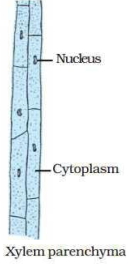
0 likes
View Solution39
Medium
Draw and identify different elements of phloem.
Solution
(N/A) Phloem is a complex permanent tissue that transports food in plants. It is composed of four main types of elements:
$1$. Sieve tubes: These are tubular cells with perforated walls (sieve plates) that facilitate the transport of food.
$2$. Companion cells: These are specialized parenchyma cells that assist the sieve tubes in their functions.
$3$. Phloem parenchyma: These are living cells that store food and provide structural support.
$4$. Phloem fibres: These are dead,thick-walled sclerenchyma cells that provide mechanical strength to the plant.
$1$. Sieve tubes: These are tubular cells with perforated walls (sieve plates) that facilitate the transport of food.
$2$. Companion cells: These are specialized parenchyma cells that assist the sieve tubes in their functions.
$3$. Phloem parenchyma: These are living cells that store food and provide structural support.
$4$. Phloem fibres: These are dead,thick-walled sclerenchyma cells that provide mechanical strength to the plant.
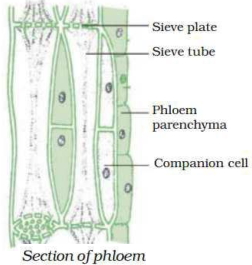
0 likes
View Solution40
Medium
Write true $(T)$ or false $(F)$ for the following statements:
$(a)$ Epithelial tissue is a protective tissue in the animal body.
$(b)$ The lining of blood vessels,lung alveoli,and kidney tubules are all made up of epithelial tissue.
$(c)$ Epithelial cells have a lot of intercellular spaces.
$(d)$ The epithelial layer is a permeable layer.
$(e)$ The epithelial layer does not allow the regulation of materials between the body and the external environment.
$(a)$ Epithelial tissue is a protective tissue in the animal body.
$(b)$ The lining of blood vessels,lung alveoli,and kidney tubules are all made up of epithelial tissue.
$(c)$ Epithelial cells have a lot of intercellular spaces.
$(d)$ The epithelial layer is a permeable layer.
$(e)$ The epithelial layer does not allow the regulation of materials between the body and the external environment.
Solution
(A-D) $(a) - T$: Epithelial tissue forms the outer covering and protective layers of the body.
$(b) - T$: These structures are lined by simple squamous or cuboidal epithelium for exchange and secretion.
$(c) - F$: Epithelial cells are tightly packed with almost no intercellular spaces.
$(d) - T$: The epithelial layer is permeable,allowing the exchange of substances.
$(e) - F$: The epithelial layer plays a crucial role in regulating the exchange of materials between the body and the external environment.
$(b) - T$: These structures are lined by simple squamous or cuboidal epithelium for exchange and secretion.
$(c) - F$: Epithelial cells are tightly packed with almost no intercellular spaces.
$(d) - T$: The epithelial layer is permeable,allowing the exchange of substances.
$(e) - F$: The epithelial layer plays a crucial role in regulating the exchange of materials between the body and the external environment.
1 likes
View Solution41
Medium
Differentiate between voluntary and involuntary muscles. Give one example of each type.
Solution
(N/A)
| Voluntary muscles | Involuntary muscles |
|---|---|
| $(i)$ Their action is under our conscious control. | $(i)$ Their action is not under our conscious control. |
| $(ii)$ These are typically striated and multinucleate. | $(ii)$ These are typically non-striated and uninucleate. |
| $(iii)$ Example: Skeletal muscles (e.g.,biceps). | $(iii)$ Example: Smooth muscles (e.g.,muscles in the digestive tract). |
0 likes
View Solution42
Medium
Differentiate the following activities on the basis of voluntary $(V)$ or involuntary $(IV)$ muscles:
$(a)$ Jumping of a frog
$(b)$ Pumping of the heart
$(c)$ Writing with hand
$(d)$ Movement of food in your intestine
$(a)$ Jumping of a frog
$(b)$ Pumping of the heart
$(c)$ Writing with hand
$(d)$ Movement of food in your intestine
Solution
(A) The classification of activities based on muscle type is as follows:
$(a)$ Jumping of a frog: This involves skeletal muscles which are under conscious control,hence it is Voluntary $(V)$.
$(b)$ Pumping of the heart: This is controlled by cardiac muscles which function automatically without conscious effort,hence it is Involuntary $(IV)$.
$(c)$ Writing with hand: This involves skeletal muscles controlled by the brain's conscious command,hence it is Voluntary $(V)$.
$(d)$ Movement of food in your intestine: This involves smooth muscles which perform peristalsis automatically,hence it is Involuntary $(IV)$.
Final Answer: $(a)-V, (b)-IV, (c)-V, (d)-IV$.
$(a)$ Jumping of a frog: This involves skeletal muscles which are under conscious control,hence it is Voluntary $(V)$.
$(b)$ Pumping of the heart: This is controlled by cardiac muscles which function automatically without conscious effort,hence it is Involuntary $(IV)$.
$(c)$ Writing with hand: This involves skeletal muscles controlled by the brain's conscious command,hence it is Voluntary $(V)$.
$(d)$ Movement of food in your intestine: This involves smooth muscles which perform peristalsis automatically,hence it is Involuntary $(IV)$.
Final Answer: $(a)-V, (b)-IV, (c)-V, (d)-IV$.
0 likes
View Solution43
Medium
Fill in the blanks:
$(a)$ Lining of blood vessels is made up of ..............
$(b)$ Lining of small intestine is made up of ..............
$(c)$ Lining of kidney tubules is made up of ...............
$(d)$ Epithelial cells with cilia are found in ..............
$(a)$ Lining of blood vessels is made up of ..............
$(b)$ Lining of small intestine is made up of ..............
$(c)$ Lining of kidney tubules is made up of ...............
$(d)$ Epithelial cells with cilia are found in ..............
Solution
(N/A) The lining of blood vessels is made up of squamous epithelium,which allows for the easy transport of substances through diffusion.
$(b)$ The lining of the small intestine is made up of columnar epithelium,which facilitates absorption and secretion.
$(c)$ The lining of kidney tubules is made up of cuboidal epithelium,which provides mechanical support and helps in absorption and secretion.
$(d)$ Epithelial cells with cilia are found in the respiratory tract,where they help in moving mucus out of the airways.
$(b)$ The lining of the small intestine is made up of columnar epithelium,which facilitates absorption and secretion.
$(c)$ The lining of kidney tubules is made up of cuboidal epithelium,which provides mechanical support and helps in absorption and secretion.
$(d)$ Epithelial cells with cilia are found in the respiratory tract,where they help in moving mucus out of the airways.
0 likes
View Solution44
Easy
Water hyacinth floats on the water surface. Explain.
Solution
(N/A) Water hyacinth contains a specialized type of parenchyma tissue known as $Aerenchyma$.
This tissue is characterized by the presence of large air-filled cavities or intercellular spaces.
These air spaces provide buoyancy to the plant,which allows the water hyacinth to float on the surface of the water.
This tissue is characterized by the presence of large air-filled cavities or intercellular spaces.
These air spaces provide buoyancy to the plant,which allows the water hyacinth to float on the surface of the water.
0 likes
View Solution45
EasyMCQ
Which structure protects the plant body against the invasion of parasites?
A
Stomata
B
Epidermis
C
Xylem
D
Phloem
Solution
(B) The $Epidermis$ is the outermost protective layer of the plant body.
It is often covered by a thick, waxy, and water-resistant layer called the $Cuticle$.
This $Cuticle$ acts as a physical barrier that prevents the entry of pathogens, parasites, and excessive water loss, thereby protecting the plant.
It is often covered by a thick, waxy, and water-resistant layer called the $Cuticle$.
This $Cuticle$ acts as a physical barrier that prevents the entry of pathogens, parasites, and excessive water loss, thereby protecting the plant.
0 likes
View Solution46
Medium
Fill in the blanks:
$(a)$ Cork cells possess ........... on their walls that make them impervious to gases and water.
$(b)$ .................. have tubular cells with perforated walls and are living in nature.
$(c)$ Bone possesses a hard matrix composed of ............... and ............. .
$(a)$ Cork cells possess ........... on their walls that make them impervious to gases and water.
$(b)$ .................. have tubular cells with perforated walls and are living in nature.
$(c)$ Bone possesses a hard matrix composed of ............... and ............. .
Solution
(A) Suberin: It is a waxy substance deposited in the cell walls of cork cells,making them impermeable to water and gases.
$(b)$ Sieve tubes: These are components of the phloem tissue,consisting of living tubular cells with perforated end walls (sieve plates).
$(c)$ Calcium and phosphorus: The matrix of bone is rich in calcium and phosphorus salts,which provide strength and rigidity to the skeletal system.
$(b)$ Sieve tubes: These are components of the phloem tissue,consisting of living tubular cells with perforated end walls (sieve plates).
$(c)$ Calcium and phosphorus: The matrix of bone is rich in calcium and phosphorus salts,which provide strength and rigidity to the skeletal system.
0 likes
View Solution47
MediumMCQ
Why is the epidermis important for plants?
A
It provides mechanical support.
B
It helps in the conduction of water.
C
It provides protection and regulates gaseous exchange.
D
It is responsible for secondary growth.
Solution
(C) The epidermis is important for plants due to the following reasons:
$(i)$ It provides protection to the underlying tissues against mechanical injury and pathogen invasion.
$(ii)$ It helps in gaseous exchange through specialized structures called stomata.
$(iii)$ It checks excessive water loss through the process of transpiration by forming a waxy cuticle layer.
$(iv)$ Root hairs arising from the epidermal cells increase the surface area for the absorption of water and minerals from the soil.
$(i)$ It provides protection to the underlying tissues against mechanical injury and pathogen invasion.
$(ii)$ It helps in gaseous exchange through specialized structures called stomata.
$(iii)$ It checks excessive water loss through the process of transpiration by forming a waxy cuticle layer.
$(iv)$ Root hairs arising from the epidermal cells increase the surface area for the absorption of water and minerals from the soil.
0 likes
View Solution48
Medium
Fill in the blanks:
$(a)$ ............. are forms of complex tissue.
$(b)$ .............. have guard cells.
$(c)$ Cells of cork contain a chemical called .............
$(d)$ Husk of coconut is made of ............. tissue.
$(e)$ ............ gives flexibility in plants.
$(f)$ ............... and ............... are both conducting tissues.
$(g)$ Xylem transports ............... and ............... from soil.
$(h)$ Phloem transports ............... from ............... to other parts of the plant.
$(a)$ ............. are forms of complex tissue.
$(b)$ .............. have guard cells.
$(c)$ Cells of cork contain a chemical called .............
$(d)$ Husk of coconut is made of ............. tissue.
$(e)$ ............ gives flexibility in plants.
$(f)$ ............... and ............... are both conducting tissues.
$(g)$ Xylem transports ............... and ............... from soil.
$(h)$ Phloem transports ............... from ............... to other parts of the plant.
Solution
(N/A) Xylem and phloem are complex tissues.
$(b)$ Stomata have guard cells.
$(c)$ Cells of cork contain a chemical called Suberin.
$(d)$ Husk of coconut is made of Sclerenchyma tissue.
$(e)$ Collenchyma gives flexibility in plants.
$(f)$ Xylem and phloem are both conducting tissues.
$(g)$ Xylem transports water and minerals from soil.
$(h)$ Phloem transports food from leaves to other parts of the plant.
$(b)$ Stomata have guard cells.
$(c)$ Cells of cork contain a chemical called Suberin.
$(d)$ Husk of coconut is made of Sclerenchyma tissue.
$(e)$ Collenchyma gives flexibility in plants.
$(f)$ Xylem and phloem are both conducting tissues.
$(g)$ Xylem transports water and minerals from soil.
$(h)$ Phloem transports food from leaves to other parts of the plant.
0 likes
View Solution49
Difficult
Differentiate between parenchyma and sclerenchyma tissues. Draw well-labelled diagrams.
Solution
(N/A) The differences between parenchyma and sclerenchyma tissues are as follows:
[Diagrams: Refer to the provided images showing $T$.$S$. and $L$.$S$. of both tissues.]
| Parenchyma | Sclerenchyma |
|---|---|
| $(1)$ Cells are thin-walled and unspecialized. | $(1)$ Cells are thick-walled and lignified. |
| $(2)$ These are living cells. | $(2)$ These are dead cells. |
| $(3)$ Cells are usually loosely packed with large intercellular spaces. | $(3)$ No intercellular spaces are found between the cells. |
| $(4)$ Stores nutrients and water in stems and roots. | $(4)$ Provides mechanical strength to plant parts. |
| $(5)$ Some cells contain chlorophyll (chlorenchyma) and perform photosynthesis. Others have large air cavities (aerenchyma) providing buoyancy to aquatic plants. | $(5)$ Cells are long and narrow,making the plant hard and stiff. Found in stems,around vascular bundles,in leaf veins,and the hard covering of seeds and nuts. |
[Diagrams: Refer to the provided images showing $T$.$S$. and $L$.$S$. of both tissues.]
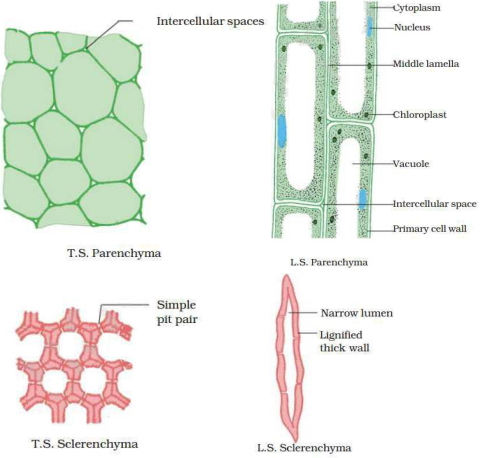
0 likes
View Solution50
Medium
Describe the structure and function of different types of epithelial tissues. Draw a diagram of each type of epithelial tissue.
Solution
(N/A) Epithelial tissues are the covering or protective tissues in the animal body. Epithelium covers most organs and cavities within the body and keeps different body systems separate. The skin,the lining of the mouth,the lining of blood vessels,lung alveoli,and kidney tubules are all made of epithelial tissue.
Epithelial tissue cells are tightly packed and form a continuous sheet. They have only a small amount of cementing material between them and almost no intercellular spaces. The permeability of the cells of various epithelia plays an important role in regulating the exchange of materials between the body and the external environment and also between different parts of the body. Regardless of the type,all epithelia are usually separated from the underlying tissue by an extracellular fibrous basement membrane.
Epithelial tissues are of the following types:
$(1)$ Simple squamous epithelium: Extremely thin and flat,forming a delicate lining. Found in blood vessels and lung alveoli where transportation occurs.
$(2)$ Stratified squamous epithelium: Arranged in many layers to prevent wear and tear. Found in the skin and lining of the mouth.
$(3)$ Columnar epithelium: Tall epithelial cells present where absorption and secretion occur,such as the inner lining of the intestine. If they have cilia,they are called ciliated columnar epithelium,which helps in moving mucus.
$(4)$ Cuboidal epithelium: Cube-shaped cells forming the lining of kidney tubules and ducts of salivary glands,providing mechanical support.
Additionally,some epithelial tissue folds inward to form a multicellular gland,known as glandular epithelium.
Epithelial tissue cells are tightly packed and form a continuous sheet. They have only a small amount of cementing material between them and almost no intercellular spaces. The permeability of the cells of various epithelia plays an important role in regulating the exchange of materials between the body and the external environment and also between different parts of the body. Regardless of the type,all epithelia are usually separated from the underlying tissue by an extracellular fibrous basement membrane.
Epithelial tissues are of the following types:
$(1)$ Simple squamous epithelium: Extremely thin and flat,forming a delicate lining. Found in blood vessels and lung alveoli where transportation occurs.
$(2)$ Stratified squamous epithelium: Arranged in many layers to prevent wear and tear. Found in the skin and lining of the mouth.
$(3)$ Columnar epithelium: Tall epithelial cells present where absorption and secretion occur,such as the inner lining of the intestine. If they have cilia,they are called ciliated columnar epithelium,which helps in moving mucus.
$(4)$ Cuboidal epithelium: Cube-shaped cells forming the lining of kidney tubules and ducts of salivary glands,providing mechanical support.
Additionally,some epithelial tissue folds inward to form a multicellular gland,known as glandular epithelium.
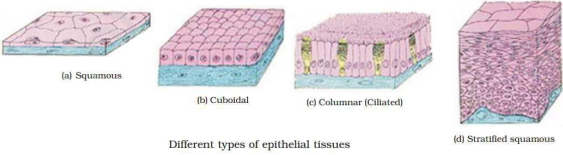
0 likes
View SolutionTISSUES — Mix Example - TISSUES · Frequently Asked Questions
1Are these TISSUES questions useful for JEE and NEET?
Yes. All questions in this section are mapped to JEE Main and NEET exam patterns. Previous year questions from JEE Main, NEET, GUJCET and state-level exams are included with full solutions.
2Can I switch to Hindi or Gujarati for these questions?
Yes. Use the language tabs in the hero section or the sidebar to view the same questions and solutions in English, Hindi or Gujarati.
3How do I generate a question paper from this subtopic?
Use the Vedclass Exam Paper Generator — select the chapter and subtopic, set difficulty, and generate Sets A, B, C, D automatically. First 3 chapters of every subject are free.
Vedclass Products
For Students
Vedclass Test Series
Mock tests in real JEE/NEET style with performance analysis. 5-day free trial.
Start Free TrialFor Teachers
Exam Paper Generator
Generate Set A/B/C/D papers from this chapter in 2 minutes. 3 chapters free.
Try FreeFor Institutes
Online Exam Module
Live online exams with unlimited students, 360° analytics & white-label branding.
See DemoFor Teachers & Institutes
Generate a TISSUES Exam Paper in 2 Minutes
Select subtopic & difficulty — Sets A, B, C, D auto-generated with No Repeat logic.
First 3 chapters of every subject are free — no payment required.