
A English
Mix Example - MATTER IN OUR SURROUNDINGS Questions in English
Class 9 Science · MATTER IN OUR SURROUNDINGS · Mix Example - MATTER IN OUR SURROUNDINGS
153+
Questions
English
Language
100%
With Solutions
Showing 50 of 153 questions in English
101
Medium
$(a)$ $CO_2$ is a gas. Write its two gaseous properties to justify it.
$(b)$ How can we liquefy a gas?
$(c)$ Solid $CO_2$ is also known as dry ice. Why?
$(d)$ Write the full form of:
$(i)$ $CNG$
$(ii)$ $LPG$
$(b)$ How can we liquefy a gas?
$(c)$ Solid $CO_2$ is also known as dry ice. Why?
$(d)$ Write the full form of:
$(i)$ $CNG$
$(ii)$ $LPG$
Solution
(N/A) Gases have large interparticle spaces and no fixed shape or volume,which justifies that $CO_2$ is a gas.
$(b)$ $A$ gas can be liquefied by increasing the pressure and decreasing the temperature,which brings the particles closer together.
$(c)$ Solid $CO_2$ is called dry ice because it undergoes sublimation,meaning it converts directly from a solid state to a gaseous state without passing through the liquid phase.
$(d) (i)$ $CNG$: Compressed Natural Gas.
$(ii)$ $LPG$: Liquefied Petroleum Gas.
$(b)$ $A$ gas can be liquefied by increasing the pressure and decreasing the temperature,which brings the particles closer together.
$(c)$ Solid $CO_2$ is called dry ice because it undergoes sublimation,meaning it converts directly from a solid state to a gaseous state without passing through the liquid phase.
$(d) (i)$ $CNG$: Compressed Natural Gas.
$(ii)$ $LPG$: Liquefied Petroleum Gas.
0 likes
View Solution102
Difficult
Account for the following:
$(a)$ When sugar crystals dissolve in water,the level of water does not rise appreciably.
$(b)$ Doctors advise to put strips of wet cloth on the forehead of a person having high fever.
$(c)$ Naphthalene balls disappear with time without leaving any solid residue.
$(d)$ $A$ wooden table should be called a solid.
$(e)$ Dogs generally hang out their tongue in summer.
$(a)$ When sugar crystals dissolve in water,the level of water does not rise appreciably.
$(b)$ Doctors advise to put strips of wet cloth on the forehead of a person having high fever.
$(c)$ Naphthalene balls disappear with time without leaving any solid residue.
$(d)$ $A$ wooden table should be called a solid.
$(e)$ Dogs generally hang out their tongue in summer.
Solution
(N/A) Particles of sugar crystals occupy the empty spaces between the particles of water,hence the volume does not increase significantly.
$(b)$ The water in the wet cloth absorbs excess heat from the body due to the high latent heat of vaporisation,which helps in lowering the body temperature.
$(c)$ Naphthalene balls undergo sublimation,where they directly convert from a solid state to a gaseous state without leaving any residue.
$(d)$ $A$ wooden table has a fixed shape,a fixed volume,and is rigid and incompressible,which are the characteristic properties of a solid.
$(e)$ Dogs hang out their tongues to increase the surface area for the evaporation of saliva,which causes a cooling effect on their body.
$(b)$ The water in the wet cloth absorbs excess heat from the body due to the high latent heat of vaporisation,which helps in lowering the body temperature.
$(c)$ Naphthalene balls undergo sublimation,where they directly convert from a solid state to a gaseous state without leaving any residue.
$(d)$ $A$ wooden table has a fixed shape,a fixed volume,and is rigid and incompressible,which are the characteristic properties of a solid.
$(e)$ Dogs hang out their tongues to increase the surface area for the evaporation of saliva,which causes a cooling effect on their body.
0 likes
View Solution103
Difficult
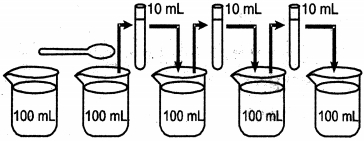
$(a)$ Explain with the help of an activity which shows that particles of matter are very small.
$(b)$ Define matter. Name the states of matter in which the forces between the constituent particles are
$(i)$ strongest
$(ii)$ weakest
$(c)$ When sugar and common salt are kept in different jars,they take the shape of the jars. Are they solid? Justify your answer.
$(b)$ Define matter. Name the states of matter in which the forces between the constituent particles are
$(i)$ strongest
$(ii)$ weakest
$(c)$ When sugar and common salt are kept in different jars,they take the shape of the jars. Are they solid? Justify your answer.
Solution
(N/A) Activity:
$(i)$ Take $2-3$ crystals of copper sulphate and dissolve them in $100\, mL$ of water.
$(ii)$ Take out approximately $10\, mL$ of this solution and put it into $90\, mL$ of clear water.
$(iii)$ Take out $10\, mL$ of this solution and put it into another $90\, mL$ of clear water.
$(iv)$ Keep repeating this process of dilution.
Observation:
$A$ crystal of copper sulphate contains millions of tiny particles which keep on dividing into smaller and smaller numbers with each dilution. This shows that particles of matter are very small.
$(b)$ Matter is anything that has mass and occupies space.
$(i)$ Solid: The forces between constituent particles are strongest in solids.
$(ii)$ Gas: The forces between constituent particles are weakest in gases.
$(c)$ Yes,sugar and common salt are solids. Although they take the shape of the container they are kept in,the shape of each individual crystal remains fixed. Therefore,they are considered solids.
$(i)$ Take $2-3$ crystals of copper sulphate and dissolve them in $100\, mL$ of water.
$(ii)$ Take out approximately $10\, mL$ of this solution and put it into $90\, mL$ of clear water.
$(iii)$ Take out $10\, mL$ of this solution and put it into another $90\, mL$ of clear water.
$(iv)$ Keep repeating this process of dilution.
Observation:
$A$ crystal of copper sulphate contains millions of tiny particles which keep on dividing into smaller and smaller numbers with each dilution. This shows that particles of matter are very small.
$(b)$ Matter is anything that has mass and occupies space.
$(i)$ Solid: The forces between constituent particles are strongest in solids.
$(ii)$ Gas: The forces between constituent particles are weakest in gases.
$(c)$ Yes,sugar and common salt are solids. Although they take the shape of the container they are kept in,the shape of each individual crystal remains fixed. Therefore,they are considered solids.
0 likes
View Solution104
Difficult
$(a)$ Enumerate the changes that take place in a liquid during evaporation.
$(b)$ How is the rate of evaporation affected by changes in the following? Justify your answer.
$(i)$ Temperature
$(ii)$ Wind speed
$(iii)$ Humidity
$(b)$ How is the rate of evaporation affected by changes in the following? Justify your answer.
$(i)$ Temperature
$(ii)$ Wind speed
$(iii)$ Humidity
Solution
(N/A) During evaporation,a small fraction of particles at the surface having higher $KE$ (Kinetic Energy) is able to break away from the force of attraction of other particles and gets converted into vapour.
$(b)$ $(i)$ Rate of evaporation increases with temperature because an increase in temperature provides more $KE$ to the particles,allowing more particles to escape the surface.
$(ii)$ Rate of evaporation increases with wind speed because the moving air carries away the water vapour particles,thereby decreasing the concentration of water vapour in the surrounding area.
$(iii)$ Rate of evaporation decreases with humidity because the air is already saturated with water vapour,leaving less space for additional water molecules to evaporate.
$(b)$ $(i)$ Rate of evaporation increases with temperature because an increase in temperature provides more $KE$ to the particles,allowing more particles to escape the surface.
$(ii)$ Rate of evaporation increases with wind speed because the moving air carries away the water vapour particles,thereby decreasing the concentration of water vapour in the surrounding area.
$(iii)$ Rate of evaporation decreases with humidity because the air is already saturated with water vapour,leaving less space for additional water molecules to evaporate.
0 likes
View Solution105
Difficult
$(a)$ Compare a block of wood,water,and air on the basis of the following:
$(i)$ Compressibility
$(ii)$ Particle motion
$(iii)$ Rigidity
$(b)$ Account for the following:
$(i)$ Gases exert pressure on the walls of the container.
$(ii)$ Liquids can be called fluids.
$(i)$ Compressibility
$(ii)$ Particle motion
$(iii)$ Rigidity
$(b)$ Account for the following:
$(i)$ Gases exert pressure on the walls of the container.
$(ii)$ Liquids can be called fluids.
Solution
(N/A) The comparison is as follows:
$(b)$ $(i)$ Gases exert pressure on the walls of the container because gas particles are in constant random motion at high speeds. When they collide with the walls of the container,they exert a force per unit area,which is perceived as pressure.
$(ii)$ Liquids are called fluids because they have the ability to flow and change their shape according to the container they are placed in,which is a characteristic property of fluids.
| Property | Block of wood | Water | Air |
|---|---|---|---|
| $(i)$ Compressibility | Negligible | Very low | High |
| $(ii)$ Particle motion | Least (vibratory only) | More than wood | Very high (random) |
| $(iii)$ Rigidity | Rigid | Fluid | Fluid |
$(b)$ $(i)$ Gases exert pressure on the walls of the container because gas particles are in constant random motion at high speeds. When they collide with the walls of the container,they exert a force per unit area,which is perceived as pressure.
$(ii)$ Liquids are called fluids because they have the ability to flow and change their shape according to the container they are placed in,which is a characteristic property of fluids.
0 likes
View Solution106
Difficult
$(a)$ Arrange the following in the increasing order of $(i)$ Force of attraction $(ii)$ Intermolecular space: Iron nail,Kerosene,and Oxygen gas. $(b)$ Define the following terms: $(i)$ Rigidity $(ii)$ Compressibility $(iii)$ Diffusion.
Solution
(N/A) $(i)$ Force of attraction: $\text{Oxygen gas} < \text{Kerosene} < \text{Iron nail}$.
$(ii)$ Intermolecular space: $\text{Iron nail} < \text{Kerosene} < \text{Oxygen gas}$.
$(b)$ $(i)$ Rigidity: It is the property of matter to maintain its shape against an external force.
$(ii)$ Compressibility: It is the property of matter by virtue of which its particles can be brought closer to each other under pressure.
$(iii)$ Diffusion: The spontaneous intermixing of particles of different types of matter due to their motion is known as diffusion.
$(ii)$ Intermolecular space: $\text{Iron nail} < \text{Kerosene} < \text{Oxygen gas}$.
$(b)$ $(i)$ Rigidity: It is the property of matter to maintain its shape against an external force.
$(ii)$ Compressibility: It is the property of matter by virtue of which its particles can be brought closer to each other under pressure.
$(iii)$ Diffusion: The spontaneous intermixing of particles of different types of matter due to their motion is known as diffusion.
0 likes
View Solution107
Medium
$(a)$ State one similarity and one difference between evaporation and boiling.
$(b)$ Account for the following:
$(i)$ We wear cotton clothes in summer.
$(ii)$ $A$ wet handkerchief is placed on the forehead of a person suffering from high fever.
$(iii)$ Wet clothes dry slowly during the rainy season.
$(b)$ Account for the following:
$(i)$ We wear cotton clothes in summer.
$(ii)$ $A$ wet handkerchief is placed on the forehead of a person suffering from high fever.
$(iii)$ Wet clothes dry slowly during the rainy season.
Solution
(N/A) Similarity: In both processes,a liquid is converted into vapours.
Difference: Evaporation is a surface phenomenon,whereas boiling is a bulk phenomenon.
$(b)$ $(i)$ Cotton is a good absorber of water. It absorbs perspiration from our body and exposes it to the atmosphere for evaporation,which causes a cooling effect.
$(ii)$ $A$ wet handkerchief placed on the forehead absorbs heat from the body as the water evaporates. This process of evaporation causes cooling,which helps in lowering the body temperature.
$(iii)$ During the rainy season,the humidity in the atmosphere is high. Since the air is already saturated with water vapours,the rate of evaporation decreases,causing wet clothes to dry slowly.
Difference: Evaporation is a surface phenomenon,whereas boiling is a bulk phenomenon.
$(b)$ $(i)$ Cotton is a good absorber of water. It absorbs perspiration from our body and exposes it to the atmosphere for evaporation,which causes a cooling effect.
$(ii)$ $A$ wet handkerchief placed on the forehead absorbs heat from the body as the water evaporates. This process of evaporation causes cooling,which helps in lowering the body temperature.
$(iii)$ During the rainy season,the humidity in the atmosphere is high. Since the air is already saturated with water vapours,the rate of evaporation decreases,causing wet clothes to dry slowly.
0 likes
View Solution108
Medium
Define the following terms: $(i)$ Rigidity,$(ii)$ Compressibility,and $(iii)$ Density. Compare any two states of matter on the basis of the above-defined properties.
Solution
(A) $(i)$ Rigidity: The property of matter to maintain its shape even when an external force is applied.
$(ii)$ Compressibility: The property of matter by virtue of which its particles can be brought closer to each other by applying external pressure.
$(iii)$ Density: The mass per unit volume of a substance,defined as $\text{Density} = \frac{\text{Mass}}{\text{Volume}}$.
$(ii)$ Compressibility: The property of matter by virtue of which its particles can be brought closer to each other by applying external pressure.
$(iii)$ Density: The mass per unit volume of a substance,defined as $\text{Density} = \frac{\text{Mass}}{\text{Volume}}$.
| Property | Solid | Liquid | Gas |
| Rigidity | Rigid | Fluid | Fluid |
| Compressibility | Negligible | Very low | High |
| Density | High | Less than solids | Least |
0 likes
View Solution109
EasyMCQ
What does the melting point of a solid indicate?
A
Strength of intermolecular forces
B
Density of the solid
C
Molecular weight of the solid
D
Volume of the solid
Solution
(A) The melting point of a solid is a measure of the strength of the forces of attraction between the constituent particles (atoms,ions,or molecules) of the solid.
$A$ higher melting point indicates that the particles are held together by stronger forces of attraction,requiring more energy (heat) to overcome these forces and transition the substance from a solid state to a liquid state.
$A$ higher melting point indicates that the particles are held together by stronger forces of attraction,requiring more energy (heat) to overcome these forces and transition the substance from a solid state to a liquid state.
0 likes
View Solution110
Medium
Which of the following will cause more severe burns and why?
$(a)$ Steam at $373 \, K$
$(b)$ Water at $373 \, K$
$(a)$ Steam at $373 \, K$
$(b)$ Water at $373 \, K$
Solution
(A) Steam at $373 \, K$ will cause more severe burns.
This is because steam contains additional energy known as the latent heat of vaporization.
At $373 \, K$,water molecules in the steam state have absorbed extra heat to change their phase from liquid to gas.
When steam comes into contact with the skin,it releases this latent heat along with its thermal energy,resulting in more severe burns compared to water at the same temperature.
This is because steam contains additional energy known as the latent heat of vaporization.
At $373 \, K$,water molecules in the steam state have absorbed extra heat to change their phase from liquid to gas.
When steam comes into contact with the skin,it releases this latent heat along with its thermal energy,resulting in more severe burns compared to water at the same temperature.
0 likes
View Solution111
Medium
Which gas is called dry ice? Why?
Solution
(N/A) Solid $CO_2$ is known as dry ice. It is called dry ice because,at a constant pressure of $1 \text{ atmosphere}$,solid $CO_2$ undergoes sublimation,meaning it converts directly from a solid state to a gaseous state without passing through the liquid phase.
0 likes
View Solution112
MediumMCQ
Which physical quantities are to be altered for liquefying gases?
A
Pressure and Volume
B
Pressure and Temperature
C
Temperature and Density
D
Volume and Density
Solution
(B) To liquefy gases,the following two physical quantities must be altered:
$(i)$ Pressure is increased: Increasing pressure brings the gas particles closer together,which decreases the interparticle space.
$(ii)$ Temperature is reduced: Decreasing the temperature reduces the kinetic energy of the particles,which increases the interparticle forces of attraction,allowing the gas to condense into a liquid state.
$(i)$ Pressure is increased: Increasing pressure brings the gas particles closer together,which decreases the interparticle space.
$(ii)$ Temperature is reduced: Decreasing the temperature reduces the kinetic energy of the particles,which increases the interparticle forces of attraction,allowing the gas to condense into a liquid state.
0 likes
View Solution113
Medium
Give reasons for the following:
$(i)$ $A$ gas exerts pressure on the walls of the container.
$(ii)$ $A$ gas fills the vessel in which it is kept.
$(i)$ $A$ gas exerts pressure on the walls of the container.
$(ii)$ $A$ gas fills the vessel in which it is kept.
Solution
(N/A) $(i)$ The molecules of a gas are in constant,random motion in all directions. As they move,they collide with each other and strike the walls of the container,exerting a force per unit area,which is perceived as pressure.
$(ii)$ The force of attraction between the particles of a gas is negligible,and the particles possess high kinetic energy. This allows them to move freely and occupy all the available space in the vessel in which they are kept.
$(ii)$ The force of attraction between the particles of a gas is negligible,and the particles possess high kinetic energy. This allows them to move freely and occupy all the available space in the vessel in which they are kept.
0 likes
View Solution114
Difficult
Explain how the three states of matter arise due to variations in the characteristics of the particles.
Solution
(N/A)
| Variation in Characteristic | Effect on State of Matter |
|---|---|
| $(i)$ Temperature | With an increase in temperature,the solid state melts to form a liquid,and a liquid boils to form a gaseous state. |
| $(ii)$ Pressure | With an increase in pressure,the gaseous state liquefies,and liquids can be compressed further. |
| $(iii)$ Interparticle space | The space between particles is minimal in solids,moderate in liquids,and maximum in gases,determined by temperature and pressure. |
| $(iv)$ Interparticle forces | Strongest in solids,weaker in liquids,and negligible in gases,which dictates the physical state. |
| $(v)$ Kinetic energy | Higher kinetic energy at higher temperatures leads to the transition from solid to liquid to gas. |
0 likes
View Solution115
Medium
$(a)$ 'Evaporation causes cooling'. Comment on this statement.
$(b)$ Explain how water kept in an earthen pot becomes cool during summer?
$(b)$ Explain how water kept in an earthen pot becomes cool during summer?
Solution
(N/A) During the process of evaporation,the particles of the liquid absorb energy from the surroundings to overcome the force of attraction and change into the vapour state. This absorption of energy from the surroundings makes the surroundings cold.
$(b)$ An earthen pot has a large number of extremely small pores on its surface. Water continuously seeps out through these pores and evaporates. The energy required for this evaporation is taken from the remaining water inside the pot. As the heat is lost from the water,it cools down.
$(b)$ An earthen pot has a large number of extremely small pores on its surface. Water continuously seeps out through these pores and evaporates. The energy required for this evaporation is taken from the remaining water inside the pot. As the heat is lost from the water,it cools down.
0 likes
View Solution116
Medium
Why is oxygen called a gas? Support your answer by giving two reasons.
Solution
(N/A) $(i)$ Oxygen has neither a fixed shape nor a fixed volume,which is a characteristic property of gases.
$(ii)$ Oxygen particles have high kinetic energy and large intermolecular spaces,allowing it to diffuse easily into the air.
$(iii)$ Oxygen exerts pressure on the walls of its container and can be compressed or liquefied under high pressure and low temperature.
$(ii)$ Oxygen particles have high kinetic energy and large intermolecular spaces,allowing it to diffuse easily into the air.
$(iii)$ Oxygen exerts pressure on the walls of its container and can be compressed or liquefied under high pressure and low temperature.
0 likes
View Solution117
Easy
Name the state of matter in which:
$(a)$ Layers of particles can slip and slide over one another easily.
$(b)$ Particles just move around randomly because of very weak force of attraction.
$(a)$ Layers of particles can slip and slide over one another easily.
$(b)$ Particles just move around randomly because of very weak force of attraction.
Solution
(N/A) The state of matter in which layers of particles can slip and slide over one another easily is the liquid state. In liquids,the intermolecular forces are weaker than in solids,allowing particles to flow.
$(b)$ The state of matter in which particles move around randomly due to very weak forces of attraction is the gaseous state. In gases,the intermolecular forces are negligible,allowing particles to move freely and randomly in all directions.
$(b)$ The state of matter in which particles move around randomly due to very weak forces of attraction is the gaseous state. In gases,the intermolecular forces are negligible,allowing particles to move freely and randomly in all directions.
0 likes
View Solution118
Easy
What is the effect of a change in pressure on the physical state of matter? Explain with an example of a gas.
Solution
(N/A) The physical state of matter can be changed by increasing or decreasing the pressure applied to it.
For example,a gas can be liquefied by applying high pressure. This occurs because,under high pressure,the molecules of the gas are forced to come closer to each other,which increases the intermolecular forces of attraction,thereby converting the gas into a liquid state.
For example,a gas can be liquefied by applying high pressure. This occurs because,under high pressure,the molecules of the gas are forced to come closer to each other,which increases the intermolecular forces of attraction,thereby converting the gas into a liquid state.
0 likes
View Solution119
MediumMCQ
The kinetic energies of water particles in three vessels $A, B$,and $C$ are $E_A, E_B$,and $E_C$ respectively,where $E_A > E_B > E_C$. Arrange the temperatures $T_A, T_B$,and $T_C$ of the water in the three vessels in increasing order. Provide a reason for your answer.
A
$T_A < T_B < T_C$
B
$T_C < T_B < T_A$
C
$T_A = T_B = T_C$
D
$T_B < T_A < T_C$
Solution
(B) The correct order of temperature is $T_C < T_B < T_A$.
Reason: The kinetic energy of particles is directly proportional to the absolute temperature of the substance. As the temperature increases,the kinetic energy of the particles also increases. Since the given kinetic energies follow the order $E_A > E_B > E_C$,the corresponding temperatures must follow the same order,$T_A > T_B > T_C$. Therefore,in increasing order,the temperatures are $T_C < T_B < T_A$.
Reason: The kinetic energy of particles is directly proportional to the absolute temperature of the substance. As the temperature increases,the kinetic energy of the particles also increases. Since the given kinetic energies follow the order $E_A > E_B > E_C$,the corresponding temperatures must follow the same order,$T_A > T_B > T_C$. Therefore,in increasing order,the temperatures are $T_C < T_B < T_A$.
0 likes
View Solution120
EasyMCQ
Arrange honey, water, and hydrogen in descending order on the basis of the following properties exhibited by them:
$(a)$ Kinetic energy
$(b)$ Density
$(a)$ Kinetic energy
$(b)$ Density
A
Kinetic energy: Hydrogen > Water > Honey; Density: Honey > Water > Hydrogen
B
Kinetic energy: Honey > Water > Hydrogen; Density: Hydrogen > Water > Honey
C
Kinetic energy: Hydrogen > Water > Honey; Density: Hydrogen > Water > Honey
D
Kinetic energy: Honey > Water > Hydrogen; Density: Honey > Water > Hydrogen
Solution
(A) The properties are arranged in descending order (from highest to lowest) as follows:
$(a)$ Kinetic energy: Particles in gases have the highest kinetic energy due to large intermolecular spaces and high speed, followed by liquids, and then solids. Thus, the order is: $Hydrogen (gas) > Water (liquid) > Honey (viscous liquid/solid-like)$.
$(b)$ Density: Density is defined as mass per unit volume. Solids/viscous liquids are more compact than liquids, which are more compact than gases. Thus, the order is: $Honey > Water > Hydrogen$.
$(a)$ Kinetic energy: Particles in gases have the highest kinetic energy due to large intermolecular spaces and high speed, followed by liquids, and then solids. Thus, the order is: $Hydrogen (gas) > Water (liquid) > Honey (viscous liquid/solid-like)$.
$(b)$ Density: Density is defined as mass per unit volume. Solids/viscous liquids are more compact than liquids, which are more compact than gases. Thus, the order is: $Honey > Water > Hydrogen$.
0 likes
View Solution121
Medium
Define the latent heat of fusion. Why does the temperature remain constant during the melting of ice?
Solution
(N/A) Latent heat of fusion is the amount of energy required to change $1 \, kg$ of a solid into a liquid at its melting point.
During the process of melting ice,the heat supplied is used up in changing the state of the substance by overcoming the forces of attraction between the particles. Since this energy is consumed to break the intermolecular bonds rather than increasing the kinetic energy of the particles,the temperature does not rise and remains constant.
During the process of melting ice,the heat supplied is used up in changing the state of the substance by overcoming the forces of attraction between the particles. Since this energy is consumed to break the intermolecular bonds rather than increasing the kinetic energy of the particles,the temperature does not rise and remains constant.
0 likes
View Solution122
Medium
Why does water as steam cause severe burns,whereas water as ice has a cooling effect? Explain.
Solution
(N/A) Steam contains water particles that possess high kinetic energy due to the latent heat of vaporization. When steam comes in contact with the skin,it releases this extra heat energy,causing severe burns.
Conversely,in the case of ice,the water particles possess lower energy. When ice comes in contact with the skin,it absorbs heat energy from the surroundings (or the body) to undergo a phase change from solid to liquid,thereby producing a cooling effect.
Conversely,in the case of ice,the water particles possess lower energy. When ice comes in contact with the skin,it absorbs heat energy from the surroundings (or the body) to undergo a phase change from solid to liquid,thereby producing a cooling effect.
0 likes
View Solution123
Easy
Name the states of matter that:
$(a)$ have a definite shape,volume,and mass.
$(b)$ have the minimum force of attraction between the particles.
$(c)$ have the maximum force of attraction between the particles.
$(a)$ have a definite shape,volume,and mass.
$(b)$ have the minimum force of attraction between the particles.
$(c)$ have the maximum force of attraction between the particles.
Solution
(N/A) Solid state: Solids have a rigid structure,resulting in a definite shape,volume,and mass.
$(b)$ Gaseous state: In gases,particles are far apart with negligible intermolecular forces,leading to the minimum force of attraction.
$(c)$ Solid state: In solids,particles are closely packed with strong intermolecular forces,resulting in the maximum force of attraction.
$(b)$ Gaseous state: In gases,particles are far apart with negligible intermolecular forces,leading to the minimum force of attraction.
$(c)$ Solid state: In solids,particles are closely packed with strong intermolecular forces,resulting in the maximum force of attraction.
0 likes
View Solution124
EasyMCQ
How can the interconversion of states of matter be achieved?
A
By changing the temperature
B
By changing the pressure
C
Both $(A)$ and $(B)$
D
None of the above
Solution
(C) The interconversion of the states of matter can be achieved in the following two ways:
$(i)$ By changing the temperature: Increasing or decreasing the temperature can cause a substance to change its state (e.g.,melting of ice into water or freezing of water into ice).
$(ii)$ By changing the pressure: Increasing or decreasing the pressure can also change the state of matter,especially in gases (e.g.,liquefaction of gases by applying high pressure and lowering the temperature).
$(i)$ By changing the temperature: Increasing or decreasing the temperature can cause a substance to change its state (e.g.,melting of ice into water or freezing of water into ice).
$(ii)$ By changing the pressure: Increasing or decreasing the pressure can also change the state of matter,especially in gases (e.g.,liquefaction of gases by applying high pressure and lowering the temperature).
0 likes
View Solution125
Easy
What is meant by melting point? How is it different from fusion?
Solution
(N/A) The melting point is defined as the temperature at which a solid substance changes its state from solid to liquid at atmospheric pressure.
Fusion is the physical process of a substance changing from a solid state to a liquid state.
In scientific terminology,melting and fusion refer to the exact same process of phase transition from solid to liquid.
Fusion is the physical process of a substance changing from a solid state to a liquid state.
In scientific terminology,melting and fusion refer to the exact same process of phase transition from solid to liquid.
0 likes
View Solution126
Medium
Why does the temperature of a substance not rise during a change of state?
Solution
(N/A) During the change of state,the heat energy supplied is used up in overcoming the force of attraction between the particles of the substance. This energy is known as latent heat. Since this energy does not increase the kinetic energy of the particles,the temperature of the substance remains constant during the phase transition.
0 likes
View Solution127
Medium
What is meant by evaporation? How is this process different from boiling?
Solution
(N/A) Evaporation is the phenomenon of the change of a liquid into vapours at any temperature below its boiling point.
| Evaporation | Boiling |
| $1.$ Evaporation occurs on its own at all temperatures. | $1.$ Boiling occurs at a particular temperature when the liquid is heated. |
| $2.$ Evaporation is a surface phenomenon,i.e.,it takes place only from the surface of the liquid. | $2.$ Boiling is a bulk phenomenon,i.e.,it involves the formation of vapours from the entire liquid. |
| $3.$ Evaporation causes a cooling effect. | $3.$ Boiling does not cause any cooling effect. |
0 likes
View Solution128
Difficult
Give reasons to explain why:
$(i)$ Carbon dioxide is called a gas?
$(ii)$ $A$ gas fills a vessel completely?
$(iii)$ Gases are so easily compressible,whereas it is impossible to compress a solid or a liquid.
$(i)$ Carbon dioxide is called a gas?
$(ii)$ $A$ gas fills a vessel completely?
$(iii)$ Gases are so easily compressible,whereas it is impossible to compress a solid or a liquid.
Solution
(D) $(i)$ Carbon dioxide is classified as a gas due to the following reasons:
$(a)$ It lacks both a fixed volume and a fixed shape,as it completely fills the container in which it is stored.
$(b)$ It exerts pressure on the walls of the container due to the high kinetic energy and collisions of its particles.
$(ii)$ In gases,the intermolecular distances are very large,and the intermolecular forces of attraction are extremely weak. Because of this,gas particles are free to move randomly in the entire space available to them. Consequently,a gas fills the vessel completely.
$(iii)$ The intermolecular space is maximum in gases,intermediate in liquids,and minimum in solids. When pressure is applied to a gas,the particles move closer together,significantly reducing the volume,which makes gases highly compressible. In contrast,the particles in solids and liquids are already closely packed,leaving very little space for further compression,making them almost incompressible.
$(a)$ It lacks both a fixed volume and a fixed shape,as it completely fills the container in which it is stored.
$(b)$ It exerts pressure on the walls of the container due to the high kinetic energy and collisions of its particles.
$(ii)$ In gases,the intermolecular distances are very large,and the intermolecular forces of attraction are extremely weak. Because of this,gas particles are free to move randomly in the entire space available to them. Consequently,a gas fills the vessel completely.
$(iii)$ The intermolecular space is maximum in gases,intermediate in liquids,and minimum in solids. When pressure is applied to a gas,the particles move closer together,significantly reducing the volume,which makes gases highly compressible. In contrast,the particles in solids and liquids are already closely packed,leaving very little space for further compression,making them almost incompressible.
0 likes
View Solution129
EasyMCQ
In which state of matter is the process of diffusion fastest?
A
Gases
B
Liquids
C
Solids
D
Semi-solids
Solution
(A) Diffusion is the movement of particles from a region of higher concentration to a region of lower concentration.
In $Gases$,the particles are far apart and have high kinetic energy,allowing them to move freely and rapidly in all directions.
In $Liquids$,particles are closer together than in gases,and in $Solids$,they are tightly packed with very little movement.
Therefore,due to high kinetic energy and large intermolecular spaces,the rate of diffusion is highest in $Gases$.
In $Gases$,the particles are far apart and have high kinetic energy,allowing them to move freely and rapidly in all directions.
In $Liquids$,particles are closer together than in gases,and in $Solids$,they are tightly packed with very little movement.
Therefore,due to high kinetic energy and large intermolecular spaces,the rate of diffusion is highest in $Gases$.
0 likes
View Solution130
EasyMCQ
Evaporation is called as
A
Bulk phenomenon
B
Surface phenomenon
C
Both surface and bulk phenomenon
D
Unique phenomenon
Solution
(B) Evaporation is a process in which liquid changes into vapor at any temperature below its boiling point.
This process occurs only at the surface of the liquid because the particles at the surface have higher kinetic energy than the particles in the bulk of the liquid,allowing them to overcome the forces of attraction and escape into the atmosphere.
Therefore,evaporation is considered a surface phenomenon.
This process occurs only at the surface of the liquid because the particles at the surface have higher kinetic energy than the particles in the bulk of the liquid,allowing them to overcome the forces of attraction and escape into the atmosphere.
Therefore,evaporation is considered a surface phenomenon.
0 likes
View Solution131
EasyMCQ
During the evaporation process,the heat is:
A
Evolved
B
First absorbed then evolved
C
Absorbed
D
Initially evolved and then absorbed
Solution
(C) Evaporation is a surface phenomenon where particles at the surface of a liquid gain enough kinetic energy to overcome the forces of attraction and escape into the vapor state.
To overcome these intermolecular forces of attraction,the particles require energy.
This energy is taken from the surroundings or the liquid itself,which leads to a cooling effect.
Therefore,heat is absorbed during the process of evaporation.
To overcome these intermolecular forces of attraction,the particles require energy.
This energy is taken from the surroundings or the liquid itself,which leads to a cooling effect.
Therefore,heat is absorbed during the process of evaporation.
0 likes
View Solution132
EasyMCQ
Boiling process is a
A
Surface phenomenon
B
Both surface and bulk phenomenon
C
Rare phenomenon
D
Bulk phenomenon
Solution
(D) Boiling is a process in which a liquid changes into a gas at a constant temperature called the boiling point.
Unlike evaporation,which occurs only at the surface of a liquid,boiling occurs throughout the entire volume of the liquid.
Therefore,heat is supplied to the entire mass of the liquid,and bubbles of vapor form within the bulk of the liquid and rise to the surface.
Thus,boiling is considered a bulk phenomenon.
Unlike evaporation,which occurs only at the surface of a liquid,boiling occurs throughout the entire volume of the liquid.
Therefore,heat is supplied to the entire mass of the liquid,and bubbles of vapor form within the bulk of the liquid and rise to the surface.
Thus,boiling is considered a bulk phenomenon.
0 likes
View Solution133
EasyMCQ
Which state of matter is found to be more stable at lower temperatures?
A
Solid
B
Liquid
C
Gas
D
Bose-Einstein Condensate $(BEC)$
Solution
(D) The stability of a state of matter depends on the kinetic energy of its particles.
At higher temperatures,particles have high kinetic energy,leading to a gaseous state.
As the temperature decreases,the kinetic energy of the particles decreases,causing them to come closer together and form a liquid,and eventually a solid.
However,at extremely low temperatures (near absolute zero),the Bose-Einstein Condensate $(BEC)$ state is formed,which is a state of matter characterized by extremely low energy and high stability in quantum terms.
Among the standard states,solid is the most stable at low temperatures,but $BEC$ is specifically defined by its existence and stability at temperatures near absolute zero.
At higher temperatures,particles have high kinetic energy,leading to a gaseous state.
As the temperature decreases,the kinetic energy of the particles decreases,causing them to come closer together and form a liquid,and eventually a solid.
However,at extremely low temperatures (near absolute zero),the Bose-Einstein Condensate $(BEC)$ state is formed,which is a state of matter characterized by extremely low energy and high stability in quantum terms.
Among the standard states,solid is the most stable at low temperatures,but $BEC$ is specifically defined by its existence and stability at temperatures near absolute zero.
0 likes
View Solution134
EasyMCQ
The gases can be liquefied by
A
Lowering temperature and pressure
B
Lowering temperature and raising pressure
C
Raising temperature and pressure
D
Lowering pressure only
Solution
(B) Gases can be liquefied by applying high pressure and reducing the temperature.
Increasing the pressure brings the gas particles closer together,while decreasing the temperature reduces their kinetic energy,allowing intermolecular forces to hold the particles together in a liquid state.
Increasing the pressure brings the gas particles closer together,while decreasing the temperature reduces their kinetic energy,allowing intermolecular forces to hold the particles together in a liquid state.
0 likes
View Solution135
EasyMCQ
Intermolecular forces of attraction are least effective in
A
Solids
B
Liquids
C
Gases
D
Plasma
Solution
(C) Intermolecular forces of attraction are the forces that hold particles (atoms, molecules, or ions) together in a substance.
In $Solids$, these forces are very strong, keeping particles in a fixed position.
In $Liquids$, these forces are weaker than in solids, allowing particles to move past each other.
In $Gases$, the particles are far apart and move randomly at high speeds, meaning the intermolecular forces of attraction are negligible or least effective.
$Plasma$ consists of ionized gas particles, where the high kinetic energy further overcomes attractive forces.
Therefore, the correct answer is $Gases$.
In $Solids$, these forces are very strong, keeping particles in a fixed position.
In $Liquids$, these forces are weaker than in solids, allowing particles to move past each other.
In $Gases$, the particles are far apart and move randomly at high speeds, meaning the intermolecular forces of attraction are negligible or least effective.
$Plasma$ consists of ionized gas particles, where the high kinetic energy further overcomes attractive forces.
Therefore, the correct answer is $Gases$.
0 likes
View Solution136
MediumMCQ
Evaporation of a liquid takes place at
A
$A$ fixed temperature lower than its boiling point.
B
$A$ fixed temperature higher than its boiling point.
C
$A$ fixed temperature and pressure.
D
All temperatures.
Solution
(D) Evaporation is a surface phenomenon where liquid molecules at the surface gain enough kinetic energy to overcome the intermolecular forces and escape into the vapor phase.
Unlike boiling,which occurs at a specific boiling point throughout the bulk of the liquid,evaporation can occur at any temperature.
As the temperature increases,the rate of evaporation increases because more molecules possess sufficient kinetic energy to escape the surface.
Unlike boiling,which occurs at a specific boiling point throughout the bulk of the liquid,evaporation can occur at any temperature.
As the temperature increases,the rate of evaporation increases because more molecules possess sufficient kinetic energy to escape the surface.
0 likes
View Solution137
EasyMCQ
When water gets solidified into ice,then heat is
A
Evolved
B
Absorbed
C
First absorbed then evolved
D
Initially evolved and then absorbed
Solution
(A) The process of water turning into ice is known as freezing or solidification. During this phase change,water molecules lose kinetic energy and transition from a liquid state to a solid state. According to the principles of thermodynamics,when a substance changes from a higher energy state (liquid) to a lower energy state (solid),it must release energy to the surroundings. Therefore,heat is evolved (released) during the solidification of water into ice.
0 likes
View Solution138
EasyMCQ
Boiling of a liquid takes place at
A
$A$ fixed temperature lower than its boiling point.
B
$A$ fixed temperature and normal atmospheric pressure.
C
$A$ fixed temperature higher than its boiling point.
D
$A$ fixed temperature and higher atmospheric pressure.
Solution
(B) The boiling point of a liquid is defined as the fixed temperature at which the vapor pressure of the liquid becomes equal to the atmospheric pressure.
Under normal atmospheric pressure $(1 \text{ atm})$,every pure liquid boils at a specific,constant temperature known as its boiling point.
Therefore,boiling occurs at a fixed temperature under normal atmospheric pressure.
Under normal atmospheric pressure $(1 \text{ atm})$,every pure liquid boils at a specific,constant temperature known as its boiling point.
Therefore,boiling occurs at a fixed temperature under normal atmospheric pressure.
0 likes
View Solution139
EasyMCQ
Arrange the following in the increasing order of 'forces of attraction' between their particles.
A
Water,air,sugar
B
Salt,air,juice
C
Oxygen,water,sugar
D
Sugar,oil,air
Solution
(C) The force of attraction between particles is strongest in solids, intermediate in liquids, and weakest in gases.
In the given options, we need to arrange them in increasing order (Gas < Liquid < Solid).
For option $C$: Oxygen is a gas, water is a liquid, and sugar is a solid.
Therefore, the increasing order of forces of attraction is: $\text{Oxygen} < \text{Water} < \text{Sugar}$.
In the given options, we need to arrange them in increasing order (Gas < Liquid < Solid).
For option $C$: Oxygen is a gas, water is a liquid, and sugar is a solid.
Therefore, the increasing order of forces of attraction is: $\text{Oxygen} < \text{Water} < \text{Sugar}$.
0 likes
View Solution140
EasyMCQ
Which condition out of the following increases the evaporation of water?
A
Adding sugar to water
B
Decrease in surface area of water
C
Increase in pressure of water
D
Increase in temperature of water
Solution
(D) Evaporation is a surface phenomenon where liquid molecules gain enough kinetic energy to escape into the vapor phase.
Factors that increase the rate of evaporation include:
$1$. Increase in surface area: More molecules are exposed to the surface.
$2$. Increase in temperature: Molecules gain higher kinetic energy,allowing more to escape.
$3$. Decrease in humidity: The air can hold more water vapor.
$4$. Increase in wind speed: Water vapor particles are moved away,creating space for more evaporation.
Therefore,an increase in the temperature of water increases the rate of evaporation.
Factors that increase the rate of evaporation include:
$1$. Increase in surface area: More molecules are exposed to the surface.
$2$. Increase in temperature: Molecules gain higher kinetic energy,allowing more to escape.
$3$. Decrease in humidity: The air can hold more water vapor.
$4$. Increase in wind speed: Water vapor particles are moved away,creating space for more evaporation.
Therefore,an increase in the temperature of water increases the rate of evaporation.
0 likes
View Solution141
EasyMCQ
The property to flow is unique to fluids. Which one of the following statements is correct?
A
Gases and liquids behave like fluids
B
Only liquids are fluids
C
Gases and solids behave like fluids
D
Only gases behave like fluids
Solution
(A) In physics and chemistry,a fluid is defined as a substance that has the ability to flow and does not resist a permanent deformation when subjected to a shear stress.
Both liquids and gases possess the ability to flow,which is why they are collectively referred to as fluids.
Solids,on the other hand,maintain a fixed shape and do not flow under normal conditions.
Therefore,the statement that gases and liquids behave like fluids is correct.
Both liquids and gases possess the ability to flow,which is why they are collectively referred to as fluids.
Solids,on the other hand,maintain a fixed shape and do not flow under normal conditions.
Therefore,the statement that gases and liquids behave like fluids is correct.
0 likes
View Solution142
EasyMCQ
What will be the correct sequence of temperature when $25^{\circ} C$,$46^{\circ} C$,and $109^{\circ} C$ are converted to the Kelvin scale?
A
$289 \, K, 319 \, K, 382 \, K$
B
$298 \, K, 319 \, K, 382 \, K$
C
$298 \, K, 391 \, K, 382 \, K$
D
$298 \, K, 319 \, K, 328 \, K$
Solution
(B) To convert temperature from Celsius $(^{\circ} C)$ to Kelvin $(K)$,we use the formula: $K = ^{\circ} C + 273.15$ (or approximately $273$).
For $25^{\circ} C$: $25 + 273 = 298 \, K$.
For $46^{\circ} C$: $46 + 273 = 319 \, K$.
For $109^{\circ} C$: $109 + 273 = 382 \, K$.
Thus,the correct sequence is $298 \, K, 319 \, K, 382 \, K$.
For $25^{\circ} C$: $25 + 273 = 298 \, K$.
For $46^{\circ} C$: $46 + 273 = 319 \, K$.
For $109^{\circ} C$: $109 + 273 = 382 \, K$.
Thus,the correct sequence is $298 \, K, 319 \, K, 382 \, K$.
0 likes
View Solution143
EasyMCQ
Which is the correct statement?
A
Conversion of solid into liquid is called sublimation.
B
Conversion of solid into vapours without passing through the liquid state is called vaporisation.
C
Conversion of vapours into solid without passing through the liquid state is called sublimation.
D
Conversion of vapours into solid without passing through the liquid state is called freezing.
Solution
(C) Sublimation is the process of transition of a substance directly from the solid to the gas phase or from the gas phase directly to the solid phase,without passing through the intermediate liquid state.
Option $A$ is incorrect because the conversion of solid to liquid is called melting or fusion.
Option $B$ is incorrect because the conversion of solid to vapour is called sublimation.
Option $C$ is correct as it describes the deposition process,which is a type of sublimation.
Option $D$ is incorrect because the conversion of vapour to solid is called deposition,not freezing.
Option $A$ is incorrect because the conversion of solid to liquid is called melting or fusion.
Option $B$ is incorrect because the conversion of solid to vapour is called sublimation.
Option $C$ is correct as it describes the deposition process,which is a type of sublimation.
Option $D$ is incorrect because the conversion of vapour to solid is called deposition,not freezing.
0 likes
View Solution144
EasyMCQ
State whether the following statement is true or false:
The movement of tiny particles in a gas or liquid is called the Tyndall effect.
The movement of tiny particles in a gas or liquid is called the Tyndall effect.
A
True
B
False
Solution
(B) The statement is False.
The random,zigzag movement of tiny particles suspended in a fluid (a liquid or a gas) is known as Brownian motion,not the Tyndall effect.
The Tyndall effect refers to the scattering of a beam of light by particles in a colloid or a very fine suspension.
The random,zigzag movement of tiny particles suspended in a fluid (a liquid or a gas) is known as Brownian motion,not the Tyndall effect.
The Tyndall effect refers to the scattering of a beam of light by particles in a colloid or a very fine suspension.
0 likes
View Solution145
EasyMCQ
State whether the following statement is true or false:
The force of attraction between the constituent particles in any form of matter is known as intermolecular force.
The force of attraction between the constituent particles in any form of matter is known as intermolecular force.
A
True
B
False
Solution
(A) The statement is $True$.
Intermolecular forces are the forces of attraction or repulsion which act between neighboring particles (atoms,molecules,or ions) of matter.
These forces are responsible for the physical state of matter (solid,liquid,or gas) and determine properties like boiling point,melting point,and viscosity.
Intermolecular forces are the forces of attraction or repulsion which act between neighboring particles (atoms,molecules,or ions) of matter.
These forces are responsible for the physical state of matter (solid,liquid,or gas) and determine properties like boiling point,melting point,and viscosity.
0 likes
View Solution146
Easy
State whether the following statement is true or false:
Solids are very rigid and cannot flow from one place to another.
Solids are very rigid and cannot flow from one place to another.
Solution
(TRUE) The statement is $True$.
Solids possess a definite shape and a fixed volume due to strong intermolecular forces of attraction between their constituent particles.
Because of these strong forces,the particles are held in fixed positions and can only vibrate about their mean positions,which prevents them from flowing like liquids or gases.
Solids possess a definite shape and a fixed volume due to strong intermolecular forces of attraction between their constituent particles.
Because of these strong forces,the particles are held in fixed positions and can only vibrate about their mean positions,which prevents them from flowing like liquids or gases.
0 likes
View Solution147
Easy
State whether the following statement is true or false:
The diffusion in liquids depends upon the thickness (viscosity) as well as on the chemical nature of the diffusing liquids.
The diffusion in liquids depends upon the thickness (viscosity) as well as on the chemical nature of the diffusing liquids.
Solution
(TRUE) The statement is True.
Diffusion is the process of movement of particles from a region of higher concentration to a region of lower concentration.
In liquids,the rate of diffusion is influenced by several factors:
$1$. Viscosity: Higher viscosity (thickness) of a liquid creates more resistance to the movement of particles,thereby slowing down the rate of diffusion.
$2$. Chemical Nature: The intermolecular forces and the size of the molecules of the diffusing substances affect how easily they can move through the medium.
Therefore,both viscosity and chemical nature are critical determinants of the diffusion rate in liquids.
Diffusion is the process of movement of particles from a region of higher concentration to a region of lower concentration.
In liquids,the rate of diffusion is influenced by several factors:
$1$. Viscosity: Higher viscosity (thickness) of a liquid creates more resistance to the movement of particles,thereby slowing down the rate of diffusion.
$2$. Chemical Nature: The intermolecular forces and the size of the molecules of the diffusing substances affect how easily they can move through the medium.
Therefore,both viscosity and chemical nature are critical determinants of the diffusion rate in liquids.
0 likes
View Solution148
Easy
State whether the following statement is true or false:
The Celsius scale is an absolute temperature scale.
The Celsius scale is an absolute temperature scale.
Solution
(FALSE) The statement is False.
An absolute temperature scale is one that starts at absolute zero $(0 \ K)$,which is the lowest possible temperature where all molecular motion ceases.
The Celsius scale is a relative scale based on the freezing point $(0 \ ^\circ C)$ and boiling point $(100 \ ^\circ C)$ of water at standard atmospheric pressure.
The Kelvin scale is the absolute temperature scale used in science.
An absolute temperature scale is one that starts at absolute zero $(0 \ K)$,which is the lowest possible temperature where all molecular motion ceases.
The Celsius scale is a relative scale based on the freezing point $(0 \ ^\circ C)$ and boiling point $(100 \ ^\circ C)$ of water at standard atmospheric pressure.
The Kelvin scale is the absolute temperature scale used in science.
0 likes
View Solution149
Easy
State whether the following statement is true or false:
$0^{\circ} C = -273 \ K$
$0^{\circ} C = -273 \ K$
Solution
(FALSE) The statement is False.
The relationship between the Celsius scale and the Kelvin scale is given by the formula: $T(K) = T(^{\circ}C) + 273.15$.
For $0^{\circ} C$,the temperature in Kelvin is $0 + 273.15 = 273.15 \ K$ (often approximated as $273 \ K$).
Therefore,$0^{\circ} C = 273 \ K$,not $-273 \ K$.
The relationship between the Celsius scale and the Kelvin scale is given by the formula: $T(K) = T(^{\circ}C) + 273.15$.
For $0^{\circ} C$,the temperature in Kelvin is $0 + 273.15 = 273.15 \ K$ (often approximated as $273 \ K$).
Therefore,$0^{\circ} C = 273 \ K$,not $-273 \ K$.
0 likes
View Solution150
Easy
State whether the following statement is true or false:
$-273^{\circ} C = 0 K$
$-273^{\circ} C = 0 K$
Solution
(TRUE) The statement is True.
The relationship between the Celsius scale and the Kelvin scale is given by the formula: $T(K) = T(^{\circ}C) + 273.15$.
For standard calculations,we use the approximation $T(K) = T(^{\circ}C) + 273$.
Substituting $T(^{\circ}C) = -273$,we get $T(K) = -273 + 273 = 0 K$.
Therefore,$-273^{\circ} C$ is equivalent to absolute zero,which is $0 K$.
The relationship between the Celsius scale and the Kelvin scale is given by the formula: $T(K) = T(^{\circ}C) + 273.15$.
For standard calculations,we use the approximation $T(K) = T(^{\circ}C) + 273$.
Substituting $T(^{\circ}C) = -273$,we get $T(K) = -273 + 273 = 0 K$.
Therefore,$-273^{\circ} C$ is equivalent to absolute zero,which is $0 K$.
0 likes
View SolutionMATTER IN OUR SURROUNDINGS — Mix Example - MATTER IN OUR SURROUNDINGS · Frequently Asked Questions
1Are these MATTER IN OUR SURROUNDINGS questions useful for JEE and NEET?
Yes. All questions in this section are mapped to JEE Main and NEET exam patterns. Previous year questions from JEE Main, NEET, GUJCET and state-level exams are included with full solutions.
2Can I switch to Hindi or Gujarati for these questions?
Yes. Use the language tabs in the hero section or the sidebar to view the same questions and solutions in English, Hindi or Gujarati.
3How do I generate a question paper from this subtopic?
Use the Vedclass Exam Paper Generator — select the chapter and subtopic, set difficulty, and generate Sets A, B, C, D automatically. First 3 chapters of every subject are free.
Vedclass Products
For Students
Vedclass Test Series
Mock tests in real JEE/NEET style with performance analysis. 5-day free trial.
Start Free TrialFor Teachers
Exam Paper Generator
Generate Set A/B/C/D papers from this chapter in 2 minutes. 3 chapters free.
Try FreeFor Institutes
Online Exam Module
Live online exams with unlimited students, 360° analytics & white-label branding.
See DemoFor Teachers & Institutes
Generate a MATTER IN OUR SURROUNDINGS Exam Paper in 2 Minutes
Select subtopic & difficulty — Sets A, B, C, D auto-generated with No Repeat logic.
First 3 chapters of every subject are free — no payment required.