
A English
Mix Example - MATTER IN OUR SURROUNDINGS Questions in English
Class 9 Science · MATTER IN OUR SURROUNDINGS · Mix Example - MATTER IN OUR SURROUNDINGS
153+
Questions
English
Language
100%
With Solutions
Showing 50 of 153 questions in English
1
MediumMCQ
Which one of the following sets of phenomena would increase on raising the temperature?
A
Evaporation,diffusion,expansion of gases
B
Evaporation,compression of gases,solubility
C
Diffusion,evaporation,compression of gases
D
Evaporation,solubility,diffusion,compression of gases
Solution
(A) $1$. Evaporation: The rate of evaporation increases with an increase in temperature because particles gain more kinetic energy to overcome intermolecular forces.
$2$. Diffusion: As temperature increases,the kinetic energy of particles increases,leading to faster movement and higher rates of diffusion.
$3$. Expansion of gases: Gases expand when heated because the kinetic energy of the gas particles increases,causing them to move further apart.
$4$. Compression of gases: Compression decreases as temperature increases because the particles move faster and exert more pressure,making them harder to compress.
Therefore,the set of phenomena that increases with temperature is evaporation,diffusion,and expansion of gases.
$2$. Diffusion: As temperature increases,the kinetic energy of particles increases,leading to faster movement and higher rates of diffusion.
$3$. Expansion of gases: Gases expand when heated because the kinetic energy of the gas particles increases,causing them to move further apart.
$4$. Compression of gases: Compression decreases as temperature increases because the particles move faster and exert more pressure,making them harder to compress.
Therefore,the set of phenomena that increases with temperature is evaporation,diffusion,and expansion of gases.
0 likes
View Solution2
MediumMCQ
Seema visited a Natural Gas Compressing Unit and found that the gas can be liquefied under specific conditions of temperature and pressure. While sharing her experience with friends,she got confused. Help her to identify the correct set of conditions.
A
Low temperature,low pressure
B
Low temperature,high pressure
C
High temperature,low pressure
D
High temperature,high pressure
Solution
(B) Low temperature reduces the kinetic energy of the gas particles,which slows down their movement.
High pressure reduces the intermolecular space between the particles,bringing them closer together.
Combining these two conditions allows the gas particles to come close enough to form intermolecular bonds,thereby converting the gas into a liquid state.
High pressure reduces the intermolecular space between the particles,bringing them closer together.
Combining these two conditions allows the gas particles to come close enough to form intermolecular bonds,thereby converting the gas into a liquid state.
0 likes
View Solution3
EasyMCQ
The property to flow is unique to fluids. Which one of the following statements is correct?
A
Only gases behave like fluids
B
Gases and solids behave like fluids
C
Gases and liquids behave like fluids
D
Only liquids are fluids
Solution
(C) Fluids are substances that have the ability to flow and take the shape of the container they are placed in. Both liquids and gases possess this property because the intermolecular space between their molecules is sufficient to allow them to move past one another,facilitating flow.
0 likes
View Solution4
MediumMCQ
During summer,water kept in an earthen pot becomes cool because of the phenomenon of
A
diffusion
B
transpiration
C
osmosis
D
evaporation
Solution
(D) Evaporation is a surface phenomenon where particles from the surface of the liquid gain energy from the surroundings to overcome the forces of attraction and change into vapor. This process absorbs heat from the remaining water and the earthen pot,thereby reducing the temperature of the water inside and making it cool.
0 likes
View Solution5
EasyMCQ
$A$ few substances are arranged in the increasing order of 'forces of attraction' between their particles. Which one of the following represents a correct arrangement?
A
Oxygen,water,sugar
B
Air,sugar,oil
C
Water,air,wind
D
Salt,juice,air
Solution
(A) The force of attraction between particles is the least in gases,followed by liquids,and is the maximum in solids.
In the given options,$Oxygen$ is a gas,$water$ is a liquid,and $sugar$ is a solid.
Therefore,the increasing order of the force of attraction is: $Oxygen < water < sugar$.
In the given options,$Oxygen$ is a gas,$water$ is a liquid,and $sugar$ is a solid.
Therefore,the increasing order of the force of attraction is: $Oxygen < water < sugar$.
0 likes
View Solution6
EasyMCQ
On converting $25\,^{\circ}C$,$38\,^{\circ}C$,and $66\,^{\circ}C$ to the Kelvin scale,the correct sequence of temperatures will be:
A
$298\,K$,$300\,K$,and $338\,K$
B
$298\,K$,$311\,K$,and $339\,K$
C
$273\,K$,$278\,K$,and $543\,K$
D
$298\,K$,$310\,K$,and $338\,K$
Solution
(B) To convert temperature from Celsius $(^{\circ}C)$ to Kelvin $(K)$,we use the formula: $K = ^{\circ}C + 273$.
$1$. For $25\,^{\circ}C$: $25 + 273 = 298\,K$.
$2$. For $38\,^{\circ}C$: $38 + 273 = 311\,K$.
$3$. For $66\,^{\circ}C$: $66 + 273 = 339\,K$.
Therefore,the correct sequence is $298\,K$,$311\,K$,and $339\,K$.
$1$. For $25\,^{\circ}C$: $25 + 273 = 298\,K$.
$2$. For $38\,^{\circ}C$: $38 + 273 = 311\,K$.
$3$. For $66\,^{\circ}C$: $66 + 273 = 339\,K$.
Therefore,the correct sequence is $298\,K$,$311\,K$,and $339\,K$.
0 likes
View Solution7
MediumMCQ
Choose the correct statement from the following:
A
Conversion of solid into vapours without passing through the liquid state is called vapourisation.
B
Conversion of vapours into solid without passing through the liquid state is called freezing.
C
Conversion of solid into vapours without passing through the liquid state is called sublimation.
D
Conversion of solid into liquid is called sublimation.
Solution
(C) The conversion of a solid directly into vapours without passing through the liquid state is called sublimation.
The direct conversion of vapours into solid without passing through the liquid state is called deposition.
The direct conversion of vapours into solid without passing through the liquid state is called deposition.
0 likes
View Solution8
EasyMCQ
The boiling points of diethyl ether, acetone, and $n-$butyl alcohol are $35\,^\circ\text{C}$, $56\,^\circ\text{C}$, and $118\,^\circ\text{C}$ respectively. Which one of the following correctly represents their boiling points in the Kelvin scale?
A
$306\text{ K}, 329\text{ K}, 391\text{ K}$
B
$308\text{ K}, 329\text{ K}, 392\text{ K}$
C
$329\text{ K}, 392\text{ K}, 308\text{ K}$
D
$308\text{ K}, 329\text{ K}, 391\text{ K}$
Solution
(D) To convert the temperature from Celsius scale to Kelvin scale, we use the formula: $T(K) = T(^\circ\text{C}) + 273$.
For diethyl ether: $35 + 273 = 308\text{ K}$.
For acetone: $56 + 273 = 329\text{ K}$.
For $n-$butyl alcohol: $118 + 273 = 391\text{ K}$.
Thus, the correct sequence is $308\text{ K}, 329\text{ K}, 391\text{ K}$.
For diethyl ether: $35 + 273 = 308\text{ K}$.
For acetone: $56 + 273 = 329\text{ K}$.
For $n-$butyl alcohol: $118 + 273 = 391\text{ K}$.
Thus, the correct sequence is $308\text{ K}, 329\text{ K}, 391\text{ K}$.
0 likes
View Solution9
EasyMCQ
Which condition out of the following will increase the evaporation of water?
A
Increase in temperature of water
B
Decrease in temperature of water
C
Less exposed surface area of water
D
Adding common salt to water
Solution
(A) Evaporation is a surface phenomenon.
Increasing the temperature of water provides more kinetic energy to the water molecules,allowing them to overcome the forces of attraction and escape into the vapor phase more rapidly.
Decreasing the temperature reduces kinetic energy,thereby decreasing evaporation.
$A$ smaller surface area limits the number of molecules available at the surface to escape,thus reducing evaporation.
Adding common salt increases the boiling point and decreases the vapor pressure of the solution,which generally hinders the rate of evaporation.
Increasing the temperature of water provides more kinetic energy to the water molecules,allowing them to overcome the forces of attraction and escape into the vapor phase more rapidly.
Decreasing the temperature reduces kinetic energy,thereby decreasing evaporation.
$A$ smaller surface area limits the number of molecules available at the surface to escape,thus reducing evaporation.
Adding common salt increases the boiling point and decreases the vapor pressure of the solution,which generally hinders the rate of evaporation.
0 likes
View Solution10
MediumMCQ
In which of the following conditions,the distance between the molecules of hydrogen gas would increase?
$(i)$ Increasing pressure on hydrogen contained in a closed container
$(ii)$ Some hydrogen gas leaking out of the container
$(iii)$ Increasing the volume of the container of hydrogen gas
$(iv)$ Adding more hydrogen gas to the container without increasing the volume of the container
$(i)$ Increasing pressure on hydrogen contained in a closed container
$(ii)$ Some hydrogen gas leaking out of the container
$(iii)$ Increasing the volume of the container of hydrogen gas
$(iv)$ Adding more hydrogen gas to the container without increasing the volume of the container
A
$(i)$ and $(iii)$
B
$(ii)$ and $(iii)$
C
$(i)$ and $(iv)$
D
$(ii)$ and $(iv)$
Solution
(B) The distance between gas molecules increases when the density of the gas decreases or the available space for the molecules increases.
$(i)$ Increasing pressure forces molecules closer together,decreasing the distance.
$(ii)$ If some hydrogen gas leaks out,the number of molecules decreases while the volume remains the same,leading to an increase in the average distance between the remaining molecules.
$(iii)$ Increasing the volume of the container allows the same number of molecules to spread out over a larger space,thereby increasing the average distance between them.
$(iv)$ Adding more hydrogen gas increases the number of molecules in the same volume,which decreases the distance between them.
Therefore,conditions $(ii)$ and $(iii)$ lead to an increase in the distance between molecules.
$(i)$ Increasing pressure forces molecules closer together,decreasing the distance.
$(ii)$ If some hydrogen gas leaks out,the number of molecules decreases while the volume remains the same,leading to an increase in the average distance between the remaining molecules.
$(iii)$ Increasing the volume of the container allows the same number of molecules to spread out over a larger space,thereby increasing the average distance between them.
$(iv)$ Adding more hydrogen gas increases the number of molecules in the same volume,which decreases the distance between them.
Therefore,conditions $(ii)$ and $(iii)$ lead to an increase in the distance between molecules.
0 likes
View Solution11
Easy
$A$ sample of water under study was found to boil at $102\,^{\circ}C$ at normal temperature and pressure. Is the water pure? Will this water freeze at $0\,^{\circ}C$? Comment.
Solution
(N/A) The boiling point of pure water is $100\,^{\circ}C$ at $1 \text{ atm}$ pressure.
Since the given sample boils at $102\,^{\circ}C$,it indicates the presence of impurities (solutes) in the water.
Therefore,the water is not pure.
Due to the presence of impurities,the freezing point of the water will be depressed,meaning it will freeze at a temperature below $0\,^{\circ}C$.
Since the given sample boils at $102\,^{\circ}C$,it indicates the presence of impurities (solutes) in the water.
Therefore,the water is not pure.
Due to the presence of impurities,the freezing point of the water will be depressed,meaning it will freeze at a temperature below $0\,^{\circ}C$.
0 likes
View Solution12
MediumMCQ
$A$ student heats a beaker containing ice and water. He measures the temperature of the content of the beaker as a function of time. Which of the following graphs would correctly represent the result? Justify your choice.

A
$(a)$
B
$(b)$
C
$(c)$
D
$(d)$
Solution
(D) Since ice and water are in equilibrium,the initial temperature of the mixture is $0^{\circ}C$. When we heat the mixture,the energy supplied is utilized in melting the ice (phase change from solid to liquid). During this process,the temperature does not change until all the ice has melted because of the latent heat of fusion. Once all the ice has melted,further heating causes the temperature of the water to increase. Therefore,graph $(d)$ correctly represents this process,as it shows a constant temperature at $0^{\circ}C$ for some time followed by an increase in temperature.
0 likes
View Solution13
Medium
Fill in the blanks :
$(a)$ Evaporation of a liquid at room temperature leads to a ........... effect.
$(b)$ At room temperature,the forces of attraction between the particles of solid substances are ........... than those which exist in the gaseous state.
$(c)$ The arrangement of particles is less ordered in the ........... state. However,there is no order in the ........... state.
$(d)$ ........... is the change of solid state directly to vapour state without going through the ........... state.
$(e)$ The phenomenon of change of a liquid into the gaseous state at any temperature below its boiling point is called ...........
$(a)$ Evaporation of a liquid at room temperature leads to a ........... effect.
$(b)$ At room temperature,the forces of attraction between the particles of solid substances are ........... than those which exist in the gaseous state.
$(c)$ The arrangement of particles is less ordered in the ........... state. However,there is no order in the ........... state.
$(d)$ ........... is the change of solid state directly to vapour state without going through the ........... state.
$(e)$ The phenomenon of change of a liquid into the gaseous state at any temperature below its boiling point is called ...........
Solution
(N/A) cooling
$(b)$ stronger
$(c)$ liquid,gaseous
$(d)$ sublimation,liquid
$(e)$ evaporation
$(b)$ stronger
$(c)$ liquid,gaseous
$(d)$ sublimation,liquid
$(e)$ evaporation
0 likes
View Solution14
MediumMCQ
Match the physical quantities given in column $A$ to their $SI$ units given in column $B$.
| Column $A$ | Column $B$ |
| $(a)$ Pressure | $(i)$ cubic metre |
| $(b)$ Temperature | $(ii)$ kilogram |
| $(c)$ Density | $(iii)$ pascal |
| $(d)$ Mass | $(iv)$ kelvin |
| $(e)$ Volume | $(v)$ kilogram per cubic metre |
A
$(a) - (iii), (b) - (ii), (c) - (iv), (d) - (v), (e) - (i)$
B
$(a) - (iii), (b) - (iv), (c) - (v), (d) - (ii), (e) - (i)$
C
$(a) - (ii), (b) - (i), (c) - (iv), (d) - (v), (e) - (iii)$
D
$(a) - (i), (b) - (ii), (c) - (v), (d) - (iv), (e) - (iii)$
Solution
(B) The correct matching of physical quantities with their $SI$ units is as follows:
$(a)$ Pressure: The $SI$ unit of pressure is the pascal $(Pa)$, which corresponds to $(iii)$.
$(b)$ Temperature: The $SI$ unit of temperature is the kelvin $(K)$, which corresponds to $(iv)$.
$(c)$ Density: Density is defined as mass per unit volume, so its $SI$ unit is kilogram per cubic metre $(kg/m^3)$, which corresponds to $(v)$.
$(d)$ Mass: The $SI$ unit of mass is the kilogram $(kg)$, which corresponds to $(ii)$.
$(e)$ Volume: The $SI$ unit of volume is the cubic metre $(m^3)$, which corresponds to $(i)$.
Therefore, the correct sequence is $(a) - (iii), (b) - (iv), (c) - (v), (d) - (ii), (e) - (i)$.
$(a)$ Pressure: The $SI$ unit of pressure is the pascal $(Pa)$, which corresponds to $(iii)$.
$(b)$ Temperature: The $SI$ unit of temperature is the kelvin $(K)$, which corresponds to $(iv)$.
$(c)$ Density: Density is defined as mass per unit volume, so its $SI$ unit is kilogram per cubic metre $(kg/m^3)$, which corresponds to $(v)$.
$(d)$ Mass: The $SI$ unit of mass is the kilogram $(kg)$, which corresponds to $(ii)$.
$(e)$ Volume: The $SI$ unit of volume is the cubic metre $(m^3)$, which corresponds to $(i)$.
Therefore, the correct sequence is $(a) - (iii), (b) - (iv), (c) - (v), (d) - (ii), (e) - (i)$.
0 likes
View Solution15
MediumMCQ
The non-$SI$ and $SI$ units of some physical quantities are given in Column $A$ and Column $B$ respectively. Match the units belonging to the same physical quantity:
| Column $A$ | Column $B$ |
| $(a)$ degree Celsius | $(i)$ kilogram |
| $(b)$ centimeter | $(ii)$ pascal |
| $(c)$ gram per centimetre cube | $(iii)$ metre |
| $(d)$ bar | $(iv)$ kelvin |
| $(e)$ milligram | $(v)$ kilogram per metre cube |
A
$(a) - (ii), (b) - (iii), (c) - (iv), (d) - (v), (e) - (i)$
B
$(a) - (iv), (b) - (i), (c) - (v), (d) - (iii), (e) - (ii)$
C
$(a) - (iv), (b) - (iii), (c) - (v), (d) - (ii), (e) - (i)$
D
$(a) - (iii), (b) - (iv), (c) - (v), (d) - (ii), (e) - (i)$
Solution
(C) The correct matches are as follows:
$(a)$ Degree Celsius is a unit of temperature, and its $SI$ unit is Kelvin $(iv)$.
$(b)$ Centimeter is a unit of length, and its $SI$ unit is metre $(iii)$.
$(c)$ Gram per centimetre cube is a unit of density, and its $SI$ unit is kilogram per metre cube $(v)$.
$(d)$ Bar is a unit of pressure, and its $SI$ unit is pascal $(ii)$.
$(e)$ Milligram is a unit of mass, and its $SI$ unit is kilogram $(i)$.
Therefore, the correct sequence is $(a)-(iv), (b)-(iii), (c)-(v), (d)-(ii), (e)-(i)$.
$(a)$ Degree Celsius is a unit of temperature, and its $SI$ unit is Kelvin $(iv)$.
$(b)$ Centimeter is a unit of length, and its $SI$ unit is metre $(iii)$.
$(c)$ Gram per centimetre cube is a unit of density, and its $SI$ unit is kilogram per metre cube $(v)$.
$(d)$ Bar is a unit of pressure, and its $SI$ unit is pascal $(ii)$.
$(e)$ Milligram is a unit of mass, and its $SI$ unit is kilogram $(i)$.
Therefore, the correct sequence is $(a)-(iv), (b)-(iii), (c)-(v), (d)-(ii), (e)-(i)$.
0 likes
View Solution16
Medium
'Osmosis is a special kind of diffusion'. Comment.
Solution
(N/A) Yes,this statement is correct.
In both diffusion and osmosis,particles move from a region of higher concentration to a region of lower concentration.
However,osmosis is considered a special kind of diffusion because it specifically involves the movement of solvent molecules (usually water) across a semi-permeable membrane.
Diffusion can occur in any medium (solid,liquid,or gas) and does not require a membrane,whereas osmosis is restricted to liquid media and requires a semi-permeable membrane to allow only specific molecules to pass through.
In both diffusion and osmosis,particles move from a region of higher concentration to a region of lower concentration.
However,osmosis is considered a special kind of diffusion because it specifically involves the movement of solvent molecules (usually water) across a semi-permeable membrane.
Diffusion can occur in any medium (solid,liquid,or gas) and does not require a membrane,whereas osmosis is restricted to liquid media and requires a semi-permeable membrane to allow only specific molecules to pass through.
0 likes
View Solution17
Medium
Classify the following processes into osmosis or diffusion:
$(a)$ Swelling up of a raisin on keeping in water.
$(b)$ Spreading of virus on sneezing.
$(c)$ Earthworm dying on coming in contact with common salt.
$(d)$ Shrinking of grapes kept in thick sugar syrup.
$(e)$ Preserving pickles in salt.
$(f)$ Spreading of smell of cake being baked throughout the house.
$(g)$ Aquatic animals using oxygen dissolved in water during respiration.
$(a)$ Swelling up of a raisin on keeping in water.
$(b)$ Spreading of virus on sneezing.
$(c)$ Earthworm dying on coming in contact with common salt.
$(d)$ Shrinking of grapes kept in thick sugar syrup.
$(e)$ Preserving pickles in salt.
$(f)$ Spreading of smell of cake being baked throughout the house.
$(g)$ Aquatic animals using oxygen dissolved in water during respiration.
Solution
(N/A) Osmosis: Water enters the raisin due to a higher water concentration outside.
$(b)$ Diffusion: Virus particles move from a region of higher concentration to lower concentration in the air.
$(c)$ Osmosis: Water moves out of the earthworm's body due to the high salt concentration outside (exosmosis).
$(d)$ Osmosis: Water moves out of the grapes into the hypertonic sugar syrup.
$(e)$ Osmosis: Salt creates a hypertonic environment,causing water to move out of the cells of the pickles (exosmosis).
$(f)$ Diffusion: Aroma molecules move from the cake to the surrounding air.
$(g)$ Diffusion: Dissolved oxygen moves from water into the aquatic animal's body across the respiratory surface.
$(b)$ Diffusion: Virus particles move from a region of higher concentration to lower concentration in the air.
$(c)$ Osmosis: Water moves out of the earthworm's body due to the high salt concentration outside (exosmosis).
$(d)$ Osmosis: Water moves out of the grapes into the hypertonic sugar syrup.
$(e)$ Osmosis: Salt creates a hypertonic environment,causing water to move out of the cells of the pickles (exosmosis).
$(f)$ Diffusion: Aroma molecules move from the cake to the surrounding air.
$(g)$ Diffusion: Dissolved oxygen moves from water into the aquatic animal's body across the respiratory surface.
0 likes
View Solution18
Medium
Water as ice has a cooling effect,whereas water as steam may cause severe burns. Explain these observations.
Solution
(N/A) $1$. Ice at $0^{\circ}C$ has less energy than water at the same temperature because it lacks the latent heat of fusion. When ice comes in contact with the skin,it absorbs heat energy from the body to melt,resulting in a cooling sensation.
$2$. Steam at $100^{\circ}C$ contains more energy than boiling water at the same temperature due to the latent heat of vaporization. When steam touches the skin,it releases this extra latent heat,causing more severe burns compared to boiling water.
$2$. Steam at $100^{\circ}C$ contains more energy than boiling water at the same temperature due to the latent heat of vaporization. When steam touches the skin,it releases this extra latent heat,causing more severe burns compared to boiling water.
0 likes
View Solution19
Easy
Alka was making tea in a kettle. Suddenly she felt intense heat from the puff of steam gushing out of the spout of the kettle. She wondered whether the temperature of the steam was higher than that of the water boiling in the kettle. Comment.
Solution
(N/A) The temperature of both boiling water and steam is $100\,^{\circ}\text{C}$.
However,steam causes more severe burns than boiling water because it contains additional energy in the form of latent heat of vaporisation.
When steam condenses into water,it releases this extra latent heat,which is why the steam feels hotter and causes more intense heat sensation.
However,steam causes more severe burns than boiling water because it contains additional energy in the form of latent heat of vaporisation.
When steam condenses into water,it releases this extra latent heat,which is why the steam feels hotter and causes more intense heat sensation.
0 likes
View Solution20
MediumMCQ
$A$ glass tumbler containing hot water is kept in the freezer compartment of a refrigerator (temperature $< 0\,^{\circ}\text{C}$). If you could measure the temperature of the content of the tumbler,which of the following graphs would correctly represent the change in its temperature as a function of time?

A
Graph $(a)$
B
Graph $(b)$
C
Graph $(c)$
D
Graph $(d)$
Solution
(A) The correct answer is $(a)$.
When hot water is placed in a freezer,it loses heat to the surroundings and its temperature decreases until it reaches $0\,^{\circ}\text{C}$.
At $0\,^{\circ}\text{C}$,the water begins to undergo a phase change from liquid to solid (ice). During this phase transition,the temperature remains constant at $0\,^{\circ}\text{C}$ because the heat being removed is used as latent heat of fusion.
Once all the water has frozen into ice,the temperature of the ice will continue to decrease further below $0\,^{\circ}\text{C}$ as it continues to lose heat to the freezer environment.
Graph $(a)$ correctly depicts this cooling curve: a steady decrease,a horizontal plateau at $0\,^{\circ}\text{C}$ during freezing,and a further decrease after the phase change is complete.
When hot water is placed in a freezer,it loses heat to the surroundings and its temperature decreases until it reaches $0\,^{\circ}\text{C}$.
At $0\,^{\circ}\text{C}$,the water begins to undergo a phase change from liquid to solid (ice). During this phase transition,the temperature remains constant at $0\,^{\circ}\text{C}$ because the heat being removed is used as latent heat of fusion.
Once all the water has frozen into ice,the temperature of the ice will continue to decrease further below $0\,^{\circ}\text{C}$ as it continues to lose heat to the freezer environment.
Graph $(a)$ correctly depicts this cooling curve: a steady decrease,a horizontal plateau at $0\,^{\circ}\text{C}$ during freezing,and a further decrease after the phase change is complete.
0 likes
View Solution21
Medium
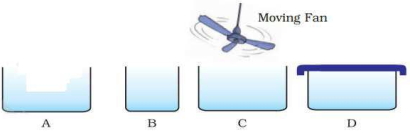
Look at the figure and suggest in which of the vessels $A$,$B$,$C$,or $D$ the rate of evaporation will be the highest? Explain.
Solution
(C) The rate of evaporation will be the highest in vessel $C$.
Explanation:
$1$. Evaporation is a surface phenomenon,meaning it occurs only at the surface of a liquid. Therefore,the rate of evaporation increases with an increase in the surface area of the liquid exposed to the atmosphere.
$2$. Vessel $C$ has the largest surface area compared to vessels $A$ and $B$.
$3$. Additionally,the presence of a moving fan above vessel $C$ increases the wind speed. An increase in wind speed causes the water vapour particles to move away faster,thereby increasing the rate of evaporation.
$4$. Vessel $D$ is covered,which prevents evaporation from occurring effectively.
Explanation:
$1$. Evaporation is a surface phenomenon,meaning it occurs only at the surface of a liquid. Therefore,the rate of evaporation increases with an increase in the surface area of the liquid exposed to the atmosphere.
$2$. Vessel $C$ has the largest surface area compared to vessels $A$ and $B$.
$3$. Additionally,the presence of a moving fan above vessel $C$ increases the wind speed. An increase in wind speed causes the water vapour particles to move away faster,thereby increasing the rate of evaporation.
$4$. Vessel $D$ is covered,which prevents evaporation from occurring effectively.
0 likes
View Solution22
Medium
$(a)$ Conversion of solid to vapour is called sublimation. Name the term used to denote the conversion of vapour to solid.
$(b)$ Conversion of solid state to liquid state is called fusion; what is meant by latent heat of fusion?
$(b)$ Conversion of solid state to liquid state is called fusion; what is meant by latent heat of fusion?
Solution
(N/A) The term used to denote the conversion of vapour to solid is deposition.
The amount of heat energy required to convert $1\, kg$ of a solid into liquid at atmospheric pressure at its melting point is known as its latent heat of fusion.
The amount of heat energy required to convert $1\, kg$ of a solid into liquid at atmospheric pressure at its melting point is known as its latent heat of fusion.
0 likes
View Solution23
Medium
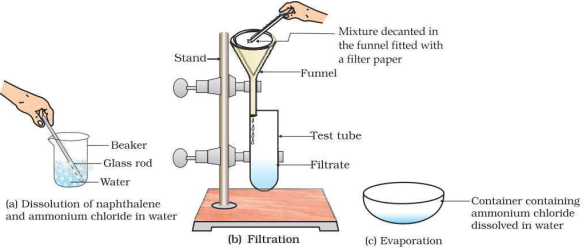
You are provided with a mixture of naphthalene and ammonium chloride by your teacher. Suggest an activity to separate them with a well-labelled diagram.
Solution
(N/A) To separate a mixture of naphthalene and ammonium chloride,we can use the property of solubility in water.
$1$. Take the mixture in a beaker and add water to it. Stir the mixture using a glass rod.
$2$. Ammonium chloride is soluble in water,whereas naphthalene is insoluble in water.
$3$. Filter the mixture using a funnel and filter paper. Naphthalene will remain as a residue on the filter paper,while the ammonium chloride solution will pass through as the filtrate.
$4$. Collect the filtrate in a china dish and heat it. The water will evaporate,leaving behind solid ammonium chloride crystals.
$1$. Take the mixture in a beaker and add water to it. Stir the mixture using a glass rod.
$2$. Ammonium chloride is soluble in water,whereas naphthalene is insoluble in water.
$3$. Filter the mixture using a funnel and filter paper. Naphthalene will remain as a residue on the filter paper,while the ammonium chloride solution will pass through as the filtrate.
$4$. Collect the filtrate in a china dish and heat it. The water will evaporate,leaving behind solid ammonium chloride crystals.
0 likes
View Solution24
EasyMCQ
It is a hot summer day,Priyanshi and Ali are wearing cotton and nylon clothes respectively. Who do you think would be more comfortable and why?
A
Priyanshi,because cotton absorbs sweat and allows evaporation.
B
Ali,because nylon is more durable.
C
Both are equally comfortable.
D
Neither is comfortable.
Solution
(A) Cotton is a better absorber of water than nylon. It helps in the absorption of sweat from the body,followed by its evaporation into the atmosphere. The process of evaporation causes a cooling effect. Therefore,Priyanshi is more comfortable,whereas Ali is not as comfortable.
0 likes
View Solution25
MediumMCQ
You want to wear your favourite shirt to a party,but the problem is that it is still wet after a wash. What steps would you take to dry it faster?
A
Keep it in a dark room.
B
Fold it and keep it in a cupboard.
C
Spread it out under a fan or in the sun.
D
Keep it in a closed container.
Solution
(C) The rate of evaporation of water can be increased by the following methods:
$(a)$ Increasing the surface area: By spreading the shirt out,more surface area is exposed to the air,which increases the rate of evaporation.
$(b)$ Increasing the temperature: Placing the shirt under the sun provides heat energy,which increases the kinetic energy of water molecules,leading to faster evaporation.
$(c)$ Increasing wind speed: Spreading the shirt under a fan increases the wind speed,which carries away the water vapour from the surface,thereby increasing the rate of evaporation.
$(a)$ Increasing the surface area: By spreading the shirt out,more surface area is exposed to the air,which increases the rate of evaporation.
$(b)$ Increasing the temperature: Placing the shirt under the sun provides heat energy,which increases the kinetic energy of water molecules,leading to faster evaporation.
$(c)$ Increasing wind speed: Spreading the shirt under a fan increases the wind speed,which carries away the water vapour from the surface,thereby increasing the rate of evaporation.
0 likes
View Solution26
Medium
Comment on the following statements :
$(a)$ Evaporation produces cooling.
$(b)$ Rate of evaporation of an aqueous solution decreases with increase in humidity.
$(c)$ Sponge though compressible is a solid.
$(a)$ Evaporation produces cooling.
$(b)$ Rate of evaporation of an aqueous solution decreases with increase in humidity.
$(c)$ Sponge though compressible is a solid.
Solution
(N/A) Evaporation produces cooling because the particles at the surface of the liquid gain energy from the surroundings to overcome the forces of attraction and change into vapour,thereby absorbing heat and producing a cooling effect.
$(b)$ Humidity is the amount of water vapour present in the air. Air can hold only a definite amount of water vapour at a given temperature. If the humidity is already high,the air cannot hold more water vapour,which decreases the rate of evaporation.
$(c)$ $A$ sponge has minute holes in which air is trapped. When we press it,the air is expelled out,allowing it to be compressed. Despite this,it is considered a solid because it has a definite shape and volume when not subjected to external force.
$(b)$ Humidity is the amount of water vapour present in the air. Air can hold only a definite amount of water vapour at a given temperature. If the humidity is already high,the air cannot hold more water vapour,which decreases the rate of evaporation.
$(c)$ $A$ sponge has minute holes in which air is trapped. When we press it,the air is expelled out,allowing it to be compressed. Despite this,it is considered a solid because it has a definite shape and volume when not subjected to external force.
0 likes
View Solution27
MediumMCQ
Why does the temperature of a substance remain constant during its melting point or boiling point?
A
Because the heat supplied is used to increase the kinetic energy of the particles.
B
Because the heat supplied is used to overcome the forces of attraction between the particles to change the state.
C
Because the substance stops absorbing heat at these points.
D
Because the heat supplied is lost to the surroundings.
Solution
(B) The temperature of a substance remains constant at its melting and boiling points until all the substance melts or boils because the heat supplied is continuously used up in changing the state of the substance by overcoming the forces of attraction between the particles.
This heat energy,which is absorbed without showing any rise in temperature,is known as latent heat of fusion or latent heat of vaporization.
This heat energy,which is absorbed without showing any rise in temperature,is known as latent heat of fusion or latent heat of vaporization.
0 likes
View Solution28
EasyMCQ
Why is the rate of diffusion faster in the gaseous state?
A
Particles have less kinetic energy.
B
Particles have more kinetic energy and larger intermolecular space.
C
Particles are closely packed.
D
Particles have fixed positions.
Solution
(B) In the gaseous state, particles possess significantly higher kinetic energy compared to solids and liquids.
Due to this high kinetic energy, the particles move randomly at very high speeds.
Additionally, the intermolecular space between gas particles is much larger, allowing them to move freely and mix with other gases rapidly.
Therefore, the rate of diffusion is much faster in gases.
Due to this high kinetic energy, the particles move randomly at very high speeds.
Additionally, the intermolecular space between gas particles is much larger, allowing them to move freely and mix with other gases rapidly.
Therefore, the rate of diffusion is much faster in gases.
0 likes
View Solution29
EasyMCQ
Why do gases show high compressibility?
A
Due to strong intermolecular forces.
B
Due to large intermolecular spaces.
C
Due to fixed shape and volume.
D
Due to high density.
Solution
(B) Gases exhibit high compressibility because the intermolecular forces of attraction between their particles are extremely weak.
Additionally,there is a large amount of empty space between the gas particles.
When pressure is applied,these particles can be easily pushed closer together,significantly reducing the volume of the gas.
Additionally,there is a large amount of empty space between the gas particles.
When pressure is applied,these particles can be easily pushed closer together,significantly reducing the volume of the gas.
0 likes
View Solution30
Easy
Why does perspiration keep our body cool?
Solution
(N/A) During the process of evaporation of sweat,the latent heat of vaporization is absorbed from the body surface. This loss of heat from the body results in a cooling effect,thereby helping to maintain our body temperature.
0 likes
View Solution31
Easy
Give the reason for the existence of the three states of matter.
Solution
(N/A) The three states of matter exist due to differences in the following characteristics:
$(i)$ Interparticle space: The distance between particles varies,being minimum in solids and maximum in gases.
$(ii)$ Interparticle force: The force of attraction between particles is strongest in solids and weakest in gases.
$(iii)$ Kinetic energy: The movement of particles depends on their kinetic energy,which is lowest in solids and highest in gases.
$(i)$ Interparticle space: The distance between particles varies,being minimum in solids and maximum in gases.
$(ii)$ Interparticle force: The force of attraction between particles is strongest in solids and weakest in gases.
$(iii)$ Kinetic energy: The movement of particles depends on their kinetic energy,which is lowest in solids and highest in gases.
0 likes
View Solution32
Easy
Explain why the temperature remains constant during the process of sublimation.
Solution
(N/A) During the process of sublimation,the heat energy supplied to the substance is entirely consumed to overcome the forces of attraction between the particles of the solid. This energy is known as the latent heat of sublimation. Since this heat is used for the phase change from solid to vapour rather than increasing the kinetic energy of the particles,the temperature of the substance remains constant until the entire solid has transformed into vapour.
0 likes
View Solution33
EasyMCQ
$A$ substance has no mass. Can one consider it as matter?
A
Yes
B
No
C
Maybe
D
Cannot be determined
Solution
(B) No,one cannot consider it as matter.
By definition,matter is anything that occupies space and has mass.
Since the substance lacks mass,it does not fulfill the fundamental criteria to be classified as matter.
By definition,matter is anything that occupies space and has mass.
Since the substance lacks mass,it does not fulfill the fundamental criteria to be classified as matter.
0 likes
View Solution34
EasyMCQ
$A$ diver is able to cut through water in a swimming pool. Which property of matter does this observation show?
A
Particles of matter have space between them.
B
Particles of matter are continuously moving.
C
Particles of matter have forces of attraction between them.
D
Particles of matter are very small.
Solution
(C) The observation that a diver can cut through water in a swimming pool demonstrates that the forces of attraction between water particles are not strong enough to prevent movement through them.
This property indicates that while particles of matter are held together by intermolecular forces of attraction,these forces can be overcome by external force,allowing the diver to move through the liquid.
This property indicates that while particles of matter are held together by intermolecular forces of attraction,these forces can be overcome by external force,allowing the diver to move through the liquid.
0 likes
View Solution35
Easy
Rate of diffusion is faster in gases. Why?
Solution
(N/A) The molecules of gases have larger intermolecular space and higher kinetic energy compared to liquids and solids. Due to these factors,gas particles move randomly at high speeds,allowing them to diffuse rapidly.
0 likes
View Solution36
Easy
Name the property of gases that helps aquatic plants and animals to survive in water.
Solution
(N/A) The property is $Diffusion$. Atmospheric oxygen and carbon dioxide dissolve in water through the process of $Diffusion$. Aquatic animals use the dissolved oxygen for respiration,and aquatic plants use the dissolved carbon dioxide for photosynthesis,which allows them to survive in water.
0 likes
View Solution37
MediumMCQ
Which of the following substances in the gaseous state should be called a vapour?
$(i)$ Helium
$(ii)$ Nitrogen
$(iii)$ Carbon dioxide
$(iv)$ Sulphur
$(i)$ Helium
$(ii)$ Nitrogen
$(iii)$ Carbon dioxide
$(iv)$ Sulphur
A
$(i)$ Helium
B
$(ii)$ Nitrogen
C
$(iii)$ Carbon dioxide
D
$(iv)$ Sulphur
Solution
(D) substance is called a vapour if it exists as a liquid or solid at room temperature $(25^{\circ}C)$ and standard atmospheric pressure,but is present in the gaseous state.
Helium,nitrogen,and carbon dioxide are gases at room temperature.
Sulphur is a solid at room temperature,but it can exist in a gaseous state (vapour) upon heating. Therefore,sulphur in the gaseous state is called a vapour.
Helium,nitrogen,and carbon dioxide are gases at room temperature.
Sulphur is a solid at room temperature,but it can exist in a gaseous state (vapour) upon heating. Therefore,sulphur in the gaseous state is called a vapour.
0 likes
View Solution38
EasyMCQ
Why do we see water droplets on the outer surface of a glass containing ice-cold water?
A
Condensation of water vapor from the air.
B
Evaporation of water from the glass.
C
Sublimation of ice.
D
Diffusion of water through the glass.
Solution
(A) When water vapor present in the surrounding air comes in contact with the cold surface of the glass containing ice-cold water,the water vapor loses energy (heat).
Due to this loss of energy,the water vapor undergoes a phase change from a gaseous state to a liquid state,appearing as water droplets on the outer surface of the glass.
This process is known as condensation.
Due to this loss of energy,the water vapor undergoes a phase change from a gaseous state to a liquid state,appearing as water droplets on the outer surface of the glass.
This process is known as condensation.
0 likes
View Solution39
EasyMCQ
What is evaporation?
A
The process of conversion of a solid into a liquid.
B
The phenomenon of change of a liquid into vapours at any temperature below its boiling point.
C
The process of conversion of a gas into a liquid.
D
The process of conversion of a liquid into a solid.
Solution
(B) Evaporation is a surface phenomenon in which liquid molecules at the surface,having higher kinetic energy than the average,escape into the vapour state at any temperature below its boiling point.
This process leads to a cooling effect in the remaining liquid.
This process leads to a cooling effect in the remaining liquid.
0 likes
View Solution40
Easy
Why is evaporation called a surface phenomenon?
Solution
(N/A) Evaporation is considered a surface phenomenon because only the particles present at the surface of the liquid possess enough kinetic energy to overcome the intermolecular forces of attraction exerted by the particles below them. Once these surface particles gain sufficient energy,they escape the liquid phase and convert into vapour,while the particles in the bulk of the liquid remain unaffected.
0 likes
View Solution41
Easy
List two processes from which it may be concluded that the particles of a gas move continuously.
Solution
(N/A) The continuous movement of gas particles can be concluded from the following two processes:
$(i)$ Diffusion: This is the process where particles of different gases intermix spontaneously due to their random motion and high kinetic energy. For example,the smell of perfume spreading across a room.
$(ii)$ Brownian Motion: This is the random,zig-zag motion of particles suspended in a fluid (gas or liquid) resulting from their collision with fast-moving gas molecules.
$(i)$ Diffusion: This is the process where particles of different gases intermix spontaneously due to their random motion and high kinetic energy. For example,the smell of perfume spreading across a room.
$(ii)$ Brownian Motion: This is the random,zig-zag motion of particles suspended in a fluid (gas or liquid) resulting from their collision with fast-moving gas molecules.
0 likes
View Solution42
MediumMCQ
What happens when you pour some acetone on your palm?
A
It gets hot due to chemical reaction.
B
It causes a cooling sensation due to evaporation.
C
It remains at the same temperature.
D
It freezes the palm instantly.
Solution
(B) Acetone has a very low boiling point. When we pour some acetone on our palm,its particles gain thermal energy from our palm and evaporate rapidly. This process of evaporation absorbs heat from the palm,which causes a cooling sensation.
0 likes
View Solution43
Medium
Give a reason why gas exerts pressure on the walls of the container.
Solution
(N/A) In the gaseous state,the particles move randomly at high speed. Due to this random movement,the particles collide with each other and also strike the walls of the container. This continuous bombardment of particles against the walls of the container exerts force per unit area,which is known as gas pressure.
0 likes
View Solution44
Medium
Give a reason why gas exerts pressure on the walls of the container.
Solution
(N/A) In the gaseous state,the particles move randomly at high speeds. Due to this random movement,the particles collide with each other and also strike the walls of the container. This continuous bombardment of gas particles against the walls of the container exerts force per unit area,which is known as gas pressure.
0 likes
View Solution45
EasyMCQ
Which property of gas is used in supplying oxygen cylinders to hospitals?
A
High compressibility
B
Low density
C
High fluidity
D
Fixed shape
Solution
(A) The property of gas used in supplying oxygen cylinders to hospitals is high compressibility.
Because gases have high compressibility,a large volume of gas can be compressed into a small cylinder,making it easy to transport and store for medical use.
Because gases have high compressibility,a large volume of gas can be compressed into a small cylinder,making it easy to transport and store for medical use.
0 likes
View Solution46
EasyMCQ
At what temperature does solid ice and liquid water co-exist together (in $0^{\circ} C$)?
A
$0$
B
$100$
C
$25$
D
$37$
Solution
(A) Solid ice and liquid water co-exist at the melting point of ice.
The melting point of ice is $0^{\circ} C$ (or $273.15 \ K$).
At this specific temperature, the phase transition between solid and liquid is in equilibrium, meaning both states can exist simultaneously.
The melting point of ice is $0^{\circ} C$ (or $273.15 \ K$).
At this specific temperature, the phase transition between solid and liquid is in equilibrium, meaning both states can exist simultaneously.
0 likes
View Solution47
Easy
What is dry ice? What happens when the pressure under which it is stored is decreased to $1$ atmosphere?
Solution
(N/A) Dry ice is solid carbon dioxide $(CO_2)$.
It is stored under high pressure to maintain its solid state.
When the pressure is decreased to $1$ atmosphere,dry ice undergoes sublimation,meaning it converts directly from a solid state to a gaseous state without passing through the liquid phase.
It is stored under high pressure to maintain its solid state.
When the pressure is decreased to $1$ atmosphere,dry ice undergoes sublimation,meaning it converts directly from a solid state to a gaseous state without passing through the liquid phase.
0 likes
View Solution48
EasyMCQ
With which name is the phenomenon of changing of a liquid into its vapours at a temperature below its boiling point known?
A
Boiling
B
Evaporation
C
Condensation
D
Sublimation
Solution
(B) The phenomenon of changing of a liquid into its vapours at any temperature below its boiling point is known as $Evaporation$. Unlike boiling, which occurs at a specific temperature throughout the bulk of the liquid, evaporation is a surface phenomenon that can occur at any temperature.
0 likes
View Solution49
EasyMCQ
List any two properties of particles of matter.
A
They have space between them.
B
They are continuously moving.
C
They attract each other.
D
They are very large in size.
Solution
(A, B, C) The particles of matter exhibit the following properties:
$(i)$ Particles of matter have spaces between them.
$(ii)$ Particles of matter are continuously moving.
$(iii)$ Particles of matter attract each other.
$(i)$ Particles of matter have spaces between them.
$(ii)$ Particles of matter are continuously moving.
$(iii)$ Particles of matter attract each other.
0 likes
View Solution50
MediumMCQ
What happens when you open a bottle of perfume?
A
The perfume remains inside the bottle.
B
The perfume particles diffuse into the air and spread,allowing us to smell them even at a distance.
C
The perfume turns into a solid.
D
The perfume particles settle down at the bottom of the bottle.
Solution
(B) When a bottle of perfume is opened,the liquid perfume evaporates into gas particles. These particles possess high kinetic energy and move randomly in all directions. Through the process of diffusion,these particles mix with the air molecules and spread throughout the room,which is why we can smell the fragrance even from a distance.
0 likes
View SolutionMATTER IN OUR SURROUNDINGS — Mix Example - MATTER IN OUR SURROUNDINGS · Frequently Asked Questions
1Are these MATTER IN OUR SURROUNDINGS questions useful for JEE and NEET?
Yes. All questions in this section are mapped to JEE Main and NEET exam patterns. Previous year questions from JEE Main, NEET, GUJCET and state-level exams are included with full solutions.
2Can I switch to Hindi or Gujarati for these questions?
Yes. Use the language tabs in the hero section or the sidebar to view the same questions and solutions in English, Hindi or Gujarati.
3How do I generate a question paper from this subtopic?
Use the Vedclass Exam Paper Generator — select the chapter and subtopic, set difficulty, and generate Sets A, B, C, D automatically. First 3 chapters of every subject are free.
Vedclass Products
For Students
Vedclass Test Series
Mock tests in real JEE/NEET style with performance analysis. 5-day free trial.
Start Free TrialFor Teachers
Exam Paper Generator
Generate Set A/B/C/D papers from this chapter in 2 minutes. 3 chapters free.
Try FreeFor Institutes
Online Exam Module
Live online exams with unlimited students, 360° analytics & white-label branding.
See DemoFor Teachers & Institutes
Generate a MATTER IN OUR SURROUNDINGS Exam Paper in 2 Minutes
Select subtopic & difficulty — Sets A, B, C, D auto-generated with No Repeat logic.
First 3 chapters of every subject are free — no payment required.