
A English
Textbook - MATTER IN OUR SURROUNDINGS Questions in English
Class 9 Science · MATTER IN OUR SURROUNDINGS · Textbook - MATTER IN OUR SURROUNDINGS
30+
Questions
English
Language
100%
With Solutions
Showing 30 of 30 questions in English
1
EasyMCQ
Which of the following are matter?
Chair,air,love,smell,hate,almonds,thought,cold,lemon water,smell of perfume.
Chair,air,love,smell,hate,almonds,thought,cold,lemon water,smell of perfume.
A
Chair,air,almonds,lemon water,smell of perfume
B
Chair,air,love,smell,hate
C
Love,hate,thought,cold
D
Chair,air,almonds,thought,cold
Solution
(A) Matter is defined as anything that has mass and occupies space.
$1$. Chair: Has mass and occupies space (Matter).
$2$. Air: Has mass and occupies space (Matter).
$3$. Love: An emotion,not matter.
$4$. Smell: The sensation of smell is not matter,but the particles of perfume causing the smell are matter.
$5$. Hate: An emotion,not matter.
$6$. Almonds: Have mass and occupy space (Matter).
$7$. Thought: $A$ mental process,not matter.
$8$. Cold: $A$ sensation,not matter.
$9$. Lemon water: Has mass and occupies space (Matter).
$10$. Smell of perfume: The particles of perfume in the air have mass and occupy space (Matter).
Therefore,the items that are matter are: Chair,air,almonds,lemon water,and smell of perfume.
$1$. Chair: Has mass and occupies space (Matter).
$2$. Air: Has mass and occupies space (Matter).
$3$. Love: An emotion,not matter.
$4$. Smell: The sensation of smell is not matter,but the particles of perfume causing the smell are matter.
$5$. Hate: An emotion,not matter.
$6$. Almonds: Have mass and occupy space (Matter).
$7$. Thought: $A$ mental process,not matter.
$8$. Cold: $A$ sensation,not matter.
$9$. Lemon water: Has mass and occupies space (Matter).
$10$. Smell of perfume: The particles of perfume in the air have mass and occupy space (Matter).
Therefore,the items that are matter are: Chair,air,almonds,lemon water,and smell of perfume.
0 likes
View Solution2
Medium
Give reasons for the following observation: The smell of hot sizzling food reaches you several metres away,but to get the smell from cold food you have to go close.
Solution
(N/A) The particles of matter are constantly moving. The rate of diffusion of particles increases with an increase in temperature.
In hot sizzling food,the kinetic energy of the particles is high,which causes them to diffuse rapidly into the air.
Consequently,these particles can travel over a longer distance and reach you from several metres away.
In contrast,the particles in cold food have lower kinetic energy,resulting in a slower rate of diffusion.
Therefore,you need to go close to the cold food to detect its smell.
In hot sizzling food,the kinetic energy of the particles is high,which causes them to diffuse rapidly into the air.
Consequently,these particles can travel over a longer distance and reach you from several metres away.
In contrast,the particles in cold food have lower kinetic energy,resulting in a slower rate of diffusion.
Therefore,you need to go close to the cold food to detect its smell.
0 likes
View Solution3
EasyMCQ
$A$ diver is able to cut through water in a swimming pool. Which property of matter does this observation show?
A
Matter is made up of particles.
B
Matter has space between its particles.
C
Particles of matter are continuously moving.
D
Particles of matter attract each other.
Solution
(B) The phenomenon of a diver cutting through water in a swimming pool demonstrates that the particles of water have spaces between them. Because these spaces exist,the diver is able to move through the water by displacing the particles.
0 likes
View Solution4
Medium
What are the characteristics of the particles of matter?
Solution
(N/A) The characteristics of the particles of matter are as follows:
$1.$ Particles of matter have space between them.
$2.$ Particles of matter are continuously moving.
$3.$ Particles of matter attract each other.
$4.$ Particles of matter are extremely small in size.
$1.$ Particles of matter have space between them.
$2.$ Particles of matter are continuously moving.
$3.$ Particles of matter attract each other.
$4.$ Particles of matter are extremely small in size.
0 likes
View Solution5
Medium
The mass per unit volume of a substance is called density $(density = mass/volume)$. Arrange the following in order of increasing density: air, exhaust from chimneys, honey, water, chalk, cotton, and iron.
Solution
(N/A) Density is defined as the mass per unit volume of a substance. Generally, the density of states of matter follows the order: $Gas < Liquid < Solid$.
$1$. Air and exhaust from chimneys are gases, which have the lowest density.
$2$. Water and honey are liquids, which have a higher density than gases.
$3$. Cotton, chalk, and iron are solids, which have the highest density.
Within these categories, the specific order of increasing density is:
Air < Exhaust from chimneys < Cotton < Water < Honey < Chalk < Iron.
$1$. Air and exhaust from chimneys are gases, which have the lowest density.
$2$. Water and honey are liquids, which have a higher density than gases.
$3$. Cotton, chalk, and iron are solids, which have the highest density.
Within these categories, the specific order of increasing density is:
Air < Exhaust from chimneys < Cotton < Water < Honey < Chalk < Iron.
0 likes
View Solution6
Medium
Tabulate the differences in the characteristics of states of matter.
Solution
(N/A) The characteristics of the three states of matter are as follows:
$1.$ $\text{Solid}:$
- Solids have a definite volume.
- Solids do not flow.
- Solids are rigid.
- Solids have a definite shape (with few exceptions like sponge or rubber band).
- Solids are generally incompressible.
$2.$ $\text{Liquid}:$
- Liquids have a definite volume.
- Liquids tend to flow (fluids).
- Liquids are not rigid.
- Liquids do not have a definite shape; they take the shape of the container.
- Liquids are almost incompressible.
$3.$ $\text{Gas}:$
- Gases do not have a definite volume; they occupy the entire space of the container.
- Gases flow easily.
- Gases are not rigid.
- Gases do not have a definite shape.
- Gases are highly compressible.
$1.$ $\text{Solid}:$
- Solids have a definite volume.
- Solids do not flow.
- Solids are rigid.
- Solids have a definite shape (with few exceptions like sponge or rubber band).
- Solids are generally incompressible.
$2.$ $\text{Liquid}:$
- Liquids have a definite volume.
- Liquids tend to flow (fluids).
- Liquids are not rigid.
- Liquids do not have a definite shape; they take the shape of the container.
- Liquids are almost incompressible.
$3.$ $\text{Gas}:$
- Gases do not have a definite volume; they occupy the entire space of the container.
- Gases flow easily.
- Gases are not rigid.
- Gases do not have a definite shape.
- Gases are highly compressible.
0 likes
View Solution7
Medium
Comment upon the following: Rigidity, compressibility, fluidity, filling a gas container, shape, kinetic energy, and density.
Solution
(N/A) $Rigidity$: The property by which an object retains its shape and size is called rigidity. Solids are rigid, whereas liquids and gases are not.
$Compressibility$: This is the property due to which a substance can be compressed, meaning its volume can be decreased. Gases are highly compressible, whereas solids and liquids are generally considered incompressible.
$Fluidity$: The tendency of a substance to flow is called fluidity. Gases and liquids are fluids, while solids are not.
$Filling \text{ } a \text{ } gas \text{ } container$: $A$ large volume of gas can be filled into a small container by compressing it under very high pressure. This is possible due to the high compressibility of gases.
$Shape$: The property of having a definite geometry is called the shape of a substance. Solids have a definite shape, whereas liquids and gases take the shape of the container.
$Kinetic \text{ } energy$: The energy possessed by moving particles or molecules is called kinetic energy. On increasing the temperature, the kinetic energy of molecules increases. Gas molecules possess the highest kinetic energy.
$Density$: The mass per unit volume of a substance is called density. Density = $\frac{\text{Mass}}{\text{Volume}}$.
$Compressibility$: This is the property due to which a substance can be compressed, meaning its volume can be decreased. Gases are highly compressible, whereas solids and liquids are generally considered incompressible.
$Fluidity$: The tendency of a substance to flow is called fluidity. Gases and liquids are fluids, while solids are not.
$Filling \text{ } a \text{ } gas \text{ } container$: $A$ large volume of gas can be filled into a small container by compressing it under very high pressure. This is possible due to the high compressibility of gases.
$Shape$: The property of having a definite geometry is called the shape of a substance. Solids have a definite shape, whereas liquids and gases take the shape of the container.
$Kinetic \text{ } energy$: The energy possessed by moving particles or molecules is called kinetic energy. On increasing the temperature, the kinetic energy of molecules increases. Gas molecules possess the highest kinetic energy.
$Density$: The mass per unit volume of a substance is called density. Density = $\frac{\text{Mass}}{\text{Volume}}$.
0 likes
View Solution8
Easy
Give reasons: $A$ gas fills completely the vessel in which it is kept.
Solution
(N/A) The force of attraction between the molecules of gases is negligible.
As a result,gas molecules are free to move in all directions and occupy the maximum space available to them.
Additionally,the high kinetic energy possessed by gas molecules allows them to move rapidly and fill the entire volume of the container.
As a result,gas molecules are free to move in all directions and occupy the maximum space available to them.
Additionally,the high kinetic energy possessed by gas molecules allows them to move rapidly and fill the entire volume of the container.
0 likes
View Solution9
Easy
Give reasons: $A$ gas exerts pressure on the walls of the container.
Solution
(N/A) In the gaseous state,particles move randomly at very high speeds. Due to this random movement,the particles collide with each other and also strike the walls of the container. The pressure exerted by the gas is defined as the force exerted by these particles per unit area on the walls of the container.
0 likes
View Solution10
Easy
Give reasons: $A$ wooden table should be called a solid.
Solution
(N/A) wooden table is classified as a solid because it possesses a fixed shape and a definite volume. In solids,the constituent particles are held together by strong intermolecular forces of attraction,which keeps them in fixed positions. Additionally,the intermolecular space between these particles is negligible. Due to these properties,a wooden table maintains its structure and does not flow,which are the defining characteristics of a solid state.
0 likes
View Solution11
MediumMCQ
Give reasons: We can easily move our hand in air but to do the same through a solid block of wood,we need a karate expert.
A
Air has high density.
B
Wood has high intermolecular space.
C
Air molecules have negligible force of attraction,while wood molecules are closely packed.
D
Wood is a gas.
Solution
(C) Air molecules are very far from each other due to the negligible force of attraction working between them. Therefore,our hand gets sufficient space to move through the air,and we can easily displace air molecules by applying a small force.
In contrast,a solid block of wood has particles that are very closely packed with strong intermolecular forces of attraction. Because of this rigid structure,our hand cannot move through it without applying a massive amount of force in a precise direction,which is why a karate expert is required.
In contrast,a solid block of wood has particles that are very closely packed with strong intermolecular forces of attraction. Because of this rigid structure,our hand cannot move through it without applying a massive amount of force in a precise direction,which is why a karate expert is required.
0 likes
View Solution12
MediumMCQ
Liquids generally have lower density compared to solids. However,you must have observed that ice floats on water. Why does this happen?
A
Ice is denser than water.
B
Ice has a cage-like structure with vacant spaces,making it less dense than water.
C
Water molecules are more tightly packed in ice than in liquid water.
D
Ice is a solid,and solids always float on liquids.
Solution
(B) Generally,solids have a higher density than liquids. However,water is an exception.
When water freezes to form ice,the molecules arrange themselves in a specific cage-like structure due to hydrogen bonding.
This structure creates vacant spaces between the water $(H_2O)$ molecules.
Because of these vacant spaces,the volume of ice increases for the same mass,which decreases its density compared to liquid water.
Since ice is less dense than liquid water,it floats on the surface.
When water freezes to form ice,the molecules arrange themselves in a specific cage-like structure due to hydrogen bonding.
This structure creates vacant spaces between the water $(H_2O)$ molecules.
Because of these vacant spaces,the volume of ice increases for the same mass,which decreases its density compared to liquid water.
Since ice is less dense than liquid water,it floats on the surface.
0 likes
View Solution13
EasyMCQ
Convert the following temperatures to the Celsius scale:
$a.$ $300 \, K$
$b.$ $573 \, K$
$a.$ $300 \, K$
$b.$ $573 \, K$
A
$27 \, ^\circ C$ and $300 \, ^\circ C$
B
$270 \, ^\circ C$ and $30 \, ^\circ C$
C
$25 \, ^\circ C$ and $330 \, ^\circ C$
D
$40 \, ^\circ C$ and $270 \, ^\circ C$
Solution
(A) To convert temperature from the Kelvin scale to the Celsius scale,we use the following formula:
$t \, ^\circ C = T \, K - 273$
$(a)$ For $300 \, K$:
$300 - 273 = 27 \, ^\circ C$
$(b)$ For $573 \, K$:
$573 - 273 = 300 \, ^\circ C$
Therefore,the correct answer is $27 \, ^\circ C$ and $300 \, ^\circ C$.
$t \, ^\circ C = T \, K - 273$
$(a)$ For $300 \, K$:
$300 - 273 = 27 \, ^\circ C$
$(b)$ For $573 \, K$:
$573 - 273 = 300 \, ^\circ C$
Therefore,the correct answer is $27 \, ^\circ C$ and $300 \, ^\circ C$.
0 likes
View Solution14
Easy
What is the physical state of water at:
$(a)$ $250\,^{\circ}\text{C}$
$(b)$ $100\,^{\circ}\text{C}$?
$(a)$ $250\,^{\circ}\text{C}$
$(b)$ $100\,^{\circ}\text{C}$?
Solution
(N/A) The boiling point of water is $100\,^{\circ}\text{C}$.
$(a)$ At $250\,^{\circ}\text{C}$,which is above the boiling point,water exists as steam or water vapour,i.e.,in a gaseous state.
$(b)$ At $100\,^{\circ}\text{C}$,water is at its boiling point where a phase transition occurs. Therefore,at this temperature,water exists in both liquid and gaseous states simultaneously.
$(a)$ At $250\,^{\circ}\text{C}$,which is above the boiling point,water exists as steam or water vapour,i.e.,in a gaseous state.
$(b)$ At $100\,^{\circ}\text{C}$,water is at its boiling point where a phase transition occurs. Therefore,at this temperature,water exists in both liquid and gaseous states simultaneously.
0 likes
View Solution15
MediumMCQ
For any substance,why does the temperature remain constant during the change of state?
A
Because the heat is used to increase the kinetic energy of the particles.
B
Because the heat is used to overcome the forces of attraction between the particles.
C
Because the heat is lost to the surroundings.
D
Because the substance stops absorbing heat.
Solution
(B) During the change of state of a substance,the temperature remains constant.
This happens because the heat energy supplied is used to overcome the forces of attraction between the particles of the substance.
This hidden heat is known as latent heat.
Since this energy is consumed in changing the state rather than increasing the kinetic energy of the particles,the temperature does not rise during the phase transition.
This happens because the heat energy supplied is used to overcome the forces of attraction between the particles of the substance.
This hidden heat is known as latent heat.
Since this energy is consumed in changing the state rather than increasing the kinetic energy of the particles,the temperature does not rise during the phase transition.
0 likes
View Solution16
EasyMCQ
Suggest a method to liquefy atmospheric gases.
A
Increasing pressure and increasing temperature
B
Applying pressure and reducing temperature
C
Reducing pressure and increasing temperature
D
Reducing pressure and reducing temperature
Solution
(B) Atmospheric gases can be liquefied by applying high pressure and simultaneously reducing the temperature.
This process works because increasing pressure brings gas particles closer together,while decreasing the temperature reduces their kinetic energy,allowing intermolecular forces to hold the particles together in a liquid state.
This process works because increasing pressure brings gas particles closer together,while decreasing the temperature reduces their kinetic energy,allowing intermolecular forces to hold the particles together in a liquid state.
0 likes
View Solution17
Medium
Why does a desert cooler cool better on a hot dry day?
Solution
(N/A) desert cooler functions on the principle of evaporative cooling.
The rate of evaporation is directly proportional to the temperature and inversely proportional to the humidity of the air.
On a hot and dry day,the temperature is high and the humidity is low,which significantly increases the rate of evaporation.
Since evaporation causes a cooling effect,the increased rate of evaporation leads to better cooling by the desert cooler.
The rate of evaporation is directly proportional to the temperature and inversely proportional to the humidity of the air.
On a hot and dry day,the temperature is high and the humidity is low,which significantly increases the rate of evaporation.
Since evaporation causes a cooling effect,the increased rate of evaporation leads to better cooling by the desert cooler.
0 likes
View Solution18
MediumMCQ
How does the water kept in an earthen pot (matka) become cool during summer?
A
Due to the absorption of heat from the surroundings.
B
Due to the process of evaporation which causes cooling.
C
Due to the condensation of water vapor on the outer surface.
D
Due to the chemical reaction between clay and water.
Solution
(B) An earthen pot (matka) has a large number of tiny pores on its surface.
Water seeps through these pores and reaches the outer surface of the pot.
This water evaporates continuously due to the heat of the surroundings.
Since the process of evaporation is an endothermic process that requires energy (latent heat of vaporization),it absorbs this heat from the remaining water inside the pot.
As a result,the temperature of the water inside the pot decreases,making it cool.
Water seeps through these pores and reaches the outer surface of the pot.
This water evaporates continuously due to the heat of the surroundings.
Since the process of evaporation is an endothermic process that requires energy (latent heat of vaporization),it absorbs this heat from the remaining water inside the pot.
As a result,the temperature of the water inside the pot decreases,making it cool.
0 likes
View Solution19
MediumMCQ
Why does our palm feel cold when we put some acetone,petrol,or perfume on it?
A
Due to the absorption of latent heat of vaporization from the palm.
B
Due to the release of heat into the palm.
C
Due to the chemical reaction between the liquid and the skin.
D
Due to the high temperature of the liquid.
Solution
(A) Acetone,petrol,and perfume are volatile substances that evaporate rapidly when exposed to air.
During the process of evaporation,these substances absorb the necessary latent heat of vaporization from the surface of the palm.
Since the palm loses heat to the liquid,the temperature of the palm decreases,causing a cooling sensation.
During the process of evaporation,these substances absorb the necessary latent heat of vaporization from the surface of the palm.
Since the palm loses heat to the liquid,the temperature of the palm decreases,causing a cooling sensation.
0 likes
View Solution20
EasyMCQ
Why are we able to sip hot tea or milk faster from a saucer rather than a cup?
A
The saucer has a smaller surface area.
B
The saucer has a larger surface area,which increases the rate of evaporation.
C
The cup is made of a different material.
D
The saucer is made of a different material.
Solution
(B) Evaporation is a surface phenomenon.
When tea or milk is poured into a saucer,it spreads out,providing a larger surface area compared to a cup.
$A$ larger surface area allows more particles of the liquid to escape into the atmosphere as vapor,thereby increasing the rate of evaporation.
Since evaporation causes cooling,the liquid in the saucer cools down much faster than in a cup,allowing us to sip it more quickly.
When tea or milk is poured into a saucer,it spreads out,providing a larger surface area compared to a cup.
$A$ larger surface area allows more particles of the liquid to escape into the atmosphere as vapor,thereby increasing the rate of evaporation.
Since evaporation causes cooling,the liquid in the saucer cools down much faster than in a cup,allowing us to sip it more quickly.
0 likes
View Solution21
MediumMCQ
What type of clothes should we wear in summer?
A
Dark colored synthetic clothes
B
Light colored cotton clothes
C
Dark colored cotton clothes
D
Light colored synthetic clothes
Solution
(B) We should wear light-colored cotton clothes in summer because:
$1.$ Cotton is a good absorber of water/sweat. It provides more surface area for the sweat to evaporate.
$2.$ Light colors absorb less heat.
Therefore,wearing light-colored cotton clothes helps us feel cool and comfortable.
$1.$ Cotton is a good absorber of water/sweat. It provides more surface area for the sweat to evaporate.
$2.$ Light colors absorb less heat.
Therefore,wearing light-colored cotton clothes helps us feel cool and comfortable.
0 likes
View Solution22
EasyMCQ
Convert the following temperatures to the Celsius scale.
$(a)$ $293 \, K$
$(b)$ $470 \, K$
$(a)$ $293 \, K$
$(b)$ $470 \, K$
A
$200 \, ^\circ C$ and $190 \, ^\circ C$
B
$20 \, ^\circ C$ and $197 \, ^\circ C$
C
$15 \, ^\circ C$ and $200 \, ^\circ C$
D
$25 \, ^\circ C$ and $195 \, ^\circ C$
Solution
(B) To convert temperature from the Kelvin scale to the Celsius scale,we subtract $273$ from the given value,as the relationship is defined by the formula: $^\circ C = K - 273$.
$(a)$ For $293 \, K$: $293 - 273 = 20 \, ^\circ C$.
$(b)$ For $470 \, K$: $470 - 273 = 197 \, ^\circ C$.
$(a)$ For $293 \, K$: $293 - 273 = 20 \, ^\circ C$.
$(b)$ For $470 \, K$: $470 - 273 = 197 \, ^\circ C$.
0 likes
View Solution23
EasyMCQ
Convert the following temperatures to the Kelvin scale:
$(a)$ $25\,^{\circ}C$
$(b)$ $373\,^{\circ}C$
$(a)$ $25\,^{\circ}C$
$(b)$ $373\,^{\circ}C$
A
$273\, K$ and $373\, K$
B
$330\, K$ and $270\, K$
C
$298\, K$ and $646\, K$
D
$270\, K$ and $650\, K$
Solution
(C) To convert temperature from the Celsius scale to the Kelvin scale,we add $273$ to the given Celsius value,as the relationship is defined by the formula:
$K = ^{\circ}C + 273$
$(a)$ For $25\,^{\circ}C$:
$25 + 273 = 298\, K$
$(b)$ For $373\,^{\circ}C$:
$373 + 273 = 646\, K$
Therefore,the correct values are $298\, K$ and $646\, K$.
$K = ^{\circ}C + 273$
$(a)$ For $25\,^{\circ}C$:
$25 + 273 = 298\, K$
$(b)$ For $373\,^{\circ}C$:
$373 + 273 = 646\, K$
Therefore,the correct values are $298\, K$ and $646\, K$.
0 likes
View Solution24
Medium
Give reasons for the following observations:
$(a)$ Naphthalene balls disappear with time without leaving any solid.
$(b)$ We can get the smell of perfume sitting several metres away.
$(a)$ Naphthalene balls disappear with time without leaving any solid.
$(b)$ We can get the smell of perfume sitting several metres away.
Solution
(N/A) Naphthalene is a substance that undergoes sublimation,meaning it changes directly from a solid to a gas without passing through the liquid state. As it absorbs heat from the surroundings,the naphthalene balls sublime and disappear over time.
$(b)$ The smell of perfume is due to the presence of volatile aromatic compounds. These particles diffuse rapidly through the air,allowing us to detect the scent even when sitting several metres away.
$(b)$ The smell of perfume is due to the presence of volatile aromatic compounds. These particles diffuse rapidly through the air,allowing us to detect the scent even when sitting several metres away.
0 likes
View Solution25
EasyMCQ
Arrange the following substances in increasing order of forces of attraction between the particles: water,sugar,oxygen.
A
Oxygen < Water < Sugar
B
Sugar < Water < Oxygen
C
Water < Sugar < Oxygen
D
Oxygen < Sugar < Water
Solution
(A) The forces of attraction between particles are strongest in solids,moderate in liquids,and weakest in gases.
Sugar is a solid,water is a liquid,and oxygen is a gas.
Therefore,the increasing order of forces of attraction is: Oxygen < Water < Sugar.
Sugar is a solid,water is a liquid,and oxygen is a gas.
Therefore,the increasing order of forces of attraction is: Oxygen < Water < Sugar.
0 likes
View Solution26
Medium
What is the physical state of water at $(a)$ $25\,^oC$,$(b)$ $0\,^oC$,and $(c)$ $100\,^oC$?
Solution
(N/A) At $0\,^oC$,water exists in a state of equilibrium between solid (ice) and liquid phases. At $100\,^oC$,water exists in a state of equilibrium between liquid and gaseous (steam) phases. Between $0\,^oC$ and $100\,^oC$,water remains in the liquid state.
$(a)$ At $25\,^oC$: Liquid state.
$(b)$ At $0\,^oC$: Solid and liquid state (melting point).
$(c)$ At $100\,^oC$: Liquid and gaseous state (boiling point).
$(a)$ At $25\,^oC$: Liquid state.
$(b)$ At $0\,^oC$: Solid and liquid state (melting point).
$(c)$ At $100\,^oC$: Liquid and gaseous state (boiling point).
0 likes
View Solution27
Medium
Give two reasons to justify:
$(a)$ Water at room temperature is a liquid.
$(b)$ An iron almirah is a solid at room temperature.
$(a)$ Water at room temperature is a liquid.
$(b)$ An iron almirah is a solid at room temperature.
Solution
(N/A) Water is a liquid at room temperature because:
$1$. It has a tendency to flow (fluidity).
$2$. It takes the shape of the container in which it is kept,but its volume remains fixed.
$(b)$ An iron almirah is a solid at room temperature because:
$1$. It has a definite shape and a fixed volume.
$2$. It is hard and rigid,meaning it resists change in shape when subjected to external force.
$1$. It has a tendency to flow (fluidity).
$2$. It takes the shape of the container in which it is kept,but its volume remains fixed.
$(b)$ An iron almirah is a solid at room temperature because:
$1$. It has a definite shape and a fixed volume.
$2$. It is hard and rigid,meaning it resists change in shape when subjected to external force.
0 likes
View Solution28
EasyMCQ
Why is ice at $273 \ K$ more effective in cooling than water at the same temperature?
A
Ice absorbs latent heat of fusion from the surroundings.
B
Water has more kinetic energy than ice at the same temperature.
C
Ice has higher density than water.
D
Water releases heat to the surroundings.
Solution
(A) At $273 \ K$,ice and water are at the same temperature,but they differ in their energy content.
Ice requires additional energy,known as the latent heat of fusion,to change its state from solid to liquid.
When ice is used for cooling,it absorbs this latent heat from the substance being cooled,thereby providing more effective cooling compared to water at the same temperature,which does not have this additional heat-absorbing capacity.
Ice requires additional energy,known as the latent heat of fusion,to change its state from solid to liquid.
When ice is used for cooling,it absorbs this latent heat from the substance being cooled,thereby providing more effective cooling compared to water at the same temperature,which does not have this additional heat-absorbing capacity.
0 likes
View Solution29
EasyMCQ
What produces more severe burns,boiling water or steam?
A
Boiling water
B
Steam
C
Both produce equal burns
D
None of the above
Solution
(B) Steam causes more severe burns than boiling water.
This is because steam contains an additional amount of heat known as latent heat of vaporization.
When steam comes into contact with the skin,it condenses into water and releases this extra latent heat,causing more intense damage to the skin tissues compared to boiling water at the same temperature.
This is because steam contains an additional amount of heat known as latent heat of vaporization.
When steam comes into contact with the skin,it condenses into water and releases this extra latent heat,causing more intense damage to the skin tissues compared to boiling water at the same temperature.
1 likes
View Solution30
Medium
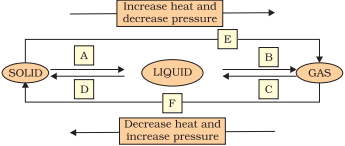
Name $A$,$B$,$C$,$D$,$E$ and $F$ in the following diagram showing the change in states of matter.
Solution
(N/A) $A =$ Melting or fusion,where solid changes into liquid.
$B =$ Evaporation or vaporization,where liquid changes into gas.
$C =$ Condensation,where gas changes into liquid.
$D =$ Freezing or solidification,where liquid changes into solid.
$E =$ Sublimation,where solid directly changes into gas without passing through the liquid state.
$F =$ Deposition,where gas directly changes into solid without passing through the liquid state.
$B =$ Evaporation or vaporization,where liquid changes into gas.
$C =$ Condensation,where gas changes into liquid.
$D =$ Freezing or solidification,where liquid changes into solid.
$E =$ Sublimation,where solid directly changes into gas without passing through the liquid state.
$F =$ Deposition,where gas directly changes into solid without passing through the liquid state.
0 likes
View SolutionMATTER IN OUR SURROUNDINGS — Textbook - MATTER IN OUR SURROUNDINGS · Frequently Asked Questions
1Are these MATTER IN OUR SURROUNDINGS questions useful for JEE and NEET?
Yes. All questions in this section are mapped to JEE Main and NEET exam patterns. Previous year questions from JEE Main, NEET, GUJCET and state-level exams are included with full solutions.
2Can I switch to Hindi or Gujarati for these questions?
Yes. Use the language tabs in the hero section or the sidebar to view the same questions and solutions in English, Hindi or Gujarati.
3How do I generate a question paper from this subtopic?
Use the Vedclass Exam Paper Generator — select the chapter and subtopic, set difficulty, and generate Sets A, B, C, D automatically. First 3 chapters of every subject are free.
Vedclass Products
For Students
Vedclass Test Series
Mock tests in real JEE/NEET style with performance analysis. 5-day free trial.
Start Free TrialFor Teachers
Exam Paper Generator
Generate Set A/B/C/D papers from this chapter in 2 minutes. 3 chapters free.
Try FreeFor Institutes
Online Exam Module
Live online exams with unlimited students, 360° analytics & white-label branding.
See DemoFor Teachers & Institutes
Generate a MATTER IN OUR SURROUNDINGS Exam Paper in 2 Minutes
Select subtopic & difficulty — Sets A, B, C, D auto-generated with No Repeat logic.
First 3 chapters of every subject are free — no payment required.