
A English
Mix Example - MATTER IN OUR SURROUNDINGS Questions in English
Class 9 Science · MATTER IN OUR SURROUNDINGS · Mix Example - MATTER IN OUR SURROUNDINGS
153+
Questions
English
Language
100%
With Solutions
Showing 50 of 153 questions in English
51
Easy
Name the state of matter in which
$(i)$ layers of particles can slip and slide over one another easily.
$(ii)$ particles just move around randomly because of very weak force of attraction.
$(i)$ layers of particles can slip and slide over one another easily.
$(ii)$ particles just move around randomly because of very weak force of attraction.
Solution
(N/A) $(i)$ Liquid: In the liquid state,the intermolecular forces are weaker than in solids,allowing the layers of particles to slip and slide over one another,which gives liquids their property of fluidity.
$(ii)$ Gaseous: In the gaseous state,the intermolecular forces of attraction are negligible,allowing particles to move randomly and freely in all directions at high speeds.
$(ii)$ Gaseous: In the gaseous state,the intermolecular forces of attraction are negligible,allowing particles to move randomly and freely in all directions at high speeds.
0 likes
View Solution52
Medium
$A$ wooden chair is a solid at room temperature. Give two reasons.
Solution
(N/A) wooden chair is classified as a solid at room temperature due to the following reasons:
$(i)$ It possesses a definite shape and a fixed volume,as the constituent particles are held together by strong intermolecular forces.
$(ii)$ It is rigid and cannot be compressed,as there is negligible space between its particles.
$(i)$ It possesses a definite shape and a fixed volume,as the constituent particles are held together by strong intermolecular forces.
$(ii)$ It is rigid and cannot be compressed,as there is negligible space between its particles.
0 likes
View Solution53
Medium
$A$ sponge is a solid,yet we are able to compress it. Why?
Solution
(N/A) sponge has minute holes,in which air is trapped.
When we press the sponge,the air is expelled out from these holes,which allows us to compress it.
When we press the sponge,the air is expelled out from these holes,which allows us to compress it.
0 likes
View Solution54
Easy
The molecules of water have more energy as compared to molecules of ice at the same temperature. Justify this statement.
Solution
(N/A) At the same temperature,water molecules possess more energy than ice molecules because of the latent heat of fusion.
When ice changes into water,it absorbs a specific amount of heat energy known as the latent heat of fusion,which is used to overcome the forces of attraction between the particles of ice to change its state from solid to liquid.
Since this energy is absorbed by the water molecules without increasing the temperature,the water molecules contain this additional energy,making them more energetic than ice molecules at the same temperature.
When ice changes into water,it absorbs a specific amount of heat energy known as the latent heat of fusion,which is used to overcome the forces of attraction between the particles of ice to change its state from solid to liquid.
Since this energy is absorbed by the water molecules without increasing the temperature,the water molecules contain this additional energy,making them more energetic than ice molecules at the same temperature.
0 likes
View Solution55
Easy
$A$ rubber band can change its shape on stretching. Will you classify it as a solid or not? Justify your answer.
Solution
(A) rubber band is classified as a solid. Although it changes its shape when stretched,it regains its original shape when the external force is removed. This behavior is characteristic of solids,which maintain their structure under normal conditions and return to their original state after the removal of deforming forces.
0 likes
View Solution56
EasyMCQ
Convert $300 \ K$ into Celsius scale and $-10^{\circ}C$ into Kelvin scale.
A
$27^{\circ}C, 263 \ K$
B
$30^{\circ}C, 283 \ K$
C
$273^{\circ}C, 273 \ K$
D
$0^{\circ}C, 263 \ K$
Solution
(A) To convert temperature from Kelvin $(K)$ to Celsius $(^{\circ}C)$,use the formula: $T(^{\circ}C) = T(K) - 273$.
For $300 \ K$: $300 - 273 = 27^{\circ}C$.
To convert temperature from Celsius $(^{\circ}C)$ to Kelvin $(K)$,use the formula: $T(K) = T(^{\circ}C) + 273$.
For $-10^{\circ}C$: $-10 + 273 = 263 \ K$.
For $300 \ K$: $300 - 273 = 27^{\circ}C$.
To convert temperature from Celsius $(^{\circ}C)$ to Kelvin $(K)$,use the formula: $T(K) = T(^{\circ}C) + 273$.
For $-10^{\circ}C$: $-10 + 273 = 263 \ K$.
0 likes
View Solution57
Easy
State one difference between a gas and a vapour.
Solution
(N/A)
| Gas | Vapour |
| It is a stable state at room temperature. $e.g., O_2, H_2$. | It is an unstable state at room temperature; it changes into a liquid state upon normal cooling. $e.g., \text{Water vapour}$. |
0 likes
View Solution58
Medium
How does the melting point of a substance indicate the strength of its intermolecular forces of attraction?
Solution
(N/A) The melting point of a substance is a direct measure of the strength of its intermolecular forces of attraction.
Stronger intermolecular forces require more energy (in the form of heat) to overcome the attraction between particles and transition the substance from a solid state to a liquid state.
Therefore,a higher melting point indicates that the particles are held together by stronger intermolecular forces,while a lower melting point indicates weaker forces.
Stronger intermolecular forces require more energy (in the form of heat) to overcome the attraction between particles and transition the substance from a solid state to a liquid state.
Therefore,a higher melting point indicates that the particles are held together by stronger intermolecular forces,while a lower melting point indicates weaker forces.
0 likes
View Solution59
MediumMCQ
What happens to the heat energy that is supplied to a solid once it starts melting?
A
It increases the kinetic energy of the particles.
B
It is used to overcome the forces of attraction between the particles.
C
It increases the temperature of the substance.
D
It is released as light energy.
Solution
(B) When a solid starts melting,the heat energy supplied is used to overcome the forces of attraction between the particles of the solid.
This energy is known as the latent heat of fusion.
Because this energy is consumed in changing the state from solid to liquid,it does not increase the kinetic energy of the particles,and therefore,the temperature of the substance remains constant until the entire solid has melted.
This energy is known as the latent heat of fusion.
Because this energy is consumed in changing the state from solid to liquid,it does not increase the kinetic energy of the particles,and therefore,the temperature of the substance remains constant until the entire solid has melted.
0 likes
View Solution60
Medium
How does pressure help in the liquefaction of gases? Explain.
Solution
(N/A) When pressure is applied to a gas,the particles are forced closer together. As the distance between the particles decreases,the intermolecular forces of attraction become strong enough to hold the particles together. During this process,the particles lose kinetic energy in the form of heat,leading to a change in state from gaseous to liquid. This process is known as the liquefaction of gases. By using this method,a large volume of gas can be compressed into a small cylinder for storage and transport.
0 likes
View Solution61
Easy
Give one property of solid which liquid does not possess and one property of liquid which solid does not possess.
Solution
(N/A) $(i)$ Solids possess the property of Rigidity,which liquids do not possess.
$(ii)$ Liquids possess the property of Fluidity,which solids do not possess.
$(ii)$ Liquids possess the property of Fluidity,which solids do not possess.
0 likes
View Solution62
Medium
Explain:
$(a)$ Sponge,though compressible,is a solid.
$(b)$ Gases completely fill the vessel in which they are kept.
$(a)$ Sponge,though compressible,is a solid.
$(b)$ Gases completely fill the vessel in which they are kept.
Solution
(N/A) sponge has minute holes in which air is trapped. On applying pressure or force,the air is expelled out and the sponge gets compressed. On releasing the pressure,the sponge regains its shape. Thus,a sponge is classified as a solid.
$(b)$ $(i)$ In the gaseous state,particles have high kinetic energy,which allows them to move freely and maintain large spaces between them.
$(ii)$ Therefore,the particles occupy the entire space available. Hence,gases completely fill the vessel in which they are kept.
$(b)$ $(i)$ In the gaseous state,particles have high kinetic energy,which allows them to move freely and maintain large spaces between them.
$(ii)$ Therefore,the particles occupy the entire space available. Hence,gases completely fill the vessel in which they are kept.
0 likes
View Solution63
Easy
Explain why a rubber band is considered a solid even though it is stretchable.
Solution
(N/A) rubber band is classified as a solid because it maintains a definite shape and volume.
It changes its shape under the application of an external force and regains its original shape when the force is removed.
It does not change its shape on its own,which is a characteristic property of solids.
It changes its shape under the application of an external force and regains its original shape when the force is removed.
It does not change its shape on its own,which is a characteristic property of solids.
0 likes
View Solution64
EasyMCQ
When suffering from a fever,which will lower your body temperature more effectively: ice or ice-cold water? Why?
A
Ice
B
Ice-cold water
C
Both are equally effective
D
None of the above
Solution
(A) Ice is more effective at lowering body temperature.
Reason: Ice at $0^{\circ}C$ absorbs more heat energy from the body than water at $0^{\circ}C$ because it undergoes a phase change from solid to liquid. This process requires the absorption of latent heat of fusion,which is approximately $334 \ J/g$. Therefore,ice extracts significantly more heat from the body to melt,resulting in a greater cooling effect compared to water at the same temperature.
Reason: Ice at $0^{\circ}C$ absorbs more heat energy from the body than water at $0^{\circ}C$ because it undergoes a phase change from solid to liquid. This process requires the absorption of latent heat of fusion,which is approximately $334 \ J/g$. Therefore,ice extracts significantly more heat from the body to melt,resulting in a greater cooling effect compared to water at the same temperature.
0 likes
View Solution65
Medium
Give reasons for the following:
$(a)$ Solids are incompressible.
$(b)$ Solids have negligible kinetic energy.
$(a)$ Solids are incompressible.
$(b)$ Solids have negligible kinetic energy.
Solution
(N/A) In solids,the constituent particles are very closely packed with negligible intermolecular space. Due to this high density and lack of space between particles,they cannot be compressed further,making them incompressible.
$(b)$ In solids,the intermolecular forces of attraction are very strong,which holds the particles in fixed positions. Since the particles can only vibrate about their mean positions and cannot move freely,their kinetic energy is negligible at room temperature.
$(b)$ In solids,the intermolecular forces of attraction are very strong,which holds the particles in fixed positions. Since the particles can only vibrate about their mean positions and cannot move freely,their kinetic energy is negligible at room temperature.
0 likes
View Solution66
Medium
$(a)$ Explain the effect of temperature on the movement of particles of matter.
$(b)$ Give a reason why we get the smell of hot sizzling food even when we are metres away from it?
$(b)$ Give a reason why we get the smell of hot sizzling food even when we are metres away from it?
Solution
(N/A) Effect of temperature: As the temperature increases,the kinetic energy $(KE)$ of the particles of matter increases. This causes the particles to move more rapidly.
$(b)$ Hot sizzling food releases vapours. At high temperatures,the kinetic energy of these vapour particles is very high,causing them to move faster and diffuse into the air over a large distance. This process of diffusion allows the smell to reach us even when we are several metres away.
$(b)$ Hot sizzling food releases vapours. At high temperatures,the kinetic energy of these vapour particles is very high,causing them to move faster and diffuse into the air over a large distance. This process of diffusion allows the smell to reach us even when we are several metres away.
0 likes
View Solution67
Medium
$2 \, mL$ of Dettol is added to a beaker containing $500 \, mL$ of water and stirred. State four observations that you make.
Solution
(N/A) $(i)$ The level of water remains almost the same because the particles of Dettol occupy the spaces between the water particles.
$(ii)$ $A$ colloidal solution is formed,not a true solution,as Dettol particles are dispersed in water.
$(iii)$ The water turns milky white due to the formation of an emulsion.
$(iv)$ The characteristic smell of Dettol can be detected even after repeated dilution,which demonstrates that matter is made up of very small particles.
$(ii)$ $A$ colloidal solution is formed,not a true solution,as Dettol particles are dispersed in water.
$(iii)$ The water turns milky white due to the formation of an emulsion.
$(iv)$ The characteristic smell of Dettol can be detected even after repeated dilution,which demonstrates that matter is made up of very small particles.
0 likes
View Solution68
Medium
Ravi added a small amount of common salt to water taken in a graduated cylinder. On dissolution,there was no detectable change in the level of water. Explain why this is so.
Solution
(N/A) When we dissolve salt in water,the volume of water remains the same because the particles of salt occupy the spaces between the particles of water and thus become invisible.
This observation demonstrates that particles of matter have spaces between them.
This observation demonstrates that particles of matter have spaces between them.
0 likes
View Solution69
Medium
What is the effect of the following on the rate of diffusion?
$(i)$ Temperature
$(ii)$ Density of liquid
$(i)$ Temperature
$(ii)$ Density of liquid
Solution
(N/A) $(i)$ The rate of diffusion increases with an increase in temperature. This occurs because the kinetic energy of the particles increases as temperature rises.
$(ii)$ The rate of diffusion is higher for a liquid that has a lower density,as particles can move more freely through a less dense medium.
$(ii)$ The rate of diffusion is higher for a liquid that has a lower density,as particles can move more freely through a less dense medium.
0 likes
View Solution70
Medium
To which physical state of matter do the following statements apply?
$(i)$ Incompressible,no fixed shape
$(ii)$ Incompressible,high melting point
$(iii)$ Compressible,no definite volume
$(iv)$ Incompressible,highly fluid
$(i)$ Incompressible,no fixed shape
$(ii)$ Incompressible,high melting point
$(iii)$ Compressible,no definite volume
$(iv)$ Incompressible,highly fluid
Solution
(A) $(i)$ Liquid: Liquids are incompressible and take the shape of the container,meaning they have no fixed shape.
$(ii)$ Solid: Solids are incompressible and generally have high melting points due to strong intermolecular forces.
$(iii)$ Gas: Gases are highly compressible and do not have a definite volume or shape.
$(iv)$ Liquid: Liquids are incompressible and exhibit high fluidity,allowing them to flow easily.
$(ii)$ Solid: Solids are incompressible and generally have high melting points due to strong intermolecular forces.
$(iii)$ Gas: Gases are highly compressible and do not have a definite volume or shape.
$(iv)$ Liquid: Liquids are incompressible and exhibit high fluidity,allowing them to flow easily.
0 likes
View Solution71
Medium
$(i)$ Write the full form of $(a)$ $LPG$ $(b)$ $CNG$.
$(ii)$ Give one use of each.
$(ii)$ Give one use of each.
Solution
(N/A) $(i)$ $(a)$ $LPG$: Liquefied Petroleum Gas.
$(b)$ $CNG$: Compressed Natural Gas.
$(ii)$ $(a)$ $LPG$ is used as a domestic fuel for cooking.
$(b)$ $CNG$ is used as a clean fuel in automobiles and vehicles.
$(b)$ $CNG$: Compressed Natural Gas.
$(ii)$ $(a)$ $LPG$ is used as a domestic fuel for cooking.
$(b)$ $CNG$ is used as a clean fuel in automobiles and vehicles.
0 likes
View Solution72
Medium
Why are gases compressible but not liquids?
Solution
(N/A) $(i)$ Gases are highly compressible because the intermolecular forces of attraction between gas molecules are very weak,and they have large intermolecular spaces.
$(ii)$ In liquids,the intermolecular forces of attraction are stronger than in gases,and the molecules are packed more closely together,which makes them incompressible under normal conditions.
$(ii)$ In liquids,the intermolecular forces of attraction are stronger than in gases,and the molecules are packed more closely together,which makes them incompressible under normal conditions.
0 likes
View Solution73
Easy
Arrange the solids,liquids,and gases in order of:
$(a)$ increasing intermolecular space.
$(b)$ increasing intermolecular force.
$(a)$ increasing intermolecular space.
$(b)$ increasing intermolecular force.
Solution
(A) The intermolecular space is the distance between particles. In solids,particles are tightly packed; in liquids,they are slightly apart; and in gases,they are far apart. Therefore,the order of increasing intermolecular space is: $Solids < Liquids < Gases$.
$(b)$ The intermolecular force is the attraction between particles. Solids have the strongest forces holding particles together,while gases have the weakest. Therefore,the order of increasing intermolecular force is: $Gases < Liquids < Solids$.
$(b)$ The intermolecular force is the attraction between particles. Solids have the strongest forces holding particles together,while gases have the weakest. Therefore,the order of increasing intermolecular force is: $Gases < Liquids < Solids$.
0 likes
View Solution74
MediumMCQ
Which phenomenon occurs during the following changes?
$(a)$ Formation of clouds.
$(b)$ Drying of wet clothes.
$(c)$ Wax melts in the sun.
$(d)$ Size of naphthalene balls decreases.
$(a)$ Formation of clouds.
$(b)$ Drying of wet clothes.
$(c)$ Wax melts in the sun.
$(d)$ Size of naphthalene balls decreases.
A
Condensation,Evaporation,Fusion,Sublimation
B
Evaporation,Condensation,Sublimation,Fusion
C
Sublimation,Fusion,Evaporation,Condensation
D
Fusion,Sublimation,Condensation,Evaporation
Solution
(A) Formation of clouds occurs due to the process of condensation,where water vapor cools down to form liquid water droplets.
$(b)$ Drying of wet clothes occurs due to evaporation,where water changes into water vapor at room temperature.
$(c)$ Wax melting in the sun is an example of fusion (melting),where a solid changes into a liquid state upon heating.
$(d)$ The size of naphthalene balls decreases due to sublimation,where a solid directly changes into a gaseous state without passing through the liquid phase.
$(b)$ Drying of wet clothes occurs due to evaporation,where water changes into water vapor at room temperature.
$(c)$ Wax melting in the sun is an example of fusion (melting),where a solid changes into a liquid state upon heating.
$(d)$ The size of naphthalene balls decreases due to sublimation,where a solid directly changes into a gaseous state without passing through the liquid phase.
0 likes
View Solution75
Easy
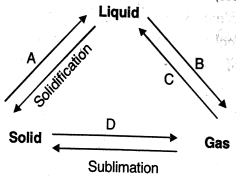
The following triangle exhibits the interconversion of the three states of matter. Complete the triangle by labeling the arrows marked $A, B, C$ and $D$.
Solution
(A) : Fusion (melting) - The process of conversion of a solid into a liquid.
$B$: Vaporisation - The process of conversion of a liquid into a gas.
$C$: Condensation - The process of conversion of a gas into a liquid.
$D$: Sublimation - The process of conversion of a solid directly into a gas.
$B$: Vaporisation - The process of conversion of a liquid into a gas.
$C$: Condensation - The process of conversion of a gas into a liquid.
$D$: Sublimation - The process of conversion of a solid directly into a gas.
0 likes
View Solution76
Medium
$(i)$ Name the $SI$ unit of measuring temperature.
$(ii)$ The boiling point of water is $100^{\circ} C$ under normal atmospheric pressure. Convert this temperature into $SI$ units.
$(ii)$ The boiling point of water is $100^{\circ} C$ under normal atmospheric pressure. Convert this temperature into $SI$ units.
Solution
(N/A) $(i)$ The $SI$ unit of temperature is Kelvin $(K)$.
$(ii)$ The relationship between Celsius and Kelvin scales is given by $T(K) = T(^{\circ}C) + 273.15$. For general calculations,we use $T(K) = T(^{\circ}C) + 273$.
Given,the boiling point of water is $100^{\circ} C$.
Therefore,in $SI$ units: $100 + 273 = 373 \ K$.
$(ii)$ The relationship between Celsius and Kelvin scales is given by $T(K) = T(^{\circ}C) + 273.15$. For general calculations,we use $T(K) = T(^{\circ}C) + 273$.
Given,the boiling point of water is $100^{\circ} C$.
Therefore,in $SI$ units: $100 + 273 = 373 \ K$.
0 likes
View Solution77
Medium
$CO_{2}$ is a gas. Write any two of its gaseous properties to justify this. How can we liquefy this gas? Solid $CO_{2}$ is also known as dry ice. Why?
Solution
(N/A) $CO_{2}$ has neither a fixed volume nor a fixed shape,which is a characteristic property of gases.
It exerts pressure on the walls of its container due to the random collisions of its molecules.
$CO_{2}$ can be liquefied by applying high pressure and lowering the temperature.
Solid $CO_{2}$ is known as dry ice because it undergoes sublimation,meaning it converts directly from a solid state to a gaseous state at atmospheric pressure without passing through the liquid phase.
It exerts pressure on the walls of its container due to the random collisions of its molecules.
$CO_{2}$ can be liquefied by applying high pressure and lowering the temperature.
Solid $CO_{2}$ is known as dry ice because it undergoes sublimation,meaning it converts directly from a solid state to a gaseous state at atmospheric pressure without passing through the liquid phase.
0 likes
View Solution78
Medium
$(a)$ What temperature in Kelvin scale is equal to $50^{\circ} C$?
$(b)$ Describe an activity to show that the rate of evaporation increases with surface area.
$(b)$ Describe an activity to show that the rate of evaporation increases with surface area.
Solution
(A) To convert Celsius to Kelvin,we use the formula: $T(K) = T(^{\circ}C) + 273.15$. Therefore,$50^{\circ}C = 50 + 273.15 = 323.15 K$ (or approximately $323 K$).
$(b)$ Activity: Take two containers,a narrow glass and a wide saucer. Pour an equal amount of water into both. Place them in the same environment for the same duration. After some time,observe the water level. The water level in the saucer will decrease more than in the glass,demonstrating that a larger surface area leads to a higher rate of evaporation.
$(b)$ Activity: Take two containers,a narrow glass and a wide saucer. Pour an equal amount of water into both. Place them in the same environment for the same duration. After some time,observe the water level. The water level in the saucer will decrease more than in the glass,demonstrating that a larger surface area leads to a higher rate of evaporation.
0 likes
View Solution79
Medium
$(a)$ "Evaporation causes cooling." Explain the reason for this effect.
$(b)$ Explain two examples from our daily life where we feel the effect of cooling due to evaporation.
$(b)$ Explain two examples from our daily life where we feel the effect of cooling due to evaporation.
Solution
(N/A) During the process of evaporation, the particles of the liquid absorb energy from the surroundings to overcome the force of attraction and change into the vapor state. This absorption of energy from the surroundings makes the surroundings lose heat, thereby causing a cooling effect.
$(b)$ Two examples from daily life are:
$1.$ Wearing cotton clothes in summer: Cotton is a good absorber of water, which helps in absorbing sweat from our body and exposing it to the atmosphere for easy evaporation. The latent heat of vaporization required for this evaporation is taken from our body surface, making us feel cool.
$2.$ Cooling by desert coolers: The water inside the cooler evaporates, which absorbs heat from the surrounding air, resulting in a decrease in the temperature of the air blown into the room.
$(b)$ Two examples from daily life are:
$1.$ Wearing cotton clothes in summer: Cotton is a good absorber of water, which helps in absorbing sweat from our body and exposing it to the atmosphere for easy evaporation. The latent heat of vaporization required for this evaporation is taken from our body surface, making us feel cool.
$2.$ Cooling by desert coolers: The water inside the cooler evaporates, which absorbs heat from the surrounding air, resulting in a decrease in the temperature of the air blown into the room.
0 likes
View Solution80
Medium
Archit dropped a crystal of potassium permanganate into two beakers $A$ and $B$ containing hot water and cold water respectively. After keeping the beakers undisturbed for some time,what did he observe and why?
Solution
(N/A) Observation: The purple color of potassium permanganate spreads more rapidly throughout the beaker containing hot water $(A)$ compared to the beaker containing cold water $(B)$.
Reason: Diffusion is the movement of particles from a region of higher concentration to a region of lower concentration. The rate of diffusion is directly proportional to temperature. As the temperature of the water increases,the kinetic energy of the water molecules increases,which causes the potassium permanganate particles to move and mix more quickly.
Reason: Diffusion is the movement of particles from a region of higher concentration to a region of lower concentration. The rate of diffusion is directly proportional to temperature. As the temperature of the water increases,the kinetic energy of the water molecules increases,which causes the potassium permanganate particles to move and mix more quickly.
0 likes
View Solution81
Easy
Explain the interconversion of three states of matter in terms of force of attraction and kinetic energy of the molecules.
Solution
(N/A) The interconversion of the three states of matter depends on the balance between the $KE$ (kinetic energy) of the molecules and the intermolecular force of attraction.
$1$. When temperature increases,the $KE$ of the molecules increases,which helps them overcome the intermolecular force of attraction,leading to a change from solid to liquid and liquid to gas.
$2$. Conversely,when temperature decreases,the $KE$ of the molecules decreases,allowing the intermolecular force of attraction to become more effective,which leads to a change from gas to liquid and liquid to solid.
$1$. When temperature increases,the $KE$ of the molecules increases,which helps them overcome the intermolecular force of attraction,leading to a change from solid to liquid and liquid to gas.
$2$. Conversely,when temperature decreases,the $KE$ of the molecules decreases,allowing the intermolecular force of attraction to become more effective,which leads to a change from gas to liquid and liquid to solid.
0 likes
View Solution82
EasyMCQ
Arrange the three states of matter in the increasing order of:
$(i)$ rate of diffusion
$(ii)$ particle motion
$(i)$ rate of diffusion
$(ii)$ particle motion
A
Solid < Liquid < Gas
B
Gas < Liquid < Solid
C
Liquid < Solid < Gas
D
Solid < Gas < Liquid
Solution
(A) $(i)$ Rate of diffusion: The rate of diffusion is lowest in solids, higher in liquids, and highest in gases because particles in gases have the most kinetic energy and freedom of movement.
Order: $\text{Solid} < \text{Liquid} < \text{Gas}$.
$(ii)$ Particle motion: The motion of particles is restricted in solids due to strong intermolecular forces, whereas particles in gases move randomly and rapidly.
Order: $\text{Solid} < \text{Liquid} < \text{Gas}$.
Order: $\text{Solid} < \text{Liquid} < \text{Gas}$.
$(ii)$ Particle motion: The motion of particles is restricted in solids due to strong intermolecular forces, whereas particles in gases move randomly and rapidly.
Order: $\text{Solid} < \text{Liquid} < \text{Gas}$.
0 likes
View Solution83
Easy
List any two properties that liquids have in common with gases.
Solution
(N/A) $(i)$ Both liquids and gases do not have a fixed shape and take the shape of the container in which they are kept.
$(ii)$ Both liquids and gases have the property of fluidity,meaning they can flow easily.
$(ii)$ Both liquids and gases have the property of fluidity,meaning they can flow easily.
0 likes
View Solution84
Medium
$(a)$ Give an example where a change in physical state occurs due to a change in pressure.
$(b)$ State two factors that determine the rate of diffusion of a liquid in another liquid.
$(b)$ State two factors that determine the rate of diffusion of a liquid in another liquid.
Solution
(N/A) Liquefaction of gases,such as the compression of $LPG$ (Liquefied Petroleum Gas) into cylinders.
$(b)$ The two factors determining the rate of diffusion are:
$(i)$ Temperature: The rate of diffusion increases with an increase in temperature because the kinetic energy of the particles increases.
$(ii)$ Concentration/Density: The rate of diffusion decreases as the concentration or density of the liquid increases.
$(b)$ The two factors determining the rate of diffusion are:
$(i)$ Temperature: The rate of diffusion increases with an increase in temperature because the kinetic energy of the particles increases.
$(ii)$ Concentration/Density: The rate of diffusion decreases as the concentration or density of the liquid increases.
0 likes
View Solution85
Medium
Distinguish between the three states of matter with respect to the following properties:
$(a)$ Density
$(b)$ Diffusion
$(c)$ Particle motion
$(a)$ Density
$(b)$ Diffusion
$(c)$ Particle motion
Solution
(N/A) The differences between the three states of matter based on the given properties are summarized in the table below:
| Property | Solid State | Liquid State | Gaseous State |
|---|---|---|---|
| $(a)$ Density | High | Lower than solids | Very low |
| $(b)$ Diffusion | Negligible | Slow | Very fast |
| $(c)$ Particle motion | Vibratory motion only | Random motion within the bulk | Rapid,random motion in all directions |
0 likes
View Solution86
Medium
$(a)$ Define evaporation. Out of nylon and cotton clothes,which will be more comfortable during summer and why?
$(b)$ Are evaporation and boiling the same? If not,then why?
$(b)$ Are evaporation and boiling the same? If not,then why?
Solution
(N/A) Evaporation: The phenomenon of change of a liquid into vapours at any temperature below its boiling point is called evaporation. Cotton is a better absorber of water than nylon. During summer,cotton clothes absorb sweat,which upon evaporation causes cooling of the body.
$(b)$ No,they are not the same. Boiling is a bulk phenomenon that occurs at a specific temperature called the boiling point. In contrast,evaporation is a surface phenomenon that can occur at any temperature below the boiling point.
$(b)$ No,they are not the same. Boiling is a bulk phenomenon that occurs at a specific temperature called the boiling point. In contrast,evaporation is a surface phenomenon that can occur at any temperature below the boiling point.
0 likes
View Solution87
Medium
Name the factors on which evaporation depends.
Solution
(N/A) Evaporation depends upon the following factors:
$(i)$ The surface area of the liquid: Increasing the surface area increases the rate of evaporation.
$(ii)$ The temperature of the liquid: Higher temperatures increase the kinetic energy of particles,leading to faster evaporation.
$(iii)$ Humidity (dryness of the air): Lower humidity allows for faster evaporation as the air can hold more water vapor.
$(iv)$ Wind speed: Increased wind speed removes water vapor particles from the surface,accelerating evaporation.
$(v)$ Nature of the liquid: Liquids with lower boiling points evaporate more quickly.
$(vi)$ Pressure on the surface: Decreasing atmospheric pressure increases the rate of evaporation.
$(i)$ The surface area of the liquid: Increasing the surface area increases the rate of evaporation.
$(ii)$ The temperature of the liquid: Higher temperatures increase the kinetic energy of particles,leading to faster evaporation.
$(iii)$ Humidity (dryness of the air): Lower humidity allows for faster evaporation as the air can hold more water vapor.
$(iv)$ Wind speed: Increased wind speed removes water vapor particles from the surface,accelerating evaporation.
$(v)$ Nature of the liquid: Liquids with lower boiling points evaporate more quickly.
$(vi)$ Pressure on the surface: Decreasing atmospheric pressure increases the rate of evaporation.
0 likes
View Solution88
Medium
$(a)$ Define boiling point.
$(b)$ Express the boiling point of water in Celsius as well as Kelvin scale.
$(c)$ $A$ diver is able to cut through water in a swimming pool. Which property of matter does this observation show?
$(b)$ Express the boiling point of water in Celsius as well as Kelvin scale.
$(c)$ $A$ diver is able to cut through water in a swimming pool. Which property of matter does this observation show?
Solution
(N/A) The temperature at which a liquid starts boiling at atmospheric pressure is called its boiling point.
$(b)$ The boiling point of water is $100^{\circ}C$ on the Celsius scale and $373 K$ on the Kelvin scale.
$(c)$ This observation shows that the particles of matter have spaces between them,which allows the diver to move through the water.
$(b)$ The boiling point of water is $100^{\circ}C$ on the Celsius scale and $373 K$ on the Kelvin scale.
$(c)$ This observation shows that the particles of matter have spaces between them,which allows the diver to move through the water.
0 likes
View Solution89
Difficult
Give reasons:
$(a)$ Steam produces more severe burns than boiling water.
$(b)$ We are able to sip hot tea faster from a saucer rather than a cup.
$(c)$ Water kept in an earthen pot becomes cool during summer.
$(a)$ Steam produces more severe burns than boiling water.
$(b)$ We are able to sip hot tea faster from a saucer rather than a cup.
$(c)$ Water kept in an earthen pot becomes cool during summer.
Solution
(N/A) Steam at $373 K$ $(100^{\circ} C)$ contains more energy than boiling water at the same temperature because it possesses additional latent heat of vaporisation.
$(b)$ $A$ saucer has a larger surface area than a cup. Since evaporation is a surface phenomenon,a larger surface area increases the rate of evaporation,leading to faster cooling of the tea.
$(c)$ An earthen pot has numerous microscopic pores. Water continuously evaporates through these pores. The energy required for this evaporation is absorbed from the remaining water inside the pot,causing the water to cool down.
$(b)$ $A$ saucer has a larger surface area than a cup. Since evaporation is a surface phenomenon,a larger surface area increases the rate of evaporation,leading to faster cooling of the tea.
$(c)$ An earthen pot has numerous microscopic pores. Water continuously evaporates through these pores. The energy required for this evaporation is absorbed from the remaining water inside the pot,causing the water to cool down.
0 likes
View Solution90
Difficult
Give reasons for the following:
$(a)$ Water droplets appear on the outer surface of a tumbler containing ice-cold water.
$(b)$ People prefer to wear cotton clothes in summer.
$(c)$ On a hot sunny day,people sprinkle water on the roof or open ground.
$(a)$ Water droplets appear on the outer surface of a tumbler containing ice-cold water.
$(b)$ People prefer to wear cotton clothes in summer.
$(c)$ On a hot sunny day,people sprinkle water on the roof or open ground.
Solution
(N/A) The water vapour present in the air,upon coming in contact with the cold surface of the glass tumbler,loses energy,gets condensed,and converts into liquid water droplets.
$(b)$ Cotton is a good absorber of water. It absorbs sweat from our body and exposes it to the atmosphere for easy evaporation. This process of evaporation causes a cooling effect on our skin.
$(c)$ The sprinkled water evaporates by absorbing a large amount of latent heat of vaporisation from the roof or open ground and the surrounding air,which results in the cooling of the area.
$(b)$ Cotton is a good absorber of water. It absorbs sweat from our body and exposes it to the atmosphere for easy evaporation. This process of evaporation causes a cooling effect on our skin.
$(c)$ The sprinkled water evaporates by absorbing a large amount of latent heat of vaporisation from the roof or open ground and the surrounding air,which results in the cooling of the area.
0 likes
View Solution91
Difficult
Give reasons for the following:
$(i)$ $A$ liquid generally flows easily.
$(ii)$ Ice at $0^{\circ} C$ appears colder to the mouth than water at $0^{\circ} C$. Why?
$(iii)$ Doctors advise putting strips of wet cloth on the forehead of a person having a high temperature.
$(i)$ $A$ liquid generally flows easily.
$(ii)$ Ice at $0^{\circ} C$ appears colder to the mouth than water at $0^{\circ} C$. Why?
$(iii)$ Doctors advise putting strips of wet cloth on the forehead of a person having a high temperature.
Solution
(N/A) $(i)$ Liquid molecules are able to slide over one another due to slightly weaker intermolecular forces of attraction compared to solids,allowing them to flow.
$(ii)$ This is due to the latent heat of fusion. Ice at $0^{\circ} C$ absorbs additional heat energy from the mouth to change its state into water at $0^{\circ} C$. Therefore,it feels colder than water at the same temperature.
$(iii)$ Water,while evaporating,absorbs the necessary latent heat of vaporization from the patient's body,which helps in lowering the body temperature.
$(ii)$ This is due to the latent heat of fusion. Ice at $0^{\circ} C$ absorbs additional heat energy from the mouth to change its state into water at $0^{\circ} C$. Therefore,it feels colder than water at the same temperature.
$(iii)$ Water,while evaporating,absorbs the necessary latent heat of vaporization from the patient's body,which helps in lowering the body temperature.
0 likes
View Solution92
Medium
Explain the following:
$(i)$ Gases exert pressure on the walls of the container.
$(ii)$ Water is liquid at room temperature.
$(iii)$ Evaporation causes cooling.
$(i)$ Gases exert pressure on the walls of the container.
$(ii)$ Water is liquid at room temperature.
$(iii)$ Evaporation causes cooling.
Solution
(N/A) $(i)$ Gas particles move randomly at high speeds and collide with the walls of the container,exerting force per unit area,which is perceived as pressure.
$(ii)$ Water is a liquid at room temperature because its melting point is below room temperature $(0 \ ^\circ C)$ and its boiling point is above room temperature $(100 \ ^\circ C)$.
$(iii)$ During evaporation,particles of the liquid absorb energy from the surroundings to overcome the forces of attraction and change into the vapor state. This loss of energy from the surroundings results in a cooling effect.
$(ii)$ Water is a liquid at room temperature because its melting point is below room temperature $(0 \ ^\circ C)$ and its boiling point is above room temperature $(100 \ ^\circ C)$.
$(iii)$ During evaporation,particles of the liquid absorb energy from the surroundings to overcome the forces of attraction and change into the vapor state. This loss of energy from the surroundings results in a cooling effect.
0 likes
View Solution93
Medium
How do the following factors affect the rate of evaporation of a liquid?
$(a)$ Surface area
$(b)$ Temperature
$(c)$ Humidity
$(a)$ Surface area
$(b)$ Temperature
$(c)$ Humidity
Solution
(N/A) Surface area: As the surface area increases,more particles are exposed to the surface,leading to a higher rate of evaporation.
$(b)$ Temperature: With an increase in temperature,the kinetic energy of the liquid particles increases,allowing more particles to escape into the vapor state,thus increasing the rate of evaporation.
$(c)$ Humidity: Humidity refers to the amount of water vapor present in the air. As humidity increases,the air becomes saturated,which decreases the rate of evaporation.
$(b)$ Temperature: With an increase in temperature,the kinetic energy of the liquid particles increases,allowing more particles to escape into the vapor state,thus increasing the rate of evaporation.
$(c)$ Humidity: Humidity refers to the amount of water vapor present in the air. As humidity increases,the air becomes saturated,which decreases the rate of evaporation.
0 likes
View Solution94
Medium
Carbon dioxide was taken in an enclosed cylinder and compressed by applying pressure.
$(a)$ Which state of matter will we obtain after completion of the process?
$(b)$ Name and define this process.
$(c)$ What is the common name of the product obtained in the above process?
$(a)$ Which state of matter will we obtain after completion of the process?
$(b)$ Name and define this process.
$(c)$ What is the common name of the product obtained in the above process?
Solution
(N/A) The state of matter obtained is solid.
$(b)$ The process is called sublimation. Sublimation is defined as the phase transition in which a substance changes directly from a solid state to a gaseous state or vice-versa without passing through the liquid state.
$(c)$ The common name of the product obtained is dry ice.
$(b)$ The process is called sublimation. Sublimation is defined as the phase transition in which a substance changes directly from a solid state to a gaseous state or vice-versa without passing through the liquid state.
$(c)$ The common name of the product obtained is dry ice.
0 likes
View Solution95
Medium
$(a)$ Enumerate the changes that take place inside the matter during the change of states.
$(b)$ When a solid melts,its temperature remains the same. Give reason.
$(b)$ When a solid melts,its temperature remains the same. Give reason.
Solution
(N/A) During a change of state,the heat energy supplied increases the kinetic energy $(KE)$ of the particles,which helps them overcome the intermolecular forces of attraction. This leads to a change in the arrangement of particles,causing the matter to transition from one state to another (e.g.,solid to liquid).
$(b)$ When a solid melts,the temperature remains constant because the heat energy supplied is entirely consumed as latent heat of fusion. This energy is used to overcome the strong intermolecular forces of attraction holding the solid particles together,rather than increasing the kinetic energy of the particles.
$(b)$ When a solid melts,the temperature remains constant because the heat energy supplied is entirely consumed as latent heat of fusion. This energy is used to overcome the strong intermolecular forces of attraction holding the solid particles together,rather than increasing the kinetic energy of the particles.
0 likes
View Solution96
Difficult
$(a)$ Define matter and write its three states.
$(b)$ Explain how these states of matter arise due to variation in the characteristics of the particles.
$(b)$ Explain how these states of matter arise due to variation in the characteristics of the particles.
Solution
(N/A) Anything which has mass and occupies space is called matter.
Three states are: Solid,liquid,and gaseous.
$(b)$ These states arise due to variation in the characteristics of the particles,specifically:
$(i)$ Interparticle space: The distance between particles is minimum in solids,more in liquids,and maximum in gases.
$(ii)$ Interparticle force of attraction: The force is strongest in solids,moderate in liquids,and weakest in gases.
$(iii)$ Kinetic energy of the particles: The kinetic energy is minimum in solids and maximum in gases,which influences the movement of particles.
Three states are: Solid,liquid,and gaseous.
$(b)$ These states arise due to variation in the characteristics of the particles,specifically:
$(i)$ Interparticle space: The distance between particles is minimum in solids,more in liquids,and maximum in gases.
$(ii)$ Interparticle force of attraction: The force is strongest in solids,moderate in liquids,and weakest in gases.
$(iii)$ Kinetic energy of the particles: The kinetic energy is minimum in solids and maximum in gases,which influences the movement of particles.
0 likes
View Solution97
Difficult
Distinguish between solids,liquids,and gases in tabular form under the following characteristics:
$(a)$ Interparticle force of attraction
$(b)$ Diffusion
$(c)$ Fluidity.
$(a)$ Interparticle force of attraction
$(b)$ Diffusion
$(c)$ Fluidity.
Solution
(N/A)
| Characteristics | Solid | Liquid | Gas |
|---|---|---|---|
| $(a)$ Interparticle force of attraction | Maximum | Moderate | Least |
| $(b)$ Diffusion | Cannot diffuse | Can diffuse to some extent | Can easily diffuse |
| $(c)$ Fluidity | Rigid (no fluidity) | Can flow (less than gases) | Can easily flow (maximum) |
0 likes
View Solution98
Difficult
$(a)$ How do solids, liquids, and gases exhibit the following properties?
$(i)$ Rigidity
$(ii)$ Diffusion
$(iii)$ Compressibility
Arrange them in ascending order.
$(b)$ Explain the following terms:
$(i)$ Expansion of gas
$(ii)$ Compressibility of gas
$(i)$ Rigidity
$(ii)$ Diffusion
$(iii)$ Compressibility
Arrange them in ascending order.
$(b)$ Explain the following terms:
$(i)$ Expansion of gas
$(ii)$ Compressibility of gas
Solution
$(A-D)$ $(i)$ Rigidity: $Gas < Liquid < Solid$
$(ii)$ Diffusion: $Solid < Liquid < Gas$
$(iii)$ Compressibility: $Solid < Liquid < Gas$
$(b)$ $(i)$ Expansion of gas: Gases expand upon heating because the kinetic energy of the particles increases, which overcomes the interparticle forces of attraction. This allows gas molecules to move randomly in all directions and exert pressure on the walls of the container.
$(ii)$ Compressibility of gas: Gases have very weak interparticle forces of attraction and large intermolecular spaces. Therefore, when external pressure is applied, the gas particles are forced closer together, significantly reducing the volume and potentially leading to liquefaction.
$(ii)$ Diffusion: $Solid < Liquid < Gas$
$(iii)$ Compressibility: $Solid < Liquid < Gas$
$(b)$ $(i)$ Expansion of gas: Gases expand upon heating because the kinetic energy of the particles increases, which overcomes the interparticle forces of attraction. This allows gas molecules to move randomly in all directions and exert pressure on the walls of the container.
$(ii)$ Compressibility of gas: Gases have very weak interparticle forces of attraction and large intermolecular spaces. Therefore, when external pressure is applied, the gas particles are forced closer together, significantly reducing the volume and potentially leading to liquefaction.
0 likes
View Solution99
MediumMCQ
$(a)$ What is matter? Write two properties of solids and two properties of liquids.
$(b)$ Ramesh took two beakers $A$ and $B$ containing hot water and cold water respectively. In each beaker,he dropped a crystal of copper sulphate. He kept the beakers undisturbed. After some time,what did he observe? Why?
$(b)$ Ramesh took two beakers $A$ and $B$ containing hot water and cold water respectively. In each beaker,he dropped a crystal of copper sulphate. He kept the beakers undisturbed. After some time,what did he observe? Why?
A
$(a)$ What is matter? Write two properties of solids and two properties of liquids.
B
$(b)$ Ramesh took two beakers $A$ and $B$ containing hot water and cold water respectively. In each beaker,he dropped a crystal of copper sulphate. He kept the beakers undisturbed. After some time,what did he observe? Why?
Solution
(N/A) Matter is anything that has mass,occupies space,and has volume.
Properties of solids: $(1)$ They have a definite shape and distinct boundaries. $(2)$ They have a fixed volume and negligible compressibility.
Properties of liquids: $(1)$ They do not have a fixed shape but take the shape of the container. $(2)$ They have a definite volume and can flow (fluidity).
$(b)$ Observation: The water in beaker $A$ (hot water) becomes coloured faster than the water in beaker $B$ (cold water).
Reason: Diffusion is the movement of particles from a region of higher concentration to a region of lower concentration. At higher temperatures,the kinetic energy of the water particles increases,which causes the particles of copper sulphate to diffuse more rapidly throughout the water.
Properties of solids: $(1)$ They have a definite shape and distinct boundaries. $(2)$ They have a fixed volume and negligible compressibility.
Properties of liquids: $(1)$ They do not have a fixed shape but take the shape of the container. $(2)$ They have a definite volume and can flow (fluidity).
$(b)$ Observation: The water in beaker $A$ (hot water) becomes coloured faster than the water in beaker $B$ (cold water).
Reason: Diffusion is the movement of particles from a region of higher concentration to a region of lower concentration. At higher temperatures,the kinetic energy of the water particles increases,which causes the particles of copper sulphate to diffuse more rapidly throughout the water.
0 likes
View Solution100
Difficult
Define the melting point of a solid. At what temperature in the Kelvin scale does ice melt? In the experiment to determine the melting point of ice,why does the temperature not rise until all the ice melts,even though heat is continuously supplied? What is this heat energy called?
Solution
(N/A) The temperature at which a solid melts to become a liquid at atmospheric pressure is called its melting point.
$(b)$ Ice melts at $273.16 K$ (or $273 K$).
$(c)$ The temperature does not rise because the heat supplied is used up in changing the state of the substance by overcoming the forces of attraction between the particles.
$(d)$ This heat energy is known as the latent heat of fusion.
$(b)$ Ice melts at $273.16 K$ (or $273 K$).
$(c)$ The temperature does not rise because the heat supplied is used up in changing the state of the substance by overcoming the forces of attraction between the particles.
$(d)$ This heat energy is known as the latent heat of fusion.
0 likes
View SolutionMATTER IN OUR SURROUNDINGS — Mix Example - MATTER IN OUR SURROUNDINGS · Frequently Asked Questions
1Are these MATTER IN OUR SURROUNDINGS questions useful for JEE and NEET?
Yes. All questions in this section are mapped to JEE Main and NEET exam patterns. Previous year questions from JEE Main, NEET, GUJCET and state-level exams are included with full solutions.
2Can I switch to Hindi or Gujarati for these questions?
Yes. Use the language tabs in the hero section or the sidebar to view the same questions and solutions in English, Hindi or Gujarati.
3How do I generate a question paper from this subtopic?
Use the Vedclass Exam Paper Generator — select the chapter and subtopic, set difficulty, and generate Sets A, B, C, D automatically. First 3 chapters of every subject are free.
Vedclass Products
For Students
Vedclass Test Series
Mock tests in real JEE/NEET style with performance analysis. 5-day free trial.
Start Free TrialFor Teachers
Exam Paper Generator
Generate Set A/B/C/D papers from this chapter in 2 minutes. 3 chapters free.
Try FreeFor Institutes
Online Exam Module
Live online exams with unlimited students, 360° analytics & white-label branding.
See DemoFor Teachers & Institutes
Generate a MATTER IN OUR SURROUNDINGS Exam Paper in 2 Minutes
Select subtopic & difficulty — Sets A, B, C, D auto-generated with No Repeat logic.
First 3 chapters of every subject are free — no payment required.