
A English
Textbook - GRAVITATION Questions in English
Class 9 Science · GRAVITATION · Textbook - GRAVITATION
33+
Questions
English
Language
100%
With Solutions
Showing 33 of 33 questions in English
1
Medium
State the universal law of gravitation.
Solution
(N/A) The universal law of gravitation states that every object in the universe attracts every other object with a force called the gravitational force.
The force acting between two objects is directly proportional to the product of their masses and inversely proportional to the square of the distance between their centers.
For two objects of masses $m_1$ and $m_2$ and the distance between them $r$,the force $(F)$ of attraction acting between them is given by the universal law of gravitation as:
$F = \frac{G m_1 m_2}{r^2}$
Where,$G$ is the universal gravitation constant and its value is $6.67 \times 10^{-11} \text{ Nm}^2 \text{ kg}^{-2}$.
The force acting between two objects is directly proportional to the product of their masses and inversely proportional to the square of the distance between their centers.
For two objects of masses $m_1$ and $m_2$ and the distance between them $r$,the force $(F)$ of attraction acting between them is given by the universal law of gravitation as:
$F = \frac{G m_1 m_2}{r^2}$
Where,$G$ is the universal gravitation constant and its value is $6.67 \times 10^{-11} \text{ Nm}^2 \text{ kg}^{-2}$.
0 likes
View Solution2
Easy
Write the formula to find the magnitude of the gravitational force between the Earth and an object on the surface of the Earth.
Solution
(N/A) Let $M_E$ be the mass of the Earth and $m$ be the mass of an object on its surface. If $R$ is the radius of the Earth,then according to the universal law of gravitation,the gravitational force $(F)$ acting between the Earth and the object is given by the relation:
$F = \frac{G M_E m}{R^2}$
Where:
$G$ is the universal gravitational constant,
$M_E$ is the mass of the Earth,
$m$ is the mass of the object,
$R$ is the distance between the center of the Earth and the object (which is equal to the radius of the Earth).
$F = \frac{G M_E m}{R^2}$
Where:
$G$ is the universal gravitational constant,
$M_E$ is the mass of the Earth,
$m$ is the mass of the object,
$R$ is the distance between the center of the Earth and the object (which is equal to the radius of the Earth).
0 likes
View Solution3
Easy
What do you mean by free fall?
Solution
(N/A) The gravity of the Earth attracts every object towards its centre. When an object is released from a height,it falls towards the surface of the Earth solely under the influence of gravitational force. This motion of the object is known as free fall.
0 likes
View Solution4
Easy
What do you mean by acceleration due to gravity?
Solution
(N/A) When an object falls towards the ground from a height,its velocity changes during the fall. This change in velocity produces acceleration in the object. This acceleration is known as acceleration due to gravity,denoted by $g$. Its standard value on the surface of the Earth is approximately $9.8 \, m/s^2$.
0 likes
View Solution5
Medium
What are the differences between the mass of an object and its weight?
Solution
(N/A)
| $S.No.$ | Mass vs Weight |
|---|---|
| $I.$ | Mass is the quantity of matter contained in the body; Weight is the force of gravity acting on the body. |
| $II.$ | Mass is the measure of inertia of the body; Weight is the measure of gravity. |
| $III.$ | Mass is a constant quantity; Weight is not constant and varies at different places. |
| $IV.$ | Mass is a scalar quantity (only magnitude); Weight is a vector quantity (magnitude and direction). |
| $V.$ | The $SI$ unit of mass is kilogram $(kg)$; The $SI$ unit of weight is Newton $(N)$. |
0 likes
View Solution6
Medium
Why is the weight of an object on the moon $\frac{1}{6}^{th}$ its weight on the Earth?
Solution
(N/A) Let $M_E$ be the mass of the Earth and $m$ be the mass of an object on the surface of the Earth. Let $R_E$ be the radius of the Earth. According to the universal law of gravitation,the weight $W_E$ of the object on the surface of the Earth is given by:
$W_E = \frac{G M_E m}{R_E^2}$
Let $M_M$ and $R_M$ be the mass and radius of the moon,respectively. Then,according to the universal law of gravitation,the weight $W_M$ of the object on the surface of the moon is given by:
$W_M = \frac{G M_M m}{R_M^2}$
Now,taking the ratio of the two weights:
$\frac{W_M}{W_E} = \frac{M_M R_E^2}{M_E R_M^2}$
Given values:
$M_E = 5.98 \times 10^{24} \text{ kg}$
$M_M = 7.36 \times 10^{22} \text{ kg}$
$R_E = 6.4 \times 10^6 \text{ m}$
$R_M = 1.74 \times 10^6 \text{ m}$
Substituting these values:
$\frac{W_M}{W_E} = \frac{7.36 \times 10^{22} \times (6.4 \times 10^6)^2}{5.98 \times 10^{24} \times (1.74 \times 10^6)^2} \approx 0.165 \approx \frac{1}{6}$
Therefore,the weight of an object on the moon is $\frac{1}{6}^{th}$ of its weight on the Earth.
$W_E = \frac{G M_E m}{R_E^2}$
Let $M_M$ and $R_M$ be the mass and radius of the moon,respectively. Then,according to the universal law of gravitation,the weight $W_M$ of the object on the surface of the moon is given by:
$W_M = \frac{G M_M m}{R_M^2}$
Now,taking the ratio of the two weights:
$\frac{W_M}{W_E} = \frac{M_M R_E^2}{M_E R_M^2}$
Given values:
$M_E = 5.98 \times 10^{24} \text{ kg}$
$M_M = 7.36 \times 10^{22} \text{ kg}$
$R_E = 6.4 \times 10^6 \text{ m}$
$R_M = 1.74 \times 10^6 \text{ m}$
Substituting these values:
$\frac{W_M}{W_E} = \frac{7.36 \times 10^{22} \times (6.4 \times 10^6)^2}{5.98 \times 10^{24} \times (1.74 \times 10^6)^2} \approx 0.165 \approx \frac{1}{6}$
Therefore,the weight of an object on the moon is $\frac{1}{6}^{th}$ of its weight on the Earth.
0 likes
View Solution7
MediumMCQ
Why is it difficult to hold a school bag having a strap made of a thin and strong string?
A
The force applied is high.
B
The pressure exerted is high due to the small surface area.
C
The weight of the bag increases.
D
The friction is reduced.
Solution
(B) It is difficult to hold a school bag with a thin strap because the pressure exerted on the shoulders is very high.
Pressure is defined as force per unit area,given by the formula $P = F/A$.
Since pressure is inversely proportional to the surface area $(A)$ on which the force $(F)$ acts,a smaller surface area results in a higher pressure.
In the case of a thin strap,the contact surface area is very small,which leads to a significantly larger pressure on the shoulder,causing pain and discomfort.
Pressure is defined as force per unit area,given by the formula $P = F/A$.
Since pressure is inversely proportional to the surface area $(A)$ on which the force $(F)$ acts,a smaller surface area results in a higher pressure.
In the case of a thin strap,the contact surface area is very small,which leads to a significantly larger pressure on the shoulder,causing pain and discomfort.
0 likes
View Solution8
EasyMCQ
What do you mean by buoyancy?
A
The downward force exerted by a liquid on an object.
B
The upward force exerted by a liquid on an object immersed in it.
C
The force of gravity acting on an object.
D
The pressure exerted by a liquid on the walls of a container.
Solution
(B) The upward force exerted by a liquid on an object immersed in it is known as buoyancy.
When an object is immersed in a fluid,the fluid exerts an upward force on the object.
This force is called the buoyant force or upthrust.
As the object is pushed deeper into the liquid,the volume of the displaced liquid increases,which leads to an increase in the buoyant force.
When an object is immersed in a fluid,the fluid exerts an upward force on the object.
This force is called the buoyant force or upthrust.
As the object is pushed deeper into the liquid,the volume of the displaced liquid increases,which leads to an increase in the buoyant force.
0 likes
View Solution9
MediumMCQ
Why does an object float or sink when placed on the surface of water?
A
Due to the difference in mass.
B
Due to the difference in volume.
C
Due to the difference in density between the object and the liquid.
D
Due to the shape of the object.
Solution
(C) Whether an object floats or sinks depends on the relative density of the object compared to the liquid.
If the density of an object is greater than the density of the liquid,the weight of the object (force of gravity) exceeds the buoyant force,causing it to sink.
Conversely,if the density of the object is less than the density of the liquid,the buoyant force acting on the object is greater than the force of gravity,causing it to float on the surface.
If the density of an object is greater than the density of the liquid,the weight of the object (force of gravity) exceeds the buoyant force,causing it to sink.
Conversely,if the density of the object is less than the density of the liquid,the buoyant force acting on the object is greater than the force of gravity,causing it to float on the surface.
0 likes
View Solution10
EasyMCQ
You find your mass to be $42\, kg$ on a weighing machine. Is your mass more or less than $42\, kg$?
A
More
B
Less
C
Equal
D
Cannot be determined
Solution
(A) When you stand on a weighing machine,the machine measures the normal force exerted by your body on it.
Due to the presence of air,a buoyant force acts on your body in the upward direction.
This buoyant force reduces the net downward force exerted by your body on the weighing machine.
Therefore,the reading shown by the weighing machine is slightly less than your actual mass.
Thus,your actual mass is more than $42\, kg$.
Due to the presence of air,a buoyant force acts on your body in the upward direction.
This buoyant force reduces the net downward force exerted by your body on the weighing machine.
Therefore,the reading shown by the weighing machine is slightly less than your actual mass.
Thus,your actual mass is more than $42\, kg$.
0 likes
View Solution11
Medium
You have a bag of cotton and an iron bar,each indicating a mass of $100\, kg$ when measured on a weighing machine. In reality,one is heavier than the other. Can you say which one is heavier and why?
Solution
(A) The bag of cotton is heavier than the iron bar.
This is because the volume of the cotton bag is much larger than that of the iron bar.
According to Archimedes' principle,an object immersed in a fluid (air) experiences an upward buoyant force equal to the weight of the fluid displaced.
Since the cotton bag occupies more space,it displaces a larger volume of air,resulting in a greater buoyant force acting on it compared to the iron bar.
This buoyant force reduces the apparent weight of the cotton bag on the weighing machine.
Therefore,for the weighing machine to show $100\, kg$ for both,the actual mass of the cotton bag must be greater than that of the iron bar to compensate for the higher buoyant force.
This is because the volume of the cotton bag is much larger than that of the iron bar.
According to Archimedes' principle,an object immersed in a fluid (air) experiences an upward buoyant force equal to the weight of the fluid displaced.
Since the cotton bag occupies more space,it displaces a larger volume of air,resulting in a greater buoyant force acting on it compared to the iron bar.
This buoyant force reduces the apparent weight of the cotton bag on the weighing machine.
Therefore,for the weighing machine to show $100\, kg$ for both,the actual mass of the cotton bag must be greater than that of the iron bar to compensate for the higher buoyant force.
0 likes
View Solution12
MediumMCQ
How does the gravitational force $(F)$ between two objects change when the distance between them is reduced to half?
A
$F'=F$
B
$F'=0.5F$
C
$F'=2F$
D
$F'=4F$
Solution
(D) According to the universal law of gravitation,the gravitational force $(F)$ acting between two objects is inversely proportional to the square of the distance $(r)$ between them,i.e.,
$F = G \frac{m_{1} m_{2}}{r^{2}}$
If the distance $r$ is reduced to $r/2$,the new gravitational force $(F')$ will be:
$F' = G \frac{m_{1} m_{2}}{(r/2)^{2}}$
$F' = G \frac{m_{1} m_{2}}{r^{2}/4}$
$F' = 4 \times (G \frac{m_{1} m_{2}}{r^{2}})$
$F' = 4F$
Therefore,if the distance is reduced to half,the gravitational force becomes four times the original value.
$F = G \frac{m_{1} m_{2}}{r^{2}}$
If the distance $r$ is reduced to $r/2$,the new gravitational force $(F')$ will be:
$F' = G \frac{m_{1} m_{2}}{(r/2)^{2}}$
$F' = G \frac{m_{1} m_{2}}{r^{2}/4}$
$F' = 4 \times (G \frac{m_{1} m_{2}}{r^{2}})$
$F' = 4F$
Therefore,if the distance is reduced to half,the gravitational force becomes four times the original value.
0 likes
View Solution13
EasyMCQ
Gravitational force acts on all objects in proportion to their masses. Why then,a heavy object does not fall faster than a light object?
A
The gravitational force is zero for light objects.
B
The acceleration due to gravity is independent of the mass of the falling object.
C
Heavy objects experience less gravitational force.
D
Air resistance is higher for heavy objects.
Solution
(B) According to Newton's second law of motion,$F = ma$. The gravitational force acting on an object is $F = G \frac{Mm}{r^2}$. Equating these,$ma = G \frac{Mm}{r^2}$,which simplifies to $a = G \frac{M}{r^2}$. Here,$a$ is the acceleration due to gravity $(g)$,$G$ is the gravitational constant,$M$ is the mass of the Earth,and $r$ is the distance from the center of the Earth. Since $g$ depends only on the mass of the Earth and the distance from its center,it is independent of the mass of the falling object $(m)$. Therefore,in the absence of air resistance,all objects fall with the same acceleration,and heavy objects do not fall faster than light objects.
0 likes
View Solution14
MediumMCQ
What is the magnitude of the gravitational force between the earth and a $1 \,kg$ object on its surface (in $,N$)? (Mass of the earth is $6 \times 10^{24} \,kg$ and radius of the earth is $6.4 \times 10^6 \,m$.)
A
$8.9$
B
$9.8$
C
$5.3$
D
$2.3$
Solution
(B) According to the universal law of gravitation,the gravitational force $F$ exerted on an object of mass $m$ is given by the formula:
$F = \frac{G M m}{r^2}$
Where:
Mass of Earth,$M = 6 \times 10^{24} \,kg$
Mass of object,$m = 1 \,kg$
Universal gravitational constant,$G = 6.67 \times 10^{-11} \,Nm^2 \,kg^{-2}$
Radius of the Earth,$r = R = 6.4 \times 10^6 \,m$
Substituting the values into the formula:
$F = \frac{6.67 \times 10^{-11} \times 6 \times 10^{24} \times 1}{(6.4 \times 10^6)^2}$
$F = \frac{40.02 \times 10^{13}}{40.96 \times 10^{12}}$
$F \approx 9.8 \,N$
Thus,the magnitude of the gravitational force is approximately $9.8 \,N$.
$F = \frac{G M m}{r^2}$
Where:
Mass of Earth,$M = 6 \times 10^{24} \,kg$
Mass of object,$m = 1 \,kg$
Universal gravitational constant,$G = 6.67 \times 10^{-11} \,Nm^2 \,kg^{-2}$
Radius of the Earth,$r = R = 6.4 \times 10^6 \,m$
Substituting the values into the formula:
$F = \frac{6.67 \times 10^{-11} \times 6 \times 10^{24} \times 1}{(6.4 \times 10^6)^2}$
$F = \frac{40.02 \times 10^{13}}{40.96 \times 10^{12}}$
$F \approx 9.8 \,N$
Thus,the magnitude of the gravitational force is approximately $9.8 \,N$.
0 likes
View Solution15
Easy
The earth and the moon are attracted to each other by gravitational force. Does the earth attract the moon with a force that is greater or smaller or the same as the force with which the moon attracts the earth? Why?
Solution
(C) According to Newton's universal law of gravitation,every object in the universe attracts every other object with a force that is directly proportional to the product of their masses and inversely proportional to the square of the distance between them. This force is mutual. Therefore,the Earth attracts the moon with a force that is exactly the same as the force with which the moon attracts the Earth. This is in accordance with Newton's third law of motion,which states that for every action,there is an equal and opposite reaction.
0 likes
View Solution16
Easy
If the moon attracts the earth,why does the earth not move towards the moon?
Solution
(N/A) According to Newton's third law of motion,the Earth and the moon exert equal and opposite gravitational forces on each other.
However,according to Newton's second law of motion,$F = ma$,the acceleration produced in a body is inversely proportional to its mass $(a = F/m)$.
The mass of the Earth is significantly larger than the mass of the moon.
Due to this massive difference in mass,the acceleration produced in the Earth is negligible compared to the acceleration produced in the moon.
Therefore,the Earth does not show any observable movement towards the moon.
However,according to Newton's second law of motion,$F = ma$,the acceleration produced in a body is inversely proportional to its mass $(a = F/m)$.
The mass of the Earth is significantly larger than the mass of the moon.
Due to this massive difference in mass,the acceleration produced in the Earth is negligible compared to the acceleration produced in the moon.
Therefore,the Earth does not show any observable movement towards the moon.
0 likes
View Solution17
Medium
What happens to the force between two objects,if
$(i)$ the mass of one object is doubled?
$(ii)$ the distance between the objects is doubled and tripled?
$(iii)$ the masses of both objects are doubled?
$(i)$ the mass of one object is doubled?
$(ii)$ the distance between the objects is doubled and tripled?
$(iii)$ the masses of both objects are doubled?
Solution
(N/A) According to the universal law of gravitation,the force of gravitation between two objects is given by $F = \frac{G M m}{r^{2}}$.
$(i)$ $F$ is directly proportional to the masses of the objects. If the mass of one object is doubled,then the gravitational force will also get doubled.
$(ii)$ $F$ is inversely proportional to the square of the distance between the objects. If the distance is doubled,the gravitational force becomes one-fourth of its original value. Similarly,if the distance is tripled,the gravitational force becomes one-ninth of its original value.
$(iii)$ $F$ is directly proportional to the product of the masses of the objects. If the masses of both objects are doubled,the new force $F' = \frac{G(2M)(2m)}{r^{2}} = 4 \times \frac{G M m}{r^{2}} = 4F$. Thus,the gravitational force becomes four times the original value.
$(i)$ $F$ is directly proportional to the masses of the objects. If the mass of one object is doubled,then the gravitational force will also get doubled.
$(ii)$ $F$ is inversely proportional to the square of the distance between the objects. If the distance is doubled,the gravitational force becomes one-fourth of its original value. Similarly,if the distance is tripled,the gravitational force becomes one-ninth of its original value.
$(iii)$ $F$ is directly proportional to the product of the masses of the objects. If the masses of both objects are doubled,the new force $F' = \frac{G(2M)(2m)}{r^{2}} = 4 \times \frac{G M m}{r^{2}} = 4F$. Thus,the gravitational force becomes four times the original value.
0 likes
View Solution18
EasyMCQ
What is the importance of the universal law of gravitation?
A
It binds us to the Earth.
B
It is responsible for the motion of the Moon around the Earth.
C
It is responsible for the motion of planets around the Sun and the occurrence of tides due to the Moon and the Sun.
D
All of the above.
Solution
(D) The universal law of gravitation is significant because:
$1$. It binds us to the Earth.
$2$. It is responsible for the motion of the Moon around the Earth.
$3$. It is responsible for the motion of planets around the Sun.
$4$. It causes the occurrence of tides due to the Moon and the Sun.
$1$. It binds us to the Earth.
$2$. It is responsible for the motion of the Moon around the Earth.
$3$. It is responsible for the motion of planets around the Sun.
$4$. It causes the occurrence of tides due to the Moon and the Sun.
0 likes
View Solution19
EasyMCQ
What is the acceleration of free fall?
A
$9.8$ m/s²
B
$8.9$ m/s²
C
$9.8$ km/s²
D
$0$ m/s²
Solution
(A) When objects fall towards the Earth under the effect of gravitational force alone,they are said to be in free fall.
The acceleration produced in an object due to the Earth's gravitational force is known as the acceleration due to gravity or acceleration of free fall.
Its value is approximately $9.8\, ms^{-2}$,which is constant for all objects regardless of their mass.
The acceleration produced in an object due to the Earth's gravitational force is known as the acceleration due to gravity or acceleration of free fall.
Its value is approximately $9.8\, ms^{-2}$,which is constant for all objects regardless of their mass.
0 likes
View Solution20
EasyMCQ
What do we call the gravitational force between the earth and an object?
A
Mass
B
Weight
C
Acceleration
D
Density
Solution
(B) The gravitational force exerted by the earth on an object is defined as the weight of that object.
It is calculated by the formula $W = m \times g$,where $m$ is the mass of the object and $g$ is the acceleration due to gravity.
It is calculated by the formula $W = m \times g$,where $m$ is the mass of the object and $g$ is the acceleration due to gravity.
0 likes
View Solution21
Easy
Amit buys a few grams of gold at the poles as per the instruction of one of his friends. He hands over the same when he meets him at the equator. Will the friend agree with the weight of gold bought? If not,why? [Hint: The value of $g$ is greater at the poles than at the equator.]
Solution
(B) The weight of a body on the Earth is given by the formula $W = mg$.
Where:
$m$ = Mass of the body.
$g$ = Acceleration due to gravity.
The value of $g$ is greater at the poles than at the equator because the Earth is flattened at the poles and bulges at the equator.
Since $W = mg$,the weight of the same mass of gold will be greater at the poles and less at the equator.
Therefore,Amit's friend will not agree with the weight of the gold bought because the weight of the gold decreases when moved from the poles to the equator.
Where:
$m$ = Mass of the body.
$g$ = Acceleration due to gravity.
The value of $g$ is greater at the poles than at the equator because the Earth is flattened at the poles and bulges at the equator.
Since $W = mg$,the weight of the same mass of gold will be greater at the poles and less at the equator.
Therefore,Amit's friend will not agree with the weight of the gold bought because the weight of the gold decreases when moved from the poles to the equator.
0 likes
View Solution22
EasyMCQ
Why will a sheet of paper fall slower than one that is crumpled into a ball?
A
Due to higher gravitational force on the ball.
B
Due to less air resistance on the crumpled ball.
C
Due to the mass of the paper changing.
D
Due to the vacuum effect.
Solution
(B) When a sheet of paper is crumpled into a ball,its surface area exposed to the air decreases.
Since air resistance depends on the surface area of the object moving through it,the crumpled ball experiences significantly less air resistance compared to the flat sheet of paper.
As a result,the crumpled ball falls faster than the flat sheet of paper.
Since air resistance depends on the surface area of the object moving through it,the crumpled ball experiences significantly less air resistance compared to the flat sheet of paper.
As a result,the crumpled ball falls faster than the flat sheet of paper.
0 likes
View Solution23
MediumMCQ
Gravitational force on the surface of the moon is only $\frac{1}{6}$ as strong as the gravitational force on the earth. What is the weight in newtons of a $10\, kg$ object on the moon and on the earth?
A
$15.8\, N, 45\, N$
B
$14.3\, N, 56\, N$
C
$16.3\, N, 98\, N$
D
$12.3\, N, 89\, N$
Solution
(C) Weight of an object on the Earth is calculated as: $W_e = m \times g$,where $m = 10\, kg$ and $g = 9.8\, m/s^2$.
So,$W_e = 10\, kg \times 9.8\, m/s^2 = 98\, N$.
The gravitational force on the moon is $\frac{1}{6}$ of that on the Earth.
Therefore,the weight of the object on the moon is: $W_m = \frac{1}{6} \times W_e$.
$W_m = \frac{1}{6} \times 98\, N \approx 16.3\, N$.
Thus,the weight on the moon is $16.3\, N$ and the weight on the Earth is $98\, N$.
So,$W_e = 10\, kg \times 9.8\, m/s^2 = 98\, N$.
The gravitational force on the moon is $\frac{1}{6}$ of that on the Earth.
Therefore,the weight of the object on the moon is: $W_m = \frac{1}{6} \times W_e$.
$W_m = \frac{1}{6} \times 98\, N \approx 16.3\, N$.
Thus,the weight on the moon is $16.3\, N$ and the weight on the Earth is $98\, N$.
0 likes
View Solution24
DifficultMCQ
$A$ ball is thrown vertically upwards with a velocity of $49\, m/s$. Calculate
$(i)$ the maximum height to which it rises,
$(ii)$ the total time it takes to return to the surface of the earth.
$(i)$ the maximum height to which it rises,
$(ii)$ the total time it takes to return to the surface of the earth.
A
$178.5\, m$,$14\, s$
B
$155.5\, m$,$16\, s$
C
$143.5\, m$,$15\, s$
D
$122.5\, m$,$10\, s$
Solution
(D) Given:
Initial velocity $u = 49\, m/s$
Final velocity at maximum height $v = 0\, m/s$
Acceleration due to gravity $g = -9.8\, m/s^2$ (acting downwards)
$(i)$ To find the maximum height $(h)$:
Using the third equation of motion: $v^2 - u^2 = 2gh$
$0^2 - (49)^2 = 2 \times (-9.8) \times h$
$-2401 = -19.6 \times h$
$h = 2401 / 19.6 = 122.5\, m$
$(ii)$ To find the total time of flight $(T)$:
Using the first equation of motion for ascent: $v = u + gt$
$0 = 49 + (-9.8) \times t$
$9.8t = 49$
$t = 5\, s$
Since the time of ascent equals the time of descent,the total time $T = 2 \times t = 2 \times 5 = 10\, s$.
Initial velocity $u = 49\, m/s$
Final velocity at maximum height $v = 0\, m/s$
Acceleration due to gravity $g = -9.8\, m/s^2$ (acting downwards)
$(i)$ To find the maximum height $(h)$:
Using the third equation of motion: $v^2 - u^2 = 2gh$
$0^2 - (49)^2 = 2 \times (-9.8) \times h$
$-2401 = -19.6 \times h$
$h = 2401 / 19.6 = 122.5\, m$
$(ii)$ To find the total time of flight $(T)$:
Using the first equation of motion for ascent: $v = u + gt$
$0 = 49 + (-9.8) \times t$
$9.8t = 49$
$t = 5\, s$
Since the time of ascent equals the time of descent,the total time $T = 2 \times t = 2 \times 5 = 10\, s$.
0 likes
View Solution25
MediumMCQ
$A$ stone is released from the top of a tower of height $19.6\, m$. Calculate its final velocity just before touching the ground. (in $, ms^{-1}$)
A
$19.6$
B
$15.8$
C
$12.7$
D
$13.5$
Solution
(A) According to the equation of motion under gravity $v^2 - u^2 = 2gs$.
Where,
$u = \text{Initial velocity of the stone} = 0\, ms^{-1}$.
$v = \text{Final velocity of the stone}$.
$s = \text{Height of the tower} = 19.6\, m$.
$g = \text{Acceleration due to gravity} = 9.8\, ms^{-2}$.
Substituting the values in the equation:
$v^2 - 0^2 = 2 \times 9.8 \times 19.6$.
$v^2 = 19.6 \times 19.6 = (19.6)^2$.
$v = 19.6\, ms^{-1}$.
Hence,the velocity of the stone just before touching the ground is $19.6\, ms^{-1}$.
Where,
$u = \text{Initial velocity of the stone} = 0\, ms^{-1}$.
$v = \text{Final velocity of the stone}$.
$s = \text{Height of the tower} = 19.6\, m$.
$g = \text{Acceleration due to gravity} = 9.8\, ms^{-2}$.
Substituting the values in the equation:
$v^2 - 0^2 = 2 \times 9.8 \times 19.6$.
$v^2 = 19.6 \times 19.6 = (19.6)^2$.
$v = 19.6\, ms^{-1}$.
Hence,the velocity of the stone just before touching the ground is $19.6\, ms^{-1}$.
0 likes
View Solution26
MediumMCQ
$A$ stone is thrown vertically upward with an initial velocity of $40 \, m/s$. Taking $g = 10 \, m/s^2$,find the maximum height reached by the stone. What is the net displacement and the total distance covered by the stone?
A
$50 \, m, 140 \, m$ and $5$
B
$80 \, m, 160 \, m$ and $0$
C
$30 \, m, 150 \, m$ and $3$
D
$20 \, m, 170 \, m$ and $2$
Solution
(B) Using the equation of motion $v^2 - u^2 = 2as$,where $a = -g$ for upward motion.
Given:
Initial velocity $u = 40 \, m/s$
Final velocity at maximum height $v = 0 \, m/s$
Acceleration $g = 10 \, m/s^2$
Using $v^2 = u^2 - 2gh$:
$0^2 = (40)^2 - 2(10)h$
$20h = 1600$
$h = 80 \, m$ (Maximum height).
Total distance covered = distance upward + distance downward = $80 \, m + 80 \, m = 160 \, m$.
Net displacement = final position - initial position = $0 \, m$ (since the stone returns to the starting point).
Given:
Initial velocity $u = 40 \, m/s$
Final velocity at maximum height $v = 0 \, m/s$
Acceleration $g = 10 \, m/s^2$
Using $v^2 = u^2 - 2gh$:
$0^2 = (40)^2 - 2(10)h$
$20h = 1600$
$h = 80 \, m$ (Maximum height).
Total distance covered = distance upward + distance downward = $80 \, m + 80 \, m = 160 \, m$.
Net displacement = final position - initial position = $0 \, m$ (since the stone returns to the starting point).
0 likes
View Solution27
MediumMCQ
Calculate the force of gravitation between the Earth and the Sun,given that the mass of the Earth $= 6 \times 10^{24} \, kg$ and of the Sun $= 2 \times 10^{30} \, kg$. The average distance between the two is $1.5 \times 10^{11} \, m$.
A
$4.25 \times 10^{22} \, N$
B
$3.25 \times 10^{22} \, N$
C
$3.57 \times 10^{22} \, N$
D
$4.57 \times 10^{22} \, N$
Solution
(C) According to the universal law of gravitation,the force of attraction between the Earth and the Sun is given by:
$F = \frac{G \times M_{\text{Sun}} \times M_{\text{Earth}}}{R^2}$
Where:
$M_{\text{Sun}} = 2 \times 10^{30} \, kg$
$M_{\text{Earth}} = 6 \times 10^{24} \, kg$
$R = 1.5 \times 10^{11} \, m$
$G = 6.7 \times 10^{-11} \, Nm^2 \, kg^{-2}$
Substituting the values:
$F = \frac{6.7 \times 10^{-11} \times 2 \times 10^{30} \times 6 \times 10^{24}}{(1.5 \times 10^{11})^2}$
$F = \frac{80.4 \times 10^{43}}{2.25 \times 10^{22}}$
$F = 35.73 \times 10^{21} \, N = 3.57 \times 10^{22} \, N$
Thus,the gravitational force is $3.57 \times 10^{22} \, N$.
$F = \frac{G \times M_{\text{Sun}} \times M_{\text{Earth}}}{R^2}$
Where:
$M_{\text{Sun}} = 2 \times 10^{30} \, kg$
$M_{\text{Earth}} = 6 \times 10^{24} \, kg$
$R = 1.5 \times 10^{11} \, m$
$G = 6.7 \times 10^{-11} \, Nm^2 \, kg^{-2}$
Substituting the values:
$F = \frac{6.7 \times 10^{-11} \times 2 \times 10^{30} \times 6 \times 10^{24}}{(1.5 \times 10^{11})^2}$
$F = \frac{80.4 \times 10^{43}}{2.25 \times 10^{22}}$
$F = 35.73 \times 10^{21} \, N = 3.57 \times 10^{22} \, N$
Thus,the gravitational force is $3.57 \times 10^{22} \, N$.
0 likes
View Solution28
DifficultMCQ
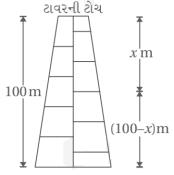
$A$ stone is allowed to fall from the top of a tower $100\, m$ high and at the same time another stone is projected vertically upwards from the ground with a velocity of $25\, m/s$. Calculate when and where the two stones will meet.
A
$45.4\, m$ and $31.6\, m$
B
$35.4\, m$ and $25.6\, m$
C
$25.4\, m$ and $19.6\, m$
D
$78.4\, m$ and $20.6\, m$
Solution
(D) Let the two stones meet after a time $t$.
For the stone dropped from the tower:
Initial velocity,$u = 0\, m/s$.
Let the displacement of the stone in time $t$ from the top of the tower be $s$.
Acceleration due to gravity,$g = 9.8\, m/s^2$.
Using the equation of motion,$s = ut + \frac{1}{2}at^2$:
$s = 0 \times t + \frac{1}{2} \times 9.8 \times t^2$
$s = 4.9t^2$ ............. $(1)$
For the stone thrown upwards:
Initial velocity,$u = 25\, m/s$.
Let the displacement of the stone from the ground in time $t$ be $s'$.
Acceleration due to gravity,$g = -9.8\, m/s^2$.
Using the equation of motion,$s' = ut + \frac{1}{2}at^2$:
$s' = 25t - \frac{1}{2} \times 9.8 \times t^2$
$s' = 25t - 4.9t^2$ ............. $(2)$
The sum of the displacements of both stones at the meeting point is equal to the total height of the tower,$100\, m$:
$s + s' = 100$
$4.9t^2 + 25t - 4.9t^2 = 100$
$25t = 100$
$t = 4\, s$
In $4\, s$,the distance covered by the falling stone from the top is:
$s = 4.9 \times (4)^2 = 4.9 \times 16 = 78.4\, m$.
Therefore,the stones will meet after $4\, s$ at a height of $(100 - 78.4) = 20.6\, m$ from the ground.
For the stone dropped from the tower:
Initial velocity,$u = 0\, m/s$.
Let the displacement of the stone in time $t$ from the top of the tower be $s$.
Acceleration due to gravity,$g = 9.8\, m/s^2$.
Using the equation of motion,$s = ut + \frac{1}{2}at^2$:
$s = 0 \times t + \frac{1}{2} \times 9.8 \times t^2$
$s = 4.9t^2$ ............. $(1)$
For the stone thrown upwards:
Initial velocity,$u = 25\, m/s$.
Let the displacement of the stone from the ground in time $t$ be $s'$.
Acceleration due to gravity,$g = -9.8\, m/s^2$.
Using the equation of motion,$s' = ut + \frac{1}{2}at^2$:
$s' = 25t - \frac{1}{2} \times 9.8 \times t^2$
$s' = 25t - 4.9t^2$ ............. $(2)$
The sum of the displacements of both stones at the meeting point is equal to the total height of the tower,$100\, m$:
$s + s' = 100$
$4.9t^2 + 25t - 4.9t^2 = 100$
$25t = 100$
$t = 4\, s$
In $4\, s$,the distance covered by the falling stone from the top is:
$s = 4.9 \times (4)^2 = 4.9 \times 16 = 78.4\, m$.
Therefore,the stones will meet after $4\, s$ at a height of $(100 - 78.4) = 20.6\, m$ from the ground.
1 likes
View Solution29
MediumMCQ
$A$ ball thrown up vertically returns to the thrower after $6\, s$. Find
$(a)$ the velocity with which it was thrown up,
$(b)$ the maximum height it reaches,and
$(c)$ its position after $4\, s$.
$(a)$ the velocity with which it was thrown up,
$(b)$ the maximum height it reaches,and
$(c)$ its position after $4\, s$.
A
$29.4\, m/s$,$44.1\, m$,$39.2\, m$
B
$25.4\, m/s$,$40.1\, m$,$35.2\, m$
C
$32.5\, m/s$,$48.2\, m$,$36.3\, m$
D
$54.6\, m/s$,$25.4\, m$,$12.2\, m$
Solution
(A) Time of ascent is equal to the time of descent. The ball takes a total of $6\, s$ for its upward and downward journey.
Hence,it has taken $3\, s$ to attain the maximum height.
Final velocity of the ball at the maximum height,$v = 0\, m/s$.
Acceleration due to gravity,$g = -9.8\, m/s^2$.
Using the equation of motion,$v = u + at$,we have:
$0 = u + (-9.8 \times 3)$
$u = 9.8 \times 3 = 29.4\, m/s$.
Hence,the ball was thrown upwards with a velocity of $29.4\, m/s$.
$(b)$ Let the maximum height attained by the ball be $h$.
Initial velocity during the upward journey,$u = 29.4\, m/s$.
Final velocity,$v = 0\, m/s$.
Acceleration due to gravity,$g = -9.8\, m/s^2$.
Using the equation of motion,$s = ut + \frac{1}{2}at^2$:
$h = 29.4 \times 3 - \frac{1}{2} \times 9.8 \times 3^2 = 88.2 - 44.1 = 44.1\, m$.
Hence,the maximum height is $44.1\, m$.
$(c)$ The ball attains the maximum height after $3\, s$. After attaining this height,it starts falling downwards.
In this case,initial velocity,$u = 0\, m/s$.
The position of the ball after $4\, s$ of the throw is given by the distance traveled by it during its downward journey in $4\, s - 3\, s = 1\, s$.
Using the equation of motion,$s = ut + \frac{1}{2}at^2$:
$s = 0 \times 1 + \frac{1}{2} \times 9.8 \times 1^2 = 4.9\, m$.
Now,the total height is $44.1\, m$.
This means the ball is $39.2\, m$ $(44.1\, m - 4.9\, m)$ above the ground after $4\, s$.
Hence,it has taken $3\, s$ to attain the maximum height.
Final velocity of the ball at the maximum height,$v = 0\, m/s$.
Acceleration due to gravity,$g = -9.8\, m/s^2$.
Using the equation of motion,$v = u + at$,we have:
$0 = u + (-9.8 \times 3)$
$u = 9.8 \times 3 = 29.4\, m/s$.
Hence,the ball was thrown upwards with a velocity of $29.4\, m/s$.
$(b)$ Let the maximum height attained by the ball be $h$.
Initial velocity during the upward journey,$u = 29.4\, m/s$.
Final velocity,$v = 0\, m/s$.
Acceleration due to gravity,$g = -9.8\, m/s^2$.
Using the equation of motion,$s = ut + \frac{1}{2}at^2$:
$h = 29.4 \times 3 - \frac{1}{2} \times 9.8 \times 3^2 = 88.2 - 44.1 = 44.1\, m$.
Hence,the maximum height is $44.1\, m$.
$(c)$ The ball attains the maximum height after $3\, s$. After attaining this height,it starts falling downwards.
In this case,initial velocity,$u = 0\, m/s$.
The position of the ball after $4\, s$ of the throw is given by the distance traveled by it during its downward journey in $4\, s - 3\, s = 1\, s$.
Using the equation of motion,$s = ut + \frac{1}{2}at^2$:
$s = 0 \times 1 + \frac{1}{2} \times 9.8 \times 1^2 = 4.9\, m$.
Now,the total height is $44.1\, m$.
This means the ball is $39.2\, m$ $(44.1\, m - 4.9\, m)$ above the ground after $4\, s$.
0 likes
View Solution30
EasyMCQ
In what direction does the buoyant force on an object immersed in a liquid act?
A
Downward
B
Upward
C
Sideways
D
In all directions
Solution
(B) When an object is immersed in a liquid,the liquid exerts an upward force on the object due to the pressure difference between the top and bottom surfaces of the object. This upward force is known as the buoyant force or upthrust.
0 likes
View Solution31
MediumMCQ
Why does a block of plastic released under water come up to the surface of water?
A
The gravitational force is greater than the buoyant force.
B
The buoyant force is greater than the gravitational force.
C
The density of plastic is greater than the density of water.
D
The atmospheric pressure pushes it up.
Solution
(B) Two forces act on an object immersed in water.
One is the gravitational force,which pulls the object downwards.
The other is the buoyant force,which pushes the object upwards.
If the upward buoyant force is greater than the downward gravitational force,the object will rise to the surface.
Since the density of plastic is less than the density of water,the buoyant force exerted by the water on the plastic block is greater than the gravitational force acting on it.
Therefore,the block of plastic rises to the surface when released under water.
One is the gravitational force,which pulls the object downwards.
The other is the buoyant force,which pushes the object upwards.
If the upward buoyant force is greater than the downward gravitational force,the object will rise to the surface.
Since the density of plastic is less than the density of water,the buoyant force exerted by the water on the plastic block is greater than the gravitational force acting on it.
Therefore,the block of plastic rises to the surface when released under water.
0 likes
View Solution32
MediumMCQ
The volume of $50\, g$ of a substance is $20\, cm^3$. If the density of water is $1\, g\, cm^{-3}$,will the substance float or sink?
A
Float
B
Sink
C
Both
D
None
Solution
(B) If the density of an object is more than the density of a liquid,then it sinks in the liquid. On the other hand,if the density of an object is less than the density of a liquid,then it floats on the surface of the liquid.
Here,the density of the substance $= \frac{\text{Mass of the substance}}{\text{Volume of the substance}} = \frac{50}{20} = 2.5\, g\, cm^{-3}$.
The density of the substance $(2.5\, g\, cm^{-3})$ is greater than the density of water $(1\, g\, cm^{-3})$. Therefore,the substance will sink in water.
Here,the density of the substance $= \frac{\text{Mass of the substance}}{\text{Volume of the substance}} = \frac{50}{20} = 2.5\, g\, cm^{-3}$.
The density of the substance $(2.5\, g\, cm^{-3})$ is greater than the density of water $(1\, g\, cm^{-3})$. Therefore,the substance will sink in water.
0 likes
View Solution33
Medium
The volume of a $500\, g$ sealed packet is $350\, cm^3$. Will the packet float or sink in water if the density of water is $1\, g\, cm^{-3}$? What will be the mass of the water displaced by this packet?
Solution
(N/A) Density of the packet = $\frac{\text{Mass}}{\text{Volume}} = \frac{500\, g}{350\, cm^3} \approx 1.43\, g/cm^3$.
Since the density of the packet $(1.43\, g/cm^3)$ is greater than the density of water $(1\, g/cm^3)$,the packet will sink in water.
According to Archimedes' principle,the volume of water displaced by a fully submerged object is equal to the volume of the object.
Mass of displaced water = $\text{Volume of packet} \times \text{Density of water} = 350\, cm^3 \times 1\, g/cm^3 = 350\, g$.
Since the density of the packet $(1.43\, g/cm^3)$ is greater than the density of water $(1\, g/cm^3)$,the packet will sink in water.
According to Archimedes' principle,the volume of water displaced by a fully submerged object is equal to the volume of the object.
Mass of displaced water = $\text{Volume of packet} \times \text{Density of water} = 350\, cm^3 \times 1\, g/cm^3 = 350\, g$.
0 likes
View SolutionGRAVITATION — Textbook - GRAVITATION · Frequently Asked Questions
1Are these GRAVITATION questions useful for JEE and NEET?
Yes. All questions in this section are mapped to JEE Main and NEET exam patterns. Previous year questions from JEE Main, NEET, GUJCET and state-level exams are included with full solutions.
2Can I switch to Hindi or Gujarati for these questions?
Yes. Use the language tabs in the hero section or the sidebar to view the same questions and solutions in English, Hindi or Gujarati.
3How do I generate a question paper from this subtopic?
Use the Vedclass Exam Paper Generator — select the chapter and subtopic, set difficulty, and generate Sets A, B, C, D automatically. First 3 chapters of every subject are free.
Vedclass Products
For Students
Vedclass Test Series
Mock tests in real JEE/NEET style with performance analysis. 5-day free trial.
Start Free TrialFor Teachers
Exam Paper Generator
Generate Set A/B/C/D papers from this chapter in 2 minutes. 3 chapters free.
Try FreeFor Institutes
Online Exam Module
Live online exams with unlimited students, 360° analytics & white-label branding.
See DemoFor Teachers & Institutes
Generate a GRAVITATION Exam Paper in 2 Minutes
Select subtopic & difficulty — Sets A, B, C, D auto-generated with No Repeat logic.
First 3 chapters of every subject are free — no payment required.