
A English
Mix Example - GRAVITATION Questions in English
Class 9 Science · GRAVITATION · Mix Example - GRAVITATION
187+
Questions
English
Language
100%
With Solutions
Showing 50 of 187 questions in English
101
DifficultMCQ
Find the weight of an object at a height $6400 \, km$ above the earth's surface. The weight of the object at the surface of the earth is $20 \, N$ and the radius of the earth is $6400 \, km$. (in $, N$)
A
$5$
B
$10$
C
$20$
D
$40$
Solution
(A) The acceleration due to gravity $g$ at the earth's surface is given by $g = \frac{GM}{R^2}$.
The weight of an object at the earth's surface is $W = mg = 20 \, N$.
At a height $h = 6400 \, km$ above the surface,the distance from the center of the earth is $r = R + h = R + R = 2R$.
The acceleration due to gravity at this height $g_h$ is given by $g_h = \frac{GM}{(R+h)^2} = \frac{GM}{(2R)^2} = \frac{GM}{4R^2} = \frac{1}{4} g$.
Therefore,the weight of the object at this height $W_h$ is $W_h = m \cdot g_h = m \cdot (\frac{1}{4} g) = \frac{1}{4} (mg)$.
Substituting the value of $W = 20 \, N$,we get $W_h = \frac{1}{4} \times 20 \, N = 5 \, N$.
The weight of an object at the earth's surface is $W = mg = 20 \, N$.
At a height $h = 6400 \, km$ above the surface,the distance from the center of the earth is $r = R + h = R + R = 2R$.
The acceleration due to gravity at this height $g_h$ is given by $g_h = \frac{GM}{(R+h)^2} = \frac{GM}{(2R)^2} = \frac{GM}{4R^2} = \frac{1}{4} g$.
Therefore,the weight of the object at this height $W_h$ is $W_h = m \cdot g_h = m \cdot (\frac{1}{4} g) = \frac{1}{4} (mg)$.
Substituting the value of $W = 20 \, N$,we get $W_h = \frac{1}{4} \times 20 \, N = 5 \, N$.
0 likes
View Solution102
Medium
What happens to the gravitational force between two objects,if
$(a)$ the mass of one object is doubled?
$(b)$ the distance between the objects is doubled?
$(c)$ the masses of both the objects are doubled? Give reason in each case.
$(a)$ the mass of one object is doubled?
$(b)$ the distance between the objects is doubled?
$(c)$ the masses of both the objects are doubled? Give reason in each case.
Solution
(N/A) The gravitational force between two objects is given by the expression $F = \frac{G m_1 m_2}{r^2}$.
$(a)$ If the mass of one object is doubled $(m_1' = 2m_1)$,the new force $F' = \frac{G(2m_1)m_2}{r^2} = 2F$. Thus,the force doubles.
$(b)$ If the distance between the objects is doubled $(r' = 2r)$,the new force $F' = \frac{G m_1 m_2}{(2r)^2} = \frac{G m_1 m_2}{4r^2} = \frac{1}{4}F$. Thus,the force becomes one-fourth of the original force.
$(c)$ If the masses of both objects are doubled ($m_1' = 2m_1$ and $m_2' = 2m_2$),the new force $F' = \frac{G(2m_1)(2m_2)}{r^2} = 4 \times \frac{G m_1 m_2}{r^2} = 4F$. Thus,the force becomes four times the original force.
$(a)$ If the mass of one object is doubled $(m_1' = 2m_1)$,the new force $F' = \frac{G(2m_1)m_2}{r^2} = 2F$. Thus,the force doubles.
$(b)$ If the distance between the objects is doubled $(r' = 2r)$,the new force $F' = \frac{G m_1 m_2}{(2r)^2} = \frac{G m_1 m_2}{4r^2} = \frac{1}{4}F$. Thus,the force becomes one-fourth of the original force.
$(c)$ If the masses of both objects are doubled ($m_1' = 2m_1$ and $m_2' = 2m_2$),the new force $F' = \frac{G(2m_1)(2m_2)}{r^2} = 4 \times \frac{G m_1 m_2}{r^2} = 4F$. Thus,the force becomes four times the original force.
0 likes
View Solution103
Medium
Distinguish between mass and weight of an object. How does the weight of an object change when moving from the equator to the poles? When can the weight of an object be zero?
Solution
(N/A) The distinction is shown in the table below:
When an object is moved from the equator to the poles, its weight increases because the acceleration due to gravity $(g)$ is greater at the poles than at the equator.
Weight of an object becomes zero at the center of the Earth or when a body is in a state of free fall.
| Mass | Weight |
| $1.$ It is the amount of matter contained in a body. | $1.$ It is a force equal to the gravitational pull exerted by a planet. |
| $2.$ It is a constant quantity and does not change with respect to position or place. | $2.$ It is a variable quantity and changes with the change in acceleration due to gravity of a place. |
| $3.$ Mass of a body can never be zero. | $3.$ Weight of a body can be zero during free fall. |
| $4.$ It is measured by using a physical balance. | $4.$ It is measured by using a spring balance. |
| $5.$ It is a scalar quantity. | $5.$ It is a vector quantity. |
| $6.$ It is measured in kilograms $(kg)$. | $6.$ It is measured in newtons $(N)$. |
When an object is moved from the equator to the poles, its weight increases because the acceleration due to gravity $(g)$ is greater at the poles than at the equator.
Weight of an object becomes zero at the center of the Earth or when a body is in a state of free fall.
0 likes
View Solution104
Medium
$(a)$ The Earth is acted upon by the gravitation of the Sun,yet it does not fall into the Sun. Why?
$(b)$ An object of mass $500 \, g$ is dropped from a tower of height $5 \, m$. Calculate its momentum when it touches the ground (given $g = 10 \, m s^{-2}$).
$(b)$ An object of mass $500 \, g$ is dropped from a tower of height $5 \, m$. Calculate its momentum when it touches the ground (given $g = 10 \, m s^{-2}$).
Solution
(N/A) This is because the gravitational force of attraction between the Sun and the Earth provides the necessary centripetal force for the Earth's orbital motion.
$(b)$ Given: Mass $m = 500 \, g = 0.5 \, kg$,Height $h = 5 \, m$,Acceleration due to gravity $g = 10 \, m s^{-2}$,Initial velocity $u = 0$.
Using the third equation of motion: $v^2 - u^2 = 2gh$
$v^2 - 0 = 2 \times 10 \times 5 = 100$
$v = \sqrt{100} = 10 \, m s^{-1}$
Momentum $p = m \times v$
$p = 0.5 \, kg \times 10 \, m s^{-1} = 5 \, kg \, m s^{-1}$.
$(b)$ Given: Mass $m = 500 \, g = 0.5 \, kg$,Height $h = 5 \, m$,Acceleration due to gravity $g = 10 \, m s^{-2}$,Initial velocity $u = 0$.
Using the third equation of motion: $v^2 - u^2 = 2gh$
$v^2 - 0 = 2 \times 10 \times 5 = 100$
$v = \sqrt{100} = 10 \, m s^{-1}$
Momentum $p = m \times v$
$p = 0.5 \, kg \times 10 \, m s^{-1} = 5 \, kg \, m s^{-1}$.
0 likes
View Solution105
Difficult
Prove that if a body is thrown vertically upward,the time of ascent is equal to the time of descent.
Solution
(N/A) For upward motion:
$u = u, v = 0$
Let $t_{1}$ be the time of ascent. Using the equation of motion $v = u + at$:
$0 = u - gt_{1}$
$t_{1} = u/g$
For downward motion (descent):
The body starts from rest at the maximum height,so $u = 0$. Let $t_{2}$ be the time of descent. Using $s = ut + (1/2)at^{2}$ where $s = h$:
$h = 0 + (1/2)gt_{2}^{2} \implies t_{2} = \sqrt{2h/g}$
Since $h = u^{2}/(2g)$,substituting this gives $t_{2} = \sqrt{2(u^{2}/2g)/g} = u/g$.
Thus,$t_{1} = t_{2}$,which proves that the time of ascent is equal to the time of descent.
$u = u, v = 0$
Let $t_{1}$ be the time of ascent. Using the equation of motion $v = u + at$:
$0 = u - gt_{1}$
$t_{1} = u/g$
For downward motion (descent):
The body starts from rest at the maximum height,so $u = 0$. Let $t_{2}$ be the time of descent. Using $s = ut + (1/2)at^{2}$ where $s = h$:
$h = 0 + (1/2)gt_{2}^{2} \implies t_{2} = \sqrt{2h/g}$
Since $h = u^{2}/(2g)$,substituting this gives $t_{2} = \sqrt{2(u^{2}/2g)/g} = u/g$.
Thus,$t_{1} = t_{2}$,which proves that the time of ascent is equal to the time of descent.
0 likes
View Solution106
Medium
State the universal law of gravitation. Write the $SI$ unit of $G$. The gravitational force between two objects is $100 \, N$. How should the distance between the objects be changed so that the force between them becomes $50 \, N$?
Solution
(N/A) The universal law of gravitation states that every object in the universe attracts every other object with a force that is directly proportional to the product of their masses and inversely proportional to the square of the distance between their centers.
The $SI$ unit of the universal gravitational constant $G$ is $N \, m^2 \, kg^{-2}$.
Given:
Initial force $F_1 = 100 \, N$
Final force $F_2 = 50 \, N$
We know that the gravitational force $F$ is given by $F = \frac{G m_1 m_2}{r^2}$,which implies $F \propto \frac{1}{r^2}$.
Therefore,$\frac{F_1}{F_2} = \left(\frac{r_2}{r_1}\right)^2$.
Substituting the values:
$\frac{100}{50} = \left(\frac{r_2}{r_1}\right)^2$
$2 = \left(\frac{r_2}{r_1}\right)^2$
$\frac{r_2}{r_1} = \sqrt{2}$
Thus,the distance between the objects should be increased by a factor of $\sqrt{2}$ (approximately $1.414$ times the original distance) to make the force $50 \, N$.
The $SI$ unit of the universal gravitational constant $G$ is $N \, m^2 \, kg^{-2}$.
Given:
Initial force $F_1 = 100 \, N$
Final force $F_2 = 50 \, N$
We know that the gravitational force $F$ is given by $F = \frac{G m_1 m_2}{r^2}$,which implies $F \propto \frac{1}{r^2}$.
Therefore,$\frac{F_1}{F_2} = \left(\frac{r_2}{r_1}\right)^2$.
Substituting the values:
$\frac{100}{50} = \left(\frac{r_2}{r_1}\right)^2$
$2 = \left(\frac{r_2}{r_1}\right)^2$
$\frac{r_2}{r_1} = \sqrt{2}$
Thus,the distance between the objects should be increased by a factor of $\sqrt{2}$ (approximately $1.414$ times the original distance) to make the force $50 \, N$.
0 likes
View Solution107
Medium
Show that the weight of an object on the moon is one-sixth of its weight on the earth. [Given: mass of earth $= 5.98 \times 10^{24} \ kg$,mass of moon $= 7.36 \times 10^{22} \ kg$,radius of earth $= 6.37 \times 10^{6} \ m$,radius of moon $= 1.74 \times 10^{6} \ m$]
Solution
(N/A) Let the mass of an object be $m$. Let its weight on the moon be $W_{m}$ and its weight on the earth be $W_{E}$.
Using the universal law of gravitation,the weight of an object on the moon is given by $W_{m} = \frac{GM_{m}m}{R_{m}^{2}}$,where $M_{m}$ is the mass of the moon and $R_{m}$ is its radius.
Similarly,the weight of the object on the earth is $W_{E} = \frac{GM_{E}m}{R_{E}^{2}}$,where $M_{E}$ is the mass of the earth and $R_{E}$ is its radius.
Taking the ratio of the two weights:
$\frac{W_{m}}{W_{E}} = \frac{GM_{m}m}{R_{m}^{2}} \times \frac{R_{E}^{2}}{GM_{E}m} = \frac{M_{m}}{M_{E}} \times \left( \frac{R_{E}}{R_{m}} \right)^{2}$
Substituting the given values:
$\frac{W_{m}}{W_{E}} = \frac{7.36 \times 10^{22}}{5.98 \times 10^{24}} \times \left( \frac{6.37 \times 10^{6}}{1.74 \times 10^{6}} \right)^{2}$
$\frac{W_{m}}{W_{E}} \approx 0.0123 \times (3.66)^{2} \approx 0.0123 \times 13.4 = 0.165 \approx \frac{1}{6}$
Thus,the weight of an object on the moon is one-sixth of its weight on the earth.
Using the universal law of gravitation,the weight of an object on the moon is given by $W_{m} = \frac{GM_{m}m}{R_{m}^{2}}$,where $M_{m}$ is the mass of the moon and $R_{m}$ is its radius.
Similarly,the weight of the object on the earth is $W_{E} = \frac{GM_{E}m}{R_{E}^{2}}$,where $M_{E}$ is the mass of the earth and $R_{E}$ is its radius.
Taking the ratio of the two weights:
$\frac{W_{m}}{W_{E}} = \frac{GM_{m}m}{R_{m}^{2}} \times \frac{R_{E}^{2}}{GM_{E}m} = \frac{M_{m}}{M_{E}} \times \left( \frac{R_{E}}{R_{m}} \right)^{2}$
Substituting the given values:
$\frac{W_{m}}{W_{E}} = \frac{7.36 \times 10^{22}}{5.98 \times 10^{24}} \times \left( \frac{6.37 \times 10^{6}}{1.74 \times 10^{6}} \right)^{2}$
$\frac{W_{m}}{W_{E}} \approx 0.0123 \times (3.66)^{2} \approx 0.0123 \times 13.4 = 0.165 \approx \frac{1}{6}$
Thus,the weight of an object on the moon is one-sixth of its weight on the earth.
0 likes
View Solution108
Difficult
$A$ stone is allowed to fall from the top of a tower $100 \, m$ high and at the same time another stone is projected vertically upwards from the ground with a velocity of $25 \, m s^{-1}$. Calculate when and where the two stones will meet? (Take $g = 10 \, m s^{-2}$).
Solution
(A) Let stone $A$ fall from the top of a tower of height $h = 100 \, m$. Its initial velocity $u_1 = 0$ and acceleration $a_1 = +g = 10 \, m s^{-2}$.
Another stone $B$ is projected upwards from the ground with initial velocity $u_2 = 25 \, m s^{-1}$ and acceleration $a_2 = -g = -10 \, m s^{-2}$.
Let the two stones meet at a point $C$ at a distance $y$ below the top of the tower after time $t$. For stone $A$:
$y = u_1 t + \frac{1}{2} a_1 t^2 = 0 + \frac{1}{2} \times 10 \times t^2 = 5t^2$ ... $(1)$
For stone $B$,the distance covered from the ground is $(100 - y)$:
$100 - y = u_2 t + \frac{1}{2} a_2 t^2 = 25t - \frac{1}{2} \times 10 \times t^2 = 25t - 5t^2$ ... $(2)$
Adding equations $(1)$ and $(2)$:
$y + (100 - y) = 5t^2 + 25t - 5t^2$
$100 = 25t$
$t = 4 \, s$
Substituting $t = 4 \, s$ into equation $(1)$:
$y = 5 \times (4)^2 = 5 \times 16 = 80 \, m$.
The stones will meet after $4 \, s$ at a distance of $80 \, m$ from the top of the tower (or $20 \, m$ from the ground).
Another stone $B$ is projected upwards from the ground with initial velocity $u_2 = 25 \, m s^{-1}$ and acceleration $a_2 = -g = -10 \, m s^{-2}$.
Let the two stones meet at a point $C$ at a distance $y$ below the top of the tower after time $t$. For stone $A$:
$y = u_1 t + \frac{1}{2} a_1 t^2 = 0 + \frac{1}{2} \times 10 \times t^2 = 5t^2$ ... $(1)$
For stone $B$,the distance covered from the ground is $(100 - y)$:
$100 - y = u_2 t + \frac{1}{2} a_2 t^2 = 25t - \frac{1}{2} \times 10 \times t^2 = 25t - 5t^2$ ... $(2)$
Adding equations $(1)$ and $(2)$:
$y + (100 - y) = 5t^2 + 25t - 5t^2$
$100 = 25t$
$t = 4 \, s$
Substituting $t = 4 \, s$ into equation $(1)$:
$y = 5 \times (4)^2 = 5 \times 16 = 80 \, m$.
The stones will meet after $4 \, s$ at a distance of $80 \, m$ from the top of the tower (or $20 \, m$ from the ground).
0 likes
View Solution109
MediumMCQ
Two stones $A$ and $B$ are dropped from a multi-storey building. Stone $A$ is dropped from $100 \, m$ and at the same time stone $B$ is dropped from $50 \, m$ height. Both of them reach the earth at the same time. Will they have equal velocity while reaching the ground? Calculate and find out the answer (Take $g = 10 \, m s^{-2}$).
A
Yes,they will have equal velocity.
B
No,stone $A$ will have higher velocity.
C
No,stone $B$ will have higher velocity.
D
Cannot be determined.
Solution
(B) For stone $A$ dropped from $h_1 = 100 \, m$:
Using the equation $v^2 - u^2 = 2gh$,where initial velocity $u = 0$:
$v_A^2 = 2 \times 10 \times 100 = 2000$
$v_A = \sqrt{2000} \approx 44.72 \, m s^{-1}$.
For stone $B$ dropped from $h_2 = 50 \, m$:
Using the equation $v^2 - u^2 = 2gh$,where initial velocity $u = 0$:
$v_B^2 = 2 \times 10 \times 50 = 1000$
$v_B = \sqrt{1000} \approx 31.62 \, m s^{-1}$.
Since $v_A \neq v_B$,the stones will not have equal velocities upon reaching the ground. Stone $A$ will have a higher velocity.
Using the equation $v^2 - u^2 = 2gh$,where initial velocity $u = 0$:
$v_A^2 = 2 \times 10 \times 100 = 2000$
$v_A = \sqrt{2000} \approx 44.72 \, m s^{-1}$.
For stone $B$ dropped from $h_2 = 50 \, m$:
Using the equation $v^2 - u^2 = 2gh$,where initial velocity $u = 0$:
$v_B^2 = 2 \times 10 \times 50 = 1000$
$v_B = \sqrt{1000} \approx 31.62 \, m s^{-1}$.
Since $v_A \neq v_B$,the stones will not have equal velocities upon reaching the ground. Stone $A$ will have a higher velocity.
0 likes
View Solution110
Medium
State Newton's universal law of gravitation and write an expression for it. Also,show that the acceleration due to gravity of an object is independent of its mass.
Solution
(N/A) Newton's universal law of gravitation states that every particle of matter in the universe attracts every other particle with a force that is directly proportional to the product of their masses and inversely proportional to the square of the distance between their centers.
Mathematically,the force $F$ is given by:
$F = \frac{G m_1 m_2}{r^2}$
where $G$ is the universal gravitational constant,$m_1$ and $m_2$ are the masses of the two objects,and $r$ is the distance between their centers.
To show that acceleration due to gravity $(g)$ is independent of the mass of the falling object,consider an object of mass $m$ falling towards the Earth (mass $M$,radius $R$).
The gravitational force is $F = \frac{G M m}{R^2}$.
According to Newton's second law,$F = m \times a$. Here,$a = g$,so $F = m \times g$.
Equating the two expressions: $m \times g = \frac{G M m}{R^2}$.
Canceling $m$ from both sides,we get $g = \frac{G M}{R^2}$.
Since $g$ depends only on the mass of the Earth $(M)$,the gravitational constant $(G)$,and the radius of the Earth $(R)$,it is independent of the mass $(m)$ of the falling object.
Mathematically,the force $F$ is given by:
$F = \frac{G m_1 m_2}{r^2}$
where $G$ is the universal gravitational constant,$m_1$ and $m_2$ are the masses of the two objects,and $r$ is the distance between their centers.
To show that acceleration due to gravity $(g)$ is independent of the mass of the falling object,consider an object of mass $m$ falling towards the Earth (mass $M$,radius $R$).
The gravitational force is $F = \frac{G M m}{R^2}$.
According to Newton's second law,$F = m \times a$. Here,$a = g$,so $F = m \times g$.
Equating the two expressions: $m \times g = \frac{G M m}{R^2}$.
Canceling $m$ from both sides,we get $g = \frac{G M}{R^2}$.
Since $g$ depends only on the mass of the Earth $(M)$,the gravitational constant $(G)$,and the radius of the Earth $(R)$,it is independent of the mass $(m)$ of the falling object.
0 likes
View Solution111
Medium
$(i)$ Seema buys a few grains of gold at the poles as per the instructions of one of her friends. She hands over the same when she meets her at the equator. Will the friend agree with the weight of gold bought? If not,why?
$(ii)$ If the moon attracts the earth,why does the earth not move towards the moon?
$(ii)$ If the moon attracts the earth,why does the earth not move towards the moon?
Solution
(N/A) $(i)$ No,the friend will not agree. Weight is the force with which the earth attracts an object,given by the formula $W = m \times g$. Since the acceleration due to gravity $(g)$ is greater at the poles than at the equator,the weight of the same amount of gold will be less at the equator compared to the poles.
$(ii)$ According to Newton's third law of motion,the moon exerts an equal and opposite force on the earth. However,the earth does not move towards the moon because the mass of the earth is extremely large compared to the mass of the moon. According to Newton's second law $(F = m \times a)$,the acceleration produced is inversely proportional to the mass $(a = F / m)$. Thus,the acceleration of the earth is negligible.
$(ii)$ According to Newton's third law of motion,the moon exerts an equal and opposite force on the earth. However,the earth does not move towards the moon because the mass of the earth is extremely large compared to the mass of the moon. According to Newton's second law $(F = m \times a)$,the acceleration produced is inversely proportional to the mass $(a = F / m)$. Thus,the acceleration of the earth is negligible.
0 likes
View Solution112
Medium
Write three differences between gravitational acceleration $(g)$ and gravitational constant $(G).$
Solution
(N/A) Following are the three differences:
$(i)$ The value of $g$ is $9.8 \, m/s^2$ on the surface of the Earth,whereas the value of $G$ is $6.67 \times 10^{-11} \, N \cdot m^2/kg^2$.
$(ii)$ The value of $g$ varies from place to place,whereas the value of $G$ remains constant throughout the universe.
$(iii)$ $g$ is a vector quantity,while $G$ is a scalar quantity.
$(i)$ The value of $g$ is $9.8 \, m/s^2$ on the surface of the Earth,whereas the value of $G$ is $6.67 \times 10^{-11} \, N \cdot m^2/kg^2$.
$(ii)$ The value of $g$ varies from place to place,whereas the value of $G$ remains constant throughout the universe.
$(iii)$ $g$ is a vector quantity,while $G$ is a scalar quantity.
0 likes
View Solution113
Medium
Define mass and weight of an object. Write their $SI$ units. An object has a mass of $20 \, kg$ on Earth. What will be its mass and weight on the surface of the Moon? ($g$ on Moon $= 1.6 \, m s^{-2}$)
Solution
(N/A) Mass is the quantity of matter contained in an object. The $SI$ unit of mass is $kg$.
Weight is the force with which an object is attracted towards the center of a planet or celestial body. The $SI$ unit of weight is the newton $(N)$.
Since mass is a constant property of an object and does not change with location,the mass of the object on the Moon remains $20 \, kg$.
The weight of the object on the Moon is calculated using the formula $W = m \times g$,where $m = 20 \, kg$ and $g = 1.6 \, m s^{-2}$.
$W = 20 \times 1.6 = 32 \, N$.
Therefore,the mass on the Moon is $20 \, kg$ and the weight on the Moon is $32 \, N$.
Weight is the force with which an object is attracted towards the center of a planet or celestial body. The $SI$ unit of weight is the newton $(N)$.
Since mass is a constant property of an object and does not change with location,the mass of the object on the Moon remains $20 \, kg$.
The weight of the object on the Moon is calculated using the formula $W = m \times g$,where $m = 20 \, kg$ and $g = 1.6 \, m s^{-2}$.
$W = 20 \times 1.6 = 32 \, N$.
Therefore,the mass on the Moon is $20 \, kg$ and the weight on the Moon is $32 \, N$.
0 likes
View Solution114
Difficult
What is meant by acceleration due to gravity? Suppose a planet exists whose mass and radius both are half of that of Earth. Calculate the acceleration due to gravity on the surface of this planet.
Solution
(N/A) Acceleration due to gravity is the acceleration produced in a body when it is allowed to fall freely under the influence of gravity alone. The acceleration due to gravity $(g)$ on the surface of a planet is given by the formula $g = \frac{GM}{R^2}$,where $M$ is the mass of the planet and $R$ is its radius.
Given:
Mass of the planet $(M_P)$ = $\frac{M_E}{2}$
Radius of the planet $(R_P)$ = $\frac{R_E}{2}$
Acceleration due to gravity on Earth $(g_E)$ = $9.8 \, m/s^2$
Using the ratio:
$\frac{g_P}{g_E} = \frac{GM_P / R_P^2}{GM_E / R_E^2} = \frac{M_P}{M_E} \times (\frac{R_E}{R_P})^2$
Substituting the values:
$\frac{g_P}{g_E} = \frac{M_E / 2}{M_E} \times (\frac{R_E}{R_E / 2})^2 = \frac{1}{2} \times (2)^2 = \frac{1}{2} \times 4 = 2$
Therefore,$g_P = 2 \times g_E = 2 \times 9.8 \, m/s^2 = 19.6 \, m/s^2$.
Given:
Mass of the planet $(M_P)$ = $\frac{M_E}{2}$
Radius of the planet $(R_P)$ = $\frac{R_E}{2}$
Acceleration due to gravity on Earth $(g_E)$ = $9.8 \, m/s^2$
Using the ratio:
$\frac{g_P}{g_E} = \frac{GM_P / R_P^2}{GM_E / R_E^2} = \frac{M_P}{M_E} \times (\frac{R_E}{R_P})^2$
Substituting the values:
$\frac{g_P}{g_E} = \frac{M_E / 2}{M_E} \times (\frac{R_E}{R_E / 2})^2 = \frac{1}{2} \times (2)^2 = \frac{1}{2} \times 4 = 2$
Therefore,$g_P = 2 \times g_E = 2 \times 9.8 \, m/s^2 = 19.6 \, m/s^2$.
0 likes
View Solution115
Medium
Give reason:
$(a)$ Value of '$g$' is not constant on Earth.
$(b)$ Objects with different masses take the same time to fall from a fixed height.
$(c)$ '$G$' is known as the universal gravitational constant.
$(a)$ Value of '$g$' is not constant on Earth.
$(b)$ Objects with different masses take the same time to fall from a fixed height.
$(c)$ '$G$' is known as the universal gravitational constant.
Solution
(N/A) The acceleration due to gravity is given by the expression $g = \frac{GM}{R^2}$.
This depends upon the radius of the Earth $(R)$. Since the Earth is not a perfect sphere and its radius varies from the poles to the equator,the value of $g$ is not constant everywhere. Additionally,$g$ varies with altitude and depth.
$(b)$ The acceleration due to gravity $(g)$ acting on a falling body is given by $g = \frac{GM}{R^2}$.
This expression shows that $g$ does not depend on the mass of the falling object $(m)$,but only on the mass of the planet $(M)$ and the distance from its center $(R)$. Therefore,all objects fall with the same acceleration,regardless of their mass,and take the same time to fall from a fixed height in a vacuum.
$(c)$ '$G$' is known as the universal gravitational constant because its value remains the same at all places in the universe and is independent of the nature of the medium or the bodies involved.
This depends upon the radius of the Earth $(R)$. Since the Earth is not a perfect sphere and its radius varies from the poles to the equator,the value of $g$ is not constant everywhere. Additionally,$g$ varies with altitude and depth.
$(b)$ The acceleration due to gravity $(g)$ acting on a falling body is given by $g = \frac{GM}{R^2}$.
This expression shows that $g$ does not depend on the mass of the falling object $(m)$,but only on the mass of the planet $(M)$ and the distance from its center $(R)$. Therefore,all objects fall with the same acceleration,regardless of their mass,and take the same time to fall from a fixed height in a vacuum.
$(c)$ '$G$' is known as the universal gravitational constant because its value remains the same at all places in the universe and is independent of the nature of the medium or the bodies involved.
0 likes
View Solution116
Medium
$(a)$ What do you mean by free fall?
$(b)$ What happens to the direction of motion of objects during free fall?
$(c)$ $A$ stone is dropped from a height of $19.6 \, m$. Calculate:
$(i)$ Time taken to fall.
$(ii)$ How fast does it move at the end of this fall?
$(iii)$ Acceleration after $1 \, s$.
$(b)$ What happens to the direction of motion of objects during free fall?
$(c)$ $A$ stone is dropped from a height of $19.6 \, m$. Calculate:
$(i)$ Time taken to fall.
$(ii)$ How fast does it move at the end of this fall?
$(iii)$ Acceleration after $1 \, s$.
Solution
(N/A) Free fall is the motion of an object falling solely under the influence of gravitational force,with constant acceleration.
$(b)$ The direction of motion remains the same (vertically downwards) during free fall.
$(c)$ Given: Initial velocity $u = 0 \, m/s$,height $h = 19.6 \, m$,acceleration $g = 9.8 \, m/s^2$.
$(i)$ Using the equation of motion $h = ut + \frac{1}{2}gt^2$:
$19.6 = 0 + \frac{1}{2} \times 9.8 \times t^2$
$19.6 = 4.9 \times t^2$
$t^2 = 4$
$t = 2 \, s$.
$(ii)$ Using the equation $v = u + gt$:
$v = 0 + 9.8 \times 2$
$v = 19.6 \, m/s$.
$(iii)$ Since the object is in free fall,the acceleration is constant and equal to the acceleration due to gravity,which is $9.8 \, m/s^2$ at any time,including after $1 \, s$.
$(b)$ The direction of motion remains the same (vertically downwards) during free fall.
$(c)$ Given: Initial velocity $u = 0 \, m/s$,height $h = 19.6 \, m$,acceleration $g = 9.8 \, m/s^2$.
$(i)$ Using the equation of motion $h = ut + \frac{1}{2}gt^2$:
$19.6 = 0 + \frac{1}{2} \times 9.8 \times t^2$
$19.6 = 4.9 \times t^2$
$t^2 = 4$
$t = 2 \, s$.
$(ii)$ Using the equation $v = u + gt$:
$v = 0 + 9.8 \times 2$
$v = 19.6 \, m/s$.
$(iii)$ Since the object is in free fall,the acceleration is constant and equal to the acceleration due to gravity,which is $9.8 \, m/s^2$ at any time,including after $1 \, s$.
0 likes
View Solution117
Medium
$(a)$ Differentiate between $G$ and $g$.
$(b)$ Is the value of $g$ the same everywhere on Earth? Reason out.
$(c)$ How does the gravitational force between two objects change if the distance between them is tripled?
$(b)$ Is the value of $g$ the same everywhere on Earth? Reason out.
$(c)$ How does the gravitational force between two objects change if the distance between them is tripled?
Solution
(A) $G$ is the Universal Gravitational Constant with a fixed value of $6.673 \times 10^{-11} \text{ N m}^2 \text{ kg}^{-2}$. It remains constant everywhere in the universe.
$g$ is the acceleration due to gravity,which varies depending on the location. Its $SI$ unit is $\text{m s}^{-2}$.
$(b)$ No,the value of $g$ is not the same everywhere on Earth. The Earth is not a perfect sphere; it is flattened at the poles and bulges at the equator. Since $g = \frac{GM}{R^2}$,the radius $R$ is smaller at the poles compared to the equator. Therefore,the value of $g$ is greater at the poles and smaller at the equator.
$(c)$ According to Newton's Law of Universal Gravitation,$F = \frac{G M m}{r^2}$,so $F \propto \frac{1}{r^2}$.
If the distance $r$ is tripled $(r' = 3r)$,the new force $F'$ becomes $F' = \frac{G M m}{(3r)^2} = \frac{G M m}{9r^2} = \frac{1}{9} F$.
Thus,the gravitational force becomes one-ninth of its original value.
$g$ is the acceleration due to gravity,which varies depending on the location. Its $SI$ unit is $\text{m s}^{-2}$.
$(b)$ No,the value of $g$ is not the same everywhere on Earth. The Earth is not a perfect sphere; it is flattened at the poles and bulges at the equator. Since $g = \frac{GM}{R^2}$,the radius $R$ is smaller at the poles compared to the equator. Therefore,the value of $g$ is greater at the poles and smaller at the equator.
$(c)$ According to Newton's Law of Universal Gravitation,$F = \frac{G M m}{r^2}$,so $F \propto \frac{1}{r^2}$.
If the distance $r$ is tripled $(r' = 3r)$,the new force $F'$ becomes $F' = \frac{G M m}{(3r)^2} = \frac{G M m}{9r^2} = \frac{1}{9} F$.
Thus,the gravitational force becomes one-ninth of its original value.
0 likes
View Solution118
DifficultMCQ
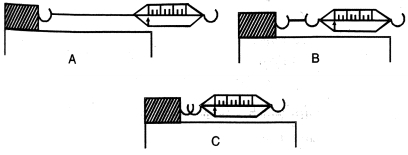
Three students $A, B$ and $C$ were performing an experiment to establish the relation between the weight of a wooden block and the minimum force required to just move it on a horizontal surface. The experimental setup used by each is as shown in the figures given below.
The result obtained by them will be:
The result obtained by them will be:
A
same for each
B
most accurate for $A$
C
most accurate for $B$
D
most accurate for $C$
Solution
(B) In the experiment to measure the force required to move a wooden block,it is essential that the force applied by the spring balance is horizontal to ensure that the entire force contributes to overcoming the static friction.
In setup $A$,the string is pulled horizontally,ensuring the force vector is parallel to the surface.
In setup $B$,the string is also horizontal,but the connection is direct and stable.
In setup $C$,the use of a coiled spring can introduce vertical components of force or oscillations,leading to inaccuracies.
Setup $A$ provides the most direct and horizontal application of force,minimizing errors due to alignment,thus yielding the most accurate result.
In setup $A$,the string is pulled horizontally,ensuring the force vector is parallel to the surface.
In setup $B$,the string is also horizontal,but the connection is direct and stable.
In setup $C$,the use of a coiled spring can introduce vertical components of force or oscillations,leading to inaccuracies.
Setup $A$ provides the most direct and horizontal application of force,minimizing errors due to alignment,thus yielding the most accurate result.
0 likes
View Solution119
Medium
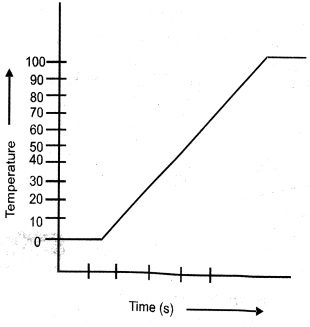
The graph below shows the change of ice to steam. Observe the change of state from ice to water and water to steam,and write two inferences that can be drawn from this graph about these changes of state.
Solution
(N/A) $(i)$ During melting,the temperature of the ice remains constant at $0^{\circ} C$. It starts rising only after all the ice has melted into water.
$(ii)$ At $100^{\circ} C$,water starts boiling and the temperature remains constant during the conversion of water into steam (latent heat of vaporization).
$(ii)$ At $100^{\circ} C$,water starts boiling and the temperature remains constant during the conversion of water into steam (latent heat of vaporization).
0 likes
View Solution120
Medium
$(a)$ Prove that if the Earth attracts two bodies placed at the same distance from the center of the Earth with equal force,then their masses will be the same.
$(b)$ Mathematically express the acceleration due to gravity experienced by a free-falling object.
$(c)$ Why is $G$ called a universal gravitational constant?
$(b)$ Mathematically express the acceleration due to gravity experienced by a free-falling object.
$(c)$ Why is $G$ called a universal gravitational constant?
Solution
(N/A) Let the masses of two bodies be $m_{1}$ and $m_{2}$.
Let the mass of the Earth be $M$ and the distance from the center of the Earth be $d$.
According to Newton's law of universal gravitation,the force $F$ is given by $F = \frac{GMm}{d^{2}}$.
For the two bodies,$F_{1} = \frac{GMm_{1}}{d^{2}}$ and $F_{2} = \frac{GMm_{2}}{d^{2}}$.
Given that $F_{1} = F_{2}$,we have $\frac{GMm_{1}}{d^{2}} = \frac{GMm_{2}}{d^{2}}$.
By canceling the common terms $\frac{GM}{d^{2}}$ from both sides,we get $m_{1} = m_{2}$.
$(b)$ The acceleration due to gravity $g$ for an object of mass $m$ at the surface of the Earth (radius $R$) is given by $g = \frac{GM}{R^{2}}$.
$(c)$ $G$ is called a universal gravitational constant because its value remains the same throughout the entire universe,regardless of the location or the nature of the interacting bodies.
Let the mass of the Earth be $M$ and the distance from the center of the Earth be $d$.
According to Newton's law of universal gravitation,the force $F$ is given by $F = \frac{GMm}{d^{2}}$.
For the two bodies,$F_{1} = \frac{GMm_{1}}{d^{2}}$ and $F_{2} = \frac{GMm_{2}}{d^{2}}$.
Given that $F_{1} = F_{2}$,we have $\frac{GMm_{1}}{d^{2}} = \frac{GMm_{2}}{d^{2}}$.
By canceling the common terms $\frac{GM}{d^{2}}$ from both sides,we get $m_{1} = m_{2}$.
$(b)$ The acceleration due to gravity $g$ for an object of mass $m$ at the surface of the Earth (radius $R$) is given by $g = \frac{GM}{R^{2}}$.
$(c)$ $G$ is called a universal gravitational constant because its value remains the same throughout the entire universe,regardless of the location or the nature of the interacting bodies.
0 likes
View Solution121
Medium
An object is thrown vertically upwards and rises to a height of $10 \, m$. Calculate:
$(i)$ the velocity with which the object was thrown upward and
$(ii)$ the time taken by the object to reach the highest point.
$(i)$ the velocity with which the object was thrown upward and
$(ii)$ the time taken by the object to reach the highest point.
Solution
(A) Given:
Height of the object,$h = 10 \, m$
Final velocity at the highest point,$v = 0 \, m/s$
Acceleration due to gravity,$a = -g = -9.8 \, m/s^2$
$(i)$ Using the third equation of motion,$v^2 - u^2 = 2ah$:
$0^2 - u^2 = 2 \times (-9.8) \times 10$
$-u^2 = -196$
$u^2 = 196$
$u = 14 \, m/s$
Thus,the initial velocity is $14 \, m/s$.
$(ii)$ Using the first equation of motion,$v = u + at$:
$0 = 14 + (-9.8) \times t$
$9.8t = 14$
$t = 14 / 9.8 \approx 1.43 \, s$
Thus,the time taken to reach the highest point is approximately $1.43 \, s$.
Height of the object,$h = 10 \, m$
Final velocity at the highest point,$v = 0 \, m/s$
Acceleration due to gravity,$a = -g = -9.8 \, m/s^2$
$(i)$ Using the third equation of motion,$v^2 - u^2 = 2ah$:
$0^2 - u^2 = 2 \times (-9.8) \times 10$
$-u^2 = -196$
$u^2 = 196$
$u = 14 \, m/s$
Thus,the initial velocity is $14 \, m/s$.
$(ii)$ Using the first equation of motion,$v = u + at$:
$0 = 14 + (-9.8) \times t$
$9.8t = 14$
$t = 14 / 9.8 \approx 1.43 \, s$
Thus,the time taken to reach the highest point is approximately $1.43 \, s$.
0 likes
View Solution122
MediumMCQ
$A$ planet existed whose mass and radius were both half of the Earth. What would be the acceleration due to gravity at the surface of the planet in terms of that on the surface of the Earth?
A
$g_{e}$
B
$2g_{e}$
C
$g_{e}/2$
D
$4g_{e}$
Solution
(B) We know that the acceleration due to gravity on Earth is given by $g_{e} = \frac{GM_{e}}{R_{e}^{2}}$.
For the given planet,the mass $M_{p} = \frac{M_{e}}{2}$ and the radius $R_{p} = \frac{R_{e}}{2}$.
Substituting these values into the formula for the planet's gravity $g_{p} = \frac{GM_{p}}{R_{p}^{2}}$,we get:
$g_{p} = \frac{G(M_{e}/2)}{(R_{e}/2)^{2}} = \frac{GM_{e}/2}{R_{e}^{2}/4} = \frac{GM_{e}}{2} \times \frac{4}{R_{e}^{2}} = 2 \times \frac{GM_{e}}{R_{e}^{2}}$.
Since $\frac{GM_{e}}{R_{e}^{2}} = g_{e}$,it follows that $g_{p} = 2g_{e}$.
For the given planet,the mass $M_{p} = \frac{M_{e}}{2}$ and the radius $R_{p} = \frac{R_{e}}{2}$.
Substituting these values into the formula for the planet's gravity $g_{p} = \frac{GM_{p}}{R_{p}^{2}}$,we get:
$g_{p} = \frac{G(M_{e}/2)}{(R_{e}/2)^{2}} = \frac{GM_{e}/2}{R_{e}^{2}/4} = \frac{GM_{e}}{2} \times \frac{4}{R_{e}^{2}} = 2 \times \frac{GM_{e}}{R_{e}^{2}}$.
Since $\frac{GM_{e}}{R_{e}^{2}} = g_{e}$,it follows that $g_{p} = 2g_{e}$.
0 likes
View Solution123
MediumMCQ
The mass of a girl is $50\, kg$. What will be her approximate weight on the Earth? How will her mass and weight change on the surface of the Moon?
A
Weight on Earth is $500\, N$; mass remains same,weight decreases on the Moon.
B
Weight on Earth is $50\, N$; mass decreases,weight remains same on the Moon.
C
Weight on Earth is $500\, N$; mass decreases,weight remains same on the Moon.
D
Weight on Earth is $50\, N$; mass remains same,weight increases on the Moon.
Solution
(A) The weight of an object on Earth is calculated using the formula $W = m \times g$,where $m$ is the mass and $g$ is the acceleration due to gravity $(g \approx 10\, m/s^2)$.
Weight on Earth: $W = 50\, kg \times 10\, m/s^2 = 500\, N$.
On the Moon,the mass of an object remains constant because it is an intrinsic property of the body.
However,the weight on the Moon changes because the acceleration due to gravity on the Moon is approximately $1/6$th of that on the Earth. Therefore,her weight on the Moon will be $500/6 \approx 83.33\, N$.
Weight on Earth: $W = 50\, kg \times 10\, m/s^2 = 500\, N$.
On the Moon,the mass of an object remains constant because it is an intrinsic property of the body.
However,the weight on the Moon changes because the acceleration due to gravity on the Moon is approximately $1/6$th of that on the Earth. Therefore,her weight on the Moon will be $500/6 \approx 83.33\, N$.
0 likes
View Solution124
Easy
Newton's law of gravitation is called a universal law. Why?
Solution
(N/A) Newton's law of gravitation is called a universal law because it is applicable to all objects in the universe,regardless of their mass,size,shape,or the distance between them. It describes the gravitational force acting between any two particles of matter anywhere in the universe.
0 likes
View Solution125
EasyMCQ
According to Newton's law of gravitation,every particle of matter attracts every other particle. But bodies on the surface of the Earth never move towards each other on account of this force of attraction. Why?
A
The force is too weak.
B
The Earth's gravity dominates.
C
Friction prevents movement.
D
The bodies are too heavy.
Solution
(B) The gravitational force between two small objects on the surface of the Earth is extremely weak because their masses are very small.
In contrast,the mass of the Earth is enormous.
Due to this,the gravitational attraction between any object and the Earth is significantly stronger than the mutual attraction between the objects themselves.
Consequently,all objects are pulled towards the center of the Earth rather than towards each other.
In contrast,the mass of the Earth is enormous.
Due to this,the gravitational attraction between any object and the Earth is significantly stronger than the mutual attraction between the objects themselves.
Consequently,all objects are pulled towards the center of the Earth rather than towards each other.
0 likes
View Solution126
EasyMCQ
What is the nature of motion of an object falling freely under the action of gravity?
A
Uniform motion
B
Uniformly accelerated motion
C
Non-uniformly accelerated motion
D
Constant velocity motion
Solution
(B) When an object falls freely under the action of gravity,it experiences a constant acceleration due to gravity $(g \approx 9.8 \ m/s^2)$.
Since the acceleration remains constant throughout the fall,the velocity of the object increases by an equal amount in equal intervals of time.
Therefore,the nature of the motion is uniformly accelerated motion in one dimension.
Since the acceleration remains constant throughout the fall,the velocity of the object increases by an equal amount in equal intervals of time.
Therefore,the nature of the motion is uniformly accelerated motion in one dimension.
0 likes
View Solution127
EasyMCQ
Will a body weigh more on the equator or at the poles?
A
Equator
B
Poles
C
Same at both places
D
None of the above
Solution
(B) The weight of a body is given by the formula $W = m \times g$,where $m$ is the mass and $g$ is the acceleration due to gravity.
The Earth is not a perfect sphere; it is flattened at the poles and bulges at the equator.
Because the radius of the Earth is smaller at the poles compared to the equator,the value of $g$ is greater at the poles.
Since $W$ is directly proportional to $g$,a body will weigh more at the poles than at the equator.
The Earth is not a perfect sphere; it is flattened at the poles and bulges at the equator.
Because the radius of the Earth is smaller at the poles compared to the equator,the value of $g$ is greater at the poles.
Since $W$ is directly proportional to $g$,a body will weigh more at the poles than at the equator.
0 likes
View Solution128
EasyMCQ
Is it possible to shield a body from gravitational effects?
A
Yes,by using a lead shield.
B
Yes,by using an electromagnetic shield.
C
No,it is not possible.
D
Yes,by using a vacuum chamber.
Solution
(C) No,it is not possible to shield a body from gravitational effects.
This is because gravitational interaction is a fundamental force that acts between all objects with mass.
Unlike electromagnetic forces,which can be shielded by placing a material between the charges,gravitational force does not depend on the nature of the intervening medium.
Therefore,gravity cannot be blocked or neutralized by any known material.
This is because gravitational interaction is a fundamental force that acts between all objects with mass.
Unlike electromagnetic forces,which can be shielded by placing a material between the charges,gravitational force does not depend on the nature of the intervening medium.
Therefore,gravity cannot be blocked or neutralized by any known material.
0 likes
View Solution129
EasyMCQ
Earth is continuously pulling the moon towards its centre,still it does not fall to the earth,why?
A
The moon is too far away from the earth.
B
The earth's gravitational force is balanced by the moon's own gravity.
C
The gravitational pull of the earth provides the necessary centripetal force for the moon to revolve in its orbit.
D
The moon has its own independent path and is not affected by earth's gravity.
Solution
(C) The gravitational force exerted by the earth on the moon provides the necessary centripetal force required for the moon to move in a circular orbit around the earth.
This gravitational force acts perpendicular to the direction of the moon's velocity,which changes the direction of the moon's motion continuously without changing its speed.
As a result,the moon keeps revolving in its orbit instead of falling towards the earth.
This gravitational force acts perpendicular to the direction of the moon's velocity,which changes the direction of the moon's motion continuously without changing its speed.
As a result,the moon keeps revolving in its orbit instead of falling towards the earth.
0 likes
View Solution130
EasyMCQ
How does acceleration due to gravity depend on the mass of the planet?
A
It is inversely proportional to the mass of the planet.
B
It is directly proportional to the mass of the planet.
C
It is independent of the mass of the planet.
D
It is proportional to the square of the mass of the planet.
Solution
(B) The acceleration due to gravity $(g)$ on the surface of a planet is given by the formula $g = \frac{GM}{R^2}$,where $G$ is the universal gravitational constant,$M$ is the mass of the planet,and $R$ is the radius of the planet.
From this relation,it is clear that $g \propto M$.
Therefore,the acceleration due to gravity is directly proportional to the mass of the planet.
From this relation,it is clear that $g \propto M$.
Therefore,the acceleration due to gravity is directly proportional to the mass of the planet.
0 likes
View Solution131
EasyMCQ
If the diameter of the earth becomes two times its present value and its mass remains unchanged,then how would the weight of an object on the surface of the earth be affected?
A
It will become two times.
B
It will become four times.
C
It will become one-half.
D
It will become one-fourth.
Solution
(D) Let $M$ be the mass and $R$ be the radius of the earth.
The weight of an object of mass $m$ on the surface of the earth is given by $W = mg = \frac{GMm}{R^2}$.
If the diameter becomes two times,the radius $R$ also becomes two times,i.e.,$R' = 2R$.
The new weight $W'$ will be $W' = \frac{GMm}{(R')^2} = \frac{GMm}{(2R)^2} = \frac{GMm}{4R^2}$.
Thus,$W' = \frac{1}{4} W$.
Therefore,the weight of the object will become one-fourth of its original value.
The weight of an object of mass $m$ on the surface of the earth is given by $W = mg = \frac{GMm}{R^2}$.
If the diameter becomes two times,the radius $R$ also becomes two times,i.e.,$R' = 2R$.
The new weight $W'$ will be $W' = \frac{GMm}{(R')^2} = \frac{GMm}{(2R)^2} = \frac{GMm}{4R^2}$.
Thus,$W' = \frac{1}{4} W$.
Therefore,the weight of the object will become one-fourth of its original value.
0 likes
View Solution132
Medium
Choose the correct alternative:
$(a)$ Acceleration due to gravity increases/decreases with increasing altitude.
$(b)$ Acceleration due to gravity increases/decreases with increasing depth.
$(c)$ Acceleration due to gravity is independent of the mass of the earth/mass of the body.
$(a)$ Acceleration due to gravity increases/decreases with increasing altitude.
$(b)$ Acceleration due to gravity increases/decreases with increasing depth.
$(c)$ Acceleration due to gravity is independent of the mass of the earth/mass of the body.
Solution
(A) Acceleration due to gravity decreases with increasing altitude because $g' = g(1 - 2h/R_e)$ for small heights.
$(b)$ Acceleration due to gravity decreases with increasing depth because $g' = g(1 - d/R_e)$.
$(c)$ Acceleration due to gravity is independent of the mass of the body,as $g = GM/R^2$,where $M$ is the mass of the Earth and $R$ is its radius.
$(b)$ Acceleration due to gravity decreases with increasing depth because $g' = g(1 - d/R_e)$.
$(c)$ Acceleration due to gravity is independent of the mass of the body,as $g = GM/R^2$,where $M$ is the mass of the Earth and $R$ is its radius.
0 likes
View Solution133
EasyMCQ
$A$ person can jump higher on the surface of the Moon than on the Earth. Why?
A
The Moon has a higher gravitational pull.
B
The Moon has a lower gravitational pull than the Earth.
C
The Moon has no atmosphere.
D
The Moon is smaller in size.
Solution
(B) The acceleration due to gravity on the surface of the Moon is approximately $1/6$th of that on the surface of the Earth.
Since the gravitational force is much weaker on the Moon,a person can jump $6$ times higher on the Moon compared to the Earth for the same amount of muscular effort.
Since the gravitational force is much weaker on the Moon,a person can jump $6$ times higher on the Moon compared to the Earth for the same amount of muscular effort.
0 likes
View Solution134
EasyMCQ
Calculate the force of gravitation between two objects of masses $50 \, kg$ and $120 \, kg$ respectively,kept at a distance of $10 \, m$ from each other. $(G = 6.673 \times 10^{-11} \, N \, m^2 \, kg^{-2})$
A
$4.0 \times 10^{-9} \, N$
B
$4.0 \times 10^{-8} \, N$
C
$6.673 \times 10^{-9} \, N$
D
$2.0 \times 10^{-9} \, N$
Solution
(A) The universal law of gravitation is given by the formula $F = \frac{G m_1 m_2}{r^2}$.
Given:
Mass of the first object,$m_1 = 50 \, kg$.
Mass of the second object,$m_2 = 120 \, kg$.
Distance between the objects,$r = 10 \, m$.
Gravitational constant,$G = 6.673 \times 10^{-11} \, N \, m^2 \, kg^{-2}$.
Substituting these values into the formula:
$F = \frac{6.673 \times 10^{-11} \times 50 \times 120}{10^2}$
$F = \frac{6.673 \times 10^{-11} \times 6000}{100}$
$F = 6.673 \times 10^{-11} \times 60$
$F = 400.38 \times 10^{-11} \, N$
$F = 4.0038 \times 10^{-9} \, N \approx 4.0 \times 10^{-9} \, N$.
Given:
Mass of the first object,$m_1 = 50 \, kg$.
Mass of the second object,$m_2 = 120 \, kg$.
Distance between the objects,$r = 10 \, m$.
Gravitational constant,$G = 6.673 \times 10^{-11} \, N \, m^2 \, kg^{-2}$.
Substituting these values into the formula:
$F = \frac{6.673 \times 10^{-11} \times 50 \times 120}{10^2}$
$F = \frac{6.673 \times 10^{-11} \times 6000}{100}$
$F = 6.673 \times 10^{-11} \times 60$
$F = 400.38 \times 10^{-11} \, N$
$F = 4.0038 \times 10^{-9} \, N \approx 4.0 \times 10^{-9} \, N$.
0 likes
View Solution135
Medium
If your weight on the Earth is $450 N$,calculate your weight on planet Mars. (Radius of Mars $= 4.3 \times 10^{6} m$,mass of Mars $= 6 \times 10^{23} kg$ and gravitational constant $G = 6.67 \times 10^{-11} Nm^{2} kg^{-2}$). Take acceleration due to gravity on Earth as $10 m s^{-2}$.
Solution
(97.2 N) Weight on Earth $(W) = 450 N$
Acceleration due to gravity on Earth $(g) = 10 m s^{-2}$
Therefore,the mass of the body $(m) = \frac{W}{g} = \frac{450}{10} = 45 kg$.
Now,the acceleration due to gravity on the surface of Mars $(g_{m})$ is calculated using the formula $g_{m} = \frac{GM_{m}}{R_{m}^{2}}$.
Substituting the values: $g_{m} = \frac{6.67 \times 10^{-11} \times 6 \times 10^{23}}{(4.3 \times 10^{6})^{2}}$.
$g_{m} = \frac{40.02 \times 10^{12}}{18.49 \times 10^{12}} \approx 2.16 m s^{-2}$.
Therefore,weight on Mars $= m \times g_{m} = 45 \times 2.16 = 97.2 N$.
Acceleration due to gravity on Earth $(g) = 10 m s^{-2}$
Therefore,the mass of the body $(m) = \frac{W}{g} = \frac{450}{10} = 45 kg$.
Now,the acceleration due to gravity on the surface of Mars $(g_{m})$ is calculated using the formula $g_{m} = \frac{GM_{m}}{R_{m}^{2}}$.
Substituting the values: $g_{m} = \frac{6.67 \times 10^{-11} \times 6 \times 10^{23}}{(4.3 \times 10^{6})^{2}}$.
$g_{m} = \frac{40.02 \times 10^{12}}{18.49 \times 10^{12}} \approx 2.16 m s^{-2}$.
Therefore,weight on Mars $= m \times g_{m} = 45 \times 2.16 = 97.2 N$.
0 likes
View Solution136
EasyMCQ
The mass of the planet Jupiter is $1.9 \times 10^{27} \, kg$ and that of the Sun is $1.99 \times 10^{30} \, kg$. The mean distance of the Sun from Jupiter is $7.8 \times 10^{11} \, m$. Calculate the gravitational force which the Sun exerts on Jupiter.
A
$1.1 \times 10^{24} \, N$
B
$2.2 \times 10^{23} \, N$
C
$8.8 \times 10^{22} \, N$
D
$4.4 \times 10^{23} \, N$
Solution
(D) Given:
Mass of Jupiter,$M_1 = 1.9 \times 10^{27} \, kg$
Mass of Sun,$M_2 = 1.99 \times 10^{30} \, kg$
Distance between Jupiter and Sun,$r = 7.8 \times 10^{11} \, m$
Gravitational constant,$G = 6.67 \times 10^{-11} \, N \cdot m^2 \cdot kg^{-2}$
Using the universal law of gravitation formula,$F = \frac{G M_1 M_2}{r^2}$:
$F = \frac{6.67 \times 10^{-11} \times 1.9 \times 10^{27} \times 1.99 \times 10^{30}}{(7.8 \times 10^{11})^2}$
$F = \frac{6.67 \times 1.9 \times 1.99 \times 10^{46}}{60.84 \times 10^{22}}$
$F \approx 4.146 \times 10^{23} \, N$
Rounding to the nearest provided option,the gravitational force is $4.4 \times 10^{23} \, N$.
Mass of Jupiter,$M_1 = 1.9 \times 10^{27} \, kg$
Mass of Sun,$M_2 = 1.99 \times 10^{30} \, kg$
Distance between Jupiter and Sun,$r = 7.8 \times 10^{11} \, m$
Gravitational constant,$G = 6.67 \times 10^{-11} \, N \cdot m^2 \cdot kg^{-2}$
Using the universal law of gravitation formula,$F = \frac{G M_1 M_2}{r^2}$:
$F = \frac{6.67 \times 10^{-11} \times 1.9 \times 10^{27} \times 1.99 \times 10^{30}}{(7.8 \times 10^{11})^2}$
$F = \frac{6.67 \times 1.9 \times 1.99 \times 10^{46}}{60.84 \times 10^{22}}$
$F \approx 4.146 \times 10^{23} \, N$
Rounding to the nearest provided option,the gravitational force is $4.4 \times 10^{23} \, N$.
0 likes
View Solution137
EasyMCQ
$A$ body weighs $63 \, N$ on the surface of the earth. What is the gravitational force on it due to the earth at a height equal to half the radius of the earth (in $, N$)? (Given: Mass of the earth $= 6 \times 10^{24} \, kg$ and radius of the earth $= 6.4 \times 10^{6} \, m$)
A
$27.35$
B
$28.00$
C
$31.50$
D
$63.00$
Solution
(A) $1$. First,calculate the mass of the body $(m)$. Given weight $W = mg = 63 \, N$. Assuming $g = 10 \, m/s^2$,$m = 63 / 10 = 6.3 \, kg$.
$2$. The distance of the body from the center of the earth $(r)$ at a height $h = R/2$ is $r = R + h = R + R/2 = 1.5R$.
$3$. Given $R = 6.4 \times 10^6 \, m$,so $r = 1.5 \times 6.4 \times 10^6 = 9.6 \times 10^6 \, m$.
$4$. The gravitational force is given by $F = \frac{GMm}{r^2}$.
$5$. Substituting the values: $F = \frac{6.67 \times 10^{-11} \times 6 \times 10^{24} \times 6.3}{(9.6 \times 10^6)^2}$.
$6$. $F = \frac{252.186 \times 10^{13}}{92.16 \times 10^{12}} = \frac{2521.86}{92.16} \approx 27.35 \, N$.
$2$. The distance of the body from the center of the earth $(r)$ at a height $h = R/2$ is $r = R + h = R + R/2 = 1.5R$.
$3$. Given $R = 6.4 \times 10^6 \, m$,so $r = 1.5 \times 6.4 \times 10^6 = 9.6 \times 10^6 \, m$.
$4$. The gravitational force is given by $F = \frac{GMm}{r^2}$.
$5$. Substituting the values: $F = \frac{6.67 \times 10^{-11} \times 6 \times 10^{24} \times 6.3}{(9.6 \times 10^6)^2}$.
$6$. $F = \frac{252.186 \times 10^{13}}{92.16 \times 10^{12}} = \frac{2521.86}{92.16} \approx 27.35 \, N$.
0 likes
View Solution138
Easy
The acceleration due to gravity at the moon's surface is $1.67 \, m s^{-2}$. If the radius of the moon is $1.74 \times 10^{6} \, m$,calculate the mass of the moon. (Use $G = 6.67 \times 10^{-11} \, N m^{2} kg^{-2}$)
Solution
The formula for acceleration due to gravity $(g)$ is given by $g = \frac{GM}{R^{2}}$,where $G$ is the universal gravitational constant,$M$ is the mass of the celestial body,and $R$ is its radius.
Rearranging the formula to solve for mass $(M)$,we get $M = \frac{g R^{2}}{G}$.
Given values are:
$g = 1.67 \, m s^{-2}$
$R = 1.74 \times 10^{6} \, m$
$G = 6.67 \times 10^{-11} \, N m^{2} kg^{-2}$
Substituting these values into the formula:
$M = \frac{1.67 \times (1.74 \times 10^{6})^{2}}{6.67 \times 10^{-11}}$
$M = \frac{1.67 \times 3.0276 \times 10^{12}}{6.67 \times 10^{-11}}$
$M \approx 0.758 \times 10^{23} \, kg = 7.58 \times 10^{22} \, kg$.
Thus,the mass of the moon is approximately $7.58 \times 10^{22} \, kg$.
Rearranging the formula to solve for mass $(M)$,we get $M = \frac{g R^{2}}{G}$.
Given values are:
$g = 1.67 \, m s^{-2}$
$R = 1.74 \times 10^{6} \, m$
$G = 6.67 \times 10^{-11} \, N m^{2} kg^{-2}$
Substituting these values into the formula:
$M = \frac{1.67 \times (1.74 \times 10^{6})^{2}}{6.67 \times 10^{-11}}$
$M = \frac{1.67 \times 3.0276 \times 10^{12}}{6.67 \times 10^{-11}}$
$M \approx 0.758 \times 10^{23} \, kg = 7.58 \times 10^{22} \, kg$.
Thus,the mass of the moon is approximately $7.58 \times 10^{22} \, kg$.
0 likes
View Solution139
Medium
$A$ stone is dropped from the edge of a roof.
$(a)$ How long does it take to fall $4.9 \, m$?
$(b)$ How fast does it move at the end of that fall?
$(c)$ How fast does it move at the end of $7.9 \, m$?
$(d)$ What is its acceleration after $1 \, s$ and after $2 \, s$?
$(a)$ How long does it take to fall $4.9 \, m$?
$(b)$ How fast does it move at the end of that fall?
$(c)$ How fast does it move at the end of $7.9 \, m$?
$(d)$ What is its acceleration after $1 \, s$ and after $2 \, s$?
Solution
(N/A) Given: Initial velocity,$u = 0 \, m/s$.
Acceleration due to gravity,$g = 9.8 \, m/s^2$.
$(a)$ Using the equation of motion $S = ut + \frac{1}{2}at^2$:
$4.9 = 0 \times t + \frac{1}{2} \times 9.8 \times t^2$
$4.9 = 4.9 \times t^2$
$t^2 = 1 \Rightarrow t = 1 \, s$.
So,it takes $1 \, s$ to fall $4.9 \, m$.
$(b)$ Using $v^2 - u^2 = 2aS$:
$v^2 - 0^2 = 2 \times 9.8 \times 4.9$
$v^2 = 96.04$
$v = 9.8 \, m/s$.
So,the speed at the end of $4.9 \, m$ is $9.8 \, m/s$.
$(c)$ Using $v^2 - u^2 = 2aS$:
$v^2 - 0^2 = 2 \times 9.8 \times 7.9$
$v^2 = 154.84$
$v = \sqrt{154.84} \approx 12.44 \, m/s$.
So,the speed at the end of $7.9 \, m$ is $12.44 \, m/s$.
$(d)$ During free fall,the acceleration due to gravity is constant.
Acceleration after $1 \, s = 9.8 \, m/s^2$.
Acceleration after $2 \, s = 9.8 \, m/s^2$.
Acceleration due to gravity,$g = 9.8 \, m/s^2$.
$(a)$ Using the equation of motion $S = ut + \frac{1}{2}at^2$:
$4.9 = 0 \times t + \frac{1}{2} \times 9.8 \times t^2$
$4.9 = 4.9 \times t^2$
$t^2 = 1 \Rightarrow t = 1 \, s$.
So,it takes $1 \, s$ to fall $4.9 \, m$.
$(b)$ Using $v^2 - u^2 = 2aS$:
$v^2 - 0^2 = 2 \times 9.8 \times 4.9$
$v^2 = 96.04$
$v = 9.8 \, m/s$.
So,the speed at the end of $4.9 \, m$ is $9.8 \, m/s$.
$(c)$ Using $v^2 - u^2 = 2aS$:
$v^2 - 0^2 = 2 \times 9.8 \times 7.9$
$v^2 = 154.84$
$v = \sqrt{154.84} \approx 12.44 \, m/s$.
So,the speed at the end of $7.9 \, m$ is $12.44 \, m/s$.
$(d)$ During free fall,the acceleration due to gravity is constant.
Acceleration after $1 \, s = 9.8 \, m/s^2$.
Acceleration after $2 \, s = 9.8 \, m/s^2$.
0 likes
View Solution140
Difficult
$A$ boy on a cliff $49\, m$ high drops a stone. One second later,he throws a second stone after the first. They both hit the ground at the same time. With what speed did he throw the second stone?
Solution
(12.1 M/S) For the first stone,we are given:
$u = 0\, m\, s^{-1}, h = 49\, m, g = 9.8\, m\, s^{-2}$
Using the equation of motion $S = ut + \frac{1}{2}at^2$,we have:
$49 = 0 \times t + \frac{1}{2} \times 9.8 \times t^2$
$t^2 = \frac{98}{9.8} = 10$
$t = \sqrt{10} \approx 3.16\, s$
So,the first stone takes $3.16\, s$ to reach the ground.
For the second stone,it is thrown $1\, s$ later but hits the ground at the same time. Therefore,the time taken by the second stone is $t_2 = 3.16 - 1 = 2.16\, s$.
Using $S = ut + \frac{1}{2}at^2$ for the second stone:
$49 = u \times 2.16 + \frac{1}{2} \times 9.8 \times (2.16)^2$
$49 = 2.16u + 4.9 \times 4.6656$
$49 = 2.16u + 22.86$
$2.16u = 49 - 22.86 = 26.14$
$u = \frac{26.14}{2.16} \approx 12.10\, m\, s^{-1}$
Thus,the second stone was thrown with a speed of $12.1\, m\, s^{-1}$.
$u = 0\, m\, s^{-1}, h = 49\, m, g = 9.8\, m\, s^{-2}$
Using the equation of motion $S = ut + \frac{1}{2}at^2$,we have:
$49 = 0 \times t + \frac{1}{2} \times 9.8 \times t^2$
$t^2 = \frac{98}{9.8} = 10$
$t = \sqrt{10} \approx 3.16\, s$
So,the first stone takes $3.16\, s$ to reach the ground.
For the second stone,it is thrown $1\, s$ later but hits the ground at the same time. Therefore,the time taken by the second stone is $t_2 = 3.16 - 1 = 2.16\, s$.
Using $S = ut + \frac{1}{2}at^2$ for the second stone:
$49 = u \times 2.16 + \frac{1}{2} \times 9.8 \times (2.16)^2$
$49 = 2.16u + 4.9 \times 4.6656$
$49 = 2.16u + 22.86$
$2.16u = 49 - 22.86 = 26.14$
$u = \frac{26.14}{2.16} \approx 12.10\, m\, s^{-1}$
Thus,the second stone was thrown with a speed of $12.1\, m\, s^{-1}$.
0 likes
View Solution141
Difficult
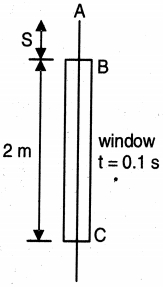
$A$ stone is dropped from the edge of a roof. It passes a window $2 \, m$ high in $0.1 \, s$. How far is the roof above the top of the window?
Solution
(19.42 M) Let the distance between the top of the window and the roof be $S$. For the journey across the window,i.e.,from $B$ to $C$:
Let the velocity at $B = u \, m/s$.
Distance travelled,$S = 2 \, m$.
Time taken,$t = 0.1 \, s$.
Acceleration,$a = g = 9.8 \, m/s^2$.
Using the equation $S = ut + \frac{1}{2}at^2$,we have:
$2 = u(0.1) + \frac{1}{2}(9.8)(0.1)^2$
$2 = 0.1u + 0.049$
$0.1u = 1.951$
$u = 19.51 \, m/s$.
Therefore,the velocity of the stone at the top of the window is $19.51 \, m/s$.
Now,for the free fall of the stone from the roof top to the top of the window,i.e.,from point $A$ to $B$:
Initial velocity $u_i = 0 \, m/s$.
Final velocity $v = 19.51 \, m/s$.
Distance covered $S = ?$.
Acceleration due to gravity $g = 9.8 \, m/s^2$.
Using $v^2 - u_i^2 = 2gS$,we have:
$(19.51)^2 - 0^2 = 2 \times 9.8 \times S$
$S = \frac{(19.51)^2}{19.6} \approx 19.42 \, m$.
Let the velocity at $B = u \, m/s$.
Distance travelled,$S = 2 \, m$.
Time taken,$t = 0.1 \, s$.
Acceleration,$a = g = 9.8 \, m/s^2$.
Using the equation $S = ut + \frac{1}{2}at^2$,we have:
$2 = u(0.1) + \frac{1}{2}(9.8)(0.1)^2$
$2 = 0.1u + 0.049$
$0.1u = 1.951$
$u = 19.51 \, m/s$.
Therefore,the velocity of the stone at the top of the window is $19.51 \, m/s$.
Now,for the free fall of the stone from the roof top to the top of the window,i.e.,from point $A$ to $B$:
Initial velocity $u_i = 0 \, m/s$.
Final velocity $v = 19.51 \, m/s$.
Distance covered $S = ?$.
Acceleration due to gravity $g = 9.8 \, m/s^2$.
Using $v^2 - u_i^2 = 2gS$,we have:
$(19.51)^2 - 0^2 = 2 \times 9.8 \times S$
$S = \frac{(19.51)^2}{19.6} \approx 19.42 \, m$.
0 likes
View Solution142
MediumMCQ
$A$ ball is thrown vertically upwards with a velocity $u$. Calculate the velocity with which it falls to the earth again.
A
$u$
B
$2u$
C
$u/2$
D
$0$
Solution
(A) For a ball thrown vertically upwards:
Initial velocity $= u \text{ m/s}$.
Final velocity at maximum height $= v = 0 \text{ m/s}$.
Using the equation of motion $v = u + at$,where $a = -g$ (acceleration due to gravity acting downwards):
$0 = u - gt \implies t = u/g$ (Time taken to reach maximum height).
For the return journey,the ball starts from rest at the maximum height $(u_{return} = 0)$ and falls downwards under gravity $(a = +g)$:
Using the equation $v^2 = u^2 + 2as$:
$v^2 = 0^2 + 2gH$,where $H$ is the maximum height.
From the upward journey,$H = u^2 / (2g)$.
Substituting $H$ in the return equation: $v^2 = 2g(u^2 / 2g) = u^2$.
Therefore,$v = u$.
The ball returns to the point of projection with the same velocity $u$ with which it was thrown.
Initial velocity $= u \text{ m/s}$.
Final velocity at maximum height $= v = 0 \text{ m/s}$.
Using the equation of motion $v = u + at$,where $a = -g$ (acceleration due to gravity acting downwards):
$0 = u - gt \implies t = u/g$ (Time taken to reach maximum height).
For the return journey,the ball starts from rest at the maximum height $(u_{return} = 0)$ and falls downwards under gravity $(a = +g)$:
Using the equation $v^2 = u^2 + 2as$:
$v^2 = 0^2 + 2gH$,where $H$ is the maximum height.
From the upward journey,$H = u^2 / (2g)$.
Substituting $H$ in the return equation: $v^2 = 2g(u^2 / 2g) = u^2$.
Therefore,$v = u$.
The ball returns to the point of projection with the same velocity $u$ with which it was thrown.
0 likes
View Solution143
Medium
Prove that if a body is thrown vertically upwards,then the time of ascent is equal to the time of descent.
Solution
(N/A) For a body thrown vertically upwards with initial velocity $u$,the final velocity at the maximum height is $v = 0$.
Let $t_{1}$ be the time of ascent. Using the first equation of motion $v = u + at$,where $a = -g$:
$0 = u - gt_{1}$
$\Rightarrow t_{1} = \frac{u}{g} ......(1)$
For the return journey (descent),the body starts from rest at the maximum height,so initial velocity $u' = 0$. The final velocity when it reaches the ground is $v' = u$. Let $t_{2}$ be the time of descent. Using $v' = u' + gt_{2}$:
$u = 0 + gt_{2}$
$\Rightarrow t_{2} = \frac{u}{g} ......(2)$
Comparing equation $(1)$ and $(2)$,we get $t_{1} = t_{2}$.
Thus,the time of ascent is equal to the time of descent.
Let $t_{1}$ be the time of ascent. Using the first equation of motion $v = u + at$,where $a = -g$:
$0 = u - gt_{1}$
$\Rightarrow t_{1} = \frac{u}{g} ......(1)$
For the return journey (descent),the body starts from rest at the maximum height,so initial velocity $u' = 0$. The final velocity when it reaches the ground is $v' = u$. Let $t_{2}$ be the time of descent. Using $v' = u' + gt_{2}$:
$u = 0 + gt_{2}$
$\Rightarrow t_{2} = \frac{u}{g} ......(2)$
Comparing equation $(1)$ and $(2)$,we get $t_{1} = t_{2}$.
Thus,the time of ascent is equal to the time of descent.
0 likes
View Solution144
Easy
$A$ stone is dropped from the roof of a building. It takes $4 \, s$ to reach the ground. Find the height of the building. $(g = 9.8 \, m \, s^{-2})$
Solution
(78.4 M) Given: Initial velocity $u = 0 \, m \, s^{-1}$,time $t = 4 \, s$,and acceleration due to gravity $g = 9.8 \, m \, s^{-2}$.
Using the second equation of motion for free fall:
$h = ut + \frac{1}{2}gt^2$
Substituting the values:
$h = (0 \times 4) + \frac{1}{2} \times 9.8 \times (4)^2$
$h = 0 + 0.5 \times 9.8 \times 16$
$h = 4.9 \times 16$
$h = 78.4 \, m$
Thus,the height of the building is $78.4 \, m$.
Using the second equation of motion for free fall:
$h = ut + \frac{1}{2}gt^2$
Substituting the values:
$h = (0 \times 4) + \frac{1}{2} \times 9.8 \times (4)^2$
$h = 0 + 0.5 \times 9.8 \times 16$
$h = 4.9 \times 16$
$h = 78.4 \, m$
Thus,the height of the building is $78.4 \, m$.
0 likes
View Solution145
MediumMCQ
$A$ man weighs $600\,N$ on Earth. What is his mass? $(g=10\,m s^{-2})$. On the Moon,his weight would be $100\,N$. What is the acceleration due to gravity on the Moon?
A
$60\,kg, 1.67\,m s^{-2}$
B
$60\,kg, 1.5\,m s^{-2}$
C
$6\,kg, 1.67\,m s^{-2}$
D
$60\,kg, 1.0\,m s^{-2}$
Solution
(A) Given: Weight on Earth $W_{E} = 600\,N$,Weight on Moon $W_{M} = 100\,N$,acceleration due to gravity on Earth $g = 10\,m s^{-2}$.
First,we calculate the mass $(m)$ of the man using the formula $W = m \times g$:
$m = \frac{W_{E}}{g} = \frac{600}{10} = 60\,kg$.
Since mass remains constant everywhere,the mass of the man on the Moon is also $60\,kg$.
Now,we calculate the acceleration due to gravity on the Moon $(g_{m})$ using the formula $W_{M} = m \times g_{m}$:
$g_{m} = \frac{W_{M}}{m} = \frac{100}{60} = 1.67\,m s^{-2}$.
First,we calculate the mass $(m)$ of the man using the formula $W = m \times g$:
$m = \frac{W_{E}}{g} = \frac{600}{10} = 60\,kg$.
Since mass remains constant everywhere,the mass of the man on the Moon is also $60\,kg$.
Now,we calculate the acceleration due to gravity on the Moon $(g_{m})$ using the formula $W_{M} = m \times g_{m}$:
$g_{m} = \frac{W_{M}}{m} = \frac{100}{60} = 1.67\,m s^{-2}$.
0 likes
View Solution146
Medium
$(a)$ The weight of a man on the surface of the earth is $392 \, N$. Find his mass. $(g = 9.8 \, m s^{-2})$
$(b)$ If the man were taken to the moon,what would be:
$(i)$ his mass and
$(ii)$ his weight?
$(iii)$ Calculate the acceleration due to gravity on the moon.
$(b)$ If the man were taken to the moon,what would be:
$(i)$ his mass and
$(ii)$ his weight?
$(iii)$ Calculate the acceleration due to gravity on the moon.
Solution
(N/A) Given: Weight $(W) = 392 \, N$,Acceleration due to gravity $(g) = 9.8 \, m s^{-2}$.
Mass $(m) = W / g = 392 / 9.8 = 40 \, kg$.
$(b)$ $(i)$ The mass of an object remains constant regardless of location. Therefore,his mass on the moon will be $40 \, kg$.
$(ii)$ The weight of an object on the moon is $1/6$ of its weight on the earth. Therefore,weight on the moon $= 392 / 6 \approx 65.33 \, N$.
$(iii)$ Acceleration due to gravity on the moon $(g_m) = \text{Weight on moon} / \text{Mass} = 65.33 / 40 \approx 1.63 \, m s^{-2}$.
Mass $(m) = W / g = 392 / 9.8 = 40 \, kg$.
$(b)$ $(i)$ The mass of an object remains constant regardless of location. Therefore,his mass on the moon will be $40 \, kg$.
$(ii)$ The weight of an object on the moon is $1/6$ of its weight on the earth. Therefore,weight on the moon $= 392 / 6 \approx 65.33 \, N$.
$(iii)$ Acceleration due to gravity on the moon $(g_m) = \text{Weight on moon} / \text{Mass} = 65.33 / 40 \approx 1.63 \, m s^{-2}$.
0 likes
View Solution147
Medium
An object has a mass of $30 \ kg$. What is its weight $(i)$ on the moon $(ii)$ on another planet? The value of $g$ on the moon is $1/6$ the value of $g$ on the earth. The value of $g$ on the planet is $3$ times the value of $g$ on the earth. Take $g_{earth} = 10 \ m/s^2$.
Solution
(N/A) Given: Mass $(m) = 30 \ kg$,$g_{earth} = 10 \ m/s^2$.
$(i)$ Weight on the moon $(W_m)$:
$g_{moon} = 1/6 \times g_{earth} = 1/6 \times 10 = 5/3 \ m/s^2$.
$W_m = m \times g_{moon} = 30 \times (5/3) = 50 \ N$.
$(ii)$ Weight on the planet $(W_p)$:
$g_{planet} = 3 \times g_{earth} = 3 \times 10 = 30 \ m/s^2$.
$W_p = m \times g_{planet} = 30 \times 30 = 900 \ N$.
$(i)$ Weight on the moon $(W_m)$:
$g_{moon} = 1/6 \times g_{earth} = 1/6 \times 10 = 5/3 \ m/s^2$.
$W_m = m \times g_{moon} = 30 \times (5/3) = 50 \ N$.
$(ii)$ Weight on the planet $(W_p)$:
$g_{planet} = 3 \times g_{earth} = 3 \times 10 = 30 \ m/s^2$.
$W_p = m \times g_{planet} = 30 \times 30 = 900 \ N$.
0 likes
View Solution148
Difficult
$A$ man throws a ball of mass $0.5 \, kg$ vertically upward with a velocity of $25 \, m s^{-1}$. Find: $(a)$ the initial momentum of the ball,$(b)$ the momentum of the ball at the halfway mark of the maximum height. (Given $g = 10 \, m s^{-2}$)
Solution
(N/A) Given: Mass $m = 0.5 \, kg$,initial velocity $u = 25 \, m s^{-1}$,acceleration due to gravity $g = -10 \, m s^{-2}$.
$(a)$ Initial momentum $p = m \times u = 0.5 \times 25 = 12.5 \, kg \, m s^{-1}$.
$(b)$ To find the momentum at half the maximum height,first calculate the maximum height $H$ using $v^2 - u^2 = 2gH$. At maximum height,final velocity $v = 0$.
$0^2 - (25)^2 = 2 \times (-10) \times H$
$-625 = -20 \times H$
$H = 625 / 20 = 31.25 \, m$.
Halfway height $h = H / 2 = 31.25 / 2 = 15.625 \, m$.
Now,find the velocity $v_h$ at height $h$ using $v_h^2 - u^2 = 2gh$:
$v_h^2 - (25)^2 = 2 \times (-10) \times 15.625$
$v_h^2 - 625 = -312.5$
$v_h^2 = 312.5$
$v_h = \sqrt{312.5} \approx 17.68 \, m s^{-1}$.
Momentum at halfway mark $p_h = m \times v_h = 0.5 \times 17.68 = 8.84 \, kg \, m s^{-1}$.
$(a)$ Initial momentum $p = m \times u = 0.5 \times 25 = 12.5 \, kg \, m s^{-1}$.
$(b)$ To find the momentum at half the maximum height,first calculate the maximum height $H$ using $v^2 - u^2 = 2gH$. At maximum height,final velocity $v = 0$.
$0^2 - (25)^2 = 2 \times (-10) \times H$
$-625 = -20 \times H$
$H = 625 / 20 = 31.25 \, m$.
Halfway height $h = H / 2 = 31.25 / 2 = 15.625 \, m$.
Now,find the velocity $v_h$ at height $h$ using $v_h^2 - u^2 = 2gh$:
$v_h^2 - (25)^2 = 2 \times (-10) \times 15.625$
$v_h^2 - 625 = -312.5$
$v_h^2 = 312.5$
$v_h = \sqrt{312.5} \approx 17.68 \, m s^{-1}$.
Momentum at halfway mark $p_h = m \times v_h = 0.5 \times 17.68 = 8.84 \, kg \, m s^{-1}$.
0 likes
View Solution149
Medium
$A$ ball thrown up vertically returns to the thrower after $6 \, s$. Find:
$(a)$ The velocity with which it was thrown up.
$(b)$ The maximum height attained. (Take $g = 9.8 \, m s^{-2}$)
$(a)$ The velocity with which it was thrown up.
$(b)$ The maximum height attained. (Take $g = 9.8 \, m s^{-2}$)
Solution
(N/A) Given: Total time $T = 6 \, s$,final velocity at maximum height $v = 0 \, m s^{-1}$,acceleration due to gravity $g = 9.8 \, m s^{-2}$.
Since the time of ascent equals the time of descent,the time taken to reach the maximum height is $t = T / 2 = 6 / 2 = 3 \, s$.
$(a)$ Using the first equation of motion,$v = u + at$,where $a = -g$:
$0 = u + (-9.8 \times 3)$
$u = 29.4 \, m s^{-1}$.
Thus,the initial velocity is $29.4 \, m s^{-1}$.
$(b)$ Using the third equation of motion,$v^2 - u^2 = 2as$:
$0^2 - (29.4)^2 = 2 \times (-9.8) \times h$
$-864.36 = -19.6 \times h$
$h = 864.36 / 19.6 = 44.1 \, m$.
Thus,the maximum height attained is $44.1 \, m$.
Since the time of ascent equals the time of descent,the time taken to reach the maximum height is $t = T / 2 = 6 / 2 = 3 \, s$.
$(a)$ Using the first equation of motion,$v = u + at$,where $a = -g$:
$0 = u + (-9.8 \times 3)$
$u = 29.4 \, m s^{-1}$.
Thus,the initial velocity is $29.4 \, m s^{-1}$.
$(b)$ Using the third equation of motion,$v^2 - u^2 = 2as$:
$0^2 - (29.4)^2 = 2 \times (-9.8) \times h$
$-864.36 = -19.6 \times h$
$h = 864.36 / 19.6 = 44.1 \, m$.
Thus,the maximum height attained is $44.1 \, m$.
0 likes
View Solution150
Medium
$A$ ball is dropped from a height of $20\, m$. $A$ second ball is thrown downwards from the same height after one second with initial velocity $u$. If both the balls reach the ground at the same time, calculate the initial velocity of the second ball. (Take $g = 10\, m s^{-2}$).
Solution
$(15 M S^{-1})$ For the first ball:
$u = 0, h = 20\, m, g = 10\, m s^{-2}, t = ?$
Using the equation of motion $S = ut + \frac{1}{2}at^2$, we have:
$20 = 0 + \frac{1}{2} \times 10 \times t^2$
$20 = 5t^2$
$t^2 = 4$
$t = 2\, s$
For the second ball:
Since the second ball is thrown $1\, s$ later and reaches the ground at the same time, its time of travel is $t' = 2 - 1 = 1\, s$.
$u = ?, h = 20\, m, g = 10\, m s^{-2}, t' = 1\, s$
Using $S = ut' + \frac{1}{2}at'^2$, we have:
$20 = u(1) + \frac{1}{2} \times 10 \times (1)^2$
$20 = u + 5$
$u = 20 - 5 = 15\, m s^{-1}$
$u = 0, h = 20\, m, g = 10\, m s^{-2}, t = ?$
Using the equation of motion $S = ut + \frac{1}{2}at^2$, we have:
$20 = 0 + \frac{1}{2} \times 10 \times t^2$
$20 = 5t^2$
$t^2 = 4$
$t = 2\, s$
For the second ball:
Since the second ball is thrown $1\, s$ later and reaches the ground at the same time, its time of travel is $t' = 2 - 1 = 1\, s$.
$u = ?, h = 20\, m, g = 10\, m s^{-2}, t' = 1\, s$
Using $S = ut' + \frac{1}{2}at'^2$, we have:
$20 = u(1) + \frac{1}{2} \times 10 \times (1)^2$
$20 = u + 5$
$u = 20 - 5 = 15\, m s^{-1}$
0 likes
View SolutionGRAVITATION — Mix Example - GRAVITATION · Frequently Asked Questions
1Are these GRAVITATION questions useful for JEE and NEET?
Yes. All questions in this section are mapped to JEE Main and NEET exam patterns. Previous year questions from JEE Main, NEET, GUJCET and state-level exams are included with full solutions.
2Can I switch to Hindi or Gujarati for these questions?
Yes. Use the language tabs in the hero section or the sidebar to view the same questions and solutions in English, Hindi or Gujarati.
3How do I generate a question paper from this subtopic?
Use the Vedclass Exam Paper Generator — select the chapter and subtopic, set difficulty, and generate Sets A, B, C, D automatically. First 3 chapters of every subject are free.
Vedclass Products
For Students
Vedclass Test Series
Mock tests in real JEE/NEET style with performance analysis. 5-day free trial.
Start Free TrialFor Teachers
Exam Paper Generator
Generate Set A/B/C/D papers from this chapter in 2 minutes. 3 chapters free.
Try FreeFor Institutes
Online Exam Module
Live online exams with unlimited students, 360° analytics & white-label branding.
See DemoFor Teachers & Institutes
Generate a GRAVITATION Exam Paper in 2 Minutes
Select subtopic & difficulty — Sets A, B, C, D auto-generated with No Repeat logic.
First 3 chapters of every subject are free — no payment required.