
A English
Mix Examples - Triangles Questions in English
Class 9 Mathematics · Triangles · Mix Examples - Triangles
148+
Questions
English
Language
100%
With Solutions
Showing 50 of 148 questions in English
1
EasyMCQ
If $\triangle ABC \cong \triangle PQR$ and $\triangle ABC$ is not congruent to $\triangle RPQ$,then which of the following is not true?
A
$BC = PQ$
B
$AC = PR$
C
$QR = BC$
D
$AB = PQ$
Solution
(A) Given that $\triangle ABC \cong \triangle PQR$. By the rule of correspondence in congruent triangles,the corresponding parts are equal:
$AB = PQ$,$BC = QR$,and $AC = PR$.
Also,the angles are equal: $\angle A = \angle P$,$\angle B = \angle Q$,and $\angle C = \angle R$.
We are given that $\triangle ABC$ is not congruent to $\triangle RPQ$. This implies that the correspondence $A \leftrightarrow R$,$B \leftrightarrow P$,and $C \leftrightarrow Q$ does not hold.
Let's check the options based on $\triangle ABC \cong \triangle PQR$:
Option $A$: $BC = PQ$. From the correspondence,$BC = QR$. Thus,$BC = PQ$ is generally not true.
Option $B$: $AC = PR$. This is true by correspondence.
Option $C$: $QR = BC$. This is true by correspondence.
Option $D$: $AB = PQ$. This is true by correspondence.
Therefore,the statement that is not true is $BC = PQ$.
$AB = PQ$,$BC = QR$,and $AC = PR$.
Also,the angles are equal: $\angle A = \angle P$,$\angle B = \angle Q$,and $\angle C = \angle R$.
We are given that $\triangle ABC$ is not congruent to $\triangle RPQ$. This implies that the correspondence $A \leftrightarrow R$,$B \leftrightarrow P$,and $C \leftrightarrow Q$ does not hold.
Let's check the options based on $\triangle ABC \cong \triangle PQR$:
Option $A$: $BC = PQ$. From the correspondence,$BC = QR$. Thus,$BC = PQ$ is generally not true.
Option $B$: $AC = PR$. This is true by correspondence.
Option $C$: $QR = BC$. This is true by correspondence.
Option $D$: $AB = PQ$. This is true by correspondence.
Therefore,the statement that is not true is $BC = PQ$.
0 likes
View Solution2
EasyMCQ
Which of the following is not a criterion for congruence of triangles?
A
$SAS$
B
$SSA$
C
$ASA$
D
$SSS$
Solution
(B) The criteria for congruence of triangles are $SAS$ (Side-Angle-Side),$ASA$ (Angle-Side-Angle),$SSS$ (Side-Side-Side),$AAS$ (Angle-Angle-Side),and $RHS$ (Right angle-Hypotenuse-Side).
$SSA$ (Side-Side-Angle) is not a valid criterion for the congruence of triangles because it does not uniquely determine a triangle.
$SSA$ (Side-Side-Angle) is not a valid criterion for the congruence of triangles because it does not uniquely determine a triangle.
0 likes
View Solution3
EasyMCQ
If $AB = QR$,$BC = PR$,and $CA = PQ$,then
A
$\triangle ABC \cong \triangle PQR$
B
$\triangle BAC \cong \triangle RPQ$
C
$\triangle CBA \cong \triangle PRQ$
D
$\triangle PQR \cong \triangle BCA$
Solution
(C) Given the side correspondences: $AB = QR$,$BC = PR$,and $CA = PQ$.
To determine the congruence,we map the vertices based on the equal sides:
$1$. Since $AB = QR$,vertex $A$ corresponds to $Q$ and vertex $B$ corresponds to $R$.
$2$. Since $BC = PR$,vertex $B$ corresponds to $P$ and vertex $C$ corresponds to $R$.
$3$. Since $CA = PQ$,vertex $C$ corresponds to $P$ and vertex $A$ corresponds to $Q$.
Matching the vertices: $A \leftrightarrow Q$,$B \leftrightarrow R$,and $C \leftrightarrow P$ is not correct based on the side $BC=PR$. Let's re-evaluate:
$A$ corresponds to $Q$,$B$ corresponds to $R$,and $C$ corresponds to $P$.
Looking at the sides: $AB$ corresponds to $QR$,$BC$ corresponds to $RP$,and $CA$ corresponds to $PQ$.
Thus,$\triangle ABC \cong \triangle QRP$.
Re-checking the options provided:
If $AB=QR, BC=PR, CA=PQ$,then the correspondence is $A \leftrightarrow Q, B \leftrightarrow R, C \leftrightarrow P$.
Therefore,$\triangle CBA \cong \triangle PRQ$ is correct because $CB=PR, BA=RQ, AC=QP$.
To determine the congruence,we map the vertices based on the equal sides:
$1$. Since $AB = QR$,vertex $A$ corresponds to $Q$ and vertex $B$ corresponds to $R$.
$2$. Since $BC = PR$,vertex $B$ corresponds to $P$ and vertex $C$ corresponds to $R$.
$3$. Since $CA = PQ$,vertex $C$ corresponds to $P$ and vertex $A$ corresponds to $Q$.
Matching the vertices: $A \leftrightarrow Q$,$B \leftrightarrow R$,and $C \leftrightarrow P$ is not correct based on the side $BC=PR$. Let's re-evaluate:
$A$ corresponds to $Q$,$B$ corresponds to $R$,and $C$ corresponds to $P$.
Looking at the sides: $AB$ corresponds to $QR$,$BC$ corresponds to $RP$,and $CA$ corresponds to $PQ$.
Thus,$\triangle ABC \cong \triangle QRP$.
Re-checking the options provided:
If $AB=QR, BC=PR, CA=PQ$,then the correspondence is $A \leftrightarrow Q, B \leftrightarrow R, C \leftrightarrow P$.
Therefore,$\triangle CBA \cong \triangle PRQ$ is correct because $CB=PR, BA=RQ, AC=QP$.
0 likes
View Solution4
MediumMCQ
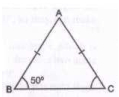
In $\triangle ABC$,$AB = AC$ and $\angle B = 50^{\circ}$. Then $\angle C$ is equal to (in $^{\circ}$)
A
$40$
B
$130$
C
$80$
D
$50$
Solution
(D) In $\triangle ABC$,we are given that $AB = AC$.
Since the angles opposite to equal sides of a triangle are equal,we have $\angle C = \angle B$.
Given that $\angle B = 50^{\circ}$.
Therefore,$\angle C = 50^{\circ}$.
Since the angles opposite to equal sides of a triangle are equal,we have $\angle C = \angle B$.
Given that $\angle B = 50^{\circ}$.
Therefore,$\angle C = 50^{\circ}$.
0 likes
View Solution5
MediumMCQ
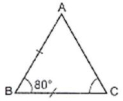
In $\triangle ABC$,$BC = AB$ and $\angle B = 80^{\circ}$. Then $\angle A$ is equal to: (in $^{\circ}$)
A
$50$
B
$80$
C
$40$
D
$100$
Solution
(A) In $\triangle ABC$,we are given that $BC = AB$.
Since the sides opposite to equal angles are equal,the angles opposite to equal sides are also equal.
Therefore,$\angle A = \angle C$.
We know that the sum of all interior angles of a triangle is $180^{\circ}$.
So,$\angle A + \angle B + \angle C = 180^{\circ}$.
Substituting the given values: $\angle A + 80^{\circ} + \angle A = 180^{\circ}$.
$2 \angle A + 80^{\circ} = 180^{\circ}$.
$2 \angle A = 180^{\circ} - 80^{\circ}$.
$2 \angle A = 100^{\circ}$.
$\angle A = 100^{\circ} / 2 = 50^{\circ}$.
Since the sides opposite to equal angles are equal,the angles opposite to equal sides are also equal.
Therefore,$\angle A = \angle C$.
We know that the sum of all interior angles of a triangle is $180^{\circ}$.
So,$\angle A + \angle B + \angle C = 180^{\circ}$.
Substituting the given values: $\angle A + 80^{\circ} + \angle A = 180^{\circ}$.
$2 \angle A + 80^{\circ} = 180^{\circ}$.
$2 \angle A = 180^{\circ} - 80^{\circ}$.
$2 \angle A = 100^{\circ}$.
$\angle A = 100^{\circ} / 2 = 50^{\circ}$.
0 likes
View Solution6
EasyMCQ
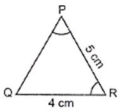
In $\triangle PQR$,$\angle R = \angle P$,$QR = 4 \, cm$,and $PR = 5 \, cm$. Then the length of $PQ$ is (in $cm$):
A
$5$
B
$4$
C
$2$
D
$2.5$
Solution
(B) In $\triangle PQR$,we are given that $\angle R = \angle P$.
According to the property of triangles,the sides opposite to equal angles are equal.
Therefore,the side opposite to $\angle R$ (which is $PQ$) must be equal to the side opposite to $\angle P$ (which is $QR$).
Thus,$PQ = QR$.
Given that $QR = 4 \, cm$,it follows that $PQ = 4 \, cm$.
According to the property of triangles,the sides opposite to equal angles are equal.
Therefore,the side opposite to $\angle R$ (which is $PQ$) must be equal to the side opposite to $\angle P$ (which is $QR$).
Thus,$PQ = QR$.
Given that $QR = 4 \, cm$,it follows that $PQ = 4 \, cm$.
0 likes
View Solution7
EasyMCQ
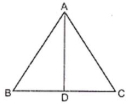
$D$ is a point on the side $BC$ of a $\triangle ABC$ such that $AD$ bisects $\angle BAC$. Then
A
$BD = CD$
B
$BD > BA$
C
$BA > BD$
D
$CD > CA$
Solution
(C) In $\triangle ADC$,the exterior angle $\angle ADB$ is greater than the interior opposite angle $\angle DAC$.
Since $AD$ is the bisector of $\angle BAC$,we have $\angle BAD = \angle DAC$.
Substituting this into the inequality,we get $\angle ADB > \angle BAD$.
In $\triangle ABD$,since the side opposite to the greater angle is longer,we have $AB > BD$.
Since $AD$ is the bisector of $\angle BAC$,we have $\angle BAD = \angle DAC$.
Substituting this into the inequality,we get $\angle ADB > \angle BAD$.
In $\triangle ABD$,since the side opposite to the greater angle is longer,we have $AB > BD$.
0 likes
View Solution8
MediumMCQ
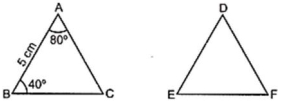
It is given that $\triangle ABC \cong \triangle FDE$. If $AB = 5 \, cm$,$\angle B = 40^{\circ}$,and $\angle A = 80^{\circ}$,then which of the following is true?
A
$DF = 5 \, cm, \angle F = 60^{\circ}$
B
$DE = 5 \, cm, \angle E = 60^{\circ}$
C
$DE = 5 \, cm, \angle D = 40^{\circ}$
D
$DF = 5 \, cm, \angle E = 60^{\circ}$
Solution
(D) Given that $\triangle ABC \cong \triangle FDE$.
$1$. In $\triangle ABC$,the sum of angles is $180^{\circ}$. Therefore,$\angle C = 180^{\circ} - (80^{\circ} + 40^{\circ}) = 180^{\circ} - 120^{\circ} = 60^{\circ}$.
$2$. Since $\triangle ABC \cong \triangle FDE$,the corresponding parts of congruent triangles are equal $(CPCT)$.
$3$. The correspondence is $A \leftrightarrow F$,$B \leftrightarrow D$,and $C \leftrightarrow E$.
$4$. Therefore,$AB$ corresponds to $FD$ (or $DF$). Thus,$DF = AB = 5 \, cm$.
$5$. Also,$\angle C$ corresponds to $\angle E$. Thus,$\angle E = \angle C = 60^{\circ}$.
$6$. Comparing this with the given options,$DF = 5 \, cm$ and $\angle E = 60^{\circ}$ is correct.
$1$. In $\triangle ABC$,the sum of angles is $180^{\circ}$. Therefore,$\angle C = 180^{\circ} - (80^{\circ} + 40^{\circ}) = 180^{\circ} - 120^{\circ} = 60^{\circ}$.
$2$. Since $\triangle ABC \cong \triangle FDE$,the corresponding parts of congruent triangles are equal $(CPCT)$.
$3$. The correspondence is $A \leftrightarrow F$,$B \leftrightarrow D$,and $C \leftrightarrow E$.
$4$. Therefore,$AB$ corresponds to $FD$ (or $DF$). Thus,$DF = AB = 5 \, cm$.
$5$. Also,$\angle C$ corresponds to $\angle E$. Thus,$\angle E = \angle C = 60^{\circ}$.
$6$. Comparing this with the given options,$DF = 5 \, cm$ and $\angle E = 60^{\circ}$ is correct.
0 likes
View Solution9
MediumMCQ
Two sides of a triangle are of lengths $5\, cm$ and $1.5\, cm$. The length of the third side of the triangle cannot be (in $cm$):
A
$3.4$
B
$3.8$
C
$4.1$
D
$3.6$
Solution
(A) According to the triangle inequality theorem,the sum of any two sides of a triangle must be greater than the third side,and the difference between any two sides must be less than the third side.
Let the third side be $x$.
Then,$5 - 1.5 < x < 5 + 1.5$,which simplifies to $3.5 < x < 6.5$.
Checking the options:
$A) 3.4$ is not in the range $(3.5, 6.5)$ because $3.4 < 3.5$.
$B) 3.8$ is in the range.
$C) 4.1$ is in the range.
$D) 3.6$ is in the range.
Therefore,the length of the third side cannot be $3.4\, cm$.
Let the third side be $x$.
Then,$5 - 1.5 < x < 5 + 1.5$,which simplifies to $3.5 < x < 6.5$.
Checking the options:
$A) 3.4$ is not in the range $(3.5, 6.5)$ because $3.4 < 3.5$.
$B) 3.8$ is in the range.
$C) 4.1$ is in the range.
$D) 3.6$ is in the range.
Therefore,the length of the third side cannot be $3.4\, cm$.
0 likes
View Solution10
MediumMCQ
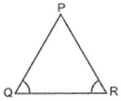
In $\triangle PQR,$ if $\angle R > \angle Q,$ then
A
$QR > PR$
B
$PQ > PR$
C
$PQ < PR$
D
$QR < PR$
Solution
(B) In $\triangle PQR,$ we are given that $\angle R > \angle Q.$
According to the theorem,in any triangle,the side opposite to the greater angle is longer.
The side opposite to $\angle R$ is $PQ$ and the side opposite to $\angle Q$ is $PR.$
Since $\angle R > \angle Q,$ it follows that $PQ > PR.$
According to the theorem,in any triangle,the side opposite to the greater angle is longer.
The side opposite to $\angle R$ is $PQ$ and the side opposite to $\angle Q$ is $PR.$
Since $\angle R > \angle Q,$ it follows that $PQ > PR.$
0 likes
View Solution11
MediumMCQ
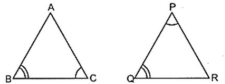
In triangles $ABC$ and $PQR$,$AB = AC$,$\angle C = \angle P$ and $\angle B = \angle Q$. The two triangles are
A
congruent but not isosceles
B
neither congruent nor isosceles
C
isosceles but not congruent
D
isosceles and congruent
Solution
(C) Given: In $\triangle ABC$,$AB = AC$. Therefore,$\angle B = \angle C$ (Angles opposite to equal sides are equal).
Given: $\angle C = \angle P$ and $\angle B = \angle Q$.
Since $\angle B = \angle C$,we have $\angle Q = \angle P$.
In $\triangle PQR$,since $\angle Q = \angle P$,the sides opposite to these angles must be equal,so $PR = QR$. Thus,$\triangle PQR$ is an isosceles triangle.
However,we do not have enough information (such as a side length or a specific angle measure) to prove that $\triangle ABC \cong \triangle PQR$. For example,the triangles could have different sizes while maintaining the same angle relationships.
Therefore,both triangles are isosceles,but they are not necessarily congruent.
Given: $\angle C = \angle P$ and $\angle B = \angle Q$.
Since $\angle B = \angle C$,we have $\angle Q = \angle P$.
In $\triangle PQR$,since $\angle Q = \angle P$,the sides opposite to these angles must be equal,so $PR = QR$. Thus,$\triangle PQR$ is an isosceles triangle.
However,we do not have enough information (such as a side length or a specific angle measure) to prove that $\triangle ABC \cong \triangle PQR$. For example,the triangles could have different sizes while maintaining the same angle relationships.
Therefore,both triangles are isosceles,but they are not necessarily congruent.
0 likes
View Solution12
EasyMCQ
In triangles $ABC$ and $DEF$,$AB = FD$ and $\angle A = \angle D$. The two triangles will be congruent by the $SAS$ axiom if:
A
$BC = EF$
B
$AC = EF$
C
$BC = DE$
D
$AC = DE$
Solution
(D) According to the $SAS$ (Side-Angle-Side) congruence axiom,two triangles are congruent if two sides and the included angle of one triangle are equal to the corresponding two sides and the included angle of the other triangle.
Given: $AB = FD$ and $\angle A = \angle D$.
For the triangles to be congruent by $SAS$,the sides forming the angle $\angle A$ (which are $AB$ and $AC$) must be equal to the sides forming the angle $\angle D$ (which are $FD$ and $DE$).
Since $AB = FD$ is already given,we must have $AC = DE$ for the $SAS$ condition to be satisfied.
Given: $AB = FD$ and $\angle A = \angle D$.
For the triangles to be congruent by $SAS$,the sides forming the angle $\angle A$ (which are $AB$ and $AC$) must be equal to the sides forming the angle $\angle D$ (which are $FD$ and $DE$).
Since $AB = FD$ is already given,we must have $AC = DE$ for the $SAS$ condition to be satisfied.
0 likes
View Solution13
Easy
In the two triangles $ABC$ and $DEF$,$AB = DE$ and $AC = EF$. Name two angles from the two triangles that must be equal so that the two triangles are congruent. Give reason for your answer.
Solution
(A) To prove that $\triangle ABC \cong \triangle DEF$ (or a variation thereof) using the $SAS$ (Side-Angle-Side) congruence criterion,the angle must be included between the two given sides.
For $\triangle ABC$,the sides are $AB$ and $AC$,so the included angle is $\angle A$.
For $\triangle DEF$,the sides are $DE$ and $EF$,so the included angle is $\angle E$.
Therefore,if $\angle A = \angle E$,then by the $SAS$ congruence rule,$\triangle ABC \cong \triangle DEF$.
For $\triangle ABC$,the sides are $AB$ and $AC$,so the included angle is $\angle A$.
For $\triangle DEF$,the sides are $DE$ and $EF$,so the included angle is $\angle E$.
Therefore,if $\angle A = \angle E$,then by the $SAS$ congruence rule,$\triangle ABC \cong \triangle DEF$.
0 likes
View Solution14
Easy
In triangles $ABC$ and $DEF$,$\angle A = \angle D$,$\angle B = \angle E$ and $AB = EF$. Will the two triangles be congruent? Give reasons for your answer.
Solution
(NO) The two triangles are not necessarily congruent. For two triangles to be congruent by the $ASA$ (Angle-Side-Angle) criterion,the side must be included between the two angles. In $\triangle ABC$,the side included between $\angle A$ and $\angle B$ is $AB$. In $\triangle DEF$,the side included between $\angle D$ and $\angle E$ is $DE$. Since the given condition is $AB = EF$ instead of $AB = DE$,the triangles do not satisfy the $ASA$ congruence criterion. Therefore,they are not necessarily congruent.
0 likes
View Solution15
Easy
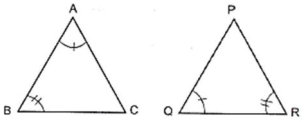
In triangles $ABC$ and $PQR$,$\angle A = \angle Q$ and $\angle B = \angle R$. Which side of $\triangle PQR$ should be equal to side $AB$ of $\triangle ABC$ so that the two triangles are congruent? Give reason for your answer.
Solution
(N/A) In triangles $ABC$ and $PQR$,we have:
$\angle A = \angle Q$ (Given)
$\angle B = \angle R$ (Given)
For the two triangles to be congruent by the $ASA$ (Angle-Side-Angle) congruence rule,the side included between the two angles must be equal.
In $\triangle ABC$,the side included between $\angle A$ and $\angle B$ is $AB$.
In $\triangle PQR$,the side included between $\angle Q$ and $\angle R$ is $QR$.
Therefore,for the triangles to be congruent,side $AB$ must be equal to side $QR$ $(AB = QR)$.
$\angle A = \angle Q$ (Given)
$\angle B = \angle R$ (Given)
For the two triangles to be congruent by the $ASA$ (Angle-Side-Angle) congruence rule,the side included between the two angles must be equal.
In $\triangle ABC$,the side included between $\angle A$ and $\angle B$ is $AB$.
In $\triangle PQR$,the side included between $\angle Q$ and $\angle R$ is $QR$.
Therefore,for the triangles to be congruent,side $AB$ must be equal to side $QR$ $(AB = QR)$.
0 likes
View Solution16
Medium
In triangles $ABC$ and $PQR$,$\angle A = \angle Q$ and $\angle B = \angle R$. Which side of $\triangle PQR$ should be equal to side $BC$ of $\triangle ABC$ so that the two triangles are congruent? Give reason for your answer.
Solution
(N/A) In triangles $ABC$ and $PQR$,we are given:
$\angle A = \angle Q$ and $\angle B = \angle R$.
For the two triangles to be congruent by the $AAS$ (Angle-Angle-Side) congruence rule,the side corresponding to $BC$ in $\triangle ABC$ must be equal to the side corresponding to $RP$ in $\triangle PQR$.
Therefore,$BC = RP$.
This ensures that the two triangles are congruent by the $AAS$ congruence criterion.
$\angle A = \angle Q$ and $\angle B = \angle R$.
For the two triangles to be congruent by the $AAS$ (Angle-Angle-Side) congruence rule,the side corresponding to $BC$ in $\triangle ABC$ must be equal to the side corresponding to $RP$ in $\triangle PQR$.
Therefore,$BC = RP$.
This ensures that the two triangles are congruent by the $AAS$ congruence criterion.
0 likes
View Solution17
Easy
"If two sides and an angle of one triangle are equal to two sides and an angle of another triangle,then the two triangles must be congruent." Is the statement true? Why?
Solution
(B) The statement is false. For two triangles to be congruent by the $SAS$ (Side-Angle-Side) congruence rule,the angle must be the included angle between the two sides. If the angle is not the included angle,the triangles are not necessarily congruent.
0 likes
View Solution18
Easy
"If two angles and a side of one triangle are equal to two angles and a side of another triangle,then the two triangles must be congruent." Is the statement true? Why?
Solution
(A) The statement is true,provided that the side is the included side between the two angles ($ASA$ Congruence Rule) or the side is corresponding to the same relative position in both triangles ($AAS$ Congruence Rule).
If two angles and any side of one triangle are equal to the corresponding two angles and the corresponding side of another triangle,the triangles are congruent by the $AAS$ (Angle-Angle-Side) congruence criterion.
Therefore,the condition of correspondence is essential for the triangles to be congruent.
If two angles and any side of one triangle are equal to the corresponding two angles and the corresponding side of another triangle,the triangles are congruent by the $AAS$ (Angle-Angle-Side) congruence criterion.
Therefore,the condition of correspondence is essential for the triangles to be congruent.
0 likes
View Solution19
Medium
Is it possible to construct a triangle with lengths of its sides as $4 \, cm, 3 \, cm$ and $7 \, cm$? Give reason for your answer.
Solution
(N/A) According to the triangle inequality theorem,the sum of the lengths of any two sides of a triangle must be strictly greater than the length of the third side.
In this case,the lengths of the sides are $4 \, cm, 3 \, cm$,and $7 \, cm$.
Calculating the sum of the two smaller sides: $4 \, cm + 3 \, cm = 7 \, cm$.
Since the sum of the two sides $(7 \, cm)$ is equal to the third side $(7 \, cm)$ and not greater than it,the triangle inequality condition is not satisfied.
Therefore,it is not possible to construct a triangle with these side lengths.
In this case,the lengths of the sides are $4 \, cm, 3 \, cm$,and $7 \, cm$.
Calculating the sum of the two smaller sides: $4 \, cm + 3 \, cm = 7 \, cm$.
Since the sum of the two sides $(7 \, cm)$ is equal to the third side $(7 \, cm)$ and not greater than it,the triangle inequality condition is not satisfied.
Therefore,it is not possible to construct a triangle with these side lengths.
0 likes
View Solution20
Easy
It is given that $\triangle ABC \cong \triangle RPQ$. Is it true to say that $BC = QR$? Why?
Solution
(B) It is false to say that $BC = QR$.
Since $\triangle ABC \cong \triangle RPQ$,the corresponding parts of congruent triangles are equal $(CPCT)$.
By matching the vertices,we have $A \leftrightarrow R$,$B \leftrightarrow P$,and $C \leftrightarrow Q$.
Therefore,the side $BC$ corresponds to the side $PQ$.
Thus,$BC = PQ$,not $QR$.
Since $\triangle ABC \cong \triangle RPQ$,the corresponding parts of congruent triangles are equal $(CPCT)$.
By matching the vertices,we have $A \leftrightarrow R$,$B \leftrightarrow P$,and $C \leftrightarrow Q$.
Therefore,the side $BC$ corresponds to the side $PQ$.
Thus,$BC = PQ$,not $QR$.
0 likes
View Solution21
Easy
It is given that $\Delta PQR \cong \Delta EDF$. Is it true to say that $PR = EF$? Give a reason for your answer.
Solution
(A) Yes,it is true that $PR = EF$.
Since $\Delta PQR \cong \Delta EDF$,the corresponding parts of congruent triangles are equal $(CPCT)$.
The vertices correspond as follows: $P \leftrightarrow E$,$Q \leftrightarrow D$,and $R \leftrightarrow F$.
Therefore,the side $PR$ corresponds to the side $EF$,which implies $PR = EF$.
Since $\Delta PQR \cong \Delta EDF$,the corresponding parts of congruent triangles are equal $(CPCT)$.
The vertices correspond as follows: $P \leftrightarrow E$,$Q \leftrightarrow D$,and $R \leftrightarrow F$.
Therefore,the side $PR$ corresponds to the side $EF$,which implies $PR = EF$.
0 likes
View Solution22
Easy
In $\triangle PQR$,$\angle P = 70^{\circ}$ and $\angle R = 30^{\circ}$. Which side of this triangle is the longest? Give a reason for your answer.
Solution
(PR) In $\triangle PQR$,the sum of all interior angles is $180^{\circ}$.
$\angle Q = 180^{\circ} - (\angle P + \angle R)$
$\angle Q = 180^{\circ} - (70^{\circ} + 30^{\circ}) = 180^{\circ} - 100^{\circ} = 80^{\circ}$.
Comparing the angles,we have $\angle Q > \angle P > \angle R$ $(80^{\circ} > 70^{\circ} > 30^{\circ})$.
According to the property of triangles,the side opposite to the largest angle is the longest side.
The angle $\angle Q$ is the largest angle,and the side opposite to $\angle Q$ is $PR$.
Therefore,$PR$ is the longest side of $\triangle PQR$.
$\angle Q = 180^{\circ} - (\angle P + \angle R)$
$\angle Q = 180^{\circ} - (70^{\circ} + 30^{\circ}) = 180^{\circ} - 100^{\circ} = 80^{\circ}$.
Comparing the angles,we have $\angle Q > \angle P > \angle R$ $(80^{\circ} > 70^{\circ} > 30^{\circ})$.
According to the property of triangles,the side opposite to the largest angle is the longest side.
The angle $\angle Q$ is the largest angle,and the side opposite to $\angle Q$ is $PR$.
Therefore,$PR$ is the longest side of $\triangle PQR$.
0 likes
View Solution23
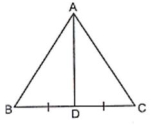
Medium
$AD$ is a median of the triangle $ABC$. Is it true that $AB + BC + CA > 2AD$? Give reason for your answer.
Solution
(N/A) In $\triangle ABD$,we have:
$AB + BD > AD$ $\ldots(1)$
[Since the sum of the lengths of any two sides of a triangle must be greater than the third side]
In $\triangle ADC$,we have:
$AC + CD > AD$ $\ldots(2)$
[Since the sum of the lengths of any two sides of a triangle must be greater than the third side]
Adding $(1)$ and $(2)$,we get:
$AB + BD + CD + AC > 2AD$
Since $AD$ is the median of $\triangle ABC$,$BD = CD$. Therefore,$BD + CD = BC$.
Substituting this into the inequality,we get:
$AB + BC + CA > 2AD$
Yes,the statement is true.
$AB + BD > AD$ $\ldots(1)$
[Since the sum of the lengths of any two sides of a triangle must be greater than the third side]
In $\triangle ADC$,we have:
$AC + CD > AD$ $\ldots(2)$
[Since the sum of the lengths of any two sides of a triangle must be greater than the third side]
Adding $(1)$ and $(2)$,we get:
$AB + BD + CD + AC > 2AD$
Since $AD$ is the median of $\triangle ABC$,$BD = CD$. Therefore,$BD + CD = BC$.
Substituting this into the inequality,we get:
$AB + BC + CA > 2AD$
Yes,the statement is true.
0 likes
View Solution24
Medium
$M$ is a point on side $BC$ of a triangle $ABC$ such that $AM$ is the bisector of $\angle BAC$. Is it true to say that the perimeter of the triangle is greater than $2\, AM$? Give reason for your answer.
Solution
(A) We have to prove that $AB + BC + AC > 2\, AM$.
According to the triangle inequality theorem,the sum of any two sides of a triangle is greater than the third side.
In $\triangle ABM$,we have:
$AB + BM > AM$ $\ldots (1)$
In $\triangle ACM$,we have:
$AC + CM > AM$ $\ldots (2)$
Adding equations $(1)$ and $(2)$,we get:
$AB + BM + AC + CM > AM + AM$
$AB + AC + (BM + CM) > 2\, AM$
Since $M$ is a point on $BC$,$BM + CM = BC$. Substituting this into the inequality:
$AB + AC + BC > 2\, AM$
Thus,the perimeter of the triangle $ABC$ is indeed greater than $2\, AM$.
According to the triangle inequality theorem,the sum of any two sides of a triangle is greater than the third side.
In $\triangle ABM$,we have:
$AB + BM > AM$ $\ldots (1)$
In $\triangle ACM$,we have:
$AC + CM > AM$ $\ldots (2)$
Adding equations $(1)$ and $(2)$,we get:
$AB + BM + AC + CM > AM + AM$
$AB + AC + (BM + CM) > 2\, AM$
Since $M$ is a point on $BC$,$BM + CM = BC$. Substituting this into the inequality:
$AB + AC + BC > 2\, AM$
Thus,the perimeter of the triangle $ABC$ is indeed greater than $2\, AM$.
0 likes
View Solution25
Easy
Is it possible to construct a triangle with lengths of its sides as $9 \, cm$,$7 \, cm$,and $17 \, cm$? Give reason for your answer.
Solution
(N/A) No,it is not possible to construct a triangle with side lengths $9 \, cm$,$7 \, cm$,and $17 \, cm$.
According to the triangle inequality theorem,the sum of the lengths of any two sides of a triangle must be greater than the length of the third side.
Here,the sum of the two smaller sides is:
$9 \, cm + 7 \, cm = 16 \, cm$
Since $16 \, cm < 17 \, cm$,the sum of the two sides is not greater than the third side.
Therefore,a triangle cannot be formed with these side lengths.
According to the triangle inequality theorem,the sum of the lengths of any two sides of a triangle must be greater than the length of the third side.
Here,the sum of the two smaller sides is:
$9 \, cm + 7 \, cm = 16 \, cm$
Since $16 \, cm < 17 \, cm$,the sum of the two sides is not greater than the third side.
Therefore,a triangle cannot be formed with these side lengths.
0 likes
View Solution26
Easy
Is it possible to construct a triangle with lengths of its sides as $8\,cm, 7\,cm$ and $4\,cm$? Give reason for your answer.
Solution
(A) Yes,it is possible to construct a triangle with side lengths $8\,cm, 7\,cm$ and $4\,cm$.
According to the triangle inequality theorem,the sum of any two sides of a triangle must be greater than the third side.
Checking the conditions:
$8 + 7 = 15 > 4$
$8 + 4 = 12 > 7$
$7 + 4 = 11 > 8$
Since all three conditions are satisfied,the triangle can be constructed.
According to the triangle inequality theorem,the sum of any two sides of a triangle must be greater than the third side.
Checking the conditions:
$8 + 7 = 15 > 4$
$8 + 4 = 12 > 7$
$7 + 4 = 11 > 8$
Since all three conditions are satisfied,the triangle can be constructed.
0 likes
View Solution27
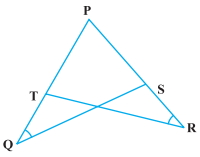
Easy
In the given figure,$PQ = PR$ and $\angle Q = \angle R$. Prove that $\triangle PQS \cong \triangle PRT$.
Solution
(N/A) In $\triangle PQS$ and $\triangle PRT$:
$1$. $PQ = PR$ (Given)
$2$. $\angle Q = \angle R$ (Given)
$3$. $\angle QPS = \angle RPT$ (Common angle $\angle P$)
Therefore,by the $ASA$ (Angle-Side-Angle) congruence criterion,$\triangle PQS \cong \triangle PRT$.
$1$. $PQ = PR$ (Given)
$2$. $\angle Q = \angle R$ (Given)
$3$. $\angle QPS = \angle RPT$ (Common angle $\angle P$)
Therefore,by the $ASA$ (Angle-Side-Angle) congruence criterion,$\triangle PQS \cong \triangle PRT$.
0 likes
View Solution28
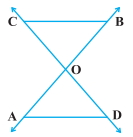
Easy
In the figure,two lines $AB$ and $CD$ intersect each other at the point $O$ such that $BC \parallel DA$ and $BC = DA$. Show that $O$ is the midpoint of both the line segments $AB$ and $CD$.
Solution
(N/A) Given: $BC \parallel AD$ and $BC = DA$.
Consider $\triangle BOC$ and $\triangle AOD$:
$1$. $\angle CBO = \angle DAO$ (Alternate interior angles,since $BC \parallel AD$)
$2$. $\angle BCO = \angle ADO$ (Alternate interior angles,since $BC \parallel AD$)
$3$. $BC = DA$ (Given)
By the $ASA$ (Angle-Side-Angle) congruence criterion,$\triangle BOC \cong \triangle AOD$.
Since the triangles are congruent,their corresponding parts are equal $(CPCT)$:
$OB = OA$ and $OC = OD$.
Therefore,$O$ is the midpoint of both the line segments $AB$ and $CD$.
Consider $\triangle BOC$ and $\triangle AOD$:
$1$. $\angle CBO = \angle DAO$ (Alternate interior angles,since $BC \parallel AD$)
$2$. $\angle BCO = \angle ADO$ (Alternate interior angles,since $BC \parallel AD$)
$3$. $BC = DA$ (Given)
By the $ASA$ (Angle-Side-Angle) congruence criterion,$\triangle BOC \cong \triangle AOD$.
Since the triangles are congruent,their corresponding parts are equal $(CPCT)$:
$OB = OA$ and $OC = OD$.
Therefore,$O$ is the midpoint of both the line segments $AB$ and $CD$.
0 likes
View Solution29
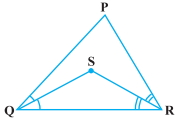
Easy
In the figure,$PQ > PR$ and $QS$ and $RS$ are the bisectors of $\angle Q$ and $\angle R$,respectively. Show that $SQ > SR$.
Solution
(N/A) Given: In $\triangle PQR$,$PQ > PR$ and $QS$,$RS$ are bisectors of $\angle Q$ and $\angle R$ respectively.
Since $PQ > PR$,the angle opposite to the longer side is greater. Therefore,$\angle R > \angle Q$.
Since $QS$ and $RS$ are bisectors of $\angle Q$ and $\angle R$ respectively,we have:
$\angle SQR = \frac{1}{2} \angle Q$
$\angle SRQ = \frac{1}{2} \angle R$
Since $\angle R > \angle Q$,it follows that $\frac{1}{2} \angle R > \frac{1}{2} \angle Q$.
Therefore,$\angle SRQ > \angle SQR$.
In $\triangle SQR$,since $\angle SRQ > \angle SQR$,the side opposite to the greater angle is longer. Thus,$SQ > SR$.
Since $PQ > PR$,the angle opposite to the longer side is greater. Therefore,$\angle R > \angle Q$.
Since $QS$ and $RS$ are bisectors of $\angle Q$ and $\angle R$ respectively,we have:
$\angle SQR = \frac{1}{2} \angle Q$
$\angle SRQ = \frac{1}{2} \angle R$
Since $\angle R > \angle Q$,it follows that $\frac{1}{2} \angle R > \frac{1}{2} \angle Q$.
Therefore,$\angle SRQ > \angle SQR$.
In $\triangle SQR$,since $\angle SRQ > \angle SQR$,the side opposite to the greater angle is longer. Thus,$SQ > SR$.
0 likes
View Solution30
Medium
$ABC$ is an isosceles triangle with $AB = AC$. $BD$ and $CE$ are its two medians. Show that $BD = CE$.
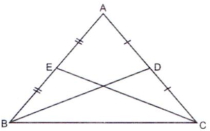
Solution
(N/A) Given: $\triangle ABC$ with $AB = AC$.
$D$ is the mid-point of $AC$ and $E$ is the mid-point of $AB$.
To prove: $BD = CE$.
Proof: In $\triangle ABD$ and $\triangle ACE$:
$1$. $AB = AC$ (Given)
$2$. $\angle BAD = \angle CAE$ (Common angle)
$3$. $AD = AE$ (Since $AB = AC$,their halves are equal,i.e.,$\frac{1}{2}AB = \frac{1}{2}AC$)
By $SAS$ congruence criterion,$\triangle ABD \cong \triangle ACE$.
Therefore,$BD = CE$ by $CPCT$ (Corresponding Parts of Congruent Triangles).
$D$ is the mid-point of $AC$ and $E$ is the mid-point of $AB$.
To prove: $BD = CE$.
Proof: In $\triangle ABD$ and $\triangle ACE$:
$1$. $AB = AC$ (Given)
$2$. $\angle BAD = \angle CAE$ (Common angle)
$3$. $AD = AE$ (Since $AB = AC$,their halves are equal,i.e.,$\frac{1}{2}AB = \frac{1}{2}AC$)
By $SAS$ congruence criterion,$\triangle ABD \cong \triangle ACE$.
Therefore,$BD = CE$ by $CPCT$ (Corresponding Parts of Congruent Triangles).
0 likes
View Solution31
Medium
In the figure,$D$ and $E$ are points on side $BC$ of a $\triangle ABC$ such that $BD = CE$ and $AD = AE$. Show that $\triangle ABD \cong \triangle ACE$.
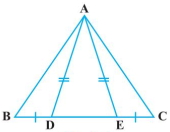
Solution
(N/A) Given: $\triangle ABC$ in which $BD = CE$ and $AD = AE$.
To Prove: $\triangle ABD \cong \triangle ACE$.
Proof: In $\triangle ADE$,we have
$AD = AE$ [Given]
$\Rightarrow \angle ADE = \angle AED$ [Angles opposite to equal sides of a triangle are equal]
Now,$\angle ADB + \angle ADE = 180^{\circ}$ [Linear pair axiom]
$\angle AEC + \angle AED = 180^{\circ}$ [Linear pair axiom]
From these equations,we get:
$\angle ADB + \angle ADE = \angle AEC + \angle AED$
Since $\angle ADE = \angle AED$,we have $\angle ADB = \angle AEC$.
Now,in $\triangle ABD$ and $\triangle ACE$:
$AD = AE$ [Given]
$\angle ADB = \angle AEC$ [Proved above]
$BD = CE$ [Given]
So,by $SAS$ criterion of congruence,we have
$\triangle ABD \cong \triangle ACE$.
Hence,proved.
To Prove: $\triangle ABD \cong \triangle ACE$.
Proof: In $\triangle ADE$,we have
$AD = AE$ [Given]
$\Rightarrow \angle ADE = \angle AED$ [Angles opposite to equal sides of a triangle are equal]
Now,$\angle ADB + \angle ADE = 180^{\circ}$ [Linear pair axiom]
$\angle AEC + \angle AED = 180^{\circ}$ [Linear pair axiom]
From these equations,we get:
$\angle ADB + \angle ADE = \angle AEC + \angle AED$
Since $\angle ADE = \angle AED$,we have $\angle ADB = \angle AEC$.
Now,in $\triangle ABD$ and $\triangle ACE$:
$AD = AE$ [Given]
$\angle ADB = \angle AEC$ [Proved above]
$BD = CE$ [Given]
So,by $SAS$ criterion of congruence,we have
$\triangle ABD \cong \triangle ACE$.
Hence,proved.
0 likes
View Solution32
Difficult
$CDE$ is an equilateral triangle formed on side $CD$ of a square $ABCD$ (see figure). Show that $\triangle ADE \cong \triangle BCE$.
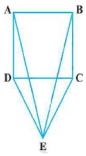
Solution
(N/A) Given: An equilateral triangle $CDE$ is formed on side $CD$ of square $ABCD$.
To prove: $\triangle ADE \cong \triangle BCE$.
Proof: In square $ABCD$,we have:
$AD = BC$ (Sides of a square are equal) ... $(1)$
$\angle ADC = \angle BCD = 90^{\circ}$ (Angles of a square) ... $(2)$
In equilateral triangle $CDE$,we have:
$DE = CE$ (Sides of an equilateral triangle are equal) ... $(3)$
$\angle CDE = \angle DCE = 60^{\circ}$ (Angles of an equilateral triangle) ... $(4)$
Adding $(2)$ and $(4)$:
$\angle ADC + \angle CDE = \angle BCD + \angle DCE$
$\angle ADE = \angle BCE$ ... $(5)$
Now,in $\triangle ADE$ and $\triangle BCE$:
$AD = BC$ (From $1$)
$\angle ADE = \angle BCE$ (From $5$)
$DE = CE$ (From $3$)
Therefore,by $SAS$ congruence criterion,$\triangle ADE \cong \triangle BCE$.
To prove: $\triangle ADE \cong \triangle BCE$.
Proof: In square $ABCD$,we have:
$AD = BC$ (Sides of a square are equal) ... $(1)$
$\angle ADC = \angle BCD = 90^{\circ}$ (Angles of a square) ... $(2)$
In equilateral triangle $CDE$,we have:
$DE = CE$ (Sides of an equilateral triangle are equal) ... $(3)$
$\angle CDE = \angle DCE = 60^{\circ}$ (Angles of an equilateral triangle) ... $(4)$
Adding $(2)$ and $(4)$:
$\angle ADC + \angle CDE = \angle BCD + \angle DCE$
$\angle ADE = \angle BCE$ ... $(5)$
Now,in $\triangle ADE$ and $\triangle BCE$:
$AD = BC$ (From $1$)
$\angle ADE = \angle BCE$ (From $5$)
$DE = CE$ (From $3$)
Therefore,by $SAS$ congruence criterion,$\triangle ADE \cong \triangle BCE$.
0 likes
View Solution33
Medium
In the given figure,$BA \perp AC$ and $DE \perp DF$ such that $BA = DE$ and $BF = EC$. Show that $\triangle ABC \cong \triangle DEF$.
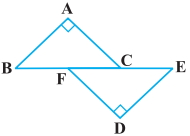
Solution
(N/A) Given: $BA \perp AC$,$DE \perp DF$,$BA = DE$,and $BF = EC$.
Step $1$: Establish the equality of the hypotenuses.
We are given $BF = EC$.
Adding $FC$ to both sides,we get:
$BF + FC = EC + FC$
$BC = EF$
Step $2$: Compare the two triangles.
In $\triangle ABC$ and $\triangle DEF$:
$1$. $\angle A = \angle D = 90^{\circ}$ (Given as $BA \perp AC$ and $DE \perp DF$)
$2$. $BA = DE$ (Given)
$3$. $BC = EF$ (Hypotenuse,proved above)
Step $3$: Conclusion.
By the $RHS$ (Right angle-Hypotenuse-Side) congruence rule,$\triangle ABC \cong \triangle DEF$.
Step $1$: Establish the equality of the hypotenuses.
We are given $BF = EC$.
Adding $FC$ to both sides,we get:
$BF + FC = EC + FC$
$BC = EF$
Step $2$: Compare the two triangles.
In $\triangle ABC$ and $\triangle DEF$:
$1$. $\angle A = \angle D = 90^{\circ}$ (Given as $BA \perp AC$ and $DE \perp DF$)
$2$. $BA = DE$ (Given)
$3$. $BC = EF$ (Hypotenuse,proved above)
Step $3$: Conclusion.
By the $RHS$ (Right angle-Hypotenuse-Side) congruence rule,$\triangle ABC \cong \triangle DEF$.
0 likes
View Solution34
Medium
$Q$ is a point on the side $SR$ of a $\triangle PSR$ such that $PQ = PR$. Prove that $PS > PQ$.
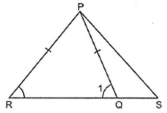
Solution
(N/A) Given: $PQ = PR$.
To prove: $PS > PQ$.
Proof: In $\triangle PQR$,we have:
$PR = PQ$ (Given).
Therefore,$\angle PQR = \angle PRQ$ (Angles opposite to equal sides of a triangle are equal).
In $\triangle PQS$,$\angle PQR$ is an exterior angle.
We know that the exterior angle of a triangle is greater than each of the interior opposite angles.
Therefore,$\angle PQR > \angle S$.
Since $\angle PQR = \angle PRQ$,we have $\angle PRQ > \angle S$.
In $\triangle PSR$,since $\angle PRQ > \angle S$,the side opposite to $\angle PRQ$ must be greater than the side opposite to $\angle S$.
Therefore,$PS > PR$.
Since $PR = PQ$,we can substitute $PQ$ for $PR$.
Thus,$PS > PQ$.
Hence proved.
To prove: $PS > PQ$.
Proof: In $\triangle PQR$,we have:
$PR = PQ$ (Given).
Therefore,$\angle PQR = \angle PRQ$ (Angles opposite to equal sides of a triangle are equal).
In $\triangle PQS$,$\angle PQR$ is an exterior angle.
We know that the exterior angle of a triangle is greater than each of the interior opposite angles.
Therefore,$\angle PQR > \angle S$.
Since $\angle PQR = \angle PRQ$,we have $\angle PRQ > \angle S$.
In $\triangle PSR$,since $\angle PRQ > \angle S$,the side opposite to $\angle PRQ$ must be greater than the side opposite to $\angle S$.
Therefore,$PS > PR$.
Since $PR = PQ$,we can substitute $PQ$ for $PR$.
Thus,$PS > PQ$.
Hence proved.
0 likes
View Solution35
Medium
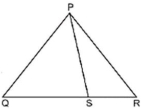
$S$ is any point on side $QR$ of a $\triangle PQR$. Show that: $PQ + QR + RP > 2 \, PS$.
Solution
(N/A) Given: $A$ point $S$ on side $QR$ of $\triangle PQR$.
To prove: $PQ + QR + RP > 2 \, PS$.
Proof: In $\triangle PQS$,we have:
$PQ + QS > PS$ ..... $(1)$
[Since the sum of the lengths of any two sides of a triangle must be greater than the third side]
Now,in $\triangle PSR$,we have:
$RS + RP > PS$ ..... $(2)$
[Since the sum of the lengths of any two sides of a triangle must be greater than the third side]
Adding $(1)$ and $(2)$,we get:
$PQ + QS + RS + RP > 2 \, PS$
Since $QS + RS = QR$,we have:
$PQ + QR + RP > 2 \, PS$
Hence,proved.
To prove: $PQ + QR + RP > 2 \, PS$.
Proof: In $\triangle PQS$,we have:
$PQ + QS > PS$ ..... $(1)$
[Since the sum of the lengths of any two sides of a triangle must be greater than the third side]
Now,in $\triangle PSR$,we have:
$RS + RP > PS$ ..... $(2)$
[Since the sum of the lengths of any two sides of a triangle must be greater than the third side]
Adding $(1)$ and $(2)$,we get:
$PQ + QS + RS + RP > 2 \, PS$
Since $QS + RS = QR$,we have:
$PQ + QR + RP > 2 \, PS$
Hence,proved.
0 likes
View Solution36
Medium
$D$ is any point on side $AC$ of a $\triangle ABC$ with $AB = AC$. Show that $CD < BD$.
Solution
(N/A) In $\triangle ABC$,we have $AB = AC$ (Given).
Therefore,$\angle ABC = \angle ACB$ (Angles opposite to equal sides of a triangle are equal).
Since $D$ is a point on $AC$,$\angle DBC < \angle ABC$.
Substituting $\angle ACB$ for $\angle ABC$,we get $\angle DBC < \angle ACB$.
Since $\angle ACB$ is the same as $\angle DCB$,we have $\angle DBC < \angle DCB$.
In $\triangle BCD$,since $\angle DCB > \angle DBC$,the side opposite to the greater angle is longer.
Therefore,$BD > CD$ or $CD < BD$.
Therefore,$\angle ABC = \angle ACB$ (Angles opposite to equal sides of a triangle are equal).
Since $D$ is a point on $AC$,$\angle DBC < \angle ABC$.
Substituting $\angle ACB$ for $\angle ABC$,we get $\angle DBC < \angle ACB$.
Since $\angle ACB$ is the same as $\angle DCB$,we have $\angle DBC < \angle DCB$.
In $\triangle BCD$,since $\angle DCB > \angle DBC$,the side opposite to the greater angle is longer.
Therefore,$BD > CD$ or $CD < BD$.
0 likes
View Solution37
Medium
In the given figure,$l \parallel m$ and $M$ is the mid-point of a line segment $AB$. Show that $M$ is also the mid-point of any line segment $CD,$ having its end points on $l$ and $m,$ respectively.
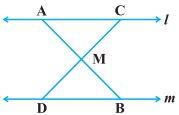
Solution
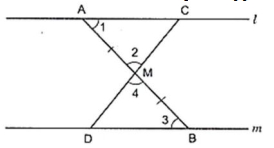
(N/A) In $\triangle AMC$ and $\triangle BMD$,we have:
$\angle MAC = \angle MBD$ (Alternate interior angles,since $l \parallel m$)
$\angle AMC = \angle BMD$ (Vertically opposite angles)
$AM = BM$ (Given,as $M$ is the mid-point of $AB$)
Therefore,$\triangle AMC \cong \triangle BMD$ (By $ASA$ congruence rule)
Thus,$CM = DM$ (By $CPCT$)
Hence,$M$ is also the mid-point of $CD.$
$\angle MAC = \angle MBD$ (Alternate interior angles,since $l \parallel m$)
$\angle AMC = \angle BMD$ (Vertically opposite angles)
$AM = BM$ (Given,as $M$ is the mid-point of $AB$)
Therefore,$\triangle AMC \cong \triangle BMD$ (By $ASA$ congruence rule)
Thus,$CM = DM$ (By $CPCT$)
Hence,$M$ is also the mid-point of $CD.$
0 likes
View Solution38
Medium
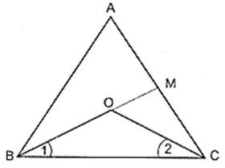
Bisectors of the angles $B$ and $C$ of an isosceles triangle with $AB = AC$ intersect each other at $O$. $BO$ is produced to a point $M$. Prove that $\angle MOC = \angle ABC$.
Solution
(N/A) Given: In $\triangle ABC$,$AB = AC$. $BO$ and $CO$ are the angle bisectors of $\angle B$ and $\angle C$ respectively,intersecting at $O$. $BO$ is produced to $M$.
Proof:
In $\triangle ABC$,since $AB = AC$,we have $\angle ABC = \angle ACB$ (Angles opposite to equal sides are equal).
Since $BO$ and $CO$ are bisectors of $\angle B$ and $\angle C$,we have:
$\angle OBC = \frac{1}{2} \angle ABC$
$\angle OCB = \frac{1}{2} \angle ACB$
Since $\angle ABC = \angle ACB$,it follows that $\angle OBC = \angle OCB$.
In $\triangle OBC$,$\angle MOC$ is an exterior angle at vertex $O$ when side $BO$ is produced to $M$.
By the Exterior Angle Property of a triangle,the exterior angle is equal to the sum of the two interior opposite angles.
Therefore,$\angle MOC = \angle OBC + \angle OCB$.
Since $\angle OBC = \angle OCB$,we can write:
$\angle MOC = \angle OBC + \angle OBC = 2 \angle OBC$.
Substituting $\angle OBC = \frac{1}{2} \angle ABC$:
$\angle MOC = 2 \times (\frac{1}{2} \angle ABC) = \angle ABC$.
Hence,$\angle MOC = \angle ABC$.
Proof:
In $\triangle ABC$,since $AB = AC$,we have $\angle ABC = \angle ACB$ (Angles opposite to equal sides are equal).
Since $BO$ and $CO$ are bisectors of $\angle B$ and $\angle C$,we have:
$\angle OBC = \frac{1}{2} \angle ABC$
$\angle OCB = \frac{1}{2} \angle ACB$
Since $\angle ABC = \angle ACB$,it follows that $\angle OBC = \angle OCB$.
In $\triangle OBC$,$\angle MOC$ is an exterior angle at vertex $O$ when side $BO$ is produced to $M$.
By the Exterior Angle Property of a triangle,the exterior angle is equal to the sum of the two interior opposite angles.
Therefore,$\angle MOC = \angle OBC + \angle OCB$.
Since $\angle OBC = \angle OCB$,we can write:
$\angle MOC = \angle OBC + \angle OBC = 2 \angle OBC$.
Substituting $\angle OBC = \frac{1}{2} \angle ABC$:
$\angle MOC = 2 \times (\frac{1}{2} \angle ABC) = \angle ABC$.
Hence,$\angle MOC = \angle ABC$.
0 likes
View Solution39
Difficult
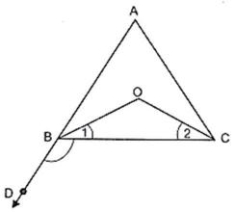
Bisectors of the angles $B$ and $C$ of an isosceles triangle $ABC$ with $AB = AC$ intersect each other at $O$. Show that the external angle adjacent to $\angle ABC$ is equal to $\angle BOC$.
Solution
(N/A) In $\triangle ABC$,we have $AB = AC$.
Therefore,$\angle ABC = \angle ACB$ [Since angles opposite to equal sides of a triangle are equal].
Since $BO$ and $CO$ are bisectors of $\angle B$ and $\angle C$ respectively,we have $\angle OBC = \frac{1}{2} \angle ABC$ and $\angle OCB = \frac{1}{2} \angle ACB$.
Since $\angle ABC = \angle ACB$,it follows that $\angle OBC = \angle OCB$.
In $\triangle OBC$,the sum of angles is $180^{\circ}$,so $\angle BOC + \angle OBC + \angle OCB = 180^{\circ}$.
Substituting $\angle OCB = \angle OBC$,we get $\angle BOC + 2 \angle OBC = 180^{\circ}$,which implies $\angle BOC = 180^{\circ} - 2 \angle OBC$.
Now,consider the external angle adjacent to $\angle ABC$. Let $D$ be a point on the extension of $AB$. The external angle is $\angle CBD = 180^{\circ} - \angle ABC$.
Since $\angle ABC = 2 \angle OBC$,we have $\angle CBD = 180^{\circ} - 2 \angle OBC$.
Comparing the two expressions,we conclude that $\angle BOC = \angle CBD$.
Therefore,$\angle ABC = \angle ACB$ [Since angles opposite to equal sides of a triangle are equal].
Since $BO$ and $CO$ are bisectors of $\angle B$ and $\angle C$ respectively,we have $\angle OBC = \frac{1}{2} \angle ABC$ and $\angle OCB = \frac{1}{2} \angle ACB$.
Since $\angle ABC = \angle ACB$,it follows that $\angle OBC = \angle OCB$.
In $\triangle OBC$,the sum of angles is $180^{\circ}$,so $\angle BOC + \angle OBC + \angle OCB = 180^{\circ}$.
Substituting $\angle OCB = \angle OBC$,we get $\angle BOC + 2 \angle OBC = 180^{\circ}$,which implies $\angle BOC = 180^{\circ} - 2 \angle OBC$.
Now,consider the external angle adjacent to $\angle ABC$. Let $D$ be a point on the extension of $AB$. The external angle is $\angle CBD = 180^{\circ} - \angle ABC$.
Since $\angle ABC = 2 \angle OBC$,we have $\angle CBD = 180^{\circ} - 2 \angle OBC$.
Comparing the two expressions,we conclude that $\angle BOC = \angle CBD$.
0 likes
View Solution40
Medium
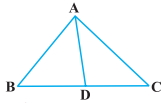
In the figure,$AD$ is the bisector of $\angle BAC$. Prove that $AB > BD$.
Solution
(N/A) Let $\angle BAD = \angle 1$ and $\angle CAD = \angle 2$. Since $AD$ is the bisector of $\angle BAC$,we have $\angle 1 = \angle 2$.
In $\triangle ACD$,$\angle ADC$ is an exterior angle at vertex $D$.
We know that an exterior angle of a triangle is equal to the sum of the two interior opposite angles.
Thus,$\angle ADC = \angle CAD + \angle ACD = \angle 2 + \angle ACD$.
Since $\angle ACD > 0$,it follows that $\angle ADC > \angle 2$.
Substituting $\angle 2 = \angle 1$,we get $\angle ADC > \angle 1$.
Now,consider $\triangle ABD$. In this triangle,the angle opposite to side $AB$ is $\angle ADB$ (which is $\angle ADC$) and the angle opposite to side $BD$ is $\angle BAD$ (which is $\angle 1$).
Since $\angle ADC > \angle 1$,the side opposite to the greater angle is longer.
Therefore,$AB > BD$.
In $\triangle ACD$,$\angle ADC$ is an exterior angle at vertex $D$.
We know that an exterior angle of a triangle is equal to the sum of the two interior opposite angles.
Thus,$\angle ADC = \angle CAD + \angle ACD = \angle 2 + \angle ACD$.
Since $\angle ACD > 0$,it follows that $\angle ADC > \angle 2$.
Substituting $\angle 2 = \angle 1$,we get $\angle ADC > \angle 1$.
Now,consider $\triangle ABD$. In this triangle,the angle opposite to side $AB$ is $\angle ADB$ (which is $\angle ADC$) and the angle opposite to side $BD$ is $\angle BAD$ (which is $\angle 1$).
Since $\angle ADC > \angle 1$,the side opposite to the greater angle is longer.
Therefore,$AB > BD$.
1 likes
View Solution41
Difficult
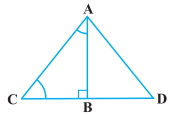
In the figure,$ABC$ is a right triangle,right-angled at $B$,such that $\angle BCA = 2 \angle BAC$. Show that the hypotenuse $AC = 2 BC$.
Solution
(N/A) Produce $CB$ to a point $D$ such that $BC = BD$ and join $AD$.
In $\Delta ABC$ and $\Delta ABD$,we have:
$BC = BD$ (By construction)
$AB = AB$ (Common side)
$\angle ABC = \angle ABD = 90^{\circ}$ (Given and by construction)
Therefore,$\Delta ABC \cong \Delta ABD$ by $SAS$ congruence rule.
So,$\angle CAB = \angle DAB$ by $CPCT$. Let $\angle BAC = x$,then $\angle CAB = x$ and $\angle DAB = x$.
Thus,$\angle CAD = \angle CAB + \angle BAD = x + x = 2x$.
Since $\angle BCA = 2 \angle BAC$,and $\angle BAC = x$,then $\angle BCA = 2x$.
In $\Delta ACD$,$\angle CAD = 2x$ and $\angle ACD = 2x$.
Since two angles are equal,the sides opposite to them are equal,so $AC = CD$.
Also,since $\Delta ABC \cong \Delta ABD$,$AC = AD$ by $CPCT$.
Thus,$\angle ADC = \angle ACD = 2x$.
Since all three angles of $\Delta ACD$ are $60^{\circ}$ (as $2x + 2x + 2x = 180^{\circ} \implies x = 30^{\circ}$),$\Delta ACD$ is an equilateral triangle.
Therefore,$AC = CD = AD$.
Since $CD = BC + BD$ and $BC = BD$,we have $CD = BC + BC = 2BC$.
Hence,$AC = 2BC$.
In $\Delta ABC$ and $\Delta ABD$,we have:
$BC = BD$ (By construction)
$AB = AB$ (Common side)
$\angle ABC = \angle ABD = 90^{\circ}$ (Given and by construction)
Therefore,$\Delta ABC \cong \Delta ABD$ by $SAS$ congruence rule.
So,$\angle CAB = \angle DAB$ by $CPCT$. Let $\angle BAC = x$,then $\angle CAB = x$ and $\angle DAB = x$.
Thus,$\angle CAD = \angle CAB + \angle BAD = x + x = 2x$.
Since $\angle BCA = 2 \angle BAC$,and $\angle BAC = x$,then $\angle BCA = 2x$.
In $\Delta ACD$,$\angle CAD = 2x$ and $\angle ACD = 2x$.
Since two angles are equal,the sides opposite to them are equal,so $AC = CD$.
Also,since $\Delta ABC \cong \Delta ABD$,$AC = AD$ by $CPCT$.
Thus,$\angle ADC = \angle ACD = 2x$.
Since all three angles of $\Delta ACD$ are $60^{\circ}$ (as $2x + 2x + 2x = 180^{\circ} \implies x = 30^{\circ}$),$\Delta ACD$ is an equilateral triangle.
Therefore,$AC = CD = AD$.
Since $CD = BC + BD$ and $BC = BD$,we have $CD = BC + BC = 2BC$.
Hence,$AC = 2BC$.
0 likes
View Solution42
Medium
Prove that if in two triangles,two angles and the included side of one triangle are equal to two angles and the included side of the other triangle,then the two triangles are congruent.
Solution
(N/A) This is the $ASA$ (Angle-Side-Angle) congruence criterion.
Let there be two triangles $\triangle ABC$ and $\triangle DEF$ such that $\angle B = \angle E$,$\angle C = \angle F$,and $BC = EF$.
We need to prove that $\triangle ABC \cong \triangle DEF$.
Case $1$: If $AB = DE$,then $\triangle ABC \cong \triangle DEF$ by $SAS$ congruence rule.
Case $2$: If $AB < DE$,take a point $P$ on $DE$ such that $DP = AB$. Join $PF$. In $\triangle ABC$ and $\triangle DPF$,$AB = DP$,$\angle B = \angle E$,and $BC = EF$. Thus,$\triangle ABC \cong \triangle DPF$ by $SAS$. This implies $\angle ACB = \angle DPF$. But we are given $\angle ACB = \angle DFE$. Therefore,$\angle DPF = \angle DFE$,which is only possible if $P$ coincides with $E$. Thus,$AB = DE$ and $\triangle ABC \cong \triangle DEF$.
Case $3$: If $AB > DE$,a similar argument shows $AB = DE$ and the triangles are congruent.
Let there be two triangles $\triangle ABC$ and $\triangle DEF$ such that $\angle B = \angle E$,$\angle C = \angle F$,and $BC = EF$.
We need to prove that $\triangle ABC \cong \triangle DEF$.
Case $1$: If $AB = DE$,then $\triangle ABC \cong \triangle DEF$ by $SAS$ congruence rule.
Case $2$: If $AB < DE$,take a point $P$ on $DE$ such that $DP = AB$. Join $PF$. In $\triangle ABC$ and $\triangle DPF$,$AB = DP$,$\angle B = \angle E$,and $BC = EF$. Thus,$\triangle ABC \cong \triangle DPF$ by $SAS$. This implies $\angle ACB = \angle DPF$. But we are given $\angle ACB = \angle DFE$. Therefore,$\angle DPF = \angle DFE$,which is only possible if $P$ coincides with $E$. Thus,$AB = DE$ and $\triangle ABC \cong \triangle DEF$.
Case $3$: If $AB > DE$,a similar argument shows $AB = DE$ and the triangles are congruent.
0 likes
View Solution43
Medium
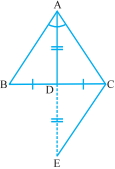
If the bisector of an angle of a triangle also bisects the opposite side,prove that the triangle is isosceles.
Solution
(N/A) We are given a point $D$ on side $BC$ of a $\Delta ABC$ such that $\angle BAD = \angle CAD$ and $BD = CD$. We are to prove that $AB = AC$.
Produce $AD$ to a point $E$ such that $AD = DE$ and then join $CE$.
Now,in $\Delta ABD$ and $\Delta ECD$,we have:
$BD = CD$ (Given)
$AD = DE$ (By construction)
$\angle ADB = \angle EDC$ (Vertically opposite angles)
Therefore,$\Delta ABD \cong \Delta ECD$ ($SAS$ congruence rule).
So,$AB = EC$ and $\angle BAD = \angle CED$ $(CPCT)$ ... $(1)$
Also,$\angle BAD = \angle CAD$ (Given) ... $(2)$
From $(1)$ and $(2)$,we get $\angle CAD = \angle CED$.
In $\Delta ACE$,since $\angle CAD = \angle CED$,the sides opposite to these angles must be equal.
Therefore,$AC = EC$ ... $(3)$
From $(1)$ and $(3)$,we have $AB = AC$.
Hence,$\Delta ABC$ is an isosceles triangle.
Produce $AD$ to a point $E$ such that $AD = DE$ and then join $CE$.
Now,in $\Delta ABD$ and $\Delta ECD$,we have:
$BD = CD$ (Given)
$AD = DE$ (By construction)
$\angle ADB = \angle EDC$ (Vertically opposite angles)
Therefore,$\Delta ABD \cong \Delta ECD$ ($SAS$ congruence rule).
So,$AB = EC$ and $\angle BAD = \angle CED$ $(CPCT)$ ... $(1)$
Also,$\angle BAD = \angle CAD$ (Given) ... $(2)$
From $(1)$ and $(2)$,we get $\angle CAD = \angle CED$.
In $\Delta ACE$,since $\angle CAD = \angle CED$,the sides opposite to these angles must be equal.
Therefore,$AC = EC$ ... $(3)$
From $(1)$ and $(3)$,we have $AB = AC$.
Hence,$\Delta ABC$ is an isosceles triangle.
0 likes
View Solution44
Medium
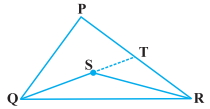
$S$ is any point in the interior of $\triangle PQR$. Show that $SQ + SR < PQ + PR$.
Solution
(N/A) Produce $QS$ to intersect $PR$ at $T$.
From $\triangle PQT$,we have:
$PQ + PT > QT$ (The sum of any two sides of a triangle is greater than the third side)
$PQ + PT > SQ + ST$ ..... $(1)$
From $\triangle TSR$,we have:
$ST + TR > SR$ ..... $(2)$
Adding $(1)$ and $(2)$,we get:
$PQ + PT + ST + TR > SQ + ST + SR$
$PQ + PT + TR > SQ + SR$
Since $PT + TR = PR$,we have:
$PQ + PR > SQ + SR$
Therefore,$SQ + SR < PQ + PR$.
From $\triangle PQT$,we have:
$PQ + PT > QT$ (The sum of any two sides of a triangle is greater than the third side)
$PQ + PT > SQ + ST$ ..... $(1)$
From $\triangle TSR$,we have:
$ST + TR > SR$ ..... $(2)$
Adding $(1)$ and $(2)$,we get:
$PQ + PT + ST + TR > SQ + ST + SR$
$PQ + PT + TR > SQ + SR$
Since $PT + TR = PR$,we have:
$PQ + PR > SQ + SR$
Therefore,$SQ + SR < PQ + PR$.
0 likes
View Solution45
MediumMCQ
Find all the angles of an equilateral triangle.
A
$60^{\circ},60^{\circ},60^{\circ}$
B
$45^{\circ},45^{\circ},90^{\circ}$
C
$30^{\circ},60^{\circ},90^{\circ}$
D
$50^{\circ},60^{\circ},70^{\circ}$
Solution
(A) In an equilateral triangle,all three sides are equal,i.e.,$AB = BC = AC$.
Since the angles opposite to equal sides of a triangle are equal,we have $\angle A = \angle B = \angle C$.
Let each angle be $x$.
By the angle sum property of a triangle,the sum of all interior angles is $180^{\circ}$.
Therefore,$\angle A + \angle B + \angle C = 180^{\circ}$.
$x + x + x = 180^{\circ}$.
$3x = 180^{\circ}$.
$x = \frac{180^{\circ}}{3} = 60^{\circ}$.
Thus,all the angles of an equilateral triangle are $60^{\circ}, 60^{\circ}, 60^{\circ}$.
Since the angles opposite to equal sides of a triangle are equal,we have $\angle A = \angle B = \angle C$.
Let each angle be $x$.
By the angle sum property of a triangle,the sum of all interior angles is $180^{\circ}$.
Therefore,$\angle A + \angle B + \angle C = 180^{\circ}$.
$x + x + x = 180^{\circ}$.
$3x = 180^{\circ}$.
$x = \frac{180^{\circ}}{3} = 60^{\circ}$.
Thus,all the angles of an equilateral triangle are $60^{\circ}, 60^{\circ}, 60^{\circ}$.
0 likes
View Solution46
Medium
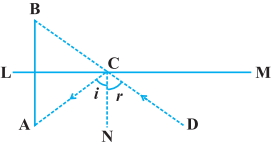
The image of an object placed at a point $A$ before a plane mirror $LM$ is seen at the point $B$ by an observer at $D$ as shown in the figure. Prove that the image is as far behind the mirror as the object is in front of the mirror.
Solution
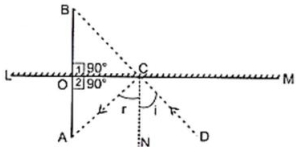
(N/A) Let $AB$ intersect $LM$ at $O$. We have to prove that $AO = BO$.
Now,$\angle i = \angle r$ ... $(1)$
[$\because$ Angle of incidence = Angle of reflection]
$\angle B = \angle i$ [Corresponding angles] ... $(2)$
And $\angle A = \angle r$ [Alternate interior angles] ... $(3)$
From $(1)$,$(2)$ and $(3)$,we get $\angle B = \angle A$.
In $\triangle BOC$ and $\triangle AOC$,we have:
$\angle 1 = \angle 2 = 90^{\circ}$ [Given]
$OC = OC$ [Common side]
$\angle B = \angle A$ [Proved above]
Therefore,$\triangle BOC \cong \triangle AOC$ [$AAS$ congruence rule].
Hence,$AO = BO$ [$CPCT$].
Now,$\angle i = \angle r$ ... $(1)$
[$\because$ Angle of incidence = Angle of reflection]
$\angle B = \angle i$ [Corresponding angles] ... $(2)$
And $\angle A = \angle r$ [Alternate interior angles] ... $(3)$
From $(1)$,$(2)$ and $(3)$,we get $\angle B = \angle A$.
In $\triangle BOC$ and $\triangle AOC$,we have:
$\angle 1 = \angle 2 = 90^{\circ}$ [Given]
$OC = OC$ [Common side]
$\angle B = \angle A$ [Proved above]
Therefore,$\triangle BOC \cong \triangle AOC$ [$AAS$ congruence rule].
Hence,$AO = BO$ [$CPCT$].
0 likes
View Solution47
Medium
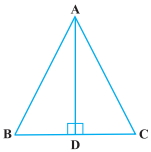
$ABC$ is an isosceles triangle with $AB = AC$ and $D$ is a point on $BC$ such that $AD \perp BC$. To prove that $\angle BAD = \angle CAD$,a student proceeded as follows:
In $\triangle ABD$ and $\triangle ACD$:
$AB = AC$ (Given)
$\angle B = \angle C$ (because $AB = AC$)
and $\angle ADB = \angle ADC$
Therefore,$\triangle ABD \cong \triangle ACD$ $(AAS)$
So,$\angle BAD = \angle CAD$ $(CPCT)$
What is the defect in the above arguments?
In $\triangle ABD$ and $\triangle ACD$:
$AB = AC$ (Given)
$\angle B = \angle C$ (because $AB = AC$)
and $\angle ADB = \angle ADC$
Therefore,$\triangle ABD \cong \triangle ACD$ $(AAS)$
So,$\angle BAD = \angle CAD$ $(CPCT)$
What is the defect in the above arguments?
Solution
(N/A) The defect in the student's argument is that they used the $AAS$ (Angle-Angle-Side) congruence criterion,but the side $AD$ is not included between the angles $\angle B$ and $\angle ADB$ in $\triangle ABD$.
Correct proof:
In $\triangle ABD$ and $\triangle ACD$:
$AB = AC$ (Given)
$AD = AD$ (Common side)
$\angle ADB = \angle ADC = 90^{\circ}$ (Given $AD \perp BC$)
Therefore,by $RHS$ (Right angle-Hypotenuse-Side) congruence criterion:
$\triangle ABD \cong \triangle ACD$
Thus,$\angle BAD = \angle CAD$ $(CPCT)$.
Correct proof:
In $\triangle ABD$ and $\triangle ACD$:
$AB = AC$ (Given)
$AD = AD$ (Common side)
$\angle ADB = \angle ADC = 90^{\circ}$ (Given $AD \perp BC$)
Therefore,by $RHS$ (Right angle-Hypotenuse-Side) congruence criterion:
$\triangle ABD \cong \triangle ACD$
Thus,$\angle BAD = \angle CAD$ $(CPCT)$.
0 likes
View Solution48
Medium
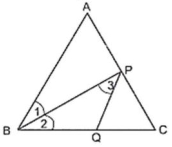
$P$ is a point on the bisector of $\angle ABC$. If the line through $P$,parallel to $BA$,meets $BC$ at $Q$,prove that $\triangle BPQ$ is an isosceles triangle.
Solution
(N/A) We have to prove that $\triangle BPQ$ is an isosceles triangle.
Given that $BP$ is the bisector of $\angle ABC$,we have:
$\angle 1 = \angle 2$ .....$(1)$
Since $PQ \parallel BA$ and $BP$ is a transversal,the alternate interior angles are equal:
$\angle 1 = \angle 3$ .....$(2)$
From equations $(1)$ and $(2)$,we get:
$\angle 2 = \angle 3$
In $\triangle BPQ$,since $\angle 2 = \angle 3$,the sides opposite to these equal angles must be equal:
$PQ = BQ$
Since two sides of $\triangle BPQ$ are equal,$\triangle BPQ$ is an isosceles triangle.
Given that $BP$ is the bisector of $\angle ABC$,we have:
$\angle 1 = \angle 2$ .....$(1)$
Since $PQ \parallel BA$ and $BP$ is a transversal,the alternate interior angles are equal:
$\angle 1 = \angle 3$ .....$(2)$
From equations $(1)$ and $(2)$,we get:
$\angle 2 = \angle 3$
In $\triangle BPQ$,since $\angle 2 = \angle 3$,the sides opposite to these equal angles must be equal:
$PQ = BQ$
Since two sides of $\triangle BPQ$ are equal,$\triangle BPQ$ is an isosceles triangle.
0 likes
View Solution49
Medium
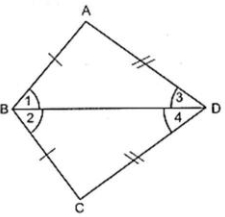
$ABCD$ is a quadrilateral in which $AB = BC$ and $AD = CD$. Show that $BD$ bisects both the angles $ABC$ and $ADC$.
Solution
(N/A) In $\triangle ABD$ and $\triangle CBD$,we have:
$AB = CB$ [Given]
$AD = CD$ [Given]
$BD = BD$ [Common side]
Therefore,$\triangle ABD \cong \triangle CBD$ [By $SSS$ congruence rule]
$\Rightarrow \angle ABD = \angle CBD$ [$CPCT$]
And $\angle ADB = \angle CDB$ [$CPCT$]
Hence,$BD$ bisects both the angles $ABC$ and $ADC$.
$AB = CB$ [Given]
$AD = CD$ [Given]
$BD = BD$ [Common side]
Therefore,$\triangle ABD \cong \triangle CBD$ [By $SSS$ congruence rule]
$\Rightarrow \angle ABD = \angle CBD$ [$CPCT$]
And $\angle ADB = \angle CDB$ [$CPCT$]
Hence,$BD$ bisects both the angles $ABC$ and $ADC$.
0 likes
View Solution50
Difficult
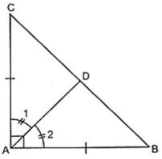
$ABC$ is a right-angled triangle with $AB = AC$. The bisector of $\angle A$ meets $BC$ at $D$. Prove that $BC = 2 AD$.
Solution
(N/A) Given: $A$ right-angled triangle $ABC$ where $AB = AC$ and the bisector of $\angle A$ meets $BC$ at $D$.
To prove: $BC = 2 AD$.
Proof: In $\triangle ABC$,since $AB = AC$ and it is a right-angled triangle,$\angle BAC = 90^{\circ}$.
In $\triangle CAD$ and $\triangle BAD$:
$AC = AB$ (Given)
$\angle CAD = \angle BAD$ (Since $AD$ is the bisector of $\angle A$)
$AD = AD$ (Common side)
By $SAS$ congruence criterion,$\triangle CAD \cong \triangle BAD$.
Therefore,$CD = BD$ (by $CPCT$).
Since $AD$ is the angle bisector of the right angle in an isosceles right triangle,$AD$ is also the median to the hypotenuse.
In a right-angled triangle,the median to the hypotenuse is half the length of the hypotenuse.
Thus,$AD = \frac{1}{2} BC$.
Multiplying both sides by $2$,we get $2 AD = BC$.
Hence,$BC = 2 AD$ is proved.
To prove: $BC = 2 AD$.
Proof: In $\triangle ABC$,since $AB = AC$ and it is a right-angled triangle,$\angle BAC = 90^{\circ}$.
In $\triangle CAD$ and $\triangle BAD$:
$AC = AB$ (Given)
$\angle CAD = \angle BAD$ (Since $AD$ is the bisector of $\angle A$)
$AD = AD$ (Common side)
By $SAS$ congruence criterion,$\triangle CAD \cong \triangle BAD$.
Therefore,$CD = BD$ (by $CPCT$).
Since $AD$ is the angle bisector of the right angle in an isosceles right triangle,$AD$ is also the median to the hypotenuse.
In a right-angled triangle,the median to the hypotenuse is half the length of the hypotenuse.
Thus,$AD = \frac{1}{2} BC$.
Multiplying both sides by $2$,we get $2 AD = BC$.
Hence,$BC = 2 AD$ is proved.
0 likes
View SolutionTriangles — Mix Examples - Triangles · Frequently Asked Questions
1Are these Triangles questions useful for JEE and NEET?
Yes. All questions in this section are mapped to JEE Main and NEET exam patterns. Previous year questions from JEE Main, NEET, GUJCET and state-level exams are included with full solutions.
2Can I switch to Hindi or Gujarati for these questions?
Yes. Use the language tabs in the hero section or the sidebar to view the same questions and solutions in English, Hindi or Gujarati.
3How do I generate a question paper from this subtopic?
Use the Vedclass Exam Paper Generator — select the chapter and subtopic, set difficulty, and generate Sets A, B, C, D automatically. First 3 chapters of every subject are free.
Vedclass Products
For Students
Vedclass Test Series
Mock tests in real JEE/NEET style with performance analysis. 5-day free trial.
Start Free TrialFor Teachers
Exam Paper Generator
Generate Set A/B/C/D papers from this chapter in 2 minutes. 3 chapters free.
Try FreeFor Institutes
Online Exam Module
Live online exams with unlimited students, 360° analytics & white-label branding.
See DemoFor Teachers & Institutes
Generate a Triangles Exam Paper in 2 Minutes
Select subtopic & difficulty — Sets A, B, C, D auto-generated with No Repeat logic.
First 3 chapters of every subject are free — no payment required.