
A English
Mix Examples - Triangles Questions in English
Class 9 Mathematics · Triangles · Mix Examples - Triangles
148+
Questions
English
Language
100%
With Solutions
Showing 50 of 148 questions in English
51
Difficult
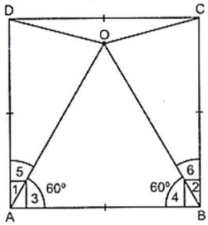
$O$ is a point in the interior of a square $ABCD$ such that $\triangle OAB$ is an equilateral triangle. Show that $\triangle OCD$ is an isosceles triangle.
Solution
(N/A) Given: $A$ square $ABCD$ and $\triangle OAB$ is an equilateral triangle,so $OA = OB = AB$.
To prove: $\triangle OCD$ is an isosceles triangle.
Proof: In square $ABCD$,$\angle DAB = \angle CBA = 90^{\circ}$.
Since $\triangle OAB$ is equilateral,$\angle OAB = \angle OBA = 60^{\circ}$.
Now,$\angle DAO = \angle DAB - \angle OAB = 90^{\circ} - 60^{\circ} = 30^{\circ}$.
Similarly,$\angle CBO = \angle CBA - \angle OBA = 90^{\circ} - 60^{\circ} = 30^{\circ}$.
In $\triangle DAO$ and $\triangle CBO$:
$AD = BC$ (Sides of a square)
$\angle DAO = \angle CBO = 30^{\circ}$ (Proved above)
$OA = OB$ (Sides of an equilateral triangle)
By $SAS$ congruence criterion,$\triangle DAO \cong \triangle CBO$.
Therefore,$OD = OC$ (Corresponding parts of congruent triangles).
Since $OD = OC$,$\triangle OCD$ is an isosceles triangle.
Hence,proved.
To prove: $\triangle OCD$ is an isosceles triangle.
Proof: In square $ABCD$,$\angle DAB = \angle CBA = 90^{\circ}$.
Since $\triangle OAB$ is equilateral,$\angle OAB = \angle OBA = 60^{\circ}$.
Now,$\angle DAO = \angle DAB - \angle OAB = 90^{\circ} - 60^{\circ} = 30^{\circ}$.
Similarly,$\angle CBO = \angle CBA - \angle OBA = 90^{\circ} - 60^{\circ} = 30^{\circ}$.
In $\triangle DAO$ and $\triangle CBO$:
$AD = BC$ (Sides of a square)
$\angle DAO = \angle CBO = 30^{\circ}$ (Proved above)
$OA = OB$ (Sides of an equilateral triangle)
By $SAS$ congruence criterion,$\triangle DAO \cong \triangle CBO$.
Therefore,$OD = OC$ (Corresponding parts of congruent triangles).
Since $OD = OC$,$\triangle OCD$ is an isosceles triangle.
Hence,proved.
0 likes
View Solution52
Difficult
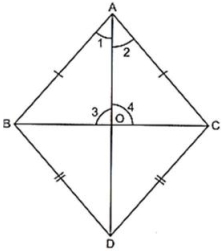
$ABC$ and $DBC$ are two triangles on the same base $BC$ such that $A$ and $D$ lie on the opposite sides of $BC$,$AB = AC$ and $DB = DC$. Show that $AD$ is the perpendicular bisector of $BC$.
Solution
(N/A) Given: $\triangle ABC$ and $\triangle DBC$ on the same base $BC$. Also,$AB = AC$ and $BD = CD$.
To prove: $AD$ is the perpendicular bisector of $BC$,i.e.,$OB = OC$ and $\angle AOB = \angle AOC = 90^{\circ}$.
Proof: In $\triangle ABD$ and $\triangle ACD$,we have:
$AB = AC$ [Given]
$BD = CD$ [Given]
$AD = AD$ [Common side]
So,by $SSS$ criterion of congruence,we have:
$\triangle ABD \cong \triangle ACD$
Therefore,$\angle 1 = \angle 2$ [$CPCT$]
Now,in $\triangle ABO$ and $\triangle ACO$,we have:
$AB = AC$ [Given]
$\angle 1 = \angle 2$ [Proved above]
$AO = AO$ [Common side]
So,by $SAS$ criterion of congruence,we have:
$\triangle ABO \cong \triangle ACO$
Therefore,$BO = CO$ [$CPCT$]
And,$\angle 3 = \angle 4$ [$CPCT$]
But,$\angle 3 + \angle 4 = 180^{\circ}$ [Linear pair axiom]
$\Rightarrow \angle 3 + \angle 3 = 180^{\circ}$
$\Rightarrow 2\angle 3 = 180^{\circ}$
$\Rightarrow \angle 3 = 90^{\circ}$
Since $BO = CO$ and $\angle 3 = 90^{\circ}$,$AD$ is the perpendicular bisector of $BC$. Hence,proved.
To prove: $AD$ is the perpendicular bisector of $BC$,i.e.,$OB = OC$ and $\angle AOB = \angle AOC = 90^{\circ}$.
Proof: In $\triangle ABD$ and $\triangle ACD$,we have:
$AB = AC$ [Given]
$BD = CD$ [Given]
$AD = AD$ [Common side]
So,by $SSS$ criterion of congruence,we have:
$\triangle ABD \cong \triangle ACD$
Therefore,$\angle 1 = \angle 2$ [$CPCT$]
Now,in $\triangle ABO$ and $\triangle ACO$,we have:
$AB = AC$ [Given]
$\angle 1 = \angle 2$ [Proved above]
$AO = AO$ [Common side]
So,by $SAS$ criterion of congruence,we have:
$\triangle ABO \cong \triangle ACO$
Therefore,$BO = CO$ [$CPCT$]
And,$\angle 3 = \angle 4$ [$CPCT$]
But,$\angle 3 + \angle 4 = 180^{\circ}$ [Linear pair axiom]
$\Rightarrow \angle 3 + \angle 3 = 180^{\circ}$
$\Rightarrow 2\angle 3 = 180^{\circ}$
$\Rightarrow \angle 3 = 90^{\circ}$
Since $BO = CO$ and $\angle 3 = 90^{\circ}$,$AD$ is the perpendicular bisector of $BC$. Hence,proved.
0 likes
View Solution53
Medium
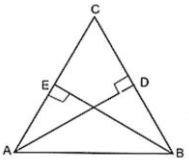
$ABC$ is an isosceles triangle in which $AC = BC$. $AD$ and $BE$ are respectively two altitudes to sides $BC$ and $AC$. Prove that $AE = BD$.
Solution
(N/A) In $\triangle ADC$ and $\triangle BEC$ we have:
$AC = BC$ [Given] ... $(1)$
$\angle ADC = \angle BEC = 90^{\circ}$ [Given as altitudes]
$\angle ACD = \angle BCE$ [Common angle]
Therefore,$\triangle ADC \cong \triangle BEC$ [By $AAS$ congruence rule]
Therefore,$CD = CE$ ... $(2)$ [$CPCT$]
Subtracting $(2)$ from $(1)$,we get:
$AC - CE = BC - CD$
$AE = BD$
Hence,proved.
$AC = BC$ [Given] ... $(1)$
$\angle ADC = \angle BEC = 90^{\circ}$ [Given as altitudes]
$\angle ACD = \angle BCE$ [Common angle]
Therefore,$\triangle ADC \cong \triangle BEC$ [By $AAS$ congruence rule]
Therefore,$CD = CE$ ... $(2)$ [$CPCT$]
Subtracting $(2)$ from $(1)$,we get:
$AC - CE = BC - CD$
$AE = BD$
Hence,proved.
0 likes
View Solution54
Difficult
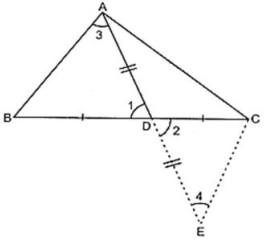
Prove that the sum of any two sides of a triangle is greater than twice the median with respect to the third side.
Solution
(N/A) Given: $\triangle ABC$ with median $AD$ to side $BC$.
To prove: $AB + AC > 2AD$.
Construction: Produce $AD$ to $E$ such that $DE = AD$ and join $EC$.
Proof: In $\triangle ADB$ and $\triangle EDC$:
$AD = ED$ (By construction)
$\angle 1 = \angle 2$ (Vertically opposite angles)
$DB = DC$ ($AD$ is the median)
By $SAS$ congruence criterion,$\triangle ADB \cong \triangle EDC$.
Therefore,$AB = EC$ $(CPCT)$.
Now,in $\triangle AEC$,the sum of any two sides is greater than the third side:
$AC + CE > AE$
Since $AE = AD + DE = AD + AD = 2AD$ and $CE = AB$:
$AC + AB > 2AD$.
Hence,it is proved that the sum of two sides is greater than twice the median to the third side.
To prove: $AB + AC > 2AD$.
Construction: Produce $AD$ to $E$ such that $DE = AD$ and join $EC$.
Proof: In $\triangle ADB$ and $\triangle EDC$:
$AD = ED$ (By construction)
$\angle 1 = \angle 2$ (Vertically opposite angles)
$DB = DC$ ($AD$ is the median)
By $SAS$ congruence criterion,$\triangle ADB \cong \triangle EDC$.
Therefore,$AB = EC$ $(CPCT)$.
Now,in $\triangle AEC$,the sum of any two sides is greater than the third side:
$AC + CE > AE$
Since $AE = AD + DE = AD + AD = 2AD$ and $CE = AB$:
$AC + AB > 2AD$.
Hence,it is proved that the sum of two sides is greater than twice the median to the third side.
0 likes
View Solution55
Difficult
Show that in a quadrilateral $ABCD$,$AB + BC + CD + DA < 2(BD + AC)$.
Solution
(N/A) Given: $A$ quadrilateral $ABCD$ with diagonals $AC$ and $BD$ intersecting at point $O$.
To prove: $AB + BC + CD + DA < 2(BD + AC)$.
Proof: In $\triangle AOB$,by the triangle inequality theorem (the sum of any two sides of a triangle is greater than the third side),we have:
$OA + OB > AB$ ... $(1)$
In $\triangle BOC$,we have:
$OB + OC > BC$ ... $(2)$
In $\triangle COD$,we have:
$OC + OD > CD$ ... $(3)$
In $\triangle DOA$,we have:
$OD + OA > DA$ ... $(4)$
Adding equations $(1), (2), (3),$ and $(4)$,we get:
$(OA + OB) + (OB + OC) + (OC + OD) + (OD + OA) > AB + BC + CD + DA$
$2(OA + OC) + 2(OB + OD) > AB + BC + CD + DA$
Since $OA + OC = AC$ and $OB + OD = BD$,we substitute these into the inequality:
$2(AC) + 2(BD) > AB + BC + CD + DA$
$2(AC + BD) > AB + BC + CD + DA$
Therefore,$AB + BC + CD + DA < 2(AC + BD)$.
Hence,proved.
To prove: $AB + BC + CD + DA < 2(BD + AC)$.
Proof: In $\triangle AOB$,by the triangle inequality theorem (the sum of any two sides of a triangle is greater than the third side),we have:
$OA + OB > AB$ ... $(1)$
In $\triangle BOC$,we have:
$OB + OC > BC$ ... $(2)$
In $\triangle COD$,we have:
$OC + OD > CD$ ... $(3)$
In $\triangle DOA$,we have:
$OD + OA > DA$ ... $(4)$
Adding equations $(1), (2), (3),$ and $(4)$,we get:
$(OA + OB) + (OB + OC) + (OC + OD) + (OD + OA) > AB + BC + CD + DA$
$2(OA + OC) + 2(OB + OD) > AB + BC + CD + DA$
Since $OA + OC = AC$ and $OB + OD = BD$,we substitute these into the inequality:
$2(AC) + 2(BD) > AB + BC + CD + DA$
$2(AC + BD) > AB + BC + CD + DA$
Therefore,$AB + BC + CD + DA < 2(AC + BD)$.
Hence,proved.
0 likes
View Solution56
Difficult
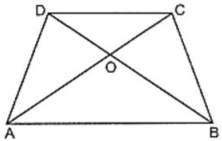
Show that in a quadrilateral $ABCD$,$AB + BC + CD + DA > AC + BD$.
Solution
(N/A) Given: $A$ quadrilateral $ABCD$.
To prove: $AB + BC + CD + DA > AC + BD$.
Proof: In $\triangle ABC$,we have $AB + BC > AC$ $\ldots(1)$ [Since the sum of the lengths of any two sides of a triangle must be greater than the third side].
In $\triangle BCD$,we have $BC + CD > BD$ $\ldots(2)$ [Same reason].
In $\triangle CDA$,we have $CD + DA > AC$ $\ldots(3)$ [Same reason].
In $\triangle DAB$,we have $DA + AB > BD$ $\ldots(4)$ [Same reason].
Adding $(1), (2), (3)$ and $(4)$,we get:
$(AB + BC) + (BC + CD) + (CD + DA) + (DA + AB) > AC + BD + AC + BD$
$2AB + 2BC + 2CD + 2DA > 2AC + 2BD$
$2(AB + BC + CD + DA) > 2(AC + BD)$
$AB + BC + CD + DA > AC + BD$.
Hence,proved.
To prove: $AB + BC + CD + DA > AC + BD$.
Proof: In $\triangle ABC$,we have $AB + BC > AC$ $\ldots(1)$ [Since the sum of the lengths of any two sides of a triangle must be greater than the third side].
In $\triangle BCD$,we have $BC + CD > BD$ $\ldots(2)$ [Same reason].
In $\triangle CDA$,we have $CD + DA > AC$ $\ldots(3)$ [Same reason].
In $\triangle DAB$,we have $DA + AB > BD$ $\ldots(4)$ [Same reason].
Adding $(1), (2), (3)$ and $(4)$,we get:
$(AB + BC) + (BC + CD) + (CD + DA) + (DA + AB) > AC + BD + AC + BD$
$2AB + 2BC + 2CD + 2DA > 2AC + 2BD$
$2(AB + BC + CD + DA) > 2(AC + BD)$
$AB + BC + CD + DA > AC + BD$.
Hence,proved.
0 likes
View Solution57
Difficult
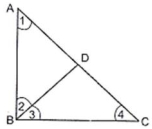
In a triangle $ABC$,$D$ is the mid-point of side $AC$ such that $BD = \frac{1}{2} AC$. Show that $\angle ABC$ is a right angle.
Solution
(N/A) We have to prove that $\angle ABC = 90^{\circ}$.
Since $D$ is the mid-point of $AC$,we have $AD = DC$.
Also,it is given that $BD = \frac{1}{2} AC$.
Since $AC = AD + DC = 2AD$,we have $BD = AD$.
Therefore,$BD = AD = DC$.
In $\Delta ABD$,since $BD = AD$,the angles opposite to equal sides are equal,so $\angle 1 = \angle 2$. $(1)$
In $\Delta BCD$,since $BD = DC$,the angles opposite to equal sides are equal,so $\angle 3 = \angle 4$. $(2)$
In $\Delta ABC$,the sum of angles is $180^{\circ}$:
$\angle A + \angle ABC + \angle C = 180^{\circ}$
$\angle 1 + (\angle 2 + \angle 3) + \angle 4 = 180^{\circ}$
Substituting $\angle 1 = \angle 2$ and $\angle 4 = \angle 3$ from $(1)$ and $(2)$:
$\angle 2 + (\angle 2 + \angle 3) + \angle 3 = 180^{\circ}$
$2(\angle 2 + \angle 3) = 180^{\circ}$
$\angle 2 + \angle 3 = 90^{\circ}$
Since $\angle ABC = \angle 2 + \angle 3$,we have $\angle ABC = 90^{\circ}$.
Hence proved.
Since $D$ is the mid-point of $AC$,we have $AD = DC$.
Also,it is given that $BD = \frac{1}{2} AC$.
Since $AC = AD + DC = 2AD$,we have $BD = AD$.
Therefore,$BD = AD = DC$.
In $\Delta ABD$,since $BD = AD$,the angles opposite to equal sides are equal,so $\angle 1 = \angle 2$. $(1)$
In $\Delta BCD$,since $BD = DC$,the angles opposite to equal sides are equal,so $\angle 3 = \angle 4$. $(2)$
In $\Delta ABC$,the sum of angles is $180^{\circ}$:
$\angle A + \angle ABC + \angle C = 180^{\circ}$
$\angle 1 + (\angle 2 + \angle 3) + \angle 4 = 180^{\circ}$
Substituting $\angle 1 = \angle 2$ and $\angle 4 = \angle 3$ from $(1)$ and $(2)$:
$\angle 2 + (\angle 2 + \angle 3) + \angle 3 = 180^{\circ}$
$2(\angle 2 + \angle 3) = 180^{\circ}$
$\angle 2 + \angle 3 = 90^{\circ}$
Since $\angle ABC = \angle 2 + \angle 3$,we have $\angle ABC = 90^{\circ}$.
Hence proved.
0 likes
View Solution58
Difficult
In a right triangle,prove that the line segment joining the mid-point of the hypotenuse to the opposite vertex is half the length of the hypotenuse.
Solution
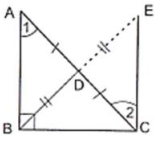
(N/A) $ABC$ is a right triangle,right-angled at $B$,and $D$ is the mid-point of the hypotenuse $AC$. We need to prove that $BD = \frac{1}{2} AC$.
Construction: Produce $BD$ to $E$ such that $BD = DE$. Join $EC$.
In $\Delta ADB$ and $\Delta CDE$:
$AD = CD$ (Since $D$ is the mid-point of $AC$)
$\angle ADB = \angle CDE$ (Vertically opposite angles)
$BD = DE$ (By construction)
Therefore,$\Delta ADB \cong \Delta CDE$ (By $SAS$ congruence criterion).
Thus,$AB = EC$ $(CPCT)$ and $\angle 1 = \angle 2$ $(CPCT)$.
Since $\angle 1$ and $\angle 2$ are alternate interior angles,$EC \parallel BA$.
Now,$EC \parallel BA$ and $BC$ is the transversal,so $\angle ABC + \angle BCE = 180^{\circ}$.
Since $\angle ABC = 90^{\circ}$,$\angle BCE = 180^{\circ} - 90^{\circ} = 90^{\circ}$.
In $\Delta ABC$ and $\Delta ECB$:
$BC = CB$ (Common side)
$AB = EC$ (Proved above)
$\angle ABC = \angle ECB = 90^{\circ}$
Therefore,$\Delta ABC \cong \Delta ECB$ (By $SAS$ congruence criterion).
Thus,$AC = EB$ $(CPCT)$.
Since $BD = DE$,$BD = \frac{1}{2} BE$.
Substituting $BE = AC$,we get $BD = \frac{1}{2} AC$.
Construction: Produce $BD$ to $E$ such that $BD = DE$. Join $EC$.
In $\Delta ADB$ and $\Delta CDE$:
$AD = CD$ (Since $D$ is the mid-point of $AC$)
$\angle ADB = \angle CDE$ (Vertically opposite angles)
$BD = DE$ (By construction)
Therefore,$\Delta ADB \cong \Delta CDE$ (By $SAS$ congruence criterion).
Thus,$AB = EC$ $(CPCT)$ and $\angle 1 = \angle 2$ $(CPCT)$.
Since $\angle 1$ and $\angle 2$ are alternate interior angles,$EC \parallel BA$.
Now,$EC \parallel BA$ and $BC$ is the transversal,so $\angle ABC + \angle BCE = 180^{\circ}$.
Since $\angle ABC = 90^{\circ}$,$\angle BCE = 180^{\circ} - 90^{\circ} = 90^{\circ}$.
In $\Delta ABC$ and $\Delta ECB$:
$BC = CB$ (Common side)
$AB = EC$ (Proved above)
$\angle ABC = \angle ECB = 90^{\circ}$
Therefore,$\Delta ABC \cong \Delta ECB$ (By $SAS$ congruence criterion).
Thus,$AC = EB$ $(CPCT)$.
Since $BD = DE$,$BD = \frac{1}{2} BE$.
Substituting $BE = AC$,we get $BD = \frac{1}{2} AC$.
0 likes
View Solution59
Medium
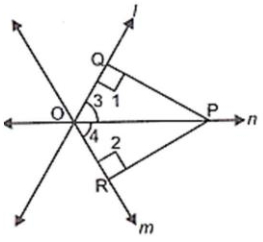
Two lines $l$ and $m$ intersect at the point $O$ and $P$ is a point on a line $n$ passing through the point $O$ such that $P$ is equidistant from $l$ and $m$. Prove that $n$ is the bisector of the angle formed by $l$ and $m$.
Solution
(N/A) Given: Lines $l$ and $m$ intersect at point $O$. $P$ is a point on line $n$ passing through $O$ such that $PQ \perp l$ and $PR \perp m$,where $PQ = PR$.
To prove: $n$ is the bisector of $\angle QOR$.
Proof: In $\triangle OQP$ and $\triangle ORP$,we have:
$\angle OQP = \angle ORP = 90^{\circ}$ (Given that $P$ is equidistant from $l$ and $m$)
$OP = OP$ (Common side)
$PQ = PR$ (Given)
By $RHS$ (Right angle-Hypotenuse-Side) criterion of congruence,we have:
$\triangle OQP \cong \triangle ORP$
Therefore,$\angle QOP = \angle ROP$ (by $CPCT$ - Corresponding Parts of Congruent Triangles).
Thus,$n$ is the bisector of $\angle QOR$. Hence proved.
To prove: $n$ is the bisector of $\angle QOR$.
Proof: In $\triangle OQP$ and $\triangle ORP$,we have:
$\angle OQP = \angle ORP = 90^{\circ}$ (Given that $P$ is equidistant from $l$ and $m$)
$OP = OP$ (Common side)
$PQ = PR$ (Given)
By $RHS$ (Right angle-Hypotenuse-Side) criterion of congruence,we have:
$\triangle OQP \cong \triangle ORP$
Therefore,$\angle QOP = \angle ROP$ (by $CPCT$ - Corresponding Parts of Congruent Triangles).
Thus,$n$ is the bisector of $\angle QOR$. Hence proved.
0 likes
View Solution60
Difficult
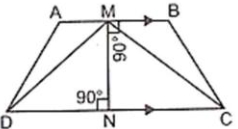
The line segment joining the mid-points $M$ and $N$ of the parallel sides $AB$ and $DC$ respectively of a trapezium $ABCD$ is perpendicular to both the sides $AB$ and $DC$. Prove that $AD = BC$.
Solution
(N/A) Join $MD$ and $MC$.
In $\Delta DMN$ and $\Delta CMN$:
$DN = CN$ [Since $N$ is the mid-point of $DC$]
$\angle DNM = \angle CNM = 90^{\circ}$ [Given]
$MN = MN$ [Common side]
Therefore,$\Delta DMN \cong \Delta CMN$ [By $SAS$ congruence rule]
This implies $DM = CM$ and $\angle NMD = \angle NMC$ ... $(1)$ [$CPCT$]
Now,consider $\Delta AMD$ and $\Delta BMC$:
$AM = BM$ [Since $M$ is the mid-point of $AB$]
$DM = CM$ [From $(1)$]
$\angle AMD = \angle AMN - \angle NMD$
$\angle BMC = \angle BMN - \angle NMC$
Since $\angle AMN = \angle BMN = 90^{\circ}$ and $\angle NMD = \angle NMC$,we have $\angle AMD = \angle BMC$ ... $(2)$
Therefore,$\Delta AMD \cong \Delta BMC$ [By $SAS$ congruence rule]
Thus,$AD = BC$ [$CPCT$].
In $\Delta DMN$ and $\Delta CMN$:
$DN = CN$ [Since $N$ is the mid-point of $DC$]
$\angle DNM = \angle CNM = 90^{\circ}$ [Given]
$MN = MN$ [Common side]
Therefore,$\Delta DMN \cong \Delta CMN$ [By $SAS$ congruence rule]
This implies $DM = CM$ and $\angle NMD = \angle NMC$ ... $(1)$ [$CPCT$]
Now,consider $\Delta AMD$ and $\Delta BMC$:
$AM = BM$ [Since $M$ is the mid-point of $AB$]
$DM = CM$ [From $(1)$]
$\angle AMD = \angle AMN - \angle NMD$
$\angle BMC = \angle BMN - \angle NMC$
Since $\angle AMN = \angle BMN = 90^{\circ}$ and $\angle NMD = \angle NMC$,we have $\angle AMD = \angle BMC$ ... $(2)$
Therefore,$\Delta AMD \cong \Delta BMC$ [By $SAS$ congruence rule]
Thus,$AD = BC$ [$CPCT$].
0 likes
View Solution61
Medium
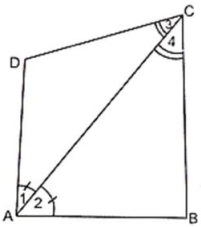
$ABCD$ is a quadrilateral such that diagonal $AC$ bisects the angles $A$ and $C.$ Prove that $AB = AD$ and $CB = CD.$
Solution
(N/A) Given: $A$ quadrilateral $ABCD$ such that $\angle 1 = \angle 2$ and $\angle 3 = \angle 4.$
To prove: $AB = AD$ and $CB = CD.$
Proof: In $\triangle ABC$ and $\triangle ADC$,we have:
$\angle 1 = \angle 2$ [Given]
$AC = AC$ [Common side]
$\angle 3 = \angle 4$ [Given]
So,by $ASA$ criterion of congruence,we have:
$\triangle ABC \cong \triangle ADC$
Therefore,$AB = AD$ [by $CPCT$]
And $CB = CD$ [by $CPCT$]
Hence,proved.
To prove: $AB = AD$ and $CB = CD.$
Proof: In $\triangle ABC$ and $\triangle ADC$,we have:
$\angle 1 = \angle 2$ [Given]
$AC = AC$ [Common side]
$\angle 3 = \angle 4$ [Given]
So,by $ASA$ criterion of congruence,we have:
$\triangle ABC \cong \triangle ADC$
Therefore,$AB = AD$ [by $CPCT$]
And $CB = CD$ [by $CPCT$]
Hence,proved.
0 likes
View Solution62
Difficult
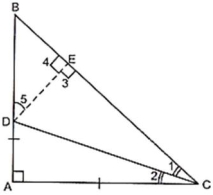
$ABC$ is a right triangle such that $AB = AC$ and the bisector of angle $C$ intersects the side $AB$ at $D$. Prove that $AC + AD = BC$.
Solution
(N/A) Given: $A$ right triangle $ABC$ where $AB = AC$ and $CD$ is the bisector of $\angle C$.
To prove: $AC + AD = BC$.
Construction: Draw $DE \perp BC$.
Proof: In right triangle $ABC$,we have $AB = AC$ (Given).
Since $BC$ is the hypotenuse,$\angle A = 90^{\circ}$.
In $\triangle DAC$ and $\triangle DEC$:
$\angle DAC = \angle DEC = 90^{\circ}$ (Given and construction).
$\angle ACD = \angle ECD$ (Since $CD$ is the bisector of $\angle C$).
$CD = CD$ (Common side).
By $AAS$ congruence criterion,$\triangle DAC \cong \triangle DEC$.
Therefore,$AD = DE$ and $AC = CE$ (by $CPCT$).
In $\triangle ABC$,since $AB = AC$,$\angle B = \angle ACB$. Since $\angle A = 90^{\circ}$,$\angle B + \angle ACB = 90^{\circ}$,so $2\angle B = 90^{\circ}$,which means $\angle B = 45^{\circ}$.
In $\triangle DEB$,$\angle DEB = 90^{\circ}$ and $\angle B = 45^{\circ}$,so $\angle EDB = 180^{\circ} - (90^{\circ} + 45^{\circ}) = 45^{\circ}$.
Since $\angle EDB = \angle B = 45^{\circ}$,the sides opposite to them are equal: $DE = BE$.
Since $AD = DE$ and $DE = BE$,we have $AD = BE$.
Now,$BC = CE + BE$.
Substituting $CE = AC$ and $BE = AD$,we get $BC = AC + AD$.
Hence,$AC + AD = BC$ is proved.
To prove: $AC + AD = BC$.
Construction: Draw $DE \perp BC$.
Proof: In right triangle $ABC$,we have $AB = AC$ (Given).
Since $BC$ is the hypotenuse,$\angle A = 90^{\circ}$.
In $\triangle DAC$ and $\triangle DEC$:
$\angle DAC = \angle DEC = 90^{\circ}$ (Given and construction).
$\angle ACD = \angle ECD$ (Since $CD$ is the bisector of $\angle C$).
$CD = CD$ (Common side).
By $AAS$ congruence criterion,$\triangle DAC \cong \triangle DEC$.
Therefore,$AD = DE$ and $AC = CE$ (by $CPCT$).
In $\triangle ABC$,since $AB = AC$,$\angle B = \angle ACB$. Since $\angle A = 90^{\circ}$,$\angle B + \angle ACB = 90^{\circ}$,so $2\angle B = 90^{\circ}$,which means $\angle B = 45^{\circ}$.
In $\triangle DEB$,$\angle DEB = 90^{\circ}$ and $\angle B = 45^{\circ}$,so $\angle EDB = 180^{\circ} - (90^{\circ} + 45^{\circ}) = 45^{\circ}$.
Since $\angle EDB = \angle B = 45^{\circ}$,the sides opposite to them are equal: $DE = BE$.
Since $AD = DE$ and $DE = BE$,we have $AD = BE$.
Now,$BC = CE + BE$.
Substituting $CE = AC$ and $BE = AD$,we get $BC = AC + AD$.
Hence,$AC + AD = BC$ is proved.
0 likes
View Solution63
Medium
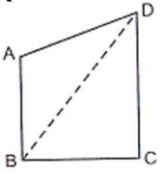
$AB$ and $CD$ are the smallest and largest sides of a quadrilateral $ABCD$. Determine which is greater,$\angle B$ or $\angle D$.
Solution
(A) Given: $A$ quadrilateral $ABCD$ in which $AB$ is the smallest side and $CD$ is the largest side.
To prove: $\angle B > \angle D$.
Construction: Join $BD$.
Proof: In $\triangle ABD$,since $AB$ is the smallest side of the quadrilateral,we have $AD > AB$. The angle opposite to the longer side is greater,therefore $\angle ABD > \angle ADB$ ... $(1)$.
In $\triangle CBD$,since $CD$ is the largest side of the quadrilateral,we have $CD > BC$. The angle opposite to the longer side is greater,therefore $\angle CBD > \angle BDC$ ... $(2)$.
Adding $(1)$ and $(2)$,we get:
$\angle ABD + \angle CBD > \angle ADB + \angle BDC$
$\Rightarrow \angle ABC > \angle ADC$
$\Rightarrow \angle B > \angle D$.
Hence,it is proved that $\angle B$ is greater than $\angle D$.
To prove: $\angle B > \angle D$.
Construction: Join $BD$.
Proof: In $\triangle ABD$,since $AB$ is the smallest side of the quadrilateral,we have $AD > AB$. The angle opposite to the longer side is greater,therefore $\angle ABD > \angle ADB$ ... $(1)$.
In $\triangle CBD$,since $CD$ is the largest side of the quadrilateral,we have $CD > BC$. The angle opposite to the longer side is greater,therefore $\angle CBD > \angle BDC$ ... $(2)$.
Adding $(1)$ and $(2)$,we get:
$\angle ABD + \angle CBD > \angle ADB + \angle BDC$
$\Rightarrow \angle ABC > \angle ADC$
$\Rightarrow \angle B > \angle D$.
Hence,it is proved that $\angle B$ is greater than $\angle D$.
0 likes
View Solution64
Difficult
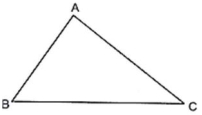
Prove that in a triangle,other than an equilateral triangle,the angle opposite to the longest side is greater than $\frac{2}{3}$ of a right angle.
Solution
(N/A) Given: $A$ triangle $ABC$,which is not an equilateral triangle. Let $BC$ be the longest side.
To prove: $\angle A > \frac{2}{3} \times 90^{\circ} = 60^{\circ}$.
Proof: In $\Delta ABC$,since $BC$ is the longest side,we have:
$BC > AB \Rightarrow \angle A > \angle C$ ..... $(1)$ [Since the angle opposite to the longer side is larger]
$BC > AC \Rightarrow \angle A > \angle B$ ..... $(2)$ [Since the angle opposite to the longer side is larger]
Adding $(1)$ and $(2)$,we get:
$\angle A + \angle A > \angle B + \angle C$
$2\angle A > \angle B + \angle C$
Adding $\angle A$ on both sides:
$2\angle A + \angle A > \angle A + \angle B + \angle C$
$3\angle A > 180^{\circ}$ [Angle sum property of a triangle]
$\angle A > \frac{180^{\circ}}{3}$
$\angle A > 60^{\circ}$
Since $60^{\circ} = \frac{2}{3} \times 90^{\circ}$,we have $\angle A > \frac{2}{3}$ of a right angle.
Hence,proved.
To prove: $\angle A > \frac{2}{3} \times 90^{\circ} = 60^{\circ}$.
Proof: In $\Delta ABC$,since $BC$ is the longest side,we have:
$BC > AB \Rightarrow \angle A > \angle C$ ..... $(1)$ [Since the angle opposite to the longer side is larger]
$BC > AC \Rightarrow \angle A > \angle B$ ..... $(2)$ [Since the angle opposite to the longer side is larger]
Adding $(1)$ and $(2)$,we get:
$\angle A + \angle A > \angle B + \angle C$
$2\angle A > \angle B + \angle C$
Adding $\angle A$ on both sides:
$2\angle A + \angle A > \angle A + \angle B + \angle C$
$3\angle A > 180^{\circ}$ [Angle sum property of a triangle]
$\angle A > \frac{180^{\circ}}{3}$
$\angle A > 60^{\circ}$
Since $60^{\circ} = \frac{2}{3} \times 90^{\circ}$,we have $\angle A > \frac{2}{3}$ of a right angle.
Hence,proved.
0 likes
View Solution65
Difficult
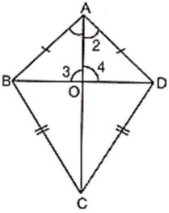
$ABCD$ is a quadrilateral such that $AB = AD$ and $CB = CD$. Prove that $AC$ is the perpendicular bisector of $BD$.
Solution
(N/A) Given: $A$ quadrilateral $ABCD$ in which $AB = AD$ and $CB = CD$.
To prove: $AC$ is the perpendicular bisector of $BD$.
Proof: In $\triangle ABC$ and $\triangle ADC$,we have:
$AB = AD$ (Given)
$BC = CD$ (Given)
$AC = AC$ (Common side)
So,by $SSS$ congruence criterion,we have:
$\triangle ABC \cong \triangle ADC$
Therefore,$\angle 1 = \angle 2$ (by $CPCT$)
Now,in $\triangle AOB$ and $\triangle AOD$,we have:
$AB = AD$ (Given)
$\angle 1 = \angle 2$ (Proved above)
$AO = AO$ (Common side)
So,by $SAS$ congruence criterion,we have:
$\triangle AOB \cong \triangle AOD$
Therefore,$BO = DO$ (by $CPCT$)
And $\angle 3 = \angle 4$ (by $CPCT$)
But,$\angle 3 + \angle 4 = 180^{\circ}$ (Linear pair axiom)
Since $\angle 3 = \angle 4$,we have:
$\angle 3 + \angle 3 = 180^{\circ}$
$2\angle 3 = 180^{\circ}$
$\angle 3 = 90^{\circ}$
Since $BO = DO$ and $\angle 3 = 90^{\circ}$,$AC$ is the perpendicular bisector of $BD$.
Hence,proved.
To prove: $AC$ is the perpendicular bisector of $BD$.
Proof: In $\triangle ABC$ and $\triangle ADC$,we have:
$AB = AD$ (Given)
$BC = CD$ (Given)
$AC = AC$ (Common side)
So,by $SSS$ congruence criterion,we have:
$\triangle ABC \cong \triangle ADC$
Therefore,$\angle 1 = \angle 2$ (by $CPCT$)
Now,in $\triangle AOB$ and $\triangle AOD$,we have:
$AB = AD$ (Given)
$\angle 1 = \angle 2$ (Proved above)
$AO = AO$ (Common side)
So,by $SAS$ congruence criterion,we have:
$\triangle AOB \cong \triangle AOD$
Therefore,$BO = DO$ (by $CPCT$)
And $\angle 3 = \angle 4$ (by $CPCT$)
But,$\angle 3 + \angle 4 = 180^{\circ}$ (Linear pair axiom)
Since $\angle 3 = \angle 4$,we have:
$\angle 3 + \angle 3 = 180^{\circ}$
$2\angle 3 = 180^{\circ}$
$\angle 3 = 90^{\circ}$
Since $BO = DO$ and $\angle 3 = 90^{\circ}$,$AC$ is the perpendicular bisector of $BD$.
Hence,proved.
0 likes
View Solution66
Medium
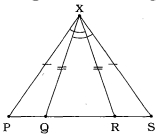
In the given figure,$XP = XS$,$XQ = XR$ and $\angle PXR = \angle SXQ$. Prove that $PQ = SR$.
Solution
(N/A) Given: $\angle PXR = \angle SXQ$
Subtracting $\angle QXR$ from both sides:
$\angle PXR - \angle QXR = \angle SXQ - \angle QXR$
$\therefore \angle PXQ = \angle SXR \quad \dots(1)$
Now,in $\Delta XPQ$ and $\Delta XSR$:
$XP = XS$ (Given)
$XQ = XR$ (Given)
$\angle PXQ = \angle SXR$ [From $(1)$]
$\therefore \Delta XPQ \cong \Delta XSR$ (By $SAS$ congruence criterion)
$\therefore PQ = SR$ (By $CPCT$)
Subtracting $\angle QXR$ from both sides:
$\angle PXR - \angle QXR = \angle SXQ - \angle QXR$
$\therefore \angle PXQ = \angle SXR \quad \dots(1)$
Now,in $\Delta XPQ$ and $\Delta XSR$:
$XP = XS$ (Given)
$XQ = XR$ (Given)
$\angle PXQ = \angle SXR$ [From $(1)$]
$\therefore \Delta XPQ \cong \Delta XSR$ (By $SAS$ congruence criterion)
$\therefore PQ = SR$ (By $CPCT$)
0 likes
View Solution67
Medium
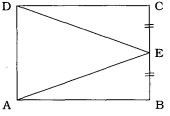
In rectangle $ABCD$,$E$ is the midpoint of $BC$. Prove that $AE = DE$.
Solution
(N/A) In rectangle $ABCD$,
$AB = DC$ (Opposite sides of a rectangle are equal)
and $\angle B = \angle C = 90^{\circ}$ (Each angle of a rectangle is $90^{\circ}$).
Also,$E$ is the midpoint of $BC$,so $BE = CE$.
Now,consider $\Delta ABE$ and $\Delta DCE$:
$AB = DC$ (Proved above)
$\angle B = \angle C = 90^{\circ}$ (Proved above)
$BE = CE$ (Given that $E$ is the midpoint of $BC$)
By the $SAS$ (Side-Angle-Side) congruence criterion,$\Delta ABE \cong \Delta DCE$.
Since the triangles are congruent,their corresponding parts are equal.
Therefore,$AE = DE$ (by $CPCT$ - Corresponding Parts of Congruent Triangles).
$AB = DC$ (Opposite sides of a rectangle are equal)
and $\angle B = \angle C = 90^{\circ}$ (Each angle of a rectangle is $90^{\circ}$).
Also,$E$ is the midpoint of $BC$,so $BE = CE$.
Now,consider $\Delta ABE$ and $\Delta DCE$:
$AB = DC$ (Proved above)
$\angle B = \angle C = 90^{\circ}$ (Proved above)
$BE = CE$ (Given that $E$ is the midpoint of $BC$)
By the $SAS$ (Side-Angle-Side) congruence criterion,$\Delta ABE \cong \Delta DCE$.
Since the triangles are congruent,their corresponding parts are equal.
Therefore,$AE = DE$ (by $CPCT$ - Corresponding Parts of Congruent Triangles).
0 likes
View Solution68
Easy
In the given figure,$PN$ and $QM$ are both perpendicular to line segment $PQ$. Also,$X$ is the midpoint of $PQ$ as well as $MN$. Prove that $\triangle PNX \cong \triangle QMX$.
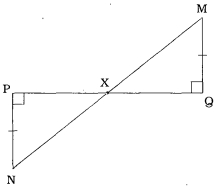
Solution
(N/A) Given:
$1$. $PN \perp PQ$ and $QM \perp PQ$.
$2$. $X$ is the midpoint of $PQ$,so $PX = QX$.
$3$. $X$ is the midpoint of $MN$,so $NX = MX$.
To prove: $\triangle PNX \cong \triangle QMX$.
Proof:
In $\triangle PNX$ and $\triangle QMX$:
$1$. $PX = QX$ (Given,$X$ is the midpoint of $PQ$).
$2$. $NX = MX$ (Given,$X$ is the midpoint of $MN$).
$3$. $\angle PNX = \angle QMX$ (Since $PN \parallel QM$ because both are perpendicular to $PQ$,and $MN$ is a transversal,these are alternate interior angles).
Alternatively,using $SAS$ congruence criterion:
$1$. $PX = QX$ (Given).
$2$. $\angle P = \angle Q = 90^\circ$ (Given).
$3$. $NX = MX$ (Given).
Therefore,by $RHS$ congruence criterion (or $SAS$),$\triangle PNX \cong \triangle QMX$.
$1$. $PN \perp PQ$ and $QM \perp PQ$.
$2$. $X$ is the midpoint of $PQ$,so $PX = QX$.
$3$. $X$ is the midpoint of $MN$,so $NX = MX$.
To prove: $\triangle PNX \cong \triangle QMX$.
Proof:
In $\triangle PNX$ and $\triangle QMX$:
$1$. $PX = QX$ (Given,$X$ is the midpoint of $PQ$).
$2$. $NX = MX$ (Given,$X$ is the midpoint of $MN$).
$3$. $\angle PNX = \angle QMX$ (Since $PN \parallel QM$ because both are perpendicular to $PQ$,and $MN$ is a transversal,these are alternate interior angles).
Alternatively,using $SAS$ congruence criterion:
$1$. $PX = QX$ (Given).
$2$. $\angle P = \angle Q = 90^\circ$ (Given).
$3$. $NX = MX$ (Given).
Therefore,by $RHS$ congruence criterion (or $SAS$),$\triangle PNX \cong \triangle QMX$.
0 likes
View Solution69
Easy
In the given figure,$AM$ and $BN$ are both perpendicular to $AB$. $MN$ intersects $AB$ at $P$. Also,$P$ is the midpoint of $AB$. Prove that $AM = BN$ and $P$ is the midpoint of $MN$.
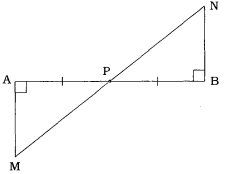
Solution
(N/A) Consider $\triangle APM$ and $\triangle BPN$.
$1$. $\angle MAP = \angle NBP = 90^{\circ}$ (Given that $AM \perp AB$ and $BN \perp AB$).
$2$. $AP = BP$ ($P$ is the midpoint of $AB$,given).
$3$. $\angle APM = \angle BPN$ (Vertically opposite angles).
Therefore,by the $ASA$ (Angle-Side-Angle) congruence criterion,$\triangle APM \cong \triangle BPN$.
Since the triangles are congruent,their corresponding parts are equal $(CPCT)$:
- $AM = BN$ (Hence proved).
- $PM = PN$ (Since $PM$ and $PN$ are corresponding sides).
Since $PM = PN$,$P$ is the midpoint of $MN$ (Hence proved).
$1$. $\angle MAP = \angle NBP = 90^{\circ}$ (Given that $AM \perp AB$ and $BN \perp AB$).
$2$. $AP = BP$ ($P$ is the midpoint of $AB$,given).
$3$. $\angle APM = \angle BPN$ (Vertically opposite angles).
Therefore,by the $ASA$ (Angle-Side-Angle) congruence criterion,$\triangle APM \cong \triangle BPN$.
Since the triangles are congruent,their corresponding parts are equal $(CPCT)$:
- $AM = BN$ (Hence proved).
- $PM = PN$ (Since $PM$ and $PN$ are corresponding sides).
Since $PM = PN$,$P$ is the midpoint of $MN$ (Hence proved).
1 likes
View Solution70
Medium
In the given figure,if $PQ = ST$,$QU = TR$,$PQ \perp QT$ and $ST \perp TQ$,then prove that $PR = SU$.
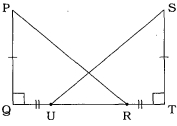
Solution
(N/A) Given: $PQ = ST$,$QU = TR$,$\angle PQT = 90^\circ$ and $\angle STQ = 90^\circ$.
To prove: $PR = SU$.
Proof:
Consider $\triangle PQR$ and $\triangle STU$.
$1$. $PQ = ST$ (Given)
$2$. $\angle PQR = \angle STU = 90^\circ$ (Given)
$3$. $QR = QU + UR$ and $TU = TR + UR$.
Since $QU = TR$,we have $QR = TR + UR = TU$.
Thus,$QR = TU$.
By $SAS$ congruence criterion,$\triangle PQR \cong \triangle STU$.
Since the triangles are congruent,their corresponding parts are equal $(CPCT)$.
Therefore,$PR = SU$.
To prove: $PR = SU$.
Proof:
Consider $\triangle PQR$ and $\triangle STU$.
$1$. $PQ = ST$ (Given)
$2$. $\angle PQR = \angle STU = 90^\circ$ (Given)
$3$. $QR = QU + UR$ and $TU = TR + UR$.
Since $QU = TR$,we have $QR = TR + UR = TU$.
Thus,$QR = TU$.
By $SAS$ congruence criterion,$\triangle PQR \cong \triangle STU$.
Since the triangles are congruent,their corresponding parts are equal $(CPCT)$.
Therefore,$PR = SU$.
2 likes
View Solution71
MediumMCQ
Prove that the medians of an equilateral triangle are equal.
A
Yes
B
No
C
Cannot be determined
D
None of these
Solution
(A) Let $\triangle ABC$ be an equilateral triangle where $AB = BC = CA = a$.
Let $AD$,$BE$,and $CF$ be the medians drawn to sides $BC$,$AC$,and $AB$ respectively.
In an equilateral triangle,the median is also the altitude.
In $\triangle ABD$ and $\triangle BCE$:
$AB = BC = a$ (sides of equilateral triangle).
$\angle B = \angle B$ (common angle).
$BD = BE$ is not the correct approach; let us use the Pythagorean theorem.
In $\triangle ABD$,$\angle ADB = 90^\circ$. By Pythagoras theorem,$AD^2 = AB^2 - BD^2$.
Since $D$ is the midpoint of $BC$,$BD = a/2$.
$AD^2 = a^2 - (a/2)^2 = a^2 - a^2/4 = 3a^2/4$.
So,$AD = (a\sqrt{3})/2$.
Similarly,for median $BE$,in $\triangle BCE$,$BE^2 = BC^2 - CE^2 = a^2 - (a/2)^2 = 3a^2/4$.
So,$BE = (a\sqrt{3})/2$.
Similarly,$CF = (a\sqrt{3})/2$.
Since $AD = BE = CF = (a\sqrt{3})/2$,the medians of an equilateral triangle are equal.
Let $AD$,$BE$,and $CF$ be the medians drawn to sides $BC$,$AC$,and $AB$ respectively.
In an equilateral triangle,the median is also the altitude.
In $\triangle ABD$ and $\triangle BCE$:
$AB = BC = a$ (sides of equilateral triangle).
$\angle B = \angle B$ (common angle).
$BD = BE$ is not the correct approach; let us use the Pythagorean theorem.
In $\triangle ABD$,$\angle ADB = 90^\circ$. By Pythagoras theorem,$AD^2 = AB^2 - BD^2$.
Since $D$ is the midpoint of $BC$,$BD = a/2$.
$AD^2 = a^2 - (a/2)^2 = a^2 - a^2/4 = 3a^2/4$.
So,$AD = (a\sqrt{3})/2$.
Similarly,for median $BE$,in $\triangle BCE$,$BE^2 = BC^2 - CE^2 = a^2 - (a/2)^2 = 3a^2/4$.
So,$BE = (a\sqrt{3})/2$.
Similarly,$CF = (a\sqrt{3})/2$.
Since $AD = BE = CF = (a\sqrt{3})/2$,the medians of an equilateral triangle are equal.
0 likes
View Solution72
Medium
Point $M$ lies on the perpendicular bisector of $PQ$. Also $M$ does not lie on $PQ$. Prove that $M$ is equidistant from $P$ and $Q$.
Solution
(N/A) Let $PQ$ be a line segment and $L$ be its perpendicular bisector. Let $M$ be a point on $L$ such that $M$ does not lie on $PQ$. Let $L$ intersect $PQ$ at point $O$. Since $L$ is the perpendicular bisector of $PQ$,we have $PO = OQ$ and $\angle MOP = \angle MOQ = 90^{\circ}$. Consider $\triangle MOP$ and $\triangle MOQ$. In these triangles: $1$. $PO = OQ$ (Given). $2$. $\angle MOP = \angle MOQ = 90^{\circ}$ (Given). $3$. $MO = MO$ (Common side). By the $SAS$ (Side-Angle-Side) congruence criterion,$\triangle MOP \cong \triangle MOQ$. Since the triangles are congruent,their corresponding parts are equal $(CPCT)$. Therefore,$MP = MQ$. Thus,point $M$ is equidistant from $P$ and $Q$.
0 likes
View Solution73
Medium
In $\Delta PQR$,$PQ = PR$. Prove that $\angle R = \angle Q$.
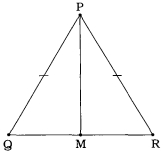
Solution
(N/A) Draw the bisector $PM$ of $\angle P$ which meets $QR$ at $M$.
Therefore,$\angle QPM = \angle RPM$ $(1)$.
Now,in $\Delta PMQ$ and $\Delta PMR$:
$PQ = PR$ (Given)
$PM = PM$ (Common side)
$\angle QPM = \angle RPM$ [From $(1)$]
So,by $SAS$ congruence criterion,$\Delta PMQ \cong \Delta PMR$.
Therefore,$\angle R = \angle Q$ (by $CPCT$ - Corresponding Parts of Congruent Triangles).
Therefore,$\angle QPM = \angle RPM$ $(1)$.
Now,in $\Delta PMQ$ and $\Delta PMR$:
$PQ = PR$ (Given)
$PM = PM$ (Common side)
$\angle QPM = \angle RPM$ [From $(1)$]
So,by $SAS$ congruence criterion,$\Delta PMQ \cong \Delta PMR$.
Therefore,$\angle R = \angle Q$ (by $CPCT$ - Corresponding Parts of Congruent Triangles).
0 likes
View Solution74
Medium
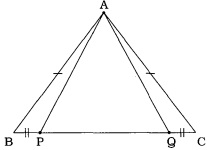
In the given figure,$AB = AC$ and $BP = CQ$. Prove that $\Delta APQ$ is an isosceles triangle.
Solution
(N/A) In $\triangle ABC$,$AB = AC$ (Given).
$\therefore \angle ABC = \angle ACB$ ($\because$ Angles opposite to equal sides are equal).
Since $P$ lies on $BC$ and $Q$ lies on $BC$,we have $\angle ABP = \angle ACQ$.
Now,in $\triangle ABP$ and $\triangle ACQ$:
$AB = AC$ (Given)
$BP = CQ$ (Given)
$\angle ABP = \angle ACQ$ (Proved above)
So,by $SAS$ congruence criterion,$\triangle ABP \cong \triangle ACQ$.
$\therefore AP = AQ$ (by $CPCT$).
Now,in $\triangle APQ$,since $AP = AQ$,$\Delta APQ$ is an isosceles triangle.
$\therefore \angle ABC = \angle ACB$ ($\because$ Angles opposite to equal sides are equal).
Since $P$ lies on $BC$ and $Q$ lies on $BC$,we have $\angle ABP = \angle ACQ$.
Now,in $\triangle ABP$ and $\triangle ACQ$:
$AB = AC$ (Given)
$BP = CQ$ (Given)
$\angle ABP = \angle ACQ$ (Proved above)
So,by $SAS$ congruence criterion,$\triangle ABP \cong \triangle ACQ$.
$\therefore AP = AQ$ (by $CPCT$).
Now,in $\triangle APQ$,since $AP = AQ$,$\Delta APQ$ is an isosceles triangle.
0 likes
View Solution75
EasyMCQ
In $\Delta ABC$,$AB = AC$. If $\angle A = 50^{\circ}$,then find $\angle B$ and $\angle C$.
A
$\angle B = 65^{\circ}, \angle C = 65^{\circ}$
B
$\angle B = 50^{\circ}, \angle C = 80^{\circ}$
C
$\angle B = 80^{\circ}, \angle C = 50^{\circ}$
D
$\angle B = 70^{\circ}, \angle C = 60^{\circ}$
Solution
(A) In $\Delta ABC$,we are given that $AB = AC$.
Since the sides opposite to equal angles are equal,the angles opposite to equal sides are also equal. Therefore,$\angle B = \angle C$.
By the angle sum property of a triangle,the sum of all interior angles is $180^{\circ}$.
So,$\angle A + \angle B + \angle C = 180^{\circ}$.
Given $\angle A = 50^{\circ}$,we have $50^{\circ} + \angle B + \angle B = 180^{\circ}$.
$2 \angle B = 180^{\circ} - 50^{\circ} = 130^{\circ}$.
$\angle B = 130^{\circ} / 2 = 65^{\circ}$.
Since $\angle B = \angle C$,we have $\angle C = 65^{\circ}$.
Since the sides opposite to equal angles are equal,the angles opposite to equal sides are also equal. Therefore,$\angle B = \angle C$.
By the angle sum property of a triangle,the sum of all interior angles is $180^{\circ}$.
So,$\angle A + \angle B + \angle C = 180^{\circ}$.
Given $\angle A = 50^{\circ}$,we have $50^{\circ} + \angle B + \angle B = 180^{\circ}$.
$2 \angle B = 180^{\circ} - 50^{\circ} = 130^{\circ}$.
$\angle B = 130^{\circ} / 2 = 65^{\circ}$.
Since $\angle B = \angle C$,we have $\angle C = 65^{\circ}$.
0 likes
View Solution76
EasyMCQ
In $\Delta PQR$,$PQ = PR$. If $\angle Q = 48^{\circ}$,then find $\angle P$ and $\angle R$.
A
$\angle P = 84^{\circ}, \angle R = 48^{\circ}$
B
$\angle P = 48^{\circ}, \angle R = 84^{\circ}$
C
$\angle P = 42^{\circ}, \angle R = 48^{\circ}$
D
$\angle P = 84^{\circ}, \angle R = 42^{\circ}$
Solution
(A) Given that in $\Delta PQR$,$PQ = PR$.
Since the sides opposite to equal angles are equal,and sides $PQ$ and $PR$ are equal,the angles opposite to these sides must be equal.
Therefore,$\angle R = \angle Q$.
Given $\angle Q = 48^{\circ}$,so $\angle R = 48^{\circ}$.
In any triangle,the sum of all interior angles is $180^{\circ}$.
Thus,$\angle P + \angle Q + \angle R = 180^{\circ}$.
Substituting the values: $\angle P + 48^{\circ} + 48^{\circ} = 180^{\circ}$.
$\angle P + 96^{\circ} = 180^{\circ}$.
$\angle P = 180^{\circ} - 96^{\circ} = 84^{\circ}$.
Hence,$\angle P = 84^{\circ}$ and $\angle R = 48^{\circ}$.
Since the sides opposite to equal angles are equal,and sides $PQ$ and $PR$ are equal,the angles opposite to these sides must be equal.
Therefore,$\angle R = \angle Q$.
Given $\angle Q = 48^{\circ}$,so $\angle R = 48^{\circ}$.
In any triangle,the sum of all interior angles is $180^{\circ}$.
Thus,$\angle P + \angle Q + \angle R = 180^{\circ}$.
Substituting the values: $\angle P + 48^{\circ} + 48^{\circ} = 180^{\circ}$.
$\angle P + 96^{\circ} = 180^{\circ}$.
$\angle P = 180^{\circ} - 96^{\circ} = 84^{\circ}$.
Hence,$\angle P = 84^{\circ}$ and $\angle R = 48^{\circ}$.
0 likes
View Solution77
EasyMCQ
In $\Delta ABC$,$AB = AC$,$\angle A = 2x^{\circ}$ and $\angle B = x + 10^{\circ}$. Find each of the angles of $\Delta ABC$.
A
$\angle A = 80^{\circ}, \angle B = 50^{\circ}, \angle C = 50^{\circ}$
B
$\angle A = 70^{\circ}, \angle B = 55^{\circ}, \angle C = 55^{\circ}$
C
$\angle A = 60^{\circ}, \angle B = 60^{\circ}, \angle C = 60^{\circ}$
D
$\angle A = 90^{\circ}, \angle B = 45^{\circ}, \angle C = 45^{\circ}$
Solution
(A) Given that in $\Delta ABC$,$AB = AC$. Therefore,the angles opposite to these sides are equal,i.e.,$\angle B = \angle C$.
Since $\angle B = x + 10^{\circ}$,then $\angle C = x + 10^{\circ}$.
The sum of all angles in a triangle is $180^{\circ}$.
So,$\angle A + \angle B + \angle C = 180^{\circ}$.
Substituting the given values: $2x + (x + 10) + (x + 10) = 180$.
$4x + 20 = 180$.
$4x = 160$.
$x = 40$.
Now,calculating the angles:
$\angle A = 2x = 2(40) = 80^{\circ}$.
$\angle B = x + 10 = 40 + 10 = 50^{\circ}$.
$\angle C = x + 10 = 40 + 10 = 50^{\circ}$.
Since $\angle B = x + 10^{\circ}$,then $\angle C = x + 10^{\circ}$.
The sum of all angles in a triangle is $180^{\circ}$.
So,$\angle A + \angle B + \angle C = 180^{\circ}$.
Substituting the given values: $2x + (x + 10) + (x + 10) = 180$.
$4x + 20 = 180$.
$4x = 160$.
$x = 40$.
Now,calculating the angles:
$\angle A = 2x = 2(40) = 80^{\circ}$.
$\angle B = x + 10 = 40 + 10 = 50^{\circ}$.
$\angle C = x + 10 = 40 + 10 = 50^{\circ}$.
0 likes
View Solution78
MediumMCQ
In $\Delta PQR$,$PQ = PR$,$\angle P = x + 10^{\circ}$ and $\angle Q = 4x - 5^{\circ}$. Find each of the angles of $\Delta PQR$.
A
$30^{\circ}, 75^{\circ}, 75^{\circ}$
B
$40^{\circ}, 70^{\circ}, 70^{\circ}$
C
$50^{\circ}, 65^{\circ}, 65^{\circ}$
D
$20^{\circ}, 80^{\circ}, 80^{\circ}$
Solution
(A) Given that in $\Delta PQR$,$PQ = PR$. Therefore,the angles opposite to these sides are equal,so $\angle Q = \angle R = 4x - 5^{\circ}$.
By the angle sum property of a triangle,$\angle P + \angle Q + \angle R = 180^{\circ}$.
Substituting the given values: $(x + 10^{\circ}) + (4x - 5^{\circ}) + (4x - 5^{\circ}) = 180^{\circ}$.
Combining like terms: $9x = 180^{\circ}$,which gives $x = 20^{\circ}$.
Now,calculating the angles:
$\angle P = x + 10^{\circ} = 20^{\circ} + 10^{\circ} = 30^{\circ}$.
$\angle Q = 4x - 5^{\circ} = 4(20^{\circ}) - 5^{\circ} = 80^{\circ} - 5^{\circ} = 75^{\circ}$.
Since $\angle Q = \angle R$,then $\angle R = 75^{\circ}$.
Thus,the angles are $30^{\circ}, 75^{\circ}, 75^{\circ}$.
By the angle sum property of a triangle,$\angle P + \angle Q + \angle R = 180^{\circ}$.
Substituting the given values: $(x + 10^{\circ}) + (4x - 5^{\circ}) + (4x - 5^{\circ}) = 180^{\circ}$.
Combining like terms: $9x = 180^{\circ}$,which gives $x = 20^{\circ}$.
Now,calculating the angles:
$\angle P = x + 10^{\circ} = 20^{\circ} + 10^{\circ} = 30^{\circ}$.
$\angle Q = 4x - 5^{\circ} = 4(20^{\circ}) - 5^{\circ} = 80^{\circ} - 5^{\circ} = 75^{\circ}$.
Since $\angle Q = \angle R$,then $\angle R = 75^{\circ}$.
Thus,the angles are $30^{\circ}, 75^{\circ}, 75^{\circ}$.
0 likes
View Solution79
Medium
In $\Delta ABC$,$AB = AC$ and $AD$ is an altitude to the base $BC$. Prove that $D$ is the midpoint of $BC$.
Solution
(N/A) Given: In $\Delta ABC$,$AB = AC$ and $AD \perp BC$.
To prove: $BD = DC$.
Proof: Consider $\Delta ABD$ and $\Delta ACD$.
$1$. $AB = AC$ (Given).
$2$. $\angle ADB = \angle ADC = 90^{\circ}$ (Since $AD$ is an altitude).
$3$. $AD = AD$ (Common side).
By the $RHS$ (Right angle-Hypotenuse-Side) congruence criterion,$\Delta ABD \cong \Delta ACD$.
Since the triangles are congruent,their corresponding parts are equal $(CPCT)$.
Therefore,$BD = DC$.
This implies that $D$ is the midpoint of $BC$.
To prove: $BD = DC$.
Proof: Consider $\Delta ABD$ and $\Delta ACD$.
$1$. $AB = AC$ (Given).
$2$. $\angle ADB = \angle ADC = 90^{\circ}$ (Since $AD$ is an altitude).
$3$. $AD = AD$ (Common side).
By the $RHS$ (Right angle-Hypotenuse-Side) congruence criterion,$\Delta ABD \cong \Delta ACD$.
Since the triangles are congruent,their corresponding parts are equal $(CPCT)$.
Therefore,$BD = DC$.
This implies that $D$ is the midpoint of $BC$.
0 likes
View Solution80
Medium
In $\Delta ABC$,$AB = AC$ and $\angle CAD$ is an exterior angle of $\Delta ABC$ at vertex $A$. If ray $AP$ is the bisector of $\angle CAD$,then prove that $AP \parallel BC$.
Solution
(N/A) Given: In $\Delta ABC$,$AB = AC$. $\angle CAD$ is an exterior angle at vertex $A$. $AP$ is the bisector of $\angle CAD$.
To prove: $AP \parallel BC$.
Proof:
$1$. Since $AB = AC$,the angles opposite to equal sides are equal. Therefore,$\angle ABC = \angle ACB$.
$2$. The exterior angle of a triangle is equal to the sum of the two interior opposite angles. Thus,$\angle CAD = \angle ABC + \angle ACB$.
$3$. Since $\angle ABC = \angle ACB$,we can write $\angle CAD = 2 \angle ACB$.
$4$. $AP$ is the bisector of $\angle CAD$,so $\angle CAP = \frac{1}{2} \angle CAD$.
$5$. Substituting the value from step $3$,$\angle CAP = \frac{1}{2} (2 \angle ACB) = \angle ACB$.
$6$. $\angle CAP$ and $\angle ACB$ are alternate interior angles. Since they are equal,the lines $AP$ and $BC$ must be parallel $(AP \parallel BC)$.
To prove: $AP \parallel BC$.
Proof:
$1$. Since $AB = AC$,the angles opposite to equal sides are equal. Therefore,$\angle ABC = \angle ACB$.
$2$. The exterior angle of a triangle is equal to the sum of the two interior opposite angles. Thus,$\angle CAD = \angle ABC + \angle ACB$.
$3$. Since $\angle ABC = \angle ACB$,we can write $\angle CAD = 2 \angle ACB$.
$4$. $AP$ is the bisector of $\angle CAD$,so $\angle CAP = \frac{1}{2} \angle CAD$.
$5$. Substituting the value from step $3$,$\angle CAP = \frac{1}{2} (2 \angle ACB) = \angle ACB$.
$6$. $\angle CAP$ and $\angle ACB$ are alternate interior angles. Since they are equal,the lines $AP$ and $BC$ must be parallel $(AP \parallel BC)$.
0 likes
View Solution81
Medium
In $\Delta ABC$,the bisectors of $\angle B$ and $\angle C$ intersect at $P$. $A$ line drawn through $P$ and parallel to $BC$ intersects $AB$ at $X$ and $AC$ at $Y$. Prove that $XY = XB + YC$.
Solution
(N/A) Given that $BP$ is the bisector of $\angle B$,therefore $\angle XBP = \angle PBC$.
Since $XY \parallel BC$,the alternate interior angles are equal,so $\angle PBC = \angle BXP$.
Thus,$\angle XBP = \angle BXP$.
In $\Delta XBP$,since the base angles are equal,the opposite sides are equal,so $XB = XP$.
Similarly,$CP$ is the bisector of $\angle C$,so $\angle YCP = \angle PCB$.
Since $XY \parallel BC$,the alternate interior angles are equal,so $\angle PCB = \angle CYP$.
Thus,$\angle YCP = \angle CYP$.
In $\Delta YCP$,since the base angles are equal,the opposite sides are equal,so $YC = YP$.
Now,$XY = XP + YP$.
Substituting the values,we get $XY = XB + YC$.
Hence proved.
Since $XY \parallel BC$,the alternate interior angles are equal,so $\angle PBC = \angle BXP$.
Thus,$\angle XBP = \angle BXP$.
In $\Delta XBP$,since the base angles are equal,the opposite sides are equal,so $XB = XP$.
Similarly,$CP$ is the bisector of $\angle C$,so $\angle YCP = \angle PCB$.
Since $XY \parallel BC$,the alternate interior angles are equal,so $\angle PCB = \angle CYP$.
Thus,$\angle YCP = \angle CYP$.
In $\Delta YCP$,since the base angles are equal,the opposite sides are equal,so $YC = YP$.
Now,$XY = XP + YP$.
Substituting the values,we get $XY = XB + YC$.
Hence proved.
0 likes
View Solution82
Medium
Line segments $AB$ and $CD$ bisect each other at $P$. If $PA = PD$ and $PB = PC$,prove that $AC = BD$.
Solution
(N/A) Given: $AB$ and $CD$ bisect each other at $P$. This implies $PA = PB$ and $PC = PD$.
However,the problem states $PA = PD$ and $PB = PC$.
Consider $\triangle APC$ and $\triangle BPD$:
$1$. $PA = PD$ (Given)
$2$. $\angle APC = \angle BPD$ (Vertically opposite angles)
$3$. $PC = PB$ (Given)
By $SAS$ (Side-Angle-Side) congruence criterion,$\triangle APC \cong \triangle BPD$.
Since the triangles are congruent,their corresponding parts are equal $(CPCT)$.
Therefore,$AC = BD$.
However,the problem states $PA = PD$ and $PB = PC$.
Consider $\triangle APC$ and $\triangle BPD$:
$1$. $PA = PD$ (Given)
$2$. $\angle APC = \angle BPD$ (Vertically opposite angles)
$3$. $PC = PB$ (Given)
By $SAS$ (Side-Angle-Side) congruence criterion,$\triangle APC \cong \triangle BPD$.
Since the triangles are congruent,their corresponding parts are equal $(CPCT)$.
Therefore,$AC = BD$.
0 likes
View Solution83
Medium
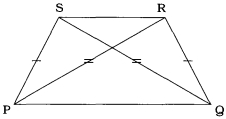
In the given figure,$PS = QR$ and $PR = QS$. Prove that $(1) \angle PSQ = \angle QRP$ and $(2) \angle SPQ = \angle RQP$.
Solution
(N/A) In $\Delta SPQ$ and $\Delta RQP$:
$PS = QR$ (Given)
$QS = PR$ (Given)
$PQ = QP$ (Common side)
Therefore,by $SSS$ congruence criterion,$\Delta SPQ \cong \Delta RQP$.
Since the triangles are congruent,their corresponding parts are equal $(CPCT)$.
Thus,$(1) \angle PSQ = \angle QRP$ and $(2) \angle SPQ = \angle RQP$.
$PS = QR$ (Given)
$QS = PR$ (Given)
$PQ = QP$ (Common side)
Therefore,by $SSS$ congruence criterion,$\Delta SPQ \cong \Delta RQP$.
Since the triangles are congruent,their corresponding parts are equal $(CPCT)$.
Thus,$(1) \angle PSQ = \angle QRP$ and $(2) \angle SPQ = \angle RQP$.
0 likes
View Solution84
Difficult
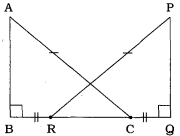
In the given figure,$AB \perp BQ$,$PQ \perp QB$,$AC = PR$ and $BR = QC$. Prove that $\angle BAC = \angle QPR$.
Solution
(N/A) Given: $AB \perp BQ$,$PQ \perp QB$,$AC = PR$ and $BR = QC$.
Since $AB \perp BQ$,$\angle ABQ = 90^{\circ}$. Thus,$\angle ABC = 90^{\circ}$.
Since $PQ \perp QB$,$\angle PQB = 90^{\circ}$. Thus,$\angle PQR = 90^{\circ}$.
Given $BR = QC$.
Adding $RC$ to both sides,we get $BR + RC = QC + RC$.
Therefore,$BC = QR$......$(1)$
In $\Delta ABC$ and $\Delta PQR$:
$AC = PR$ (Given)
$\angle ABC = \angle PQR = 90^{\circ}$ (Proved above)
$BC = QR$ [From $(1)$]
By $RHS$ congruence criterion,$\Delta ABC \cong \Delta PQR$.
Therefore,$\angle BAC = \angle QPR$ (by $CPCT$).
Since $AB \perp BQ$,$\angle ABQ = 90^{\circ}$. Thus,$\angle ABC = 90^{\circ}$.
Since $PQ \perp QB$,$\angle PQB = 90^{\circ}$. Thus,$\angle PQR = 90^{\circ}$.
Given $BR = QC$.
Adding $RC$ to both sides,we get $BR + RC = QC + RC$.
Therefore,$BC = QR$......$(1)$
In $\Delta ABC$ and $\Delta PQR$:
$AC = PR$ (Given)
$\angle ABC = \angle PQR = 90^{\circ}$ (Proved above)
$BC = QR$ [From $(1)$]
By $RHS$ congruence criterion,$\Delta ABC \cong \Delta PQR$.
Therefore,$\angle BAC = \angle QPR$ (by $CPCT$).
0 likes
View Solution85
Difficult
In $\Delta PQR$,$X$ is the midpoint of $QR$. $XY$ and $XZ$ are altitudes from $X$ on $PQ$ and $PR$ respectively. If $XY = XZ$,then prove that $\Delta PQR$ is an isosceles triangle.
Solution
(N/A) Given: In $\Delta PQR$,$X$ is the midpoint of $QR$,so $QX = XR$. $XY \perp PQ$ and $XZ \perp PR$. Also,$XY = XZ$.
Step $1$: Consider $\Delta QXY$ and $\Delta RXZ$.
Step $2$: In these two triangles:
$1$. $\angle XYQ = \angle XZR = 90^{\circ}$ (Given as altitudes).
$2$. $XY = XZ$ (Given).
$3$. $QX = XR$ (Given as $X$ is the midpoint of $QR$).
Step $3$: By $RHS$ congruence criterion,$\Delta QXY \cong \Delta RXZ$.
Step $4$: By $CPCT$,$\angle Q = \angle R$.
Step $5$: In $\Delta PQR$,since $\angle Q = \angle R$,the sides opposite to these angles must be equal,i.e.,$PR = PQ$.
Conclusion: Since two sides of $\Delta PQR$ are equal,$\Delta PQR$ is an isosceles triangle.
Step $1$: Consider $\Delta QXY$ and $\Delta RXZ$.
Step $2$: In these two triangles:
$1$. $\angle XYQ = \angle XZR = 90^{\circ}$ (Given as altitudes).
$2$. $XY = XZ$ (Given).
$3$. $QX = XR$ (Given as $X$ is the midpoint of $QR$).
Step $3$: By $RHS$ congruence criterion,$\Delta QXY \cong \Delta RXZ$.
Step $4$: By $CPCT$,$\angle Q = \angle R$.
Step $5$: In $\Delta PQR$,since $\angle Q = \angle R$,the sides opposite to these angles must be equal,i.e.,$PR = PQ$.
Conclusion: Since two sides of $\Delta PQR$ are equal,$\Delta PQR$ is an isosceles triangle.
0 likes
View Solution86
EasyMCQ
$PQRS$ is a parallelogram. If the two diagonals are equal,find the measure of $\angle PQR$. (in $^{\circ}$)
A
$45$
B
$60$
C
$90$
D
$120$
Solution
(C) parallelogram with equal diagonals is a rectangle.
In a rectangle,all interior angles are equal to $90^{\circ}$.
Therefore,$\angle PQR = 90^{\circ}$.
In a rectangle,all interior angles are equal to $90^{\circ}$.
Therefore,$\angle PQR = 90^{\circ}$.
0 likes
View Solution87
Medium
In quadrilateral $PQRS$,$PQ = PS$ and $QR = RS$. Prove that diagonal $PR$ bisects $\angle QPS$ as well as $\angle QRS$.
Solution
(N/A) To prove that diagonal $PR$ bisects $\angle QPS$ and $\angle QRS$,we consider the two triangles $\triangle PQR$ and $\triangle PSR$.
$1$. In $\triangle PQR$ and $\triangle PSR$:
- $PQ = PS$ (Given)
- $QR = RS$ (Given)
- $PR = PR$ (Common side)
$2$. By the $SSS$ (Side-Side-Side) congruence criterion,$\triangle PQR \cong \triangle PSR$.
$3$. Since the triangles are congruent,their corresponding parts are equal $(CPCT)$:
- $\angle QPR = \angle SPR$. This implies that $PR$ bisects $\angle QPS$.
- $\angle QRP = \angle SRP$. This implies that $PR$ bisects $\angle QRS$.
Thus,it is proved that diagonal $PR$ bisects both $\angle QPS$ and $\angle QRS$.
$1$. In $\triangle PQR$ and $\triangle PSR$:
- $PQ = PS$ (Given)
- $QR = RS$ (Given)
- $PR = PR$ (Common side)
$2$. By the $SSS$ (Side-Side-Side) congruence criterion,$\triangle PQR \cong \triangle PSR$.
$3$. Since the triangles are congruent,their corresponding parts are equal $(CPCT)$:
- $\angle QPR = \angle SPR$. This implies that $PR$ bisects $\angle QPS$.
- $\angle QRP = \angle SRP$. This implies that $PR$ bisects $\angle QRS$.
Thus,it is proved that diagonal $PR$ bisects both $\angle QPS$ and $\angle QRS$.
0 likes
View Solution88
Medium
In quadrilateral $PQRS$,$PQ = PS$ and $RQ = RS$. Prove that $\angle PQR = \angle PSR$.
Solution
(N/A) $1$. Consider the two triangles $\triangle PQR$ and $\triangle PSR$.
$2$. In these triangles,we are given that $PQ = PS$ (Side).
$3$. We are also given that $RQ = RS$ (Side).
$4$. The side $PR$ is common to both triangles,so $PR = PR$ (Side).
$5$. By the $SSS$ (Side-Side-Side) congruence criterion,$\triangle PQR \cong \triangle PSR$.
$6$. Since the triangles are congruent,their corresponding parts are equal ($CPCT$ - Corresponding Parts of Congruent Triangles).
$7$. Therefore,$\angle PQR = \angle PSR$.
$2$. In these triangles,we are given that $PQ = PS$ (Side).
$3$. We are also given that $RQ = RS$ (Side).
$4$. The side $PR$ is common to both triangles,so $PR = PR$ (Side).
$5$. By the $SSS$ (Side-Side-Side) congruence criterion,$\triangle PQR \cong \triangle PSR$.
$6$. Since the triangles are congruent,their corresponding parts are equal ($CPCT$ - Corresponding Parts of Congruent Triangles).
$7$. Therefore,$\angle PQR = \angle PSR$.
0 likes
View Solution89
Medium
$PL, QM$ and $RN$ are the altitudes of $\Delta PQR$. If $PL = QM = RN$,then by $RHS$ criterion of congruence,prove that $\Delta PQR$ is an equilateral triangle.
Solution
(N/A) $1$. Consider the right-angled triangles $\Delta PLQ$ and $\Delta QMP$.
$2$. In these triangles,$PL = QM$ (given),$PQ = QP$ (common side),and $\angle PLQ = \angle QMP = 90^{\circ}$ (altitudes).
$3$. By $RHS$ congruence criterion,$\Delta PLQ \cong \Delta QMP$.
$4$. By $CPCT$,$\angle PQL = \angle QPM$,which implies $\angle PQR = \angle QPR$.
$5$. Since the base angles are equal,the sides opposite to them are equal,so $PR = QR$.
$6$. Similarly,by considering $\Delta QMR$ and $\Delta RNP$,we can prove $\Delta QMR \cong \Delta RNP$,which implies $\angle QRM = \angle RPN$,leading to $PQ = QR$.
$7$. Since $PR = QR$ and $PQ = QR$,we have $PQ = QR = PR$.
$8$. Therefore,$\Delta PQR$ is an equilateral triangle.
$2$. In these triangles,$PL = QM$ (given),$PQ = QP$ (common side),and $\angle PLQ = \angle QMP = 90^{\circ}$ (altitudes).
$3$. By $RHS$ congruence criterion,$\Delta PLQ \cong \Delta QMP$.
$4$. By $CPCT$,$\angle PQL = \angle QPM$,which implies $\angle PQR = \angle QPR$.
$5$. Since the base angles are equal,the sides opposite to them are equal,so $PR = QR$.
$6$. Similarly,by considering $\Delta QMR$ and $\Delta RNP$,we can prove $\Delta QMR \cong \Delta RNP$,which implies $\angle QRM = \angle RPN$,leading to $PQ = QR$.
$7$. Since $PR = QR$ and $PQ = QR$,we have $PQ = QR = PR$.
$8$. Therefore,$\Delta PQR$ is an equilateral triangle.
1 likes
View Solution90
Medium
$PL, QM$ and $RN$ are the altitudes of $\Delta PQR$. If $PL = QM = RN$,then by $AAS$ criterion of congruence,prove that $\Delta PQR$ is an equilateral triangle.
Solution
(N/A) $1$. In $\Delta PQR$,let $PL \perp QR$,$QM \perp PR$,and $RN \perp PQ$. Given $PL = QM = RN$.
$2$. Consider $\Delta QRN$ and $\Delta RQM$. We have $\angle QNR = \angle RMQ = 90^{\circ}$,$QR = RQ$ (common side),and $RN = QM$ (given).
$3$. By $RHS$ congruence,$\Delta QRN \cong \Delta RQM$. Thus,$\angle RQN = \angle QRM$,which implies $\angle RQP = \angle QRP$.
$4$. Similarly,by considering $\Delta PQL$ and $\Delta QPM$,we can show $\angle QPR = \angle PQR$.
$5$. Since $\angle PQR = \angle QRP$ and $\angle QPR = \angle PQR$,it follows that $\angle PQR = \angle QRP = \angle QPR$.
$6$. Since all angles are equal,$\Delta PQR$ is an equilateral triangle.
$2$. Consider $\Delta QRN$ and $\Delta RQM$. We have $\angle QNR = \angle RMQ = 90^{\circ}$,$QR = RQ$ (common side),and $RN = QM$ (given).
$3$. By $RHS$ congruence,$\Delta QRN \cong \Delta RQM$. Thus,$\angle RQN = \angle QRM$,which implies $\angle RQP = \angle QRP$.
$4$. Similarly,by considering $\Delta PQL$ and $\Delta QPM$,we can show $\angle QPR = \angle PQR$.
$5$. Since $\angle PQR = \angle QRP$ and $\angle QPR = \angle PQR$,it follows that $\angle PQR = \angle QRP = \angle QPR$.
$6$. Since all angles are equal,$\Delta PQR$ is an equilateral triangle.
0 likes
View Solution91
Medium
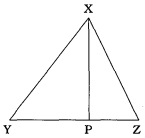
In $\Delta XYZ$,$XY > XZ$ and $P$ is any point on the side $YZ$. Prove that $XY > XP$.
Solution
(N/A) In $\Delta XYZ$,$XY > XZ$ (Given).
$\therefore \angle XZY > \angle XYZ$ (Since the angle opposite to the larger side of a triangle is greater).
In $\Delta XPZ$,$\angle XPY$ is an exterior angle,and $\angle XZP$ is its interior opposite angle.
Therefore,$\angle XPY > \angle XZP$ (Exterior angle property).
Since $\angle XZY$ is the same as $\angle XZP$,we have $\angle XPY > \angle XZP > \angle XYZ$.
Thus,$\angle XPY > \angle XYZ$ (or $\angle XPY > \angle XYP$).
In $\Delta XYP$,since the angle opposite to $XY$ (which is $\angle XPY$) is greater than the angle opposite to $XP$ (which is $\angle XYP$),it follows that $XY > XP$.
$\therefore \angle XZY > \angle XYZ$ (Since the angle opposite to the larger side of a triangle is greater).
In $\Delta XPZ$,$\angle XPY$ is an exterior angle,and $\angle XZP$ is its interior opposite angle.
Therefore,$\angle XPY > \angle XZP$ (Exterior angle property).
Since $\angle XZY$ is the same as $\angle XZP$,we have $\angle XPY > \angle XZP > \angle XYZ$.
Thus,$\angle XPY > \angle XYZ$ (or $\angle XPY > \angle XYP$).
In $\Delta XYP$,since the angle opposite to $XY$ (which is $\angle XPY$) is greater than the angle opposite to $XP$ (which is $\angle XYP$),it follows that $XY > XP$.
0 likes
View Solution92
Medium
Write the measures of its sides in ascending order in each of the following triangles:
$(1) \text{In } \Delta ABC, \angle A = 50^{\circ} \text{ and } \angle B = 60^{\circ}$
$(1) \text{In } \Delta ABC, \angle A = 50^{\circ} \text{ and } \angle B = 60^{\circ}$
Solution
(A) In $\Delta ABC$,the sum of angles is $180^{\circ}$.
Therefore,$\angle C = 180^{\circ} - (50^{\circ} + 60^{\circ}) = 180^{\circ} - 110^{\circ} = 70^{\circ}$.
We know that the side opposite to the smaller angle is smaller and the side opposite to the larger angle is larger.
The angles in ascending order are $\angle A < \angle B < \angle C$ $(50^{\circ} < 60^{\circ} < 70^{\circ})$.
Therefore,the sides in ascending order are $BC < AC < AB$.
Therefore,$\angle C = 180^{\circ} - (50^{\circ} + 60^{\circ}) = 180^{\circ} - 110^{\circ} = 70^{\circ}$.
We know that the side opposite to the smaller angle is smaller and the side opposite to the larger angle is larger.
The angles in ascending order are $\angle A < \angle B < \angle C$ $(50^{\circ} < 60^{\circ} < 70^{\circ})$.
Therefore,the sides in ascending order are $BC < AC < AB$.
0 likes
View Solution93
Medium
Write the measures of the sides of $\Delta PQR$ in ascending order,given that $\angle P = 40^{\circ}$ and $\angle R = 80^{\circ}$.
Solution
(QR, PR, PQ) In $\Delta PQR$,the sum of all interior angles is $180^{\circ}$.
Therefore,$\angle P + \angle Q + \angle R = 180^{\circ}$.
Substituting the given values: $40^{\circ} + \angle Q + 80^{\circ} = 180^{\circ}$.
$120^{\circ} + \angle Q = 180^{\circ}$,which gives $\angle Q = 60^{\circ}$.
We know that the side opposite to the smallest angle is the shortest,and the side opposite to the largest angle is the longest.
The angles in ascending order are $\angle P (40^{\circ}) < \angle Q (60^{\circ}) < \angle R (80^{\circ})$.
Therefore,the sides opposite to these angles in ascending order are $QR < PR < PQ$.
Therefore,$\angle P + \angle Q + \angle R = 180^{\circ}$.
Substituting the given values: $40^{\circ} + \angle Q + 80^{\circ} = 180^{\circ}$.
$120^{\circ} + \angle Q = 180^{\circ}$,which gives $\angle Q = 60^{\circ}$.
We know that the side opposite to the smallest angle is the shortest,and the side opposite to the largest angle is the longest.
The angles in ascending order are $\angle P (40^{\circ}) < \angle Q (60^{\circ}) < \angle R (80^{\circ})$.
Therefore,the sides opposite to these angles in ascending order are $QR < PR < PQ$.
0 likes
View Solution94
Medium
Write the measures of the sides of $\Delta XYZ$ in ascending order,given that $\angle X = 80^{\circ}$ and $\angle Y = 30^{\circ}$.
Solution
(A) In $\Delta XYZ$,the sum of angles is $180^{\circ}$.
Therefore,$\angle Z = 180^{\circ} - (80^{\circ} + 30^{\circ}) = 180^{\circ} - 110^{\circ} = 70^{\circ}$.
The angles in ascending order are $\angle Y (30^{\circ}) < \angle Z (70^{\circ}) < \angle X (80^{\circ})$.
Since the side opposite to the smaller angle is smaller,the sides in ascending order are $XZ < XY < YZ$.
Therefore,$\angle Z = 180^{\circ} - (80^{\circ} + 30^{\circ}) = 180^{\circ} - 110^{\circ} = 70^{\circ}$.
The angles in ascending order are $\angle Y (30^{\circ}) < \angle Z (70^{\circ}) < \angle X (80^{\circ})$.
Since the side opposite to the smaller angle is smaller,the sides in ascending order are $XZ < XY < YZ$.
0 likes
View Solution95
Medium
Write the measures of its sides in ascending order in each of the following triangles:
$(1)$ In $\Delta ABC$,$\angle B = 70^{\circ}$ and $\angle C = 20^{\circ}$.
$(1)$ In $\Delta ABC$,$\angle B = 70^{\circ}$ and $\angle C = 20^{\circ}$.
Solution
(N/A) In $\Delta ABC$,the sum of angles is $180^{\circ}$.
Therefore,$\angle A + \angle B + \angle C = 180^{\circ}$.
$\angle A + 70^{\circ} + 20^{\circ} = 180^{\circ}$.
$\angle A + 90^{\circ} = 180^{\circ}$,so $\angle A = 90^{\circ}$.
The angles are $\angle C = 20^{\circ}$,$\angle B = 70^{\circ}$,and $\angle A = 90^{\circ}$.
Since the side opposite to the smaller angle is smaller,the order of sides is $AB < AC < BC$.
Therefore,$\angle A + \angle B + \angle C = 180^{\circ}$.
$\angle A + 70^{\circ} + 20^{\circ} = 180^{\circ}$.
$\angle A + 90^{\circ} = 180^{\circ}$,so $\angle A = 90^{\circ}$.
The angles are $\angle C = 20^{\circ}$,$\angle B = 70^{\circ}$,and $\angle A = 90^{\circ}$.
Since the side opposite to the smaller angle is smaller,the order of sides is $AB < AC < BC$.
0 likes
View Solution96
Medium
Write the measures of the sides of $\Delta PQR$ in ascending order,given that $\angle P = 93^{\circ}$ and $\angle R = 55^{\circ}$.
Solution
(A) In $\Delta PQR$,the sum of all angles is $180^{\circ}$.
$\angle P + \angle Q + \angle R = 180^{\circ}$
$93^{\circ} + \angle Q + 55^{\circ} = 180^{\circ}$
$148^{\circ} + \angle Q = 180^{\circ}$
$\angle Q = 180^{\circ} - 148^{\circ} = 32^{\circ}$.
Since the side opposite to the smallest angle is the shortest and the side opposite to the largest angle is the longest,we compare the angles: $\angle Q (32^{\circ}) < \angle R (55^{\circ}) < \angle P (93^{\circ})$.
Therefore,the sides in ascending order are: $PR < PQ < QR$.
$\angle P + \angle Q + \angle R = 180^{\circ}$
$93^{\circ} + \angle Q + 55^{\circ} = 180^{\circ}$
$148^{\circ} + \angle Q = 180^{\circ}$
$\angle Q = 180^{\circ} - 148^{\circ} = 32^{\circ}$.
Since the side opposite to the smallest angle is the shortest and the side opposite to the largest angle is the longest,we compare the angles: $\angle Q (32^{\circ}) < \angle R (55^{\circ}) < \angle P (93^{\circ})$.
Therefore,the sides in ascending order are: $PR < PQ < QR$.
0 likes
View Solution97
Medium
In $\Delta ABC$,$AB > BC > CA$. Write the measure of the angles of the triangle in ascending order.
Solution
(A) In a triangle,the angle opposite to the longer side is larger.
Given the side lengths are in the order $AB > BC > CA$.
The angle opposite to side $AB$ is $\angle C$.
The angle opposite to side $BC$ is $\angle A$.
The angle opposite to side $CA$ is $\angle B$.
Since $AB > BC > CA$,it follows that $\angle C > \angle A > \angle B$.
Therefore,the angles in ascending order are $\angle B < \angle A < \angle C$.
Given the side lengths are in the order $AB > BC > CA$.
The angle opposite to side $AB$ is $\angle C$.
The angle opposite to side $BC$ is $\angle A$.
The angle opposite to side $CA$ is $\angle B$.
Since $AB > BC > CA$,it follows that $\angle C > \angle A > \angle B$.
Therefore,the angles in ascending order are $\angle B < \angle A < \angle C$.
0 likes
View Solution98
MediumMCQ
$\angle ABD$ and $\angle ACE$ are exterior angles of $\Delta ABC$. If $\angle ABD > \angle ACE$,then prove that $AC > AB$.
A
$N$/$A$
B
$N$/$A$
C
$N$/$A$
D
$N$/$A$
Solution
(N/A) Let $\angle ABC = \beta$ and $\angle ACB = \gamma$.
Since $\angle ABD$ is an exterior angle at vertex $B$,$\angle ABD = 180^\circ - \beta$.
Since $\angle ACE$ is an exterior angle at vertex $C$,$\angle ACE = 180^\circ - \gamma$.
Given that $\angle ABD > \angle ACE$,we substitute the expressions:
$180^\circ - \beta > 180^\circ - \gamma$.
Subtracting $180^\circ$ from both sides,we get $-\beta > -\gamma$.
Multiplying by $-1$ reverses the inequality sign: $\beta < \gamma$.
Since $\angle ACB (\gamma) > \angle ABC (\beta)$,the side opposite to the larger angle is longer.
Therefore,the side opposite to $\angle ACB$ is $AB$ and the side opposite to $\angle ABC$ is $AC$.
Thus,$AB > AC$ is incorrect based on the standard exterior angle theorem logic; if $\angle ABD > \angle ACE$,then $\angle ACB > \angle ABC$,which implies $AB > AC$ is false,rather $AC > AB$ is true.
Since $\angle ABD$ is an exterior angle at vertex $B$,$\angle ABD = 180^\circ - \beta$.
Since $\angle ACE$ is an exterior angle at vertex $C$,$\angle ACE = 180^\circ - \gamma$.
Given that $\angle ABD > \angle ACE$,we substitute the expressions:
$180^\circ - \beta > 180^\circ - \gamma$.
Subtracting $180^\circ$ from both sides,we get $-\beta > -\gamma$.
Multiplying by $-1$ reverses the inequality sign: $\beta < \gamma$.
Since $\angle ACB (\gamma) > \angle ABC (\beta)$,the side opposite to the larger angle is longer.
Therefore,the side opposite to $\angle ACB$ is $AB$ and the side opposite to $\angle ABC$ is $AC$.
Thus,$AB > AC$ is incorrect based on the standard exterior angle theorem logic; if $\angle ABD > \angle ACE$,then $\angle ACB > \angle ABC$,which implies $AB > AC$ is false,rather $AC > AB$ is true.
0 likes
View Solution99
Medium
Prove that an angle opposite to the longest side in a scalene triangle is greater than $60^{\circ}$.
Solution
(N/A) Let the sides of the scalene triangle be $a$,$b$,and $c$ such that $a > b > c$.
Let the angles opposite to these sides be $A$,$B$,and $C$ respectively.
According to the property of triangles,the angle opposite to the longest side is the largest angle. Thus,$A > B > C$.
We know that the sum of all angles in a triangle is $180^{\circ}$,so $A + B + C = 180^{\circ}$.
Since $A > B$ and $A > C$,we can write $A + A + A > A + B + C$.
Therefore,$3A > 180^{\circ}$.
Dividing both sides by $3$,we get $A > 60^{\circ}$.
Thus,the angle opposite to the longest side in a scalene triangle is always greater than $60^{\circ}$.
Let the angles opposite to these sides be $A$,$B$,and $C$ respectively.
According to the property of triangles,the angle opposite to the longest side is the largest angle. Thus,$A > B > C$.
We know that the sum of all angles in a triangle is $180^{\circ}$,so $A + B + C = 180^{\circ}$.
Since $A > B$ and $A > C$,we can write $A + A + A > A + B + C$.
Therefore,$3A > 180^{\circ}$.
Dividing both sides by $3$,we get $A > 60^{\circ}$.
Thus,the angle opposite to the longest side in a scalene triangle is always greater than $60^{\circ}$.
1 likes
View Solution100
Medium
In $\Delta ABC$,$D$ is any point on the side $BC$. Prove that the perimeter of $\Delta ABC > 2 AD$.
Solution
(N/A) In $\Delta ABD$,by the triangle inequality theorem,the sum of any two sides is greater than the third side: $AB + BD > AD$ (Equation $1$).
In $\Delta ACD$,by the triangle inequality theorem: $AC + CD > AD$ (Equation $2$).
Adding Equation $1$ and Equation $2$,we get: $(AB + BD) + (AC + CD) > AD + AD$.
Rearranging the terms: $AB + AC + (BD + CD) > 2 AD$.
Since $D$ is a point on $BC$,$BD + CD = BC$.
Therefore,$AB + AC + BC > 2 AD$.
This shows that the perimeter of $\Delta ABC$ is greater than $2 AD$.
In $\Delta ACD$,by the triangle inequality theorem: $AC + CD > AD$ (Equation $2$).
Adding Equation $1$ and Equation $2$,we get: $(AB + BD) + (AC + CD) > AD + AD$.
Rearranging the terms: $AB + AC + (BD + CD) > 2 AD$.
Since $D$ is a point on $BC$,$BD + CD = BC$.
Therefore,$AB + AC + BC > 2 AD$.
This shows that the perimeter of $\Delta ABC$ is greater than $2 AD$.
0 likes
View SolutionTriangles — Mix Examples - Triangles · Frequently Asked Questions
1Are these Triangles questions useful for JEE and NEET?
Yes. All questions in this section are mapped to JEE Main and NEET exam patterns. Previous year questions from JEE Main, NEET, GUJCET and state-level exams are included with full solutions.
2Can I switch to Hindi or Gujarati for these questions?
Yes. Use the language tabs in the hero section or the sidebar to view the same questions and solutions in English, Hindi or Gujarati.
3How do I generate a question paper from this subtopic?
Use the Vedclass Exam Paper Generator — select the chapter and subtopic, set difficulty, and generate Sets A, B, C, D automatically. First 3 chapters of every subject are free.
Vedclass Products
For Students
Vedclass Test Series
Mock tests in real JEE/NEET style with performance analysis. 5-day free trial.
Start Free TrialFor Teachers
Exam Paper Generator
Generate Set A/B/C/D papers from this chapter in 2 minutes. 3 chapters free.
Try FreeFor Institutes
Online Exam Module
Live online exams with unlimited students, 360° analytics & white-label branding.
See DemoFor Teachers & Institutes
Generate a Triangles Exam Paper in 2 Minutes
Select subtopic & difficulty — Sets A, B, C, D auto-generated with No Repeat logic.
First 3 chapters of every subject are free — no payment required.