
A English
Textbook - Triangles Questions in English
Class 9 Mathematics · Triangles · Textbook - Triangles
40+
Questions
English
Language
100%
With Solutions
Showing 40 of 40 questions in English
1
Medium
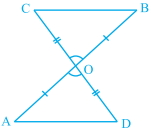
In the figure,$OA = OB$ and $OD = OC$. Show that
$(i)$ $\Delta AOD \cong \Delta BOC$ and
$(ii)$ $AD \parallel BC$.
$(i)$ $\Delta AOD \cong \Delta BOC$ and
$(ii)$ $AD \parallel BC$.
Solution
(N/A) $(i)$ In $\Delta AOD$ and $\Delta BOC$:
$OA = OB$ (Given)
$OD = OC$ (Given)
Also,$\angle AOD = \angle BOC$ (Vertically opposite angles).
Therefore,by the $SAS$ congruence rule,$\Delta AOD \cong \Delta BOC$.
$(ii)$ Since $\Delta AOD \cong \Delta BOC$,their corresponding parts are equal $(CPCT)$.
Thus,$\angle OAD = \angle OBC$.
These are alternate interior angles formed by the transversal $AB$ intersecting lines $AD$ and $BC$.
Since the alternate interior angles are equal,$AD \parallel BC$.
$OA = OB$ (Given)
$OD = OC$ (Given)
Also,$\angle AOD = \angle BOC$ (Vertically opposite angles).
Therefore,by the $SAS$ congruence rule,$\Delta AOD \cong \Delta BOC$.
$(ii)$ Since $\Delta AOD \cong \Delta BOC$,their corresponding parts are equal $(CPCT)$.
Thus,$\angle OAD = \angle OBC$.
These are alternate interior angles formed by the transversal $AB$ intersecting lines $AD$ and $BC$.
Since the alternate interior angles are equal,$AD \parallel BC$.
0 likes
View Solution2
Medium
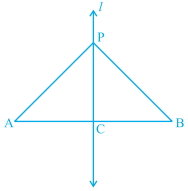
$AB$ is a line segment and line $l$ is its perpendicular bisector. If a point $P$ lies on $l$,show that $P$ is equidistant from $A$ and $B$.
Solution
(N/A) Line $l$ is the perpendicular bisector of $AB$ and passes through $C$,which is the mid-point of $AB$ (see figure).
We need to show that $PA = PB$.
Consider $\Delta PCA$ and $\Delta PCB$.
In these triangles:
$AC = BC$ ($C$ is the mid-point of $AB$)
$\angle PCA = \angle PCB = 90^\circ$ (Given,as $l$ is the perpendicular bisector)
$PC = PC$ (Common side)
Therefore,by the $SAS$ congruence rule,$\Delta PCA \cong \Delta PCB$.
Since the triangles are congruent,their corresponding parts are equal $(CPCT)$.
Thus,$PA = PB$,which means $P$ is equidistant from $A$ and $B$.
We need to show that $PA = PB$.
Consider $\Delta PCA$ and $\Delta PCB$.
In these triangles:
$AC = BC$ ($C$ is the mid-point of $AB$)
$\angle PCA = \angle PCB = 90^\circ$ (Given,as $l$ is the perpendicular bisector)
$PC = PC$ (Common side)
Therefore,by the $SAS$ congruence rule,$\Delta PCA \cong \Delta PCB$.
Since the triangles are congruent,their corresponding parts are equal $(CPCT)$.
Thus,$PA = PB$,which means $P$ is equidistant from $A$ and $B$.
0 likes
View Solution3
Medium
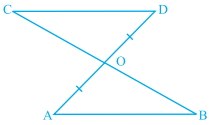
Line-segment $AB$ is parallel to another line-segment $CD$. $O$ is the mid-point of $AD$ (see Fig). Show that $(i)$ $\Delta AOB \cong \Delta DOC$ $(ii)$ $O$ is also the mid-point of $BC$.
Solution
$(i)$ Consider $\Delta AOB$ and $\Delta DOC$.
$\angle OAB = \angle ODC$ (Alternate interior angles as $AB \parallel CD$ and $AD$ is the transversal)
$\angle AOB = \angle DOC$ (Vertically opposite angles)
$OA = OD$ (Given,as $O$ is the mid-point of $AD$)
Therefore,by $ASA$ congruence rule,$\Delta AOB \cong \Delta DOC$.
$(ii)$ Since $\Delta AOB \cong \Delta DOC$,then by $CPCT$ (Corresponding Parts of Congruent Triangles),
$OB = OC$
Thus,$O$ is the mid-point of $BC$.
$\angle OAB = \angle ODC$ (Alternate interior angles as $AB \parallel CD$ and $AD$ is the transversal)
$\angle AOB = \angle DOC$ (Vertically opposite angles)
$OA = OD$ (Given,as $O$ is the mid-point of $AD$)
Therefore,by $ASA$ congruence rule,$\Delta AOB \cong \Delta DOC$.
$(ii)$ Since $\Delta AOB \cong \Delta DOC$,then by $CPCT$ (Corresponding Parts of Congruent Triangles),
$OB = OC$
Thus,$O$ is the mid-point of $BC$.
0 likes
View Solution4
Medium
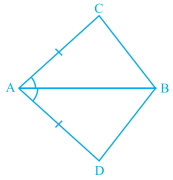
In quadrilateral $ACBD$,$AC = AD$ and $AB$ bisects $\angle A$ (see figure). Show that $\Delta ABC \cong \Delta ABD$. What can you say about $BC$ and $BD$?
Solution
(N/A) In quadrilateral $ACBD$,we are given:
$AC = AD$
$AB$ bisects $\angle A$,which implies $\angle CAB = \angle DAB$.
Now,consider $\Delta ABC$ and $\Delta ABD$:
$1$. $AC = AD$ (Given)
$2$. $\angle CAB = \angle DAB$ (Since $AB$ bisects $\angle A$)
$3$. $AB = AB$ (Common side)
By the $SAS$ (Side-Angle-Side) congruence criterion,$\Delta ABC \cong \Delta ABD$.
Since the triangles are congruent,their corresponding parts are equal by $CPCT$ (Corresponding Parts of Congruent Triangles).
Therefore,$BC = BD$.
$AC = AD$
$AB$ bisects $\angle A$,which implies $\angle CAB = \angle DAB$.
Now,consider $\Delta ABC$ and $\Delta ABD$:
$1$. $AC = AD$ (Given)
$2$. $\angle CAB = \angle DAB$ (Since $AB$ bisects $\angle A$)
$3$. $AB = AB$ (Common side)
By the $SAS$ (Side-Angle-Side) congruence criterion,$\Delta ABC \cong \Delta ABD$.
Since the triangles are congruent,their corresponding parts are equal by $CPCT$ (Corresponding Parts of Congruent Triangles).
Therefore,$BC = BD$.
0 likes
View Solution5
Medium
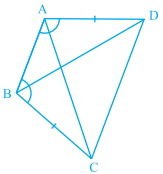
$ABCD$ is a quadrilateral in which $AD = BC$ and $\angle DAB = \angle CBA$ (see figure). Prove that:
$(i)$ $\Delta ABD \cong \Delta BAC$
$(ii)$ $BD = AC$
$(iii)$ $\angle ABD = \angle BAC$
$(i)$ $\Delta ABD \cong \Delta BAC$
$(ii)$ $BD = AC$
$(iii)$ $\angle ABD = \angle BAC$
Solution
(N/A) $(i)$ In quadrilateral $ABCD$,we have $AD = BC$ and $\angle DAB = \angle CBA$.
Consider $\Delta ABD$ and $\Delta BAC$:
$AD = BC$ (Given)
$AB = BA$ (Common side)
$\angle DAB = \angle CBA$ (Given)
Therefore,by $SAS$ (Side-Angle-Side) congruence criterion,we have $\Delta ABD \cong \Delta BAC$.
$(ii)$ Since $\Delta ABD \cong \Delta BAC$,their corresponding parts are equal $(CPCT)$.
Therefore,$BD = AC$.
$(iii)$ Since $\Delta ABD \cong \Delta BAC$,their corresponding parts are equal $(CPCT)$.
Therefore,$\angle ABD = \angle BAC$.
Consider $\Delta ABD$ and $\Delta BAC$:
$AD = BC$ (Given)
$AB = BA$ (Common side)
$\angle DAB = \angle CBA$ (Given)
Therefore,by $SAS$ (Side-Angle-Side) congruence criterion,we have $\Delta ABD \cong \Delta BAC$.
$(ii)$ Since $\Delta ABD \cong \Delta BAC$,their corresponding parts are equal $(CPCT)$.
Therefore,$BD = AC$.
$(iii)$ Since $\Delta ABD \cong \Delta BAC$,their corresponding parts are equal $(CPCT)$.
Therefore,$\angle ABD = \angle BAC$.
0 likes
View Solution6
Medium
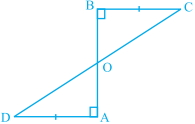
$AD$ and $BC$ are equal perpendiculars to a line segment $AB$ (see figure). Show that $CD$ bisects $AB$.
Solution
(N/A) Given: $AD \perp AB$,$BC \perp AB$ and $AD = BC$.
To prove: $CD$ bisects $AB$,i.e.,$OA = OB$.
Proof:
In $\Delta OBC$ and $\Delta OAD$:
$1$. $\angle OBC = \angle OAD = 90^\circ$ (Given)
$2$. $\angle BOC = \angle AOD$ (Vertically opposite angles)
$3$. $BC = AD$ (Given)
By $AAS$ congruence rule,$\Delta OBC \cong \Delta OAD$.
Therefore,$OB = OA$ (by $c.p.c.t.$).
Since $OB = OA$,$O$ is the midpoint of $AB$.
Hence,$CD$ bisects $AB$.
To prove: $CD$ bisects $AB$,i.e.,$OA = OB$.
Proof:
In $\Delta OBC$ and $\Delta OAD$:
$1$. $\angle OBC = \angle OAD = 90^\circ$ (Given)
$2$. $\angle BOC = \angle AOD$ (Vertically opposite angles)
$3$. $BC = AD$ (Given)
By $AAS$ congruence rule,$\Delta OBC \cong \Delta OAD$.
Therefore,$OB = OA$ (by $c.p.c.t.$).
Since $OB = OA$,$O$ is the midpoint of $AB$.
Hence,$CD$ bisects $AB$.
0 likes
View Solution7
Medium
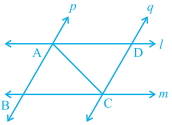
$l$ and $m$ are two parallel lines intersected by another pair of parallel lines $p$ and $q$ (see Fig). Show that $\Delta ABC \cong \Delta CDA$.
Solution
(N/A) Given: $l \parallel m$ and $p \parallel q$.
To prove: $\Delta ABC \cong \Delta CDA$.
Proof:
Since $l \parallel m$ and $AC$ is a transversal,
$\therefore \angle BAC = \angle DCA$ [Alternate interior angles]
Also,since $p \parallel q$ and $AC$ is a transversal,
$\therefore \angle BCA = \angle DAC$ [Alternate interior angles]
Now,in $\Delta ABC$ and $\Delta CDA$:
$\angle BAC = \angle DCA$ [Proved above]
$\angle BCA = \angle DAC$ [Proved above]
$AC = CA$ [Common side]
Therefore,by the $ASA$ (Angle-Side-Angle) congruence criterion,$\Delta ABC \cong \Delta CDA$.
To prove: $\Delta ABC \cong \Delta CDA$.
Proof:
Since $l \parallel m$ and $AC$ is a transversal,
$\therefore \angle BAC = \angle DCA$ [Alternate interior angles]
Also,since $p \parallel q$ and $AC$ is a transversal,
$\therefore \angle BCA = \angle DAC$ [Alternate interior angles]
Now,in $\Delta ABC$ and $\Delta CDA$:
$\angle BAC = \angle DCA$ [Proved above]
$\angle BCA = \angle DAC$ [Proved above]
$AC = CA$ [Common side]
Therefore,by the $ASA$ (Angle-Side-Angle) congruence criterion,$\Delta ABC \cong \Delta CDA$.
0 likes
View Solution8
Medium
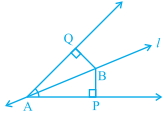
Line $l$ is the bisector of an angle $\angle A$ and $B$ is any point on $l$. $BP$ and $BQ$ are perpendiculars from $B$ to the arms of $\angle A$ (see Fig). Show that :
$(i)$ $\Delta APB \cong \Delta AQB$
$(ii)$ $BP = BQ$ or $B$ is equidistant from the arms of $\angle A$.
$(i)$ $\Delta APB \cong \Delta AQB$
$(ii)$ $BP = BQ$ or $B$ is equidistant from the arms of $\angle A$.
Solution
(N/A) Given: Line $l$ is the bisector of $\angle A$. $BP \perp AQ$ and $BQ \perp AP$.
$(i)$ In $\Delta APB$ and $\Delta AQB$:
$\angle APB = \angle AQB = 90^{\circ}$ (Given)
$\angle PAB = \angle QAB$ ($l$ is the bisector of $\angle A$)
$AB = AB$ (Common side)
Therefore,by $AAS$ congruence criterion,$\Delta APB \cong \Delta AQB$.
$(ii)$ Since $\Delta APB \cong \Delta AQB$,their corresponding parts are equal by $CPCT$.
Therefore,$BP = BQ$.
This shows that point $B$ is equidistant from the arms of $\angle A$.
$(i)$ In $\Delta APB$ and $\Delta AQB$:
$\angle APB = \angle AQB = 90^{\circ}$ (Given)
$\angle PAB = \angle QAB$ ($l$ is the bisector of $\angle A$)
$AB = AB$ (Common side)
Therefore,by $AAS$ congruence criterion,$\Delta APB \cong \Delta AQB$.
$(ii)$ Since $\Delta APB \cong \Delta AQB$,their corresponding parts are equal by $CPCT$.
Therefore,$BP = BQ$.
This shows that point $B$ is equidistant from the arms of $\angle A$.
0 likes
View Solution9
Medium
In the figure,$AC = AE$,$AB = AD$ and $\angle BAD = \angle EAC$. Show that $BC = DE$.
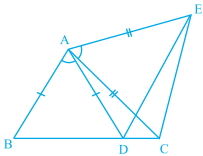
Solution
(N/A) We have $\angle BAD = \angle EAC$.
Adding $\angle DAC$ on both sides,we have:
$\angle BAD + \angle DAC = \angle EAC + \angle DAC$
$\Rightarrow \angle BAC = \angle DAE$
Now,in $\triangle ABC$ and $\triangle ADE$,we have:
$\angle BAC = \angle DAE$ [Proved above]
$AB = AD$ [Given]
$AC = AE$ [Given]
$\therefore \triangle ABC \cong \triangle ADE$ [Using $SAS$ congruence criterion]
Since $\triangle ABC \cong \triangle ADE$,therefore,their corresponding parts are equal $(CPCT)$.
$\Rightarrow BC = DE$.
Adding $\angle DAC$ on both sides,we have:
$\angle BAD + \angle DAC = \angle EAC + \angle DAC$
$\Rightarrow \angle BAC = \angle DAE$
Now,in $\triangle ABC$ and $\triangle ADE$,we have:
$\angle BAC = \angle DAE$ [Proved above]
$AB = AD$ [Given]
$AC = AE$ [Given]
$\therefore \triangle ABC \cong \triangle ADE$ [Using $SAS$ congruence criterion]
Since $\triangle ABC \cong \triangle ADE$,therefore,their corresponding parts are equal $(CPCT)$.
$\Rightarrow BC = DE$.
0 likes
View Solution10
Medium
$AB$ is a line segment and $P$ is its mid-point. $D$ and $E$ are points on the same side of $AB$ such that $\angle BAD = \angle ABE$ and $\angle EPA = \angle DPB$. Show that:
$(i)$ $\Delta DAP \cong \Delta EBP$
$(ii)$ $AD = BE$
$(i)$ $\Delta DAP \cong \Delta EBP$
$(ii)$ $AD = BE$
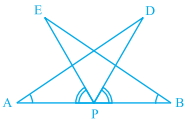
Solution
(N/A) Given: $P$ is the mid-point of $AB$.
$\therefore AP = BP$
$\angle EPA = \angle DPB$ [Given]
Adding $\angle EPD$ to both sides,we get:
$\angle EPA + \angle EPD = \angle DPB + \angle EPD$
$\Rightarrow \angle APD = \angle BPE$
$(i)$ In $\Delta DAP$ and $\Delta EBP$:
$AP = BP$ [Proved above]
$\angle PAD = \angle PBE$ [Given as $\angle BAD = \angle ABE$]
$\angle APD = \angle BPE$ [Proved above]
By $ASA$ congruence criterion,we have:
$\Delta DAP \cong \Delta EBP$
$(ii)$ Since $\Delta DAP \cong \Delta EBP$,their corresponding parts are equal $(CPCT)$:
$\Rightarrow AD = BE$
$\therefore AP = BP$
$\angle EPA = \angle DPB$ [Given]
Adding $\angle EPD$ to both sides,we get:
$\angle EPA + \angle EPD = \angle DPB + \angle EPD$
$\Rightarrow \angle APD = \angle BPE$
$(i)$ In $\Delta DAP$ and $\Delta EBP$:
$AP = BP$ [Proved above]
$\angle PAD = \angle PBE$ [Given as $\angle BAD = \angle ABE$]
$\angle APD = \angle BPE$ [Proved above]
By $ASA$ congruence criterion,we have:
$\Delta DAP \cong \Delta EBP$
$(ii)$ Since $\Delta DAP \cong \Delta EBP$,their corresponding parts are equal $(CPCT)$:
$\Rightarrow AD = BE$
0 likes
View Solution11
Difficult
In right triangle $ABC$,right-angled at $C$,$M$ is the mid-point of hypotenuse $AB$. $C$ is joined to $M$ and produced to a point $D$ such that $DM = CM$. Point $D$ is joined to point $B$ (see Fig). Show that:
$(i)$ $\Delta AMC \cong \Delta BMD$
$(ii)$ $\angle DBC$ is a right angle.
$(iii)$ $\Delta DBC \cong \Delta ACB$
$(iv)$ $CM = \frac{1}{2} AB$
$(i)$ $\Delta AMC \cong \Delta BMD$
$(ii)$ $\angle DBC$ is a right angle.
$(iii)$ $\Delta DBC \cong \Delta ACB$
$(iv)$ $CM = \frac{1}{2} AB$
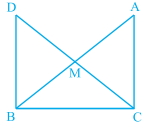
Solution
(N/A) Given: In $\Delta ABC$,$\angle C = 90^\circ$ and $M$ is the mid-point of $AB$ $(AM = BM)$. $CM$ is produced to $D$ such that $DM = CM$.
$(i)$ In $\Delta AMC$ and $\Delta BMD$:
$AM = BM$ (Given,$M$ is the mid-point of $AB$)
$\angle AMC = \angle BMD$ (Vertically opposite angles)
$CM = DM$ (Given)
Therefore,by $SAS$ congruence criterion,$\Delta AMC \cong \Delta BMD$.
$(ii)$ Since $\Delta AMC \cong \Delta BMD$,their corresponding parts are equal $(c.p.c.t.)$.
So,$\angle MAC = \angle MBD$. These are alternate interior angles,which implies $AC \parallel DB$.
Since $AC \parallel DB$ and $BC$ is a transversal,the sum of consecutive interior angles is $180^\circ$.
$\angle ACB + \angle DBC = 180^\circ$
$90^\circ + \angle DBC = 180^\circ$
$\angle DBC = 180^\circ - 90^\circ = 90^\circ$.
$(iii)$ In $\Delta DBC$ and $\Delta ACB$:
$DB = AC$ ($c.p.c.t.$ from $\Delta AMC \cong \Delta BMD$)
$\angle DBC = \angle ACB = 90^\circ$ (Proved above)
$BC = CB$ (Common side)
Therefore,by $SAS$ congruence criterion,$\Delta DBC \cong \Delta ACB$.
$(iv)$ Since $\Delta DBC \cong \Delta ACB$,their corresponding parts are equal $(c.p.c.t.)$.
So,$DC = AB$.
Since $DM = CM$,$CM = \frac{1}{2} DC$.
Substituting $DC = AB$,we get $CM = \frac{1}{2} AB$.
$(i)$ In $\Delta AMC$ and $\Delta BMD$:
$AM = BM$ (Given,$M$ is the mid-point of $AB$)
$\angle AMC = \angle BMD$ (Vertically opposite angles)
$CM = DM$ (Given)
Therefore,by $SAS$ congruence criterion,$\Delta AMC \cong \Delta BMD$.
$(ii)$ Since $\Delta AMC \cong \Delta BMD$,their corresponding parts are equal $(c.p.c.t.)$.
So,$\angle MAC = \angle MBD$. These are alternate interior angles,which implies $AC \parallel DB$.
Since $AC \parallel DB$ and $BC$ is a transversal,the sum of consecutive interior angles is $180^\circ$.
$\angle ACB + \angle DBC = 180^\circ$
$90^\circ + \angle DBC = 180^\circ$
$\angle DBC = 180^\circ - 90^\circ = 90^\circ$.
$(iii)$ In $\Delta DBC$ and $\Delta ACB$:
$DB = AC$ ($c.p.c.t.$ from $\Delta AMC \cong \Delta BMD$)
$\angle DBC = \angle ACB = 90^\circ$ (Proved above)
$BC = CB$ (Common side)
Therefore,by $SAS$ congruence criterion,$\Delta DBC \cong \Delta ACB$.
$(iv)$ Since $\Delta DBC \cong \Delta ACB$,their corresponding parts are equal $(c.p.c.t.)$.
So,$DC = AB$.
Since $DM = CM$,$CM = \frac{1}{2} DC$.
Substituting $DC = AB$,we get $CM = \frac{1}{2} AB$.
0 likes
View Solution12
Medium
In $\Delta ABC$,the bisector $AD$ of $\angle A$ is perpendicular to side $BC$ (see figure). Show that $AB = AC$ and $\Delta ABC$ is isosceles.
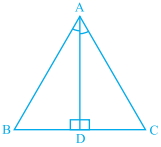
Solution
(N/A) In $\Delta ABD$ and $\Delta ACD$:
$\angle BAD = \angle CAD$ (Given,as $AD$ is the bisector of $\angle A$)
$AD = AD$ (Common side)
$\angle ADB = \angle ADC = 90^\circ$ (Given,as $AD \perp BC$)
Therefore,by the $ASA$ (Angle-Side-Angle) congruence rule,$\Delta ABD \cong \Delta ACD$.
Since the triangles are congruent,their corresponding parts are equal $(CPCT)$.
Thus,$AB = AC$.
Since two sides of $\Delta ABC$ are equal,$\Delta ABC$ is an isosceles triangle.
$\angle BAD = \angle CAD$ (Given,as $AD$ is the bisector of $\angle A$)
$AD = AD$ (Common side)
$\angle ADB = \angle ADC = 90^\circ$ (Given,as $AD \perp BC$)
Therefore,by the $ASA$ (Angle-Side-Angle) congruence rule,$\Delta ABD \cong \Delta ACD$.
Since the triangles are congruent,their corresponding parts are equal $(CPCT)$.
Thus,$AB = AC$.
Since two sides of $\Delta ABC$ are equal,$\Delta ABC$ is an isosceles triangle.
0 likes
View Solution13
Easy
$E$ and $F$ are respectively the mid-points of equal sides $AB$ and $AC$ of $\Delta ABC$ (see figure). Show that $BF = CE$.
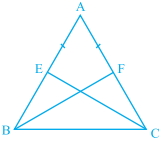
Solution
(N/A) In $\Delta ABF$ and $\Delta ACE$:
$AB = AC$ (Given)
$\angle A = \angle A$ (Common angle)
$AF = AE$ (Since $F$ and $E$ are mid-points of equal sides $AC$ and $AB$ respectively,$AF = \frac{1}{2} AC$ and $AE = \frac{1}{2} AB$. Since $AB = AC$,it follows that $AF = AE$.)
Therefore,$\Delta ABF \cong \Delta ACE$ by the $SAS$ congruence rule.
Since the triangles are congruent,their corresponding parts are equal.
Thus,$BF = CE$ (by $CPCT$).
$AB = AC$ (Given)
$\angle A = \angle A$ (Common angle)
$AF = AE$ (Since $F$ and $E$ are mid-points of equal sides $AC$ and $AB$ respectively,$AF = \frac{1}{2} AC$ and $AE = \frac{1}{2} AB$. Since $AB = AC$,it follows that $AF = AE$.)
Therefore,$\Delta ABF \cong \Delta ACE$ by the $SAS$ congruence rule.
Since the triangles are congruent,their corresponding parts are equal.
Thus,$BF = CE$ (by $CPCT$).
0 likes
View Solution14
Medium
In an isosceles triangle $ABC$ with $AB = AC$,$D$ and $E$ are points on $BC$ such that $BE = CD$ (see Fig). Show that $AD = AE$.
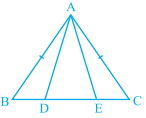
Solution
(N/A) In $\Delta ABD$ and $\Delta ACE$:
$AB = AC$ (Given) ........... $(1)$
$\angle B = \angle C$ (Angles opposite to equal sides) ........... $(2)$
Also,$BE = CD$
Subtracting $DE$ from both sides:
$BE - DE = CD - DE$
$BD = CE$ ........... $(3)$
Therefore,$\Delta ABD \cong \Delta ACE$ (Using $(1)$,$(2)$,$(3)$ and $SAS$ congruence rule).
This gives $AD = AE$ $(CPCT)$.
$AB = AC$ (Given) ........... $(1)$
$\angle B = \angle C$ (Angles opposite to equal sides) ........... $(2)$
Also,$BE = CD$
Subtracting $DE$ from both sides:
$BE - DE = CD - DE$
$BD = CE$ ........... $(3)$
Therefore,$\Delta ABD \cong \Delta ACE$ (Using $(1)$,$(2)$,$(3)$ and $SAS$ congruence rule).
This gives $AD = AE$ $(CPCT)$.
0 likes
View Solution15
Medium
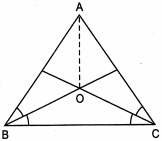
In an isosceles triangle $ABC$,with $AB = AC$,the bisectors of $\angle B$ and $\angle C$ intersect each other at $O$. Join $A$ to $O$. Show that :
$(i)$ $OB = OC$
$(ii)$ $AO$ bisects $\angle A$
$(i)$ $OB = OC$
$(ii)$ $AO$ bisects $\angle A$
Solution
(N/A) $(i)$ In $\Delta ABC$,we have
$AB = AC$ [Given]
$\therefore \angle C = \angle B$ [Angles opposite to equal sides are equal]
$\Rightarrow \frac{1}{2} \angle C = \frac{1}{2} \angle B$
Or $\angle OCB = \angle OBC$
$\Rightarrow OB = OC$ [Sides opposite to equal angles are equal]
$(ii)$ In $\Delta ABO$ and $\Delta ACO$,we have
$AB = AC$ [Given]
$OB = OC$ [Proved above]
$\angle OBA = \angle OCA$ [Since $\frac{1}{2} \angle B = \frac{1}{2} \angle C$]
$\therefore$ Using $SAS$ congruence criteria,
$\Delta ABO \cong \Delta ACO$
$\Rightarrow \angle OAB = \angle OAC$ [c.p.c.t.]
$\Rightarrow AO$ bisects $\angle A$.
$AB = AC$ [Given]
$\therefore \angle C = \angle B$ [Angles opposite to equal sides are equal]
$\Rightarrow \frac{1}{2} \angle C = \frac{1}{2} \angle B$
Or $\angle OCB = \angle OBC$
$\Rightarrow OB = OC$ [Sides opposite to equal angles are equal]
$(ii)$ In $\Delta ABO$ and $\Delta ACO$,we have
$AB = AC$ [Given]
$OB = OC$ [Proved above]
$\angle OBA = \angle OCA$ [Since $\frac{1}{2} \angle B = \frac{1}{2} \angle C$]
$\therefore$ Using $SAS$ congruence criteria,
$\Delta ABO \cong \Delta ACO$
$\Rightarrow \angle OAB = \angle OAC$ [c.p.c.t.]
$\Rightarrow AO$ bisects $\angle A$.
0 likes
View Solution16
Medium
In $\Delta ABC$,$AD$ is the perpendicular bisector of $BC$ (see figure). Show that $\Delta ABC$ is an isosceles triangle in which $AB = AC$.
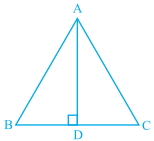
Solution
(N/A) Given: $AD$ is the perpendicular bisector of $BC$,which implies $BD = CD$ and $\angle ADB = \angle ADC = 90^o$.
In $\Delta ABD$ and $\Delta ACD$:
$AD = AD$ (Common side)
$\angle ADB = \angle ADC = 90^o$ (Given)
$BD = CD$ (Since $AD$ is the bisector of $BC$)
Therefore,$\Delta ABD \cong \Delta ACD$ by the $SAS$ congruence criterion.
Since the triangles are congruent,their corresponding parts are equal $(CPCT)$.
Thus,$AB = AC$.
Since two sides of $\Delta ABC$ are equal,it is an isosceles triangle.
In $\Delta ABD$ and $\Delta ACD$:
$AD = AD$ (Common side)
$\angle ADB = \angle ADC = 90^o$ (Given)
$BD = CD$ (Since $AD$ is the bisector of $BC$)
Therefore,$\Delta ABD \cong \Delta ACD$ by the $SAS$ congruence criterion.
Since the triangles are congruent,their corresponding parts are equal $(CPCT)$.
Thus,$AB = AC$.
Since two sides of $\Delta ABC$ are equal,it is an isosceles triangle.
0 likes
View Solution17
Medium
$\Delta ABC$ is an isosceles triangle in which altitudes $BE$ and $CF$ are drawn to equal sides $AC$ and $AB$ respectively. Show that these altitudes are equal.
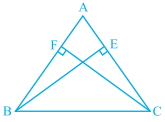
Solution
(N/A) Given: $\Delta ABC$ is an isosceles triangle with $AB = AC$.
Altitudes $BE \perp AC$ and $CF \perp AB$.
To prove: $BE = CF$.
Proof:
In $\Delta ABE$ and $\Delta ACF$:
$1$. $\angle A = \angle A$ (Common angle)
$2$. $AB = AC$ (Given)
$3$. $\angle AEB = \angle AFC = 90^\circ$ (Since $BE$ and $CF$ are altitudes)
Therefore,by $AAS$ congruence criterion,$\Delta ABE \cong \Delta ACF$.
Since the triangles are congruent,their corresponding parts are equal $(CPCT)$.
Thus,$BE = CF$.
Altitudes $BE \perp AC$ and $CF \perp AB$.
To prove: $BE = CF$.
Proof:
In $\Delta ABE$ and $\Delta ACF$:
$1$. $\angle A = \angle A$ (Common angle)
$2$. $AB = AC$ (Given)
$3$. $\angle AEB = \angle AFC = 90^\circ$ (Since $BE$ and $CF$ are altitudes)
Therefore,by $AAS$ congruence criterion,$\Delta ABE \cong \Delta ACF$.
Since the triangles are congruent,their corresponding parts are equal $(CPCT)$.
Thus,$BE = CF$.
1 likes
View Solution18
Medium
$ABC$ is a triangle in which altitudes $BE$ and $CF$ to sides $AC$ and $AB$ are equal (see Fig). Show that
$(i)$ $\Delta ABE \cong \Delta ACF$
$(ii)$ $AB = AC$,i.e.,$ABC$ is an isosceles triangle.
$(i)$ $\Delta ABE \cong \Delta ACF$
$(ii)$ $AB = AC$,i.e.,$ABC$ is an isosceles triangle.
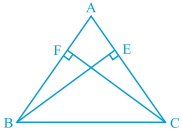
Solution
(N/A) $(i)$ In $\Delta ABE$ and $\Delta ACF$,we have:
$\angle AEB = \angle AFC = 90^\circ$ (Since $BE \perp AC$ and $CF \perp AB$)
$\angle A = \angle A$ (Common angle)
$BE = CF$ (Given)
Therefore,by the $AAS$ congruence criterion,$\Delta ABE \cong \Delta ACF$.
$(ii)$ Since $\Delta ABE \cong \Delta ACF$,their corresponding parts are equal $(CPCT)$.
Therefore,$AB = AC$.
Thus,$ABC$ is an isosceles triangle.
$\angle AEB = \angle AFC = 90^\circ$ (Since $BE \perp AC$ and $CF \perp AB$)
$\angle A = \angle A$ (Common angle)
$BE = CF$ (Given)
Therefore,by the $AAS$ congruence criterion,$\Delta ABE \cong \Delta ACF$.
$(ii)$ Since $\Delta ABE \cong \Delta ACF$,their corresponding parts are equal $(CPCT)$.
Therefore,$AB = AC$.
Thus,$ABC$ is an isosceles triangle.
0 likes
View Solution19
Medium
$ABC$ and $DBC$ are two isosceles triangles on the same base $BC$ (see figure). Show that $\angle ABD = \angle ACD$.
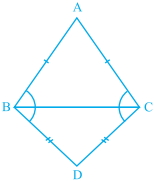
Solution
(N/A) In $\Delta ABC$,we have
$AB = AC$ (Given,since $\Delta ABC$ is an isosceles triangle)
Since angles opposite to equal sides are equal,we have:
$\angle ABC = \angle ACB$ .......... $(1)$
In $\Delta BDC$,we have
$BD = CD$ (Given,since $\Delta BDC$ is an isosceles triangle)
Since angles opposite to equal sides are equal,we have:
$\angle CBD = \angle BCD$ .......... $(2)$
Adding equations $(1)$ and $(2)$,we get:
$\angle ABC + \angle CBD = \angle ACB + \angle BCD$
$\Rightarrow \angle ABD = \angle ACD$
Hence proved.
$AB = AC$ (Given,since $\Delta ABC$ is an isosceles triangle)
Since angles opposite to equal sides are equal,we have:
$\angle ABC = \angle ACB$ .......... $(1)$
In $\Delta BDC$,we have
$BD = CD$ (Given,since $\Delta BDC$ is an isosceles triangle)
Since angles opposite to equal sides are equal,we have:
$\angle CBD = \angle BCD$ .......... $(2)$
Adding equations $(1)$ and $(2)$,we get:
$\angle ABC + \angle CBD = \angle ACB + \angle BCD$
$\Rightarrow \angle ABD = \angle ACD$
Hence proved.
0 likes
View Solution20
Difficult
$\Delta ABC$ is an isosceles triangle in which $AB = AC$. Side $BA$ is produced to $D$ such that $AD = AB$ (see figure). Show that $\angle BCD$ is a right angle.
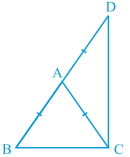
Solution
(N/A) In $\Delta ABC$,since $AB = AC$,we have $\angle ABC = \angle ACB$ (angles opposite to equal sides). Let $\angle ABC = \angle ACB = x$. Then $\angle BAC = 180^\circ - 2x$.
In $\Delta ACD$,since $AD = AB$ and $AB = AC$,we have $AD = AC$. Thus,$\angle ADC = \angle ACD$ (angles opposite to equal sides). Let $\angle ADC = \angle ACD = y$.
Since $BA$ is produced to $D$,$BD$ is a straight line. Therefore,$\angle BAC + \angle CAD = 180^\circ$.
Since $\angle CAD = 180^\circ - 2y$ (from $\Delta ACD$),we have $(180^\circ - 2x) + (180^\circ - 2y) = 180^\circ$.
$360^\circ - 2(x + y) = 180^\circ$.
$2(x + y) = 180^\circ$.
$x + y = 90^\circ$.
Since $\angle BCD = \angle ACB + \angle ACD = x + y$,we conclude $\angle BCD = 90^\circ$.
In $\Delta ACD$,since $AD = AB$ and $AB = AC$,we have $AD = AC$. Thus,$\angle ADC = \angle ACD$ (angles opposite to equal sides). Let $\angle ADC = \angle ACD = y$.
Since $BA$ is produced to $D$,$BD$ is a straight line. Therefore,$\angle BAC + \angle CAD = 180^\circ$.
Since $\angle CAD = 180^\circ - 2y$ (from $\Delta ACD$),we have $(180^\circ - 2x) + (180^\circ - 2y) = 180^\circ$.
$360^\circ - 2(x + y) = 180^\circ$.
$2(x + y) = 180^\circ$.
$x + y = 90^\circ$.
Since $\angle BCD = \angle ACB + \angle ACD = x + y$,we conclude $\angle BCD = 90^\circ$.
0 likes
View Solution21
Medium
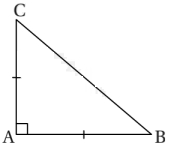
$ABC$ is a right-angled triangle in which $\angle A = 90^o$ and $AB = AC$. Find $\angle B$ and $\angle C$.
Solution
(N/A) In $\triangle ABC$,we have:
$AB = AC$ [Given]
Since the sides are equal,their opposite angles are also equal.
$\Rightarrow \angle ACB = \angle ABC$
We know that the sum of all angles in a triangle is $180^o$.
$\angle A + \angle B + \angle C = 180^o$
$90^o + \angle B + \angle C = 180^o$ [Since $\angle A = 90^o$]
$\angle B + \angle C = 180^o - 90^o = 90^o$
Since $\angle B = \angle C$,we can write:
$2 \angle B = 90^o$
$\angle B = \frac{90^o}{2} = 45^o$
Therefore,$\angle B = 45^o$ and $\angle C = 45^o$.
$AB = AC$ [Given]
Since the sides are equal,their opposite angles are also equal.
$\Rightarrow \angle ACB = \angle ABC$
We know that the sum of all angles in a triangle is $180^o$.
$\angle A + \angle B + \angle C = 180^o$
$90^o + \angle B + \angle C = 180^o$ [Since $\angle A = 90^o$]
$\angle B + \angle C = 180^o - 90^o = 90^o$
Since $\angle B = \angle C$,we can write:
$2 \angle B = 90^o$
$\angle B = \frac{90^o}{2} = 45^o$
Therefore,$\angle B = 45^o$ and $\angle C = 45^o$.
0 likes
View Solution22
Difficult
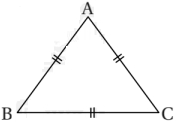
Show that the angles of an equilateral triangle are $60^o$ each.
Solution
(N/A) In $\Delta ABC$,we have:
$AB = BC = CA$ $[\because \Delta ABC$ is an equilateral triangle$]$
Since $AB = BC$,the angles opposite to these sides are equal,so $\angle A = \angle C$ ......... $(1)$
Similarly,since $AC = BC$,the angles opposite to these sides are equal,so $\angle A = \angle B$ ......... $(2)$
From $(1)$ and $(2)$,we have:
$\angle A = \angle B = \angle C$
Let $\angle A = \angle B = \angle C = x$
Since the sum of the angles in a triangle is $180^o$:
$\angle A + \angle B + \angle C = 180^o$
Substituting $x$ for each angle:
$x + x + x = 180^o$
$3x = 180^o$
$x = \frac{180^o}{3} = 60^o$
Therefore,$\angle A = \angle B = \angle C = 60^o$.
Thus,each angle of an equilateral triangle is $60^o$.
$AB = BC = CA$ $[\because \Delta ABC$ is an equilateral triangle$]$
Since $AB = BC$,the angles opposite to these sides are equal,so $\angle A = \angle C$ ......... $(1)$
Similarly,since $AC = BC$,the angles opposite to these sides are equal,so $\angle A = \angle B$ ......... $(2)$
From $(1)$ and $(2)$,we have:
$\angle A = \angle B = \angle C$
Let $\angle A = \angle B = \angle C = x$
Since the sum of the angles in a triangle is $180^o$:
$\angle A + \angle B + \angle C = 180^o$
Substituting $x$ for each angle:
$x + x + x = 180^o$
$3x = 180^o$
$x = \frac{180^o}{3} = 60^o$
Therefore,$\angle A = \angle B = \angle C = 60^o$.
Thus,each angle of an equilateral triangle is $60^o$.
0 likes
View Solution23
Difficult
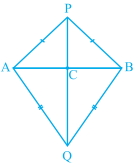
$AB$ is a line segment. $P$ and $Q$ are points on opposite sides of $AB$ such that each of them is equidistant from the points $A$ and $B$ (see figure). Show that the line $PQ$ is the perpendicular bisector of $AB$.
Solution
(N/A) Given: $PA = PB$ and $QA = QB$. We need to show that $PQ \perp AB$ and $PQ$ bisects $AB$. Let $PQ$ intersect $AB$ at $C$.
Consider $\Delta PAQ$ and $\Delta PBQ$:
$AP = BP$ (Given)
$AQ = BQ$ (Given)
$PQ = PQ$ (Common side)
Therefore,$\Delta PAQ \cong \Delta PBQ$ by $SSS$ congruence rule.
This implies $\angle APQ = \angle BPQ$ by $CPCT$.
Now,consider $\Delta PAC$ and $\Delta PBC$:
$AP = BP$ (Given)
$\angle APC = \angle BPC$ (Since $\angle APQ = \angle BPQ$)
$PC = PC$ (Common side)
Therefore,$\Delta PAC \cong \Delta PBC$ by $SAS$ congruence rule.
This implies $AC = BC$ and $\angle ACP = \angle BCP$ by $CPCT$.
Since $\angle ACP + \angle BCP = 180^o$ (Linear pair),
$2 \angle ACP = 180^o \implies \angle ACP = 90^o$.
Since $AC = BC$ and $\angle ACP = 90^o$,$PQ$ is the perpendicular bisector of $AB$.
Consider $\Delta PAQ$ and $\Delta PBQ$:
$AP = BP$ (Given)
$AQ = BQ$ (Given)
$PQ = PQ$ (Common side)
Therefore,$\Delta PAQ \cong \Delta PBQ$ by $SSS$ congruence rule.
This implies $\angle APQ = \angle BPQ$ by $CPCT$.
Now,consider $\Delta PAC$ and $\Delta PBC$:
$AP = BP$ (Given)
$\angle APC = \angle BPC$ (Since $\angle APQ = \angle BPQ$)
$PC = PC$ (Common side)
Therefore,$\Delta PAC \cong \Delta PBC$ by $SAS$ congruence rule.
This implies $AC = BC$ and $\angle ACP = \angle BCP$ by $CPCT$.
Since $\angle ACP + \angle BCP = 180^o$ (Linear pair),
$2 \angle ACP = 180^o \implies \angle ACP = 90^o$.
Since $AC = BC$ and $\angle ACP = 90^o$,$PQ$ is the perpendicular bisector of $AB$.
0 likes
View Solution24
Medium
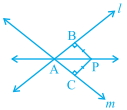
$P$ is a point equidistant from two lines $l$ and $m$ intersecting at point $A$. Show that the line $AP$ bisects the angle between them.
Solution
(N/A) Given: Lines $l$ and $m$ intersect at point $A$. $P$ is a point such that $PB \perp l$ and $PC \perp m$,with $PB = PC$.
To prove: Line $AP$ bisects the angle between lines $l$ and $m$,i.e.,$\angle PAB = \angle PAC$.
Proof: Consider $\Delta PAB$ and $\Delta PAC$.
In these two triangles:
$1$. $PB = PC$ (Given,as $P$ is equidistant from the lines)
$2$. $\angle PBA = \angle PCA = 90^o$ (Given,as $PB \perp l$ and $PC \perp m$)
$3$. $PA = PA$ (Common side)
Therefore,by the $RHS$ congruence rule,$\Delta PAB \cong \Delta PAC$.
Since the triangles are congruent,their corresponding parts are equal $(CPCT)$.
Thus,$\angle PAB = \angle PAC$.
This shows that the line $AP$ bisects the angle between lines $l$ and $m$.
To prove: Line $AP$ bisects the angle between lines $l$ and $m$,i.e.,$\angle PAB = \angle PAC$.
Proof: Consider $\Delta PAB$ and $\Delta PAC$.
In these two triangles:
$1$. $PB = PC$ (Given,as $P$ is equidistant from the lines)
$2$. $\angle PBA = \angle PCA = 90^o$ (Given,as $PB \perp l$ and $PC \perp m$)
$3$. $PA = PA$ (Common side)
Therefore,by the $RHS$ congruence rule,$\Delta PAB \cong \Delta PAC$.
Since the triangles are congruent,their corresponding parts are equal $(CPCT)$.
Thus,$\angle PAB = \angle PAC$.
This shows that the line $AP$ bisects the angle between lines $l$ and $m$.
0 likes
View Solution25
Difficult
$\Delta ABC$ and $\Delta DBC$ are two isosceles triangles on the same base $BC$ and vertices $A$ and $D$ are on the same side of $BC$ (see Fig). If $AD$ is extended to intersect $BC$ at $P$,show that:
$(i)$ $\Delta ABD \cong \Delta ACD$
$(ii)$ $\Delta ABP \cong \Delta ACP$
$(iii)$ $AP$ bisects $\angle A$ as well as $\angle D$.
$(iv)$ $AP$ is the perpendicular bisector of $BC$.
$(i)$ $\Delta ABD \cong \Delta ACD$
$(ii)$ $\Delta ABP \cong \Delta ACP$
$(iii)$ $AP$ bisects $\angle A$ as well as $\angle D$.
$(iv)$ $AP$ is the perpendicular bisector of $BC$.
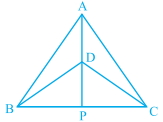
Solution
(N/A) $(i)$ In $\Delta ABD$ and $\Delta ACD$,we have:
$AB = AC$ [Given]
$AD = AD$ [Common]
$BD = CD$ [Given]
$\therefore \Delta ABD \cong \Delta ACD$ [$SSS$ congruence criterion]
$(ii)$ In $\Delta ABP$ and $\Delta ACP$,we have:
$AB = AC$ [Given]
$\angle BAP = \angle CAP$ [Since $\Delta ABD \cong \Delta ACD$,their corresponding parts are equal]
$AP = AP$ [Common]
$\therefore \Delta ABP \cong \Delta ACP$ [$SAS$ congruence criterion]
$(iii)$ Since $\Delta ABP \cong \Delta ACP$,their corresponding parts are congruent.
$\Rightarrow \angle BAP = \angle CAP$,so $AP$ bisects $\angle A$.
Also,in $\Delta BDP$ and $\Delta CDP$:
$BD = CD$ [Given]
$DP = DP$ [Common]
$BP = CP$ [Since $\Delta ABP \cong \Delta ACP$,$BP = CP$ by $CPCT$]
$\therefore \Delta BDP \cong \Delta CDP$ [$SSS$ congruence criterion]
$\Rightarrow \angle BDP = \angle CDP$,so $AP$ bisects $\angle D$.
$(iv)$ Since $\Delta ABP \cong \Delta ACP$,we have $\angle APB = \angle APC$ [by $CPCT$].
Since $\angle APB + \angle APC = 180^\circ$ [Linear pair],
$\angle APB = \angle APC = 90^\circ$.
Also $BP = CP$ [by $CPCT$].
Thus,$AP$ is the perpendicular bisector of $BC$.
$AB = AC$ [Given]
$AD = AD$ [Common]
$BD = CD$ [Given]
$\therefore \Delta ABD \cong \Delta ACD$ [$SSS$ congruence criterion]
$(ii)$ In $\Delta ABP$ and $\Delta ACP$,we have:
$AB = AC$ [Given]
$\angle BAP = \angle CAP$ [Since $\Delta ABD \cong \Delta ACD$,their corresponding parts are equal]
$AP = AP$ [Common]
$\therefore \Delta ABP \cong \Delta ACP$ [$SAS$ congruence criterion]
$(iii)$ Since $\Delta ABP \cong \Delta ACP$,their corresponding parts are congruent.
$\Rightarrow \angle BAP = \angle CAP$,so $AP$ bisects $\angle A$.
Also,in $\Delta BDP$ and $\Delta CDP$:
$BD = CD$ [Given]
$DP = DP$ [Common]
$BP = CP$ [Since $\Delta ABP \cong \Delta ACP$,$BP = CP$ by $CPCT$]
$\therefore \Delta BDP \cong \Delta CDP$ [$SSS$ congruence criterion]
$\Rightarrow \angle BDP = \angle CDP$,so $AP$ bisects $\angle D$.
$(iv)$ Since $\Delta ABP \cong \Delta ACP$,we have $\angle APB = \angle APC$ [by $CPCT$].
Since $\angle APB + \angle APC = 180^\circ$ [Linear pair],
$\angle APB = \angle APC = 90^\circ$.
Also $BP = CP$ [by $CPCT$].
Thus,$AP$ is the perpendicular bisector of $BC$.
0 likes
View Solution26
Medium
$AD$ is an altitude of an isosceles triangle $ABC$ in which $AB = AC$. Show that:
$(i)$ $AD$ bisects $BC$
$(ii)$ $AD$ bisects $\angle A$.
$(i)$ $AD$ bisects $BC$
$(ii)$ $AD$ bisects $\angle A$.
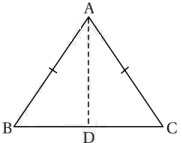
Solution
(N/A) $(i)$ In $\Delta ABD$ and $\Delta ACD$,we have:
$AB = AC$ [Given]
$\angle ADB = \angle ADC = 90^\circ$ [Since $AD$ is an altitude]
$AD = AD$ [Common side]
Therefore,by $RHS$ congruence rule,$\Delta ABD \cong \Delta ACD$.
Since the triangles are congruent,their corresponding parts are equal $(CPCT)$.
Therefore,$BD = CD$,which means $AD$ bisects $BC$.
$(ii)$ Since $\Delta ABD \cong \Delta ACD$,their corresponding angles are equal $(CPCT)$.
Therefore,$\angle BAD = \angle CAD$,which means $AD$ bisects $\angle A$.
$AB = AC$ [Given]
$\angle ADB = \angle ADC = 90^\circ$ [Since $AD$ is an altitude]
$AD = AD$ [Common side]
Therefore,by $RHS$ congruence rule,$\Delta ABD \cong \Delta ACD$.
Since the triangles are congruent,their corresponding parts are equal $(CPCT)$.
Therefore,$BD = CD$,which means $AD$ bisects $BC$.
$(ii)$ Since $\Delta ABD \cong \Delta ACD$,their corresponding angles are equal $(CPCT)$.
Therefore,$\angle BAD = \angle CAD$,which means $AD$ bisects $\angle A$.
0 likes
View Solution27
Medium
Two sides $AB$ and $BC$ and median $AM$ of one triangle $ABC$ are respectively equal to sides $PQ$ and $QR$ and median $PN$ of $\Delta PQR$ (see Fig). Show that:
$(i)$ $\Delta ABM \cong \Delta PQN$
$(ii)$ $\Delta ABC \cong \Delta PQR$
$(i)$ $\Delta ABM \cong \Delta PQN$
$(ii)$ $\Delta ABC \cong \Delta PQR$
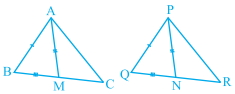
Solution
(N/A) In $\Delta ABC$,$AM$ is a median [Given].
$\therefore BM = \frac{1}{2} BC$ ........... $(1)$
In $\Delta PQR$,$PN$ is a median.
$\therefore QN = \frac{1}{2} QR$ ........... $(2)$
$\because BC = QR$ [Given]
$\therefore \frac{1}{2} BC = \frac{1}{2} QR$
$\Rightarrow BM = QN$ [From $(1)$ and $(2)$]
$(i)$ In $\Delta ABM$ and $\Delta PQN$,we have:
$AB = PQ$ [Given]
$AM = PN$ [Given]
$BM = QN$ [Proved above]
$\therefore \Delta ABM \cong \Delta PQN$ [$SSS$ congruence criterion]
$(ii)$ $\because \Delta ABM \cong \Delta PQN$
$\therefore$ Their corresponding parts are congruent $(CPCT)$.
$\Rightarrow \angle B = \angle Q$
Now,in $\Delta ABC$ and $\Delta PQR$,we have:
$AB = PQ$ [Given]
$\angle B = \angle Q$ [Proved above]
$BC = QR$ [Given]
$\therefore \Delta ABC \cong \Delta PQR$ [$SAS$ congruence criterion]
$\therefore BM = \frac{1}{2} BC$ ........... $(1)$
In $\Delta PQR$,$PN$ is a median.
$\therefore QN = \frac{1}{2} QR$ ........... $(2)$
$\because BC = QR$ [Given]
$\therefore \frac{1}{2} BC = \frac{1}{2} QR$
$\Rightarrow BM = QN$ [From $(1)$ and $(2)$]
$(i)$ In $\Delta ABM$ and $\Delta PQN$,we have:
$AB = PQ$ [Given]
$AM = PN$ [Given]
$BM = QN$ [Proved above]
$\therefore \Delta ABM \cong \Delta PQN$ [$SSS$ congruence criterion]
$(ii)$ $\because \Delta ABM \cong \Delta PQN$
$\therefore$ Their corresponding parts are congruent $(CPCT)$.
$\Rightarrow \angle B = \angle Q$
Now,in $\Delta ABC$ and $\Delta PQR$,we have:
$AB = PQ$ [Given]
$\angle B = \angle Q$ [Proved above]
$BC = QR$ [Given]
$\therefore \Delta ABC \cong \Delta PQR$ [$SAS$ congruence criterion]
0 likes
View Solution28
Difficult
$BE$ and $CF$ are two equal altitudes of a triangle $ABC$. Using $RHS$ congruence rule,prove that the triangle $ABC$ is isosceles.
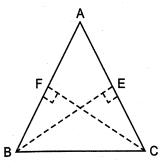
Solution
(N/A) Given: $BE \perp AC$ and $CF \perp AB$ such that $BE = CF$.
To prove: $\Delta ABC$ is an isosceles triangle,i.e.,$AB = AC$.
Proof:
In right-angled triangles $\Delta BEC$ and $\Delta CFB$:
$1$. $\angle BEC = \angle CFB = 90^\circ$ (Altitudes are perpendicular to the sides).
$2$. $BC = CB$ (Common hypotenuse).
$3$. $BE = CF$ (Given).
Therefore,by $RHS$ congruence rule,$\Delta BEC \cong \Delta CFB$.
Since the triangles are congruent,their corresponding parts are equal $(CPCT)$:
$\angle BCE = \angle CBF$
This implies $\angle BCA = \angle CBA$.
In $\Delta ABC$,since the angles opposite to equal sides are equal,the sides opposite to equal angles are also equal.
Therefore,$AB = AC$.
Hence,$\Delta ABC$ is an isosceles triangle.
To prove: $\Delta ABC$ is an isosceles triangle,i.e.,$AB = AC$.
Proof:
In right-angled triangles $\Delta BEC$ and $\Delta CFB$:
$1$. $\angle BEC = \angle CFB = 90^\circ$ (Altitudes are perpendicular to the sides).
$2$. $BC = CB$ (Common hypotenuse).
$3$. $BE = CF$ (Given).
Therefore,by $RHS$ congruence rule,$\Delta BEC \cong \Delta CFB$.
Since the triangles are congruent,their corresponding parts are equal $(CPCT)$:
$\angle BCE = \angle CBF$
This implies $\angle BCA = \angle CBA$.
In $\Delta ABC$,since the angles opposite to equal sides are equal,the sides opposite to equal angles are also equal.
Therefore,$AB = AC$.
Hence,$\Delta ABC$ is an isosceles triangle.
0 likes
View Solution29
Medium
$ABC$ is an isosceles triangle with $AB = AC$. Draw $AP \perp BC$ to show that $\angle B = \angle C$.
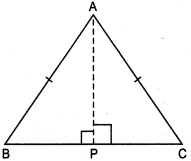
Solution
(N/A) Given: $ABC$ is an isosceles triangle with $AB = AC$. $AP \perp BC$.
To prove: $\angle B = \angle C$.
Proof:
In $\Delta ABP$ and $\Delta ACP$:
$1$. $\angle APB = \angle APC = 90^\circ$ (Since $AP \perp BC$)
$2$. $AB = AC$ (Given)
$3$. $AP = AP$ (Common side)
Therefore,by $RHS$ congruence criterion,$\Delta ABP \cong \Delta ACP$.
Since the triangles are congruent,their corresponding parts are equal $(CPCT)$.
Thus,$\angle B = \angle C$.
To prove: $\angle B = \angle C$.
Proof:
In $\Delta ABP$ and $\Delta ACP$:
$1$. $\angle APB = \angle APC = 90^\circ$ (Since $AP \perp BC$)
$2$. $AB = AC$ (Given)
$3$. $AP = AP$ (Common side)
Therefore,by $RHS$ congruence criterion,$\Delta ABP \cong \Delta ACP$.
Since the triangles are congruent,their corresponding parts are equal $(CPCT)$.
Thus,$\angle B = \angle C$.
0 likes
View Solution30
Medium
$D$ is a point on side $BC$ of $\Delta ABC$ such that $AD = AC$ (see figure). Show that $AB > AD$.
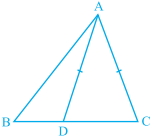
Solution
(N/A) In $\Delta DAC$,
$AD = AC$ (Given)
Therefore,$\angle ADC = \angle ACD$ (Angles opposite to equal sides are equal).
Now,$\angle ADC$ is an exterior angle for $\Delta ABD$.
By the exterior angle theorem,$\angle ADC > \angle ABD$.
Since $\angle ADC = \angle ACD$,we have $\angle ACD > \angle ABD$.
This implies $\angle ACB > \angle ABC$.
In $\Delta ABC$,the side opposite to the larger angle is longer. Therefore,$AB > AC$.
Since $AD = AC$,we conclude that $AB > AD$.
$AD = AC$ (Given)
Therefore,$\angle ADC = \angle ACD$ (Angles opposite to equal sides are equal).
Now,$\angle ADC$ is an exterior angle for $\Delta ABD$.
By the exterior angle theorem,$\angle ADC > \angle ABD$.
Since $\angle ADC = \angle ACD$,we have $\angle ACD > \angle ABD$.
This implies $\angle ACB > \angle ABC$.
In $\Delta ABC$,the side opposite to the larger angle is longer. Therefore,$AB > AC$.
Since $AD = AC$,we conclude that $AB > AD$.
0 likes
View Solution31
Difficult
Show that in a right-angled triangle,the hypotenuse is the longest side.
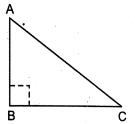
Solution
(N/A) Let us consider $\Delta ABC$ such that $\angle B = 90^\circ$.
Since the sum of angles in a triangle is $180^\circ$,we have $\angle A + \angle B + \angle C = 180^\circ$.
Substituting $\angle B = 90^\circ$,we get $\angle A + 90^\circ + \angle C = 180^\circ$,which implies $\angle A + \angle C = 90^\circ$.
Since $\angle A + \angle C = 90^\circ$ and $\angle B = 90^\circ$,it follows that $\angle B = \angle A + \angle C$.
This implies that $\angle B > \angle A$ and $\angle B > \angle C$.
In any triangle,the side opposite to the larger angle is longer. Therefore,the side opposite to $\angle B$ (which is $AC$) is longer than the side opposite to $\angle A$ (which is $BC$) and the side opposite to $\angle C$ (which is $AB$).
Thus,$AC > BC$ and $AC > AB$.
Since $AC$ is the hypotenuse,it is the longest side of the triangle.
Since the sum of angles in a triangle is $180^\circ$,we have $\angle A + \angle B + \angle C = 180^\circ$.
Substituting $\angle B = 90^\circ$,we get $\angle A + 90^\circ + \angle C = 180^\circ$,which implies $\angle A + \angle C = 90^\circ$.
Since $\angle A + \angle C = 90^\circ$ and $\angle B = 90^\circ$,it follows that $\angle B = \angle A + \angle C$.
This implies that $\angle B > \angle A$ and $\angle B > \angle C$.
In any triangle,the side opposite to the larger angle is longer. Therefore,the side opposite to $\angle B$ (which is $AC$) is longer than the side opposite to $\angle A$ (which is $BC$) and the side opposite to $\angle C$ (which is $AB$).
Thus,$AC > BC$ and $AC > AB$.
Since $AC$ is the hypotenuse,it is the longest side of the triangle.
0 likes
View Solution32
Medium
In the figure,sides $AB$ and $AC$ of $\Delta ABC$ are extended to points $P$ and $Q$ respectively. Also,$\angle PBC < \angle QCB$. Show that $AC > AB$.
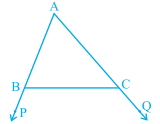
Solution
(N/A) We know that $\angle ABC + \angle PBC = 180^\circ$ [Linear pair axiom].
Similarly,$\angle ACB + \angle QCB = 180^\circ$ [Linear pair axiom].
Therefore,$\angle ABC + \angle PBC = \angle ACB + \angle QCB$.
Given that $\angle PBC < \angle QCB$.
Since the sum of the angles is constant $(180^\circ)$,if one angle in the sum is smaller,the other must be larger to maintain the equality.
Thus,$\angle ABC > \angle ACB$.
In any triangle,the side opposite to the larger angle is longer.
Therefore,the side opposite to $\angle ABC$ (which is $AC$) is greater than the side opposite to $\angle ACB$ (which is $AB$).
Hence,$AC > AB$.
Similarly,$\angle ACB + \angle QCB = 180^\circ$ [Linear pair axiom].
Therefore,$\angle ABC + \angle PBC = \angle ACB + \angle QCB$.
Given that $\angle PBC < \angle QCB$.
Since the sum of the angles is constant $(180^\circ)$,if one angle in the sum is smaller,the other must be larger to maintain the equality.
Thus,$\angle ABC > \angle ACB$.
In any triangle,the side opposite to the larger angle is longer.
Therefore,the side opposite to $\angle ABC$ (which is $AC$) is greater than the side opposite to $\angle ACB$ (which is $AB$).
Hence,$AC > AB$.
0 likes
View Solution33
Difficult
In the figure,$\angle B < \angle A$ and $\angle C < \angle D$. Show that $AD < BC$.
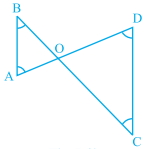
Solution
(N/A) Given: $\angle B < \angle A$ and $\angle C < \angle D$.
In $\triangle AOB$,since $\angle B < \angle A$,the side opposite to the greater angle is longer. Therefore,$OA < OB$ (side opposite to $\angle B$ is $OA$ and side opposite to $\angle A$ is $OB$) ...... $(1)$
In $\triangle COD$,since $\angle C < \angle D$,the side opposite to the greater angle is longer. Therefore,$OD < OC$ (side opposite to $\angle C$ is $OD$ and side opposite to $\angle D$ is $OC$) ...... $(2)$
Adding equations $(1)$ and $(2)$,we get:
$OA + OD < OB + OC$
Since $OA + OD = AD$ and $OB + OC = BC$,we have:
$AD < BC$.
In $\triangle AOB$,since $\angle B < \angle A$,the side opposite to the greater angle is longer. Therefore,$OA < OB$ (side opposite to $\angle B$ is $OA$ and side opposite to $\angle A$ is $OB$) ...... $(1)$
In $\triangle COD$,since $\angle C < \angle D$,the side opposite to the greater angle is longer. Therefore,$OD < OC$ (side opposite to $\angle C$ is $OD$ and side opposite to $\angle D$ is $OC$) ...... $(2)$
Adding equations $(1)$ and $(2)$,we get:
$OA + OD < OB + OC$
Since $OA + OD = AD$ and $OB + OC = BC$,we have:
$AD < BC$.
0 likes
View Solution34
Medium
$AB$ and $CD$ are respectively the smallest and longest sides of a quadrilateral $ABCD$ (see Fig). Show that $\angle A > \angle C$ and $\angle B > \angle D$.
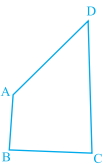
Solution
(N/A) Let us join $AC$.
In $\Delta ABC$,since $AB$ is the smallest side of the quadrilateral $ABCD$,we have $AB < BC$ and $AB < AC$.
Specifically,$BC > AB$.
Since the angle opposite to the longer side is larger,we have $\angle BAC > \angle BCA$ ........... $(1)$
In $\Delta ACD$,since $CD$ is the longest side of the quadrilateral $ABCD$,we have $CD > AD$ and $CD > AC$.
Specifically,$CD > AD$.
Since the angle opposite to the longer side is larger,we have $\angle CAD > \angle ACD$ ........... $(2)$
Adding $(1)$ and $(2)$,we get:
$(\angle BAC + \angle CAD) > (\angle BCA + \angle ACD)$
$\Rightarrow \angle A > \angle C$
Similarly,by joining $BD$ and using the same logic for $\Delta ABD$ and $\Delta BCD$,we can show that $\angle B > \angle D$.
In $\Delta ABC$,since $AB$ is the smallest side of the quadrilateral $ABCD$,we have $AB < BC$ and $AB < AC$.
Specifically,$BC > AB$.
Since the angle opposite to the longer side is larger,we have $\angle BAC > \angle BCA$ ........... $(1)$
In $\Delta ACD$,since $CD$ is the longest side of the quadrilateral $ABCD$,we have $CD > AD$ and $CD > AC$.
Specifically,$CD > AD$.
Since the angle opposite to the longer side is larger,we have $\angle CAD > \angle ACD$ ........... $(2)$
Adding $(1)$ and $(2)$,we get:
$(\angle BAC + \angle CAD) > (\angle BCA + \angle ACD)$
$\Rightarrow \angle A > \angle C$
Similarly,by joining $BD$ and using the same logic for $\Delta ABD$ and $\Delta BCD$,we can show that $\angle B > \angle D$.
0 likes
View Solution35
Difficult
In the figure,$PR > PQ$ and $PS$ bisects $\angle QPR$. Prove that $\angle PSR > \angle PSQ$.
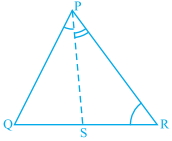
Solution
(N/A) In $\Delta PQR$,$PS$ bisects $\angle QPR$ [Given].
Therefore,$\angle QPS = \angle RPS$.
Since $PR > PQ$ [Given],
Therefore,the angle opposite to $PR$ is greater than the angle opposite to $PQ$.
Thus,$\angle PQS > \angle PRS$.
Adding $\angle QPS$ to the left side and $\angle RPS$ to the right side (since $\angle QPS = \angle RPS$):
$\angle PQS + \angle QPS > \angle PRS + \angle RPS$ ... $(1)$.
We know that the exterior angle of a triangle is equal to the sum of the two interior opposite angles.
For $\Delta PQS$,the exterior angle $\angle PSR = \angle PQS + \angle QPS$.
For $\Delta PRS$,the exterior angle $\angle PSQ = \angle PRS + \angle RPS$.
Substituting these into $(1)$,we get $\angle PSR > \angle PSQ$.
Therefore,$\angle QPS = \angle RPS$.
Since $PR > PQ$ [Given],
Therefore,the angle opposite to $PR$ is greater than the angle opposite to $PQ$.
Thus,$\angle PQS > \angle PRS$.
Adding $\angle QPS$ to the left side and $\angle RPS$ to the right side (since $\angle QPS = \angle RPS$):
$\angle PQS + \angle QPS > \angle PRS + \angle RPS$ ... $(1)$.
We know that the exterior angle of a triangle is equal to the sum of the two interior opposite angles.
For $\Delta PQS$,the exterior angle $\angle PSR = \angle PQS + \angle QPS$.
For $\Delta PRS$,the exterior angle $\angle PSQ = \angle PRS + \angle RPS$.
Substituting these into $(1)$,we get $\angle PSR > \angle PSQ$.
0 likes
View Solution36
Difficult
Show that of all line segments drawn from a given point not on a line,the perpendicular line segment is the shortest.
Solution
(N/A) Let us consider a point $P$ not on line $l$. Let $PM$ be the perpendicular from $P$ to line $l$,and let $N$ be any other point on line $l$ such that $N \neq M$.
In $\Delta PMN$,since $\angle M = 90^o$,the sum of angles is $\angle M + \angle N + \angle P = 180^o$.
This implies $\angle N + \angle P = 90^o$,so $\angle N < 90^o$.
Since $\angle N < \angle M$,the side opposite to $\angle N$ must be smaller than the side opposite to $\angle M$.
Therefore,$PM < PN$.
Since $N$ is an arbitrary point on line $l$ (other than $M$),this shows that $PM$ is shorter than any other line segment drawn from $P$ to line $l$.
Thus,the perpendicular segment is the shortest line segment drawn from a point to a line.
In $\Delta PMN$,since $\angle M = 90^o$,the sum of angles is $\angle M + \angle N + \angle P = 180^o$.
This implies $\angle N + \angle P = 90^o$,so $\angle N < 90^o$.
Since $\angle N < \angle M$,the side opposite to $\angle N$ must be smaller than the side opposite to $\angle M$.
Therefore,$PM < PN$.
Since $N$ is an arbitrary point on line $l$ (other than $M$),this shows that $PM$ is shorter than any other line segment drawn from $P$ to line $l$.
Thus,the perpendicular segment is the shortest line segment drawn from a point to a line.
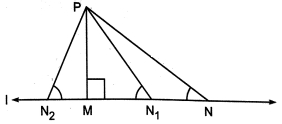
0 likes
View Solution37
Medium
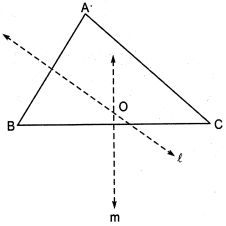
$ABC$ is a triangle. Locate a point in the interior of $\Delta ABC$ which is equidistant from all the vertices of $\Delta ABC$.
Solution
(N/A) Let us consider a $\Delta ABC$.
Draw line $l$ as the perpendicular bisector of side $AB$.
Draw line $m$ as the perpendicular bisector of side $BC$.
Let the two perpendicular bisectors $l$ and $m$ intersect at point $O$.
Since any point on the perpendicular bisector of a segment is equidistant from its endpoints,point $O$ lies on the perpendicular bisector of $AB$ (so $OA = OB$) and on the perpendicular bisector of $BC$ (so $OB = OC$).
Therefore,$OA = OB = OC$,which means point $O$ is the required point equidistant from all vertices $A, B,$ and $C$. This point $O$ is known as the circumcenter of the triangle.
Draw line $l$ as the perpendicular bisector of side $AB$.
Draw line $m$ as the perpendicular bisector of side $BC$.
Let the two perpendicular bisectors $l$ and $m$ intersect at point $O$.
Since any point on the perpendicular bisector of a segment is equidistant from its endpoints,point $O$ lies on the perpendicular bisector of $AB$ (so $OA = OB$) and on the perpendicular bisector of $BC$ (so $OB = OC$).
Therefore,$OA = OB = OC$,which means point $O$ is the required point equidistant from all vertices $A, B,$ and $C$. This point $O$ is known as the circumcenter of the triangle.
0 likes
View Solution38
Medium
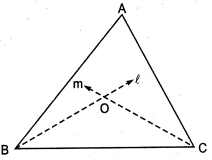
In a triangle,locate a point in its interior which is equidistant from all the sides of the triangle.
Solution
(N/A) Consider a $\Delta ABC$.
Draw the angle bisector $'l'$ of $\angle B$.
Draw the angle bisector $'m'$ of $\angle C$.
Let the two angle bisectors $'l'$ and $'m'$ intersect at point $O$.
Since any point on the angle bisector of an angle is equidistant from the arms of the angle,point $O$ lies on the bisector of $\angle B$ (so it is equidistant from $AB$ and $BC$) and also on the bisector of $\angle C$ (so it is equidistant from $BC$ and $AC$).
Therefore,point $O$ is equidistant from all three sides ($AB$,$BC$,and $AC$) of $\Delta ABC$. This point $O$ is known as the incenter of the triangle.
Draw the angle bisector $'l'$ of $\angle B$.
Draw the angle bisector $'m'$ of $\angle C$.
Let the two angle bisectors $'l'$ and $'m'$ intersect at point $O$.
Since any point on the angle bisector of an angle is equidistant from the arms of the angle,point $O$ lies on the bisector of $\angle B$ (so it is equidistant from $AB$ and $BC$) and also on the bisector of $\angle C$ (so it is equidistant from $BC$ and $AC$).
Therefore,point $O$ is equidistant from all three sides ($AB$,$BC$,and $AC$) of $\Delta ABC$. This point $O$ is known as the incenter of the triangle.
0 likes
View Solution39
Medium
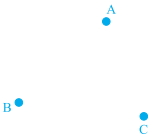
In a huge park,people are concentrated at three points (see Fig) :
$A$ : where there are different slides and swings for children,
$B$ : near which a man-made lake is situated,
$C$ : which is near to a large parking and exit. Where should an ice cream parlour be set up so that the maximum number of persons can approach it?
(Hint: The parlour should be equidistant from $A$,$B$,and $C$.)
$A$ : where there are different slides and swings for children,
$B$ : near which a man-made lake is situated,
$C$ : which is near to a large parking and exit. Where should an ice cream parlour be set up so that the maximum number of persons can approach it?
(Hint: The parlour should be equidistant from $A$,$B$,and $C$.)
Solution
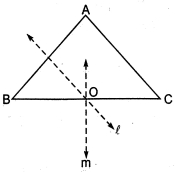
(N/A) To ensure the ice cream parlour is equidistant from points $A$,$B$,and $C$,we need to find the circumcenter of the triangle formed by these points.
$1$. Join points $A$ and $B$,and draw line $l$,which is the perpendicular bisector of segment $AB$.
$2$. Join points $B$ and $C$,and draw line $m$,which is the perpendicular bisector of segment $BC$.
$3$. Let the perpendicular bisectors $l$ and $m$ intersect at point $O$.
Point $O$ is the circumcenter of $\triangle ABC$,and it is equidistant from vertices $A$,$B$,and $C$. Therefore,the ice cream parlour should be set up at point $O$.
$1$. Join points $A$ and $B$,and draw line $l$,which is the perpendicular bisector of segment $AB$.
$2$. Join points $B$ and $C$,and draw line $m$,which is the perpendicular bisector of segment $BC$.
$3$. Let the perpendicular bisectors $l$ and $m$ intersect at point $O$.
Point $O$ is the circumcenter of $\triangle ABC$,and it is equidistant from vertices $A$,$B$,and $C$. Therefore,the ice cream parlour should be set up at point $O$.
0 likes
View Solution40
Medium
Complete the hexagonal and star-shaped Rangolies [see Fig. $(i)$ and $(ii)$] by filling them with as many equilateral triangles of side $1\,cm$ as you can. Count the number of triangles in each case. Which has more triangles?
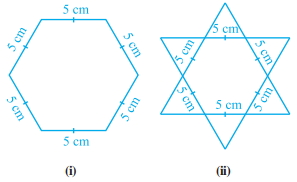
Solution
(B) To find the number of equilateral triangles of side $1\,cm$ that can fit into the given shapes,we calculate the area of the shapes and divide by the area of one small equilateral triangle.
$1$. For the regular hexagon of side $s = 5\,cm$:
Area $= \frac{3\sqrt{3}}{2} s^2 = \frac{3\sqrt{3}}{2} \times 25 = 37.5\sqrt{3} \approx 64.95\,cm^2$.
Each small triangle of side $1\,cm$ has an area of $\frac{\sqrt{3}}{4} \times 1^2 = 0.25\sqrt{3} \approx 0.433\,cm^2$.
Number of triangles in Fig. $(i) = \frac{37.5\sqrt{3}}{0.25\sqrt{3}} = 150$.
$2$. For the star-shaped figure in Fig. $(ii)$:
This figure consists of a central hexagon of side $5\,cm$ and $6$ equilateral triangles of side $5\,cm$ attached to its sides.
Total area $= \text{Area of hexagon} + 6 \times \text{Area of triangle of side } 5\,cm$.
Total area $= 37.5\sqrt{3} + 6 \times (6.25\sqrt{3}) = 37.5\sqrt{3} + 37.5\sqrt{3} = 75\sqrt{3} \approx 129.9\,cm^2$.
Number of triangles in Fig. $(ii) = \frac{75\sqrt{3}}{0.25\sqrt{3}} = 300$.
Therefore,the star-shaped figure $(ii)$ has more triangles.
$1$. For the regular hexagon of side $s = 5\,cm$:
Area $= \frac{3\sqrt{3}}{2} s^2 = \frac{3\sqrt{3}}{2} \times 25 = 37.5\sqrt{3} \approx 64.95\,cm^2$.
Each small triangle of side $1\,cm$ has an area of $\frac{\sqrt{3}}{4} \times 1^2 = 0.25\sqrt{3} \approx 0.433\,cm^2$.
Number of triangles in Fig. $(i) = \frac{37.5\sqrt{3}}{0.25\sqrt{3}} = 150$.
$2$. For the star-shaped figure in Fig. $(ii)$:
This figure consists of a central hexagon of side $5\,cm$ and $6$ equilateral triangles of side $5\,cm$ attached to its sides.
Total area $= \text{Area of hexagon} + 6 \times \text{Area of triangle of side } 5\,cm$.
Total area $= 37.5\sqrt{3} + 6 \times (6.25\sqrt{3}) = 37.5\sqrt{3} + 37.5\sqrt{3} = 75\sqrt{3} \approx 129.9\,cm^2$.
Number of triangles in Fig. $(ii) = \frac{75\sqrt{3}}{0.25\sqrt{3}} = 300$.
Therefore,the star-shaped figure $(ii)$ has more triangles.
0 likes
View SolutionTriangles — Textbook - Triangles · Frequently Asked Questions
1Are these Triangles questions useful for JEE and NEET?
Yes. All questions in this section are mapped to JEE Main and NEET exam patterns. Previous year questions from JEE Main, NEET, GUJCET and state-level exams are included with full solutions.
2Can I switch to Hindi or Gujarati for these questions?
Yes. Use the language tabs in the hero section or the sidebar to view the same questions and solutions in English, Hindi or Gujarati.
3How do I generate a question paper from this subtopic?
Use the Vedclass Exam Paper Generator — select the chapter and subtopic, set difficulty, and generate Sets A, B, C, D automatically. First 3 chapters of every subject are free.
Vedclass Products
For Students
Vedclass Test Series
Mock tests in real JEE/NEET style with performance analysis. 5-day free trial.
Start Free TrialFor Teachers
Exam Paper Generator
Generate Set A/B/C/D papers from this chapter in 2 minutes. 3 chapters free.
Try FreeFor Institutes
Online Exam Module
Live online exams with unlimited students, 360° analytics & white-label branding.
See DemoFor Teachers & Institutes
Generate a Triangles Exam Paper in 2 Minutes
Select subtopic & difficulty — Sets A, B, C, D auto-generated with No Repeat logic.
First 3 chapters of every subject are free — no payment required.