
A English
Textbook - Probability Questions in English
Class 9 Mathematics · Probability · Textbook - Probability
23+
Questions
English
Language
100%
With Solutions
Showing 23 of 23 questions in English
1
MediumMCQ
$A$ coin is tossed $1000$ times with the following frequencies:
Head : $455$ Tail : $545$
Compute the probability for each event.
Head : $455$ Tail : $545$
Compute the probability for each event.
A
$0.455, 0.545$
B
$0.555, 0.555$
C
$0.444, 0.445$
D
$0.335, 0.635$
Solution
(A) Since the coin is tossed $1000$ times,the total number of trials is $1000$.
Let $E$ be the event of getting a head and $F$ be the event of getting a tail.
The number of times $E$ occurs is $455$.
The probability of event $E$ is given by $P(E) = \frac{\text{Number of heads}}{\text{Total number of trials}} = \frac{455}{1000} = 0.455$.
The number of times $F$ occurs is $545$.
The probability of event $F$ is given by $P(F) = \frac{\text{Number of tails}}{\text{Total number of trials}} = \frac{545}{1000} = 0.545$.
Thus,the probabilities are $0.455$ and $0.545$ respectively.
Let $E$ be the event of getting a head and $F$ be the event of getting a tail.
The number of times $E$ occurs is $455$.
The probability of event $E$ is given by $P(E) = \frac{\text{Number of heads}}{\text{Total number of trials}} = \frac{455}{1000} = 0.455$.
The number of times $F$ occurs is $545$.
The probability of event $F$ is given by $P(F) = \frac{\text{Number of tails}}{\text{Total number of trials}} = \frac{545}{1000} = 0.545$.
Thus,the probabilities are $0.455$ and $0.545$ respectively.
0 likes
View Solution2
Medium
Two coins are tossed simultaneously $500$ times,and we get:
Two heads : $105$ times
One head : $275$ times
No head : $120$ times
Find the probability of occurrence of each of these events.
Two heads : $105$ times
One head : $275$ times
No head : $120$ times
Find the probability of occurrence of each of these events.
Solution
(N/A) Let us denote the events of getting two heads,one head,and no head by $E_1, E_2,$ and $E_3$ respectively.
The total number of trials is $500$.
For $E_1$ (two heads): $P(E_1) = \frac{105}{500} = 0.21$
For $E_2$ (one head): $P(E_2) = \frac{275}{500} = 0.55$
For $E_3$ (no head): $P(E_3) = \frac{120}{500} = 0.24$
Observe that $P(E_1) + P(E_2) + P(E_3) = 0.21 + 0.55 + 0.24 = 1.0$. These events cover all possible outcomes of the trial.
The total number of trials is $500$.
For $E_1$ (two heads): $P(E_1) = \frac{105}{500} = 0.21$
For $E_2$ (one head): $P(E_2) = \frac{275}{500} = 0.55$
For $E_3$ (no head): $P(E_3) = \frac{120}{500} = 0.24$
Observe that $P(E_1) + P(E_2) + P(E_3) = 0.21 + 0.55 + 0.24 = 1.0$. These events cover all possible outcomes of the trial.
0 likes
View Solution3
Medium
$A$ die is thrown $1000$ times with the frequencies for the outcomes $1, 2, 3, 4, 5$ and $6$ as given in the following table:
Find the probability of getting each outcome.
| Outcome | $1$ | $2$ | $3$ | $4$ | $5$ | $6$ |
| Frequency | $179$ | $150$ | $157$ | $149$ | $175$ | $190$ |
Find the probability of getting each outcome.
Solution
(N/A) Let $E_i$ denote the event of getting the outcome $i$,where $i = 1, 2, 3, 4, 5, 6$.
The probability of an event is given by the formula: $P(E) = \frac{\text{Number of trials in which the event happened}}{\text{Total number of trials}}$.
Here,the total number of trials is $1000$.
$P(E_1) = \frac{179}{1000} = 0.179$
$P(E_2) = \frac{150}{1000} = 0.150$
$P(E_3) = \frac{157}{1000} = 0.157$
$P(E_4) = \frac{149}{1000} = 0.149$
$P(E_5) = \frac{175}{1000} = 0.175$
$P(E_6) = \frac{190}{1000} = 0.190$
Note that the sum of all probabilities is $0.179 + 0.150 + 0.157 + 0.149 + 0.175 + 0.190 = 1$.
The probability of an event is given by the formula: $P(E) = \frac{\text{Number of trials in which the event happened}}{\text{Total number of trials}}$.
Here,the total number of trials is $1000$.
$P(E_1) = \frac{179}{1000} = 0.179$
$P(E_2) = \frac{150}{1000} = 0.150$
$P(E_3) = \frac{157}{1000} = 0.157$
$P(E_4) = \frac{149}{1000} = 0.149$
$P(E_5) = \frac{175}{1000} = 0.175$
$P(E_6) = \frac{190}{1000} = 0.190$
Note that the sum of all probabilities is $0.179 + 0.150 + 0.157 + 0.149 + 0.175 + 0.190 = 1$.
0 likes
View Solution4
MediumMCQ
On one page of a telephone directory,there were $200$ telephone numbers. The frequency distribution of their unit place digit (for example,in the number $25828573$,the unit place digit is $3$) is given in the table below:
Without looking at the page,a number is chosen at random. What is the probability that the digit in its unit place is $6$?
| Digit | $0, 1, 2, 3, 4, 5, 6, 7, 8, 9$ |
| Frequency | $22, 26, 22, 22, 20, 10, 14, 28, 16, 20$ |
Without looking at the page,a number is chosen at random. What is the probability that the digit in its unit place is $6$?
A
$0.10$
B
$1.13$
C
$2.15$
D
$0.07$
Solution
(D) The probability of an event is given by the formula: $P(E) = \frac{\text{Number of trials in which the event happened}}{\text{Total number of trials}}$.
Here,the total number of telephone numbers is $200$.
The frequency of the digit $6$ in the unit place is $14$.
Therefore,the probability that the digit in the unit place is $6$ is:
$P(\text{digit } 6) = \frac{14}{200} = \frac{7}{100} = 0.07$.
Here,the total number of telephone numbers is $200$.
The frequency of the digit $6$ in the unit place is $14$.
Therefore,the probability that the digit in the unit place is $6$ is:
$P(\text{digit } 6) = \frac{14}{200} = \frac{7}{100} = 0.07$.
0 likes
View Solution5
MediumMCQ
The record of a weather station shows that out of the past $250$ consecutive days,its weather forecasts were correct $175$ times.
$(i)$ What is the probability that on a given day it was correct?
$(ii)$ What is the probability that it was not correct on a given day?
$(i)$ What is the probability that on a given day it was correct?
$(ii)$ What is the probability that it was not correct on a given day?
A
$0.7, 0.3$
B
$0.3, 0.7$
C
$0.5, 0.5$
D
$0.8, 0.2$
Solution
(A) The total number of days for which the record is available $= 250$.
$(i)$ The number of days when the forecast was correct $= 175$.
$P$ (the forecast was correct on a given day) $= \frac{\text{Number of days when the forecast was correct}}{\text{Total number of days}} = \frac{175}{250} = 0.7$.
$(ii)$ The number of days when the forecast was not correct $= 250 - 175 = 75$.
$P$ (the forecast was not correct on a given day) $= \frac{\text{Number of days when the forecast was not correct}}{\text{Total number of days}} = \frac{75}{250} = 0.3$.
$(i)$ The number of days when the forecast was correct $= 175$.
$P$ (the forecast was correct on a given day) $= \frac{\text{Number of days when the forecast was correct}}{\text{Total number of days}} = \frac{175}{250} = 0.7$.
$(ii)$ The number of days when the forecast was not correct $= 250 - 175 = 75$.
$P$ (the forecast was not correct on a given day) $= \frac{\text{Number of days when the forecast was not correct}}{\text{Total number of days}} = \frac{75}{250} = 0.3$.
0 likes
View Solution6
Medium
$A$ tyre manufacturing company kept a record of the distance covered before a tyre needed to be replaced. The table shows the results of $1000$ cases.
If you buy a tyre of this company,what is the probability that:
$(i)$ it will need to be replaced before it has covered $4000 \, km$?
$(ii)$ it will last more than $9000 \, km$?
$(iii)$ it will need to be replaced after it has covered somewhere between $4000 \, km$ and $14000 \, km$?
| Distance (in $km$) | less than $4000$ | $4000$ to $9000$ | $9001$ to $14000$ | more than $14000$ |
| Frequency | $20$ | $210$ | $325$ | $445$ |
If you buy a tyre of this company,what is the probability that:
$(i)$ it will need to be replaced before it has covered $4000 \, km$?
$(ii)$ it will last more than $9000 \, km$?
$(iii)$ it will need to be replaced after it has covered somewhere between $4000 \, km$ and $14000 \, km$?
Solution
(N/A) $(i)$ The total number of trials $= 1000$.
The frequency of a tyre that needs to be replaced before it covers $4000 \, km$ is $20$.
So,$P(\text{tyre to be replaced before it covers } 4000 \, km) = \frac{20}{1000} = 0.02$.
$(ii)$ The frequency of a tyre that will last more than $9000 \, km$ is the sum of frequencies for the ranges $9001$ to $14000$ and more than $14000$,which is $325 + 445 = 770$.
So,$P(\text{tyre will last more than } 9000 \, km) = \frac{770}{1000} = 0.77$.
$(iii)$ The frequency of a tyre that requires replacement between $4000 \, km$ and $14000 \, km$ is the sum of frequencies for the ranges $4000$ to $9000$ and $9001$ to $14000$,which is $210 + 325 = 535$.
So,$P(\text{tyre requiring replacement between } 4000 \, km \text{ and } 14000 \, km) = \frac{535}{1000} = 0.535$.
The frequency of a tyre that needs to be replaced before it covers $4000 \, km$ is $20$.
So,$P(\text{tyre to be replaced before it covers } 4000 \, km) = \frac{20}{1000} = 0.02$.
$(ii)$ The frequency of a tyre that will last more than $9000 \, km$ is the sum of frequencies for the ranges $9001$ to $14000$ and more than $14000$,which is $325 + 445 = 770$.
So,$P(\text{tyre will last more than } 9000 \, km) = \frac{770}{1000} = 0.77$.
$(iii)$ The frequency of a tyre that requires replacement between $4000 \, km$ and $14000 \, km$ is the sum of frequencies for the ranges $4000$ to $9000$ and $9001$ to $14000$,which is $210 + 325 = 535$.
So,$P(\text{tyre requiring replacement between } 4000 \, km \text{ and } 14000 \, km) = \frac{535}{1000} = 0.535$.
0 likes
View Solution7
MediumMCQ
The percentage of marks obtained by a student in the monthly unit tests are given below:
Based on this data,find the probability that the student gets more than $70\%$ marks in a unit test.
| Unit test | $I$ | $II$ | $III$ | $IV$ | $V$ |
| Percentage of marks obtained | $69$ | $71$ | $73$ | $68$ | $74$ |
Based on this data,find the probability that the student gets more than $70\%$ marks in a unit test.
A
$1.5$
B
$2.5$
C
$0.6$
D
$1.6$
Solution
(C) The total number of unit tests held is $5$.
The percentage of marks obtained in the unit tests are $69, 71, 73, 68, 74$.
The unit tests in which the student obtained more than $70\%$ marks are $II$ $(71\%)$,$III$ $(73\%)$,and $V$ $(74\%)$.
Thus,the number of unit tests in which the student obtained more than $70\%$ marks is $3$.
The probability $P$ of an event is given by the formula: $P = \frac{\text{Number of favorable outcomes}}{\text{Total number of outcomes}}$.
Therefore,$P$ (scoring more than $70\%$ marks) $= \frac{3}{5} = 0.6$.
The percentage of marks obtained in the unit tests are $69, 71, 73, 68, 74$.
The unit tests in which the student obtained more than $70\%$ marks are $II$ $(71\%)$,$III$ $(73\%)$,and $V$ $(74\%)$.
Thus,the number of unit tests in which the student obtained more than $70\%$ marks is $3$.
The probability $P$ of an event is given by the formula: $P = \frac{\text{Number of favorable outcomes}}{\text{Total number of outcomes}}$.
Therefore,$P$ (scoring more than $70\%$ marks) $= \frac{3}{5} = 0.6$.
0 likes
View Solution8
Medium
An insurance company selected $2000$ drivers at random in a particular city to find a relationship between age and accidents. The data obtained are given in the following table:
Find the probabilities of the following events for a driver chosen at random from the city:
$(i)$ Being $18-29$ years of age and having exactly $3$ accidents in one year.
$(ii)$ Being $30-50$ years of age and having one or more accidents in a year.
$(iii)$ Having no accidents in one year.
| Age of drivers (in years) | $0$ accidents | $1$ accident | $2$ accidents | $3$ accidents | Over $3$ accidents |
| $18-29$ | $440$ | $160$ | $110$ | $61$ | $35$ |
| $30-50$ | $505$ | $125$ | $60$ | $22$ | $18$ |
| Above $50$ | $360$ | $45$ | $35$ | $15$ | $9$ |
Find the probabilities of the following events for a driver chosen at random from the city:
$(i)$ Being $18-29$ years of age and having exactly $3$ accidents in one year.
$(ii)$ Being $30-50$ years of age and having one or more accidents in a year.
$(iii)$ Having no accidents in one year.
Solution
(N/A) Total number of drivers $= 2000$.
$(i)$ The number of drivers who are $18-29$ years old and have exactly $3$ accidents in one year is $61$.
So,$P$ (driver is $18-29$ years old with exactly $3$ accidents) $= \frac{61}{2000} = 0.0305$.
$(ii)$ The number of drivers $30-50$ years of age and having one or more accidents in one year $= 125 + 60 + 22 + 18 = 225$.
So,$P$ (driver is $30-50$ years of age and having one or more accidents) $= \frac{225}{2000} = 0.1125$.
$(iii)$ The number of drivers having no accidents in one year $= 440 + 505 + 360 = 1305$.
Therefore,$P$ (drivers with no accident) $= \frac{1305}{2000} = 0.6525$.
$(i)$ The number of drivers who are $18-29$ years old and have exactly $3$ accidents in one year is $61$.
So,$P$ (driver is $18-29$ years old with exactly $3$ accidents) $= \frac{61}{2000} = 0.0305$.
$(ii)$ The number of drivers $30-50$ years of age and having one or more accidents in one year $= 125 + 60 + 22 + 18 = 225$.
So,$P$ (driver is $30-50$ years of age and having one or more accidents) $= \frac{225}{2000} = 0.1125$.
$(iii)$ The number of drivers having no accidents in one year $= 440 + 505 + 360 = 1305$.
Therefore,$P$ (drivers with no accident) $= \frac{1305}{2000} = 0.6525$.
0 likes
View Solution9
MediumMCQ
Consider the frequency distribution table which gives the weights of $38$ students of a class.
$(i)$ Find the probability that the weight of a student in the class lies in the interval $46-50 \, kg$.
$(ii)$ Give two events in this context,one having probability $0$ and the other having probability $1$.
| Weights (in $kg$) | Number of students |
| $31-35$ | $9$ |
| $36-40$ | $5$ |
| $41-45$ | $14$ |
| $46-50$ | $3$ |
| $51-55$ | $1$ |
| $56-60$ | $2$ |
| $61-65$ | $2$ |
| $66-70$ | $1$ |
| $71-75$ | $1$ |
| Total | $38$ |
$(i)$ Find the probability that the weight of a student in the class lies in the interval $46-50 \, kg$.
$(ii)$ Give two events in this context,one having probability $0$ and the other having probability $1$.
A
$0.079, 0$ and $1$
B
$1.079, 2$ and $3$
C
$0.279, 3$ and $4$
D
$6.079, 8$ and $9$
Solution
(A) $(i)$ The total number of students is $38$. The number of students with weight in the interval $46-50 \, kg$ is $3$.
Therefore,the probability $P$ is given by: $P = \frac{3}{38} \approx 0.079$.
$(ii)$ An event with probability $0$ is an impossible event. For example,the event that a student weighs $30 \, kg$ (since no student in the table has this weight),the probability is $0$.
An event with probability $1$ is a sure event. For example,the event that a student weighs more than $30 \, kg$ (since all $38$ students weigh more than $30 \, kg$),the probability is $\frac{38}{38} = 1$.
Therefore,the probability $P$ is given by: $P = \frac{3}{38} \approx 0.079$.
$(ii)$ An event with probability $0$ is an impossible event. For example,the event that a student weighs $30 \, kg$ (since no student in the table has this weight),the probability is $0$.
An event with probability $1$ is a sure event. For example,the event that a student weighs more than $30 \, kg$ (since all $38$ students weigh more than $30 \, kg$),the probability is $\frac{38}{38} = 1$.
0 likes
View Solution10
Medium
Fifty seeds were selected at random from each of $5$ bags of seeds,and were kept under standardised conditions favourable to germination. After $20$ days,the number of seeds which had germinated in each collection were counted and recorded as follows:
What is the probability of germination of
$(i)$ more than $40$ seeds in a bag?
$(ii)$ $49$ seeds in a bag?
$(iii)$ more than $35$ seeds in a bag?
| Bag | $1$ | $2$ | $3$ | $4$ | $5$ |
| Number of seeds germinated | $40$ | $48$ | $42$ | $39$ | $41$ |
What is the probability of germination of
$(i)$ more than $40$ seeds in a bag?
$(ii)$ $49$ seeds in a bag?
$(iii)$ more than $35$ seeds in a bag?
Solution
(A-D) The total number of bags is $5$.
$(i)$ The number of bags in which more than $40$ seeds germinated is $3$ (Bags $2, 3,$ and $5$).
Probability $= \frac{\text{Number of favorable outcomes}}{\text{Total number of outcomes}} = \frac{3}{5} = 0.6$.
$(ii)$ The number of bags in which $49$ seeds germinated is $0$.
Probability $= \frac{0}{5} = 0$.
$(iii)$ The number of bags in which more than $35$ seeds germinated is $5$ (All bags).
Probability $= \frac{5}{5} = 1$.
$(i)$ The number of bags in which more than $40$ seeds germinated is $3$ (Bags $2, 3,$ and $5$).
Probability $= \frac{\text{Number of favorable outcomes}}{\text{Total number of outcomes}} = \frac{3}{5} = 0.6$.
$(ii)$ The number of bags in which $49$ seeds germinated is $0$.
Probability $= \frac{0}{5} = 0$.
$(iii)$ The number of bags in which more than $35$ seeds germinated is $5$ (All bags).
Probability $= \frac{5}{5} = 1$.
0 likes
View Solution11
MediumMCQ
In a cricket match,a batswoman hits a boundary $6$ times out of $30$ balls she plays. Find the probability that she did not hit a boundary.
A
$\frac{4}{9}$
B
$\frac{4}{15}$
C
$\frac{4}{5}$
D
$\frac{1}{5}$
Solution
(C) Number of times the batswoman hits a boundary $= 6$.
Total number of balls played $= 30$.
Number of times that the batswoman does not hit a boundary $= 30 - 6 = 24$.
The probability $P$ that she does not hit a boundary is given by the ratio of the number of times she does not hit a boundary to the total number of balls played.
$P(\text{not hitting a boundary}) = \frac{24}{30}$.
Simplifying the fraction by dividing both numerator and denominator by $6$,we get:
$P(\text{not hitting a boundary}) = \frac{4}{5}$.
Total number of balls played $= 30$.
Number of times that the batswoman does not hit a boundary $= 30 - 6 = 24$.
The probability $P$ that she does not hit a boundary is given by the ratio of the number of times she does not hit a boundary to the total number of balls played.
$P(\text{not hitting a boundary}) = \frac{24}{30}$.
Simplifying the fraction by dividing both numerator and denominator by $6$,we get:
$P(\text{not hitting a boundary}) = \frac{4}{5}$.
0 likes
View Solution12
Difficult
$1500$ families with $2$ children were selected randomly,and the following data were recorded:
Compute the probability of a family,chosen at random,having:
$(i)$ $2$ girls $(ii)$ $1$ girl $(iii)$ No girl
Also,check whether the sum of these probabilities is $1$.
| Number of girls in a family | $2$ | $1$ | $0$ |
| Number of families | $475$ | $814$ | $211$ |
Compute the probability of a family,chosen at random,having:
$(i)$ $2$ girls $(ii)$ $1$ girl $(iii)$ No girl
Also,check whether the sum of these probabilities is $1$.
Solution
(N/A) Total number of families $= 475 + 814 + 211 = 1500$.
$(i)$ Number of families having $2$ girls $= 475$.
Probability $(P_1)$ of a randomly chosen family having $2$ girls $= \frac{475}{1500} = \frac{19}{60}$.
$(ii)$ Number of families having $1$ girl $= 814$.
Probability $(P_2)$ of a randomly chosen family having $1$ girl $= \frac{814}{1500} = \frac{407}{750}$.
$(iii)$ Number of families having no girl $= 211$.
Probability $(P_3)$ of a randomly chosen family having no girl $= \frac{211}{1500}$.
Sum of all these probabilities $= P_1 + P_2 + P_3 = \frac{475}{1500} + \frac{814}{1500} + \frac{211}{1500} = \frac{475 + 814 + 211}{1500} = \frac{1500}{1500} = 1$.
Therefore,the sum of all these probabilities is $1$.
$(i)$ Number of families having $2$ girls $= 475$.
Probability $(P_1)$ of a randomly chosen family having $2$ girls $= \frac{475}{1500} = \frac{19}{60}$.
$(ii)$ Number of families having $1$ girl $= 814$.
Probability $(P_2)$ of a randomly chosen family having $1$ girl $= \frac{814}{1500} = \frac{407}{750}$.
$(iii)$ Number of families having no girl $= 211$.
Probability $(P_3)$ of a randomly chosen family having no girl $= \frac{211}{1500}$.
Sum of all these probabilities $= P_1 + P_2 + P_3 = \frac{475}{1500} + \frac{814}{1500} + \frac{211}{1500} = \frac{475 + 814 + 211}{1500} = \frac{1500}{1500} = 1$.
Therefore,the sum of all these probabilities is $1$.
0 likes
View Solution13
MediumMCQ
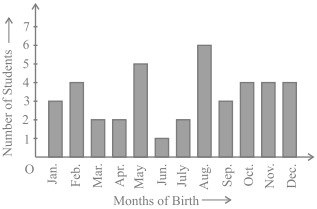
Find the probability that a student of the class was born in August.
A
$\frac{3}{20}$
B
$\frac{3}{25}$
C
$\frac{13}{20}$
D
$\frac{3}{90}$
Solution
(A) From the given bar graph,the number of students born in the month of August is $6$.
The total number of students is the sum of students born in all months:
$3 + 4 + 2 + 2 + 5 + 1 + 2 + 6 + 3 + 4 + 4 + 4 = 40$.
The probability $P$ that a student was born in August is given by:
$P(\text{August}) = \frac{\text{Number of students born in August}}{\text{Total number of students}}$
$P(\text{August}) = \frac{6}{40} = \frac{3}{20}$.
The total number of students is the sum of students born in all months:
$3 + 4 + 2 + 2 + 5 + 1 + 2 + 6 + 3 + 4 + 4 + 4 = 40$.
The probability $P$ that a student was born in August is given by:
$P(\text{August}) = \frac{\text{Number of students born in August}}{\text{Total number of students}}$
$P(\text{August}) = \frac{6}{40} = \frac{3}{20}$.
0 likes
View Solution14
MediumMCQ
Three coins are tossed simultaneously $200$ times with the following frequencies of different outcomes:
If the three coins are simultaneously tossed again,compute the probability of $2$ heads coming up.
| Outcome | $3$ heads | $2$ heads | $1$ head | No head |
| Frequency | $23$ | $72$ | $77$ | $28$ |
If the three coins are simultaneously tossed again,compute the probability of $2$ heads coming up.
A
$\frac{90}{25}$
B
$\frac{9}{25}$
C
$\frac{9}{29}$
D
$\frac{19}{25}$
Solution
(B) The number of times $2$ heads appear is $72$.
The total number of times the coins were tossed is $200$.
The probability of an event is given by the ratio of the number of favorable outcomes to the total number of trials.
$P(2 \text{ heads}) = \frac{\text{Number of times } 2 \text{ heads come up}}{\text{Total number of trials}}$
$P(2 \text{ heads}) = \frac{72}{200}$
Dividing both the numerator and the denominator by $8$,we get:
$P(2 \text{ heads}) = \frac{9}{25}$
The total number of times the coins were tossed is $200$.
The probability of an event is given by the ratio of the number of favorable outcomes to the total number of trials.
$P(2 \text{ heads}) = \frac{\text{Number of times } 2 \text{ heads come up}}{\text{Total number of trials}}$
$P(2 \text{ heads}) = \frac{72}{200}$
Dividing both the numerator and the denominator by $8$,we get:
$P(2 \text{ heads}) = \frac{9}{25}$
0 likes
View Solution15
Medium
An organisation selected $2400$ families at random and surveyed them to determine a relationship between income level and the number of vehicles in a family. The information gathered is listed in the table below:
Suppose a family is chosen. Find the probability that the family chosen is:
$(i)$ Earning Rs. $10000 - 13000$ per month and owning exactly $2$ vehicles.
$(ii)$ Earning Rs. $16000$ or more per month and owning exactly $1$ vehicle.
$(iii)$ Earning less than Rs. $7000$ per month and does not own any vehicle.
$(iv)$ Earning Rs. $13000 - 16000$ per month and owning more than $2$ vehicles.
$(v)$ Owning not more than $1$ vehicle.
| Monthly income (in Rs.) / Vehicles per family | $0$ | $1$ | $2$ | Above $2$ |
| Less than $7000$ | $10$ | $160$ | $25$ | $0$ |
| $7000 - 10000$ | $0$ | $305$ | $27$ | $2$ |
| $10000 - 13000$ | $1$ | $535$ | $29$ | $1$ |
| $13000 - 16000$ | $2$ | $469$ | $59$ | $25$ |
| $16000$ or more | $1$ | $579$ | $82$ | $88$ |
Suppose a family is chosen. Find the probability that the family chosen is:
$(i)$ Earning Rs. $10000 - 13000$ per month and owning exactly $2$ vehicles.
$(ii)$ Earning Rs. $16000$ or more per month and owning exactly $1$ vehicle.
$(iii)$ Earning less than Rs. $7000$ per month and does not own any vehicle.
$(iv)$ Earning Rs. $13000 - 16000$ per month and owning more than $2$ vehicles.
$(v)$ Owning not more than $1$ vehicle.
Solution
(N/A) Total number of families surveyed $= 2400$.
$(i)$ Number of families earning Rs. $10000 - 13000$ per month and owning exactly $2$ vehicles $= 29$.
Probability $= \frac{29}{2400}$.
$(ii)$ Number of families earning Rs. $16000$ or more per month and owning exactly $1$ vehicle $= 579$.
Probability $= \frac{579}{2400}$.
$(iii)$ Number of families earning less than Rs. $7000$ per month and owning no vehicle $= 10$.
Probability $= \frac{10}{2400} = \frac{1}{240}$.
$(iv)$ Number of families earning Rs. $13000 - 16000$ per month and owning more than $2$ vehicles $= 25$.
Probability $= \frac{25}{2400} = \frac{1}{96}$.
$(v)$ Number of families owning not more than $1$ vehicle (i.e.,$0$ or $1$ vehicle) $= (10 + 160) + (0 + 305) + (1 + 535) + (2 + 469) + (1 + 579) = 170 + 305 + 536 + 471 + 580 = 2062$.
Probability $= \frac{2062}{2400} = \frac{1031}{1200}$.
$(i)$ Number of families earning Rs. $10000 - 13000$ per month and owning exactly $2$ vehicles $= 29$.
Probability $= \frac{29}{2400}$.
$(ii)$ Number of families earning Rs. $16000$ or more per month and owning exactly $1$ vehicle $= 579$.
Probability $= \frac{579}{2400}$.
$(iii)$ Number of families earning less than Rs. $7000$ per month and owning no vehicle $= 10$.
Probability $= \frac{10}{2400} = \frac{1}{240}$.
$(iv)$ Number of families earning Rs. $13000 - 16000$ per month and owning more than $2$ vehicles $= 25$.
Probability $= \frac{25}{2400} = \frac{1}{96}$.
$(v)$ Number of families owning not more than $1$ vehicle (i.e.,$0$ or $1$ vehicle) $= (10 + 160) + (0 + 305) + (1 + 535) + (2 + 469) + (1 + 579) = 170 + 305 + 536 + 471 + 580 = 2062$.
Probability $= \frac{2062}{2400} = \frac{1031}{1200}$.
0 likes
View Solution16
MediumMCQ
$A$ teacher wanted to analyze the performance of two sections of students in a mathematics test of $100$ marks. Looking at their performances,she found that a few students got under $20$ marks and a few got $70$ marks or above. So she decided to group them into intervals of varying sizes as follows: $0-20, 20-30, ..., 60-70, 70-100$. Then she formed the following table:
$(i)$ Find the probability that a student obtained less than $20\%$ in the mathematics test.
$(ii)$ Find the probability that a student obtained marks $60$ or above.
| Marks | Number of students |
| $0-20$ | $7$ |
| $20-30$ | $10$ |
| $30-40$ | $10$ |
| $40-50$ | $20$ |
| $50-60$ | $20$ |
| $60-70$ | $15$ |
| $70$ and above | $8$ |
| Total | $90$ |
$(i)$ Find the probability that a student obtained less than $20\%$ in the mathematics test.
$(ii)$ Find the probability that a student obtained marks $60$ or above.
A
$\frac{7}{39}, 53/90$
B
$\frac{27}{90}, 69/90$
C
$\frac{7}{19}, 23/90$
D
$\frac{7}{90}, 23/90$
Solution
(D) Total number of students $= 90$.
$(i)$ Number of students getting less than $20$ marks (which is $20\%$ of $100$) $= 7$.
Probability $P = \frac{\text{Number of students with } < 20 \text{ marks}}{\text{Total number of students}} = \frac{7}{90}$.
$(ii)$ Number of students obtaining marks $60$ or above $= (\text{Students in } 60-70) + (\text{Students in } 70 \text{ and above}) = 15 + 8 = 23$.
Probability $P = \frac{\text{Number of students with } \ge 60 \text{ marks}}{\text{Total number of students}} = \frac{23}{90}$.
$(i)$ Number of students getting less than $20$ marks (which is $20\%$ of $100$) $= 7$.
Probability $P = \frac{\text{Number of students with } < 20 \text{ marks}}{\text{Total number of students}} = \frac{7}{90}$.
$(ii)$ Number of students obtaining marks $60$ or above $= (\text{Students in } 60-70) + (\text{Students in } 70 \text{ and above}) = 15 + 8 = 23$.
Probability $P = \frac{\text{Number of students with } \ge 60 \text{ marks}}{\text{Total number of students}} = \frac{23}{90}$.
0 likes
View Solution17
MediumMCQ
To know the opinion of the students about the subject statistics,a survey of $200$ students was conducted. The data is recorded in the following table.
Find the probability that a student chosen at random:
$(i)$ likes statistics,$(ii)$ does not like it.
| Opinion | Number of students |
| Like | $135$ |
| Dislike | $65$ |
Find the probability that a student chosen at random:
$(i)$ likes statistics,$(ii)$ does not like it.
A
$\frac{27}{40}, \frac{13}{40}$
B
$\frac{29}{50}, \frac{13}{50}$
C
$\frac{27}{80}, \frac{13}{80}$
D
$\frac{27}{95}, \frac{13}{36}$
Solution
(A) Total number of students $= 135 + 65 = 200$.
$(i)$ Number of students who like statistics $= 135$.
Probability (student likes statistics) $= \frac{\text{Number of students who like statistics}}{\text{Total number of students}} = \frac{135}{200} = \frac{27}{40}$.
$(ii)$ Number of students who do not like statistics $= 65$.
Probability (student does not like statistics) $= \frac{\text{Number of students who do not like statistics}}{\text{Total number of students}} = \frac{65}{200} = \frac{13}{40}$.
$(i)$ Number of students who like statistics $= 135$.
Probability (student likes statistics) $= \frac{\text{Number of students who like statistics}}{\text{Total number of students}} = \frac{135}{200} = \frac{27}{40}$.
$(ii)$ Number of students who do not like statistics $= 65$.
Probability (student does not like statistics) $= \frac{\text{Number of students who do not like statistics}}{\text{Total number of students}} = \frac{65}{200} = \frac{13}{40}$.
0 likes
View Solution18
Medium
The distance (in $km$) of $40$ engineers from their residence to their place of work were found as follows.
What is the empirical probability that an engineer lives:
$(i)$ less than $7 \, km$ from her place of work?
$(ii)$ more than or equal to $7 \, km$ from her place of work?
$(iii)$ within $\frac{1}{2} \, km$ from her place of work?
| $5$ | $3$ | $10$ | $20$ | $25$ | $11$ | $13$ | $7$ | $12$ | $31$ |
| $19$ | $10$ | $12$ | $17$ | $18$ | $11$ | $32$ | $17$ | $16$ | $2$ |
| $7$ | $9$ | $7$ | $8$ | $3$ | $5$ | $12$ | $15$ | $18$ | $3$ |
| $12$ | $14$ | $2$ | $9$ | $6$ | $15$ | $15$ | $7$ | $6$ | $12$ |
What is the empirical probability that an engineer lives:
$(i)$ less than $7 \, km$ from her place of work?
$(ii)$ more than or equal to $7 \, km$ from her place of work?
$(iii)$ within $\frac{1}{2} \, km$ from her place of work?
Solution
(A) $(i)$ Total number of engineers $= 40$.
Number of engineers living less than $7 \, km$ from their place of work are: $5, 3, 3, 2, 7, 9, 7, 3, 2, 6, 6$ (Wait,let us re-count: $5, 3, 3, 2, 7$ is not less than $7$,so $5, 3, 3, 2, 3, 5, 2, 6, 6$ are less than $7$).
Counting values less than $7$: $5, 3, 2, 3, 5, 2, 6, 6$ (Total $8$ values). Let's re-verify: $5, 3, 2, 3, 5, 2, 6, 6$ are $8$ values. Actually,looking at the table: $5, 3, 3, 2, 7, 9, 7, 3, 2, 6, 6$. The values less than $7$ are $5, 3, 2, 3, 5, 2, 6, 6$. Total count is $8$.
Wait,let's list all values $< 7$: $5, 3, 2, 3, 5, 2, 6, 6$. Total $= 8$.
Probability $P = \frac{8}{40} = \frac{1}{5} = 0.2$.
$(ii)$ Number of engineers living more than or equal to $7 \, km = 40 - 8 = 32$.
Probability $P = \frac{32}{40} = \frac{4}{5} = 0.8$.
$(iii)$ Number of engineers living within $\frac{1}{2} \, km = 0$.
Probability $P = 0$.
Number of engineers living less than $7 \, km$ from their place of work are: $5, 3, 3, 2, 7, 9, 7, 3, 2, 6, 6$ (Wait,let us re-count: $5, 3, 3, 2, 7$ is not less than $7$,so $5, 3, 3, 2, 3, 5, 2, 6, 6$ are less than $7$).
Counting values less than $7$: $5, 3, 2, 3, 5, 2, 6, 6$ (Total $8$ values). Let's re-verify: $5, 3, 2, 3, 5, 2, 6, 6$ are $8$ values. Actually,looking at the table: $5, 3, 3, 2, 7, 9, 7, 3, 2, 6, 6$. The values less than $7$ are $5, 3, 2, 3, 5, 2, 6, 6$. Total count is $8$.
Wait,let's list all values $< 7$: $5, 3, 2, 3, 5, 2, 6, 6$. Total $= 8$.
Probability $P = \frac{8}{40} = \frac{1}{5} = 0.2$.
$(ii)$ Number of engineers living more than or equal to $7 \, km = 40 - 8 = 32$.
Probability $P = \frac{32}{40} = \frac{4}{5} = 0.8$.
$(iii)$ Number of engineers living within $\frac{1}{2} \, km = 0$.
Probability $P = 0$.
0 likes
View Solution19
Medium
Note the frequency of two-wheelers, three-wheelers, and four-wheelers passing by your school gate during a specific time interval. Calculate the probability that any one vehicle chosen from the total vehicles observed is a two-wheeler.
Solution
(N/A) To find the probability, follow these steps:
$1$. Let $n_1$ be the number of two-wheelers, $n_2$ be the number of three-wheelers, and $n_3$ be the number of four-wheelers observed.
$2$. Calculate the total number of vehicles observed: $N = n_1 + n_2 + n_3$.
$3$. The probability $P$ of selecting a two-wheeler is given by the ratio of the number of two-wheelers to the total number of vehicles.
$4$. Formula: $P(\text{two-wheeler}) = \frac{n_1}{N} = \frac{n_1}{n_1 + n_2 + n_3}$.
$1$. Let $n_1$ be the number of two-wheelers, $n_2$ be the number of three-wheelers, and $n_3$ be the number of four-wheelers observed.
$2$. Calculate the total number of vehicles observed: $N = n_1 + n_2 + n_3$.
$3$. The probability $P$ of selecting a two-wheeler is given by the ratio of the number of two-wheelers to the total number of vehicles.
$4$. Formula: $P(\text{two-wheeler}) = \frac{n_1}{N} = \frac{n_1}{n_1 + n_2 + n_3}$.
0 likes
View Solution20
MediumMCQ
Ask all the students in your class to write a $3-$digit number. Choose any student from the room at random. What is the probability that the number written by her/him is divisible by $3$? Remember that a number is divisible by $3$,if the sum of its digits is divisible by $3$.
A
$\frac{1}{3}$
B
$\frac{2}{3}$
C
$\frac{1}{2}$
D
$\frac{1}{4}$
Solution
(A) The total number of $3-$digit numbers ranges from $100$ to $999$.
The total count of $3-$digit numbers is $999 - 100 + 1 = 900$.
$A$ number is divisible by $3$ if the sum of its digits is divisible by $3$.
In any sequence of $3$ consecutive integers,exactly one is divisible by $3$.
Since $900$ is a multiple of $3$,exactly one-third of these numbers are divisible by $3$.
Number of favorable outcomes $= \frac{900}{3} = 300$.
The probability $P$ is given by the ratio of favorable outcomes to total outcomes.
$P = \frac{300}{900} = \frac{1}{3}$.
The total count of $3-$digit numbers is $999 - 100 + 1 = 900$.
$A$ number is divisible by $3$ if the sum of its digits is divisible by $3$.
In any sequence of $3$ consecutive integers,exactly one is divisible by $3$.
Since $900$ is a multiple of $3$,exactly one-third of these numbers are divisible by $3$.
Number of favorable outcomes $= \frac{900}{3} = 300$.
The probability $P$ is given by the ratio of favorable outcomes to total outcomes.
$P = \frac{300}{900} = \frac{1}{3}$.
0 likes
View Solution21
MediumMCQ
Eleven bags of wheat flour,each marked $5 \,kg$,actually contained the following weights of flour (in $kg$):
$4.97, 5.05, 5.08, 5.03, 5.00, 5.06, 5.08, 4.98, 5.04, 5.07, 5.00$
Find the probability that any of these bags chosen at random contains more than $5 \,kg$ of flour.
$4.97, 5.05, 5.08, 5.03, 5.00, 5.06, 5.08, 4.98, 5.04, 5.07, 5.00$
Find the probability that any of these bags chosen at random contains more than $5 \,kg$ of flour.
A
$\frac{7}{11}$
B
$\frac{7}{16}$
C
$\frac{5}{11}$
D
$\frac{5}{10}$
Solution
(A) Total number of bags $= 11$.
Bags containing more than $5 \,kg$ of flour are: $5.05, 5.08, 5.03, 5.06, 5.08, 5.04, 5.07$.
Number of bags containing more than $5 \,kg$ of flour $= 7$.
Probability of an event $= \frac{\text{Number of favorable outcomes}}{\text{Total number of outcomes}}$.
Therefore,the required probability $P = \frac{7}{11}$.
Bags containing more than $5 \,kg$ of flour are: $5.05, 5.08, 5.03, 5.06, 5.08, 5.04, 5.07$.
Number of bags containing more than $5 \,kg$ of flour $= 7$.
Probability of an event $= \frac{\text{Number of favorable outcomes}}{\text{Total number of outcomes}}$.
Therefore,the required probability $P = \frac{7}{11}$.
0 likes
View Solution22
MediumMCQ
The following frequency distribution table shows the concentration of sulphur dioxide $(SO_2)$ in the air in parts per million $(ppm)$ of a certain city for $30$ days. Using this table,find the probability of the concentration of sulphur dioxide being in the interval $0.12 - 0.16$ on any of these days.
| Concentration of $SO_2$ (in $ppm$) | Number of days (frequency) |
| $0.00-0.04$ | $4$ |
| $0.04-0.08$ | $9$ |
| $0.08-0.12$ | $9$ |
| $0.12-0.16$ | $2$ |
| $0.16-0.20$ | $4$ |
| $0.20-0.24$ | $2$ |
| Total | $30$ |
A
$\frac{9}{13}$
B
$\frac{1}{15}$
C
$\frac{1}{25}$
D
$\frac{10}{15}$
Solution
(B) To find the probability,we use the formula: $P(E) = \frac{\text{Number of favorable outcomes}}{\text{Total number of outcomes}}$.
From the given frequency distribution table:
$1$. The number of days for which the concentration of sulphur dioxide was in the interval $0.12 - 0.16$ is $2$.
$2$. The total number of days is $30$.
Therefore,the required probability $P$ is:
$P = \frac{2}{30} = \frac{1}{15}$.
From the given frequency distribution table:
$1$. The number of days for which the concentration of sulphur dioxide was in the interval $0.12 - 0.16$ is $2$.
$2$. The total number of days is $30$.
Therefore,the required probability $P$ is:
$P = \frac{2}{30} = \frac{1}{15}$.
0 likes
View Solution23
EasyMCQ
The following frequency distribution table shows the blood groups of $30$ students of a class. Use this table to determine the probability that a student of this class,selected at random,has blood group $AB$.
| Blood group | Number of students |
| $A$ | $9$ |
| $B$ | $6$ |
| $AB$ | $3$ |
| $O$ | $12$ |
| Total | $30$ |
A
$\frac{10}{15}$
B
$\frac{1}{25}$
C
$\frac{1}{10}$
D
$\frac{1}{15}$
Solution
(C) The total number of students in the class is $30$.
The number of students having blood group $AB$ is $3$.
The probability $P$ of an event is given by the formula:
$P = \frac{\text{Number of favorable outcomes}}{\text{Total number of possible outcomes}}$
Here,the number of favorable outcomes (students with blood group $AB$) is $3$,and the total number of possible outcomes (total students) is $30$.
Therefore,the probability $P = \frac{3}{30} = \frac{1}{10}$.
The number of students having blood group $AB$ is $3$.
The probability $P$ of an event is given by the formula:
$P = \frac{\text{Number of favorable outcomes}}{\text{Total number of possible outcomes}}$
Here,the number of favorable outcomes (students with blood group $AB$) is $3$,and the total number of possible outcomes (total students) is $30$.
Therefore,the probability $P = \frac{3}{30} = \frac{1}{10}$.
0 likes
View SolutionProbability — Textbook - Probability · Frequently Asked Questions
1Are these Probability questions useful for JEE and NEET?
Yes. All questions in this section are mapped to JEE Main and NEET exam patterns. Previous year questions from JEE Main, NEET, GUJCET and state-level exams are included with full solutions.
2Can I switch to Hindi or Gujarati for these questions?
Yes. Use the language tabs in the hero section or the sidebar to view the same questions and solutions in English, Hindi or Gujarati.
3How do I generate a question paper from this subtopic?
Use the Vedclass Exam Paper Generator — select the chapter and subtopic, set difficulty, and generate Sets A, B, C, D automatically. First 3 chapters of every subject are free.
Vedclass Products
For Students
Vedclass Test Series
Mock tests in real JEE/NEET style with performance analysis. 5-day free trial.
Start Free TrialFor Teachers
Exam Paper Generator
Generate Set A/B/C/D papers from this chapter in 2 minutes. 3 chapters free.
Try FreeFor Institutes
Online Exam Module
Live online exams with unlimited students, 360° analytics & white-label branding.
See DemoFor Teachers & Institutes
Generate a Probability Exam Paper in 2 Minutes
Select subtopic & difficulty — Sets A, B, C, D auto-generated with No Repeat logic.
First 3 chapters of every subject are free — no payment required.