
A English
Textbook - Coordinate Geometry Questions in English
Class 9 Mathematics · Coordinate Geometry · Textbook - Coordinate Geometry
10+
Questions
English
Language
100%
With Solutions
Showing 10 of 10 questions in English
1
Medium
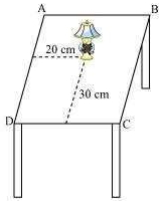
How will you describe the position of a table lamp on your study table to another person?
Solution
(N/A) Consider that the lamp is placed on the table. Choose two adjacent edges,$DC$ and $AD$.
Draw perpendiculars from the position of the lamp to the edges $DC$ and $AD$ and measure the lengths of these perpendiculars.
Let the length of these perpendiculars be $30\, cm$ and $20\, cm$ respectively.
Now,the position of the lamp from the left edge $(AD)$ is $20\, cm$ and from the lower edge $(DC)$ is $30\, cm$.
This can be written as $(20, 30)$,where $20$ represents the perpendicular distance of the lamp from edge $AD$ and $30$ represents the perpendicular distance of the lamp from edge $DC$.
Draw perpendiculars from the position of the lamp to the edges $DC$ and $AD$ and measure the lengths of these perpendiculars.
Let the length of these perpendiculars be $30\, cm$ and $20\, cm$ respectively.
Now,the position of the lamp from the left edge $(AD)$ is $20\, cm$ and from the lower edge $(DC)$ is $30\, cm$.
This can be written as $(20, 30)$,where $20$ represents the perpendicular distance of the lamp from edge $AD$ and $30$ represents the perpendicular distance of the lamp from edge $DC$.
0 likes
View Solution2
Medium
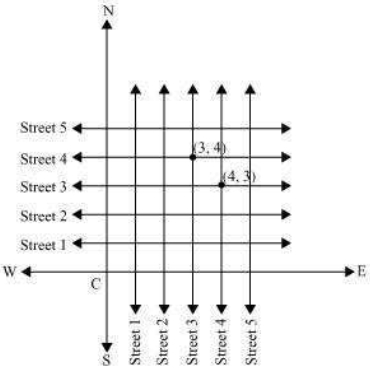
(Street Plan) : $A$ city has two main roads which cross each other at the centre of the city. These two roads are along the North-South direction and East-West direction. All the other streets of the city run parallel to these roads and are $200 \,m$ apart. There are $5$ streets in each direction. Using $1 \,cm = 200 \,m$,draw a model of the city on your notebook. Represent the roads/streets by single lines. There are many cross-streets in your model. $A$ particular cross-street is made by two streets,one running in the North-South direction and another in the East-West direction. Each cross-street is referred to in the following manner: If the $2^{nd}$ street running in the North-South direction and $5^{th}$ in the East-West direction meet at some crossing,then we will call this cross-street $(2, 5).$ Using this convention,find:
$(i)$ how many cross-streets can be referred to as $(4, 3).$
$(ii)$ how many cross-streets can be referred to as $(3, 4).$
$(i)$ how many cross-streets can be referred to as $(4, 3).$
$(ii)$ how many cross-streets can be referred to as $(3, 4).$
Solution
(A) Based on the convention provided,the first number represents the street running in the North-South direction,and the second number represents the street running in the East-West direction.
$(i)$ The cross-street $(4, 3)$ is formed by the intersection of the $4^{th}$ North-South street and the $3^{rd}$ East-West street. Since there is only one such intersection point,there is only $1$ cross-street that can be referred to as $(4, 3).$
$(ii)$ The cross-street $(3, 4)$ is formed by the intersection of the $3^{rd}$ North-South street and the $4^{th}$ East-West street. Similarly,there is only $1$ cross-street that can be referred to as $(3, 4).$
$(i)$ The cross-street $(4, 3)$ is formed by the intersection of the $4^{th}$ North-South street and the $3^{rd}$ East-West street. Since there is only one such intersection point,there is only $1$ cross-street that can be referred to as $(4, 3).$
$(ii)$ The cross-street $(3, 4)$ is formed by the intersection of the $3^{rd}$ North-South street and the $4^{th}$ East-West street. Similarly,there is only $1$ cross-street that can be referred to as $(3, 4).$
0 likes
View Solution3
Medium
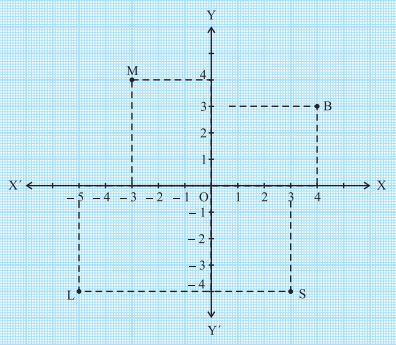
See the figure and complete the following statements:
$(i)$ The abscissa and the ordinate of the point $B$ are ......... and ......... respectively. Hence,the coordinates of $B$ are (.........,.........)
$(ii)$ The $x$-coordinate and the $y$-coordinate of the point $M$ are ......... and ......... respectively. Hence,the coordinates of $M$ are (.........,.........)
$(iii)$ The $x$-coordinate and the $y$-coordinate of the point $L$ are ......... and ......... respectively. Hence,the coordinates of $L$ are (.........,.........)
$(iv)$ The $x$-coordinate and the $y$-coordinate of the point $S$ are ......... and ......... respectively. Hence,the coordinates of $S$ are (.........,.........)
$(i)$ The abscissa and the ordinate of the point $B$ are ......... and ......... respectively. Hence,the coordinates of $B$ are (.........,.........)
$(ii)$ The $x$-coordinate and the $y$-coordinate of the point $M$ are ......... and ......... respectively. Hence,the coordinates of $M$ are (.........,.........)
$(iii)$ The $x$-coordinate and the $y$-coordinate of the point $L$ are ......... and ......... respectively. Hence,the coordinates of $L$ are (.........,.........)
$(iv)$ The $x$-coordinate and the $y$-coordinate of the point $S$ are ......... and ......... respectively. Hence,the coordinates of $S$ are (.........,.........)
Solution
(N/A) $(i)$ Since the distance of the point $B$ from the $y$-axis is $4$ units,the $x$-coordinate or abscissa of the point $B$ is $4$. The distance of the point $B$ from the $x$-axis is $3$ units; therefore,the $y$-coordinate,i.e.,the ordinate,of the point $B$ is $3$. Hence,the coordinates of the point $B$ are $(4, 3)$.
As in $(i)$ above:
$(ii)$ The $x$-coordinate and the $y$-coordinate of the point $M$ are $-3$ and $4$,respectively. Hence,the coordinates of the point $M$ are $(-3, 4)$.
$(iii)$ The $x$-coordinate and the $y$-coordinate of the point $L$ are $-5$ and $-4$,respectively. Hence,the coordinates of the point $L$ are $(-5, -4)$.
$(iv)$ The $x$-coordinate and the $y$-coordinate of the point $S$ are $3$ and $-4$,respectively. Hence,the coordinates of the point $S$ are $(3, -4)$.
As in $(i)$ above:
$(ii)$ The $x$-coordinate and the $y$-coordinate of the point $M$ are $-3$ and $4$,respectively. Hence,the coordinates of the point $M$ are $(-3, 4)$.
$(iii)$ The $x$-coordinate and the $y$-coordinate of the point $L$ are $-5$ and $-4$,respectively. Hence,the coordinates of the point $L$ are $(-5, -4)$.
$(iv)$ The $x$-coordinate and the $y$-coordinate of the point $S$ are $3$ and $-4$,respectively. Hence,the coordinates of the point $S$ are $(3, -4)$.
0 likes
View Solution4
Easy
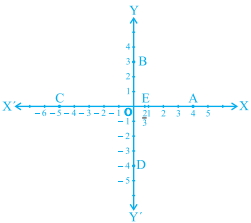
Write the coordinates of the points marked on the axes in the figure.
Solution
(N/A) You can see that:
$(i)$ The point $A$ is at a distance of $+4$ units from the $y$-axis and at a distance of $0$ from the $x$-axis. Therefore,the $x$-coordinate of $A$ is $4$ and the $y$-coordinate is $0$. Hence,the coordinates of $A$ are $(4, 0)$.
(ii) The point $B$ is on the $y$-axis at a distance of $3$ units from the origin. Therefore,the $x$-coordinate is $0$ and the $y$-coordinate is $3$. Hence,the coordinates of $B$ are $(0, 3)$.
(iii) The point $C$ is on the $x$-axis at a distance of $5$ units to the left of the origin. Therefore,the $x$-coordinate is $-5$ and the $y$-coordinate is $0$. Hence,the coordinates of $C$ are $(-5, 0)$.
(iv) The point $D$ is on the $y$-axis at a distance of $4$ units below the origin. Therefore,the $x$-coordinate is $0$ and the $y$-coordinate is $-4$. Hence,the coordinates of $D$ are $(0, -4)$.
$(v)$ The point $E$ is on the $x$-axis at a distance of $\frac{2}{3}$ units from the origin. Therefore,the $x$-coordinate is $\frac{2}{3}$ and the $y$-coordinate is $0$. Hence,the coordinates of $E$ are $(\frac{2}{3}, 0)$.
$(i)$ The point $A$ is at a distance of $+4$ units from the $y$-axis and at a distance of $0$ from the $x$-axis. Therefore,the $x$-coordinate of $A$ is $4$ and the $y$-coordinate is $0$. Hence,the coordinates of $A$ are $(4, 0)$.
(ii) The point $B$ is on the $y$-axis at a distance of $3$ units from the origin. Therefore,the $x$-coordinate is $0$ and the $y$-coordinate is $3$. Hence,the coordinates of $B$ are $(0, 3)$.
(iii) The point $C$ is on the $x$-axis at a distance of $5$ units to the left of the origin. Therefore,the $x$-coordinate is $-5$ and the $y$-coordinate is $0$. Hence,the coordinates of $C$ are $(-5, 0)$.
(iv) The point $D$ is on the $y$-axis at a distance of $4$ units below the origin. Therefore,the $x$-coordinate is $0$ and the $y$-coordinate is $-4$. Hence,the coordinates of $D$ are $(0, -4)$.
$(v)$ The point $E$ is on the $x$-axis at a distance of $\frac{2}{3}$ units from the origin. Therefore,the $x$-coordinate is $\frac{2}{3}$ and the $y$-coordinate is $0$. Hence,the coordinates of $E$ are $(\frac{2}{3}, 0)$.
0 likes
View Solution5
Easy
Write the answer to each of the following questions:
$(i)$ What is the name of the horizontal and the vertical lines drawn to determine the position of any point in the Cartesian plane?
$(ii)$ What is the name of each part of the plane formed by these two lines?
$(iii)$ Write the name of the point where these two lines intersect.
$(i)$ What is the name of the horizontal and the vertical lines drawn to determine the position of any point in the Cartesian plane?
$(ii)$ What is the name of each part of the plane formed by these two lines?
$(iii)$ Write the name of the point where these two lines intersect.
Solution
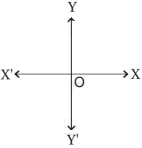
(N/A) $(i)$ The name of the horizontal line is the $x$-axis and the name of the vertical line is the $y$-axis.
$(ii)$ Each part of the plane formed by these two lines is called a quadrant.
$(iii)$ The point where these two lines intersect is called the origin.
$(ii)$ Each part of the plane formed by these two lines is called a quadrant.
$(iii)$ The point where these two lines intersect is called the origin.
0 likes
View Solution6
Easy
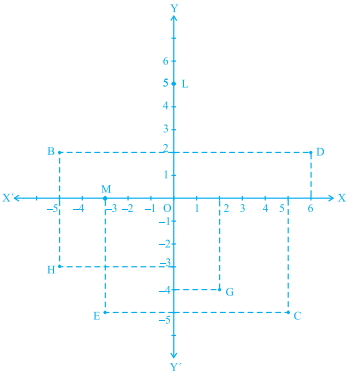
See the figure and write the following:
$(i)$ The coordinates of $B$.
$(ii)$ The coordinates of $C$.
$(iii)$ The point identified by the coordinates $(-3, -5)$.
$(iv)$ The point identified by the coordinates $(2, -4)$.
$(v)$ The abscissa of the point $D$.
$(vi)$ The ordinate of the point $H$.
$(vii)$ The coordinates of the point $L$.
$(viii)$ The coordinates of the point $M$.
$(i)$ The coordinates of $B$.
$(ii)$ The coordinates of $C$.
$(iii)$ The point identified by the coordinates $(-3, -5)$.
$(iv)$ The point identified by the coordinates $(2, -4)$.
$(v)$ The abscissa of the point $D$.
$(vi)$ The ordinate of the point $H$.
$(vii)$ The coordinates of the point $L$.
$(viii)$ The coordinates of the point $M$.
Solution
(N/A) $(i)$ The $x$-coordinate and the $y$-coordinate of point $B$ are $-5$ and $2$ respectively. Therefore,the coordinates of point $B$ are $(-5, 2)$.
$(ii)$ The $x$-coordinate and the $y$-coordinate of point $C$ are $5$ and $-5$ respectively. Therefore,the coordinates of point $C$ are $(5, -5)$.
$(iii)$ The point whose $x$-coordinate and $y$-coordinate are $-3$ and $-5$ respectively is point $E$.
$(iv)$ The point whose $x$-coordinate and $y$-coordinate are $2$ and $-4$ respectively is point $G$.
$(v)$ The $x$-coordinate of point $D$ is $6$. Therefore,the abscissa of point $D$ is $6$.
$(vi)$ The $y$-coordinate of point $H$ is $-3$. Therefore,the ordinate of point $H$ is $-3$.
$(vii)$ The $x$-coordinate and the $y$-coordinate of point $L$ are $0$ and $5$ respectively. Therefore,the coordinates of point $L$ are $(0, 5)$.
$(viii)$ The $x$-coordinate and the $y$-coordinate of point $M$ are $-3$ and $0$ respectively. Therefore,the coordinates of point $M$ are $(-3, 0)$.
$(ii)$ The $x$-coordinate and the $y$-coordinate of point $C$ are $5$ and $-5$ respectively. Therefore,the coordinates of point $C$ are $(5, -5)$.
$(iii)$ The point whose $x$-coordinate and $y$-coordinate are $-3$ and $-5$ respectively is point $E$.
$(iv)$ The point whose $x$-coordinate and $y$-coordinate are $2$ and $-4$ respectively is point $G$.
$(v)$ The $x$-coordinate of point $D$ is $6$. Therefore,the abscissa of point $D$ is $6$.
$(vi)$ The $y$-coordinate of point $H$ is $-3$. Therefore,the ordinate of point $H$ is $-3$.
$(vii)$ The $x$-coordinate and the $y$-coordinate of point $L$ are $0$ and $5$ respectively. Therefore,the coordinates of point $L$ are $(0, 5)$.
$(viii)$ The $x$-coordinate and the $y$-coordinate of point $M$ are $-3$ and $0$ respectively. Therefore,the coordinates of point $M$ are $(-3, 0)$.
0 likes
View Solution7
Easy
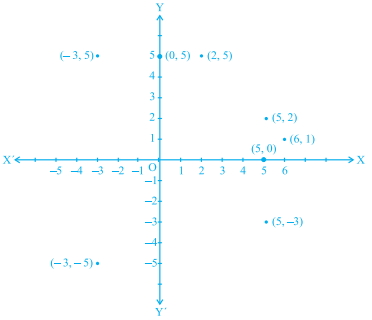
Locate the points $(5, 0)$,$(0, 5)$,$(2, 5)$,$(5, 2)$,$(-3, 5)$,$(-3, -5)$,$(5, -3)$ and $(6, 1)$ in the Cartesian plane.
Solution
(N/A) To locate the points in the Cartesian plane,we follow these steps:
$1$. Draw the $x$-axis and $y$-axis on a graph paper,intersecting at the origin $O(0, 0)$.
$2$. Choose a suitable scale,for example,$1 \text{ cm} = 1 \text{ unit}$.
$3$. For each point $(x, y)$,start from the origin $O$. Move $x$ units along the $x$-axis (right if $x > 0$,left if $x < 0$) and then move $y$ units parallel to the $y$-axis (up if $y > 0$,down if $y < 0$).
$4$. The positions of the given points are plotted as follows:
- $(5, 0)$: On the $x$-axis,$5$ units to the right of the origin.
- $(0, 5)$: On the $y$-axis,$5$ units above the origin.
- $(2, 5)$: $2$ units right and $5$ units up.
- $(5, 2)$: $5$ units right and $2$ units up.
- $(-3, 5)$: $3$ units left and $5$ units up.
- $(-3, -5)$: $3$ units left and $5$ units down.
- $(5, -3)$: $5$ units right and $3$ units down.
- $(6, 1)$: $6$ units right and $1$ unit up.
$1$. Draw the $x$-axis and $y$-axis on a graph paper,intersecting at the origin $O(0, 0)$.
$2$. Choose a suitable scale,for example,$1 \text{ cm} = 1 \text{ unit}$.
$3$. For each point $(x, y)$,start from the origin $O$. Move $x$ units along the $x$-axis (right if $x > 0$,left if $x < 0$) and then move $y$ units parallel to the $y$-axis (up if $y > 0$,down if $y < 0$).
$4$. The positions of the given points are plotted as follows:
- $(5, 0)$: On the $x$-axis,$5$ units to the right of the origin.
- $(0, 5)$: On the $y$-axis,$5$ units above the origin.
- $(2, 5)$: $2$ units right and $5$ units up.
- $(5, 2)$: $5$ units right and $2$ units up.
- $(-3, 5)$: $3$ units left and $5$ units up.
- $(-3, -5)$: $3$ units left and $5$ units down.
- $(5, -3)$: $5$ units right and $3$ units down.
- $(6, 1)$: $6$ units right and $1$ unit up.
0 likes
View Solution8
Easy
Plot the following ordered pairs $(x, y)$ of numbers as points in the Cartesian plane. Use the scale $1\,cm = 1$ unit on the axes.
| $x$ | $-3$ | $0$ | $-1$ | $4$ | $2$ |
|---|---|---|---|---|---|
| $y$ | $7$ | $-3.5$ | $-3$ | $4$ | $-3$ |
Solution
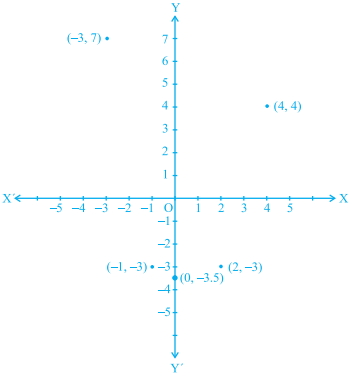
(N/A) The pairs of numbers given in the table can be represented by the points $(-3, 7)$,$(0, -3.5)$,$(-1, -3)$,$(4, 4)$,and $(2, -3)$.
To plot these points:
$1$. For $(-3, 7)$,start at the origin,move $3$ units to the left along the $X$-axis,and then $7$ units upwards parallel to the $Y$-axis.
$2$. For $(0, -3.5)$,start at the origin,move $0$ units along the $X$-axis,and then $3.5$ units downwards along the $Y$-axis.
$3$. For $(-1, -3)$,start at the origin,move $1$ unit to the left along the $X$-axis,and then $3$ units downwards parallel to the $Y$-axis.
$4$. For $(4, 4)$,start at the origin,move $4$ units to the right along the $X$-axis,and then $4$ units upwards parallel to the $Y$-axis.
$5$. For $(2, -3)$,start at the origin,move $2$ units to the right along the $X$-axis,and then $3$ units downwards parallel to the $Y$-axis.
The locations of these points are shown in the figure.
To plot these points:
$1$. For $(-3, 7)$,start at the origin,move $3$ units to the left along the $X$-axis,and then $7$ units upwards parallel to the $Y$-axis.
$2$. For $(0, -3.5)$,start at the origin,move $0$ units along the $X$-axis,and then $3.5$ units downwards along the $Y$-axis.
$3$. For $(-1, -3)$,start at the origin,move $1$ unit to the left along the $X$-axis,and then $3$ units downwards parallel to the $Y$-axis.
$4$. For $(4, 4)$,start at the origin,move $4$ units to the right along the $X$-axis,and then $4$ units upwards parallel to the $Y$-axis.
$5$. For $(2, -3)$,start at the origin,move $2$ units to the right along the $X$-axis,and then $3$ units downwards parallel to the $Y$-axis.
The locations of these points are shown in the figure.
0 likes
View Solution9
Easy
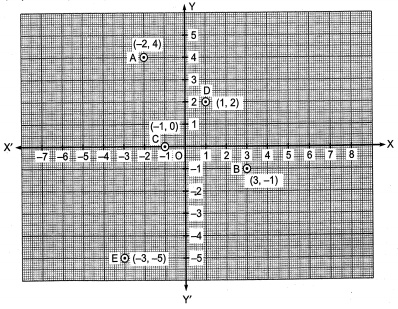
In which quadrant or on which axis do each of the points $(-2, 4)$,$(3, -1)$,$(-1, 0)$,$(1, 2)$ and $(-3, -5)$ lie? Verify your answer by locating them on the Cartesian plane.
Solution
(N/A) For the point $(-2, 4)$,the abscissa ($x$-coordinate) is negative and the ordinate ($y$-coordinate) is positive. Since $(-, +)$ belongs to the $2nd$ quadrant,$(-2, 4)$ lies in the $2nd$ quadrant.
For the point $(3, -1)$,the abscissa is positive and the ordinate is negative. Since $(+, -)$ belongs to the $4th$ quadrant,$(3, -1)$ lies in the $4th$ quadrant.
For the point $(-1, 0)$,the ordinate is $0$. Any point with an ordinate of $0$ lies on the $x$-axis. Since the abscissa is negative,$(-1, 0)$ lies on the negative $x$-axis.
For the point $(1, 2)$,both the abscissa and the ordinate are positive. Since $(+, +)$ belongs to the $1st$ quadrant,$(1, 2)$ lies in the $1st$ quadrant.
For the point $(-3, -5)$,both the abscissa and the ordinate are negative. Since $(-, -)$ belongs to the $3rd$ quadrant,$(-3, -5)$ lies in the $3rd$ quadrant.
These points are plotted in the Cartesian plane as shown in the figure: $A(-2, 4)$,$B(3, -1)$,$C(-1, 0)$,$D(1, 2)$,and $E(-3, -5)$.
For the point $(3, -1)$,the abscissa is positive and the ordinate is negative. Since $(+, -)$ belongs to the $4th$ quadrant,$(3, -1)$ lies in the $4th$ quadrant.
For the point $(-1, 0)$,the ordinate is $0$. Any point with an ordinate of $0$ lies on the $x$-axis. Since the abscissa is negative,$(-1, 0)$ lies on the negative $x$-axis.
For the point $(1, 2)$,both the abscissa and the ordinate are positive. Since $(+, +)$ belongs to the $1st$ quadrant,$(1, 2)$ lies in the $1st$ quadrant.
For the point $(-3, -5)$,both the abscissa and the ordinate are negative. Since $(-, -)$ belongs to the $3rd$ quadrant,$(-3, -5)$ lies in the $3rd$ quadrant.
These points are plotted in the Cartesian plane as shown in the figure: $A(-2, 4)$,$B(3, -1)$,$C(-1, 0)$,$D(1, 2)$,and $E(-3, -5)$.
0 likes
View Solution10
Easy
Plot the points $(x, y)$ given in the following table on the plane,choosing suitable units of distance on the axes.
| $x$ | $-2$ | $-1$ | $0$ | $1$ | $3$ |
| $y$ | $8$ | $7$ | $-1.25$ | $3$ | $-1$ |
Solution
(N/A) The given points are $A(-2, 8), B(-1, 7), C(0, -1.25), D(1, 3)$ and $E(3, -1)$. To plot these points:
$(i)$ We draw $X'OX$ and $YOY'$ as axes.
$(ii)$ We choose suitable units of distance on the axes.
$(iii)$ To plot $A(-2, 8)$,we start from the origin $O$,move $2$ units to the left on the $x$-axis and $8$ units upwards on the $y$-axis.
$(iv)$ To plot $B(-1, 7)$,we start from the origin $O$,move $1$ unit to the left on the $x$-axis and $7$ units upwards on the $y$-axis.
$(v)$ To plot $C(0, -1.25)$,we start from the origin $O$,move $0$ units on the $x$-axis and $1.25$ units downwards on the $y$-axis.
$(vi)$ To plot $D(1, 3)$,we start from the origin $O$,move $1$ unit to the right on the $x$-axis and $3$ units upwards on the $y$-axis.
$(vii)$ To plot $E(3, -1)$,we start from the origin $O$,move $3$ units to the right on the $x$-axis and $1$ unit downwards on the $y$-axis.
$(i)$ We draw $X'OX$ and $YOY'$ as axes.
$(ii)$ We choose suitable units of distance on the axes.
$(iii)$ To plot $A(-2, 8)$,we start from the origin $O$,move $2$ units to the left on the $x$-axis and $8$ units upwards on the $y$-axis.
$(iv)$ To plot $B(-1, 7)$,we start from the origin $O$,move $1$ unit to the left on the $x$-axis and $7$ units upwards on the $y$-axis.
$(v)$ To plot $C(0, -1.25)$,we start from the origin $O$,move $0$ units on the $x$-axis and $1.25$ units downwards on the $y$-axis.
$(vi)$ To plot $D(1, 3)$,we start from the origin $O$,move $1$ unit to the right on the $x$-axis and $3$ units upwards on the $y$-axis.
$(vii)$ To plot $E(3, -1)$,we start from the origin $O$,move $3$ units to the right on the $x$-axis and $1$ unit downwards on the $y$-axis.
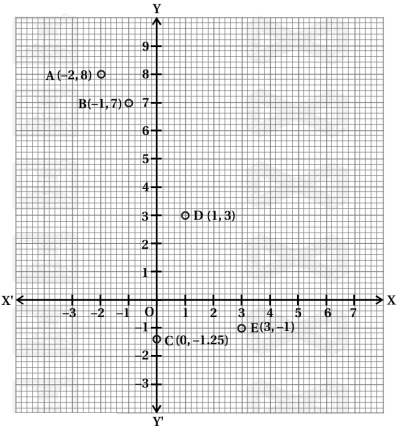
0 likes
View SolutionCoordinate Geometry — Textbook - Coordinate Geometry · Frequently Asked Questions
1Are these Coordinate Geometry questions useful for JEE and NEET?
Yes. All questions in this section are mapped to JEE Main and NEET exam patterns. Previous year questions from JEE Main, NEET, GUJCET and state-level exams are included with full solutions.
2Can I switch to Hindi or Gujarati for these questions?
Yes. Use the language tabs in the hero section or the sidebar to view the same questions and solutions in English, Hindi or Gujarati.
3How do I generate a question paper from this subtopic?
Use the Vedclass Exam Paper Generator — select the chapter and subtopic, set difficulty, and generate Sets A, B, C, D automatically. First 3 chapters of every subject are free.
Vedclass Products
For Students
Vedclass Test Series
Mock tests in real JEE/NEET style with performance analysis. 5-day free trial.
Start Free TrialFor Teachers
Exam Paper Generator
Generate Set A/B/C/D papers from this chapter in 2 minutes. 3 chapters free.
Try FreeFor Institutes
Online Exam Module
Live online exams with unlimited students, 360° analytics & white-label branding.
See DemoFor Teachers & Institutes
Generate a Coordinate Geometry Exam Paper in 2 Minutes
Select subtopic & difficulty — Sets A, B, C, D auto-generated with No Repeat logic.
First 3 chapters of every subject are free — no payment required.