
A English
Mix Examples - Coordinate Geometry Questions in English
Class 9 Mathematics · Coordinate Geometry · Mix Examples - Coordinate Geometry
100+
Questions
English
Language
100%
With Solutions
Showing 50 of 100 questions in English
1
EasyMCQ
The points (other than origin) for which abscissa is equal to the ordinate will lie in
A
$I$ and $III$ quadrants
B
$I$ quadrant only
C
$I$ and $II$ quadrants
D
$II$ and $IV$ quadrants
Solution
(A) Let the coordinates of a point be $(x, y)$.
According to the problem,the abscissa is equal to the ordinate,so $x = y$.
If $x = y > 0$,the point $(x, x)$ lies in the $I$ quadrant.
If $x = y < 0$,the point $(x, x)$ lies in the $III$ quadrant.
Since the origin $(0, 0)$ is excluded,the points lie in the $I$ and $III$ quadrants.
According to the problem,the abscissa is equal to the ordinate,so $x = y$.
If $x = y > 0$,the point $(x, x)$ lies in the $I$ quadrant.
If $x = y < 0$,the point $(x, x)$ lies in the $III$ quadrant.
Since the origin $(0, 0)$ is excluded,the points lie in the $I$ and $III$ quadrants.
0 likes
View Solution2
EasyMCQ
The point $(-3, 5)$ lies in the
A
first quadrant
B
second quadrant
C
third quadrant
D
fourth quadrant
Solution
(B) In the Cartesian plane,the sign convention for quadrants is as follows:
- First quadrant: $(+, +)$
- Second quadrant: $(-, +)$
- Third quadrant: $(-, -)$
- Fourth quadrant: $(+, -)$
For the point $(-3, 5)$,the abscissa ($x$-coordinate) is $-3$ (negative) and the ordinate ($y$-coordinate) is $5$ (positive).
Since the point has a negative $x$-coordinate and a positive $y$-coordinate,it lies in the second quadrant.
- First quadrant: $(+, +)$
- Second quadrant: $(-, +)$
- Third quadrant: $(-, -)$
- Fourth quadrant: $(+, -)$
For the point $(-3, 5)$,the abscissa ($x$-coordinate) is $-3$ (negative) and the ordinate ($y$-coordinate) is $5$ (positive).
Since the point has a negative $x$-coordinate and a positive $y$-coordinate,it lies in the second quadrant.
0 likes
View Solution3
EasyMCQ
Signs of the abscissa and ordinate of a point in the second quadrant are respectively
A
$+,+$
B
$-,-$
C
$-,+$
D
$+,-$
Solution
(C) In a Cartesian plane,the coordinate system is divided into four quadrants.
In the first quadrant,both $x$ and $y$ coordinates are positive $(+,+)$.
In the second quadrant,the $x$-coordinate (abscissa) is negative and the $y$-coordinate (ordinate) is positive $(-,+)$.
In the third quadrant,both coordinates are negative $(-,-)$.
In the fourth quadrant,the $x$-coordinate is positive and the $y$-coordinate is negative $(+,-)$.
Therefore,for a point in the second quadrant,the signs are $(-,+)$.
In the first quadrant,both $x$ and $y$ coordinates are positive $(+,+)$.
In the second quadrant,the $x$-coordinate (abscissa) is negative and the $y$-coordinate (ordinate) is positive $(-,+)$.
In the third quadrant,both coordinates are negative $(-,-)$.
In the fourth quadrant,the $x$-coordinate is positive and the $y$-coordinate is negative $(+,-)$.
Therefore,for a point in the second quadrant,the signs are $(-,+)$.
0 likes
View Solution4
EasyMCQ
The point $(0, -7)$ lies:
A
on the $x$-axis
B
in the second quadrant
C
in the fourth quadrant
D
on the $y$-axis
Solution
(D) In a Cartesian coordinate system,a point is of the form $(x, y)$.
If the $x$-coordinate is $0$,the point lies on the $y$-axis.
If the $y$-coordinate is $0$,the point lies on the $x$-axis.
For the point $(0, -7)$,the $x$-coordinate is $0$,therefore,it lies on the $y$-axis.
If the $x$-coordinate is $0$,the point lies on the $y$-axis.
If the $y$-coordinate is $0$,the point lies on the $x$-axis.
For the point $(0, -7)$,the $x$-coordinate is $0$,therefore,it lies on the $y$-axis.
0 likes
View Solution5
EasyMCQ
The point $(-10, 0)$ lies:
A
on the negative direction of the $x$-axis
B
on the negative direction of the $y$-axis
C
in the third quadrant
D
in the fourth quadrant
Solution
(A) In a Cartesian coordinate system,a point $(x, y)$ lies on the $x$-axis if its $y$-coordinate is $0$.
Since the given point is $(-10, 0)$,the $y$-coordinate is $0$,which means it lies on the $x$-axis.
Because the $x$-coordinate is $-10$ (which is less than $0$),the point lies on the negative direction of the $x$-axis.
Since the given point is $(-10, 0)$,the $y$-coordinate is $0$,which means it lies on the $x$-axis.
Because the $x$-coordinate is $-10$ (which is less than $0$),the point lies on the negative direction of the $x$-axis.
0 likes
View Solution6
EasyMCQ
The abscissa of all points on the $x$-axis is:
A
$0$
B
any number
C
$1$
D
$2$
Solution
(B) In a Cartesian coordinate system,any point on the $x$-axis is represented as $(x, 0)$,where $x$ is any real number.
The first coordinate of a point $(x, y)$ is called the abscissa.
Therefore,for any point on the $x$-axis,the abscissa can be any real number.
The first coordinate of a point $(x, y)$ is called the abscissa.
Therefore,for any point on the $x$-axis,the abscissa can be any real number.
0 likes
View Solution7
EasyMCQ
The ordinate of all points on the $x$-axis is:
A
$-1$
B
$1$
C
$0$
D
any number
Solution
(C) In a Cartesian coordinate system,any point on the $x$-axis is represented as $(x, 0)$.
Here,the first coordinate $x$ is called the abscissa,and the second coordinate $0$ is called the ordinate.
Therefore,the ordinate of all points on the $x$-axis is $0$.
Here,the first coordinate $x$ is called the abscissa,and the second coordinate $0$ is called the ordinate.
Therefore,the ordinate of all points on the $x$-axis is $0$.
0 likes
View Solution8
EasyMCQ
The point at which the two coordinate axes meet is called the
A
abscissa
B
ordinate
C
quadrant
D
origin
Solution
(D) In a Cartesian coordinate system,the two axes (the $x$-axis and the $y$-axis) intersect at a specific point. This point of intersection is known as the origin,and its coordinates are $(0, 0)$.
0 likes
View Solution9
EasyMCQ
$A$ point both of whose coordinates are negative will lie in
A
$III$ quadrant
B
$I$ quadrant
C
$II$ quadrant
D
$IV$ quadrant
Solution
(A) In a Cartesian plane,the coordinate system is divided into four quadrants based on the signs of the $x$ and $y$ coordinates:
$1$. $I$ quadrant: Both $x$ and $y$ are positive $(+, +)$.
$2$. $II$ quadrant: $x$ is negative and $y$ is positive $(-, +)$.
$3$. $III$ quadrant: Both $x$ and $y$ are negative $(-, -)$.
$4$. $IV$ quadrant: $x$ is positive and $y$ is negative $(+, -)$.
Therefore,a point whose both coordinates are negative will lie in the $III$ quadrant.
$1$. $I$ quadrant: Both $x$ and $y$ are positive $(+, +)$.
$2$. $II$ quadrant: $x$ is negative and $y$ is positive $(-, +)$.
$3$. $III$ quadrant: Both $x$ and $y$ are negative $(-, -)$.
$4$. $IV$ quadrant: $x$ is positive and $y$ is negative $(+, -)$.
Therefore,a point whose both coordinates are negative will lie in the $III$ quadrant.
0 likes
View Solution10
MediumMCQ
The points $(1, -1), (2, -2), (4, -5), (-3, -4)$:
A
lie in the $II$ quadrant.
B
do not lie in the same quadrant.
C
lie in the $III$ quadrant.
D
lie in the $IV$ quadrant.
Solution
(B) In the Cartesian plane,a point $(x, y)$ lies in the $IV$ quadrant if $x > 0$ and $y < 0$. $A$ point $(x, y)$ lies in the $III$ quadrant if $x < 0$ and $y < 0$.
For the given points:
$1$. $(1, -1)$: $x > 0, y < 0$,so it lies in the $IV$ quadrant.
$2$. $(2, -2)$: $x > 0, y < 0$,so it lies in the $IV$ quadrant.
$3$. $(4, -5)$: $x > 0, y < 0$,so it lies in the $IV$ quadrant.
$4$. $(-3, -4)$: $x < 0, y < 0$,so it lies in the $III$ quadrant.
Since the points lie in different quadrants ($IV$ and $III$),they do not lie in the same quadrant.
For the given points:
$1$. $(1, -1)$: $x > 0, y < 0$,so it lies in the $IV$ quadrant.
$2$. $(2, -2)$: $x > 0, y < 0$,so it lies in the $IV$ quadrant.
$3$. $(4, -5)$: $x > 0, y < 0$,so it lies in the $IV$ quadrant.
$4$. $(-3, -4)$: $x < 0, y < 0$,so it lies in the $III$ quadrant.
Since the points lie in different quadrants ($IV$ and $III$),they do not lie in the same quadrant.
0 likes
View Solution11
EasyMCQ
If $y$-coordinate of a point is zero,then this point always lies
A
in $I$ quadrant
B
in $II$ quadrant
C
on $x$-axis
D
on $y$-axis
Solution
(C) In a Cartesian coordinate system,a point is represented as $(x, y)$.
If the $y$-coordinate (ordinate) of a point is $0$,the point is of the form $(x, 0)$.
Any point with a $y$-coordinate of $0$ lies on the $x$-axis,as it has no vertical displacement from the origin.
If the $y$-coordinate (ordinate) of a point is $0$,the point is of the form $(x, 0)$.
Any point with a $y$-coordinate of $0$ lies on the $x$-axis,as it has no vertical displacement from the origin.
0 likes
View Solution12
EasyMCQ
The points $(-5, 2)$ and $(2, -5)$ lie in the
A
same quadrant
B
$II$ and $III$ quadrants,respectively
C
$IV$ and $II$ quadrants,respectively
D
$II$ and $IV$ quadrants,respectively
Solution
(D) In the Cartesian plane,the quadrants are defined as follows:
$I$ quadrant: $(+, +)$
$II$ quadrant: $(-, +)$
$III$ quadrant: $(-, -)$
$IV$ quadrant: $(+, -)$
For the point $(-5, 2)$,the $x$-coordinate is negative and the $y$-coordinate is positive,so it lies in the $II$ quadrant.
For the point $(2, -5)$,the $x$-coordinate is positive and the $y$-coordinate is negative,so it lies in the $IV$ quadrant.
Therefore,the points $(-5, 2)$ and $(2, -5)$ lie in the $II$ and $IV$ quadrants,respectively.
$I$ quadrant: $(+, +)$
$II$ quadrant: $(-, +)$
$III$ quadrant: $(-, -)$
$IV$ quadrant: $(+, -)$
For the point $(-5, 2)$,the $x$-coordinate is negative and the $y$-coordinate is positive,so it lies in the $II$ quadrant.
For the point $(2, -5)$,the $x$-coordinate is positive and the $y$-coordinate is negative,so it lies in the $IV$ quadrant.
Therefore,the points $(-5, 2)$ and $(2, -5)$ lie in the $II$ and $IV$ quadrants,respectively.
0 likes
View Solution13
EasyMCQ
If the perpendicular distance of a point $P$ from the $x$-axis is $5$ units and the foot of the perpendicular lies on the negative direction of the $x$-axis,then the point $P$ has
A
$y$-coordinate $= 5$ or $-5$
B
$x$-coordinate $= -5$
C
$y$-coordinate $= 5$ only
D
$y$-coordinate $= -5$ only
Solution
(A) The perpendicular distance of a point $P(x, y)$ from the $x$-axis is given by $|y|$.
Given that the perpendicular distance is $5$ units,we have $|y| = 5$,which implies $y = 5$ or $y = -5$.
The foot of the perpendicular from point $P$ to the $x$-axis is the point $(x, 0)$.
Since the foot of the perpendicular lies on the negative direction of the $x$-axis,the $x$-coordinate must be negative (i.e.,$x < 0$).
However,the question asks for the possible values of the $y$-coordinate of point $P$.
Since $y$ can be either $5$ or $-5$,the point $P$ can be $(x, 5)$ or $(x, -5)$ where $x < 0$.
Given that the perpendicular distance is $5$ units,we have $|y| = 5$,which implies $y = 5$ or $y = -5$.
The foot of the perpendicular from point $P$ to the $x$-axis is the point $(x, 0)$.
Since the foot of the perpendicular lies on the negative direction of the $x$-axis,the $x$-coordinate must be negative (i.e.,$x < 0$).
However,the question asks for the possible values of the $y$-coordinate of point $P$.
Since $y$ can be either $5$ or $-5$,the point $P$ can be $(x, 5)$ or $(x, -5)$ where $x < 0$.
0 likes
View Solution14
EasyMCQ
On plotting the points $O(0,0), A(3,0), B(3,4)$,and $C(0,4)$ and joining $OA, AB, BC$,and $CO$,which of the following figures is obtained?
A
Square
B
Rectangle
C
Trapezium
D
Rhombus
Solution
(B) The coordinates of the vertices are $O(0,0), A(3,0), B(3,4)$,and $C(0,4)$.
Calculating the lengths of the sides using the distance formula $d = \sqrt{(x_2-x_1)^2 + (y_2-y_1)^2}$:
$OA = \sqrt{(3-0)^2 + (0-0)^2} = \sqrt{3^2} = 3$ units.
$AB = \sqrt{(3-3)^2 + (4-0)^2} = \sqrt{4^2} = 4$ units.
$BC = \sqrt{(0-3)^2 + (4-4)^2} = \sqrt{(-3)^2} = 3$ units.
$CO = \sqrt{(0-0)^2 + (0-4)^2} = \sqrt{(-4)^2} = 4$ units.
Since opposite sides are equal ($OA = BC = 3$ units and $AB = CO = 4$ units) and the adjacent sides are perpendicular (as they lie along the axes),the figure $OABC$ is a rectangle.
Calculating the lengths of the sides using the distance formula $d = \sqrt{(x_2-x_1)^2 + (y_2-y_1)^2}$:
$OA = \sqrt{(3-0)^2 + (0-0)^2} = \sqrt{3^2} = 3$ units.
$AB = \sqrt{(3-3)^2 + (4-0)^2} = \sqrt{4^2} = 4$ units.
$BC = \sqrt{(0-3)^2 + (4-4)^2} = \sqrt{(-3)^2} = 3$ units.
$CO = \sqrt{(0-0)^2 + (0-4)^2} = \sqrt{(-4)^2} = 4$ units.
Since opposite sides are equal ($OA = BC = 3$ units and $AB = CO = 4$ units) and the adjacent sides are perpendicular (as they lie along the axes),the figure $OABC$ is a rectangle.
0 likes
View Solution15
EasyMCQ
If $P(-1, 1)$,$Q(3, -4)$,$R(1, -1)$,$S(-2, -3)$,and $T(-4, 4)$ are plotted on the graph paper,then the points in the fourth quadrant are:
A
$P$ and $T$
B
$Q$ and $S$
C
$Q$ and $R$
D
$P$ and $R$
Solution
(C) In a Cartesian coordinate system,the fourth quadrant is defined by points $(x, y)$ where the $x$-coordinate is positive $(x > 0)$ and the $y$-coordinate is negative $(y < 0)$.
Let us examine the given points:
$P(-1, 1)$: $x$ is negative,$y$ is positive (Quadrant $II$).
$Q(3, -4)$: $x$ is positive,$y$ is negative (Quadrant $IV$).
$R(1, -1)$: $x$ is positive,$y$ is negative (Quadrant $IV$).
$S(-2, -3)$: $x$ is negative,$y$ is negative (Quadrant $III$).
$T(-4, 4)$: $x$ is negative,$y$ is positive (Quadrant $II$).
Therefore,the points located in the fourth quadrant are $Q$ and $R$.
Let us examine the given points:
$P(-1, 1)$: $x$ is negative,$y$ is positive (Quadrant $II$).
$Q(3, -4)$: $x$ is positive,$y$ is negative (Quadrant $IV$).
$R(1, -1)$: $x$ is positive,$y$ is negative (Quadrant $IV$).
$S(-2, -3)$: $x$ is negative,$y$ is negative (Quadrant $III$).
$T(-4, 4)$: $x$ is negative,$y$ is positive (Quadrant $II$).
Therefore,the points located in the fourth quadrant are $Q$ and $R$.
0 likes
View Solution16
EasyMCQ
If the coordinates of the two points are $P(-2, 3)$ and $Q(-3, 5),$ then (abscissa of $P$) $-$ (abscissa of $Q$) is
A
$1$
B
$-1$
C
$5$
D
$-5$
Solution
(A) The abscissa of a point $(x, y)$ is its $x$-coordinate.
For point $P(-2, 3)$,the abscissa is $-2$.
For point $Q(-3, 5)$,the abscissa is $-3$.
Therefore,(abscissa of $P$) $-$ (abscissa of $Q$) $= -2 - (-3)$.
$= -2 + 3 = 1$.
For point $P(-2, 3)$,the abscissa is $-2$.
For point $Q(-3, 5)$,the abscissa is $-3$.
Therefore,(abscissa of $P$) $-$ (abscissa of $Q$) $= -2 - (-3)$.
$= -2 + 3 = 1$.
0 likes
View Solution17
EasyMCQ
If $P(5,1), Q(8,0), R(0,4), S(0,5)$ and $O(0,0)$ are plotted on the graph paper,then the point$(s)$ on the $x$-axis are
A
$Q$ and $O$
B
$P$ and $R$
C
$O$ and $Q$
D
$R$ and $S$
Solution
(A) We know that if a point lies on the $x$-axis,its ordinate (the $y$-coordinate) must be $0$.
Given points are $P(5,1)$,$Q(8,0)$,$R(0,4)$,$S(0,5)$,and $O(0,0)$.
Checking the $y$-coordinates of each point:
- For $P(5,1)$,$y = 1 \neq 0$.
- For $Q(8,0)$,$y = 0$.
- For $R(0,4)$,$y = 4 \neq 0$.
- For $S(0,5)$,$y = 5 \neq 0$.
- For $O(0,0)$,$y = 0$.
Thus,the points $Q(8,0)$ and $O(0,0)$ lie on the $x$-axis.
Given points are $P(5,1)$,$Q(8,0)$,$R(0,4)$,$S(0,5)$,and $O(0,0)$.
Checking the $y$-coordinates of each point:
- For $P(5,1)$,$y = 1 \neq 0$.
- For $Q(8,0)$,$y = 0$.
- For $R(0,4)$,$y = 4 \neq 0$.
- For $S(0,5)$,$y = 5 \neq 0$.
- For $O(0,0)$,$y = 0$.
Thus,the points $Q(8,0)$ and $O(0,0)$ lie on the $x$-axis.
0 likes
View Solution18
EasyMCQ
The abscissa of a point is positive in:
A
$I$ and $II$ quadrants
B
$I$ and $IV$ quadrants
C
$I$ quadrant only
D
$II$ quadrant only
Solution
(B) In a Cartesian coordinate system,the abscissa is the $x$-coordinate of a point. The $x$-coordinate is positive to the right of the $y$-axis. This region corresponds to the $I$ quadrant (where both $x$ and $y$ are positive) and the $IV$ quadrant (where $x$ is positive and $y$ is negative). Therefore,the abscissa is positive in the $I$ and $IV$ quadrants.
0 likes
View Solution19
EasyMCQ
The points whose abscissa and ordinate have different signs will lie in
A
$I$ and $II$ quadrants
B
$II$ and $III$ quadrants
C
$II$ and $IV$ quadrants only
D
$I$ and $III$ quadrants only
Solution
(C) In the Cartesian plane,the signs of coordinates $(x, y)$ in different quadrants are as follows:
$I$ quadrant: $(+, +)$ (both signs are same)
$II$ quadrant: $(-, +)$ (signs are different)
$III$ quadrant: $(-, -)$ (both signs are same)
$IV$ quadrant: $(+, -)$ (signs are different)
Therefore,the points whose abscissa ($x$-coordinate) and ordinate ($y$-coordinate) have different signs lie in the $II$ and $IV$ quadrants.
$I$ quadrant: $(+, +)$ (both signs are same)
$II$ quadrant: $(-, +)$ (signs are different)
$III$ quadrant: $(-, -)$ (both signs are same)
$IV$ quadrant: $(+, -)$ (signs are different)
Therefore,the points whose abscissa ($x$-coordinate) and ordinate ($y$-coordinate) have different signs lie in the $II$ and $IV$ quadrants.
0 likes
View Solution20
EasyMCQ
In the figure,the coordinates of point $P$ are:
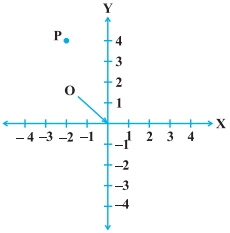
A
$(-4, 2)$
B
$(4, -2)$
C
$(2, -4)$
D
$(-2, 4)$
Solution
(D) To find the coordinates of point $P$,we observe its position on the Cartesian plane.
$1$. The $x$-coordinate is the perpendicular distance of the point from the $y$-axis. Looking at the figure,point $P$ is at a distance of $2$ units to the left of the $y$-axis,so the $x$-coordinate is $-2$.
$2$. The $y$-coordinate is the perpendicular distance of the point from the $x$-axis. Looking at the figure,point $P$ is at a distance of $4$ units above the $x$-axis,so the $y$-coordinate is $4$.
$3$. Therefore,the coordinates of point $P$ are $(-2, 4)$.
$1$. The $x$-coordinate is the perpendicular distance of the point from the $y$-axis. Looking at the figure,point $P$ is at a distance of $2$ units to the left of the $y$-axis,so the $x$-coordinate is $-2$.
$2$. The $y$-coordinate is the perpendicular distance of the point from the $x$-axis. Looking at the figure,point $P$ is at a distance of $4$ units above the $x$-axis,so the $y$-coordinate is $4$.
$3$. Therefore,the coordinates of point $P$ are $(-2, 4)$.
0 likes
View Solution21
EasyMCQ
In the figure,the point identified by the coordinates $(-5, 3)$ is:
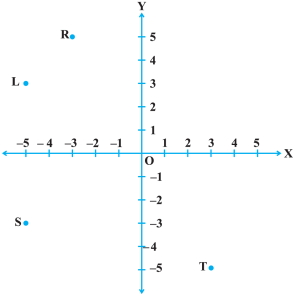
A
$L$
B
$R$
C
$T$
D
$S$
Solution
(A) To identify the point with coordinates $(-5, 3)$,we look for the point that is $-5$ units along the $x$-axis and $3$ units along the $y$-axis.
Looking at the Cartesian plane:
$1$. Start at the origin $(0, 0)$.
$2$. Move $5$ units to the left along the negative $x$-axis to reach $x = -5$.
$3$. From there,move $3$ units upwards along the positive $y$-axis to reach $y = 3$.
The point located at these coordinates is $L$.
Looking at the Cartesian plane:
$1$. Start at the origin $(0, 0)$.
$2$. Move $5$ units to the left along the negative $x$-axis to reach $x = -5$.
$3$. From there,move $3$ units upwards along the positive $y$-axis to reach $y = 3$.
The point located at these coordinates is $L$.
0 likes
View Solution22
EasyMCQ
The point whose ordinate is $4$ and which lies on the $y$-axis is
A
$(4,0)$
B
$(0,4)$
C
$(1,4)$
D
$(4,2)$
Solution
(B) In a Cartesian coordinate system,any point on the $y$-axis has an abscissa (x-coordinate) of $0$.
Given that the ordinate (y-coordinate) is $4$.
Therefore,the coordinates of the point are $(0,4)$.
Given that the ordinate (y-coordinate) is $4$.
Therefore,the coordinates of the point are $(0,4)$.
0 likes
View Solution23
EasyMCQ
Which of the points $P(0,3), Q(1,0), R(0,-1), S(-5,0), T(1,2)$ do not lie on the $x$-axis?
A
$P$ and $R$ only
B
$Q$ and $S$ only
C
$P, R$ and $T$
D
$Q, S$ and $T$
Solution
(C) We know that any point lying on the $x$-axis must have its $y$-coordinate (ordinate) equal to $0$.
Let us examine the given points:
$P(0,3)$: The $y$-coordinate is $3 \neq 0$,so it does not lie on the $x$-axis.
$Q(1,0)$: The $y$-coordinate is $0$,so it lies on the $x$-axis.
$R(0,-1)$: The $y$-coordinate is $-1 \neq 0$,so it does not lie on the $x$-axis.
$S(-5,0)$: The $y$-coordinate is $0$,so it lies on the $x$-axis.
$T(1,2)$: The $y$-coordinate is $2 \neq 0$,so it does not lie on the $x$-axis.
Therefore,the points that do not lie on the $x$-axis are $P, R,$ and $T$.
Let us examine the given points:
$P(0,3)$: The $y$-coordinate is $3 \neq 0$,so it does not lie on the $x$-axis.
$Q(1,0)$: The $y$-coordinate is $0$,so it lies on the $x$-axis.
$R(0,-1)$: The $y$-coordinate is $-1 \neq 0$,so it does not lie on the $x$-axis.
$S(-5,0)$: The $y$-coordinate is $0$,so it lies on the $x$-axis.
$T(1,2)$: The $y$-coordinate is $2 \neq 0$,so it does not lie on the $x$-axis.
Therefore,the points that do not lie on the $x$-axis are $P, R,$ and $T$.
0 likes
View Solution24
EasyMCQ
The point which lies on the $y$-axis at a distance of $5$ units in the negative direction of the $y$-axis is
A
$(0, 5)$
B
$(5, 0)$
C
$(-5, 0)$
D
$(0, -5)$
Solution
(D) point on the $y$-axis always has its abscissa (x-coordinate) equal to $0$.
The negative direction of the $y$-axis represents values less than $0$.
Since the point is at a distance of $5$ units in the negative direction,its ordinate (y-coordinate) is $-5$.
Therefore,the coordinates of the point are $(0, -5)$.
The negative direction of the $y$-axis represents values less than $0$.
Since the point is at a distance of $5$ units in the negative direction,its ordinate (y-coordinate) is $-5$.
Therefore,the coordinates of the point are $(0, -5)$.
0 likes
View Solution25
EasyMCQ
The perpendicular distance of the point $P(3, 4)$ from the $y$-axis is
A
$3$
B
$4$
C
$5$
D
$7$
Solution
(A) The perpendicular distance of any point $(x, y)$ from the $y$-axis is given by the absolute value of its $x$-coordinate (abscissa).
For the point $P(3, 4)$,the $x$-coordinate is $3$.
Therefore,the perpendicular distance from the $y$-axis is $|3| = 3$ units.
For the point $P(3, 4)$,the $x$-coordinate is $3$.
Therefore,the perpendicular distance from the $y$-axis is $|3| = 3$ units.
0 likes
View Solution26
Easy
Write whether the following statements are True or False. Justify your answer.
$(i)$ Point $(0, -2)$ lies on the $y$-axis.
$(ii)$ The perpendicular distance of the point $(4, 3)$ from the $x$-axis is $4$.
$(i)$ Point $(0, -2)$ lies on the $y$-axis.
$(ii)$ The perpendicular distance of the point $(4, 3)$ from the $x$-axis is $4$.
Solution
(A) $(i)$ True. $A$ point on the $y$-axis has an $x$-coordinate of $0$. Since the given point is $(0, -2)$,it lies on the $y$-axis.
$(ii)$ False. The perpendicular distance of a point $(x, y)$ from the $x$-axis is given by the absolute value of its $y$-coordinate (the ordinate). For the point $(4, 3)$,the ordinate is $3$. Therefore,the perpendicular distance from the $x$-axis is $3$,not $4$.
$(ii)$ False. The perpendicular distance of a point $(x, y)$ from the $x$-axis is given by the absolute value of its $y$-coordinate (the ordinate). For the point $(4, 3)$,the ordinate is $3$. Therefore,the perpendicular distance from the $x$-axis is $3$,not $4$.
0 likes
View Solution27
Easy
Write whether the following statements are True or False? Justify your answer.
$(i)$ Point $(3,0)$ lies in the first quadrant.
$(ii)$ Points $(1,-1)$ and $(-1,1)$ lie in the same quadrant.
$(i)$ Point $(3,0)$ lies in the first quadrant.
$(ii)$ Points $(1,-1)$ and $(-1,1)$ lie in the same quadrant.
Solution
(N/A) $(i)$ The point $(3,0)$ has an abscissa (x-coordinate) of $3$ and an ordinate (y-coordinate) of $0$. If the ordinate of a point is $0$,the point lies on the x-axis,not in any quadrant.
Hence,the given statement is False.
$(ii)$ The point $(1,-1)$ has a positive x-coordinate and a negative y-coordinate,so it lies in the $IV$ quadrant. The point $(-1,1)$ has a negative x-coordinate and a positive y-coordinate,so it lies in the $II$ quadrant.
Since they lie in different quadrants,the given statement is False.
Hence,the given statement is False.
$(ii)$ The point $(1,-1)$ has a positive x-coordinate and a negative y-coordinate,so it lies in the $IV$ quadrant. The point $(-1,1)$ has a negative x-coordinate and a positive y-coordinate,so it lies in the $II$ quadrant.
Since they lie in different quadrants,the given statement is False.
0 likes
View Solution28
Easy
Write whether the following statements are True or False. Justify your answer.
$(i)$ The coordinates of a point whose ordinate is $-\frac{1}{2}$ and abscissa is $1$ are $(-\frac{1}{2}, 1)$.
$(ii)$ $A$ point lies on the $y$-axis at a distance of $2$ units from the $x$-axis. Its coordinates are $(2, 0)$.
$(i)$ The coordinates of a point whose ordinate is $-\frac{1}{2}$ and abscissa is $1$ are $(-\frac{1}{2}, 1)$.
$(ii)$ $A$ point lies on the $y$-axis at a distance of $2$ units from the $x$-axis. Its coordinates are $(2, 0)$.
Solution
(A) $(i)$ False. We know that in the coordinates of a point,the abscissa ($x$-coordinate) is written first,followed by the ordinate ($y$-coordinate). Therefore,the coordinates of the point are $(1, -\frac{1}{2})$,not $(-\frac{1}{2}, 1)$.
$(ii)$ False. Any point that lies on the $y$-axis must have an abscissa of $0$ and is of the form $(0, y)$. Since the point is at a distance of $2$ units from the $x$-axis,its coordinates must be $(0, 2)$ or $(0, -2)$,not $(2, 0)$.
$(ii)$ False. Any point that lies on the $y$-axis must have an abscissa of $0$ and is of the form $(0, y)$. Since the point is at a distance of $2$ units from the $x$-axis,its coordinates must be $(0, 2)$ or $(0, -2)$,not $(2, 0)$.
0 likes
View Solution29
Easy
Write whether the following statement is True or False. Justify your answer.
$(-1, 7)$ is a point in the $II$ quadrant.
$(-1, 7)$ is a point in the $II$ quadrant.
Solution
(TRUE) In the Cartesian plane,the $II$ quadrant is defined by points where the $x$-coordinate (abscissa) is negative and the $y$-coordinate (ordinate) is positive.
For the point $(-1, 7)$,the $x$-coordinate is $-1$ (which is $< 0$) and the $y$-coordinate is $7$ (which is $> 0$).
Since the signs are $(-, +)$,the point $(-1, 7)$ lies in the $II$ quadrant.
Therefore,the statement is True.
For the point $(-1, 7)$,the $x$-coordinate is $-1$ (which is $< 0$) and the $y$-coordinate is $7$ (which is $> 0$).
Since the signs are $(-, +)$,the point $(-1, 7)$ lies in the $II$ quadrant.
Therefore,the statement is True.
0 likes
View Solution30
Easy
Plot the point $P(-6, 2)$ and from it draw $PM$ and $PN$ as perpendiculars to the $x$-axis and $y$-axis,respectively. Write the coordinates of the points $M$ and $N$.
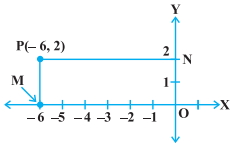
Solution
(N/A) $1$. The point $P(-6, 2)$ is located in the second quadrant where the $x$-coordinate is $-6$ and the $y$-coordinate is $2$.
$2$. $A$ perpendicular $PM$ is drawn from $P$ to the $x$-axis. Since $M$ lies on the $x$-axis,its $y$-coordinate is $0$. The $x$-coordinate remains the same as $P$,which is $-6$. Thus,the coordinates of $M$ are $(-6, 0)$.
$3$. $A$ perpendicular $PN$ is drawn from $P$ to the $y$-axis. Since $N$ lies on the $y$-axis,its $x$-coordinate is $0$. The $y$-coordinate remains the same as $P$,which is $2$. Thus,the coordinates of $N$ are $(0, 2)$.
$2$. $A$ perpendicular $PM$ is drawn from $P$ to the $x$-axis. Since $M$ lies on the $x$-axis,its $y$-coordinate is $0$. The $x$-coordinate remains the same as $P$,which is $-6$. Thus,the coordinates of $M$ are $(-6, 0)$.
$3$. $A$ perpendicular $PN$ is drawn from $P$ to the $y$-axis. Since $N$ lies on the $y$-axis,its $x$-coordinate is $0$. The $y$-coordinate remains the same as $P$,which is $2$. Thus,the coordinates of $N$ are $(0, 2)$.
0 likes
View Solution31
Easy
From the figure,write the following:
$(i)$ Coordinates of $B, C$ and $E$
$(ii)$ The point identified by the coordinates $(0, -2)$
$(iii)$ The abscissa of the point $H$
$(iv)$ The ordinate of the point $D$
$(i)$ Coordinates of $B, C$ and $E$
$(ii)$ The point identified by the coordinates $(0, -2)$
$(iii)$ The abscissa of the point $H$
$(iv)$ The ordinate of the point $D$
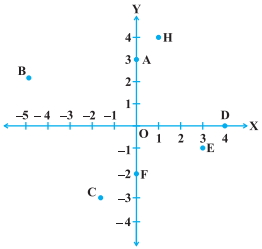
Solution
(N/A) $(i)$ To find the coordinates of a point,we look at its position relative to the $X$-axis and $Y$-axis.
- For point $B$,the $x$-coordinate is $-5$ and the $y$-coordinate is $2$. So,$B = (-5, 2)$.
- For point $C$,the $x$-coordinate is $-2$ and the $y$-coordinate is $-3$. So,$C = (-2, -3)$.
- For point $E$,the $x$-coordinate is $3$ and the $y$-coordinate is $-1$. So,$E = (3, -1)$.
$(ii)$ The coordinates $(0, -2)$ mean $x = 0$ and $y = -2$. Looking at the graph,this point lies on the $Y$-axis at $-2$,which is point $F$.
$(iii)$ The abscissa is the $x$-coordinate of a point. For point $H$,the coordinates are $(1, 4)$. Therefore,the abscissa is $1$.
$(iv)$ The ordinate is the $y$-coordinate of a point. For point $D$,the coordinates are $(4, 0)$. Therefore,the ordinate is $0$.
- For point $B$,the $x$-coordinate is $-5$ and the $y$-coordinate is $2$. So,$B = (-5, 2)$.
- For point $C$,the $x$-coordinate is $-2$ and the $y$-coordinate is $-3$. So,$C = (-2, -3)$.
- For point $E$,the $x$-coordinate is $3$ and the $y$-coordinate is $-1$. So,$E = (3, -1)$.
$(ii)$ The coordinates $(0, -2)$ mean $x = 0$ and $y = -2$. Looking at the graph,this point lies on the $Y$-axis at $-2$,which is point $F$.
$(iii)$ The abscissa is the $x$-coordinate of a point. For point $H$,the coordinates are $(1, 4)$. Therefore,the abscissa is $1$.
$(iv)$ The ordinate is the $y$-coordinate of a point. For point $D$,the coordinates are $(4, 0)$. Therefore,the ordinate is $0$.
0 likes
View Solution32
Easy
Write the coordinates of each of the points $P, Q, R, S, T$ and $O$ from the given figure.
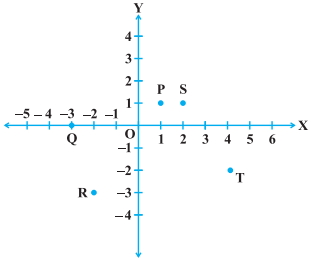
Solution
(N/A) To find the coordinates of a point $(x, y)$,we determine its distance from the $Y$-axis (x-coordinate) and the $X$-axis (y-coordinate).
- For point $P$: The x-coordinate is $1$ and the y-coordinate is $1$. So,$P = (1, 1)$.
- For point $Q$: The x-coordinate is $-3$ and the y-coordinate is $0$ (since it lies on the $X$-axis). So,$Q = (-3, 0)$.
- For point $R$: The x-coordinate is $-2$ and the y-coordinate is $-3$. So,$R = (-2, -3)$.
- For point $S$: The x-coordinate is $2$ and the y-coordinate is $1$. So,$S = (2, 1)$.
- For point $T$: The x-coordinate is $4$ and the y-coordinate is $-2$. So,$T = (4, -2)$.
- For point $O$: This is the origin,where both axes intersect. So,$O = (0, 0)$.
- For point $P$: The x-coordinate is $1$ and the y-coordinate is $1$. So,$P = (1, 1)$.
- For point $Q$: The x-coordinate is $-3$ and the y-coordinate is $0$ (since it lies on the $X$-axis). So,$Q = (-3, 0)$.
- For point $R$: The x-coordinate is $-2$ and the y-coordinate is $-3$. So,$R = (-2, -3)$.
- For point $S$: The x-coordinate is $2$ and the y-coordinate is $1$. So,$S = (2, 1)$.
- For point $T$: The x-coordinate is $4$ and the y-coordinate is $-2$. So,$T = (4, -2)$.
- For point $O$: This is the origin,where both axes intersect. So,$O = (0, 0)$.
0 likes
View Solution33
Medium
Plot the following points and write the name of the figure obtained by joining them in order:
$P(-3, 2), Q(-7, -3), R(6, -3), S(2, 2)$
$P(-3, 2), Q(-7, -3), R(6, -3), S(2, 2)$
Solution
(N/A) $1$. Draw the coordinate axes $X'OX$ and $Y'OY$ on a graph paper.
$2$. Plot the points $P(-3, 2)$,$Q(-7, -3)$,$R(6, -3)$,and $S(2, 2)$ by locating their respective $x$ and $y$ coordinates.
$3$. Join the points in the order $P$ to $Q$,$Q$ to $R$,$R$ to $S$,and $S$ to $P$.
$4$. Observe the figure formed. The side $PS$ is parallel to the side $QR$ because both lie on horizontal lines ($y=2$ and $y=-3$ respectively),but they are of different lengths ($PS = 5$ units,$QR = 13$ units).
$5$. Since one pair of opposite sides is parallel and the other is not,the figure obtained is a trapezium.
$2$. Plot the points $P(-3, 2)$,$Q(-7, -3)$,$R(6, -3)$,and $S(2, 2)$ by locating their respective $x$ and $y$ coordinates.
$3$. Join the points in the order $P$ to $Q$,$Q$ to $R$,$R$ to $S$,and $S$ to $P$.
$4$. Observe the figure formed. The side $PS$ is parallel to the side $QR$ because both lie on horizontal lines ($y=2$ and $y=-3$ respectively),but they are of different lengths ($PS = 5$ units,$QR = 13$ units).
$5$. Since one pair of opposite sides is parallel and the other is not,the figure obtained is a trapezium.
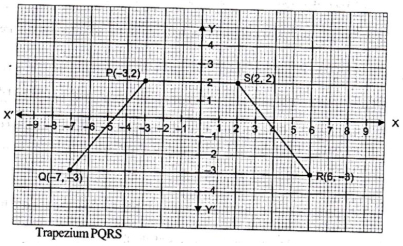
0 likes
View Solution34
Easy
Plot the points $(x, y)$ given by the following table:
| $x$ | $2$ | $4$ | $-3$ | $-2$ | $3$ | $0$ |
| $y$ | $4$ | $2$ | $0$ | $5$ | $-3$ | $0$ |
Solution
(N/A) To plot the points $(x, y)$ on a Cartesian plane,follow these steps:
$1$. Draw the coordinate axes $X'OX$ and $Y'OY$.
$2$. For each point $(x, y)$,start from the origin $(0, 0)$.
$3$. Move $x$ units along the $X$-axis (right if $x > 0$,left if $x < 0$).
$4$. From that position,move $y$ units parallel to the $Y$-axis (up if $y > 0$,down if $y < 0$).
The points are plotted as follows:
- $(2, 4)$: Move $2$ units right and $4$ units up.
- $(4, 2)$: Move $4$ units right and $2$ units up.
- $(-3, 0)$: Move $3$ units left and $0$ units up/down (lies on the $X$-axis).
- $(-2, 5)$: Move $2$ units left and $5$ units up.
- $(3, -3)$: Move $3$ units right and $3$ units down.
- $(0, 0)$: The origin.
$1$. Draw the coordinate axes $X'OX$ and $Y'OY$.
$2$. For each point $(x, y)$,start from the origin $(0, 0)$.
$3$. Move $x$ units along the $X$-axis (right if $x > 0$,left if $x < 0$).
$4$. From that position,move $y$ units parallel to the $Y$-axis (up if $y > 0$,down if $y < 0$).
The points are plotted as follows:
- $(2, 4)$: Move $2$ units right and $4$ units up.
- $(4, 2)$: Move $4$ units right and $2$ units up.
- $(-3, 0)$: Move $3$ units left and $0$ units up/down (lies on the $X$-axis).
- $(-2, 5)$: Move $2$ units left and $5$ units up.
- $(3, -3)$: Move $3$ units right and $3$ units down.
- $(0, 0)$: The origin.
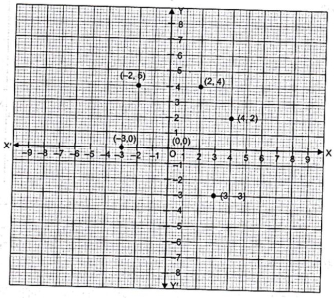
0 likes
View Solution35
Easy
Plot the following points and check whether they are collinear or not:
$(1,3), (-1,-1), (-2,-3)$
$(1,3), (-1,-1), (-2,-3)$
Solution
(N/A) $1$. Plot the points $A(1,3)$,$B(-1,-1)$,and $C(-2,-3)$ on the Cartesian plane.
$2$. Observe that all three points $A$,$B$,and $C$ lie on the same straight line.
$3$. Since the points lie on the same straight line,they are collinear.
$2$. Observe that all three points $A$,$B$,and $C$ lie on the same straight line.
$3$. Since the points lie on the same straight line,they are collinear.
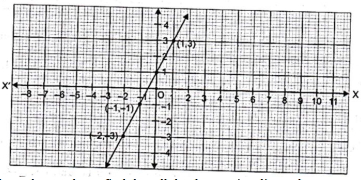
0 likes
View Solution36
Easy
Plot the following points and check whether they are collinear or not:
$(1,1), (2,-3), (-1,-2)$
$(1,1), (2,-3), (-1,-2)$
Solution
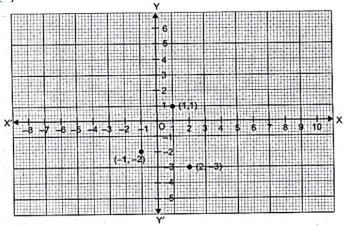
(N/A) $1$. Plot the points $A(1, 1)$,$B(2, -3)$,and $C(-1, -2)$ on a Cartesian plane.
$2$. Observe the positions of these points on the graph.
$3$. $A$ set of points is said to be collinear if they all lie on the same straight line.
$4$. By connecting these points,we can see that they do not form a single straight line.
$5$. Therefore,the given points are not collinear.
$2$. Observe the positions of these points on the graph.
$3$. $A$ set of points is said to be collinear if they all lie on the same straight line.
$4$. By connecting these points,we can see that they do not form a single straight line.
$5$. Therefore,the given points are not collinear.
0 likes
View Solution37
Easy
Plot the following points on a Cartesian plane and check whether they are collinear or not:
$(0,0), (2,2), (5,5)$
$(0,0), (2,2), (5,5)$
Solution
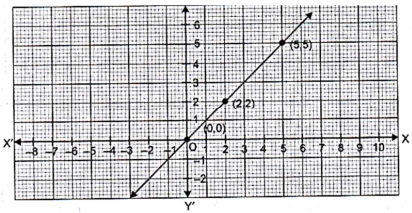
(N/A) $1$. Plot the points $A(0,0)$,$B(2,2)$,and $C(5,5)$ on a Cartesian plane.
$2$. Observe that all three points lie on the same straight line passing through the origin.
$3$. Since the points $A, B,$ and $C$ lie on a single straight line,they are collinear.
$2$. Observe that all three points lie on the same straight line passing through the origin.
$3$. Since the points $A, B,$ and $C$ lie on a single straight line,they are collinear.
0 likes
View Solution38
Easy
Without plotting the points,indicate the quadrant in which they will lie,if:
$(i)$ ordinate is $5$ and abscissa is $-3$
$(ii)$ abscissa is $-5$ and ordinate is $-3$
$(i)$ ordinate is $5$ and abscissa is $-3$
$(ii)$ abscissa is $-5$ and ordinate is $-3$
Solution
(N/A) $(i)$ In the point $(-3, 5)$,the abscissa ($x$-coordinate) is $-3$ (negative) and the ordinate ($y$-coordinate) is $5$ (positive). Points with a negative $x$ and a positive $y$ lie in the second quadrant.
$(ii)$ In the point $(-5, -3)$,the abscissa ($x$-coordinate) is $-5$ (negative) and the ordinate ($y$-coordinate) is $-3$ (negative). Points with both negative $x$ and $y$ coordinates lie in the third quadrant.
$(ii)$ In the point $(-5, -3)$,the abscissa ($x$-coordinate) is $-5$ (negative) and the ordinate ($y$-coordinate) is $-3$ (negative). Points with both negative $x$ and $y$ coordinates lie in the third quadrant.
0 likes
View Solution39
EasyMCQ
Without plotting the points,indicate the quadrant in which they will lie,if:
$(i)$ abscissa is $-5$ and ordinate is $3$
$(ii)$ ordinate is $5$ and abscissa is $3$
$(i)$ abscissa is $-5$ and ordinate is $3$
$(ii)$ ordinate is $5$ and abscissa is $3$
A
Quadrant $II$ and Quadrant $I$
B
Quadrant $I$ and Quadrant $II$
C
Quadrant $III$ and Quadrant $IV$
D
Quadrant $IV$ and Quadrant $III$
Solution
(A) $(i)$ For the point $(-5, 3)$,the abscissa ($x$-coordinate) is $-5$ (negative) and the ordinate ($y$-coordinate) is $3$ (positive). Points with a negative $x$ and a positive $y$ lie in the second quadrant.
$(ii)$ For the point $(3, 5)$,the abscissa ($x$-coordinate) is $3$ (positive) and the ordinate ($y$-coordinate) is $5$ (positive). Points with both positive $x$ and $y$ coordinates lie in the first quadrant.
$(ii)$ For the point $(3, 5)$,the abscissa ($x$-coordinate) is $3$ (positive) and the ordinate ($y$-coordinate) is $5$ (positive). Points with both positive $x$ and $y$ coordinates lie in the first quadrant.
0 likes
View Solution40
Easy
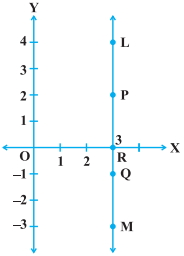
In the figure,$LM$ is a line parallel to the $y$-axis at a distance of $3$ units.
$(i)$ What are the coordinates of the points $P, R,$ and $Q$?
$(ii)$ What is the difference between the abscissa of the points $L$ and $M$?
$(i)$ What are the coordinates of the points $P, R,$ and $Q$?
$(ii)$ What is the difference between the abscissa of the points $L$ and $M$?
Solution
(N/A) $(i)$ Clearly,the distance of point $P$ from the $y$-axis is $3$ units and its distance from the $x$-axis is $2$ units. Since $P$ lies in the first quadrant,its coordinates are $(3, 2)$.
Point $R$ lies on the $x$-axis,and its distance from the $y$-axis is $3$ units and from the $x$-axis is $0$ units. So,its coordinates are $(3, 0)$.
Clearly,point $Q$ lies in the fourth quadrant. The distance of $Q$ from the $y$-axis is $3$ units and from the $x$-axis is $1$ unit. So,the coordinates of $Q$ are $(3, -1)$.
$(ii)$ From the given figure,we observe that the points $L$ and $M$ lie on the same vertical line $x = 3$. Therefore,the abscissa (the $x$-coordinate) of both points $L$ and $M$ is $3$.
Hence,the difference between the abscissa of the points $L$ and $M$ is $3 - 3 = 0$.
Point $R$ lies on the $x$-axis,and its distance from the $y$-axis is $3$ units and from the $x$-axis is $0$ units. So,its coordinates are $(3, 0)$.
Clearly,point $Q$ lies in the fourth quadrant. The distance of $Q$ from the $y$-axis is $3$ units and from the $x$-axis is $1$ unit. So,the coordinates of $Q$ are $(3, -1)$.
$(ii)$ From the given figure,we observe that the points $L$ and $M$ lie on the same vertical line $x = 3$. Therefore,the abscissa (the $x$-coordinate) of both points $L$ and $M$ is $3$.
Hence,the difference between the abscissa of the points $L$ and $M$ is $3 - 3 = 0$.
0 likes
View Solution41
Easy
In which quadrant or on which axis does each of the following points lie?
$(-3, 5), (4, -1), (2, 0), (2, 2), (-3, -6)$
$(-3, 5), (4, -1), (2, 0), (2, 2), (-3, -6)$
Solution
(N/A) $(i) \, (-3, 5)$ lies in the $II$ quadrant because $x < 0$ and $y > 0$.
$(ii) \, (4, -1)$ lies in the $IV$ quadrant because $x > 0$ and $y < 0$.
$(iii) \, (2, 0)$ lies on the $x$-axis because the $y$-coordinate is $0$.
$(iv) \, (2, 2)$ lies in the $I$ quadrant because $x > 0$ and $y > 0$.
$(v) \, (-3, -6)$ lies in the $III$ quadrant because $x < 0$ and $y < 0$.
$(ii) \, (4, -1)$ lies in the $IV$ quadrant because $x > 0$ and $y < 0$.
$(iii) \, (2, 0)$ lies on the $x$-axis because the $y$-coordinate is $0$.
$(iv) \, (2, 2)$ lies in the $I$ quadrant because $x > 0$ and $y > 0$.
$(v) \, (-3, -6)$ lies in the $III$ quadrant because $x < 0$ and $y < 0$.
0 likes
View Solution42
Easy
Which of the following points lie on the $y$-axis?
$A(1,1), B(1,0), C(0,1), D(0,0), E(0,-1)$
$F(-1,0), G(0,5), H(-7,0), I(3,3)$
$A(1,1), B(1,0), C(0,1), D(0,0), E(0,-1)$
$F(-1,0), G(0,5), H(-7,0), I(3,3)$
Solution
(C, D, E, G) We know that if a point lies on the $y$-axis,its abscissa ($x$-coordinate) must be $0$. Therefore,the coordinates of such a point are of the form $(0, y)$.
Checking the given points:
$A(1,1)$: $x=1 \neq 0$
$B(1,0)$: $x=1 \neq 0$
$C(0,1)$: $x=0$ (Lies on $y$-axis)
$D(0,0)$: $x=0$ (Lies on $y$-axis)
$E(0,-1)$: $x=0$ (Lies on $y$-axis)
$F(-1,0)$: $x=-1 \neq 0$
$G(0,5)$: $x=0$ (Lies on $y$-axis)
$H(-7,0)$: $x=-7 \neq 0$
$I(3,3)$: $x=3 \neq 0$
Thus,the points that lie on the $y$-axis are $C(0,1), D(0,0), E(0,-1),$ and $G(0,5)$.
Checking the given points:
$A(1,1)$: $x=1 \neq 0$
$B(1,0)$: $x=1 \neq 0$
$C(0,1)$: $x=0$ (Lies on $y$-axis)
$D(0,0)$: $x=0$ (Lies on $y$-axis)
$E(0,-1)$: $x=0$ (Lies on $y$-axis)
$F(-1,0)$: $x=-1 \neq 0$
$G(0,5)$: $x=0$ (Lies on $y$-axis)
$H(-7,0)$: $x=-7 \neq 0$
$I(3,3)$: $x=3 \neq 0$
Thus,the points that lie on the $y$-axis are $C(0,1), D(0,0), E(0,-1),$ and $G(0,5)$.
0 likes
View Solution43
Medium
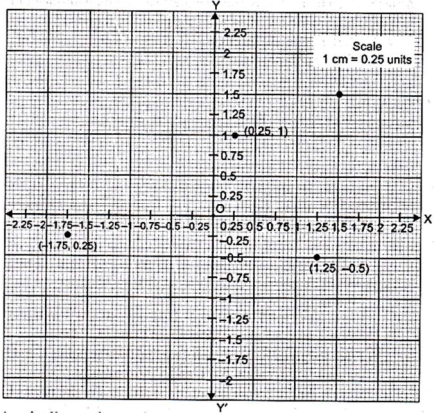
Plot the points $(x, y)$ given by the following table using the scale $1 \ cm = 0.25 \ \text{units}$.
| $x$ | $1.25$ | $0.25$ | $1.5$ | $-1.75$ |
| $y$ | $-0.5$ | $1$ | $1.5$ | $-0.25$ |
Solution
(N/A) To plot the points, we first identify the coordinates as ordered pairs $(x, y)$:
$1$. $(1.25, -0.5)$
$2$. $(0.25, 1)$
$3$. $(1.5, 1.5)$
$4$. $(-1.75, -0.25)$
Steps to plot:
- Draw the Cartesian plane with $X'OX$ and $Y'OY$ as the coordinate axes.
- Set the scale as $1 \ cm = 0.25 \ \text{units}$ on both axes.
- Locate each point by moving $x$ units along the $X$-axis and $y$ units along the $Y$-axis.
- The plotted points are shown in the graph below.
$1$. $(1.25, -0.5)$
$2$. $(0.25, 1)$
$3$. $(1.5, 1.5)$
$4$. $(-1.75, -0.25)$
Steps to plot:
- Draw the Cartesian plane with $X'OX$ and $Y'OY$ as the coordinate axes.
- Set the scale as $1 \ cm = 0.25 \ \text{units}$ on both axes.
- Locate each point by moving $x$ units along the $X$-axis and $y$ units along the $Y$-axis.
- The plotted points are shown in the graph below.
0 likes
View Solution44
MediumMCQ
$A$ point lies on the $x$-axis at a distance of $7$ units from the $y$-axis. What are its coordinates? What will be the coordinates if it lies on the $y$-axis at a distance of $-7$ units from the $x$-axis?
A
$(7, 0)$
B
$(0, 7)$
C
$(7, -7)$
D
$(-7, 0)$
Solution
(A) point on the $x$-axis has a $y$-coordinate of $0$. Since its distance from the $y$-axis is $7$ units,its $x$-coordinate is $7$. Thus,the coordinates are $(7, 0)$.
$A$ point on the $y$-axis has an $x$-coordinate of $0$. The distance from the $x$-axis is given as $-7$ units. In coordinate geometry,the distance from the $x$-axis represents the $y$-coordinate. Therefore,the $y$-coordinate is $-7$. Thus,the coordinates are $(0, -7)$.
$A$ point on the $y$-axis has an $x$-coordinate of $0$. The distance from the $x$-axis is given as $-7$ units. In coordinate geometry,the distance from the $x$-axis represents the $y$-coordinate. Therefore,the $y$-coordinate is $-7$. Thus,the coordinates are $(0, -7)$.
0 likes
View Solution45
Easy
Find the coordinates of the point:
$(i)$ which lies on both $x$ and $y$ axes.
$(ii)$ whose ordinate is $-4$ and which lies on the $y$-axis.
$(iii)$ whose abscissa is $5$ and which lies on the $x$-axis.
$(i)$ which lies on both $x$ and $y$ axes.
$(ii)$ whose ordinate is $-4$ and which lies on the $y$-axis.
$(iii)$ whose abscissa is $5$ and which lies on the $x$-axis.
Solution
(N/A) $(i)$ The point that lies on both the $x$ and $y$ axes is the origin,which has coordinates $(0,0)$.
$(ii)$ $A$ point on the $y$-axis has an abscissa of $0$. Given the ordinate is $-4$,the coordinates are $(0,-4)$.
$(iii)$ $A$ point on the $x$-axis has an ordinate of $0$. Given the abscissa is $5$,the coordinates are $(5,0)$.
$(ii)$ $A$ point on the $y$-axis has an abscissa of $0$. Given the ordinate is $-4$,the coordinates are $(0,-4)$.
$(iii)$ $A$ point on the $x$-axis has an ordinate of $0$. Given the abscissa is $5$,the coordinates are $(5,0)$.
0 likes
View Solution46
Medium
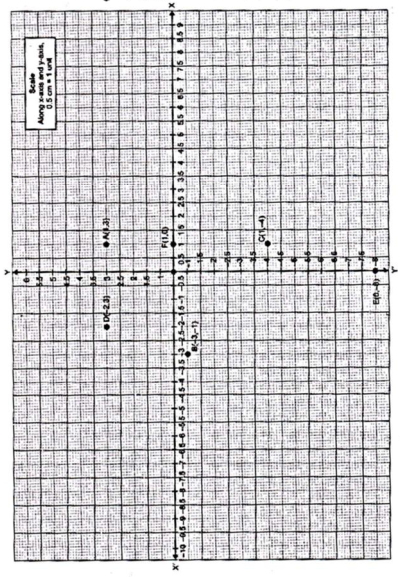
Taking $0.5 \ cm$ as $1 \ unit,$ plot the following points on the graph paper:
$A(1, 3), B(-3, -1), C(1, -4), D(-2, 3), E(0, -8), F(1, 0)$
$A(1, 3), B(-3, -1), C(1, -4), D(-2, 3), E(0, -8), F(1, 0)$
Solution
(A) To plot the points on a graph paper,follow these steps:
$1$. Draw two perpendicular lines,$X'OX$ (x-axis) and $Y'OY$ (y-axis),intersecting at the origin $O(0, 0)$.
$2$. Choose a scale: $0.5 \ cm = 1 \ unit$ on both axes.
$3$. Plot each point based on its coordinates $(x, y)$:
- For $A(1, 3)$,move $1 \ unit$ to the right of the y-axis and $3 \ units$ above the x-axis.
- For $B(-3, -1)$,move $3 \ units$ to the left of the y-axis and $1 \ unit$ below the x-axis.
- For $C(1, -4)$,move $1 \ unit$ to the right of the y-axis and $4 \ units$ below the x-axis.
- For $D(-2, 3)$,move $2 \ units$ to the left of the y-axis and $3 \ units$ above the x-axis.
- For $E(0, -8)$,stay on the y-axis and move $8 \ units$ below the x-axis.
- For $F(1, 0)$,move $1 \ unit$ to the right of the y-axis and stay on the x-axis.
$1$. Draw two perpendicular lines,$X'OX$ (x-axis) and $Y'OY$ (y-axis),intersecting at the origin $O(0, 0)$.
$2$. Choose a scale: $0.5 \ cm = 1 \ unit$ on both axes.
$3$. Plot each point based on its coordinates $(x, y)$:
- For $A(1, 3)$,move $1 \ unit$ to the right of the y-axis and $3 \ units$ above the x-axis.
- For $B(-3, -1)$,move $3 \ units$ to the left of the y-axis and $1 \ unit$ below the x-axis.
- For $C(1, -4)$,move $1 \ unit$ to the right of the y-axis and $4 \ units$ below the x-axis.
- For $D(-2, 3)$,move $2 \ units$ to the left of the y-axis and $3 \ units$ above the x-axis.
- For $E(0, -8)$,stay on the y-axis and move $8 \ units$ below the x-axis.
- For $F(1, 0)$,move $1 \ unit$ to the right of the y-axis and stay on the x-axis.
0 likes
View Solution47
Medium
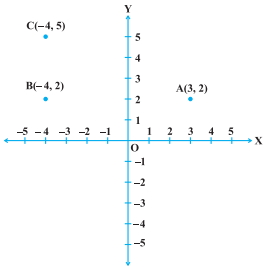
Three vertices of a rectangle are $(3,2), (-4,2)$ and $(-4,5)$. Plot these points and find the coordinates of the fourth vertex.
Solution
(N/A) Let the three vertices of the rectangle be $A(3,2)$,$B(-4,2)$,and $C(-4,5)$ (see the figure).
We need to find the coordinates of the fourth vertex $D$ such that $ABCD$ forms a rectangle.
Since the opposite sides of a rectangle are equal and parallel to the axes,the abscissa (x-coordinate) of $D$ must be equal to the abscissa of $A$,which is $3$.
The ordinate (y-coordinate) of $D$ must be equal to the ordinate of $C$,which is $5$.
Therefore,the coordinates of the fourth vertex $D$ are $(3,5)$.
We need to find the coordinates of the fourth vertex $D$ such that $ABCD$ forms a rectangle.
Since the opposite sides of a rectangle are equal and parallel to the axes,the abscissa (x-coordinate) of $D$ must be equal to the abscissa of $A$,which is $3$.
The ordinate (y-coordinate) of $D$ must be equal to the ordinate of $C$,which is $5$.
Therefore,the coordinates of the fourth vertex $D$ are $(3,5)$.
0 likes
View Solution48
Medium
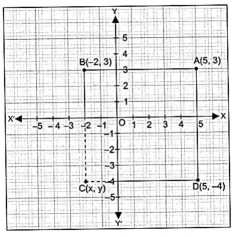
Points $A(5,3)$,$B(-2,3)$,and $D(5,-4)$ are three vertices of a square $ABCD$. Plot these points on a graph paper and hence find the coordinates of the vertex $C$.
Solution
(C) $1$. Plot the points $A(5,3)$,$B(-2,3)$,and $D(5,-4)$ on the Cartesian plane.
$2$. Join the points $AB$ and $AD$. Since $ABCD$ is a square,all its sides are equal in length and each interior angle is $90^{\circ}$.
$3$. The side $AB$ is horizontal (parallel to the $x$-axis) with length $|5 - (-2)| = 7$ units. The side $AD$ is vertical (parallel to the $y$-axis) with length $|3 - (-4)| = 7$ units.
$4$. To complete the square,the vertex $C$ must have the same $x$-coordinate as $B$ (which is $-2$) and the same $y$-coordinate as $D$ (which is $-4$).
$5$. Therefore,the coordinates of the vertex $C$ are $(-2,-4)$.
$2$. Join the points $AB$ and $AD$. Since $ABCD$ is a square,all its sides are equal in length and each interior angle is $90^{\circ}$.
$3$. The side $AB$ is horizontal (parallel to the $x$-axis) with length $|5 - (-2)| = 7$ units. The side $AD$ is vertical (parallel to the $y$-axis) with length $|3 - (-4)| = 7$ units.
$4$. To complete the square,the vertex $C$ must have the same $x$-coordinate as $B$ (which is $-2$) and the same $y$-coordinate as $D$ (which is $-4$).
$5$. Therefore,the coordinates of the vertex $C$ are $(-2,-4)$.
0 likes
View Solution49
Medium
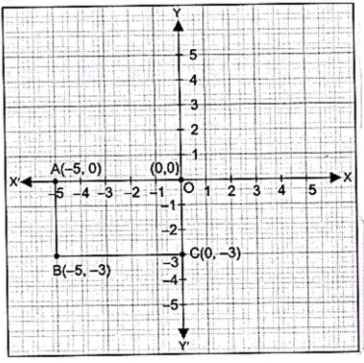
Write the coordinates of the vertices of a rectangle whose length and breadth are $5$ and $3$ units respectively,one vertex is at the origin,the longer side lies on the $x$-axis,and one of the vertices lies in the third quadrant.
Solution
(N/A) Given that the length and breadth of the rectangle are $5$ and $3$ units respectively.
One vertex is at the origin $(0,0)$.
The longer side (length $= 5$) lies on the $x$-axis.
Since one vertex lies in the third quadrant,the rectangle must extend towards the negative $x$-axis and negative $y$-axis.
Therefore,the vertices are:
$1$. The origin: $(0,0)$
$2$. Moving $5$ units along the negative $x$-axis: $(-5,0)$
$3$. Moving $3$ units down from $(-5,0)$ to reach the third quadrant: $(-5,-3)$
$4$. Moving $3$ units down from the origin along the $y$-axis: $(0,-3)$
Thus,the coordinates of the vertices are $(0,0), (-5,0), (-5,-3),$ and $(0,-3).$
One vertex is at the origin $(0,0)$.
The longer side (length $= 5$) lies on the $x$-axis.
Since one vertex lies in the third quadrant,the rectangle must extend towards the negative $x$-axis and negative $y$-axis.
Therefore,the vertices are:
$1$. The origin: $(0,0)$
$2$. Moving $5$ units along the negative $x$-axis: $(-5,0)$
$3$. Moving $3$ units down from $(-5,0)$ to reach the third quadrant: $(-5,-3)$
$4$. Moving $3$ units down from the origin along the $y$-axis: $(0,-3)$
Thus,the coordinates of the vertices are $(0,0), (-5,0), (-5,-3),$ and $(0,-3).$
0 likes
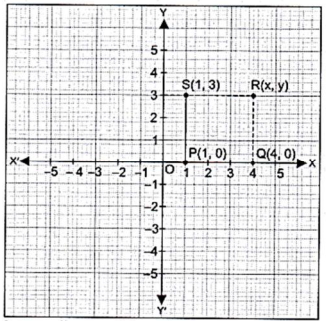
View Solution50
Medium
Plot the points $P(1, 0)$,$Q(4, 0)$,and $S(1, 3)$. Find the coordinates of the point $R$ such that $PQRS$ is a square.
Solution
(D) $1$. Plot the points $P(1, 0)$,$Q(4, 0)$,and $S(1, 3)$ on the Cartesian plane.
$2$. In a square $PQRS$,the side length $PQ$ is the distance between $(1, 0)$ and $(4, 0)$,which is $|4 - 1| = 3$ units.
$3$. Similarly,the side length $PS$ is the distance between $(1, 0)$ and $(1, 3)$,which is $|3 - 0| = 3$ units.
$4$. Since $PQ = PS = 3$ units and the sides are perpendicular (along the axes),the point $R$ must complete the square.
$5$. The $x$-coordinate of $R$ must match the $x$-coordinate of $Q$,which is $4$.
$6$. The $y$-coordinate of $R$ must match the $y$-coordinate of $S$,which is $3$.
$7$. Therefore,the coordinates of point $R$ are $(4, 3)$.
$2$. In a square $PQRS$,the side length $PQ$ is the distance between $(1, 0)$ and $(4, 0)$,which is $|4 - 1| = 3$ units.
$3$. Similarly,the side length $PS$ is the distance between $(1, 0)$ and $(1, 3)$,which is $|3 - 0| = 3$ units.
$4$. Since $PQ = PS = 3$ units and the sides are perpendicular (along the axes),the point $R$ must complete the square.
$5$. The $x$-coordinate of $R$ must match the $x$-coordinate of $Q$,which is $4$.
$6$. The $y$-coordinate of $R$ must match the $y$-coordinate of $S$,which is $3$.
$7$. Therefore,the coordinates of point $R$ are $(4, 3)$.
0 likes
View SolutionCoordinate Geometry — Mix Examples - Coordinate Geometry · Frequently Asked Questions
1Are these Coordinate Geometry questions useful for JEE and NEET?
Yes. All questions in this section are mapped to JEE Main and NEET exam patterns. Previous year questions from JEE Main, NEET, GUJCET and state-level exams are included with full solutions.
2Can I switch to Hindi or Gujarati for these questions?
Yes. Use the language tabs in the hero section or the sidebar to view the same questions and solutions in English, Hindi or Gujarati.
3How do I generate a question paper from this subtopic?
Use the Vedclass Exam Paper Generator — select the chapter and subtopic, set difficulty, and generate Sets A, B, C, D automatically. First 3 chapters of every subject are free.
Vedclass Products
For Students
Vedclass Test Series
Mock tests in real JEE/NEET style with performance analysis. 5-day free trial.
Start Free TrialFor Teachers
Exam Paper Generator
Generate Set A/B/C/D papers from this chapter in 2 minutes. 3 chapters free.
Try FreeFor Institutes
Online Exam Module
Live online exams with unlimited students, 360° analytics & white-label branding.
See DemoFor Teachers & Institutes
Generate a Coordinate Geometry Exam Paper in 2 Minutes
Select subtopic & difficulty — Sets A, B, C, D auto-generated with No Repeat logic.
First 3 chapters of every subject are free — no payment required.