
A English
Variations in YDSE (Young's Double Slit Experiment) Questions in English
Class 12 Physics · Wave Optics · Variations in YDSE (Young's Double Slit Experiment)
106+
Questions
English
Language
100%
With Solutions
Showing 5 of 106 questions in English
101
DifficultMCQ
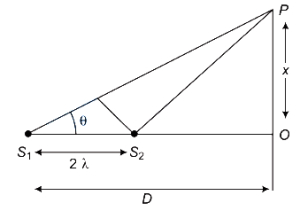
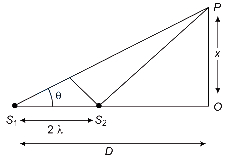
Two coherent point sources $S_1$ and $S_2$ vibrating in phase emit light of wavelength $\lambda$. The separation between them is $2 \lambda$ as shown in the figure. The first bright fringe is formed at $P$ due to interference on a screen placed at a distance $D$ from $S_1$ $(D >> \lambda)$. Find the distance $OP$.
A
$\sqrt{2} D$
B
$1.5 D$
C
$\sqrt{3} D$
D
$2 D$
Solution
(C) The path difference between the waves reaching point $P$ from $S_1$ and $S_2$ is given by $\Delta x = S_1 P - S_2 P$.
For the first bright fringe,the path difference must be equal to the wavelength,so $\Delta x = \lambda$.
From the geometry of the setup,the path difference can also be expressed as $\Delta x = d \cos \theta$,where $d = 2 \lambda$ is the separation between the sources.
Thus,$2 \lambda \cos \theta = \lambda$.
This simplifies to $\cos \theta = \frac{1}{2}$,which means $\theta = 60^{\circ}$.
From the right-angled triangle formed by the screen,we have $\tan \theta = \frac{OP}{D}$.
Substituting $\theta = 60^{\circ}$,we get $\tan 60^{\circ} = \frac{OP}{D}$.
Since $\tan 60^{\circ} = \sqrt{3}$,we have $\sqrt{3} = \frac{OP}{D}$.
Therefore,$OP = \sqrt{3} D$.
For the first bright fringe,the path difference must be equal to the wavelength,so $\Delta x = \lambda$.
From the geometry of the setup,the path difference can also be expressed as $\Delta x = d \cos \theta$,where $d = 2 \lambda$ is the separation between the sources.
Thus,$2 \lambda \cos \theta = \lambda$.
This simplifies to $\cos \theta = \frac{1}{2}$,which means $\theta = 60^{\circ}$.
From the right-angled triangle formed by the screen,we have $\tan \theta = \frac{OP}{D}$.
Substituting $\theta = 60^{\circ}$,we get $\tan 60^{\circ} = \frac{OP}{D}$.
Since $\tan 60^{\circ} = \sqrt{3}$,we have $\sqrt{3} = \frac{OP}{D}$.
Therefore,$OP = \sqrt{3} D$.
0 likes
View Solution102
MediumMCQ
$A$ thin plastic sheet of refractive index $1.6$ is used to cover one of the slits of a double slit arrangement. The central point on the screen is now occupied by what would have been the $7^{th}$ bright fringe before the plastic was used. If the wavelength of light is $600 \ nm$, what is the thickness (in $\mu m$) of the plastic sheet?
A
$7$
B
$4$
C
$8$
D
$6$
Solution
(A) When a thin sheet of thickness $t$ and refractive index $\mu$ is placed in front of one of the slits, the path difference introduced is $\Delta x = (\mu - 1)t$.
Given that the central point on the screen is now occupied by the $7^{th}$ bright fringe, the shift in the fringe pattern is equal to $7$ fringe widths.
The condition for the shift is $(\mu - 1)t = n\lambda$, where $n = 7$ and $\lambda = 600 \ nm = 0.6 \ \mu m$.
Substituting the values: $(1.6 - 1)t = 7 \times 0.6 \ \mu m$.
$0.6 \times t = 4.2 \ \mu m$.
$t = \frac{4.2}{0.6} \ \mu m = 7 \ \mu m$.
Given that the central point on the screen is now occupied by the $7^{th}$ bright fringe, the shift in the fringe pattern is equal to $7$ fringe widths.
The condition for the shift is $(\mu - 1)t = n\lambda$, where $n = 7$ and $\lambda = 600 \ nm = 0.6 \ \mu m$.
Substituting the values: $(1.6 - 1)t = 7 \times 0.6 \ \mu m$.
$0.6 \times t = 4.2 \ \mu m$.
$t = \frac{4.2}{0.6} \ \mu m = 7 \ \mu m$.
0 likes
View Solution103
MediumMCQ
In a Young's double slit experiment setup,the two slits are kept $0.4 \ mm$ apart and the screen is placed at $1 \ m$ from the slits. If a thin transparent sheet of thickness $20 \ \mu m$ is introduced in front of one of the slits,then the central bright fringe shifts by $20 \ mm$ on the screen. The refractive index of the transparent sheet is given by $\frac{\alpha}{10}$,where $\alpha$ is . . . . . . .
A
$10$
B
$12$
C
$14$
D
$16$
Solution
(C) The shift in the central bright fringe in a Young's double slit experiment when a thin transparent sheet is introduced is given by the formula: $y_{\text{shift}} = \frac{(\mu - 1) t D}{d}$.
Given values are: $d = 0.4 \ mm = 0.4 \times 10^{-3} \ m$,$D = 1 \ m$,$t = 20 \ \mu m = 20 \times 10^{-6} \ m$,and $y_{\text{shift}} = 20 \ mm = 20 \times 10^{-3} \ m$.
Substituting these values into the formula:
$20 \times 10^{-3} = \frac{(\mu - 1) \times 20 \times 10^{-6} \times 1}{0.4 \times 10^{-3}}$
$20 \times 10^{-3} = \frac{(\mu - 1) \times 20 \times 10^{-6}}{0.4 \times 10^{-3}}$
$20 \times 10^{-3} = (\mu - 1) \times 50 \times 10^{-3}$
$\mu - 1 = \frac{20}{50} = 0.4$
$\mu = 1.4$
Since the refractive index is given as $\frac{\alpha}{10} = 1.4$,we get $\alpha = 14$.
Given values are: $d = 0.4 \ mm = 0.4 \times 10^{-3} \ m$,$D = 1 \ m$,$t = 20 \ \mu m = 20 \times 10^{-6} \ m$,and $y_{\text{shift}} = 20 \ mm = 20 \times 10^{-3} \ m$.
Substituting these values into the formula:
$20 \times 10^{-3} = \frac{(\mu - 1) \times 20 \times 10^{-6} \times 1}{0.4 \times 10^{-3}}$
$20 \times 10^{-3} = \frac{(\mu - 1) \times 20 \times 10^{-6}}{0.4 \times 10^{-3}}$
$20 \times 10^{-3} = (\mu - 1) \times 50 \times 10^{-3}$
$\mu - 1 = \frac{20}{50} = 0.4$
$\mu = 1.4$
Since the refractive index is given as $\frac{\alpha}{10} = 1.4$,we get $\alpha = 14$.
0 likes
View Solution104
DifficultMCQ
In a double slit experiment,the distance between the slits is $0.1 \ cm$ and the screen is placed at $50 \ cm$ from the slits plane. When one slit is covered with a transparent sheet having thickness $t$ and refractive index $n = 1.5$,the central fringe shifts by $0.2 \ cm$. The value of $t$ is . . . . . . $cm$.
A
$8 \times 10^{-4}$
B
$6.0 \times 10^{-3}$
C
$5.6 \times 10^{-4}$
D
$5.0 \times 10^{-3}$
Solution
(A) The shift in the central fringe in a Young's Double Slit Experiment $(YDSE)$ when a transparent sheet of thickness $t$ and refractive index $\mu$ is introduced is given by the formula: $\Delta x = \frac{D}{d}(\mu - 1)t$.
Given values are: $d = 0.1 \ cm$,$D = 50 \ cm$,$\Delta x = 0.2 \ cm$,and $\mu = 1.5$.
Rearranging the formula to solve for $t$: $t = \frac{\Delta x \cdot d}{D(\mu - 1)}$.
Substituting the values: $t = \frac{0.2 \times 0.1}{50(1.5 - 1)}$.
$t = \frac{0.02}{50 \times 0.5} = \frac{0.02}{25}$.
$t = 0.0008 \ cm = 8 \times 10^{-4} \ cm$.
Given values are: $d = 0.1 \ cm$,$D = 50 \ cm$,$\Delta x = 0.2 \ cm$,and $\mu = 1.5$.
Rearranging the formula to solve for $t$: $t = \frac{\Delta x \cdot d}{D(\mu - 1)}$.
Substituting the values: $t = \frac{0.2 \times 0.1}{50(1.5 - 1)}$.
$t = \frac{0.02}{50 \times 0.5} = \frac{0.02}{25}$.
$t = 0.0008 \ cm = 8 \times 10^{-4} \ cm$.
0 likes
View Solution105
DifficultMCQ
In a double slit experiment,when one of the slits is covered by a transparent mica sheet of refractive index $1.56$,the central fringe shifts to the position of $7^{th}$ bright fringe,obtained with both slits uncovered. If the light source wavelength is $450 \text{ nm}$,the thickness of mica sheet is $\alpha \times 10^{-9} \text{ m}$. The value of $\alpha$ is . . . . . . .
A
$5625$
B
$6250$
C
$7500$
D
$8250$
Solution
(A) The shift in the central fringe due to the introduction of a mica sheet is given by $\Delta y = \frac{(\mu - 1)tD}{d}$.
Given that this shift is equal to the position of the $7^{th}$ bright fringe,we have $\Delta y = 7 \times \frac{\lambda D}{d}$.
Equating the two expressions: $\frac{(\mu - 1)tD}{d} = \frac{7\lambda D}{d}$.
This simplifies to $(\mu - 1)t = 7\lambda$.
Substituting the given values: $(1.56 - 1)t = 7 \times 450 \times 10^{-9} \text{ m}$.
$0.56t = 3150 \times 10^{-9} \text{ m}$.
$t = \frac{3150}{0.56} \times 10^{-9} \text{ m} = 5625 \times 10^{-9} \text{ m}$.
Comparing this with $\alpha \times 10^{-9} \text{ m}$,we get $\alpha = 5625$.
Given that this shift is equal to the position of the $7^{th}$ bright fringe,we have $\Delta y = 7 \times \frac{\lambda D}{d}$.
Equating the two expressions: $\frac{(\mu - 1)tD}{d} = \frac{7\lambda D}{d}$.
This simplifies to $(\mu - 1)t = 7\lambda$.
Substituting the given values: $(1.56 - 1)t = 7 \times 450 \times 10^{-9} \text{ m}$.
$0.56t = 3150 \times 10^{-9} \text{ m}$.
$t = \frac{3150}{0.56} \times 10^{-9} \text{ m} = 5625 \times 10^{-9} \text{ m}$.
Comparing this with $\alpha \times 10^{-9} \text{ m}$,we get $\alpha = 5625$.
0 likes
View SolutionWave Optics — Variations in YDSE (Young's Double Slit Experiment) · Frequently Asked Questions
1Are these Wave Optics questions useful for JEE and NEET?
Yes. All questions in this section are mapped to JEE Main and NEET exam patterns. Previous year questions from JEE Main, NEET, GUJCET and state-level exams are included with full solutions.
2Can I switch to Hindi or Gujarati for these questions?
Yes. Use the language tabs in the hero section or the sidebar to view the same questions and solutions in English, Hindi or Gujarati.
3How do I generate a question paper from this subtopic?
Use the Vedclass Exam Paper Generator — select the chapter and subtopic, set difficulty, and generate Sets A, B, C, D automatically. First 3 chapters of every subject are free.
Vedclass Products
For Students
Vedclass Test Series
Mock tests in real JEE/NEET style with performance analysis. 5-day free trial.
Start Free TrialFor Teachers
Exam Paper Generator
Generate Set A/B/C/D papers from this chapter in 2 minutes. 3 chapters free.
Try FreeFor Institutes
Online Exam Module
Live online exams with unlimited students, 360° analytics & white-label branding.
See DemoFor Teachers & Institutes
Generate a Wave Optics Exam Paper in 2 Minutes
Select subtopic & difficulty — Sets A, B, C, D auto-generated with No Repeat logic.
First 3 chapters of every subject are free — no payment required.