
A English
Intensity in Young's Double Slit Experiment Questions in English
Class 12 Physics · Wave Optics · Intensity in Young's Double Slit Experiment
81+
Questions
English
Language
100%
With Solutions
Showing 28 of 81 questions in English
51
Medium
The figure shows a two-slit arrangement with a source that emits unpolarised light. $P$ is a polariser with an axis whose direction is not given. If $I_0$ is the intensity of the principal maxima when no polariser is present, calculate in the present case, the intensity of the principal maxima as well as of the first minima.
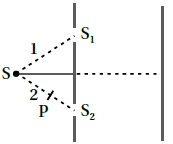
Solution
(N/A) In the absence of a polariser, the intensity of the principal maxima is $I_0 = 4I$, where $I$ is the intensity of light from each slit.
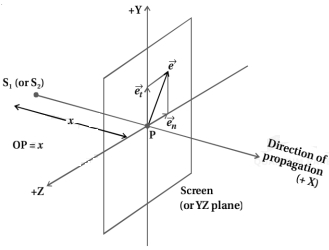
When a polariser is placed in one of the paths (say path $2$), the light passing through it becomes linearly polarised. Let the amplitude of the light from each slit be $a$. The intensity $I = a^2$.
For the slit without the polariser, the light remains unpolarised. For the slit with the polariser, the light becomes polarised.
When these two beams superpose, the unpolarised light can be considered as two incoherent components of intensity $I/2$ each, vibrating in mutually perpendicular directions.
The polarised light from the second slit has intensity $I' = I/2$ (after passing through the polariser).
At the principal maxima, the two beams are in phase. The intensity of the unpolarised beam is $I$ and the polarised beam is $I/2$. The resultant intensity is $I_{max} = I + I/2 + 2\sqrt{I \cdot I/2} \cdot \cos(0) = I + I/2 + \sqrt{2}I = I(1.5 + 1.414) \approx 2.914I$. Since $I_0 = 4I$, $I = I_0/4$. Thus, $I_{max} = (2.914/4)I_0 = 0.7285I_0$.
At the first minima, the phase difference is $\pi$. The intensity is $I_{min} = I + I/2 - 2\sqrt{I \cdot I/2} = I(1.5 - 1.414) = 0.086I = 0.086(I_0/4) = 0.0215I_0$.
When a polariser is placed in one of the paths (say path $2$), the light passing through it becomes linearly polarised. Let the amplitude of the light from each slit be $a$. The intensity $I = a^2$.
For the slit without the polariser, the light remains unpolarised. For the slit with the polariser, the light becomes polarised.
When these two beams superpose, the unpolarised light can be considered as two incoherent components of intensity $I/2$ each, vibrating in mutually perpendicular directions.
The polarised light from the second slit has intensity $I' = I/2$ (after passing through the polariser).
At the principal maxima, the two beams are in phase. The intensity of the unpolarised beam is $I$ and the polarised beam is $I/2$. The resultant intensity is $I_{max} = I + I/2 + 2\sqrt{I \cdot I/2} \cdot \cos(0) = I + I/2 + \sqrt{2}I = I(1.5 + 1.414) \approx 2.914I$. Since $I_0 = 4I$, $I = I_0/4$. Thus, $I_{max} = (2.914/4)I_0 = 0.7285I_0$.
At the first minima, the phase difference is $\pi$. The intensity is $I_{min} = I + I/2 - 2\sqrt{I \cdot I/2} = I(1.5 - 1.414) = 0.086I = 0.086(I_0/4) = 0.0215I_0$.
0 likes
View Solution52
Difficult
Four identical monochromatic sources $A, B, C, D$ as shown in the figure produce waves of the same wavelength $\lambda$ and are coherent. Two receivers $R_1$ and $R_2$ are at great but equal distances from $B$.
$(i)$ Which of the two receivers picks up the larger signal?
$(ii)$ Which of the two receivers picks up the larger signal when $B$ is turned off?
$(iii)$ Which of the two receivers picks up the larger signal when $D$ is turned off?
$(iv)$ Which of the two receivers can distinguish which of the sources $B$ or $D$ has been turned off?
$(i)$ Which of the two receivers picks up the larger signal?
$(ii)$ Which of the two receivers picks up the larger signal when $B$ is turned off?
$(iii)$ Which of the two receivers picks up the larger signal when $D$ is turned off?
$(iv)$ Which of the two receivers can distinguish which of the sources $B$ or $D$ has been turned off?
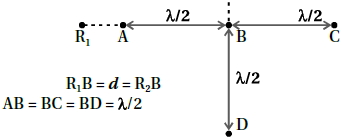
Solution
(B) $(i)$ At $R_1$,the path difference between waves from $A$ and $B$ is $\lambda/2$,leading to destructive interference $(y_A + y_B = 0)$. Similarly,waves from $C$ and $D$ interfere destructively at $R_1$. Thus,the net signal at $R_1$ is zero. At $R_2$,the path differences are different,leading to constructive interference. Therefore,$R_2$ picks up the larger signal.
$(ii)$ If $B$ is turned off,the destructive interference at $R_1$ is removed,resulting in a non-zero signal. $R_2$ also experiences a change,but $R_1$ now receives a stronger resultant signal compared to its previous zero state. Thus,$R_1$ picks up the larger signal.
$(iii)$ If $D$ is turned off,the destructive interference at $R_1$ is removed,resulting in a non-zero signal. $R_1$ picks up the larger signal.
$(iv)$ Since the path differences for $B$ and $D$ are different relative to $R_1$ and $R_2$,the change in signal intensity at the receivers will be unique for each source being turned off. Thus,both receivers can distinguish which source is turned off.
$(ii)$ If $B$ is turned off,the destructive interference at $R_1$ is removed,resulting in a non-zero signal. $R_2$ also experiences a change,but $R_1$ now receives a stronger resultant signal compared to its previous zero state. Thus,$R_1$ picks up the larger signal.
$(iii)$ If $D$ is turned off,the destructive interference at $R_1$ is removed,resulting in a non-zero signal. $R_1$ picks up the larger signal.
$(iv)$ Since the path differences for $B$ and $D$ are different relative to $R_1$ and $R_2$,the change in signal intensity at the receivers will be unique for each source being turned off. Thus,both receivers can distinguish which source is turned off.
0 likes
View Solution53
MediumMCQ
Two light beams of intensities in the ratio of $9: 4$ are allowed to interfere. The ratio of the intensity of maxima and minima will be
A
$2: 3$
B
$16: 81$
C
$25: 169$
D
$25: 1$
Solution
(D) Given the ratio of intensities $I_1 : I_2 = 9 : 4$.
Let $I_1 = 9k$ and $I_2 = 4k$.
The amplitudes are proportional to the square root of intensities,so $a_1 = \sqrt{I_1} = 3\sqrt{k}$ and $a_2 = \sqrt{I_2} = 2\sqrt{k}$.
The ratio of maximum intensity to minimum intensity is given by the formula:
$\frac{I_{max}}{I_{min}} = \left( \frac{a_1 + a_2}{a_1 - a_2} \right)^2$.
Substituting the values:
$\frac{I_{max}}{I_{min}} = \left( \frac{3\sqrt{k} + 2\sqrt{k}}{3\sqrt{k} - 2\sqrt{k}} \right)^2 = \left( \frac{5\sqrt{k}}{1\sqrt{k}} \right)^2 = 5^2 = 25$.
Thus,the ratio is $25 : 1$.
Let $I_1 = 9k$ and $I_2 = 4k$.
The amplitudes are proportional to the square root of intensities,so $a_1 = \sqrt{I_1} = 3\sqrt{k}$ and $a_2 = \sqrt{I_2} = 2\sqrt{k}$.
The ratio of maximum intensity to minimum intensity is given by the formula:
$\frac{I_{max}}{I_{min}} = \left( \frac{a_1 + a_2}{a_1 - a_2} \right)^2$.
Substituting the values:
$\frac{I_{max}}{I_{min}} = \left( \frac{3\sqrt{k} + 2\sqrt{k}}{3\sqrt{k} - 2\sqrt{k}} \right)^2 = \left( \frac{5\sqrt{k}}{1\sqrt{k}} \right)^2 = 5^2 = 25$.
Thus,the ratio is $25 : 1$.
0 likes
View Solution54
DifficultMCQ
In Young's double slit experiment,monochromatic light of wavelength $5000 \ \mathring{A}$ is used. The slits are $1.0 \ mm$ apart and the screen is placed at $1.0 \ m$ away from the slits. The distance from the centre of the screen where intensity becomes half of the maximum intensity for the first time is . . . . . . $\times 10^{-6} \ m$.
A
$121$
B
$122$
C
$124$
D
$125$
Solution
(D) Let the intensity of light on the screen due to each slit be $I_0$.
The maximum intensity at the centre of the screen is $I_{max} = 4I_0$.
The intensity $I$ at a point where the phase difference is $\phi$ is given by $I = I_0 + I_0 + 2\sqrt{I_0 I_0} \cos \phi = 4I_0 \cos^2(\phi/2)$.
We are given that the intensity becomes half of the maximum intensity,so $I = \frac{I_{max}}{2} = 2I_0$.
Thus,$2I_0 = 4I_0 \cos^2(\phi/2) \implies \cos^2(\phi/2) = 1/2 \implies \cos(\phi/2) = 1/\sqrt{2}$.
This gives $\phi/2 = \pi/4$,so the phase difference $\phi = \pi/2$.
The phase difference is related to the path difference $\Delta x$ by $\phi = \frac{2\pi}{\lambda} \Delta x$.
So,$\frac{2\pi}{\lambda} \Delta x = \frac{\pi}{2} \implies \Delta x = \frac{\lambda}{4}$.
For small angles,the path difference $\Delta x = d \sin \theta \approx d \tan \theta = d(y/D)$.
Equating the two,we get $d(y/D) = \lambda/4 \implies y = \frac{\lambda D}{4d}$.
Given $\lambda = 5000 \ \mathring{A} = 5 \times 10^{-7} \ m$,$d = 1.0 \ mm = 10^{-3} \ m$,and $D = 1.0 \ m$.
$y = \frac{5 \times 10^{-7} \times 1}{4 \times 10^{-3}} = 1.25 \times 10^{-4} \ m = 125 \times 10^{-6} \ m$.
Therefore,the distance is $125$.
The maximum intensity at the centre of the screen is $I_{max} = 4I_0$.
The intensity $I$ at a point where the phase difference is $\phi$ is given by $I = I_0 + I_0 + 2\sqrt{I_0 I_0} \cos \phi = 4I_0 \cos^2(\phi/2)$.
We are given that the intensity becomes half of the maximum intensity,so $I = \frac{I_{max}}{2} = 2I_0$.
Thus,$2I_0 = 4I_0 \cos^2(\phi/2) \implies \cos^2(\phi/2) = 1/2 \implies \cos(\phi/2) = 1/\sqrt{2}$.
This gives $\phi/2 = \pi/4$,so the phase difference $\phi = \pi/2$.
The phase difference is related to the path difference $\Delta x$ by $\phi = \frac{2\pi}{\lambda} \Delta x$.
So,$\frac{2\pi}{\lambda} \Delta x = \frac{\pi}{2} \implies \Delta x = \frac{\lambda}{4}$.
For small angles,the path difference $\Delta x = d \sin \theta \approx d \tan \theta = d(y/D)$.
Equating the two,we get $d(y/D) = \lambda/4 \implies y = \frac{\lambda D}{4d}$.
Given $\lambda = 5000 \ \mathring{A} = 5 \times 10^{-7} \ m$,$d = 1.0 \ mm = 10^{-3} \ m$,and $D = 1.0 \ m$.
$y = \frac{5 \times 10^{-7} \times 1}{4 \times 10^{-3}} = 1.25 \times 10^{-4} \ m = 125 \times 10^{-6} \ m$.
Therefore,the distance is $125$.
0 likes
View Solution55
DifficultMCQ
In a Young's double slit experiment,the intensity at a point is $\left(\frac{1}{4}\right)^{\text{th}}$ of the maximum intensity. The minimum distance of the point from the central maximum is . . . . . . . . $\mu m$.
(Given: $\lambda = 600 \ nm, d = 1.0 \ mm, D = 1.0 \ m$)
(Given: $\lambda = 600 \ nm, d = 1.0 \ mm, D = 1.0 \ m$)
A
$197$
B
$198$
C
$199$
D
$200$
Solution
(D) The intensity at any point in a Young's double slit experiment is given by $I = I_{max} \cos^2\left(\frac{\Delta \phi}{2}\right)$,where $\Delta \phi$ is the phase difference.
Given that $I = \frac{I_{max}}{4}$,we have $\frac{I_{max}}{4} = I_{max} \cos^2\left(\frac{\Delta \phi}{2}\right)$.
This simplifies to $\cos^2\left(\frac{\Delta \phi}{2}\right) = \frac{1}{4}$,which means $\cos\left(\frac{\Delta \phi}{2}\right) = \frac{1}{2}$.
Thus,$\frac{\Delta \phi}{2} = \frac{\pi}{3}$,which gives the phase difference $\Delta \phi = \frac{2\pi}{3}$.
The phase difference is related to the path difference $\Delta x$ by $\Delta \phi = \frac{2\pi}{\lambda} \Delta x$. Since $\Delta x = \frac{yd}{D}$,we have $\Delta \phi = \frac{2\pi}{\lambda} \left(\frac{yd}{D}\right)$.
Equating the two expressions for $\Delta \phi$: $\frac{2\pi}{\lambda} \left(\frac{yd}{D}\right) = \frac{2\pi}{3}$.
Solving for $y$: $y = \frac{\lambda D}{3d}$.
Substituting the given values: $y = \frac{600 \times 10^{-9} \ m \times 1.0 \ m}{3 \times 1.0 \times 10^{-3} \ m} = \frac{600 \times 10^{-9}}{3 \times 10^{-3}} \ m = 200 \times 10^{-6} \ m$.
Since $1 \ \mu m = 10^{-6} \ m$,the distance $y = 200 \ \mu m$.
Given that $I = \frac{I_{max}}{4}$,we have $\frac{I_{max}}{4} = I_{max} \cos^2\left(\frac{\Delta \phi}{2}\right)$.
This simplifies to $\cos^2\left(\frac{\Delta \phi}{2}\right) = \frac{1}{4}$,which means $\cos\left(\frac{\Delta \phi}{2}\right) = \frac{1}{2}$.
Thus,$\frac{\Delta \phi}{2} = \frac{\pi}{3}$,which gives the phase difference $\Delta \phi = \frac{2\pi}{3}$.
The phase difference is related to the path difference $\Delta x$ by $\Delta \phi = \frac{2\pi}{\lambda} \Delta x$. Since $\Delta x = \frac{yd}{D}$,we have $\Delta \phi = \frac{2\pi}{\lambda} \left(\frac{yd}{D}\right)$.
Equating the two expressions for $\Delta \phi$: $\frac{2\pi}{\lambda} \left(\frac{yd}{D}\right) = \frac{2\pi}{3}$.
Solving for $y$: $y = \frac{\lambda D}{3d}$.
Substituting the given values: $y = \frac{600 \times 10^{-9} \ m \times 1.0 \ m}{3 \times 1.0 \times 10^{-3} \ m} = \frac{600 \times 10^{-9}}{3 \times 10^{-3}} \ m = 200 \times 10^{-6} \ m$.
Since $1 \ \mu m = 10^{-6} \ m$,the distance $y = 200 \ \mu m$.
0 likes
View Solution56
MediumMCQ
In the Young's double slit experiment using a monochromatic light of wavelength $\lambda$,the path difference (in terms of an integer $n$) corresponding to any point having half the peak intensity is:
A
$(2n+1) \frac{\lambda}{2}$
B
$(2n+1) \frac{\lambda}{4}$
C
$(2n+1) \frac{\lambda}{8}$
D
$(2n+1) \frac{\lambda}{16}$
Solution
(B) The intensity at any point in the interference pattern is given by $I = I_{max} \cos^2(\frac{\phi}{2})$,where $\phi$ is the phase difference.
Given that the intensity is half of the peak intensity,$I = \frac{I_{max}}{2}$.
Substituting this into the equation: $\frac{I_{max}}{2} = I_{max} \cos^2(\frac{\phi}{2})$.
This simplifies to $\cos^2(\frac{\phi}{2}) = \frac{1}{2}$,which means $\cos(\frac{\phi}{2}) = \pm \frac{1}{\sqrt{2}}$.
Thus,$\frac{\phi}{2} = \frac{\pi}{4}, \frac{3\pi}{4}, \frac{5\pi}{4}, \dots$,which implies $\phi = \frac{\pi}{2}, \frac{3\pi}{2}, \frac{5\pi}{2}, \dots$.
In general,$\phi = (2n+1) \frac{\pi}{2}$.
Since the path difference $\Delta x = \frac{\lambda}{2\pi} \phi$,we substitute $\phi$:
$\Delta x = \frac{\lambda}{2\pi} \times (2n+1) \frac{\pi}{2} = (2n+1) \frac{\lambda}{4}$.
Given that the intensity is half of the peak intensity,$I = \frac{I_{max}}{2}$.
Substituting this into the equation: $\frac{I_{max}}{2} = I_{max} \cos^2(\frac{\phi}{2})$.
This simplifies to $\cos^2(\frac{\phi}{2}) = \frac{1}{2}$,which means $\cos(\frac{\phi}{2}) = \pm \frac{1}{\sqrt{2}}$.
Thus,$\frac{\phi}{2} = \frac{\pi}{4}, \frac{3\pi}{4}, \frac{5\pi}{4}, \dots$,which implies $\phi = \frac{\pi}{2}, \frac{3\pi}{2}, \frac{5\pi}{2}, \dots$.
In general,$\phi = (2n+1) \frac{\pi}{2}$.
Since the path difference $\Delta x = \frac{\lambda}{2\pi} \phi$,we substitute $\phi$:
$\Delta x = \frac{\lambda}{2\pi} \times (2n+1) \frac{\pi}{2} = (2n+1) \frac{\lambda}{4}$.
0 likes
View Solution57
MediumMCQ
The two coherent sources produce interference with intensity ratio $b$. In the interference pattern, the ratio $\frac{I_{\text{max}} + I_{\text{min}}}{I_{\text{max}} - I_{\text{min}}}$ will be
A
$\frac{1+b}{\sqrt{b}}$
B
$\frac{1+b}{2\sqrt{b}}$
C
$\frac{2\sqrt{b}}{1+b}$
D
$\frac{2\sqrt{b}}{(1+b)^2}$
Solution
(B) Let the intensities of the two coherent sources be $I_1$ and $I_2$. The ratio of intensities is given as $b = \frac{I_1}{I_2}$.
We know that $I_{\text{max}} = (\sqrt{I_1} + \sqrt{I_2})^2$ and $I_{\text{min}} = (\sqrt{I_1} - \sqrt{I_2})^2$.
The required ratio is $R = \frac{I_{\text{max}} + I_{\text{min}}}{I_{\text{max}} - I_{\text{min}}}$.
Substituting the expressions for $I_{\text{max}}$ and $I_{\text{min}}$:
$R = \frac{(\sqrt{I_1} + \sqrt{I_2})^2 + (\sqrt{I_1} - \sqrt{I_2})^2}{(\sqrt{I_1} + \sqrt{I_2})^2 - (\sqrt{I_1} - \sqrt{I_2})^2}$.
Expanding the terms:
$R = \frac{(I_1 + I_2 + 2\sqrt{I_1I_2}) + (I_1 + I_2 - 2\sqrt{I_1I_2})}{(I_1 + I_2 + 2\sqrt{I_1I_2}) - (I_1 + I_2 - 2\sqrt{I_1I_2})} = \frac{2(I_1 + I_2)}{4\sqrt{I_1I_2}} = \frac{I_1 + I_2}{2\sqrt{I_1I_2}}$.
Dividing numerator and denominator by $I_2$:
$R = \frac{\frac{I_1}{I_2} + 1}{2\sqrt{\frac{I_1}{I_2}}} = \frac{b + 1}{2\sqrt{b}}$.
We know that $I_{\text{max}} = (\sqrt{I_1} + \sqrt{I_2})^2$ and $I_{\text{min}} = (\sqrt{I_1} - \sqrt{I_2})^2$.
The required ratio is $R = \frac{I_{\text{max}} + I_{\text{min}}}{I_{\text{max}} - I_{\text{min}}}$.
Substituting the expressions for $I_{\text{max}}$ and $I_{\text{min}}$:
$R = \frac{(\sqrt{I_1} + \sqrt{I_2})^2 + (\sqrt{I_1} - \sqrt{I_2})^2}{(\sqrt{I_1} + \sqrt{I_2})^2 - (\sqrt{I_1} - \sqrt{I_2})^2}$.
Expanding the terms:
$R = \frac{(I_1 + I_2 + 2\sqrt{I_1I_2}) + (I_1 + I_2 - 2\sqrt{I_1I_2})}{(I_1 + I_2 + 2\sqrt{I_1I_2}) - (I_1 + I_2 - 2\sqrt{I_1I_2})} = \frac{2(I_1 + I_2)}{4\sqrt{I_1I_2}} = \frac{I_1 + I_2}{2\sqrt{I_1I_2}}$.
Dividing numerator and denominator by $I_2$:
$R = \frac{\frac{I_1}{I_2} + 1}{2\sqrt{\frac{I_1}{I_2}}} = \frac{b + 1}{2\sqrt{b}}$.
0 likes
View Solution58
EasyMCQ
The intensity ratio of the maxima and minima in an interference pattern produced by two coherent sources of light is $9: 1$. The intensities of the light sources used are in the ratio (in $: 1$)
A
$3$
B
$4$
C
$9$
D
$10$
Solution
(B) The ratio of maximum intensity to minimum intensity is given by the formula:
$\frac{I_{\max }}{I_{\min }}=\frac{(\sqrt{I_1}+\sqrt{I_2})^2}{(\sqrt{I_1}-\sqrt{I_2})^2}$
Given that $\frac{I_{\max }}{I_{\min }} = \frac{9}{1}$,we have:
$\frac{9}{1} = \frac{(\sqrt{I_1}+\sqrt{I_2})^2}{(\sqrt{I_1}-\sqrt{I_2})^2}$
Taking the square root on both sides:
$\frac{3}{1} = \frac{\sqrt{I_1}+\sqrt{I_2}}{\sqrt{I_1}-\sqrt{I_2}}$
Cross-multiplying gives:
$3(\sqrt{I_1}-\sqrt{I_2}) = 1(\sqrt{I_1}+\sqrt{I_2})$
$3\sqrt{I_1} - 3\sqrt{I_2} = \sqrt{I_1} + \sqrt{I_2}$
$2\sqrt{I_1} = 4\sqrt{I_2}$
$\sqrt{\frac{I_1}{I_2}} = \frac{4}{2} = 2$
Squaring both sides,we get:
$\frac{I_1}{I_2} = \frac{4}{1}$
Thus,the ratio of the intensities of the light sources is $4: 1$.
$\frac{I_{\max }}{I_{\min }}=\frac{(\sqrt{I_1}+\sqrt{I_2})^2}{(\sqrt{I_1}-\sqrt{I_2})^2}$
Given that $\frac{I_{\max }}{I_{\min }} = \frac{9}{1}$,we have:
$\frac{9}{1} = \frac{(\sqrt{I_1}+\sqrt{I_2})^2}{(\sqrt{I_1}-\sqrt{I_2})^2}$
Taking the square root on both sides:
$\frac{3}{1} = \frac{\sqrt{I_1}+\sqrt{I_2}}{\sqrt{I_1}-\sqrt{I_2}}$
Cross-multiplying gives:
$3(\sqrt{I_1}-\sqrt{I_2}) = 1(\sqrt{I_1}+\sqrt{I_2})$
$3\sqrt{I_1} - 3\sqrt{I_2} = \sqrt{I_1} + \sqrt{I_2}$
$2\sqrt{I_1} = 4\sqrt{I_2}$
$\sqrt{\frac{I_1}{I_2}} = \frac{4}{2} = 2$
Squaring both sides,we get:
$\frac{I_1}{I_2} = \frac{4}{1}$
Thus,the ratio of the intensities of the light sources is $4: 1$.
0 likes
View Solution59
MediumMCQ
In Young's double slit experiment,the intensity of light at a point on the screen where the path difference is $\lambda$ is $x$ units,where $\lambda$ is the wavelength of light used. The intensity at a point where the path difference is $\frac{\lambda}{4}$ will be $\left(\cos 2\pi = 1, \cos \frac{\pi}{2} = 0\right)$.
A
$\frac{x}{4}$
B
$\frac{x}{2}$
C
$x$
D
zero
Solution
(B) The intensity of light in Young's double slit experiment is given by $I = 4I_0 \cos^2(\frac{\phi}{2})$,where $I_0$ is the intensity of each individual slit and $\phi$ is the phase difference.
Case $1$: Path difference $\Delta x = \lambda$.
The phase difference is $\phi = \frac{2\pi}{\lambda} \times \Delta x = \frac{2\pi}{\lambda} \times \lambda = 2\pi$.
Given intensity $I = x$,so $x = 4I_0 \cos^2(\frac{2\pi}{2}) = 4I_0 \cos^2(\pi) = 4I_0(1)^2 = 4I_0$.
Thus,$4I_0 = x$.
Case $2$: Path difference $\Delta x = \frac{\lambda}{4}$.
The phase difference is $\phi' = \frac{2\pi}{\lambda} \times \frac{\lambda}{4} = \frac{\pi}{2}$.
The new intensity $I'$ is $I' = 4I_0 \cos^2(\frac{\phi'}{2}) = 4I_0 \cos^2(\frac{\pi/2}{2}) = 4I_0 \cos^2(\frac{\pi}{4})$.
Since $\cos(\frac{\pi}{4}) = \frac{1}{\sqrt{2}}$,we have $I' = 4I_0 \times (\frac{1}{\sqrt{2}})^2 = 4I_0 \times \frac{1}{2} = 2I_0$.
Since $4I_0 = x$,then $2I_0 = \frac{x}{2}$.
Therefore,the intensity is $\frac{x}{2}$.
Case $1$: Path difference $\Delta x = \lambda$.
The phase difference is $\phi = \frac{2\pi}{\lambda} \times \Delta x = \frac{2\pi}{\lambda} \times \lambda = 2\pi$.
Given intensity $I = x$,so $x = 4I_0 \cos^2(\frac{2\pi}{2}) = 4I_0 \cos^2(\pi) = 4I_0(1)^2 = 4I_0$.
Thus,$4I_0 = x$.
Case $2$: Path difference $\Delta x = \frac{\lambda}{4}$.
The phase difference is $\phi' = \frac{2\pi}{\lambda} \times \frac{\lambda}{4} = \frac{\pi}{2}$.
The new intensity $I'$ is $I' = 4I_0 \cos^2(\frac{\phi'}{2}) = 4I_0 \cos^2(\frac{\pi/2}{2}) = 4I_0 \cos^2(\frac{\pi}{4})$.
Since $\cos(\frac{\pi}{4}) = \frac{1}{\sqrt{2}}$,we have $I' = 4I_0 \times (\frac{1}{\sqrt{2}})^2 = 4I_0 \times \frac{1}{2} = 2I_0$.
Since $4I_0 = x$,then $2I_0 = \frac{x}{2}$.
Therefore,the intensity is $\frac{x}{2}$.
0 likes
View Solution60
MediumMCQ
In Young's double slit experiment,at two points $P$ and $Q$ on the screen,waves from slits $S_1$ and $S_2$ have a path difference of $0$ and $\frac{\lambda}{4}$ respectively. The ratio of intensities at point $P$ to that at $Q$ will be $(\cos 0^{\circ}=1, \cos 45^{\circ}=\frac{1}{\sqrt{2}})$.
A
$3: 2$
B
$2: 1$
C
$\sqrt{2}: 1$
D
$4: 1$
Solution
(B) The intensity $I$ at any point on the screen in Young's double slit experiment is given by $I = I_{max} \cos^2(\frac{\phi}{2})$,where $\phi$ is the phase difference.
Phase difference $\phi = \frac{2\pi}{\lambda} \times (\text{path difference} \Delta x)$.
For point $P$,path difference $\Delta x_P = 0$,so $\phi_P = 0$. Intensity $I_P = I_{max} \cos^2(0) = I_{max}$.
For point $Q$,path difference $\Delta x_Q = \frac{\lambda}{4}$,so $\phi_Q = \frac{2\pi}{\lambda} \times \frac{\lambda}{4} = \frac{\pi}{2} = 90^{\circ}$.
Intensity $I_Q = I_{max} \cos^2(\frac{90^{\circ}}{2}) = I_{max} \cos^2(45^{\circ}) = I_{max} \times (\frac{1}{\sqrt{2}})^2 = \frac{I_{max}}{2}$.
The ratio of intensities is $\frac{I_P}{I_Q} = \frac{I_{max}}{I_{max}/2} = 2: 1$.
Phase difference $\phi = \frac{2\pi}{\lambda} \times (\text{path difference} \Delta x)$.
For point $P$,path difference $\Delta x_P = 0$,so $\phi_P = 0$. Intensity $I_P = I_{max} \cos^2(0) = I_{max}$.
For point $Q$,path difference $\Delta x_Q = \frac{\lambda}{4}$,so $\phi_Q = \frac{2\pi}{\lambda} \times \frac{\lambda}{4} = \frac{\pi}{2} = 90^{\circ}$.
Intensity $I_Q = I_{max} \cos^2(\frac{90^{\circ}}{2}) = I_{max} \cos^2(45^{\circ}) = I_{max} \times (\frac{1}{\sqrt{2}})^2 = \frac{I_{max}}{2}$.
The ratio of intensities is $\frac{I_P}{I_Q} = \frac{I_{max}}{I_{max}/2} = 2: 1$.
0 likes
View Solution61
MediumMCQ
The intensity of light coming from one of the slits in Young's double slit experiment is double the intensity from the other slit. The ratio of the maximum intensity to the minimum intensity in the interference fringe pattern observed is (in $: 1$)
A
$9$
B
$34$
C
$4$
D
$16$
Solution
(B) Two coherent sources of intensities $I_1$ and $I_2$ produce maximum intensity $I_{\max} = (\sqrt{I_1} + \sqrt{I_2})^2$ and minimum intensity $I_{\min} = (\sqrt{I_1} - \sqrt{I_2})^2$ in an interference pattern.
The ratio is given by $\frac{I_{\max}}{I_{\min}} = \frac{(\sqrt{I_1} + \sqrt{I_2})^2}{(\sqrt{I_1} - \sqrt{I_2})^2}$.
Given $I_1 = 2I_2$,we substitute this into the ratio:
$\frac{I_{\max}}{I_{\min}} = \frac{(\sqrt{2I_2} + \sqrt{I_2})^2}{(\sqrt{2I_2} - \sqrt{I_2})^2} = \frac{(\sqrt{I_2}(\sqrt{2} + 1))^2}{(\sqrt{I_2}(\sqrt{2} - 1))^2} = \frac{(\sqrt{2} + 1)^2}{(\sqrt{2} - 1)^2}$.
Expanding the squares: $\frac{2 + 1 + 2\sqrt{2}}{2 + 1 - 2\sqrt{2}} = \frac{3 + 2\sqrt{2}}{3 - 2\sqrt{2}}$.
Rationalizing the denominator: $\frac{(3 + 2\sqrt{2})(3 + 2\sqrt{2})}{(3 - 2\sqrt{2})(3 + 2\sqrt{2})} = \frac{9 + 8 + 12\sqrt{2}}{9 - 8} = 17 + 12\sqrt{2} \approx 33.97 \approx 34$.
Thus,the ratio is $34:1$.
The ratio is given by $\frac{I_{\max}}{I_{\min}} = \frac{(\sqrt{I_1} + \sqrt{I_2})^2}{(\sqrt{I_1} - \sqrt{I_2})^2}$.
Given $I_1 = 2I_2$,we substitute this into the ratio:
$\frac{I_{\max}}{I_{\min}} = \frac{(\sqrt{2I_2} + \sqrt{I_2})^2}{(\sqrt{2I_2} - \sqrt{I_2})^2} = \frac{(\sqrt{I_2}(\sqrt{2} + 1))^2}{(\sqrt{I_2}(\sqrt{2} - 1))^2} = \frac{(\sqrt{2} + 1)^2}{(\sqrt{2} - 1)^2}$.
Expanding the squares: $\frac{2 + 1 + 2\sqrt{2}}{2 + 1 - 2\sqrt{2}} = \frac{3 + 2\sqrt{2}}{3 - 2\sqrt{2}}$.
Rationalizing the denominator: $\frac{(3 + 2\sqrt{2})(3 + 2\sqrt{2})}{(3 - 2\sqrt{2})(3 + 2\sqrt{2})} = \frac{9 + 8 + 12\sqrt{2}}{9 - 8} = 17 + 12\sqrt{2} \approx 33.97 \approx 34$.
Thus,the ratio is $34:1$.
0 likes
View Solution62
MediumMCQ
In Young's double slit experiment using monochromatic light of wavelength $\lambda$,the intensity of light at a point on the screen where the path difference is $\lambda$ is $K$ units. What is the intensity of light at a point where the path difference is $\frac{\lambda}{6}$? $\left[\cos \frac{\pi}{6} = \frac{\sqrt{3}}{2}\right]$
A
$K$
B
$\frac{3K}{4}$
C
$\frac{K}{2}$
D
$\frac{K}{4}$
Solution
(B) The intensity in Young's double slit experiment is given by $I = I_{max} \cos^2 \left( \frac{\phi}{2} \right)$,where $\phi$ is the phase difference.
Given that at path difference $\Delta x = \lambda$,the intensity is $K$. Since $\Delta x = \lambda$ corresponds to a phase difference $\phi = \frac{2\pi}{\lambda} \cdot \lambda = 2\pi$,we have $I = I_{max} \cos^2(\pi) = I_{max} = K$.
Now,for a path difference $\Delta x = \frac{\lambda}{6}$,the phase difference is $\phi = \frac{2\pi}{\lambda} \cdot \frac{\lambda}{6} = \frac{\pi}{3}$.
The intensity at this point is $I = K \cos^2 \left( \frac{\pi/3}{2} \right) = K \cos^2 \left( \frac{\pi}{6} \right)$.
Substituting $\cos \frac{\pi}{6} = \frac{\sqrt{3}}{2}$,we get $I = K \left( \frac{\sqrt{3}}{2} \right)^2 = K \left( \frac{3}{4} \right) = \frac{3K}{4}$.
Given that at path difference $\Delta x = \lambda$,the intensity is $K$. Since $\Delta x = \lambda$ corresponds to a phase difference $\phi = \frac{2\pi}{\lambda} \cdot \lambda = 2\pi$,we have $I = I_{max} \cos^2(\pi) = I_{max} = K$.
Now,for a path difference $\Delta x = \frac{\lambda}{6}$,the phase difference is $\phi = \frac{2\pi}{\lambda} \cdot \frac{\lambda}{6} = \frac{\pi}{3}$.
The intensity at this point is $I = K \cos^2 \left( \frac{\pi/3}{2} \right) = K \cos^2 \left( \frac{\pi}{6} \right)$.
Substituting $\cos \frac{\pi}{6} = \frac{\sqrt{3}}{2}$,we get $I = K \left( \frac{\sqrt{3}}{2} \right)^2 = K \left( \frac{3}{4} \right) = \frac{3K}{4}$.
0 likes
View Solution63
MediumMCQ
In the Young's double slit experiment,the intensity at a point on the screen,where the path difference is $\lambda$ ($\lambda =$ wavelength),is $\beta$. The intensity at a point where the path difference is $\lambda / 3$ will be: [Given: $\cos(\pi/3) = 1/2$]
A
$\beta$
B
$\beta / 2$
C
$\beta / 4$
D
$\beta / 8$
Solution
(C) The intensity $I$ in Young's double slit experiment is given by the formula $I = I_{max} \cos^2(\phi/2)$,where $\phi$ is the phase difference.
Given that the intensity at a path difference of $\lambda$ is $\beta$,we know that for a path difference of $\lambda$,the phase difference $\phi = (2\pi/\lambda) \times \lambda = 2\pi$.
Thus,$\beta = I_{max} \cos^2(2\pi/2) = I_{max} \cos^2(\pi) = I_{max}(1)^2 = I_{max}$.
Now,for a path difference of $\Delta x = \lambda/3$,the phase difference is $\phi = (2\pi/\lambda) \times (\lambda/3) = 2\pi/3$.
The intensity at this point is $I = I_{max} \cos^2(\phi/2) = \beta \cos^2((2\pi/3)/2) = \beta \cos^2(\pi/3)$.
Since $\cos(\pi/3) = 1/2$,we have $I = \beta (1/2)^2 = \beta/4$.
Given that the intensity at a path difference of $\lambda$ is $\beta$,we know that for a path difference of $\lambda$,the phase difference $\phi = (2\pi/\lambda) \times \lambda = 2\pi$.
Thus,$\beta = I_{max} \cos^2(2\pi/2) = I_{max} \cos^2(\pi) = I_{max}(1)^2 = I_{max}$.
Now,for a path difference of $\Delta x = \lambda/3$,the phase difference is $\phi = (2\pi/\lambda) \times (\lambda/3) = 2\pi/3$.
The intensity at this point is $I = I_{max} \cos^2(\phi/2) = \beta \cos^2((2\pi/3)/2) = \beta \cos^2(\pi/3)$.
Since $\cos(\pi/3) = 1/2$,we have $I = \beta (1/2)^2 = \beta/4$.
0 likes
View Solution64
DifficultMCQ
In Young's double slit experiment,the intensity at a point on the screen is $K$,where the path difference is $\lambda$. What will be the intensity at the point where the path difference is $\frac{\lambda}{4}$?
A
$\frac{K}{4}$
B
$\frac{K}{2}$
C
$K$
D
$0$
Solution
(B) The intensity in Young's double slit experiment is given by $I = 4I_0 \cos^2(\frac{\phi}{2})$,where $\phi$ is the phase difference.
Phase difference $\phi$ is related to path difference $\Delta x$ by $\phi = \frac{2\pi}{\lambda} \Delta x$.
For path difference $\Delta x = \lambda$,the phase difference is $\phi = \frac{2\pi}{\lambda} \times \lambda = 2\pi$.
Given intensity $K = 4I_0 \cos^2(\frac{2\pi}{2}) = 4I_0 \cos^2(\pi) = 4I_0(1)^2 = 4I_0$.
Now,for path difference $\Delta x = \frac{\lambda}{4}$,the phase difference is $\phi' = \frac{2\pi}{\lambda} \times \frac{\lambda}{4} = \frac{\pi}{2}$.
The new intensity $K'$ is $K' = 4I_0 \cos^2(\frac{\pi/2}{2}) = 4I_0 \cos^2(\frac{\pi}{4})$.
Since $\cos(\frac{\pi}{4}) = \frac{1}{\sqrt{2}}$,we have $K' = 4I_0 \times (\frac{1}{\sqrt{2}})^2 = 4I_0 \times \frac{1}{2} = 2I_0$.
Since $K = 4I_0$,then $2I_0 = \frac{K}{2}$.
Therefore,the intensity is $\frac{K}{2}$.
Phase difference $\phi$ is related to path difference $\Delta x$ by $\phi = \frac{2\pi}{\lambda} \Delta x$.
For path difference $\Delta x = \lambda$,the phase difference is $\phi = \frac{2\pi}{\lambda} \times \lambda = 2\pi$.
Given intensity $K = 4I_0 \cos^2(\frac{2\pi}{2}) = 4I_0 \cos^2(\pi) = 4I_0(1)^2 = 4I_0$.
Now,for path difference $\Delta x = \frac{\lambda}{4}$,the phase difference is $\phi' = \frac{2\pi}{\lambda} \times \frac{\lambda}{4} = \frac{\pi}{2}$.
The new intensity $K'$ is $K' = 4I_0 \cos^2(\frac{\pi/2}{2}) = 4I_0 \cos^2(\frac{\pi}{4})$.
Since $\cos(\frac{\pi}{4}) = \frac{1}{\sqrt{2}}$,we have $K' = 4I_0 \times (\frac{1}{\sqrt{2}})^2 = 4I_0 \times \frac{1}{2} = 2I_0$.
Since $K = 4I_0$,then $2I_0 = \frac{K}{2}$.
Therefore,the intensity is $\frac{K}{2}$.
0 likes
View Solution65
EasyMCQ
In Young's double slit experiment,the intensity of light at a point on the screen is $K$ unit for path difference $\lambda$. What would be the intensity at a point if path difference is $\frac{\lambda}{4}$?
A
zero
B
$\frac{K}{4}$
C
$K$
D
$\frac{K}{2}$
Solution
(D) The intensity of light in Young's double slit experiment is given by $I = 4I_0 \cos^2(\frac{\phi}{2})$,where $I_0$ is the intensity of each individual wave and $\phi$ is the phase difference.
Phase difference $\phi$ is related to path difference $\Delta x$ by $\phi = \frac{2\pi}{\lambda} \Delta x$.
For path difference $\Delta x = \lambda$,the phase difference is $\phi = \frac{2\pi}{\lambda} \cdot \lambda = 2\pi$.
Given intensity $K = 4I_0 \cos^2(\frac{2\pi}{2}) = 4I_0 \cos^2(\pi) = 4I_0(1)^2 = 4I_0$.
For path difference $\Delta x = \frac{\lambda}{4}$,the phase difference is $\phi' = \frac{2\pi}{\lambda} \cdot \frac{\lambda}{4} = \frac{\pi}{2}$.
The new intensity $I'$ is $I' = 4I_0 \cos^2(\frac{\pi/2}{2}) = 4I_0 \cos^2(\frac{\pi}{4})$.
Since $\cos(\frac{\pi}{4}) = \frac{1}{\sqrt{2}}$,we have $I' = 4I_0 \cdot (\frac{1}{\sqrt{2}})^2 = 4I_0 \cdot \frac{1}{2} = 2I_0$.
Since $K = 4I_0$,then $2I_0 = \frac{K}{2}$.
Therefore,the intensity is $\frac{K}{2}$.
Phase difference $\phi$ is related to path difference $\Delta x$ by $\phi = \frac{2\pi}{\lambda} \Delta x$.
For path difference $\Delta x = \lambda$,the phase difference is $\phi = \frac{2\pi}{\lambda} \cdot \lambda = 2\pi$.
Given intensity $K = 4I_0 \cos^2(\frac{2\pi}{2}) = 4I_0 \cos^2(\pi) = 4I_0(1)^2 = 4I_0$.
For path difference $\Delta x = \frac{\lambda}{4}$,the phase difference is $\phi' = \frac{2\pi}{\lambda} \cdot \frac{\lambda}{4} = \frac{\pi}{2}$.
The new intensity $I'$ is $I' = 4I_0 \cos^2(\frac{\pi/2}{2}) = 4I_0 \cos^2(\frac{\pi}{4})$.
Since $\cos(\frac{\pi}{4}) = \frac{1}{\sqrt{2}}$,we have $I' = 4I_0 \cdot (\frac{1}{\sqrt{2}})^2 = 4I_0 \cdot \frac{1}{2} = 2I_0$.
Since $K = 4I_0$,then $2I_0 = \frac{K}{2}$.
Therefore,the intensity is $\frac{K}{2}$.
0 likes
View Solution66
MediumMCQ
In Young's double slit experiment,the resultant intensity of light at a point on the screen is $I$ when the path difference is $\lambda$. When the path difference is $\frac{\lambda}{4}$,the intensity at a point will be (where $\lambda$ is the wavelength of light).
A
Zero
B
$I$
C
$\frac{I}{2}$
D
$\frac{I}{4}$
Solution
(C) The resultant intensity $I_R$ in Young's double slit experiment is given by $I_R = 4I_0 \cos^2(\frac{\phi}{2})$,where $I_0$ is the intensity of each individual slit and $\phi$ is the phase difference.
Phase difference $\phi$ is related to path difference $\Delta x$ by $\phi = \frac{2\pi}{\lambda} \Delta x$.
Case $1$: When $\Delta x = \lambda$,$\phi = \frac{2\pi}{\lambda} \times \lambda = 2\pi$. The intensity $I = 4I_0 \cos^2(\frac{2\pi}{2}) = 4I_0 \cos^2(\pi) = 4I_0(-1)^2 = 4I_0$.
Case $2$: When $\Delta x = \frac{\lambda}{4}$,$\phi = \frac{2\pi}{\lambda} \times \frac{\lambda}{4} = \frac{\pi}{2}$.
The new intensity $I' = 4I_0 \cos^2(\frac{\pi/2}{2}) = 4I_0 \cos^2(\frac{\pi}{4}) = 4I_0 (\frac{1}{\sqrt{2}})^2 = 4I_0 \times \frac{1}{2} = 2I_0$.
Since $I = 4I_0$,we have $I_0 = \frac{I}{4}$.
Substituting $I_0$ into the expression for $I'$,we get $I' = 2(\frac{I}{4}) = \frac{I}{2}$.
Phase difference $\phi$ is related to path difference $\Delta x$ by $\phi = \frac{2\pi}{\lambda} \Delta x$.
Case $1$: When $\Delta x = \lambda$,$\phi = \frac{2\pi}{\lambda} \times \lambda = 2\pi$. The intensity $I = 4I_0 \cos^2(\frac{2\pi}{2}) = 4I_0 \cos^2(\pi) = 4I_0(-1)^2 = 4I_0$.
Case $2$: When $\Delta x = \frac{\lambda}{4}$,$\phi = \frac{2\pi}{\lambda} \times \frac{\lambda}{4} = \frac{\pi}{2}$.
The new intensity $I' = 4I_0 \cos^2(\frac{\pi/2}{2}) = 4I_0 \cos^2(\frac{\pi}{4}) = 4I_0 (\frac{1}{\sqrt{2}})^2 = 4I_0 \times \frac{1}{2} = 2I_0$.
Since $I = 4I_0$,we have $I_0 = \frac{I}{4}$.
Substituting $I_0$ into the expression for $I'$,we get $I' = 2(\frac{I}{4}) = \frac{I}{2}$.
0 likes
View Solution67
EasyMCQ
Two beams of light having intensities $I$ and $4I$ interfere to produce a fringe pattern on a screen. The phase difference between the beams is $\pi / 2$ at point $A$ and $\pi$ at point $B$. Then the difference between the resultant intensities at $A$ and $B$ is (in $I$)
A
$4$
B
$5$
C
$2$
D
$3$
Solution
(A) The resultant intensity $I_R$ for two interfering beams with intensities $I_1$ and $I_2$ and phase difference $\phi$ is given by $I_R = I_1 + I_2 + 2\sqrt{I_1 I_2} \cos \phi$.
Given $I_1 = I$ and $I_2 = 4I$.
At point $A$,the phase difference $\phi_A = \pi / 2$. Thus,$I_A = I + 4I + 2\sqrt{I \cdot 4I} \cos(\pi / 2) = 5I + 4I(0) = 5I$.
At point $B$,the phase difference $\phi_B = \pi$. Thus,$I_B = I + 4I + 2\sqrt{I \cdot 4I} \cos(\pi) = 5I + 4I(-1) = 5I - 4I = I$.
The difference between the resultant intensities at $A$ and $B$ is $I_A - I_B = 5I - I = 4I$.
Given $I_1 = I$ and $I_2 = 4I$.
At point $A$,the phase difference $\phi_A = \pi / 2$. Thus,$I_A = I + 4I + 2\sqrt{I \cdot 4I} \cos(\pi / 2) = 5I + 4I(0) = 5I$.
At point $B$,the phase difference $\phi_B = \pi$. Thus,$I_B = I + 4I + 2\sqrt{I \cdot 4I} \cos(\pi) = 5I + 4I(-1) = 5I - 4I = I$.
The difference between the resultant intensities at $A$ and $B$ is $I_A - I_B = 5I - I = 4I$.
0 likes
View Solution68
EasyMCQ
The wavelength of the light used in Young's double slit experiment is $\lambda$. The intensity at a point on the screen is $I$,where the path difference is $\frac{\lambda}{6}$. If $I_{0}$ denotes the maximum intensity,then the ratio of $I$ and $I_{0}$ is
A
$0.866$
B
$0.5$
C
$0.707$
D
$0.75$
Solution
(D) The phase difference $\phi$ is related to the path difference $\Delta x$ by the formula: $\phi = \frac{2\pi}{\lambda} \times \Delta x$.
Given the path difference $\Delta x = \frac{\lambda}{6}$,we calculate the phase difference: $\phi = \frac{2\pi}{\lambda} \times \frac{\lambda}{6} = \frac{\pi}{3} = 60^{\circ}$.
The intensity $I$ at any point on the screen is given by $I = I_{0} \cos^{2}\left(\frac{\phi}{2}\right)$,where $I_{0}$ is the maximum intensity.
Substituting the value of $\phi$: $\frac{I}{I_{0}} = \cos^{2}\left(\frac{60^{\circ}}{2}\right) = \cos^{2}(30^{\circ})$.
Since $\cos(30^{\circ}) = \frac{\sqrt{3}}{2}$,we have $\frac{I}{I_{0}} = \left(\frac{\sqrt{3}}{2}\right)^{2} = \frac{3}{4} = 0.75$.
Given the path difference $\Delta x = \frac{\lambda}{6}$,we calculate the phase difference: $\phi = \frac{2\pi}{\lambda} \times \frac{\lambda}{6} = \frac{\pi}{3} = 60^{\circ}$.
The intensity $I$ at any point on the screen is given by $I = I_{0} \cos^{2}\left(\frac{\phi}{2}\right)$,where $I_{0}$ is the maximum intensity.
Substituting the value of $\phi$: $\frac{I}{I_{0}} = \cos^{2}\left(\frac{60^{\circ}}{2}\right) = \cos^{2}(30^{\circ})$.
Since $\cos(30^{\circ}) = \frac{\sqrt{3}}{2}$,we have $\frac{I}{I_{0}} = \left(\frac{\sqrt{3}}{2}\right)^{2} = \frac{3}{4} = 0.75$.
0 likes
View Solution69
MediumMCQ
Two coherent light sources having intensity in the ratio $2x$ produce an interference pattern. Then the value of $\frac{I_{\max }-I_{\min }}{I_{\max }+I_{\min }}$ will be
A
$\frac{2 \sqrt{2 x}}{x+1}$
B
$\frac{\sqrt{2 x}}{2 x+1}$
C
$\frac{2 \sqrt{2 x}}{2 x+1}$
D
$\frac{\sqrt{2 x}}{x+1}$
Solution
(C) Given the ratio of intensities of two coherent sources is $\frac{I_1}{I_2} = 2x$.
We know that $I_{\max} = (\sqrt{I_1} + \sqrt{I_2})^2$ and $I_{\min} = (\sqrt{I_1} - \sqrt{I_2})^2$.
The expression to evaluate is $V = \frac{I_{\max} - I_{\min}}{I_{\max} + I_{\min}}$.
Substituting the expressions for $I_{\max}$ and $I_{\min}$:
$V = \frac{(\sqrt{I_1} + \sqrt{I_2})^2 - (\sqrt{I_1} - \sqrt{I_2})^2}{(\sqrt{I_1} + \sqrt{I_2})^2 + (\sqrt{I_1} - \sqrt{I_2})^2}$.
Using the algebraic identities $(a+b)^2 - (a-b)^2 = 4ab$ and $(a+b)^2 + (a-b)^2 = 2(a^2 + b^2)$:
$V = \frac{4\sqrt{I_1 I_2}}{2(I_1 + I_2)} = \frac{2\sqrt{I_1 I_2}}{I_1 + I_2}$.
Dividing the numerator and denominator by $I_2$:
$V = \frac{2\sqrt{I_1/I_2}}{I_1/I_2 + 1}$.
Substituting $\frac{I_1}{I_2} = 2x$:
$V = \frac{2\sqrt{2x}}{2x + 1}$.
We know that $I_{\max} = (\sqrt{I_1} + \sqrt{I_2})^2$ and $I_{\min} = (\sqrt{I_1} - \sqrt{I_2})^2$.
The expression to evaluate is $V = \frac{I_{\max} - I_{\min}}{I_{\max} + I_{\min}}$.
Substituting the expressions for $I_{\max}$ and $I_{\min}$:
$V = \frac{(\sqrt{I_1} + \sqrt{I_2})^2 - (\sqrt{I_1} - \sqrt{I_2})^2}{(\sqrt{I_1} + \sqrt{I_2})^2 + (\sqrt{I_1} - \sqrt{I_2})^2}$.
Using the algebraic identities $(a+b)^2 - (a-b)^2 = 4ab$ and $(a+b)^2 + (a-b)^2 = 2(a^2 + b^2)$:
$V = \frac{4\sqrt{I_1 I_2}}{2(I_1 + I_2)} = \frac{2\sqrt{I_1 I_2}}{I_1 + I_2}$.
Dividing the numerator and denominator by $I_2$:
$V = \frac{2\sqrt{I_1/I_2}}{I_1/I_2 + 1}$.
Substituting $\frac{I_1}{I_2} = 2x$:
$V = \frac{2\sqrt{2x}}{2x + 1}$.
0 likes
View Solution70
MediumMCQ
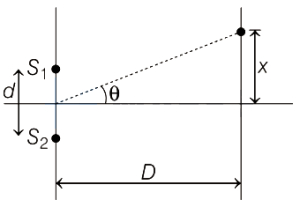
In Young's double slit experiment, the intensity of the central fringe is $I_0$ and the fringe width is $\beta$. If a point is at a distance $x$ from the central fringe, then the intensity at that point is
A
$I_0 \cos ^2\left(\frac{\pi x}{\beta}\right)$
B
$I_0 \cos ^2\left(\frac{x}{\beta}\right)$
C
$\frac{I_0}{4} \cos ^2\left(\frac{\pi x}{\beta}\right)$
D
$I_0 \cos ^2\left(\frac{\pi \beta}{x}\right)$
Solution
(A) In Young's double slit experiment, the intensity at any point on the screen is given by $I = I_{max} \cos^2 \left( \frac{\phi}{2} \right)$, where $\phi$ is the phase difference.
Given that the intensity of the central fringe is $I_0$, we have $I_{max} = I_0$.
The phase difference $\phi$ is related to the path difference $\Delta p$ as $\phi = \frac{2\pi}{\lambda} \Delta p$.
For a point at distance $x$ from the central fringe, the path difference is $\Delta p = d \sin \theta \approx d \tan \theta = d \left( \frac{x}{D} \right)$.
Thus, $\phi = \frac{2\pi}{\lambda} \left( \frac{dx}{D} \right)$.
We know that the fringe width is $\beta = \frac{\lambda D}{d}$, which implies $\frac{d}{\lambda D} = \frac{1}{\beta}$.
Substituting this into the phase difference expression, we get $\phi = 2\pi \left( \frac{x}{\beta} \right)$.
Now, substituting $\phi$ into the intensity formula: $I = I_0 \cos^2 \left( \frac{2\pi x / \beta}{2} \right) = I_0 \cos^2 \left( \frac{\pi x}{\beta} \right)$.
Given that the intensity of the central fringe is $I_0$, we have $I_{max} = I_0$.
The phase difference $\phi$ is related to the path difference $\Delta p$ as $\phi = \frac{2\pi}{\lambda} \Delta p$.
For a point at distance $x$ from the central fringe, the path difference is $\Delta p = d \sin \theta \approx d \tan \theta = d \left( \frac{x}{D} \right)$.
Thus, $\phi = \frac{2\pi}{\lambda} \left( \frac{dx}{D} \right)$.
We know that the fringe width is $\beta = \frac{\lambda D}{d}$, which implies $\frac{d}{\lambda D} = \frac{1}{\beta}$.
Substituting this into the phase difference expression, we get $\phi = 2\pi \left( \frac{x}{\beta} \right)$.
Now, substituting $\phi$ into the intensity formula: $I = I_0 \cos^2 \left( \frac{2\pi x / \beta}{2} \right) = I_0 \cos^2 \left( \frac{\pi x}{\beta} \right)$.
0 likes
View Solution71
EasyMCQ
In Young's double slit experiment, the slits separated by $0.6 \, mm$ are illuminated with light of $6600 \, Å$. Interference pattern is obtained on a screen placed at $4 \, m$ from the slits. The minimum distance from the central maximum at which the average intensity is $50 \%$ of the maximum value is (in $ \, mm$)
A
$0.21$
B
$2.1$
C
$0.11$
D
$1.1$
Solution
(D) The intensity in a double slit experiment is given by $I = I_{max} \cos^2(\frac{\phi}{2})$, where $\phi$ is the phase difference.
We are given that $I = 0.5 I_{max}$, so $0.5 I_{max} = I_{max} \cos^2(\frac{\phi}{2})$.
This implies $\cos^2(\frac{\phi}{2}) = 0.5$, or $\cos(\frac{\phi}{2}) = \frac{1}{\sqrt{2}}$.
Thus, $\frac{\phi}{2} = \frac{\pi}{4}$, which gives $\phi = \frac{\pi}{2}$.
The phase difference $\phi$ is related to the path difference $\Delta x$ by $\phi = \frac{2\pi}{\lambda} \Delta x$.
Substituting $\phi = \frac{\pi}{2}$, we get $\frac{\pi}{2} = \frac{2\pi}{\lambda} \Delta x$, which means $\Delta x = \frac{\lambda}{4}$.
The path difference for a point at distance $y$ from the central maximum is $\Delta x = \frac{yd}{D}$.
Equating the two, $\frac{yd}{D} = \frac{\lambda}{4}$, so $y = \frac{\lambda D}{4d}$.
Given $\lambda = 6600 \, Å = 6.6 \times 10^{-7} \, m$, $D = 4 \, m$, and $d = 0.6 \, mm = 6 \times 10^{-4} \, m$.
$y = \frac{(6.6 \times 10^{-7} \, m) \times (4 \, m)}{4 \times (6 \times 10^{-4} \, m)} = \frac{6.6 \times 10^{-7}}{6 \times 10^{-4}} \, m = 1.1 \times 10^{-3} \, m = 1.1 \, mm$.
We are given that $I = 0.5 I_{max}$, so $0.5 I_{max} = I_{max} \cos^2(\frac{\phi}{2})$.
This implies $\cos^2(\frac{\phi}{2}) = 0.5$, or $\cos(\frac{\phi}{2}) = \frac{1}{\sqrt{2}}$.
Thus, $\frac{\phi}{2} = \frac{\pi}{4}$, which gives $\phi = \frac{\pi}{2}$.
The phase difference $\phi$ is related to the path difference $\Delta x$ by $\phi = \frac{2\pi}{\lambda} \Delta x$.
Substituting $\phi = \frac{\pi}{2}$, we get $\frac{\pi}{2} = \frac{2\pi}{\lambda} \Delta x$, which means $\Delta x = \frac{\lambda}{4}$.
The path difference for a point at distance $y$ from the central maximum is $\Delta x = \frac{yd}{D}$.
Equating the two, $\frac{yd}{D} = \frac{\lambda}{4}$, so $y = \frac{\lambda D}{4d}$.
Given $\lambda = 6600 \, Å = 6.6 \times 10^{-7} \, m$, $D = 4 \, m$, and $d = 0.6 \, mm = 6 \times 10^{-4} \, m$.
$y = \frac{(6.6 \times 10^{-7} \, m) \times (4 \, m)}{4 \times (6 \times 10^{-4} \, m)} = \frac{6.6 \times 10^{-7}}{6 \times 10^{-4}} \, m = 1.1 \times 10^{-3} \, m = 1.1 \, mm$.
0 likes
View Solution72
MediumMCQ
Two beams of monochromatic light with intensities $64 \ mW$ and $4 \ mW$ interfere constructively to produce an intensity of $100 \ mW$. If one of the beams is shifted by a phase angle $\phi$,the intensity is reduced to $84 \ mW$. The magnitude of $\phi$ is
A
$30^\circ$
B
$60^\circ$
C
$45^\circ$
D
$\cos^{-1} \left( \frac{1}{3} \right)$
Solution
(B) Given: Intensities of two beams of monochromatic light are $I_1 = 64 \ mW$ and $I_2 = 4 \ mW$.
The formula for the resultant intensity of two interfering waves is given by $I = I_1 + I_2 + 2 \sqrt{I_1 I_2} \cos \phi$.
When the intensity is reduced to $84 \ mW$,we substitute the known values into the equation:
$84 = 64 + 4 + 2 \sqrt{64 \times 4} \cos \phi$
$84 = 68 + 2 \times 8 \times 2 \cos \phi$
$84 - 68 = 32 \cos \phi$
$16 = 32 \cos \phi$
$\cos \phi = \frac{16}{32} = \frac{1}{2}$
Therefore,$\phi = \cos^{-1} \left( \frac{1}{2} \right) = 60^\circ$.
The formula for the resultant intensity of two interfering waves is given by $I = I_1 + I_2 + 2 \sqrt{I_1 I_2} \cos \phi$.
When the intensity is reduced to $84 \ mW$,we substitute the known values into the equation:
$84 = 64 + 4 + 2 \sqrt{64 \times 4} \cos \phi$
$84 = 68 + 2 \times 8 \times 2 \cos \phi$
$84 - 68 = 32 \cos \phi$
$16 = 32 \cos \phi$
$\cos \phi = \frac{16}{32} = \frac{1}{2}$
Therefore,$\phi = \cos^{-1} \left( \frac{1}{2} \right) = 60^\circ$.
0 likes
View Solution73
MediumMCQ
In Young's double slit experiment with light of wavelength $\lambda$,the intensity of light at a point on the screen where the path difference becomes $\frac{\lambda}{3}$ is (where $I$ is the intensity of the central bright fringe).
A
$I$
B
$\frac{I}{2}$
C
$\frac{I}{3}$
D
$\frac{I}{4}$
Solution
(D) The intensity at any point in an interference pattern is given by $I_p = I_{max} \cos^2(\frac{\phi}{2})$,where $\phi$ is the phase difference.
Given that $I_{max} = I$ (intensity of the central bright fringe).
The relationship between phase difference $\phi$ and path difference $\Delta x$ is $\phi = \frac{2\pi}{\lambda} \Delta x$.
Given $\Delta x = \frac{\lambda}{3}$,we have $\phi = \frac{2\pi}{\lambda} \times \frac{\lambda}{3} = \frac{2\pi}{3}$.
Substituting this into the intensity formula:
$I_p = I \cos^2(\frac{2\pi/3}{2}) = I \cos^2(\frac{\pi}{3})$.
Since $\cos(\frac{\pi}{3}) = \frac{1}{2}$,we get $I_p = I (\frac{1}{2})^2 = \frac{I}{4}$.
Given that $I_{max} = I$ (intensity of the central bright fringe).
The relationship between phase difference $\phi$ and path difference $\Delta x$ is $\phi = \frac{2\pi}{\lambda} \Delta x$.
Given $\Delta x = \frac{\lambda}{3}$,we have $\phi = \frac{2\pi}{\lambda} \times \frac{\lambda}{3} = \frac{2\pi}{3}$.
Substituting this into the intensity formula:
$I_p = I \cos^2(\frac{2\pi/3}{2}) = I \cos^2(\frac{\pi}{3})$.
Since $\cos(\frac{\pi}{3}) = \frac{1}{2}$,we get $I_p = I (\frac{1}{2})^2 = \frac{I}{4}$.
0 likes
View Solution74
MediumMCQ
Young's double slit experiment is performed with monochromatic light of wavelength $6000 \ Å$. If the intensity of light at a point on the screen where the path difference is $2000 \ Å$ is $I_1$ and the intensity of light at a point on the screen where the path difference is $1000 \ Å$ is $I_2$,then $I_1: I_2=$
A
$1: 3$
B
$2: 1$
C
$1: 1$
D
$4: 5$
Solution
(A) The intensity of light in a double slit experiment is given by $I = I_0 \cos^2(\phi/2)$,where $\phi$ is the phase difference.
Alternatively,using the formula $I = I_{max} \cos^2(\frac{\pi \Delta x}{\lambda})$,where $\Delta x$ is the path difference.
For the first point,$\Delta x_1 = 2000 \ Å$ and $\lambda = 6000 \ Å$.
Phase difference $\phi_1 = \frac{2\pi}{\lambda} \Delta x_1 = \frac{2\pi}{6000} \times 2000 = \frac{2\pi}{3} = 120^{\circ}$.
Intensity $I_1 = I_{max} \cos^2(\frac{120^{\circ}}{2}) = I_{max} \cos^2(60^{\circ}) = I_{max} (1/2)^2 = I_{max}/4$.
For the second point,$\Delta x_2 = 1000 \ Å$.
Phase difference $\phi_2 = \frac{2\pi}{\lambda} \Delta x_2 = \frac{2\pi}{6000} \times 1000 = \frac{\pi}{3} = 60^{\circ}$.
Intensity $I_2 = I_{max} \cos^2(\frac{60^{\circ}}{2}) = I_{max} \cos^2(30^{\circ}) = I_{max} (\sqrt{3}/2)^2 = 3I_{max}/4$.
Therefore,the ratio $\frac{I_1}{I_2} = \frac{I_{max}/4}{3I_{max}/4} = \frac{1}{3}$.
Thus,$I_1: I_2 = 1: 3$.
Alternatively,using the formula $I = I_{max} \cos^2(\frac{\pi \Delta x}{\lambda})$,where $\Delta x$ is the path difference.
For the first point,$\Delta x_1 = 2000 \ Å$ and $\lambda = 6000 \ Å$.
Phase difference $\phi_1 = \frac{2\pi}{\lambda} \Delta x_1 = \frac{2\pi}{6000} \times 2000 = \frac{2\pi}{3} = 120^{\circ}$.
Intensity $I_1 = I_{max} \cos^2(\frac{120^{\circ}}{2}) = I_{max} \cos^2(60^{\circ}) = I_{max} (1/2)^2 = I_{max}/4$.
For the second point,$\Delta x_2 = 1000 \ Å$.
Phase difference $\phi_2 = \frac{2\pi}{\lambda} \Delta x_2 = \frac{2\pi}{6000} \times 1000 = \frac{\pi}{3} = 60^{\circ}$.
Intensity $I_2 = I_{max} \cos^2(\frac{60^{\circ}}{2}) = I_{max} \cos^2(30^{\circ}) = I_{max} (\sqrt{3}/2)^2 = 3I_{max}/4$.
Therefore,the ratio $\frac{I_1}{I_2} = \frac{I_{max}/4}{3I_{max}/4} = \frac{1}{3}$.
Thus,$I_1: I_2 = 1: 3$.
0 likes
View Solution75
EasyMCQ
In the Young's double slit experiment,the resultant intensity at a point on the screen is $75 \%$ of the maximum intensity of the bright fringe. Then the phase difference between the two interfering rays at that point is
A
$\frac{\pi}{6}$
B
$\frac{\pi}{4}$
C
$\frac{\pi}{3}$
D
$\frac{\pi}{2}$
Solution
(C) The resultant intensity $I_R$ at any point is given by $I_R = I_{\max} \cos^2 \left( \frac{\phi}{2} \right)$,where $\phi$ is the phase difference.
Given that $I_R = 75 \% \text{ of } I_{\max} = 0.75 I_{\max} = \frac{3}{4} I_{\max}$.
Substituting this into the formula:
$\frac{3}{4} I_{\max} = I_{\max} \cos^2 \left( \frac{\phi}{2} \right)$
$\cos^2 \left( \frac{\phi}{2} \right) = \frac{3}{4}$
Taking the square root on both sides:
$\cos \left( \frac{\phi}{2} \right) = \frac{\sqrt{3}}{2}$
Since $\cos \left( \frac{\pi}{6} \right) = \frac{\sqrt{3}}{2}$,we have:
$\frac{\phi}{2} = \frac{\pi}{6}$
$\phi = \frac{\pi}{3}$
Given that $I_R = 75 \% \text{ of } I_{\max} = 0.75 I_{\max} = \frac{3}{4} I_{\max}$.
Substituting this into the formula:
$\frac{3}{4} I_{\max} = I_{\max} \cos^2 \left( \frac{\phi}{2} \right)$
$\cos^2 \left( \frac{\phi}{2} \right) = \frac{3}{4}$
Taking the square root on both sides:
$\cos \left( \frac{\phi}{2} \right) = \frac{\sqrt{3}}{2}$
Since $\cos \left( \frac{\pi}{6} \right) = \frac{\sqrt{3}}{2}$,we have:
$\frac{\phi}{2} = \frac{\pi}{6}$
$\phi = \frac{\pi}{3}$
0 likes
View Solution76
DifficultMCQ
In Young's double slit experiment,the first slit has a width four times the width of the second slit. The ratio of the maximum intensity to the minimum intensity in the interference fringe system is: (in $: 1$)
A
$2$
B
$4$
C
$9$
D
$8$
Solution
(C) The intensity of light $I$ is directly proportional to the width $w$ of the slit,i.e.,$I \propto w$.
Given that the width of the first slit $w_1 = 4w_2$,the intensities are related as $I_1 = 4I_2$.
Let $I_2 = I$,then $I_1 = 4I$.
The ratio of maximum intensity to minimum intensity is given by the formula:
$\frac{I_{\max}}{I_{\min}} = \frac{(\sqrt{I_1} + \sqrt{I_2})^2}{(\sqrt{I_1} - \sqrt{I_2})^2}$
Substituting the values:
$\frac{I_{\max}}{I_{\min}} = \frac{(\sqrt{4I} + \sqrt{I})^2}{(\sqrt{4I} - \sqrt{I})^2} = \frac{(2\sqrt{I} + \sqrt{I})^2}{(2\sqrt{I} - \sqrt{I})^2}$
$\frac{I_{\max}}{I_{\min}} = \frac{(3\sqrt{I})^2}{(\sqrt{I})^2} = \frac{9I}{I} = \frac{9}{1}$
Thus,the ratio is $9: 1$.
Given that the width of the first slit $w_1 = 4w_2$,the intensities are related as $I_1 = 4I_2$.
Let $I_2 = I$,then $I_1 = 4I$.
The ratio of maximum intensity to minimum intensity is given by the formula:
$\frac{I_{\max}}{I_{\min}} = \frac{(\sqrt{I_1} + \sqrt{I_2})^2}{(\sqrt{I_1} - \sqrt{I_2})^2}$
Substituting the values:
$\frac{I_{\max}}{I_{\min}} = \frac{(\sqrt{4I} + \sqrt{I})^2}{(\sqrt{4I} - \sqrt{I})^2} = \frac{(2\sqrt{I} + \sqrt{I})^2}{(2\sqrt{I} - \sqrt{I})^2}$
$\frac{I_{\max}}{I_{\min}} = \frac{(3\sqrt{I})^2}{(\sqrt{I})^2} = \frac{9I}{I} = \frac{9}{1}$
Thus,the ratio is $9: 1$.
0 likes
View Solution77
EasyMCQ
The intensity of light emerging from one of the slits in a Young's double-slit experiment is found to be $1.5$ times the intensity of light emerging from the other slit. What will be the approximate ratio of the intensity of an interference maximum to that of an interference minimum?
A
$2.25$
B
$98$
C
$5$
D
$9.9$
Solution
(B) Let the intensities of light from the two slits be $I_1$ and $I_2$. Given that $I_1 = 1.5 I_2$,we have the ratio $\frac{I_1}{I_2} = 1.5 = \frac{3}{2}$.
The ratio of maximum intensity to minimum intensity in an interference pattern is given by the formula:
$\frac{I_{\max}}{I_{\min}} = \left( \frac{\sqrt{I_1} + \sqrt{I_2}}{\sqrt{I_1} - \sqrt{I_2}} \right)^2$.
Dividing the numerator and denominator by $\sqrt{I_2}$,we get:
$\frac{I_{\max}}{I_{\min}} = \left( \frac{\sqrt{I_1/I_2} + 1}{\sqrt{I_1/I_2} - 1} \right)^2$.
Substituting $\frac{I_1}{I_2} = \frac{3}{2} = 1.5$:
$\frac{I_{\max}}{I_{\min}} = \left( \frac{\sqrt{1.5} + 1}{\sqrt{1.5} - 1} \right)^2 \approx \left( \frac{1.225 + 1}{1.225 - 1} \right)^2 = \left( \frac{2.225}{0.225} \right)^2 \approx (9.88)^2 \approx 97.7 \approx 98$.
The ratio of maximum intensity to minimum intensity in an interference pattern is given by the formula:
$\frac{I_{\max}}{I_{\min}} = \left( \frac{\sqrt{I_1} + \sqrt{I_2}}{\sqrt{I_1} - \sqrt{I_2}} \right)^2$.
Dividing the numerator and denominator by $\sqrt{I_2}$,we get:
$\frac{I_{\max}}{I_{\min}} = \left( \frac{\sqrt{I_1/I_2} + 1}{\sqrt{I_1/I_2} - 1} \right)^2$.
Substituting $\frac{I_1}{I_2} = \frac{3}{2} = 1.5$:
$\frac{I_{\max}}{I_{\min}} = \left( \frac{\sqrt{1.5} + 1}{\sqrt{1.5} - 1} \right)^2 \approx \left( \frac{1.225 + 1}{1.225 - 1} \right)^2 = \left( \frac{2.225}{0.225} \right)^2 \approx (9.88)^2 \approx 97.7 \approx 98$.
0 likes
View Solution78
DifficultMCQ
The maximum intensity in a Young's double slit experiment is $I_0$. The distance between the slits $(d)$ is $5\lambda$,where $\lambda$ is the wavelength of light used. The intensity of the fringe,exactly opposite to one of the slits on the screen,placed at a distance $D = 10d$ is . . . . . . .
A
$I_0/4$
B
$I_0/2$
C
$I_0$
D
$3I_0/4$
Solution
(B) The path difference $\Delta x$ for a point on the screen at a vertical distance $y$ from the center is given by $\Delta x = d \sin \theta \approx dy/D$.
For a point exactly opposite to one of the slits,the vertical distance $y = d/2$.
Substituting this into the path difference formula,we get $\Delta x = d(d/2) / D = d^2 / (2D)$.
Given $D = 10d$,the path difference becomes $\Delta x = d^2 / (20d) = d/20$.
Given $d = 5\lambda$,we substitute to find $\Delta x = 5\lambda / 20 = \lambda/4$.
The phase difference $\phi$ is calculated as $\phi = (2\pi/\lambda) \Delta x = (2\pi/\lambda) \times (\lambda/4) = \pi/2$.
The intensity $I$ at this point is given by $I = I_0 \cos^2(\phi/2)$.
Substituting $\phi = \pi/2$,we get $I = I_0 \cos^2(\pi/4) = I_0 (1/\sqrt{2})^2 = I_0/2$.
For a point exactly opposite to one of the slits,the vertical distance $y = d/2$.
Substituting this into the path difference formula,we get $\Delta x = d(d/2) / D = d^2 / (2D)$.
Given $D = 10d$,the path difference becomes $\Delta x = d^2 / (20d) = d/20$.
Given $d = 5\lambda$,we substitute to find $\Delta x = 5\lambda / 20 = \lambda/4$.
The phase difference $\phi$ is calculated as $\phi = (2\pi/\lambda) \Delta x = (2\pi/\lambda) \times (\lambda/4) = \pi/2$.
The intensity $I$ at this point is given by $I = I_0 \cos^2(\phi/2)$.
Substituting $\phi = \pi/2$,we get $I = I_0 \cos^2(\pi/4) = I_0 (1/\sqrt{2})^2 = I_0/2$.
0 likes
View SolutionWave Optics — Intensity in Young's Double Slit Experiment · Frequently Asked Questions
1Are these Wave Optics questions useful for JEE and NEET?
Yes. All questions in this section are mapped to JEE Main and NEET exam patterns. Previous year questions from JEE Main, NEET, GUJCET and state-level exams are included with full solutions.
2Can I switch to Hindi or Gujarati for these questions?
Yes. Use the language tabs in the hero section or the sidebar to view the same questions and solutions in English, Hindi or Gujarati.
3How do I generate a question paper from this subtopic?
Use the Vedclass Exam Paper Generator — select the chapter and subtopic, set difficulty, and generate Sets A, B, C, D automatically. First 3 chapters of every subject are free.
Vedclass Products
For Students
Vedclass Test Series
Mock tests in real JEE/NEET style with performance analysis. 5-day free trial.
Start Free TrialFor Teachers
Exam Paper Generator
Generate Set A/B/C/D papers from this chapter in 2 minutes. 3 chapters free.
Try FreeFor Institutes
Online Exam Module
Live online exams with unlimited students, 360° analytics & white-label branding.
See DemoFor Teachers & Institutes
Generate a Wave Optics Exam Paper in 2 Minutes
Select subtopic & difficulty — Sets A, B, C, D auto-generated with No Repeat logic.
First 3 chapters of every subject are free — no payment required.