
A English
Law of Radioactivity by Rutherford and Soddy and Half Life and Mean Life Questions in English
Class 12 Physics · Nuclei · Law of Radioactivity by Rutherford and Soddy and Half Life and Mean Life
573+
Questions
English
Language
100%
With Solutions
Showing 48 of 573 questions in English
101
MediumMCQ
From a newly formed radioactive substance (half-life $2$ hours), the intensity of radiation is $64$ times the permissible safe level. The minimum time after which work can be done safely from this source is .......... $hours$.
A
$6$
B
$12$
C
$24$
D
$128$
Solution
(B) The intensity of radiation $I$ decreases according to the law of radioactive decay: $I = I_0 \left( \frac{1}{2} \right)^n$, where $n$ is the number of half-lives.
Given that the initial intensity $I_0 = 64 I_{\text{safe}}$, we need the intensity to reach $I_{\text{safe}}$.
Thus, $\frac{I_{\text{safe}}}{64 I_{\text{safe}}} = \left( \frac{1}{2} \right)^n$.
$\frac{1}{64} = \left( \frac{1}{2} \right)^n$.
Since $64 = 2^6$, we have $\left( \frac{1}{2} \right)^6 = \left( \frac{1}{2} \right)^n$, which implies $n = 6$.
The total time $t$ is given by $t = n \times T_{1/2}$, where $T_{1/2} = 2 \text{ hours}$.
$t = 6 \times 2 = 12 \text{ hours}$.
Given that the initial intensity $I_0 = 64 I_{\text{safe}}$, we need the intensity to reach $I_{\text{safe}}$.
Thus, $\frac{I_{\text{safe}}}{64 I_{\text{safe}}} = \left( \frac{1}{2} \right)^n$.
$\frac{1}{64} = \left( \frac{1}{2} \right)^n$.
Since $64 = 2^6$, we have $\left( \frac{1}{2} \right)^6 = \left( \frac{1}{2} \right)^n$, which implies $n = 6$.
The total time $t$ is given by $t = n \times T_{1/2}$, where $T_{1/2} = 2 \text{ hours}$.
$t = 6 \times 2 = 12 \text{ hours}$.
0 likes
View Solution102
MediumMCQ
The half-life of radium is $1620$ years and its atomic weight is $226 \ kg/kmol$. The number of atoms that will decay from its $1 \ g$ sample per second will be (Avogadro's number $N_A = 6.02 \times 10^{26} \ atoms/kmol$)
A
$3.61 \times 10^{10}$
B
$3.6 \times 10^{12}$
C
$3.11 \times 10^{15}$
D
$31.1 \times 10^{15}$
Solution
(A) The rate of decay is given by $\frac{dN}{dt} = \lambda N$.
First,calculate the decay constant $\lambda$ in $s^{-1}$:
$\lambda = \frac{0.693}{T_{1/2}} = \frac{0.693}{1620 \times 365 \times 24 \times 3600} \ s^{-1}$.
Next,calculate the number of atoms $N$ in $1 \ g$ $(10^{-3} \ kg)$ of radium:
$N = \frac{\text{mass}}{\text{molar mass}} \times N_A = \frac{10^{-3} \ kg}{226 \ kg/kmol} \times 6.02 \times 10^{26} \ atoms/kmol = \frac{6.02}{226} \times 10^{23} \ atoms$.
Now,calculate the activity $\frac{dN}{dt}$:
$\frac{dN}{dt} = \left( \frac{0.693}{1620 \times 3.1536 \times 10^7} \right) \times \left( \frac{6.02}{226} \times 10^{23} \right) \approx 3.61 \times 10^{10} \ atoms/s$.
First,calculate the decay constant $\lambda$ in $s^{-1}$:
$\lambda = \frac{0.693}{T_{1/2}} = \frac{0.693}{1620 \times 365 \times 24 \times 3600} \ s^{-1}$.
Next,calculate the number of atoms $N$ in $1 \ g$ $(10^{-3} \ kg)$ of radium:
$N = \frac{\text{mass}}{\text{molar mass}} \times N_A = \frac{10^{-3} \ kg}{226 \ kg/kmol} \times 6.02 \times 10^{26} \ atoms/kmol = \frac{6.02}{226} \times 10^{23} \ atoms$.
Now,calculate the activity $\frac{dN}{dt}$:
$\frac{dN}{dt} = \left( \frac{0.693}{1620 \times 3.1536 \times 10^7} \right) \times \left( \frac{6.02}{226} \times 10^{23} \right) \approx 3.61 \times 10^{10} \ atoms/s$.
0 likes
View Solution103
MediumMCQ
$A$ radioactive material decays by simultaneous emission of two particles with respective half-lives $1620$ years and $810$ years. The time (in years) after which one-fourth of the material remains is:
A
$1080$
B
$2430$
C
$3240$
D
$4860$
Solution
(A) When a radioactive material decays by two simultaneous processes,the effective decay constant $\lambda$ is given by $\lambda = \lambda_1 + \lambda_2$.
Since the half-life $T$ is related to the decay constant by $T = \frac{\ln 2}{\lambda}$,the effective half-life $T$ is given by $\frac{1}{T} = \frac{1}{T_1} + \frac{1}{T_2}$.
Given $T_1 = 1620$ years and $T_2 = 810$ years,the effective half-life is:
$T = \frac{T_1 T_2}{T_1 + T_2} = \frac{1620 \times 810}{1620 + 810} = \frac{1620 \times 810}{2430} = 540$ years.
We want to find the time $t$ after which $\frac{1}{4}$ of the material remains.
The law of radioactive decay states that $N(t) = N_0 \left(\frac{1}{2}\right)^{t/T}$.
Setting $N(t) = \frac{1}{4} N_0$,we get $\frac{1}{4} = \left(\frac{1}{2}\right)^{t/T}$,which implies $\left(\frac{1}{2}\right)^2 = \left(\frac{1}{2}\right)^{t/T}$.
Thus,$\frac{t}{T} = 2$,so $t = 2T = 2 \times 540 = 1080$ years.
Since the half-life $T$ is related to the decay constant by $T = \frac{\ln 2}{\lambda}$,the effective half-life $T$ is given by $\frac{1}{T} = \frac{1}{T_1} + \frac{1}{T_2}$.
Given $T_1 = 1620$ years and $T_2 = 810$ years,the effective half-life is:
$T = \frac{T_1 T_2}{T_1 + T_2} = \frac{1620 \times 810}{1620 + 810} = \frac{1620 \times 810}{2430} = 540$ years.
We want to find the time $t$ after which $\frac{1}{4}$ of the material remains.
The law of radioactive decay states that $N(t) = N_0 \left(\frac{1}{2}\right)^{t/T}$.
Setting $N(t) = \frac{1}{4} N_0$,we get $\frac{1}{4} = \left(\frac{1}{2}\right)^{t/T}$,which implies $\left(\frac{1}{2}\right)^2 = \left(\frac{1}{2}\right)^{t/T}$.
Thus,$\frac{t}{T} = 2$,so $t = 2T = 2 \times 540 = 1080$ years.
0 likes
View Solution104
MediumMCQ
$A$ freshly prepared radioactive sample of half-life $1$ hour emits radiations that are $128$ times as intense as the permissible safe limit. The minimum time after which this sample can be safely used is ......... $hours$.
A
$14$
B
$7$
C
$128$
D
$256$
Solution
(B) The intensity of radiation is proportional to the number of radioactive nuclei $N$ present in the sample.
Let $N_0$ be the initial number of nuclei and $N$ be the number of nuclei after $n$ half-lives.
The safe limit corresponds to $N = \frac{N_0}{128}$.
Using the law of radioactive decay, the remaining fraction is given by $\frac{N}{N_0} = (\frac{1}{2})^n$.
Substituting the values, we get $\frac{1}{128} = (\frac{1}{2})^n$.
Since $128 = 2^7$, we have $(\frac{1}{2})^7 = (\frac{1}{2})^n$, which implies $n = 7$.
Since the half-life $T_{1/2} = 1$ hour, the total time $t = n \times T_{1/2} = 7 \times 1 = 7$ hours.
Let $N_0$ be the initial number of nuclei and $N$ be the number of nuclei after $n$ half-lives.
The safe limit corresponds to $N = \frac{N_0}{128}$.
Using the law of radioactive decay, the remaining fraction is given by $\frac{N}{N_0} = (\frac{1}{2})^n$.
Substituting the values, we get $\frac{1}{128} = (\frac{1}{2})^n$.
Since $128 = 2^7$, we have $(\frac{1}{2})^7 = (\frac{1}{2})^n$, which implies $n = 7$.
Since the half-life $T_{1/2} = 1$ hour, the total time $t = n \times T_{1/2} = 7 \times 1 = 7$ hours.
0 likes
View Solution105
MediumMCQ
The half-life period of a radioactive element $X$ is the same as the mean life time of another radioactive element $Y$. Initially,both of them have the same number of atoms. Then:
A
$X$ and $Y$ have the same decay rate initially.
B
$X$ and $Y$ decay at the same rate always.
C
$Y$ will decay at a faster rate than $X$.
D
$X$ will decay at a faster rate than $Y$.
Solution
(C) Given that the half-life of $X$ is equal to the mean life of $Y$:
$({T_{1/2}})_X = ({\tau})_Y$
We know that ${T_{1/2}} = \frac{0.693}{\lambda}$ and ${\tau} = \frac{1}{\lambda}$.
Substituting these,we get:
$\frac{0.693}{\lambda_X} = \frac{1}{\lambda_Y}$
$\Rightarrow \lambda_X = 0.693 \lambda_Y$
Since $0.693 < 1$,it follows that $\lambda_X < \lambda_Y$.
The rate of decay is given by $R = \lambda N$.
Initially,the number of atoms $N$ is the same for both.
Since $\lambda_Y > \lambda_X$,the decay rate $R_Y = \lambda_Y N$ will be greater than $R_X = \lambda_X N$.
Therefore,$Y$ will decay at a faster rate than $X$.
$({T_{1/2}})_X = ({\tau})_Y$
We know that ${T_{1/2}} = \frac{0.693}{\lambda}$ and ${\tau} = \frac{1}{\lambda}$.
Substituting these,we get:
$\frac{0.693}{\lambda_X} = \frac{1}{\lambda_Y}$
$\Rightarrow \lambda_X = 0.693 \lambda_Y$
Since $0.693 < 1$,it follows that $\lambda_X < \lambda_Y$.
The rate of decay is given by $R = \lambda N$.
Initially,the number of atoms $N$ is the same for both.
Since $\lambda_Y > \lambda_X$,the decay rate $R_Y = \lambda_Y N$ will be greater than $R_X = \lambda_X N$.
Therefore,$Y$ will decay at a faster rate than $X$.
0 likes
View Solution106
DifficultMCQ
For a substance,the average life for $\alpha$-emission is $1620$ years and for $\beta$-emission is $405$ years. After how much time will $1/4$ of the material remain after both $\alpha$ and $\beta$ emissions?
A
$1500$
B
$300$
C
$449$
D
$810$
Solution
(C) The decay constant for $\alpha$-emission is $\lambda_{\alpha} = \frac{1}{1620} \text{ year}^{-1}$.
The decay constant for $\beta$-emission is $\lambda_{\beta} = \frac{1}{405} \text{ year}^{-1}$.
The total decay constant is $\lambda = \lambda_{\alpha} + \lambda_{\beta} = \frac{1}{1620} + \frac{1}{405} = \frac{1+4}{1620} = \frac{5}{1620} = \frac{1}{324} \text{ year}^{-1}$.
The law of radioactive decay is given by $N = N_0 e^{-\lambda t}$,where $\frac{N}{N_0} = \frac{1}{4}$.
Taking the natural logarithm on both sides: $\ln\left(\frac{N_0}{N}\right) = \lambda t$.
Substituting the values: $\ln(4) = \left(\frac{1}{324}\right) t$.
$t = 324 \times \ln(4) = 324 \times 2 \times \ln(2) \approx 648 \times 0.6931 = 449.13 \text{ years}$.
Thus,the time required is approximately $449 \text{ years}$.
The decay constant for $\beta$-emission is $\lambda_{\beta} = \frac{1}{405} \text{ year}^{-1}$.
The total decay constant is $\lambda = \lambda_{\alpha} + \lambda_{\beta} = \frac{1}{1620} + \frac{1}{405} = \frac{1+4}{1620} = \frac{5}{1620} = \frac{1}{324} \text{ year}^{-1}$.
The law of radioactive decay is given by $N = N_0 e^{-\lambda t}$,where $\frac{N}{N_0} = \frac{1}{4}$.
Taking the natural logarithm on both sides: $\ln\left(\frac{N_0}{N}\right) = \lambda t$.
Substituting the values: $\ln(4) = \left(\frac{1}{324}\right) t$.
$t = 324 \times \ln(4) = 324 \times 2 \times \ln(2) \approx 648 \times 0.6931 = 449.13 \text{ years}$.
Thus,the time required is approximately $449 \text{ years}$.
0 likes
View Solution107
DifficultMCQ
The half-life of radioactive Polonium $(Po)$ is $138.6$ days. For $10^6$ Polonium atoms,the number of disintegrations in $24$ hours is:
A
$2000$
B
$3000$
C
$4000$
D
$5000$
Solution
(D) The decay constant $\lambda$ is given by $\lambda = \frac{0.693}{T_{1/2}} = \frac{0.693}{138.6 \times 24 \text{ hours}} = \frac{0.693}{3326.4} \text{ h}^{-1}$.
Alternatively,using the activity formula for a small time interval $\Delta t$:
Activity $A = \lambda N = \frac{0.693}{T_{1/2}} N$.
Given $T_{1/2} = 138.6 \text{ days} = 138.6 \times 24 \text{ hours} = 3326.4 \text{ hours}$.
Number of atoms $N = 10^6$.
Disintegrations in $\Delta t = 24 \text{ hours}$ (which is $1$ day):
$\Delta N = \lambda N \Delta t = \left( \frac{0.693}{138.6 \text{ days}} \right) \times 10^6 \times 1 \text{ day}$.
$\Delta N = \frac{0.693}{138.6} \times 10^6 = 0.005 \times 10^6 = 5000$.
Thus,the number of disintegrations is $5000$.
Alternatively,using the activity formula for a small time interval $\Delta t$:
Activity $A = \lambda N = \frac{0.693}{T_{1/2}} N$.
Given $T_{1/2} = 138.6 \text{ days} = 138.6 \times 24 \text{ hours} = 3326.4 \text{ hours}$.
Number of atoms $N = 10^6$.
Disintegrations in $\Delta t = 24 \text{ hours}$ (which is $1$ day):
$\Delta N = \lambda N \Delta t = \left( \frac{0.693}{138.6 \text{ days}} \right) \times 10^6 \times 1 \text{ day}$.
$\Delta N = \frac{0.693}{138.6} \times 10^6 = 0.005 \times 10^6 = 5000$.
Thus,the number of disintegrations is $5000$.
0 likes
View Solution108
DifficultMCQ
Half-life of a radioactive substance is $20 \ min$. The difference between the points of time when it is $33\%$ disintegrated and $67\%$ disintegrated is approximately ........... $min$.
A
$10$
B
$20$
C
$30$
D
$40$
Solution
(B) The decay constant $\lambda$ is given by $\lambda = \frac{0.693}{T_{1/2}} = \frac{0.693}{20} = 0.03465 \ min^{-1}$.
The time $t$ required for a substance to decay is given by $t = \frac{2.303}{\lambda} \log_{10} \left( \frac{N_0}{N} \right)$.
For $33\%$ disintegration,the remaining amount $N = N_0 - 0.33N_0 = 0.67N_0$. Thus,$t_1 = \frac{2.303}{0.03465} \log_{10} \left( \frac{100}{67} \right) \approx 66.46 \times 0.1739 \approx 11.56 \ min$.
For $67\%$ disintegration,the remaining amount $N = N_0 - 0.67N_0 = 0.33N_0$. Thus,$t_2 = \frac{2.303}{0.03465} \log_{10} \left( \frac{100}{33} \right) \approx 66.46 \times 0.4815 \approx 32.00 \ min$.
The time difference is $\Delta t = t_2 - t_1 = 32.00 - 11.56 = 20.44 \ min \approx 20 \ min$.
The time $t$ required for a substance to decay is given by $t = \frac{2.303}{\lambda} \log_{10} \left( \frac{N_0}{N} \right)$.
For $33\%$ disintegration,the remaining amount $N = N_0 - 0.33N_0 = 0.67N_0$. Thus,$t_1 = \frac{2.303}{0.03465} \log_{10} \left( \frac{100}{67} \right) \approx 66.46 \times 0.1739 \approx 11.56 \ min$.
For $67\%$ disintegration,the remaining amount $N = N_0 - 0.67N_0 = 0.33N_0$. Thus,$t_2 = \frac{2.303}{0.03465} \log_{10} \left( \frac{100}{33} \right) \approx 66.46 \times 0.4815 \approx 32.00 \ min$.
The time difference is $\Delta t = t_2 - t_1 = 32.00 - 11.56 = 20.44 \ min \approx 20 \ min$.
0 likes
View Solution109
MediumMCQ
At any instant,two elements $X_1$ and $X_2$ have the same number of radioactive atoms. If the decay constants of $X_1$ and $X_2$ are $10\lambda$ and $\lambda$ respectively,then the time when the ratio of their atoms becomes $\frac{1}{e}$ will be:
A
$\frac{1}{5\lambda}$
B
$\frac{1}{11\lambda}$
C
$\frac{1}{6\lambda}$
D
$\frac{1}{9\lambda}$
Solution
(D) Let $N_0$ be the initial number of radioactive atoms for both elements at $t = 0$.
According to the law of radioactive decay,the number of atoms remaining at time $t$ is given by $N(t) = N_0 e^{-\lambda t}$.
For element $X_1$ with decay constant $\lambda_1 = 10\lambda$,the number of atoms is $N_1 = N_0 e^{-10\lambda t}$.
For element $X_2$ with decay constant $\lambda_2 = \lambda$,the number of atoms is $N_2 = N_0 e^{-\lambda t}$.
We are given that the ratio $\frac{N_1}{N_2} = \frac{1}{e} = e^{-1}$.
Substituting the expressions for $N_1$ and $N_2$:
$\frac{N_0 e^{-10\lambda t}}{N_0 e^{-\lambda t}} = e^{-1}$
$e^{-10\lambda t + \lambda t} = e^{-1}$
$e^{-9\lambda t} = e^{-1}$
Comparing the exponents:
$-9\lambda t = -1$
$t = \frac{1}{9\lambda}$.
According to the law of radioactive decay,the number of atoms remaining at time $t$ is given by $N(t) = N_0 e^{-\lambda t}$.
For element $X_1$ with decay constant $\lambda_1 = 10\lambda$,the number of atoms is $N_1 = N_0 e^{-10\lambda t}$.
For element $X_2$ with decay constant $\lambda_2 = \lambda$,the number of atoms is $N_2 = N_0 e^{-\lambda t}$.
We are given that the ratio $\frac{N_1}{N_2} = \frac{1}{e} = e^{-1}$.
Substituting the expressions for $N_1$ and $N_2$:
$\frac{N_0 e^{-10\lambda t}}{N_0 e^{-\lambda t}} = e^{-1}$
$e^{-10\lambda t + \lambda t} = e^{-1}$
$e^{-9\lambda t} = e^{-1}$
Comparing the exponents:
$-9\lambda t = -1$
$t = \frac{1}{9\lambda}$.
0 likes
View Solution110
MediumMCQ
After $280$ days,the activity of a radioactive sample is $6000 \, dps$. The activity reduces to $3000 \, dps$ after another $140$ days. The initial activity of the sample in $dps$ is
A
$6000$
B
$9000$
C
$3000$
D
$24000$
Solution
(D) The activity of a radioactive sample follows the law $A = A_0 (1/2)^n$,where $n$ is the number of half-lives.
Given that the activity reduces from $6000 \, dps$ to $3000 \, dps$ in $140$ days,the half-life $T_{1/2}$ is $140$ days.
After $280$ days,the number of half-lives elapsed is $n = 280 / 140 = 2$.
Let $A_{280}$ be the activity after $280$ days,which is $6000 \, dps$.
Using the formula $A_{280} = A_{initial} \times (1/2)^n$,we get $6000 = A_{initial} \times (1/2)^2$.
$6000 = A_{initial} \times (1/4)$.
$A_{initial} = 6000 \times 4 = 24000 \, dps$.
Given that the activity reduces from $6000 \, dps$ to $3000 \, dps$ in $140$ days,the half-life $T_{1/2}$ is $140$ days.
After $280$ days,the number of half-lives elapsed is $n = 280 / 140 = 2$.
Let $A_{280}$ be the activity after $280$ days,which is $6000 \, dps$.
Using the formula $A_{280} = A_{initial} \times (1/2)^n$,we get $6000 = A_{initial} \times (1/2)^2$.
$6000 = A_{initial} \times (1/4)$.
$A_{initial} = 6000 \times 4 = 24000 \, dps$.
0 likes
View Solution111
DifficultMCQ
The rate of disintegration was observed to be $10^{17}$ disintegrations per second when its half-life period is $1445$ years. The original number of particles is:
A
$8.9 \times 10^{27}$
B
$6.6 \times 10^{27}$
C
$1.4 \times 10^{16}$
D
$1.2 \times 10^{17}$
Solution
(B) The rate of disintegration is given by $\frac{dN}{dt} = \lambda N_0 = 10^{17} \, s^{-1}$.
The half-life $T_{1/2} = 1445 \, \text{years}$.
Convert the half-life into seconds: $T_{1/2} = 1445 \times 365 \times 24 \times 3600 \approx 4.55 \times 10^{10} \, s$.
The decay constant $\lambda$ is given by $\lambda = \frac{0.693}{T_{1/2}} = \frac{0.693}{4.55 \times 10^{10}} \approx 1.52 \times 10^{-11} \, s^{-1}$.
Using the relation $\frac{dN}{dt} = \lambda N_0$,we find the original number of particles $N_0$:
$N_0 = \frac{dN/dt}{\lambda} = \frac{10^{17}}{1.52 \times 10^{-11}} \approx 6.58 \times 10^{27} \approx 6.6 \times 10^{27}$.
The half-life $T_{1/2} = 1445 \, \text{years}$.
Convert the half-life into seconds: $T_{1/2} = 1445 \times 365 \times 24 \times 3600 \approx 4.55 \times 10^{10} \, s$.
The decay constant $\lambda$ is given by $\lambda = \frac{0.693}{T_{1/2}} = \frac{0.693}{4.55 \times 10^{10}} \approx 1.52 \times 10^{-11} \, s^{-1}$.
Using the relation $\frac{dN}{dt} = \lambda N_0$,we find the original number of particles $N_0$:
$N_0 = \frac{dN/dt}{\lambda} = \frac{10^{17}}{1.52 \times 10^{-11}} \approx 6.58 \times 10^{27} \approx 6.6 \times 10^{27}$.
0 likes
View Solution112
DifficultMCQ
$A$ radioactive sample of $U^{238}$ decays to $Pb$ through a process for which the half-life is $4.5 \times 10^9$ years. Find the ratio of the number of nuclei of $Pb$ to $U^{238}$ after a time of $1.5 \times 10^9$ years (given $2^{1/3} = 1.26$).
A
$0.12$
B
$0.26$
C
$1.2$
D
$0.37$
Solution
(B) The number of half-lives $n$ is given by $n = \frac{t}{T_{1/2}} = \frac{1.5 \times 10^9}{4.5 \times 10^9} = \frac{1}{3}$.
The remaining number of $U^{238}$ nuclei $N_U$ is given by $N_U = N_0 \left( \frac{1}{2} \right)^n = N_0 \left( \frac{1}{2} \right)^{1/3}$.
Given $2^{1/3} = 1.26$,we have $\left( \frac{1}{2} \right)^{1/3} = \frac{1}{1.26} \approx 0.7937$.
Thus,$N_U = N_0 \times 0.7937$.
The number of $Pb$ nuclei formed is $N_{Pb} = N_0 - N_U = N_0(1 - 0.7937) = N_0(0.2063)$.
Alternatively,using the ratio: $\frac{N_U}{N_0} = \frac{1}{1.26}$.
Since $N_0 = N_U + N_{Pb}$,we have $\frac{N_U}{N_U + N_{Pb}} = \frac{1}{1.26}$.
$1.26 N_U = N_U + N_{Pb} \implies N_{Pb} = 0.26 N_U$.
Therefore,the ratio $\frac{N_{Pb}}{N_U} = 0.26$.
The remaining number of $U^{238}$ nuclei $N_U$ is given by $N_U = N_0 \left( \frac{1}{2} \right)^n = N_0 \left( \frac{1}{2} \right)^{1/3}$.
Given $2^{1/3} = 1.26$,we have $\left( \frac{1}{2} \right)^{1/3} = \frac{1}{1.26} \approx 0.7937$.
Thus,$N_U = N_0 \times 0.7937$.
The number of $Pb$ nuclei formed is $N_{Pb} = N_0 - N_U = N_0(1 - 0.7937) = N_0(0.2063)$.
Alternatively,using the ratio: $\frac{N_U}{N_0} = \frac{1}{1.26}$.
Since $N_0 = N_U + N_{Pb}$,we have $\frac{N_U}{N_U + N_{Pb}} = \frac{1}{1.26}$.
$1.26 N_U = N_U + N_{Pb} \implies N_{Pb} = 0.26 N_U$.
Therefore,the ratio $\frac{N_{Pb}}{N_U} = 0.26$.
0 likes
View Solution113
MediumMCQ
$A$ radioactive sample is an $\alpha$-emitter with a half-life of $138.6$ days. $A$ student observes its activity to be $2000$ disintegrations per second. The number of radioactive nuclei for this given activity is:
A
$3.45 \times 10^{10}$
B
$1 \times 10^{10}$
C
$3.45 \times 10^{15}$
D
$2.75 \times 10^{11}$
Solution
(A) The activity $A$ is given by $A = \lambda N$,where $\lambda$ is the decay constant and $N$ is the number of nuclei.
The decay constant $\lambda$ is related to the half-life $T_{1/2}$ by $\lambda = \frac{\ln 2}{T_{1/2}}$.
Given $T_{1/2} = 138.6 \text{ days} = 138.6 \times 24 \times 3600 \text{ seconds} = 1.1975 \times 10^7 \text{ s}$.
Given activity $A = 2000 \text{ disintegrations/sec}$.
Substituting the values into $N = \frac{A}{\lambda} = \frac{A \times T_{1/2}}{\ln 2}$:
$N = \frac{2000 \times 138.6 \times 24 \times 3600}{0.693} = \frac{2000 \times 1.1975 \times 10^7}{0.693} \approx 3.45 \times 10^{10}$.
The decay constant $\lambda$ is related to the half-life $T_{1/2}$ by $\lambda = \frac{\ln 2}{T_{1/2}}$.
Given $T_{1/2} = 138.6 \text{ days} = 138.6 \times 24 \times 3600 \text{ seconds} = 1.1975 \times 10^7 \text{ s}$.
Given activity $A = 2000 \text{ disintegrations/sec}$.
Substituting the values into $N = \frac{A}{\lambda} = \frac{A \times T_{1/2}}{\ln 2}$:
$N = \frac{2000 \times 138.6 \times 24 \times 3600}{0.693} = \frac{2000 \times 1.1975 \times 10^7}{0.693} \approx 3.45 \times 10^{10}$.
0 likes
View Solution114
MediumMCQ
$A$ radioactive nucleus is being produced at a constant rate $\alpha$ per second. Its decay constant is $\lambda$. If $N_0$ is the number of nuclei at time $t = 0$,then the maximum number of nuclei possible is:
A
$\frac{\alpha}{\lambda}$
B
$N_0 + \frac{\alpha}{\lambda}$
C
$N_0$
D
$\frac{\lambda}{\alpha} + N_0$
Solution
(A) The rate of change of the number of nuclei $N$ is given by the differential equation: $\frac{dN}{dt} = \alpha - \lambda N$.
At the maximum number of nuclei,the rate of change is zero,i.e.,$\frac{dN}{dt} = 0$.
Setting the equation to zero: $0 = \alpha - \lambda N$.
Solving for $N$,we get $N_{max} = \frac{\alpha}{\lambda}$.
Note that if the initial number of nuclei $N_0$ is already greater than $\frac{\alpha}{\lambda}$,the number of nuclei will decrease until it reaches the equilibrium value $\frac{\alpha}{\lambda}$. If $N_0 < \frac{\alpha}{\lambda}$,it will increase until it reaches $\frac{\alpha}{\lambda}$.
At the maximum number of nuclei,the rate of change is zero,i.e.,$\frac{dN}{dt} = 0$.
Setting the equation to zero: $0 = \alpha - \lambda N$.
Solving for $N$,we get $N_{max} = \frac{\alpha}{\lambda}$.
Note that if the initial number of nuclei $N_0$ is already greater than $\frac{\alpha}{\lambda}$,the number of nuclei will decrease until it reaches the equilibrium value $\frac{\alpha}{\lambda}$. If $N_0 < \frac{\alpha}{\lambda}$,it will increase until it reaches $\frac{\alpha}{\lambda}$.
0 likes
View Solution115
MediumMCQ
If one starts with $1 \, \text{curie}$ of a radioactive substance $(T_{1/2} = 12 \, \text{hrs})$, the activity left after a period of $1 \, \text{week}$ will be about:
A
$1 \, \text{curie}$
B
$120 \, \mu\text{Ci}$
C
$60 \, \mu\text{Ci}$
D
$8 \, \text{mCi}$
Solution
(C) The half-life of the substance is $T_{1/2} = 12 \, \text{hrs}$.
The total time elapsed is $t = 1 \, \text{week} = 7 \, \text{days} = 7 \times 24 \, \text{hrs} = 168 \, \text{hrs}$.
The number of half-lives $n$ is given by $n = \frac{t}{T_{1/2}} = \frac{168}{12} = 14$.
The activity $A$ after $n$ half-lives is given by $A = A_0 \left( \frac{1}{2} \right)^n$, where $A_0 = 1 \, \text{curie}$.
$A = 1 \times \left( \frac{1}{2} \right)^{14} \, \text{curie} = \frac{1}{16384} \, \text{curie}$.
Calculating the value: $A \approx 0.000061 \, \text{curie} = 61 \times 10^{-6} \, \text{curie} = 61 \, \mu\text{Ci}$.
Thus, the activity left is approximately $60 \, \mu\text{Ci}$.
The total time elapsed is $t = 1 \, \text{week} = 7 \, \text{days} = 7 \times 24 \, \text{hrs} = 168 \, \text{hrs}$.
The number of half-lives $n$ is given by $n = \frac{t}{T_{1/2}} = \frac{168}{12} = 14$.
The activity $A$ after $n$ half-lives is given by $A = A_0 \left( \frac{1}{2} \right)^n$, where $A_0 = 1 \, \text{curie}$.
$A = 1 \times \left( \frac{1}{2} \right)^{14} \, \text{curie} = \frac{1}{16384} \, \text{curie}$.
Calculating the value: $A \approx 0.000061 \, \text{curie} = 61 \times 10^{-6} \, \text{curie} = 61 \, \mu\text{Ci}$.
Thus, the activity left is approximately $60 \, \mu\text{Ci}$.
0 likes
View Solution116
MediumMCQ
$A$ radioactive sample consists of two distinct species having an equal number of atoms initially. The mean life time of one species is $\tau$ and that of the other is $5 \tau$. The decay products in both cases are stable. $A$ plot is made of the total number of radioactive nuclei as a function of time. Which of the following figures best represents the form of this plot?
A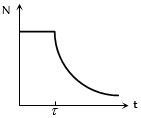
B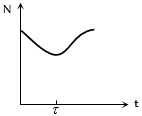
C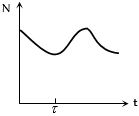
D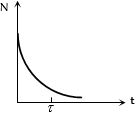
Solution
(D) Let $N_0$ be the initial number of atoms of each species. The number of radioactive nuclei of the first species at time $t$ is $N_1(t) = N_0 e^{-t/\tau}$.
The number of radioactive nuclei of the second species at time $t$ is $N_2(t) = N_0 e^{-t/(5\tau)}$.
The total number of radioactive nuclei is $N(t) = N_1(t) + N_2(t) = N_0(e^{-t/\tau} + e^{-t/(5\tau)})$.
At $t = 0$,$N(0) = 2N_0$. As $t \to \infty$,$N(t) \to 0$.
Since both $e^{-t/\tau}$ and $e^{-t/(5\tau)}$ are monotonically decreasing functions of time,their sum $N(t)$ must also be a monotonically decreasing function of time.
Therefore,the total number of radioactive nuclei will continuously decrease with time,which is represented by the graph in option $(d)$.
The number of radioactive nuclei of the second species at time $t$ is $N_2(t) = N_0 e^{-t/(5\tau)}$.
The total number of radioactive nuclei is $N(t) = N_1(t) + N_2(t) = N_0(e^{-t/\tau} + e^{-t/(5\tau)})$.
At $t = 0$,$N(0) = 2N_0$. As $t \to \infty$,$N(t) \to 0$.
Since both $e^{-t/\tau}$ and $e^{-t/(5\tau)}$ are monotonically decreasing functions of time,their sum $N(t)$ must also be a monotonically decreasing function of time.
Therefore,the total number of radioactive nuclei will continuously decrease with time,which is represented by the graph in option $(d)$.
0 likes
View Solution117
MediumMCQ
$A$ radioactive element decays to form a stable nuclide. The rate of decay of the reactant $\left( \frac{dN}{dt} \right)$ will vary with time $(t)$ as shown in which figure?
A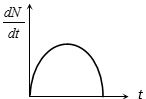
B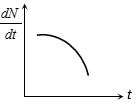
C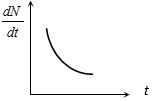
D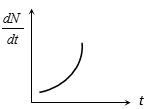
Solution
(C) According to the law of radioactive decay,the number of undecayed nuclei $N$ at time $t$ is given by $N = N_0 e^{-\lambda t}$,where $N_0$ is the initial number of nuclei and $\lambda$ is the decay constant.
The rate of decay is given by the derivative of $N$ with respect to time $t$:
$\frac{dN}{dt} = -\lambda N_0 e^{-\lambda t}$
The magnitude of the rate of decay is $|\frac{dN}{dt}| = \lambda N_0 e^{-\lambda t}$.
This expression shows that the rate of decay decreases exponentially with time $t$. Among the given options,Figure $C$ represents an exponential decay curve,which correctly depicts the relationship between the rate of decay and time.
The rate of decay is given by the derivative of $N$ with respect to time $t$:
$\frac{dN}{dt} = -\lambda N_0 e^{-\lambda t}$
The magnitude of the rate of decay is $|\frac{dN}{dt}| = \lambda N_0 e^{-\lambda t}$.
This expression shows that the rate of decay decreases exponentially with time $t$. Among the given options,Figure $C$ represents an exponential decay curve,which correctly depicts the relationship between the rate of decay and time.
0 likes
View Solution118
MediumMCQ
$A$ radioactive sample has ${N_0}$ active atoms at $t = 0$. If the rate of disintegration at any time is $R$ and the number of atoms is $N$,then the ratio $R/N$ varies with time as:
A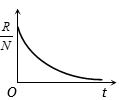
B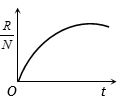
C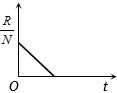
D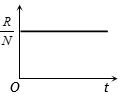
Solution
(D) The rate of radioactive disintegration $R$ is given by the law of radioactive decay as $R = -\frac{dN}{dt} = \lambda N$,where $\lambda$ is the decay constant.
From this relation,we can write the ratio of the rate of disintegration to the number of atoms as:
$\frac{R}{N} = \lambda$
Since the decay constant $\lambda$ is a characteristic property of a radioactive substance and remains constant over time,the ratio $R/N$ is independent of time.
Therefore,the graph representing the variation of $R/N$ with time $t$ will be a horizontal straight line parallel to the time axis.
From this relation,we can write the ratio of the rate of disintegration to the number of atoms as:
$\frac{R}{N} = \lambda$
Since the decay constant $\lambda$ is a characteristic property of a radioactive substance and remains constant over time,the ratio $R/N$ is independent of time.
Therefore,the graph representing the variation of $R/N$ with time $t$ will be a horizontal straight line parallel to the time axis.
0 likes
View Solution119
MediumMCQ
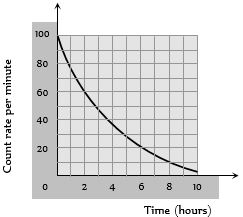
The count rate of $10\,g$ of radioactive material was measured at different times and this has been shown in the figure. The half-life of the material and the total counts (approximately) in the first half-life period,respectively,are:
A
$4\,h, 9000$
B
$3\,h, 14000$
C
$3\,h, 235$
D
$3\,h, 50$
Solution
(B) $1$. To find the half-life,observe the graph. The initial count rate at $t = 0$ is $100$. The half-life is the time taken for the count rate to become half of its initial value,i.e.,$50$. From the graph,at a count rate of $50$,the time is $3\,h$. Thus,the half-life $T_{1/2} = 3\,h$.
$2$. To find the total counts in the first half-life period ($0$ to $3\,h$),we calculate the area under the curve between $t = 0$ and $t = 3\,h$.
$3$. Each small square on the graph represents a count rate of $10$ units on the y-axis and $1\,h$ on the x-axis. However,the question specifies $10\,g$ of material. The area under the curve represents the total number of counts. By counting the number of small squares under the curve from $t = 0$ to $t = 3\,h$,we find approximately $24$ squares.
$4$. Each square represents $10 \times 60 = 600$ counts (assuming the rate is per minute,so $10 \text{ counts/min} \times 60 \text{ min} = 600 \text{ counts/hour}$).
$5$. Total counts $\approx 24 \times 600 = 14400$.
$2$. To find the total counts in the first half-life period ($0$ to $3\,h$),we calculate the area under the curve between $t = 0$ and $t = 3\,h$.
$3$. Each small square on the graph represents a count rate of $10$ units on the y-axis and $1\,h$ on the x-axis. However,the question specifies $10\,g$ of material. The area under the curve represents the total number of counts. By counting the number of small squares under the curve from $t = 0$ to $t = 3\,h$,we find approximately $24$ squares.
$4$. Each square represents $10 \times 60 = 600$ counts (assuming the rate is per minute,so $10 \text{ counts/min} \times 60 \text{ min} = 600 \text{ counts/hour}$).
$5$. Total counts $\approx 24 \times 600 = 14400$.
0 likes
View Solution120
MediumMCQ
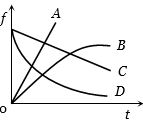
The fraction $f$ of radioactive material that has decayed in time $t$,varies with time $t$. The correct variation is given by the curve
A
$A$
B
$B$
C
$C$
D
$D$
Solution
(B) The number of undecayed atoms at time $t$ is given by $N = N_0 e^{-\lambda t}$.
The number of decayed atoms is $N_d = N_0 - N = N_0(1 - e^{-\lambda t})$.
The fraction of radioactive material that has decayed is $f = \frac{N_d}{N_0} = \frac{N_0(1 - e^{-\lambda t})}{N_0} = 1 - e^{-\lambda t}$.
At $t = 0$,$f = 1 - e^0 = 0$.
As $t \to \infty$,$f \to 1 - 0 = 1$.
The function $f(t) = 1 - e^{-\lambda t}$ represents an exponential growth curve that starts from $0$ and approaches $1$ asymptotically. This corresponds to curve $B$ in the graph.
The number of decayed atoms is $N_d = N_0 - N = N_0(1 - e^{-\lambda t})$.
The fraction of radioactive material that has decayed is $f = \frac{N_d}{N_0} = \frac{N_0(1 - e^{-\lambda t})}{N_0} = 1 - e^{-\lambda t}$.
At $t = 0$,$f = 1 - e^0 = 0$.
As $t \to \infty$,$f \to 1 - 0 = 1$.
The function $f(t) = 1 - e^{-\lambda t}$ represents an exponential growth curve that starts from $0$ and approaches $1$ asymptotically. This corresponds to curve $B$ in the graph.
0 likes
View Solution121
MediumMCQ
The plot of the number $(N)$ of undecayed atoms versus activity $(A)$ of a radioactive substance is
A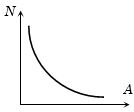
B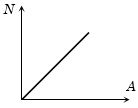
C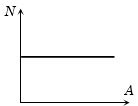
D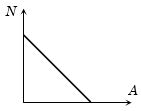
Solution
(B) The number of undecayed atoms at time $t$ is given by $N = N_0 e^{-\lambda t}$.
The activity of the radioactive substance is given by $A = \lambda N$.
From this relation, we can see that $N = \frac{A}{\lambda}$.
Since $\lambda$ (decay constant) is a constant for a given radioactive substance, $N$ is directly proportional to $A$ $(N \propto A)$.
Therefore, the plot of the number of undecayed atoms $(N)$ versus activity $(A)$ is a straight line passing through the origin.
The activity of the radioactive substance is given by $A = \lambda N$.
From this relation, we can see that $N = \frac{A}{\lambda}$.
Since $\lambda$ (decay constant) is a constant for a given radioactive substance, $N$ is directly proportional to $A$ $(N \propto A)$.
Therefore, the plot of the number of undecayed atoms $(N)$ versus activity $(A)$ is a straight line passing through the origin.
0 likes
View Solution122
MediumMCQ
The graph between the instantaneous concentration $(N)$ of a radioactive element and time $(t)$ is:
A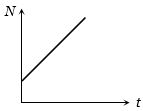
B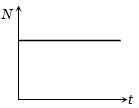
C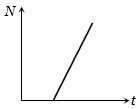
D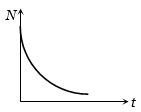
Solution
(D) The law of radioactive decay states that the number of radioactive nuclei $N$ at any time $t$ is given by the equation: $N = N_0 e^{-\lambda t}$,where $N_0$ is the initial number of nuclei and $\lambda$ is the decay constant.
This equation represents an exponential decay function.
As time $t$ increases,the value of $N$ decreases exponentially,approaching zero as $t$ approaches infinity.
Therefore,the graph of $N$ versus $t$ is an exponential decay curve,which corresponds to option $(D)$.
This equation represents an exponential decay function.
As time $t$ increases,the value of $N$ decreases exponentially,approaching zero as $t$ approaches infinity.
Therefore,the graph of $N$ versus $t$ is an exponential decay curve,which corresponds to option $(D)$.
0 likes
View Solution123
MediumMCQ
In the figure,$X$ represents time and $Y$ represents the activity of a radioactive sample. The activity of the sample varies with time according to which curve?
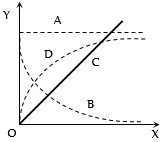
A
$A$
B
$B$
C
$C$
D
$D$
Solution
(B) The activity $A$ of a radioactive sample is given by the formula $A = -\frac{dN}{dt} = \lambda N = \lambda N_0 e^{-\lambda t}$.
Here,$N_0$ is the initial number of nuclei,$\lambda$ is the decay constant,and $t$ is time.
This equation shows that the activity $A$ decreases exponentially with time $t$.
Graphically,an exponential decay starting from a positive value at $t=0$ and approaching zero as $t \to \infty$ is represented by curve $B$.
Here,$N_0$ is the initial number of nuclei,$\lambda$ is the decay constant,and $t$ is time.
This equation shows that the activity $A$ decreases exponentially with time $t$.
Graphically,an exponential decay starting from a positive value at $t=0$ and approaching zero as $t \to \infty$ is represented by curve $B$.
0 likes
View Solution124
MediumMCQ
The graph which represents the correct variation of logarithm of activity $(\log A)$ versus time $t$ is:
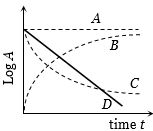
A
$A$
B
$B$
C
$C$
D
$D$
Solution
(D) The radioactive decay law for activity $A$ is given by $A = A_0 e^{-\lambda t}$,where $A_0 = \lambda N_0$ is the initial activity.
Taking the natural logarithm on both sides:
$\ln A = \ln(A_0 e^{-\lambda t})$
$\ln A = \ln A_0 + \ln(e^{-\lambda t})$
$\ln A = \ln A_0 - \lambda t$
This equation is of the form $y = mx + c$,where $y = \ln A$,$x = t$,slope $m = -\lambda$,and intercept $c = \ln A_0$.
Since the slope is negative $(-\lambda)$ and the intercept is positive $(\ln A_0)$,the graph of $\log A$ versus $t$ is a straight line with a negative slope. Looking at the provided figure,the line labeled $D$ represents this linear decrease.
Taking the natural logarithm on both sides:
$\ln A = \ln(A_0 e^{-\lambda t})$
$\ln A = \ln A_0 + \ln(e^{-\lambda t})$
$\ln A = \ln A_0 - \lambda t$
This equation is of the form $y = mx + c$,where $y = \ln A$,$x = t$,slope $m = -\lambda$,and intercept $c = \ln A_0$.
Since the slope is negative $(-\lambda)$ and the intercept is positive $(\ln A_0)$,the graph of $\log A$ versus $t$ is a straight line with a negative slope. Looking at the provided figure,the line labeled $D$ represents this linear decrease.
0 likes
View Solution125
MediumMCQ
The curve between the activity $A$ of a radioactive sample and the number of active atoms $N$ is
A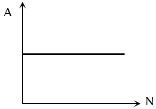
B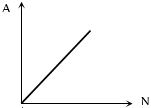
C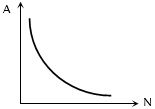
D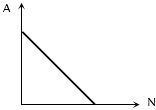
Solution
(B) The activity $A$ of a radioactive sample is defined as the rate of decay of the radioactive nuclei,which is given by the relation:
$A = \left| \frac{dN}{dt} \right| = \lambda N$
where $\lambda$ is the decay constant and $N$ is the number of active atoms present at that instant.
This equation is of the form $y = mx$,where $y = A$,$x = N$,and the slope $m = \lambda$.
Since $\lambda$ is a constant for a given radioactive substance,the relationship between $A$ and $N$ is a straight line passing through the origin.
Therefore,the correct graph is a straight line passing through the origin,which corresponds to option $B$.
$A = \left| \frac{dN}{dt} \right| = \lambda N$
where $\lambda$ is the decay constant and $N$ is the number of active atoms present at that instant.
This equation is of the form $y = mx$,where $y = A$,$x = N$,and the slope $m = \lambda$.
Since $\lambda$ is a constant for a given radioactive substance,the relationship between $A$ and $N$ is a straight line passing through the origin.
Therefore,the correct graph is a straight line passing through the origin,which corresponds to option $B$.
0 likes
View Solution126
DifficultMCQ
$A$ radioactive substance has decay constants $\lambda_{\alpha}$ and $\lambda_{\beta}$ for $\alpha$ and $\beta$ emission,respectively. If the substance emits both $\alpha$ and $\beta$ particles,find the effective half-life of the substance.
A
$\frac{1}{2}(T_{\alpha} + T_{\beta})$
B
$T_{\alpha} + T_{\beta}$
C
$\frac{2 T_{\alpha} T_{\beta}}{T_{\alpha} + T_{\beta}}$
D
$\frac{T_{\alpha} T_{\beta}}{T_{\alpha} + T_{\beta}}$
Solution
(D) When a radioactive substance decays by two different processes simultaneously,the total decay constant $\lambda_{eff}$ is the sum of the individual decay constants: $\lambda_{eff} = \lambda_{\alpha} + \lambda_{\beta}$.
We know that the half-life $T$ is related to the decay constant $\lambda$ by the formula $T = \frac{\ln 2}{\lambda}$,which implies $\lambda = \frac{\ln 2}{T}$.
Substituting this into the effective decay constant equation: $\frac{\ln 2}{T_{eff}} = \frac{\ln 2}{T_{\alpha}} + \frac{\ln 2}{T_{\beta}}$.
Dividing both sides by $\ln 2$,we get: $\frac{1}{T_{eff}} = \frac{1}{T_{\alpha}} + \frac{1}{T_{\beta}}$.
Solving for $T_{eff}$: $\frac{1}{T_{eff}} = \frac{T_{\beta} + T_{\alpha}}{T_{\alpha} T_{\beta}}$.
Therefore,$T_{eff} = \frac{T_{\alpha} T_{\beta}}{T_{\alpha} + T_{\beta}}$.
We know that the half-life $T$ is related to the decay constant $\lambda$ by the formula $T = \frac{\ln 2}{\lambda}$,which implies $\lambda = \frac{\ln 2}{T}$.
Substituting this into the effective decay constant equation: $\frac{\ln 2}{T_{eff}} = \frac{\ln 2}{T_{\alpha}} + \frac{\ln 2}{T_{\beta}}$.
Dividing both sides by $\ln 2$,we get: $\frac{1}{T_{eff}} = \frac{1}{T_{\alpha}} + \frac{1}{T_{\beta}}$.
Solving for $T_{eff}$: $\frac{1}{T_{eff}} = \frac{T_{\beta} + T_{\alpha}}{T_{\alpha} T_{\beta}}$.
Therefore,$T_{eff} = \frac{T_{\alpha} T_{\beta}}{T_{\alpha} + T_{\beta}}$.
0 likes
View Solution127
MediumMCQ
The rate of radioactive disintegration at an instant for a radioactive sample of half-life $2.2 \times 10^9 \; s$ is $10^{10} \; s^{-1}$. The number of radioactive atoms in that sample at that instant is,
A
$3.17 \times 10^{20}$
B
$3.17 \times 10^{19}$
C
$3.17 \times 10^{17}$
D
$3.17 \times 10^{18}$
Solution
(B) The relationship between half-life $T_{1/2}$ and decay constant $\lambda$ is given by $T_{1/2} = \frac{\ln 2}{\lambda} \approx \frac{0.693}{\lambda}$.
Given $T_{1/2} = 2.2 \times 10^9 \; s$,we find $\lambda = \frac{0.693}{2.2 \times 10^9} \approx 3.15 \times 10^{-10} \; s^{-1}$.
The rate of disintegration $R$ is related to the number of radioactive atoms $N$ by the formula $R = \lambda N$.
Given $R = 10^{10} \; s^{-1}$,we calculate $N = \frac{R}{\lambda} = \frac{10^{10}}{3.15 \times 10^{-10}} \approx 3.17 \times 10^{19}$ atoms.
Given $T_{1/2} = 2.2 \times 10^9 \; s$,we find $\lambda = \frac{0.693}{2.2 \times 10^9} \approx 3.15 \times 10^{-10} \; s^{-1}$.
The rate of disintegration $R$ is related to the number of radioactive atoms $N$ by the formula $R = \lambda N$.
Given $R = 10^{10} \; s^{-1}$,we calculate $N = \frac{R}{\lambda} = \frac{10^{10}}{3.15 \times 10^{-10}} \approx 3.17 \times 10^{19}$ atoms.
0 likes
View Solution128
EasyMCQ
What is a curie?
A
$A$ measure of radioactivity
B
$A$ measure of temperature
C
$A$ measure of magnetism
D
$A$ measure of electric field
Solution
(A) curie $(Ci)$ is a unit of radioactivity. It is defined as the quantity of a radioactive substance that undergoes $3.7 \times 10^{10}$ disintegrations per second,which is approximately the activity of $1 \ g$ of radium-$226$.
0 likes
View Solution129
DifficultMCQ
In time $t$,$7/8$ of a radioactive sample disintegrates. How much time will it take for $15/16$ of the sample to disintegrate?
A
$t$
B
$\frac{4}{3}t$
C
$\frac{5}{3}t$
D
$2t$
Solution
(B) The fraction of the sample remaining after time $t$ is $N/N_0 = 1 - 7/8 = 1/8$.
Using the radioactive decay law $N = N_0(1/2)^n$,we have $1/8 = (1/2)^n$,which implies $(1/2)^3 = (1/2)^n$,so $n = 3$.
Since $n = t/T_{1/2}$,the half-life is $T_{1/2} = t/3$.
Now,for $15/16$ of the sample to disintegrate,the remaining fraction is $N/N_0 = 1 - 15/16 = 1/16$.
Using $N/N_0 = (1/2)^n$,we have $1/16 = (1/2)^n$,which implies $(1/2)^4 = (1/2)^n$,so $n = 4$.
The total time required is $t' = n \times T_{1/2} = 4 \times (t/3) = \frac{4}{3}t$.
Using the radioactive decay law $N = N_0(1/2)^n$,we have $1/8 = (1/2)^n$,which implies $(1/2)^3 = (1/2)^n$,so $n = 3$.
Since $n = t/T_{1/2}$,the half-life is $T_{1/2} = t/3$.
Now,for $15/16$ of the sample to disintegrate,the remaining fraction is $N/N_0 = 1 - 15/16 = 1/16$.
Using $N/N_0 = (1/2)^n$,we have $1/16 = (1/2)^n$,which implies $(1/2)^4 = (1/2)^n$,so $n = 4$.
The total time required is $t' = n \times T_{1/2} = 4 \times (t/3) = \frac{4}{3}t$.
0 likes
View Solution130
MediumMCQ
At a given instant,a radioactive sample has $N$ active nuclei. If its decay constant is $\lambda$,which of the following relations is incorrect? (Note: $\lambda$ is very small.)
A
$N\lambda =$ Activity at the given instant
B
$\lambda =$ Probability of decay of a nucleus per unit time
C
After a time interval of $1/\lambda$,the number of nuclei remaining in the sample is $N[1 - 1/e]$
D
Half-life of the sample is $\ln(2)/\lambda$
Solution
(C) The activity of a radioactive sample is given by $A = |dN/dt| = N\lambda$. Thus,option $A$ is correct.
By definition,the decay constant $\lambda$ represents the probability of decay per unit time for a single nucleus. Thus,option $B$ is correct.
The number of nuclei remaining after time $t$ is given by $N(t) = N_0 e^{-\lambda t}$.
For $t = 1/\lambda$,the number of nuclei remaining is $N(1/\lambda) = N e^{-\lambda(1/\lambda)} = N e^{-1} = N/e$.
Option $C$ states that the number of nuclei remaining is $N[1 - 1/e]$,which represents the number of nuclei that have decayed,not the number remaining. Therefore,option $C$ is incorrect.
The half-life $T_{1/2}$ is given by $\ln(2)/\lambda$. Thus,option $D$ is correct.
By definition,the decay constant $\lambda$ represents the probability of decay per unit time for a single nucleus. Thus,option $B$ is correct.
The number of nuclei remaining after time $t$ is given by $N(t) = N_0 e^{-\lambda t}$.
For $t = 1/\lambda$,the number of nuclei remaining is $N(1/\lambda) = N e^{-\lambda(1/\lambda)} = N e^{-1} = N/e$.
Option $C$ states that the number of nuclei remaining is $N[1 - 1/e]$,which represents the number of nuclei that have decayed,not the number remaining. Therefore,option $C$ is incorrect.
The half-life $T_{1/2}$ is given by $\ln(2)/\lambda$. Thus,option $D$ is correct.
0 likes
View Solution131
EasyMCQ
The decay constant of a radioactive sample is $\lambda$. The probability of decay per unit time is:
A
$\lambda$ decreases as the atom gets older.
B
$\lambda$ increases as the age of the atom increases.
C
$\lambda$ is independent of the age of the atom.
D
The behavior of $\lambda$ depends on the time of activity.
Solution
(C) The radioactive decay law states that the rate of decay is proportional to the number of radioactive nuclei present at that time,given by $\frac{dN}{dt} = -\lambda N$.
Here,$\lambda$ is the decay constant,which represents the probability of decay per unit time for a single radioactive nucleus.
Radioactive decay is a spontaneous and random process,meaning the probability of decay for a nucleus does not depend on how long the nucleus has existed.
Therefore,$\lambda$ is a constant characteristic of the radioactive isotope and is independent of the age of the atom.
Here,$\lambda$ is the decay constant,which represents the probability of decay per unit time for a single radioactive nucleus.
Radioactive decay is a spontaneous and random process,meaning the probability of decay for a nucleus does not depend on how long the nucleus has existed.
Therefore,$\lambda$ is a constant characteristic of the radioactive isotope and is independent of the age of the atom.
0 likes
View Solution132
EasyMCQ
The specific activity of radium is close to:
A
$1 \, Bq$
B
$1 \, Ci$
C
$3.7 \times 10^{10} \, Ci$
D
$1 \, mCi$
Solution
(B) The specific activity of a radioactive substance is defined as the activity per unit mass.
By definition,the unit $1 \, Curie$ $(1 \, Ci)$ was originally defined as the activity of $1 \, gram$ of Radium-$226$.
Therefore,the specific activity of radium is approximately $1 \, Ci/g$.
By definition,the unit $1 \, Curie$ $(1 \, Ci)$ was originally defined as the activity of $1 \, gram$ of Radium-$226$.
Therefore,the specific activity of radium is approximately $1 \, Ci/g$.
0 likes
View Solution133
EasyMCQ
What is the relationship between the decay constant $\lambda$ and the half-life $\tau_{1/2}$?
A
$\tau_{1/2} = \frac{\ln 2}{\lambda}$
B
$\tau_{1/2} \ln 2 = \lambda$
C
$\tau_{1/2} = \frac{1}{\lambda}$
D
$(\lambda + \tau_{1/2}) = \ln 2$
Solution
(A) The radioactive decay law is given by $N(t) = N_0 e^{-\lambda t}$.
At half-life $t = \tau_{1/2}$,the number of nuclei remaining is $N = N_0 / 2$.
Substituting these values: $\frac{N_0}{2} = N_0 e^{-\lambda \tau_{1/2}}$.
$1/2 = e^{-\lambda \tau_{1/2}}$,which implies $2 = e^{\lambda \tau_{1/2}}$.
Taking the natural logarithm on both sides: $\ln 2 = \lambda \tau_{1/2}$.
Therefore,the relationship is $\tau_{1/2} = \frac{\ln 2}{\lambda} \approx \frac{0.693}{\lambda}$.
At half-life $t = \tau_{1/2}$,the number of nuclei remaining is $N = N_0 / 2$.
Substituting these values: $\frac{N_0}{2} = N_0 e^{-\lambda \tau_{1/2}}$.
$1/2 = e^{-\lambda \tau_{1/2}}$,which implies $2 = e^{\lambda \tau_{1/2}}$.
Taking the natural logarithm on both sides: $\ln 2 = \lambda \tau_{1/2}$.
Therefore,the relationship is $\tau_{1/2} = \frac{\ln 2}{\lambda} \approx \frac{0.693}{\lambda}$.
0 likes
View Solution134
EasyMCQ
The specific activity of $Ra^{226}$ is $1 \, Ci/g$. The activity of $1 \, \mu g$ of $Ra^{226}$ will be:
A
$1 \, \mu Ci$
B
$1 \, mCi$
C
$1 \, Ci$
D
$10^6 \, Ci$
Solution
(A) Specific activity is defined as the activity per unit mass of the radioactive substance.
Given,specific activity $A_s = 1 \, Ci/g$.
The mass of the sample $m = 1 \, \mu g = 10^{-6} \, g$.
The activity $A$ of the sample is given by the product of specific activity and the mass of the sample:
$A = A_s \times m$
$A = 1 \, Ci/g \times 10^{-6} \, g$
$A = 10^{-6} \, Ci$
Since $1 \, \mu Ci = 10^{-6} \, Ci$,the activity is $1 \, \mu Ci$.
Given,specific activity $A_s = 1 \, Ci/g$.
The mass of the sample $m = 1 \, \mu g = 10^{-6} \, g$.
The activity $A$ of the sample is given by the product of specific activity and the mass of the sample:
$A = A_s \times m$
$A = 1 \, Ci/g \times 10^{-6} \, g$
$A = 10^{-6} \, Ci$
Since $1 \, \mu Ci = 10^{-6} \, Ci$,the activity is $1 \, \mu Ci$.
0 likes
View Solution135
MediumMCQ
The half-life of radium is $1600 \, \text{years}$. The fraction of the radium sample that will remain after $6400 \, \text{years}$ is:
A
$1/4$
B
$1/2$
C
$1/8$
D
$1/16$
Solution
(D) The radioactive decay law is given by the formula: $\frac{N}{N_0} = (1/2)^n$, where $n$ is the number of half-lives.
Number of half-lives $n = \frac{t}{T_{1/2}} = \frac{6400}{1600} = 4$.
Substituting the value of $n$ into the formula:
$\frac{N}{N_0} = (1/2)^4 = \frac{1}{16}$.
Thus, the fraction of the radium sample remaining after $6400 \, \text{years}$ is $1/16$.
Number of half-lives $n = \frac{t}{T_{1/2}} = \frac{6400}{1600} = 4$.
Substituting the value of $n$ into the formula:
$\frac{N}{N_0} = (1/2)^4 = \frac{1}{16}$.
Thus, the fraction of the radium sample remaining after $6400 \, \text{years}$ is $1/16$.
0 likes
View Solution136
MediumMCQ
The half-life of a radioactive element is $10 \, days$. The time required for the mass of the sample to reduce to $\frac{1}{10}$ of its initial mass is approximately ........ days.
A
$100$
B
$50$
C
$33$
D
$16$
Solution
(C) The radioactive decay law is given by $N = N_0 \left( \frac{1}{2} \right)^{\frac{t}{T_{1/2}}}$.
Given, $T_{1/2} = 10 \, days$ and $\frac{N}{N_0} = \frac{1}{10}$.
Substituting these values: $\frac{1}{10} = \left( \frac{1}{2} \right)^{\frac{t}{10}}$.
Taking the natural logarithm on both sides: $\ln(10^{-1}) = \frac{t}{10} \ln(2^{-1})$.
$- \ln(10) = - \frac{t}{10} \ln(2)$.
$t = 10 \times \frac{\ln(10)}{\ln(2)} = 10 \times \frac{2.303}{0.693} \approx 10 \times 3.32$.
$t \approx 33.2 \, days$.
Therefore, the time required is approximately $33 \, days$.
Given, $T_{1/2} = 10 \, days$ and $\frac{N}{N_0} = \frac{1}{10}$.
Substituting these values: $\frac{1}{10} = \left( \frac{1}{2} \right)^{\frac{t}{10}}$.
Taking the natural logarithm on both sides: $\ln(10^{-1}) = \frac{t}{10} \ln(2^{-1})$.
$- \ln(10) = - \frac{t}{10} \ln(2)$.
$t = 10 \times \frac{\ln(10)}{\ln(2)} = 10 \times \frac{2.303}{0.693} \approx 10 \times 3.32$.
$t \approx 33.2 \, days$.
Therefore, the time required is approximately $33 \, days$.
0 likes
View Solution137
DifficultMCQ
Two radioactive samples $A_1$ and $A_2$ have decay constants $10\lambda_0$ and $\lambda_0$ respectively. If they initially contain the same number of nuclei,find the ratio of the number of undecayed nuclei after time $t = 1/(9\lambda_0)$.
A
$1/e$
B
$1/e^2$
C
$1/e^9$
D
$1/e^{10}$
Solution
(A) The number of undecayed nuclei at time $t$ is given by $N(t) = N_0 e^{-\lambda t}$.
For sample $A_1$,$N_1 = N_0 e^{-(10\lambda_0)t}$.
For sample $A_2$,$N_2 = N_0 e^{-\lambda_0 t}$.
The ratio of undecayed nuclei is $N_1/N_2 = \frac{N_0 e^{-10\lambda_0 t}}{N_0 e^{-\lambda_0 t}} = e^{-9\lambda_0 t}$.
Given $t = 1/(9\lambda_0)$,substitute this value into the ratio:
$N_1/N_2 = e^{-9\lambda_0 (1/9\lambda_0)} = e^{-1} = 1/e$.
For sample $A_1$,$N_1 = N_0 e^{-(10\lambda_0)t}$.
For sample $A_2$,$N_2 = N_0 e^{-\lambda_0 t}$.
The ratio of undecayed nuclei is $N_1/N_2 = \frac{N_0 e^{-10\lambda_0 t}}{N_0 e^{-\lambda_0 t}} = e^{-9\lambda_0 t}$.
Given $t = 1/(9\lambda_0)$,substitute this value into the ratio:
$N_1/N_2 = e^{-9\lambda_0 (1/9\lambda_0)} = e^{-1} = 1/e$.
0 likes
View Solution138
MediumMCQ
The radiation emitted by a radioactive substance with a half-life of $30 \ min$ is measured by a Geiger-Muller counter. If the count rate drops to $5 \ \text{disintegrations/sec}$ in $2 \ \text{hours}$, find the initial disintegration rate.
A
$80$
B
$200$
C
$250$
D
$40$
Solution
(A) Given: Half-life $T_{1/2} = 30 \ min$.
Total time $t = 2 \ \text{hours} = 120 \ min$.
Number of half-lives $n = \frac{t}{T_{1/2}} = \frac{120}{30} = 4$.
The relationship between initial activity $A_0$ and final activity $A$ is given by $A = \frac{A_0}{2^n}$.
Given final activity $A = 5 \ \text{disintegrations/sec}$.
Substituting the values: $5 = \frac{A_0}{2^4} = \frac{A_0}{16}$.
Therefore, $A_0 = 5 \times 16 = 80 \ \text{disintegrations/sec}$.
Total time $t = 2 \ \text{hours} = 120 \ min$.
Number of half-lives $n = \frac{t}{T_{1/2}} = \frac{120}{30} = 4$.
The relationship between initial activity $A_0$ and final activity $A$ is given by $A = \frac{A_0}{2^n}$.
Given final activity $A = 5 \ \text{disintegrations/sec}$.
Substituting the values: $5 = \frac{A_0}{2^4} = \frac{A_0}{16}$.
Therefore, $A_0 = 5 \times 16 = 80 \ \text{disintegrations/sec}$.
0 likes
View Solution139
EasyMCQ
The half-life of a radioactive substance is $5$ years. What is the probability of decay of this element in $10$ years?
A
$0.5$
B
$0.25$
C
$0.6$
D
$0.75$
Solution
(D) The half-life $T_{1/2} = 5$ years.
The total time $t = 10$ years.
The number of half-lives $n = t / T_{1/2} = 10 / 5 = 2$.
The fraction of the substance remaining after $n$ half-lives is given by $N/N_0 = (1/2)^n$.
$N/N_0 = (1/2)^2 = 1/4$.
The fraction of the substance that has decayed is $1 - N/N_0$.
Decayed fraction $= 1 - 1/4 = 3/4 = 0.75$.
The total time $t = 10$ years.
The number of half-lives $n = t / T_{1/2} = 10 / 5 = 2$.
The fraction of the substance remaining after $n$ half-lives is given by $N/N_0 = (1/2)^n$.
$N/N_0 = (1/2)^2 = 1/4$.
The fraction of the substance that has decayed is $1 - N/N_0$.
Decayed fraction $= 1 - 1/4 = 3/4 = 0.75$.
0 likes
View Solution140
MediumMCQ
Element $X$ decays into element $Y$ with a half-life of $3$ days. On March $1$st,the mass of $X$ is $10 \, g$. What will be the masses of $X$ and $Y$ after $6$ days?
A
$X = 2.5 \, g$ and $Y = 7.5 \, g$
B
$X = 5.0 \, g$ and $Y = 5.0 \, g$
C
$X = 7.5 \, g$ and $Y = 2.5 \, g$
D
$X = 10 \, g$ and $Y = 0 \, g$
Solution
(A) The decay process is $X \rightarrow Y$.
Given half-life $T_{1/2} = 3$ days.
Total time elapsed $t = 6$ days.
The number of half-lives $n = t / T_{1/2} = 6 / 3 = 2$.
The remaining mass of $X$ after $n$ half-lives is given by $N = N_0(1/2)^n$.
$N = 10 \times (1/2)^2 = 10 / 4 = 2.5 \, g$.
Since the total mass is conserved,the mass of $Y$ formed is $M_Y = N_0 - N = 10 - 2.5 = 7.5 \, g$.
Thus,the mass of $X$ is $2.5 \, g$ and the mass of $Y$ is $7.5 \, g$.
Given half-life $T_{1/2} = 3$ days.
Total time elapsed $t = 6$ days.
The number of half-lives $n = t / T_{1/2} = 6 / 3 = 2$.
The remaining mass of $X$ after $n$ half-lives is given by $N = N_0(1/2)^n$.
$N = 10 \times (1/2)^2 = 10 / 4 = 2.5 \, g$.
Since the total mass is conserved,the mass of $Y$ formed is $M_Y = N_0 - N = 10 - 2.5 = 7.5 \, g$.
Thus,the mass of $X$ is $2.5 \, g$ and the mass of $Y$ is $7.5 \, g$.
0 likes
View Solution141
MediumMCQ
The decay constant for the nuclide $^{64}Cu$ is $1.6 \times 10^{-5} \, s^{-1}$. Find the activity of a $1 \, mg$ sample of $^{64}Cu$ in $Ci$. (Given: Atomic mass of Copper = $64 \, g/mol$,$1 \, Ci = 3.7 \times 10^{10} \, Bq$)
A
$4054$
B
$5404$
C
$2365$
D
$2850$
Solution
(A) The activity $R$ is given by the formula $R = \lambda N$,where $\lambda$ is the decay constant and $N$ is the number of nuclei.
Number of nuclei $N = \frac{m}{M} \times N_A$,where $m = 1 \, mg = 10^{-3} \, g$,$M = 64 \, g/mol$,and $N_A = 6.022 \times 10^{23} \, atoms/mol$.
$N = \frac{10^{-3}}{64} \times 6.022 \times 10^{23} \approx 9.41 \times 10^{18} \, atoms$.
Now,$R = (1.6 \times 10^{-5} \, s^{-1}) \times (9.41 \times 10^{18}) = 1.5056 \times 10^{14} \, Bq$.
To convert to Curies $(Ci)$,divide by $3.7 \times 10^{10} \, Bq/Ci$:
$R = \frac{1.5056 \times 10^{14}}{3.7 \times 10^{10}} \approx 4069 \, Ci$.
Rounding to the nearest provided option,the answer is $4054 \, Ci$.
Number of nuclei $N = \frac{m}{M} \times N_A$,where $m = 1 \, mg = 10^{-3} \, g$,$M = 64 \, g/mol$,and $N_A = 6.022 \times 10^{23} \, atoms/mol$.
$N = \frac{10^{-3}}{64} \times 6.022 \times 10^{23} \approx 9.41 \times 10^{18} \, atoms$.
Now,$R = (1.6 \times 10^{-5} \, s^{-1}) \times (9.41 \times 10^{18}) = 1.5056 \times 10^{14} \, Bq$.
To convert to Curies $(Ci)$,divide by $3.7 \times 10^{10} \, Bq/Ci$:
$R = \frac{1.5056 \times 10^{14}}{3.7 \times 10^{10}} \approx 4069 \, Ci$.
Rounding to the nearest provided option,the answer is $4054 \, Ci$.
0 likes
View Solution142
EasyMCQ
The half-life of a radioactive element $X$ is equal to the mean life of another radioactive element $Y$. Initially, the number of atoms for both is the same. Then:
A
$X$ will decay faster than $Y$.
B
$Y$ will decay faster than $X$.
C
$Y$ and $X$ will decay at the same rate.
D
$X$ and $Y$ will always decay at the same rate.
Solution
(B) Given: Half-life of $X$ $(T_{1/2, X})$ = Mean life of $Y$ $(\tau_Y)$.
We know that $T_{1/2, X} = \frac{\ln 2}{\lambda_X} \approx 0.693 \tau_X$.
Also, $\tau_Y = \frac{1}{\lambda_Y}$.
Since $T_{1/2, X} = \tau_Y$, we have $0.693 \tau_X = \tau_Y$, which implies $\tau_X > \tau_Y$.
Since the decay constant $\lambda = \frac{1}{\tau}$, it follows that $\lambda_Y > \lambda_X$.
The rate of decay is given by $R = \lambda N$. Since the initial number of atoms $N_0$ is the same for both, the element with the larger decay constant will decay faster.
Therefore, $Y$ decays faster than $X$.
We know that $T_{1/2, X} = \frac{\ln 2}{\lambda_X} \approx 0.693 \tau_X$.
Also, $\tau_Y = \frac{1}{\lambda_Y}$.
Since $T_{1/2, X} = \tau_Y$, we have $0.693 \tau_X = \tau_Y$, which implies $\tau_X > \tau_Y$.
Since the decay constant $\lambda = \frac{1}{\tau}$, it follows that $\lambda_Y > \lambda_X$.
The rate of decay is given by $R = \lambda N$. Since the initial number of atoms $N_0$ is the same for both, the element with the larger decay constant will decay faster.
Therefore, $Y$ decays faster than $X$.
0 likes
View Solution143
MediumMCQ
$A$ radioactive element $ThA$ $(_{84}Po^{216})$ can undergo $\alpha$ and $\beta$ types of disintegrations with half-lives $T_1$ and $T_2$ respectively. Then the effective half-life of $ThA$ is:
A
$T_1 + T_2$
B
$T_1 \cdot T_2$
C
$T_1 - T_2$
D
$\frac{T_1 T_2}{T_1 + T_2}$
Solution
(D) The decay constant for $\alpha$-decay is $\lambda_1 = \frac{\ln 2}{T_1}$.
The decay constant for $\beta$-decay is $\lambda_2 = \frac{\ln 2}{T_2}$.
When a radioactive nucleus can decay by two different processes,the total decay constant is the sum of the individual decay constants: $\lambda_{eq} = \lambda_1 + \lambda_2$.
Since $\lambda_{eq} = \frac{\ln 2}{T_{eq}}$,we have $\frac{\ln 2}{T_{eq}} = \frac{\ln 2}{T_1} + \frac{\ln 2}{T_2}$.
Dividing by $\ln 2$,we get $\frac{1}{T_{eq}} = \frac{1}{T_1} + \frac{1}{T_2} = \frac{T_1 + T_2}{T_1 T_2}$.
Therefore,the effective half-life is $T_{eq} = \frac{T_1 T_2}{T_1 + T_2}$.
The decay constant for $\beta$-decay is $\lambda_2 = \frac{\ln 2}{T_2}$.
When a radioactive nucleus can decay by two different processes,the total decay constant is the sum of the individual decay constants: $\lambda_{eq} = \lambda_1 + \lambda_2$.
Since $\lambda_{eq} = \frac{\ln 2}{T_{eq}}$,we have $\frac{\ln 2}{T_{eq}} = \frac{\ln 2}{T_1} + \frac{\ln 2}{T_2}$.
Dividing by $\ln 2$,we get $\frac{1}{T_{eq}} = \frac{1}{T_1} + \frac{1}{T_2} = \frac{T_1 + T_2}{T_1 T_2}$.
Therefore,the effective half-life is $T_{eq} = \frac{T_1 T_2}{T_1 + T_2}$.
0 likes
View Solution144
MediumMCQ
If $3/4$ of a radioactive sample decays in $3/4 \, s$,then the half-life of the sample is ........ .
A
$1/2 \, s$
B
$1 \, s$
C
$3/8 \, s$
D
$3/4 \, s$
Solution
(C) The radioactive decay law is given by $N(t) = N_0 \left( \frac{1}{2} \right)^{t/T_{1/2}}$,where $T_{1/2}$ is the half-life.
Given that $3/4$ of the sample decays,the remaining amount is $N(t) = N_0 - \frac{3}{4} N_0 = \frac{1}{4} N_0$.
Substituting this into the decay equation:
$\frac{1}{4} N_0 = N_0 \left( \frac{1}{2} \right)^{t/T_{1/2}}$
$\left( \frac{1}{2} \right)^2 = \left( \frac{1}{2} \right)^{t/T_{1/2}}$
Comparing the exponents,we get $2 = \frac{t}{T_{1/2}}$.
Given $t = 3/4 \, s$,we have $2 = \frac{3/4}{T_{1/2}}$.
Therefore,$T_{1/2} = \frac{3/4}{2} = 3/8 \, s$.
Given that $3/4$ of the sample decays,the remaining amount is $N(t) = N_0 - \frac{3}{4} N_0 = \frac{1}{4} N_0$.
Substituting this into the decay equation:
$\frac{1}{4} N_0 = N_0 \left( \frac{1}{2} \right)^{t/T_{1/2}}$
$\left( \frac{1}{2} \right)^2 = \left( \frac{1}{2} \right)^{t/T_{1/2}}$
Comparing the exponents,we get $2 = \frac{t}{T_{1/2}}$.
Given $t = 3/4 \, s$,we have $2 = \frac{3/4}{T_{1/2}}$.
Therefore,$T_{1/2} = \frac{3/4}{2} = 3/8 \, s$.
0 likes
View Solution145
MediumMCQ
The half-life of a radioactive element is $30$ days. What percentage of the element will have decayed in $90$ days?
A
$12.5$
B
$46.5$
C
$87.5$
D
$90.15$
Solution
(C) Given: Half-life $T_{1/2} = 30$ days,Total time $t = 90$ days.
Number of half-lives $n = \frac{t}{T_{1/2}} = \frac{90}{30} = 3$.
The remaining amount of the radioactive substance is given by $N = N_0 \left(\frac{1}{2}\right)^n$.
Substituting the values: $N = N_0 \left(\frac{1}{2}\right)^3 = \frac{N_0}{8}$.
The amount that has decayed is $N_{decayed} = N_0 - N = N_0 - \frac{N_0}{8} = \frac{7N_0}{8}$.
The percentage of decay is $\frac{N_{decayed}}{N_0} \times 100 = \frac{7}{8} \times 100 = 87.5\%$.
Number of half-lives $n = \frac{t}{T_{1/2}} = \frac{90}{30} = 3$.
The remaining amount of the radioactive substance is given by $N = N_0 \left(\frac{1}{2}\right)^n$.
Substituting the values: $N = N_0 \left(\frac{1}{2}\right)^3 = \frac{N_0}{8}$.
The amount that has decayed is $N_{decayed} = N_0 - N = N_0 - \frac{N_0}{8} = \frac{7N_0}{8}$.
The percentage of decay is $\frac{N_{decayed}}{N_0} \times 100 = \frac{7}{8} \times 100 = 87.5\%$.
0 likes
View Solution146
EasyMCQ
If $M_0$ is the initial mass of a radioactive substance with a half-life of ${t_{1/2}} = 5 \text{ years}$,what is the amount of substance remaining after $15 \text{ years}$?
A
$\frac{M_0}{8}$
B
$\frac{M_0}{16}$
C
$\frac{M_0}{2}$
D
$\frac{M_0}{4}$
Solution
(A) The law of radioactive decay is given by the formula: $M = M_0 \left( \frac{1}{2} \right)^{\frac{t}{t_{1/2}}}$
Given:
Initial mass = $M_0$
Half-life $(t_{1/2})$ = $5 \text{ years}$
Total time $(t)$ = $15 \text{ years}$
Number of half-lives $(n)$ = $\frac{t}{t_{1/2}} = \frac{15}{5} = 3$
Substituting the values into the formula:
$M = M_0 \left( \frac{1}{2} \right)^3$
$M = M_0 \left( \frac{1}{8} \right)$
$M = \frac{M_0}{8}$
Given:
Initial mass = $M_0$
Half-life $(t_{1/2})$ = $5 \text{ years}$
Total time $(t)$ = $15 \text{ years}$
Number of half-lives $(n)$ = $\frac{t}{t_{1/2}} = \frac{15}{5} = 3$
Substituting the values into the formula:
$M = M_0 \left( \frac{1}{2} \right)^3$
$M = M_0 \left( \frac{1}{8} \right)$
$M = \frac{M_0}{8}$
0 likes
View Solution147
MediumMCQ
In a sample of $^{66}Cu$,$7/8$ of the initial number of nuclei decay into $Zn$ in $15 \ min$. The half-life of the sample is ......... $min$.
A
$5$
B
$7.5$
C
$10$
D
$14$
Solution
(A) The number of nuclei remaining after time $t$ is given by $N = N_0 \left( \frac{1}{2} \right)^{\frac{t}{T_{1/2}}}$.
Given that $7/8$ of the nuclei have decayed,the remaining fraction is $1 - 7/8 = 1/8$.
So,$\frac{N}{N_0} = \frac{1}{8}$.
Substituting this into the formula: $\frac{1}{8} = \left( \frac{1}{2} \right)^{\frac{15}{T_{1/2}}}$.
Since $\frac{1}{8} = \left( \frac{1}{2} \right)^3$,we have $\left( \frac{1}{2} \right)^3 = \left( \frac{1}{2} \right)^{\frac{15}{T_{1/2}}}$.
Equating the exponents: $3 = \frac{15}{T_{1/2}}$.
Therefore,$T_{1/2} = \frac{15}{3} = 5 \ min$.
Given that $7/8$ of the nuclei have decayed,the remaining fraction is $1 - 7/8 = 1/8$.
So,$\frac{N}{N_0} = \frac{1}{8}$.
Substituting this into the formula: $\frac{1}{8} = \left( \frac{1}{2} \right)^{\frac{15}{T_{1/2}}}$.
Since $\frac{1}{8} = \left( \frac{1}{2} \right)^3$,we have $\left( \frac{1}{2} \right)^3 = \left( \frac{1}{2} \right)^{\frac{15}{T_{1/2}}}$.
Equating the exponents: $3 = \frac{15}{T_{1/2}}$.
Therefore,$T_{1/2} = \frac{15}{3} = 5 \ min$.
0 likes
View Solution148
MediumMCQ
$A$ radioactive substance has a half-life of $3.8 \, days$. If the initial mass is $10.38 \, g$, how much mass (in grams) will remain after $19 \, days$?
A
$0.151$
B
$0.32$
C
$1.51$
D
$0.16$
Solution
(B) The formula for the remaining mass of a radioactive substance is given by $N = \frac{N_0}{2^n}$, where $n = \frac{t}{T_{1/2}}$ is the number of half-lives.
Given: Initial mass $N_0 = 10.38 \, g$, half-life $T_{1/2} = 3.8 \, days$, and total time $t = 19 \, days$.
First, calculate the number of half-lives: $n = \frac{19}{3.8} = 5$.
Now, substitute the values into the formula: $N = \frac{10.38}{2^5}$.
$N = \frac{10.38}{32} = 0.324375 \, g$.
Rounding to the nearest provided option, the remaining mass is $0.32 \, g$.
Given: Initial mass $N_0 = 10.38 \, g$, half-life $T_{1/2} = 3.8 \, days$, and total time $t = 19 \, days$.
First, calculate the number of half-lives: $n = \frac{19}{3.8} = 5$.
Now, substitute the values into the formula: $N = \frac{10.38}{2^5}$.
$N = \frac{10.38}{32} = 0.324375 \, g$.
Rounding to the nearest provided option, the remaining mass is $0.32 \, g$.
0 likes
View SolutionNuclei — Law of Radioactivity by Rutherford and Soddy and Half Life and Mean Life · Frequently Asked Questions
1Are these Nuclei questions useful for JEE and NEET?
Yes. All questions in this section are mapped to JEE Main and NEET exam patterns. Previous year questions from JEE Main, NEET, GUJCET and state-level exams are included with full solutions.
2Can I switch to Hindi or Gujarati for these questions?
Yes. Use the language tabs in the hero section or the sidebar to view the same questions and solutions in English, Hindi or Gujarati.
3How do I generate a question paper from this subtopic?
Use the Vedclass Exam Paper Generator — select the chapter and subtopic, set difficulty, and generate Sets A, B, C, D automatically. First 3 chapters of every subject are free.
Vedclass Products
For Students
Vedclass Test Series
Mock tests in real JEE/NEET style with performance analysis. 5-day free trial.
Start Free TrialFor Teachers
Exam Paper Generator
Generate Set A/B/C/D papers from this chapter in 2 minutes. 3 chapters free.
Try FreeFor Institutes
Online Exam Module
Live online exams with unlimited students, 360° analytics & white-label branding.
See DemoFor Teachers & Institutes
Generate a Nuclei Exam Paper in 2 Minutes
Select subtopic & difficulty — Sets A, B, C, D auto-generated with No Repeat logic.
First 3 chapters of every subject are free — no payment required.