
A English
Matter Waves and de Broglie Wavelength Questions in English
Class 12 Physics · Dual Nature of Radiation and matter · Matter Waves and de Broglie Wavelength
437+
Questions
English
Language
100%
With Solutions
Showing 49 of 437 questions in English
301
EasyMCQ
The de Broglie wavelength and kinetic energy of a particle are $2000 \ \mathring{A}$ and $1 \ \text{eV}$ respectively. If its kinetic energy becomes $1 \ \text{MeV}$,then its de Broglie wavelength becomes $...... \ \mathring{A}$.
A
$1$
B
$2$
C
$5$
D
$10$
Solution
(B) The de Broglie wavelength of a particle is given by $\lambda = \frac{h}{p}$,where $p$ is the momentum and $h$ is Planck's constant.
The kinetic energy $K$ of a particle is related to its momentum $p$ by $K = \frac{p^2}{2m}$,where $m$ is the mass of the particle.
From this,we can express the momentum as $p = \sqrt{2mK}$. Substituting this into the de Broglie wavelength formula,we get $\lambda = \frac{h}{\sqrt{2mK}}$.
Since the mass $m$ of the particle remains constant,the relationship between wavelength and kinetic energy is $\lambda \propto \frac{1}{\sqrt{K}}$.
Given $\lambda = 2000 \ \mathring{A}$ for $K = 1 \ \text{eV}$,and we need to find $\lambda'$ for $K' = 1 \ \text{MeV} = 10^6 \ \text{eV}$.
Using the ratio: $\frac{\lambda'}{\lambda} = \sqrt{\frac{K}{K'}} = \sqrt{\frac{1 \ \text{eV}}{10^6 \ \text{eV}}} = \sqrt{\frac{1}{10^6}} = \frac{1}{10^3}$.
Therefore,$\lambda' = \frac{\lambda}{10^3} = \frac{2000}{1000} \ \mathring{A} = 2 \ \mathring{A}$.
The kinetic energy $K$ of a particle is related to its momentum $p$ by $K = \frac{p^2}{2m}$,where $m$ is the mass of the particle.
From this,we can express the momentum as $p = \sqrt{2mK}$. Substituting this into the de Broglie wavelength formula,we get $\lambda = \frac{h}{\sqrt{2mK}}$.
Since the mass $m$ of the particle remains constant,the relationship between wavelength and kinetic energy is $\lambda \propto \frac{1}{\sqrt{K}}$.
Given $\lambda = 2000 \ \mathring{A}$ for $K = 1 \ \text{eV}$,and we need to find $\lambda'$ for $K' = 1 \ \text{MeV} = 10^6 \ \text{eV}$.
Using the ratio: $\frac{\lambda'}{\lambda} = \sqrt{\frac{K}{K'}} = \sqrt{\frac{1 \ \text{eV}}{10^6 \ \text{eV}}} = \sqrt{\frac{1}{10^6}} = \frac{1}{10^3}$.
Therefore,$\lambda' = \frac{\lambda}{10^3} = \frac{2000}{1000} \ \mathring{A} = 2 \ \mathring{A}$.
0 likes
View Solution302
EasyMCQ
An electron accelerated by a potential difference $V$ has a de-Broglie wavelength $\lambda$. If the electron is accelerated by a potential difference $9V$,its de-Broglie wavelength will be
A
$\frac{\lambda}{4.5}$
B
$\frac{\lambda}{3}$
C
$\frac{\lambda}{2}$
D
$\lambda$
Solution
(B) The de-Broglie wavelength $\lambda$ of an electron accelerated through a potential difference $V$ is given by the formula: $\lambda = \frac{h}{\sqrt{2meV}}$.
From this relation,we can see that $\lambda \propto \frac{1}{\sqrt{V}}$.
Let the initial wavelength be $\lambda_1 = \lambda$ at potential $V_1 = V$.
Let the new wavelength be $\lambda_2$ at potential $V_2 = 9V$.
Taking the ratio: $\frac{\lambda_2}{\lambda_1} = \sqrt{\frac{V_1}{V_2}}$.
Substituting the values: $\frac{\lambda_2}{\lambda} = \sqrt{\frac{V}{9V}} = \sqrt{\frac{1}{9}} = \frac{1}{3}$.
Therefore,$\lambda_2 = \frac{\lambda}{3}$.
From this relation,we can see that $\lambda \propto \frac{1}{\sqrt{V}}$.
Let the initial wavelength be $\lambda_1 = \lambda$ at potential $V_1 = V$.
Let the new wavelength be $\lambda_2$ at potential $V_2 = 9V$.
Taking the ratio: $\frac{\lambda_2}{\lambda_1} = \sqrt{\frac{V_1}{V_2}}$.
Substituting the values: $\frac{\lambda_2}{\lambda} = \sqrt{\frac{V}{9V}} = \sqrt{\frac{1}{9}} = \frac{1}{3}$.
Therefore,$\lambda_2 = \frac{\lambda}{3}$.
0 likes
View Solution303
MediumMCQ
$A$ light of wavelength $\lambda$ is incident on a photosensitive surface of negligible work function. The photoelectrons emitted from the surface have de-Broglie wavelength $\lambda_1$. Then the ratio $\lambda : \lambda_1^2$ is ($h =$ Planck's constant,$c =$ velocity of light,$m =$ mass of electron).
A
$4 mc : h$
B
$2 c : h$
C
$2 mc : h$
D
$2 mh : c$
Solution
(C) The energy of the incident photon is $E = \frac{hc}{\lambda}$.
Since the work function is negligible,the kinetic energy $K$ of the emitted photoelectron is equal to the energy of the incident photon: $K = \frac{hc}{\lambda}$.
The de-Broglie wavelength $\lambda_1$ of the electron is given by $\lambda_1 = \frac{h}{p}$,where $p$ is the momentum of the electron.
We know that $K = \frac{p^2}{2m}$,so $p = \sqrt{2mK}$.
Substituting $K = \frac{hc}{\lambda}$,we get $p = \sqrt{2m \cdot \frac{hc}{\lambda}}$.
Thus,$\lambda_1 = \frac{h}{\sqrt{\frac{2mhc}{\lambda}}}$.
Squaring both sides,we get $\lambda_1^2 = \frac{h^2}{\frac{2mhc}{\lambda}} = \frac{h^2 \lambda}{2mhc} = \frac{h \lambda}{2mc}$.
Rearranging the terms,we find $\frac{\lambda}{\lambda_1^2} = \frac{2mc}{h}$.
Therefore,the ratio $\lambda : \lambda_1^2$ is $2mc : h$.
Since the work function is negligible,the kinetic energy $K$ of the emitted photoelectron is equal to the energy of the incident photon: $K = \frac{hc}{\lambda}$.
The de-Broglie wavelength $\lambda_1$ of the electron is given by $\lambda_1 = \frac{h}{p}$,where $p$ is the momentum of the electron.
We know that $K = \frac{p^2}{2m}$,so $p = \sqrt{2mK}$.
Substituting $K = \frac{hc}{\lambda}$,we get $p = \sqrt{2m \cdot \frac{hc}{\lambda}}$.
Thus,$\lambda_1 = \frac{h}{\sqrt{\frac{2mhc}{\lambda}}}$.
Squaring both sides,we get $\lambda_1^2 = \frac{h^2}{\frac{2mhc}{\lambda}} = \frac{h^2 \lambda}{2mhc} = \frac{h \lambda}{2mc}$.
Rearranging the terms,we find $\frac{\lambda}{\lambda_1^2} = \frac{2mc}{h}$.
Therefore,the ratio $\lambda : \lambda_1^2$ is $2mc : h$.
0 likes
View Solution304
EasyMCQ
The de-Broglie wavelength $(\lambda)$ of a particle
A
is inversely proportional to impulse.
B
does not depend on impulse.
C
is proportional to mass.
D
is proportional to impulse.
Solution
(A) The de-Broglie wavelength $(\lambda)$ of a particle is given by the relation: $\lambda = \frac{h}{p}$,where $h$ is Planck's constant and $p$ is the momentum (impulse) of the particle.
From this relation,it is clear that $\lambda \propto \frac{1}{p}$.
Therefore,the de-Broglie wavelength is inversely proportional to the momentum (impulse) of the particle.
Thus,option $A$ is correct.
From this relation,it is clear that $\lambda \propto \frac{1}{p}$.
Therefore,the de-Broglie wavelength is inversely proportional to the momentum (impulse) of the particle.
Thus,option $A$ is correct.
0 likes
View Solution305
MediumMCQ
The de-Broglie wavelength of a neutron at $27^{\circ} C$ is $\lambda_0$. What will be its wavelength at $927^{\circ} C$?
A
$\frac{\lambda_0}{4}$
B
$\frac{\lambda_0}{3}$
C
$\frac{\lambda_0}{2}$
D
$\frac{3 \lambda_0}{2}$
Solution
(C) The de-Broglie wavelength $\lambda$ of a neutron is given by $\lambda = \frac{h}{\sqrt{2mE_k}}$,where $E_k$ is the kinetic energy.
For a neutron in thermal equilibrium at temperature $T$,the average kinetic energy is $E_k = \frac{3}{2} k_B T$.
Thus,$\lambda = \frac{h}{\sqrt{2m(\frac{3}{2} k_B T)}} = \frac{h}{\sqrt{3mk_B T}}$.
This implies $\lambda \propto \frac{1}{\sqrt{T}}$.
Given $T_1 = 27^{\circ} C = 27 + 273 = 300 \ K$ and $T_2 = 927^{\circ} C = 927 + 273 = 1200 \ K$.
Therefore,$\frac{\lambda_2}{\lambda_0} = \sqrt{\frac{T_1}{T_2}} = \sqrt{\frac{300}{1200}} = \sqrt{\frac{1}{4}} = \frac{1}{2}$.
So,$\lambda_2 = \frac{\lambda_0}{2}$.
For a neutron in thermal equilibrium at temperature $T$,the average kinetic energy is $E_k = \frac{3}{2} k_B T$.
Thus,$\lambda = \frac{h}{\sqrt{2m(\frac{3}{2} k_B T)}} = \frac{h}{\sqrt{3mk_B T}}$.
This implies $\lambda \propto \frac{1}{\sqrt{T}}$.
Given $T_1 = 27^{\circ} C = 27 + 273 = 300 \ K$ and $T_2 = 927^{\circ} C = 927 + 273 = 1200 \ K$.
Therefore,$\frac{\lambda_2}{\lambda_0} = \sqrt{\frac{T_1}{T_2}} = \sqrt{\frac{300}{1200}} = \sqrt{\frac{1}{4}} = \frac{1}{2}$.
So,$\lambda_2 = \frac{\lambda_0}{2}$.
0 likes
View Solution306
MediumMCQ
The energy that should be added to an electron to reduce its de-Broglie wavelength from $\lambda$ to $\frac{\lambda}{2}$ is $n$ times the initial energy. The value of $n$ is
A
$4$
B
$3$
C
$2$
D
$1$
Solution
(B) The de-Broglie wavelength $\lambda$ of an electron with kinetic energy $E$ is given by $\lambda = \frac{h}{\sqrt{2mE}}$.
From this,we have $E = \frac{h^2}{2m\lambda^2}$,which means $E \propto \frac{1}{\lambda^2}$.
Let the initial energy be $E_1$ corresponding to wavelength $\lambda$. So,$E_1 = \frac{k}{\lambda^2}$ (where $k = \frac{h^2}{2m}$).
The final wavelength is $\lambda_2 = \frac{\lambda}{2}$. The final energy $E_2$ is $E_2 = \frac{k}{(\lambda/2)^2} = \frac{4k}{\lambda^2} = 4E_1$.
The energy to be added is $\Delta E = E_2 - E_1 = 4E_1 - E_1 = 3E_1$.
Given that $\Delta E = nE_1$,we find $n = 3$.
From this,we have $E = \frac{h^2}{2m\lambda^2}$,which means $E \propto \frac{1}{\lambda^2}$.
Let the initial energy be $E_1$ corresponding to wavelength $\lambda$. So,$E_1 = \frac{k}{\lambda^2}$ (where $k = \frac{h^2}{2m}$).
The final wavelength is $\lambda_2 = \frac{\lambda}{2}$. The final energy $E_2$ is $E_2 = \frac{k}{(\lambda/2)^2} = \frac{4k}{\lambda^2} = 4E_1$.
The energy to be added is $\Delta E = E_2 - E_1 = 4E_1 - E_1 = 3E_1$.
Given that $\Delta E = nE_1$,we find $n = 3$.
0 likes
View Solution307
MediumMCQ
An electron beam,when accelerated by a voltage of $10 \ kV$,has a de-Broglie wavelength of $\lambda$. If the voltage is increased to $20 \ kV$,then the de-Broglie wavelength associated with the electron beam would be:
A
$4 \lambda$
B
$2 \lambda$
C
$\frac{\lambda}{2}$
D
$\frac{\lambda}{\sqrt{2}}$
Solution
(D) The de-Broglie wavelength $\lambda$ of an electron accelerated by a potential difference $V$ is given by the formula: $\lambda = \frac{h}{\sqrt{2meV}}$.
From this relation,we can see that $\lambda \propto \frac{1}{\sqrt{V}}$.
Let $\lambda_1$ be the initial wavelength at voltage $V_1 = 10 \ kV$ and $\lambda_2$ be the final wavelength at voltage $V_2 = 20 \ kV$.
Then,$\frac{\lambda_2}{\lambda_1} = \sqrt{\frac{V_1}{V_2}}$.
Substituting the given values: $\frac{\lambda_2}{\lambda} = \sqrt{\frac{10 \ kV}{20 \ kV}} = \sqrt{\frac{1}{2}} = \frac{1}{\sqrt{2}}$.
Therefore,$\lambda_2 = \frac{\lambda}{\sqrt{2}}$.
From this relation,we can see that $\lambda \propto \frac{1}{\sqrt{V}}$.
Let $\lambda_1$ be the initial wavelength at voltage $V_1 = 10 \ kV$ and $\lambda_2$ be the final wavelength at voltage $V_2 = 20 \ kV$.
Then,$\frac{\lambda_2}{\lambda_1} = \sqrt{\frac{V_1}{V_2}}$.
Substituting the given values: $\frac{\lambda_2}{\lambda} = \sqrt{\frac{10 \ kV}{20 \ kV}} = \sqrt{\frac{1}{2}} = \frac{1}{\sqrt{2}}$.
Therefore,$\lambda_2 = \frac{\lambda}{\sqrt{2}}$.
0 likes
View Solution308
MediumMCQ
An electron of mass $m$ and charge $e$ initially at rest gets accelerated by a constant electric field $E$. The rate of change of de-Broglie wavelength of the electron at time $t$ is (Ignore relativistic effect) ($h=$ Planck's constant).
A
$-\frac{h}{eEt^2}$
B
$-\frac{eEt}{h}$
C
$\frac{-mh}{eEt^2}$
D
$-\frac{h}{eE}$
Solution
(A) The force on the electron is $F = eE$. The acceleration is $a = \frac{eE}{m}$.
Since the electron starts from rest,its velocity at time $t$ is $v = at = \frac{eEt}{m}$.
The momentum of the electron is $p = mv = m(\frac{eEt}{m}) = eEt$.
The de-Broglie wavelength is given by $\lambda = \frac{h}{p} = \frac{h}{eEt}$.
To find the rate of change of wavelength,we differentiate $\lambda$ with respect to time $t$:
$\frac{d\lambda}{dt} = \frac{d}{dt}(\frac{h}{eEt}) = \frac{h}{eE} \frac{d}{dt}(t^{-1}) = \frac{h}{eE} (-t^{-2}) = -\frac{h}{eEt^2}$.
Since the electron starts from rest,its velocity at time $t$ is $v = at = \frac{eEt}{m}$.
The momentum of the electron is $p = mv = m(\frac{eEt}{m}) = eEt$.
The de-Broglie wavelength is given by $\lambda = \frac{h}{p} = \frac{h}{eEt}$.
To find the rate of change of wavelength,we differentiate $\lambda$ with respect to time $t$:
$\frac{d\lambda}{dt} = \frac{d}{dt}(\frac{h}{eEt}) = \frac{h}{eE} \frac{d}{dt}(t^{-1}) = \frac{h}{eE} (-t^{-2}) = -\frac{h}{eEt^2}$.
0 likes
View Solution309
MediumMCQ
The wavelength $\lambda$ of a photon and the de-Broglie wavelength of an electron have the same value. The ratio of the kinetic energy of the electron to the energy of a photon is ($m=$ mass of electron,$c=$ velocity of light,$h=$ Planck's constant).
A
$\frac{2 \lambda m c}{h}$
B
$\frac{\lambda mc}{h}$
C
$\frac{h}{2 \lambda m c}$
D
$\frac{h}{\lambda mc}$
Solution
(C) $1$. Energy of a photon $(E_p)$ is given by $E_p = \frac{hc}{\lambda}$.
$2$. De-Broglie wavelength of an electron is $\lambda = \frac{h}{p}$,where $p$ is the momentum of the electron. Thus,$p = \frac{h}{\lambda}$.
$3$. Kinetic energy of the electron $(K_e)$ is given by $K_e = \frac{p^2}{2m}$.
$4$. Substituting $p = \frac{h}{\lambda}$ into the kinetic energy formula: $K_e = \frac{(h/\lambda)^2}{2m} = \frac{h^2}{2m\lambda^2}$.
$5$. The ratio of the kinetic energy of the electron to the energy of the photon is $\frac{K_e}{E_p} = \frac{h^2 / (2m\lambda^2)}{hc / \lambda}$.
$6$. Simplifying the expression: $\frac{K_e}{E_p} = \frac{h^2}{2m\lambda^2} \times \frac{\lambda}{hc} = \frac{h}{2mc\lambda}$.
$2$. De-Broglie wavelength of an electron is $\lambda = \frac{h}{p}$,where $p$ is the momentum of the electron. Thus,$p = \frac{h}{\lambda}$.
$3$. Kinetic energy of the electron $(K_e)$ is given by $K_e = \frac{p^2}{2m}$.
$4$. Substituting $p = \frac{h}{\lambda}$ into the kinetic energy formula: $K_e = \frac{(h/\lambda)^2}{2m} = \frac{h^2}{2m\lambda^2}$.
$5$. The ratio of the kinetic energy of the electron to the energy of the photon is $\frac{K_e}{E_p} = \frac{h^2 / (2m\lambda^2)}{hc / \lambda}$.
$6$. Simplifying the expression: $\frac{K_e}{E_p} = \frac{h^2}{2m\lambda^2} \times \frac{\lambda}{hc} = \frac{h}{2mc\lambda}$.
0 likes
View Solution310
MediumMCQ
Let $E_e$ and $E_p$ represent the kinetic energy of an electron and a photon,respectively. If the de-Broglie wavelength of a photon is twice the de-Broglie wavelength of an electron,then find the ratio $E_p / E_e$. (Given: speed of electron $v = c / 100$,where $c$ is the velocity of light).
A
$10$
B
$10^2$
C
$10^3$
D
$10^4$
Solution
(B) The de-Broglie wavelength of an electron is given by $\lambda_e = h / p_e = h / (m_e v)$.
Given $v = c / 100$,so $\lambda_e = h / (m_e c / 100) = 100h / (m_e c)$.
The kinetic energy of the electron is $E_e = (1/2) m_e v^2 = (1/2) m_e (c / 100)^2 = m_e c^2 / 20000$.
The de-Broglie wavelength of a photon is $\lambda_p = h / p_p = hc / E_p$,which implies $E_p = hc / \lambda_p$.
Given $\lambda_p = 2 \lambda_e$,we substitute $\lambda_e$:
$\lambda_p = 2 \times (100h / (m_e c)) = 200h / (m_e c)$.
Now,calculate $E_p = hc / (200h / (m_e c)) = m_e c^2 / 200$.
Finally,the ratio $E_p / E_e = (m_e c^2 / 200) / (m_e c^2 / 20000) = 20000 / 200 = 100 = 10^2$.
Given $v = c / 100$,so $\lambda_e = h / (m_e c / 100) = 100h / (m_e c)$.
The kinetic energy of the electron is $E_e = (1/2) m_e v^2 = (1/2) m_e (c / 100)^2 = m_e c^2 / 20000$.
The de-Broglie wavelength of a photon is $\lambda_p = h / p_p = hc / E_p$,which implies $E_p = hc / \lambda_p$.
Given $\lambda_p = 2 \lambda_e$,we substitute $\lambda_e$:
$\lambda_p = 2 \times (100h / (m_e c)) = 200h / (m_e c)$.
Now,calculate $E_p = hc / (200h / (m_e c)) = m_e c^2 / 200$.
Finally,the ratio $E_p / E_e = (m_e c^2 / 200) / (m_e c^2 / 20000) = 20000 / 200 = 100 = 10^2$.
0 likes
View Solution311
MediumMCQ
If $E_p$ and $E_e$ represent the kinetic energy of a photon and an electron respectively. If the de-Broglie wavelength $\lambda_p$ of a photon is twice the de-Broglie wavelength $\lambda_e$ of an electron,then $E_e / E_p$ is (Speed of electron $= C/100$,where $C$ is the velocity of light).
A
$2 \times 10^{-2}$
B
$1 \times 10^{-2}$
C
$4 \times 10^{-2}$
D
$8 \times 10^{-2}$
Solution
(B) For a photon,the energy is $E_p = h\nu = hc / \lambda_p$.
For an electron,the de-Broglie wavelength is $\lambda_e = h / p_e$,so $p_e = h / \lambda_e$.
The kinetic energy of the electron is $E_e = p_e^2 / (2m) = h^2 / (2m \lambda_e^2)$.
Given $\lambda_p = 2\lambda_e$,we have $\lambda_e = \lambda_p / 2$.
Substituting this into the electron energy expression: $E_e = h^2 / (2m (\lambda_p / 2)^2) = 2h^2 / (m \lambda_p^2)$.
Now,find the ratio $E_e / E_p$:
$E_e / E_p = [2h^2 / (m \lambda_p^2)] / [hc / \lambda_p] = 2h / (mc \lambda_p)$.
Since $\lambda_e = h / (m v_e)$,we have $\lambda_p = 2 \lambda_e = 2h / (m v_e)$.
Substitute $\lambda_p$ into the ratio: $E_e / E_p = 2h / (mc \cdot (2h / (m v_e))) = v_e / c$.
Given $v_e = C / 100$,the ratio is $E_e / E_p = (C / 100) / C = 1 / 100 = 1 \times 10^{-2}$.
For an electron,the de-Broglie wavelength is $\lambda_e = h / p_e$,so $p_e = h / \lambda_e$.
The kinetic energy of the electron is $E_e = p_e^2 / (2m) = h^2 / (2m \lambda_e^2)$.
Given $\lambda_p = 2\lambda_e$,we have $\lambda_e = \lambda_p / 2$.
Substituting this into the electron energy expression: $E_e = h^2 / (2m (\lambda_p / 2)^2) = 2h^2 / (m \lambda_p^2)$.
Now,find the ratio $E_e / E_p$:
$E_e / E_p = [2h^2 / (m \lambda_p^2)] / [hc / \lambda_p] = 2h / (mc \lambda_p)$.
Since $\lambda_e = h / (m v_e)$,we have $\lambda_p = 2 \lambda_e = 2h / (m v_e)$.
Substitute $\lambda_p$ into the ratio: $E_e / E_p = 2h / (mc \cdot (2h / (m v_e))) = v_e / c$.
Given $v_e = C / 100$,the ratio is $E_e / E_p = (C / 100) / C = 1 / 100 = 1 \times 10^{-2}$.
0 likes
View Solution312
DifficultMCQ
The kinetic energy of an electron is increased by $2$ times,then the de-Broglie wavelength associated with it changes by a factor.
A
$\frac{1}{3}$
B
$\frac{1}{\sqrt{3}}$
C
$3$
D
$\sqrt{3}$
Solution
(B) The kinetic energy $E$ is related to momentum $p$ by the formula $E = \frac{p^2}{2m}$,which implies $p = \sqrt{2mE}$.
According to the de-Broglie hypothesis,the wavelength $\lambda$ is given by $\lambda = \frac{h}{p} = \frac{h}{\sqrt{2mE}}$.
From this relation,we can see that $\lambda \propto \frac{1}{\sqrt{E}}$.
If the kinetic energy is increased by $2$ times,the new kinetic energy $E'$ becomes $E + 2E = 3E$.
The new wavelength $\lambda'$ is $\lambda' = \frac{h}{\sqrt{2m(3E)}} = \frac{1}{\sqrt{3}} \lambda$.
Therefore,the wavelength changes by a factor of $\frac{1}{\sqrt{3}}$.
According to the de-Broglie hypothesis,the wavelength $\lambda$ is given by $\lambda = \frac{h}{p} = \frac{h}{\sqrt{2mE}}$.
From this relation,we can see that $\lambda \propto \frac{1}{\sqrt{E}}$.
If the kinetic energy is increased by $2$ times,the new kinetic energy $E'$ becomes $E + 2E = 3E$.
The new wavelength $\lambda'$ is $\lambda' = \frac{h}{\sqrt{2m(3E)}} = \frac{1}{\sqrt{3}} \lambda$.
Therefore,the wavelength changes by a factor of $\frac{1}{\sqrt{3}}$.
0 likes
View Solution313
MediumMCQ
If the potential difference used to accelerate electrons is increased four times,by what factor does the de-Broglie wavelength associated with the electrons change?
A
Wavelength increased two times
B
Wavelength decreased to half
C
Wavelength increased four times
D
Wavelength remains the same
Solution
(B) The de-Broglie wavelength $\lambda$ of an electron accelerated through a potential difference $V$ is given by the relation: $\lambda = \frac{h}{\sqrt{2meV}}$.
This implies that $\lambda \propto \frac{1}{\sqrt{V}}$.
Let the initial potential be $V_1$ and the final potential be $V_2 = 4V_1$.
The ratio of the wavelengths is given by: $\frac{\lambda_2}{\lambda_1} = \sqrt{\frac{V_1}{V_2}}$.
Substituting the value of $V_2$: $\frac{\lambda_2}{\lambda_1} = \sqrt{\frac{V_1}{4V_1}} = \sqrt{\frac{1}{4}} = \frac{1}{2}$.
Therefore,$\lambda_2 = \frac{\lambda_1}{2}$.
Thus,the de-Broglie wavelength decreases to half of its initial value.
This implies that $\lambda \propto \frac{1}{\sqrt{V}}$.
Let the initial potential be $V_1$ and the final potential be $V_2 = 4V_1$.
The ratio of the wavelengths is given by: $\frac{\lambda_2}{\lambda_1} = \sqrt{\frac{V_1}{V_2}}$.
Substituting the value of $V_2$: $\frac{\lambda_2}{\lambda_1} = \sqrt{\frac{V_1}{4V_1}} = \sqrt{\frac{1}{4}} = \frac{1}{2}$.
Therefore,$\lambda_2 = \frac{\lambda_1}{2}$.
Thus,the de-Broglie wavelength decreases to half of its initial value.
0 likes
View Solution314
EasyMCQ
If the potential difference used to accelerate electrons is doubled,by what factor does the de Broglie wavelength $(\lambda)$ associated with the electrons change?
A
$\lambda$ is increased to $\sqrt{2}$ times.
B
$\lambda$ is increased to $\frac{1}{\sqrt{2}}$ times.
C
$\lambda$ is decreased by $\frac{1}{\sqrt{2}}$ times.
D
$\lambda$ is decreased by $\sqrt{2}$ times.
Solution
(C) The de Broglie wavelength $(\lambda)$ of an electron accelerated through a potential difference $V$ is given by the formula: $\lambda = \frac{h}{\sqrt{2mqV}}$.
From this relation,we can see that $\lambda \propto \frac{1}{\sqrt{V}}$.
Let the initial potential be $V_1 = V$ and the final potential be $V_2 = 2V$.
The ratio of the wavelengths is $\frac{\lambda_2}{\lambda_1} = \sqrt{\frac{V_1}{V_2}} = \sqrt{\frac{V}{2V}} = \frac{1}{\sqrt{2}}$.
Therefore,the new wavelength $\lambda_2 = \frac{1}{\sqrt{2}} \lambda_1$.
Thus,the de Broglie wavelength is decreased by a factor of $\frac{1}{\sqrt{2}}$.
From this relation,we can see that $\lambda \propto \frac{1}{\sqrt{V}}$.
Let the initial potential be $V_1 = V$ and the final potential be $V_2 = 2V$.
The ratio of the wavelengths is $\frac{\lambda_2}{\lambda_1} = \sqrt{\frac{V_1}{V_2}} = \sqrt{\frac{V}{2V}} = \frac{1}{\sqrt{2}}$.
Therefore,the new wavelength $\lambda_2 = \frac{1}{\sqrt{2}} \lambda_1$.
Thus,the de Broglie wavelength is decreased by a factor of $\frac{1}{\sqrt{2}}$.
0 likes
View Solution315
EasyMCQ
Electrons are accelerated through a potential difference of $16 \ kV$. If the potential difference is increased to $64 \ kV$,then the de-Broglie wavelength associated with the electron will
A
remain same.
B
become half.
C
become four times.
D
become a quarter.
Solution
(B) The de-Broglie wavelength $\lambda$ of an electron accelerated through a potential difference $V$ is given by the relation:
$\lambda = \frac{h}{\sqrt{2meV}} \implies \lambda \propto \frac{1}{\sqrt{V}}$
Given initial potential $V_1 = 16 \ kV$ and final potential $V_2 = 64 \ kV$.
Using the ratio formula:
$\frac{\lambda_2}{\lambda_1} = \sqrt{\frac{V_1}{V_2}}$
$\frac{\lambda_2}{\lambda_1} = \sqrt{\frac{16}{64}} = \sqrt{\frac{1}{4}} = \frac{1}{2}$
Therefore,$\lambda_2 = \frac{\lambda_1}{2}$.
Thus,the de-Broglie wavelength becomes half of its initial value.
$\lambda = \frac{h}{\sqrt{2meV}} \implies \lambda \propto \frac{1}{\sqrt{V}}$
Given initial potential $V_1 = 16 \ kV$ and final potential $V_2 = 64 \ kV$.
Using the ratio formula:
$\frac{\lambda_2}{\lambda_1} = \sqrt{\frac{V_1}{V_2}}$
$\frac{\lambda_2}{\lambda_1} = \sqrt{\frac{16}{64}} = \sqrt{\frac{1}{4}} = \frac{1}{2}$
Therefore,$\lambda_2 = \frac{\lambda_1}{2}$.
Thus,the de-Broglie wavelength becomes half of its initial value.
0 likes
View Solution316
DifficultMCQ
Kinetic energy of a proton is equal to energy $E$ of a photon. Let $\lambda_1$ be the de-Broglie wavelength of the proton and $\lambda_2$ be the wavelength of the photon. If $\left(\frac{\lambda_1}{\lambda_2}\right) \propto E^{n}$,then the value of $n$ is:
A
$1$
B
$2$
C
$5$
D
$0.5$
Solution
(D) For a proton,the kinetic energy $E$ is related to its momentum $p$ by the equation $E = \frac{p^2}{2m}$,where $m$ is the mass of the proton.
From this,the momentum is $p = \sqrt{2mE}$.
The de-Broglie wavelength of the proton is $\lambda_1 = \frac{h}{p} = \frac{h}{\sqrt{2mE}}$.
For a photon,the energy $E$ is related to its wavelength $\lambda_2$ by the equation $E = \frac{hc}{\lambda_2}$,where $c$ is the speed of light.
Thus,the wavelength of the photon is $\lambda_2 = \frac{hc}{E}$.
Now,taking the ratio of the wavelengths:
$\frac{\lambda_1}{\lambda_2} = \left( \frac{h}{\sqrt{2mE}} \right) \times \left( \frac{E}{hc} \right) = \frac{1}{c} \sqrt{\frac{E}{2m}}$.
This simplifies to $\frac{\lambda_1}{\lambda_2} = \left( \frac{1}{c\sqrt{2m}} \right) E^{1/2}$.
Comparing this with $\frac{\lambda_1}{\lambda_2} \propto E^n$,we find that $n = 1/2 = 0.5$.
From this,the momentum is $p = \sqrt{2mE}$.
The de-Broglie wavelength of the proton is $\lambda_1 = \frac{h}{p} = \frac{h}{\sqrt{2mE}}$.
For a photon,the energy $E$ is related to its wavelength $\lambda_2$ by the equation $E = \frac{hc}{\lambda_2}$,where $c$ is the speed of light.
Thus,the wavelength of the photon is $\lambda_2 = \frac{hc}{E}$.
Now,taking the ratio of the wavelengths:
$\frac{\lambda_1}{\lambda_2} = \left( \frac{h}{\sqrt{2mE}} \right) \times \left( \frac{E}{hc} \right) = \frac{1}{c} \sqrt{\frac{E}{2m}}$.
This simplifies to $\frac{\lambda_1}{\lambda_2} = \left( \frac{1}{c\sqrt{2m}} \right) E^{1/2}$.
Comparing this with $\frac{\lambda_1}{\lambda_2} \propto E^n$,we find that $n = 1/2 = 0.5$.
0 likes
View Solution317
MediumMCQ
An electron accelerated through a potential difference $V_1$ has a de-Broglie wavelength $\lambda$. When the potential is changed to $V_2$,its de-Broglie wavelength increases by $50 \%$. The value of $\left(\frac{V_1}{V_2}\right)$ is
A
$3$:$1$
B
$9$:$4$
C
$3$:$2$
D
$4$:$1$
Solution
(B) The de-Broglie wavelength $\lambda$ of an electron accelerated through a potential $V$ is given by $\lambda = \frac{h}{\sqrt{2meV}} = \frac{1.228}{\sqrt{V}} \text{ nm}$.
From this relation,we see that $\lambda \propto \frac{1}{\sqrt{V}}$,which implies $\frac{\lambda_1}{\lambda_2} = \sqrt{\frac{V_2}{V_1}}$ or $\frac{V_1}{V_2} = \left(\frac{\lambda_2}{\lambda_1}\right)^2$.
Given that the wavelength increases by $50 \%$,the new wavelength $\lambda_2 = \lambda_1 + 0.5\lambda_1 = 1.5\lambda_1 = \frac{3}{2}\lambda_1$.
Substituting this into the ratio:
$\frac{V_1}{V_2} = \left(\frac{1.5\lambda_1}{\lambda_1}\right)^2 = \left(\frac{3}{2}\right)^2 = \frac{9}{4}$.
From this relation,we see that $\lambda \propto \frac{1}{\sqrt{V}}$,which implies $\frac{\lambda_1}{\lambda_2} = \sqrt{\frac{V_2}{V_1}}$ or $\frac{V_1}{V_2} = \left(\frac{\lambda_2}{\lambda_1}\right)^2$.
Given that the wavelength increases by $50 \%$,the new wavelength $\lambda_2 = \lambda_1 + 0.5\lambda_1 = 1.5\lambda_1 = \frac{3}{2}\lambda_1$.
Substituting this into the ratio:
$\frac{V_1}{V_2} = \left(\frac{1.5\lambda_1}{\lambda_1}\right)^2 = \left(\frac{3}{2}\right)^2 = \frac{9}{4}$.
0 likes
View Solution318
MediumMCQ
If the potential difference used to accelerate electrons is doubled,by what factor does the de-Broglie wavelength associated with electrons change?
A
Wavelength is increased to $\frac{1}{\sqrt{2}}$ times.
B
Wavelength is increased to $\frac{1}{2}$ times.
C
Wavelength is decreased to $\frac{1}{\sqrt{2}}$ times.
D
Wavelength is decreased to $\frac{1}{2}$ times.
Solution
(C) The de-Broglie wavelength $\lambda$ of an electron accelerated through a potential difference $V$ is given by the formula: $\lambda = \frac{h}{\sqrt{2mqV}}$.
From this relation,we can see that $\lambda \propto \frac{1}{\sqrt{V}}$.
Let the initial potential difference be $V_1 = V$ and the final potential difference be $V_2 = 2V$.
The ratio of the wavelengths is $\frac{\lambda_2}{\lambda_1} = \sqrt{\frac{V_1}{V_2}} = \sqrt{\frac{V}{2V}} = \frac{1}{\sqrt{2}}$.
Therefore,the de-Broglie wavelength decreases by a factor of $\frac{1}{\sqrt{2}}$.
From this relation,we can see that $\lambda \propto \frac{1}{\sqrt{V}}$.
Let the initial potential difference be $V_1 = V$ and the final potential difference be $V_2 = 2V$.
The ratio of the wavelengths is $\frac{\lambda_2}{\lambda_1} = \sqrt{\frac{V_1}{V_2}} = \sqrt{\frac{V}{2V}} = \frac{1}{\sqrt{2}}$.
Therefore,the de-Broglie wavelength decreases by a factor of $\frac{1}{\sqrt{2}}$.
0 likes
View Solution319
MediumMCQ
When an electron is accelerated through a potential $V$,the de-Broglie wavelength associated with it is $4 \lambda$. When the accelerating potential is increased to $4V$,its wavelength will be
A
$\frac{\lambda}{4}$
B
$\frac{\lambda}{2}$
C
$\lambda$
D
$2 \lambda$
Solution
(D) The de-Broglie wavelength $\lambda$ of an electron accelerated through a potential $V$ is given by the formula: $\lambda = \frac{h}{\sqrt{2meV}}$.
From this relation,we can see that $\lambda \propto \frac{1}{\sqrt{V}}$.
Let the initial wavelength be $\lambda_1 = 4\lambda$ at potential $V_1 = V$.
Let the final wavelength be $\lambda_2$ at potential $V_2 = 4V$.
Using the proportionality $\frac{\lambda_2}{\lambda_1} = \sqrt{\frac{V_1}{V_2}}$,we get:
$\frac{\lambda_2}{4\lambda} = \sqrt{\frac{V}{4V}} = \sqrt{\frac{1}{4}} = \frac{1}{2}$.
Therefore,$\lambda_2 = 4\lambda \times \frac{1}{2} = 2\lambda$.
From this relation,we can see that $\lambda \propto \frac{1}{\sqrt{V}}$.
Let the initial wavelength be $\lambda_1 = 4\lambda$ at potential $V_1 = V$.
Let the final wavelength be $\lambda_2$ at potential $V_2 = 4V$.
Using the proportionality $\frac{\lambda_2}{\lambda_1} = \sqrt{\frac{V_1}{V_2}}$,we get:
$\frac{\lambda_2}{4\lambda} = \sqrt{\frac{V}{4V}} = \sqrt{\frac{1}{4}} = \frac{1}{2}$.
Therefore,$\lambda_2 = 4\lambda \times \frac{1}{2} = 2\lambda$.
0 likes
View Solution320
EasyMCQ
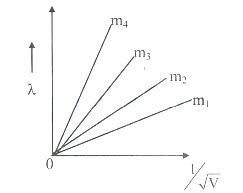
The graph shows the variation of de Broglie wavelength $(\lambda)$ versus $\frac{1}{\sqrt{V}}$,where '$V$' is the accelerating potential for four particles $A, B, C, D$ carrying the same charge but having masses $m_1, m_2, m_3, m_4$. Which one represents a particle of the largest mass?
A
$m_1$
B
$m_2$
C
$m_3$
D
$m_4$
Solution
(A) The de Broglie wavelength is given by $\lambda = \frac{h}{p}$.
Since $p = \sqrt{2mqV}$,we have $\lambda = \frac{h}{\sqrt{2mqV}}$.
Rearranging the terms,we get $\lambda = \left( \frac{h}{\sqrt{2mq}} \right) \left( \frac{1}{\sqrt{V}} \right)$.
Comparing this with the equation of a straight line $y = mx$,where $y = \lambda$ and $x = \frac{1}{\sqrt{V}}$,the slope of the graph is given by $\text{Slope} = \frac{h}{\sqrt{2mq}}$.
Since $h$ and $q$ are constants,the slope is inversely proportional to the square root of the mass: $\text{Slope} \propto \frac{1}{\sqrt{m}}$.
Therefore,a smaller slope corresponds to a larger mass.
Looking at the graph,the line corresponding to $m_1$ has the smallest slope.
Thus,$m_1$ represents the particle with the largest mass.
Since $p = \sqrt{2mqV}$,we have $\lambda = \frac{h}{\sqrt{2mqV}}$.
Rearranging the terms,we get $\lambda = \left( \frac{h}{\sqrt{2mq}} \right) \left( \frac{1}{\sqrt{V}} \right)$.
Comparing this with the equation of a straight line $y = mx$,where $y = \lambda$ and $x = \frac{1}{\sqrt{V}}$,the slope of the graph is given by $\text{Slope} = \frac{h}{\sqrt{2mq}}$.
Since $h$ and $q$ are constants,the slope is inversely proportional to the square root of the mass: $\text{Slope} \propto \frac{1}{\sqrt{m}}$.
Therefore,a smaller slope corresponds to a larger mass.
Looking at the graph,the line corresponding to $m_1$ has the smallest slope.
Thus,$m_1$ represents the particle with the largest mass.
0 likes
View Solution321
EasyMCQ
The de-Broglie wavelength $(\lambda)$ of a particle is related to its kinetic energy $(E)$ as
A
$\lambda \propto E$
B
$\lambda \propto E^{-1}$
C
$\lambda \propto E^{\frac{1}{2}}$
D
$\lambda \propto E^{-\frac{1}{2}}$
Solution
(D) The de-Broglie wavelength $(\lambda)$ of a particle is given by the formula $\lambda = \frac{h}{p}$,where $h$ is Planck's constant and $p$ is the momentum of the particle.
We know that the relationship between kinetic energy $(E)$ and momentum $(p)$ is $E = \frac{p^2}{2m}$,which implies $p = \sqrt{2mE}$.
Substituting this into the de-Broglie wavelength equation,we get $\lambda = \frac{h}{\sqrt{2mE}}$.
Since $h$ and $m$ (mass of the particle) are constants,we can conclude that $\lambda \propto \frac{1}{\sqrt{E}}$,which is equivalent to $\lambda \propto E^{-\frac{1}{2}}$.
We know that the relationship between kinetic energy $(E)$ and momentum $(p)$ is $E = \frac{p^2}{2m}$,which implies $p = \sqrt{2mE}$.
Substituting this into the de-Broglie wavelength equation,we get $\lambda = \frac{h}{\sqrt{2mE}}$.
Since $h$ and $m$ (mass of the particle) are constants,we can conclude that $\lambda \propto \frac{1}{\sqrt{E}}$,which is equivalent to $\lambda \propto E^{-\frac{1}{2}}$.
0 likes
View Solution322
MediumMCQ
An electron of mass $m$ and a photon have the same energy $E$. The ratio of the de-Broglie wavelengths associated with them is ($c$ = velocity of light in air).
A
$\left[\frac{E}{2m}\right]^{1/2}$
B
$\frac{1}{c}\left[\frac{E}{2m}\right]^{1/2}$
C
$c(2mE)^{1/2}$
D
$\frac{1}{c}\left[\frac{2m}{E}\right]^{1/2}$
Solution
(B) The de-Broglie wavelength of a particle is given by $\lambda = \frac{h}{p}$.
For an electron with energy $E$ and mass $m$,the momentum $p_e = \sqrt{2mE}$. Thus,$\lambda_e = \frac{h}{\sqrt{2mE}}$.
For a photon with energy $E$,the momentum $p_p = \frac{E}{c}$. Thus,$\lambda_p = \frac{h}{p_p} = \frac{hc}{E}$.
The ratio of the wavelengths is $\frac{\lambda_e}{\lambda_p} = \frac{h}{\sqrt{2mE}} \times \frac{E}{hc} = \frac{1}{c} \frac{E}{\sqrt{2mE}} = \frac{1}{c} \sqrt{\frac{E}{2m}} = \frac{1}{c} \left[\frac{E}{2m}\right]^{1/2}$.
For an electron with energy $E$ and mass $m$,the momentum $p_e = \sqrt{2mE}$. Thus,$\lambda_e = \frac{h}{\sqrt{2mE}}$.
For a photon with energy $E$,the momentum $p_p = \frac{E}{c}$. Thus,$\lambda_p = \frac{h}{p_p} = \frac{hc}{E}$.
The ratio of the wavelengths is $\frac{\lambda_e}{\lambda_p} = \frac{h}{\sqrt{2mE}} \times \frac{E}{hc} = \frac{1}{c} \frac{E}{\sqrt{2mE}} = \frac{1}{c} \sqrt{\frac{E}{2m}} = \frac{1}{c} \left[\frac{E}{2m}\right]^{1/2}$.
0 likes
View Solution323
EasyMCQ
If the potential difference used to accelerate electrons is doubled,by what factor does the de-Broglie wavelength associated with the electrons change?
A
Wavelength is increased to $\sqrt{2}$ times.
B
Wavelength is decreased to $\sqrt{2}$ times.
C
Wavelength is decreased to $\frac{1}{\sqrt{2}}$ times.
D
Wavelength is increased to $\frac{1}{\sqrt{2}}$ times.
Solution
(C) The de-Broglie wavelength $\lambda$ of an electron accelerated through a potential difference $V$ is given by the formula: $\lambda = \frac{h}{\sqrt{2mqV}}$.
From this relation,we can see that $\lambda \propto \frac{1}{\sqrt{V}}$.
Let the initial potential difference be $V_1 = V$ and the final potential difference be $V_2 = 2V$.
The ratio of the wavelengths is $\frac{\lambda_2}{\lambda_1} = \sqrt{\frac{V_1}{V_2}} = \sqrt{\frac{V}{2V}} = \frac{1}{\sqrt{2}}$.
Therefore,the de-Broglie wavelength decreases by a factor of $\frac{1}{\sqrt{2}}$.
From this relation,we can see that $\lambda \propto \frac{1}{\sqrt{V}}$.
Let the initial potential difference be $V_1 = V$ and the final potential difference be $V_2 = 2V$.
The ratio of the wavelengths is $\frac{\lambda_2}{\lambda_1} = \sqrt{\frac{V_1}{V_2}} = \sqrt{\frac{V}{2V}} = \frac{1}{\sqrt{2}}$.
Therefore,the de-Broglie wavelength decreases by a factor of $\frac{1}{\sqrt{2}}$.
0 likes
View Solution324
EasyMCQ
According to the de-Broglie hypothesis,if an electron of mass '$m$' is accelerated by a potential difference '$V$',then the associated wavelength is '$\lambda$'. When a proton of mass '$M$' is accelerated through a potential difference '$9V$',then the wavelength associated with it is:
A
$\frac{\lambda}{3} \sqrt{\frac{M}{m}}$
B
$\frac{\lambda}{3} \sqrt{\frac{m}{M}}$
C
$\frac{\lambda}{6} \sqrt{\frac{m}{M}}$
D
$\frac{\lambda}{6} \sqrt{\frac{M}{m}}$
Solution
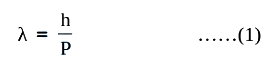
(B) The de-Broglie wavelength of a charged particle accelerated through a potential difference '$V$' is given by:
$\lambda = \frac{h}{\sqrt{2mqV}}$
For an electron of mass '$m$' and charge '$q$':
$\lambda = \frac{h}{\sqrt{2mqV}}$ ---$(1)$
For a proton of mass '$M$' and charge '$q$' (since the magnitude of charge on an electron and a proton is the same):
$\lambda_p = \frac{h}{\sqrt{2Mq(9V)}}$ ---$(2)$
Dividing equation $(1)$ by equation $(2)$:
$\frac{\lambda}{\lambda_p} = \frac{\frac{h}{\sqrt{2mqV}}}{\frac{h}{\sqrt{2Mq(9V)}}} = \sqrt{\frac{2Mq(9V)}{2mqV}} = \sqrt{\frac{9M}{m}} = 3\sqrt{\frac{M}{m}}$
Therefore,the wavelength associated with the proton is:
$\lambda_p = \frac{\lambda}{3} \sqrt{\frac{m}{M}}$
$\lambda = \frac{h}{\sqrt{2mqV}}$
For an electron of mass '$m$' and charge '$q$':
$\lambda = \frac{h}{\sqrt{2mqV}}$ ---$(1)$
For a proton of mass '$M$' and charge '$q$' (since the magnitude of charge on an electron and a proton is the same):
$\lambda_p = \frac{h}{\sqrt{2Mq(9V)}}$ ---$(2)$
Dividing equation $(1)$ by equation $(2)$:
$\frac{\lambda}{\lambda_p} = \frac{\frac{h}{\sqrt{2mqV}}}{\frac{h}{\sqrt{2Mq(9V)}}} = \sqrt{\frac{2Mq(9V)}{2mqV}} = \sqrt{\frac{9M}{m}} = 3\sqrt{\frac{M}{m}}$
Therefore,the wavelength associated with the proton is:
$\lambda_p = \frac{\lambda}{3} \sqrt{\frac{m}{M}}$
0 likes
View Solution325
EasyMCQ
The kinetic energy of an electron is tripled,then the de-Broglie wavelength associated with it will change by a factor of:
A
$1/3$
B
$3$
C
$\sqrt{3}$
D
$1/\sqrt{3}$
Solution
(D) The relation between kinetic energy $K$ and momentum $P$ is given by $P = \sqrt{2mK}$.
If the kinetic energy is tripled,the new kinetic energy $K' = 3K$.
The new momentum $P'$ is given by $P' = \sqrt{2m(3K)} = \sqrt{3} \sqrt{2mK} = \sqrt{3}P$.
The de-Broglie wavelength $\lambda$ is given by $\lambda = h/P$.
Therefore,the new wavelength $\lambda'$ is $\lambda' = h/P' = h/(\sqrt{3}P) = \lambda / \sqrt{3}$.
Thus,the wavelength changes by a factor of $1/\sqrt{3}$.
If the kinetic energy is tripled,the new kinetic energy $K' = 3K$.
The new momentum $P'$ is given by $P' = \sqrt{2m(3K)} = \sqrt{3} \sqrt{2mK} = \sqrt{3}P$.
The de-Broglie wavelength $\lambda$ is given by $\lambda = h/P$.
Therefore,the new wavelength $\lambda'$ is $\lambda' = h/P' = h/(\sqrt{3}P) = \lambda / \sqrt{3}$.
Thus,the wavelength changes by a factor of $1/\sqrt{3}$.
0 likes
View Solution326
EasyMCQ
If the kinetic energy of a free electron doubles,its de-Broglie wavelength $\lambda$ changes by a factor of:
A
$2$
B
$\frac{1}{\sqrt{2}}$
C
$\sqrt{2}$
D
$\frac{1}{2}$
Solution
(B) The de-Broglie wavelength $\lambda$ is given by the formula $\lambda = \frac{h}{p}$,where $h$ is Planck's constant and $p$ is the momentum of the electron.
Since kinetic energy $K = \frac{p^2}{2m}$,we can express momentum as $p = \sqrt{2mK}$.
Substituting this into the wavelength formula,we get $\lambda = \frac{h}{\sqrt{2mK}}$.
This shows that $\lambda \propto \frac{1}{\sqrt{K}}$.
If the kinetic energy $K$ is doubled to $K' = 2K$,the new wavelength $\lambda'$ becomes $\lambda' = \frac{h}{\sqrt{2m(2K)}} = \frac{1}{\sqrt{2}} \cdot \frac{h}{\sqrt{2mK}} = \frac{\lambda}{\sqrt{2}}$.
Therefore,the wavelength changes by a factor of $\frac{1}{\sqrt{2}}$.
Since kinetic energy $K = \frac{p^2}{2m}$,we can express momentum as $p = \sqrt{2mK}$.
Substituting this into the wavelength formula,we get $\lambda = \frac{h}{\sqrt{2mK}}$.
This shows that $\lambda \propto \frac{1}{\sqrt{K}}$.
If the kinetic energy $K$ is doubled to $K' = 2K$,the new wavelength $\lambda'$ becomes $\lambda' = \frac{h}{\sqrt{2m(2K)}} = \frac{1}{\sqrt{2}} \cdot \frac{h}{\sqrt{2mK}} = \frac{\lambda}{\sqrt{2}}$.
Therefore,the wavelength changes by a factor of $\frac{1}{\sqrt{2}}$.
0 likes
View Solution327
DifficultMCQ
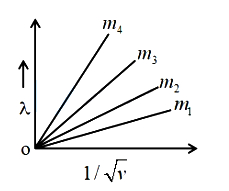
The graph shows the variation of de-Broglie wavelength $\lambda$ versus $\frac{1}{\sqrt{V}}$,where $V$ is the accelerating potential for four particles carrying the same charge but having masses $m_1, m_2, m_3, m_4$. Which one represents the particle with the smallest mass?
A
$m_4$
B
$m_1$
C
$m_3$
D
$m_2$
Solution
(A) The de-Broglie wavelength $\lambda$ is given by $\lambda = \frac{h}{p}$.
Since the kinetic energy $K = \frac{p^2}{2m} = qV$,the momentum is $p = \sqrt{2mqV}$.
Substituting this into the wavelength formula,we get $\lambda = \frac{h}{\sqrt{2mqV}} = \left( \frac{h}{\sqrt{2mq}} \right) \left( \frac{1}{\sqrt{V}} \right)$.
Comparing this with the equation of a straight line $y = mx$,where $y = \lambda$ and $x = \frac{1}{\sqrt{V}}$,the slope is given by $\text{slope} = \frac{h}{\sqrt{2mq}}$.
Since $h$ and $q$ are constants,the slope is inversely proportional to the square root of the mass,i.e.,$\text{slope} \propto \frac{1}{\sqrt{m}}$.
Therefore,a larger slope corresponds to a smaller mass.
From the graph,the line corresponding to $m_4$ has the largest slope.
Thus,$m_4$ represents the particle with the smallest mass.
Since the kinetic energy $K = \frac{p^2}{2m} = qV$,the momentum is $p = \sqrt{2mqV}$.
Substituting this into the wavelength formula,we get $\lambda = \frac{h}{\sqrt{2mqV}} = \left( \frac{h}{\sqrt{2mq}} \right) \left( \frac{1}{\sqrt{V}} \right)$.
Comparing this with the equation of a straight line $y = mx$,where $y = \lambda$ and $x = \frac{1}{\sqrt{V}}$,the slope is given by $\text{slope} = \frac{h}{\sqrt{2mq}}$.
Since $h$ and $q$ are constants,the slope is inversely proportional to the square root of the mass,i.e.,$\text{slope} \propto \frac{1}{\sqrt{m}}$.
Therefore,a larger slope corresponds to a smaller mass.
From the graph,the line corresponding to $m_4$ has the largest slope.
Thus,$m_4$ represents the particle with the smallest mass.
0 likes
View Solution328
EasyMCQ
What is the additional energy that should be supplied to a moving electron to reduce its de Broglie wavelength from $1 \,nm$ to $0.5 \,nm$?
A
Four times its initial energy
B
Five times its initial energy
C
Two times its initial energy
D
Three times its initial energy
Solution
(D) The de Broglie wavelength $\lambda$ is related to the kinetic energy $E$ by the formula: $\lambda = \frac{h}{\sqrt{2mE}}$.
From this, we can express energy as $E = \frac{h^2}{2m\lambda^2}$.
Let the initial wavelength be $\lambda_1 = 1 \,nm$ and the final wavelength be $\lambda_2 = 0.5 \,nm$.
The initial energy is $E_1 = \frac{h^2}{2m\lambda_1^2}$.
The final energy is $E_2 = \frac{h^2}{2m\lambda_2^2} = \frac{h^2}{2m(0.5\lambda_1)^2} = \frac{h^2}{2m(0.25\lambda_1^2)} = 4E_1$.
The additional energy required is $\Delta E = E_2 - E_1 = 4E_1 - E_1 = 3E_1$.
Thus, the additional energy to be supplied is three times its initial energy.
From this, we can express energy as $E = \frac{h^2}{2m\lambda^2}$.
Let the initial wavelength be $\lambda_1 = 1 \,nm$ and the final wavelength be $\lambda_2 = 0.5 \,nm$.
The initial energy is $E_1 = \frac{h^2}{2m\lambda_1^2}$.
The final energy is $E_2 = \frac{h^2}{2m\lambda_2^2} = \frac{h^2}{2m(0.5\lambda_1)^2} = \frac{h^2}{2m(0.25\lambda_1^2)} = 4E_1$.
The additional energy required is $\Delta E = E_2 - E_1 = 4E_1 - E_1 = 3E_1$.
Thus, the additional energy to be supplied is three times its initial energy.
0 likes
View Solution329
DifficultMCQ
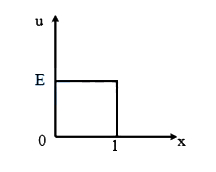
The potential energy '$U$' of a moving particle of mass '$m$' varies with '$x$' as shown in the figure. The de-Broglie wavelengths of the particle in the regions $0 \leq x \leq 1$ and $x > 1$ are $\lambda_1$ and $\lambda_2$ respectively. If the total energy of the particle is '$nE$',then the ratio $\lambda_1 / \lambda_2$ is
A
$\sqrt{\frac{n^2}{n-1}}$
B
$\sqrt{\frac{n-1}{n}}$
C
$\sqrt{\frac{n}{n-1}}$
D
$\sqrt{\frac{n(n-1)}{n}}$
Solution
(C) In the region $0 \leq x \leq 1$,the potential energy of the particle is $U = E$. The total energy is $E_{total} = nE$.
Since $E_{total} = K.E. + P.E.$,the kinetic energy $K_1 = nE - E = (n-1)E$.
The momentum $p_1 = \sqrt{2mK_1} = \sqrt{2m(n-1)E}$.
The de-Broglie wavelength is $\lambda_1 = \frac{h}{p_1} = \frac{h}{\sqrt{2m(n-1)E}}$.
In the region $x > 1$,the potential energy is $U = 0$.
Thus,the kinetic energy $K_2 = nE - 0 = nE$.
The momentum $p_2 = \sqrt{2mK_2} = \sqrt{2mnE}$.
The de-Broglie wavelength is $\lambda_2 = \frac{h}{p_2} = \frac{h}{\sqrt{2mnE}}$.
Taking the ratio,$\frac{\lambda_1}{\lambda_2} = \frac{h / \sqrt{2m(n-1)E}}{h / \sqrt{2mnE}} = \sqrt{\frac{2mnE}{2m(n-1)E}} = \sqrt{\frac{n}{n-1}}$.
Since $E_{total} = K.E. + P.E.$,the kinetic energy $K_1 = nE - E = (n-1)E$.
The momentum $p_1 = \sqrt{2mK_1} = \sqrt{2m(n-1)E}$.
The de-Broglie wavelength is $\lambda_1 = \frac{h}{p_1} = \frac{h}{\sqrt{2m(n-1)E}}$.
In the region $x > 1$,the potential energy is $U = 0$.
Thus,the kinetic energy $K_2 = nE - 0 = nE$.
The momentum $p_2 = \sqrt{2mK_2} = \sqrt{2mnE}$.
The de-Broglie wavelength is $\lambda_2 = \frac{h}{p_2} = \frac{h}{\sqrt{2mnE}}$.
Taking the ratio,$\frac{\lambda_1}{\lambda_2} = \frac{h / \sqrt{2m(n-1)E}}{h / \sqrt{2mnE}} = \sqrt{\frac{2mnE}{2m(n-1)E}} = \sqrt{\frac{n}{n-1}}$.
0 likes
View Solution330
MediumMCQ
$A$ proton and an alpha particle are accelerated through the same potential difference. The ratio of the de-Broglie wavelength of the proton to that of the alpha particle will be (mass of alpha particle is four times the mass of the proton,and the charge of the alpha particle is twice the charge of the proton).
A
$1: 2$
B
$2 \sqrt{2}: 1$
C
$1: 1$
D
$2: 1$
Solution
(B) The de-Broglie wavelength $\lambda$ of a particle accelerated through a potential difference $V$ is given by the formula: $\lambda = \frac{h}{\sqrt{2mqV}}$.
Here,$h$ is Planck's constant,$m$ is the mass of the particle,and $q$ is the charge of the particle.
For a proton,let mass be $m_p = m$ and charge be $q_p = e$.
For an alpha particle,mass $m_{\alpha} = 4m$ and charge $q_{\alpha} = 2e$.
Since both are accelerated through the same potential difference $V$,the ratio of their wavelengths is:
$\frac{\lambda_p}{\lambda_{\alpha}} = \frac{\frac{h}{\sqrt{2m_p q_p V}}}{\frac{h}{\sqrt{2m_{\alpha} q_{\alpha} V}}} = \sqrt{\frac{m_{\alpha} q_{\alpha}}{m_p q_p}}$
Substituting the values:
$\frac{\lambda_p}{\lambda_{\alpha}} = \sqrt{\frac{4m \times 2e}{m \times e}} = \sqrt{8} = 2\sqrt{2}$.
Thus,the ratio is $2\sqrt{2}: 1$.
Here,$h$ is Planck's constant,$m$ is the mass of the particle,and $q$ is the charge of the particle.
For a proton,let mass be $m_p = m$ and charge be $q_p = e$.
For an alpha particle,mass $m_{\alpha} = 4m$ and charge $q_{\alpha} = 2e$.
Since both are accelerated through the same potential difference $V$,the ratio of their wavelengths is:
$\frac{\lambda_p}{\lambda_{\alpha}} = \frac{\frac{h}{\sqrt{2m_p q_p V}}}{\frac{h}{\sqrt{2m_{\alpha} q_{\alpha} V}}} = \sqrt{\frac{m_{\alpha} q_{\alpha}}{m_p q_p}}$
Substituting the values:
$\frac{\lambda_p}{\lambda_{\alpha}} = \sqrt{\frac{4m \times 2e}{m \times e}} = \sqrt{8} = 2\sqrt{2}$.
Thus,the ratio is $2\sqrt{2}: 1$.
0 likes
View Solution331
DifficultMCQ
Kinetic energy of a proton is equal to energy $E$ of a photon. Let $\lambda_1$ be the de-Broglie wavelength of the proton and $\lambda_2$ be the wavelength of the photon. If $\frac{\lambda_1}{\lambda_2} \propto E^{n}$,then the value of $n$ is
A
$\frac{1}{2}$
B
$\frac{1}{4}$
C
$2$
D
$4$
Solution
(A) For a proton with kinetic energy $E$,the momentum $p$ is given by $E = \frac{p^2}{2m}$,where $m$ is the mass of the proton.
Thus,$p = \sqrt{2mE}$.
The de-Broglie wavelength of the proton is $\lambda_1 = \frac{h}{p} = \frac{h}{\sqrt{2mE}}$.
For a photon with energy $E$,the wavelength $\lambda_2$ is given by $E = \frac{hc}{\lambda_2}$,which implies $\lambda_2 = \frac{hc}{E}$.
Taking the ratio of the two wavelengths:
$\frac{\lambda_1}{\lambda_2} = \frac{h}{\sqrt{2mE}} \cdot \frac{E}{hc} = \frac{1}{c} \sqrt{\frac{E}{2m}}$.
Therefore,$\frac{\lambda_1}{\lambda_2} \propto E^{1/2}$.
Comparing this with $\frac{\lambda_1}{\lambda_2} \propto E^n$,we get $n = \frac{1}{2}$.
Thus,$p = \sqrt{2mE}$.
The de-Broglie wavelength of the proton is $\lambda_1 = \frac{h}{p} = \frac{h}{\sqrt{2mE}}$.
For a photon with energy $E$,the wavelength $\lambda_2$ is given by $E = \frac{hc}{\lambda_2}$,which implies $\lambda_2 = \frac{hc}{E}$.
Taking the ratio of the two wavelengths:
$\frac{\lambda_1}{\lambda_2} = \frac{h}{\sqrt{2mE}} \cdot \frac{E}{hc} = \frac{1}{c} \sqrt{\frac{E}{2m}}$.
Therefore,$\frac{\lambda_1}{\lambda_2} \propto E^{1/2}$.
Comparing this with $\frac{\lambda_1}{\lambda_2} \propto E^n$,we get $n = \frac{1}{2}$.
0 likes
View Solution332
DifficultMCQ
An electron of mass $m$ and a photon have the same energy $E$. The ratio of the de-Broglie wavelength of the electron to the wavelength of the photon is ($c =$ velocity of light).
A
$c \sqrt{\frac{E}{m}}$
B
$\frac{1}{c} \sqrt{\frac{2m}{E}}$
C
$\frac{1}{c} \sqrt{\frac{E}{2m}}$
D
$c \sqrt{\frac{m}{E}}$
Solution
(C) For an electron with kinetic energy $E$,the momentum $p$ is given by $E = \frac{p^2}{2m}$,which implies $p = \sqrt{2mE}$.
The de-Broglie wavelength of the electron is $\lambda_e = \frac{h}{p} = \frac{h}{\sqrt{2mE}}$.
For a photon,the energy $E$ is related to its wavelength $\lambda_p$ by $E = \frac{hc}{\lambda_p}$,which implies $\lambda_p = \frac{hc}{E}$.
The ratio of the wavelengths is $\frac{\lambda_e}{\lambda_p} = \frac{h}{\sqrt{2mE}} \times \frac{E}{hc} = \frac{1}{c} \sqrt{\frac{E}{2m}}$.
The de-Broglie wavelength of the electron is $\lambda_e = \frac{h}{p} = \frac{h}{\sqrt{2mE}}$.
For a photon,the energy $E$ is related to its wavelength $\lambda_p$ by $E = \frac{hc}{\lambda_p}$,which implies $\lambda_p = \frac{hc}{E}$.
The ratio of the wavelengths is $\frac{\lambda_e}{\lambda_p} = \frac{h}{\sqrt{2mE}} \times \frac{E}{hc} = \frac{1}{c} \sqrt{\frac{E}{2m}}$.
0 likes
View Solution333
EasyMCQ
The de-Broglie wavelength associated with an electron accelerated through a potential difference '$V$' is '$\lambda$'. When the accelerating potential is increased to '$4V$',the new de-Broglie wavelength:
A
reduces to half
B
remains the same
C
reduces to $(1/4)^{\text{th}}$
D
increases by $25\%$
Solution
(A) The de-Broglie wavelength $\lambda$ of an electron accelerated through a potential difference $V$ is given by the formula: $\lambda = \frac{h}{\sqrt{2meV}} = \frac{1.228}{\sqrt{V}} \text{ nm}$.
From this relation,we can see that $\lambda \propto \frac{1}{\sqrt{V}}$.
Let the initial wavelength be $\lambda_1 = \lambda$ at potential $V_1 = V$.
Let the new wavelength be $\lambda_2$ at potential $V_2 = 4V$.
Taking the ratio: $\frac{\lambda_2}{\lambda_1} = \sqrt{\frac{V_1}{V_2}} = \sqrt{\frac{V}{4V}} = \sqrt{\frac{1}{4}} = \frac{1}{2}$.
Therefore,$\lambda_2 = \frac{\lambda}{2}$.
Thus,the wavelength reduces to half of its original value.
From this relation,we can see that $\lambda \propto \frac{1}{\sqrt{V}}$.
Let the initial wavelength be $\lambda_1 = \lambda$ at potential $V_1 = V$.
Let the new wavelength be $\lambda_2$ at potential $V_2 = 4V$.
Taking the ratio: $\frac{\lambda_2}{\lambda_1} = \sqrt{\frac{V_1}{V_2}} = \sqrt{\frac{V}{4V}} = \sqrt{\frac{1}{4}} = \frac{1}{2}$.
Therefore,$\lambda_2 = \frac{\lambda}{2}$.
Thus,the wavelength reduces to half of its original value.
0 likes
View Solution334
MediumMCQ
If the kinetic energy of a particle is increased to $16$ times its previous value,the percentage change in the de-Broglie wavelength of the particle is
A
$75$
B
$25$
C
$50$
D
$5$
Solution
(A) The kinetic energy $K$ is related to momentum $p$ by the equation $K = \frac{p^2}{2m}$.
Therefore,$p = \sqrt{2mK}$.
The de-Broglie wavelength $\lambda$ is given by $\lambda = \frac{h}{p} = \frac{h}{\sqrt{2mK}}$.
This implies $\lambda \propto \frac{1}{\sqrt{K}}$.
Let the initial kinetic energy be $K_1$ and the final kinetic energy be $K_2 = 16K_1$.
Then,$\frac{\lambda_2}{\lambda_1} = \sqrt{\frac{K_1}{K_2}} = \sqrt{\frac{K_1}{16K_1}} = \sqrt{\frac{1}{16}} = \frac{1}{4}$.
So,$\lambda_2 = 0.25 \lambda_1$.
The percentage change in wavelength is $\frac{\lambda_1 - \lambda_2}{\lambda_1} \times 100\% = \frac{\lambda_1 - 0.25 \lambda_1}{\lambda_1} \times 100\% = 0.75 \times 100\% = 75\%$.
Therefore,$p = \sqrt{2mK}$.
The de-Broglie wavelength $\lambda$ is given by $\lambda = \frac{h}{p} = \frac{h}{\sqrt{2mK}}$.
This implies $\lambda \propto \frac{1}{\sqrt{K}}$.
Let the initial kinetic energy be $K_1$ and the final kinetic energy be $K_2 = 16K_1$.
Then,$\frac{\lambda_2}{\lambda_1} = \sqrt{\frac{K_1}{K_2}} = \sqrt{\frac{K_1}{16K_1}} = \sqrt{\frac{1}{16}} = \frac{1}{4}$.
So,$\lambda_2 = 0.25 \lambda_1$.
The percentage change in wavelength is $\frac{\lambda_1 - \lambda_2}{\lambda_1} \times 100\% = \frac{\lambda_1 - 0.25 \lambda_1}{\lambda_1} \times 100\% = 0.75 \times 100\% = 75\%$.
0 likes
View Solution335
MediumMCQ
Photons of wavelength $\lambda$ are incident on the cathode of a photocell. Electrons are emitted from the cathode surface. The de-Broglie wavelength of the emitted electrons is (work function is negligible).
($c =$ velocity of light,$h =$ Planck's constant,$m =$ mass of electron)
($c =$ velocity of light,$h =$ Planck's constant,$m =$ mass of electron)
A
$\sqrt{\frac{mc}{2h\lambda}}$
B
$\sqrt{\frac{h\lambda}{2mc}}$
C
$\sqrt{\frac{2h\lambda}{mc}}$
D
$\sqrt{\frac{mh}{\lambda c}}$
Solution
(B) Given that the work function is negligible,the kinetic energy of the emitted electron is equal to the energy of the incident photon.
$\frac{1}{2}mv^2 = \frac{hc}{\lambda}$
Multiplying both sides by $2m$,we get $m^2v^2 = \frac{2mhc}{\lambda}$.
Taking the square root,the momentum $p = mv = \sqrt{\frac{2mhc}{\lambda}}$.
The de-Broglie wavelength $\lambda_e$ is given by $\lambda_e = \frac{h}{p}$.
Substituting the value of $p$:
$\lambda_e = \frac{h}{\sqrt{\frac{2mhc}{\lambda}}} = \sqrt{\frac{h^2 \lambda}{2mhc}} = \sqrt{\frac{h\lambda}{2mc}}$.
$\frac{1}{2}mv^2 = \frac{hc}{\lambda}$
Multiplying both sides by $2m$,we get $m^2v^2 = \frac{2mhc}{\lambda}$.
Taking the square root,the momentum $p = mv = \sqrt{\frac{2mhc}{\lambda}}$.
The de-Broglie wavelength $\lambda_e$ is given by $\lambda_e = \frac{h}{p}$.
Substituting the value of $p$:
$\lambda_e = \frac{h}{\sqrt{\frac{2mhc}{\lambda}}} = \sqrt{\frac{h^2 \lambda}{2mhc}} = \sqrt{\frac{h\lambda}{2mc}}$.
0 likes
View Solution336
EasyMCQ
If the potential difference used to accelerate electrons is doubled,by what factor does the de-Broglie wavelength associated with the electrons change?
A
Wavelength is decreased to $1/3$ times.
B
Wavelength is increased to $1/2$ times.
C
Wavelength is increased to $1/\sqrt{2}$ times.
D
Wavelength is decreased to $1/\sqrt{2}$ times.
Solution
(D) The de Broglie wavelength $\lambda$ of an electron accelerated through a potential difference $V$ is given by the formula: $\lambda = \frac{h}{\sqrt{2meV}}$.
From this relation,we can see that $\lambda \propto \frac{1}{\sqrt{V}}$.
Let the initial potential difference be $V_1 = V$ and the initial wavelength be $\lambda_1$.
When the potential difference is doubled,the new potential difference is $V_2 = 2V$.
The new wavelength $\lambda_2$ is given by $\lambda_2 = \frac{h}{\sqrt{2me(2V)}} = \frac{1}{\sqrt{2}} \times \frac{h}{\sqrt{2meV}}$.
Therefore,$\lambda_2 = \frac{1}{\sqrt{2}} \lambda_1$.
Thus,the de-Broglie wavelength changes by a factor of $1/\sqrt{2}$.
From this relation,we can see that $\lambda \propto \frac{1}{\sqrt{V}}$.
Let the initial potential difference be $V_1 = V$ and the initial wavelength be $\lambda_1$.
When the potential difference is doubled,the new potential difference is $V_2 = 2V$.
The new wavelength $\lambda_2$ is given by $\lambda_2 = \frac{h}{\sqrt{2me(2V)}} = \frac{1}{\sqrt{2}} \times \frac{h}{\sqrt{2meV}}$.
Therefore,$\lambda_2 = \frac{1}{\sqrt{2}} \lambda_1$.
Thus,the de-Broglie wavelength changes by a factor of $1/\sqrt{2}$.
0 likes
View Solution337
EasyMCQ
An electron and a proton are accelerated through the same potential difference. The ratio of the de-Broglie wavelength $\lambda_{p}$ to $\lambda_{e}$ is $[m_{e} = \text{mass of electron}, m_{p} = \text{mass of proton}]$
A
$\left(\frac{m_{p}}{m_{e}}\right)^{\frac{1}{2}}$
B
$\left(\frac{m_{e}}{m_{p}}\right)^{\frac{1}{2}}$
C
$\left(\frac{m_{e}}{m_{p}}\right)$
D
$\left(\frac{m_{p}}{m_{e}}\right)$
Solution
(B) Both the electron and the proton are accelerated through the same potential difference $V$,so they acquire the same kinetic energy $K = eV$.
The momentum $P$ of a particle is related to its kinetic energy $K$ by the formula $P = \sqrt{2mK}$.
For the electron,the momentum is $P_{e} = \sqrt{2m_{e}K}$.
For the proton,the momentum is $P_{p} = \sqrt{2m_{p}K}$.
The de-Broglie wavelength is given by $\lambda = \frac{h}{P}$.
Therefore,the ratio of the wavelengths is $\frac{\lambda_{p}}{\lambda_{e}} = \frac{h/P_{p}}{h/P_{e}} = \frac{P_{e}}{P_{p}}$.
Substituting the expressions for momentum: $\frac{\lambda_{p}}{\lambda_{e}} = \frac{\sqrt{2m_{e}K}}{\sqrt{2m_{p}K}} = \sqrt{\frac{m_{e}}{m_{p}}} = \left(\frac{m_{e}}{m_{p}}\right)^{\frac{1}{2}}$.
The momentum $P$ of a particle is related to its kinetic energy $K$ by the formula $P = \sqrt{2mK}$.
For the electron,the momentum is $P_{e} = \sqrt{2m_{e}K}$.
For the proton,the momentum is $P_{p} = \sqrt{2m_{p}K}$.
The de-Broglie wavelength is given by $\lambda = \frac{h}{P}$.
Therefore,the ratio of the wavelengths is $\frac{\lambda_{p}}{\lambda_{e}} = \frac{h/P_{p}}{h/P_{e}} = \frac{P_{e}}{P_{p}}$.
Substituting the expressions for momentum: $\frac{\lambda_{p}}{\lambda_{e}} = \frac{\sqrt{2m_{e}K}}{\sqrt{2m_{p}K}} = \sqrt{\frac{m_{e}}{m_{p}}} = \left(\frac{m_{e}}{m_{p}}\right)^{\frac{1}{2}}$.
0 likes
View Solution338
MediumMCQ
How much energy is imparted to an electron so that its de-Broglie wavelength reduces from $10^{-10} \ m$ to $0.5 \times 10^{-10} \ m$? (Let $E$ be the initial energy of the electron).
A
$3 E$
B
$4 E$
C
$2 E$
D
$E$
Solution
(A) The de-Broglie wavelength $\lambda$ of an electron with energy $E$ is given by $\lambda = \frac{h}{\sqrt{2mE}}$.
From this relation,we can see that $\lambda \propto \frac{1}{\sqrt{E}}$,which implies $\frac{\lambda_1}{\lambda_2} = \sqrt{\frac{E_2}{E_1}}$.
Given $\lambda_1 = 10^{-10} \ m$ and $\lambda_2 = 0.5 \times 10^{-10} \ m$,we have $\frac{\lambda_1}{\lambda_2} = \frac{10^{-10}}{0.5 \times 10^{-10}} = 2$.
Substituting this into the ratio equation: $2 = \sqrt{\frac{E_2}{E_1}}$.
Squaring both sides,we get $4 = \frac{E_2}{E_1}$,so $E_2 = 4E_1 = 4E$.
The energy imparted to the electron is $\Delta E = E_2 - E_1 = 4E - E = 3E$.
From this relation,we can see that $\lambda \propto \frac{1}{\sqrt{E}}$,which implies $\frac{\lambda_1}{\lambda_2} = \sqrt{\frac{E_2}{E_1}}$.
Given $\lambda_1 = 10^{-10} \ m$ and $\lambda_2 = 0.5 \times 10^{-10} \ m$,we have $\frac{\lambda_1}{\lambda_2} = \frac{10^{-10}}{0.5 \times 10^{-10}} = 2$.
Substituting this into the ratio equation: $2 = \sqrt{\frac{E_2}{E_1}}$.
Squaring both sides,we get $4 = \frac{E_2}{E_1}$,so $E_2 = 4E_1 = 4E$.
The energy imparted to the electron is $\Delta E = E_2 - E_1 = 4E - E = 3E$.
0 likes
View Solution339
MediumMCQ
The kinetic energy of an electron having de-Broglie wavelength $\lambda$ is ($h=$ Planck's constant,$m=$ mass of electron).
A
$\frac{h}{2 m \lambda}$
B
$\frac{h^2}{2 m \lambda^2}$
C
$\frac{h^2}{2 m^2 \lambda^2}$
D
$\frac{h^2}{2 m^2 \lambda}$
Solution
(B) The de-Broglie wavelength $\lambda$ is related to the momentum $p$ by the equation $\lambda = \frac{h}{p}$.
Since kinetic energy $K.E. = \frac{p^2}{2m}$,we can express momentum as $p = \sqrt{2m(K.E.)}$.
Substituting this into the wavelength formula,we get $\lambda = \frac{h}{\sqrt{2m(K.E.)}}$.
Squaring both sides,we obtain $\lambda^2 = \frac{h^2}{2m(K.E.)}$.
Rearranging the terms to solve for kinetic energy,we get $K.E. = \frac{h^2}{2m\lambda^2}$.
Since kinetic energy $K.E. = \frac{p^2}{2m}$,we can express momentum as $p = \sqrt{2m(K.E.)}$.
Substituting this into the wavelength formula,we get $\lambda = \frac{h}{\sqrt{2m(K.E.)}}$.
Squaring both sides,we obtain $\lambda^2 = \frac{h^2}{2m(K.E.)}$.
Rearranging the terms to solve for kinetic energy,we get $K.E. = \frac{h^2}{2m\lambda^2}$.
0 likes
View Solution340
MediumMCQ
If an electron and a proton have the same de-Broglie wavelength,then the kinetic energy of the electron is
A
Zero
B
Less than that of a proton
C
More than that of a proton
D
Equal to that of a proton
Solution
(C) The de-Broglie wavelength $\lambda$ is given by the relation $\lambda = \frac{h}{p} = \frac{h}{\sqrt{2mKE}}$.
From this,the kinetic energy $KE$ can be expressed as $KE = \frac{h^2}{2m\lambda^2}$.
Since the de-Broglie wavelength $\lambda$ is the same for both the electron and the proton,we have $KE \propto \frac{1}{m}$.
Because the mass of an electron $(m_e \approx 9.11 \times 10^{-31} \ kg)$ is much smaller than the mass of a proton $(m_p \approx 1.67 \times 10^{-27} \ kg)$,the kinetic energy of the electron will be greater than that of the proton.
From this,the kinetic energy $KE$ can be expressed as $KE = \frac{h^2}{2m\lambda^2}$.
Since the de-Broglie wavelength $\lambda$ is the same for both the electron and the proton,we have $KE \propto \frac{1}{m}$.
Because the mass of an electron $(m_e \approx 9.11 \times 10^{-31} \ kg)$ is much smaller than the mass of a proton $(m_p \approx 1.67 \times 10^{-27} \ kg)$,the kinetic energy of the electron will be greater than that of the proton.
0 likes
View Solution341
EasyMCQ
According to the de-Broglie hypothesis,the wavelength associated with a moving electron of mass $m$ is $\lambda_e$. Using the mass-energy relation and Planck's quantum theory,the wavelength associated with a photon is $\lambda_p$. If the energy $(E)$ of the electron and the photon is the same,then the relation between $\lambda_e$ and $\lambda_p$ is:
A
$\lambda_p \propto \lambda_e$
B
$\lambda_p \propto \lambda_e^2$
C
$\lambda_p \propto \sqrt{\lambda_e}$
D
$\lambda_p \propto \frac{1}{\lambda_e}$
Solution
(B) For a photon,the energy is given by $E = \frac{hc}{\lambda_p}$.
Therefore,$\lambda_p = \frac{hc}{E} \dots (i)$.
For a non-relativistic electron,the de-Broglie wavelength is $\lambda_e = \frac{h}{p}$.
Since $E = \frac{p^2}{2m}$,we have $p = \sqrt{2mE}$.
Thus,$\lambda_e = \frac{h}{\sqrt{2mE}}$,which implies $E = \frac{h^2}{2m\lambda_e^2}$.
Substituting $E$ into equation $(i)$:
$\lambda_p = \frac{hc}{(h^2 / 2m\lambda_e^2)} = \frac{2mc}{h} \lambda_e^2$.
Therefore,$\lambda_p \propto \lambda_e^2$.
Therefore,$\lambda_p = \frac{hc}{E} \dots (i)$.
For a non-relativistic electron,the de-Broglie wavelength is $\lambda_e = \frac{h}{p}$.
Since $E = \frac{p^2}{2m}$,we have $p = \sqrt{2mE}$.
Thus,$\lambda_e = \frac{h}{\sqrt{2mE}}$,which implies $E = \frac{h^2}{2m\lambda_e^2}$.
Substituting $E$ into equation $(i)$:
$\lambda_p = \frac{hc}{(h^2 / 2m\lambda_e^2)} = \frac{2mc}{h} \lambda_e^2$.
Therefore,$\lambda_p \propto \lambda_e^2$.
0 likes
View Solution342
MediumMCQ
An electron of mass $m$ has de-Broglie wavelength $\lambda$ when accelerated through potential difference $V$. When a proton of mass $M$ is accelerated through a potential difference of $9V$,the de-Broglie wavelength associated with it will be (Assume that wavelength is determined at low voltage).
A
$\frac{\lambda}{3} \sqrt{\frac{M}{m}}$
B
$\frac{\lambda}{3} \cdot \frac{M}{m}$
C
$\frac{\lambda}{3} \sqrt{\frac{m}{M}}$
D
$\frac{\lambda}{3} \cdot \frac{m}{M}$
Solution
(C) The de-Broglie wavelength $\lambda$ of a particle of mass $m$ and charge $q$ accelerated through a potential difference $V$ is given by $\lambda = \frac{h}{\sqrt{2mqV}}$.
For an electron: $\lambda = \frac{h}{\sqrt{2meV}}$.
For a proton of mass $M$ and charge $e$ accelerated through potential $9V$: $\lambda' = \frac{h}{\sqrt{2Me(9V)}} = \frac{h}{3\sqrt{2MeV}}$.
Dividing $\lambda'$ by $\lambda$: $\frac{\lambda'}{\lambda} = \frac{\frac{h}{3\sqrt{2MeV}}}{\frac{h}{\sqrt{2meV}}} = \frac{1}{3} \sqrt{\frac{m}{M}}$.
Therefore,$\lambda' = \frac{\lambda}{3} \sqrt{\frac{m}{M}}$.
For an electron: $\lambda = \frac{h}{\sqrt{2meV}}$.
For a proton of mass $M$ and charge $e$ accelerated through potential $9V$: $\lambda' = \frac{h}{\sqrt{2Me(9V)}} = \frac{h}{3\sqrt{2MeV}}$.
Dividing $\lambda'$ by $\lambda$: $\frac{\lambda'}{\lambda} = \frac{\frac{h}{3\sqrt{2MeV}}}{\frac{h}{\sqrt{2meV}}} = \frac{1}{3} \sqrt{\frac{m}{M}}$.
Therefore,$\lambda' = \frac{\lambda}{3} \sqrt{\frac{m}{M}}$.
0 likes
View Solution343
EasyMCQ
When the kinetic energy of an electron is increased,the wavelength of the associated wave will:
A
increase
B
decrease
C
wavelength does not depend upon kinetic energy
D
None of the above
Solution
(B) The de Broglie wavelength $\lambda$ associated with a particle of mass $m$ and kinetic energy $E$ is given by the relation: $\lambda = \frac{h}{p} = \frac{h}{\sqrt{2mE}}$.
From this expression,it is clear that $\lambda \propto \frac{1}{\sqrt{E}}$.
Therefore,when the kinetic energy $E$ of an electron is increased,the wavelength $\lambda$ will decrease.
From this expression,it is clear that $\lambda \propto \frac{1}{\sqrt{E}}$.
Therefore,when the kinetic energy $E$ of an electron is increased,the wavelength $\lambda$ will decrease.
0 likes
View Solution344
MediumMCQ
The ratio of momenta of an electron and an $\alpha$-particle which are accelerated from rest by a potential difference of $100 \ V$ is
A
$1$
B
$\sqrt{\frac{2 m_{e}}{m_{\alpha}}}$
C
$\sqrt{\frac{m_{e}}{m_{\alpha}}}$
D
$\sqrt{\frac{m_{e}}{2 m_{\alpha}}}$
Solution
(D) The momentum $p$ of a charged particle accelerated from rest through a potential difference $V$ is given by the relation $p = \sqrt{2mqV}$,where $m$ is the mass and $q$ is the charge of the particle.
For an electron,$m = m_{e}$ and $q = e$.
For an $\alpha$-particle,$m = m_{\alpha}$ and $q = 2e$.
Taking the ratio of the momenta:
$\frac{p_{e}}{p_{\alpha}} = \frac{\sqrt{2 m_{e} e V}}{\sqrt{2 m_{\alpha} (2e) V}}$
$\frac{p_{e}}{p_{\alpha}} = \sqrt{\frac{2 m_{e} e V}{4 m_{\alpha} e V}}$
$\frac{p_{e}}{p_{\alpha}} = \sqrt{\frac{m_{e}}{2 m_{\alpha}}}$
For an electron,$m = m_{e}$ and $q = e$.
For an $\alpha$-particle,$m = m_{\alpha}$ and $q = 2e$.
Taking the ratio of the momenta:
$\frac{p_{e}}{p_{\alpha}} = \frac{\sqrt{2 m_{e} e V}}{\sqrt{2 m_{\alpha} (2e) V}}$
$\frac{p_{e}}{p_{\alpha}} = \sqrt{\frac{2 m_{e} e V}{4 m_{\alpha} e V}}$
$\frac{p_{e}}{p_{\alpha}} = \sqrt{\frac{m_{e}}{2 m_{\alpha}}}$
0 likes
View Solution345
EasyMCQ
$A$ ball of mass $0.12 \ kg$ is moving with a speed $20 \ m \ s^{-1}$. Then its de Broglie wavelength is . . . . . . . ( $h = 6.63 \times 10^{-34} \ J \ s$ )
A
$2.76 \times 10^{-34} \ m$
B
$1.76 \times 10^{-34} \ m$
C
$3.76 \times 10^{-34} \ m$
D
$4.76 \times 10^{-34} \ m$
Solution
(A) The de Broglie wavelength $\lambda$ is given by the formula $\lambda = \frac{h}{mv}$.
Given:
Mass $m = 0.12 \ kg$
Velocity $v = 20 \ m \ s^{-1}$
Planck's constant $h = 6.63 \times 10^{-34} \ J \ s$
Substituting the values into the formula:
$\lambda = \frac{6.63 \times 10^{-34}}{0.12 \times 20}$
$\lambda = \frac{6.63 \times 10^{-34}}{2.4}$
$\lambda = 2.7625 \times 10^{-34} \ m$
Rounding to two decimal places,we get $\lambda = 2.76 \times 10^{-34} \ m$.
Given:
Mass $m = 0.12 \ kg$
Velocity $v = 20 \ m \ s^{-1}$
Planck's constant $h = 6.63 \times 10^{-34} \ J \ s$
Substituting the values into the formula:
$\lambda = \frac{6.63 \times 10^{-34}}{0.12 \times 20}$
$\lambda = \frac{6.63 \times 10^{-34}}{2.4}$
$\lambda = 2.7625 \times 10^{-34} \ m$
Rounding to two decimal places,we get $\lambda = 2.76 \times 10^{-34} \ m$.
0 likes
View Solution346
EasyMCQ
What is the de-Broglie wavelength associated with an electron moving with a speed of $6.4 \times 10^{6} \ m/s$ (in $nm$)? $(m_{e} = 9.11 \times 10^{-31} \ kg, h = 6.63 \times 10^{-34} \ J \cdot s)$
A
$0.124$
B
$0.114$
C
$0.135$
D
$0.145$
Solution
(B) The de-Broglie wavelength $\lambda$ is given by the formula: $\lambda = \frac{h}{mv}$.
Given values are $h = 6.63 \times 10^{-34} \ J \cdot s$,$m_{e} = 9.11 \times 10^{-31} \ kg$,and $v = 6.4 \times 10^{6} \ m/s$.
Substituting these values into the formula:
$\lambda = \frac{6.63 \times 10^{-34}}{9.11 \times 10^{-31} \times 6.4 \times 10^{6}}$
$\lambda = \frac{6.63 \times 10^{-34}}{58.304 \times 10^{-25}}$
$\lambda \approx 0.1137 \times 10^{-9} \ m$
Since $1 \ nm = 10^{-9} \ m$,we get $\lambda \approx 0.114 \ nm$.
Given values are $h = 6.63 \times 10^{-34} \ J \cdot s$,$m_{e} = 9.11 \times 10^{-31} \ kg$,and $v = 6.4 \times 10^{6} \ m/s$.
Substituting these values into the formula:
$\lambda = \frac{6.63 \times 10^{-34}}{9.11 \times 10^{-31} \times 6.4 \times 10^{6}}$
$\lambda = \frac{6.63 \times 10^{-34}}{58.304 \times 10^{-25}}$
$\lambda \approx 0.1137 \times 10^{-9} \ m$
Since $1 \ nm = 10^{-9} \ m$,we get $\lambda \approx 0.114 \ nm$.
0 likes
View Solution347
EasyMCQ
If the de Broglie wavelength of a dust particle of mass $1.0 \times 10^{-9} \,kg$ is $3 \times 10^{-25} \,m$, then the speed of the particle is . . . . . . . $\left(h=6.625 \times 10^{-34} \,J \,s\right)$
A
$1.1 \,m \,s^{-1}$
B
$1.2 \,km \,s^{-1}$
C
$1.0 \,km \,s^{-1}$
D
$2.2 \,m \,s^{-1}$
Solution
(D) The de Broglie wavelength $\lambda$ is given by the formula: $\lambda = \frac{h}{mv}$.
Rearranging the formula to solve for the speed $v$:
$v = \frac{h}{m \lambda}$.
Given values:
$h = 6.625 \times 10^{-34} \,J \,s$
$m = 1.0 \times 10^{-9} \,kg$
$\lambda = 3 \times 10^{-25} \,m$
Substituting these values into the equation:
$v = \frac{6.625 \times 10^{-34}}{(1.0 \times 10^{-9}) \times (3 \times 10^{-25})}$
$v = \frac{6.625 \times 10^{-34}}{3.0 \times 10^{-34}}$
$v = 2.2083... \,m \,s^{-1} \approx 2.2 \,m \,s^{-1}$.
Thus, the correct option is $D$.
Rearranging the formula to solve for the speed $v$:
$v = \frac{h}{m \lambda}$.
Given values:
$h = 6.625 \times 10^{-34} \,J \,s$
$m = 1.0 \times 10^{-9} \,kg$
$\lambda = 3 \times 10^{-25} \,m$
Substituting these values into the equation:
$v = \frac{6.625 \times 10^{-34}}{(1.0 \times 10^{-9}) \times (3 \times 10^{-25})}$
$v = \frac{6.625 \times 10^{-34}}{3.0 \times 10^{-34}}$
$v = 2.2083... \,m \,s^{-1} \approx 2.2 \,m \,s^{-1}$.
Thus, the correct option is $D$.
0 likes
View Solution348
EasyMCQ
An electron microscope uses which property of the electron?
A
Wave nature
B
Negative electric charge
C
Spin frequency
D
None of these
Solution
(A) The electron microscope operates on the principle of the wave nature of electrons.
According to the de Broglie hypothesis,moving electrons are associated with a wave,known as matter waves.
The wavelength of these matter waves is given by $\lambda = \frac{h}{p}$,where $h$ is Planck's constant and $p$ is the momentum of the electron.
Because the wavelength of electrons is much smaller than that of visible light,electron microscopes can achieve much higher resolution than optical microscopes.
Therefore,the correct option is $(A)$.
According to the de Broglie hypothesis,moving electrons are associated with a wave,known as matter waves.
The wavelength of these matter waves is given by $\lambda = \frac{h}{p}$,where $h$ is Planck's constant and $p$ is the momentum of the electron.
Because the wavelength of electrons is much smaller than that of visible light,electron microscopes can achieve much higher resolution than optical microscopes.
Therefore,the correct option is $(A)$.
0 likes
View Solution349
EasyMCQ
$A$ particle is dropped from a height $H$. The de Broglie wavelength of the particle depends on height as
A
$H$
B
$H^{0}$
C
$H^{\frac{1}{2}}$
D
$H^{-\frac{1}{2}}$
Solution
(D) According to the de Broglie equation,the wavelength $\lambda$ of a particle is given by:
$\lambda = \frac{h}{mv}$
When a particle is dropped from a height $H$,its velocity $v$ at the ground is given by the equation of motion:
$v = \sqrt{2gH}$
Substituting the expression for velocity into the de Broglie equation:
$\lambda = \frac{h}{m\sqrt{2gH}}$
Since $h$,$m$,and $g$ are constants,we can write:
$\lambda \propto \frac{1}{\sqrt{H}}$
Therefore,the de Broglie wavelength depends on height as:
$\lambda \propto H^{-\frac{1}{2}}$
$\lambda = \frac{h}{mv}$
When a particle is dropped from a height $H$,its velocity $v$ at the ground is given by the equation of motion:
$v = \sqrt{2gH}$
Substituting the expression for velocity into the de Broglie equation:
$\lambda = \frac{h}{m\sqrt{2gH}}$
Since $h$,$m$,and $g$ are constants,we can write:
$\lambda \propto \frac{1}{\sqrt{H}}$
Therefore,the de Broglie wavelength depends on height as:
$\lambda \propto H^{-\frac{1}{2}}$
0 likes
View SolutionDual Nature of Radiation and matter — Matter Waves and de Broglie Wavelength · Frequently Asked Questions
1Are these Dual Nature of Radiation and matter questions useful for JEE and NEET?
Yes. All questions in this section are mapped to JEE Main and NEET exam patterns. Previous year questions from JEE Main, NEET, GUJCET and state-level exams are included with full solutions.
2Can I switch to Hindi or Gujarati for these questions?
Yes. Use the language tabs in the hero section or the sidebar to view the same questions and solutions in English, Hindi or Gujarati.
3How do I generate a question paper from this subtopic?
Use the Vedclass Exam Paper Generator — select the chapter and subtopic, set difficulty, and generate Sets A, B, C, D automatically. First 3 chapters of every subject are free.
Vedclass Products
For Students
Vedclass Test Series
Mock tests in real JEE/NEET style with performance analysis. 5-day free trial.
Start Free TrialFor Teachers
Exam Paper Generator
Generate Set A/B/C/D papers from this chapter in 2 minutes. 3 chapters free.
Try FreeFor Institutes
Online Exam Module
Live online exams with unlimited students, 360° analytics & white-label branding.
See DemoFor Teachers & Institutes
Generate a Dual Nature of Radiation and matter Exam Paper in 2 Minutes
Select subtopic & difficulty — Sets A, B, C, D auto-generated with No Repeat logic.
First 3 chapters of every subject are free — no payment required.