
A English
Cathode Rays and Electron Emission Questions in English
Class 12 Physics · Dual Nature of Radiation and matter · Cathode Rays and Electron Emission
66+
Questions
English
Language
100%
With Solutions
Showing 50 of 66 questions in English
1
EasyMCQ
Cathode rays travelling from east to west enter into a region of an electric field directed towards north to south in the plane of the paper. The deflection of cathode rays is towards:
A
East
B
South
C
West
D
North
Solution
(D) Cathode rays consist of a stream of negatively charged particles (electrons).
When a negatively charged particle enters an electric field,it experiences a force in the direction opposite to the electric field.
The electric field is directed from north to south.
Therefore,the force on the negatively charged cathode rays will be directed from south to north.
Thus,the deflection of the cathode rays is towards the north.
When a negatively charged particle enters an electric field,it experiences a force in the direction opposite to the electric field.
The electric field is directed from north to south.
Therefore,the force on the negatively charged cathode rays will be directed from south to north.
Thus,the deflection of the cathode rays is towards the north.
0 likes
View Solution2
EasyMCQ
When a magnetic field is applied in a direction perpendicular to the direction of cathode rays,then their
A
Energy decreases
B
Energy increases
C
Momentum increases
D
Momentum and energy remain unchanged
Solution
(D) The magnetic force acting on a charged particle moving in a magnetic field is given by $\vec{F} = q(\vec{v} \times \vec{B})$.
Since the force $\vec{F}$ is always perpendicular to the velocity $\vec{v}$,the work done by the magnetic field on the particle is $W = \int \vec{F} \cdot d\vec{s} = \int \vec{F} \cdot \vec{v} dt = 0$.
According to the work-energy theorem,the change in kinetic energy is equal to the work done,so the kinetic energy remains constant.
Since the speed of the particle remains constant,the magnitude of its momentum $(p = mv)$ also remains constant.
Therefore,both the energy and the magnitude of the momentum remain unchanged.
Since the force $\vec{F}$ is always perpendicular to the velocity $\vec{v}$,the work done by the magnetic field on the particle is $W = \int \vec{F} \cdot d\vec{s} = \int \vec{F} \cdot \vec{v} dt = 0$.
According to the work-energy theorem,the change in kinetic energy is equal to the work done,so the kinetic energy remains constant.
Since the speed of the particle remains constant,the magnitude of its momentum $(p = mv)$ also remains constant.
Therefore,both the energy and the magnitude of the momentum remain unchanged.
0 likes
View Solution3
MediumMCQ
The cathode rays have particle nature because of the fact that
A
They can propagate in vacuum
B
They are deflected by electric and magnetic fields
C
They produce fluorescence
D
They cast shadows
Solution
(B) strong argument for the particle nature of cathode rays is that they are deflected by electric and magnetic fields.
The deflection through electric and magnetic fields indicates that cathode rays are streams of minute particles carrying a negative charge.
Additionally,cathode rays cause mechanical motion of a small pinwheel placed in their path. Hence,they possess kinetic energy and must be material particles.
The deflection through electric and magnetic fields indicates that cathode rays are streams of minute particles carrying a negative charge.
Additionally,cathode rays cause mechanical motion of a small pinwheel placed in their path. Hence,they possess kinetic energy and must be material particles.
0 likes
View Solution4
EasyMCQ
When the speed of electrons increases,then the value of its specific charge
A
Increases
B
Decreases
C
Remains unchanged
D
Increases upto some velocity and then begins to decrease
Solution
(B) The specific charge of a particle is defined as the ratio of its charge to its mass,given by $e/m$.
According to the theory of relativity,the mass $m$ of a particle moving with velocity $v$ is given by $m = \frac{m_0}{\sqrt{1 - v^2/c^2}}$,where $m_0$ is the rest mass and $c$ is the speed of light.
As the speed $v$ of the electron increases,the relativistic mass $m$ increases.
Since the charge $e$ remains constant and the mass $m$ increases,the ratio $e/m$ (specific charge) decreases.
According to the theory of relativity,the mass $m$ of a particle moving with velocity $v$ is given by $m = \frac{m_0}{\sqrt{1 - v^2/c^2}}$,where $m_0$ is the rest mass and $c$ is the speed of light.
As the speed $v$ of the electron increases,the relativistic mass $m$ increases.
Since the charge $e$ remains constant and the mass $m$ increases,the ratio $e/m$ (specific charge) decreases.
0 likes
View Solution5
EasyMCQ
The mass of the electron varies with
A
The size of the cathode ray tube
B
The variation of $g$
C
Velocity
D
Size of the electron
Solution
(C) Mass is generally considered a constant for physical applications at low velocities. However,according to Einstein's theory of special relativity,as an object's speed approaches the speed of light,its relativistic mass increases. The formula for the variation of mass with velocity is given by:
$m = \frac{m_0}{\sqrt{1 - \frac{v^2}{c^2}}}$
where $m$ is the relativistic mass,$m_0$ is the rest mass,$v$ is the velocity of the electron,and $c$ is the speed of light.
$m = \frac{m_0}{\sqrt{1 - \frac{v^2}{c^2}}}$
where $m$ is the relativistic mass,$m_0$ is the rest mass,$v$ is the velocity of the electron,and $c$ is the speed of light.
0 likes
View Solution6
EasyMCQ
When subjected to a transverse electric field,cathode rays move
A
Down the potential gradient
B
Up the potential gradient
C
Along a hyperbolic path
D
Along a circular path
Solution
(B) Cathode rays consist of electrons,which are negatively charged particles.
When placed in a transverse electric field,these particles experience an electrostatic force $F = qE$.
Since the charge $q$ is negative,the force acts in the direction opposite to the electric field vector.
Electric field lines point from higher potential to lower potential.
Therefore,the force on the electrons acts from lower potential to higher potential,causing them to move up the potential gradient.
When placed in a transverse electric field,these particles experience an electrostatic force $F = qE$.
Since the charge $q$ is negative,the force acts in the direction opposite to the electric field vector.
Electric field lines point from higher potential to lower potential.
Therefore,the force on the electrons acts from lower potential to higher potential,causing them to move up the potential gradient.
0 likes
View Solution7
EasyMCQ
In Thomson's method of determining $e/m$ of electrons,how are the electric and magnetic fields arranged relative to the electron beam?
A
Electric and magnetic fields are parallel to the electron beam.
B
Electric and magnetic fields are perpendicular to each other and perpendicular to the electron beam.
C
Magnetic field is parallel to the electron beam.
D
Electric field is parallel to the electron beam.
Solution
(B) In Thomson's experiment to determine the specific charge $(e/m)$ of an electron,a fine beam of electrons is passed through a region where both electric and magnetic fields are applied.
These fields are arranged such that they are mutually perpendicular to each other and also perpendicular to the direction of the electron beam.
By adjusting the fields,the electron beam is made to pass undeflected,allowing the determination of the velocity and the $e/m$ ratio.
These fields are arranged such that they are mutually perpendicular to each other and also perpendicular to the direction of the electron beam.
By adjusting the fields,the electron beam is made to pass undeflected,allowing the determination of the velocity and the $e/m$ ratio.
0 likes
View Solution8
EasyMCQ
Cathode rays enter into a uniform magnetic field perpendicular to the direction of the field. In the magnetic field,their path will be:
A
Straight line
B
Circle
C
Parabolic
D
Ellipse
Solution
(B) When a charged particle (like an electron in a cathode ray) enters a uniform magnetic field $B$ with a velocity $v$ perpendicular to the field,the magnetic Lorentz force $F = q(v \times B)$ acts as a centripetal force.
Since the force is always perpendicular to the velocity,the speed of the particle remains constant,but the direction changes continuously.
This results in the particle tracing a circular path.
Therefore,the correct option is $B$.
Since the force is always perpendicular to the velocity,the speed of the particle remains constant,but the direction changes continuously.
This results in the particle tracing a circular path.
Therefore,the correct option is $B$.
0 likes
View Solution9
EasyMCQ
The specific charge of an electron is
A
$1.6 \times 10^{-19} \text{ C}$
B
$4.8 \times 10^{-10} \text{ statC}$
C
$1.76 \times 10^{11} \text{ C/kg}$
D
$8 \times 10^{-15} \text{ Hz}$
Solution
(C) The specific charge is defined as the ratio of charge $(e)$ to mass $(m)$ of a particle.
For an electron,the charge $e = 1.6 \times 10^{-19} \text{ C}$ and the mass $m = 9.1 \times 10^{-31} \text{ kg}$.
Therefore,the specific charge $\frac{e}{m} = \frac{1.6 \times 10^{-19}}{9.1 \times 10^{-31}} \approx 1.76 \times 10^{11} \text{ C/kg}$.
For an electron,the charge $e = 1.6 \times 10^{-19} \text{ C}$ and the mass $m = 9.1 \times 10^{-31} \text{ kg}$.
Therefore,the specific charge $\frac{e}{m} = \frac{1.6 \times 10^{-19}}{9.1 \times 10^{-31}} \approx 1.76 \times 10^{11} \text{ C/kg}$.
0 likes
View Solution10
EasyMCQ
Cathode rays are similar to visible light rays in that
A
They both can be deflected by electric and magnetic fields
B
They both have a definite magnitude of wavelength
C
They both can ionise a gas through which they pass
D
They both can expose a photographic plate
Solution
(D) Cathode rays consist of a stream of fast-moving electrons,while visible light consists of electromagnetic waves (photons).
Both cathode rays and visible light have the property of affecting photographic emulsions,meaning they can both expose a photographic plate.
Electric and magnetic fields deflect cathode rays (charged particles) but do not deflect light (neutral photons).
Only cathode rays can ionize a gas through collisions.
Therefore,the correct similarity is that they both can expose a photographic plate.
Both cathode rays and visible light have the property of affecting photographic emulsions,meaning they can both expose a photographic plate.
Electric and magnetic fields deflect cathode rays (charged particles) but do not deflect light (neutral photons).
Only cathode rays can ionize a gas through collisions.
Therefore,the correct similarity is that they both can expose a photographic plate.
0 likes
View Solution11
EasyMCQ
Which one of the following devices makes use of the electrons to strike certain substances to produce fluorescence?
A
Thermionic valve
B
Photoelectric cell
C
Cathode ray oscilloscope
D
Electron gun
Solution
(C) $Cathode$ $ray$ $oscilloscope$ $(CRO)$ uses an electron beam generated by an electron gun. These high-speed electrons are directed towards a screen coated with a fluorescent material (like zinc sulfide). When the electrons strike the fluorescent screen,they transfer their kinetic energy to the atoms of the material,causing them to emit light,which is known as fluorescence. Therefore,the correct device is the $Cathode$ $ray$ $oscilloscope$.
0 likes
View Solution12
EasyMCQ
An oxide-coated filament is useful in vacuum tubes because essentially:
A
It has a high melting point
B
It can withstand high temperatures
C
It has good mechanical strength
D
It can emit electrons at relatively lower temperatures
Solution
(D) An oxide-coated filament is used in vacuum tubes because the oxide layer (typically barium or strontium oxide) significantly reduces the work function of the metal surface.
Due to this lower work function,the filament can emit a large number of electrons via thermionic emission at relatively lower temperatures compared to pure metal filaments.
This increases the efficiency and lifespan of the vacuum tube.
Due to this lower work function,the filament can emit a large number of electrons via thermionic emission at relatively lower temperatures compared to pure metal filaments.
This increases the efficiency and lifespan of the vacuum tube.
0 likes
View Solution13
EasyMCQ
Cathode rays and canal rays produced in a certain discharge tube are deflected in the same direction if
A
$A$ magnetic field is applied normally
B
An electric field is applied normally
C
An electric field is applied tangentially
D
$A$ magnetic field is applied tangentially
Solution
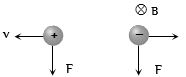
(A) In a discharge tube,cathode rays (a beam of negative particles) and canal rays (positive rays) move in opposite directions. The magnetic force on a moving charge is given by $\vec{F} = q(\vec{v} \times \vec{B})$.
For positive rays,$q$ is positive and $\vec{v}$ is in one direction. For cathode rays,$q$ is negative and $\vec{v}$ is in the opposite direction.
When a magnetic field $\vec{B}$ is applied normally (perpendicular to the velocity),the cross product $\vec{v} \times \vec{B}$ changes sign for the cathode rays due to the negative charge,effectively resulting in a force in the same direction as that on the positive rays. Thus,they are deflected in the same direction.
For positive rays,$q$ is positive and $\vec{v}$ is in one direction. For cathode rays,$q$ is negative and $\vec{v}$ is in the opposite direction.
When a magnetic field $\vec{B}$ is applied normally (perpendicular to the velocity),the cross product $\vec{v} \times \vec{B}$ changes sign for the cathode rays due to the negative charge,effectively resulting in a force in the same direction as that on the positive rays. Thus,they are deflected in the same direction.
0 likes
View Solution14
EasyMCQ
Cathode rays consist of
A
Photons
B
Electrons
C
Protons
D
$ \alpha $-particles
Solution
(B) Cathode rays are streams of negatively charged particles known as electrons.
These rays are emitted from the cathode in a discharge tube under low pressure and high voltage.
They cause ionization of the gases through which they travel and are deflected by both electric and magnetic fields,confirming their negative charge.
These rays are emitted from the cathode in a discharge tube under low pressure and high voltage.
They cause ionization of the gases through which they travel and are deflected by both electric and magnetic fields,confirming their negative charge.
0 likes
View Solution15
EasyMCQ
$A$ metal plate gets heated when cathode rays strike against it due to:
A
Kinetic energy of cathode rays
B
Potential energy of cathode rays
C
Linear velocity of cathode rays
D
Angular velocity of cathode rays
Solution
(A) Cathode rays consist of a stream of fast-moving electrons.
These electrons possess significant kinetic energy due to their motion.
When these rays strike a metal plate,they collide with the atoms of the plate and transfer their kinetic energy to the plate.
This transfer of energy causes the atoms of the metal plate to vibrate more vigorously,resulting in an increase in the temperature of the plate.
These electrons possess significant kinetic energy due to their motion.
When these rays strike a metal plate,they collide with the atoms of the plate and transfer their kinetic energy to the plate.
This transfer of energy causes the atoms of the metal plate to vibrate more vigorously,resulting in an increase in the temperature of the plate.
0 likes
View Solution16
EasyMCQ
Cathode rays are
A
Positive rays
B
Neutral rays
C
He rays
D
Electron waves
Solution
(D) Cathode rays are streams of fast-moving electrons emitted from the cathode in a discharge tube.
Therefore,they are essentially beams of electrons.
Thus,the correct option is $D$.
Therefore,they are essentially beams of electrons.
Thus,the correct option is $D$.
0 likes
View Solution17
EasyMCQ
Which of the following is not true with respect to cathode rays?
A
$A$ stream of electrons
B
Charged particles
C
Move with the same speed as that of light
D
Can be deflected by magnetic fields
Solution
(C) Cathode rays are a stream of fast-moving electrons. They are negatively charged particles and can be deflected by both electric and magnetic fields. However,their speed ranges from $10^7 \, m/s$ to $3 \times 10^7 \, m/s$,which is significantly less than the speed of light $(c \approx 3 \times 10^8 \, m/s)$. Therefore,statement $(c)$ is not true.
0 likes
View Solution18
EasyMCQ
Cathode rays are produced when the pressure is of the order of
A
$2 \ cm$ of $Hg$
B
$0.1 \ cm$ of $Hg$
C
$0.01 \ mm$ of $Hg$
D
$1 \ \mu m$ of $Hg$
Solution
(C) Cathode rays are produced in a discharge tube at low pressure. The typical pressure required for the production of cathode rays is approximately $0.01 \ mm$ of $Hg$ (or $10^{-2} \ mm$ of $Hg$).
At this low pressure,the mean free path of the electrons becomes large enough to allow them to accelerate towards the anode without frequent collisions with gas molecules.
If the pressure is higher,the number of gas atoms increases,leading to more frequent collisions between electrons and gas atoms,which obstructs the flow of electrons and prevents the formation of a stable cathode ray beam.
At this low pressure,the mean free path of the electrons becomes large enough to allow them to accelerate towards the anode without frequent collisions with gas molecules.
If the pressure is higher,the number of gas atoms increases,leading to more frequent collisions between electrons and gas atoms,which obstructs the flow of electrons and prevents the formation of a stable cathode ray beam.
0 likes
View Solution19
EasyMCQ
Which of the following is not a property of cathode rays?
A
They cast shadows.
B
They produce a heating effect.
C
They produce fluorescence.
D
They do not deflect in an electric field.
Solution
(D) Cathode rays consist of a stream of negatively charged particles (electrons). Because they carry a charge,they are deflected by both electric and magnetic fields. Therefore,the statement that they do not deflect in an electric field is incorrect.
0 likes
View Solution20
MediumMCQ
In a Thomson set-up for the determination of $e/m$,electrons accelerated by $2.5 \ kV$ enter the region of crossed electric and magnetic fields of strengths $3.6 \times 10^4 \ Vm^{-1}$ and $1.2 \times 10^{-3} \ T$ respectively and go through undeflected. The measured value of $e/m$ of the electron is equal to
A
$1.0 \times 10^{11} \ C \ kg^{-1}$
B
$1.76 \times 10^{11} \ C \ kg^{-1}$
C
$1.80 \times 10^{11} \ C \ kg^{-1}$
D
$1.85 \times 10^{11} \ C \ kg^{-1}$
Solution
(C) When electrons pass through crossed electric $(E)$ and magnetic $(B)$ fields undeflected,the electric force equals the magnetic force: $eE = evB$,which implies $v = E/B$.
The kinetic energy gained by an electron accelerated through a potential difference $V$ is given by $\frac{1}{2}mv^2 = eV$,so $v^2 = \frac{2eV}{m}$.
Substituting $v = E/B$ into the equation,we get $(E/B)^2 = \frac{2eV}{m}$,which simplifies to $\frac{e}{m} = \frac{E^2}{2VB^2}$.
Given values: $E = 3.6 \times 10^4 \ Vm^{-1}$,$B = 1.2 \times 10^{-3} \ T$,$V = 2.5 \times 10^3 \ V$.
Calculating $\frac{e}{m} = \frac{(3.6 \times 10^4)^2}{2 \times (2.5 \times 10^3) \times (1.2 \times 10^{-3})^2} = \frac{12.96 \times 10^8}{5000 \times 1.44 \times 10^{-6}} = \frac{12.96 \times 10^8}{7.2 \times 10^{-3}} = 1.8 \times 10^{11} \ C \ kg^{-1}$.
The kinetic energy gained by an electron accelerated through a potential difference $V$ is given by $\frac{1}{2}mv^2 = eV$,so $v^2 = \frac{2eV}{m}$.
Substituting $v = E/B$ into the equation,we get $(E/B)^2 = \frac{2eV}{m}$,which simplifies to $\frac{e}{m} = \frac{E^2}{2VB^2}$.
Given values: $E = 3.6 \times 10^4 \ Vm^{-1}$,$B = 1.2 \times 10^{-3} \ T$,$V = 2.5 \times 10^3 \ V$.
Calculating $\frac{e}{m} = \frac{(3.6 \times 10^4)^2}{2 \times (2.5 \times 10^3) \times (1.2 \times 10^{-3})^2} = \frac{12.96 \times 10^8}{5000 \times 1.44 \times 10^{-6}} = \frac{12.96 \times 10^8}{7.2 \times 10^{-3}} = 1.8 \times 10^{11} \ C \ kg^{-1}$.
0 likes
View Solution21
EasyMCQ
In a discharge tube at $0.02\, mm$ pressure,there is a formation of
[$AIPMT$ $1996$]
[$AIPMT$ $1996$]
A
$FDS$ (Faraday's dark space)
B
$CDS$ (Crooke's dark space)
C
Both spaces
D
None of these
Solution
(B) In a gas discharge tube,the appearance of different regions depends on the pressure of the gas.
At a pressure of approximately $0.01\, mm$ to $0.05\, mm$ of $Hg$,the discharge tube exhibits the Crooke's dark space $(CDS)$,which occupies almost the entire tube.
Since $0.02\, mm$ falls within this range,the formation of Crooke's dark space occurs.
At a pressure of approximately $0.01\, mm$ to $0.05\, mm$ of $Hg$,the discharge tube exhibits the Crooke's dark space $(CDS)$,which occupies almost the entire tube.
Since $0.02\, mm$ falls within this range,the formation of Crooke's dark space occurs.
0 likes
View Solution22
MediumMCQ
$A$ cathode emits $1.8 \times 10^{14}$ electrons per second when heated. When $400 \ V$ is applied to the anode,all the emitted electrons reach the anode. The charge on an electron is $1.6 \times 10^{-19} \ C$. The maximum anode current is ............ $\mu A$.
A
$2.7$
B
$29$
C
$72$
D
$2.9$
Solution
(B) The current $i$ is defined as the rate of flow of charge,given by $i = \frac{q}{t} = \frac{ne}{t}$.
Given,the number of electrons emitted per second $\frac{n}{t} = 1.8 \times 10^{14} \ s^{-1}$.
The charge of an electron $e = 1.6 \times 10^{-19} \ C$.
Substituting the values:
$i = (1.8 \times 10^{14}) \times (1.6 \times 10^{-19}) \ A$
$i = 2.88 \times 10^{-5} \ A$
$i = 28.8 \times 10^{-6} \ A$
Since $1 \ \mu A = 10^{-6} \ A$,we have $i = 28.8 \ \mu A$.
Rounding to the nearest integer,the maximum anode current is approximately $29 \ \mu A$.
Given,the number of electrons emitted per second $\frac{n}{t} = 1.8 \times 10^{14} \ s^{-1}$.
The charge of an electron $e = 1.6 \times 10^{-19} \ C$.
Substituting the values:
$i = (1.8 \times 10^{14}) \times (1.6 \times 10^{-19}) \ A$
$i = 2.88 \times 10^{-5} \ A$
$i = 28.8 \times 10^{-6} \ A$
Since $1 \ \mu A = 10^{-6} \ A$,we have $i = 28.8 \ \mu A$.
Rounding to the nearest integer,the maximum anode current is approximately $29 \ \mu A$.
0 likes
View Solution23
MediumMCQ
The order of the $q/m$ ratio for a proton,$\alpha$-particle,and electron is:
A
$e > p > \alpha$
B
$p > \alpha > e$
C
$e > \alpha > p$
D
None of these
Solution
(A) The specific charge is defined as the ratio of charge to mass $(q/m)$.
For an electron: $q_e = e$,$m_e \approx 9.1 \times 10^{-31} \ kg$.
For a proton: $q_p = e$,$m_p \approx 1.67 \times 10^{-27} \ kg$.
For an $\alpha$-particle: $q_{\alpha} = 2e$,$m_{\alpha} \approx 4 \times 1.67 \times 10^{-27} \ kg$.
Calculating the ratios:
$(q/m)_e = e / m_e$
$(q/m)_p = e / m_p$
$(q/m)_{\alpha} = 2e / (4m_p) = 0.5 (e / m_p)$
Since $m_e \ll m_p$,the ratio for the electron is the largest.
Comparing proton and $\alpha$-particle: $(q/m)_p > (q/m)_{\alpha}$.
Therefore,the order is $(q/m)_e > (q/m)_p > (q/m)_{\alpha}$.
For an electron: $q_e = e$,$m_e \approx 9.1 \times 10^{-31} \ kg$.
For a proton: $q_p = e$,$m_p \approx 1.67 \times 10^{-27} \ kg$.
For an $\alpha$-particle: $q_{\alpha} = 2e$,$m_{\alpha} \approx 4 \times 1.67 \times 10^{-27} \ kg$.
Calculating the ratios:
$(q/m)_e = e / m_e$
$(q/m)_p = e / m_p$
$(q/m)_{\alpha} = 2e / (4m_p) = 0.5 (e / m_p)$
Since $m_e \ll m_p$,the ratio for the electron is the largest.
Comparing proton and $\alpha$-particle: $(q/m)_p > (q/m)_{\alpha}$.
Therefore,the order is $(q/m)_e > (q/m)_p > (q/m)_{\alpha}$.
0 likes
View Solution24
EasyMCQ
Positive rays consist of
A
Electrons
B
Neutrons
C
Positive ions
D
Electromagnetic waves
Solution
(C) Positive rays,also known as canal rays,are streams of positively charged particles produced in a discharge tube. These particles are formed when high-energy electrons collide with gas atoms,stripping away electrons and leaving behind positive ions. Therefore,positive rays consist of positive ions.
0 likes
View Solution25
EasyMCQ
Positive rays were discovered by
A
Thomson
B
Goldstein
C
$W$. Crookes
D
Rutherford
Solution
(B) Positive rays,also known as canal rays,were discovered by $E. Goldstein$ in $1886$ using a discharge tube with a perforated cathode.
However,the detailed study and identification of these rays as positively charged particles (ions) were later performed by $J.J. Thomson$.
In the context of standard physics curriculum questions,$E. Goldstein$ is credited with the discovery of canal rays (positive rays).
However,the detailed study and identification of these rays as positively charged particles (ions) were later performed by $J.J. Thomson$.
In the context of standard physics curriculum questions,$E. Goldstein$ is credited with the discovery of canal rays (positive rays).
0 likes
View Solution26
EasyMCQ
Which of the following has the highest specific charge?
A
Positron
B
Proton
C
$He$ nucleus
D
None of these
Solution
(A) Specific charge is defined as the ratio of charge to mass $(q/m)$.
For a positron, the charge is $+e$ and the mass is $m_e$ (mass of an electron).
Specific charge of positron = $e/m_e$.
For a proton, the charge is $+e$ and the mass is $m_p \approx 1836 m_e$.
Specific charge of proton = $e/m_p = e/(1836 m_e)$.
For an $He$ nucleus (alpha particle), the charge is $+2e$ and the mass is $m_{\alpha} \approx 4 m_p \approx 7344 m_e$.
Specific charge of $He$ nucleus = $2e/(7344 m_e) = e/(3672 m_e)$.
Comparing the values, the positron has the smallest mass, therefore it has the highest specific charge.
For a positron, the charge is $+e$ and the mass is $m_e$ (mass of an electron).
Specific charge of positron = $e/m_e$.
For a proton, the charge is $+e$ and the mass is $m_p \approx 1836 m_e$.
Specific charge of proton = $e/m_p = e/(1836 m_e)$.
For an $He$ nucleus (alpha particle), the charge is $+2e$ and the mass is $m_{\alpha} \approx 4 m_p \approx 7344 m_e$.
Specific charge of $He$ nucleus = $2e/(7344 m_e) = e/(3672 m_e)$.
Comparing the values, the positron has the smallest mass, therefore it has the highest specific charge.
0 likes
View Solution27
EasyMCQ
The mass of a photoelectron is
A
$9.1 \times 10^{-27} \ kg$
B
$9.1 \times 10^{-29} \ kg$
C
$9.1 \times 10^{-31} \ kg$
D
$9.1 \times 10^{-34} \ kg$
Solution
(C) photoelectron is essentially an electron that has been emitted from a material due to the photoelectric effect.
Since it is an electron,its mass is equal to the rest mass of an electron.
The rest mass of an electron is approximately $9.1 \times 10^{-31} \ kg$.
Therefore,the correct option is $C$.
Since it is an electron,its mass is equal to the rest mass of an electron.
The rest mass of an electron is approximately $9.1 \times 10^{-31} \ kg$.
Therefore,the correct option is $C$.
0 likes
View Solution28
MediumMCQ
Thermionic emission from a heated filament varies with its temperature $T$ as
A
$T^{-1}$
B
$T$
C
$T^2$
D
$T^{3/2}$
Solution
(C) According to the Richardson-Dushman equation,the thermionic emission current density $J$ is given by:
$J = AT^2 e^{-W_0/kT}$
where $A$ is the Richardson constant,$T$ is the absolute temperature,$W_0$ is the work function of the metal,and $k$ is the Boltzmann constant.
From this equation,it is evident that the emission current density $J$ is proportional to the square of the absolute temperature,i.e.,$J \propto T^2$.
Therefore,the correct option is $C$.
$J = AT^2 e^{-W_0/kT}$
where $A$ is the Richardson constant,$T$ is the absolute temperature,$W_0$ is the work function of the metal,and $k$ is the Boltzmann constant.
From this equation,it is evident that the emission current density $J$ is proportional to the square of the absolute temperature,i.e.,$J \propto T^2$.
Therefore,the correct option is $C$.
0 likes
View Solution29
EasyMCQ
The number of secondary electrons emitted per number of primary electrons depends on:
A
Material of the target
B
Frequency of primary electrons
C
Intensity of the primary electron beam
D
None of the above
Solution
(A) The ratio of the number of secondary electrons emitted to the number of primary electrons incident is known as the secondary emission coefficient $\delta$.
This coefficient $\delta$ is primarily a property of the target material and the energy of the primary electrons.
However, in the context of standard physics problems regarding electron emission, if the question asks what determines the total number of secondary electrons emitted, it is directly proportional to the intensity (number of incident primary electrons) of the primary beam.
Given the options provided, the secondary emission coefficient itself is a material property, but the total count of secondary electrons depends on the intensity of the primary beam.
Therefore, the most appropriate answer is (A) Material of the target, as $\delta$ is a characteristic constant for a given material.
This coefficient $\delta$ is primarily a property of the target material and the energy of the primary electrons.
However, in the context of standard physics problems regarding electron emission, if the question asks what determines the total number of secondary electrons emitted, it is directly proportional to the intensity (number of incident primary electrons) of the primary beam.
Given the options provided, the secondary emission coefficient itself is a material property, but the total count of secondary electrons depends on the intensity of the primary beam.
Therefore, the most appropriate answer is (A) Material of the target, as $\delta$ is a characteristic constant for a given material.
0 likes
View Solution30
MediumMCQ
The relation between current and charge is given by $I = A T^2 e^{qV / V_L}$. What is the value of $V_L$?
A
$\frac{V}{kT}$
B
$\frac{kV}{T}$
C
$\frac{kT}{V}$
D
$\frac{VT}{k}$
Solution
(C) The given equation is $I = A T^2 e^{qV / V_L}$.
Comparing this with the standard Richardson-Dushman equation for thermionic emission,$I = A T^2 e^{-qV / kT}$ (where the exponent term represents the ratio of energy to thermal energy).
In the given expression,the exponent is $\frac{qV}{V_L}$.
Comparing the exponents: $\frac{qV}{V_L} = \frac{qV}{kT}$.
Therefore,$V_L = \frac{kT}{V}$.
Comparing this with the standard Richardson-Dushman equation for thermionic emission,$I = A T^2 e^{-qV / kT}$ (where the exponent term represents the ratio of energy to thermal energy).
In the given expression,the exponent is $\frac{qV}{V_L}$.
Comparing the exponents: $\frac{qV}{V_L} = \frac{qV}{kT}$.
Therefore,$V_L = \frac{kT}{V}$.
0 likes
View Solution31
MediumMCQ
Which one is the correct relation for thermionic emission?
A
$J = A{T^{1/2}}{e^{ - \varphi /kT}}$
B
$J = A{T^2}{e^{ - \varphi /kT}}$
C
$J = A{T^{3/2}}{e^{ - \varphi /kT}}$
D
$J = A{T^2}{e^{ - \varphi /2kT}}$
Solution
(B) The thermionic emission is described by the Richardson-Dushman equation.
According to this equation,the current density $J$ emitted from a heated surface is given by $J = AT^2 e^{-\varphi/kT}$,where $A$ is the Richardson constant,$T$ is the absolute temperature,$\varphi$ is the work function of the material,and $k$ is the Boltzmann constant.
Therefore,the correct relation is $J = AT^2 e^{-\varphi/kT}$.
According to this equation,the current density $J$ emitted from a heated surface is given by $J = AT^2 e^{-\varphi/kT}$,where $A$ is the Richardson constant,$T$ is the absolute temperature,$\varphi$ is the work function of the material,and $k$ is the Boltzmann constant.
Therefore,the correct relation is $J = AT^2 e^{-\varphi/kT}$.
0 likes
View Solution32
EasyMCQ
The thermionic emission of electrons is due to:
A
Electromagnetic field
B
Electrostatic field
C
High temperature
D
Photoelectric effect
Solution
(C) Thermionic emission is the process by which electrons are emitted from the surface of a metal due to the absorption of thermal energy. When a metal is heated to a high temperature,the free electrons within the metal gain sufficient kinetic energy to overcome the work function of the metal surface and escape into the surrounding space. Therefore,thermionic emission is caused by high temperature.
0 likes
View Solution33
DifficultMCQ
$A$ metallic surface with a work function of $2 \, eV$,on heating to a temperature of $800 \, K$,gives an emission current of $1 \, mA$. If another metallic surface having the same surface area,same emission constant,but a work function of $4 \, eV$ is heated to a temperature of $1600 \, K$,then the emission current will be......$mA$.
A
$1$
B
$2$
C
$4$
D
None of these
Solution
(C) The emission current $i$ is given by the Richardson-Dushman equation: $i = A T^2 S e^{-\phi / kT}$.
Given for the first surface: $\phi_1 = 2 \, eV$,$T_1 = 800 \, K$,$i_1 = 1 \, mA$.
Given for the second surface: $\phi_2 = 4 \, eV$,$T_2 = 1600 \, K$,$A_1 = A_2$,$S_1 = S_2$.
We observe that the ratio $\frac{\phi_1}{T_1} = \frac{2}{800} = 0.0025$ and $\frac{\phi_2}{T_2} = \frac{4}{1600} = 0.0025$. Thus,$\frac{\phi_1}{T_1} = \frac{\phi_2}{T_2}$.
Taking the ratio of the currents: $\frac{i_2}{i_1} = \frac{A T_2^2 S e^{-\phi_2 / kT_2}}{A T_1^2 S e^{-\phi_1 / kT_1}} = \left( \frac{T_2}{T_1} \right)^2 \cdot e^{-(\phi_2/kT_2 - \phi_1/kT_1)}$.
Since $\frac{\phi_2}{kT_2} = \frac{\phi_1}{kT_1}$,the exponential term becomes $e^0 = 1$.
Therefore,$\frac{i_2}{i_1} = \left( \frac{1600}{800} \right)^2 = (2)^2 = 4$.
Hence,$i_2 = 4 \times i_1 = 4 \times 1 \, mA = 4 \, mA$.
Given for the first surface: $\phi_1 = 2 \, eV$,$T_1 = 800 \, K$,$i_1 = 1 \, mA$.
Given for the second surface: $\phi_2 = 4 \, eV$,$T_2 = 1600 \, K$,$A_1 = A_2$,$S_1 = S_2$.
We observe that the ratio $\frac{\phi_1}{T_1} = \frac{2}{800} = 0.0025$ and $\frac{\phi_2}{T_2} = \frac{4}{1600} = 0.0025$. Thus,$\frac{\phi_1}{T_1} = \frac{\phi_2}{T_2}$.
Taking the ratio of the currents: $\frac{i_2}{i_1} = \frac{A T_2^2 S e^{-\phi_2 / kT_2}}{A T_1^2 S e^{-\phi_1 / kT_1}} = \left( \frac{T_2}{T_1} \right)^2 \cdot e^{-(\phi_2/kT_2 - \phi_1/kT_1)}$.
Since $\frac{\phi_2}{kT_2} = \frac{\phi_1}{kT_1}$,the exponential term becomes $e^0 = 1$.
Therefore,$\frac{i_2}{i_1} = \left( \frac{1600}{800} \right)^2 = (2)^2 = 4$.
Hence,$i_2 = 4 \times i_1 = 4 \times 1 \, mA = 4 \, mA$.
0 likes
View Solution34
MediumMCQ
For a thermionic emitter (metallic),if $J$ represents the current density and $T$ is its absolute temperature,then the correct curve between $\log_e \frac{J}{T^2}$ and $\frac{1}{T}$ is:
A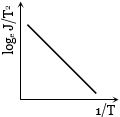
B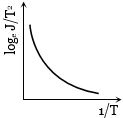
C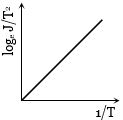
D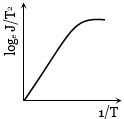
Solution
(A) According to the Richardson-Dushman equation,the current density $J$ is given by $J = A T^2 e^{-b/T}$,where $A$ and $b$ are constants.
Taking the natural logarithm on both sides:
$\log_e J = \log_e A + 2 \log_e T - \frac{b}{T}$
Rearranging the terms to isolate $\log_e \frac{J}{T^2}$:
$\log_e \frac{J}{T^2} = \log_e A - \frac{b}{T}$
This equation is of the form $y = mx + c$,where $y = \log_e \frac{J}{T^2}$,$x = \frac{1}{T}$,$m = -b$ (slope),and $c = \log_e A$ (intercept).
Since the slope $m = -b$ is negative,the graph is a straight line with a negative slope and a positive intercept on the $y$-axis.
Therefore,the correct curve is represented by the graph with a downward-sloping straight line.
Taking the natural logarithm on both sides:
$\log_e J = \log_e A + 2 \log_e T - \frac{b}{T}$
Rearranging the terms to isolate $\log_e \frac{J}{T^2}$:
$\log_e \frac{J}{T^2} = \log_e A - \frac{b}{T}$
This equation is of the form $y = mx + c$,where $y = \log_e \frac{J}{T^2}$,$x = \frac{1}{T}$,$m = -b$ (slope),and $c = \log_e A$ (intercept).
Since the slope $m = -b$ is negative,the graph is a straight line with a negative slope and a positive intercept on the $y$-axis.
Therefore,the correct curve is represented by the graph with a downward-sloping straight line.
0 likes
View Solution35
MediumMCQ
If the thermionic current density is $J$ and emitter temperature is $T$,then the curve between $\frac{J}{T^2}$ and $\frac{1}{T}$ will be
A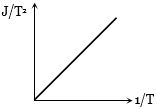
B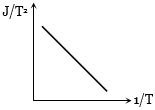
C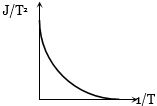
D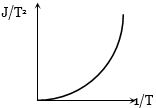
Solution
(C) The Richardson-Dushman equation for thermionic emission is given by $J = AT^2 e^{-b/T}$,where $A$ and $b$ are constants.
Dividing both sides by $T^2$,we get $\frac{J}{T^2} = A e^{-b/T}$.
Taking the natural logarithm on both sides,we get $\ln\left(\frac{J}{T^2}\right) = \ln(A) - \frac{b}{T}$.
This equation is of the form $y = mx + c$,where $y = \ln\left(\frac{J}{T^2}\right)$,$x = \frac{1}{T}$,$m = -b$ (slope),and $c = \ln(A)$ (intercept).
However,if we plot $\frac{J}{T^2}$ directly against $\frac{1}{T}$,the relationship is $\frac{J}{T^2} = A e^{-b/T}$.
As $\frac{1}{T}$ increases,the exponent $-b/T$ becomes more negative,causing the value of $\frac{J}{T^2}$ to decrease exponentially towards zero.
Therefore,the curve is an exponential decay curve.
Dividing both sides by $T^2$,we get $\frac{J}{T^2} = A e^{-b/T}$.
Taking the natural logarithm on both sides,we get $\ln\left(\frac{J}{T^2}\right) = \ln(A) - \frac{b}{T}$.
This equation is of the form $y = mx + c$,where $y = \ln\left(\frac{J}{T^2}\right)$,$x = \frac{1}{T}$,$m = -b$ (slope),and $c = \ln(A)$ (intercept).
However,if we plot $\frac{J}{T^2}$ directly against $\frac{1}{T}$,the relationship is $\frac{J}{T^2} = A e^{-b/T}$.
As $\frac{1}{T}$ increases,the exponent $-b/T$ becomes more negative,causing the value of $\frac{J}{T^2}$ to decrease exponentially towards zero.
Therefore,the curve is an exponential decay curve.
0 likes
View Solution36
MediumMCQ
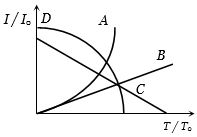
The ratio of thermionic currents $(I/I_0)$ for a metal when the temperature is slowly increased from $T_0$ to $T$ is shown in the figure. ($I$ and $I_0$ are currents at $T$ and $T_0$ respectively). Which curve correctly represents this relationship?
A
$A$
B
$B$
C
$C$
D
$D$
Solution
(A) According to Richardson-Dushman equation,the thermionic current $I$ is given by $I = AT^2 e^{-\phi/kT}$,where $A$ is a constant,$T$ is the absolute temperature,$\phi$ is the work function,and $k$ is the Boltzmann constant.
For a small range of temperature variation,the exponential term $e^{-\phi/kT}$ remains approximately constant.
Therefore,the current $I$ is proportional to the square of the temperature: $I \propto T^2$.
This implies the ratio $\frac{I}{I_0} = \left( \frac{T}{T_0} \right)^2$.
This equation represents a parabola opening upwards,which corresponds to curve $A$ in the given figure.
For a small range of temperature variation,the exponential term $e^{-\phi/kT}$ remains approximately constant.
Therefore,the current $I$ is proportional to the square of the temperature: $I \propto T^2$.
This implies the ratio $\frac{I}{I_0} = \left( \frac{T}{T_0} \right)^2$.
This equation represents a parabola opening upwards,which corresponds to curve $A$ in the given figure.
0 likes
View Solution37
EasyMCQ
Which one of the following is not electromagnetic in nature?
A
$X$-rays
B
Gamma rays
C
Cathode rays
D
Infrared rays
Solution
(C) . Cathode rays are not electromagnetic in nature.
Cathode rays (electron beam or $e$-beam) are streams of electrons observed in vacuum tubes. If an evacuated glass tube is equipped with two electrodes and a voltage is applied,the glass behind the positive electrode is observed to glow due to electrons emitted from and traveling away from the cathode (the electrode connected to the negative terminal of the voltage supply). They were first observed in $1869$ by German physicist Johann Wilhelm Hittorf and were named in $1876$ by Eugen Goldstein as $Kathodenstrahlen$,or cathode rays. In $1897$,British physicist $J.J. Thomson$ showed that cathode rays were composed of a previously unknown negatively charged particle,which was later named the electron. Cathode ray tubes $(CRTs)$ use a focused beam of electrons deflected by electric or magnetic fields to create the image on a television screen.
The electromagnetic force usually exhibits electromagnetic fields such as electric fields,magnetic fields,and light,and is one of the four fundamental interactions in nature. The other three fundamental interactions are the strong interaction,the weak interaction,and gravitation.
Cathode rays (electron beam or $e$-beam) are streams of electrons observed in vacuum tubes. If an evacuated glass tube is equipped with two electrodes and a voltage is applied,the glass behind the positive electrode is observed to glow due to electrons emitted from and traveling away from the cathode (the electrode connected to the negative terminal of the voltage supply). They were first observed in $1869$ by German physicist Johann Wilhelm Hittorf and were named in $1876$ by Eugen Goldstein as $Kathodenstrahlen$,or cathode rays. In $1897$,British physicist $J.J. Thomson$ showed that cathode rays were composed of a previously unknown negatively charged particle,which was later named the electron. Cathode ray tubes $(CRTs)$ use a focused beam of electrons deflected by electric or magnetic fields to create the image on a television screen.
The electromagnetic force usually exhibits electromagnetic fields such as electric fields,magnetic fields,and light,and is one of the four fundamental interactions in nature. The other three fundamental interactions are the strong interaction,the weak interaction,and gravitation.
0 likes
View Solution38
EasyMCQ
Thermions are
A
protons
B
photons
C
electrons
D
positrons
Solution
(C) Thermions are electrically charged particles or ions that are emitted by a heated conducting material.
When a metal surface is heated to a high temperature,the thermal energy provided to the free electrons allows them to overcome the work function of the metal and escape the surface.
These emitted electrons are specifically referred to as thermions.
Therefore,thermions are electrons.
When a metal surface is heated to a high temperature,the thermal energy provided to the free electrons allows them to overcome the work function of the metal and escape the surface.
These emitted electrons are specifically referred to as thermions.
Therefore,thermions are electrons.
0 likes
View Solution39
EasyMCQ
Who discovered the presence of electric charge on an electron?
A
$J$. $J$. Thomson
B
Millikan
C
Newton
D
Franklin
Solution
(B) The elementary charge of an electron was accurately measured by Robert $A$. Millikan in his famous oil-drop experiment conducted in $1909$. While $J$. $J$. Thomson discovered the electron itself,Millikan is credited with determining the magnitude of the charge on an electron.
0 likes
View Solution40
EasyMCQ
Cathode rays are....
A
Positive rays
B
Neutral rays
C
$He$ rays
D
Electrons
Solution
(D) Cathode rays are streams of fast-moving electrons emitted from the cathode in a discharge tube.
0 likes
View Solution41
EasyMCQ
The color of the positive column in a gas discharge tube depends on:
A
The type of glass used to make the tube
B
The gas present in the tube
C
The applied voltage
D
The material of the cathode
Solution
(B) In a gas discharge tube,the color of the positive column is determined by the nature of the gas present inside the tube.
Different gases emit light of different characteristic wavelengths when excited by an electric discharge.
For example,air produces a pinkish-red glow,while hydrogen $(H_2)$ produces a blue glow.
Different gases emit light of different characteristic wavelengths when excited by an electric discharge.
For example,air produces a pinkish-red glow,while hydrogen $(H_2)$ produces a blue glow.
0 likes
View Solution42
EasyMCQ
In an electron gun,the control grid is kept at a negative potential with respect to the cathode because...
A
To decelerate the electrons.
B
To control the flow of electrons by repelling them.
C
To select electrons of uniform velocity and focus them on the axis.
D
To decrease the kinetic energy of the electrons.
Solution
(B) In an electron gun,the cathode emits electrons via thermionic emission. The control grid is placed between the cathode and the accelerating anode. By maintaining the control grid at a negative potential relative to the cathode,it acts as a gate that repels the electrons. This allows for the regulation of the number of electrons passing through the aperture,thereby controlling the intensity of the electron beam.
0 likes
View Solution43
MediumMCQ
$A$ beam of cathode rays is subjected to crossed electric $(E)$ and magnetic fields $(B).$ The fields are adjusted such that the beam is not deflected. The specific charge of the cathode rays is given by (where $V$ is the potential difference between cathode and anode):
A
$\frac{B^2}{2VE^2}$
B
$\frac{2VB^2}{E^2}$
C
$\frac{2VE^2}{B^2}$
D
$\frac{E^2}{2VB^2}$
Solution
(D) When a beam of cathode rays (electrons) is subjected to crossed electric $(E)$ and magnetic $(B)$ fields,the beam is not deflected if the force due to the electric field equals the force due to the magnetic field.
$Be v = eE$
$v = \frac{E}{B}$ ..... $(i)$
If $V$ is the potential difference between the anode and the cathode,the kinetic energy gained by the electron is given by:
$\frac{1}{2} m v^2 = eV$
$\frac{e}{m} = \frac{v^2}{2V}$ ..... $(ii)$
Substituting the value of $v$ from equation $(i)$ into equation $(ii)$,we get:
$\frac{e}{m} = \frac{(E/B)^2}{2V} = \frac{E^2}{2VB^2}$
Thus,the specific charge of the cathode rays is $\frac{E^2}{2VB^2}$.
$Be v = eE$
$v = \frac{E}{B}$ ..... $(i)$
If $V$ is the potential difference between the anode and the cathode,the kinetic energy gained by the electron is given by:
$\frac{1}{2} m v^2 = eV$
$\frac{e}{m} = \frac{v^2}{2V}$ ..... $(ii)$
Substituting the value of $v$ from equation $(i)$ into equation $(ii)$,we get:
$\frac{e}{m} = \frac{(E/B)^2}{2V} = \frac{E^2}{2VB^2}$
Thus,the specific charge of the cathode rays is $\frac{E^2}{2VB^2}$.
0 likes
View Solution44
EasyMCQ
Three particles having their charges in the ratio of $1 : 3 : 5$ produce the same spot on the screen in Thomson's experiment. Their masses are in the ratio of
A
$5 : 3 : 1$
B
$3 : 1 : 5$
C
$1 : 3 : 5$
D
$5 : 1 : 3$
Solution
(C) In Thomson's experiment,the deflection of a charged particle in an electric or magnetic field depends on the specific charge,which is the ratio of charge to mass,denoted as $\frac{q}{m}$.
Since all three particles produce the same spot on the screen,they must experience the same deflection,which implies that their specific charge ratios must be equal.
Therefore,$\frac{q_1}{m_1} = \frac{q_2}{m_2} = \frac{q_3}{m_3}$.
Given the ratio of charges is $q_1 : q_2 : q_3 = 1 : 3 : 5$.
For the ratios to be equal,the masses must follow the same ratio as the charges.
Thus,$m_1 : m_2 : m_3 = 1 : 3 : 5$.
Since all three particles produce the same spot on the screen,they must experience the same deflection,which implies that their specific charge ratios must be equal.
Therefore,$\frac{q_1}{m_1} = \frac{q_2}{m_2} = \frac{q_3}{m_3}$.
Given the ratio of charges is $q_1 : q_2 : q_3 = 1 : 3 : 5$.
For the ratios to be equal,the masses must follow the same ratio as the charges.
Thus,$m_1 : m_2 : m_3 = 1 : 3 : 5$.
0 likes
View Solution45
EasyMCQ
In which of the following,emission of electrons does not take place?
A
Thermionic emission
B
$X$-rays emission
C
Photoelectric emission
D
Secondary emission
Solution
(B) $X$-rays emission: These are produced due to transitions in the inner energy levels of an atom,not by the emission of electrons from the surface.
Photoelectric emission: This is the emission of electrons from a metal surface upon irradiation with radiation of a suitable frequency.
Secondary emission: When an incident electron strikes the surface of a metallic plate,it causes the emission of other electrons from the surface.
Thermionic emission: When a metal is heated to a high temperature,the free electrons gain sufficient kinetic energy to escape from the surface of the metal.
Photoelectric emission: This is the emission of electrons from a metal surface upon irradiation with radiation of a suitable frequency.
Secondary emission: When an incident electron strikes the surface of a metallic plate,it causes the emission of other electrons from the surface.
Thermionic emission: When a metal is heated to a high temperature,the free electrons gain sufficient kinetic energy to escape from the surface of the metal.
0 likes
View Solution46
EasyMCQ
Who evaluated the mass of the electron indirectly with the help of its charge?
A
Rutherford
B
Thomson
C
Millikan
D
Newton
Solution
(B) $J$.$J$. Thomson determined the specific charge $(e/m)$ of an electron using his cathode ray tube experiment. Later,Robert $A$. Millikan determined the charge $(e)$ of an electron using his oil-drop experiment. By combining these two values,the mass $(m)$ of the electron was evaluated indirectly as $m = e / (e/m)$.
0 likes
View Solution47
MediumMCQ
In the phenomenon of electric discharge through gases at low pressure,the coloured glow in the tube appears as a result of
[$AIPMT$ $2008$]
[$AIPMT$ $2008$]
A
collision between different electrons of the atoms of the gas
B
collisions between the charged particles emitted from the cathode and the atoms of the gas
C
excitation of electrons in the atoms
D
collision between the atoms of the gas
Solution
(B) In the phenomenon of electric discharge through gases at low pressure,a high potential difference is applied across the electrodes.
This causes the emission of charged particles (electrons) from the cathode.
These high-speed electrons collide with the neutral gas atoms present in the tube.
These collisions cause the excitation and ionization of the gas atoms.
When these excited atoms return to their ground state,they emit light of specific wavelengths,which results in the characteristic coloured glow observed in the discharge tube.
This causes the emission of charged particles (electrons) from the cathode.
These high-speed electrons collide with the neutral gas atoms present in the tube.
These collisions cause the excitation and ionization of the gas atoms.
When these excited atoms return to their ground state,they emit light of specific wavelengths,which results in the characteristic coloured glow observed in the discharge tube.
0 likes
View Solution48
EasyMCQ
Assertion: In a photoemissive cell,an inert gas is used.
Reason: An inert gas in the photoemissive cell provides a greater current.
Reason: An inert gas in the photoemissive cell provides a greater current.
A
If both Assertion and Reason are correct and the Reason is a correct explanation of the Assertion.
B
If both Assertion and Reason are correct but Reason is not a correct explanation of the Assertion.
C
If the Assertion is correct but Reason is incorrect.
D
If both the Assertion and Reason are incorrect.
Solution
(A) photoemissive cell consists of two electrodes enclosed in a glass bulb,which may be evacuated or filled with an inert gas at low pressure.
When an inert gas is present,the photoelectrons emitted from the cathode collide with the gas atoms,causing ionization. This process increases the number of charge carriers,resulting in a greater current compared to an evacuated cell.
Therefore,both the Assertion and the Reason are correct,and the Reason correctly explains why an inert gas is used in such cells.
When an inert gas is present,the photoelectrons emitted from the cathode collide with the gas atoms,causing ionization. This process increases the number of charge carriers,resulting in a greater current compared to an evacuated cell.
Therefore,both the Assertion and the Reason are correct,and the Reason correctly explains why an inert gas is used in such cells.
0 likes
View Solution49
Medium
$(a)$ Estimate the speed with which electrons emitted from a heated emitter of an evacuated tube impinge on the collector maintained at a potential difference of $500\;V$ with respect to the emitter. Ignore the small initial speeds of the electrons. The specific charge of the electron,$i.e.$,the $e/m$ is given to be $1.76 \times 10^{11}\; C\; kg^{-1}$.
$(b)$ Use the same formula you employ in $(a)$ to obtain electron speed for a collector potential of $10\;MV$. Do you see what is wrong? In what way is the formula to be modified?
$(b)$ Use the same formula you employ in $(a)$ to obtain electron speed for a collector potential of $10\;MV$. Do you see what is wrong? In what way is the formula to be modified?
Solution
(A) Potential difference $V = 500\;V$. Specific charge $e/m = 1.76 \times 10^{11}\;C\;kg^{-1}$.
Using the conservation of energy,$eV = \frac{1}{2}mv^2$,we get $v = \sqrt{2V(e/m)}$.
$v = \sqrt{2 \times 500 \times 1.76 \times 10^{11}} = \sqrt{1.76 \times 10^{14}} \approx 1.33 \times 10^7\;m/s$.
$(b)$ For $V = 10\;MV = 10^7\;V$,the formula gives $v = \sqrt{2 \times 10^7 \times 1.76 \times 10^{11}} = \sqrt{3.52 \times 10^{18}} \approx 1.88 \times 10^9\;m/s$.
This result is wrong because $v > c$ (speed of light),which is physically impossible.
The formula $K.E. = \frac{1}{2}mv^2$ is non-relativistic. For high potentials,we must use the relativistic kinetic energy formula: $K.E. = (\gamma - 1)mc^2$,where $\gamma = (1 - v^2/c^2)^{-1/2}$.
Using the conservation of energy,$eV = \frac{1}{2}mv^2$,we get $v = \sqrt{2V(e/m)}$.
$v = \sqrt{2 \times 500 \times 1.76 \times 10^{11}} = \sqrt{1.76 \times 10^{14}} \approx 1.33 \times 10^7\;m/s$.
$(b)$ For $V = 10\;MV = 10^7\;V$,the formula gives $v = \sqrt{2 \times 10^7 \times 1.76 \times 10^{11}} = \sqrt{3.52 \times 10^{18}} \approx 1.88 \times 10^9\;m/s$.
This result is wrong because $v > c$ (speed of light),which is physically impossible.
The formula $K.E. = \frac{1}{2}mv^2$ is non-relativistic. For high potentials,we must use the relativistic kinetic energy formula: $K.E. = (\gamma - 1)mc^2$,where $\gamma = (1 - v^2/c^2)^{-1/2}$.
0 likes
View Solution50
Easy
Write observations of various experiments which suggest that cathode rays are a stream of negatively charged particles.
Solution
(A) In $1870$,William Crookes performed experiments with a gas discharge tube.
He filled a gas in the discharge tube at low pressure and applied a high electric field to the electrodes at both ends of the tube.
He observed that electric rays (cathode rays) were produced,which traveled from the cathode to the anode. When these rays struck a fluorescent material,they produced a yellowish glow.
$J$.$J$. Thomson further investigated these rays and observed that they could be deflected by electric and magnetic fields,confirming they carry a negative charge.
$J$.$J$. Thomson measured the speed of cathode rays,finding it to be in the range of $\frac{1}{20}$ to $\frac{1}{30}$ times the speed of light $(3 \times 10^{8} \ m/s)$.
He determined the specific charge (ratio of charge to mass,$\frac{e}{m}$) of these particles to be approximately $1.76 \times 10^{11} \ C/kg$.
He concluded that the specific charge $\frac{e}{m}$ is independent of the type of gas used in the tube and the material of the electrodes,suggesting that these particles (electrons) are universal constituents of all matter.
He filled a gas in the discharge tube at low pressure and applied a high electric field to the electrodes at both ends of the tube.
He observed that electric rays (cathode rays) were produced,which traveled from the cathode to the anode. When these rays struck a fluorescent material,they produced a yellowish glow.
$J$.$J$. Thomson further investigated these rays and observed that they could be deflected by electric and magnetic fields,confirming they carry a negative charge.
$J$.$J$. Thomson measured the speed of cathode rays,finding it to be in the range of $\frac{1}{20}$ to $\frac{1}{30}$ times the speed of light $(3 \times 10^{8} \ m/s)$.
He determined the specific charge (ratio of charge to mass,$\frac{e}{m}$) of these particles to be approximately $1.76 \times 10^{11} \ C/kg$.
He concluded that the specific charge $\frac{e}{m}$ is independent of the type of gas used in the tube and the material of the electrodes,suggesting that these particles (electrons) are universal constituents of all matter.
0 likes
View SolutionDual Nature of Radiation and matter — Cathode Rays and Electron Emission · Frequently Asked Questions
1Are these Dual Nature of Radiation and matter questions useful for JEE and NEET?
Yes. All questions in this section are mapped to JEE Main and NEET exam patterns. Previous year questions from JEE Main, NEET, GUJCET and state-level exams are included with full solutions.
2Can I switch to Hindi or Gujarati for these questions?
Yes. Use the language tabs in the hero section or the sidebar to view the same questions and solutions in English, Hindi or Gujarati.
3How do I generate a question paper from this subtopic?
Use the Vedclass Exam Paper Generator — select the chapter and subtopic, set difficulty, and generate Sets A, B, C, D automatically. First 3 chapters of every subject are free.
Vedclass Products
For Students
Vedclass Test Series
Mock tests in real JEE/NEET style with performance analysis. 5-day free trial.
Start Free TrialFor Teachers
Exam Paper Generator
Generate Set A/B/C/D papers from this chapter in 2 minutes. 3 chapters free.
Try FreeFor Institutes
Online Exam Module
Live online exams with unlimited students, 360° analytics & white-label branding.
See DemoFor Teachers & Institutes
Generate a Dual Nature of Radiation and matter Exam Paper in 2 Minutes
Select subtopic & difficulty — Sets A, B, C, D auto-generated with No Repeat logic.
First 3 chapters of every subject are free — no payment required.