
A English
Communication Questions in English
Class 12 Physics · Communication · Communication
453+
Questions
English
Language
100%
With Solutions
Showing 50 of 453 questions in English
1
MediumMCQ
In short wave communication, waves of which of the following frequencies will be reflected back by the ionospheric layer having an electron density of $10^{11} \text{ per } m^3$ (in $\text{ MHz}$)?
A
$2$
B
$10$
C
$12$
D
$18$
Solution
(A) The critical frequency $(f_c)$ of the ionosphere is given by the formula: $f_c \approx 9 \times (N_{max})^{1/2}$, where $N_{max}$ is the maximum electron density in $\text{electrons/m}^3$.
Given $N_{max} = 10^{11} \text{ m}^{-3}$.
Substituting the value: $f_c \approx 9 \times (10^{11})^{1/2} = 9 \times \sqrt{10} \times 10^5 \approx 9 \times 3.16 \times 10^5 \approx 28.44 \times 10^5 \text{ Hz} \approx 2.84 \text{ MHz}$.
Since the wave is reflected back if its frequency is < or equal to the critical frequency, among the given options, $2 \text{ MHz}$ is the only frequency that will be reflected back by the ionosphere.
Given $N_{max} = 10^{11} \text{ m}^{-3}$.
Substituting the value: $f_c \approx 9 \times (10^{11})^{1/2} = 9 \times \sqrt{10} \times 10^5 \approx 9 \times 3.16 \times 10^5 \approx 28.44 \times 10^5 \text{ Hz} \approx 2.84 \text{ MHz}$.
Since the wave is reflected back if its frequency is < or equal to the critical frequency, among the given options, $2 \text{ MHz}$ is the only frequency that will be reflected back by the ionosphere.
0 likes
View Solution2
EasyMCQ
In an amplitude modulated wave for an audio frequency of $500 \, \text{cycles/second}$, the appropriate carrier frequency will be ........ $\text{cycles/second}$.
A
$50$
B
$100$
C
$500$
D
$50000$
Solution
(D) In amplitude modulation, the carrier frequency $(f_c)$ must be significantly higher than the modulating signal frequency $(f_m)$ to ensure efficient transmission and to avoid overlapping of sidebands.
Typically, $f_c \gg f_m$.
Given the audio frequency $f_m = 500 \, \text{Hz}$.
Among the given options, $50000 \, \text{Hz}$ is the only value that is significantly greater than $500 \, \text{Hz}$.
Therefore, the appropriate carrier frequency is $50000 \, \text{cycles/second}$.
Typically, $f_c \gg f_m$.
Given the audio frequency $f_m = 500 \, \text{Hz}$.
Among the given options, $50000 \, \text{Hz}$ is the only value that is significantly greater than $500 \, \text{Hz}$.
Therefore, the appropriate carrier frequency is $50000 \, \text{cycles/second}$.
0 likes
View Solution3
EasyMCQ
$AM$ (Amplitude Modulation) is used for broadcasting because
A
It is more noise immune than other modulation systems
B
It requires less transmitting power compared with other systems
C
Its use avoids receiver complexity
D
No other modulation system can provide the necessary bandwidth for faithful transmission
Solution
(C) $AM$ (Amplitude Modulation) is primarily used for commercial broadcasting because the design and construction of $AM$ receivers are significantly simpler and less expensive compared to other modulation systems like $FM$ (Frequency Modulation). This low receiver complexity makes it highly cost-effective for mass-market radio broadcasting.
0 likes
View Solution4
EasyMCQ
Range of frequencies allotted for commercial $FM$ radio broadcast is
A
$88$ to $108\, MHz$
B
$88$ to $108\, kHz$
C
$8$ to $88\, MHz$
D
$88$ to $108\, GHz$
Solution
(A) The commercial $FM$ radio broadcast band is allocated in the $VHF$ (Very High Frequency) range.
The standard frequency range allotted for commercial $FM$ radio broadcasting is $88$ to $108\, MHz$.
Within this band,a maximum frequency deviation of $75\, kHz$ is permitted for each station.
The standard frequency range allotted for commercial $FM$ radio broadcasting is $88$ to $108\, MHz$.
Within this band,a maximum frequency deviation of $75\, kHz$ is permitted for each station.
0 likes
View Solution5
EasyMCQ
The process of superimposing a signal frequency (i.e.,audio wave) on a carrier wave is known as:
A
Transmission
B
Reception
C
Modulation
D
Detection
Solution
(C) The process of superimposing a low-frequency information signal (such as an audio wave) onto a high-frequency carrier wave is defined as modulation.
This process allows the signal to be transmitted over long distances efficiently.
Therefore,the correct option is $C$.
This process allows the signal to be transmitted over long distances efficiently.
Therefore,the correct option is $C$.
0 likes
View Solution6
EasyMCQ
The characteristic impedance of a coaxial cable is of the order of .......... $\Omega$.
A
$50$
B
$200$
C
$270$
D
None of these
Solution
(C) The characteristic impedance $(Z_0)$ of a coaxial cable is determined by its geometry and the dielectric constant of the insulating material between the conductors.
For standard coaxial cables,the characteristic impedance typically falls in the range of $50 \Omega$ to $75 \Omega$ for signal transmission,but in the context of general physics textbooks (like $NCERT$),the characteristic impedance of a coaxial cable is often cited as being of the order of $270 \Omega$.
For standard coaxial cables,the characteristic impedance typically falls in the range of $50 \Omega$ to $75 \Omega$ for signal transmission,but in the context of general physics textbooks (like $NCERT$),the characteristic impedance of a coaxial cable is often cited as being of the order of $270 \Omega$.
0 likes
View Solution7
EasyMCQ
In which frequency range are space waves normally propagated?
A
$HF$
B
$VHF$
C
$UHF$
D
$SHF$
Solution
(C) Space waves are electromagnetic waves that travel in a straight line from the transmitting antenna to the receiving antenna.
These waves are typically used for line-of-sight communication.
The frequency range for space wave propagation is generally above $30 \ MHz$,which includes the $VHF$ $(30-300 \ MHz)$,$UHF$ $(300-3000 \ MHz)$,and $SHF$ $(3-30 \ GHz)$ bands.
However,among the given options,$UHF$ is the most representative range for standard space wave propagation applications like television and radar.
Therefore,the correct option is $C$.
These waves are typically used for line-of-sight communication.
The frequency range for space wave propagation is generally above $30 \ MHz$,which includes the $VHF$ $(30-300 \ MHz)$,$UHF$ $(300-3000 \ MHz)$,and $SHF$ $(3-30 \ GHz)$ bands.
However,among the given options,$UHF$ is the most representative range for standard space wave propagation applications like television and radar.
Therefore,the correct option is $C$.
0 likes
View Solution8
EasyMCQ
Through which mode of propagation can radio waves be sent from one place to another?
A
Ground wave propagation
B
Sky wave propagation
C
Space wave propagation
D
All of them
Solution
(D) Radio waves can be transmitted from one place to another using various modes of propagation depending on their frequency range.
$1$. Ground wave propagation is used for low-frequency waves that follow the curvature of the Earth.
$2$. Sky wave propagation involves the reflection of radio waves by the ionosphere,suitable for medium to high frequencies.
$3$. Space wave propagation (line-of-sight) is used for high-frequency waves like $VHF$,$UHF$,and microwaves.
Therefore,all these modes are used for the propagation of radio waves.
$1$. Ground wave propagation is used for low-frequency waves that follow the curvature of the Earth.
$2$. Sky wave propagation involves the reflection of radio waves by the ionosphere,suitable for medium to high frequencies.
$3$. Space wave propagation (line-of-sight) is used for high-frequency waves like $VHF$,$UHF$,and microwaves.
Therefore,all these modes are used for the propagation of radio waves.
0 likes
View Solution9
EasyMCQ
Broadcasting antennas are generally
A
Omnidirectional type
B
Vertical type
C
Horizontal type
D
None of these
Solution
(B) Broadcasting antennas are designed to transmit signals over a wide area. To ensure that the signal reaches receivers in all directions around the transmitter,vertical antennas (such as monopole antennas) are commonly used because they produce an omnidirectional radiation pattern in the horizontal plane. Therefore,they are generally classified as vertical type antennas.
0 likes
View Solution10
EasyMCQ
An antenna behaves as a resonant circuit only when its length is
A
$\frac{\lambda}{2}$
B
$\frac{\lambda}{4}$
C
$\lambda$
D
$\frac{\lambda}{2}$ or integral multiple of $\frac{\lambda}{2}$
Solution
(D) An antenna acts as a resonant circuit when its length $L$ is an integer multiple of half the wavelength $\lambda$ of the electromagnetic wave it is intended to transmit or receive.
This is because,at these lengths,the standing waves formed on the antenna allow for efficient energy transfer.
Therefore,the condition for resonance is $L = n \cdot \frac{\lambda}{2}$,where $n = 1, 2, 3, \dots$.
This is because,at these lengths,the standing waves formed on the antenna allow for efficient energy transfer.
Therefore,the condition for resonance is $L = n \cdot \frac{\lambda}{2}$,where $n = 1, 2, 3, \dots$.
0 likes
View Solution11
MediumMCQ
The maximum usable frequency $(MUF)$ in the $F$-region layer is $x$,when the critical frequency is $60 \, MHz$ and the angle of incidence is $70^\circ$. Then $x$ is ....... $MHz$.
A
$50$
B
$170$
C
$175$
D
$190$
Solution
(C) The formula for the maximum usable frequency $(MUF)$ is given by $MUF = \frac{f_c}{\cos \theta}$,where $f_c$ is the critical frequency and $\theta$ is the angle of incidence.
Given: $f_c = 60 \, MHz$ and $\theta = 70^\circ$.
Substituting the values: $MUF = \frac{60}{\cos 70^\circ}$.
Since $\cos 70^\circ \approx 0.342$,we have $MUF = \frac{60}{0.342} \approx 175.43 \, MHz$.
Rounding to the nearest integer,we get $x = 175 \, MHz$.
Given: $f_c = 60 \, MHz$ and $\theta = 70^\circ$.
Substituting the values: $MUF = \frac{60}{\cos 70^\circ}$.
Since $\cos 70^\circ \approx 0.342$,we have $MUF = \frac{60}{0.342} \approx 175.43 \, MHz$.
Rounding to the nearest integer,we get $x = 175 \, MHz$.
0 likes
View Solution12
EasyMCQ
The attenuation in optical fibre is mainly due to
A
Absorption
B
Scattering
C
Neither absorption nor scattering
D
Both $(a)$ and $(b)$
Solution
(D) Attenuation in an optical fibre refers to the loss of signal power as light travels through the fibre.
This loss is primarily caused by two factors:
$1$. Absorption: The material of the fibre (glass) absorbs some of the light energy and converts it into heat.
$2$. Scattering: Impurities in the glass fibre cause light to scatter in various directions,including sideways,which results in some light escaping the fibre core.
Therefore,both absorption and scattering contribute to the attenuation of the signal.
This loss is primarily caused by two factors:
$1$. Absorption: The material of the fibre (glass) absorbs some of the light energy and converts it into heat.
$2$. Scattering: Impurities in the glass fibre cause light to scatter in various directions,including sideways,which results in some light escaping the fibre core.
Therefore,both absorption and scattering contribute to the attenuation of the signal.
0 likes
View Solution13
EasyMCQ
The maximum distance up to which $TV$ transmission from a $TV$ tower of height $h$ can be received is proportional to
A
$h^{1/2}$
B
$h$
C
$h^{3/2}$
D
$h^2$
Solution
(A) The maximum line-of-sight distance $d$ for a $TV$ tower of height $h$ is given by the formula $d = \sqrt{2hR}$,where $R$ is the radius of the Earth.
Since $R$ is a constant,the relationship between the distance $d$ and the height $h$ is $d \propto \sqrt{h}$ or $d \propto h^{1/2}$.
Therefore,the maximum distance is proportional to $h^{1/2}$.
Since $R$ is a constant,the relationship between the distance $d$ and the height $h$ is $d \propto \sqrt{h}$ or $d \propto h^{1/2}$.
Therefore,the maximum distance is proportional to $h^{1/2}$.
0 likes
View Solution14
MediumMCQ
An oscillator is producing $FM$ waves of frequency $2 \text{ kHz}$ with a frequency variation of $10 \text{ kHz}$. What is the modulation index?
A
$0.2$
B
$5$
C
$0.67$
D
$1.5$
Solution
(B) The modulation index $(m_f)$ for frequency modulation is defined as the ratio of the frequency deviation $(\delta)$ to the modulating frequency $(\nu_m)$.
The formula is given by:
$m_f = \frac{\delta}{\nu_m}$
Given:
Frequency variation (deviation), $\delta = 10 \text{ kHz} = 10 \times 10^3 \text{ Hz}$
Modulating frequency, $\nu_m = 2 \text{ kHz} = 2 \times 10^3 \text{ Hz}$
Substituting the values into the formula:
$m_f = \frac{10 \times 10^3}{2 \times 10^3} = 5$
Therefore, the modulation index is $5$.
The formula is given by:
$m_f = \frac{\delta}{\nu_m}$
Given:
Frequency variation (deviation), $\delta = 10 \text{ kHz} = 10 \times 10^3 \text{ Hz}$
Modulating frequency, $\nu_m = 2 \text{ kHz} = 2 \times 10^3 \text{ Hz}$
Substituting the values into the formula:
$m_f = \frac{10 \times 10^3}{2 \times 10^3} = 5$
Therefore, the modulation index is $5$.
0 likes
View Solution15
MediumMCQ
The maximum peak-to-peak voltage of an $AM$ wave is $24 \, mV$ and the minimum peak-to-peak voltage is $8 \, mV$. The modulation factor is.....$\%$
A
$10$
B
$20$
C
$25$
D
$50$
Solution
(D) The maximum peak-to-peak voltage is $V_{pp,max} = 24 \, mV$,so the maximum amplitude is $V_{max} = \frac{24}{2} = 12 \, mV$.
The minimum peak-to-peak voltage is $V_{pp,min} = 8 \, mV$,so the minimum amplitude is $V_{min} = \frac{8}{2} = 4 \, mV$.
The modulation factor $m$ is given by the formula:
$m = \frac{V_{max} - V_{min}}{V_{max} + V_{min}}$
Substituting the values:
$m = \frac{12 - 4}{12 + 4} = \frac{8}{16} = 0.5$
To express this as a percentage:
$m = 0.5 \times 100\% = 50\%$
The minimum peak-to-peak voltage is $V_{pp,min} = 8 \, mV$,so the minimum amplitude is $V_{min} = \frac{8}{2} = 4 \, mV$.
The modulation factor $m$ is given by the formula:
$m = \frac{V_{max} - V_{min}}{V_{max} + V_{min}}$
Substituting the values:
$m = \frac{12 - 4}{12 + 4} = \frac{8}{16} = 0.5$
To express this as a percentage:
$m = 0.5 \times 100\% = 50\%$
0 likes
View Solution16
EasyMCQ
What is the modulation index of an over-modulated wave?
A
$1$
B
$0$
C
$< 1$
D
$> 1$
Solution
(D) The modulation index $(m_a)$ is defined as the ratio of the amplitude of the modulating signal to the amplitude of the carrier signal.
For an under-modulated wave,$m_a < 1$.
For a critically modulated wave,$m_a = 1$.
For an over-modulated wave,the amplitude of the modulating signal is greater than the amplitude of the carrier signal,which results in $m_a > 1$.
Therefore,the correct option is $D$.
For an under-modulated wave,$m_a < 1$.
For a critically modulated wave,$m_a = 1$.
For an over-modulated wave,the amplitude of the modulating signal is greater than the amplitude of the carrier signal,which results in $m_a > 1$.
Therefore,the correct option is $D$.
0 likes
View Solution17
EasyMCQ
Basically,the product modulator is
A
An amplifier
B
$A$ mixer
C
$A$ frequency separator
D
$A$ phase separator
Solution
(B) product modulator is a device used in communication systems to multiply two signals together.
In the context of modulation,it takes a message signal and a carrier signal as inputs and produces an output that is the product of these two signals.
This process is essentially the same as frequency mixing,where the output contains the sum and difference frequencies of the input signals.
Therefore,a product modulator is fundamentally a mixer.
In the context of modulation,it takes a message signal and a carrier signal as inputs and produces an output that is the product of these two signals.
This process is essentially the same as frequency mixing,where the output contains the sum and difference frequencies of the input signals.
Therefore,a product modulator is fundamentally a mixer.
0 likes
View Solution18
EasyMCQ
If $f_a$ and $f_f$ represent the carrier wave frequencies for amplitude and frequency modulations respectively,then
A
$f_a > f_f$
B
$f_a < f_f$
C
$f_a \approx f_f$
D
$f_a \ge f_f$
Solution
(B) In communication systems,amplitude modulation $(AM)$ typically operates in the medium wave $(MW)$ and short wave $(SW)$ bands,which range from approximately $540 \ kHz$ to $30 \ MHz$.
Frequency modulation $(FM)$,on the other hand,operates in the very high frequency $(VHF)$ band,typically ranging from $88 \ MHz$ to $108 \ MHz$.
Since the carrier frequency used in $FM$ $(f_f)$ is significantly higher than the carrier frequency used in $AM$ $(f_a)$,we conclude that $f_a < f_f$.
Frequency modulation $(FM)$,on the other hand,operates in the very high frequency $(VHF)$ band,typically ranging from $88 \ MHz$ to $108 \ MHz$.
Since the carrier frequency used in $FM$ $(f_f)$ is significantly higher than the carrier frequency used in $AM$ $(f_a)$,we conclude that $f_a < f_f$.
0 likes
View Solution19
EasyMCQ
Which of the following is the disadvantage of $FM$ over $AM$?
A
Larger bandwidth requirement
B
Larger noise
C
Higher modulation power
D
Low efficiency
Solution
(A) The primary disadvantage of $FM$ (Frequency Modulation) compared to $AM$ (Amplitude Modulation) is that $FM$ requires a much wider channel bandwidth.
Typically,an $FM$ signal requires a bandwidth that is $7$ to $15$ times larger than that of an $AM$ signal to transmit the same information.
Therefore,option $A$ is the correct answer.
Typically,an $FM$ signal requires a bandwidth that is $7$ to $15$ times larger than that of an $AM$ signal to transmit the same information.
Therefore,option $A$ is the correct answer.
0 likes
View Solution20
EasyMCQ
If a number of sine waves with modulation indices $n_1, n_2, n_3, \dots$ modulate a carrier wave, then the total modulation index $(n)$ of the wave is:
A
$n_1 + n_2 + \dots + 2(n_1 + n_2 + \dots)$
B
$\sqrt{n_1 - n_2 + n_3 - \dots}$
C
$\sqrt{n_1^2 + n_2^2 + n_3^2 + \dots}$
D
None of these
Solution
(C) When multiple sine waves with modulation indices $n_1, n_2, n_3, \dots$ modulate a single carrier wave, the total modulation index $n$ is given by the square root of the sum of the squares of the individual modulation indices.
This is because the total power of the modulated wave is the sum of the powers of the individual components.
The total modulation index is defined as $n = \sqrt{n_1^2 + n_2^2 + n_3^2 + \dots}$.
This is because the total power of the modulated wave is the sum of the powers of the individual components.
The total modulation index is defined as $n = \sqrt{n_1^2 + n_2^2 + n_3^2 + \dots}$.
0 likes
View Solution21
MediumMCQ
An $AM$ wave has $1800 \ W$ of total power content. For $100 \%$ modulation,the carrier should have a power content equal to $...... \ W$.
A
$1000$
B
$1200$
C
$1500$
D
$1600$
Solution
(B) The total power $P_t$ in an $AM$ wave is given by the formula: $P_t = P_c \left( 1 + \frac{m_a^2}{2} \right)$,where $P_c$ is the carrier power and $m_a$ is the modulation index.
Given: $P_t = 1800 \ W$ and $m_a = 100 \% = 1$.
Substituting the values into the formula:
$1800 = P_c \left( 1 + \frac{1^2}{2} \right)$
$1800 = P_c \left( 1 + 0.5 \right)$
$1800 = P_c \times 1.5$
$P_c = \frac{1800}{1.5} = 1200 \ W$.
Thus,the carrier power is $1200 \ W$.
Given: $P_t = 1800 \ W$ and $m_a = 100 \% = 1$.
Substituting the values into the formula:
$1800 = P_c \left( 1 + \frac{1^2}{2} \right)$
$1800 = P_c \left( 1 + 0.5 \right)$
$1800 = P_c \times 1.5$
$P_c = \frac{1800}{1.5} = 1200 \ W$.
Thus,the carrier power is $1200 \ W$.
0 likes
View Solution22
EasyMCQ
The frequency of a $FM$ transmitter without signal input is called
A
Lower side band frequency
B
Upper side band frequency
C
Resting frequency
D
None of these
Solution
(C) In Frequency Modulation $(FM)$,the frequency of the carrier wave varies in accordance with the instantaneous amplitude of the modulating signal.
When there is no signal input (i.e.,the modulating signal amplitude is zero),the transmitter operates at its assigned carrier frequency.
This specific frequency is known as the resting frequency or the center frequency of the $FM$ transmitter.
Therefore,the correct option is $C$.
When there is no signal input (i.e.,the modulating signal amplitude is zero),the transmitter operates at its assigned carrier frequency.
This specific frequency is known as the resting frequency or the center frequency of the $FM$ transmitter.
Therefore,the correct option is $C$.
0 likes
View Solution23
EasyMCQ
What type of modulation is employed in India for radio transmission?
A
Amplitude modulation
B
Frequency modulation
C
Pulse modulation
D
None of these
Solution
(A) In India,radio broadcasting for medium wave and short wave bands is primarily done through $Amplitude Modulation$ $(AM)$.
$AM$ is used because it allows for long-distance transmission and simpler receiver circuitry compared to other modulation techniques.
$AM$ is used because it allows for long-distance transmission and simpler receiver circuitry compared to other modulation techniques.
0 likes
View Solution24
EasyMCQ
When the modulating frequency is doubled, the modulation index is halved and the modulating voltage remains constant, the modulation system is
A
Amplitude modulation
B
Phase modulation
C
Frequency modulation
D
All of the above
Solution
(C) In $Frequency \text{ } Modulation$ $(FM)$, the modulation index $\beta$ is defined as $\beta = \frac{\Delta f}{f_m}$, where $\Delta f$ is the frequency deviation and $f_m$ is the modulating frequency.
Also, the frequency deviation $\Delta f$ is directly proportional to the modulating voltage $V_m$, i.e., $\Delta f = k_f V_m$.
Thus, $\beta = \frac{k_f V_m}{f_m}$.
Given that the modulating voltage $V_m$ remains constant, we have $\beta \propto \frac{1}{f_m}$.
If the modulating frequency $f_m$ is doubled $(f_m' = 2f_m)$, the new modulation index $\beta'$ becomes $\beta' = \frac{k_f V_m}{2f_m} = \frac{\beta}{2}$.
This matches the condition given in the question, where the modulation index is halved when the frequency is doubled. Therefore, the system is $Frequency \text{ } Modulation$.
Also, the frequency deviation $\Delta f$ is directly proportional to the modulating voltage $V_m$, i.e., $\Delta f = k_f V_m$.
Thus, $\beta = \frac{k_f V_m}{f_m}$.
Given that the modulating voltage $V_m$ remains constant, we have $\beta \propto \frac{1}{f_m}$.
If the modulating frequency $f_m$ is doubled $(f_m' = 2f_m)$, the new modulation index $\beta'$ becomes $\beta' = \frac{k_f V_m}{2f_m} = \frac{\beta}{2}$.
This matches the condition given in the question, where the modulation index is halved when the frequency is doubled. Therefore, the system is $Frequency \text{ } Modulation$.
1 likes
View Solution25
EasyMCQ
An antenna is a device:
A
That converts electromagnetic energy into radio frequency signal
B
That converts radio frequency signal into electromagnetic energy
C
That converts guided electromagnetic waves into free space electromagnetic waves and vice-versa
D
None of these
Solution
(C) An antenna is a transducer that converts guided electromagnetic waves (traveling along a transmission line) into electromagnetic waves propagating in free space (radiation) and vice-versa (reception). Therefore,option $C$ is the correct definition.
0 likes
View Solution26
EasyMCQ
While tuning in a certain broadcast station with a receiver,we are actually
A
Varying the local oscillator frequency
B
Varying the frequency of the radio signal to be picked up
C
Tuning the antenna
D
None of these
Solution
(A) In a superheterodyne receiver,the process of tuning involves selecting a specific broadcast station signal.
This is achieved by changing the frequency of the local oscillator.
By varying the local oscillator frequency,the difference between the incoming radio frequency $(f_r)$ and the local oscillator frequency $(f_o)$ is kept constant,which is known as the intermediate frequency $(f_i = |f_r - f_o|)$.
Therefore,tuning is essentially the act of varying the local oscillator frequency to match the desired station.
This is achieved by changing the frequency of the local oscillator.
By varying the local oscillator frequency,the difference between the incoming radio frequency $(f_r)$ and the local oscillator frequency $(f_o)$ is kept constant,which is known as the intermediate frequency $(f_i = |f_r - f_o|)$.
Therefore,tuning is essentially the act of varying the local oscillator frequency to match the desired station.
0 likes
View Solution27
EasyMCQ
Indicate which one of the following systems is digital.
A
Pulse position modulation
B
Pulse code modulation
C
Pulse width modulation
D
Pulse amplitude modulation
Solution
(B) In communication systems,modulation techniques are categorized based on how the signal is processed.
Pulse amplitude modulation $(PAM)$,pulse width modulation $(PWM)$,and pulse position modulation $(PPM)$ are all examples of analog pulse modulation because the amplitude,width,or position of the pulses varies continuously with the analog signal.
Pulse code modulation $(PCM)$ involves sampling an analog signal and then quantizing and encoding the samples into a binary format (a sequence of $0$s and $1$s).
Since $PCM$ represents information in discrete binary form,it is classified as a digital system.
Therefore,the correct option is $B$.
Pulse amplitude modulation $(PAM)$,pulse width modulation $(PWM)$,and pulse position modulation $(PPM)$ are all examples of analog pulse modulation because the amplitude,width,or position of the pulses varies continuously with the analog signal.
Pulse code modulation $(PCM)$ involves sampling an analog signal and then quantizing and encoding the samples into a binary format (a sequence of $0$s and $1$s).
Since $PCM$ represents information in discrete binary form,it is classified as a digital system.
Therefore,the correct option is $B$.
0 likes
View Solution28
EasyMCQ
In a communication system,noise is most likely to affect the signal:
A
At the transmitter
B
In the channel or in the transmission line
C
In the information source
D
At the receiver
Solution
(B) In a communication system,noise refers to unwanted signals that interfere with the original signal. Noise is most likely to be introduced while the signal is traveling through the channel or transmission line. This occurs because the signal is exposed to external electromagnetic interference and thermal fluctuations from the surroundings during transmission,which superimpose onto the signal.
0 likes
View Solution29
EasyMCQ
Television signals on earth cannot be received at distances greater than $100\, km$ from the transmission station. The reason behind this is that
A
The receiver antenna is unable to detect the signal at a distance greater than $100\, km$
B
The $TV$ programme consists of both audio and video signals
C
The $TV$ signals are less powerful than radio signals
D
The surface of earth is curved like a sphere
Solution
(D) Television signals are transmitted as space waves (line-of-sight propagation). Because the earth is curved,the signal cannot follow the curvature of the earth beyond the horizon. The transmission is limited by the line-of-sight distance between the transmitting antenna and the receiving antenna. Therefore,the curvature of the earth prevents the reception of signals at large distances.
0 likes
View Solution30
MediumMCQ
What is the advantage of an optical fibre?
A
High bandwidth and $EM$ interference
B
Low bandwidth and $EM$ interference
C
High bandwidth,low transmission capacity and no $EM$ interference
D
High bandwidth,high data transmission capacity and no $EM$ interference
Solution
(D) The correct option is $(D)$.
Optical fibres offer several significant advantages over traditional copper wires or radio wave communication.
First,they provide a very high bandwidth,allowing for a massive amount of data to be transmitted simultaneously.
Second,they have a high data transmission capacity,which is essential for modern high-speed internet and telecommunications.
Third,optical fibres are made of glass or plastic,which are insulators,making them practically free from electromagnetic $(EM)$ interference.
Unlike copper cables or microwave links,optical fibres do not suffer from signal degradation due to external electromagnetic fields or cross-talk between adjacent cables.
Optical fibres offer several significant advantages over traditional copper wires or radio wave communication.
First,they provide a very high bandwidth,allowing for a massive amount of data to be transmitted simultaneously.
Second,they have a high data transmission capacity,which is essential for modern high-speed internet and telecommunications.
Third,optical fibres are made of glass or plastic,which are insulators,making them practically free from electromagnetic $(EM)$ interference.
Unlike copper cables or microwave links,optical fibres do not suffer from signal degradation due to external electromagnetic fields or cross-talk between adjacent cables.
0 likes
View Solution31
EasyMCQ
In frequency modulation,
A
The amplitude of the modulated wave varies as the frequency of the carrier wave.
B
The frequency of the modulated wave varies as the amplitude of the modulating wave.
C
The amplitude of the modulated wave varies as the amplitude of the carrier wave.
D
The frequency of the modulated wave varies as the frequency of the modulating wave.
Solution
(B) In frequency modulation $(FM)$,the frequency of the carrier wave is varied in accordance with the instantaneous amplitude of the modulating signal (the information signal).
Therefore,the frequency of the modulated wave changes in proportion to the amplitude of the modulating wave,while the amplitude of the modulated wave remains constant.
Therefore,the frequency of the modulated wave changes in proportion to the amplitude of the modulating wave,while the amplitude of the modulated wave remains constant.
0 likes
View Solution32
MediumMCQ
Audio signals cannot be transmitted directly over long distances because:
A
The signal has too much noise.
B
The signal cannot be amplified for long-distance communication.
C
The required transmitting antenna length is too small to design.
D
The required transmitting antenna length is very large and impracticable.
Solution
(D) The correct option is $D$.
Following are the primary reasons why audio signals (low-frequency signals) cannot be transmitted directly over long distances:
$(i)$ These signals have a very low frequency, which results in a very large wavelength $(\lambda = c/f)$.
$(ii)$ For efficient radiation and reception, the antenna size should be at least $\lambda/4$. For an audio frequency of $20 \text{ Hz}$, the required antenna length would be approximately $3750 \text{ km}$, which is physically impracticable.
$(iii)$ If multiple users transmit low-frequency signals directly, they would interfere with each other, making communication ineffective.
$(iv)$ Therefore, modulation is required to shift the signal to a higher frequency, allowing for a much smaller and practical antenna size.
Following are the primary reasons why audio signals (low-frequency signals) cannot be transmitted directly over long distances:
$(i)$ These signals have a very low frequency, which results in a very large wavelength $(\lambda = c/f)$.
$(ii)$ For efficient radiation and reception, the antenna size should be at least $\lambda/4$. For an audio frequency of $20 \text{ Hz}$, the required antenna length would be approximately $3750 \text{ km}$, which is physically impracticable.
$(iii)$ If multiple users transmit low-frequency signals directly, they would interfere with each other, making communication ineffective.
$(iv)$ Therefore, modulation is required to shift the signal to a higher frequency, allowing for a much smaller and practical antenna size.
0 likes
View Solution33
EasyMCQ
In which of the following is the remote sensing technique $NOT$ used?
A
Forest density
B
Pollution
C
Wetland mapping
D
Medical treatment
Solution
(D) Remote sensing is a technique used to collect information about an object regarding its size,color,nature,location,temperature,etc.,without physically touching it.
Remote sensing is primarily used for monitoring inaccessible areas or large-scale environmental changes.
Applications include:
$1$. Monitoring forest density.
$2$. Detecting pollution levels.
$3$. Wetland mapping.
Medical treatment is a clinical process involving direct interaction with a patient and is not a function of remote sensing. Therefore,option $(D)$ is the correct answer.
Remote sensing is primarily used for monitoring inaccessible areas or large-scale environmental changes.
Applications include:
$1$. Monitoring forest density.
$2$. Detecting pollution levels.
$3$. Wetland mapping.
Medical treatment is a clinical process involving direct interaction with a patient and is not a function of remote sensing. Therefore,option $(D)$ is the correct answer.
0 likes
View Solution34
MediumMCQ
For sky wave propagation of a $10\, MHz$ signal, what should be the minimum electron density in the ionosphere?
A
$\, 1.2 \times 10^{12} \, m^{-3}$
B
$\, 10^{6} \, m^{-3}$
C
$\, 10^{14} \, m^{-3}$
D
$\, 10^{22} \, m^{-3}$
Solution
(A) The critical frequency $(f_c)$ for sky wave propagation is related to the maximum electron density $(N_{\max})$ by the formula: $f_c = 9 \sqrt{N_{\max}}$.
Given $f_c = 10 \, MHz = 10 \times 10^6 \, Hz$.
Substituting the value: $10 \times 10^6 = 9 \sqrt{N_{\max}}$.
Squaring both sides: $(10^7)^2 = 81 \times N_{\max}$.
$N_{\max} = \frac{10^{14}}{81} \approx 1.23 \times 10^{12} \, m^{-3}$.
Thus, the minimum electron density required is approximately $1.2 \times 10^{12} \, m^{-3}$.
Given $f_c = 10 \, MHz = 10 \times 10^6 \, Hz$.
Substituting the value: $10 \times 10^6 = 9 \sqrt{N_{\max}}$.
Squaring both sides: $(10^7)^2 = 81 \times N_{\max}$.
$N_{\max} = \frac{10^{14}}{81} \approx 1.23 \times 10^{12} \, m^{-3}$.
Thus, the minimum electron density required is approximately $1.2 \times 10^{12} \, m^{-3}$.
0 likes
View Solution35
DifficultMCQ
The antenna current of an $AM$ transmitter is $8 \text{ A}$ when only the carrier is sent,but it increases to $8.96 \text{ A}$ when the carrier is sinusoidally modulated. The percentage modulation is.......$\%$
A
$50$
B
$60$
C
$65$
D
$71$
Solution
(D) The relationship between the total antenna current $(I_t)$ and the carrier current $(I_c)$ in an $AM$ transmitter is given by the formula:
${\left( {\frac{{{I_t}}}{{{I_c}}}} \right)^2} = 1 + \frac{{{m^2}}}{2}$
where $m$ is the modulation index.
Given: $I_c = 8 \text{ A}$ and $I_t = 8.96 \text{ A}$.
Substituting the values:
${\left( {\frac{{8.96}}{8}} \right)^2} = 1 + \frac{{{m^2}}}{2}$
$(1.12)^2 = 1 + \frac{{{m^2}}}{2}$
$1.2544 = 1 + \frac{{{m^2}}}{2}$
$0.2544 = \frac{{{m^2}}}{2}$
$m^2 = 0.5088$
$m = \sqrt{0.5088} \approx 0.713$
Thus,the percentage modulation is $m \times 100 \approx 71\%$.
${\left( {\frac{{{I_t}}}{{{I_c}}}} \right)^2} = 1 + \frac{{{m^2}}}{2}$
where $m$ is the modulation index.
Given: $I_c = 8 \text{ A}$ and $I_t = 8.96 \text{ A}$.
Substituting the values:
${\left( {\frac{{8.96}}{8}} \right)^2} = 1 + \frac{{{m^2}}}{2}$
$(1.12)^2 = 1 + \frac{{{m^2}}}{2}$
$1.2544 = 1 + \frac{{{m^2}}}{2}$
$0.2544 = \frac{{{m^2}}}{2}$
$m^2 = 0.5088$
$m = \sqrt{0.5088} \approx 0.713$
Thus,the percentage modulation is $m \times 100 \approx 71\%$.
0 likes
View Solution36
MediumMCQ
The total power content of an $AM$ wave is $1500 \, W$. For $100 \%$ modulation,the power transmitted by the carrier is ........ $W$.
A
$500$
B
$700$
C
$750$
D
$1000$
Solution
(D) The total power of an $AM$ wave is given by the formula: $P_t = P_c (1 + \frac{m^2}{2})$,where $P_t$ is the total power,$P_c$ is the carrier power,and $m$ is the modulation index.
Given: $P_t = 1500 \, W$ and $m = 100 \% = 1$.
Substituting the values into the formula: $1500 = P_c (1 + \frac{1^2}{2})$.
$1500 = P_c (1 + 0.5) = P_c (1.5)$.
$P_c = \frac{1500}{1.5} = 1000 \, W$.
Therefore,the power transmitted by the carrier is $1000 \, W$.
Given: $P_t = 1500 \, W$ and $m = 100 \% = 1$.
Substituting the values into the formula: $1500 = P_c (1 + \frac{1^2}{2})$.
$1500 = P_c (1 + 0.5) = P_c (1.5)$.
$P_c = \frac{1500}{1.5} = 1000 \, W$.
Therefore,the power transmitted by the carrier is $1000 \, W$.
0 likes
View Solution37
MediumMCQ
The total power content of an $AM$ wave is $900 \, W$. For $100\%$ modulation,the power transmitted by each sideband is......$W$
A
$50$
B
$100$
C
$150$
D
$200$
Solution
(C) The total power of an $AM$ wave is given by $P_t = P_c \left(1 + \frac{m^2}{2}\right)$,where $P_c$ is the carrier power and $m$ is the modulation index.
Given $P_t = 900 \, W$ and $m = 1$ (for $100\%$ modulation).
$900 = P_c \left(1 + \frac{1^2}{2}\right) = P_c \left(1 + 0.5\right) = 1.5 P_c$.
Therefore,$P_c = \frac{900}{1.5} = 600 \, W$.
The power in each sideband is given by $P_{SB} = \frac{m^2 P_c}{4}$.
Substituting the values: $P_{SB} = \frac{1^2 \times 600}{4} = \frac{600}{4} = 150 \, W$.
Given $P_t = 900 \, W$ and $m = 1$ (for $100\%$ modulation).
$900 = P_c \left(1 + \frac{1^2}{2}\right) = P_c \left(1 + 0.5\right) = 1.5 P_c$.
Therefore,$P_c = \frac{900}{1.5} = 600 \, W$.
The power in each sideband is given by $P_{SB} = \frac{m^2 P_c}{4}$.
Substituting the values: $P_{SB} = \frac{1^2 \times 600}{4} = \frac{600}{4} = 150 \, W$.
0 likes
View Solution38
MediumMCQ
The modulation index of an $FM$ carrier having a carrier swing of $200\, kHz$ and a modulating signal frequency of $10\, kHz$ is:
A
$5$
B
$10$
C
$20$
D
$25$
Solution
(B) The carrier swing $(CS)$ in $FM$ is defined as the total frequency deviation,which is $2 \times \Delta f$,where $\Delta f$ is the frequency deviation.
Given: $CS = 200\, kHz$ and modulating frequency $f_m = 10\, kHz$.
First,calculate the frequency deviation: $\Delta f = \frac{CS}{2} = \frac{200\, kHz}{2} = 100\, kHz$.
The modulation index $(m_f)$ is given by the ratio of frequency deviation to the modulating frequency: $m_f = \frac{\Delta f}{f_m}$.
Substituting the values: $m_f = \frac{100\, kHz}{10\, kHz} = 10$.
Therefore,the modulation index is $10$.
Given: $CS = 200\, kHz$ and modulating frequency $f_m = 10\, kHz$.
First,calculate the frequency deviation: $\Delta f = \frac{CS}{2} = \frac{200\, kHz}{2} = 100\, kHz$.
The modulation index $(m_f)$ is given by the ratio of frequency deviation to the modulating frequency: $m_f = \frac{\Delta f}{f_m}$.
Substituting the values: $m_f = \frac{100\, kHz}{10\, kHz} = 10$.
Therefore,the modulation index is $10$.
0 likes
View Solution39
MediumMCQ
$A$ $500\, Hz$ modulating voltage fed into an $FM$ generator produces a frequency deviation of $2.25\, kHz$. If the amplitude of the voltage is kept constant but the frequency is raised to $6\, kHz$,then the new frequency deviation will be.......$kHz$.
A
$4.5$
B
$54$
C
$27$
D
$15$
Solution
(C) In $FM$ (Frequency Modulation),the frequency deviation $\delta$ is given by $\delta = k_f \cdot A_m$,where $k_f$ is the frequency sensitivity of the modulator and $A_m$ is the amplitude of the modulating signal.
Since the amplitude $A_m$ is kept constant,the frequency deviation $\delta$ remains independent of the modulating frequency $f_m$.
Therefore,the frequency deviation $\delta$ remains $2.25\, kHz$ regardless of the change in modulating frequency from $500\, Hz$ to $6\, kHz$.
However,if the question implies that the modulation index $m_f$ is kept constant,then $\delta = m_f \cdot f_m$.
Given initial conditions: $m_f = \frac{\delta_1}{f_{m1}} = \frac{2.25\, kHz}{500\, Hz} = \frac{2250}{500} = 4.5$.
For the new frequency $f_{m2} = 6\, kHz$,the new deviation $\delta_2 = m_f \cdot f_{m2} = 4.5 \times 6\, kHz = 27\, kHz$.
Given the options provided,the intended answer is $27\, kHz$.
Since the amplitude $A_m$ is kept constant,the frequency deviation $\delta$ remains independent of the modulating frequency $f_m$.
Therefore,the frequency deviation $\delta$ remains $2.25\, kHz$ regardless of the change in modulating frequency from $500\, Hz$ to $6\, kHz$.
However,if the question implies that the modulation index $m_f$ is kept constant,then $\delta = m_f \cdot f_m$.
Given initial conditions: $m_f = \frac{\delta_1}{f_{m1}} = \frac{2.25\, kHz}{500\, Hz} = \frac{2250}{500} = 4.5$.
For the new frequency $f_{m2} = 6\, kHz$,the new deviation $\delta_2 = m_f \cdot f_{m2} = 4.5 \times 6\, kHz = 27\, kHz$.
Given the options provided,the intended answer is $27\, kHz$.
0 likes
View Solution40
EasyMCQ
The audio signal used to modulate $60 \sin(2\pi \times 10^6 t)$ is $15 \sin(300\pi t)$. The depth of modulation is.......$\%$
A
$50$
B
$40$
C
$25$
D
$15$
Solution
(C) The carrier wave is given by $E_c(t) = 60 \sin(2\pi \times 10^6 t)$,so the amplitude of the carrier wave is $E_c = 60$.
The modulating signal is given by $E_m(t) = 15 \sin(300\pi t)$,so the amplitude of the modulating signal is $E_m = 15$.
The modulation index (or depth of modulation) $m_a$ is defined as the ratio of the amplitude of the modulating signal to the amplitude of the carrier wave:
$m_a = \frac{E_m}{E_c} = \frac{15}{60} = 0.25$.
To express this as a percentage,we multiply by $100$:
$m_a = 0.25 \times 100 = 25\%$.
The modulating signal is given by $E_m(t) = 15 \sin(300\pi t)$,so the amplitude of the modulating signal is $E_m = 15$.
The modulation index (or depth of modulation) $m_a$ is defined as the ratio of the amplitude of the modulating signal to the amplitude of the carrier wave:
$m_a = \frac{E_m}{E_c} = \frac{15}{60} = 0.25$.
To express this as a percentage,we multiply by $100$:
$m_a = 0.25 \times 100 = 25\%$.
0 likes
View Solution41
MediumMCQ
The bit rate for a signal,which has a sampling rate of $8 \, kHz$ and where $16$ quantisation levels have been used,is ......... $bits/sec$.
A
$32000$
B
$16000$
C
$64000$
D
$72000$
Solution
(A) If $n$ is the number of bits per sample,then the number of quantisation levels is given by $2^n$.
Given that the number of quantisation levels is $16$.
Therefore,$2^n = 16$,which implies $n = 4$.
The bit rate is calculated as: $\text{Bit rate} = \text{Sampling rate} \times \text{Number of bits per sample}$.
Substituting the values: $\text{Bit rate} = 8000 \, Hz \times 4 \, bits/sample = 32000 \, bits/sec$.
Given that the number of quantisation levels is $16$.
Therefore,$2^n = 16$,which implies $n = 4$.
The bit rate is calculated as: $\text{Bit rate} = \text{Sampling rate} \times \text{Number of bits per sample}$.
Substituting the values: $\text{Bit rate} = 8000 \, Hz \times 4 \, bits/sample = 32000 \, bits/sec$.
0 likes
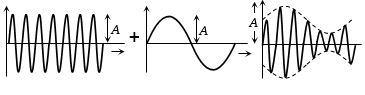
View Solution42
MediumMCQ
In $AM$,the cent percent modulation is achieved when
A
Carrier amplitude $=$ signal amplitude
B
Carrier amplitude $\neq$ signal amplitude
C
Carrier frequency $=$ signal frequency
D
Carrier frequency $\neq$ signal frequency
Solution
(A) The modulation index $m_a$ is defined as the ratio of the amplitude of the modulating signal $(A_m)$ to the amplitude of the carrier wave $(A_c)$.
For cent percent modulation,the modulation index $m_a = 1$ (or $100\%$).
$m_a = \frac{A_m}{A_c} = 1 \implies A_m = A_c$.
Thus,cent percent modulation is achieved when the amplitude of the modulating signal is equal to the amplitude of the carrier wave.
For cent percent modulation,the modulation index $m_a = 1$ (or $100\%$).
$m_a = \frac{A_m}{A_c} = 1 \implies A_m = A_c$.
Thus,cent percent modulation is achieved when the amplitude of the modulating signal is equal to the amplitude of the carrier wave.
0 likes
View Solution43
EasyMCQ
The maximum distance up to which $TV$ transmission from a $TV$ tower of height $h$ can be received is proportional to
A
$h^{1/2}$
B
$\frac{1}{2}h$
C
$h$
D
$h^2$
Solution
(A) The maximum line-of-sight distance $d$ for a $TV$ tower of height $h$ is given by the formula $d = \sqrt{2Rh}$,where $R$ is the radius of the Earth.
Since $R$ is a constant,the relationship between the distance $d$ and the height $h$ is $d \propto \sqrt{h}$.
Therefore,the maximum distance is proportional to $h^{1/2}$.
Since $R$ is a constant,the relationship between the distance $d$ and the height $h$ is $d \propto \sqrt{h}$.
Therefore,the maximum distance is proportional to $h^{1/2}$.
0 likes
View Solution44
EasyMCQ
Television signals broadcast from the moon can be received on the earth,while the $TV$ broadcast from Delhi cannot be received at places about $100 \, km$ distant from Delhi. This is because:
A
There is no atmosphere around the moon
B
Of strong gravity effect on $TV$ signals
C
$TV$ signals travel straight and cannot follow the curvature of the earth
D
There is atmosphere around the earth
Solution
(C) Television signals are radio waves that propagate in a straight line (line-of-sight propagation).
They cannot pass through the Earth's surface.
When waves travel in a straight line from a terrestrial transmitter,they are blocked by the curvature of the Earth beyond a certain distance.
However,when signals are broadcast from the moon,they approach the Earth from a high altitude,allowing them to cover a much larger area without being obstructed by the Earth's curvature.
This is why high-altitude towers are used for terrestrial broadcasting to extend the range of signal reception.
They cannot pass through the Earth's surface.
When waves travel in a straight line from a terrestrial transmitter,they are blocked by the curvature of the Earth beyond a certain distance.
However,when signals are broadcast from the moon,they approach the Earth from a high altitude,allowing them to cover a much larger area without being obstructed by the Earth's curvature.
This is why high-altitude towers are used for terrestrial broadcasting to extend the range of signal reception.
0 likes
View Solution45
EasyMCQ
$A$ $TV$ tower has a height of $100 \ m$. The average population density around the tower is $1000 \ \text{per} \ km^2$. The radius of the earth is $6.4 \times 10^6 \ m$. The population covered by the tower is:
A
$2 \times 10^6$
B
$3 \times 10^6$
C
$4 \times 10^6$
D
$6 \times 10^6$
Solution
(C) The range of the $TV$ tower is given by $d = \sqrt{2hR}$.
The area covered by the tower is $A = \pi d^2 = \pi (2hR) = 2 \pi hR$.
Given: $h = 100 \ m = 0.1 \ km$, $R = 6.4 \times 10^6 \ m = 6400 \ km$, and population density $\rho = 1000 \ \text{per} \ km^2$.
Area $A = 2 \times \pi \times 0.1 \ km \times 6400 \ km = 1280 \pi \ km^2$.
Using $\pi \approx 3.14$, $A \approx 2 \times 3.14 \times 0.1 \times 6400 = 4019.2 \ km^2 \approx 4000 \ km^2$.
Population covered $= A \times \rho = 4000 \ km^2 \times 1000 \ \text{per} \ km^2 = 4 \times 10^6$.
The area covered by the tower is $A = \pi d^2 = \pi (2hR) = 2 \pi hR$.
Given: $h = 100 \ m = 0.1 \ km$, $R = 6.4 \times 10^6 \ m = 6400 \ km$, and population density $\rho = 1000 \ \text{per} \ km^2$.
Area $A = 2 \times \pi \times 0.1 \ km \times 6400 \ km = 1280 \pi \ km^2$.
Using $\pi \approx 3.14$, $A \approx 2 \times 3.14 \times 0.1 \times 6400 = 4019.2 \ km^2 \approx 4000 \ km^2$.
Population covered $= A \times \rho = 4000 \ km^2 \times 1000 \ \text{per} \ km^2 = 4 \times 10^6$.
0 likes
View Solution46
EasyMCQ
The maximum amplitude of an $AM$ wave is $90 \ V$ and the minimum amplitude is $10 \ V$. What is the amplitude of the modulating wave in the given $AM$ wave (in $V$)?
A
$40$
B
$50$
C
$90$
D
$100$
Solution
(A) The amplitude of the modulating wave $E_m$ is given by the formula:
$E_m = \frac{E_{max} - E_{min}}{2}$
Given that $E_{max} = 90 \ V$ and $E_{min} = 10 \ V$.
Substituting the values:
$E_m = \frac{90 - 10}{2} = \frac{80}{2} = 40 \ V$.
Therefore,the amplitude of the modulating wave is $40 \ V$.
$E_m = \frac{E_{max} - E_{min}}{2}$
Given that $E_{max} = 90 \ V$ and $E_{min} = 10 \ V$.
Substituting the values:
$E_m = \frac{90 - 10}{2} = \frac{80}{2} = 40 \ V$.
Therefore,the amplitude of the modulating wave is $40 \ V$.
0 likes
View Solution47
EasyMCQ
For effective radiation of a wave with a frequency of $20 \text{ MHz}$,what should be the length of the antenna in $m$?
A
$5$
B
$7.5$
C
$2$
D
$3.75$
Solution
(D) The wavelength $\lambda$ is given by the formula $\lambda = \frac{c}{f}$.
Substituting the given values: $c = 3 \times 10^8 \text{ m/s}$ and $f = 20 \times 10^6 \text{ Hz}$.
$\lambda = \frac{3 \times 10^8}{20 \times 10^6} = \frac{300}{20} = 15 \text{ m}$.
For effective radiation,the antenna length $L$ should be at least $\frac{\lambda}{4}$.
$L = \frac{15}{4} = 3.75 \text{ m}$.
Substituting the given values: $c = 3 \times 10^8 \text{ m/s}$ and $f = 20 \times 10^6 \text{ Hz}$.
$\lambda = \frac{3 \times 10^8}{20 \times 10^6} = \frac{300}{20} = 15 \text{ m}$.
For effective radiation,the antenna length $L$ should be at least $\frac{\lambda}{4}$.
$L = \frac{15}{4} = 3.75 \text{ m}$.
0 likes
View Solution48
MediumMCQ
The mathematical form of an $AM$ wave is given by $e = 50 (1 + 0.5 \sin(2\pi \times 5 \times 10^3 t)) \sin(31.4 \times 10^6 t) \text{ V}$. The frequencies of the $LSB$ and $USB$ in the given $AM$ wave are,respectively,....... and ....... .
A
$5 \text{ kHz}, 5 \text{ MHz}$
B
$5 \text{ MHz}, 5 \text{ kHz}$
C
$4.995 \text{ MHz}, 5.005 \text{ MHz}$
D
$5.005 \text{ MHz}, 4.995 \text{ MHz}$
Solution
(C) The standard equation for an $AM$ wave is $e = E_c(1 + m_a \sin(\omega_m t)) \sin(\omega_c t)$.
Comparing the given equation $e = 50(1 + 0.5 \sin(2\pi \times 5 \times 10^3 t)) \sin(31.4 \times 10^6 t)$ with the standard form:
$1$. The modulating frequency $f_m$ is obtained from $\omega_m = 2\pi f_m = 2\pi \times 5 \times 10^3 \text{ rad/s}$,so $f_m = 5 \times 10^3 \text{ Hz} = 5 \text{ kHz} = 0.005 \text{ MHz}$.
$2$. The carrier frequency $f_c$ is obtained from $\omega_c = 2\pi f_c = 31.4 \times 10^6 \text{ rad/s}$. Since $31.4 \approx 10\pi$,we have $2\pi f_c = 10\pi \times 10^6$,so $f_c = 5 \times 10^6 \text{ Hz} = 5 \text{ MHz}$.
$3$. The Lower Sideband $(LSB)$ frequency is $f_c - f_m = 5 \text{ MHz} - 0.005 \text{ MHz} = 4.995 \text{ MHz}$.
$4$. The Upper Sideband $(USB)$ frequency is $f_c + f_m = 5 \text{ MHz} + 0.005 \text{ MHz} = 5.005 \text{ MHz}$.
Therefore,the $LSB$ is $4.995 \text{ MHz}$ and the $USB$ is $5.005 \text{ MHz}$.
Comparing the given equation $e = 50(1 + 0.5 \sin(2\pi \times 5 \times 10^3 t)) \sin(31.4 \times 10^6 t)$ with the standard form:
$1$. The modulating frequency $f_m$ is obtained from $\omega_m = 2\pi f_m = 2\pi \times 5 \times 10^3 \text{ rad/s}$,so $f_m = 5 \times 10^3 \text{ Hz} = 5 \text{ kHz} = 0.005 \text{ MHz}$.
$2$. The carrier frequency $f_c$ is obtained from $\omega_c = 2\pi f_c = 31.4 \times 10^6 \text{ rad/s}$. Since $31.4 \approx 10\pi$,we have $2\pi f_c = 10\pi \times 10^6$,so $f_c = 5 \times 10^6 \text{ Hz} = 5 \text{ MHz}$.
$3$. The Lower Sideband $(LSB)$ frequency is $f_c - f_m = 5 \text{ MHz} - 0.005 \text{ MHz} = 4.995 \text{ MHz}$.
$4$. The Upper Sideband $(USB)$ frequency is $f_c + f_m = 5 \text{ MHz} + 0.005 \text{ MHz} = 5.005 \text{ MHz}$.
Therefore,the $LSB$ is $4.995 \text{ MHz}$ and the $USB$ is $5.005 \text{ MHz}$.
0 likes
View Solution49
DifficultMCQ
The height of a transmitting antenna is $h \ m$ and the height of a receiving antenna is $45 \ m$. The distance between them is $40 \ km$. For satisfactory $Line\, of\, Sight$ $(LOS)$ communication between the two antennas,the height of the transmitting antenna $h$ must be ....... $m$. (Radius of the Earth $R = 6400 \ km$)
A
$15$
B
$20$
C
$30$
D
$25$
Solution
(B) The maximum line-of-sight distance $d$ between a transmitting antenna of height $h_T$ and a receiving antenna of height $h_R$ is given by the formula: $d = \sqrt{2Rh_T} + \sqrt{2Rh_R}$.
Given: $d = 40 \ km = 40 \times 10^3 \ m$,$h_R = 45 \ m$,$R = 6400 \ km = 6.4 \times 10^6 \ m$.
Substituting the values:
$40 \times 10^3 = \sqrt{2 \times 6.4 \times 10^6 \times h_T} + \sqrt{2 \times 6.4 \times 10^6 \times 45}$
$40 \times 10^3 = \sqrt{12.8 \times 10^6 \times h_T} + \sqrt{576 \times 10^6}$
$40 \times 10^3 = \sqrt{12.8 \times 10^6 \times h_T} + 24 \times 10^3$
$40 \times 10^3 - 24 \times 10^3 = \sqrt{12.8 \times 10^6 \times h_T}$
$16 \times 10^3 = \sqrt{12.8 \times 10^6 \times h_T}$
Squaring both sides:
$(16 \times 10^3)^2 = 12.8 \times 10^6 \times h_T$
$256 \times 10^6 = 12.8 \times 10^6 \times h_T$
$h_T = \frac{256}{12.8} = 20 \ m$.
Given: $d = 40 \ km = 40 \times 10^3 \ m$,$h_R = 45 \ m$,$R = 6400 \ km = 6.4 \times 10^6 \ m$.
Substituting the values:
$40 \times 10^3 = \sqrt{2 \times 6.4 \times 10^6 \times h_T} + \sqrt{2 \times 6.4 \times 10^6 \times 45}$
$40 \times 10^3 = \sqrt{12.8 \times 10^6 \times h_T} + \sqrt{576 \times 10^6}$
$40 \times 10^3 = \sqrt{12.8 \times 10^6 \times h_T} + 24 \times 10^3$
$40 \times 10^3 - 24 \times 10^3 = \sqrt{12.8 \times 10^6 \times h_T}$
$16 \times 10^3 = \sqrt{12.8 \times 10^6 \times h_T}$
Squaring both sides:
$(16 \times 10^3)^2 = 12.8 \times 10^6 \times h_T$
$256 \times 10^6 = 12.8 \times 10^6 \times h_T$
$h_T = \frac{256}{12.8} = 20 \ m$.
0 likes
View Solution50
EasyMCQ
The maximum amplitude of an $AM$ wave is $90 V$ and the minimum amplitude is $10 V$. What is the original amplitude of the carrier wave in the given $AM$ wave in $V$?
A
$40$
B
$50$
C
$90$
D
$100$
Solution
(B) Given:
Maximum amplitude $E_{max} = 90 V$
Minimum amplitude $E_{min} = 10 V$
The amplitude of the carrier wave $(E_c)$ is given by the formula:
$E_c = \frac{E_{max} + E_{min}}{2}$
Substituting the values:
$E_c = \frac{90 + 10}{2} = \frac{100}{2} = 50 V$
Therefore,the original amplitude of the carrier wave is $50 V$.
Maximum amplitude $E_{max} = 90 V$
Minimum amplitude $E_{min} = 10 V$
The amplitude of the carrier wave $(E_c)$ is given by the formula:
$E_c = \frac{E_{max} + E_{min}}{2}$
Substituting the values:
$E_c = \frac{90 + 10}{2} = \frac{100}{2} = 50 V$
Therefore,the original amplitude of the carrier wave is $50 V$.
0 likes
View SolutionCommunication — Communication · Frequently Asked Questions
1Are these Communication questions useful for JEE and NEET?
Yes. All questions in this section are mapped to JEE Main and NEET exam patterns. Previous year questions from JEE Main, NEET, GUJCET and state-level exams are included with full solutions.
2Can I switch to Hindi or Gujarati for these questions?
Yes. Use the language tabs in the hero section or the sidebar to view the same questions and solutions in English, Hindi or Gujarati.
3How do I generate a question paper from this subtopic?
Use the Vedclass Exam Paper Generator — select the chapter and subtopic, set difficulty, and generate Sets A, B, C, D automatically. First 3 chapters of every subject are free.
Vedclass Products
For Students
Vedclass Test Series
Mock tests in real JEE/NEET style with performance analysis. 5-day free trial.
Start Free TrialFor Teachers
Exam Paper Generator
Generate Set A/B/C/D papers from this chapter in 2 minutes. 3 chapters free.
Try FreeFor Institutes
Online Exam Module
Live online exams with unlimited students, 360° analytics & white-label branding.
See DemoFor Teachers & Institutes
Generate a Communication Exam Paper in 2 Minutes
Select subtopic & difficulty — Sets A, B, C, D auto-generated with No Repeat logic.
First 3 chapters of every subject are free — no payment required.