
A English
Mix Example - Atoms Questions in English
Class 12 Physics · Atoms · Mix Example - Atoms
63+
Questions
English
Language
100%
With Solutions
Showing 11 of 63 questions in English
51
MediumMCQ
Given below are two statements:
Statement $I$: Atoms are electrically neutral as they contain equal number of positive and negative charges.
Statement $II$: Atoms of each element are stable and emit their characteristic spectrum.
In the light of the above statements,choose the most appropriate answer from the options given below.
Statement $I$: Atoms are electrically neutral as they contain equal number of positive and negative charges.
Statement $II$: Atoms of each element are stable and emit their characteristic spectrum.
In the light of the above statements,choose the most appropriate answer from the options given below.
A
Both Statement $I$ and Statement $II$ are incorrect
B
Statement $I$ is correct but Statement $II$ is incorrect
C
Statement $I$ is incorrect but Statement $II$ is correct
D
Both Statement $I$ and Statement $II$ are correct
Solution
(B) Statement $I$ is correct. Atoms are electrically neutral because the number of protons (positive charge) in the nucleus is equal to the number of electrons (negative charge) orbiting the nucleus.
Statement $II$ is incorrect. While many atoms are stable,there are many radioactive elements whose atoms are unstable and undergo decay. Furthermore,while atoms do emit characteristic spectra,the statement implies that 'each' element's atom is stable,which is a generalization that ignores radioactive instability.
Statement $II$ is incorrect. While many atoms are stable,there are many radioactive elements whose atoms are unstable and undergo decay. Furthermore,while atoms do emit characteristic spectra,the statement implies that 'each' element's atom is stable,which is a generalization that ignores radioactive instability.
0 likes
View Solution52
AdvancedMCQ
Highly excited states for hydrogen-like atoms (also called Rydberg states) with nuclear charge $Ze$ are defined by their principal quantum number $n$,where $n \gg 1$. Which of the following statement$(s)$ is(are) true?
$(A)$ Relative change in the radii of two consecutive orbitals does not depend on $Z$
$(B)$ Relative change in the radii of two consecutive orbitals varies as $1/n$
$(C)$ Relative change in the energy of two consecutive orbitals varies as $1/n^3$
$(D)$ Relative change in the angular momenta of two consecutive orbitals varies as $1/n$
$(A)$ Relative change in the radii of two consecutive orbitals does not depend on $Z$
$(B)$ Relative change in the radii of two consecutive orbitals varies as $1/n$
$(C)$ Relative change in the energy of two consecutive orbitals varies as $1/n^3$
$(D)$ Relative change in the angular momenta of two consecutive orbitals varies as $1/n$
A
$A, B, D$
B
$B, C, D$
C
$A, B, C$
D
$A, C, D$
Solution
(A) For a hydrogen-like atom,the radius of the $n$-th orbit is $r_n = a_0 \frac{n^2}{Z}$.
The relative change in radius for two consecutive orbitals is $\frac{\Delta r}{r} \approx \frac{dr}{r} = \frac{2n \, dn}{n^2} = \frac{2 \Delta n}{n}$. Since $\Delta n = 1$,$\frac{\Delta r}{r} \propto \frac{1}{n}$. This is independent of $Z$. Thus,$(A)$ and $(B)$ are correct.
The energy of the $n$-th orbit is $E_n = -E_0 \frac{Z^2}{n^2}$.
The relative change in energy is $\frac{\Delta E}{E} \approx \frac{dE}{E} = \frac{2n^{-3} \, dn}{n^{-2}} = \frac{2 \Delta n}{n}$. Since $\Delta n = 1$,$\frac{\Delta E}{E} \propto \frac{1}{n}$. Thus,$(C)$ is incorrect.
The angular momentum is $L = \frac{nh}{2\pi}$.
The relative change is $\frac{\Delta L}{L} = \frac{\Delta n}{n}$. Since $\Delta n = 1$,$\frac{\Delta L}{L} \propto \frac{1}{n}$. Thus,$(D)$ is correct.
Therefore,the correct statements are $(A)$,$(B)$,and $(D)$.
The relative change in radius for two consecutive orbitals is $\frac{\Delta r}{r} \approx \frac{dr}{r} = \frac{2n \, dn}{n^2} = \frac{2 \Delta n}{n}$. Since $\Delta n = 1$,$\frac{\Delta r}{r} \propto \frac{1}{n}$. This is independent of $Z$. Thus,$(A)$ and $(B)$ are correct.
The energy of the $n$-th orbit is $E_n = -E_0 \frac{Z^2}{n^2}$.
The relative change in energy is $\frac{\Delta E}{E} \approx \frac{dE}{E} = \frac{2n^{-3} \, dn}{n^{-2}} = \frac{2 \Delta n}{n}$. Since $\Delta n = 1$,$\frac{\Delta E}{E} \propto \frac{1}{n}$. Thus,$(C)$ is incorrect.
The angular momentum is $L = \frac{nh}{2\pi}$.
The relative change is $\frac{\Delta L}{L} = \frac{\Delta n}{n}$. Since $\Delta n = 1$,$\frac{\Delta L}{L} \propto \frac{1}{n}$. Thus,$(D)$ is correct.
Therefore,the correct statements are $(A)$,$(B)$,and $(D)$.
0 likes
View Solution53
MediumMCQ
An electron of a stationary Hydrogen atom transitions from the fifth energy level to the ground level. The velocity that the atom acquires as a result of photon emission is ( $m=$ mass of the atom,$R=$ Rydberg's constant,$h=$ Planck's constant).
A
$\frac{24 Rh}{25 m}$
B
$\frac{25 Rh}{24 m}$
C
$\frac{25 m}{24 Rh}$
D
$\frac{24 m}{25 Rh}$
Solution
(A) The wavelength $\lambda$ of the emitted photon is given by the Rydberg formula:
$\frac{1}{\lambda} = R \left( \frac{1}{n_1^2} - \frac{1}{n_2^2} \right)$
Given $n_1 = 1$ and $n_2 = 5$:
$\frac{1}{\lambda} = R \left( \frac{1}{1^2} - \frac{1}{5^2} \right) = R \left( 1 - \frac{1}{25} \right) = \frac{24}{25} R$ ... $(i)$
The momentum of the emitted photon is $p = \frac{h}{\lambda}$.
Substituting from $(i)$:
$p = h \left( \frac{24}{25} R \right)$
By the law of conservation of linear momentum,the momentum of the atom must be equal and opposite to the momentum of the photon (since the atom was initially stationary):
$p_{\text{atom}} = p_{\text{photon}}$
$mv = \frac{24 Rh}{25}$
$v = \frac{24 Rh}{25 m}$
$\frac{1}{\lambda} = R \left( \frac{1}{n_1^2} - \frac{1}{n_2^2} \right)$
Given $n_1 = 1$ and $n_2 = 5$:
$\frac{1}{\lambda} = R \left( \frac{1}{1^2} - \frac{1}{5^2} \right) = R \left( 1 - \frac{1}{25} \right) = \frac{24}{25} R$ ... $(i)$
The momentum of the emitted photon is $p = \frac{h}{\lambda}$.
Substituting from $(i)$:
$p = h \left( \frac{24}{25} R \right)$
By the law of conservation of linear momentum,the momentum of the atom must be equal and opposite to the momentum of the photon (since the atom was initially stationary):
$p_{\text{atom}} = p_{\text{photon}}$
$mv = \frac{24 Rh}{25}$
$v = \frac{24 Rh}{25 m}$
0 likes
View Solution54
EasyMCQ
Pick out the correct statement from the following:
A
Mercury vapour lamp produces line emission spectrum
B
Sunlight spectrum is an example for line absorption spectrum
C
Band spectrum helps us to study molecular structure
D
All of the above
Solution
(D) The line emission spectrum is produced by an excited substance in the atomic state,such as a mercury vapour lamp.
Line absorption spectrum is produced when electromagnetic radiations pass through a medium; therefore,the sunlight spectrum is a line absorption spectrum.
The band spectrum is used to study the molecular structure.
Since all the statements $A$,$B$,and $C$ are correct,the correct option is $D$.
Line absorption spectrum is produced when electromagnetic radiations pass through a medium; therefore,the sunlight spectrum is a line absorption spectrum.
The band spectrum is used to study the molecular structure.
Since all the statements $A$,$B$,and $C$ are correct,the correct option is $D$.
0 likes
View Solution55
EasyMCQ
Continuous emission spectrum is produced by
A
incandescent electric lamp
B
mercury vapour lamp
C
sodium vapour lamp
D
polyatomic substances
Solution
(A) An incandescent electric lamp produces a continuous emission spectrum because the filament emits radiation across a wide range of wavelengths due to its high temperature.
Mercury and sodium vapour lamps produce line emission spectra because the atoms in the gas emit light only at specific discrete wavelengths.
Polyatomic substances,such as $H_{2}$,$CO_{2}$,and $KMnO_{4}$,typically produce band absorption spectra.
Mercury and sodium vapour lamps produce line emission spectra because the atoms in the gas emit light only at specific discrete wavelengths.
Polyatomic substances,such as $H_{2}$,$CO_{2}$,and $KMnO_{4}$,typically produce band absorption spectra.
0 likes
View Solution56
EasyMCQ
The solar spectrum is an example of
A
line emission spectrum
B
continuous emission spectrum
C
band absorption spectrum
D
line absorption spectrum
Solution
(D) The solar spectrum consists of a continuous spectrum of light emitted by the hot interior of the Sun,which is crossed by numerous dark lines known as Fraunhofer lines. These dark lines are produced because the cooler gases in the Sun's outer atmosphere (the photosphere and chromosphere) absorb specific wavelengths of light from the continuous spectrum. Therefore,the solar spectrum is classified as a line absorption spectrum.
0 likes
View Solution57
EasyMCQ
The ionisation energy of an electron in the ground state of a helium atom is $24.6 eV$. The energy required to remove both electrons is: (in $eV$)
A
$51.8$
B
$79$
C
$38.2$
D
$49.2$
Solution
(B) The energy required to remove the first electron from a neutral helium atom $(He)$ is given as $24.6 eV$.
After the first electron is removed,the remaining ion is $He^+$,which is a hydrogen-like species with atomic number $Z = 2$.
The energy required to remove the second electron from the ground state of $He^+$ is given by the formula $E = Z^2 \times 13.6 eV$.
Substituting $Z = 2$,we get $E = (2)^2 \times 13.6 eV = 4 \times 13.6 eV = 54.4 eV$.
The total energy required to remove both electrons is the sum of the energy to remove the first and the second electron.
Total Energy $= 24.6 eV + 54.4 eV = 79 eV$.
After the first electron is removed,the remaining ion is $He^+$,which is a hydrogen-like species with atomic number $Z = 2$.
The energy required to remove the second electron from the ground state of $He^+$ is given by the formula $E = Z^2 \times 13.6 eV$.
Substituting $Z = 2$,we get $E = (2)^2 \times 13.6 eV = 4 \times 13.6 eV = 54.4 eV$.
The total energy required to remove both electrons is the sum of the energy to remove the first and the second electron.
Total Energy $= 24.6 eV + 54.4 eV = 79 eV$.
0 likes
View Solution58
MediumMCQ
$A$ stationary hydrogen atom emits a photon corresponding to the first line of the Lyman series. The recoil velocity of the atom is nearly (in $m/s$)
A
$3.2$
B
$0.63$
C
$8.2$
D
$0.1$
Solution
(A) The energy of the photon emitted in the first line of the Lyman series ($n=2$ to $n=1$) is given by: $E = 13.6 \ eV \times (1 - 1/4) = 13.6 \times 0.75 = 10.2 \ eV$.
Converting this to Joules: $E = 10.2 \times 1.6 \times 10^{-19} \ J = 1.632 \times 10^{-18} \ J$.
The momentum of the photon is $p = E/c = (1.632 \times 10^{-18}) / (3 \times 10^8) = 5.44 \times 10^{-27} \ kg \ m/s$.
By conservation of momentum,the recoil momentum of the hydrogen atom must be equal and opposite to the photon's momentum: $m_H v = p$.
The mass of a hydrogen atom is $m_H \approx 1.67 \times 10^{-27} \ kg$.
Therefore,$v = p / m_H = (5.44 \times 10^{-27}) / (1.67 \times 10^{-27}) \approx 3.25 \ m/s$.
Converting this to Joules: $E = 10.2 \times 1.6 \times 10^{-19} \ J = 1.632 \times 10^{-18} \ J$.
The momentum of the photon is $p = E/c = (1.632 \times 10^{-18}) / (3 \times 10^8) = 5.44 \times 10^{-27} \ kg \ m/s$.
By conservation of momentum,the recoil momentum of the hydrogen atom must be equal and opposite to the photon's momentum: $m_H v = p$.
The mass of a hydrogen atom is $m_H \approx 1.67 \times 10^{-27} \ kg$.
Therefore,$v = p / m_H = (5.44 \times 10^{-27}) / (1.67 \times 10^{-27}) \approx 3.25 \ m/s$.
0 likes
View Solution59
MediumMCQ
Match the following:
| $1$. Burning candle | $i$. Line spectrum |
| $2$. Sodium vapour | $ii$. Continuous spectrum |
| $3$. Bunsen flame | $iii$. Band spectrum |
| $4$. Dark lines in solar spectrum | $iv$. Absorption spectrum |
A
$1-(iii), 2-(i), 3-(ii), 4-(iv)$
B
$1-(iii), 2-(ii), 3-(i), 4-(iv)$
C
$1-(ii), 2-(iii), 3-(i), 4-(iv)$
D
$1-(ii), 2-(i), 3-(iii), 4-(iv)$
Solution
(D) The correct matches are as follows:
$1$. $A$ burning candle emits light across a wide range of wavelengths,resulting in a continuous spectrum.
$2$. Sodium vapour,when excited,emits light at specific discrete wavelengths,resulting in a line spectrum.
$3$. $A$ Bunsen flame (often containing molecular species) produces a band spectrum.
$4$. Dark lines in the solar spectrum (Fraunhofer lines) are caused by the absorption of specific wavelengths by gases in the solar atmosphere,resulting in an absorption spectrum.
Therefore,the correct matching is $1-(ii), 2-(i), 3-(iii), 4-(iv)$.
$1$. $A$ burning candle emits light across a wide range of wavelengths,resulting in a continuous spectrum.
$2$. Sodium vapour,when excited,emits light at specific discrete wavelengths,resulting in a line spectrum.
$3$. $A$ Bunsen flame (often containing molecular species) produces a band spectrum.
$4$. Dark lines in the solar spectrum (Fraunhofer lines) are caused by the absorption of specific wavelengths by gases in the solar atmosphere,resulting in an absorption spectrum.
Therefore,the correct matching is $1-(ii), 2-(i), 3-(iii), 4-(iv)$.
0 likes
View Solution60
MediumMCQ
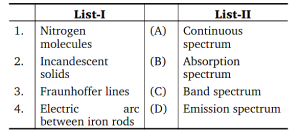
Match the appropriate pairs from List-$I$ and List-$II$:
| List-$I$ | List-$II$ |
|---|---|
| $1$. Nitrogen molecules | $(A)$ Continuous spectrum |
| $2$. Incandescent solids | $(B)$ Absorption spectrum |
| $3$. Fraunhofer lines | $(C)$ Band spectrum |
| $4$. Electric arc between iron rods | $(D)$ Emission spectrum |
A
$1-C, 2-A, 3-B, 4-D$
B
$1-B, 2-A, 3-D, 4-C$
C
$1-D, 2-A, 3-B, 4-C$
D
$1-A, 2-C, 3-D, 4-B$
Solution
(A) $1$. Nitrogen molecules exhibit a band spectrum because molecular spectra consist of bands due to transitions between electronic,vibrational,and rotational energy levels.
$2$. Incandescent solids emit a continuous spectrum because they contain a wide range of frequencies due to thermal agitation.
$3$. Fraunhofer lines are dark lines observed in the solar spectrum,which are caused by the absorption of specific wavelengths by gases in the solar atmosphere,thus forming an absorption spectrum.
$4$. An electric arc between iron rods produces a line emission spectrum characteristic of the iron atoms present in the arc.
Therefore,the correct matching is $1-C, 2-A, 3-B, 4-D$.
$2$. Incandescent solids emit a continuous spectrum because they contain a wide range of frequencies due to thermal agitation.
$3$. Fraunhofer lines are dark lines observed in the solar spectrum,which are caused by the absorption of specific wavelengths by gases in the solar atmosphere,thus forming an absorption spectrum.
$4$. An electric arc between iron rods produces a line emission spectrum characteristic of the iron atoms present in the arc.
Therefore,the correct matching is $1-C, 2-A, 3-B, 4-D$.
0 likes
View Solution61
MediumMCQ
The collision of an electron with kinetic energy $5.5 eV$ and a hydrogen atom in its ground state can be described as
A
completely inelastic
B
may be completely inelastic
C
may be partially elastic
D
elastic
Solution
(D) Given,kinetic energy of the electron $= 5.5 eV$.
The energy required to excite a hydrogen atom from the ground state $(n=1)$ to the first excited state $(n=2)$ is $\Delta E = E_2 - E_1 = -3.4 eV - (-13.6 eV) = 10.2 eV$.
Since the kinetic energy of the incident electron $(5.5 eV)$ is less than the excitation energy required $(10.2 eV)$,the electron cannot transfer any energy to the hydrogen atom to cause an electronic transition.
As no energy is lost to internal excitation,the total kinetic energy of the system remains conserved.
Therefore,the collision is elastic.
The energy required to excite a hydrogen atom from the ground state $(n=1)$ to the first excited state $(n=2)$ is $\Delta E = E_2 - E_1 = -3.4 eV - (-13.6 eV) = 10.2 eV$.
Since the kinetic energy of the incident electron $(5.5 eV)$ is less than the excitation energy required $(10.2 eV)$,the electron cannot transfer any energy to the hydrogen atom to cause an electronic transition.
As no energy is lost to internal excitation,the total kinetic energy of the system remains conserved.
Therefore,the collision is elastic.
0 likes
View SolutionAtoms — Mix Example - Atoms · Frequently Asked Questions
1Are these Atoms questions useful for JEE and NEET?
Yes. All questions in this section are mapped to JEE Main and NEET exam patterns. Previous year questions from JEE Main, NEET, GUJCET and state-level exams are included with full solutions.
2Can I switch to Hindi or Gujarati for these questions?
Yes. Use the language tabs in the hero section or the sidebar to view the same questions and solutions in English, Hindi or Gujarati.
3How do I generate a question paper from this subtopic?
Use the Vedclass Exam Paper Generator — select the chapter and subtopic, set difficulty, and generate Sets A, B, C, D automatically. First 3 chapters of every subject are free.
Vedclass Products
For Students
Vedclass Test Series
Mock tests in real JEE/NEET style with performance analysis. 5-day free trial.
Start Free TrialFor Teachers
Exam Paper Generator
Generate Set A/B/C/D papers from this chapter in 2 minutes. 3 chapters free.
Try FreeFor Institutes
Online Exam Module
Live online exams with unlimited students, 360° analytics & white-label branding.
See DemoFor Teachers & Institutes
Generate a Atoms Exam Paper in 2 Minutes
Select subtopic & difficulty — Sets A, B, C, D auto-generated with No Repeat logic.
First 3 chapters of every subject are free — no payment required.