
A English
Bohr's Model of Hydrogen Atom Questions in English
Class 12 Physics · Atoms · Bohr's Model of Hydrogen Atom
574+
Questions
English
Language
100%
With Solutions
Showing 49 of 574 questions in English
151
MediumMCQ
If the energy of the $n^{th}$ orbit in a hydrogen atom is $E_n$,what will be the energy of the $n^{th}$ orbit in a helium ion $(He^+)$?
A
$4E_n$
B
$E_n/4$
C
$2E_n$
D
$E_n/2$
Solution
(A) The energy of an electron in the $n^{th}$ orbit of a hydrogen-like atom is given by the formula: $E_n = -13.6 \times \frac{Z^2}{n^2} \text{ eV}$.
For a hydrogen atom,the atomic number $Z = 1$,so $E_n = -13.6 \times \frac{1^2}{n^2} = -\frac{13.6}{n^2}$.
For a helium ion $(He^+)$,the atomic number $Z = 2$,so the energy $E'_{n}$ is given by: $E'_{n} = -13.6 \times \frac{2^2}{n^2} = -13.6 \times \frac{4}{n^2}$.
Comparing the two expressions,we get: $E'_{n} = 4 \times (-13.6 \times \frac{1}{n^2}) = 4E_n$.
Therefore,the energy of the $n^{th}$ orbit in a helium ion is $4E_n$.
For a hydrogen atom,the atomic number $Z = 1$,so $E_n = -13.6 \times \frac{1^2}{n^2} = -\frac{13.6}{n^2}$.
For a helium ion $(He^+)$,the atomic number $Z = 2$,so the energy $E'_{n}$ is given by: $E'_{n} = -13.6 \times \frac{2^2}{n^2} = -13.6 \times \frac{4}{n^2}$.
Comparing the two expressions,we get: $E'_{n} = 4 \times (-13.6 \times \frac{1}{n^2}) = 4E_n$.
Therefore,the energy of the $n^{th}$ orbit in a helium ion is $4E_n$.
0 likes
View Solution152
MediumMCQ
What is the change in angular momentum of an electron in a hydrogen atom when it transitions from the $4^{th}$ orbit to the $5^{th}$ orbit? $(h = 6.6 \times 10^{-34} \, J \cdot s)$
A
$4.16 \times 10^{-34} \, J \cdot s$
B
$3.32 \times 10^{-34} \, J \cdot s$
C
$1.05 \times 10^{-34} \, J \cdot s$
D
$2.08 \times 10^{-34} \, J \cdot s$
Solution
(C) According to Bohr's postulate,the angular momentum $L$ of an electron in the $n^{th}$ orbit is given by $L = \frac{nh}{2\pi}$.
The change in angular momentum $\Delta L$ when the electron transitions from orbit $n_1 = 4$ to $n_2 = 5$ is:
$\Delta L = L_2 - L_1 = \frac{n_2 h}{2\pi} - \frac{n_1 h}{2\pi} = \frac{h}{2\pi}(n_2 - n_1)$.
Substituting the given values:
$\Delta L = \frac{6.6 \times 10^{-34}}{2 \times 3.14} \times (5 - 4)$.
$\Delta L = \frac{6.6 \times 10^{-34}}{6.28} \times 1$.
$\Delta L \approx 1.05 \times 10^{-34} \, J \cdot s$.
The change in angular momentum $\Delta L$ when the electron transitions from orbit $n_1 = 4$ to $n_2 = 5$ is:
$\Delta L = L_2 - L_1 = \frac{n_2 h}{2\pi} - \frac{n_1 h}{2\pi} = \frac{h}{2\pi}(n_2 - n_1)$.
Substituting the given values:
$\Delta L = \frac{6.6 \times 10^{-34}}{2 \times 3.14} \times (5 - 4)$.
$\Delta L = \frac{6.6 \times 10^{-34}}{6.28} \times 1$.
$\Delta L \approx 1.05 \times 10^{-34} \, J \cdot s$.
0 likes
View Solution153
MediumMCQ
What is the ratio of the time periods of an electron in the $n = 2$ and $n = 1$ orbits of a hydrogen atom (in $:1$)?
A
$2$
B
$4$
C
$8$
D
$16$
Solution
(C) According to Bohr's theory,the time period $T$ of an electron in an orbit is given by $T = \frac{2\pi r}{v}$.
Since $r \propto n^2$ and $v \propto \frac{1}{n}$,we have $T \propto \frac{n^2}{1/n} = n^3$.
Therefore,the ratio of the time periods for $n_2 = 2$ and $n_1 = 1$ is:
$\frac{T_2}{T_1} = \left( \frac{n_2}{n_1} \right)^3 = \left( \frac{2}{1} \right)^3 = \frac{8}{1}$.
Thus,the ratio is $8:1$.
Since $r \propto n^2$ and $v \propto \frac{1}{n}$,we have $T \propto \frac{n^2}{1/n} = n^3$.
Therefore,the ratio of the time periods for $n_2 = 2$ and $n_1 = 1$ is:
$\frac{T_2}{T_1} = \left( \frac{n_2}{n_1} \right)^3 = \left( \frac{2}{1} \right)^3 = \frac{8}{1}$.
Thus,the ratio is $8:1$.
0 likes
View Solution154
DifficultMCQ
Hydrogen $(H)$,Deuterium $(D)$,Helium $(He^+)$,and Lithium $(Li^{2+})$ emit radiation of wavelengths $\lambda_1, \lambda_2, \lambda_3,$ and $\lambda_4$ respectively during the transition from $n = 2$ to $n = 1$. Then:
A
$\lambda_1 = \lambda_2 = 4\lambda_3 = 9\lambda_4$
B
$4\lambda_1 = 2\lambda_2 = 2\lambda_3 = \lambda_4$
C
$\lambda_1 = 2\lambda_2 = 2\sqrt{2}\lambda_3 = 3\sqrt{2}\lambda_4$
D
$\lambda_1 = \lambda_2 = 2\lambda_3 = 3\lambda_4$
Solution
(A) The energy of a photon emitted during a transition between energy levels $n_2$ and $n_1$ in a hydrogen-like atom is given by $\Delta E = 13.6 Z^2 \left( \frac{1}{n_1^2} - \frac{1}{n_2^2} \right) \text{ eV}$.
Since the transition is from $n = 2$ to $n = 1$ for all cases,the term $\left( \frac{1}{1^2} - \frac{1}{2^2} \right)$ is constant.
Therefore,$\Delta E \propto Z^2$.
Since $\Delta E = \frac{hc}{\lambda}$,we have $\frac{hc}{\lambda} \propto Z^2$,which implies $\lambda Z^2 = \text{constant}$.
For $H$ $(Z=1)$,$D$ $(Z=1)$,$He^+$ $(Z=2)$,and $Li^{2+}$ $(Z=3)$:
$\lambda_1 (1)^2 = \lambda_2 (1)^2 = \lambda_3 (2)^2 = \lambda_4 (3)^2$.
Thus,$\lambda_1 = \lambda_2 = 4\lambda_3 = 9\lambda_4$.
Since the transition is from $n = 2$ to $n = 1$ for all cases,the term $\left( \frac{1}{1^2} - \frac{1}{2^2} \right)$ is constant.
Therefore,$\Delta E \propto Z^2$.
Since $\Delta E = \frac{hc}{\lambda}$,we have $\frac{hc}{\lambda} \propto Z^2$,which implies $\lambda Z^2 = \text{constant}$.
For $H$ $(Z=1)$,$D$ $(Z=1)$,$He^+$ $(Z=2)$,and $Li^{2+}$ $(Z=3)$:
$\lambda_1 (1)^2 = \lambda_2 (1)^2 = \lambda_3 (2)^2 = \lambda_4 (3)^2$.
Thus,$\lambda_1 = \lambda_2 = 4\lambda_3 = 9\lambda_4$.
0 likes
View Solution155
MediumMCQ
In a hydrogen atom,when an electron transitions from the $4^{th}$ orbit to the $2^{nd}$ orbit,the wave number is $20,397 \, cm^{-1}$. What will be the wave number when an electron in a $He^+$ ion transitions from the $4^{th}$ orbit to the $2^{nd}$ orbit?
A
$5,099 \, cm^{-1}$
B
$20,497 \, cm^{-1}$
C
$40,994 \, cm^{-1}$
D
$81,588 \, cm^{-1}$
Solution
(D) The wave number $\bar{\nu}$ is given by the Rydberg formula: $\bar{\nu} = R Z^2 \left( \frac{1}{n_1^2} - \frac{1}{n_2^2} \right)$.
For a given transition $(n_1=2, n_2=4)$,the wave number is proportional to the square of the atomic number: $\bar{\nu} \propto Z^2$.
For Hydrogen $(H)$,$Z_1 = 1$. For Helium ion $(He^+)$,$Z_2 = 2$.
Therefore,$\frac{\bar{\nu}_{He^+}}{\bar{\nu}_{H}} = \left( \frac{Z_2}{Z_1} \right)^2 = \left( \frac{2}{1} \right)^2 = 4$.
Thus,$\bar{\nu}_{He^+} = 4 \times \bar{\nu}_{H} = 4 \times 20,397 \, cm^{-1} = 81,588 \, cm^{-1}$.
For a given transition $(n_1=2, n_2=4)$,the wave number is proportional to the square of the atomic number: $\bar{\nu} \propto Z^2$.
For Hydrogen $(H)$,$Z_1 = 1$. For Helium ion $(He^+)$,$Z_2 = 2$.
Therefore,$\frac{\bar{\nu}_{He^+}}{\bar{\nu}_{H}} = \left( \frac{Z_2}{Z_1} \right)^2 = \left( \frac{2}{1} \right)^2 = 4$.
Thus,$\bar{\nu}_{He^+} = 4 \times \bar{\nu}_{H} = 4 \times 20,397 \, cm^{-1} = 81,588 \, cm^{-1}$.
0 likes
View Solution156
MediumMCQ
In a hydrogen atom,an electron transitions from an orbit of radius $R$ to an orbit of radius $4R$. What is the ratio of their time periods?
A
$1/4$
B
$4/1$
C
$8/1$
D
$1/8$
Solution
(D) According to Bohr's model,the radius of the $n^{th}$ orbit is given by $R_n \propto n^2$.
Given $R_1 = R$ and $R_2 = 4R$,we have $\frac{R_1}{R_2} = \frac{R}{4R} = \frac{1}{4}$.
Since $R_n \propto n^2$,we have $\frac{n_1^2}{n_2^2} = \frac{1}{4}$,which implies $\frac{n_1}{n_2} = \frac{1}{2}$.
The time period $T$ of an electron in the $n^{th}$ orbit is given by $T_n \propto n^3$.
Therefore,the ratio of the time periods is $\frac{T_1}{T_2} = \left( \frac{n_1}{n_2} \right)^3$.
Substituting the values,$\frac{T_1}{T_2} = \left( \frac{1}{2} \right)^3 = \frac{1}{8}$.
Given $R_1 = R$ and $R_2 = 4R$,we have $\frac{R_1}{R_2} = \frac{R}{4R} = \frac{1}{4}$.
Since $R_n \propto n^2$,we have $\frac{n_1^2}{n_2^2} = \frac{1}{4}$,which implies $\frac{n_1}{n_2} = \frac{1}{2}$.
The time period $T$ of an electron in the $n^{th}$ orbit is given by $T_n \propto n^3$.
Therefore,the ratio of the time periods is $\frac{T_1}{T_2} = \left( \frac{n_1}{n_2} \right)^3$.
Substituting the values,$\frac{T_1}{T_2} = \left( \frac{1}{2} \right)^3 = \frac{1}{8}$.
0 likes
View Solution157
MediumMCQ
The energy of an electron in the ground state of a hydrogen atom is $E$. What is the energy of an electron in the $2^{nd}$ excited state of $Li^{++}$?
A
$E$
B
$3E$
C
$6E$
D
$9E$
Solution
(A) The energy of an electron in a hydrogen-like atom is given by the formula $E_n = E_0 \cdot \frac{Z^2}{n^2}$,where $E_0$ is the ground state energy of the hydrogen atom $(-13.6 \ eV)$.
For the ground state of a hydrogen atom,$n = 1$ and $Z = 1$. Thus,$E = E_0 \cdot \frac{1^2}{1^2} = E_0$.
For the $2^{nd}$ excited state of $Li^{++}$,the principal quantum number $n = 3$ (since $n=1$ is ground,$n=2$ is $1^{st}$ excited,and $n=3$ is $2^{nd}$ excited). The atomic number of Lithium is $Z = 3$.
Substituting these values into the formula: $E' = E_0 \cdot \frac{Z^2}{n^2} = E_0 \cdot \frac{3^2}{3^2} = E_0$.
Since $E = E_0$,we find that $E' = E$.
For the ground state of a hydrogen atom,$n = 1$ and $Z = 1$. Thus,$E = E_0 \cdot \frac{1^2}{1^2} = E_0$.
For the $2^{nd}$ excited state of $Li^{++}$,the principal quantum number $n = 3$ (since $n=1$ is ground,$n=2$ is $1^{st}$ excited,and $n=3$ is $2^{nd}$ excited). The atomic number of Lithium is $Z = 3$.
Substituting these values into the formula: $E' = E_0 \cdot \frac{Z^2}{n^2} = E_0 \cdot \frac{3^2}{3^2} = E_0$.
Since $E = E_0$,we find that $E' = E$.
0 likes
View Solution158
MediumMCQ
The ionization potential of a hydrogen atom is $13.6 \ eV$. Hydrogen atoms in the ground state are excited by monochromatic radiation of photon energy $12.1 \ eV$. According to Bohr's theory,the number of spectral lines emitted by the hydrogen atoms will be:
A
$1$
B
$2$
C
$3$
D
$4$
Solution
(C) The ionization potential of a hydrogen atom is $13.6 \ eV$. The energy of the $n^{th}$ orbit is given by $E_n = -\frac{13.6}{n^2} \ eV$.
When the hydrogen atom in the ground state $(n=1)$ absorbs a photon of energy $12.1 \ eV$,it is excited to a higher energy level $n$. The energy difference is given by:
$E = E_n - E_1$
$12.1 = -\frac{13.6}{n^2} - (-13.6)$
$12.1 = 13.6 - \frac{13.6}{n^2}$
$\frac{13.6}{n^2} = 13.6 - 12.1 = 1.5$
$n^2 = \frac{13.6}{1.5} \approx 9.06 \approx 9$
$n = 3$
The number of spectral lines emitted when the electron transitions from the $n^{th}$ state back to the ground state is given by the formula $\frac{n(n-1)}{2}$.
For $n=3$,the number of spectral lines = $\frac{3(3-1)}{2} = \frac{3 \times 2}{2} = 3$.
When the hydrogen atom in the ground state $(n=1)$ absorbs a photon of energy $12.1 \ eV$,it is excited to a higher energy level $n$. The energy difference is given by:
$E = E_n - E_1$
$12.1 = -\frac{13.6}{n^2} - (-13.6)$
$12.1 = 13.6 - \frac{13.6}{n^2}$
$\frac{13.6}{n^2} = 13.6 - 12.1 = 1.5$
$n^2 = \frac{13.6}{1.5} \approx 9.06 \approx 9$
$n = 3$
The number of spectral lines emitted when the electron transitions from the $n^{th}$ state back to the ground state is given by the formula $\frac{n(n-1)}{2}$.
For $n=3$,the number of spectral lines = $\frac{3(3-1)}{2} = \frac{3 \times 2}{2} = 3$.
0 likes
View Solution159
MediumMCQ
The energy of a hydrogen atom in the ground state is $-13.6 \, eV$. The energy of the $He^+$ ion in the first excited state will be .... $eV$.
A
$-13.6$
B
$-27.2$
C
$-54.4$
D
$-6.8$
Solution
(A) The energy $E$ of a hydrogen-like atom with atomic number $Z$ and principal quantum number $n$ is given by the formula:
$E_n = -13.6 \times \frac{Z^2}{n^2} \, eV$
For the $He^+$ ion,the atomic number $Z = 2$.
For the first excited state,the principal quantum number $n = 2$.
Substituting these values into the formula:
$E_2 = -13.6 \times \frac{2^2}{2^2} \, eV$
$E_2 = -13.6 \times \frac{4}{4} \, eV$
$E_2 = -13.6 \, eV$.
$E_n = -13.6 \times \frac{Z^2}{n^2} \, eV$
For the $He^+$ ion,the atomic number $Z = 2$.
For the first excited state,the principal quantum number $n = 2$.
Substituting these values into the formula:
$E_2 = -13.6 \times \frac{2^2}{2^2} \, eV$
$E_2 = -13.6 \times \frac{4}{4} \, eV$
$E_2 = -13.6 \, eV$.
0 likes
View Solution160
MediumMCQ
According to Bohr's atomic model,which of the following is $NOT$ a possible energy for a photon emitted by a hydrogen atom (in $;eV$)? (in $eV$)
A
$0.65$
B
$1.9$
C
$11.1$
D
$13.6$
Solution
(C) The energy of the $n^{\text{th}}$ orbit of a hydrogen atom is given by the formula $E_n = -\frac{13.6}{n^2} \; eV$.
The energy levels are:
$E_1 = -13.6 \; eV$
$E_2 = -\frac{13.6}{4} = -3.4 \; eV$
$E_3 = -\frac{13.6}{9} \approx -1.51 \; eV$
$E_4 = -\frac{13.6}{16} = -0.85 \; eV$
The energy of an emitted photon is the difference between two energy levels: $\Delta E = E_{n_2} - E_{n_1}$.
Checking the options:
$1$. $E_4 - E_3 = -0.85 - (-1.51) = 0.66 \; eV$ (approx $0.65 \; eV$). This is possible.
$2$. $E_3 - E_2 = -1.51 - (-3.4) = 1.89 \; eV$ (approx $1.9 \; eV$). This is possible.
$3$. $E_1$ is the ground state energy,and transitions to $E_1$ can release $13.6 \; eV$ (e.g.,from infinity to $n=1$). This is possible.
$4$. $11.1 \; eV$ cannot be expressed as the difference between any two energy levels of the hydrogen atom.
Therefore,$11.1 \; eV$ is not a possible energy for an emitted photon.
The energy levels are:
$E_1 = -13.6 \; eV$
$E_2 = -\frac{13.6}{4} = -3.4 \; eV$
$E_3 = -\frac{13.6}{9} \approx -1.51 \; eV$
$E_4 = -\frac{13.6}{16} = -0.85 \; eV$
The energy of an emitted photon is the difference between two energy levels: $\Delta E = E_{n_2} - E_{n_1}$.
Checking the options:
$1$. $E_4 - E_3 = -0.85 - (-1.51) = 0.66 \; eV$ (approx $0.65 \; eV$). This is possible.
$2$. $E_3 - E_2 = -1.51 - (-3.4) = 1.89 \; eV$ (approx $1.9 \; eV$). This is possible.
$3$. $E_1$ is the ground state energy,and transitions to $E_1$ can release $13.6 \; eV$ (e.g.,from infinity to $n=1$). This is possible.
$4$. $11.1 \; eV$ cannot be expressed as the difference between any two energy levels of the hydrogen atom.
Therefore,$11.1 \; eV$ is not a possible energy for an emitted photon.
0 likes
View Solution161
MediumMCQ
Consider the $3^{rd}$ orbit of $He^{+}$ (Helium) using a non-relativistic approach. The speed of the electron in this orbit will be (given $K = 9 \times 10^9 \; N \cdot m^2/C^2$,$Z = 2$,and $h = 6.6 \times 10^{-34} \; J \cdot s$).
A
$2.92 \times 10^6 \; m/s$
B
$1.46 \times 10^6 \; m/s$
C
$0.73 \times 10^6 \; m/s$
D
$3.0 \times 10^8 \; m/s$
Solution
(B) According to Bohr's theory,the velocity of an electron in the $n^{th}$ orbit of a hydrogen-like atom is given by the formula:
$v_n = v_0 \times \frac{Z}{n}$
where $v_0 = 2.18 \times 10^6 \; m/s$ is the velocity of an electron in the first orbit of the hydrogen atom.
For $He^{+}$,$Z = 2$ and for the $3^{rd}$ orbit,$n = 3$.
Substituting these values:
$v_3 = (2.18 \times 10^6) \times \frac{2}{3} \; m/s$
$v_3 = 2.18 \times 10^6 \times 0.666... \; m/s$
$v_3 \approx 1.453 \times 10^6 \; m/s \approx 1.46 \times 10^6 \; m/s$.
$v_n = v_0 \times \frac{Z}{n}$
where $v_0 = 2.18 \times 10^6 \; m/s$ is the velocity of an electron in the first orbit of the hydrogen atom.
For $He^{+}$,$Z = 2$ and for the $3^{rd}$ orbit,$n = 3$.
Substituting these values:
$v_3 = (2.18 \times 10^6) \times \frac{2}{3} \; m/s$
$v_3 = 2.18 \times 10^6 \times 0.666... \; m/s$
$v_3 \approx 1.453 \times 10^6 \; m/s \approx 1.46 \times 10^6 \; m/s$.
0 likes
View Solution162
MediumMCQ
The ratio of kinetic energy to the total energy of an electron in a Bohr orbit of the hydrogen atom is
A
$1:1$
B
$1:-1$
C
$1:-2$
D
$2:-1$
Solution
(B) In a Bohr orbit of the hydrogen atom,the total energy $E$ is given by $E = -K$,where $K$ is the kinetic energy.
This relationship arises because the total energy is the sum of kinetic energy and potential energy,$E = K + U$,and for a Bohr orbit,$U = -2K$.
Therefore,$E = K + (-2K) = -K$.
Thus,the ratio of kinetic energy to total energy is $K/E = K/(-K) = 1:-1$.
This relationship arises because the total energy is the sum of kinetic energy and potential energy,$E = K + U$,and for a Bohr orbit,$U = -2K$.
Therefore,$E = K + (-2K) = -K$.
Thus,the ratio of kinetic energy to total energy is $K/E = K/(-K) = 1:-1$.
0 likes
View Solution163
MediumMCQ
In the Bohr model of a hydrogen atom,the electrostatic force on the electron depends on the principal quantum number $n$ as:
A
$F \propto 1/n^3$
B
$F \propto 1/n^4$
C
$F \propto 1/n^5$
D
Does not depend on $n$
Solution
(B) According to the Bohr model,the electrostatic force $F$ between the nucleus and the electron is given by Coulomb's law: $F = \frac{1}{4\pi\epsilon_0} \frac{Ze^2}{r^2}$.
In the Bohr model,the radius of the $n^{th}$ orbit is given by $r_n \propto n^2$.
Substituting this into the force equation: $F \propto \frac{1}{r_n^2} \propto \frac{1}{(n^2)^2} = \frac{1}{n^4}$.
Therefore,the force on the electron depends on the principal quantum number as $F \propto 1/n^4$.
In the Bohr model,the radius of the $n^{th}$ orbit is given by $r_n \propto n^2$.
Substituting this into the force equation: $F \propto \frac{1}{r_n^2} \propto \frac{1}{(n^2)^2} = \frac{1}{n^4}$.
Therefore,the force on the electron depends on the principal quantum number as $F \propto 1/n^4$.
0 likes
View Solution164
MediumMCQ
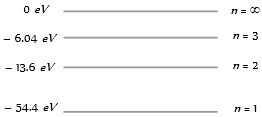
The energy level diagram for a hydrogen-like atom is shown in the figure. The radius of its first Bohr orbit is
A
$0.265\, \mathring{A}$
B
$0.53\, \mathring{A}$
C
$0.132\, \mathring{A}$
D
None of these
Solution
(A) The energy of the $n$-th orbit for a hydrogen-like atom is given by $E_n = -13.6 \frac{Z^2}{n^2} \, \text{eV}$.
From the given energy level diagram,for the ground state $(n = 1)$,the energy is $E_1 = -54.4 \, \text{eV}$.
Substituting these values into the formula: $-54.4 = -13.6 \frac{Z^2}{1^2}$.
Solving for $Z^2$: $Z^2 = \frac{54.4}{13.6} = 4$,which gives $Z = 2$.
The radius of the $n$-th Bohr orbit is given by $r_n = 0.53 \frac{n^2}{Z} \, \mathring{A}$.
For the first Bohr orbit $(n = 1)$ and $Z = 2$,the radius is $r_1 = 0.53 \frac{1^2}{2} = 0.265 \, \mathring{A}$.
Thus,the correct option is $A$.
From the given energy level diagram,for the ground state $(n = 1)$,the energy is $E_1 = -54.4 \, \text{eV}$.
Substituting these values into the formula: $-54.4 = -13.6 \frac{Z^2}{1^2}$.
Solving for $Z^2$: $Z^2 = \frac{54.4}{13.6} = 4$,which gives $Z = 2$.
The radius of the $n$-th Bohr orbit is given by $r_n = 0.53 \frac{n^2}{Z} \, \mathring{A}$.
For the first Bohr orbit $(n = 1)$ and $Z = 2$,the radius is $r_1 = 0.53 \frac{1^2}{2} = 0.265 \, \mathring{A}$.
Thus,the correct option is $A$.
0 likes
View Solution165
MediumMCQ
What is the angular momentum of an electron in Bohr's hydrogen atom whose energy is $-0.544 \ eV$?
A
$\frac{h}{\pi}$
B
$\frac{2h}{\pi}$
C
$\frac{5h}{2\pi}$
D
$\frac{7h}{2\pi}$
Solution
(C) The energy of an electron in the $n^{th}$ orbit of a hydrogen atom is given by the formula: $E_n = -\frac{13.6}{n^2} \ eV$.
Given $E_n = -0.544 \ eV$,we set up the equation: $-0.544 = -\frac{13.6}{n^2}$.
Solving for $n^2$: $n^2 = \frac{13.6}{0.544} = 25$.
Thus,$n = 5$.
According to Bohr's postulate,the angular momentum $L$ of an electron in the $n^{th}$ orbit is given by: $L = n\frac{h}{2\pi}$.
Substituting $n = 5$,we get: $L = 5\frac{h}{2\pi} = \frac{5h}{2\pi}$.
Given $E_n = -0.544 \ eV$,we set up the equation: $-0.544 = -\frac{13.6}{n^2}$.
Solving for $n^2$: $n^2 = \frac{13.6}{0.544} = 25$.
Thus,$n = 5$.
According to Bohr's postulate,the angular momentum $L$ of an electron in the $n^{th}$ orbit is given by: $L = n\frac{h}{2\pi}$.
Substituting $n = 5$,we get: $L = 5\frac{h}{2\pi} = \frac{5h}{2\pi}$.
0 likes
View Solution166
DifficultMCQ
The ratio between the total acceleration of the electron in a singly ionized helium atom and a hydrogen atom (both in the ground state) is:
A
$1$
B
$8$
C
$4$
D
$16$
Solution
(B) The acceleration $a$ of an electron in a circular orbit is given by $a = \frac{v^2}{r}$.
From Bohr's theory,the velocity $v \propto \frac{Z}{n}$ and the radius $r \propto \frac{n^2}{Z}$.
Substituting these into the acceleration formula: $a \propto \frac{(Z/n)^2}{n^2/Z} = \frac{Z^2/n^2}{n^2/Z} = \frac{Z^3}{n^4}$.
Since both atoms are in the ground state,$n = 1$ for both.
Therefore,$a \propto Z^3$.
The ratio of acceleration for singly ionized helium $(Z=2)$ to hydrogen $(Z=1)$ is $\frac{a_{He^+}}{a_H} = \left( \frac{Z_{He^+}}{Z_H} \right)^3 = \left( \frac{2}{1} \right)^3 = 8$.
From Bohr's theory,the velocity $v \propto \frac{Z}{n}$ and the radius $r \propto \frac{n^2}{Z}$.
Substituting these into the acceleration formula: $a \propto \frac{(Z/n)^2}{n^2/Z} = \frac{Z^2/n^2}{n^2/Z} = \frac{Z^3}{n^4}$.
Since both atoms are in the ground state,$n = 1$ for both.
Therefore,$a \propto Z^3$.
The ratio of acceleration for singly ionized helium $(Z=2)$ to hydrogen $(Z=1)$ is $\frac{a_{He^+}}{a_H} = \left( \frac{Z_{He^+}}{Z_H} \right)^3 = \left( \frac{2}{1} \right)^3 = 8$.
0 likes
View Solution167
AdvancedMCQ
The de-Broglie wavelength of an electron in the $n^{th}$ Bohr orbit is $\lambda_n$ and the angular momentum is $J_n$,then:
A
$J_n \propto \lambda_n$
B
$\lambda_n \propto \frac{1}{J_n}$
C
$\lambda_n \propto J_n^2$
D
None of these
Solution
(A) According to Bohr's quantization condition,the angular momentum $J_n$ of an electron in the $n^{th}$ orbit is given by $J_n = \frac{n h}{2 \pi}$.
This implies $J_n \propto n$.
According to the de-Broglie hypothesis,the wavelength $\lambda_n$ is given by $\lambda_n = \frac{h}{p} = \frac{h}{mv_n}$.
For the $n^{th}$ orbit,the circumference is $2 \pi r_n = n \lambda_n$.
Since $r_n \propto n^2$ and $v_n \propto \frac{1}{n}$,the angular momentum $J_n = m v_n r_n$ is proportional to $n$.
From the relation $2 \pi r_n = n \lambda_n$,we have $\lambda_n = \frac{2 \pi r_n}{n}$.
Substituting $r_n \propto n^2$,we get $\lambda_n \propto \frac{n^2}{n} = n$.
Since $J_n \propto n$ and $\lambda_n \propto n$,it follows that $J_n \propto \lambda_n$.
This implies $J_n \propto n$.
According to the de-Broglie hypothesis,the wavelength $\lambda_n$ is given by $\lambda_n = \frac{h}{p} = \frac{h}{mv_n}$.
For the $n^{th}$ orbit,the circumference is $2 \pi r_n = n \lambda_n$.
Since $r_n \propto n^2$ and $v_n \propto \frac{1}{n}$,the angular momentum $J_n = m v_n r_n$ is proportional to $n$.
From the relation $2 \pi r_n = n \lambda_n$,we have $\lambda_n = \frac{2 \pi r_n}{n}$.
Substituting $r_n \propto n^2$,we get $\lambda_n \propto \frac{n^2}{n} = n$.
Since $J_n \propto n$ and $\lambda_n \propto n$,it follows that $J_n \propto \lambda_n$.
0 likes
View Solution168
MediumMCQ
The angular momentum of an electron in the hydrogen atom is $\frac{3h}{2\pi}$. Here $h$ is Planck's constant. The kinetic energy of this electron is.....$eV$
A
$4.53$
B
$1.51$
C
$3.4$
D
$6.8$
Solution
(B) According to Bohr's postulate,the angular momentum $L$ of an electron in the $n^{th}$ orbit is given by $L = \frac{nh}{2\pi}$.
Given $L = \frac{3h}{2\pi}$,comparing the two expressions,we get $n = 3$.
The energy of an electron in the $n^{th}$ orbit of a hydrogen atom is given by $E_n = -\frac{13.6}{n^2} \text{ eV}$.
For $n = 3$,$E_3 = -\frac{13.6}{3^2} = -\frac{13.6}{9} \approx -1.51 \text{ eV}$.
The kinetic energy $K$ of an electron in an orbit is equal to the magnitude of its total energy,so $K = |E_n| = 1.51 \text{ eV}$.
Given $L = \frac{3h}{2\pi}$,comparing the two expressions,we get $n = 3$.
The energy of an electron in the $n^{th}$ orbit of a hydrogen atom is given by $E_n = -\frac{13.6}{n^2} \text{ eV}$.
For $n = 3$,$E_3 = -\frac{13.6}{3^2} = -\frac{13.6}{9} \approx -1.51 \text{ eV}$.
The kinetic energy $K$ of an electron in an orbit is equal to the magnitude of its total energy,so $K = |E_n| = 1.51 \text{ eV}$.
0 likes
View Solution169
MediumMCQ
In a hydrogen atom,the binding energy of the electron in the $n^{th}$ state is $E_n$. Then,the frequency of revolution of the electron in the $n^{th}$ orbit is:
A
$2E_n / nh$
B
$2E_n n / h$
C
$E_n / nh$
D
$E_n n / h$
Solution
(A) We know that for a hydrogen atom,the kinetic energy $(K)$ is equal to the binding energy $(E_n)$:
$K = \frac{1}{2} m v^2 = E_n$ --- $(i)$
According to Bohr's quantization condition of angular momentum:
$mvr = \frac{nh}{2\pi}$ --- $(ii)$
From $(i)$,we have $v^2 = \frac{2E_n}{m}$,so $v = \sqrt{\frac{2E_n}{m}}$.
From $(ii)$,the radius $r = \frac{nh}{2\pi mv}$.
The frequency of revolution $(f)$ is given by $f = \frac{v}{2\pi r}$.
Substituting the value of $r$ from $(ii)$ into the frequency formula:
$f = \frac{v}{2\pi (nh / 2\pi mv)} = \frac{v^2 m}{nh} = \frac{(2E_n / m) m}{nh} = \frac{2E_n}{nh}$.
Therefore,the frequency of revolution is $\frac{2E_n}{nh}$.
$K = \frac{1}{2} m v^2 = E_n$ --- $(i)$
According to Bohr's quantization condition of angular momentum:
$mvr = \frac{nh}{2\pi}$ --- $(ii)$
From $(i)$,we have $v^2 = \frac{2E_n}{m}$,so $v = \sqrt{\frac{2E_n}{m}}$.
From $(ii)$,the radius $r = \frac{nh}{2\pi mv}$.
The frequency of revolution $(f)$ is given by $f = \frac{v}{2\pi r}$.
Substituting the value of $r$ from $(ii)$ into the frequency formula:
$f = \frac{v}{2\pi (nh / 2\pi mv)} = \frac{v^2 m}{nh} = \frac{(2E_n / m) m}{nh} = \frac{2E_n}{nh}$.
Therefore,the frequency of revolution is $\frac{2E_n}{nh}$.
0 likes
View Solution170
DifficultMCQ
The difference between the $n^{th}$ and $(n+1)^{th}$ Bohr radius of an $H$ atom is equal to its $(n-1)^{th}$ Bohr radius. The value of $n$ is:
A
$1$
B
$2$
C
$3$
D
$4$
Solution
(D) The Bohr radius for the $n^{th}$ orbit is given by $r_n = a_0 n^2$,where $a_0$ is the Bohr radius constant.
According to the problem,the difference between the $(n+1)^{th}$ and $n^{th}$ radius is equal to the $(n-1)^{th}$ radius:
$r_{n+1} - r_n = r_{n-1}$
Substituting the formula $r_n = a_0 n^2$:
$a_0(n+1)^2 - a_0 n^2 = a_0(n-1)^2$
Dividing by $a_0$:
$(n+1)^2 - n^2 = (n-1)^2$
$(n^2 + 2n + 1) - n^2 = n^2 - 2n + 1$
$2n + 1 = n^2 - 2n + 1$
$n^2 - 4n = 0$
$n(n - 4) = 0$
Since $n$ must be a positive integer greater than $1$ for the $(n-1)^{th}$ orbit to exist,we have $n = 4$.
According to the problem,the difference between the $(n+1)^{th}$ and $n^{th}$ radius is equal to the $(n-1)^{th}$ radius:
$r_{n+1} - r_n = r_{n-1}$
Substituting the formula $r_n = a_0 n^2$:
$a_0(n+1)^2 - a_0 n^2 = a_0(n-1)^2$
Dividing by $a_0$:
$(n+1)^2 - n^2 = (n-1)^2$
$(n^2 + 2n + 1) - n^2 = n^2 - 2n + 1$
$2n + 1 = n^2 - 2n + 1$
$n^2 - 4n = 0$
$n(n - 4) = 0$
Since $n$ must be a positive integer greater than $1$ for the $(n-1)^{th}$ orbit to exist,we have $n = 4$.
0 likes
View Solution171
DifficultMCQ
An electron in a hydrogen atom,after absorbing energy photons,can jump between energy states $n_1$ and $n_2$ $(n_2 > n_1)$. It then returns to the ground state,emitting six different wavelengths in the emission spectrum. The energy of the emitted photons can be equal to,less than,or greater than the absorbed photon energy. Determine $n_1$ and $n_2$.
A
$n_2 = 4, n_1 = 3$
B
$n_2 = 5, n_1 = 3$
C
$n_2 = 4, n_1 = 2$
D
$n_2 = 4, n_1 = 1$
Solution
(C) The number of spectral lines emitted when an electron transitions from an excited state $n_2$ to a lower state $n_1$ is given by the formula $N = \frac{(n_2 - n_1 + 1)(n_2 - n_1)}{2}$.
Given that $N = 6$,we have $\frac{(n_2 - n_1 + 1)(n_2 - n_1)}{2} = 6$,which simplifies to $(n_2 - n_1 + 1)(n_2 - n_1) = 12$.
Let $x = n_2 - n_1$. Then $(x+1)x = 12$,which gives $x^2 + x - 12 = 0$. Solving this quadratic equation,we get $(x+4)(x-3) = 0$,so $x = 3$.
Thus,$n_2 - n_1 = 3$. Possible pairs are $(4, 1)$ or $(5, 2)$.
However,the problem states that the energy of the emitted photons can be equal to,less than,or greater than the absorbed photon energy. The absorbed photon energy corresponds to the transition from $n_1$ to $n_2$. If $n_1 = 2$ and $n_2 = 4$,the transitions include $4 \rightarrow 3, 4 \rightarrow 2, 4 \rightarrow 1, 3 \rightarrow 2, 3 \rightarrow 1, 2 \rightarrow 1$. Here,$E_{4 \rightarrow 2}$ equals the absorbed energy,$E_{4 \rightarrow 3}$ is less than the absorbed energy,and $E_{4 \rightarrow 1}, E_{3 \rightarrow 1}, E_{2 \rightarrow 1}$ are greater than the absorbed energy. This satisfies all conditions. Therefore,$n_1 = 2$ and $n_2 = 4$.
Given that $N = 6$,we have $\frac{(n_2 - n_1 + 1)(n_2 - n_1)}{2} = 6$,which simplifies to $(n_2 - n_1 + 1)(n_2 - n_1) = 12$.
Let $x = n_2 - n_1$. Then $(x+1)x = 12$,which gives $x^2 + x - 12 = 0$. Solving this quadratic equation,we get $(x+4)(x-3) = 0$,so $x = 3$.
Thus,$n_2 - n_1 = 3$. Possible pairs are $(4, 1)$ or $(5, 2)$.
However,the problem states that the energy of the emitted photons can be equal to,less than,or greater than the absorbed photon energy. The absorbed photon energy corresponds to the transition from $n_1$ to $n_2$. If $n_1 = 2$ and $n_2 = 4$,the transitions include $4 \rightarrow 3, 4 \rightarrow 2, 4 \rightarrow 1, 3 \rightarrow 2, 3 \rightarrow 1, 2 \rightarrow 1$. Here,$E_{4 \rightarrow 2}$ equals the absorbed energy,$E_{4 \rightarrow 3}$ is less than the absorbed energy,and $E_{4 \rightarrow 1}, E_{3 \rightarrow 1}, E_{2 \rightarrow 1}$ are greater than the absorbed energy. This satisfies all conditions. Therefore,$n_1 = 2$ and $n_2 = 4$.
0 likes
View Solution172
AdvancedMCQ
The electron in a hydrogen atom makes a transition from the $M$ shell to the $L$ shell. The ratio of the magnitudes of the initial to the final centripetal acceleration of the electron is:
A
$9 : 4$
B
$81 : 16$
C
$4 : 9$
D
$16 : 81$
Solution
(D) The radius of the $n^{th}$ orbit is given by $r_n \propto n^2$.
The velocity of the electron in the $n^{th}$ orbit is given by $v_n \propto \frac{1}{n}$.
The centripetal acceleration $a_n$ is given by $a_n = \frac{v_n^2}{r_n}$.
Substituting the proportionalities: $a_n \propto \frac{(1/n)^2}{n^2} = \frac{1}{n^4}$.
For the $M$ shell, $n = 3$. Thus, $a_M \propto \frac{1}{3^4} = \frac{1}{81}$.
For the $L$ shell, $n = 2$. Thus, $a_L \propto \frac{1}{2^4} = \frac{1}{16}$.
The ratio of the initial ($M$ shell) to the final ($L$ shell) centripetal acceleration is $\frac{a_M}{a_L} = \frac{1/81}{1/16} = \frac{16}{81}$.
The velocity of the electron in the $n^{th}$ orbit is given by $v_n \propto \frac{1}{n}$.
The centripetal acceleration $a_n$ is given by $a_n = \frac{v_n^2}{r_n}$.
Substituting the proportionalities: $a_n \propto \frac{(1/n)^2}{n^2} = \frac{1}{n^4}$.
For the $M$ shell, $n = 3$. Thus, $a_M \propto \frac{1}{3^4} = \frac{1}{81}$.
For the $L$ shell, $n = 2$. Thus, $a_L \propto \frac{1}{2^4} = \frac{1}{16}$.
The ratio of the initial ($M$ shell) to the final ($L$ shell) centripetal acceleration is $\frac{a_M}{a_L} = \frac{1/81}{1/16} = \frac{16}{81}$.
0 likes
View Solution173
AdvancedMCQ
The electron in a hydrogen atom makes a transition $n_1 \rightarrow n_2$,where $n_1$ and $n_2$ are the principal quantum numbers of the two states. Assume the Bohr model to be valid. The frequency of orbital motion of the electron in the initial state is $1/27$ of that in the final state. The possible values of $n_1$ and $n_2$ are
A
$n_1 = 4, n_2 = 2$
B
$n_1 = 3, n_2 = 1$
C
$n_1 = 8, n_2 = 1$
D
$n_1 = 6, n_2 = 3$
Solution
(B) The frequency of orbital motion $f$ of an electron in a hydrogen-like atom is given by $f \propto \frac{Z^2}{n^3}$.
Since the atom is hydrogen,$Z = 1$,so $f \propto \frac{1}{n^3}$.
Let $f_1$ be the frequency in the initial state $n_1$ and $f_2$ be the frequency in the final state $n_2$.
Given that $f_1 = \frac{1}{27} f_2$,we have $\frac{1}{n_1^3} = \frac{1}{27} \cdot \frac{1}{n_2^3}$.
Rearranging the terms,we get $\frac{n_2^3}{n_1^3} = \frac{1}{27}$.
Taking the cube root of both sides,$\frac{n_2}{n_1} = \frac{1}{3}$,which implies $n_1 = 3n_2$.
Checking the options:
For option $B$,$n_1 = 3$ and $n_2 = 1$,which satisfies $n_1 = 3(1) = 3$.
Thus,the correct values are $n_1 = 3$ and $n_2 = 1$.
Since the atom is hydrogen,$Z = 1$,so $f \propto \frac{1}{n^3}$.
Let $f_1$ be the frequency in the initial state $n_1$ and $f_2$ be the frequency in the final state $n_2$.
Given that $f_1 = \frac{1}{27} f_2$,we have $\frac{1}{n_1^3} = \frac{1}{27} \cdot \frac{1}{n_2^3}$.
Rearranging the terms,we get $\frac{n_2^3}{n_1^3} = \frac{1}{27}$.
Taking the cube root of both sides,$\frac{n_2}{n_1} = \frac{1}{3}$,which implies $n_1 = 3n_2$.
Checking the options:
For option $B$,$n_1 = 3$ and $n_2 = 1$,which satisfies $n_1 = 3(1) = 3$.
Thus,the correct values are $n_1 = 3$ and $n_2 = 1$.
0 likes
View Solution174
MediumMCQ
An electron in a hydrogen atom is replaced by an identically charged particle,a muon,with a mass $207$ times that of an electron. What will be the radius of the $K$ shell?
A
$2.56 \times 10^{-3} \, \mathring{A}$
B
$109.7 \, \mathring{A}$
C
$1.21 \times 10^{-3} \, \mathring{A}$
D
$22174.4 \, \mathring{A}$
Solution
(A) The Bohr radius for the $K$ shell is given by the formula:
$a_{0} = \frac{h^{2} \varepsilon_{0}}{\pi m e^{2}}$
From this expression,it is clear that the Bohr radius is inversely proportional to the mass $(m)$ of the orbiting particle.
Therefore,the ratio of the radius of the electron orbit $(a_{0e})$ to the radius of the muon orbit $(a_{0m})$ is:
$\frac{a_{0m}}{a_{0e}} = \frac{m_{e}}{m_{m}}$
Given that $m_{m} = 207 m_{e}$,we substitute this into the equation:
$a_{0m} = \frac{m_{e}}{207 m_{e}} \times a_{0e} = \frac{a_{0e}}{207}$
The standard Bohr radius for a hydrogen atom is $a_{0e} \approx 0.529 \, \mathring{A} = 0.529 \times 10^{-10} \, m$.
Calculating the new radius:
$a_{0m} = \frac{0.529 \, \mathring{A}}{207} \approx 0.002555 \, \mathring{A} \approx 2.56 \times 10^{-3} \, \mathring{A}$.
$a_{0} = \frac{h^{2} \varepsilon_{0}}{\pi m e^{2}}$
From this expression,it is clear that the Bohr radius is inversely proportional to the mass $(m)$ of the orbiting particle.
Therefore,the ratio of the radius of the electron orbit $(a_{0e})$ to the radius of the muon orbit $(a_{0m})$ is:
$\frac{a_{0m}}{a_{0e}} = \frac{m_{e}}{m_{m}}$
Given that $m_{m} = 207 m_{e}$,we substitute this into the equation:
$a_{0m} = \frac{m_{e}}{207 m_{e}} \times a_{0e} = \frac{a_{0e}}{207}$
The standard Bohr radius for a hydrogen atom is $a_{0e} \approx 0.529 \, \mathring{A} = 0.529 \times 10^{-10} \, m$.
Calculating the new radius:
$a_{0m} = \frac{0.529 \, \mathring{A}}{207} \approx 0.002555 \, \mathring{A} \approx 2.56 \times 10^{-3} \, \mathring{A}$.
0 likes
View Solution175
AdvancedMCQ
Monochromatic radiation of wavelength $\lambda$ is incident on a hydrogen sample containing atoms in the ground state. Hydrogen atoms absorb the light and subsequently emit radiations of ten different wavelengths. The value of $\lambda$ is.....$nm$.
A
$95$
B
$103$
C
$73$
D
$88$
Solution
(A) The number of spectral lines emitted when an electron transitions from an excited state $n$ to the ground state is given by the formula $N = \frac{n(n-1)}{2}$.
Given $N = 10$,we have $\frac{n(n-1)}{2} = 10$,which implies $n^2 - n - 20 = 0$.
Solving the quadratic equation,$(n-5)(n+4) = 0$,we get $n = 5$ (since $n$ must be positive).
The energy of the incident photon corresponds to the transition from the ground state $(n=1)$ to the $n=5$ state.
The wavelength $\lambda$ is given by the Rydberg formula: $\frac{1}{\lambda} = R \left( \frac{1}{1^2} - \frac{1}{5^2} \right)$.
$\frac{1}{\lambda} = R \left( 1 - \frac{1}{25} \right) = R \left( \frac{24}{25} \right)$.
Using $R \approx 1.097 \times 10^7 \ m^{-1}$,we get $\lambda = \frac{25}{24 \times 1.097 \times 10^7} \approx 9.5 \times 10^{-8} \ m = 95 \ nm$.
Given $N = 10$,we have $\frac{n(n-1)}{2} = 10$,which implies $n^2 - n - 20 = 0$.
Solving the quadratic equation,$(n-5)(n+4) = 0$,we get $n = 5$ (since $n$ must be positive).
The energy of the incident photon corresponds to the transition from the ground state $(n=1)$ to the $n=5$ state.
The wavelength $\lambda$ is given by the Rydberg formula: $\frac{1}{\lambda} = R \left( \frac{1}{1^2} - \frac{1}{5^2} \right)$.
$\frac{1}{\lambda} = R \left( 1 - \frac{1}{25} \right) = R \left( \frac{24}{25} \right)$.
Using $R \approx 1.097 \times 10^7 \ m^{-1}$,we get $\lambda = \frac{25}{24 \times 1.097 \times 10^7} \approx 9.5 \times 10^{-8} \ m = 95 \ nm$.
0 likes
View Solution176
AdvancedMCQ
When a hydrogen atom,initially at rest,emits a photon resulting in a transition $n = 5 \rightarrow n = 1$,its recoil speed is about
A
$10^{-4} \, m/s$
B
$2 \times 10^{-2} \, m/s$
C
$4.3 \, m/s$
D
$3.8 \times 10^{-2} \, m/s$
Solution
(C) Given:
Initial state $n_2 = 5$,final state $n_1 = 1$.
Mass of hydrogen atom $m \approx 1.67 \times 10^{-27} \, kg$.
Rydberg constant $R = 1.097 \times 10^7 \, m^{-1}$.
Planck's constant $h = 6.63 \times 10^{-34} \, J \cdot s$.
Using the Rydberg formula for the wavelength $\lambda$ of the emitted photon:
$\frac{1}{\lambda} = R \left( \frac{1}{n_1^2} - \frac{1}{n_2^2} \right) = 1.097 \times 10^7 \left( \frac{1}{1^2} - \frac{1}{5^2} \right) = 1.097 \times 10^7 \left( 1 - 0.04 \right) = 1.053 \times 10^7 \, m^{-1}$.
$\lambda = \frac{1}{1.053 \times 10^7} \approx 9.496 \times 10^{-8} \, m$.
By conservation of momentum,the momentum of the atom $p_{atom}$ must equal the momentum of the photon $p_{photon} = \frac{h}{\lambda}$.
$m v = \frac{h}{\lambda} \implies v = \frac{h}{m \lambda}$.
$v = \frac{6.63 \times 10^{-34}}{(1.67 \times 10^{-27}) \times (9.496 \times 10^{-8})} \approx \frac{6.63 \times 10^{-34}}{1.586 \times 10^{-34}} \approx 4.18 \, m/s$.
Rounding to the nearest provided option,the recoil speed is approximately $4.3 \, m/s$.
Initial state $n_2 = 5$,final state $n_1 = 1$.
Mass of hydrogen atom $m \approx 1.67 \times 10^{-27} \, kg$.
Rydberg constant $R = 1.097 \times 10^7 \, m^{-1}$.
Planck's constant $h = 6.63 \times 10^{-34} \, J \cdot s$.
Using the Rydberg formula for the wavelength $\lambda$ of the emitted photon:
$\frac{1}{\lambda} = R \left( \frac{1}{n_1^2} - \frac{1}{n_2^2} \right) = 1.097 \times 10^7 \left( \frac{1}{1^2} - \frac{1}{5^2} \right) = 1.097 \times 10^7 \left( 1 - 0.04 \right) = 1.053 \times 10^7 \, m^{-1}$.
$\lambda = \frac{1}{1.053 \times 10^7} \approx 9.496 \times 10^{-8} \, m$.
By conservation of momentum,the momentum of the atom $p_{atom}$ must equal the momentum of the photon $p_{photon} = \frac{h}{\lambda}$.
$m v = \frac{h}{\lambda} \implies v = \frac{h}{m \lambda}$.
$v = \frac{6.63 \times 10^{-34}}{(1.67 \times 10^{-27}) \times (9.496 \times 10^{-8})} \approx \frac{6.63 \times 10^{-34}}{1.586 \times 10^{-34}} \approx 4.18 \, m/s$.
Rounding to the nearest provided option,the recoil speed is approximately $4.3 \, m/s$.
0 likes
View Solution177
AdvancedMCQ
The frequency of revolution of an electron in the $n^{th}$ Bohr orbit is $v_n$. The graph between $\log n$ and $\log (v_n / v_1)$ may be
A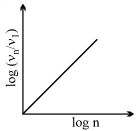
B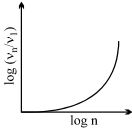
C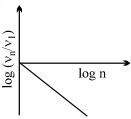
D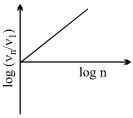
Solution
(C) The frequency of revolution of an electron in the $n^{th}$ Bohr orbit is given by $v_n \propto \frac{1}{n^3}$.
Therefore,$v_n = \frac{k}{n^3}$ for some constant $k$.
For the first orbit $(n=1)$,$v_1 = k$.
Thus,the ratio is $\frac{v_n}{v_1} = \frac{k/n^3}{k} = \frac{1}{n^3} = n^{-3}$.
Taking the logarithm on both sides,we get $\log (v_n / v_1) = \log (n^{-3}) = -3 \log n$.
This equation is of the form $y = mx$,where $y = \log (v_n / v_1)$,$x = \log n$,and the slope $m = -3$.
Since the slope is negative,the graph is a straight line passing through the origin with a negative slope.
Therefore,$v_n = \frac{k}{n^3}$ for some constant $k$.
For the first orbit $(n=1)$,$v_1 = k$.
Thus,the ratio is $\frac{v_n}{v_1} = \frac{k/n^3}{k} = \frac{1}{n^3} = n^{-3}$.
Taking the logarithm on both sides,we get $\log (v_n / v_1) = \log (n^{-3}) = -3 \log n$.
This equation is of the form $y = mx$,where $y = \log (v_n / v_1)$,$x = \log n$,and the slope $m = -3$.
Since the slope is negative,the graph is a straight line passing through the origin with a negative slope.
0 likes
View Solution178
MediumMCQ
Consider the spectral line resulting from the transition $n = 2 \rightarrow n = 1$ in the atoms and ions given below. The shortest wavelength is produced by:
A
hydrogen atom
B
deuterium atom
C
singly ionized helium
D
doubly ionized lithium
Solution
(D) The Rydberg formula for the wavelength of a spectral line is given by $\frac{1}{\lambda} = R Z^2 \left[ \frac{1}{n_f^2} - \frac{1}{n_i^2} \right]$.
For the transition $n = 2 \rightarrow n = 1$,the term in the brackets is constant.
Therefore,$\frac{1}{\lambda} \propto Z^2$,which implies $\lambda \propto \frac{1}{Z^2}$.
To obtain the shortest wavelength,we need the largest atomic number $Z$.
The atomic numbers are: Hydrogen $(Z=1)$,Deuterium $(Z=1)$,Singly ionized Helium $(Z=2)$,and Doubly ionized Lithium $(Z=3)$.
Since Lithium has the highest atomic number $(Z=3)$,it produces the shortest wavelength.
For the transition $n = 2 \rightarrow n = 1$,the term in the brackets is constant.
Therefore,$\frac{1}{\lambda} \propto Z^2$,which implies $\lambda \propto \frac{1}{Z^2}$.
To obtain the shortest wavelength,we need the largest atomic number $Z$.
The atomic numbers are: Hydrogen $(Z=1)$,Deuterium $(Z=1)$,Singly ionized Helium $(Z=2)$,and Doubly ionized Lithium $(Z=3)$.
Since Lithium has the highest atomic number $(Z=3)$,it produces the shortest wavelength.
0 likes
View Solution179
DifficultMCQ
In an atom,two electrons move around the nucleus in circular orbits of radii $R$ and $4R$. The ratio of the time taken by them to complete one revolution is:
A
$1 : 4$
B
$4 : 1$
C
$1 : 8$
D
$8 : 1$
Solution
(C) According to Bohr's theory for an electron in a circular orbit,the centripetal force is provided by the electrostatic force: $\frac{mv^2}{r} = \frac{ke^2}{r^2}$,which implies $v \propto r^{-1/2}$.
The time period $T$ is given by $T = \frac{2\pi r}{v}$.
Substituting $v \propto r^{-1/2}$,we get $T \propto \frac{r}{r^{-1/2}} = r^{3/2}$.
Given radii are $r_1 = R$ and $r_2 = 4R$.
Therefore,the ratio of time periods is $\frac{T_1}{T_2} = \left(\frac{r_1}{r_2}\right)^{3/2} = \left(\frac{R}{4R}\right)^{3/2} = \left(\frac{1}{4}\right)^{3/2} = \frac{1}{8}$.
Thus,the ratio is $1 : 8$.
The time period $T$ is given by $T = \frac{2\pi r}{v}$.
Substituting $v \propto r^{-1/2}$,we get $T \propto \frac{r}{r^{-1/2}} = r^{3/2}$.
Given radii are $r_1 = R$ and $r_2 = 4R$.
Therefore,the ratio of time periods is $\frac{T_1}{T_2} = \left(\frac{r_1}{r_2}\right)^{3/2} = \left(\frac{R}{4R}\right)^{3/2} = \left(\frac{1}{4}\right)^{3/2} = \frac{1}{8}$.
Thus,the ratio is $1 : 8$.
0 likes
View Solution180
AdvancedMCQ
The magnitude of angular momentum,orbit radius,and frequency of revolution of an electron in a hydrogen atom corresponding to quantum number $n$ are $L, r$,and $f$ respectively. According to Bohr's theory of the hydrogen atom,which of the following is constant for all orbits?
A
$fr^2L$ is constant for all orbits
B
$frL$ is constant for all orbits
C
$f^2rL$ is constant for all orbits
D
$frL^2$ is constant for all orbits
Solution
(B) According to Bohr's model for a hydrogen atom:
$1$. Angular momentum $L = \frac{nh}{2\pi}$,so $L \propto n$.
$2$. Orbit radius $r = a_0 \frac{n^2}{Z}$,so $r \propto n^2$ (for a fixed $Z$).
$3$. Frequency of revolution $f = \frac{v}{2\pi r}$. Since $v \propto \frac{Z}{n}$ and $r \propto \frac{n^2}{Z}$,we have $f \propto \frac{Z/n}{n^2/Z} = \frac{Z^2}{n^3}$,so $f \propto n^{-3}$.
Now,consider the product $frL$:
$frL \propto (n^{-3}) \cdot (n^2) \cdot (n) = n^0 = 1$.
Therefore,$frL$ is independent of the quantum number $n$ and is constant for all orbits.
$1$. Angular momentum $L = \frac{nh}{2\pi}$,so $L \propto n$.
$2$. Orbit radius $r = a_0 \frac{n^2}{Z}$,so $r \propto n^2$ (for a fixed $Z$).
$3$. Frequency of revolution $f = \frac{v}{2\pi r}$. Since $v \propto \frac{Z}{n}$ and $r \propto \frac{n^2}{Z}$,we have $f \propto \frac{Z/n}{n^2/Z} = \frac{Z^2}{n^3}$,so $f \propto n^{-3}$.
Now,consider the product $frL$:
$frL \propto (n^{-3}) \cdot (n^2) \cdot (n) = n^0 = 1$.
Therefore,$frL$ is independent of the quantum number $n$ and is constant for all orbits.
0 likes
View Solution181
MediumMCQ
Radius of the second Bohr orbit of a singly ionized helium atom is ......... $ \mathring A $
A
$0.53$
B
$1.06$
C
$0.265$
D
$0.132$
Solution
(B) The radius of the $n^{th}$ Bohr orbit is given by the formula: $r_n = \frac{0.529 \times n^2}{Z} \mathring A$.
For a singly ionized helium atom $(He^+)$,the atomic number $Z = 2$.
For the second Bohr orbit,$n = 2$.
Substituting these values into the formula:
$r_2 = \frac{0.529 \times 2^2}{2} \mathring A$
$r_2 = \frac{0.529 \times 4}{2} \mathring A$
$r_2 = 0.529 \times 2 \mathring A$
$r_2 = 1.06 \mathring A$.
For a singly ionized helium atom $(He^+)$,the atomic number $Z = 2$.
For the second Bohr orbit,$n = 2$.
Substituting these values into the formula:
$r_2 = \frac{0.529 \times 2^2}{2} \mathring A$
$r_2 = \frac{0.529 \times 4}{2} \mathring A$
$r_2 = 0.529 \times 2 \mathring A$
$r_2 = 1.06 \mathring A$.
0 likes
View Solution182
DifficultMCQ
An electron in Bohr's hydrogen atom has an energy of $-3.4 \ eV$. The angular momentum of the electron is
A
$h / \pi$
B
$h / 2\pi$
C
$nh / 2\pi$ ($n$ is an integer)
D
$2h / \pi$
Solution
(A) The energy of an electron in an orbit of principal quantum number $n$ is given by the formula:
$E = -13.6 / n^2 \ eV$
Given $E = -3.4 \ eV$,we have:
$-3.4 = -13.6 / n^2$
$n^2 = 13.6 / 3.4 = 4$
$n = 2$
According to Bohr's postulate,the angular momentum $L$ of an electron in the $n$-th orbit is given by:
$L = nh / 2\pi$
Substituting $n = 2$:
$L = 2h / 2\pi = h / \pi$
$E = -13.6 / n^2 \ eV$
Given $E = -3.4 \ eV$,we have:
$-3.4 = -13.6 / n^2$
$n^2 = 13.6 / 3.4 = 4$
$n = 2$
According to Bohr's postulate,the angular momentum $L$ of an electron in the $n$-th orbit is given by:
$L = nh / 2\pi$
Substituting $n = 2$:
$L = 2h / 2\pi = h / \pi$
0 likes
View Solution183
AdvancedMCQ
An electron in a hydrogen atom first jumps from the second excited state to the first excited state and then from the first excited state to the ground state. Let the ratio of wavelength,momentum,and energy of the photons in the two cases be $x, y,$ and $z$ respectively. Select the wrong answer$(s)$:
A
$z = 1/x$
B
$x = 9/4$
C
$y = 5/27$
D
$z = 5/27$
Solution
(B) The energy of a photon emitted during a transition is given by $E = \Delta E = 13.6 \text{ eV} \times Z^2 \left( \frac{1}{n_f^2} - \frac{1}{n_i^2} \right)$.
For the first transition (second excited state $n=3$ to first excited state $n=2$):
$E_1 = 13.6 \left( \frac{1}{2^2} - \frac{1}{3^2} \right) = 13.6 \left( \frac{1}{4} - \frac{1}{9} \right) = 13.6 \left( \frac{5}{36} \right)$.
For the second transition (first excited state $n=2$ to ground state $n=1$):
$E_2 = 13.6 \left( \frac{1}{1^2} - \frac{1}{2^2} \right) = 13.6 \left( 1 - \frac{1}{4} \right) = 13.6 \left( \frac{3}{4} \right) = 13.6 \left( \frac{27}{36} \right)$.
Ratio of energies $z = \frac{E_1}{E_2} = \frac{5/36}{27/36} = \frac{5}{27}$.
Since $E = \frac{hc}{\lambda}$,we have $\frac{E_1}{E_2} = \frac{\lambda_2}{\lambda_1} = z$. Thus,$x = \frac{\lambda_1}{\lambda_2} = \frac{1}{z} = \frac{27}{5}$.
Since $p = \frac{E}{c}$,the ratio of momenta $y = \frac{p_1}{p_2} = \frac{E_1/c}{E_2/c} = \frac{E_1}{E_2} = z = \frac{5}{27}$.
Comparing with options:
$(A)$ $z = 1/x$ is correct because $z = \frac{E_1}{E_2}$ and $x = \frac{\lambda_1}{\lambda_2} = \frac{E_2}{E_1} = 1/z$.
$(B)$ $x = 9/4$ is incorrect (actual value is $27/5$).
$(C)$ $y = 5/27$ is correct.
$(D)$ $z = 5/27$ is correct.
Therefore,the wrong answer is $(B)$.
For the first transition (second excited state $n=3$ to first excited state $n=2$):
$E_1 = 13.6 \left( \frac{1}{2^2} - \frac{1}{3^2} \right) = 13.6 \left( \frac{1}{4} - \frac{1}{9} \right) = 13.6 \left( \frac{5}{36} \right)$.
For the second transition (first excited state $n=2$ to ground state $n=1$):
$E_2 = 13.6 \left( \frac{1}{1^2} - \frac{1}{2^2} \right) = 13.6 \left( 1 - \frac{1}{4} \right) = 13.6 \left( \frac{3}{4} \right) = 13.6 \left( \frac{27}{36} \right)$.
Ratio of energies $z = \frac{E_1}{E_2} = \frac{5/36}{27/36} = \frac{5}{27}$.
Since $E = \frac{hc}{\lambda}$,we have $\frac{E_1}{E_2} = \frac{\lambda_2}{\lambda_1} = z$. Thus,$x = \frac{\lambda_1}{\lambda_2} = \frac{1}{z} = \frac{27}{5}$.
Since $p = \frac{E}{c}$,the ratio of momenta $y = \frac{p_1}{p_2} = \frac{E_1/c}{E_2/c} = \frac{E_1}{E_2} = z = \frac{5}{27}$.
Comparing with options:
$(A)$ $z = 1/x$ is correct because $z = \frac{E_1}{E_2}$ and $x = \frac{\lambda_1}{\lambda_2} = \frac{E_2}{E_1} = 1/z$.
$(B)$ $x = 9/4$ is incorrect (actual value is $27/5$).
$(C)$ $y = 5/27$ is correct.
$(D)$ $z = 5/27$ is correct.
Therefore,the wrong answer is $(B)$.
0 likes
View Solution184
MediumMCQ
Choose the correct statement$(s)$ for hydrogen and deuterium atoms (considering the motion of the nucleus).
A
The radius of the first Bohr orbit of deuterium is less than that of hydrogen.
B
The speed of the electron in the first Bohr orbit of deuterium is more than that of hydrogen.
C
The wavelength of the first Balmer line of deuterium is more than that of hydrogen.
D
The angular momentum of the electron in the first Bohr orbit of deuterium is more than that of hydrogen.
Solution
(A) When considering the motion of the nucleus,the mass of the electron $m_e$ is replaced by the reduced mass $\mu = \frac{m_e M}{m_e + M}$,where $M$ is the mass of the nucleus.
Since the mass of the deuterium nucleus $(M_D \approx 2M_H)$ is greater than that of the hydrogen nucleus,the reduced mass $\mu_D$ is greater than $\mu_H$.
The radius of the $n^{th}$ Bohr orbit is given by $r_n = \frac{n^2 h^2 \epsilon_0}{\pi \mu e^2}$. Since $\mu_D > \mu_H$,the radius $r_D < r_H$. Thus,option $A$ is correct.
The speed of the electron is given by $v_n = \frac{e^2}{2 n h \epsilon_0}$. This expression does not depend on the mass of the nucleus,so $v_D = v_H$. Option $B$ is incorrect.
The wavelength of the emitted photon is given by $\frac{1}{\lambda} = R_{\mu} Z^2 (\frac{1}{n_1^2} - \frac{1}{n_2^2})$,where $R_{\mu} = \frac{\mu e^4}{8 \epsilon_0^2 h^3 c}$. Since $\mu_D > \mu_H$,$R_D > R_H$. Consequently,$\lambda_D < \lambda_H$. Option $C$ is incorrect.
The angular momentum of the electron in the $n^{th}$ orbit is $L = n \frac{h}{2\pi}$,which is independent of the mass of the nucleus. Thus,$L_D = L_H$. Option $D$ is incorrect.
Since the mass of the deuterium nucleus $(M_D \approx 2M_H)$ is greater than that of the hydrogen nucleus,the reduced mass $\mu_D$ is greater than $\mu_H$.
The radius of the $n^{th}$ Bohr orbit is given by $r_n = \frac{n^2 h^2 \epsilon_0}{\pi \mu e^2}$. Since $\mu_D > \mu_H$,the radius $r_D < r_H$. Thus,option $A$ is correct.
The speed of the electron is given by $v_n = \frac{e^2}{2 n h \epsilon_0}$. This expression does not depend on the mass of the nucleus,so $v_D = v_H$. Option $B$ is incorrect.
The wavelength of the emitted photon is given by $\frac{1}{\lambda} = R_{\mu} Z^2 (\frac{1}{n_1^2} - \frac{1}{n_2^2})$,where $R_{\mu} = \frac{\mu e^4}{8 \epsilon_0^2 h^3 c}$. Since $\mu_D > \mu_H$,$R_D > R_H$. Consequently,$\lambda_D < \lambda_H$. Option $C$ is incorrect.
The angular momentum of the electron in the $n^{th}$ orbit is $L = n \frac{h}{2\pi}$,which is independent of the mass of the nucleus. Thus,$L_D = L_H$. Option $D$ is incorrect.
0 likes
View Solution185
DifficultMCQ
Let $A_n$ be the area enclosed by the $n^{th}$ orbit in a hydrogen atom. The graph of $\ln (A_n/A_1)$ against $\ln (n)$:
A
will pass through the origin
B
will be a straight line with slope $4$
C
will be a monotonically increasing nonlinear curve
D
both $(A)$ and $(B)$
Solution
(D) The radius of the $n^{th}$ orbit of a hydrogen atom is given by $r_n = n^2 a_0$.
The area of the $n^{th}$ orbit is given by $A_n = \pi r_n^2 = \pi (n^2 a_0)^2 = \pi n^4 a_0^2$.
For the first orbit $(n=1)$,the area is $A_1 = \pi a_0^2$.
Taking the ratio,we get $\frac{A_n}{A_1} = \frac{\pi n^4 a_0^2}{\pi a_0^2} = n^4$.
Taking the natural logarithm on both sides,we get $\ln \left( \frac{A_n}{A_1} \right) = \ln (n^4) = 4 \ln (n)$.
Comparing this with the equation of a straight line $y = mx + c$,where $y = \ln (A_n/A_1)$,$x = \ln (n)$,$m = 4$,and $c = 0$,we conclude that the graph is a straight line passing through the origin with a slope of $4$.
The area of the $n^{th}$ orbit is given by $A_n = \pi r_n^2 = \pi (n^2 a_0)^2 = \pi n^4 a_0^2$.
For the first orbit $(n=1)$,the area is $A_1 = \pi a_0^2$.
Taking the ratio,we get $\frac{A_n}{A_1} = \frac{\pi n^4 a_0^2}{\pi a_0^2} = n^4$.
Taking the natural logarithm on both sides,we get $\ln \left( \frac{A_n}{A_1} \right) = \ln (n^4) = 4 \ln (n)$.
Comparing this with the equation of a straight line $y = mx + c$,where $y = \ln (A_n/A_1)$,$x = \ln (n)$,$m = 4$,and $c = 0$,we conclude that the graph is a straight line passing through the origin with a slope of $4$.
0 likes
View Solution186
MediumMCQ
Suppose an electron is attracted towards the origin by a force $F = \frac{k}{r}$,where $k$ is a constant and $r$ is the distance of the electron from the origin. By applying the Bohr model to this system,the radius of the $n^{th}$ orbital of the electron is found to be $r_n$ and the kinetic energy of the electron is $K_n$. Then which of the following is true?
A
$K_n \propto \frac{1}{n}, r_n \propto n^2$
B
$K_n \propto \frac{1}{n^2}, r_n \propto n^2$
C
$K_n$ is independent of $n, r_n \propto n$
D
$K_n \propto \frac{1}{n}, r_n \propto n$
Solution
(C) The force acting on the electron is $F = \frac{k}{r}$.
For circular motion,this force provides the necessary centripetal force: $\frac{k}{r} = \frac{mv^2}{r}$.
This implies $mv^2 = k$,which means the kinetic energy $K_n = \frac{1}{2}mv^2 = \frac{k}{2}$ is constant and independent of $n$.
According to the Bohr quantization condition,$mvr = \frac{nh}{2\pi}$.
Since $v = \sqrt{\frac{k}{m}}$ is constant,we have $m \sqrt{\frac{k}{m}} r_n = \frac{nh}{2\pi}$.
Therefore,$r_n \propto n$.
For circular motion,this force provides the necessary centripetal force: $\frac{k}{r} = \frac{mv^2}{r}$.
This implies $mv^2 = k$,which means the kinetic energy $K_n = \frac{1}{2}mv^2 = \frac{k}{2}$ is constant and independent of $n$.
According to the Bohr quantization condition,$mvr = \frac{nh}{2\pi}$.
Since $v = \sqrt{\frac{k}{m}}$ is constant,we have $m \sqrt{\frac{k}{m}} r_n = \frac{nh}{2\pi}$.
Therefore,$r_n \propto n$.
0 likes
View Solution187
MediumMCQ
Energy required for the electron excitation in $Li^{++}$ from the first to the third Bohr orbit is.....$eV$
A
$36.3$
B
$108.8$
C
$122.4$
D
$12.1$
Solution
(B) The energy required for an electron transition in a hydrogen-like ion is given by the formula:
$\Delta E = 13.6 Z^{2} \left( \frac{1}{n_{1}^{2}} - \frac{1}{n_{2}^{2}} \right) \text{eV}$
For $Li^{++}$ ion,the atomic number $Z = 3$.
The transition is from the first orbit $(n_{1} = 1)$ to the third orbit $(n_{2} = 3)$.
Substituting the values into the formula:
$\Delta E = 13.6 \times (3)^{2} \left( \frac{1}{1^{2}} - \frac{1}{3^{2}} \right) \text{eV}$
$\Delta E = 13.6 \times 9 \left( 1 - \frac{1}{9} \right) \text{eV}$
$\Delta E = 13.6 \times 9 \left( \frac{8}{9} \right) \text{eV}$
$\Delta E = 13.6 \times 8 = 108.8 \text{eV}$
$\Delta E = 13.6 Z^{2} \left( \frac{1}{n_{1}^{2}} - \frac{1}{n_{2}^{2}} \right) \text{eV}$
For $Li^{++}$ ion,the atomic number $Z = 3$.
The transition is from the first orbit $(n_{1} = 1)$ to the third orbit $(n_{2} = 3)$.
Substituting the values into the formula:
$\Delta E = 13.6 \times (3)^{2} \left( \frac{1}{1^{2}} - \frac{1}{3^{2}} \right) \text{eV}$
$\Delta E = 13.6 \times 9 \left( 1 - \frac{1}{9} \right) \text{eV}$
$\Delta E = 13.6 \times 9 \left( \frac{8}{9} \right) \text{eV}$
$\Delta E = 13.6 \times 8 = 108.8 \text{eV}$
0 likes
View Solution188
DifficultMCQ
$A$ diatomic molecule is made of two masses $m_1$ and $m_2$ which are separated by a distance $r$. If we calculate its rotational energy by applying Bohr's rule of angular momentum quantization,its energy will be given by: ($n$ is an integer)
A
$\frac{(m_1 + m_2)n^2 h^2}{8 \pi^2 m_1 m_2 r^2}$
B
$\frac{(m_1 + m_2)^2 n^2 h^2}{2 m_1^2 m_2^2 r^2}$
C
$\frac{n^2 h^2}{2(m_1 + m_2)r^2}$
D
$\frac{2n^2 h^2}{(m_1 + m_2)r^2}$
Solution
(A) The rotational energy of a system is given by $E = \frac{L^2}{2I}$,where $L$ is the angular momentum and $I$ is the moment of inertia.
According to Bohr's quantization rule,$L = \frac{nh}{2\pi}$.
The moment of inertia $I$ for a diatomic molecule about its center of mass is $I = \mu r^2$,where $\mu = \frac{m_1 m_2}{m_1 + m_2}$ is the reduced mass.
Substituting $L$ and $I$ into the energy formula:
$E = \frac{(nh/2\pi)^2}{2(\frac{m_1 m_2}{m_1 + m_2})r^2}$
$E = \frac{n^2 h^2}{4\pi^2 \cdot 2 \cdot \frac{m_1 m_2}{m_1 + m_2} r^2}$
$E = \frac{(m_1 + m_2)n^2 h^2}{8\pi^2 m_1 m_2 r^2}$.
According to Bohr's quantization rule,$L = \frac{nh}{2\pi}$.
The moment of inertia $I$ for a diatomic molecule about its center of mass is $I = \mu r^2$,where $\mu = \frac{m_1 m_2}{m_1 + m_2}$ is the reduced mass.
Substituting $L$ and $I$ into the energy formula:
$E = \frac{(nh/2\pi)^2}{2(\frac{m_1 m_2}{m_1 + m_2})r^2}$
$E = \frac{n^2 h^2}{4\pi^2 \cdot 2 \cdot \frac{m_1 m_2}{m_1 + m_2} r^2}$
$E = \frac{(m_1 + m_2)n^2 h^2}{8\pi^2 m_1 m_2 r^2}$.
0 likes
View Solution189
MediumMCQ
In a hydrogen-like atom,an electron makes a transition from an energy level with quantum number $n$ to another with quantum number $(n - 1)$. If $n >> 1$,the frequency of radiation emitted is proportional to:
A
$1/n^3$
B
$1/n$
C
$1/n^2$
D
$1/n^{3/2}$
Solution
(A) The frequency $\nu$ of the emitted radiation is given by the Rydberg formula: $\nu = c R Z^2 [1/(n-1)^2 - 1/n^2]$.
Simplifying the expression inside the brackets: $[n^2 - (n-1)^2] / [n^2(n-1)^2] = (n^2 - (n^2 - 2n + 1)) / [n^2(n-1)^2] = (2n - 1) / [n^2(n-1)^2]$.
Since $n >> 1$,we can approximate $(2n - 1) \approx 2n$ and $(n-1) \approx n$.
Substituting these approximations: $\nu \approx c R Z^2 [2n / (n^2 \cdot n^2)] = c R Z^2 [2n / n^4] = 2 c R Z^2 / n^3$.
Therefore,the frequency $\nu$ is proportional to $1/n^3$.
Simplifying the expression inside the brackets: $[n^2 - (n-1)^2] / [n^2(n-1)^2] = (n^2 - (n^2 - 2n + 1)) / [n^2(n-1)^2] = (2n - 1) / [n^2(n-1)^2]$.
Since $n >> 1$,we can approximate $(2n - 1) \approx 2n$ and $(n-1) \approx n$.
Substituting these approximations: $\nu \approx c R Z^2 [2n / (n^2 \cdot n^2)] = c R Z^2 [2n / n^4] = 2 c R Z^2 / n^3$.
Therefore,the frequency $\nu$ is proportional to $1/n^3$.
0 likes
View Solution190
MediumMCQ
Hydrogen $(_1H^1)$,Deuterium $(_1H^2)$,singly ionized Helium $(_2He^4)^+$,and doubly ionized Lithium $(_3^6Li)^{++}$ all have one electron around the nucleus. Consider an electron transition from $n = 2$ to $n = 1$. If the wavelengths of emitted radiation are $\lambda_1, \lambda_2, \lambda_3$,and $\lambda_4$ respectively,then approximately which one of the following is correct?
A
$\lambda_1 = 2\lambda_2 = 2\lambda_3 = \lambda_4$
B
$\lambda_1 = \lambda_2 = 4\lambda_3 = 9\lambda_4$
C
$\lambda_1 = 2\lambda_2 = 3\lambda_3 = 4\lambda_4$
D
$4\lambda_1 = 2\lambda_2 = 2\lambda_3 = \lambda_4$
Solution
(B) The wavelength $\lambda$ of emitted radiation for a hydrogen-like atom is given by the Rydberg formula:
$\frac{1}{\lambda} = R Z^2 \left[ \frac{1}{n_1^2} - \frac{1}{n_2^2} \right]$
Since the transition is from $n_2 = 2$ to $n_1 = 1$ for all ions,the term in the bracket is constant: $\left[ \frac{1}{1^2} - \frac{1}{2^2} \right] = \frac{3}{4}$.
Thus,$\lambda \propto \frac{1}{Z^2}$.
For Hydrogen $(Z=1)$,$\lambda_1 \propto \frac{1}{1^2} = 1$.
For Deuterium $(Z=1)$,$\lambda_2 \propto \frac{1}{1^2} = 1$.
For Helium $(Z=2)$,$\lambda_3 \propto \frac{1}{2^2} = \frac{1}{4}$.
For Lithium $(Z=3)$,$\lambda_4 \propto \frac{1}{3^2} = \frac{1}{9}$.
Comparing these,we get $\lambda_1 = \lambda_2 = 4\lambda_3 = 9\lambda_4$.
$\frac{1}{\lambda} = R Z^2 \left[ \frac{1}{n_1^2} - \frac{1}{n_2^2} \right]$
Since the transition is from $n_2 = 2$ to $n_1 = 1$ for all ions,the term in the bracket is constant: $\left[ \frac{1}{1^2} - \frac{1}{2^2} \right] = \frac{3}{4}$.
Thus,$\lambda \propto \frac{1}{Z^2}$.
For Hydrogen $(Z=1)$,$\lambda_1 \propto \frac{1}{1^2} = 1$.
For Deuterium $(Z=1)$,$\lambda_2 \propto \frac{1}{1^2} = 1$.
For Helium $(Z=2)$,$\lambda_3 \propto \frac{1}{2^2} = \frac{1}{4}$.
For Lithium $(Z=3)$,$\lambda_4 \propto \frac{1}{3^2} = \frac{1}{9}$.
Comparing these,we get $\lambda_1 = \lambda_2 = 4\lambda_3 = 9\lambda_4$.
0 likes
View Solution191
DifficultMCQ
An electron from various excited states of a hydrogen atom emits radiation to return to the ground state. Let $\lambda_n$ and $\lambda_g$ be the de Broglie wavelength of the electron in the $n^{th}$ state and the ground state,respectively. Let $\Lambda_n$ be the wavelength of the emitted photon in the transition from the $n^{th}$ state to the ground state. For large $n$,which of the following relations holds true ($A, B$ are constants)?
A
$\Lambda_n = A + B \lambda_n$
B
$\Lambda_n^2 = A + B \lambda_n^2$
C
$\Lambda_n^2 = \lambda_n$
D
$\Lambda_n = A + \frac{B}{\lambda_n^2}$
Solution
(D) The wavelength of the emitted photon for a transition from the $n^{th}$ state to the ground state is given by the Rydberg formula: $\frac{1}{\Lambda_n} = R \left( \frac{1}{1^2} - \frac{1}{n^2} \right)$.
For large $n$,we can approximate this as $\Lambda_n = \frac{1}{R} (1 - \frac{1}{n^2})^{-1} \approx \frac{1}{R} (1 + \frac{1}{n^2}) = \frac{1}{R} + \frac{1}{R n^2}$.
The de Broglie wavelength of an electron in the $n^{th}$ orbit is $\lambda_n = \frac{h}{p} = \frac{h}{m v_n}$. Since $v_n \propto \frac{1}{n}$,we have $\lambda_n \propto n$,which implies $n^2 \propto \lambda_n^2$.
Substituting this into the expression for $\Lambda_n$,we get $\Lambda_n = A + \frac{B}{\lambda_n^2}$,where $A = \frac{1}{R}$ and $B$ is a constant related to the physical parameters of the atom.
For large $n$,we can approximate this as $\Lambda_n = \frac{1}{R} (1 - \frac{1}{n^2})^{-1} \approx \frac{1}{R} (1 + \frac{1}{n^2}) = \frac{1}{R} + \frac{1}{R n^2}$.
The de Broglie wavelength of an electron in the $n^{th}$ orbit is $\lambda_n = \frac{h}{p} = \frac{h}{m v_n}$. Since $v_n \propto \frac{1}{n}$,we have $\lambda_n \propto n$,which implies $n^2 \propto \lambda_n^2$.
Substituting this into the expression for $\Lambda_n$,we get $\Lambda_n = A + \frac{B}{\lambda_n^2}$,where $A = \frac{1}{R}$ and $B$ is a constant related to the physical parameters of the atom.
0 likes
View Solution192
AdvancedMCQ
The muon has the same charge as an electron but a mass that is $207$ times greater. The negatively charged muon can bind to a proton to form a new type of hydrogen atom. How does the binding energy $E_{B\mu}$ of the muon in the ground state of a muonic hydrogen atom compare with the binding energy $E_{Be}$ of an electron in the ground state of a conventional hydrogen atom?
A
$|E_{B\mu}| \approx |E_{Be}|$
B
$|E_{B\mu}| \approx 207|E_{Be}|$
C
$|E_{B\mu}| \approx 100|E_{Be}|$
D
$|E_{B\mu}| \approx |E_{Be}|/207$
Solution
(B) The binding energy of a hydrogen-like atom in the ground state is given by the formula $E_n = -\frac{m e^4}{8 \epsilon_0^2 h^2 n^2}$,where $m$ is the mass of the orbiting particle.
Since the charge of the muon is the same as the electron,the binding energy is directly proportional to the mass of the particle $(E \propto m)$.
Given that the mass of the muon $m_{\mu} = 207 m_e$,the binding energy of the muonic hydrogen atom is $E_{B\mu} = 207 E_{Be}$.
Therefore,$|E_{B\mu}| \approx 207 |E_{Be}|$. The closest option provided is $207|E_{Be}|$,which corresponds to option $B$.
Since the charge of the muon is the same as the electron,the binding energy is directly proportional to the mass of the particle $(E \propto m)$.
Given that the mass of the muon $m_{\mu} = 207 m_e$,the binding energy of the muonic hydrogen atom is $E_{B\mu} = 207 E_{Be}$.
Therefore,$|E_{B\mu}| \approx 207 |E_{Be}|$. The closest option provided is $207|E_{Be}|$,which corresponds to option $B$.
0 likes
View Solution193
DifficultMCQ
When an electron in a hydrogen atom makes a transition from the $2^{nd}$ excited state to the ground state,it emits a photon of frequency $f$. The frequency of the photon emitted when an electron of $Li^{++}$ makes a transition from the $1^{st}$ excited state to the ground state is:
A
$\frac{243}{32}f$
B
$\frac{81}{32}f$
C
$\frac{243}{8}f$
D
$\frac{27}{8}f$
Solution
(A) The frequency of a photon emitted during a transition is given by Rydberg's formula: $f = R c Z^2 \left( \frac{1}{n_1^2} - \frac{1}{n_2^2} \right)$.
For a hydrogen atom $(Z=1)$,the transition from the $2^{nd}$ excited state $(n_2=3)$ to the ground state $(n_1=1)$ gives frequency $f$:
$f = R c (1)^2 \left( \frac{1}{1^2} - \frac{1}{3^2} \right) = R c \left( 1 - \frac{1}{9} \right) = \frac{8}{9} R c$.
Thus,$R c = \frac{9}{8} f$.
For $Li^{++}$ $(Z=3)$,the transition from the $1^{st}$ excited state $(n_2=2)$ to the ground state $(n_1=1)$ gives frequency $f'$:
$f' = R c (3)^2 \left( \frac{1}{1^2} - \frac{1}{2^2} \right) = R c (9) \left( 1 - \frac{1}{4} \right) = R c (9) \left( \frac{3}{4} \right) = \frac{27}{4} R c$.
Substituting $R c = \frac{9}{8} f$ into the equation for $f'$:
$f' = \frac{27}{4} \times \left( \frac{9}{8} f \right) = \frac{243}{32} f$.
For a hydrogen atom $(Z=1)$,the transition from the $2^{nd}$ excited state $(n_2=3)$ to the ground state $(n_1=1)$ gives frequency $f$:
$f = R c (1)^2 \left( \frac{1}{1^2} - \frac{1}{3^2} \right) = R c \left( 1 - \frac{1}{9} \right) = \frac{8}{9} R c$.
Thus,$R c = \frac{9}{8} f$.
For $Li^{++}$ $(Z=3)$,the transition from the $1^{st}$ excited state $(n_2=2)$ to the ground state $(n_1=1)$ gives frequency $f'$:
$f' = R c (3)^2 \left( \frac{1}{1^2} - \frac{1}{2^2} \right) = R c (9) \left( 1 - \frac{1}{4} \right) = R c (9) \left( \frac{3}{4} \right) = \frac{27}{4} R c$.
Substituting $R c = \frac{9}{8} f$ into the equation for $f'$:
$f' = \frac{27}{4} \times \left( \frac{9}{8} f \right) = \frac{243}{32} f$.
0 likes
View Solution194
MediumMCQ
In a hypothetical system,a particle of mass $m$ and charge $-3q$ is moving around a very heavy particle having charge $q$. Assuming Bohr's model to be true for this system,the orbital velocity of mass $m$ when it is nearest to the heavy particle is:
A
$\frac{3q^2}{2\varepsilon_0 h}$
B
$\frac{3q^2}{4\varepsilon_0 h}$
C
$\frac{3q}{2\varepsilon_0 h}$
D
$\frac{3q}{4\varepsilon_0 h}$
Solution
(A) For a system following Bohr's model,the electrostatic force provides the necessary centripetal force: $\frac{1}{4\pi\varepsilon_0} \frac{(3q)(q)}{r^2} = \frac{mv^2}{r} \implies \frac{3q^2}{4\pi\varepsilon_0 r} = mv^2$ .......$(1)$
According to Bohr's quantization condition for the ground state $(n=1)$: $mvr = \frac{h}{2\pi} \implies r = \frac{h}{2\pi mv}$ .......$(2)$
Substitute $r$ from $(2)$ into $(1)$:
$\frac{3q^2}{4\pi\varepsilon_0} \left( \frac{2\pi mv}{h} \right) = mv^2$
$\frac{3q^2}{2\varepsilon_0 h} = v$
Thus,the orbital velocity is $v = \frac{3q^2}{2\varepsilon_0 h}$.
According to Bohr's quantization condition for the ground state $(n=1)$: $mvr = \frac{h}{2\pi} \implies r = \frac{h}{2\pi mv}$ .......$(2)$
Substitute $r$ from $(2)$ into $(1)$:
$\frac{3q^2}{4\pi\varepsilon_0} \left( \frac{2\pi mv}{h} \right) = mv^2$
$\frac{3q^2}{2\varepsilon_0 h} = v$
Thus,the orbital velocity is $v = \frac{3q^2}{2\varepsilon_0 h}$.
0 likes
View Solution195
DifficultMCQ
Hydrogen $(H)$,deuterium $(D)$,singly ionized helium $(He^+)$ and doubly ionized lithium $(Li^{++})$ all have one electron around the nucleus. Consider the $n = 2$ to $n = 1$ transition. The wavelengths of emitted radiations are $\lambda_1, \lambda_2, \lambda_3$ and $\lambda_4$ respectively.
A
$\lambda_1 = \lambda_2 = 4 \lambda_3 = 9 \lambda_4$
B
$4 \lambda_1 = 2 \lambda_2 = 2 \lambda_3 = \lambda_4$
C
$\lambda_1 = 2 \lambda_2 = 2 \sqrt{2} \lambda_3 = 3 \sqrt{2} \lambda_4$
D
$\lambda_1 = \lambda_2 = 2 \lambda_3 = 3 \sqrt{2} \lambda_4$
Solution
(A) For a hydrogen-like atom,the wavelength $\lambda$ of the emitted radiation for a transition from $n_2$ to $n_1$ is given by the Rydberg formula: $\frac{1}{\lambda} = R Z^2 \left( \frac{1}{n_1^2} - \frac{1}{n_2^2} \right)$.
For the transition $n = 2$ to $n = 1$,we have $\frac{1}{\lambda} = R Z^2 \left( \frac{1}{1^2} - \frac{1}{2^2} \right) = R Z^2 \left( 1 - \frac{1}{4} \right) = \frac{3R Z^2}{4}$.
Thus,$\lambda = \frac{4}{3RZ^2}$,which implies $\lambda Z^2 = \text{constant}$.
Given the atomic numbers: $Z_1 = 1$ (for $H$),$Z_2 = 1$ (for $D$),$Z_3 = 2$ (for $He^+$),and $Z_4 = 3$ (for $Li^{++}$).
Substituting these values: $\lambda_1 (1)^2 = \lambda_2 (1)^2 = \lambda_3 (2)^2 = \lambda_4 (3)^2$.
This simplifies to $\lambda_1 = \lambda_2 = 4 \lambda_3 = 9 \lambda_4$.
For the transition $n = 2$ to $n = 1$,we have $\frac{1}{\lambda} = R Z^2 \left( \frac{1}{1^2} - \frac{1}{2^2} \right) = R Z^2 \left( 1 - \frac{1}{4} \right) = \frac{3R Z^2}{4}$.
Thus,$\lambda = \frac{4}{3RZ^2}$,which implies $\lambda Z^2 = \text{constant}$.
Given the atomic numbers: $Z_1 = 1$ (for $H$),$Z_2 = 1$ (for $D$),$Z_3 = 2$ (for $He^+$),and $Z_4 = 3$ (for $Li^{++}$).
Substituting these values: $\lambda_1 (1)^2 = \lambda_2 (1)^2 = \lambda_3 (2)^2 = \lambda_4 (3)^2$.
This simplifies to $\lambda_1 = \lambda_2 = 4 \lambda_3 = 9 \lambda_4$.
0 likes
View Solution196
DifficultMCQ
Apply Bohr's atomic model to a lithium atom. Assuming that its two $K$-shell electrons are so close to the nucleus that the nucleus and the $K$-shell electrons act as a core with an effective positive charge equivalent to $1e$. The ionization energy of its outermost electron is......$eV$.
A
$30.6$
B
$3.4$
C
$32.4$
D
$13.6$
Solution
(B) In a lithium atom $(Z=3)$,there are $3$ electrons. Two electrons are in the $K$-shell $(n=1)$.
According to the problem,these two electrons screen the nucleus such that the effective charge seen by the outermost electron is $Z_{eff} = 3 - 2 = 1$.
The outermost electron is in the $L$-shell $(n=2)$.
The energy of an electron in a hydrogen-like atom is given by $E_n = -13.6 \times \frac{Z_{eff}^2}{n^2} \text{ eV}$.
For the outermost electron,$n=2$ and $Z_{eff}=1$.
$E_2 = -13.6 \times \frac{1^2}{2^2} = -13.6 \times \frac{1}{4} = -3.4 \text{ eV}$.
The ionization energy is the energy required to remove the electron from $n=2$ to $n=\infty$,which is $E_{\infty} - E_2 = 0 - (-3.4) = 3.4 \text{ eV}$.
According to the problem,these two electrons screen the nucleus such that the effective charge seen by the outermost electron is $Z_{eff} = 3 - 2 = 1$.
The outermost electron is in the $L$-shell $(n=2)$.
The energy of an electron in a hydrogen-like atom is given by $E_n = -13.6 \times \frac{Z_{eff}^2}{n^2} \text{ eV}$.
For the outermost electron,$n=2$ and $Z_{eff}=1$.
$E_2 = -13.6 \times \frac{1^2}{2^2} = -13.6 \times \frac{1}{4} = -3.4 \text{ eV}$.
The ionization energy is the energy required to remove the electron from $n=2$ to $n=\infty$,which is $E_{\infty} - E_2 = 0 - (-3.4) = 3.4 \text{ eV}$.
0 likes
View Solution197
DifficultMCQ
For a certain hypothetical one-electron atom,the wavelength (in $\mathring{A}$) for the spectral lines for transition from $n = p$ to $n = 1$ is given by $\lambda = \frac{1500p^2}{p^2 - 1}$ (where $p > 1$). The ionization potential of this element must be .....$V$ (Take $hc = 12420\ eV\cdot\mathring{A}$).
A
$0.95$
B
$2.05$
C
$8.28$
D
None of these
Solution
(C) The wavelength of the spectral lines is given by $\lambda = \frac{1500p^2}{p^2 - 1}$.
To find the ionization energy,we consider the transition from $n = \infty$ to $n = 1$,which corresponds to the series limit.
As $p \to \infty$,the wavelength $\lambda_{\min} = \lim_{p \to \infty} \frac{1500p^2}{p^2 - 1} = 1500\ \mathring{A}$.
The energy corresponding to this wavelength is the ionization energy $E_i$,given by $E_i = \frac{hc}{\lambda_{\min}}$.
Substituting the given values,$E_i = \frac{12420\ eV\cdot\mathring{A}}{1500\ \mathring{A}} = 8.28\ eV$.
Since the ionization energy is $8.28\ eV$,the ionization potential is $8.28\ V$.
To find the ionization energy,we consider the transition from $n = \infty$ to $n = 1$,which corresponds to the series limit.
As $p \to \infty$,the wavelength $\lambda_{\min} = \lim_{p \to \infty} \frac{1500p^2}{p^2 - 1} = 1500\ \mathring{A}$.
The energy corresponding to this wavelength is the ionization energy $E_i$,given by $E_i = \frac{hc}{\lambda_{\min}}$.
Substituting the given values,$E_i = \frac{12420\ eV\cdot\mathring{A}}{1500\ \mathring{A}} = 8.28\ eV$.
Since the ionization energy is $8.28\ eV$,the ionization potential is $8.28\ V$.
0 likes
View Solution198
EasyMCQ
An orbital electron in the ground state of hydrogen has a magnetic moment $\mu_1$. This orbital electron is excited to the $3^{rd}$ excited state by some energy transfer to the hydrogen atom. If the new magnetic moment of the electron is $\mu_2$,then:
A
$\mu_1 = 4\mu_2$
B
$2\mu_1 = \mu_2$
C
$16\mu_1 = \mu_2$
D
$4\mu_1 = \mu_2$
Solution
(D) The magnetic moment $M$ of an orbital electron is given by $M = \frac{qL}{2m}$,where $L$ is the orbital angular momentum.
According to Bohr's quantization condition,$L = \frac{nh}{2\pi}$,where $n$ is the principal quantum number.
Thus,$M \propto L \propto n$.
For the ground state,$n_1 = 1$,so $\mu_1 \propto 1$.
For the $3^{rd}$ excited state,$n_2 = 1 + 3 = 4$,so $\mu_2 \propto 4$.
Taking the ratio,$\frac{\mu_2}{\mu_1} = \frac{n_2}{n_1} = \frac{4}{1} = 4$.
Therefore,$\mu_2 = 4\mu_1$.
According to Bohr's quantization condition,$L = \frac{nh}{2\pi}$,where $n$ is the principal quantum number.
Thus,$M \propto L \propto n$.
For the ground state,$n_1 = 1$,so $\mu_1 \propto 1$.
For the $3^{rd}$ excited state,$n_2 = 1 + 3 = 4$,so $\mu_2 \propto 4$.
Taking the ratio,$\frac{\mu_2}{\mu_1} = \frac{n_2}{n_1} = \frac{4}{1} = 4$.
Therefore,$\mu_2 = 4\mu_1$.
0 likes
View Solution199
MediumMCQ
$A$ sample of hydrogen-like atoms produces an emission spectrum consisting of $10$ wavelengths arising from all possible transitions. During this process,the maximum angular momentum change for an electron transitioning from a higher energy level to a lower energy level is:
A
$\frac{h}{2\pi}$
B
$\frac{h}{\pi}$
C
$\frac{2h}{\pi}$
D
$\frac{3h}{2\pi}$
Solution
(C) The number of spectral lines emitted for transitions from level $n$ to lower levels is given by the formula $N = \frac{n(n-1)}{2}$.
Given $N = 10$,we have $\frac{n(n-1)}{2} = 10$,which implies $n^2 - n - 20 = 0$.
Solving the quadratic equation,$(n-5)(n+4) = 0$,we get $n = 5$ (since $n$ must be positive).
The angular momentum of an electron in the $n$-th orbit is given by $L = \frac{nh}{2\pi}$.
The change in angular momentum $\Delta L$ for a transition from $n_2$ to $n_1$ is $\Delta L = \frac{(n_2 - n_1)h}{2\pi}$.
To maximize $\Delta L$,we choose the transition from the highest level $n_2 = 5$ to the lowest level $n_1 = 1$.
Thus,$\Delta L_{max} = \frac{(5 - 1)h}{2\pi} = \frac{4h}{2\pi} = \frac{2h}{\pi}$.
Given $N = 10$,we have $\frac{n(n-1)}{2} = 10$,which implies $n^2 - n - 20 = 0$.
Solving the quadratic equation,$(n-5)(n+4) = 0$,we get $n = 5$ (since $n$ must be positive).
The angular momentum of an electron in the $n$-th orbit is given by $L = \frac{nh}{2\pi}$.
The change in angular momentum $\Delta L$ for a transition from $n_2$ to $n_1$ is $\Delta L = \frac{(n_2 - n_1)h}{2\pi}$.
To maximize $\Delta L$,we choose the transition from the highest level $n_2 = 5$ to the lowest level $n_1 = 1$.
Thus,$\Delta L_{max} = \frac{(5 - 1)h}{2\pi} = \frac{4h}{2\pi} = \frac{2h}{\pi}$.
0 likes
View SolutionAtoms — Bohr's Model of Hydrogen Atom · Frequently Asked Questions
1Are these Atoms questions useful for JEE and NEET?
Yes. All questions in this section are mapped to JEE Main and NEET exam patterns. Previous year questions from JEE Main, NEET, GUJCET and state-level exams are included with full solutions.
2Can I switch to Hindi or Gujarati for these questions?
Yes. Use the language tabs in the hero section or the sidebar to view the same questions and solutions in English, Hindi or Gujarati.
3How do I generate a question paper from this subtopic?
Use the Vedclass Exam Paper Generator — select the chapter and subtopic, set difficulty, and generate Sets A, B, C, D automatically. First 3 chapters of every subject are free.
Vedclass Products
For Students
Vedclass Test Series
Mock tests in real JEE/NEET style with performance analysis. 5-day free trial.
Start Free TrialFor Teachers
Exam Paper Generator
Generate Set A/B/C/D papers from this chapter in 2 minutes. 3 chapters free.
Try FreeFor Institutes
Online Exam Module
Live online exams with unlimited students, 360° analytics & white-label branding.
See DemoFor Teachers & Institutes
Generate a Atoms Exam Paper in 2 Minutes
Select subtopic & difficulty — Sets A, B, C, D auto-generated with No Repeat logic.
First 3 chapters of every subject are free — no payment required.