
A English
Bohr's Model of Hydrogen Atom Questions in English
Class 12 Physics · Atoms · Bohr's Model of Hydrogen Atom
574+
Questions
English
Language
100%
With Solutions
Showing 50 of 574 questions in English
251
Easy
According to the classical electromagnetic theory,calculate the initial frequency of the light emitted by the electron revolving around a proton in a hydrogen atom.
Solution
(N/A) The velocity of an electron moving around a proton in a hydrogen atom in an orbit of radius $r = 5.3 \times 10^{-11} \, m$ is $v = 2.2 \times 10^{6} \, m/s$.
The frequency of the electron revolving around the proton is given by the formula $f = \frac{v}{2 \pi r}$.
Substituting the values:
$f = \frac{2.2 \times 10^{6} \, m/s}{2 \times 3.14 \times 5.3 \times 10^{-11} \, m}$
$f \approx 6.6 \times 10^{15} \, Hz$.
According to classical electromagnetic theory,the frequency of the electromagnetic waves emitted by a revolving electron is equal to the frequency of its revolution around the nucleus. Therefore,the initial frequency of the light emitted is $6.6 \times 10^{15} \, Hz$.
The frequency of the electron revolving around the proton is given by the formula $f = \frac{v}{2 \pi r}$.
Substituting the values:
$f = \frac{2.2 \times 10^{6} \, m/s}{2 \times 3.14 \times 5.3 \times 10^{-11} \, m}$
$f \approx 6.6 \times 10^{15} \, Hz$.
According to classical electromagnetic theory,the frequency of the electromagnetic waves emitted by a revolving electron is equal to the frequency of its revolution around the nucleus. Therefore,the initial frequency of the light emitted is $6.6 \times 10^{15} \, Hz$.
0 likes
View Solution252
EasyMCQ
The ground state energy of a hydrogen atom is $-13.6 \; eV$. What are the kinetic and potential energies of the electron in this state?
A
Kinetic energy $= 13.6 \; eV$,Potential energy $= -27.2 \; eV$
B
Kinetic energy $= -13.6 \; eV$,Potential energy $= 27.2 \; eV$
C
Kinetic energy $= 27.2 \; eV$,Potential energy $= -13.6 \; eV$
D
Kinetic energy $= -27.2 \; eV$,Potential energy $= 13.6 \; eV$
Solution
(A) The total energy $E$ of an electron in the ground state of a hydrogen atom is given as $E = -13.6 \; eV$.
The total energy is the sum of kinetic energy $(K)$ and potential energy $(U)$,i.e.,$E = K + U$.
For an electron in a hydrogen atom,the kinetic energy is related to the total energy by $K = -E$.
Therefore,$K = -(-13.6 \; eV) = 13.6 \; eV$.
The potential energy is related to the total energy by $U = 2E$.
Therefore,$U = 2 \times (-13.6 \; eV) = -27.2 \; eV$.
Thus,the kinetic energy is $13.6 \; eV$ and the potential energy is $-27.2 \; eV$.
The total energy is the sum of kinetic energy $(K)$ and potential energy $(U)$,i.e.,$E = K + U$.
For an electron in a hydrogen atom,the kinetic energy is related to the total energy by $K = -E$.
Therefore,$K = -(-13.6 \; eV) = 13.6 \; eV$.
The potential energy is related to the total energy by $U = 2E$.
Therefore,$U = 2 \times (-13.6 \; eV) = -27.2 \; eV$.
Thus,the kinetic energy is $13.6 \; eV$ and the potential energy is $-27.2 \; eV$.
0 likes
View Solution253
Medium
$(a)$ Using the Bohr model,calculate the speed of the electron in a hydrogen atom in the $n = 1, 2,$ and $3$ levels.
$(b)$ Calculate the orbital period in each of these levels.
$(b)$ Calculate the orbital period in each of these levels.
Solution
(N/A) Let $v_{n}$ be the orbital speed of the electron in a hydrogen atom in the $n$-th level. The speed is given by $v_{n} = \frac{v_{1}}{n}$,where $v_{1} = \frac{e^{2}}{2 \epsilon_{0} h} \approx 2.18 \times 10^{6} \, m/s$.
For $n=1$: $v_{1} = 2.18 \times 10^{6} \, m/s$.
For $n=2$: $v_{2} = \frac{v_{1}}{2} = 1.09 \times 10^{6} \, m/s$.
For $n=3$: $v_{3} = \frac{v_{1}}{3} = 7.27 \times 10^{5} \, m/s$.
$(b)$ The orbital period $T_{n}$ is given by $T_{n} = \frac{2 \pi r_{n}}{v_{n}}$. Since $r_{n} = n^{2} r_{1}$ and $v_{n} = \frac{v_{1}}{n}$,we have $T_{n} = n^{3} T_{1}$,where $T_{1} = \frac{2 \pi r_{1}}{v_{1}} \approx 1.52 \times 10^{-16} \, s$.
For $n=1$: $T_{1} = 1.52 \times 10^{-16} \, s$.
For $n=2$: $T_{2} = 2^{3} T_{1} = 8 \times 1.52 \times 10^{-16} = 1.22 \times 10^{-15} \, s$.
For $n=3$: $T_{3} = 3^{3} T_{1} = 27 \times 1.52 \times 10^{-16} = 4.12 \times 10^{-15} \, s$.
For $n=1$: $v_{1} = 2.18 \times 10^{6} \, m/s$.
For $n=2$: $v_{2} = \frac{v_{1}}{2} = 1.09 \times 10^{6} \, m/s$.
For $n=3$: $v_{3} = \frac{v_{1}}{3} = 7.27 \times 10^{5} \, m/s$.
$(b)$ The orbital period $T_{n}$ is given by $T_{n} = \frac{2 \pi r_{n}}{v_{n}}$. Since $r_{n} = n^{2} r_{1}$ and $v_{n} = \frac{v_{1}}{n}$,we have $T_{n} = n^{3} T_{1}$,where $T_{1} = \frac{2 \pi r_{1}}{v_{1}} \approx 1.52 \times 10^{-16} \, s$.
For $n=1$: $T_{1} = 1.52 \times 10^{-16} \, s$.
For $n=2$: $T_{2} = 2^{3} T_{1} = 8 \times 1.52 \times 10^{-16} = 1.22 \times 10^{-15} \, s$.
For $n=3$: $T_{3} = 3^{3} T_{1} = 27 \times 1.52 \times 10^{-16} = 4.12 \times 10^{-15} \, s$.
0 likes
View Solution254
Easy
The radius of the innermost electron orbit of a hydrogen atom is $5.3 \times 10^{-11} \;m$. What are the radii of the $n=2$ and $n=3$ orbits?
Solution
(N/A) The radius of the innermost orbit of a hydrogen atom is given by $r_{1} = 5.3 \times 10^{-11} \;m$.
The radius of an orbit for a hydrogen atom is given by the formula $r_{n} = n^{2} r_{1}$,where $n$ is the principal quantum number.
For $n=2$:
$r_{2} = (2)^{2} \times r_{1} = 4 \times 5.3 \times 10^{-11} = 2.12 \times 10^{-10} \;m$.
For $n=3$:
$r_{3} = (3)^{2} \times r_{1} = 9 \times 5.3 \times 10^{-11} = 4.77 \times 10^{-10} \;m$.
Thus,the radii for $n=2$ and $n=3$ orbits are $2.12 \times 10^{-10} \;m$ and $4.77 \times 10^{-10} \;m$ respectively.
The radius of an orbit for a hydrogen atom is given by the formula $r_{n} = n^{2} r_{1}$,where $n$ is the principal quantum number.
For $n=2$:
$r_{2} = (2)^{2} \times r_{1} = 4 \times 5.3 \times 10^{-11} = 2.12 \times 10^{-10} \;m$.
For $n=3$:
$r_{3} = (3)^{2} \times r_{1} = 9 \times 5.3 \times 10^{-11} = 4.77 \times 10^{-10} \;m$.
Thus,the radii for $n=2$ and $n=3$ orbits are $2.12 \times 10^{-10} \;m$ and $4.77 \times 10^{-10} \;m$ respectively.
0 likes
View Solution255
MediumMCQ
In accordance with Bohr's model,find the quantum number that characterizes the Earth's revolution around the Sun in an orbit of radius $1.5 \times 10^{11} \; m$ with an orbital speed of $3 \times 10^{4} \; m/s$. (Mass of Earth $= 6.0 \times 10^{24} \; kg$)
A
$7.3 \times 10^{69}$
B
$8.6 \times 10^{79}$
C
$6.4 \times 10^{54}$
D
$2.6 \times 10^{74}$
Solution
(D) Given:
Radius of the orbit,$r = 1.5 \times 10^{11} \; m$
Orbital speed,$v = 3 \times 10^{4} \; m/s$
Mass of the Earth,$m = 6.0 \times 10^{24} \; kg$
Planck's constant,$h = 6.626 \times 10^{-34} \; J \cdot s$
According to Bohr's quantization condition for angular momentum:
$L = mvr = \frac{nh}{2\pi}$
Rearranging for the quantum number $n$:
$n = \frac{2\pi mvr}{h}$
Substituting the values:
$n = \frac{2 \times 3.1416 \times (6.0 \times 10^{24}) \times (3 \times 10^{4}) \times (1.5 \times 10^{11})}{6.626 \times 10^{-34}}$
$n = \frac{169.646 \times 10^{39}}{6.626 \times 10^{-34}}$
$n \approx 25.603 \times 10^{73} \approx 2.56 \times 10^{74}$
Rounding to the nearest provided option,we get $n \approx 2.6 \times 10^{74}$.
Radius of the orbit,$r = 1.5 \times 10^{11} \; m$
Orbital speed,$v = 3 \times 10^{4} \; m/s$
Mass of the Earth,$m = 6.0 \times 10^{24} \; kg$
Planck's constant,$h = 6.626 \times 10^{-34} \; J \cdot s$
According to Bohr's quantization condition for angular momentum:
$L = mvr = \frac{nh}{2\pi}$
Rearranging for the quantum number $n$:
$n = \frac{2\pi mvr}{h}$
Substituting the values:
$n = \frac{2 \times 3.1416 \times (6.0 \times 10^{24}) \times (3 \times 10^{4}) \times (1.5 \times 10^{11})}{6.626 \times 10^{-34}}$
$n = \frac{169.646 \times 10^{39}}{6.626 \times 10^{-34}}$
$n \approx 25.603 \times 10^{73} \approx 2.56 \times 10^{74}$
Rounding to the nearest provided option,we get $n \approx 2.6 \times 10^{74}$.
0 likes
View Solution256
Medium
The gravitational attraction between an electron and a proton in a hydrogen atom is weaker than the Coulomb attraction by a factor of about $10^{-40}$. An alternative way of looking at this fact is to estimate the radius of the first Bohr orbit of a hydrogen atom if the electron and proton were bound by gravitational attraction.
Solution
(N/A) The radius of the first Bohr orbit is given by the relation:
$r_{1} = \frac{4 \pi \epsilon_{0} (\frac{h}{2 \pi})^{2}}{m_{e} e^{2}} \dots (i)$
Where:
$\epsilon_{0} = 8.854 \times 10^{-12} \, C^{2} N^{-1} m^{-2}$ (Permittivity of free space)
$h = 6.63 \times 10^{-34} \, J s$ (Planck's constant)
$m_{e} = 9.1 \times 10^{-31} \, kg$ (Mass of an electron)
$e = 1.6 \times 10^{-19} \, C$ (Charge of an electron)
$m_{p} = 1.67 \times 10^{-27} \, kg$ (Mass of a proton)
$G = 6.67 \times 10^{-11} \, N m^{2} kg^{-2}$ (Gravitational constant)
Coulomb force: $F_{c} = \frac{e^{2}}{4 \pi \epsilon_{0} r^{2}}$
Gravitational force: $F_{G} = \frac{G m_{p} m_{e}}{r^{2}}$
If the electron and proton were bound by gravitational attraction, we equate the centripetal force to the gravitational force:
$\frac{m_{e} v^{2}}{r} = \frac{G m_{p} m_{e}}{r^{2}}$
Using Bohr's quantization condition $m_{e} v r = \frac{h}{2 \pi}$, we substitute $v = \frac{h}{2 \pi m_{e} r}$ into the force equation:
$r_{1} = \frac{h^{2}}{4 \pi^{2} G m_{p} m_{e}^{2}}$
Substituting the values:
$r_{1} = \frac{(6.63 \times 10^{-34})^{2}}{4 \times (3.14)^{2} \times 6.67 \times 10^{-11} \times 1.67 \times 10^{-27} \times (9.1 \times 10^{-31})^{2}}$
$r_{1} \approx 1.21 \times 10^{29} \, m$
Since the observable universe is approximately $1.5 \times 10^{27} \, m$, the calculated radius is much larger than the size of the universe.
$r_{1} = \frac{4 \pi \epsilon_{0} (\frac{h}{2 \pi})^{2}}{m_{e} e^{2}} \dots (i)$
Where:
$\epsilon_{0} = 8.854 \times 10^{-12} \, C^{2} N^{-1} m^{-2}$ (Permittivity of free space)
$h = 6.63 \times 10^{-34} \, J s$ (Planck's constant)
$m_{e} = 9.1 \times 10^{-31} \, kg$ (Mass of an electron)
$e = 1.6 \times 10^{-19} \, C$ (Charge of an electron)
$m_{p} = 1.67 \times 10^{-27} \, kg$ (Mass of a proton)
$G = 6.67 \times 10^{-11} \, N m^{2} kg^{-2}$ (Gravitational constant)
Coulomb force: $F_{c} = \frac{e^{2}}{4 \pi \epsilon_{0} r^{2}}$
Gravitational force: $F_{G} = \frac{G m_{p} m_{e}}{r^{2}}$
If the electron and proton were bound by gravitational attraction, we equate the centripetal force to the gravitational force:
$\frac{m_{e} v^{2}}{r} = \frac{G m_{p} m_{e}}{r^{2}}$
Using Bohr's quantization condition $m_{e} v r = \frac{h}{2 \pi}$, we substitute $v = \frac{h}{2 \pi m_{e} r}$ into the force equation:
$r_{1} = \frac{h^{2}}{4 \pi^{2} G m_{p} m_{e}^{2}}$
Substituting the values:
$r_{1} = \frac{(6.63 \times 10^{-34})^{2}}{4 \times (3.14)^{2} \times 6.67 \times 10^{-11} \times 1.67 \times 10^{-27} \times (9.1 \times 10^{-31})^{2}}$
$r_{1} \approx 1.21 \times 10^{29} \, m$
Since the observable universe is approximately $1.5 \times 10^{27} \, m$, the calculated radius is much larger than the size of the universe.
0 likes
View Solution257
Medium
Obtain an expression for the frequency of radiation emitted when a hydrogen atom de-excites from level $n$ to level $(n-1)$. For large $n$,show that this frequency equals the classical frequency of revolution of the electron in the orbit.
Solution
(N/A) The energy of an electron in the $n^{th}$ orbit of a hydrogen atom is given by $E_n = -\frac{m e^4}{8 \epsilon_0^2 h^2 n^2}$.
When the atom de-excites from level $n$ to $(n-1)$,the energy of the emitted photon is $h \nu = E_n - E_{n-1}$.
$h \nu = \frac{m e^4}{8 \epsilon_0^2 h^2} \left( \frac{1}{(n-1)^2} - \frac{1}{n^2} \right)$.
$
u = \frac{m e^4}{8 \epsilon_0^2 h^3} \left( \frac{n^2 - (n-1)^2}{n^2(n-1)^2} \right) = \frac{m e^4}{8 \epsilon_0^2 h^3} \left( \frac{2n-1}{n^2(n-1)^2} \right)$.
For large $n$,$2n-1 \approx 2n$ and $(n-1) \approx n$,so $
u \approx \frac{m e^4}{8 \epsilon_0^2 h^3} \left( \frac{2n}{n^4} \right) = \frac{m e^4}{4 \epsilon_0^2 h^3 n^3}$.
The classical frequency of revolution $\nu_c$ is $\frac{v}{2 \pi r}$.
Using $v = \frac{e^2}{2 \epsilon_0 h n}$ and $r = \frac{\epsilon_0 h^2 n^2}{\pi m e^2}$,we get $\nu_c = \frac{v}{2 \pi r} = \frac{e^2 / (2 \epsilon_0 h n)}{2 \pi (\epsilon_0 h^2 n^2 / \pi m e^2)} = \frac{m e^4}{4 \epsilon_0^2 h^3 n^3}$.
Thus,for large $n$,the quantum frequency equals the classical frequency.
When the atom de-excites from level $n$ to $(n-1)$,the energy of the emitted photon is $h \nu = E_n - E_{n-1}$.
$h \nu = \frac{m e^4}{8 \epsilon_0^2 h^2} \left( \frac{1}{(n-1)^2} - \frac{1}{n^2} \right)$.
$
u = \frac{m e^4}{8 \epsilon_0^2 h^3} \left( \frac{n^2 - (n-1)^2}{n^2(n-1)^2} \right) = \frac{m e^4}{8 \epsilon_0^2 h^3} \left( \frac{2n-1}{n^2(n-1)^2} \right)$.
For large $n$,$2n-1 \approx 2n$ and $(n-1) \approx n$,so $
u \approx \frac{m e^4}{8 \epsilon_0^2 h^3} \left( \frac{2n}{n^4} \right) = \frac{m e^4}{4 \epsilon_0^2 h^3 n^3}$.
The classical frequency of revolution $\nu_c$ is $\frac{v}{2 \pi r}$.
Using $v = \frac{e^2}{2 \epsilon_0 h n}$ and $r = \frac{\epsilon_0 h^2 n^2}{\pi m e^2}$,we get $\nu_c = \frac{v}{2 \pi r} = \frac{e^2 / (2 \epsilon_0 h n)}{2 \pi (\epsilon_0 h^2 n^2 / \pi m e^2)} = \frac{m e^4}{4 \epsilon_0^2 h^3 n^3}$.
Thus,for large $n$,the quantum frequency equals the classical frequency.
0 likes
View Solution258
Medium
Classically,an electron can be in any orbit around the nucleus of an atom. Then what determines the typical atomic size? Why is an atom not,say,thousand times bigger than its typical size? The question had greatly puzzled Bohr before he arrived at his famous model of the atom that you have learnt in the text. To simulate what he might well have done before his discovery,let us play as follows with the basic constants of nature and see if we can get a quantity with the dimensions of length that is roughly equal to the known size of an atom $\left(\sim 10^{-10} \;m \right)$.
$(a)$ Construct a quantity with the dimensions of length from the fundamental constants $e, m_{e},$ and $c$. Determine its numerical value.
$(b)$ You will find that the length obtained in $(a)$ is many orders of magnitude smaller than the atomic dimensions. Further,it involves $c$. But energies of atoms are mostly in non-relativistic domain where $c$ is not expected to play any role. This is what may have suggested Bohr to discard $c$ and look for 'something else' to get the right atomic size. Now,the Planck's constant $h$ had already made its appearance elsewhere. Bohr's great insight lay in recognising that $h, m_{e},$ and $e$ will yield the right atomic size. Construct a quantity with the dimension of length from $h, m_{e},$ and $e$ and confirm that its numerical value has indeed the correct order of magnitude.
$(a)$ Construct a quantity with the dimensions of length from the fundamental constants $e, m_{e},$ and $c$. Determine its numerical value.
$(b)$ You will find that the length obtained in $(a)$ is many orders of magnitude smaller than the atomic dimensions. Further,it involves $c$. But energies of atoms are mostly in non-relativistic domain where $c$ is not expected to play any role. This is what may have suggested Bohr to discard $c$ and look for 'something else' to get the right atomic size. Now,the Planck's constant $h$ had already made its appearance elsewhere. Bohr's great insight lay in recognising that $h, m_{e},$ and $e$ will yield the right atomic size. Construct a quantity with the dimension of length from $h, m_{e},$ and $e$ and confirm that its numerical value has indeed the correct order of magnitude.
Solution
(N/A) The quantity having dimensions of length involving $e, m_{e},$ and $c$ is the classical electron radius,given by $r_{e} = \frac{1}{4 \pi \epsilon_{0}} \frac{e^{2}}{m_{e} c^{2}}$.
Using $e = 1.6 \times 10^{-19} \; C$,$m_{e} = 9.1 \times 10^{-31} \; kg$,$c = 3 \times 10^{8} \; m/s$,and $\frac{1}{4 \pi \epsilon_{0}} = 9 \times 10^{9} \; Nm^{2}C^{-2}$:
$r_{e} = (9 \times 10^{9}) \times \frac{(1.6 \times 10^{-19})^{2}}{9.1 \times 10^{-31} \times (3 \times 10^{8})^{2}} \approx 2.81 \times 10^{-15} \; m$.
This value is much smaller than the atomic size of $\sim 10^{-10} \; m$.
$(b)$ The quantity with dimensions of length involving $h, m_{e},$ and $e$ is the Bohr radius $a_{0} = \frac{4 \pi \epsilon_{0} \hbar^{2}}{m_{e} e^{2}}$,where $\hbar = \frac{h}{2 \pi}$.
Substituting $h = 6.63 \times 10^{-34} \; Js$:
$a_{0} = \frac{1}{9 \times 10^{9}} \times \frac{(6.63 \times 10^{-34} / (2 \times 3.14))^{2}}{9.1 \times 10^{-31} \times (1.6 \times 10^{-19})^{2}} \approx 0.53 \times 10^{-10} \; m$.
This value is of the order of $10^{-10} \; m$,which matches the known atomic size.
Using $e = 1.6 \times 10^{-19} \; C$,$m_{e} = 9.1 \times 10^{-31} \; kg$,$c = 3 \times 10^{8} \; m/s$,and $\frac{1}{4 \pi \epsilon_{0}} = 9 \times 10^{9} \; Nm^{2}C^{-2}$:
$r_{e} = (9 \times 10^{9}) \times \frac{(1.6 \times 10^{-19})^{2}}{9.1 \times 10^{-31} \times (3 \times 10^{8})^{2}} \approx 2.81 \times 10^{-15} \; m$.
This value is much smaller than the atomic size of $\sim 10^{-10} \; m$.
$(b)$ The quantity with dimensions of length involving $h, m_{e},$ and $e$ is the Bohr radius $a_{0} = \frac{4 \pi \epsilon_{0} \hbar^{2}}{m_{e} e^{2}}$,where $\hbar = \frac{h}{2 \pi}$.
Substituting $h = 6.63 \times 10^{-34} \; Js$:
$a_{0} = \frac{1}{9 \times 10^{9}} \times \frac{(6.63 \times 10^{-34} / (2 \times 3.14))^{2}}{9.1 \times 10^{-31} \times (1.6 \times 10^{-19})^{2}} \approx 0.53 \times 10^{-10} \; m$.
This value is of the order of $10^{-10} \; m$,which matches the known atomic size.
0 likes
View Solution259
Easy
If Bohr's quantisation postulate (angular momentum $= n h / 2 \pi$) is a basic law of nature, it should be equally valid for the case of planetary motion also. Why then do we never speak of quantisation of orbits of planets around the sun?
Solution
(N/A) The quantization of angular momentum is a fundamental law of nature, but its effects are only observable at the microscopic scale.
For planetary motion, the angular momentum $(L)$ is extremely large compared to Planck's constant $(h)$.
For example, the angular momentum of the Earth in its orbit is of the order of $10^{70} h$.
According to Bohr's postulate, $L = n(h / 2 \pi)$, which implies $n = 2 \pi L / h$.
Substituting the values, we find that the quantum number $(n)$ is of the order of $10^{70}$.
For such extremely large values of $(n)$, the difference between successive energy levels or angular momentum states is infinitesimally small.
Therefore, the discrete nature of the orbits becomes indistinguishable from a continuous distribution, and we treat planetary motion using classical mechanics.
For planetary motion, the angular momentum $(L)$ is extremely large compared to Planck's constant $(h)$.
For example, the angular momentum of the Earth in its orbit is of the order of $10^{70} h$.
According to Bohr's postulate, $L = n(h / 2 \pi)$, which implies $n = 2 \pi L / h$.
Substituting the values, we find that the quantum number $(n)$ is of the order of $10^{70}$.
For such extremely large values of $(n)$, the difference between successive energy levels or angular momentum states is infinitesimally small.
Therefore, the discrete nature of the orbits becomes indistinguishable from a continuous distribution, and we treat planetary motion using classical mechanics.
0 likes
View Solution260
Medium
Obtain the first Bohr's radius and the ground state energy of a muonic hydrogen atom [i.e.,an atom in which a negatively charged muon $(\mu^-)$ of mass about $207 m_{e}$ orbits around a proton].
Solution
(N/A) The mass of a negatively charged muon is $m_{\mu} = 207 m_{e}$.
According to Bohr's model,the radius of the $n^{th}$ orbit is given by $r_n = \frac{n^2 h^2 \epsilon_0}{\pi m Z e^2}$. Since $r \propto \frac{1}{m}$,we have $r_{\mu} = r_{e} \times \frac{m_{e}}{m_{\mu}}$.
Given $r_{e} = 0.53 \times 10^{-10} \, m$,the radius of the muonic hydrogen atom is $r_{\mu} = \frac{0.53 \times 10^{-10}}{207} \approx 2.56 \times 10^{-13} \, m$.
The energy of the ground state is given by $E_n = -\frac{m Z^2 e^4}{8 \epsilon_0^2 n^2 h^2}$. Since $E \propto m$,we have $E_{\mu} = E_{e} \times \frac{m_{\mu}}{m_{e}}$.
Given $E_{e} = -13.6 \, eV$,the ground state energy of the muonic hydrogen atom is $E_{\mu} = -13.6 \times 207 \, eV = -2815.2 \, eV \approx -2.81 \, keV$.
According to Bohr's model,the radius of the $n^{th}$ orbit is given by $r_n = \frac{n^2 h^2 \epsilon_0}{\pi m Z e^2}$. Since $r \propto \frac{1}{m}$,we have $r_{\mu} = r_{e} \times \frac{m_{e}}{m_{\mu}}$.
Given $r_{e} = 0.53 \times 10^{-10} \, m$,the radius of the muonic hydrogen atom is $r_{\mu} = \frac{0.53 \times 10^{-10}}{207} \approx 2.56 \times 10^{-13} \, m$.
The energy of the ground state is given by $E_n = -\frac{m Z^2 e^4}{8 \epsilon_0^2 n^2 h^2}$. Since $E \propto m$,we have $E_{\mu} = E_{e} \times \frac{m_{\mu}}{m_{e}}$.
Given $E_{e} = -13.6 \, eV$,the ground state energy of the muonic hydrogen atom is $E_{\mu} = -13.6 \times 207 \, eV = -2815.2 \, eV \approx -2.81 \, keV$.
0 likes
View Solution261
Medium
Give the relationship between orbital radius and velocity of an electron for a hydrogen atom.
Solution
(N/A) According to Bohr's theory of the hydrogen atom,the electrostatic force between the nucleus and the electron provides the necessary centripetal force for circular motion:
$F_e = F_c$
$\frac{1}{4\pi\epsilon_0} \cdot \frac{e^2}{r^2} = \frac{mv^2}{r}$
From this,we can derive the relationship between the orbital radius $r$ and the velocity $v$ of the electron:
$\frac{1}{4\pi\epsilon_0} \cdot \frac{e^2}{r} = mv^2$
Thus,the relationship is $r = \frac{e^2}{4\pi\epsilon_0 mv^2}$.
$F_e = F_c$
$\frac{1}{4\pi\epsilon_0} \cdot \frac{e^2}{r^2} = \frac{mv^2}{r}$
From this,we can derive the relationship between the orbital radius $r$ and the velocity $v$ of the electron:
$\frac{1}{4\pi\epsilon_0} \cdot \frac{e^2}{r} = mv^2$
Thus,the relationship is $r = \frac{e^2}{4\pi\epsilon_0 mv^2}$.
0 likes
View Solution262
Medium
State the success of the Bohr's atomic model.
Solution
(N/A) Bohr's atomic model successfully explained the stability of the atom by postulating that electrons revolve in stationary orbits where they do not radiate energy.
It successfully calculated the energy levels and radii of hydrogen and hydrogen-like atoms (single-electron species).
It provided a theoretical basis for the Rydberg formula and the spectral series of hydrogen,given by $\frac{1}{\lambda} = R Z^2 \left[ \frac{1}{n_1^2} - \frac{1}{n_2^2} \right]$.
It successfully explained the spectra of hydrogen-like ions such as $He^+$,$Li^{2+}$,and $Be^{3+}$,where $Z$ is the atomic number.
It successfully calculated the energy levels and radii of hydrogen and hydrogen-like atoms (single-electron species).
It provided a theoretical basis for the Rydberg formula and the spectral series of hydrogen,given by $\frac{1}{\lambda} = R Z^2 \left[ \frac{1}{n_1^2} - \frac{1}{n_2^2} \right]$.
It successfully explained the spectra of hydrogen-like ions such as $He^+$,$Li^{2+}$,and $Be^{3+}$,where $Z$ is the atomic number.
0 likes
View Solution263
Easy
Mention the value of the Rydberg constant with its unit.
Solution
(N/A) The Rydberg constant,denoted by $R$,is a physical constant related to the atomic spectra of hydrogen. Its value is approximately $R = 1.097 \times 10^7 \ m^{-1}$.
0 likes
View Solution264
Medium
Explain Bohr's atomic model.
Solution
(N/A) In $1913$,Bohr concluded that despite the success of electromagnetic theory in explaining large-scale phenomena,it could not be applied to processes at the atomic scale.
Concepts different from classical mechanics and electromagnetism were needed to understand the structure of atoms and the relation of atomic structure to atomic spectra.
Bohr combined classical and early quantum concepts and proposed his theory in the form of three postulates:
$(1)$ An electron in an atom could revolve in certain stable orbits without the emission of radiant energy,contrary to the prediction of electromagnetic theory. Each atom has certain definite stable states in which it can exist,and each possible state has a definite total energy. These are called the stationary states of the atom.
$(2)$ The electron revolves around the nucleus only in those orbits for which the angular momentum is an integral multiple of $\frac{h}{2 \pi}$,where $h$ is Planck's constant $(6.626 \times 10^{-34} \ J \ s)$. Thus,the angular momentum $(L)$ of the orbiting electron is quantized.
That is,$L = \frac{nh}{2\pi} = mvr$,where $n = 1, 2, 3, ...$
$(3)$ Bohr's third postulate incorporated early quantum concepts developed by Planck and Einstein. It states that an electron might make a transition from one of its specified non-radiating orbits to another of lower energy. When it does so,a photon is emitted having energy equal to the energy difference between the initial and final states.
The frequency $(v)$ of the emitted photon is given by:
$hv = E_i - E_f$
$\therefore v = \frac{E_i - E_f}{h}$
Where $E_i$ is the energy of the initial state,$E_f$ is the energy of the final state,and $E_i > E_f$.
Concepts different from classical mechanics and electromagnetism were needed to understand the structure of atoms and the relation of atomic structure to atomic spectra.
Bohr combined classical and early quantum concepts and proposed his theory in the form of three postulates:
$(1)$ An electron in an atom could revolve in certain stable orbits without the emission of radiant energy,contrary to the prediction of electromagnetic theory. Each atom has certain definite stable states in which it can exist,and each possible state has a definite total energy. These are called the stationary states of the atom.
$(2)$ The electron revolves around the nucleus only in those orbits for which the angular momentum is an integral multiple of $\frac{h}{2 \pi}$,where $h$ is Planck's constant $(6.626 \times 10^{-34} \ J \ s)$. Thus,the angular momentum $(L)$ of the orbiting electron is quantized.
That is,$L = \frac{nh}{2\pi} = mvr$,where $n = 1, 2, 3, ...$
$(3)$ Bohr's third postulate incorporated early quantum concepts developed by Planck and Einstein. It states that an electron might make a transition from one of its specified non-radiating orbits to another of lower energy. When it does so,a photon is emitted having energy equal to the energy difference between the initial and final states.
The frequency $(v)$ of the emitted photon is given by:
$hv = E_i - E_f$
$\therefore v = \frac{E_i - E_f}{h}$
Where $E_i$ is the energy of the initial state,$E_f$ is the energy of the final state,and $E_i > E_f$.
0 likes
View Solution265
Medium
Using Bohr's atomic model,derive an equation for the radius of the $n^{th}$ orbit of an electron.
Solution
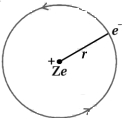
(N/A) The atomic model of Bohr is shown in the figure.
Let the mass of an electron be $m$,its charge be $e$,its linear speed in the $n^{th}$ orbit be $v_n$,the radius of the orbit be $r_n$,and the charge on the nucleus be $Ze$,where $Z$ is the atomic number.
The necessary centripetal force is provided by the Coulombic attractive force between the electron and the nucleus. Thus,
$\frac{m v_n^2}{r_n} = \frac{1}{4 \pi \epsilon_0} \cdot \frac{(Ze)(e)}{r_n^2} = \frac{Z e^2}{4 \pi \epsilon_0 r_n^2}$ ... $(1)$
From Bohr's second postulate,the angular momentum $L_n$ of an electron in the $n^{th}$ orbit is given by:
$L_n = m v_n r_n = \frac{n h}{2 \pi}$ ... $(2)$
From equation $(1)$,we have $m v_n^2 = \frac{Z e^2}{4 \pi \epsilon_0 r_n}$.
Multiplying both sides by $r_n^2$,we get $m v_n^2 r_n^2 = \frac{Z e^2 r_n}{4 \pi \epsilon_0}$.
Taking the square root,$m v_n r_n = \sqrt{\frac{Z e^2 m r_n}{4 \pi \epsilon_0}}$.
Equating this to equation $(2)$:
$\frac{n h}{2 \pi} = \sqrt{\frac{Z e^2 m r_n}{4 \pi \epsilon_0}}$
Squaring both sides:
$\frac{n^2 h^2}{4 \pi^2} = \frac{Z e^2 m r_n}{4 \pi \epsilon_0}$
Solving for $r_n$:
$r_n = \frac{n^2 h^2 \epsilon_0}{\pi m Z e^2}$
Let the mass of an electron be $m$,its charge be $e$,its linear speed in the $n^{th}$ orbit be $v_n$,the radius of the orbit be $r_n$,and the charge on the nucleus be $Ze$,where $Z$ is the atomic number.
The necessary centripetal force is provided by the Coulombic attractive force between the electron and the nucleus. Thus,
$\frac{m v_n^2}{r_n} = \frac{1}{4 \pi \epsilon_0} \cdot \frac{(Ze)(e)}{r_n^2} = \frac{Z e^2}{4 \pi \epsilon_0 r_n^2}$ ... $(1)$
From Bohr's second postulate,the angular momentum $L_n$ of an electron in the $n^{th}$ orbit is given by:
$L_n = m v_n r_n = \frac{n h}{2 \pi}$ ... $(2)$
From equation $(1)$,we have $m v_n^2 = \frac{Z e^2}{4 \pi \epsilon_0 r_n}$.
Multiplying both sides by $r_n^2$,we get $m v_n^2 r_n^2 = \frac{Z e^2 r_n}{4 \pi \epsilon_0}$.
Taking the square root,$m v_n r_n = \sqrt{\frac{Z e^2 m r_n}{4 \pi \epsilon_0}}$.
Equating this to equation $(2)$:
$\frac{n h}{2 \pi} = \sqrt{\frac{Z e^2 m r_n}{4 \pi \epsilon_0}}$
Squaring both sides:
$\frac{n^2 h^2}{4 \pi^2} = \frac{Z e^2 m r_n}{4 \pi \epsilon_0}$
Solving for $r_n$:
$r_n = \frac{n^2 h^2 \epsilon_0}{\pi m Z e^2}$
0 likes
View Solution266
Difficult
Using the formula for the radius of the $n^{th}$ orbit $r_n = \frac{n^2 h^2 \epsilon_0}{\pi m Z e^2}$,derive an expression for the total energy of an electron in the $n^{th}$ Bohr orbit.
Solution
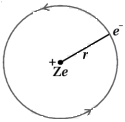
(N/A) The necessary centripetal force for an electron of mass $m$ and charge $e$ moving with speed $v_n$ in an orbit of radius $r_n$ around a nucleus of charge $Ze$ is provided by the electrostatic force of attraction:
$\frac{m v_n^2}{r_n} = \frac{1}{4 \pi \epsilon_0} \frac{(Ze)(e)}{r_n^2}$
Multiplying both sides by $\frac{r_n}{2}$,we get the kinetic energy $K$:
$K = \frac{1}{2} m v_n^2 = \frac{Ze^2}{8 \pi \epsilon_0 r_n} \quad \dots (1)$
The potential energy $U$ of the electron in the field of the nucleus is:
$U = -\frac{1}{4 \pi \epsilon_0} \frac{(Ze)(e)}{r_n} = -\frac{Ze^2}{4 \pi \epsilon_0 r_n} \quad \dots (2)$
The total energy $E_n$ is the sum of kinetic and potential energy:
$E_n = K + U = \frac{Ze^2}{8 \pi \epsilon_0 r_n} - \frac{Ze^2}{4 \pi \epsilon_0 r_n}$
$E_n = -\frac{Ze^2}{8 \pi \epsilon_0 r_n}$
Substituting the given expression for $r_n = \frac{n^2 h^2 \epsilon_0}{\pi m Z e^2}$ into the energy formula:
$E_n = -\frac{Ze^2}{8 \pi \epsilon_0} \left( \frac{\pi m Z e^2}{n^2 h^2 \epsilon_0} \right) = -\frac{m Z^2 e^4}{8 \epsilon_0^2 n^2 h^2}$
$\frac{m v_n^2}{r_n} = \frac{1}{4 \pi \epsilon_0} \frac{(Ze)(e)}{r_n^2}$
Multiplying both sides by $\frac{r_n}{2}$,we get the kinetic energy $K$:
$K = \frac{1}{2} m v_n^2 = \frac{Ze^2}{8 \pi \epsilon_0 r_n} \quad \dots (1)$
The potential energy $U$ of the electron in the field of the nucleus is:
$U = -\frac{1}{4 \pi \epsilon_0} \frac{(Ze)(e)}{r_n} = -\frac{Ze^2}{4 \pi \epsilon_0 r_n} \quad \dots (2)$
The total energy $E_n$ is the sum of kinetic and potential energy:
$E_n = K + U = \frac{Ze^2}{8 \pi \epsilon_0 r_n} - \frac{Ze^2}{4 \pi \epsilon_0 r_n}$
$E_n = -\frac{Ze^2}{8 \pi \epsilon_0 r_n}$
Substituting the given expression for $r_n = \frac{n^2 h^2 \epsilon_0}{\pi m Z e^2}$ into the energy formula:
$E_n = -\frac{Ze^2}{8 \pi \epsilon_0} \left( \frac{\pi m Z e^2}{n^2 h^2 \epsilon_0} \right) = -\frac{m Z^2 e^4}{8 \epsilon_0^2 n^2 h^2}$
0 likes
View Solution267
MediumMCQ
The total energy of an electron $E_n = -\frac{Z^2me^4}{8\epsilon_0^2n^2h^2}$ in an atom is based on which hypothesis? Under what condition is this formula true?
A
Bohr's hypothesis of circular orbits
B
Sommerfeld's hypothesis of elliptical orbits
C
De Broglie's hypothesis of wave nature
D
Heisenberg's uncertainty principle
Solution
(A) The expression for the total energy of an electron $E_n = -\frac{Z^2me^4}{8\epsilon_0^2n^2h^2}$ is derived based on Bohr's hypothesis of circular orbits.
In this model,the electron is assumed to move in circular orbits around the nucleus under the influence of the electrostatic force.
Physicist Sommerfeld later extended this model to include elliptical orbits. He demonstrated that when the restriction of circular orbits is relaxed,the energy expression remains valid for elliptical orbits as well,provided the central force is an inverse-square force.
In this model,the electron is assumed to move in circular orbits around the nucleus under the influence of the electrostatic force.
Physicist Sommerfeld later extended this model to include elliptical orbits. He demonstrated that when the restriction of circular orbits is relaxed,the energy expression remains valid for elliptical orbits as well,provided the central force is an inverse-square force.
0 likes
View Solution268
Easy
Write the formula for the orbital radius of the electron in the atom based on the Bohr atomic model.
Solution
(N/A) According to the Bohr atomic model, the radius of the $n^{th}$ orbit of an electron in a hydrogen-like atom is given by the formula:
$r_n = \frac{n^2 h^2 \epsilon_0}{\pi m Z e^2}$
Where:
$n$ is the principal quantum number (orbit number),
$h$ is Planck's constant,
$\epsilon_0$ is the permittivity of free space,
$m$ is the mass of the electron,
$Z$ is the atomic number,
$e$ is the elementary charge.
$r_n = \frac{n^2 h^2 \epsilon_0}{\pi m Z e^2}$
Where:
$n$ is the principal quantum number (orbit number),
$h$ is Planck's constant,
$\epsilon_0$ is the permittivity of free space,
$m$ is the mass of the electron,
$Z$ is the atomic number,
$e$ is the elementary charge.
0 likes
View Solution269
Easy
What is ground state?
Solution
(N/A) The ground state of an atom is the lowest energy state of the system.
In the context of the Bohr model for a hydrogen atom,it corresponds to the state where the electron is in the innermost orbit,which is the orbit with the principal quantum number $n = 1$.
The energy of the electron in the ground state of a hydrogen atom is approximately $-13.6 \ eV$.
In the context of the Bohr model for a hydrogen atom,it corresponds to the state where the electron is in the innermost orbit,which is the orbit with the principal quantum number $n = 1$.
The energy of the electron in the ground state of a hydrogen atom is approximately $-13.6 \ eV$.
0 likes
View Solution270
Easy
What is ionisation energy?
Solution
(N/A) Ionisation energy is defined as the minimum amount of energy required to remove an electron from an atom in its ground state to an infinite distance from the nucleus,effectively placing it in a state where it is no longer bound to the atom.
For a hydrogen atom,the energy of the ground state $(n = 1)$ is $E_1 = -13.6 \ eV$.
To ionise the atom,we must provide enough energy to bring the total energy to $0 \ eV$ (the energy of an electron at infinity).
Therefore,the ionisation energy is $E_{\infty} - E_1 = 0 - (-13.6 \ eV) = 13.6 \ eV$.
For a hydrogen atom,the energy of the ground state $(n = 1)$ is $E_1 = -13.6 \ eV$.
To ionise the atom,we must provide enough energy to bring the total energy to $0 \ eV$ (the energy of an electron at infinity).
Therefore,the ionisation energy is $E_{\infty} - E_1 = 0 - (-13.6 \ eV) = 13.6 \ eV$.
0 likes
View Solution271
Difficult
Obtain the equations for the frequency of radiation and the wave number when an electron makes a transition from a higher energy state to a lower energy state in a hydrogen atom.
Solution
(N/A) According to Bohr's third postulate,when an electron makes a transition from a higher energy state with quantum number $n_{i}$ to a lower energy state with quantum number $n_{f}$ $(n_{i} > n_{f})$,a photon is emitted with energy equal to the difference in energy between the two states.
The energy of an electron in the $n_{i}$ state is given by:
$E_{n_{i}} = -\frac{m e^{4}}{8 \epsilon_{0}^{2} h^{2} n_{i}^{2}}$
The energy of an electron in the $n_{f}$ state is given by:
$E_{n_{f}} = -\frac{m e^{4}}{8 \epsilon_{0}^{2} h^{2} n_{f}^{2}}$
The energy of the emitted photon is $h \nu_{if} = E_{n_{i}} - E_{n_{f}}$.
Substituting the expressions:
$h \nu_{if} = -\frac{m e^{4}}{8 \epsilon_{0}^{2} h^{2} n_{i}^{2}} - \left( -\frac{m e^{4}}{8 \epsilon_{0}^{2} h^{2} n_{f}^{2}} \right)$
$h \nu_{if} = \frac{m e^{4}}{8 \epsilon_{0}^{2} h^{2}} \left[ \frac{1}{n_{f}^{2}} - \frac{1}{n_{i}^{2}} \right]$
Thus,the frequency of the emitted radiation is:
$\nu_{if} = \frac{m e^{4}}{8 \epsilon_{0}^{2} h^{3}} \left[ \frac{1}{n_{f}^{2}} - \frac{1}{n_{i}^{2}} \right]$
Since the wave number $\bar{\nu} = \frac{1}{\lambda} = \frac{\nu}{c}$,we divide the frequency by the speed of light $c$:
$\bar{\nu} = \frac{1}{\lambda_{if}} = \frac{m e^{4}}{8 \epsilon_{0}^{2} h^{3} c} \left[ \frac{1}{n_{f}^{2}} - \frac{1}{n_{i}^{2}} \right]$
Here,$R = \frac{m e^{4}}{8 \epsilon_{0}^{2} h^{3} c}$ is the Rydberg constant,with a theoretical value of approximately $1.097 \times 10^{7} \ m^{-1}$.
The energy of an electron in the $n_{i}$ state is given by:
$E_{n_{i}} = -\frac{m e^{4}}{8 \epsilon_{0}^{2} h^{2} n_{i}^{2}}$
The energy of an electron in the $n_{f}$ state is given by:
$E_{n_{f}} = -\frac{m e^{4}}{8 \epsilon_{0}^{2} h^{2} n_{f}^{2}}$
The energy of the emitted photon is $h \nu_{if} = E_{n_{i}} - E_{n_{f}}$.
Substituting the expressions:
$h \nu_{if} = -\frac{m e^{4}}{8 \epsilon_{0}^{2} h^{2} n_{i}^{2}} - \left( -\frac{m e^{4}}{8 \epsilon_{0}^{2} h^{2} n_{f}^{2}} \right)$
$h \nu_{if} = \frac{m e^{4}}{8 \epsilon_{0}^{2} h^{2}} \left[ \frac{1}{n_{f}^{2}} - \frac{1}{n_{i}^{2}} \right]$
Thus,the frequency of the emitted radiation is:
$\nu_{if} = \frac{m e^{4}}{8 \epsilon_{0}^{2} h^{3}} \left[ \frac{1}{n_{f}^{2}} - \frac{1}{n_{i}^{2}} \right]$
Since the wave number $\bar{\nu} = \frac{1}{\lambda} = \frac{\nu}{c}$,we divide the frequency by the speed of light $c$:
$\bar{\nu} = \frac{1}{\lambda_{if}} = \frac{m e^{4}}{8 \epsilon_{0}^{2} h^{3} c} \left[ \frac{1}{n_{f}^{2}} - \frac{1}{n_{i}^{2}} \right]$
Here,$R = \frac{m e^{4}}{8 \epsilon_{0}^{2} h^{3} c}$ is the Rydberg constant,with a theoretical value of approximately $1.097 \times 10^{7} \ m^{-1}$.
0 likes
View Solution272
Easy
Write the theoretical value and experimental value of the Rydberg constant,including the unit.
Solution
(N/A) The Rydberg constant $(R)$ is a fundamental physical constant related to the atomic spectra of hydrogen.
The theoretical value of the Rydberg constant is derived from the formula:
$R = \frac{m_e e^4}{8 \epsilon_0^2 h^3 c}$
where $m_e$ is the electron mass,$e$ is the elementary charge,$\epsilon_0$ is the vacuum permittivity,$h$ is Planck's constant,and $c$ is the speed of light.
Substituting the standard values:
$R \approx 1.0973731568 \times 10^7 \ m^{-1}$.
The experimental value is determined through high-precision spectroscopy of hydrogen atoms and is found to be consistent with the theoretical value:
$R \approx 1.0973731568 \times 10^7 \ m^{-1}$.
The theoretical value of the Rydberg constant is derived from the formula:
$R = \frac{m_e e^4}{8 \epsilon_0^2 h^3 c}$
where $m_e$ is the electron mass,$e$ is the elementary charge,$\epsilon_0$ is the vacuum permittivity,$h$ is Planck's constant,and $c$ is the speed of light.
Substituting the standard values:
$R \approx 1.0973731568 \times 10^7 \ m^{-1}$.
The experimental value is determined through high-precision spectroscopy of hydrogen atoms and is found to be consistent with the theoretical value:
$R \approx 1.0973731568 \times 10^7 \ m^{-1}$.
0 likes
View Solution273
Medium
Explain the quantization of angular momentum by considering the electron as a wave in an atom.
Solution
(N/A) In his second postulate,Bohr proposed that the angular momentum of an electron orbiting the nucleus is quantized.
Louis de Broglie provided a physical explanation for this in $1923$.
According to de Broglie's hypothesis,material particles exhibit wave-like properties. This wave nature was experimentally verified by Davisson and Germer.
Bohr suggested that an electron in a circular orbit behaves as a matter wave.
Similar to waves on a string,particle waves can form standing waves under resonant conditions.
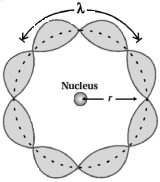
When a string is plucked,many waves are excited,but only those that form standing waves (with nodes at the ends) persist. This occurs when the total distance traveled by the wave is an integral multiple of its wavelength.
Waves with other wavelengths interfere destructively upon reflection,and their amplitudes drop to zero; thus,an electron cannot exist in such an orbit.
For an electron in the $n^{\text{th}}$ circular orbit of radius $r_n$,the circumference of the orbit must be an integral multiple of the wavelength $\lambda$.
Therefore,$2 \pi r_n = n \lambda$ ... $(1)$,where $n = 1, 2, 3, \dots$
Using de Broglie's relation for wavelength and momentum,$\lambda = \frac{h}{p} = \frac{h}{m v_n}$ ... $(2)$.
Substituting $(2)$ into $(1)$:
$2 \pi r_n = n \left( \frac{h}{m v_n} \right)$
Rearranging the terms gives the quantization condition for angular momentum:
$m v_n r_n = \frac{n h}{2 \pi}$
Louis de Broglie provided a physical explanation for this in $1923$.
According to de Broglie's hypothesis,material particles exhibit wave-like properties. This wave nature was experimentally verified by Davisson and Germer.
Bohr suggested that an electron in a circular orbit behaves as a matter wave.
Similar to waves on a string,particle waves can form standing waves under resonant conditions.
When a string is plucked,many waves are excited,but only those that form standing waves (with nodes at the ends) persist. This occurs when the total distance traveled by the wave is an integral multiple of its wavelength.
Waves with other wavelengths interfere destructively upon reflection,and their amplitudes drop to zero; thus,an electron cannot exist in such an orbit.
For an electron in the $n^{\text{th}}$ circular orbit of radius $r_n$,the circumference of the orbit must be an integral multiple of the wavelength $\lambda$.
Therefore,$2 \pi r_n = n \lambda$ ... $(1)$,where $n = 1, 2, 3, \dots$
Using de Broglie's relation for wavelength and momentum,$\lambda = \frac{h}{p} = \frac{h}{m v_n}$ ... $(2)$.
Substituting $(2)$ into $(1)$:
$2 \pi r_n = n \left( \frac{h}{m v_n} \right)$
Rearranging the terms gives the quantization condition for angular momentum:
$m v_n r_n = \frac{n h}{2 \pi}$
0 likes
View Solution274
Easy
Explain the limitations of the Bohr atomic model.
Solution
(N/A) $(1)$ The Bohr model is applicable only to hydrogenic atoms. It cannot be extended even to simple two-electron atoms such as helium.
- The analysis of atoms with more than one electron was attempted using the lines of Bohr's model for hydrogenic atoms,but it did not meet with any success.
- The difficulty lies in the fact that each electron interacts not only with the positively charged nucleus but also with all other electrons.
- The formulation of the Bohr model involves the electrical force between the positively charged nucleus and the electron. It does not include the electrical force between electrons,which necessarily appears in multi-electron atoms.
$(2)$ While the Bohr model correctly predicts the frequencies of the light emitted by hydrogenic atoms,it is unable to explain the relative intensities of the frequencies in the spectrum.
- In the emission spectrum of hydrogen,some of the visible frequencies have weak intensity,while others are strong. Why?
- Experimental observations depict that some transitions are more favoured than others.
- The Bohr model is unable to account for these intensity variations.
- This model cannot be applied to complex atoms. For complex atoms,we must use a new theory based on quantum mechanics.
- The analysis of atoms with more than one electron was attempted using the lines of Bohr's model for hydrogenic atoms,but it did not meet with any success.
- The difficulty lies in the fact that each electron interacts not only with the positively charged nucleus but also with all other electrons.
- The formulation of the Bohr model involves the electrical force between the positively charged nucleus and the electron. It does not include the electrical force between electrons,which necessarily appears in multi-electron atoms.
$(2)$ While the Bohr model correctly predicts the frequencies of the light emitted by hydrogenic atoms,it is unable to explain the relative intensities of the frequencies in the spectrum.
- In the emission spectrum of hydrogen,some of the visible frequencies have weak intensity,while others are strong. Why?
- Experimental observations depict that some transitions are more favoured than others.
- The Bohr model is unable to account for these intensity variations.
- This model cannot be applied to complex atoms. For complex atoms,we must use a new theory based on quantum mechanics.
0 likes
View Solution275
Easy
Write the quantum condition suggested by Bohr for the angular momentum of the electron.
Solution
(N/A) According to Bohr's second postulate,the electron revolves around the nucleus only in those orbits for which its angular momentum is an integral multiple of $\frac{h}{2\pi}$.
Mathematically,this condition is expressed as:
$L = mvr = \frac{nh}{2\pi}$
Where:
$L$ is the angular momentum of the electron.
$m$ is the mass of the electron.
$v$ is the velocity of the electron in its orbit.
$r$ is the radius of the orbit.
$n$ is the principal quantum number $(n = 1, 2, 3, ...)$.
$h$ is Planck's constant.
Mathematically,this condition is expressed as:
$L = mvr = \frac{nh}{2\pi}$
Where:
$L$ is the angular momentum of the electron.
$m$ is the mass of the electron.
$v$ is the velocity of the electron in its orbit.
$r$ is the radius of the orbit.
$n$ is the principal quantum number $(n = 1, 2, 3, ...)$.
$h$ is Planck's constant.
0 likes
View Solution276
Medium
Imagine removing one electron from $He^4$ and $He^3$. Their energy levels,as worked out on the basis of the Bohr model,will be very close. Explain why?
Solution
(N/A) Both ${ }_{2} He^{3}$ and ${ }_{2} He^{4}$ are isotopes of helium.
When one electron is removed from each,they both become hydrogen-like ions $(He^+)$ with a single electron.
The energy levels of a hydrogen-like ion are given by the formula $E_n = -\frac{Z^2 R_y}{n^2}$,where $Z$ is the atomic number and $R_y$ is the Rydberg constant.
Since both isotopes have the same atomic number $Z = 2$,their energy levels are identical in the ideal Bohr model.
However,the slight difference in mass between the nuclei of $He^3$ and $He^4$ leads to a very small difference in the reduced mass of the electron-nucleus system,which is why their energy levels are very close but not perfectly identical.
When one electron is removed from each,they both become hydrogen-like ions $(He^+)$ with a single electron.
The energy levels of a hydrogen-like ion are given by the formula $E_n = -\frac{Z^2 R_y}{n^2}$,where $Z$ is the atomic number and $R_y$ is the Rydberg constant.
Since both isotopes have the same atomic number $Z = 2$,their energy levels are identical in the ideal Bohr model.
However,the slight difference in mass between the nuclei of $He^3$ and $He^4$ leads to a very small difference in the reduced mass of the electron-nucleus system,which is why their energy levels are very close but not perfectly identical.
0 likes
View Solution277
Medium
When an electron falls from a higher energy level to a lower energy level,the difference in energy is emitted as electromagnetic radiation. Why can it not be emitted as other forms of energy?
Solution
(N/A) According to classical electrodynamics,an accelerated charged particle emits energy in the form of electromagnetic waves.
When an electron transitions from a higher energy orbit to a lower energy orbit,it moves closer to the nucleus.
Due to the change in the electrostatic potential energy and the requirement to maintain angular momentum,the electron undergoes a change in its velocity,effectively performing an accelerated motion.
Since the electron is a charged particle,this accelerated motion results in the emission of energy in the form of periodically oscillating electric and magnetic fields,which we observe as electromagnetic radiation.
Other forms of energy,such as mechanical or thermal energy,do not satisfy the fundamental conservation laws and the specific interaction dynamics between the electron's charge and the electromagnetic field during such transitions.
When an electron transitions from a higher energy orbit to a lower energy orbit,it moves closer to the nucleus.
Due to the change in the electrostatic potential energy and the requirement to maintain angular momentum,the electron undergoes a change in its velocity,effectively performing an accelerated motion.
Since the electron is a charged particle,this accelerated motion results in the emission of energy in the form of periodically oscillating electric and magnetic fields,which we observe as electromagnetic radiation.
Other forms of energy,such as mechanical or thermal energy,do not satisfy the fundamental conservation laws and the specific interaction dynamics between the electron's charge and the electromagnetic field during such transitions.
0 likes
View Solution278
Easy
Would the Bohr formula for the $H-$ atom remain unchanged if the proton had a charge of $+ \frac{4e}{3}$ and the electron a charge of $- \frac{3e}{4}$ (where $e = 1.6 \times 10^{-19} \ C$)? Give reasons for your answer.
Solution
(A) Yes,the Bohr formula for the $H-$ atom would remain unchanged in this case because the electrostatic force between the proton and the electron remains the same.
In the original case,the electrostatic force is given by $F = \frac{1}{4 \pi \epsilon_{0}} \frac{(e)(e)}{r^{2}} = \frac{1}{4 \pi \epsilon_{0}} \frac{e^{2}}{r^{2}}$.
In the new case,the magnitude of the charges are $q_{1} = \frac{4e}{3}$ and $q_{2} = \frac{3e}{4}$. The new electrostatic force $F^{\prime}$ is given by:
$F^{\prime} = \frac{1}{4 \pi \epsilon_{0}} \frac{(\frac{4e}{3})(\frac{3e}{4})}{r^{2}} = \frac{1}{4 \pi \epsilon_{0}} \frac{e^{2}}{r^{2}}$.
Since $F^{\prime} = F$,the centripetal force required for the orbit remains identical,and therefore,the Bohr model energy levels and radii formulas remain unchanged.
In the original case,the electrostatic force is given by $F = \frac{1}{4 \pi \epsilon_{0}} \frac{(e)(e)}{r^{2}} = \frac{1}{4 \pi \epsilon_{0}} \frac{e^{2}}{r^{2}}$.
In the new case,the magnitude of the charges are $q_{1} = \frac{4e}{3}$ and $q_{2} = \frac{3e}{4}$. The new electrostatic force $F^{\prime}$ is given by:
$F^{\prime} = \frac{1}{4 \pi \epsilon_{0}} \frac{(\frac{4e}{3})(\frac{3e}{4})}{r^{2}} = \frac{1}{4 \pi \epsilon_{0}} \frac{e^{2}}{r^{2}}$.
Since $F^{\prime} = F$,the centripetal force required for the orbit remains identical,and therefore,the Bohr model energy levels and radii formulas remain unchanged.
0 likes
View Solution279
MediumMCQ
Consider two different hydrogen atoms. The electron in each atom is in an excited state. Is it possible for the electrons to have different energies but the same orbital angular momentum according to the Bohr model?
A
Yes
B
No
C
Only for ground state
D
Depends on the atom
Solution
(B) According to the Bohr model,the total energy of an electron in the $n^{\text{th}}$ energy level of a hydrogen atom is given by $E_n = -\frac{13.6}{n^2} \text{ eV}$.
If the energies $E_n$ are different,the principal quantum numbers $n$ must be different.
The orbital angular momentum of an electron in the $n^{\text{th}}$ orbit is given by $L_n = \frac{nh}{2\pi}$.
Since the angular momentum $L_n$ is directly proportional to $n$,if the values of $n$ are different,the values of the angular momentum $L_n$ must also be different.
Therefore,it is not possible for the electrons to have different energies but the same orbital angular momentum.
If the energies $E_n$ are different,the principal quantum numbers $n$ must be different.
The orbital angular momentum of an electron in the $n^{\text{th}}$ orbit is given by $L_n = \frac{nh}{2\pi}$.
Since the angular momentum $L_n$ is directly proportional to $n$,if the values of $n$ are different,the values of the angular momentum $L_n$ must also be different.
Therefore,it is not possible for the electrons to have different energies but the same orbital angular momentum.
0 likes
View Solution280
MediumMCQ
Positronium is just like a $H$-atom with the proton replaced by the positively charged antiparticle of the electron (called the positron,which is as massive as the electron). What would be the ground state energy of positronium?
A
-$13.6$ eV
B
-$6.8$ eV
C
-$27.2$ eV
D
-$3.4$ eV
Solution
(B) Positronium is a binary system consisting of an electron and a positron. Both particles revolve around their common center of mass.
To treat this as a single-particle system,we use the reduced mass $\mu$ of the binary system:
$\mu = \frac{m_1 m_2}{m_1 + m_2} = \frac{m_e \times m_e}{m_e + m_e} = \frac{m_e}{2} = \frac{m}{2}$
The ground state energy of an electron in a hydrogen atom is given by:
$E_1 = -\frac{m e^4}{8 \epsilon_0^2 h^2} = -13.6 \text{ eV}$
Since the energy of the ground state is directly proportional to the mass of the orbiting particle,the ground state energy of positronium $E_1'$ is:
$E_1' = \frac{\mu}{m} E_1 = \frac{m/2}{m} E_1 = \frac{1}{2} E_1$
Substituting the value of $E_1$:
$E_1' = \frac{1}{2} (-13.6 \text{ eV}) = -6.8 \text{ eV}$
To treat this as a single-particle system,we use the reduced mass $\mu$ of the binary system:
$\mu = \frac{m_1 m_2}{m_1 + m_2} = \frac{m_e \times m_e}{m_e + m_e} = \frac{m_e}{2} = \frac{m}{2}$
The ground state energy of an electron in a hydrogen atom is given by:
$E_1 = -\frac{m e^4}{8 \epsilon_0^2 h^2} = -13.6 \text{ eV}$
Since the energy of the ground state is directly proportional to the mass of the orbiting particle,the ground state energy of positronium $E_1'$ is:
$E_1' = \frac{\mu}{m} E_1 = \frac{m/2}{m} E_1 = \frac{1}{2} E_1$
Substituting the value of $E_1$:
$E_1' = \frac{1}{2} (-13.6 \text{ eV}) = -6.8 \text{ eV}$
0 likes
View Solution281
Medium
Assume that there is no repulsive force between the electrons in an atom,but the force between positive and negative charges is given by Coulomb's law as usual. Under such circumstances,calculate the ground state energy of a $He$ atom.
Solution
(N/A) As per the assumption made in the statement,since the $He$ atom behaves like a hydrogen-like atom (where electron-electron repulsion is ignored),we can apply Bohr's atomic model to the $He$ atom.
The energy of an electron in an orbit is given by:
$E_{n} = -\frac{m Z^{2} e^{4}}{8 \epsilon_{0}^{2} n^{2} h^{2}}$
This can be simplified as:
$E_{n} = -13.6 \frac{Z^{2}}{n^{2}} \text{ eV}$
For a $He$ atom,the atomic number $Z = 2$. For the ground state,the principal quantum number $n = 1$.
Substituting these values:
$E_{1} = -13.6 \times \frac{(2)^{2}}{(1)^{2}} \text{ eV}$
$E_{1} = -13.6 \times 4 \text{ eV}$
$E_{1} = -54.4 \text{ eV}$
Since there are two electrons in the $He$ atom and we assume no repulsion between them,the total ground state energy of the $He$ atom is the sum of the energies of both electrons:
$E_{\text{total}} = 2 \times E_{1} = 2 \times (-54.4 \text{ eV}) = -108.8 \text{ eV}$.
The energy of an electron in an orbit is given by:
$E_{n} = -\frac{m Z^{2} e^{4}}{8 \epsilon_{0}^{2} n^{2} h^{2}}$
This can be simplified as:
$E_{n} = -13.6 \frac{Z^{2}}{n^{2}} \text{ eV}$
For a $He$ atom,the atomic number $Z = 2$. For the ground state,the principal quantum number $n = 1$.
Substituting these values:
$E_{1} = -13.6 \times \frac{(2)^{2}}{(1)^{2}} \text{ eV}$
$E_{1} = -13.6 \times 4 \text{ eV}$
$E_{1} = -54.4 \text{ eV}$
Since there are two electrons in the $He$ atom and we assume no repulsion between them,the total ground state energy of the $He$ atom is the sum of the energies of both electrons:
$E_{\text{total}} = 2 \times E_{1} = 2 \times (-54.4 \text{ eV}) = -108.8 \text{ eV}$.
0 likes
View Solution282
Medium
Using the Bohr model,calculate the electric current created by the electron when the $H$-atom is in the ground state.
Solution
(A) The orbital radius of an electron in the $n^{\text{th}}$ orbit of an $H$-atom is given by $r_{n} = \frac{\epsilon_{0} n^{2} h^{2}}{\pi m Z e^{2}}$.
For the ground state,$n = 1$ and $Z = 1$,so $r_{1} = a_{0} = 0.53 \times 10^{-10} \text{ m}$.
The velocity of the electron in the $n^{\text{th}}$ orbit is $v_{n} = \frac{Z e^{2}}{2 \epsilon_{0} n h}$. For $n = 1$,$v_{1} = 2.187 \times 10^{6} \text{ m/s}$.
The frequency of revolution $f_{1}$ is given by $f_{1} = \frac{v_{1}}{2 \pi r_{1}}$.
The electric current $I$ is $I = f_{1} e = \frac{v_{1} e}{2 \pi r_{1}}$.
Substituting the values: $I = \frac{(2.187 \times 10^{6} \text{ m/s}) \times (1.6 \times 10^{-19} \text{ C})}{2 \times 3.1416 \times (0.53 \times 10^{-10} \text{ m})}$.
$I \approx 1.05 \times 10^{-3} \text{ A} = 1.05 \text{ mA}$.
For the ground state,$n = 1$ and $Z = 1$,so $r_{1} = a_{0} = 0.53 \times 10^{-10} \text{ m}$.
The velocity of the electron in the $n^{\text{th}}$ orbit is $v_{n} = \frac{Z e^{2}}{2 \epsilon_{0} n h}$. For $n = 1$,$v_{1} = 2.187 \times 10^{6} \text{ m/s}$.
The frequency of revolution $f_{1}$ is given by $f_{1} = \frac{v_{1}}{2 \pi r_{1}}$.
The electric current $I$ is $I = f_{1} e = \frac{v_{1} e}{2 \pi r_{1}}$.
Substituting the values: $I = \frac{(2.187 \times 10^{6} \text{ m/s}) \times (1.6 \times 10^{-19} \text{ C})}{2 \times 3.1416 \times (0.53 \times 10^{-10} \text{ m})}$.
$I \approx 1.05 \times 10^{-3} \text{ A} = 1.05 \text{ mA}$.
0 likes
View Solution283
Medium
Show that the first few frequencies of light that is emitted when electrons fall to the $n^{\text{th}}$ level from levels higher than $n$,are approximate harmonics (i.e.,in the ratio $1:2:3...$) when $n >> 1$.
Solution
(N/A) In an atom of an element with atomic number $Z$,when an electron makes a transition from the $(n+x)^{\text{th}}$ orbit (where $x=1, 2, 3, \dots$) to the $n^{\text{th}}$ orbit,the frequency $f$ of the emitted radiation is given by the Rydberg formula:
$\frac{1}{\lambda} = R Z^{2} \left( \frac{1}{n^{2}} - \frac{1}{(n+x)^{2}} \right)$
Since $f = \frac{c}{\lambda}$,we have:
$f = c R Z^{2} \left( \frac{(n+x)^{2} - n^{2}}{n^{2}(n+x)^{2}} \right)$
$f = c R Z^{2} \left( \frac{n^{2} + 2nx + x^{2} - n^{2}}{n^{2}(n+x)^{2}} \right)$
$f = c R Z^{2} \left( \frac{2nx + x^{2}}{n^{2}(n+x)^{2}} \right)$
Given $n >> 1$ and $x$ is small $(x=1, 2, 3, \dots)$,we can approximate $(n+x) \approx n$:
$f \approx c R Z^{2} \left( \frac{2nx}{n^{2} \cdot n^{2}} \right)$
$f \approx \left( \frac{2 R c Z^{2}}{n^{3}} \right) x$
Since $\frac{2 R c Z^{2}}{n^{3}}$ is constant for a fixed $n$,we have $f \propto x$.
Therefore,the ratio of frequencies for $x=1, 2, 3$ is $f_{1} : f_{2} : f_{3} = 1 : 2 : 3$.
$\frac{1}{\lambda} = R Z^{2} \left( \frac{1}{n^{2}} - \frac{1}{(n+x)^{2}} \right)$
Since $f = \frac{c}{\lambda}$,we have:
$f = c R Z^{2} \left( \frac{(n+x)^{2} - n^{2}}{n^{2}(n+x)^{2}} \right)$
$f = c R Z^{2} \left( \frac{n^{2} + 2nx + x^{2} - n^{2}}{n^{2}(n+x)^{2}} \right)$
$f = c R Z^{2} \left( \frac{2nx + x^{2}}{n^{2}(n+x)^{2}} \right)$
Given $n >> 1$ and $x$ is small $(x=1, 2, 3, \dots)$,we can approximate $(n+x) \approx n$:
$f \approx c R Z^{2} \left( \frac{2nx}{n^{2} \cdot n^{2}} \right)$
$f \approx \left( \frac{2 R c Z^{2}}{n^{3}} \right) x$
Since $\frac{2 R c Z^{2}}{n^{3}}$ is constant for a fixed $n$,we have $f \propto x$.
Therefore,the ratio of frequencies for $x=1, 2, 3$ is $f_{1} : f_{2} : f_{3} = 1 : 2 : 3$.
0 likes
View Solution284
Medium
What is the minimum energy that must be given to a $H$ atom in the ground state so that it can emit an $H_{\gamma}$ line in the Balmer series? If the angular momentum of the system is conserved,what would be the angular momentum of such an $H_{\gamma}$ photon?
Solution
(D) For the Balmer series of the atomic spectrum of hydrogen,the transition ends at $n=2$. The lines are defined as $H_{\alpha} (n=3 \to 2)$,$H_{\beta} (n=4 \to 2)$,$H_{\gamma} (n=5 \to 2)$,and so on.
To emit an $H_{\gamma}$ line,the electron must be excited from the ground state $(n=1)$ to the $n=5$ energy level.
The energy required is $\Delta E = E_{5} - E_{1}$.
Using $E_{n} = -\frac{13.6 \text{ eV}}{n^{2}}$,we get:
$\Delta E = -\frac{13.6}{5^{2}} - (-13.6) = 13.6 \left(1 - \frac{1}{25}\right) = 13.6 \times \frac{24}{25} = 13.056 \text{ eV}$.
The angular momentum of the emitted photon is equal to the change in the orbital angular momentum of the electron during the transition from $n=5$ to $n=2$.
Using Bohr's quantization condition $L = \frac{nh}{2\pi}$:
$L_{\text{photon}} = L_{5} - L_{2} = \frac{5h}{2\pi} - \frac{2h}{2\pi} = \frac{3h}{2\pi}$.
Substituting $h = 6.626 \times 10^{-34} \text{ Js}$:
$L_{\text{photon}} = \frac{3 \times 6.626 \times 10^{-34}}{2 \times 3.14159} \approx 3.165 \times 10^{-34} \text{ Js}$.
To emit an $H_{\gamma}$ line,the electron must be excited from the ground state $(n=1)$ to the $n=5$ energy level.
The energy required is $\Delta E = E_{5} - E_{1}$.
Using $E_{n} = -\frac{13.6 \text{ eV}}{n^{2}}$,we get:
$\Delta E = -\frac{13.6}{5^{2}} - (-13.6) = 13.6 \left(1 - \frac{1}{25}\right) = 13.6 \times \frac{24}{25} = 13.056 \text{ eV}$.
The angular momentum of the emitted photon is equal to the change in the orbital angular momentum of the electron during the transition from $n=5$ to $n=2$.
Using Bohr's quantization condition $L = \frac{nh}{2\pi}$:
$L_{\text{photon}} = L_{5} - L_{2} = \frac{5h}{2\pi} - \frac{2h}{2\pi} = \frac{3h}{2\pi}$.
Substituting $h = 6.626 \times 10^{-34} \text{ Js}$:
$L_{\text{photon}} = \frac{3 \times 6.626 \times 10^{-34}}{2 \times 3.14159} \approx 3.165 \times 10^{-34} \text{ Js}$.
0 likes
View Solution285
Difficult
The first four spectral lines in the Lyman series of a $H$ atom are $\lambda = 1218 \, \mathring{A}, 1028 \, \mathring{A}, 974.3 \, \mathring{A}, 951.4 \, \mathring{A}$. If instead of Hydrogen,we consider Deuterium,calculate the shift in the wavelength of these lines.
Solution
(A) The Rydberg constant is given by $R = \frac{\mu e^4}{8 \epsilon_0^2 h^3 c}$,where $\mu$ is the reduced mass of the electron-nucleus system,$\mu = \frac{M m_e}{M + m_e}$.
For Hydrogen $(H)$,$M_H \approx 1836 m_e$,so $\mu_H = \frac{1836 m_e^2}{1837 m_e} \approx 0.99945 m_e$.
For Deuterium $(D)$,$M_D \approx 3670 m_e$,so $\mu_D = \frac{3670 m_e^2}{3671 m_e} \approx 0.99973 m_e$.
Since $\frac{1}{\lambda} = R \left( \frac{1}{n_1^2} - \frac{1}{n_2^2} \right)$,we have $\lambda \propto \frac{1}{R} \propto \frac{1}{\mu}$.
Thus,$\frac{\lambda_D}{\lambda_H} = \frac{\mu_H}{\mu_D} \approx \frac{0.99945}{0.99973} \approx 0.99972$.
The shift is $\Delta \lambda = \lambda_H - \lambda_D = \lambda_H (1 - 0.99972) = 0.00028 \lambda_H$.
For Hydrogen $(H)$,$M_H \approx 1836 m_e$,so $\mu_H = \frac{1836 m_e^2}{1837 m_e} \approx 0.99945 m_e$.
For Deuterium $(D)$,$M_D \approx 3670 m_e$,so $\mu_D = \frac{3670 m_e^2}{3671 m_e} \approx 0.99973 m_e$.
Since $\frac{1}{\lambda} = R \left( \frac{1}{n_1^2} - \frac{1}{n_2^2} \right)$,we have $\lambda \propto \frac{1}{R} \propto \frac{1}{\mu}$.
Thus,$\frac{\lambda_D}{\lambda_H} = \frac{\mu_H}{\mu_D} \approx \frac{0.99945}{0.99973} \approx 0.99972$.
The shift is $\Delta \lambda = \lambda_H - \lambda_D = \lambda_H (1 - 0.99972) = 0.00028 \lambda_H$.
0 likes
View Solution286
Advanced
If a proton had a radius $R$ and the charge was uniformly distributed,calculate using Bohr theory,the ground state energy of a $H$-atom when $(i) R = 0.1 \mathring{A}$ and $(ii) R = 10 \mathring{A}$.
Solution
(A) The orbital radius of an electron in the ground state of a $H$-atom is the Bohr radius $a_0 = 0.53 \mathring{A} = \frac{\epsilon_0 h^2}{\pi m e^2}$.
For case $(i)$,$R = 0.1 \mathring{A}$. Since $R < a_0$,the proton can be treated as a point charge. The ground state energy is $E_1 = -13.6 \text{ eV}$.
For case $(ii)$,$R = 10 \mathring{A}$. Since $R > a_0$,the electron moves inside the proton. The effective charge $e'$ at radius $b_0$ is $e' = e \left( \frac{b_0^3}{R^3} \right)$.
The Bohr radius condition is $b_0 = \frac{\epsilon_0 h^2}{\pi m e e'} = \frac{\epsilon_0 h^2}{\pi m e^2} \left( \frac{R^3}{b_0^3} \right) = a_0 \frac{R^3}{b_0^3}$.
Thus,$b_0^4 = a_0 R^3 \Rightarrow b_0 = (a_0 R^3)^{1/4} = (0.53 \times 10^3)^{1/4} \approx 4.8 \mathring{A}$.
The potential energy inside a uniform charge sphere is $U = \frac{e}{4\pi\epsilon_0 R^3} \left( \frac{3R^2 - b_0^2}{2} \right) (-e)$.
The total energy $E = K + U = \frac{e^2}{8\pi\epsilon_0 R^3} (3R^2 - b_0^2) - \frac{e^2}{4\pi\epsilon_0 R^3} (3R^2 - b_0^2) = -\frac{e^2}{8\pi\epsilon_0 R^3} (3R^2 - b_0^2)$.
For case $(i)$,$R = 0.1 \mathring{A}$. Since $R < a_0$,the proton can be treated as a point charge. The ground state energy is $E_1 = -13.6 \text{ eV}$.
For case $(ii)$,$R = 10 \mathring{A}$. Since $R > a_0$,the electron moves inside the proton. The effective charge $e'$ at radius $b_0$ is $e' = e \left( \frac{b_0^3}{R^3} \right)$.
The Bohr radius condition is $b_0 = \frac{\epsilon_0 h^2}{\pi m e e'} = \frac{\epsilon_0 h^2}{\pi m e^2} \left( \frac{R^3}{b_0^3} \right) = a_0 \frac{R^3}{b_0^3}$.
Thus,$b_0^4 = a_0 R^3 \Rightarrow b_0 = (a_0 R^3)^{1/4} = (0.53 \times 10^3)^{1/4} \approx 4.8 \mathring{A}$.
The potential energy inside a uniform charge sphere is $U = \frac{e}{4\pi\epsilon_0 R^3} \left( \frac{3R^2 - b_0^2}{2} \right) (-e)$.
The total energy $E = K + U = \frac{e^2}{8\pi\epsilon_0 R^3} (3R^2 - b_0^2) - \frac{e^2}{4\pi\epsilon_0 R^3} (3R^2 - b_0^2) = -\frac{e^2}{8\pi\epsilon_0 R^3} (3R^2 - b_0^2)$.
0 likes
View Solution287
Medium
In the Auger process,an atom makes a transition to a lower state without emitting a photon. The excess energy is transferred to an outer electron which may be ejected by the atom. (This is called an Auger electron). Assuming the nucleus to be massive,calculate the kinetic energy of an $n = 4$ Auger electron emitted by Chromium by absorbing the energy from an $n = 2$ to $n = 1$ transition.
Solution
(D) The energy of an electron in a hydrogen-like atom is given by $E_{n} = -13.6 \frac{Z^{2}}{n^{2}} \ eV$.
For Chromium $(Z = 24)$:
Energy of $n = 2$ state: $E_{2} = -13.6 \times \frac{24^{2}}{2^{2}} = -13.6 \times 144 = -1958.4 \ eV$.
Energy of $n = 1$ state: $E_{1} = -13.6 \times \frac{24^{2}}{1^{2}} = -13.6 \times 576 = -7833.6 \ eV$.
The energy released during the $n = 2$ to $n = 1$ transition is $\Delta E = E_{2} - E_{1} = -1958.4 - (-7833.6) = 5875.2 \ eV$.
This energy is transferred to an electron in the $n = 4$ state.
The energy of the $n = 4$ state is $E_{4} = -13.6 \times \frac{24^{2}}{4^{2}} = -13.6 \times 36 = -489.6 \ eV$.
The kinetic energy $K$ of the ejected Auger electron is $K = \Delta E - |E_{4}| = 5875.2 - 489.6 = 5385.6 \ eV$.
For Chromium $(Z = 24)$:
Energy of $n = 2$ state: $E_{2} = -13.6 \times \frac{24^{2}}{2^{2}} = -13.6 \times 144 = -1958.4 \ eV$.
Energy of $n = 1$ state: $E_{1} = -13.6 \times \frac{24^{2}}{1^{2}} = -13.6 \times 576 = -7833.6 \ eV$.
The energy released during the $n = 2$ to $n = 1$ transition is $\Delta E = E_{2} - E_{1} = -1958.4 - (-7833.6) = 5875.2 \ eV$.
This energy is transferred to an electron in the $n = 4$ state.
The energy of the $n = 4$ state is $E_{4} = -13.6 \times \frac{24^{2}}{4^{2}} = -13.6 \times 36 = -489.6 \ eV$.
The kinetic energy $K$ of the ejected Auger electron is $K = \Delta E - |E_{4}| = 5875.2 - 489.6 = 5385.6 \ eV$.
0 likes
View Solution288
Advanced
The inverse square law in electrostatics is $|\vec F| = \frac{{{e^2}}}{{4\pi { \in _0}{r^2}}}$ for the force between an electron and a proton. The $\frac{1}{r^2}$ dependence of $|\vec F|$ can be understood in quantum theory as being due to the fact that the particle of light (photon) is massless. If photons had a mass $m_p$,the force would be modified to $|\vec F| = \frac{{{e^2}}}{{4\pi { \in _0}}}\left( {\frac{1}{{{r^2}}} + \frac{\lambda }{r}} \right)\left( {{e^{ - \lambda r}}} \right)$ where $\lambda = \frac{{{m_p}c}}{\hbar }$ and $\hbar = \frac{h}{{2\pi }}$. Estimate the change in the ground state energy of a $H$-atom if $m_p$ were $10^{-6}$ times the mass of an electron.
Solution
(A) Given $\lambda = \frac{m_p c}{\hbar} = \frac{2 \pi m_p c}{h}$. With $m_p = 10^{-6} m_e$,$\lambda = \frac{2 \pi (10^{-6} \times 9.1 \times 10^{-31} \text{ kg}) (3 \times 10^8 \text{ m/s})}{6.63 \times 10^{-34} \text{ J s}} \approx 2.58 \times 10^6 \text{ m}^{-1}$.
Since the Bohr radius $r_B \approx 5.3 \times 10^{-11} \text{ m}$,we have $\lambda r_B \approx 1.37 \times 10^{-4} \ll 1$.
Using the modified potential $U(r) = -\frac{e^2}{4\pi \epsilon_0} \frac{e^{-\lambda r}}{r}$,we expand the exponential for small $\lambda r$: $U(r) \approx -\frac{e^2}{4\pi \epsilon_0} \frac{1-\lambda r}{r} = -\frac{e^2}{4\pi \epsilon_0} (\frac{1}{r} - \lambda)$.
The change in potential energy is $\Delta U = U_{modified} - U_{coulomb} = \frac{e^2}{4\pi \epsilon_0} \lambda$.
Substituting $\frac{e^2}{4\pi \epsilon_0} = k e^2 \approx 1.44 \text{ eV nm} = 1.44 \times 10^{-9} \text{ eV m}$,the energy shift $\Delta E \approx \Delta U = (1.44 \times 10^{-9} \text{ eV m}) (2.58 \times 10^6 \text{ m}^{-1}) \approx 3.7 \times 10^{-3} \text{ eV}$.
Since the Bohr radius $r_B \approx 5.3 \times 10^{-11} \text{ m}$,we have $\lambda r_B \approx 1.37 \times 10^{-4} \ll 1$.
Using the modified potential $U(r) = -\frac{e^2}{4\pi \epsilon_0} \frac{e^{-\lambda r}}{r}$,we expand the exponential for small $\lambda r$: $U(r) \approx -\frac{e^2}{4\pi \epsilon_0} \frac{1-\lambda r}{r} = -\frac{e^2}{4\pi \epsilon_0} (\frac{1}{r} - \lambda)$.
The change in potential energy is $\Delta U = U_{modified} - U_{coulomb} = \frac{e^2}{4\pi \epsilon_0} \lambda$.
Substituting $\frac{e^2}{4\pi \epsilon_0} = k e^2 \approx 1.44 \text{ eV nm} = 1.44 \times 10^{-9} \text{ eV m}$,the energy shift $\Delta E \approx \Delta U = (1.44 \times 10^{-9} \text{ eV m}) (2.58 \times 10^6 \text{ m}^{-1}) \approx 3.7 \times 10^{-3} \text{ eV}$.
0 likes
View Solution289
Difficult
The Bohr model for the $H$-atom relies on Coulomb's law of electrostatics. Coulomb's law has not been directly verified for very short distances of the order of $\mathring{A}$. Suppose Coulomb's law between two opposite charges $+q_1$ and $-q_2$ is modified to $|\vec{F}| = \frac{q_1 q_2}{4\pi \epsilon_0} \left( \frac{1}{r^2} \right)$ for $r \ge R_0$ and $|\vec{F}| = \frac{q_1 q_2}{4\pi \epsilon_0} \left( \frac{1}{R_0^{2-\epsilon} r^{\epsilon}} \right)$ for $r < R_0$. Calculate the ground state energy of an $H$-atom,given $\epsilon = 0.1$ and $R_0 = 1 \,\mathring{A}$.
Solution
For $r < R_0$,the modified force is $F = \frac{k e^2}{R_0^{2-\epsilon} r^{\epsilon}}$.
Equating this to the centripetal force: $\frac{m v^2}{r} = \frac{k e^2}{R_0^{2-\epsilon} r^{\epsilon}}$.
Thus,$v^2 = \frac{k e^2}{m R_0^{2-\epsilon} r^{\epsilon-1}}$.
The Bohr quantization condition is $mvr = n\hbar$. For the ground state,$n=1$,so $v = \frac{\hbar}{mr}$.
Substituting $v^2 = \frac{\hbar^2}{m^2 r^2}$ into the force equation: $\frac{\hbar^2}{m r^3} = \frac{k e^2}{R_0^{2-\epsilon} r^{\epsilon}}$.
$r^{3-\epsilon} = \frac{\hbar^2 R_0^{2-\epsilon}}{m k e^2} = a_0 R_0^{2-\epsilon}$,where $a_0$ is the Bohr radius.
$r = (a_0 R_0^{2-\epsilon})^{1/(3-\epsilon)}$.
The total energy $E = K + U = \frac{1}{2} m v^2 + \int_{\infty}^{r} F dr$.
Calculating the potential energy $U = -\int_{\infty}^{R_0} \frac{k e^2}{r^2} dr - \int_{R_0}^{r} \frac{k e^2}{R_0^{2-\epsilon} r^{\epsilon}} dr$.
Evaluating these integrals gives the ground state energy $E$.
Equating this to the centripetal force: $\frac{m v^2}{r} = \frac{k e^2}{R_0^{2-\epsilon} r^{\epsilon}}$.
Thus,$v^2 = \frac{k e^2}{m R_0^{2-\epsilon} r^{\epsilon-1}}$.
The Bohr quantization condition is $mvr = n\hbar$. For the ground state,$n=1$,so $v = \frac{\hbar}{mr}$.
Substituting $v^2 = \frac{\hbar^2}{m^2 r^2}$ into the force equation: $\frac{\hbar^2}{m r^3} = \frac{k e^2}{R_0^{2-\epsilon} r^{\epsilon}}$.
$r^{3-\epsilon} = \frac{\hbar^2 R_0^{2-\epsilon}}{m k e^2} = a_0 R_0^{2-\epsilon}$,where $a_0$ is the Bohr radius.
$r = (a_0 R_0^{2-\epsilon})^{1/(3-\epsilon)}$.
The total energy $E = K + U = \frac{1}{2} m v^2 + \int_{\infty}^{r} F dr$.
Calculating the potential energy $U = -\int_{\infty}^{R_0} \frac{k e^2}{r^2} dr - \int_{R_0}^{r} \frac{k e^2}{R_0^{2-\epsilon} r^{\epsilon}} dr$.
Evaluating these integrals gives the ground state energy $E$.
0 likes
View Solution290
MediumMCQ
$A$ hydrogen ion $(H^+)$ and a singly ionized helium atom $(He^+)$ are accelerated from rest through the same potential difference $(V)$. The ratio of the final speeds of the hydrogen ion and the helium ion is close to:
A
$5:7$
B
$1:2$
C
$10:7$
D
$2:1$
Solution
(D) The kinetic energy gained by a charged particle accelerated through a potential difference $V$ is given by $K = qV = \frac{1}{2}mv^2$.
From this,the speed $v$ is given by $v = \sqrt{\frac{2qV}{m}}$.
For a hydrogen ion $(H^+)$,charge $q_H = e$ and mass $m_H \approx m$.
For a singly ionized helium atom $(He^+)$,charge $q_{He} = e$ and mass $m_{He} \approx 4m$.
The ratio of speeds is $\frac{v_H}{v_{He}} = \frac{\sqrt{2q_H V / m_H}}{\sqrt{2q_{He} V / m_{He}}} = \sqrt{\frac{q_H}{q_{He}} \cdot \frac{m_{He}}{m_H}}$.
Substituting the values: $\frac{v_H}{v_{He}} = \sqrt{\frac{e}{e} \cdot \frac{4m}{m}} = \sqrt{4} = 2$.
Thus,the ratio is $2:1$.
From this,the speed $v$ is given by $v = \sqrt{\frac{2qV}{m}}$.
For a hydrogen ion $(H^+)$,charge $q_H = e$ and mass $m_H \approx m$.
For a singly ionized helium atom $(He^+)$,charge $q_{He} = e$ and mass $m_{He} \approx 4m$.
The ratio of speeds is $\frac{v_H}{v_{He}} = \frac{\sqrt{2q_H V / m_H}}{\sqrt{2q_{He} V / m_{He}}} = \sqrt{\frac{q_H}{q_{He}} \cdot \frac{m_{He}}{m_H}}$.
Substituting the values: $\frac{v_H}{v_{He}} = \sqrt{\frac{e}{e} \cdot \frac{4m}{m}} = \sqrt{4} = 2$.
Thus,the ratio is $2:1$.
0 likes
View Solution291
MediumMCQ
$A$ particle of mass $200 \, MeV/c^2$ collides with a hydrogen atom at rest. Soon after the collision,the particle comes to rest,and the atom recoils and goes to its first excited state. The initial kinetic energy of the particle (in $eV$) is $\frac{N}{4}$. The value of $N$ is: (Given the mass of the hydrogen atom to be $1 \, GeV/c^2$)
A
$55$
B
$65$
C
$60$
D
$51$
Solution
(D) Let $m = 200 \, MeV/c^2$ be the mass of the particle and $M = 1000 \, MeV/c^2$ be the mass of the hydrogen atom.
Let $v$ be the initial velocity of the particle and $V$ be the recoil velocity of the atom.
By conservation of linear momentum: $mv = MV = p$,where $p$ is the momentum.
The energy required to excite the hydrogen atom to its first excited state is $\Delta E = 13.6 \, eV \times (1 - 1/4) = 10.2 \, eV$.
By conservation of energy: $K_{initial} = K_{final} + \Delta E$.
$K_{initial} = \frac{p^2}{2m}$ and $K_{final} = \frac{p^2}{2M}$.
Thus,$\frac{p^2}{2m} - \frac{p^2}{2M} = 10.2 \, eV$.
$\frac{p^2}{2m} (1 - \frac{m}{M}) = 10.2 \, eV$.
Given $m/M = 200/1000 = 0.2$,we have $K_{initial} (1 - 0.2) = 10.2 \, eV$.
$K_{initial} (0.8) = 10.2 \, eV$.
$K_{initial} = \frac{10.2}{0.8} = 12.75 \, eV$.
We are given $K_{initial} = \frac{N}{4}$,so $\frac{N}{4} = 12.75$.
$N = 12.75 \times 4 = 51$.
Let $v$ be the initial velocity of the particle and $V$ be the recoil velocity of the atom.
By conservation of linear momentum: $mv = MV = p$,where $p$ is the momentum.
The energy required to excite the hydrogen atom to its first excited state is $\Delta E = 13.6 \, eV \times (1 - 1/4) = 10.2 \, eV$.
By conservation of energy: $K_{initial} = K_{final} + \Delta E$.
$K_{initial} = \frac{p^2}{2m}$ and $K_{final} = \frac{p^2}{2M}$.
Thus,$\frac{p^2}{2m} - \frac{p^2}{2M} = 10.2 \, eV$.
$\frac{p^2}{2m} (1 - \frac{m}{M}) = 10.2 \, eV$.
Given $m/M = 200/1000 = 0.2$,we have $K_{initial} (1 - 0.2) = 10.2 \, eV$.
$K_{initial} (0.8) = 10.2 \, eV$.
$K_{initial} = \frac{10.2}{0.8} = 12.75 \, eV$.
We are given $K_{initial} = \frac{N}{4}$,so $\frac{N}{4} = 12.75$.
$N = 12.75 \times 4 = 51$.
0 likes
View Solution292
EasyMCQ
For which one of the following,is the Bohr model not valid?
A
Singly ionized neon atom $(Ne^+)$
B
Hydrogen atom
C
Singly ionized helium atom $(He^+)$
D
Deuteron atom
Solution
(A) The Bohr model is strictly applicable only to hydrogen-like species,which are atoms or ions containing exactly one electron.
$1$. Hydrogen atom $(H)$ has $1$ electron.
$2$. Singly ionized helium atom $(He^+)$ has $2 - 1 = 1$ electron.
$3$. Deuteron atom (an isotope of hydrogen) has $1$ electron.
$4$. Singly ionized neon atom $(Ne^+)$ has $10 - 1 = 9$ electrons.
Since $Ne^+$ has more than one electron,the Bohr model is not valid for it.
$1$. Hydrogen atom $(H)$ has $1$ electron.
$2$. Singly ionized helium atom $(He^+)$ has $2 - 1 = 1$ electron.
$3$. Deuteron atom (an isotope of hydrogen) has $1$ electron.
$4$. Singly ionized neon atom $(Ne^+)$ has $10 - 1 = 9$ electrons.
Since $Ne^+$ has more than one electron,the Bohr model is not valid for it.
0 likes
View Solution293
DifficultMCQ
An electron is revolving in $n = 3$ orbit. What will be the magnetic field at the centre of the hydrogen atom? (in $T$)
A
$0.1$
B
$5$
C
$0.5$
D
$0.05$
Solution
(D) The magnetic field at the center of the orbit due to a revolving electron is given by $B = \frac{\mu_0 i}{2r}$.
Here,the current $i = \frac{e}{T} = \frac{ev}{2\pi r}$.
Substituting $i$,we get $B = \frac{\mu_0 ev}{4\pi r^2}$.
For the $n$-th orbit of a hydrogen atom,the velocity is $v_n = \frac{v_1}{n} = \frac{2.18 \times 10^6}{3} \approx 7.27 \times 10^5 \ m/s$.
The radius is $r_n = r_1 n^2 = 0.529 \times 10^{-10} \times 3^2 = 4.761 \times 10^{-10} \ m$.
Substituting these values into the formula:
$B = \frac{(10^{-7}) \times (1.6 \times 10^{-19}) \times (7.27 \times 10^5)}{(4.761 \times 10^{-10})^2}$.
$B = \frac{1.1632 \times 10^{-20}}{22.667 \times 10^{-20}} \approx 0.0513 \ T$.
Rounding to the nearest option,the value is $0.05 \ T$.
Here,the current $i = \frac{e}{T} = \frac{ev}{2\pi r}$.
Substituting $i$,we get $B = \frac{\mu_0 ev}{4\pi r^2}$.
For the $n$-th orbit of a hydrogen atom,the velocity is $v_n = \frac{v_1}{n} = \frac{2.18 \times 10^6}{3} \approx 7.27 \times 10^5 \ m/s$.
The radius is $r_n = r_1 n^2 = 0.529 \times 10^{-10} \times 3^2 = 4.761 \times 10^{-10} \ m$.
Substituting these values into the formula:
$B = \frac{(10^{-7}) \times (1.6 \times 10^{-19}) \times (7.27 \times 10^5)}{(4.761 \times 10^{-10})^2}$.
$B = \frac{1.1632 \times 10^{-20}}{22.667 \times 10^{-20}} \approx 0.0513 \ T$.
Rounding to the nearest option,the value is $0.05 \ T$.
0 likes
View Solution294
MediumMCQ
The de-Broglie wavelength of an electron in the $3^{rd}$ orbit of a $He^{+1}$ ion is approximately (in $\mathring{A}$):
A
$2$
B
$3$
C
$4$
D
$5$
Solution
(D) According to the Bohr quantization condition,the circumference of the $n^{th}$ orbit is an integer multiple of the de-Broglie wavelength: $2 \pi r_n = n \lambda$.
Therefore,the wavelength is given by $\lambda = \frac{2 \pi r_n}{n}$.
The radius of the $n^{th}$ orbit for a hydrogen-like ion is $r_n = a_0 \frac{n^2}{Z}$,where $a_0 \approx 0.529 \ \mathring{A}$.
For $He^{+1}$ ion,the atomic number $Z = 2$. For the $3^{rd}$ orbit,$n = 3$.
Substituting these values into the radius formula: $r_3 = 0.529 \times \frac{3^2}{2} = 0.529 \times 4.5 = 2.3805 \ \mathring{A}$.
Now,substitute $r_3$ and $n$ into the wavelength formula: $\lambda = \frac{2 \pi (2.3805)}{3}$.
$\lambda = \frac{2 \times 3.14159 \times 2.3805}{3} \approx \frac{14.958}{3} \approx 4.986 \ \mathring{A}$.
Rounding to the nearest integer,we get $\lambda \approx 5 \ \mathring{A}$.
Therefore,the wavelength is given by $\lambda = \frac{2 \pi r_n}{n}$.
The radius of the $n^{th}$ orbit for a hydrogen-like ion is $r_n = a_0 \frac{n^2}{Z}$,where $a_0 \approx 0.529 \ \mathring{A}$.
For $He^{+1}$ ion,the atomic number $Z = 2$. For the $3^{rd}$ orbit,$n = 3$.
Substituting these values into the radius formula: $r_3 = 0.529 \times \frac{3^2}{2} = 0.529 \times 4.5 = 2.3805 \ \mathring{A}$.
Now,substitute $r_3$ and $n$ into the wavelength formula: $\lambda = \frac{2 \pi (2.3805)}{3}$.
$\lambda = \frac{2 \times 3.14159 \times 2.3805}{3} \approx \frac{14.958}{3} \approx 4.986 \ \mathring{A}$.
Rounding to the nearest integer,we get $\lambda \approx 5 \ \mathring{A}$.
0 likes
View Solution295
EasyMCQ
In a hydrogen atom,the electron is moving around the nucleus with a velocity of $2.18 \times 10^{6} \; m/s$ in an orbit of radius $0.528 \; \mathring{A}$. The acceleration of the electron is:
A
$9 \times 10^{18} \; m/s^{2}$
B
$9 \times 10^{22} \; m/s^{2}$
C
$9 \times 10^{-22} \; m/s^{2}$
D
$9 \times 10^{12} \; m/s^{2}$
Solution
(B) The centripetal acceleration $a$ of an electron moving in a circular orbit is given by the formula:
$a = \frac{v^{2}}{r}$
Given values:
Velocity $v = 2.18 \times 10^{6} \; m/s$
Radius $r = 0.528 \; \mathring{A} = 0.528 \times 10^{-10} \; m$
Substituting these values into the formula:
$a = \frac{(2.18 \times 10^{6})^{2}}{0.528 \times 10^{-10}}$
$a = \frac{4.7524 \times 10^{12}}{0.528 \times 10^{-10}}$
$a \approx 9 \times 10^{22} \; m/s^{2}$
$a = \frac{v^{2}}{r}$
Given values:
Velocity $v = 2.18 \times 10^{6} \; m/s$
Radius $r = 0.528 \; \mathring{A} = 0.528 \times 10^{-10} \; m$
Substituting these values into the formula:
$a = \frac{(2.18 \times 10^{6})^{2}}{0.528 \times 10^{-10}}$
$a = \frac{4.7524 \times 10^{12}}{0.528 \times 10^{-10}}$
$a \approx 9 \times 10^{22} \; m/s^{2}$
0 likes
View Solution296
MediumMCQ
In a hydrogen atom,find the magnetic field at the center in the ground state. Given that Bohr's radius is $r_{0} = 5 \times 10^{-11} \, m$ (in $T$).
A
$15.20$
B
$10.90$
C
$13.95$
D
$20.00$
Solution
(C) The magnetic field $B$ at the center of the orbit due to an electron revolving in a circular path is given by $B = \frac{\mu_{0} I}{2r}$.
The current $I$ is given by $I = \frac{ev}{2\pi r}$,where $e$ is the charge of the electron,$v$ is the velocity,and $r$ is the radius.
Substituting $I$ into the magnetic field formula: $B = \frac{\mu_{0} ev}{4\pi r^{2}}$.
Given values: $\mu_{0} = 4\pi \times 10^{-7} \, T \cdot m/A$,$e = 1.6 \times 10^{-19} \, C$,$v = 2.18 \times 10^{6} \, m/s$,and $r = 5 \times 10^{-11} \, m$.
$B = \frac{(4\pi \times 10^{-7}) \times (1.6 \times 10^{-19}) \times (2.18 \times 10^{6})}{4\pi \times (5 \times 10^{-11})^{2}}$
$B = \frac{1.6 \times 10^{-19} \times 2.18 \times 10^{6} \times 10^{-7}}{25 \times 10^{-22}}$
$B = \frac{3.488 \times 10^{-20}}{25 \times 10^{-22}} = \frac{348.8}{25} = 13.952 \, T$.
Thus,the magnetic field is approximately $13.95 \, T$.
The current $I$ is given by $I = \frac{ev}{2\pi r}$,where $e$ is the charge of the electron,$v$ is the velocity,and $r$ is the radius.
Substituting $I$ into the magnetic field formula: $B = \frac{\mu_{0} ev}{4\pi r^{2}}$.
Given values: $\mu_{0} = 4\pi \times 10^{-7} \, T \cdot m/A$,$e = 1.6 \times 10^{-19} \, C$,$v = 2.18 \times 10^{6} \, m/s$,and $r = 5 \times 10^{-11} \, m$.
$B = \frac{(4\pi \times 10^{-7}) \times (1.6 \times 10^{-19}) \times (2.18 \times 10^{6})}{4\pi \times (5 \times 10^{-11})^{2}}$
$B = \frac{1.6 \times 10^{-19} \times 2.18 \times 10^{6} \times 10^{-7}}{25 \times 10^{-22}}$
$B = \frac{3.488 \times 10^{-20}}{25 \times 10^{-22}} = \frac{348.8}{25} = 13.952 \, T$.
Thus,the magnetic field is approximately $13.95 \, T$.
0 likes
View Solution297
MediumMCQ
If the energy of an electron in the ground state is $-13.6 \text{ eV}$,find the speed of the electron in the fourth orbit of an $H$-atom.
A
$5.45 \times 10^{6} \text{ m/s}$
B
$5.45 \times 10^{5} \text{ m/s}$
C
$5.45 \times 10^{4} \text{ m/s}$
D
$4.45 \times 10^{5} \text{ m/s}$
Solution
(B) The velocity of an electron in the $n^{th}$ orbit of a hydrogen-like atom is given by the formula: $v_n = v_0 \frac{Z}{n}$,where $v_0$ is the velocity of the electron in the ground state of the hydrogen atom.
The value of $v_0$ is $2.18 \times 10^{6} \text{ m/s}$.
For a hydrogen atom ($H$-atom),the atomic number $Z = 1$. We need to find the speed in the fourth orbit,so $n = 4$.
Substituting these values into the formula:
$v_4 = (2.18 \times 10^{6} \text{ m/s}) \times \frac{1}{4}$
$v_4 = 0.545 \times 10^{6} \text{ m/s}$
$v_4 = 5.45 \times 10^{5} \text{ m/s}$.
Thus,the speed of the electron in the fourth orbit is $5.45 \times 10^{5} \text{ m/s}$.
The value of $v_0$ is $2.18 \times 10^{6} \text{ m/s}$.
For a hydrogen atom ($H$-atom),the atomic number $Z = 1$. We need to find the speed in the fourth orbit,so $n = 4$.
Substituting these values into the formula:
$v_4 = (2.18 \times 10^{6} \text{ m/s}) \times \frac{1}{4}$
$v_4 = 0.545 \times 10^{6} \text{ m/s}$
$v_4 = 5.45 \times 10^{5} \text{ m/s}$.
Thus,the speed of the electron in the fourth orbit is $5.45 \times 10^{5} \text{ m/s}$.
0 likes
View Solution298
MediumMCQ
At which excited state of $Be^{3+}$ will the radius of the $e^{-}$ be the same as that of an $H$ atom in the ground state?
A
$1$
B
$2$
C
$3$
D
$4$
Solution
(A) The radius of an electron in a hydrogen-like ion is given by the formula:
$r = r_{0} \frac{n^{2}}{Z}$
where $r_{0}$ is the Bohr radius,$n$ is the principal quantum number,and $Z$ is the atomic number.
For $Be^{3+}$,the atomic number $Z = 4$.
For the ground state of a Hydrogen atom,the radius is $r = r_{0}$ (where $n = 1$ and $Z = 1$).
Setting the radii equal:
$r_{0} = r_{0} \frac{n^{2}}{4}$
$n^{2} = 4$
$n = 2$
The principal quantum number $n = 2$ corresponds to the first excited state.
Therefore,at the first excited state of $Be^{3+}$,the radius of the electron is the same as that of a Hydrogen atom in the ground state.
$r = r_{0} \frac{n^{2}}{Z}$
where $r_{0}$ is the Bohr radius,$n$ is the principal quantum number,and $Z$ is the atomic number.
For $Be^{3+}$,the atomic number $Z = 4$.
For the ground state of a Hydrogen atom,the radius is $r = r_{0}$ (where $n = 1$ and $Z = 1$).
Setting the radii equal:
$r_{0} = r_{0} \frac{n^{2}}{4}$
$n^{2} = 4$
$n = 2$
The principal quantum number $n = 2$ corresponds to the first excited state.
Therefore,at the first excited state of $Be^{3+}$,the radius of the electron is the same as that of a Hydrogen atom in the ground state.
0 likes
View Solution299
MediumMCQ
If an electron is moving in the $n^{\text{th}}$ orbit of the hydrogen atom,then its velocity $(v_n)$ for the $n^{\text{th}}$ orbit is given as:
A
$v_n \propto n$
B
$v_n \propto \frac{1}{n}$
C
$v_n \propto n^2$
D
$v_n \propto \frac{1}{n^2}$
Solution
(B) According to Bohr's theory of the hydrogen atom,the velocity $(v_n)$ of an electron in the $n^{\text{th}}$ orbit is given by the formula:
$v_n = \frac{2 \pi k Z e^2}{n h}$
Where:
$k$ is Coulomb's constant,
$Z$ is the atomic number (for hydrogen,$Z=1$),
$e$ is the charge of the electron,
$h$ is Planck's constant,
$n$ is the principal quantum number (orbit number).
Since $2, \pi, k, Z, e^2,$ and $h$ are constants,the velocity is inversely proportional to the orbit number $n$.
Therefore,$v_n \propto \frac{1}{n}$.
$v_n = \frac{2 \pi k Z e^2}{n h}$
Where:
$k$ is Coulomb's constant,
$Z$ is the atomic number (for hydrogen,$Z=1$),
$e$ is the charge of the electron,
$h$ is Planck's constant,
$n$ is the principal quantum number (orbit number).
Since $2, \pi, k, Z, e^2,$ and $h$ are constants,the velocity is inversely proportional to the orbit number $n$.
Therefore,$v_n \propto \frac{1}{n}$.
0 likes
View Solution300
DifficultMCQ
Imagine that the electron in a hydrogen atom is replaced by a muon $(\mu)$. The mass of the muon particle is $207$ times that of an electron and its charge is equal to the charge of an electron. The ionization potential of this hydrogen atom will be ............. $eV$.
A
$13.6$
B
$2815.2$
C
$331.2$
D
$27.2$
Solution
(B) The energy levels of a hydrogen-like atom are given by $E_n = -\frac{m e^4}{8 \epsilon_0^2 n^2 h^2}$,where $m$ is the mass of the orbiting particle.
Since $E \propto m$,the ionization potential $IP$ is directly proportional to the mass of the particle.
For a standard hydrogen atom,$IP_e = 13.6 \ eV$.
When the electron is replaced by a muon with mass $m_{\mu} = 207 m_e$,the new ionization potential $IP_{\mu}$ is given by:
$IP_{\mu} = IP_e \times \frac{m_{\mu}}{m_e}$
$IP_{\mu} = 13.6 \ eV \times 207$
$IP_{\mu} = 2815.2 \ eV$.
Since $E \propto m$,the ionization potential $IP$ is directly proportional to the mass of the particle.
For a standard hydrogen atom,$IP_e = 13.6 \ eV$.
When the electron is replaced by a muon with mass $m_{\mu} = 207 m_e$,the new ionization potential $IP_{\mu}$ is given by:
$IP_{\mu} = IP_e \times \frac{m_{\mu}}{m_e}$
$IP_{\mu} = 13.6 \ eV \times 207$
$IP_{\mu} = 2815.2 \ eV$.
0 likes
View SolutionAtoms — Bohr's Model of Hydrogen Atom · Frequently Asked Questions
1Are these Atoms questions useful for JEE and NEET?
Yes. All questions in this section are mapped to JEE Main and NEET exam patterns. Previous year questions from JEE Main, NEET, GUJCET and state-level exams are included with full solutions.
2Can I switch to Hindi or Gujarati for these questions?
Yes. Use the language tabs in the hero section or the sidebar to view the same questions and solutions in English, Hindi or Gujarati.
3How do I generate a question paper from this subtopic?
Use the Vedclass Exam Paper Generator — select the chapter and subtopic, set difficulty, and generate Sets A, B, C, D automatically. First 3 chapters of every subject are free.
Vedclass Products
For Students
Vedclass Test Series
Mock tests in real JEE/NEET style with performance analysis. 5-day free trial.
Start Free TrialFor Teachers
Exam Paper Generator
Generate Set A/B/C/D papers from this chapter in 2 minutes. 3 chapters free.
Try FreeFor Institutes
Online Exam Module
Live online exams with unlimited students, 360° analytics & white-label branding.
See DemoFor Teachers & Institutes
Generate a Atoms Exam Paper in 2 Minutes
Select subtopic & difficulty — Sets A, B, C, D auto-generated with No Repeat logic.
First 3 chapters of every subject are free — no payment required.