
A English
Scalar or Dot product of two vectors and its applications Questions in English
Class 12 Mathematics · Vector Algebra · Scalar or Dot product of two vectors and its applications
923+
Questions
English
Language
100%
With Solutions
Showing 37 of 923 questions in English
851
DifficultMCQ
If $p$-th,$q$-th,and $r$-th terms of a geometric progression are the positive numbers $a, b,$ and $c$ respectively,then the angle between the vectors $(\log a^2) i + (\log b^2) j + (\log c^2) k$ and $(q-r) i + (r-p) j + (p-q) k$ is
A
$\frac{\pi}{3}$
B
$\frac{\pi}{2}$
C
$\sin^{-1} \frac{1}{\sqrt{a^2+b^2+c^2}}$
D
$\frac{\pi}{4}$
Solution
(B) Let the first term of the $GP$ be $u$ and the common ratio be $z$.
Then,$T_p = u z^{p-1} = a$,$T_q = u z^{q-1} = b$,and $T_r = u z^{r-1} = c$.
Taking the logarithm on both sides:
$\log a = \log u + (p-1) \log z$
$\log b = \log u + (q-1) \log z$
$\log c = \log u + (r-1) \log z$
Let $\vec{A} = (\log a^2) i + (\log b^2) j + (\log c^2) k = 2(\log a) i + 2(\log b) j + 2(\log c) k$.
Let $\vec{B} = (q-r) i + (r-p) j + (p-q) k$.
The dot product $\vec{A} \cdot \vec{B} = 2 [(\log a)(q-r) + (\log b)(r-p) + (\log c)(p-q)]$.
Substituting $\log a, \log b, \log c$ in terms of $p, q, r$:
$(\log a)(q-r) + (\log b)(r-p) + (\log c)(p-q) = [\log u + (p-1)\log z](q-r) + [\log u + (q-1)\log z](r-p) + [\log u + (r-1)\log z](p-q)$.
$= \log u (q-r+r-p+p-q) + \log z [(p-1)(q-r) + (q-1)(r-p) + (r-1)(p-q)]$.
$= \log u (0) + \log z [pq - pr - q + r + qr - qp - r + p + rp - rq - p + q] = 0$.
Since the dot product is $0$,the vectors are perpendicular.
Therefore,the angle $\theta = \frac{\pi}{2}$.
Then,$T_p = u z^{p-1} = a$,$T_q = u z^{q-1} = b$,and $T_r = u z^{r-1} = c$.
Taking the logarithm on both sides:
$\log a = \log u + (p-1) \log z$
$\log b = \log u + (q-1) \log z$
$\log c = \log u + (r-1) \log z$
Let $\vec{A} = (\log a^2) i + (\log b^2) j + (\log c^2) k = 2(\log a) i + 2(\log b) j + 2(\log c) k$.
Let $\vec{B} = (q-r) i + (r-p) j + (p-q) k$.
The dot product $\vec{A} \cdot \vec{B} = 2 [(\log a)(q-r) + (\log b)(r-p) + (\log c)(p-q)]$.
Substituting $\log a, \log b, \log c$ in terms of $p, q, r$:
$(\log a)(q-r) + (\log b)(r-p) + (\log c)(p-q) = [\log u + (p-1)\log z](q-r) + [\log u + (q-1)\log z](r-p) + [\log u + (r-1)\log z](p-q)$.
$= \log u (q-r+r-p+p-q) + \log z [(p-1)(q-r) + (q-1)(r-p) + (r-1)(p-q)]$.
$= \log u (0) + \log z [pq - pr - q + r + qr - qp - r + p + rp - rq - p + q] = 0$.
Since the dot product is $0$,the vectors are perpendicular.
Therefore,the angle $\theta = \frac{\pi}{2}$.
0 likes
View Solution852
MediumMCQ
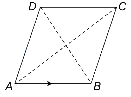
The vectors $\vec{AB} = 3\hat{i} - 2\hat{j} + 2\hat{k}$ and $\vec{BC} = \hat{i} - 2\hat{k}$ are the adjacent sides of a parallelogram. The angle between its diagonals is
A
$\frac{\pi}{2}$
B
$\frac{\pi}{3}$ or $\frac{2\pi}{3}$
C
$\frac{3\pi}{4}$ or $\frac{\pi}{4}$
D
None of these
Solution
(D) Given,$\vec{AB} = 3\hat{i} - 2\hat{j} + 2\hat{k}$ and $\vec{BC} = \hat{i} - 2\hat{k}$.
Let the diagonals be $\vec{d_1}$ and $\vec{d_2}$.
In a parallelogram $ABCD$,the diagonals are $\vec{AC} = \vec{AB} + \vec{BC}$ and $\vec{BD} = \vec{BC} - \vec{AB}$.
$\vec{AC} = (3\hat{i} - 2\hat{j} + 2\hat{k}) + (\hat{i} - 2\hat{k}) = 4\hat{i} - 2\hat{j}$.
$\vec{BD} = (\hat{i} - 2\hat{k}) - (3\hat{i} - 2\hat{j} + 2\hat{k}) = -2\hat{i} + 2\hat{j} - 4\hat{k}$.
The angle $\theta$ between the diagonals is given by $\cos \theta = \frac{|\vec{AC} \cdot \vec{BD}|}{|\vec{AC}| |\vec{BD}|}$.
$\vec{AC} \cdot \vec{BD} = (4)(-2) + (-2)(2) + (0)(-4) = -8 - 4 = -12$.
$|\vec{AC}| = \sqrt{4^2 + (-2)^2 + 0^2} = \sqrt{16 + 4} = \sqrt{20} = 2\sqrt{5}$.
$|\vec{BD}| = \sqrt{(-2)^2 + 2^2 + (-4)^2} = \sqrt{4 + 4 + 16} = \sqrt{24} = 2\sqrt{6}$.
$\cos \theta = \frac{|-12|}{(2\sqrt{5})(2\sqrt{6})} = \frac{12}{4\sqrt{30}} = \frac{3}{\sqrt{30}} = \sqrt{\frac{9}{30}} = \sqrt{\frac{3}{10}}$.
Thus,$\theta = \cos^{-1}\left(\sqrt{\frac{3}{10}}\right)$.
Since this value is not among the options,the correct answer is $D$.
Let the diagonals be $\vec{d_1}$ and $\vec{d_2}$.
In a parallelogram $ABCD$,the diagonals are $\vec{AC} = \vec{AB} + \vec{BC}$ and $\vec{BD} = \vec{BC} - \vec{AB}$.
$\vec{AC} = (3\hat{i} - 2\hat{j} + 2\hat{k}) + (\hat{i} - 2\hat{k}) = 4\hat{i} - 2\hat{j}$.
$\vec{BD} = (\hat{i} - 2\hat{k}) - (3\hat{i} - 2\hat{j} + 2\hat{k}) = -2\hat{i} + 2\hat{j} - 4\hat{k}$.
The angle $\theta$ between the diagonals is given by $\cos \theta = \frac{|\vec{AC} \cdot \vec{BD}|}{|\vec{AC}| |\vec{BD}|}$.
$\vec{AC} \cdot \vec{BD} = (4)(-2) + (-2)(2) + (0)(-4) = -8 - 4 = -12$.
$|\vec{AC}| = \sqrt{4^2 + (-2)^2 + 0^2} = \sqrt{16 + 4} = \sqrt{20} = 2\sqrt{5}$.
$|\vec{BD}| = \sqrt{(-2)^2 + 2^2 + (-4)^2} = \sqrt{4 + 4 + 16} = \sqrt{24} = 2\sqrt{6}$.
$\cos \theta = \frac{|-12|}{(2\sqrt{5})(2\sqrt{6})} = \frac{12}{4\sqrt{30}} = \frac{3}{\sqrt{30}} = \sqrt{\frac{9}{30}} = \sqrt{\frac{3}{10}}$.
Thus,$\theta = \cos^{-1}\left(\sqrt{\frac{3}{10}}\right)$.
Since this value is not among the options,the correct answer is $D$.
0 likes
View Solution853
EasyMCQ
If the vectors $\vec{a} = \hat{i} - 2x\hat{j} - 3y\hat{k}$ and $\vec{b} = \hat{i} + 3x\hat{j} + 2y\hat{k}$ are orthogonal to each other,then the locus of the point $(x, y)$ is
A
a circle
B
an ellipse
C
a parabola
D
a straight line
Solution
(A) Two vectors are orthogonal if their dot product is equal to $0$.
Given vectors are $\vec{a} = \hat{i} - 2x\hat{j} - 3y\hat{k}$ and $\vec{b} = \hat{i} + 3x\hat{j} + 2y\hat{k}$.
Taking the dot product: $\vec{a} \cdot \vec{b} = (1)(1) + (-2x)(3x) + (-3y)(2y) = 0$.
This simplifies to $1 - 6x^2 - 6y^2 = 0$.
Rearranging the terms,we get $6x^2 + 6y^2 = 1$,which implies $x^2 + y^2 = \frac{1}{6}$.
This is the equation of a circle with center at the origin $(0, 0)$ and radius $\frac{1}{\sqrt{6}}$.
Thus,the locus of the point $(x, y)$ is a circle.
Given vectors are $\vec{a} = \hat{i} - 2x\hat{j} - 3y\hat{k}$ and $\vec{b} = \hat{i} + 3x\hat{j} + 2y\hat{k}$.
Taking the dot product: $\vec{a} \cdot \vec{b} = (1)(1) + (-2x)(3x) + (-3y)(2y) = 0$.
This simplifies to $1 - 6x^2 - 6y^2 = 0$.
Rearranging the terms,we get $6x^2 + 6y^2 = 1$,which implies $x^2 + y^2 = \frac{1}{6}$.
This is the equation of a circle with center at the origin $(0, 0)$ and radius $\frac{1}{\sqrt{6}}$.
Thus,the locus of the point $(x, y)$ is a circle.
0 likes
View Solution854
EasyMCQ
Suppose $\overrightarrow{a}=\lambda \hat{i}-7 \hat{j}+3 \hat{k}$ and $\overrightarrow{b}=\lambda \hat{i}+\hat{j}+2 \lambda \hat{k}$. If the angle between $\overrightarrow{a}$ and $\overrightarrow{b}$ is greater than $90^{\circ}$,then $\lambda$ satisfies the inequality:
A
$-7 < \lambda < 1$
B
$\lambda > 1$
C
$1 < \lambda < 7$
D
$-5 < \lambda < 1$
Solution
(A) The angle $\theta$ between two vectors $\overrightarrow{a}$ and $\overrightarrow{b}$ is given by $\cos \theta = \frac{\overrightarrow{a} \cdot \overrightarrow{b}}{|\overrightarrow{a}| |\overrightarrow{b}|}$.
Since the angle $\theta > 90^{\circ}$,we have $\cos \theta < 0$,which implies $\overrightarrow{a} \cdot \overrightarrow{b} < 0$.
Calculating the dot product: $\overrightarrow{a} \cdot \overrightarrow{b} = (\lambda)(\lambda) + (-7)(1) + (3)(2\lambda) = \lambda^2 - 7 + 6\lambda$.
Setting the dot product to be less than zero: $\lambda^2 + 6\lambda - 7 < 0$.
Factoring the quadratic expression: $(\lambda + 7)(\lambda - 1) < 0$.
Solving the inequality,we find that $\lambda$ must lie between the roots $-7$ and $1$.
Therefore,$-7 < \lambda < 1$.
Since the angle $\theta > 90^{\circ}$,we have $\cos \theta < 0$,which implies $\overrightarrow{a} \cdot \overrightarrow{b} < 0$.
Calculating the dot product: $\overrightarrow{a} \cdot \overrightarrow{b} = (\lambda)(\lambda) + (-7)(1) + (3)(2\lambda) = \lambda^2 - 7 + 6\lambda$.
Setting the dot product to be less than zero: $\lambda^2 + 6\lambda - 7 < 0$.
Factoring the quadratic expression: $(\lambda + 7)(\lambda - 1) < 0$.
Solving the inequality,we find that $\lambda$ must lie between the roots $-7$ and $1$.
Therefore,$-7 < \lambda < 1$.
0 likes
View Solution855
EasyMCQ
If $\overrightarrow{a}+\overrightarrow{b}+\overrightarrow{c}=\overrightarrow{0}$ and $|\overrightarrow{a}|=3, |\overrightarrow{b}|=4$ and $|\overrightarrow{c}|=\sqrt{37}$,then the angle between $\overrightarrow{a}$ and $\overrightarrow{b}$ is:
A
$\frac{\pi}{4}$
B
$\frac{\pi}{2}$
C
$\frac{\pi}{6}$
D
$\frac{\pi}{3}$
Solution
(D) Given that $\overrightarrow{a}+\overrightarrow{b}+\overrightarrow{c}=\overrightarrow{0}$.
We can write this as $\overrightarrow{a}+\overrightarrow{b}=-\overrightarrow{c}$.
Squaring both sides,we get $(\overrightarrow{a}+\overrightarrow{b})^2=(-\overrightarrow{c})^2$.
Expanding the dot product,we have $|\overrightarrow{a}|^2+|\overrightarrow{b}|^2+2(\overrightarrow{a} \cdot \overrightarrow{b})=|\overrightarrow{c}|^2$.
Since $\overrightarrow{a} \cdot \overrightarrow{b} = |\overrightarrow{a}||\overrightarrow{b}| \cos \theta$,where $\theta$ is the angle between $\overrightarrow{a}$ and $\overrightarrow{b}$,we have $|\overrightarrow{a}|^2+|\overrightarrow{b}|^2+2|\overrightarrow{a}||\overrightarrow{b}| \cos \theta=|\overrightarrow{c}|^2$.
Substituting the given values $3^2+4^2+2(3)(4) \cos \theta = (\sqrt{37})^2$.
$9+16+24 \cos \theta = 37$.
$25+24 \cos \theta = 37$.
$24 \cos \theta = 37-25 = 12$.
$\cos \theta = \frac{12}{24} = \frac{1}{2}$.
Since $\cos \theta = \frac{1}{2}$,we have $\theta = \frac{\pi}{3}$.
We can write this as $\overrightarrow{a}+\overrightarrow{b}=-\overrightarrow{c}$.
Squaring both sides,we get $(\overrightarrow{a}+\overrightarrow{b})^2=(-\overrightarrow{c})^2$.
Expanding the dot product,we have $|\overrightarrow{a}|^2+|\overrightarrow{b}|^2+2(\overrightarrow{a} \cdot \overrightarrow{b})=|\overrightarrow{c}|^2$.
Since $\overrightarrow{a} \cdot \overrightarrow{b} = |\overrightarrow{a}||\overrightarrow{b}| \cos \theta$,where $\theta$ is the angle between $\overrightarrow{a}$ and $\overrightarrow{b}$,we have $|\overrightarrow{a}|^2+|\overrightarrow{b}|^2+2|\overrightarrow{a}||\overrightarrow{b}| \cos \theta=|\overrightarrow{c}|^2$.
Substituting the given values $3^2+4^2+2(3)(4) \cos \theta = (\sqrt{37})^2$.
$9+16+24 \cos \theta = 37$.
$25+24 \cos \theta = 37$.
$24 \cos \theta = 37-25 = 12$.
$\cos \theta = \frac{12}{24} = \frac{1}{2}$.
Since $\cos \theta = \frac{1}{2}$,we have $\theta = \frac{\pi}{3}$.
0 likes
View Solution856
EasyMCQ
The orthogonal projection of vector $a$ on vector $b$ is given by:
A
$\frac{(a \cdot b) a}{|a|^2}$
B
$\frac{(a \cdot b) b}{|b|^2}$
C
$\frac{a}{|a|^2}$
D
$\frac{b}{|b|}$
Solution
(B) The orthogonal projection of a vector $a$ onto a vector $b$ is defined as the component of $a$ along the direction of $b$.
The formula for the projection of $a$ on $b$ is given by:
$\text{Proj}_{b} a = \left( \frac{a \cdot b}{|b|^2} \right) b$
This represents a vector that is parallel to $b$ and has a magnitude equal to the scalar projection of $a$ on $b$.
The formula for the projection of $a$ on $b$ is given by:
$\text{Proj}_{b} a = \left( \frac{a \cdot b}{|b|^2} \right) b$
This represents a vector that is parallel to $b$ and has a magnitude equal to the scalar projection of $a$ on $b$.
0 likes
View Solution857
EasyMCQ
If $\theta$ is the angle between vectors $\vec{a}$ and $\vec{b}$ and $|\vec{a} \times \vec{b}| = |\vec{a} \cdot \vec{b}|$,then $\theta$ is equal to
A
$0$
B
$\pi$
C
$\frac{\pi}{2}$
D
$\frac{\pi}{4}$
Solution
(D) Given that,$|\vec{a} \times \vec{b}| = |\vec{a} \cdot \vec{b}|$.
Using the definitions of cross product and dot product:
$|\vec{a}| |\vec{b}| \sin \theta = |\vec{a}| |\vec{b}| \cos \theta$.
Dividing both sides by $|\vec{a}| |\vec{b}| \cos \theta$ (assuming $\vec{a}, \vec{b} \neq 0$ and $\cos \theta \neq 0$):
$\frac{\sin \theta}{\cos \theta} = 1$.
$\tan \theta = 1$.
Since $\theta$ is the angle between two vectors,$0 \leq \theta \leq \pi$.
Therefore,$\theta = \frac{\pi}{4}$.
Using the definitions of cross product and dot product:
$|\vec{a}| |\vec{b}| \sin \theta = |\vec{a}| |\vec{b}| \cos \theta$.
Dividing both sides by $|\vec{a}| |\vec{b}| \cos \theta$ (assuming $\vec{a}, \vec{b} \neq 0$ and $\cos \theta \neq 0$):
$\frac{\sin \theta}{\cos \theta} = 1$.
$\tan \theta = 1$.
Since $\theta$ is the angle between two vectors,$0 \leq \theta \leq \pi$.
Therefore,$\theta = \frac{\pi}{4}$.
0 likes
View Solution858
EasyMCQ
If $\theta$ is the angle between the vectors $2 \hat{i}-\hat{j}+2 \hat{k}$ and $a \hat{i}+4 \hat{j}+b \hat{k}$ and $\cos \theta=\frac{2}{3}$,then $2(a+b+3)=$
A
$a^2+b^2$
B
$a^2$
C
$b^2$
D
$ab$
Solution
(D) Let $\vec{u} = 2 \hat{i}-\hat{j}+2 \hat{k}$ and $\vec{v} = a \hat{i}+4 \hat{j}+b \hat{k}$.
Given $\cos \theta = \frac{\vec{u} \cdot \vec{v}}{|\vec{u}| |\vec{v}|} = \frac{2}{3}$.
The dot product $\vec{u} \cdot \vec{v} = (2)(a) + (-1)(4) + (2)(b) = 2a - 4 + 2b = 2(a+b-2)$.
The magnitudes are $|\vec{u}| = \sqrt{2^2 + (-1)^2 + 2^2} = \sqrt{4+1+4} = \sqrt{9} = 3$ and $|\vec{v}| = \sqrt{a^2 + 4^2 + b^2} = \sqrt{a^2+b^2+16}$.
Substituting these into the formula: $\frac{2}{3} = \frac{2(a+b-2)}{3 \sqrt{a^2+b^2+16}}$.
Simplifying,we get $\sqrt{a^2+b^2+16} = a+b-2$.
Squaring both sides: $a^2+b^2+16 = (a+b-2)^2 = (a+b)^2 - 4(a+b) + 4$.
$a^2+b^2+16 = a^2+b^2+2ab - 4a - 4b + 4$.
$16 = 2ab - 4a - 4b + 4$.
$12 = 2ab - 4(a+b)$.
$6 = ab - 2(a+b)$.
$ab = 2(a+b) + 6 = 2(a+b+3)$.
Thus,$2(a+b+3) = ab$.
Given $\cos \theta = \frac{\vec{u} \cdot \vec{v}}{|\vec{u}| |\vec{v}|} = \frac{2}{3}$.
The dot product $\vec{u} \cdot \vec{v} = (2)(a) + (-1)(4) + (2)(b) = 2a - 4 + 2b = 2(a+b-2)$.
The magnitudes are $|\vec{u}| = \sqrt{2^2 + (-1)^2 + 2^2} = \sqrt{4+1+4} = \sqrt{9} = 3$ and $|\vec{v}| = \sqrt{a^2 + 4^2 + b^2} = \sqrt{a^2+b^2+16}$.
Substituting these into the formula: $\frac{2}{3} = \frac{2(a+b-2)}{3 \sqrt{a^2+b^2+16}}$.
Simplifying,we get $\sqrt{a^2+b^2+16} = a+b-2$.
Squaring both sides: $a^2+b^2+16 = (a+b-2)^2 = (a+b)^2 - 4(a+b) + 4$.
$a^2+b^2+16 = a^2+b^2+2ab - 4a - 4b + 4$.
$16 = 2ab - 4a - 4b + 4$.
$12 = 2ab - 4(a+b)$.
$6 = ab - 2(a+b)$.
$ab = 2(a+b) + 6 = 2(a+b+3)$.
Thus,$2(a+b+3) = ab$.
0 likes
View Solution859
MediumMCQ
Three non-coplanar vectors $\bar{a}, \bar{b}, \bar{c}$ are the coterminous edges of a parallelepiped. If $\bar{a}$ and $\bar{b}$ determine the base of the parallelepiped,then its height is:
A
$\frac{|[\bar{a} \bar{b} \bar{c}]|}{|\bar{b} \times \bar{c}|}$
B
$\frac{|[\bar{a} \bar{b} \bar{c}]|}{|\bar{a} \times \bar{b}|}$
C
$\frac{|[\bar{a} \bar{b} \bar{c}]|}{|\bar{a} \times \bar{c}|}$
D
$\frac{|[\bar{a} \bar{b} \bar{c}]|}{|\bar{b}+\bar{c}|}$
Solution
(B) The volume of a parallelepiped formed by coterminous edges $\bar{a}, \bar{b}, \bar{c}$ is given by the scalar triple product $|[\bar{a} \bar{b} \bar{c}]|$.
Since $\bar{a}$ and $\bar{b}$ determine the base,the area of the base is given by $|\bar{a} \times \bar{b}|$.
The volume of a parallelepiped is also defined as $\text{Volume} = \text{Area of base} \times \text{Height}$.
Therefore,$\text{Height} = \frac{\text{Volume}}{\text{Area of base}} = \frac{|[\bar{a} \bar{b} \bar{c}]|}{|\bar{a} \times \bar{b}|}$.
Since $\bar{a}$ and $\bar{b}$ determine the base,the area of the base is given by $|\bar{a} \times \bar{b}|$.
The volume of a parallelepiped is also defined as $\text{Volume} = \text{Area of base} \times \text{Height}$.
Therefore,$\text{Height} = \frac{\text{Volume}}{\text{Area of base}} = \frac{|[\bar{a} \bar{b} \bar{c}]|}{|\bar{a} \times \bar{b}|}$.
0 likes
View Solution860
EasyMCQ
Let $\vec{a}=2 \hat{i}-\hat{j}+\hat{k}$ and $\vec{b}=2 \hat{j}-3 \hat{k}$. If $\vec{b}=\vec{c}-\vec{d}$,$\vec{a}$ is parallel to $\vec{c}$,and $\vec{a}$ is perpendicular to $\vec{d}$,then $\vec{c}+\vec{d}=$
A
$-\frac{1}{6}(2 \vec{a}+5 \vec{b})$
B
$\frac{1}{3}(3 \vec{a}+5 \vec{b})$
C
$\frac{1}{6}(5 \vec{a}+2 \vec{b})$
D
$-\frac{1}{3}(5 \vec{a}+3 \vec{b})$
Solution
(D) Given: $\vec{a}=2 \hat{i}-\hat{j}+\hat{k}$ and $\vec{b}=2 \hat{j}-3 \hat{k}$.
Since $\vec{a} \parallel \vec{c}$,we can write $\vec{c} = k \vec{a}$ for some scalar $k$.
Given $\vec{b} = \vec{c} - \vec{d}$,we have $\vec{d} = \vec{c} - \vec{b} = k \vec{a} - \vec{b}$.
Since $\vec{a} \perp \vec{d}$,their dot product is zero: $\vec{a} \cdot \vec{d} = 0$.
$\vec{a} \cdot (k \vec{a} - \vec{b}) = 0 \Rightarrow k |\vec{a}|^2 - \vec{a} \cdot \vec{b} = 0$.
Calculate $|\vec{a}|^2 = 2^2 + (-1)^2 + 1^2 = 4 + 1 + 1 = 6$.
Calculate $\vec{a} \cdot \vec{b} = (2)(0) + (-1)(2) + (1)(-3) = 0 - 2 - 3 = -5$.
Substituting these values: $k(6) - (-5) = 0 \Rightarrow 6k = -5 \Rightarrow k = -\frac{5}{6}$.
Thus,$\vec{c} = -\frac{5}{6} \vec{a}$.
Then $\vec{d} = \vec{c} - \vec{b} = -\frac{5}{6} \vec{a} - \vec{b}$.
Finally,$\vec{c} + \vec{d} = (-\frac{5}{6} \vec{a}) + (-\frac{5}{6} \vec{a} - \vec{b}) = -\frac{10}{6} \vec{a} - \vec{b} = -\frac{5}{3} \vec{a} - \vec{b} = -\frac{1}{3}(5 \vec{a} + 3 \vec{b})$.
Since $\vec{a} \parallel \vec{c}$,we can write $\vec{c} = k \vec{a}$ for some scalar $k$.
Given $\vec{b} = \vec{c} - \vec{d}$,we have $\vec{d} = \vec{c} - \vec{b} = k \vec{a} - \vec{b}$.
Since $\vec{a} \perp \vec{d}$,their dot product is zero: $\vec{a} \cdot \vec{d} = 0$.
$\vec{a} \cdot (k \vec{a} - \vec{b}) = 0 \Rightarrow k |\vec{a}|^2 - \vec{a} \cdot \vec{b} = 0$.
Calculate $|\vec{a}|^2 = 2^2 + (-1)^2 + 1^2 = 4 + 1 + 1 = 6$.
Calculate $\vec{a} \cdot \vec{b} = (2)(0) + (-1)(2) + (1)(-3) = 0 - 2 - 3 = -5$.
Substituting these values: $k(6) - (-5) = 0 \Rightarrow 6k = -5 \Rightarrow k = -\frac{5}{6}$.
Thus,$\vec{c} = -\frac{5}{6} \vec{a}$.
Then $\vec{d} = \vec{c} - \vec{b} = -\frac{5}{6} \vec{a} - \vec{b}$.
Finally,$\vec{c} + \vec{d} = (-\frac{5}{6} \vec{a}) + (-\frac{5}{6} \vec{a} - \vec{b}) = -\frac{10}{6} \vec{a} - \vec{b} = -\frac{5}{3} \vec{a} - \vec{b} = -\frac{1}{3}(5 \vec{a} + 3 \vec{b})$.
0 likes
View Solution861
EasyMCQ
Let $a=\hat{i}+2 \hat{j}-2 \hat{k}$ and $b=2 \hat{i}-\hat{j}-2 \hat{k}$. If the orthogonal projection vector of $a$ on $b$ is $x$ and the orthogonal projection vector of $b$ on $a$ is $y$,then $|x-y|=$
A
$\frac{4}{9} \sqrt{26}$
B
$\frac{8}{9} \sqrt{10}$
C
$\frac{4}{9} \sqrt{10}$
D
$\frac{8}{9} \sqrt{26}$
Solution
(C) The orthogonal projection of $a$ on $b$ is given by $x = \frac{a \cdot b}{|b|^2} b$.
The orthogonal projection of $b$ on $a$ is given by $y = \frac{a \cdot b}{|a|^2} a$.
Given $a = \hat{i} + 2\hat{j} - 2\hat{k}$ and $b = 2\hat{i} - \hat{j} - 2\hat{k}$.
Calculate the dot product: $a \cdot b = (1)(2) + (2)(-1) + (-2)(-2) = 2 - 2 + 4 = 4$.
Calculate the magnitudes squared: $|a|^2 = 1^2 + 2^2 + (-2)^2 = 1 + 4 + 4 = 9$ and $|b|^2 = 2^2 + (-1)^2 + (-2)^2 = 4 + 1 + 4 = 9$.
Thus,$x - y = \frac{a \cdot b}{|b|^2} b - \frac{a \cdot b}{|a|^2} a = \frac{4}{9} b - \frac{4}{9} a = \frac{4}{9} (b - a)$.
Calculate $b - a = (2\hat{i} - \hat{j} - 2\hat{k}) - (\hat{i} + 2\hat{j} - 2\hat{k}) = \hat{i} - 3\hat{j}$.
Then $x - y = \frac{4}{9} (\hat{i} - 3\hat{j})$.
Finally,$|x - y| = \frac{4}{9} \sqrt{1^2 + (-3)^2} = \frac{4}{9} \sqrt{1 + 9} = \frac{4}{9} \sqrt{10}$.
The orthogonal projection of $b$ on $a$ is given by $y = \frac{a \cdot b}{|a|^2} a$.
Given $a = \hat{i} + 2\hat{j} - 2\hat{k}$ and $b = 2\hat{i} - \hat{j} - 2\hat{k}$.
Calculate the dot product: $a \cdot b = (1)(2) + (2)(-1) + (-2)(-2) = 2 - 2 + 4 = 4$.
Calculate the magnitudes squared: $|a|^2 = 1^2 + 2^2 + (-2)^2 = 1 + 4 + 4 = 9$ and $|b|^2 = 2^2 + (-1)^2 + (-2)^2 = 4 + 1 + 4 = 9$.
Thus,$x - y = \frac{a \cdot b}{|b|^2} b - \frac{a \cdot b}{|a|^2} a = \frac{4}{9} b - \frac{4}{9} a = \frac{4}{9} (b - a)$.
Calculate $b - a = (2\hat{i} - \hat{j} - 2\hat{k}) - (\hat{i} + 2\hat{j} - 2\hat{k}) = \hat{i} - 3\hat{j}$.
Then $x - y = \frac{4}{9} (\hat{i} - 3\hat{j})$.
Finally,$|x - y| = \frac{4}{9} \sqrt{1^2 + (-3)^2} = \frac{4}{9} \sqrt{1 + 9} = \frac{4}{9} \sqrt{10}$.
0 likes
View Solution862
DifficultMCQ
$\bar{a}, \bar{b}, \bar{c}$ are three non-coplanar and mutually perpendicular vectors of same magnitude $K$. If $\bar{r}$ is any vector satisfying $\bar{a} \times ((\bar{r}-\bar{b}) \times \bar{a}) + \bar{b} \times ((\bar{r}-\bar{c}) \times \bar{b}) + \bar{c} \times ((\bar{r}-\bar{a}) \times \bar{c}) = \bar{0}$,then $\bar{r} =$
A
$\frac{K^2(\bar{a}+\bar{b}+\bar{c})}{3K^2}$
B
$\frac{\bar{a}+\bar{b}+\bar{c}}{2}$
C
$\frac{K(\bar{a}+\bar{b}+\bar{c})}{K+1}$
D
$\frac{\bar{a}+\bar{b}+\bar{c}}{3}$
Solution
(B) Given that $\bar{a}, \bar{b}, \bar{c}$ are mutually perpendicular vectors of magnitude $K$,we have $\bar{a} \cdot \bar{b} = \bar{b} \cdot \bar{c} = \bar{c} \cdot \bar{a} = 0$ and $|\bar{a}| = |\bar{b}| = |\bar{c}| = K$,so $\bar{a} \cdot \bar{a} = \bar{b} \cdot \bar{b} = \bar{c} \cdot \bar{c} = K^2$.
Using the vector triple product formula $\bar{u} \times (\bar{v} \times \bar{w}) = (\bar{u} \cdot \bar{w})\bar{v} - (\bar{u} \cdot \bar{v})\bar{w}$,the given equation becomes:
$(\bar{a} \cdot \bar{a})(\bar{r}-\bar{b}) - (\bar{a} \cdot (\bar{r}-\bar{b}))\bar{a} + (\bar{b} \cdot \bar{b})(\bar{r}-\bar{c}) - (\bar{b} \cdot (\bar{r}-\bar{c}))\bar{b} + (\bar{c} \cdot \bar{c})(\bar{r}-\bar{a}) - (\bar{c} \cdot (\bar{r}-\bar{a}))\bar{c} = \bar{0}$.
Substituting the dot products:
$K^2(\bar{r}-\bar{b}) - (\bar{a} \cdot \bar{r})\bar{a} + K^2(\bar{r}-\bar{c}) - (\bar{b} \cdot \bar{r})\bar{b} + K^2(\bar{r}-\bar{a}) - (\bar{c} \cdot \bar{r})\bar{c} = \bar{0}$.
$3K^2\bar{r} - K^2(\bar{a}+\bar{b}+\bar{c}) - ((\bar{a} \cdot \bar{r})\bar{a} + (\bar{b} \cdot \bar{r})\bar{b} + (\bar{c} \cdot \bar{r})\bar{c}) = \bar{0}$.
Since $\bar{a}, \bar{b}, \bar{c}$ are orthogonal,any vector $\bar{r}$ can be written as $\bar{r} = \frac{\bar{a} \cdot \bar{r}}{K^2}\bar{a} + \frac{\bar{b} \cdot \bar{r}}{K^2}\bar{b} + \frac{\bar{c} \cdot \bar{r}}{K^2}\bar{c}$.
Thus,$(\bar{a} \cdot \bar{r})\bar{a} + (\bar{b} \cdot \bar{r})\bar{b} + (\bar{c} \cdot \bar{r})\bar{c} = K^2\bar{r}$.
Substituting this back:
$3K^2\bar{r} - K^2(\bar{a}+\bar{b}+\bar{c}) - K^2\bar{r} = \bar{0}$.
$2K^2\bar{r} = K^2(\bar{a}+\bar{b}+\bar{c})$.
$\bar{r} = \frac{\bar{a}+\bar{b}+\bar{c}}{2}$.
Using the vector triple product formula $\bar{u} \times (\bar{v} \times \bar{w}) = (\bar{u} \cdot \bar{w})\bar{v} - (\bar{u} \cdot \bar{v})\bar{w}$,the given equation becomes:
$(\bar{a} \cdot \bar{a})(\bar{r}-\bar{b}) - (\bar{a} \cdot (\bar{r}-\bar{b}))\bar{a} + (\bar{b} \cdot \bar{b})(\bar{r}-\bar{c}) - (\bar{b} \cdot (\bar{r}-\bar{c}))\bar{b} + (\bar{c} \cdot \bar{c})(\bar{r}-\bar{a}) - (\bar{c} \cdot (\bar{r}-\bar{a}))\bar{c} = \bar{0}$.
Substituting the dot products:
$K^2(\bar{r}-\bar{b}) - (\bar{a} \cdot \bar{r})\bar{a} + K^2(\bar{r}-\bar{c}) - (\bar{b} \cdot \bar{r})\bar{b} + K^2(\bar{r}-\bar{a}) - (\bar{c} \cdot \bar{r})\bar{c} = \bar{0}$.
$3K^2\bar{r} - K^2(\bar{a}+\bar{b}+\bar{c}) - ((\bar{a} \cdot \bar{r})\bar{a} + (\bar{b} \cdot \bar{r})\bar{b} + (\bar{c} \cdot \bar{r})\bar{c}) = \bar{0}$.
Since $\bar{a}, \bar{b}, \bar{c}$ are orthogonal,any vector $\bar{r}$ can be written as $\bar{r} = \frac{\bar{a} \cdot \bar{r}}{K^2}\bar{a} + \frac{\bar{b} \cdot \bar{r}}{K^2}\bar{b} + \frac{\bar{c} \cdot \bar{r}}{K^2}\bar{c}$.
Thus,$(\bar{a} \cdot \bar{r})\bar{a} + (\bar{b} \cdot \bar{r})\bar{b} + (\bar{c} \cdot \bar{r})\bar{c} = K^2\bar{r}$.
Substituting this back:
$3K^2\bar{r} - K^2(\bar{a}+\bar{b}+\bar{c}) - K^2\bar{r} = \bar{0}$.
$2K^2\bar{r} = K^2(\bar{a}+\bar{b}+\bar{c})$.
$\bar{r} = \frac{\bar{a}+\bar{b}+\bar{c}}{2}$.
0 likes
View Solution863
MediumMCQ
If $\vec{b}=2 \hat{i}-\hat{j}-\hat{k}$,$\vec{a}=3 \hat{i}+4 \hat{j}-5 \hat{k}$ and $\vec{b} \times(\vec{a} \times \vec{b})=\frac{\vec{a}-k \vec{b}}{l}$,then $\frac{k}{l|\vec{b}|}$ is
A
the orthogonal projection of $\vec{b}$ on $\vec{a}$ and equal to $\frac{7}{\sqrt{50}}$
B
the orthogonal projection of $\vec{a}$ on $\vec{b}$ and equal to $\frac{7}{\sqrt{6}}$
C
the orthogonal projection of $\vec{b}$ in the direction perpendicular to $\vec{a}$ and equal to $\frac{5}{3}$
D
the orthogonal projection of $\vec{a}$ in the direction perpendicular to $\vec{b}$ and equal to $\frac{752}{3}$
Solution
(B) Given,$\vec{b}=2 \hat{i}-\hat{j}-\hat{k}$ and $\vec{a}=3 \hat{i}+4 \hat{j}-5 \hat{k}$.
First,calculate the dot products:
$\vec{b} \cdot \vec{b} = (2)^2 + (-1)^2 + (-1)^2 = 4 + 1 + 1 = 6$.
$\vec{b} \cdot \vec{a} = (2)(3) + (-1)(4) + (-1)(-5) = 6 - 4 + 5 = 7$.
Using the vector triple product formula $\vec{b} \times(\vec{a} \times \vec{b})=(\vec{b} \cdot \vec{b}) \vec{a}-(\vec{b} \cdot \vec{a}) \vec{b}$,we get:
$\vec{b} \times(\vec{a} \times \vec{b}) = 6 \vec{a} - 7 \vec{b}$.
We can rewrite this as $\frac{\vec{a} - (7/6) \vec{b}}{1/6}$.
Comparing this with the given expression $\frac{\vec{a}-k \vec{b}}{l}$,we find $k = 7/6$ and $l = 1/6$.
Now,calculate $|\vec{b}| = \sqrt{2^2 + (-1)^2 + (-1)^2} = \sqrt{6}$.
Finally,$\frac{k}{l|\vec{b}|} = \frac{7/6}{(1/6) \times \sqrt{6}} = \frac{7}{\sqrt{6}}$.
This value represents the scalar projection of $\vec{a}$ on $\vec{b}$,which is $\frac{\vec{a} \cdot \vec{b}}{|\vec{b}|} = \frac{7}{\sqrt{6}}$.
First,calculate the dot products:
$\vec{b} \cdot \vec{b} = (2)^2 + (-1)^2 + (-1)^2 = 4 + 1 + 1 = 6$.
$\vec{b} \cdot \vec{a} = (2)(3) + (-1)(4) + (-1)(-5) = 6 - 4 + 5 = 7$.
Using the vector triple product formula $\vec{b} \times(\vec{a} \times \vec{b})=(\vec{b} \cdot \vec{b}) \vec{a}-(\vec{b} \cdot \vec{a}) \vec{b}$,we get:
$\vec{b} \times(\vec{a} \times \vec{b}) = 6 \vec{a} - 7 \vec{b}$.
We can rewrite this as $\frac{\vec{a} - (7/6) \vec{b}}{1/6}$.
Comparing this with the given expression $\frac{\vec{a}-k \vec{b}}{l}$,we find $k = 7/6$ and $l = 1/6$.
Now,calculate $|\vec{b}| = \sqrt{2^2 + (-1)^2 + (-1)^2} = \sqrt{6}$.
Finally,$\frac{k}{l|\vec{b}|} = \frac{7/6}{(1/6) \times \sqrt{6}} = \frac{7}{\sqrt{6}}$.
This value represents the scalar projection of $\vec{a}$ on $\vec{b}$,which is $\frac{\vec{a} \cdot \vec{b}}{|\vec{b}|} = \frac{7}{\sqrt{6}}$.
0 likes
View Solution864
MediumMCQ
If $\bar{a} = \bar{i} + \sqrt{11} \bar{j} - 2 \bar{k}$ and $\bar{b} = \bar{i} + \sqrt{11} \bar{j} - 10 \bar{k}$ are two vectors,then the component of $\bar{b}$ perpendicular to $\bar{a}$ is:
A
$3 \bar{i} - \sqrt{11} \bar{j} - 4 \bar{k}$
B
$\bar{i} - \sqrt{11} \bar{j} - 5 \bar{k}$
C
$-(\bar{i} + \sqrt{11} \bar{j} + 6 \bar{k})$
D
$-5 \bar{i} + \sqrt{11} \bar{j} + 3 \bar{k}$
Solution
(C) The component of vector $\bar{b}$ perpendicular to $\bar{a}$ is given by $\bar{b} - \text{proj}_{\bar{a}} \bar{b} = \bar{b} - \left( \frac{\bar{b} \cdot \bar{a}}{|\bar{a}|^2} \right) \bar{a}$.
First,calculate the dot product $\bar{b} \cdot \bar{a} = (1)(1) + (\sqrt{11})(\sqrt{11}) + (-10)(-2) = 1 + 11 + 20 = 32$.
Next,calculate the magnitude squared $|\bar{a}|^2 = (1)^2 + (\sqrt{11})^2 + (-2)^2 = 1 + 11 + 4 = 16$.
Now,find the projection: $\frac{\bar{b} \cdot \bar{a}}{|\bar{a}|^2} \bar{a} = \frac{32}{16} \bar{a} = 2 \bar{a} = 2(\bar{i} + \sqrt{11} \bar{j} - 2 \bar{k}) = 2 \bar{i} + 2\sqrt{11} \bar{j} - 4 \bar{k}$.
Finally,the perpendicular component is $\bar{b} - 2 \bar{a} = (\bar{i} + \sqrt{11} \bar{j} - 10 \bar{k}) - (2 \bar{i} + 2\sqrt{11} \bar{j} - 4 \bar{k}) = (1-2) \bar{i} + (\sqrt{11} - 2\sqrt{11}) \bar{j} + (-10 + 4) \bar{k} = -\bar{i} - \sqrt{11} \bar{j} - 6 \bar{k} = -(\bar{i} + \sqrt{11} \bar{j} + 6 \bar{k})$.
Thus,the correct option is $C$.
First,calculate the dot product $\bar{b} \cdot \bar{a} = (1)(1) + (\sqrt{11})(\sqrt{11}) + (-10)(-2) = 1 + 11 + 20 = 32$.
Next,calculate the magnitude squared $|\bar{a}|^2 = (1)^2 + (\sqrt{11})^2 + (-2)^2 = 1 + 11 + 4 = 16$.
Now,find the projection: $\frac{\bar{b} \cdot \bar{a}}{|\bar{a}|^2} \bar{a} = \frac{32}{16} \bar{a} = 2 \bar{a} = 2(\bar{i} + \sqrt{11} \bar{j} - 2 \bar{k}) = 2 \bar{i} + 2\sqrt{11} \bar{j} - 4 \bar{k}$.
Finally,the perpendicular component is $\bar{b} - 2 \bar{a} = (\bar{i} + \sqrt{11} \bar{j} - 10 \bar{k}) - (2 \bar{i} + 2\sqrt{11} \bar{j} - 4 \bar{k}) = (1-2) \bar{i} + (\sqrt{11} - 2\sqrt{11}) \bar{j} + (-10 + 4) \bar{k} = -\bar{i} - \sqrt{11} \bar{j} - 6 \bar{k} = -(\bar{i} + \sqrt{11} \bar{j} + 6 \bar{k})$.
Thus,the correct option is $C$.
0 likes
View Solution865
MediumMCQ
Let $\bar{a} = \bar{i} + 2\bar{j} + 3\bar{k}$,$\bar{b} = 2\bar{i} - 3\bar{j} + \bar{k}$,and $\bar{c} = 3\bar{i} + \bar{j} - 2\bar{k}$ be three vectors. If $\bar{r}$ is a vector such that $\bar{r} \cdot \bar{a} = 0$,$\bar{r} \cdot \bar{b} = -2$,and $\bar{r} \cdot \bar{c} = 6$,then find the value of $\bar{r} \cdot (3\bar{i} + \bar{j} + \bar{k})$.
A
$0$
B
$1$
C
$2$
D
$3$
Solution
(D) Let $\bar{r} = x\bar{i} + y\bar{j} + z\bar{k}$.
Given the dot products:
$x + 2y + 3z = 0$ $(1)$
$2x - 3y + z = -2$ $(2)$
$3x + y - 2z = 6$ $(3)$
Solving this system of linear equations:
From $(1)$,$x = -2y - 3z$.
Substitute into $(2)$: $2(-2y - 3z) - 3y + z = -2 \implies -7y - 5z = -2 \implies 7y + 5z = 2$ $(4)$
Substitute into $(3)$: $3(-2y - 3z) + y - 2z = 6 \implies -5y - 11z = 6$ $(5)$
Multiply $(4)$ by $5$ and $(5)$ by $7$: $35y + 25z = 10$ and $-35y - 77z = 42$.
Adding these: $-52z = 52 \implies z = -1$.
Substitute $z = -1$ into $(4)$: $7y - 5 = 2 \implies 7y = 7 \implies y = 1$.
Substitute $y = 1, z = -1$ into $(1)$: $x + 2(1) + 3(-1) = 0 \implies x - 1 = 0 \implies x = 1$.
Thus,$\bar{r} = \bar{i} + \bar{j} - \bar{k}$.
Finally,calculate $\bar{r} \cdot (3\bar{i} + \bar{j} + \bar{k}) = (1)(3) + (1)(1) + (-1)(1) = 3 + 1 - 1 = 3$.
Given the dot products:
$x + 2y + 3z = 0$ $(1)$
$2x - 3y + z = -2$ $(2)$
$3x + y - 2z = 6$ $(3)$
Solving this system of linear equations:
From $(1)$,$x = -2y - 3z$.
Substitute into $(2)$: $2(-2y - 3z) - 3y + z = -2 \implies -7y - 5z = -2 \implies 7y + 5z = 2$ $(4)$
Substitute into $(3)$: $3(-2y - 3z) + y - 2z = 6 \implies -5y - 11z = 6$ $(5)$
Multiply $(4)$ by $5$ and $(5)$ by $7$: $35y + 25z = 10$ and $-35y - 77z = 42$.
Adding these: $-52z = 52 \implies z = -1$.
Substitute $z = -1$ into $(4)$: $7y - 5 = 2 \implies 7y = 7 \implies y = 1$.
Substitute $y = 1, z = -1$ into $(1)$: $x + 2(1) + 3(-1) = 0 \implies x - 1 = 0 \implies x = 1$.
Thus,$\bar{r} = \bar{i} + \bar{j} - \bar{k}$.
Finally,calculate $\bar{r} \cdot (3\bar{i} + \bar{j} + \bar{k}) = (1)(3) + (1)(1) + (-1)(1) = 3 + 1 - 1 = 3$.
0 likes
View Solution866
MediumMCQ
If $\bar{a}$ and $\bar{b}$ are two vectors such that $|\bar{a}|=|\bar{b}|=\sqrt{6}$ and $\bar{a} \cdot \bar{b}=-1$,then find the value of $|\bar{a} \times \bar{b}| \sin(\theta)$,where $\theta$ is the angle between $\bar{a}$ and $\bar{b}$.
A
$5$
B
$35$
C
$6$
D
$1$
Solution
(B) Given $|\bar{a}| = |\bar{b}| = \sqrt{6}$ and $\bar{a} \cdot \bar{b} = -1$.
We know that $\bar{a} \cdot \bar{b} = |\bar{a}| |\bar{b}| \cos(\theta)$.
Substituting the values: $-1 = (\sqrt{6})(\sqrt{6}) \cos(\theta) = 6 \cos(\theta)$.
So,$\cos(\theta) = -\frac{1}{6}$.
Since $\sin^2(\theta) = 1 - \cos^2(\theta)$,we have $\sin^2(\theta) = 1 - (-\frac{1}{6})^2 = 1 - \frac{1}{36} = \frac{35}{36}$.
Thus,$\sin(\theta) = \frac{\sqrt{35}}{6}$.
Now,$|\bar{a} \times \bar{b}| = |\bar{a}| |\bar{b}| \sin(\theta) = (\sqrt{6})(\sqrt{6}) \sin(\theta) = 6 \sin(\theta)$.
Therefore,$|\bar{a} \times \bar{b}| \sin(\theta) = 6 \sin(\theta) \cdot \sin(\theta) = 6 \sin^2(\theta) = 6 \times \frac{35}{36} = \frac{35}{6}$.
We know that $\bar{a} \cdot \bar{b} = |\bar{a}| |\bar{b}| \cos(\theta)$.
Substituting the values: $-1 = (\sqrt{6})(\sqrt{6}) \cos(\theta) = 6 \cos(\theta)$.
So,$\cos(\theta) = -\frac{1}{6}$.
Since $\sin^2(\theta) = 1 - \cos^2(\theta)$,we have $\sin^2(\theta) = 1 - (-\frac{1}{6})^2 = 1 - \frac{1}{36} = \frac{35}{36}$.
Thus,$\sin(\theta) = \frac{\sqrt{35}}{6}$.
Now,$|\bar{a} \times \bar{b}| = |\bar{a}| |\bar{b}| \sin(\theta) = (\sqrt{6})(\sqrt{6}) \sin(\theta) = 6 \sin(\theta)$.
Therefore,$|\bar{a} \times \bar{b}| \sin(\theta) = 6 \sin(\theta) \cdot \sin(\theta) = 6 \sin^2(\theta) = 6 \times \frac{35}{36} = \frac{35}{6}$.
0 likes
View Solution867
EasyMCQ
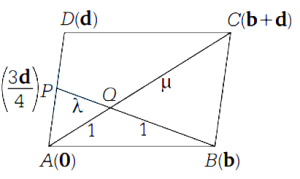
$ABCD$ is a parallelogram and $P$ is a point on the segment $AD$ dividing it internally in the ratio $3:1$. If the line $BP$ meets the diagonal $AC$ in $Q$,then $AQ:QC$ equals
A
$3:4$
B
$4:3$
C
$3:2$
D
$2:3$
Solution
(A) Let the position vectors of vertices $A, B, D$ be $\vec{0}, \vec{b}, \vec{d}$ respectively. Then the position vector of $C$ is $\vec{b} + \vec{d}$.
Since $P$ divides $AD$ in the ratio $3:1$,the position vector of $P$ is $\vec{p} = \frac{3\vec{d} + 1\vec{0}}{3+1} = \frac{3}{4}\vec{d}$.
Let $Q$ divide $BP$ in the ratio $k:1$ and $AC$ in the ratio $m:1$.
The position vector of $Q$ on $BP$ is $\vec{q} = \frac{k\vec{p} + 1\vec{b}}{k+1} = \frac{k(\frac{3}{4}\vec{d}) + \vec{b}}{k+1} = \frac{1}{k+1}\vec{b} + \frac{3k}{4(k+1)}\vec{d}$.
The position vector of $Q$ on $AC$ is $\vec{q} = \frac{m\vec{c} + 1\vec{a}}{m+1} = \frac{m(\vec{b} + \vec{d})}{m+1} = \frac{m}{m+1}\vec{b} + \frac{m}{m+1}\vec{d}$.
Comparing the coefficients of $\vec{b}$ and $\vec{d}$:
$\frac{1}{k+1} = \frac{m}{m+1}$ and $\frac{3k}{4(k+1)} = \frac{m}{m+1}$.
Thus,$\frac{1}{k+1} = \frac{3k}{4(k+1)} \Rightarrow 4 = 3k \Rightarrow k = \frac{4}{3}$.
Substituting $k = \frac{4}{3}$ into $\frac{m}{m+1} = \frac{1}{k+1} = \frac{1}{4/3 + 1} = \frac{1}{7/3} = \frac{3}{7}$.
$7m = 3m + 3 \Rightarrow 4m = 3 \Rightarrow m = \frac{3}{4}$.
Therefore,$AQ:QC = m:1 = \frac{3}{4}:1 = 3:4$.
Since $P$ divides $AD$ in the ratio $3:1$,the position vector of $P$ is $\vec{p} = \frac{3\vec{d} + 1\vec{0}}{3+1} = \frac{3}{4}\vec{d}$.
Let $Q$ divide $BP$ in the ratio $k:1$ and $AC$ in the ratio $m:1$.
The position vector of $Q$ on $BP$ is $\vec{q} = \frac{k\vec{p} + 1\vec{b}}{k+1} = \frac{k(\frac{3}{4}\vec{d}) + \vec{b}}{k+1} = \frac{1}{k+1}\vec{b} + \frac{3k}{4(k+1)}\vec{d}$.
The position vector of $Q$ on $AC$ is $\vec{q} = \frac{m\vec{c} + 1\vec{a}}{m+1} = \frac{m(\vec{b} + \vec{d})}{m+1} = \frac{m}{m+1}\vec{b} + \frac{m}{m+1}\vec{d}$.
Comparing the coefficients of $\vec{b}$ and $\vec{d}$:
$\frac{1}{k+1} = \frac{m}{m+1}$ and $\frac{3k}{4(k+1)} = \frac{m}{m+1}$.
Thus,$\frac{1}{k+1} = \frac{3k}{4(k+1)} \Rightarrow 4 = 3k \Rightarrow k = \frac{4}{3}$.
Substituting $k = \frac{4}{3}$ into $\frac{m}{m+1} = \frac{1}{k+1} = \frac{1}{4/3 + 1} = \frac{1}{7/3} = \frac{3}{7}$.
$7m = 3m + 3 \Rightarrow 4m = 3 \Rightarrow m = \frac{3}{4}$.
Therefore,$AQ:QC = m:1 = \frac{3}{4}:1 = 3:4$.
0 likes
View Solution868
MediumMCQ
Let $\vec{a}$ be a vector in the plane containing vectors $\vec{b}=\hat{i}+2 \hat{j}+\hat{k}$ and $\vec{c}=2 \hat{i}-\hat{j}+\hat{k}$. If $\vec{a}$ is perpendicular to $\hat{i}+\hat{j}+3 \hat{k}$ and its projection on $\vec{b}$ is $3 \sqrt{6}$,then $|\vec{a}|^2=$
A
$186$
B
$36$
C
$128$
D
$264$
Solution
(D) Let $\vec{a}=a_1 \hat{i}+a_2 \hat{j}+a_3 \hat{k}$.
Since $\vec{a}$ lies in the plane containing $\vec{b}$ and $\vec{c}$,$\vec{a}, \vec{b},$ and $\vec{c}$ are coplanar. Thus,$\vec{a} \cdot (\vec{b} \times \vec{c}) = 0$.
Calculating $\vec{b} \times \vec{c} = \begin{vmatrix} \hat{i} & \hat{j} & \hat{k} \\ 1 & 2 & 1 \\ 2 & -1 & 1 \end{vmatrix} = \hat{i}(2+1) - \hat{j}(1-2) + \hat{k}(-1-4) = 3\hat{i} + \hat{j} - 5\hat{k}$.
So,$(a_1 \hat{i} + a_2 \hat{j} + a_3 \hat{k}) \cdot (3\hat{i} + \hat{j} - 5\hat{k}) = 0 \Rightarrow 3a_1 + a_2 - 5a_3 = 0 \dots (i)$.
Since $\vec{a}$ is perpendicular to $\hat{i} + \hat{j} + 3\hat{k}$,we have $(a_1 \hat{i} + a_2 \hat{j} + a_3 \hat{k}) \cdot (\hat{i} + \hat{j} + 3\hat{k}) = 0 \Rightarrow a_1 + a_2 + 3a_3 = 0 \dots (ii)$.
The projection of $\vec{a}$ on $\vec{b}$ is $3\sqrt{6}$,so $\frac{\vec{a} \cdot \vec{b}}{|\vec{b}|} = 3\sqrt{6}$.
$\frac{a_1 + 2a_2 + a_3}{\sqrt{1^2 + 2^2 + 1^2}} = 3\sqrt{6} \Rightarrow a_1 + 2a_2 + a_3 = 3\sqrt{6} \cdot \sqrt{6} = 18 \dots (iii)$.
Solving equations $(i), (ii),$ and $(iii)$:
Subtracting $(ii)$ from $(i)$: $2a_1 - 8a_3 = 0 \Rightarrow a_1 = 4a_3$.
Substituting $a_1 = 4a_3$ into $(ii)$: $4a_3 + a_2 + 3a_3 = 0 \Rightarrow a_2 = -7a_3$.
Substituting into $(iii)$: $4a_3 + 2(-7a_3) + a_3 = 18 \Rightarrow 4a_3 - 14a_3 + a_3 = 18 \Rightarrow -9a_3 = 18 \Rightarrow a_3 = -2$.
Thus,$a_1 = -8$ and $a_2 = 14$.
Therefore,$\vec{a} = -8\hat{i} + 14\hat{j} - 2\hat{k}$.
$|\vec{a}|^2 = (-8)^2 + 14^2 + (-2)^2 = 64 + 196 + 4 = 264$.
Since $\vec{a}$ lies in the plane containing $\vec{b}$ and $\vec{c}$,$\vec{a}, \vec{b},$ and $\vec{c}$ are coplanar. Thus,$\vec{a} \cdot (\vec{b} \times \vec{c}) = 0$.
Calculating $\vec{b} \times \vec{c} = \begin{vmatrix} \hat{i} & \hat{j} & \hat{k} \\ 1 & 2 & 1 \\ 2 & -1 & 1 \end{vmatrix} = \hat{i}(2+1) - \hat{j}(1-2) + \hat{k}(-1-4) = 3\hat{i} + \hat{j} - 5\hat{k}$.
So,$(a_1 \hat{i} + a_2 \hat{j} + a_3 \hat{k}) \cdot (3\hat{i} + \hat{j} - 5\hat{k}) = 0 \Rightarrow 3a_1 + a_2 - 5a_3 = 0 \dots (i)$.
Since $\vec{a}$ is perpendicular to $\hat{i} + \hat{j} + 3\hat{k}$,we have $(a_1 \hat{i} + a_2 \hat{j} + a_3 \hat{k}) \cdot (\hat{i} + \hat{j} + 3\hat{k}) = 0 \Rightarrow a_1 + a_2 + 3a_3 = 0 \dots (ii)$.
The projection of $\vec{a}$ on $\vec{b}$ is $3\sqrt{6}$,so $\frac{\vec{a} \cdot \vec{b}}{|\vec{b}|} = 3\sqrt{6}$.
$\frac{a_1 + 2a_2 + a_3}{\sqrt{1^2 + 2^2 + 1^2}} = 3\sqrt{6} \Rightarrow a_1 + 2a_2 + a_3 = 3\sqrt{6} \cdot \sqrt{6} = 18 \dots (iii)$.
Solving equations $(i), (ii),$ and $(iii)$:
Subtracting $(ii)$ from $(i)$: $2a_1 - 8a_3 = 0 \Rightarrow a_1 = 4a_3$.
Substituting $a_1 = 4a_3$ into $(ii)$: $4a_3 + a_2 + 3a_3 = 0 \Rightarrow a_2 = -7a_3$.
Substituting into $(iii)$: $4a_3 + 2(-7a_3) + a_3 = 18 \Rightarrow 4a_3 - 14a_3 + a_3 = 18 \Rightarrow -9a_3 = 18 \Rightarrow a_3 = -2$.
Thus,$a_1 = -8$ and $a_2 = 14$.
Therefore,$\vec{a} = -8\hat{i} + 14\hat{j} - 2\hat{k}$.
$|\vec{a}|^2 = (-8)^2 + 14^2 + (-2)^2 = 64 + 196 + 4 = 264$.
0 likes
View Solution869
EasyMCQ
Let $A=(3,4,0), B=(4,4,4), C=(-6,2,3)$ and $D=(1,1,2)$. If $\theta$ is the acute angle between the lines $AB$ and $CD$,then $\cos \theta=$
A
$\frac{4}{17 \sqrt{3}}$
B
$\frac{3}{17 \sqrt{3}}$
C
$\frac{12}{17 \sqrt{3}}$
D
$\frac{11}{17 \sqrt{3}}$
Solution
(B) The vector $\overrightarrow{AB}$ is given by $B - A = (4-3, 4-4, 4-0) = (1, 0, 4)$.
The vector $\overrightarrow{CD}$ is given by $D - C = (1 - (-6), 1 - 2, 2 - 3) = (7, -1, -1)$.
The dot product $\overrightarrow{AB} \cdot \overrightarrow{CD} = (1)(7) + (0)(-1) + (4)(-1) = 7 + 0 - 4 = 3$.
The magnitude of $\overrightarrow{AB}$ is $|\overrightarrow{AB}| = \sqrt{1^2 + 0^2 + 4^2} = \sqrt{1 + 0 + 16} = \sqrt{17}$.
The magnitude of $\overrightarrow{CD}$ is $|\overrightarrow{CD}| = \sqrt{7^2 + (-1)^2 + (-1)^2} = \sqrt{49 + 1 + 1} = \sqrt{51}$.
Since $\sqrt{51} = \sqrt{17 \times 3} = \sqrt{17} \sqrt{3}$,we have $|\overrightarrow{CD}| = \sqrt{17} \sqrt{3}$.
The cosine of the angle $\theta$ is given by $\cos \theta = \frac{|\overrightarrow{AB} \cdot \overrightarrow{CD}|}{|\overrightarrow{AB}| |\overrightarrow{CD}|} = \frac{3}{\sqrt{17} \cdot \sqrt{17} \sqrt{3}} = \frac{3}{17 \sqrt{3}}$.
The vector $\overrightarrow{CD}$ is given by $D - C = (1 - (-6), 1 - 2, 2 - 3) = (7, -1, -1)$.
The dot product $\overrightarrow{AB} \cdot \overrightarrow{CD} = (1)(7) + (0)(-1) + (4)(-1) = 7 + 0 - 4 = 3$.
The magnitude of $\overrightarrow{AB}$ is $|\overrightarrow{AB}| = \sqrt{1^2 + 0^2 + 4^2} = \sqrt{1 + 0 + 16} = \sqrt{17}$.
The magnitude of $\overrightarrow{CD}$ is $|\overrightarrow{CD}| = \sqrt{7^2 + (-1)^2 + (-1)^2} = \sqrt{49 + 1 + 1} = \sqrt{51}$.
Since $\sqrt{51} = \sqrt{17 \times 3} = \sqrt{17} \sqrt{3}$,we have $|\overrightarrow{CD}| = \sqrt{17} \sqrt{3}$.
The cosine of the angle $\theta$ is given by $\cos \theta = \frac{|\overrightarrow{AB} \cdot \overrightarrow{CD}|}{|\overrightarrow{AB}| |\overrightarrow{CD}|} = \frac{3}{\sqrt{17} \cdot \sqrt{17} \sqrt{3}} = \frac{3}{17 \sqrt{3}}$.
0 likes
View Solution870
MediumMCQ
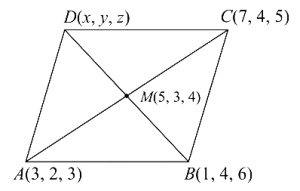
If $A(3,2,3)$,$B(1,4,6)$,and $C(7,4,5)$ are the three vertices of a parallelogram $ABCD$,then the angle between its diagonal through $D$ and the side $DC$ is
A
$\cos ^{-1}\left(\frac{16}{\sqrt{357}}\right)$
B
$\cos ^{-1}\left(\frac{5}{\sqrt{126}}\right)$
C
$\cos ^{-1}\left(\frac{5}{\sqrt{21}}\right)$
D
$\cos ^{-1}\left(\frac{2}{\sqrt{357}}\right)$
Solution
(A) In a parallelogram $ABCD$,the diagonals $AC$ and $BD$ bisect each other at point $M$.
$M$ is the midpoint of $AC$,so $M = \left(\frac{3+7}{2}, \frac{2+4}{2}, \frac{3+5}{2}\right) = (5, 3, 4)$.
Since $M$ is also the midpoint of $BD$,let $D = (x, y, z)$. Then $\left(\frac{x+1}{2}, \frac{y+4}{2}, \frac{z+6}{2}\right) = (5, 3, 4)$.
Solving for $x, y, z$: $x+1=10 \Rightarrow x=9$; $y+4=6 \Rightarrow y=2$; $z+6=8 \Rightarrow z=2$. Thus,$D = (9, 2, 2)$.
The vector $\vec{DC} = (7-9, 4-2, 5-2) = (-2, 2, 3)$. The direction ratios are $a_1 = -2, b_1 = 2, c_1 = 3$.
The vector $\vec{DB} = (1-9, 4-2, 6-2) = (-8, 2, 4)$. The direction ratios are $a_2 = -8, b_2 = 2, c_2 = 4$.
The angle $\theta$ between $\vec{DC}$ and $\vec{DB}$ is given by $\cos \theta = \frac{|a_1 a_2 + b_1 b_2 + c_1 c_2|}{\sqrt{a_1^2 + b_1^2 + c_1^2} \sqrt{a_2^2 + b_2^2 + c_2^2}}$.
$\cos \theta = \frac{|(-2)(-8) + (2)(2) + (3)(4)|}{\sqrt{(-2)^2 + 2^2 + 3^2} \sqrt{(-8)^2 + 2^2 + 4^2}} = \frac{|16 + 4 + 12|}{\sqrt{4+4+9} \sqrt{64+4+16}} = \frac{32}{\sqrt{17} \sqrt{84}} = \frac{32}{\sqrt{17} \cdot 2\sqrt{21}} = \frac{16}{\sqrt{357}}$.
Therefore,$\theta = \cos ^{-1}\left(\frac{16}{\sqrt{357}}\right)$.
$M$ is the midpoint of $AC$,so $M = \left(\frac{3+7}{2}, \frac{2+4}{2}, \frac{3+5}{2}\right) = (5, 3, 4)$.
Since $M$ is also the midpoint of $BD$,let $D = (x, y, z)$. Then $\left(\frac{x+1}{2}, \frac{y+4}{2}, \frac{z+6}{2}\right) = (5, 3, 4)$.
Solving for $x, y, z$: $x+1=10 \Rightarrow x=9$; $y+4=6 \Rightarrow y=2$; $z+6=8 \Rightarrow z=2$. Thus,$D = (9, 2, 2)$.
The vector $\vec{DC} = (7-9, 4-2, 5-2) = (-2, 2, 3)$. The direction ratios are $a_1 = -2, b_1 = 2, c_1 = 3$.
The vector $\vec{DB} = (1-9, 4-2, 6-2) = (-8, 2, 4)$. The direction ratios are $a_2 = -8, b_2 = 2, c_2 = 4$.
The angle $\theta$ between $\vec{DC}$ and $\vec{DB}$ is given by $\cos \theta = \frac{|a_1 a_2 + b_1 b_2 + c_1 c_2|}{\sqrt{a_1^2 + b_1^2 + c_1^2} \sqrt{a_2^2 + b_2^2 + c_2^2}}$.
$\cos \theta = \frac{|(-2)(-8) + (2)(2) + (3)(4)|}{\sqrt{(-2)^2 + 2^2 + 3^2} \sqrt{(-8)^2 + 2^2 + 4^2}} = \frac{|16 + 4 + 12|}{\sqrt{4+4+9} \sqrt{64+4+16}} = \frac{32}{\sqrt{17} \sqrt{84}} = \frac{32}{\sqrt{17} \cdot 2\sqrt{21}} = \frac{16}{\sqrt{357}}$.
Therefore,$\theta = \cos ^{-1}\left(\frac{16}{\sqrt{357}}\right)$.
0 likes
View Solution871
MediumMCQ
If the position vectors of three points $A, B, C$ are $\hat{i}+2\hat{j}+\hat{k}$,$2\hat{i}-\hat{j}+2\hat{k}$ and $\hat{i}+\hat{j}+2\hat{k}$ respectively,then the perpendicular distance of the point $C$ from the line $AB$ is
A
$\sqrt{\frac{3}{11}}$
B
$\sqrt{\frac{4}{11}}$
C
$\sqrt{\frac{6}{11}}$
D
$\sqrt{\frac{8}{11}}$
Solution
(C) Given position vectors are:
$A = \hat{i}+2\hat{j}+\hat{k}$
$B = 2\hat{i}-\hat{j}+2\hat{k}$
$C = \hat{i}+\hat{j}+2\hat{k}$
First,find the vectors $\overrightarrow{AC}$ and $\overrightarrow{AB}$:
$\overrightarrow{AC} = \overrightarrow{C} - \overrightarrow{A} = (\hat{i}+\hat{j}+2\hat{k}) - (\hat{i}+2\hat{j}+\hat{k}) = 0\hat{i} - \hat{j} + \hat{k}$
$\overrightarrow{AB} = \overrightarrow{B} - \overrightarrow{A} = (2\hat{i}-\hat{j}+2\hat{k}) - (\hat{i}+2\hat{j}+\hat{k}) = \hat{i} - 3\hat{j} + \hat{k}$
Now,calculate the cross product $\overrightarrow{AC} \times \overrightarrow{AB}$:
$\overrightarrow{AC} \times \overrightarrow{AB} = \begin{vmatrix} \hat{i} & \hat{j} & \hat{k} \\ 0 & -1 & 1 \\ 1 & -3 & 1 \end{vmatrix} = \hat{i}(-1+3) - \hat{j}(0-1) + \hat{k}(0+1) = 2\hat{i} + \hat{j} + \hat{k}$
The magnitude of the cross product is $|\overrightarrow{AC} \times \overrightarrow{AB}| = \sqrt{2^2 + 1^2 + 1^2} = \sqrt{6}$.
The magnitude of $\overrightarrow{AB}$ is $|\overrightarrow{AB}| = \sqrt{1^2 + (-3)^2 + 1^2} = \sqrt{1+9+1} = \sqrt{11}$.
The perpendicular distance from point $C$ to line $AB$ is given by the formula $d = \frac{|\overrightarrow{AC} \times \overrightarrow{AB}|}{|\overrightarrow{AB}|}$.
$d = \frac{\sqrt{6}}{\sqrt{11}} = \sqrt{\frac{6}{11}}$.
$A = \hat{i}+2\hat{j}+\hat{k}$
$B = 2\hat{i}-\hat{j}+2\hat{k}$
$C = \hat{i}+\hat{j}+2\hat{k}$
First,find the vectors $\overrightarrow{AC}$ and $\overrightarrow{AB}$:
$\overrightarrow{AC} = \overrightarrow{C} - \overrightarrow{A} = (\hat{i}+\hat{j}+2\hat{k}) - (\hat{i}+2\hat{j}+\hat{k}) = 0\hat{i} - \hat{j} + \hat{k}$
$\overrightarrow{AB} = \overrightarrow{B} - \overrightarrow{A} = (2\hat{i}-\hat{j}+2\hat{k}) - (\hat{i}+2\hat{j}+\hat{k}) = \hat{i} - 3\hat{j} + \hat{k}$
Now,calculate the cross product $\overrightarrow{AC} \times \overrightarrow{AB}$:
$\overrightarrow{AC} \times \overrightarrow{AB} = \begin{vmatrix} \hat{i} & \hat{j} & \hat{k} \\ 0 & -1 & 1 \\ 1 & -3 & 1 \end{vmatrix} = \hat{i}(-1+3) - \hat{j}(0-1) + \hat{k}(0+1) = 2\hat{i} + \hat{j} + \hat{k}$
The magnitude of the cross product is $|\overrightarrow{AC} \times \overrightarrow{AB}| = \sqrt{2^2 + 1^2 + 1^2} = \sqrt{6}$.
The magnitude of $\overrightarrow{AB}$ is $|\overrightarrow{AB}| = \sqrt{1^2 + (-3)^2 + 1^2} = \sqrt{1+9+1} = \sqrt{11}$.
The perpendicular distance from point $C$ to line $AB$ is given by the formula $d = \frac{|\overrightarrow{AC} \times \overrightarrow{AB}|}{|\overrightarrow{AB}|}$.
$d = \frac{\sqrt{6}}{\sqrt{11}} = \sqrt{\frac{6}{11}}$.
0 likes
View Solution872
EasyMCQ
If $a$ is a unit vector,then $|a \times \hat{i}|^2+|a \times \hat{j}|^2+|a \times \hat{k}|^2=$
A
$2$
B
$4$
C
$1$
D
$0$
Solution
(A) Let $a = a_1 \hat{i} + a_2 \hat{j} + a_3 \hat{k}$. Since $a$ is a unit vector,$|a|^2 = a_1^2 + a_2^2 + a_3^2 = 1$.
Now,$a \times \hat{i} = (a_1 \hat{i} + a_2 \hat{j} + a_3 \hat{k}) \times \hat{i} = -a_2 \hat{k} + a_3 \hat{j}$.
So,$|a \times \hat{i}|^2 = a_2^2 + a_3^2$.
Similarly,$|a \times \hat{j}|^2 = a_1^2 + a_3^2$ and $|a \times \hat{k}|^2 = a_1^2 + a_2^2$.
Adding these,we get $|a \times \hat{i}|^2 + |a \times \hat{j}|^2 + |a \times \hat{k}|^2 = (a_2^2 + a_3^2) + (a_1^2 + a_3^2) + (a_1^2 + a_2^2) = 2(a_1^2 + a_2^2 + a_3^2)$.
Since $a_1^2 + a_2^2 + a_3^2 = 1$,the sum is $2(1) = 2$.
Now,$a \times \hat{i} = (a_1 \hat{i} + a_2 \hat{j} + a_3 \hat{k}) \times \hat{i} = -a_2 \hat{k} + a_3 \hat{j}$.
So,$|a \times \hat{i}|^2 = a_2^2 + a_3^2$.
Similarly,$|a \times \hat{j}|^2 = a_1^2 + a_3^2$ and $|a \times \hat{k}|^2 = a_1^2 + a_2^2$.
Adding these,we get $|a \times \hat{i}|^2 + |a \times \hat{j}|^2 + |a \times \hat{k}|^2 = (a_2^2 + a_3^2) + (a_1^2 + a_3^2) + (a_1^2 + a_2^2) = 2(a_1^2 + a_2^2 + a_3^2)$.
Since $a_1^2 + a_2^2 + a_3^2 = 1$,the sum is $2(1) = 2$.
0 likes
View Solution873
EasyMCQ
Let $a = i + 2j + k$,$b = i - j + k$,and $c = i + j - k$. $A$ vector in the plane of $a$ and $b$ has a projection of $\frac{1}{\sqrt{3}}$ on $c$. Then,one such vector is:
A
$4i + j - 4k$
B
$3i + j - 3k$
C
$4i - j + 4k$
D
$2i + j + 2k$
Solution
(D) Since the vector $r$ lies in the plane of $a$ and $b$,it can be expressed as a linear combination: $r = a + tb$ (assuming the vector is not parallel to $b$).
$r = (i + 2j + k) + t(i - j + k) = (1 + t)i + (2 - t)j + (1 + t)k$.
Given that the projection of $r$ on $c$ is $\frac{1}{\sqrt{3}}$,we use the formula: $\frac{r \cdot c}{|c|} = \frac{1}{\sqrt{3}}$.
First,calculate $|c| = \sqrt{1^2 + 1^2 + (-1)^2} = \sqrt{3}$.
Now,calculate the dot product $r \cdot c = ((1 + t)i + (2 - t)j + (1 + t)k) \cdot (i + j - k) = (1 + t) + (2 - t) - (1 + t) = 2 - t$.
Substituting these into the projection formula: $\frac{2 - t}{\sqrt{3}} = \frac{1}{\sqrt{3}}$.
This implies $2 - t = 1$,so $t = 1$.
Substituting $t = 1$ back into the expression for $r$: $r = (1 + 1)i + (2 - 1)j + (1 + 1)k = 2i + j + 2k$.
$r = (i + 2j + k) + t(i - j + k) = (1 + t)i + (2 - t)j + (1 + t)k$.
Given that the projection of $r$ on $c$ is $\frac{1}{\sqrt{3}}$,we use the formula: $\frac{r \cdot c}{|c|} = \frac{1}{\sqrt{3}}$.
First,calculate $|c| = \sqrt{1^2 + 1^2 + (-1)^2} = \sqrt{3}$.
Now,calculate the dot product $r \cdot c = ((1 + t)i + (2 - t)j + (1 + t)k) \cdot (i + j - k) = (1 + t) + (2 - t) - (1 + t) = 2 - t$.
Substituting these into the projection formula: $\frac{2 - t}{\sqrt{3}} = \frac{1}{\sqrt{3}}$.
This implies $2 - t = 1$,so $t = 1$.
Substituting $t = 1$ back into the expression for $r$: $r = (1 + 1)i + (2 - 1)j + (1 + 1)k = 2i + j + 2k$.
0 likes
View Solution874
MediumMCQ
The magnitude of the projection of the vector $\vec{a} = 4\hat{i} - 3\hat{j} + 2\hat{k}$ on the line which makes equal angles with the coordinate axes is
A
$\sqrt{2}$
B
$\sqrt{3}$
C
$\frac{1}{\sqrt{3}}$
D
$\frac{1}{\sqrt{2}}$
Solution
(B) Let the unit vector along the line be $\hat{u} = \cos \alpha \hat{i} + \cos \alpha \hat{j} + \cos \alpha \hat{k}$.
Since $\cos^2 \alpha + \cos^2 \alpha + \cos^2 \alpha = 1$,we have $3 \cos^2 \alpha = 1$,which implies $\cos \alpha = \pm \frac{1}{\sqrt{3}}$.
Thus,the unit vector along the line is $\hat{u} = \pm \frac{1}{\sqrt{3}}(\hat{i} + \hat{j} + \hat{k})$.
The projection of vector $\vec{a} = 4\hat{i} - 3\hat{j} + 2\hat{k}$ on the line is given by the magnitude of the dot product $\vec{a} \cdot \hat{u}$.
$|\vec{a} \cdot \hat{u}| = |(4\hat{i} - 3\hat{j} + 2\hat{k}) \cdot \pm \frac{1}{\sqrt{3}}(\hat{i} + \hat{j} + \hat{k})|$
$= |\pm \frac{1}{\sqrt{3}}(4 - 3 + 2)|$
$= |\pm \frac{3}{\sqrt{3}}| = \sqrt{3}$.
Since $\cos^2 \alpha + \cos^2 \alpha + \cos^2 \alpha = 1$,we have $3 \cos^2 \alpha = 1$,which implies $\cos \alpha = \pm \frac{1}{\sqrt{3}}$.
Thus,the unit vector along the line is $\hat{u} = \pm \frac{1}{\sqrt{3}}(\hat{i} + \hat{j} + \hat{k})$.
The projection of vector $\vec{a} = 4\hat{i} - 3\hat{j} + 2\hat{k}$ on the line is given by the magnitude of the dot product $\vec{a} \cdot \hat{u}$.
$|\vec{a} \cdot \hat{u}| = |(4\hat{i} - 3\hat{j} + 2\hat{k}) \cdot \pm \frac{1}{\sqrt{3}}(\hat{i} + \hat{j} + \hat{k})|$
$= |\pm \frac{1}{\sqrt{3}}(4 - 3 + 2)|$
$= |\pm \frac{3}{\sqrt{3}}| = \sqrt{3}$.
0 likes
View Solution875
MediumMCQ
If $\overrightarrow{a}=-\hat{i}+\hat{j}+2 \hat{k}$,$\overrightarrow{b}=2 \hat{i}-\hat{j}-\hat{k}$ and $\overrightarrow{c}=-2 \hat{i}+\hat{j}+3 \hat{k}$,then the angle between $2 \overrightarrow{a}-\overrightarrow{c}$ and $\overrightarrow{a}+\overrightarrow{b}$ is
A
$\frac{\pi}{4}$
B
$\frac{\pi}{3}$
C
$\frac{\pi}{2}$
D
$\frac{3 \pi}{2}$
Solution
(B) First,we calculate the vectors $2 \overrightarrow{a}-\overrightarrow{c}$ and $\overrightarrow{a}+\overrightarrow{b}$.
$2 \overrightarrow{a}-\overrightarrow{c} = 2(-\hat{i}+\hat{j}+2 \hat{k}) - (-2 \hat{i}+\hat{j}+3 \hat{k}) = (-2\hat{i}+2\hat{j}+4\hat{k}) + (2\hat{i}-\hat{j}-3\hat{k}) = \hat{j}+\hat{k}$.
$\overrightarrow{a}+\overrightarrow{b} = (-\hat{i}+\hat{j}+2 \hat{k}) + (2 \hat{i}-\hat{j}-\hat{k}) = \hat{i}+\hat{k}$.
Let $\theta$ be the angle between these two vectors. The cosine of the angle is given by $\cos \theta = \frac{(\hat{j}+\hat{k}) \cdot (\hat{i}+\hat{k})}{|\hat{j}+\hat{k}| |\hat{i}+\hat{k}|}$.
Calculating the dot product: $(\hat{j}+\hat{k}) \cdot (\hat{i}+\hat{k}) = (0)(1) + (1)(0) + (1)(1) = 1$.
Calculating the magnitudes: $|\hat{j}+\hat{k}| = \sqrt{0^2+1^2+1^2} = \sqrt{2}$ and $|\hat{i}+\hat{k}| = \sqrt{1^2+0^2+1^2} = \sqrt{2}$.
Thus,$\cos \theta = \frac{1}{\sqrt{2} \cdot \sqrt{2}} = \frac{1}{2}$.
Therefore,$\theta = \cos^{-1}(\frac{1}{2}) = \frac{\pi}{3}$.
$2 \overrightarrow{a}-\overrightarrow{c} = 2(-\hat{i}+\hat{j}+2 \hat{k}) - (-2 \hat{i}+\hat{j}+3 \hat{k}) = (-2\hat{i}+2\hat{j}+4\hat{k}) + (2\hat{i}-\hat{j}-3\hat{k}) = \hat{j}+\hat{k}$.
$\overrightarrow{a}+\overrightarrow{b} = (-\hat{i}+\hat{j}+2 \hat{k}) + (2 \hat{i}-\hat{j}-\hat{k}) = \hat{i}+\hat{k}$.
Let $\theta$ be the angle between these two vectors. The cosine of the angle is given by $\cos \theta = \frac{(\hat{j}+\hat{k}) \cdot (\hat{i}+\hat{k})}{|\hat{j}+\hat{k}| |\hat{i}+\hat{k}|}$.
Calculating the dot product: $(\hat{j}+\hat{k}) \cdot (\hat{i}+\hat{k}) = (0)(1) + (1)(0) + (1)(1) = 1$.
Calculating the magnitudes: $|\hat{j}+\hat{k}| = \sqrt{0^2+1^2+1^2} = \sqrt{2}$ and $|\hat{i}+\hat{k}| = \sqrt{1^2+0^2+1^2} = \sqrt{2}$.
Thus,$\cos \theta = \frac{1}{\sqrt{2} \cdot \sqrt{2}} = \frac{1}{2}$.
Therefore,$\theta = \cos^{-1}(\frac{1}{2}) = \frac{\pi}{3}$.
0 likes
View Solution876
DifficultMCQ
Consider the following Assertion $(A)$ and Reason $(R)$:
Assertion $(A)$: The two lines $\bar{r}=\bar{a}+t(\bar{b})$ and $\bar{r}=\bar{b}+s(\bar{a})$ intersect each other.
Reason $(R)$: The shortest distance between the lines $\bar{r}=\bar{p}+t(\bar{q})$ and $\bar{r}=\bar{c}+s(\bar{d})$ is equal to the length of the projection of the vector $(\bar{p}-\bar{c})$ on $(\bar{q} \times \bar{d})$.
The correct answer is:
Assertion $(A)$: The two lines $\bar{r}=\bar{a}+t(\bar{b})$ and $\bar{r}=\bar{b}+s(\bar{a})$ intersect each other.
Reason $(R)$: The shortest distance between the lines $\bar{r}=\bar{p}+t(\bar{q})$ and $\bar{r}=\bar{c}+s(\bar{d})$ is equal to the length of the projection of the vector $(\bar{p}-\bar{c})$ on $(\bar{q} \times \bar{d})$.
The correct answer is:
A
Both $(A)$ and $(R)$ are true and $(R)$ is the correct explanation of $(A)$
B
Both $(A)$ and $(R)$ are true and $(R)$ is not the correct explanation of $(A)$
C
$(A)$ is true,but $(R)$ is false
D
$(A)$ is false,but $(R)$ is true
Solution
(B) For Assertion $(A)$: The lines are $\bar{r}=\bar{a}+t\bar{b}$ and $\bar{r}=\bar{b}+s\bar{a}$. These lines pass through points with position vectors $\bar{a}$ and $\bar{b}$ respectively,and are parallel to vectors $\bar{b}$ and $\bar{a}$. Since both lines pass through the point with position vector $\bar{a}+\bar{b}$ (by setting $t=1$ in the first and $s=1$ in the second),they intersect. Thus,$(A)$ is true.
For Reason $(R)$: The shortest distance between two skew lines $\bar{r}=\bar{p}+t\bar{q}$ and $\bar{r}=\bar{c}+s\bar{d}$ is given by the formula $d = \frac{|(\bar{p}-\bar{c}) \cdot (\bar{q} \times \bar{d})|}{|\bar{q} \times \bar{d}|}$. This is indeed the length of the projection of the vector $(\bar{p}-\bar{c})$ onto the vector $(\bar{q} \times \bar{d})$. Thus,$(R)$ is true.
However,the intersection of the lines in $(A)$ is a specific property of these lines,while $(R)$ provides a general formula for the shortest distance between skew lines. Therefore,$(R)$ is not the correct explanation for $(A)$.
The correct option is $(B)$.
For Reason $(R)$: The shortest distance between two skew lines $\bar{r}=\bar{p}+t\bar{q}$ and $\bar{r}=\bar{c}+s\bar{d}$ is given by the formula $d = \frac{|(\bar{p}-\bar{c}) \cdot (\bar{q} \times \bar{d})|}{|\bar{q} \times \bar{d}|}$. This is indeed the length of the projection of the vector $(\bar{p}-\bar{c})$ onto the vector $(\bar{q} \times \bar{d})$. Thus,$(R)$ is true.
However,the intersection of the lines in $(A)$ is a specific property of these lines,while $(R)$ provides a general formula for the shortest distance between skew lines. Therefore,$(R)$ is not the correct explanation for $(A)$.
The correct option is $(B)$.
0 likes
View Solution877
EasyMCQ
If $A=(1,-1,2)$,$B=(3,4,-2)$,$C=(0,3,2)$ and $D=(3,5,6)$,then the angle between the lines $\overrightarrow{AB}$ and $\overrightarrow{CD}$ is (in $^{\circ}$)
A
$30$
B
$45$
C
$60$
D
$90$
Solution
(D) First,we find the vectors $\overrightarrow{AB}$ and $\overrightarrow{CD}$:
$\overrightarrow{AB} = B - A = (3-1, 4-(-1), -2-2) = (2, 5, -4)$
$\overrightarrow{CD} = D - C = (3-0, 5-3, 6-2) = (3, 2, 4)$
Let $\theta$ be the angle between the vectors $\overrightarrow{AB}$ and $\overrightarrow{CD}$. The cosine of the angle is given by the formula:
$\cos \theta = \frac{\overrightarrow{AB} \cdot \overrightarrow{CD}}{|\overrightarrow{AB}| |\overrightarrow{CD}|}$
Calculate the dot product:
$\overrightarrow{AB} \cdot \overrightarrow{CD} = (2)(3) + (5)(2) + (-4)(4) = 6 + 10 - 16 = 0$
Since the dot product is $0$,the vectors are perpendicular.
Therefore,$\cos \theta = 0$,which implies $\theta = 90^{\circ}$.
$\overrightarrow{AB} = B - A = (3-1, 4-(-1), -2-2) = (2, 5, -4)$
$\overrightarrow{CD} = D - C = (3-0, 5-3, 6-2) = (3, 2, 4)$
Let $\theta$ be the angle between the vectors $\overrightarrow{AB}$ and $\overrightarrow{CD}$. The cosine of the angle is given by the formula:
$\cos \theta = \frac{\overrightarrow{AB} \cdot \overrightarrow{CD}}{|\overrightarrow{AB}| |\overrightarrow{CD}|}$
Calculate the dot product:
$\overrightarrow{AB} \cdot \overrightarrow{CD} = (2)(3) + (5)(2) + (-4)(4) = 6 + 10 - 16 = 0$
Since the dot product is $0$,the vectors are perpendicular.
Therefore,$\cos \theta = 0$,which implies $\theta = 90^{\circ}$.
0 likes
View Solution878
EasyMCQ
If $r=b+ta$ and $r=d+sc$ are two skew lines,then the shortest distance between them is
A
Magnitude of vector $b \times d$.
B
Sum of orthogonal projection of $b$ on $d$ and projection of $d$ on $b$.
C
Orthogonal projection of $(a - c)$ on $(b \times d)$.
D
Orthogonal projection of $(b - d)$ on $(a \times c)$.
Solution
(D) Given the two skew lines are $r = b + ta$ and $r = d + sc$.
The formula for the shortest distance between two skew lines $r = a_1 + \lambda b_1$ and $r = a_2 + \mu b_2$ is given by $d = \left| \frac{(a_2 - a_1) \cdot (b_1 \times b_2)}{|b_1 \times b_2|} \right|$.
Here,$a_1 = b$,$b_1 = a$,$a_2 = d$,and $b_2 = c$.
Substituting these values,the shortest distance is $\left| \frac{(d - b) \cdot (a \times c)}{|a \times c|} \right|$.
Since $|x| = |-x|$,this is equivalent to $\left| \frac{(b - d) \cdot (a \times c)}{|a \times c|} \right|$.
This expression represents the magnitude of the orthogonal projection of the vector $(b - d)$ onto the vector $(a \times c)$.
The formula for the shortest distance between two skew lines $r = a_1 + \lambda b_1$ and $r = a_2 + \mu b_2$ is given by $d = \left| \frac{(a_2 - a_1) \cdot (b_1 \times b_2)}{|b_1 \times b_2|} \right|$.
Here,$a_1 = b$,$b_1 = a$,$a_2 = d$,and $b_2 = c$.
Substituting these values,the shortest distance is $\left| \frac{(d - b) \cdot (a \times c)}{|a \times c|} \right|$.
Since $|x| = |-x|$,this is equivalent to $\left| \frac{(b - d) \cdot (a \times c)}{|a \times c|} \right|$.
This expression represents the magnitude of the orthogonal projection of the vector $(b - d)$ onto the vector $(a \times c)$.
0 likes
View Solution879
EasyMCQ
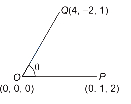
If $P=(0,1,2)$,$Q=(4,-2,1)$,and $O=(0,0,0)$,then $\angle POQ$ is equal to
A
$\frac{\pi}{2}$
B
$\frac{\pi}{4}$
C
$\frac{\pi}{6}$
D
$\frac{\pi}{3}$
Solution
(A) The position vectors of points $P$ and $Q$ with respect to the origin $O(0,0,0)$ are given by $\vec{OP} = 0\hat{i} + 1\hat{j} + 2\hat{k}$ and $\vec{OQ} = 4\hat{i} - 2\hat{j} + 1\hat{k}$.
To find the angle $\theta = \angle POQ$,we use the dot product formula: $\cos \theta = \frac{\vec{OP} \cdot \vec{OQ}}{|\vec{OP}| |\vec{OQ}|}$.
First,calculate the dot product:
$\vec{OP} \cdot \vec{OQ} = (0)(4) + (1)(-2) + (2)(1) = 0 - 2 + 2 = 0$.
Since the dot product is $0$,the vectors $\vec{OP}$ and $\vec{OQ}$ are perpendicular to each other.
Therefore,$\cos \theta = 0$,which implies $\theta = \frac{\pi}{2}$.
To find the angle $\theta = \angle POQ$,we use the dot product formula: $\cos \theta = \frac{\vec{OP} \cdot \vec{OQ}}{|\vec{OP}| |\vec{OQ}|}$.
First,calculate the dot product:
$\vec{OP} \cdot \vec{OQ} = (0)(4) + (1)(-2) + (2)(1) = 0 - 2 + 2 = 0$.
Since the dot product is $0$,the vectors $\vec{OP}$ and $\vec{OQ}$ are perpendicular to each other.
Therefore,$\cos \theta = 0$,which implies $\theta = \frac{\pi}{2}$.
0 likes
View Solution880
MediumMCQ
If $e$ is a unit vector perpendicular to the plane determined by the points $2 \hat{i}+\hat{j}+\hat{k}$,$\hat{i}-\hat{j}+\hat{k}$ and $-\hat{i}+\hat{j}-\hat{k}$. If $a=2 \hat{i}-3 \hat{j}+6 \hat{k}$,then the projection vector of $a$ on $e$ is
A
$\frac{11}{14}(-2 \hat{i}+\hat{j}+3 \hat{k})$
B
$\frac{1}{3}(\hat{i}-2 \hat{j}+2 \hat{k})$
C
$\frac{1}{7}(2 \hat{i}-3 \hat{j}+6 \hat{k})$
D
$\frac{1}{\sqrt{14}}(2 \hat{i}-\hat{j}+3 \hat{k})$
Solution
(A) Let the points be $A(2, 1, 1)$,$B(1, -1, 1)$,and $C(-1, 1, -1)$.
The normal vector $\vec{n}$ to the plane is given by $\vec{AB} \times \vec{AC}$.
$\vec{AB} = (1-2)\hat{i} + (-1-1)\hat{j} + (1-1)\hat{k} = -\hat{i} - 2\hat{j}$.
$\vec{AC} = (-1-2)\hat{i} + (1-1)\hat{j} + (-1-1)\hat{k} = -3\hat{i} - 2\hat{k}$.
$\vec{n} = \begin{vmatrix} \hat{i} & \hat{j} & \hat{k} \\ -1 & -2 & 0 \\ -3 & 0 & -2 \end{vmatrix} = \hat{i}(4-0) - \hat{j}(2-0) + \hat{k}(0-6) = 4\hat{i} - 2\hat{j} - 6\hat{k}$.
Dividing by $2$,we get the normal vector $\vec{n}' = 2\hat{i} - \hat{j} - 3\hat{k}$.
The unit vector $e$ perpendicular to the plane is $e = \pm \frac{2\hat{i} - \hat{j} - 3\hat{k}}{\sqrt{2^2 + (-1)^2 + (-3)^2}} = \pm \frac{1}{\sqrt{14}}(2\hat{i} - \hat{j} - 3\hat{k})$.
Given $a = 2\hat{i} - 3\hat{j} + 6\hat{k}$,the projection vector of $a$ on $e$ is $(a \cdot e)e$.
$a \cdot e = \pm \frac{1}{\sqrt{14}}(2(2) + (-3)(-1) + 6(-3)) = \pm \frac{1}{\sqrt{14}}(4 + 3 - 18) = \mp \frac{11}{\sqrt{14}}$.
Projection vector $= (a \cdot e)e = \left(\mp \frac{11}{\sqrt{14}}\right) \left(\pm \frac{1}{\sqrt{14}}(2\hat{i} - \hat{j} - 3\hat{k})\right) = -\frac{11}{14}(2\hat{i} - \hat{j} - 3\hat{k}) = \frac{11}{14}(-2\hat{i} + \hat{j} + 3\hat{k})$.
The normal vector $\vec{n}$ to the plane is given by $\vec{AB} \times \vec{AC}$.
$\vec{AB} = (1-2)\hat{i} + (-1-1)\hat{j} + (1-1)\hat{k} = -\hat{i} - 2\hat{j}$.
$\vec{AC} = (-1-2)\hat{i} + (1-1)\hat{j} + (-1-1)\hat{k} = -3\hat{i} - 2\hat{k}$.
$\vec{n} = \begin{vmatrix} \hat{i} & \hat{j} & \hat{k} \\ -1 & -2 & 0 \\ -3 & 0 & -2 \end{vmatrix} = \hat{i}(4-0) - \hat{j}(2-0) + \hat{k}(0-6) = 4\hat{i} - 2\hat{j} - 6\hat{k}$.
Dividing by $2$,we get the normal vector $\vec{n}' = 2\hat{i} - \hat{j} - 3\hat{k}$.
The unit vector $e$ perpendicular to the plane is $e = \pm \frac{2\hat{i} - \hat{j} - 3\hat{k}}{\sqrt{2^2 + (-1)^2 + (-3)^2}} = \pm \frac{1}{\sqrt{14}}(2\hat{i} - \hat{j} - 3\hat{k})$.
Given $a = 2\hat{i} - 3\hat{j} + 6\hat{k}$,the projection vector of $a$ on $e$ is $(a \cdot e)e$.
$a \cdot e = \pm \frac{1}{\sqrt{14}}(2(2) + (-3)(-1) + 6(-3)) = \pm \frac{1}{\sqrt{14}}(4 + 3 - 18) = \mp \frac{11}{\sqrt{14}}$.
Projection vector $= (a \cdot e)e = \left(\mp \frac{11}{\sqrt{14}}\right) \left(\pm \frac{1}{\sqrt{14}}(2\hat{i} - \hat{j} - 3\hat{k})\right) = -\frac{11}{14}(2\hat{i} - \hat{j} - 3\hat{k}) = \frac{11}{14}(-2\hat{i} + \hat{j} + 3\hat{k})$.
0 likes
View Solution881
MediumMCQ
Assertion $(A)$: $a, b, c, d$ are position vectors of $4$ points such that $2a - 3b + 7c - 6d = 0 \Rightarrow a, b, c, d$ are coplanar.
Reason $(R)$: Vector equation of the plane passing through three points whose position vectors are $a, b, c$ is $r = (1 - x - y)a + xb + yc$.
Which of the following is true?
Reason $(R)$: Vector equation of the plane passing through three points whose position vectors are $a, b, c$ is $r = (1 - x - y)a + xb + yc$.
Which of the following is true?
A
Both $(A)$ and $(R)$ are true and $(R)$ is the correct explanation of $(A)$
B
Both $(A)$ and $(R)$ are true,but $(R)$ is not the correct explanation of $(A)$
C
$(A)$ is true,but $(R)$ is false
D
$(A)$ is false,but $(R)$ is true
Solution
(A) The vector equation of a plane passing through three non-collinear points with position vectors $a, b, c$ is given by $r = (1 - x - y)a + xb + yc$.
If four points $a, b, c, d$ are coplanar,then $d$ must be expressible as a linear combination of $a, b, c$ such that the sum of the coefficients is $1$.
Given the equation $2a - 3b + 7c - 6d = 0$,we can rewrite it as $6d = 2a - 3b + 7c$,which implies $d = \frac{2}{6}a - \frac{3}{6}b + \frac{7}{6}c = \frac{1}{3}a - \frac{1}{2}b + \frac{7}{6}c$.
The sum of the coefficients is $\frac{1}{3} - \frac{1}{2} + \frac{7}{6} = \frac{2 - 3 + 7}{6} = \frac{6}{6} = 1$.
Since the sum of the coefficients is $1$,the point $d$ lies in the plane formed by $a, b, c$.
Thus,$(A)$ is true,$(R)$ is true,and $(R)$ is the correct explanation of $(A)$.
If four points $a, b, c, d$ are coplanar,then $d$ must be expressible as a linear combination of $a, b, c$ such that the sum of the coefficients is $1$.
Given the equation $2a - 3b + 7c - 6d = 0$,we can rewrite it as $6d = 2a - 3b + 7c$,which implies $d = \frac{2}{6}a - \frac{3}{6}b + \frac{7}{6}c = \frac{1}{3}a - \frac{1}{2}b + \frac{7}{6}c$.
The sum of the coefficients is $\frac{1}{3} - \frac{1}{2} + \frac{7}{6} = \frac{2 - 3 + 7}{6} = \frac{6}{6} = 1$.
Since the sum of the coefficients is $1$,the point $d$ lies in the plane formed by $a, b, c$.
Thus,$(A)$ is true,$(R)$ is true,and $(R)$ is the correct explanation of $(A)$.
0 likes
View Solution882
EasyMCQ
In a plane,$\vec{a}$ and $\vec{b}$ are the position vectors of two points $A$ and $B$ respectively. $A$ point $P$ with position vector $\vec{r}$ moves on that plane in such a way that $|\vec{r}-\vec{a}| - |\vec{r}-\vec{b}| = c$ (where $c$ is a real constant). The locus of $P$ is a conic section whose eccentricity is:
A
$\frac{|\vec{a}-\vec{b}|}{c}$
B
$\frac{|\vec{a}+\vec{b}|}{c}$
C
$\frac{|\vec{a}-\vec{b}|}{2c}$
D
$\frac{|\vec{a}+\vec{b}|}{2c}$
Solution
(A) The equation $|\vec{r}-\vec{a}| - |\vec{r}-\vec{b}| = c$ represents the definition of a hyperbola where $A$ and $B$ are the foci.
The distance between the foci is $2ae = |\vec{a}-\vec{b}|$.
The distance between the vertices (transverse axis length) is $2a = c$.
Therefore,the eccentricity $e$ is given by:
$e = \frac{\text{distance between foci}}{\text{distance between vertices}} = \frac{|\vec{a}-\vec{b}|}{c}$.
The distance between the foci is $2ae = |\vec{a}-\vec{b}|$.
The distance between the vertices (transverse axis length) is $2a = c$.
Therefore,the eccentricity $e$ is given by:
$e = \frac{\text{distance between foci}}{\text{distance between vertices}} = \frac{|\vec{a}-\vec{b}|}{c}$.
0 likes
View Solution883
EasyMCQ
Let $\vec{\alpha}, \vec{\beta}, \vec{\gamma}$ be three non-zero vectors which are pairwise non-collinear. If $\vec{\alpha}+3 \vec{\beta}$ is collinear with $\vec{\gamma}$ and $\vec{\beta}+2 \vec{\gamma}$ is collinear with $\vec{\alpha}$,then $\vec{\alpha}+3 \vec{\beta}+6 \vec{\gamma}$ is
A
$\vec{\gamma}$
B
$\overrightarrow{0}$
C
$\vec{\alpha}+\vec{\gamma}$
D
$\vec{\alpha}$
Solution
(B) Given that $\vec{\alpha}+3 \vec{\beta}$ is collinear with $\vec{\gamma}$,there exists a scalar $k_{1}$ such that $\vec{\alpha}+3 \vec{\beta}=k_{1} \vec{\gamma}$.
This implies $\vec{\beta}=\frac{k_{1}}{3} \vec{\gamma}-\frac{1}{3} \vec{\alpha}$.
Also,$\vec{\beta}+2 \vec{\gamma}$ is collinear with $\vec{\alpha}$,so there exists a scalar $k_{2}$ such that $\vec{\beta}+2 \vec{\gamma}=k_{2} \vec{\alpha}$.
This implies $\vec{\beta}=k_{2} \vec{\alpha}-2 \vec{\gamma}$.
Equating the two expressions for $\vec{\beta}$,we get $\frac{k_{1}}{3} \vec{\gamma}-\frac{1}{3} \vec{\alpha}=k_{2} \vec{\alpha}-2 \vec{\gamma}$.
Rearranging the terms,we have $\vec{\alpha}(k_{2}+\frac{1}{3})=\vec{\gamma}(\frac{k_{1}}{3}+2)$.
Since $\vec{\alpha}$ and $\vec{\gamma}$ are non-collinear,the coefficients must be zero: $k_{2}+\frac{1}{3}=0 \Rightarrow k_{2}=-\frac{1}{3}$ and $\frac{k_{1}}{3}+2=0 \Rightarrow k_{1}=-6$.
Substituting $k_{1}=-6$ into the first equation,we get $\vec{\alpha}+3 \vec{\beta}=-6 \vec{\gamma}$.
Therefore,$\vec{\alpha}+3 \vec{\beta}+6 \vec{\gamma}=\overrightarrow{0}$.
This implies $\vec{\beta}=\frac{k_{1}}{3} \vec{\gamma}-\frac{1}{3} \vec{\alpha}$.
Also,$\vec{\beta}+2 \vec{\gamma}$ is collinear with $\vec{\alpha}$,so there exists a scalar $k_{2}$ such that $\vec{\beta}+2 \vec{\gamma}=k_{2} \vec{\alpha}$.
This implies $\vec{\beta}=k_{2} \vec{\alpha}-2 \vec{\gamma}$.
Equating the two expressions for $\vec{\beta}$,we get $\frac{k_{1}}{3} \vec{\gamma}-\frac{1}{3} \vec{\alpha}=k_{2} \vec{\alpha}-2 \vec{\gamma}$.
Rearranging the terms,we have $\vec{\alpha}(k_{2}+\frac{1}{3})=\vec{\gamma}(\frac{k_{1}}{3}+2)$.
Since $\vec{\alpha}$ and $\vec{\gamma}$ are non-collinear,the coefficients must be zero: $k_{2}+\frac{1}{3}=0 \Rightarrow k_{2}=-\frac{1}{3}$ and $\frac{k_{1}}{3}+2=0 \Rightarrow k_{1}=-6$.
Substituting $k_{1}=-6$ into the first equation,we get $\vec{\alpha}+3 \vec{\beta}=-6 \vec{\gamma}$.
Therefore,$\vec{\alpha}+3 \vec{\beta}+6 \vec{\gamma}=\overrightarrow{0}$.
0 likes
View Solution884
EasyMCQ
If $a(\vec{\alpha} \times \vec{\beta}) + b(\vec{\beta} \times \vec{\gamma}) + c(\vec{\gamma} \times \vec{\alpha}) = \overrightarrow{0}$,where $a, b, c$ are non-zero scalars,then the vectors $\vec{\alpha}, \vec{\beta}, \vec{\gamma}$ are
A
parallel
B
non-coplanar
C
coplanar
D
mutually perpendicular
Solution
(C) Given the equation $a(\vec{\alpha} \times \vec{\beta}) + b(\vec{\beta} \times \vec{\gamma}) + c(\vec{\gamma} \times \vec{\alpha}) = \overrightarrow{0}$.
Let $\vec{u} = \vec{\alpha} \times \vec{\beta}$,$\vec{v} = \vec{\beta} \times \vec{\gamma}$,and $\vec{w} = \vec{\gamma} \times \vec{\alpha}$.
The given equation is $a\vec{u} + b\vec{v} + c\vec{w} = \overrightarrow{0}$.
Since $a, b, c$ are non-zero scalars,the vectors $\vec{u}, \vec{v}, \vec{w}$ are linearly dependent,which implies they are coplanar.
For any three vectors $\vec{\alpha}, \vec{\beta}, \vec{\gamma}$,the cross products $\vec{\alpha} \times \vec{\beta}$,$\vec{\beta} \times \vec{\gamma}$,and $\vec{\gamma} \times \vec{\alpha}$ are coplanar if and only if $\vec{\alpha}, \vec{\beta}, \vec{\gamma}$ are coplanar.
Therefore,the vectors $\vec{\alpha}, \vec{\beta}, \vec{\gamma}$ are coplanar.
Let $\vec{u} = \vec{\alpha} \times \vec{\beta}$,$\vec{v} = \vec{\beta} \times \vec{\gamma}$,and $\vec{w} = \vec{\gamma} \times \vec{\alpha}$.
The given equation is $a\vec{u} + b\vec{v} + c\vec{w} = \overrightarrow{0}$.
Since $a, b, c$ are non-zero scalars,the vectors $\vec{u}, \vec{v}, \vec{w}$ are linearly dependent,which implies they are coplanar.
For any three vectors $\vec{\alpha}, \vec{\beta}, \vec{\gamma}$,the cross products $\vec{\alpha} \times \vec{\beta}$,$\vec{\beta} \times \vec{\gamma}$,and $\vec{\gamma} \times \vec{\alpha}$ are coplanar if and only if $\vec{\alpha}, \vec{\beta}, \vec{\gamma}$ are coplanar.
Therefore,the vectors $\vec{\alpha}, \vec{\beta}, \vec{\gamma}$ are coplanar.
0 likes
View Solution885
MediumMCQ
The unit vector in $ZOX$ plane,making angles $45^{\circ}$ and $60^{\circ}$ respectively with $\vec{\alpha}=2 \hat{i}+2 \hat{j}-\hat{k}$ and $\vec{\beta}=\hat{j}-\hat{k}$ is
A
$\frac{1}{\sqrt{2}} \hat{i}+\frac{1}{\sqrt{2}} \hat{j}$
B
$\frac{1}{\sqrt{2}} \hat{i}-\frac{1}{\sqrt{2}} \hat{k}$
C
$\frac{1}{\sqrt{2}} \hat{i}-\frac{1}{\sqrt{2}} \hat{j}$
D
$\frac{1}{\sqrt{2}} \hat{i}+\frac{1}{\sqrt{2}} \hat{k}$
Solution
(B) Let the unit vector in the $ZOX$ plane be $\vec{r} = x \hat{i} + z \hat{k}$.
Since it is a unit vector,$|\vec{r}|^2 = x^2 + z^2 = 1$.
Given $\vec{\alpha} = 2 \hat{i} + 2 \hat{j} - \hat{k}$,we have $|\vec{\alpha}| = \sqrt{2^2 + 2^2 + (-1)^2} = \sqrt{4+4+1} = 3$.
The angle between $\vec{r}$ and $\vec{\alpha}$ is $45^{\circ}$,so $\vec{r} \cdot \vec{\alpha} = |\vec{r}| |\vec{\alpha}| \cos 45^{\circ}$.
$(x \hat{i} + z \hat{k}) \cdot (2 \hat{i} + 2 \hat{j} - \hat{k}) = 1 \cdot 3 \cdot \frac{1}{\sqrt{2}} \Rightarrow 2x - z = \frac{3}{\sqrt{2}}$.
Given $\vec{\beta} = \hat{j} - \hat{k}$,we have $|\vec{\beta}| = \sqrt{0^2 + 1^2 + (-1)^2} = \sqrt{2}$.
The angle between $\vec{r}$ and $\vec{\beta}$ is $60^{\circ}$,so $\vec{r} \cdot \vec{\beta} = |\vec{r}| |\vec{\beta}| \cos 60^{\circ}$.
$(x \hat{i} + z \hat{k}) \cdot (0 \hat{i} + 1 \hat{j} - 1 \hat{k}) = 1 \cdot \sqrt{2} \cdot \frac{1}{2} \Rightarrow -z = \frac{\sqrt{2}}{2} = \frac{1}{\sqrt{2}} \Rightarrow z = -\frac{1}{\sqrt{2}}$.
Substituting $z$ into $2x - z = \frac{3}{\sqrt{2}}$,we get $2x - (-\frac{1}{\sqrt{2}}) = \frac{3}{\sqrt{2}} \Rightarrow 2x = \frac{2}{\sqrt{2}} = \sqrt{2} \Rightarrow x = \frac{1}{\sqrt{2}}$.
Thus,$\vec{r} = \frac{1}{\sqrt{2}} \hat{i} - \frac{1}{\sqrt{2}} \hat{k}$.
Since it is a unit vector,$|\vec{r}|^2 = x^2 + z^2 = 1$.
Given $\vec{\alpha} = 2 \hat{i} + 2 \hat{j} - \hat{k}$,we have $|\vec{\alpha}| = \sqrt{2^2 + 2^2 + (-1)^2} = \sqrt{4+4+1} = 3$.
The angle between $\vec{r}$ and $\vec{\alpha}$ is $45^{\circ}$,so $\vec{r} \cdot \vec{\alpha} = |\vec{r}| |\vec{\alpha}| \cos 45^{\circ}$.
$(x \hat{i} + z \hat{k}) \cdot (2 \hat{i} + 2 \hat{j} - \hat{k}) = 1 \cdot 3 \cdot \frac{1}{\sqrt{2}} \Rightarrow 2x - z = \frac{3}{\sqrt{2}}$.
Given $\vec{\beta} = \hat{j} - \hat{k}$,we have $|\vec{\beta}| = \sqrt{0^2 + 1^2 + (-1)^2} = \sqrt{2}$.
The angle between $\vec{r}$ and $\vec{\beta}$ is $60^{\circ}$,so $\vec{r} \cdot \vec{\beta} = |\vec{r}| |\vec{\beta}| \cos 60^{\circ}$.
$(x \hat{i} + z \hat{k}) \cdot (0 \hat{i} + 1 \hat{j} - 1 \hat{k}) = 1 \cdot \sqrt{2} \cdot \frac{1}{2} \Rightarrow -z = \frac{\sqrt{2}}{2} = \frac{1}{\sqrt{2}} \Rightarrow z = -\frac{1}{\sqrt{2}}$.
Substituting $z$ into $2x - z = \frac{3}{\sqrt{2}}$,we get $2x - (-\frac{1}{\sqrt{2}}) = \frac{3}{\sqrt{2}} \Rightarrow 2x = \frac{2}{\sqrt{2}} = \sqrt{2} \Rightarrow x = \frac{1}{\sqrt{2}}$.
Thus,$\vec{r} = \frac{1}{\sqrt{2}} \hat{i} - \frac{1}{\sqrt{2}} \hat{k}$.
0 likes
View Solution886
MediumMCQ
For non-zero vectors $a$ and $b$,if $|a+b| < |a-b|$,then $a$ and $b$ are
A
collinear
B
perpendicular to each other
C
inclined at an acute angle
D
inclined at an obtuse angle
Solution
(D) Given,$|a+b| < |a-b|$.
Squaring both sides,we get $|a+b|^2 < |a-b|^2$.
Using the property $|x|^2 = x \cdot x$,we have $(a+b) \cdot (a+b) < (a-b) \cdot (a-b)$.
Expanding the dot product,$|a|^2 + |b|^2 + 2(a \cdot b) < |a|^2 + |b|^2 - 2(a \cdot b)$.
Subtracting $|a|^2 + |b|^2$ from both sides,$2(a \cdot b) < -2(a \cdot b)$.
This simplifies to $4(a \cdot b) < 0$,which implies $a \cdot b < 0$.
Since $a \cdot b = |a||b| \cos \theta < 0$ and $|a|, |b| > 0$,we must have $\cos \theta < 0$.
Therefore,the angle $\theta$ between $a$ and $b$ is an obtuse angle.
Squaring both sides,we get $|a+b|^2 < |a-b|^2$.
Using the property $|x|^2 = x \cdot x$,we have $(a+b) \cdot (a+b) < (a-b) \cdot (a-b)$.
Expanding the dot product,$|a|^2 + |b|^2 + 2(a \cdot b) < |a|^2 + |b|^2 - 2(a \cdot b)$.
Subtracting $|a|^2 + |b|^2$ from both sides,$2(a \cdot b) < -2(a \cdot b)$.
This simplifies to $4(a \cdot b) < 0$,which implies $a \cdot b < 0$.
Since $a \cdot b = |a||b| \cos \theta < 0$ and $|a|, |b| > 0$,we must have $\cos \theta < 0$.
Therefore,the angle $\theta$ between $a$ and $b$ is an obtuse angle.
0 likes
View Solution887
MediumMCQ
Let $\vec{a}, \vec{b}$ and $\vec{c}$ be vectors of equal magnitude such that the angle between $\vec{a}$ and $\vec{b}$ is $\alpha$,$\vec{b}$ and $\vec{c}$ is $\beta$,and $\vec{c}$ and $\vec{a}$ is $\gamma$. Then the minimum value of $\cos \alpha + \cos \beta + \cos \gamma$ is
A
$\frac{1}{2}$
B
$-\frac{1}{2}$
C
$\frac{3}{2}$
D
$-\frac{3}{2}$
Solution
(D) Let $|\vec{a}| = |\vec{b}| = |\vec{c}| = k$.
We know that $\vec{a} \cdot \vec{b} = k^2 \cos \alpha$,$\vec{b} \cdot \vec{c} = k^2 \cos \beta$,and $\vec{c} \cdot \vec{a} = k^2 \cos \gamma$.
Consider the magnitude of the sum of the vectors: $|\vec{a} + \vec{b} + \vec{c}|^2 \geq 0$.
Expanding this,we get: $(\vec{a} + \vec{b} + \vec{c}) \cdot (\vec{a} + \vec{b} + \vec{c}) \geq 0$.
$|\vec{a}|^2 + |\vec{b}|^2 + |\vec{c}|^2 + 2(\vec{a} \cdot \vec{b} + \vec{b} \cdot \vec{c} + \vec{c} \cdot \vec{a}) \geq 0$.
Substituting the values: $3k^2 + 2k^2(\cos \alpha + \cos \beta + \cos \gamma) \geq 0$.
Dividing by $2k^2$ (since $k > 0$): $\frac{3}{2} + (\cos \alpha + \cos \beta + \cos \gamma) \geq 0$.
Therefore,$\cos \alpha + \cos \beta + \cos \gamma \geq -\frac{3}{2}$.
We know that $\vec{a} \cdot \vec{b} = k^2 \cos \alpha$,$\vec{b} \cdot \vec{c} = k^2 \cos \beta$,and $\vec{c} \cdot \vec{a} = k^2 \cos \gamma$.
Consider the magnitude of the sum of the vectors: $|\vec{a} + \vec{b} + \vec{c}|^2 \geq 0$.
Expanding this,we get: $(\vec{a} + \vec{b} + \vec{c}) \cdot (\vec{a} + \vec{b} + \vec{c}) \geq 0$.
$|\vec{a}|^2 + |\vec{b}|^2 + |\vec{c}|^2 + 2(\vec{a} \cdot \vec{b} + \vec{b} \cdot \vec{c} + \vec{c} \cdot \vec{a}) \geq 0$.
Substituting the values: $3k^2 + 2k^2(\cos \alpha + \cos \beta + \cos \gamma) \geq 0$.
Dividing by $2k^2$ (since $k > 0$): $\frac{3}{2} + (\cos \alpha + \cos \beta + \cos \gamma) \geq 0$.
Therefore,$\cos \alpha + \cos \beta + \cos \gamma \geq -\frac{3}{2}$.
0 likes
View SolutionVector Algebra — Scalar or Dot product of two vectors and its applications · Frequently Asked Questions
1Are these Vector Algebra questions useful for JEE and NEET?
Yes. All questions in this section are mapped to JEE Main and NEET exam patterns. Previous year questions from JEE Main, NEET, GUJCET and state-level exams are included with full solutions.
2Can I switch to Hindi or Gujarati for these questions?
Yes. Use the language tabs in the hero section or the sidebar to view the same questions and solutions in English, Hindi or Gujarati.
3How do I generate a question paper from this subtopic?
Use the Vedclass Exam Paper Generator — select the chapter and subtopic, set difficulty, and generate Sets A, B, C, D automatically. First 3 chapters of every subject are free.
Vedclass Products
For Students
Vedclass Test Series
Mock tests in real JEE/NEET style with performance analysis. 5-day free trial.
Start Free TrialFor Teachers
Exam Paper Generator
Generate Set A/B/C/D papers from this chapter in 2 minutes. 3 chapters free.
Try FreeFor Institutes
Online Exam Module
Live online exams with unlimited students, 360° analytics & white-label branding.
See DemoFor Teachers & Institutes
Generate a Vector Algebra Exam Paper in 2 Minutes
Select subtopic & difficulty — Sets A, B, C, D auto-generated with No Repeat logic.
First 3 chapters of every subject are free — no payment required.