
A English
Domain and Range Questions in English
Class 12 Mathematics · Relation and Function · Domain and Range
324+
Questions
English
Language
100%
With Solutions
Showing 50 of 324 questions in English
151
EasyMCQ
Domain of the real valued function $f(x) = \frac{x+2}{9-x^{2}}$ is
A
$-3 \leq x \leq 3$
B
$R - \{-3, 3\}$
C
$R$
D
$R - \{3\}$
Solution
(B) The function $f(x) = \frac{x+2}{9-x^{2}}$ is defined for all real values of $x$ except where the denominator is zero.
Setting the denominator to zero: $9 - x^{2} = 0$.
This implies $x^{2} = 9$,so $x = \pm 3$.
Thus,the function is undefined at $x = 3$ and $x = -3$.
Therefore,the domain of the function is the set of all real numbers except $\{-3, 3\}$,which is written as $R - \{-3, 3\}$.
Setting the denominator to zero: $9 - x^{2} = 0$.
This implies $x^{2} = 9$,so $x = \pm 3$.
Thus,the function is undefined at $x = 3$ and $x = -3$.
Therefore,the domain of the function is the set of all real numbers except $\{-3, 3\}$,which is written as $R - \{-3, 3\}$.
0 likes
View Solution152
EasyMCQ
The domain of a function $f(y) = \frac{\cos^{-1}(y-5)}{\sqrt{25-y^2}}$ is
A
$(4, 6]$
B
$(-5, 5)$
C
$[4, 5)$
D
$(4, 5]$
Solution
(C) For the function $f(y) = \frac{\cos^{-1}(y-5)}{\sqrt{25-y^2}}$ to be defined,the following conditions must be satisfied:
$1$. The argument of $\cos^{-1}$ must be in the interval $[-1, 1]$,so $-1 \leq y-5 \leq 1$. Adding $5$ to all sides gives $4 \leq y \leq 6$.
$2$. The denominator must be non-zero and the expression inside the square root must be positive,so $25-y^2 > 0$,which implies $y^2 < 25$,or $-5 < y < 5$.
$3$. Taking the intersection of the two conditions: $y \in [4, 6]$ and $y \in (-5, 5)$.
$4$. The intersection is $4 \leq y < 5$,which can be written as the interval $[4, 5)$.
Therefore,the domain is $[4, 5)$.
$1$. The argument of $\cos^{-1}$ must be in the interval $[-1, 1]$,so $-1 \leq y-5 \leq 1$. Adding $5$ to all sides gives $4 \leq y \leq 6$.
$2$. The denominator must be non-zero and the expression inside the square root must be positive,so $25-y^2 > 0$,which implies $y^2 < 25$,or $-5 < y < 5$.
$3$. Taking the intersection of the two conditions: $y \in [4, 6]$ and $y \in (-5, 5)$.
$4$. The intersection is $4 \leq y < 5$,which can be written as the interval $[4, 5)$.
Therefore,the domain is $[4, 5)$.
0 likes
View Solution153
EasyMCQ
The domain of the function $f(x) = \sqrt{x}$ is
A
$R - \{0\}$
B
$R^{+}$
C
$R^{+} \cup \{0\}$
D
$R$
Solution
(C) For $f(x) = \sqrt{x}$ to be defined in the set of real numbers,the expression under the square root must be non-negative.
Therefore,$x \geq 0$.
The domain is the set of all non-negative real numbers,which is represented as $[0, \infty)$ or $R^{+} \cup \{0\}$.
Thus,the correct option is $C$.
Therefore,$x \geq 0$.
The domain is the set of all non-negative real numbers,which is represented as $[0, \infty)$ or $R^{+} \cup \{0\}$.
Thus,the correct option is $C$.
0 likes
View Solution154
EasyMCQ
The domain and range of the relation $R$ given by $R = \{(x, y) : y = x + \frac{6}{x}, x, y \in N \text{ and } x < 6\}$ are
A
Domain $= \{2, 3\}$,Range $= \{5\}$.
B
Domain $= \{1, 2\}$,Range $= \{5, 7\}$.
C
Domain $= \{1, 2, 3, 4, 5\}$,Range $= \{7, 5, 5.5, 6.2\}$.
D
Domain $= \{1, 2, 3\}$,Range $= \{5, 7\}$.
Solution
(D) Given the relation $R = \{(x, y) : y = x + \frac{6}{x}, x, y \in N, x < 6\}$.
We test each value of $x \in \{1, 2, 3, 4, 5\}$ to see if $y$ is a natural number $(N)$:
For $x = 1, y = 1 + \frac{6}{1} = 7 \in N$.
For $x = 2, y = 2 + \frac{6}{2} = 2 + 3 = 5 \in N$.
For $x = 3, y = 3 + \frac{6}{3} = 3 + 2 = 5 \in N$.
For $x = 4, y = 4 + \frac{6}{4} = 4 + 1.5 = 5.5 \notin N$.
For $x = 5, y = 5 + \frac{6}{5} = 5 + 1.2 = 6.2 \notin N$.
Thus,the relation $R = \{(1, 7), (2, 5), (3, 5)\}$.
The domain is the set of first elements: $\{1, 2, 3\}$.
The range is the set of second elements: $\{5, 7\}$.
We test each value of $x \in \{1, 2, 3, 4, 5\}$ to see if $y$ is a natural number $(N)$:
For $x = 1, y = 1 + \frac{6}{1} = 7 \in N$.
For $x = 2, y = 2 + \frac{6}{2} = 2 + 3 = 5 \in N$.
For $x = 3, y = 3 + \frac{6}{3} = 3 + 2 = 5 \in N$.
For $x = 4, y = 4 + \frac{6}{4} = 4 + 1.5 = 5.5 \notin N$.
For $x = 5, y = 5 + \frac{6}{5} = 5 + 1.2 = 6.2 \notin N$.
Thus,the relation $R = \{(1, 7), (2, 5), (3, 5)\}$.
The domain is the set of first elements: $\{1, 2, 3\}$.
The range is the set of second elements: $\{5, 7\}$.
0 likes
View Solution155
EasyMCQ
The domain of the real valued function $f(x) = \sqrt{\frac{x-2}{3-x}}$ is...
A
$(2, 3]$
B
$[2, 3)$
C
$(2, 3)$
D
$[2, 3]$
Solution
(B) For the function $f(x) = \sqrt{\frac{x-2}{3-x}}$ to be defined,the expression under the square root must be non-negative: $\frac{x-2}{3-x} \geq 0$.
This implies that the numerator and denominator must have opposite signs or the numerator must be zero.
Specifically,$x-2 \geq 0$ and $3-x > 0$.
From $x-2 \geq 0$,we get $x \geq 2$.
From $3-x > 0$,we get $x < 3$.
Combining these two conditions,we get $2 \leq x < 3$.
Thus,the domain of $f(x)$ is $[2, 3)$.
This implies that the numerator and denominator must have opposite signs or the numerator must be zero.
Specifically,$x-2 \geq 0$ and $3-x > 0$.
From $x-2 \geq 0$,we get $x \geq 2$.
From $3-x > 0$,we get $x < 3$.
Combining these two conditions,we get $2 \leq x < 3$.
Thus,the domain of $f(x)$ is $[2, 3)$.
0 likes
View Solution156
EasyMCQ
Range of the function $f(x) = \frac{x^2+x+2}{x^2+x+1}, x \in R$ is
A
$\left(1, \frac{7}{3}\right)$
B
$\left[1, \frac{7}{3}\right)$
C
$\left(1, \frac{7}{3}\right]$
D
$\left[1, \frac{7}{3}\right]$
Solution
(C) Let $y = \frac{x^2+x+2}{x^2+x+1}$.
$y(x^2+x+1) = x^2+x+2$
$(y-1)x^2 + (y-1)x + (y-2) = 0$.
For $x \in R$,the discriminant $D \geq 0$.
$D = (y-1)^2 - 4(y-1)(y-2) \geq 0$.
$(y-1)[(y-1) - 4(y-2)] \geq 0$.
$(y-1)(-3y+7) \geq 0$.
$(y-1)(3y-7) \leq 0$.
Thus,$1 < y \leq \frac{7}{3}$.
Since $x^2+x+1 = (x+1/2)^2 + 3/4 > 0$,$y$ can never be $1$ because the numerator $x^2+x+2$ is always greater than the denominator $x^2+x+1$.
Therefore,the range is $\left(1, \frac{7}{3}\right]$.
$y(x^2+x+1) = x^2+x+2$
$(y-1)x^2 + (y-1)x + (y-2) = 0$.
For $x \in R$,the discriminant $D \geq 0$.
$D = (y-1)^2 - 4(y-1)(y-2) \geq 0$.
$(y-1)[(y-1) - 4(y-2)] \geq 0$.
$(y-1)(-3y+7) \geq 0$.
$(y-1)(3y-7) \leq 0$.
Thus,$1 < y \leq \frac{7}{3}$.
Since $x^2+x+1 = (x+1/2)^2 + 3/4 > 0$,$y$ can never be $1$ because the numerator $x^2+x+2$ is always greater than the denominator $x^2+x+1$.
Therefore,the range is $\left(1, \frac{7}{3}\right]$.
0 likes
View Solution157
EasyMCQ
The range of the function $f(x) = \frac{x^2}{x^2+1}$ is
A
$(0, 1)$
B
$[0, 1)$
C
$(0, 1]$
D
$[0, 1]$
Solution
(B) Let $y = \frac{x^2}{x^2+1}$.
$y(x^2+1) = x^2$
$yx^2 + y = x^2$
$x^2(y-1) = -y$
$x^2 = \frac{y}{1-y}$.
For $x$ to be a real number,$x^2 \geq 0$.
Therefore,$\frac{y}{1-y} \geq 0$.
This implies $y(1-y) \geq 0$ and $y \neq 1$.
Solving the inequality $y(y-1) \leq 0$,we get $0 \leq y < 1$.
Thus,the range of the function is $[0, 1)$.
$y(x^2+1) = x^2$
$yx^2 + y = x^2$
$x^2(y-1) = -y$
$x^2 = \frac{y}{1-y}$.
For $x$ to be a real number,$x^2 \geq 0$.
Therefore,$\frac{y}{1-y} \geq 0$.
This implies $y(1-y) \geq 0$ and $y \neq 1$.
Solving the inequality $y(y-1) \leq 0$,we get $0 \leq y < 1$.
Thus,the range of the function is $[0, 1)$.
0 likes
View Solution158
EasyMCQ
Let $A = \{10, 11, 12, 14, 26\}$ and let $f: A \rightarrow N$ be defined such that $f(a) = \text{highest prime factor of } a$,where $a \in A$. Then the range of $f$ is:
A
$\{5, 7, 13\}$
B
$\{5, 7, 11, 13\}$
C
$\{3, 5, 7, 11, 13\}$
D
$\{3, 7, 11, 13\}$
Solution
(C) Given the set $A = \{10, 11, 12, 14, 26\}$.
We find the prime factorization for each element in $A$:
$10 = 2 \times 5$,so the highest prime factor is $5$.
$11 = 11$,so the highest prime factor is $11$.
$12 = 2^2 \times 3$,so the highest prime factor is $3$.
$14 = 2 \times 7$,so the highest prime factor is $7$.
$26 = 2 \times 13$,so the highest prime factor is $13$.
Thus,the range of $f$ is the set of all these highest prime factors: $\{3, 5, 7, 11, 13\}$.
Therefore,the correct option is $C$.
We find the prime factorization for each element in $A$:
$10 = 2 \times 5$,so the highest prime factor is $5$.
$11 = 11$,so the highest prime factor is $11$.
$12 = 2^2 \times 3$,so the highest prime factor is $3$.
$14 = 2 \times 7$,so the highest prime factor is $7$.
$26 = 2 \times 13$,so the highest prime factor is $13$.
Thus,the range of $f$ is the set of all these highest prime factors: $\{3, 5, 7, 11, 13\}$.
Therefore,the correct option is $C$.
0 likes
View Solution159
EasyMCQ
Range of the function $f(x) = 3 + 2^x + 4^x$ is
A
$(3, \infty)$
B
$(-\infty, \infty)$
C
$(4, \infty)$
D
$(-\infty, 3)$
Solution
(A) Given the function $f(x) = 3 + 2^x + 4^x$.
Since $2^x > 0$ for all $x \in \mathbb{R}$,it follows that $4^x = (2^x)^2 > 0$.
Let $t = 2^x$,where $t \in (0, \infty)$.
Then the function becomes $g(t) = 3 + t + t^2$.
Since $t > 0$,the minimum value of $t + t^2$ approaches $0$ as $t \to 0^+$.
As $t \to \infty$,$t + t^2 \to \infty$.
Therefore,the range of $t + t^2$ for $t > 0$ is $(0, \infty)$.
Adding $3$ to this range,the range of $f(x)$ is $(3 + 0, 3 + \infty) = (3, \infty)$.
Since $2^x > 0$ for all $x \in \mathbb{R}$,it follows that $4^x = (2^x)^2 > 0$.
Let $t = 2^x$,where $t \in (0, \infty)$.
Then the function becomes $g(t) = 3 + t + t^2$.
Since $t > 0$,the minimum value of $t + t^2$ approaches $0$ as $t \to 0^+$.
As $t \to \infty$,$t + t^2 \to \infty$.
Therefore,the range of $t + t^2$ for $t > 0$ is $(0, \infty)$.
Adding $3$ to this range,the range of $f(x)$ is $(3 + 0, 3 + \infty) = (3, \infty)$.
0 likes
View Solution160
EasyMCQ
The range of the function $f(x) = \frac{x-3}{5-x}, x \neq 5$ is
A
$R - \{1\}$
B
$R - \{-5\}$
C
$R - \{5\}$
D
$R - \{-1\}$
Solution
(D) Let $y = \frac{x-3}{5-x}$.
$y(5-x) = x-3$
$5y - xy = x - 3$
$5y + 3 = x + xy$
$5y + 3 = x(1+y)$
$x = \frac{5y+3}{1+y}$.
For $x$ to be defined,the denominator $1+y \neq 0$,which means $y \neq -1$.
Thus,the range of the function is $R - \{-1\}$.
Therefore,the correct option is $D$.
$y(5-x) = x-3$
$5y - xy = x - 3$
$5y + 3 = x + xy$
$5y + 3 = x(1+y)$
$x = \frac{5y+3}{1+y}$.
For $x$ to be defined,the denominator $1+y \neq 0$,which means $y \neq -1$.
Thus,the range of the function is $R - \{-1\}$.
Therefore,the correct option is $D$.
0 likes
View Solution161
EasyMCQ
If $f: R-\{2\} \rightarrow R$ is a function defined by $f(x)=\frac{x^2-4}{x-2}$,then the range is
A
$R$
B
$R-\{2\}$
C
$R-\{4\}$
D
$R-\{-2, 2\}$
Solution
(C) Given the function $f(x) = \frac{x^2-4}{x-2}$.
Since the domain is $R-\{2\}$,we can simplify the expression for $x \neq 2$:
$f(x) = \frac{(x-2)(x+2)}{x-2} = x+2$.
As $x$ can take any real value except $2$,the value of $x+2$ can take any real value except $2+2 = 4$.
Therefore,the range of the function is $R-\{4\}$.
Since the domain is $R-\{2\}$,we can simplify the expression for $x \neq 2$:
$f(x) = \frac{(x-2)(x+2)}{x-2} = x+2$.
As $x$ can take any real value except $2$,the value of $x+2$ can take any real value except $2+2 = 4$.
Therefore,the range of the function is $R-\{4\}$.
0 likes
View Solution162
EasyMCQ
If the function $f: R-\{-1, 1\} \rightarrow A$ defined by $f(x) = \frac{x^2}{1-x^2}$ is surjective,then $A$ is equal to
A
$R-[-1, 0)$
B
$R-\{-1\}$
C
$[0, \infty)$
D
$R-(-1, 0)$
Solution
(A) For the function $f(x)$ to be surjective,the codomain $A$ must be equal to the range of $f(x)$.
Let $y = \frac{x^2}{1-x^2}$.
Rearranging for $x^2$,we get $y(1-x^2) = x^2$,which implies $y - yx^2 = x^2$,so $y = x^2(1+y)$.
Thus,$x^2 = \frac{y}{1+y}$.
Since $x^2 \geq 0$ and $x \neq \pm 1$,we must have $\frac{y}{1+y} \geq 0$ and $x^2 \neq 1$ (which implies $\frac{y}{1+y} \neq 1$,so $y \neq 1+y$,which is always true for any finite $y$).
The inequality $\frac{y}{1+y} \geq 0$ holds when $y \in (-\infty, -1) \cup [0, \infty)$.
Therefore,the range of $f(x)$ is $(-\infty, -1) \cup [0, \infty)$,which can be written as $R - [-1, 0)$.
Hence,$A = R - [-1, 0)$.
Let $y = \frac{x^2}{1-x^2}$.
Rearranging for $x^2$,we get $y(1-x^2) = x^2$,which implies $y - yx^2 = x^2$,so $y = x^2(1+y)$.
Thus,$x^2 = \frac{y}{1+y}$.
Since $x^2 \geq 0$ and $x \neq \pm 1$,we must have $\frac{y}{1+y} \geq 0$ and $x^2 \neq 1$ (which implies $\frac{y}{1+y} \neq 1$,so $y \neq 1+y$,which is always true for any finite $y$).
The inequality $\frac{y}{1+y} \geq 0$ holds when $y \in (-\infty, -1) \cup [0, \infty)$.
Therefore,the range of $f(x)$ is $(-\infty, -1) \cup [0, \infty)$,which can be written as $R - [-1, 0)$.
Hence,$A = R - [-1, 0)$.
0 likes
View Solution163
EasyMCQ
If $f(x) = [x]^{2} - 5[x] + 6 = 0$,where $[x]$ denotes the greatest integer function,then $x \in$
A
$(2, 4]$
B
$[2, 4]$
C
$[2, 4)$
D
$(2, 4)$
Solution
(C) Given the equation: $[x]^{2} - 5[x] + 6 = 0$.
Let $t = [x]$. Then the equation becomes $t^{2} - 5t + 6 = 0$.
Factoring the quadratic equation: $(t - 3)(t - 2) = 0$.
This gives $t = 2$ or $t = 3$.
Thus,$[x] = 2$ or $[x] = 3$.
By the definition of the greatest integer function:
If $[x] = 2$,then $x \in [2, 3)$.
If $[x] = 3$,then $x \in [3, 4)$.
Combining these intervals,we get $x \in [2, 3) \cup [3, 4) = [2, 4)$.
Therefore,the correct option is $C$.
Let $t = [x]$. Then the equation becomes $t^{2} - 5t + 6 = 0$.
Factoring the quadratic equation: $(t - 3)(t - 2) = 0$.
This gives $t = 2$ or $t = 3$.
Thus,$[x] = 2$ or $[x] = 3$.
By the definition of the greatest integer function:
If $[x] = 2$,then $x \in [2, 3)$.
If $[x] = 3$,then $x \in [3, 4)$.
Combining these intervals,we get $x \in [2, 3) \cup [3, 4) = [2, 4)$.
Therefore,the correct option is $C$.
0 likes
View Solution164
DifficultMCQ
If $[x]^2-5[x]+6=0$,where $[.]$ denotes the greatest integer function,then
A
$x \in(2,4]$
B
$x \in[2,4]$
C
$x \in[2,4)$
D
$x \in(2,4)$
Solution
(C) Given equation: $[x]^2-5[x]+6=0$
Let $[x] = a$.
Then the equation becomes $a^2 - 5a + 6 = 0$.
Factoring the quadratic equation: $(a-2)(a-3) = 0$.
This gives $a = 2$ or $a = 3$.
Substituting back $[x] = a$,we get $[x] = 2$ or $[x] = 3$.
By the definition of the greatest integer function:
If $[x] = 2$,then $x \in [2, 3)$.
If $[x] = 3$,then $x \in [3, 4)$.
Combining these intervals,we get $x \in [2, 3) \cup [3, 4) = [2, 4)$.
Thus,the correct option is $C$.
Let $[x] = a$.
Then the equation becomes $a^2 - 5a + 6 = 0$.
Factoring the quadratic equation: $(a-2)(a-3) = 0$.
This gives $a = 2$ or $a = 3$.
Substituting back $[x] = a$,we get $[x] = 2$ or $[x] = 3$.
By the definition of the greatest integer function:
If $[x] = 2$,then $x \in [2, 3)$.
If $[x] = 3$,then $x \in [3, 4)$.
Combining these intervals,we get $x \in [2, 3) \cup [3, 4) = [2, 4)$.
Thus,the correct option is $C$.
0 likes
View Solution165
EasyMCQ
Function $f:(2, \infty) \rightarrow R$ defined by $f(x) = x^2 - 4x + 5$. The range of $f$ is $=$ . . . . . . .
A
$R$
B
$[1, \infty)$
C
$(1, \infty)$
D
$[5, \infty)$
Solution
(C) Given the function $f(x) = x^2 - 4x + 5$ defined on the domain $(2, \infty)$.
We can rewrite the function by completing the square:
$f(x) = (x^2 - 4x + 4) + 1 = (x - 2)^2 + 1$.
Since the domain is $x \in (2, \infty)$,we have $x > 2$.
Subtracting $2$ from both sides,we get $x - 2 > 0$.
Squaring both sides,we get $(x - 2)^2 > 0$.
Adding $1$ to both sides,we get $(x - 2)^2 + 1 > 1$.
Therefore,$f(x) > 1$.
Thus,the range of the function $f$ is $(1, \infty)$.
We can rewrite the function by completing the square:
$f(x) = (x^2 - 4x + 4) + 1 = (x - 2)^2 + 1$.
Since the domain is $x \in (2, \infty)$,we have $x > 2$.
Subtracting $2$ from both sides,we get $x - 2 > 0$.
Squaring both sides,we get $(x - 2)^2 > 0$.
Adding $1$ to both sides,we get $(x - 2)^2 + 1 > 1$.
Therefore,$f(x) > 1$.
Thus,the range of the function $f$ is $(1, \infty)$.
0 likes
View Solution166
EasyMCQ
The domain of the function $f(x) = \sqrt{\cos x}$ is
A
$[0, \frac{\pi}{2}]$
B
$[0, \frac{\pi}{2}] \cup [\frac{3\pi}{2}, 2\pi]$
C
$[\frac{3\pi}{2}, 2\pi]$
D
$[-\frac{\pi}{2}, \frac{\pi}{2}]$
Solution
(B) The function $f(x) = \sqrt{\cos x}$ is defined only when $\cos x \geq 0$.
In the interval $[0, 2\pi]$,$\cos x$ is non-negative in the first quadrant $[0, \frac{\pi}{2}]$ and the fourth quadrant $[\frac{3\pi}{2}, 2\pi]$.
Thus,the domain for $n=0$ is $[0, \frac{\pi}{2}] \cup [\frac{3\pi}{2}, 2\pi]$.
In the interval $[0, 2\pi]$,$\cos x$ is non-negative in the first quadrant $[0, \frac{\pi}{2}]$ and the fourth quadrant $[\frac{3\pi}{2}, 2\pi]$.
Thus,the domain for $n=0$ is $[0, \frac{\pi}{2}] \cup [\frac{3\pi}{2}, 2\pi]$.
0 likes
View Solution167
MediumMCQ
Let $f:[2, \infty) \rightarrow R$ be the function defined by $f(x)=x^{2}-4x+5$. Then the range of $f$ is:
A
$(-\infty, \infty)$
B
$[1, \infty)$
C
$(1, \infty)$
D
$[5, \infty)$
Solution
(B) Given the function $f(x) = x^{2} - 4x + 5$ defined on the domain $[2, \infty)$.
We can rewrite the function by completing the square:
$f(x) = (x^{2} - 4x + 4) + 1$
$f(x) = (x - 2)^{2} + 1$
Since the domain is $x \in [2, \infty)$,we have $x - 2 \geq 0$.
Therefore,$(x - 2)^{2} \geq 0$.
Adding $1$ to both sides,we get $(x - 2)^{2} + 1 \geq 1$.
Thus,$f(x) \geq 1$.
The range of the function $f$ is $[1, \infty)$.
We can rewrite the function by completing the square:
$f(x) = (x^{2} - 4x + 4) + 1$
$f(x) = (x - 2)^{2} + 1$
Since the domain is $x \in [2, \infty)$,we have $x - 2 \geq 0$.
Therefore,$(x - 2)^{2} \geq 0$.
Adding $1$ to both sides,we get $(x - 2)^{2} + 1 \geq 1$.
Thus,$f(x) \geq 1$.
The range of the function $f$ is $[1, \infty)$.
0 likes
View Solution168
EasyMCQ
Domain of the function $f$,given by $f(x) = \frac{1}{\sqrt{(x - 2)(x - 5)}}$ is
A
$(-\infty, 2] \cup [5, \infty)$
B
$(-\infty, 2) \cup (5, \infty)$
C
$(-\infty, 3) \cup [5, \infty)$
D
$(-\infty, 3] \cup (5, \infty)$
Solution
(B) For the function $f(x) = \frac{1}{\sqrt{(x - 2)(x - 5)}}$ to be defined,the expression inside the square root must be strictly greater than zero.
$\Rightarrow (x - 2)(x - 5) > 0$
The critical points are $x = 2$ and $x = 5$.
Testing the intervals $(-\infty, 2)$,$(2, 5)$,and $(5, \infty)$:
For $x < 2$,$(x - 2)(x - 5) > 0$.
For $2 < x < 5$,$(x - 2)(x - 5) < 0$.
For $x > 5$,$(x - 2)(x - 5) > 0$.
Thus,the domain is $x \in (-\infty, 2) \cup (5, \infty)$.
$\Rightarrow (x - 2)(x - 5) > 0$
The critical points are $x = 2$ and $x = 5$.
Testing the intervals $(-\infty, 2)$,$(2, 5)$,and $(5, \infty)$:
For $x < 2$,$(x - 2)(x - 5) > 0$.
For $2 < x < 5$,$(x - 2)(x - 5) < 0$.
For $x > 5$,$(x - 2)(x - 5) > 0$.
Thus,the domain is $x \in (-\infty, 2) \cup (5, \infty)$.
0 likes
View Solution169
EasyMCQ
The domain of the function $f(x) = \frac{1}{\log_{10}(1-x)} + \sqrt{x+2}$ is
A
$[-2, 0) \cap (0, 1)$
B
$[-2, 1)$
C
$[-2, 0)$
D
$[-2, 0) \cup (0, 1)$
Solution
(D) For the function $f(x) = \frac{1}{\log_{10}(1-x)} + \sqrt{x+2}$ to be defined:
$1$. The term inside the square root must be non-negative: $x + 2 \geq 0 \implies x \geq -2$.
$2$. The argument of the logarithm must be positive: $1 - x > 0 \implies x < 1$.
$3$. The denominator cannot be zero: $\log_{10}(1-x) \neq 0 \implies 1 - x \neq 10^0 \implies 1 - x \neq 1 \implies x \neq 0$.
Combining these conditions: $x \geq -2$,$x < 1$,and $x \neq 0$.
Thus,the domain is $x \in [-2, 0) \cup (0, 1)$.
$1$. The term inside the square root must be non-negative: $x + 2 \geq 0 \implies x \geq -2$.
$2$. The argument of the logarithm must be positive: $1 - x > 0 \implies x < 1$.
$3$. The denominator cannot be zero: $\log_{10}(1-x) \neq 0 \implies 1 - x \neq 10^0 \implies 1 - x \neq 1 \implies x \neq 0$.
Combining these conditions: $x \geq -2$,$x < 1$,and $x \neq 0$.
Thus,the domain is $x \in [-2, 0) \cup (0, 1)$.
0 likes
View Solution170
EasyMCQ
Domain of $f(x) = \frac{x}{1-|x|}$ is
A
$R - [-1, 1]$
B
$(-\infty, 1)$
C
$(-\infty, 1) \cup (0, 1)$
D
$R - \{-1, 1\}$
Solution
(D) Given function,$f(x) = \frac{x}{1-|x|}$.
For the function to be defined,the denominator must not be zero.
$1 - |x| \neq 0$
$|x| \neq 1$
$x \neq 1$ and $x \neq -1$.
Therefore,the domain is all real numbers except $1$ and $-1$,which is written as $R - \{-1, 1\}$.
For the function to be defined,the denominator must not be zero.
$1 - |x| \neq 0$
$|x| \neq 1$
$x \neq 1$ and $x \neq -1$.
Therefore,the domain is all real numbers except $1$ and $-1$,which is written as $R - \{-1, 1\}$.
0 likes
View Solution171
MediumMCQ
The domain of the function $f(x) = \frac{1}{\sqrt{[x]^2 - [x] - 6}}$,where $[x]$ is the greatest integer function $\leq x$,is:
A
$(-\infty, -2) \cup [4, \infty)$
B
$(-\infty, -2) \cup [3, \infty)$
C
$(-\infty, -2] \cup [4, \infty)$
D
$(-\infty, -2] \cup [3, \infty)$
Solution
(A) For the function $f(x) = \frac{1}{\sqrt{[x]^2 - [x] - 6}}$ to be defined,the expression inside the square root must be strictly positive:
$[x]^2 - [x] - 6 > 0$
Factoring the quadratic expression:
$([x] - 3)([x] + 2) > 0$
This inequality holds when:
$[x] > 3$ or $[x] < -2$
If $[x] > 3$,then the smallest integer value for $[x]$ is $4$,which implies $x \geq 4$,or $x \in [4, \infty)$.
If $[x] < -2$,then the largest integer value for $[x]$ is $-3$,which implies $x < -2$,or $x \in (-\infty, -2)$.
Combining these,the domain is $x \in (-\infty, -2) \cup [4, \infty)$.
$[x]^2 - [x] - 6 > 0$
Factoring the quadratic expression:
$([x] - 3)([x] + 2) > 0$
This inequality holds when:
$[x] > 3$ or $[x] < -2$
If $[x] > 3$,then the smallest integer value for $[x]$ is $4$,which implies $x \geq 4$,or $x \in [4, \infty)$.
If $[x] < -2$,then the largest integer value for $[x]$ is $-3$,which implies $x < -2$,or $x \in (-\infty, -2)$.
Combining these,the domain is $x \in (-\infty, -2) \cup [4, \infty)$.
0 likes
View Solution172
EasyMCQ
The domain of the function $f: R \rightarrow R$ defined by $f(x) = \sqrt{x^{2}-7x+12}$ is
A
$(-\infty, 3] \cup (4, \infty)$
B
$(3, 4)$
C
$(-\infty, 3] \cup [4, \infty)$
D
$(-\infty, 3] \cap [4, \infty)$
Solution
(C) For the function $f(x) = \sqrt{x^{2}-7x+12}$ to be defined,the expression inside the square root must be non-negative:
$x^{2}-7x+12 \geq 0$
Factorizing the quadratic expression:
$(x-4)(x-3) \geq 0$
Using the sign scheme method for the inequality,the expression is non-negative when $x \leq 3$ or $x \geq 4$.
Thus,the domain is $x \in (-\infty, 3] \cup [4, \infty)$.
$x^{2}-7x+12 \geq 0$
Factorizing the quadratic expression:
$(x-4)(x-3) \geq 0$
Using the sign scheme method for the inequality,the expression is non-negative when $x \leq 3$ or $x \geq 4$.
Thus,the domain is $x \in (-\infty, 3] \cup [4, \infty)$.
0 likes
View Solution173
EasyMCQ
The range of the function $f(x)=\sin [x]$,where $-\frac{\pi}{4} < x < \frac{\pi}{4}$ and $[x]$ denotes the greatest integer $\leq x$,is
A
$\{0\}$
B
$\{0, -1\}$
C
$\{0, \pm \sin 1\}$
D
$\{0, -\sin 1\}$
Solution
(D) Given the function $f(x) = \sin [x]$ for $-\frac{\pi}{4} < x < \frac{\pi}{4}$.
We know that $\frac{\pi}{4} \approx 0.785$ and $-\frac{\pi}{4} \approx -0.785$.
The interval for $x$ is $(-0.785, 0.785)$.
For $x \in [0, 0.785)$,the greatest integer value $[x] = 0$. Thus,$f(x) = \sin(0) = 0$.
For $x \in (-0.785, 0)$,the greatest integer value $[x] = -1$. Thus,$f(x) = \sin(-1) = -\sin(1)$.
Therefore,the range of the function is $\{0, -\sin 1\}$.
We know that $\frac{\pi}{4} \approx 0.785$ and $-\frac{\pi}{4} \approx -0.785$.
The interval for $x$ is $(-0.785, 0.785)$.
For $x \in [0, 0.785)$,the greatest integer value $[x] = 0$. Thus,$f(x) = \sin(0) = 0$.
For $x \in (-0.785, 0)$,the greatest integer value $[x] = -1$. Thus,$f(x) = \sin(-1) = -\sin(1)$.
Therefore,the range of the function is $\{0, -\sin 1\}$.
0 likes
View Solution174
MediumMCQ
Let $f: R \rightarrow R$ be defined by $f(x) = \frac{1}{x}$ for all $x \in R$. Then $f$ is:
A
One-one
B
Onto
C
Bijective
D
$f$ is not defined
Solution
(D) Given the function $f: R \rightarrow R$ defined by $f(x) = \frac{1}{x}$.
For a function to be defined on the domain $R$,every element in $R$ must have a corresponding image in the codomain.
At $x = 0$,the expression $f(0) = \frac{1}{0}$ is undefined in the set of real numbers $R$.
Since $0 \in R$ and $f(0)$ does not exist,the function $f$ is not well-defined on the domain $R$.
Therefore,$f$ is not defined.
For a function to be defined on the domain $R$,every element in $R$ must have a corresponding image in the codomain.
At $x = 0$,the expression $f(0) = \frac{1}{0}$ is undefined in the set of real numbers $R$.
Since $0 \in R$ and $f(0)$ does not exist,the function $f$ is not well-defined on the domain $R$.
Therefore,$f$ is not defined.
0 likes
View Solution175
EasyMCQ
The range of the function $f(x) = \sqrt{9 - x^2}$ is
A
$ (0, 3) $
B
$ [0, 3] $
C
$ (0, 3] $
D
$ [0, 3) $
Solution
(B) Given the function $f(x) = \sqrt{9 - x^2}$.
For the function to be defined,the expression inside the square root must be non-negative:
$9 - x^2 \geq 0 \Rightarrow x^2 \leq 9 \Rightarrow -3 \leq x \leq 3$.
Thus,the domain of the function is $x \in [-3, 3]$.
When $x = 0$,$f(0) = \sqrt{9 - 0} = 3$.
When $x = \pm 3$,$f(\pm 3) = \sqrt{9 - 9} = 0$.
Since the square root function always yields non-negative values,the minimum value is $0$ and the maximum value is $3$.
Therefore,the range of the function is $[0, 3]$.
For the function to be defined,the expression inside the square root must be non-negative:
$9 - x^2 \geq 0 \Rightarrow x^2 \leq 9 \Rightarrow -3 \leq x \leq 3$.
Thus,the domain of the function is $x \in [-3, 3]$.
When $x = 0$,$f(0) = \sqrt{9 - 0} = 3$.
When $x = \pm 3$,$f(\pm 3) = \sqrt{9 - 9} = 0$.
Since the square root function always yields non-negative values,the minimum value is $0$ and the maximum value is $3$.
Therefore,the range of the function is $[0, 3]$.
0 likes
View Solution176
EasyMCQ
Given $f(x) = \frac{1}{2} - \tan^{-1}\left(\frac{\pi x}{2}\right)$ for $-1 < x < 1$ and $g(x) = \sqrt{3 + 4x - 4x^2}$. Find the domain of $(f + g)$.
A
$ \left(-\frac{1}{2}, 1\right) $
B
$ \left(-\frac{1}{2}, 1\right] $
C
$ \left[-\frac{1}{2}, \frac{3}{2}\right] $
D
$ (-1, 1) $
Solution
(A) The domain of $(f + g)$ is the intersection of the domains of $f(x)$ and $g(x)$.
For $f(x) = \frac{1}{2} - \tan^{-1}\left(\frac{\pi x}{2}\right)$,the given domain is $-1 < x < 1$.
For $g(x) = \sqrt{3 + 4x - 4x^2}$ to be defined,we must have $3 + 4x - 4x^2 \geq 0$.
Multiplying by $-1$,we get $4x^2 - 4x - 3 \leq 0$.
Factoring the quadratic: $(2x + 1)(2x - 3) \leq 0$.
This inequality holds for $x \in \left[-\frac{1}{2}, \frac{3}{2}\right]$.
The domain of $(f + g)$ is the intersection of $(-1, 1)$ and $\left[-\frac{1}{2}, \frac{3}{2}\right]$.
Intersection: $\left(-\frac{1}{2}, 1\right)$.
For $f(x) = \frac{1}{2} - \tan^{-1}\left(\frac{\pi x}{2}\right)$,the given domain is $-1 < x < 1$.
For $g(x) = \sqrt{3 + 4x - 4x^2}$ to be defined,we must have $3 + 4x - 4x^2 \geq 0$.
Multiplying by $-1$,we get $4x^2 - 4x - 3 \leq 0$.
Factoring the quadratic: $(2x + 1)(2x - 3) \leq 0$.
This inequality holds for $x \in \left[-\frac{1}{2}, \frac{3}{2}\right]$.
The domain of $(f + g)$ is the intersection of $(-1, 1)$ and $\left[-\frac{1}{2}, \frac{3}{2}\right]$.
Intersection: $\left(-\frac{1}{2}, 1\right)$.
0 likes
View Solution177
MediumMCQ
$f(x)$ is a quadratic polynomial satisfying the condition $f(x) + f\left(\frac{1}{x}\right) = f(x) f\left(\frac{1}{x}\right)$. If $f(-1) = 0$,then the range of $f$ is
A
$[1, \infty)$
B
$[-1, 1]$
C
$(-\infty, 1]$
D
$R$
Solution
(C) Let $f(x) = ax^2 + bx + c$. The given equation is $f(x) + f(1/x) = f(x)f(1/x)$,which can be rewritten as $f(x)f(1/x) - f(x) - f(1/x) + 1 = 1$,or $(f(x) - 1)(f(1/x) - 1) = 1$.
Let $g(x) = f(x) - 1$. Then $g(x)g(1/x) = 1$.
Since $f(x)$ is a quadratic polynomial,$g(x)$ is also a quadratic polynomial. Let $g(x) = ax^2 + bx + c'$.
Then $(ax^2 + bx + c')(a/x^2 + b/x + c') = 1$.
Comparing coefficients,we find $g(x) = x^2$ or $g(x) = 1/x^2$ (not a polynomial) or $g(x) = -x^2$ or $g(x) = 1$.
Given $f(-1) = 0$,we have $g(-1) = f(-1) - 1 = -1$.
If $g(x) = x^2$,$g(-1) = 1 \neq -1$.
If $g(x) = -x^2$,$g(-1) = -1$.
Thus $f(x) - 1 = -x^2$,which means $f(x) = 1 - x^2$.
The range of $f(x) = 1 - x^2$ is $(-\infty, 1]$.
Let $g(x) = f(x) - 1$. Then $g(x)g(1/x) = 1$.
Since $f(x)$ is a quadratic polynomial,$g(x)$ is also a quadratic polynomial. Let $g(x) = ax^2 + bx + c'$.
Then $(ax^2 + bx + c')(a/x^2 + b/x + c') = 1$.
Comparing coefficients,we find $g(x) = x^2$ or $g(x) = 1/x^2$ (not a polynomial) or $g(x) = -x^2$ or $g(x) = 1$.
Given $f(-1) = 0$,we have $g(-1) = f(-1) - 1 = -1$.
If $g(x) = x^2$,$g(-1) = 1 \neq -1$.
If $g(x) = -x^2$,$g(-1) = -1$.
Thus $f(x) - 1 = -x^2$,which means $f(x) = 1 - x^2$.
The range of $f(x) = 1 - x^2$ is $(-\infty, 1]$.
0 likes
View Solution178
EasyMCQ
The domain of $f(x)=\cos ^{-1}\left(\frac{x-3}{2}\right)-\log _{10}(4-x)$ is
A
$(1,4)$
B
$[1,4)$
C
$(1,4]$
D
$[1,4]$
Solution
(B) The given function is $f(x) = \cos^{-1}\left(\frac{x-3}{2}\right) - \log_{10}(4-x)$.
For the logarithmic function $\log_{10}(4-x)$ to be defined,the argument must be strictly positive:
$4 - x > 0 \implies x < 4$.
For the inverse trigonometric function $\cos^{-1}\left(\frac{x-3}{2}\right)$ to be defined,the argument must lie in the interval $[-1, 1]$:
$-1 \leq \frac{x-3}{2} \leq 1$.
Multiplying by $2$,we get $-2 \leq x - 3 \leq 2$.
Adding $3$ to all parts,we get $1 \leq x \leq 5$.
The domain of $f(x)$ is the intersection of the two conditions:
$x < 4$ and $1 \leq x \leq 5$.
Therefore,the domain is $x \in [1, 4)$.
For the logarithmic function $\log_{10}(4-x)$ to be defined,the argument must be strictly positive:
$4 - x > 0 \implies x < 4$.
For the inverse trigonometric function $\cos^{-1}\left(\frac{x-3}{2}\right)$ to be defined,the argument must lie in the interval $[-1, 1]$:
$-1 \leq \frac{x-3}{2} \leq 1$.
Multiplying by $2$,we get $-2 \leq x - 3 \leq 2$.
Adding $3$ to all parts,we get $1 \leq x \leq 5$.
The domain of $f(x)$ is the intersection of the two conditions:
$x < 4$ and $1 \leq x \leq 5$.
Therefore,the domain is $x \in [1, 4)$.
0 likes
View Solution179
MediumMCQ
The set of all real values of $x$ such that $f(x) = \sqrt{\frac{[x]-1}{[x]^2-[x]-6}}$ is a real-valued function is
A
$[1, \infty)$
B
$(-\infty, -2) \cup [4, \infty)$
C
$[-1, 3)$
D
$[-1, 2) \cup [4, \infty)$
Solution
(D) For $f(x)$ to be a real-valued function,the expression inside the square root must be non-negative: $\frac{[x]-1}{[x]^2-[x]-6} \ge 0$.
Let $n = [x]$. Then $\frac{n-1}{n^2-n-6} \ge 0$,which simplifies to $\frac{n-1}{(n-3)(n+2)} \ge 0$.
Using the wavy curve method,the inequality holds for $n \in (-2, 1] \cup (3, \infty)$.
Since $n$ is an integer $(n = [x])$,the possible values for $n$ are $\{-1, 0, 1, 4, 5, 6, \dots\}$.
If $n = -1$,then $-1 \le x < 0$.
If $n = 0$,then $0 \le x < 1$.
If $n = 1$,then $1 \le x < 2$.
Combining these,we get $[-1, 2)$.
If $n \ge 4$,then $x \ge 4$.
Thus,the domain is $[-1, 2) \cup [4, \infty)$.
Let $n = [x]$. Then $\frac{n-1}{n^2-n-6} \ge 0$,which simplifies to $\frac{n-1}{(n-3)(n+2)} \ge 0$.
Using the wavy curve method,the inequality holds for $n \in (-2, 1] \cup (3, \infty)$.
Since $n$ is an integer $(n = [x])$,the possible values for $n$ are $\{-1, 0, 1, 4, 5, 6, \dots\}$.
If $n = -1$,then $-1 \le x < 0$.
If $n = 0$,then $0 \le x < 1$.
If $n = 1$,then $1 \le x < 2$.
Combining these,we get $[-1, 2)$.
If $n \ge 4$,then $x \ge 4$.
Thus,the domain is $[-1, 2) \cup [4, \infty)$.
0 likes
View Solution180
MediumMCQ
Domain of the real valued function $f(x) = \log(x^2 - 1) + x \operatorname{coth}^{-1} x$ is
A
$R$
B
$(-1, 1)$
C
$R - [-1, 1]$
D
$R - [0, 1]$
Solution
(C) For the function $f(x) = \log(x^2 - 1) + x \operatorname{coth}^{-1} x$ to be defined:
$1$. The argument of the logarithm must be positive: $x^2 - 1 > 0$,which implies $x^2 > 1$,so $x \in (-\infty, -1) \cup (1, \infty)$.
$2$. The inverse hyperbolic cotangent function $\operatorname{coth}^{-1} x$ is defined for $|x| > 1$,which means $x \in (-\infty, -1) \cup (1, \infty)$.
Combining both conditions,the domain is $x \in (-\infty, -1) \cup (1, \infty)$,which can be written as $R - [-1, 1]$.
$1$. The argument of the logarithm must be positive: $x^2 - 1 > 0$,which implies $x^2 > 1$,so $x \in (-\infty, -1) \cup (1, \infty)$.
$2$. The inverse hyperbolic cotangent function $\operatorname{coth}^{-1} x$ is defined for $|x| > 1$,which means $x \in (-\infty, -1) \cup (1, \infty)$.
Combining both conditions,the domain is $x \in (-\infty, -1) \cup (1, \infty)$,which can be written as $R - [-1, 1]$.
0 likes
View Solution181
MediumMCQ
The set of all real values of $x$ for which $f(x)=\sqrt{\frac{|x|-2}{|x|-3}}$ is a well-defined function is
A
$(-\infty, -3) \cup [-2, 2] \cup (3, \infty)$
B
$R - (-3, 3)$
C
$(-\infty, -3) \cup (-3, -2] \cup [2, 3) \cup (3, \infty)$
D
$(-\infty, -3] \cup [-2, 2] \cup [3, \infty)$
Solution
(A) For the function $f(x) = \sqrt{\frac{|x|-2}{|x|-3}}$ to be well-defined,the expression inside the square root must be non-negative and the denominator must not be zero.
So,$\frac{|x|-2}{|x|-3} \geq 0$ and $|x|-3 \neq 0$.
Let $t = |x|$,where $t \geq 0$. The inequality becomes $\frac{t-2}{t-3} \geq 0$.
The critical points are $t=2$ and $t=3$.
Testing intervals for $t$:
$1$) If $0 \leq t < 2$,$\frac{t-2}{t-3} > 0$ (e.g.,$t=1$,$\frac{-1}{-2} = 0.5 > 0$).
$2$) If $2 \leq t < 3$,$\frac{t-2}{t-3} \leq 0$ (e.g.,$t=2.5$,$\frac{0.5}{-0.5} = -1 < 0$).
$3$) If $t > 3$,$\frac{t-2}{t-3} > 0$ (e.g.,$t=4$,$\frac{2}{1} = 2 > 0$).
Thus,the solution for $t$ is $0 \leq t \leq 2$ or $t > 3$.
Substituting back $|x| = t$,we get $0 \leq |x| \leq 2$ or $|x| > 3$.
$|x| \leq 2 \implies x \in [-2, 2]$.
$|x| > 3 \implies x \in (-\infty, -3) \cup (3, \infty)$.
Combining these,the domain is $(-\infty, -3) \cup [-2, 2] \cup (3, \infty)$.
So,$\frac{|x|-2}{|x|-3} \geq 0$ and $|x|-3 \neq 0$.
Let $t = |x|$,where $t \geq 0$. The inequality becomes $\frac{t-2}{t-3} \geq 0$.
The critical points are $t=2$ and $t=3$.
Testing intervals for $t$:
$1$) If $0 \leq t < 2$,$\frac{t-2}{t-3} > 0$ (e.g.,$t=1$,$\frac{-1}{-2} = 0.5 > 0$).
$2$) If $2 \leq t < 3$,$\frac{t-2}{t-3} \leq 0$ (e.g.,$t=2.5$,$\frac{0.5}{-0.5} = -1 < 0$).
$3$) If $t > 3$,$\frac{t-2}{t-3} > 0$ (e.g.,$t=4$,$\frac{2}{1} = 2 > 0$).
Thus,the solution for $t$ is $0 \leq t \leq 2$ or $t > 3$.
Substituting back $|x| = t$,we get $0 \leq |x| \leq 2$ or $|x| > 3$.
$|x| \leq 2 \implies x \in [-2, 2]$.
$|x| > 3 \implies x \in (-\infty, -3) \cup (3, \infty)$.
Combining these,the domain is $(-\infty, -3) \cup [-2, 2] \cup (3, \infty)$.
0 likes
View Solution182
MediumMCQ
The domain of the function $f(x) = \sqrt{\log_e\left(\frac{1}{x^2-4x+4}\right)} + \sin^{-1}(x^2-2)$ is
A
$[1, 3]$
B
$[1, 3)$
C
$[1, \sqrt{3}]$
D
$[1, \sqrt{3}]$
Solution
(C) For the function $f(x) = \sqrt{\log_e\left(\frac{1}{(x-2)^2}\right)} + \sin^{-1}(x^2-2)$ to be defined:
$1$. The term inside the square root must be non-negative: $\log_e\left(\frac{1}{(x-2)^2}\right) \ge 0$.
This implies $\frac{1}{(x-2)^2} \ge e^0 = 1$,so $(x-2)^2 \le 1$,which means $|x-2| \le 1$,giving $1 \le x \le 3$. Since $x \neq 2$,the domain is $[1, 2) \cup (2, 3]$.
$2$. The term inside $\sin^{-1}$ must be in $[-1, 1]$: $-1 \le x^2-2 \le 1$.
This implies $1 \le x^2 \le 3$,so $x \in [-\sqrt{3}, -1] \cup [1, \sqrt{3}]$.
$3$. Taking the intersection of both conditions: $[1, 2) \cup (2, 3] \cap ([-\sqrt{3}, -1] \cup [1, \sqrt{3}])$.
This results in $[1, \sqrt{3}] \setminus \{2\}$. Since $2$ is not in $[1, \sqrt{3}]$,the domain is $[1, \sqrt{3}]$.
$1$. The term inside the square root must be non-negative: $\log_e\left(\frac{1}{(x-2)^2}\right) \ge 0$.
This implies $\frac{1}{(x-2)^2} \ge e^0 = 1$,so $(x-2)^2 \le 1$,which means $|x-2| \le 1$,giving $1 \le x \le 3$. Since $x \neq 2$,the domain is $[1, 2) \cup (2, 3]$.
$2$. The term inside $\sin^{-1}$ must be in $[-1, 1]$: $-1 \le x^2-2 \le 1$.
This implies $1 \le x^2 \le 3$,so $x \in [-\sqrt{3}, -1] \cup [1, \sqrt{3}]$.
$3$. Taking the intersection of both conditions: $[1, 2) \cup (2, 3] \cap ([-\sqrt{3}, -1] \cup [1, \sqrt{3}])$.
This results in $[1, \sqrt{3}] \setminus \{2\}$. Since $2$ is not in $[1, \sqrt{3}]$,the domain is $[1, \sqrt{3}]$.
0 likes
View Solution183
DifficultMCQ
The domain of the real-valued function $f(x) = \frac{3}{4-x^2} + \log_{10}(x^3-x)$ is
A
$(1, 2) \cup (2, \infty)$
B
$(-1, 0) \cup (1, 2)$
C
$(-1, 0) \cup (1, 2) \cup (2, \infty)$
D
$(-\infty, -1) \cup (1, 2) \cup (2, \infty)$
Solution
(C) For the function $f(x) = \frac{3}{4-x^2} + \log_{10}(x^3-x)$ to be defined:
$1$. The denominator must not be zero: $4-x^2 \neq 0 \implies x^2 \neq 4 \implies x \neq \pm 2$.
$2$. The argument of the logarithm must be positive: $x^3-x > 0$.
Factoring the expression: $x(x^2-1) > 0 \implies x(x-1)(x+1) > 0$.
Using the wavy curve method (sign scheme) for the critical points $x = -1, 0, 1$:
The inequality $x(x-1)(x+1) > 0$ holds for $x \in (-1, 0) \cup (1, \infty)$.
Combining the conditions: $x \in (-1, 0) \cup (1, \infty)$ and $x \neq \pm 2$.
Since $x \neq 2$ and $x \neq -2$,we exclude $2$ from the interval $(1, \infty)$.
Thus,the domain is $x \in (-1, 0) \cup (1, 2) \cup (2, \infty)$.
$1$. The denominator must not be zero: $4-x^2 \neq 0 \implies x^2 \neq 4 \implies x \neq \pm 2$.
$2$. The argument of the logarithm must be positive: $x^3-x > 0$.
Factoring the expression: $x(x^2-1) > 0 \implies x(x-1)(x+1) > 0$.
Using the wavy curve method (sign scheme) for the critical points $x = -1, 0, 1$:
The inequality $x(x-1)(x+1) > 0$ holds for $x \in (-1, 0) \cup (1, \infty)$.
Combining the conditions: $x \in (-1, 0) \cup (1, \infty)$ and $x \neq \pm 2$.
Since $x \neq 2$ and $x \neq -2$,we exclude $2$ from the interval $(1, \infty)$.
Thus,the domain is $x \in (-1, 0) \cup (1, 2) \cup (2, \infty)$.
0 likes
View Solution184
EasyMCQ
The domain of the real valued function $f(x) = \frac{1}{\sqrt{\log_{0.5}(2x - 3)}} + \sqrt{4 - 9x^2}$ is:
A
$[\frac{2}{3}, \frac{3}{2})$
B
Null set
C
$[\frac{2}{3}, 2)$
D
$[-\frac{2}{3}, \frac{2}{3}]$
Solution
(B) Given,$f(x) = \frac{1}{\sqrt{\log_{0.5}(2x - 3)}} + \sqrt{4 - 9x^2}$.
For $f(x)$ to be defined,the following conditions must hold:
$1. \log_{0.5}(2x - 3) > 0$ $\Rightarrow 2x - 3 < (0.5)^0$ $\Rightarrow 2x - 3 < 1$ $\Rightarrow 2x < 4$ $\Rightarrow x < 2$.
$2. 2x - 3 > 0$ $\Rightarrow 2x > 3$ $\Rightarrow x > \frac{3}{2}$.
$3. 4 - 9x^2 \geq 0$ $\Rightarrow 9x^2 \leq 4$ $\Rightarrow x^2 \leq \frac{4}{9}$ $\Rightarrow -\frac{2}{3} \leq x \leq \frac{2}{3}$.
Combining these conditions: $(x < 2) \cap (x > \frac{3}{2}) \cap (-\frac{2}{3} \leq x \leq \frac{2}{3})$.
Since there is no value of $x$ that satisfies $x > \frac{3}{2}$ and $x \leq \frac{2}{3}$ simultaneously,the domain is the null set.
For $f(x)$ to be defined,the following conditions must hold:
$1. \log_{0.5}(2x - 3) > 0$ $\Rightarrow 2x - 3 < (0.5)^0$ $\Rightarrow 2x - 3 < 1$ $\Rightarrow 2x < 4$ $\Rightarrow x < 2$.
$2. 2x - 3 > 0$ $\Rightarrow 2x > 3$ $\Rightarrow x > \frac{3}{2}$.
$3. 4 - 9x^2 \geq 0$ $\Rightarrow 9x^2 \leq 4$ $\Rightarrow x^2 \leq \frac{4}{9}$ $\Rightarrow -\frac{2}{3} \leq x \leq \frac{2}{3}$.
Combining these conditions: $(x < 2) \cap (x > \frac{3}{2}) \cap (-\frac{2}{3} \leq x \leq \frac{2}{3})$.
Since there is no value of $x$ that satisfies $x > \frac{3}{2}$ and $x \leq \frac{2}{3}$ simultaneously,the domain is the null set.
0 likes
View Solution185
EasyMCQ
The domain of the real valued function $f(x) = \sqrt{2+x} + \sqrt{3-x}$ is
A
$(-2, 3)$
B
$[-2, 3)$
C
$(-2, 3]$
D
$[-2, 3]$
Solution
(D) For the function $f(x) = \sqrt{2+x} + \sqrt{3-x}$ to be defined,the expressions under the square roots must be non-negative. \\ $2+x \geq 0 \Rightarrow x \geq -2$ \\ $3-x \geq 0 \Rightarrow x \leq 3$ \\ Combining these two conditions,we get $-2 \leq x \leq 3$. \\ Therefore,the domain is $x \in [-2, 3]$.
0 likes
View Solution186
EasyMCQ
The domain of the real valued function $f(x) = \log_2 \log_3 \log_5(x^2 - 5x + 11)$ is
A
$(2, \infty)$
B
$(-\infty, 3)$
C
$(2, 3)$
D
$(-\infty, 2) \cup (3, \infty)$
Solution
(D) For the function $f(x) = \log_2 \log_3 \log_5(x^2 - 5x + 11)$ to be defined,we require:
$1$. $\log_5(x^2 - 5x + 11) > 0$ $\Rightarrow x^2 - 5x + 11 > 5^0 = 1$ $\Rightarrow x^2 - 5x + 10 > 0$. Since the discriminant $D = (-5)^2 - 4(1)(10) = 25 - 40 = -15 < 0$ and the coefficient of $x^2$ is positive,this is true for all $x \in \mathbb{R}$.
$2$. $\log_3 \log_5(x^2 - 5x + 11) > 0$ $\Rightarrow \log_5(x^2 - 5x + 11) > 3^0 = 1$ $\Rightarrow x^2 - 5x + 11 > 5^1 = 5$ $\Rightarrow x^2 - 5x + 6 > 0$.
Factoring the quadratic: $(x - 2)(x - 3) > 0$.
This inequality holds when $x \in (-\infty, 2) \cup (3, \infty)$.
$1$. $\log_5(x^2 - 5x + 11) > 0$ $\Rightarrow x^2 - 5x + 11 > 5^0 = 1$ $\Rightarrow x^2 - 5x + 10 > 0$. Since the discriminant $D = (-5)^2 - 4(1)(10) = 25 - 40 = -15 < 0$ and the coefficient of $x^2$ is positive,this is true for all $x \in \mathbb{R}$.
$2$. $\log_3 \log_5(x^2 - 5x + 11) > 0$ $\Rightarrow \log_5(x^2 - 5x + 11) > 3^0 = 1$ $\Rightarrow x^2 - 5x + 11 > 5^1 = 5$ $\Rightarrow x^2 - 5x + 6 > 0$.
Factoring the quadratic: $(x - 2)(x - 3) > 0$.
This inequality holds when $x \in (-\infty, 2) \cup (3, \infty)$.
0 likes
View Solution187
EasyMCQ
The domain of the real valued function $f(x) = \sqrt{9 - \sqrt{x^2 - 144}}$ is
A
$[-15, -12] \cup [12, 15]$
B
$(-\infty, -12] \cup [12, \infty)$
C
$[-15, 15]$
D
$[-12, 12]$
Solution
(A) For the function $f(x) = \sqrt{9 - \sqrt{x^2 - 144}}$ to be defined,the expressions under the square roots must be non-negative:
$1$. $x^2 - 144 \geq 0$ $\Rightarrow x^2 \geq 144$ $\Rightarrow |x| \geq 12$.
$2$. $9 - \sqrt{x^2 - 144} \geq 0 \Rightarrow 9 \geq \sqrt{x^2 - 144}$.
Squaring both sides,we get $81 \geq x^2 - 144$ $\Rightarrow x^2 \leq 225$ $\Rightarrow |x| \leq 15$.
Combining both conditions,we have $12 \leq |x| \leq 15$.
This implies $x \in [-15, -12] \cup [12, 15]$.
$1$. $x^2 - 144 \geq 0$ $\Rightarrow x^2 \geq 144$ $\Rightarrow |x| \geq 12$.
$2$. $9 - \sqrt{x^2 - 144} \geq 0 \Rightarrow 9 \geq \sqrt{x^2 - 144}$.
Squaring both sides,we get $81 \geq x^2 - 144$ $\Rightarrow x^2 \leq 225$ $\Rightarrow |x| \leq 15$.
Combining both conditions,we have $12 \leq |x| \leq 15$.
This implies $x \in [-15, -12] \cup [12, 15]$.
0 likes
View Solution188
EasyMCQ
The domain of the function $y=f(x)$,where $x$ and $y$ are related by $2^x+2^y=2$ is
A
$(-\infty, \infty)$
B
$(-\infty, 1)$
C
$(-1, \infty)$
D
$(1, \infty)$
Solution
(B) Given the equation $2^x+2^y=2$.
Since $2^y > 0$ for all real $y$,we must have $2-2^x > 0$.
This implies $2^x < 2$.
Taking the logarithm base $2$ on both sides,we get $x < 1$.
Therefore,the domain of the function is $x \in (-\infty, 1)$.
Since $2^y > 0$ for all real $y$,we must have $2-2^x > 0$.
This implies $2^x < 2$.
Taking the logarithm base $2$ on both sides,we get $x < 1$.
Therefore,the domain of the function is $x \in (-\infty, 1)$.
0 likes
View Solution189
MediumMCQ
If $f(x)=\sqrt{2-x^2}$ and $g(x)=\ln (1-x)$ are two real-valued functions,then the domain of the function $(f+g)(x)$ is
A
$[-\sqrt{2}, \sqrt{2}]$
B
$[-\sqrt{2}, 1)$
C
$(-\infty, 1)$
D
$(1, \sqrt{2}]$
Solution
(B) Given $f(x)=\sqrt{2-x^2}$ and $g(x)=\ln (1-x)$.
The domain of $(f+g)(x)$ is the intersection of the domains of $f(x)$ and $g(x)$.
For $f(x)=\sqrt{2-x^2}$,we require $2-x^2 \geq 0$,which implies $x^2 \leq 2$. Thus,$x \in [-\sqrt{2}, \sqrt{2}]$. So,$D_1 = [-\sqrt{2}, \sqrt{2}]$.
For $g(x)=\ln (1-x)$,we require $1-x > 0$,which implies $x < 1$. So,$D_2 = (-\infty, 1)$.
The domain of $(f+g)(x)$ is $D_1 \cap D_2 = [-\sqrt{2}, \sqrt{2}] \cap (-\infty, 1) = [-\sqrt{2}, 1)$.
The domain of $(f+g)(x)$ is the intersection of the domains of $f(x)$ and $g(x)$.
For $f(x)=\sqrt{2-x^2}$,we require $2-x^2 \geq 0$,which implies $x^2 \leq 2$. Thus,$x \in [-\sqrt{2}, \sqrt{2}]$. So,$D_1 = [-\sqrt{2}, \sqrt{2}]$.
For $g(x)=\ln (1-x)$,we require $1-x > 0$,which implies $x < 1$. So,$D_2 = (-\infty, 1)$.
The domain of $(f+g)(x)$ is $D_1 \cap D_2 = [-\sqrt{2}, \sqrt{2}] \cap (-\infty, 1) = [-\sqrt{2}, 1)$.
0 likes
View Solution190
DifficultMCQ
Find the set $\{x \in R : \frac{\sqrt{|x|^2-2|x|-8}}{\log(2-x-x^2)} \text{ is a real number}\}$.
A
$(-\infty, -4] \cup [4, \infty)$
B
$\phi$
C
$(-1, 2)$
D
$(-\infty, -4] \cup (-1, 2) \cup [4, \infty)$
Solution
(B) For the expression to be a real number,the following conditions must be satisfied:
$1$. The expression inside the square root must be non-negative: $|x|^2 - 2|x| - 8 \geq 0$.
Let $|x| = t$,then $t^2 - 2t - 8 \geq 0 \Rightarrow (t-4)(t+2) \geq 0$.
Since $t = |x| \geq 0$,we have $t \geq 4$,which means $|x| \geq 4$,so $x \in (-\infty, -4] \cup [4, \infty)$.
$2$. The argument of the logarithm must be positive: $2 - x - x^2 > 0 \Rightarrow x^2 + x - 2 < 0$.
$(x+2)(x-1) < 0 \Rightarrow x \in (-2, 1)$.
$3$. The denominator must not be zero: $\log(2 - x - x^2) \neq 0$ $\Rightarrow 2 - x - x^2 \neq 1$ $\Rightarrow x^2 + x - 1 \neq 0$.
$x \neq \frac{-1 \pm \sqrt{5}}{2}$.
Combining the conditions: $x \in ((-\infty, -4] \cup [4, \infty)) \cap (-2, 1)$.
Since there is no intersection between these sets,the solution is the empty set $\phi$.
$1$. The expression inside the square root must be non-negative: $|x|^2 - 2|x| - 8 \geq 0$.
Let $|x| = t$,then $t^2 - 2t - 8 \geq 0 \Rightarrow (t-4)(t+2) \geq 0$.
Since $t = |x| \geq 0$,we have $t \geq 4$,which means $|x| \geq 4$,so $x \in (-\infty, -4] \cup [4, \infty)$.
$2$. The argument of the logarithm must be positive: $2 - x - x^2 > 0 \Rightarrow x^2 + x - 2 < 0$.
$(x+2)(x-1) < 0 \Rightarrow x \in (-2, 1)$.
$3$. The denominator must not be zero: $\log(2 - x - x^2) \neq 0$ $\Rightarrow 2 - x - x^2 \neq 1$ $\Rightarrow x^2 + x - 1 \neq 0$.
$x \neq \frac{-1 \pm \sqrt{5}}{2}$.
Combining the conditions: $x \in ((-\infty, -4] \cup [4, \infty)) \cap (-2, 1)$.
Since there is no intersection between these sets,the solution is the empty set $\phi$.
0 likes
View Solution191
MediumMCQ
The domain of $f(x) = \sin \log \left( \frac{\sqrt{4-x^2}}{1-x} \right)$ is
A
$(-2, 1)$
B
$(-2, 2)$
C
$(1, 2)$
D
$(-1, 1)$
Solution
(A) For $f(x) = \sin \log \left( \frac{\sqrt{4-x^2}}{1-x} \right)$ to be defined,the argument of the logarithm must be strictly positive.
First,the square root $\sqrt{4-x^2}$ is defined when $4-x^2 \geq 0$,which implies $x \in [-2, 2]$.
Second,the expression inside the logarithm must be positive: $\frac{\sqrt{4-x^2}}{1-x} > 0$.
Since $\sqrt{4-x^2} \geq 0$,we must have $1-x > 0$ (i.e.,$x < 1$) and $\sqrt{4-x^2} \neq 0$.
Thus,$x < 1$ and $x \neq \pm 2$.
Combining $x \in [-2, 2]$ with $x < 1$ and $x \neq \pm 2$,we get $x \in (-2, 1)$.
First,the square root $\sqrt{4-x^2}$ is defined when $4-x^2 \geq 0$,which implies $x \in [-2, 2]$.
Second,the expression inside the logarithm must be positive: $\frac{\sqrt{4-x^2}}{1-x} > 0$.
Since $\sqrt{4-x^2} \geq 0$,we must have $1-x > 0$ (i.e.,$x < 1$) and $\sqrt{4-x^2} \neq 0$.
Thus,$x < 1$ and $x \neq \pm 2$.
Combining $x \in [-2, 2]$ with $x < 1$ and $x \neq \pm 2$,we get $x \in (-2, 1)$.
0 likes
View Solution192
MediumMCQ
The domain of the real-valued function $f(x) = \frac{\log_2(x+3)}{\sqrt{x^2+3x+2}}$ is
A
$(-3, \infty)$
B
$(-3, -1) \cup (-1, \infty)$
C
$(-3, -2) \cup (-2, -1) \cup (-1, \infty)$
D
$(-3, -2) \cup (-1, \infty)$
Solution
(D) For the function $f(x) = \frac{\log_2(x+3)}{\sqrt{x^2+3x+2}}$ to be defined:
$1$. The argument of the logarithm must be positive: $x+3 > 0 \implies x > -3$.
$2$. The expression inside the square root in the denominator must be strictly positive: $x^2+3x+2 > 0$.
Factoring the quadratic: $(x+2)(x+1) > 0$.
This inequality holds when $x \in (-\infty, -2) \cup (-1, \infty)$.
Combining the conditions $x > -3$ and $x \in (-\infty, -2) \cup (-1, \infty)$,we get the intersection:
$x \in (-3, -2) \cup (-1, \infty)$.
$1$. The argument of the logarithm must be positive: $x+3 > 0 \implies x > -3$.
$2$. The expression inside the square root in the denominator must be strictly positive: $x^2+3x+2 > 0$.
Factoring the quadratic: $(x+2)(x+1) > 0$.
This inequality holds when $x \in (-\infty, -2) \cup (-1, \infty)$.
Combining the conditions $x > -3$ and $x \in (-\infty, -2) \cup (-1, \infty)$,we get the intersection:
$x \in (-3, -2) \cup (-1, \infty)$.
0 likes
View Solution193
EasyMCQ
The domain of the real valued function $f(x) = \frac{\sqrt{2-x} + \sqrt{1+x}}{\sqrt{x+3}}$ is
A
$[-1, 2]$
B
$(-1, 2)$
C
$[-1, \infty)$
D
$[2, \infty)$
Solution
(A) For the function $f(x) = \frac{\sqrt{2-x} + \sqrt{1+x}}{\sqrt{x+3}}$ to be defined,the expressions under the square roots must be non-negative,and the denominator must not be zero.
$1$. For $\sqrt{2-x}$,we require $2-x \geq 0$,which implies $x \leq 2$.
$2$. For $\sqrt{1+x}$,we require $1+x \geq 0$,which implies $x \geq -1$.
$3$. For $\sqrt{x+3}$ in the denominator,we require $x+3 > 0$,which implies $x > -3$.
Combining these conditions: $x \leq 2$,$x \geq -1$,and $x > -3$.
The intersection of these intervals is $[-1, 2]$.
$1$. For $\sqrt{2-x}$,we require $2-x \geq 0$,which implies $x \leq 2$.
$2$. For $\sqrt{1+x}$,we require $1+x \geq 0$,which implies $x \geq -1$.
$3$. For $\sqrt{x+3}$ in the denominator,we require $x+3 > 0$,which implies $x > -3$.
Combining these conditions: $x \leq 2$,$x \geq -1$,and $x > -3$.
The intersection of these intervals is $[-1, 2]$.
0 likes
View Solution194
EasyMCQ
The domain of the real valued function $f(x) = \frac{\sqrt{\log _{0.5}(x-3)}}{\sqrt{x-1}}$ is
A
$(3, 4]$
B
$[4, \infty)$
C
$(1, \infty)$
D
$(1, 3)$
Solution
(A) Given the function $f(x) = \frac{\sqrt{\log _{0.5}(x-3)}}{\sqrt{x-1}}$.
For the square root in the numerator to be defined,we must have $\log _{0.5}(x-3) \geq 0$.
Since the base $0.5 < 1$,the inequality reverses: $x-3 \leq (0.5)^0$,which gives $x-3 \leq 1$,so $x \leq 4$.
Also,for the logarithm to be defined,$x-3 > 0$,which implies $x > 3$.
For the denominator to be defined and non-zero,$x-1 > 0$,which implies $x > 1$.
Taking the intersection of all conditions: $(x \leq 4) \cap (x > 3) \cap (x > 1)$,we get $3 < x \leq 4$.
Thus,the domain is $(3, 4]$.
For the square root in the numerator to be defined,we must have $\log _{0.5}(x-3) \geq 0$.
Since the base $0.5 < 1$,the inequality reverses: $x-3 \leq (0.5)^0$,which gives $x-3 \leq 1$,so $x \leq 4$.
Also,for the logarithm to be defined,$x-3 > 0$,which implies $x > 3$.
For the denominator to be defined and non-zero,$x-1 > 0$,which implies $x > 1$.
Taking the intersection of all conditions: $(x \leq 4) \cap (x > 3) \cap (x > 1)$,we get $3 < x \leq 4$.
Thus,the domain is $(3, 4]$.
0 likes
View Solution195
MediumMCQ
Let $f(x) = \sqrt{\frac{x+1}{x+3}}$ and $g(x) = \sqrt{\frac{2-x}{x+3}}$ be two real-valued functions. Then the domain of $f/g$ is
A
$(-\infty, -3) \cup [-1, \infty)$
B
$[-1, 2)$
C
$(-3, 2)$
D
$(-\infty, -3) \cup [2, \infty)$
Solution
(B) The domain of $f/g$ is the set of all $x$ such that $f(x)$ is defined,$g(x)$ is defined,and $g(x) \neq 0$.
For $f(x) = \sqrt{\frac{x+1}{x+3}}$ to be defined,we need $\frac{x+1}{x+3} \geq 0$. This holds for $x \in (-\infty, -3) \cup [-1, \infty)$.
For $g(x) = \sqrt{\frac{2-x}{x+3}}$ to be defined and $g(x) \neq 0$,we need $\frac{2-x}{x+3} > 0$. Multiplying by $-1$,we get $\frac{x-2}{x+3} < 0$,which holds for $x \in (-3, 2)$.
The domain of $f/g$ is the intersection of these two sets: $((-\infty, -3) \cup [-1, \infty)) \cap (-3, 2) = [-1, 2)$.
For $f(x) = \sqrt{\frac{x+1}{x+3}}$ to be defined,we need $\frac{x+1}{x+3} \geq 0$. This holds for $x \in (-\infty, -3) \cup [-1, \infty)$.
For $g(x) = \sqrt{\frac{2-x}{x+3}}$ to be defined and $g(x) \neq 0$,we need $\frac{2-x}{x+3} > 0$. Multiplying by $-1$,we get $\frac{x-2}{x+3} < 0$,which holds for $x \in (-3, 2)$.
The domain of $f/g$ is the intersection of these two sets: $((-\infty, -3) \cup [-1, \infty)) \cap (-3, 2) = [-1, 2)$.
0 likes
View Solution196
MediumMCQ
The domain of the real-valued function $f(x) = \sqrt{\frac{2-|x|}{3-|x|}}$ is
A
$(-\infty, \infty)$
B
$(-\infty, -3) \cup (2, \infty)$
C
$(-\infty, -3] \cup (-2, 2) \cup [3, \infty)$
D
$(-\infty, -3) \cup [-2, 2] \cup (3, \infty)$
Solution
(D) Given,$f(x) = \sqrt{\frac{2-|x|}{3-|x|}}$.
For $f(x)$ to be defined,we must have $\frac{2-|x|}{3-|x|} \geq 0$.
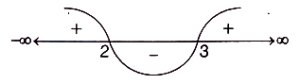
Let $t = |x|$,where $t \geq 0$. The inequality becomes $\frac{2-t}{3-t} \geq 0$,which is equivalent to $\frac{t-2}{t-3} \geq 0$.
Using the wavy curve method for $t \geq 0$,the solution for $t$ is $t \in [0, 2] \cup (3, \infty)$.
Now,substitute $t = |x|$ back:
Case $I$: $0 \leq |x| \leq 2 \Rightarrow x \in [-2, 2]$.
Case $II$: $|x| > 3 \Rightarrow x \in (-\infty, -3) \cup (3, \infty)$.
Combining these,the domain is $x \in (-\infty, -3) \cup [-2, 2] \cup (3, \infty)$.
For $f(x)$ to be defined,we must have $\frac{2-|x|}{3-|x|} \geq 0$.
Let $t = |x|$,where $t \geq 0$. The inequality becomes $\frac{2-t}{3-t} \geq 0$,which is equivalent to $\frac{t-2}{t-3} \geq 0$.
Using the wavy curve method for $t \geq 0$,the solution for $t$ is $t \in [0, 2] \cup (3, \infty)$.
Now,substitute $t = |x|$ back:
Case $I$: $0 \leq |x| \leq 2 \Rightarrow x \in [-2, 2]$.
Case $II$: $|x| > 3 \Rightarrow x \in (-\infty, -3) \cup (3, \infty)$.
Combining these,the domain is $x \in (-\infty, -3) \cup [-2, 2] \cup (3, \infty)$.
0 likes
View Solution197
EasyMCQ
The domain of the function defined by $f(x) = \frac{-5}{4x^2+1} + \sqrt{x^2-4}$ is
A
$R$
B
$(-\infty, -2)$
C
$(-\infty, -2] \cup [2, \infty)$
D
$(2, \infty)$
Solution
(C) The function is $f(x) = \frac{-5}{4x^2+1} + \sqrt{x^2-4}$.
For the function to be defined,the denominator $4x^2+1$ must not be zero,and the expression inside the square root must be non-negative.
Since $4x^2+1 \geq 1$ for all $x \in R$,the denominator is never zero.
For the square root,we require $x^2 - 4 \geq 0$.
$x^2 \geq 4$
$|x| \geq 2$
This implies $x \in (-\infty, -2] \cup [2, \infty)$.
Thus,the domain is $(-\infty, -2] \cup [2, \infty)$.
For the function to be defined,the denominator $4x^2+1$ must not be zero,and the expression inside the square root must be non-negative.
Since $4x^2+1 \geq 1$ for all $x \in R$,the denominator is never zero.
For the square root,we require $x^2 - 4 \geq 0$.
$x^2 \geq 4$
$|x| \geq 2$
This implies $x \in (-\infty, -2] \cup [2, \infty)$.
Thus,the domain is $(-\infty, -2] \cup [2, \infty)$.
0 likes
View Solution198
EasyMCQ
The domain of the function $f(x) = \sqrt{\frac{1-|x|}{2-|x|}}$ is
A
$[-1, 1] \cup (-\infty, -2] \cup [2, \infty)$
B
$[-1, 1] \cup (-\infty, -2) \cup (2, \infty)$
C
$(-\infty, -2) \cup (-2, 2) \cup (2, \infty)$
D
$R$
Solution
(B) For the function $f(x) = \sqrt{\frac{1-|x|}{2-|x|}}$ to be defined,the expression inside the square root must be non-negative and the denominator must not be zero.
$1$. $\frac{1-|x|}{2-|x|} \geq 0$
$2$. $2-|x| \neq 0 \implies |x| \neq 2 \implies x \neq \pm 2$
Let $t = |x|$,where $t \geq 0$. The inequality becomes $\frac{1-t}{2-t} \geq 0$.
Multiplying by $-1$ in numerator and denominator: $\frac{t-1}{t-2} \geq 0$.
Using the wavy curve method for $t \geq 0$,the solution for $t$ is $t \in [0, 1] \cup (2, \infty)$.
Now,substitute $t = |x|$ back:
Case $I$: $0 \leq |x| \leq 1 \implies x \in [-1, 1]$.
Case $II$: $|x| > 2 \implies x \in (-\infty, -2) \cup (2, \infty)$.
Combining these,the domain is $x \in (-\infty, -2) \cup [-1, 1] \cup (2, \infty)$.
$1$. $\frac{1-|x|}{2-|x|} \geq 0$
$2$. $2-|x| \neq 0 \implies |x| \neq 2 \implies x \neq \pm 2$
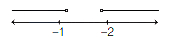
Let $t = |x|$,where $t \geq 0$. The inequality becomes $\frac{1-t}{2-t} \geq 0$.
Multiplying by $-1$ in numerator and denominator: $\frac{t-1}{t-2} \geq 0$.
Using the wavy curve method for $t \geq 0$,the solution for $t$ is $t \in [0, 1] \cup (2, \infty)$.
Now,substitute $t = |x|$ back:
Case $I$: $0 \leq |x| \leq 1 \implies x \in [-1, 1]$.
Case $II$: $|x| > 2 \implies x \in (-\infty, -2) \cup (2, \infty)$.
Combining these,the domain is $x \in (-\infty, -2) \cup [-1, 1] \cup (2, \infty)$.
0 likes
View Solution199
EasyMCQ
The domain of the function $f(x) = \frac{1}{\sqrt{|x|-x}}$ is
A
$(0, \infty)$
B
$(-\infty, 0)$
C
$(-\infty, \infty) \setminus \{0\}$
D
$(-\infty, \infty)$
Solution
(B) Given the function $f(x) = \frac{1}{\sqrt{|x|-x}}$.
For $f(x)$ to be defined,the expression inside the square root must be strictly positive:
$|x| - x > 0$
$|x| > x$
We know that for $x \geq 0$,$|x| = x$,so $x > x$ is false.
For $x < 0$,$|x| = -x$,so $-x > x$,which implies $-2x > 0$,or $x < 0$.
Thus,the function is defined for all $x \in (-\infty, 0)$.
Therefore,the domain of $f(x)$ is $(-\infty, 0)$.
For $f(x)$ to be defined,the expression inside the square root must be strictly positive:
$|x| - x > 0$
$|x| > x$
We know that for $x \geq 0$,$|x| = x$,so $x > x$ is false.
For $x < 0$,$|x| = -x$,so $-x > x$,which implies $-2x > 0$,or $x < 0$.
Thus,the function is defined for all $x \in (-\infty, 0)$.
Therefore,the domain of $f(x)$ is $(-\infty, 0)$.
0 likes
View Solution200
EasyMCQ
Find the domain of the real-valued function $f(x) = ([x]^2 - [x] - 2)^{-1/2}$,where $[\cdot]$ denotes the greatest integer function.
A
$R - (-1, 3]$
B
$R - [-1, 3)$
C
$R - (-1, 3)$
D
$R - [-1, 3]$
Solution
(B) For the function $f(x) = ([x]^2 - [x] - 2)^{-1/2}$ to be defined,the expression inside the square root must be strictly positive:
$[x]^2 - [x] - 2 > 0$
Factorizing the quadratic expression:
$([x] - 2)([x] + 1) > 0$
This inequality holds when $[x] < -1$ or $[x] > 2$.
Case $1$: If $[x] < -1$,then $x < -1$.
Case $2$: If $[x] > 2$,then $[x] \geq 3$,which implies $x \geq 3$.
Combining these,the domain is $(-\infty, -1) \cup [3, \infty)$.
This can be written as $R - [-1, 3)$.
$[x]^2 - [x] - 2 > 0$
Factorizing the quadratic expression:
$([x] - 2)([x] + 1) > 0$
This inequality holds when $[x] < -1$ or $[x] > 2$.
Case $1$: If $[x] < -1$,then $x < -1$.
Case $2$: If $[x] > 2$,then $[x] \geq 3$,which implies $x \geq 3$.
Combining these,the domain is $(-\infty, -1) \cup [3, \infty)$.
This can be written as $R - [-1, 3)$.
0 likes
View SolutionRelation and Function — Domain and Range · Frequently Asked Questions
1Are these Relation and Function questions useful for JEE and NEET?
Yes. All questions in this section are mapped to JEE Main and NEET exam patterns. Previous year questions from JEE Main, NEET, GUJCET and state-level exams are included with full solutions.
2Can I switch to Hindi or Gujarati for these questions?
Yes. Use the language tabs in the hero section or the sidebar to view the same questions and solutions in English, Hindi or Gujarati.
3How do I generate a question paper from this subtopic?
Use the Vedclass Exam Paper Generator — select the chapter and subtopic, set difficulty, and generate Sets A, B, C, D automatically. First 3 chapters of every subject are free.
Vedclass Products
For Students
Vedclass Test Series
Mock tests in real JEE/NEET style with performance analysis. 5-day free trial.
Start Free TrialFor Teachers
Exam Paper Generator
Generate Set A/B/C/D papers from this chapter in 2 minutes. 3 chapters free.
Try FreeFor Institutes
Online Exam Module
Live online exams with unlimited students, 360° analytics & white-label branding.
See DemoFor Teachers & Institutes
Generate a Relation and Function Exam Paper in 2 Minutes
Select subtopic & difficulty — Sets A, B, C, D auto-generated with No Repeat logic.
First 3 chapters of every subject are free — no payment required.