
A English
Probability distribution Questions in English
Class 12 Mathematics · Probability · Probability distribution
430+
Questions
English
Language
100%
With Solutions
Showing 46 of 430 questions in English
351
MediumMCQ
If $m$ and $\sigma^2$ are the mean and variance of the random variable $X$,whose distribution is given by:
Then:
| $X=x$ | $0$ | $1$ | $2$ | $3$ |
|---|---|---|---|---|
| $P(X=x)$ | $\frac{1}{3}$ | $\frac{1}{2}$ | $0$ | $\frac{1}{6}$ |
Then:
A
$m=\sigma^2=2$
B
$m=1, \sigma^2=2$
C
$m=\sigma^2=1$
D
$m=2, \sigma^2=1$
Solution
(C) Given the probability distribution:
Mean $m = \sum p_i x_i = (0 \times \frac{1}{3}) + (1 \times \frac{1}{2}) + (2 \times 0) + (3 \times \frac{1}{6})$
$m = 0 + \frac{1}{2} + 0 + \frac{1}{2} = 1$
Variance $\sigma^2 = \sum p_i (x_i - m)^2$
$\sigma^2 = \frac{1}{3}(0 - 1)^2 + \frac{1}{2}(1 - 1)^2 + 0(2 - 1)^2 + \frac{1}{6}(3 - 1)^2$
$\sigma^2 = \frac{1}{3}(1) + \frac{1}{2}(0) + 0 + \frac{1}{6}(4)$
$\sigma^2 = \frac{1}{3} + 0 + 0 + \frac{4}{6} = \frac{1}{3} + \frac{2}{3} = 1$
Thus,$m = 1$ and $\sigma^2 = 1$,so $m = \sigma^2 = 1$.
Mean $m = \sum p_i x_i = (0 \times \frac{1}{3}) + (1 \times \frac{1}{2}) + (2 \times 0) + (3 \times \frac{1}{6})$
$m = 0 + \frac{1}{2} + 0 + \frac{1}{2} = 1$
Variance $\sigma^2 = \sum p_i (x_i - m)^2$
$\sigma^2 = \frac{1}{3}(0 - 1)^2 + \frac{1}{2}(1 - 1)^2 + 0(2 - 1)^2 + \frac{1}{6}(3 - 1)^2$
$\sigma^2 = \frac{1}{3}(1) + \frac{1}{2}(0) + 0 + \frac{1}{6}(4)$
$\sigma^2 = \frac{1}{3} + 0 + 0 + \frac{4}{6} = \frac{1}{3} + \frac{2}{3} = 1$
Thus,$m = 1$ and $\sigma^2 = 1$,so $m = \sigma^2 = 1$.
0 likes
View Solution352
EasyMCQ
If two dice are thrown and if $X$ denotes the sum of the numbers that show up on the faces of the dice,then the mean of the random variable $X$ is
A
$\frac{27}{4}$
B
$\frac{35}{6}$
C
$\frac{41}{3}$
D
$7$
Solution
(D) Let $X$ be the sum of the numbers on the two dice. The possible values for $X$ are $2, 3, 4, 5, 6, 7, 8, 9, 10, 11, 12$.
The probability distribution is as follows:
$P(X=2) = \frac{1}{36}, P(X=3) = \frac{2}{36}, P(X=4) = \frac{3}{36}, P(X=5) = \frac{4}{36}, P(X=6) = \frac{5}{36}, P(X=7) = \frac{6}{36}, P(X=8) = \frac{5}{36}, P(X=9) = \frac{4}{36}, P(X=10) = \frac{3}{36}, P(X=11) = \frac{2}{36}, P(X=12) = \frac{1}{36}$.
The mean $E(X)$ is given by $\sum X_i P(X_i)$:
$E(X) = 2(\frac{1}{36}) + 3(\frac{2}{36}) + 4(\frac{3}{36}) + 5(\frac{4}{36}) + 6(\frac{5}{36}) + 7(\frac{6}{36}) + 8(\frac{5}{36}) + 9(\frac{4}{36}) + 10(\frac{3}{36}) + 11(\frac{2}{36}) + 12(\frac{1}{36})$
$E(X) = \frac{2 + 6 + 12 + 20 + 30 + 42 + 40 + 36 + 30 + 22 + 12}{36} = \frac{252}{36} = 7$.
The probability distribution is as follows:
$P(X=2) = \frac{1}{36}, P(X=3) = \frac{2}{36}, P(X=4) = \frac{3}{36}, P(X=5) = \frac{4}{36}, P(X=6) = \frac{5}{36}, P(X=7) = \frac{6}{36}, P(X=8) = \frac{5}{36}, P(X=9) = \frac{4}{36}, P(X=10) = \frac{3}{36}, P(X=11) = \frac{2}{36}, P(X=12) = \frac{1}{36}$.
The mean $E(X)$ is given by $\sum X_i P(X_i)$:
$E(X) = 2(\frac{1}{36}) + 3(\frac{2}{36}) + 4(\frac{3}{36}) + 5(\frac{4}{36}) + 6(\frac{5}{36}) + 7(\frac{6}{36}) + 8(\frac{5}{36}) + 9(\frac{4}{36}) + 10(\frac{3}{36}) + 11(\frac{2}{36}) + 12(\frac{1}{36})$
$E(X) = \frac{2 + 6 + 12 + 20 + 30 + 42 + 40 + 36 + 30 + 22 + 12}{36} = \frac{252}{36} = 7$.
0 likes
View Solution353
EasyMCQ
If the probability that an individual will suffer a reaction from an injection of a drug is $0.001$,then the probability that out of $2000$ individuals having that injection,more than $2$ individuals will suffer a reaction,is
A
$\frac{5}{e^2}$
B
$1-\frac{5}{e^2}$
C
$1-\frac{4}{e^2}$
D
$\frac{4}{e^2}$
Solution
(B) Given $n = 2000$ and $p = 0.001$.
Using the Poisson distribution,the parameter $\lambda = np = 2000 \times 0.001 = 2$.
The probability of $X$ individuals suffering a reaction is given by $P(X=k) = \frac{e^{-\lambda} \lambda^k}{k!}$.
We need to find $P(X > 2) = 1 - [P(X=0) + P(X=1) + P(X=2)]$.
Calculating the individual probabilities:
$P(X=0) = \frac{e^{-2} 2^0}{0!} = e^{-2}$
$P(X=1) = \frac{e^{-2} 2^1}{1!} = 2e^{-2}$
$P(X=2) = \frac{e^{-2} 2^2}{2!} = 2e^{-2}$
Summing these: $P(X \le 2) = e^{-2} + 2e^{-2} + 2e^{-2} = 5e^{-2}$.
Therefore,$P(X > 2) = 1 - 5e^{-2} = 1 - \frac{5}{e^2}$.
Using the Poisson distribution,the parameter $\lambda = np = 2000 \times 0.001 = 2$.
The probability of $X$ individuals suffering a reaction is given by $P(X=k) = \frac{e^{-\lambda} \lambda^k}{k!}$.
We need to find $P(X > 2) = 1 - [P(X=0) + P(X=1) + P(X=2)]$.
Calculating the individual probabilities:
$P(X=0) = \frac{e^{-2} 2^0}{0!} = e^{-2}$
$P(X=1) = \frac{e^{-2} 2^1}{1!} = 2e^{-2}$
$P(X=2) = \frac{e^{-2} 2^2}{2!} = 2e^{-2}$
Summing these: $P(X \le 2) = e^{-2} + 2e^{-2} + 2e^{-2} = 5e^{-2}$.
Therefore,$P(X > 2) = 1 - 5e^{-2} = 1 - \frac{5}{e^2}$.
0 likes
View Solution354
EasyMCQ
$5$ persons entered a lift cabin on the ground floor of a $7$-floor house. Suppose that each of them independently and with equal probability can leave the cabin at any floor beginning with the first. The probability of all the $5$ persons leaving the cabin at different floors is
A
$\frac{360}{2401}$
B
$\frac{5}{54}$
C
$\frac{5}{18}$
D
$\frac{5!}{7!}$
Solution
(B) The number of floors available to leave,excluding the ground floor,is $6$.
Each of the $5$ persons can choose any of the $6$ floors independently.
Therefore,the total number of ways the $5$ persons can leave is $6^5$.
The number of ways the $5$ persons can leave at $5$ different floors is given by the permutation formula $^6P_5$.
$^6P_5 = \frac{6!}{(6-5)!} = 6 \times 5 \times 4 \times 3 \times 2 = 720$.
The total number of outcomes is $6^5 = 7776$.
The probability is $\frac{^6P_5}{6^5} = \frac{720}{7776}$.
Simplifying the fraction: $\frac{720}{7776} = \frac{5}{54}$.
Each of the $5$ persons can choose any of the $6$ floors independently.
Therefore,the total number of ways the $5$ persons can leave is $6^5$.
The number of ways the $5$ persons can leave at $5$ different floors is given by the permutation formula $^6P_5$.
$^6P_5 = \frac{6!}{(6-5)!} = 6 \times 5 \times 4 \times 3 \times 2 = 720$.
The total number of outcomes is $6^5 = 7776$.
The probability is $\frac{^6P_5}{6^5} = \frac{720}{7776}$.
Simplifying the fraction: $\frac{720}{7776} = \frac{5}{54}$.
0 likes
View Solution355
DifficultMCQ
In a book of $500$ pages,it is found that there are $250$ typing errors. Assume that Poisson law holds for the number of errors per page. Then,the probability that a random sample of $2$ pages will contain no error,is:
A
$e^{-0.3}$
B
$e^{-0.5}$
C
$e^{-1}$
D
$e^{-2}$
Solution
(C) The average number of errors per page is given by $\lambda_{page} = \frac{250}{500} = 0.5$.
For a sample of $n = 2$ pages,the parameter for the Poisson distribution becomes $\lambda = n \times \lambda_{page} = 2 \times 0.5 = 1$.
The probability of having $X$ errors in the sample is given by the Poisson formula $P(X=k) = \frac{e^{-\lambda} \lambda^k}{k!}$.
For no errors,we set $k = 0$:
$P(X=0) = \frac{e^{-1} \times 1^0}{0!} = \frac{e^{-1} \times 1}{1} = e^{-1}$.
For a sample of $n = 2$ pages,the parameter for the Poisson distribution becomes $\lambda = n \times \lambda_{page} = 2 \times 0.5 = 1$.
The probability of having $X$ errors in the sample is given by the Poisson formula $P(X=k) = \frac{e^{-\lambda} \lambda^k}{k!}$.
For no errors,we set $k = 0$:
$P(X=0) = \frac{e^{-1} \times 1^0}{0!} = \frac{e^{-1} \times 1}{1} = e^{-1}$.
0 likes
View Solution356
DifficultMCQ
$A$ person who tosses an unbiased coin gains two points for turning up a head and loses one point for a tail. If three coins are tossed and the total score $X$ is observed,then the range of $X$ is
A
$\{0, 3, 6\}$
B
$\{-3, 0, 3\}$
C
$\{-3, 0, 3, 6\}$
D
$\{-3, 3, 6\}$
Solution
(C) Let $H$ denote a head and $T$ denote a tail. For each $H$,the gain is $+2$ points,and for each $T$,the loss is $-1$ point.
When three coins are tossed,the possible outcomes for the number of heads $(n_H)$ and tails $(n_T)$ are as follows:
$1$. Three tails $(0H, 3T)$: Score $X = 0(2) + 3(-1) = -3$.
$2$. Two tails and one head $(1H, 2T)$: Score $X = 1(2) + 2(-1) = 2 - 2 = 0$.
$3$. One tail and two heads $(2H, 1T)$: Score $X = 2(2) + 1(-1) = 4 - 1 = 3$.
$4$. Three heads $(3H, 0T)$: Score $X = 3(2) + 0(-1) = 6$.
Thus,the possible values for the total score $X$ are $\{-3, 0, 3, 6\}$.
Therefore,the range of $X$ is $\{-3, 0, 3, 6\}$.
When three coins are tossed,the possible outcomes for the number of heads $(n_H)$ and tails $(n_T)$ are as follows:
$1$. Three tails $(0H, 3T)$: Score $X = 0(2) + 3(-1) = -3$.
$2$. Two tails and one head $(1H, 2T)$: Score $X = 1(2) + 2(-1) = 2 - 2 = 0$.
$3$. One tail and two heads $(2H, 1T)$: Score $X = 2(2) + 1(-1) = 4 - 1 = 3$.
$4$. Three heads $(3H, 0T)$: Score $X = 3(2) + 0(-1) = 6$.
Thus,the possible values for the total score $X$ are $\{-3, 0, 3, 6\}$.
Therefore,the range of $X$ is $\{-3, 0, 3, 6\}$.
0 likes
View Solution357
DifficultMCQ
If on an average $4$ customers visit a shop in an hour,then the probability that more than $2$ customers visit the shop in a specific hour is
A
$\frac{e^4-13}{e^4}$
B
$\frac{8}{e^4}$
C
$\frac{4}{e^4}$
D
$\frac{e^4-21}{e^4}$
Solution
(A) The number of customers visiting the shop follows a Poisson distribution with parameter $\lambda = 4$.
The probability mass function is given by $P(X=x) = \frac{\lambda^x e^{-\lambda}}{x!}$.
We need to find the probability that more than $2$ customers visit,which is $P(X > 2)$.
$P(X > 2) = 1 - P(X \leq 2) = 1 - [P(X=0) + P(X=1) + P(X=2)]$.
Substituting the values:
$P(X=0) = \frac{4^0 e^{-4}}{0!} = e^{-4}$.
$P(X=1) = \frac{4^1 e^{-4}}{1!} = 4e^{-4}$.
$P(X=2) = \frac{4^2 e^{-4}}{2!} = \frac{16e^{-4}}{2} = 8e^{-4}$.
Therefore,$P(X > 2) = 1 - [e^{-4} + 4e^{-4} + 8e^{-4}] = 1 - 13e^{-4}$.
This can be written as $1 - \frac{13}{e^4} = \frac{e^4 - 13}{e^4}$.
The probability mass function is given by $P(X=x) = \frac{\lambda^x e^{-\lambda}}{x!}$.
We need to find the probability that more than $2$ customers visit,which is $P(X > 2)$.
$P(X > 2) = 1 - P(X \leq 2) = 1 - [P(X=0) + P(X=1) + P(X=2)]$.
Substituting the values:
$P(X=0) = \frac{4^0 e^{-4}}{0!} = e^{-4}$.
$P(X=1) = \frac{4^1 e^{-4}}{1!} = 4e^{-4}$.
$P(X=2) = \frac{4^2 e^{-4}}{2!} = \frac{16e^{-4}}{2} = 8e^{-4}$.
Therefore,$P(X > 2) = 1 - [e^{-4} + 4e^{-4} + 8e^{-4}] = 1 - 13e^{-4}$.
This can be written as $1 - \frac{13}{e^4} = \frac{e^4 - 13}{e^4}$.
0 likes
View Solution358
MediumMCQ
If $P(X=x)=c\left(\frac{2}{3}\right)^x$ for $x=1, 2, 3, 4, \ldots$ is a probability distribution function of a random variable $X$,then the value of $c$ is
A
$\frac{1}{4}$
B
$\frac{1}{3}$
C
$\frac{1}{2}$
D
$\frac{1}{6}$
Solution
(C) For a probability distribution,the sum of all probabilities must be equal to $1$,i.e.,$\sum_{x=1}^{\infty} P(X=x) = 1$.
Given $P(X=x) = c\left(\frac{2}{3}\right)^x$.
Substituting the values of $x$: $c\left(\frac{2}{3}\right) + c\left(\frac{2}{3}\right)^2 + c\left(\frac{2}{3}\right)^3 + \ldots = 1$.
Taking $c$ as a common factor: $c \left[ \frac{2}{3} + \left(\frac{2}{3}\right)^2 + \left(\frac{2}{3}\right)^3 + \ldots \right] = 1$.
The expression inside the bracket is an infinite geometric series with first term $a = \frac{2}{3}$ and common ratio $r = \frac{2}{3}$.
The sum of an infinite geometric series is given by $S = \frac{a}{1-r}$.
So,$c \left[ \frac{2/3}{1 - 2/3} \right] = 1$.
$c \left[ \frac{2/3}{1/3} \right] = 1$.
$c(2) = 1$.
Therefore,$c = \frac{1}{2}$.
Given $P(X=x) = c\left(\frac{2}{3}\right)^x$.
Substituting the values of $x$: $c\left(\frac{2}{3}\right) + c\left(\frac{2}{3}\right)^2 + c\left(\frac{2}{3}\right)^3 + \ldots = 1$.
Taking $c$ as a common factor: $c \left[ \frac{2}{3} + \left(\frac{2}{3}\right)^2 + \left(\frac{2}{3}\right)^3 + \ldots \right] = 1$.
The expression inside the bracket is an infinite geometric series with first term $a = \frac{2}{3}$ and common ratio $r = \frac{2}{3}$.
The sum of an infinite geometric series is given by $S = \frac{a}{1-r}$.
So,$c \left[ \frac{2/3}{1 - 2/3} \right] = 1$.
$c \left[ \frac{2/3}{1/3} \right] = 1$.
$c(2) = 1$.
Therefore,$c = \frac{1}{2}$.
0 likes
View Solution359
MediumMCQ
An observer counts $240$ vehicles per hour at a specific location on a highway. Assuming that the arrival of vehicles at the location follows a Poisson distribution,the probability that more than two vehicles arrive over a $30 \text{ sec}$ time interval is
A
$\frac{e^2-5}{e^2}$
B
$\frac{e^2-2}{e^2}$
C
$\frac{1}{12 e^2}$
D
$\frac{12-e^2}{e^2}$
Solution
(A) The average arrival rate,$\lambda$,is $240 \text{ vehicles/hour} = \frac{240}{3600} \text{ vehicles/second} = \frac{1}{15} \text{ vehicles/second}$.
For a time interval $t = 30 \text{ seconds}$,the expected number of arrivals is $\mu = \lambda t = \frac{1}{15} \times 30 = 2$.
According to the Poisson distribution,the probability of $n$ arrivals is $P(n) = \frac{\mu^n e^{-\mu}}{n!}$.
We need to find the probability of more than two vehicles arriving,i.e.,$P(n > 2) = 1 - [P(0) + P(1) + P(2)]$.
Calculating individual probabilities:
$P(0) = \frac{2^0 e^{-2}}{0!} = e^{-2}$
$P(1) = \frac{2^1 e^{-2}}{1!} = 2e^{-2}$
$P(2) = \frac{2^2 e^{-2}}{2!} = \frac{4e^{-2}}{2} = 2e^{-2}$
Summing these probabilities: $P(n \leq 2) = e^{-2} + 2e^{-2} + 2e^{-2} = 5e^{-2}$.
Therefore,$P(n > 2) = 1 - 5e^{-2} = 1 - \frac{5}{e^2} = \frac{e^2 - 5}{e^2}$.
For a time interval $t = 30 \text{ seconds}$,the expected number of arrivals is $\mu = \lambda t = \frac{1}{15} \times 30 = 2$.
According to the Poisson distribution,the probability of $n$ arrivals is $P(n) = \frac{\mu^n e^{-\mu}}{n!}$.
We need to find the probability of more than two vehicles arriving,i.e.,$P(n > 2) = 1 - [P(0) + P(1) + P(2)]$.
Calculating individual probabilities:
$P(0) = \frac{2^0 e^{-2}}{0!} = e^{-2}$
$P(1) = \frac{2^1 e^{-2}}{1!} = 2e^{-2}$
$P(2) = \frac{2^2 e^{-2}}{2!} = \frac{4e^{-2}}{2} = 2e^{-2}$
Summing these probabilities: $P(n \leq 2) = e^{-2} + 2e^{-2} + 2e^{-2} = 5e^{-2}$.
Therefore,$P(n > 2) = 1 - 5e^{-2} = 1 - \frac{5}{e^2} = \frac{e^2 - 5}{e^2}$.
0 likes
View Solution360
MediumMCQ
If the probability function of a random variable $X$ is given by $P(X=n) = \frac{k(n+1)}{3^n}$ for $n \in \mathbb{N} \cup \{0\}$ where $k$ is a constant,then $P(X < 2) = $
A
$\frac{20}{27}$
B
$\frac{20}{81}$
C
$\frac{2}{27}$
D
$\frac{8}{81}$
Solution
(A) Given the probability mass function $P(X=n) = \frac{k(n+1)}{3^n}$ for $n \in \{0, 1, 2, \dots\}$.
Since the sum of all probabilities must be $1$,we have $\sum_{n=0}^{\infty} P(X=n) = 1$.
$k \sum_{n=0}^{\infty} \frac{n+1}{3^n} = k \left( \frac{1}{3^0} + \frac{2}{3^1} + \frac{3}{3^2} + \frac{4}{3^3} + \dots \right) = 1$.
This is an arithmetico-geometric series with $a=1$,$d=1$,and $r=\frac{1}{3}$.
The sum of the series is $S = \frac{a}{1-r} + \frac{dr}{(1-r)^2} = \frac{1}{1-1/3} + \frac{1 \cdot (1/3)}{(1-1/3)^2} = \frac{3}{2} + \frac{1/3}{4/9} = \frac{3}{2} + \frac{3}{4} = \frac{9}{4}$.
Thus,$k \cdot \frac{9}{4} = 1 \implies k = \frac{4}{9}$.
We need to find $P(X < 2) = P(X=0) + P(X=1)$.
$P(X=0) = k \cdot \frac{0+1}{3^0} = k \cdot 1 = \frac{4}{9}$.
$P(X=1) = k \cdot \frac{1+1}{3^1} = k \cdot \frac{2}{3} = \frac{4}{9} \cdot \frac{2}{3} = \frac{8}{27}$.
$P(X < 2) = \frac{4}{9} + \frac{8}{27} = \frac{12+8}{27} = \frac{20}{27}$.
Since the sum of all probabilities must be $1$,we have $\sum_{n=0}^{\infty} P(X=n) = 1$.
$k \sum_{n=0}^{\infty} \frac{n+1}{3^n} = k \left( \frac{1}{3^0} + \frac{2}{3^1} + \frac{3}{3^2} + \frac{4}{3^3} + \dots \right) = 1$.
This is an arithmetico-geometric series with $a=1$,$d=1$,and $r=\frac{1}{3}$.
The sum of the series is $S = \frac{a}{1-r} + \frac{dr}{(1-r)^2} = \frac{1}{1-1/3} + \frac{1 \cdot (1/3)}{(1-1/3)^2} = \frac{3}{2} + \frac{1/3}{4/9} = \frac{3}{2} + \frac{3}{4} = \frac{9}{4}$.
Thus,$k \cdot \frac{9}{4} = 1 \implies k = \frac{4}{9}$.
We need to find $P(X < 2) = P(X=0) + P(X=1)$.
$P(X=0) = k \cdot \frac{0+1}{3^0} = k \cdot 1 = \frac{4}{9}$.
$P(X=1) = k \cdot \frac{1+1}{3^1} = k \cdot \frac{2}{3} = \frac{4}{9} \cdot \frac{2}{3} = \frac{8}{27}$.
$P(X < 2) = \frac{4}{9} + \frac{8}{27} = \frac{12+8}{27} = \frac{20}{27}$.
0 likes
View Solution361
MediumMCQ
If a Poisson variate $X$ satisfies the relation $P(X=3)=P(X=5)$,then $P(X=4)=$
A
$\frac{50}{3 e^{\sqrt{20}}}$
B
$\frac{20000}{3 e^{20}}$
C
$\frac{125}{3 e^{10}}$
D
$\frac{25}{3 e^{\sqrt{20}}}$
Solution
(A) The probability mass function of a Poisson distribution is given by $P(X=k) = \frac{e^{-\lambda} \lambda^k}{k!}$.
Given $P(X=3) = P(X=5)$,we have $\frac{e^{-\lambda} \lambda^3}{3!} = \frac{e^{-\lambda} \lambda^5}{5!}$.
Canceling $e^{-\lambda}$ and $\lambda^3$ from both sides,we get $\frac{1}{6} = \frac{\lambda^2}{120}$.
Thus,$\lambda^2 = \frac{120}{6} = 20$,which implies $\lambda = \sqrt{20}$.
Now,we need to find $P(X=4) = \frac{e^{-\lambda} \lambda^4}{4!}$.
Substituting $\lambda = \sqrt{20}$ and $\lambda^2 = 20$,we get $P(X=4) = \frac{e^{-\sqrt{20}} (20)^2}{24} = \frac{400}{24 e^{\sqrt{20}}} = \frac{50}{3 e^{\sqrt{20}}}$.
Given $P(X=3) = P(X=5)$,we have $\frac{e^{-\lambda} \lambda^3}{3!} = \frac{e^{-\lambda} \lambda^5}{5!}$.
Canceling $e^{-\lambda}$ and $\lambda^3$ from both sides,we get $\frac{1}{6} = \frac{\lambda^2}{120}$.
Thus,$\lambda^2 = \frac{120}{6} = 20$,which implies $\lambda = \sqrt{20}$.
Now,we need to find $P(X=4) = \frac{e^{-\lambda} \lambda^4}{4!}$.
Substituting $\lambda = \sqrt{20}$ and $\lambda^2 = 20$,we get $P(X=4) = \frac{e^{-\sqrt{20}} (20)^2}{24} = \frac{400}{24 e^{\sqrt{20}}} = \frac{50}{3 e^{\sqrt{20}}}$.
0 likes
View Solution362
MediumMCQ
In a Poisson distribution,if $\frac{P(X=5)}{P(X=2)}=\frac{1}{7500}$ and $\frac{P(X=5)}{P(X=3)}=\frac{1}{500}$,then the mean of the distribution is
A
$\frac{1}{15}$
B
$\frac{1}{5}$
C
$\frac{1}{25}$
D
$\frac{1}{3}$
Solution
(B) For a Poisson distribution with parameter $\lambda$,the probability mass function is given by $P(X=k) = \frac{e^{-\lambda} \lambda^k}{k!}$.
Given $\frac{P(X=5)}{P(X=2)} = \frac{1}{7500}$,we have $\frac{\frac{e^{-\lambda} \lambda^5}{5!}}{\frac{e^{-\lambda} \lambda^2}{2!}} = \frac{\lambda^3}{5 \times 4 \times 3} = \frac{\lambda^3}{60} = \frac{1}{7500}$.
Thus,$\lambda^3 = \frac{60}{7500} = \frac{6}{750} = \frac{1}{125}$.
Taking the cube root,$\lambda = \frac{1}{5}$.
Checking with the second condition: $\frac{P(X=5)}{P(X=3)} = \frac{\frac{e^{-\lambda} \lambda^5}{5!}}{\frac{e^{-\lambda} \lambda^3}{3!}} = \frac{\lambda^2}{5 \times 4} = \frac{\lambda^2}{20}$.
Substituting $\lambda = \frac{1}{5}$,we get $\frac{(1/5)^2}{20} = \frac{1/25}{20} = \frac{1}{500}$.
This matches the given condition. Therefore,the mean of the distribution is $\lambda = \frac{1}{5}$.
Given $\frac{P(X=5)}{P(X=2)} = \frac{1}{7500}$,we have $\frac{\frac{e^{-\lambda} \lambda^5}{5!}}{\frac{e^{-\lambda} \lambda^2}{2!}} = \frac{\lambda^3}{5 \times 4 \times 3} = \frac{\lambda^3}{60} = \frac{1}{7500}$.
Thus,$\lambda^3 = \frac{60}{7500} = \frac{6}{750} = \frac{1}{125}$.
Taking the cube root,$\lambda = \frac{1}{5}$.
Checking with the second condition: $\frac{P(X=5)}{P(X=3)} = \frac{\frac{e^{-\lambda} \lambda^5}{5!}}{\frac{e^{-\lambda} \lambda^3}{3!}} = \frac{\lambda^2}{5 \times 4} = \frac{\lambda^2}{20}$.
Substituting $\lambda = \frac{1}{5}$,we get $\frac{(1/5)^2}{20} = \frac{1/25}{20} = \frac{1}{500}$.
This matches the given condition. Therefore,the mean of the distribution is $\lambda = \frac{1}{5}$.
0 likes
View Solution363
MediumMCQ
$A$ typist claims that he prepares a typed page with typo errors of $1$ per $10$ pages. In a typing assignment of $40$ pages,if the probability that the typo errors are at most $2$ is $p$,then $e^2 p=$
A
$5$
B
$13$
C
$13 e^{-2}$
D
$5 e^{-2}$
Solution
(C) The number of errors follows a Poisson distribution with parameter $\lambda = n \times p_{error}$.
Given $n = 40$ pages and the rate of errors is $1$ per $10$ pages,the average number of errors is $\lambda = 40 \times \frac{1}{10} = 4$.
The probability of having $X$ errors is given by $P(X = k) = \frac{e^{-\lambda} \lambda^k}{k!}$.
We need the probability that the errors are at most $2$,which is $p = P(X \le 2) = P(X=0) + P(X=1) + P(X=2)$.
$p = e^{-4} \left( \frac{4^0}{0!} + \frac{4^1}{1!} + \frac{4^2}{2!} \right) = e^{-4} (1 + 4 + 8) = 13 e^{-4}$.
We are asked to find $e^2 p$.
$e^2 p = e^2 \times 13 e^{-4} = 13 e^{-2}$.
Given $n = 40$ pages and the rate of errors is $1$ per $10$ pages,the average number of errors is $\lambda = 40 \times \frac{1}{10} = 4$.
The probability of having $X$ errors is given by $P(X = k) = \frac{e^{-\lambda} \lambda^k}{k!}$.
We need the probability that the errors are at most $2$,which is $p = P(X \le 2) = P(X=0) + P(X=1) + P(X=2)$.
$p = e^{-4} \left( \frac{4^0}{0!} + \frac{4^1}{1!} + \frac{4^2}{2!} \right) = e^{-4} (1 + 4 + 8) = 13 e^{-4}$.
We are asked to find $e^2 p$.
$e^2 p = e^2 \times 13 e^{-4} = 13 e^{-2}$.
0 likes
View Solution364
MediumMCQ
Two bad eggs are mixed accidentally with $10$ good ones. If three eggs are drawn at random from this lot in succession without replacement,then the variance of the probability distribution of the number of bad eggs drawn is
A
$\frac{17}{44}$
B
$\frac{15}{44}$
C
$\frac{13}{44}$
D
$\frac{9}{44}$
Solution
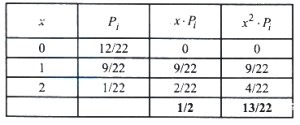
(B) Let $X$ be the random variable representing the number of bad eggs drawn. The total number of eggs is $12$,and we draw $3$ eggs without replacement. The possible values for $X$ are $0, 1, 2$.
The probability distribution is calculated as follows:
$P(X=0) = \frac{{}^{10}C_3}{{}^{12}C_3} = \frac{120}{220} = \frac{12}{22}$
$P(X=1) = \frac{{}^{10}C_2 \times {}^{2}C_1}{{}^{12}C_3} = \frac{45 \times 2}{220} = \frac{90}{220} = \frac{9}{22}$
$P(X=2) = \frac{{}^{10}C_1 \times {}^{2}C_2}{{}^{12}C_3} = \frac{10 \times 1}{220} = \frac{10}{220} = \frac{1}{22}$
Now,we calculate the mean $E(X) = \sum x_i P_i$:
$E(X) = (0 \times \frac{12}{22}) + (1 \times \frac{9}{22}) + (2 \times \frac{1}{22}) = \frac{9+2}{22} = \frac{11}{22} = \frac{1}{2}$
Next,we calculate $E(X^2) = \sum x_i^2 P_i$:
$E(X^2) = (0^2 \times \frac{12}{22}) + (1^2 \times \frac{9}{22}) + (2^2 \times \frac{1}{22}) = \frac{9+4}{22} = \frac{13}{22}$
Finally,the variance is given by $Var(X) = E(X^2) - [E(X)]^2$:
$Var(X) = \frac{13}{22} - (\frac{1}{2})^2 = \frac{13}{22} - \frac{1}{4} = \frac{26-11}{44} = \frac{15}{44}$
The probability distribution is calculated as follows:
$P(X=0) = \frac{{}^{10}C_3}{{}^{12}C_3} = \frac{120}{220} = \frac{12}{22}$
$P(X=1) = \frac{{}^{10}C_2 \times {}^{2}C_1}{{}^{12}C_3} = \frac{45 \times 2}{220} = \frac{90}{220} = \frac{9}{22}$
$P(X=2) = \frac{{}^{10}C_1 \times {}^{2}C_2}{{}^{12}C_3} = \frac{10 \times 1}{220} = \frac{10}{220} = \frac{1}{22}$
Now,we calculate the mean $E(X) = \sum x_i P_i$:
$E(X) = (0 \times \frac{12}{22}) + (1 \times \frac{9}{22}) + (2 \times \frac{1}{22}) = \frac{9+2}{22} = \frac{11}{22} = \frac{1}{2}$
Next,we calculate $E(X^2) = \sum x_i^2 P_i$:
$E(X^2) = (0^2 \times \frac{12}{22}) + (1^2 \times \frac{9}{22}) + (2^2 \times \frac{1}{22}) = \frac{9+4}{22} = \frac{13}{22}$
Finally,the variance is given by $Var(X) = E(X^2) - [E(X)]^2$:
$Var(X) = \frac{13}{22} - (\frac{1}{2})^2 = \frac{13}{22} - \frac{1}{4} = \frac{26-11}{44} = \frac{15}{44}$
0 likes
View Solution365
MediumMCQ
In a communication network,$98 \%$ of messages are transmitted with no error. If a random variable $X$ denotes the number of incorrectly transmitted messages,then the probability that at most one message is transmitted incorrectly out of $500$ messages sent,is
A
$\frac{11}{e^{10}}$
B
$\frac{e^{10}-1}{e^{10}}$
C
$e^{10}$
D
$\frac{98}{e^{10}}$
Solution
(A) Given that the total number of messages $n = 500$ and the probability of a message being transmitted correctly is $0.98$.
Therefore,the probability of a message being transmitted incorrectly is $p = 1 - 0.98 = 0.02$.
Since $n$ is large and $p$ is small,we use the Poisson distribution with parameter $\lambda = np = 500 \times 0.02 = 10$.
The probability of $X$ incorrectly transmitted messages is given by $P(X=r) = \frac{\lambda^r e^{-\lambda}}{r!}$.
We need to find the probability that at most one message is transmitted incorrectly,i.e.,$P(X \leq 1) = P(X=0) + P(X=1)$.
$P(X=0) = \frac{10^0 e^{-10}}{0!} = e^{-10}$.
$P(X=1) = \frac{10^1 e^{-10}}{1!} = 10 e^{-10}$.
Thus,$P(X \leq 1) = e^{-10} + 10 e^{-10} = 11 e^{-10} = \frac{11}{e^{10}}$.
Therefore,the probability of a message being transmitted incorrectly is $p = 1 - 0.98 = 0.02$.
Since $n$ is large and $p$ is small,we use the Poisson distribution with parameter $\lambda = np = 500 \times 0.02 = 10$.
The probability of $X$ incorrectly transmitted messages is given by $P(X=r) = \frac{\lambda^r e^{-\lambda}}{r!}$.
We need to find the probability that at most one message is transmitted incorrectly,i.e.,$P(X \leq 1) = P(X=0) + P(X=1)$.
$P(X=0) = \frac{10^0 e^{-10}}{0!} = e^{-10}$.
$P(X=1) = \frac{10^1 e^{-10}}{1!} = 10 e^{-10}$.
Thus,$P(X \leq 1) = e^{-10} + 10 e^{-10} = 11 e^{-10} = \frac{11}{e^{10}}$.
0 likes
View Solution366
MediumMCQ
An executive in a company makes on an average $5$ telephone calls per hour at a cost of $Rs. 2$ per call. The probability that in any hour the cost of the calls exceeds a sum of $Rs. 4$ is
A
$\frac{2 e^4-35}{2 e^5}$
B
$\frac{2 e^5-37}{2 e^5}$
C
$1-\frac{37}{2 e^4}$
D
$1-(18.5) e^5$
Solution
(B) Let $X$ be the number of calls made per hour. Since the average number of calls is $5$,$X$ follows a Poisson distribution with parameter $\lambda = 5$.
The cost of $X$ calls is $2X$. We want to find the probability that the cost exceeds $Rs. 4$,i.e.,$P(2X > 4) = P(X > 2)$.
$P(X > 2) = 1 - P(X \leq 2) = 1 - [P(X=0) + P(X=1) + P(X=2)]$.
Using the Poisson formula $P(X=k) = \frac{e^{-\lambda} \lambda^k}{k!}$:
$P(X=0) = e^{-5} \frac{5^0}{0!} = e^{-5}$.
$P(X=1) = e^{-5} \frac{5^1}{1!} = 5e^{-5}$.
$P(X=2) = e^{-5} \frac{5^2}{2!} = \frac{25}{2} e^{-5}$.
Summing these: $P(X \leq 2) = e^{-5} (1 + 5 + 12.5) = 18.5 e^{-5} = \frac{37}{2} e^{-5}$.
Therefore,$P(X > 2) = 1 - \frac{37}{2 e^5} = \frac{2 e^5 - 37}{2 e^5}$.
The cost of $X$ calls is $2X$. We want to find the probability that the cost exceeds $Rs. 4$,i.e.,$P(2X > 4) = P(X > 2)$.
$P(X > 2) = 1 - P(X \leq 2) = 1 - [P(X=0) + P(X=1) + P(X=2)]$.
Using the Poisson formula $P(X=k) = \frac{e^{-\lambda} \lambda^k}{k!}$:
$P(X=0) = e^{-5} \frac{5^0}{0!} = e^{-5}$.
$P(X=1) = e^{-5} \frac{5^1}{1!} = 5e^{-5}$.
$P(X=2) = e^{-5} \frac{5^2}{2!} = \frac{25}{2} e^{-5}$.
Summing these: $P(X \leq 2) = e^{-5} (1 + 5 + 12.5) = 18.5 e^{-5} = \frac{37}{2} e^{-5}$.
Therefore,$P(X > 2) = 1 - \frac{37}{2 e^5} = \frac{2 e^5 - 37}{2 e^5}$.
0 likes
View Solution367
EasyMCQ
If the probability of a bad reaction from a vaccination is $0.01$,then the probability that exactly two out of $300$ people will get a bad reaction is
A
$\frac{7}{2 e^3}$
B
$\frac{9}{2 e^3}$
C
$\frac{7}{e^3}$
D
$\frac{9}{e^3}$
Solution
(B) The probability of a bad reaction is $p = 0.01$ and the number of people is $n = 300$.
Since $n$ is large and $p$ is small,we use the Poisson distribution as an approximation to the binomial distribution.
The mean $\mu$ is given by $\mu = n \times p = 300 \times 0.01 = 3$.
The Poisson probability formula is $P(X = x) = \frac{e^{-\mu} \cdot \mu^x}{x!}$.
For $x = 2$,we have $P(X = 2) = \frac{e^{-3} \cdot 3^2}{2!} = \frac{9}{2 e^3}$.
Since $n$ is large and $p$ is small,we use the Poisson distribution as an approximation to the binomial distribution.
The mean $\mu$ is given by $\mu = n \times p = 300 \times 0.01 = 3$.
The Poisson probability formula is $P(X = x) = \frac{e^{-\mu} \cdot \mu^x}{x!}$.
For $x = 2$,we have $P(X = 2) = \frac{e^{-3} \cdot 3^2}{2!} = \frac{9}{2 e^3}$.
0 likes
View Solution368
MediumMCQ
In a game of throwing $3$ coins,a player loses $₹ 5$ for each head and gains $₹ 10$ for each tail. If a random variable $X: S \rightarrow R$ is defined as $X(a) = \text{net gain } (a \in S)$,then the mean of the random variable is (in rupees):
A
$\frac{15}{2}$
B
$-\frac{15}{2}$
C
$15$
D
$25$
Solution
(A) When $3$ coins are tossed,the sample space $S$ contains $2^3 = 8$ outcomes: $S = \{HHH, HHT, HTH, HTT, THH, THT, TTH, TTT\}$.
Let $H$ be the number of heads and $T$ be the number of tails. The net gain $X$ is given by $X = 10T - 5H$. Since $H + T = 3$,we have $T = 3 - H$.
Thus,$X = 10(3 - H) - 5H = 30 - 15H$.
Calculating $X$ for each outcome:
- $HHH (H=3): X = 30 - 15(3) = -15$
- $HHT, HTH, THH (H=2): X = 30 - 15(2) = 0$
- $HTT, THT, TTH (H=1): X = 30 - 15(1) = 15$
- $TTT (H=0): X = 30 - 15(0) = 30$
The probability distribution is:
The mean $E(X) = \Sigma x P(x) = (-15 \times \frac{1}{8}) + (0 \times \frac{3}{8}) + (15 \times \frac{3}{8}) + (30 \times \frac{1}{8})$
$E(X) = \frac{-15 + 0 + 45 + 30}{8} = \frac{60}{8} = \frac{15}{2}$.
Let $H$ be the number of heads and $T$ be the number of tails. The net gain $X$ is given by $X = 10T - 5H$. Since $H + T = 3$,we have $T = 3 - H$.
Thus,$X = 10(3 - H) - 5H = 30 - 15H$.
Calculating $X$ for each outcome:
- $HHH (H=3): X = 30 - 15(3) = -15$
- $HHT, HTH, THH (H=2): X = 30 - 15(2) = 0$
- $HTT, THT, TTH (H=1): X = 30 - 15(1) = 15$
- $TTT (H=0): X = 30 - 15(0) = 30$
The probability distribution is:
| $x$ | $-15$ | $0$ | $15$ | $30$ |
| $P(x)$ | $\frac{1}{8}$ | $\frac{3}{8}$ | $\frac{3}{8}$ | $\frac{1}{8}$ |
The mean $E(X) = \Sigma x P(x) = (-15 \times \frac{1}{8}) + (0 \times \frac{3}{8}) + (15 \times \frac{3}{8}) + (30 \times \frac{1}{8})$
$E(X) = \frac{-15 + 0 + 45 + 30}{8} = \frac{60}{8} = \frac{15}{2}$.
0 likes
View Solution369
MediumMCQ
If three dice are thrown,then the mean of the sum of the numbers appearing on them is
A
$58.5$
B
$76.66$
C
$71.75$
D
$10.5$
Solution
(D) Let $X_1, X_2, X_3$ be the random variables representing the numbers appearing on the three dice respectively.
Each $X_i$ can take values from the set $\{1, 2, 3, 4, 5, 6\}$ with equal probability $P(X_i = k) = \frac{1}{6}$ for $k \in \{1, 2, 3, 4, 5, 6\}$.
The mean (expected value) of a single die is $E[X_i] = \sum_{k=1}^{6} k \cdot P(X_i = k) = \frac{1+2+3+4+5+6}{6} = \frac{21}{6} = 3.5$.
Let $S$ be the sum of the numbers appearing on the three dice,so $S = X_1 + X_2 + X_3$.
By the linearity of expectation,the mean of the sum is $E[S] = E[X_1 + X_2 + X_3] = E[X_1] + E[X_2] + E[X_3]$.
Substituting the mean of a single die,we get $E[S] = 3.5 + 3.5 + 3.5 = 10.5$.
Therefore,the mean of the sum of the numbers is $10.5$.
Each $X_i$ can take values from the set $\{1, 2, 3, 4, 5, 6\}$ with equal probability $P(X_i = k) = \frac{1}{6}$ for $k \in \{1, 2, 3, 4, 5, 6\}$.
The mean (expected value) of a single die is $E[X_i] = \sum_{k=1}^{6} k \cdot P(X_i = k) = \frac{1+2+3+4+5+6}{6} = \frac{21}{6} = 3.5$.
Let $S$ be the sum of the numbers appearing on the three dice,so $S = X_1 + X_2 + X_3$.
By the linearity of expectation,the mean of the sum is $E[S] = E[X_1 + X_2 + X_3] = E[X_1] + E[X_2] + E[X_3]$.
Substituting the mean of a single die,we get $E[S] = 3.5 + 3.5 + 3.5 = 10.5$.
Therefore,the mean of the sum of the numbers is $10.5$.
0 likes
View Solution370
MediumMCQ
Two persons $A$ and $B$ play a game by throwing two dice. If the sum of the numbers appeared on the two dice is even,$A$ will get $\frac{1}{2}$ point and $B$ will get $\frac{1}{2}$ point. If the sum is odd,$A$ will get one point and $B$ will get no point. The arithmetic mean of the random variable of the number of points of $A$ is
A
$\frac{1}{2}$
B
$\frac{1}{4}$
C
$1$
D
$\frac{3}{4}$
Solution
(D) When two dice are thrown,the total number of outcomes is $6 \times 6 = 36$.
The sum of the numbers on the two dice can be even or odd.
The number of outcomes where the sum is even is $18$,and the number of outcomes where the sum is odd is $18$.
Thus,$P(\text{sum is even}) = \frac{18}{36} = \frac{1}{2}$ and $P(\text{sum is odd}) = \frac{18}{36} = \frac{1}{2}$.
Let $X$ be the random variable representing the points obtained by $A$.
If the sum is even,$X = \frac{1}{2}$ with probability $\frac{1}{2}$.
If the sum is odd,$X = 1$ with probability $\frac{1}{2}$.
The arithmetic mean (expected value) of $X$ is $E(X) = \sum x_i p_i = (\frac{1}{2} \times \frac{1}{2}) + (1 \times \frac{1}{2}) = \frac{1}{4} + \frac{1}{2} = \frac{3}{4}$.
The sum of the numbers on the two dice can be even or odd.
The number of outcomes where the sum is even is $18$,and the number of outcomes where the sum is odd is $18$.
Thus,$P(\text{sum is even}) = \frac{18}{36} = \frac{1}{2}$ and $P(\text{sum is odd}) = \frac{18}{36} = \frac{1}{2}$.
Let $X$ be the random variable representing the points obtained by $A$.
If the sum is even,$X = \frac{1}{2}$ with probability $\frac{1}{2}$.
If the sum is odd,$X = 1$ with probability $\frac{1}{2}$.
The arithmetic mean (expected value) of $X$ is $E(X) = \sum x_i p_i = (\frac{1}{2} \times \frac{1}{2}) + (1 \times \frac{1}{2}) = \frac{1}{4} + \frac{1}{2} = \frac{3}{4}$.
0 likes
View Solution371
MediumMCQ
If $X$ is a random variable with probability distribution $P(X=k) = \frac{(2k+3)c}{3^k}$,$k=0, 1, 2, \ldots, \infty$,then $P(X=3) =$
A
$\frac{1}{24}$
B
$\frac{1}{18}$
C
$\frac{1}{6}$
D
$\frac{1}{3}$
Solution
(B) For a probability distribution,the sum of all probabilities must be $1$: $\sum_{k=0}^{\infty} P(X=k) = 1$.
Substituting the given expression: $c \sum_{k=0}^{\infty} \frac{2k+3}{3^k} = 1$.
Let $S = \sum_{k=0}^{\infty} \frac{2k+3}{3^k} = 3 \sum_{k=0}^{\infty} \frac{1}{3^k} + 2 \sum_{k=0}^{\infty} \frac{k}{3^k}$.
The first part is a geometric series: $3 \times \frac{1}{1 - 1/3} = 3 \times \frac{3}{2} = \frac{9}{2}$.
The second part is an arithmetico-geometric series: $\sum_{k=0}^{\infty} k x^k = \frac{x}{(1-x)^2}$. For $x = 1/3$,this is $\frac{1/3}{(1-1/3)^2} = \frac{1/3}{4/9} = \frac{3}{4}$.
So,$S = \frac{9}{2} + 2 \times \frac{3}{4} = \frac{9}{2} + \frac{3}{2} = 6$.
Since $c \times S = 1$,we have $c = 1/6$.
Now,$P(X=3) = \frac{(2(3)+3)c}{3^3} = \frac{9c}{27} = \frac{c}{3}$.
Substituting $c = 1/6$,we get $P(X=3) = \frac{1/6}{3} = \frac{1}{18}$.
Substituting the given expression: $c \sum_{k=0}^{\infty} \frac{2k+3}{3^k} = 1$.
Let $S = \sum_{k=0}^{\infty} \frac{2k+3}{3^k} = 3 \sum_{k=0}^{\infty} \frac{1}{3^k} + 2 \sum_{k=0}^{\infty} \frac{k}{3^k}$.
The first part is a geometric series: $3 \times \frac{1}{1 - 1/3} = 3 \times \frac{3}{2} = \frac{9}{2}$.
The second part is an arithmetico-geometric series: $\sum_{k=0}^{\infty} k x^k = \frac{x}{(1-x)^2}$. For $x = 1/3$,this is $\frac{1/3}{(1-1/3)^2} = \frac{1/3}{4/9} = \frac{3}{4}$.
So,$S = \frac{9}{2} + 2 \times \frac{3}{4} = \frac{9}{2} + \frac{3}{2} = 6$.
Since $c \times S = 1$,we have $c = 1/6$.
Now,$P(X=3) = \frac{(2(3)+3)c}{3^3} = \frac{9c}{27} = \frac{c}{3}$.
Substituting $c = 1/6$,we get $P(X=3) = \frac{1/6}{3} = \frac{1}{18}$.
0 likes
View Solution372
MediumMCQ
The probability distribution of a random variable $X$ is given below. Then,the standard deviation of $X$ is
| $X=x_i$ | $2$ | $3$ | $5$ | $7$ | $12$ |
|---|---|---|---|---|---|
| $P(X=x_i)$ | $3k$ | $k$ | $k$ | $2k$ | $k$ |
A
$5$
B
$11$
C
$\sqrt{11}$
D
$\sqrt{5}$
Solution
(C) Step $1$: Find the value of $k$. The sum of probabilities must be $1$.
$3k + k + k + 2k + k = 1 \implies 8k = 1 \implies k = \frac{1}{8}$.
Step $2$: Calculate the mean $E(X) = \sum x_i P(X=x_i)$.
$E(X) = 2(3k) + 3(k) + 5(k) + 7(2k) + 12(k) = 6k + 3k + 5k + 14k + 12k = 40k$.
Since $k = \frac{1}{8}$,$E(X) = 40 \times \frac{1}{8} = 5$.
Step $3$: Calculate $E(X^2) = \sum x_i^2 P(X=x_i)$.
$E(X^2) = 2^2(3k) + 3^2(k) + 5^2(k) + 7^2(2k) + 12^2(k) = 12k + 9k + 25k + 98k + 144k = 288k$.
Since $k = \frac{1}{8}$,$E(X^2) = 288 \times \frac{1}{8} = 36$.
Step $4$: Calculate the variance $Var(X) = E(X^2) - [E(X)]^2$.
$Var(X) = 36 - (5)^2 = 36 - 25 = 11$.
Step $5$: Calculate the standard deviation $\sigma = \sqrt{Var(X)} = \sqrt{11}$.
$3k + k + k + 2k + k = 1 \implies 8k = 1 \implies k = \frac{1}{8}$.
Step $2$: Calculate the mean $E(X) = \sum x_i P(X=x_i)$.
$E(X) = 2(3k) + 3(k) + 5(k) + 7(2k) + 12(k) = 6k + 3k + 5k + 14k + 12k = 40k$.
Since $k = \frac{1}{8}$,$E(X) = 40 \times \frac{1}{8} = 5$.
Step $3$: Calculate $E(X^2) = \sum x_i^2 P(X=x_i)$.
$E(X^2) = 2^2(3k) + 3^2(k) + 5^2(k) + 7^2(2k) + 12^2(k) = 12k + 9k + 25k + 98k + 144k = 288k$.
Since $k = \frac{1}{8}$,$E(X^2) = 288 \times \frac{1}{8} = 36$.
Step $4$: Calculate the variance $Var(X) = E(X^2) - [E(X)]^2$.
$Var(X) = 36 - (5)^2 = 36 - 25 = 11$.
Step $5$: Calculate the standard deviation $\sigma = \sqrt{Var(X)} = \sqrt{11}$.
0 likes
View Solution373
MediumMCQ
The range of a discrete random variable $X$ is $\{1, 2, 3\}$ and the probabilities of its elements are given by $P(X=1) = 3k^3$,$P(X=2) = 2k^2$,and $P(X=3) = 7 - 19k$. Then $P(X=3) = $
A
$\frac{2}{3}$
B
$\frac{2}{9}$
C
$\frac{1}{9}$
D
$\frac{4}{9}$
Solution
(A) For a discrete random variable,the sum of all probabilities must be equal to $1$.
Therefore,$P(X=1) + P(X=2) + P(X=3) = 1$.
Substituting the given values: $3k^3 + 2k^2 + (7 - 19k) = 1$.
$3k^3 + 2k^2 - 19k + 6 = 0$.
By testing values,if $k = 3$,$3(27) + 2(9) - 19(3) + 6 = 81 + 18 - 57 + 6 = 48 \neq 0$.
If $k = \frac{1}{3}$,$3(\frac{1}{27}) + 2(\frac{1}{9}) - 19(\frac{1}{3}) + 6 = \frac{1}{9} + \frac{2}{9} - \frac{57}{9} + \frac{54}{9} = 0$.
So,$k = \frac{1}{3}$ is a root.
Now,$P(X=3) = 7 - 19k = 7 - 19(\frac{1}{3}) = 7 - \frac{19}{3} = \frac{21 - 19}{3} = \frac{2}{3}$.
Therefore,$P(X=1) + P(X=2) + P(X=3) = 1$.
Substituting the given values: $3k^3 + 2k^2 + (7 - 19k) = 1$.
$3k^3 + 2k^2 - 19k + 6 = 0$.
By testing values,if $k = 3$,$3(27) + 2(9) - 19(3) + 6 = 81 + 18 - 57 + 6 = 48 \neq 0$.
If $k = \frac{1}{3}$,$3(\frac{1}{27}) + 2(\frac{1}{9}) - 19(\frac{1}{3}) + 6 = \frac{1}{9} + \frac{2}{9} - \frac{57}{9} + \frac{54}{9} = 0$.
So,$k = \frac{1}{3}$ is a root.
Now,$P(X=3) = 7 - 19k = 7 - 19(\frac{1}{3}) = 7 - \frac{19}{3} = \frac{21 - 19}{3} = \frac{2}{3}$.
0 likes
View Solution374
EasyMCQ
If a random variable $X$ has the following probability distribution,then the mean of $X$ is
| $X = x_i$ | $1$ | $2$ | $3$ | $5$ |
| $P(X = x_i)$ | $2k^2$ | $k$ | $k$ | $k^2$ |
A
$\frac{26}{9}$
B
$\frac{22}{9}$
C
$\frac{24}{9}$
D
$\frac{28}{9}$
Solution
(B) We know that the sum of all probabilities in a distribution is $1$,i.e.,$\Sigma P(X = x_i) = 1$.
$\therefore 2k^2 + k + k + k^2 = 1$
$\Rightarrow 3k^2 + 2k - 1 = 0$
Factoring the quadratic equation: $(3k - 1)(k + 1) = 0$.
This gives $k = \frac{1}{3}$ or $k = -1$.
Since the probability $P(X = x_i)$ must be non-negative,$k = \frac{1}{3}$ is the only valid solution.
The mean of $X$ is given by $E(X) = \Sigma x_i P(X = x_i)$.
$E(X) = (1 \times 2k^2) + (2 \times k) + (3 \times k) + (5 \times k^2)$
$E(X) = 2k^2 + 2k + 3k + 5k^2 = 7k^2 + 5k$
Substituting $k = \frac{1}{3}$:
$E(X) = 7(\frac{1}{3})^2 + 5(\frac{1}{3}) = 7(\frac{1}{9}) + \frac{5}{3} = \frac{7}{9} + \frac{15}{9} = \frac{22}{9}$.
$\therefore 2k^2 + k + k + k^2 = 1$
$\Rightarrow 3k^2 + 2k - 1 = 0$
Factoring the quadratic equation: $(3k - 1)(k + 1) = 0$.
This gives $k = \frac{1}{3}$ or $k = -1$.
Since the probability $P(X = x_i)$ must be non-negative,$k = \frac{1}{3}$ is the only valid solution.
The mean of $X$ is given by $E(X) = \Sigma x_i P(X = x_i)$.
$E(X) = (1 \times 2k^2) + (2 \times k) + (3 \times k) + (5 \times k^2)$
$E(X) = 2k^2 + 2k + 3k + 5k^2 = 7k^2 + 5k$
Substituting $k = \frac{1}{3}$:
$E(X) = 7(\frac{1}{3})^2 + 5(\frac{1}{3}) = 7(\frac{1}{9}) + \frac{5}{3} = \frac{7}{9} + \frac{15}{9} = \frac{22}{9}$.
0 likes
View Solution375
EasyMCQ
If the probability distribution of a random variable $X$ is as follows,then the variance of $X$ is
$\begin{array}{|c|c|c|c|c|}\hline X=x & 2 & 3 & 5 & 9 \\\hline P(X=x) & K & 2 K & 3 K^2 & K^2 \\\hline\end{array}$
$\begin{array}{|c|c|c|c|c|}\hline X=x & 2 & 3 & 5 & 9 \\\hline P(X=x) & K & 2 K & 3 K^2 & K^2 \\\hline\end{array}$
A
$\frac{61}{4}$
B
$\frac{7}{2}$
C
$12$
D
$3$
Solution
(D) We know that the sum of probabilities in a distribution is $1$.
$\Sigma P(X=x) = K + 2K + 3K^2 + K^2 = 1$
$4K^2 + 3K - 1 = 0$
$(4K - 1)(K + 1) = 0$
Since $P(X=x) \geq 0$,we reject $K = -1$. Thus,$K = \frac{1}{4}$.
The distribution is:
$\begin{array}{|c|c|c|c|c|}\hline X=x & 2 & 3 & 5 & 9 \\\hline P(X=x) & \frac{1}{4} & \frac{1}{2} & \frac{3}{16} & \frac{1}{16} \\\hline\end{array}$
$E(X) = \Sigma x P(x) = (2 \times \frac{1}{4}) + (3 \times \frac{1}{2}) + (5 \times \frac{3}{16}) + (9 \times \frac{1}{16}) = \frac{8}{16} + \frac{24}{16} + \frac{15}{16} + \frac{9}{16} = \frac{56}{16} = \frac{7}{2}$
$E(X^2) = \Sigma x^2 P(x) = (4 \times \frac{1}{4}) + (9 \times \frac{1}{2}) + (25 \times \frac{3}{16}) + (81 \times \frac{1}{16}) = 1 + \frac{9}{2} + \frac{75}{16} + \frac{81}{16} = \frac{16 + 72 + 75 + 81}{16} = \frac{244}{16} = \frac{61}{4}$
$\text{Variance} = E(X^2) - [E(X)]^2 = \frac{61}{4} - (\frac{7}{2})^2 = \frac{61}{4} - \frac{49}{4} = \frac{12}{4} = 3$.
$\Sigma P(X=x) = K + 2K + 3K^2 + K^2 = 1$
$4K^2 + 3K - 1 = 0$
$(4K - 1)(K + 1) = 0$
Since $P(X=x) \geq 0$,we reject $K = -1$. Thus,$K = \frac{1}{4}$.
The distribution is:
$\begin{array}{|c|c|c|c|c|}\hline X=x & 2 & 3 & 5 & 9 \\\hline P(X=x) & \frac{1}{4} & \frac{1}{2} & \frac{3}{16} & \frac{1}{16} \\\hline\end{array}$
$E(X) = \Sigma x P(x) = (2 \times \frac{1}{4}) + (3 \times \frac{1}{2}) + (5 \times \frac{3}{16}) + (9 \times \frac{1}{16}) = \frac{8}{16} + \frac{24}{16} + \frac{15}{16} + \frac{9}{16} = \frac{56}{16} = \frac{7}{2}$
$E(X^2) = \Sigma x^2 P(x) = (4 \times \frac{1}{4}) + (9 \times \frac{1}{2}) + (25 \times \frac{3}{16}) + (81 \times \frac{1}{16}) = 1 + \frac{9}{2} + \frac{75}{16} + \frac{81}{16} = \frac{16 + 72 + 75 + 81}{16} = \frac{244}{16} = \frac{61}{4}$
$\text{Variance} = E(X^2) - [E(X)]^2 = \frac{61}{4} - (\frac{7}{2})^2 = \frac{61}{4} - \frac{49}{4} = \frac{12}{4} = 3$.
0 likes
View Solution376
EasyMCQ
If a random variable $X$ has the following probability distribution,then its variance is
| $X=x$ | $1$ | $3$ | $5$ | $2$ |
| $P(X=x)$ | $3 K^2$ | $K$ | $K^2$ | $2 K$ |
A
$\frac{9}{4}$
B
$\frac{25}{8}$
C
$\frac{27}{16}$
D
$\frac{15}{16}$
Solution
(D) The sum of probabilities in a probability distribution is $1$.
$3K^2 + K + K^2 + 2K = 1$
$4K^2 + 3K - 1 = 0$
$(4K - 1)(K + 1) = 0$
Since $P(X=x) \geq 0$,$K$ must be positive,so $K = \frac{1}{4}$.
The distribution is:
The mean $\mu = E(X) = \sum x_i P(x_i) = 1(\frac{3}{16}) + 3(\frac{1}{4}) + 5(\frac{1}{16}) + 2(\frac{1}{2}) = \frac{3}{16} + \frac{12}{16} + \frac{5}{16} + \frac{16}{16} = \frac{36}{16} = \frac{9}{4}$.
$E(X^2) = \sum x_i^2 P(x_i) = 1^2(\frac{3}{16}) + 3^2(\frac{1}{4}) + 5^2(\frac{1}{16}) + 2^2(\frac{1}{2}) = \frac{3}{16} + \frac{36}{16} + \frac{25}{16} + \frac{32}{16} = \frac{96}{16} = 6$.
Variance $\sigma^2 = E(X^2) - [E(X)]^2 = 6 - (\frac{9}{4})^2 = 6 - \frac{81}{16} = \frac{96 - 81}{16} = \frac{15}{16}$.
$3K^2 + K + K^2 + 2K = 1$
$4K^2 + 3K - 1 = 0$
$(4K - 1)(K + 1) = 0$
Since $P(X=x) \geq 0$,$K$ must be positive,so $K = \frac{1}{4}$.
The distribution is:
| $X=x$ | $1$ | $3$ | $5$ | $2$ |
| $P(X=x)$ | $\frac{3}{16}$ | $\frac{1}{4}$ | $\frac{1}{16}$ | $\frac{1}{2}$ |
The mean $\mu = E(X) = \sum x_i P(x_i) = 1(\frac{3}{16}) + 3(\frac{1}{4}) + 5(\frac{1}{16}) + 2(\frac{1}{2}) = \frac{3}{16} + \frac{12}{16} + \frac{5}{16} + \frac{16}{16} = \frac{36}{16} = \frac{9}{4}$.
$E(X^2) = \sum x_i^2 P(x_i) = 1^2(\frac{3}{16}) + 3^2(\frac{1}{4}) + 5^2(\frac{1}{16}) + 2^2(\frac{1}{2}) = \frac{3}{16} + \frac{36}{16} + \frac{25}{16} + \frac{32}{16} = \frac{96}{16} = 6$.
Variance $\sigma^2 = E(X^2) - [E(X)]^2 = 6 - (\frac{9}{4})^2 = 6 - \frac{81}{16} = \frac{96 - 81}{16} = \frac{15}{16}$.
0 likes
View Solution377
DifficultMCQ
If $X$ is a Poisson variate satisfying the condition $3 P(X=2)=P(X=4)$,then find $P(X=6)$.
A
$\frac{162}{5 e^6}$
B
$\frac{108}{5 e^6}$
C
$\frac{324}{5 e^6}$
D
$\frac{648}{5 e^6}$
Solution
(C) The probability mass function of a Poisson distribution is given by $P(X=x) = \frac{e^{-\lambda} \lambda^x}{x!}$.
Given the condition $3 P(X=2) = P(X=4)$.
Substituting the formula,we get $3 \cdot \frac{e^{-\lambda} \lambda^2}{2!} = \frac{e^{-\lambda} \lambda^4}{4!}$.
Canceling $e^{-\lambda}$ from both sides and simplifying the factorials: $\frac{3 \lambda^2}{2} = \frac{\lambda^4}{24}$.
Multiplying both sides by $24$,we get $36 \lambda^2 = \lambda^4$.
Since $\lambda > 0$,we have $\lambda^2 = 36$,which implies $\lambda = 6$.
Now,we need to find $P(X=6) = \frac{e^{-6} \cdot 6^6}{6!}$.
Calculating the value: $P(X=6) = \frac{e^{-6} \cdot 46656}{720} = \frac{46656}{720 e^6} = \frac{324}{5 e^6}$.
Given the condition $3 P(X=2) = P(X=4)$.
Substituting the formula,we get $3 \cdot \frac{e^{-\lambda} \lambda^2}{2!} = \frac{e^{-\lambda} \lambda^4}{4!}$.
Canceling $e^{-\lambda}$ from both sides and simplifying the factorials: $\frac{3 \lambda^2}{2} = \frac{\lambda^4}{24}$.
Multiplying both sides by $24$,we get $36 \lambda^2 = \lambda^4$.
Since $\lambda > 0$,we have $\lambda^2 = 36$,which implies $\lambda = 6$.
Now,we need to find $P(X=6) = \frac{e^{-6} \cdot 6^6}{6!}$.
Calculating the value: $P(X=6) = \frac{e^{-6} \cdot 46656}{720} = \frac{46656}{720 e^6} = \frac{324}{5 e^6}$.
0 likes
View Solution378
MediumMCQ
$A$ random variable $X$ has the following probability distribution:
For the events $E = \{x : x \text{ is a prime number}\}$ and $F = \{x : x < 4\}$,then $P(E \cup F) = $
| $X = x$ | $1$ | $2$ | $3$ | $4$ | $5$ | $6$ | $7$ | $8$ |
| $P(X = x)$ | $0.15$ | $0.23$ | $k$ | $0.10$ | $0.20$ | $0.08$ | $0.07$ | $0.05$ |
For the events $E = \{x : x \text{ is a prime number}\}$ and $F = \{x : x < 4\}$,then $P(E \cup F) = $
A
$0.57$
B
$0.87$
C
$0.77$
D
$0.35$
Solution
(C) The sum of all probabilities in a distribution must be $1$:
$\Sigma P(X = x) = 0.15 + 0.23 + k + 0.10 + 0.20 + 0.08 + 0.07 + 0.05 = 1$
$0.88 + k = 1$
$k = 0.12$
The event $E$ consists of prime numbers in the set $\{1, 2, 3, 4, 5, 6, 7, 8\}$,so $E = \{2, 3, 5, 7\}$.
The event $F$ consists of values less than $4$,so $F = \{1, 2, 3\}$.
The union $E \cup F = \{1, 2, 3, 5, 7\}$.
The probability $P(E \cup F) = P(X=1) + P(X=2) + P(X=3) + P(X=5) + P(X=7)$
$P(E \cup F) = 0.15 + 0.23 + 0.12 + 0.20 + 0.07 = 0.77$.
$\Sigma P(X = x) = 0.15 + 0.23 + k + 0.10 + 0.20 + 0.08 + 0.07 + 0.05 = 1$
$0.88 + k = 1$
$k = 0.12$
The event $E$ consists of prime numbers in the set $\{1, 2, 3, 4, 5, 6, 7, 8\}$,so $E = \{2, 3, 5, 7\}$.
The event $F$ consists of values less than $4$,so $F = \{1, 2, 3\}$.
The union $E \cup F = \{1, 2, 3, 5, 7\}$.
The probability $P(E \cup F) = P(X=1) + P(X=2) + P(X=3) + P(X=5) + P(X=7)$
$P(E \cup F) = 0.15 + 0.23 + 0.12 + 0.20 + 0.07 = 0.77$.
0 likes
View Solution379
EasyMCQ
$A$ random variable $X$ has the following distribution.
Then the variance of this distribution is
| $X = x_{i}$ | $-2$ | $-1$ | $0$ | $1$ | $2$ | $3$ |
| $P(X = x_{i})$ | $0.1$ | $k$ | $0.2$ | $2k$ | $3k$ | $k$ |
Then the variance of this distribution is
A
$2.64$
B
$2.8$
C
$2.16$
D
$1.86$
Solution
(C) For a probability distribution,the sum of all probabilities must be $1$.
$\sum P(X = x_{i}) = 0.1 + k + 0.2 + 2k + 3k + k = 1$
$7k + 0.3 = 1 \Rightarrow 7k = 0.7 \Rightarrow k = 0.1$.
Now,we calculate the mean $\mu = E(X) = \sum x_{i} P(x_{i})$:
$\mu = (-2)(0.1) + (-1)(0.1) + (0)(0.2) + (1)(0.2) + (2)(0.3) + (3)(0.1)$
$\mu = -0.2 - 0.1 + 0 + 0.2 + 0.6 + 0.3 = 0.8$.
Next,we calculate $E(X^2) = \sum x_{i}^2 P(x_{i})$:
$E(X^2) = (-2)^2(0.1) + (-1)^2(0.1) + (0)^2(0.2) + (1)^2(0.2) + (2)^2(0.3) + (3)^2(0.1)$
$E(X^2) = 4(0.1) + 1(0.1) + 0 + 1(0.2) + 4(0.3) + 9(0.1)$
$E(X^2) = 0.4 + 0.1 + 0 + 0.2 + 1.2 + 0.9 = 2.8$.
The variance is given by $Var(X) = E(X^2) - [E(X)]^2$.
$Var(X) = 2.8 - (0.8)^2 = 2.8 - 0.64 = 2.16$.
$\sum P(X = x_{i}) = 0.1 + k + 0.2 + 2k + 3k + k = 1$
$7k + 0.3 = 1 \Rightarrow 7k = 0.7 \Rightarrow k = 0.1$.
Now,we calculate the mean $\mu = E(X) = \sum x_{i} P(x_{i})$:
$\mu = (-2)(0.1) + (-1)(0.1) + (0)(0.2) + (1)(0.2) + (2)(0.3) + (3)(0.1)$
$\mu = -0.2 - 0.1 + 0 + 0.2 + 0.6 + 0.3 = 0.8$.
Next,we calculate $E(X^2) = \sum x_{i}^2 P(x_{i})$:
$E(X^2) = (-2)^2(0.1) + (-1)^2(0.1) + (0)^2(0.2) + (1)^2(0.2) + (2)^2(0.3) + (3)^2(0.1)$
$E(X^2) = 4(0.1) + 1(0.1) + 0 + 1(0.2) + 4(0.3) + 9(0.1)$
$E(X^2) = 0.4 + 0.1 + 0 + 0.2 + 1.2 + 0.9 = 2.8$.
The variance is given by $Var(X) = E(X^2) - [E(X)]^2$.
$Var(X) = 2.8 - (0.8)^2 = 2.8 - 0.64 = 2.16$.
0 likes
View Solution380
MediumMCQ
Two balls are drawn at random from a bag containing $5$ black balls and $3$ white balls. If the random variable $X$ denotes the number of white balls drawn,then the mean of $X$ is
A
$\frac{1}{2}$
B
$\frac{5}{8}$
C
$\frac{3}{4}$
D
$\frac{3}{8}$
Solution
(C) The total number of balls is $5 + 3 = 8$. Two balls are drawn at random. The total number of ways to draw $2$ balls is ${}^8C_2 = \frac{8 \times 7}{2} = 28$.
Let $X$ be the random variable representing the number of white balls drawn. The possible values for $X$ are $0, 1, 2$.
$P(X = 0) = \frac{{}^5C_2}{{}^8C_2} = \frac{10}{28}$.
$P(X = 1) = \frac{{}^5C_1 \times {}^3C_1}{{}^8C_2} = \frac{5 \times 3}{28} = \frac{15}{28}$.
$P(X = 2) = \frac{{}^3C_2}{{}^8C_2} = \frac{3}{28}$.
The mean of $X$ is given by $E(X) = \sum x_i P(x_i) = 0 \times P(X = 0) + 1 \times P(X = 1) + 2 \times P(X = 2)$.
$E(X) = 0 \times \frac{10}{28} + 1 \times \frac{15}{28} + 2 \times \frac{3}{28} = 0 + \frac{15}{28} + \frac{6}{28} = \frac{21}{28} = \frac{3}{4}$.
Let $X$ be the random variable representing the number of white balls drawn. The possible values for $X$ are $0, 1, 2$.
$P(X = 0) = \frac{{}^5C_2}{{}^8C_2} = \frac{10}{28}$.
$P(X = 1) = \frac{{}^5C_1 \times {}^3C_1}{{}^8C_2} = \frac{5 \times 3}{28} = \frac{15}{28}$.
$P(X = 2) = \frac{{}^3C_2}{{}^8C_2} = \frac{3}{28}$.
The mean of $X$ is given by $E(X) = \sum x_i P(x_i) = 0 \times P(X = 0) + 1 \times P(X = 1) + 2 \times P(X = 2)$.
$E(X) = 0 \times \frac{10}{28} + 1 \times \frac{15}{28} + 2 \times \frac{3}{28} = 0 + \frac{15}{28} + \frac{6}{28} = \frac{21}{28} = \frac{3}{4}$.
0 likes
View Solution381
EasyMCQ
$A$ random variable $X$ has the range $\{0, 1, 2, \ldots\}$. If $P(X=r) = k(1+r) 3^{-r}$ for $r=0, 1, 2, \ldots$,where $k > 0$ is a real number,then $P(X=0) + P(X=1) + P(X=2) =$
A
$\frac{4}{9}$
B
$\frac{8}{9}$
C
$\frac{2}{3}$
D
$\frac{1}{3}$
Solution
(B) The sum of all probabilities in a probability distribution is $1$. Therefore,$\sum_{r=0}^{\infty} P(X=r) = 1$.
Given $P(X=r) = k(1+r) 3^{-r}$,we have $k \sum_{r=0}^{\infty} (1+r) \left(\frac{1}{3}\right)^r = 1$.
Let $S = \sum_{r=0}^{\infty} (1+r) x^r$ where $x = \frac{1}{3}$.
This is an arithmetico-geometric series: $S = 1 + 2x + 3x^2 + 4x^3 + \ldots$.
Multiplying by $x$: $xS = x + 2x^2 + 3x^3 + \ldots$.
Subtracting the two: $S(1-x) = 1 + x + x^2 + x^3 + \ldots = \frac{1}{1-x}$.
Thus,$S = \frac{1}{(1-x)^2}$.
For $x = \frac{1}{3}$,$S = \frac{1}{(1 - 1/3)^2} = \frac{1}{(2/3)^2} = \frac{9}{4}$.
So,$k \times \frac{9}{4} = 1 \implies k = \frac{4}{9}$.
Now,$P(X=0) + P(X=1) + P(X=2) = k \left[ (1+0)3^0 + (1+1)3^{-1} + (1+2)3^{-2} \right]$.
$= \frac{4}{9} \left[ 1 + \frac{2}{3} + \frac{3}{9} \right] = \frac{4}{9} \left[ 1 + \frac{2}{3} + \frac{1}{3} \right] = \frac{4}{9} \times 2 = \frac{8}{9}$.
Given $P(X=r) = k(1+r) 3^{-r}$,we have $k \sum_{r=0}^{\infty} (1+r) \left(\frac{1}{3}\right)^r = 1$.
Let $S = \sum_{r=0}^{\infty} (1+r) x^r$ where $x = \frac{1}{3}$.
This is an arithmetico-geometric series: $S = 1 + 2x + 3x^2 + 4x^3 + \ldots$.
Multiplying by $x$: $xS = x + 2x^2 + 3x^3 + \ldots$.
Subtracting the two: $S(1-x) = 1 + x + x^2 + x^3 + \ldots = \frac{1}{1-x}$.
Thus,$S = \frac{1}{(1-x)^2}$.
For $x = \frac{1}{3}$,$S = \frac{1}{(1 - 1/3)^2} = \frac{1}{(2/3)^2} = \frac{9}{4}$.
So,$k \times \frac{9}{4} = 1 \implies k = \frac{4}{9}$.
Now,$P(X=0) + P(X=1) + P(X=2) = k \left[ (1+0)3^0 + (1+1)3^{-1} + (1+2)3^{-2} \right]$.
$= \frac{4}{9} \left[ 1 + \frac{2}{3} + \frac{3}{9} \right] = \frac{4}{9} \left[ 1 + \frac{2}{3} + \frac{1}{3} \right] = \frac{4}{9} \times 2 = \frac{8}{9}$.
0 likes
View Solution382
MediumMCQ
If the probability distribution of a random variable $X$ is given by the following table,then the mean of $X$ is:
| $X = x$ | $0$ | $2$ | $4$ | $6$ | $8$ | $10$ |
|---|---|---|---|---|---|---|
| $P(X = x)$ | $0$ | $k$ | $2k$ | $5k^2$ | $2k^2$ | $3k$ |
A
$\frac{384}{121}$
B
$\frac{60}{13}$
C
$\frac{163}{25}$
D
$\frac{326}{49}$
Solution
(D) For a probability distribution,the sum of all probabilities must be equal to $1$:
$\sum P(X=x) = 0 + k + 2k + 5k^2 + 2k^2 + 3k = 1$
$7k^2 + 6k - 1 = 0$
$7k^2 + 7k - k - 1 = 0$
$7k(k + 1) - 1(k + 1) = 0$
$(k + 1)(7k - 1) = 0$
Since $k$ must be positive for probabilities,$k = \frac{1}{7}$.
The mean $E(X)$ is given by $\sum x_i P(X=x_i)$:
$E(X) = (0 \times 0) + (2 \times k) + (4 \times 2k) + (6 \times 5k^2) + (8 \times 2k^2) + (10 \times 3k)$
$E(X) = 0 + 2k + 8k + 30k^2 + 16k^2 + 30k$
$E(X) = 46k^2 + 40k$
Substituting $k = \frac{1}{7}$:
$E(X) = 46(\frac{1}{7})^2 + 40(\frac{1}{7})$
$E(X) = \frac{46}{49} + \frac{40}{7} = \frac{46 + 280}{49} = \frac{326}{49}$
Thus,the correct option is $(d)$.
$\sum P(X=x) = 0 + k + 2k + 5k^2 + 2k^2 + 3k = 1$
$7k^2 + 6k - 1 = 0$
$7k^2 + 7k - k - 1 = 0$
$7k(k + 1) - 1(k + 1) = 0$
$(k + 1)(7k - 1) = 0$
Since $k$ must be positive for probabilities,$k = \frac{1}{7}$.
The mean $E(X)$ is given by $\sum x_i P(X=x_i)$:
$E(X) = (0 \times 0) + (2 \times k) + (4 \times 2k) + (6 \times 5k^2) + (8 \times 2k^2) + (10 \times 3k)$
$E(X) = 0 + 2k + 8k + 30k^2 + 16k^2 + 30k$
$E(X) = 46k^2 + 40k$
Substituting $k = \frac{1}{7}$:
$E(X) = 46(\frac{1}{7})^2 + 40(\frac{1}{7})$
$E(X) = \frac{46}{49} + \frac{40}{7} = \frac{46 + 280}{49} = \frac{326}{49}$
Thus,the correct option is $(d)$.
0 likes
View Solution383
MediumMCQ
If $X$ is a Poisson variate such that $\frac{5}{3} k = P(X=2) = P(X=3)$,then $P(X=5) =$
A
$k$
B
$\frac{1}{4} k$
C
$\frac{1}{2} k$
D
$\frac{3}{4} k$
Solution
(D) The probability mass function of a Poisson distribution is given by $P(X=x) = \frac{e^{-\lambda} \lambda^x}{x!}$.
Given $P(X=2) = P(X=3)$,we have:
$\frac{e^{-\lambda} \lambda^2}{2!} = \frac{e^{-\lambda} \lambda^3}{3!}$
$\frac{1}{2} = \frac{\lambda}{6} \implies \lambda = 3$.
Now,we are given $\frac{5}{3} k = P(X=2) = \frac{e^{-3} 3^2}{2!} = \frac{9 e^{-3}}{2}$.
So,$\frac{5}{3} k = \frac{9 e^{-3}}{2} \implies e^{-3} = \frac{10}{27} k$.
We need to find $P(X=5) = \frac{e^{-3} 3^5}{5!} = \frac{e^{-3} \times 243}{120} = \frac{81}{40} e^{-3}$.
Substituting $e^{-3} = \frac{10}{27} k$:
$P(X=5) = \frac{81}{40} \times \frac{10}{27} k = \frac{3}{4} k$.
Given $P(X=2) = P(X=3)$,we have:
$\frac{e^{-\lambda} \lambda^2}{2!} = \frac{e^{-\lambda} \lambda^3}{3!}$
$\frac{1}{2} = \frac{\lambda}{6} \implies \lambda = 3$.
Now,we are given $\frac{5}{3} k = P(X=2) = \frac{e^{-3} 3^2}{2!} = \frac{9 e^{-3}}{2}$.
So,$\frac{5}{3} k = \frac{9 e^{-3}}{2} \implies e^{-3} = \frac{10}{27} k$.
We need to find $P(X=5) = \frac{e^{-3} 3^5}{5!} = \frac{e^{-3} \times 243}{120} = \frac{81}{40} e^{-3}$.
Substituting $e^{-3} = \frac{10}{27} k$:
$P(X=5) = \frac{81}{40} \times \frac{10}{27} k = \frac{3}{4} k$.
0 likes
View Solution384
MediumMCQ
$A$ random variable $X$ has the following probability distribution:
where $k$ is a real number. If $A = \{ x_i : x_i \text{ is a prime number} \}$ and $B = \{ x_i : x_i > 5 \}$ are two events,then $P(A \cup B) = $
| $X = x_i$ | $1$ | $2$ | $3$ | $4$ | $5$ | $6$ | $7$ | $8$ | $9$ |
| $P(X = x_i)$ | $10k$ | $9k$ | $8k$ | $8k$ | $6k$ | $5k$ | $4k$ | $3k$ | $k$ |
where $k$ is a real number. If $A = \{ x_i : x_i \text{ is a prime number} \}$ and $B = \{ x_i : x_i > 5 \}$ are two events,then $P(A \cup B) = $
A
$\frac{2}{3}$
B
$\frac{4}{9}$
C
$\frac{1}{27}$
D
$\frac{5}{6}$
Solution
(A) For any probability distribution,the sum of all probabilities must be $1$.
$\sum P(X = x_i) = 10k + 9k + 8k + 8k + 6k + 5k + 4k + 3k + k = 54k = 1$.
Therefore,$k = \frac{1}{54}$.
The event $A$ consists of prime numbers in the set $\{1, 2, 3, 4, 5, 6, 7, 8, 9\}$,which are $\{2, 3, 5, 7\}$.
$P(A) = P(2) + P(3) + P(5) + P(7) = 9k + 8k + 6k + 4k = 27k$.
The event $B$ consists of values $x_i > 5$,which are $\{6, 7, 8, 9\}$.
$P(B) = P(6) + P(7) + P(8) + P(9) = 5k + 4k + 3k + k = 13k$.
The intersection $A \cap B$ consists of values that are both prime and greater than $5$,which is $\{7\}$.
$P(A \cap B) = P(7) = 4k$.
Using the addition theorem of probability,$P(A \cup B) = P(A) + P(B) - P(A \cap B)$.
$P(A \cup B) = 27k + 13k - 4k = 36k$.
Substituting $k = \frac{1}{54}$,we get $P(A \cup B) = 36 \times \frac{1}{54} = \frac{36}{54} = \frac{2}{3}$.
$\sum P(X = x_i) = 10k + 9k + 8k + 8k + 6k + 5k + 4k + 3k + k = 54k = 1$.
Therefore,$k = \frac{1}{54}$.
The event $A$ consists of prime numbers in the set $\{1, 2, 3, 4, 5, 6, 7, 8, 9\}$,which are $\{2, 3, 5, 7\}$.
$P(A) = P(2) + P(3) + P(5) + P(7) = 9k + 8k + 6k + 4k = 27k$.
The event $B$ consists of values $x_i > 5$,which are $\{6, 7, 8, 9\}$.
$P(B) = P(6) + P(7) + P(8) + P(9) = 5k + 4k + 3k + k = 13k$.
The intersection $A \cap B$ consists of values that are both prime and greater than $5$,which is $\{7\}$.
$P(A \cap B) = P(7) = 4k$.
Using the addition theorem of probability,$P(A \cup B) = P(A) + P(B) - P(A \cap B)$.
$P(A \cup B) = 27k + 13k - 4k = 36k$.
Substituting $k = \frac{1}{54}$,we get $P(A \cup B) = 36 \times \frac{1}{54} = \frac{36}{54} = \frac{2}{3}$.
0 likes
View Solution385
EasyMCQ
If the probability that an individual will suffer a bad reaction from an injection is $0.001$,then the probability that out of $2000$ individuals,exactly $3$ individuals suffer a bad reaction is
A
$\frac{4}{3 e^{2}}$
B
$\frac{2}{e^{2}}$
C
$\frac{2}{3 e^{2}}$
D
$\frac{4}{5 e^{2}}$
Solution
(A) The problem follows a Poisson distribution because the number of trials $n = 2000$ is large and the probability of success $p = 0.001$ is very small.
For a Poisson distribution,the parameter $\lambda$ is given by $\lambda = n \times p$.
$\lambda = 2000 \times 0.001 = 2$.
The probability mass function for a Poisson distribution is $P(X = x) = \frac{e^{-\lambda} \lambda^{x}}{x!}$.
We need to find the probability for exactly $x = 3$ individuals.
Substituting the values,we get $P(X = 3) = \frac{e^{-2} \times 2^{3}}{3!}$.
$P(X = 3) = \frac{e^{-2} \times 8}{6} = \frac{4}{3 e^{2}}$.
For a Poisson distribution,the parameter $\lambda$ is given by $\lambda = n \times p$.
$\lambda = 2000 \times 0.001 = 2$.
The probability mass function for a Poisson distribution is $P(X = x) = \frac{e^{-\lambda} \lambda^{x}}{x!}$.
We need to find the probability for exactly $x = 3$ individuals.
Substituting the values,we get $P(X = 3) = \frac{e^{-2} \times 2^{3}}{3!}$.
$P(X = 3) = \frac{e^{-2} \times 8}{6} = \frac{4}{3 e^{2}}$.
0 likes
View Solution386
EasyMCQ
If '$m$' is the mean of a Poisson distribution,then $P(x > 0) = $
A
$e^{-m}$
B
$1 - e^m$
C
$\frac{e^m - 1}{e^m}$
D
$m^{-e}$
Solution
(C) For a Poisson distribution with mean '$m$',the probability mass function is given by $P(x = k) = \frac{m^k \cdot e^{-m}}{k!}$ for $k = 0, 1, 2, \dots$.
We need to find $P(x > 0)$.
Using the complement rule,$P(x > 0) = 1 - P(x = 0)$.
Substituting $k = 0$ into the formula,we get $P(x = 0) = \frac{m^0 \cdot e^{-m}}{0!} = \frac{1 \cdot e^{-m}}{1} = e^{-m}$.
Therefore,$P(x > 0) = 1 - e^{-m} = 1 - \frac{1}{e^m}$.
Simplifying this expression,we get $P(x > 0) = \frac{e^m - 1}{e^m}$.
We need to find $P(x > 0)$.
Using the complement rule,$P(x > 0) = 1 - P(x = 0)$.
Substituting $k = 0$ into the formula,we get $P(x = 0) = \frac{m^0 \cdot e^{-m}}{0!} = \frac{1 \cdot e^{-m}}{1} = e^{-m}$.
Therefore,$P(x > 0) = 1 - e^{-m} = 1 - \frac{1}{e^m}$.
Simplifying this expression,we get $P(x > 0) = \frac{e^m - 1}{e^m}$.
0 likes
View Solution387
EasyMCQ
The range of a random variable $X$ is $\{0, 1, 2\}$. If $P(X = 0) = 3c^3$,$P(X = 1) = 4c - 10c^2$,and $P(X = 2) = 5c - 1$,then find $P(0 < X \le 2)$.
A
$\frac{1}{9}$
B
$\frac{2}{3}$
C
$\frac{8}{9}$
D
$\frac{1}{3}$
Solution
(C) The sum of all probabilities for a random variable must be $1$.
$P(X = 0) + P(X = 1) + P(X = 2) = 1$
$3c^3 + (4c - 10c^2) + (5c - 1) = 1$
$3c^3 - 10c^2 + 9c - 2 = 0$
Factoring the cubic equation,we get $(c - 1)(c - 2)(3c - 1) = 0$.
Since $0 \le P(X) \le 1$,we test the values. If $c = 1$,$P(X = 2) = 5(1) - 1 = 4$,which is impossible. If $c = 2$,$P(X = 2) = 5(2) - 1 = 9$,which is impossible. Thus,$c = \frac{1}{3}$.
Now,$P(X = 0) = 3(\frac{1}{3})^3 = \frac{1}{9}$,$P(X = 1) = 4(\frac{1}{3}) - 10(\frac{1}{3})^2 = \frac{4}{3} - \frac{10}{9} = \frac{2}{9}$,and $P(X = 2) = 5(\frac{1}{3}) - 1 = \frac{2}{3}$.
We need to find $P(0 < X \le 2) = P(X = 1) + P(X = 2)$.
$P(0 < X \le 2) = \frac{2}{9} + \frac{2}{3} = \frac{2}{9} + \frac{6}{9} = \frac{8}{9}$.
$P(X = 0) + P(X = 1) + P(X = 2) = 1$
$3c^3 + (4c - 10c^2) + (5c - 1) = 1$
$3c^3 - 10c^2 + 9c - 2 = 0$
Factoring the cubic equation,we get $(c - 1)(c - 2)(3c - 1) = 0$.
Since $0 \le P(X) \le 1$,we test the values. If $c = 1$,$P(X = 2) = 5(1) - 1 = 4$,which is impossible. If $c = 2$,$P(X = 2) = 5(2) - 1 = 9$,which is impossible. Thus,$c = \frac{1}{3}$.
Now,$P(X = 0) = 3(\frac{1}{3})^3 = \frac{1}{9}$,$P(X = 1) = 4(\frac{1}{3}) - 10(\frac{1}{3})^2 = \frac{4}{3} - \frac{10}{9} = \frac{2}{9}$,and $P(X = 2) = 5(\frac{1}{3}) - 1 = \frac{2}{3}$.
We need to find $P(0 < X \le 2) = P(X = 1) + P(X = 2)$.
$P(0 < X \le 2) = \frac{2}{9} + \frac{2}{3} = \frac{2}{9} + \frac{6}{9} = \frac{8}{9}$.
0 likes
View Solution388
EasyMCQ
If $P(X = x) = 5r^x$,$x = 1, 2, 3, \dots$ is the probability mass function of a discrete random variable $X$,then $r = $
A
$\frac{1}{6}$
B
$\frac{1}{3}$
C
$\frac{2}{3}$
D
$\frac{1}{4}$
Solution
(A) For a discrete probability distribution,the sum of all probabilities must be equal to $1$.
$\sum_{x=1}^{\infty} P(X = x) = 1$
$\sum_{x=1}^{\infty} 5r^x = 1$
$5(r + r^2 + r^3 + \dots) = 1$
This is an infinite geometric series with the first term $a = r$ and common ratio $r$. The sum is given by $\frac{a}{1-r}$ for $|r| < 1$.
$5 \left( \frac{r}{1 - r} \right) = 1$
$5r = 1 - r$
$6r = 1$
$r = \frac{1}{6}$
$\sum_{x=1}^{\infty} P(X = x) = 1$
$\sum_{x=1}^{\infty} 5r^x = 1$
$5(r + r^2 + r^3 + \dots) = 1$
This is an infinite geometric series with the first term $a = r$ and common ratio $r$. The sum is given by $\frac{a}{1-r}$ for $|r| < 1$.
$5 \left( \frac{r}{1 - r} \right) = 1$
$5r = 1 - r$
$6r = 1$
$r = \frac{1}{6}$
0 likes
View Solution389
EasyMCQ
The probability distribution of a random variable $X$ is given below.
Then $P(X \geq 3) - P(X < 6) =$
| $X = x$ | $0$ | $1$ | $2$ | $3$ | $4$ | $5$ | $6$ | $7$ |
| $P(x)$ | $0.01$ | $0.10$ | $0.26$ | $0.33$ | $0.18$ | $0.06$ | $K$ | $0.04$ |
Then $P(X \geq 3) - P(X < 6) =$
A
$0.24$
B
$-0.27$
C
$0.57$
D
$-0.31$
Solution
(D) For any probability distribution,the sum of all probabilities must be equal to $1$.
$\sum_{x=0}^{7} P(x) = 1$
$\Rightarrow 0.01 + 0.10 + 0.26 + 0.33 + 0.18 + 0.06 + K + 0.04 = 1$
$\Rightarrow 0.98 + K = 1$
$\Rightarrow K = 1 - 0.98 = 0.02$
Now,we need to calculate $P(X \geq 3) - P(X < 6)$.
$P(X \geq 3) = P(3) + P(4) + P(5) + P(6) + P(7) = 0.33 + 0.18 + 0.06 + 0.02 + 0.04 = 0.63$
$P(X < 6) = P(0) + P(1) + P(2) + P(3) + P(4) + P(5) = 0.01 + 0.10 + 0.26 + 0.33 + 0.18 + 0.06 = 0.94$
Therefore,$P(X \geq 3) - P(X < 6) = 0.63 - 0.94 = -0.31$.
$\sum_{x=0}^{7} P(x) = 1$
$\Rightarrow 0.01 + 0.10 + 0.26 + 0.33 + 0.18 + 0.06 + K + 0.04 = 1$
$\Rightarrow 0.98 + K = 1$
$\Rightarrow K = 1 - 0.98 = 0.02$
Now,we need to calculate $P(X \geq 3) - P(X < 6)$.
$P(X \geq 3) = P(3) + P(4) + P(5) + P(6) + P(7) = 0.33 + 0.18 + 0.06 + 0.02 + 0.04 = 0.63$
$P(X < 6) = P(0) + P(1) + P(2) + P(3) + P(4) + P(5) = 0.01 + 0.10 + 0.26 + 0.33 + 0.18 + 0.06 = 0.94$
Therefore,$P(X \geq 3) - P(X < 6) = 0.63 - 0.94 = -0.31$.
0 likes
View Solution390
DifficultMCQ
Face masks are supplied to a junior college in packets of $100$. If there is a chance that $1$ in $500$ face masks is defective,then the number of packets containing no defective face masks in a consignment of $10,000$ packets is:
A
$\frac{10,000}{e^{0.2}}$
B
$(10,000)e^{0.2}$
C
$(10,000)e^{-0.02}$
D
$\frac{(10,000)e^{0.002}}{2!}$
Solution
(A) The probability of a mask being defective is $p = \frac{1}{500} = 0.002$.
In a packet of $n = 100$ masks,the expected number of defective masks is $\lambda = np = 100 \times 0.002 = 0.2$.
Using Poisson distribution,the probability that a packet contains $r$ defective masks is $P(X = r) = \frac{e^{-\lambda} \lambda^r}{r!}$.
For a packet to contain no defective masks,we set $r = 0$:
$P(X = 0) = \frac{e^{-0.2} (0.2)^0}{0!} = e^{-0.2}$.
In a consignment of $10,000$ packets,the number of packets with no defective masks is $10,000 \times P(X = 0) = 10,000 \times e^{-0.2} = \frac{10,000}{e^{0.2}}$.
In a packet of $n = 100$ masks,the expected number of defective masks is $\lambda = np = 100 \times 0.002 = 0.2$.
Using Poisson distribution,the probability that a packet contains $r$ defective masks is $P(X = r) = \frac{e^{-\lambda} \lambda^r}{r!}$.
For a packet to contain no defective masks,we set $r = 0$:
$P(X = 0) = \frac{e^{-0.2} (0.2)^0}{0!} = e^{-0.2}$.
In a consignment of $10,000$ packets,the number of packets with no defective masks is $10,000 \times P(X = 0) = 10,000 \times e^{-0.2} = \frac{10,000}{e^{0.2}}$.
0 likes
View Solution391
MediumMCQ
The probability function of a discrete random variable $X$ is given by $P(X=r)=K r^2$,where $r=-2,-1,0,1,2,3$ and $K$ is a constant. The sum of the variance of $X$ and the square of the mean of $X$ is
A
$\frac{81}{19}$
B
$\frac{27}{19}$
C
$\frac{18}{19}$
D
$\frac{115}{19}$
Solution
(D) Given the probability function $P(X=r) = K r^2$ for $r \in \{-2, -1, 0, 1, 2, 3\}$.
Since the sum of all probabilities must be $1$,we have:
$\sum P(X=r) = 1$
$K((-2)^2 + (-1)^2 + 0^2 + 1^2 + 2^2 + 3^2) = 1$
$K(4 + 1 + 0 + 1 + 4 + 9) = 1$
$19K = 1 \Rightarrow K = \frac{1}{19}$
We need to find the sum of the variance $\sigma^2$ and the square of the mean $\mu^2$. We know that $\sigma^2 = E(X^2) - \mu^2$,so $\sigma^2 + \mu^2 = E(X^2)$.
$E(X^2) = \sum r^2 P(X=r) = \sum r^2 (K r^2) = K \sum r^4$
$E(X^2) = K((-2)^4 + (-1)^4 + 0^4 + 1^4 + 2^4 + 3^4)$
$E(X^2) = K(16 + 1 + 0 + 1 + 16 + 81) = K(115)$
Substituting $K = \frac{1}{19}$,we get:
$E(X^2) = \frac{115}{19}$
Thus,$\sigma^2 + \mu^2 = \frac{115}{19}$.
Since the sum of all probabilities must be $1$,we have:
$\sum P(X=r) = 1$
$K((-2)^2 + (-1)^2 + 0^2 + 1^2 + 2^2 + 3^2) = 1$
$K(4 + 1 + 0 + 1 + 4 + 9) = 1$
$19K = 1 \Rightarrow K = \frac{1}{19}$
We need to find the sum of the variance $\sigma^2$ and the square of the mean $\mu^2$. We know that $\sigma^2 = E(X^2) - \mu^2$,so $\sigma^2 + \mu^2 = E(X^2)$.
$E(X^2) = \sum r^2 P(X=r) = \sum r^2 (K r^2) = K \sum r^4$
$E(X^2) = K((-2)^4 + (-1)^4 + 0^4 + 1^4 + 2^4 + 3^4)$
$E(X^2) = K(16 + 1 + 0 + 1 + 16 + 81) = K(115)$
Substituting $K = \frac{1}{19}$,we get:
$E(X^2) = \frac{115}{19}$
Thus,$\sigma^2 + \mu^2 = \frac{115}{19}$.
0 likes
View Solution392
DifficultMCQ
In a Poisson distribution,if $P(X = 2)$ is twice $P(X = 1)$,then the standard deviation of the distribution is:
A
$1$
B
$2$
C
$4$
D
$8$
Solution
(B) For a Poisson distribution,the probability mass function is given by $P(X = x) = \frac{e^{-\lambda} \cdot \lambda^x}{x!}$.
Given that $P(X = 2) = 2 \cdot P(X = 1)$.
Substituting the formula:
$\frac{e^{-\lambda} \cdot \lambda^2}{2!} = 2 \cdot \frac{e^{-\lambda} \cdot \lambda^1}{1!}$.
Dividing both sides by $e^{-\lambda} \cdot \lambda$ (assuming $\lambda \neq 0$):
$\frac{\lambda}{2} = 2 \cdot 1$.
$\lambda = 4$.
In a Poisson distribution,the variance is equal to the parameter $\lambda$,so $\sigma^2 = \lambda = 4$.
The standard deviation $\sigma$ is $\sqrt{\lambda} = \sqrt{4} = 2$.
Given that $P(X = 2) = 2 \cdot P(X = 1)$.
Substituting the formula:
$\frac{e^{-\lambda} \cdot \lambda^2}{2!} = 2 \cdot \frac{e^{-\lambda} \cdot \lambda^1}{1!}$.
Dividing both sides by $e^{-\lambda} \cdot \lambda$ (assuming $\lambda \neq 0$):
$\frac{\lambda}{2} = 2 \cdot 1$.
$\lambda = 4$.
In a Poisson distribution,the variance is equal to the parameter $\lambda$,so $\sigma^2 = \lambda = 4$.
The standard deviation $\sigma$ is $\sqrt{\lambda} = \sqrt{4} = 2$.
0 likes
View Solution393
MediumMCQ
The probability distribution of a random variable $X$ is given below:
Then,$P(0 < X < 4)$ is equal to:
| $X = x$ | $0$ | $1$ | $2$ | $3$ | $4$ | $5$ | $6$ | $7$ |
| $P(X = x)$ | $0$ | $k$ | $2k$ | $2k$ | $3k$ | $k^2$ | $2k^2$ | $7k^2 + k$ |
Then,$P(0 < X < 4)$ is equal to:
A
$\frac{4}{5}$
B
$\frac{3}{5}$
C
$\frac{1}{2}$
D
$\frac{1}{4}$
Solution
(C) We know that the sum of all probabilities in a distribution must be equal to $1$.
$\sum P(X = x) = 0 + k + 2k + 2k + 3k + k^2 + 2k^2 + 7k^2 + k = 1$
$10k^2 + 9k - 1 = 0$
$(10k - 1)(k + 1) = 0$
Since $k$ must be positive for probabilities to be valid,we have $k = \frac{1}{10}$.
We need to find $P(0 < X < 4) = P(X = 1) + P(X = 2) + P(X = 3)$.
$P(0 < X < 4) = k + 2k + 2k = 5k$.
Substituting $k = \frac{1}{10}$,we get $P(0 < X < 4) = 5 \times \frac{1}{10} = \frac{1}{2}$.
$\sum P(X = x) = 0 + k + 2k + 2k + 3k + k^2 + 2k^2 + 7k^2 + k = 1$
$10k^2 + 9k - 1 = 0$
$(10k - 1)(k + 1) = 0$
Since $k$ must be positive for probabilities to be valid,we have $k = \frac{1}{10}$.
We need to find $P(0 < X < 4) = P(X = 1) + P(X = 2) + P(X = 3)$.
$P(0 < X < 4) = k + 2k + 2k = 5k$.
Substituting $k = \frac{1}{10}$,we get $P(0 < X < 4) = 5 \times \frac{1}{10} = \frac{1}{2}$.
0 likes
View Solution394
DifficultMCQ
Let $p(x)$ represent the probability mass function of a Poisson distribution. If its mean $\lambda = 3.725$,then the value of $x$ at which $p(x)$ is maximum is
A
$2$
B
$3$
C
$4$
D
$5$
Solution
(B) The probability mass function of a Poisson distribution is given by $p(x) = \frac{e^{-\lambda} \lambda^x}{x!}$ for $x = 0, 1, 2, \dots$.
To find the value of $x$ for which $p(x)$ is maximum,we examine the ratio $\frac{p(x)}{p(x-1)}$.
$\frac{p(x)}{p(x-1)} = \frac{e^{-\lambda} \lambda^x / x!}{e^{-\lambda} \lambda^{x-1} / (x-1)!} = \frac{\lambda}{x}$.
For $p(x)$ to be maximum,we need $\frac{p(x)}{p(x-1)} \geq 1$ and $\frac{p(x+1)}{p(x)} \leq 1$.
This implies $\frac{\lambda}{x} \geq 1 \implies x \leq \lambda$ and $\frac{\lambda}{x+1} \leq 1 \implies x+1 \geq \lambda$.
Thus,the mode $x$ satisfies $\lambda - 1 \leq x \leq \lambda$.
Given $\lambda = 3.725$,we have $3.725 - 1 \leq x \leq 3.725$,which means $2.725 \leq x \leq 3.725$.
Since $x$ must be an integer,the value of $x$ that maximizes $p(x)$ is $3$.
To find the value of $x$ for which $p(x)$ is maximum,we examine the ratio $\frac{p(x)}{p(x-1)}$.
$\frac{p(x)}{p(x-1)} = \frac{e^{-\lambda} \lambda^x / x!}{e^{-\lambda} \lambda^{x-1} / (x-1)!} = \frac{\lambda}{x}$.
For $p(x)$ to be maximum,we need $\frac{p(x)}{p(x-1)} \geq 1$ and $\frac{p(x+1)}{p(x)} \leq 1$.
This implies $\frac{\lambda}{x} \geq 1 \implies x \leq \lambda$ and $\frac{\lambda}{x+1} \leq 1 \implies x+1 \geq \lambda$.
Thus,the mode $x$ satisfies $\lambda - 1 \leq x \leq \lambda$.
Given $\lambda = 3.725$,we have $3.725 - 1 \leq x \leq 3.725$,which means $2.725 \leq x \leq 3.725$.
Since $x$ must be an integer,the value of $x$ that maximizes $p(x)$ is $3$.
0 likes
View Solution395
MediumMCQ
Let $X$ be the discrete random variable representing the number $(x)$ that appears on the face of a biased die when it is rolled. The probability distribution of $X$ is given by:
Find the variance of $X$.
| $X = x$ | $1$ | $2$ | $3$ | $4$ | $5$ | $6$ |
| $P(X = x)$ | $0.1$ | $0.15$ | $0.3$ | $0.25$ | $k$ | $k$ |
Find the variance of $X$.
A
$1.64$
B
$1.94$
C
$2.16$
D
$2.28$
Solution
(B) We know that the sum of all probabilities in a probability distribution is $1$,so $\sum P(X=x_i) = 1$.
$0.1 + 0.15 + 0.3 + 0.25 + k + k = 1$
$0.8 + 2k = 1 \implies 2k = 0.2 \implies k = 0.1$.
Now,we calculate the mean $E(X) = \sum x_i P(x_i)$ and $E(X^2) = \sum x_i^2 P(x_i)$:
The variance is given by $Var(X) = E(X^2) - [E(X)]^2$.
$Var(X) = 13.5 - (3.4)^2 = 13.5 - 11.56 = 1.94$.
$0.1 + 0.15 + 0.3 + 0.25 + k + k = 1$
$0.8 + 2k = 1 \implies 2k = 0.2 \implies k = 0.1$.
Now,we calculate the mean $E(X) = \sum x_i P(x_i)$ and $E(X^2) = \sum x_i^2 P(x_i)$:
| $x_i$ | $P(x_i)$ | $x_i P(x_i)$ | $x_i^2 P(x_i)$ |
| $1$ | $0.1$ | $0.1$ | $0.1$ |
| $2$ | $0.15$ | $0.3$ | $0.6$ |
| $3$ | $0.3$ | $0.9$ | $2.7$ |
| $4$ | $0.25$ | $1.0$ | $4.0$ |
| $5$ | $0.1$ | $0.5$ | $2.5$ |
| $6$ | $0.1$ | $0.6$ | $3.6$ |
| Total | $1.0$ | $3.4$ | $13.5$ |
The variance is given by $Var(X) = E(X^2) - [E(X)]^2$.
$Var(X) = 13.5 - (3.4)^2 = 13.5 - 11.56 = 1.94$.
0 likes
View Solution396
EasyMCQ
If a random variable $X$ follows the Poisson distribution with variance $3$,then $P(X=r)$ is maximum,when $r=$
A
$0$
B
$1$
C
$2$
D
$3$
Solution
(C) For a Poisson distribution,the variance is equal to the parameter $\lambda$. Given that the variance is $3$,we have $\lambda = 3$.
The probability mass function is given by $P(X=r) = \frac{e^{-\lambda} \lambda^r}{r!}$.
For a Poisson distribution,the probability $P(X=r)$ is maximum when $r = \lfloor \lambda \rfloor$ if $\lambda$ is not an integer,and it takes two maximum values at $r = \lambda$ and $r = \lambda - 1$ if $\lambda$ is an integer.
Here,$\lambda = 3$,which is an integer.
Therefore,$P(X=r)$ is maximum at $r = 3$ and $r = 3 - 1 = 2$.
Comparing this with the given options,$r=2$ and $r=3$ are both valid,but since $r=2$ is provided in the options,it is a correct value.
The probability mass function is given by $P(X=r) = \frac{e^{-\lambda} \lambda^r}{r!}$.
For a Poisson distribution,the probability $P(X=r)$ is maximum when $r = \lfloor \lambda \rfloor$ if $\lambda$ is not an integer,and it takes two maximum values at $r = \lambda$ and $r = \lambda - 1$ if $\lambda$ is an integer.
Here,$\lambda = 3$,which is an integer.
Therefore,$P(X=r)$ is maximum at $r = 3$ and $r = 3 - 1 = 2$.
Comparing this with the given options,$r=2$ and $r=3$ are both valid,but since $r=2$ is provided in the options,it is a correct value.
0 likes
View SolutionProbability — Probability distribution · Frequently Asked Questions
1Are these Probability questions useful for JEE and NEET?
Yes. All questions in this section are mapped to JEE Main and NEET exam patterns. Previous year questions from JEE Main, NEET, GUJCET and state-level exams are included with full solutions.
2Can I switch to Hindi or Gujarati for these questions?
Yes. Use the language tabs in the hero section or the sidebar to view the same questions and solutions in English, Hindi or Gujarati.
3How do I generate a question paper from this subtopic?
Use the Vedclass Exam Paper Generator — select the chapter and subtopic, set difficulty, and generate Sets A, B, C, D automatically. First 3 chapters of every subject are free.
Vedclass Products
For Students
Vedclass Test Series
Mock tests in real JEE/NEET style with performance analysis. 5-day free trial.
Start Free TrialFor Teachers
Exam Paper Generator
Generate Set A/B/C/D papers from this chapter in 2 minutes. 3 chapters free.
Try FreeFor Institutes
Online Exam Module
Live online exams with unlimited students, 360° analytics & white-label branding.
See DemoFor Teachers & Institutes
Generate a Probability Exam Paper in 2 Minutes
Select subtopic & difficulty — Sets A, B, C, D auto-generated with No Repeat logic.
First 3 chapters of every subject are free — no payment required.