
A English
Probability distribution Questions in English
Class 12 Mathematics · Probability · Probability distribution
430+
Questions
English
Language
100%
With Solutions
Showing 50 of 430 questions in English
251
MediumMCQ
Find the mean number of heads in three tosses of a fair coin. (in $.5$)
A
$1$
B
$4$
C
$2$
D
$3$
Solution
(A) Given that three coins are tossed.
The sample space $S$ is given by:
$S = \{TTT, TTH, THT, HTT, HHT, HTH, THH, HHH\}$
Therefore,$n(S) = 8$.
Let $X$ represent the number of heads.
Then $X$ can take values $0, 1, 2, 3$.
The probability distribution of $X$ is:
| $X$ | $0$ | $1$ | $2$ | $3$ |
|---|---|---|---|---|
| $P(X)$ | $1/8$ | $3/8$ | $3/8$ | $1/8$ |
The mean $\mu$ is given by $\Sigma X_i P(X_i)$:
$\mu = 0 \times \left(\frac{1}{8}\right) + 1 \times \left(\frac{3}{8}\right) + 2 \times \left(\frac{3}{8}\right) + 3 \times \left(\frac{1}{8}\right)$
$\mu = 0 + \frac{3}{8} + \frac{6}{8} + \frac{3}{8}$
$\mu = \frac{12}{8} = 1.5$
The sample space $S$ is given by:
$S = \{TTT, TTH, THT, HTT, HHT, HTH, THH, HHH\}$
Therefore,$n(S) = 8$.
Let $X$ represent the number of heads.
Then $X$ can take values $0, 1, 2, 3$.
The probability distribution of $X$ is:
| $X$ | $0$ | $1$ | $2$ | $3$ |
|---|---|---|---|---|
| $P(X)$ | $1/8$ | $3/8$ | $3/8$ | $1/8$ |
The mean $\mu$ is given by $\Sigma X_i P(X_i)$:
$\mu = 0 \times \left(\frac{1}{8}\right) + 1 \times \left(\frac{3}{8}\right) + 2 \times \left(\frac{3}{8}\right) + 3 \times \left(\frac{1}{8}\right)$
$\mu = 0 + \frac{3}{8} + \frac{6}{8} + \frac{3}{8}$
$\mu = \frac{12}{8} = 1.5$
0 likes
View Solution252
MediumMCQ
$A$ random variable $X$ has the following probability distribution:
Then the value of $k$ is:
| $X$ | $1$ | $2$ | $3$ | $4$ | $5$ | $6$ | $7$ |
| $P(X)$ | $k-1$ | $3k$ | $k$ | $3k$ | $3k^2$ | $k^2$ | $k^2+k$ |
Then the value of $k$ is:
A
$ -2 $
B
$ \frac{1}{10} $
C
$ \frac{1}{5} $
D
$ \frac{2}{7} $
Solution
(C) For a probability distribution,the sum of all probabilities must be equal to $1$,i.e.,$\Sigma P(X) = 1$.
$(k-1) + 3k + k + 3k + 3k^2 + k^2 + (k^2+k) = 1$
Combining like terms:
$5k^2 + 9k - 1 = 1$
$5k^2 + 9k - 2 = 0$
Factoring the quadratic equation:
$5k^2 + 10k - k - 2 = 0$
$5k(k+2) - 1(k+2) = 0$
$(5k-1)(k+2) = 0$
This gives $k = \frac{1}{5}$ or $k = -2$.
Since the probability $P(X)$ cannot be negative,$k$ must be positive. For $k = -2$,$P(X=1) = -2-1 = -3$,which is impossible.
Therefore,$k = \frac{1}{5}$.
$(k-1) + 3k + k + 3k + 3k^2 + k^2 + (k^2+k) = 1$
Combining like terms:
$5k^2 + 9k - 1 = 1$
$5k^2 + 9k - 2 = 0$
Factoring the quadratic equation:
$5k^2 + 10k - k - 2 = 0$
$5k(k+2) - 1(k+2) = 0$
$(5k-1)(k+2) = 0$
This gives $k = \frac{1}{5}$ or $k = -2$.
Since the probability $P(X)$ cannot be negative,$k$ must be positive. For $k = -2$,$P(X=1) = -2-1 = -3$,which is impossible.
Therefore,$k = \frac{1}{5}$.
0 likes
View Solution253
MediumMCQ
For the probability distribution given by
the standard deviation $(\sigma)$ is
| $x = x_{i}$ | $0$ | $1$ | $2$ |
| $P_{i}$ | $\frac{25}{36}$ | $\frac{5}{18}$ | $\frac{1}{36}$ |
the standard deviation $(\sigma)$ is
A
$\sqrt{\frac{1}{3}}$
B
$\frac{1}{3} \sqrt{\frac{5}{2}}$
C
$\sqrt{\frac{5}{36}}$
D
None of the above
Solution
(B) The mean $(\mu)$ of the probability distribution is given by $\mu = \sum x_{i} P_{i}$.
$\mu = (0 \times \frac{25}{36}) + (1 \times \frac{5}{18}) + (2 \times \frac{1}{36}) = 0 + \frac{10}{36} + \frac{2}{36} = \frac{12}{36} = \frac{1}{3}$.
The variance $(\sigma^2)$ is given by $\sigma^2 = \sum x_{i}^2 P_{i} - \mu^2$.
First,calculate $\sum x_{i}^2 P_{i} = (0^2 \times \frac{25}{36}) + (1^2 \times \frac{5}{18}) + (2^2 \times \frac{1}{36}) = 0 + \frac{10}{36} + \frac{4}{36} = \frac{14}{36} = \frac{7}{18}$.
Now,$\sigma^2 = \frac{7}{18} - (\frac{1}{3})^2 = \frac{7}{18} - \frac{1}{9} = \frac{7-2}{18} = \frac{5}{18}$.
Therefore,the standard deviation $\sigma = \sqrt{\frac{5}{18}} = \sqrt{\frac{5 \times 2}{18 \times 2}} = \sqrt{\frac{10}{36}} = \frac{\sqrt{10}}{6}$.
Alternatively,$\sigma = \sqrt{\frac{5}{18}} = \frac{1}{3} \sqrt{\frac{5}{2}}$.
Thus,option $B$ is correct.
$\mu = (0 \times \frac{25}{36}) + (1 \times \frac{5}{18}) + (2 \times \frac{1}{36}) = 0 + \frac{10}{36} + \frac{2}{36} = \frac{12}{36} = \frac{1}{3}$.
The variance $(\sigma^2)$ is given by $\sigma^2 = \sum x_{i}^2 P_{i} - \mu^2$.
First,calculate $\sum x_{i}^2 P_{i} = (0^2 \times \frac{25}{36}) + (1^2 \times \frac{5}{18}) + (2^2 \times \frac{1}{36}) = 0 + \frac{10}{36} + \frac{4}{36} = \frac{14}{36} = \frac{7}{18}$.
Now,$\sigma^2 = \frac{7}{18} - (\frac{1}{3})^2 = \frac{7}{18} - \frac{1}{9} = \frac{7-2}{18} = \frac{5}{18}$.
Therefore,the standard deviation $\sigma = \sqrt{\frac{5}{18}} = \sqrt{\frac{5 \times 2}{18 \times 2}} = \sqrt{\frac{10}{36}} = \frac{\sqrt{10}}{6}$.
Alternatively,$\sigma = \sqrt{\frac{5}{18}} = \frac{1}{3} \sqrt{\frac{5}{2}}$.
Thus,option $B$ is correct.
0 likes
View Solution254
EasyMCQ
If the mean of a Poisson variate $X$ is $1$,then $\sum_{r=0}^{\infty}|r-1| P(X=r)=$
A
$1$
B
$0$
C
$\frac{2}{e}$
D
$\frac{1}{e}$
Solution
(C) Given that the mean of a Poisson variate $X$ is $\lambda = 1$.
The probability mass function is $P(X=r) = \frac{e^{-\lambda} \lambda^r}{r!} = \frac{e^{-1}}{r!}$.
We need to calculate $\sum_{r=0}^{\infty} |r-1| P(X=r)$.
$\sum_{r=0}^{\infty} |r-1| \frac{e^{-1}}{r!} = e^{-1} \left[ |0-1| \frac{1}{0!} + |1-1| \frac{1}{1!} + |2-1| \frac{1}{2!} + |3-1| \frac{1}{3!} + \dots \right]$
$= e^{-1} \left[ 1 \cdot 1 + 0 \cdot 1 + 1 \cdot \frac{1}{2} + 2 \cdot \frac{1}{6} + \dots \right]$
$= e^{-1} \left[ 1 + 0 + \frac{1}{2} + \frac{1}{3} + \dots \right]$
Note that $\sum_{r=0}^{\infty} |r-1| P(X=r) = E[|X-1|]$.
For a Poisson distribution with $\lambda=1$,$E[|X-1|] = \sum_{r=0}^{\infty} |r-1| \frac{e^{-1}}{r!} = e^{-1} \left( \sum_{r=0}^{\infty} r \frac{1}{r!} - \sum_{r=0}^{\infty} \frac{1}{r!} + P(X=0) \right)$ is not the direct path.
Calculating the sum: $e^{-1} [ |0-1| + |1-1|\frac{1}{1!} + |2-1|\frac{1}{2!} + |3-1|\frac{1}{3!} + \dots ] = e^{-1} [ 1 + 0 + \frac{1}{2} + \frac{2}{6} + \dots ] = e^{-1} [ 1 + 0 + 0.5 + 0.333 + \dots ] = \frac{2}{e}$.
Thus,the correct option is $C$.
The probability mass function is $P(X=r) = \frac{e^{-\lambda} \lambda^r}{r!} = \frac{e^{-1}}{r!}$.
We need to calculate $\sum_{r=0}^{\infty} |r-1| P(X=r)$.
$\sum_{r=0}^{\infty} |r-1| \frac{e^{-1}}{r!} = e^{-1} \left[ |0-1| \frac{1}{0!} + |1-1| \frac{1}{1!} + |2-1| \frac{1}{2!} + |3-1| \frac{1}{3!} + \dots \right]$
$= e^{-1} \left[ 1 \cdot 1 + 0 \cdot 1 + 1 \cdot \frac{1}{2} + 2 \cdot \frac{1}{6} + \dots \right]$
$= e^{-1} \left[ 1 + 0 + \frac{1}{2} + \frac{1}{3} + \dots \right]$
Note that $\sum_{r=0}^{\infty} |r-1| P(X=r) = E[|X-1|]$.
For a Poisson distribution with $\lambda=1$,$E[|X-1|] = \sum_{r=0}^{\infty} |r-1| \frac{e^{-1}}{r!} = e^{-1} \left( \sum_{r=0}^{\infty} r \frac{1}{r!} - \sum_{r=0}^{\infty} \frac{1}{r!} + P(X=0) \right)$ is not the direct path.
Calculating the sum: $e^{-1} [ |0-1| + |1-1|\frac{1}{1!} + |2-1|\frac{1}{2!} + |3-1|\frac{1}{3!} + \dots ] = e^{-1} [ 1 + 0 + \frac{1}{2} + \frac{2}{6} + \dots ] = e^{-1} [ 1 + 0 + 0.5 + 0.333 + \dots ] = \frac{2}{e}$.
Thus,the correct option is $C$.
0 likes
View Solution255
MediumMCQ
In a Poisson distribution with unit mean,calculate the value of $\sum_{x=0}^{\infty} |x-\bar{x}| P(X=x)$,where $\bar{x}$ is the mean of the distribution.
A
$e$
B
$\frac{1}{e}$
C
$\frac{2}{e}$
D
$\frac{2}{3e}$
Solution
(C) For a Poisson distribution with unit mean,$\bar{x} = 1$. The probability mass function is $P(X=x) = \frac{e^{-1}}{x!}$.
We need to calculate $\sum_{x=0}^{\infty} |x-1| \frac{e^{-1}}{x!}$.
$= \frac{1}{e} \left[ |0-1| \frac{1}{0!} + |1-1| \frac{1}{1!} + |2-1| \frac{1}{2!} + |3-1| \frac{1}{3!} + \dots \right]$
$= \frac{1}{e} \left[ 1 + 0 + \frac{1}{2!} + \frac{2}{3!} + \frac{3}{4!} + \dots \right]$
$= \frac{1}{e} \left[ 1 + \sum_{x=2}^{\infty} \frac{x-1}{x!} \right] = \frac{1}{e} \left[ 1 + \sum_{x=2}^{\infty} \frac{1}{(x-1)!} - \sum_{x=2}^{\infty} \frac{1}{x!} \right]$
$= \frac{1}{e} \left[ 1 + (e-1) - (e-1-1) \right] = \frac{1}{e} [1 + e - 1 - e + 2] = \frac{2}{e}$.
Thus,the correct option is $C$.
We need to calculate $\sum_{x=0}^{\infty} |x-1| \frac{e^{-1}}{x!}$.
$= \frac{1}{e} \left[ |0-1| \frac{1}{0!} + |1-1| \frac{1}{1!} + |2-1| \frac{1}{2!} + |3-1| \frac{1}{3!} + \dots \right]$
$= \frac{1}{e} \left[ 1 + 0 + \frac{1}{2!} + \frac{2}{3!} + \frac{3}{4!} + \dots \right]$
$= \frac{1}{e} \left[ 1 + \sum_{x=2}^{\infty} \frac{x-1}{x!} \right] = \frac{1}{e} \left[ 1 + \sum_{x=2}^{\infty} \frac{1}{(x-1)!} - \sum_{x=2}^{\infty} \frac{1}{x!} \right]$
$= \frac{1}{e} \left[ 1 + (e-1) - (e-1-1) \right] = \frac{1}{e} [1 + e - 1 - e + 2] = \frac{2}{e}$.
Thus,the correct option is $C$.
0 likes
View Solution256
EasyMCQ
If $X$ is a Poisson variate such that $2 P(X=1)=5 P(X=5)+2 P(X=3)$,then the standard deviation of $X$ is
A
$4$
B
$2$
C
$\frac{1}{2}$
D
$\sqrt{2}$
Solution
(D) The probability mass function of a Poisson distribution is given by $P(X=r) = \frac{e^{-\lambda} \lambda^r}{r!}$.
Given the equation $2 P(X=1) = 5 P(X=5) + 2 P(X=3)$.
Substituting the formula: $2 \frac{e^{-\lambda} \lambda^1}{1!} = 5 \frac{e^{-\lambda} \lambda^5}{5!} + 2 \frac{e^{-\lambda} \lambda^3}{3!}$.
Dividing both sides by $e^{-\lambda}$ (since $e^{-\lambda} \neq 0$):
$2\lambda = \frac{5 \lambda^5}{120} + \frac{2 \lambda^3}{6}$.
$2\lambda = \frac{\lambda^5}{24} + \frac{\lambda^3}{3}$.
Dividing by $\lambda$ (assuming $\lambda > 0$):
$2 = \frac{\lambda^4}{24} + \frac{\lambda^2}{3}$.
Multiply by $24$: $48 = \lambda^4 + 8\lambda^2$.
$\lambda^4 + 8\lambda^2 - 48 = 0$.
Let $u = \lambda^2$,then $u^2 + 8u - 48 = 0$.
$(u + 12)(u - 4) = 0$.
Since $\lambda^2$ must be positive,$u = 4$,so $\lambda^2 = 4$,which implies $\lambda = 2$.
The standard deviation of a Poisson distribution is $\sigma = \sqrt{\lambda}$.
Therefore,$\sigma = \sqrt{2}$.
Given the equation $2 P(X=1) = 5 P(X=5) + 2 P(X=3)$.
Substituting the formula: $2 \frac{e^{-\lambda} \lambda^1}{1!} = 5 \frac{e^{-\lambda} \lambda^5}{5!} + 2 \frac{e^{-\lambda} \lambda^3}{3!}$.
Dividing both sides by $e^{-\lambda}$ (since $e^{-\lambda} \neq 0$):
$2\lambda = \frac{5 \lambda^5}{120} + \frac{2 \lambda^3}{6}$.
$2\lambda = \frac{\lambda^5}{24} + \frac{\lambda^3}{3}$.
Dividing by $\lambda$ (assuming $\lambda > 0$):
$2 = \frac{\lambda^4}{24} + \frac{\lambda^2}{3}$.
Multiply by $24$: $48 = \lambda^4 + 8\lambda^2$.
$\lambda^4 + 8\lambda^2 - 48 = 0$.
Let $u = \lambda^2$,then $u^2 + 8u - 48 = 0$.
$(u + 12)(u - 4) = 0$.
Since $\lambda^2$ must be positive,$u = 4$,so $\lambda^2 = 4$,which implies $\lambda = 2$.
The standard deviation of a Poisson distribution is $\sigma = \sqrt{\lambda}$.
Therefore,$\sigma = \sqrt{2}$.
0 likes
View Solution257
DifficultMCQ
If the probability function of a random variable $X$ is defined by $P(X=k) = a \left( \frac{k+1}{2^k} \right)$ for $k = 0, 1, 2, 3, 4, 5$,then the probability that $X$ takes a prime value is
A
$\frac{13}{20}$
B
$\frac{23}{60}$
C
$\frac{11}{20}$
D
$\frac{19}{60}$
Solution
(B) We know that the sum of probabilities for all possible values of a random variable is $1$.
$\sum_{k=0}^{5} P(X=k) = 1$
$a \left( \frac{0+1}{2^0} + \frac{1+1}{2^1} + \frac{2+1}{2^2} + \frac{3+1}{2^3} + \frac{4+1}{2^4} + \frac{5+1}{2^5} \right) = 1$
$a \left( 1 + 1 + \frac{3}{4} + \frac{4}{8} + \frac{5}{16} + \frac{6}{32} \right) = 1$
$a \left( 2 + 0.75 + 0.5 + 0.3125 + 0.1875 \right) = 1$
$a \left( \frac{64+48+32+20+12}{32} \right) = 1$ $\Rightarrow a \left( \frac{176}{32} \right) = 1$ $\Rightarrow a \left( \frac{11}{2} \right) = 1$ $\Rightarrow a = \frac{2}{11}$.
Wait,re-calculating the sum:
$a(1 + 1 + 0.75 + 0.5 + 0.3125 + 0.1875) = a(2 + 0.75 + 0.5 + 0.5) = a(3.75) = a(\frac{15}{4}) = 1$ $\Rightarrow a = \frac{4}{15}$.
The prime values for $X$ in the set $\{0, 1, 2, 3, 4, 5\}$ are $2, 3, 5$.
$P(X \in \{2, 3, 5\}) = P(X=2) + P(X=3) + P(X=5)$
$= a \left( \frac{3}{4} + \frac{4}{8} + \frac{6}{32} \right) = a \left( \frac{24+16+6}{32} \right) = a \left( \frac{46}{32} \right) = a \left( \frac{23}{16} \right)$
$= \frac{4}{15} \times \frac{23}{16} = \frac{23}{60}$.
$\sum_{k=0}^{5} P(X=k) = 1$
$a \left( \frac{0+1}{2^0} + \frac{1+1}{2^1} + \frac{2+1}{2^2} + \frac{3+1}{2^3} + \frac{4+1}{2^4} + \frac{5+1}{2^5} \right) = 1$
$a \left( 1 + 1 + \frac{3}{4} + \frac{4}{8} + \frac{5}{16} + \frac{6}{32} \right) = 1$
$a \left( 2 + 0.75 + 0.5 + 0.3125 + 0.1875 \right) = 1$
$a \left( \frac{64+48+32+20+12}{32} \right) = 1$ $\Rightarrow a \left( \frac{176}{32} \right) = 1$ $\Rightarrow a \left( \frac{11}{2} \right) = 1$ $\Rightarrow a = \frac{2}{11}$.
Wait,re-calculating the sum:
$a(1 + 1 + 0.75 + 0.5 + 0.3125 + 0.1875) = a(2 + 0.75 + 0.5 + 0.5) = a(3.75) = a(\frac{15}{4}) = 1$ $\Rightarrow a = \frac{4}{15}$.
The prime values for $X$ in the set $\{0, 1, 2, 3, 4, 5\}$ are $2, 3, 5$.
$P(X \in \{2, 3, 5\}) = P(X=2) + P(X=3) + P(X=5)$
$= a \left( \frac{3}{4} + \frac{4}{8} + \frac{6}{32} \right) = a \left( \frac{24+16+6}{32} \right) = a \left( \frac{46}{32} \right) = a \left( \frac{23}{16} \right)$
$= \frac{4}{15} \times \frac{23}{16} = \frac{23}{60}$.
0 likes
View Solution258
MediumMCQ
$A$ random variable $X$ has the following probability distribution:
Find the value of $P(0 < X < 6)$.
| $x$ | $0$ | $1$ | $2$ | $3$ | $4$ | $5$ | $6$ | $7$ |
| $P(X=x)$ | $0$ | $k$ | $2k$ | $2k$ | $3k$ | $k^2$ | $2k^2$ | $7k^2+k$ |
Find the value of $P(0 < X < 6)$.
A
$\frac{9}{10}$
B
$\left(\frac{9}{10}\right)^2$
C
$\frac{3}{10}$
D
$\frac{1}{10}$
Solution
(B) For a probability distribution,the sum of all probabilities must be $1$:
$\sum P(X=x_i) = 1$
$0 + k + 2k + 2k + 3k + k^2 + 2k^2 + (7k^2 + k) = 1$
$10k^2 + 9k - 1 = 0$
$(10k - 1)(k + 1) = 0$
Since $P(X=x) \ge 0$,$k$ must be positive,so $k = \frac{1}{10}$.
Now,we need to find $P(0 < X < 6) = P(X=1) + P(X=2) + P(X=3) + P(X=4) + P(X=5)$.
$P(0 < X < 6) = k + 2k + 2k + 3k + k^2 = 8k + k^2$.
Substituting $k = \frac{1}{10}$:
$P(0 < X < 6) = 8\left(\frac{1}{10}\right) + \left(\frac{1}{10}\right)^2 = \frac{8}{10} + \frac{1}{100} = \frac{80+1}{100} = \frac{81}{100} = \left(\frac{9}{10}\right)^2$.
$\sum P(X=x_i) = 1$
$0 + k + 2k + 2k + 3k + k^2 + 2k^2 + (7k^2 + k) = 1$
$10k^2 + 9k - 1 = 0$
$(10k - 1)(k + 1) = 0$
Since $P(X=x) \ge 0$,$k$ must be positive,so $k = \frac{1}{10}$.
Now,we need to find $P(0 < X < 6) = P(X=1) + P(X=2) + P(X=3) + P(X=4) + P(X=5)$.
$P(0 < X < 6) = k + 2k + 2k + 3k + k^2 = 8k + k^2$.
Substituting $k = \frac{1}{10}$:
$P(0 < X < 6) = 8\left(\frac{1}{10}\right) + \left(\frac{1}{10}\right)^2 = \frac{8}{10} + \frac{1}{100} = \frac{80+1}{100} = \frac{81}{100} = \left(\frac{9}{10}\right)^2$.
0 likes
View Solution259
MediumMCQ
The discrete random variables $X$ and $Y$ are independent from one another and are defined as $X \sim B(16, 0.25)$ and $Y \sim P(2)$. Then the sum of the variances of $X$ and $Y$ is
A
$4$
B
$5$
C
$6$
D
$2$
Solution
(B) Given that $X$ and $Y$ are independent discrete random variables.
For the binomial distribution $X \sim B(n, p)$,the variance is given by $Var(X) = npq$,where $q = 1 - p$.
Here,$n = 16$ and $p = 0.25$,so $q = 1 - 0.25 = 0.75$.
Thus,$Var(X) = 16 \times 0.25 \times 0.75 = 4 \times 0.75 = 3$.
For the Poisson distribution $Y \sim P(\lambda)$,the variance is given by $Var(Y) = \lambda$.
Here,$\lambda = 2$,so $Var(Y) = 2$.
The sum of the variances is $Var(X) + Var(Y) = 3 + 2 = 5$.
For the binomial distribution $X \sim B(n, p)$,the variance is given by $Var(X) = npq$,where $q = 1 - p$.
Here,$n = 16$ and $p = 0.25$,so $q = 1 - 0.25 = 0.75$.
Thus,$Var(X) = 16 \times 0.25 \times 0.75 = 4 \times 0.75 = 3$.
For the Poisson distribution $Y \sim P(\lambda)$,the variance is given by $Var(Y) = \lambda$.
Here,$\lambda = 2$,so $Var(Y) = 2$.
The sum of the variances is $Var(X) + Var(Y) = 3 + 2 = 5$.
0 likes
View Solution260
MediumMCQ
If $X$ follows a Poisson distribution with variance $2$,then $P(X \geq 3) = $
A
$5/e^2$
B
$5 + 2/e^2$
C
$(e^2 - 5)/e^2$
D
$(5 - e^2)/4$
Solution
(C) For a Poisson distribution,the mean $\lambda$ is equal to the variance. Given variance $= 2$,so $\lambda = 2$.
The probability mass function is $P(X = k) = \frac{e^{-\lambda} \lambda^k}{k!}$.
We need to find $P(X \geq 3) = 1 - [P(X=0) + P(X=1) + P(X=2)]$.
$P(X=0) = \frac{e^{-2} 2^0}{0!} = e^{-2}$.
$P(X=1) = \frac{e^{-2} 2^1}{1!} = 2e^{-2}$.
$P(X=2) = \frac{e^{-2} 2^2}{2!} = \frac{4e^{-2}}{2} = 2e^{-2}$.
Sum $= e^{-2} + 2e^{-2} + 2e^{-2} = 5e^{-2} = \frac{5}{e^2}$.
Therefore,$P(X \geq 3) = 1 - \frac{5}{e^2} = \frac{e^2 - 5}{e^2}$.
The probability mass function is $P(X = k) = \frac{e^{-\lambda} \lambda^k}{k!}$.
We need to find $P(X \geq 3) = 1 - [P(X=0) + P(X=1) + P(X=2)]$.
$P(X=0) = \frac{e^{-2} 2^0}{0!} = e^{-2}$.
$P(X=1) = \frac{e^{-2} 2^1}{1!} = 2e^{-2}$.
$P(X=2) = \frac{e^{-2} 2^2}{2!} = \frac{4e^{-2}}{2} = 2e^{-2}$.
Sum $= e^{-2} + 2e^{-2} + 2e^{-2} = 5e^{-2} = \frac{5}{e^2}$.
Therefore,$P(X \geq 3) = 1 - \frac{5}{e^2} = \frac{e^2 - 5}{e^2}$.
0 likes
View Solution261
MediumMCQ
If the average number of accidents occurring at a particular junction on a highway in a week is $5$,then the probability that at most one accident occurs in a particular week is
A
$\frac{25}{e^4}$
B
$\frac{24}{e^4}$
C
$\frac{6}{e^5}$
D
$\frac{1}{e^5}$
Solution
(C) The number of accidents follows a Poisson distribution with parameter $\lambda = 5$.
The probability mass function for a Poisson distribution is given by $P(X = x) = \frac{e^{-\lambda} \lambda^x}{x!}$.
We need to find the probability that at most one accident occurs,which is $P(X \le 1) = P(X = 0) + P(X = 1)$.
For $x = 0$,$P(X = 0) = \frac{e^{-5} 5^0}{0!} = \frac{e^{-5} \times 1}{1} = e^{-5}$.
For $x = 1$,$P(X = 1) = \frac{e^{-5} 5^1}{1!} = \frac{e^{-5} \times 5}{1} = 5e^{-5}$.
Therefore,$P(X \le 1) = e^{-5} + 5e^{-5} = 6e^{-5} = \frac{6}{e^5}$.
The probability mass function for a Poisson distribution is given by $P(X = x) = \frac{e^{-\lambda} \lambda^x}{x!}$.
We need to find the probability that at most one accident occurs,which is $P(X \le 1) = P(X = 0) + P(X = 1)$.
For $x = 0$,$P(X = 0) = \frac{e^{-5} 5^0}{0!} = \frac{e^{-5} \times 1}{1} = e^{-5}$.
For $x = 1$,$P(X = 1) = \frac{e^{-5} 5^1}{1!} = \frac{e^{-5} \times 5}{1} = 5e^{-5}$.
Therefore,$P(X \le 1) = e^{-5} + 5e^{-5} = 6e^{-5} = \frac{6}{e^5}$.
0 likes
View Solution262
MediumMCQ
$A$ $1$-rupee coin,a $2$-rupee coin,a $5$-rupee coin,and a $10$-rupee coin are tossed simultaneously. The expected value of the sum of the values of the coins that show heads up is:
A
$8$
B
$7$
C
$10$
D
$9$
Solution
(D) Let $X_1, X_2, X_3, X_4$ be the values of the coins $1, 2, 5, 10$ respectively.
Let $I_k$ be an indicator random variable such that $I_k = 1$ if the $k$-th coin shows heads and $I_k = 0$ if it shows tails.
The probability of getting heads for each coin is $P(I_k = 1) = \frac{1}{2}$.
The expected value of each indicator variable is $E[I_k] = 1 \times \frac{1}{2} + 0 \times \frac{1}{2} = \frac{1}{2}$.
The total sum $S$ of the values of the coins showing heads is $S = 1 \cdot I_1 + 2 \cdot I_2 + 5 \cdot I_3 + 10 \cdot I_4$.
By the linearity of expectation,$E[S] = 1 \cdot E[I_1] + 2 \cdot E[I_2] + 5 \cdot E[I_3] + 10 \cdot E[I_4]$.
$E[S] = 1 \times \frac{1}{2} + 2 \times \frac{1}{2} + 5 \times \frac{1}{2} + 10 \times \frac{1}{2}$.
$E[S] = \frac{1+2+5+10}{2} = \frac{18}{2} = 9$.
Let $I_k$ be an indicator random variable such that $I_k = 1$ if the $k$-th coin shows heads and $I_k = 0$ if it shows tails.
The probability of getting heads for each coin is $P(I_k = 1) = \frac{1}{2}$.
The expected value of each indicator variable is $E[I_k] = 1 \times \frac{1}{2} + 0 \times \frac{1}{2} = \frac{1}{2}$.
The total sum $S$ of the values of the coins showing heads is $S = 1 \cdot I_1 + 2 \cdot I_2 + 5 \cdot I_3 + 10 \cdot I_4$.
By the linearity of expectation,$E[S] = 1 \cdot E[I_1] + 2 \cdot E[I_2] + 5 \cdot E[I_3] + 10 \cdot E[I_4]$.
$E[S] = 1 \times \frac{1}{2} + 2 \times \frac{1}{2} + 5 \times \frac{1}{2} + 10 \times \frac{1}{2}$.
$E[S] = \frac{1+2+5+10}{2} = \frac{18}{2} = 9$.
0 likes
View Solution263
DifficultMCQ
$A$ player tosses two coins. He wins $Rs. 1$ if $1$ head appears,$Rs. 2$ if $2$ heads appear. But he loses $Rs. 3$ if no head appears. The mean of the prize money is
A
$1/2$
B
$1/3$
C
$1/4$
D
$1/5$
Solution
(C) When two coins are tossed,the sample space is $S = \{HH, HT, TH, TT\}$. The total number of outcomes is $4$.
Let $X$ be the random variable representing the prize money.
The possible outcomes are:
$1$. Two heads $(HH)$: $P(X = 2) = 1/4$. Prize = $Rs. 2$.
$2$. One head ($HT$ or $TH$): $P(X = 1) = 2/4 = 1/2$. Prize = $Rs. 1$.
$3$. No head $(TT)$: $P(X = -3) = 1/4$. Prize = $-Rs. 3$ (loss).
The mean (expected value) $E(X)$ is calculated as:
$E(X) = \sum x_i p_i$
$E(X) = (2 \times 1/4) + (1 \times 1/2) + (-3 \times 1/4)$
$E(X) = 2/4 + 1/2 - 3/4$
$E(X) = 1/2 + 1/2 - 3/4 = 1 - 3/4 = 1/4$.
Thus,the mean of the prize money is $1/4$.
Let $X$ be the random variable representing the prize money.
The possible outcomes are:
$1$. Two heads $(HH)$: $P(X = 2) = 1/4$. Prize = $Rs. 2$.
$2$. One head ($HT$ or $TH$): $P(X = 1) = 2/4 = 1/2$. Prize = $Rs. 1$.
$3$. No head $(TT)$: $P(X = -3) = 1/4$. Prize = $-Rs. 3$ (loss).
The mean (expected value) $E(X)$ is calculated as:
$E(X) = \sum x_i p_i$
$E(X) = (2 \times 1/4) + (1 \times 1/2) + (-3 \times 1/4)$
$E(X) = 2/4 + 1/2 - 3/4$
$E(X) = 1/2 + 1/2 - 3/4 = 1 - 3/4 = 1/4$.
Thus,the mean of the prize money is $1/4$.
0 likes
View Solution264
DifficultMCQ
In a city,$10$ accidents take place in a span of $50$ days. Assuming that the number of accidents follows the Poisson distribution,the probability that three or more accidents occur in a day is:
A
$\sum_{k=3}^{\infty} \frac{e^{-0.2} (0.2)^k}{k !}$
B
$\sum_{k=3}^{\infty} \frac{e^{0.2} (0.2)^k}{k !}$
C
$1 - \sum_{k=0}^{2} \frac{e^{-0.2} (0.2)^k}{k !}$
D
$\sum_{k=0}^{3} \frac{e^{-0.2} (0.2)^k}{k !}$
Solution
(A) For a Poisson distribution,the probability mass function is given by $P(X=k) = \frac{e^{-\lambda} \lambda^k}{k !}$.
Here,$\lambda$ is the mean number of accidents per day.
Given that $10$ accidents occur in $50$ days,the average number of accidents per day is $\lambda = \frac{10}{50} = 0.2$.
We need to find the probability that three or more accidents occur in a day,which is $P(X \geq 3)$.
$P(X \geq 3) = P(X=3) + P(X=4) + P(X=5) + \dots$
This can be written as $\sum_{k=3}^{\infty} \frac{e^{-\lambda} \lambda^k}{k !}$ with $\lambda = 0.2$.
Thus,the correct expression is $\sum_{k=3}^{\infty} \frac{e^{-0.2} (0.2)^k}{k !}$.
Here,$\lambda$ is the mean number of accidents per day.
Given that $10$ accidents occur in $50$ days,the average number of accidents per day is $\lambda = \frac{10}{50} = 0.2$.
We need to find the probability that three or more accidents occur in a day,which is $P(X \geq 3)$.
$P(X \geq 3) = P(X=3) + P(X=4) + P(X=5) + \dots$
This can be written as $\sum_{k=3}^{\infty} \frac{e^{-\lambda} \lambda^k}{k !}$ with $\lambda = 0.2$.
Thus,the correct expression is $\sum_{k=3}^{\infty} \frac{e^{-0.2} (0.2)^k}{k !}$.
0 likes
View Solution265
MediumMCQ
$A$ manufacturing company noticed that $1 \%$ of its products are defective. If a dealer orders for $300$ items from this company,then the probability that the number of defective items is at most one is
A
$\frac{3}{e^3}$
B
$\frac{2}{e^3}$
C
$\frac{3}{e^2}$
D
$\frac{4}{e^3}$
Solution
(D) Given: $n = 300$,$p = 0.01$.
Let $m$ be the mean number of defective items.
$m = n \times p = 300 \times 0.01 = 3$.
Since $n$ is large and $p$ is small,we use the Poisson distribution with parameter $m = 3$.
The probability of $X$ defective items is given by $P(X = k) = \frac{e^{-m} m^k}{k!}$.
We need to find the probability that the number of defective items is at most one,i.e.,$P(X \leq 1)$.
$P(X \leq 1) = P(X = 0) + P(X = 1)$.
$P(X = 0) = \frac{e^{-3} 3^0}{0!} = \frac{e^{-3} \times 1}{1} = \frac{1}{e^3}$.
$P(X = 1) = \frac{e^{-3} 3^1}{1!} = \frac{3}{e^3}$.
Therefore,$P(X \leq 1) = \frac{1}{e^3} + \frac{3}{e^3} = \frac{4}{e^3}$.
Let $m$ be the mean number of defective items.
$m = n \times p = 300 \times 0.01 = 3$.
Since $n$ is large and $p$ is small,we use the Poisson distribution with parameter $m = 3$.
The probability of $X$ defective items is given by $P(X = k) = \frac{e^{-m} m^k}{k!}$.
We need to find the probability that the number of defective items is at most one,i.e.,$P(X \leq 1)$.
$P(X \leq 1) = P(X = 0) + P(X = 1)$.
$P(X = 0) = \frac{e^{-3} 3^0}{0!} = \frac{e^{-3} \times 1}{1} = \frac{1}{e^3}$.
$P(X = 1) = \frac{e^{-3} 3^1}{1!} = \frac{3}{e^3}$.
Therefore,$P(X \leq 1) = \frac{1}{e^3} + \frac{3}{e^3} = \frac{4}{e^3}$.
0 likes
View Solution266
EasyMCQ
If $P(X=x)=k\left(\frac{3}{8}\right)^{X}, x=1,2,3, \ldots$ is the probability distribution function of a discrete random variable $X$,then $k=$
A
$\frac{5}{8}$
B
$\frac{8}{3}$
C
$\frac{5}{3}$
D
$\frac{4}{3}$
Solution
(C) Given that $P(X=x)=k\left(\frac{3}{8}\right)^X$ for $x=1, 2, 3, \ldots$ is a probability distribution function.
Since the sum of all probabilities must be equal to $1$,we have $\sum_{x=1}^{\infty} P(X=x) = 1$.
Substituting the given expression: $k \sum_{x=1}^{\infty} \left(\frac{3}{8}\right)^x = 1$.
This is an infinite geometric series with the first term $a = \frac{3}{8}$ and common ratio $r = \frac{3}{8}$.
The sum of an infinite geometric series is given by $S = \frac{a}{1-r}$.
Thus,$k \left( \frac{3/8}{1-3/8} \right) = 1$.
$k \left( \frac{3/8}{5/8} \right) = 1$.
$k \left( \frac{3}{5} \right) = 1$.
Therefore,$k = \frac{5}{3}$.
Since the sum of all probabilities must be equal to $1$,we have $\sum_{x=1}^{\infty} P(X=x) = 1$.
Substituting the given expression: $k \sum_{x=1}^{\infty} \left(\frac{3}{8}\right)^x = 1$.
This is an infinite geometric series with the first term $a = \frac{3}{8}$ and common ratio $r = \frac{3}{8}$.
The sum of an infinite geometric series is given by $S = \frac{a}{1-r}$.
Thus,$k \left( \frac{3/8}{1-3/8} \right) = 1$.
$k \left( \frac{3/8}{5/8} \right) = 1$.
$k \left( \frac{3}{5} \right) = 1$.
Therefore,$k = \frac{5}{3}$.
0 likes
View Solution267
MediumMCQ
The value of the constant $c$,so that $P(x)=c\left(\frac{2}{3}\right)^{x}$,$x=1,2,3, \ldots$ is the probability distribution function of a discrete random variable $X$ is
A
$\frac{1}{3}$
B
$\frac{1}{2}$
C
$1$
D
$0$
Solution
(B) For a discrete random variable $X$,the sum of all probabilities must be equal to $1$,i.e.,$\sum P(x) = 1$.
Given $P(x) = c\left(\frac{2}{3}\right)^x$ for $x = 1, 2, 3, \ldots$.
Therefore,$\sum_{x=1}^{\infty} c\left(\frac{2}{3}\right)^x = 1$.
$c \left[ \frac{2}{3} + \left(\frac{2}{3}\right)^2 + \left(\frac{2}{3}\right)^3 + \ldots \right] = 1$.
The expression inside the bracket is an infinite geometric series with first term $a = \frac{2}{3}$ and common ratio $r = \frac{2}{3}$.
The sum of an infinite geometric series is given by $S = \frac{a}{1-r}$.
$c \left[ \frac{2/3}{1 - 2/3} \right] = 1$.
$c \left[ \frac{2/3}{1/3} \right] = 1$.
$c(2) = 1$.
$c = \frac{1}{2}$.
Given $P(x) = c\left(\frac{2}{3}\right)^x$ for $x = 1, 2, 3, \ldots$.
Therefore,$\sum_{x=1}^{\infty} c\left(\frac{2}{3}\right)^x = 1$.
$c \left[ \frac{2}{3} + \left(\frac{2}{3}\right)^2 + \left(\frac{2}{3}\right)^3 + \ldots \right] = 1$.
The expression inside the bracket is an infinite geometric series with first term $a = \frac{2}{3}$ and common ratio $r = \frac{2}{3}$.
The sum of an infinite geometric series is given by $S = \frac{a}{1-r}$.
$c \left[ \frac{2/3}{1 - 2/3} \right] = 1$.
$c \left[ \frac{2/3}{1/3} \right] = 1$.
$c(2) = 1$.
$c = \frac{1}{2}$.
0 likes
View Solution268
EasyMCQ
If a cubical die is thrown,then the mean and variance of the random variable $X$,representing the number on the face that shows up,are respectively:
A
$\frac{2}{7}, \frac{12}{35}$
B
$\frac{7}{2}, \frac{12}{35}$
C
$\frac{1}{7}, \frac{1}{12}$
D
$\frac{7}{2}, \frac{35}{12}$
Solution
(D) The random variable $X$ takes values $\{1, 2, 3, 4, 5, 6\}$ with probability $P(X=x_i) = \frac{1}{6}$ for each $i$.
Mean $E(X) = \sum x_i P(x_i) = \frac{1+2+3+4+5+6}{6} = \frac{21}{6} = \frac{7}{2}$.
Variance $Var(X) = E(X^2) - [E(X)]^2$.
$E(X^2) = \sum x_i^2 P(x_i) = \frac{1^2+2^2+3^2+4^2+5^2+6^2}{6} = \frac{1+4+9+16+25+36}{6} = \frac{91}{6}$.
$Var(X) = \frac{91}{6} - (\frac{7}{2})^2 = \frac{91}{6} - \frac{49}{4} = \frac{182 - 147}{12} = \frac{35}{12}$.
Thus,the mean is $\frac{7}{2}$ and the variance is $\frac{35}{12}$.
Mean $E(X) = \sum x_i P(x_i) = \frac{1+2+3+4+5+6}{6} = \frac{21}{6} = \frac{7}{2}$.
Variance $Var(X) = E(X^2) - [E(X)]^2$.
$E(X^2) = \sum x_i^2 P(x_i) = \frac{1^2+2^2+3^2+4^2+5^2+6^2}{6} = \frac{1+4+9+16+25+36}{6} = \frac{91}{6}$.
$Var(X) = \frac{91}{6} - (\frac{7}{2})^2 = \frac{91}{6} - \frac{49}{4} = \frac{182 - 147}{12} = \frac{35}{12}$.
Thus,the mean is $\frac{7}{2}$ and the variance is $\frac{35}{12}$.
0 likes
View Solution269
MediumMCQ
If $6$ is the mean of a Poisson distribution,then $P(X \geq 3)=$
A
$1-\frac{25}{e^6}$
B
$e^{-6}-25$
C
$24-25 e^6$
D
$e^{-3}$
Solution
(A) Given,the mean of the Poisson distribution is $\lambda = 6$.
The probability mass function of a Poisson distribution is given by $P(X=x) = \frac{e^{-\lambda} \lambda^x}{x!}$.
We need to find $P(X \geq 3)$.
Using the complement rule,$P(X \geq 3) = 1 - [P(X=0) + P(X=1) + P(X=2)]$.
Substituting the values:
$P(X=0) = \frac{e^{-6} 6^0}{0!} = e^{-6}$.
$P(X=1) = \frac{e^{-6} 6^1}{1!} = 6e^{-6}$.
$P(X=2) = \frac{e^{-6} 6^2}{2!} = \frac{36e^{-6}}{2} = 18e^{-6}$.
Therefore,$P(X \geq 3) = 1 - [e^{-6} + 6e^{-6} + 18e^{-6}] = 1 - 25e^{-6} = 1 - \frac{25}{e^6}$.
The probability mass function of a Poisson distribution is given by $P(X=x) = \frac{e^{-\lambda} \lambda^x}{x!}$.
We need to find $P(X \geq 3)$.
Using the complement rule,$P(X \geq 3) = 1 - [P(X=0) + P(X=1) + P(X=2)]$.
Substituting the values:
$P(X=0) = \frac{e^{-6} 6^0}{0!} = e^{-6}$.
$P(X=1) = \frac{e^{-6} 6^1}{1!} = 6e^{-6}$.
$P(X=2) = \frac{e^{-6} 6^2}{2!} = \frac{36e^{-6}}{2} = 18e^{-6}$.
Therefore,$P(X \geq 3) = 1 - [e^{-6} + 6e^{-6} + 18e^{-6}] = 1 - 25e^{-6} = 1 - \frac{25}{e^6}$.
0 likes
View Solution270
MediumMCQ
If $3$ is the variance of a Poisson distribution,then $P(1 < x < 4) = $
A
$\frac{123}{8} e^{-3}$
B
$3 e^{-\sqrt{3}}$
C
$9 e^{-3}$
D
$\left(\frac{3+\sqrt{3}}{2}\right) e^{-3}$
Solution
(C) For a Poisson distribution,the variance is given by $\lambda$. Here,$\lambda = 3$.
The probability mass function is $P(x=n) = \frac{\lambda^n \cdot e^{-\lambda}}{n!}$.
We need to find $P(1 < x < 4) = P(x=2) + P(x=3)$.
$P(x=2) = \frac{3^2 \cdot e^{-3}}{2!} = \frac{9 \cdot e^{-3}}{2}$.
$P(x=3) = \frac{3^3 \cdot e^{-3}}{3!} = \frac{27 \cdot e^{-3}}{6} = \frac{9 \cdot e^{-3}}{2}$.
Therefore,$P(1 < x < 4) = \frac{9 \cdot e^{-3}}{2} + \frac{9 \cdot e^{-3}}{2} = 9 \cdot e^{-3}$.
The probability mass function is $P(x=n) = \frac{\lambda^n \cdot e^{-\lambda}}{n!}$.
We need to find $P(1 < x < 4) = P(x=2) + P(x=3)$.
$P(x=2) = \frac{3^2 \cdot e^{-3}}{2!} = \frac{9 \cdot e^{-3}}{2}$.
$P(x=3) = \frac{3^3 \cdot e^{-3}}{3!} = \frac{27 \cdot e^{-3}}{6} = \frac{9 \cdot e^{-3}}{2}$.
Therefore,$P(1 < x < 4) = \frac{9 \cdot e^{-3}}{2} + \frac{9 \cdot e^{-3}}{2} = 9 \cdot e^{-3}$.
0 likes
View Solution271
MediumMCQ
If a discrete random variable $X$ has the probability distribution $P(X=x) = k \frac{2^{2x+1}}{(2x+1)!}$ for $x = 0, 1, 2, \ldots, \infty$,then $k =$
A
$\sinh 2$
B
$\sec 2$
C
$\text{cosech } 2$
D
$\cosh 2$
Solution
(C) The sum of all probabilities in a probability distribution must be equal to $1$.
Therefore,$\sum_{x=0}^{\infty} P(X=x) = 1$.
Substituting the given expression: $\sum_{x=0}^{\infty} k \frac{2^{2x+1}}{(2x+1)!} = 1$.
$k \sum_{x=0}^{\infty} \frac{2^{2x+1}}{(2x+1)!} = 1$.
Let $n = 2x+1$. As $x$ goes from $0$ to $\infty$,$n$ takes odd values $1, 3, 5, \ldots$.
So,$k \sum_{n=1, 3, 5, \ldots}^{\infty} \frac{2^n}{n!} = 1$.
The Taylor series expansion for $\sinh(z)$ is $\sum_{n=1, 3, 5, \ldots}^{\infty} \frac{z^n}{n!} = \sinh(z)$.
Here,$z = 2$,so $\sum_{n=1, 3, 5, \ldots}^{\infty} \frac{2^n}{n!} = \sinh(2)$.
Thus,$k \sinh(2) = 1$.
$k = \frac{1}{\sinh(2)} = \text{cosech } 2$.
Therefore,$\sum_{x=0}^{\infty} P(X=x) = 1$.
Substituting the given expression: $\sum_{x=0}^{\infty} k \frac{2^{2x+1}}{(2x+1)!} = 1$.
$k \sum_{x=0}^{\infty} \frac{2^{2x+1}}{(2x+1)!} = 1$.
Let $n = 2x+1$. As $x$ goes from $0$ to $\infty$,$n$ takes odd values $1, 3, 5, \ldots$.
So,$k \sum_{n=1, 3, 5, \ldots}^{\infty} \frac{2^n}{n!} = 1$.
The Taylor series expansion for $\sinh(z)$ is $\sum_{n=1, 3, 5, \ldots}^{\infty} \frac{z^n}{n!} = \sinh(z)$.
Here,$z = 2$,so $\sum_{n=1, 3, 5, \ldots}^{\infty} \frac{2^n}{n!} = \sinh(2)$.
Thus,$k \sinh(2) = 1$.
$k = \frac{1}{\sinh(2)} = \text{cosech } 2$.
0 likes
View Solution272
MediumMCQ
The probability distribution of a random variable $X$ is given below:
If $\mu$ and $\sigma^2$ represent the mean and variance of $X$ and $\mu=4.2$,then $\sigma^2+\mu^2=$
| $X$ | $1$ | $2$ | $3$ | $4$ | $5$ | $6$ |
| $P(X=x_i)$ | $\alpha$ | $\alpha$ | $\alpha$ | $\beta$ | $\beta$ | $0.3$ |
If $\mu$ and $\sigma^2$ represent the mean and variance of $X$ and $\mu=4.2$,then $\sigma^2+\mu^2=$
A
$20.4$
B
$10.8$
C
$16.4$
D
$21.4$
Solution
(A) The sum of probabilities in a distribution is $1$:
$\alpha + \alpha + \alpha + \beta + \beta + 0.3 = 1 \implies 3\alpha + 2\beta = 0.7$ (Equation $1$).
The mean $\mu$ is given by $\sum x_i P(x_i) = 4.2$:
$1(\alpha) + 2(\alpha) + 3(\alpha) + 4(\beta) + 5(\beta) + 6(0.3) = 4.2$
$6\alpha + 9\beta + 1.8 = 4.2 \implies 6\alpha + 9\beta = 2.4 \implies 2\alpha + 3\beta = 0.8$ (Equation $2$).
Solving Equations $1$ and $2$:
Multiply Eq $1$ by $2$: $6\alpha + 4\beta = 1.4$.
Multiply Eq $2$ by $3$: $6\alpha + 9\beta = 2.4$.
Subtracting: $5\beta = 1.0 \implies \beta = 0.2$.
Substituting $\beta = 0.2$ into Eq $1$: $3\alpha + 2(0.2) = 0.7 \implies 3\alpha = 0.3 \implies \alpha = 0.1$.
We need to find $\sigma^2 + \mu^2$. Since $\sigma^2 = E(X^2) - \mu^2$,then $\sigma^2 + \mu^2 = E(X^2)$.
$E(X^2) = \sum x_i^2 P(x_i) = 1^2(0.1) + 2^2(0.1) + 3^2(0.1) + 4^2(0.2) + 5^2(0.2) + 6^2(0.3)$
$E(X^2) = 0.1 + 0.4 + 0.9 + 3.2 + 5.0 + 10.8 = 20.4$.
$\alpha + \alpha + \alpha + \beta + \beta + 0.3 = 1 \implies 3\alpha + 2\beta = 0.7$ (Equation $1$).
The mean $\mu$ is given by $\sum x_i P(x_i) = 4.2$:
$1(\alpha) + 2(\alpha) + 3(\alpha) + 4(\beta) + 5(\beta) + 6(0.3) = 4.2$
$6\alpha + 9\beta + 1.8 = 4.2 \implies 6\alpha + 9\beta = 2.4 \implies 2\alpha + 3\beta = 0.8$ (Equation $2$).
Solving Equations $1$ and $2$:
Multiply Eq $1$ by $2$: $6\alpha + 4\beta = 1.4$.
Multiply Eq $2$ by $3$: $6\alpha + 9\beta = 2.4$.
Subtracting: $5\beta = 1.0 \implies \beta = 0.2$.
Substituting $\beta = 0.2$ into Eq $1$: $3\alpha + 2(0.2) = 0.7 \implies 3\alpha = 0.3 \implies \alpha = 0.1$.
We need to find $\sigma^2 + \mu^2$. Since $\sigma^2 = E(X^2) - \mu^2$,then $\sigma^2 + \mu^2 = E(X^2)$.
$E(X^2) = \sum x_i^2 P(x_i) = 1^2(0.1) + 2^2(0.1) + 3^2(0.1) + 4^2(0.2) + 5^2(0.2) + 6^2(0.3)$
$E(X^2) = 0.1 + 0.4 + 0.9 + 3.2 + 5.0 + 10.8 = 20.4$.
0 likes
View Solution273
MediumMCQ
If the probability distribution of a random variable $X$ is as follows,then $P(X \leq 2) = $
| $x_i$ | $0$ | $1$ | $2$ | $3$ | $4$ |
|---|---|---|---|---|---|
| $P(X = x_i)$ | $3K$ | $5K$ | $3k^2$ | $4k^2 + k$ | $3k^2$ |
A
$\frac{14}{25}$
B
$\frac{23}{32}$
C
$\frac{41}{49}$
D
$\frac{83}{100}$
Solution
(D) For a probability distribution,the sum of all probabilities must be $1$.
$\sum P(X = x_i) = 3K + 5K + 3k^2 + (4k^2 + k) + 3k^2 = 1$
$10k^2 + 9K - 1 = 0$
$(10k - 1)(k + 1) = 0$
Since $P(X = x_i) \geq 0$,we must have $k > 0$,so $k = \frac{1}{10}$.
We need to find $P(X \leq 2) = P(X=0) + P(X=1) + P(X=2)$.
$P(X \leq 2) = 3K + 5K + 3k^2 = 8K + 3k^2$.
Substituting $k = \frac{1}{10}$:
$P(X \leq 2) = 8(\frac{1}{10}) + 3(\frac{1}{10})^2 = \frac{8}{10} + \frac{3}{100} = \frac{80 + 3}{100} = \frac{83}{100}$.
$\sum P(X = x_i) = 3K + 5K + 3k^2 + (4k^2 + k) + 3k^2 = 1$
$10k^2 + 9K - 1 = 0$
$(10k - 1)(k + 1) = 0$
Since $P(X = x_i) \geq 0$,we must have $k > 0$,so $k = \frac{1}{10}$.
We need to find $P(X \leq 2) = P(X=0) + P(X=1) + P(X=2)$.
$P(X \leq 2) = 3K + 5K + 3k^2 = 8K + 3k^2$.
Substituting $k = \frac{1}{10}$:
$P(X \leq 2) = 8(\frac{1}{10}) + 3(\frac{1}{10})^2 = \frac{8}{10} + \frac{3}{100} = \frac{80 + 3}{100} = \frac{83}{100}$.
0 likes
View Solution274
MediumMCQ
If the probability distribution of a discrete random variable $X$ is given by $P(X=k) = \frac{2^{-k}(3k+1)}{2^c}$ for $k = 0, 1, 2, \ldots, \infty$,then find the value of $P(X \leq c)$. Note: The expression provided in the prompt is likely $P(X=k) = \frac{(3k+1)}{2^{k+c}}$. Given $\sum_{k=0}^{\infty} P(X=k) = 1$,we have $\frac{1}{2^c} \sum_{k=0}^{\infty} (3k+1) \left(\frac{1}{2}\right)^k = 1$.
A
$\frac{c}{5}$
B
$\frac{c}{4}$
C
$\frac{c+2}{5}$
D
$\frac{c-2}{7}$
Solution
(B) The sum of probabilities is $\sum_{k=0}^{\infty} P(X=k) = 1$.
Given $P(X=k) = \frac{3k+1}{2^{k+c}}$,we have $\frac{1}{2^c} \sum_{k=0}^{\infty} (3k+1) \left(\frac{1}{2}\right)^k = 1$.
Let $S = \sum_{k=0}^{\infty} (3k+1) x^k$ where $x = \frac{1}{2}$.
$S = 3 \sum_{k=0}^{\infty} k x^k + \sum_{k=0}^{\infty} x^k = 3 \frac{x}{(1-x)^2} + \frac{1}{1-x}$.
Substituting $x = \frac{1}{2}$: $S = 3 \frac{1/2}{(1/2)^2} + \frac{1}{1/2} = 3(2) + 2 = 8$.
Thus,$\frac{1}{2^c} (8) = 1 \implies 2^3 = 2^c \implies c = 3$.
We need to find $P(X \leq 3) = P(X=0) + P(X=1) + P(X=2) + P(X=3)$.
$P(X=k) = \frac{3k+1}{2^{k+3}}$.
$P(X=0) = \frac{1}{8}, P(X=1) = \frac{4}{16} = \frac{2}{8}, P(X=2) = \frac{7}{32}, P(X=3) = \frac{10}{64} = \frac{5}{32}$.
Sum $= \frac{4}{32} + \frac{8}{32} + \frac{7}{32} + \frac{5}{32} = \frac{24}{32} = \frac{3}{4}$.
Since $c=3$,the option $\frac{c}{4} = \frac{3}{4}$ matches option $B$.
Given $P(X=k) = \frac{3k+1}{2^{k+c}}$,we have $\frac{1}{2^c} \sum_{k=0}^{\infty} (3k+1) \left(\frac{1}{2}\right)^k = 1$.
Let $S = \sum_{k=0}^{\infty} (3k+1) x^k$ where $x = \frac{1}{2}$.
$S = 3 \sum_{k=0}^{\infty} k x^k + \sum_{k=0}^{\infty} x^k = 3 \frac{x}{(1-x)^2} + \frac{1}{1-x}$.
Substituting $x = \frac{1}{2}$: $S = 3 \frac{1/2}{(1/2)^2} + \frac{1}{1/2} = 3(2) + 2 = 8$.
Thus,$\frac{1}{2^c} (8) = 1 \implies 2^3 = 2^c \implies c = 3$.
We need to find $P(X \leq 3) = P(X=0) + P(X=1) + P(X=2) + P(X=3)$.
$P(X=k) = \frac{3k+1}{2^{k+3}}$.
$P(X=0) = \frac{1}{8}, P(X=1) = \frac{4}{16} = \frac{2}{8}, P(X=2) = \frac{7}{32}, P(X=3) = \frac{10}{64} = \frac{5}{32}$.
Sum $= \frac{4}{32} + \frac{8}{32} + \frac{7}{32} + \frac{5}{32} = \frac{24}{32} = \frac{3}{4}$.
Since $c=3$,the option $\frac{c}{4} = \frac{3}{4}$ matches option $B$.
0 likes
View Solution275
MediumMCQ
The probability distribution of a discrete random variable $X$ is given below:
Then the value of $6 \Sigma(x^2) P(X=x) - \operatorname{var}(X) =$ ?
| $X = x$ | $-1$ | $0$ | $1$ | $2$ |
|---|---|---|---|---|
| $P(X = x)$ | $\frac{1}{3}$ | $\frac{1}{6}$ | $\frac{1}{6}$ | $\frac{1}{3}$ |
Then the value of $6 \Sigma(x^2) P(X=x) - \operatorname{var}(X) =$ ?
A
$\frac{113}{12}$
B
$\frac{151}{12}$
C
$\frac{19}{12}$
D
$\frac{1}{2}$
Solution
(A) Step $1$: Calculate $E(X) = \Sigma x P(X=x)$.
$E(X) = (-1)(\frac{1}{3}) + (0)(\frac{1}{6}) + (1)(\frac{1}{6}) + (2)(\frac{1}{3}) = -\frac{1}{3} + 0 + \frac{1}{6} + \frac{2}{3} = \frac{-2+1+4}{6} = \frac{3}{6} = \frac{1}{2}$.
Step $2$: Calculate $E(X^2) = \Sigma x^2 P(X=x)$.
$E(X^2) = (-1)^2(\frac{1}{3}) + (0)^2(\frac{1}{6}) + (1)^2(\frac{1}{6}) + (2)^2(\frac{1}{3}) = \frac{1}{3} + 0 + \frac{1}{6} + \frac{4}{3} = \frac{2+1+8}{6} = \frac{11}{6}$.
Step $3$: Calculate $\operatorname{var}(X) = E(X^2) - [E(X)]^2$.
$\operatorname{var}(X) = \frac{11}{6} - (\frac{1}{2})^2 = \frac{11}{6} - \frac{1}{4} = \frac{22-3}{12} = \frac{19}{12}$.
Step $4$: Calculate $6 \Sigma(x^2) P(X=x) - \operatorname{var}(X)$.
$6 E(X^2) - \operatorname{var}(X) = 6(\frac{11}{6}) - \frac{19}{12} = 11 - \frac{19}{12} = \frac{132-19}{12} = \frac{113}{12}$.
$E(X) = (-1)(\frac{1}{3}) + (0)(\frac{1}{6}) + (1)(\frac{1}{6}) + (2)(\frac{1}{3}) = -\frac{1}{3} + 0 + \frac{1}{6} + \frac{2}{3} = \frac{-2+1+4}{6} = \frac{3}{6} = \frac{1}{2}$.
Step $2$: Calculate $E(X^2) = \Sigma x^2 P(X=x)$.
$E(X^2) = (-1)^2(\frac{1}{3}) + (0)^2(\frac{1}{6}) + (1)^2(\frac{1}{6}) + (2)^2(\frac{1}{3}) = \frac{1}{3} + 0 + \frac{1}{6} + \frac{4}{3} = \frac{2+1+8}{6} = \frac{11}{6}$.
Step $3$: Calculate $\operatorname{var}(X) = E(X^2) - [E(X)]^2$.
$\operatorname{var}(X) = \frac{11}{6} - (\frac{1}{2})^2 = \frac{11}{6} - \frac{1}{4} = \frac{22-3}{12} = \frac{19}{12}$.
Step $4$: Calculate $6 \Sigma(x^2) P(X=x) - \operatorname{var}(X)$.
$6 E(X^2) - \operatorname{var}(X) = 6(\frac{11}{6}) - \frac{19}{12} = 11 - \frac{19}{12} = \frac{132-19}{12} = \frac{113}{12}$.
0 likes
View Solution276
MediumMCQ
If the probability distribution of a random variable $X$ is as follows,then the mean of $X$ is:
| $X = x_i$ | $-1$ | $0$ | $1$ | $2$ |
|---|---|---|---|---|
| $P(X = x_i)$ | $k^3$ | $2k^3 + k$ | $4k - 10k^2$ | $4k - 1$ |
A
$\frac{193}{27}$
B
$\frac{25}{27}$
C
$\frac{23}{27}$
D
$\frac{83}{27}$
Solution
(C) The sum of all probabilities in a probability distribution must be equal to $1$.
Therefore,$k^3 + (2k^3 + k) + (4k - 10k^2) + (4k - 1) = 1$.
Simplifying the equation: $3k^3 - 10k^2 + 9k - 2 = 0$.
By testing values,we find that $k = \frac{1}{3}$ is a root: $3(\frac{1}{27}) - 10(\frac{1}{9}) + 9(\frac{1}{3}) - 2 = \frac{1}{9} - \frac{10}{9} + 3 - 2 = -1 + 1 = 0$.
The probabilities are: $P(-1) = (\frac{1}{3})^3 = \frac{1}{27}$,$P(0) = 2(\frac{1}{27}) + \frac{1}{3} = \frac{11}{27}$,$P(1) = 4(\frac{1}{3}) - 10(\frac{1}{9}) = \frac{12-10}{9} = \frac{2}{9} = \frac{6}{27}$,$P(2) = 4(\frac{1}{3}) - 1 = \frac{1}{3} = \frac{9}{27}$.
Sum check: $\frac{1+11+6+9}{27} = \frac{27}{27} = 1$.
The mean $E(X) = \sum x_i P(x_i) = (-1)(\frac{1}{27}) + (0)(\frac{11}{27}) + (1)(\frac{6}{27}) + (2)(\frac{9}{27}) = \frac{-1 + 0 + 6 + 18}{27} = \frac{23}{27}$.
Therefore,$k^3 + (2k^3 + k) + (4k - 10k^2) + (4k - 1) = 1$.
Simplifying the equation: $3k^3 - 10k^2 + 9k - 2 = 0$.
By testing values,we find that $k = \frac{1}{3}$ is a root: $3(\frac{1}{27}) - 10(\frac{1}{9}) + 9(\frac{1}{3}) - 2 = \frac{1}{9} - \frac{10}{9} + 3 - 2 = -1 + 1 = 0$.
The probabilities are: $P(-1) = (\frac{1}{3})^3 = \frac{1}{27}$,$P(0) = 2(\frac{1}{27}) + \frac{1}{3} = \frac{11}{27}$,$P(1) = 4(\frac{1}{3}) - 10(\frac{1}{9}) = \frac{12-10}{9} = \frac{2}{9} = \frac{6}{27}$,$P(2) = 4(\frac{1}{3}) - 1 = \frac{1}{3} = \frac{9}{27}$.
Sum check: $\frac{1+11+6+9}{27} = \frac{27}{27} = 1$.
The mean $E(X) = \sum x_i P(x_i) = (-1)(\frac{1}{27}) + (0)(\frac{11}{27}) + (1)(\frac{6}{27}) + (2)(\frac{9}{27}) = \frac{-1 + 0 + 6 + 18}{27} = \frac{23}{27}$.
0 likes
View Solution277
MediumMCQ
The probability distribution of a random variable $X$ is as follows. Then the mean of $X$ is
| $X = x_{i}$ | $-2$ | $-1$ | $0$ | $1$ | $2$ |
|---|---|---|---|---|---|
| $P(X = x_{i})$ | $k^2 / 3$ | $k^2$ | $2k^2 / 3$ | $k / 2$ | $k / 2$ |
A
$1/3$
B
$1/5$
C
$11/2$
D
$13/2$
Solution
(A) For a probability distribution,the sum of all probabilities must be equal to $1$.
$\sum P(X = x_{i}) = 1$
$\frac{k^2}{3} + k^2 + \frac{2k^2}{3} + \frac{k}{2} + \frac{k}{2} = 1$
$\frac{k^2 + 3k^2 + 2k^2}{3} + k = 1$
$\frac{6k^2}{3} + k = 1$
$2k^2 + k - 1 = 0$
$(2k - 1)(k + 1) = 0$
Since $k$ must be positive for probabilities to be valid,$k = 1/2$.
The mean $E(X) = \sum x_{i} P(X = x_{i})$
$E(X) = (-2) \cdot \frac{k^2}{3} + (-1) \cdot k^2 + (0) \cdot \frac{2k^2}{3} + (1) \cdot \frac{k}{2} + (2) \cdot \frac{k}{2}$
$E(X) = -\frac{2k^2}{3} - k^2 + 0 + \frac{k}{2} + k$
$E(X) = -\frac{5k^2}{3} + \frac{3k}{2}$
Substituting $k = 1/2$:
$E(X) = -\frac{5(1/4)}{3} + \frac{3(1/2)}{2}$
$E(X) = -\frac{5}{12} + \frac{3}{4} = -\frac{5}{12} + \frac{9}{12} = \frac{4}{12} = 1/3$.
$\sum P(X = x_{i}) = 1$
$\frac{k^2}{3} + k^2 + \frac{2k^2}{3} + \frac{k}{2} + \frac{k}{2} = 1$
$\frac{k^2 + 3k^2 + 2k^2}{3} + k = 1$
$\frac{6k^2}{3} + k = 1$
$2k^2 + k - 1 = 0$
$(2k - 1)(k + 1) = 0$
Since $k$ must be positive for probabilities to be valid,$k = 1/2$.
The mean $E(X) = \sum x_{i} P(X = x_{i})$
$E(X) = (-2) \cdot \frac{k^2}{3} + (-1) \cdot k^2 + (0) \cdot \frac{2k^2}{3} + (1) \cdot \frac{k}{2} + (2) \cdot \frac{k}{2}$
$E(X) = -\frac{2k^2}{3} - k^2 + 0 + \frac{k}{2} + k$
$E(X) = -\frac{5k^2}{3} + \frac{3k}{2}$
Substituting $k = 1/2$:
$E(X) = -\frac{5(1/4)}{3} + \frac{3(1/2)}{2}$
$E(X) = -\frac{5}{12} + \frac{3}{4} = -\frac{5}{12} + \frac{9}{12} = \frac{4}{12} = 1/3$.
0 likes
View Solution278
MediumMCQ
Let $X$ be the random variable taking values $1, 2, \ldots, n$ for a fixed positive integer $n$. If $P(X=k) = \frac{1}{n}$ for $1 \leq k \leq n$,then the variance of $X$ is
A
$\frac{n^2-1}{12}$
B
$\frac{n^2+1}{12}$
C
$\frac{n^2-1}{6}$
D
$\frac{(n+1)(n+2)}{6}$
Solution
(A) The random variable $X$ follows a discrete uniform distribution on the set $\{1, 2, \ldots, n\}$.
The mean $E[X]$ is given by:
$E[X] = \sum_{k=1}^{n} k \cdot P(X=k) = \sum_{k=1}^{n} k \cdot \frac{1}{n} = \frac{1}{n} \cdot \frac{n(n+1)}{2} = \frac{n+1}{2}$.
The expected value of $X^2$ is given by:
$E[X^2] = \sum_{k=1}^{n} k^2 \cdot P(X=k) = \sum_{k=1}^{n} k^2 \cdot \frac{1}{n} = \frac{1}{n} \cdot \frac{n(n+1)(2n+1)}{6} = \frac{(n+1)(2n+1)}{6}$.
The variance $Var(X)$ is given by:
$Var(X) = E[X^2] - (E[X])^2 = \frac{(n+1)(2n+1)}{6} - \left(\frac{n+1}{2}\right)^2$.
Factoring out $\frac{n+1}{2}$:
$Var(X) = \frac{n+1}{2} \left[ \frac{2n+1}{3} - \frac{n+1}{2} \right] = \frac{n+1}{2} \left[ \frac{4n+2 - 3n - 3}{6} \right] = \frac{n+1}{2} \cdot \frac{n-1}{6} = \frac{n^2-1}{12}$.
The mean $E[X]$ is given by:
$E[X] = \sum_{k=1}^{n} k \cdot P(X=k) = \sum_{k=1}^{n} k \cdot \frac{1}{n} = \frac{1}{n} \cdot \frac{n(n+1)}{2} = \frac{n+1}{2}$.
The expected value of $X^2$ is given by:
$E[X^2] = \sum_{k=1}^{n} k^2 \cdot P(X=k) = \sum_{k=1}^{n} k^2 \cdot \frac{1}{n} = \frac{1}{n} \cdot \frac{n(n+1)(2n+1)}{6} = \frac{(n+1)(2n+1)}{6}$.
The variance $Var(X)$ is given by:
$Var(X) = E[X^2] - (E[X])^2 = \frac{(n+1)(2n+1)}{6} - \left(\frac{n+1}{2}\right)^2$.
Factoring out $\frac{n+1}{2}$:
$Var(X) = \frac{n+1}{2} \left[ \frac{2n+1}{3} - \frac{n+1}{2} \right] = \frac{n+1}{2} \left[ \frac{4n+2 - 3n - 3}{6} \right] = \frac{n+1}{2} \cdot \frac{n-1}{6} = \frac{n^2-1}{12}$.
0 likes
View Solution279
MediumMCQ
If a random variable $X$ follows a Poisson distribution with a mean value of $5$,then the probability that $X < 3$ is:
A
$\frac{37}{2} e^5$
B
$6 e^5$
C
$6 e^{-5}$
D
$\frac{37}{2} e^{-5}$
Solution
(D) For a Poisson distribution with mean $\lambda = 5$,the probability mass function is given by $P(X = k) = \frac{e^{-\lambda} \lambda^k}{k!}$.
We need to find $P(X < 3) = P(X = 0) + P(X = 1) + P(X = 2)$.
Substituting the values:
$P(X = 0) = \frac{e^{-5} 5^0}{0!} = e^{-5}$
$P(X = 1) = \frac{e^{-5} 5^1}{1!} = 5e^{-5}$
$P(X = 2) = \frac{e^{-5} 5^2}{2!} = \frac{25}{2}e^{-5}$
Summing these probabilities:
$P(X < 3) = e^{-5} \left( 1 + 5 + \frac{25}{2} \right) = e^{-5} \left( 6 + 12.5 \right) = 18.5 e^{-5} = \frac{37}{2} e^{-5}$.
We need to find $P(X < 3) = P(X = 0) + P(X = 1) + P(X = 2)$.
Substituting the values:
$P(X = 0) = \frac{e^{-5} 5^0}{0!} = e^{-5}$
$P(X = 1) = \frac{e^{-5} 5^1}{1!} = 5e^{-5}$
$P(X = 2) = \frac{e^{-5} 5^2}{2!} = \frac{25}{2}e^{-5}$
Summing these probabilities:
$P(X < 3) = e^{-5} \left( 1 + 5 + \frac{25}{2} \right) = e^{-5} \left( 6 + 12.5 \right) = 18.5 e^{-5} = \frac{37}{2} e^{-5}$.
0 likes
View Solution280
EasyMCQ
If two cards are drawn randomly from a pack of $52$ playing cards,then the mean of the probability distribution of the number of kings is
A
$\frac{215}{221}$
B
$\frac{2}{13}$
C
$\frac{188}{221}$
D
$\frac{13}{2}$
Solution
(B) Let $X$ be the random variable representing the number of kings drawn.
Total number of cards = $52$. Number of kings = $4$. Number of non-kings = $48$.
We draw $2$ cards. The possible values for $X$ are $0, 1, 2$.
$P(X=0) = \frac{{}^{48}C_2}{{}^{52}C_2} = \frac{48 \times 47}{52 \times 51} = \frac{1128}{1326} = \frac{188}{221}$.
$P(X=1) = \frac{{}^{4}C_1 \times {}^{48}C_1}{{}^{52}C_2} = \frac{4 \times 48}{1326} = \frac{192}{1326} = \frac{32}{221}$.
$P(X=2) = \frac{{}^{4}C_2}{{}^{52}C_2} = \frac{6}{1326} = \frac{1}{221}$.
The mean $E(X) = \sum x_i P(x_i) = 0 \times P(X=0) + 1 \times P(X=1) + 2 \times P(X=2)$.
$E(X) = 0 + \frac{32}{221} + 2 \times \frac{1}{221} = \frac{32+2}{221} = \frac{34}{221} = \frac{2}{13}$.
Total number of cards = $52$. Number of kings = $4$. Number of non-kings = $48$.
We draw $2$ cards. The possible values for $X$ are $0, 1, 2$.
$P(X=0) = \frac{{}^{48}C_2}{{}^{52}C_2} = \frac{48 \times 47}{52 \times 51} = \frac{1128}{1326} = \frac{188}{221}$.
$P(X=1) = \frac{{}^{4}C_1 \times {}^{48}C_1}{{}^{52}C_2} = \frac{4 \times 48}{1326} = \frac{192}{1326} = \frac{32}{221}$.
$P(X=2) = \frac{{}^{4}C_2}{{}^{52}C_2} = \frac{6}{1326} = \frac{1}{221}$.
The mean $E(X) = \sum x_i P(x_i) = 0 \times P(X=0) + 1 \times P(X=1) + 2 \times P(X=2)$.
$E(X) = 0 + \frac{32}{221} + 2 \times \frac{1}{221} = \frac{32+2}{221} = \frac{34}{221} = \frac{2}{13}$.
0 likes
View Solution281
MediumMCQ
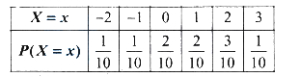
For the probability distribution of a discrete random variable $X$ as given below,the mean of $X$ is:
| $X = x$ | $-2$ | $-1$ | $0$ | $1$ | $2$ | $3$ |
|---|---|---|---|---|---|---|
| $P(X = x)$ | $\frac{1}{10}$ | $K + \frac{2}{10}$ | $K + \frac{3}{10}$ | $K + \frac{3}{10}$ | $K + \frac{4}{10}$ | $K + \frac{2}{10}$ |
A
$\frac{3}{5}$
B
$\frac{4}{5}$
C
$\frac{6}{5}$
D
$\frac{8}{5}$
Solution
(B) The sum of all probabilities in a probability distribution must be $1$.
$\sum P(X=x) = \frac{1}{10} + (K + \frac{2}{10}) + (K + \frac{3}{10}) + (K + \frac{3}{10}) + (K + \frac{4}{10}) + (K + \frac{2}{10}) = 1$
$\Rightarrow 5K + \frac{15}{10} = 1$
$\Rightarrow 5K + 1.5 = 1$
$\Rightarrow 5K = -0.5$
$\Rightarrow K = -0.1 = -\frac{1}{10}$
Now,substitute $K = -\frac{1}{10}$ into the table:
For $x = -2, P = \frac{1}{10}$
For $x = -1, P = -\frac{1}{10} + \frac{2}{10} = \frac{1}{10}$
For $x = 0, P = -\frac{1}{10} + \frac{3}{10} = \frac{2}{10}$
For $x = 1, P = -\frac{1}{10} + \frac{3}{10} = \frac{2}{10}$
For $x = 2, P = -\frac{1}{10} + \frac{4}{10} = \frac{3}{10}$
For $x = 3, P = -\frac{1}{10} + \frac{2}{10} = \frac{1}{10}$
The mean $\mu = \sum x P(x) = (-2)(\frac{1}{10}) + (-1)(\frac{1}{10}) + (0)(\frac{2}{10}) + (1)(\frac{2}{10}) + (2)(\frac{3}{10}) + (3)(\frac{1}{10})$
$\mu = \frac{-2 - 1 + 0 + 2 + 6 + 3}{10} = \frac{8}{10} = \frac{4}{5}$
$\sum P(X=x) = \frac{1}{10} + (K + \frac{2}{10}) + (K + \frac{3}{10}) + (K + \frac{3}{10}) + (K + \frac{4}{10}) + (K + \frac{2}{10}) = 1$
$\Rightarrow 5K + \frac{15}{10} = 1$
$\Rightarrow 5K + 1.5 = 1$
$\Rightarrow 5K = -0.5$
$\Rightarrow K = -0.1 = -\frac{1}{10}$
Now,substitute $K = -\frac{1}{10}$ into the table:
For $x = -2, P = \frac{1}{10}$
For $x = -1, P = -\frac{1}{10} + \frac{2}{10} = \frac{1}{10}$
For $x = 0, P = -\frac{1}{10} + \frac{3}{10} = \frac{2}{10}$
For $x = 1, P = -\frac{1}{10} + \frac{3}{10} = \frac{2}{10}$
For $x = 2, P = -\frac{1}{10} + \frac{4}{10} = \frac{3}{10}$
For $x = 3, P = -\frac{1}{10} + \frac{2}{10} = \frac{1}{10}$
The mean $\mu = \sum x P(x) = (-2)(\frac{1}{10}) + (-1)(\frac{1}{10}) + (0)(\frac{2}{10}) + (1)(\frac{2}{10}) + (2)(\frac{3}{10}) + (3)(\frac{1}{10})$
$\mu = \frac{-2 - 1 + 0 + 2 + 6 + 3}{10} = \frac{8}{10} = \frac{4}{5}$
0 likes
View Solution282
EasyMCQ
An urn contains $3$ black and $5$ red balls. If $3$ balls are drawn at random from the urn,the mean of the probability distribution of the number of red balls drawn is
A
$\frac{45}{28}$
B
$\frac{15}{8}$
C
$\frac{2}{5}$
D
$\frac{3}{2}$
Solution
(B) Let $X$ be the number of red balls drawn. The total number of balls is $3 + 5 = 8$. We draw $3$ balls from $8$,so the total number of ways is ${}^8 C_3 = \frac{8 \times 7 \times 6}{3 \times 2 \times 1} = 56$.
The random variable $X$ can take values $0, 1, 2, 3$.
$P(X=0) = \frac{{}^5 C_0 \times {}^3 C_3}{56} = \frac{1 \times 1}{56} = \frac{1}{56}$
$P(X=1) = \frac{{}^5 C_1 \times {}^3 C_2}{56} = \frac{5 \times 3}{56} = \frac{15}{56}$
$P(X=2) = \frac{{}^5 C_2 \times {}^3 C_1}{56} = \frac{10 \times 3}{56} = \frac{30}{56}$
$P(X=3) = \frac{{}^5 C_3 \times {}^3 C_0}{56} = \frac{10 \times 1}{56} = \frac{10}{56}$
The mean $E(X) = \sum x_i P(x_i) = 0 \times \frac{1}{56} + 1 \times \frac{15}{56} + 2 \times \frac{30}{56} + 3 \times \frac{10}{56} = \frac{0 + 15 + 60 + 30}{56} = \frac{105}{56} = \frac{15}{8}$.
The random variable $X$ can take values $0, 1, 2, 3$.
$P(X=0) = \frac{{}^5 C_0 \times {}^3 C_3}{56} = \frac{1 \times 1}{56} = \frac{1}{56}$
$P(X=1) = \frac{{}^5 C_1 \times {}^3 C_2}{56} = \frac{5 \times 3}{56} = \frac{15}{56}$
$P(X=2) = \frac{{}^5 C_2 \times {}^3 C_1}{56} = \frac{10 \times 3}{56} = \frac{30}{56}$
$P(X=3) = \frac{{}^5 C_3 \times {}^3 C_0}{56} = \frac{10 \times 1}{56} = \frac{10}{56}$
The mean $E(X) = \sum x_i P(x_i) = 0 \times \frac{1}{56} + 1 \times \frac{15}{56} + 2 \times \frac{30}{56} + 3 \times \frac{10}{56} = \frac{0 + 15 + 60 + 30}{56} = \frac{105}{56} = \frac{15}{8}$.
0 likes
View Solution283
EasyMCQ
When an unfair dice is thrown,the probability of getting a number $k$ on it is $P(X=k)=k^2 P$,where $k=1, 2, 3, 4, 5, 6$ and $X$ is the random variable denoting a number on the dice,then the mean of $X$ is
A
$25$
B
$5$
C
$\frac{441}{9}$
D
$\frac{441}{91}$
Solution
(D) Given $P(X=k) = k^2 P$ for $k = 1, 2, 3, 4, 5, 6$.
Since the sum of all probabilities must be $1$,we have:
$\sum_{k=1}^6 P(X=k) = 1$
$P(1^2) + P(2^2) + P(3^2) + P(4^2) + P(5^2) + P(6^2) = 1$
$P(1 + 4 + 9 + 16 + 25 + 36) = 1$
$91P = 1 \Rightarrow P = \frac{1}{91}$.
The mean of $X$ is given by $E(X) = \sum_{k=1}^6 k \cdot P(X=k)$.
$E(X) = \sum_{k=1}^6 k \cdot (k^2 P) = P \sum_{k=1}^6 k^3$.
$E(X) = \frac{1}{91} (1^3 + 2^3 + 3^3 + 4^3 + 5^3 + 6^3)$.
$E(X) = \frac{1}{91} (1 + 8 + 27 + 64 + 125 + 216) = \frac{441}{91}$.
Since the sum of all probabilities must be $1$,we have:
$\sum_{k=1}^6 P(X=k) = 1$
$P(1^2) + P(2^2) + P(3^2) + P(4^2) + P(5^2) + P(6^2) = 1$
$P(1 + 4 + 9 + 16 + 25 + 36) = 1$
$91P = 1 \Rightarrow P = \frac{1}{91}$.
The mean of $X$ is given by $E(X) = \sum_{k=1}^6 k \cdot P(X=k)$.
$E(X) = \sum_{k=1}^6 k \cdot (k^2 P) = P \sum_{k=1}^6 k^3$.
$E(X) = \frac{1}{91} (1^3 + 2^3 + 3^3 + 4^3 + 5^3 + 6^3)$.
$E(X) = \frac{1}{91} (1 + 8 + 27 + 64 + 125 + 216) = \frac{441}{91}$.
0 likes
View Solution284
EasyMCQ
If a random variable $X$ has the following probability distribution,then its variance is nearly:
| $X=x$ | $-3$ | $-2$ | $-1$ | $0$ | $1$ | $2$ | $3$ |
| $P(X=x)$ | $0.05$ | $0.1$ | $2K$ | $0$ | $0.3$ | $K$ | $0.1$ |
A
$2.8875$
B
$2.9875$
C
$2.7865$
D
$2.785$
Solution
(A) For a probability distribution,the sum of all probabilities must be $1$.
$\sum P(X=x) = 1$
$0.05 + 0.1 + 2K + 0 + 0.3 + K + 0.1 = 1$
$0.55 + 3K = 1 \Rightarrow 3K = 0.45 \Rightarrow K = 0.15$.
Now,the distribution is:
Mean $\mu = E(X) = \sum x_i P(x_i) = (-3)(0.05) + (-2)(0.1) + (-1)(0.3) + (0)(0) + (1)(0.3) + (2)(0.15) + (3)(0.1)$
$\mu = -0.15 - 0.2 - 0.3 + 0 + 0.3 + 0.3 + 0.3 = 0.25$.
Variance $\sigma^2 = E(X^2) - \mu^2 = \sum x_i^2 P(x_i) - (0.25)^2$.
$E(X^2) = (-3)^2(0.05) + (-2)^2(0.1) + (-1)^2(0.3) + (0)^2(0) + (1)^2(0.3) + (2)^2(0.15) + (3)^2(0.1)$
$E(X^2) = 9(0.05) + 4(0.1) + 1(0.3) + 0 + 1(0.3) + 4(0.15) + 9(0.1)$
$E(X^2) = 0.45 + 0.4 + 0.3 + 0 + 0.3 + 0.6 + 0.9 = 2.95$.
Variance $= 2.95 - (0.25)^2 = 2.95 - 0.0625 = 2.8875$.
$\sum P(X=x) = 1$
$0.05 + 0.1 + 2K + 0 + 0.3 + K + 0.1 = 1$
$0.55 + 3K = 1 \Rightarrow 3K = 0.45 \Rightarrow K = 0.15$.
Now,the distribution is:
| $X$ | $-3$ | $-2$ | $-1$ | $0$ | $1$ | $2$ | $3$ |
| $P(X)$ | $0.05$ | $0.1$ | $0.3$ | $0$ | $0.3$ | $0.15$ | $0.1$ |
Mean $\mu = E(X) = \sum x_i P(x_i) = (-3)(0.05) + (-2)(0.1) + (-1)(0.3) + (0)(0) + (1)(0.3) + (2)(0.15) + (3)(0.1)$
$\mu = -0.15 - 0.2 - 0.3 + 0 + 0.3 + 0.3 + 0.3 = 0.25$.
Variance $\sigma^2 = E(X^2) - \mu^2 = \sum x_i^2 P(x_i) - (0.25)^2$.
$E(X^2) = (-3)^2(0.05) + (-2)^2(0.1) + (-1)^2(0.3) + (0)^2(0) + (1)^2(0.3) + (2)^2(0.15) + (3)^2(0.1)$
$E(X^2) = 9(0.05) + 4(0.1) + 1(0.3) + 0 + 1(0.3) + 4(0.15) + 9(0.1)$
$E(X^2) = 0.45 + 0.4 + 0.3 + 0 + 0.3 + 0.6 + 0.9 = 2.95$.
Variance $= 2.95 - (0.25)^2 = 2.95 - 0.0625 = 2.8875$.
0 likes
View Solution285
EasyMCQ
If the probability distribution of a random variable $X$ is as follows,then $k=$
(in $/10$)
| $X=x$ | $1$ | $2$ | $3$ | $4$ |
| $P(X=x)$ | $2k$ | $4k$ | $3k$ | $k$ |
A
$1$
B
$2$
C
$3$
D
$4$
Solution
(A) For a probability distribution,the sum of all probabilities must be equal to $1$.
$\Sigma P(X=x) = 1$
$2k + 4k + 3k + k = 1$
$10k = 1$
$k = \frac{1}{10}$
$\Sigma P(X=x) = 1$
$2k + 4k + 3k + k = 1$
$10k = 1$
$k = \frac{1}{10}$
0 likes
View Solution286
MediumMCQ
The range of a random variable $X$ is $\{0, 1, 2\}$. If $P(X=0) = 3C^3$,$P(X=1) = 4C - 10C^2$,and $P(X=2) = 5C - 1$,then the value of $C$ is
A
$\frac{2}{3}$
B
$\frac{1}{3}$
C
$\frac{5}{3}$
D
$\frac{4}{3}$
Solution
(B) For a probability distribution,the sum of all probabilities must be equal to $1$.
$P(X=0) + P(X=1) + P(X=2) = 1$
$3C^3 + (4C - 10C^2) + (5C - 1) = 1$
$3C^3 - 10C^2 + 9C - 2 = 0$
By testing values,we find that $(C - 1)$ is a factor. Dividing the polynomial,we get $(C - 1)(3C^2 - 7C + 2) = 0$.
Factoring further: $(C - 1)(3C - 1)(C - 2) = 0$.
Thus,the possible values for $C$ are $1, \frac{1}{3}, 2$.
We must check if these values result in probabilities between $0$ and $1$:
If $C = 2$,$P(X=2) = 5(2) - 1 = 9$,which is $> 1$. So $C \neq 2$.
If $C = 1$,$P(X=1) = 4(1) - 10(1)^2 = -6$,which is $< 0$. So $C \neq 1$.
If $C = \frac{1}{3}$,$P(X=0) = 3(\frac{1}{27}) = \frac{1}{9}$,$P(X=1) = 4(\frac{1}{3}) - 10(\frac{1}{9}) = \frac{12-10}{9} = \frac{2}{9}$,and $P(X=2) = 5(\frac{1}{3}) - 1 = \frac{2}{3}$.
Since all probabilities are between $0$ and $1$ and sum to $1$,the correct value is $C = \frac{1}{3}$.
$P(X=0) + P(X=1) + P(X=2) = 1$
$3C^3 + (4C - 10C^2) + (5C - 1) = 1$
$3C^3 - 10C^2 + 9C - 2 = 0$
By testing values,we find that $(C - 1)$ is a factor. Dividing the polynomial,we get $(C - 1)(3C^2 - 7C + 2) = 0$.
Factoring further: $(C - 1)(3C - 1)(C - 2) = 0$.
Thus,the possible values for $C$ are $1, \frac{1}{3}, 2$.
We must check if these values result in probabilities between $0$ and $1$:
If $C = 2$,$P(X=2) = 5(2) - 1 = 9$,which is $> 1$. So $C \neq 2$.
If $C = 1$,$P(X=1) = 4(1) - 10(1)^2 = -6$,which is $< 0$. So $C \neq 1$.
If $C = \frac{1}{3}$,$P(X=0) = 3(\frac{1}{27}) = \frac{1}{9}$,$P(X=1) = 4(\frac{1}{3}) - 10(\frac{1}{9}) = \frac{12-10}{9} = \frac{2}{9}$,and $P(X=2) = 5(\frac{1}{3}) - 1 = \frac{2}{3}$.
Since all probabilities are between $0$ and $1$ and sum to $1$,the correct value is $C = \frac{1}{3}$.
0 likes
View Solution287
EasyMCQ
If $X$ is a random variable such that $P(X=-2)=P(X=-1)=P(X=2)=P(X=1)=\frac{1}{6}$ and $P(X=0)=\frac{1}{3}$,then the mean of $X$ is
A
$\frac{5}{3}$
B
$1$
C
$0$
D
$\frac{3}{5}$
Solution
(C) The mean (expected value) of a random variable $X$ is given by the formula $E(X) = \sum x_i P(X=x_i)$.
Given the probability distribution:
$P(X=-2) = \frac{1}{6}$
$P(X=-1) = \frac{1}{6}$
$P(X=0) = \frac{1}{3}$
$P(X=1) = \frac{1}{6}$
$P(X=2) = \frac{1}{6}$
Calculating the mean:
$E(X) = (-2) \times \frac{1}{6} + (-1) \times \frac{1}{6} + 0 \times \frac{1}{3} + 1 \times \frac{1}{6} + 2 \times \frac{1}{6}$
$E(X) = -\frac{2}{6} - \frac{1}{6} + 0 + \frac{1}{6} + \frac{2}{6}$
$E(X) = \frac{-2 - 1 + 0 + 1 + 2}{6} = \frac{0}{6} = 0$
Thus,the mean of $X$ is $0$.
Given the probability distribution:
$P(X=-2) = \frac{1}{6}$
$P(X=-1) = \frac{1}{6}$
$P(X=0) = \frac{1}{3}$
$P(X=1) = \frac{1}{6}$
$P(X=2) = \frac{1}{6}$
Calculating the mean:
$E(X) = (-2) \times \frac{1}{6} + (-1) \times \frac{1}{6} + 0 \times \frac{1}{3} + 1 \times \frac{1}{6} + 2 \times \frac{1}{6}$
$E(X) = -\frac{2}{6} - \frac{1}{6} + 0 + \frac{1}{6} + \frac{2}{6}$
$E(X) = \frac{-2 - 1 + 0 + 1 + 2}{6} = \frac{0}{6} = 0$
Thus,the mean of $X$ is $0$.
0 likes
View Solution288
MediumMCQ
If $X$ is a random variable with probability distribution $P(X=k) = \frac{(k+1)c}{2^k}$ for $k = 0, 1, 2, \ldots$,then $P(X \geq 3) = $
A
$\frac{1}{4}$
B
$\frac{5}{16}$
C
$\frac{5}{11}$
D
$\frac{3}{16}$
Solution
(B) We know that the sum of all probabilities in a distribution is $1$,so $\sum_{k=0}^{\infty} P(X=k) = 1$.
Given $P(X=k) = \frac{(k+1)c}{2^k}$,we have $c \sum_{k=0}^{\infty} \frac{k+1}{2^k} = 1$.
Let $S = \sum_{k=0}^{\infty} \frac{k+1}{2^k} = 1 + \frac{2}{2} + \frac{3}{4} + \frac{4}{8} + \ldots$.
Then $\frac{1}{2}S = \frac{1}{2} + \frac{2}{4} + \frac{3}{8} + \ldots$.
Subtracting the two equations: $S - \frac{1}{2}S = 1 + \frac{1}{2} + \frac{1}{4} + \frac{1}{8} + \ldots = \frac{1}{1 - 1/2} = 2$.
Thus,$\frac{1}{2}S = 2$,which means $S = 4$.
Since $c \cdot S = 1$,we get $4c = 1$,so $c = \frac{1}{4}$.
Now,$P(X \geq 3) = 1 - [P(X=0) + P(X=1) + P(X=2)]$.
$P(X=0) = \frac{(0+1)c}{2^0} = c = \frac{1}{4}$.
$P(X=1) = \frac{(1+1)c}{2^1} = c = \frac{1}{4}$.
$P(X=2) = \frac{(2+1)c}{2^2} = \frac{3c}{4} = \frac{3}{16}$.
$P(X \geq 3) = 1 - [\frac{1}{4} + \frac{1}{4} + \frac{3}{16}] = 1 - [\frac{4+4+3}{16}] = 1 - \frac{11}{16} = \frac{5}{16}$.
Given $P(X=k) = \frac{(k+1)c}{2^k}$,we have $c \sum_{k=0}^{\infty} \frac{k+1}{2^k} = 1$.
Let $S = \sum_{k=0}^{\infty} \frac{k+1}{2^k} = 1 + \frac{2}{2} + \frac{3}{4} + \frac{4}{8} + \ldots$.
Then $\frac{1}{2}S = \frac{1}{2} + \frac{2}{4} + \frac{3}{8} + \ldots$.
Subtracting the two equations: $S - \frac{1}{2}S = 1 + \frac{1}{2} + \frac{1}{4} + \frac{1}{8} + \ldots = \frac{1}{1 - 1/2} = 2$.
Thus,$\frac{1}{2}S = 2$,which means $S = 4$.
Since $c \cdot S = 1$,we get $4c = 1$,so $c = \frac{1}{4}$.
Now,$P(X \geq 3) = 1 - [P(X=0) + P(X=1) + P(X=2)]$.
$P(X=0) = \frac{(0+1)c}{2^0} = c = \frac{1}{4}$.
$P(X=1) = \frac{(1+1)c}{2^1} = c = \frac{1}{4}$.
$P(X=2) = \frac{(2+1)c}{2^2} = \frac{3c}{4} = \frac{3}{16}$.
$P(X \geq 3) = 1 - [\frac{1}{4} + \frac{1}{4} + \frac{3}{16}] = 1 - [\frac{4+4+3}{16}] = 1 - \frac{11}{16} = \frac{5}{16}$.
0 likes
View Solution289
MediumMCQ
For a Poisson distribution,if mean $= l$,variance $= m$ and $l + m = 8$,then $e^4[1 - P(X > 2)] = $
A
$8$
B
$13$
C
$9$
D
$12$
Solution
(B) For a Poisson distribution,the mean is equal to the variance.
Given that mean $= l$ and variance $= m$,we have $l = m$.
Given $l + m = 8$,substituting $l = m$ gives $2l = 8$,so $l = 4$ and $m = 4$.
We need to evaluate $e^4[1 - P(X > 2)]$.
Since $1 - P(X > 2) = P(X \leq 2)$,we have:
$e^4[P(X = 0) + P(X = 1) + P(X = 2)]$.
Using the Poisson probability formula $P(X = k) = \frac{e^{-\lambda} \lambda^k}{k!}$ with $\lambda = 4$:
$P(X = 0) = \frac{e^{-4} \times 4^0}{0!} = e^{-4}$.
$P(X = 1) = \frac{e^{-4} \times 4^1}{1!} = 4e^{-4}$.
$P(X = 2) = \frac{e^{-4} \times 4^2}{2!} = \frac{16e^{-4}}{2} = 8e^{-4}$.
Summing these probabilities:
$P(X \leq 2) = e^{-4}(1 + 4 + 8) = 13e^{-4}$.
Finally,$e^4 \times 13e^{-4} = 13$.
Given that mean $= l$ and variance $= m$,we have $l = m$.
Given $l + m = 8$,substituting $l = m$ gives $2l = 8$,so $l = 4$ and $m = 4$.
We need to evaluate $e^4[1 - P(X > 2)]$.
Since $1 - P(X > 2) = P(X \leq 2)$,we have:
$e^4[P(X = 0) + P(X = 1) + P(X = 2)]$.
Using the Poisson probability formula $P(X = k) = \frac{e^{-\lambda} \lambda^k}{k!}$ with $\lambda = 4$:
$P(X = 0) = \frac{e^{-4} \times 4^0}{0!} = e^{-4}$.
$P(X = 1) = \frac{e^{-4} \times 4^1}{1!} = 4e^{-4}$.
$P(X = 2) = \frac{e^{-4} \times 4^2}{2!} = \frac{16e^{-4}}{2} = 8e^{-4}$.
Summing these probabilities:
$P(X \leq 2) = e^{-4}(1 + 4 + 8) = 13e^{-4}$.
Finally,$e^4 \times 13e^{-4} = 13$.
0 likes
View Solution290
MediumMCQ
Suppose that a book of $600$ pages contains $40$ print mistakes. Assume that these errors are randomly distributed throughout the book and the number of errors per page follows a Poisson distribution. The probability that all the $10$ pages selected at random have no print mistakes is
A
$\frac{1}{3} e^{-1}$
B
$2 e^{-1 / 3}$
C
$e^{-2 / 3}$
D
$\frac{1}{3} e^{-2}$
Solution
(C) The total number of pages is $600$ and the total number of mistakes is $40$.
The average number of mistakes per page,denoted by $\lambda$,is $\lambda = \frac{40}{600} = \frac{1}{15}$.
The number of errors per page follows a Poisson distribution with parameter $\lambda = \frac{1}{15}$.
The probability that a single page has no mistakes is given by $P(X=0) = \frac{e^{-\lambda} \lambda^0}{0!} = e^{-\lambda} = e^{-1/15}$.
Since we are selecting $10$ pages at random,the probability that all $10$ pages have no mistakes is $(P(X=0))^{10} = (e^{-1/15})^{10} = e^{-10/15} = e^{-2/3}$.
The average number of mistakes per page,denoted by $\lambda$,is $\lambda = \frac{40}{600} = \frac{1}{15}$.
The number of errors per page follows a Poisson distribution with parameter $\lambda = \frac{1}{15}$.
The probability that a single page has no mistakes is given by $P(X=0) = \frac{e^{-\lambda} \lambda^0}{0!} = e^{-\lambda} = e^{-1/15}$.
Since we are selecting $10$ pages at random,the probability that all $10$ pages have no mistakes is $(P(X=0))^{10} = (e^{-1/15})^{10} = e^{-10/15} = e^{-2/3}$.
0 likes
View Solution291
EasyMCQ
If $X$ is a Poisson random variate with mean $3$,then $P(|X-3| < 2) =$
A
$\frac{9}{2 e^3}$
B
$\frac{99}{8 e^3}$
C
$\frac{3}{2 e^3}$
D
$\frac{1}{3 e^3}$
Solution
(B) For a Poisson distribution,the probability mass function is given by $P(X=k) = \frac{\lambda^k \cdot e^{-\lambda}}{k!}$.
Given $\lambda = 3$,we need to find $P(|X-3| < 2)$.
The inequality $|X-3| < 2$ implies $-2 < X-3 < 2$,which simplifies to $1 < X < 5$.
Since $X$ is a discrete random variable taking non-negative integer values,the possible values for $X$ are $2, 3, 4$.
Thus,$P(|X-3| < 2) = P(X=2) + P(X=3) + P(X=4)$.
Substituting the values into the formula:
$P(X=2) = \frac{3^2 \cdot e^{-3}}{2!} = \frac{9}{2} e^{-3}$
$P(X=3) = \frac{3^3 \cdot e^{-3}}{3!} = \frac{27}{6} e^{-3} = \frac{9}{2} e^{-3}$
$P(X=4) = \frac{3^4 \cdot e^{-3}}{4!} = \frac{81}{24} e^{-3} = \frac{27}{8} e^{-3}$
Summing these probabilities:
$P(|X-3| < 2) = e^{-3} \left( \frac{9}{2} + \frac{9}{2} + \frac{27}{8} \right) = e^{-3} \left( 9 + \frac{27}{8} \right) = e^{-3} \left( \frac{72+27}{8} \right) = \frac{99}{8 e^3}$.
Given $\lambda = 3$,we need to find $P(|X-3| < 2)$.
The inequality $|X-3| < 2$ implies $-2 < X-3 < 2$,which simplifies to $1 < X < 5$.
Since $X$ is a discrete random variable taking non-negative integer values,the possible values for $X$ are $2, 3, 4$.
Thus,$P(|X-3| < 2) = P(X=2) + P(X=3) + P(X=4)$.
Substituting the values into the formula:
$P(X=2) = \frac{3^2 \cdot e^{-3}}{2!} = \frac{9}{2} e^{-3}$
$P(X=3) = \frac{3^3 \cdot e^{-3}}{3!} = \frac{27}{6} e^{-3} = \frac{9}{2} e^{-3}$
$P(X=4) = \frac{3^4 \cdot e^{-3}}{4!} = \frac{81}{24} e^{-3} = \frac{27}{8} e^{-3}$
Summing these probabilities:
$P(|X-3| < 2) = e^{-3} \left( \frac{9}{2} + \frac{9}{2} + \frac{27}{8} \right) = e^{-3} \left( 9 + \frac{27}{8} \right) = e^{-3} \left( \frac{72+27}{8} \right) = \frac{99}{8 e^3}$.
0 likes
View Solution292
EasyMCQ
$A$ discrete random variable $X$ takes values $10, 20, 30,$ and $40$,with probabilities $0.3, 0.3, 0.2,$ and $0.2$ respectively. Then the expected value of $X$ is
A
$12$
B
$22$
C
$23$
D
$24$
Solution
(C) The expected value $E(X)$ of a discrete random variable $X$ is calculated using the formula $E(X) = \sum x_i P(x_i)$.
Given values of $X$ are $10, 20, 30, 40$ and their respective probabilities are $0.3, 0.3, 0.2, 0.2$.
Substituting these values into the formula:
$E(X) = (10 \times 0.3) + (20 \times 0.3) + (30 \times 0.2) + (40 \times 0.2)$
$E(X) = 3 + 6 + 6 + 8$
$E(X) = 23$
Therefore,the expected value of $X$ is $23$.
Given values of $X$ are $10, 20, 30, 40$ and their respective probabilities are $0.3, 0.3, 0.2, 0.2$.
Substituting these values into the formula:
$E(X) = (10 \times 0.3) + (20 \times 0.3) + (30 \times 0.2) + (40 \times 0.2)$
$E(X) = 3 + 6 + 6 + 8$
$E(X) = 23$
Therefore,the expected value of $X$ is $23$.
0 likes
View Solution293
MediumMCQ
For the random variable $X$ with the probability distribution given by the table:
The mean of $X$ is:
| $X = x$ | $0$ | $1$ | $2$ | $3$ |
| $P(X = x)$ | $K$ | $K + \frac{1}{7}$ | $2K$ | $\frac{2}{5}$ |
The mean of $X$ is:
A
$\frac{31}{35}$
B
$\frac{57}{35}$
C
$\frac{63}{35}$
D
$\frac{67}{35}$
Solution
(D) Given the probability distribution table:
Since the sum of all probabilities must be $1$,we have:
$K + (K + \frac{1}{7}) + 2K + \frac{2}{5} = 1$
$4K + \frac{5 + 14}{35} = 1$
$4K + \frac{19}{35} = 1$
$4K = 1 - \frac{19}{35} = \frac{16}{35}$
$K = \frac{4}{35}$
Now,substituting $K$ back into the table:
$P(X=0) = \frac{4}{35}$
$P(X=1) = \frac{4}{35} + \frac{5}{35} = \frac{9}{35}$
$P(X=2) = 2 \times \frac{4}{35} = \frac{8}{35}$
$P(X=3) = \frac{2}{5} = \frac{14}{35}$
The mean $\mu = E(X) = \sum x_i P(x_i)$:
$\mu = 0 \times \frac{4}{35} + 1 \times \frac{9}{35} + 2 \times \frac{8}{35} + 3 \times \frac{14}{35}$
$\mu = 0 + \frac{9}{35} + \frac{16}{35} + \frac{42}{35}$
$\mu = \frac{67}{35}$
| $X = x$ | $0$ | $1$ | $2$ | $3$ |
| $P(X = x)$ | $K$ | $K + \frac{1}{7}$ | $2K$ | $\frac{2}{5}$ |
Since the sum of all probabilities must be $1$,we have:
$K + (K + \frac{1}{7}) + 2K + \frac{2}{5} = 1$
$4K + \frac{5 + 14}{35} = 1$
$4K + \frac{19}{35} = 1$
$4K = 1 - \frac{19}{35} = \frac{16}{35}$
$K = \frac{4}{35}$
Now,substituting $K$ back into the table:
$P(X=0) = \frac{4}{35}$
$P(X=1) = \frac{4}{35} + \frac{5}{35} = \frac{9}{35}$
$P(X=2) = 2 \times \frac{4}{35} = \frac{8}{35}$
$P(X=3) = \frac{2}{5} = \frac{14}{35}$
The mean $\mu = E(X) = \sum x_i P(x_i)$:
$\mu = 0 \times \frac{4}{35} + 1 \times \frac{9}{35} + 2 \times \frac{8}{35} + 3 \times \frac{14}{35}$
$\mu = 0 + \frac{9}{35} + \frac{16}{35} + \frac{42}{35}$
$\mu = \frac{67}{35}$
0 likes
View Solution294
MediumMCQ
The range of a random variable $X$ is $\{1, 2, 3, \ldots\}$ and $P(X=x) = \frac{c^x}{x!}$ for $x = 1, 2, 3, \ldots$. Then the value of $c$ is
A
$0$
B
$1$
C
$\ln(2)$
D
$\ln(3)$
Solution
(C) We know that for any probability distribution,the sum of all probabilities must be equal to $1$.
Given $P(X=x) = \frac{c^x}{x!}$ for $x = 1, 2, 3, \ldots$.
Therefore,$\sum_{x=1}^{\infty} P(X=x) = 1$.
Substituting the given expression: $\sum_{x=1}^{\infty} \frac{c^x}{x!} = 1$.
We know the Taylor series expansion for the exponential function is $e^c = \sum_{x=0}^{\infty} \frac{c^x}{x!} = 1 + \frac{c}{1!} + \frac{c^2}{2!} + \frac{c^3}{3!} + \ldots$.
Thus,$\sum_{x=1}^{\infty} \frac{c^x}{x!} = e^c - 1$.
Setting this equal to $1$: $e^c - 1 = 1$.
$e^c = 2$.
Taking the natural logarithm on both sides: $c = \ln(2)$.
Given $P(X=x) = \frac{c^x}{x!}$ for $x = 1, 2, 3, \ldots$.
Therefore,$\sum_{x=1}^{\infty} P(X=x) = 1$.
Substituting the given expression: $\sum_{x=1}^{\infty} \frac{c^x}{x!} = 1$.
We know the Taylor series expansion for the exponential function is $e^c = \sum_{x=0}^{\infty} \frac{c^x}{x!} = 1 + \frac{c}{1!} + \frac{c^2}{2!} + \frac{c^3}{3!} + \ldots$.
Thus,$\sum_{x=1}^{\infty} \frac{c^x}{x!} = e^c - 1$.
Setting this equal to $1$: $e^c - 1 = 1$.
$e^c = 2$.
Taking the natural logarithm on both sides: $c = \ln(2)$.
0 likes
View Solution295
MediumMCQ
If $X$ is a Poisson variable such that $3 P(X=4)=\frac{1}{2} P(X=2)+P(X=0)$,then the mean of $X$ is
A
$1$
B
$2$
C
$\frac{3}{2}$
D
$\frac{1}{2}$
Solution
(B) Given that $X$ follows a Poisson distribution with parameter $\lambda$. The probability mass function is given by $P(X=x) = \frac{e^{-\lambda} \lambda^x}{x!}$ for $x = 0, 1, 2, \dots$.
Given the equation: $3 P(X=4) = \frac{1}{2} P(X=2) + P(X=0)$.
Substituting the formula: $3 \frac{e^{-\lambda} \lambda^4}{4!} = \frac{1}{2} \frac{e^{-\lambda} \lambda^2}{2!} + \frac{e^{-\lambda} \lambda^0}{0!}$.
Dividing both sides by $e^{-\lambda}$: $\frac{3 \lambda^4}{24} = \frac{\lambda^2}{4} + 1$.
Simplifying: $\frac{\lambda^4}{8} = \frac{\lambda^2}{4} + 1$.
Multiplying by $8$: $\lambda^4 = 2 \lambda^2 + 8$,which gives $\lambda^4 - 2 \lambda^2 - 8 = 0$.
Let $u = \lambda^2$. Then $u^2 - 2u - 8 = 0$.
Factoring the quadratic: $(u - 4)(u + 2) = 0$.
This gives $u = 4$ or $u = -2$.
Since $\lambda^2 = u$ and $\lambda^2$ must be non-negative,we have $\lambda^2 = 4$,which implies $\lambda = 2$ (as $\lambda > 0$).
The mean of a Poisson distribution is $\lambda$,so the mean is $2$.
Given the equation: $3 P(X=4) = \frac{1}{2} P(X=2) + P(X=0)$.
Substituting the formula: $3 \frac{e^{-\lambda} \lambda^4}{4!} = \frac{1}{2} \frac{e^{-\lambda} \lambda^2}{2!} + \frac{e^{-\lambda} \lambda^0}{0!}$.
Dividing both sides by $e^{-\lambda}$: $\frac{3 \lambda^4}{24} = \frac{\lambda^2}{4} + 1$.
Simplifying: $\frac{\lambda^4}{8} = \frac{\lambda^2}{4} + 1$.
Multiplying by $8$: $\lambda^4 = 2 \lambda^2 + 8$,which gives $\lambda^4 - 2 \lambda^2 - 8 = 0$.
Let $u = \lambda^2$. Then $u^2 - 2u - 8 = 0$.
Factoring the quadratic: $(u - 4)(u + 2) = 0$.
This gives $u = 4$ or $u = -2$.
Since $\lambda^2 = u$ and $\lambda^2$ must be non-negative,we have $\lambda^2 = 4$,which implies $\lambda = 2$ (as $\lambda > 0$).
The mean of a Poisson distribution is $\lambda$,so the mean is $2$.
0 likes
View Solution296
EasyMCQ
If the mean of a Poisson distribution is $\frac{1}{3}$,then the ratio $P(X=1) : P(X=2)$ is
A
$1 : 2$
B
$3 : 1$
C
$1 : 6$
D
$6 : 1$
Solution
(D) Given,the mean of the Poisson distribution is $\lambda = \frac{1}{3}$.
For a Poisson distribution,the probability mass function is given by $P(X=k) = \frac{e^{-\lambda} \lambda^k}{k!}$.
For $k=1$,$P(X=1) = \frac{e^{-1/3} (1/3)^1}{1!} = \frac{1}{3} e^{-1/3}$.
For $k=2$,$P(X=2) = \frac{e^{-1/3} (1/3)^2}{2!} = \frac{1}{2} \times \frac{1}{9} e^{-1/3} = \frac{1}{18} e^{-1/3}$.
Now,the ratio $P(X=1) : P(X=2) = \frac{\frac{1}{3} e^{-1/3}}{\frac{1}{18} e^{-1/3}} = \frac{1/3}{1/18} = \frac{18}{3} = 6$.
Thus,the ratio is $6 : 1$.
For a Poisson distribution,the probability mass function is given by $P(X=k) = \frac{e^{-\lambda} \lambda^k}{k!}$.
For $k=1$,$P(X=1) = \frac{e^{-1/3} (1/3)^1}{1!} = \frac{1}{3} e^{-1/3}$.
For $k=2$,$P(X=2) = \frac{e^{-1/3} (1/3)^2}{2!} = \frac{1}{2} \times \frac{1}{9} e^{-1/3} = \frac{1}{18} e^{-1/3}$.
Now,the ratio $P(X=1) : P(X=2) = \frac{\frac{1}{3} e^{-1/3}}{\frac{1}{18} e^{-1/3}} = \frac{1/3}{1/18} = \frac{18}{3} = 6$.
Thus,the ratio is $6 : 1$.
0 likes
View Solution297
EasyMCQ
$A$ random variable $X$ takes values $0, 1, 2, 3, \ldots$ with probability $P(X=x) = K(x+1)\left(\frac{1}{5}\right)^x$,where $K$ is a constant. Then $P(X=0)$ is:
A
$\frac{7}{25}$
B
$\frac{18}{25}$
C
$\frac{16}{25}$
D
$\frac{13}{25}$
Solution
(C) Given,$P(X=x) = K(x+1)\left(\frac{1}{5}\right)^x$.
Since the sum of all probabilities in a probability distribution is $1$,we have $\sum_{x=0}^{\infty} P(X=x) = 1$.
Substituting the given expression:
$\sum_{x=0}^{\infty} K(x+1)\left(\frac{1}{5}\right)^x = 1$
$K \left[ 1 + 2\left(\frac{1}{5}\right) + 3\left(\frac{1}{5}\right)^2 + 4\left(\frac{1}{5}\right)^3 + \ldots \right] = 1$.
This is an arithmetico-geometric series of the form $\sum_{n=1}^{\infty} n r^{n-1} = (1-r)^{-2}$ where $r = \frac{1}{5}$.
Thus,$K(1 - \frac{1}{5})^{-2} = 1$.
$K(\frac{4}{5})^{-2} = 1 \Rightarrow K(\frac{5}{4})^2 = 1$.
$K(\frac{25}{16}) = 1 \Rightarrow K = \frac{16}{25}$.
Now,$P(X=0) = K(0+1)\left(\frac{1}{5}\right)^0 = K(1)(1) = K$.
Therefore,$P(X=0) = \frac{16}{25}$.
Since the sum of all probabilities in a probability distribution is $1$,we have $\sum_{x=0}^{\infty} P(X=x) = 1$.
Substituting the given expression:
$\sum_{x=0}^{\infty} K(x+1)\left(\frac{1}{5}\right)^x = 1$
$K \left[ 1 + 2\left(\frac{1}{5}\right) + 3\left(\frac{1}{5}\right)^2 + 4\left(\frac{1}{5}\right)^3 + \ldots \right] = 1$.
This is an arithmetico-geometric series of the form $\sum_{n=1}^{\infty} n r^{n-1} = (1-r)^{-2}$ where $r = \frac{1}{5}$.
Thus,$K(1 - \frac{1}{5})^{-2} = 1$.
$K(\frac{4}{5})^{-2} = 1 \Rightarrow K(\frac{5}{4})^2 = 1$.
$K(\frac{25}{16}) = 1 \Rightarrow K = \frac{16}{25}$.
Now,$P(X=0) = K(0+1)\left(\frac{1}{5}\right)^0 = K(1)(1) = K$.
Therefore,$P(X=0) = \frac{16}{25}$.
0 likes
View Solution298
MediumMCQ
If $X$ is a Poisson variate such that $P(X=2)=P(X=3)$,then $e^3 P(X=4)$ is
A
$\left(\frac{3}{2}\right)^3$
B
$\frac{3}{2}$
C
$\frac{e^{-3} \cdot 3^4}{4 !}$
D
$\frac{e^3 \cdot 3^4}{4 !}$
Solution
(A) $X$ is a Poisson variate.
Given $P(X=2) = P(X=3)$.
Using the formula $P(X=r) = \frac{e^{-\lambda} \cdot \lambda^r}{r!}$,we have:
$\frac{e^{-\lambda} \cdot \lambda^2}{2!} = \frac{e^{-\lambda} \cdot \lambda^3}{3!}$
$\Rightarrow \frac{\lambda^2}{2} = \frac{\lambda^3}{6}$
$\Rightarrow \lambda = \frac{6}{2} = 3$.
Now,we calculate $P(X=4)$:
$P(X=4) = \frac{e^{-\lambda} \cdot \lambda^4}{4!} = \frac{e^{-3} \cdot 3^4}{4!}$.
Finally,we find $e^3 P(X=4)$:
$e^3 P(X=4) = e^3 \cdot \frac{e^{-3} \cdot 3^4}{4!} = \frac{3^4}{4!} = \frac{81}{24} = \frac{27}{8} = \left(\frac{3}{2}\right)^3$.
Given $P(X=2) = P(X=3)$.
Using the formula $P(X=r) = \frac{e^{-\lambda} \cdot \lambda^r}{r!}$,we have:
$\frac{e^{-\lambda} \cdot \lambda^2}{2!} = \frac{e^{-\lambda} \cdot \lambda^3}{3!}$
$\Rightarrow \frac{\lambda^2}{2} = \frac{\lambda^3}{6}$
$\Rightarrow \lambda = \frac{6}{2} = 3$.
Now,we calculate $P(X=4)$:
$P(X=4) = \frac{e^{-\lambda} \cdot \lambda^4}{4!} = \frac{e^{-3} \cdot 3^4}{4!}$.
Finally,we find $e^3 P(X=4)$:
$e^3 P(X=4) = e^3 \cdot \frac{e^{-3} \cdot 3^4}{4!} = \frac{3^4}{4!} = \frac{81}{24} = \frac{27}{8} = \left(\frac{3}{2}\right)^3$.
0 likes
View Solution299
EasyMCQ
Let $X$ be a random variable with probability distribution function,$P(X=x)=K\left(\frac{2}{5}\right)^x, x=1, 2, 3, \ldots$. Then,the value of $K$ is
A
$\frac{3}{5}$
B
$\frac{5}{3}$
C
$\frac{3}{2}$
D
$\frac{2}{3}$
Solution
(C) Given the probability distribution function $P(X=x)=K\left(\frac{2}{5}\right)^x$ for $x=1, 2, 3, \ldots$.
We know that the sum of all probabilities in a distribution must be equal to $1$,i.e.,$\sum_{x=1}^{\infty} P(X=x) = 1$.
Substituting the given function,we get $K \sum_{x=1}^{\infty} \left(\frac{2}{5}\right)^x = 1$.
This is an infinite geometric series with the first term $a = \frac{2}{5}$ and common ratio $r = \frac{2}{5}$.
The sum of an infinite geometric series is given by $S = \frac{a}{1-r}$.
Therefore,$K \left( \frac{2/5}{1 - 2/5} \right) = 1$.
$K \left( \frac{2/5}{3/5} \right) = 1$.
$K \left( \frac{2}{3} \right) = 1$.
Thus,$K = \frac{3}{2}$.
We know that the sum of all probabilities in a distribution must be equal to $1$,i.e.,$\sum_{x=1}^{\infty} P(X=x) = 1$.
Substituting the given function,we get $K \sum_{x=1}^{\infty} \left(\frac{2}{5}\right)^x = 1$.
This is an infinite geometric series with the first term $a = \frac{2}{5}$ and common ratio $r = \frac{2}{5}$.
The sum of an infinite geometric series is given by $S = \frac{a}{1-r}$.
Therefore,$K \left( \frac{2/5}{1 - 2/5} \right) = 1$.
$K \left( \frac{2/5}{3/5} \right) = 1$.
$K \left( \frac{2}{3} \right) = 1$.
Thus,$K = \frac{3}{2}$.
0 likes
View Solution300
EasyMCQ
Let $X$ be a random variable representing the number of heads obtained when three fair coins are tossed simultaneously. Find the value of $P(X = 2)$.
A
$\frac{3}{8}$
B
$\frac{5}{8}$
C
$\frac{1}{8}$
D
$\frac{3}{4}$
Solution
(A) The sample space $S$ for tossing three fair coins is given by:
$S = \{HHH, HHT, HTH, THH, HTT, THT, TTH, TTT\}$.
The total number of outcomes is $n(S) = 8$.
$X$ is a random variable representing the number of heads.
We need to find $P(X = 2)$,which is the probability of getting exactly two heads.
The outcomes with exactly two heads are $\{HHT, HTH, THH\}$.
Thus,the number of favorable outcomes is $n(X = 2) = 3$.
Therefore,$P(X = 2) = \frac{n(X = 2)}{n(S)} = \frac{3}{8}$.
$S = \{HHH, HHT, HTH, THH, HTT, THT, TTH, TTT\}$.
The total number of outcomes is $n(S) = 8$.
$X$ is a random variable representing the number of heads.
We need to find $P(X = 2)$,which is the probability of getting exactly two heads.
The outcomes with exactly two heads are $\{HHT, HTH, THH\}$.
Thus,the number of favorable outcomes is $n(X = 2) = 3$.
Therefore,$P(X = 2) = \frac{n(X = 2)}{n(S)} = \frac{3}{8}$.
0 likes
View SolutionProbability — Probability distribution · Frequently Asked Questions
1Are these Probability questions useful for JEE and NEET?
Yes. All questions in this section are mapped to JEE Main and NEET exam patterns. Previous year questions from JEE Main, NEET, GUJCET and state-level exams are included with full solutions.
2Can I switch to Hindi or Gujarati for these questions?
Yes. Use the language tabs in the hero section or the sidebar to view the same questions and solutions in English, Hindi or Gujarati.
3How do I generate a question paper from this subtopic?
Use the Vedclass Exam Paper Generator — select the chapter and subtopic, set difficulty, and generate Sets A, B, C, D automatically. First 3 chapters of every subject are free.
Vedclass Products
For Students
Vedclass Test Series
Mock tests in real JEE/NEET style with performance analysis. 5-day free trial.
Start Free TrialFor Teachers
Exam Paper Generator
Generate Set A/B/C/D papers from this chapter in 2 minutes. 3 chapters free.
Try FreeFor Institutes
Online Exam Module
Live online exams with unlimited students, 360° analytics & white-label branding.
See DemoFor Teachers & Institutes
Generate a Probability Exam Paper in 2 Minutes
Select subtopic & difficulty — Sets A, B, C, D auto-generated with No Repeat logic.
First 3 chapters of every subject are free — no payment required.