
A English
Probability distribution Questions in English
Class 12 Mathematics · Probability · Probability distribution
430+
Questions
English
Language
100%
With Solutions
Showing 24 of 430 questions in English
401
MediumMCQ
In a book consisting of $600$ pages,there are $60$ typographical errors. The probability that a randomly chosen page will contain at most two errors is
A
$\frac{1}{5} \sqrt{e}$
B
$\frac{1}{e^{0.1}}\left(\frac{221}{200}\right)$
C
$\frac{1}{e^{0.1}}\left(\frac{111}{200}\right)$
D
$\frac{1}{5} e^{0.1}$
Solution
(B) The number of errors per page follows a Poisson distribution with parameter $\lambda = \frac{60}{600} = 0.1$.
The probability mass function is given by $P(X=x) = \frac{e^{-\lambda} \lambda^x}{x!} = \frac{e^{-0.1} (0.1)^x}{x!}$.
We need to find the probability that a page contains at most two errors,which is $P(X \le 2) = P(X=0) + P(X=1) + P(X=2)$.
$P(X=0) = \frac{e^{-0.1} (0.1)^0}{0!} = e^{-0.1}$.
$P(X=1) = \frac{e^{-0.1} (0.1)^1}{1!} = 0.1 e^{-0.1}$.
$P(X=2) = \frac{e^{-0.1} (0.1)^2}{2!} = \frac{0.01}{2} e^{-0.1} = 0.005 e^{-0.1}$.
Adding these probabilities: $P(X \le 2) = e^{-0.1} (1 + 0.1 + 0.005) = e^{-0.1} (1.105) = e^{-0.1} \left(\frac{1105}{1000}\right) = e^{-0.1} \left(\frac{221}{200}\right) = \frac{1}{e^{0.1}} \left(\frac{221}{200}\right)$.
The probability mass function is given by $P(X=x) = \frac{e^{-\lambda} \lambda^x}{x!} = \frac{e^{-0.1} (0.1)^x}{x!}$.
We need to find the probability that a page contains at most two errors,which is $P(X \le 2) = P(X=0) + P(X=1) + P(X=2)$.
$P(X=0) = \frac{e^{-0.1} (0.1)^0}{0!} = e^{-0.1}$.
$P(X=1) = \frac{e^{-0.1} (0.1)^1}{1!} = 0.1 e^{-0.1}$.
$P(X=2) = \frac{e^{-0.1} (0.1)^2}{2!} = \frac{0.01}{2} e^{-0.1} = 0.005 e^{-0.1}$.
Adding these probabilities: $P(X \le 2) = e^{-0.1} (1 + 0.1 + 0.005) = e^{-0.1} (1.105) = e^{-0.1} \left(\frac{1105}{1000}\right) = e^{-0.1} \left(\frac{221}{200}\right) = \frac{1}{e^{0.1}} \left(\frac{221}{200}\right)$.
0 likes
View Solution402
MediumMCQ
In a hospital,on an average if there are $35$ births in a week,then the probability that there will be less than $3$ births in a day is:
A
$\frac{118}{e^{35}}$
B
$\frac{37}{2 e^5}$
C
$\frac{6}{2 \cdot e^{35}}$
D
$1-\frac{118}{3 e^5}$
Solution
(B) Given,the average number of births in a week is $35$.
Since there are $7$ days in a week,the average number of births in a day is $\lambda = \frac{35}{7} = 5$.
We use the Poisson distribution formula $P(X = k) = \frac{\lambda^k e^{-\lambda}}{k!}$.
We need to find the probability of less than $3$ births in a day,which is $P(X < 3) = P(X = 0) + P(X = 1) + P(X = 2)$.
$P(X = 0) = \frac{5^0 e^{-5}}{0!} = e^{-5}$.
$P(X = 1) = \frac{5^1 e^{-5}}{1!} = 5e^{-5}$.
$P(X = 2) = \frac{5^2 e^{-5}}{2!} = \frac{25}{2}e^{-5}$.
Adding these probabilities: $P(X < 3) = e^{-5} + 5e^{-5} + \frac{25}{2}e^{-5} = e^{-5}(1 + 5 + 12.5) = 18.5e^{-5} = \frac{37}{2e^5}$.
Since there are $7$ days in a week,the average number of births in a day is $\lambda = \frac{35}{7} = 5$.
We use the Poisson distribution formula $P(X = k) = \frac{\lambda^k e^{-\lambda}}{k!}$.
We need to find the probability of less than $3$ births in a day,which is $P(X < 3) = P(X = 0) + P(X = 1) + P(X = 2)$.
$P(X = 0) = \frac{5^0 e^{-5}}{0!} = e^{-5}$.
$P(X = 1) = \frac{5^1 e^{-5}}{1!} = 5e^{-5}$.
$P(X = 2) = \frac{5^2 e^{-5}}{2!} = \frac{25}{2}e^{-5}$.
Adding these probabilities: $P(X < 3) = e^{-5} + 5e^{-5} + \frac{25}{2}e^{-5} = e^{-5}(1 + 5 + 12.5) = 18.5e^{-5} = \frac{37}{2e^5}$.
0 likes
View Solution403
MediumMCQ
If the probability function of a discrete random variable $X$ is $P(X=r) = r/k$ for $r = 1, 2, 3, 4, 5$,then $P(X=2 \text{ or } X=k/3)$ is equal to:
A
$P(X=1 \text{ or } X=6)$
B
$P(X=4 \text{ or } X=k/5)$
C
$P(X=k/5 \text{ or } X=5)$
D
$P(X=k/3 \text{ or } X=0)$
Solution
(B) Given the probability function $P(X=r) = r/k$ for $r = 1, 2, 3, 4, 5$.
Since the sum of all probabilities must be $1$,we have:
$\sum_{r=1}^{5} P(X=r) = 1 \Rightarrow \frac{1}{k} + \frac{2}{k} + \frac{3}{k} + \frac{4}{k} + \frac{5}{k} = 1$
$\frac{1+2+3+4+5}{k} = 1 \Rightarrow \frac{15}{k} = 1 \Rightarrow k = 15$.
We need to find $P(X=2 \text{ or } X=k/3)$.
Since $k=15$,$k/3 = 15/3 = 5$.
So,$P(X=2 \text{ or } X=5) = P(X=2) + P(X=5) = \frac{2}{15} + \frac{5}{15} = \frac{7}{15}$.
Now,let us check the options:
Option $B$: $P(X=4 \text{ or } X=k/5) = P(X=4 \text{ or } X=15/5) = P(X=4 \text{ or } X=3) = \frac{4}{15} + \frac{3}{15} = \frac{7}{15}$.
Thus,$P(X=2 \text{ or } X=k/3) = P(X=4 \text{ or } X=k/5)$.
Since the sum of all probabilities must be $1$,we have:
$\sum_{r=1}^{5} P(X=r) = 1 \Rightarrow \frac{1}{k} + \frac{2}{k} + \frac{3}{k} + \frac{4}{k} + \frac{5}{k} = 1$
$\frac{1+2+3+4+5}{k} = 1 \Rightarrow \frac{15}{k} = 1 \Rightarrow k = 15$.
We need to find $P(X=2 \text{ or } X=k/3)$.
Since $k=15$,$k/3 = 15/3 = 5$.
So,$P(X=2 \text{ or } X=5) = P(X=2) + P(X=5) = \frac{2}{15} + \frac{5}{15} = \frac{7}{15}$.
Now,let us check the options:
Option $B$: $P(X=4 \text{ or } X=k/5) = P(X=4 \text{ or } X=15/5) = P(X=4 \text{ or } X=3) = \frac{4}{15} + \frac{3}{15} = \frac{7}{15}$.
Thus,$P(X=2 \text{ or } X=k/3) = P(X=4 \text{ or } X=k/5)$.
0 likes
View Solution404
MediumMCQ
Two dice are rolled. If a random variable $X$ is defined as the absolute difference of the two numbers that appear on them,then the mean of $X$ is
A
$0$
B
$\frac{13}{18}$
C
$\frac{19}{9}$
D
$\frac{35}{18}$
Solution
(D) When two dice are rolled,the total number of outcomes is $6 \times 6 = 36$. Let $X$ be the absolute difference of the numbers on the two dice. The possible values of $X$ are $0, 1, 2, 3, 4, 5$. The probability distribution is as follows:
| $X$ | $P(X)$ | $P_i X_i$ |
|---|---|---|
| $0$ | $6/36$ | $0$ |
| $1$ | $10/36$ | $10/36$ |
| $2$ | $8/36$ | $16/36$ |
| $3$ | $6/36$ | $18/36$ |
| $4$ | $4/36$ | $16/36$ |
| $5$ | $2/36$ | $10/36$ |
The mean $\mu$ is given by $\sum P_i X_i$:
$\mu = 0 + \frac{10}{36} + \frac{16}{36} + \frac{18}{36} + \frac{16}{36} + \frac{10}{36}$
$\mu = \frac{10 + 16 + 18 + 16 + 10}{36} = \frac{70}{36} = \frac{35}{18}$.
| $X$ | $P(X)$ | $P_i X_i$ |
|---|---|---|
| $0$ | $6/36$ | $0$ |
| $1$ | $10/36$ | $10/36$ |
| $2$ | $8/36$ | $16/36$ |
| $3$ | $6/36$ | $18/36$ |
| $4$ | $4/36$ | $16/36$ |
| $5$ | $2/36$ | $10/36$ |
The mean $\mu$ is given by $\sum P_i X_i$:
$\mu = 0 + \frac{10}{36} + \frac{16}{36} + \frac{18}{36} + \frac{16}{36} + \frac{10}{36}$
$\mu = \frac{10 + 16 + 18 + 16 + 10}{36} = \frac{70}{36} = \frac{35}{18}$.
0 likes
View Solution405
MediumMCQ
If $X$ is a Poisson variable representing the number of successes in $50$ trials such that $2 P(X=1) = 5 P(X=5) + 2 P(X=3)$,then the probability of getting success in one trial is
A
$2 e^{-2}$
B
$0.03$
C
$0.04$
D
$0.05$
Solution
(C) Given,$n = 50$. Let $p$ be the probability of success in one trial. Then the parameter of the Poisson distribution is $\lambda = np = 50p$.
The probability mass function for a Poisson variable is $P(X=k) = \frac{e^{-\lambda} \lambda^k}{k!}$.
Given the equation: $2 P(X=1) = 5 P(X=5) + 2 P(X=3)$.
Substituting the formula: $2 \frac{e^{-\lambda} \lambda^1}{1!} = 5 \frac{e^{-\lambda} \lambda^5}{5!} + 2 \frac{e^{-\lambda} \lambda^3}{3!}$.
Dividing both sides by $e^{-\lambda}$ (since $e^{-\lambda} \neq 0$): $2 \lambda = 5 \frac{\lambda^5}{120} + 2 \frac{\lambda^3}{6}$.
$2 \lambda = \frac{\lambda^5}{24} + \frac{\lambda^3}{3}$.
Multiplying by $24$: $48 \lambda = \lambda^5 + 8 \lambda^3$.
Since $\lambda \neq 0$,divide by $\lambda$: $\lambda^4 + 8 \lambda^2 - 48 = 0$.
Let $u = \lambda^2$,then $u^2 + 8u - 48 = 0$.
$(u + 12)(u - 4) = 0$.
So,$\lambda^2 = 4$ or $\lambda^2 = -12$. Since $\lambda^2$ must be positive,$\lambda^2 = 4$,which gives $\lambda = 2$.
Finally,$p = \frac{\lambda}{n} = \frac{2}{50} = 0.04$.
The probability mass function for a Poisson variable is $P(X=k) = \frac{e^{-\lambda} \lambda^k}{k!}$.
Given the equation: $2 P(X=1) = 5 P(X=5) + 2 P(X=3)$.
Substituting the formula: $2 \frac{e^{-\lambda} \lambda^1}{1!} = 5 \frac{e^{-\lambda} \lambda^5}{5!} + 2 \frac{e^{-\lambda} \lambda^3}{3!}$.
Dividing both sides by $e^{-\lambda}$ (since $e^{-\lambda} \neq 0$): $2 \lambda = 5 \frac{\lambda^5}{120} + 2 \frac{\lambda^3}{6}$.
$2 \lambda = \frac{\lambda^5}{24} + \frac{\lambda^3}{3}$.
Multiplying by $24$: $48 \lambda = \lambda^5 + 8 \lambda^3$.
Since $\lambda \neq 0$,divide by $\lambda$: $\lambda^4 + 8 \lambda^2 - 48 = 0$.
Let $u = \lambda^2$,then $u^2 + 8u - 48 = 0$.
$(u + 12)(u - 4) = 0$.
So,$\lambda^2 = 4$ or $\lambda^2 = -12$. Since $\lambda^2$ must be positive,$\lambda^2 = 4$,which gives $\lambda = 2$.
Finally,$p = \frac{\lambda}{n} = \frac{2}{50} = 0.04$.
0 likes
View Solution406
EasyMCQ
The probability distribution of a discrete random variable $X$ is given below. If $E(X^2) = \Sigma x^2 P(X=x)$,then $6 E(X^2) - \operatorname{Var}(X) =$
| $X=x$ | $-1$ | $0$ | $1$ | $2$ |
|---|---|---|---|---|
| $P(X=x)$ | $\frac{1}{3}$ | $\frac{1}{6}$ | $\frac{1}{6}$ | $\frac{1}{3}$ |
A
$\frac{1}{12}$
B
$\frac{19}{12}$
C
$\frac{113}{12}$
D
$\frac{12}{113}$
Solution
(C) First,we calculate $E(X)$ and $E(X^2)$ using the given distribution:
$E(X) = \Sigma x P(X=x) = (-1)(\frac{1}{3}) + (0)(\frac{1}{6}) + (1)(\frac{1}{6}) + (2)(\frac{1}{3}) = -\frac{1}{3} + 0 + \frac{1}{6} + \frac{2}{3} = \frac{-2+0+1+4}{6} = \frac{3}{6} = \frac{1}{2}$
$E(X^2) = \Sigma x^2 P(X=x) = (-1)^2(\frac{1}{3}) + (0)^2(\frac{1}{6}) + (1)^2(\frac{1}{6}) + (2)^2(\frac{1}{3}) = \frac{1}{3} + 0 + \frac{1}{6} + \frac{4}{3} = \frac{2+0+1+8}{6} = \frac{11}{6}$
Now,we find $\operatorname{Var}(X) = E(X^2) - (E(X))^2 = \frac{11}{6} - (\frac{1}{2})^2 = \frac{11}{6} - \frac{1}{4} = \frac{22-3}{12} = \frac{19}{12}$
Finally,we calculate $6 E(X^2) - \operatorname{Var}(X)$:
$6 E(X^2) - \operatorname{Var}(X) = 6(\frac{11}{6}) - \frac{19}{12} = 11 - \frac{19}{12} = \frac{132-19}{12} = \frac{113}{12}$
$E(X) = \Sigma x P(X=x) = (-1)(\frac{1}{3}) + (0)(\frac{1}{6}) + (1)(\frac{1}{6}) + (2)(\frac{1}{3}) = -\frac{1}{3} + 0 + \frac{1}{6} + \frac{2}{3} = \frac{-2+0+1+4}{6} = \frac{3}{6} = \frac{1}{2}$
$E(X^2) = \Sigma x^2 P(X=x) = (-1)^2(\frac{1}{3}) + (0)^2(\frac{1}{6}) + (1)^2(\frac{1}{6}) + (2)^2(\frac{1}{3}) = \frac{1}{3} + 0 + \frac{1}{6} + \frac{4}{3} = \frac{2+0+1+8}{6} = \frac{11}{6}$
Now,we find $\operatorname{Var}(X) = E(X^2) - (E(X))^2 = \frac{11}{6} - (\frac{1}{2})^2 = \frac{11}{6} - \frac{1}{4} = \frac{22-3}{12} = \frac{19}{12}$
Finally,we calculate $6 E(X^2) - \operatorname{Var}(X)$:
$6 E(X^2) - \operatorname{Var}(X) = 6(\frac{11}{6}) - \frac{19}{12} = 11 - \frac{19}{12} = \frac{132-19}{12} = \frac{113}{12}$
0 likes
View Solution407
EasyMCQ
$A$ boy rolls a die once. If an even number appears,the number of chocolates the boy gets is equal to two more than the number that appeared. If an odd number appears on the die,the number of chocolates he gets is equal to three more than the number that appeared. If a random variable $X$ represents the number of chocolates the boy receives,then the range of $X$ is:
A
$\{4, 6, 8\}$
B
$\{3, 5, 7\}$
C
$\{3, 4, 7\}$
D
$\{2, 3\}$
Solution
(A) Let $N$ be the number appearing on the die. The possible values for $N$ are $\{1, 2, 3, 4, 5, 6\}$.
If $N$ is even $(N \in \{2, 4, 6\})$,the number of chocolates $X = N + 2$.
For $N = 2$,$X = 2 + 2 = 4$.
For $N = 4$,$X = 4 + 2 = 6$.
For $N = 6$,$X = 6 + 2 = 8$.
If $N$ is odd $(N \in \{1, 3, 5\})$,the number of chocolates $X = N + 3$.
For $N = 1$,$X = 1 + 3 = 4$.
For $N = 3$,$X = 3 + 3 = 6$.
For $N = 5$,$X = 5 + 3 = 8$.
Thus,the set of all possible values of $X$ is $\{4, 6, 8\}$.
Therefore,the range of $X$ is $\{4, 6, 8\}$.
If $N$ is even $(N \in \{2, 4, 6\})$,the number of chocolates $X = N + 2$.
For $N = 2$,$X = 2 + 2 = 4$.
For $N = 4$,$X = 4 + 2 = 6$.
For $N = 6$,$X = 6 + 2 = 8$.
If $N$ is odd $(N \in \{1, 3, 5\})$,the number of chocolates $X = N + 3$.
For $N = 1$,$X = 1 + 3 = 4$.
For $N = 3$,$X = 3 + 3 = 6$.
For $N = 5$,$X = 5 + 3 = 8$.
Thus,the set of all possible values of $X$ is $\{4, 6, 8\}$.
Therefore,the range of $X$ is $\{4, 6, 8\}$.
0 likes
View Solution408
MediumMCQ
Two dice are rolled. If a random variable $X$ denotes the sum of the numbers on them and $\mu$ denotes the mean of $X$,then $\mu+P(X < 5)+P(X>9)+P(X=7)=$
A
$\frac{15}{2}$
B
$17$
C
$\frac{17}{2}$
D
$15$
Solution
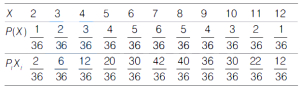
(A) When two dice are rolled,the sum $X$ can take values from $2$ to $12$. The probability distribution is as follows:
$X: 2, 3, 4, 5, 6, 7, 8, 9, 10, 11, 12$
$P(X): \frac{1}{36}, \frac{2}{36}, \frac{3}{36}, \frac{4}{36}, \frac{5}{36}, \frac{6}{36}, \frac{5}{36}, \frac{4}{36}, \frac{3}{36}, \frac{2}{36}, \frac{1}{36}$
The mean $\mu = E(X) = \sum X_i P(X_i) = \frac{2(1)+3(2)+4(3)+5(4)+6(5)+7(6)+8(5)+9(4)+10(3)+11(2)+12(1)}{36} = \frac{252}{36} = 7$.
Now,calculate the probabilities:
$P(X < 5) = P(X=2) + P(X=3) + P(X=4) = \frac{1+2+3}{36} = \frac{6}{36}$.
$P(X > 9) = P(X=10) + P(X=11) + P(X=12) = \frac{3+2+1}{36} = \frac{6}{36}$.
$P(X = 7) = \frac{6}{36}$.
Substituting these values into the expression $\mu + P(X < 5) + P(X > 9) + P(X = 7)$:
$= 7 + \frac{6}{36} + \frac{6}{36} + \frac{6}{36} = 7 + \frac{18}{36} = 7 + \frac{1}{2} = \frac{15}{2}$.
$X: 2, 3, 4, 5, 6, 7, 8, 9, 10, 11, 12$
$P(X): \frac{1}{36}, \frac{2}{36}, \frac{3}{36}, \frac{4}{36}, \frac{5}{36}, \frac{6}{36}, \frac{5}{36}, \frac{4}{36}, \frac{3}{36}, \frac{2}{36}, \frac{1}{36}$
The mean $\mu = E(X) = \sum X_i P(X_i) = \frac{2(1)+3(2)+4(3)+5(4)+6(5)+7(6)+8(5)+9(4)+10(3)+11(2)+12(1)}{36} = \frac{252}{36} = 7$.
Now,calculate the probabilities:
$P(X < 5) = P(X=2) + P(X=3) + P(X=4) = \frac{1+2+3}{36} = \frac{6}{36}$.
$P(X > 9) = P(X=10) + P(X=11) + P(X=12) = \frac{3+2+1}{36} = \frac{6}{36}$.
$P(X = 7) = \frac{6}{36}$.
Substituting these values into the expression $\mu + P(X < 5) + P(X > 9) + P(X = 7)$:
$= 7 + \frac{6}{36} + \frac{6}{36} + \frac{6}{36} = 7 + \frac{18}{36} = 7 + \frac{1}{2} = \frac{15}{2}$.
0 likes
View Solution409
MediumMCQ
If a Poisson variate $X$ satisfies $P(X=2) = P(X=3)$,then $P(X=5) =$
A
$\frac{81}{40 e^5}$
B
$\frac{81}{40 e^3}$
C
$\frac{243}{40 e^3}$
D
$\frac{243}{40 e^5}$
Solution
(B) For a Poisson distribution,the probability mass function is given by $P(X=k) = \frac{\lambda^k e^{-\lambda}}{k!}$.
Given $P(X=2) = P(X=3)$,we have:
$\frac{\lambda^2 e^{-\lambda}}{2!} = \frac{\lambda^3 e^{-\lambda}}{3!}$
$\frac{\lambda^2}{2} = \frac{\lambda^3}{6}$
Since $\lambda > 0$,we can divide by $\lambda^2$:
$\frac{1}{2} = \frac{\lambda}{6} \Rightarrow \lambda = 3$.
Now,we calculate $P(X=5)$:
$P(X=5) = \frac{3^5 e^{-3}}{5!} = \frac{243 e^{-3}}{120} = \frac{81 e^{-3}}{40} = \frac{81}{40 e^3}$.
Thus,option $B$ is correct.
Given $P(X=2) = P(X=3)$,we have:
$\frac{\lambda^2 e^{-\lambda}}{2!} = \frac{\lambda^3 e^{-\lambda}}{3!}$
$\frac{\lambda^2}{2} = \frac{\lambda^3}{6}$
Since $\lambda > 0$,we can divide by $\lambda^2$:
$\frac{1}{2} = \frac{\lambda}{6} \Rightarrow \lambda = 3$.
Now,we calculate $P(X=5)$:
$P(X=5) = \frac{3^5 e^{-3}}{5!} = \frac{243 e^{-3}}{120} = \frac{81 e^{-3}}{40} = \frac{81}{40 e^3}$.
Thus,option $B$ is correct.
0 likes
View Solution410
DifficultMCQ
$A$ random variable $X$ takes the values $1, 2, 3$ and $4$ such that $2 P(X=1) = 3 P(X=2) = P(X=3) = 5 P(X=4)$. If $\sigma^2$ is the variance and $\mu$ is the mean of $X$,then $\sigma^2 + \mu^2 =$
A
$\frac{421}{61}$
B
$\frac{570}{61}$
C
$\frac{149}{61}$
D
$\frac{3480}{3721}$
Solution
(A) Given $2 P(X=1) = 3 P(X=2) = P(X=3) = 5 P(X=4) = k$.
Then $P(X=1) = \frac{k}{2}, P(X=2) = \frac{k}{3}, P(X=3) = k, P(X=4) = \frac{k}{5}$.
Since $\sum P(X) = 1$,we have $\frac{k}{2} + \frac{k}{3} + k + \frac{k}{5} = 1$.
$\Rightarrow k(\frac{15+10+30+6}{30}) = 1 \Rightarrow k(\frac{61}{30}) = 1 \Rightarrow k = \frac{30}{61}$.
The probability distribution is:
Mean $\mu = E(X) = \sum x P(x) = 1(\frac{15}{61}) + 2(\frac{10}{61}) + 3(\frac{30}{61}) + 4(\frac{6}{61}) = \frac{15+20+90+24}{61} = \frac{149}{61}$.
$E(X^2) = \sum x^2 P(x) = 1^2(\frac{15}{61}) + 2^2(\frac{10}{61}) + 3^2(\frac{30}{61}) + 4^2(\frac{6}{61}) = \frac{15+40+270+96}{61} = \frac{421}{61}$.
Variance $\sigma^2 = E(X^2) - \mu^2$.
We need $\sigma^2 + \mu^2 = E(X^2) - \mu^2 + \mu^2 = E(X^2)$.
Therefore,$\sigma^2 + \mu^2 = \frac{421}{61}$.
Then $P(X=1) = \frac{k}{2}, P(X=2) = \frac{k}{3}, P(X=3) = k, P(X=4) = \frac{k}{5}$.
Since $\sum P(X) = 1$,we have $\frac{k}{2} + \frac{k}{3} + k + \frac{k}{5} = 1$.
$\Rightarrow k(\frac{15+10+30+6}{30}) = 1 \Rightarrow k(\frac{61}{30}) = 1 \Rightarrow k = \frac{30}{61}$.
The probability distribution is:
| $x$ | $1$ | $2$ | $3$ | $4$ |
| $P(X=x)$ | $\frac{15}{61}$ | $\frac{10}{61}$ | $\frac{30}{61}$ | $\frac{6}{61}$ |
Mean $\mu = E(X) = \sum x P(x) = 1(\frac{15}{61}) + 2(\frac{10}{61}) + 3(\frac{30}{61}) + 4(\frac{6}{61}) = \frac{15+20+90+24}{61} = \frac{149}{61}$.
$E(X^2) = \sum x^2 P(x) = 1^2(\frac{15}{61}) + 2^2(\frac{10}{61}) + 3^2(\frac{30}{61}) + 4^2(\frac{6}{61}) = \frac{15+40+270+96}{61} = \frac{421}{61}$.
Variance $\sigma^2 = E(X^2) - \mu^2$.
We need $\sigma^2 + \mu^2 = E(X^2) - \mu^2 + \mu^2 = E(X^2)$.
Therefore,$\sigma^2 + \mu^2 = \frac{421}{61}$.
0 likes
View Solution411
MediumMCQ
If a random variable $X$ follows a Poisson distribution such that $P(X=1) = 3P(X=2)$,then $P(X=3) =$
A
$\frac{4}{81} e^{-\frac{2}{3}}$
B
$\frac{2}{81} e^{-\frac{2}{3}}$
C
$\frac{2}{27} e^{-\frac{2}{3}}$
D
$\frac{4}{81} e^{-\frac{1}{3}}$
Solution
(A) For a Poisson distribution,the probability mass function is given by $P(X=r) = \frac{\lambda^r e^{-\lambda}}{r!}$,where $\lambda$ is the parameter of the distribution.
Given that $P(X=1) = 3P(X=2)$.
Substituting the formula:
$\frac{\lambda^1 e^{-\lambda}}{1!} = 3 \times \frac{\lambda^2 e^{-\lambda}}{2!}$
$\lambda = 3 \times \frac{\lambda^2}{2}$
Since $\lambda \neq 0$,we divide by $\lambda$:
$1 = \frac{3\lambda}{2} \implies \lambda = \frac{2}{3}$.
Now,we calculate $P(X=3)$:
$P(X=3) = \frac{\lambda^3 e^{-\lambda}}{3!} = \frac{(\frac{2}{3})^3 e^{-\frac{2}{3}}}{6}$
$P(X=3) = \frac{\frac{8}{27} e^{-\frac{2}{3}}}{6} = \frac{8}{27 \times 6} e^{-\frac{2}{3}} = \frac{4}{81} e^{-\frac{2}{3}}$.
Given that $P(X=1) = 3P(X=2)$.
Substituting the formula:
$\frac{\lambda^1 e^{-\lambda}}{1!} = 3 \times \frac{\lambda^2 e^{-\lambda}}{2!}$
$\lambda = 3 \times \frac{\lambda^2}{2}$
Since $\lambda \neq 0$,we divide by $\lambda$:
$1 = \frac{3\lambda}{2} \implies \lambda = \frac{2}{3}$.
Now,we calculate $P(X=3)$:
$P(X=3) = \frac{\lambda^3 e^{-\lambda}}{3!} = \frac{(\frac{2}{3})^3 e^{-\frac{2}{3}}}{6}$
$P(X=3) = \frac{\frac{8}{27} e^{-\frac{2}{3}}}{6} = \frac{8}{27 \times 6} e^{-\frac{2}{3}} = \frac{4}{81} e^{-\frac{2}{3}}$.
0 likes
View Solution412
MediumMCQ
The probability distribution of a random variable $X$ is given below:
If the mean of $X$ is $4.2$,then $a$ and $b$ are respectively equal to:
| $x$ | $1$ | $2$ | $3$ | $4$ | $5$ | $6$ |
| $P(X=x)$ | $a$ | $a$ | $a$ | $b$ | $b$ | $0.3$ |
If the mean of $X$ is $4.2$,then $a$ and $b$ are respectively equal to:
A
$0.3, 0.2$
B
$0.1, 0.4$
C
$0.1, 0.2$
D
$0.2, 0.1$
Solution
(C) For a probability distribution,the sum of all probabilities must be $1$:
$\sum P(X=x) = a + a + a + b + b + 0.3 = 1$
$3a + 2b + 0.3 = 1$
$3a + 2b = 0.7$ --- $(i)$
The mean of a random variable $X$ is given by $E(X) = \sum x_i P(x_i) = 4.2$:
$1(a) + 2(a) + 3(a) + 4(b) + 5(b) + 6(0.3) = 4.2$
$a + 2a + 3a + 4b + 5b + 1.8 = 4.2$
$6a + 9b = 4.2 - 1.8$
$6a + 9b = 2.4$
Dividing by $3$,we get:
$2a + 3b = 0.8$ --- $(ii)$
Now,solve the system of linear equations $(i)$ and $(ii)$:
Multiply $(i)$ by $3$ and $(ii)$ by $2$:
$9a + 6b = 2.1$ --- $(iii)$
$4a + 6b = 1.6$ --- $(iv)$
Subtract $(iv)$ from $(iii)$:
$5a = 0.5 \Rightarrow a = 0.1$
Substitute $a = 0.1$ into $(i)$:
$3(0.1) + 2b = 0.7$
$0.3 + 2b = 0.7$
$2b = 0.4 \Rightarrow b = 0.2$
Thus,$a = 0.1$ and $b = 0.2$.
$\sum P(X=x) = a + a + a + b + b + 0.3 = 1$
$3a + 2b + 0.3 = 1$
$3a + 2b = 0.7$ --- $(i)$
The mean of a random variable $X$ is given by $E(X) = \sum x_i P(x_i) = 4.2$:
$1(a) + 2(a) + 3(a) + 4(b) + 5(b) + 6(0.3) = 4.2$
$a + 2a + 3a + 4b + 5b + 1.8 = 4.2$
$6a + 9b = 4.2 - 1.8$
$6a + 9b = 2.4$
Dividing by $3$,we get:
$2a + 3b = 0.8$ --- $(ii)$
Now,solve the system of linear equations $(i)$ and $(ii)$:
Multiply $(i)$ by $3$ and $(ii)$ by $2$:
$9a + 6b = 2.1$ --- $(iii)$
$4a + 6b = 1.6$ --- $(iv)$
Subtract $(iv)$ from $(iii)$:
$5a = 0.5 \Rightarrow a = 0.1$
Substitute $a = 0.1$ into $(i)$:
$3(0.1) + 2b = 0.7$
$0.3 + 2b = 0.7$
$2b = 0.4 \Rightarrow b = 0.2$
Thus,$a = 0.1$ and $b = 0.2$.
0 likes
View Solution413
MediumMCQ
The probability distribution of a random variable $X$ is given below:
The variance of $X$ is:
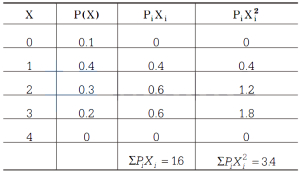
| $X=k$ | $0$ | $1$ | $2$ | $3$ | $4$ |
|---|---|---|---|---|---|
| $P(X=k)$ | $0.1$ | $0.4$ | $0.3$ | $0.2$ | $0$ |
The variance of $X$ is:
A
$1.6$
B
$0.24$
C
$0.84$
D
$0.75$
Solution
(C) To find the variance of the random variable $X$,we use the formula: $\text{Var}(X) = E(X^2) - [E(X)]^2$.
First,we calculate the mean $E(X) = \sum P_i X_i$:
$E(X) = (0 \times 0.1) + (1 \times 0.4) + (2 \times 0.3) + (3 \times 0.2) + (4 \times 0) = 0 + 0.4 + 0.6 + 0.6 + 0 = 1.6$.
Next,we calculate $E(X^2) = \sum P_i X_i^2$:
$E(X^2) = (0^2 \times 0.1) + (1^2 \times 0.4) + (2^2 \times 0.3) + (3^2 \times 0.2) + (4^2 \times 0) = 0 + 0.4 + 1.2 + 1.8 + 0 = 3.4$.
Now,calculate the variance:
$\text{Var}(X) = 3.4 - (1.6)^2 = 3.4 - 2.56 = 0.84$.
First,we calculate the mean $E(X) = \sum P_i X_i$:
$E(X) = (0 \times 0.1) + (1 \times 0.4) + (2 \times 0.3) + (3 \times 0.2) + (4 \times 0) = 0 + 0.4 + 0.6 + 0.6 + 0 = 1.6$.
Next,we calculate $E(X^2) = \sum P_i X_i^2$:
$E(X^2) = (0^2 \times 0.1) + (1^2 \times 0.4) + (2^2 \times 0.3) + (3^2 \times 0.2) + (4^2 \times 0) = 0 + 0.4 + 1.2 + 1.8 + 0 = 3.4$.
Now,calculate the variance:
$\text{Var}(X) = 3.4 - (1.6)^2 = 3.4 - 2.56 = 0.84$.
0 likes
View Solution414
EasyMCQ
$A$ random variable $X$ has the probability distribution given below. Its variance is:
| $X$ | $1$ | $2$ | $3$ | $4$ | $5$ |
|---|---|---|---|---|---|
| $P(X=x)$ | $K$ | $2K$ | $3K$ | $2K$ | $K$ |
A
$\frac{16}{3}$
B
$\frac{4}{3}$
C
$\frac{5}{3}$
D
$\frac{10}{3}$
Solution
(B) For a probability distribution,the sum of all probabilities must be $1$:
$\Sigma P(X=x) = K + 2K + 3K + 2K + K = 9K = 1$
$\therefore K = \frac{1}{9}$
The mean $E(X) = \Sigma x_i P(x_i) = (1 \times K) + (2 \times 2K) + (3 \times 3K) + (4 \times 2K) + (5 \times K)$
$= K + 4K + 9K + 8K + 5K = 27K = 27 \times \frac{1}{9} = 3$
$E(X^2) = \Sigma x_i^2 P(x_i) = (1^2 \times K) + (2^2 \times 2K) + (3^2 \times 3K) + (4^2 \times 2K) + (5^2 \times K)$
$= K + 8K + 27K + 32K + 25K = 93K = 93 \times \frac{1}{9} = \frac{93}{9} = \frac{31}{3}$
Variance $Var(X) = E(X^2) - [E(X)]^2$
$= \frac{31}{3} - (3)^2 = \frac{31}{3} - 9 = \frac{31 - 27}{3} = \frac{4}{3}$
$\Sigma P(X=x) = K + 2K + 3K + 2K + K = 9K = 1$
$\therefore K = \frac{1}{9}$
The mean $E(X) = \Sigma x_i P(x_i) = (1 \times K) + (2 \times 2K) + (3 \times 3K) + (4 \times 2K) + (5 \times K)$
$= K + 4K + 9K + 8K + 5K = 27K = 27 \times \frac{1}{9} = 3$
$E(X^2) = \Sigma x_i^2 P(x_i) = (1^2 \times K) + (2^2 \times 2K) + (3^2 \times 3K) + (4^2 \times 2K) + (5^2 \times K)$
$= K + 8K + 27K + 32K + 25K = 93K = 93 \times \frac{1}{9} = \frac{93}{9} = \frac{31}{3}$
Variance $Var(X) = E(X^2) - [E(X)]^2$
$= \frac{31}{3} - (3)^2 = \frac{31}{3} - 9 = \frac{31 - 27}{3} = \frac{4}{3}$
0 likes
View Solution415
MediumMCQ
If $X$ is a Poisson variate such that $\alpha = P(X=1) = P(X=2)$,then $P(X=4)$ is equal to
A
$2 \alpha$
B
$\frac{\alpha}{3}$
C
$\alpha e^{-2}$
D
$\alpha e^2$
Solution
(B) Given that $X$ is a Poisson variate with parameter $\lambda$,the probability mass function is $P(X=k) = \frac{e^{-\lambda} \lambda^k}{k!}$.
Given $\alpha = P(X=1) = P(X=2)$:
$\frac{e^{-\lambda} \lambda^1}{1!} = \frac{e^{-\lambda} \lambda^2}{2!}$
$\lambda = \frac{\lambda^2}{2} \Rightarrow \lambda = 2$ (since $\lambda > 0$).
Now,calculate $\alpha$:
$\alpha = P(X=1) = \frac{e^{-2} \times 2^1}{1!} = 2e^{-2}$.
We need to find $P(X=4)$:
$P(X=4) = \frac{e^{-\lambda} \lambda^4}{4!} = \frac{e^{-2} \times 2^4}{24} = \frac{16 e^{-2}}{24} = \frac{2}{3} e^{-2}$.
Since $\alpha = 2e^{-2}$,we have $e^{-2} = \frac{\alpha}{2}$.
Substituting this into the expression for $P(X=4)$:
$P(X=4) = \frac{2}{3} \times \frac{\alpha}{2} = \frac{\alpha}{3}$.
Given $\alpha = P(X=1) = P(X=2)$:
$\frac{e^{-\lambda} \lambda^1}{1!} = \frac{e^{-\lambda} \lambda^2}{2!}$
$\lambda = \frac{\lambda^2}{2} \Rightarrow \lambda = 2$ (since $\lambda > 0$).
Now,calculate $\alpha$:
$\alpha = P(X=1) = \frac{e^{-2} \times 2^1}{1!} = 2e^{-2}$.
We need to find $P(X=4)$:
$P(X=4) = \frac{e^{-\lambda} \lambda^4}{4!} = \frac{e^{-2} \times 2^4}{24} = \frac{16 e^{-2}}{24} = \frac{2}{3} e^{-2}$.
Since $\alpha = 2e^{-2}$,we have $e^{-2} = \frac{\alpha}{2}$.
Substituting this into the expression for $P(X=4)$:
$P(X=4) = \frac{2}{3} \times \frac{\alpha}{2} = \frac{\alpha}{3}$.
0 likes
View Solution416
MediumMCQ
Suppose that a random variable $X$ follows a Poisson distribution. If $P(X=1) = P(X=2)$,then $P(X=5)$ is equal to:
A
$\frac{2}{3} e^{-2}$
B
$\frac{3}{4} e^{-2}$
C
$\frac{4}{15} e^{-2}$
D
$\frac{7}{8} e^{-2}$
Solution
(C) Let $\lambda$ be the mean of the Poisson distribution for the random variable $X$.
The probability mass function is given by $P(X=r) = \frac{\lambda^r e^{-\lambda}}{r!}$ for $r = 0, 1, 2, \dots$.
Given $P(X=1) = P(X=2)$,we have:
$\frac{\lambda^1 e^{-\lambda}}{1!} = \frac{\lambda^2 e^{-\lambda}}{2!}$
$\lambda = \frac{\lambda^2}{2}$
Since $\lambda > 0$,we divide by $\lambda$ to get $1 = \frac{\lambda}{2}$,which implies $\lambda = 2$.
Now,we calculate $P(X=5)$:
$P(X=5) = \frac{2^5 e^{-2}}{5!} = \frac{32 e^{-2}}{120}$.
Simplifying the fraction $\frac{32}{120}$ by dividing both numerator and denominator by $8$,we get $\frac{4}{15}$.
Thus,$P(X=5) = \frac{4}{15} e^{-2}$.
The probability mass function is given by $P(X=r) = \frac{\lambda^r e^{-\lambda}}{r!}$ for $r = 0, 1, 2, \dots$.
Given $P(X=1) = P(X=2)$,we have:
$\frac{\lambda^1 e^{-\lambda}}{1!} = \frac{\lambda^2 e^{-\lambda}}{2!}$
$\lambda = \frac{\lambda^2}{2}$
Since $\lambda > 0$,we divide by $\lambda$ to get $1 = \frac{\lambda}{2}$,which implies $\lambda = 2$.
Now,we calculate $P(X=5)$:
$P(X=5) = \frac{2^5 e^{-2}}{5!} = \frac{32 e^{-2}}{120}$.
Simplifying the fraction $\frac{32}{120}$ by dividing both numerator and denominator by $8$,we get $\frac{4}{15}$.
Thus,$P(X=5) = \frac{4}{15} e^{-2}$.
0 likes
View Solution417
EasyMCQ
If $X$ is a Poisson variate with $P(X=0)=0.8$,then the variance of $X$ is
A
$\log _e 20$
B
$\log _{10} 20$
C
$\log _e 1.25$
D
$\log _e 0.8$
Solution
(C) For a Poisson distribution,the probability mass function is given by $P(X=x) = \frac{e^{-m} m^x}{x!}$,where $m$ is the parameter (mean and variance).
Given $P(X=0) = 0.8$.
Substituting $x=0$ in the formula:
$P(X=0) = \frac{e^{-m} m^0}{0!} = e^{-m} = 0.8$.
Taking the natural logarithm on both sides:
$-m = \ln(0.8) = \ln(\frac{8}{10}) = \ln(\frac{4}{5})$.
Therefore,$m = -\ln(\frac{4}{5}) = \ln((\frac{4}{5})^{-1}) = \ln(\frac{5}{4}) = \ln(1.25)$.
Since the variance of a Poisson distribution is equal to its parameter $m$,the variance is $\ln(1.25)$ or $\log _e 1.25$.
Given $P(X=0) = 0.8$.
Substituting $x=0$ in the formula:
$P(X=0) = \frac{e^{-m} m^0}{0!} = e^{-m} = 0.8$.
Taking the natural logarithm on both sides:
$-m = \ln(0.8) = \ln(\frac{8}{10}) = \ln(\frac{4}{5})$.
Therefore,$m = -\ln(\frac{4}{5}) = \ln((\frac{4}{5})^{-1}) = \ln(\frac{5}{4}) = \ln(1.25)$.
Since the variance of a Poisson distribution is equal to its parameter $m$,the variance is $\ln(1.25)$ or $\log _e 1.25$.
0 likes
View Solution418
MediumMCQ
$A$ random variable $X$ takes the values $0, 1$ and $2$. If $P(X=1)=P(X=2)$ and $P(X=0)=0.4$,then the mean of the random variable $X$ is
A
$0.2$
B
$0.7$
C
$0.5$
D
$0.9$
Solution
(D) The sum of probabilities in a probability distribution is always $1$.
Given $P(X=0) = 0.4$.
Since $P(X=0) + P(X=1) + P(X=2) = 1$,we have $0.4 + P(X=1) + P(X=2) = 1$.
$P(X=1) + P(X=2) = 0.6$.
Given $P(X=1) = P(X=2)$,let $P(X=1) = P(X=2) = p$.
Then $p + p = 0.6 \Rightarrow 2p = 0.6 \Rightarrow p = 0.3$.
So,$P(X=1) = 0.3$ and $P(X=2) = 0.3$.
The mean $E(X)$ is given by $\sum x_i P(x_i)$.
$E(X) = (0 \times P(X=0)) + (1 \times P(X=1)) + (2 \times P(X=2))$.
$E(X) = (0 \times 0.4) + (1 \times 0.3) + (2 \times 0.3)$.
$E(X) = 0 + 0.3 + 0.6 = 0.9$.
Given $P(X=0) = 0.4$.
Since $P(X=0) + P(X=1) + P(X=2) = 1$,we have $0.4 + P(X=1) + P(X=2) = 1$.
$P(X=1) + P(X=2) = 0.6$.
Given $P(X=1) = P(X=2)$,let $P(X=1) = P(X=2) = p$.
Then $p + p = 0.6 \Rightarrow 2p = 0.6 \Rightarrow p = 0.3$.
So,$P(X=1) = 0.3$ and $P(X=2) = 0.3$.
The mean $E(X)$ is given by $\sum x_i P(x_i)$.
$E(X) = (0 \times P(X=0)) + (1 \times P(X=1)) + (2 \times P(X=2))$.
$E(X) = (0 \times 0.4) + (1 \times 0.3) + (2 \times 0.3)$.
$E(X) = 0 + 0.3 + 0.6 = 0.9$.
0 likes
View Solution419
MediumMCQ
If the mean of a Poisson distribution is $\frac{1}{2}$,then the ratio of $P(X=3)$ to $P(X=2)$ is
A
$1: 2$
B
$1: 4$
C
$1: 6$
D
$1: 8$
Solution
(C) Given that the mean of the Poisson distribution is $\lambda = \frac{1}{2}$.
The probability mass function of a Poisson distribution is given by $P(X=n) = \frac{\lambda^n e^{-\lambda}}{n!}$.
We need to find the ratio $\frac{P(X=3)}{P(X=2)}$.
$P(X=3) = \frac{(\frac{1}{2})^3 e^{-1/2}}{3!}$ and $P(X=2) = \frac{(\frac{1}{2})^2 e^{-1/2}}{2!}$.
Taking the ratio:
$\frac{P(X=3)}{P(X=2)} = \frac{\frac{(\frac{1}{2})^3 e^{-1/2}}{3!}}{\frac{(\frac{1}{2})^2 e^{-1/2}}{2!}}$
$= \frac{(\frac{1}{2})^3}{3!} \times \frac{2!}{(\frac{1}{2})^2}$
$= \frac{1}{2} \times \frac{2!}{3!}$
$= \frac{1}{2} \times \frac{2}{6} = \frac{1}{6}$.
Thus,the ratio is $1:6$.
The probability mass function of a Poisson distribution is given by $P(X=n) = \frac{\lambda^n e^{-\lambda}}{n!}$.
We need to find the ratio $\frac{P(X=3)}{P(X=2)}$.
$P(X=3) = \frac{(\frac{1}{2})^3 e^{-1/2}}{3!}$ and $P(X=2) = \frac{(\frac{1}{2})^2 e^{-1/2}}{2!}$.
Taking the ratio:
$\frac{P(X=3)}{P(X=2)} = \frac{\frac{(\frac{1}{2})^3 e^{-1/2}}{3!}}{\frac{(\frac{1}{2})^2 e^{-1/2}}{2!}}$
$= \frac{(\frac{1}{2})^3}{3!} \times \frac{2!}{(\frac{1}{2})^2}$
$= \frac{1}{2} \times \frac{2!}{3!}$
$= \frac{1}{2} \times \frac{2}{6} = \frac{1}{6}$.
Thus,the ratio is $1:6$.
0 likes
View Solution420
DifficultMCQ
$A$ fair six-faced die is rolled $12$ times. The probability that each face turns up exactly twice is equal to:
A
$\frac{12!}{6!6!6^{12}}$
B
$\frac{2^{12}}{2^{6} 6^{12}}$
C
$\frac{12!}{2^{6} 6^{12}}$
D
$\frac{12!}{6^{2} 6^{12}}$
Solution
(C) The total number of outcomes when a die is rolled $12$ times is $6^{12}$.
We want each of the $6$ faces to appear exactly $2$ times.
This is a multinomial distribution problem where we arrange $12$ items into $6$ groups of size $2$ each.
The number of ways to distribute $12$ outcomes such that each face appears twice is given by the multinomial coefficient:
$\frac{12!}{2! 2! 2! 2! 2! 2!} = \frac{12!}{(2!)^6} = \frac{12!}{2^6}$.
Therefore,the required probability is:
$P = \frac{12!}{2^6 \times 6^{12}}$.
We want each of the $6$ faces to appear exactly $2$ times.
This is a multinomial distribution problem where we arrange $12$ items into $6$ groups of size $2$ each.
The number of ways to distribute $12$ outcomes such that each face appears twice is given by the multinomial coefficient:
$\frac{12!}{2! 2! 2! 2! 2! 2!} = \frac{12!}{(2!)^6} = \frac{12!}{2^6}$.
Therefore,the required probability is:
$P = \frac{12!}{2^6 \times 6^{12}}$.
0 likes
View Solution421
MediumMCQ
$A$ biased coin with probability $p$ $(0 < p < 1)$ of getting a head is tossed until a head appears for the first time. If the probability that the number of tosses required is even is $\frac{2}{5}$,then $p=$
A
$\frac{1}{4}$
B
$\frac{1}{3}$
C
$\frac{2}{3}$
D
$\frac{3}{4}$
Solution
(B) Let $q = 1-p$ be the probability of getting a tail. The event that the first head appears on an even toss means the sequence of outcomes is $(T, H), (T, T, T, H), (T, T, T, T, T, H), \dots$
The probability of this occurring is $P = qp + q^3p + q^5p + \dots$
This is an infinite geometric series with first term $a = qp$ and common ratio $r = q^2$.
Since $0 < p < 1$,we have $0 < q < 1$,so $|q^2| < 1$.
The sum of the series is $P = \frac{a}{1-r} = \frac{qp}{1-q^2}$.
Given $P = \frac{2}{5}$,we have $\frac{qp}{1-q^2} = \frac{2}{5}$.
Substituting $q = 1-p$,we get $\frac{(1-p)p}{1-(1-p)^2} = \frac{2}{5}$.
Simplifying the denominator: $1 - (1 - 2p + p^2) = 2p - p^2 = p(2-p)$.
So,$\frac{p(1-p)}{p(2-p)} = \frac{2}{5}$.
Canceling $p$ (since $p \neq 0$),we get $\frac{1-p}{2-p} = \frac{2}{5}$.
Cross-multiplying: $5(1-p) = 2(2-p) \Rightarrow 5 - 5p = 4 - 2p$.
$1 = 3p \Rightarrow p = \frac{1}{3}$.
The probability of this occurring is $P = qp + q^3p + q^5p + \dots$
This is an infinite geometric series with first term $a = qp$ and common ratio $r = q^2$.
Since $0 < p < 1$,we have $0 < q < 1$,so $|q^2| < 1$.
The sum of the series is $P = \frac{a}{1-r} = \frac{qp}{1-q^2}$.
Given $P = \frac{2}{5}$,we have $\frac{qp}{1-q^2} = \frac{2}{5}$.
Substituting $q = 1-p$,we get $\frac{(1-p)p}{1-(1-p)^2} = \frac{2}{5}$.
Simplifying the denominator: $1 - (1 - 2p + p^2) = 2p - p^2 = p(2-p)$.
So,$\frac{p(1-p)}{p(2-p)} = \frac{2}{5}$.
Canceling $p$ (since $p \neq 0$),we get $\frac{1-p}{2-p} = \frac{2}{5}$.
Cross-multiplying: $5(1-p) = 2(2-p) \Rightarrow 5 - 5p = 4 - 2p$.
$1 = 3p \Rightarrow p = \frac{1}{3}$.
0 likes
View Solution422
DifficultMCQ
The probability distribution of a random variable $X$ is given below:
If $E(X) = \frac{263}{15}$,then $P(X < 20)$ is equal to:
| $X$ | $4k$ | $\frac{30}{7}k$ | $\frac{32}{7}k$ | $\frac{34}{7}k$ | $\frac{36}{7}k$ | $\frac{38}{7}k$ | $\frac{40}{7}k$ | $6k$ |
| $P(X)$ | $\frac{2}{15}$ | $\frac{1}{15}$ | $\frac{2}{15}$ | $\frac{1}{5}$ | $\frac{1}{15}$ | $\frac{2}{15}$ | $\frac{1}{5}$ | $\frac{1}{15}$ |
If $E(X) = \frac{263}{15}$,then $P(X < 20)$ is equal to:
A
$\frac{3}{5}$
B
$\frac{8}{15}$
C
$\frac{11}{15}$
D
$\frac{14}{15}$
Solution
(C) Given the expected value $E(X) = \sum X_i P(X_i) = \frac{263}{15}$.
Calculating the sum: $E(X) = (4k \cdot \frac{2}{15}) + (\frac{30}{7}k \cdot \frac{1}{15}) + (\frac{32}{7}k \cdot \frac{2}{15}) + (\frac{34}{7}k \cdot \frac{1}{5}) + (\frac{36}{7}k \cdot \frac{1}{15}) + (\frac{38}{7}k \cdot \frac{2}{15}) + (\frac{40}{7}k \cdot \frac{1}{5}) + (6k \cdot \frac{1}{15})$.
$E(X) = \frac{k}{105} [ (28 \cdot 2) + (30 \cdot 1) + (32 \cdot 2) + (34 \cdot 3) + (36 \cdot 1) + (38 \cdot 2) + (40 \cdot 3) + (42 \cdot 1) ] = \frac{k}{105} [ 56 + 30 + 64 + 102 + 36 + 76 + 120 + 42 ] = \frac{526k}{105} = \frac{263}{15}$.
Solving for $k$: $k = \frac{263}{15} \cdot \frac{105}{526} = \frac{263}{526} \cdot \frac{105}{15} = \frac{1}{2} \cdot 7 = \frac{7}{2}$.
Substituting $k = \frac{7}{2}$ into the values of $X$: $X$ takes values ${14, 15, 16, 17, 18, 19, 20, 21}$.
We need $P(X < 20) = P(X=14) + P(X=15) + P(X=16) + P(X=17) + P(X=18) + P(X=19)$.
$P(X < 20) = \frac{2}{15} + \frac{1}{15} + \frac{2}{15} + \frac{1}{5} + \frac{1}{15} + \frac{2}{15} = \frac{2+1+2+3+1+2}{15} = \frac{11}{15}$.
Calculating the sum: $E(X) = (4k \cdot \frac{2}{15}) + (\frac{30}{7}k \cdot \frac{1}{15}) + (\frac{32}{7}k \cdot \frac{2}{15}) + (\frac{34}{7}k \cdot \frac{1}{5}) + (\frac{36}{7}k \cdot \frac{1}{15}) + (\frac{38}{7}k \cdot \frac{2}{15}) + (\frac{40}{7}k \cdot \frac{1}{5}) + (6k \cdot \frac{1}{15})$.
$E(X) = \frac{k}{105} [ (28 \cdot 2) + (30 \cdot 1) + (32 \cdot 2) + (34 \cdot 3) + (36 \cdot 1) + (38 \cdot 2) + (40 \cdot 3) + (42 \cdot 1) ] = \frac{k}{105} [ 56 + 30 + 64 + 102 + 36 + 76 + 120 + 42 ] = \frac{526k}{105} = \frac{263}{15}$.
Solving for $k$: $k = \frac{263}{15} \cdot \frac{105}{526} = \frac{263}{526} \cdot \frac{105}{15} = \frac{1}{2} \cdot 7 = \frac{7}{2}$.
Substituting $k = \frac{7}{2}$ into the values of $X$: $X$ takes values ${14, 15, 16, 17, 18, 19, 20, 21}$.
We need $P(X < 20) = P(X=14) + P(X=15) + P(X=16) + P(X=17) + P(X=18) + P(X=19)$.
$P(X < 20) = \frac{2}{15} + \frac{1}{15} + \frac{2}{15} + \frac{1}{5} + \frac{1}{15} + \frac{2}{15} = \frac{2+1+2+3+1+2}{15} = \frac{11}{15}$.
0 likes
View Solution423
DifficultMCQ
$A$ random variable $X$ takes values $0, 1, 2, 3$ with probabilities $\frac{2a + 1}{30}, \frac{8a - 1}{30}, \frac{4a + 1}{30}, b$ respectively,where $a, b \in R$. Let $\mu$ and $\sigma$ respectively be the mean and standard deviation of $X$ such that $\sigma^{2} + \mu^{2} = 2$. Then $\frac{a}{b}$ is equal to:
A
$30$
B
$3$
C
$60$
D
$12$
Solution
(C) The sum of probabilities must be $1$:
$\frac{2a + 1}{30} + \frac{8a - 1}{30} + \frac{4a + 1}{30} + b = 1$
$\frac{14a + 1}{30} + b = 1 \Rightarrow 14a + 30b = 29 \dots (1)$
We are given $\sigma^{2} + \mu^{2} = 2$. Since $\sigma^{2} = E[X^{2}] - \mu^{2}$,we have $E[X^{2}] = 2$.
$E[X^{2}] = \sum x_{i}^{2} p(x_{i}) = 0^{2} \cdot \frac{2a+1}{30} + 1^{2} \cdot \frac{8a-1}{30} + 2^{2} \cdot \frac{4a+1}{30} + 3^{2} \cdot b = 2$
$\frac{8a - 1 + 16a + 4}{30} + 9b = 2$
$\frac{24a + 3}{30} + 9b = 2$ $\Rightarrow 24a + 3 + 270b = 60$ $\Rightarrow 24a + 270b = 57$
Dividing by $3$: $8a + 90b = 19 \dots (2)$
From $(1)$,$30b = 29 - 14a$. Substitute into $(2)$:
$8a + 3(29 - 14a) = 19$
$8a + 87 - 42a = 19$
$-34a = -68 \Rightarrow a = 2$
Substituting $a = 2$ into $(1)$: $14(2) + 30b = 29$ $\Rightarrow 28 + 30b = 29$ $\Rightarrow 30b = 1$ $\Rightarrow b = \frac{1}{30}$
Therefore,$\frac{a}{b} = \frac{2}{1/30} = 60$.
$\frac{2a + 1}{30} + \frac{8a - 1}{30} + \frac{4a + 1}{30} + b = 1$
$\frac{14a + 1}{30} + b = 1 \Rightarrow 14a + 30b = 29 \dots (1)$
We are given $\sigma^{2} + \mu^{2} = 2$. Since $\sigma^{2} = E[X^{2}] - \mu^{2}$,we have $E[X^{2}] = 2$.
$E[X^{2}] = \sum x_{i}^{2} p(x_{i}) = 0^{2} \cdot \frac{2a+1}{30} + 1^{2} \cdot \frac{8a-1}{30} + 2^{2} \cdot \frac{4a+1}{30} + 3^{2} \cdot b = 2$
$\frac{8a - 1 + 16a + 4}{30} + 9b = 2$
$\frac{24a + 3}{30} + 9b = 2$ $\Rightarrow 24a + 3 + 270b = 60$ $\Rightarrow 24a + 270b = 57$
Dividing by $3$: $8a + 90b = 19 \dots (2)$
From $(1)$,$30b = 29 - 14a$. Substitute into $(2)$:
$8a + 3(29 - 14a) = 19$
$8a + 87 - 42a = 19$
$-34a = -68 \Rightarrow a = 2$
Substituting $a = 2$ into $(1)$: $14(2) + 30b = 29$ $\Rightarrow 28 + 30b = 29$ $\Rightarrow 30b = 1$ $\Rightarrow b = \frac{1}{30}$
Therefore,$\frac{a}{b} = \frac{2}{1/30} = 60$.
0 likes
View Solution424
DifficultMCQ
If a random variable $x$ has the probability distribution as follows:
Then $P(3 < x \leq 6)$ is equal to:
| $x$ | $0$ | $1$ | $2$ | $3$ | $4$ | $5$ | $6$ | $7$ |
| $P(x)$ | $0$ | $2k$ | $k$ | $3k$ | $2k^2$ | $2k$ | $k^2+k$ | $7k^2$ |
Then $P(3 < x \leq 6)$ is equal to:
A
$0.34$
B
$0.22$
C
$0.64$
D
$0.33$
Solution
(D) For a probability distribution,the sum of all probabilities must be equal to $1$.
$\sum P(x_i) = 0 + 2k + k + 3k + 2k^2 + 2k + (k^2 + k) + 7k^2 = 1$
Combining the terms,we get: $10k^2 + 9k = 1$
Rearranging into a quadratic equation: $10k^2 + 9k - 1 = 0$
Factoring the equation: $(10k - 1)(k + 1) = 0$
Since $k$ must be positive for probabilities to be non-negative,we have $k = \frac{1}{10} = 0.1$.
We need to find $P(3 < x \leq 6) = P(x=4) + P(x=5) + P(x=6)$.
$P(3 < x \leq 6) = 2k^2 + 2k + (k^2 + k) = 3k^2 + 3k$.
Substituting $k = 0.1$:
$P(3 < x \leq 6) = 3(0.1)^2 + 3(0.1) = 3(0.01) + 0.3 = 0.03 + 0.3 = 0.33$.
$\sum P(x_i) = 0 + 2k + k + 3k + 2k^2 + 2k + (k^2 + k) + 7k^2 = 1$
Combining the terms,we get: $10k^2 + 9k = 1$
Rearranging into a quadratic equation: $10k^2 + 9k - 1 = 0$
Factoring the equation: $(10k - 1)(k + 1) = 0$
Since $k$ must be positive for probabilities to be non-negative,we have $k = \frac{1}{10} = 0.1$.
We need to find $P(3 < x \leq 6) = P(x=4) + P(x=5) + P(x=6)$.
$P(3 < x \leq 6) = 2k^2 + 2k + (k^2 + k) = 3k^2 + 3k$.
Substituting $k = 0.1$:
$P(3 < x \leq 6) = 3(0.1)^2 + 3(0.1) = 3(0.01) + 0.3 = 0.03 + 0.3 = 0.33$.
0 likes
View SolutionProbability — Probability distribution · Frequently Asked Questions
1Are these Probability questions useful for JEE and NEET?
Yes. All questions in this section are mapped to JEE Main and NEET exam patterns. Previous year questions from JEE Main, NEET, GUJCET and state-level exams are included with full solutions.
2Can I switch to Hindi or Gujarati for these questions?
Yes. Use the language tabs in the hero section or the sidebar to view the same questions and solutions in English, Hindi or Gujarati.
3How do I generate a question paper from this subtopic?
Use the Vedclass Exam Paper Generator — select the chapter and subtopic, set difficulty, and generate Sets A, B, C, D automatically. First 3 chapters of every subject are free.
Vedclass Products
For Students
Vedclass Test Series
Mock tests in real JEE/NEET style with performance analysis. 5-day free trial.
Start Free TrialFor Teachers
Exam Paper Generator
Generate Set A/B/C/D papers from this chapter in 2 minutes. 3 chapters free.
Try FreeFor Institutes
Online Exam Module
Live online exams with unlimited students, 360° analytics & white-label branding.
See DemoFor Teachers & Institutes
Generate a Probability Exam Paper in 2 Minutes
Select subtopic & difficulty — Sets A, B, C, D auto-generated with No Repeat logic.
First 3 chapters of every subject are free — no payment required.