
A English
Probability distribution Questions in English
Class 12 Mathematics · Probability · Probability distribution
430+
Questions
English
Language
100%
With Solutions
Showing 49 of 430 questions in English
151
EasyMCQ
$A$ service station manager sells gas at an average of ₹ $100$ per hour on a rainy day,₹ $150$ per hour on a dubious day,₹ $250$ per hour on a fair day,and ₹ $300$ per hour on a clear sky day. If weather bureau statistics show the probabilities of weather as follows,then his mathematical expectation is:
| Weather | Clear | Fair | Dubious | Rainy |
| Probability | $0.50$ | $0.30$ | $0.15$ | $0.05$ |
A
$257.5$
B
$252.5$
C
$250$
D
$247.5$
Solution
(B) The mathematical expectation $E(X)$ is calculated as the sum of the products of each outcome and its corresponding probability: $E(X) = \sum x_i p_i$.
Given data:
- Clear: $x = 300, p = 0.50$
- Fair: $x = 250, p = 0.30$
- Dubious: $x = 150, p = 0.15$
- Rainy: $x = 100, p = 0.05$
Calculation:
$E(X) = (300 \times 0.50) + (250 \times 0.30) + (150 \times 0.15) + (100 \times 0.05)$
$E(X) = 150 + 75 + 22.5 + 5$
$E(X) = 252.5$
Thus,the mathematical expectation is ₹ $252.5$.
Given data:
- Clear: $x = 300, p = 0.50$
- Fair: $x = 250, p = 0.30$
- Dubious: $x = 150, p = 0.15$
- Rainy: $x = 100, p = 0.05$
Calculation:
$E(X) = (300 \times 0.50) + (250 \times 0.30) + (150 \times 0.15) + (100 \times 0.05)$
$E(X) = 150 + 75 + 22.5 + 5$
$E(X) = 252.5$
Thus,the mathematical expectation is ₹ $252.5$.
0 likes
View Solution152
MediumMCQ
$A$ random variable $X$ has the following probability distribution:
For the events $E = \{X \text{ is a prime number}\}$ and $F = \{X < 4\}$,find $P(E \cup F)$.
| $X$ | $1$ | $2$ | $3$ | $4$ | $5$ | $6$ | $7$ | $8$ |
|---|---|---|---|---|---|---|---|---|
| $P(X=x)$ | $0.15$ | $0.23$ | $0.12$ | $0.10$ | $0.20$ | $0.08$ | $0.07$ | $0.05$ |
For the events $E = \{X \text{ is a prime number}\}$ and $F = \{X < 4\}$,find $P(E \cup F)$.
A
$0.87$
B
$0.35$
C
$0.77$
D
$0.5$
Solution
(C) The probability distribution is given as:
$P(X=1)=0.15, P(X=2)=0.23, P(X=3)=0.12, P(X=4)=0.10, P(X=5)=0.20, P(X=6)=0.08, P(X=7)=0.07, P(X=8)=0.05$.
Event $E = \{X \text{ is a prime number}\} = \{2, 3, 5, 7\}$.
$P(E) = P(X=2) + P(X=3) + P(X=5) + P(X=7) = 0.23 + 0.12 + 0.20 + 0.07 = 0.62$.
Event $F = \{X < 4\} = \{1, 2, 3\}$.
$P(F) = P(X=1) + P(X=2) + P(X=3) = 0.15 + 0.23 + 0.12 = 0.50$.
Event $E \cap F = \{X \text{ is a prime number and } X < 4\} = \{2, 3\}$.
$P(E \cap F) = P(X=2) + P(X=3) = 0.23 + 0.12 = 0.35$.
Using the addition theorem of probability:
$P(E \cup F) = P(E) + P(F) - P(E \cap F)$
$P(E \cup F) = 0.62 + 0.50 - 0.35 = 0.77$.
$P(X=1)=0.15, P(X=2)=0.23, P(X=3)=0.12, P(X=4)=0.10, P(X=5)=0.20, P(X=6)=0.08, P(X=7)=0.07, P(X=8)=0.05$.
Event $E = \{X \text{ is a prime number}\} = \{2, 3, 5, 7\}$.
$P(E) = P(X=2) + P(X=3) + P(X=5) + P(X=7) = 0.23 + 0.12 + 0.20 + 0.07 = 0.62$.
Event $F = \{X < 4\} = \{1, 2, 3\}$.
$P(F) = P(X=1) + P(X=2) + P(X=3) = 0.15 + 0.23 + 0.12 = 0.50$.
Event $E \cap F = \{X \text{ is a prime number and } X < 4\} = \{2, 3\}$.
$P(E \cap F) = P(X=2) + P(X=3) = 0.23 + 0.12 = 0.35$.
Using the addition theorem of probability:
$P(E \cup F) = P(E) + P(F) - P(E \cap F)$
$P(E \cup F) = 0.62 + 0.50 - 0.35 = 0.77$.
0 likes
View Solution153
MediumMCQ
In a game,$3$ coins are tossed. $A$ person is paid ₹ $100$,if he gets all heads or all tails; and he is supposed to pay ₹ $40$,if he gets one head or two heads. The amount he can expect to win/lose on an average per game in (₹) is
A
$10$ loss
B
$5$ loss
C
$5$ gain
D
$10$ gain
Solution
(B) In a game,$3$ coins are tossed. The total number of outcomes is $2^3 = 8$.
$P(\text{getting all heads or all tails}) = P(HHH, TTT) = \frac{2}{8} = \frac{1}{4}$.
$P(\text{getting one head or two heads}) = P(HTT, THT, TTH, HHT, HTH, THH) = \frac{6}{8} = \frac{3}{4}$.
Let $X$ be the random variable representing the amount won or lost.
$P(X = 100) = \frac{1}{4}$.
$P(X = -40) = \frac{3}{4}$.
The expected value $E(X) = \sum x_i p_i$.
$E(X) = 100 \times \frac{1}{4} + (-40) \times \frac{3}{4}$.
$E(X) = 25 - 30 = -5$.
Since the result is negative,the person expects a loss of ₹ $5$ per game.
$P(\text{getting all heads or all tails}) = P(HHH, TTT) = \frac{2}{8} = \frac{1}{4}$.
$P(\text{getting one head or two heads}) = P(HTT, THT, TTH, HHT, HTH, THH) = \frac{6}{8} = \frac{3}{4}$.
Let $X$ be the random variable representing the amount won or lost.
$P(X = 100) = \frac{1}{4}$.
$P(X = -40) = \frac{3}{4}$.
The expected value $E(X) = \sum x_i p_i$.
$E(X) = 100 \times \frac{1}{4} + (-40) \times \frac{3}{4}$.
$E(X) = 25 - 30 = -5$.
Since the result is negative,the person expects a loss of ₹ $5$ per game.
0 likes
View Solution154
DifficultMCQ
$A$ random variable $X$ assumes values $1, 2, 3, \ldots, n$ with equal probabilities. If $\operatorname{var}(X) : E(X) = 4 : 1$,then $n$ is equal to
A
$20$
B
$15$
C
$25$
D
$10$
Solution
(C) The probability distribution is given by the table:
| $X=x$ | $1$ | $2$ | $3$ | $\ldots$ | $n$ |
|---|---|---|---|---|---|
| $P(X=x)$ | $\frac{1}{n}$ | $\frac{1}{n}$ | $\frac{1}{n}$ | $\ldots$ | $\frac{1}{n}$ |
$E(X) = \sum x P(X=x) = \frac{1}{n} (1 + 2 + \ldots + n) = \frac{1}{n} \cdot \frac{n(n+1)}{2} = \frac{n+1}{2}$
$E(X^2) = \sum x^2 P(X=x) = \frac{1}{n} (1^2 + 2^2 + \ldots + n^2) = \frac{1}{n} \cdot \frac{n(n+1)(2n+1)}{6} = \frac{(n+1)(2n+1)}{6}$
$\operatorname{Var}(X) = E(X^2) - [E(X)]^2 = \frac{(n+1)(2n+1)}{6} - \left(\frac{n+1}{2}\right)^2$
$= \frac{(n+1)}{2} \left[ \frac{2n+1}{3} - \frac{n+1}{2} \right] = \frac{(n+1)}{2} \left[ \frac{4n+2 - 3n - 3}{6} \right] = \frac{(n+1)(n-1)}{12} = \frac{n^2-1}{12}$
Given $\frac{\operatorname{Var}(X)}{E(X)} = \frac{4}{1}$,we have:
$\frac{(n^2-1)/12}{(n+1)/2} = 4$
$\frac{(n+1)(n-1)}{12} \cdot \frac{2}{n+1} = 4$
$\frac{n-1}{6} = 4$
$n-1 = 24$
$n = 25$
| $X=x$ | $1$ | $2$ | $3$ | $\ldots$ | $n$ |
|---|---|---|---|---|---|
| $P(X=x)$ | $\frac{1}{n}$ | $\frac{1}{n}$ | $\frac{1}{n}$ | $\ldots$ | $\frac{1}{n}$ |
$E(X) = \sum x P(X=x) = \frac{1}{n} (1 + 2 + \ldots + n) = \frac{1}{n} \cdot \frac{n(n+1)}{2} = \frac{n+1}{2}$
$E(X^2) = \sum x^2 P(X=x) = \frac{1}{n} (1^2 + 2^2 + \ldots + n^2) = \frac{1}{n} \cdot \frac{n(n+1)(2n+1)}{6} = \frac{(n+1)(2n+1)}{6}$
$\operatorname{Var}(X) = E(X^2) - [E(X)]^2 = \frac{(n+1)(2n+1)}{6} - \left(\frac{n+1}{2}\right)^2$
$= \frac{(n+1)}{2} \left[ \frac{2n+1}{3} - \frac{n+1}{2} \right] = \frac{(n+1)}{2} \left[ \frac{4n+2 - 3n - 3}{6} \right] = \frac{(n+1)(n-1)}{12} = \frac{n^2-1}{12}$
Given $\frac{\operatorname{Var}(X)}{E(X)} = \frac{4}{1}$,we have:
$\frac{(n^2-1)/12}{(n+1)/2} = 4$
$\frac{(n+1)(n-1)}{12} \cdot \frac{2}{n+1} = 4$
$\frac{n-1}{6} = 4$
$n-1 = 24$
$n = 25$
0 likes
View Solution155
MediumMCQ
If three fair coins are tossed,then the variance of the number of heads obtained is
A
$0.25$
B
$3$
C
$0.75$
D
$1.5$
Solution
(C) Let the random variable $X$ denote the number of heads obtained when three fair coins are tossed. The probability distribution of $X$ is given by the following table:
| $X = x$ | $0$ | $1$ | $2$ | $3$ |
| :--- | :--- | :--- | :--- | :--- |
| $P(X = x)$ | $\frac{1}{8}$ | $\frac{3}{8}$ | $\frac{3}{8}$ | $\frac{1}{8}$ |
The expected value $E(X)$ is calculated as:
$E(X) = \sum x P(X=x) = 0 \times \frac{1}{8} + 1 \times \frac{3}{8} + 2 \times \frac{3}{8} + 3 \times \frac{1}{8} = 0 + \frac{3}{8} + \frac{6}{8} + \frac{3}{8} = \frac{12}{8} = \frac{3}{2} = 1.5$
The expected value $E(X^2)$ is calculated as:
$E(X^2) = \sum x^2 P(X=x) = 0^2 \times \frac{1}{8} + 1^2 \times \frac{3}{8} + 2^2 \times \frac{3}{8} + 3^2 \times \frac{1}{8} = 0 + \frac{3}{8} + \frac{12}{8} + \frac{9}{8} = \frac{24}{8} = 3$
The variance $V(X)$ is given by the formula:
$V(X) = E(X^2) - [E(X)]^2$
$V(X) = 3 - (\frac{3}{2})^2 = 3 - \frac{9}{4} = \frac{12 - 9}{4} = \frac{3}{4} = 0.75$
| $X = x$ | $0$ | $1$ | $2$ | $3$ |
| :--- | :--- | :--- | :--- | :--- |
| $P(X = x)$ | $\frac{1}{8}$ | $\frac{3}{8}$ | $\frac{3}{8}$ | $\frac{1}{8}$ |
The expected value $E(X)$ is calculated as:
$E(X) = \sum x P(X=x) = 0 \times \frac{1}{8} + 1 \times \frac{3}{8} + 2 \times \frac{3}{8} + 3 \times \frac{1}{8} = 0 + \frac{3}{8} + \frac{6}{8} + \frac{3}{8} = \frac{12}{8} = \frac{3}{2} = 1.5$
The expected value $E(X^2)$ is calculated as:
$E(X^2) = \sum x^2 P(X=x) = 0^2 \times \frac{1}{8} + 1^2 \times \frac{3}{8} + 2^2 \times \frac{3}{8} + 3^2 \times \frac{1}{8} = 0 + \frac{3}{8} + \frac{12}{8} + \frac{9}{8} = \frac{24}{8} = 3$
The variance $V(X)$ is given by the formula:
$V(X) = E(X^2) - [E(X)]^2$
$V(X) = 3 - (\frac{3}{2})^2 = 3 - \frac{9}{4} = \frac{12 - 9}{4} = \frac{3}{4} = 0.75$
0 likes
View Solution156
DifficultMCQ
The p.m.f. of a random variable $X$ is given by $P(X=x) = \begin{cases} \frac{\binom{5}{x}}{2^5}, & x = 0, 1, 2, 3, 4, 5 \\ 0, & \text{otherwise} \end{cases}$. Then which of the following is not correct?
A
$P(X=0)=P(X=5)$
B
$P(X \leq 1)=P(X \geq 4)$
C
$P(X \leq 2)=P(X \geq 3)$
D
$P(X \leq 2) > P(X \geq 3)$
Solution
(D) The given probability mass function is $P(X=x) = \frac{\binom{5}{x}}{2^5}$ for $x \in \{0, 1, 2, 3, 4, 5\}$.
$P(X=0) = \frac{\binom{5}{0}}{32} = \frac{1}{32}$ and $P(X=5) = \frac{\binom{5}{5}}{32} = \frac{1}{32}$. Thus,$P(X=0) = P(X=5)$ is correct.
$P(X \leq 1) = P(X=0) + P(X=1) = \frac{1}{32} + \frac{5}{32} = \frac{6}{32}$.
$P(X \geq 4) = P(X=4) + P(X=5) = \frac{5}{32} + \frac{1}{32} = \frac{6}{32}$. Thus,$P(X \leq 1) = P(X \geq 4)$ is correct.
$P(X \leq 2) = P(X=0) + P(X=1) + P(X=2) = \frac{1}{32} + \frac{5}{32} + \frac{10}{32} = \frac{16}{32} = \frac{1}{2}$.
$P(X \geq 3) = P(X=3) + P(X=4) + P(X=5) = \frac{10}{32} + \frac{5}{32} + \frac{1}{32} = \frac{16}{32} = \frac{1}{2}$.
Since $P(X \leq 2) = \frac{1}{2}$ and $P(X \geq 3) = \frac{1}{2}$,the statement $P(X \leq 2) > P(X \geq 3)$ is incorrect.
$P(X=0) = \frac{\binom{5}{0}}{32} = \frac{1}{32}$ and $P(X=5) = \frac{\binom{5}{5}}{32} = \frac{1}{32}$. Thus,$P(X=0) = P(X=5)$ is correct.
$P(X \leq 1) = P(X=0) + P(X=1) = \frac{1}{32} + \frac{5}{32} = \frac{6}{32}$.
$P(X \geq 4) = P(X=4) + P(X=5) = \frac{5}{32} + \frac{1}{32} = \frac{6}{32}$. Thus,$P(X \leq 1) = P(X \geq 4)$ is correct.
$P(X \leq 2) = P(X=0) + P(X=1) + P(X=2) = \frac{1}{32} + \frac{5}{32} + \frac{10}{32} = \frac{16}{32} = \frac{1}{2}$.
$P(X \geq 3) = P(X=3) + P(X=4) + P(X=5) = \frac{10}{32} + \frac{5}{32} + \frac{1}{32} = \frac{16}{32} = \frac{1}{2}$.
Since $P(X \leq 2) = \frac{1}{2}$ and $P(X \geq 3) = \frac{1}{2}$,the statement $P(X \leq 2) > P(X \geq 3)$ is incorrect.
0 likes
View Solution157
MediumMCQ
$A$ random variable $X$ has the following probability distribution:
For the event $E = \{ X \text{ is a prime number} \}$,$F = \{ X < 4 \}$,then $P(E \cup F)$ is
| $X = x$ | $1$ | $2$ | $3$ | $4$ | $5$ | $6$ | $7$ | $8$ |
|---|---|---|---|---|---|---|---|---|
| $P(X = x)$ | $0.15$ | $0.23$ | $0.10$ | $0.12$ | $0.20$ | $0.08$ | $0.07$ | $0.05$ |
For the event $E = \{ X \text{ is a prime number} \}$,$F = \{ X < 4 \}$,then $P(E \cup F)$ is
A
$0.5$
B
$0.77$
C
$0.35$
D
$0.75$
Solution
(D) The probability distribution is given as:
$P(X=1)=0.15, P(X=2)=0.23, P(X=3)=0.10, P(X=4)=0.12, P(X=5)=0.20, P(X=6)=0.08, P(X=7)=0.07, P(X=8)=0.05$.
Event $E = \{ X \text{ is a prime number} \} = \{ 2, 3, 5, 7 \}$.
$P(E) = P(X=2) + P(X=3) + P(X=5) + P(X=7) = 0.23 + 0.10 + 0.20 + 0.07 = 0.60$.
Event $F = \{ X < 4 \} = \{ 1, 2, 3 \}$.
$P(F) = P(X=1) + P(X=2) + P(X=3) = 0.15 + 0.23 + 0.10 = 0.48$.
Event $E \cap F = \{ X \text{ is a prime number and } X < 4 \} = \{ 2, 3 \}$.
$P(E \cap F) = P(X=2) + P(X=3) = 0.23 + 0.10 = 0.33$.
Using the addition rule for probability:
$P(E \cup F) = P(E) + P(F) - P(E \cap F)$
$P(E \cup F) = 0.60 + 0.48 - 0.33 = 0.75$.
$P(X=1)=0.15, P(X=2)=0.23, P(X=3)=0.10, P(X=4)=0.12, P(X=5)=0.20, P(X=6)=0.08, P(X=7)=0.07, P(X=8)=0.05$.
Event $E = \{ X \text{ is a prime number} \} = \{ 2, 3, 5, 7 \}$.
$P(E) = P(X=2) + P(X=3) + P(X=5) + P(X=7) = 0.23 + 0.10 + 0.20 + 0.07 = 0.60$.
Event $F = \{ X < 4 \} = \{ 1, 2, 3 \}$.
$P(F) = P(X=1) + P(X=2) + P(X=3) = 0.15 + 0.23 + 0.10 = 0.48$.
Event $E \cap F = \{ X \text{ is a prime number and } X < 4 \} = \{ 2, 3 \}$.
$P(E \cap F) = P(X=2) + P(X=3) = 0.23 + 0.10 = 0.33$.
Using the addition rule for probability:
$P(E \cup F) = P(E) + P(F) - P(E \cap F)$
$P(E \cup F) = 0.60 + 0.48 - 0.33 = 0.75$.
0 likes
View Solution158
EasyMCQ
$A$ random variable $X$ has the following probability distribution:
| $X$ | $1$ | $2$ | $3$ | $4$ | $5$ |
|---|---|---|---|---|---|
| $P(X)$ | $k^2$ | $2k$ | $k$ | $2k$ | $5k^2$ |
Then $P(X \geq 2)$ is equal to:
| $X$ | $1$ | $2$ | $3$ | $4$ | $5$ |
|---|---|---|---|---|---|
| $P(X)$ | $k^2$ | $2k$ | $k$ | $2k$ | $5k^2$ |
Then $P(X \geq 2)$ is equal to:
A
$\frac{35}{36}$
B
$\frac{34}{36}$
C
$\frac{33}{36}$
D
$\frac{31}{36}$
Solution
(A) We know that the sum of all probabilities in a probability distribution is $1$,i.e.,$\sum P(X=x) = 1$.
Given the distribution:
$k^2 + 2k + k + 2k + 5k^2 = 1$
$6k^2 + 5k - 1 = 0$
$(6k - 1)(k + 1) = 0$
Since $P(X) \geq 0$,we must have $k > 0$,so $k = \frac{1}{6}$.
Now,we need to find $P(X \geq 2)$:
$P(X \geq 2) = P(X=2) + P(X=3) + P(X=4) + P(X=5)$
$P(X \geq 2) = 2k + k + 2k + 5k^2 = 5k + 5k^2$
Substituting $k = \frac{1}{6}$:
$P(X \geq 2) = 5(\frac{1}{6}) + 5(\frac{1}{6})^2$
$P(X \geq 2) = \frac{5}{6} + \frac{5}{36} = \frac{30 + 5}{36} = \frac{35}{36}$.
Given the distribution:
$k^2 + 2k + k + 2k + 5k^2 = 1$
$6k^2 + 5k - 1 = 0$
$(6k - 1)(k + 1) = 0$
Since $P(X) \geq 0$,we must have $k > 0$,so $k = \frac{1}{6}$.
Now,we need to find $P(X \geq 2)$:
$P(X \geq 2) = P(X=2) + P(X=3) + P(X=4) + P(X=5)$
$P(X \geq 2) = 2k + k + 2k + 5k^2 = 5k + 5k^2$
Substituting $k = \frac{1}{6}$:
$P(X \geq 2) = 5(\frac{1}{6}) + 5(\frac{1}{6})^2$
$P(X \geq 2) = \frac{5}{6} + \frac{5}{36} = \frac{30 + 5}{36} = \frac{35}{36}$.
0 likes
View Solution159
MediumMCQ
For the following probability distribution,find the expected value of $X$:
| $x$ | $0$ | $1$ | $2$ | $3$ | $4$ | $5$ |
|---|---|---|---|---|---|---|
| $P(x)$ | $k$ | $0.3$ | $0.15$ | $0.15$ | $0.1$ | $2k$ |
A
$1.45$
B
$1.55$
C
$2.45$
D
$2.55$
Solution
(C) The sum of all probabilities in a probability distribution is always $1$.
$\therefore k + 0.3 + 0.15 + 0.15 + 0.1 + 2k = 1$
$3k + 0.7 = 1$
$3k = 0.3$
$k = 0.1$
The expected value $E(X)$ is given by $\sum x_i \cdot P(x_i)$:
$E(X) = 0(k) + 1(0.3) + 2(0.15) + 3(0.15) + 4(0.1) + 5(2k)$
$E(X) = 0(0.1) + 0.3 + 0.3 + 0.45 + 0.4 + 5(0.2)$
$E(X) = 0 + 0.3 + 0.3 + 0.45 + 0.4 + 1.0$
$E(X) = 2.45$
$\therefore k + 0.3 + 0.15 + 0.15 + 0.1 + 2k = 1$
$3k + 0.7 = 1$
$3k = 0.3$
$k = 0.1$
The expected value $E(X)$ is given by $\sum x_i \cdot P(x_i)$:
$E(X) = 0(k) + 1(0.3) + 2(0.15) + 3(0.15) + 4(0.1) + 5(2k)$
$E(X) = 0(0.1) + 0.3 + 0.3 + 0.45 + 0.4 + 5(0.2)$
$E(X) = 0 + 0.3 + 0.3 + 0.45 + 0.4 + 1.0$
$E(X) = 2.45$
0 likes
View Solution160
EasyMCQ
Suppose three coins are tossed simultaneously. If $X$ denotes the number of heads,then the probability distribution of $X$ is:
A
| $X=x$ | $0$ | $1$ | $2$ | $3$ |
| $P(X=x)$ | $\frac{2}{8}$ | $\frac{2}{8}$ | $\frac{3}{8}$ | $\frac{1}{8}$ |
B
| $X=x$ | $0$ | $1$ | $2$ | $3$ |
| $P(X=x)$ | $\frac{1}{8}$ | $\frac{3}{8}$ | $\frac{3}{8}$ | $\frac{1}{8}$ |
C
| $X=x$ | $1$ | $2$ | $3$ |
| $P(X=x)$ | $\frac{3}{8}$ | $\frac{3}{8}$ | $\frac{2}{8}$ |
D
| $X=x$ | $0$ | $1$ | $2$ | $3$ |
| $P(X=x)$ | $\frac{1}{8}$ | $\frac{1}{8}$ | $\frac{3}{8}$ | $\frac{3}{8}$ |
Solution
(B) Let $X$ denote the number of heads. When three coins are tossed,the sample space is $S = \{HHH, HHT, HTH, THH, HTT, THT, TTH, TTT\}$,so the total number of outcomes is $8$.
The possible values of $X$ are $0, 1, 2,$ and $3$.
$P(X=0) = P(\{TTT\}) = \frac{1}{8}$
$P(X=1) = P(\{HTT, THT, TTH\}) = \frac{3}{8}$
$P(X=2) = P(\{HHT, HTH, THH\}) = \frac{3}{8}$
$P(X=3) = P(\{HHH\}) = \frac{1}{8}$
Thus,the probability distribution is:
Therefore,Option $(B)$ is the correct answer.
The possible values of $X$ are $0, 1, 2,$ and $3$.
$P(X=0) = P(\{TTT\}) = \frac{1}{8}$
$P(X=1) = P(\{HTT, THT, TTH\}) = \frac{3}{8}$
$P(X=2) = P(\{HHT, HTH, THH\}) = \frac{3}{8}$
$P(X=3) = P(\{HHH\}) = \frac{1}{8}$
Thus,the probability distribution is:
| $X=x$ | $0$ | $1$ | $2$ | $3$ |
| $P(X=x)$ | $\frac{1}{8}$ | $\frac{3}{8}$ | $\frac{3}{8}$ | $\frac{1}{8}$ |
Therefore,Option $(B)$ is the correct answer.
0 likes
View Solution161
EasyMCQ
$A$ random variable $X$ takes the values $0, 1, 2, 3$ and its mean is $1.3$. If $P(X=3)=2 P(X=1)$ and $P(X=2)=0.3$,then $P(X=0)$ is
A
$0.2$
B
$0.3$
C
$0.1$
D
$0.4$
Solution
(D) Let $P(X=0)=p_0, P(X=1)=p_1, P(X=2)=p_2, P(X=3)=p_3$.
Given $p_2 = 0.3$ and $p_3 = 2p_1$.
The sum of probabilities is $p_0 + p_1 + p_2 + p_3 = 1$.
Substituting the values,$p_0 + p_1 + 0.3 + 2p_1 = 1 \Rightarrow p_0 + 3p_1 = 0.7 \dots (i)$.
The mean is given by $E(X) = \sum x_i p_i = 0(p_0) + 1(p_1) + 2(p_2) + 3(p_3) = 1.3$.
Substituting the values,$0 + p_1 + 2(0.3) + 3(2p_1) = 1.3$.
$p_1 + 0.6 + 6p_1 = 1.3 \Rightarrow 7p_1 = 0.7 \Rightarrow p_1 = 0.1$.
From equation $(i)$,$p_0 + 3(0.1) = 0.7 \Rightarrow p_0 + 0.3 = 0.7 \Rightarrow p_0 = 0.4$.
Thus,$P(X=0) = 0.4$.
Given $p_2 = 0.3$ and $p_3 = 2p_1$.
The sum of probabilities is $p_0 + p_1 + p_2 + p_3 = 1$.
Substituting the values,$p_0 + p_1 + 0.3 + 2p_1 = 1 \Rightarrow p_0 + 3p_1 = 0.7 \dots (i)$.
The mean is given by $E(X) = \sum x_i p_i = 0(p_0) + 1(p_1) + 2(p_2) + 3(p_3) = 1.3$.
Substituting the values,$0 + p_1 + 2(0.3) + 3(2p_1) = 1.3$.
$p_1 + 0.6 + 6p_1 = 1.3 \Rightarrow 7p_1 = 0.7 \Rightarrow p_1 = 0.1$.
From equation $(i)$,$p_0 + 3(0.1) = 0.7 \Rightarrow p_0 + 0.3 = 0.7 \Rightarrow p_0 = 0.4$.
Thus,$P(X=0) = 0.4$.
0 likes
View Solution162
EasyMCQ
If a random variable $X$ has the following probability distribution values,then $P(X \geq 6)$ has the value:
| $X$ | $0$ | $1$ | $2$ | $3$ | $4$ | $5$ | $6$ | $7$ |
| $P(X)$ | $0$ | $k$ | $2k$ | $2k$ | $3k$ | $k^2$ | $2k^2$ | $7k^2 + k$ |
A
$\frac{19}{100}$
B
$\frac{81}{100}$
C
$\frac{9}{100}$
D
$\frac{91}{100}$
Solution
(A) Since the sum of all probabilities in a probability distribution is $1$,we have:
$\sum_{x=0}^7 P(X=x) = 1$
$0 + k + 2k + 2k + 3k + k^2 + 2k^2 + (7k^2 + k) = 1$
$10k^2 + 9k - 1 = 0$
$(10k - 1)(k + 1) = 0$
Since $k \geq 0$,we have $k = \frac{1}{10}$.
Now,we need to find $P(X \geq 6)$:
$P(X \geq 6) = P(X=6) + P(X=7)$
$P(X \geq 6) = 2k^2 + (7k^2 + k) = 9k^2 + k$
Substituting $k = \frac{1}{10}$:
$P(X \geq 6) = 9\left(\frac{1}{10}\right)^2 + \frac{1}{10} = \frac{9}{100} + \frac{10}{100} = \frac{19}{100}$.
$\sum_{x=0}^7 P(X=x) = 1$
$0 + k + 2k + 2k + 3k + k^2 + 2k^2 + (7k^2 + k) = 1$
$10k^2 + 9k - 1 = 0$
$(10k - 1)(k + 1) = 0$
Since $k \geq 0$,we have $k = \frac{1}{10}$.
Now,we need to find $P(X \geq 6)$:
$P(X \geq 6) = P(X=6) + P(X=7)$
$P(X \geq 6) = 2k^2 + (7k^2 + k) = 9k^2 + k$
Substituting $k = \frac{1}{10}$:
$P(X \geq 6) = 9\left(\frac{1}{10}\right)^2 + \frac{1}{10} = \frac{9}{100} + \frac{10}{100} = \frac{19}{100}$.
0 likes
View Solution163
EasyMCQ
The cumulative distribution function $F(x)$ of a discrete random variable $X$ is given by the following table:
Then $E(X^2) = $
| $X = x$ | $-1$ | $0$ | $1$ | $2$ |
|---|---|---|---|---|
| $F(X = x)$ | $0.3$ | $0.7$ | $0.8$ | $1$ |
Then $E(X^2) = $
A
$0.2$
B
$1.2$
C
$0.8$
D
$2.5$
Solution
(B) To find $E(X^2)$,we first determine the probability mass function $P(X=x)$ from the cumulative distribution function $F(x)$ using the relation $P(X=x_i) = F(x_i) - F(x_{i-1})$.
$P(X=-1) = F(-1) = 0.3$
$P(X=0) = F(0) - F(-1) = 0.7 - 0.3 = 0.4$
$P(X=1) = F(1) - F(0) = 0.8 - 0.7 = 0.1$
$P(X=2) = F(2) - F(1) = 1 - 0.8 = 0.2$
Now,we calculate the expected value $E(X^2)$ using the formula $E(X^2) = \sum x_i^2 \cdot P(X=x_i)$:
$E(X^2) = (-1)^2(0.3) + (0)^2(0.4) + (1)^2(0.1) + (2)^2(0.2)$
$E(X^2) = (1)(0.3) + (0)(0.4) + (1)(0.1) + (4)(0.2)$
$E(X^2) = 0.3 + 0 + 0.1 + 0.8$
$E(X^2) = 1.2$
$P(X=-1) = F(-1) = 0.3$
$P(X=0) = F(0) - F(-1) = 0.7 - 0.3 = 0.4$
$P(X=1) = F(1) - F(0) = 0.8 - 0.7 = 0.1$
$P(X=2) = F(2) - F(1) = 1 - 0.8 = 0.2$
Now,we calculate the expected value $E(X^2)$ using the formula $E(X^2) = \sum x_i^2 \cdot P(X=x_i)$:
$E(X^2) = (-1)^2(0.3) + (0)^2(0.4) + (1)^2(0.1) + (2)^2(0.2)$
$E(X^2) = (1)(0.3) + (0)(0.4) + (1)(0.1) + (4)(0.2)$
$E(X^2) = 0.3 + 0 + 0.1 + 0.8$
$E(X^2) = 1.2$
0 likes
View Solution164
MediumMCQ
If a discrete random variable $X$ is defined as follows:
$P(X=x) = \begin{cases} \frac{k(x+1)}{5^x}, & x=0, 1, 2, \ldots \\ 0, & \text{otherwise} \end{cases}$
then $k=$
$P(X=x) = \begin{cases} \frac{k(x+1)}{5^x}, & x=0, 1, 2, \ldots \\ 0, & \text{otherwise} \end{cases}$
then $k=$
A
$\frac{19}{25}$
B
$\frac{18}{25}$
C
$\frac{16}{25}$
D
$\frac{7}{25}$
Solution
(C) We know that for a probability distribution,the sum of all probabilities must be $1$,i.e.,$\sum_{x=0}^{\infty} P(X=x) = 1$.
Substituting the given expression: $k \sum_{x=0}^{\infty} (x+1) (\frac{1}{5})^x = 1$.
Expanding the series: $k [ 1 + 2(\frac{1}{5}) + 3(\frac{1}{5})^2 + 4(\frac{1}{5})^3 + \ldots ] = 1$.
This is an arithmetico-geometric series of the form $\sum_{n=0}^{\infty} (a+nd)r^n = \frac{a}{1-r} + \frac{dr}{(1-r)^2}$ where $a=1, d=1, r=\frac{1}{5}$.
Calculating the sum: $k [ \frac{1}{1 - 1/5} + \frac{1 \times 1/5}{(1 - 1/5)^2} ] = 1$.
$k [ \frac{5}{4} + \frac{1/5}{16/25} ] = k [ \frac{5}{4} + \frac{5}{16} ] = 1$.
$k [ \frac{20+5}{16} ] = 1 \Rightarrow \frac{25k}{16} = 1$.
Therefore,$k = \frac{16}{25}$.
Substituting the given expression: $k \sum_{x=0}^{\infty} (x+1) (\frac{1}{5})^x = 1$.
Expanding the series: $k [ 1 + 2(\frac{1}{5}) + 3(\frac{1}{5})^2 + 4(\frac{1}{5})^3 + \ldots ] = 1$.
This is an arithmetico-geometric series of the form $\sum_{n=0}^{\infty} (a+nd)r^n = \frac{a}{1-r} + \frac{dr}{(1-r)^2}$ where $a=1, d=1, r=\frac{1}{5}$.
Calculating the sum: $k [ \frac{1}{1 - 1/5} + \frac{1 \times 1/5}{(1 - 1/5)^2} ] = 1$.
$k [ \frac{5}{4} + \frac{1/5}{16/25} ] = k [ \frac{5}{4} + \frac{5}{16} ] = 1$.
$k [ \frac{20+5}{16} ] = 1 \Rightarrow \frac{25k}{16} = 1$.
Therefore,$k = \frac{16}{25}$.
0 likes
View Solution165
MediumMCQ
Three fair coins,each numbered $1$ and $0$,are tossed simultaneously. The variance $\operatorname{Var}(X)$ of the probability distribution of the random variable $X$,where $X$ is the sum of the numbers on the uppermost faces,is:
A
$0.7$
B
$0.75$
C
$0.65$
D
$0.62$
Solution
(B) Three fair coins numbered $1$ and $0$ are tossed.
The sample space $S = \{111, 110, 101, 011, 100, 010, 001, 000\}$.
The total number of outcomes $n(S) = 8$.
$X$ represents the sum of the numbers on the uppermost faces.
The probability distribution of $X$ is:
$E(X) = \sum x_i P(x_i) = 0 \times \frac{1}{8} + 1 \times \frac{3}{8} + 2 \times \frac{3}{8} + 3 \times \frac{1}{8} = \frac{0+3+6+3}{8} = \frac{12}{8} = \frac{3}{2}$.
$E(X^2) = \sum x_i^2 P(x_i) = 0^2 \times \frac{1}{8} + 1^2 \times \frac{3}{8} + 2^2 \times \frac{3}{8} + 3^2 \times \frac{1}{8} = \frac{0+3+12+9}{8} = \frac{24}{8} = 3$.
$\operatorname{Var}(X) = E(X^2) - [E(X)]^2 = 3 - (\frac{3}{2})^2 = 3 - \frac{9}{4} = \frac{12-9}{4} = \frac{3}{4} = 0.75$.
The sample space $S = \{111, 110, 101, 011, 100, 010, 001, 000\}$.
The total number of outcomes $n(S) = 8$.
$X$ represents the sum of the numbers on the uppermost faces.
The probability distribution of $X$ is:
| $X$ | $0$ | $1$ | $2$ | $3$ |
| $P(X)$ | $1/8$ | $3/8$ | $3/8$ | $1/8$ |
$E(X) = \sum x_i P(x_i) = 0 \times \frac{1}{8} + 1 \times \frac{3}{8} + 2 \times \frac{3}{8} + 3 \times \frac{1}{8} = \frac{0+3+6+3}{8} = \frac{12}{8} = \frac{3}{2}$.
$E(X^2) = \sum x_i^2 P(x_i) = 0^2 \times \frac{1}{8} + 1^2 \times \frac{3}{8} + 2^2 \times \frac{3}{8} + 3^2 \times \frac{1}{8} = \frac{0+3+12+9}{8} = \frac{24}{8} = 3$.
$\operatorname{Var}(X) = E(X^2) - [E(X)]^2 = 3 - (\frac{3}{2})^2 = 3 - \frac{9}{4} = \frac{12-9}{4} = \frac{3}{4} = 0.75$.
0 likes
View Solution166
MediumMCQ
The probability mass function of a random variable $X$ is given by $P[X = r] = \begin{cases} \frac{^n C_r}{32}, & r = 0, 1, 2, \dots, n \\ 0, & \text{otherwise} \end{cases}$. Then,$P[X \leq 2] = $
A
$\frac{1}{3}$
B
$\frac{1}{2}$
C
$\frac{1}{4}$
D
$\frac{1}{5}$
Solution
(B) We know that the sum of all probabilities in a probability mass function must be equal to $1$.
Thus,$\sum_{r = 0}^n P(X = r) = 1$.
$\frac{^n C_0 + ^n C_1 + ^n C_2 + \dots + ^n C_n}{32} = 1$.
Using the identity $\sum_{r = 0}^n n C_r = 2^n$,we get $\frac{2^n}{32} = 1$.
$2^n = 32$,which implies $2^n = 2^5$,so $n = 5$.
Now,we need to calculate $P[X \leq 2] = P(X = 0) + P(X = 1) + P(X = 2)$.
$P[X \leq 2] = \frac{^5 C_0}{32} + \frac{^5 C_1}{32} + \frac{^5 C_2}{32}$.
Substituting the values: $^5 C_0 = 1$,$^5 C_1 = 5$,and $^5 C_2 = \frac{5 \times 4}{2} = 10$.
$P[X \leq 2] = \frac{1 + 5 + 10}{32} = \frac{16}{32} = \frac{1}{2}$.
Thus,$\sum_{r = 0}^n P(X = r) = 1$.
$\frac{^n C_0 + ^n C_1 + ^n C_2 + \dots + ^n C_n}{32} = 1$.
Using the identity $\sum_{r = 0}^n n C_r = 2^n$,we get $\frac{2^n}{32} = 1$.
$2^n = 32$,which implies $2^n = 2^5$,so $n = 5$.
Now,we need to calculate $P[X \leq 2] = P(X = 0) + P(X = 1) + P(X = 2)$.
$P[X \leq 2] = \frac{^5 C_0}{32} + \frac{^5 C_1}{32} + \frac{^5 C_2}{32}$.
Substituting the values: $^5 C_0 = 1$,$^5 C_1 = 5$,and $^5 C_2 = \frac{5 \times 4}{2} = 10$.
$P[X \leq 2] = \frac{1 + 5 + 10}{32} = \frac{16}{32} = \frac{1}{2}$.
0 likes
View Solution167
MediumMCQ
$A$ random variable $X$ assumes values $1, 2, 3, \ldots, n$ with equal probabilities. If $\operatorname{Var}(X) = E(X)$,then $n$ is:
A
$4$
B
$5$
C
$7$
D
$9$
Solution
(C) Given that $X$ takes values $1, 2, \ldots, n$ with equal probability $P(X) = \frac{1}{n}$.
$E(X) = \sum_{i=1}^{n} x_i p_i = \frac{1}{n} \sum_{i=1}^{n} i = \frac{1}{n} \cdot \frac{n(n+1)}{2} = \frac{n+1}{2}$.
$E(X^2) = \sum_{i=1}^{n} x_i^2 p_i = \frac{1}{n} \sum_{i=1}^{n} i^2 = \frac{1}{n} \cdot \frac{n(n+1)(2n+1)}{6} = \frac{(n+1)(2n+1)}{6}$.
$\operatorname{Var}(X) = E(X^2) - [E(X)]^2 = \frac{(n+1)(2n+1)}{6} - \left(\frac{n+1}{2}\right)^2$.
Given $\operatorname{Var}(X) = E(X)$,we have:
$\frac{(n+1)(2n+1)}{6} - \frac{(n+1)^2}{4} = \frac{n+1}{2}$.
Dividing by $(n+1)$ (since $n \neq -1$):
$\frac{2n+1}{6} - \frac{n+1}{4} = \frac{1}{2}$.
Multiply by $12$:
$2(2n+1) - 3(n+1) = 6$.
$4n + 2 - 3n - 3 = 6$.
$n - 1 = 6 \implies n = 7$.
$E(X) = \sum_{i=1}^{n} x_i p_i = \frac{1}{n} \sum_{i=1}^{n} i = \frac{1}{n} \cdot \frac{n(n+1)}{2} = \frac{n+1}{2}$.
$E(X^2) = \sum_{i=1}^{n} x_i^2 p_i = \frac{1}{n} \sum_{i=1}^{n} i^2 = \frac{1}{n} \cdot \frac{n(n+1)(2n+1)}{6} = \frac{(n+1)(2n+1)}{6}$.
$\operatorname{Var}(X) = E(X^2) - [E(X)]^2 = \frac{(n+1)(2n+1)}{6} - \left(\frac{n+1}{2}\right)^2$.
Given $\operatorname{Var}(X) = E(X)$,we have:
$\frac{(n+1)(2n+1)}{6} - \frac{(n+1)^2}{4} = \frac{n+1}{2}$.
Dividing by $(n+1)$ (since $n \neq -1$):
$\frac{2n+1}{6} - \frac{n+1}{4} = \frac{1}{2}$.
Multiply by $12$:
$2(2n+1) - 3(n+1) = 6$.
$4n + 2 - 3n - 3 = 6$.
$n - 1 = 6 \implies n = 7$.
0 likes
View Solution168
MediumMCQ
$A$ player tosses $2$ fair coins. He wins ₹ $5$ if $2$ heads appear,₹ $2$ if one head appears,and ₹ $1$ if no head appears. Then the variance of his winning amount in ₹ is
A
$6$
B
$\frac{5}{2}$
C
$\frac{9}{4}$
D
$\frac{17}{2}$
Solution
(C) When a player tosses $2$ fair coins,the sample space is $S = \{HH, HT, TH, TT\}$.
Let $X$ be a random variable that denotes the amount received by the player.
The possible values for $X$ are $5, 2,$ and $1$.
The probabilities are:
$P(X=5) = P(\{HH\}) = \frac{1}{4}$
$P(X=2) = P(\{HT, TH\}) = \frac{2}{4} = \frac{1}{2}$
$P(X=1) = P(\{TT\}) = \frac{1}{4}$
The probability distribution is:
$E(X) = \sum X P(X) = 5 \times \frac{1}{4} + 2 \times \frac{1}{2} + 1 \times \frac{1}{4} = \frac{5}{4} + 1 + \frac{1}{4} = \frac{10}{4} = 2.5$
$E(X^2) = \sum X^2 P(X) = 5^2 \times \frac{1}{4} + 2^2 \times \frac{1}{2} + 1^2 \times \frac{1}{4} = \frac{25}{4} + 2 + \frac{1}{4} = \frac{34}{4} = 8.5$
$\text{Variance}(X) = E(X^2) - [E(X)]^2 = \frac{34}{4} - \left(\frac{10}{4}\right)^2 = \frac{34}{4} - \frac{100}{16} = \frac{136 - 100}{16} = \frac{36}{16} = \frac{9}{4}$.
Let $X$ be a random variable that denotes the amount received by the player.
The possible values for $X$ are $5, 2,$ and $1$.
The probabilities are:
$P(X=5) = P(\{HH\}) = \frac{1}{4}$
$P(X=2) = P(\{HT, TH\}) = \frac{2}{4} = \frac{1}{2}$
$P(X=1) = P(\{TT\}) = \frac{1}{4}$
The probability distribution is:
$E(X) = \sum X P(X) = 5 \times \frac{1}{4} + 2 \times \frac{1}{2} + 1 \times \frac{1}{4} = \frac{5}{4} + 1 + \frac{1}{4} = \frac{10}{4} = 2.5$
$E(X^2) = \sum X^2 P(X) = 5^2 \times \frac{1}{4} + 2^2 \times \frac{1}{2} + 1^2 \times \frac{1}{4} = \frac{25}{4} + 2 + \frac{1}{4} = \frac{34}{4} = 8.5$
$\text{Variance}(X) = E(X^2) - [E(X)]^2 = \frac{34}{4} - \left(\frac{10}{4}\right)^2 = \frac{34}{4} - \frac{100}{16} = \frac{136 - 100}{16} = \frac{36}{16} = \frac{9}{4}$.
0 likes
View Solution169
MediumMCQ
The p.d.f. of a discrete random variable $X$ is defined as $f(x) = \begin{cases} kx^2, & x \in \{0, 1, 2, 3, 4, 5, 6\} \\ 0, & \text{otherwise} \end{cases}$. Then the value of $F(4)$ (c.d.f.) is:
A
$\frac{30}{91}$
B
$\frac{30}{97}$
C
$\frac{15}{47}$
D
$\frac{15}{97}$
Solution
(A) For a discrete random variable,the sum of probabilities must be $1$.
$\sum_{x=0}^{6} f(x) = 1$
$k(0^2 + 1^2 + 2^2 + 3^2 + 4^2 + 5^2 + 6^2) = 1$
$k(0 + 1 + 4 + 9 + 16 + 25 + 36) = 1$
$91k = 1 \implies k = \frac{1}{91}$
The cumulative distribution function $F(4)$ is defined as $P(X \leq 4)$.
$F(4) = P(X=0) + P(X=1) + P(X=2) + P(X=3) + P(X=4)$
$F(4) = k(0^2 + 1^2 + 2^2 + 3^2 + 4^2)$
$F(4) = k(0 + 1 + 4 + 9 + 16) = 30k$
Substituting $k = \frac{1}{91}$,we get:
$F(4) = 30 \times \frac{1}{91} = \frac{30}{91}$
$\sum_{x=0}^{6} f(x) = 1$
$k(0^2 + 1^2 + 2^2 + 3^2 + 4^2 + 5^2 + 6^2) = 1$
$k(0 + 1 + 4 + 9 + 16 + 25 + 36) = 1$
$91k = 1 \implies k = \frac{1}{91}$
The cumulative distribution function $F(4)$ is defined as $P(X \leq 4)$.
$F(4) = P(X=0) + P(X=1) + P(X=2) + P(X=3) + P(X=4)$
$F(4) = k(0^2 + 1^2 + 2^2 + 3^2 + 4^2)$
$F(4) = k(0 + 1 + 4 + 9 + 16) = 30k$
Substituting $k = \frac{1}{91}$,we get:
$F(4) = 30 \times \frac{1}{91} = \frac{30}{91}$
0 likes
View Solution170
MediumMCQ
$A$ fair die is tossed twice in succession. If $X$ denotes the number of sixes in $2$ tosses,then the probability distribution of $X$ is given by
A
| $X = x$ | $0$ | $1$ | $2$ |
| $P(X = x)$ | $\frac{25}{36}$ | $\frac{1}{36}$ | $\frac{5}{18}$ |
B
| $X = x$ | $0$ | $1$ | $2$ |
| $P(X = x)$ | $\frac{5}{18}$ | $\frac{1}{36}$ | $\frac{25}{36}$ |
C
| $X = x$ | $0$ | $1$ | $2$ |
| $P(X = x)$ | $\frac{25}{36}$ | $\frac{5}{18}$ | $\frac{1}{36}$ |
D
| $X = x$ | $0$ | $1$ | $2$ |
| $P(X = x)$ | $\frac{5}{18}$ | $\frac{25}{36}$ | $\frac{1}{36}$ |
Solution
(C) The random variable $X$ represents the number of sixes in $2$ tosses of a fair die. The possible values for $X$ are $0, 1, 2$.
The probability of getting a six in a single toss is $p = \frac{1}{6}$,and the probability of not getting a six is $q = 1 - \frac{1}{6} = \frac{5}{6}$.
For $X = 0$ (no sixes): $P(X = 0) = q \times q = \frac{5}{6} \times \frac{5}{6} = \frac{25}{36}$.
For $X = 1$ (one six): $P(X = 1) = (p \times q) + (q \times p) = (\frac{1}{6} \times \frac{5}{6}) + (\frac{5}{6} \times \frac{1}{6}) = \frac{5}{36} + \frac{5}{36} = \frac{10}{36} = \frac{5}{18}$.
For $X = 2$ (two sixes): $P(X = 2) = p \times p = \frac{1}{6} \times \frac{1}{6} = \frac{1}{36}$.
The probability distribution is:
The probability of getting a six in a single toss is $p = \frac{1}{6}$,and the probability of not getting a six is $q = 1 - \frac{1}{6} = \frac{5}{6}$.
For $X = 0$ (no sixes): $P(X = 0) = q \times q = \frac{5}{6} \times \frac{5}{6} = \frac{25}{36}$.
For $X = 1$ (one six): $P(X = 1) = (p \times q) + (q \times p) = (\frac{1}{6} \times \frac{5}{6}) + (\frac{5}{6} \times \frac{1}{6}) = \frac{5}{36} + \frac{5}{36} = \frac{10}{36} = \frac{5}{18}$.
For $X = 2$ (two sixes): $P(X = 2) = p \times p = \frac{1}{6} \times \frac{1}{6} = \frac{1}{36}$.
The probability distribution is:
| $X = x$ | $0$ | $1$ | $2$ |
| $P(X = x)$ | $\frac{25}{36}$ | $\frac{5}{18}$ | $\frac{1}{36}$ |
0 likes
View Solution171
MediumMCQ
From a lot of $20$ baskets,which includes $6$ defective baskets,a sample of $2$ baskets is drawn at random one by one without replacement. The expected value of the number of defective baskets is
A
$0.6$
B
$0.06$
C
$0.006$
D
$1.07$
Solution
(A) Let $X$ be the random variable representing the number of defective baskets drawn. Since we draw $2$ baskets without replacement,$X$ can take values $0, 1, 2$.
Total baskets = $20$,Defective = $6$,Non-defective = $14$.
$P(X=0) = \frac{14}{20} \times \frac{13}{19} = \frac{182}{380}$
$P(X=1) = \frac{6}{20} \times \frac{14}{19} + \frac{14}{20} \times \frac{6}{19} = \frac{84+84}{380} = \frac{168}{380}$
$P(X=2) = \frac{6}{20} \times \frac{5}{19} = \frac{30}{380}$
The expected value $E(X) = \sum x_i P(x_i) = 0 \times P(X=0) + 1 \times P(X=1) + 2 \times P(X=2)$
$E(X) = 0 + \frac{168}{380} + 2 \times \frac{30}{380} = \frac{168 + 60}{380} = \frac{228}{380} = 0.6$.
Total baskets = $20$,Defective = $6$,Non-defective = $14$.
$P(X=0) = \frac{14}{20} \times \frac{13}{19} = \frac{182}{380}$
$P(X=1) = \frac{6}{20} \times \frac{14}{19} + \frac{14}{20} \times \frac{6}{19} = \frac{84+84}{380} = \frac{168}{380}$
$P(X=2) = \frac{6}{20} \times \frac{5}{19} = \frac{30}{380}$
The expected value $E(X) = \sum x_i P(x_i) = 0 \times P(X=0) + 1 \times P(X=1) + 2 \times P(X=2)$
$E(X) = 0 + \frac{168}{380} + 2 \times \frac{30}{380} = \frac{168 + 60}{380} = \frac{228}{380} = 0.6$.
0 likes
View Solution172
DifficultMCQ
$A$ fair die is tossed twice in succession. If $X$ denotes the number of fours in $2$ tosses,then the probability distribution of $X$ is given by
A
| $X = x_i$ | $0$ | $1$ | $2$ |
| $P_i$ | $\frac{1}{36}$ | $\frac{25}{36}$ | $\frac{5}{18}$ |
B
| $X = x_i$ | $0$ | $1$ | $2$ |
| $P_i$ | $\frac{25}{36}$ | $\frac{1}{36}$ | $\frac{5}{18}$ |
C
| $X = x_i$ | $0$ | $1$ | $2$ |
| $P_i$ | $\frac{25}{36}$ | $\frac{5}{18}$ | $\frac{1}{36}$ |
D
| $X = x_i$ | $0$ | $1$ | $2$ |
| $P_i$ | $\frac{5}{18}$ | $\frac{1}{36}$ | $\frac{25}{36}$ |
Solution
(C) fair die is tossed twice in succession. The total number of outcomes is $6 \times 6 = 36$.
Let $X$ be the number of fours in $2$ tosses.
The possible values for $X$ are $0, 1, 2$.
$1$. For $X = 0$: The outcomes are all pairs where neither die shows a $4$. There are $5 \times 5 = 25$ such outcomes. Thus,$P(X = 0) = \frac{25}{36}$.
$2$. For $X = 1$: The outcomes are $(4, \text{not } 4)$ or $(\text{not } 4, 4)$. There are $1 \times 5 + 5 \times 1 = 10$ such outcomes. Thus,$P(X = 1) = \frac{10}{36} = \frac{5}{18}$.
$3$. For $X = 2$: The only outcome is $(4, 4)$. There is $1$ such outcome. Thus,$P(X = 2) = \frac{1}{36}$.
The probability distribution is:
Let $X$ be the number of fours in $2$ tosses.
The possible values for $X$ are $0, 1, 2$.
$1$. For $X = 0$: The outcomes are all pairs where neither die shows a $4$. There are $5 \times 5 = 25$ such outcomes. Thus,$P(X = 0) = \frac{25}{36}$.
$2$. For $X = 1$: The outcomes are $(4, \text{not } 4)$ or $(\text{not } 4, 4)$. There are $1 \times 5 + 5 \times 1 = 10$ such outcomes. Thus,$P(X = 1) = \frac{10}{36} = \frac{5}{18}$.
$3$. For $X = 2$: The only outcome is $(4, 4)$. There is $1$ such outcome. Thus,$P(X = 2) = \frac{1}{36}$.
The probability distribution is:
| $X = x_i$ | $0$ | $1$ | $2$ |
| $P_i$ | $\frac{25}{36}$ | $\frac{5}{18}$ | $\frac{1}{36}$ |
0 likes
View Solution173
MediumMCQ
The p.m.f of a random variable $X$ is given by $P(X) = \frac{2x}{n(n+1)}$ for $x = 1, 2, 3, \ldots, n$,and $0$ otherwise. Then $E(X) = $
A
$\frac{n+1}{3}$
B
$\frac{2n+1}{3}$
C
$\frac{n+2}{3}$
D
$\frac{2n-1}{3}$
Solution
(B) The expected value $E(X)$ is defined as $\sum_{x=1}^{n} x \cdot P(X=x)$.
Given $P(X=x) = \frac{2x}{n(n+1)}$ for $x = 1, 2, \ldots, n$.
Thus,$E(X) = \sum_{x=1}^{n} x \cdot \frac{2x}{n(n+1)}$.
$E(X) = \frac{2}{n(n+1)} \sum_{x=1}^{n} x^2$.
Using the formula for the sum of squares of the first $n$ natural numbers,$\sum_{x=1}^{n} x^2 = \frac{n(n+1)(2n+1)}{6}$.
Substituting this into the expression:
$E(X) = \frac{2}{n(n+1)} \cdot \frac{n(n+1)(2n+1)}{6}$.
$E(X) = \frac{2(2n+1)}{6} = \frac{2n+1}{3}$.
Given $P(X=x) = \frac{2x}{n(n+1)}$ for $x = 1, 2, \ldots, n$.
Thus,$E(X) = \sum_{x=1}^{n} x \cdot \frac{2x}{n(n+1)}$.
$E(X) = \frac{2}{n(n+1)} \sum_{x=1}^{n} x^2$.
Using the formula for the sum of squares of the first $n$ natural numbers,$\sum_{x=1}^{n} x^2 = \frac{n(n+1)(2n+1)}{6}$.
Substituting this into the expression:
$E(X) = \frac{2}{n(n+1)} \cdot \frac{n(n+1)(2n+1)}{6}$.
$E(X) = \frac{2(2n+1)}{6} = \frac{2n+1}{3}$.
0 likes
View Solution174
MediumMCQ
Three fair coins with faces numbered $1$ and $0$ are tossed simultaneously. The variance $(X)$ of the probability distribution of random variable $X$,where $X$ is the sum of numbers on the uppermost faces,is
A
$0.7$
B
$0.75$
C
$0.65$
D
$0.6$
Solution
(B) Let $X$ be the random variable representing the sum of the numbers on the uppermost faces. The possible values of $X$ are $0, 1, 2, 3$.
Since there are $3$ coins,the total number of outcomes is $2^3 = 8$.
The probability distribution is:
$P(X=0) = \frac{1}{8}$
$P(X=1) = \frac{3}{8}$
$P(X=2) = \frac{3}{8}$
$P(X=3) = \frac{1}{8}$
$E(X) = \sum x_i p_i = 0 \times \frac{1}{8} + 1 \times \frac{3}{8} + 2 \times \frac{3}{8} + 3 \times \frac{1}{8} = \frac{0+3+6+3}{8} = \frac{12}{8} = 1.5$.
$E(X^2) = \sum x_i^2 p_i = 0^2 \times \frac{1}{8} + 1^2 \times \frac{3}{8} + 2^2 \times \frac{3}{8} + 3^2 \times \frac{1}{8} = \frac{0+3+12+9}{8} = \frac{24}{8} = 3$.
$Variance(X) = E(X^2) - [E(X)]^2 = 3 - (1.5)^2 = 3 - 2.25 = 0.75$.
Since there are $3$ coins,the total number of outcomes is $2^3 = 8$.
The probability distribution is:
$P(X=0) = \frac{1}{8}$
$P(X=1) = \frac{3}{8}$
$P(X=2) = \frac{3}{8}$
$P(X=3) = \frac{1}{8}$
$E(X) = \sum x_i p_i = 0 \times \frac{1}{8} + 1 \times \frac{3}{8} + 2 \times \frac{3}{8} + 3 \times \frac{1}{8} = \frac{0+3+6+3}{8} = \frac{12}{8} = 1.5$.
$E(X^2) = \sum x_i^2 p_i = 0^2 \times \frac{1}{8} + 1^2 \times \frac{3}{8} + 2^2 \times \frac{3}{8} + 3^2 \times \frac{1}{8} = \frac{0+3+12+9}{8} = \frac{24}{8} = 3$.
$Variance(X) = E(X^2) - [E(X)]^2 = 3 - (1.5)^2 = 3 - 2.25 = 0.75$.
0 likes
View Solution175
EasyMCQ
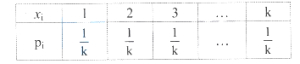
The discrete random variable $X$ can take all possible integer values from $1$ to $k$,each with a probability $\frac{1}{k}$. Then its variance is
A
$\frac{k^2-1}{12}$
B
$\frac{k^2-1}{6}$
C
$\frac{k^2+1}{12}$
D
$\frac{k^2+1}{6}$
Solution
(A) The probability distribution is given by:
$E(X) = \sum_{i=1}^{k} x_i p_i = \frac{1}{k} + \frac{2}{k} + \dots + \frac{k}{k} = \frac{1}{k} \sum_{i=1}^{k} i = \frac{1}{k} \cdot \frac{k(k+1)}{2} = \frac{k+1}{2}$
$E(X^2) = \sum_{i=1}^{k} x_i^2 p_i = \frac{1^2 + 2^2 + \dots + k^2}{k} = \frac{1}{k} \cdot \frac{k(k+1)(2k+1)}{6} = \frac{(k+1)(2k+1)}{6}$
Variance $= E(X^2) - [E(X)]^2$
$= \frac{(k+1)(2k+1)}{6} - \left( \frac{k+1}{2} \right)^2$
$= \frac{2k^2 + 3k + 1}{6} - \frac{k^2 + 2k + 1}{4}$
$= \frac{2(2k^2 + 3k + 1) - 3(k^2 + 2k + 1)}{12}$
$= \frac{4k^2 + 6k + 2 - 3k^2 - 6k - 3}{12}$
$= \frac{k^2 - 1}{12}$
$E(X) = \sum_{i=1}^{k} x_i p_i = \frac{1}{k} + \frac{2}{k} + \dots + \frac{k}{k} = \frac{1}{k} \sum_{i=1}^{k} i = \frac{1}{k} \cdot \frac{k(k+1)}{2} = \frac{k+1}{2}$
$E(X^2) = \sum_{i=1}^{k} x_i^2 p_i = \frac{1^2 + 2^2 + \dots + k^2}{k} = \frac{1}{k} \cdot \frac{k(k+1)(2k+1)}{6} = \frac{(k+1)(2k+1)}{6}$
Variance $= E(X^2) - [E(X)]^2$
$= \frac{(k+1)(2k+1)}{6} - \left( \frac{k+1}{2} \right)^2$
$= \frac{2k^2 + 3k + 1}{6} - \frac{k^2 + 2k + 1}{4}$
$= \frac{2(2k^2 + 3k + 1) - 3(k^2 + 2k + 1)}{12}$
$= \frac{4k^2 + 6k + 2 - 3k^2 - 6k - 3}{12}$
$= \frac{k^2 - 1}{12}$
0 likes
View Solution176
EasyMCQ
$A$ random variable $X$ has the following probability distribution:
Then $P(X < 2)$ is:
| $X = x$ | $0$ | $1$ | $2$ |
| $P(X = x)$ | $4k - 10k^2$ | $5k - 1$ | $3k^3$ |
Then $P(X < 2)$ is:
A
$\frac{2}{9}$
B
$\frac{5}{9}$
C
$\frac{8}{9}$
D
$\frac{4}{9}$
Solution
(C) The sum of probabilities in a probability distribution must be equal to $1$.
$\sum P(X=x) = P(X=0) + P(X=1) + P(X=2) = 1$
$(4k - 10k^2) + (5k - 1) + 3k^3 = 1$
$3k^3 - 10k^2 + 9k - 2 = 0$
By testing values,we find that $k = \frac{1}{3}$ is a root:
$3(\frac{1}{27}) - 10(\frac{1}{9}) + 9(\frac{1}{3}) - 2 = \frac{1}{9} - \frac{10}{9} + 3 - 2 = -1 + 1 = 0$
Factoring the polynomial,we get $(k - \frac{1}{3})(3k^2 - 9k + 6) = 0$,which simplifies to $(k - \frac{1}{3})(k - 1)(k - 2) = 0$.
If $k = 1$,$P(X=0) = 4(1) - 10(1)^2 = -6$,which is impossible as probability cannot be negative.
If $k = 2$,$P(X=0) = 4(2) - 10(4) = 8 - 40 = -32$,which is impossible.
Thus,$k = \frac{1}{3}$ is the only valid value.
We need to find $P(X < 2) = P(X=0) + P(X=1)$.
$P(X < 2) = (4k - 10k^2) + (5k - 1) = 9k - 10k^2 - 1$
Substituting $k = \frac{1}{3}$:
$P(X < 2) = 9(\frac{1}{3}) - 10(\frac{1}{9}) - 1 = 3 - \frac{10}{9} - 1 = 2 - \frac{10}{9} = \frac{18 - 10}{9} = \frac{8}{9}$.
$\sum P(X=x) = P(X=0) + P(X=1) + P(X=2) = 1$
$(4k - 10k^2) + (5k - 1) + 3k^3 = 1$
$3k^3 - 10k^2 + 9k - 2 = 0$
By testing values,we find that $k = \frac{1}{3}$ is a root:
$3(\frac{1}{27}) - 10(\frac{1}{9}) + 9(\frac{1}{3}) - 2 = \frac{1}{9} - \frac{10}{9} + 3 - 2 = -1 + 1 = 0$
Factoring the polynomial,we get $(k - \frac{1}{3})(3k^2 - 9k + 6) = 0$,which simplifies to $(k - \frac{1}{3})(k - 1)(k - 2) = 0$.
If $k = 1$,$P(X=0) = 4(1) - 10(1)^2 = -6$,which is impossible as probability cannot be negative.
If $k = 2$,$P(X=0) = 4(2) - 10(4) = 8 - 40 = -32$,which is impossible.
Thus,$k = \frac{1}{3}$ is the only valid value.
We need to find $P(X < 2) = P(X=0) + P(X=1)$.
$P(X < 2) = (4k - 10k^2) + (5k - 1) = 9k - 10k^2 - 1$
Substituting $k = \frac{1}{3}$:
$P(X < 2) = 9(\frac{1}{3}) - 10(\frac{1}{9}) - 1 = 3 - \frac{10}{9} - 1 = 2 - \frac{10}{9} = \frac{18 - 10}{9} = \frac{8}{9}$.
0 likes
View Solution177
MediumMCQ
If $f(x) = \begin{cases} 3(1 - 2x^2) & ; 0 < x < 1 \\ 0 & ; \text{otherwise} \end{cases}$ is a probability density function of $X$,then $P\left(\frac{1}{4} < x < \frac{1}{3}\right)$ is
A
$\frac{75}{243}$
B
$\frac{23}{96}$
C
$\frac{179}{864}$
D
$\frac{52}{243}$
Solution
(C) We are given the probability density function $f(x) = 3(1 - 2x^2)$ for $0 < x < 1$.
To find $P\left(\frac{1}{4} < x < \frac{1}{3}\right)$,we integrate the function over the given interval:
$P\left(\frac{1}{4} < x < \frac{1}{3}\right) = \int_{\frac{1}{4}}^{\frac{1}{3}} 3(1 - 2x^2) dx$
$= \int_{\frac{1}{4}}^{\frac{1}{3}} (3 - 6x^2) dx$
$= [3x - 2x^3]_{\frac{1}{4}}^{\frac{1}{3}}$
$= \left(3\left(\frac{1}{3}\right) - 2\left(\frac{1}{3}\right)^3\right) - \left(3\left(\frac{1}{4}\right) - 2\left(\frac{1}{4}\right)^3\right)$
$= \left(1 - \frac{2}{27}\right) - \left(\frac{3}{4} - \frac{2}{64}\right)$
$= \left(\frac{25}{27}\right) - \left(\frac{3}{4} - \frac{1}{32}\right)$
$= \frac{25}{27} - \frac{3}{4} + \frac{1}{32}$
Finding a common denominator $(864)$:
$= \frac{25 \times 32 - 3 \times 216 + 1 \times 27}{864}$
$= \frac{800 - 648 + 27}{864} = \frac{179}{864}$
To find $P\left(\frac{1}{4} < x < \frac{1}{3}\right)$,we integrate the function over the given interval:
$P\left(\frac{1}{4} < x < \frac{1}{3}\right) = \int_{\frac{1}{4}}^{\frac{1}{3}} 3(1 - 2x^2) dx$
$= \int_{\frac{1}{4}}^{\frac{1}{3}} (3 - 6x^2) dx$
$= [3x - 2x^3]_{\frac{1}{4}}^{\frac{1}{3}}$
$= \left(3\left(\frac{1}{3}\right) - 2\left(\frac{1}{3}\right)^3\right) - \left(3\left(\frac{1}{4}\right) - 2\left(\frac{1}{4}\right)^3\right)$
$= \left(1 - \frac{2}{27}\right) - \left(\frac{3}{4} - \frac{2}{64}\right)$
$= \left(\frac{25}{27}\right) - \left(\frac{3}{4} - \frac{1}{32}\right)$
$= \frac{25}{27} - \frac{3}{4} + \frac{1}{32}$
Finding a common denominator $(864)$:
$= \frac{25 \times 32 - 3 \times 216 + 1 \times 27}{864}$
$= \frac{800 - 648 + 27}{864} = \frac{179}{864}$
0 likes
View Solution178
MediumMCQ
The p.m.f. of a random variable $X$ is $P(x) = \begin{cases} \frac{2x}{n(n+1)}, & x = 1, 2, 3, \ldots, n \\ 0, & \text{otherwise} \end{cases}$,then $E(X)$ is
A
$\frac{n+1}{6}$
B
$\frac{2n+1}{6}$
C
$\frac{n+1}{3}$
D
$\frac{2n+1}{3}$
Solution
(D) The expected value $E(X)$ is defined as $\sum x_i \cdot P(x_i)$.
Given $P(x) = \frac{2x}{n(n+1)}$ for $x = 1, 2, \ldots, n$.
$E(X) = \sum_{x=1}^{n} x \cdot \frac{2x}{n(n+1)}$
$E(X) = \frac{2}{n(n+1)} \sum_{x=1}^{n} x^2$
Using the formula for the sum of squares of the first $n$ natural numbers,$\sum_{x=1}^{n} x^2 = \frac{n(n+1)(2n+1)}{6}$.
$E(X) = \frac{2}{n(n+1)} \cdot \frac{n(n+1)(2n+1)}{6}$
$E(X) = \frac{2n+1}{3}$
Given $P(x) = \frac{2x}{n(n+1)}$ for $x = 1, 2, \ldots, n$.
$E(X) = \sum_{x=1}^{n} x \cdot \frac{2x}{n(n+1)}$
$E(X) = \frac{2}{n(n+1)} \sum_{x=1}^{n} x^2$
Using the formula for the sum of squares of the first $n$ natural numbers,$\sum_{x=1}^{n} x^2 = \frac{n(n+1)(2n+1)}{6}$.
$E(X) = \frac{2}{n(n+1)} \cdot \frac{n(n+1)(2n+1)}{6}$
$E(X) = \frac{2n+1}{3}$
0 likes
View Solution179
EasyMCQ
$A$ fair die with numbers $1$ to $6$ on its faces is thrown. Let $X$ denote the number of factors of the number on the uppermost face. Then the probability distribution of $X$ is
A
| $X = x$ | $1$ | $2$ | $3$ | $4$ |
| $P(X = x)$ | $1/6$ | $1/2$ | $1/6$ | $1/6$ |
B
| $X = x$ | $1$ | $2$ | $3$ | $4$ |
| $P(X = x)$ | $1/6$ | $1/6$ | $1/6$ | $1/2$ |
C
| $X = x$ | $1$ | $2$ | $3$ | $4$ |
| $P(X = x)$ | $1/2$ | $1/6$ | $1/6$ | $1/6$ |
D
| $X = x$ | $1$ | $2$ | $3$ | $4$ |
| $P(X = x)$ | $1/6$ | $1/6$ | $1/2$ | $1/6$ |
Solution
(A) The sample space of the experiment is $S = \{1, 2, 3, 4, 5, 6\}$.
We determine the number of factors $(X)$ for each outcome:
$X(1) = 1$ (factor: $1$)
$X(2) = 2$ (factors: $1, 2$)
$X(3) = 2$ (factors: $1, 3$)
$X(4) = 3$ (factors: $1, 2, 4$)
$X(5) = 2$ (factors: $1, 5$)
$X(6) = 4$ (factors: $1, 2, 3, 6$)
Now,we calculate the probabilities for each value of $X$:
$P(X = 1) = P(\{1\}) = 1/6$
$P(X = 2) = P(\{2, 3, 5\}) = 3/6 = 1/2$
$P(X = 3) = P(\{4\}) = 1/6$
$P(X = 4) = P(\{6\}) = 1/6$
Thus,the probability distribution is as shown in option $A$.
We determine the number of factors $(X)$ for each outcome:
$X(1) = 1$ (factor: $1$)
$X(2) = 2$ (factors: $1, 2$)
$X(3) = 2$ (factors: $1, 3$)
$X(4) = 3$ (factors: $1, 2, 4$)
$X(5) = 2$ (factors: $1, 5$)
$X(6) = 4$ (factors: $1, 2, 3, 6$)
Now,we calculate the probabilities for each value of $X$:
$P(X = 1) = P(\{1\}) = 1/6$
$P(X = 2) = P(\{2, 3, 5\}) = 3/6 = 1/2$
$P(X = 3) = P(\{4\}) = 1/6$
$P(X = 4) = P(\{6\}) = 1/6$
Thus,the probability distribution is as shown in option $A$.
0 likes
View Solution180
EasyMCQ
The random variable $X$ has the following probability distribution:
| $X$ | $8$ | $12$ | $16$ | $20$ | $24$ |
|---|---|---|---|---|---|
| $P(X)$ | $K$ | $\frac{1}{6}$ | $\frac{3}{8}$ | $2K$ | $\frac{1}{12}$ |
Then the value of $K$ is:
| $X$ | $8$ | $12$ | $16$ | $20$ | $24$ |
|---|---|---|---|---|---|
| $P(X)$ | $K$ | $\frac{1}{6}$ | $\frac{3}{8}$ | $2K$ | $\frac{1}{12}$ |
Then the value of $K$ is:
A
$\frac{1}{4}$
B
$\frac{1}{8}$
C
$\frac{3}{2}$
D
$\frac{1}{2}$
Solution
(B) For a probability distribution,the sum of all probabilities must be equal to $1$.
Therefore,$\sum P(X) = 1$.
$K + \frac{1}{6} + \frac{3}{8} + 2K + \frac{1}{12} = 1$
Combine the terms with $K$ and the constant fractions:
$3K + (\frac{1}{6} + \frac{3}{8} + \frac{1}{12}) = 1$
Find a common denominator for the fractions,which is $24$:
$3K + (\frac{4}{24} + \frac{9}{24} + \frac{2}{24}) = 1$
$3K + \frac{15}{24} = 1$
$3K + \frac{5}{8} = 1$
$3K = 1 - \frac{5}{8}$
$3K = \frac{3}{8}$
$K = \frac{1}{8}$
Therefore,$\sum P(X) = 1$.
$K + \frac{1}{6} + \frac{3}{8} + 2K + \frac{1}{12} = 1$
Combine the terms with $K$ and the constant fractions:
$3K + (\frac{1}{6} + \frac{3}{8} + \frac{1}{12}) = 1$
Find a common denominator for the fractions,which is $24$:
$3K + (\frac{4}{24} + \frac{9}{24} + \frac{2}{24}) = 1$
$3K + \frac{15}{24} = 1$
$3K + \frac{5}{8} = 1$
$3K = 1 - \frac{5}{8}$
$3K = \frac{3}{8}$
$K = \frac{1}{8}$
0 likes
View Solution181
EasyMCQ
$A$ coin is tossed twice in succession. Let $X$ represent the number of tails in two tosses,then the probability distribution of $X$ is given by
A
| $X=x_i$ | $0$ | $1$ | $2$ |
| $P_i$ | $1/2$ | $1/4$ | $1/4$ |
B
| $X=x_i$ | $0$ | $1$ | $2$ |
| $P_i$ | $1/3$ | $1/3$ | $1/3$ |
C
| $X=x_i$ | $0$ | $1$ | $2$ |
| $P_i$ | $1/4$ | $1/4$ | $1/2$ |
D
| $X=x_i$ | $0$ | $1$ | $2$ |
| $P_i$ | $1/4$ | $1/2$ | $1/4$ |
Solution
(D) When a coin is tossed twice,the sample space $S$ is given by $S = \{HH, HT, TH, TT\}$.
Here,$X$ represents the number of tails.
For $X=0$ (no tails),the outcome is $\{HH\}$,so $P(X=0) = 1/4$.
For $X=1$ (one tail),the outcomes are $\{HT, TH\}$,so $P(X=1) = 2/4 = 1/2$.
For $X=2$ (two tails),the outcome is $\{TT\}$,so $P(X=2) = 1/4$.
The probability distribution is:
This matches option $D$.
Here,$X$ represents the number of tails.
For $X=0$ (no tails),the outcome is $\{HH\}$,so $P(X=0) = 1/4$.
For $X=1$ (one tail),the outcomes are $\{HT, TH\}$,so $P(X=1) = 2/4 = 1/2$.
For $X=2$ (two tails),the outcome is $\{TT\}$,so $P(X=2) = 1/4$.
The probability distribution is:
| $X=x_i$ | $0$ | $1$ | $2$ |
| $P_i$ | $1/4$ | $1/2$ | $1/4$ |
This matches option $D$.
0 likes
View Solution182
MediumMCQ
$A$ random variable $X$ has the following probability distribution:
Then find $P(X \ge 2)$.
| $X$ | $0$ | $1$ | $2$ | $3$ | $4$ | $5$ | $6$ |
|---|---|---|---|---|---|---|---|
| $P(X)$ | $k$ | $3k$ | $5k$ | $7k$ | $9k$ | $11k$ | $13k$ |
Then find $P(X \ge 2)$.
A
$\frac{45}{49}$
B
$\frac{15}{49}$
C
$\frac{1}{49}$
D
$\frac{40}{49}$
Solution
(A) For a probability distribution,the sum of all probabilities must be $1$.
$\sum P(X) = k + 3k + 5k + 7k + 9k + 11k + 13k = 49k = 1$
Therefore,$k = \frac{1}{49}$.
We need to find $P(X \ge 2)$.
$P(X \ge 2) = 1 - P(X < 2)$
$P(X < 2) = P(X = 0) + P(X = 1) = k + 3k = 4k$
$P(X \ge 2) = 1 - 4k = 1 - 4(\frac{1}{49}) = 1 - \frac{4}{49} = \frac{45}{49}$.
$\sum P(X) = k + 3k + 5k + 7k + 9k + 11k + 13k = 49k = 1$
Therefore,$k = \frac{1}{49}$.
We need to find $P(X \ge 2)$.
$P(X \ge 2) = 1 - P(X < 2)$
$P(X < 2) = P(X = 0) + P(X = 1) = k + 3k = 4k$
$P(X \ge 2) = 1 - 4k = 1 - 4(\frac{1}{49}) = 1 - \frac{4}{49} = \frac{45}{49}$.
0 likes
View Solution183
MediumMCQ
Two numbers are selected at random from the first six positive integers. If $X$ denotes the larger of the two numbers,then $\operatorname{Var}(X) = $
A
$\frac{1}{3}$
B
$\frac{14}{3}$
C
$\frac{14}{9}$
D
$\frac{70}{3}$
Solution
(C) The total number of ways to select $2$ numbers from the first $6$ positive integers is $^6C_2 = \frac{6 \times 5}{2} = 15$.
Let $X$ be the random variable representing the larger of the two numbers. The possible values for $X$ are $2, 3, 4, 5, 6$.
The probability distribution is as follows:
For $X=2$: Pairs are $(1,2)$,so $P(X=2) = \frac{1}{15}$.
For $X=3$: Pairs are $(1,3), (2,3)$,so $P(X=3) = \frac{2}{15}$.
For $X=4$: Pairs are $(1,4), (2,4), (3,4)$,so $P(X=4) = \frac{3}{15}$.
For $X=5$: Pairs are $(1,5), (2,5), (3,5), (4,5)$,so $P(X=5) = \frac{4}{15}$.
For $X=6$: Pairs are $(1,6), (2,6), (3,6), (4,6), (5,6)$,so $P(X=6) = \frac{5}{15}$.
Calculating $E(X) = \sum x_i P_i = 2(\frac{1}{15}) + 3(\frac{2}{15}) + 4(\frac{3}{15}) + 5(\frac{4}{15}) + 6(\frac{5}{15}) = \frac{2+6+12+20+30}{15} = \frac{70}{15} = \frac{14}{3}$.
Calculating $E(X^2) = \sum x_i^2 P_i = 4(\frac{1}{15}) + 9(\frac{2}{15}) + 16(\frac{3}{15}) + 25(\frac{4}{15}) + 36(\frac{5}{15}) = \frac{4+18+48+100+180}{15} = \frac{350}{15} = \frac{70}{3}$.
$\operatorname{Var}(X) = E(X^2) - [E(X)]^2 = \frac{70}{3} - (\frac{14}{3})^2 = \frac{70}{3} - \frac{196}{9} = \frac{210-196}{9} = \frac{14}{9}$.
Let $X$ be the random variable representing the larger of the two numbers. The possible values for $X$ are $2, 3, 4, 5, 6$.
The probability distribution is as follows:
For $X=2$: Pairs are $(1,2)$,so $P(X=2) = \frac{1}{15}$.
For $X=3$: Pairs are $(1,3), (2,3)$,so $P(X=3) = \frac{2}{15}$.
For $X=4$: Pairs are $(1,4), (2,4), (3,4)$,so $P(X=4) = \frac{3}{15}$.
For $X=5$: Pairs are $(1,5), (2,5), (3,5), (4,5)$,so $P(X=5) = \frac{4}{15}$.
For $X=6$: Pairs are $(1,6), (2,6), (3,6), (4,6), (5,6)$,so $P(X=6) = \frac{5}{15}$.
Calculating $E(X) = \sum x_i P_i = 2(\frac{1}{15}) + 3(\frac{2}{15}) + 4(\frac{3}{15}) + 5(\frac{4}{15}) + 6(\frac{5}{15}) = \frac{2+6+12+20+30}{15} = \frac{70}{15} = \frac{14}{3}$.
Calculating $E(X^2) = \sum x_i^2 P_i = 4(\frac{1}{15}) + 9(\frac{2}{15}) + 16(\frac{3}{15}) + 25(\frac{4}{15}) + 36(\frac{5}{15}) = \frac{4+18+48+100+180}{15} = \frac{350}{15} = \frac{70}{3}$.
$\operatorname{Var}(X) = E(X^2) - [E(X)]^2 = \frac{70}{3} - (\frac{14}{3})^2 = \frac{70}{3} - \frac{196}{9} = \frac{210-196}{9} = \frac{14}{9}$.
0 likes
View Solution184
EasyMCQ
The following table shows the probability distribution of smart phones sold in a shop per day:
Then $E(x) = ?$
| Number of smart phones $(x)$ | $0$ | $1$ | $2$ | $3$ | $4$ | $5$ |
|---|---|---|---|---|---|---|
| Probability $(P(x))$ | $k$ | $0.3$ | $0.15$ | $0.15$ | $0.1$ | $2k$ |
Then $E(x) = ?$
A
$2.45$
B
$2.55$
C
$0.55$
D
$0.75$
Solution
(A) For a probability distribution,the sum of all probabilities must be equal to $1$.
$\sum P(x) = k + 0.3 + 0.15 + 0.15 + 0.1 + 2k = 1$
$3k + 0.7 = 1$
$3k = 0.3$
$k = 0.1$
Now,the expected value $E(x)$ is calculated as $\sum x_i P(x_i)$:
$E(x) = (0 \times k) + (1 \times 0.3) + (2 \times 0.15) + (3 \times 0.15) + (4 \times 0.1) + (5 \times 2k)$
Substitute $k = 0.1$:
$E(x) = (0 \times 0.1) + (1 \times 0.3) + (2 \times 0.15) + (3 \times 0.15) + (4 \times 0.1) + (5 \times 0.2)$
$E(x) = 0 + 0.3 + 0.3 + 0.45 + 0.4 + 1.0$
$E(x) = 2.45$
$\sum P(x) = k + 0.3 + 0.15 + 0.15 + 0.1 + 2k = 1$
$3k + 0.7 = 1$
$3k = 0.3$
$k = 0.1$
Now,the expected value $E(x)$ is calculated as $\sum x_i P(x_i)$:
$E(x) = (0 \times k) + (1 \times 0.3) + (2 \times 0.15) + (3 \times 0.15) + (4 \times 0.1) + (5 \times 2k)$
Substitute $k = 0.1$:
$E(x) = (0 \times 0.1) + (1 \times 0.3) + (2 \times 0.15) + (3 \times 0.15) + (4 \times 0.1) + (5 \times 0.2)$
$E(x) = 0 + 0.3 + 0.3 + 0.45 + 0.4 + 1.0$
$E(x) = 2.45$
0 likes
View Solution185
MediumMCQ
$A$ random variable $X$ assumes values $1, 2, 3, \ldots, n$ with equal probabilities. If the ratio of the variance of $X$ to the expected value of $X$ is equal to $4$,then the value of $n$ is:
A
$35$
B
$50$
C
$30$
D
$25$
Solution
(D) The random variable $X$ takes values $1, 2, \ldots, n$ with probability $p_i = \frac{1}{n}$ for each $i$.
The expected value $E(X) = \sum p_i x_i = \frac{1}{n} \sum_{i=1}^{n} i = \frac{1}{n} \cdot \frac{n(n+1)}{2} = \frac{n+1}{2}$.
The variance $V(X) = E(X^2) - [E(X)]^2 = \sum p_i x_i^2 - [E(X)]^2$.
$E(X^2) = \frac{1}{n} \sum_{i=1}^{n} i^2 = \frac{1}{n} \cdot \frac{n(n+1)(2n+1)}{6} = \frac{(n+1)(2n+1)}{6}$.
$V(X) = \frac{(n+1)(2n+1)}{6} - \left(\frac{n+1}{2}\right)^2 = \frac{(n+1)}{2} \left[ \frac{2n+1}{3} - \frac{n+1}{2} \right] = \frac{(n+1)}{2} \left[ \frac{4n+2-3n-3}{6} \right] = \frac{(n+1)(n-1)}{12} = \frac{n^2-1}{12}$.
Given the ratio $\frac{V(X)}{E(X)} = 4$,we have $\frac{(n^2-1)/12}{(n+1)/2} = 4$.
$\frac{(n-1)(n+1)}{12} \cdot \frac{2}{n+1} = 4$.
$\frac{n-1}{6} = 4 \Rightarrow n-1 = 24 \Rightarrow n = 25$.
The expected value $E(X) = \sum p_i x_i = \frac{1}{n} \sum_{i=1}^{n} i = \frac{1}{n} \cdot \frac{n(n+1)}{2} = \frac{n+1}{2}$.
The variance $V(X) = E(X^2) - [E(X)]^2 = \sum p_i x_i^2 - [E(X)]^2$.
$E(X^2) = \frac{1}{n} \sum_{i=1}^{n} i^2 = \frac{1}{n} \cdot \frac{n(n+1)(2n+1)}{6} = \frac{(n+1)(2n+1)}{6}$.
$V(X) = \frac{(n+1)(2n+1)}{6} - \left(\frac{n+1}{2}\right)^2 = \frac{(n+1)}{2} \left[ \frac{2n+1}{3} - \frac{n+1}{2} \right] = \frac{(n+1)}{2} \left[ \frac{4n+2-3n-3}{6} \right] = \frac{(n+1)(n-1)}{12} = \frac{n^2-1}{12}$.
Given the ratio $\frac{V(X)}{E(X)} = 4$,we have $\frac{(n^2-1)/12}{(n+1)/2} = 4$.
$\frac{(n-1)(n+1)}{12} \cdot \frac{2}{n+1} = 4$.
$\frac{n-1}{6} = 4 \Rightarrow n-1 = 24 \Rightarrow n = 25$.
0 likes
View Solution186
EasyMCQ
$A$ player tosses $2$ fair coins. He wins $Rs. 5$ if $2$ heads appear,$Rs. 2$ if $1$ head appears,and $Rs. 1$ if no head appears. Then,the variance of his winning amount is
A
$\frac{9}{4}$
B
$6$
C
$\frac{5}{2}$
D
$\frac{17}{2}$
Solution
(A) The sample space for tossing $2$ coins is $\{HH, HT, TH, TT\}$.
The probabilities are:
$P(X=5) = P(HH) = \frac{1}{4}$
$P(X=2) = P(HT, TH) = \frac{2}{4} = \frac{1}{2}$
$P(X=1) = P(TT) = \frac{1}{4}$
We calculate the mean $E(X) = \sum p_i x_i = (5 \times \frac{1}{4}) + (2 \times \frac{1}{2}) + (1 \times \frac{1}{4}) = \frac{5}{4} + 1 + \frac{1}{4} = \frac{6}{4} + 1 = \frac{3}{2} + 1 = \frac{5}{2}$.
Next,we calculate $E(X^2) = \sum p_i x_i^2 = (5^2 \times \frac{1}{4}) + (2^2 \times \frac{1}{2}) + (1^2 \times \frac{1}{4}) = \frac{25}{4} + 2 + \frac{1}{4} = \frac{26}{4} + 2 = \frac{13}{2} + 2 = \frac{17}{2}$.
Variance $Var(X) = E(X^2) - [E(X)]^2 = \frac{17}{2} - (\frac{5}{2})^2 = \frac{17}{2} - \frac{25}{4} = \frac{34-25}{4} = \frac{9}{4}$.
The probabilities are:
$P(X=5) = P(HH) = \frac{1}{4}$
$P(X=2) = P(HT, TH) = \frac{2}{4} = \frac{1}{2}$
$P(X=1) = P(TT) = \frac{1}{4}$
We calculate the mean $E(X) = \sum p_i x_i = (5 \times \frac{1}{4}) + (2 \times \frac{1}{2}) + (1 \times \frac{1}{4}) = \frac{5}{4} + 1 + \frac{1}{4} = \frac{6}{4} + 1 = \frac{3}{2} + 1 = \frac{5}{2}$.
Next,we calculate $E(X^2) = \sum p_i x_i^2 = (5^2 \times \frac{1}{4}) + (2^2 \times \frac{1}{2}) + (1^2 \times \frac{1}{4}) = \frac{25}{4} + 2 + \frac{1}{4} = \frac{26}{4} + 2 = \frac{13}{2} + 2 = \frac{17}{2}$.
Variance $Var(X) = E(X^2) - [E(X)]^2 = \frac{17}{2} - (\frac{5}{2})^2 = \frac{17}{2} - \frac{25}{4} = \frac{34-25}{4} = \frac{9}{4}$.
0 likes
View Solution187
MediumMCQ
If the function $P[X = x] = \begin{cases} \frac{K \cdot 2^x}{x!}, & x = 0, 1, 2, 3 \\ 0, & \text{otherwise} \end{cases}$ forms a probability mass function (p.m.f.),then the value of $K$ is:
A
$\frac{5}{19}$
B
$\frac{2}{19}$
C
$\frac{3}{19}$
D
$\frac{1}{19}$
Solution
(C) For a function to be a probability mass function (p.m.f.),the sum of all probabilities must be equal to $1$.
$\sum_{x=0}^{3} P(X=x) = 1$
$P(0) + P(1) + P(2) + P(3) = 1$
$K \cdot \frac{2^0}{0!} + K \cdot \frac{2^1}{1!} + K \cdot \frac{2^2}{2!} + K \cdot \frac{2^3}{3!} = 1$
$K \cdot (\frac{1}{1} + \frac{2}{1} + \frac{4}{2} + \frac{8}{6}) = 1$
$K \cdot (1 + 2 + 2 + \frac{4}{3}) = 1$
$K \cdot (5 + \frac{4}{3}) = 1$
$K \cdot (\frac{15+4}{3}) = 1$
$K \cdot \frac{19}{3} = 1$
$K = \frac{3}{19}$
$\sum_{x=0}^{3} P(X=x) = 1$
$P(0) + P(1) + P(2) + P(3) = 1$
$K \cdot \frac{2^0}{0!} + K \cdot \frac{2^1}{1!} + K \cdot \frac{2^2}{2!} + K \cdot \frac{2^3}{3!} = 1$
$K \cdot (\frac{1}{1} + \frac{2}{1} + \frac{4}{2} + \frac{8}{6}) = 1$
$K \cdot (1 + 2 + 2 + \frac{4}{3}) = 1$
$K \cdot (5 + \frac{4}{3}) = 1$
$K \cdot (\frac{15+4}{3}) = 1$
$K \cdot \frac{19}{3} = 1$
$K = \frac{3}{19}$
0 likes
View Solution188
EasyMCQ
If the probability mass function (p.m.f.) of a random variable $X$ is $P(X=x) = \frac{1}{10}$ for $x = 1, 2, 3, \ldots, 10$,and $0$ otherwise,then $\operatorname{Var}(X)$ is equal to:
A
$\frac{11}{2}$
B
$\frac{33}{4}$
C
$\frac{121}{4}$
D
$\frac{77}{2}$
Solution
(B) The variance of a random variable $X$ is given by $\operatorname{Var}(X) = E(X^2) - [E(X)]^2$.
First,we calculate $E(X) = \sum_{x=1}^{10} x P(X=x) = \frac{1}{10} (1 + 2 + 3 + \ldots + 10) = \frac{1}{10} \times \frac{10 \times 11}{2} = 5.5$.
Next,we calculate $E(X^2) = \sum_{x=1}^{10} x^2 P(X=x) = \frac{1}{10} (1^2 + 2^2 + 3^2 + \ldots + 10^2) = \frac{1}{10} \times \frac{10 \times 11 \times 21}{6} = \frac{231}{6} = 38.5$.
Finally,$\operatorname{Var}(X) = 38.5 - (5.5)^2 = 38.5 - 30.25 = 8.25$.
Since $8.25 = \frac{33}{4}$,the correct option is $B$.
First,we calculate $E(X) = \sum_{x=1}^{10} x P(X=x) = \frac{1}{10} (1 + 2 + 3 + \ldots + 10) = \frac{1}{10} \times \frac{10 \times 11}{2} = 5.5$.
Next,we calculate $E(X^2) = \sum_{x=1}^{10} x^2 P(X=x) = \frac{1}{10} (1^2 + 2^2 + 3^2 + \ldots + 10^2) = \frac{1}{10} \times \frac{10 \times 11 \times 21}{6} = \frac{231}{6} = 38.5$.
Finally,$\operatorname{Var}(X) = 38.5 - (5.5)^2 = 38.5 - 30.25 = 8.25$.
Since $8.25 = \frac{33}{4}$,the correct option is $B$.
0 likes
View Solution189
EasyMCQ
Rajesh has just bought a $VCR$ from Maharashtra Electronics and the shop offers an after-sales service contract for Rs. $1000$ for the next five years. Considering the experience of $VCR$ users,the following distribution of maintenance expenses for the next five years is formed:
The expected value of the maintenance cost is:
| Expenses | $0$ | $500$ | $1000$ | $1500$ | $2000$ | $2500$ | $3000$ |
|---|---|---|---|---|---|---|---|
| Probability | $0.35$ | $0.25$ | $0.15$ | $0.10$ | $0.08$ | $0.05$ | $0.02$ |
The expected value of the maintenance cost is:
A
Rs. $800$
B
Rs. $770$
C
Rs. $700$
D
Rs. $900$
Solution
(B) The expected value $E(X)$ of a random variable $X$ is given by the formula $E(X) = \sum p_i x_i$.
Using the provided table:
$E(X) = (0 \times 0.35) + (500 \times 0.25) + (1000 \times 0.15) + (1500 \times 0.10) + (2000 \times 0.08) + (2500 \times 0.05) + (3000 \times 0.02)$
Calculating each term:
$E(X) = 0 + 125 + 150 + 150 + 160 + 125 + 60$
Summing the values:
$E(X) = 770$
Thus,the expected value of the maintenance cost is Rs. $770$.
Using the provided table:
$E(X) = (0 \times 0.35) + (500 \times 0.25) + (1000 \times 0.15) + (1500 \times 0.10) + (2000 \times 0.08) + (2500 \times 0.05) + (3000 \times 0.02)$
Calculating each term:
$E(X) = 0 + 125 + 150 + 150 + 160 + 125 + 60$
Summing the values:
$E(X) = 770$
Thus,the expected value of the maintenance cost is Rs. $770$.
0 likes
View Solution190
EasyMCQ
$A$ random variable $X$ has the following probability distribution:
Then $F(4) = $
| $X = x$ | $0$ | $1$ | $2$ | $3$ | $4$ | $5$ | $6$ | $7$ |
|---|---|---|---|---|---|---|---|---|
| $P(X = x)$ | $0$ | $k$ | $2k$ | $2k$ | $3k$ | $k^2$ | $2k^2$ | $7k^2 + k$ |
Then $F(4) = $
A
$\frac{3}{10}$
B
$\frac{1}{10}$
C
$\frac{7}{10}$
D
$\frac{4}{5}$
Solution
(D) The sum of all probabilities in a probability distribution must be equal to $1$.
$\sum P(X = x) = 0 + k + 2k + 2k + 3k + k^2 + 2k^2 + (7k^2 + k) = 1$
$10k^2 + 9k - 1 = 0$
$(10k - 1)(k + 1) = 0$
Since $k \geq 0$,we have $k = \frac{1}{10}$.
The cumulative distribution function $F(4)$ is defined as $P(X \leq 4)$.
$F(4) = P(X = 0) + P(X = 1) + P(X = 2) + P(X = 3) + P(X = 4)$
$F(4) = 0 + k + 2k + 2k + 3k = 8k$
Substituting $k = \frac{1}{10}$:
$F(4) = 8 \times \frac{1}{10} = \frac{8}{10} = \frac{4}{5}$.
$\sum P(X = x) = 0 + k + 2k + 2k + 3k + k^2 + 2k^2 + (7k^2 + k) = 1$
$10k^2 + 9k - 1 = 0$
$(10k - 1)(k + 1) = 0$
Since $k \geq 0$,we have $k = \frac{1}{10}$.
The cumulative distribution function $F(4)$ is defined as $P(X \leq 4)$.
$F(4) = P(X = 0) + P(X = 1) + P(X = 2) + P(X = 3) + P(X = 4)$
$F(4) = 0 + k + 2k + 2k + 3k = 8k$
Substituting $k = \frac{1}{10}$:
$F(4) = 8 \times \frac{1}{10} = \frac{8}{10} = \frac{4}{5}$.
0 likes
View Solution191
EasyMCQ
The p.m.f of a random variable $X$ is $P(X=x)=\frac{1}{2^5}\binom{5}{x}$,where $x=0, 1, 2, 3, 4, 5$ and $P(X=x)=0$ otherwise. Then:
A
$P(X \leq 2) < P(X \geq 3)$
B
$P(X \leq 2) > P(X \geq 3)$
C
$P(X \leq 2) = 2 P(X \geq 3)$
D
$P(X \leq 2) = P(X \geq 3)$
Solution
(D) Given the p.m.f $P(X=x) = \frac{1}{32} \binom{5}{x}$ for $x \in \{0, 1, 2, 3, 4, 5\}$.
$P(X \leq 2) = P(X=0) + P(X=1) + P(X=2)$
$= \frac{1}{32} \left[ \binom{5}{0} + \binom{5}{1} + \binom{5}{2} \right] = \frac{1}{32} (1 + 5 + 10) = \frac{16}{32} = \frac{1}{2}$.
$P(X \geq 3) = P(X=3) + P(X=4) + P(X=5)$
$= \frac{1}{32} \left[ \binom{5}{3} + \binom{5}{4} + \binom{5}{5} \right] = \frac{1}{32} (10 + 5 + 1) = \frac{16}{32} = \frac{1}{2}$.
Since $P(X \leq 2) = \frac{1}{2}$ and $P(X \geq 3) = \frac{1}{2}$,it follows that $P(X \leq 2) = P(X \geq 3)$.
$P(X \leq 2) = P(X=0) + P(X=1) + P(X=2)$
$= \frac{1}{32} \left[ \binom{5}{0} + \binom{5}{1} + \binom{5}{2} \right] = \frac{1}{32} (1 + 5 + 10) = \frac{16}{32} = \frac{1}{2}$.
$P(X \geq 3) = P(X=3) + P(X=4) + P(X=5)$
$= \frac{1}{32} \left[ \binom{5}{3} + \binom{5}{4} + \binom{5}{5} \right] = \frac{1}{32} (10 + 5 + 1) = \frac{16}{32} = \frac{1}{2}$.
Since $P(X \leq 2) = \frac{1}{2}$ and $P(X \geq 3) = \frac{1}{2}$,it follows that $P(X \leq 2) = P(X \geq 3)$.
0 likes
View Solution192
EasyMCQ
The variance of the following probability distribution is:
| $x$ | $0$ | $1$ | $2$ |
|---|---|---|---|
| $P(X)$ | $\frac{9}{16}$ | $\frac{3}{8}$ | $\frac{1}{16}$ |
A
$\frac{1}{8}$
B
$\frac{5}{8}$
C
$\frac{1}{4}$
D
$\frac{3}{16}$
Solution
(D) To find the variance of the probability distribution,we use the formula: $\text{Variance} = E(X^2) - [E(X)]^2$,where $E(X) = \sum p_i x_i$ and $E(X^2) = \sum p_i x_i^2$.
First,calculate $E(X)$:
$E(X) = (0 \times \frac{9}{16}) + (1 \times \frac{3}{8}) + (2 \times \frac{1}{16}) = 0 + \frac{3}{8} + \frac{2}{16} = \frac{6}{16} + \frac{2}{16} = \frac{8}{16} = \frac{1}{2}$.
Next,calculate $E(X^2)$:
$E(X^2) = (0^2 \times \frac{9}{16}) + (1^2 \times \frac{3}{8}) + (2^2 \times \frac{1}{16}) = 0 + \frac{3}{8} + \frac{4}{16} = \frac{6}{16} + \frac{4}{16} = \frac{10}{16} = \frac{5}{8}$.
Now,calculate the variance:
$\text{Variance} = E(X^2) - [E(X)]^2 = \frac{5}{8} - (\frac{1}{2})^2 = \frac{5}{8} - \frac{1}{4} = \frac{5}{8} - \frac{2}{8} = \frac{3}{8}$.
First,calculate $E(X)$:
$E(X) = (0 \times \frac{9}{16}) + (1 \times \frac{3}{8}) + (2 \times \frac{1}{16}) = 0 + \frac{3}{8} + \frac{2}{16} = \frac{6}{16} + \frac{2}{16} = \frac{8}{16} = \frac{1}{2}$.
Next,calculate $E(X^2)$:
$E(X^2) = (0^2 \times \frac{9}{16}) + (1^2 \times \frac{3}{8}) + (2^2 \times \frac{1}{16}) = 0 + \frac{3}{8} + \frac{4}{16} = \frac{6}{16} + \frac{4}{16} = \frac{10}{16} = \frac{5}{8}$.
Now,calculate the variance:
$\text{Variance} = E(X^2) - [E(X)]^2 = \frac{5}{8} - (\frac{1}{2})^2 = \frac{5}{8} - \frac{1}{4} = \frac{5}{8} - \frac{2}{8} = \frac{3}{8}$.
0 likes
View Solution193
MediumMCQ
If $x$ is a random variable with $PMF$ as follows: $P(X = x) = \begin{cases} \frac{5}{16}, & x = 0, 1 \\ \frac{kx}{48}, & x = 2 \\ \frac{1}{4}, & x = 3 \end{cases}$ then find $E(x)$.
A
$1.1875$
B
$1.3125$
C
$1.5625$
D
$0.5625$
Solution
(B) The sum of probabilities in a probability distribution must be $1$,i.e.,$\sum P(X = x_i) = 1$.
Given $P(X=0) = \frac{5}{16}$,$P(X=1) = \frac{5}{16}$,$P(X=2) = \frac{2k}{48}$,and $P(X=3) = \frac{1}{4} = \frac{12}{48}$.
Summing these: $\frac{5}{16} + \frac{5}{16} + \frac{2k}{48} + \frac{12}{48} = 1$.
Converting all to denominator $48$: $\frac{15}{48} + \frac{15}{48} + \frac{2k}{48} + \frac{12}{48} = 1$.
$\frac{42 + 2k}{48} = 1 \Rightarrow 42 + 2k = 48 \Rightarrow 2k = 6 \Rightarrow k = 3$.
Now,the probability distribution is:
$P(X=0) = \frac{15}{48}$,$P(X=1) = \frac{15}{48}$,$P(X=2) = \frac{6}{48} = \frac{1}{8}$,$P(X=3) = \frac{12}{48}$.
The expected value $E(X) = \sum x_i P(x_i) = (0 \times \frac{15}{48}) + (1 \times \frac{15}{48}) + (2 \times \frac{6}{48}) + (3 \times \frac{12}{48})$.
$E(X) = 0 + \frac{15}{48} + \frac{12}{48} + \frac{36}{48} = \frac{63}{48} = \frac{21}{16} = 1.3125$.
Given $P(X=0) = \frac{5}{16}$,$P(X=1) = \frac{5}{16}$,$P(X=2) = \frac{2k}{48}$,and $P(X=3) = \frac{1}{4} = \frac{12}{48}$.
Summing these: $\frac{5}{16} + \frac{5}{16} + \frac{2k}{48} + \frac{12}{48} = 1$.
Converting all to denominator $48$: $\frac{15}{48} + \frac{15}{48} + \frac{2k}{48} + \frac{12}{48} = 1$.
$\frac{42 + 2k}{48} = 1 \Rightarrow 42 + 2k = 48 \Rightarrow 2k = 6 \Rightarrow k = 3$.
Now,the probability distribution is:
$P(X=0) = \frac{15}{48}$,$P(X=1) = \frac{15}{48}$,$P(X=2) = \frac{6}{48} = \frac{1}{8}$,$P(X=3) = \frac{12}{48}$.
The expected value $E(X) = \sum x_i P(x_i) = (0 \times \frac{15}{48}) + (1 \times \frac{15}{48}) + (2 \times \frac{6}{48}) + (3 \times \frac{12}{48})$.
$E(X) = 0 + \frac{15}{48} + \frac{12}{48} + \frac{36}{48} = \frac{63}{48} = \frac{21}{16} = 1.3125$.
0 likes
View Solution194
EasyMCQ
$A$ bakerman sells $5$ types of cakes. Profit due to sale of each type of cake is respectively $Rs \ 2$,$Rs \ 2.5$,$Rs \ 3$,$Rs \ 1.5$ and $Rs \ 1$. The demands for these cakes are $20 \%$,$5 \%$,$10 \%$,$50 \%$ and $15 \%$ respectively. Then the expected profit per cake is:
A
Rs $1.725$
B
Rs $0.01725$
C
Rs $0.1725$
D
Rs $17.25$
Solution
(A) The expected profit per cake is calculated using the formula for the expected value: $E(X) = \sum p_i x_i$.
Here,$x_i$ represents the profit for each type of cake and $p_i$ represents the probability (demand) of each type.
Given values:
$x_1 = 2, p_1 = 0.20$
$x_2 = 2.5, p_2 = 0.05$
$x_3 = 3, p_3 = 0.10$
$x_4 = 1.5, p_4 = 0.50$
$x_5 = 1, p_5 = 0.15$
Expected Profit $= (2 \times 0.20) + (2.5 \times 0.05) + (3 \times 0.10) + (1.5 \times 0.50) + (1 \times 0.15)$
$= 0.4 + 0.125 + 0.3 + 0.75 + 0.15$
$= 1.725$
Therefore,the expected profit per cake is $Rs \ 1.725$.
Here,$x_i$ represents the profit for each type of cake and $p_i$ represents the probability (demand) of each type.
Given values:
$x_1 = 2, p_1 = 0.20$
$x_2 = 2.5, p_2 = 0.05$
$x_3 = 3, p_3 = 0.10$
$x_4 = 1.5, p_4 = 0.50$
$x_5 = 1, p_5 = 0.15$
Expected Profit $= (2 \times 0.20) + (2.5 \times 0.05) + (3 \times 0.10) + (1.5 \times 0.50) + (1 \times 0.15)$
$= 0.4 + 0.125 + 0.3 + 0.75 + 0.15$
$= 1.725$
Therefore,the expected profit per cake is $Rs \ 1.725$.
0 likes
View Solution195
EasyMCQ
$A$ random variable $X$ has the following probability distribution:
Then $P(2 \leq X < 5) = $
| $X = x$ | $1$ | $2$ | $3$ | $4$ | $5$ | $6$ |
| $P(X = x)$ | $k$ | $3k$ | $5k$ | $7k$ | $8k$ | $k$ |
Then $P(2 \leq X < 5) = $
A
$\frac{7}{25}$
B
$\frac{3}{5}$
C
$\frac{24}{25}$
D
$\frac{23}{25}$
Solution
(B) For a probability distribution,the sum of all probabilities must be $1$.
$\sum P(X = x) = k + 3k + 5k + 7k + 8k + k = 1$
$25k = 1 \Rightarrow k = \frac{1}{25}$
We need to find $P(2 \leq X < 5)$,which is $P(X = 2) + P(X = 3) + P(X = 4)$.
$P(2 \leq X < 5) = 3k + 5k + 7k = 15k$
Substituting $k = \frac{1}{25}$:
$P(2 \leq X < 5) = 15 \times \frac{1}{25} = \frac{15}{25} = \frac{3}{5}$
$\sum P(X = x) = k + 3k + 5k + 7k + 8k + k = 1$
$25k = 1 \Rightarrow k = \frac{1}{25}$
We need to find $P(2 \leq X < 5)$,which is $P(X = 2) + P(X = 3) + P(X = 4)$.
$P(2 \leq X < 5) = 3k + 5k + 7k = 15k$
Substituting $k = \frac{1}{25}$:
$P(2 \leq X < 5) = 15 \times \frac{1}{25} = \frac{15}{25} = \frac{3}{5}$
0 likes
View Solution196
MediumMCQ
The cumulative distribution function $F(X)$ of a discrete random variable $X$ is given by the following table:
Then $P[X=4] + P[X=5] = $
| $X$ | $1$ | $2$ | $3$ | $4$ | $5$ | $6$ |
|---|---|---|---|---|---|---|
| $F(X=x)$ | $0.2$ | $0.37$ | $0.48$ | $0.62$ | $0.85$ | $1$ |
Then $P[X=4] + P[X=5] = $
A
$0.14$
B
$0.85$
C
$0.37$
D
$0.23$
Solution
(C) The cumulative distribution function $F(x)$ is defined as $F(x) = P(X \le x)$.
To find the probability mass function $P(X=x)$,we use the relation $P(X=x) = F(x) - F(x-1)$.
For $x=4$,$P(X=4) = F(4) - F(3) = 0.62 - 0.48 = 0.14$.
For $x=5$,$P(X=5) = F(5) - F(4) = 0.85 - 0.62 = 0.23$.
Therefore,$P(X=4) + P(X=5) = 0.14 + 0.23 = 0.37$.
To find the probability mass function $P(X=x)$,we use the relation $P(X=x) = F(x) - F(x-1)$.
For $x=4$,$P(X=4) = F(4) - F(3) = 0.62 - 0.48 = 0.14$.
For $x=5$,$P(X=5) = F(5) - F(4) = 0.85 - 0.62 = 0.23$.
Therefore,$P(X=4) + P(X=5) = 0.14 + 0.23 = 0.37$.
0 likes
View Solution197
MediumMCQ
The probability distribution of a discrete random variable $X$ is given by the following table:
Find the value of $P(2 < X < 6)$.
| $X$ | $1$ | $2$ | $3$ | $4$ | $5$ | $6$ |
|---|---|---|---|---|---|---|
| $P(X)$ | $K$ | $2K$ | $3K$ | $4K$ | $5K$ | $6K$ |
Find the value of $P(2 < X < 6)$.
A
$\frac{4}{21}$
B
$\frac{1}{21}$
C
$\frac{10}{21}$
D
$\frac{4}{7}$
Solution
(D) For a probability distribution,the sum of all probabilities must be equal to $1$.
$\sum P(X) = K + 2K + 3K + 4K + 5K + 6K = 1$
$21K = 1 \Rightarrow K = \frac{1}{21}$
We need to find $P(2 < X < 6)$,which corresponds to $P(X=3) + P(X=4) + P(X=5)$.
$P(2 < X < 6) = 3K + 4K + 5K = 12K$
Substituting the value of $K = \frac{1}{21}$:
$P(2 < X < 6) = 12 \times \frac{1}{21} = \frac{12}{21} = \frac{4}{7}$
$\sum P(X) = K + 2K + 3K + 4K + 5K + 6K = 1$
$21K = 1 \Rightarrow K = \frac{1}{21}$
We need to find $P(2 < X < 6)$,which corresponds to $P(X=3) + P(X=4) + P(X=5)$.
$P(2 < X < 6) = 3K + 4K + 5K = 12K$
Substituting the value of $K = \frac{1}{21}$:
$P(2 < X < 6) = 12 \times \frac{1}{21} = \frac{12}{21} = \frac{4}{7}$
0 likes
View Solution198
EasyMCQ
If the probability distribution function of a random variable $X$ is given as follows:
Then $F(0)$ is equal to:
| $X=x_i$ | $-2$ | $-1$ | $0$ | $1$ | $2$ |
|---|---|---|---|---|---|
| $P(X=x_i)$ | $0.2$ | $0.3$ | $0.15$ | $0.25$ | $0.1$ |
Then $F(0)$ is equal to:
A
$P(X > 0)$
B
$1 - P(X > 0)$
C
$1 - P(X < 0)$
D
$P(X < 0)$
Solution
(B) The cumulative distribution function $F(x)$ is defined as $F(x) = P(X \leq x)$.
Therefore,$F(0) = P(X \leq 0) = P(X = -2) + P(X = -1) + P(X = 0)$.
From the given table:
$P(X = -2) = 0.2$
$P(X = -1) = 0.3$
$P(X = 0) = 0.15$
So,$F(0) = 0.2 + 0.3 + 0.15 = 0.65$.
Alternatively,we know that the sum of all probabilities is $1$.
$P(X \leq 0) + P(X > 0) = 1$
$F(0) = 1 - P(X > 0)$.
Thus,$F(0) = 1 - (P(X = 1) + P(X = 2)) = 1 - (0.25 + 0.1) = 1 - 0.35 = 0.65$.
Therefore,$F(0) = P(X \leq 0) = P(X = -2) + P(X = -1) + P(X = 0)$.
From the given table:
$P(X = -2) = 0.2$
$P(X = -1) = 0.3$
$P(X = 0) = 0.15$
So,$F(0) = 0.2 + 0.3 + 0.15 = 0.65$.
Alternatively,we know that the sum of all probabilities is $1$.
$P(X \leq 0) + P(X > 0) = 1$
$F(0) = 1 - P(X > 0)$.
Thus,$F(0) = 1 - (P(X = 1) + P(X = 2)) = 1 - (0.25 + 0.1) = 1 - 0.35 = 0.65$.
0 likes
View Solution199
MediumMCQ
$A$ random variable $X$ has the following probability distribution:
Then $P(3 < X \leq 6) = $
| $x$ | $0$ | $1$ | $2$ | $3$ | $4$ | $5$ | $6$ | $7$ | $8$ |
|---|---|---|---|---|---|---|---|---|---|
| $P(X=x)$ | $k$ | $2k$ | $3k$ | $4k$ | $4k$ | $3k$ | $2k$ | $k$ | $k$ |
Then $P(3 < X \leq 6) = $
A
$\frac{3}{7}$
B
$\frac{4}{7}$
C
$\frac{13}{21}$
D
$\frac{8}{21}$
Solution
(A) The sum of all probabilities in a probability distribution must be equal to $1$.
$k + 2k + 3k + 4k + 4k + 3k + 2k + k + k = 1$
$21k = 1$
$k = \frac{1}{21}$
We need to find $P(3 < X \leq 6)$,which is $P(X=4) + P(X=5) + P(X=6)$.
From the table:
$P(X=4) = 4k$
$P(X=5) = 3k$
$P(X=6) = 2k$
Therefore,$P(3 < X \leq 6) = 4k + 3k + 2k = 9k$.
Substituting the value of $k = \frac{1}{21}$:
$P(3 < X \leq 6) = 9 \times \frac{1}{21} = \frac{9}{21} = \frac{3}{7}$.
$k + 2k + 3k + 4k + 4k + 3k + 2k + k + k = 1$
$21k = 1$
$k = \frac{1}{21}$
We need to find $P(3 < X \leq 6)$,which is $P(X=4) + P(X=5) + P(X=6)$.
From the table:
$P(X=4) = 4k$
$P(X=5) = 3k$
$P(X=6) = 2k$
Therefore,$P(3 < X \leq 6) = 4k + 3k + 2k = 9k$.
Substituting the value of $k = \frac{1}{21}$:
$P(3 < X \leq 6) = 9 \times \frac{1}{21} = \frac{9}{21} = \frac{3}{7}$.
0 likes
View SolutionProbability — Probability distribution · Frequently Asked Questions
1Are these Probability questions useful for JEE and NEET?
Yes. All questions in this section are mapped to JEE Main and NEET exam patterns. Previous year questions from JEE Main, NEET, GUJCET and state-level exams are included with full solutions.
2Can I switch to Hindi or Gujarati for these questions?
Yes. Use the language tabs in the hero section or the sidebar to view the same questions and solutions in English, Hindi or Gujarati.
3How do I generate a question paper from this subtopic?
Use the Vedclass Exam Paper Generator — select the chapter and subtopic, set difficulty, and generate Sets A, B, C, D automatically. First 3 chapters of every subject are free.
Vedclass Products
For Students
Vedclass Test Series
Mock tests in real JEE/NEET style with performance analysis. 5-day free trial.
Start Free TrialFor Teachers
Exam Paper Generator
Generate Set A/B/C/D papers from this chapter in 2 minutes. 3 chapters free.
Try FreeFor Institutes
Online Exam Module
Live online exams with unlimited students, 360° analytics & white-label branding.
See DemoFor Teachers & Institutes
Generate a Probability Exam Paper in 2 Minutes
Select subtopic & difficulty — Sets A, B, C, D auto-generated with No Repeat logic.
First 3 chapters of every subject are free — no payment required.