
A English
Mix Examples-Probability Questions in English
Class 12 Mathematics · Probability · Mix Examples-Probability
237+
Questions
English
Language
100%
With Solutions
Showing 48 of 237 questions in English
151
MediumMCQ
If $l, m$ represent any two elements (identical or different) of the set $\{1, 2, 3, 4, 5, 6, 7\}$,then the probability that $lx^2 + mx + 1 > 0$ for all $x \in R$ is
A
$\frac{12}{49}$
B
$\frac{22}{49}$
C
$\frac{10}{49}$
D
$\frac{36}{49}$
Solution
(B) For the quadratic expression $lx^2 + mx + 1 > 0$ to hold for all $x \in R$,the conditions are:
$1$. The coefficient of $x^2$ must be positive: $l > 0$. Since $l \in \{1, 2, 3, 4, 5, 6, 7\}$,this is always satisfied.
$2$. The discriminant $D < 0$: $m^2 - 4(l)(1) < 0$,which implies $m^2 < 4l$.
Given $l, m \in \{1, 2, 3, 4, 5, 6, 7\}$,the total number of possible pairs $(l, m)$ is $7 \times 7 = 49$.
We test values for $l$:
- If $l = 1$,$m^2 < 4 \implies m = 1$ ($1$ pair).
- If $l = 2$,$m^2 < 8 \implies m = 1, 2$ ($2$ pairs).
- If $l = 3$,$m^2 < 12 \implies m = 1, 2, 3$ ($3$ pairs).
- If $l = 4$,$m^2 < 16 \implies m = 1, 2, 3$ ($3$ pairs).
- If $l = 5$,$m^2 < 20 \implies m = 1, 2, 3, 4$ ($4$ pairs).
- If $l = 6$,$m^2 < 24 \implies m = 1, 2, 3, 4$ ($4$ pairs).
- If $l = 7$,$m^2 < 28 \implies m = 1, 2, 3, 4, 5$ ($5$ pairs).
Total favorable outcomes = $1 + 2 + 3 + 3 + 4 + 4 + 5 = 22$.
Probability = $\frac{22}{49}$.
$1$. The coefficient of $x^2$ must be positive: $l > 0$. Since $l \in \{1, 2, 3, 4, 5, 6, 7\}$,this is always satisfied.
$2$. The discriminant $D < 0$: $m^2 - 4(l)(1) < 0$,which implies $m^2 < 4l$.
Given $l, m \in \{1, 2, 3, 4, 5, 6, 7\}$,the total number of possible pairs $(l, m)$ is $7 \times 7 = 49$.
We test values for $l$:
- If $l = 1$,$m^2 < 4 \implies m = 1$ ($1$ pair).
- If $l = 2$,$m^2 < 8 \implies m = 1, 2$ ($2$ pairs).
- If $l = 3$,$m^2 < 12 \implies m = 1, 2, 3$ ($3$ pairs).
- If $l = 4$,$m^2 < 16 \implies m = 1, 2, 3$ ($3$ pairs).
- If $l = 5$,$m^2 < 20 \implies m = 1, 2, 3, 4$ ($4$ pairs).
- If $l = 6$,$m^2 < 24 \implies m = 1, 2, 3, 4$ ($4$ pairs).
- If $l = 7$,$m^2 < 28 \implies m = 1, 2, 3, 4, 5$ ($5$ pairs).
Total favorable outcomes = $1 + 2 + 3 + 3 + 4 + 4 + 5 = 22$.
Probability = $\frac{22}{49}$.
0 likes
View Solution152
EasyMCQ
Let $\alpha$ be a root of $x^2+x+1=0$ and suppose that a fair die is thrown $3$ times. If $a, b,$ and $c$ are the numbers shown on the die,then the probability that $\alpha^a+\alpha^b+\alpha^c=0$ is
A
$\frac{2}{36}$
B
$\frac{1}{27}$
C
$\frac{1}{72}$
D
$\frac{2}{9}$
Solution
(D) The roots of $x^2+x+1=0$ are $\omega$ and $\omega^2$,where $\omega$ is a complex cube root of unity.
We know that $1+\omega+\omega^2=0$.
For $\alpha^a+\alpha^b+\alpha^c=0$,the powers $\alpha^a, \alpha^b, \alpha^c$ must be a permutation of ${1, \omega, \omega^2}$.
This implies that $a, b, c$ must be of the form $3k_1+r_1, 3k_2+r_2, 3k_3+r_3$ where ${r_1, r_2, r_3} = {0, 1, 2}$ modulo $3$.
In a die,the numbers are ${1, 2, 3, 4, 5, 6}$.
Modulo $3$,these are ${1, 2, 0, 1, 2, 0}$.
There are two $1$s,two $2$s,and two $0$s.
To have ${r_1, r_2, r_3} = {0, 1, 2}$,we need to choose one number from each set of residues.
Number of ways to choose $a, b, c$ such that their residues are ${0, 1, 2}$ in any order is $3! \times (2 \times 2 \times 2) = 6 \times 8 = 48$.
Total outcomes $= 6^3 = 216$.
Probability $= \frac{48}{216} = \frac{2}{9}$.
We know that $1+\omega+\omega^2=0$.
For $\alpha^a+\alpha^b+\alpha^c=0$,the powers $\alpha^a, \alpha^b, \alpha^c$ must be a permutation of ${1, \omega, \omega^2}$.
This implies that $a, b, c$ must be of the form $3k_1+r_1, 3k_2+r_2, 3k_3+r_3$ where ${r_1, r_2, r_3} = {0, 1, 2}$ modulo $3$.
In a die,the numbers are ${1, 2, 3, 4, 5, 6}$.
Modulo $3$,these are ${1, 2, 0, 1, 2, 0}$.
There are two $1$s,two $2$s,and two $0$s.
To have ${r_1, r_2, r_3} = {0, 1, 2}$,we need to choose one number from each set of residues.
Number of ways to choose $a, b, c$ such that their residues are ${0, 1, 2}$ in any order is $3! \times (2 \times 2 \times 2) = 6 \times 8 = 48$.
Total outcomes $= 6^3 = 216$.
Probability $= \frac{48}{216} = \frac{2}{9}$.
0 likes
View Solution153
MediumMCQ
Bag $A$ contains $3$ white and $4$ red balls,bag $B$ contains $4$ white and $5$ red balls,and bag $C$ contains $5$ white and $6$ red balls. If one ball is drawn at random from each of these three bags,then the probability of getting one white and two red balls is
A
$\frac{268}{693}$
B
$\frac{310}{693}$
C
$\frac{38}{99}$
D
$\frac{286}{693}$
Solution
(D) Let $W_A, W_B, W_C$ be the events of drawing a white ball from bags $A, B, C$ respectively,and $R_A, R_B, R_C$ be the events of drawing a red ball from bags $A, B, C$ respectively.
$P(W_A) = \frac{3}{7}, P(R_A) = \frac{4}{7}$
$P(W_B) = \frac{4}{9}, P(R_B) = \frac{5}{9}$
$P(W_C) = \frac{5}{11}, P(R_C) = \frac{6}{11}$
We need one white and two red balls. This can happen in three mutually exclusive cases:
Case $I$: White from $A$,Red from $B$,Red from $C$: $P_1 = \frac{3}{7} \times \frac{5}{9} \times \frac{6}{11} = \frac{90}{693}$
Case $II$: Red from $A$,White from $B$,Red from $C$: $P_2 = \frac{4}{7} \times \frac{4}{9} \times \frac{6}{11} = \frac{96}{693}$
Case $III$: Red from $A$,Red from $B$,White from $C$: $P_3 = \frac{4}{7} \times \frac{5}{9} \times \frac{5}{11} = \frac{100}{693}$
Total probability $= P_1 + P_2 + P_3 = \frac{90+96+100}{693} = \frac{286}{693}$.
$P(W_A) = \frac{3}{7}, P(R_A) = \frac{4}{7}$
$P(W_B) = \frac{4}{9}, P(R_B) = \frac{5}{9}$
$P(W_C) = \frac{5}{11}, P(R_C) = \frac{6}{11}$
We need one white and two red balls. This can happen in three mutually exclusive cases:
Case $I$: White from $A$,Red from $B$,Red from $C$: $P_1 = \frac{3}{7} \times \frac{5}{9} \times \frac{6}{11} = \frac{90}{693}$
Case $II$: Red from $A$,White from $B$,Red from $C$: $P_2 = \frac{4}{7} \times \frac{4}{9} \times \frac{6}{11} = \frac{96}{693}$
Case $III$: Red from $A$,Red from $B$,White from $C$: $P_3 = \frac{4}{7} \times \frac{5}{9} \times \frac{5}{11} = \frac{100}{693}$
Total probability $= P_1 + P_2 + P_3 = \frac{90+96+100}{693} = \frac{286}{693}$.
0 likes
View Solution154
MediumMCQ
Three screws are drawn at random from a lot of $50$ screws containing $5$ defective ones. The probability of the event that all $3$ screws drawn are non-defective,assuming that the drawing is $(a)$ with replacement and $(b)$ without replacement,is respectively:
A
$\left(\frac{9}{10}\right)^3, \frac{1419}{1960}$
B
$\left(\frac{9}{10}\right)^2, \frac{1418}{1961}$
C
$\left(\frac{9}{10}\right)^2, \frac{1419}{1960}$
D
$\left(\frac{9}{10}\right)^3, \frac{1418}{1961}$
Solution
(A) Total screws $= 50$.
Defective screws $= 5$.
Non-defective screws $= 45$.
Let $A$ be the event that all $3$ screws drawn are non-defective.
$(a)$ With replacement:
The probability of drawing a non-defective screw in one draw is $P = \frac{45}{50} = \frac{9}{10}$.
Since the drawing is with replacement,the events are independent.
$P(A) = \left(\frac{9}{10}\right) \times \left(\frac{9}{10}\right) \times \left(\frac{9}{10}\right) = \left(\frac{9}{10}\right)^3$.
$(b)$ Without replacement:
The probability is calculated as:
$P(A) = \frac{45}{50} \times \frac{44}{49} \times \frac{43}{48}$.
$P(A) = \frac{9}{10} \times \frac{44}{49} \times \frac{43}{48} = \frac{3}{10} \times \frac{11}{49} \times \frac{43}{4} = \frac{1419}{1960}$.
Defective screws $= 5$.
Non-defective screws $= 45$.
Let $A$ be the event that all $3$ screws drawn are non-defective.
$(a)$ With replacement:
The probability of drawing a non-defective screw in one draw is $P = \frac{45}{50} = \frac{9}{10}$.
Since the drawing is with replacement,the events are independent.
$P(A) = \left(\frac{9}{10}\right) \times \left(\frac{9}{10}\right) \times \left(\frac{9}{10}\right) = \left(\frac{9}{10}\right)^3$.
$(b)$ Without replacement:
The probability is calculated as:
$P(A) = \frac{45}{50} \times \frac{44}{49} \times \frac{43}{48}$.
$P(A) = \frac{9}{10} \times \frac{44}{49} \times \frac{43}{48} = \frac{3}{10} \times \frac{11}{49} \times \frac{43}{4} = \frac{1419}{1960}$.
0 likes
View Solution155
EasyMCQ
If $S$ is the sample space of a random experiment $\xi$ and $P$ is a probability function defined on the power set $\mathcal{P}(S)$ of $S$,then which one of the following is not satisfied by $P$?
$(i)$ $P(\phi) = 0$
(ii) If $E^c$ is the complementary event of $E$,then $P(E^c) = 1 - P(E)$
(iii) $0 \leq P(E) \leq 1, \forall E \subseteq S$
(iv) If $E_1 \subseteq E_2$,then $P(E_2) \leq P(E_1)$
$(i)$ $P(\phi) = 0$
(ii) If $E^c$ is the complementary event of $E$,then $P(E^c) = 1 - P(E)$
(iii) $0 \leq P(E) \leq 1, \forall E \subseteq S$
(iv) If $E_1 \subseteq E_2$,then $P(E_2) \leq P(E_1)$
A
(iii)
B
(iv)
C
(ii)
D
$(i)$
Solution
(B) By the axioms of probability,if $E_1 \subseteq E_2$,then $P(E_1) \leq P(E_2)$.
Statement (iv) states that if $E_1 \subseteq E_2$,then $P(E_2) \leq P(E_1)$,which is incorrect.
Therefore,statement (iv) is not satisfied by $P$.
Statement (iv) states that if $E_1 \subseteq E_2$,then $P(E_2) \leq P(E_1)$,which is incorrect.
Therefore,statement (iv) is not satisfied by $P$.
0 likes
View Solution156
MediumMCQ
$A$ box contains $100$ balls,numbered from $1$ to $100$. If $3$ balls are selected one after the other at random with replacement from the box,then the probability that the sum of the three numbers on the balls selected is an odd number,is
A
$\frac{1}{2}$
B
$\frac{3}{4}$
C
$\frac{3}{8}$
D
$\frac{1}{8}$
Solution
(A) Let $O$ denote an odd number and $E$ denote an even number. In the set $\{1, 2, \dots, 100\}$,there are $50$ odd and $50$ even numbers. Thus,$P(O) = \frac{50}{100} = \frac{1}{2}$ and $P(E) = \frac{50}{100} = \frac{1}{2}$.
For the sum of three numbers to be odd,we must have an odd number of odd-numbered balls. The possible cases are:
$1$. Three odd balls: $P(O, O, O) = \frac{1}{2} \times \frac{1}{2} \times \frac{1}{2} = \frac{1}{8}$
$2$. One odd and two even balls: The odd ball can be in any of the $3$ positions $(OEE, EOE, EEO)$.
$P(O, E, E) = \frac{1}{2} \times \frac{1}{2} \times \frac{1}{2} = \frac{1}{8}$
$P(E, O, E) = \frac{1}{2} \times \frac{1}{2} \times \frac{1}{2} = \frac{1}{8}$
$P(E, E, O) = \frac{1}{2} \times \frac{1}{2} \times \frac{1}{2} = \frac{1}{8}$
Total probability $= \frac{1}{8} + \frac{1}{8} + \frac{1}{8} + \frac{1}{8} = \frac{4}{8} = \frac{1}{2}$.
For the sum of three numbers to be odd,we must have an odd number of odd-numbered balls. The possible cases are:
$1$. Three odd balls: $P(O, O, O) = \frac{1}{2} \times \frac{1}{2} \times \frac{1}{2} = \frac{1}{8}$
$2$. One odd and two even balls: The odd ball can be in any of the $3$ positions $(OEE, EOE, EEO)$.
$P(O, E, E) = \frac{1}{2} \times \frac{1}{2} \times \frac{1}{2} = \frac{1}{8}$
$P(E, O, E) = \frac{1}{2} \times \frac{1}{2} \times \frac{1}{2} = \frac{1}{8}$
$P(E, E, O) = \frac{1}{2} \times \frac{1}{2} \times \frac{1}{2} = \frac{1}{8}$
Total probability $= \frac{1}{8} + \frac{1}{8} + \frac{1}{8} + \frac{1}{8} = \frac{4}{8} = \frac{1}{2}$.
0 likes
View Solution157
MediumMCQ
$A$ bag contains $19$ red balls and $19$ black balls. Two balls are chosen at a time repeatedly and discarded if they are of the same colour,but if they are different,the black ball is discarded and the red ball is returned to the bag. The probability that this process will terminate with one red ball is
A
$1$
B
$1 / 21$
C
$0$
D
$0.5$
Solution
(A) Let $R$ be the number of red balls and $B$ be the number of black balls. Initially,$R = 19$ and $B = 19$.
In each step,two balls are removed:
$1$. If two red balls are removed,$R$ decreases by $2$ $(R \to R-2, B \to B)$.
$2$. If two black balls are removed,$B$ decreases by $2$ $(R \to R, B \to B-2)$.
$3$. If one red and one black ball are removed,the black ball is discarded and the red ball is returned $(R \to R, B \to B-1)$.
Notice that in all cases,the number of black balls $B$ decreases by either $0$ or $2$ or $1$. Specifically,the parity of the number of black balls changes if we remove one black ball,but the process continues until no more pairs can be formed.
Crucially,the number of red balls $R$ only changes parity if we remove two red balls. Since we start with $19$ red balls (odd) and $19$ black balls (odd),and the process must terminate,we observe that the number of black balls will eventually reach $0$. Since we cannot remove a red ball without another red ball,and we only discard red balls in pairs,the number of red balls will remain odd. Thus,the process must terminate with $1$ red ball remaining. Therefore,the probability is $1$.
In each step,two balls are removed:
$1$. If two red balls are removed,$R$ decreases by $2$ $(R \to R-2, B \to B)$.
$2$. If two black balls are removed,$B$ decreases by $2$ $(R \to R, B \to B-2)$.
$3$. If one red and one black ball are removed,the black ball is discarded and the red ball is returned $(R \to R, B \to B-1)$.
Notice that in all cases,the number of black balls $B$ decreases by either $0$ or $2$ or $1$. Specifically,the parity of the number of black balls changes if we remove one black ball,but the process continues until no more pairs can be formed.
Crucially,the number of red balls $R$ only changes parity if we remove two red balls. Since we start with $19$ red balls (odd) and $19$ black balls (odd),and the process must terminate,we observe that the number of black balls will eventually reach $0$. Since we cannot remove a red ball without another red ball,and we only discard red balls in pairs,the number of red balls will remain odd. Thus,the process must terminate with $1$ red ball remaining. Therefore,the probability is $1$.
0 likes
View Solution158
MediumMCQ
$12$ balls are distributed among $3$ boxes. The probability that the first box will contain exactly $3$ balls is:
A
$\frac{{}^{12}C_3 \times 2^9}{3^{12}}$
B
$\frac{{}^{12}C_3 \times 2^9}{3^{10}}$
C
$\frac{{}^{12}C_3}{3^{12}}$
D
$\frac{{}^{12}C_3}{3^{10}}$
Solution
(A) Each of the $12$ balls can be placed in any of the $3$ boxes in $3$ ways. Therefore,the total number of ways to distribute $12$ balls into $3$ boxes is $3^{12}$.
To find the number of favorable outcomes where the first box contains exactly $3$ balls:
$1$. Choose $3$ balls out of $12$ to be placed in the first box,which can be done in ${}^{12}C_3$ ways.
$2$. The remaining $9$ balls must be placed in the other $2$ boxes. Each of these $9$ balls has $2$ choices,so there are $2^9$ ways to distribute them.
Thus,the number of favorable ways is ${}^{12}C_3 \times 2^9$.
The required probability is $\frac{\text{Favorable outcomes}}{\text{Total outcomes}} = \frac{{}^{12}C_3 \times 2^9}{3^{12}}$.
To find the number of favorable outcomes where the first box contains exactly $3$ balls:
$1$. Choose $3$ balls out of $12$ to be placed in the first box,which can be done in ${}^{12}C_3$ ways.
$2$. The remaining $9$ balls must be placed in the other $2$ boxes. Each of these $9$ balls has $2$ choices,so there are $2^9$ ways to distribute them.
Thus,the number of favorable ways is ${}^{12}C_3 \times 2^9$.
The required probability is $\frac{\text{Favorable outcomes}}{\text{Total outcomes}} = \frac{{}^{12}C_3 \times 2^9}{3^{12}}$.
0 likes
View Solution159
DifficultMCQ
If the letters of the word $REGULATIONS$ are arranged in such a way that the relative positions of the letters of the word $GULATIONS$ remain the same,then the probability that there are exactly $4$ letters between $R$ and $E$ is
A
$\frac{3}{55}$
B
$\frac{6}{55}$
C
$\frac{9}{55}$
D
$\frac{7}{55}$
Solution
(B) The word $REGULATIONS$ contains $11$ distinct letters.
Since the relative positions of the letters $G, U, L, A, T, I, O, N, S$ remain fixed,we only need to consider the positions of $R$ and $E$ among the $11$ available slots.
The total number of ways to place $R$ and $E$ in $11$ slots is $^{11}P_2 = 11 \times 10 = 110$.
We want exactly $4$ letters between $R$ and $E$. If $R$ is at position $i$ and $E$ is at position $j$,then $|i - j| = 5$.
The possible pairs $(i, j)$ are $(1, 6), (2, 7), (3, 8), (4, 9), (5, 10), (6, 11)$.
Since $R$ and $E$ can be interchanged,we have $6 \times 2 = 12$ favorable outcomes.
The probability is $\frac{12}{110} = \frac{6}{55}$.
Since the relative positions of the letters $G, U, L, A, T, I, O, N, S$ remain fixed,we only need to consider the positions of $R$ and $E$ among the $11$ available slots.
The total number of ways to place $R$ and $E$ in $11$ slots is $^{11}P_2 = 11 \times 10 = 110$.
We want exactly $4$ letters between $R$ and $E$. If $R$ is at position $i$ and $E$ is at position $j$,then $|i - j| = 5$.
The possible pairs $(i, j)$ are $(1, 6), (2, 7), (3, 8), (4, 9), (5, 10), (6, 11)$.
Since $R$ and $E$ can be interchanged,we have $6 \times 2 = 12$ favorable outcomes.
The probability is $\frac{12}{110} = \frac{6}{55}$.
0 likes
View Solution160
EasyMCQ
$A$ die is rolled three times. The probability of getting their sum equal to a prime number of the form $4n+1$ is
A
$\frac{1}{6}$
B
$\frac{7}{36}$
C
$\frac{5}{36}$
D
$\frac{11}{36}$
Solution
(C) When a die is rolled three times,the total number of outcomes is $6 \times 6 \times 6 = 216$.
We are looking for the sum $S$ such that $S$ is a prime number of the form $4n+1$.
The possible sums range from $3$ to $18$.
The prime numbers in this range are $3, 5, 7, 11, 13, 17$.
Among these,the primes of the form $4n+1$ are $5, 13, 17$.
Number of ways to get sum $5$: $(1,1,3)$ in $3$ permutations,$(1,2,2)$ in $3$ permutations. Total = $6$ ways.
Number of ways to get sum $13$: $(1,6,6)$ in $3$ permutations,$(2,5,6)$ in $6$ permutations,$(3,4,6)$ in $6$ permutations,$(3,5,5)$ in $3$ permutations,$(4,4,5)$ in $3$ permutations. Total = $21$ ways.
Number of ways to get sum $17$: $(5,6,6)$ in $3$ permutations. Total = $3$ ways.
Total favorable outcomes = $6 + 21 + 3 = 30$.
Required probability = $\frac{30}{216} = \frac{5}{36}$.
We are looking for the sum $S$ such that $S$ is a prime number of the form $4n+1$.
The possible sums range from $3$ to $18$.
The prime numbers in this range are $3, 5, 7, 11, 13, 17$.
Among these,the primes of the form $4n+1$ are $5, 13, 17$.
Number of ways to get sum $5$: $(1,1,3)$ in $3$ permutations,$(1,2,2)$ in $3$ permutations. Total = $6$ ways.
Number of ways to get sum $13$: $(1,6,6)$ in $3$ permutations,$(2,5,6)$ in $6$ permutations,$(3,4,6)$ in $6$ permutations,$(3,5,5)$ in $3$ permutations,$(4,4,5)$ in $3$ permutations. Total = $21$ ways.
Number of ways to get sum $17$: $(5,6,6)$ in $3$ permutations. Total = $3$ ways.
Total favorable outcomes = $6 + 21 + 3 = 30$.
Required probability = $\frac{30}{216} = \frac{5}{36}$.
0 likes
View Solution161
MediumMCQ
Five different books are to be distributed among four students randomly. The probability that each child gets at least one book is
A
$\frac{21}{64}$
B
$\frac{15}{64}$
C
$\frac{31}{64}$
D
$\frac{51}{64}$
Solution
(B) The total number of ways to distribute $5$ different books among $4$ students is $4^5 = 1024$.
To ensure each student gets at least one book,we must distribute the books such that one student gets $2$ books and the other three students get $1$ book each.
The number of ways to choose which student gets $2$ books is $\binom{4}{1} = 4$.
The number of ways to choose $2$ books out of $5$ is $\binom{5}{2} = 10$.
The number of ways to distribute the remaining $3$ books to the remaining $3$ students is $3! = 6$.
Total favorable ways = $4 \times 10 \times 6 = 240$.
The required probability is $\frac{240}{1024} = \frac{15}{64}$.
Thus,option $B$ is correct.
To ensure each student gets at least one book,we must distribute the books such that one student gets $2$ books and the other three students get $1$ book each.
The number of ways to choose which student gets $2$ books is $\binom{4}{1} = 4$.
The number of ways to choose $2$ books out of $5$ is $\binom{5}{2} = 10$.
The number of ways to distribute the remaining $3$ books to the remaining $3$ students is $3! = 6$.
Total favorable ways = $4 \times 10 \times 6 = 240$.
The required probability is $\frac{240}{1024} = \frac{15}{64}$.
Thus,option $B$ is correct.
0 likes
View Solution162
EasyMCQ
If two unbiased six-faced dice are thrown simultaneously until a sum of either $7$ or $11$ occurs,then the probability that $7$ comes before $11$ is
A
$\frac{1}{4}$
B
$\frac{3}{4}$
C
$\frac{5}{9}$
D
$\frac{5}{18}$
Solution
(B) Let $A$ be the event that the sum is $7$ and $B$ be the event that the sum is $11$.
The total number of outcomes when two dice are thrown is $36$.
The number of outcomes for sum $7$ is $n(A) = \{(1,6), (6,1), (2,5), (5,2), (3,4), (4,3)\} = 6$.
The number of outcomes for sum $11$ is $n(B) = \{(5,6), (6,5)\} = 2$.
The probabilities are $P(A) = \frac{6}{36} = \frac{1}{6}$ and $P(B) = \frac{2}{36} = \frac{1}{18}$.
We are interested in the event that $A$ occurs before $B$. This can happen in the first trial,or in the third trial (if the first two trials result in neither $A$ nor $B$),and so on.
Let $p = P(A) = \frac{1}{6}$ and $q = P(B) = \frac{1}{18}$. The probability of neither $A$ nor $B$ occurring is $r = 1 - (p + q) = 1 - (\frac{1}{6} + \frac{1}{18}) = 1 - \frac{4}{18} = 1 - \frac{2}{9} = \frac{7}{9}$.
The probability that $A$ occurs before $B$ is given by the sum of the infinite geometric series:
$P = p + rp + r^2p + \dots = \frac{p}{1-r} = \frac{1/6}{1 - 7/9} = \frac{1/6}{2/9} = \frac{1}{6} \times \frac{9}{2} = \frac{3}{4}$.
The total number of outcomes when two dice are thrown is $36$.
The number of outcomes for sum $7$ is $n(A) = \{(1,6), (6,1), (2,5), (5,2), (3,4), (4,3)\} = 6$.
The number of outcomes for sum $11$ is $n(B) = \{(5,6), (6,5)\} = 2$.
The probabilities are $P(A) = \frac{6}{36} = \frac{1}{6}$ and $P(B) = \frac{2}{36} = \frac{1}{18}$.
We are interested in the event that $A$ occurs before $B$. This can happen in the first trial,or in the third trial (if the first two trials result in neither $A$ nor $B$),and so on.
Let $p = P(A) = \frac{1}{6}$ and $q = P(B) = \frac{1}{18}$. The probability of neither $A$ nor $B$ occurring is $r = 1 - (p + q) = 1 - (\frac{1}{6} + \frac{1}{18}) = 1 - \frac{4}{18} = 1 - \frac{2}{9} = \frac{7}{9}$.
The probability that $A$ occurs before $B$ is given by the sum of the infinite geometric series:
$P = p + rp + r^2p + \dots = \frac{p}{1-r} = \frac{1/6}{1 - 7/9} = \frac{1/6}{2/9} = \frac{1}{6} \times \frac{9}{2} = \frac{3}{4}$.
0 likes
View Solution163
MediumMCQ
Three dice are thrown simultaneously and the sum of the numbers appeared on them is noted. If $A$ is the event of getting a sum greater than $14$ and $B$ is the event of getting a sum which is a multiple of $3$,then $P(A \cap \overline{B}) + P(\overline{A} \cap B) = $
A
$\frac{35}{108}$
B
$\frac{17}{54}$
C
$\frac{45}{108}$
D
$\frac{5}{54}$
Solution
(A) The total number of outcomes when three dice are thrown is $6^3 = 216$.
Let $S$ be the sum of the numbers on the three dice. The possible values for $S$ range from $3$ to $18$.
Event $A$ is the sum $S > 14$,i.e.,$S \in \{15, 16, 17, 18\}$.
The number of ways to get these sums are:
$S=15: (6,6,3) \times 3, (6,5,4) \times 6, (5,5,5) \times 1 = 10$ ways.
$S=16: (6,6,4) \times 3, (6,5,5) \times 3 = 6$ ways.
$S=17: (6,6,5) \times 3 = 3$ ways.
$S=18: (6,6,6) \times 1 = 1$ way.
Total outcomes for $A = 10 + 6 + 3 + 1 = 20$.
Event $B$ is the sum $S$ being a multiple of $3$,i.e.,$S \in \{3, 6, 9, 12, 15, 18\}$.
Outcomes for $S=15$ are $10$ and for $S=18$ are $1$.
Thus,$A \cap B$ contains outcomes where $S=15$ or $S=18$,so $n(A \cap B) = 10 + 1 = 11$.
$P(A \cap \overline{B}) = P(A) - P(A \cap B) = \frac{20}{216} - \frac{11}{216} = \frac{9}{216}$.
Now,$P(\overline{A} \cap B) = P(B) - P(A \cap B)$.
Number of outcomes for $B$:
$S=3: 1$,$S=6: 10$,$S=9: 25$,$S=12: 25$,$S=15: 10$,$S=18: 1$.
Total $n(B) = 1 + 10 + 25 + 25 + 10 + 1 = 72$.
$P(\overline{A} \cap B) = \frac{72}{216} - \frac{11}{216} = \frac{61}{216}$.
Finally,$P(A \cap \overline{B}) + P(\overline{A} \cap B) = \frac{9}{216} + \frac{61}{216} = \frac{70}{216} = \frac{35}{108}$.
Let $S$ be the sum of the numbers on the three dice. The possible values for $S$ range from $3$ to $18$.
Event $A$ is the sum $S > 14$,i.e.,$S \in \{15, 16, 17, 18\}$.
The number of ways to get these sums are:
$S=15: (6,6,3) \times 3, (6,5,4) \times 6, (5,5,5) \times 1 = 10$ ways.
$S=16: (6,6,4) \times 3, (6,5,5) \times 3 = 6$ ways.
$S=17: (6,6,5) \times 3 = 3$ ways.
$S=18: (6,6,6) \times 1 = 1$ way.
Total outcomes for $A = 10 + 6 + 3 + 1 = 20$.
Event $B$ is the sum $S$ being a multiple of $3$,i.e.,$S \in \{3, 6, 9, 12, 15, 18\}$.
Outcomes for $S=15$ are $10$ and for $S=18$ are $1$.
Thus,$A \cap B$ contains outcomes where $S=15$ or $S=18$,so $n(A \cap B) = 10 + 1 = 11$.
$P(A \cap \overline{B}) = P(A) - P(A \cap B) = \frac{20}{216} - \frac{11}{216} = \frac{9}{216}$.
Now,$P(\overline{A} \cap B) = P(B) - P(A \cap B)$.
Number of outcomes for $B$:
$S=3: 1$,$S=6: 10$,$S=9: 25$,$S=12: 25$,$S=15: 10$,$S=18: 1$.
Total $n(B) = 1 + 10 + 25 + 25 + 10 + 1 = 72$.
$P(\overline{A} \cap B) = \frac{72}{216} - \frac{11}{216} = \frac{61}{216}$.
Finally,$P(A \cap \overline{B}) + P(\overline{A} \cap B) = \frac{9}{216} + \frac{61}{216} = \frac{70}{216} = \frac{35}{108}$.
0 likes
View Solution164
MediumMCQ
For three events $A$, $B$, and $C$ of a sample space, $P(\text{exactly one of } A \text{ or } B \text{ occurs}) = P(\text{exactly one of } B \text{ or } C \text{ occurs}) = P(\text{exactly one of } C \text{ or } A \text{ occurs}) = \frac{1}{4}$. If the probability of all the three events occurring simultaneously is $\frac{1}{16}$, then the probability that at least one of the events occurs is:
A
$\frac{3}{16}$
B
$\frac{5}{16}$
C
$\frac{7}{16}$
D
$\frac{7}{32}$
Solution
(C) Let $P(A) = x$, $P(B) = y$, $P(C) = z$, $P(A \cap B) = p$, $P(B \cap C) = q$, $P(C \cap A) = r$, and $P(A \cap B \cap C) = k = \frac{1}{16}$.
Given $P(\text{exactly one of } A \text{ or } B) = P(A) + P(B) - 2P(A \cap B) = x + y - 2p = \frac{1}{4}$.
Similarly, $y + z - 2q = \frac{1}{4}$ and $z + x - 2r = \frac{1}{4}$.
Adding these three equations: $2(x + y + z) - 2(p + q + r) = \frac{3}{4} \implies x + y + z - (p + q + r) = \frac{3}{8}$.
The probability that at least one event occurs is $P(A \cup B \cup C) = (x + y + z) - (p + q + r) + k$.
Substituting the values: $P(A \cup B \cup C) = \frac{3}{8} + \frac{1}{16} = \frac{6+1}{16} = \frac{7}{16}$.
Given $P(\text{exactly one of } A \text{ or } B) = P(A) + P(B) - 2P(A \cap B) = x + y - 2p = \frac{1}{4}$.
Similarly, $y + z - 2q = \frac{1}{4}$ and $z + x - 2r = \frac{1}{4}$.
Adding these three equations: $2(x + y + z) - 2(p + q + r) = \frac{3}{4} \implies x + y + z - (p + q + r) = \frac{3}{8}$.
The probability that at least one event occurs is $P(A \cup B \cup C) = (x + y + z) - (p + q + r) + k$.
Substituting the values: $P(A \cup B \cup C) = \frac{3}{8} + \frac{1}{16} = \frac{6+1}{16} = \frac{7}{16}$.
0 likes
View Solution165
MediumMCQ
$A$ bag contains $2n$ coins,out of which $n-1$ are unfair with heads on both sides and the remaining are fair. One coin is picked from the bag at random and tossed. If the probability that a head appears in the toss is $\frac{41}{56}$,then the number of unfair coins in the bag is:
A
$18$
B
$15$
C
$13$
D
$14$
Solution
(C) Let $n-1$ be the number of unfair coins (heads on both sides) and $2n - (n-1) = n+1$ be the number of fair coins.
Total coins = $2n$.
The probability of picking an unfair coin is $\frac{n-1}{2n}$ and a fair coin is $\frac{n+1}{2n}$.
The probability of getting a head is given by:
$P(H) = P(H|\text{unfair})P(\text{unfair}) + P(H|\text{fair})P(\text{fair})$
$\frac{41}{56} = (1) \times \frac{n-1}{2n} + (\frac{1}{2}) \times \frac{n+1}{2n}$
$\frac{41}{56} = \frac{2(n-1) + (n+1)}{4n}$
$\frac{41}{56} = \frac{3n-1}{4n}$
$41 \times 4n = 56 \times (3n-1)$
$164n = 168n - 56$
$4n = 56 \Rightarrow n = 14$.
The number of unfair coins is $n-1 = 14-1 = 13$.
Total coins = $2n$.
The probability of picking an unfair coin is $\frac{n-1}{2n}$ and a fair coin is $\frac{n+1}{2n}$.
The probability of getting a head is given by:
$P(H) = P(H|\text{unfair})P(\text{unfair}) + P(H|\text{fair})P(\text{fair})$
$\frac{41}{56} = (1) \times \frac{n-1}{2n} + (\frac{1}{2}) \times \frac{n+1}{2n}$
$\frac{41}{56} = \frac{2(n-1) + (n+1)}{4n}$
$\frac{41}{56} = \frac{3n-1}{4n}$
$41 \times 4n = 56 \times (3n-1)$
$164n = 168n - 56$
$4n = 56 \Rightarrow n = 14$.
The number of unfair coins is $n-1 = 14-1 = 13$.
0 likes
View Solution166
EasyMCQ
$A$ bag contains $2$ white,$3$ green,and $5$ red balls. If three balls are drawn one after the other without replacement,then the probability that the last ball drawn was red is
A
$\frac{2}{3}$
B
$\frac{3}{4}$
C
$\frac{5}{9}$
D
$\frac{1}{2}$
Solution
(D) Total number of balls $= 2 + 3 + 5 = 10$.
Let $R_3$ be the event that the third ball drawn is red.
By the symmetry of drawing balls without replacement,the probability that the $k$-th ball drawn is of a certain color is equal to the initial proportion of that color in the bag.
Specifically,for any position $k$ (where $1 \le k \le 10$),the probability that the $k$-th ball is red is given by $P(R_k) = \frac{\text{Number of red balls}}{\text{Total number of balls}}$.
Thus,$P(R_3) = \frac{5}{10} = \frac{1}{2}$.
Alternatively,using the law of total probability:
$P(R_3) = P(R_3|R_1 R_2)P(R_1 R_2) + P(R_3|R_1 R_2^c)P(R_1 R_2^c) + P(R_3|R_1^c R_2)P(R_1^c R_2) + P(R_3|R_1^c R_2^c)P(R_1^c R_2^c) = \frac{1}{2}$.
Let $R_3$ be the event that the third ball drawn is red.
By the symmetry of drawing balls without replacement,the probability that the $k$-th ball drawn is of a certain color is equal to the initial proportion of that color in the bag.
Specifically,for any position $k$ (where $1 \le k \le 10$),the probability that the $k$-th ball is red is given by $P(R_k) = \frac{\text{Number of red balls}}{\text{Total number of balls}}$.
Thus,$P(R_3) = \frac{5}{10} = \frac{1}{2}$.
Alternatively,using the law of total probability:
$P(R_3) = P(R_3|R_1 R_2)P(R_1 R_2) + P(R_3|R_1 R_2^c)P(R_1 R_2^c) + P(R_3|R_1^c R_2)P(R_1^c R_2) + P(R_3|R_1^c R_2^c)P(R_1^c R_2^c) = \frac{1}{2}$.
0 likes
View Solution167
MediumMCQ
$A$ and $B$ throw a pair of dice alternately and they note the sum of the numbers appearing on the dice. $A$ wins if he throws $6$ before $B$ throws $7$,and $B$ wins if he throws $7$ before $A$ throws $6$. If $A$ begins,the probability of $A$ winning is:
A
$\frac{15}{61}$
B
$\frac{21}{61}$
C
$\frac{30}{61}$
D
$\frac{36}{61}$
Solution
(C) Let $E_A$ be the event of getting a sum of $6$ and $E_B$ be the event of getting a sum of $7$.
The probability of getting a sum of $6$ is $P(E_A) = \frac{5}{36}$.
The probability of not getting a sum of $6$ is $P(E_A^c) = 1 - \frac{5}{36} = \frac{31}{36}$.
The probability of getting a sum of $7$ is $P(E_B) = \frac{6}{36} = \frac{1}{6}$.
The probability of not getting a sum of $7$ is $P(E_B^c) = 1 - \frac{1}{6} = \frac{5}{6}$.
$A$ wins if he gets $6$ on his $1^{st}$ turn,or if $A$ fails,$B$ fails,and then $A$ gets $6$ on his $2^{nd}$ turn,and so on.
$P(A \text{ wins}) = P(E_A) + P(E_A^c)P(E_B^c)P(E_A) + P(E_A^c)P(E_B^c)P(E_A^c)P(E_B^c)P(E_A) + \dots$
This is an infinite geometric series with first term $a = \frac{5}{36}$ and common ratio $r = P(E_A^c)P(E_B^c) = \frac{31}{36} \times \frac{5}{6} = \frac{155}{216}$.
$P(A \text{ wins}) = \frac{a}{1-r} = \frac{\frac{5}{36}}{1 - \frac{155}{216}} = \frac{\frac{5}{36}}{\frac{61}{216}} = \frac{5}{36} \times \frac{216}{61} = \frac{30}{61}$.
The probability of getting a sum of $6$ is $P(E_A) = \frac{5}{36}$.
The probability of not getting a sum of $6$ is $P(E_A^c) = 1 - \frac{5}{36} = \frac{31}{36}$.
The probability of getting a sum of $7$ is $P(E_B) = \frac{6}{36} = \frac{1}{6}$.
The probability of not getting a sum of $7$ is $P(E_B^c) = 1 - \frac{1}{6} = \frac{5}{6}$.
$A$ wins if he gets $6$ on his $1^{st}$ turn,or if $A$ fails,$B$ fails,and then $A$ gets $6$ on his $2^{nd}$ turn,and so on.
$P(A \text{ wins}) = P(E_A) + P(E_A^c)P(E_B^c)P(E_A) + P(E_A^c)P(E_B^c)P(E_A^c)P(E_B^c)P(E_A) + \dots$
This is an infinite geometric series with first term $a = \frac{5}{36}$ and common ratio $r = P(E_A^c)P(E_B^c) = \frac{31}{36} \times \frac{5}{6} = \frac{155}{216}$.
$P(A \text{ wins}) = \frac{a}{1-r} = \frac{\frac{5}{36}}{1 - \frac{155}{216}} = \frac{\frac{5}{36}}{\frac{61}{216}} = \frac{5}{36} \times \frac{216}{61} = \frac{30}{61}$.
0 likes
View Solution168
EasyMCQ
Two persons $A$ and $B$ take part in a shooting competition. $A$ can hit the target with a probability of $0.6$. $B$ can hit the target with a probability of $0.8$. $A$ takes the first shot,after which they shoot alternately. The probability that $A$ wins the competition is
A
$\frac{7}{10}$
B
$\frac{15}{23}$
C
$\frac{2}{3}$
D
$\frac{11}{17}$
Solution
(B) Given that,$P(A) = 0.6$ and $P(B) = 0.8$.
Therefore,$P(A') = 0.4$ and $P(B') = 0.2$.
$A$ wins if $A$ hits on the $1^{st}$ shot,or $A$ misses,$B$ misses,and $A$ hits on the $3^{rd}$ shot,or $A$ misses,$B$ misses,$A$ misses,$B$ misses,and $A$ hits on the $5^{th}$ shot,and so on.
Probability that $A$ wins $= P(A) + P(A')P(B')P(A) + P(A')P(B')P(A')P(B')P(A) + \dots$
$= 0.6 + (0.4)(0.2)(0.6) + (0.4)^2(0.2)^2(0.6) + \dots$
This is an infinite geometric series with first term $a = 0.6$ and common ratio $r = (0.4)(0.2) = 0.08$.
The sum of an infinite geometric series is $S = \frac{a}{1-r}$.
$P(A \text{ wins}) = \frac{0.6}{1 - 0.08} = \frac{0.6}{0.92} = \frac{60}{92} = \frac{15}{23}$.
Therefore,$P(A') = 0.4$ and $P(B') = 0.2$.
$A$ wins if $A$ hits on the $1^{st}$ shot,or $A$ misses,$B$ misses,and $A$ hits on the $3^{rd}$ shot,or $A$ misses,$B$ misses,$A$ misses,$B$ misses,and $A$ hits on the $5^{th}$ shot,and so on.
Probability that $A$ wins $= P(A) + P(A')P(B')P(A) + P(A')P(B')P(A')P(B')P(A) + \dots$
$= 0.6 + (0.4)(0.2)(0.6) + (0.4)^2(0.2)^2(0.6) + \dots$
This is an infinite geometric series with first term $a = 0.6$ and common ratio $r = (0.4)(0.2) = 0.08$.
The sum of an infinite geometric series is $S = \frac{a}{1-r}$.
$P(A \text{ wins}) = \frac{0.6}{1 - 0.08} = \frac{0.6}{0.92} = \frac{60}{92} = \frac{15}{23}$.
0 likes
View Solution169
EasyMCQ
$2$ aeroplanes $I$ and $II$ bomb a target in succession. The probabilities of $I$ and $II$ scoring a hit correctly are $0.3$ and $0.2$ respectively. The second plane will bomb only if the first misses the target. The probability that the target is hit by the $2^{nd}$ plane is
A
$0.06$
B
$0.14$
C
$0.32$
D
$0.7$
Solution
(C) Let $A$ be the event that aeroplane-$I$ hits the target and $B$ be the event that aeroplane-$II$ hits the target.
Given: $P(A) = 0.3$ and $P(B) = 0.2$.
The probability that aeroplane-$I$ misses is $P(A') = 1 - P(A) = 1 - 0.3 = 0.7$.
The probability that aeroplane-$II$ misses is $P(B') = 1 - P(B) = 1 - 0.2 = 0.8$.
The second plane bombs only if the first misses. The target is hit by the $2^{nd}$ plane if:
$1.$ Plane-$I$ misses $AND$ Plane-$II$ hits: $P(A')P(B) = 0.7 \times 0.2 = 0.14$.
$2.$ Plane-$I$ misses,Plane-$II$ misses,Plane-$I$ misses,Plane-$II$ hits: $P(A')P(B')P(A')P(B) = 0.7 \times 0.8 \times 0.7 \times 0.2 = (0.56) \times 0.14$.
$3.$ This continues in an infinite geometric progression.
The total probability $P(X)$ that the target is hit by the $2^{nd}$ plane is:
$P(X) = 0.14 + 0.14(0.56) + 0.14(0.56)^2 + \dots$
This is an infinite $GP$ with first term $a = 0.14$ and common ratio $r = 0.56$.
Sum $= \frac{a}{1-r} = \frac{0.14}{1-0.56} = \frac{0.14}{0.44} = \frac{14}{44} = \frac{7}{22} \approx 0.31818...$
Note: Based on the provided options,the closest value is $0.32$.
Given: $P(A) = 0.3$ and $P(B) = 0.2$.
The probability that aeroplane-$I$ misses is $P(A') = 1 - P(A) = 1 - 0.3 = 0.7$.
The probability that aeroplane-$II$ misses is $P(B') = 1 - P(B) = 1 - 0.2 = 0.8$.
The second plane bombs only if the first misses. The target is hit by the $2^{nd}$ plane if:
$1.$ Plane-$I$ misses $AND$ Plane-$II$ hits: $P(A')P(B) = 0.7 \times 0.2 = 0.14$.
$2.$ Plane-$I$ misses,Plane-$II$ misses,Plane-$I$ misses,Plane-$II$ hits: $P(A')P(B')P(A')P(B) = 0.7 \times 0.8 \times 0.7 \times 0.2 = (0.56) \times 0.14$.
$3.$ This continues in an infinite geometric progression.
The total probability $P(X)$ that the target is hit by the $2^{nd}$ plane is:
$P(X) = 0.14 + 0.14(0.56) + 0.14(0.56)^2 + \dots$
This is an infinite $GP$ with first term $a = 0.14$ and common ratio $r = 0.56$.
Sum $= \frac{a}{1-r} = \frac{0.14}{1-0.56} = \frac{0.14}{0.44} = \frac{14}{44} = \frac{7}{22} \approx 0.31818...$
Note: Based on the provided options,the closest value is $0.32$.
0 likes
View Solution170
EasyMCQ
$A$ and $B$ are two candidates seeking admission in a college. The probability that $A$ is selected is $0.7$ and the probability that exactly one of them is selected is $0.6$. Find the probability that $B$ is selected.
A
$0.15$
B
$0.2$
C
$0.25$
D
$0.3$
Solution
(C) Given,$P(A) = 0.7$.
Probability that exactly one of them is selected is $P(A \cap \overline{B}) + P(\overline{A} \cap B) = 0.6$.
Since $A$ and $B$ are independent events,$P(A \cap B) = P(A) \cdot P(B)$.
The probability that exactly one is selected is given by $P(A) + P(B) - 2P(A \cap B) = 0.6$.
Substituting the values: $0.7 + P(B) - 2(0.7)P(B) = 0.6$.
$0.7 + P(B) - 1.4P(B) = 0.6$.
$-0.4P(B) = 0.6 - 0.7$.
$-0.4P(B) = -0.1$.
$P(B) = \frac{0.1}{0.4} = 0.25$.
Thus,the probability that $B$ is selected is $0.25$.
Probability that exactly one of them is selected is $P(A \cap \overline{B}) + P(\overline{A} \cap B) = 0.6$.
Since $A$ and $B$ are independent events,$P(A \cap B) = P(A) \cdot P(B)$.
The probability that exactly one is selected is given by $P(A) + P(B) - 2P(A \cap B) = 0.6$.
Substituting the values: $0.7 + P(B) - 2(0.7)P(B) = 0.6$.
$0.7 + P(B) - 1.4P(B) = 0.6$.
$-0.4P(B) = 0.6 - 0.7$.
$-0.4P(B) = -0.1$.
$P(B) = \frac{0.1}{0.4} = 0.25$.
Thus,the probability that $B$ is selected is $0.25$.
0 likes
View Solution171
DifficultMCQ
$A$ and $B$ each select one number at random from the distinct numbers $1, 2, 3, \ldots, n$. The probability that the number selected by $A$ is less than the number selected by $B$ is $\frac{1009}{2019}$. The probability that the number selected by $B$ is the number immediately next to the number selected by $A$ is:
A
$\frac{2018}{2019}$
B
$\frac{2018}{(2019)^2}$
C
$\frac{2000}{2019}$
D
$\frac{2000}{(2019)^2}$
Solution
(B) Let $A$ and $B$ select numbers $x$ and $y$ respectively from the set $\{1, 2, 3, \ldots, n\}$. The total number of possible outcomes is $n \times n = n^2$.
The number of ways such that $x < y$ is given by the number of ways to choose $2$ distinct numbers from $n$,which is $\binom{n}{2} = \frac{n(n-1)}{2}$.
Given the probability $P(x < y) = \frac{n(n-1)}{2n^2} = \frac{n-1}{2n} = \frac{1009}{2019}$.
Solving for $n$: $2019(n-1) = 2018n \Rightarrow 2019n - 2019 = 2018n \Rightarrow n = 2019$.
Now,we need the probability that $y = x + 1$. The possible pairs $(x, y)$ such that $y = x + 1$ are $(1, 2), (2, 3), \ldots, (n-1, n)$. There are $n-1$ such pairs.
Thus,the required probability is $\frac{n-1}{n^2} = \frac{2019-1}{(2019)^2} = \frac{2018}{(2019)^2}$.
The number of ways such that $x < y$ is given by the number of ways to choose $2$ distinct numbers from $n$,which is $\binom{n}{2} = \frac{n(n-1)}{2}$.
Given the probability $P(x < y) = \frac{n(n-1)}{2n^2} = \frac{n-1}{2n} = \frac{1009}{2019}$.
Solving for $n$: $2019(n-1) = 2018n \Rightarrow 2019n - 2019 = 2018n \Rightarrow n = 2019$.
Now,we need the probability that $y = x + 1$. The possible pairs $(x, y)$ such that $y = x + 1$ are $(1, 2), (2, 3), \ldots, (n-1, n)$. There are $n-1$ such pairs.
Thus,the required probability is $\frac{n-1}{n^2} = \frac{2019-1}{(2019)^2} = \frac{2018}{(2019)^2}$.
0 likes
View Solution172
EasyMCQ
Two balls are drawn from an urn containing $7$ white,$6$ red,and $8$ black balls one after the other without replacement. The probability that at least one of them is white is:
A
$\frac{4}{9}$
B
$\frac{13}{30}$
C
$\frac{11}{30}$
D
$\frac{17}{30}$
Solution
(D) Total number of balls = $7 + 6 + 8 = 21$.
Number of white balls = $7$.
Number of non-white balls = $6 + 8 = 14$.
We need to find the probability that at least one ball is white.
It is easier to calculate the probability of the complement event: $P(\text{at least one white}) = 1 - P(\text{no white balls})$.
If no white balls are drawn,both balls must be non-white.
Probability of drawing the first non-white ball = $\frac{14}{21}$.
After drawing one non-white ball,$13$ non-white balls remain out of $20$ total balls.
Probability of drawing the second non-white ball = $\frac{13}{20}$.
$P(\text{no white}) = \frac{14}{21} \times \frac{13}{20} = \frac{2}{3} \times \frac{13}{20} = \frac{26}{60} = \frac{13}{30}$.
Therefore,$P(\text{at least one white}) = 1 - \frac{13}{30} = \frac{17}{30}$.
Number of white balls = $7$.
Number of non-white balls = $6 + 8 = 14$.
We need to find the probability that at least one ball is white.
It is easier to calculate the probability of the complement event: $P(\text{at least one white}) = 1 - P(\text{no white balls})$.
If no white balls are drawn,both balls must be non-white.
Probability of drawing the first non-white ball = $\frac{14}{21}$.
After drawing one non-white ball,$13$ non-white balls remain out of $20$ total balls.
Probability of drawing the second non-white ball = $\frac{13}{20}$.
$P(\text{no white}) = \frac{14}{21} \times \frac{13}{20} = \frac{2}{3} \times \frac{13}{20} = \frac{26}{60} = \frac{13}{30}$.
Therefore,$P(\text{at least one white}) = 1 - \frac{13}{30} = \frac{17}{30}$.
0 likes
View Solution173
DifficultMCQ
There are four machines and it is known that exactly two of them are faulty. They are tested one by one,in a random order,until both the faulty machines are identified. The probability that only two tests are needed is:
A
$\frac{1}{3}$
B
$\frac{1}{6}$
C
$\frac{1}{2}$
D
$\frac{1}{4}$
Solution
(B) Let the four machines be $M_1, M_2, F_1, F_2$,where $F_1, F_2$ are faulty and $M_1, M_2$ are non-faulty.
We need to identify both faulty machines. The total number of ways to pick two machines out of four in a specific order is $4 \times 3 = 12$.
For only two tests to be needed,the first two machines tested must be the two faulty ones ($F_1, F_2$ or $F_2, F_1$).
The probability of picking a faulty machine in the first test is $\frac{2}{4}$.
Given the first was faulty,the probability of picking the second faulty machine in the second test is $\frac{1}{3}$.
Therefore,the probability that both faulty machines are identified in exactly two tests is $\frac{2}{4} \times \frac{1}{3} = \frac{2}{12} = \frac{1}{6}$.
We need to identify both faulty machines. The total number of ways to pick two machines out of four in a specific order is $4 \times 3 = 12$.
For only two tests to be needed,the first two machines tested must be the two faulty ones ($F_1, F_2$ or $F_2, F_1$).
The probability of picking a faulty machine in the first test is $\frac{2}{4}$.
Given the first was faulty,the probability of picking the second faulty machine in the second test is $\frac{1}{3}$.
Therefore,the probability that both faulty machines are identified in exactly two tests is $\frac{2}{4} \times \frac{1}{3} = \frac{2}{12} = \frac{1}{6}$.
0 likes
View Solution174
MediumMCQ
$A$ and $B$ are two independent events of a random experiment and $P(A) > P(B)$. If the probability that both $A$ and $B$ occur is $\frac{1}{6}$ and the probability that neither of them occurs is $\frac{1}{3}$,then the probability of the occurrence of $B$ is
A
$\frac{1}{4}$
B
$\frac{1}{3}$
C
$\frac{1}{2}$
D
$\frac{3}{8}$
Solution
(B) Let $P(A) = x$ and $P(B) = y$. Since $A$ and $B$ are independent,$P(A \cap B) = P(A)P(B) = xy = \frac{1}{6}$.
Also,$P(A^c \cap B^c) = P(A^c)P(B^c) = (1-x)(1-y) = \frac{1}{3}$.
Expanding the second equation: $1 - x - y + xy = \frac{1}{3}$.
Substituting $xy = \frac{1}{6}$: $1 - (x+y) + \frac{1}{6} = \frac{1}{3}$.
$x+y = 1 + \frac{1}{6} - \frac{1}{3} = 1 + \frac{1-2}{6} = 1 - \frac{1}{6} = \frac{5}{6}$.
We have $x+y = \frac{5}{6}$ and $xy = \frac{1}{6}$.
These are the roots of the quadratic equation $t^2 - (x+y)t + xy = 0$,which is $t^2 - \frac{5}{6}t + \frac{1}{6} = 0$.
Multiplying by $6$: $6t^2 - 5t + 1 = 0$.
$(2t-1)(3t-1) = 0$.
So,$t = \frac{1}{2}$ or $t = \frac{1}{3}$.
Since $P(A) > P(B)$,we have $P(A) = \frac{1}{2}$ and $P(B) = \frac{1}{3}$.
Thus,the probability of the occurrence of $B$ is $\frac{1}{3}$.
Also,$P(A^c \cap B^c) = P(A^c)P(B^c) = (1-x)(1-y) = \frac{1}{3}$.
Expanding the second equation: $1 - x - y + xy = \frac{1}{3}$.
Substituting $xy = \frac{1}{6}$: $1 - (x+y) + \frac{1}{6} = \frac{1}{3}$.
$x+y = 1 + \frac{1}{6} - \frac{1}{3} = 1 + \frac{1-2}{6} = 1 - \frac{1}{6} = \frac{5}{6}$.
We have $x+y = \frac{5}{6}$ and $xy = \frac{1}{6}$.
These are the roots of the quadratic equation $t^2 - (x+y)t + xy = 0$,which is $t^2 - \frac{5}{6}t + \frac{1}{6} = 0$.
Multiplying by $6$: $6t^2 - 5t + 1 = 0$.
$(2t-1)(3t-1) = 0$.
So,$t = \frac{1}{2}$ or $t = \frac{1}{3}$.
Since $P(A) > P(B)$,we have $P(A) = \frac{1}{2}$ and $P(B) = \frac{1}{3}$.
Thus,the probability of the occurrence of $B$ is $\frac{1}{3}$.
0 likes
View Solution175
MediumMCQ
$S$ is the sample space and $A, B$ are two events of a random experiment. Match the items of List-$A$ with the items of List-$B$.
| List-$A$ | List-$B$ |
|---|---|
| $(I)$ $A, B$ are mutually exclusive events | $(i)$ $P(A \cap B) = P(B) - P(\bar{A})$ |
| $(II)$ $A, B$ are independent events | $(ii)$ $P(A) \leq P(B)$ |
| $(III)$ $A \cap B = A$ | $(iii)$ $P(\frac{\bar{A}}{B}) = 1 - P(A)$ |
| $(IV)$ $A \cup B = S$ | $(iv)$ $P(A \cup B) = P(A) + P(B)$ |
| $(v)$ $P(A) + P(B) = 2$ |
A
$(I)$-$(iv)$,$(II)$-$(iii)$,$(III)$-$(ii)$,$(IV)$-$(i)$
B
$(I)$-$(i)$,$(II)$-$(iii)$,$(III)$-$(v)$,$(IV)$-$(ii)$
C
$(I)$-$(iv)$,$(II)$-$(iii)$,$(III)$-$(ii)$,$(IV)$-$(i)$
D
$(I)$-$(ii)$,$(II)$-$(iv)$,$(III)$-$(i)$,$(IV)$-$(iii)$
Solution
(A) $I$. $A, B$ are mutually exclusive events $\Rightarrow P(A \cap B) = 0$. Therefore,$P(A \cup B) = P(A) + P(B)$. This matches $(iv)$.
$II$. $A, B$ are independent events $\Rightarrow P(A \cap B) = P(A) \cdot P(B)$. Then $P(\frac{\bar{A}}{B}) = \frac{P(\bar{A} \cap B)}{P(B)} = \frac{P(\bar{A}) \cdot P(B)}{P(B)} = P(\bar{A}) = 1 - P(A)$. This matches $(iii)$.
$III$. $A \cap B = A \Rightarrow A \subset B \Rightarrow P(A) \leq P(B)$. This matches $(ii)$.
$IV$. $A \cup B = S \Rightarrow P(A \cup B) = 1$. Since $P(A \cup B) = P(A) + P(B) - P(A \cap B) = 1$,we have $P(A \cap B) = P(A) + P(B) - 1$. Since $P(A) = 1 - P(\bar{A})$,we get $P(A \cap B) = 1 - P(\bar{A}) + P(B) - 1 = P(B) - P(\bar{A})$. This matches $(i)$.
Thus,the correct matching is $(I)$-$(iv)$,$(II)$-$(iii)$,$(III)$-$(ii)$,$(IV)$-$(i)$.
$II$. $A, B$ are independent events $\Rightarrow P(A \cap B) = P(A) \cdot P(B)$. Then $P(\frac{\bar{A}}{B}) = \frac{P(\bar{A} \cap B)}{P(B)} = \frac{P(\bar{A}) \cdot P(B)}{P(B)} = P(\bar{A}) = 1 - P(A)$. This matches $(iii)$.
$III$. $A \cap B = A \Rightarrow A \subset B \Rightarrow P(A) \leq P(B)$. This matches $(ii)$.
$IV$. $A \cup B = S \Rightarrow P(A \cup B) = 1$. Since $P(A \cup B) = P(A) + P(B) - P(A \cap B) = 1$,we have $P(A \cap B) = P(A) + P(B) - 1$. Since $P(A) = 1 - P(\bar{A})$,we get $P(A \cap B) = 1 - P(\bar{A}) + P(B) - 1 = P(B) - P(\bar{A})$. This matches $(i)$.
Thus,the correct matching is $(I)$-$(iv)$,$(II)$-$(iii)$,$(III)$-$(ii)$,$(IV)$-$(i)$.
0 likes
View Solution176
EasyMCQ
The probability that $A$ speaks truth is $75 \%$ and the probability that $B$ speaks truth is $80 \%$. The probability that they contradict each other when asked to speak on a fact is
A
$\frac{3}{20}$
B
$\frac{4}{20}$
C
$\frac{7}{20}$
D
$\frac{5}{20}$
Solution
(C) $P(A) = \frac{75}{100} = \frac{3}{4}$,so $P(\bar{A}) = 1 - \frac{3}{4} = \frac{1}{4}$.
$P(B) = \frac{80}{100} = \frac{4}{5}$,so $P(\bar{B}) = 1 - \frac{4}{5} = \frac{1}{5}$.
They contradict each other if one speaks the truth and the other lies.
This can happen in two ways: ($A$ speaks truth and $B$ lies) $OR$ ($A$ lies and $B$ speaks truth).
$P(\text{contradict}) = P(A \cap \bar{B}) + P(\bar{A} \cap B)$
$P(\text{contradict}) = (P(A) \times P(\bar{B})) + (P(\bar{A}) \times P(B))$
$P(\text{contradict}) = (\frac{3}{4} \times \frac{1}{5}) + (\frac{1}{4} \times \frac{4}{5})$
$P(\text{contradict}) = \frac{3}{20} + \frac{4}{20} = \frac{7}{20}$.
$P(B) = \frac{80}{100} = \frac{4}{5}$,so $P(\bar{B}) = 1 - \frac{4}{5} = \frac{1}{5}$.
They contradict each other if one speaks the truth and the other lies.
This can happen in two ways: ($A$ speaks truth and $B$ lies) $OR$ ($A$ lies and $B$ speaks truth).
$P(\text{contradict}) = P(A \cap \bar{B}) + P(\bar{A} \cap B)$
$P(\text{contradict}) = (P(A) \times P(\bar{B})) + (P(\bar{A}) \times P(B))$
$P(\text{contradict}) = (\frac{3}{4} \times \frac{1}{5}) + (\frac{1}{4} \times \frac{4}{5})$
$P(\text{contradict}) = \frac{3}{20} + \frac{4}{20} = \frac{7}{20}$.
0 likes
View Solution177
EasyMCQ
If $A, B$ and $C$ are three independent events of a random experiment such that $P(A \cap B^{c} \cap C^{c}) = \frac{1}{4}$,$P(A^{c} \cap B \cap C^{c}) = \frac{1}{8}$ and $P(A^{c} \cap B^{c} \cap C^{c}) = \frac{1}{4}$,then $P(A), P(B)$ and $P(C)$ are respectively
A
$\frac{1}{2}, \frac{1}{4}, \frac{1}{5}$
B
$1, \frac{1}{2}, \frac{1}{3}$
C
$\frac{1}{2}, \frac{1}{3}, \frac{1}{4}$
D
$\frac{1}{3}, \frac{1}{4}, \frac{1}{5}$
Solution
(C) Let $P(A) = x, P(B) = y, P(C) = z$. Since $A, B, C$ are independent,$A^c, B^c, C^c$ are also independent.
Given $P(A \cap B^{c} \cap C^{c}) = P(A)P(B^c)P(C^c) = x(1-y)(1-z) = \frac{1}{4} \dots (i)$
Given $P(A^{c} \cap B \cap C^{c}) = P(A^c)P(B)P(C^c) = (1-x)y(1-z) = \frac{1}{8} \dots (ii)$
Given $P(A^{c} \cap B^{c} \cap C^{c}) = P(A^c)P(B^c)P(C^c) = (1-x)(1-y)(1-z) = \frac{1}{4} \dots (iii)$
Dividing $(i)$ by $(iii)$: $\frac{x(1-y)(1-z)}{(1-x)(1-y)(1-z)} = \frac{1/4}{1/4} \Rightarrow \frac{x}{1-x} = 1 \Rightarrow x = 1-x \Rightarrow 2x = 1 \Rightarrow x = \frac{1}{2}$.
Dividing $(ii)$ by $(iii)$: $\frac{(1-x)y(1-z)}{(1-x)(1-y)(1-z)} = \frac{1/8}{1/4} \Rightarrow \frac{y}{1-y} = \frac{1}{2} \Rightarrow 2y = 1-y \Rightarrow 3y = 1 \Rightarrow y = \frac{1}{3}$.
Substituting $x = \frac{1}{2}$ and $y = \frac{1}{3}$ into $(i)$: $\frac{1}{2} \times (1 - \frac{1}{3}) \times (1-z) = \frac{1}{4} \Rightarrow \frac{1}{2} \times \frac{2}{3} \times (1-z) = \frac{1}{4} \Rightarrow \frac{1}{3}(1-z) = \frac{1}{4} \Rightarrow 1-z = \frac{3}{4} \Rightarrow z = 1 - \frac{3}{4} = \frac{1}{4}$.
Thus,$P(A) = \frac{1}{2}, P(B) = \frac{1}{3}, P(C) = \frac{1}{4}$.
Given $P(A \cap B^{c} \cap C^{c}) = P(A)P(B^c)P(C^c) = x(1-y)(1-z) = \frac{1}{4} \dots (i)$
Given $P(A^{c} \cap B \cap C^{c}) = P(A^c)P(B)P(C^c) = (1-x)y(1-z) = \frac{1}{8} \dots (ii)$
Given $P(A^{c} \cap B^{c} \cap C^{c}) = P(A^c)P(B^c)P(C^c) = (1-x)(1-y)(1-z) = \frac{1}{4} \dots (iii)$
Dividing $(i)$ by $(iii)$: $\frac{x(1-y)(1-z)}{(1-x)(1-y)(1-z)} = \frac{1/4}{1/4} \Rightarrow \frac{x}{1-x} = 1 \Rightarrow x = 1-x \Rightarrow 2x = 1 \Rightarrow x = \frac{1}{2}$.
Dividing $(ii)$ by $(iii)$: $\frac{(1-x)y(1-z)}{(1-x)(1-y)(1-z)} = \frac{1/8}{1/4} \Rightarrow \frac{y}{1-y} = \frac{1}{2} \Rightarrow 2y = 1-y \Rightarrow 3y = 1 \Rightarrow y = \frac{1}{3}$.
Substituting $x = \frac{1}{2}$ and $y = \frac{1}{3}$ into $(i)$: $\frac{1}{2} \times (1 - \frac{1}{3}) \times (1-z) = \frac{1}{4} \Rightarrow \frac{1}{2} \times \frac{2}{3} \times (1-z) = \frac{1}{4} \Rightarrow \frac{1}{3}(1-z) = \frac{1}{4} \Rightarrow 1-z = \frac{3}{4} \Rightarrow z = 1 - \frac{3}{4} = \frac{1}{4}$.
Thus,$P(A) = \frac{1}{2}, P(B) = \frac{1}{3}, P(C) = \frac{1}{4}$.
0 likes
View Solution178
MediumMCQ
$P$ speaks truth in $70\%$ of the cases and $Q$ in $80\%$ of the cases. In what percent of cases are they likely to agree in stating the same fact (in $\%$)?
A
$38$
B
$48$
C
$52$
D
$62$
Solution
(D) Let $A$ and $B$ denote the events that $P$ speaks the truth and $Q$ speaks the truth,respectively.
Given $P(A) = \frac{70}{100} = 0.7$ and $P(B) = \frac{80}{100} = 0.8$.
Hence,the probabilities of them speaking falsely are $P(\bar{A}) = 1 - 0.7 = 0.3$ and $P(\bar{B}) = 1 - 0.8 = 0.2$.
They agree in stating the same fact if both speak the truth or both speak falsely.
The required probability is $P(A \cap B) + P(\bar{A} \cap \bar{B}) = P(A)P(B) + P(\bar{A})P(\bar{B})$.
$= (0.7 \times 0.8) + (0.3 \times 0.2)$
$= 0.56 + 0.06 = 0.62$.
Converting to percentage,$0.62 \times 100 = 62\%$.
Therefore,they are likely to agree in $62\%$ of the cases.
Given $P(A) = \frac{70}{100} = 0.7$ and $P(B) = \frac{80}{100} = 0.8$.
Hence,the probabilities of them speaking falsely are $P(\bar{A}) = 1 - 0.7 = 0.3$ and $P(\bar{B}) = 1 - 0.8 = 0.2$.
They agree in stating the same fact if both speak the truth or both speak falsely.
The required probability is $P(A \cap B) + P(\bar{A} \cap \bar{B}) = P(A)P(B) + P(\bar{A})P(\bar{B})$.
$= (0.7 \times 0.8) + (0.3 \times 0.2)$
$= 0.56 + 0.06 = 0.62$.
Converting to percentage,$0.62 \times 100 = 62\%$.
Therefore,they are likely to agree in $62\%$ of the cases.
0 likes
View Solution179
EasyMCQ
The probability of occurrence of an event is $\frac{2}{5}$ and the probability of non-occurrence of another event is $\frac{3}{10}$. If these events are independent,then the probability that only one of the two events occur is
A
$\frac{27}{25}$
B
$\frac{27}{50}$
C
$\frac{7}{25}$
D
$\frac{14}{25}$
Solution
(B) Let the two events be $A$ and $B$. Given,$P(A) = \frac{2}{5}$ and $P(B') = \frac{3}{10}$.
Since $A$ and $B$ are independent events,their complements $A'$ and $B$ are also independent.
We find the probability of occurrence of $B$ as $P(B) = 1 - P(B') = 1 - \frac{3}{10} = \frac{7}{10}$.
We find the probability of non-occurrence of $A$ as $P(A') = 1 - P(A) = 1 - \frac{2}{5} = \frac{3}{5}$.
The probability that only one of the two events occurs is given by $P(A \cap B') + P(A' \cap B)$.
Since the events are independent,this is $P(A)P(B') + P(A')P(B)$.
Substituting the values: $\frac{2}{5} \times \frac{3}{10} + \frac{3}{5} \times \frac{7}{10} = \frac{6}{50} + \frac{21}{50} = \frac{27}{50}$.
Since $A$ and $B$ are independent events,their complements $A'$ and $B$ are also independent.
We find the probability of occurrence of $B$ as $P(B) = 1 - P(B') = 1 - \frac{3}{10} = \frac{7}{10}$.
We find the probability of non-occurrence of $A$ as $P(A') = 1 - P(A) = 1 - \frac{2}{5} = \frac{3}{5}$.
The probability that only one of the two events occurs is given by $P(A \cap B') + P(A' \cap B)$.
Since the events are independent,this is $P(A)P(B') + P(A')P(B)$.
Substituting the values: $\frac{2}{5} \times \frac{3}{10} + \frac{3}{5} \times \frac{7}{10} = \frac{6}{50} + \frac{21}{50} = \frac{27}{50}$.
0 likes
View Solution180
EasyMCQ
Let $A$ and $B$ be two independent events such that $P(B) > P(A)$. If the probability that both $A$ and $B$ happen is $\frac{1}{12}$ and the probability that neither $A$ nor $B$ happens is $\frac{1}{2}$,then:
A
$P(A) = \frac{1}{6}, P(B) = \frac{1}{2}$
B
$P(A) = \frac{1}{4}, P(B) = \frac{1}{3}$
C
$P(A) = \frac{1}{6}, P(B) = \frac{1}{5}$
D
$P(A) = \frac{1}{6}, P(B) = \frac{1}{3}$
Solution
(B) Given that $A$ and $B$ are independent events,we have $P(A \cap B) = P(A)P(B) = \frac{1}{12}$.
Also,the probability that neither $A$ nor $B$ happens is $P(A^c \cap B^c) = P(A^c)P(B^c) = (1 - P(A))(1 - P(B)) = \frac{1}{2}$.
Expanding the second equation: $1 - P(A) - P(B) + P(A)P(B) = \frac{1}{2}$.
Substituting $P(A)P(B) = \frac{1}{12}$: $1 - (P(A) + P(B)) + \frac{1}{12} = \frac{1}{2}$.
$P(A) + P(B) = 1 + \frac{1}{12} - \frac{1}{2} = \frac{12 + 1 - 6}{12} = \frac{7}{12}$.
Let $x = P(A)$ and $y = P(B)$. We have $x + y = \frac{7}{12}$ and $xy = \frac{1}{12}$.
The quadratic equation with roots $x$ and $y$ is $t^2 - (x+y)t + xy = 0$,which is $t^2 - \frac{7}{12}t + \frac{1}{12} = 0$.
Multiplying by $12$: $12t^2 - 7t + 1 = 0$.
$12t^2 - 4t - 3t + 1 = 0 \implies 4t(3t - 1) - 1(3t - 1) = 0$.
$(4t - 1)(3t - 1) = 0$,so $t = \frac{1}{4}$ or $t = \frac{1}{3}$.
Since $P(B) > P(A)$,we have $P(A) = \frac{1}{4}$ and $P(B) = \frac{1}{3}$.
Also,the probability that neither $A$ nor $B$ happens is $P(A^c \cap B^c) = P(A^c)P(B^c) = (1 - P(A))(1 - P(B)) = \frac{1}{2}$.
Expanding the second equation: $1 - P(A) - P(B) + P(A)P(B) = \frac{1}{2}$.
Substituting $P(A)P(B) = \frac{1}{12}$: $1 - (P(A) + P(B)) + \frac{1}{12} = \frac{1}{2}$.
$P(A) + P(B) = 1 + \frac{1}{12} - \frac{1}{2} = \frac{12 + 1 - 6}{12} = \frac{7}{12}$.
Let $x = P(A)$ and $y = P(B)$. We have $x + y = \frac{7}{12}$ and $xy = \frac{1}{12}$.
The quadratic equation with roots $x$ and $y$ is $t^2 - (x+y)t + xy = 0$,which is $t^2 - \frac{7}{12}t + \frac{1}{12} = 0$.
Multiplying by $12$: $12t^2 - 7t + 1 = 0$.
$12t^2 - 4t - 3t + 1 = 0 \implies 4t(3t - 1) - 1(3t - 1) = 0$.
$(4t - 1)(3t - 1) = 0$,so $t = \frac{1}{4}$ or $t = \frac{1}{3}$.
Since $P(B) > P(A)$,we have $P(A) = \frac{1}{4}$ and $P(B) = \frac{1}{3}$.
0 likes
View Solution181
DifficultMCQ
If $A$ and $B$ are independent events of a random experiment such that $P(A \cap B) = \frac{1}{6}$ and $P(\bar{A} \cap \bar{B}) = \frac{1}{3}$,then $P(A)$ is equal to (Here,$\bar{E}$ is the complement of the event $E$)
A
$\frac{1}{4}$
B
$\frac{1}{3}$
C
$\frac{2}{3}$
D
None of these
Solution
(D) Given that $A$ and $B$ are independent events,$P(A \cap B) = P(A)P(B) = \frac{1}{6}$.
Also,$P(\bar{A} \cap \bar{B}) = P(\bar{A})P(\bar{B}) = (1 - P(A))(1 - P(B)) = \frac{1}{3}$.
Expanding the second equation: $1 - P(A) - P(B) + P(A)P(B) = \frac{1}{3}$.
Substituting $P(A)P(B) = \frac{1}{6}$: $1 - (P(A) + P(B)) + \frac{1}{6} = \frac{1}{3}$.
$P(A) + P(B) = 1 + \frac{1}{6} - \frac{1}{3} = \frac{6 + 1 - 2}{6} = \frac{5}{6}$.
Let $x = P(A)$ and $y = P(B)$. We have $x + y = \frac{5}{6}$ and $xy = \frac{1}{6}$.
These are roots of the quadratic equation $t^2 - (x+y)t + xy = 0$,which is $t^2 - \frac{5}{6}t + \frac{1}{6} = 0$.
Multiplying by $6$: $6t^2 - 5t + 1 = 0$.
$(2t - 1)(3t - 1) = 0$.
So,$t = \frac{1}{2}$ or $t = \frac{1}{3}$.
Thus,$P(A)$ can be $\frac{1}{2}$ or $\frac{1}{3}$.
Since neither $\frac{1}{2}$ nor $\frac{1}{3}$ are uniquely listed as the only correct option,the answer is $D$.
Also,$P(\bar{A} \cap \bar{B}) = P(\bar{A})P(\bar{B}) = (1 - P(A))(1 - P(B)) = \frac{1}{3}$.
Expanding the second equation: $1 - P(A) - P(B) + P(A)P(B) = \frac{1}{3}$.
Substituting $P(A)P(B) = \frac{1}{6}$: $1 - (P(A) + P(B)) + \frac{1}{6} = \frac{1}{3}$.
$P(A) + P(B) = 1 + \frac{1}{6} - \frac{1}{3} = \frac{6 + 1 - 2}{6} = \frac{5}{6}$.
Let $x = P(A)$ and $y = P(B)$. We have $x + y = \frac{5}{6}$ and $xy = \frac{1}{6}$.
These are roots of the quadratic equation $t^2 - (x+y)t + xy = 0$,which is $t^2 - \frac{5}{6}t + \frac{1}{6} = 0$.
Multiplying by $6$: $6t^2 - 5t + 1 = 0$.
$(2t - 1)(3t - 1) = 0$.
So,$t = \frac{1}{2}$ or $t = \frac{1}{3}$.
Thus,$P(A)$ can be $\frac{1}{2}$ or $\frac{1}{3}$.
Since neither $\frac{1}{2}$ nor $\frac{1}{3}$ are uniquely listed as the only correct option,the answer is $D$.
0 likes
View Solution182
MediumMCQ
$U_1, U_2, U_3$ are three urns. $U_1$ contains $5$ red,$3$ white,$2$ black balls; $U_2$ contains $4$ red,$4$ white,$2$ black balls and $U_3$ contains $3$ red,$4$ white,$3$ black balls. If a ball is chosen at random from an urn chosen at random,then the probability of not getting a black ball is
A
$\frac{7}{30}$
B
$\frac{23}{30}$
C
$\frac{2}{5}$
D
$\frac{11}{30}$
Solution
(B) Let $E_1, E_2, E_3$ be the events of choosing urns $U_1, U_2, U_3$ respectively. Since the urn is chosen at random,$P(E_1) = P(E_2) = P(E_3) = \frac{1}{3}$.
Let $B$ be the event of drawing a black ball. We want to find the probability of not getting a black ball,which is $P(B^c) = 1 - P(B)$.
The probability of drawing a black ball from each urn is:
$P(B|E_1) = \frac{2}{5+3+2} = \frac{2}{10} = \frac{1}{5}$
$P(B|E_2) = \frac{2}{4+4+2} = \frac{2}{10} = \frac{1}{5}$
$P(B|E_3) = \frac{3}{3+4+3} = \frac{3}{10}$
Using the law of total probability,$P(B) = P(E_1)P(B|E_1) + P(E_2)P(B|E_2) + P(E_3)P(B|E_3)$
$P(B) = \frac{1}{3} \times \frac{1}{5} + \frac{1}{3} \times \frac{1}{5} + \frac{1}{3} \times \frac{3}{10} = \frac{1}{15} + \frac{1}{15} + \frac{1}{10} = \frac{2}{15} + \frac{1}{10} = \frac{4+3}{30} = \frac{7}{30}$.
Therefore,the probability of not getting a black ball is $P(B^c) = 1 - \frac{7}{30} = \frac{23}{30}$.
Let $B$ be the event of drawing a black ball. We want to find the probability of not getting a black ball,which is $P(B^c) = 1 - P(B)$.
The probability of drawing a black ball from each urn is:
$P(B|E_1) = \frac{2}{5+3+2} = \frac{2}{10} = \frac{1}{5}$
$P(B|E_2) = \frac{2}{4+4+2} = \frac{2}{10} = \frac{1}{5}$
$P(B|E_3) = \frac{3}{3+4+3} = \frac{3}{10}$
Using the law of total probability,$P(B) = P(E_1)P(B|E_1) + P(E_2)P(B|E_2) + P(E_3)P(B|E_3)$
$P(B) = \frac{1}{3} \times \frac{1}{5} + \frac{1}{3} \times \frac{1}{5} + \frac{1}{3} \times \frac{3}{10} = \frac{1}{15} + \frac{1}{15} + \frac{1}{10} = \frac{2}{15} + \frac{1}{10} = \frac{4+3}{30} = \frac{7}{30}$.
Therefore,the probability of not getting a black ball is $P(B^c) = 1 - \frac{7}{30} = \frac{23}{30}$.
0 likes
View Solution183
MediumMCQ
An urn $A$ contains $4$ white and $1$ black ball; urn $B$ contains $3$ white and $2$ black balls and urn $C$ contains $2$ white and $3$ black balls. One ball is transferred randomly from $A$ to $B$; later one ball is transferred randomly from $B$ to $C$. Finally,if a ball is drawn randomly from $C$,then the probability that it is a black ball is
A
$\frac{7}{12}$
B
$\frac{89}{180}$
C
$\frac{101}{180}$
D
$\frac{17}{36}$
Solution
(C) Let $W_A, B_A$ be the events of drawing a white or black ball from $A$. $P(W_A) = \frac{4}{5}, P(B_A) = \frac{1}{5}$.
After transferring from $A$ to $B$,urn $B$ has $6$ balls.
Case $1$: If $W_A$ is transferred,$B$ has $4$ white,$2$ black. $P(W_{B|W_A}) = \frac{4}{6}, P(B_{B|W_A}) = \frac{2}{6}$.
Case $2$: If $B_A$ is transferred,$B$ has $3$ white,$3$ black. $P(W_{B|B_A}) = \frac{3}{6}, P(B_{B|B_A}) = \frac{3}{6}$.
Urn $C$ initially has $2$ white,$3$ black. After transfer from $B$,it has $6$ balls.
If $W_B$ is transferred,$C$ has $3$ white,$3$ black. $P(B_C|W_B) = \frac{3}{6}$.
If $B_B$ is transferred,$C$ has $2$ white,$4$ black. $P(B_C|B_B) = \frac{4}{6}$.
Total probability $P(B_C) = P(B_C|W_B)P(W_B) + P(B_C|B_B)P(B_B)$.
$P(W_B) = P(W_B|W_A)P(W_A) + P(W_B|B_A)P(B_A) = (\frac{4}{6} \times \frac{4}{5}) + (\frac{3}{6} \times \frac{1}{5}) = \frac{16+3}{30} = \frac{19}{30}$.
$P(B_B) = 1 - \frac{19}{30} = \frac{11}{30}$.
$P(B_C) = (\frac{3}{6} \times \frac{19}{30}) + (\frac{4}{6} \times \frac{11}{30}) = \frac{57 + 44}{180} = \frac{101}{180}$.
After transferring from $A$ to $B$,urn $B$ has $6$ balls.
Case $1$: If $W_A$ is transferred,$B$ has $4$ white,$2$ black. $P(W_{B|W_A}) = \frac{4}{6}, P(B_{B|W_A}) = \frac{2}{6}$.
Case $2$: If $B_A$ is transferred,$B$ has $3$ white,$3$ black. $P(W_{B|B_A}) = \frac{3}{6}, P(B_{B|B_A}) = \frac{3}{6}$.
Urn $C$ initially has $2$ white,$3$ black. After transfer from $B$,it has $6$ balls.
If $W_B$ is transferred,$C$ has $3$ white,$3$ black. $P(B_C|W_B) = \frac{3}{6}$.
If $B_B$ is transferred,$C$ has $2$ white,$4$ black. $P(B_C|B_B) = \frac{4}{6}$.
Total probability $P(B_C) = P(B_C|W_B)P(W_B) + P(B_C|B_B)P(B_B)$.
$P(W_B) = P(W_B|W_A)P(W_A) + P(W_B|B_A)P(B_A) = (\frac{4}{6} \times \frac{4}{5}) + (\frac{3}{6} \times \frac{1}{5}) = \frac{16+3}{30} = \frac{19}{30}$.
$P(B_B) = 1 - \frac{19}{30} = \frac{11}{30}$.
$P(B_C) = (\frac{3}{6} \times \frac{19}{30}) + (\frac{4}{6} \times \frac{11}{30}) = \frac{57 + 44}{180} = \frac{101}{180}$.
0 likes
View Solution184
MediumMCQ
$A$ bag $P$ contains $4$ red and $5$ black balls,another bag $Q$ contains $3$ red and $6$ black balls. If one ball is drawn at random from bag $P$ and two balls are drawn from bag $Q$,then the probability that out of the three balls drawn two are black and one is red,is
A
$\frac{25}{63}$
B
$\frac{25}{64}$
C
$\frac{27}{64}$
D
$\frac{35}{54}$
Solution
(D) Let $R_P$ be the event of drawing a red ball from bag $P$ and $B_P$ be the event of drawing a black ball from bag $P$. Similarly,let $R_Q$ and $B_Q$ be the events for bag $Q$.
Bag $P$ has $4$ red and $5$ black balls (Total $9$).
Bag $Q$ has $3$ red and $6$ black balls (Total $9$).
We draw $1$ ball from $P$ and $2$ balls from $Q$.
The total number of ways to draw $1$ ball from $P$ and $2$ balls from $Q$ is $\binom{9}{1} \times \binom{9}{2} = 9 \times 36 = 324$.
We want $2$ black and $1$ red ball. This can happen in two mutually exclusive cases:
Case $1$: $1$ red from $P$ and $2$ black from $Q$.
Probability $= P(R_P) \times P(2B_Q) = \frac{4}{9} \times \frac{\binom{6}{2}}{\binom{9}{2}} = \frac{4}{9} \times \frac{15}{36} = \frac{4}{9} \times \frac{5}{12} = \frac{20}{108} = \frac{5}{27}$.
Case $2$: $1$ black from $P$ and $1$ red,$1$ black from $Q$.
Probability $= P(B_P) \times P(1R_Q, 1B_Q) = \frac{5}{9} \times \frac{\binom{3}{1} \times \binom{6}{1}}{\binom{9}{2}} = \frac{5}{9} \times \frac{3 \times 6}{36} = \frac{5}{9} \times \frac{18}{36} = \frac{5}{9} \times \frac{1}{2} = \frac{5}{18}$.
Total Probability $= \frac{5}{27} + \frac{5}{18} = \frac{10 + 15}{54} = \frac{25}{54}$.
Bag $P$ has $4$ red and $5$ black balls (Total $9$).
Bag $Q$ has $3$ red and $6$ black balls (Total $9$).
We draw $1$ ball from $P$ and $2$ balls from $Q$.
The total number of ways to draw $1$ ball from $P$ and $2$ balls from $Q$ is $\binom{9}{1} \times \binom{9}{2} = 9 \times 36 = 324$.
We want $2$ black and $1$ red ball. This can happen in two mutually exclusive cases:
Case $1$: $1$ red from $P$ and $2$ black from $Q$.
Probability $= P(R_P) \times P(2B_Q) = \frac{4}{9} \times \frac{\binom{6}{2}}{\binom{9}{2}} = \frac{4}{9} \times \frac{15}{36} = \frac{4}{9} \times \frac{5}{12} = \frac{20}{108} = \frac{5}{27}$.
Case $2$: $1$ black from $P$ and $1$ red,$1$ black from $Q$.
Probability $= P(B_P) \times P(1R_Q, 1B_Q) = \frac{5}{9} \times \frac{\binom{3}{1} \times \binom{6}{1}}{\binom{9}{2}} = \frac{5}{9} \times \frac{3 \times 6}{36} = \frac{5}{9} \times \frac{18}{36} = \frac{5}{9} \times \frac{1}{2} = \frac{5}{18}$.
Total Probability $= \frac{5}{27} + \frac{5}{18} = \frac{10 + 15}{54} = \frac{25}{54}$.
0 likes
View Solution185
MediumMCQ
Two natural numbers are chosen at random from $1$ to $100$ and are multiplied. If $A$ is the event that the product is an even number and $B$ is the event that the product is divisible by $4$,then $P(A \cap \bar{B})=$
A
$\frac{25}{198}$
B
$\frac{49}{198}$
C
$\frac{25}{99}$
D
$\frac{50}{99}$
Solution
(C) Total number of ways to choose $2$ numbers from $100$ is $N = {}^{100}C_2 = \frac{100 \times 99}{2} = 4950$.
Event $A$: The product is even. This happens if at least one number is even. The complement is that both numbers are odd. Number of odd numbers is $50$.
$n(A) = {}^{100}C_2 - {}^{50}C_2 = 4950 - 1225 = 3725$.
Event $B$: The product is divisible by $4$. This happens if (both are even and at least one is a multiple of $4$) or (one is odd and one is a multiple of $4$).
Let $E$ be the set of even numbers ${2, 4, \dots, 100}$ ($50$ numbers) and $O$ be the set of odd numbers ${1, 3, \dots, 99}$ ($50$ numbers).
Let $M_4$ be the set of multiples of $4$ ${4, 8, \dots, 100}$ ($25$ numbers).
Let $E_2$ be the set of even numbers not divisible by $4$ ${2, 6, \dots, 98}$ ($25$ numbers).
$n(A \cap B)$ is the number of pairs whose product is divisible by $4$.
Pairs are: (one from $M_4$,any other) or (both from $E_2$).
$n(A \cap B) = {}^{25}C_1 \times {}^{75}C_1 + {}^{25}C_2 = 25 \times 75 + 300 = 1875 + 300 = 2175$.
$n(A \cap \bar{B}) = n(A) - n(A \cap B) = 3725 - 2175 = 1550$.
$P(A \cap \bar{B}) = \frac{1550}{4950} = \frac{155}{495} = \frac{31}{99}$.
Re-evaluating: The product is even but not divisible by $4$ if one number is from $E_2$ and the other is from $O$.
$n(A \cap \bar{B}) = {}^{25}C_1 \times {}^{50}C_1 = 25 \times 50 = 1250$.
$P(A \cap \bar{B}) = \frac{1250}{4950} = \frac{125}{495} = \frac{25}{99}$.
Event $A$: The product is even. This happens if at least one number is even. The complement is that both numbers are odd. Number of odd numbers is $50$.
$n(A) = {}^{100}C_2 - {}^{50}C_2 = 4950 - 1225 = 3725$.
Event $B$: The product is divisible by $4$. This happens if (both are even and at least one is a multiple of $4$) or (one is odd and one is a multiple of $4$).
Let $E$ be the set of even numbers ${2, 4, \dots, 100}$ ($50$ numbers) and $O$ be the set of odd numbers ${1, 3, \dots, 99}$ ($50$ numbers).
Let $M_4$ be the set of multiples of $4$ ${4, 8, \dots, 100}$ ($25$ numbers).
Let $E_2$ be the set of even numbers not divisible by $4$ ${2, 6, \dots, 98}$ ($25$ numbers).
$n(A \cap B)$ is the number of pairs whose product is divisible by $4$.
Pairs are: (one from $M_4$,any other) or (both from $E_2$).
$n(A \cap B) = {}^{25}C_1 \times {}^{75}C_1 + {}^{25}C_2 = 25 \times 75 + 300 = 1875 + 300 = 2175$.
$n(A \cap \bar{B}) = n(A) - n(A \cap B) = 3725 - 2175 = 1550$.
$P(A \cap \bar{B}) = \frac{1550}{4950} = \frac{155}{495} = \frac{31}{99}$.
Re-evaluating: The product is even but not divisible by $4$ if one number is from $E_2$ and the other is from $O$.
$n(A \cap \bar{B}) = {}^{25}C_1 \times {}^{50}C_1 = 25 \times 50 = 1250$.
$P(A \cap \bar{B}) = \frac{1250}{4950} = \frac{125}{495} = \frac{25}{99}$.
0 likes
View Solution186
MediumMCQ
$A$ bag contains $4$ red and $5$ black balls. Another bag contains $3$ red and $6$ black balls. If one ball is drawn from the first bag and two balls are drawn from the second bag at random,the probability that out of the three balls,two are black and one is red,is
A
$\frac{20}{27}$
B
$\frac{17}{18}$
C
$\frac{25}{54}$
D
$\frac{25}{108}$
Solution
(C) Let $B_1$ be the first bag and $B_2$ be the second bag.
Bag $B_1$ contains $4$ red and $5$ black balls (Total = $9$).
Bag $B_2$ contains $3$ red and $6$ black balls (Total = $9$).
We draw $1$ ball from $B_1$ and $2$ balls from $B_2$. Total balls drawn = $3$.
We need $2$ black and $1$ red ball. There are two cases:
Case $I$: The ball from $B_1$ is red and the two balls from $B_2$ are black.
$P(Case I) = P(R_1) \times P(B_2, B_2) = \frac{4}{9} \times \frac{\binom{6}{2}}{\binom{9}{2}} = \frac{4}{9} \times \frac{15}{36} = \frac{4}{9} \times \frac{5}{12} = \frac{20}{108} = \frac{5}{27}$.
Case $II$: The ball from $B_1$ is black and the two balls from $B_2$ are one red and one black.
$P(Case II) = P(B_1) \times P(R_2, B_2) = \frac{5}{9} \times \frac{\binom{3}{1} \times \binom{6}{1}}{\binom{9}{2}} = \frac{5}{9} \times \frac{3 \times 6}{36} = \frac{5}{9} \times \frac{18}{36} = \frac{5}{9} \times \frac{1}{2} = \frac{5}{18}$.
Total Probability = $P(Case I) + P(Case II) = \frac{5}{27} + \frac{5}{18} = \frac{10 + 15}{54} = \frac{25}{54}$.
Bag $B_1$ contains $4$ red and $5$ black balls (Total = $9$).
Bag $B_2$ contains $3$ red and $6$ black balls (Total = $9$).
We draw $1$ ball from $B_1$ and $2$ balls from $B_2$. Total balls drawn = $3$.
We need $2$ black and $1$ red ball. There are two cases:
Case $I$: The ball from $B_1$ is red and the two balls from $B_2$ are black.
$P(Case I) = P(R_1) \times P(B_2, B_2) = \frac{4}{9} \times \frac{\binom{6}{2}}{\binom{9}{2}} = \frac{4}{9} \times \frac{15}{36} = \frac{4}{9} \times \frac{5}{12} = \frac{20}{108} = \frac{5}{27}$.
Case $II$: The ball from $B_1$ is black and the two balls from $B_2$ are one red and one black.
$P(Case II) = P(B_1) \times P(R_2, B_2) = \frac{5}{9} \times \frac{\binom{3}{1} \times \binom{6}{1}}{\binom{9}{2}} = \frac{5}{9} \times \frac{3 \times 6}{36} = \frac{5}{9} \times \frac{18}{36} = \frac{5}{9} \times \frac{1}{2} = \frac{5}{18}$.
Total Probability = $P(Case I) + P(Case II) = \frac{5}{27} + \frac{5}{18} = \frac{10 + 15}{54} = \frac{25}{54}$.
0 likes
View Solution187
DifficultMCQ
Box-$I$ contains $3$ cards bearing numbers $1, 2, 3$; Box-$II$ contains $5$ cards bearing numbers $1, 2, 3, 4, 5$ and Box-$III$ contains $7$ cards bearing numbers $1, 2, 3, 4, 5, 6, 7$. One card is drawn at random from each of the boxes. If $x_i$ is the number on the card drawn from the $i^{\text{th}}$ box,$i=1, 2, 3$,then the probability that $x_1+x_2+x_3$ is odd is equal to
A
$\frac{23}{105}$
B
$\frac{53}{105}$
C
$\frac{43}{105}$
D
$\frac{33}{105}$
Solution
(B) Let $O_i$ and $E_i$ denote the events of drawing an odd and an even number from Box-$i$ respectively.
For Box-$I$ $(1, 2, 3)$: $P(O_1) = \frac{2}{3}$,$P(E_1) = \frac{1}{3}$.
For Box-$II$ $(1, 2, 3, 4, 5)$: $P(O_2) = \frac{3}{5}$,$P(E_2) = \frac{2}{5}$.
For Box-$III$ $(1, 2, 3, 4, 5, 6, 7)$: $P(O_3) = \frac{4}{7}$,$P(E_3) = \frac{3}{7}$.
The sum $x_1+x_2+x_3$ is odd if we have either three odd numbers or one odd and two even numbers.
Case $1$: All three are odd: $P(O_1 \cap O_2 \cap O_3) = \frac{2}{3} \times \frac{3}{5} \times \frac{4}{7} = \frac{24}{105}$.
Case $2$: One odd and two even:
- $O_1, E_2, E_3$: $\frac{2}{3} \times \frac{2}{5} \times \frac{3}{7} = \frac{12}{105}$.
- $E_1, O_2, E_3$: $\frac{1}{3} \times \frac{3}{5} \times \frac{3}{7} = \frac{9}{105}$.
- $E_1, E_2, O_3$: $\frac{1}{3} \times \frac{2}{5} \times \frac{4}{7} = \frac{8}{105}$.
Total Probability $= \frac{24+12+9+8}{105} = \frac{53}{105}$.
For Box-$I$ $(1, 2, 3)$: $P(O_1) = \frac{2}{3}$,$P(E_1) = \frac{1}{3}$.
For Box-$II$ $(1, 2, 3, 4, 5)$: $P(O_2) = \frac{3}{5}$,$P(E_2) = \frac{2}{5}$.
For Box-$III$ $(1, 2, 3, 4, 5, 6, 7)$: $P(O_3) = \frac{4}{7}$,$P(E_3) = \frac{3}{7}$.
The sum $x_1+x_2+x_3$ is odd if we have either three odd numbers or one odd and two even numbers.
Case $1$: All three are odd: $P(O_1 \cap O_2 \cap O_3) = \frac{2}{3} \times \frac{3}{5} \times \frac{4}{7} = \frac{24}{105}$.
Case $2$: One odd and two even:
- $O_1, E_2, E_3$: $\frac{2}{3} \times \frac{2}{5} \times \frac{3}{7} = \frac{12}{105}$.
- $E_1, O_2, E_3$: $\frac{1}{3} \times \frac{3}{5} \times \frac{3}{7} = \frac{9}{105}$.
- $E_1, E_2, O_3$: $\frac{1}{3} \times \frac{2}{5} \times \frac{4}{7} = \frac{8}{105}$.
Total Probability $= \frac{24+12+9+8}{105} = \frac{53}{105}$.
0 likes
View Solution188
MediumMCQ
$A$ speaks truth in $75 \%$ of the cases and $B$ in $80 \%$ of the cases. Then,the probability that their statements about an incident do not match,is
A
$\frac{7}{20}$
B
$\frac{3}{20}$
C
$\frac{2}{7}$
D
$\frac{5}{7}$
Solution
(A) Let $A$ be the event that $A$ speaks the truth and $B$ be the event that $B$ speaks the truth.
Given probabilities are:
$P(A) = 75 \% = \frac{75}{100} = \frac{3}{4}$
$P(B) = 80 \% = \frac{80}{100} = \frac{4}{5}$
Their statements do not match if one speaks the truth and the other lies.
This can happen in two ways: ($A$ speaks the truth $AND$ $B$ lies) $OR$ ($A$ lies $AND$ $B$ speaks the truth).
Required probability $= P(A) \times P(\bar{B}) + P(\bar{A}) \times P(B)$
$= P(A) \times (1 - P(B)) + (1 - P(A)) \times P(B)$
$= \frac{3}{4} \times (1 - \frac{4}{5}) + (1 - \frac{3}{4}) \times \frac{4}{5}$
$= \frac{3}{4} \times \frac{1}{5} + \frac{1}{4} \times \frac{4}{5}$
$= \frac{3}{20} + \frac{4}{20} = \frac{7}{20}$
Given probabilities are:
$P(A) = 75 \% = \frac{75}{100} = \frac{3}{4}$
$P(B) = 80 \% = \frac{80}{100} = \frac{4}{5}$
Their statements do not match if one speaks the truth and the other lies.
This can happen in two ways: ($A$ speaks the truth $AND$ $B$ lies) $OR$ ($A$ lies $AND$ $B$ speaks the truth).
Required probability $= P(A) \times P(\bar{B}) + P(\bar{A}) \times P(B)$
$= P(A) \times (1 - P(B)) + (1 - P(A)) \times P(B)$
$= \frac{3}{4} \times (1 - \frac{4}{5}) + (1 - \frac{3}{4}) \times \frac{4}{5}$
$= \frac{3}{4} \times \frac{1}{5} + \frac{1}{4} \times \frac{4}{5}$
$= \frac{3}{20} + \frac{4}{20} = \frac{7}{20}$
0 likes
View Solution189
MediumMCQ
Two persons $A$ and $B$ are throwing an unbiased six-faced dice alternatively,with the condition that the person who throws $3$ first wins the game. If $A$ starts the game,then the probabilities of $A$ and $B$ winning the game are,respectively:
A
$\frac{6}{11}, \frac{5}{11}$
B
$\frac{5}{11}, \frac{6}{11}$
C
$\frac{8}{11}, \frac{3}{11}$
D
$\frac{3}{11}, \frac{8}{11}$
Solution
(A) The probability of getting a $3$ in a single throw is $p = \frac{1}{6}$.
The probability of not getting a $3$ is $q = 1 - \frac{1}{6} = \frac{5}{6}$.
$A$ starts the game. $A$ wins if $A$ gets a $3$ on the $1^{st}, 3^{rd}, 5^{th}, \dots$ throw.
$P(A) = p + q^2p + q^4p + \dots = \frac{p}{1 - q^2}$.
Substituting the values: $P(A) = \frac{1/6}{1 - (5/6)^2} = \frac{1/6}{1 - 25/36} = \frac{1/6}{11/36} = \frac{6}{11}$.
Since the total probability is $1$,$P(B) = 1 - P(A) = 1 - \frac{6}{11} = \frac{5}{11}$.
Thus,the probabilities are $\frac{6}{11}$ and $\frac{5}{11}$.
The probability of not getting a $3$ is $q = 1 - \frac{1}{6} = \frac{5}{6}$.
$A$ starts the game. $A$ wins if $A$ gets a $3$ on the $1^{st}, 3^{rd}, 5^{th}, \dots$ throw.
$P(A) = p + q^2p + q^4p + \dots = \frac{p}{1 - q^2}$.
Substituting the values: $P(A) = \frac{1/6}{1 - (5/6)^2} = \frac{1/6}{1 - 25/36} = \frac{1/6}{11/36} = \frac{6}{11}$.
Since the total probability is $1$,$P(B) = 1 - P(A) = 1 - \frac{6}{11} = \frac{5}{11}$.
Thus,the probabilities are $\frac{6}{11}$ and $\frac{5}{11}$.
0 likes
View Solution190
MediumMCQ
$A$ coin is tossed $2020$ times. The probability of getting head on $1947^{\text{th}}$ toss is
A
$\left(\frac{1}{2}\right)^{1947}$
B
$\left(\frac{1}{2}\right)^{2020}$
C
$\frac{1}{2}$
D
$\frac{2}{1947}$
Solution
(C) The outcome of each coin toss is an independent event.
For a fair coin,the probability of getting a head in any single toss is always $P(H) = \frac{1}{2}$.
Since the tosses are independent,the result of the $1947^{\text{th}}$ toss does not depend on the results of any other tosses.
Therefore,the probability of getting a head on the $1947^{\text{th}}$ toss remains $\frac{1}{2}$.
For a fair coin,the probability of getting a head in any single toss is always $P(H) = \frac{1}{2}$.
Since the tosses are independent,the result of the $1947^{\text{th}}$ toss does not depend on the results of any other tosses.
Therefore,the probability of getting a head on the $1947^{\text{th}}$ toss remains $\frac{1}{2}$.
0 likes
View Solution191
MediumMCQ
In a game,a person wins $5$ rupees for getting a number greater than $4$ and loses $1$ rupee otherwise,when a fair die is thrown. $A$ man participates in the game and decides to quit as soon as he gets a number greater than $4$. If he plays for a maximum of $3$ throws,what is the expected value (mean value) of the amount he wins or loses?
A
$\frac{9}{19}$
B
$\frac{8}{19}$
C
$\frac{19}{9}$
D
$\frac{19}{8}$
Solution
(C) Let $W$ denote winning (getting a number $> 4$,probability $p = \frac{2}{6} = \frac{1}{3}$) and $L$ denote losing (getting a number $\le 4$,probability $q = \frac{4}{6} = \frac{2}{3}$). The player quits when $W$ occurs or after $3$ throws. The possible outcomes are:
$(i)$ $W$: Win $5$ rupees. Probability $P_1 = \frac{1}{3}$.
(ii) $LW$: Lose $1$ rupee,then win $5$ rupees. Net gain $= 4$ rupees. Probability $P_2 = \frac{2}{3} \times \frac{1}{3} = \frac{2}{9}$.
(iii) $LLW$: Lose $1$ rupee,lose $1$ rupee,then win $5$ rupees. Net gain $= 3$ rupees. Probability $P_3 = \frac{2}{3} \times \frac{2}{3} \times \frac{1}{3} = \frac{4}{27}$.
(iv) $LLL$: Lose $1$ rupee,lose $1$ rupee,lose $1$ rupee. Net gain $= -3$ rupees. Probability $P_4 = \frac{2}{3} \times \frac{2}{3} \times \frac{2}{3} = \frac{8}{27}$.
The expected value $E = \sum x_i P_i = 5(\frac{1}{3}) + 4(\frac{2}{9}) + 3(\frac{4}{27}) + (-3)(\frac{8}{27})$.
$E = \frac{5}{3} + \frac{8}{9} + \frac{12}{27} - \frac{24}{27} = \frac{45 + 24 + 12 - 24}{27} = \frac{57}{27} = \frac{19}{9}$.
$(i)$ $W$: Win $5$ rupees. Probability $P_1 = \frac{1}{3}$.
(ii) $LW$: Lose $1$ rupee,then win $5$ rupees. Net gain $= 4$ rupees. Probability $P_2 = \frac{2}{3} \times \frac{1}{3} = \frac{2}{9}$.
(iii) $LLW$: Lose $1$ rupee,lose $1$ rupee,then win $5$ rupees. Net gain $= 3$ rupees. Probability $P_3 = \frac{2}{3} \times \frac{2}{3} \times \frac{1}{3} = \frac{4}{27}$.
(iv) $LLL$: Lose $1$ rupee,lose $1$ rupee,lose $1$ rupee. Net gain $= -3$ rupees. Probability $P_4 = \frac{2}{3} \times \frac{2}{3} \times \frac{2}{3} = \frac{8}{27}$.
The expected value $E = \sum x_i P_i = 5(\frac{1}{3}) + 4(\frac{2}{9}) + 3(\frac{4}{27}) + (-3)(\frac{8}{27})$.
$E = \frac{5}{3} + \frac{8}{9} + \frac{12}{27} - \frac{24}{27} = \frac{45 + 24 + 12 - 24}{27} = \frac{57}{27} = \frac{19}{9}$.
0 likes
View Solution192
MediumMCQ
Functions are formed from the set $A = \{a_1, a_2, a_3\}$ to another set $B = \{b_1, b_2, b_3, b_4, b_5\}$. If a function is selected at random,the probability that it is a one-one function is
A
$\frac{1}{2}$
B
$\frac{13}{25}$
C
$\frac{3}{5}$
D
$\frac{12}{25}$
Solution
(D) The total number of functions from set $A$ to set $B$ is given by $|B|^{|A|}$.
Here,$|A| = 3$ and $|B| = 5$.
Total number of functions = $5^3 = 125$.
$A$ function is one-one if each element in $A$ is mapped to a distinct element in $B$.
The number of one-one functions is given by the number of permutations of $5$ elements taken $3$ at a time,which is $P(5, 3) = 5 \times 4 \times 3 = 60$.
The probability that a randomly selected function is one-one is the ratio of the number of one-one functions to the total number of functions.
Probability = $\frac{60}{125} = \frac{12}{25}$.
Here,$|A| = 3$ and $|B| = 5$.
Total number of functions = $5^3 = 125$.
$A$ function is one-one if each element in $A$ is mapped to a distinct element in $B$.
The number of one-one functions is given by the number of permutations of $5$ elements taken $3$ at a time,which is $P(5, 3) = 5 \times 4 \times 3 = 60$.
The probability that a randomly selected function is one-one is the ratio of the number of one-one functions to the total number of functions.
Probability = $\frac{60}{125} = \frac{12}{25}$.
0 likes
View Solution193
MediumMCQ
If three dice are thrown at a time,then the probability of getting the sum of the numbers on them as a prime number is
A
$\frac{3}{8}$
B
$\frac{73}{216}$
C
$\frac{4}{27}$
D
$\frac{5}{54}$
Solution
(B) When three dice are thrown,the total number of outcomes is $6^3 = 216$.
The sum of the numbers on the three dice can range from $3$ to $18$.
The prime numbers in this range are $3, 5, 7, 11, 13, 17$.
We count the number of ways to get each sum:
Sum $= 3$: $(1,1,1) \rightarrow 1$ way.
Sum $= 5$: $(1,1,3) \times 3, (1,2,2) \times 3 \rightarrow 6$ ways.
Sum $= 7$: $(1,1,5) \times 3, (1,2,4) \times 6, (1,3,3) \times 3, (2,2,3) \times 3 \rightarrow 15$ ways.
Sum $= 11$: $(1,4,6) \times 6, (1,5,5) \times 3, (2,3,6) \times 6, (2,4,5) \times 6, (3,3,5) \times 3, (3,4,4) \times 3 \rightarrow 27$ ways.
Sum $= 13$: $(1,6,6) \times 3, (2,5,6) \times 6, (3,4,6) \times 6, (3,5,5) \times 3, (4,4,5) \times 3 \rightarrow 21$ ways.
Sum $= 17$: $(5,6,6) \times 3 \rightarrow 3$ ways.
Total favorable outcomes $= 1 + 6 + 15 + 27 + 21 + 3 = 73$.
The probability is $\frac{73}{216}$.
The sum of the numbers on the three dice can range from $3$ to $18$.
The prime numbers in this range are $3, 5, 7, 11, 13, 17$.
We count the number of ways to get each sum:
Sum $= 3$: $(1,1,1) \rightarrow 1$ way.
Sum $= 5$: $(1,1,3) \times 3, (1,2,2) \times 3 \rightarrow 6$ ways.
Sum $= 7$: $(1,1,5) \times 3, (1,2,4) \times 6, (1,3,3) \times 3, (2,2,3) \times 3 \rightarrow 15$ ways.
Sum $= 11$: $(1,4,6) \times 6, (1,5,5) \times 3, (2,3,6) \times 6, (2,4,5) \times 6, (3,3,5) \times 3, (3,4,4) \times 3 \rightarrow 27$ ways.
Sum $= 13$: $(1,6,6) \times 3, (2,5,6) \times 6, (3,4,6) \times 6, (3,5,5) \times 3, (4,4,5) \times 3 \rightarrow 21$ ways.
Sum $= 17$: $(5,6,6) \times 3 \rightarrow 3$ ways.
Total favorable outcomes $= 1 + 6 + 15 + 27 + 21 + 3 = 73$.
The probability is $\frac{73}{216}$.
0 likes
View Solution194
MediumMCQ
If two smallest squares are chosen at random on a chessboard,then the probability of choosing these squares such that they do not have a side in common is:
A
$\frac{1}{18}$
B
$\frac{5}{36}$
C
$\frac{17}{18}$
D
$\frac{7}{36}$
Solution
(C) chessboard has $8 \times 8 = 64$ squares. The total number of ways to choose two squares is $\binom{64}{2} = \frac{64 \times 63}{2} = 2016$.
Two squares have a side in common if they are adjacent horizontally or vertically.
Number of horizontal adjacent pairs: Each row has $7$ pairs,and there are $8$ rows,so $8 \times 7 = 56$.
Number of vertical adjacent pairs: Each column has $7$ pairs,and there are $8$ columns,so $8 \times 7 = 56$.
Total adjacent pairs = $56 + 56 = 112$.
The number of pairs that do not have a side in common is $2016 - 112 = 1904$.
The probability is $\frac{1904}{2016}$.
Dividing both by $112$,we get $\frac{1904 \div 112}{2016 \div 112} = \frac{17}{18}$.
Two squares have a side in common if they are adjacent horizontally or vertically.
Number of horizontal adjacent pairs: Each row has $7$ pairs,and there are $8$ rows,so $8 \times 7 = 56$.
Number of vertical adjacent pairs: Each column has $7$ pairs,and there are $8$ columns,so $8 \times 7 = 56$.
Total adjacent pairs = $56 + 56 = 112$.
The number of pairs that do not have a side in common is $2016 - 112 = 1904$.
The probability is $\frac{1904}{2016}$.
Dividing both by $112$,we get $\frac{1904 \div 112}{2016 \div 112} = \frac{17}{18}$.
0 likes
View Solution195
EasyMCQ
If three numbers are randomly selected from the set $\{1, 2, 3, \ldots, 50\}$,then the probability that they are in arithmetic progression is
A
$\frac{3}{50}$
B
$\frac{3}{98}$
C
$\frac{3}{49}$
D
$\frac{3}{25}$
Solution
(B) Total number of ways to select three numbers from $50$ is $^{50}C_3 = \frac{50 \times 49 \times 48}{3 \times 2 \times 1} = 19,600$.
For three numbers $a, b, c$ to be in arithmetic progression,$2b = a + c$.
This implies $a + c$ must be even,which occurs if both $a$ and $c$ are odd or both are even.
Number of odd numbers in the set is $25$ and number of even numbers is $25$.
Number of ways to choose two odd numbers is $^{25}C_2 = \frac{25 \times 24}{2} = 300$.
Number of ways to choose two even numbers is $^{25}C_2 = \frac{25 \times 24}{2} = 300$.
Total favorable cases = $300 + 300 = 600$.
Probability = $\frac{600}{19600} = \frac{6}{196} = \frac{3}{98}$.
For three numbers $a, b, c$ to be in arithmetic progression,$2b = a + c$.
This implies $a + c$ must be even,which occurs if both $a$ and $c$ are odd or both are even.
Number of odd numbers in the set is $25$ and number of even numbers is $25$.
Number of ways to choose two odd numbers is $^{25}C_2 = \frac{25 \times 24}{2} = 300$.
Number of ways to choose two even numbers is $^{25}C_2 = \frac{25 \times 24}{2} = 300$.
Total favorable cases = $300 + 300 = 600$.
Probability = $\frac{600}{19600} = \frac{6}{196} = \frac{3}{98}$.
0 likes
View Solution196
EasyMCQ
If two cards are drawn at random simultaneously from a pack of $52$ playing cards,then the probability of getting a face card and a spade card other than the face card is:
A
$\frac{35}{221}$
B
$\frac{20}{221}$
C
$\frac{77}{442}$
D
$\frac{65}{442}$
Solution
(B) Total number of ways to draw $2$ cards from $52$ is $C(52, 2) = \frac{52 \times 51}{2} = 1326$.
There are $12$ face cards in a deck ($J, Q, K$ of each suit).
There are $13$ spade cards in total.
Face cards that are spades are $3$ ($J, Q, K$ of spades).
Spade cards that are $NOT$ face cards are $13 - 3 = 10$.
We need to select $1$ face card and $1$ spade card that is not a face card.
Case $1$: Select $1$ face card from the $3$ spade face cards and $1$ spade card from the $10$ non-face spade cards. Number of ways = $C(3, 1) \times C(10, 1) = 3 \times 10 = 30$.
Case $2$: Select $1$ face card from the $9$ non-spade face cards and $1$ spade card from the $10$ non-face spade cards. Number of ways = $C(9, 1) \times C(10, 1) = 9 \times 10 = 90$.
Total favorable outcomes = $30 + 90 = 120$.
Probability = $\frac{120}{1326} = \frac{20}{221}$.
There are $12$ face cards in a deck ($J, Q, K$ of each suit).
There are $13$ spade cards in total.
Face cards that are spades are $3$ ($J, Q, K$ of spades).
Spade cards that are $NOT$ face cards are $13 - 3 = 10$.
We need to select $1$ face card and $1$ spade card that is not a face card.
Case $1$: Select $1$ face card from the $3$ spade face cards and $1$ spade card from the $10$ non-face spade cards. Number of ways = $C(3, 1) \times C(10, 1) = 3 \times 10 = 30$.
Case $2$: Select $1$ face card from the $9$ non-spade face cards and $1$ spade card from the $10$ non-face spade cards. Number of ways = $C(9, 1) \times C(10, 1) = 9 \times 10 = 90$.
Total favorable outcomes = $30 + 90 = 120$.
Probability = $\frac{120}{1326} = \frac{20}{221}$.
0 likes
View Solution197
MediumMCQ
Let $A, B, C$ be three pairwise independent events of a random experiment. If $P(\bar{B} \cup \bar{C}) = \frac{1}{2}$,$P(A) > 0$,$P(B) = b$,and $P(C) = c$,then $P((\bar{B} \cap \bar{C}) \mid A) = $
A
$1+b-c$
B
$2+b-c$
C
$\frac{3}{2}-b-c$
D
$2-b-c$
Solution
(C) Given that $A, B, C$ are pairwise independent events,we have $P(A \cap B) = P(A)P(B)$,$P(B \cap C) = P(B)P(C)$,and $P(C \cap A) = P(C)P(A)$.
We are given $P(\bar{B} \cup \bar{C}) = \frac{1}{2}$.
By De Morgan's Law,$P(\bar{B} \cup \bar{C}) = 1 - P(B \cap C) = \frac{1}{2}$,which implies $P(B \cap C) = \frac{1}{2}$.
Since $B$ and $C$ are independent,$P(B)P(C) = bc = \frac{1}{2}$.
We need to find $P((\bar{B} \cap \bar{C}) \mid A) = \frac{P((\bar{B} \cap \bar{C}) \cap A)}{P(A)}$.
Using the property of sets,$(\bar{B} \cap \bar{C}) \cap A = A \setminus (A \cap (B \cup C)) = A \setminus ((A \cap B) \cup (A \cap C))$.
Thus,$P((\bar{B} \cap \bar{C}) \cap A) = P(A) - P((A \cap B) \cup (A \cap C)) = P(A) - [P(A \cap B) + P(A \cap C) - P(A \cap B \cap C)]$.
Since the events are pairwise independent,$P(A \cap B \cap C)$ is not necessarily $P(A)P(B)P(C)$ unless they are mutually independent. However,the question implies pairwise independence. Assuming mutual independence for the intersection term:
$P((\bar{B} \cap \bar{C}) \cap A) = P(A) - P(A)P(B) - P(A)P(C) + P(A)P(B)P(C) = P(A)(1 - b - c + bc)$.
Substituting $bc = \frac{1}{2}$,we get $P((\bar{B} \cap \bar{C}) \cap A) = P(A)(1 - b - c + \frac{1}{2}) = P(A)(\frac{3}{2} - b - c)$.
Therefore,$P((\bar{B} \cap \bar{C}) \mid A) = \frac{3}{2} - b - c$.
We are given $P(\bar{B} \cup \bar{C}) = \frac{1}{2}$.
By De Morgan's Law,$P(\bar{B} \cup \bar{C}) = 1 - P(B \cap C) = \frac{1}{2}$,which implies $P(B \cap C) = \frac{1}{2}$.
Since $B$ and $C$ are independent,$P(B)P(C) = bc = \frac{1}{2}$.
We need to find $P((\bar{B} \cap \bar{C}) \mid A) = \frac{P((\bar{B} \cap \bar{C}) \cap A)}{P(A)}$.
Using the property of sets,$(\bar{B} \cap \bar{C}) \cap A = A \setminus (A \cap (B \cup C)) = A \setminus ((A \cap B) \cup (A \cap C))$.
Thus,$P((\bar{B} \cap \bar{C}) \cap A) = P(A) - P((A \cap B) \cup (A \cap C)) = P(A) - [P(A \cap B) + P(A \cap C) - P(A \cap B \cap C)]$.
Since the events are pairwise independent,$P(A \cap B \cap C)$ is not necessarily $P(A)P(B)P(C)$ unless they are mutually independent. However,the question implies pairwise independence. Assuming mutual independence for the intersection term:
$P((\bar{B} \cap \bar{C}) \cap A) = P(A) - P(A)P(B) - P(A)P(C) + P(A)P(B)P(C) = P(A)(1 - b - c + bc)$.
Substituting $bc = \frac{1}{2}$,we get $P((\bar{B} \cap \bar{C}) \cap A) = P(A)(1 - b - c + \frac{1}{2}) = P(A)(\frac{3}{2} - b - c)$.
Therefore,$P((\bar{B} \cap \bar{C}) \mid A) = \frac{3}{2} - b - c$.
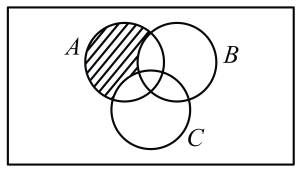
0 likes
View Solution198
MediumMCQ
Two players $A$ and $B$ are alternately throwing a coin and a die together. $A$ player who first throws a head and a $6$ wins the game. If $A$ starts the game,then the probability that $B$ wins the game is:
A
$\frac{12}{23}$
B
$\frac{11}{23}$
C
$\frac{5}{119}$
D
$\frac{12}{119}$
Solution
(B) Let $p$ be the probability of getting a head and a $6$ in a single throw. The probability of getting a head is $\frac{1}{2}$ and the probability of getting a $6$ is $\frac{1}{6}$. Since these are independent events,$p = \frac{1}{2} \times \frac{1}{6} = \frac{1}{12}$. The probability of not winning in a single throw is $q = 1 - p = \frac{11}{12}$.
$A$ starts the game. $B$ wins if $A$ fails,then $B$ succeeds,or $A$ fails,$B$ fails,$A$ fails,$B$ succeeds,and so on.
The probability that $B$ wins is:
$P(B) = qp + q^3p + q^5p + \dots$
This is an infinite geometric series with first term $a = qp = \frac{11}{12} \times \frac{1}{12} = \frac{11}{144}$ and common ratio $r = q^2 = (\frac{11}{12})^2 = \frac{121}{144}$.
$P(B) = \frac{a}{1-r} = \frac{\frac{11}{144}}{1 - \frac{121}{144}} = \frac{\frac{11}{144}}{\frac{23}{144}} = \frac{11}{23}$.
$A$ starts the game. $B$ wins if $A$ fails,then $B$ succeeds,or $A$ fails,$B$ fails,$A$ fails,$B$ succeeds,and so on.
The probability that $B$ wins is:
$P(B) = qp + q^3p + q^5p + \dots$
This is an infinite geometric series with first term $a = qp = \frac{11}{12} \times \frac{1}{12} = \frac{11}{144}$ and common ratio $r = q^2 = (\frac{11}{12})^2 = \frac{121}{144}$.
$P(B) = \frac{a}{1-r} = \frac{\frac{11}{144}}{1 - \frac{121}{144}} = \frac{\frac{11}{144}}{\frac{23}{144}} = \frac{11}{23}$.
0 likes
View SolutionProbability — Mix Examples-Probability · Frequently Asked Questions
1Are these Probability questions useful for JEE and NEET?
Yes. All questions in this section are mapped to JEE Main and NEET exam patterns. Previous year questions from JEE Main, NEET, GUJCET and state-level exams are included with full solutions.
2Can I switch to Hindi or Gujarati for these questions?
Yes. Use the language tabs in the hero section or the sidebar to view the same questions and solutions in English, Hindi or Gujarati.
3How do I generate a question paper from this subtopic?
Use the Vedclass Exam Paper Generator — select the chapter and subtopic, set difficulty, and generate Sets A, B, C, D automatically. First 3 chapters of every subject are free.
Vedclass Products
For Students
Vedclass Test Series
Mock tests in real JEE/NEET style with performance analysis. 5-day free trial.
Start Free TrialFor Teachers
Exam Paper Generator
Generate Set A/B/C/D papers from this chapter in 2 minutes. 3 chapters free.
Try FreeFor Institutes
Online Exam Module
Live online exams with unlimited students, 360° analytics & white-label branding.
See DemoFor Teachers & Institutes
Generate a Probability Exam Paper in 2 Minutes
Select subtopic & difficulty — Sets A, B, C, D auto-generated with No Repeat logic.
First 3 chapters of every subject are free — no payment required.