
A English
Conditional probability Questions in English
Class 12 Mathematics · Probability · Conditional probability
248+
Questions
English
Language
100%
With Solutions
Showing 43 of 248 questions in English
201
DifficultMCQ
If $A$ and $B$ are two independent events such that $P(B)=\frac{2}{7}$ and $P(A \cup B^c)=0.8$,then $P(A)$ is equal to:
A
$0.1$
B
$0.2$
C
$0.3$
D
$0.4$
Solution
(C) Given that $A$ and $B$ are independent events,$A$ and $B^c$ are also independent events.
$P(B) = \frac{2}{7} \implies P(B^c) = 1 - \frac{2}{7} = \frac{5}{7}$.
We know that $P(A \cup B^c) = P(A) + P(B^c) - P(A \cap B^c)$.
Since $A$ and $B^c$ are independent,$P(A \cap B^c) = P(A) \cdot P(B^c)$.
Substituting the values:
$0.8 = P(A) + \frac{5}{7} - P(A) \cdot \frac{5}{7}$.
$0.8 - \frac{5}{7} = P(A) \cdot (1 - \frac{5}{7})$.
$\frac{5.6 - 5}{7} = P(A) \cdot \frac{2}{7}$.
$0.6 = 2 \cdot P(A)$.
$P(A) = 0.3$.
$P(B) = \frac{2}{7} \implies P(B^c) = 1 - \frac{2}{7} = \frac{5}{7}$.
We know that $P(A \cup B^c) = P(A) + P(B^c) - P(A \cap B^c)$.
Since $A$ and $B^c$ are independent,$P(A \cap B^c) = P(A) \cdot P(B^c)$.
Substituting the values:
$0.8 = P(A) + \frac{5}{7} - P(A) \cdot \frac{5}{7}$.
$0.8 - \frac{5}{7} = P(A) \cdot (1 - \frac{5}{7})$.
$\frac{5.6 - 5}{7} = P(A) \cdot \frac{2}{7}$.
$0.6 = 2 \cdot P(A)$.
$P(A) = 0.3$.
0 likes
View Solution202
EasyMCQ
In a random experiment,events $A$ and $B$ are such that $P(A) = \frac{1}{4}$,$P(A \mid B) = \frac{1}{2}$,and $P(B \mid A) = \frac{2}{3}$. Find $P(B)$.
A
$\frac{1}{3}$
B
$\frac{2}{3}$
C
$\frac{1}{2}$
D
$\frac{1}{6}$
Solution
(A) We know that the conditional probability formula is given by $P(B \mid A) = \frac{P(A \cap B)}{P(A)}$.
Substituting the given values,we get $P(A \cap B) = P(B \mid A) \times P(A) = \frac{2}{3} \times \frac{1}{4} = \frac{2}{12} = \frac{1}{6}$.
Now,we use the conditional probability formula for $P(A \mid B)$:
$P(A \mid B) = \frac{P(A \cap B)}{P(B)}$.
Rearranging for $P(B)$,we get $P(B) = \frac{P(A \cap B)}{P(A \mid B)}$.
Substituting the values,$P(B) = \frac{1/6}{1/2} = \frac{1}{6} \times 2 = \frac{1}{3}$.
Substituting the given values,we get $P(A \cap B) = P(B \mid A) \times P(A) = \frac{2}{3} \times \frac{1}{4} = \frac{2}{12} = \frac{1}{6}$.
Now,we use the conditional probability formula for $P(A \mid B)$:
$P(A \mid B) = \frac{P(A \cap B)}{P(B)}$.
Rearranging for $P(B)$,we get $P(B) = \frac{P(A \cap B)}{P(A \mid B)}$.
Substituting the values,$P(B) = \frac{1/6}{1/2} = \frac{1}{6} \times 2 = \frac{1}{3}$.
0 likes
View Solution203
MediumMCQ
$A$ coin is tossed until a head appears or it has been tossed thrice. Given that a head does not appear on the first toss,what is the probability that the coin is tossed thrice?
A
$\frac{1}{2}$
B
$\frac{1}{3}$
C
$\frac{3}{4}$
D
$\frac{1}{4}$
Solution
(A) Let $H$ denote the event of getting a head and $T$ denote the event of getting a tail. The experiment stops when a head appears or after three tosses.
The sample space of the experiment is $S = \{H, TH, TTH, TTT\}$.
Let $A$ be the event that a head does not appear on the first toss. This means the first toss is a tail $(T)$.
The outcomes corresponding to event $A$ are $\{TH, TTH, TTT\}$.
The probability $P(A) = P(T) = \frac{1}{2}$.
Let $B$ be the event that the coin is tossed thrice. The outcomes corresponding to event $B$ are $\{TTH, TTT\}$.
The intersection $A \cap B$ represents the event that the first toss is a tail $AND$ the coin is tossed thrice. This corresponds to the outcomes $\{TTH, TTT\}$.
$P(A \cap B) = P(TTH) + P(TTT) = \frac{1}{8} + \frac{1}{8} = \frac{2}{8} = \frac{1}{4}$.
We need to find the conditional probability $P(B|A)$:
$P(B|A) = \frac{P(A \cap B)}{P(A)} = \frac{\frac{1}{4}}{\frac{1}{2}} = \frac{1}{2}$.
The sample space of the experiment is $S = \{H, TH, TTH, TTT\}$.
Let $A$ be the event that a head does not appear on the first toss. This means the first toss is a tail $(T)$.
The outcomes corresponding to event $A$ are $\{TH, TTH, TTT\}$.
The probability $P(A) = P(T) = \frac{1}{2}$.
Let $B$ be the event that the coin is tossed thrice. The outcomes corresponding to event $B$ are $\{TTH, TTT\}$.
The intersection $A \cap B$ represents the event that the first toss is a tail $AND$ the coin is tossed thrice. This corresponds to the outcomes $\{TTH, TTT\}$.
$P(A \cap B) = P(TTH) + P(TTT) = \frac{1}{8} + \frac{1}{8} = \frac{2}{8} = \frac{1}{4}$.
We need to find the conditional probability $P(B|A)$:
$P(B|A) = \frac{P(A \cap B)}{P(A)} = \frac{\frac{1}{4}}{\frac{1}{2}} = \frac{1}{2}$.
0 likes
View Solution204
MediumMCQ
Let $X$ be a random variable which takes values $1, 2, 3, 4$ such that $P(X=r) = K r^3$ where $r = 1, 2, 3, 4$. Then:
A
$K = \frac{1}{100}$ and $P\left(\left.\frac{1}{2} < X < \frac{5}{2} \right\rvert X > 1\right) = \frac{8}{97}$
B
$K = \frac{1}{99}$ and $P\left(\left.\frac{1}{2} < X < \frac{5}{2} \right\rvert X > 1\right) = \frac{8}{99}$
C
$K = \frac{1}{100}$ and $P\left(\left.\frac{1}{2} < X < \frac{5}{2} \right\rvert X > 1\right) = \frac{8}{99}$
D
$K = \frac{1}{100}$ and $P\left(\left.\frac{1}{2} < X < \frac{5}{2} \right\rvert X > 1\right) = \frac{10}{99}$
Solution
(C) The sum of probabilities for a random variable is $1$.
Given $P(X=r) = K r^3$ for $r \in \{1, 2, 3, 4\}$.
Summing these: $K(1^3) + K(2^3) + K(3^3) + K(4^3) = 1$.
$K(1 + 8 + 27 + 64) = 1 \Rightarrow 100K = 1 \Rightarrow K = \frac{1}{100}$.
We need to find $P\left(\left.\frac{1}{2} < X < \frac{5}{2} \right\rvert X > 1\right)$.
This is equivalent to $P(X=2 \mid X \in \{2, 3, 4\})$.
By the definition of conditional probability: $P(A \mid B) = \frac{P(A \cap B)}{P(B)}$.
Here $A = \{X=2\}$ and $B = \{X=2, 3, 4\}$.
$P(A \cap B) = P(X=2) = 8K$.
$P(B) = P(X=2) + P(X=3) + P(X=4) = 8K + 27K + 64K = 99K$.
Thus,$P(A \mid B) = \frac{8K}{99K} = \frac{8}{99}$.
Therefore,$K = \frac{1}{100}$ and the conditional probability is $\frac{8}{99}$.
Given $P(X=r) = K r^3$ for $r \in \{1, 2, 3, 4\}$.
Summing these: $K(1^3) + K(2^3) + K(3^3) + K(4^3) = 1$.
$K(1 + 8 + 27 + 64) = 1 \Rightarrow 100K = 1 \Rightarrow K = \frac{1}{100}$.
We need to find $P\left(\left.\frac{1}{2} < X < \frac{5}{2} \right\rvert X > 1\right)$.
This is equivalent to $P(X=2 \mid X \in \{2, 3, 4\})$.
By the definition of conditional probability: $P(A \mid B) = \frac{P(A \cap B)}{P(B)}$.
Here $A = \{X=2\}$ and $B = \{X=2, 3, 4\}$.
$P(A \cap B) = P(X=2) = 8K$.
$P(B) = P(X=2) + P(X=3) + P(X=4) = 8K + 27K + 64K = 99K$.
Thus,$P(A \mid B) = \frac{8K}{99K} = \frac{8}{99}$.
Therefore,$K = \frac{1}{100}$ and the conditional probability is $\frac{8}{99}$.
0 likes
View Solution205
MediumMCQ
When $2$ dice are thrown,it is observed that the sum of the numbers appearing on the top faces of both dice is a prime number. What is the probability that at least one of the numbers in the pair is a multiple of $3$?
A
$\frac{8}{15}$
B
$\frac{11}{36}$
C
$\frac{5}{9}$
D
$\frac{5}{12}$
Solution
(A) The possible sums of two dice that are prime numbers are $2, 3, 5, 7, 11$.
The sample space $S$ of pairs $(x, y)$ where $x+y$ is prime is:
Sum $= 2: (1, 1)$
Sum $= 3: (1, 2), (2, 1)$
Sum $= 5: (1, 4), (4, 1), (2, 3), (3, 2)$
Sum $= 7: (1, 6), (6, 1), (2, 5), (5, 2), (3, 4), (4, 3)$
Sum $= 11: (5, 6), (6, 5)$
Total number of outcomes $n(S) = 1 + 2 + 4 + 6 + 2 = 15$.
We need the probability that at least one number is a multiple of $3$ (i.e.,$3$ or $6$).
The favorable outcomes are: $(2, 3), (3, 2), (1, 6), (6, 1), (3, 4), (4, 3), (5, 6), (6, 5)$.
Number of favorable outcomes $n(E) = 8$.
The required probability $P(E) = \frac{n(E)}{n(S)} = \frac{8}{15}$.
The sample space $S$ of pairs $(x, y)$ where $x+y$ is prime is:
Sum $= 2: (1, 1)$
Sum $= 3: (1, 2), (2, 1)$
Sum $= 5: (1, 4), (4, 1), (2, 3), (3, 2)$
Sum $= 7: (1, 6), (6, 1), (2, 5), (5, 2), (3, 4), (4, 3)$
Sum $= 11: (5, 6), (6, 5)$
Total number of outcomes $n(S) = 1 + 2 + 4 + 6 + 2 = 15$.
We need the probability that at least one number is a multiple of $3$ (i.e.,$3$ or $6$).
The favorable outcomes are: $(2, 3), (3, 2), (1, 6), (6, 1), (3, 4), (4, 3), (5, 6), (6, 5)$.
Number of favorable outcomes $n(E) = 8$.
The required probability $P(E) = \frac{n(E)}{n(S)} = \frac{8}{15}$.
0 likes
View Solution206
EasyMCQ
If $P(A / B) = \frac{3}{10}$,$P(B / A) = \frac{4}{5}$ and $P(A \cup B) = K P(B)$,then $\frac{1}{K} =$
A
$\frac{40}{49}$
B
$\frac{40}{43}$
C
$\frac{100}{101}$
D
$1$
Solution
(B) Given $P(A / B) = \frac{P(A \cap B)}{P(B)} = \frac{3}{10} \implies P(A \cap B) = \frac{3}{10} P(B)$.
$P(B / A) = \frac{P(A \cap B)}{P(A)} = \frac{4}{5} \implies P(A) = \frac{5}{4} P(A \cap B) = \frac{5}{4} \times \frac{3}{10} P(B) = \frac{3}{8} P(B)$.
We know $P(A \cup B) = P(A) + P(B) - P(A \cap B)$.
Given $P(A \cup B) = K P(B)$,so $K P(B) = P(A) + P(B) - P(A \cap B)$.
Dividing by $P(B)$,we get $K = \frac{P(A)}{P(B)} + 1 - \frac{P(A \cap B)}{P(B)}$.
Substituting the values: $K = \frac{3}{8} + 1 - \frac{3}{10}$.
$K = \frac{15 + 40 - 12}{40} = \frac{43}{40}$.
Therefore,$\frac{1}{K} = \frac{40}{43}$.
$P(B / A) = \frac{P(A \cap B)}{P(A)} = \frac{4}{5} \implies P(A) = \frac{5}{4} P(A \cap B) = \frac{5}{4} \times \frac{3}{10} P(B) = \frac{3}{8} P(B)$.
We know $P(A \cup B) = P(A) + P(B) - P(A \cap B)$.
Given $P(A \cup B) = K P(B)$,so $K P(B) = P(A) + P(B) - P(A \cap B)$.
Dividing by $P(B)$,we get $K = \frac{P(A)}{P(B)} + 1 - \frac{P(A \cap B)}{P(B)}$.
Substituting the values: $K = \frac{3}{8} + 1 - \frac{3}{10}$.
$K = \frac{15 + 40 - 12}{40} = \frac{43}{40}$.
Therefore,$\frac{1}{K} = \frac{40}{43}$.
0 likes
View Solution207
EasyMCQ
$A$ and $B$ are two groups of books. Group $A$ consists of $8$ science and $5$ engineering books,and group $B$ consists of $6$ science and $7$ engineering books. When an unbiased die is rolled,if $2$ or $5$ turns up,a book is selected at random from group $A$. Otherwise,a book is selected at random from group $B$. The probability of selecting a science book is
A
$\frac{13}{24}$
B
$\frac{34}{35}$
C
$\frac{20}{39}$
D
$\frac{13}{36}$
Solution
(C) Let $E$ be the event of selecting a science book.
Let $A$ be the event of selecting a book from group $A$,and $B$ be the event of selecting a book from group $B$.
The probability of getting $2$ or $5$ on a die is $P(A) = \frac{2}{6} = \frac{1}{3}$.
The probability of not getting $2$ or $5$ is $P(B) = 1 - \frac{1}{3} = \frac{2}{3}$.
In group $A$,there are $8$ science and $5$ engineering books,total $13$ books. So,$P(E|A) = \frac{8}{13}$.
In group $B$,there are $6$ science and $7$ engineering books,total $13$ books. So,$P(E|B) = \frac{6}{13}$.
Using the law of total probability:
$P(E) = P(A) \times P(E|A) + P(B) \times P(E|B)$
$P(E) = \frac{1}{3} \times \frac{8}{13} + \frac{2}{3} \times \frac{6}{13}$
$P(E) = \frac{8}{39} + \frac{12}{39} = \frac{20}{39}$
Let $A$ be the event of selecting a book from group $A$,and $B$ be the event of selecting a book from group $B$.
The probability of getting $2$ or $5$ on a die is $P(A) = \frac{2}{6} = \frac{1}{3}$.
The probability of not getting $2$ or $5$ is $P(B) = 1 - \frac{1}{3} = \frac{2}{3}$.
In group $A$,there are $8$ science and $5$ engineering books,total $13$ books. So,$P(E|A) = \frac{8}{13}$.
In group $B$,there are $6$ science and $7$ engineering books,total $13$ books. So,$P(E|B) = \frac{6}{13}$.
Using the law of total probability:
$P(E) = P(A) \times P(E|A) + P(B) \times P(E|B)$
$P(E) = \frac{1}{3} \times \frac{8}{13} + \frac{2}{3} \times \frac{6}{13}$
$P(E) = \frac{8}{39} + \frac{12}{39} = \frac{20}{39}$
0 likes
View Solution208
MediumMCQ
$A$ number is selected at random from the set $\{1, 2, \ldots, 100\}$. Given that the selected number is divisible by $2$,what is the probability that it is also divisible by $3$ or $5$?
A
$\frac{26}{50}$
B
$\frac{23}{50}$
C
$\frac{7}{50}$
D
$\frac{13}{50}$
Solution
(B) Let $S = \{1, 2, \ldots, 100\}$. The total number of elements is $100$.
Let $A$ be the event that the number is divisible by $2$. The elements of $A$ are $\{2, 4, 6, \ldots, 100\}$. The number of elements in $A$ is $n(A) = 50$.
Let $B$ be the event that the number is divisible by $3$ or $5$. We want to find the conditional probability $P(B|A) = \frac{n(A \cap B)}{n(A)}$.
$A \cap B$ is the set of numbers in $\{1, 2, \ldots, 100\}$ that are divisible by $2$ $AND$ (divisible by $3$ $OR$ divisible by $5$).
This is equivalent to numbers divisible by $6$ or $10$.
Numbers divisible by $6$ up to $100$: $\lfloor \frac{100}{6} \rfloor = 16$.
Numbers divisible by $10$ up to $100$: $\lfloor \frac{100}{10} \rfloor = 10$.
Numbers divisible by both $6$ and $10$ (i.e.,divisible by $30$): $\lfloor \frac{100}{30} \rfloor = 3$.
By the Principle of Inclusion-Exclusion,$n(A \cap B) = 16 + 10 - 3 = 23$.
The required probability is $\frac{n(A \cap B)}{n(A)} = \frac{23}{50}$.
Let $A$ be the event that the number is divisible by $2$. The elements of $A$ are $\{2, 4, 6, \ldots, 100\}$. The number of elements in $A$ is $n(A) = 50$.
Let $B$ be the event that the number is divisible by $3$ or $5$. We want to find the conditional probability $P(B|A) = \frac{n(A \cap B)}{n(A)}$.
$A \cap B$ is the set of numbers in $\{1, 2, \ldots, 100\}$ that are divisible by $2$ $AND$ (divisible by $3$ $OR$ divisible by $5$).
This is equivalent to numbers divisible by $6$ or $10$.
Numbers divisible by $6$ up to $100$: $\lfloor \frac{100}{6} \rfloor = 16$.
Numbers divisible by $10$ up to $100$: $\lfloor \frac{100}{10} \rfloor = 10$.
Numbers divisible by both $6$ and $10$ (i.e.,divisible by $30$): $\lfloor \frac{100}{30} \rfloor = 3$.
By the Principle of Inclusion-Exclusion,$n(A \cap B) = 16 + 10 - 3 = 23$.
The required probability is $\frac{n(A \cap B)}{n(A)} = \frac{23}{50}$.
0 likes
View Solution209
MediumMCQ
If a die is rolled twice and the sum of the numbers appearing on them is observed to be $6$,then the probability that the number $1$ appears at least once on them is
A
$\frac{5}{36}$
B
$\frac{2}{5}$
C
$\frac{11}{36}$
D
$\frac{1}{3}$
Solution
(B) Let $A$ be the event that the sum of the numbers appearing on the two dice is $6$. The possible outcomes for $A$ are: $(1, 5), (2, 4), (3, 3), (4, 2), (5, 1)$.
Thus,the number of outcomes in $A$ is $n(A) = 5$.
Let $B$ be the event that the number $1$ appears at least once.
We are looking for the conditional probability $P(B|A)$,which is defined as $P(B|A) = \frac{n(A \cap B)}{n(A)}$.
The intersection $A \cap B$ represents the outcomes where the sum is $6$ $AND$ the number $1$ appears at least once. These outcomes are: $(1, 5)$ and $(5, 1)$.
Thus,$n(A \cap B) = 2$.
Therefore,the required probability is $P(B|A) = \frac{2}{5}$.
Thus,the number of outcomes in $A$ is $n(A) = 5$.
Let $B$ be the event that the number $1$ appears at least once.
We are looking for the conditional probability $P(B|A)$,which is defined as $P(B|A) = \frac{n(A \cap B)}{n(A)}$.
The intersection $A \cap B$ represents the outcomes where the sum is $6$ $AND$ the number $1$ appears at least once. These outcomes are: $(1, 5)$ and $(5, 1)$.
Thus,$n(A \cap B) = 2$.
Therefore,the required probability is $P(B|A) = \frac{2}{5}$.
0 likes
View Solution210
Medium
Suppose $A$ and $B$ are events of a random experiment such that $P(A)=\frac{1}{3}$,$P(A \cap B)=\frac{1}{5}$ and $P(A \cup B)=\frac{3}{5}$. Match the items of List-$I$ with the items of List-$II$.
| List-$I$ | List-$II$ |
| $A$. $P(\frac{A}{B})$ | $(i)$. $\frac{2}{15}$ |
| $B$. $P(\bar{B})$ | $(ii)$. $\frac{4}{15}$ |
| $C$. $P(A \cap \bar{B})$ | $(iii)$. $\frac{8}{15}$ |
| $D$. $P(B \cap \bar{A})$ | $(iv)$. $\frac{2}{3}$ |
| $(v)$. $\frac{3}{7}$ |
Solution
(A) Given that,$P(A)=\frac{1}{3}$,$P(A \cap B)=\frac{1}{5}$,$P(A \cup B)=\frac{3}{5}$.
We know that,$P(A \cup B) = P(A) + P(B) - P(A \cap B)$.
Substituting the values: $\frac{3}{5} = \frac{1}{3} + P(B) - \frac{1}{5}$.
$P(B) = \frac{3}{5} + \frac{1}{5} - \frac{1}{3} = \frac{9+3-5}{15} = \frac{7}{15}$.
Now,matching the items:
$A$. $P(\frac{A}{B}) = \frac{P(A \cap B)}{P(B)} = \frac{1/5}{7/15} = \frac{3}{7}$ (Matches $(v)$).
$B$. $P(\bar{B}) = 1 - P(B) = 1 - \frac{7}{15} = \frac{8}{15}$ (Matches $(iii)$).
$C$. $P(A \cap \bar{B}) = P(A) - P(A \cap B) = \frac{1}{3} - \frac{1}{5} = \frac{2}{15}$ (Matches $(i)$).
$D$. $P(B \cap \bar{A}) = P(B) - P(A \cap B) = \frac{7}{15} - \frac{1}{5} = \frac{4}{15}$ (Matches $(ii)$).
Thus,the correct matching is: $A-(v), B-(iii), C-(i), D-(ii)$.
We know that,$P(A \cup B) = P(A) + P(B) - P(A \cap B)$.
Substituting the values: $\frac{3}{5} = \frac{1}{3} + P(B) - \frac{1}{5}$.
$P(B) = \frac{3}{5} + \frac{1}{5} - \frac{1}{3} = \frac{9+3-5}{15} = \frac{7}{15}$.
Now,matching the items:
$A$. $P(\frac{A}{B}) = \frac{P(A \cap B)}{P(B)} = \frac{1/5}{7/15} = \frac{3}{7}$ (Matches $(v)$).
$B$. $P(\bar{B}) = 1 - P(B) = 1 - \frac{7}{15} = \frac{8}{15}$ (Matches $(iii)$).
$C$. $P(A \cap \bar{B}) = P(A) - P(A \cap B) = \frac{1}{3} - \frac{1}{5} = \frac{2}{15}$ (Matches $(i)$).
$D$. $P(B \cap \bar{A}) = P(B) - P(A \cap B) = \frac{7}{15} - \frac{1}{5} = \frac{4}{15}$ (Matches $(ii)$).
Thus,the correct matching is: $A-(v), B-(iii), C-(i), D-(ii)$.
0 likes
View Solution211
EasyMCQ
If $A$ and $B$ are two events such that $P(A | B) = 0.6$,$P(B | A) = 0.3$,and $P(A) = 0.1$,then $P(\bar{A} \cap \bar{B})$ equals:
A
$0.88$
B
$0.12$
C
$0.6$
D
$0.4$
Solution
(A) Given: $P(A | B) = 0.6$,$P(B | A) = 0.3$,and $P(A) = 0.1$.
Using the definition of conditional probability,$P(B | A) = \frac{P(A \cap B)}{P(A)}$.
Substituting the values: $0.3 = \frac{P(A \cap B)}{0.1} \implies P(A \cap B) = 0.03$.
Next,$P(A | B) = \frac{P(A \cap B)}{P(B)}$.
Substituting the values: $0.6 = \frac{0.03}{P(B)} \implies P(B) = \frac{0.03}{0.6} = 0.05$.
By De Morgan's Law,$P(\bar{A} \cap \bar{B}) = P(\overline{A \cup B}) = 1 - P(A \cup B)$.
Using the addition rule,$P(A \cup B) = P(A) + P(B) - P(A \cap B)$.
$P(A \cup B) = 0.1 + 0.05 - 0.03 = 0.12$.
Therefore,$P(\bar{A} \cap \bar{B}) = 1 - 0.12 = 0.88$.
Using the definition of conditional probability,$P(B | A) = \frac{P(A \cap B)}{P(A)}$.
Substituting the values: $0.3 = \frac{P(A \cap B)}{0.1} \implies P(A \cap B) = 0.03$.
Next,$P(A | B) = \frac{P(A \cap B)}{P(B)}$.
Substituting the values: $0.6 = \frac{0.03}{P(B)} \implies P(B) = \frac{0.03}{0.6} = 0.05$.
By De Morgan's Law,$P(\bar{A} \cap \bar{B}) = P(\overline{A \cup B}) = 1 - P(A \cup B)$.
Using the addition rule,$P(A \cup B) = P(A) + P(B) - P(A \cap B)$.
$P(A \cup B) = 0.1 + 0.05 - 0.03 = 0.12$.
Therefore,$P(\bar{A} \cap \bar{B}) = 1 - 0.12 = 0.88$.
0 likes
View Solution212
DifficultMCQ
$A$ candidate takes three tests in succession and the probability of passing the first test is $p$. The probability of passing each succeeding test is $p$ if he passes the preceding one,and $\frac{p}{2}$ if he fails the preceding one. The candidate is selected if he passes at least two tests. The probability that the candidate is selected is:
A
$p^2(2-p)$
B
$p(2-p)$
C
$p+p^2+p^3$
D
$p^2(1-p)$
Solution
(A) Let $S$ denote success (passing) and $F$ denote failure. The probability of passing the first test is $P(S_1) = p$,so $P(F_1) = 1-p$.
For subsequent tests,$P(S_{n+1} | S_n) = p$ and $P(S_{n+1} | F_n) = \frac{p}{2}$.
The candidate is selected if they pass at least two tests. The possible favorable outcomes are $(S, S, S), (S, S, F), (S, F, S), (F, S, S)$.
$P(S, S, S) = P(S_1) \times P(S_2|S_1) \times P(S_3|S_2) = p \times p \times p = p^3$.
$P(S, S, F) = P(S_1) \times P(S_2|S_1) \times P(F_3|S_2) = p \times p \times (1-p) = p^2(1-p)$.
$P(S, F, S) = P(S_1) \times P(F_2|S_1) \times P(S_3|F_2) = p \times (1-p) \times \frac{p}{2} = \frac{p^2(1-p)}{2}$.
$P(F, S, S) = P(F_1) \times P(S_2|F_1) \times P(S_3|S_2) = (1-p) \times \frac{p}{2} \times p = \frac{p^2(1-p)}{2}$.
Summing these probabilities: $p^3 + p^2(1-p) + \frac{p^2(1-p)}{2} + \frac{p^2(1-p)}{2} = p^3 + p^2(1-p) + p^2(1-p) = p^3 + 2p^2(1-p) = p^3 + 2p^2 - 2p^3 = 2p^2 - p^3 = p^2(2-p)$.
For subsequent tests,$P(S_{n+1} | S_n) = p$ and $P(S_{n+1} | F_n) = \frac{p}{2}$.
The candidate is selected if they pass at least two tests. The possible favorable outcomes are $(S, S, S), (S, S, F), (S, F, S), (F, S, S)$.
$P(S, S, S) = P(S_1) \times P(S_2|S_1) \times P(S_3|S_2) = p \times p \times p = p^3$.
$P(S, S, F) = P(S_1) \times P(S_2|S_1) \times P(F_3|S_2) = p \times p \times (1-p) = p^2(1-p)$.
$P(S, F, S) = P(S_1) \times P(F_2|S_1) \times P(S_3|F_2) = p \times (1-p) \times \frac{p}{2} = \frac{p^2(1-p)}{2}$.
$P(F, S, S) = P(F_1) \times P(S_2|F_1) \times P(S_3|S_2) = (1-p) \times \frac{p}{2} \times p = \frac{p^2(1-p)}{2}$.
Summing these probabilities: $p^3 + p^2(1-p) + \frac{p^2(1-p)}{2} + \frac{p^2(1-p)}{2} = p^3 + p^2(1-p) + p^2(1-p) = p^3 + 2p^2(1-p) = p^3 + 2p^2 - 2p^3 = 2p^2 - p^3 = p^2(2-p)$.
0 likes
View Solution213
EasyMCQ
If $A$ and $B$ are mutually exclusive events with $P(B) \neq 1$,then $P(A \mid \bar{B})$ is equal to (Here $\bar{B}$ is the complement of the event $B$)
A
$\frac{1}{P(B)}$
B
$\frac{1}{1-P(B)}$
C
$\frac{P(A)}{P(B)}$
D
$\frac{P(A)}{1-P(B)}$
Solution
(D) Given that $A$ and $B$ are mutually exclusive events,we have $P(A \cap B) = 0$.
By the definition of conditional probability,$P(A \mid \bar{B}) = \frac{P(A \cap \bar{B})}{P(\bar{B})}$.
Since $A = (A \cap B) \cup (A \cap \bar{B})$ and these are disjoint,we have $P(A) = P(A \cap B) + P(A \cap \bar{B})$.
Thus,$P(A \cap \bar{B}) = P(A) - P(A \cap B) = P(A) - 0 = P(A)$.
Also,$P(\bar{B}) = 1 - P(B)$.
Therefore,$P(A \mid \bar{B}) = \frac{P(A)}{1 - P(B)}$.
By the definition of conditional probability,$P(A \mid \bar{B}) = \frac{P(A \cap \bar{B})}{P(\bar{B})}$.
Since $A = (A \cap B) \cup (A \cap \bar{B})$ and these are disjoint,we have $P(A) = P(A \cap B) + P(A \cap \bar{B})$.
Thus,$P(A \cap \bar{B}) = P(A) - P(A \cap B) = P(A) - 0 = P(A)$.
Also,$P(\bar{B}) = 1 - P(B)$.
Therefore,$P(A \mid \bar{B}) = \frac{P(A)}{1 - P(B)}$.
0 likes
View Solution214
MediumMCQ
$A, B$ are the events in a random experiment. If $P(A)=\frac{1}{2}, P(B)=\frac{1}{3}, P(A \cap B)=\frac{1}{4}$,then $P\left(\frac{A^{c}}{B^{c}}\right)+P\left(\frac{A}{B}\right)=$
A
$1$
B
$\frac{4}{5}$
C
$\frac{11}{8}$
D
$\frac{7}{3}$
Solution
(C) Given: $P(A) = \frac{1}{2}, P(B) = \frac{1}{3}, P(A \cap B) = \frac{1}{4}$.
First,we find $P(A|B) = \frac{P(A \cap B)}{P(B)} = \frac{1/4}{1/3} = \frac{3}{4}$.
Next,we find $P(A^c \cap B^c) = P((A \cup B)^c) = 1 - P(A \cup B)$.
$P(A \cup B) = P(A) + P(B) - P(A \cap B) = \frac{1}{2} + \frac{1}{3} - \frac{1}{4} = \frac{6+4-3}{12} = \frac{7}{12}$.
So,$P(A^c \cap B^c) = 1 - \frac{7}{12} = \frac{5}{12}$.
Also,$P(B^c) = 1 - P(B) = 1 - \frac{1}{3} = \frac{2}{3}$.
Then,$P(A^c|B^c) = \frac{P(A^c \cap B^c)}{P(B^c)} = \frac{5/12}{2/3} = \frac{5}{12} \times \frac{3}{2} = \frac{5}{8}$.
Finally,$P(A^c|B^c) + P(A|B) = \frac{5}{8} + \frac{3}{4} = \frac{5+6}{8} = \frac{11}{8}$.
First,we find $P(A|B) = \frac{P(A \cap B)}{P(B)} = \frac{1/4}{1/3} = \frac{3}{4}$.
Next,we find $P(A^c \cap B^c) = P((A \cup B)^c) = 1 - P(A \cup B)$.
$P(A \cup B) = P(A) + P(B) - P(A \cap B) = \frac{1}{2} + \frac{1}{3} - \frac{1}{4} = \frac{6+4-3}{12} = \frac{7}{12}$.
So,$P(A^c \cap B^c) = 1 - \frac{7}{12} = \frac{5}{12}$.
Also,$P(B^c) = 1 - P(B) = 1 - \frac{1}{3} = \frac{2}{3}$.
Then,$P(A^c|B^c) = \frac{P(A^c \cap B^c)}{P(B^c)} = \frac{5/12}{2/3} = \frac{5}{12} \times \frac{3}{2} = \frac{5}{8}$.
Finally,$P(A^c|B^c) + P(A|B) = \frac{5}{8} + \frac{3}{4} = \frac{5+6}{8} = \frac{11}{8}$.
0 likes
View Solution215
MediumMCQ
Two cards are drawn randomly from a pack of $52$ playing cards one after the other with replacement. If $A$ is the event of drawing a face card in the first draw and $B$ is the event of drawing a club card in the second draw,then $P(\overline{B}|A) = $
A
$\frac{11}{12}$
B
$\frac{12}{13}$
C
$\frac{3}{4}$
D
$\frac{1}{4}$
Solution
(C) The total number of cards is $52$.
Since the cards are drawn with replacement,the events $A$ and $B$ are independent.
Event $A$ is drawing a face card in the first draw. There are $12$ face cards in a deck ($4$ Jacks,$4$ Queens,$4$ Kings).
Thus,$P(A) = \frac{12}{52} = \frac{3}{13}$.
Event $B$ is drawing a club card in the second draw. There are $13$ club cards in a deck.
Thus,$P(B) = \frac{13}{52} = \frac{1}{4}$.
Since the events are independent,$P(B|A) = P(B) = \frac{1}{4}$.
We need to find $P(\overline{B}|A)$.
Using the property of complementary events,$P(\overline{B}|A) = 1 - P(B|A)$.
$P(\overline{B}|A) = 1 - \frac{1}{4} = \frac{3}{4}$.
Therefore,the correct option is $C$.
Since the cards are drawn with replacement,the events $A$ and $B$ are independent.
Event $A$ is drawing a face card in the first draw. There are $12$ face cards in a deck ($4$ Jacks,$4$ Queens,$4$ Kings).
Thus,$P(A) = \frac{12}{52} = \frac{3}{13}$.
Event $B$ is drawing a club card in the second draw. There are $13$ club cards in a deck.
Thus,$P(B) = \frac{13}{52} = \frac{1}{4}$.
Since the events are independent,$P(B|A) = P(B) = \frac{1}{4}$.
We need to find $P(\overline{B}|A)$.
Using the property of complementary events,$P(\overline{B}|A) = 1 - P(B|A)$.
$P(\overline{B}|A) = 1 - \frac{1}{4} = \frac{3}{4}$.
Therefore,the correct option is $C$.
0 likes
View Solution216
EasyMCQ
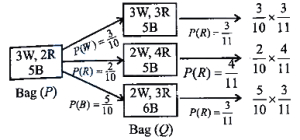
Bag $P$ contains $3$ white,$2$ red,$5$ blue balls and bag $Q$ contains $2$ white,$3$ red,$5$ blue balls. $A$ ball is chosen at random from $P$ and is placed in $Q$. If a ball is chosen from bag $Q$ at random,then the probability that it is a red ball is
A
$\frac{9}{50}$
B
$\frac{13}{45}$
C
$\frac{16}{55}$
D
$\frac{12}{35}$
Solution
(C) Let $W_P, R_P, B_P$ be the events of drawing a white,red,or blue ball from bag $P$ respectively.
Bag $P$ has $3+2+5 = 10$ balls. So,$P(W_P) = \frac{3}{10}, P(R_P) = \frac{2}{10}, P(B_P) = \frac{5}{10}$.
After transferring a ball to bag $Q$,bag $Q$ will have $10+1 = 11$ balls.
If a white ball is transferred,bag $Q$ has $3$ white,$3$ red,$5$ blue balls. $P(R|W_P) = \frac{3}{11}$.
If a red ball is transferred,bag $Q$ has $2$ white,$4$ red,$5$ blue balls. $P(R|R_P) = \frac{4}{11}$.
If a blue ball is transferred,bag $Q$ has $2$ white,$3$ red,$6$ blue balls. $P(R|B_P) = \frac{3}{11}$.
Using the law of total probability:
$P(R) = P(W_P) \times P(R|W_P) + P(R_P) \times P(R|R_P) + P(B_P) \times P(R|B_P)$
$P(R) = \frac{3}{10} \times \frac{3}{11} + \frac{2}{10} \times \frac{4}{11} + \frac{5}{10} \times \frac{3}{11}$
$P(R) = \frac{9}{110} + \frac{8}{110} + \frac{15}{110} = \frac{32}{110} = \frac{16}{55}$.
Bag $P$ has $3+2+5 = 10$ balls. So,$P(W_P) = \frac{3}{10}, P(R_P) = \frac{2}{10}, P(B_P) = \frac{5}{10}$.
After transferring a ball to bag $Q$,bag $Q$ will have $10+1 = 11$ balls.
If a white ball is transferred,bag $Q$ has $3$ white,$3$ red,$5$ blue balls. $P(R|W_P) = \frac{3}{11}$.
If a red ball is transferred,bag $Q$ has $2$ white,$4$ red,$5$ blue balls. $P(R|R_P) = \frac{4}{11}$.
If a blue ball is transferred,bag $Q$ has $2$ white,$3$ red,$6$ blue balls. $P(R|B_P) = \frac{3}{11}$.
Using the law of total probability:
$P(R) = P(W_P) \times P(R|W_P) + P(R_P) \times P(R|R_P) + P(B_P) \times P(R|B_P)$
$P(R) = \frac{3}{10} \times \frac{3}{11} + \frac{2}{10} \times \frac{4}{11} + \frac{5}{10} \times \frac{3}{11}$
$P(R) = \frac{9}{110} + \frac{8}{110} + \frac{15}{110} = \frac{32}{110} = \frac{16}{55}$.
0 likes
View Solution217
MediumMCQ
If two dice are rolled,then the probability of getting a multiple of $3$ as the sum of the numbers appeared on the top faces of the dice,given that their sum is an odd number,is
A
$\frac{1}{5}$
B
$\frac{11}{36}$
C
$\frac{1}{3}$
D
$\frac{7}{18}$
Solution
(C) Let $A$ be the event that the sum is a multiple of $3$,so $A = \{3, 6, 9, 12\}$.
Let $B$ be the event that the sum is an odd number,so $B = \{3, 5, 7, 9, 11\}$.
We need to find the conditional probability $P(A|B) = \frac{n(A \cap B)}{n(B)}$.
For the sum to be both a multiple of $3$ and odd,the sum must be $3$ or $9$.
The pairs $(x, y)$ such that $x+y = 3$ are $(1, 2)$ and $(2, 1)$.
The pairs $(x, y)$ such that $x+y = 9$ are $(3, 6), (6, 3), (4, 5), (5, 4)$.
Thus,$A \cap B = \{(1, 2), (2, 1), (3, 6), (6, 3), (4, 5), (5, 4)\}$ and $n(A \cap B) = 6$.
The total number of outcomes where the sum is odd $(B)$ is $18$ (since exactly half of the $36$ outcomes result in an odd sum).
Therefore,$P(A|B) = \frac{6}{18} = \frac{1}{3}$.
Let $B$ be the event that the sum is an odd number,so $B = \{3, 5, 7, 9, 11\}$.
We need to find the conditional probability $P(A|B) = \frac{n(A \cap B)}{n(B)}$.
For the sum to be both a multiple of $3$ and odd,the sum must be $3$ or $9$.
The pairs $(x, y)$ such that $x+y = 3$ are $(1, 2)$ and $(2, 1)$.
The pairs $(x, y)$ such that $x+y = 9$ are $(3, 6), (6, 3), (4, 5), (5, 4)$.
Thus,$A \cap B = \{(1, 2), (2, 1), (3, 6), (6, 3), (4, 5), (5, 4)\}$ and $n(A \cap B) = 6$.
The total number of outcomes where the sum is odd $(B)$ is $18$ (since exactly half of the $36$ outcomes result in an odd sum).
Therefore,$P(A|B) = \frac{6}{18} = \frac{1}{3}$.
0 likes
View Solution218
MediumMCQ
Two cards are drawn from a pack of $52$ playing cards one after the other. If $p_1$ is the probability of getting a queen in the first draw and a diamond card in the second draw when the first card drawn is replaced,and $p_2$ is the probability of the same event when the first card drawn is not replaced,then $\frac{p_1}{p_2} = $
A
$1$
B
$2$
C
$3$
D
$4$
Solution
(A) Case $1$: With replacement.
$p_1 = P(\text{First is Queen}) \times P(\text{Second is Diamond}) = \frac{4}{52} \times \frac{13}{52} = \frac{1}{13} \times \frac{1}{4} = \frac{1}{52}$.
Case $2$: Without replacement.
Let $Q_1$ be the event that the first card is a queen and $D_2$ be the event that the second card is a diamond.
If the first card is the Queen of Diamonds,$P(Q_1 \cap D_2) = P(Q_1 \cap D_1) \times P(D_2 | Q_1 \cap D_1) = \frac{1}{52} \times \frac{12}{51}$.
If the first card is a Queen other than the Queen of Diamonds,$P(Q_1 \cap D_2) = P(Q_1 \cap D_1^c) \times P(D_2 | Q_1 \cap D_1^c) = \frac{3}{52} \times \frac{13}{51}$.
$p_2 = \frac{1 \times 12 + 3 \times 13}{52 \times 51} = \frac{12 + 39}{52 \times 51} = \frac{51}{52 \times 51} = \frac{1}{52}$.
Therefore,$\frac{p_1}{p_2} = \frac{1/52}{1/52} = 1$.
$p_1 = P(\text{First is Queen}) \times P(\text{Second is Diamond}) = \frac{4}{52} \times \frac{13}{52} = \frac{1}{13} \times \frac{1}{4} = \frac{1}{52}$.
Case $2$: Without replacement.
Let $Q_1$ be the event that the first card is a queen and $D_2$ be the event that the second card is a diamond.
If the first card is the Queen of Diamonds,$P(Q_1 \cap D_2) = P(Q_1 \cap D_1) \times P(D_2 | Q_1 \cap D_1) = \frac{1}{52} \times \frac{12}{51}$.
If the first card is a Queen other than the Queen of Diamonds,$P(Q_1 \cap D_2) = P(Q_1 \cap D_1^c) \times P(D_2 | Q_1 \cap D_1^c) = \frac{3}{52} \times \frac{13}{51}$.
$p_2 = \frac{1 \times 12 + 3 \times 13}{52 \times 51} = \frac{12 + 39}{52 \times 51} = \frac{51}{52 \times 51} = \frac{1}{52}$.
Therefore,$\frac{p_1}{p_2} = \frac{1/52}{1/52} = 1$.
0 likes
View Solution219
EasyMCQ
Two numbers are selected at random from the set $\{1, 2, 3, \ldots, 13\}$. If the sum of the selected numbers is even,what is the probability that both the numbers are odd?
A
$\frac{2}{13}$
B
$\frac{1}{2}$
C
$\frac{7}{12}$
D
$\frac{5}{26}$
Solution
(C) The set is $S = \{1, 2, 3, \ldots, 13\}$. There are $7$ odd numbers $\{1, 3, 5, 7, 9, 11, 13\}$ and $6$ even numbers $\{2, 4, 6, 8, 10, 12\}$.
Let $E$ be the event that the sum of the two selected numbers is even. This happens if both numbers are odd or both numbers are even.
Number of ways to select two odd numbers = $^7C_2 = \frac{7 \times 6}{2} = 21$.
Number of ways to select two even numbers = $^6C_2 = \frac{6 \times 5}{2} = 15$.
Total ways for the sum to be even = $21 + 15 = 36$.
Let $A$ be the event that both numbers are odd. We want to find $P(A|E) = \frac{n(A \cap E)}{n(E)}$.
Since $A \cap E$ is the event that both numbers are odd,$n(A \cap E) = 21$.
Therefore,$P(A|E) = \frac{21}{36} = \frac{7}{12}$.
Let $E$ be the event that the sum of the two selected numbers is even. This happens if both numbers are odd or both numbers are even.
Number of ways to select two odd numbers = $^7C_2 = \frac{7 \times 6}{2} = 21$.
Number of ways to select two even numbers = $^6C_2 = \frac{6 \times 5}{2} = 15$.
Total ways for the sum to be even = $21 + 15 = 36$.
Let $A$ be the event that both numbers are odd. We want to find $P(A|E) = \frac{n(A \cap E)}{n(E)}$.
Since $A \cap E$ is the event that both numbers are odd,$n(A \cap E) = 21$.
Therefore,$P(A|E) = \frac{21}{36} = \frac{7}{12}$.
0 likes
View Solution220
MediumMCQ
If $E_1$ and $E_2$ are two events of the sample space such that $P(E_1) = \frac{1}{4}$,$P(E_1 | E_2) = \frac{1}{2}$ and $P(E_2 | E_1) = \frac{1}{3}$,then $P(E_1 | \bar{E}_2) = $
A
$\frac{2}{15}$
B
$\frac{1}{10}$
C
$\frac{1}{5}$
D
$\frac{3}{10}$
Solution
(C) We have,$P(E_1 \cap E_2) = P(E_1) \cdot P(E_2 | E_1)$.
$\therefore P(E_1 \cap E_2) = \frac{1}{4} \cdot \frac{1}{3} = \frac{1}{12}$.
Now,$P(E_1 | E_2) = \frac{P(E_1 \cap E_2)}{P(E_2)}$.
$\Rightarrow \frac{1}{2} = \frac{1/12}{P(E_2)}$.
$\Rightarrow P(E_2) = \frac{1}{12} \times 2 = \frac{1}{6}$.
$\therefore P(\bar{E}_2) = 1 - P(E_2) = 1 - \frac{1}{6} = \frac{5}{6}$.
Now,$P(E_1 | \bar{E}_2) = \frac{P(E_1 \cap \bar{E}_2)}{P(\bar{E}_2)} = \frac{P(E_1) - P(E_1 \cap E_2)}{P(\bar{E}_2)}$.
$= \frac{\frac{1}{4} - \frac{1}{12}}{\frac{5}{6}} = \frac{\frac{3-1}{12}}{\frac{5}{6}} = \frac{\frac{2}{12}}{\frac{5}{6}} = \frac{1}{6} \times \frac{6}{5} = \frac{1}{5}$.
$\therefore P(E_1 \cap E_2) = \frac{1}{4} \cdot \frac{1}{3} = \frac{1}{12}$.
Now,$P(E_1 | E_2) = \frac{P(E_1 \cap E_2)}{P(E_2)}$.
$\Rightarrow \frac{1}{2} = \frac{1/12}{P(E_2)}$.
$\Rightarrow P(E_2) = \frac{1}{12} \times 2 = \frac{1}{6}$.
$\therefore P(\bar{E}_2) = 1 - P(E_2) = 1 - \frac{1}{6} = \frac{5}{6}$.
Now,$P(E_1 | \bar{E}_2) = \frac{P(E_1 \cap \bar{E}_2)}{P(\bar{E}_2)} = \frac{P(E_1) - P(E_1 \cap E_2)}{P(\bar{E}_2)}$.
$= \frac{\frac{1}{4} - \frac{1}{12}}{\frac{5}{6}} = \frac{\frac{3-1}{12}}{\frac{5}{6}} = \frac{\frac{2}{12}}{\frac{5}{6}} = \frac{1}{6} \times \frac{6}{5} = \frac{1}{5}$.
0 likes
View Solution221
EasyMCQ
Let $A$ and $B$ be not mutually exclusive events. If $P(A) = \frac{4}{9}$ and $P(A \cap \bar{B}) = \frac{3}{7}$,then find $P\left(\frac{B}{A}\right)$.
A
$0$
B
$\frac{1}{28}$
C
$\frac{3}{13}$
D
$\frac{4}{7}$
Solution
(B) Given that $P(A) = \frac{4}{9}$ and $P(A \cap \bar{B}) = \frac{3}{7}$.
We know that $P(A) = P(A \cap B) + P(A \cap \bar{B})$.
Therefore,$P(A \cap B) = P(A) - P(A \cap \bar{B})$.
Substituting the values,we get $P(A \cap B) = \frac{4}{9} - \frac{3}{7} = \frac{28 - 27}{63} = \frac{1}{63}$.
Now,the conditional probability $P\left(\frac{B}{A}\right)$ is defined as $P\left(\frac{B}{A}\right) = \frac{P(A \cap B)}{P(A)}$.
Substituting the values,$P\left(\frac{B}{A}\right) = \frac{\frac{1}{63}}{\frac{4}{9}} = \frac{1}{63} \times \frac{9}{4} = \frac{1}{7 \times 4} = \frac{1}{28}$.
We know that $P(A) = P(A \cap B) + P(A \cap \bar{B})$.
Therefore,$P(A \cap B) = P(A) - P(A \cap \bar{B})$.
Substituting the values,we get $P(A \cap B) = \frac{4}{9} - \frac{3}{7} = \frac{28 - 27}{63} = \frac{1}{63}$.
Now,the conditional probability $P\left(\frac{B}{A}\right)$ is defined as $P\left(\frac{B}{A}\right) = \frac{P(A \cap B)}{P(A)}$.
Substituting the values,$P\left(\frac{B}{A}\right) = \frac{\frac{1}{63}}{\frac{4}{9}} = \frac{1}{63} \times \frac{9}{4} = \frac{1}{7 \times 4} = \frac{1}{28}$.
0 likes
View Solution222
EasyMCQ
Let $X$ and $Y$ be two events of a sample space such that $P(X)=\frac{1}{3}$,$P(X|Y)=\frac{1}{2}$ and $P(Y|X)=\frac{2}{5}$,then which of the following is true?
A
$P(X \cap Y)=\frac{1}{5}$
B
$P(X \cup Y)=\frac{2}{5}$
C
$P(Y)=\frac{4}{15}$
D
$P(X \cup Y)=\frac{1}{2}$
Solution
(C) Given: $P(X)=\frac{1}{3}$,$P(X|Y)=\frac{1}{2}$,and $P(Y|X)=\frac{2}{5}$.
Using the definition of conditional probability,$P(Y|X) = \frac{P(X \cap Y)}{P(X)}$.
Therefore,$P(X \cap Y) = P(Y|X) \times P(X) = \frac{2}{5} \times \frac{1}{3} = \frac{2}{15}$.
Now,using $P(X|Y) = \frac{P(X \cap Y)}{P(Y)}$,we have $\frac{1}{2} = \frac{2/15}{P(Y)}$.
This implies $P(Y) = 2 \times \frac{2}{15} = \frac{4}{15}$.
Thus,option $C$ is correct.
Using the definition of conditional probability,$P(Y|X) = \frac{P(X \cap Y)}{P(X)}$.
Therefore,$P(X \cap Y) = P(Y|X) \times P(X) = \frac{2}{5} \times \frac{1}{3} = \frac{2}{15}$.
Now,using $P(X|Y) = \frac{P(X \cap Y)}{P(Y)}$,we have $\frac{1}{2} = \frac{2/15}{P(Y)}$.
This implies $P(Y) = 2 \times \frac{2}{15} = \frac{4}{15}$.
Thus,option $C$ is correct.
0 likes
View Solution223
MediumMCQ
$A$ box contains $10$ mangoes,out of which $4$ are spoiled. $2$ mangoes are taken together at random. If one of them is found to be good,then the probability that the other is also good is:
A
$\frac{1}{3}$
B
$\frac{2}{3}$
C
$\frac{8}{15}$
D
$\frac{5}{13}$
Solution
(D) Total mangoes $= 10$. Good mangoes $= 6$. Spoiled mangoes $= 4$.
Let $E$ be the event that at least one mango is good,and $F$ be the event that both mangoes are good.
The number of ways to select $2$ mangoes from $10$ is $^{10}C_2 = \frac{10 \times 9}{2} = 45$.
The number of ways to select $2$ spoiled mangoes is $^4C_2 = \frac{4 \times 3}{2} = 6$.
The number of ways to select at least one good mango is $45 - 6 = 39$. So,$P(E) = \frac{39}{45}$.
The number of ways to select $2$ good mangoes is $^6C_2 = \frac{6 \times 5}{2} = 15$. So,$P(F) = \frac{15}{45}$.
Since $F \subset E$,$P(E \cap F) = P(F) = \frac{15}{45}$.
The conditional probability that the other is good given that one is good is $P(F|E) = \frac{P(F \cap E)}{P(E)} = \frac{15/45}{39/45} = \frac{15}{39} = \frac{5}{13}$.
Let $E$ be the event that at least one mango is good,and $F$ be the event that both mangoes are good.
The number of ways to select $2$ mangoes from $10$ is $^{10}C_2 = \frac{10 \times 9}{2} = 45$.
The number of ways to select $2$ spoiled mangoes is $^4C_2 = \frac{4 \times 3}{2} = 6$.
The number of ways to select at least one good mango is $45 - 6 = 39$. So,$P(E) = \frac{39}{45}$.
The number of ways to select $2$ good mangoes is $^6C_2 = \frac{6 \times 5}{2} = 15$. So,$P(F) = \frac{15}{45}$.
Since $F \subset E$,$P(E \cap F) = P(F) = \frac{15}{45}$.
The conditional probability that the other is good given that one is good is $P(F|E) = \frac{P(F \cap E)}{P(E)} = \frac{15/45}{39/45} = \frac{15}{39} = \frac{5}{13}$.
0 likes
View Solution224
EasyMCQ
Two dice $A$ and $B$ are rolled. If it is known that the number on $B$ is $5$,then the probability that the sum of the numbers on the two dice will be greater than $9$ is
A
$\frac{1}{3}$
B
$\frac{1}{4}$
C
$\frac{1}{5}$
D
$\frac{1}{2}$
Solution
(A) Let $X$ be the event that the sum of the numbers on the two dice is greater than $9$.
Let $Y$ be the event that the number on die $B$ is $5$.
The sample space for event $Y$ is $\{(1,5), (2,5), (3,5), (4,5), (5,5), (6,5)\}$. Thus,$n(Y) = 6$.
The event $X \cap Y$ represents the outcomes where the number on die $B$ is $5$ $AND$ the sum is greater than $9$.
The possible outcomes for $X \cap Y$ are $\{(5,5), (6,5)\}$. Thus,$n(X \cap Y) = 2$.
The conditional probability is given by $P(X|Y) = \frac{n(X \cap Y)}{n(Y)}$.
$P(X|Y) = \frac{2}{6} = \frac{1}{3}$.
Let $Y$ be the event that the number on die $B$ is $5$.
The sample space for event $Y$ is $\{(1,5), (2,5), (3,5), (4,5), (5,5), (6,5)\}$. Thus,$n(Y) = 6$.
The event $X \cap Y$ represents the outcomes where the number on die $B$ is $5$ $AND$ the sum is greater than $9$.
The possible outcomes for $X \cap Y$ are $\{(5,5), (6,5)\}$. Thus,$n(X \cap Y) = 2$.
The conditional probability is given by $P(X|Y) = \frac{n(X \cap Y)}{n(Y)}$.
$P(X|Y) = \frac{2}{6} = \frac{1}{3}$.
0 likes
View Solution225
EasyMCQ
If $A$ and $B$ are two events such that $P(\bar{A})=0.3, P(B)=0.4$ and $P(A \cap \bar{B})=0.5$,then $P(B \mid A \cup \bar{B})=$
A
$0.3$
B
$0.1$
C
$0.25$
D
$0.75$
Solution
(C) Given $P(\bar{A})=0.3$,so $P(A)=1-0.3=0.7$.
Given $P(B)=0.4$,so $P(\bar{B})=1-0.4=0.6$.
We know that $P(A \cap \bar{B}) = P(A) - P(A \cap B) = 0.5$.
Substituting $P(A)=0.7$,we get $0.7 - P(A \cap B) = 0.5$,which implies $P(A \cap B) = 0.2$.
Now,we need to find $P(B \mid A \cup \bar{B}) = \frac{P(B \cap (A \cup \bar{B}))}{P(A \cup \bar{B})}$.
First,calculate the denominator: $P(A \cup \bar{B}) = P(A) + P(\bar{B}) - P(A \cap \bar{B}) = 0.7 + 0.6 - 0.5 = 0.8$.
Next,calculate the numerator: $P(B \cap (A \cup \bar{B})) = P((B \cap A) \cup (B \cap \bar{B})) = P((B \cap A) \cup \emptyset) = P(A \cap B) = 0.2$.
Therefore,$P(B \mid A \cup \bar{B}) = \frac{0.2}{0.8} = 0.25$.
Given $P(B)=0.4$,so $P(\bar{B})=1-0.4=0.6$.
We know that $P(A \cap \bar{B}) = P(A) - P(A \cap B) = 0.5$.
Substituting $P(A)=0.7$,we get $0.7 - P(A \cap B) = 0.5$,which implies $P(A \cap B) = 0.2$.
Now,we need to find $P(B \mid A \cup \bar{B}) = \frac{P(B \cap (A \cup \bar{B}))}{P(A \cup \bar{B})}$.
First,calculate the denominator: $P(A \cup \bar{B}) = P(A) + P(\bar{B}) - P(A \cap \bar{B}) = 0.7 + 0.6 - 0.5 = 0.8$.
Next,calculate the numerator: $P(B \cap (A \cup \bar{B})) = P((B \cap A) \cup (B \cap \bar{B})) = P((B \cap A) \cup \emptyset) = P(A \cap B) = 0.2$.
Therefore,$P(B \mid A \cup \bar{B}) = \frac{0.2}{0.8} = 0.25$.
0 likes
View Solution226
EasyMCQ
If $80 \%$ of flights depart on time,$70 \%$ of flights arrive on time and $65 \%$ of flights depart on time and arrive on time,then the probability that a flight that has just departed on time will arrive on time is
A
$\frac{13}{16}$
B
$\frac{11}{16}$
C
$\frac{13}{14}$
D
$\frac{11}{14}$
Solution
(A) Let $A$ be the event that a flight departs on time and $B$ be the event that a flight arrives on time.
Given probabilities are:
$P(A) = 80 \% = 0.80$
$P(B) = 70 \% = 0.70$
$P(A \cap B) = 65 \% = 0.65$
We need to find the conditional probability that a flight arrives on time given that it has departed on time,which is $P(B|A)$.
Using the formula for conditional probability:
$P(B|A) = \frac{P(A \cap B)}{P(A)}$
Substituting the values:
$P(B|A) = \frac{0.65}{0.80} = \frac{65}{80} = \frac{13}{16}$
Thus,the probability is $\frac{13}{16}$.
Given probabilities are:
$P(A) = 80 \% = 0.80$
$P(B) = 70 \% = 0.70$
$P(A \cap B) = 65 \% = 0.65$
We need to find the conditional probability that a flight arrives on time given that it has departed on time,which is $P(B|A)$.
Using the formula for conditional probability:
$P(B|A) = \frac{P(A \cap B)}{P(A)}$
Substituting the values:
$P(B|A) = \frac{0.65}{0.80} = \frac{65}{80} = \frac{13}{16}$
Thus,the probability is $\frac{13}{16}$.
0 likes
View Solution227
EasyMCQ
From a lot containing $n$ good and $m$ bad articles,if $2$ articles are picked at random in succession without replacement,then the probability that the second article picked is bad is
A
$\frac{m}{m+n}$
B
$\frac{m-1}{m+n}$
C
$\frac{(n-1)(m-1)}{(m+n)^2}$
D
$\frac{m n}{(m+n)^2}$
Solution
(A) Let $G$ denote a good article and $B$ denote a bad article. Total articles $= n + m$.
We are picking $2$ articles in succession without replacement.
The second article is bad in two mutually exclusive cases:
$1$. The first article is bad and the second article is bad $(B_1 \cap B_2)$.
$2$. The first article is good and the second article is bad $(G_1 \cap B_2)$.
The probability is given by:
$P(B_2) = P(B_1 \cap B_2) + P(G_1 \cap B_2)$
$P(B_2) = P(B_1) \cdot P(B_2|B_1) + P(G_1) \cdot P(B_2|G_1)$
$P(B_2) = \left( \frac{m}{n+m} \right) \cdot \left( \frac{m-1}{n+m-1} \right) + \left( \frac{n}{n+m} \right) \cdot \left( \frac{m}{n+m-1} \right)$
$P(B_2) = \frac{m(m-1) + nm}{(n+m)(n+m-1)}$
$P(B_2) = \frac{m^2 - m + nm}{(n+m)(n+m-1)}$
$P(B_2) = \frac{m(m + n - 1)}{(n+m)(n+m-1)}$
$P(B_2) = \frac{m}{n+m}$
We are picking $2$ articles in succession without replacement.
The second article is bad in two mutually exclusive cases:
$1$. The first article is bad and the second article is bad $(B_1 \cap B_2)$.
$2$. The first article is good and the second article is bad $(G_1 \cap B_2)$.
The probability is given by:
$P(B_2) = P(B_1 \cap B_2) + P(G_1 \cap B_2)$
$P(B_2) = P(B_1) \cdot P(B_2|B_1) + P(G_1) \cdot P(B_2|G_1)$
$P(B_2) = \left( \frac{m}{n+m} \right) \cdot \left( \frac{m-1}{n+m-1} \right) + \left( \frac{n}{n+m} \right) \cdot \left( \frac{m}{n+m-1} \right)$
$P(B_2) = \frac{m(m-1) + nm}{(n+m)(n+m-1)}$
$P(B_2) = \frac{m^2 - m + nm}{(n+m)(n+m-1)}$
$P(B_2) = \frac{m(m + n - 1)}{(n+m)(n+m-1)}$
$P(B_2) = \frac{m}{n+m}$
0 likes
View Solution228
MediumMCQ
Suppose $E$ and $F$ are two events of a random experiment. If the probability of occurrence of $E$ is $1/5$ and the probability of occurrence of $F$ given $E$ is $1/10$,then the probability of non-occurrence of at least one of the events $E$ and $F$ is
A
$1/18$
B
$1/2$
C
$49/50$
D
$1/50$
Solution
(C) Given that,$P(E) = 1/5$ and $P(F|E) = 1/10$.
We know that the probability of both events occurring is given by $P(E \cap F) = P(E) \cdot P(F|E)$.
Substituting the values,we get $P(E \cap F) = (1/5) \cdot (1/10) = 1/50$.
The probability of non-occurrence of at least one of the events $E$ and $F$ is equivalent to the complement of the event that both $E$ and $F$ occur.
Thus,the required probability is $1 - P(E \cap F)$.
Calculating this,we get $1 - 1/50 = 49/50$.
We know that the probability of both events occurring is given by $P(E \cap F) = P(E) \cdot P(F|E)$.
Substituting the values,we get $P(E \cap F) = (1/5) \cdot (1/10) = 1/50$.
The probability of non-occurrence of at least one of the events $E$ and $F$ is equivalent to the complement of the event that both $E$ and $F$ occur.
Thus,the required probability is $1 - P(E \cap F)$.
Calculating this,we get $1 - 1/50 = 49/50$.
0 likes
View Solution229
EasyMCQ
If $2$ cards drawn at random from a well-shuffled pack of $52$ playing cards are from the same suit,then the probability of getting a face card and a card having a prime number is
A
$\frac{8}{13}$
B
$\frac{2}{13}$
C
$\frac{8}{221}$
D
$\frac{32}{221}$
Solution
(B) The total number of ways to choose $2$ cards from the same suit is given by choosing one suit out of $4$ and then choosing $2$ cards out of $13$ from that suit. Total ways $= 4 \times \binom{13}{2} = 4 \times \frac{13 \times 12}{2} = 312$.
Alternatively,since the condition is that the cards are from the same suit,we consider the sample space where both cards belong to the same suit. There are $4$ suits,and for each suit,there are $\binom{13}{2} = 78$ ways to pick $2$ cards. Total outcomes $= 4 \times 78 = 312$.
In each suit,the prime-numbered cards are ${2, 3, 5, 7}$ (total $4$ cards) and the face cards are ${J, Q, K}$ (total $3$ cards).
We need one face card and one prime-numbered card from the same suit.
For one specific suit,the number of ways to choose one face card and one prime card is $3 \times 4 = 12$.
Since there are $4$ suits,the total number of favourable outcomes is $4 \times (3 \times 4) = 48$.
However,the question implies the probability given that they are from the same suit.
Given the cards are from the same suit,the total ways to pick $2$ cards is $\binom{13}{2} = 78$.
The number of ways to pick one face card ($3$ options) and one prime card ($4$ options) is $3 \times 4 = 12$.
Since the order does not matter,we have $12$ ways.
Probability $= \frac{12}{78} = \frac{2}{13}$.
Alternatively,since the condition is that the cards are from the same suit,we consider the sample space where both cards belong to the same suit. There are $4$ suits,and for each suit,there are $\binom{13}{2} = 78$ ways to pick $2$ cards. Total outcomes $= 4 \times 78 = 312$.
In each suit,the prime-numbered cards are ${2, 3, 5, 7}$ (total $4$ cards) and the face cards are ${J, Q, K}$ (total $3$ cards).
We need one face card and one prime-numbered card from the same suit.
For one specific suit,the number of ways to choose one face card and one prime card is $3 \times 4 = 12$.
Since there are $4$ suits,the total number of favourable outcomes is $4 \times (3 \times 4) = 48$.
However,the question implies the probability given that they are from the same suit.
Given the cards are from the same suit,the total ways to pick $2$ cards is $\binom{13}{2} = 78$.
The number of ways to pick one face card ($3$ options) and one prime card ($4$ options) is $3 \times 4 = 12$.
Since the order does not matter,we have $12$ ways.
Probability $= \frac{12}{78} = \frac{2}{13}$.
0 likes
View Solution230
MediumMCQ
An urn $A$ contains $3$ white and $5$ black balls. Another urn $B$ contains $6$ white and $8$ black balls. $A$ ball is picked from $A$ at random and then transferred to $B$. Then,a ball is picked at random from $B$. The probability that it is a white ball is
A
$\frac{14}{40}$
B
$\frac{15}{40}$
C
$\frac{16}{40}$
D
$\frac{17}{40}$
Solution
(D) Case $I$: $A$ white ball is transferred from urn $A$ to urn $B$.
Probability of selecting a white ball from $A$ is $P(W_1) = \frac{3}{3+5} = \frac{3}{8}$.
After transferring,urn $B$ contains $7$ white and $8$ black balls.
Probability of selecting a white ball from $B$ is $P(W_2|W_1) = \frac{7}{7+8} = \frac{7}{15}$.
Probability of this case $= P(W_1) \times P(W_2|W_1) = \frac{3}{8} \times \frac{7}{15} = \frac{21}{120} = \frac{7}{40}$.
Case $II$: $A$ black ball is transferred from urn $A$ to urn $B$.
Probability of selecting a black ball from $A$ is $P(B_1) = \frac{5}{3+5} = \frac{5}{8}$.
After transferring,urn $B$ contains $6$ white and $9$ black balls.
Probability of selecting a white ball from $B$ is $P(W_2|B_1) = \frac{6}{6+9} = \frac{6}{15}$.
Probability of this case $= P(B_1) \times P(W_2|B_1) = \frac{5}{8} \times \frac{6}{15} = \frac{30}{120} = \frac{10}{40}$.
Total probability $= \frac{7}{40} + \frac{10}{40} = \frac{17}{40}$.
Probability of selecting a white ball from $A$ is $P(W_1) = \frac{3}{3+5} = \frac{3}{8}$.
After transferring,urn $B$ contains $7$ white and $8$ black balls.
Probability of selecting a white ball from $B$ is $P(W_2|W_1) = \frac{7}{7+8} = \frac{7}{15}$.
Probability of this case $= P(W_1) \times P(W_2|W_1) = \frac{3}{8} \times \frac{7}{15} = \frac{21}{120} = \frac{7}{40}$.
Case $II$: $A$ black ball is transferred from urn $A$ to urn $B$.
Probability of selecting a black ball from $A$ is $P(B_1) = \frac{5}{3+5} = \frac{5}{8}$.
After transferring,urn $B$ contains $6$ white and $9$ black balls.
Probability of selecting a white ball from $B$ is $P(W_2|B_1) = \frac{6}{6+9} = \frac{6}{15}$.
Probability of this case $= P(B_1) \times P(W_2|B_1) = \frac{5}{8} \times \frac{6}{15} = \frac{30}{120} = \frac{10}{40}$.
Total probability $= \frac{7}{40} + \frac{10}{40} = \frac{17}{40}$.
0 likes
View Solution231
EasyMCQ
Let $B(\alpha, \beta, \gamma)$ represent that a bag $B$ contains $\alpha$ red balls,$\beta$ green balls,and $\gamma$ blue balls. Given $B_1(2, 3, 2)$,$B_2(3, 2, 2)$,$B_3(2, 2, 3)$. $A$ die is rolled. If the die shows $2, 3,$ or $5$,a ball is drawn from bag $B_1$. If the die shows $4$ or $6$,a ball is drawn from bag $B_2$. If the die shows $1$,a ball is drawn from bag $B_3$. Find the probability of drawing a green ball.
A
$\frac{2}{7}$
B
$\frac{5}{14}$
C
$\frac{3}{5}$
D
$\frac{2}{3}$
Solution
(B) Let $E_1, E_2, E_3$ be the events of choosing bags $B_1, B_2, B_3$ respectively.
The probabilities of choosing the bags are:
$P(E_1) = \frac{3}{6} = \frac{1}{2}$ (for outcomes $2, 3, 5$)
$P(E_2) = \frac{2}{6} = \frac{1}{3}$ (for outcomes $4, 6$)
$P(E_3) = \frac{1}{6}$ (for outcome $1$)
Let $G$ be the event of drawing a green ball. The conditional probabilities are:
$P(G|E_1) = \frac{3}{2+3+2} = \frac{3}{7}$
$P(G|E_2) = \frac{2}{3+2+2} = \frac{2}{7}$
$P(G|E_3) = \frac{2}{2+2+3} = \frac{2}{7}$
Using the Law of Total Probability:
$P(G) = P(E_1)P(G|E_1) + P(E_2)P(G|E_2) + P(E_3)P(G|E_3)$
$P(G) = \left(\frac{3}{6} \times \frac{3}{7}\right) + \left(\frac{2}{6} \times \frac{2}{7}\right) + \left(\frac{1}{6} \times \frac{2}{7}\right)$
$P(G) = \frac{9}{42} + \frac{4}{42} + \frac{2}{42} = \frac{15}{42} = \frac{5}{14}$
The probabilities of choosing the bags are:
$P(E_1) = \frac{3}{6} = \frac{1}{2}$ (for outcomes $2, 3, 5$)
$P(E_2) = \frac{2}{6} = \frac{1}{3}$ (for outcomes $4, 6$)
$P(E_3) = \frac{1}{6}$ (for outcome $1$)
Let $G$ be the event of drawing a green ball. The conditional probabilities are:
$P(G|E_1) = \frac{3}{2+3+2} = \frac{3}{7}$
$P(G|E_2) = \frac{2}{3+2+2} = \frac{2}{7}$
$P(G|E_3) = \frac{2}{2+2+3} = \frac{2}{7}$
Using the Law of Total Probability:
$P(G) = P(E_1)P(G|E_1) + P(E_2)P(G|E_2) + P(E_3)P(G|E_3)$
$P(G) = \left(\frac{3}{6} \times \frac{3}{7}\right) + \left(\frac{2}{6} \times \frac{2}{7}\right) + \left(\frac{1}{6} \times \frac{2}{7}\right)$
$P(G) = \frac{9}{42} + \frac{4}{42} + \frac{2}{42} = \frac{15}{42} = \frac{5}{14}$
0 likes
View Solution232
MediumMCQ
Two events $A$ and $B$ are such that $P(A)=\frac{1}{4}$,$P(A|B)=\frac{1}{4}$ and $P(B|A)=\frac{1}{2}$. Consider the following statements:
$(I) P(\bar{A}|\bar{B})=\frac{3}{4}$
$(II) A$ and $B$ are mutually exclusive
$(III) P(A|B)+P(A|\bar{B})=1$
Then,
$(I) P(\bar{A}|\bar{B})=\frac{3}{4}$
$(II) A$ and $B$ are mutually exclusive
$(III) P(A|B)+P(A|\bar{B})=1$
Then,
A
only $(I)$ is correct
B
only $(I)$ and $(II)$ are correct
C
only $(I)$ and $(III)$ are correct
D
only $(II)$ and $(III)$ are correct
Solution
(A) Given: $P(A)=\frac{1}{4}$,$P(A|B)=\frac{1}{4}$,$P(B|A)=\frac{1}{2}$.
We know $P(A|B) = \frac{P(A \cap B)}{P(B)} = \frac{1}{4} \implies P(A \cap B) = \frac{1}{4}P(B)$.
Also $P(B|A) = \frac{P(A \cap B)}{P(A)} = \frac{1}{2} \implies P(A \cap B) = \frac{1}{2}P(A) = \frac{1}{2} \times \frac{1}{4} = \frac{1}{8}$.
Equating the two,$\frac{1}{4}P(B) = \frac{1}{8} \implies P(B) = \frac{1}{2}$.
$(I)$ $P(\bar{A}|\bar{B}) = \frac{P(\bar{A} \cap \bar{B})}{P(\bar{B})} = \frac{1-P(A \cup B)}{1-P(B)} = \frac{1-[P(A)+P(B)-P(A \cap B)]}{1-P(B)} = \frac{1-[\frac{1}{4}+\frac{1}{2}-\frac{1}{8}]}{1-\frac{1}{2}} = \frac{1-\frac{5}{8}}{\frac{1}{2}} = \frac{3/8}{1/2} = \frac{3}{4}$. Statement $(I)$ is correct.
$(II)$ Since $P(A \cap B) = \frac{1}{8} \neq 0$,$A$ and $B$ are not mutually exclusive. Statement $(II)$ is incorrect.
$(III)$ $P(A|B)+P(A|\bar{B}) = \frac{P(A \cap B)}{P(B)} + \frac{P(A \cap \bar{B})}{P(\bar{B})} = \frac{1/8}{1/2} + \frac{P(A)-P(A \cap B)}{1-P(B)} = \frac{1}{4} + \frac{1/4-1/8}{1/2} = \frac{1}{4} + \frac{1/8}{1/2} = \frac{1}{4} + \frac{1}{4} = \frac{1}{2} \neq 1$. Statement $(III)$ is incorrect.
Thus,only $(I)$ is correct.
We know $P(A|B) = \frac{P(A \cap B)}{P(B)} = \frac{1}{4} \implies P(A \cap B) = \frac{1}{4}P(B)$.
Also $P(B|A) = \frac{P(A \cap B)}{P(A)} = \frac{1}{2} \implies P(A \cap B) = \frac{1}{2}P(A) = \frac{1}{2} \times \frac{1}{4} = \frac{1}{8}$.
Equating the two,$\frac{1}{4}P(B) = \frac{1}{8} \implies P(B) = \frac{1}{2}$.
$(I)$ $P(\bar{A}|\bar{B}) = \frac{P(\bar{A} \cap \bar{B})}{P(\bar{B})} = \frac{1-P(A \cup B)}{1-P(B)} = \frac{1-[P(A)+P(B)-P(A \cap B)]}{1-P(B)} = \frac{1-[\frac{1}{4}+\frac{1}{2}-\frac{1}{8}]}{1-\frac{1}{2}} = \frac{1-\frac{5}{8}}{\frac{1}{2}} = \frac{3/8}{1/2} = \frac{3}{4}$. Statement $(I)$ is correct.
$(II)$ Since $P(A \cap B) = \frac{1}{8} \neq 0$,$A$ and $B$ are not mutually exclusive. Statement $(II)$ is incorrect.
$(III)$ $P(A|B)+P(A|\bar{B}) = \frac{P(A \cap B)}{P(B)} + \frac{P(A \cap \bar{B})}{P(\bar{B})} = \frac{1/8}{1/2} + \frac{P(A)-P(A \cap B)}{1-P(B)} = \frac{1}{4} + \frac{1/4-1/8}{1/2} = \frac{1}{4} + \frac{1/8}{1/2} = \frac{1}{4} + \frac{1}{4} = \frac{1}{2} \neq 1$. Statement $(III)$ is incorrect.
Thus,only $(I)$ is correct.
0 likes
View Solution233
MediumMCQ
If two unbiased dice are rolled simultaneously until a sum of the numbers appearing on these dice is either $7$ or $11$,then the probability that $7$ comes before $11$ is:
A
$\frac{3}{8}$
B
$\frac{3}{4}$
C
$\frac{5}{6}$
D
$\frac{2}{9}$
Solution
(B) Let $E_1$ be the event that the sum is $7$ and $E_2$ be the event that the sum is $11$.
The total number of outcomes when two dice are rolled is $6 \times 6 = 36$.
The outcomes for sum $7$ are $(1,6), (2,5), (3,4), (4,3), (5,2), (6,1)$,so $P(E_1) = \frac{6}{36} = \frac{1}{6}$.
The outcomes for sum $11$ are $(5,6), (6,5)$,so $P(E_2) = \frac{2}{36} = \frac{1}{18}$.
We are interested in the event that $E_1$ occurs before $E_2$. This means in any trial,we ignore outcomes where the sum is neither $7$ nor $11$.
The probability of getting either $7$ or $11$ is $P(E_1 \cup E_2) = P(E_1) + P(E_2) = \frac{6}{36} + \frac{2}{36} = \frac{8}{36} = \frac{2}{9}$.
Given that the sum is either $7$ or $11$,the conditional probability that the sum is $7$ is $P(E_1 | E_1 \cup E_2) = \frac{P(E_1)}{P(E_1) + P(E_2)} = \frac{6/36}{8/36} = \frac{6}{8} = \frac{3}{4}$.
Thus,the probability that $7$ appears before $11$ is $\frac{3}{4}$.
The total number of outcomes when two dice are rolled is $6 \times 6 = 36$.
The outcomes for sum $7$ are $(1,6), (2,5), (3,4), (4,3), (5,2), (6,1)$,so $P(E_1) = \frac{6}{36} = \frac{1}{6}$.
The outcomes for sum $11$ are $(5,6), (6,5)$,so $P(E_2) = \frac{2}{36} = \frac{1}{18}$.
We are interested in the event that $E_1$ occurs before $E_2$. This means in any trial,we ignore outcomes where the sum is neither $7$ nor $11$.
The probability of getting either $7$ or $11$ is $P(E_1 \cup E_2) = P(E_1) + P(E_2) = \frac{6}{36} + \frac{2}{36} = \frac{8}{36} = \frac{2}{9}$.
Given that the sum is either $7$ or $11$,the conditional probability that the sum is $7$ is $P(E_1 | E_1 \cup E_2) = \frac{P(E_1)}{P(E_1) + P(E_2)} = \frac{6/36}{8/36} = \frac{6}{8} = \frac{3}{4}$.
Thus,the probability that $7$ appears before $11$ is $\frac{3}{4}$.
0 likes
View Solution234
MediumMCQ
Two dice are thrown and the sum of the numbers appearing on the dice is observed to be a multiple of $4$. If $p$ is the conditional probability that number $4$ has appeared at least once,then $3p + 2 =$
A
$\frac{25}{12}$
B
$\frac{1}{6}$
C
$\frac{7}{3}$
D
$\frac{5}{2}$
Solution
(C) Let $A$ be the event that the sum of the numbers on the two dice is a multiple of $4$. The possible sums are $4, 8, 12$.
The outcomes for event $A$ are: $(1, 3), (3, 1), (2, 2), (2, 6), (6, 2), (3, 5), (5, 3), (4, 4), (6, 6)$.
Total number of outcomes in $A$ is $n(A) = 9$.
Let $B$ be the event that the number $4$ appears at least once on the dice.
We need to find the conditional probability $p = P(B|A) = \frac{n(A \cap B)}{n(A)}$.
The intersection $A \cap B$ consists of outcomes where the sum is a multiple of $4$ $AND$ the number $4$ appears at least once.
From the set $A$,the outcomes containing at least one $4$ are: $(4, 4)$.
Thus,$n(A \cap B) = 1$.
Therefore,$p = P(B|A) = \frac{1}{9}$.
Finally,we calculate $3p + 2 = 3 \times \frac{1}{9} + 2 = \frac{1}{3} + 2 = \frac{7}{3}$.
The outcomes for event $A$ are: $(1, 3), (3, 1), (2, 2), (2, 6), (6, 2), (3, 5), (5, 3), (4, 4), (6, 6)$.
Total number of outcomes in $A$ is $n(A) = 9$.
Let $B$ be the event that the number $4$ appears at least once on the dice.
We need to find the conditional probability $p = P(B|A) = \frac{n(A \cap B)}{n(A)}$.
The intersection $A \cap B$ consists of outcomes where the sum is a multiple of $4$ $AND$ the number $4$ appears at least once.
From the set $A$,the outcomes containing at least one $4$ are: $(4, 4)$.
Thus,$n(A \cap B) = 1$.
Therefore,$p = P(B|A) = \frac{1}{9}$.
Finally,we calculate $3p + 2 = 3 \times \frac{1}{9} + 2 = \frac{1}{3} + 2 = \frac{7}{3}$.
0 likes
View Solution235
EasyMCQ
Let $A$ and $B$ be two events with $P(A^{C}) = 0.3$,$P(B) = 0.4$,and $P(A \cap B^{C}) = 0.5$. Then $P(B \mid A \cup B^{C})$ is equal to
A
$\frac{1}{4}$
B
$\frac{1}{3}$
C
$\frac{1}{2}$
D
$\frac{2}{3}$
Solution
(A) Given: $P(A^{C}) = 0.3 \implies P(A) = 1 - 0.3 = 0.7$.
$P(B) = 0.4 \implies P(B^{C}) = 1 - 0.4 = 0.6$.
$P(A \cap B^{C}) = 0.5$.
We know $P(A) = P(A \cap B) + P(A \cap B^{C})$,so $P(A \cap B) = P(A) - P(A \cap B^{C}) = 0.7 - 0.5 = 0.2$.
We need to find $P(B \mid A \cup B^{C}) = \frac{P(B \cap (A \cup B^{C}))}{P(A \cup B^{C})}$.
Numerator: $P(B \cap (A \cup B^{C})) = P((B \cap A) \cup (B \cap B^{C})) = P(A \cap B) = 0.2$.
Denominator: $P(A \cup B^{C}) = P(A) + P(B^{C}) - P(A \cap B^{C}) = 0.7 + 0.6 - 0.5 = 0.8$.
Thus,$P(B \mid A \cup B^{C}) = \frac{0.2}{0.8} = \frac{1}{4}$.
$P(B) = 0.4 \implies P(B^{C}) = 1 - 0.4 = 0.6$.
$P(A \cap B^{C}) = 0.5$.
We know $P(A) = P(A \cap B) + P(A \cap B^{C})$,so $P(A \cap B) = P(A) - P(A \cap B^{C}) = 0.7 - 0.5 = 0.2$.
We need to find $P(B \mid A \cup B^{C}) = \frac{P(B \cap (A \cup B^{C}))}{P(A \cup B^{C})}$.
Numerator: $P(B \cap (A \cup B^{C})) = P((B \cap A) \cup (B \cap B^{C})) = P(A \cap B) = 0.2$.
Denominator: $P(A \cup B^{C}) = P(A) + P(B^{C}) - P(A \cap B^{C}) = 0.7 + 0.6 - 0.5 = 0.8$.
Thus,$P(B \mid A \cup B^{C}) = \frac{0.2}{0.8} = \frac{1}{4}$.
0 likes
View Solution236
MediumMCQ
Two integers $r$ and $s$ are drawn one at a time without replacement from the set $\{1, 2, \ldots, n\}$. Then $P(r \leq k \mid s \leq k) =$
A
$\frac{k}{n}$
B
$\frac{k}{n-1}$
C
$\frac{k-1}{n}$
D
$\frac{k-1}{n-1}$
Solution
(D) We are given that two integers $r$ and $s$ are drawn without replacement from the set $\{1, 2, \ldots, n\}$.
We need to find the conditional probability $P(r \leq k \mid s \leq k)$.
By the definition of conditional probability,$P(r \leq k \mid s \leq k) = \frac{P(r \leq k \cap s \leq k)}{P(s \leq k)}$.
First,the probability that $s \leq k$ is $P(s \leq k) = \frac{k}{n}$.
Next,the probability that both $r \leq k$ and $s \leq k$ is the probability of choosing two distinct integers from the set $\{1, 2, \ldots, k\}$ out of the total ways to choose two distinct integers from the set $\{1, 2, \ldots, n\}$.
This is given by $P(r \leq k \cap s \leq k) = \frac{k(k-1)}{n(n-1)}$.
Therefore,the conditional probability is $P(r \leq k \mid s \leq k) = \frac{\frac{k(k-1)}{n(n-1)}}{\frac{k}{n}} = \frac{k(k-1)}{n(n-1)} \times \frac{n}{k} = \frac{k-1}{n-1}$.
We need to find the conditional probability $P(r \leq k \mid s \leq k)$.
By the definition of conditional probability,$P(r \leq k \mid s \leq k) = \frac{P(r \leq k \cap s \leq k)}{P(s \leq k)}$.
First,the probability that $s \leq k$ is $P(s \leq k) = \frac{k}{n}$.
Next,the probability that both $r \leq k$ and $s \leq k$ is the probability of choosing two distinct integers from the set $\{1, 2, \ldots, k\}$ out of the total ways to choose two distinct integers from the set $\{1, 2, \ldots, n\}$.
This is given by $P(r \leq k \cap s \leq k) = \frac{k(k-1)}{n(n-1)}$.
Therefore,the conditional probability is $P(r \leq k \mid s \leq k) = \frac{\frac{k(k-1)}{n(n-1)}}{\frac{k}{n}} = \frac{k(k-1)}{n(n-1)} \times \frac{n}{k} = \frac{k-1}{n-1}$.
0 likes
View Solution237
MediumMCQ
In a group of $14$ males and $6$ females,$8$ males and $3$ females are aged above $40 \text{ yr}$. The probability that a person selected at random from the group is aged above $40 \text{ yr}$,given that the selected person is a female,is:
A
$2/7$
B
$1/2$
C
$1/4$
D
$5/6$
Solution
(B) Let $F$ be the event that the selected person is a female.
Let $A$ be the event that the selected person is aged above $40 \text{ yr}$.
We are given:
Total number of females $n(F) = 6$.
Number of females aged above $40 \text{ yr}$ is $n(A \cap F) = 3$.
We need to find the conditional probability $P(A|F)$,which is the probability that the person is aged above $40 \text{ yr}$ given that the person is a female.
The formula for conditional probability is $P(A|F) = \frac{n(A \cap F)}{n(F)}$.
Substituting the values:
$P(A|F) = \frac{3}{6} = \frac{1}{2}$.
Let $A$ be the event that the selected person is aged above $40 \text{ yr}$.
We are given:
Total number of females $n(F) = 6$.
Number of females aged above $40 \text{ yr}$ is $n(A \cap F) = 3$.
We need to find the conditional probability $P(A|F)$,which is the probability that the person is aged above $40 \text{ yr}$ given that the person is a female.
The formula for conditional probability is $P(A|F) = \frac{n(A \cap F)}{n(F)}$.
Substituting the values:
$P(A|F) = \frac{3}{6} = \frac{1}{2}$.
0 likes
View Solution238
MediumMCQ
If $E$ and $F$ are two independent events with $P(E)=0.3$ and $P(E \cup F)=0.5$,then $P(E|F)-P(F|E)$ equals
A
$\frac{2}{7}$
B
$\frac{3}{35}$
C
$\frac{1}{70}$
D
$\frac{1}{7}$
Solution
(C) Given that $E$ and $F$ are independent events,we have $P(E \cap F) = P(E) \cdot P(F)$.
Using the formula $P(E \cup F) = P(E) + P(F) - P(E \cap F)$,we substitute the given values:
$0.5 = 0.3 + P(F) - 0.3 \cdot P(F)$
$0.2 = 0.7 \cdot P(F)$
$P(F) = \frac{0.2}{0.7} = \frac{2}{7}$.
For independent events,$P(E|F) = P(E)$ and $P(F|E) = P(F)$.
Therefore,$P(E|F) - P(F|E) = P(E) - P(F) = 0.3 - \frac{2}{7} = \frac{3}{10} - \frac{2}{7} = \frac{21 - 20}{70} = \frac{1}{70}$.
Using the formula $P(E \cup F) = P(E) + P(F) - P(E \cap F)$,we substitute the given values:
$0.5 = 0.3 + P(F) - 0.3 \cdot P(F)$
$0.2 = 0.7 \cdot P(F)$
$P(F) = \frac{0.2}{0.7} = \frac{2}{7}$.
For independent events,$P(E|F) = P(E)$ and $P(F|E) = P(F)$.
Therefore,$P(E|F) - P(F|E) = P(E) - P(F) = 0.3 - \frac{2}{7} = \frac{3}{10} - \frac{2}{7} = \frac{21 - 20}{70} = \frac{1}{70}$.
0 likes
View Solution239
DifficultMCQ
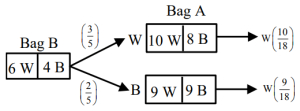
Bag $A$ contains $9$ white and $8$ black balls,while bag $B$ contains $6$ white and $4$ black balls. One ball is randomly picked up from bag $B$ and mixed with the balls in bag $A$. Then a ball is randomly drawn from bag $A$. If the probability that the ball drawn is white is $p/q$ (where $gcd(p,q)=1$),then $p+q$ is equal to:
A
$22$
B
$23$
C
$24$
D
$21$
Solution
(B) Let $W_B$ be the event of picking a white ball from bag $B$,and $B_B$ be the event of picking a black ball from bag $B$.
$P(W_B) = \frac{6}{6+4} = \frac{6}{10} = \frac{3}{5}$
$P(B_B) = \frac{4}{6+4} = \frac{4}{10} = \frac{2}{5}$
If a white ball is transferred to bag $A$,bag $A$ now contains $10$ white and $8$ black balls (total $18$). The probability of drawing a white ball from bag $A$ is $P(W_A | W_B) = \frac{10}{18}$.
If a black ball is transferred to bag $A$,bag $A$ now contains $9$ white and $9$ black balls (total $18$). The probability of drawing a white ball from bag $A$ is $P(W_A | B_B) = \frac{9}{18}$.
Using the law of total probability:
$P(W_A) = P(W_B) \times P(W_A | W_B) + P(B_B) \times P(W_A | B_B)$
$P(W_A) = \frac{3}{5} \times \frac{10}{18} + \frac{2}{5} \times \frac{9}{18}$
$P(W_A) = \frac{30}{90} + \frac{18}{90} = \frac{48}{90} = \frac{8}{15}$
Thus,$p=8$ and $q=15$. Since $gcd(8,15)=1$,$p+q = 8+15 = 23$.
$P(W_B) = \frac{6}{6+4} = \frac{6}{10} = \frac{3}{5}$
$P(B_B) = \frac{4}{6+4} = \frac{4}{10} = \frac{2}{5}$
If a white ball is transferred to bag $A$,bag $A$ now contains $10$ white and $8$ black balls (total $18$). The probability of drawing a white ball from bag $A$ is $P(W_A | W_B) = \frac{10}{18}$.
If a black ball is transferred to bag $A$,bag $A$ now contains $9$ white and $9$ black balls (total $18$). The probability of drawing a white ball from bag $A$ is $P(W_A | B_B) = \frac{9}{18}$.
Using the law of total probability:
$P(W_A) = P(W_B) \times P(W_A | W_B) + P(B_B) \times P(W_A | B_B)$
$P(W_A) = \frac{3}{5} \times \frac{10}{18} + \frac{2}{5} \times \frac{9}{18}$
$P(W_A) = \frac{30}{90} + \frac{18}{90} = \frac{48}{90} = \frac{8}{15}$
Thus,$p=8$ and $q=15$. Since $gcd(8,15)=1$,$p+q = 8+15 = 23$.
0 likes
View Solution240
MediumMCQ
Two events $E$ and $F$ are independent. If $P(E) = \frac{3}{5}$ and $P(F) = \frac{3}{10}$,then $P(E'/F) + P(F'/E) = \text{ . . . . . . }$
A
$\frac{1}{10}$
B
$\frac{11}{10}$
C
$\frac{9}{10}$
D
$\frac{10}{11}$
Solution
(B) Since $E$ and $F$ are independent events,the occurrence of one does not affect the probability of the other. Therefore,$E'$ and $F$ are independent,and $F'$ and $E$ are independent.
$P(E'/F) = P(E') = 1 - P(E) = 1 - \frac{3}{5} = \frac{2}{5}$.
Similarly,$P(F'/E) = P(F') = 1 - P(F) = 1 - \frac{3}{10} = \frac{7}{10}$.
Thus,$P(E'/F) + P(F'/E) = \frac{2}{5} + \frac{7}{10} = \frac{4}{10} + \frac{7}{10} = \frac{11}{10}$.
$P(E'/F) = P(E') = 1 - P(E) = 1 - \frac{3}{5} = \frac{2}{5}$.
Similarly,$P(F'/E) = P(F') = 1 - P(F) = 1 - \frac{3}{10} = \frac{7}{10}$.
Thus,$P(E'/F) + P(F'/E) = \frac{2}{5} + \frac{7}{10} = \frac{4}{10} + \frac{7}{10} = \frac{11}{10}$.
0 likes
View Solution241
MediumMCQ
Let $A$ and $B$ be two events such that $P(A) = \frac{3}{8}$,$P(B) = \frac{5}{8}$ and $P(A \cup B) = \frac{3}{4}$. Then $P(A'|B) - P(A|B) =$ . . . . . .
A
$\frac{1}{5}$
B
$\frac{3}{5}$
C
$\frac{2}{5}$
D
$\frac{4}{5}$
Solution
(A) We know that $P(A \cup B) = P(A) + P(B) - P(A \cap B)$.
Substituting the given values: $\frac{3}{4} = \frac{3}{8} + \frac{5}{8} - P(A \cap B)$.
$\frac{3}{4} = 1 - P(A \cap B) \Rightarrow P(A \cap B) = 1 - \frac{3}{4} = \frac{1}{4}$.
Now,calculate $P(A|B) = \frac{P(A \cap B)}{P(B)} = \frac{1/4}{5/8} = \frac{1}{4} \times \frac{8}{5} = \frac{2}{5}$.
Since $P(A'|B) = 1 - P(A|B)$,we have $P(A'|B) = 1 - \frac{2}{5} = \frac{3}{5}$.
Finally,$P(A'|B) - P(A|B) = \frac{3}{5} - \frac{2}{5} = \frac{1}{5}$.
Substituting the given values: $\frac{3}{4} = \frac{3}{8} + \frac{5}{8} - P(A \cap B)$.
$\frac{3}{4} = 1 - P(A \cap B) \Rightarrow P(A \cap B) = 1 - \frac{3}{4} = \frac{1}{4}$.
Now,calculate $P(A|B) = \frac{P(A \cap B)}{P(B)} = \frac{1/4}{5/8} = \frac{1}{4} \times \frac{8}{5} = \frac{2}{5}$.
Since $P(A'|B) = 1 - P(A|B)$,we have $P(A'|B) = 1 - \frac{2}{5} = \frac{3}{5}$.
Finally,$P(A'|B) - P(A|B) = \frac{3}{5} - \frac{2}{5} = \frac{1}{5}$.
0 likes
View Solution242
MediumMCQ
If $A$ and $B$ are any two events such that $P(A) + P(B) - P(A \cap B) = P(A)$,then $\dots \dots \dots$
A
$P(A|B) = 1$
B
$P(B|A) = 1$
C
$P(B|A) = 0$
D
$P(A|B) = 0$
Solution
(A) Given the equation $P(A) + P(B) - P(A \cap B) = P(A)$.
Subtracting $P(A)$ from both sides,we get $P(B) - P(A \cap B) = 0$,which implies $P(B) = P(A \cap B)$.
This equality indicates that $B \subseteq A$,meaning all outcomes of event $B$ are contained within event $A$.
By the definition of conditional probability,$P(A|B) = \frac{P(A \cap B)}{P(B)}$.
Since $P(A \cap B) = P(B)$,we substitute this into the formula:
$P(A|B) = \frac{P(B)}{P(B)} = 1$ (assuming $P(B) \neq 0$).
Subtracting $P(A)$ from both sides,we get $P(B) - P(A \cap B) = 0$,which implies $P(B) = P(A \cap B)$.
This equality indicates that $B \subseteq A$,meaning all outcomes of event $B$ are contained within event $A$.
By the definition of conditional probability,$P(A|B) = \frac{P(A \cap B)}{P(B)}$.
Since $P(A \cap B) = P(B)$,we substitute this into the formula:
$P(A|B) = \frac{P(B)}{P(B)} = 1$ (assuming $P(B) \neq 0$).
0 likes
View Solution243
MediumMCQ
Let $A$ and $B$ be two events such that $P(A) = \frac{5}{11}$,$P(B) = \frac{2}{11}$,and $P(A \cup B) = \frac{3}{11}$,then $P(A'|B')$ is . . . . . . .
A
$\frac{1}{2}$
B
$\frac{8}{9}$
C
$\frac{3}{5}$
D
$\frac{2}{9}$
Solution
(B) We use the definition of conditional probability: $P(A'|B') = \frac{P(A' \cap B')}{P(B')}$.
By De Morgan's Law,$A' \cap B' = (A \cup B)'$.
Therefore,$P(A' \cap B') = P((A \cup B)') = 1 - P(A \cup B)$.
Given $P(A \cup B) = \frac{3}{11}$,we have $P(A' \cap B') = 1 - \frac{3}{11} = \frac{8}{11}$.
Also,$P(B') = 1 - P(B) = 1 - \frac{2}{11} = \frac{9}{11}$.
Substituting these values into the formula:
$P(A'|B') = \frac{8/11}{9/11} = \frac{8}{9}$.
By De Morgan's Law,$A' \cap B' = (A \cup B)'$.
Therefore,$P(A' \cap B') = P((A \cup B)') = 1 - P(A \cup B)$.
Given $P(A \cup B) = \frac{3}{11}$,we have $P(A' \cap B') = 1 - \frac{3}{11} = \frac{8}{11}$.
Also,$P(B') = 1 - P(B) = 1 - \frac{2}{11} = \frac{9}{11}$.
Substituting these values into the formula:
$P(A'|B') = \frac{8/11}{9/11} = \frac{8}{9}$.
0 likes
View SolutionProbability — Conditional probability · Frequently Asked Questions
1Are these Probability questions useful for JEE and NEET?
Yes. All questions in this section are mapped to JEE Main and NEET exam patterns. Previous year questions from JEE Main, NEET, GUJCET and state-level exams are included with full solutions.
2Can I switch to Hindi or Gujarati for these questions?
Yes. Use the language tabs in the hero section or the sidebar to view the same questions and solutions in English, Hindi or Gujarati.
3How do I generate a question paper from this subtopic?
Use the Vedclass Exam Paper Generator — select the chapter and subtopic, set difficulty, and generate Sets A, B, C, D automatically. First 3 chapters of every subject are free.
Vedclass Products
For Students
Vedclass Test Series
Mock tests in real JEE/NEET style with performance analysis. 5-day free trial.
Start Free TrialFor Teachers
Exam Paper Generator
Generate Set A/B/C/D papers from this chapter in 2 minutes. 3 chapters free.
Try FreeFor Institutes
Online Exam Module
Live online exams with unlimited students, 360° analytics & white-label branding.
See DemoFor Teachers & Institutes
Generate a Probability Exam Paper in 2 Minutes
Select subtopic & difficulty — Sets A, B, C, D auto-generated with No Repeat logic.
First 3 chapters of every subject are free — no payment required.