
A English
Linear differential equations Questions in English
Class 12 Mathematics · Differential Equations · Linear differential equations
475+
Questions
English
Language
100%
With Solutions
Showing 50 of 475 questions in English
201
DifficultMCQ
Let $x = x(y)$ be the solution of the differential equation $2(y + 2) \log_e(y + 2) dx + (x + 4 - 2 \log_e(y + 2)) dy = 0$,$y > -1$ with $x(e^4 - 2) = 1$. Then $x(e^9 - 2)$ is equal to
A
$\frac{4}{9}$
B
$\frac{10}{3}$
C
$\frac{32}{9}$
D
$3$
Solution
(C) The given differential equation is $2(y + 2) \ln(y + 2) dx + (x + 4 - 2 \ln(y + 2)) dy = 0$.
Rearranging,we get $\frac{dx}{dy} = -\frac{x + 4 - 2 \ln(y + 2)}{2(y + 2) \ln(y + 2)}$.
This can be written as $2(y + 2) \ln(y + 2) \frac{dx}{dy} + x = 2 \ln(y + 2) - 4$.
Let $t = \ln(y + 2)$,then $dt = \frac{1}{y + 2} dy$,so $dy = (y + 2) dt$.
The equation becomes $2t \frac{dx}{dt} + x = 2t - 4$,or $\frac{dx}{dt} + \frac{x}{2t} = 1 - \frac{2}{t}$.
This is a linear differential equation in $x$ with respect to $t$.
The integrating factor is $IF = e^{\int \frac{1}{2t} dt} = e^{\frac{1}{2} \ln t} = \sqrt{t}$.
Multiplying by $IF$,we get $\frac{d}{dt}(x \sqrt{t}) = \sqrt{t} - \frac{2}{\sqrt{t}}$.
Integrating both sides,$x \sqrt{t} = \int (t^{1/2} - 2t^{-1/2}) dt = \frac{2}{3} t^{3/2} - 4t^{1/2} + C$.
Dividing by $\sqrt{t}$,$x = \frac{2}{3} t - 4 + \frac{C}{\sqrt{t}}$.
Substituting $t = \ln(y + 2)$,$x = \frac{2}{3} \ln(y + 2) - 4 + \frac{C}{\sqrt{\ln(y + 2)}}$.
Given $x(e^4 - 2) = 1$,so $y = e^4 - 2$,$t = \ln(e^4) = 4$,$x = 1$.
$1 = \frac{2}{3}(4) - 4 + \frac{C}{\sqrt{4}} \implies 1 = \frac{8}{3} - 4 + \frac{C}{2} \implies 1 = -\frac{4}{3} + \frac{C}{2} \implies \frac{C}{2} = \frac{7}{3} \implies C = \frac{14}{3}$.
Now find $x(e^9 - 2)$,so $y = e^9 - 2$,$t = \ln(e^9) = 9$.
$x = \frac{2}{3}(9) - 4 + \frac{14/3}{\sqrt{9}} = 6 - 4 + \frac{14/3}{3} = 2 + \frac{14}{9} = \frac{32}{9}$.
Rearranging,we get $\frac{dx}{dy} = -\frac{x + 4 - 2 \ln(y + 2)}{2(y + 2) \ln(y + 2)}$.
This can be written as $2(y + 2) \ln(y + 2) \frac{dx}{dy} + x = 2 \ln(y + 2) - 4$.
Let $t = \ln(y + 2)$,then $dt = \frac{1}{y + 2} dy$,so $dy = (y + 2) dt$.
The equation becomes $2t \frac{dx}{dt} + x = 2t - 4$,or $\frac{dx}{dt} + \frac{x}{2t} = 1 - \frac{2}{t}$.
This is a linear differential equation in $x$ with respect to $t$.
The integrating factor is $IF = e^{\int \frac{1}{2t} dt} = e^{\frac{1}{2} \ln t} = \sqrt{t}$.
Multiplying by $IF$,we get $\frac{d}{dt}(x \sqrt{t}) = \sqrt{t} - \frac{2}{\sqrt{t}}$.
Integrating both sides,$x \sqrt{t} = \int (t^{1/2} - 2t^{-1/2}) dt = \frac{2}{3} t^{3/2} - 4t^{1/2} + C$.
Dividing by $\sqrt{t}$,$x = \frac{2}{3} t - 4 + \frac{C}{\sqrt{t}}$.
Substituting $t = \ln(y + 2)$,$x = \frac{2}{3} \ln(y + 2) - 4 + \frac{C}{\sqrt{\ln(y + 2)}}$.
Given $x(e^4 - 2) = 1$,so $y = e^4 - 2$,$t = \ln(e^4) = 4$,$x = 1$.
$1 = \frac{2}{3}(4) - 4 + \frac{C}{\sqrt{4}} \implies 1 = \frac{8}{3} - 4 + \frac{C}{2} \implies 1 = -\frac{4}{3} + \frac{C}{2} \implies \frac{C}{2} = \frac{7}{3} \implies C = \frac{14}{3}$.
Now find $x(e^9 - 2)$,so $y = e^9 - 2$,$t = \ln(e^9) = 9$.
$x = \frac{2}{3}(9) - 4 + \frac{14/3}{\sqrt{9}} = 6 - 4 + \frac{14/3}{3} = 2 + \frac{14}{9} = \frac{32}{9}$.
0 likes
View Solution202
MediumMCQ
$A$ function $y=f(x)$ satisfies $f(x) \sin 2x + \sin x - (1 + \cos^2 x) f'(x) = 0$ with the condition $f(0) = 0$. Then $f(\frac{\pi}{2})$ is equal to
A
$1$
B
$0$
C
$-1$
D
$2$
Solution
(A) The given differential equation is $(1 + \cos^2 x) \frac{dy}{dx} - (\sin 2x) y = \sin x$.
Dividing by $(1 + \cos^2 x)$,we get $\frac{dy}{dx} - \left( \frac{\sin 2x}{1 + \cos^2 x} \right) y = \frac{\sin x}{1 + \cos^2 x}$.
This is a linear differential equation of the form $\frac{dy}{dx} + P(x)y = Q(x)$,where $P(x) = -\frac{\sin 2x}{1 + \cos^2 x}$ and $Q(x) = \frac{\sin x}{1 + \cos^2 x}$.
The integrating factor $I.F. = e^{\int P(x) dx} = e^{-\int \frac{\sin 2x}{1 + \cos^2 x} dx}$.
Let $u = 1 + \cos^2 x$,then $du = -2 \cos x \sin x dx = -\sin 2x dx$.
So,$I.F. = e^{\int \frac{du}{u}} = e^{\ln(u)} = 1 + \cos^2 x$.
The general solution is $y \cdot (I.F.) = \int Q(x) \cdot (I.F.) dx + C$.
$y(1 + \cos^2 x) = \int \left( \frac{\sin x}{1 + \cos^2 x} \right) (1 + \cos^2 x) dx = \int \sin x dx = -\cos x + C$.
Given $f(0) = 0$,at $x = 0$,$y(1 + \cos^2 0) = -\cos 0 + C \implies 0(2) = -1 + C \implies C = 1$.
Thus,$y(1 + \cos^2 x) = 1 - \cos x$.
At $x = \frac{\pi}{2}$,$y(1 + \cos^2 \frac{\pi}{2}) = 1 - \cos \frac{\pi}{2} \implies y(1 + 0) = 1 - 0 \implies y = 1$.
Dividing by $(1 + \cos^2 x)$,we get $\frac{dy}{dx} - \left( \frac{\sin 2x}{1 + \cos^2 x} \right) y = \frac{\sin x}{1 + \cos^2 x}$.
This is a linear differential equation of the form $\frac{dy}{dx} + P(x)y = Q(x)$,where $P(x) = -\frac{\sin 2x}{1 + \cos^2 x}$ and $Q(x) = \frac{\sin x}{1 + \cos^2 x}$.
The integrating factor $I.F. = e^{\int P(x) dx} = e^{-\int \frac{\sin 2x}{1 + \cos^2 x} dx}$.
Let $u = 1 + \cos^2 x$,then $du = -2 \cos x \sin x dx = -\sin 2x dx$.
So,$I.F. = e^{\int \frac{du}{u}} = e^{\ln(u)} = 1 + \cos^2 x$.
The general solution is $y \cdot (I.F.) = \int Q(x) \cdot (I.F.) dx + C$.
$y(1 + \cos^2 x) = \int \left( \frac{\sin x}{1 + \cos^2 x} \right) (1 + \cos^2 x) dx = \int \sin x dx = -\cos x + C$.
Given $f(0) = 0$,at $x = 0$,$y(1 + \cos^2 0) = -\cos 0 + C \implies 0(2) = -1 + C \implies C = 1$.
Thus,$y(1 + \cos^2 x) = 1 - \cos x$.
At $x = \frac{\pi}{2}$,$y(1 + \cos^2 \frac{\pi}{2}) = 1 - \cos \frac{\pi}{2} \implies y(1 + 0) = 1 - 0 \implies y = 1$.
0 likes
View Solution203
DifficultMCQ
Let $y=y(x)$ be the solution of the differential equation $\sec x \, dy + \{2(1-x) \tan x + x(2-x)\} \, dx = 0$ such that $y(0)=2$. Then $y(2)$ is equal to :
A
$2$
B
$2\{1-\sin(2)\}$
C
$2\{\sin(2)+1\}$
D
$1$
Solution
(A) The given differential equation is $\sec x \, dy = -\{2(1-x) \tan x + x(2-x)\} \, dx$.
Dividing by $\sec x$,we get $\frac{dy}{dx} = -\{2(1-x) \sin x + x(2-x) \cos x\}$.
This simplifies to $\frac{dy}{dx} = 2(x-1) \sin x + (x^2-2x) \cos x$.
Integrating both sides with respect to $x$:
$y(x) = \int 2(x-1) \sin x \, dx + \int (x^2-2x) \cos x \, dx$.
Using integration by parts on the second term: $\int (x^2-2x) \cos x \, dx = (x^2-2x) \sin x - \int (2x-2) \sin x \, dx$.
Substituting this back: $y(x) = \int 2(x-1) \sin x \, dx + (x^2-2x) \sin x - \int 2(x-1) \sin x \, dx + C$.
Thus,$y(x) = (x^2-2x) \sin x + C$.
Given $y(0)=2$,we have $2 = (0^2-2(0)) \sin(0) + C$,which implies $C=2$.
So,$y(x) = (x^2-2x) \sin x + 2$.
For $x=2$,$y(2) = (2^2-2(2)) \sin(2) + 2 = (4-4) \sin(2) + 2 = 2$.
Dividing by $\sec x$,we get $\frac{dy}{dx} = -\{2(1-x) \sin x + x(2-x) \cos x\}$.
This simplifies to $\frac{dy}{dx} = 2(x-1) \sin x + (x^2-2x) \cos x$.
Integrating both sides with respect to $x$:
$y(x) = \int 2(x-1) \sin x \, dx + \int (x^2-2x) \cos x \, dx$.
Using integration by parts on the second term: $\int (x^2-2x) \cos x \, dx = (x^2-2x) \sin x - \int (2x-2) \sin x \, dx$.
Substituting this back: $y(x) = \int 2(x-1) \sin x \, dx + (x^2-2x) \sin x - \int 2(x-1) \sin x \, dx + C$.
Thus,$y(x) = (x^2-2x) \sin x + C$.
Given $y(0)=2$,we have $2 = (0^2-2(0)) \sin(0) + C$,which implies $C=2$.
So,$y(x) = (x^2-2x) \sin x + 2$.
For $x=2$,$y(2) = (2^2-2(2)) \sin(2) + 2 = (4-4) \sin(2) + 2 = 2$.
0 likes
View Solution204
DifficultMCQ
Let $y=y(x)$ be the solution of the differential equation $(1-x^2) dy = [xy + (x^3+2) \sqrt{3(1-x^2)}] dx$ for $-1 < x < 1$,with $y(0)=0$. If $y(1/2) = m/n$,where $m$ and $n$ are coprime numbers,then $m+n$ is equal to . . . . . . . . . .
A
$91$
B
$92$
C
$97$
D
$77$
Solution
(C) The given differential equation is $(1-x^2) dy = [xy + (x^3+2) \sqrt{3(1-x^2)}] dx$.
Dividing by $(1-x^2) dx$,we get $\frac{dy}{dx} - \frac{x}{1-x^2} y = \frac{(x^3+2) \sqrt{3(1-x^2)}}{1-x^2}$.
This is a linear differential equation of the form $\frac{dy}{dx} + P(x)y = Q(x)$,where $P(x) = -\frac{x}{1-x^2}$ and $Q(x) = \frac{(x^3+2) \sqrt{3}}{\sqrt{1-x^2}}$.
The integrating factor $IF = e^{\int P(x) dx} = e^{-\int \frac{x}{1-x^2} dx} = e^{\frac{1}{2} \ln(1-x^2)} = \sqrt{1-x^2}$.
The general solution is $y \cdot IF = \int Q(x) \cdot IF dx + C$.
$y \sqrt{1-x^2} = \int \frac{(x^3+2) \sqrt{3}}{\sqrt{1-x^2}} \cdot \sqrt{1-x^2} dx + C = \sqrt{3} \int (x^3+2) dx + C$.
$y \sqrt{1-x^2} = \sqrt{3} (\frac{x^4}{4} + 2x) + C$.
Given $y(0)=0$,we have $0 = \sqrt{3}(0) + C$,so $C=0$.
Thus,$y \sqrt{1-x^2} = \sqrt{3} (\frac{x^4}{4} + 2x)$.
For $x = 1/2$,$y \sqrt{1 - 1/4} = \sqrt{3} (\frac{(1/2)^4}{4} + 2(1/2)) = \sqrt{3} (\frac{1}{64} + 1) = \sqrt{3} (\frac{65}{64})$.
$y \sqrt{3/4} = y \frac{\sqrt{3}}{2} = \sqrt{3} \frac{65}{64}$.
$y = \frac{65}{64} \times 2 = \frac{65}{32}$.
Since $m=65$ and $n=32$ are coprime,$m+n = 65+32 = 97$.
Dividing by $(1-x^2) dx$,we get $\frac{dy}{dx} - \frac{x}{1-x^2} y = \frac{(x^3+2) \sqrt{3(1-x^2)}}{1-x^2}$.
This is a linear differential equation of the form $\frac{dy}{dx} + P(x)y = Q(x)$,where $P(x) = -\frac{x}{1-x^2}$ and $Q(x) = \frac{(x^3+2) \sqrt{3}}{\sqrt{1-x^2}}$.
The integrating factor $IF = e^{\int P(x) dx} = e^{-\int \frac{x}{1-x^2} dx} = e^{\frac{1}{2} \ln(1-x^2)} = \sqrt{1-x^2}$.
The general solution is $y \cdot IF = \int Q(x) \cdot IF dx + C$.
$y \sqrt{1-x^2} = \int \frac{(x^3+2) \sqrt{3}}{\sqrt{1-x^2}} \cdot \sqrt{1-x^2} dx + C = \sqrt{3} \int (x^3+2) dx + C$.
$y \sqrt{1-x^2} = \sqrt{3} (\frac{x^4}{4} + 2x) + C$.
Given $y(0)=0$,we have $0 = \sqrt{3}(0) + C$,so $C=0$.
Thus,$y \sqrt{1-x^2} = \sqrt{3} (\frac{x^4}{4} + 2x)$.
For $x = 1/2$,$y \sqrt{1 - 1/4} = \sqrt{3} (\frac{(1/2)^4}{4} + 2(1/2)) = \sqrt{3} (\frac{1}{64} + 1) = \sqrt{3} (\frac{65}{64})$.
$y \sqrt{3/4} = y \frac{\sqrt{3}}{2} = \sqrt{3} \frac{65}{64}$.
$y = \frac{65}{64} \times 2 = \frac{65}{32}$.
Since $m=65$ and $n=32$ are coprime,$m+n = 65+32 = 97$.
0 likes
View Solution205
DifficultMCQ
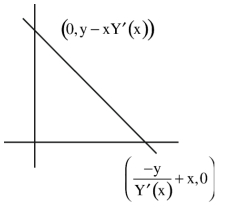
Let $Y=Y(X)$ be a curve lying in the first quadrant such that the area enclosed by the tangent line $Y-y=Y^{\prime}(x)(X-x)$ and the coordinate axes,where $(x, y)$ is any point on the curve,is always $\frac{-y^2}{2 Y^{\prime}(x)}+1$,where $Y^{\prime}(x) \neq 0$. If $Y(1)=1$,then $12 Y(2)$ equals
A
$20$
B
$10$
C
$11$
D
$15$
Solution
(A) The equation of the tangent at $(x, y)$ is $Y-y=Y^{\prime}(x)(X-x)$.
For $X=0$,$Y=y-x Y^{\prime}(x)$.
For $Y=0$,$X=x-\frac{y}{Y^{\prime}(x)}$.
The area of the triangle formed by the tangent and the coordinate axes is $A = \frac{1}{2} \left| x - \frac{y}{Y^{\prime}(x)} \right| \left| y - x Y^{\prime}(x) \right|$.
Since the curve is in the first quadrant and the area is given as $\frac{-y^2}{2 Y^{\prime}(x)}+1$,we have:
$A = \frac{1}{2} \left( \frac{x Y^{\prime}(x) - y}{Y^{\prime}(x)} \right) (y - x Y^{\prime}(x)) = \frac{-y^2}{2 Y^{\prime}(x)} + 1$.
Multiplying by $2 Y^{\prime}(x)$:
$-(y - x Y^{\prime}(x))^2 = -y^2 + 2 Y^{\prime}(x)$.
$-y^2 + 2xy Y^{\prime}(x) - x^2 (Y^{\prime}(x))^2 = -y^2 + 2 Y^{\prime}(x)$.
$2xy Y^{\prime}(x) - x^2 (Y^{\prime}(x))^2 = 2 Y^{\prime}(x)$.
Since $Y^{\prime}(x) \neq 0$,we divide by $Y^{\prime}(x)$:
$2xy - x^2 Y^{\prime}(x) = 2$.
$Y^{\prime}(x) = \frac{2xy - 2}{x^2} = \frac{2y}{x} - \frac{2}{x^2}$.
This is a linear differential equation: $\frac{dy}{dx} - \frac{2}{x} y = -\frac{2}{x^2}$.
Integrating factor $I.F. = e^{\int -\frac{2}{x} dx} = e^{-2 \ln x} = \frac{1}{x^2}$.
The solution is $y \cdot \frac{1}{x^2} = \int \left( -\frac{2}{x^2} \cdot \frac{1}{x^2} \right) dx = \int -2 x^{-4} dx = \frac{2}{3} x^{-3} + C$.
$y = \frac{2}{3x} + C x^2$.
Given $Y(1)=1$,$1 = \frac{2}{3} + C \Rightarrow C = \frac{1}{3}$.
So,$Y(x) = \frac{2}{3x} + \frac{x^2}{3}$.
$Y(2) = \frac{2}{3(2)} + \frac{4}{3} = \frac{1}{3} + \frac{4}{3} = \frac{5}{3}$.
$12 Y(2) = 12 \times \frac{5}{3} = 20$.
For $X=0$,$Y=y-x Y^{\prime}(x)$.
For $Y=0$,$X=x-\frac{y}{Y^{\prime}(x)}$.
The area of the triangle formed by the tangent and the coordinate axes is $A = \frac{1}{2} \left| x - \frac{y}{Y^{\prime}(x)} \right| \left| y - x Y^{\prime}(x) \right|$.
Since the curve is in the first quadrant and the area is given as $\frac{-y^2}{2 Y^{\prime}(x)}+1$,we have:
$A = \frac{1}{2} \left( \frac{x Y^{\prime}(x) - y}{Y^{\prime}(x)} \right) (y - x Y^{\prime}(x)) = \frac{-y^2}{2 Y^{\prime}(x)} + 1$.
Multiplying by $2 Y^{\prime}(x)$:
$-(y - x Y^{\prime}(x))^2 = -y^2 + 2 Y^{\prime}(x)$.
$-y^2 + 2xy Y^{\prime}(x) - x^2 (Y^{\prime}(x))^2 = -y^2 + 2 Y^{\prime}(x)$.
$2xy Y^{\prime}(x) - x^2 (Y^{\prime}(x))^2 = 2 Y^{\prime}(x)$.
Since $Y^{\prime}(x) \neq 0$,we divide by $Y^{\prime}(x)$:
$2xy - x^2 Y^{\prime}(x) = 2$.
$Y^{\prime}(x) = \frac{2xy - 2}{x^2} = \frac{2y}{x} - \frac{2}{x^2}$.
This is a linear differential equation: $\frac{dy}{dx} - \frac{2}{x} y = -\frac{2}{x^2}$.
Integrating factor $I.F. = e^{\int -\frac{2}{x} dx} = e^{-2 \ln x} = \frac{1}{x^2}$.
The solution is $y \cdot \frac{1}{x^2} = \int \left( -\frac{2}{x^2} \cdot \frac{1}{x^2} \right) dx = \int -2 x^{-4} dx = \frac{2}{3} x^{-3} + C$.
$y = \frac{2}{3x} + C x^2$.
Given $Y(1)=1$,$1 = \frac{2}{3} + C \Rightarrow C = \frac{1}{3}$.
So,$Y(x) = \frac{2}{3x} + \frac{x^2}{3}$.
$Y(2) = \frac{2}{3(2)} + \frac{4}{3} = \frac{1}{3} + \frac{4}{3} = \frac{5}{3}$.
$12 Y(2) = 12 \times \frac{5}{3} = 20$.
0 likes
View Solution206
DifficultMCQ
Let $y=y(x)$ be the solution of the differential equation $\frac{d y}{d x}=\frac{(\tan x)+y}{\sin x(\sec x-\sin x \tan x)}$,$x \in\left(0, \frac{\pi}{2}\right)$ satisfying the condition $y\left(\frac{\pi}{4}\right)=2$. Then,$y\left(\frac{\pi}{3}\right)$ is
A
$\sqrt{3}\left(2+\log _{e} \sqrt{3}\right)$
B
$\frac{\sqrt{3}}{2}\left(2+\log _e 3\right)$
C
$\sqrt{3}\left(1+2 \log _e 3\right)$
D
$\sqrt{3}\left(2+\log _e 3\right)$
Solution
(A) The given differential equation is $\frac{d y}{d x}=\frac{\tan x+y}{\sin x(\sec x-\sin x \tan x)}$.
Simplifying the denominator: $\sin x(\frac{1}{\cos x}-\frac{\sin^2 x}{\cos x}) = \sin x(\frac{1-\sin^2 x}{\cos x}) = \sin x(\frac{\cos^2 x}{\cos x}) = \sin x \cos x$.
So,$\frac{d y}{d x} = \frac{\tan x + y}{\sin x \cos x} = \frac{\tan x}{\sin x \cos x} + \frac{y}{\sin x \cos x} = \sec^2 x + y(2 \csc 2x)$.
This is a linear differential equation of the form $\frac{d y}{d x} - (2 \csc 2x)y = \sec^2 x$.
The integrating factor $I.F. = e^{\int -2 \csc 2x dx} = e^{-\ln|\tan x|} = \frac{1}{\tan x}$ (since $x \in (0, \pi/2)$).
The general solution is $y \cdot \frac{1}{\tan x} = \int \sec^2 x \cdot \frac{1}{\tan x} dx + c$.
Let $\tan x = t$,then $\sec^2 x dx = dt$. So,$y \cot x = \int \frac{1}{t} dt + c = \ln|t| + c = \ln(\tan x) + c$.
Thus,$y = \tan x (\ln(\tan x) + c)$.
Given $y(\frac{\pi}{4}) = 2$,we have $2 = \tan(\frac{\pi}{4})(\ln(\tan(\frac{\pi}{4})) + c) = 1(0 + c)$,so $c = 2$.
The solution is $y = \tan x (\ln(\tan x) + 2)$.
For $x = \frac{\pi}{3}$,$y(\frac{\pi}{3}) = \tan(\frac{\pi}{3})(\ln(\tan(\frac{\pi}{3})) + 2) = \sqrt{3}(\ln \sqrt{3} + 2) = \sqrt{3}(\frac{1}{2} \ln 3 + 2) = \sqrt{3}(2 + \log_e \sqrt{3})$.
Simplifying the denominator: $\sin x(\frac{1}{\cos x}-\frac{\sin^2 x}{\cos x}) = \sin x(\frac{1-\sin^2 x}{\cos x}) = \sin x(\frac{\cos^2 x}{\cos x}) = \sin x \cos x$.
So,$\frac{d y}{d x} = \frac{\tan x + y}{\sin x \cos x} = \frac{\tan x}{\sin x \cos x} + \frac{y}{\sin x \cos x} = \sec^2 x + y(2 \csc 2x)$.
This is a linear differential equation of the form $\frac{d y}{d x} - (2 \csc 2x)y = \sec^2 x$.
The integrating factor $I.F. = e^{\int -2 \csc 2x dx} = e^{-\ln|\tan x|} = \frac{1}{\tan x}$ (since $x \in (0, \pi/2)$).
The general solution is $y \cdot \frac{1}{\tan x} = \int \sec^2 x \cdot \frac{1}{\tan x} dx + c$.
Let $\tan x = t$,then $\sec^2 x dx = dt$. So,$y \cot x = \int \frac{1}{t} dt + c = \ln|t| + c = \ln(\tan x) + c$.
Thus,$y = \tan x (\ln(\tan x) + c)$.
Given $y(\frac{\pi}{4}) = 2$,we have $2 = \tan(\frac{\pi}{4})(\ln(\tan(\frac{\pi}{4})) + c) = 1(0 + c)$,so $c = 2$.
The solution is $y = \tan x (\ln(\tan x) + 2)$.
For $x = \frac{\pi}{3}$,$y(\frac{\pi}{3}) = \tan(\frac{\pi}{3})(\ln(\tan(\frac{\pi}{3})) + 2) = \sqrt{3}(\ln \sqrt{3} + 2) = \sqrt{3}(\frac{1}{2} \ln 3 + 2) = \sqrt{3}(2 + \log_e \sqrt{3})$.
0 likes
View Solution207
DifficultMCQ
Let $y=y(x)$ be the solution of the differential equation $\sec^2 x dx + (e^{2y} \tan^2 x + \tan x) dy = 0$,where $0 < x < \frac{\pi}{2}$ and $y(\frac{\pi}{4}) = 0$. If $y(\frac{\pi}{6}) = \alpha$,then $e^{8\alpha}$ is equal to:
A
$9$
B
$10$
C
$11$
D
$12$
Solution
(A) Given the differential equation: $\sec^2 x dx + (e^{2y} \tan^2 x + \tan x) dy = 0$.
Dividing by $dy$,we get: $\sec^2 x \frac{dx}{dy} + e^{2y} \tan^2 x + \tan x = 0$.
Let $t = \tan x$,then $\frac{dt}{dy} = \sec^2 x \frac{dx}{dy}$.
The equation becomes: $\frac{dt}{dy} + t = -e^{2y} t^2$.
Dividing by $t^2$: $t^{-2} \frac{dt}{dy} + t^{-1} = -e^{2y}$.
Let $u = t^{-1} = \frac{1}{\tan x}$,then $\frac{du}{dy} = -t^{-2} \frac{dt}{dy}$.
Substituting this into the equation: $-\frac{du}{dy} + u = -e^{2y}$,or $\frac{du}{dy} - u = e^{2y}$.
This is a linear differential equation with Integrating Factor $I.F. = e^{\int -1 dy} = e^{-y}$.
The solution is $u e^{-y} = \int e^{2y} e^{-y} dy = \int e^y dy = e^y + C$.
So,$\frac{1}{\tan x} e^{-y} = e^y + C$.
Given $y(\frac{\pi}{4}) = 0$,we have $\frac{1}{\tan(\pi/4)} e^0 = e^0 + C \Rightarrow 1 = 1 + C \Rightarrow C = 0$.
Thus,$\frac{1}{\tan x} e^{-y} = e^y \Rightarrow e^{2y} = \frac{1}{\tan x} = \cot x$.
For $x = \frac{\pi}{6}$,$e^{2\alpha} = \cot(\frac{\pi}{6}) = \sqrt{3}$.
Therefore,$e^{8\alpha} = (e^{2\alpha})^4 = (\sqrt{3})^4 = 9$.
Dividing by $dy$,we get: $\sec^2 x \frac{dx}{dy} + e^{2y} \tan^2 x + \tan x = 0$.
Let $t = \tan x$,then $\frac{dt}{dy} = \sec^2 x \frac{dx}{dy}$.
The equation becomes: $\frac{dt}{dy} + t = -e^{2y} t^2$.
Dividing by $t^2$: $t^{-2} \frac{dt}{dy} + t^{-1} = -e^{2y}$.
Let $u = t^{-1} = \frac{1}{\tan x}$,then $\frac{du}{dy} = -t^{-2} \frac{dt}{dy}$.
Substituting this into the equation: $-\frac{du}{dy} + u = -e^{2y}$,or $\frac{du}{dy} - u = e^{2y}$.
This is a linear differential equation with Integrating Factor $I.F. = e^{\int -1 dy} = e^{-y}$.
The solution is $u e^{-y} = \int e^{2y} e^{-y} dy = \int e^y dy = e^y + C$.
So,$\frac{1}{\tan x} e^{-y} = e^y + C$.
Given $y(\frac{\pi}{4}) = 0$,we have $\frac{1}{\tan(\pi/4)} e^0 = e^0 + C \Rightarrow 1 = 1 + C \Rightarrow C = 0$.
Thus,$\frac{1}{\tan x} e^{-y} = e^y \Rightarrow e^{2y} = \frac{1}{\tan x} = \cot x$.
For $x = \frac{\pi}{6}$,$e^{2\alpha} = \cot(\frac{\pi}{6}) = \sqrt{3}$.
Therefore,$e^{8\alpha} = (e^{2\alpha})^4 = (\sqrt{3})^4 = 9$.
0 likes
View Solution208
DifficultMCQ
If $x=x(t)$ is the solution of the differential equation $(t+1) dx = (2x + (t+1)^4) dt$ with the initial condition $x(0) = 2$,then $x(1)$ equals:
A
$14$
B
$15$
C
$16$
D
$17$
Solution
(A) Given the differential equation: $(t+1) dx = (2x + (t+1)^4) dt$.
Rearranging into the standard linear form $\frac{dx}{dt} + P(t)x = Q(t)$:
$\frac{dx}{dt} = \frac{2x + (t+1)^4}{t+1} = \frac{2x}{t+1} + (t+1)^3$.
$\frac{dx}{dt} - \frac{2}{t+1}x = (t+1)^3$.
The integrating factor $I.F. = e^{\int -\frac{2}{t+1} dt} = e^{-2 \ln(t+1)} = (t+1)^{-2} = \frac{1}{(t+1)^2}$.
Multiplying both sides by $I.F.$:
$\frac{d}{dt} \left( \frac{x}{(t+1)^2} \right) = (t+1)^3 \cdot \frac{1}{(t+1)^2} = (t+1)$.
Integrating both sides with respect to $t$:
$\frac{x}{(t+1)^2} = \int (t+1) dt = \frac{(t+1)^2}{2} + C$.
Using the initial condition $x(0) = 2$:
$\frac{2}{(0+1)^2} = \frac{(0+1)^2}{2} + C \Rightarrow 2 = \frac{1}{2} + C \Rightarrow C = \frac{3}{2}$.
Thus,the solution is $x = \frac{(t+1)^4}{2} + \frac{3}{2}(t+1)^2$.
For $t=1$:
$x(1) = \frac{(1+1)^4}{2} + \frac{3}{2}(1+1)^2 = \frac{16}{2} + \frac{3}{2}(4) = 8 + 6 = 14$.
Rearranging into the standard linear form $\frac{dx}{dt} + P(t)x = Q(t)$:
$\frac{dx}{dt} = \frac{2x + (t+1)^4}{t+1} = \frac{2x}{t+1} + (t+1)^3$.
$\frac{dx}{dt} - \frac{2}{t+1}x = (t+1)^3$.
The integrating factor $I.F. = e^{\int -\frac{2}{t+1} dt} = e^{-2 \ln(t+1)} = (t+1)^{-2} = \frac{1}{(t+1)^2}$.
Multiplying both sides by $I.F.$:
$\frac{d}{dt} \left( \frac{x}{(t+1)^2} \right) = (t+1)^3 \cdot \frac{1}{(t+1)^2} = (t+1)$.
Integrating both sides with respect to $t$:
$\frac{x}{(t+1)^2} = \int (t+1) dt = \frac{(t+1)^2}{2} + C$.
Using the initial condition $x(0) = 2$:
$\frac{2}{(0+1)^2} = \frac{(0+1)^2}{2} + C \Rightarrow 2 = \frac{1}{2} + C \Rightarrow C = \frac{3}{2}$.
Thus,the solution is $x = \frac{(t+1)^4}{2} + \frac{3}{2}(t+1)^2$.
For $t=1$:
$x(1) = \frac{(1+1)^4}{2} + \frac{3}{2}(1+1)^2 = \frac{16}{2} + \frac{3}{2}(4) = 8 + 6 = 14$.
0 likes
View Solution209
DifficultMCQ
Let $\alpha$ be a non-zero real number. Suppose $f: R \rightarrow R$ is a differentiable function such that $f(0)=2$ and $\lim _{x \rightarrow-\infty} f(x)=1$. If $f^{\prime}(x)=\alpha f(x)+3$ for all $x \in R$,then $f(-\log _e 2)$ is equal to . . . . . . . . .
A
$2$
B
$5$
C
$9$
D
$7$
Solution
(A) Given the linear differential equation $f'(x) - \alpha f(x) = 3$.
The integrating factor is $I.F. = e^{\int -\alpha dx} = e^{-\alpha x}$.
Multiplying both sides by the $I.F.$,we get $\frac{d}{dx} [f(x) e^{-\alpha x}] = 3 e^{-\alpha x}$.
Integrating both sides,$f(x) e^{-\alpha x} = \int 3 e^{-\alpha x} dx = -\frac{3}{\alpha} e^{-\alpha x} + C$.
Thus,$f(x) = -\frac{3}{\alpha} + C e^{\alpha x}$.
Given $f(0) = 2$,we have $2 = -\frac{3}{\alpha} + C$,so $C = 2 + \frac{3}{\alpha}$.
Given $\lim_{x \rightarrow -\infty} f(x) = 1$.
If $\alpha > 0$,then $e^{\alpha x} \rightarrow 0$ as $x \rightarrow -\infty$,so $f(x) \rightarrow -\frac{3}{\alpha} = 1$,which implies $\alpha = -3$. This contradicts $\alpha > 0$.
If $\alpha < 0$,then $e^{\alpha x} \rightarrow \infty$ as $x \rightarrow -\infty$. For the limit to be $1$,the coefficient of $e^{\alpha x}$ must be $0$.
So $C = 0$,which means $2 + \frac{3}{\alpha} = 0$,so $\alpha = -\frac{3}{2}$.
Then $f(x) = -\frac{3}{-3/2} = 2$. Since $f(x) = 2$ is a constant function,$f'(x) = 0$. The equation $f'(x) = \alpha f(x) + 3$ becomes $0 = (-3/2)(2) + 3 = 0$,which is consistent.
Thus $f(x) = 2$ for all $x$.
Therefore,$f(-\log_e 2) = 2$.
The integrating factor is $I.F. = e^{\int -\alpha dx} = e^{-\alpha x}$.
Multiplying both sides by the $I.F.$,we get $\frac{d}{dx} [f(x) e^{-\alpha x}] = 3 e^{-\alpha x}$.
Integrating both sides,$f(x) e^{-\alpha x} = \int 3 e^{-\alpha x} dx = -\frac{3}{\alpha} e^{-\alpha x} + C$.
Thus,$f(x) = -\frac{3}{\alpha} + C e^{\alpha x}$.
Given $f(0) = 2$,we have $2 = -\frac{3}{\alpha} + C$,so $C = 2 + \frac{3}{\alpha}$.
Given $\lim_{x \rightarrow -\infty} f(x) = 1$.
If $\alpha > 0$,then $e^{\alpha x} \rightarrow 0$ as $x \rightarrow -\infty$,so $f(x) \rightarrow -\frac{3}{\alpha} = 1$,which implies $\alpha = -3$. This contradicts $\alpha > 0$.
If $\alpha < 0$,then $e^{\alpha x} \rightarrow \infty$ as $x \rightarrow -\infty$. For the limit to be $1$,the coefficient of $e^{\alpha x}$ must be $0$.
So $C = 0$,which means $2 + \frac{3}{\alpha} = 0$,so $\alpha = -\frac{3}{2}$.
Then $f(x) = -\frac{3}{-3/2} = 2$. Since $f(x) = 2$ is a constant function,$f'(x) = 0$. The equation $f'(x) = \alpha f(x) + 3$ becomes $0 = (-3/2)(2) + 3 = 0$,which is consistent.
Thus $f(x) = 2$ for all $x$.
Therefore,$f(-\log_e 2) = 2$.
0 likes
View Solution210
DifficultMCQ
If $\frac{dx}{dy} = \frac{1+x-y^2}{y}$ and $x(1) = 1$,then $5x(2)$ is equal to:
A
$5$
B
$8$
C
$7$
D
$9$
Solution
(A) Given the differential equation: $\frac{dx}{dy} = \frac{1+x-y^2}{y}$.
Rearranging the terms,we get: $\frac{dx}{dy} - \frac{x}{y} = \frac{1-y^2}{y}$.
This is a linear differential equation of the form $\frac{dx}{dy} + P(y)x = Q(y)$,where $P(y) = -\frac{1}{y}$ and $Q(y) = \frac{1-y^2}{y}$.
The integrating factor $(IF)$ is given by $IF = e^{\int P(y) dy} = e^{\int -\frac{1}{y} dy} = e^{-\ln|y|} = \frac{1}{y}$.
The general solution is $x \cdot IF = \int Q(y) \cdot IF dy + C$.
Substituting the values: $x \cdot \frac{1}{y} = \int \left(\frac{1-y^2}{y}\right) \cdot \frac{1}{y} dy + C$.
$x \cdot \frac{1}{y} = \int \left(\frac{1}{y^2} - 1\right) dy + C$.
$x \cdot \frac{1}{y} = -\frac{1}{y} - y + C$.
Multiplying by $y$: $x = -1 - y^2 + Cy$.
Given the condition $x(1) = 1$,we substitute $y=1$ and $x=1$: $1 = -1 - (1)^2 + C(1) \Rightarrow 1 = -2 + C \Rightarrow C = 3$.
Thus,the particular solution is $x = -1 - y^2 + 3y$.
To find $5x(2)$,we substitute $y=2$: $x(2) = -1 - (2)^2 + 3(2) = -1 - 4 + 6 = 1$.
Therefore,$5x(2) = 5(1) = 5$.
Rearranging the terms,we get: $\frac{dx}{dy} - \frac{x}{y} = \frac{1-y^2}{y}$.
This is a linear differential equation of the form $\frac{dx}{dy} + P(y)x = Q(y)$,where $P(y) = -\frac{1}{y}$ and $Q(y) = \frac{1-y^2}{y}$.
The integrating factor $(IF)$ is given by $IF = e^{\int P(y) dy} = e^{\int -\frac{1}{y} dy} = e^{-\ln|y|} = \frac{1}{y}$.
The general solution is $x \cdot IF = \int Q(y) \cdot IF dy + C$.
Substituting the values: $x \cdot \frac{1}{y} = \int \left(\frac{1-y^2}{y}\right) \cdot \frac{1}{y} dy + C$.
$x \cdot \frac{1}{y} = \int \left(\frac{1}{y^2} - 1\right) dy + C$.
$x \cdot \frac{1}{y} = -\frac{1}{y} - y + C$.
Multiplying by $y$: $x = -1 - y^2 + Cy$.
Given the condition $x(1) = 1$,we substitute $y=1$ and $x=1$: $1 = -1 - (1)^2 + C(1) \Rightarrow 1 = -2 + C \Rightarrow C = 3$.
Thus,the particular solution is $x = -1 - y^2 + 3y$.
To find $5x(2)$,we substitute $y=2$: $x(2) = -1 - (2)^2 + 3(2) = -1 - 4 + 6 = 1$.
Therefore,$5x(2) = 5(1) = 5$.
0 likes
View Solution211
MediumMCQ
Let the solution $y=y(x)$ of the differential equation $\frac{dy}{dx}-y=1+4 \sin x$ satisfy $y(\pi)=1$. Then $y\left(\frac{\pi}{2}\right)+10$ is equal to:
A
$10$
B
$8$
C
$7$
D
$5$
Solution
(C) The given differential equation is a linear differential equation of the form $\frac{dy}{dx} + P(x)y = Q(x)$,where $P(x) = -1$ and $Q(x) = 1 + 4 \sin x$.
The integrating factor $(IF)$ is $e^{\int P(x) dx} = e^{\int -1 dx} = e^{-x}$.
Multiplying both sides by the $IF$,we get: $e^{-x} \frac{dy}{dx} - e^{-x} y = e^{-x}(1 + 4 \sin x)$,which simplifies to $\frac{d}{dx}(y e^{-x}) = e^{-x} + 4 e^{-x} \sin x$.
Integrating both sides: $y e^{-x} = \int e^{-x} dx + 4 \int e^{-x} \sin x dx$.
Using the formula $\int e^{ax} \sin(bx) dx = \frac{e^{ax}}{a^2+b^2}(a \sin(bx) - b \cos(bx))$,we get $\int e^{-x} \sin x dx = \frac{e^{-x}}{(-1)^2+1^2}(-1 \sin x - 1 \cos x) = -\frac{e^{-x}}{2}(\sin x + \cos x)$.
Thus,$y e^{-x} = -e^{-x} + 4 \left( -\frac{e^{-x}}{2}(\sin x + \cos x) \right) + C = -e^{-x} - 2e^{-x}(\sin x + \cos x) + C$.
Dividing by $e^{-x}$,we get $y = -1 - 2(\sin x + \cos x) + C e^x$.
Given $y(\pi) = 1$: $1 = -1 - 2(\sin \pi + \cos \pi) + C e^{\pi} \Rightarrow 1 = -1 - 2(0 - 1) + C e^{\pi} \Rightarrow 1 = -1 + 2 + C e^{\pi} \Rightarrow 1 = 1 + C e^{\pi} \Rightarrow C = 0$.
So,$y(x) = -1 - 2(\sin x + \cos x)$.
Then $y\left(\frac{\pi}{2}\right) = -1 - 2(\sin \frac{\pi}{2} + \cos \frac{\pi}{2}) = -1 - 2(1 + 0) = -3$.
Finally,$y\left(\frac{\pi}{2}\right) + 10 = -3 + 10 = 7$.
The integrating factor $(IF)$ is $e^{\int P(x) dx} = e^{\int -1 dx} = e^{-x}$.
Multiplying both sides by the $IF$,we get: $e^{-x} \frac{dy}{dx} - e^{-x} y = e^{-x}(1 + 4 \sin x)$,which simplifies to $\frac{d}{dx}(y e^{-x}) = e^{-x} + 4 e^{-x} \sin x$.
Integrating both sides: $y e^{-x} = \int e^{-x} dx + 4 \int e^{-x} \sin x dx$.
Using the formula $\int e^{ax} \sin(bx) dx = \frac{e^{ax}}{a^2+b^2}(a \sin(bx) - b \cos(bx))$,we get $\int e^{-x} \sin x dx = \frac{e^{-x}}{(-1)^2+1^2}(-1 \sin x - 1 \cos x) = -\frac{e^{-x}}{2}(\sin x + \cos x)$.
Thus,$y e^{-x} = -e^{-x} + 4 \left( -\frac{e^{-x}}{2}(\sin x + \cos x) \right) + C = -e^{-x} - 2e^{-x}(\sin x + \cos x) + C$.
Dividing by $e^{-x}$,we get $y = -1 - 2(\sin x + \cos x) + C e^x$.
Given $y(\pi) = 1$: $1 = -1 - 2(\sin \pi + \cos \pi) + C e^{\pi} \Rightarrow 1 = -1 - 2(0 - 1) + C e^{\pi} \Rightarrow 1 = -1 + 2 + C e^{\pi} \Rightarrow 1 = 1 + C e^{\pi} \Rightarrow C = 0$.
So,$y(x) = -1 - 2(\sin x + \cos x)$.
Then $y\left(\frac{\pi}{2}\right) = -1 - 2(\sin \frac{\pi}{2} + \cos \frac{\pi}{2}) = -1 - 2(1 + 0) = -3$.
Finally,$y\left(\frac{\pi}{2}\right) + 10 = -3 + 10 = 7$.
0 likes
View Solution212
DifficultMCQ
Let $y=y(x)$ be the solution of the differential equation $(x^2+4)^2 dy + (2x^3y+8xy-2) dx = 0$. If $y(0)=0$,then $y(2)$ is equal to
A
$\frac{\pi}{8}$
B
$\frac{\pi}{16}$
C
$2\pi$
D
$\frac{\pi}{32}$
Solution
(D) The given differential equation is $(x^2+4)^2 dy + (2x^3y+8xy-2) dx = 0$.
Rearranging the terms,we get $(x^2+4)^2 \frac{dy}{dx} + 2x(x^2+4)y = 2$.
Dividing by $(x^2+4)^2$,we obtain the linear differential equation: $\frac{dy}{dx} + \frac{2x}{x^2+4}y = \frac{2}{(x^2+4)^2}$.
The integrating factor $(IF)$ is $e^{\int \frac{2x}{x^2+4} dx} = e^{\ln(x^2+4)} = x^2+4$.
Multiplying both sides by the $IF$,we get $\frac{d}{dx} [y(x^2+4)] = \frac{2}{x^2+4}$.
Integrating both sides with respect to $x$,we get $y(x^2+4) = \int \frac{2}{x^2+2^2} dx = 2 \cdot \frac{1}{2} \tan^{-1}(\frac{x}{2}) + C = \tan^{-1}(\frac{x}{2}) + C$.
Given $y(0)=0$,we have $0(0+4) = \tan^{-1}(0) + C$,which implies $C=0$.
Thus,$y(x^2+4) = \tan^{-1}(\frac{x}{2})$.
At $x=2$,$y(2^2+4) = \tan^{-1}(\frac{2}{2}) = \tan^{-1}(1) = \frac{\pi}{4}$.
Therefore,$y(8) = \frac{\pi}{4}$,so $y(2) = \frac{\pi}{32}$.
Rearranging the terms,we get $(x^2+4)^2 \frac{dy}{dx} + 2x(x^2+4)y = 2$.
Dividing by $(x^2+4)^2$,we obtain the linear differential equation: $\frac{dy}{dx} + \frac{2x}{x^2+4}y = \frac{2}{(x^2+4)^2}$.
The integrating factor $(IF)$ is $e^{\int \frac{2x}{x^2+4} dx} = e^{\ln(x^2+4)} = x^2+4$.
Multiplying both sides by the $IF$,we get $\frac{d}{dx} [y(x^2+4)] = \frac{2}{x^2+4}$.
Integrating both sides with respect to $x$,we get $y(x^2+4) = \int \frac{2}{x^2+2^2} dx = 2 \cdot \frac{1}{2} \tan^{-1}(\frac{x}{2}) + C = \tan^{-1}(\frac{x}{2}) + C$.
Given $y(0)=0$,we have $0(0+4) = \tan^{-1}(0) + C$,which implies $C=0$.
Thus,$y(x^2+4) = \tan^{-1}(\frac{x}{2})$.
At $x=2$,$y(2^2+4) = \tan^{-1}(\frac{2}{2}) = \tan^{-1}(1) = \frac{\pi}{4}$.
Therefore,$y(8) = \frac{\pi}{4}$,so $y(2) = \frac{\pi}{32}$.
0 likes
View Solution213
MediumMCQ
If $y=y(x)$ is the solution of the differential equation $\frac{dy}{dx}+2y=\sin(2x)$ with $y(0)=\frac{3}{4}$,then $y\left(\frac{\pi}{8}\right)$ is equal to:
A
$e^{-\pi/8}$
B
$e^{-\pi/4}$
C
$e^{\pi/4}$
D
$e^{\pi/8}$
Solution
(B) The given differential equation is a linear differential equation of the form $\frac{dy}{dx} + Py = Q$,where $P=2$ and $Q=\sin(2x)$.
The Integrating Factor ($I$.$F$.) is given by $e^{\int P dx} = e^{\int 2 dx} = e^{2x}$.
The general solution is $y \cdot (I.F.) = \int Q \cdot (I.F.) dx + C$.
$y \cdot e^{2x} = \int e^{2x} \sin(2x) dx + C$.
Using the formula $\int e^{ax} \sin(bx) dx = \frac{e^{ax}}{a^2+b^2} (a \sin(bx) - b \cos(bx))$,we get:
$y \cdot e^{2x} = \frac{e^{2x}}{2^2+2^2} (2 \sin(2x) - 2 \cos(2x)) + C = \frac{e^{2x}}{8} (2 \sin(2x) - 2 \cos(2x)) + C = \frac{e^{2x}}{4} (\sin(2x) - \cos(2x)) + C$.
Given $y(0) = \frac{3}{4}$,substitute $x=0$ and $y=\frac{3}{4}$:
$\frac{3}{4} \cdot e^0 = \frac{e^0}{4} (\sin(0) - \cos(0)) + C \Rightarrow \frac{3}{4} = \frac{1}{4} (0 - 1) + C \Rightarrow \frac{3}{4} = -\frac{1}{4} + C \Rightarrow C = 1$.
So,$y \cdot e^{2x} = \frac{e^{2x}}{4} (\sin(2x) - \cos(2x)) + 1$,which simplifies to $y = \frac{1}{4} (\sin(2x) - \cos(2x)) + e^{-2x}$.
Now,evaluate at $x = \frac{\pi}{8}$:
$y\left(\frac{\pi}{8}\right) = \frac{1}{4} (\sin(\frac{\pi}{4}) - \cos(\frac{\pi}{4})) + e^{-2(\frac{\pi}{8})} = \frac{1}{4} (\frac{1}{\sqrt{2}} - \frac{1}{\sqrt{2}}) + e^{-\pi/4} = 0 + e^{-\pi/4} = e^{-\pi/4}$.
The Integrating Factor ($I$.$F$.) is given by $e^{\int P dx} = e^{\int 2 dx} = e^{2x}$.
The general solution is $y \cdot (I.F.) = \int Q \cdot (I.F.) dx + C$.
$y \cdot e^{2x} = \int e^{2x} \sin(2x) dx + C$.
Using the formula $\int e^{ax} \sin(bx) dx = \frac{e^{ax}}{a^2+b^2} (a \sin(bx) - b \cos(bx))$,we get:
$y \cdot e^{2x} = \frac{e^{2x}}{2^2+2^2} (2 \sin(2x) - 2 \cos(2x)) + C = \frac{e^{2x}}{8} (2 \sin(2x) - 2 \cos(2x)) + C = \frac{e^{2x}}{4} (\sin(2x) - \cos(2x)) + C$.
Given $y(0) = \frac{3}{4}$,substitute $x=0$ and $y=\frac{3}{4}$:
$\frac{3}{4} \cdot e^0 = \frac{e^0}{4} (\sin(0) - \cos(0)) + C \Rightarrow \frac{3}{4} = \frac{1}{4} (0 - 1) + C \Rightarrow \frac{3}{4} = -\frac{1}{4} + C \Rightarrow C = 1$.
So,$y \cdot e^{2x} = \frac{e^{2x}}{4} (\sin(2x) - \cos(2x)) + 1$,which simplifies to $y = \frac{1}{4} (\sin(2x) - \cos(2x)) + e^{-2x}$.
Now,evaluate at $x = \frac{\pi}{8}$:
$y\left(\frac{\pi}{8}\right) = \frac{1}{4} (\sin(\frac{\pi}{4}) - \cos(\frac{\pi}{4})) + e^{-2(\frac{\pi}{8})} = \frac{1}{4} (\frac{1}{\sqrt{2}} - \frac{1}{\sqrt{2}}) + e^{-\pi/4} = 0 + e^{-\pi/4} = e^{-\pi/4}$.
0 likes
View Solution214
DifficultMCQ
Let $f$ be a differentiable function in the interval $(0, \infty)$ such that $f(1)=1$ and $\lim _{t \rightarrow x} \frac{t^2 f(x)-x^2 f(t)}{t-x}=1$ for each $x>0$. Then $2 f(2)+3 f(3)$ is equal to ....................
A
$25$
B
$24$
C
$26$
D
$48$
Solution
(B) Given $\lim _{t \rightarrow x} \frac{t^2 f(x)-x^2 f(t)}{t-x}=1$. Applying $L$'$H$ôpital's rule with respect to $t$:
$\lim _{t \rightarrow x} \frac{2t f(x)-x^2 f'(t)}{1}=1$
$2x f(x)-x^2 f'(x)=1$
$f'(x) - \frac{2}{x} f(x) = -\frac{1}{x^2}$
This is a linear differential equation of the form $\frac{dy}{dx} + P(x)y = Q(x)$,where $P(x) = -\frac{2}{x}$ and $Q(x) = -\frac{1}{x^2}$.
Integrating factor $I.F. = e^{\int -\frac{2}{x} dx} = e^{-2 \ln x} = \frac{1}{x^2}$.
The solution is $f(x) \cdot \frac{1}{x^2} = \int -\frac{1}{x^2} \cdot \frac{1}{x^2} dx + C = \int -x^{-4} dx + C = \frac{1}{3x^3} + C$.
$f(x) = \frac{1}{3x} + Cx^2$.
Given $f(1) = 1$,we have $1 = \frac{1}{3} + C$,so $C = \frac{2}{3}$.
Thus,$f(x) = \frac{1}{3x} + \frac{2x^2}{3} = \frac{1+2x^3}{3x}$.
$f(2) = \frac{1+2(8)}{3(2)} = \frac{17}{6}$.
$f(3) = \frac{1+2(27)}{3(3)} = \frac{55}{9}$.
$2f(2) + 3f(3) = 2(\frac{17}{6}) + 3(\frac{55}{9}) = \frac{17}{3} + \frac{55}{3} = \frac{72}{3} = 24$.
$\lim _{t \rightarrow x} \frac{2t f(x)-x^2 f'(t)}{1}=1$
$2x f(x)-x^2 f'(x)=1$
$f'(x) - \frac{2}{x} f(x) = -\frac{1}{x^2}$
This is a linear differential equation of the form $\frac{dy}{dx} + P(x)y = Q(x)$,where $P(x) = -\frac{2}{x}$ and $Q(x) = -\frac{1}{x^2}$.
Integrating factor $I.F. = e^{\int -\frac{2}{x} dx} = e^{-2 \ln x} = \frac{1}{x^2}$.
The solution is $f(x) \cdot \frac{1}{x^2} = \int -\frac{1}{x^2} \cdot \frac{1}{x^2} dx + C = \int -x^{-4} dx + C = \frac{1}{3x^3} + C$.
$f(x) = \frac{1}{3x} + Cx^2$.
Given $f(1) = 1$,we have $1 = \frac{1}{3} + C$,so $C = \frac{2}{3}$.
Thus,$f(x) = \frac{1}{3x} + \frac{2x^2}{3} = \frac{1+2x^3}{3x}$.
$f(2) = \frac{1+2(8)}{3(2)} = \frac{17}{6}$.
$f(3) = \frac{1+2(27)}{3(3)} = \frac{55}{9}$.
$2f(2) + 3f(3) = 2(\frac{17}{6}) + 3(\frac{55}{9}) = \frac{17}{3} + \frac{55}{3} = \frac{72}{3} = 24$.
0 likes
View Solution215
DifficultMCQ
Let $y=y(x)$ be the solution of the differential equation $(1+x^2) \frac{dy}{dx} + y = e^{\tan^{-1} x}$,with $y(1)=0$. Then $y(0)$ is
A
$\frac{1}{4}(e^{\pi/2}-1)$
B
$\frac{1}{2}(1-e^{\pi/2})$
C
$\frac{1}{4}(1-e^{\pi/2})$
D
$\frac{1}{2}(e^{\pi/2}-1)$
Solution
(B) The given differential equation is $(1+x^2) \frac{dy}{dx} + y = e^{\tan^{-1} x}$.
Dividing by $(1+x^2)$,we get $\frac{dy}{dx} + \frac{y}{1+x^2} = \frac{e^{\tan^{-1} x}}{1+x^2}$.
This is a linear differential equation of the form $\frac{dy}{dx} + Py = Q$,where $P = \frac{1}{1+x^2}$ and $Q = \frac{e^{\tan^{-1} x}}{1+x^2}$.
The integrating factor ($I$.$F$.) is $e^{\int P dx} = e^{\int \frac{1}{1+x^2} dx} = e^{\tan^{-1} x}$.
The solution is $y \cdot (I.F.) = \int Q \cdot (I.F.) dx + C$.
$y \cdot e^{\tan^{-1} x} = \int \frac{e^{\tan^{-1} x}}{1+x^2} \cdot e^{\tan^{-1} x} dx$.
Let $\tan^{-1} x = z$,then $\frac{1}{1+x^2} dx = dz$.
$y \cdot e^{\tan^{-1} x} = \int e^{2z} dz = \frac{e^{2z}}{2} + C = \frac{e^{2\tan^{-1} x}}{2} + C$.
Given $y(1) = 0$,so $0 \cdot e^{\tan^{-1}(1)} = \frac{e^{2\tan^{-1}(1)}}{2} + C \Rightarrow 0 = \frac{e^{\pi/2}}{2} + C \Rightarrow C = -\frac{e^{\pi/2}}{2}$.
Thus,$y \cdot e^{\tan^{-1} x} = \frac{e^{2\tan^{-1} x}}{2} - \frac{e^{\pi/2}}{2}$.
For $x=0$,$y \cdot e^{\tan^{-1}(0)} = \frac{e^{2\tan^{-1}(0)}}{2} - \frac{e^{\pi/2}}{2} \Rightarrow y \cdot 1 = \frac{1}{2} - \frac{e^{\pi/2}}{2}$.
Therefore,$y(0) = \frac{1}{2}(1 - e^{\pi/2})$.
Dividing by $(1+x^2)$,we get $\frac{dy}{dx} + \frac{y}{1+x^2} = \frac{e^{\tan^{-1} x}}{1+x^2}$.
This is a linear differential equation of the form $\frac{dy}{dx} + Py = Q$,where $P = \frac{1}{1+x^2}$ and $Q = \frac{e^{\tan^{-1} x}}{1+x^2}$.
The integrating factor ($I$.$F$.) is $e^{\int P dx} = e^{\int \frac{1}{1+x^2} dx} = e^{\tan^{-1} x}$.
The solution is $y \cdot (I.F.) = \int Q \cdot (I.F.) dx + C$.
$y \cdot e^{\tan^{-1} x} = \int \frac{e^{\tan^{-1} x}}{1+x^2} \cdot e^{\tan^{-1} x} dx$.
Let $\tan^{-1} x = z$,then $\frac{1}{1+x^2} dx = dz$.
$y \cdot e^{\tan^{-1} x} = \int e^{2z} dz = \frac{e^{2z}}{2} + C = \frac{e^{2\tan^{-1} x}}{2} + C$.
Given $y(1) = 0$,so $0 \cdot e^{\tan^{-1}(1)} = \frac{e^{2\tan^{-1}(1)}}{2} + C \Rightarrow 0 = \frac{e^{\pi/2}}{2} + C \Rightarrow C = -\frac{e^{\pi/2}}{2}$.
Thus,$y \cdot e^{\tan^{-1} x} = \frac{e^{2\tan^{-1} x}}{2} - \frac{e^{\pi/2}}{2}$.
For $x=0$,$y \cdot e^{\tan^{-1}(0)} = \frac{e^{2\tan^{-1}(0)}}{2} - \frac{e^{\pi/2}}{2} \Rightarrow y \cdot 1 = \frac{1}{2} - \frac{e^{\pi/2}}{2}$.
Therefore,$y(0) = \frac{1}{2}(1 - e^{\pi/2})$.
0 likes
View Solution216
DifficultMCQ
Let $y=y(x)$ be the solution of the differential equation $(2x \ln x) \frac{dy}{dx} + 2y = \frac{3}{x} \ln x$,$x > 0$ and $y(e^{-1}) = 0$. Then,$y(e)$ is equal to
A
$-\frac{3}{2e}$
B
$-\frac{2}{3e}$
C
$-\frac{3}{e}$
D
$-\frac{2}{e}$
Solution
(C) The given differential equation is $(2x \ln x) \frac{dy}{dx} + 2y = \frac{3}{x} \ln x$.
Dividing by $(2x \ln x)$,we get $\frac{dy}{dx} + \frac{y}{x \ln x} = \frac{3}{2x^2}$.
This is a linear differential equation of the form $\frac{dy}{dx} + Py = Q$,where $P = \frac{1}{x \ln x}$ and $Q = \frac{3}{2x^2}$.
The integrating factor ($I$.$F$.) is $e^{\int P dx} = e^{\int \frac{1}{x \ln x} dx} = e^{\ln(\ln x)} = \ln x$.
The general solution is $y \cdot (I.F.) = \int Q \cdot (I.F.) dx + C$.
$y \ln x = \int \frac{3}{2x^2} \ln x dx$.
Using integration by parts,$\int \ln x \cdot (\frac{3}{2} x^{-2}) dx = \ln x \cdot (-\frac{3}{2x}) - \int \frac{1}{x} (-\frac{3}{2x}) dx = -\frac{3 \ln x}{2x} + \frac{3}{2} \int x^{-2} dx = -\frac{3 \ln x}{2x} - \frac{3}{2x} + C$.
Given $y(e^{-1}) = 0$,so $0 \cdot \ln(e^{-1}) = -\frac{3 \ln(e^{-1})}{2e^{-1}} - \frac{3}{2e^{-1}} + C$.
$0 = -\frac{3(-1)}{2e^{-1}} - \frac{3}{2e^{-1}} + C \Rightarrow 0 = \frac{3e}{2} - \frac{3e}{2} + C \Rightarrow C = 0$.
Thus,$y \ln x = -\frac{3 \ln x}{2x} - \frac{3}{2x} \Rightarrow y = -\frac{3}{2x} - \frac{3}{2x \ln x}$.
At $x = e$,$y(e) = -\frac{3}{2e} - \frac{3}{2e \ln e} = -\frac{3}{2e} - \frac{3}{2e} = -\frac{6}{2e} = -\frac{3}{e}$.
Dividing by $(2x \ln x)$,we get $\frac{dy}{dx} + \frac{y}{x \ln x} = \frac{3}{2x^2}$.
This is a linear differential equation of the form $\frac{dy}{dx} + Py = Q$,where $P = \frac{1}{x \ln x}$ and $Q = \frac{3}{2x^2}$.
The integrating factor ($I$.$F$.) is $e^{\int P dx} = e^{\int \frac{1}{x \ln x} dx} = e^{\ln(\ln x)} = \ln x$.
The general solution is $y \cdot (I.F.) = \int Q \cdot (I.F.) dx + C$.
$y \ln x = \int \frac{3}{2x^2} \ln x dx$.
Using integration by parts,$\int \ln x \cdot (\frac{3}{2} x^{-2}) dx = \ln x \cdot (-\frac{3}{2x}) - \int \frac{1}{x} (-\frac{3}{2x}) dx = -\frac{3 \ln x}{2x} + \frac{3}{2} \int x^{-2} dx = -\frac{3 \ln x}{2x} - \frac{3}{2x} + C$.
Given $y(e^{-1}) = 0$,so $0 \cdot \ln(e^{-1}) = -\frac{3 \ln(e^{-1})}{2e^{-1}} - \frac{3}{2e^{-1}} + C$.
$0 = -\frac{3(-1)}{2e^{-1}} - \frac{3}{2e^{-1}} + C \Rightarrow 0 = \frac{3e}{2} - \frac{3e}{2} + C \Rightarrow C = 0$.
Thus,$y \ln x = -\frac{3 \ln x}{2x} - \frac{3}{2x} \Rightarrow y = -\frac{3}{2x} - \frac{3}{2x \ln x}$.
At $x = e$,$y(e) = -\frac{3}{2e} - \frac{3}{2e \ln e} = -\frac{3}{2e} - \frac{3}{2e} = -\frac{6}{2e} = -\frac{3}{e}$.
0 likes
View Solution217
DifficultMCQ
Let $y=y(x)$ be the solution curve of the differential equation $\sec y \frac{dy}{dx} + 2x \sin y = x^3 \cos y$,with the initial condition $y(1) = 0$. Then the value of $y(\sqrt{3})$ is equal to:
A
$\frac{\pi}{3}$
B
$\frac{\pi}{6}$
C
$\frac{\pi}{4}$
D
$\frac{\pi}{12}$
Solution
(C) Given the differential equation: $\sec y \frac{dy}{dx} + 2x \sin y = x^3 \cos y$.
Divide both sides by $\cos y$ (or multiply by $\sec y$):
$\sec^2 y \frac{dy}{dx} + 2x \tan y = x^3$.
Let $t = \tan y$,then $\frac{dt}{dx} = \sec^2 y \frac{dy}{dx}$.
The equation becomes a linear differential equation: $\frac{dt}{dx} + 2xt = x^3$.
The integrating factor $IF = e^{\int 2x dx} = e^{x^2}$.
Multiplying by $IF$: $\frac{d}{dx}(t e^{x^2}) = x^3 e^{x^2}$.
Integrating both sides: $t e^{x^2} = \int x^3 e^{x^2} dx + C$.
Let $u = x^2$,then $du = 2x dx$,so $\int x^3 e^{x^2} dx = \frac{1}{2} \int u e^u du = \frac{1}{2} (u e^u - e^u) + C = \frac{1}{2} e^{x^2} (x^2 - 1) + C$.
Thus,$\tan y \cdot e^{x^2} = \frac{1}{2} e^{x^2} (x^2 - 1) + C$.
Given $y(1) = 0$,so $\tan(0) \cdot e^1 = \frac{1}{2} e^1 (1 - 1) + C \implies 0 = 0 + C \implies C = 0$.
So,$\tan y = \frac{1}{2} (x^2 - 1)$.
For $x = \sqrt{3}$,$\tan y = \frac{1}{2} ((\sqrt{3})^2 - 1) = \frac{1}{2} (3 - 1) = 1$.
Since $\tan y = 1$,$y = \frac{\pi}{4}$.
Divide both sides by $\cos y$ (or multiply by $\sec y$):
$\sec^2 y \frac{dy}{dx} + 2x \tan y = x^3$.
Let $t = \tan y$,then $\frac{dt}{dx} = \sec^2 y \frac{dy}{dx}$.
The equation becomes a linear differential equation: $\frac{dt}{dx} + 2xt = x^3$.
The integrating factor $IF = e^{\int 2x dx} = e^{x^2}$.
Multiplying by $IF$: $\frac{d}{dx}(t e^{x^2}) = x^3 e^{x^2}$.
Integrating both sides: $t e^{x^2} = \int x^3 e^{x^2} dx + C$.
Let $u = x^2$,then $du = 2x dx$,so $\int x^3 e^{x^2} dx = \frac{1}{2} \int u e^u du = \frac{1}{2} (u e^u - e^u) + C = \frac{1}{2} e^{x^2} (x^2 - 1) + C$.
Thus,$\tan y \cdot e^{x^2} = \frac{1}{2} e^{x^2} (x^2 - 1) + C$.
Given $y(1) = 0$,so $\tan(0) \cdot e^1 = \frac{1}{2} e^1 (1 - 1) + C \implies 0 = 0 + C \implies C = 0$.
So,$\tan y = \frac{1}{2} (x^2 - 1)$.
For $x = \sqrt{3}$,$\tan y = \frac{1}{2} ((\sqrt{3})^2 - 1) = \frac{1}{2} (3 - 1) = 1$.
Since $\tan y = 1$,$y = \frac{\pi}{4}$.
0 likes
View Solution218
DifficultMCQ
For a differentiable function $f: \mathbb{R} \rightarrow \mathbb{R}$,suppose $f^{\prime}(x)=3 f(x)+\alpha$,where $\alpha \in \mathbb{R}, f(0)=1$ and $\lim _{x \rightarrow-\infty} f(x)=7$. Then $9 f\left(-\log _{e} 3\right)$ is equal to ............
A
$12$
B
$87$
C
$61$
D
$25$
Solution
(C) The given differential equation is a linear differential equation of the form $\frac{dy}{dx} - 3y = \alpha$.
The integrating factor is $IF = e^{\int -3 dx} = e^{-3x}$.
Multiplying both sides by $IF$,we get $\frac{d}{dx}(y e^{-3x}) = \alpha e^{-3x}$.
Integrating both sides,$y e^{-3x} = \int \alpha e^{-3x} dx = \frac{\alpha e^{-3x}}{-3} + C$.
Thus,$y = -\frac{\alpha}{3} + C e^{3x}$.
Given $\lim_{x \rightarrow -\infty} f(x) = 7$,as $x \rightarrow -\infty$,$e^{3x} \rightarrow 0$. Therefore,$7 = -\frac{\alpha}{3}$,which implies $\alpha = -21$.
Substituting $\alpha = -21$ into the equation,$y = 7 + C e^{3x}$.
Using $f(0) = 1$,we get $1 = 7 + C$,so $C = -6$.
Thus,$f(x) = 7 - 6 e^{3x}$.
Now,calculate $f(-\log_e 3) = 7 - 6 e^{3(-\log_e 3)} = 7 - 6 e^{\log_e(3^{-3})} = 7 - 6(3^{-3}) = 7 - 6(\frac{1}{27}) = 7 - \frac{6}{27} = 7 - \frac{2}{9} = \frac{63-2}{9} = \frac{61}{9}$.
Therefore,$9 f(-\log_e 3) = 9 \times \frac{61}{9} = 61$.
The integrating factor is $IF = e^{\int -3 dx} = e^{-3x}$.
Multiplying both sides by $IF$,we get $\frac{d}{dx}(y e^{-3x}) = \alpha e^{-3x}$.
Integrating both sides,$y e^{-3x} = \int \alpha e^{-3x} dx = \frac{\alpha e^{-3x}}{-3} + C$.
Thus,$y = -\frac{\alpha}{3} + C e^{3x}$.
Given $\lim_{x \rightarrow -\infty} f(x) = 7$,as $x \rightarrow -\infty$,$e^{3x} \rightarrow 0$. Therefore,$7 = -\frac{\alpha}{3}$,which implies $\alpha = -21$.
Substituting $\alpha = -21$ into the equation,$y = 7 + C e^{3x}$.
Using $f(0) = 1$,we get $1 = 7 + C$,so $C = -6$.
Thus,$f(x) = 7 - 6 e^{3x}$.
Now,calculate $f(-\log_e 3) = 7 - 6 e^{3(-\log_e 3)} = 7 - 6 e^{\log_e(3^{-3})} = 7 - 6(3^{-3}) = 7 - 6(\frac{1}{27}) = 7 - \frac{6}{27} = 7 - \frac{2}{9} = \frac{63-2}{9} = \frac{61}{9}$.
Therefore,$9 f(-\log_e 3) = 9 \times \frac{61}{9} = 61$.
0 likes
View Solution219
DifficultMCQ
Let $f(x)$ be differentiable on the interval $(0, \infty)$ such that $f(1)=1$,and $\lim _{t \rightarrow x} \frac{t^2 f(x)-x^2 f(t)}{t-x}=1$ for each $x>0$. Then $f(x)$ is
A
$\frac{1}{3x} + \frac{2x^2}{3}$
B
$-\frac{1}{3x} + \frac{4x^2}{3}$
C
$-\frac{1}{x} + \frac{2}{x^2}$
D
$\frac{1}{x}$
Solution
(A) Given the limit $\lim _{t \rightarrow x} \frac{t^2 f(x)-x^2 f(t)}{t-x}=1$.
Applying $L$'$H$ôpital's rule with respect to $t$:
$\lim _{t \rightarrow x} \frac{2t f(x) - x^2 f'(t)}{1} = 1$.
Substituting $t=x$,we get $2x f(x) - x^2 f'(x) = 1$.
Rearranging the terms: $f'(x) - \frac{2}{x} f(x) = -\frac{1}{x^2}$.
This is a linear differential equation of the form $\frac{dy}{dx} + P(x)y = Q(x)$,where $P(x) = -\frac{2}{x}$ and $Q(x) = -\frac{1}{x^2}$.
The integrating factor $IF = e^{\int P(x) dx} = e^{\int -\frac{2}{x} dx} = e^{-2 \ln x} = \frac{1}{x^2}$.
The solution is $f(x) \cdot \frac{1}{x^2} = \int (-\frac{1}{x^2}) \cdot \frac{1}{x^2} dx = \int -x^{-4} dx = \frac{x^{-3}}{3} + C = \frac{1}{3x^3} + C$.
Thus,$f(x) = \frac{1}{3x} + Cx^2$.
Given $f(1) = 1$,we have $1 = \frac{1}{3} + C$,which implies $C = \frac{2}{3}$.
Therefore,$f(x) = \frac{1}{3x} + \frac{2x^2}{3}$.
Applying $L$'$H$ôpital's rule with respect to $t$:
$\lim _{t \rightarrow x} \frac{2t f(x) - x^2 f'(t)}{1} = 1$.
Substituting $t=x$,we get $2x f(x) - x^2 f'(x) = 1$.
Rearranging the terms: $f'(x) - \frac{2}{x} f(x) = -\frac{1}{x^2}$.
This is a linear differential equation of the form $\frac{dy}{dx} + P(x)y = Q(x)$,where $P(x) = -\frac{2}{x}$ and $Q(x) = -\frac{1}{x^2}$.
The integrating factor $IF = e^{\int P(x) dx} = e^{\int -\frac{2}{x} dx} = e^{-2 \ln x} = \frac{1}{x^2}$.
The solution is $f(x) \cdot \frac{1}{x^2} = \int (-\frac{1}{x^2}) \cdot \frac{1}{x^2} dx = \int -x^{-4} dx = \frac{x^{-3}}{3} + C = \frac{1}{3x^3} + C$.
Thus,$f(x) = \frac{1}{3x} + Cx^2$.
Given $f(1) = 1$,we have $1 = \frac{1}{3} + C$,which implies $C = \frac{2}{3}$.
Therefore,$f(x) = \frac{1}{3x} + \frac{2x^2}{3}$.
0 likes
View Solution220
AdvancedMCQ
Let $f:(0, \infty) \rightarrow \mathbb{R}$ be a differentiable function such that $f^{\prime}(x)=2-\frac{f(x)}{x}$ for all $x \in(0, \infty)$ and $f(1) \neq 1$. Then
A
$\lim _{x \rightarrow 0+} f^{\prime}\left(\frac{1}{x}\right)=1$
B
$\lim _{x \rightarrow 0+} x f\left(\frac{1}{x}\right)=2$
C
$\lim _{x \rightarrow 0+} x^2 f^{\prime}(x)=0$
D
$|f(x)| \leq 2$ for all $x \in(0,2)$
Solution
(A) Given the linear differential equation $f^{\prime}(x) + \frac{f(x)}{x} = 2$.
The integrating factor is $e^{\int \frac{1}{x} dx} = e^{\ln x} = x$.
Multiplying by the integrating factor,we get $\frac{d}{dx}(x f(x)) = 2x$.
Integrating both sides,$x f(x) = x^2 + c$,which gives $f(x) = x + \frac{c}{x}$ for all $x \in (0, \infty)$.
Given $f(1) \neq 1$,we have $1 + c \neq 1$,so $c \neq 0$.
Now,$f^{\prime}(x) = 1 - \frac{c}{x^2}$.
Evaluating option $A$: $\lim _{x \rightarrow 0+} f^{\prime}\left(\frac{1}{x}\right) = \lim _{x \rightarrow 0+} (1 - c x^2) = 1$.
Evaluating option $B$: $\lim _{x \rightarrow 0+} x f\left(\frac{1}{x}\right) = \lim _{x \rightarrow 0+} x \left(\frac{1}{x} + cx\right) = \lim _{x \rightarrow 0+} (1 + cx^2) = 1 \neq 2$.
Evaluating option $C$: $\lim _{x \rightarrow 0+} x^2 f^{\prime}(x) = \lim _{x \rightarrow 0+} x^2 (1 - \frac{c}{x^2}) = \lim _{x \rightarrow 0+} (x^2 - c) = -c \neq 0$.
Thus,option $A$ is correct.
The integrating factor is $e^{\int \frac{1}{x} dx} = e^{\ln x} = x$.
Multiplying by the integrating factor,we get $\frac{d}{dx}(x f(x)) = 2x$.
Integrating both sides,$x f(x) = x^2 + c$,which gives $f(x) = x + \frac{c}{x}$ for all $x \in (0, \infty)$.
Given $f(1) \neq 1$,we have $1 + c \neq 1$,so $c \neq 0$.
Now,$f^{\prime}(x) = 1 - \frac{c}{x^2}$.
Evaluating option $A$: $\lim _{x \rightarrow 0+} f^{\prime}\left(\frac{1}{x}\right) = \lim _{x \rightarrow 0+} (1 - c x^2) = 1$.
Evaluating option $B$: $\lim _{x \rightarrow 0+} x f\left(\frac{1}{x}\right) = \lim _{x \rightarrow 0+} x \left(\frac{1}{x} + cx\right) = \lim _{x \rightarrow 0+} (1 + cx^2) = 1 \neq 2$.
Evaluating option $C$: $\lim _{x \rightarrow 0+} x^2 f^{\prime}(x) = \lim _{x \rightarrow 0+} x^2 (1 - \frac{c}{x^2}) = \lim _{x \rightarrow 0+} (x^2 - c) = -c \neq 0$.
Thus,option $A$ is correct.
0 likes
View Solution221
AdvancedMCQ
Let $f: [1, \infty) \rightarrow R$ be a differentiable function such that $f(1) = \frac{1}{3}$ and $3 \int_1^x f(t) dt = x f(x) - \frac{x^3}{3}$ for $x \in [1, \infty)$. Then the value of $f(e)$ is:
A
$\frac{e^2+4}{3}$
B
$\frac{\log_e 4 + e}{3}$
C
$\frac{4e^2}{3}$
D
$\frac{e^2-4}{3}$
Solution
(C) Given the equation: $3 \int_1^x f(t) dt = x f(x) - \frac{x^3}{3}$.
Differentiating both sides with respect to $x$ using the Leibniz rule:
$3 f(x) = f(x) + x f'(x) - x^2$.
Rearranging the terms:
$2 f(x) = x f'(x) - x^2 \implies x f'(x) - 2 f(x) = x^2$.
Dividing by $x$ $(x \geq 1)$:
$f'(x) - \frac{2}{x} f(x) = x$.
This is a linear differential equation of the form $\frac{dy}{dx} + P(x)y = Q(x)$,where $P(x) = -\frac{2}{x}$ and $Q(x) = x$.
Integrating Factor $(IF)$ = $e^{\int P(x) dx} = e^{\int -\frac{2}{x} dx} = e^{-2 \ln x} = x^{-2} = \frac{1}{x^2}$.
The solution is given by $f(x) \cdot IF = \int Q(x) \cdot IF dx + C$:
$f(x) \cdot \frac{1}{x^2} = \int x \cdot \frac{1}{x^2} dx = \int \frac{1}{x} dx = \ln x + C$.
So,$f(x) = x^2 \ln x + C x^2$.
Using the condition $f(1) = \frac{1}{3}$:
$f(1) = 1^2 \ln(1) + C(1)^2 = \frac{1}{3} \implies 0 + C = \frac{1}{3} \implies C = \frac{1}{3}$.
Thus,$f(x) = x^2 \ln x + \frac{x^2}{3}$.
Calculating $f(e)$:
$f(e) = e^2 \ln(e) + \frac{e^2}{3} = e^2(1) + \frac{e^2}{3} = \frac{3e^2 + e^2}{3} = \frac{4e^2}{3}$.
Differentiating both sides with respect to $x$ using the Leibniz rule:
$3 f(x) = f(x) + x f'(x) - x^2$.
Rearranging the terms:
$2 f(x) = x f'(x) - x^2 \implies x f'(x) - 2 f(x) = x^2$.
Dividing by $x$ $(x \geq 1)$:
$f'(x) - \frac{2}{x} f(x) = x$.
This is a linear differential equation of the form $\frac{dy}{dx} + P(x)y = Q(x)$,where $P(x) = -\frac{2}{x}$ and $Q(x) = x$.
Integrating Factor $(IF)$ = $e^{\int P(x) dx} = e^{\int -\frac{2}{x} dx} = e^{-2 \ln x} = x^{-2} = \frac{1}{x^2}$.
The solution is given by $f(x) \cdot IF = \int Q(x) \cdot IF dx + C$:
$f(x) \cdot \frac{1}{x^2} = \int x \cdot \frac{1}{x^2} dx = \int \frac{1}{x} dx = \ln x + C$.
So,$f(x) = x^2 \ln x + C x^2$.
Using the condition $f(1) = \frac{1}{3}$:
$f(1) = 1^2 \ln(1) + C(1)^2 = \frac{1}{3} \implies 0 + C = \frac{1}{3} \implies C = \frac{1}{3}$.
Thus,$f(x) = x^2 \ln x + \frac{x^2}{3}$.
Calculating $f(e)$:
$f(e) = e^2 \ln(e) + \frac{e^2}{3} = e^2(1) + \frac{e^2}{3} = \frac{3e^2 + e^2}{3} = \frac{4e^2}{3}$.
0 likes
View Solution222
EasyMCQ
For $x \in R$,let $y(x)$ be a solution of the differential equation $(x^2-5) \frac{dy}{dx} - 2xy = -2x(x^2-5)^2$ such that $y(2)=7$. Find the maximum value of $y(x)$.
A
$1$
B
$16$
C
$3$
D
$15$
Solution
(B) The given differential equation is $(x^2-5) \frac{dy}{dx} - 2xy = -2x(x^2-5)^2$.
Dividing by $(x^2-5)$,we get $\frac{dy}{dx} - \frac{2x}{x^2-5} y = -2x(x^2-5)$.
This is a linear differential equation of the form $\frac{dy}{dx} + P(x)y = Q(x)$,where $P(x) = -\frac{2x}{x^2-5}$ and $Q(x) = -2x(x^2-5)$.
The integrating factor $IF = e^{\int P(x) dx} = e^{-\int \frac{2x}{x^2-5} dx} = e^{-\ln|x^2-5|} = \frac{1}{x^2-5}$.
The solution is $y \cdot IF = \int Q(x) \cdot IF dx + c$.
$y \cdot \frac{1}{x^2-5} = \int -2x(x^2-5) \cdot \frac{1}{x^2-5} dx + c$.
$\frac{y}{x^2-5} = \int -2x dx + c = -x^2 + c$.
Given $y(2) = 7$,we have $\frac{7}{2^2-5} = -2^2 + c \Rightarrow \frac{7}{-1} = -4 + c \Rightarrow c = -3$.
So,$\frac{y}{x^2-5} = -x^2 - 3$,which means $y = -(x^2-5)(x^2+3) = -(x^4 - 2x^2 - 15) = -x^4 + 2x^2 + 15$.
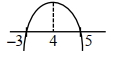
To find the maximum value,let $t = x^2$ where $t \ge 0$. Then $y = -t^2 + 2t + 15$.
This is a downward parabola with vertex at $t = -\frac{b}{2a} = -\frac{2}{2(-1)} = 1$.
Since $t=1$ is in the domain $t \ge 0$,the maximum value is $y(1) = -(1)^2 + 2(1) + 15 = -1 + 2 + 15 = 16$.
Dividing by $(x^2-5)$,we get $\frac{dy}{dx} - \frac{2x}{x^2-5} y = -2x(x^2-5)$.
This is a linear differential equation of the form $\frac{dy}{dx} + P(x)y = Q(x)$,where $P(x) = -\frac{2x}{x^2-5}$ and $Q(x) = -2x(x^2-5)$.
The integrating factor $IF = e^{\int P(x) dx} = e^{-\int \frac{2x}{x^2-5} dx} = e^{-\ln|x^2-5|} = \frac{1}{x^2-5}$.
The solution is $y \cdot IF = \int Q(x) \cdot IF dx + c$.
$y \cdot \frac{1}{x^2-5} = \int -2x(x^2-5) \cdot \frac{1}{x^2-5} dx + c$.
$\frac{y}{x^2-5} = \int -2x dx + c = -x^2 + c$.
Given $y(2) = 7$,we have $\frac{7}{2^2-5} = -2^2 + c \Rightarrow \frac{7}{-1} = -4 + c \Rightarrow c = -3$.
So,$\frac{y}{x^2-5} = -x^2 - 3$,which means $y = -(x^2-5)(x^2+3) = -(x^4 - 2x^2 - 15) = -x^4 + 2x^2 + 15$.
To find the maximum value,let $t = x^2$ where $t \ge 0$. Then $y = -t^2 + 2t + 15$.
This is a downward parabola with vertex at $t = -\frac{b}{2a} = -\frac{2}{2(-1)} = 1$.
Since $t=1$ is in the domain $t \ge 0$,the maximum value is $y(1) = -(1)^2 + 2(1) + 15 = -1 + 2 + 15 = 16$.
0 likes
View Solution223
AdvancedMCQ
If $f: R \rightarrow R$ is a differentiable function such that $f^{\prime}(x) > 2f(x)$ for all $x \in R$,and $f(0) = 1$,then:
A
$B, D$
B
$B, C$
C
$A, C$
D
$A, D$
Solution
(C) Given $f^{\prime}(x) - 2f(x) > 0$.
Multiply by the integrating factor $e^{-2x}$:
$e^{-2x} f^{\prime}(x) - 2e^{-2x} f(x) > 0$.
This is equivalent to $\frac{d}{dx}(f(x) e^{-2x}) > 0$.
Let $g(x) = f(x) e^{-2x}$. Since $g^{\prime}(x) > 0$,$g(x)$ is a strictly increasing function.
For $x > 0$,$g(x) > g(0)$.
Since $g(0) = f(0) e^0 = 1 \cdot 1 = 1$,we have $f(x) e^{-2x} > 1$,which implies $f(x) > e^{2x}$ for all $x > 0$.
Since $f(x) > e^{2x} > 0$ for $x > 0$,and $f^{\prime}(x) > 2f(x)$,we have $f^{\prime}(x) > 2e^{2x} > 0$.
Since $f^{\prime}(x) > 0$,$f(x)$ is an increasing function in $(0, \infty)$.
Thus,$A$ and $C$ are correct.
Multiply by the integrating factor $e^{-2x}$:
$e^{-2x} f^{\prime}(x) - 2e^{-2x} f(x) > 0$.
This is equivalent to $\frac{d}{dx}(f(x) e^{-2x}) > 0$.
Let $g(x) = f(x) e^{-2x}$. Since $g^{\prime}(x) > 0$,$g(x)$ is a strictly increasing function.
For $x > 0$,$g(x) > g(0)$.
Since $g(0) = f(0) e^0 = 1 \cdot 1 = 1$,we have $f(x) e^{-2x} > 1$,which implies $f(x) > e^{2x}$ for all $x > 0$.
Since $f(x) > e^{2x} > 0$ for $x > 0$,and $f^{\prime}(x) > 2f(x)$,we have $f^{\prime}(x) > 2e^{2x} > 0$.
Since $f^{\prime}(x) > 0$,$f(x)$ is an increasing function in $(0, \infty)$.
Thus,$A$ and $C$ are correct.
0 likes
View Solution224
DifficultMCQ
Let $f$ be a real-valued differentiable function on $\mathbb{R}$ (the set of all real numbers) such that $f(1)=1$. If the $y$-intercept of the tangent at any point $P(x, y)$ on the curve $y=f(x)$ is equal to the cube of the abscissa of $P$,then the value of $f(-3)$ is equal to
A
$3$
B
$6$
C
$9$
D
$4$
Solution
(C) The equation of the tangent at point $P(x, y)$ is $Y - y = \frac{dy}{dx}(X - x)$.
To find the $y$-intercept,set $X = 0$,which gives $Y = y - x \frac{dy}{dx}$.
According to the problem,the $y$-intercept is equal to the cube of the abscissa,so $y - x \frac{dy}{dx} = x^3$.
Rearranging this gives $x \frac{dy}{dx} - y = -x^3$,or $\frac{dy}{dx} - \frac{y}{x} = -x^2$.
This is a linear differential equation of the form $\frac{dy}{dx} + P(x)y = Q(x)$,where $P(x) = -\frac{1}{x}$ and $Q(x) = -x^2$.
The integrating factor is $IF = e^{\int -\frac{1}{x} dx} = e^{-\ln x} = \frac{1}{x}$.
The solution is $y \cdot \frac{1}{x} = \int (-x^2) \cdot \frac{1}{x} dx = \int -x dx = -\frac{x^2}{2} + C$.
Thus,$f(x) = -\frac{x^3}{2} + Cx$.
Given $f(1) = 1$,we have $1 = -\frac{1}{2} + C$,which implies $C = \frac{3}{2}$.
So,$f(x) = -\frac{x^3}{2} + \frac{3}{2}x$.
Calculating $f(-3) = -\frac{(-3)^3}{2} + \frac{3}{2}(-3) = -\frac{-27}{2} - \frac{9}{2} = \frac{18}{2} = 9$.
To find the $y$-intercept,set $X = 0$,which gives $Y = y - x \frac{dy}{dx}$.
According to the problem,the $y$-intercept is equal to the cube of the abscissa,so $y - x \frac{dy}{dx} = x^3$.
Rearranging this gives $x \frac{dy}{dx} - y = -x^3$,or $\frac{dy}{dx} - \frac{y}{x} = -x^2$.
This is a linear differential equation of the form $\frac{dy}{dx} + P(x)y = Q(x)$,where $P(x) = -\frac{1}{x}$ and $Q(x) = -x^2$.
The integrating factor is $IF = e^{\int -\frac{1}{x} dx} = e^{-\ln x} = \frac{1}{x}$.
The solution is $y \cdot \frac{1}{x} = \int (-x^2) \cdot \frac{1}{x} dx = \int -x dx = -\frac{x^2}{2} + C$.
Thus,$f(x) = -\frac{x^3}{2} + Cx$.
Given $f(1) = 1$,we have $1 = -\frac{1}{2} + C$,which implies $C = \frac{3}{2}$.
So,$f(x) = -\frac{x^3}{2} + \frac{3}{2}x$.
Calculating $f(-3) = -\frac{(-3)^3}{2} + \frac{3}{2}(-3) = -\frac{-27}{2} - \frac{9}{2} = \frac{18}{2} = 9$.
0 likes
View Solution225
AdvancedMCQ
Let $f:[1, \infty) \rightarrow [2, \infty)$ be a differentiable function such that $f(1)=2$. If $6 \int_1^x f(t) dt = 3x f(x) - x^3$ for all $x \geq 1$,then the value of $f(2)$ is
A
$6$
B
$3$
C
$0$
D
$1$
Solution
(A) Given the equation $6 \int_1^x f(t) dt = 3x f(x) - x^3$.
Differentiating both sides with respect to $x$ using the Newton-Leibniz theorem:
$6 f(x) = 3 f(x) + 3x f'(x) - 3x^2$.
Rearranging the terms:
$3x f'(x) = 3 f(x) + 3x^2 \Rightarrow x f'(x) - f(x) = x^2$.
Dividing by $x^2$ (assuming $x \geq 1$):
$\frac{x f'(x) - f(x)}{x^2} = 1 \Rightarrow \frac{d}{dx} \left( \frac{f(x)}{x} \right) = 1$.
Integrating both sides with respect to $x$:
$\frac{f(x)}{x} = x + C$.
Given $f(1) = 2$,we substitute $x=1$:
$\frac{f(1)}{1} = 1 + C \Rightarrow 2 = 1 + C \Rightarrow C = 1$.
Thus,$f(x) = x^2 + x$.
Calculating $f(2)$:
$f(2) = 2^2 + 2 = 4 + 2 = 6$.
Differentiating both sides with respect to $x$ using the Newton-Leibniz theorem:
$6 f(x) = 3 f(x) + 3x f'(x) - 3x^2$.
Rearranging the terms:
$3x f'(x) = 3 f(x) + 3x^2 \Rightarrow x f'(x) - f(x) = x^2$.
Dividing by $x^2$ (assuming $x \geq 1$):
$\frac{x f'(x) - f(x)}{x^2} = 1 \Rightarrow \frac{d}{dx} \left( \frac{f(x)}{x} \right) = 1$.
Integrating both sides with respect to $x$:
$\frac{f(x)}{x} = x + C$.
Given $f(1) = 2$,we substitute $x=1$:
$\frac{f(1)}{1} = 1 + C \Rightarrow 2 = 1 + C \Rightarrow C = 1$.
Thus,$f(x) = x^2 + x$.
Calculating $f(2)$:
$f(2) = 2^2 + 2 = 4 + 2 = 6$.
0 likes
View Solution226
DifficultMCQ
Let $y^{\prime}(x) + y(x) g^{\prime}(x) = g(x) g^{\prime}(x)$,$y(0) = 0$,$x \in \mathbb{R}$,where $f^{\prime}(x)$ denotes $\frac{d f(x)}{d x}$ and $g(x)$ is a given non-constant differentiable function on $\mathbb{R}$ with $g(0) = g(2) = 0$. Then the value of $y(2)$ is
A
$1$
B
$0$
C
$2$
D
$3$
Solution
(B) The given differential equation is a linear differential equation of the form $\frac{dy}{dx} + P(x)y = Q(x)$,where $P(x) = g^{\prime}(x)$ and $Q(x) = g(x)g^{\prime}(x)$.
The integrating factor ($I$.$F$.) is given by $e^{\int P(x) dx} = e^{\int g^{\prime}(x) dx} = e^{g(x)}$.
The general solution is $y \cdot e^{g(x)} = \int Q(x) e^{g(x)} dx + C = \int g(x) g^{\prime}(x) e^{g(x)} dx + C$.
Let $u = g(x)$,then $du = g^{\prime}(x) dx$. The integral becomes $\int u e^u du = u e^u - e^u = e^{g(x)}(g(x) - 1)$.
Thus,$y e^{g(x)} = e^{g(x)}(g(x) - 1) + C$.
Given $y(0) = 0$ and $g(0) = 0$,we substitute these values: $0 \cdot e^0 = e^0(0 - 1) + C \implies 0 = -1 + C \implies C = 1$.
So,the solution is $y e^{g(x)} = e^{g(x)}(g(x) - 1) + 1$.
To find $y(2)$,substitute $x = 2$ and $g(2) = 0$: $y(2) e^0 = e^0(0 - 1) + 1 \implies y(2) = -1 + 1 = 0$.
The integrating factor ($I$.$F$.) is given by $e^{\int P(x) dx} = e^{\int g^{\prime}(x) dx} = e^{g(x)}$.
The general solution is $y \cdot e^{g(x)} = \int Q(x) e^{g(x)} dx + C = \int g(x) g^{\prime}(x) e^{g(x)} dx + C$.
Let $u = g(x)$,then $du = g^{\prime}(x) dx$. The integral becomes $\int u e^u du = u e^u - e^u = e^{g(x)}(g(x) - 1)$.
Thus,$y e^{g(x)} = e^{g(x)}(g(x) - 1) + C$.
Given $y(0) = 0$ and $g(0) = 0$,we substitute these values: $0 \cdot e^0 = e^0(0 - 1) + C \implies 0 = -1 + C \implies C = 1$.
So,the solution is $y e^{g(x)} = e^{g(x)}(g(x) - 1) + 1$.
To find $y(2)$,substitute $x = 2$ and $g(2) = 0$: $y(2) e^0 = e^0(0 - 1) + 1 \implies y(2) = -1 + 1 = 0$.
0 likes
View Solution227
AdvancedMCQ
If $y(x)$ satisfies the differential equation $y^{\prime}-y \tan x=2 x \sec x$ and $y(0)=0$,then which of the following is true?
A
$(A, D)$
B
$(B, C)$
C
$(A, C)$
D
$(C, D)$
Solution
(A) The given differential equation is $\frac{dy}{dx} - y \tan x = 2x \sec x$.
This is a linear differential equation of the form $\frac{dy}{dx} + Py = Q$,where $P = -\tan x$ and $Q = 2x \sec x$.
The integrating factor ($I$.$F$.) is $e^{\int P dx} = e^{-\int \tan x dx} = e^{-\ln(\sec x)} = \cos x$.
Multiplying both sides by the $I$.$F$.,we get $\frac{d}{dx}(y \cos x) = 2x \sec x \cdot \cos x = 2x$.
Integrating both sides,$y \cos x = x^2 + C$.
Given $y(0) = 0$,we have $0 = 0^2 + C$,so $C = 0$.
Thus,$y = x^2 \sec x$.
For option $(A)$: $y(\frac{\pi}{4}) = (\frac{\pi}{4})^2 \sec(\frac{\pi}{4}) = \frac{\pi^2}{16} \cdot \sqrt{2} = \frac{\pi^2}{8\sqrt{2}}$. This is true.
For option $(D)$: $y'(x) = 2x \sec x + x^2 \sec x \tan x$.
$y'(\frac{\pi}{3}) = 2(\frac{\pi}{3}) \sec(\frac{\pi}{3}) + (\frac{\pi}{3})^2 \sec(\frac{\pi}{3}) \tan(\frac{\pi}{3}) = 2(\frac{\pi}{3})(2) + \frac{\pi^2}{9}(2)(\sqrt{3}) = \frac{4\pi}{3} + \frac{2\pi^2\sqrt{3}}{9}$. This is true.
Therefore,options $(A)$ and $(D)$ are correct.
This is a linear differential equation of the form $\frac{dy}{dx} + Py = Q$,where $P = -\tan x$ and $Q = 2x \sec x$.
The integrating factor ($I$.$F$.) is $e^{\int P dx} = e^{-\int \tan x dx} = e^{-\ln(\sec x)} = \cos x$.
Multiplying both sides by the $I$.$F$.,we get $\frac{d}{dx}(y \cos x) = 2x \sec x \cdot \cos x = 2x$.
Integrating both sides,$y \cos x = x^2 + C$.
Given $y(0) = 0$,we have $0 = 0^2 + C$,so $C = 0$.
Thus,$y = x^2 \sec x$.
For option $(A)$: $y(\frac{\pi}{4}) = (\frac{\pi}{4})^2 \sec(\frac{\pi}{4}) = \frac{\pi^2}{16} \cdot \sqrt{2} = \frac{\pi^2}{8\sqrt{2}}$. This is true.
For option $(D)$: $y'(x) = 2x \sec x + x^2 \sec x \tan x$.
$y'(\frac{\pi}{3}) = 2(\frac{\pi}{3}) \sec(\frac{\pi}{3}) + (\frac{\pi}{3})^2 \sec(\frac{\pi}{3}) \tan(\frac{\pi}{3}) = 2(\frac{\pi}{3})(2) + \frac{\pi^2}{9}(2)(\sqrt{3}) = \frac{4\pi}{3} + \frac{2\pi^2\sqrt{3}}{9}$. This is true.
Therefore,options $(A)$ and $(D)$ are correct.
0 likes
View Solution228
AdvancedMCQ
Let $f : R \rightarrow R$ be a differentiable function with $f(0)=1$ and satisfying the equation $f(x+y)=f(x) f^{\prime}(y)+f^{\prime}(x) f(y)$ for all $x, y \in R$. Then,the value of $\log _e(f(4))$ is:
A
$1$
B
$2$
C
$5$
D
$7$
Solution
(B) Given $f(x+y)=f(x) f^{\prime}(y)+f^{\prime}(x) f(y)$ and $f(0)=1$.
Setting $x=0$ and $y=0$ in the given equation:
$f(0+0)=f(0)f^{\prime}(0)+f^{\prime}(0)f(0)$
$f(0)=2f(0)f^{\prime}(0)$
Since $f(0)=1$,we have $1=2(1)f^{\prime}(0)$,which implies $f^{\prime}(0)=\frac{1}{2}$.
Now,setting $y=0$ in the original equation:
$f(x+0)=f(x)f^{\prime}(0)+f^{\prime}(x)f(0)$
$f(x)=f(x) \cdot \frac{1}{2} + f^{\prime}(x) \cdot 1$
$f^{\prime}(x) = f(x) - \frac{1}{2}f(x) = \frac{1}{2}f(x)$.
This is a first-order linear differential equation:
$\frac{f^{\prime}(x)}{f(x)} = \frac{1}{2}$.
Integrating both sides with respect to $x$:
$\int \frac{f^{\prime}(x)}{f(x)} dx = \int \frac{1}{2} dx$
$\ln(f(x)) = \frac{x}{2} + C$.
Using $f(0)=1$,we get $\ln(1) = 0 + C$,so $C=0$.
Thus,$f(x) = e^{x/2}$.
Finally,we calculate $\log _e(f(4))$:
$f(4) = e^{4/2} = e^2$.
$\log _e(f(4)) = \log _e(e^2) = 2$.
Setting $x=0$ and $y=0$ in the given equation:
$f(0+0)=f(0)f^{\prime}(0)+f^{\prime}(0)f(0)$
$f(0)=2f(0)f^{\prime}(0)$
Since $f(0)=1$,we have $1=2(1)f^{\prime}(0)$,which implies $f^{\prime}(0)=\frac{1}{2}$.
Now,setting $y=0$ in the original equation:
$f(x+0)=f(x)f^{\prime}(0)+f^{\prime}(x)f(0)$
$f(x)=f(x) \cdot \frac{1}{2} + f^{\prime}(x) \cdot 1$
$f^{\prime}(x) = f(x) - \frac{1}{2}f(x) = \frac{1}{2}f(x)$.
This is a first-order linear differential equation:
$\frac{f^{\prime}(x)}{f(x)} = \frac{1}{2}$.
Integrating both sides with respect to $x$:
$\int \frac{f^{\prime}(x)}{f(x)} dx = \int \frac{1}{2} dx$
$\ln(f(x)) = \frac{x}{2} + C$.
Using $f(0)=1$,we get $\ln(1) = 0 + C$,so $C=0$.
Thus,$f(x) = e^{x/2}$.
Finally,we calculate $\log _e(f(4))$:
$f(4) = e^{4/2} = e^2$.
$\log _e(f(4)) = \log _e(e^2) = 2$.
0 likes
View Solution229
AdvancedMCQ
For any real numbers $\alpha$ and $\beta$,let $y_{\alpha, \beta}(x), x \in R$,be the solution of the differential equation $\frac{dy}{dx}+\alpha y=x e^{\beta x}, y(1)=1$. Let $S=\{y_{\alpha, \beta}(x): \alpha, \beta \in R\}$. Then which of the following functions belong$(s)$ to the set $S$?
A
$A, B$
B
$A, C$
C
$A, D$
D
$A, B, C$
Solution
(B) The given differential equation is $\frac{dy}{dx} + \alpha y = x e^{\beta x}$. This is a linear differential equation of the form $\frac{dy}{dx} + P(x)y = Q(x)$,where $P(x) = \alpha$ and $Q(x) = x e^{\beta x}$.
The integrating factor is $IF = e^{\int \alpha dx} = e^{\alpha x}$.
Multiplying both sides by $IF$,we get $\frac{d}{dx}(y e^{\alpha x}) = x e^{(\alpha+\beta)x}$.
Case $I$: If $\alpha + \beta = 0$,then $\beta = -\alpha$. The equation becomes $\frac{d}{dx}(y e^{\alpha x}) = x$. Integrating both sides,$y e^{\alpha x} = \frac{x^2}{2} + C$. Using $y(1) = 1$,we get $1 \cdot e^{\alpha} = \frac{1}{2} + C$,so $C = e^{\alpha} - \frac{1}{2}$. Thus,$y = \frac{x^2}{2} e^{-\alpha x} + (e^{\alpha} - \frac{1}{2}) e^{-\alpha x}$. For $\alpha = 1$,$y = \frac{x^2}{2} e^{-x} + (e - \frac{1}{2}) e^{-x}$,which matches option $(A)$.
Case $II$: If $\alpha + \beta \neq 0$,integrating $\int x e^{(\alpha+\beta)x} dx$ by parts gives $\frac{x e^{(\alpha+\beta)x}}{\alpha+\beta} - \frac{e^{(\alpha+\beta)x}}{(\alpha+\beta)^2} + C$. Thus,$y e^{\alpha x} = \frac{x e^{(\alpha+\beta)x}}{\alpha+\beta} - \frac{e^{(\alpha+\beta)x}}{(\alpha+\beta)^2} + C$. Using $y(1) = 1$,$C = e^{\alpha} - \frac{e^{\alpha+\beta}}{\alpha+\beta} + \frac{e^{\alpha+\beta}}{(\alpha+\beta)^2}$. For $\alpha = -1, \beta = 2$,we have $\alpha+\beta = 1$. Substituting these values leads to the form in option $(C)$.
Therefore,both $(A)$ and $(C)$ belong to $S$.
The integrating factor is $IF = e^{\int \alpha dx} = e^{\alpha x}$.
Multiplying both sides by $IF$,we get $\frac{d}{dx}(y e^{\alpha x}) = x e^{(\alpha+\beta)x}$.
Case $I$: If $\alpha + \beta = 0$,then $\beta = -\alpha$. The equation becomes $\frac{d}{dx}(y e^{\alpha x}) = x$. Integrating both sides,$y e^{\alpha x} = \frac{x^2}{2} + C$. Using $y(1) = 1$,we get $1 \cdot e^{\alpha} = \frac{1}{2} + C$,so $C = e^{\alpha} - \frac{1}{2}$. Thus,$y = \frac{x^2}{2} e^{-\alpha x} + (e^{\alpha} - \frac{1}{2}) e^{-\alpha x}$. For $\alpha = 1$,$y = \frac{x^2}{2} e^{-x} + (e - \frac{1}{2}) e^{-x}$,which matches option $(A)$.
Case $II$: If $\alpha + \beta \neq 0$,integrating $\int x e^{(\alpha+\beta)x} dx$ by parts gives $\frac{x e^{(\alpha+\beta)x}}{\alpha+\beta} - \frac{e^{(\alpha+\beta)x}}{(\alpha+\beta)^2} + C$. Thus,$y e^{\alpha x} = \frac{x e^{(\alpha+\beta)x}}{\alpha+\beta} - \frac{e^{(\alpha+\beta)x}}{(\alpha+\beta)^2} + C$. Using $y(1) = 1$,$C = e^{\alpha} - \frac{e^{\alpha+\beta}}{\alpha+\beta} + \frac{e^{\alpha+\beta}}{(\alpha+\beta)^2}$. For $\alpha = -1, \beta = 2$,we have $\alpha+\beta = 1$. Substituting these values leads to the form in option $(C)$.
Therefore,both $(A)$ and $(C)$ belong to $S$.
0 likes
View Solution230
DifficultMCQ
The function $y=f(x)$ is the solution of the differential equation $\frac{dy}{dx}+\frac{xy}{x^2-1}=\frac{x^4+2x}{\sqrt{1-x^2}}$ in $(-1,1)$ satisfying $f(0)=0$. Then $\int_{-\frac{\sqrt{3}}{2}}^{\frac{\sqrt{3}}{2}} f(x) dx$ is
A
$\frac{\pi}{3}-\frac{\sqrt{3}}{2}$
B
$\frac{\pi}{3}-\frac{\sqrt{3}}{4}$
C
$\frac{\pi}{6}-\frac{\sqrt{3}}{4}$
D
$\frac{\pi}{6}-\frac{\sqrt{3}}{2}$
Solution
(B) The given differential equation is a linear differential equation of the form $\frac{dy}{dx} + P(x)y = Q(x)$,where $P(x) = \frac{x}{x^2-1}$ and $Q(x) = \frac{x^4+2x}{\sqrt{1-x^2}}$.
Integrating factor ($I$.$F$.) $= e^{\int \frac{x}{x^2-1} dx} = e^{\frac{1}{2} \ln|x^2-1|} = e^{\frac{1}{2} \ln(1-x^2)} = \sqrt{1-x^2}$.
The general solution is $y \cdot \sqrt{1-x^2} = \int \frac{x^4+2x}{\sqrt{1-x^2}} \cdot \sqrt{1-x^2} dx + c = \int (x^4+2x) dx + c = \frac{x^5}{5} + x^2 + c$.
Given $f(0)=0$,we have $0 \cdot 1 = 0 + 0 + c$,so $c=0$.
Thus,$f(x) = \frac{x^5/5 + x^2}{\sqrt{1-x^2}}$.
We need to evaluate $I = \int_{-\frac{\sqrt{3}}{2}}^{\frac{\sqrt{3}}{2}} f(x) dx$. Since $f(x) = \frac{x^5/5}{\sqrt{1-x^2}} + \frac{x^2}{\sqrt{1-x^2}}$,the first part is an odd function,so its integral over the symmetric interval is $0$.
Thus,$I = 2 \int_{0}^{\frac{\sqrt{3}}{2}} \frac{x^2}{\sqrt{1-x^2}} dx$.
Let $x = \sin \theta$,then $dx = \cos \theta d\theta$. When $x=0, \theta=0$; when $x=\frac{\sqrt{3}}{2}, \theta=\frac{\pi}{3}$.
$I = 2 \int_{0}^{\frac{\pi}{3}} \frac{\sin^2 \theta}{\cos \theta} \cos \theta d\theta = 2 \int_{0}^{\frac{\pi}{3}} \sin^2 \theta d\theta = \int_{0}^{\frac{\pi}{3}} (1 - \cos 2\theta) d\theta$.
$I = [\theta - \frac{1}{2} \sin 2\theta]_{0}^{\frac{\pi}{3}} = \frac{\pi}{3} - \frac{1}{2} \sin(\frac{2\pi}{3}) = \frac{\pi}{3} - \frac{1}{2} \cdot \frac{\sqrt{3}}{2} = \frac{\pi}{3} - \frac{\sqrt{3}}{4}$.
Integrating factor ($I$.$F$.) $= e^{\int \frac{x}{x^2-1} dx} = e^{\frac{1}{2} \ln|x^2-1|} = e^{\frac{1}{2} \ln(1-x^2)} = \sqrt{1-x^2}$.
The general solution is $y \cdot \sqrt{1-x^2} = \int \frac{x^4+2x}{\sqrt{1-x^2}} \cdot \sqrt{1-x^2} dx + c = \int (x^4+2x) dx + c = \frac{x^5}{5} + x^2 + c$.
Given $f(0)=0$,we have $0 \cdot 1 = 0 + 0 + c$,so $c=0$.
Thus,$f(x) = \frac{x^5/5 + x^2}{\sqrt{1-x^2}}$.
We need to evaluate $I = \int_{-\frac{\sqrt{3}}{2}}^{\frac{\sqrt{3}}{2}} f(x) dx$. Since $f(x) = \frac{x^5/5}{\sqrt{1-x^2}} + \frac{x^2}{\sqrt{1-x^2}}$,the first part is an odd function,so its integral over the symmetric interval is $0$.
Thus,$I = 2 \int_{0}^{\frac{\sqrt{3}}{2}} \frac{x^2}{\sqrt{1-x^2}} dx$.
Let $x = \sin \theta$,then $dx = \cos \theta d\theta$. When $x=0, \theta=0$; when $x=\frac{\sqrt{3}}{2}, \theta=\frac{\pi}{3}$.
$I = 2 \int_{0}^{\frac{\pi}{3}} \frac{\sin^2 \theta}{\cos \theta} \cos \theta d\theta = 2 \int_{0}^{\frac{\pi}{3}} \sin^2 \theta d\theta = \int_{0}^{\frac{\pi}{3}} (1 - \cos 2\theta) d\theta$.
$I = [\theta - \frac{1}{2} \sin 2\theta]_{0}^{\frac{\pi}{3}} = \frac{\pi}{3} - \frac{1}{2} \sin(\frac{2\pi}{3}) = \frac{\pi}{3} - \frac{1}{2} \cdot \frac{\sqrt{3}}{2} = \frac{\pi}{3} - \frac{\sqrt{3}}{4}$.
0 likes
View Solution231
MediumMCQ
Let $y(x)$ be a solution of the differential equation $(1+e^x) y^{\prime}+y e^x=1$. If $y(0)=2$,then which of the following statements is (are) true?
$(A)$ $y(-4)=0$
$(B)$ $y(-2)=0$
$(C)$ $y(x)$ has a critical point in the interval $(-1,0)$
$(D)$ $y(x)$ has no critical point in the interval $(-1,0)$
$(A)$ $y(-4)=0$
$(B)$ $y(-2)=0$
$(C)$ $y(x)$ has a critical point in the interval $(-1,0)$
$(D)$ $y(x)$ has no critical point in the interval $(-1,0)$
A
$(A, C)$
B
$(B, D)$
C
$(B, C)$
D
$(A, D)$
Solution
(A) The given differential equation is $(1+e^x) y^{\prime}+y e^x=1$. Dividing by $(1+e^x)$,we get $\frac{d y}{d x}+\frac{e^x}{1+e^x} y = \frac{1}{1+e^x}$.
This is a linear differential equation of the form $\frac{d y}{d x}+P(x)y=Q(x)$.
The integrating factor is $I.F. = e^{\int \frac{e^x}{1+e^x} dx} = e^{\ln(1+e^x)} = 1+e^x$.
The solution is $y(1+e^x) = \int 1 dx = x+c$.
Given $y(0)=2$,we have $2(1+e^0) = 0+c \Rightarrow c=4$.
Thus,$y(x) = \frac{x+4}{1+e^x}$.
For $(A)$,$y(-4) = \frac{-4+4}{1+e^{-4}} = 0$. So $(A)$ is true.
For $(B)$,$y(-2) = \frac{-2+4}{1+e^{-2}} = \frac{2}{1+e^{-2}} \neq 0$. So $(B)$ is false.
For $(C)$ and $(D)$,we find the critical points by setting $y^{\prime}(x) = 0$.
$y^{\prime}(x) = \frac{(1+e^x) - (x+4)e^x}{(1+e^x)^2} = \frac{1+e^x - xe^x - 4e^x}{(1+e^x)^2} = \frac{1-e^x(x+3)}{(1+e^x)^2}$.
Let $g(x) = 1-e^x(x+3)$.
$g(0) = 1-e^0(3) = 1-3 = -2$.
$g(-1) = 1-e^{-1}(2) = 1-\frac{2}{e} \approx 1-0.736 = 0.264$.
Since $g(x)$ is continuous and $g(-1) > 0$ and $g(0) < 0$,there exists a root in $(-1, 0)$.
Thus,$y(x)$ has a critical point in $(-1, 0)$. So $(C)$ is true.
The correct options are $(A)$ and $(C)$.
This is a linear differential equation of the form $\frac{d y}{d x}+P(x)y=Q(x)$.
The integrating factor is $I.F. = e^{\int \frac{e^x}{1+e^x} dx} = e^{\ln(1+e^x)} = 1+e^x$.
The solution is $y(1+e^x) = \int 1 dx = x+c$.
Given $y(0)=2$,we have $2(1+e^0) = 0+c \Rightarrow c=4$.
Thus,$y(x) = \frac{x+4}{1+e^x}$.
For $(A)$,$y(-4) = \frac{-4+4}{1+e^{-4}} = 0$. So $(A)$ is true.
For $(B)$,$y(-2) = \frac{-2+4}{1+e^{-2}} = \frac{2}{1+e^{-2}} \neq 0$. So $(B)$ is false.
For $(C)$ and $(D)$,we find the critical points by setting $y^{\prime}(x) = 0$.
$y^{\prime}(x) = \frac{(1+e^x) - (x+4)e^x}{(1+e^x)^2} = \frac{1+e^x - xe^x - 4e^x}{(1+e^x)^2} = \frac{1-e^x(x+3)}{(1+e^x)^2}$.
Let $g(x) = 1-e^x(x+3)$.
$g(0) = 1-e^0(3) = 1-3 = -2$.
$g(-1) = 1-e^{-1}(2) = 1-\frac{2}{e} \approx 1-0.736 = 0.264$.
Since $g(x)$ is continuous and $g(-1) > 0$ and $g(0) < 0$,there exists a root in $(-1, 0)$.
Thus,$y(x)$ has a critical point in $(-1, 0)$. So $(C)$ is true.
The correct options are $(A)$ and $(C)$.
0 likes
View Solution232
DifficultMCQ
For $x \in R$,let the function $y(x)$ be the solution of the differential equation $\frac{dy}{dx} + 12y = \cos \left(\frac{\pi}{12} x\right)$ with $y(0) = 0$. Then,which of the following statements is/are $TRUE$?
A
$y(x)$ is an increasing function
B
$y(x)$ is a decreasing function
C
There exists a real number $\beta$ such that the line $y = \beta$ intersects the curve $y = y(x)$ at infinitely many points
D
$y(x)$ is a periodic function
Solution
(C) The given differential equation is a linear differential equation of the form $\frac{dy}{dx} + Py = Q$,where $P = 12$ and $Q = \cos \left(\frac{\pi}{12} x\right)$.
The integrating factor $(I.F.)$ is $e^{\int 12 dx} = e^{12x}$.
The general solution is $y \cdot e^{12x} = \int e^{12x} \cos \left(\frac{\pi}{12} x\right) dx + C$.
Using the formula $\int e^{ax} \cos(bx) dx = \frac{e^{ax}}{a^2 + b^2} (a \cos(bx) + b \sin(bx))$,we get:
$y \cdot e^{12x} = \frac{e^{12x}}{12^2 + (\frac{\pi}{12})^2} \left(12 \cos \left(\frac{\pi}{12} x\right) + \frac{\pi}{12} \sin \left(\frac{\pi}{12} x\right)\right) + C$.
Simplifying,$y = \frac{1}{144 + \frac{\pi^2}{144}} \left(12 \cos \left(\frac{\pi}{12} x\right) + \frac{\pi}{12} \sin \left(\frac{\pi}{12} x\right)\right) + C e^{-12x}$.
Given $y(0) = 0$,we have $0 = \frac{12}{144 + \frac{\pi^2}{144}} + C$,so $C = -\frac{12}{144 + \frac{\pi^2}{144}}$.
Thus,$y(x) = \frac{1}{144 + \frac{\pi^2}{144}} \left(12 \cos \left(\frac{\pi}{12} x\right) + \frac{\pi}{12} \sin \left(\frac{\pi}{12} x\right) - 12 e^{-12x}\right)$.
As $x \to \infty$,$e^{-12x} \to 0$,so $y(x)$ approaches a periodic function $f(x) = A \cos \left(\frac{\pi}{12} x - \phi\right)$.
Since $y(x)$ approaches a periodic function,for a value $\beta$ within the range of this periodic function,the line $y = \beta$ will intersect the curve $y = y(x)$ at infinitely many points as $x \to \infty$. Thus,statement $C$ is $TRUE$.
The integrating factor $(I.F.)$ is $e^{\int 12 dx} = e^{12x}$.
The general solution is $y \cdot e^{12x} = \int e^{12x} \cos \left(\frac{\pi}{12} x\right) dx + C$.
Using the formula $\int e^{ax} \cos(bx) dx = \frac{e^{ax}}{a^2 + b^2} (a \cos(bx) + b \sin(bx))$,we get:
$y \cdot e^{12x} = \frac{e^{12x}}{12^2 + (\frac{\pi}{12})^2} \left(12 \cos \left(\frac{\pi}{12} x\right) + \frac{\pi}{12} \sin \left(\frac{\pi}{12} x\right)\right) + C$.
Simplifying,$y = \frac{1}{144 + \frac{\pi^2}{144}} \left(12 \cos \left(\frac{\pi}{12} x\right) + \frac{\pi}{12} \sin \left(\frac{\pi}{12} x\right)\right) + C e^{-12x}$.
Given $y(0) = 0$,we have $0 = \frac{12}{144 + \frac{\pi^2}{144}} + C$,so $C = -\frac{12}{144 + \frac{\pi^2}{144}}$.
Thus,$y(x) = \frac{1}{144 + \frac{\pi^2}{144}} \left(12 \cos \left(\frac{\pi}{12} x\right) + \frac{\pi}{12} \sin \left(\frac{\pi}{12} x\right) - 12 e^{-12x}\right)$.
As $x \to \infty$,$e^{-12x} \to 0$,so $y(x)$ approaches a periodic function $f(x) = A \cos \left(\frac{\pi}{12} x - \phi\right)$.
Since $y(x)$ approaches a periodic function,for a value $\beta$ within the range of this periodic function,the line $y = \beta$ will intersect the curve $y = y(x)$ at infinitely many points as $x \to \infty$. Thus,statement $C$ is $TRUE$.
0 likes
View Solution233
AdvancedMCQ
Let $f(x)$ be a continuously differentiable function on the interval $(0, \infty)$ such that $f(1)=2$ and $\lim _{t \rightarrow x} \frac{t^{10} f(x)-x^{10} f(t)}{t^9-x^9}=1$ for each $x>0$. Then,for all $x>0, f(x)$ is equal to
A
$\frac{31}{11 x}-\frac{9}{11} x^{10}$
B
$\frac{9}{11 x}+\frac{13}{11} x^{10}$
C
$\frac{-9}{11 x}+\frac{31}{11} x^{10}$
D
$\frac{13}{11 x}+\frac{9}{11} x^{10}$
Solution
(B) Given $\lim _{t \rightarrow x} \frac{t^{10} f(x)-x^{10} f(t)}{t^9-x^9}=1$.
Applying $L$'$H$ôpital's rule with respect to $t$:
$\lim _{t \rightarrow x} \frac{10 t^9 f(x)-x^{10} f^{\prime}(t)}{9 t^8}=1$
$\Rightarrow \frac{10 x^9 f(x)-x^{10} f^{\prime}(x)}{9 x^8}=1$
$\Rightarrow 10 x f(x)-x^2 f^{\prime}(x)=9 x^8 \cdot \frac{9}{x^8} = 9$
$\Rightarrow f^{\prime}(x)-\frac{10}{x} f(x)=-\frac{9}{x^2}$.
This is a linear differential equation of the form $\frac{dy}{dx} + P(x)y = Q(x)$,where $P(x) = -\frac{10}{x}$ and $Q(x) = -\frac{9}{x^2}$.
The integrating factor $IF = e^{\int P(x) dx} = e^{-10 \ln x} = x^{-10} = \frac{1}{x^{10}}$.
The solution is $y \cdot IF = \int Q(x) \cdot IF dx + C$.
$\frac{f(x)}{x^{10}} = \int -\frac{9}{x^2} \cdot \frac{1}{x^{10}} dx = -9 \int x^{-12} dx = -9 \left( \frac{x^{-11}}{-11} \right) + C = \frac{9}{11 x^{11}} + C$.
Given $f(1)=2$,we have $\frac{2}{1} = \frac{9}{11} + C \Rightarrow C = 2 - \frac{9}{11} = \frac{13}{11}$.
Thus,$f(x) = x^{10} \left( \frac{9}{11 x^{11}} + \frac{13}{11} \right) = \frac{9}{11 x} + \frac{13}{11} x^{10}$.
Therefore,option $(B)$ is correct.
Applying $L$'$H$ôpital's rule with respect to $t$:
$\lim _{t \rightarrow x} \frac{10 t^9 f(x)-x^{10} f^{\prime}(t)}{9 t^8}=1$
$\Rightarrow \frac{10 x^9 f(x)-x^{10} f^{\prime}(x)}{9 x^8}=1$
$\Rightarrow 10 x f(x)-x^2 f^{\prime}(x)=9 x^8 \cdot \frac{9}{x^8} = 9$
$\Rightarrow f^{\prime}(x)-\frac{10}{x} f(x)=-\frac{9}{x^2}$.
This is a linear differential equation of the form $\frac{dy}{dx} + P(x)y = Q(x)$,where $P(x) = -\frac{10}{x}$ and $Q(x) = -\frac{9}{x^2}$.
The integrating factor $IF = e^{\int P(x) dx} = e^{-10 \ln x} = x^{-10} = \frac{1}{x^{10}}$.
The solution is $y \cdot IF = \int Q(x) \cdot IF dx + C$.
$\frac{f(x)}{x^{10}} = \int -\frac{9}{x^2} \cdot \frac{1}{x^{10}} dx = -9 \int x^{-12} dx = -9 \left( \frac{x^{-11}}{-11} \right) + C = \frac{9}{11 x^{11}} + C$.
Given $f(1)=2$,we have $\frac{2}{1} = \frac{9}{11} + C \Rightarrow C = 2 - \frac{9}{11} = \frac{13}{11}$.
Thus,$f(x) = x^{10} \left( \frac{9}{11 x^{11}} + \frac{13}{11} \right) = \frac{9}{11 x} + \frac{13}{11} x^{10}$.
Therefore,option $(B)$ is correct.
0 likes
View Solution234
DifficultMCQ
Let $x = x(y)$ be the solution of the differential equation $y^2 dx + (x - \frac{1}{y}) dy = 0$. If $x(1) = 1$,then $x(\frac{1}{2})$ is:
A
$\frac{1}{2} + e$
B
$\frac{3}{2} + e$
C
$3 - e$
D
$3 + e$
Solution
(C) The given differential equation is $y^2 dx + (x - \frac{1}{y}) dy = 0$.
Dividing by $y^2 dy$,we get $\frac{dx}{dy} + \frac{x}{y^2} = \frac{1}{y^3}$.
This is a linear differential equation of the form $\frac{dx}{dy} + P(y)x = Q(y)$,where $P(y) = \frac{1}{y^2}$ and $Q(y) = \frac{1}{y^3}$.
The integrating factor ($I$.$F$.) is $e^{\int P(y) dy} = e^{\int y^{-2} dy} = e^{-1/y}$.
The solution is $x \cdot e^{-1/y} = \int Q(y) \cdot e^{-1/y} dy + C$.
Let $t = -1/y$,then $dt = \frac{1}{y^2} dy$.
$x \cdot e^{-1/y} = \int (-t) e^t dt + C = -(t e^t - e^t) + C = e^t(1 - t) + C$.
Substituting $t = -1/y$,we get $x \cdot e^{-1/y} = e^{-1/y}(1 + \frac{1}{y}) + C$.
Given $x(1) = 1$,we have $1 \cdot e^{-1} = e^{-1}(1 + 1) + C$,so $e^{-1} = 2e^{-1} + C$,which implies $C = -e^{-1}$.
Thus,$x = 1 + \frac{1}{y} - e^{1/y} \cdot e^{-1} = 1 + \frac{1}{y} - e^{(1/y) - 1}$.
For $y = 1/2$,$x = 1 + \frac{1}{1/2} - e^{(1/(1/2)) - 1} = 1 + 2 - e^{2-1} = 3 - e$.
Dividing by $y^2 dy$,we get $\frac{dx}{dy} + \frac{x}{y^2} = \frac{1}{y^3}$.
This is a linear differential equation of the form $\frac{dx}{dy} + P(y)x = Q(y)$,where $P(y) = \frac{1}{y^2}$ and $Q(y) = \frac{1}{y^3}$.
The integrating factor ($I$.$F$.) is $e^{\int P(y) dy} = e^{\int y^{-2} dy} = e^{-1/y}$.
The solution is $x \cdot e^{-1/y} = \int Q(y) \cdot e^{-1/y} dy + C$.
Let $t = -1/y$,then $dt = \frac{1}{y^2} dy$.
$x \cdot e^{-1/y} = \int (-t) e^t dt + C = -(t e^t - e^t) + C = e^t(1 - t) + C$.
Substituting $t = -1/y$,we get $x \cdot e^{-1/y} = e^{-1/y}(1 + \frac{1}{y}) + C$.
Given $x(1) = 1$,we have $1 \cdot e^{-1} = e^{-1}(1 + 1) + C$,so $e^{-1} = 2e^{-1} + C$,which implies $C = -e^{-1}$.
Thus,$x = 1 + \frac{1}{y} - e^{1/y} \cdot e^{-1} = 1 + \frac{1}{y} - e^{(1/y) - 1}$.
For $y = 1/2$,$x = 1 + \frac{1}{1/2} - e^{(1/(1/2)) - 1} = 1 + 2 - e^{2-1} = 3 - e$.
0 likes
View Solution235
DifficultMCQ
If $x=f(y)$ is the solution of the differential equation $(1+y^2)+(x-2 e^{\tan ^{-1} y}) \frac{d y}{d x}=0$,$y \in(-\frac{\pi}{2}, \frac{\pi}{2})$ with $f(0)=1$,then $f(\frac{1}{\sqrt{3}})$ is equal to :
A
$e^{\pi / 4}$
B
$e^{\pi / 12}$
C
$e^{\pi / 3}$
D
$e^{\pi / 6}$
Solution
(D) The given differential equation is $(1+y^2)+(x-2 e^{\tan ^{-1} y}) \frac{d y}{d x}=0$.
Rearranging the terms,we get $\frac{d x}{d y} = -\frac{x-2 e^{\tan ^{-1} y}}{1+y^2} = \frac{2 e^{\tan ^{-1} y}-x}{1+y^2}$.
This can be written as $\frac{d x}{d y} + \frac{x}{1+y^2} = \frac{2 e^{\tan ^{-1} y}}{1+y^2}$.
This is a linear differential equation of the form $\frac{d x}{d y} + P(y)x = Q(y)$,where $P(y) = \frac{1}{1+y^2}$ and $Q(y) = \frac{2 e^{\tan ^{-1} y}}{1+y^2}$.
The integrating factor ($I$.$F$.) is $e^{\int P(y) dy} = e^{\int \frac{1}{1+y^2} dy} = e^{\tan ^{-1} y}$.
The solution is $x \cdot (I.F.) = \int Q(y) \cdot (I.F.) dy + C$.
$x e^{\tan ^{-1} y} = \int \frac{2 e^{\tan ^{-1} y}}{1+y^2} \cdot e^{\tan ^{-1} y} dy = \int \frac{2 e^{2 \tan ^{-1} y}}{1+y^2} dy$.
Let $t = \tan ^{-1} y$,then $dt = \frac{1}{1+y^2} dy$.
$x e^{\tan ^{-1} y} = \int 2 e^{2t} dt = e^{2t} + C = e^{2 \tan ^{-1} y} + C$.
Given $f(0)=1$,i.e.,$x=1$ when $y=0$:
$1 \cdot e^{\tan ^{-1} 0} = e^{2 \tan ^{-1} 0} + C \implies 1 \cdot 1 = 1 + C \implies C = 0$.
Thus,$x e^{\tan ^{-1} y} = e^{2 \tan ^{-1} y} \implies x = e^{\tan ^{-1} y}$.
For $y = \frac{1}{\sqrt{3}}$,$x = e^{\tan ^{-1}(1/\sqrt{3})} = e^{\pi / 6}$.
Rearranging the terms,we get $\frac{d x}{d y} = -\frac{x-2 e^{\tan ^{-1} y}}{1+y^2} = \frac{2 e^{\tan ^{-1} y}-x}{1+y^2}$.
This can be written as $\frac{d x}{d y} + \frac{x}{1+y^2} = \frac{2 e^{\tan ^{-1} y}}{1+y^2}$.
This is a linear differential equation of the form $\frac{d x}{d y} + P(y)x = Q(y)$,where $P(y) = \frac{1}{1+y^2}$ and $Q(y) = \frac{2 e^{\tan ^{-1} y}}{1+y^2}$.
The integrating factor ($I$.$F$.) is $e^{\int P(y) dy} = e^{\int \frac{1}{1+y^2} dy} = e^{\tan ^{-1} y}$.
The solution is $x \cdot (I.F.) = \int Q(y) \cdot (I.F.) dy + C$.
$x e^{\tan ^{-1} y} = \int \frac{2 e^{\tan ^{-1} y}}{1+y^2} \cdot e^{\tan ^{-1} y} dy = \int \frac{2 e^{2 \tan ^{-1} y}}{1+y^2} dy$.
Let $t = \tan ^{-1} y$,then $dt = \frac{1}{1+y^2} dy$.
$x e^{\tan ^{-1} y} = \int 2 e^{2t} dt = e^{2t} + C = e^{2 \tan ^{-1} y} + C$.
Given $f(0)=1$,i.e.,$x=1$ when $y=0$:
$1 \cdot e^{\tan ^{-1} 0} = e^{2 \tan ^{-1} 0} + C \implies 1 \cdot 1 = 1 + C \implies C = 0$.
Thus,$x e^{\tan ^{-1} y} = e^{2 \tan ^{-1} y} \implies x = e^{\tan ^{-1} y}$.
For $y = \frac{1}{\sqrt{3}}$,$x = e^{\tan ^{-1}(1/\sqrt{3})} = e^{\pi / 6}$.
0 likes
View Solution236
DifficultMCQ
Let $y=f(x)$ be the solution of the differential equation $\frac{dy}{dx}+\frac{xy}{x^2-1}=\frac{x^6+4x}{\sqrt{1-x^2}}$ for $-1 < x < 1$ such that $f(0)=0$. If $6 \int_{-1/2}^{1/2} f(x) dx = 2\pi - \alpha$,then $\alpha^2$ is equal to . . . . . .
A
$27$
B
$30$
C
$31$
D
$33$
Solution
(A) The given differential equation is $\frac{dy}{dx} + \frac{x}{x^2-1}y = \frac{x^6+4x}{\sqrt{1-x^2}}$.
This is a linear differential equation of the form $\frac{dy}{dx} + P(x)y = Q(x)$.
Integrating factor ($I$.$F$.) = $e^{\int P(x) dx} = e^{\int \frac{x}{x^2-1} dx} = e^{\frac{1}{2} \ln|x^2-1|} = \sqrt{1-x^2}$ (since $-1 < x < 1$,$x^2-1 < 0$,so $|x^2-1| = 1-x^2$).
The solution is $y \cdot \sqrt{1-x^2} = \int \frac{x^6+4x}{\sqrt{1-x^2}} \cdot \sqrt{1-x^2} dx = \int (x^6+4x) dx = \frac{x^7}{7} + 2x^2 + C$.
Given $f(0)=0$,we have $0 = 0 + 0 + C \Rightarrow C=0$.
Thus,$f(x) = \frac{x^7/7 + 2x^2}{\sqrt{1-x^2}}$.
We need to evaluate $6 \int_{-1/2}^{1/2} f(x) dx = 6 \int_{-1/2}^{1/2} \frac{x^7/7 + 2x^2}{\sqrt{1-x^2}} dx$.
Since $\frac{x^7/7}{\sqrt{1-x^2}}$ is an odd function,its integral over $[-1/2, 1/2]$ is $0$.
So,the expression becomes $6 \int_{-1/2}^{1/2} \frac{2x^2}{\sqrt{1-x^2}} dx = 24 \int_0^{1/2} \frac{x^2}{\sqrt{1-x^2}} dx$.
Let $x = \sin \theta$,then $dx = \cos \theta d\theta$. When $x=0, \theta=0$; when $x=1/2, \theta=\pi/6$.
Integral = $24 \int_0^{\pi/6} \frac{\sin^2 \theta}{\cos \theta} \cos \theta d\theta = 24 \int_0^{\pi/6} \sin^2 \theta d\theta = 24 \int_0^{\pi/6} \frac{1-\cos 2\theta}{2} d\theta = 12 [\theta - \frac{\sin 2\theta}{2}]_0^{\pi/6} = 12(\frac{\pi}{6} - \frac{\sqrt{3}}{4}) = 2\pi - 3\sqrt{3}$.
Comparing with $2\pi - \alpha$,we get $\alpha = 3\sqrt{3}$.
Therefore,$\alpha^2 = (3\sqrt{3})^2 = 27$.
This is a linear differential equation of the form $\frac{dy}{dx} + P(x)y = Q(x)$.
Integrating factor ($I$.$F$.) = $e^{\int P(x) dx} = e^{\int \frac{x}{x^2-1} dx} = e^{\frac{1}{2} \ln|x^2-1|} = \sqrt{1-x^2}$ (since $-1 < x < 1$,$x^2-1 < 0$,so $|x^2-1| = 1-x^2$).
The solution is $y \cdot \sqrt{1-x^2} = \int \frac{x^6+4x}{\sqrt{1-x^2}} \cdot \sqrt{1-x^2} dx = \int (x^6+4x) dx = \frac{x^7}{7} + 2x^2 + C$.
Given $f(0)=0$,we have $0 = 0 + 0 + C \Rightarrow C=0$.
Thus,$f(x) = \frac{x^7/7 + 2x^2}{\sqrt{1-x^2}}$.
We need to evaluate $6 \int_{-1/2}^{1/2} f(x) dx = 6 \int_{-1/2}^{1/2} \frac{x^7/7 + 2x^2}{\sqrt{1-x^2}} dx$.
Since $\frac{x^7/7}{\sqrt{1-x^2}}$ is an odd function,its integral over $[-1/2, 1/2]$ is $0$.
So,the expression becomes $6 \int_{-1/2}^{1/2} \frac{2x^2}{\sqrt{1-x^2}} dx = 24 \int_0^{1/2} \frac{x^2}{\sqrt{1-x^2}} dx$.
Let $x = \sin \theta$,then $dx = \cos \theta d\theta$. When $x=0, \theta=0$; when $x=1/2, \theta=\pi/6$.
Integral = $24 \int_0^{\pi/6} \frac{\sin^2 \theta}{\cos \theta} \cos \theta d\theta = 24 \int_0^{\pi/6} \sin^2 \theta d\theta = 24 \int_0^{\pi/6} \frac{1-\cos 2\theta}{2} d\theta = 12 [\theta - \frac{\sin 2\theta}{2}]_0^{\pi/6} = 12(\frac{\pi}{6} - \frac{\sqrt{3}}{4}) = 2\pi - 3\sqrt{3}$.
Comparing with $2\pi - \alpha$,we get $\alpha = 3\sqrt{3}$.
Therefore,$\alpha^2 = (3\sqrt{3})^2 = 27$.
0 likes
View Solution237
DifficultMCQ
Let $y=y(x)$ be the solution of the differential equation $(xy-5x^2\sqrt{1+x^2})dx+(1+x^2)dy=0$,with $y(0)=0$. Then $y(\sqrt{3})$ is equal to
A
$\frac{5\sqrt{3}}{2}$
B
$\sqrt{\frac{14}{3}}$
C
$2\sqrt{2}$
D
$\sqrt{\frac{15}{2}}$
Solution
(A) The given differential equation is $(1+x^2)dy = (5x^2\sqrt{1+x^2} - xy)dx$.
Rearranging,we get $(1+x^2)\frac{dy}{dx} + xy = 5x^2\sqrt{1+x^2}$.
Dividing by $(1+x^2)$,we get $\frac{dy}{dx} + \frac{x}{1+x^2}y = \frac{5x^2}{\sqrt{1+x^2}}$.
This is a linear differential equation of the form $\frac{dy}{dx} + P(x)y = Q(x)$,where $P(x) = \frac{x}{1+x^2}$ and $Q(x) = \frac{5x^2}{\sqrt{1+x^2}}$.
Integrating factor $I.F. = e^{\int P(x)dx} = e^{\int \frac{x}{1+x^2}dx} = e^{\frac{1}{2}\ln(1+x^2)} = \sqrt{1+x^2}$.
The solution is $y \cdot I.F. = \int Q(x) \cdot I.F. dx + C$.
$y\sqrt{1+x^2} = \int \frac{5x^2}{\sqrt{1+x^2}} \cdot \sqrt{1+x^2} dx = \int 5x^2 dx = \frac{5x^3}{3} + C$.
Given $y(0)=0$,we have $0\sqrt{1+0} = \frac{5(0)^3}{3} + C$,so $C=0$.
Thus,$y = \frac{5x^3}{3\sqrt{1+x^2}}$.
For $x=\sqrt{3}$,$y(\sqrt{3}) = \frac{5(\sqrt{3})^3}{3\sqrt{1+(\sqrt{3})^2}} = \frac{5(3\sqrt{3})}{3\sqrt{4}} = \frac{15\sqrt{3}}{3(2)} = \frac{5\sqrt{3}}{2}$.
Rearranging,we get $(1+x^2)\frac{dy}{dx} + xy = 5x^2\sqrt{1+x^2}$.
Dividing by $(1+x^2)$,we get $\frac{dy}{dx} + \frac{x}{1+x^2}y = \frac{5x^2}{\sqrt{1+x^2}}$.
This is a linear differential equation of the form $\frac{dy}{dx} + P(x)y = Q(x)$,where $P(x) = \frac{x}{1+x^2}$ and $Q(x) = \frac{5x^2}{\sqrt{1+x^2}}$.
Integrating factor $I.F. = e^{\int P(x)dx} = e^{\int \frac{x}{1+x^2}dx} = e^{\frac{1}{2}\ln(1+x^2)} = \sqrt{1+x^2}$.
The solution is $y \cdot I.F. = \int Q(x) \cdot I.F. dx + C$.
$y\sqrt{1+x^2} = \int \frac{5x^2}{\sqrt{1+x^2}} \cdot \sqrt{1+x^2} dx = \int 5x^2 dx = \frac{5x^3}{3} + C$.
Given $y(0)=0$,we have $0\sqrt{1+0} = \frac{5(0)^3}{3} + C$,so $C=0$.
Thus,$y = \frac{5x^3}{3\sqrt{1+x^2}}$.
For $x=\sqrt{3}$,$y(\sqrt{3}) = \frac{5(\sqrt{3})^3}{3\sqrt{1+(\sqrt{3})^2}} = \frac{5(3\sqrt{3})}{3\sqrt{4}} = \frac{15\sqrt{3}}{3(2)} = \frac{5\sqrt{3}}{2}$.
0 likes
View Solution238
DifficultMCQ
Let $f$ be a differentiable function such that $2(x+2)^2 f(x) - 3(x+2)^2 = 10 \int_0^x (t+2) f(t) dt$ for $x \geq 0$. Then $f(2)$ is equal to . . . . . .
A
$19$
B
$20$
C
$30$
D
$40$
Solution
(A) Given the equation: $2(x+2)^2 f(x) - 3(x+2)^2 = 10 \int_0^x (t+2) f(t) dt$.
At $x=0$,$2(2)^2 f(0) - 3(2)^2 = 10(0) \implies 8 f(0) = 12 \implies f(0) = \frac{3}{2}$.
Differentiating both sides with respect to $x$ using the Leibniz rule:
$4(x+2) f(x) + 2(x+2)^2 f'(x) - 6(x+2) = 10(x+2) f(x)$.
Divide by $2(x+2)$ (assuming $x \geq 0$):
$2 f(x) + (x+2) f'(x) - 3 = 5 f(x)$.
$(x+2) f'(x) - 3 f(x) = 3$.
This is a linear differential equation: $\frac{df}{dx} - \frac{3}{x+2} f = \frac{3}{x+2}$.
Integrating factor $IF = e^{\int -\frac{3}{x+2} dx} = e^{-3 \ln(x+2)} = (x+2)^{-3}$.
Multiplying by $IF$: $\frac{d}{dx} [f(x) (x+2)^{-3}] = 3(x+2)^{-4}$.
Integrating both sides: $f(x) (x+2)^{-3} = \int 3(x+2)^{-4} dx = -(x+2)^{-3} + C$.
$f(x) = -1 + C(x+2)^3$.
Using $f(0) = \frac{3}{2}$: $\frac{3}{2} = -1 + C(2)^3 \implies \frac{5}{2} = 8C \implies C = \frac{5}{16}$.
Thus,$f(x) = \frac{5}{16}(x+2)^3 - 1$.
For $f(2)$: $f(2) = \frac{5}{16}(4)^3 - 1 = \frac{5}{16}(64) - 1 = 5(4) - 1 = 19$.
At $x=0$,$2(2)^2 f(0) - 3(2)^2 = 10(0) \implies 8 f(0) = 12 \implies f(0) = \frac{3}{2}$.
Differentiating both sides with respect to $x$ using the Leibniz rule:
$4(x+2) f(x) + 2(x+2)^2 f'(x) - 6(x+2) = 10(x+2) f(x)$.
Divide by $2(x+2)$ (assuming $x \geq 0$):
$2 f(x) + (x+2) f'(x) - 3 = 5 f(x)$.
$(x+2) f'(x) - 3 f(x) = 3$.
This is a linear differential equation: $\frac{df}{dx} - \frac{3}{x+2} f = \frac{3}{x+2}$.
Integrating factor $IF = e^{\int -\frac{3}{x+2} dx} = e^{-3 \ln(x+2)} = (x+2)^{-3}$.
Multiplying by $IF$: $\frac{d}{dx} [f(x) (x+2)^{-3}] = 3(x+2)^{-4}$.
Integrating both sides: $f(x) (x+2)^{-3} = \int 3(x+2)^{-4} dx = -(x+2)^{-3} + C$.
$f(x) = -1 + C(x+2)^3$.
Using $f(0) = \frac{3}{2}$: $\frac{3}{2} = -1 + C(2)^3 \implies \frac{5}{2} = 8C \implies C = \frac{5}{16}$.
Thus,$f(x) = \frac{5}{16}(x+2)^3 - 1$.
For $f(2)$: $f(2) = \frac{5}{16}(4)^3 - 1 = \frac{5}{16}(64) - 1 = 5(4) - 1 = 19$.
0 likes
View Solution239
AdvancedMCQ
Let $f :(0, \infty) \rightarrow R$ be a function which is differentiable at all points of its domain and satisfies the condition $x^2 f^{\prime}(x)=2 x f(x)+3$,with $f(1)=4$. Then $2 f(2)$ is equal to:
A
$29$
B
$19$
C
$39$
D
$23$
Solution
(C) Given the differential equation: $x^2 f^{\prime}(x) - 2 x f(x) = 3$.
Divide both sides by $x^4$ (where $x \neq 0$):
$\frac{x^2 f^{\prime}(x) - 2 x f(x)}{x^4} = \frac{3}{x^4}$
This simplifies to the derivative of a quotient:
$\frac{d}{dx} \left( \frac{f(x)}{x^2} \right) = 3 x^{-4}$
Integrating both sides with respect to $x$:
$\frac{f(x)}{x^2} = \int 3 x^{-4} dx = 3 \left( \frac{x^{-3}}{-3} \right) + C = -\frac{1}{x^3} + C$
Multiplying by $x^2$:
$f(x) = -\frac{1}{x} + C x^2$
Given $f(1) = 4$,substitute $x=1$:
$4 = -\frac{1}{1} + C(1)^2 \Rightarrow 4 = -1 + C \Rightarrow C = 5$.
Thus,$f(x) = 5x^2 - \frac{1}{x}$.
Now,calculate $2f(2)$:
$f(2) = 5(2)^2 - \frac{1}{2} = 20 - 0.5 = 19.5$.
$2f(2) = 2 \times 19.5 = 39$.
Divide both sides by $x^4$ (where $x \neq 0$):
$\frac{x^2 f^{\prime}(x) - 2 x f(x)}{x^4} = \frac{3}{x^4}$
This simplifies to the derivative of a quotient:
$\frac{d}{dx} \left( \frac{f(x)}{x^2} \right) = 3 x^{-4}$
Integrating both sides with respect to $x$:
$\frac{f(x)}{x^2} = \int 3 x^{-4} dx = 3 \left( \frac{x^{-3}}{-3} \right) + C = -\frac{1}{x^3} + C$
Multiplying by $x^2$:
$f(x) = -\frac{1}{x} + C x^2$
Given $f(1) = 4$,substitute $x=1$:
$4 = -\frac{1}{1} + C(1)^2 \Rightarrow 4 = -1 + C \Rightarrow C = 5$.
Thus,$f(x) = 5x^2 - \frac{1}{x}$.
Now,calculate $2f(2)$:
$f(2) = 5(2)^2 - \frac{1}{2} = 20 - 0.5 = 19.5$.
$2f(2) = 2 \times 19.5 = 39$.
0 likes
View Solution240
DifficultMCQ
Let $y=y(x)$ be the solution of the differential equation $2 \cos x \frac{d y}{d x}=\sin 2 x-4 y \sin x$,where $x \in \left(0, \frac{\pi}{2}\right)$. If $y\left(\frac{\pi}{3}\right)=0$,then $y^{\prime}\left(\frac{\pi}{4}\right)+y\left(\frac{\pi}{4}\right)$ is equal to:
A
$4$
B
$3$
C
$1$
D
$2$
Solution
(C) Given the differential equation: $2 \cos x \frac{d y}{d x} = \sin 2x - 4y \sin x$.
Dividing by $2 \cos x$,we get: $\frac{d y}{d x} = \frac{2 \sin x \cos x}{2 \cos x} - \frac{4y \sin x}{2 \cos x} = \sin x - 2y \tan x$.
Rearranging gives the linear differential equation: $\frac{d y}{d x} + 2y \tan x = \sin x$.
The integrating factor $I.F. = e^{\int 2 \tan x \, dx} = e^{2 \ln |\sec x|} = \sec^2 x$.
Multiplying by $I.F.$,we have: $y \sec^2 x = \int \sin x \sec^2 x \, dx = \int \tan x \sec x \, dx = \sec x + C$.
Given $y(\frac{\pi}{3}) = 0$,we substitute $x = \frac{\pi}{3}$: $0 \cdot \sec^2(\frac{\pi}{3}) = \sec(\frac{\pi}{3}) + C \implies 0 = 2 + C \implies C = -2$.
Thus,$y \sec^2 x = \sec x - 2$,which simplifies to $y = \cos x - 2 \cos^2 x$.
Now,$y(\frac{\pi}{4}) = \cos(\frac{\pi}{4}) - 2 \cos^2(\frac{\pi}{4}) = \frac{1}{\sqrt{2}} - 2(\frac{1}{2}) = \frac{1}{\sqrt{2}} - 1$.
Next,$y^{\prime}(x) = -\sin x - 4 \cos x(-\sin x) = -\sin x + 4 \sin x \cos x = -\sin x + 2 \sin 2x$.
$y^{\prime}(\frac{\pi}{4}) = -\sin(\frac{\pi}{4}) + 2 \sin(\frac{\pi}{2}) = -\frac{1}{\sqrt{2}} + 2$.
Finally,$y^{\prime}(\frac{\pi}{4}) + y(\frac{\pi}{4}) = (-\frac{1}{\sqrt{2}} + 2) + (\frac{1}{\sqrt{2}} - 1) = 1$.
Dividing by $2 \cos x$,we get: $\frac{d y}{d x} = \frac{2 \sin x \cos x}{2 \cos x} - \frac{4y \sin x}{2 \cos x} = \sin x - 2y \tan x$.
Rearranging gives the linear differential equation: $\frac{d y}{d x} + 2y \tan x = \sin x$.
The integrating factor $I.F. = e^{\int 2 \tan x \, dx} = e^{2 \ln |\sec x|} = \sec^2 x$.
Multiplying by $I.F.$,we have: $y \sec^2 x = \int \sin x \sec^2 x \, dx = \int \tan x \sec x \, dx = \sec x + C$.
Given $y(\frac{\pi}{3}) = 0$,we substitute $x = \frac{\pi}{3}$: $0 \cdot \sec^2(\frac{\pi}{3}) = \sec(\frac{\pi}{3}) + C \implies 0 = 2 + C \implies C = -2$.
Thus,$y \sec^2 x = \sec x - 2$,which simplifies to $y = \cos x - 2 \cos^2 x$.
Now,$y(\frac{\pi}{4}) = \cos(\frac{\pi}{4}) - 2 \cos^2(\frac{\pi}{4}) = \frac{1}{\sqrt{2}} - 2(\frac{1}{2}) = \frac{1}{\sqrt{2}} - 1$.
Next,$y^{\prime}(x) = -\sin x - 4 \cos x(-\sin x) = -\sin x + 4 \sin x \cos x = -\sin x + 2 \sin 2x$.
$y^{\prime}(\frac{\pi}{4}) = -\sin(\frac{\pi}{4}) + 2 \sin(\frac{\pi}{2}) = -\frac{1}{\sqrt{2}} + 2$.
Finally,$y^{\prime}(\frac{\pi}{4}) + y(\frac{\pi}{4}) = (-\frac{1}{\sqrt{2}} + 2) + (\frac{1}{\sqrt{2}} - 1) = 1$.
0 likes
View Solution241
DifficultMCQ
If $y = y(x)$ is the solution of the differential equation $\sqrt{4-x^2} \frac{dy}{dx} = \left(\left(\sin^{-1}\left(\frac{x}{2}\right)\right)^2 - y\right) \sin^{-1}\left(\frac{x}{2}\right)$ for $-2 \leq x \leq 2$ with $y(2) = \frac{\pi^2-8}{4}$,then $y^2(0)$ is equal to
A
$4$
B
$5$
C
$6$
D
$7$
Solution
(A) The given differential equation is $\sqrt{4-x^2} \frac{dy}{dx} + y \sin^{-1}\left(\frac{x}{2}\right) = \left(\sin^{-1}\left(\frac{x}{2}\right)\right)^3$.
Dividing by $\sqrt{4-x^2}$,we get $\frac{dy}{dx} + \frac{\sin^{-1}(x/2)}{\sqrt{4-x^2}} y = \frac{(\sin^{-1}(x/2))^3}{\sqrt{4-x^2}}$.
This is a linear differential equation of the form $\frac{dy}{dx} + P(x)y = Q(x)$,where $P(x) = \frac{\sin^{-1}(x/2)}{\sqrt{4-x^2}}$ and $Q(x) = \frac{(\sin^{-1}(x/2))^3}{\sqrt{4-x^2}}$.
The integrating factor $IF = e^{\int P(x) dx} = e^{\int \frac{\sin^{-1}(x/2)}{\sqrt{4-x^2}} dx}$.
Let $u = \sin^{-1}(x/2)$,then $du = \frac{1}{\sqrt{1-(x/2)^2}} \cdot \frac{1}{2} dx = \frac{1}{\sqrt{4-x^2}} dx$.
So,$IF = e^{\int u du} = e^{u^2/2} = e^{\frac{(\sin^{-1}(x/2))^2}{2}}$.
The solution is $y \cdot IF = \int Q(x) \cdot IF dx + C$.
$y e^{\frac{(\sin^{-1}(x/2))^2}{2}} = \int u^3 e^{u^2/2} du + C$.
Let $t = u^2/2$,then $dt = u du$. The integral becomes $\int 2t e^t dt = 2(t e^t - e^t) + C = 2e^t(t-1) + C$.
Substituting back,$y e^{u^2/2} = 2e^{u^2/2} (\frac{u^2}{2} - 1) + C = e^{u^2/2} (u^2 - 2) + C$.
$y = u^2 - 2 + C e^{-u^2/2}$.
Given $y(2) = \frac{\pi^2-8}{4}$,$u = \sin^{-1}(1) = \pi/2$.
$\frac{\pi^2-8}{4} = \frac{\pi^2}{4} - 2 + C e^{-\pi^2/8} \Rightarrow C = 0$.
Thus,$y = u^2 - 2 = (\sin^{-1}(x/2))^2 - 2$.
At $x=0$,$y(0) = (\sin^{-1}(0))^2 - 2 = -2$.
Therefore,$y^2(0) = (-2)^2 = 4$.
Dividing by $\sqrt{4-x^2}$,we get $\frac{dy}{dx} + \frac{\sin^{-1}(x/2)}{\sqrt{4-x^2}} y = \frac{(\sin^{-1}(x/2))^3}{\sqrt{4-x^2}}$.
This is a linear differential equation of the form $\frac{dy}{dx} + P(x)y = Q(x)$,where $P(x) = \frac{\sin^{-1}(x/2)}{\sqrt{4-x^2}}$ and $Q(x) = \frac{(\sin^{-1}(x/2))^3}{\sqrt{4-x^2}}$.
The integrating factor $IF = e^{\int P(x) dx} = e^{\int \frac{\sin^{-1}(x/2)}{\sqrt{4-x^2}} dx}$.
Let $u = \sin^{-1}(x/2)$,then $du = \frac{1}{\sqrt{1-(x/2)^2}} \cdot \frac{1}{2} dx = \frac{1}{\sqrt{4-x^2}} dx$.
So,$IF = e^{\int u du} = e^{u^2/2} = e^{\frac{(\sin^{-1}(x/2))^2}{2}}$.
The solution is $y \cdot IF = \int Q(x) \cdot IF dx + C$.
$y e^{\frac{(\sin^{-1}(x/2))^2}{2}} = \int u^3 e^{u^2/2} du + C$.
Let $t = u^2/2$,then $dt = u du$. The integral becomes $\int 2t e^t dt = 2(t e^t - e^t) + C = 2e^t(t-1) + C$.
Substituting back,$y e^{u^2/2} = 2e^{u^2/2} (\frac{u^2}{2} - 1) + C = e^{u^2/2} (u^2 - 2) + C$.
$y = u^2 - 2 + C e^{-u^2/2}$.
Given $y(2) = \frac{\pi^2-8}{4}$,$u = \sin^{-1}(1) = \pi/2$.
$\frac{\pi^2-8}{4} = \frac{\pi^2}{4} - 2 + C e^{-\pi^2/8} \Rightarrow C = 0$.
Thus,$y = u^2 - 2 = (\sin^{-1}(x/2))^2 - 2$.
At $x=0$,$y(0) = (\sin^{-1}(0))^2 - 2 = -2$.
Therefore,$y^2(0) = (-2)^2 = 4$.
0 likes
View Solution242
DifficultMCQ
Let $y=y(x)$ be the solution of the differential equation $\cos x(\ln(\cos x))^2 dy + (\sin x - 3y \sin x \ln(\cos x)) dx = 0$,where $x \in (0, \frac{\pi}{2})$. If $y(\frac{\pi}{4}) = \frac{-1}{\ln 2}$,then $y(\frac{\pi}{6})$ is:
A
$\frac{2}{\ln 3 - \ln 4}$
B
$\frac{1}{\ln 4 - \ln 3}$
C
$-\frac{1}{\ln 4}$
D
$\frac{1}{\ln 3 - \ln 4}$
Solution
(D) The given differential equation is $\cos x(\ln(\cos x))^2 dy + (\sin x - 3y \sin x \ln(\cos x)) dx = 0$.
Dividing by $dx \cdot \cos x(\ln(\cos x))^2$,we get:
$\frac{dy}{dx} - \frac{3 \sin x \ln(\cos x)}{\cos x(\ln(\cos x))^2} y = -\frac{\sin x}{\cos x(\ln(\cos x))^2}$
$\frac{dy}{dx} - \frac{3 \tan x}{\ln(\cos x)} y = -\frac{\tan x}{(\ln(\cos x))^2}$.
This is a linear differential equation of the form $\frac{dy}{dx} + P(x)y = Q(x)$,where $P(x) = -\frac{3 \tan x}{\ln(\cos x)}$.
Integrating factor $I.F. = e^{\int P(x) dx} = e^{\int -\frac{3 \tan x}{\ln(\cos x)} dx}$.
Let $u = \ln(\cos x)$,then $du = \frac{1}{\cos x} (-\sin x) dx = -\tan x dx$.
So,$I.F. = e^{3 \int \frac{1}{u} du} = e^{3 \ln u} = u^3 = (\ln(\cos x))^3$.
The solution is $y \cdot I.F. = \int Q(x) \cdot I.F. dx + C$.
$y(\ln(\cos x))^3 = \int -\frac{\tan x}{(\ln(\cos x))^2} \cdot (\ln(\cos x))^3 dx + C$.
$y(\ln(\cos x))^3 = -\int \tan x \ln(\cos x) dx + C$.
Let $v = \ln(\cos x)$,then $dv = -\tan x dx$.
$y(\ln(\cos x))^3 = \int v dv + C = \frac{v^2}{2} + C = \frac{(\ln(\cos x))^2}{2} + C$.
Given $y(\frac{\pi}{4}) = -\frac{1}{\ln 2}$. Since $\ln(\cos \frac{\pi}{4}) = \ln(\frac{1}{\sqrt{2}}) = -\frac{1}{2} \ln 2$.
$(-\frac{1}{\ln 2})(-\frac{1}{2} \ln 2)^3 = \frac{1}{2} (-\frac{1}{2} \ln 2)^2 + C$.
$(-\frac{1}{\ln 2})(-\frac{1}{8} (\ln 2)^3) = \frac{1}{2} (\frac{1}{4} (\ln 2)^2) + C$.
$\frac{1}{8} (\ln 2)^2 = \frac{1}{8} (\ln 2)^2 + C \implies C = 0$.
Thus,$y(\ln(\cos x))^3 = \frac{(\ln(\cos x))^2}{2} \implies y = \frac{1}{2 \ln(\cos x)}$.
For $x = \frac{\pi}{6}$,$y(\frac{\pi}{6}) = \frac{1}{2 \ln(\cos \frac{\pi}{6})} = \frac{1}{2 \ln(\frac{\sqrt{3}}{2})} = \frac{1}{2(\frac{1}{2} \ln 3 - \ln 2)} = \frac{1}{\ln 3 - \ln 4}$.
Dividing by $dx \cdot \cos x(\ln(\cos x))^2$,we get:
$\frac{dy}{dx} - \frac{3 \sin x \ln(\cos x)}{\cos x(\ln(\cos x))^2} y = -\frac{\sin x}{\cos x(\ln(\cos x))^2}$
$\frac{dy}{dx} - \frac{3 \tan x}{\ln(\cos x)} y = -\frac{\tan x}{(\ln(\cos x))^2}$.
This is a linear differential equation of the form $\frac{dy}{dx} + P(x)y = Q(x)$,where $P(x) = -\frac{3 \tan x}{\ln(\cos x)}$.
Integrating factor $I.F. = e^{\int P(x) dx} = e^{\int -\frac{3 \tan x}{\ln(\cos x)} dx}$.
Let $u = \ln(\cos x)$,then $du = \frac{1}{\cos x} (-\sin x) dx = -\tan x dx$.
So,$I.F. = e^{3 \int \frac{1}{u} du} = e^{3 \ln u} = u^3 = (\ln(\cos x))^3$.
The solution is $y \cdot I.F. = \int Q(x) \cdot I.F. dx + C$.
$y(\ln(\cos x))^3 = \int -\frac{\tan x}{(\ln(\cos x))^2} \cdot (\ln(\cos x))^3 dx + C$.
$y(\ln(\cos x))^3 = -\int \tan x \ln(\cos x) dx + C$.
Let $v = \ln(\cos x)$,then $dv = -\tan x dx$.
$y(\ln(\cos x))^3 = \int v dv + C = \frac{v^2}{2} + C = \frac{(\ln(\cos x))^2}{2} + C$.
Given $y(\frac{\pi}{4}) = -\frac{1}{\ln 2}$. Since $\ln(\cos \frac{\pi}{4}) = \ln(\frac{1}{\sqrt{2}}) = -\frac{1}{2} \ln 2$.
$(-\frac{1}{\ln 2})(-\frac{1}{2} \ln 2)^3 = \frac{1}{2} (-\frac{1}{2} \ln 2)^2 + C$.
$(-\frac{1}{\ln 2})(-\frac{1}{8} (\ln 2)^3) = \frac{1}{2} (\frac{1}{4} (\ln 2)^2) + C$.
$\frac{1}{8} (\ln 2)^2 = \frac{1}{8} (\ln 2)^2 + C \implies C = 0$.
Thus,$y(\ln(\cos x))^3 = \frac{(\ln(\cos x))^2}{2} \implies y = \frac{1}{2 \ln(\cos x)}$.
For $x = \frac{\pi}{6}$,$y(\frac{\pi}{6}) = \frac{1}{2 \ln(\cos \frac{\pi}{6})} = \frac{1}{2 \ln(\frac{\sqrt{3}}{2})} = \frac{1}{2(\frac{1}{2} \ln 3 - \ln 2)} = \frac{1}{\ln 3 - \ln 4}$.
0 likes
View Solution243
AdvancedMCQ
If for the solution curve $y=f(x)$ of the differential equation $\frac{dy}{dx}+(\tan x)y=\frac{2+\sec x}{(1+2\sec x)^2}$,$x \in \left(\frac{-\pi}{2}, \frac{\pi}{2}\right)$,$f\left(\frac{\pi}{3}\right)=\frac{\sqrt{3}}{10}$,then $f\left(\frac{\pi}{4}\right)$ is equal to:
A
$\frac{4-\sqrt{2}}{14}$
B
$\frac{\sqrt{3}+1}{10(4+\sqrt{3})}$
C
$\frac{5-\sqrt{3}}{2\sqrt{2}}$
D
$\frac{9\sqrt{3}+3}{10(4+\sqrt{3})}$
Solution
(A) The given differential equation is $\frac{dy}{dx}+(\tan x)y=\frac{2+\sec x}{(1+2\sec x)^2}$.
This is a linear differential equation of the form $\frac{dy}{dx}+Py=Q$,where $P=\tan x$ and $Q=\frac{2+\sec x}{(1+2\sec x)^2}$.
The integrating factor $IF = e^{\int \tan x dx} = e^{\ln|\sec x|} = \sec x$.
The general solution is $y \cdot \sec x = \int Q \cdot IF dx + C$.
$y \sec x = \int \frac{2+\sec x}{(1+2\sec x)^2} \sec x dx = \int \frac{2\cos x+1}{(\cos x+2)^2} dx$.
Using the substitution $\cos x = \frac{1-t^2}{1+t^2}$ where $t = \tan(x/2)$,we get $dx = \frac{2dt}{1+t^2}$.
$y \sec x = \int \frac{2(\frac{1-t^2}{1+t^2})+1}{(\frac{1-t^2}{1+t^2}+2)^2} \frac{2dt}{1+t^2} = \int \frac{3-t^2}{(t^2+3)^2} 2dt$.
Let $u = t + \frac{3}{t}$,then $du = (1 - \frac{3}{t^2}) dt = \frac{t^2-3}{t^2} dt$. This integral simplifies to $y \sec x = \frac{2}{t+3/t} + C = \frac{2t}{t^2+3} + C$.
Given $f(\pi/3) = \sqrt{3}/10$,at $x=\pi/3$,$t = \tan(\pi/6) = 1/\sqrt{3}$.
$(\sqrt{3}/10) \cdot 2 = \frac{2(1/\sqrt{3})}{1/3+3} + C \implies \sqrt{3}/5 = \frac{2/\sqrt{3}}{10/3} + C = \frac{\sqrt{3}}{5} + C \implies C=0$.
Thus $y \sec x = \frac{2t}{t^2+3}$. At $x=\pi/4$,$t = \tan(\pi/8) = \sqrt{2}-1$.
$y \cdot \sqrt{2} = \frac{2(\sqrt{2}-1)}{(\sqrt{2}-1)^2+3} = \frac{2(\sqrt{2}-1)}{2-2\sqrt{2}+1+3} = \frac{2(\sqrt{2}-1)}{6-2\sqrt{2}} = \frac{\sqrt{2}-1}{3-\sqrt{2}}$.
$y = \frac{\sqrt{2}-1}{\sqrt{2}(3-\sqrt{2})} = \frac{\sqrt{2}-1}{3\sqrt{2}-2} \cdot \frac{3\sqrt{2}+2}{3\sqrt{2}+2} = \frac{6+\sqrt{2}-2}{18-4} = \frac{4+\sqrt{2}}{14}$.
Wait,re-evaluating the integral $\int \frac{3-t^2}{(t^2+3)^2} 2dt$: $y \sec x = \frac{2t}{t^2+3} + C$ is correct. With $C=0$,$y = \cos x \cdot \frac{2t}{t^2+3} = \frac{1-t^2}{1+t^2} \cdot \frac{2t}{t^2+3}$.
At $t=\sqrt{2}-1$,$t^2 = 3-2\sqrt{2}$,$y = \frac{1-(3-2\sqrt{2})}{1+3-2\sqrt{2}} \cdot \frac{2(\sqrt{2}-1)}{3-2\sqrt{2}+3} = \frac{2\sqrt{2}-2}{4-2\sqrt{2}} \cdot \frac{2\sqrt{2}-2}{6-2\sqrt{2}} = \frac{1}{\sqrt{2}} \cdot \frac{\sqrt{2}-1}{3-\sqrt{2}} = \frac{4-\sqrt{2}}{14}$.
This is a linear differential equation of the form $\frac{dy}{dx}+Py=Q$,where $P=\tan x$ and $Q=\frac{2+\sec x}{(1+2\sec x)^2}$.
The integrating factor $IF = e^{\int \tan x dx} = e^{\ln|\sec x|} = \sec x$.
The general solution is $y \cdot \sec x = \int Q \cdot IF dx + C$.
$y \sec x = \int \frac{2+\sec x}{(1+2\sec x)^2} \sec x dx = \int \frac{2\cos x+1}{(\cos x+2)^2} dx$.
Using the substitution $\cos x = \frac{1-t^2}{1+t^2}$ where $t = \tan(x/2)$,we get $dx = \frac{2dt}{1+t^2}$.
$y \sec x = \int \frac{2(\frac{1-t^2}{1+t^2})+1}{(\frac{1-t^2}{1+t^2}+2)^2} \frac{2dt}{1+t^2} = \int \frac{3-t^2}{(t^2+3)^2} 2dt$.
Let $u = t + \frac{3}{t}$,then $du = (1 - \frac{3}{t^2}) dt = \frac{t^2-3}{t^2} dt$. This integral simplifies to $y \sec x = \frac{2}{t+3/t} + C = \frac{2t}{t^2+3} + C$.
Given $f(\pi/3) = \sqrt{3}/10$,at $x=\pi/3$,$t = \tan(\pi/6) = 1/\sqrt{3}$.
$(\sqrt{3}/10) \cdot 2 = \frac{2(1/\sqrt{3})}{1/3+3} + C \implies \sqrt{3}/5 = \frac{2/\sqrt{3}}{10/3} + C = \frac{\sqrt{3}}{5} + C \implies C=0$.
Thus $y \sec x = \frac{2t}{t^2+3}$. At $x=\pi/4$,$t = \tan(\pi/8) = \sqrt{2}-1$.
$y \cdot \sqrt{2} = \frac{2(\sqrt{2}-1)}{(\sqrt{2}-1)^2+3} = \frac{2(\sqrt{2}-1)}{2-2\sqrt{2}+1+3} = \frac{2(\sqrt{2}-1)}{6-2\sqrt{2}} = \frac{\sqrt{2}-1}{3-\sqrt{2}}$.
$y = \frac{\sqrt{2}-1}{\sqrt{2}(3-\sqrt{2})} = \frac{\sqrt{2}-1}{3\sqrt{2}-2} \cdot \frac{3\sqrt{2}+2}{3\sqrt{2}+2} = \frac{6+\sqrt{2}-2}{18-4} = \frac{4+\sqrt{2}}{14}$.
Wait,re-evaluating the integral $\int \frac{3-t^2}{(t^2+3)^2} 2dt$: $y \sec x = \frac{2t}{t^2+3} + C$ is correct. With $C=0$,$y = \cos x \cdot \frac{2t}{t^2+3} = \frac{1-t^2}{1+t^2} \cdot \frac{2t}{t^2+3}$.
At $t=\sqrt{2}-1$,$t^2 = 3-2\sqrt{2}$,$y = \frac{1-(3-2\sqrt{2})}{1+3-2\sqrt{2}} \cdot \frac{2(\sqrt{2}-1)}{3-2\sqrt{2}+3} = \frac{2\sqrt{2}-2}{4-2\sqrt{2}} \cdot \frac{2\sqrt{2}-2}{6-2\sqrt{2}} = \frac{1}{\sqrt{2}} \cdot \frac{\sqrt{2}-1}{3-\sqrt{2}} = \frac{4-\sqrt{2}}{14}$.
0 likes
View Solution244
DifficultMCQ
Let $f:[1, \infty) \rightarrow[2, \infty)$ be a differentiable function. If $10 \int_1^{x} f(t) dt = 5x f(x) - x^5 - 9$ for all $x \geq 1$,then the value of $f(3)$ is:
A
$18$
B
$32$
C
$22$
D
$26$
Solution
(B) Given $10 \int_1^x f(t) dt = 5x f(x) - x^5 - 9$.
Differentiating both sides with respect to $x$ using the Leibniz rule:
$10 f(x) = 5 f(x) + 5x f'(x) - 5x^4$.
Rearranging the terms:
$5 f(x) + 5x^4 = 5x f'(x)$
$f'(x) - \frac{1}{x} f(x) = x^3$.
This is a linear differential equation of the form $\frac{dy}{dx} + P(x)y = Q(x)$,where $P(x) = -\frac{1}{x}$ and $Q(x) = x^3$.
The integrating factor $IF = e^{\int P(x) dx} = e^{\int -\frac{1}{x} dx} = e^{-\ln x} = \frac{1}{x}$.
Multiplying by $IF$:
$\frac{1}{x} f'(x) - \frac{1}{x^2} f(x) = x^2$.
Integrating both sides:
$\frac{f(x)}{x} = \int x^2 dx = \frac{x^3}{3} + C$.
To find $C$,put $x=1$ in the original equation: $10 \int_1^1 f(t) dt = 5(1)f(1) - 1^5 - 9 \Rightarrow 0 = 5f(1) - 10 \Rightarrow f(1) = 2$.
Substituting $x=1$ in $\frac{f(x)}{x} = \frac{x^3}{3} + C$:
$\frac{2}{1} = \frac{1}{3} + C \Rightarrow C = 2 - \frac{1}{3} = \frac{5}{3}$.
Thus,$f(x) = \frac{x^4}{3} + \frac{5x}{3}$.
For $x=3$: $f(3) = \frac{3^4}{3} + \frac{5(3)}{3} = \frac{81}{3} + 5 = 27 + 5 = 32$.
Differentiating both sides with respect to $x$ using the Leibniz rule:
$10 f(x) = 5 f(x) + 5x f'(x) - 5x^4$.
Rearranging the terms:
$5 f(x) + 5x^4 = 5x f'(x)$
$f'(x) - \frac{1}{x} f(x) = x^3$.
This is a linear differential equation of the form $\frac{dy}{dx} + P(x)y = Q(x)$,where $P(x) = -\frac{1}{x}$ and $Q(x) = x^3$.
The integrating factor $IF = e^{\int P(x) dx} = e^{\int -\frac{1}{x} dx} = e^{-\ln x} = \frac{1}{x}$.
Multiplying by $IF$:
$\frac{1}{x} f'(x) - \frac{1}{x^2} f(x) = x^2$.
Integrating both sides:
$\frac{f(x)}{x} = \int x^2 dx = \frac{x^3}{3} + C$.
To find $C$,put $x=1$ in the original equation: $10 \int_1^1 f(t) dt = 5(1)f(1) - 1^5 - 9 \Rightarrow 0 = 5f(1) - 10 \Rightarrow f(1) = 2$.
Substituting $x=1$ in $\frac{f(x)}{x} = \frac{x^3}{3} + C$:
$\frac{2}{1} = \frac{1}{3} + C \Rightarrow C = 2 - \frac{1}{3} = \frac{5}{3}$.
Thus,$f(x) = \frac{x^4}{3} + \frac{5x}{3}$.
For $x=3$: $f(3) = \frac{3^4}{3} + \frac{5(3)}{3} = \frac{81}{3} + 5 = 27 + 5 = 32$.
0 likes
View Solution245
DifficultMCQ
Let $y=y(x)$ be the solution of the differential equation $\frac{dy}{dx}+2y \sec^2 x = 2 \sec^2 x + 3 \tan x \cdot \sec^2 x$ such that $y(0)=\frac{5}{4}$. Then $12\left(y\left(\frac{\pi}{4}\right)-e^{-2}\right)$ is equal to . . . . . . .
A
$21$
B
$22$
C
$23$
D
$24$
Solution
(A) The given differential equation is $\frac{dy}{dx} + (2 \sec^2 x)y = 2 \sec^2 x + 3 \tan x \sec^2 x$.
This is a linear differential equation of the form $\frac{dy}{dx} + P(x)y = Q(x)$,where $P(x) = 2 \sec^2 x$ and $Q(x) = 2 \sec^2 x + 3 \tan x \sec^2 x$.
Integrating factor ($I$.$F$.) $= e^{\int 2 \sec^2 x dx} = e^{2 \tan x}$.
The solution is $y \cdot e^{2 \tan x} = \int (2 \sec^2 x + 3 \tan x \sec^2 x) e^{2 \tan x} dx$.
Let $u = \tan x$,then $du = \sec^2 x dx$. The integral becomes $\int (2 + 3u) e^{2u} du$.
Using integration by parts: $\int (2 + 3u) e^{2u} du = (2 + 3u) \frac{e^{2u}}{2} - \int 3 \frac{e^{2u}}{2} du = (1 + \frac{3}{2}u) e^{2u} - \frac{3}{4} e^{2u} + C = (\frac{3}{2}u + \frac{1}{4}) e^{2u} + C$.
So,$y \cdot e^{2 \tan x} = (\frac{3}{2} \tan x + \frac{1}{4}) e^{2 \tan x} + C$.
Dividing by $e^{2 \tan x}$,we get $y = \frac{3}{2} \tan x + \frac{1}{4} + C e^{-2 \tan x}$.
Given $y(0) = \frac{5}{4}$,so $\frac{5}{4} = 0 + \frac{1}{4} + C \implies C = 1$.
Thus,$y(x) = \frac{3}{2} \tan x + \frac{1}{4} + e^{-2 \tan x}$.
At $x = \frac{\pi}{4}$,$y(\frac{\pi}{4}) = \frac{3}{2}(1) + \frac{1}{4} + e^{-2} = \frac{7}{4} + e^{-2}$.
Therefore,$12(y(\frac{\pi}{4}) - e^{-2}) = 12(\frac{7}{4}) = 21$.
This is a linear differential equation of the form $\frac{dy}{dx} + P(x)y = Q(x)$,where $P(x) = 2 \sec^2 x$ and $Q(x) = 2 \sec^2 x + 3 \tan x \sec^2 x$.
Integrating factor ($I$.$F$.) $= e^{\int 2 \sec^2 x dx} = e^{2 \tan x}$.
The solution is $y \cdot e^{2 \tan x} = \int (2 \sec^2 x + 3 \tan x \sec^2 x) e^{2 \tan x} dx$.
Let $u = \tan x$,then $du = \sec^2 x dx$. The integral becomes $\int (2 + 3u) e^{2u} du$.
Using integration by parts: $\int (2 + 3u) e^{2u} du = (2 + 3u) \frac{e^{2u}}{2} - \int 3 \frac{e^{2u}}{2} du = (1 + \frac{3}{2}u) e^{2u} - \frac{3}{4} e^{2u} + C = (\frac{3}{2}u + \frac{1}{4}) e^{2u} + C$.
So,$y \cdot e^{2 \tan x} = (\frac{3}{2} \tan x + \frac{1}{4}) e^{2 \tan x} + C$.
Dividing by $e^{2 \tan x}$,we get $y = \frac{3}{2} \tan x + \frac{1}{4} + C e^{-2 \tan x}$.
Given $y(0) = \frac{5}{4}$,so $\frac{5}{4} = 0 + \frac{1}{4} + C \implies C = 1$.
Thus,$y(x) = \frac{3}{2} \tan x + \frac{1}{4} + e^{-2 \tan x}$.
At $x = \frac{\pi}{4}$,$y(\frac{\pi}{4}) = \frac{3}{2}(1) + \frac{1}{4} + e^{-2} = \frac{7}{4} + e^{-2}$.
Therefore,$12(y(\frac{\pi}{4}) - e^{-2}) = 12(\frac{7}{4}) = 21$.
0 likes
View Solution246
DifficultMCQ
Let $g$ be a differentiable function such that $\int_0^x g(t) dt = x - \int_0^x tg(t) dt$ for $x \geq 0$. Let $y = y(x)$ satisfy the differential equation $\frac{dy}{dx} - y \tan x = 2(x+1) \sec x g(x)$ for $x \in [0, \frac{\pi}{2})$. If $y(0) = 0$,then $y(\frac{\pi}{3})$ is equal to
A
$\frac{2 \pi}{3 \sqrt{3}}$
B
$\frac{4 \pi}{3}$
C
$\frac{2 \pi}{3}$
D
$\frac{4 \pi}{3 \sqrt{3}}$
Solution
(B) Given $\int_0^x g(t) dt = x - \int_0^x tg(t) dt$.
Differentiating both sides with respect to $x$ using the Leibniz rule:
$g(x) = 1 - xg(x)$.
Rearranging gives $g(x)(1+x) = 1$,so $g(x) = \frac{1}{1+x}$.
Substitute $g(x)$ into the differential equation:
$\frac{dy}{dx} - y \tan x = 2(x+1) \sec x \cdot \frac{1}{1+x} = 2 \sec x$.
This is a linear differential equation of the form $\frac{dy}{dx} + Py = Q$,where $P = -\tan x$ and $Q = 2 \sec x$.
The integrating factor $IF = e^{\int P dx} = e^{-\int \tan x dx} = e^{\ln(\cos x)} = \cos x$.
The solution is $y \cdot IF = \int Q \cdot IF dx + C$.
$y \cos x = \int 2 \sec x \cdot \cos x dx + C = \int 2 dx + C = 2x + C$.
Given $y(0) = 0$,we have $0 \cdot \cos(0) = 2(0) + C$,so $C = 0$.
Thus,$y \cos x = 2x$,which means $y = 2x \sec x$.
At $x = \frac{\pi}{3}$,$y(\frac{\pi}{3}) = 2 \cdot \frac{\pi}{3} \cdot \sec(\frac{\pi}{3}) = 2 \cdot \frac{\pi}{3} \cdot 2 = \frac{4 \pi}{3}$.
Differentiating both sides with respect to $x$ using the Leibniz rule:
$g(x) = 1 - xg(x)$.
Rearranging gives $g(x)(1+x) = 1$,so $g(x) = \frac{1}{1+x}$.
Substitute $g(x)$ into the differential equation:
$\frac{dy}{dx} - y \tan x = 2(x+1) \sec x \cdot \frac{1}{1+x} = 2 \sec x$.
This is a linear differential equation of the form $\frac{dy}{dx} + Py = Q$,where $P = -\tan x$ and $Q = 2 \sec x$.
The integrating factor $IF = e^{\int P dx} = e^{-\int \tan x dx} = e^{\ln(\cos x)} = \cos x$.
The solution is $y \cdot IF = \int Q \cdot IF dx + C$.
$y \cos x = \int 2 \sec x \cdot \cos x dx + C = \int 2 dx + C = 2x + C$.
Given $y(0) = 0$,we have $0 \cdot \cos(0) = 2(0) + C$,so $C = 0$.
Thus,$y \cos x = 2x$,which means $y = 2x \sec x$.
At $x = \frac{\pi}{3}$,$y(\frac{\pi}{3}) = 2 \cdot \frac{\pi}{3} \cdot \sec(\frac{\pi}{3}) = 2 \cdot \frac{\pi}{3} \cdot 2 = \frac{4 \pi}{3}$.
0 likes
View Solution247
DifficultMCQ
Let $y=y(x)$ be the solution of the differential equation $\frac{dy}{dx} + 3(\tan^2 x + 1)y = \sec^2 x$,with the initial condition $y(0) = \frac{1}{3} + e^3$. Then $y\left(\frac{\pi}{4}\right)$ is equal to:
A
$\frac{2}{3}$
B
$\frac{4}{3}$
C
$\frac{4}{3} + e^3$
D
$\frac{2}{3} + e^3$
Solution
(B) The given differential equation is $\frac{dy}{dx} + 3(\tan^2 x + 1)y = \sec^2 x$.
Since $1 + \tan^2 x = \sec^2 x$,the equation simplifies to $\frac{dy}{dx} + 3(\sec^2 x)y = \sec^2 x$.
This is a linear differential equation of the form $\frac{dy}{dx} + P(x)y = Q(x)$,where $P(x) = 3\sec^2 x$ and $Q(x) = \sec^2 x$.
The integrating factor $(IF)$ is $e^{\int P(x) dx} = e^{\int 3\sec^2 x dx} = e^{3\tan x}$.
The general solution is $y \cdot IF = \int Q(x) \cdot IF dx + C$.
$y \cdot e^{3\tan x} = \int \sec^2 x \cdot e^{3\tan x} dx + C$.
Let $u = 3\tan x$,then $du = 3\sec^2 x dx$,so $\sec^2 x dx = \frac{du}{3}$.
$y \cdot e^{3\tan x} = \int e^u \frac{du}{3} + C = \frac{1}{3}e^{3\tan x} + C$.
Given $y(0) = \frac{1}{3} + e^3$,at $x=0$,$\tan(0)=0$,so $y(0) \cdot e^0 = \frac{1}{3}e^0 + C \Rightarrow \frac{1}{3} + e^3 = \frac{1}{3} + C \Rightarrow C = e^3$.
Thus,$y \cdot e^{3\tan x} = \frac{1}{3}e^{3\tan x} + e^3$.
At $x = \frac{\pi}{4}$,$\tan\left(\frac{\pi}{4}\right) = 1$.
$y\left(\frac{\pi}{4}\right) \cdot e^3 = \frac{1}{3}e^3 + e^3 = \frac{4}{3}e^3$.
Therefore,$y\left(\frac{\pi}{4}\right) = \frac{4}{3}$.
Since $1 + \tan^2 x = \sec^2 x$,the equation simplifies to $\frac{dy}{dx} + 3(\sec^2 x)y = \sec^2 x$.
This is a linear differential equation of the form $\frac{dy}{dx} + P(x)y = Q(x)$,where $P(x) = 3\sec^2 x$ and $Q(x) = \sec^2 x$.
The integrating factor $(IF)$ is $e^{\int P(x) dx} = e^{\int 3\sec^2 x dx} = e^{3\tan x}$.
The general solution is $y \cdot IF = \int Q(x) \cdot IF dx + C$.
$y \cdot e^{3\tan x} = \int \sec^2 x \cdot e^{3\tan x} dx + C$.
Let $u = 3\tan x$,then $du = 3\sec^2 x dx$,so $\sec^2 x dx = \frac{du}{3}$.
$y \cdot e^{3\tan x} = \int e^u \frac{du}{3} + C = \frac{1}{3}e^{3\tan x} + C$.
Given $y(0) = \frac{1}{3} + e^3$,at $x=0$,$\tan(0)=0$,so $y(0) \cdot e^0 = \frac{1}{3}e^0 + C \Rightarrow \frac{1}{3} + e^3 = \frac{1}{3} + C \Rightarrow C = e^3$.
Thus,$y \cdot e^{3\tan x} = \frac{1}{3}e^{3\tan x} + e^3$.
At $x = \frac{\pi}{4}$,$\tan\left(\frac{\pi}{4}\right) = 1$.
$y\left(\frac{\pi}{4}\right) \cdot e^3 = \frac{1}{3}e^3 + e^3 = \frac{4}{3}e^3$.
Therefore,$y\left(\frac{\pi}{4}\right) = \frac{4}{3}$.
0 likes
View Solution248
DifficultMCQ
Let $f:[0, \infty) \rightarrow \mathbb{R}$ be a differentiable function such that $f(x) = 1 - 2x + \int_0^x e^{x-t} f(t) dt$ for all $x \in [0, \infty)$. Then the area of the region bounded by $y = f(x)$ and the coordinate axes is
A
$\sqrt{5}$
B
$\frac{1}{2}$
C
$\sqrt{2}$
D
$2$
Solution
(B) Given $f(x) = 1 - 2x + e^x \int_0^x e^{-t} f(t) dt$.
Differentiating both sides with respect to $x$ using the Leibniz rule:
$f'(x) = -2 + e^x \int_0^x e^{-t} f(t) dt + e^x (e^{-x} f(x)) = -2 + (f(x) - (1 - 2x)) + f(x) = 2f(x) + 2x - 3$.
This is a linear differential equation: $\frac{dy}{dx} - 2y = 2x - 3$.
The integrating factor is $IF = e^{\int -2 dx} = e^{-2x}$.
Multiplying by $IF$: $\frac{d}{dx}(y e^{-2x}) = (2x - 3) e^{-2x}$.
Integrating both sides: $y e^{-2x} = \int (2x - 3) e^{-2x} dx = (2x - 3) \frac{e^{-2x}}{-2} - \int 2 \cdot \frac{e^{-2x}}{-2} dx = -\frac{2x-3}{2} e^{-2x} - \frac{1}{2} e^{-2x} + C$.
$y = -\frac{2x-3}{2} - \frac{1}{2} + C e^{2x} = -x + \frac{3}{2} - \frac{1}{2} + C e^{2x} = -x + 1 + C e^{2x}$.
Since $f(0) = 1 - 0 + 0 = 1$,we have $1 = -0 + 1 + C e^0 \Rightarrow C = 0$.
Thus,$f(x) = 1 - x$.
The region bounded by $y = 1 - x$ and the coordinate axes is a triangle with vertices $(0,0), (1,0), (0,1)$.
The area is $\frac{1}{2} \times \text{base} \times \text{height} = \frac{1}{2} \times 1 \times 1 = \frac{1}{2}$.
Differentiating both sides with respect to $x$ using the Leibniz rule:
$f'(x) = -2 + e^x \int_0^x e^{-t} f(t) dt + e^x (e^{-x} f(x)) = -2 + (f(x) - (1 - 2x)) + f(x) = 2f(x) + 2x - 3$.
This is a linear differential equation: $\frac{dy}{dx} - 2y = 2x - 3$.
The integrating factor is $IF = e^{\int -2 dx} = e^{-2x}$.
Multiplying by $IF$: $\frac{d}{dx}(y e^{-2x}) = (2x - 3) e^{-2x}$.
Integrating both sides: $y e^{-2x} = \int (2x - 3) e^{-2x} dx = (2x - 3) \frac{e^{-2x}}{-2} - \int 2 \cdot \frac{e^{-2x}}{-2} dx = -\frac{2x-3}{2} e^{-2x} - \frac{1}{2} e^{-2x} + C$.
$y = -\frac{2x-3}{2} - \frac{1}{2} + C e^{2x} = -x + \frac{3}{2} - \frac{1}{2} + C e^{2x} = -x + 1 + C e^{2x}$.
Since $f(0) = 1 - 0 + 0 = 1$,we have $1 = -0 + 1 + C e^0 \Rightarrow C = 0$.
Thus,$f(x) = 1 - x$.
The region bounded by $y = 1 - x$ and the coordinate axes is a triangle with vertices $(0,0), (1,0), (0,1)$.
The area is $\frac{1}{2} \times \text{base} \times \text{height} = \frac{1}{2} \times 1 \times 1 = \frac{1}{2}$.
0 likes
View Solution249
DifficultMCQ
If a curve $y=y(x)$ passes through the point $\left(1, \frac{\pi}{2}\right)$ and satisfies the differential equation $\left(7 x^4 \cot y-e^x \operatorname{cosec} y\right) \frac{d x}{d y}=x^5, x \geq 1$,then at $x=2$,the value of $\cos y$ is:
A
$\frac{2 e^2-e}{64}$
B
$\frac{2 e^2+e}{64}$
C
$\frac{2 e^2-e}{128}$
D
$\frac{2 e^2+e}{128}$
Solution
(C) Given the differential equation: $\left(7 x^4 \cot y-e^x \operatorname{cosec} y\right) \frac{d x}{d y}=x^5$.
Rearranging the equation: $\frac{d x}{d y} = \frac{x^5}{7 x^4 \cot y - e^x \operatorname{cosec} y}$.
This is equivalent to $\frac{d y}{d x} = \frac{7 x^4 \cot y - e^x \operatorname{cosec} y}{x^5} = \frac{7 \cot y}{x} - \frac{e^x \operatorname{cosec} y}{x^5}$.
Multiplying by $\sin y$: $\sin y \frac{d y}{d x} - \frac{7 \cos y}{x} = -\frac{e^x}{x^5}$.
Let $t = \cos y$,then $\frac{d t}{d x} = -\sin y \frac{d y}{d x}$.
Substituting this into the equation: $-\frac{d t}{d x} - \frac{7 t}{x} = -\frac{e^x}{x^5}$,which simplifies to $\frac{d t}{d x} + \frac{7 t}{x} = \frac{e^x}{x^5}$.
This is a linear differential equation with Integrating Factor $I.F. = e^{\int \frac{7}{x} dx} = e^{7 \ln x} = x^7$.
The solution is $t \cdot x^7 = \int x^7 \cdot \frac{e^x}{x^5} dx = \int x^2 e^x dx$.
Using integration by parts: $\int x^2 e^x dx = x^2 e^x - 2 \int x e^x dx = x^2 e^x - 2(x e^x - e^x) + C = e^x(x^2 - 2x + 2) + C$.
So,$\cos y \cdot x^7 = e^x(x^2 - 2x + 2) + C$.
At $x=1, y=\frac{\pi}{2}$,we have $\cos(\frac{\pi}{2}) \cdot 1^7 = e^1(1-2+2) + C \implies 0 = e + C \implies C = -e$.
Thus,$\cos y = \frac{e^x(x^2 - 2x + 2) - e}{x^7}$.
At $x=2$,$\cos y = \frac{e^2(4 - 4 + 2) - e}{2^7} = \frac{2e^2 - e}{128}$.
Rearranging the equation: $\frac{d x}{d y} = \frac{x^5}{7 x^4 \cot y - e^x \operatorname{cosec} y}$.
This is equivalent to $\frac{d y}{d x} = \frac{7 x^4 \cot y - e^x \operatorname{cosec} y}{x^5} = \frac{7 \cot y}{x} - \frac{e^x \operatorname{cosec} y}{x^5}$.
Multiplying by $\sin y$: $\sin y \frac{d y}{d x} - \frac{7 \cos y}{x} = -\frac{e^x}{x^5}$.
Let $t = \cos y$,then $\frac{d t}{d x} = -\sin y \frac{d y}{d x}$.
Substituting this into the equation: $-\frac{d t}{d x} - \frac{7 t}{x} = -\frac{e^x}{x^5}$,which simplifies to $\frac{d t}{d x} + \frac{7 t}{x} = \frac{e^x}{x^5}$.
This is a linear differential equation with Integrating Factor $I.F. = e^{\int \frac{7}{x} dx} = e^{7 \ln x} = x^7$.
The solution is $t \cdot x^7 = \int x^7 \cdot \frac{e^x}{x^5} dx = \int x^2 e^x dx$.
Using integration by parts: $\int x^2 e^x dx = x^2 e^x - 2 \int x e^x dx = x^2 e^x - 2(x e^x - e^x) + C = e^x(x^2 - 2x + 2) + C$.
So,$\cos y \cdot x^7 = e^x(x^2 - 2x + 2) + C$.
At $x=1, y=\frac{\pi}{2}$,we have $\cos(\frac{\pi}{2}) \cdot 1^7 = e^1(1-2+2) + C \implies 0 = e + C \implies C = -e$.
Thus,$\cos y = \frac{e^x(x^2 - 2x + 2) - e}{x^7}$.
At $x=2$,$\cos y = \frac{e^2(4 - 4 + 2) - e}{2^7} = \frac{2e^2 - e}{128}$.
0 likes
View Solution250
AdvancedMCQ
Let $y = y(x)$ be the solution curve of the differential equation $x(x^2 + e^x) dy + (e^x(x-2)y - x^3) dx = 0, x > 0$,passing through the point $(1, 0)$. Then $y(2)$ is equal to:
A
$\frac{4}{4-e^2}$
B
$\frac{2}{2+e^2}$
C
$\frac{2}{2-e^2}$
D
$\frac{4}{4+e^2}$
Solution
(D) The given differential equation is $x(x^2 + e^x) dy + (e^x(x-2)y - x^3) dx = 0$.
Rearranging it into the linear form $\frac{dy}{dx} + P(x)y = Q(x)$:
$x(x^2 + e^x) \frac{dy}{dx} + e^x(x-2)y = x^3$
$\frac{dy}{dx} + \frac{e^x(x-2)}{x(x^2 + e^x)} y = \frac{x^2}{x^2 + e^x}$.
Integrating Factor ($I$.$F$.) $= e^{\int \frac{e^x(x-2)}{x(x^2 + e^x)} dx}$.
Let $u = 1 + \frac{e^x}{x^2}$. Then $du = \frac{x^2 e^x - e^x(2x)}{x^4} dx = \frac{e^x(x-2)}{x^3} dx$.
Thus,$I$.$F$. $= e^{\int \frac{1}{u} du} = u = 1 + \frac{e^x}{x^2}$.
The general solution is $y \cdot (I.F.) = \int Q(x) \cdot (I.F.) dx + C$.
$y(1 + \frac{e^x}{x^2}) = \int \frac{x^2}{x^2 + e^x} \cdot (\frac{x^2 + e^x}{x^2}) dx + C$.
$y(1 + \frac{e^x}{x^2}) = \int 1 dx + C = x + C$.
Since the curve passes through $(1, 0)$,we have $0(1 + e) = 1 + C$,so $C = -1$.
Thus,$y = \frac{x-1}{1 + \frac{e^x}{x^2}}$.
For $x = 2$,$y(2) = \frac{2-1}{1 + \frac{e^2}{4}} = \frac{1}{\frac{4+e^2}{4}} = \frac{4}{4+e^2}$.
Rearranging it into the linear form $\frac{dy}{dx} + P(x)y = Q(x)$:
$x(x^2 + e^x) \frac{dy}{dx} + e^x(x-2)y = x^3$
$\frac{dy}{dx} + \frac{e^x(x-2)}{x(x^2 + e^x)} y = \frac{x^2}{x^2 + e^x}$.
Integrating Factor ($I$.$F$.) $= e^{\int \frac{e^x(x-2)}{x(x^2 + e^x)} dx}$.
Let $u = 1 + \frac{e^x}{x^2}$. Then $du = \frac{x^2 e^x - e^x(2x)}{x^4} dx = \frac{e^x(x-2)}{x^3} dx$.
Thus,$I$.$F$. $= e^{\int \frac{1}{u} du} = u = 1 + \frac{e^x}{x^2}$.
The general solution is $y \cdot (I.F.) = \int Q(x) \cdot (I.F.) dx + C$.
$y(1 + \frac{e^x}{x^2}) = \int \frac{x^2}{x^2 + e^x} \cdot (\frac{x^2 + e^x}{x^2}) dx + C$.
$y(1 + \frac{e^x}{x^2}) = \int 1 dx + C = x + C$.
Since the curve passes through $(1, 0)$,we have $0(1 + e) = 1 + C$,so $C = -1$.
Thus,$y = \frac{x-1}{1 + \frac{e^x}{x^2}}$.
For $x = 2$,$y(2) = \frac{2-1}{1 + \frac{e^2}{4}} = \frac{1}{\frac{4+e^2}{4}} = \frac{4}{4+e^2}$.
0 likes
View SolutionDifferential Equations — Linear differential equations · Frequently Asked Questions
1Are these Differential Equations questions useful for JEE and NEET?
Yes. All questions in this section are mapped to JEE Main and NEET exam patterns. Previous year questions from JEE Main, NEET, GUJCET and state-level exams are included with full solutions.
2Can I switch to Hindi or Gujarati for these questions?
Yes. Use the language tabs in the hero section or the sidebar to view the same questions and solutions in English, Hindi or Gujarati.
3How do I generate a question paper from this subtopic?
Use the Vedclass Exam Paper Generator — select the chapter and subtopic, set difficulty, and generate Sets A, B, C, D automatically. First 3 chapters of every subject are free.
Vedclass Products
For Students
Vedclass Test Series
Mock tests in real JEE/NEET style with performance analysis. 5-day free trial.
Start Free TrialFor Teachers
Exam Paper Generator
Generate Set A/B/C/D papers from this chapter in 2 minutes. 3 chapters free.
Try FreeFor Institutes
Online Exam Module
Live online exams with unlimited students, 360° analytics & white-label branding.
See DemoFor Teachers & Institutes
Generate a Differential Equations Exam Paper in 2 Minutes
Select subtopic & difficulty — Sets A, B, C, D auto-generated with No Repeat logic.
First 3 chapters of every subject are free — no payment required.