
A English
Homogeneous differential equations Questions in English
Class 12 Mathematics · Differential Equations · Homogeneous differential equations
204+
Questions
English
Language
100%
With Solutions
Showing 48 of 204 questions in English
1
EasyMCQ
$f(x, y) = \frac{1}{x + y}$ is a homogeneous function of degree
A
$1$
B
$-1$
C
$2$
D
$-2$
Solution
(B) function $f(x, y)$ is said to be homogeneous of degree $n$ if $f(tx, ty) = t^n f(x, y)$.
Given $f(x, y) = \frac{1}{x + y}$.
Substitute $x$ with $tx$ and $y$ with $ty$:
$f(tx, ty) = \frac{1}{tx + ty} = \frac{1}{t(x + y)} = t^{-1} \cdot \frac{1}{x + y} = t^{-1} f(x, y)$.
Comparing this with $f(tx, ty) = t^n f(x, y)$,we get $n = -1$.
Therefore,the function is homogeneous of degree $-1$.
Given $f(x, y) = \frac{1}{x + y}$.
Substitute $x$ with $tx$ and $y$ with $ty$:
$f(tx, ty) = \frac{1}{tx + ty} = \frac{1}{t(x + y)} = t^{-1} \cdot \frac{1}{x + y} = t^{-1} f(x, y)$.
Comparing this with $f(tx, ty) = t^n f(x, y)$,we get $n = -1$.
Therefore,the function is homogeneous of degree $-1$.
0 likes
View Solution2
MediumMCQ
The solution of the differential equation $x^2 \frac{dy}{dx} = x^2 + xy + y^2$ is
A
$\tan^{-1} \left( \frac{y}{x} \right) = \log x + c$
B
$\tan^{-1} \left( \frac{y}{x} \right) = - \log x + c$
C
$\sin^{-1} \left( \frac{y}{x} \right) = \log x + c$
D
$\tan^{-1} \left( \frac{x}{y} \right) = \log x + c$
Solution
(A) The given equation is a homogeneous differential equation: $\frac{dy}{dx} = \frac{x^2 + xy + y^2}{x^2} = 1 + \frac{y}{x} + \left( \frac{y}{x} \right)^2$.
Substitute $y = vx$,which implies $\frac{dy}{dx} = v + x \frac{dv}{dx}$.
Substituting these into the equation: $v + x \frac{dv}{dx} = 1 + v + v^2$.
Simplifying,we get $x \frac{dv}{dx} = 1 + v^2$.
Separating the variables: $\frac{dv}{1 + v^2} = \frac{dx}{x}$.
Integrating both sides: $\int \frac{dv}{1 + v^2} = \int \frac{dx}{x}$.
This yields $\tan^{-1}(v) = \log |x| + c$.
Substituting $v = \frac{y}{x}$ back,we get $\tan^{-1} \left( \frac{y}{x} \right) = \log |x| + c$.
Substitute $y = vx$,which implies $\frac{dy}{dx} = v + x \frac{dv}{dx}$.
Substituting these into the equation: $v + x \frac{dv}{dx} = 1 + v + v^2$.
Simplifying,we get $x \frac{dv}{dx} = 1 + v^2$.
Separating the variables: $\frac{dv}{1 + v^2} = \frac{dx}{x}$.
Integrating both sides: $\int \frac{dv}{1 + v^2} = \int \frac{dx}{x}$.
This yields $\tan^{-1}(v) = \log |x| + c$.
Substituting $v = \frac{y}{x}$ back,we get $\tan^{-1} \left( \frac{y}{x} \right) = \log |x| + c$.
0 likes
View Solution3
MediumMCQ
The solution of the differential equation $2xy \frac{dy}{dx} = x^2 + 3y^2$ is (where $p$ is a constant):
A
$x^3 + y^2 = px^2$
B
$\frac{x^2}{2} + \frac{y^3}{x} = y^2 + p$
C
$x^2 + y^3 = px^2$
D
$x^2 + y^2 = px^3$
Solution
(D) The given differential equation is $2xy \frac{dy}{dx} = x^2 + 3y^2$,which is a homogeneous differential equation.
Rewrite it as $\frac{dy}{dx} = \frac{x^2 + 3y^2}{2xy}$.
Substitute $y = vx$,so $\frac{dy}{dx} = v + x \frac{dv}{dx}$.
Substituting these into the equation: $v + x \frac{dv}{dx} = \frac{x^2 + 3(vx)^2}{2x(vx)} = \frac{x^2(1 + 3v^2)}{2x^2v} = \frac{1 + 3v^2}{2v}$.
Then,$x \frac{dv}{dx} = \frac{1 + 3v^2}{2v} - v = \frac{1 + 3v^2 - 2v^2}{2v} = \frac{1 + v^2}{2v}$.
Separating variables: $\frac{2v}{1 + v^2} dv = \frac{1}{x} dx$.
Integrating both sides: $\int \frac{2v}{1 + v^2} dv = \int \frac{1}{x} dx$.
This gives $\ln(1 + v^2) = \ln|x| + \ln|p|$,where $\ln|p|$ is the constant of integration.
So,$1 + v^2 = px$,which means $1 + \frac{y^2}{x^2} = px$.
Multiplying by $x^2$,we get $x^2 + y^2 = px^3$.
Rewrite it as $\frac{dy}{dx} = \frac{x^2 + 3y^2}{2xy}$.
Substitute $y = vx$,so $\frac{dy}{dx} = v + x \frac{dv}{dx}$.
Substituting these into the equation: $v + x \frac{dv}{dx} = \frac{x^2 + 3(vx)^2}{2x(vx)} = \frac{x^2(1 + 3v^2)}{2x^2v} = \frac{1 + 3v^2}{2v}$.
Then,$x \frac{dv}{dx} = \frac{1 + 3v^2}{2v} - v = \frac{1 + 3v^2 - 2v^2}{2v} = \frac{1 + v^2}{2v}$.
Separating variables: $\frac{2v}{1 + v^2} dv = \frac{1}{x} dx$.
Integrating both sides: $\int \frac{2v}{1 + v^2} dv = \int \frac{1}{x} dx$.
This gives $\ln(1 + v^2) = \ln|x| + \ln|p|$,where $\ln|p|$ is the constant of integration.
So,$1 + v^2 = px$,which means $1 + \frac{y^2}{x^2} = px$.
Multiplying by $x^2$,we get $x^2 + y^2 = px^3$.
0 likes
View Solution4
MediumMCQ
The solution of the differential equation $(x^2 + y^2)dx = 2xydy$ is
A
$x = c(x^2 + y^2)$
B
$x^2 - y^2 = cx$
C
$x + c(x^2 - y^2) = 0$
D
None of these
Solution
(B) Given differential equation is $(x^2 + y^2)dx = 2xydy$.
This can be rewritten as $\frac{dy}{dx} = \frac{x^2 + y^2}{2xy}$.
This is a homogeneous differential equation. Let $y = vx$,then $\frac{dy}{dx} = v + x\frac{dv}{dx}$.
Substituting these into the equation: $v + x\frac{dv}{dx} = \frac{x^2 + v^2x^2}{2x(vx)} = \frac{x^2(1 + v^2)}{2x^2v} = \frac{1 + v^2}{2v}$.
$x\frac{dv}{dx} = \frac{1 + v^2}{2v} - v = \frac{1 + v^2 - 2v^2}{2v} = \frac{1 - v^2}{2v}$.
Separating the variables: $\frac{2v}{1 - v^2} dv = \frac{dx}{x}$.
Integrating both sides: $-\ln|1 - v^2| = \ln|x| + \ln|c|$.
$-\ln|1 - v^2| = \ln|cx| \implies \ln|1 - v^2|^{-1} = \ln|cx| \implies \frac{1}{1 - v^2} = cx$.
Since $v = \frac{y}{x}$,we have $\frac{1}{1 - (y/x)^2} = cx \implies \frac{x^2}{x^2 - y^2} = cx \implies x = c(x^2 - y^2)$.
This can be rewritten as $\frac{dy}{dx} = \frac{x^2 + y^2}{2xy}$.
This is a homogeneous differential equation. Let $y = vx$,then $\frac{dy}{dx} = v + x\frac{dv}{dx}$.
Substituting these into the equation: $v + x\frac{dv}{dx} = \frac{x^2 + v^2x^2}{2x(vx)} = \frac{x^2(1 + v^2)}{2x^2v} = \frac{1 + v^2}{2v}$.
$x\frac{dv}{dx} = \frac{1 + v^2}{2v} - v = \frac{1 + v^2 - 2v^2}{2v} = \frac{1 - v^2}{2v}$.
Separating the variables: $\frac{2v}{1 - v^2} dv = \frac{dx}{x}$.
Integrating both sides: $-\ln|1 - v^2| = \ln|x| + \ln|c|$.
$-\ln|1 - v^2| = \ln|cx| \implies \ln|1 - v^2|^{-1} = \ln|cx| \implies \frac{1}{1 - v^2} = cx$.
Since $v = \frac{y}{x}$,we have $\frac{1}{1 - (y/x)^2} = cx \implies \frac{x^2}{x^2 - y^2} = cx \implies x = c(x^2 - y^2)$.
0 likes
View Solution5
MediumMCQ
The solution of the equation $\frac{dy}{dx} = \frac{x + y}{x - y}$ is
A
$c(x^2 + y^2)^{1/2} + e^{\tan^{-1}(y/x)} = 0$
B
$c(x^2 + y^2)^{1/2} = e^{\tan^{-1}(y/x)}$
C
$c(x^2 - y^2) = e^{\tan^{-1}(y/x)}$
D
None of these
Solution
(B) Given the homogeneous differential equation $\frac{dy}{dx} = \frac{x + y}{x - y}$.
Substitute $y = vx$,which implies $\frac{dy}{dx} = v + x\frac{dv}{dx}$.
Substituting these into the equation: $v + x\frac{dv}{dx} = \frac{x + vx}{x - vx} = \frac{1 + v}{1 - v}$.
Rearranging terms: $x\frac{dv}{dx} = \frac{1 + v}{1 - v} - v = \frac{1 + v - v + v^2}{1 - v} = \frac{1 + v^2}{1 - v}$.
Separating variables: $\frac{dx}{x} = \frac{1 - v}{1 + v^2} dv = \left( \frac{1}{1 + v^2} - \frac{v}{1 + v^2} \right) dv$.
Integrating both sides: $\int \frac{dx}{x} = \int \frac{1}{1 + v^2} dv - \int \frac{v}{1 + v^2} dv$.
$\ln|x| = \tan^{-1}(v) - \frac{1}{2} \ln(1 + v^2) + C$.
Substitute $v = \frac{y}{x}$: $\ln|x| = \tan^{-1}(\frac{y}{x}) - \frac{1}{2} \ln(1 + \frac{y^2}{x^2}) + \ln|c|$.
$\ln|x| = \tan^{-1}(\frac{y}{x}) - \frac{1}{2} \ln(\frac{x^2 + y^2}{x^2}) + \ln|c|$.
$\ln|x| = \tan^{-1}(\frac{y}{x}) - \frac{1}{2} [\ln(x^2 + y^2) - \ln(x^2)] + \ln|c|$.
$\ln|x| = \tan^{-1}(\frac{y}{x}) - \frac{1}{2} \ln(x^2 + y^2) + \ln|x| + \ln|c|$.
$0 = \tan^{-1}(\frac{y}{x}) - \ln((x^2 + y^2)^{1/2}) + \ln|c|$.
$\ln((x^2 + y^2)^{1/2}) = \tan^{-1}(\frac{y}{x}) + \ln|c|$.
Taking the exponential of both sides: $(x^2 + y^2)^{1/2} = c e^{\tan^{-1}(y/x)}$ or $c(x^2 + y^2)^{1/2} = e^{\tan^{-1}(y/x)}$.
Substitute $y = vx$,which implies $\frac{dy}{dx} = v + x\frac{dv}{dx}$.
Substituting these into the equation: $v + x\frac{dv}{dx} = \frac{x + vx}{x - vx} = \frac{1 + v}{1 - v}$.
Rearranging terms: $x\frac{dv}{dx} = \frac{1 + v}{1 - v} - v = \frac{1 + v - v + v^2}{1 - v} = \frac{1 + v^2}{1 - v}$.
Separating variables: $\frac{dx}{x} = \frac{1 - v}{1 + v^2} dv = \left( \frac{1}{1 + v^2} - \frac{v}{1 + v^2} \right) dv$.
Integrating both sides: $\int \frac{dx}{x} = \int \frac{1}{1 + v^2} dv - \int \frac{v}{1 + v^2} dv$.
$\ln|x| = \tan^{-1}(v) - \frac{1}{2} \ln(1 + v^2) + C$.
Substitute $v = \frac{y}{x}$: $\ln|x| = \tan^{-1}(\frac{y}{x}) - \frac{1}{2} \ln(1 + \frac{y^2}{x^2}) + \ln|c|$.
$\ln|x| = \tan^{-1}(\frac{y}{x}) - \frac{1}{2} \ln(\frac{x^2 + y^2}{x^2}) + \ln|c|$.
$\ln|x| = \tan^{-1}(\frac{y}{x}) - \frac{1}{2} [\ln(x^2 + y^2) - \ln(x^2)] + \ln|c|$.
$\ln|x| = \tan^{-1}(\frac{y}{x}) - \frac{1}{2} \ln(x^2 + y^2) + \ln|x| + \ln|c|$.
$0 = \tan^{-1}(\frac{y}{x}) - \ln((x^2 + y^2)^{1/2}) + \ln|c|$.
$\ln((x^2 + y^2)^{1/2}) = \tan^{-1}(\frac{y}{x}) + \ln|c|$.
Taking the exponential of both sides: $(x^2 + y^2)^{1/2} = c e^{\tan^{-1}(y/x)}$ or $c(x^2 + y^2)^{1/2} = e^{\tan^{-1}(y/x)}$.
0 likes
View Solution6
MediumMCQ
The solution of the differential equation $x \, dy - y \, dx = \sqrt{x^2 + y^2} \, dx$ is
A
$y - \sqrt{x^2 + y^2} = cx^2$
B
$y + \sqrt{x^2 + y^2} = cx^2$
C
$y + \sqrt{x^2 + y^2} + cx^2 = 0$
D
None of these
Solution
(B) Given differential equation: $x \, dy - y \, dx = \sqrt{x^2 + y^2} \, dx$
Divide by $dx$: $x \frac{dy}{dx} - y = \sqrt{x^2 + y^2}$
$x \frac{dy}{dx} = y + \sqrt{x^2 + y^2}$
$\frac{dy}{dx} = \frac{y + \sqrt{x^2 + y^2}}{x}$
This is a homogeneous differential equation. Let $y = vx$,then $\frac{dy}{dx} = v + x \frac{dv}{dx}$.
Substituting these into the equation:
$v + x \frac{dv}{dx} = \frac{vx + \sqrt{x^2 + v^2x^2}}{x} = v + \sqrt{1 + v^2}$
$x \frac{dv}{dx} = \sqrt{1 + v^2}$
Separating variables: $\frac{dv}{\sqrt{1 + v^2}} = \frac{dx}{x}$
Integrating both sides: $\ln|v + \sqrt{1 + v^2}| = \ln|x| + \ln|c|$
$v + \sqrt{1 + v^2} = cx$
Substitute $v = \frac{y}{x}$:
$\frac{y}{x} + \sqrt{1 + \frac{y^2}{x^2}} = cx$
$\frac{y + \sqrt{x^2 + y^2}}{x} = cx$
$y + \sqrt{x^2 + y^2} = cx^2$
Divide by $dx$: $x \frac{dy}{dx} - y = \sqrt{x^2 + y^2}$
$x \frac{dy}{dx} = y + \sqrt{x^2 + y^2}$
$\frac{dy}{dx} = \frac{y + \sqrt{x^2 + y^2}}{x}$
This is a homogeneous differential equation. Let $y = vx$,then $\frac{dy}{dx} = v + x \frac{dv}{dx}$.
Substituting these into the equation:
$v + x \frac{dv}{dx} = \frac{vx + \sqrt{x^2 + v^2x^2}}{x} = v + \sqrt{1 + v^2}$
$x \frac{dv}{dx} = \sqrt{1 + v^2}$
Separating variables: $\frac{dv}{\sqrt{1 + v^2}} = \frac{dx}{x}$
Integrating both sides: $\ln|v + \sqrt{1 + v^2}| = \ln|x| + \ln|c|$
$v + \sqrt{1 + v^2} = cx$
Substitute $v = \frac{y}{x}$:
$\frac{y}{x} + \sqrt{1 + \frac{y^2}{x^2}} = cx$
$\frac{y + \sqrt{x^2 + y^2}}{x} = cx$
$y + \sqrt{x^2 + y^2} = cx^2$
0 likes
View Solution7
MediumMCQ
The general solution of the differential equation $(x + y)dx + xdy = 0$ is
A
$x^2 + y^2 = c$
B
$2x^2 - y^2 = c$
C
$x^2 + 2xy = c$
D
$y^2 + 2xy = c$
Solution
(C) Given differential equation is $(x + y)dx + xdy = 0$.
Rearranging the terms,we get $xdy = -(x + y)dx$,which implies $\frac{dy}{dx} = -\frac{x + y}{x} = -(1 + \frac{y}{x})$.
This is a homogeneous differential equation. Let $y = vx$,then $\frac{dy}{dx} = v + x\frac{dv}{dx}$.
Substituting these into the equation: $v + x\frac{dv}{dx} = -(1 + v) = -1 - v$.
$x\frac{dv}{dx} = -1 - 2v$.
Separating the variables: $\frac{dv}{1 + 2v} = -\frac{dx}{x}$.
Integrating both sides: $\int \frac{dv}{1 + 2v} = -\int \frac{dx}{x}$.
$\frac{1}{2} \ln|1 + 2v| = -\ln|x| + C_1$.
$\ln|1 + 2v| = -2\ln|x| + 2C_1 = \ln|x^{-2}| + \ln|C|$.
$1 + 2v = \frac{C}{x^2}$.
Substituting $v = \frac{y}{x}$: $1 + 2(\frac{y}{x}) = \frac{C}{x^2}$.
$\frac{x + 2y}{x} = \frac{C}{x^2} \implies x(x + 2y) = C \implies x^2 + 2xy = C$.
Rearranging the terms,we get $xdy = -(x + y)dx$,which implies $\frac{dy}{dx} = -\frac{x + y}{x} = -(1 + \frac{y}{x})$.
This is a homogeneous differential equation. Let $y = vx$,then $\frac{dy}{dx} = v + x\frac{dv}{dx}$.
Substituting these into the equation: $v + x\frac{dv}{dx} = -(1 + v) = -1 - v$.
$x\frac{dv}{dx} = -1 - 2v$.
Separating the variables: $\frac{dv}{1 + 2v} = -\frac{dx}{x}$.
Integrating both sides: $\int \frac{dv}{1 + 2v} = -\int \frac{dx}{x}$.
$\frac{1}{2} \ln|1 + 2v| = -\ln|x| + C_1$.
$\ln|1 + 2v| = -2\ln|x| + 2C_1 = \ln|x^{-2}| + \ln|C|$.
$1 + 2v = \frac{C}{x^2}$.
Substituting $v = \frac{y}{x}$: $1 + 2(\frac{y}{x}) = \frac{C}{x^2}$.
$\frac{x + 2y}{x} = \frac{C}{x^2} \implies x(x + 2y) = C \implies x^2 + 2xy = C$.
0 likes
View Solution8
MediumMCQ
The solution of the differential equation $x + y\frac{dy}{dx} = 2y$ is
A
$\log (y - x) = c + \frac{y - x}{x}$
B
$\log (y - x) = c + \frac{x}{y - x}$
C
$y - x = c + \log \frac{x}{y - x}$
D
$y - x = c + \frac{x}{y - x}$
Solution
(B) Given the differential equation $x + y\frac{dy}{dx} = 2y$.
Rearranging the terms,we get $y\frac{dy}{dx} = 2y - x$,which implies $\frac{dy}{dx} = \frac{2y - x}{y}$.
This is a homogeneous differential equation. Let $y = vx$,then $\frac{dy}{dx} = v + x\frac{dv}{dx}$.
Substituting these into the equation: $v + x\frac{dv}{dx} = \frac{2vx - x}{vx} = \frac{2v - 1}{v}$.
$x\frac{dv}{dx} = \frac{2v - 1}{v} - v = \frac{2v - 1 - v^2}{v} = -\frac{(v - 1)^2}{v}$.
Separating the variables: $\frac{v}{(v - 1)^2} dv = -\frac{dx}{x}$.
Using partial fractions: $\frac{v}{(v - 1)^2} = \frac{v - 1 + 1}{(v - 1)^2} = \frac{1}{v - 1} + \frac{1}{(v - 1)^2}$.
Integrating both sides: $\int \left( \frac{1}{v - 1} + \frac{1}{(v - 1)^2} \right) dv = -\int \frac{dx}{x}$.
$\log |v - 1| - \frac{1}{v - 1} = -\log |x| + c$.
Since $v = \frac{y}{x}$,we have $v - 1 = \frac{y - x}{x}$.
$\log |\frac{y - x}{x}| + \log |x| = \frac{1}{\frac{y - x}{x}} + c$.
$\log |y - x| = \frac{x}{y - x} + c$.
Rearranging the terms,we get $y\frac{dy}{dx} = 2y - x$,which implies $\frac{dy}{dx} = \frac{2y - x}{y}$.
This is a homogeneous differential equation. Let $y = vx$,then $\frac{dy}{dx} = v + x\frac{dv}{dx}$.
Substituting these into the equation: $v + x\frac{dv}{dx} = \frac{2vx - x}{vx} = \frac{2v - 1}{v}$.
$x\frac{dv}{dx} = \frac{2v - 1}{v} - v = \frac{2v - 1 - v^2}{v} = -\frac{(v - 1)^2}{v}$.
Separating the variables: $\frac{v}{(v - 1)^2} dv = -\frac{dx}{x}$.
Using partial fractions: $\frac{v}{(v - 1)^2} = \frac{v - 1 + 1}{(v - 1)^2} = \frac{1}{v - 1} + \frac{1}{(v - 1)^2}$.
Integrating both sides: $\int \left( \frac{1}{v - 1} + \frac{1}{(v - 1)^2} \right) dv = -\int \frac{dx}{x}$.
$\log |v - 1| - \frac{1}{v - 1} = -\log |x| + c$.
Since $v = \frac{y}{x}$,we have $v - 1 = \frac{y - x}{x}$.
$\log |\frac{y - x}{x}| + \log |x| = \frac{1}{\frac{y - x}{x}} + c$.
$\log |y - x| = \frac{x}{y - x} + c$.
0 likes
View Solution9
MediumMCQ
The solution of the differential equation $\frac{dy}{dx} = \frac{xy}{x^2 + y^2}$ is
A
$ay^2 = e^{x^2/y^2}$
B
$ay = e^{x/y}$
C
$y = e^{x^2} + e^{y^2} + c$
D
$y = e^{x^2} + y^2 + c$
Solution
(A) Given the differential equation $\frac{dy}{dx} = \frac{xy}{x^2 + y^2}$.
Since this is a homogeneous differential equation,we substitute $y = vx$,which implies $\frac{dy}{dx} = v + x \frac{dv}{dx}$.
Substituting these into the equation: $v + x \frac{dv}{dx} = \frac{x(vx)}{x^2 + (vx)^2} = \frac{vx^2}{x^2(1 + v^2)} = \frac{v}{1 + v^2}$.
Now,$x \frac{dv}{dx} = \frac{v}{1 + v^2} - v = \frac{v - v - v^3}{1 + v^2} = -\frac{v^3}{1 + v^2}$.
Separating the variables: $\frac{1 + v^2}{v^3} dv = -\frac{dx}{x}$,which simplifies to $(\frac{1}{v^3} + \frac{1}{v}) dv = -\frac{dx}{x}$.
Integrating both sides: $\int (v^{-3} + v^{-1}) dv = -\int \frac{1}{x} dx$.
This gives $-\frac{1}{2v^2} + \ln|v| = -\ln|x| + C$.
Substituting $v = \frac{y}{x}$: $-\frac{x^2}{2y^2} + \ln(\frac{y}{x}) = -\ln|x| + C$.
$-\frac{x^2}{2y^2} + \ln|y| - \ln|x| = -\ln|x| + C$,which simplifies to $\ln|y| - \frac{x^2}{2y^2} = C$.
Rearranging gives $\ln|y| = \frac{x^2}{2y^2} + C$,so $y = e^{\frac{x^2}{2y^2} + C} = k e^{\frac{x^2}{2y^2}}$.
Squaring both sides: $y^2 = k^2 e^{\frac{x^2}{y^2}}$. Letting $a = k^2$,we get $ay^2 = e^{x^2/y^2}$.
Since this is a homogeneous differential equation,we substitute $y = vx$,which implies $\frac{dy}{dx} = v + x \frac{dv}{dx}$.
Substituting these into the equation: $v + x \frac{dv}{dx} = \frac{x(vx)}{x^2 + (vx)^2} = \frac{vx^2}{x^2(1 + v^2)} = \frac{v}{1 + v^2}$.
Now,$x \frac{dv}{dx} = \frac{v}{1 + v^2} - v = \frac{v - v - v^3}{1 + v^2} = -\frac{v^3}{1 + v^2}$.
Separating the variables: $\frac{1 + v^2}{v^3} dv = -\frac{dx}{x}$,which simplifies to $(\frac{1}{v^3} + \frac{1}{v}) dv = -\frac{dx}{x}$.
Integrating both sides: $\int (v^{-3} + v^{-1}) dv = -\int \frac{1}{x} dx$.
This gives $-\frac{1}{2v^2} + \ln|v| = -\ln|x| + C$.
Substituting $v = \frac{y}{x}$: $-\frac{x^2}{2y^2} + \ln(\frac{y}{x}) = -\ln|x| + C$.
$-\frac{x^2}{2y^2} + \ln|y| - \ln|x| = -\ln|x| + C$,which simplifies to $\ln|y| - \frac{x^2}{2y^2} = C$.
Rearranging gives $\ln|y| = \frac{x^2}{2y^2} + C$,so $y = e^{\frac{x^2}{2y^2} + C} = k e^{\frac{x^2}{2y^2}}$.
Squaring both sides: $y^2 = k^2 e^{\frac{x^2}{y^2}}$. Letting $a = k^2$,we get $ay^2 = e^{x^2/y^2}$.
0 likes
View Solution10
DifficultMCQ
The solution of the equation $\frac{dy}{dx} = \frac{x}{2y - x}$ is
A
$(x - y)(x + 2y)^2 = c$
B
$y = x + c$
C
$y = (2y - x) + c$
D
$y = \frac{x}{2y - x} + c$
Solution
(A) Given the differential equation $\frac{dy}{dx} = \frac{x}{2y - x}$.
Since this is a homogeneous differential equation,we substitute $y = vx$,which implies $\frac{dy}{dx} = v + x\frac{dv}{dx}$.
Substituting these into the equation: $v + x\frac{dv}{dx} = \frac{x}{2vx - x} = \frac{1}{2v - 1}$.
Rearranging for $\frac{dv}{dx}$: $x\frac{dv}{dx} = \frac{1}{2v - 1} - v = \frac{1 - v(2v - 1)}{2v - 1} = \frac{1 - 2v^2 + v}{2v - 1} = -\frac{2v^2 - v - 1}{2v - 1} = -\frac{(2v + 1)(v - 1)}{2v - 1}$.
Separating the variables: $\frac{2v - 1}{(2v + 1)(v - 1)} dv = -\frac{dx}{x}$.
Using partial fractions: $\frac{2v - 1}{(2v + 1)(v - 1)} = \frac{A}{2v + 1} + \frac{B}{v - 1}$.
Solving for coefficients,we get $\frac{4/3}{2v + 1} + \frac{1/3}{v - 1} dv = -\frac{dx}{x}$.
Integrating both sides: $\frac{2}{3}\ln|2v + 1| + \frac{1}{3}\ln|v - 1| = -\ln|x| + C$.
Multiplying by $3$: $2\ln|2v + 1| + \ln|v - 1| = -3\ln|x| + C'$.
$\ln|(2v + 1)^2(v - 1)| = \ln|x^{-3}| + C'$.
$(2v + 1)^2(v - 1) = \frac{c}{x^3}$.
Substituting $v = \frac{y}{x}$: $(2\frac{y}{x} + 1)^2(\frac{y}{x} - 1) = \frac{c}{x^3}$.
$(\frac{2y + x}{x})^2(\frac{y - x}{x}) = \frac{c}{x^3}$.
$(2y + x)^2(y - x) = c$. Since $(y - x) = -(x - y)$,we get $(x - y)(x + 2y)^2 = c$.
Since this is a homogeneous differential equation,we substitute $y = vx$,which implies $\frac{dy}{dx} = v + x\frac{dv}{dx}$.
Substituting these into the equation: $v + x\frac{dv}{dx} = \frac{x}{2vx - x} = \frac{1}{2v - 1}$.
Rearranging for $\frac{dv}{dx}$: $x\frac{dv}{dx} = \frac{1}{2v - 1} - v = \frac{1 - v(2v - 1)}{2v - 1} = \frac{1 - 2v^2 + v}{2v - 1} = -\frac{2v^2 - v - 1}{2v - 1} = -\frac{(2v + 1)(v - 1)}{2v - 1}$.
Separating the variables: $\frac{2v - 1}{(2v + 1)(v - 1)} dv = -\frac{dx}{x}$.
Using partial fractions: $\frac{2v - 1}{(2v + 1)(v - 1)} = \frac{A}{2v + 1} + \frac{B}{v - 1}$.
Solving for coefficients,we get $\frac{4/3}{2v + 1} + \frac{1/3}{v - 1} dv = -\frac{dx}{x}$.
Integrating both sides: $\frac{2}{3}\ln|2v + 1| + \frac{1}{3}\ln|v - 1| = -\ln|x| + C$.
Multiplying by $3$: $2\ln|2v + 1| + \ln|v - 1| = -3\ln|x| + C'$.
$\ln|(2v + 1)^2(v - 1)| = \ln|x^{-3}| + C'$.
$(2v + 1)^2(v - 1) = \frac{c}{x^3}$.
Substituting $v = \frac{y}{x}$: $(2\frac{y}{x} + 1)^2(\frac{y}{x} - 1) = \frac{c}{x^3}$.
$(\frac{2y + x}{x})^2(\frac{y - x}{x}) = \frac{c}{x^3}$.
$(2y + x)^2(y - x) = c$. Since $(y - x) = -(x - y)$,we get $(x - y)(x + 2y)^2 = c$.
0 likes
View Solution11
MediumMCQ
The solution of the equation $\frac{dy}{dx} = \frac{y}{x} \left( \log \frac{y}{x} + 1 \right)$ is
A
$\log \left( \frac{y}{x} \right) = cx$
B
$\frac{y}{x} = \log y + c$
C
$y = \log y + 1$
D
$y = xy + c$
Solution
(A) Given the differential equation: $\frac{dy}{dx} = \frac{y}{x} \left( \log \frac{y}{x} + 1 \right)$.
This is a homogeneous differential equation. Let $y = vx$,then $\frac{dy}{dx} = v + x \frac{dv}{dx}$.
Substituting these into the equation:
$v + x \frac{dv}{dx} = v (\log v + 1)$
$v + x \frac{dv}{dx} = v \log v + v$
$x \frac{dv}{dx} = v \log v$
Separating the variables:
$\frac{dv}{v \log v} = \frac{dx}{x}$
Integrating both sides:
$\int \frac{dv}{v \log v} = \int \frac{dx}{x}$
Let $u = \log v$,then $du = \frac{1}{v} dv$. The integral becomes:
$\int \frac{du}{u} = \int \frac{dx}{x}$
$\log |u| = \log |x| + \log |c|$
$\log |\log v| = \log |xc|$
$\log v = xc$
Substituting $v = \frac{y}{x}$ back:
$\log \left( \frac{y}{x} \right) = cx$.
This is a homogeneous differential equation. Let $y = vx$,then $\frac{dy}{dx} = v + x \frac{dv}{dx}$.
Substituting these into the equation:
$v + x \frac{dv}{dx} = v (\log v + 1)$
$v + x \frac{dv}{dx} = v \log v + v$
$x \frac{dv}{dx} = v \log v$
Separating the variables:
$\frac{dv}{v \log v} = \frac{dx}{x}$
Integrating both sides:
$\int \frac{dv}{v \log v} = \int \frac{dx}{x}$
Let $u = \log v$,then $du = \frac{1}{v} dv$. The integral becomes:
$\int \frac{du}{u} = \int \frac{dx}{x}$
$\log |u| = \log |x| + \log |c|$
$\log |\log v| = \log |xc|$
$\log v = xc$
Substituting $v = \frac{y}{x}$ back:
$\log \left( \frac{y}{x} \right) = cx$.
0 likes
View Solution12
MediumMCQ
The solution of the differential equation $\frac{dy}{dx} = \frac{y - x}{y + x}$ is
A
$\log_e(x^2 + y^2) + 2\tan^{-1}\left(\frac{y}{x}\right) + c = 0$
B
$\frac{y^2}{2} + xy = xy - \frac{x^2}{2} + c$
C
$\left(1 + \frac{x}{y}\right)y = \left(1 - \frac{x}{y}\right)x + c$
D
$y = x - 2\log_e y + c$
Solution
(A) Given the homogeneous differential equation $\frac{dy}{dx} = \frac{y - x}{y + x}$.
Substitute $y = vx$,so $\frac{dy}{dx} = v + x\frac{dv}{dx}$.
Substituting into the equation: $v + x\frac{dv}{dx} = \frac{vx - x}{vx + x} = \frac{v - 1}{v + 1}$.
Rearranging: $x\frac{dv}{dx} = \frac{v - 1}{v + 1} - v = \frac{v - 1 - v^2 - v}{v + 1} = -\frac{v^2 + 1}{v + 1}$.
Separating variables: $\int \frac{dx}{x} = -\int \frac{v + 1}{v^2 + 1} dv$.
Integrating both sides: $\log_e x = -\left[ \frac{1}{2} \int \frac{2v}{v^2 + 1} dv + \int \frac{1}{v^2 + 1} dv \right] + c$.
$\log_e x = -\frac{1}{2} \log_e(v^2 + 1) - \tan^{-1}v + c$.
Multiply by $-2$: $-2\log_e x = \log_e(v^2 + 1) + 2\tan^{-1}v + c$.
Substitute $v = \frac{y}{x}$: $-2\log_e x = \log_e\left(\frac{y^2}{x^2} + 1\right) + 2\tan^{-1}\left(\frac{y}{x}\right) + c$.
$-2\log_e x = \log_e\left(\frac{y^2 + x^2}{x^2}\right) + 2\tan^{-1}\left(\frac{y}{x}\right) + c$.
$-2\log_e x = \log_e(x^2 + y^2) - 2\log_e x + 2\tan^{-1}\left(\frac{y}{x}\right) + c$.
Thus,$\log_e(x^2 + y^2) + 2\tan^{-1}\left(\frac{y}{x}\right) + c = 0$.
Substitute $y = vx$,so $\frac{dy}{dx} = v + x\frac{dv}{dx}$.
Substituting into the equation: $v + x\frac{dv}{dx} = \frac{vx - x}{vx + x} = \frac{v - 1}{v + 1}$.
Rearranging: $x\frac{dv}{dx} = \frac{v - 1}{v + 1} - v = \frac{v - 1 - v^2 - v}{v + 1} = -\frac{v^2 + 1}{v + 1}$.
Separating variables: $\int \frac{dx}{x} = -\int \frac{v + 1}{v^2 + 1} dv$.
Integrating both sides: $\log_e x = -\left[ \frac{1}{2} \int \frac{2v}{v^2 + 1} dv + \int \frac{1}{v^2 + 1} dv \right] + c$.
$\log_e x = -\frac{1}{2} \log_e(v^2 + 1) - \tan^{-1}v + c$.
Multiply by $-2$: $-2\log_e x = \log_e(v^2 + 1) + 2\tan^{-1}v + c$.
Substitute $v = \frac{y}{x}$: $-2\log_e x = \log_e\left(\frac{y^2}{x^2} + 1\right) + 2\tan^{-1}\left(\frac{y}{x}\right) + c$.
$-2\log_e x = \log_e\left(\frac{y^2 + x^2}{x^2}\right) + 2\tan^{-1}\left(\frac{y}{x}\right) + c$.
$-2\log_e x = \log_e(x^2 + y^2) - 2\log_e x + 2\tan^{-1}\left(\frac{y}{x}\right) + c$.
Thus,$\log_e(x^2 + y^2) + 2\tan^{-1}\left(\frac{y}{x}\right) + c = 0$.
0 likes
View Solution13
MediumMCQ
If $y' = \frac{x - y}{x + y}$,then its solution is
A
$y^2 + 2xy - x^2 = c$
B
$y^2 + 2xy + x^2 = c$
C
$y^2 - 2xy - x^2 = c$
D
$y^2 - 2xy + x^2 = c$
Solution
(A) Given the homogeneous differential equation $\frac{dy}{dx} = \frac{x - y}{x + y}$.
Substitute $y = vx$,which implies $\frac{dy}{dx} = v + x \frac{dv}{dx}$.
Substituting into the equation: $v + x \frac{dv}{dx} = \frac{x - vx}{x + vx} = \frac{1 - v}{1 + v}$.
Rearranging terms: $x \frac{dv}{dx} = \frac{1 - v}{1 + v} - v = \frac{1 - v - v - v^2}{1 + v} = \frac{1 - 2v - v^2}{1 + v}$.
Separating variables: $\frac{1 + v}{1 - 2v - v^2} dv = \frac{dx}{x}$.
Multiply by $-1/2$: $-\frac{1}{2} \frac{-2 - 2v}{1 - 2v - v^2} dv = \frac{dx}{x}$.
Integrating both sides: $-\frac{1}{2} \ln|1 - 2v - v^2| = \ln|x| + C_1$.
Multiply by $-2$: $\ln|1 - 2v - v^2| = -2 \ln|x| + C_2 = \ln|x^{-2}| + C_2$.
Thus,$1 - 2v - v^2 = \frac{C}{x^2}$.
Substituting $v = \frac{y}{x}$: $1 - 2(\frac{y}{x}) - (\frac{y}{x})^2 = \frac{C}{x^2}$.
Multiplying by $x^2$: $x^2 - 2xy - y^2 = C$,which can be rewritten as $y^2 + 2xy - x^2 = c$.
Substitute $y = vx$,which implies $\frac{dy}{dx} = v + x \frac{dv}{dx}$.
Substituting into the equation: $v + x \frac{dv}{dx} = \frac{x - vx}{x + vx} = \frac{1 - v}{1 + v}$.
Rearranging terms: $x \frac{dv}{dx} = \frac{1 - v}{1 + v} - v = \frac{1 - v - v - v^2}{1 + v} = \frac{1 - 2v - v^2}{1 + v}$.
Separating variables: $\frac{1 + v}{1 - 2v - v^2} dv = \frac{dx}{x}$.
Multiply by $-1/2$: $-\frac{1}{2} \frac{-2 - 2v}{1 - 2v - v^2} dv = \frac{dx}{x}$.
Integrating both sides: $-\frac{1}{2} \ln|1 - 2v - v^2| = \ln|x| + C_1$.
Multiply by $-2$: $\ln|1 - 2v - v^2| = -2 \ln|x| + C_2 = \ln|x^{-2}| + C_2$.
Thus,$1 - 2v - v^2 = \frac{C}{x^2}$.
Substituting $v = \frac{y}{x}$: $1 - 2(\frac{y}{x}) - (\frac{y}{x})^2 = \frac{C}{x^2}$.
Multiplying by $x^2$: $x^2 - 2xy - y^2 = C$,which can be rewritten as $y^2 + 2xy - x^2 = c$.
0 likes
View Solution14
DifficultMCQ
The general solution of the differential equation $(2x - y + 1)dx + (2y - x + 1)dy = 0$ is
A
${x^2} + {y^2} + xy - x + y = c$
B
${x^2} + {y^2} - xy + x + y = c$
C
${x^2} - {y^2} + 2xy - x + y = c$
D
${x^2} - {y^2} - 2xy + x - y = c$
Solution
(B) Given differential equation: $(2x - y + 1)dx + (2y - x + 1)dy = 0$.
Rearranging,we get $\frac{dy}{dx} = -\frac{2x - y + 1}{2y - x + 1} = \frac{2x - y + 1}{x - 2y - 1}$.
Let $x = X + h$ and $y = Y + k$. Substituting these,we get $\frac{dY}{dX} = \frac{2X - Y + 2h - k + 1}{X - 2Y + h - 2k - 1}$.
For the equation to be homogeneous,we set $2h - k + 1 = 0$ and $h - 2k - 1 = 0$. Solving these gives $h = -1$ and $k = -1$.
Thus,$\frac{dY}{dX} = \frac{2X - Y}{X - 2Y}$.
Substitute $Y = vX$,so $\frac{dY}{dX} = v + X\frac{dv}{dX}$.
$v + X\frac{dv}{dX} = \frac{2 - v}{1 - 2v} \implies X\frac{dv}{dX} = \frac{2 - v}{1 - 2v} - v = \frac{2 - v - v + 2v^2}{1 - 2v} = \frac{2(v^2 - v + 1)}{1 - 2v}$.
Separating variables: $\frac{dX}{X} = \frac{1 - 2v}{2(v^2 - v + 1)} dv$.
Integrating both sides: $\int \frac{dX}{X} = -\frac{1}{2} \int \frac{2v - 1}{v^2 - v + 1} dv$.
$\ln|X| = -\frac{1}{2} \ln|v^2 - v + 1| + \ln|c_1| \implies \ln|X| + \frac{1}{2} \ln|v^2 - v + 1| = \ln|c_1|$.
$X^2(v^2 - v + 1) = c$. Substituting $v = \frac{Y}{X}$,we get $X^2(\frac{Y^2}{X^2} - \frac{Y}{X} + 1) = c \implies Y^2 - XY + X^2 = c$.
Substituting $X = x + 1$ and $Y = y + 1$: $(y + 1)^2 - (y + 1)(x + 1) + (x + 1)^2 = c$.
Expanding: $(y^2 + 2y + 1) - (xy + x + y + 1) + (x^2 + 2x + 1) = c$.
$x^2 + y^2 - xy + x + y = c'$ (where $c' = c - 1$).
Rearranging,we get $\frac{dy}{dx} = -\frac{2x - y + 1}{2y - x + 1} = \frac{2x - y + 1}{x - 2y - 1}$.
Let $x = X + h$ and $y = Y + k$. Substituting these,we get $\frac{dY}{dX} = \frac{2X - Y + 2h - k + 1}{X - 2Y + h - 2k - 1}$.
For the equation to be homogeneous,we set $2h - k + 1 = 0$ and $h - 2k - 1 = 0$. Solving these gives $h = -1$ and $k = -1$.
Thus,$\frac{dY}{dX} = \frac{2X - Y}{X - 2Y}$.
Substitute $Y = vX$,so $\frac{dY}{dX} = v + X\frac{dv}{dX}$.
$v + X\frac{dv}{dX} = \frac{2 - v}{1 - 2v} \implies X\frac{dv}{dX} = \frac{2 - v}{1 - 2v} - v = \frac{2 - v - v + 2v^2}{1 - 2v} = \frac{2(v^2 - v + 1)}{1 - 2v}$.
Separating variables: $\frac{dX}{X} = \frac{1 - 2v}{2(v^2 - v + 1)} dv$.
Integrating both sides: $\int \frac{dX}{X} = -\frac{1}{2} \int \frac{2v - 1}{v^2 - v + 1} dv$.
$\ln|X| = -\frac{1}{2} \ln|v^2 - v + 1| + \ln|c_1| \implies \ln|X| + \frac{1}{2} \ln|v^2 - v + 1| = \ln|c_1|$.
$X^2(v^2 - v + 1) = c$. Substituting $v = \frac{Y}{X}$,we get $X^2(\frac{Y^2}{X^2} - \frac{Y}{X} + 1) = c \implies Y^2 - XY + X^2 = c$.
Substituting $X = x + 1$ and $Y = y + 1$: $(y + 1)^2 - (y + 1)(x + 1) + (x + 1)^2 = c$.
Expanding: $(y^2 + 2y + 1) - (xy + x + y + 1) + (x^2 + 2x + 1) = c$.
$x^2 + y^2 - xy + x + y = c'$ (where $c' = c - 1$).
0 likes
View Solution15
DifficultMCQ
$(x^2 + y^2)dy = xy dx$. If $y(x_0) = e$ and $y(1) = 1$,then the value of $x_0$ is:
A
$\sqrt{3}e$
B
$\sqrt{e^2 - \frac{1}{2}}$
C
$\sqrt{\frac{e^2 - 1}{2}}$
D
$\sqrt{\frac{e^2 + 1}{2}}$
Solution
(A) Given the differential equation $(x^2 + y^2)dy = xy dx$.
Rearranging the terms,we get $x^2 dy + y^2 dy = xy dx$.
$x^2 dy - xy dx = -y^2 dy$.
Dividing by $xy^2$,we get $\frac{x dy - y dx}{y^2} = -\frac{dy}{x}$.
This is equivalent to $d(\frac{x}{y}) = -\frac{dy}{x}$ (Note: The standard form is $x dy - y dx = x^2 d(\frac{y}{x})$ or $y dx - x dy = y^2 d(\frac{x}{y})$).
Let us rewrite: $x^2 dy = xy dx - y^2 dy = y(x dx - y dy)$ is not correct. Let's use substitution $y = vx$,$dy = v dx + x dv$.
$(x^2 + v^2 x^2)(v dx + x dv) = x(vx) dx$.
$x^2(1 + v^2)(v dx + x dv) = vx^2 dx$.
$(1 + v^2)(v dx + x dv) = v dx$.
$v dx + x dv + v^3 dx + v^2 x dv = v dx$.
$x dv(1 + v^2) = -v^3 dx$.
$\frac{1 + v^2}{v^3} dv = -\frac{dx}{x}$.
Integrating both sides: $\int (v^{-3} + v^{-1}) dv = -\int \frac{dx}{x}$.
$-\frac{1}{2v^2} + \ln|v| = -\ln|x| + C$.
$-\frac{x^2}{2y^2} + \ln|\frac{y}{x}| = -\ln|x| + C$.
$-\frac{x^2}{2y^2} + \ln|y| - \ln|x| = -\ln|x| + C$.
$-\frac{x^2}{2y^2} + \ln|y| = C$.
Given $y(1) = 1$,so $-\frac{1^2}{2(1)^2} + \ln(1) = C \implies C = -\frac{1}{2}$.
So,$-\frac{x^2}{2y^2} + \ln|y| = -\frac{1}{2}$.
For $y(x_0) = e$,$-\frac{x_0^2}{2e^2} + \ln(e) = -\frac{1}{2}$.
$-\frac{x_0^2}{2e^2} + 1 = -\frac{1}{2}$.
$-\frac{x_0^2}{2e^2} = -\frac{3}{2}$.
$x_0^2 = 3e^2 \implies x_0 = \sqrt{3}e$.
Rearranging the terms,we get $x^2 dy + y^2 dy = xy dx$.
$x^2 dy - xy dx = -y^2 dy$.
Dividing by $xy^2$,we get $\frac{x dy - y dx}{y^2} = -\frac{dy}{x}$.
This is equivalent to $d(\frac{x}{y}) = -\frac{dy}{x}$ (Note: The standard form is $x dy - y dx = x^2 d(\frac{y}{x})$ or $y dx - x dy = y^2 d(\frac{x}{y})$).
Let us rewrite: $x^2 dy = xy dx - y^2 dy = y(x dx - y dy)$ is not correct. Let's use substitution $y = vx$,$dy = v dx + x dv$.
$(x^2 + v^2 x^2)(v dx + x dv) = x(vx) dx$.
$x^2(1 + v^2)(v dx + x dv) = vx^2 dx$.
$(1 + v^2)(v dx + x dv) = v dx$.
$v dx + x dv + v^3 dx + v^2 x dv = v dx$.
$x dv(1 + v^2) = -v^3 dx$.
$\frac{1 + v^2}{v^3} dv = -\frac{dx}{x}$.
Integrating both sides: $\int (v^{-3} + v^{-1}) dv = -\int \frac{dx}{x}$.
$-\frac{1}{2v^2} + \ln|v| = -\ln|x| + C$.
$-\frac{x^2}{2y^2} + \ln|\frac{y}{x}| = -\ln|x| + C$.
$-\frac{x^2}{2y^2} + \ln|y| - \ln|x| = -\ln|x| + C$.
$-\frac{x^2}{2y^2} + \ln|y| = C$.
Given $y(1) = 1$,so $-\frac{1^2}{2(1)^2} + \ln(1) = C \implies C = -\frac{1}{2}$.
So,$-\frac{x^2}{2y^2} + \ln|y| = -\frac{1}{2}$.
For $y(x_0) = e$,$-\frac{x_0^2}{2e^2} + \ln(e) = -\frac{1}{2}$.
$-\frac{x_0^2}{2e^2} + 1 = -\frac{1}{2}$.
$-\frac{x_0^2}{2e^2} = -\frac{3}{2}$.
$x_0^2 = 3e^2 \implies x_0 = \sqrt{3}e$.
0 likes
View Solution16
MediumMCQ
The integral curve satisfying $y' = \frac{x^2 + y^2}{x^2 - y^2}$ with $y(1) = 2$ has a slope at the point $(1, 0)$ equal to:
A
$-5/3$
B
$-1$
C
$1$
D
$5/3$
Solution
(C) The slope of the integral curve at any point $(x, y)$ is given by the differential equation $\frac{dy}{dx} = \frac{x^2 + y^2}{x^2 - y^2}$.
To find the slope at the point $(1, 0)$,we substitute $x = 1$ and $y = 0$ into the given differential equation.
$\left( \frac{dy}{dx} \right)_{(1, 0)} = \frac{1^2 + 0^2}{1^2 - 0^2} = \frac{1 + 0}{1 - 0} = \frac{1}{1} = 1$.
Therefore,the slope at the point $(1, 0)$ is $1$.
To find the slope at the point $(1, 0)$,we substitute $x = 1$ and $y = 0$ into the given differential equation.
$\left( \frac{dy}{dx} \right)_{(1, 0)} = \frac{1^2 + 0^2}{1^2 - 0^2} = \frac{1 + 0}{1 - 0} = \frac{1}{1} = 1$.
Therefore,the slope at the point $(1, 0)$ is $1$.
0 likes
View Solution17
MediumMCQ
The slope of the tangent at $(x, y)$ to a curve passing through a point $(2, 1)$ is $\frac{x^2 + y^2}{2xy}$,then the equation of the curve is
A
$2(x^2 - y^2) = 3x$
B
$2(x^2 - y^2) = 6y$
C
$x(x^2 - y^2) = 6$
D
$x(x^2 + y^2) = 10$
Solution
(A) Given the differential equation: $\frac{dy}{dx} = \frac{x^2 + y^2}{2xy}$.
This is a homogeneous differential equation. Let $y = vx$,then $\frac{dy}{dx} = v + x\frac{dv}{dx}$.
Substituting these into the equation: $v + x\frac{dv}{dx} = \frac{x^2 + v^2x^2}{2vx^2} = \frac{1 + v^2}{2v}$.
$x\frac{dv}{dx} = \frac{1 + v^2}{2v} - v = \frac{1 + v^2 - 2v^2}{2v} = \frac{1 - v^2}{2v}$.
Separating variables: $\frac{2v}{1 - v^2} dv = \frac{dx}{x}$.
Integrating both sides: $-\ln|1 - v^2| = \ln|x| + \ln|c|$.
$-\ln|1 - \frac{y^2}{x^2}| = \ln|xc| \implies \ln|\frac{x^2}{x^2 - y^2}| = \ln|xc|$.
$\frac{x^2}{x^2 - y^2} = xc \implies x = c(x^2 - y^2)$.
Since the curve passes through $(2, 1)$,we have $2 = c(2^2 - 1^2) = c(3) \implies c = \frac{2}{3}$.
Thus,$x = \frac{2}{3}(x^2 - y^2)$,which simplifies to $3x = 2(x^2 - y^2)$.
This is a homogeneous differential equation. Let $y = vx$,then $\frac{dy}{dx} = v + x\frac{dv}{dx}$.
Substituting these into the equation: $v + x\frac{dv}{dx} = \frac{x^2 + v^2x^2}{2vx^2} = \frac{1 + v^2}{2v}$.
$x\frac{dv}{dx} = \frac{1 + v^2}{2v} - v = \frac{1 + v^2 - 2v^2}{2v} = \frac{1 - v^2}{2v}$.
Separating variables: $\frac{2v}{1 - v^2} dv = \frac{dx}{x}$.
Integrating both sides: $-\ln|1 - v^2| = \ln|x| + \ln|c|$.
$-\ln|1 - \frac{y^2}{x^2}| = \ln|xc| \implies \ln|\frac{x^2}{x^2 - y^2}| = \ln|xc|$.
$\frac{x^2}{x^2 - y^2} = xc \implies x = c(x^2 - y^2)$.
Since the curve passes through $(2, 1)$,we have $2 = c(2^2 - 1^2) = c(3) \implies c = \frac{2}{3}$.
Thus,$x = \frac{2}{3}(x^2 - y^2)$,which simplifies to $3x = 2(x^2 - y^2)$.
0 likes
View Solution18
MediumMCQ
The solution of the differential equation $x \frac{dy}{dx} = y(\log y - \log x + 1)$ is
A
$y = x e^{cx}$
B
$y + x e^{cx} = 0$
C
$y + e^x = 0$
D
None of these
Solution
(A) Given the differential equation $x \frac{dy}{dx} = y(\log y - \log x + 1)$.
Dividing by $x$,we get $\frac{dy}{dx} = \frac{y}{x} (\log(\frac{y}{x}) + 1)$.
This is a homogeneous differential equation.
Let $v = \frac{y}{x}$,so $y = vx$ and $\frac{dy}{dx} = v + x \frac{dv}{dx}$.
Substituting these into the equation: $v + x \frac{dv}{dx} = v(\log v + 1)$.
$v + x \frac{dv}{dx} = v \log v + v$.
$x \frac{dv}{dx} = v \log v$.
Separating the variables: $\frac{dv}{v \log v} = \frac{dx}{x}$.
Integrating both sides: $\int \frac{dv}{v \log v} = \int \frac{dx}{x}$.
Let $u = \log v$,then $du = \frac{1}{v} dv$. The integral becomes $\int \frac{du}{u} = \log x + C$.
$\log(\log v) = \log x + \log c = \log(cx)$.
Taking the exponential of both sides: $\log v = cx$.
Since $v = \frac{y}{x}$,we have $\log(\frac{y}{x}) = cx$.
Therefore,$\frac{y}{x} = e^{cx}$,which implies $y = x e^{cx}$.
Dividing by $x$,we get $\frac{dy}{dx} = \frac{y}{x} (\log(\frac{y}{x}) + 1)$.
This is a homogeneous differential equation.
Let $v = \frac{y}{x}$,so $y = vx$ and $\frac{dy}{dx} = v + x \frac{dv}{dx}$.
Substituting these into the equation: $v + x \frac{dv}{dx} = v(\log v + 1)$.
$v + x \frac{dv}{dx} = v \log v + v$.
$x \frac{dv}{dx} = v \log v$.
Separating the variables: $\frac{dv}{v \log v} = \frac{dx}{x}$.
Integrating both sides: $\int \frac{dv}{v \log v} = \int \frac{dx}{x}$.
Let $u = \log v$,then $du = \frac{1}{v} dv$. The integral becomes $\int \frac{du}{u} = \log x + C$.
$\log(\log v) = \log x + \log c = \log(cx)$.
Taking the exponential of both sides: $\log v = cx$.
Since $v = \frac{y}{x}$,we have $\log(\frac{y}{x}) = cx$.
Therefore,$\frac{y}{x} = e^{cx}$,which implies $y = x e^{cx}$.
0 likes
View Solution19
MediumMCQ
The general solution of ${y^2}\,dx + ({x^2} - xy + {y^2})\,dy = 0$ is
A
${\tan ^{ - 1}}\left( {\frac{x}{y}} \right) + \log y + c = 0$
B
$2{\tan ^{ - 1}}\left( {\frac{x}{y}} \right) + \log x + c = 0$
C
$\log (y + \sqrt {{x^2} + {y^2}} ) + \log y + c = 0$
D
${\sinh ^{ - 1}}\left( {\frac{x}{y}} \right) + \log y + c = 0$
Solution
(A) Given the differential equation: ${y^2}\,dx + ({x^2} - xy + {y^2})\,dy = 0$
Rearranging the terms,we get: $\frac{{dx}}{{dy}} = -\frac{{{x^2} - xy + {y^2}}}{{{y^2}}}$
This is a homogeneous differential equation. Let $x = vy$,then $\frac{{dx}}{{dy}} = v + y\frac{{dv}}{{dy}}$.
Substituting these into the equation: $v + y\frac{{dv}}{{dy}} = -\left( {\frac{{{v^2}{y^2} - vy^2 + {y^2}}}{{{y^2}}}} \right)$
$v + y\frac{{dv}}{{dy}} = -({v^2} - v + 1)$
$y\frac{{dv}}{{dy}} = -{v^2} + v - 1 - v = -({v^2} + 1)$
Separating the variables: $\frac{{dv}}{{{v^2} + 1}} = -\frac{{dy}}{y}$
Integrating both sides: $\int \frac{{dv}}{{{v^2} + 1}} = -\int \frac{{dy}}{y}$
${\tan ^{ - 1}}(v) = -\log |y| + C$
Substituting $v = \frac{x}{y}$ back: ${\tan ^{ - 1}}\left( {\frac{x}{y}} \right) + \log |y| = C$
Thus,the general solution is ${\tan ^{ - 1}}\left( {\frac{x}{y}} \right) + \log y + c = 0$.
Rearranging the terms,we get: $\frac{{dx}}{{dy}} = -\frac{{{x^2} - xy + {y^2}}}{{{y^2}}}$
This is a homogeneous differential equation. Let $x = vy$,then $\frac{{dx}}{{dy}} = v + y\frac{{dv}}{{dy}}$.
Substituting these into the equation: $v + y\frac{{dv}}{{dy}} = -\left( {\frac{{{v^2}{y^2} - vy^2 + {y^2}}}{{{y^2}}}} \right)$
$v + y\frac{{dv}}{{dy}} = -({v^2} - v + 1)$
$y\frac{{dv}}{{dy}} = -{v^2} + v - 1 - v = -({v^2} + 1)$
Separating the variables: $\frac{{dv}}{{{v^2} + 1}} = -\frac{{dy}}{y}$
Integrating both sides: $\int \frac{{dv}}{{{v^2} + 1}} = -\int \frac{{dy}}{y}$
${\tan ^{ - 1}}(v) = -\log |y| + C$
Substituting $v = \frac{x}{y}$ back: ${\tan ^{ - 1}}\left( {\frac{x}{y}} \right) + \log |y| = C$
Thus,the general solution is ${\tan ^{ - 1}}\left( {\frac{x}{y}} \right) + \log y + c = 0$.
0 likes
View Solution20
MediumMCQ
The slope of the tangent at $(x, y)$ to a curve passing through $\left( 1, \frac{\pi}{4} \right)$ is given by $\frac{y}{x} - \cos^2\left( \frac{y}{x} \right)$. Then the equation of the curve is:
A
$y = \tan^{-1}\left[ \log\left( \frac{e}{x} \right) \right]$
B
$y = x\tan^{-1}\left[ \log\left( \frac{x}{e} \right) \right]$
C
$y = x\tan^{-1}\left[ \log\left( \frac{e}{x} \right) \right]$
D
None of these
Solution
(C) Given the differential equation: $\frac{dy}{dx} = \frac{y}{x} - \cos^2\left( \frac{y}{x} \right)$.
This is a homogeneous differential equation. Let $y = vx$,then $\frac{dy}{dx} = v + x\frac{dv}{dx}$.
Substituting these into the equation: $v + x\frac{dv}{dx} = v - \cos^2(v)$.
This simplifies to $x\frac{dv}{dx} = -\cos^2(v)$,or $\sec^2(v) dv = -\frac{dx}{x}$.
Integrating both sides: $\int \sec^2(v) dv = -\int \frac{1}{x} dx$.
$\tan(v) = -\log|x| + C$.
Substituting $v = \frac{y}{x}$: $\tan\left( \frac{y}{x} \right) = -\log|x| + C$.
The curve passes through $\left( 1, \frac{\pi}{4} \right)$,so $\tan\left( \frac{\pi/4}{1} \right) = -\log(1) + C \implies 1 = 0 + C \implies C = 1$.
Thus,$\tan\left( \frac{y}{x} \right) = -\log(x) + 1 = \log(e) - \log(x) = \log\left( \frac{e}{x} \right)$.
Therefore,$y = x\tan^{-1}\left[ \log\left( \frac{e}{x} \right) \right]$.
This is a homogeneous differential equation. Let $y = vx$,then $\frac{dy}{dx} = v + x\frac{dv}{dx}$.
Substituting these into the equation: $v + x\frac{dv}{dx} = v - \cos^2(v)$.
This simplifies to $x\frac{dv}{dx} = -\cos^2(v)$,or $\sec^2(v) dv = -\frac{dx}{x}$.
Integrating both sides: $\int \sec^2(v) dv = -\int \frac{1}{x} dx$.
$\tan(v) = -\log|x| + C$.
Substituting $v = \frac{y}{x}$: $\tan\left( \frac{y}{x} \right) = -\log|x| + C$.
The curve passes through $\left( 1, \frac{\pi}{4} \right)$,so $\tan\left( \frac{\pi/4}{1} \right) = -\log(1) + C \implies 1 = 0 + C \implies C = 1$.
Thus,$\tan\left( \frac{y}{x} \right) = -\log(x) + 1 = \log(e) - \log(x) = \log\left( \frac{e}{x} \right)$.
Therefore,$y = x\tan^{-1}\left[ \log\left( \frac{e}{x} \right) \right]$.
0 likes
View Solution21
EasyMCQ
Three fair coins are tossed. If both heads and tails appear,then the probability that exactly one head appears is:
A
$\frac{3}{8}$
B
$\frac{1}{6}$
C
$\frac{1}{2}$
D
$\frac{1}{3}$
Solution
(C) When three fair coins are tossed,the sample space is $S = \{HHH, HHT, HTH, THH, HTT, THT, TTH, TTT\}$.
Since the condition is that both heads and tails appear,we exclude the cases $HHH$ and $TTT$.
Thus,the reduced sample space $S'$ is $\{HHT, HTH, THH, HTT, THT, TTH\}$,so $n(S') = 6$.
Let $E$ be the event that exactly one head appears. The outcomes in $E$ are $\{HTT, THT, TTH\}$,so $n(E) = 3$.
The required probability is $P(E) = \frac{n(E)}{n(S')} = \frac{3}{6} = \frac{1}{2}$.
Since the condition is that both heads and tails appear,we exclude the cases $HHH$ and $TTT$.
Thus,the reduced sample space $S'$ is $\{HHT, HTH, THH, HTT, THT, TTH\}$,so $n(S') = 6$.
Let $E$ be the event that exactly one head appears. The outcomes in $E$ are $\{HTT, THT, TTH\}$,so $n(E) = 3$.
The required probability is $P(E) = \frac{n(E)}{n(S')} = \frac{3}{6} = \frac{1}{2}$.
0 likes
View Solution22
EasyMCQ
$A$ coin is tossed until a head appears or until the coin has been tossed five times. If a head does not occur on the first two tosses,then the probability that the coin will be tossed $5$ times is
A
$\frac{1}{2}$
B
$\frac{3}{5}$
C
$\frac{1}{4}$
D
$\frac{1}{3}$
Solution
(C) Let $T$ denote a tail and $H$ denote a head.
Given that a head does not occur on the first two tosses,the outcomes for the first two tosses are $(T, T)$.
The experiment continues until a head appears or the coin is tossed $5$ times.
For the coin to be tossed $5$ times,we must not get a head on the $3^{rd}$ and $4^{th}$ tosses.
The probability of getting a tail on the $3^{rd}$ toss is $P(T_3) = \frac{1}{2}$.
The probability of getting a tail on the $4^{th}$ toss is $P(T_4) = \frac{1}{2}$.
Since these are independent events,the probability that the coin is tossed $5$ times given the first two were tails is $P(T_3) \times P(T_4) = \frac{1}{2} \times \frac{1}{2} = \frac{1}{4}$.
Given that a head does not occur on the first two tosses,the outcomes for the first two tosses are $(T, T)$.
The experiment continues until a head appears or the coin is tossed $5$ times.
For the coin to be tossed $5$ times,we must not get a head on the $3^{rd}$ and $4^{th}$ tosses.
The probability of getting a tail on the $3^{rd}$ toss is $P(T_3) = \frac{1}{2}$.
The probability of getting a tail on the $4^{th}$ toss is $P(T_4) = \frac{1}{2}$.
Since these are independent events,the probability that the coin is tossed $5$ times given the first two were tails is $P(T_3) \times P(T_4) = \frac{1}{2} \times \frac{1}{2} = \frac{1}{4}$.
0 likes
View Solution23
EasyMCQ
In a single throw of two dice,what is the probability of obtaining a sum of numbers greater than $7$,given that $4$ appears on the first die?
A
$\frac{1}{3}$
B
$\frac{1}{2}$
C
$\frac{1}{12}$
D
None of these
Solution
(B) Let $A$ be the event that the sum of the numbers is greater than $7$.
Let $B$ be the event that $4$ appears on the first die.
The sample space for the first die showing $4$ is $S = \{(4, 1), (4, 2), (4, 3), (4, 4), (4, 5), (4, 6)\}$.
The total number of outcomes in $B$ is $n(B) = 6$.
The outcomes where the sum is greater than $7$ are $(4, 4), (4, 5), (4, 6)$.
Thus,the number of favorable outcomes is $n(A \cap B) = 3$.
The conditional probability is $P(A|B) = \frac{n(A \cap B)}{n(B)} = \frac{3}{6} = \frac{1}{2}$.
Let $B$ be the event that $4$ appears on the first die.
The sample space for the first die showing $4$ is $S = \{(4, 1), (4, 2), (4, 3), (4, 4), (4, 5), (4, 6)\}$.
The total number of outcomes in $B$ is $n(B) = 6$.
The outcomes where the sum is greater than $7$ are $(4, 4), (4, 5), (4, 6)$.
Thus,the number of favorable outcomes is $n(A \cap B) = 3$.
The conditional probability is $P(A|B) = \frac{n(A \cap B)}{n(B)} = \frac{3}{6} = \frac{1}{2}$.
0 likes
View Solution24
EasyMCQ
$A$ bag contains $3$ red,$6$ white,and $7$ blue balls. Two balls are drawn one after another. What is the probability that the first ball is white and the second ball is blue,if the first ball drawn is not replaced in the bag?
A
$6/25$
B
$7/33$
C
$5/38$
D
$7/40$
Solution
(D) Total number of balls = $3 + 6 + 7 = 16$.
Let $A$ be the event that the first ball is white.
Let $B$ be the event that the second ball is blue.
Since the first ball is not replaced,the events are dependent.
The probability of drawing a white ball first is $P(A) = \frac{6}{16} = \frac{3}{8}$.
After drawing one white ball,the remaining number of balls in the bag is $15$.
The number of blue balls remains $7$.
The conditional probability of drawing a blue ball given that the first was white is $P(B|A) = \frac{7}{15}$.
The probability that the first ball is white and the second is blue is $P(A \cap B) = P(A) \times P(B|A) = \frac{6}{16} \times \frac{7}{15} = \frac{3}{8} \times \frac{7}{15} = \frac{1}{8} \times \frac{7}{5} = \frac{7}{40}$.
Let $A$ be the event that the first ball is white.
Let $B$ be the event that the second ball is blue.
Since the first ball is not replaced,the events are dependent.
The probability of drawing a white ball first is $P(A) = \frac{6}{16} = \frac{3}{8}$.
After drawing one white ball,the remaining number of balls in the bag is $15$.
The number of blue balls remains $7$.
The conditional probability of drawing a blue ball given that the first was white is $P(B|A) = \frac{7}{15}$.
The probability that the first ball is white and the second is blue is $P(A \cap B) = P(A) \times P(B|A) = \frac{6}{16} \times \frac{7}{15} = \frac{3}{8} \times \frac{7}{15} = \frac{1}{8} \times \frac{7}{5} = \frac{7}{40}$.
0 likes
View Solution25
MediumMCQ
$A$ die is thrown twice. If the sum of the numbers obtained is $6$,what is the probability that the number $4$ appears at least once?
A
$3/4$
B
$2/5$
C
$2/3$
D
$5/3$
Solution
(B) Let $A$ be the event that the number $4$ appears at least once,and $B$ be the event that the sum of the numbers is $6$.
The sample space for the sum being $6$ is $B = \{(1, 5), (2, 4), (3, 3), (4, 2), (5, 1)\}$.
Thus,the total number of outcomes in $B$ is $n(B) = 5$.
The event $A \cap B$ represents the outcomes where the sum is $6$ $AND$ the number $4$ appears at least once.
Looking at the set $B$,the outcomes containing $4$ are $(2, 4)$ and $(4, 2)$.
So,$A \cap B = \{(2, 4), (4, 2)\}$,which means $n(A \cap B) = 2$.
The conditional probability is given by $P(A|B) = \frac{n(A \cap B)}{n(B)} = \frac{2}{5}$.
The sample space for the sum being $6$ is $B = \{(1, 5), (2, 4), (3, 3), (4, 2), (5, 1)\}$.
Thus,the total number of outcomes in $B$ is $n(B) = 5$.
The event $A \cap B$ represents the outcomes where the sum is $6$ $AND$ the number $4$ appears at least once.
Looking at the set $B$,the outcomes containing $4$ are $(2, 4)$ and $(4, 2)$.
So,$A \cap B = \{(2, 4), (4, 2)\}$,which means $n(A \cap B) = 2$.
The conditional probability is given by $P(A|B) = \frac{n(A \cap B)}{n(B)} = \frac{2}{5}$.
0 likes
View Solution26
MediumMCQ
Let $A$ and $B$ be two independent events. If $P(A) = \frac{1}{5}$ and $P(A \cup B) = \frac{7}{10}$,then what is the value of $P(\overline{B})$?
A
$3/8$
B
$2/7$
C
$7/9$
D
None of these
Solution
(A) Let $P(\overline{B}) = x$. Then $P(B) = 1 - x$.
Since $A$ and $B$ are independent events,$P(A \cap B) = P(A)P(B) = \frac{1}{5}(1 - x)$.
We know that $P(A \cup B) = P(A) + P(B) - P(A \cap B)$.
Substituting the given values: $\frac{7}{10} = \frac{1}{5} + (1 - x) - \frac{1}{5}(1 - x)$.
$\frac{7}{10} = \frac{1}{5} + (1 - x)(1 - \frac{1}{5})$.
$\frac{7}{10} - \frac{2}{10} = (1 - x)(\frac{4}{5})$.
$\frac{5}{10} = (1 - x)(\frac{4}{5})$.
$\frac{1}{2} = (1 - x)(\frac{4}{5})$.
$1 - x = \frac{1}{2} \times \frac{5}{4} = \frac{5}{8}$.
Since $P(\overline{B}) = x$,we have $x = 1 - \frac{5}{8} = \frac{3}{8}$.
Since $A$ and $B$ are independent events,$P(A \cap B) = P(A)P(B) = \frac{1}{5}(1 - x)$.
We know that $P(A \cup B) = P(A) + P(B) - P(A \cap B)$.
Substituting the given values: $\frac{7}{10} = \frac{1}{5} + (1 - x) - \frac{1}{5}(1 - x)$.
$\frac{7}{10} = \frac{1}{5} + (1 - x)(1 - \frac{1}{5})$.
$\frac{7}{10} - \frac{2}{10} = (1 - x)(\frac{4}{5})$.
$\frac{5}{10} = (1 - x)(\frac{4}{5})$.
$\frac{1}{2} = (1 - x)(\frac{4}{5})$.
$1 - x = \frac{1}{2} \times \frac{5}{4} = \frac{5}{8}$.
Since $P(\overline{B}) = x$,we have $x = 1 - \frac{5}{8} = \frac{3}{8}$.
0 likes
View Solution27
MediumMCQ
The solution of the differential equation $\frac{dy}{dx} = \frac{x + y}{x}$ satisfying the condition $y(1) = 1$ is:
A
$y = \ln x + x$
B
$y = x \ln x + x^2$
C
$y = x e^{x - 1}$
D
$y = x \ln x + x$
Solution
(D) Given the differential equation $\frac{dy}{dx} = \frac{x + y}{x} = 1 + \frac{y}{x}$.
This is a homogeneous differential equation. Let $y = vx$,then $\frac{dy}{dx} = v + x \frac{dv}{dx}$.
Substituting these into the equation,we get $v + x \frac{dv}{dx} = 1 + v$.
Subtracting $v$ from both sides,we have $x \frac{dv}{dx} = 1$.
Separating the variables,we get $dv = \frac{dx}{x}$.
Integrating both sides,we get $v = \ln|x| + C$.
Since $y = vx$,we have $\frac{y}{x} = \ln|x| + C$,which implies $y = x \ln|x| + Cx$.
Given the condition $y(1) = 1$,we substitute $x = 1$ and $y = 1$:
$1 = 1 \cdot \ln(1) + C(1) \Rightarrow 1 = 0 + C \Rightarrow C = 1$.
Thus,the solution is $y = x \ln x + x$.
This is a homogeneous differential equation. Let $y = vx$,then $\frac{dy}{dx} = v + x \frac{dv}{dx}$.
Substituting these into the equation,we get $v + x \frac{dv}{dx} = 1 + v$.
Subtracting $v$ from both sides,we have $x \frac{dv}{dx} = 1$.
Separating the variables,we get $dv = \frac{dx}{x}$.
Integrating both sides,we get $v = \ln|x| + C$.
Since $y = vx$,we have $\frac{y}{x} = \ln|x| + C$,which implies $y = x \ln|x| + Cx$.
Given the condition $y(1) = 1$,we substitute $x = 1$ and $y = 1$:
$1 = 1 \cdot \ln(1) + C(1) \Rightarrow 1 = 0 + C \Rightarrow C = 1$.
Thus,the solution is $y = x \ln x + x$.
0 likes
View Solution28
MediumMCQ
Two aeroplanes $I$ and $II$ bomb a target in succession. The probabilities of $I$ and $II$ scoring a hit are $0.3$ and $0.2$,respectively. The second plane will bomb only if the first misses the target. The probability that the target is hit by the second plane is
A
$0.2$
B
$0.7$
C
$0.14$
D
$0.32$
0 likes
View Solution29
MediumMCQ
The solution of the equation $x\frac{dy}{dx} = y - x\tan \left( \frac{y}{x} \right)$ is
A
$x\sin \left( \frac{x}{y} \right) + c = 0$
B
$x\sin y + c = 0$
C
$x\sin \left( \frac{y}{x} \right) = c$
D
None of these
Solution
(C) Given the differential equation: $x\frac{dy}{dx} = y - x\tan \left( \frac{y}{x} \right)$.
Dividing by $x$,we get: $\frac{dy}{dx} = \frac{y}{x} - \tan \left( \frac{y}{x} \right)$.
This is a homogeneous differential equation. Let $y = vx$,then $\frac{dy}{dx} = v + x\frac{dv}{dx}$.
Substituting these into the equation: $v + x\frac{dv}{dx} = v - \tan v$.
Simplifying: $x\frac{dv}{dx} = -\tan v$.
Separating the variables: $\frac{dv}{\tan v} = -\frac{dx}{x}$,which is $\cot v \, dv = -\frac{dx}{x}$.
Integrating both sides: $\int \cot v \, dv = -\int \frac{dx}{x}$.
$\ln |\sin v| = -\ln |x| + \ln |c|$.
$\ln |\sin v| + \ln |x| = \ln |c|$.
$\ln |x \sin v| = \ln |c|$.
$x \sin v = c$.
Substituting $v = \frac{y}{x}$ back: $x \sin \left( \frac{y}{x} \right) = c$.
Dividing by $x$,we get: $\frac{dy}{dx} = \frac{y}{x} - \tan \left( \frac{y}{x} \right)$.
This is a homogeneous differential equation. Let $y = vx$,then $\frac{dy}{dx} = v + x\frac{dv}{dx}$.
Substituting these into the equation: $v + x\frac{dv}{dx} = v - \tan v$.
Simplifying: $x\frac{dv}{dx} = -\tan v$.
Separating the variables: $\frac{dv}{\tan v} = -\frac{dx}{x}$,which is $\cot v \, dv = -\frac{dx}{x}$.
Integrating both sides: $\int \cot v \, dv = -\int \frac{dx}{x}$.
$\ln |\sin v| = -\ln |x| + \ln |c|$.
$\ln |\sin v| + \ln |x| = \ln |c|$.
$\ln |x \sin v| = \ln |c|$.
$x \sin v = c$.
Substituting $v = \frac{y}{x}$ back: $x \sin \left( \frac{y}{x} \right) = c$.
0 likes
View Solution30
DifficultMCQ
If the gradient of the tangent at any point $(x, y)$ of a curve which passes through the point $\left( 1, \frac{\pi}{4} \right)$ is $\left\{ \frac{y}{x} - \sin^2\left( \frac{y}{x} \right) \right\}$,then the equation of the curve is:
A
$y = \cot^{-1}(\log_e x)$
B
$y = \cot^{-1}\left( \log_e \frac{x}{e} \right)$
C
$y = x \cot^{-1}(\log_e ex)$
D
$y = \cot^{-1}\left( \log_e \frac{e}{x} \right)$
Solution
(C) Given the differential equation $\frac{dy}{dx} = \frac{y}{x} - \sin^2\left( \frac{y}{x} \right)$.
This is a homogeneous differential equation. Let $y = vx$,then $\frac{dy}{dx} = v + x \frac{dv}{dx}$.
Substituting into the equation: $v + x \frac{dv}{dx} = v - \sin^2 v$.
This simplifies to $x \frac{dv}{dx} = -\sin^2 v$,or $-\csc^2 v \, dv = \frac{dx}{x}$.
Integrating both sides: $-\int \csc^2 v \, dv = \int \frac{dx}{x}$.
This gives $\cot v = \log_e x + C$,so $\cot\left( \frac{y}{x} \right) = \log_e x + C$.
The curve passes through $\left( 1, \frac{\pi}{4} \right)$,so $\cot\left( \frac{\pi/4}{1} \right) = \log_e 1 + C$.
Since $\cot(\pi/4) = 1$ and $\log_e 1 = 0$,we get $C = 1$.
Thus,$\cot\left( \frac{y}{x} \right) = \log_e x + 1 = \log_e x + \log_e e = \log_e(ex)$.
Therefore,$\frac{y}{x} = \cot^{-1}(\log_e ex)$,which implies $y = x \cot^{-1}(\log_e ex)$.
This is a homogeneous differential equation. Let $y = vx$,then $\frac{dy}{dx} = v + x \frac{dv}{dx}$.
Substituting into the equation: $v + x \frac{dv}{dx} = v - \sin^2 v$.
This simplifies to $x \frac{dv}{dx} = -\sin^2 v$,or $-\csc^2 v \, dv = \frac{dx}{x}$.
Integrating both sides: $-\int \csc^2 v \, dv = \int \frac{dx}{x}$.
This gives $\cot v = \log_e x + C$,so $\cot\left( \frac{y}{x} \right) = \log_e x + C$.
The curve passes through $\left( 1, \frac{\pi}{4} \right)$,so $\cot\left( \frac{\pi/4}{1} \right) = \log_e 1 + C$.
Since $\cot(\pi/4) = 1$ and $\log_e 1 = 0$,we get $C = 1$.
Thus,$\cot\left( \frac{y}{x} \right) = \log_e x + 1 = \log_e x + \log_e e = \log_e(ex)$.
Therefore,$\frac{y}{x} = \cot^{-1}(\log_e ex)$,which implies $y = x \cot^{-1}(\log_e ex)$.
0 likes
View Solution31
AdvancedMCQ
Which one of the following functions is not homogeneous?
A
$f(x, y) = \frac{x - y}{x^2 + y^2}$
B
$f(x, y) = x^{1/3} \cdot y^{-2/3} \tan^{-1} \frac{x}{y}$
C
$f(x, y) = x (\ln \sqrt{x^2 + y^2} - \ln y) + y e^{x/y}$
D
$f(x, y) = x \left[ \ln \frac{2x^2 + y^2}{x} - \ln(x + y) \right] + y^2 \tan \frac{x + 2y}{3x - y}$
Solution
(D) function $f(x, y)$ is homogeneous of degree $n$ if $f(\lambda x, \lambda y) = \lambda^n f(x, y)$.
$(A)$ $f(\lambda x, \lambda y) = \frac{\lambda x - \lambda y}{(\lambda x)^2 + (\lambda y)^2} = \frac{\lambda(x - y)}{\lambda^2(x^2 + y^2)} = \lambda^{-1} f(x, y)$. This is homogeneous of degree $-1$.
$(B)$ $f(\lambda x, \lambda y) = (\lambda x)^{1/3} (\lambda y)^{-2/3} \tan^{-1} \frac{\lambda x}{\lambda y} = \lambda^{1/3 - 2/3} x^{1/3} y^{-2/3} \tan^{-1} \frac{x}{y} = \lambda^{-1/3} f(x, y)$. This is homogeneous of degree $-1/3$.
$(C)$ $f(\lambda x, \lambda y) = \lambda x (\ln \sqrt{\lambda^2(x^2 + y^2)} - \ln(\lambda y)) + \lambda y e^{\frac{\lambda x}{\lambda y}} = \lambda x (\ln \lambda + \ln \sqrt{x^2 + y^2} - \ln \lambda - \ln y) + \lambda y e^{x/y} = \lambda f(x, y)$. This is homogeneous of degree $1$.
$(D)$ $f(\lambda x, \lambda y) = \lambda x [\ln \frac{2\lambda^2 x^2 + \lambda^2 y^2}{\lambda x} - \ln(\lambda x + \lambda y)] + (\lambda y)^2 \tan \frac{\lambda x + 2\lambda y}{3\lambda x - \lambda y} = \lambda x [\ln \frac{\lambda^2(2x^2 + y^2)}{\lambda x} - \ln(\lambda(x + y))] + \lambda^2 y^2 \tan \frac{x + 2y}{3x - y} = \lambda x [\ln \lambda + \ln \frac{2x^2 + y^2}{x(x + y)}] + \lambda^2 y^2 \tan \frac{x + 2y}{3x - y}$. Since the $\ln \lambda$ term does not factor out as $\lambda^n$,this function is not homogeneous.
$(A)$ $f(\lambda x, \lambda y) = \frac{\lambda x - \lambda y}{(\lambda x)^2 + (\lambda y)^2} = \frac{\lambda(x - y)}{\lambda^2(x^2 + y^2)} = \lambda^{-1} f(x, y)$. This is homogeneous of degree $-1$.
$(B)$ $f(\lambda x, \lambda y) = (\lambda x)^{1/3} (\lambda y)^{-2/3} \tan^{-1} \frac{\lambda x}{\lambda y} = \lambda^{1/3 - 2/3} x^{1/3} y^{-2/3} \tan^{-1} \frac{x}{y} = \lambda^{-1/3} f(x, y)$. This is homogeneous of degree $-1/3$.
$(C)$ $f(\lambda x, \lambda y) = \lambda x (\ln \sqrt{\lambda^2(x^2 + y^2)} - \ln(\lambda y)) + \lambda y e^{\frac{\lambda x}{\lambda y}} = \lambda x (\ln \lambda + \ln \sqrt{x^2 + y^2} - \ln \lambda - \ln y) + \lambda y e^{x/y} = \lambda f(x, y)$. This is homogeneous of degree $1$.
$(D)$ $f(\lambda x, \lambda y) = \lambda x [\ln \frac{2\lambda^2 x^2 + \lambda^2 y^2}{\lambda x} - \ln(\lambda x + \lambda y)] + (\lambda y)^2 \tan \frac{\lambda x + 2\lambda y}{3\lambda x - \lambda y} = \lambda x [\ln \frac{\lambda^2(2x^2 + y^2)}{\lambda x} - \ln(\lambda(x + y))] + \lambda^2 y^2 \tan \frac{x + 2y}{3x - y} = \lambda x [\ln \lambda + \ln \frac{2x^2 + y^2}{x(x + y)}] + \lambda^2 y^2 \tan \frac{x + 2y}{3x - y}$. Since the $\ln \lambda$ term does not factor out as $\lambda^n$,this function is not homogeneous.
0 likes
View Solution32
DifficultMCQ
$A$ curve passes through the point $\left( 1, \frac{\pi}{4} \right)$ and its slope at any point is given by $\frac{dy}{dx} = \frac{y}{x} - \cos^2 \left( \frac{y}{x} \right)$. Then the equation of the curve is:
A
$y = x \tan^{-1} \left( \ln \frac{e}{x} \right)$
B
$y = x \tan^{-1} (\ln x + 2)$
C
$y = \tan^{-1} \left( \ln \frac{e}{x} \right)$
D
None of these
Solution
(A) Given the differential equation: $\frac{dy}{dx} = \frac{y}{x} - \cos^2 \left( \frac{y}{x} \right)$.
This is a homogeneous differential equation. Let $y = vx$,then $\frac{dy}{dx} = v + x \frac{dv}{dx}$.
Substituting these into the equation: $v + x \frac{dv}{dx} = v - \cos^2 v$.
Simplifying,we get: $x \frac{dv}{dx} = -\cos^2 v$.
Separating the variables: $\frac{dv}{\cos^2 v} = -\frac{dx}{x}$,which is $\sec^2 v \, dv = -\frac{dx}{x}$.
Integrating both sides: $\int \sec^2 v \, dv = -\int \frac{1}{x} \, dx$.
This gives: $\tan v = -\ln |x| + C$.
Substituting $v = \frac{y}{x}$: $\tan \left( \frac{y}{x} \right) = -\ln x + C$.
The curve passes through $(1, \frac{\pi}{4})$,so $\tan \left( \frac{\pi/4}{1} \right) = -\ln(1) + C$.
Since $\tan(\frac{\pi}{4}) = 1$ and $\ln(1) = 0$,we have $1 = 0 + C$,so $C = 1$.
Thus,$\tan \left( \frac{y}{x} \right) = 1 - \ln x = \ln e - \ln x = \ln \left( \frac{e}{x} \right)$.
Therefore,$y = x \tan^{-1} \left( \ln \frac{e}{x} \right)$.
This is a homogeneous differential equation. Let $y = vx$,then $\frac{dy}{dx} = v + x \frac{dv}{dx}$.
Substituting these into the equation: $v + x \frac{dv}{dx} = v - \cos^2 v$.
Simplifying,we get: $x \frac{dv}{dx} = -\cos^2 v$.
Separating the variables: $\frac{dv}{\cos^2 v} = -\frac{dx}{x}$,which is $\sec^2 v \, dv = -\frac{dx}{x}$.
Integrating both sides: $\int \sec^2 v \, dv = -\int \frac{1}{x} \, dx$.
This gives: $\tan v = -\ln |x| + C$.
Substituting $v = \frac{y}{x}$: $\tan \left( \frac{y}{x} \right) = -\ln x + C$.
The curve passes through $(1, \frac{\pi}{4})$,so $\tan \left( \frac{\pi/4}{1} \right) = -\ln(1) + C$.
Since $\tan(\frac{\pi}{4}) = 1$ and $\ln(1) = 0$,we have $1 = 0 + C$,so $C = 1$.
Thus,$\tan \left( \frac{y}{x} \right) = 1 - \ln x = \ln e - \ln x = \ln \left( \frac{e}{x} \right)$.
Therefore,$y = x \tan^{-1} \left( \ln \frac{e}{x} \right)$.
0 likes
View Solution33
AdvancedMCQ
The real value of $m$ for which the substitution $y = u^m$ will transform the differential equation $2x^4y \frac{dy}{dx} + y^4 = 4x^6$ into a homogeneous equation is:
A
$m = 0$
B
$m = 1$
C
$m = 3/2$
D
no value of $m$
Solution
(C) Given the differential equation: $2x^4y \frac{dy}{dx} + y^4 = 4x^6$.
Substitute $y = u^m$,then $\frac{dy}{dx} = m u^{m-1} \frac{du}{dx}$.
Substituting these into the equation: $2x^4(u^m)(m u^{m-1} \frac{du}{dx}) + (u^m)^4 = 4x^6$.
This simplifies to: $2m x^4 u^{2m-1} \frac{du}{dx} + u^{4m} = 4x^6$.
For the equation to be homogeneous,the powers of $x$ and $u$ must be proportional in each term.
Comparing the powers of $x$ and $u$ in the terms $x^4 u^{2m-1} \frac{du}{dx}$,$u^{4m}$,and $x^6$:
From $u^{4m}$ and $x^6$,we require $4m = 6$,which gives $m = 3/2$.
Checking the first term $x^4 u^{2m-1}$,we require $2m-1 = 2$,which also gives $m = 3/2$.
Thus,the value of $m$ is $3/2$.
Substitute $y = u^m$,then $\frac{dy}{dx} = m u^{m-1} \frac{du}{dx}$.
Substituting these into the equation: $2x^4(u^m)(m u^{m-1} \frac{du}{dx}) + (u^m)^4 = 4x^6$.
This simplifies to: $2m x^4 u^{2m-1} \frac{du}{dx} + u^{4m} = 4x^6$.
For the equation to be homogeneous,the powers of $x$ and $u$ must be proportional in each term.
Comparing the powers of $x$ and $u$ in the terms $x^4 u^{2m-1} \frac{du}{dx}$,$u^{4m}$,and $x^6$:
From $u^{4m}$ and $x^6$,we require $4m = 6$,which gives $m = 3/2$.
Checking the first term $x^4 u^{2m-1}$,we require $2m-1 = 2$,which also gives $m = 3/2$.
Thus,the value of $m$ is $3/2$.
0 likes
View Solution34
AdvancedMCQ
The equation of a curve passing through $(1, 0)$ for which the product of the abscissa of a point $P$ and the intercept made by a normal at $P$ on the $x$-axis equals twice the square of the radius vector of the point $P$ is
A
$x^2 + y^2 = x^4$
B
$x^2 + y^2 = 2x^4$
C
$x^2 + y^2 = 4x^4$
D
none
Solution
(A) Let the point $P$ be $(x, y)$. The slope of the tangent at $P$ is $m = \frac{dy}{dx}$. The slope of the normal at $P$ is $-\frac{1}{m} = -\frac{dx}{dy}$.
The equation of the normal at $P(x, y)$ is $Y - y = -\frac{dx}{dy} (X - x)$.
To find the $x$-intercept,set $Y = 0$:
$-y = -\frac{dx}{dy} (X - x) \implies X - x = y \frac{dy}{dx} \implies X = x + y \frac{dy}{dx}$.
The abscissa of $P$ is $x$. The $x$-intercept of the normal is $X = x + y \frac{dy}{dx}$.
The radius vector of $P$ is $\sqrt{x^2 + y^2}$,so its square is $x^2 + y^2$.
According to the problem,the product of the abscissa and the $x$-intercept equals twice the square of the radius vector:
$x \left( x + y \frac{dy}{dx} \right) = 2(x^2 + y^2)$.
$x^2 + xy \frac{dy}{dx} = 2x^2 + 2y^2 \implies xy \frac{dy}{dx} = x^2 + 2y^2$.
This is a homogeneous differential equation. Let $y = vx$,then $\frac{dy}{dx} = v + x \frac{dv}{dx}$.
$x(vx) (v + x \frac{dv}{dx}) = x^2 + 2(vx)^2 \implies x^2 v (v + x \frac{dv}{dx}) = x^2(1 + 2v^2)$.
$v^2 + vx \frac{dv}{dx} = 1 + 2v^2 \implies vx \frac{dv}{dx} = 1 + v^2$.
$\frac{v}{1 + v^2} dv = \frac{1}{x} dx$.
Integrating both sides: $\frac{1}{2} \ln(1 + v^2) = \ln x + C \implies \ln(1 + v^2) = \ln x^2 + 2C \implies 1 + v^2 = k x^2$,where $k = e^{2C}$.
Substituting $v = \frac{y}{x}$: $1 + \frac{y^2}{x^2} = k x^2 \implies x^2 + y^2 = k x^4$.
The curve passes through $(1, 0)$,so $1^2 + 0^2 = k(1)^4 \implies k = 1$.
Thus,the equation is $x^2 + y^2 = x^4$.
The equation of the normal at $P(x, y)$ is $Y - y = -\frac{dx}{dy} (X - x)$.
To find the $x$-intercept,set $Y = 0$:
$-y = -\frac{dx}{dy} (X - x) \implies X - x = y \frac{dy}{dx} \implies X = x + y \frac{dy}{dx}$.
The abscissa of $P$ is $x$. The $x$-intercept of the normal is $X = x + y \frac{dy}{dx}$.
The radius vector of $P$ is $\sqrt{x^2 + y^2}$,so its square is $x^2 + y^2$.
According to the problem,the product of the abscissa and the $x$-intercept equals twice the square of the radius vector:
$x \left( x + y \frac{dy}{dx} \right) = 2(x^2 + y^2)$.
$x^2 + xy \frac{dy}{dx} = 2x^2 + 2y^2 \implies xy \frac{dy}{dx} = x^2 + 2y^2$.
This is a homogeneous differential equation. Let $y = vx$,then $\frac{dy}{dx} = v + x \frac{dv}{dx}$.
$x(vx) (v + x \frac{dv}{dx}) = x^2 + 2(vx)^2 \implies x^2 v (v + x \frac{dv}{dx}) = x^2(1 + 2v^2)$.
$v^2 + vx \frac{dv}{dx} = 1 + 2v^2 \implies vx \frac{dv}{dx} = 1 + v^2$.
$\frac{v}{1 + v^2} dv = \frac{1}{x} dx$.
Integrating both sides: $\frac{1}{2} \ln(1 + v^2) = \ln x + C \implies \ln(1 + v^2) = \ln x^2 + 2C \implies 1 + v^2 = k x^2$,where $k = e^{2C}$.
Substituting $v = \frac{y}{x}$: $1 + \frac{y^2}{x^2} = k x^2 \implies x^2 + y^2 = k x^4$.
The curve passes through $(1, 0)$,so $1^2 + 0^2 = k(1)^4 \implies k = 1$.
Thus,the equation is $x^2 + y^2 = x^4$.
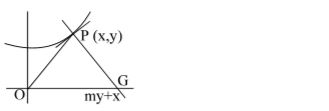
0 likes
View Solution35
AdvancedMCQ
The substitution $y = z^{\alpha}$ transforms the differential equation $(x^2y^2 - 1)dy + 2xy^3dx = 0$ into a homogeneous differential equation for
A
$\alpha = -1$
B
$\alpha = 0$
C
$\alpha = 1$
D
no value of $\alpha$
Solution
(A) Given the differential equation $(x^2y^2 - 1)dy + 2xy^3dx = 0$.
Substitute $y = z^{\alpha}$,then $dy = \alpha z^{\alpha - 1} dz$.
Substituting these into the equation:
$(x^2(z^{\alpha})^2 - 1)(\alpha z^{\alpha - 1} dz) + 2x(z^{\alpha})^3 dx = 0$
$(x^2 z^{2\alpha} - 1)(\alpha z^{\alpha - 1} dz) + 2x z^{3\alpha} dx = 0$
$\alpha x^2 z^{3\alpha - 1} dz - \alpha z^{\alpha - 1} dz + 2x z^{3\alpha} dx = 0$
For the equation to be homogeneous,the sum of powers of $x$ and $z$ in each term must be equal.
The powers are:
Term $1$: $x^2 z^{3\alpha - 1} \rightarrow 2 + (3\alpha - 1) = 3\alpha + 1$
Term $2$: $z^{\alpha - 1} \rightarrow 0 + (\alpha - 1) = \alpha - 1$
Term $3$: $x z^{3\alpha} \rightarrow 1 + 3\alpha = 3\alpha + 1$
Equating the powers: $3\alpha + 1 = \alpha - 1$
$2\alpha = -2 \Rightarrow \alpha = -1$.
Substitute $y = z^{\alpha}$,then $dy = \alpha z^{\alpha - 1} dz$.
Substituting these into the equation:
$(x^2(z^{\alpha})^2 - 1)(\alpha z^{\alpha - 1} dz) + 2x(z^{\alpha})^3 dx = 0$
$(x^2 z^{2\alpha} - 1)(\alpha z^{\alpha - 1} dz) + 2x z^{3\alpha} dx = 0$
$\alpha x^2 z^{3\alpha - 1} dz - \alpha z^{\alpha - 1} dz + 2x z^{3\alpha} dx = 0$
For the equation to be homogeneous,the sum of powers of $x$ and $z$ in each term must be equal.
The powers are:
Term $1$: $x^2 z^{3\alpha - 1} \rightarrow 2 + (3\alpha - 1) = 3\alpha + 1$
Term $2$: $z^{\alpha - 1} \rightarrow 0 + (\alpha - 1) = \alpha - 1$
Term $3$: $x z^{3\alpha} \rightarrow 1 + 3\alpha = 3\alpha + 1$
Equating the powers: $3\alpha + 1 = \alpha - 1$
$2\alpha = -2 \Rightarrow \alpha = -1$.
0 likes
View Solution36
AdvancedMCQ
The general solution of the differential equation $x \left( \frac{dy}{dx} \right) = y \ln \left( \frac{y}{x} \right)$ is:
A
$y = xe^{1 - cx}$
B
$y = xe^{1 + cx}$
C
$y = xe^{cx}$
D
None of these
Solution
(B) Given the differential equation: $x \frac{dy}{dx} = y \ln \left( \frac{y}{x} \right)$.
This is a homogeneous differential equation. Let $y = vx$,then $\frac{dy}{dx} = v + x \frac{dv}{dx}$.
Substituting these into the equation: $x(v + x \frac{dv}{dx}) = vx \ln(v)$.
Dividing by $x$: $v + x \frac{dv}{dx} = v \ln(v)$.
Rearranging: $x \frac{dv}{dx} = v \ln(v) - v = v(\ln(v) - 1)$.
Separating variables: $\frac{dv}{v(\ln(v) - 1)} = \frac{dx}{x}$.
Integrating both sides: $\int \frac{dv}{v(\ln(v) - 1)} = \int \frac{dx}{x}$.
Let $u = \ln(v) - 1$,then $du = \frac{1}{v} dv$.
So,$\int \frac{du}{u} = \ln|x| + C$.
$\ln|\ln(v) - 1| = \ln|x| + C$.
$\ln(v) - 1 = Cx$ (where $C$ is a constant).
$\ln(\frac{y}{x}) = 1 + Cx$.
$\frac{y}{x} = e^{1 + Cx}$.
$y = xe^{1 + Cx}$.
This is a homogeneous differential equation. Let $y = vx$,then $\frac{dy}{dx} = v + x \frac{dv}{dx}$.
Substituting these into the equation: $x(v + x \frac{dv}{dx}) = vx \ln(v)$.
Dividing by $x$: $v + x \frac{dv}{dx} = v \ln(v)$.
Rearranging: $x \frac{dv}{dx} = v \ln(v) - v = v(\ln(v) - 1)$.
Separating variables: $\frac{dv}{v(\ln(v) - 1)} = \frac{dx}{x}$.
Integrating both sides: $\int \frac{dv}{v(\ln(v) - 1)} = \int \frac{dx}{x}$.
Let $u = \ln(v) - 1$,then $du = \frac{1}{v} dv$.
So,$\int \frac{du}{u} = \ln|x| + C$.
$\ln|\ln(v) - 1| = \ln|x| + C$.
$\ln(v) - 1 = Cx$ (where $C$ is a constant).
$\ln(\frac{y}{x}) = 1 + Cx$.
$\frac{y}{x} = e^{1 + Cx}$.
$y = xe^{1 + Cx}$.
0 likes
View Solution37
AdvancedMCQ
Identify the statement$(s)$ which is/are True.
A
$f(x, y) = e^{y/x} + \tan\frac{y}{x}$ is homogeneous of degree zero.
B
$x \cdot \ln \frac{y}{x} dx + \frac{y^2}{x} \sin^{-1} \frac{y}{x} dy = 0$ is a homogeneous differential equation.
C
$f(x, y) = x^2 + \sin x \cdot \cos y$ is not homogeneous.
D
All of the above.
Solution
(D) Step $1$: Check option $A$. $A$ function $f(x, y)$ is homogeneous of degree $n$ if $f(\lambda x, \lambda y) = \lambda^n f(x, y)$. For $f(x, y) = e^{y/x} + \tan(y/x)$,$f(\lambda x, \lambda y) = e^{(\lambda y)/(\lambda x)} + \tan((\lambda y)/(\lambda x)) = e^{y/x} + \tan(y/x) = \lambda^0 f(x, y)$. Thus,it is homogeneous of degree $0$. Option $A$ is true.
Step $2$: Check option $B$. $A$ differential equation $M(x, y)dx + N(x, y)dy = 0$ is homogeneous if both $M(x, y)$ and $N(x, y)$ are homogeneous functions of the same degree. Here,$M(x, y) = x \ln(y/x)$ is homogeneous of degree $1$ (since $M(\lambda x, \lambda y) = \lambda x \ln(y/x) = \lambda^1 M(x, y)$). $N(x, y) = \frac{y^2}{x} \sin^{-1}(y/x)$ is homogeneous of degree $1$ (since $N(\lambda x, \lambda y) = \frac{(\lambda y)^2}{\lambda x} \sin^{-1}(y/x) = \lambda \frac{y^2}{x} \sin^{-1}(y/x) = \lambda^1 N(x, y)$). Since both are degree $1$,the equation is homogeneous. Option $B$ is true.
Step $3$: Check option $C$. For $f(x, y) = x^2 + \sin x \cos y$,$f(\lambda x, \lambda y) = (\lambda x)^2 + \sin(\lambda x) \cos(\lambda y) = \lambda^2 x^2 + \sin(\lambda x) \cos(\lambda y)$. This cannot be written in the form $\lambda^n f(x, y)$ for any $n$. Thus,it is not homogeneous. Option $C$ is true.
Step $4$: Since $A, B,$ and $C$ are true,the correct answer is $D$.
Step $2$: Check option $B$. $A$ differential equation $M(x, y)dx + N(x, y)dy = 0$ is homogeneous if both $M(x, y)$ and $N(x, y)$ are homogeneous functions of the same degree. Here,$M(x, y) = x \ln(y/x)$ is homogeneous of degree $1$ (since $M(\lambda x, \lambda y) = \lambda x \ln(y/x) = \lambda^1 M(x, y)$). $N(x, y) = \frac{y^2}{x} \sin^{-1}(y/x)$ is homogeneous of degree $1$ (since $N(\lambda x, \lambda y) = \frac{(\lambda y)^2}{\lambda x} \sin^{-1}(y/x) = \lambda \frac{y^2}{x} \sin^{-1}(y/x) = \lambda^1 N(x, y)$). Since both are degree $1$,the equation is homogeneous. Option $B$ is true.
Step $3$: Check option $C$. For $f(x, y) = x^2 + \sin x \cos y$,$f(\lambda x, \lambda y) = (\lambda x)^2 + \sin(\lambda x) \cos(\lambda y) = \lambda^2 x^2 + \sin(\lambda x) \cos(\lambda y)$. This cannot be written in the form $\lambda^n f(x, y)$ for any $n$. Thus,it is not homogeneous. Option $C$ is true.
Step $4$: Since $A, B,$ and $C$ are true,the correct answer is $D$.
0 likes
View Solution38
AdvancedMCQ
Which of the following functions are homogeneous?
A
$x \sin y + y \sin x$
B
$x e^{y/x} + y e^{x/y}$
C
$x^2 - xy$
D
Both $(B)$ and $(C)$
Solution
(D) function $f(x, y)$ is homogeneous of degree $n$ if $f(\lambda x, \lambda y) = \lambda^n f(x, y)$.
$A) f(x, y) = x \sin y + y \sin x$
$f(\lambda x, \lambda y) = \lambda x \sin(\lambda y) + \lambda y \sin(\lambda x) = \lambda(x \sin(\lambda y) + y \sin(\lambda x))$.
Since this is not equal to $\lambda^n f(x, y)$,it is not homogeneous.
$B) f(x, y) = x e^{y/x} + y e^{x/y}$
$f(\lambda x, \lambda y) = \lambda x e^{\lambda y / \lambda x} + \lambda y e^{\lambda x / \lambda y} = \lambda(x e^{y/x} + y e^{x/y}) = \lambda^1 f(x, y)$.
This is a homogeneous function of degree $1$.
$C) f(x, y) = x^2 - xy$
$f(\lambda x, \lambda y) = (\lambda x)^2 - (\lambda x)(\lambda y) = \lambda^2 x^2 - \lambda^2 xy = \lambda^2(x^2 - xy) = \lambda^2 f(x, y)$.
This is a homogeneous function of degree $2$.
Therefore,both $(B)$ and $(C)$ are homogeneous functions.
$A) f(x, y) = x \sin y + y \sin x$
$f(\lambda x, \lambda y) = \lambda x \sin(\lambda y) + \lambda y \sin(\lambda x) = \lambda(x \sin(\lambda y) + y \sin(\lambda x))$.
Since this is not equal to $\lambda^n f(x, y)$,it is not homogeneous.
$B) f(x, y) = x e^{y/x} + y e^{x/y}$
$f(\lambda x, \lambda y) = \lambda x e^{\lambda y / \lambda x} + \lambda y e^{\lambda x / \lambda y} = \lambda(x e^{y/x} + y e^{x/y}) = \lambda^1 f(x, y)$.
This is a homogeneous function of degree $1$.
$C) f(x, y) = x^2 - xy$
$f(\lambda x, \lambda y) = (\lambda x)^2 - (\lambda x)(\lambda y) = \lambda^2 x^2 - \lambda^2 xy = \lambda^2(x^2 - xy) = \lambda^2 f(x, y)$.
This is a homogeneous function of degree $2$.
Therefore,both $(B)$ and $(C)$ are homogeneous functions.
0 likes
View Solution39
AdvancedMCQ
$A$ curve passes through the point $\left( 1, \frac{\pi}{4} \right)$ and its slope at any point is given by $\frac{dy}{dx} = \frac{y}{x} - \cos^2 \left( \frac{y}{x} \right)$. Find the equation of the curve.
A
$y = x \tan^{-1} \left( \ln \frac{e}{x} \right)$
B
$y = x \tan^{-1} (\ln x + 2)$
C
$y = \frac{1}{x} \tan^{-1} \left( \ln \frac{e}{x} \right)$
D
None of these
Solution
(A) Given the differential equation: $\frac{dy}{dx} = \frac{y}{x} - \cos^2 \left( \frac{y}{x} \right)$.
Let $v = \frac{y}{x}$,then $y = vx$. Differentiating with respect to $x$,we get $\frac{dy}{dx} = v + x \frac{dv}{dx}$.
Substituting into the equation: $v + x \frac{dv}{dx} = v - \cos^2 v$.
This simplifies to $x \frac{dv}{dx} = -\cos^2 v$.
Separating variables: $\sec^2 v \, dv = -\frac{dx}{x}$.
Integrating both sides: $\int \sec^2 v \, dv = -\int \frac{dx}{x} \implies \tan v = -\ln |x| + C$.
Since the curve passes through $\left( 1, \frac{\pi}{4} \right)$,we have $v = \frac{\pi}{4}$ when $x = 1$.
$\tan \left( \frac{\pi}{4} \right) = -\ln(1) + C \implies 1 = 0 + C \implies C = 1$.
Thus,$\tan v = 1 - \ln x = \ln e - \ln x = \ln \left( \frac{e}{x} \right)$.
Therefore,$v = \tan^{-1} \left( \ln \frac{e}{x} \right)$.
Substituting $v = \frac{y}{x}$,we get $y = x \tan^{-1} \left( \ln \frac{e}{x} \right)$.
Let $v = \frac{y}{x}$,then $y = vx$. Differentiating with respect to $x$,we get $\frac{dy}{dx} = v + x \frac{dv}{dx}$.
Substituting into the equation: $v + x \frac{dv}{dx} = v - \cos^2 v$.
This simplifies to $x \frac{dv}{dx} = -\cos^2 v$.
Separating variables: $\sec^2 v \, dv = -\frac{dx}{x}$.
Integrating both sides: $\int \sec^2 v \, dv = -\int \frac{dx}{x} \implies \tan v = -\ln |x| + C$.
Since the curve passes through $\left( 1, \frac{\pi}{4} \right)$,we have $v = \frac{\pi}{4}$ when $x = 1$.
$\tan \left( \frac{\pi}{4} \right) = -\ln(1) + C \implies 1 = 0 + C \implies C = 1$.
Thus,$\tan v = 1 - \ln x = \ln e - \ln x = \ln \left( \frac{e}{x} \right)$.
Therefore,$v = \tan^{-1} \left( \ln \frac{e}{x} \right)$.
Substituting $v = \frac{y}{x}$,we get $y = x \tan^{-1} \left( \ln \frac{e}{x} \right)$.
0 likes
View Solution40
AdvancedMCQ
The solution of the differential equation $(x^2 - xy)dy = (xy + y^2)dx$ is
A
$xy = ce^{-y/x}$
B
$xy = ce^{-x/y}$
C
$yx^2 = ce^{1/x}$
D
None of these
Solution
(B) The given differential equation is $(x^2 - xy)dy = (xy + y^2)dx$.
This can be written as $\frac{dy}{dx} = \frac{xy + y^2}{x^2 - xy}$.
This is a homogeneous differential equation.
Let $y = vx$,then $\frac{dy}{dx} = v + x\frac{dv}{dx}$.
Substituting these into the equation: $v + x\frac{dv}{dx} = \frac{x(vx) + (vx)^2}{x^2 - x(vx)} = \frac{v + v^2}{1 - v}$.
$x\frac{dv}{dx} = \frac{v + v^2}{1 - v} - v = \frac{v + v^2 - v + v^2}{1 - v} = \frac{2v^2}{1 - v}$.
Separating the variables: $\frac{1 - v}{v^2} dv = \frac{2}{x} dx$.
Integrating both sides: $\int (v^{-2} - v^{-1}) dv = 2 \int \frac{1}{x} dx$.
$-v^{-1} - \ln|v| = 2\ln|x| + C$.
Substituting $v = y/x$: $-\frac{x}{y} - \ln|y/x| = 2\ln|x| + C$.
$-\frac{x}{y} - \ln|y| + \ln|x| = 2\ln|x| + C$.
$-\frac{x}{y} = \ln|y| + \ln|x| + C = \ln|xy| + C$.
Thus,$xy = e^{-x/y - C} = Ce^{-x/y}$.
This can be written as $\frac{dy}{dx} = \frac{xy + y^2}{x^2 - xy}$.
This is a homogeneous differential equation.
Let $y = vx$,then $\frac{dy}{dx} = v + x\frac{dv}{dx}$.
Substituting these into the equation: $v + x\frac{dv}{dx} = \frac{x(vx) + (vx)^2}{x^2 - x(vx)} = \frac{v + v^2}{1 - v}$.
$x\frac{dv}{dx} = \frac{v + v^2}{1 - v} - v = \frac{v + v^2 - v + v^2}{1 - v} = \frac{2v^2}{1 - v}$.
Separating the variables: $\frac{1 - v}{v^2} dv = \frac{2}{x} dx$.
Integrating both sides: $\int (v^{-2} - v^{-1}) dv = 2 \int \frac{1}{x} dx$.
$-v^{-1} - \ln|v| = 2\ln|x| + C$.
Substituting $v = y/x$: $-\frac{x}{y} - \ln|y/x| = 2\ln|x| + C$.
$-\frac{x}{y} - \ln|y| + \ln|x| = 2\ln|x| + C$.
$-\frac{x}{y} = \ln|y| + \ln|x| + C = \ln|xy| + C$.
Thus,$xy = e^{-x/y - C} = Ce^{-x/y}$.
0 likes
View Solution41
AdvancedMCQ
For the differential equation,the general solution for $x \cos \left( \frac{y}{x} \right) (y dx + x dy) = y \sin \left( \frac{y}{x} \right) (x dy - y dx)$,(where $c$ is the constant of integration) is
A
$x = cy \sec \left( \frac{y}{x} \right)$
B
$xy \cos \left( \frac{y}{x} \right) = c$
C
$x = cy \sec \left( \frac{x}{y} \right)$
D
$xy = c \cos \left( \frac{y}{x} \right)$
Solution
(B) Given equation: $x \cos \left( \frac{y}{x} \right) (y dx + x dy) = y \sin \left( \frac{y}{x} \right) (x dy - y dx)$
Divide both sides by $xy \cos \left( \frac{y}{x} \right)$:
$\frac{y dx + x dy}{y} = \tan \left( \frac{y}{x} \right) \frac{x dy - y dx}{x} $
$\frac{y dx + x dy}{xy} = \tan \left( \frac{y}{x} \right) \left( \frac{x dy - y dx}{x^2} \right) $
Note that $d(xy) = y dx + x dy$ and $d\left( \frac{y}{x} \right) = \frac{x dy - y dx}{x^2}$.
So,$\frac{d(xy)}{xy} = \tan \left( \frac{y}{x} \right) d\left( \frac{y}{x} \right) $
Integrating both sides:
$\int \frac{d(xy)}{xy} = \int \tan \left( \frac{y}{x} \right) d\left( \frac{y}{x} \right) $
$\ln |xy| = \ln \left| \sec \left( \frac{y}{x} \right) \right| + \ln |c| $
$xy = c \sec \left( \frac{y}{x} \right) $
Thus,$x = \frac{c}{y} \sec \left( \frac{y}{x} \right)$ is not the form,but $xy = c \sec \left( \frac{y}{x} \right)$ is equivalent to $xy \cos \left( \frac{y}{x} \right) = c$.
Divide both sides by $xy \cos \left( \frac{y}{x} \right)$:
$\frac{y dx + x dy}{y} = \tan \left( \frac{y}{x} \right) \frac{x dy - y dx}{x} $
$\frac{y dx + x dy}{xy} = \tan \left( \frac{y}{x} \right) \left( \frac{x dy - y dx}{x^2} \right) $
Note that $d(xy) = y dx + x dy$ and $d\left( \frac{y}{x} \right) = \frac{x dy - y dx}{x^2}$.
So,$\frac{d(xy)}{xy} = \tan \left( \frac{y}{x} \right) d\left( \frac{y}{x} \right) $
Integrating both sides:
$\int \frac{d(xy)}{xy} = \int \tan \left( \frac{y}{x} \right) d\left( \frac{y}{x} \right) $
$\ln |xy| = \ln \left| \sec \left( \frac{y}{x} \right) \right| + \ln |c| $
$xy = c \sec \left( \frac{y}{x} \right) $
Thus,$x = \frac{c}{y} \sec \left( \frac{y}{x} \right)$ is not the form,but $xy = c \sec \left( \frac{y}{x} \right)$ is equivalent to $xy \cos \left( \frac{y}{x} \right) = c$.
0 likes
View Solution42
AdvancedMCQ
The equation of the curve satisfying $x dy - y dx = \sqrt{x^2 - y^2} dx$ with the condition $y(1) = 0$ is:
A
$y = x \sin(\ln x)$
B
$y^2 = x(x - 1)^2$
C
$y^2 = x^2(x - 1)$
D
$y = x \sin(\ln x)$
Solution
(D) Given the differential equation: $x dy - y dx = \sqrt{x^2 - y^2} dx$.
Divide by $dx$: $x \frac{dy}{dx} - y = \sqrt{x^2 - y^2}$.
Substitute $y = vx$,so $\frac{dy}{dx} = v + x \frac{dv}{dx}$.
$x(v + x \frac{dv}{dx}) - vx = \sqrt{x^2 - v^2x^2}$.
$vx + x^2 \frac{dv}{dx} - vx = x \sqrt{1 - v^2}$.
$x^2 \frac{dv}{dx} = x \sqrt{1 - v^2} \implies \frac{dv}{\sqrt{1 - v^2}} = \frac{dx}{x}$.
Integrating both sides: $\int \frac{dv}{\sqrt{1 - v^2}} = \int \frac{dx}{x} \implies \sin^{-1}(v) = \ln|x| + C$.
Substitute $v = \frac{y}{x}$: $\sin^{-1}(\frac{y}{x}) = \ln|x| + C$.
Given $y(1) = 0$,at $x = 1, y = 0$: $\sin^{-1}(0) = \ln(1) + C \implies 0 = 0 + C \implies C = 0$.
Thus,$\sin^{-1}(\frac{y}{x}) = \ln x \implies \frac{y}{x} = \sin(\ln x) \implies y = x \sin(\ln x)$.
Divide by $dx$: $x \frac{dy}{dx} - y = \sqrt{x^2 - y^2}$.
Substitute $y = vx$,so $\frac{dy}{dx} = v + x \frac{dv}{dx}$.
$x(v + x \frac{dv}{dx}) - vx = \sqrt{x^2 - v^2x^2}$.
$vx + x^2 \frac{dv}{dx} - vx = x \sqrt{1 - v^2}$.
$x^2 \frac{dv}{dx} = x \sqrt{1 - v^2} \implies \frac{dv}{\sqrt{1 - v^2}} = \frac{dx}{x}$.
Integrating both sides: $\int \frac{dv}{\sqrt{1 - v^2}} = \int \frac{dx}{x} \implies \sin^{-1}(v) = \ln|x| + C$.
Substitute $v = \frac{y}{x}$: $\sin^{-1}(\frac{y}{x}) = \ln|x| + C$.
Given $y(1) = 0$,at $x = 1, y = 0$: $\sin^{-1}(0) = \ln(1) + C \implies 0 = 0 + C \implies C = 0$.
Thus,$\sin^{-1}(\frac{y}{x}) = \ln x \implies \frac{y}{x} = \sin(\ln x) \implies y = x \sin(\ln x)$.
0 likes
View Solution43
DifficultMCQ
The curve satisfying the differential equation $(x^2 - y^2) \, dx + 2xy \, dy = 0$ and passing through the point $(1, 1)$ is
A
a circle of radius two
B
a circle of radius one
C
a hyperbola
D
an ellipse
Solution
(B) Given differential equation is $(x^2 - y^2) \, dx + 2xy \, dy = 0$.
This can be written as $\frac{dy}{dx} = \frac{y^2 - x^2}{2xy}$.
Since this is a homogeneous differential equation,we put $y = ux$,which implies $\frac{dy}{dx} = u + x \frac{du}{dx}$.
Substituting these into the equation: $u + x \frac{du}{dx} = \frac{u^2 x^2 - x^2}{2x(ux)} = \frac{u^2 - 1}{2u}$.
$x \frac{du}{dx} = \frac{u^2 - 1}{2u} - u = \frac{u^2 - 1 - 2u^2}{2u} = \frac{-(1 + u^2)}{2u}$.
Separating variables: $\int \frac{2u}{1 + u^2} \, du = - \int \frac{1}{x} \, dx$.
Integrating both sides: $\ln(1 + u^2) = -\ln|x| + \ln|C|$.
$\ln(1 + u^2) = \ln\left(\frac{C}{x}\right) \Rightarrow 1 + u^2 = \frac{C}{x}$.
Substituting $u = \frac{y}{x}$: $1 + \frac{y^2}{x^2} = \frac{C}{x} \Rightarrow \frac{x^2 + y^2}{x^2} = \frac{C}{x} \Rightarrow x^2 + y^2 = Cx$.
Since the curve passes through $(1, 1)$,we have $1^2 + 1^2 = C(1) \Rightarrow C = 2$.
Thus,the equation of the curve is $x^2 + y^2 = 2x$,which can be rewritten as $(x - 1)^2 + y^2 = 1$.
This represents a circle with center $(1, 0)$ and radius $1$.
This can be written as $\frac{dy}{dx} = \frac{y^2 - x^2}{2xy}$.
Since this is a homogeneous differential equation,we put $y = ux$,which implies $\frac{dy}{dx} = u + x \frac{du}{dx}$.
Substituting these into the equation: $u + x \frac{du}{dx} = \frac{u^2 x^2 - x^2}{2x(ux)} = \frac{u^2 - 1}{2u}$.
$x \frac{du}{dx} = \frac{u^2 - 1}{2u} - u = \frac{u^2 - 1 - 2u^2}{2u} = \frac{-(1 + u^2)}{2u}$.
Separating variables: $\int \frac{2u}{1 + u^2} \, du = - \int \frac{1}{x} \, dx$.
Integrating both sides: $\ln(1 + u^2) = -\ln|x| + \ln|C|$.
$\ln(1 + u^2) = \ln\left(\frac{C}{x}\right) \Rightarrow 1 + u^2 = \frac{C}{x}$.
Substituting $u = \frac{y}{x}$: $1 + \frac{y^2}{x^2} = \frac{C}{x} \Rightarrow \frac{x^2 + y^2}{x^2} = \frac{C}{x} \Rightarrow x^2 + y^2 = Cx$.
Since the curve passes through $(1, 1)$,we have $1^2 + 1^2 = C(1) \Rightarrow C = 2$.
Thus,the equation of the curve is $x^2 + y^2 = 2x$,which can be rewritten as $(x - 1)^2 + y^2 = 1$.
This represents a circle with center $(1, 0)$ and radius $1$.
0 likes
View Solution44
DifficultMCQ
Consider the differential equation $\frac{dy}{dx} = \frac{y^3}{2(xy^2 - x^2)}$.
Statement $-1:$ The substitution $z = y^2$ transforms the above equation into a first-order homogeneous differential equation.
Statement $-2:$ The solution of this differential equation is $y^2 e^{-y^2/x} = C$.
Statement $-1:$ The substitution $z = y^2$ transforms the above equation into a first-order homogeneous differential equation.
Statement $-2:$ The solution of this differential equation is $y^2 e^{-y^2/x} = C$.
A
Both statements are false.
B
Statement $-1$ is true and statement $-2$ is false.
C
Statement $-1$ is false and statement $-2$ is true.
D
Both statements are true.
Solution
(B) Given differential equation is $\frac{dy}{dx} = \frac{y^3}{2(xy^2 - x^2)}$.
Let $z = y^2$. Then $\frac{dz}{dx} = 2y \frac{dy}{dx}$.
Substituting $\frac{dy}{dx} = \frac{1}{2y} \frac{dz}{dx}$ into the equation:
$\frac{1}{2y} \frac{dz}{dx} = \frac{y^3}{2(xy^2 - x^2)} \implies \frac{dz}{dx} = \frac{y^4}{xy^2 - x^2} = \frac{z^2}{xz - x^2}$.
Dividing numerator and denominator by $x^2$,we get $\frac{dz}{dx} = \frac{(z/x)^2}{(z/x) - 1}$. This is a homogeneous differential equation in terms of $z$ and $x$. Thus,Statement $-1$ is true.
To solve $\frac{dz}{dx} = \frac{z^2}{xz - x^2}$,let $z = vx$,then $\frac{dz}{dx} = v + x \frac{dv}{dx}$.
$v + x \frac{dv}{dx} = \frac{v^2 x^2}{x(vx) - x^2} = \frac{v^2}{v - 1}$.
$x \frac{dv}{dx} = \frac{v^2}{v - 1} - v = \frac{v^2 - v^2 + v}{v - 1} = \frac{v}{v - 1}$.
$\int \frac{v - 1}{v} dv = \int \frac{1}{x} dx \implies \int (1 - \frac{1}{v}) dv = \ln|x| + C$.
$v - \ln|v| = \ln|x| + C \implies \frac{z}{x} - \ln|\frac{z}{x}| = \ln|x| + C$.
$\frac{y^2}{x} - \ln|y^2| + \ln|x| = \ln|x| + C \implies \frac{y^2}{x} = \ln|y^2| + C$.
This does not match $y^2 e^{-y^2/x} = C$. Thus,Statement $-2$ is false.
Let $z = y^2$. Then $\frac{dz}{dx} = 2y \frac{dy}{dx}$.
Substituting $\frac{dy}{dx} = \frac{1}{2y} \frac{dz}{dx}$ into the equation:
$\frac{1}{2y} \frac{dz}{dx} = \frac{y^3}{2(xy^2 - x^2)} \implies \frac{dz}{dx} = \frac{y^4}{xy^2 - x^2} = \frac{z^2}{xz - x^2}$.
Dividing numerator and denominator by $x^2$,we get $\frac{dz}{dx} = \frac{(z/x)^2}{(z/x) - 1}$. This is a homogeneous differential equation in terms of $z$ and $x$. Thus,Statement $-1$ is true.
To solve $\frac{dz}{dx} = \frac{z^2}{xz - x^2}$,let $z = vx$,then $\frac{dz}{dx} = v + x \frac{dv}{dx}$.
$v + x \frac{dv}{dx} = \frac{v^2 x^2}{x(vx) - x^2} = \frac{v^2}{v - 1}$.
$x \frac{dv}{dx} = \frac{v^2}{v - 1} - v = \frac{v^2 - v^2 + v}{v - 1} = \frac{v}{v - 1}$.
$\int \frac{v - 1}{v} dv = \int \frac{1}{x} dx \implies \int (1 - \frac{1}{v}) dv = \ln|x| + C$.
$v - \ln|v| = \ln|x| + C \implies \frac{z}{x} - \ln|\frac{z}{x}| = \ln|x| + C$.
$\frac{y^2}{x} - \ln|y^2| + \ln|x| = \ln|x| + C \implies \frac{y^2}{x} = \ln|y^2| + C$.
This does not match $y^2 e^{-y^2/x} = C$. Thus,Statement $-2$ is false.
0 likes
View Solution45
DifficultMCQ
If $\frac{dy}{dx} = \frac{xy}{x^2 + y^2}$ and $y(1) = 1$,then find the value of $x$ that satisfies $y(x) = e$.
A
$\sqrt{2} e$
B
$\frac{e}{\sqrt{2}}$
C
$\frac{1}{2} \sqrt{3} e$
D
$\sqrt{3} e$
Solution
(D) Given the differential equation $\frac{dy}{dx} = \frac{xy}{x^2 + y^2}$.
Substitute $y = vx$,then $\frac{dy}{dx} = v + x \frac{dv}{dx}$.
Substituting into the equation: $v + x \frac{dv}{dx} = \frac{x(vx)}{x^2 + v^2 x^2} = \frac{v}{1 + v^2}$.
$x \frac{dv}{dx} = \frac{v}{1 + v^2} - v = \frac{v - v - v^3}{1 + v^2} = -\frac{v^3}{1 + v^2}$.
Separating variables: $\int \frac{1 + v^2}{v^3} dv = -\int \frac{dx}{x}$.
$\int (v^{-3} + v^{-1}) dv = -\int \frac{dx}{x}$.
Integrating both sides: $-\frac{1}{2v^2} + \ln|v| = -\ln|x| + C$.
Substitute $v = \frac{y}{x}$: $-\frac{x^2}{2y^2} + \ln|\frac{y}{x}| = -\ln|x| + C$.
$-\frac{x^2}{2y^2} + \ln|y| - \ln|x| = -\ln|x| + C \implies -\frac{x^2}{2y^2} + \ln|y| = C$.
Using $y(1) = 1$: $-\frac{1^2}{2(1)^2} + \ln(1) = C \implies C = -\frac{1}{2}$.
The equation is $-\frac{x^2}{2y^2} + \ln|y| = -\frac{1}{2}$.
For $y = e$: $-\frac{x^2}{2e^2} + \ln(e) = -\frac{1}{2} \implies -\frac{x^2}{2e^2} + 1 = -\frac{1}{2}$.
$-\frac{x^2}{2e^2} = -\frac{3}{2} \implies x^2 = 3e^2 \implies x = \sqrt{3}e$.
Substitute $y = vx$,then $\frac{dy}{dx} = v + x \frac{dv}{dx}$.
Substituting into the equation: $v + x \frac{dv}{dx} = \frac{x(vx)}{x^2 + v^2 x^2} = \frac{v}{1 + v^2}$.
$x \frac{dv}{dx} = \frac{v}{1 + v^2} - v = \frac{v - v - v^3}{1 + v^2} = -\frac{v^3}{1 + v^2}$.
Separating variables: $\int \frac{1 + v^2}{v^3} dv = -\int \frac{dx}{x}$.
$\int (v^{-3} + v^{-1}) dv = -\int \frac{dx}{x}$.
Integrating both sides: $-\frac{1}{2v^2} + \ln|v| = -\ln|x| + C$.
Substitute $v = \frac{y}{x}$: $-\frac{x^2}{2y^2} + \ln|\frac{y}{x}| = -\ln|x| + C$.
$-\frac{x^2}{2y^2} + \ln|y| - \ln|x| = -\ln|x| + C \implies -\frac{x^2}{2y^2} + \ln|y| = C$.
Using $y(1) = 1$: $-\frac{1^2}{2(1)^2} + \ln(1) = C \implies C = -\frac{1}{2}$.
The equation is $-\frac{x^2}{2y^2} + \ln|y| = -\frac{1}{2}$.
For $y = e$: $-\frac{x^2}{2e^2} + \ln(e) = -\frac{1}{2} \implies -\frac{x^2}{2e^2} + 1 = -\frac{1}{2}$.
$-\frac{x^2}{2e^2} = -\frac{3}{2} \implies x^2 = 3e^2 \implies x = \sqrt{3}e$.
0 likes
View Solution46
Medium
One card is drawn at random from a well-shuffled deck of $52$ cards. In which of the following cases are the events $E$ and $F$ independent?
$E:$ 'The card drawn is a king or a queen'
$F:$ 'The card drawn is a queen or a jack'
$E:$ 'The card drawn is a king or a queen'
$F:$ 'The card drawn is a queen or a jack'
Solution
(NONE) In a deck of $52$ cards,there are $4$ kings,$4$ queens,and $4$ jacks.
$P(E) = P(\text{king or queen}) = \frac{4+4}{52} = \frac{8}{52} = \frac{2}{13}$.
$P(F) = P(\text{queen or jack}) = \frac{4+4}{52} = \frac{8}{52} = \frac{2}{13}$.
The event $E \cap F$ represents the card being a queen (since queen is common to both sets).
$P(E \cap F) = P(\text{queen}) = \frac{4}{52} = \frac{1}{13}$.
Now,check for independence: $P(E) \times P(F) = \frac{2}{13} \times \frac{2}{13} = \frac{4}{169}$.
Since $P(E \cap F) = \frac{1}{13} = \frac{13}{169}$,and $\frac{4}{169} \neq \frac{13}{169}$,we have $P(E \cap F) \neq P(E) \times P(F)$.
Therefore,the events $E$ and $F$ are not independent.
$P(E) = P(\text{king or queen}) = \frac{4+4}{52} = \frac{8}{52} = \frac{2}{13}$.
$P(F) = P(\text{queen or jack}) = \frac{4+4}{52} = \frac{8}{52} = \frac{2}{13}$.
The event $E \cap F$ represents the card being a queen (since queen is common to both sets).
$P(E \cap F) = P(\text{queen}) = \frac{4}{52} = \frac{1}{13}$.
Now,check for independence: $P(E) \times P(F) = \frac{2}{13} \times \frac{2}{13} = \frac{4}{169}$.
Since $P(E \cap F) = \frac{1}{13} = \frac{13}{169}$,and $\frac{4}{169} \neq \frac{13}{169}$,we have $P(E \cap F) \neq P(E) \times P(F)$.
Therefore,the events $E$ and $F$ are not independent.
0 likes
View Solution47
Difficult
Show that the differential equation $(x-y) \frac{dy}{dx} = x+2y$ is homogeneous and solve it.
Solution
(N/A) The given differential equation can be expressed as
$\frac{dy}{dx} = \frac{x+2y}{x-y}$ ............$(1)$
Let $F(x, y) = \frac{x+2y}{x-y}$.
Now $F(\lambda x, \lambda y) = \frac{\lambda(x+2y)}{\lambda(x-y)} = \lambda^0 \cdot F(x, y)$.
Therefore,$F(x, y)$ is a homogeneous function of degree zero. So,the given differential equation is a homogeneous differential equation.
Alternatively,
$\frac{dy}{dx} = \frac{1+2(y/x)}{1-(y/x)} = g(y/x)$ .............$(2)$
Since the $R.H.S.$ is a function of $y/x$,it is a homogeneous function of degree zero.
To solve it,we make the substitution $y = vx$ ...........$(3)$
Differentiating with respect to $x$,we get $\frac{dy}{dx} = v + x \frac{dv}{dx}$ ...........$(4)$
Substituting $(3)$ and $(4)$ into $(1)$:
$v + x \frac{dv}{dx} = \frac{1+2v}{1-v}$
$x \frac{dv}{dx} = \frac{1+2v}{1-v} - v = \frac{1+2v-v+v^2}{1-v} = \frac{v^2+v+1}{1-v}$
$\frac{v-1}{v^2+v+1} dv = -\frac{dx}{x}$
Integrating both sides:
$\int \frac{v-1}{v^2+v+1} dv = -\int \frac{dx}{x}$
$\frac{1}{2} \int \frac{2v+1-3}{v^2+v+1} dv = -\log|x| + C_1$
$\frac{1}{2} \log|v^2+v+1| - \frac{3}{2} \int \frac{1}{(v+1/2)^2 + (\sqrt{3}/2)^2} dv = -\log|x| + C_1$
$\frac{1}{2} \log|v^2+v+1| - \frac{3}{2} \cdot \frac{2}{\sqrt{3}} \tan^{-1}\left(\frac{2v+1}{\sqrt{3}}\right) = -\log|x| + C_1$
$\frac{1}{2} \log|v^2+v+1| + \log|x| = \sqrt{3} \tan^{-1}\left(\frac{2v+1}{\sqrt{3}}\right) + C_1$
$\frac{1}{2} \log|x^2(v^2+v+1)| = \sqrt{3} \tan^{-1}\left(\frac{2v+1}{\sqrt{3}}\right) + C_1$
Substituting $v = y/x$:
$\log|x^2+xy+y^2| = 2\sqrt{3} \tan^{-1}\left(\frac{2y+x}{\sqrt{3}x}\right) + C$.
$\frac{dy}{dx} = \frac{x+2y}{x-y}$ ............$(1)$
Let $F(x, y) = \frac{x+2y}{x-y}$.
Now $F(\lambda x, \lambda y) = \frac{\lambda(x+2y)}{\lambda(x-y)} = \lambda^0 \cdot F(x, y)$.
Therefore,$F(x, y)$ is a homogeneous function of degree zero. So,the given differential equation is a homogeneous differential equation.
Alternatively,
$\frac{dy}{dx} = \frac{1+2(y/x)}{1-(y/x)} = g(y/x)$ .............$(2)$
Since the $R.H.S.$ is a function of $y/x$,it is a homogeneous function of degree zero.
To solve it,we make the substitution $y = vx$ ...........$(3)$
Differentiating with respect to $x$,we get $\frac{dy}{dx} = v + x \frac{dv}{dx}$ ...........$(4)$
Substituting $(3)$ and $(4)$ into $(1)$:
$v + x \frac{dv}{dx} = \frac{1+2v}{1-v}$
$x \frac{dv}{dx} = \frac{1+2v}{1-v} - v = \frac{1+2v-v+v^2}{1-v} = \frac{v^2+v+1}{1-v}$
$\frac{v-1}{v^2+v+1} dv = -\frac{dx}{x}$
Integrating both sides:
$\int \frac{v-1}{v^2+v+1} dv = -\int \frac{dx}{x}$
$\frac{1}{2} \int \frac{2v+1-3}{v^2+v+1} dv = -\log|x| + C_1$
$\frac{1}{2} \log|v^2+v+1| - \frac{3}{2} \int \frac{1}{(v+1/2)^2 + (\sqrt{3}/2)^2} dv = -\log|x| + C_1$
$\frac{1}{2} \log|v^2+v+1| - \frac{3}{2} \cdot \frac{2}{\sqrt{3}} \tan^{-1}\left(\frac{2v+1}{\sqrt{3}}\right) = -\log|x| + C_1$
$\frac{1}{2} \log|v^2+v+1| + \log|x| = \sqrt{3} \tan^{-1}\left(\frac{2v+1}{\sqrt{3}}\right) + C_1$
$\frac{1}{2} \log|x^2(v^2+v+1)| = \sqrt{3} \tan^{-1}\left(\frac{2v+1}{\sqrt{3}}\right) + C_1$
Substituting $v = y/x$:
$\log|x^2+xy+y^2| = 2\sqrt{3} \tan^{-1}\left(\frac{2y+x}{\sqrt{3}x}\right) + C$.
0 likes
View Solution48
Difficult
Show that the differential equation $x \cos \left(\frac{y}{x}\right) \frac{d y}{d x}=y \cos \left(\frac{y}{x}\right)+x$ is homogeneous and solve it.
Solution
(N/A) The given differential equation can be written as
$\frac{d y}{d x}=\frac{y \cos \left(\frac{y}{x}\right)+x}{x \cos \left(\frac{y}{x}\right)}$ ............$(1)$
It is a differential equation of the form $\frac{d y}{d x}=F(x, y)$.
Here $F(x, y) = \frac{y \cos \left(\frac{y}{x}\right) + x}{x \cos \left(\frac{y}{x}\right)}$.
Replacing $x$ by $\lambda x$ and $y$ by $\lambda y$,we get
$F(\lambda x, \lambda y) = \frac{\lambda y \cos \left(\frac{\lambda y}{\lambda x}\right) + \lambda x}{\lambda x \cos \left(\frac{\lambda y}{\lambda x}\right)} = \frac{\lambda [y \cos (y/x) + x]}{\lambda [x \cos (y/x)]} = \lambda^0 F(x, y)$.
Since $F(x, y)$ is a homogeneous function of degree zero,the given differential equation is homogeneous.
To solve it,substitute $y = vx$,which implies $\frac{dy}{dx} = v + x \frac{dv}{dx}$.
Substituting these into equation $(1)$:
$v + x \frac{dv}{dx} = \frac{vx \cos v + x}{x \cos v} = \frac{v \cos v + 1}{\cos v}$.
$x \frac{dv}{dx} = \frac{v \cos v + 1}{\cos v} - v = \frac{v \cos v + 1 - v \cos v}{\cos v} = \frac{1}{\cos v}$.
Separating variables: $\cos v \, dv = \frac{dx}{x}$.
Integrating both sides: $\int \cos v \, dv = \int \frac{1}{x} \, dx$.
$\sin v = \log |x| + C$.
Substituting $v = y/x$,the general solution is $\sin \left(\frac{y}{x}\right) = \log |x| + C$.
$\frac{d y}{d x}=\frac{y \cos \left(\frac{y}{x}\right)+x}{x \cos \left(\frac{y}{x}\right)}$ ............$(1)$
It is a differential equation of the form $\frac{d y}{d x}=F(x, y)$.
Here $F(x, y) = \frac{y \cos \left(\frac{y}{x}\right) + x}{x \cos \left(\frac{y}{x}\right)}$.
Replacing $x$ by $\lambda x$ and $y$ by $\lambda y$,we get
$F(\lambda x, \lambda y) = \frac{\lambda y \cos \left(\frac{\lambda y}{\lambda x}\right) + \lambda x}{\lambda x \cos \left(\frac{\lambda y}{\lambda x}\right)} = \frac{\lambda [y \cos (y/x) + x]}{\lambda [x \cos (y/x)]} = \lambda^0 F(x, y)$.
Since $F(x, y)$ is a homogeneous function of degree zero,the given differential equation is homogeneous.
To solve it,substitute $y = vx$,which implies $\frac{dy}{dx} = v + x \frac{dv}{dx}$.
Substituting these into equation $(1)$:
$v + x \frac{dv}{dx} = \frac{vx \cos v + x}{x \cos v} = \frac{v \cos v + 1}{\cos v}$.
$x \frac{dv}{dx} = \frac{v \cos v + 1}{\cos v} - v = \frac{v \cos v + 1 - v \cos v}{\cos v} = \frac{1}{\cos v}$.
Separating variables: $\cos v \, dv = \frac{dx}{x}$.
Integrating both sides: $\int \cos v \, dv = \int \frac{1}{x} \, dx$.
$\sin v = \log |x| + C$.
Substituting $v = y/x$,the general solution is $\sin \left(\frac{y}{x}\right) = \log |x| + C$.
0 likes
View SolutionDifferential Equations — Homogeneous differential equations · Frequently Asked Questions
1Are these Differential Equations questions useful for JEE and NEET?
Yes. All questions in this section are mapped to JEE Main and NEET exam patterns. Previous year questions from JEE Main, NEET, GUJCET and state-level exams are included with full solutions.
2Can I switch to Hindi or Gujarati for these questions?
Yes. Use the language tabs in the hero section or the sidebar to view the same questions and solutions in English, Hindi or Gujarati.
3How do I generate a question paper from this subtopic?
Use the Vedclass Exam Paper Generator — select the chapter and subtopic, set difficulty, and generate Sets A, B, C, D automatically. First 3 chapters of every subject are free.
Vedclass Products
For Students
Vedclass Test Series
Mock tests in real JEE/NEET style with performance analysis. 5-day free trial.
Start Free TrialFor Teachers
Exam Paper Generator
Generate Set A/B/C/D papers from this chapter in 2 minutes. 3 chapters free.
Try FreeFor Institutes
Online Exam Module
Live online exams with unlimited students, 360° analytics & white-label branding.
See DemoFor Teachers & Institutes
Generate a Differential Equations Exam Paper in 2 Minutes
Select subtopic & difficulty — Sets A, B, C, D auto-generated with No Repeat logic.
First 3 chapters of every subject are free — no payment required.