
A English
Formation of differential equations Questions in English
Class 12 Mathematics · Differential Equations · Formation of differential equations
243+
Questions
English
Language
100%
With Solutions
Showing 50 of 243 questions in English
1
MediumMCQ
The differential equation satisfied by the function $y = \sqrt{\sin x + \sqrt{\sin x + \sqrt{\sin x + \dots \infty}}}$ is
A
$(2y - 1)\frac{dy}{dx} - \sin x = 0$
B
$(2y - 1)\cos x + \frac{dy}{dx} = 0$
C
$(2y - 1)\cos x - \frac{dy}{dx} = 0$
D
$(2y - 1)\frac{dy}{dx} - \cos x = 0$
Solution
(D) Given the function $y = \sqrt{\sin x + \sqrt{\sin x + \sqrt{\sin x + \dots \infty}}}$.
Since the series is infinite,we can write it as $y = \sqrt{\sin x + y}$.
Squaring both sides,we get $y^2 = \sin x + y$.
Differentiating both sides with respect to $x$,we get $\frac{d}{dx}(y^2) = \frac{d}{dx}(\sin x + y)$.
Using the chain rule,$2y \frac{dy}{dx} = \cos x + \frac{dy}{dx}$.
Rearranging the terms,we get $2y \frac{dy}{dx} - \frac{dy}{dx} = \cos x$.
Factoring out $\frac{dy}{dx}$,we get $(2y - 1)\frac{dy}{dx} = \cos x$,which can be written as $(2y - 1)\frac{dy}{dx} - \cos x = 0$.
Since the series is infinite,we can write it as $y = \sqrt{\sin x + y}$.
Squaring both sides,we get $y^2 = \sin x + y$.
Differentiating both sides with respect to $x$,we get $\frac{d}{dx}(y^2) = \frac{d}{dx}(\sin x + y)$.
Using the chain rule,$2y \frac{dy}{dx} = \cos x + \frac{dy}{dx}$.
Rearranging the terms,we get $2y \frac{dy}{dx} - \frac{dy}{dx} = \cos x$.
Factoring out $\frac{dy}{dx}$,we get $(2y - 1)\frac{dy}{dx} = \cos x$,which can be written as $(2y - 1)\frac{dy}{dx} - \cos x = 0$.
0 likes
View Solution2
EasyMCQ
If $y = a + bx^2$,where $a$ and $b$ are arbitrary constants,then which of the following is true?
A
$\frac{d^2y}{dx^2} = 2xy$
B
$x\frac{d^2y}{dx^2} = \frac{dy}{dx}$
C
$x\frac{d^2y}{dx^2} - \frac{dy}{dx} + y = 0$
D
$x\frac{d^2y}{dx^2} = 2xy$
Solution
(B) Given the equation $y = a + bx^2$.
First,differentiate with respect to $x$:
$\frac{dy}{dx} = \frac{d}{dx}(a + bx^2) = 0 + 2bx = 2bx$.
Next,differentiate again with respect to $x$ to find the second derivative:
$\frac{d^2y}{dx^2} = \frac{d}{dx}(2bx) = 2b$.
Now,consider the expression $x \frac{d^2y}{dx^2}$:
$x \frac{d^2y}{dx^2} = x(2b) = 2bx$.
Since $\frac{dy}{dx} = 2bx$,we can substitute this into the equation:
$x \frac{d^2y}{dx^2} = \frac{dy}{dx}$.
Thus,option $B$ is correct.
First,differentiate with respect to $x$:
$\frac{dy}{dx} = \frac{d}{dx}(a + bx^2) = 0 + 2bx = 2bx$.
Next,differentiate again with respect to $x$ to find the second derivative:
$\frac{d^2y}{dx^2} = \frac{d}{dx}(2bx) = 2b$.
Now,consider the expression $x \frac{d^2y}{dx^2}$:
$x \frac{d^2y}{dx^2} = x(2b) = 2bx$.
Since $\frac{dy}{dx} = 2bx$,we can substitute this into the equation:
$x \frac{d^2y}{dx^2} = \frac{dy}{dx}$.
Thus,option $B$ is correct.
0 likes
View Solution3
EasyMCQ
The order of the differential equation of a family of curves represented by an equation containing four arbitrary constants will be:
A
$2$
B
$4$
C
$6$
D
None of these
Solution
(B) The order of a differential equation representing a family of curves is equal to the number of arbitrary constants present in the equation of the family of curves.
Since the given family of curves contains $4$ arbitrary constants,the order of the corresponding differential equation is $4$.
Since the given family of curves contains $4$ arbitrary constants,the order of the corresponding differential equation is $4$.
0 likes
View Solution4
EasyMCQ
The differential equation of all circles of radius $a$ is of order:
A
$2$
B
$3$
C
$4$
D
None of these
Solution
(A) The general equation of a circle with radius $a$ is given by $(x - h)^2 + (y - k)^2 = a^2$,where $(h, k)$ are the coordinates of the center.
This equation contains two arbitrary constants,$h$ and $k$.
The order of a differential equation is equal to the number of arbitrary constants present in the general solution of the family of curves.
Since there are $2$ arbitrary constants,the order of the differential equation is $2$.
This equation contains two arbitrary constants,$h$ and $k$.
The order of a differential equation is equal to the number of arbitrary constants present in the general solution of the family of curves.
Since there are $2$ arbitrary constants,the order of the differential equation is $2$.
0 likes
View Solution5
MediumMCQ
$y = 4\sin 3x$ is a solution of the differential equation
A
$\frac{dy}{dx} + 8y = 0$
B
$\frac{dy}{dx} - 8y = 0$
C
$\frac{d^2y}{dx^2} + 9y = 0$
D
$\frac{d^2y}{dx^2} - 9y = 0$
Solution
(C) Given the function $y = 4\sin 3x$.
Differentiating with respect to $x$,we get:
$\frac{dy}{dx} = 4 \times 3 \cos 3x = 12 \cos 3x$.
Differentiating again with respect to $x$,we get:
$\frac{d^2y}{dx^2} = 12 \times (-3 \sin 3x) = -36 \sin 3x$.
We can rewrite this as:
$\frac{d^2y}{dx^2} = -9(4 \sin 3x)$.
Since $y = 4 \sin 3x$,we substitute $y$ into the equation:
$\frac{d^2y}{dx^2} = -9y$.
Rearranging the terms,we get:
$\frac{d^2y}{dx^2} + 9y = 0$.
Thus,the correct option is $C$.
Differentiating with respect to $x$,we get:
$\frac{dy}{dx} = 4 \times 3 \cos 3x = 12 \cos 3x$.
Differentiating again with respect to $x$,we get:
$\frac{d^2y}{dx^2} = 12 \times (-3 \sin 3x) = -36 \sin 3x$.
We can rewrite this as:
$\frac{d^2y}{dx^2} = -9(4 \sin 3x)$.
Since $y = 4 \sin 3x$,we substitute $y$ into the equation:
$\frac{d^2y}{dx^2} = -9y$.
Rearranging the terms,we get:
$\frac{d^2y}{dx^2} + 9y = 0$.
Thus,the correct option is $C$.
0 likes
View Solution6
EasyMCQ
The differential equation of all the lines in the $xy$-plane is
A
$\frac{dy}{dx} - x = 0$
B
$\frac{d^2y}{dx^2} - x\frac{dy}{dx} = 0$
C
$\frac{d^2y}{dx^2} = 0$
D
$\frac{d^2y}{dx^2} + x = 0$
Solution
(C) The general equation of all lines in the $xy$-plane is given by $y = mx + c$,where $m$ and $c$ are arbitrary constants.
To find the differential equation,we differentiate with respect to $x$:
$\frac{dy}{dx} = m$
Now,differentiate again with respect to $x$:
$\frac{d^2y}{dx^2} = 0$
Thus,the required differential equation is $\frac{d^2y}{dx^2} = 0$.
To find the differential equation,we differentiate with respect to $x$:
$\frac{dy}{dx} = m$
Now,differentiate again with respect to $x$:
$\frac{d^2y}{dx^2} = 0$
Thus,the required differential equation is $\frac{d^2y}{dx^2} = 0$.
0 likes
View Solution7
MediumMCQ
The differential equation of the family of curves represented by the equation ${x^2} + {y^2} = {a^2}$ is
A
$x + y\frac{dy}{dx} = 0$
B
$y\frac{dy}{dx} = x$
C
$y\frac{d^2y}{dx^2} + \left( \frac{dy}{dx} \right)^2 = 0$
D
None of these
Solution
(A) Given equation is ${x^2} + {y^2} = {a^2}$.
To find the differential equation,we differentiate the given equation with respect to $x$:
$\frac{d}{dx}({x^2} + {y^2}) = \frac{d}{dx}({a^2})$
$2x + 2y\frac{dy}{dx} = 0$
Dividing by $2$,we get:
$x + y\frac{dy}{dx} = 0$
Thus,the differential equation is $x + y\frac{dy}{dx} = 0$.
To find the differential equation,we differentiate the given equation with respect to $x$:
$\frac{d}{dx}({x^2} + {y^2}) = \frac{d}{dx}({a^2})$
$2x + 2y\frac{dy}{dx} = 0$
Dividing by $2$,we get:
$x + y\frac{dy}{dx} = 0$
Thus,the differential equation is $x + y\frac{dy}{dx} = 0$.
0 likes
View Solution8
EasyMCQ
$y = \frac{x}{x + 1}$ is a solution of which differential equation?
A
$y^2 \frac{dy}{dx} = x^2$
B
$x^2 \frac{dy}{dx} = y^2$
C
$y \frac{dy}{dx} = x$
D
$x \frac{dy}{dx} = y$
Solution
(B) Given $y = \frac{x}{x + 1}$.
Taking the reciprocal of both sides,we get $\frac{1}{y} = \frac{x + 1}{x} = 1 + \frac{1}{x}$.
Differentiating both sides with respect to $x$:
$-\frac{1}{y^2} \frac{dy}{dx} = 0 - \frac{1}{x^2}$.
Multiplying both sides by $-y^2 x^2$,we get $x^2 \frac{dy}{dx} = y^2$.
Thus,the correct option is $B$.
Taking the reciprocal of both sides,we get $\frac{1}{y} = \frac{x + 1}{x} = 1 + \frac{1}{x}$.
Differentiating both sides with respect to $x$:
$-\frac{1}{y^2} \frac{dy}{dx} = 0 - \frac{1}{x^2}$.
Multiplying both sides by $-y^2 x^2$,we get $x^2 \frac{dy}{dx} = y^2$.
Thus,the correct option is $B$.
0 likes
View Solution9
EasyMCQ
The differential equation whose solution is $y = A\sin x + B\cos x$ is
A
$\frac{d^2y}{dx^2} + y = 0$
B
$\frac{d^2y}{dx^2} - y = 0$
C
$\frac{dy}{dx} + y = 0$
D
None of these
Solution
(A) Given the equation $y = A\sin x + B\cos x$.
Differentiating with respect to $x$ once,we get:
$\frac{dy}{dx} = A\cos x - B\sin x$.
Differentiating with respect to $x$ again,we get:
$\frac{d^2y}{dx^2} = -A\sin x - B\cos x$.
We can rewrite this as:
$\frac{d^2y}{dx^2} = -(A\sin x + B\cos x)$.
Since $y = A\sin x + B\cos x$,we substitute $y$ into the equation:
$\frac{d^2y}{dx^2} = -y$.
Rearranging the terms,we get the required differential equation:
$\frac{d^2y}{dx^2} + y = 0$.
Differentiating with respect to $x$ once,we get:
$\frac{dy}{dx} = A\cos x - B\sin x$.
Differentiating with respect to $x$ again,we get:
$\frac{d^2y}{dx^2} = -A\sin x - B\cos x$.
We can rewrite this as:
$\frac{d^2y}{dx^2} = -(A\sin x + B\cos x)$.
Since $y = A\sin x + B\cos x$,we substitute $y$ into the equation:
$\frac{d^2y}{dx^2} = -y$.
Rearranging the terms,we get the required differential equation:
$\frac{d^2y}{dx^2} + y = 0$.
0 likes
View Solution10
EasyMCQ
The differential equation of the family of curves $y = a \cos(x + b)$ is
A
$\frac{d^2y}{dx^2} - y = 0$
B
$\frac{d^2y}{dx^2} + y = 0$
C
$\frac{d^2y}{dx^2} + 2y = 0$
D
None of these
Solution
(B) Given the family of curves $y = a \cos(x + b)$,where $a$ and $b$ are arbitrary constants.
Differentiating with respect to $x$,we get:
$\frac{dy}{dx} = -a \sin(x + b)$
Differentiating again with respect to $x$,we get:
$\frac{d^2y}{dx^2} = -a \cos(x + b)$
Since $y = a \cos(x + b)$,we can substitute this into the second derivative:
$\frac{d^2y}{dx^2} = -y$
Rearranging the terms,we get:
$\frac{d^2y}{dx^2} + y = 0$
Thus,the correct option is $B$.
Differentiating with respect to $x$,we get:
$\frac{dy}{dx} = -a \sin(x + b)$
Differentiating again with respect to $x$,we get:
$\frac{d^2y}{dx^2} = -a \cos(x + b)$
Since $y = a \cos(x + b)$,we can substitute this into the second derivative:
$\frac{d^2y}{dx^2} = -y$
Rearranging the terms,we get:
$\frac{d^2y}{dx^2} + y = 0$
Thus,the correct option is $B$.
0 likes
View Solution11
DifficultMCQ
The differential equation for all the straight lines which are at a unit distance from the origin is
A
${\left( {y - x\frac{{dy}}{{dx}}} \right)^2} = 1 - {\left( {\frac{{dy}}{{dx}}} \right)^2}$
B
${\left( {y + x\frac{{dy}}{{dx}}} \right)^2} = 1 + {\left( {\frac{{dy}}{{dx}}} \right)^2}$
C
${\left( {y - x\frac{{dy}}{{dx}}} \right)^2} = 1 + {\left( {\frac{{dy}}{{dx}}} \right)^2}$
D
${\left( {y + x\frac{{dy}}{{dx}}} \right)^2} = 1 - {\left( {\frac{{dy}}{{dx}}} \right)^2}$
Solution
(C) The equation of a straight line at a unit distance from the origin is given by $x \cos \alpha + y \sin \alpha = 1$ $... (i)$
Differentiating with respect to $x$,we get $\cos \alpha + \frac{dy}{dx} \sin \alpha = 0$ $... (ii)$
From $(ii)$,we have $\cos \alpha = -\frac{dy}{dx} \sin \alpha$. Substituting this into $(i)$:
$x(-\frac{dy}{dx} \sin \alpha) + y \sin \alpha = 1$
$\sin \alpha (y - x \frac{dy}{dx}) = 1$
$y - x \frac{dy}{dx} = \frac{1}{\sin \alpha} = \csc \alpha$ $... (iii)$
From $(ii)$,$\frac{dy}{dx} = -\cot \alpha$,so $(\frac{dy}{dx})^2 = \cot^2 \alpha$.
Using the identity $1 + \cot^2 \alpha = \csc^2 \alpha$,we substitute from $(iii)$ and $(iv)$:
$1 + (\frac{dy}{dx})^2 = \csc^2 \alpha = (y - x \frac{dy}{dx})^2$.
Differentiating with respect to $x$,we get $\cos \alpha + \frac{dy}{dx} \sin \alpha = 0$ $... (ii)$
From $(ii)$,we have $\cos \alpha = -\frac{dy}{dx} \sin \alpha$. Substituting this into $(i)$:
$x(-\frac{dy}{dx} \sin \alpha) + y \sin \alpha = 1$
$\sin \alpha (y - x \frac{dy}{dx}) = 1$
$y - x \frac{dy}{dx} = \frac{1}{\sin \alpha} = \csc \alpha$ $... (iii)$
From $(ii)$,$\frac{dy}{dx} = -\cot \alpha$,so $(\frac{dy}{dx})^2 = \cot^2 \alpha$.
Using the identity $1 + \cot^2 \alpha = \csc^2 \alpha$,we substitute from $(iii)$ and $(iv)$:
$1 + (\frac{dy}{dx})^2 = \csc^2 \alpha = (y - x \frac{dy}{dx})^2$.
0 likes
View Solution12
EasyMCQ
If $y = c{e^{{{\sin }^{ - 1}}x}}$,then the corresponding differential equation is:
A
$\frac{dy}{dx} = \frac{y}{\sqrt{1 - x^2}}$
B
$\frac{dy}{dx} = \frac{1}{\sqrt{1 - x^2}}$
C
$\frac{dy}{dx} = \frac{x}{\sqrt{1 - x^2}}$
D
None of these
Solution
(A) Given the equation: $y = c{e^{{{\sin }^{ - 1}}x}}$.
Differentiating both sides with respect to $x$ using the chain rule:
$\frac{dy}{dx} = c{e^{{{\sin }^{ - 1}}x}} \cdot \frac{d}{dx}(\sin^{-1}x)$
We know that $\frac{d}{dx}(\sin^{-1}x) = \frac{1}{\sqrt{1 - x^2}}$.
Substituting this into the derivative:
$\frac{dy}{dx} = c{e^{{{\sin }^{ - 1}}x}} \cdot \frac{1}{\sqrt{1 - x^2}}$
Since $y = c{e^{{{\sin }^{ - 1}}x}}$,we can substitute $y$ back into the equation:
$\frac{dy}{dx} = \frac{y}{\sqrt{1 - x^2}}$
Thus,the correct option is $A$.
Differentiating both sides with respect to $x$ using the chain rule:
$\frac{dy}{dx} = c{e^{{{\sin }^{ - 1}}x}} \cdot \frac{d}{dx}(\sin^{-1}x)$
We know that $\frac{d}{dx}(\sin^{-1}x) = \frac{1}{\sqrt{1 - x^2}}$.
Substituting this into the derivative:
$\frac{dy}{dx} = c{e^{{{\sin }^{ - 1}}x}} \cdot \frac{1}{\sqrt{1 - x^2}}$
Since $y = c{e^{{{\sin }^{ - 1}}x}}$,we can substitute $y$ back into the equation:
$\frac{dy}{dx} = \frac{y}{\sqrt{1 - x^2}}$
Thus,the correct option is $A$.
0 likes
View Solution13
EasyMCQ
The differential equation of the family of curves represented by the equation ${x^2}y = a$ is:
A
$\frac{dy}{dx} + \frac{2y}{x} = 0$
B
$\frac{dy}{dx} + \frac{2x}{y} = 0$
C
$\frac{dy}{dx} - \frac{2y}{x} = 0$
D
$\frac{dy}{dx} - \frac{2x}{y} = 0$
Solution
(A) Given the equation of the family of curves: ${x^2}y = a$.
Differentiating both sides with respect to $x$ using the product rule:
$\frac{d}{dx}({x^2}y) = \frac{d}{dx}(a)$
${x^2} \frac{dy}{dx} + y \frac{d}{dx}({x^2}) = 0$
${x^2} \frac{dy}{dx} + y(2x) = 0$
${x^2} \frac{dy}{dx} + 2xy = 0$
Dividing the entire equation by ${x^2}$ (assuming $x \neq 0$):
$\frac{dy}{dx} + \frac{2xy}{x^2} = 0$
$\frac{dy}{dx} + \frac{2y}{x} = 0$.
Thus,the correct option is $A$.
Differentiating both sides with respect to $x$ using the product rule:
$\frac{d}{dx}({x^2}y) = \frac{d}{dx}(a)$
${x^2} \frac{dy}{dx} + y \frac{d}{dx}({x^2}) = 0$
${x^2} \frac{dy}{dx} + y(2x) = 0$
${x^2} \frac{dy}{dx} + 2xy = 0$
Dividing the entire equation by ${x^2}$ (assuming $x \neq 0$):
$\frac{dy}{dx} + \frac{2xy}{x^2} = 0$
$\frac{dy}{dx} + \frac{2y}{x} = 0$.
Thus,the correct option is $A$.
0 likes
View Solution14
EasyMCQ
The differential equation corresponding to the primitive $y = e^{mx}$ is obtained by eliminating the arbitrary constant $m$. What is the resulting differential equation?
A
$\frac{dy}{dx} = \left( \frac{y}{x} \right) \log x$
B
$\frac{dy}{dx} = \left( \frac{x}{y} \right) \log y$
C
$\frac{dy}{dx} = \left( \frac{y}{x} \right) \log y$
D
$\frac{dy}{dx} = \left( \frac{x}{y} \right) \log x$
Solution
(C) Given the equation $y = e^{mx}$.
Taking the natural logarithm on both sides,we get $\log y = mx$.
From this,we can express the arbitrary constant as $m = \frac{\log y}{x}$.
Now,differentiate $y = e^{mx}$ with respect to $x$:
$\frac{dy}{dx} = m e^{mx}$.
Since $e^{mx} = y$,we substitute this into the derivative:
$\frac{dy}{dx} = m \cdot y$.
Substitute the value of $m = \frac{\log y}{x}$ into the equation:
$\frac{dy}{dx} = \left( \frac{\log y}{x} \right) \cdot y = \left( \frac{y}{x} \right) \log y$.
Thus,the correct option is $C$.
Taking the natural logarithm on both sides,we get $\log y = mx$.
From this,we can express the arbitrary constant as $m = \frac{\log y}{x}$.
Now,differentiate $y = e^{mx}$ with respect to $x$:
$\frac{dy}{dx} = m e^{mx}$.
Since $e^{mx} = y$,we substitute this into the derivative:
$\frac{dy}{dx} = m \cdot y$.
Substitute the value of $m = \frac{\log y}{x}$ into the equation:
$\frac{dy}{dx} = \left( \frac{\log y}{x} \right) \cdot y = \left( \frac{y}{x} \right) \log y$.
Thus,the correct option is $C$.
0 likes
View Solution15
EasyMCQ
The differential equation whose solution is $y = c_1 \cos ax + c_2 \sin ax$ is (where $c_1, c_2$ are arbitrary constants):
A
$\frac{d^2y}{dx^2} + y^2 = 0$
B
$\frac{d^2y}{dx^2} + a^2y = 0$
C
$\frac{d^2y}{dx^2} + ay^2 = 0$
D
$\frac{d^2y}{dx^2} - a^2y = 0$
Solution
(B) Given the solution is $y = c_1 \cos ax + c_2 \sin ax$.
Differentiating with respect to $x$,we get:
$\frac{dy}{dx} = -c_1 a \sin ax + c_2 a \cos ax$.
Differentiating again with respect to $x$:
$\frac{d^2y}{dx^2} = -c_1 a^2 \cos ax - c_2 a^2 \sin ax$.
Factoring out $-a^2$:
$\frac{d^2y}{dx^2} = -a^2(c_1 \cos ax + c_2 \sin ax)$.
Since $y = c_1 \cos ax + c_2 \sin ax$,we substitute $y$ into the equation:
$\frac{d^2y}{dx^2} = -a^2 y$.
Rearranging the terms,we get:
$\frac{d^2y}{dx^2} + a^2 y = 0$.
Differentiating with respect to $x$,we get:
$\frac{dy}{dx} = -c_1 a \sin ax + c_2 a \cos ax$.
Differentiating again with respect to $x$:
$\frac{d^2y}{dx^2} = -c_1 a^2 \cos ax - c_2 a^2 \sin ax$.
Factoring out $-a^2$:
$\frac{d^2y}{dx^2} = -a^2(c_1 \cos ax + c_2 \sin ax)$.
Since $y = c_1 \cos ax + c_2 \sin ax$,we substitute $y$ into the equation:
$\frac{d^2y}{dx^2} = -a^2 y$.
Rearranging the terms,we get:
$\frac{d^2y}{dx^2} + a^2 y = 0$.
0 likes
View Solution16
EasyMCQ
The differential equation for the line $y = mx + c$ is (where $m$ and $c$ are arbitrary constants).
A
$\frac{d^2y}{dx^2} = 0$
B
$\frac{dy}{dx} + m = 0$
C
$\frac{dy}{dx} = 0$
D
None of these
Solution
(A) Given the equation of the line is $y = mx + c$,where $m$ and $c$ are arbitrary constants.
Step $1$: Differentiate the equation with respect to $x$:
$\frac{dy}{dx} = m$
Step $2$: Differentiate again with respect to $x$ to eliminate the constant $m$:
$\frac{d^2y}{dx^2} = 0$
Thus,the differential equation is $\frac{d^2y}{dx^2} = 0$.
Step $1$: Differentiate the equation with respect to $x$:
$\frac{dy}{dx} = m$
Step $2$: Differentiate again with respect to $x$ to eliminate the constant $m$:
$\frac{d^2y}{dx^2} = 0$
Thus,the differential equation is $\frac{d^2y}{dx^2} = 0$.
0 likes
View Solution17
MediumMCQ
The differential equation of all straight lines passing through the point $(1, -1)$ is
A
$y = (x + 1)\frac{dy}{dx} + 1$
B
$y = (x + 1)\frac{dy}{dx} - 1$
C
$y = (x - 1)\frac{dy}{dx} + 1$
D
$y = (x - 1)\frac{dy}{dx} - 1$
Solution
(D) The equation of a straight line passing through the point $(1, -1)$ with slope $m$ is given by:
$y - y_1 = m(x - x_1)$
Substituting $(x_1, y_1) = (1, -1)$,we get:
$y - (-1) = m(x - 1)$
$y + 1 = m(x - 1)$
Since $m$ represents the slope of the line,we can write $m = \frac{dy}{dx}$.
Substituting this into the equation,we get:
$y + 1 = \frac{dy}{dx}(x - 1)$
Rearranging the terms to solve for $y$:
$y = (x - 1)\frac{dy}{dx} - 1$
Thus,the correct option is $D$.
$y - y_1 = m(x - x_1)$
Substituting $(x_1, y_1) = (1, -1)$,we get:
$y - (-1) = m(x - 1)$
$y + 1 = m(x - 1)$
Since $m$ represents the slope of the line,we can write $m = \frac{dy}{dx}$.
Substituting this into the equation,we get:
$y + 1 = \frac{dy}{dx}(x - 1)$
Rearranging the terms to solve for $y$:
$y = (x - 1)\frac{dy}{dx} - 1$
Thus,the correct option is $D$.
0 likes
View Solution18
MediumMCQ
The differential equation of the family of curves ${y^2} = 4a(x + a)$,where $a$ is an arbitrary constant,is
A
$y\left[ {1 + {{\left( {\frac{{dy}}{{dx}}} \right)}^2}} \right] = 2x\frac{{dy}}{{dx}}$
B
$y\left[ {1 - {{\left( {\frac{{dy}}{{dx}}} \right)}^2}} \right] = 2x\frac{{dy}}{{dx}}$
C
$\frac{{{d^2}y}}{{d{x^2}}} + 2\frac{{dy}}{{dx}} = 0$
D
${\left( {\frac{{dy}}{{dx}}} \right)^3} + 3\frac{{dy}}{{dx}} + y = 0$
Solution
(B) Given the family of curves: ${y^2} = 4a(x + a) \quad (i)$
Differentiating both sides with respect to $x$:
$2y \frac{{dy}}{{dx}} = 4a$
$a = \frac{y}{2} \frac{{dy}}{{dx}} \quad (ii)$
Substitute the value of $a$ from equation $(ii)$ into equation $(i)$:
${y^2} = 4 \left( \frac{y}{2} \frac{{dy}}{{dx}} \right) \left( x + \frac{y}{2} \frac{{dy}}{{dx}} \right)$
${y^2} = 2y \frac{{dy}}{{dx}} \left( x + \frac{y}{2} \frac{{dy}}{{dx}} \right)$
Divide by $y$ (assuming $y \neq 0$):
$y = 2 \frac{{dy}}{{dx}} \left( x + \frac{y}{2} \frac{{dy}}{{dx}} \right)$
$y = 2x \frac{{dy}}{{dx}} + y {\left( \frac{{dy}}{{dx}} \right)^2}$
Rearranging the terms:
$y - y {\left( \frac{{dy}}{{dx}} \right)^2} = 2x \frac{{dy}}{{dx}}$
$y \left[ {1 - {{\left( {\frac{{dy}}{{dx}}} \right)}^2}} \right] = 2x \frac{{dy}}{{dx}}$
Thus,the correct option is $B$.
Differentiating both sides with respect to $x$:
$2y \frac{{dy}}{{dx}} = 4a$
$a = \frac{y}{2} \frac{{dy}}{{dx}} \quad (ii)$
Substitute the value of $a$ from equation $(ii)$ into equation $(i)$:
${y^2} = 4 \left( \frac{y}{2} \frac{{dy}}{{dx}} \right) \left( x + \frac{y}{2} \frac{{dy}}{{dx}} \right)$
${y^2} = 2y \frac{{dy}}{{dx}} \left( x + \frac{y}{2} \frac{{dy}}{{dx}} \right)$
Divide by $y$ (assuming $y \neq 0$):
$y = 2 \frac{{dy}}{{dx}} \left( x + \frac{y}{2} \frac{{dy}}{{dx}} \right)$
$y = 2x \frac{{dy}}{{dx}} + y {\left( \frac{{dy}}{{dx}} \right)^2}$
Rearranging the terms:
$y - y {\left( \frac{{dy}}{{dx}} \right)^2} = 2x \frac{{dy}}{{dx}}$
$y \left[ {1 - {{\left( {\frac{{dy}}{{dx}}} \right)}^2}} \right] = 2x \frac{{dy}}{{dx}}$
Thus,the correct option is $B$.
0 likes
View Solution19
MediumMCQ
The differential equation of the family of curves $v = \frac{A}{r} + B$,where $A$ and $B$ are arbitrary constants,is
A
$\frac{d^2v}{dr^2} + \frac{1}{r}\frac{dv}{dr} = 0$
B
$\frac{d^2v}{dr^2} - \frac{2}{r}\frac{dv}{dr} = 0$
C
$\frac{d^2v}{dr^2} + \frac{2}{r}\frac{dv}{dr} = 0$
D
None of these
Solution
(C) Given the equation $v = \frac{A}{r} + B$.
Differentiating with respect to $r$,we get:
$\frac{dv}{dr} = -\frac{A}{r^2}$.
Differentiating again with respect to $r$,we get:
$\frac{d^2v}{dr^2} = \frac{2A}{r^3}$.
From the first derivative,we have $A = -r^2 \frac{dv}{dr}$.
Substituting this into the second derivative:
$\frac{d^2v}{dr^2} = \frac{2(-r^2 \frac{dv}{dr})}{r^3} = -\frac{2}{r} \frac{dv}{dr}$.
Rearranging the terms,we get:
$\frac{d^2v}{dr^2} + \frac{2}{r} \frac{dv}{dr} = 0$.
Differentiating with respect to $r$,we get:
$\frac{dv}{dr} = -\frac{A}{r^2}$.
Differentiating again with respect to $r$,we get:
$\frac{d^2v}{dr^2} = \frac{2A}{r^3}$.
From the first derivative,we have $A = -r^2 \frac{dv}{dr}$.
Substituting this into the second derivative:
$\frac{d^2v}{dr^2} = \frac{2(-r^2 \frac{dv}{dr})}{r^3} = -\frac{2}{r} \frac{dv}{dr}$.
Rearranging the terms,we get:
$\frac{d^2v}{dr^2} + \frac{2}{r} \frac{dv}{dr} = 0$.
0 likes
View Solution20
MediumMCQ
The differential equation of all parabolas whose axes are parallel to the $y$-axis is
A
$\frac{d^3y}{dx^3} = 0$
B
$\frac{d^2x}{dy^2} = c$
C
$\frac{d^3y}{dx^3} + \frac{d^2x}{dy^2} = 0$
D
$\frac{d^2y}{dx^2} + 2\frac{dy}{dx} = c$
Solution
(A) The general equation of a parabola with its axis parallel to the $y$-axis is given by $y = Ax^2 + Bx + C$,where $A, B, C$ are arbitrary constants.
Step $1$: Differentiate with respect to $x$:
$\frac{dy}{dx} = 2Ax + B$
Step $2$: Differentiate again with respect to $x$:
$\frac{d^2y}{dx^2} = 2A$
Step $3$: Differentiate a third time with respect to $x$:
$\frac{d^3y}{dx^3} = 0$
Since there are $3$ arbitrary constants,we differentiate $3$ times to eliminate them. Thus,the required differential equation is $\frac{d^3y}{dx^3} = 0$.
Step $1$: Differentiate with respect to $x$:
$\frac{dy}{dx} = 2Ax + B$
Step $2$: Differentiate again with respect to $x$:
$\frac{d^2y}{dx^2} = 2A$
Step $3$: Differentiate a third time with respect to $x$:
$\frac{d^3y}{dx^3} = 0$
Since there are $3$ arbitrary constants,we differentiate $3$ times to eliminate them. Thus,the required differential equation is $\frac{d^3y}{dx^3} = 0$.
0 likes
View Solution21
MediumMCQ
The differential equation found by the elimination of the arbitrary constant $K$ from the equation $y = (x + K)e^{-x}$ is
A
$\frac{dy}{dx} - y = e^{-x}$
B
$\frac{dy}{dx} - ye^x = 1$
C
$\frac{dy}{dx} + ye^x = 1$
D
$\frac{dy}{dx} + y = e^{-x}$
Solution
(D) Given equation: $y = (x + K)e^{-x}$
Differentiating both sides with respect to $x$ using the product rule:
$\frac{dy}{dx} = \frac{d}{dx}(x + K) \cdot e^{-x} + (x + K) \cdot \frac{d}{dx}(e^{-x})$
$\frac{dy}{dx} = 1 \cdot e^{-x} + (x + K) \cdot (-e^{-x})$
$\frac{dy}{dx} = e^{-x} - (x + K)e^{-x}$
Since $y = (x + K)e^{-x}$,we substitute $y$ into the equation:
$\frac{dy}{dx} = e^{-x} - y$
Rearranging the terms gives:
$\frac{dy}{dx} + y = e^{-x}$
Differentiating both sides with respect to $x$ using the product rule:
$\frac{dy}{dx} = \frac{d}{dx}(x + K) \cdot e^{-x} + (x + K) \cdot \frac{d}{dx}(e^{-x})$
$\frac{dy}{dx} = 1 \cdot e^{-x} + (x + K) \cdot (-e^{-x})$
$\frac{dy}{dx} = e^{-x} - (x + K)e^{-x}$
Since $y = (x + K)e^{-x}$,we substitute $y$ into the equation:
$\frac{dy}{dx} = e^{-x} - y$
Rearranging the terms gives:
$\frac{dy}{dx} + y = e^{-x}$
0 likes
View Solution22
MediumMCQ
The differential equation whose solution is $y = cx + c - c^3$ is:
A
$\frac{dy}{dx} = c$
B
$y = x\frac{dy}{dx} + \frac{dy}{dx} - \left(\frac{dy}{dx}\right)^3$
C
$\frac{dy}{dx} = c - 3c^2$
D
None of these
Solution
(B) Given the equation $y = cx + c - c^3$.
To find the differential equation,we differentiate the given equation with respect to $x$:
$\frac{dy}{dx} = c$.
Now,we substitute $c = \frac{dy}{dx}$ back into the original equation $y = cx + c - c^3$:
$y = x\left(\frac{dy}{dx}\right) + \frac{dy}{dx} - \left(\frac{dy}{dx}\right)^3$.
Thus,the required differential equation is $y = x\frac{dy}{dx} + \frac{dy}{dx} - \left(\frac{dy}{dx}\right)^3$.
To find the differential equation,we differentiate the given equation with respect to $x$:
$\frac{dy}{dx} = c$.
Now,we substitute $c = \frac{dy}{dx}$ back into the original equation $y = cx + c - c^3$:
$y = x\left(\frac{dy}{dx}\right) + \frac{dy}{dx} - \left(\frac{dy}{dx}\right)^3$.
Thus,the required differential equation is $y = x\frac{dy}{dx} + \frac{dy}{dx} - \left(\frac{dy}{dx}\right)^3$.
0 likes
View Solution23
EasyMCQ
The family of curves $y = e^x(A\cos x + B\sin x)$ represents the differential equation:
A
$\frac{d^2y}{dx^2} = 2\frac{dy}{dx} - y$
B
$\frac{d^2y}{dx^2} = 2\frac{dy}{dx} - 2y$
C
$\frac{d^2y}{dx^2} = \frac{dy}{dx} - 2y$
D
$\frac{d^2y}{dx^2} = 2\frac{dy}{dx} + y$
Solution
(B) Given the equation $y = e^x(A\cos x + B\sin x)$.
Differentiating with respect to $x$ using the product rule:
$\frac{dy}{dx} = e^x(A\cos x + B\sin x) + e^x(-A\sin x + B\cos x)$
$\frac{dy}{dx} = e^x((A+B)\cos x + (B-A)\sin x) = y + e^x(-A\sin x + B\cos x)$
Differentiating again with respect to $x$:
$\frac{d^2y}{dx^2} = \frac{dy}{dx} + e^x(-A\sin x + B\cos x) + e^x(-A\cos x - B\sin x)$
$\frac{d^2y}{dx^2} = \frac{dy}{dx} + (\frac{dy}{dx} - y) - y$
$\frac{d^2y}{dx^2} = 2\frac{dy}{dx} - 2y$.
Differentiating with respect to $x$ using the product rule:
$\frac{dy}{dx} = e^x(A\cos x + B\sin x) + e^x(-A\sin x + B\cos x)$
$\frac{dy}{dx} = e^x((A+B)\cos x + (B-A)\sin x) = y + e^x(-A\sin x + B\cos x)$
Differentiating again with respect to $x$:
$\frac{d^2y}{dx^2} = \frac{dy}{dx} + e^x(-A\sin x + B\cos x) + e^x(-A\cos x - B\sin x)$
$\frac{d^2y}{dx^2} = \frac{dy}{dx} + (\frac{dy}{dx} - y) - y$
$\frac{d^2y}{dx^2} = 2\frac{dy}{dx} - 2y$.
0 likes
View Solution24
EasyMCQ
The elimination of the arbitrary constants $A, B$ and $C$ from $y = A + Bx + C{e^{ - x}}$ leads to the differential equation:
A
$y''' - y' = 0$
B
$y''' - y'' + y' = 0$
C
$y''' + y'' = 0$
D
$y'' + y'' - y' = 0$
Solution
(C) Given equation is $y = A + Bx + C{e^{ - x}} \dots (i)$
Differentiating with respect to $x$:
$\frac{dy}{dx} = B - C{e^{ - x}} \dots (ii)$
Differentiating again with respect to $x$:
$\frac{d^2y}{dx^2} = C{e^{ - x}} \dots (iii)$
Differentiating a third time with respect to $x$:
$\frac{d^3y}{dx^3} = -C{e^{ - x}} \dots (iv)$
From equation $(iii)$,we have $C{e^{ - x}} = \frac{d^2y}{dx^2}$.
Substituting this into equation $(iv)$:
$\frac{d^3y}{dx^3} = -\frac{d^2y}{dx^2}$
Rearranging the terms,we get:
$\frac{d^3y}{dx^3} + \frac{d^2y}{dx^2} = 0$,which is $y''' + y'' = 0$.
Differentiating with respect to $x$:
$\frac{dy}{dx} = B - C{e^{ - x}} \dots (ii)$
Differentiating again with respect to $x$:
$\frac{d^2y}{dx^2} = C{e^{ - x}} \dots (iii)$
Differentiating a third time with respect to $x$:
$\frac{d^3y}{dx^3} = -C{e^{ - x}} \dots (iv)$
From equation $(iii)$,we have $C{e^{ - x}} = \frac{d^2y}{dx^2}$.
Substituting this into equation $(iv)$:
$\frac{d^3y}{dx^3} = -\frac{d^2y}{dx^2}$
Rearranging the terms,we get:
$\frac{d^3y}{dx^3} + \frac{d^2y}{dx^2} = 0$,which is $y''' + y'' = 0$.
0 likes
View Solution25
EasyMCQ
The differential equation obtained by eliminating $A$ and $B$ from the equation $y = A \cos \omega t + B \sin \omega t$ is
A
$y'' = - \omega^2 y$
B
$y'' + y = 0$
C
$y'' + y' = 0$
D
$y'' - \omega^2 y = 0$
Solution
(A) Given the equation: $y = A \cos \omega t + B \sin \omega t$
Differentiating with respect to $t$:
$y' = -A \omega \sin \omega t + B \omega \cos \omega t$
Differentiating again with respect to $t$:
$y'' = -A \omega^2 \cos \omega t - B \omega^2 \sin \omega t$
Factoring out $-\omega^2$:
$y'' = -\omega^2 (A \cos \omega t + B \sin \omega t)$
Since $y = A \cos \omega t + B \sin \omega t$,we substitute $y$ into the equation:
$y'' = -\omega^2 y$
Thus,the differential equation is $y'' + \omega^2 y = 0$.
Differentiating with respect to $t$:
$y' = -A \omega \sin \omega t + B \omega \cos \omega t$
Differentiating again with respect to $t$:
$y'' = -A \omega^2 \cos \omega t - B \omega^2 \sin \omega t$
Factoring out $-\omega^2$:
$y'' = -\omega^2 (A \cos \omega t + B \sin \omega t)$
Since $y = A \cos \omega t + B \sin \omega t$,we substitute $y$ into the equation:
$y'' = -\omega^2 y$
Thus,the differential equation is $y'' + \omega^2 y = 0$.
0 likes
View Solution26
MediumMCQ
The differential equation of all straight lines passing through the origin is
A
$y = \sqrt {x\frac{{dy}}{{dx}}} $
B
$\frac{{dy}}{{dx}} = y + x$
C
$\frac{{dy}}{{dx}} = \frac{y}{x}$
D
None of these
Solution
(C) The equation of all straight lines passing through the origin is given by $y = mx$,where $m$ is an arbitrary constant.
Differentiating both sides with respect to $x$,we get:
$\frac{dy}{dx} = m$.
From the original equation $y = mx$,we can write $m = \frac{y}{x}$.
Substituting the value of $m$ into the differentiated equation,we get:
$\frac{dy}{dx} = \frac{y}{x}$.
Differentiating both sides with respect to $x$,we get:
$\frac{dy}{dx} = m$.
From the original equation $y = mx$,we can write $m = \frac{y}{x}$.
Substituting the value of $m$ into the differentiated equation,we get:
$\frac{dy}{dx} = \frac{y}{x}$.
0 likes
View Solution27
MediumMCQ
$y = a{e^{mx}} + b{e^{ - mx}}$ satisfies which of the following differential equations?
A
$\frac{dy}{dx} - my = 0$
B
$\frac{dy}{dx} + my = 0$
C
$\frac{d^2y}{dx^2} + m^2y = 0$
D
$\frac{d^2y}{dx^2} - m^2y = 0$
Solution
(D) Given the equation: $y = a{e^{mx}} + b{e^{-mx}}$
Differentiating with respect to $x$,we get:
$\frac{dy}{dx} = ma{e^{mx}} - mb{e^{-mx}}$
Differentiating again with respect to $x$,we get:
$\frac{d^2y}{dx^2} = m^2a{e^{mx}} + m^2b{e^{-mx}}$
Factoring out $m^2$:
$\frac{d^2y}{dx^2} = m^2(a{e^{mx}} + b{e^{-mx}})$
Since $y = a{e^{mx}} + b{e^{-mx}}$,we can substitute $y$ into the equation:
$\frac{d^2y}{dx^2} = m^2y$
Rearranging the terms gives:
$\frac{d^2y}{dx^2} - m^2y = 0$
Thus,the correct option is $D$.
Differentiating with respect to $x$,we get:
$\frac{dy}{dx} = ma{e^{mx}} - mb{e^{-mx}}$
Differentiating again with respect to $x$,we get:
$\frac{d^2y}{dx^2} = m^2a{e^{mx}} + m^2b{e^{-mx}}$
Factoring out $m^2$:
$\frac{d^2y}{dx^2} = m^2(a{e^{mx}} + b{e^{-mx}})$
Since $y = a{e^{mx}} + b{e^{-mx}}$,we can substitute $y$ into the equation:
$\frac{d^2y}{dx^2} = m^2y$
Rearranging the terms gives:
$\frac{d^2y}{dx^2} - m^2y = 0$
Thus,the correct option is $D$.
0 likes
View Solution28
EasyMCQ
The differential equation of $y = \sec(\tan^{-1}x)$ is
A
$(1 + x^2)\frac{dy}{dx} = y + x$
B
$(1 + x^2)\frac{dy}{dx} = y - x$
C
$(1 + x^2)\frac{dy}{dx} = xy$
D
$(1 + x^2)\frac{dy}{dx} = \frac{x}{y}$
Solution
(C) Given the equation: $y = \sec(\tan^{-1}x)$.
Differentiating both sides with respect to $x$ using the chain rule:
$\frac{dy}{dx} = \frac{d}{dx}[\sec(\tan^{-1}x)]$
Using the derivative formula $\frac{d}{dx}[\sec(u)] = \sec(u)\tan(u)\frac{du}{dx}$ and $\frac{d}{dx}[\tan^{-1}x] = \frac{1}{1+x^2}$:
$\frac{dy}{dx} = \sec(\tan^{-1}x) \cdot \tan(\tan^{-1}x) \cdot \frac{1}{1+x^2}$
Since $\tan(\tan^{-1}x) = x$ and $y = \sec(\tan^{-1}x)$:
$\frac{dy}{dx} = y \cdot x \cdot \frac{1}{1+x^2}$
Rearranging the terms:
$(1 + x^2)\frac{dy}{dx} = xy$.
Differentiating both sides with respect to $x$ using the chain rule:
$\frac{dy}{dx} = \frac{d}{dx}[\sec(\tan^{-1}x)]$
Using the derivative formula $\frac{d}{dx}[\sec(u)] = \sec(u)\tan(u)\frac{du}{dx}$ and $\frac{d}{dx}[\tan^{-1}x] = \frac{1}{1+x^2}$:
$\frac{dy}{dx} = \sec(\tan^{-1}x) \cdot \tan(\tan^{-1}x) \cdot \frac{1}{1+x^2}$
Since $\tan(\tan^{-1}x) = x$ and $y = \sec(\tan^{-1}x)$:
$\frac{dy}{dx} = y \cdot x \cdot \frac{1}{1+x^2}$
Rearranging the terms:
$(1 + x^2)\frac{dy}{dx} = xy$.
0 likes
View Solution29
MediumMCQ
The differential equation satisfied by the family of curves $y = ax \cos \left( \frac{1}{x} + b \right)$,where $a$ and $b$ are parameters,is
A
$x^2 y_2 + y = 0$
B
$x^4 y_2 + y = 0$
C
$x y_2 - y = 0$
D
$x^4 y_2 - y = 0$
Solution
(B) Given the family of curves: $y = ax \cos \left( \frac{1}{x} + b \right) \dots (i)$
Differentiating with respect to $x$ using the product rule:
$y_1 = a \cos \left( \frac{1}{x} + b \right) + ax \left( -\sin \left( \frac{1}{x} + b \right) \right) \left( -\frac{1}{x^2} \right)$
$y_1 = a \cos \left( \frac{1}{x} + b \right) + \frac{a}{x} \sin \left( \frac{1}{x} + b \right) \dots (ii)$
Differentiating again with respect to $x$:
$y_2 = a \left( -\sin \left( \frac{1}{x} + b \right) \right) \left( -\frac{1}{x^2} \right) + a \left( -\frac{1}{x^2} \right) \sin \left( \frac{1}{x} + b \right) + \frac{a}{x} \cos \left( \frac{1}{x} + b \right) \left( -\frac{1}{x^2} \right)$
$y_2 = \frac{a}{x^2} \sin \left( \frac{1}{x} + b \right) - \frac{a}{x^2} \sin \left( \frac{1}{x} + b \right) - \frac{a}{x^3} \cos \left( \frac{1}{x} + b \right)$
$y_2 = -\frac{a}{x^3} \cos \left( \frac{1}{x} + b \right)$
Multiply both sides by $x^4$:
$x^4 y_2 = -ax \cos \left( \frac{1}{x} + b \right)$
Since $y = ax \cos \left( \frac{1}{x} + b \right)$,we have:
$x^4 y_2 = -y$
$x^4 y_2 + y = 0$
Differentiating with respect to $x$ using the product rule:
$y_1 = a \cos \left( \frac{1}{x} + b \right) + ax \left( -\sin \left( \frac{1}{x} + b \right) \right) \left( -\frac{1}{x^2} \right)$
$y_1 = a \cos \left( \frac{1}{x} + b \right) + \frac{a}{x} \sin \left( \frac{1}{x} + b \right) \dots (ii)$
Differentiating again with respect to $x$:
$y_2 = a \left( -\sin \left( \frac{1}{x} + b \right) \right) \left( -\frac{1}{x^2} \right) + a \left( -\frac{1}{x^2} \right) \sin \left( \frac{1}{x} + b \right) + \frac{a}{x} \cos \left( \frac{1}{x} + b \right) \left( -\frac{1}{x^2} \right)$
$y_2 = \frac{a}{x^2} \sin \left( \frac{1}{x} + b \right) - \frac{a}{x^2} \sin \left( \frac{1}{x} + b \right) - \frac{a}{x^3} \cos \left( \frac{1}{x} + b \right)$
$y_2 = -\frac{a}{x^3} \cos \left( \frac{1}{x} + b \right)$
Multiply both sides by $x^4$:
$x^4 y_2 = -ax \cos \left( \frac{1}{x} + b \right)$
Since $y = ax \cos \left( \frac{1}{x} + b \right)$,we have:
$x^4 y_2 = -y$
$x^4 y_2 + y = 0$
0 likes
View Solution30
MediumMCQ
The differential equation for which $\sin^{-1} x + \sin^{-1} y = c$ is given by
A
$\sqrt{1 - x^2} \, dx + \sqrt{1 - y^2} \, dy = 0$
B
$\sqrt{1 - x^2} \, dy + \sqrt{1 - y^2} \, dx = 0$
C
$\sqrt{1 - x^2} \, dy - \sqrt{1 - y^2} \, dx = 0$
D
$\sqrt{1 - x^2} \, dx - \sqrt{1 - y^2} \, dy = 0$
Solution
(B) Given equation is $\sin^{-1} x + \sin^{-1} y = c$ ... $(i)$
Differentiating both sides with respect to $x$,we get:
$\frac{d}{dx}(\sin^{-1} x) + \frac{d}{dx}(\sin^{-1} y) = \frac{d}{dx}(c)$
$\frac{1}{\sqrt{1 - x^2}} + \frac{1}{\sqrt{1 - y^2}} \cdot \frac{dy}{dx} = 0$
Multiplying by $\sqrt{1 - x^2} \sqrt{1 - y^2}$,we get:
$\sqrt{1 - y^2} + \sqrt{1 - x^2} \frac{dy}{dx} = 0$
Rearranging the terms,we get:
$\sqrt{1 - x^2} \, dy + \sqrt{1 - y^2} \, dx = 0$.
Differentiating both sides with respect to $x$,we get:
$\frac{d}{dx}(\sin^{-1} x) + \frac{d}{dx}(\sin^{-1} y) = \frac{d}{dx}(c)$
$\frac{1}{\sqrt{1 - x^2}} + \frac{1}{\sqrt{1 - y^2}} \cdot \frac{dy}{dx} = 0$
Multiplying by $\sqrt{1 - x^2} \sqrt{1 - y^2}$,we get:
$\sqrt{1 - y^2} + \sqrt{1 - x^2} \frac{dy}{dx} = 0$
Rearranging the terms,we get:
$\sqrt{1 - x^2} \, dy + \sqrt{1 - y^2} \, dx = 0$.
0 likes
View Solution31
MediumMCQ
The differential equation of the family of curves $y = A{e^{3x}} + B{e^{5x}}$,where $A$ and $B$ are arbitrary constants,is
A
$\frac{{{d^2}y}}{{d{x^2}}} + 8\frac{{dy}}{{dx}} + 15y = 0$
B
$\frac{{{d^2}y}}{{d{x^2}}} - 8\frac{{dy}}{{dx}} + 15y = 0$
C
$\frac{{{d^2}y}}{{d{x^2}}} - \frac{{dy}}{{dx}} + y = 0$
D
None of these
Solution
(B) Given the family of curves: $y = A{e^{3x}} + B{e^{5x}}$
Step $1$: Differentiate with respect to $x$:
$\frac{{dy}}{{dx}} = 3A{e^{3x}} + 5B{e^{5x}}$
Step $2$: Differentiate again with respect to $x$:
$\frac{{{d^2}y}}{{d{x^2}}} = 9A{e^{3x}} + 25B{e^{5x}}$
Step $3$: We eliminate the arbitrary constants $A$ and $B$. The characteristic equation for the roots $m_1 = 3$ and $m_2 = 5$ is $(m - 3)(m - 5) = 0$,which simplifies to $m^2 - 8m + 15 = 0$.
Step $4$: Replacing $m^k$ with $\frac{{d^k}y}{{dx^k}}$,we get the differential equation:
$\frac{{{d^2}y}}{{d{x^2}}} - 8\frac{{dy}}{{dx}} + 15y = 0$
Thus,the correct option is $B$.
Step $1$: Differentiate with respect to $x$:
$\frac{{dy}}{{dx}} = 3A{e^{3x}} + 5B{e^{5x}}$
Step $2$: Differentiate again with respect to $x$:
$\frac{{{d^2}y}}{{d{x^2}}} = 9A{e^{3x}} + 25B{e^{5x}}$
Step $3$: We eliminate the arbitrary constants $A$ and $B$. The characteristic equation for the roots $m_1 = 3$ and $m_2 = 5$ is $(m - 3)(m - 5) = 0$,which simplifies to $m^2 - 8m + 15 = 0$.
Step $4$: Replacing $m^k$ with $\frac{{d^k}y}{{dx^k}}$,we get the differential equation:
$\frac{{{d^2}y}}{{d{x^2}}} - 8\frac{{dy}}{{dx}} + 15y = 0$
Thus,the correct option is $B$.
0 likes
View Solution32
DifficultMCQ
The differential equation of the family of curves for which the length of the normal is equal to a constant $k$,is given by
A
${y^2}\frac{{dy}}{{dx}} = {k^2} - {y^2}$
B
${\left( {y\frac{{dy}}{{dx}}} \right)^2} = {k^2} - {y^2}$
C
$y{\left( {\frac{{dy}}{{dx}}} \right)^2} = {k^2} + {y^2}$
D
${\left( {y\frac{{dy}}{{dx}}} \right)^2} = {k^2} + {y^2}$
Solution
(B) The length of the normal to a curve is given by the formula $L = |y|\sqrt{1 + (\frac{dy}{dx})^2}$.
Given that the length of the normal is a constant $k$,we have $|y|\sqrt{1 + (\frac{dy}{dx})^2} = k$.
Squaring both sides,we get $y^2(1 + (\frac{dy}{dx})^2) = k^2$.
Expanding the equation,we get $y^2 + y^2(\frac{dy}{dx})^2 = k^2$.
Rearranging the terms,we obtain $y^2(\frac{dy}{dx})^2 = k^2 - y^2$,which can be written as $(y\frac{dy}{dx})^2 = k^2 - y^2$.
Given that the length of the normal is a constant $k$,we have $|y|\sqrt{1 + (\frac{dy}{dx})^2} = k$.
Squaring both sides,we get $y^2(1 + (\frac{dy}{dx})^2) = k^2$.
Expanding the equation,we get $y^2 + y^2(\frac{dy}{dx})^2 = k^2$.
Rearranging the terms,we obtain $y^2(\frac{dy}{dx})^2 = k^2 - y^2$,which can be written as $(y\frac{dy}{dx})^2 = k^2 - y^2$.
0 likes
View Solution33
MediumMCQ
If $\frac{d^2y}{dx^2} = 0$,then:
A
$y = ax + b$
B
$y^2 = ax + b$
C
$y = \log x$
D
$y = e^x + c$
Solution
(A) Given $\frac{d^2y}{dx^2} = 0$.
Integrating with respect to $x$,we get $\frac{dy}{dx} = a$,where $a$ is an arbitrary constant.
Integrating again with respect to $x$,we get $\int \frac{dy}{dx} dx = \int a dx + b$,where $b$ is another arbitrary constant.
Therefore,$y = ax + b$.
Integrating with respect to $x$,we get $\frac{dy}{dx} = a$,where $a$ is an arbitrary constant.
Integrating again with respect to $x$,we get $\int \frac{dy}{dx} dx = \int a dx + b$,where $b$ is another arbitrary constant.
Therefore,$y = ax + b$.
0 likes
View Solution34
MediumMCQ
The differential equation whose solution is $Ax^2 + By^2 = 1$,where $A$ and $B$ are arbitrary constants,is of
A
second order and second degree
B
first order and second degree
C
first order and first degree
D
second order and first degree
Solution
(D) Given equation is $Ax^2 + By^2 = 1 \quad \dots(1)$
Differentiating with respect to $x$:
$2Ax + 2By \frac{dy}{dx} = 0 \implies Ax + By \frac{dy}{dx} = 0 \quad \dots(2)$
Differentiating again with respect to $x$:
$A + B \left( y \frac{d^2y}{dx^2} + \left( \frac{dy}{dx} \right)^2 \right) = 0 \quad \dots(3)$
From $(2)$,$A = -\frac{By}{x} \frac{dy}{dx}$. Substituting this into $(3)$:
$-\frac{By}{x} \frac{dy}{dx} + By \frac{d^2y}{dx^2} + B \left( \frac{dy}{dx} \right)^2 = 0$
Dividing by $B$ (assuming $B \neq 0$):
$-\frac{y}{x} \frac{dy}{dx} + y \frac{d^2y}{dx^2} + \left( \frac{dy}{dx} \right)^2 = 0$
Multiplying by $x$:
$xy \frac{d^2y}{dx^2} + x \left( \frac{dy}{dx} \right)^2 - y \frac{dy}{dx} = 0$
The highest order derivative is $\frac{d^2y}{dx^2}$,so the order is $2$. The power of the highest order derivative is $1$,so the degree is $1$.
Differentiating with respect to $x$:
$2Ax + 2By \frac{dy}{dx} = 0 \implies Ax + By \frac{dy}{dx} = 0 \quad \dots(2)$
Differentiating again with respect to $x$:
$A + B \left( y \frac{d^2y}{dx^2} + \left( \frac{dy}{dx} \right)^2 \right) = 0 \quad \dots(3)$
From $(2)$,$A = -\frac{By}{x} \frac{dy}{dx}$. Substituting this into $(3)$:
$-\frac{By}{x} \frac{dy}{dx} + By \frac{d^2y}{dx^2} + B \left( \frac{dy}{dx} \right)^2 = 0$
Dividing by $B$ (assuming $B \neq 0$):
$-\frac{y}{x} \frac{dy}{dx} + y \frac{d^2y}{dx^2} + \left( \frac{dy}{dx} \right)^2 = 0$
Multiplying by $x$:
$xy \frac{d^2y}{dx^2} + x \left( \frac{dy}{dx} \right)^2 - y \frac{dy}{dx} = 0$
The highest order derivative is $\frac{d^2y}{dx^2}$,so the order is $2$. The power of the highest order derivative is $1$,so the degree is $1$.
0 likes
View Solution35
MediumMCQ
The differential equation of all circles passing through the origin and having their centres on the $x$-axis is
A
$y^2 = x^2 + 2xy\frac{dy}{dx}$
B
$y^2 = x^2 - 2xy\frac{dy}{dx}$
C
$x^2 = y^2 + xy\frac{dy}{dx}$
D
$x^2 = y^2 + 3xy\frac{dy}{dx}$
Solution
(A) All circles passing through the origin and having their center on the $x$-axis at $(a, 0)$ will have a radius of $a$.
The general equation of such circles is given by:
$(x - a)^2 + y^2 = a^2$
$x^2 - 2ax + a^2 + y^2 = a^2$
$x^2 + y^2 - 2ax = 0$ --- $(i)$
This equation has only one arbitrary constant,$a$. Therefore,we differentiate it once with respect to $x$:
$2x + 2y\frac{dy}{dx} - 2a = 0$
$x + y\frac{dy}{dx} = a$
Substituting the value of $a$ into equation $(i)$:
$x^2 + y^2 - 2x(x + y\frac{dy}{dx}) = 0$
$x^2 + y^2 - 2x^2 - 2xy\frac{dy}{dx} = 0$
$y^2 - x^2 - 2xy\frac{dy}{dx} = 0$
$y^2 = x^2 + 2xy\frac{dy}{dx}$
The general equation of such circles is given by:
$(x - a)^2 + y^2 = a^2$
$x^2 - 2ax + a^2 + y^2 = a^2$
$x^2 + y^2 - 2ax = 0$ --- $(i)$
This equation has only one arbitrary constant,$a$. Therefore,we differentiate it once with respect to $x$:
$2x + 2y\frac{dy}{dx} - 2a = 0$
$x + y\frac{dy}{dx} = a$
Substituting the value of $a$ into equation $(i)$:
$x^2 + y^2 - 2x(x + y\frac{dy}{dx}) = 0$
$x^2 + y^2 - 2x^2 - 2xy\frac{dy}{dx} = 0$
$y^2 - x^2 - 2xy\frac{dy}{dx} = 0$
$y^2 = x^2 + 2xy\frac{dy}{dx}$
0 likes
View Solution36
MediumMCQ
The differential equation which represents the family of curves $y = c_1 e^{c_2 x}$,where $c_1$ and $c_2$ are arbitrary constants is:
A
$y'' = y' y$
B
$y y'' = y'$
C
$y y'' = (y')^2$
D
$y' = y^2$
Solution
(C) Given the family of curves: $y = c_1 e^{c_2 x} \dots (i)$
Differentiating with respect to $x$,we get:
$y' = c_1 c_2 e^{c_2 x} = c_2 y \dots (ii)$
Again,differentiating with respect to $x$,we get:
$y'' = c_2 y' \dots (iii)$
From equation $(ii)$,we have $c_2 = \frac{y'}{y}$.
Substituting this value of $c_2$ into equation $(iii)$:
$y'' = \left( \frac{y'}{y} \right) y'$
Multiplying both sides by $y$:
$y y'' = (y')^2$
This is the required differential equation.
Differentiating with respect to $x$,we get:
$y' = c_1 c_2 e^{c_2 x} = c_2 y \dots (ii)$
Again,differentiating with respect to $x$,we get:
$y'' = c_2 y' \dots (iii)$
From equation $(ii)$,we have $c_2 = \frac{y'}{y}$.
Substituting this value of $c_2$ into equation $(iii)$:
$y'' = \left( \frac{y'}{y} \right) y'$
Multiplying both sides by $y$:
$y y'' = (y')^2$
This is the required differential equation.
0 likes
View Solution37
MediumMCQ
The differential equation of all circles passing through the origin and having their centers on the $x$-axis is
A
$\frac{dy}{dx} = \frac{y^2 + x^2}{2xy}$
B
$\frac{dy}{dx} = \frac{y^2 + x^2}{2x}$
C
$\frac{d^2y}{dx^2} = \frac{y^2 - x^2}{2xy}$
D
$\frac{dy}{dx} = \frac{y^2 - x^2}{2xy}$
Solution
(D) The general equation of a circle passing through the origin with its center on the $x$-axis is given by $(x - h)^2 + y^2 = h^2$,where $h$ is the $x$-coordinate of the center.
Expanding this,we get $x^2 - 2hx + h^2 + y^2 = h^2$,which simplifies to $x^2 + y^2 - 2hx = 0$ ..... $(i)$.
Differentiating equation $(i)$ with respect to $x$,we get $2x + 2y \frac{dy}{dx} - 2h = 0$.
Dividing by $2$,we get $x + y \frac{dy}{dx} - h = 0$,so $h = x + y \frac{dy}{dx}$.
Substituting the value of $h$ into equation $(i)$,we get $x^2 + y^2 - 2x(x + y \frac{dy}{dx}) = 0$.
$x^2 + y^2 - 2x^2 - 2xy \frac{dy}{dx} = 0$.
$y^2 - x^2 - 2xy \frac{dy}{dx} = 0$.
Rearranging the terms,we get $2xy \frac{dy}{dx} = y^2 - x^2$,which gives $\frac{dy}{dx} = \frac{y^2 - x^2}{2xy}$.
Expanding this,we get $x^2 - 2hx + h^2 + y^2 = h^2$,which simplifies to $x^2 + y^2 - 2hx = 0$ ..... $(i)$.
Differentiating equation $(i)$ with respect to $x$,we get $2x + 2y \frac{dy}{dx} - 2h = 0$.
Dividing by $2$,we get $x + y \frac{dy}{dx} - h = 0$,so $h = x + y \frac{dy}{dx}$.
Substituting the value of $h$ into equation $(i)$,we get $x^2 + y^2 - 2x(x + y \frac{dy}{dx}) = 0$.
$x^2 + y^2 - 2x^2 - 2xy \frac{dy}{dx} = 0$.
$y^2 - x^2 - 2xy \frac{dy}{dx} = 0$.
Rearranging the terms,we get $2xy \frac{dy}{dx} = y^2 - x^2$,which gives $\frac{dy}{dx} = \frac{y^2 - x^2}{2xy}$.
0 likes
View Solution38
MediumMCQ
The differential equation for the family of curves ${x^2} + {y^2} - 2ay = 0,$ where $a$ is an arbitrary constant,is
A
$({x^2} + {y^2})y' = 2xy$
B
$2({x^2} + {y^2})y' = 2xy$
C
$({x^2} - {y^2})y' = 2xy$
D
$2({x^2} - {y^2})y' = xy$
Solution
(C) Given the family of curves is ${x^2} + {y^2} - 2ay = 0$ ..... $(i)$
Differentiating both sides with respect to $x$,we get:
$2x + 2yy' - 2ay' = 0$
$2ay' = 2x + 2yy'$
$2a = \frac{2x + 2yy'}{y'} = \frac{2x}{y'} + 2y$ ..... $(ii)$
Substituting the value of $2a$ from equation $(ii)$ into equation $(i)$:
${x^2} + {y^2} - (\frac{2x}{y'} + 2y)y = 0$
${x^2} + {y^2} - \frac{2xy}{y'} - 2{y^2} = 0$
${x^2} - {y^2} - \frac{2xy}{y'} = 0$
Multiplying by $y'$,we get:
$({x^2} - {y^2})y' - 2xy = 0$
$({x^2} - {y^2})y' = 2xy$.
Differentiating both sides with respect to $x$,we get:
$2x + 2yy' - 2ay' = 0$
$2ay' = 2x + 2yy'$
$2a = \frac{2x + 2yy'}{y'} = \frac{2x}{y'} + 2y$ ..... $(ii)$
Substituting the value of $2a$ from equation $(ii)$ into equation $(i)$:
${x^2} + {y^2} - (\frac{2x}{y'} + 2y)y = 0$
${x^2} + {y^2} - \frac{2xy}{y'} - 2{y^2} = 0$
${x^2} - {y^2} - \frac{2xy}{y'} = 0$
Multiplying by $y'$,we get:
$({x^2} - {y^2})y' - 2xy = 0$
$({x^2} - {y^2})y' = 2xy$.
0 likes
View Solution39
AdvancedMCQ
The differential equation of all parabolas each of which has a latus rectum $4a$ and whose axes are parallel to the $x$-axis is:
A
of order $1$ and degree $2$
B
of order $2$ and degree $3$
C
of order $2$ and degree $1$
D
of order $2$ and degree $2$
Solution
(C) The equation of the family of parabolas with latus rectum $4a$ and axis parallel to the $x$-axis is $(y - k)^2 = 4a(x - h)$,where $(h, k)$ are arbitrary constants.
Differentiating with respect to $x$:
$2(y - k) \frac{dy}{dx} = 4a$
$\Rightarrow (y - k) \frac{dy}{dx} = 2a$
Differentiating again with respect to $x$:
$(y - k) \frac{d^2y}{dx^2} + \left( \frac{dy}{dx} \right)^2 = 0$
From the first derivative,we have $(y - k) = \frac{2a}{dy/dx}$. Substituting this into the second derivative equation:
$\left( \frac{2a}{dy/dx} \right) \frac{d^2y}{dx^2} + \left( \frac{dy}{dx} \right)^2 = 0$
Multiplying by $\frac{dy}{dx}$:
$2a \frac{d^2y}{dx^2} + \left( \frac{dy}{dx} \right)^3 = 0$
In this differential equation,the highest order derivative is $\frac{d^2y}{dx^2}$,so the order is $2$. The power of the highest order derivative is $1$,so the degree is $1$.
Differentiating with respect to $x$:
$2(y - k) \frac{dy}{dx} = 4a$
$\Rightarrow (y - k) \frac{dy}{dx} = 2a$
Differentiating again with respect to $x$:
$(y - k) \frac{d^2y}{dx^2} + \left( \frac{dy}{dx} \right)^2 = 0$
From the first derivative,we have $(y - k) = \frac{2a}{dy/dx}$. Substituting this into the second derivative equation:
$\left( \frac{2a}{dy/dx} \right) \frac{d^2y}{dx^2} + \left( \frac{dy}{dx} \right)^2 = 0$
Multiplying by $\frac{dy}{dx}$:
$2a \frac{d^2y}{dx^2} + \left( \frac{dy}{dx} \right)^3 = 0$
In this differential equation,the highest order derivative is $\frac{d^2y}{dx^2}$,so the order is $2$. The power of the highest order derivative is $1$,so the degree is $1$.
0 likes
View Solution40
AdvancedMCQ
The differential equation whose general solution is given by $y = (c_1 \cos(x + c_2)) - (c_3 e^{(-x + c_4)}) + (c_5 \sin x)$,where $c_1, c_2, c_3, c_4, c_5$ are arbitrary constants,is
A
$\frac{d^4y}{dx^4} - \frac{d^2y}{dx^2} + y = 0$
B
$\frac{d^3y}{dx^3} + \frac{d^2y}{dx^2} + \frac{dy}{dx} + y = 0$
C
$\frac{d^5y}{dx^5} + y = 0$
D
$\frac{d^3y}{dx^3} - \frac{d^2y}{dx^2} + \frac{dy}{dx} - y = 0$
Solution
(B) Given the general solution: $y = c_1 \cos(x + c_2) - c_3 e^{-x + c_4} + c_5 \sin x$
Using trigonometric identity $\cos(A+B) = \cos A \cos B - \sin A \sin B$ and property of exponents $e^{A+B} = e^A e^B$:
$y = c_1(\cos x \cos c_2 - \sin x \sin c_2) - (c_3 e^{c_4}) e^{-x} + c_5 \sin x$
Let $A = c_1 \cos c_2$,$B = (c_1 \sin c_2 - c_5)$,and $C = c_3 e^{c_4}$.
Then $y = A \cos x - B \sin x - C e^{-x} \dots (i)$
Differentiating with respect to $x$:
$y' = -A \sin x - B \cos x + C e^{-x} \dots (ii)$
$y'' = -A \cos x + B \sin x - C e^{-x} \dots (iii)$
$y''' = A \sin x + B \cos x + C e^{-x} \dots (iv)$
Adding $(i)$ and $(iii)$: $y'' + y = -2C e^{-x} \dots (v)$
Adding $(ii)$ and $(iv)$: $y''' + y' = 2C e^{-x} \dots (vi)$
Adding $(v)$ and $(vi)$: $y''' + y'' + y' + y = 0$
Thus,the differential equation is $\frac{d^3y}{dx^3} + \frac{d^2y}{dx^2} + \frac{dy}{dx} + y = 0$.
Using trigonometric identity $\cos(A+B) = \cos A \cos B - \sin A \sin B$ and property of exponents $e^{A+B} = e^A e^B$:
$y = c_1(\cos x \cos c_2 - \sin x \sin c_2) - (c_3 e^{c_4}) e^{-x} + c_5 \sin x$
Let $A = c_1 \cos c_2$,$B = (c_1 \sin c_2 - c_5)$,and $C = c_3 e^{c_4}$.
Then $y = A \cos x - B \sin x - C e^{-x} \dots (i)$
Differentiating with respect to $x$:
$y' = -A \sin x - B \cos x + C e^{-x} \dots (ii)$
$y'' = -A \cos x + B \sin x - C e^{-x} \dots (iii)$
$y''' = A \sin x + B \cos x + C e^{-x} \dots (iv)$
Adding $(i)$ and $(iii)$: $y'' + y = -2C e^{-x} \dots (v)$
Adding $(ii)$ and $(iv)$: $y''' + y' = 2C e^{-x} \dots (vi)$
Adding $(v)$ and $(vi)$: $y''' + y'' + y' + y = 0$
Thus,the differential equation is $\frac{d^3y}{dx^3} + \frac{d^2y}{dx^2} + \frac{dy}{dx} + y = 0$.
0 likes
View Solution41
AdvancedMCQ
The differential equation whose solution is $(x - h)^2 + (y - k)^2 = a^2$ is ($a$ is a constant).
A
$[1 + (dy/dx)^2]^3 = a^2 (d^2y/dx^2)$
B
$[1 + (dy/dx)^2]^3 = a^2 (d^2y/dx^2)^2$
C
$[1 + (dy/dx)]^3 = a^2 (d^2y/dx^2)^2$
D
None of these
Solution
(B) Given the equation of a circle: $(x - h)^2 + (y - k)^2 = a^2$ $(i)$
Differentiating with respect to $x$: $2(x - h) + 2(y - k) \frac{dy}{dx} = 0$
$\Rightarrow (x - h) + (y - k) \frac{dy}{dx} = 0 \Rightarrow (x - h) = -(y - k) \frac{dy}{dx}$ (ii)
Differentiating again with respect to $x$: $1 + \left(\frac{dy}{dx}\right)^2 + (y - k) \frac{d^2y}{dx^2} = 0$
$\Rightarrow (y - k) = -\frac{1 + (dy/dx)^2}{d^2y/dx^2}$ (iii)
Substituting (iii) into (ii): $(x - h) = \frac{[1 + (dy/dx)^2] \frac{dy}{dx}}{d^2y/dx^2}$ (iv)
Substituting (iii) and (iv) into $(i)$:
$\left( \frac{[1 + (dy/dx)^2] \frac{dy}{dx}}{d^2y/dx^2} \right)^2 + \left( -\frac{1 + (dy/dx)^2}{d^2y/dx^2} \right)^2 = a^2$
$\Rightarrow \frac{[1 + (dy/dx)^2]^2}{(d^2y/dx^2)^2} \left[ (dy/dx)^2 + 1 \right] = a^2$
$\Rightarrow [1 + (dy/dx)^2]^3 = a^2 (d^2y/dx^2)^2$
Differentiating with respect to $x$: $2(x - h) + 2(y - k) \frac{dy}{dx} = 0$
$\Rightarrow (x - h) + (y - k) \frac{dy}{dx} = 0 \Rightarrow (x - h) = -(y - k) \frac{dy}{dx}$ (ii)
Differentiating again with respect to $x$: $1 + \left(\frac{dy}{dx}\right)^2 + (y - k) \frac{d^2y}{dx^2} = 0$
$\Rightarrow (y - k) = -\frac{1 + (dy/dx)^2}{d^2y/dx^2}$ (iii)
Substituting (iii) into (ii): $(x - h) = \frac{[1 + (dy/dx)^2] \frac{dy}{dx}}{d^2y/dx^2}$ (iv)
Substituting (iii) and (iv) into $(i)$:
$\left( \frac{[1 + (dy/dx)^2] \frac{dy}{dx}}{d^2y/dx^2} \right)^2 + \left( -\frac{1 + (dy/dx)^2}{d^2y/dx^2} \right)^2 = a^2$
$\Rightarrow \frac{[1 + (dy/dx)^2]^2}{(d^2y/dx^2)^2} \left[ (dy/dx)^2 + 1 \right] = a^2$
$\Rightarrow [1 + (dy/dx)^2]^3 = a^2 (d^2y/dx^2)^2$
0 likes
View Solution42
AdvancedMCQ
The differential equation representing the family of curves ${y^2} = \sqrt{c}(x + 2c)$,where $c$ is a positive parameter,is of
A
order $= 1$,degree $= 2$
B
order $= 2$,degree $= 2$
C
order $= 1$,degree $= 3$
D
order $= 2$,degree $= 4$
Solution
(C) The given equation is ${y^2} = \sqrt{c}(x + 2c)$.
Since there is only one arbitrary constant $c$,the order of the differential equation is $1$.
To find the degree,we differentiate with respect to $x$:
$2y \frac{dy}{dx} = \sqrt{c}$.
Squaring both sides,we get $4y^2 \left(\frac{dy}{dx}\right)^2 = c$.
Substitute $\sqrt{c} = 2y \frac{dy}{dx}$ into the original equation:
${y^2} = 2y \frac{dy}{dx} (x + 2(4y^2 \left(\frac{dy}{dx}\right)^2))$.
${y^2} = 2xy \frac{dy}{dx} + 16y^3 \left(\frac{dy}{dx}\right)^3$.
Dividing by $y$ (assuming $y \neq 0$):
$y = 2x \frac{dy}{dx} + 16y^2 \left(\frac{dy}{dx}\right)^3$.
The highest power of the derivative $\frac{dy}{dx}$ is $3$,so the degree is $3$.
Since there is only one arbitrary constant $c$,the order of the differential equation is $1$.
To find the degree,we differentiate with respect to $x$:
$2y \frac{dy}{dx} = \sqrt{c}$.
Squaring both sides,we get $4y^2 \left(\frac{dy}{dx}\right)^2 = c$.
Substitute $\sqrt{c} = 2y \frac{dy}{dx}$ into the original equation:
${y^2} = 2y \frac{dy}{dx} (x + 2(4y^2 \left(\frac{dy}{dx}\right)^2))$.
${y^2} = 2xy \frac{dy}{dx} + 16y^3 \left(\frac{dy}{dx}\right)^3$.
Dividing by $y$ (assuming $y \neq 0$):
$y = 2x \frac{dy}{dx} + 16y^2 \left(\frac{dy}{dx}\right)^3$.
The highest power of the derivative $\frac{dy}{dx}$ is $3$,so the degree is $3$.
0 likes
View Solution43
AdvancedMCQ
$y = ke^{\sin ^{-1} x} + 3$ is a solution of which differential equation?
A
$\sqrt{1 - x^2} \frac{dy}{dx} = y - 3$
B
$\sqrt{1 + x^2} \frac{dy}{dx} = y - 3$
C
$\sqrt{1 + x^2} \frac{dy}{dx} = y + 3$
D
$\sqrt{1 - x^2} \frac{dy}{dx} = y + 3$
Solution
(A) Given the equation: $y = ke^{\sin^{-1} x} + 3$.
Subtracting $3$ from both sides,we get: $y - 3 = ke^{\sin^{-1} x}$.
Differentiating both sides with respect to $x$:
$\frac{d}{dx}(y - 3) = \frac{d}{dx}(ke^{\sin^{-1} x})$.
$\frac{dy}{dx} = k \cdot e^{\sin^{-1} x} \cdot \frac{1}{\sqrt{1 - x^2}}$.
Since $ke^{\sin^{-1} x} = y - 3$,we substitute this into the derivative:
$\frac{dy}{dx} = (y - 3) \cdot \frac{1}{\sqrt{1 - x^2}}$.
Multiplying both sides by $\sqrt{1 - x^2}$,we obtain:
$\sqrt{1 - x^2} \frac{dy}{dx} = y - 3$.
Subtracting $3$ from both sides,we get: $y - 3 = ke^{\sin^{-1} x}$.
Differentiating both sides with respect to $x$:
$\frac{d}{dx}(y - 3) = \frac{d}{dx}(ke^{\sin^{-1} x})$.
$\frac{dy}{dx} = k \cdot e^{\sin^{-1} x} \cdot \frac{1}{\sqrt{1 - x^2}}$.
Since $ke^{\sin^{-1} x} = y - 3$,we substitute this into the derivative:
$\frac{dy}{dx} = (y - 3) \cdot \frac{1}{\sqrt{1 - x^2}}$.
Multiplying both sides by $\sqrt{1 - x^2}$,we obtain:
$\sqrt{1 - x^2} \frac{dy}{dx} = y - 3$.
0 likes
View Solution44
AdvancedMCQ
The differential equation of the family of ellipses $\frac{x^2}{a^2} + \frac{y^2}{b^2} = c$ is given by $\left( y' = \frac{dy}{dx}, y'' = \frac{d^2y}{dx^2} \right)$.
A
$\frac{y''}{y'} + \frac{y'}{y} - \frac{1}{x} = 0$
B
$\frac{y''}{y'} + \frac{y'}{y} + \frac{1}{x} = 0$
C
$\frac{y''}{y'} - \frac{y'}{y} - \frac{1}{x} = 0$
D
$\frac{y''}{y'} - \frac{y'}{y} = 0$
Solution
(A) Given the equation of the family of ellipses: $\frac{x^2}{a^2} + \frac{y^2}{b^2} = c$.
Differentiating with respect to $x$: $\frac{2x}{a^2} + \frac{2yy'}{b^2} = 0 \Rightarrow \frac{x}{a^2} + \frac{yy'}{b^2} = 0$.
Differentiating again with respect to $x$: $\frac{1}{a^2} + \frac{y y'' + (y')^2}{b^2} = 0$.
From the first derivative,$\frac{1}{a^2} = -\frac{yy'}{xb^2}$.
Substituting this into the second derivative equation: $-\frac{yy'}{xb^2} + \frac{yy'' + (y')^2}{b^2} = 0$.
Multiplying by $\frac{b^2}{y'}$ (assuming $y' \neq 0$): $-\frac{y}{x} + \frac{yy'' + (y')^2}{y'} = 0$.
Rearranging the terms: $\frac{yy'' + (y')^2}{y'} = \frac{y}{x} \Rightarrow \frac{yy''}{y'} + y' = \frac{y}{x}$.
Dividing by $y$: $\frac{y''}{y'} + \frac{y'}{y} = \frac{1}{x} \Rightarrow \frac{y''}{y'} + \frac{y'}{y} - \frac{1}{x} = 0$.
Differentiating with respect to $x$: $\frac{2x}{a^2} + \frac{2yy'}{b^2} = 0 \Rightarrow \frac{x}{a^2} + \frac{yy'}{b^2} = 0$.
Differentiating again with respect to $x$: $\frac{1}{a^2} + \frac{y y'' + (y')^2}{b^2} = 0$.
From the first derivative,$\frac{1}{a^2} = -\frac{yy'}{xb^2}$.
Substituting this into the second derivative equation: $-\frac{yy'}{xb^2} + \frac{yy'' + (y')^2}{b^2} = 0$.
Multiplying by $\frac{b^2}{y'}$ (assuming $y' \neq 0$): $-\frac{y}{x} + \frac{yy'' + (y')^2}{y'} = 0$.
Rearranging the terms: $\frac{yy'' + (y')^2}{y'} = \frac{y}{x} \Rightarrow \frac{yy''}{y'} + y' = \frac{y}{x}$.
Dividing by $y$: $\frac{y''}{y'} + \frac{y'}{y} = \frac{1}{x} \Rightarrow \frac{y''}{y'} + \frac{y'}{y} - \frac{1}{x} = 0$.
0 likes
View Solution45
AdvancedMCQ
The differential equation of $y = A{e^{2x}} + B{e^{ - 2x}}$ is (where $A$ and $B$ are arbitrary constants):
A
$\frac{dy}{dx} = x^2$
B
$\frac{d^3y}{dx^3} - \frac{dy}{dx} + e^x = 0$
C
$\frac{d^2y}{dx^2} = 0$
D
$\frac{d^2y}{dx^2} = 4y$
Solution
(D) Given the equation: $y = Ae^{2x} + Be^{-2x}$
Differentiating with respect to $x$ once:
$\frac{dy}{dx} = 2Ae^{2x} - 2Be^{-2x}$
Differentiating with respect to $x$ again:
$\frac{d^2y}{dx^2} = 4Ae^{2x} + 4Be^{-2x}$
Factoring out $4$:
$\frac{d^2y}{dx^2} = 4(Ae^{2x} + Be^{-2x})$
Since $y = Ae^{2x} + Be^{-2x}$,we substitute $y$ into the equation:
$\frac{d^2y}{dx^2} = 4y$
Differentiating with respect to $x$ once:
$\frac{dy}{dx} = 2Ae^{2x} - 2Be^{-2x}$
Differentiating with respect to $x$ again:
$\frac{d^2y}{dx^2} = 4Ae^{2x} + 4Be^{-2x}$
Factoring out $4$:
$\frac{d^2y}{dx^2} = 4(Ae^{2x} + Be^{-2x})$
Since $y = Ae^{2x} + Be^{-2x}$,we substitute $y$ into the equation:
$\frac{d^2y}{dx^2} = 4y$
0 likes
View Solution46
AdvancedMCQ
The differential equation of all circles having center on the $x$-axis and touching the $y$-axis at the origin is:
A
$x^2 + y^2 = 2x \frac{dy}{dx}$
B
$x^2 + y^2 + y \frac{dy}{dx} = 0$
C
$\frac{dy}{dx} = \frac{y^2 - x^2}{2xy}$
D
$\frac{dy}{dx} = - \frac{x}{y}$
Solution
(C) The equation of a circle with center $(h, 0)$ on the $x$-axis and radius $h$ (since it touches the $y$-axis at the origin) is $(x - h)^2 + y^2 = h^2$.
Expanding this,we get $x^2 - 2xh + h^2 + y^2 = h^2$,which simplifies to $x^2 + y^2 = 2xh$.
To eliminate the arbitrary constant $h$,we differentiate with respect to $x$:
$2x + 2y \frac{dy}{dx} = 2h$.
Substituting $h = x + y \frac{dy}{dx}$ into the original equation $x^2 + y^2 = 2x(h)$:
$x^2 + y^2 = 2x(x + y \frac{dy}{dx})$.
$x^2 + y^2 = 2x^2 + 2xy \frac{dy}{dx}$.
$y^2 - x^2 = 2xy \frac{dy}{dx}$.
Thus,$\frac{dy}{dx} = \frac{y^2 - x^2}{2xy}$.
Expanding this,we get $x^2 - 2xh + h^2 + y^2 = h^2$,which simplifies to $x^2 + y^2 = 2xh$.
To eliminate the arbitrary constant $h$,we differentiate with respect to $x$:
$2x + 2y \frac{dy}{dx} = 2h$.
Substituting $h = x + y \frac{dy}{dx}$ into the original equation $x^2 + y^2 = 2x(h)$:
$x^2 + y^2 = 2x(x + y \frac{dy}{dx})$.
$x^2 + y^2 = 2x^2 + 2xy \frac{dy}{dx}$.
$y^2 - x^2 = 2xy \frac{dy}{dx}$.
Thus,$\frac{dy}{dx} = \frac{y^2 - x^2}{2xy}$.
0 likes
View Solution47
DifficultMCQ
The differential equation representing the family of ellipses having foci either on the $x$-axis or on the $y$-axis,centered at the origin,and passing through the point $(0,3)$ is:
A
$xyy' + y^2 - 9 = 0$
B
$x + yy'' = 0$
C
$xyy'' + x(y')^2 - yy' = 0$
D
$xyy' - y^2 + 9 = 0$
Solution
(D) The equation of an ellipse centered at the origin is $\frac{x^2}{a^2} + \frac{y^2}{b^2} = 1$.
Since the ellipse passes through $(0,3)$,we have $\frac{0^2}{a^2} + \frac{3^2}{b^2} = 1$,which gives $b^2 = 9$.
Thus,the equation of the ellipse is $\frac{x^2}{a^2} + \frac{y^2}{9} = 1$.
Differentiating with respect to $x$,we get $\frac{2x}{a^2} + \frac{2y}{9} y' = 0$,which simplifies to $\frac{x}{a^2} + \frac{y y'}{9} = 0$,or $\frac{1}{a^2} = -\frac{y y'}{9x}$.
Substituting $\frac{1}{a^2}$ back into the equation $\frac{x^2}{a^2} + \frac{y^2}{9} = 1$,we get $x^2(-\frac{y y'}{9x}) + \frac{y^2}{9} = 1$.
Multiplying by $9$,we get $-x y y' + y^2 = 9$,or $x y y' - y^2 + 9 = 0$.
Since the ellipse passes through $(0,3)$,we have $\frac{0^2}{a^2} + \frac{3^2}{b^2} = 1$,which gives $b^2 = 9$.
Thus,the equation of the ellipse is $\frac{x^2}{a^2} + \frac{y^2}{9} = 1$.
Differentiating with respect to $x$,we get $\frac{2x}{a^2} + \frac{2y}{9} y' = 0$,which simplifies to $\frac{x}{a^2} + \frac{y y'}{9} = 0$,or $\frac{1}{a^2} = -\frac{y y'}{9x}$.
Substituting $\frac{1}{a^2}$ back into the equation $\frac{x^2}{a^2} + \frac{y^2}{9} = 1$,we get $x^2(-\frac{y y'}{9x}) + \frac{y^2}{9} = 1$.
Multiplying by $9$,we get $-x y y' + y^2 = 9$,or $x y y' - y^2 + 9 = 0$.
0 likes
View Solution48
DifficultMCQ
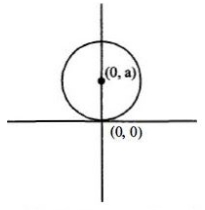
If the differential equation representing the family of all circles touching the $x-$axis at the origin is $(x^2 - y^2)\frac{dy}{dx} = g(x)y$,then $g(x)$ equals
A
$\frac{1}{2}x$
B
$2x^2$
C
$2x$
D
$\frac{1}{2}x^2$
Solution
(C) The equation of the family of all circles touching the $x-$axis at the origin $(0, 0)$ with center $(0, a)$ and radius $|a|$ is given by:
$x^2 + (y - a)^2 = a^2$
$x^2 + y^2 - 2ay + a^2 = a^2$
$x^2 + y^2 - 2ay = 0$ ... $(1)$
Differentiating both sides with respect to $x$:
$2x + 2y\frac{dy}{dx} - 2a\frac{dy}{dx} = 0$
$x + y\frac{dy}{dx} = a\frac{dy}{dx}$
$a = \frac{x + y\frac{dy}{dx}}{\frac{dy}{dx}}$
Substituting the value of $a$ into equation $(1)$:
$x^2 + y^2 - 2y \left( \frac{x + y\frac{dy}{dx}}{\frac{dy}{dx}} \right) = 0$
$(x^2 + y^2)\frac{dy}{dx} - 2y(x + y\frac{dy}{dx}) = 0$
$(x^2 + y^2)\frac{dy}{dx} - 2xy - 2y^2\frac{dy}{dx} = 0$
$(x^2 - y^2)\frac{dy}{dx} = 2xy$
Comparing this with the given equation $(x^2 - y^2)\frac{dy}{dx} = g(x)y$,we get:
$g(x)y = 2xy$
$g(x) = 2x$
$x^2 + (y - a)^2 = a^2$
$x^2 + y^2 - 2ay + a^2 = a^2$
$x^2 + y^2 - 2ay = 0$ ... $(1)$
Differentiating both sides with respect to $x$:
$2x + 2y\frac{dy}{dx} - 2a\frac{dy}{dx} = 0$
$x + y\frac{dy}{dx} = a\frac{dy}{dx}$
$a = \frac{x + y\frac{dy}{dx}}{\frac{dy}{dx}}$
Substituting the value of $a$ into equation $(1)$:
$x^2 + y^2 - 2y \left( \frac{x + y\frac{dy}{dx}}{\frac{dy}{dx}} \right) = 0$
$(x^2 + y^2)\frac{dy}{dx} - 2y(x + y\frac{dy}{dx}) = 0$
$(x^2 + y^2)\frac{dy}{dx} - 2xy - 2y^2\frac{dy}{dx} = 0$
$(x^2 - y^2)\frac{dy}{dx} = 2xy$
Comparing this with the given equation $(x^2 - y^2)\frac{dy}{dx} = g(x)y$,we get:
$g(x)y = 2xy$
$g(x) = 2x$
0 likes
View Solution49
DifficultMCQ
The differential equation of the family of curves,$x^{2}=4 b(y+b), b \in R,$ is
A
$x(y^{\prime})^{2} = x + 2yy^{\prime}$
B
$x(y^{\prime})^{2} = 2yy^{\prime} - x$
C
$xy^{\prime\prime} = y^{\prime}$
D
$x(y^{\prime})^{2} = x - 2yy^{\prime}$
Solution
(A) Given the equation of the family of curves: $x^{2} = 4b(y+b)$.
Differentiating both sides with respect to $x$,we get:
$2x = 4b y^{\prime}$
$b = \frac{2x}{4y^{\prime}} = \frac{x}{2y^{\prime}}$.
Substitute the value of $b$ back into the original equation:
$x^{2} = 4 \left( \frac{x}{2y^{\prime}} \right) \left( y + \frac{x}{2y^{\prime}} \right)$.
Simplify the expression:
$x^{2} = \frac{2x}{y^{\prime}} \left( \frac{2yy^{\prime} + x}{2y^{\prime}} \right)$.
$x^{2} = \frac{2x(2yy^{\prime} + x)}{2(y^{\prime})^{2}}$.
$x^{2} = \frac{x(2yy^{\prime} + x)}{(y^{\prime})^{2}}$.
Dividing by $x$ (assuming $x \neq 0$):
$x(y^{\prime})^{2} = 2yy^{\prime} + x$.
Differentiating both sides with respect to $x$,we get:
$2x = 4b y^{\prime}$
$b = \frac{2x}{4y^{\prime}} = \frac{x}{2y^{\prime}}$.
Substitute the value of $b$ back into the original equation:
$x^{2} = 4 \left( \frac{x}{2y^{\prime}} \right) \left( y + \frac{x}{2y^{\prime}} \right)$.
Simplify the expression:
$x^{2} = \frac{2x}{y^{\prime}} \left( \frac{2yy^{\prime} + x}{2y^{\prime}} \right)$.
$x^{2} = \frac{2x(2yy^{\prime} + x)}{2(y^{\prime})^{2}}$.
$x^{2} = \frac{x(2yy^{\prime} + x)}{(y^{\prime})^{2}}$.
Dividing by $x$ (assuming $x \neq 0$):
$x(y^{\prime})^{2} = 2yy^{\prime} + x$.
0 likes
View Solution50
Easy
Verify that the function $y=e^{-3x}$ is a solution of the differential equation $\frac{d^{2}y}{dx^{2}}+\frac{dy}{dx}-6y=0$.
Solution
(N/A) Given function is $y=e^{-3x}$.
Differentiating both sides with respect to $x$,we get:
$\frac{dy}{dx} = -3e^{-3x}$ ... $(1)$
Now,differentiating $(1)$ with respect to $x$ again,we get:
$\frac{d^{2}y}{dx^{2}} = 9e^{-3x}$
Substituting the values of $\frac{d^{2}y}{dx^{2}}$,$\frac{dy}{dx}$,and $y$ into the left-hand side $(L.H.S.)$ of the given differential equation:
$L.H.S. = \frac{d^{2}y}{dx^{2}} + \frac{dy}{dx} - 6y$
$L.H.S. = 9e^{-3x} + (-3e^{-3x}) - 6(e^{-3x})$
$L.H.S. = 9e^{-3x} - 3e^{-3x} - 6e^{-3x}$
$L.H.S. = 9e^{-3x} - 9e^{-3x} = 0$
Since $L.H.S. = R.H.S. = 0$,the function $y=e^{-3x}$ is a solution of the given differential equation.
Differentiating both sides with respect to $x$,we get:
$\frac{dy}{dx} = -3e^{-3x}$ ... $(1)$
Now,differentiating $(1)$ with respect to $x$ again,we get:
$\frac{d^{2}y}{dx^{2}} = 9e^{-3x}$
Substituting the values of $\frac{d^{2}y}{dx^{2}}$,$\frac{dy}{dx}$,and $y$ into the left-hand side $(L.H.S.)$ of the given differential equation:
$L.H.S. = \frac{d^{2}y}{dx^{2}} + \frac{dy}{dx} - 6y$
$L.H.S. = 9e^{-3x} + (-3e^{-3x}) - 6(e^{-3x})$
$L.H.S. = 9e^{-3x} - 3e^{-3x} - 6e^{-3x}$
$L.H.S. = 9e^{-3x} - 9e^{-3x} = 0$
Since $L.H.S. = R.H.S. = 0$,the function $y=e^{-3x}$ is a solution of the given differential equation.
0 likes
View SolutionDifferential Equations — Formation of differential equations · Frequently Asked Questions
1Are these Differential Equations questions useful for JEE and NEET?
Yes. All questions in this section are mapped to JEE Main and NEET exam patterns. Previous year questions from JEE Main, NEET, GUJCET and state-level exams are included with full solutions.
2Can I switch to Hindi or Gujarati for these questions?
Yes. Use the language tabs in the hero section or the sidebar to view the same questions and solutions in English, Hindi or Gujarati.
3How do I generate a question paper from this subtopic?
Use the Vedclass Exam Paper Generator — select the chapter and subtopic, set difficulty, and generate Sets A, B, C, D automatically. First 3 chapters of every subject are free.
Vedclass Products
For Students
Vedclass Test Series
Mock tests in real JEE/NEET style with performance analysis. 5-day free trial.
Start Free TrialFor Teachers
Exam Paper Generator
Generate Set A/B/C/D papers from this chapter in 2 minutes. 3 chapters free.
Try FreeFor Institutes
Online Exam Module
Live online exams with unlimited students, 360° analytics & white-label branding.
See DemoFor Teachers & Institutes
Generate a Differential Equations Exam Paper in 2 Minutes
Select subtopic & difficulty — Sets A, B, C, D auto-generated with No Repeat logic.
First 3 chapters of every subject are free — no payment required.