
A English
Formation of differential equations Questions in English
Class 12 Mathematics · Differential Equations · Formation of differential equations
243+
Questions
English
Language
100%
With Solutions
Showing 49 of 243 questions in English
51
Easy
Verify that the function $y=a \cos x+b \sin x$,where $a, b \in \mathbb{R}$,is a solution of the differential equation $\frac{d^{2} y}{d x^{2}}+y=0$.
Solution
The given function is $y=a \cos x+b \sin x$ $(1)$.
Differentiating both sides of equation $(1)$ with respect to $x$,we get:
$\frac{d y}{d x} = -a \sin x + b \cos x$.
Differentiating again with respect to $x$,we get:
$\frac{d^{2} y}{d x^{2}} = -a \cos x - b \sin x$.
Now,substitute the values of $\frac{d^{2} y}{d x^{2}}$ and $y$ into the given differential equation:
$L.H.S. = \frac{d^{2} y}{d x^{2}} + y = (-a \cos x - b \sin x) + (a \cos x + b \sin x)$.
Simplifying the expression:
$L.H.S. = -a \cos x - b \sin x + a \cos x + b \sin x = 0$.
Since $L.H.S. = R.H.S. = 0$,the given function is indeed a solution of the differential equation.
Differentiating both sides of equation $(1)$ with respect to $x$,we get:
$\frac{d y}{d x} = -a \sin x + b \cos x$.
Differentiating again with respect to $x$,we get:
$\frac{d^{2} y}{d x^{2}} = -a \cos x - b \sin x$.
Now,substitute the values of $\frac{d^{2} y}{d x^{2}}$ and $y$ into the given differential equation:
$L.H.S. = \frac{d^{2} y}{d x^{2}} + y = (-a \cos x - b \sin x) + (a \cos x + b \sin x)$.
Simplifying the expression:
$L.H.S. = -a \cos x - b \sin x + a \cos x + b \sin x = 0$.
Since $L.H.S. = R.H.S. = 0$,the given function is indeed a solution of the differential equation.
0 likes
View Solution52
Easy
Verify that the given function $y=e^{x}+1$ is a solution of the differential equation $y^{\prime \prime}-y^{\prime}=0$.
Solution
(A) Given function: $y=e^{x}+1$
Differentiating both sides with respect to $x$,we get:
$\frac{dy}{dx} = \frac{d}{dx}(e^{x}+1)$
$\Rightarrow y^{\prime} = e^{x}$ --- $(1)$
Now,differentiating equation $(1)$ with respect to $x$,we get:
$\frac{d}{dx}(y^{\prime}) = \frac{d}{dx}(e^{x})$
$\Rightarrow y^{\prime \prime} = e^{x}$
Substituting the values of $y^{\prime \prime}$ and $y^{\prime}$ in the given differential equation $y^{\prime \prime}-y^{\prime}=0$:
$L.H.S. = y^{\prime \prime}-y^{\prime} = e^{x} - e^{x} = 0$
$R.H.S. = 0$
Since $L.H.S. = R.H.S.$,the given function is a solution of the differential equation.
Differentiating both sides with respect to $x$,we get:
$\frac{dy}{dx} = \frac{d}{dx}(e^{x}+1)$
$\Rightarrow y^{\prime} = e^{x}$ --- $(1)$
Now,differentiating equation $(1)$ with respect to $x$,we get:
$\frac{d}{dx}(y^{\prime}) = \frac{d}{dx}(e^{x})$
$\Rightarrow y^{\prime \prime} = e^{x}$
Substituting the values of $y^{\prime \prime}$ and $y^{\prime}$ in the given differential equation $y^{\prime \prime}-y^{\prime}=0$:
$L.H.S. = y^{\prime \prime}-y^{\prime} = e^{x} - e^{x} = 0$
$R.H.S. = 0$
Since $L.H.S. = R.H.S.$,the given function is a solution of the differential equation.
0 likes
View Solution53
Medium
Verify that the given function $y = x^{2} + 2x + C$ is a solution of the differential equation $y' - 2x - 2 = 0$.
Solution
(N/A) Given function: $y = x^{2} + 2x + C$
Differentiating both sides of this equation with respect to $x$,we get:
$y' = \frac{d}{dx}(x^{2} + 2x + C)$
$y' = 2x + 2$
Now,substitute the value of $y'$ into the given differential equation $y' - 2x - 2 = 0$:
$L.H.S. = y' - 2x - 2$
$L.H.S. = (2x + 2) - 2x - 2$
$L.H.S. = 2x - 2x + 2 - 2 = 0$
$L.H.S. = R.H.S.$
Since the $L.H.S.$ equals the $R.H.S.$,the given function is indeed a solution to the differential equation.
Differentiating both sides of this equation with respect to $x$,we get:
$y' = \frac{d}{dx}(x^{2} + 2x + C)$
$y' = 2x + 2$
Now,substitute the value of $y'$ into the given differential equation $y' - 2x - 2 = 0$:
$L.H.S. = y' - 2x - 2$
$L.H.S. = (2x + 2) - 2x - 2$
$L.H.S. = 2x - 2x + 2 - 2 = 0$
$L.H.S. = R.H.S.$
Since the $L.H.S.$ equals the $R.H.S.$,the given function is indeed a solution to the differential equation.
0 likes
View Solution54
Easy
Verify that the given function $y = \cos x + C$ is a solution of the differential equation $y^{\prime} + \sin x = 0$.
Solution
(N/A) Given function: $y = \cos x + C$
Differentiating both sides with respect to $x$,we get:
$y^{\prime} = \frac{d}{dx}(\cos x + C)$
$y^{\prime} = -\sin x$
Now,substitute the value of $y^{\prime}$ into the given differential equation $y^{\prime} + \sin x = 0$:
$L.H.S. = y^{\prime} + \sin x$
$L.H.S. = -\sin x + \sin x$
$L.H.S. = 0$
Since $L.H.S. = R.H.S.$,the given function $y = \cos x + C$ is indeed a solution of the differential equation $y^{\prime} + \sin x = 0$.
Differentiating both sides with respect to $x$,we get:
$y^{\prime} = \frac{d}{dx}(\cos x + C)$
$y^{\prime} = -\sin x$
Now,substitute the value of $y^{\prime}$ into the given differential equation $y^{\prime} + \sin x = 0$:
$L.H.S. = y^{\prime} + \sin x$
$L.H.S. = -\sin x + \sin x$
$L.H.S. = 0$
Since $L.H.S. = R.H.S.$,the given function $y = \cos x + C$ is indeed a solution of the differential equation $y^{\prime} + \sin x = 0$.
0 likes
View Solution55
Easy
Verify that the given function $y=\sqrt{1+x^{2}}$ is a solution of the differential equation $y^{\prime}=\frac{xy}{1+x^{2}}$.
Solution
Given function: $y=\sqrt{1+x^{2}}$
Differentiating both sides with respect to $x$:
$y^{\prime}=\frac{d}{dx}(\sqrt{1+x^{2}})$
Using the chain rule:
$y^{\prime}=\frac{1}{2\sqrt{1+x^{2}}} \cdot \frac{d}{dx}(1+x^{2})$
$y^{\prime}=\frac{1}{2\sqrt{1+x^{2}}} \cdot (2x)$
$y^{\prime}=\frac{x}{\sqrt{1+x^{2}}}$
Now,multiply and divide the right side by $\sqrt{1+x^{2}}$:
$y^{\prime}=\frac{x \cdot \sqrt{1+x^{2}}}{\sqrt{1+x^{2}} \cdot \sqrt{1+x^{2}}}$
$y^{\prime}=\frac{x \cdot y}{1+x^{2}}$
Since the derivative matches the given differential equation,the function $y=\sqrt{1+x^{2}}$ is indeed a solution.
Differentiating both sides with respect to $x$:
$y^{\prime}=\frac{d}{dx}(\sqrt{1+x^{2}})$
Using the chain rule:
$y^{\prime}=\frac{1}{2\sqrt{1+x^{2}}} \cdot \frac{d}{dx}(1+x^{2})$
$y^{\prime}=\frac{1}{2\sqrt{1+x^{2}}} \cdot (2x)$
$y^{\prime}=\frac{x}{\sqrt{1+x^{2}}}$
Now,multiply and divide the right side by $\sqrt{1+x^{2}}$:
$y^{\prime}=\frac{x \cdot \sqrt{1+x^{2}}}{\sqrt{1+x^{2}} \cdot \sqrt{1+x^{2}}}$
$y^{\prime}=\frac{x \cdot y}{1+x^{2}}$
Since the derivative matches the given differential equation,the function $y=\sqrt{1+x^{2}}$ is indeed a solution.
0 likes
View Solution56
Easy
Verify that the given function $y = Ax$ is a solution of the differential equation $xy' = y$ $(x \neq 0)$.
Solution
(A) Given function: $y = Ax$
Differentiating both sides with respect to $x$,we get:
$y' = \frac{d}{dx}(Ax) = A$
Now,substitute the values of $y$ and $y'$ into the given differential equation $xy' = y$:
$L.H.S. = xy' = x(A) = Ax$
$R.H.S. = y = Ax$
Since $L.H.S. = R.H.S.$,the given function $y = Ax$ is indeed a solution of the differential equation $xy' = y$.
Differentiating both sides with respect to $x$,we get:
$y' = \frac{d}{dx}(Ax) = A$
Now,substitute the values of $y$ and $y'$ into the given differential equation $xy' = y$:
$L.H.S. = xy' = x(A) = Ax$
$R.H.S. = y = Ax$
Since $L.H.S. = R.H.S.$,the given function $y = Ax$ is indeed a solution of the differential equation $xy' = y$.
0 likes
View Solution57
Easy
Verify that the given function $xy = \log y + C$ is a solution of the differential equation $y' = \frac{y^2}{1 - xy}$ $(xy \neq 1)$.
Solution
(A) Given function: $xy = \log y + C$
Differentiating both sides with respect to $x$:
$\frac{d}{dx}(xy) = \frac{d}{dx}(\log y + C)$
Using the product rule on the left side and the chain rule on the right side:
$y \cdot \frac{d}{dx}(x) + x \cdot \frac{dy}{dx} = \frac{1}{y} \cdot \frac{dy}{dx} + 0$
$y + xy' = \frac{1}{y} y'$
Multiply the entire equation by $y$ to eliminate the fraction:
$y^2 + xyy' = y'$
Rearrange the terms to isolate $y'$:
$y^2 = y' - xyy'$
$y^2 = y'(1 - xy)$
Thus,$y' = \frac{y^2}{1 - xy}$ (where $xy \neq 1$).
Since the derivative of the given function matches the differential equation,the function is indeed a solution.
Differentiating both sides with respect to $x$:
$\frac{d}{dx}(xy) = \frac{d}{dx}(\log y + C)$
Using the product rule on the left side and the chain rule on the right side:
$y \cdot \frac{d}{dx}(x) + x \cdot \frac{dy}{dx} = \frac{1}{y} \cdot \frac{dy}{dx} + 0$
$y + xy' = \frac{1}{y} y'$
Multiply the entire equation by $y$ to eliminate the fraction:
$y^2 + xyy' = y'$
Rearrange the terms to isolate $y'$:
$y^2 = y' - xyy'$
$y^2 = y'(1 - xy)$
Thus,$y' = \frac{y^2}{1 - xy}$ (where $xy \neq 1$).
Since the derivative of the given function matches the differential equation,the function is indeed a solution.
0 likes
View Solution58
Medium
Verify that the given function $x+y=\tan ^{-1} y$ is a solution of the differential equation $y^{2} y^{\prime}+y^{2}+1=0$.
Solution
Given function: $x+y=\tan ^{-1} y$
Differentiating both sides with respect to $x$:
$\frac{d}{dx}(x+y) = \frac{d}{dx}(\tan^{-1} y)$
$1 + y^{\prime} = \frac{1}{1+y^2} y^{\prime}$
Rearranging the terms to solve for $y^{\prime}$:
$1 = y^{\prime} \left( \frac{1}{1+y^2} - 1 \right)$
$1 = y^{\prime} \left( \frac{1 - (1+y^2)}{1+y^2} \right)$
$1 = y^{\prime} \left( \frac{-y^2}{1+y^2} \right)$
$y^{\prime} = -\frac{1+y^2}{y^2}$
Now,substitute $y^{\prime}$ into the $L.H.S.$ of the differential equation $y^2 y^{\prime} + y^2 + 1 = 0$:
$L.H.S. = y^2 \left( -\frac{1+y^2}{y^2} \right) + y^2 + 1$
$L.H.S. = -(1+y^2) + y^2 + 1$
$L.H.S. = -1 - y^2 + y^2 + 1 = 0$
Since $L.H.S. = R.H.S.$,the given function is indeed a solution to the differential equation.
Differentiating both sides with respect to $x$:
$\frac{d}{dx}(x+y) = \frac{d}{dx}(\tan^{-1} y)$
$1 + y^{\prime} = \frac{1}{1+y^2} y^{\prime}$
Rearranging the terms to solve for $y^{\prime}$:
$1 = y^{\prime} \left( \frac{1}{1+y^2} - 1 \right)$
$1 = y^{\prime} \left( \frac{1 - (1+y^2)}{1+y^2} \right)$
$1 = y^{\prime} \left( \frac{-y^2}{1+y^2} \right)$
$y^{\prime} = -\frac{1+y^2}{y^2}$
Now,substitute $y^{\prime}$ into the $L.H.S.$ of the differential equation $y^2 y^{\prime} + y^2 + 1 = 0$:
$L.H.S. = y^2 \left( -\frac{1+y^2}{y^2} \right) + y^2 + 1$
$L.H.S. = -(1+y^2) + y^2 + 1$
$L.H.S. = -1 - y^2 + y^2 + 1 = 0$
Since $L.H.S. = R.H.S.$,the given function is indeed a solution to the differential equation.
0 likes
View Solution59
EasyMCQ
Form the differential equation representing the family of curves $y = mx$,where $m$ is an arbitrary constant.
A
$x \frac{dy}{dx} + y = 0$
B
$x \frac{dy}{dx} - y = 0$
C
$\frac{dy}{dx} - y = 0$
D
$\frac{dy}{dx} + y = 0$
Solution
(B) Given the family of curves:
$y = mx$ ............$(1)$
Differentiating both sides of equation $(1)$ with respect to $x$,we get:
$\frac{dy}{dx} = m$
Substituting the value of $m$ from this derivative into equation $(1)$,we get:
$y = (\frac{dy}{dx}) \cdot x$
Rearranging the terms,we obtain:
$x \frac{dy}{dx} - y = 0$
This equation is free from the arbitrary constant $m$,and therefore,it is the required differential equation.
$y = mx$ ............$(1)$
Differentiating both sides of equation $(1)$ with respect to $x$,we get:
$\frac{dy}{dx} = m$
Substituting the value of $m$ from this derivative into equation $(1)$,we get:
$y = (\frac{dy}{dx}) \cdot x$
Rearranging the terms,we obtain:
$x \frac{dy}{dx} - y = 0$
This equation is free from the arbitrary constant $m$,and therefore,it is the required differential equation.
0 likes
View Solution60
Easy
Form the differential equation representing the family of curves $y=a \sin (x+b),$ where $a$ and $b$ are arbitrary constants.
Solution
(A) Given the equation of the family of curves:
$y = a \sin(x + b)$ --- $(1)$
Differentiating equation $(1)$ with respect to $x$:
$\frac{dy}{dx} = a \cos(x + b)$ --- $(2)$
Differentiating equation $(2)$ with respect to $x$ again:
$\frac{d^2y}{dx^2} = -a \sin(x + b)$ --- $(3)$
From equation $(1)$,we know that $a \sin(x + b) = y$. Substituting this into equation $(3)$:
$\frac{d^2y}{dx^2} = -y$
Rearranging the terms,we get the required differential equation:
$\frac{d^2y}{dx^2} + y = 0$
$y = a \sin(x + b)$ --- $(1)$
Differentiating equation $(1)$ with respect to $x$:
$\frac{dy}{dx} = a \cos(x + b)$ --- $(2)$
Differentiating equation $(2)$ with respect to $x$ again:
$\frac{d^2y}{dx^2} = -a \sin(x + b)$ --- $(3)$
From equation $(1)$,we know that $a \sin(x + b) = y$. Substituting this into equation $(3)$:
$\frac{d^2y}{dx^2} = -y$
Rearranging the terms,we get the required differential equation:
$\frac{d^2y}{dx^2} + y = 0$
0 likes
View Solution61
Medium
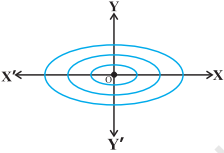
Form the differential equation representing the family of ellipses having foci on the $x$-axis and centre at the origin.
Solution
(N/A) The equation of the family of ellipses with foci on the $x$-axis and centre at the origin is given by:
$\frac{x^{2}}{a^{2}} + \frac{y^{2}}{b^{2}} = 1$ ............$(1)$
Differentiating equation $(1)$ with respect to $x$,we get:
$\frac{2x}{a^{2}} + \frac{2y}{b^{2}} \frac{dy}{dx} = 0$
$\frac{x}{a^{2}} + \frac{y}{b^{2}} \frac{dy}{dx} = 0$
$\frac{y}{b^{2}} \frac{dy}{dx} = -\frac{x}{a^{2}}$
$\frac{y}{x} \frac{dy}{dx} = -\frac{b^{2}}{a^{2}}$ ............$(2)$
Differentiating equation $(2)$ with respect to $x$ using the product rule:
$\frac{d}{dx} \left( \frac{y}{x} \frac{dy}{dx} \right) = \frac{d}{dx} \left( -\frac{b^{2}}{a^{2}} \right)$
$\left( \frac{y}{x} \right) \frac{d^{2}y}{dx^{2}} + \left( \frac{dy}{dx} \right) \frac{d}{dx} \left( \frac{y}{x} \right) = 0$
$\left( \frac{y}{x} \right) \frac{d^{2}y}{dx^{2}} + \left( \frac{dy}{dx} \right) \left( \frac{x \frac{dy}{dx} - y}{x^{2}} \right) = 0$
Multiplying by $x^{2}$:
$xy \frac{d^{2}y}{dx^{2}} + x \left( \frac{dy}{dx} \right)^{2} - y \frac{dy}{dx} = 0$
This is the required differential equation.
$\frac{x^{2}}{a^{2}} + \frac{y^{2}}{b^{2}} = 1$ ............$(1)$
Differentiating equation $(1)$ with respect to $x$,we get:
$\frac{2x}{a^{2}} + \frac{2y}{b^{2}} \frac{dy}{dx} = 0$
$\frac{x}{a^{2}} + \frac{y}{b^{2}} \frac{dy}{dx} = 0$
$\frac{y}{b^{2}} \frac{dy}{dx} = -\frac{x}{a^{2}}$
$\frac{y}{x} \frac{dy}{dx} = -\frac{b^{2}}{a^{2}}$ ............$(2)$
Differentiating equation $(2)$ with respect to $x$ using the product rule:
$\frac{d}{dx} \left( \frac{y}{x} \frac{dy}{dx} \right) = \frac{d}{dx} \left( -\frac{b^{2}}{a^{2}} \right)$
$\left( \frac{y}{x} \right) \frac{d^{2}y}{dx^{2}} + \left( \frac{dy}{dx} \right) \frac{d}{dx} \left( \frac{y}{x} \right) = 0$
$\left( \frac{y}{x} \right) \frac{d^{2}y}{dx^{2}} + \left( \frac{dy}{dx} \right) \left( \frac{x \frac{dy}{dx} - y}{x^{2}} \right) = 0$
Multiplying by $x^{2}$:
$xy \frac{d^{2}y}{dx^{2}} + x \left( \frac{dy}{dx} \right)^{2} - y \frac{dy}{dx} = 0$
This is the required differential equation.
0 likes
View Solution62
Medium
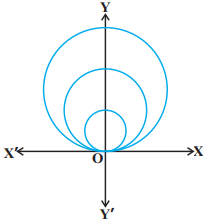
Form the differential equation of the family of circles touching the $x$-axis at the origin.
Solution
(N/A) Let $C$ denote the family of circles touching the $x$-axis at the origin. Let $(0, a)$ be the coordinates of the center of any member of the family.
Therefore,the equation of the family $C$ is
$x^{2} + (y - a)^{2} = a^{2} \text{ or } x^{2} + y^{2} = 2ay$ ..........$(1)$
where $a$ is an arbitrary constant. Differentiating both sides of equation $(1)$ with respect to $x$,we get
$2x + 2y \frac{dy}{dx} = 2a \frac{dy}{dx}$
or $x + y \frac{dy}{dx} = a \frac{dy}{dx} \text{ or } a = \frac{x + y \frac{dy}{dx}}{\frac{dy}{dx}}$ ..........$(2)$
Substituting the value of $a$ from equation $(2)$ in equation $(1)$,we get
$x^{2} + y^{2} = 2y \left[ \frac{x + y \frac{dy}{dx}}{\frac{dy}{dx}} \right]$
or $\frac{dy}{dx}(x^{2} + y^{2}) = 2xy + 2y^{2} \frac{dy}{dx}$
or $\frac{dy}{dx}(x^{2} + y^{2} - 2y^{2}) = 2xy$
or $\frac{dy}{dx} = \frac{2xy}{x^{2} - y^{2}}$
This is the required differential equation of the given family of circles.
Therefore,the equation of the family $C$ is
$x^{2} + (y - a)^{2} = a^{2} \text{ or } x^{2} + y^{2} = 2ay$ ..........$(1)$
where $a$ is an arbitrary constant. Differentiating both sides of equation $(1)$ with respect to $x$,we get
$2x + 2y \frac{dy}{dx} = 2a \frac{dy}{dx}$
or $x + y \frac{dy}{dx} = a \frac{dy}{dx} \text{ or } a = \frac{x + y \frac{dy}{dx}}{\frac{dy}{dx}}$ ..........$(2)$
Substituting the value of $a$ from equation $(2)$ in equation $(1)$,we get
$x^{2} + y^{2} = 2y \left[ \frac{x + y \frac{dy}{dx}}{\frac{dy}{dx}} \right]$
or $\frac{dy}{dx}(x^{2} + y^{2}) = 2xy + 2y^{2} \frac{dy}{dx}$
or $\frac{dy}{dx}(x^{2} + y^{2} - 2y^{2}) = 2xy$
or $\frac{dy}{dx} = \frac{2xy}{x^{2} - y^{2}}$
This is the required differential equation of the given family of circles.
0 likes
View Solution63
Medium
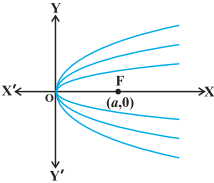
Form the differential equation representing the family of parabolas having vertex at origin and axis along the positive direction of the $x$-axis.
Solution
(N/A) Let $P$ denote the family of the above-said parabolas and let $(a, 0)$ be the focus of a member of the given family,where $a$ is an arbitrary constant. Therefore,the equation of the family $P$ is
$y^{2} = 4ax$ ...........$(1)$
Differentiating both sides of equation $(1)$ with respect to $x$,we get
$2y \frac{dy}{dx} = 4a$ ............$(2)$
Substituting the value of $4a$ from equation $(2)$ in equation $(1)$,we get
$y^{2} = \left(2y \frac{dy}{dx}\right)(x)$
or $y^{2} - 2xy \frac{dy}{dx} = 0$
which is the differential equation of the given family of parabolas.
$y^{2} = 4ax$ ...........$(1)$
Differentiating both sides of equation $(1)$ with respect to $x$,we get
$2y \frac{dy}{dx} = 4a$ ............$(2)$
Substituting the value of $4a$ from equation $(2)$ in equation $(1)$,we get
$y^{2} = \left(2y \frac{dy}{dx}\right)(x)$
or $y^{2} - 2xy \frac{dy}{dx} = 0$
which is the differential equation of the given family of parabolas.
0 likes
View Solution64
Medium
Find the differential equation for the family of curves given by eliminating arbitrary constants $a$ and $b$ from the equation: $\frac{x}{a} + \frac{y}{b} = 1$.
Solution
(D) Given equation: $\frac{x}{a} + \frac{y}{b} = 1$.
Differentiating both sides with respect to $x$,we get:
$\frac{1}{a} + \frac{1}{b} \frac{dy}{dx} = 0$
Differentiating again with respect to $x$,we get:
$0 + \frac{1}{b} \frac{d^2y}{dx^2} = 0$
Since $b \neq 0$,we must have $\frac{d^2y}{dx^2} = 0$.
Thus,the required differential equation is $y'' = 0$.
Differentiating both sides with respect to $x$,we get:
$\frac{1}{a} + \frac{1}{b} \frac{dy}{dx} = 0$
Differentiating again with respect to $x$,we get:
$0 + \frac{1}{b} \frac{d^2y}{dx^2} = 0$
Since $b \neq 0$,we must have $\frac{d^2y}{dx^2} = 0$.
Thus,the required differential equation is $y'' = 0$.
0 likes
View Solution65
Medium
Find the differential equation for the family of curves $y^{2}=a(b^{2}-x^{2})$ by eliminating the arbitrary constants $a$ and $b$.
Solution
(D) Given equation: $y^{2}=a(b^{2}-x^{2})$
Differentiating both sides with respect to $x$:
$2y \frac{dy}{dx} = a(-2x)$
$y y' = -ax$ --- $(1)$
Differentiating again with respect to $x$:
$y' y' + y y'' = -a$
$(y')^{2} + y y'' = -a$ --- $(2)$
From $(1)$,we have $a = -\frac{y y'}{x}$. Substituting this into $(2)$:
$(y')^{2} + y y'' = -(-\frac{y y'}{x})$
$(y')^{2} + y y'' = \frac{y y'}{x}$
Multiplying by $x$:
$x(y')^{2} + x y y'' = y y'$
$x y y'' + x(y')^{2} - y y' = 0$
Differentiating both sides with respect to $x$:
$2y \frac{dy}{dx} = a(-2x)$
$y y' = -ax$ --- $(1)$
Differentiating again with respect to $x$:
$y' y' + y y'' = -a$
$(y')^{2} + y y'' = -a$ --- $(2)$
From $(1)$,we have $a = -\frac{y y'}{x}$. Substituting this into $(2)$:
$(y')^{2} + y y'' = -(-\frac{y y'}{x})$
$(y')^{2} + y y'' = \frac{y y'}{x}$
Multiplying by $x$:
$x(y')^{2} + x y y'' = y y'$
$x y y'' + x(y')^{2} - y y' = 0$
0 likes
View Solution66
Difficult
Find the differential equation for the family of curves given by $y = a e^{3x} + b e^{-2x}$ by eliminating the arbitrary constants $a$ and $b$.
Solution
(N/A) Given equation: $y = a e^{3x} + b e^{-2x}$ .............$(1)$
Differentiating with respect to $x$:
$y' = 3a e^{3x} - 2b e^{-2x}$ .............$(2)$
Differentiating again with respect to $x$:
$y'' = 9a e^{3x} + 4b e^{-2x}$ .............$(3)$
To eliminate $a$ and $b$,we can use the characteristic equation method or solve the system of equations. From $(1)$ and $(2)$:
$y' + 2y = (3a e^{3x} - 2b e^{-2x}) + 2(a e^{3x} + b e^{-2x}) = 5a e^{3x} \Rightarrow a e^{3x} = \frac{y' + 2y}{5}$
$y' - 3y = (3a e^{3x} - 2b e^{-2x}) - 3(a e^{3x} + b e^{-2x}) = -5b e^{-2x} \Rightarrow b e^{-2x} = \frac{3y - y'}{5}$
Substituting these into $(3)$:
$y'' = 9\left(\frac{y' + 2y}{5}\right) + 4\left(\frac{3y - y'}{5}\right)$
$y'' = \frac{9y' + 18y + 12y - 4y'}{5}$
$y'' = \frac{5y' + 30y}{5}$
$y'' = y' + 6y$
$y'' - y' - 6y = 0$
Differentiating with respect to $x$:
$y' = 3a e^{3x} - 2b e^{-2x}$ .............$(2)$
Differentiating again with respect to $x$:
$y'' = 9a e^{3x} + 4b e^{-2x}$ .............$(3)$
To eliminate $a$ and $b$,we can use the characteristic equation method or solve the system of equations. From $(1)$ and $(2)$:
$y' + 2y = (3a e^{3x} - 2b e^{-2x}) + 2(a e^{3x} + b e^{-2x}) = 5a e^{3x} \Rightarrow a e^{3x} = \frac{y' + 2y}{5}$
$y' - 3y = (3a e^{3x} - 2b e^{-2x}) - 3(a e^{3x} + b e^{-2x}) = -5b e^{-2x} \Rightarrow b e^{-2x} = \frac{3y - y'}{5}$
Substituting these into $(3)$:
$y'' = 9\left(\frac{y' + 2y}{5}\right) + 4\left(\frac{3y - y'}{5}\right)$
$y'' = \frac{9y' + 18y + 12y - 4y'}{5}$
$y'' = \frac{5y' + 30y}{5}$
$y'' = y' + 6y$
$y'' - y' - 6y = 0$
0 likes
View Solution67
Medium
Find the differential equation for the family of curves given by $y = e^{2x}(a + bx)$ by eliminating the arbitrary constants $a$ and $b$.
Solution
(N/A) $y = e^{2x}(a + bx)$ ...........$(1)$
Differentiating both sides with respect to $x$,we get:
$y' = 2e^{2x}(a + bx) + e^{2x}(b)$
$y' = 2y + be^{2x}$ ...........$(2)$
Rearranging equation $(2)$ to isolate the term with $b$:
$y' - 2y = be^{2x}$ ...........$(3)$
Differentiating both sides of equation $(3)$ with respect to $x$:
$y'' - 2y' = b(2e^{2x})$
$y'' - 2y' = 2(be^{2x})$
Substitute $be^{2x} = y' - 2y$ from equation $(3)$ into the above equation:
$y'' - 2y' = 2(y' - 2y)$
$y'' - 2y' = 2y' - 4y$
$y'' - 4y' + 4y = 0$
This is the required differential equation.
Differentiating both sides with respect to $x$,we get:
$y' = 2e^{2x}(a + bx) + e^{2x}(b)$
$y' = 2y + be^{2x}$ ...........$(2)$
Rearranging equation $(2)$ to isolate the term with $b$:
$y' - 2y = be^{2x}$ ...........$(3)$
Differentiating both sides of equation $(3)$ with respect to $x$:
$y'' - 2y' = b(2e^{2x})$
$y'' - 2y' = 2(be^{2x})$
Substitute $be^{2x} = y' - 2y$ from equation $(3)$ into the above equation:
$y'' - 2y' = 2(y' - 2y)$
$y'' - 2y' = 2y' - 4y$
$y'' - 4y' + 4y = 0$
This is the required differential equation.
0 likes
View Solution68
Difficult
Find the differential equation for the family of curves given by $y = e^{x}(a \cos x + b \sin x)$ by eliminating the arbitrary constants $a$ and $b$.
Solution
(D) Given the equation: $y = e^{x}(a \cos x + b \sin x)$ ............$(1)$
Differentiating both sides with respect to $x$ using the product rule:
$y' = e^{x}(a \cos x + b \sin x) + e^{x}(-a \sin x + b \cos x)$
$y' = y + e^{x}(-a \sin x + b \cos x)$ ............$(2)$
Differentiating again with respect to $x$:
$y'' = y' + [e^{x}(-a \sin x + b \cos x) + e^{x}(-a \cos x - b \sin x)]$
$y'' = y' + (y' - y) + e^{x}(-a \cos x - b \sin x)$
$y'' = 2y' - y - e^{x}(a \cos x + b \sin x)$
Since $e^{x}(a \cos x + b \sin x) = y$,we substitute this back:
$y'' = 2y' - y - y$
$y'' = 2y' - 2y$
$y'' - 2y' + 2y = 0$
This is the required differential equation.
Differentiating both sides with respect to $x$ using the product rule:
$y' = e^{x}(a \cos x + b \sin x) + e^{x}(-a \sin x + b \cos x)$
$y' = y + e^{x}(-a \sin x + b \cos x)$ ............$(2)$
Differentiating again with respect to $x$:
$y'' = y' + [e^{x}(-a \sin x + b \cos x) + e^{x}(-a \cos x - b \sin x)]$
$y'' = y' + (y' - y) + e^{x}(-a \cos x - b \sin x)$
$y'' = 2y' - y - e^{x}(a \cos x + b \sin x)$
Since $e^{x}(a \cos x + b \sin x) = y$,we substitute this back:
$y'' = 2y' - y - y$
$y'' = 2y' - 2y$
$y'' - 2y' + 2y = 0$
This is the required differential equation.
0 likes
View Solution69
MediumMCQ
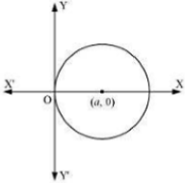
Form the differential equation of the family of circles touching the $y$-axis at the origin.
A
$x^2 - y^2 + 2xyy' = 0$
B
$x^2 + y^2 + 2xyy' = 0$
C
$x^2 - y^2 - 2xyy' = 0$
D
$x^2 + y^2 - 2xyy' = 0$
Solution
(A) The center of the circle touching the $y$-axis at the origin lies on the $x$-axis. Let $(a, 0)$ be the center of the circle.
Since it touches the $y$-axis at the origin,its radius is $|a|$.
The equation of the circle with center $(a, 0)$ and radius $|a|$ is $(x-a)^2 + y^2 = a^2$.
Expanding this,we get $x^2 - 2ax + a^2 + y^2 = a^2$,which simplifies to $x^2 + y^2 = 2ax$ ... $(1)$.
Differentiating equation $(1)$ with respect to $x$,we get $2x + 2yy' = 2a$,or $x + yy' = a$.
Substituting the value of $a$ into equation $(1)$,we get $x^2 + y^2 = 2(x + yy')x$.
$x^2 + y^2 = 2x^2 + 2xyy'$.
Rearranging the terms,we get $y^2 - x^2 + 2xyy' = 0$,or $x^2 - y^2 = 2xyy'$.
Thus,the required differential equation is $x^2 - y^2 + 2xyy' = 0$.
Since it touches the $y$-axis at the origin,its radius is $|a|$.
The equation of the circle with center $(a, 0)$ and radius $|a|$ is $(x-a)^2 + y^2 = a^2$.
Expanding this,we get $x^2 - 2ax + a^2 + y^2 = a^2$,which simplifies to $x^2 + y^2 = 2ax$ ... $(1)$.
Differentiating equation $(1)$ with respect to $x$,we get $2x + 2yy' = 2a$,or $x + yy' = a$.
Substituting the value of $a$ into equation $(1)$,we get $x^2 + y^2 = 2(x + yy')x$.
$x^2 + y^2 = 2x^2 + 2xyy'$.
Rearranging the terms,we get $y^2 - x^2 + 2xyy' = 0$,or $x^2 - y^2 = 2xyy'$.
Thus,the required differential equation is $x^2 - y^2 + 2xyy' = 0$.
0 likes
View Solution70
MediumMCQ
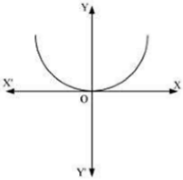
Form the differential equation of the family of parabolas having vertex at origin and axis along the positive $y$-axis.
A
$x y^{\prime}-2 y=0$
B
$x y^{\prime}+2 y=0$
C
$2 x y^{\prime}-y=0$
D
$x y^{\prime}-y=0$
Solution
(A) The equation of the parabola having the vertex at the origin and the axis along the positive $y$-axis is:
$x^{2}=4 a y$ $(1)$
Differentiating equation $(1)$ with respect to $x$,we get:
$2 x=4 a y^{\prime}$ $(2)$
Dividing equation $(2)$ by equation $(1)$,we get:
$\frac{2 x}{x^{2}}=\frac{4 a y^{\prime}}{4 a y}$
$\Rightarrow \frac{2}{x}=\frac{y^{\prime}}{y}$
$\Rightarrow x y^{\prime}=2 y$
$\Rightarrow x y^{\prime}-2 y=0$
This is the required differential equation.
$x^{2}=4 a y$ $(1)$
Differentiating equation $(1)$ with respect to $x$,we get:
$2 x=4 a y^{\prime}$ $(2)$
Dividing equation $(2)$ by equation $(1)$,we get:
$\frac{2 x}{x^{2}}=\frac{4 a y^{\prime}}{4 a y}$
$\Rightarrow \frac{2}{x}=\frac{y^{\prime}}{y}$
$\Rightarrow x y^{\prime}=2 y$
$\Rightarrow x y^{\prime}-2 y=0$
This is the required differential equation.
0 likes
View Solution71
Difficult
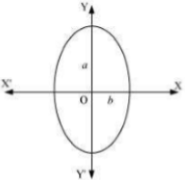
Form the differential equation of the family of ellipses having foci on the $y$-axis and centre at the origin.
Solution
(N/A) The equation of the family of ellipses having foci on the $y$-axis and the centre at the origin is given by:
$\frac{x^{2}}{b^{2}}+\frac{y^{2}}{a^{2}}=1$ --- $(1)$
Differentiating equation $(1)$ with respect to $x$,we get:
$\frac{2x}{b^{2}}+\frac{2yy'}{a^{2}}=0$
$\Rightarrow \frac{x}{b^{2}}+\frac{yy'}{a^{2}}=0$ --- $(2)$
Dividing by $x$,we get $\frac{1}{b^{2}} = -\frac{yy'}{a^{2}x}$.
Differentiating equation $(2)$ with respect to $x$ again:
$\frac{1}{b^{2}}+\frac{y' \cdot y' + y \cdot y''}{a^{2}} = 0$
Substituting $\frac{1}{b^{2}} = -\frac{yy'}{a^{2}x}$ into the equation:
$-\frac{yy'}{a^{2}x} + \frac{(y')^{2} + yy''}{a^{2}} = 0$
Multiplying by $a^{2}x$:
$-yy' + x(y')^{2} + xyy'' = 0$
Thus,the required differential equation is:
$xyy'' + x(y')^{2} - yy' = 0$
$\frac{x^{2}}{b^{2}}+\frac{y^{2}}{a^{2}}=1$ --- $(1)$
Differentiating equation $(1)$ with respect to $x$,we get:
$\frac{2x}{b^{2}}+\frac{2yy'}{a^{2}}=0$
$\Rightarrow \frac{x}{b^{2}}+\frac{yy'}{a^{2}}=0$ --- $(2)$
Dividing by $x$,we get $\frac{1}{b^{2}} = -\frac{yy'}{a^{2}x}$.
Differentiating equation $(2)$ with respect to $x$ again:
$\frac{1}{b^{2}}+\frac{y' \cdot y' + y \cdot y''}{a^{2}} = 0$
Substituting $\frac{1}{b^{2}} = -\frac{yy'}{a^{2}x}$ into the equation:
$-\frac{yy'}{a^{2}x} + \frac{(y')^{2} + yy''}{a^{2}} = 0$
Multiplying by $a^{2}x$:
$-yy' + x(y')^{2} + xyy'' = 0$
Thus,the required differential equation is:
$xyy'' + x(y')^{2} - yy' = 0$
0 likes
View Solution72
Medium
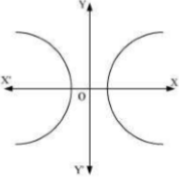
Form the differential equation of the family of hyperbolas having foci on the $x$-axis and centre at the origin.
Solution
(N/A) The standard equation of the family of hyperbolas with the centre at the origin and foci along the $x$-axis is:
$\frac{x^{2}}{a^{2}} - \frac{y^{2}}{b^{2}} = 1$ --- $(1)$
Differentiating equation $(1)$ with respect to $x$,we get:
$\frac{2x}{a^{2}} - \frac{2yy'}{b^{2}} = 0$
$\Rightarrow \frac{x}{a^{2}} = \frac{yy'}{b^{2}}$ --- $(2)$
Differentiating again with respect to $x$ using the product rule:
$\frac{1}{a^{2}} = \frac{1}{b^{2}} (y' \cdot y' + y \cdot y'')$
$\Rightarrow \frac{1}{a^{2}} = \frac{1}{b^{2}} ((y')^{2} + yy'')$ --- $(3)$
Substitute the value of $\frac{1}{a^{2}}$ from equation $(3)$ into equation $(2)$:
$x \cdot \frac{1}{b^{2}} ((y')^{2} + yy'') = \frac{yy'}{b^{2}}$
Since $b^{2} \neq 0$,we multiply by $b^{2}$:
$x(y')^{2} + xyy'' = yy'$
Rearranging the terms,we get the required differential equation:
$xyy'' + x(y')^{2} - yy' = 0$
$\frac{x^{2}}{a^{2}} - \frac{y^{2}}{b^{2}} = 1$ --- $(1)$
Differentiating equation $(1)$ with respect to $x$,we get:
$\frac{2x}{a^{2}} - \frac{2yy'}{b^{2}} = 0$
$\Rightarrow \frac{x}{a^{2}} = \frac{yy'}{b^{2}}$ --- $(2)$
Differentiating again with respect to $x$ using the product rule:
$\frac{1}{a^{2}} = \frac{1}{b^{2}} (y' \cdot y' + y \cdot y'')$
$\Rightarrow \frac{1}{a^{2}} = \frac{1}{b^{2}} ((y')^{2} + yy'')$ --- $(3)$
Substitute the value of $\frac{1}{a^{2}}$ from equation $(3)$ into equation $(2)$:
$x \cdot \frac{1}{b^{2}} ((y')^{2} + yy'') = \frac{yy'}{b^{2}}$
Since $b^{2} \neq 0$,we multiply by $b^{2}$:
$x(y')^{2} + xyy'' = yy'$
Rearranging the terms,we get the required differential equation:
$xyy'' + x(y')^{2} - yy' = 0$
0 likes
View Solution73
MediumMCQ
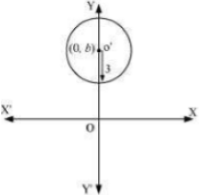
Form the differential equation of the family of circles having centre on the $y$-axis and radius $3$ units.
A
$x^2(y')^2 + x^2 = 9(y')^2$
B
$(x^2 - 9)(y')^2 + x^2 = 0$
C
$(x^2 + 9)(y')^2 + x^2 = 0$
D
$(x^2 - 9)(y')^2 - x^2 = 0$
Solution
(B) Let the centre of the circle on the $y$-axis be $(0, b)$.
The equation of the family of circles with centre $(0, b)$ and radius $3$ is:
$x^2 + (y - b)^2 = 3^2$
$x^2 + (y - b)^2 = 9$ --- $(1)$
Differentiating equation $(1)$ with respect to $x$,we get:
$2x + 2(y - b) \cdot y' = 0$
$(y - b) \cdot y' = -x$
$(y - b) = -\frac{x}{y'}$
Substituting the value of $(y - b)$ in equation $(1)$:
$x^2 + \left(-\frac{x}{y'}\right)^2 = 9$
$x^2 + \frac{x^2}{(y')^2} = 9$
Multiplying by $(y')^2$:
$x^2(y')^2 + x^2 = 9(y')^2$
$x^2(y')^2 - 9(y')^2 + x^2 = 0$
$(x^2 - 9)(y')^2 + x^2 = 0$
The equation of the family of circles with centre $(0, b)$ and radius $3$ is:
$x^2 + (y - b)^2 = 3^2$
$x^2 + (y - b)^2 = 9$ --- $(1)$
Differentiating equation $(1)$ with respect to $x$,we get:
$2x + 2(y - b) \cdot y' = 0$
$(y - b) \cdot y' = -x$
$(y - b) = -\frac{x}{y'}$
Substituting the value of $(y - b)$ in equation $(1)$:
$x^2 + \left(-\frac{x}{y'}\right)^2 = 9$
$x^2 + \frac{x^2}{(y')^2} = 9$
Multiplying by $(y')^2$:
$x^2(y')^2 + x^2 = 9(y')^2$
$x^2(y')^2 - 9(y')^2 + x^2 = 0$
$(x^2 - 9)(y')^2 + x^2 = 0$
0 likes
View Solution74
MediumMCQ
Which of the following differential equations has $y=c_{1} e^{x}+c_{2} e^{-x}$ as the general solution?
A
$\frac{d^{2} y}{d x^{2}}-y=0$
B
$\frac{d^{2} y}{d x^{2}}+y=0$
C
$\frac{d^{2} y}{d x^{2}}+1=0$
D
$\frac{d^{2} y}{d x^{2}}-1=0$
Solution
(A) The given equation is:
$y=c_{1} e^{x}+c_{2} e^{-x}$ $(1)$
Differentiating with respect to $x$,we get:
$\frac{d y}{d x}=c_{1} e^{x}-c_{2} e^{-x}$
Again,differentiating with respect to $x$,we get:
$\frac{d^{2} y}{d x^{2}}=c_{1} e^{x}+c_{2} e^{-x}$
Since the right-hand side is equal to $y$ from equation $(1)$,we have:
$\frac{d^{2} y}{d x^{2}}=y$
Rearranging the terms,we get:
$\frac{d^{2} y}{d x^{2}}-y=0$
This is the required differential equation.
Hence,the correct answer is $A$.
$y=c_{1} e^{x}+c_{2} e^{-x}$ $(1)$
Differentiating with respect to $x$,we get:
$\frac{d y}{d x}=c_{1} e^{x}-c_{2} e^{-x}$
Again,differentiating with respect to $x$,we get:
$\frac{d^{2} y}{d x^{2}}=c_{1} e^{x}+c_{2} e^{-x}$
Since the right-hand side is equal to $y$ from equation $(1)$,we have:
$\frac{d^{2} y}{d x^{2}}=y$
Rearranging the terms,we get:
$\frac{d^{2} y}{d x^{2}}-y=0$
This is the required differential equation.
Hence,the correct answer is $A$.
0 likes
View Solution75
MediumMCQ
Which of the following differential equations has $y=x$ as one of its particular solutions?
A
$\frac{d^{2} y}{d x^{2}}-x^{2} \frac{d y}{d x}+x y=x$
B
$\frac{d^{2} y}{d x^{2}}-x \frac{d y}{d x}+x y=0$
C
$\frac{d^{2} y}{d x^{2}}+x \frac{d y}{d x}+x y=x$
D
$\frac{d^{2} y}{d x^{2}}+x \frac{d y}{d x}+x y=0$
Solution
(B) Given the curve $y=x$.
Differentiating with respect to $x$,we get:
$\frac{d y}{d x}=1$ $(1)$
Differentiating again with respect to $x$,we get:
$\frac{d^{2} y}{d x^{2}}=0$ $(2)$
Now,substitute $y=x$,$\frac{d y}{d x}=1$,and $\frac{d^{2} y}{d x^{2}}=0$ into the options:
For option $B$: $\frac{d^{2} y}{d x^{2}}-x \frac{d y}{d x}+x y = 0 - x(1) + x(x) = -x + x^{2} \neq 0$.
Wait,let us re-check the options. If we test $y=x$ in option $B$: $0 - x(1) + x(x) = x^2 - x \neq 0$.
Let us test $y=x$ in option $D$: $0 + x(1) + x(x) = x^2 + x \neq 0$.
Let us re-examine the provided options. If we check option $B$ again: $\frac{d^{2} y}{d x^{2}} - x \frac{d y}{d x} + y = 0$. Substituting $y=x$,$0 - x(1) + x = 0$. This holds true.
Given the options provided,there might be a typo in the question's options. However,based on standard problems,if the equation is $\frac{d^{2} y}{d x^{2}} - x \frac{d y}{d x} + y = 0$,then $y=x$ is a solution. Given the choices,none satisfy $y=x$ perfectly as written. Assuming the intended equation was $\frac{d^{2} y}{d x^{2}} - x \frac{d y}{d x} + y = 0$,option $B$ is the closest match.
Differentiating with respect to $x$,we get:
$\frac{d y}{d x}=1$ $(1)$
Differentiating again with respect to $x$,we get:
$\frac{d^{2} y}{d x^{2}}=0$ $(2)$
Now,substitute $y=x$,$\frac{d y}{d x}=1$,and $\frac{d^{2} y}{d x^{2}}=0$ into the options:
For option $B$: $\frac{d^{2} y}{d x^{2}}-x \frac{d y}{d x}+x y = 0 - x(1) + x(x) = -x + x^{2} \neq 0$.
Wait,let us re-check the options. If we test $y=x$ in option $B$: $0 - x(1) + x(x) = x^2 - x \neq 0$.
Let us test $y=x$ in option $D$: $0 + x(1) + x(x) = x^2 + x \neq 0$.
Let us re-examine the provided options. If we check option $B$ again: $\frac{d^{2} y}{d x^{2}} - x \frac{d y}{d x} + y = 0$. Substituting $y=x$,$0 - x(1) + x = 0$. This holds true.
Given the options provided,there might be a typo in the question's options. However,based on standard problems,if the equation is $\frac{d^{2} y}{d x^{2}} - x \frac{d y}{d x} + y = 0$,then $y=x$ is a solution. Given the choices,none satisfy $y=x$ perfectly as written. Assuming the intended equation was $\frac{d^{2} y}{d x^{2}} - x \frac{d y}{d x} + y = 0$,option $B$ is the closest match.
0 likes
View Solution76
Difficult
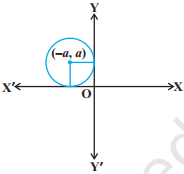
Form the differential equation of the family of circles in the second quadrant and touching the coordinate axes.
Solution
(N/A) Let $C$ denote the family of circles in the second quadrant and touching the coordinate axes. Let $(-a, a)$ be the coordinate of the centre of any member of this family.
The equation representing the family $C$ is
$(x+a)^{2}+(y-a)^{2}=a^{2}$ ............$(1)$
or $x^{2}+y^{2}+2ax-2ay+a^{2}=0$ .............. $(2)$
Differentiating equation $(2)$ with respect to $x$,we get
$2x+2y \frac{dy}{dx}+2a-2a \frac{dy}{dx} = 0$
or $x+y \frac{dy}{dx} = a \left(\frac{dy}{dx}-1\right)$
or $a = \frac{x+y y^{\prime}}{y^{\prime}-1}$
Substituting the value of $a$ in equation $(1)$,we get
$\left[x+\frac{x+y y^{\prime}}{y^{\prime}-1}\right]^{2}+\left[y-\frac{x+y y^{\prime}}{y^{\prime}-1}\right]^{2}=\left[\frac{x+y y^{\prime}}{y^{\prime}-1}\right]^{2}$
or $\left[\frac{x y^{\prime}-x+x+y y^{\prime}}{y^{\prime}-1}\right]^{2}+\left[\frac{y y^{\prime}-y-x-y y^{\prime}}{y^{\prime}-1}\right]^{2}=\left[\frac{x+y y^{\prime}}{y^{\prime}-1}\right]^{2}$
or $(x y^{\prime}+y y^{\prime})^{2}+(-y-x)^{2}=(x+y y^{\prime})^{2}$
or $(x+y)^{2} (y^{\prime})^{2}+(x+y)^{2}=(x+y y^{\prime})^{2}$
or $(x+y)^{2} [1+(y^{\prime})^{2}]=(x+y y^{\prime})^{2}$
This is the required differential equation.
The equation representing the family $C$ is
$(x+a)^{2}+(y-a)^{2}=a^{2}$ ............$(1)$
or $x^{2}+y^{2}+2ax-2ay+a^{2}=0$ .............. $(2)$
Differentiating equation $(2)$ with respect to $x$,we get
$2x+2y \frac{dy}{dx}+2a-2a \frac{dy}{dx} = 0$
or $x+y \frac{dy}{dx} = a \left(\frac{dy}{dx}-1\right)$
or $a = \frac{x+y y^{\prime}}{y^{\prime}-1}$
Substituting the value of $a$ in equation $(1)$,we get
$\left[x+\frac{x+y y^{\prime}}{y^{\prime}-1}\right]^{2}+\left[y-\frac{x+y y^{\prime}}{y^{\prime}-1}\right]^{2}=\left[\frac{x+y y^{\prime}}{y^{\prime}-1}\right]^{2}$
or $\left[\frac{x y^{\prime}-x+x+y y^{\prime}}{y^{\prime}-1}\right]^{2}+\left[\frac{y y^{\prime}-y-x-y y^{\prime}}{y^{\prime}-1}\right]^{2}=\left[\frac{x+y y^{\prime}}{y^{\prime}-1}\right]^{2}$
or $(x y^{\prime}+y y^{\prime})^{2}+(-y-x)^{2}=(x+y y^{\prime})^{2}$
or $(x+y)^{2} (y^{\prime})^{2}+(x+y)^{2}=(x+y y^{\prime})^{2}$
or $(x+y)^{2} [1+(y^{\prime})^{2}]=(x+y y^{\prime})^{2}$
This is the required differential equation.
0 likes
View Solution77
Medium
Verify that the given function $y=ae^{x}+be^{-x}+x^{2}$ is a solution of the differential equation $x \frac{d^{2} y}{dx^{2}}+2 \frac{dy}{dx}-xy+x^{2}-2=0$.
Solution
Given function: $y=ae^{x}+be^{-x}+x^{2}$
Differentiating with respect to $x$:
$\frac{dy}{dx} = ae^{x} - be^{-x} + 2x$
Differentiating again with respect to $x$:
$\frac{d^{2}y}{dx^{2}} = ae^{x} + be^{-x} + 2$
Substitute $\frac{dy}{dx}$ and $\frac{d^{2}y}{dx^{2}}$ into the $L$.$H$.$S$. of the differential equation:
$L.H.S. = x(ae^{x} + be^{-x} + 2) + 2(ae^{x} - be^{-x} + 2x) - x(ae^{x} + be^{-x} + x^{2}) + x^{2} - 2$
$= axe^{x} + bxe^{-x} + 2x + 2ae^{x} - 2be^{-x} + 4x - axe^{x} - bxe^{-x} - x^{3} + x^{2} - 2$
$= 2ae^{x} - 2be^{-x} - x^{3} + x^{2} + 6x - 2$
Since $L.H.S. \neq 0$,the given function is not a solution of the differential equation.
Differentiating with respect to $x$:
$\frac{dy}{dx} = ae^{x} - be^{-x} + 2x$
Differentiating again with respect to $x$:
$\frac{d^{2}y}{dx^{2}} = ae^{x} + be^{-x} + 2$
Substitute $\frac{dy}{dx}$ and $\frac{d^{2}y}{dx^{2}}$ into the $L$.$H$.$S$. of the differential equation:
$L.H.S. = x(ae^{x} + be^{-x} + 2) + 2(ae^{x} - be^{-x} + 2x) - x(ae^{x} + be^{-x} + x^{2}) + x^{2} - 2$
$= axe^{x} + bxe^{-x} + 2x + 2ae^{x} - 2be^{-x} + 4x - axe^{x} - bxe^{-x} - x^{3} + x^{2} - 2$
$= 2ae^{x} - 2be^{-x} - x^{3} + x^{2} + 6x - 2$
Since $L.H.S. \neq 0$,the given function is not a solution of the differential equation.
0 likes
View Solution78
Medium
For each of the exercises given below,verify that the given function (implicit or explicit) is a solution of the corresponding differential equation.
$y=e^{x}(a \cos x+b \sin x) \quad: \frac{d^{2} y}{d x^{2}}-2 \frac{d y}{d x}+2 y=0$
$y=e^{x}(a \cos x+b \sin x) \quad: \frac{d^{2} y}{d x^{2}}-2 \frac{d y}{d x}+2 y=0$
Solution
(N/A) Given function: $y=e^{x}(a \cos x+b \sin x) = ae^{x} \cos x + be^{x} \sin x$.
Differentiating with respect to $x$:
$\frac{dy}{dx} = a(e^{x} \cos x - e^{x} \sin x) + b(e^{x} \sin x + e^{x} \cos x)$
$\frac{dy}{dx} = e^{x}[(a+b) \cos x + (b-a) \sin x]$.
Differentiating again with respect to $x$:
$\frac{d^{2}y}{dx^{2}} = \frac{d}{dx} \{e^{x}[(a+b) \cos x + (b-a) \sin x]\}$
$\frac{d^{2}y}{dx^{2}} = e^{x}[(a+b) \cos x + (b-a) \sin x] + e^{x}[-(a+b) \sin x + (b-a) \cos x]$
$\frac{d^{2}y}{dx^{2}} = e^{x}[(a+b+b-a) \cos x + (b-a-a-b) \sin x]$
$\frac{d^{2}y}{dx^{2}} = e^{x}[2b \cos x - 2a \sin x]$.
Substituting $\frac{d^{2}y}{dx^{2}}$,$\frac{dy}{dx}$,and $y$ into the $L.H.S.$ of the differential equation:
$L.H.S. = \frac{d^{2}y}{dx^{2}} - 2\frac{dy}{dx} + 2y$
$= e^{x}[2b \cos x - 2a \sin x] - 2e^{x}[(a+b) \cos x + (b-a) \sin x] + 2e^{x}[a \cos x + b \sin x]$
$= e^{x}[2b \cos x - 2a \sin x - 2a \cos x - 2b \sin x + 2b \sin x - 2a \cos x + 2a \cos x + 2b \sin x]$
$= e^{x}[(2b - 2a - 2b + 2a) \cos x + (-2a - 2b + 2b + 2a) \sin x]$
$= e^{x}[0 \cos x + 0 \sin x] = 0 = R.H.S.$
Thus,the given function is a solution of the differential equation.
Differentiating with respect to $x$:
$\frac{dy}{dx} = a(e^{x} \cos x - e^{x} \sin x) + b(e^{x} \sin x + e^{x} \cos x)$
$\frac{dy}{dx} = e^{x}[(a+b) \cos x + (b-a) \sin x]$.
Differentiating again with respect to $x$:
$\frac{d^{2}y}{dx^{2}} = \frac{d}{dx} \{e^{x}[(a+b) \cos x + (b-a) \sin x]\}$
$\frac{d^{2}y}{dx^{2}} = e^{x}[(a+b) \cos x + (b-a) \sin x] + e^{x}[-(a+b) \sin x + (b-a) \cos x]$
$\frac{d^{2}y}{dx^{2}} = e^{x}[(a+b+b-a) \cos x + (b-a-a-b) \sin x]$
$\frac{d^{2}y}{dx^{2}} = e^{x}[2b \cos x - 2a \sin x]$.
Substituting $\frac{d^{2}y}{dx^{2}}$,$\frac{dy}{dx}$,and $y$ into the $L.H.S.$ of the differential equation:
$L.H.S. = \frac{d^{2}y}{dx^{2}} - 2\frac{dy}{dx} + 2y$
$= e^{x}[2b \cos x - 2a \sin x] - 2e^{x}[(a+b) \cos x + (b-a) \sin x] + 2e^{x}[a \cos x + b \sin x]$
$= e^{x}[2b \cos x - 2a \sin x - 2a \cos x - 2b \sin x + 2b \sin x - 2a \cos x + 2a \cos x + 2b \sin x]$
$= e^{x}[(2b - 2a - 2b + 2a) \cos x + (-2a - 2b + 2b + 2a) \sin x]$
$= e^{x}[0 \cos x + 0 \sin x] = 0 = R.H.S.$
Thus,the given function is a solution of the differential equation.
0 likes
View Solution79
Medium
Verify that the given function $x^{2}=2 y^{2} \log y$ is a solution of the corresponding differential equation $(x^{2}+y^{2}) \frac{dy}{dx}-xy=0$.
Solution
Given function: $x^{2}=2 y^{2} \log y$
Differentiating both sides with respect to $x$:
$2x = 2 \frac{d}{dx} [y^{2} \log y]$
$x = \frac{d}{dx} [y^{2} \log y]$
$x = 2y \log y \frac{dy}{dx} + y^{2} \cdot \frac{1}{y} \frac{dy}{dx}$
$x = \frac{dy}{dx} (2y \log y + y)$
$x = y \frac{dy}{dx} (2 \log y + 1)$
$\frac{dy}{dx} = \frac{x}{y(1+2 \log y)}$
Now,substitute $\frac{dy}{dx}$ into the $L.H.S.$ of the differential equation $(x^{2}+y^{2}) \frac{dy}{dx}-xy$:
$L.H.S. = (2y^{2} \log y + y^{2}) \cdot \frac{x}{y(1+2 \log y)} - xy$
$L.H.S. = y^{2}(2 \log y + 1) \cdot \frac{x}{y(1+2 \log y)} - xy$
$L.H.S. = y(2 \log y + 1) \cdot \frac{x}{(1+2 \log y)} - xy$
$L.H.S. = xy - xy = 0$
Since $L.H.S. = R.H.S.$,the given function is a solution of the differential equation.
Differentiating both sides with respect to $x$:
$2x = 2 \frac{d}{dx} [y^{2} \log y]$
$x = \frac{d}{dx} [y^{2} \log y]$
$x = 2y \log y \frac{dy}{dx} + y^{2} \cdot \frac{1}{y} \frac{dy}{dx}$
$x = \frac{dy}{dx} (2y \log y + y)$
$x = y \frac{dy}{dx} (2 \log y + 1)$
$\frac{dy}{dx} = \frac{x}{y(1+2 \log y)}$
Now,substitute $\frac{dy}{dx}$ into the $L.H.S.$ of the differential equation $(x^{2}+y^{2}) \frac{dy}{dx}-xy$:
$L.H.S. = (2y^{2} \log y + y^{2}) \cdot \frac{x}{y(1+2 \log y)} - xy$
$L.H.S. = y^{2}(2 \log y + 1) \cdot \frac{x}{y(1+2 \log y)} - xy$
$L.H.S. = y(2 \log y + 1) \cdot \frac{x}{(1+2 \log y)} - xy$
$L.H.S. = xy - xy = 0$
Since $L.H.S. = R.H.S.$,the given function is a solution of the differential equation.
0 likes
View Solution80
Medium
Form the differential equation representing the family of curves given by $(x-a)^{2}+2 y^{2}=a^{2},$ where $a$ is an arbitrary constant.
Solution
(D) Given equation: $(x-a)^{2}+2 y^{2}=a^{2}$
Expanding the equation: $x^{2}-2ax+a^{2}+2y^{2}=a^{2}$
Simplifying: $x^{2}-2ax+2y^{2}=0$
$2ax = x^{2}+2y^{2}$
$a = \frac{x^{2}+2y^{2}}{2x}$
Now,differentiate the equation $x^{2}-2ax+2y^{2}=0$ with respect to $x$:
$2x - 2a + 4y \frac{dy}{dx} = 0$
$x - a + 2y \frac{dy}{dx} = 0$
Substitute the value of $a$:
$x - \frac{x^{2}+2y^{2}}{2x} + 2y \frac{dy}{dx} = 0$
Multiply by $2x$:
$2x^{2} - (x^{2}+2y^{2}) + 4xy \frac{dy}{dx} = 0$
$2x^{2} - x^{2} - 2y^{2} + 4xy \frac{dy}{dx} = 0$
$x^{2} - 2y^{2} + 4xy \frac{dy}{dx} = 0$
$4xy \frac{dy}{dx} = 2y^{2} - x^{2}$
$\frac{dy}{dx} = \frac{2y^{2}-x^{2}}{4xy}$
Expanding the equation: $x^{2}-2ax+a^{2}+2y^{2}=a^{2}$
Simplifying: $x^{2}-2ax+2y^{2}=0$
$2ax = x^{2}+2y^{2}$
$a = \frac{x^{2}+2y^{2}}{2x}$
Now,differentiate the equation $x^{2}-2ax+2y^{2}=0$ with respect to $x$:
$2x - 2a + 4y \frac{dy}{dx} = 0$
$x - a + 2y \frac{dy}{dx} = 0$
Substitute the value of $a$:
$x - \frac{x^{2}+2y^{2}}{2x} + 2y \frac{dy}{dx} = 0$
Multiply by $2x$:
$2x^{2} - (x^{2}+2y^{2}) + 4xy \frac{dy}{dx} = 0$
$2x^{2} - x^{2} - 2y^{2} + 4xy \frac{dy}{dx} = 0$
$x^{2} - 2y^{2} + 4xy \frac{dy}{dx} = 0$
$4xy \frac{dy}{dx} = 2y^{2} - x^{2}$
$\frac{dy}{dx} = \frac{2y^{2}-x^{2}}{4xy}$
0 likes
View Solution81
Difficult
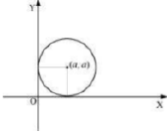
Form the differential equation of the family of circles in the first quadrant which touch the coordinate axes.
Solution
(N/A) The equation of a circle in the first quadrant with centre $(a, a)$ and radius $(a)$ which touches the coordinate axes is:
$(x-a)^{2}+(y-a)^{2}=a^{2}$ $(1)$
Differentiating equation $(1)$ with respect to $x$,we get:
$2(x-a)+2(y-a) y^{\prime}=0$
$(x-a)+(y-a) y^{\prime}=0$
$x-a+yy^{\prime}-ay^{\prime}=0$
$x+y y^{\prime}-a(1+y^{\prime})=0$
$a=\frac{x+y y^{\prime}}{1+y^{\prime}}$
Substituting the value of $a$ in equation $(1)$,we get:
$\left[x-\left(\frac{x+yy^{\prime}}{1+y^{\prime}}\right)\right]^{2}+\left[y-\left(\frac{x+yy^{\prime}}{1+y^{\prime}}\right)\right]^{2}=\left(\frac{x+yy^{\prime}}{1+y^{\prime}}\right)^{2}$
$\left[\frac{x+xy^{\prime}-x-yy^{\prime}}{1+y^{\prime}}\right]^{2}+\left[\frac{y+yy^{\prime}-x-yy^{\prime}}{1+y^{\prime}}\right]^{2}=\left[\frac{x+yy^{\prime}}{1+y^{\prime}}\right]^{2}$
$\left[\frac{x y^{\prime}-y y^{\prime}}{1+y^{\prime}}\right]^{2}+\left[\frac{y-x}{1+y^{\prime}}\right]^{2}=\left[\frac{x+yy^{\prime}}{1+y^{\prime}}\right]^{2}$
$(y^{\prime})^{2}(x-y)^{2}+(y-x)^{2}=(x+yy^{\prime})^{2}$
$(x-y)^{2}[1+(y^{\prime})^{2}]=(x+yy^{\prime})^{2}$
$(x-a)^{2}+(y-a)^{2}=a^{2}$ $(1)$
Differentiating equation $(1)$ with respect to $x$,we get:
$2(x-a)+2(y-a) y^{\prime}=0$
$(x-a)+(y-a) y^{\prime}=0$
$x-a+yy^{\prime}-ay^{\prime}=0$
$x+y y^{\prime}-a(1+y^{\prime})=0$
$a=\frac{x+y y^{\prime}}{1+y^{\prime}}$
Substituting the value of $a$ in equation $(1)$,we get:
$\left[x-\left(\frac{x+yy^{\prime}}{1+y^{\prime}}\right)\right]^{2}+\left[y-\left(\frac{x+yy^{\prime}}{1+y^{\prime}}\right)\right]^{2}=\left(\frac{x+yy^{\prime}}{1+y^{\prime}}\right)^{2}$
$\left[\frac{x+xy^{\prime}-x-yy^{\prime}}{1+y^{\prime}}\right]^{2}+\left[\frac{y+yy^{\prime}-x-yy^{\prime}}{1+y^{\prime}}\right]^{2}=\left[\frac{x+yy^{\prime}}{1+y^{\prime}}\right]^{2}$
$\left[\frac{x y^{\prime}-y y^{\prime}}{1+y^{\prime}}\right]^{2}+\left[\frac{y-x}{1+y^{\prime}}\right]^{2}=\left[\frac{x+yy^{\prime}}{1+y^{\prime}}\right]^{2}$
$(y^{\prime})^{2}(x-y)^{2}+(y-x)^{2}=(x+yy^{\prime})^{2}$
$(x-y)^{2}[1+(y^{\prime})^{2}]=(x+yy^{\prime})^{2}$
0 likes
View Solution82
DifficultMCQ
The differential equation satisfied by the system of parabolas $y^{2} = 4a(x + a)$ is
A
$y\left(\frac{dy}{dx}\right)^{2} - 2x\left(\frac{dy}{dx}\right) - y = 0$
B
$y\left(\frac{dy}{dx}\right)^{2} - 2x\left(\frac{dy}{dx}\right) + y = 0$
C
$y\left(\frac{dy}{dx}\right)^{2} + 2x\left(\frac{dy}{dx}\right) - y = 0$
D
$y\left(\frac{dy}{dx}\right) + 2x\left(\frac{dy}{dx}\right) - y = 0$
Solution
(C) Given the equation of the parabola: $y^{2} = 4ax + 4a^{2}$.
Differentiating both sides with respect to $x$:
$2y \frac{dy}{dx} = 4a$
$\Rightarrow a = \frac{y}{2} \frac{dy}{dx}$.
Substitute the value of $a$ back into the original equation:
$y^{2} = 4\left(\frac{y}{2} \frac{dy}{dx}\right)x + 4\left(\frac{y}{2} \frac{dy}{dx}\right)^{2}$.
Simplify the equation:
$y^{2} = 2xy \frac{dy}{dx} + 4 \cdot \frac{y^{2}}{4} \left(\frac{dy}{dx}\right)^{2}$.
$y^{2} = 2xy \frac{dy}{dx} + y^{2} \left(\frac{dy}{dx}\right)^{2}$.
Dividing by $y$ (assuming $y \neq 0$):
$y = 2x \frac{dy}{dx} + y \left(\frac{dy}{dx}\right)^{2}$.
Rearranging the terms,we get:
$y \left(\frac{dy}{dx}\right)^{2} + 2x \frac{dy}{dx} - y = 0$.
Differentiating both sides with respect to $x$:
$2y \frac{dy}{dx} = 4a$
$\Rightarrow a = \frac{y}{2} \frac{dy}{dx}$.
Substitute the value of $a$ back into the original equation:
$y^{2} = 4\left(\frac{y}{2} \frac{dy}{dx}\right)x + 4\left(\frac{y}{2} \frac{dy}{dx}\right)^{2}$.
Simplify the equation:
$y^{2} = 2xy \frac{dy}{dx} + 4 \cdot \frac{y^{2}}{4} \left(\frac{dy}{dx}\right)^{2}$.
$y^{2} = 2xy \frac{dy}{dx} + y^{2} \left(\frac{dy}{dx}\right)^{2}$.
Dividing by $y$ (assuming $y \neq 0$):
$y = 2x \frac{dy}{dx} + y \left(\frac{dy}{dx}\right)^{2}$.
Rearranging the terms,we get:
$y \left(\frac{dy}{dx}\right)^{2} + 2x \frac{dy}{dx} - y = 0$.
0 likes
View Solution83
MediumMCQ
The difference between the degree and the order of the differential equation that represents the family of curves given by $y^{2}=a\left(x+\frac{\sqrt{a}}{2}\right)$,where $a>0$,is:
A
$4$
B
$3$
C
$1$
D
$2$
Solution
(D) Given the family of curves: $y^{2}=a\left(x+\frac{\sqrt{a}}{2}\right) = ax + \frac{a^{3/2}}{2} \quad ...(1)$
Differentiating with respect to $x$:
$2yy' = a$
Substitute $a = 2yy'$ into equation $(1)$:
$y^{2} = (2yy')x + \frac{(2yy')^{3/2}}{2}$
Rearrange the terms:
$y^{2} - 2xyy' = \frac{(2yy')^{3/2}}{2}$
Square both sides to eliminate the fractional exponent:
$(y^{2} - 2xyy')^{2} = \frac{(2yy')^{3}}{4}$
$(y^{2} - 2xyy')^{2} = 2y^{3}(y')^{3}$
The highest order derivative present is $y'$,so the order is $1$.
The highest power of the highest order derivative is $3$,so the degree is $3$.
The difference between the degree and the order is $3 - 1 = 2$.
Differentiating with respect to $x$:
$2yy' = a$
Substitute $a = 2yy'$ into equation $(1)$:
$y^{2} = (2yy')x + \frac{(2yy')^{3/2}}{2}$
Rearrange the terms:
$y^{2} - 2xyy' = \frac{(2yy')^{3/2}}{2}$
Square both sides to eliminate the fractional exponent:
$(y^{2} - 2xyy')^{2} = \frac{(2yy')^{3}}{4}$
$(y^{2} - 2xyy')^{2} = 2y^{3}(y')^{3}$
The highest order derivative present is $y'$,so the order is $1$.
The highest power of the highest order derivative is $3$,so the degree is $3$.
The difference between the degree and the order is $3 - 1 = 2$.
0 likes
View Solution84
DifficultMCQ
$A$ differential equation representing the family of parabolas with axis parallel to the $y$-axis and whose length of latus rectum is the distance of the point $(2, -3)$ from the line $3x + 4y = 5$,is given by:
A
$10 \frac{d^{2}y}{dx^{2}} = 11$
B
$11 \frac{d^{2}x}{dy^{2}} = 10$
C
$10 \frac{d^{2}x}{dy^{2}} = 11$
D
$11 \frac{d^{2}y}{dx^{2}} = 10$
Solution
(D) The length of the latus rectum $4a$ is the distance from the point $(2, -3)$ to the line $3x + 4y - 5 = 0$.
$4a = \frac{|3(2) + 4(-3) - 5|}{\sqrt{3^{2} + 4^{2}}} = \frac{|6 - 12 - 5|}{5} = \frac{|-11|}{5} = \frac{11}{5}$.
Since the axis is parallel to the $y$-axis,the equation of the parabola is $(x - h)^{2} = 4a(y - k)$,where $4a = \frac{11}{5}$.
$(x - h)^{2} = \frac{11}{5}(y - k)$.
Differentiating with respect to $x$:
$2(x - h) = \frac{11}{5} \frac{dy}{dx}$.
Differentiating again with respect to $x$:
$2 = \frac{11}{5} \frac{d^{2}y}{dx^{2}}$.
$10 = 11 \frac{d^{2}y}{dx^{2}}$,which is $11 \frac{d^{2}y}{dx^{2}} = 10$.
$4a = \frac{|3(2) + 4(-3) - 5|}{\sqrt{3^{2} + 4^{2}}} = \frac{|6 - 12 - 5|}{5} = \frac{|-11|}{5} = \frac{11}{5}$.
Since the axis is parallel to the $y$-axis,the equation of the parabola is $(x - h)^{2} = 4a(y - k)$,where $4a = \frac{11}{5}$.
$(x - h)^{2} = \frac{11}{5}(y - k)$.
Differentiating with respect to $x$:
$2(x - h) = \frac{11}{5} \frac{dy}{dx}$.
Differentiating again with respect to $x$:
$2 = \frac{11}{5} \frac{d^{2}y}{dx^{2}}$.
$10 = 11 \frac{d^{2}y}{dx^{2}}$,which is $11 \frac{d^{2}y}{dx^{2}} = 10$.
0 likes
View Solution85
DifficultMCQ
The differential equation of the family of circles passing through the points $(0,2)$ and $(0,-2)$ is
A
$2 x y \frac{d y}{d x} + (x^{2} - y^{2} + 4) = 0$
B
$2 x y \frac{d y}{d x} + (x^{2} + y^{2} - 4) = 0$
C
$2 x y \frac{d y}{d x} + (y^{2} - x^{2} + 4) = 0$
D
$2 x y \frac{d y}{d x} - (x^{2} - y^{2} + 4) = 0$
Solution
(A) The general equation of a circle passing through $(0, 2)$ and $(0, -2)$ is given by the family of circles $x^{2} + y^{2} + 2gx + 2fy + c = 0$.
Since the points $(0, 2)$ and $(0, -2)$ lie on the circle,we have $4 + 4f + c = 0$ and $4 - 4f + c = 0$,which implies $f = 0$ and $c = -4$.
Thus,the equation of the family of circles is $x^{2} + y^{2} + 2gx - 4 = 0$,which can be written as $x^{2} + y^{2} - 4 + 2gx = 0$.
Dividing by $x$ (assuming $x \neq 0$),we get $\frac{x^{2} + y^{2} - 4}{x} + 2g = 0$.
Differentiating with respect to $x$,we get $\frac{d}{dx} \left( \frac{x^{2} + y^{2} - 4}{x} \right) = 0$.
Using the quotient rule,$\frac{x(2x + 2y \frac{dy}{dx}) - (x^{2} + y^{2} - 4)(1)}{x^{2}} = 0$.
This simplifies to $2x^{2} + 2xy \frac{dy}{dx} - x^{2} - y^{2} + 4 = 0$.
Rearranging the terms,we get $2xy \frac{dy}{dx} + x^{2} - y^{2} + 4 = 0$.
Since the points $(0, 2)$ and $(0, -2)$ lie on the circle,we have $4 + 4f + c = 0$ and $4 - 4f + c = 0$,which implies $f = 0$ and $c = -4$.
Thus,the equation of the family of circles is $x^{2} + y^{2} + 2gx - 4 = 0$,which can be written as $x^{2} + y^{2} - 4 + 2gx = 0$.
Dividing by $x$ (assuming $x \neq 0$),we get $\frac{x^{2} + y^{2} - 4}{x} + 2g = 0$.
Differentiating with respect to $x$,we get $\frac{d}{dx} \left( \frac{x^{2} + y^{2} - 4}{x} \right) = 0$.
Using the quotient rule,$\frac{x(2x + 2y \frac{dy}{dx}) - (x^{2} + y^{2} - 4)(1)}{x^{2}} = 0$.
This simplifies to $2x^{2} + 2xy \frac{dy}{dx} - x^{2} - y^{2} + 4 = 0$.
Rearranging the terms,we get $2xy \frac{dy}{dx} + x^{2} - y^{2} + 4 = 0$.
0 likes
View Solution86
DifficultMCQ
The differential equation of the family of circles passing through the origin and having their center on the line $y=x$ is:
A
$(x^2-y^2+2xy) dx = (x^2-y^2+2xy) dy$
B
$(x^2+y^2+2xy) dx = (x^2+y^2-2xy) dy$
C
$(x^2-y^2+2xy) dx = (x^2-y^2-2xy) dy$
D
$(x^2+y^2-2xy) dx = (x^2+y^2+2xy) dy$
Solution
(C) Let the center of the circle be $(h, h)$ since it lies on the line $y=x$.
Since the circle passes through the origin $(0,0)$,its radius $r$ is the distance from $(h, h)$ to $(0,0)$,so $r^2 = h^2 + h^2 = 2h^2$.
The equation of the circle is $(x-h)^2 + (y-h)^2 = 2h^2$.
Expanding this,we get $x^2 - 2xh + h^2 + y^2 - 2yh + h^2 = 2h^2$,which simplifies to $x^2 + y^2 - 2h(x+y) = 0$.
Differentiating with respect to $x$,we get $2x + 2yy' - 2h(1+y') = 0$,which gives $h = \frac{x+yy'}{1+y'}$.
Substituting $h$ back into the circle equation: $x^2 + y^2 = 2(\frac{x+yy'}{1+y'})(x+y)$.
$(x^2+y^2)(1+y') = 2(x+y)(x+yy')$.
$(x^2+y^2) + (x^2+y^2)y' = 2(x^2 + xyy' + xy + y^2y')$.
$(x^2+y^2) + (x^2+y^2)y' = 2x^2 + 2xyy' + 2xy + 2y^2y'$.
Rearranging terms to isolate $y'$: $(x^2+y^2-2xy-2y^2)y' = 2x^2 + 2xy - x^2 - y^2$.
$(x^2-y^2-2xy)y' = x^2-y^2+2xy$.
Thus,$(x^2-y^2+2xy) dx = (x^2-y^2-2xy) dy$.
Since the circle passes through the origin $(0,0)$,its radius $r$ is the distance from $(h, h)$ to $(0,0)$,so $r^2 = h^2 + h^2 = 2h^2$.
The equation of the circle is $(x-h)^2 + (y-h)^2 = 2h^2$.
Expanding this,we get $x^2 - 2xh + h^2 + y^2 - 2yh + h^2 = 2h^2$,which simplifies to $x^2 + y^2 - 2h(x+y) = 0$.
Differentiating with respect to $x$,we get $2x + 2yy' - 2h(1+y') = 0$,which gives $h = \frac{x+yy'}{1+y'}$.
Substituting $h$ back into the circle equation: $x^2 + y^2 = 2(\frac{x+yy'}{1+y'})(x+y)$.
$(x^2+y^2)(1+y') = 2(x+y)(x+yy')$.
$(x^2+y^2) + (x^2+y^2)y' = 2(x^2 + xyy' + xy + y^2y')$.
$(x^2+y^2) + (x^2+y^2)y' = 2x^2 + 2xyy' + 2xy + 2y^2y'$.
Rearranging terms to isolate $y'$: $(x^2+y^2-2xy-2y^2)y' = 2x^2 + 2xy - x^2 - y^2$.
$(x^2-y^2-2xy)y' = x^2-y^2+2xy$.
Thus,$(x^2-y^2+2xy) dx = (x^2-y^2-2xy) dy$.
0 likes
View Solution87
DifficultMCQ
Let $f(x)$ be a positive function such that the area bounded by $y=f(x), y=0$ from $x=0$ to $x=a>0$ is $e^{-a}+4a^2+a-1$. Then the differential equation,whose general solution is $y=c_1 f(x)+c_2$,where $c_1$ and $c_2$ are arbitrary constants,is :
A
$(8e^x-1) \frac{d^2y}{dx^2}+\frac{dy}{dx}=0$
B
$(8e^x+1) \frac{d^2y}{dx^2}-\frac{dy}{dx}=0$
C
$(8e^x+1) \frac{d^2y}{dx^2}+\frac{dy}{dx}=0$
D
$(8e^x-1) \frac{d^2y}{dx^2}-\frac{dy}{dx}=0$
Solution
(B) Given the area under the curve $y=f(x)$ from $x=0$ to $x=a$ is $\int_0^a f(x) dx = e^{-a}+4a^2+a-1$.
By the Fundamental Theorem of Calculus,differentiating both sides with respect to $a$ gives $f(a) = \frac{d}{da}(e^{-a}+4a^2+a-1) = -e^{-a}+8a+1$.
Thus,$f(x) = -e^{-x}+8x+1$.
Given the general solution $y = c_1 f(x) + c_2$,we differentiate with respect to $x$:
$\frac{dy}{dx} = c_1 f'(x) = c_1(e^{-x}+8)$.
$\frac{d^2y}{dx^2} = c_1 f''(x) = c_1(e^{-x})$.
From the second derivative,we have $c_1 = e^x \frac{d^2y}{dx^2}$.
Substituting $c_1$ into the first derivative equation:
$\frac{dy}{dx} = (e^x \frac{d^2y}{dx^2})(e^{-x}+8) = \frac{d^2y}{dx^2}(1+8e^x)$.
Rearranging gives $(8e^x+1) \frac{d^2y}{dx^2} - \frac{dy}{dx} = 0$.
By the Fundamental Theorem of Calculus,differentiating both sides with respect to $a$ gives $f(a) = \frac{d}{da}(e^{-a}+4a^2+a-1) = -e^{-a}+8a+1$.
Thus,$f(x) = -e^{-x}+8x+1$.
Given the general solution $y = c_1 f(x) + c_2$,we differentiate with respect to $x$:
$\frac{dy}{dx} = c_1 f'(x) = c_1(e^{-x}+8)$.
$\frac{d^2y}{dx^2} = c_1 f''(x) = c_1(e^{-x})$.
From the second derivative,we have $c_1 = e^x \frac{d^2y}{dx^2}$.
Substituting $c_1$ into the first derivative equation:
$\frac{dy}{dx} = (e^x \frac{d^2y}{dx^2})(e^{-x}+8) = \frac{d^2y}{dx^2}(1+8e^x)$.
Rearranging gives $(8e^x+1) \frac{d^2y}{dx^2} - \frac{dy}{dx} = 0$.
0 likes
View Solution88
MediumMCQ
The differential equation of the family of circles,whose centres are on the $X$-axis and which touch the $Y$-axis,is
A
$4(x+y \frac{dy}{dx})^2 x^2 = (x^2+y^2)^2$
B
$(x+y \frac{dy}{dx})^2 x^2 = (x^2+y^2)^2$
C
$2(x+y \frac{dy}{dx})^2 x^2 = (x^2+y^2)^2$
D
$(x+y \frac{dy}{dx})^2 x^2 = 4(x^2+y^2)^2$
Solution
(A) The equation of a circle with center $(h, 0)$ on the $X$-axis and radius $r = |h|$ (since it touches the $Y$-axis) is $(x-h)^2 + y^2 = h^2$.
Expanding this,we get $x^2 - 2xh + h^2 + y^2 = h^2$,which simplifies to $x^2 + y^2 = 2xh$.
Let $h = b$. Then $x^2 + y^2 = 2bx$ ... $(i)$.
Differentiating with respect to $x$,we get $2x + 2y \frac{dy}{dx} = 2b$,or $x + y \frac{dy}{dx} = b$ ... $(ii)$.
Substituting $(ii)$ into $(i)$,we get $x^2 + y^2 = 2x(x + y \frac{dy}{dx})$.
Squaring both sides,we get $(x^2 + y^2)^2 = 4x^2(x + y \frac{dy}{dx})^2$.
Expanding this,we get $x^2 - 2xh + h^2 + y^2 = h^2$,which simplifies to $x^2 + y^2 = 2xh$.
Let $h = b$. Then $x^2 + y^2 = 2bx$ ... $(i)$.
Differentiating with respect to $x$,we get $2x + 2y \frac{dy}{dx} = 2b$,or $x + y \frac{dy}{dx} = b$ ... $(ii)$.
Substituting $(ii)$ into $(i)$,we get $x^2 + y^2 = 2x(x + y \frac{dy}{dx})$.
Squaring both sides,we get $(x^2 + y^2)^2 = 4x^2(x + y \frac{dy}{dx})^2$.
0 likes
View Solution89
MediumMCQ
The order of the differential equation whose general solution is given by $y = (C_1 + C_2) \sin (x + C_3) - C_4 e^{x + C_5}$ is (where $C_1, C_2, C_3, C_4, C_5$ are arbitrary constants).
A
$5$
B
$4$
C
$2$
D
$3$
Solution
(D) The given general solution is $y = (C_1 + C_2) \sin (x + C_3) - C_4 e^{x + C_5}$.
We can simplify the constants as follows:
Let $A = (C_1 + C_2)$. Since $C_1$ and $C_2$ are arbitrary constants,their sum $A$ is also an arbitrary constant.
Let $B = C_4 e^{C_5}$. Since $C_4$ and $C_5$ are arbitrary constants,$B$ is also an arbitrary constant.
Now,the equation becomes $y = A \sin (x + C_3) - B e^x$.
Using the trigonometric identity $\sin (x + C_3) = \sin x \cos C_3 + \cos x \sin C_3$,we get:
$y = A (\sin x \cos C_3 + \cos x \sin C_3) - B e^x$
$y = (A \cos C_3) \sin x + (A \sin C_3) \cos x - B e^x$.
Let $K_1 = A \cos C_3$,$K_2 = A \sin C_3$,and $K_3 = -B$.
These $K_1, K_2, K_3$ are independent arbitrary constants.
Thus,the equation simplifies to $y = K_1 \sin x + K_2 \cos x + K_3 e^x$.
Since there are $3$ independent arbitrary constants in the general solution,the order of the corresponding differential equation is $3$.
We can simplify the constants as follows:
Let $A = (C_1 + C_2)$. Since $C_1$ and $C_2$ are arbitrary constants,their sum $A$ is also an arbitrary constant.
Let $B = C_4 e^{C_5}$. Since $C_4$ and $C_5$ are arbitrary constants,$B$ is also an arbitrary constant.
Now,the equation becomes $y = A \sin (x + C_3) - B e^x$.
Using the trigonometric identity $\sin (x + C_3) = \sin x \cos C_3 + \cos x \sin C_3$,we get:
$y = A (\sin x \cos C_3 + \cos x \sin C_3) - B e^x$
$y = (A \cos C_3) \sin x + (A \sin C_3) \cos x - B e^x$.
Let $K_1 = A \cos C_3$,$K_2 = A \sin C_3$,and $K_3 = -B$.
These $K_1, K_2, K_3$ are independent arbitrary constants.
Thus,the equation simplifies to $y = K_1 \sin x + K_2 \cos x + K_3 e^x$.
Since there are $3$ independent arbitrary constants in the general solution,the order of the corresponding differential equation is $3$.
0 likes
View Solution90
EasyMCQ
The differential equation representing the family of curves $y^2=2 c(x+\sqrt{c})$,where $c$ is a positive parameter,is of
A
order $1$,degree $4$
B
order $2$,degree $3$
C
order $2$,degree $4$
D
order $1$,degree $3$
Solution
(D) Given equation: $y^2=2 c(x+\sqrt{c}) \dots (i)$
Differentiating with respect to $x$:
$2 y \frac{dy}{dx} = 2c \implies c = y \frac{dy}{dx} \dots (ii)$
Substituting $(ii)$ into $(i)$:
$y^2 = 2 \left(y \frac{dy}{dx}\right) \left(x + \sqrt{y \frac{dy}{dx}}\right)$
Dividing by $y$ (assuming $y \neq 0$):
$y = 2 \frac{dy}{dx} \left(x + \sqrt{y \frac{dy}{dx}}\right)$
$y - 2x \frac{dy}{dx} = 2 \frac{dy}{dx} \sqrt{y \frac{dy}{dx}}$
Squaring both sides:
$(y - 2x \frac{dy}{dx})^2 = 4 \left(\frac{dy}{dx}\right)^2 \left(y \frac{dy}{dx}\right)$
$(y - 2x \frac{dy}{dx})^2 = 4y \left(\frac{dy}{dx}\right)^3$
The highest order derivative is $\frac{dy}{dx}$,so the order is $1$. The power of the highest order derivative is $3$,so the degree is $3$.
Differentiating with respect to $x$:
$2 y \frac{dy}{dx} = 2c \implies c = y \frac{dy}{dx} \dots (ii)$
Substituting $(ii)$ into $(i)$:
$y^2 = 2 \left(y \frac{dy}{dx}\right) \left(x + \sqrt{y \frac{dy}{dx}}\right)$
Dividing by $y$ (assuming $y \neq 0$):
$y = 2 \frac{dy}{dx} \left(x + \sqrt{y \frac{dy}{dx}}\right)$
$y - 2x \frac{dy}{dx} = 2 \frac{dy}{dx} \sqrt{y \frac{dy}{dx}}$
Squaring both sides:
$(y - 2x \frac{dy}{dx})^2 = 4 \left(\frac{dy}{dx}\right)^2 \left(y \frac{dy}{dx}\right)$
$(y - 2x \frac{dy}{dx})^2 = 4y \left(\frac{dy}{dx}\right)^3$
The highest order derivative is $\frac{dy}{dx}$,so the order is $1$. The power of the highest order derivative is $3$,so the degree is $3$.
0 likes
View Solution91
MediumMCQ
The degree of the differential equation whose solution is $y^2=8a(x+a)$ is
A
$2$
B
$1$
C
$4$
D
$3$
Solution
(A) Given the equation: $y^2 = 8ax + 8a^2$ $(1)$
Differentiating with respect to $x$:
$2y \frac{dy}{dx} = 8a$
$\Rightarrow a = \frac{y}{4} \frac{dy}{dx}$
Substituting the value of $a$ into equation $(1)$:
$y^2 = 8 \left( \frac{y}{4} \frac{dy}{dx} \right) x + 8 \left( \frac{y}{4} \frac{dy}{dx} \right)^2$
$y^2 = 2xy \frac{dy}{dx} + 8 \left( \frac{y^2}{16} \right) \left( \frac{dy}{dx} \right)^2$
$y^2 = 2xy \frac{dy}{dx} + \frac{y^2}{2} \left( \frac{dy}{dx} \right)^2$
Multiplying by $2$ to clear the fraction:
$2y^2 = 4xy \frac{dy}{dx} + y^2 \left( \frac{dy}{dx} \right)^2$
In this differential equation,the highest order derivative is $\frac{dy}{dx}$,which has an order of $1$. The highest power of the highest order derivative is $2$. Therefore,the degree is $2$.
Differentiating with respect to $x$:
$2y \frac{dy}{dx} = 8a$
$\Rightarrow a = \frac{y}{4} \frac{dy}{dx}$
Substituting the value of $a$ into equation $(1)$:
$y^2 = 8 \left( \frac{y}{4} \frac{dy}{dx} \right) x + 8 \left( \frac{y}{4} \frac{dy}{dx} \right)^2$
$y^2 = 2xy \frac{dy}{dx} + 8 \left( \frac{y^2}{16} \right) \left( \frac{dy}{dx} \right)^2$
$y^2 = 2xy \frac{dy}{dx} + \frac{y^2}{2} \left( \frac{dy}{dx} \right)^2$
Multiplying by $2$ to clear the fraction:
$2y^2 = 4xy \frac{dy}{dx} + y^2 \left( \frac{dy}{dx} \right)^2$
In this differential equation,the highest order derivative is $\frac{dy}{dx}$,which has an order of $1$. The highest power of the highest order derivative is $2$. Therefore,the degree is $2$.
0 likes
View Solution92
EasyMCQ
The order of the differential equation whose solution is $y=a \cos x+b \sin x+c e^{-x}$ is
A
$3$
B
$4$
C
$2$
D
$1$
Solution
(A) The given solution is $y=a \cos x+b \sin x+c e^{-x}$.
Since the solution contains $3$ arbitrary constants $(a, b, c)$,the order of the corresponding differential equation is equal to the number of arbitrary constants.
Therefore,the order of the differential equation is $3$.
Since the solution contains $3$ arbitrary constants $(a, b, c)$,the order of the corresponding differential equation is equal to the number of arbitrary constants.
Therefore,the order of the differential equation is $3$.
0 likes
View Solution93
MediumMCQ
The order of the differential equation of all circles whose radius is $4$,is . . . . . .
A
$1$
B
$2$
C
$3$
D
$4$
Solution
(B) The general equation of a circle with radius $r=4$ and center $(h, k)$ is given by $(x-h)^2 + (y-k)^2 = 4^2$.
Here,$h$ and $k$ are arbitrary constants.
Since there are $2$ independent arbitrary constants,the order of the differential equation is equal to the number of arbitrary constants.
Therefore,the order of the differential equation is $2$.
Here,$h$ and $k$ are arbitrary constants.
Since there are $2$ independent arbitrary constants,the order of the differential equation is equal to the number of arbitrary constants.
Therefore,the order of the differential equation is $2$.
0 likes
View Solution94
EasyMCQ
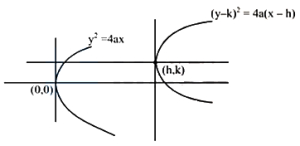
The order of the differential equation of all parabolas,whose latus rectum is $4a$ and axis is parallel to the $x$-axis,is
A
One
B
Four
C
Three
D
Two
Solution
(D) The general equation of a parabola with latus rectum $4a$ and axis parallel to the $x$-axis is given by $(y-k)^2 = 4a(x-h)$.
Here,$a$ is a fixed parameter (given as the latus rectum length),while $h$ and $k$ are arbitrary constants representing the coordinates of the vertex $(h, k)$.
Since there are $2$ arbitrary constants,the order of the differential equation is equal to the number of arbitrary constants.
Therefore,the order of the differential equation is $2$.
Here,$a$ is a fixed parameter (given as the latus rectum length),while $h$ and $k$ are arbitrary constants representing the coordinates of the vertex $(h, k)$.
Since there are $2$ arbitrary constants,the order of the differential equation is equal to the number of arbitrary constants.
Therefore,the order of the differential equation is $2$.
0 likes
View Solution95
EasyMCQ
The order of the differential equation whose solution is $a e^{x} + b e^{2x} + c e^{3x} + d = 0$ is:
A
$1$
B
$2$
C
$3$
D
$4$
Solution
(D) The given equation is $a e^{x} + b e^{2x} + c e^{3x} + d = 0$.
This equation contains $4$ arbitrary constants,namely $a, b, c,$ and $d$.
By definition,the order of a differential equation is equal to the number of independent arbitrary constants present in its general solution.
Since there are $4$ arbitrary constants,the order of the differential equation is $4$.
This equation contains $4$ arbitrary constants,namely $a, b, c,$ and $d$.
By definition,the order of a differential equation is equal to the number of independent arbitrary constants present in its general solution.
Since there are $4$ arbitrary constants,the order of the differential equation is $4$.
0 likes
View Solution96
MediumMCQ
The differential equation of all straight lines passing through the point $(1, -1)$ is
A
$y = (x - 1) \frac{dy}{dx} - 1$
B
$x = (x - 1) \frac{dy}{dx} + 1$
C
$y + 1 = (x - 1) \frac{dy}{dx}$
D
$y = 2(x - 1) \frac{dy}{dx}$
Solution
(C) The equation of a straight line passing through the point $(1, -1)$ with slope $m$ is given by the point-slope form:
$y - y_1 = m(x - x_1)$
Substituting the point $(1, -1)$,we get:
$y - (-1) = m(x - 1)$
$y + 1 = m(x - 1)$
Since $m = \frac{dy}{dx}$,we substitute this into the equation:
$y + 1 = \frac{dy}{dx}(x - 1)$
Rearranging the terms,we get:
$y + 1 = (x - 1) \frac{dy}{dx}$
Comparing this with the given options,the correct form is $y + 1 = (x - 1) \frac{dy}{dx}$.
$y - y_1 = m(x - x_1)$
Substituting the point $(1, -1)$,we get:
$y - (-1) = m(x - 1)$
$y + 1 = m(x - 1)$
Since $m = \frac{dy}{dx}$,we substitute this into the equation:
$y + 1 = \frac{dy}{dx}(x - 1)$
Rearranging the terms,we get:
$y + 1 = (x - 1) \frac{dy}{dx}$
Comparing this with the given options,the correct form is $y + 1 = (x - 1) \frac{dy}{dx}$.
0 likes
View Solution97
MediumMCQ
The differential equation whose solution represents the family $x^2 y = 4e^x + c$,where $c$ is an arbitrary constant,is
A
$x \frac{dy}{dx} + xy = 0$
B
$x^2 \frac{dy}{dx} + (2xy - 4e^x) = 0$
C
$x \frac{dy}{dx} + (x - 2)y = 0$
D
$x \frac{dy}{dx} + (2 - x)y = 0$
Solution
(B) Given the family of curves: $x^2 y = 4e^x + c$.
To find the differential equation,we differentiate both sides with respect to $x$:
$\frac{d}{dx}(x^2 y) = \frac{d}{dx}(4e^x + c)$.
Using the product rule on the left side:
$x^2 \frac{dy}{dx} + y \frac{d}{dx}(x^2) = 4e^x$.
$x^2 \frac{dy}{dx} + 2xy = 4e^x$.
Rearranging the terms,we get:
$x^2 \frac{dy}{dx} + (2xy - 4e^x) = 0$.
Thus,the correct option is $B$.
To find the differential equation,we differentiate both sides with respect to $x$:
$\frac{d}{dx}(x^2 y) = \frac{d}{dx}(4e^x + c)$.
Using the product rule on the left side:
$x^2 \frac{dy}{dx} + y \frac{d}{dx}(x^2) = 4e^x$.
$x^2 \frac{dy}{dx} + 2xy = 4e^x$.
Rearranging the terms,we get:
$x^2 \frac{dy}{dx} + (2xy - 4e^x) = 0$.
Thus,the correct option is $B$.
0 likes
View Solution98
MediumMCQ
The differential equation of all circles having their centres on the line $y=5$ and touching the $X$-axis is ......
A
$(5-y) \frac{dy}{dx} + y^2 - 10y = 0$
B
$(5-y)^2 \frac{d^2y}{dx^2} + y^2 - 10y = 0$
C
$(5-y) \frac{dy}{dx} + y - 10 = 0$
D
$(5-y)^2 \left(\frac{dy}{dx}\right)^2 + y^2 - 10y = 0$
Solution
(D) The center of the circle is $(h, 5)$ and it touches the $X$-axis,so its radius $r$ is equal to the absolute value of the $y$-coordinate of the center,which is $r = 5$.
The equation of the circle is $(x-h)^2 + (y-5)^2 = 5^2$.
$(x-h)^2 + (y-5)^2 = 25$.
Differentiating with respect to $x$,we get $2(x-h) + 2(y-5) \frac{dy}{dx} = 0$.
Thus,$(x-h) = -(y-5) \frac{dy}{dx}$.
Substituting this into the circle equation: $[-(y-5) \frac{dy}{dx}]^2 + (y-5)^2 = 25$.
$(y-5)^2 \left(\frac{dy}{dx}\right)^2 + (y-5)^2 = 25$.
$(y-5)^2 \left(\frac{dy}{dx}\right)^2 + y^2 - 10y + 25 = 25$.
$(y-5)^2 \left(\frac{dy}{dx}\right)^2 + y^2 - 10y = 0$.
The equation of the circle is $(x-h)^2 + (y-5)^2 = 5^2$.
$(x-h)^2 + (y-5)^2 = 25$.
Differentiating with respect to $x$,we get $2(x-h) + 2(y-5) \frac{dy}{dx} = 0$.
Thus,$(x-h) = -(y-5) \frac{dy}{dx}$.
Substituting this into the circle equation: $[-(y-5) \frac{dy}{dx}]^2 + (y-5)^2 = 25$.
$(y-5)^2 \left(\frac{dy}{dx}\right)^2 + (y-5)^2 = 25$.
$(y-5)^2 \left(\frac{dy}{dx}\right)^2 + y^2 - 10y + 25 = 25$.
$(y-5)^2 \left(\frac{dy}{dx}\right)^2 + y^2 - 10y = 0$.
0 likes
View Solution99
MediumMCQ
The differential equation satisfied by $y = X \sin(6t + 5) + Y \cos(6t + 5)$ is (where $X$ and $Y$ are constants).
A
$\frac{d^2 y}{dt^2} + 6y = 0$
B
$\frac{d^2 y}{dt^2} = 0$
C
$\frac{d^2 y}{dt^2} + 36y = 0$
D
$\frac{d^2 y}{dt^2} + 25y = 0$
Solution
(C) Given the equation: $y = X \sin(6t + 5) + Y \cos(6t + 5)$.
First,differentiate $y$ with respect to $t$:
$\frac{dy}{dt} = X \cdot \cos(6t + 5) \cdot 6 - Y \cdot \sin(6t + 5) \cdot 6 = 6[X \cos(6t + 5) - Y \sin(6t + 5)]$.
Now,differentiate again with respect to $t$:
$\frac{d^2 y}{dt^2} = 6[X \cdot (-\sin(6t + 5)) \cdot 6 - Y \cdot \cos(6t + 5) \cdot 6]$
$\frac{d^2 y}{dt^2} = -36[X \sin(6t + 5) + Y \cos(6t + 5)]$.
Since $y = X \sin(6t + 5) + Y \cos(6t + 5)$,we substitute $y$ into the equation:
$\frac{d^2 y}{dt^2} = -36y$.
Rearranging gives: $\frac{d^2 y}{dt^2} + 36y = 0$.
First,differentiate $y$ with respect to $t$:
$\frac{dy}{dt} = X \cdot \cos(6t + 5) \cdot 6 - Y \cdot \sin(6t + 5) \cdot 6 = 6[X \cos(6t + 5) - Y \sin(6t + 5)]$.
Now,differentiate again with respect to $t$:
$\frac{d^2 y}{dt^2} = 6[X \cdot (-\sin(6t + 5)) \cdot 6 - Y \cdot \cos(6t + 5) \cdot 6]$
$\frac{d^2 y}{dt^2} = -36[X \sin(6t + 5) + Y \cos(6t + 5)]$.
Since $y = X \sin(6t + 5) + Y \cos(6t + 5)$,we substitute $y$ into the equation:
$\frac{d^2 y}{dt^2} = -36y$.
Rearranging gives: $\frac{d^2 y}{dt^2} + 36y = 0$.
0 likes
View SolutionDifferential Equations — Formation of differential equations · Frequently Asked Questions
1Are these Differential Equations questions useful for JEE and NEET?
Yes. All questions in this section are mapped to JEE Main and NEET exam patterns. Previous year questions from JEE Main, NEET, GUJCET and state-level exams are included with full solutions.
2Can I switch to Hindi or Gujarati for these questions?
Yes. Use the language tabs in the hero section or the sidebar to view the same questions and solutions in English, Hindi or Gujarati.
3How do I generate a question paper from this subtopic?
Use the Vedclass Exam Paper Generator — select the chapter and subtopic, set difficulty, and generate Sets A, B, C, D automatically. First 3 chapters of every subject are free.
Vedclass Products
For Students
Vedclass Test Series
Mock tests in real JEE/NEET style with performance analysis. 5-day free trial.
Start Free TrialFor Teachers
Exam Paper Generator
Generate Set A/B/C/D papers from this chapter in 2 minutes. 3 chapters free.
Try FreeFor Institutes
Online Exam Module
Live online exams with unlimited students, 360° analytics & white-label branding.
See DemoFor Teachers & Institutes
Generate a Differential Equations Exam Paper in 2 Minutes
Select subtopic & difficulty — Sets A, B, C, D auto-generated with No Repeat logic.
First 3 chapters of every subject are free — no payment required.