
A English
Maxima and Minima Questions in English
Class 12 Mathematics · Applications of Derivatives · Maxima and Minima
760+
Questions
English
Language
100%
With Solutions
Showing 50 of 760 questions in English
51
MediumMCQ
$x$ and $y$ are two variables such that $x > 0$ and $xy = 1$. Then the minimum value of $x + y$ is
A
$2$
B
$3$
C
$4$
D
$0$
Solution
(A) Given $xy = 1$ and $x > 0$,we have $y = \frac{1}{x}$.
Let $f(x) = x + y = x + \frac{1}{x}$.
To find the minimum value,we differentiate $f(x)$ with respect to $x$:
$f'(x) = 1 - \frac{1}{x^2}$.
Setting $f'(x) = 0$ for critical points:
$1 - \frac{1}{x^2} = 0 \Rightarrow x^2 = 1$.
Since $x > 0$,we take $x = 1$.
Now,find the second derivative:
$f''(x) = \frac{2}{x^3}$.
At $x = 1$,$f''(1) = \frac{2}{1^3} = 2 > 0$.
Since the second derivative is positive,$x = 1$ is a point of local minima.
The minimum value is $f(1) = 1 + \frac{1}{1} = 2$.
Let $f(x) = x + y = x + \frac{1}{x}$.
To find the minimum value,we differentiate $f(x)$ with respect to $x$:
$f'(x) = 1 - \frac{1}{x^2}$.
Setting $f'(x) = 0$ for critical points:
$1 - \frac{1}{x^2} = 0 \Rightarrow x^2 = 1$.
Since $x > 0$,we take $x = 1$.
Now,find the second derivative:
$f''(x) = \frac{2}{x^3}$.
At $x = 1$,$f''(1) = \frac{2}{1^3} = 2 > 0$.
Since the second derivative is positive,$x = 1$ is a point of local minima.
The minimum value is $f(1) = 1 + \frac{1}{1} = 2$.
0 likes
View Solution52
MediumMCQ
What are the minimum and maximum values of the function $f(x) = x^5 - 5x^4 + 5x^3 - 10$?
A
$-37, -9$
B
$10, 0$
C
It has $2$ min. and $1$ max. values
D
It has $2$ max. and $1$ min. values
Solution
(A) Let $y = f(x) = x^5 - 5x^4 + 5x^3 - 10$.
First,find the derivative: $\frac{dy}{dx} = 5x^4 - 20x^3 + 15x^2 = 5x^2(x^2 - 4x + 3) = 5x^2(x - 3)(x - 1)$.
Setting $\frac{dy}{dx} = 0$,we get critical points at $x = 0, 1, 3$.
Now,find the second derivative: $\frac{d^2y}{dx^2} = 20x^3 - 60x^2 + 30x = 10x(2x^2 - 6x + 3)$.
For $x = 0$: $\frac{d^2y}{dx^2} = 0$. Checking the third derivative: $\frac{d^3y}{dx^3} = 60x^2 - 120x + 30$. At $x = 0$,$\frac{d^3y}{dx^3} = 30 \neq 0$. Thus,$x = 0$ is a point of inflection,not a local extremum.
For $x = 1$: $\frac{d^2y}{dx^2} = 10(1)(2 - 6 + 3) = -10 < 0$. Thus,$x = 1$ is a local maximum.
$f(1) = 1 - 5 + 5 - 10 = -9$.
For $x = 3$: $\frac{d^2y}{dx^2} = 10(3)(2(9) - 6(3) + 3) = 30(18 - 18 + 3) = 90 > 0$. Thus,$x = 3$ is a local minimum.
$f(3) = 3^5 - 5(3^4) + 5(3^3) - 10 = 243 - 405 + 135 - 10 = -37$.
Therefore,the minimum value is $-37$ and the maximum value is $-9$.
First,find the derivative: $\frac{dy}{dx} = 5x^4 - 20x^3 + 15x^2 = 5x^2(x^2 - 4x + 3) = 5x^2(x - 3)(x - 1)$.
Setting $\frac{dy}{dx} = 0$,we get critical points at $x = 0, 1, 3$.
Now,find the second derivative: $\frac{d^2y}{dx^2} = 20x^3 - 60x^2 + 30x = 10x(2x^2 - 6x + 3)$.
For $x = 0$: $\frac{d^2y}{dx^2} = 0$. Checking the third derivative: $\frac{d^3y}{dx^3} = 60x^2 - 120x + 30$. At $x = 0$,$\frac{d^3y}{dx^3} = 30 \neq 0$. Thus,$x = 0$ is a point of inflection,not a local extremum.
For $x = 1$: $\frac{d^2y}{dx^2} = 10(1)(2 - 6 + 3) = -10 < 0$. Thus,$x = 1$ is a local maximum.
$f(1) = 1 - 5 + 5 - 10 = -9$.
For $x = 3$: $\frac{d^2y}{dx^2} = 10(3)(2(9) - 6(3) + 3) = 30(18 - 18 + 3) = 90 > 0$. Thus,$x = 3$ is a local minimum.
$f(3) = 3^5 - 5(3^4) + 5(3^3) - 10 = 243 - 405 + 135 - 10 = -37$.
Therefore,the minimum value is $-37$ and the maximum value is $-9$.
0 likes
View Solution53
MediumMCQ
Divide $20$ into two parts such that the product of one part and the cube of the other is maximum. The two parts are
A
$(10, 10)$
B
$(5, 15)$
C
$(13, 7)$
D
None of these
Solution
(B) Let the two parts be $x$ and $y$ such that $x + y = 20$.
We want to maximize the product $z = x \cdot y^3$.
Substituting $x = 20 - y$ into the equation,we get $z = (20 - y)y^3 = 20y^3 - y^4$.
To find the critical points,we differentiate $z$ with respect to $y$: $\frac{dz}{dy} = 60y^2 - 4y^3$.
Setting $\frac{dz}{dy} = 0$,we get $4y^2(15 - y) = 0$,which gives $y = 0$ or $y = 15$.
Now,we find the second derivative: $\frac{d^2z}{dy^2} = 120y - 12y^2$.
At $y = 15$,$\frac{d^2z}{dy^2} = 120(15) - 12(15^2) = 1800 - 2700 = -900 < 0$.
Since the second derivative is negative,$y = 15$ is the point of maxima.
If $y = 15$,then $x = 20 - 15 = 5$.
Thus,the two parts are $(5, 15)$.
We want to maximize the product $z = x \cdot y^3$.
Substituting $x = 20 - y$ into the equation,we get $z = (20 - y)y^3 = 20y^3 - y^4$.
To find the critical points,we differentiate $z$ with respect to $y$: $\frac{dz}{dy} = 60y^2 - 4y^3$.
Setting $\frac{dz}{dy} = 0$,we get $4y^2(15 - y) = 0$,which gives $y = 0$ or $y = 15$.
Now,we find the second derivative: $\frac{d^2z}{dy^2} = 120y - 12y^2$.
At $y = 15$,$\frac{d^2z}{dy^2} = 120(15) - 12(15^2) = 1800 - 2700 = -900 < 0$.
Since the second derivative is negative,$y = 15$ is the point of maxima.
If $y = 15$,then $x = 20 - 15 = 5$.
Thus,the two parts are $(5, 15)$.
0 likes
View Solution54
MediumMCQ
The maximum and minimum values of ${x^3} - 18{x^2} + 96x$ in the interval $(0, 9)$ are
A
$160, 0$
B
$60, 0$
C
$160, 128$
D
$120, 28$
Solution
(C) Let $f(x) = {x^3} - 18{x^2} + 96x$.
First,find the derivative: $f'(x) = 3{x^2} - 36x + 96$.
Set $f'(x) = 0$ to find critical points: $3(x^2 - 12x + 32) = 0 \Rightarrow 3(x - 4)(x - 8) = 0$.
Thus,the critical points are $x = 4$ and $x = 8$.
Now,find the second derivative: $f''(x) = 6x - 36$.
At $x = 4$,$f''(4) = 6(4) - 36 = -12 < 0$,so $f(x)$ has a local maximum at $x = 4$.
The maximum value is $f(4) = (4)^3 - 18(4)^2 + 96(4) = 64 - 288 + 384 = 160$.
At $x = 8$,$f''(8) = 6(8) - 36 = 12 > 0$,so $f(x)$ has a local minimum at $x = 8$.
The minimum value is $f(8) = (8)^3 - 18(8)^2 + 96(8) = 512 - 1152 + 768 = 128$.
Therefore,the maximum and minimum values are $160$ and $128$ respectively.
First,find the derivative: $f'(x) = 3{x^2} - 36x + 96$.
Set $f'(x) = 0$ to find critical points: $3(x^2 - 12x + 32) = 0 \Rightarrow 3(x - 4)(x - 8) = 0$.
Thus,the critical points are $x = 4$ and $x = 8$.
Now,find the second derivative: $f''(x) = 6x - 36$.
At $x = 4$,$f''(4) = 6(4) - 36 = -12 < 0$,so $f(x)$ has a local maximum at $x = 4$.
The maximum value is $f(4) = (4)^3 - 18(4)^2 + 96(4) = 64 - 288 + 384 = 160$.
At $x = 8$,$f''(8) = 6(8) - 36 = 12 > 0$,so $f(x)$ has a local minimum at $x = 8$.
The minimum value is $f(8) = (8)^3 - 18(8)^2 + 96(8) = 512 - 1152 + 768 = 128$.
Therefore,the maximum and minimum values are $160$ and $128$ respectively.
0 likes
View Solution55
MediumMCQ
The maximum value of $\sin x(1 + \cos x)$ occurs at
A
$x = \frac{\pi}{2}$
B
$x = \frac{\pi}{6}$
C
$x = \frac{\pi}{3}$
D
$x = \pi$
Solution
(C) Let $f(x) = \sin x(1 + \cos x) = \sin x + \sin x \cos x = \sin x + \frac{1}{2} \sin 2x$.
To find the maximum,we find the derivative $f'(x)$ and set it to $0$:
$f'(x) = \cos x + \cos 2x = 0$.
Using the identity $\cos 2x = 2 \cos^2 x - 1$,we get:
$2 \cos^2 x + \cos x - 1 = 0$.
Let $u = \cos x$,then $2u^2 + u - 1 = 0$,which factors as $(2u - 1)(u + 1) = 0$.
So,$\cos x = \frac{1}{2}$ or $\cos x = -1$.
For $\cos x = \frac{1}{2}$,$x = \frac{\pi}{3}$ (in the first quadrant).
For $\cos x = -1$,$x = \pi$,but at $x = \pi$,$f(x) = 0$,which is the minimum.
Checking the second derivative $f''(x) = -\sin x - 2\sin 2x$:
At $x = \frac{\pi}{3}$,$f''(\frac{\pi}{3}) = -\sin(\frac{\pi}{3}) - 2\sin(\frac{2\pi}{3}) = -\frac{\sqrt{3}}{2} - 2(\frac{\sqrt{3}}{2}) = -\frac{3\sqrt{3}}{2} < 0$.
Since the second derivative is negative,the function has a maximum at $x = \frac{\pi}{3}$.
To find the maximum,we find the derivative $f'(x)$ and set it to $0$:
$f'(x) = \cos x + \cos 2x = 0$.
Using the identity $\cos 2x = 2 \cos^2 x - 1$,we get:
$2 \cos^2 x + \cos x - 1 = 0$.
Let $u = \cos x$,then $2u^2 + u - 1 = 0$,which factors as $(2u - 1)(u + 1) = 0$.
So,$\cos x = \frac{1}{2}$ or $\cos x = -1$.
For $\cos x = \frac{1}{2}$,$x = \frac{\pi}{3}$ (in the first quadrant).
For $\cos x = -1$,$x = \pi$,but at $x = \pi$,$f(x) = 0$,which is the minimum.
Checking the second derivative $f''(x) = -\sin x - 2\sin 2x$:
At $x = \frac{\pi}{3}$,$f''(\frac{\pi}{3}) = -\sin(\frac{\pi}{3}) - 2\sin(\frac{2\pi}{3}) = -\frac{\sqrt{3}}{2} - 2(\frac{\sqrt{3}}{2}) = -\frac{3\sqrt{3}}{2} < 0$.
Since the second derivative is negative,the function has a maximum at $x = \frac{\pi}{3}$.
0 likes
View Solution56
DifficultMCQ
The function $f(x) = \frac{x}{1 + x \tan x}$ attains its maximum value at:
A
$x = \sin x$
B
$x = \cos x$
C
$x = \frac{\pi}{3}$
D
$x = \tan x$
Solution
(B) Let $f(x) = \frac{x}{1 + x \tan x}$. To find the maxima of $f(x)$,we can find the minima of its reciprocal $g(x) = \frac{1}{f(x)} = \frac{1 + x \tan x}{x} = \frac{1}{x} + \tan x$.
Now,differentiate $g(x)$ with respect to $x$:
$g'(x) = -\frac{1}{x^2} + \sec^2 x$.
For critical points,set $g'(x) = 0$:
$-\frac{1}{x^2} + \sec^2 x = 0 \implies \sec^2 x = \frac{1}{x^2} \implies \cos^2 x = x^2 \implies x = \cos x$ (considering the domain where $x > 0$).
Now,find the second derivative $g''(x)$:
$g''(x) = \frac{2}{x^3} + 2 \sec x (\sec x \tan x) = \frac{2}{x^3} + 2 \sec^2 x \tan x$.
At $x = \cos x$,$g''(x) = \frac{2}{\cos^3 x} + 2 \sec^2 x \tan x = 2 \sec^3 x + 2 \sec^2 x \tan x = 2 \sec^2 x (\sec x + \tan x)$.
Since $x = \cos x$ lies in the first quadrant,$\sec x > 0$ and $\tan x > 0$,so $g''(x) > 0$.
Thus,$g(x)$ has a minimum at $x = \cos x$,which implies $f(x)$ has a maximum at $x = \cos x$.
Now,differentiate $g(x)$ with respect to $x$:
$g'(x) = -\frac{1}{x^2} + \sec^2 x$.
For critical points,set $g'(x) = 0$:
$-\frac{1}{x^2} + \sec^2 x = 0 \implies \sec^2 x = \frac{1}{x^2} \implies \cos^2 x = x^2 \implies x = \cos x$ (considering the domain where $x > 0$).
Now,find the second derivative $g''(x)$:
$g''(x) = \frac{2}{x^3} + 2 \sec x (\sec x \tan x) = \frac{2}{x^3} + 2 \sec^2 x \tan x$.
At $x = \cos x$,$g''(x) = \frac{2}{\cos^3 x} + 2 \sec^2 x \tan x = 2 \sec^3 x + 2 \sec^2 x \tan x = 2 \sec^2 x (\sec x + \tan x)$.
Since $x = \cos x$ lies in the first quadrant,$\sec x > 0$ and $\tan x > 0$,so $g''(x) > 0$.
Thus,$g(x)$ has a minimum at $x = \cos x$,which implies $f(x)$ has a maximum at $x = \cos x$.
0 likes
View Solution57
DifficultMCQ
If $x$ is real,then the greatest and least values of $\frac{x^2 - x + 1}{x^2 + x + 1}$ are
A
$3, -\frac{1}{2}$
B
$3, \frac{1}{3}$
C
$-3, -\frac{1}{3}$
D
None of these
Solution
(B) Let $y = \frac{x^2 - x + 1}{x^2 + x + 1}$.
To find the extrema,we differentiate $y$ with respect to $x$:
$\frac{dy}{dx} = \frac{(x^2 + x + 1)(2x - 1) - (x^2 - x + 1)(2x + 1)}{(x^2 + x + 1)^2}$
$= \frac{(2x^3 + 2x^2 + 2x - x^2 - x - 1) - (2x^3 - 2x^2 + 2x + x^2 - x + 1)}{(x^2 + x + 1)^2}$
$= \frac{(2x^3 + x^2 + x - 1) - (2x^3 - x^2 + x + 1)}{(x^2 + x + 1)^2}$
$= \frac{2x^2 - 2}{(x^2 + x + 1)^2}$.
Setting $\frac{dy}{dx} = 0$,we get $2x^2 - 2 = 0$,which implies $x^2 = 1$,so $x = 1$ or $x = -1$.
For $x = 1$,$y = \frac{1 - 1 + 1}{1 + 1 + 1} = \frac{1}{3}$.
For $x = -1$,$y = \frac{1 + 1 + 1}{1 - 1 + 1} = \frac{3}{1} = 3$.
Thus,the greatest value is $3$ and the least value is $\frac{1}{3}$.
To find the extrema,we differentiate $y$ with respect to $x$:
$\frac{dy}{dx} = \frac{(x^2 + x + 1)(2x - 1) - (x^2 - x + 1)(2x + 1)}{(x^2 + x + 1)^2}$
$= \frac{(2x^3 + 2x^2 + 2x - x^2 - x - 1) - (2x^3 - 2x^2 + 2x + x^2 - x + 1)}{(x^2 + x + 1)^2}$
$= \frac{(2x^3 + x^2 + x - 1) - (2x^3 - x^2 + x + 1)}{(x^2 + x + 1)^2}$
$= \frac{2x^2 - 2}{(x^2 + x + 1)^2}$.
Setting $\frac{dy}{dx} = 0$,we get $2x^2 - 2 = 0$,which implies $x^2 = 1$,so $x = 1$ or $x = -1$.
For $x = 1$,$y = \frac{1 - 1 + 1}{1 + 1 + 1} = \frac{1}{3}$.
For $x = -1$,$y = \frac{1 + 1 + 1}{1 - 1 + 1} = \frac{3}{1} = 3$.
Thus,the greatest value is $3$ and the least value is $\frac{1}{3}$.
0 likes
View Solution58
MediumMCQ
The minimum value of $\frac{\log x}{x}$ in the interval $[2, \infty)$ is
A
$\frac{\log 2}{2}$
B
Zero
C
$\frac{1}{e}$
D
Does not exist
Solution
(D) Let $f(x) = \frac{\log x}{x}$.
Find the derivative: $f'(x) = \frac{x \cdot \frac{1}{x} - \log x \cdot 1}{x^2} = \frac{1 - \log x}{x^2}$.
Set $f'(x) = 0$ to find critical points: $1 - \log x = 0 \Rightarrow \log x = 1 \Rightarrow x = e$.
Since $e \approx 2.718$,$x = e$ lies in the interval $[2, \infty)$.
Evaluate the function at the critical point and the boundary:
$f(e) = \frac{\log e}{e} = \frac{1}{e} \approx 0.367$.
$f(2) = \frac{\log 2}{2} \approx \frac{0.693}{2} = 0.346$.
As $x \to \infty$,$\frac{\log x}{x} \to 0$ (by $L$'Hopital's rule).
Since $f(2) \approx 0.346$ and the limit as $x \to \infty$ is $0$,and the function decreases for $x > e$,the function values approach $0$ but never reach it in the interval $[2, \infty)$.
Therefore,the minimum value does not exist.
Find the derivative: $f'(x) = \frac{x \cdot \frac{1}{x} - \log x \cdot 1}{x^2} = \frac{1 - \log x}{x^2}$.
Set $f'(x) = 0$ to find critical points: $1 - \log x = 0 \Rightarrow \log x = 1 \Rightarrow x = e$.
Since $e \approx 2.718$,$x = e$ lies in the interval $[2, \infty)$.
Evaluate the function at the critical point and the boundary:
$f(e) = \frac{\log e}{e} = \frac{1}{e} \approx 0.367$.
$f(2) = \frac{\log 2}{2} \approx \frac{0.693}{2} = 0.346$.
As $x \to \infty$,$\frac{\log x}{x} \to 0$ (by $L$'Hopital's rule).
Since $f(2) \approx 0.346$ and the limit as $x \to \infty$ is $0$,and the function decreases for $x > e$,the function values approach $0$ but never reach it in the interval $[2, \infty)$.
Therefore,the minimum value does not exist.
0 likes
View Solution59
EasyMCQ
The real number $x$ when added to its inverse gives the minimum value of the sum at $x$ equal to
A
$-2$
B
$1$
C
$2$
D
$-1$
Solution
(B) Let the function be $f(x) = x + \frac{1}{x}$ for $x > 0$.
To find the minimum value,we find the derivative $f'(x) = 1 - \frac{1}{x^2}$.
Setting $f'(x) = 0$,we get $1 - \frac{1}{x^2} = 0$,which implies $x^2 = 1$. Since $x > 0$,we have $x = 1$.
Now,we check the second derivative $f''(x) = \frac{2}{x^3}$.
At $x = 1$,$f''(1) = \frac{2}{1^3} = 2 > 0$.
Since the second derivative is positive,the function $f(x)$ has a local minimum at $x = 1$.
To find the minimum value,we find the derivative $f'(x) = 1 - \frac{1}{x^2}$.
Setting $f'(x) = 0$,we get $1 - \frac{1}{x^2} = 0$,which implies $x^2 = 1$. Since $x > 0$,we have $x = 1$.
Now,we check the second derivative $f''(x) = \frac{2}{x^3}$.
At $x = 1$,$f''(1) = \frac{2}{1^3} = 2 > 0$.
Since the second derivative is positive,the function $f(x)$ has a local minimum at $x = 1$.
0 likes
View Solution60
MediumMCQ
The denominator of a fraction is $16$ more than the square of the numerator. Find the least value of the fraction.
A
$ - 1/4$
B
$ - 1/8$
C
$1/12$
D
$1/16$
Solution
(B) Let the numerator be $x$. Then the denominator is $x^2 + 16$.
The fraction is $f(x) = \frac{x}{x^2 + 16}$.
To find the extrema,we find the derivative $f'(x)$:
$f'(x) = \frac{(x^2 + 16)(1) - x(2x)}{(x^2 + 16)^2} = \frac{16 - x^2}{(x^2 + 16)^2}$.
Setting $f'(x) = 0$ gives $16 - x^2 = 0$,so $x = 4$ or $x = -4$.
We evaluate $f(x)$ at these critical points:
For $x = 4$,$f(4) = \frac{4}{16 + 16} = \frac{4}{32} = \frac{1}{8}$.
For $x = -4$,$f(-4) = \frac{-4}{16 + 16} = \frac{-4}{32} = -\frac{1}{8}$.
Comparing the values,the least value is $-1/8$.
The fraction is $f(x) = \frac{x}{x^2 + 16}$.
To find the extrema,we find the derivative $f'(x)$:
$f'(x) = \frac{(x^2 + 16)(1) - x(2x)}{(x^2 + 16)^2} = \frac{16 - x^2}{(x^2 + 16)^2}$.
Setting $f'(x) = 0$ gives $16 - x^2 = 0$,so $x = 4$ or $x = -4$.
We evaluate $f(x)$ at these critical points:
For $x = 4$,$f(4) = \frac{4}{16 + 16} = \frac{4}{32} = \frac{1}{8}$.
For $x = -4$,$f(-4) = \frac{-4}{16 + 16} = \frac{-4}{32} = -\frac{1}{8}$.
Comparing the values,the least value is $-1/8$.
0 likes
View Solution61
MediumMCQ
The real number which most exceeds its cube is
A
$1/2$
B
$1/\sqrt{3}$
C
$1/\sqrt{2}$
D
None of these
Solution
(B) Let the number be $x$. We want to maximize the difference between the number and its cube,so we define the function $f(x) = x - x^3$.
To find the maximum,we take the first derivative: $f'(x) = 1 - 3x^2$.
Setting $f'(x) = 0$,we get $1 - 3x^2 = 0$,which implies $x^2 = 1/3$,so $x = \pm 1/\sqrt{3}$.
Now,we check the second derivative: $f''(x) = -6x$.
For $x = 1/\sqrt{3}$,$f''(1/\sqrt{3}) = -6/\sqrt{3} < 0$,which indicates a local maximum.
For $x = -1/\sqrt{3}$,$f''(-1/\sqrt{3}) = 6/\sqrt{3} > 0$,which indicates a local minimum.
Thus,the number that most exceeds its cube is $1/\sqrt{3}$.
To find the maximum,we take the first derivative: $f'(x) = 1 - 3x^2$.
Setting $f'(x) = 0$,we get $1 - 3x^2 = 0$,which implies $x^2 = 1/3$,so $x = \pm 1/\sqrt{3}$.
Now,we check the second derivative: $f''(x) = -6x$.
For $x = 1/\sqrt{3}$,$f''(1/\sqrt{3}) = -6/\sqrt{3} < 0$,which indicates a local maximum.
For $x = -1/\sqrt{3}$,$f''(-1/\sqrt{3}) = 6/\sqrt{3} > 0$,which indicates a local minimum.
Thus,the number that most exceeds its cube is $1/\sqrt{3}$.
0 likes
View Solution62
MediumMCQ
The maximum value of $f(x) = \frac{x}{4 + x + x^2}$ on the interval $[-1, 1]$ is:
A
$-1/4$
B
$-1/3$
C
$1/6$
D
$1/5$
Solution
(C) Given function: $f(x) = \frac{x}{4 + x + x^2}$.
To find the critical points,we differentiate $f(x)$ with respect to $x$ using the quotient rule:
$f'(x) = \frac{(4 + x + x^2)(1) - x(1 + 2x)}{(4 + x + x^2)^2}$
$f'(x) = \frac{4 + x + x^2 - x - 2x^2}{(4 + x + x^2)^2} = \frac{4 - x^2}{(4 + x + x^2)^2}$.
Setting $f'(x) = 0$ gives $4 - x^2 = 0$,which implies $x = 2$ or $x = -2$.
Since both $x = 2$ and $x = -2$ lie outside the given interval $[-1, 1]$,the maximum and minimum values must occur at the endpoints of the interval.
Evaluating at the endpoints:
$f(-1) = \frac{-1}{4 - 1 + 1} = \frac{-1}{4} = -0.25$.
$f(1) = \frac{1}{4 + 1 + 1} = \frac{1}{6} \approx 0.1667$.
Comparing these values,the maximum value is $1/6$.
To find the critical points,we differentiate $f(x)$ with respect to $x$ using the quotient rule:
$f'(x) = \frac{(4 + x + x^2)(1) - x(1 + 2x)}{(4 + x + x^2)^2}$
$f'(x) = \frac{4 + x + x^2 - x - 2x^2}{(4 + x + x^2)^2} = \frac{4 - x^2}{(4 + x + x^2)^2}$.
Setting $f'(x) = 0$ gives $4 - x^2 = 0$,which implies $x = 2$ or $x = -2$.
Since both $x = 2$ and $x = -2$ lie outside the given interval $[-1, 1]$,the maximum and minimum values must occur at the endpoints of the interval.
Evaluating at the endpoints:
$f(-1) = \frac{-1}{4 - 1 + 1} = \frac{-1}{4} = -0.25$.
$f(1) = \frac{1}{4 + 1 + 1} = \frac{1}{6} \approx 0.1667$.
Comparing these values,the maximum value is $1/6$.
0 likes
View Solution63
DifficultMCQ
$A$ cone of maximum volume is inscribed in a given sphere. Then the ratio of the height of the cone to the diameter of the sphere is:
A
$2/3$
B
$3/4$
C
$1/3$
D
$1/4$
Solution
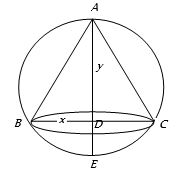
(A) Let the radius of the sphere be $R$,so the diameter is $2R$.
Let the height of the cone be $y$ and the radius of the base of the cone be $x$.
From the geometry of the sphere,the distance from the center of the sphere to the base of the cone is $|y - R|$.
Using the Pythagorean theorem in the triangle formed by the radius of the sphere,the radius of the cone,and the distance from the center: $x^2 + (y - R)^2 = R^2$.
$x^2 = R^2 - (y - R)^2 = R^2 - (y^2 - 2Ry + R^2) = 2Ry - y^2$.
The volume of the cone is $V = \frac{1}{3}\pi x^2 y = \frac{1}{3}\pi (2Ry - y^2)y = \frac{1}{3}\pi (2Ry^2 - y^3)$.
To find the maximum volume,differentiate $V$ with respect to $y$: $\frac{dV}{dy} = \frac{1}{3}\pi (4Ry - 3y^2)$.
Setting $\frac{dV}{dy} = 0$,we get $y(4R - 3y) = 0$. Since $y \neq 0$,we have $y = \frac{4}{3}R$.
The second derivative $\frac{d^2V}{dy^2} = \frac{1}{3}\pi (4R - 6y)$. At $y = \frac{4}{3}R$,$\frac{d^2V}{dy^2} = \frac{1}{3}\pi (4R - 8R) = -\frac{4}{3}\pi R < 0$,confirming a maximum.
The ratio of the height of the cone $(y)$ to the diameter of the sphere $(2R)$ is $\frac{y}{2R} = \frac{4/3 R}{2R} = \frac{2}{3}$.
Let the height of the cone be $y$ and the radius of the base of the cone be $x$.
From the geometry of the sphere,the distance from the center of the sphere to the base of the cone is $|y - R|$.
Using the Pythagorean theorem in the triangle formed by the radius of the sphere,the radius of the cone,and the distance from the center: $x^2 + (y - R)^2 = R^2$.
$x^2 = R^2 - (y - R)^2 = R^2 - (y^2 - 2Ry + R^2) = 2Ry - y^2$.
The volume of the cone is $V = \frac{1}{3}\pi x^2 y = \frac{1}{3}\pi (2Ry - y^2)y = \frac{1}{3}\pi (2Ry^2 - y^3)$.
To find the maximum volume,differentiate $V$ with respect to $y$: $\frac{dV}{dy} = \frac{1}{3}\pi (4Ry - 3y^2)$.
Setting $\frac{dV}{dy} = 0$,we get $y(4R - 3y) = 0$. Since $y \neq 0$,we have $y = \frac{4}{3}R$.
The second derivative $\frac{d^2V}{dy^2} = \frac{1}{3}\pi (4R - 6y)$. At $y = \frac{4}{3}R$,$\frac{d^2V}{dy^2} = \frac{1}{3}\pi (4R - 8R) = -\frac{4}{3}\pi R < 0$,confirming a maximum.
The ratio of the height of the cone $(y)$ to the diameter of the sphere $(2R)$ is $\frac{y}{2R} = \frac{4/3 R}{2R} = \frac{2}{3}$.
0 likes
View Solution64
DifficultMCQ
The ratio of the height of a cone of maximum volume inscribed in a sphere to its radius is
A
$3/4$
B
$4/3$
C
$1/2$
D
$2/3$
Solution
(B) Let the radius of the sphere be $R$ and the diameter be $AE = 2R$.
Let the radius of the cone be $x$ and its height be $y$.
In the right-angled triangle $BDE$,by the property of chords,$BD^2 = AD \times DE$,where $AD = y$ and $DE = 2R - y$.
So,$x^2 = y(2R - y)$.
The volume of the cone is $V = \frac{1}{3}\pi x^2 y = \frac{1}{3}\pi y(2R - y)y = \frac{1}{3}\pi (2Ry^2 - y^3)$.
To find the maximum volume,differentiate $V$ with respect to $y$:
$\frac{dV}{dy} = \frac{1}{3}\pi (4Ry - 3y^2)$.
Set $\frac{dV}{dy} = 0$:
$\frac{1}{3}\pi y(4R - 3y) = 0$.
Since $y \neq 0$,we have $y = \frac{4}{3}R$.
Using the second derivative test,$\frac{d^2V}{dy^2} = \frac{1}{3}\pi (4R - 6y)$.
At $y = \frac{4}{3}R$,$\frac{d^2V}{dy^2} = \frac{1}{3}\pi (4R - 8R) = -\frac{4}{3}\pi R < 0$,which confirms the volume is maximum.
The ratio of the height of the cone to the radius of the sphere is $\frac{y}{R} = \frac{4}{3}$.
Let the radius of the cone be $x$ and its height be $y$.
In the right-angled triangle $BDE$,by the property of chords,$BD^2 = AD \times DE$,where $AD = y$ and $DE = 2R - y$.
So,$x^2 = y(2R - y)$.
The volume of the cone is $V = \frac{1}{3}\pi x^2 y = \frac{1}{3}\pi y(2R - y)y = \frac{1}{3}\pi (2Ry^2 - y^3)$.
To find the maximum volume,differentiate $V$ with respect to $y$:
$\frac{dV}{dy} = \frac{1}{3}\pi (4Ry - 3y^2)$.
Set $\frac{dV}{dy} = 0$:
$\frac{1}{3}\pi y(4R - 3y) = 0$.
Since $y \neq 0$,we have $y = \frac{4}{3}R$.
Using the second derivative test,$\frac{d^2V}{dy^2} = \frac{1}{3}\pi (4R - 6y)$.
At $y = \frac{4}{3}R$,$\frac{d^2V}{dy^2} = \frac{1}{3}\pi (4R - 8R) = -\frac{4}{3}\pi R < 0$,which confirms the volume is maximum.
The ratio of the height of the cone to the radius of the sphere is $\frac{y}{R} = \frac{4}{3}$.
0 likes
View Solution65
EasyMCQ
The function $f(x) = x + \sin x$ has
A
$A$ minimum but no maximum
B
$A$ maximum but no minimum
C
Neither maximum nor minimum
D
Both maximum and minimum
Solution
(C) Given the function $f(x) = x + \sin x$.
First,we find the derivative: $f'(x) = 1 + \cos x$.
Setting $f'(x) = 0$,we get $1 + \cos x = 0$,which implies $\cos x = -1$.
This occurs at $x = (2n+1)\pi$ for any integer $n$.
Now,we check the second derivative: $f''(x) = -\sin x$.
At $x = \pi$,$f''(\pi) = -\sin(\pi) = 0$.
Since the second derivative is zero,we check the third derivative: $f'''(x) = -\cos x$.
At $x = \pi$,$f'''(\pi) = -\cos(\pi) = -(-1) = 1 \neq 0$.
Since the first non-zero derivative at the critical point is of an odd order (the third derivative),the function $f(x)$ has a point of inflection at $x = \pi$ and does not have a local maximum or local minimum.
First,we find the derivative: $f'(x) = 1 + \cos x$.
Setting $f'(x) = 0$,we get $1 + \cos x = 0$,which implies $\cos x = -1$.
This occurs at $x = (2n+1)\pi$ for any integer $n$.
Now,we check the second derivative: $f''(x) = -\sin x$.
At $x = \pi$,$f''(\pi) = -\sin(\pi) = 0$.
Since the second derivative is zero,we check the third derivative: $f'''(x) = -\cos x$.
At $x = \pi$,$f'''(\pi) = -\cos(\pi) = -(-1) = 1 \neq 0$.
Since the first non-zero derivative at the critical point is of an odd order (the third derivative),the function $f(x)$ has a point of inflection at $x = \pi$ and does not have a local maximum or local minimum.
0 likes
View Solution66
EasyMCQ
The function $f(x) = ax + \frac{b}{x}$ where $a, b, x > 0$ takes on the least value at $x$ equal to:
A
$\sqrt{b}$
B
$\sqrt{a}$
C
$b$
D
$\sqrt{\frac{b}{a}}$
Solution
(D) Given the function $f(x) = ax + \frac{b}{x}$.
To find the critical points,we differentiate $f(x)$ with respect to $x$:
$f'(x) = a - \frac{b}{x^2}$.
Setting $f'(x) = 0$ for critical points:
$a - \frac{b}{x^2} = 0 \Rightarrow a = \frac{b}{x^2} \Rightarrow x^2 = \frac{b}{a} \Rightarrow x = \sqrt{\frac{b}{a}}$ (since $x > 0$).
Now,we find the second derivative to check for minima:
$f''(x) = \frac{d}{dx}(a - bx^{-2}) = 0 - b(-2)x^{-3} = \frac{2b}{x^3}$.
Since $b > 0$ and $x > 0$,$f''(x) = \frac{2b}{x^3} > 0$ for all $x > 0$.
Since $f''(x) > 0$ at $x = \sqrt{\frac{b}{a}}$,the function attains its least value at $x = \sqrt{\frac{b}{a}}$.
To find the critical points,we differentiate $f(x)$ with respect to $x$:
$f'(x) = a - \frac{b}{x^2}$.
Setting $f'(x) = 0$ for critical points:
$a - \frac{b}{x^2} = 0 \Rightarrow a = \frac{b}{x^2} \Rightarrow x^2 = \frac{b}{a} \Rightarrow x = \sqrt{\frac{b}{a}}$ (since $x > 0$).
Now,we find the second derivative to check for minima:
$f''(x) = \frac{d}{dx}(a - bx^{-2}) = 0 - b(-2)x^{-3} = \frac{2b}{x^3}$.
Since $b > 0$ and $x > 0$,$f''(x) = \frac{2b}{x^3} > 0$ for all $x > 0$.
Since $f''(x) > 0$ at $x = \sqrt{\frac{b}{a}}$,the function attains its least value at $x = \sqrt{\frac{b}{a}}$.
0 likes
View Solution67
MediumMCQ
If $xy = c^2$,then the minimum value of $ax + by$ is
A
$c\sqrt{ab}$
B
$2c\sqrt{ab}$
C
$-c\sqrt{ab}$
D
$-2c\sqrt{ab}$
Solution
(B) Given $xy = c^2$,we can write $y = \frac{c^2}{x}$.
Let $f(x) = ax + by = ax + \frac{bc^2}{x}$.
To find the minimum value,differentiate $f(x)$ with respect to $x$:
$f'(x) = a - \frac{bc^2}{x^2}$.
Set $f'(x) = 0$ for critical points:
$a - \frac{bc^2}{x^2} = 0 \implies ax^2 = bc^2 \implies x^2 = \frac{bc^2}{a}$.
Since $x$ must be positive for a minimum value in this context (assuming $a, b, c > 0$),we take $x = c\sqrt{\frac{b}{a}}$.
Substituting $x$ back into $f(x)$:
$f\left(c\sqrt{\frac{b}{a}}\right) = a\left(c\sqrt{\frac{b}{a}}\right) + \frac{bc^2}{c\sqrt{\frac{b}{a}}} = ac\sqrt{\frac{b}{a}} + bc\sqrt{\frac{a}{b}} = c\sqrt{ab} + c\sqrt{ab} = 2c\sqrt{ab}$.
Let $f(x) = ax + by = ax + \frac{bc^2}{x}$.
To find the minimum value,differentiate $f(x)$ with respect to $x$:
$f'(x) = a - \frac{bc^2}{x^2}$.
Set $f'(x) = 0$ for critical points:
$a - \frac{bc^2}{x^2} = 0 \implies ax^2 = bc^2 \implies x^2 = \frac{bc^2}{a}$.
Since $x$ must be positive for a minimum value in this context (assuming $a, b, c > 0$),we take $x = c\sqrt{\frac{b}{a}}$.
Substituting $x$ back into $f(x)$:
$f\left(c\sqrt{\frac{b}{a}}\right) = a\left(c\sqrt{\frac{b}{a}}\right) + \frac{bc^2}{c\sqrt{\frac{b}{a}}} = ac\sqrt{\frac{b}{a}} + bc\sqrt{\frac{a}{b}} = c\sqrt{ab} + c\sqrt{ab} = 2c\sqrt{ab}$.
0 likes
View Solution68
DifficultMCQ
If ${a^2}{x^4} + {b^2}{y^4} = {c^6}$,then the maximum value of $xy$ is
A
$\frac{{{c^2}}}{{\sqrt {ab} }}$
B
$\frac{{{c^3}}}{{ab}}$
C
$\frac{{{c^3}}}{{\sqrt {2ab} }}$
D
$\frac{{{c^3}}}{{2ab}}$
Solution
(C) Given the equation ${a^2}{x^4} + {b^2}{y^4} = {c^6}$.
Using the $AM$-$GM$ inequality,we know that for positive numbers $u$ and $v$,$\frac{u+v}{2} \ge \sqrt{uv}$.
Let $u = {a^2}{x^4}$ and $v = {b^2}{y^4}$.
Then $\frac{{{a^2}{x^4} + {b^2}{y^4}}}{2} \ge \sqrt{{a^2}{x^4} \cdot {b^2}{y^4}}$.
Substituting the given equation: $\frac{{{c^6}}}{2} \ge \sqrt{{a^2}{b^2}{x^4}{y^4}}$.
$\frac{{{c^6}}}{2} \ge ab{x^2}{y^2}$.
${x^2}{y^2} \le \frac{{{c^6}}}{{2ab}}$.
Taking the square root on both sides,we get $xy \le \sqrt{\frac{{{c^6}}}{{2ab}}}$.
Therefore,the maximum value of $xy$ is $\frac{{{c^3}}}{{\sqrt {2ab} }}$.
Using the $AM$-$GM$ inequality,we know that for positive numbers $u$ and $v$,$\frac{u+v}{2} \ge \sqrt{uv}$.
Let $u = {a^2}{x^4}$ and $v = {b^2}{y^4}$.
Then $\frac{{{a^2}{x^4} + {b^2}{y^4}}}{2} \ge \sqrt{{a^2}{x^4} \cdot {b^2}{y^4}}$.
Substituting the given equation: $\frac{{{c^6}}}{2} \ge \sqrt{{a^2}{b^2}{x^4}{y^4}}$.
$\frac{{{c^6}}}{2} \ge ab{x^2}{y^2}$.
${x^2}{y^2} \le \frac{{{c^6}}}{{2ab}}$.
Taking the square root on both sides,we get $xy \le \sqrt{\frac{{{c^6}}}{{2ab}}}$.
Therefore,the maximum value of $xy$ is $\frac{{{c^3}}}{{\sqrt {2ab} }}$.
0 likes
View Solution69
MediumMCQ
The function $f(x) = 2x^3 - 15x^2 + 36x + 4$ is maximum at $x=$ ......
A
$2$
B
$4$
C
$0$
D
$3$
Solution
(A) Given function is $f(x) = 2x^3 - 15x^2 + 36x + 4$.
First,find the first derivative $f'(x)$:
$f'(x) = \frac{d}{dx}(2x^3 - 15x^2 + 36x + 4) = 6x^2 - 30x + 36$.
To find the critical points,set $f'(x) = 0$:
$6(x^2 - 5x + 6) = 0$
$6(x - 2)(x - 3) = 0$
So,the critical points are $x = 2$ and $x = 3$.
Now,find the second derivative $f''(x)$ to check for maxima or minima:
$f''(x) = \frac{d}{dx}(6x^2 - 30x + 36) = 12x - 30$.
Evaluate $f''(x)$ at the critical points:
For $x = 2$: $f''(2) = 12(2) - 30 = 24 - 30 = -6$.
Since $f''(2) < 0$,the function has a local maximum at $x = 2$.
For $x = 3$: $f''(3) = 12(3) - 30 = 36 - 30 = 6$.
Since $f''(3) > 0$,the function has a local minimum at $x = 3$.
Therefore,the function is maximum at $x = 2$.
First,find the first derivative $f'(x)$:
$f'(x) = \frac{d}{dx}(2x^3 - 15x^2 + 36x + 4) = 6x^2 - 30x + 36$.
To find the critical points,set $f'(x) = 0$:
$6(x^2 - 5x + 6) = 0$
$6(x - 2)(x - 3) = 0$
So,the critical points are $x = 2$ and $x = 3$.
Now,find the second derivative $f''(x)$ to check for maxima or minima:
$f''(x) = \frac{d}{dx}(6x^2 - 30x + 36) = 12x - 30$.
Evaluate $f''(x)$ at the critical points:
For $x = 2$: $f''(2) = 12(2) - 30 = 24 - 30 = -6$.
Since $f''(2) < 0$,the function has a local maximum at $x = 2$.
For $x = 3$: $f''(3) = 12(3) - 30 = 36 - 30 = 6$.
Since $f''(3) > 0$,the function has a local minimum at $x = 3$.
Therefore,the function is maximum at $x = 2$.
0 likes
View Solution70
MediumMCQ
Maximum slope of the curve $y = -x^3 + 3x^2 + 9x - 27$ is
A
$0$
B
$12$
C
$16$
D
$32$
Solution
(B) Let the function be $f(x) = -x^3 + 3x^2 + 9x - 27$.
The slope of the curve at any point $x$ is given by the derivative $f'(x) = -3x^2 + 6x + 9$.
To find the maximum slope,let $g(x) = f'(x) = -3x^2 + 6x + 9$.
We find the derivative of $g(x)$ with respect to $x$: $g'(x) = -6x + 6$.
Setting $g'(x) = 0$ for critical points gives $-6x + 6 = 0$,which implies $x = 1$.
To verify the maximum,we find the second derivative: $g''(x) = -6$. Since $g''(1) = -6 < 0$,the function $g(x)$ attains its maximum value at $x = 1$.
Substituting $x = 1$ into $g(x)$,we get the maximum slope: $g(1) = -3(1)^2 + 6(1) + 9 = -3 + 6 + 9 = 12$.
The slope of the curve at any point $x$ is given by the derivative $f'(x) = -3x^2 + 6x + 9$.
To find the maximum slope,let $g(x) = f'(x) = -3x^2 + 6x + 9$.
We find the derivative of $g(x)$ with respect to $x$: $g'(x) = -6x + 6$.
Setting $g'(x) = 0$ for critical points gives $-6x + 6 = 0$,which implies $x = 1$.
To verify the maximum,we find the second derivative: $g''(x) = -6$. Since $g''(1) = -6 < 0$,the function $g(x)$ attains its maximum value at $x = 1$.
Substituting $x = 1$ into $g(x)$,we get the maximum slope: $g(1) = -3(1)^2 + 6(1) + 9 = -3 + 6 + 9 = 12$.
0 likes
View Solution71
MediumMCQ
The function $f(x) = 2x^3 - 3x^2 - 12x + 4$ has
A
No maxima and minima
B
One maximum and one minimum
C
Two maxima
D
Two minima
Solution
(B) Given function: $f(x) = 2x^3 - 3x^2 - 12x + 4$
Step $1$: Find the first derivative $f'(x)$.
$f'(x) = \frac{d}{dx}(2x^3 - 3x^2 - 12x + 4) = 6x^2 - 6x - 12$
Step $2$: Find critical points by setting $f'(x) = 0$.
$6(x^2 - x - 2) = 0$
$6(x - 2)(x + 1) = 0$
So,the critical points are $x = 2$ and $x = -1$.
Step $3$: Find the second derivative $f''(x)$ to check for maxima/minima.
$f''(x) = \frac{d}{dx}(6x^2 - 6x - 12) = 12x - 6$
Step $4$: Evaluate $f''(x)$ at critical points.
For $x = 2$: $f''(2) = 12(2) - 6 = 24 - 6 = 18 > 0$. Since $f''(2) > 0$,the function has a local minimum at $x = 2$.
For $x = -1$: $f''(-1) = 12(-1) - 6 = -12 - 6 = -18 < 0$. Since $f''(-1) < 0$,the function has a local maximum at $x = -1$.
Conclusion: The function has one maximum and one minimum.
Step $1$: Find the first derivative $f'(x)$.
$f'(x) = \frac{d}{dx}(2x^3 - 3x^2 - 12x + 4) = 6x^2 - 6x - 12$
Step $2$: Find critical points by setting $f'(x) = 0$.
$6(x^2 - x - 2) = 0$
$6(x - 2)(x + 1) = 0$
So,the critical points are $x = 2$ and $x = -1$.
Step $3$: Find the second derivative $f''(x)$ to check for maxima/minima.
$f''(x) = \frac{d}{dx}(6x^2 - 6x - 12) = 12x - 6$
Step $4$: Evaluate $f''(x)$ at critical points.
For $x = 2$: $f''(2) = 12(2) - 6 = 24 - 6 = 18 > 0$. Since $f''(2) > 0$,the function has a local minimum at $x = 2$.
For $x = -1$: $f''(-1) = 12(-1) - 6 = -12 - 6 = -18 < 0$. Since $f''(-1) < 0$,the function has a local maximum at $x = -1$.
Conclusion: The function has one maximum and one minimum.
0 likes
View Solution72
MediumMCQ
If $f(x) = x + \frac{1}{x}$ for $x > 0$,then its greatest value is:
A
$-2$
B
$0$
C
$3$
D
None of these
Solution
(D) Given the function $f(x) = x + \frac{1}{x}$ for $x > 0$.
First,we find the derivative of the function with respect to $x$:
$f'(x) = \frac{d}{dx}(x + x^{-1}) = 1 - x^{-2} = 1 - \frac{1}{x^2}$.
To find the critical points,we set $f'(x) = 0$:
$1 - \frac{1}{x^2} = 0 \implies x^2 = 1 \implies x = \pm 1$.
Since the domain is $x > 0$,we only consider $x = 1$.
Now,we check the second derivative to determine the nature of the critical point:
$f''(x) = \frac{d}{dx}(1 - x^{-2}) = 2x^{-3} = \frac{2}{x^3}$.
At $x = 1$,$f''(1) = \frac{2}{1^3} = 2 > 0$.
Since $f''(1) > 0$,the function has a local minimum at $x = 1$,and the minimum value is $f(1) = 1 + \frac{1}{1} = 2$.
As $x \to 0^+$,$f(x) \to \infty$,and as $x \to \infty$,$f(x) \to \infty$.
Therefore,the function does not have a greatest value (maximum) on the interval $(0, \infty)$.
Thus,the correct option is $(d)$.
First,we find the derivative of the function with respect to $x$:
$f'(x) = \frac{d}{dx}(x + x^{-1}) = 1 - x^{-2} = 1 - \frac{1}{x^2}$.
To find the critical points,we set $f'(x) = 0$:
$1 - \frac{1}{x^2} = 0 \implies x^2 = 1 \implies x = \pm 1$.
Since the domain is $x > 0$,we only consider $x = 1$.
Now,we check the second derivative to determine the nature of the critical point:
$f''(x) = \frac{d}{dx}(1 - x^{-2}) = 2x^{-3} = \frac{2}{x^3}$.
At $x = 1$,$f''(1) = \frac{2}{1^3} = 2 > 0$.
Since $f''(1) > 0$,the function has a local minimum at $x = 1$,and the minimum value is $f(1) = 1 + \frac{1}{1} = 2$.
As $x \to 0^+$,$f(x) \to \infty$,and as $x \to \infty$,$f(x) \to \infty$.
Therefore,the function does not have a greatest value (maximum) on the interval $(0, \infty)$.
Thus,the correct option is $(d)$.
0 likes
View Solution73
MediumMCQ
The perimeter of a sector is $p$. The area of the sector is maximum when its radius is
A
$\sqrt{p}$
B
$\frac{1}{\sqrt{p}}$
C
$\frac{p}{2}$
D
$\frac{p}{4}$
Solution
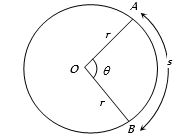
(D) Let $r$ be the radius and $s$ be the arc length of the sector. The perimeter $p$ is given by $p = 2r + s$,so $s = p - 2r$.
The area $A$ of the sector is given by $A = \frac{1}{2}rs$.
Substituting $s = p - 2r$ into the area formula,we get $A = \frac{1}{2}r(p - 2r) = \frac{1}{2}pr - r^2$.
To find the maximum area,we differentiate $A$ with respect to $r$ and set the derivative to zero:
$\frac{dA}{dr} = \frac{1}{2}p - 2r = 0$.
Solving for $r$,we get $2r = \frac{p}{2}$,which implies $r = \frac{p}{4}$.
Since $\frac{d^2A}{dr^2} = -2 < 0$,the area is maximum at $r = \frac{p}{4}$.
The area $A$ of the sector is given by $A = \frac{1}{2}rs$.
Substituting $s = p - 2r$ into the area formula,we get $A = \frac{1}{2}r(p - 2r) = \frac{1}{2}pr - r^2$.
To find the maximum area,we differentiate $A$ with respect to $r$ and set the derivative to zero:
$\frac{dA}{dr} = \frac{1}{2}p - 2r = 0$.
Solving for $r$,we get $2r = \frac{p}{2}$,which implies $r = \frac{p}{4}$.
Since $\frac{d^2A}{dr^2} = -2 < 0$,the area is maximum at $r = \frac{p}{4}$.
0 likes
View Solution74
MediumMCQ
If $y = a \ln x + bx^2 + x$ has its extremum value at $x = 1$ and $x = 2,$ then $(a, b) =$
A
$ (1, 1/2) $
B
$ (1/2, 2) $
C
$ (2, -1/2) $
D
$ (-2/3, -1/6) $
Solution
(D) Given the function $y = a \ln x + bx^2 + x$.
Find the derivative: $\frac{dy}{dx} = \frac{a}{x} + 2bx + 1$.
Since the function has extremum values at $x = 1$ and $x = 2$,the derivative must be zero at these points.
At $x = 1$: $\frac{a}{1} + 2b(1) + 1 = 0 \implies a + 2b = -1$ (Equation $1$).
At $x = 2$: $\frac{a}{2} + 2b(2) + 1 = 0 \implies \frac{a}{2} + 4b = -1 \implies a + 8b = -2$ (Equation $2$).
Subtract Equation $1$ from Equation $2$: $(a + 8b) - (a + 2b) = -2 - (-1) \implies 6b = -1 \implies b = -1/6$.
Substitute $b = -1/6$ into Equation $1$: $a + 2(-1/6) = -1 \implies a - 1/3 = -1 \implies a = -1 + 1/3 = -2/3$.
Thus,$(a, b) = (-2/3, -1/6)$.
Find the derivative: $\frac{dy}{dx} = \frac{a}{x} + 2bx + 1$.
Since the function has extremum values at $x = 1$ and $x = 2$,the derivative must be zero at these points.
At $x = 1$: $\frac{a}{1} + 2b(1) + 1 = 0 \implies a + 2b = -1$ (Equation $1$).
At $x = 2$: $\frac{a}{2} + 2b(2) + 1 = 0 \implies \frac{a}{2} + 4b = -1 \implies a + 8b = -2$ (Equation $2$).
Subtract Equation $1$ from Equation $2$: $(a + 8b) - (a + 2b) = -2 - (-1) \implies 6b = -1 \implies b = -1/6$.
Substitute $b = -1/6$ into Equation $1$: $a + 2(-1/6) = -1 \implies a - 1/3 = -1 \implies a = -1 + 1/3 = -2/3$.
Thus,$(a, b) = (-2/3, -1/6)$.
0 likes
View Solution75
DifficultMCQ
In the interval $(-4, 4)$,the function $f(x) = \int_{-10}^x (t^4 - 4)e^{-4t} dt$ has:
A
No extrema
B
One extremum
C
Two extrema
D
Four extrema
Solution
(C) Given $f(x) = \int_{-10}^x (t^4 - 4)e^{-4t} dt$.
By the Fundamental Theorem of Calculus,$f'(x) = (x^4 - 4)e^{-4x}$.
To find the critical points,set $f'(x) = 0$:
$(x^4 - 4)e^{-4x} = 0$.
Since $e^{-4x} \neq 0$ for all $x$,we have $x^4 - 4 = 0$,which implies $x^2 = 2$ or $x^2 = -2$.
In the real domain,$x = \sqrt{2}$ and $x = -\sqrt{2}$.
Both values $\sqrt{2} \approx 1.414$ and $-\sqrt{2} \approx -1.414$ lie within the interval $(-4, 4)$.
Since $f'(x)$ changes sign at $x = \sqrt{2}$ and $x = -\sqrt{2}$,the function has two extrema in the given interval.
By the Fundamental Theorem of Calculus,$f'(x) = (x^4 - 4)e^{-4x}$.
To find the critical points,set $f'(x) = 0$:
$(x^4 - 4)e^{-4x} = 0$.
Since $e^{-4x} \neq 0$ for all $x$,we have $x^4 - 4 = 0$,which implies $x^2 = 2$ or $x^2 = -2$.
In the real domain,$x = \sqrt{2}$ and $x = -\sqrt{2}$.
Both values $\sqrt{2} \approx 1.414$ and $-\sqrt{2} \approx -1.414$ lie within the interval $(-4, 4)$.
Since $f'(x)$ changes sign at $x = \sqrt{2}$ and $x = -\sqrt{2}$,the function has two extrema in the given interval.
0 likes
View Solution76
MediumMCQ
On the interval $[1, e]$,the greatest value of $f(x) = x^2 \log x$ is:
A
$e^2$
B
$\frac{1}{e} \log \frac{1}{\sqrt{e}}$
C
$e^2 \log \sqrt{e}$
D
None of these
Solution
(A) Let $f(x) = x^2 \log x$.
To find the critical points,we find the derivative $f'(x)$:
$f'(x) = \frac{d}{dx}(x^2) \cdot \log x + x^2 \cdot \frac{d}{dx}(\log x) = 2x \log x + x^2 \cdot \frac{1}{x} = 2x \log x + x = x(2 \log x + 1)$.
Setting $f'(x) = 0$,we get $x(2 \log x + 1) = 0$.
Since $x \in [1, e]$,$x \neq 0$. Thus,$2 \log x + 1 = 0 \implies \log x = -\frac{1}{2} \implies x = e^{-1/2} = \frac{1}{\sqrt{e}}$.
Since $\frac{1}{\sqrt{e}} \approx 0.606$,which is not in the interval $[1, e]$,there are no critical points in the given interval.
Therefore,the maximum value must occur at the endpoints $x = 1$ or $x = e$.
$f(1) = 1^2 \cdot \log(1) = 1 \cdot 0 = 0$.
$f(e) = e^2 \cdot \log(e) = e^2 \cdot 1 = e^2$.
Comparing the values $0$ and $e^2$,the greatest value is $e^2$.
To find the critical points,we find the derivative $f'(x)$:
$f'(x) = \frac{d}{dx}(x^2) \cdot \log x + x^2 \cdot \frac{d}{dx}(\log x) = 2x \log x + x^2 \cdot \frac{1}{x} = 2x \log x + x = x(2 \log x + 1)$.
Setting $f'(x) = 0$,we get $x(2 \log x + 1) = 0$.
Since $x \in [1, e]$,$x \neq 0$. Thus,$2 \log x + 1 = 0 \implies \log x = -\frac{1}{2} \implies x = e^{-1/2} = \frac{1}{\sqrt{e}}$.
Since $\frac{1}{\sqrt{e}} \approx 0.606$,which is not in the interval $[1, e]$,there are no critical points in the given interval.
Therefore,the maximum value must occur at the endpoints $x = 1$ or $x = e$.
$f(1) = 1^2 \cdot \log(1) = 1 \cdot 0 = 0$.
$f(e) = e^2 \cdot \log(e) = e^2 \cdot 1 = e^2$.
Comparing the values $0$ and $e^2$,the greatest value is $e^2$.
0 likes
View Solution77
MediumMCQ
The function $f(x) = x^{-x}, (x \in R)$ attains a maximum value at $x =$
A
$x = 2$
B
$x = 3$
C
$x = 1/e$
D
$x = 1$
Solution
(C) Let $f(x) = y = x^{-x}$.
Taking the natural logarithm on both sides,we get $\ln y = -x \ln x$.
Differentiating both sides with respect to $x$,we have $\frac{1}{y} \frac{dy}{dx} = -[x \cdot \frac{1}{x} + \ln x \cdot 1] = -(1 + \ln x)$.
Thus,$\frac{dy}{dx} = -x^{-x}(1 + \ln x)$.
For critical points,set $\frac{dy}{dx} = 0$,which implies $1 + \ln x = 0$.
$\ln x = -1$,so $x = e^{-1} = \frac{1}{e}$.
To verify the maximum,we check the second derivative or the sign change of the first derivative. Since $f'(x) > 0$ for $x < 1/e$ and $f'(x) < 0$ for $x > 1/e$,the function attains a maximum at $x = 1/e$.
Taking the natural logarithm on both sides,we get $\ln y = -x \ln x$.
Differentiating both sides with respect to $x$,we have $\frac{1}{y} \frac{dy}{dx} = -[x \cdot \frac{1}{x} + \ln x \cdot 1] = -(1 + \ln x)$.
Thus,$\frac{dy}{dx} = -x^{-x}(1 + \ln x)$.
For critical points,set $\frac{dy}{dx} = 0$,which implies $1 + \ln x = 0$.
$\ln x = -1$,so $x = e^{-1} = \frac{1}{e}$.
To verify the maximum,we check the second derivative or the sign change of the first derivative. Since $f'(x) > 0$ for $x < 1/e$ and $f'(x) < 0$ for $x > 1/e$,the function attains a maximum at $x = 1/e$.
0 likes
View Solution78
MediumMCQ
If $ab = 2a + 3b$ where $a > 0$ and $b > 0$,then the minimum value of $ab$ is:
A
$12$
B
$24$
C
$1/4$
D
None of these
Solution
(B) Given $ab = 2a + 3b$. Since $a > 0$ and $b > 0$,we can express $b$ in terms of $a$:
$b(a - 3) = 2a \implies b = \frac{2a}{a - 3}$.
Since $b > 0$ and $a > 0$,we must have $a - 3 > 0$,so $a > 3$.
Let $z = ab = a \left( \frac{2a}{a - 3} \right) = \frac{2a^2}{a - 3}$.
To find the minimum,we differentiate $z$ with respect to $a$:
$\frac{dz}{da} = \frac{(a - 3)(4a) - 2a^2(1)}{(a - 3)^2} = \frac{4a^2 - 12a - 2a^2}{(a - 3)^2} = \frac{2a^2 - 12a}{(a - 3)^2}$.
Setting $\frac{dz}{da} = 0$ gives $2a(a - 6) = 0$. Since $a > 3$,we have $a = 6$.
At $a = 6$,$b = \frac{2(6)}{6 - 3} = \frac{12}{3} = 4$.
The value of $ab = 6 \times 4 = 24$.
Using the second derivative test or checking values around $a=6$,we confirm this is the minimum value.
Thus,the minimum value of $ab$ is $24$.
$b(a - 3) = 2a \implies b = \frac{2a}{a - 3}$.
Since $b > 0$ and $a > 0$,we must have $a - 3 > 0$,so $a > 3$.
Let $z = ab = a \left( \frac{2a}{a - 3} \right) = \frac{2a^2}{a - 3}$.
To find the minimum,we differentiate $z$ with respect to $a$:
$\frac{dz}{da} = \frac{(a - 3)(4a) - 2a^2(1)}{(a - 3)^2} = \frac{4a^2 - 12a - 2a^2}{(a - 3)^2} = \frac{2a^2 - 12a}{(a - 3)^2}$.
Setting $\frac{dz}{da} = 0$ gives $2a(a - 6) = 0$. Since $a > 3$,we have $a = 6$.
At $a = 6$,$b = \frac{2(6)}{6 - 3} = \frac{12}{3} = 4$.
The value of $ab = 6 \times 4 = 24$.
Using the second derivative test or checking values around $a=6$,we confirm this is the minimum value.
Thus,the minimum value of $ab$ is $24$.
0 likes
View Solution79
MediumMCQ
If $PQ$ and $PR$ are the two sides of a triangle,then the angle between them which gives the maximum area of the triangle is
A
$\pi$
B
$\pi/3$
C
$\pi/4$
D
$\pi/2$
Solution
(D) Let the lengths of the sides $PQ$ and $PR$ be $a$ and $b$ respectively.
The area $\Delta$ of the triangle is given by the formula:
$\Delta = \frac{1}{2} ab \sin \theta$,where $\theta$ is the angle between the sides $PQ$ and $PR$.
Since $a$ and $b$ are constant lengths,the area $\Delta$ is directly proportional to $\sin \theta$.
The area is maximized when $\sin \theta$ attains its maximum value.
We know that the maximum value of $\sin \theta$ is $1$,which occurs when $\theta = \frac{\pi}{2}$.
Therefore,the angle between the sides that gives the maximum area is $\frac{\pi}{2}$.
The area $\Delta$ of the triangle is given by the formula:
$\Delta = \frac{1}{2} ab \sin \theta$,where $\theta$ is the angle between the sides $PQ$ and $PR$.
Since $a$ and $b$ are constant lengths,the area $\Delta$ is directly proportional to $\sin \theta$.
The area is maximized when $\sin \theta$ attains its maximum value.
We know that the maximum value of $\sin \theta$ is $1$,which occurs when $\theta = \frac{\pi}{2}$.
Therefore,the angle between the sides that gives the maximum area is $\frac{\pi}{2}$.
0 likes
View Solution80
MediumMCQ
The function $y = a(1 - \cos x)$ is maximum when $x = $
A
$\pi $
B
$\pi /2$
C
$-\pi /2$
D
$-\pi /6$
Solution
(A) Given the function $y = a(1 - \cos x)$.
First,find the derivative $y'$ with respect to $x$:
$y' = \frac{d}{dx}[a(1 - \cos x)] = a(0 - (-\sin x)) = a \sin x$.
To find the critical points,set $y' = 0$:
$a \sin x = 0 \Rightarrow \sin x = 0 \Rightarrow x = n\pi$ for any integer $n$.
Within the standard interval $[0, 2\pi]$,the critical points are $x = 0$ and $x = \pi$.
Now,find the second derivative $y''$:
$y'' = \frac{d}{dx}(a \sin x) = a \cos x$.
Evaluate $y''$ at the critical points:
For $x = 0$,$y''(0) = a \cos(0) = a$.
For $x = \pi$,$y''(\pi) = a \cos(\pi) = -a$.
Assuming $a > 0$,the function has a local maximum when $y'' < 0$,which occurs at $x = \pi$.
First,find the derivative $y'$ with respect to $x$:
$y' = \frac{d}{dx}[a(1 - \cos x)] = a(0 - (-\sin x)) = a \sin x$.
To find the critical points,set $y' = 0$:
$a \sin x = 0 \Rightarrow \sin x = 0 \Rightarrow x = n\pi$ for any integer $n$.
Within the standard interval $[0, 2\pi]$,the critical points are $x = 0$ and $x = \pi$.
Now,find the second derivative $y''$:
$y'' = \frac{d}{dx}(a \sin x) = a \cos x$.
Evaluate $y''$ at the critical points:
For $x = 0$,$y''(0) = a \cos(0) = a$.
For $x = \pi$,$y''(\pi) = a \cos(\pi) = -a$.
Assuming $a > 0$,the function has a local maximum when $y'' < 0$,which occurs at $x = \pi$.
0 likes
View Solution81
MediumMCQ
The minimum value of $\left( x^2 + \frac{250}{x} \right)$ is
A
$75$
B
$50$
C
$25$
D
$55$
Solution
(A) Let $f(x) = x^2 + \frac{250}{x}$.
To find the minimum value,we first find the derivative $f'(x)$:
$f'(x) = 2x - \frac{250}{x^2}$.
Set $f'(x) = 0$ to find the critical points:
$2x - \frac{250}{x^2} = 0 \implies 2x^3 = 250 \implies x^3 = 125 \implies x = 5$.
Now,we check the second derivative $f''(x)$ to confirm the nature of the extremum:
$f''(x) = 2 + \frac{500}{x^3}$.
At $x = 5$,$f''(5) = 2 + \frac{500}{125} = 2 + 4 = 6$.
Since $f''(5) > 0$,the function has a local minimum at $x = 5$.
The minimum value is $f(5) = 5^2 + \frac{250}{5} = 25 + 50 = 75$.
To find the minimum value,we first find the derivative $f'(x)$:
$f'(x) = 2x - \frac{250}{x^2}$.
Set $f'(x) = 0$ to find the critical points:
$2x - \frac{250}{x^2} = 0 \implies 2x^3 = 250 \implies x^3 = 125 \implies x = 5$.
Now,we check the second derivative $f''(x)$ to confirm the nature of the extremum:
$f''(x) = 2 + \frac{500}{x^3}$.
At $x = 5$,$f''(5) = 2 + \frac{500}{125} = 2 + 4 = 6$.
Since $f''(5) > 0$,the function has a local minimum at $x = 5$.
The minimum value is $f(5) = 5^2 + \frac{250}{5} = 25 + 50 = 75$.
0 likes
View Solution82
MediumMCQ
The minimum value of ${x^2} + \frac{1}{1 + {x^2}}$ is at $x=$ ..........
A
$0$
B
$1$
C
$4$
D
$3$
Solution
(A) Let $f(x) = x^2 + \frac{1}{1 + x^2}$.
To find the critical points,we differentiate $f(x)$ with respect to $x$:
$f'(x) = 2x - \frac{1}{(1 + x^2)^2} \cdot (2x) = 2x \left( 1 - \frac{1}{(1 + x^2)^2} \right)$.
Setting $f'(x) = 0$,we get $2x = 0$ or $1 - \frac{1}{(1 + x^2)^2} = 0$.
From $2x = 0$,we find $x = 0$.
From $1 - \frac{1}{(1 + x^2)^2} = 0$,we get $(1 + x^2)^2 = 1$,which implies $1 + x^2 = 1$ (since $1 + x^2 > 0$),so $x^2 = 0$,which again gives $x = 0$.
Evaluating the function at $x = 0$,$f(0) = 0^2 + \frac{1}{1 + 0^2} = 1$.
Since $x^2 \ge 0$,let $u = x^2$ where $u \ge 0$. Then $g(u) = u + \frac{1}{1+u} = \frac{u^2 + u + 1}{1+u} = \frac{u^2 - 1 + u + 2}{1+u} = u - 1 + \frac{2}{1+u}$.
At $x=0$,$u=0$,$f(0)=1$. For $x \neq 0$,$x^2 > 0$,the function value increases. Thus,the minimum value is at $x = 0$.
To find the critical points,we differentiate $f(x)$ with respect to $x$:
$f'(x) = 2x - \frac{1}{(1 + x^2)^2} \cdot (2x) = 2x \left( 1 - \frac{1}{(1 + x^2)^2} \right)$.
Setting $f'(x) = 0$,we get $2x = 0$ or $1 - \frac{1}{(1 + x^2)^2} = 0$.
From $2x = 0$,we find $x = 0$.
From $1 - \frac{1}{(1 + x^2)^2} = 0$,we get $(1 + x^2)^2 = 1$,which implies $1 + x^2 = 1$ (since $1 + x^2 > 0$),so $x^2 = 0$,which again gives $x = 0$.
Evaluating the function at $x = 0$,$f(0) = 0^2 + \frac{1}{1 + 0^2} = 1$.
Since $x^2 \ge 0$,let $u = x^2$ where $u \ge 0$. Then $g(u) = u + \frac{1}{1+u} = \frac{u^2 + u + 1}{1+u} = \frac{u^2 - 1 + u + 2}{1+u} = u - 1 + \frac{2}{1+u}$.
At $x=0$,$u=0$,$f(0)=1$. For $x \neq 0$,$x^2 > 0$,the function value increases. Thus,the minimum value is at $x = 0$.
0 likes
View Solution83
MediumMCQ
If $x - 2y = 4,$ the minimum value of $xy$ is
A
$-2$
B
$2$
C
$0$
D
$-3$
Solution
(A) Given the equation $x - 2y = 4,$ we can express $x$ in terms of $y$ as $x = 2y + 4$ $(i).$
Let the product be $P = xy.$
Substituting $(i)$ into the expression for $P,$ we get $P = y(2y + 4) = 2y^2 + 4y.$
To find the minimum value,we differentiate $P$ with respect to $y$ and set it to zero:
$\frac{dP}{dy} = 4y + 4 = 0 \Rightarrow y = -1.$
Now,we find the second derivative to check for a minimum:
$\frac{d^2P}{dy^2} = 4,$ which is greater than $0,$ confirming that $y = -1$ gives a minimum value.
Substituting $y = -1$ into $(i),$ we get $x = 2(-1) + 4 = 2.$
Therefore,the minimum value of $xy$ is $P = (2)(-1) = -2.$
Let the product be $P = xy.$
Substituting $(i)$ into the expression for $P,$ we get $P = y(2y + 4) = 2y^2 + 4y.$
To find the minimum value,we differentiate $P$ with respect to $y$ and set it to zero:
$\frac{dP}{dy} = 4y + 4 = 0 \Rightarrow y = -1.$
Now,we find the second derivative to check for a minimum:
$\frac{d^2P}{dy^2} = 4,$ which is greater than $0,$ confirming that $y = -1$ gives a minimum value.
Substituting $y = -1$ into $(i),$ we get $x = 2(-1) + 4 = 2.$
Therefore,the minimum value of $xy$ is $P = (2)(-1) = -2.$
0 likes
View Solution84
EasyMCQ
The minimum value of $2x + 3y,$ when $xy = 6,$ is
A
$12$
B
$9$
C
$8$
D
$6$
Solution
(A) Let $f(x, y) = 2x + 3y$ subject to the constraint $xy = 6.$
Since $xy = 6,$ we have $y = \frac{6}{x}.$
Substituting this into the function,we get $f(x) = 2x + 3\left(\frac{6}{x}\right) = 2x + \frac{18}{x}.$
To find the minimum,we find the derivative $f'(x) = 2 - \frac{18}{x^2}.$
Setting $f'(x) = 0,$ we get $2 = \frac{18}{x^2},$ which implies $x^2 = 9,$ so $x = \pm 3.$
Since $x$ and $y$ must be positive for a minimum value in this context (as $xy=6$),we take $x = 3.$
Then $y = \frac{6}{3} = 2.$
The minimum value is $f(3) = 2(3) + 3(2) = 6 + 6 = 12.$
Since $xy = 6,$ we have $y = \frac{6}{x}.$
Substituting this into the function,we get $f(x) = 2x + 3\left(\frac{6}{x}\right) = 2x + \frac{18}{x}.$
To find the minimum,we find the derivative $f'(x) = 2 - \frac{18}{x^2}.$
Setting $f'(x) = 0,$ we get $2 = \frac{18}{x^2},$ which implies $x^2 = 9,$ so $x = \pm 3.$
Since $x$ and $y$ must be positive for a minimum value in this context (as $xy=6$),we take $x = 3.$
Then $y = \frac{6}{3} = 2.$
The minimum value is $f(3) = 2(3) + 3(2) = 6 + 6 = 12.$
0 likes
View Solution85
DifficultMCQ
The minimum value of the function $f(x) = 3x^4 - 8x^3 + 12x^2 - 48x + 25$ on the interval $[0, 3]$ is equal to:
A
$25$
B
$-39$
C
$-25$
D
$39$
Solution
(B) Given the function $f(x) = 3x^4 - 8x^3 + 12x^2 - 48x + 25$.
First,find the derivative $f'(x)$:
$f'(x) = 12x^3 - 24x^2 + 24x - 48$
$f'(x) = 12(x^3 - 2x^2 + 2x - 4)$
$f'(x) = 12[x^2(x - 2) + 2(x - 2)] = 12(x - 2)(x^2 + 2)$.
To find critical points,set $f'(x) = 0$:
Since $x^2 + 2 = 0$ has no real roots,the only critical point is $x = 2$.
Now,evaluate $f(x)$ at the critical point $x = 2$ and the endpoints of the interval $[0, 3]$:
$f(0) = 3(0)^4 - 8(0)^3 + 12(0)^2 - 48(0) + 25 = 25$
$f(2) = 3(2)^4 - 8(2)^3 + 12(2)^2 - 48(2) + 25 = 3(16) - 8(8) + 12(4) - 96 + 25 = 48 - 64 + 48 - 96 + 25 = -39$
$f(3) = 3(3)^4 - 8(3)^3 + 12(3)^2 - 48(3) + 25 = 3(81) - 8(27) + 12(9) - 144 + 25 = 243 - 216 + 108 - 144 + 25 = 16$.
The minimum value is $\min\{25, -39, 16\} = -39$.
First,find the derivative $f'(x)$:
$f'(x) = 12x^3 - 24x^2 + 24x - 48$
$f'(x) = 12(x^3 - 2x^2 + 2x - 4)$
$f'(x) = 12[x^2(x - 2) + 2(x - 2)] = 12(x - 2)(x^2 + 2)$.
To find critical points,set $f'(x) = 0$:
Since $x^2 + 2 = 0$ has no real roots,the only critical point is $x = 2$.
Now,evaluate $f(x)$ at the critical point $x = 2$ and the endpoints of the interval $[0, 3]$:
$f(0) = 3(0)^4 - 8(0)^3 + 12(0)^2 - 48(0) + 25 = 25$
$f(2) = 3(2)^4 - 8(2)^3 + 12(2)^2 - 48(2) + 25 = 3(16) - 8(8) + 12(4) - 96 + 25 = 48 - 64 + 48 - 96 + 25 = -39$
$f(3) = 3(3)^4 - 8(3)^3 + 12(3)^2 - 48(3) + 25 = 3(81) - 8(27) + 12(9) - 144 + 25 = 243 - 216 + 108 - 144 + 25 = 16$.
The minimum value is $\min\{25, -39, 16\} = -39$.
0 likes
View Solution86
MediumMCQ
The maximum value of ${x^{1/x}}$ is
A
${1/e}$
B
${e^{1/e}}$
C
$e$
D
${1/e^e}$
Solution
(B) Let $y = x^{1/x}$.
Taking the natural logarithm on both sides,we get $\ln y = \frac{1}{x} \ln x$.
Differentiating both sides with respect to $x$ using the product rule:
$\frac{1}{y} \frac{dy}{dx} = \left(-\frac{1}{x^2}\right) \ln x + \left(\frac{1}{x}\right) \left(\frac{1}{x}\right) = \frac{1 - \ln x}{x^2}$.
Thus,$\frac{dy}{dx} = x^{1/x} \left(\frac{1 - \ln x}{x^2}\right)$.
For critical points,set $\frac{dy}{dx} = 0$,which implies $1 - \ln x = 0$,so $\ln x = 1$,which gives $x = e$.
Since the derivative changes from positive to negative at $x = e$,the function attains a maximum at $x = e$.
The maximum value is $y(e) = e^{1/e}$.
Taking the natural logarithm on both sides,we get $\ln y = \frac{1}{x} \ln x$.
Differentiating both sides with respect to $x$ using the product rule:
$\frac{1}{y} \frac{dy}{dx} = \left(-\frac{1}{x^2}\right) \ln x + \left(\frac{1}{x}\right) \left(\frac{1}{x}\right) = \frac{1 - \ln x}{x^2}$.
Thus,$\frac{dy}{dx} = x^{1/x} \left(\frac{1 - \ln x}{x^2}\right)$.
For critical points,set $\frac{dy}{dx} = 0$,which implies $1 - \ln x = 0$,so $\ln x = 1$,which gives $x = e$.
Since the derivative changes from positive to negative at $x = e$,the function attains a maximum at $x = e$.
The maximum value is $y(e) = e^{1/e}$.
0 likes
View Solution87
DifficultMCQ
The point $(0, 5)$ is closest to the curve ${x^2} = 2y$ at
A
$(2\sqrt{2}, 4)$
B
$(0, 0)$
C
$(2, 2)$
D
None of these
Solution
(D) Let a point on the curve be $P(h, k)$.
Since the point lies on the curve ${x^2} = 2y$,we have ${h^2} = 2k$ ... $(i)$.
The distance $D$ between the point $(0, 5)$ and $P(h, k)$ is given by $D = \sqrt{(h - 0)^2 + (k - 5)^2} = \sqrt{h^2 + (k - 5)^2}$.
Substituting ${h^2} = 2k$ from $(i)$,we get $D = \sqrt{2k + (k - 5)^2} = \sqrt{2k + k^2 - 10k + 25} = \sqrt{k^2 - 8k + 25}$.
To minimize $D$,we minimize $f(k) = k^2 - 8k + 25$.
Taking the derivative,$f'(k) = 2k - 8$.
Setting $f'(k) = 0$,we get $2k = 8$,which implies $k = 4$.
For $k = 4$,${h^2} = 2(4) = 8$,so $h = \pm 2\sqrt{2}$.
The points on the curve closest to $(0, 5)$ are $(2\sqrt{2}, 4)$ and $(-2\sqrt{2}, 4)$.
Since these points are not listed in options $A$,$B$,or $C$,the correct option is $D$.
Since the point lies on the curve ${x^2} = 2y$,we have ${h^2} = 2k$ ... $(i)$.
The distance $D$ between the point $(0, 5)$ and $P(h, k)$ is given by $D = \sqrt{(h - 0)^2 + (k - 5)^2} = \sqrt{h^2 + (k - 5)^2}$.
Substituting ${h^2} = 2k$ from $(i)$,we get $D = \sqrt{2k + (k - 5)^2} = \sqrt{2k + k^2 - 10k + 25} = \sqrt{k^2 - 8k + 25}$.
To minimize $D$,we minimize $f(k) = k^2 - 8k + 25$.
Taking the derivative,$f'(k) = 2k - 8$.
Setting $f'(k) = 0$,we get $2k = 8$,which implies $k = 4$.
For $k = 4$,${h^2} = 2(4) = 8$,so $h = \pm 2\sqrt{2}$.
The points on the curve closest to $(0, 5)$ are $(2\sqrt{2}, 4)$ and $(-2\sqrt{2}, 4)$.
Since these points are not listed in options $A$,$B$,or $C$,the correct option is $D$.
0 likes
View Solution88
MediumMCQ
The minimum value of $f(a) = (2a^2 - 3) + 3(3 - a) + 4$ is
A
$\frac{15}{2}$
B
$\frac{11}{2}$
C
$-\frac{13}{2}$
D
$\frac{71}{8}$
Solution
(D) Given function is $f(a) = (2a^2 - 3) + 3(3 - a) + 4$.
Simplifying the expression:
$f(a) = 2a^2 - 3 + 9 - 3a + 4$
$f(a) = 2a^2 - 3a + 10$.
To find the minimum value,we find the derivative $f'(a)$:
$f'(a) = \frac{d}{da}(2a^2 - 3a + 10) = 4a - 3$.
Setting $f'(a) = 0$ for critical points:
$4a - 3 = 0 \Rightarrow a = \frac{3}{4}$.
Since the second derivative $f''(a) = 4 > 0$,the function has a local minimum at $a = \frac{3}{4}$.
The minimum value is:
$f\left(\frac{3}{4}\right) = 2\left(\frac{3}{4}\right)^2 - 3\left(\frac{3}{4}\right) + 10$
$f\left(\frac{3}{4}\right) = 2\left(\frac{9}{16}\right) - \frac{9}{4} + 10$
$f\left(\frac{3}{4}\right) = \frac{9}{8} - \frac{18}{8} + \frac{80}{8} = \frac{71}{8}$.
Simplifying the expression:
$f(a) = 2a^2 - 3 + 9 - 3a + 4$
$f(a) = 2a^2 - 3a + 10$.
To find the minimum value,we find the derivative $f'(a)$:
$f'(a) = \frac{d}{da}(2a^2 - 3a + 10) = 4a - 3$.
Setting $f'(a) = 0$ for critical points:
$4a - 3 = 0 \Rightarrow a = \frac{3}{4}$.
Since the second derivative $f''(a) = 4 > 0$,the function has a local minimum at $a = \frac{3}{4}$.
The minimum value is:
$f\left(\frac{3}{4}\right) = 2\left(\frac{3}{4}\right)^2 - 3\left(\frac{3}{4}\right) + 10$
$f\left(\frac{3}{4}\right) = 2\left(\frac{9}{16}\right) - \frac{9}{4} + 10$
$f\left(\frac{3}{4}\right) = \frac{9}{8} - \frac{18}{8} + \frac{80}{8} = \frac{71}{8}$.
0 likes
View Solution89
DifficultMCQ
Let $f(x) = 1 + 2x^2 + 2^2x^4 + \dots + 2^{10}x^{20}$. Then $f(x)$ has:
A
More than one minimum
B
Exactly one minimum
C
At least one maximum
D
None of these
Solution
(B) The given function is a geometric series with first term $a = 1$,common ratio $r = 2x^2$,and $n = 11$ terms.
$f(x) = \sum_{k=0}^{10} (2x^2)^k = \frac{(2x^2)^{11} - 1}{2x^2 - 1}$.
Alternatively,we can differentiate the polynomial directly:
$f(x) = 1 + 2x^2 + 4x^4 + 8x^6 + \dots + 1024x^{20}$.
$f'(x) = 4x + 16x^3 + 48x^5 + \dots + 20480x^{19}$.
$f'(x) = 4x(1 + 4x^2 + 12x^4 + \dots + 5120x^{18})$.
Setting $f'(x) = 0$,we see that $x = 0$ is the only real critical point because the term in the bracket is always positive for all real $x$.
Calculating the second derivative at $x = 0$:
$f''(x) = 4 + 48x^2 + 240x^4 + \dots$
$f''(0) = 4 > 0$.
Since $f'(0) = 0$ and $f''(0) > 0$,the function has a local minimum at $x = 0$. Since it is a polynomial of even degree with a positive leading coefficient,this is the global minimum. Thus,$f(x)$ has exactly one minimum.
$f(x) = \sum_{k=0}^{10} (2x^2)^k = \frac{(2x^2)^{11} - 1}{2x^2 - 1}$.
Alternatively,we can differentiate the polynomial directly:
$f(x) = 1 + 2x^2 + 4x^4 + 8x^6 + \dots + 1024x^{20}$.
$f'(x) = 4x + 16x^3 + 48x^5 + \dots + 20480x^{19}$.
$f'(x) = 4x(1 + 4x^2 + 12x^4 + \dots + 5120x^{18})$.
Setting $f'(x) = 0$,we see that $x = 0$ is the only real critical point because the term in the bracket is always positive for all real $x$.
Calculating the second derivative at $x = 0$:
$f''(x) = 4 + 48x^2 + 240x^4 + \dots$
$f''(0) = 4 > 0$.
Since $f'(0) = 0$ and $f''(0) > 0$,the function has a local minimum at $x = 0$. Since it is a polynomial of even degree with a positive leading coefficient,this is the global minimum. Thus,$f(x)$ has exactly one minimum.
0 likes
View Solution90
MediumMCQ
For all $x \in (0, 1)$,which of the following inequalities is true?
A
$e^x < 1 + x$
B
$\log_e(1 + x) < x$
C
$\sin x > x$
D
$\log_e x > x$
Solution
(B) Consider the function $f(x) = x - \log_e(1 + x)$ for $x \in (0, 1)$.
Taking the derivative,we get $f'(x) = 1 - \frac{1}{1 + x} = \frac{1 + x - 1}{1 + x} = \frac{x}{1 + x}$.
Since $x > 0$,$f'(x) > 0$ for all $x \in (0, 1)$.
This implies that $f(x)$ is a strictly increasing function on $(0, 1)$.
Since $f(0) = 0 - \log_e(1) = 0$,and $f(x)$ is strictly increasing,$f(x) > f(0)$ for all $x > 0$.
Therefore,$x - \log_e(1 + x) > 0$,which means $\log_e(1 + x) < x$ for all $x \in (0, 1)$.
Thus,option $(b)$ is correct.
Taking the derivative,we get $f'(x) = 1 - \frac{1}{1 + x} = \frac{1 + x - 1}{1 + x} = \frac{x}{1 + x}$.
Since $x > 0$,$f'(x) > 0$ for all $x \in (0, 1)$.
This implies that $f(x)$ is a strictly increasing function on $(0, 1)$.
Since $f(0) = 0 - \log_e(1) = 0$,and $f(x)$ is strictly increasing,$f(x) > f(0)$ for all $x > 0$.
Therefore,$x - \log_e(1 + x) > 0$,which means $\log_e(1 + x) < x$ for all $x \in (0, 1)$.
Thus,option $(b)$ is correct.
0 likes
View Solution91
DifficultMCQ
The radius of the cylinder of maximum volume,which can be inscribed in a sphere of radius $R$ is
A
${2 \over 3}R$
B
$\sqrt {{2 \over 3}} R$
C
${3 \over 4}R$
D
$\sqrt {{3 \over 4}} R$
Solution
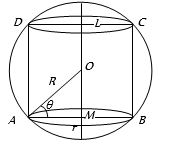
(B) Let $r$ be the radius and $h$ be the height of the cylinder inscribed in a sphere of radius $R$. From the geometry of the figure,we have the relation:
${r^2} + {\left( {\frac{h}{2}} \right)^2} = {R^2}$
${h^2} = 4({R^2} - {r^2}) \implies h = 2\sqrt {{R^2} - {r^2}}$
The volume $V$ of the cylinder is given by:
$V = \pi {r^2}h = 2\pi {r^2}\sqrt {{R^2} - {r^2}}$
To find the maximum volume,we differentiate $V$ with respect to $r$:
$\frac{{dV}}{{dr}} = 2\pi \left[ {2r\sqrt {{R^2} - {r^2}} + {r^2} \cdot \frac{1}{{2\sqrt {{R^2} - {r^2}} }} \cdot ( - 2r)} \right]$
$\frac{{dV}}{{dr}} = 2\pi \left[ {2r\sqrt {{R^2} - {r^2}} - \frac{{{r^3}}}{{\sqrt {{R^2} - {r^2}} }}} \right]$
Setting $\frac{{dV}}{{dr}} = 0$ for critical points:
$2r\sqrt {{R^2} - {r^2}} = \frac{{{r^3}}}{{\sqrt {{R^2} - {r^2}} }}$
$2({R^2} - {r^2}) = {r^2}$
$2{R^2} - 2{r^2} = {r^2}$
$3{r^2} = 2{R^2}$
${r^2} = \frac{2}{3}{R^2}$
$r = \sqrt {\frac{2}{3}} R$
Thus,the radius of the cylinder of maximum volume is $\sqrt {\frac{2}{3}} R$.
${r^2} + {\left( {\frac{h}{2}} \right)^2} = {R^2}$
${h^2} = 4({R^2} - {r^2}) \implies h = 2\sqrt {{R^2} - {r^2}}$
The volume $V$ of the cylinder is given by:
$V = \pi {r^2}h = 2\pi {r^2}\sqrt {{R^2} - {r^2}}$
To find the maximum volume,we differentiate $V$ with respect to $r$:
$\frac{{dV}}{{dr}} = 2\pi \left[ {2r\sqrt {{R^2} - {r^2}} + {r^2} \cdot \frac{1}{{2\sqrt {{R^2} - {r^2}} }} \cdot ( - 2r)} \right]$
$\frac{{dV}}{{dr}} = 2\pi \left[ {2r\sqrt {{R^2} - {r^2}} - \frac{{{r^3}}}{{\sqrt {{R^2} - {r^2}} }}} \right]$
Setting $\frac{{dV}}{{dr}} = 0$ for critical points:
$2r\sqrt {{R^2} - {r^2}} = \frac{{{r^3}}}{{\sqrt {{R^2} - {r^2}} }}$
$2({R^2} - {r^2}) = {r^2}$
$2{R^2} - 2{r^2} = {r^2}$
$3{r^2} = 2{R^2}$
${r^2} = \frac{2}{3}{R^2}$
$r = \sqrt {\frac{2}{3}} R$
Thus,the radius of the cylinder of maximum volume is $\sqrt {\frac{2}{3}} R$.
0 likes
View Solution92
DifficultMCQ
Let $f(x) = \int\limits_0^x \frac{\cos t}{t} dt, x > 0$. Then $f(x)$ has:
A
Maxima when $n = -2, -4, -6, \dots$
B
Maxima when $n = -1, -3, -5, \dots$
C
Minima when $n = 0, 2, 4, \dots$
D
None of these
Solution
(D) Given $f(x) = \int\limits_0^x \frac{\cos t}{t} dt$ for $x > 0$.
By the Fundamental Theorem of Calculus,$f'(x) = \frac{\cos x}{x}$.
For critical points,set $f'(x) = 0$,which implies $\cos x = 0$ (since $x > 0$).
Thus,$x = (2n + 1)\frac{\pi}{2}$ for $n \in \mathbb{Z}$.
Now,$f''(x) = \frac{-x \sin x - \cos x}{x^2}$.
At critical points $x_n = (2n + 1)\frac{\pi}{2}$,we have $\cos x_n = 0$ and $\sin x_n = (-1)^n$.
So,$f''(x_n) = \frac{-x_n \sin x_n}{x_n^2} = \frac{-\sin x_n}{x_n} = \frac{-(-1)^n}{(2n + 1)\frac{\pi}{2}} = \frac{2(-1)^{n+1}}{(2n + 1)\pi}$.
For a maximum,we need $f''(x_n) < 0$. This occurs when $(-1)^{n+1} < 0$,which means $n+1$ is odd,so $n$ is even $(n = 0, 2, 4, \dots)$.
For a minimum,we need $f''(x_n) > 0$. This occurs when $(-1)^{n+1} > 0$,which means $n+1$ is even,so $n$ is odd $(n = 1, 3, 5, \dots)$.
Since none of the provided options match these conditions correctly,the answer is $(d)$.
By the Fundamental Theorem of Calculus,$f'(x) = \frac{\cos x}{x}$.
For critical points,set $f'(x) = 0$,which implies $\cos x = 0$ (since $x > 0$).
Thus,$x = (2n + 1)\frac{\pi}{2}$ for $n \in \mathbb{Z}$.
Now,$f''(x) = \frac{-x \sin x - \cos x}{x^2}$.
At critical points $x_n = (2n + 1)\frac{\pi}{2}$,we have $\cos x_n = 0$ and $\sin x_n = (-1)^n$.
So,$f''(x_n) = \frac{-x_n \sin x_n}{x_n^2} = \frac{-\sin x_n}{x_n} = \frac{-(-1)^n}{(2n + 1)\frac{\pi}{2}} = \frac{2(-1)^{n+1}}{(2n + 1)\pi}$.
For a maximum,we need $f''(x_n) < 0$. This occurs when $(-1)^{n+1} < 0$,which means $n+1$ is odd,so $n$ is even $(n = 0, 2, 4, \dots)$.
For a minimum,we need $f''(x_n) > 0$. This occurs when $(-1)^{n+1} > 0$,which means $n+1$ is even,so $n$ is odd $(n = 1, 3, 5, \dots)$.
Since none of the provided options match these conditions correctly,the answer is $(d)$.
0 likes
View Solution93
DifficultMCQ
$N$ characters of information are held on magnetic tape,in batches of $x$ characters each; the batch processing time is $\alpha + \beta x^2$ seconds; $\alpha$ and $\beta$ are constants. The optimal value of $x$ for fast processing is
A
$\frac{\alpha}{\beta}$
B
$\frac{\beta}{\alpha}$
C
$\sqrt{\frac{\alpha}{\beta}}$
D
$\sqrt{\frac{\beta}{\alpha}}$
Solution
(C) The total number of batches is $\frac{N}{x}$.
The time taken per batch is $(\alpha + \beta x^2)$ seconds.
Therefore,the total processing time $T$ is given by $T = \frac{N}{x}(\alpha + \beta x^2) = N(\frac{\alpha}{x} + \beta x)$.
For fast processing,$T$ must be minimized.
Taking the derivative with respect to $x$: $\frac{dT}{dx} = N(-\frac{\alpha}{x^2} + \beta)$.
Setting $\frac{dT}{dx} = 0$ for critical points: $-\frac{\alpha}{x^2} + \beta = 0 \implies x^2 = \frac{\alpha}{\beta} \implies x = \sqrt{\frac{\alpha}{\beta}}$.
Checking the second derivative: $\frac{d^2T}{dx^2} = N(\frac{2\alpha}{x^3})$. Since $x, \alpha, \beta > 0$,$\frac{d^2T}{dx^2} > 0$,which confirms that $T$ is minimum at $x = \sqrt{\frac{\alpha}{\beta}}$.
The time taken per batch is $(\alpha + \beta x^2)$ seconds.
Therefore,the total processing time $T$ is given by $T = \frac{N}{x}(\alpha + \beta x^2) = N(\frac{\alpha}{x} + \beta x)$.
For fast processing,$T$ must be minimized.
Taking the derivative with respect to $x$: $\frac{dT}{dx} = N(-\frac{\alpha}{x^2} + \beta)$.
Setting $\frac{dT}{dx} = 0$ for critical points: $-\frac{\alpha}{x^2} + \beta = 0 \implies x^2 = \frac{\alpha}{\beta} \implies x = \sqrt{\frac{\alpha}{\beta}}$.
Checking the second derivative: $\frac{d^2T}{dx^2} = N(\frac{2\alpha}{x^3})$. Since $x, \alpha, \beta > 0$,$\frac{d^2T}{dx^2} > 0$,which confirms that $T$ is minimum at $x = \sqrt{\frac{\alpha}{\beta}}$.
0 likes
View Solution94
DifficultMCQ
On the interval $[0, 1],$ the function $f(x) = {x^{25}}{(1 - x)^{75}}$ takes its maximum value at the point
A
$0$
B
$1/2$
C
$1/3$
D
$1/4$
Solution
(D) Let $f(x) = {x^{25}}{(1 - x)^{75}}$.
To find the maximum value,we differentiate $f(x)$ with respect to $x$:
$f'(x) = {x^{25}} \cdot 75{(1 - x)^{74}} \cdot (-1) + 25{x^{24}} \cdot {(1 - x)^{75}}$
$f'(x) = 25{x^{24}}{(1 - x)^{74}} [ -3x + (1 - x) ]$
$f'(x) = 25{x^{24}}{(1 - x)^{74}} (1 - 4x)$
For critical points,set $f'(x) = 0$:
$25{x^{24}}{(1 - x)^{74}} (1 - 4x) = 0$
This gives $x = 0, x = 1,$ or $x = 1/4$.
Since $f(0) = 0$ and $f(1) = 0$,and $f(x) > 0$ for $x \in (0, 1)$,the maximum must occur at the critical point $x = 1/4$.
Thus,the function takes its maximum value at $x = 1/4$.
To find the maximum value,we differentiate $f(x)$ with respect to $x$:
$f'(x) = {x^{25}} \cdot 75{(1 - x)^{74}} \cdot (-1) + 25{x^{24}} \cdot {(1 - x)^{75}}$
$f'(x) = 25{x^{24}}{(1 - x)^{74}} [ -3x + (1 - x) ]$
$f'(x) = 25{x^{24}}{(1 - x)^{74}} (1 - 4x)$
For critical points,set $f'(x) = 0$:
$25{x^{24}}{(1 - x)^{74}} (1 - 4x) = 0$
This gives $x = 0, x = 1,$ or $x = 1/4$.
Since $f(0) = 0$ and $f(1) = 0$,and $f(x) > 0$ for $x \in (0, 1)$,the maximum must occur at the critical point $x = 1/4$.
Thus,the function takes its maximum value at $x = 1/4$.
0 likes
View Solution95
DifficultMCQ
The function $f(x) = \int_{-1}^x {t({e^t} - 1)(t - 1){(t - 2)}^3{(t - 3)}^5} dt$ has a local minimum at $x = $ ..........
A
$0$
B
$1$
C
$2$
D
None of these
Solution
(B) Given $f(x) = \int_{-1}^x {t({e^t} - 1)(t - 1){(t - 2)}^3{(t - 3)}^5} dt$.
By the Fundamental Theorem of Calculus,$f'(x) = x({e^x} - 1)(x - 1){(x - 2)}^3{(x - 3)}^5$.
For local extrema,we set $f'(x) = 0$,which gives critical points $x = 0, 1, 2, 3$.
We examine the sign change of $f'(x)$ around these points:
$1$. At $x = 0$: $f'(x)$ changes from negative to negative (no extremum).
$2$. At $x = 1$: $f'(x)$ changes from negative to positive (local minimum).
$3$. At $x = 2$: $f'(x)$ changes from positive to negative (local maximum).
$4$. At $x = 3$: $f'(x)$ changes from negative to positive (local minimum).
Thus,the function has local minima at $x = 1$ and $x = 3$. Since $1$ is an option,the correct answer is $1$.
By the Fundamental Theorem of Calculus,$f'(x) = x({e^x} - 1)(x - 1){(x - 2)}^3{(x - 3)}^5$.
For local extrema,we set $f'(x) = 0$,which gives critical points $x = 0, 1, 2, 3$.
We examine the sign change of $f'(x)$ around these points:
$1$. At $x = 0$: $f'(x)$ changes from negative to negative (no extremum).
$2$. At $x = 1$: $f'(x)$ changes from negative to positive (local minimum).
$3$. At $x = 2$: $f'(x)$ changes from positive to negative (local maximum).
$4$. At $x = 3$: $f'(x)$ changes from negative to positive (local minimum).
Thus,the function has local minima at $x = 1$ and $x = 3$. Since $1$ is an option,the correct answer is $1$.
0 likes
View Solution96
DifficultMCQ
If the function $f(x) = 2x^3 - 9ax^2 + 12a^2x + 1$,where $a > 0$,attains its maximum and minimum at $p$ and $q$ respectively such that $p^2 = q$,then $a$ equals:
A
$3$
B
$1$
C
$2$
D
$1/2$
Solution
(C) Given the function $f(x) = 2x^3 - 9ax^2 + 12a^2x + 1$.
Find the first derivative: $f'(x) = 6x^2 - 18ax + 12a^2$.
Set $f'(x) = 0$ to find critical points: $6(x^2 - 3ax + 2a^2) = 0 \Rightarrow 6(x - a)(x - 2a) = 0$.
The critical points are $x = a$ and $x = 2a$.
Find the second derivative: $f''(x) = 12x - 18a$.
At $x = a$,$f''(a) = 12a - 18a = -6a < 0$ (since $a > 0$),so $x = a$ is a point of local maximum. Thus,$p = a$.
At $x = 2a$,$f''(2a) = 12(2a) - 18a = 6a > 0$,so $x = 2a$ is a point of local minimum. Thus,$q = 2a$.
Given the condition $p^2 = q$,we have $a^2 = 2a$.
Since $a > 0$,we can divide by $a$ to get $a = 2$.
Find the first derivative: $f'(x) = 6x^2 - 18ax + 12a^2$.
Set $f'(x) = 0$ to find critical points: $6(x^2 - 3ax + 2a^2) = 0 \Rightarrow 6(x - a)(x - 2a) = 0$.
The critical points are $x = a$ and $x = 2a$.
Find the second derivative: $f''(x) = 12x - 18a$.
At $x = a$,$f''(a) = 12a - 18a = -6a < 0$ (since $a > 0$),so $x = a$ is a point of local maximum. Thus,$p = a$.
At $x = 2a$,$f''(2a) = 12(2a) - 18a = 6a > 0$,so $x = 2a$ is a point of local minimum. Thus,$q = 2a$.
Given the condition $p^2 = q$,we have $a^2 = 2a$.
Since $a > 0$,we can divide by $a$ to get $a = 2$.
0 likes
View Solution97
EasyMCQ
For a positive real number $x$,when its reciprocal is added to it,the sum attains a minimum value. What is the value of $x$?
A
$1$
B
$-1$
C
$-2$
D
$2$
Solution
(A) Let the sum be $S = x + \frac{1}{x}$.
By the Arithmetic Mean-Geometric Mean $(AM-GM)$ inequality,for positive real numbers $x$ and $\frac{1}{x}$:
$\frac{x + \frac{1}{x}}{2} \ge \sqrt{x \cdot \frac{1}{x}}$
$\frac{x + \frac{1}{x}}{2} \ge \sqrt{1}$
$x + \frac{1}{x} \ge 2$.
The minimum value of the sum is $2$,which occurs when $x = \frac{1}{x}$,i.e.,$x^2 = 1$. Since $x$ is a positive real number,$x = 1$.
By the Arithmetic Mean-Geometric Mean $(AM-GM)$ inequality,for positive real numbers $x$ and $\frac{1}{x}$:
$\frac{x + \frac{1}{x}}{2} \ge \sqrt{x \cdot \frac{1}{x}}$
$\frac{x + \frac{1}{x}}{2} \ge \sqrt{1}$
$x + \frac{1}{x} \ge 2$.
The minimum value of the sum is $2$,which occurs when $x = \frac{1}{x}$,i.e.,$x^2 = 1$. Since $x$ is a positive real number,$x = 1$.
0 likes
View Solution98
MediumMCQ
Let $x$ and $y$ be two variables such that $x > 0$ and $xy = 1$. What is the minimum value of $x + y$?
A
$1$
B
$2$
C
$3$
D
$4$
Solution
(B) Let $A = x + y$. Since $xy = 1$,we have $y = \frac{1}{x}$.
Substituting this into the expression for $A$,we get $A(x) = x + \frac{1}{x}$ for $x > 0$.
To find the minimum value,we find the derivative: $\frac{dA}{dx} = 1 - \frac{1}{x^2}$.
Setting $\frac{dA}{dx} = 0$,we get $1 = \frac{1}{x^2}$,which implies $x^2 = 1$. Since $x > 0$,we have $x = 1$.
Now,we check the second derivative: $\frac{d^2A}{dx^2} = \frac{2}{x^3}$.
At $x = 1$,$\frac{d^2A}{dx^2} = \frac{2}{1^3} = 2 > 0$.
Since the second derivative is positive,$x = 1$ is a point of local minima.
The minimum value is $A(1) = 1 + \frac{1}{1} = 2$.
Substituting this into the expression for $A$,we get $A(x) = x + \frac{1}{x}$ for $x > 0$.
To find the minimum value,we find the derivative: $\frac{dA}{dx} = 1 - \frac{1}{x^2}$.
Setting $\frac{dA}{dx} = 0$,we get $1 = \frac{1}{x^2}$,which implies $x^2 = 1$. Since $x > 0$,we have $x = 1$.
Now,we check the second derivative: $\frac{d^2A}{dx^2} = \frac{2}{x^3}$.
At $x = 1$,$\frac{d^2A}{dx^2} = \frac{2}{1^3} = 2 > 0$.
Since the second derivative is positive,$x = 1$ is a point of local minima.
The minimum value is $A(1) = 1 + \frac{1}{1} = 2$.
0 likes
View Solution99
MediumMCQ
The maximum value of $f(x) = x^2 \log x$ on the interval $[1, e]$ is:
A
$e^2$
B
$\frac{1}{e} \log \frac{1}{\sqrt{e}}$
C
$e^2 \log \sqrt{e}$
D
None of these
Solution
(A) Given function is $f(x) = x^2 \log x$ on the interval $[1, e]$.
First,find the derivative $f'(x)$:
$f'(x) = x^2 \cdot \frac{1}{x} + (\log x) \cdot 2x = x + 2x \log x = x(1 + 2 \log x)$.
For $x \in [1, e]$,$x$ is always positive and $\log x \ge 0$.
Since $1 + 2 \log x > 0$ for all $x \in [1, e]$,$f'(x) > 0$.
Thus,$f(x)$ is a strictly increasing function on the interval $[1, e]$.
The maximum value occurs at the right endpoint of the interval,which is $x = e$.
$f(e) = e^2 \log e = e^2 \cdot 1 = e^2$.
First,find the derivative $f'(x)$:
$f'(x) = x^2 \cdot \frac{1}{x} + (\log x) \cdot 2x = x + 2x \log x = x(1 + 2 \log x)$.
For $x \in [1, e]$,$x$ is always positive and $\log x \ge 0$.
Since $1 + 2 \log x > 0$ for all $x \in [1, e]$,$f'(x) > 0$.
Thus,$f(x)$ is a strictly increasing function on the interval $[1, e]$.
The maximum value occurs at the right endpoint of the interval,which is $x = e$.
$f(e) = e^2 \log e = e^2 \cdot 1 = e^2$.
0 likes
View Solution100
DifficultMCQ
For the function $f(x) = x^4(12\ln x - 7)$,match the following columns:
| Column-$I$ | Column-$II$ |
|---|---|
| $(A)$ If $(a, b)$ is a point of inflection,then $a - b$ equals | $(P)$ $3$ |
| $(B)$ If $e^t$ is the point of local minimum,then $12t$ equals | $(Q)$ $1$ |
| $(C)$ If the graph is concave down on $(d, e)$,then $d + 3e$ equals | $(R)$ $4$ |
| $(D)$ If the graph is concave up on $(p, \infty)$,then $p$ equals | $(S)$ $8$ |
A
$(A) \to S, (B) \to R, (C) \to P, (D) \to Q$
B
$(A) \to Q, (B) \to P, (C) \to R, (D) \to S$
C
$(A) \to R, (B) \to Q, (C) \to S, (D) \to P$
D
$(A) \to P, (B) \to S, (C) \to Q, (D) \to R$
Solution
Given $f(x) = x^4(12\ln x - 7)$.
$f'(x) = 4x^3(12\ln x - 7) + x^4(\frac{12}{x}) = 48x^3\ln x - 28x^3 + 12x^3 = 48x^3\ln x - 16x^3 = 16x^3(3\ln x - 1)$.
$f''(x) = 48x^2(3\ln x - 1) + 16x^3(\frac{3}{x}) = 144x^2\ln x - 48x^2 + 48x^2 = 144x^2\ln x$.
$(A)$ Point of inflection occurs where $f''(x) = 0$,so $144x^2\ln x = 0 \implies \ln x = 0 \implies x = 1$. Then $f(1) = 1^4(12\ln 1 - 7) = -7$. So $(a, b) = (1, -7)$. $a - b = 1 - (-7) = 8$. Thus $(A) \to S$.
$(B)$ Local minimum occurs where $f'(x) = 0$ and $f''(x) > 0$. $16x^3(3\ln x - 1) = 0 \implies \ln x = 1/3 \implies x = e^{1/3}$. Here $t = 1/3$. So $12t = 12(1/3) = 4$. Thus $(B) \to R$.
$(C)$ Concave down where $f''(x) < 0$,i.e.,$144x^2\ln x < 0 \implies \ln x < 0 \implies 0 < x < 1$. So $(d, e) = (0, 1)$. $d + 3e = 0 + 3(1) = 3$. Thus $(C) \to P$.
$(D)$ Concave up where $f''(x) > 0$,i.e.,$144x^2\ln x > 0 \implies \ln x > 0 \implies x > 1$. So $p = 1$. Thus $(D) \to Q$.
$f'(x) = 4x^3(12\ln x - 7) + x^4(\frac{12}{x}) = 48x^3\ln x - 28x^3 + 12x^3 = 48x^3\ln x - 16x^3 = 16x^3(3\ln x - 1)$.
$f''(x) = 48x^2(3\ln x - 1) + 16x^3(\frac{3}{x}) = 144x^2\ln x - 48x^2 + 48x^2 = 144x^2\ln x$.
$(A)$ Point of inflection occurs where $f''(x) = 0$,so $144x^2\ln x = 0 \implies \ln x = 0 \implies x = 1$. Then $f(1) = 1^4(12\ln 1 - 7) = -7$. So $(a, b) = (1, -7)$. $a - b = 1 - (-7) = 8$. Thus $(A) \to S$.
$(B)$ Local minimum occurs where $f'(x) = 0$ and $f''(x) > 0$. $16x^3(3\ln x - 1) = 0 \implies \ln x = 1/3 \implies x = e^{1/3}$. Here $t = 1/3$. So $12t = 12(1/3) = 4$. Thus $(B) \to R$.
$(C)$ Concave down where $f''(x) < 0$,i.e.,$144x^2\ln x < 0 \implies \ln x < 0 \implies 0 < x < 1$. So $(d, e) = (0, 1)$. $d + 3e = 0 + 3(1) = 3$. Thus $(C) \to P$.
$(D)$ Concave up where $f''(x) > 0$,i.e.,$144x^2\ln x > 0 \implies \ln x > 0 \implies x > 1$. So $p = 1$. Thus $(D) \to Q$.
0 likes
View SolutionApplications of Derivatives — Maxima and Minima · Frequently Asked Questions
1Are these Applications of Derivatives questions useful for JEE and NEET?
Yes. All questions in this section are mapped to JEE Main and NEET exam patterns. Previous year questions from JEE Main, NEET, GUJCET and state-level exams are included with full solutions.
2Can I switch to Hindi or Gujarati for these questions?
Yes. Use the language tabs in the hero section or the sidebar to view the same questions and solutions in English, Hindi or Gujarati.
3How do I generate a question paper from this subtopic?
Use the Vedclass Exam Paper Generator — select the chapter and subtopic, set difficulty, and generate Sets A, B, C, D automatically. First 3 chapters of every subject are free.
Vedclass Products
For Students
Vedclass Test Series
Mock tests in real JEE/NEET style with performance analysis. 5-day free trial.
Start Free TrialFor Teachers
Exam Paper Generator
Generate Set A/B/C/D papers from this chapter in 2 minutes. 3 chapters free.
Try FreeFor Institutes
Online Exam Module
Live online exams with unlimited students, 360° analytics & white-label branding.
See DemoFor Teachers & Institutes
Generate a Applications of Derivatives Exam Paper in 2 Minutes
Select subtopic & difficulty — Sets A, B, C, D auto-generated with No Repeat logic.
First 3 chapters of every subject are free — no payment required.