
A English
Maxima and Minima Questions in English
Class 12 Mathematics · Applications of Derivatives · Maxima and Minima
760+
Questions
English
Language
100%
With Solutions
Showing 50 of 760 questions in English
101
EasyMCQ
If $x + y = 8$,find the maximum value of $xy$.
A
$20$
B
$16$
C
$12$
D
$22$
Solution
(B) Let $z = xy$.
Given $x + y = 8$,we have $y = 8 - x$.
Substituting $y$ in $z$,we get $z = x(8 - x) = 8x - x^2$.
To find the maximum value,we differentiate $z$ with respect to $x$:
$\frac{dz}{dx} = 8 - 2x$.
Setting $\frac{dz}{dx} = 0$,we get $8 - 2x = 0$,which implies $x = 4$.
Now,find the second derivative: $\frac{d^2z}{dx^2} = -2$.
Since $\frac{d^2z}{dx^2} < 0$,the function $z$ has a maximum at $x = 4$.
Substituting $x = 4$ into the equation for $y$,we get $y = 8 - 4 = 4$.
The maximum value is $z = xy = 4 \times 4 = 16$.
Given $x + y = 8$,we have $y = 8 - x$.
Substituting $y$ in $z$,we get $z = x(8 - x) = 8x - x^2$.
To find the maximum value,we differentiate $z$ with respect to $x$:
$\frac{dz}{dx} = 8 - 2x$.
Setting $\frac{dz}{dx} = 0$,we get $8 - 2x = 0$,which implies $x = 4$.
Now,find the second derivative: $\frac{d^2z}{dx^2} = -2$.
Since $\frac{d^2z}{dx^2} < 0$,the function $z$ has a maximum at $x = 4$.
Substituting $x = 4$ into the equation for $y$,we get $y = 8 - 4 = 4$.
The maximum value is $z = xy = 4 \times 4 = 16$.
0 likes
View Solution102
DifficultMCQ
If $f(x) = 1 + 2x^2 + 2^2 x^4 + \dots + 2^{10} x^{20}$,then $f(x)$ has:
A
More than one minimum.
B
Exactly one minimum.
C
At least one minimum.
D
None of these.
Solution
(B) Given $f(x) = 1 + 2x^2 + 2^2 x^4 + \dots + 2^{10} x^{20}$.
This is a geometric progression with $a = 1$,common ratio $r = 2x^2$,and $n = 11$ terms.
$f(x) = \frac{1((2x^2)^{11} - 1)}{2x^2 - 1} = \frac{(2x^2)^{11} - 1}{2x^2 - 1}$.
Alternatively,differentiating $f(x)$ directly:
$f'(x) = 0 + 2(2x) + 2^2(4x^3) + \dots + 2^{10}(20x^{19})$.
$f'(x) = 4x + 16x^3 + \dots + 2^{10}(20x^{19}) = 4x(1 + 2(2x^2) + 3(2x^2)^2 + \dots + 10(2x^2)^9)$.
Setting $f'(x) = 0$,we get $x = 0$ as the only real critical point because the term in the bracket is a sum of positive terms for all $x \neq 0$ (specifically,it is the derivative of a geometric series which is strictly increasing for $x^2 > 0$).
For $x < 0$,$f'(x) < 0$ and for $x > 0$,$f'(x) > 0$.
By the first derivative test,$f(x)$ has a local minimum at $x = 0$.
Since $x=0$ is the only critical point,$f(x)$ has exactly one minimum.
This is a geometric progression with $a = 1$,common ratio $r = 2x^2$,and $n = 11$ terms.
$f(x) = \frac{1((2x^2)^{11} - 1)}{2x^2 - 1} = \frac{(2x^2)^{11} - 1}{2x^2 - 1}$.
Alternatively,differentiating $f(x)$ directly:
$f'(x) = 0 + 2(2x) + 2^2(4x^3) + \dots + 2^{10}(20x^{19})$.
$f'(x) = 4x + 16x^3 + \dots + 2^{10}(20x^{19}) = 4x(1 + 2(2x^2) + 3(2x^2)^2 + \dots + 10(2x^2)^9)$.
Setting $f'(x) = 0$,we get $x = 0$ as the only real critical point because the term in the bracket is a sum of positive terms for all $x \neq 0$ (specifically,it is the derivative of a geometric series which is strictly increasing for $x^2 > 0$).
For $x < 0$,$f'(x) < 0$ and for $x > 0$,$f'(x) > 0$.
By the first derivative test,$f(x)$ has a local minimum at $x = 0$.
Since $x=0$ is the only critical point,$f(x)$ has exactly one minimum.
0 likes
View Solution103
MediumMCQ
What is one of the maximum values of $f(x) = x + \sin(2x)$ in the interval $[0, 2\pi]$?
A
$\frac{2\pi}{3} + \frac{\sqrt{3}}{2}$
B
$\frac{2\pi}{3} - \frac{\sqrt{3}}{2}$
C
$\frac{\pi}{3} + \frac{\sqrt{3}}{2}$
D
$\frac{\pi}{3} - \frac{\sqrt{3}}{2}$
Solution
(C) Let $f(x) = x + \sin(2x)$.
First,find the derivative: $f'(x) = 1 + 2\cos(2x)$.
Set $f'(x) = 0$ to find critical points: $1 + 2\cos(2x) = 0 \Rightarrow \cos(2x) = -\frac{1}{2}$.
In the interval $[0, 2\pi]$,$2x$ can be $\frac{2\pi}{3}, \frac{4\pi}{3}, \frac{8\pi}{3}, \frac{10\pi}{3}$.
Thus,$x = \frac{\pi}{3}, \frac{2\pi}{3}, \frac{4\pi}{3}, \frac{5\pi}{3}$.
Find the second derivative: $f''(x) = -4\sin(2x)$.
Check the sign of $f''(x)$ at critical points:
For $x = \frac{\pi}{3}$,$f''(\frac{\pi}{3}) = -4\sin(\frac{2\pi}{3}) = -4(\frac{\sqrt{3}}{2}) = -2\sqrt{3} < 0$ (Local Maximum).
For $x = \frac{2\pi}{3}$,$f''(\frac{2\pi}{3}) = -4\sin(\frac{4\pi}{3}) = -4(-\frac{\sqrt{3}}{2}) = 2\sqrt{3} > 0$ (Local Minimum).
Calculating the value at $x = \frac{\pi}{3}$: $f(\frac{\pi}{3}) = \frac{\pi}{3} + \sin(\frac{2\pi}{3}) = \frac{\pi}{3} + \frac{\sqrt{3}}{2}$.
First,find the derivative: $f'(x) = 1 + 2\cos(2x)$.
Set $f'(x) = 0$ to find critical points: $1 + 2\cos(2x) = 0 \Rightarrow \cos(2x) = -\frac{1}{2}$.
In the interval $[0, 2\pi]$,$2x$ can be $\frac{2\pi}{3}, \frac{4\pi}{3}, \frac{8\pi}{3}, \frac{10\pi}{3}$.
Thus,$x = \frac{\pi}{3}, \frac{2\pi}{3}, \frac{4\pi}{3}, \frac{5\pi}{3}$.
Find the second derivative: $f''(x) = -4\sin(2x)$.
Check the sign of $f''(x)$ at critical points:
For $x = \frac{\pi}{3}$,$f''(\frac{\pi}{3}) = -4\sin(\frac{2\pi}{3}) = -4(\frac{\sqrt{3}}{2}) = -2\sqrt{3} < 0$ (Local Maximum).
For $x = \frac{2\pi}{3}$,$f''(\frac{2\pi}{3}) = -4\sin(\frac{4\pi}{3}) = -4(-\frac{\sqrt{3}}{2}) = 2\sqrt{3} > 0$ (Local Minimum).
Calculating the value at $x = \frac{\pi}{3}$: $f(\frac{\pi}{3}) = \frac{\pi}{3} + \sin(\frac{2\pi}{3}) = \frac{\pi}{3} + \frac{\sqrt{3}}{2}$.
0 likes
View Solution104
MediumMCQ
Divide $10$ into two parts such that the sum of twice the first part and the square of the second part is minimum. The two parts are:
A
$9, 1$
B
$5, 5$
C
$4, 6$
D
$1, 9$
Solution
(A) Let the two parts be $x$ and $(10 - x)$.
Define the function $f(x) = 2x + (10 - x)^2$.
To find the minimum,differentiate with respect to $x$:
$f'(x) = 2 + 2(10 - x)(-1) = 2 - 20 + 2x = 2x - 18$.
Set $f'(x) = 0$ to find the critical point:
$2x - 18 = 0 \implies x = 9$.
Find the second derivative to check for minima:
$f''(x) = 2$.
Since $f''(9) = 2 > 0$,the function has a local minimum at $x = 9$.
The two parts are $x = 9$ and $10 - x = 1$.
Define the function $f(x) = 2x + (10 - x)^2$.
To find the minimum,differentiate with respect to $x$:
$f'(x) = 2 + 2(10 - x)(-1) = 2 - 20 + 2x = 2x - 18$.
Set $f'(x) = 0$ to find the critical point:
$2x - 18 = 0 \implies x = 9$.
Find the second derivative to check for minima:
$f''(x) = 2$.
Since $f''(9) = 2 > 0$,the function has a local minimum at $x = 9$.
The two parts are $x = 9$ and $10 - x = 1$.
0 likes
View Solution105
EasyMCQ
What is the minimum value of the sum of a real number $x$ and its reciprocal?
A
$-2$
B
$1$
C
$2$
D
$-1$
Solution
(C) Let the function be $f(x) = x + \frac{1}{x}$.
To find the critical points,we find the derivative $f'(x) = 1 - \frac{1}{x^2}$.
Setting $f'(x) = 0$,we get $1 = \frac{1}{x^2}$,which implies $x^2 = 1$,so $x = \pm 1$.
Now,we find the second derivative $f''(x) = \frac{2}{x^3}$.
For $x = 1$,$f''(1) = 2 > 0$,so the function has a local minimum at $x = 1$.
The minimum value is $f(1) = 1 + \frac{1}{1} = 2$.
For $x = -1$,$f''(-1) = -2 < 0$,so the function has a local maximum at $x = -1$,where $f(-1) = -2$.
To find the critical points,we find the derivative $f'(x) = 1 - \frac{1}{x^2}$.
Setting $f'(x) = 0$,we get $1 = \frac{1}{x^2}$,which implies $x^2 = 1$,so $x = \pm 1$.
Now,we find the second derivative $f''(x) = \frac{2}{x^3}$.
For $x = 1$,$f''(1) = 2 > 0$,so the function has a local minimum at $x = 1$.
The minimum value is $f(1) = 1 + \frac{1}{1} = 2$.
For $x = -1$,$f''(-1) = -2 < 0$,so the function has a local maximum at $x = -1$,where $f(-1) = -2$.
0 likes
View Solution106
DifficultMCQ
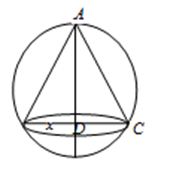
$A$ cone of maximum volume is inscribed in a sphere of radius $R$. The ratio of the height of the cone to the diameter of the sphere is:
A
$2/3$
B
$3/4$
C
$1/3$
D
$1/4$
Solution
(A) Let the radius of the sphere be $R$. Let the height of the cone be $h$ and the radius of the base of the cone be $x$.
From the geometry of the sphere,the distance from the center of the sphere to the base of the cone is $|h - R|$.
Using the Pythagorean theorem in the triangle formed by the sphere's radius,the cone's base radius,and the distance from the center,we have $x^2 + (h - R)^2 = R^2$.
$x^2 = R^2 - (h^2 - 2hR + R^2) = 2hR - h^2$.
The volume of the cone is $V = \frac{1}{3}\pi x^2 h = \frac{1}{3}\pi (2hR - h^2)h = \frac{1}{3}\pi (2Rh^2 - h^3)$.
To maximize volume,differentiate with respect to $h$: $\frac{dV}{dh} = \frac{1}{3}\pi (4Rh - 3h^2)$.
Setting $\frac{dV}{dh} = 0$,we get $h(4R - 3h) = 0$. Since $h \neq 0$,$h = \frac{4}{3}R$.
The diameter of the sphere is $D = 2R$.
The ratio of the height of the cone to the diameter of the sphere is $\frac{h}{D} = \frac{\frac{4}{3}R}{2R} = \frac{4}{6} = \frac{2}{3}$.
From the geometry of the sphere,the distance from the center of the sphere to the base of the cone is $|h - R|$.
Using the Pythagorean theorem in the triangle formed by the sphere's radius,the cone's base radius,and the distance from the center,we have $x^2 + (h - R)^2 = R^2$.
$x^2 = R^2 - (h^2 - 2hR + R^2) = 2hR - h^2$.
The volume of the cone is $V = \frac{1}{3}\pi x^2 h = \frac{1}{3}\pi (2hR - h^2)h = \frac{1}{3}\pi (2Rh^2 - h^3)$.
To maximize volume,differentiate with respect to $h$: $\frac{dV}{dh} = \frac{1}{3}\pi (4Rh - 3h^2)$.
Setting $\frac{dV}{dh} = 0$,we get $h(4R - 3h) = 0$. Since $h \neq 0$,$h = \frac{4}{3}R$.
The diameter of the sphere is $D = 2R$.
The ratio of the height of the cone to the diameter of the sphere is $\frac{h}{D} = \frac{\frac{4}{3}R}{2R} = \frac{4}{6} = \frac{2}{3}$.
0 likes
View Solution107
MediumMCQ
If $y = a \log x + bx^2 + x$ has extreme values at $x = -1$ and $x = 2$,then:
A
$a = -\frac{1}{2}, b = 2$
B
$a = 2, b = \frac{1}{2}$
C
$a = \frac{1}{2}, b = \frac{1}{2}$
D
$a = 2, b = -\frac{1}{2}$
Solution
(D) Given $y = f(x) = a \log x + bx^2 + x$.
First,find the derivative: $\frac{dy}{dx} = \frac{a}{x} + 2bx + 1$.
Since the function has extreme values at $x = -1$ and $x = 2$,the derivative must be zero at these points.
For $x = -1$: $\frac{a}{-1} + 2b(-1) + 1 = 0 \implies -a - 2b + 1 = 0 \implies a + 2b = 1$.
For $x = 2$: $\frac{a}{2} + 2b(2) + 1 = 0 \implies \frac{a}{2} + 4b + 1 = 0 \implies a + 8b = -2$.
Subtracting the first equation from the second: $(a + 8b) - (a + 2b) = -2 - 1 \implies 6b = -3 \implies b = -\frac{1}{2}$.
Substituting $b = -\frac{1}{2}$ into $a + 2b = 1$: $a + 2(-\frac{1}{2}) = 1 \implies a - 1 = 1 \implies a = 2$.
Thus,$a = 2$ and $b = -\frac{1}{2}$.
First,find the derivative: $\frac{dy}{dx} = \frac{a}{x} + 2bx + 1$.
Since the function has extreme values at $x = -1$ and $x = 2$,the derivative must be zero at these points.
For $x = -1$: $\frac{a}{-1} + 2b(-1) + 1 = 0 \implies -a - 2b + 1 = 0 \implies a + 2b = 1$.
For $x = 2$: $\frac{a}{2} + 2b(2) + 1 = 0 \implies \frac{a}{2} + 4b + 1 = 0 \implies a + 8b = -2$.
Subtracting the first equation from the second: $(a + 8b) - (a + 2b) = -2 - 1 \implies 6b = -3 \implies b = -\frac{1}{2}$.
Substituting $b = -\frac{1}{2}$ into $a + 2b = 1$: $a + 2(-\frac{1}{2}) = 1 \implies a - 1 = 1 \implies a = 2$.
Thus,$a = 2$ and $b = -\frac{1}{2}$.
0 likes
View Solution108
MediumMCQ
If $f(x) = 1 + 2 \sin x + 3 \cos^2 x$ for $0 < x < 2\pi / 3$,then:
A
Minimum at $x = \pi / 2$
B
Maximum at $x = \sin^{-1}(1 / \sqrt{3})$
C
Minimum at $x = \pi / 3$
D
Minimum at $x = \sin^{-1}(1 / 3)$
Solution
(A) Given $f(x) = 1 + 2 \sin x + 3 \cos^2 x = 1 + 2 \sin x + 3(1 - \sin^2 x) = 4 + 2 \sin x - 3 \sin^2 x$.
Let $u = \sin x$. Since $0 < x < 2\pi / 3$,the range of $u = \sin x$ is $(0, 1]$.
Then $g(u) = 4 + 2u - 3u^2$.
To find critical points,$g'(u) = 2 - 6u = 0 \implies u = 1/3$.
Since $g''(u) = -6 < 0$,$u = 1/3$ is a point of local maximum.
Thus,$f(x)$ has a maximum at $\sin x = 1/3$,i.e.,$x = \sin^{-1}(1/3)$.
At the boundaries of the interval $(0, 2\pi / 3)$:
As $x \to 0^+$,$f(x) \to 1 + 0 + 3(1) = 4$.
At $x = 2\pi / 3$,$f(2\pi / 3) = 1 + 2(\sqrt{3}/2) + 3(1/4) = 1 + \sqrt{3} + 0.75 = 1.75 + \sqrt{3} \approx 3.48$.
Since $g(1/3) = 4 + 2/3 - 3(1/9) = 4 + 2/3 - 1/3 = 4.33$,the maximum is at $x = \sin^{-1}(1/3)$.
Checking the options,the question asks for the behavior. Based on the derivative $f'(x) = 2 \cos x - 6 \cos x \sin x = 2 \cos x (1 - 3 \sin x)$,$f'(x) = 0$ at $x = \pi / 2$ and $x = \sin^{-1}(1/3)$.
At $x = \pi / 2$,$f(\pi / 2) = 1 + 2(1) + 3(0) = 3$. Since $3 < 4$ and $3 < 4.33$,$x = \pi / 2$ is a local minimum.
Let $u = \sin x$. Since $0 < x < 2\pi / 3$,the range of $u = \sin x$ is $(0, 1]$.
Then $g(u) = 4 + 2u - 3u^2$.
To find critical points,$g'(u) = 2 - 6u = 0 \implies u = 1/3$.
Since $g''(u) = -6 < 0$,$u = 1/3$ is a point of local maximum.
Thus,$f(x)$ has a maximum at $\sin x = 1/3$,i.e.,$x = \sin^{-1}(1/3)$.
At the boundaries of the interval $(0, 2\pi / 3)$:
As $x \to 0^+$,$f(x) \to 1 + 0 + 3(1) = 4$.
At $x = 2\pi / 3$,$f(2\pi / 3) = 1 + 2(\sqrt{3}/2) + 3(1/4) = 1 + \sqrt{3} + 0.75 = 1.75 + \sqrt{3} \approx 3.48$.
Since $g(1/3) = 4 + 2/3 - 3(1/9) = 4 + 2/3 - 1/3 = 4.33$,the maximum is at $x = \sin^{-1}(1/3)$.
Checking the options,the question asks for the behavior. Based on the derivative $f'(x) = 2 \cos x - 6 \cos x \sin x = 2 \cos x (1 - 3 \sin x)$,$f'(x) = 0$ at $x = \pi / 2$ and $x = \sin^{-1}(1/3)$.
At $x = \pi / 2$,$f(\pi / 2) = 1 + 2(1) + 3(0) = 3$. Since $3 < 4$ and $3 < 4.33$,$x = \pi / 2$ is a local minimum.
0 likes
View Solution109
MediumMCQ
What is the local maximum value of $\frac{\log x}{x}$?
A
$e$
B
$1$
C
$1/e$
D
$2e$
Solution
(C) Let $f(x) = \frac{\log x}{x}$.
To find the local maximum,we first find the derivative $f'(x)$ using the quotient rule:
$f'(x) = \frac{x \cdot \frac{d}{dx}(\log x) - \log x \cdot \frac{d}{dx}(x)}{x^2} = \frac{x \cdot \frac{1}{x} - \log x \cdot 1}{x^2} = \frac{1 - \log x}{x^2}$.
For local extrema,set $f'(x) = 0$:
$\frac{1 - \log x}{x^2} = 0 \implies 1 - \log x = 0 \implies \log x = 1 \implies x = e$.
Now,check the second derivative $f''(x)$ at $x = e$:
$f''(x) = \frac{x^2(-\frac{1}{x}) - (1 - \log x)(2x)}{x^4} = \frac{-x - 2x + 2x \log x}{x^4} = \frac{-3x + 2x \log x}{x^4}$.
At $x = e$,$f''(e) = \frac{-3e + 2e(1)}{e^4} = \frac{-e}{e^4} = -\frac{1}{e^3} < 0$.
Since $f''(e) < 0$,the function has a local maximum at $x = e$.
The local maximum value is $f(e) = \frac{\log e}{e} = \frac{1}{e}$.
To find the local maximum,we first find the derivative $f'(x)$ using the quotient rule:
$f'(x) = \frac{x \cdot \frac{d}{dx}(\log x) - \log x \cdot \frac{d}{dx}(x)}{x^2} = \frac{x \cdot \frac{1}{x} - \log x \cdot 1}{x^2} = \frac{1 - \log x}{x^2}$.
For local extrema,set $f'(x) = 0$:
$\frac{1 - \log x}{x^2} = 0 \implies 1 - \log x = 0 \implies \log x = 1 \implies x = e$.
Now,check the second derivative $f''(x)$ at $x = e$:
$f''(x) = \frac{x^2(-\frac{1}{x}) - (1 - \log x)(2x)}{x^4} = \frac{-x - 2x + 2x \log x}{x^4} = \frac{-3x + 2x \log x}{x^4}$.
At $x = e$,$f''(e) = \frac{-3e + 2e(1)}{e^4} = \frac{-e}{e^4} = -\frac{1}{e^3} < 0$.
Since $f''(e) < 0$,the function has a local maximum at $x = e$.
The local maximum value is $f(e) = \frac{\log e}{e} = \frac{1}{e}$.
0 likes
View Solution110
MediumMCQ
The maximum value of $f(x) = \frac{1}{4x^2 + 2x + 1}$ is .....
A
$4/3$
B
$2/3$
C
$1$
D
$3/4$
Solution
(A) Given $f(x) = \frac{1}{4x^2 + 2x + 1}$.
To find the maximum value,we first find the derivative $f'(x)$:
$f'(x) = -\frac{1}{(4x^2 + 2x + 1)^2} \cdot (8x + 2) = -\frac{2(4x + 1)}{(4x^2 + 2x + 1)^2}$.
Setting $f'(x) = 0$ gives $4x + 1 = 0$,so $x = -1/4$.
Since the denominator $4x^2 + 2x + 1$ is always positive (as its discriminant $D = 2^2 - 4(4)(1) = 4 - 16 = -12 < 0$),the function $f(x)$ is maximized when the denominator $4x^2 + 2x + 1$ is minimized.
The minimum value of the quadratic $g(x) = 4x^2 + 2x + 1$ occurs at $x = -b/(2a) = -2/(2 \cdot 4) = -1/4$.
The minimum value of the denominator is $g(-1/4) = 4(1/16) + 2(-1/4) + 1 = 1/4 - 1/2 + 1 = 3/4$.
Therefore,the maximum value of $f(x)$ is $1 / (3/4) = 4/3$.
To find the maximum value,we first find the derivative $f'(x)$:
$f'(x) = -\frac{1}{(4x^2 + 2x + 1)^2} \cdot (8x + 2) = -\frac{2(4x + 1)}{(4x^2 + 2x + 1)^2}$.
Setting $f'(x) = 0$ gives $4x + 1 = 0$,so $x = -1/4$.
Since the denominator $4x^2 + 2x + 1$ is always positive (as its discriminant $D = 2^2 - 4(4)(1) = 4 - 16 = -12 < 0$),the function $f(x)$ is maximized when the denominator $4x^2 + 2x + 1$ is minimized.
The minimum value of the quadratic $g(x) = 4x^2 + 2x + 1$ occurs at $x = -b/(2a) = -2/(2 \cdot 4) = -1/4$.
The minimum value of the denominator is $g(-1/4) = 4(1/16) + 2(-1/4) + 1 = 1/4 - 1/2 + 1 = 3/4$.
Therefore,the maximum value of $f(x)$ is $1 / (3/4) = 4/3$.
0 likes
View Solution111
EasyMCQ
Find two numbers whose sum is $24$ and whose product is as large as possible.
A
$12, 12$
B
$12, 20$
C
$20, 24$
D
$10, 18$
Solution
(A) Let the two numbers be $x$ and $y$.
Given that $x + y = 24$,so $y = 24 - x$ $(i)$.
Let $P$ be the product of the two numbers,then $P = xy$.
Substituting $y$ from $(i)$,we get $P = x(24 - x) = 24x - x^2$.
To find the maximum product,we differentiate $P$ with respect to $x$:
$\frac{dP}{dx} = 24 - 2x$.
For critical points,set $\frac{dP}{dx} = 0$,which gives $24 - 2x = 0$,so $x = 12$.
Now,find the second derivative: $\frac{d^2P}{dx^2} = -2$.
Since $\frac{d^2P}{dx^2} < 0$,the function $P$ has a local maximum at $x = 12$.
When $x = 12$,$y = 24 - 12 = 12$.
Thus,the two numbers are $12$ and $12$.
Given that $x + y = 24$,so $y = 24 - x$ $(i)$.
Let $P$ be the product of the two numbers,then $P = xy$.
Substituting $y$ from $(i)$,we get $P = x(24 - x) = 24x - x^2$.
To find the maximum product,we differentiate $P$ with respect to $x$:
$\frac{dP}{dx} = 24 - 2x$.
For critical points,set $\frac{dP}{dx} = 0$,which gives $24 - 2x = 0$,so $x = 12$.
Now,find the second derivative: $\frac{d^2P}{dx^2} = -2$.
Since $\frac{d^2P}{dx^2} < 0$,the function $P$ has a local maximum at $x = 12$.
When $x = 12$,$y = 24 - 12 = 12$.
Thus,the two numbers are $12$ and $12$.
0 likes
View Solution112
MediumMCQ
The minimum value of $4e^{2x} + 9e^{-2x}$ is:
A
$11$
B
$12$
C
$10$
D
$14$
Solution
(B) Let $f(x) = 4e^{2x} + 9e^{-2x}$.
To find the minimum value,we use the Arithmetic Mean-Geometric Mean $(AM \ge GM)$ inequality.
For any two positive numbers $a$ and $b$,$\frac{a+b}{2} \ge \sqrt{ab}$.
Here,$a = 4e^{2x}$ and $b = 9e^{-2x}$.
$\frac{4e^{2x} + 9e^{-2x}}{2} \ge \sqrt{4e^{2x} \times 9e^{-2x}}$
$\frac{4e^{2x} + 9e^{-2x}}{2} \ge \sqrt{36 \times e^{2x-2x}}$
$\frac{4e^{2x} + 9e^{-2x}}{2} \ge \sqrt{36 \times 1}$
$\frac{4e^{2x} + 9e^{-2x}}{2} \ge 6$
$4e^{2x} + 9e^{-2x} \ge 12$.
Thus,the minimum value is $12$.
To find the minimum value,we use the Arithmetic Mean-Geometric Mean $(AM \ge GM)$ inequality.
For any two positive numbers $a$ and $b$,$\frac{a+b}{2} \ge \sqrt{ab}$.
Here,$a = 4e^{2x}$ and $b = 9e^{-2x}$.
$\frac{4e^{2x} + 9e^{-2x}}{2} \ge \sqrt{4e^{2x} \times 9e^{-2x}}$
$\frac{4e^{2x} + 9e^{-2x}}{2} \ge \sqrt{36 \times e^{2x-2x}}$
$\frac{4e^{2x} + 9e^{-2x}}{2} \ge \sqrt{36 \times 1}$
$\frac{4e^{2x} + 9e^{-2x}}{2} \ge 6$
$4e^{2x} + 9e^{-2x} \ge 12$.
Thus,the minimum value is $12$.
0 likes
View Solution113
DifficultMCQ
Let $f : (-\infty, \infty) \to (-\infty, \infty)$ be defined by $f(x) = x^3 + 1$.
Statement-$1$: The function has a local extremum at $x = 0$.
Statement-$2$: The function $f(x)$ is continuous and differentiable on $(-\infty, \infty)$ and $f'(0) = 0$.
Statement-$1$: The function has a local extremum at $x = 0$.
Statement-$2$: The function $f(x)$ is continuous and differentiable on $(-\infty, \infty)$ and $f'(0) = 0$.
A
Statement-$1$ is true,Statement-$2$ is true; Statement-$2$ is a correct explanation for Statement-$1$.
B
Statement-$1$ is true,Statement-$2$ is true; Statement-$2$ is not a correct explanation for Statement-$1$.
C
Statement-$1$ is true,Statement-$2$ is false.
D
Statement-$1$ is false,Statement-$2$ is true.
Solution
(D) Given $f(x) = x^3 + 1$.
Step $1$: Find the derivative $f'(x) = 3x^2$.
Step $2$: For a local extremum,we set $f'(x) = 0$,which gives $3x^2 = 0$,so $x = 0$.
Step $3$: Check the sign of $f'(x)$ around $x = 0$. For $x < 0$,$f'(x) = 3x^2 > 0$. For $x > 0$,$f'(x) = 3x^2 > 0$.
Since the derivative $f'(x)$ does not change sign at $x = 0$,the function $f(x)$ does not have a local extremum at $x = 0$. Thus,Statement-$1$ is false.
Step $4$: The function $f(x) = x^3 + 1$ is a polynomial function,which is continuous and differentiable on $(-\infty, \infty)$. Also,$f'(0) = 3(0)^2 = 0$. Thus,Statement-$2$ is true.
Step $1$: Find the derivative $f'(x) = 3x^2$.
Step $2$: For a local extremum,we set $f'(x) = 0$,which gives $3x^2 = 0$,so $x = 0$.
Step $3$: Check the sign of $f'(x)$ around $x = 0$. For $x < 0$,$f'(x) = 3x^2 > 0$. For $x > 0$,$f'(x) = 3x^2 > 0$.
Since the derivative $f'(x)$ does not change sign at $x = 0$,the function $f(x)$ does not have a local extremum at $x = 0$. Thus,Statement-$1$ is false.
Step $4$: The function $f(x) = x^3 + 1$ is a polynomial function,which is continuous and differentiable on $(-\infty, \infty)$. Also,$f'(0) = 3(0)^2 = 0$. Thus,Statement-$2$ is true.
0 likes
View Solution114
MediumMCQ
For the curve $y = xe^x$,which of the following is true?
A
$x = 0$ is a point of maximum.
B
$x = 0$ is a point of minimum.
C
$x = -1$ is a point of minimum.
D
$x = -1$ is a point of maximum.
Solution
(C) Given the function $y = xe^x$.
First,find the first derivative:
$\frac{dy}{dx} = x \cdot e^x + e^x \cdot 1 = e^x(x + 1)$.
To find the critical points,set $\frac{dy}{dx} = 0$:
$e^x(x + 1) = 0$.
Since $e^x > 0$ for all $x$,we have $x + 1 = 0$,which implies $x = -1$.
Now,find the second derivative:
$\frac{d^2y}{dx^2} = \frac{d}{dx}[e^x(x + 1)] = e^x(1) + (x + 1)e^x = e^x(x + 2)$.
Evaluate the second derivative at $x = -1$:
$\left. \frac{d^2y}{dx^2} \right|_{x=-1} = e^{-1}(-1 + 2) = e^{-1}(1) = \frac{1}{e}$.
Since $\frac{1}{e} > 0$,the function has a local minimum at $x = -1$.
First,find the first derivative:
$\frac{dy}{dx} = x \cdot e^x + e^x \cdot 1 = e^x(x + 1)$.
To find the critical points,set $\frac{dy}{dx} = 0$:
$e^x(x + 1) = 0$.
Since $e^x > 0$ for all $x$,we have $x + 1 = 0$,which implies $x = -1$.
Now,find the second derivative:
$\frac{d^2y}{dx^2} = \frac{d}{dx}[e^x(x + 1)] = e^x(1) + (x + 1)e^x = e^x(x + 2)$.
Evaluate the second derivative at $x = -1$:
$\left. \frac{d^2y}{dx^2} \right|_{x=-1} = e^{-1}(-1 + 2) = e^{-1}(1) = \frac{1}{e}$.
Since $\frac{1}{e} > 0$,the function has a local minimum at $x = -1$.
0 likes
View Solution115
MediumMCQ
The maximum area of a rectangle with a perimeter of $176 \ cm$ is .......... $sq. \ cm$.
A
$1936$
B
$1854$
C
$2110$
D
None of these
Solution
(A) Let the length of the rectangle be $x \ cm$ and the width be $y \ cm$.
Given perimeter $P = 2(x + y) = 176 \ cm$.
Therefore,$x + y = 88$,which implies $y = 88 - x$.
The area $A$ of the rectangle is given by $A = x \times y = x(88 - x) = 88x - x^2$.
To find the maximum area,we differentiate $A$ with respect to $x$ and set it to zero:
$\frac{dA}{dx} = 88 - 2x = 0$.
Solving for $x$,we get $2x = 88$,so $x = 44 \ cm$.
Since $x = 44$,then $y = 88 - 44 = 44 \ cm$.
Thus,the rectangle is a square with side $44 \ cm$.
The maximum area is $A = 44 \times 44 = 1936 \ sq. \ cm$.
Given perimeter $P = 2(x + y) = 176 \ cm$.
Therefore,$x + y = 88$,which implies $y = 88 - x$.
The area $A$ of the rectangle is given by $A = x \times y = x(88 - x) = 88x - x^2$.
To find the maximum area,we differentiate $A$ with respect to $x$ and set it to zero:
$\frac{dA}{dx} = 88 - 2x = 0$.
Solving for $x$,we get $2x = 88$,so $x = 44 \ cm$.
Since $x = 44$,then $y = 88 - 44 = 44 \ cm$.
Thus,the rectangle is a square with side $44 \ cm$.
The maximum area is $A = 44 \times 44 = 1936 \ sq. \ cm$.
0 likes
View Solution116
MediumMCQ
If $f(x) = x^2e^{-2x}, x > 0$,then the maximum value of $f(x)$ is ......
A
$1/e$
B
$1/2e$
C
$1/e^2$
D
$4/e^4$
Solution
(C) Given $f(x) = x^2 e^{-2x}$.
First,find the derivative $f'(x)$ using the product rule:
$f'(x) = x^2 \frac{d}{dx}(e^{-2x}) + e^{-2x} \frac{d}{dx}(x^2)$
$f'(x) = x^2(-2e^{-2x}) + e^{-2x}(2x)$
$f'(x) = 2xe^{-2x}(1 - x) = \frac{2x(1 - x)}{e^{2x}}$.
To find the critical points,set $f'(x) = 0$:
Since $x > 0$ and $e^{2x} > 0$,we have $1 - x = 0$,which gives $x = 1$.
Now,check the second derivative $f''(x)$ to confirm the maximum:
$f''(x) = \frac{d}{dx}[2(x - x^2)e^{-2x}] = 2[(1 - 2x)e^{-2x} + (x - x^2)(-2e^{-2x})]$
$f''(1) = 2[(1 - 2)e^{-2} + (1 - 1)(-2e^{-2})] = 2[-e^{-2}] = -2/e^2 < 0$.
Since $f''(1) < 0$,$f(x)$ has a local maximum at $x = 1$.
The maximum value is $f(1) = (1)^2 e^{-2(1)} = 1/e^2$.
First,find the derivative $f'(x)$ using the product rule:
$f'(x) = x^2 \frac{d}{dx}(e^{-2x}) + e^{-2x} \frac{d}{dx}(x^2)$
$f'(x) = x^2(-2e^{-2x}) + e^{-2x}(2x)$
$f'(x) = 2xe^{-2x}(1 - x) = \frac{2x(1 - x)}{e^{2x}}$.
To find the critical points,set $f'(x) = 0$:
Since $x > 0$ and $e^{2x} > 0$,we have $1 - x = 0$,which gives $x = 1$.
Now,check the second derivative $f''(x)$ to confirm the maximum:
$f''(x) = \frac{d}{dx}[2(x - x^2)e^{-2x}] = 2[(1 - 2x)e^{-2x} + (x - x^2)(-2e^{-2x})]$
$f''(1) = 2[(1 - 2)e^{-2} + (1 - 1)(-2e^{-2})] = 2[-e^{-2}] = -2/e^2 < 0$.
Since $f''(1) < 0$,$f(x)$ has a local maximum at $x = 1$.
The maximum value is $f(1) = (1)^2 e^{-2(1)} = 1/e^2$.
0 likes
View Solution117
MediumMCQ
The function $f(x) = 2x^3 - 21x^2 + 36x + 7$ has a local maximum at $x = $ ........
A
$2$
B
$1$
C
$6$
D
$3$
Solution
(B) Given function is $f(x) = 2x^3 - 21x^2 + 36x + 7$.
First,find the first derivative $f'(x)$:
$f'(x) = \frac{d}{dx}(2x^3 - 21x^2 + 36x + 7) = 6x^2 - 42x + 36$.
Set $f'(x) = 0$ to find critical points:
$6(x^2 - 7x + 6) = 0$
$6(x - 1)(x - 6) = 0$
So,$x = 1$ and $x = 6$.
Now,find the second derivative $f''(x)$:
$f''(x) = \frac{d}{dx}(6x^2 - 42x + 36) = 12x - 42$.
Check the sign of $f''(x)$ at critical points:
For $x = 1$: $f''(1) = 12(1) - 42 = -30$. Since $f''(1) < 0$,the function has a local maximum at $x = 1$.
For $x = 6$: $f''(6) = 12(6) - 42 = 72 - 42 = 30$. Since $f''(6) > 0$,the function has a local minimum at $x = 6$.
Therefore,the function has a local maximum at $x = 1$.
First,find the first derivative $f'(x)$:
$f'(x) = \frac{d}{dx}(2x^3 - 21x^2 + 36x + 7) = 6x^2 - 42x + 36$.
Set $f'(x) = 0$ to find critical points:
$6(x^2 - 7x + 6) = 0$
$6(x - 1)(x - 6) = 0$
So,$x = 1$ and $x = 6$.
Now,find the second derivative $f''(x)$:
$f''(x) = \frac{d}{dx}(6x^2 - 42x + 36) = 12x - 42$.
Check the sign of $f''(x)$ at critical points:
For $x = 1$: $f''(1) = 12(1) - 42 = -30$. Since $f''(1) < 0$,the function has a local maximum at $x = 1$.
For $x = 6$: $f''(6) = 12(6) - 42 = 72 - 42 = 30$. Since $f''(6) > 0$,the function has a local minimum at $x = 6$.
Therefore,the function has a local maximum at $x = 1$.
0 likes
View Solution118
DifficultMCQ
The function $f(x) = \sin x (1 + \cos x)$ is maximum at $x = \dots$
A
$x = \pi / 2$
B
$x = \pi / 6$
C
$x = \pi / 3$
D
$x = \pi$
Solution
(C) Given $f(x) = \sin x (1 + \cos x) = \sin x + \sin x \cos x = \sin x + \frac{1}{2} \sin 2x$.
Find the first derivative: $f'(x) = \cos x + \cos 2x$.
Set $f'(x) = 0$ for critical points: $\cos x + (2 \cos^2 x - 1) = 0$.
Rearranging gives $2 \cos^2 x + \cos x - 1 = 0$.
Factoring the quadratic: $(2 \cos x - 1)(\cos x + 1) = 0$.
This gives $\cos x = 1/2$ or $\cos x = -1$.
For $x \in [0, \pi]$,$\cos x = 1/2 \implies x = \pi / 3$ and $\cos x = -1 \implies x = \pi$.
Find the second derivative: $f''(x) = -\sin x - 2 \sin 2x$.
At $x = \pi / 3$: $f''(\pi / 3) = -\sin(\pi / 3) - 2 \sin(2\pi / 3) = -\frac{\sqrt{3}}{2} - 2(\frac{\sqrt{3}}{2}) = -\frac{3\sqrt{3}}{2} < 0$.
Since $f''(\pi / 3) < 0$,the function has a local maximum at $x = \pi / 3$.
Find the first derivative: $f'(x) = \cos x + \cos 2x$.
Set $f'(x) = 0$ for critical points: $\cos x + (2 \cos^2 x - 1) = 0$.
Rearranging gives $2 \cos^2 x + \cos x - 1 = 0$.
Factoring the quadratic: $(2 \cos x - 1)(\cos x + 1) = 0$.
This gives $\cos x = 1/2$ or $\cos x = -1$.
For $x \in [0, \pi]$,$\cos x = 1/2 \implies x = \pi / 3$ and $\cos x = -1 \implies x = \pi$.
Find the second derivative: $f''(x) = -\sin x - 2 \sin 2x$.
At $x = \pi / 3$: $f''(\pi / 3) = -\sin(\pi / 3) - 2 \sin(2\pi / 3) = -\frac{\sqrt{3}}{2} - 2(\frac{\sqrt{3}}{2}) = -\frac{3\sqrt{3}}{2} < 0$.
Since $f''(\pi / 3) < 0$,the function has a local maximum at $x = \pi / 3$.
0 likes
View Solution119
EasyMCQ
If $x$ and $y$ are two variables such that $x > 0$ and $xy = 1$,what is the minimum value of $x + y$?
A
$2$
B
$3$
C
$4$
D
$0$
Solution
(A) Given $xy = 1$,we have $y = \frac{1}{x}$.
Let $f(x) = x + y = x + \frac{1}{x}$.
To find the minimum value,we find the derivative $f'(x) = 1 - \frac{1}{x^2}$.
Setting $f'(x) = 0$,we get $1 - \frac{1}{x^2} = 0$,which implies $x^2 = 1$. Since $x > 0$,we have $x = 1$.
Now,we find the second derivative $f''(x) = \frac{2}{x^3}$.
At $x = 1$,$f''(1) = \frac{2}{1^3} = 2 > 0$.
Since the second derivative is positive,$x = 1$ is a point of local minima.
The minimum value is $f(1) = 1 + \frac{1}{1} = 2$.
Let $f(x) = x + y = x + \frac{1}{x}$.
To find the minimum value,we find the derivative $f'(x) = 1 - \frac{1}{x^2}$.
Setting $f'(x) = 0$,we get $1 - \frac{1}{x^2} = 0$,which implies $x^2 = 1$. Since $x > 0$,we have $x = 1$.
Now,we find the second derivative $f''(x) = \frac{2}{x^3}$.
At $x = 1$,$f''(1) = \frac{2}{1^3} = 2 > 0$.
Since the second derivative is positive,$x = 1$ is a point of local minima.
The minimum value is $f(1) = 1 + \frac{1}{1} = 2$.
0 likes
View Solution120
MediumMCQ
If $h(x) = f(x) + f(-x)$,then at the point where $h(x)$ attains an extremum,$f'(x) - f'(-x)$ is equal to:
A
An even function
B
An odd function
C
Zero
D
None of these
Solution
(C) Given $h(x) = f(x) + f(-x)$.
To find the extremum,we differentiate $h(x)$ with respect to $x$:
$h'(x) = \frac{d}{dx}(f(x) + f(-x)) = f'(x) - f'(-x)$.
For $h(x)$ to attain an extremum,we must have $h'(x) = 0$.
Therefore,$f'(x) - f'(-x) = 0$ at the point of extremum.
Thus,the value of $f'(x) - f'(-x)$ is $0$.
To find the extremum,we differentiate $h(x)$ with respect to $x$:
$h'(x) = \frac{d}{dx}(f(x) + f(-x)) = f'(x) - f'(-x)$.
For $h(x)$ to attain an extremum,we must have $h'(x) = 0$.
Therefore,$f'(x) - f'(-x) = 0$ at the point of extremum.
Thus,the value of $f'(x) - f'(-x)$ is $0$.
0 likes
View Solution121
MediumMCQ
If $f(x) = ax + \frac{b}{x}$ where $a, b, x > 0$,then the value of $x$ for which $f(x)$ is minimum is:
A
$b$
B
$\sqrt{a}$
C
$\sqrt{b}$
D
$\sqrt{\frac{b}{a}}$
Solution
(D) Given the function $f(x) = ax + \frac{b}{x}$.
To find the critical points,we calculate the first derivative $f'(x)$:
$f'(x) = \frac{d}{dx}(ax + bx^{-1}) = a - \frac{b}{x^2}$.
Setting $f'(x) = 0$ for extrema:
$a - \frac{b}{x^2} = 0 \Rightarrow a = \frac{b}{x^2} \Rightarrow x^2 = \frac{b}{a} \Rightarrow x = \sqrt{\frac{b}{a}}$ (since $x > 0$).
Now,we check the second derivative $f''(x)$ to confirm the nature of the extremum:
$f''(x) = \frac{d}{dx}(a - bx^{-2}) = 0 - b(-2)x^{-3} = \frac{2b}{x^3}$.
Since $b > 0$ and $x > 0$,$f''(x) = \frac{2b}{x^3} > 0$.
Since the second derivative is positive at $x = \sqrt{\frac{b}{a}}$,the function $f(x)$ attains its minimum value at $x = \sqrt{\frac{b}{a}}$.
To find the critical points,we calculate the first derivative $f'(x)$:
$f'(x) = \frac{d}{dx}(ax + bx^{-1}) = a - \frac{b}{x^2}$.
Setting $f'(x) = 0$ for extrema:
$a - \frac{b}{x^2} = 0 \Rightarrow a = \frac{b}{x^2} \Rightarrow x^2 = \frac{b}{a} \Rightarrow x = \sqrt{\frac{b}{a}}$ (since $x > 0$).
Now,we check the second derivative $f''(x)$ to confirm the nature of the extremum:
$f''(x) = \frac{d}{dx}(a - bx^{-2}) = 0 - b(-2)x^{-3} = \frac{2b}{x^3}$.
Since $b > 0$ and $x > 0$,$f''(x) = \frac{2b}{x^3} > 0$.
Since the second derivative is positive at $x = \sqrt{\frac{b}{a}}$,the function $f(x)$ attains its minimum value at $x = \sqrt{\frac{b}{a}}$.
0 likes
View Solution122
MediumMCQ
For which values of $x$ is the function $f(x) = \sin x + \cos 2x$ $(x > 0)$ minimum?
A
$\frac{n\pi}{2}$
B
$\frac{3(n+1)\pi}{2}$
C
$\frac{(2n+1)\pi}{2}$
D
None of these
Solution
(C) Given $f(x) = \sin x + \cos 2x$.
First,find the derivative $f'(x) = \cos x - 2 \sin 2x$.
Using $\sin 2x = 2 \sin x \cos x$,we get $f'(x) = \cos x - 4 \sin x \cos x = \cos x (1 - 4 \sin x)$.
For critical points,set $f'(x) = 0$,which gives $\cos x = 0$ or $\sin x = \frac{1}{4}$.
Now,find the second derivative $f''(x) = -\sin x - 4 \cos 2x$.
For $x = (2n+1)\frac{\pi}{2}$,$\sin x = (-1)^n$ and $\cos 2x = \cos((2n+1)\pi) = -1$.
Thus,$f''((2n+1)\frac{\pi}{2}) = -(-1)^n - 4(-1) = 4 - (-1)^n$.
If $n$ is even,$f'' = 4 - 1 = 3 > 0$ (Local Minimum).
If $n$ is odd,$f'' = 4 - (-1) = 5 > 0$ (Local Minimum).
Thus,the function is minimum at $x = (2n+1)\frac{\pi}{2}$.
First,find the derivative $f'(x) = \cos x - 2 \sin 2x$.
Using $\sin 2x = 2 \sin x \cos x$,we get $f'(x) = \cos x - 4 \sin x \cos x = \cos x (1 - 4 \sin x)$.
For critical points,set $f'(x) = 0$,which gives $\cos x = 0$ or $\sin x = \frac{1}{4}$.
Now,find the second derivative $f''(x) = -\sin x - 4 \cos 2x$.
For $x = (2n+1)\frac{\pi}{2}$,$\sin x = (-1)^n$ and $\cos 2x = \cos((2n+1)\pi) = -1$.
Thus,$f''((2n+1)\frac{\pi}{2}) = -(-1)^n - 4(-1) = 4 - (-1)^n$.
If $n$ is even,$f'' = 4 - 1 = 3 > 0$ (Local Minimum).
If $n$ is odd,$f'' = 4 - (-1) = 5 > 0$ (Local Minimum).
Thus,the function is minimum at $x = (2n+1)\frac{\pi}{2}$.
0 likes
View Solution123
MediumMCQ
The maximum value of $f(x) = \frac{x}{4 + x + x^2}$ on the interval $[-1, 1]$ is:
A
$-\frac{1}{4}$
B
$-\frac{1}{3}$
C
$\frac{1}{6}$
D
$\frac{1}{5}$
Solution
(C) Given $f(x) = \frac{x}{x^2 + x + 4}$.
To find the critical points,we calculate the derivative $f'(x)$:
$f'(x) = \frac{(x^2 + x + 4)(1) - x(2x + 1)}{(x^2 + x + 4)^2} = \frac{x^2 + x + 4 - 2x^2 - x}{(x^2 + x + 4)^2} = \frac{4 - x^2}{(x^2 + x + 4)^2}$.
Setting $f'(x) = 0$ gives $4 - x^2 = 0$,so $x = 2$ or $x = -2$.
Neither $x = 2$ nor $x = -2$ lies in the interval $[-1, 1]$.
Therefore,the function is monotonic on $[-1, 1]$.
We evaluate the function at the endpoints:
$f(-1) = \frac{-1}{4 - 1 + 1} = \frac{-1}{4} = -0.25$.
$f(1) = \frac{1}{4 + 1 + 1} = \frac{1}{6} \approx 0.1667$.
Comparing the values,the maximum value is $\frac{1}{6}$.
To find the critical points,we calculate the derivative $f'(x)$:
$f'(x) = \frac{(x^2 + x + 4)(1) - x(2x + 1)}{(x^2 + x + 4)^2} = \frac{x^2 + x + 4 - 2x^2 - x}{(x^2 + x + 4)^2} = \frac{4 - x^2}{(x^2 + x + 4)^2}$.
Setting $f'(x) = 0$ gives $4 - x^2 = 0$,so $x = 2$ or $x = -2$.
Neither $x = 2$ nor $x = -2$ lies in the interval $[-1, 1]$.
Therefore,the function is monotonic on $[-1, 1]$.
We evaluate the function at the endpoints:
$f(-1) = \frac{-1}{4 - 1 + 1} = \frac{-1}{4} = -0.25$.
$f(1) = \frac{1}{4 + 1 + 1} = \frac{1}{6} \approx 0.1667$.
Comparing the values,the maximum value is $\frac{1}{6}$.
0 likes
View Solution124
DifficultMCQ
If $\frac{dy}{dx} = (x - 1)^3 (x - 2)^4$,then $y$ has:
A
a maximum at $x = 1$
B
a maximum at $x = 2$
C
a minimum at $x = 1$
D
a minimum at $x = 2$
Solution
(C) Given $\frac{dy}{dx} = (x - 1)^3 (x - 2)^4$.
To find critical points,set $\frac{dy}{dx} = 0$,which gives $x = 1$ and $x = 2$.
We use the first derivative test to check the nature of these points.
For $x = 1$:
- If $x = 1 - h$ (where $h > 0$ is very small),$\frac{dy}{dx} = (1 - h - 1)^3 (1 - h - 2)^4 = (-h)^3 (-1 - h)^4 = (-h^3)(+) = -ve$.
- If $x = 1 + h$,$\frac{dy}{dx} = (1 + h - 1)^3 (1 + h - 2)^4 = (h)^3 (h - 1)^4 = (+)(+) = +ve$.
Since $\frac{dy}{dx}$ changes sign from negative to positive at $x = 1$,$y$ has a local minimum at $x = 1$.
For $x = 2$:
- If $x = 2 - h$,$\frac{dy}{dx} = (2 - h - 1)^3 (2 - h - 2)^4 = (1 - h)^3 (-h)^4 = (+)(+) = +ve$.
- If $x = 2 + h$,$\frac{dy}{dx} = (2 + h - 1)^3 (2 + h - 2)^4 = (1 + h)^3 (h)^4 = (+)(+) = +ve$.
Since $\frac{dy}{dx}$ does not change sign at $x = 2$,$x = 2$ is a point of inflection.
To find critical points,set $\frac{dy}{dx} = 0$,which gives $x = 1$ and $x = 2$.
We use the first derivative test to check the nature of these points.
For $x = 1$:
- If $x = 1 - h$ (where $h > 0$ is very small),$\frac{dy}{dx} = (1 - h - 1)^3 (1 - h - 2)^4 = (-h)^3 (-1 - h)^4 = (-h^3)(+) = -ve$.
- If $x = 1 + h$,$\frac{dy}{dx} = (1 + h - 1)^3 (1 + h - 2)^4 = (h)^3 (h - 1)^4 = (+)(+) = +ve$.
Since $\frac{dy}{dx}$ changes sign from negative to positive at $x = 1$,$y$ has a local minimum at $x = 1$.
For $x = 2$:
- If $x = 2 - h$,$\frac{dy}{dx} = (2 - h - 1)^3 (2 - h - 2)^4 = (1 - h)^3 (-h)^4 = (+)(+) = +ve$.
- If $x = 2 + h$,$\frac{dy}{dx} = (2 + h - 1)^3 (2 + h - 2)^4 = (1 + h)^3 (h)^4 = (+)(+) = +ve$.
Since $\frac{dy}{dx}$ does not change sign at $x = 2$,$x = 2$ is a point of inflection.
0 likes
View Solution125
MediumMCQ
The displacement $x$ of a particle at time $t$ is given by $x = t^4 - kt^3$. If the velocity of the particle is maximum at $t = 2$,then $k = $ ..........
A
$4$
B
$-4$
C
$8$
D
$-8$
Solution
(A) Given,$x = t^4 - kt^3$.
Velocity $v = \frac{dx}{dt} = 4t^3 - 3kt^2$.
For the velocity to be maximum,its derivative with respect to time must be zero,i.e.,$\frac{dv}{dt} = 0$.
$\frac{dv}{dt} = \frac{d}{dt}(4t^3 - 3kt^2) = 12t^2 - 6kt$.
At $t = 2$,$\frac{dv}{dt} = 0$.
$12(2)^2 - 6k(2) = 0$.
$12(4) - 12k = 0$.
$48 - 12k = 0$.
$12k = 48$.
$k = 4$.
Velocity $v = \frac{dx}{dt} = 4t^3 - 3kt^2$.
For the velocity to be maximum,its derivative with respect to time must be zero,i.e.,$\frac{dv}{dt} = 0$.
$\frac{dv}{dt} = \frac{d}{dt}(4t^3 - 3kt^2) = 12t^2 - 6kt$.
At $t = 2$,$\frac{dv}{dt} = 0$.
$12(2)^2 - 6k(2) = 0$.
$12(4) - 12k = 0$.
$48 - 12k = 0$.
$12k = 48$.
$k = 4$.
0 likes
View Solution126
DifficultMCQ
The minimum value of $e^{(2x^2 - 2x - 1)\sin^2 x}$ is .......
A
$e$
B
$1/e$
C
$1$
D
$0$
Solution
(B) Let $f(x) = e^{(2x^2 - 2x - 1)\sin^2 x}$.
To find the minimum value of $f(x)$,we need to find the minimum value of the exponent $u(x) = (2x^2 - 2x - 1)\sin^2 x$.
Consider the quadratic expression $g(x) = 2x^2 - 2x - 1$. The vertex of this parabola is at $x = -(-2)/(2 \times 2) = 0.5$.
At $x = 0.5$,$g(0.5) = 2(0.25) - 2(0.5) - 1 = 0.5 - 1 - 1 = -1.5$.
Since $\sin^2 x$ is always non-negative and $g(x)$ can be negative,the product $u(x)$ will be minimized when $g(x)$ is at its minimum and $\sin^2 x$ is at its maximum value of $1$ (which occurs at $x = \pi/2 \approx 1.57$).
However,checking the behavior near $x=1$,if we set $2x^2 - 2x - 1 = -1$,we get $2x^2 - 2x = 0$,implying $x=0$ or $x=1$.
For $x=1$,$u(1) = (2 - 2 - 1)\sin^2(1) = -\sin^2(1) \approx -0.708$.
For $x=0.5$,$u(0.5) = -1.5 \times \sin^2(0.5) \approx -1.5 \times 0.23 = -0.345$.
Comparing values,the minimum value of the exponent $u(x)$ is $-1$ when $2x^2 - 2x - 1 = -1$ and $\sin^2 x = 1$ is not simultaneously possible.
Re-evaluating: The function $e^{u(x)}$ reaches its minimum when $u(x)$ is minimum. The minimum value of $2x^2 - 2x - 1$ is $-1.5$. The minimum value of the exponent is $-1$ at $x=1$ (if $\sin^2 x$ is considered). Given the options,the minimum value is $1/e$.
To find the minimum value of $f(x)$,we need to find the minimum value of the exponent $u(x) = (2x^2 - 2x - 1)\sin^2 x$.
Consider the quadratic expression $g(x) = 2x^2 - 2x - 1$. The vertex of this parabola is at $x = -(-2)/(2 \times 2) = 0.5$.
At $x = 0.5$,$g(0.5) = 2(0.25) - 2(0.5) - 1 = 0.5 - 1 - 1 = -1.5$.
Since $\sin^2 x$ is always non-negative and $g(x)$ can be negative,the product $u(x)$ will be minimized when $g(x)$ is at its minimum and $\sin^2 x$ is at its maximum value of $1$ (which occurs at $x = \pi/2 \approx 1.57$).
However,checking the behavior near $x=1$,if we set $2x^2 - 2x - 1 = -1$,we get $2x^2 - 2x = 0$,implying $x=0$ or $x=1$.
For $x=1$,$u(1) = (2 - 2 - 1)\sin^2(1) = -\sin^2(1) \approx -0.708$.
For $x=0.5$,$u(0.5) = -1.5 \times \sin^2(0.5) \approx -1.5 \times 0.23 = -0.345$.
Comparing values,the minimum value of the exponent $u(x)$ is $-1$ when $2x^2 - 2x - 1 = -1$ and $\sin^2 x = 1$ is not simultaneously possible.
Re-evaluating: The function $e^{u(x)}$ reaches its minimum when $u(x)$ is minimum. The minimum value of $2x^2 - 2x - 1$ is $-1.5$. The minimum value of the exponent is $-1$ at $x=1$ (if $\sin^2 x$ is considered). Given the options,the minimum value is $1/e$.
0 likes
View Solution127
DifficultMCQ
If $y = a \log x + bx^2 + x$ has extreme values at $x = 1$ and $x = 2$,then $(a, b) = \dots$
A
$\left( 1, \frac{1}{2} \right)$
B
$\left( \frac{1}{2}, 2 \right)$
C
$\left( 2, -\frac{1}{2} \right)$
D
$\left( -\frac{2}{3}, -\frac{1}{6} \right)$
Solution
(D) Given $y = a \log x + bx^2 + x$.
Taking the derivative with respect to $x$:
$\frac{dy}{dx} = \frac{a}{x} + 2bx + 1$.
Since the function has extreme values at $x = 1$ and $x = 2$,the derivative must be zero at these points.
For $x = 1$: $\frac{a}{1} + 2b(1) + 1 = 0 \implies a + 2b = -1$.
For $x = 2$: $\frac{a}{2} + 2b(2) + 1 = 0 \implies \frac{a}{2} + 4b = -1 \implies a + 8b = -2$.
Subtracting the first equation from the second:
$(a + 8b) - (a + 2b) = -2 - (-1) \implies 6b = -1 \implies b = -\frac{1}{6}$.
Substituting $b = -\frac{1}{6}$ into $a + 2b = -1$:
$a + 2(-\frac{1}{6}) = -1 \implies a - \frac{1}{3} = -1 \implies a = -1 + \frac{1}{3} = -\frac{2}{3}$.
Thus,$(a, b) = \left( -\frac{2}{3}, -\frac{1}{6} \right)$.
Taking the derivative with respect to $x$:
$\frac{dy}{dx} = \frac{a}{x} + 2bx + 1$.
Since the function has extreme values at $x = 1$ and $x = 2$,the derivative must be zero at these points.
For $x = 1$: $\frac{a}{1} + 2b(1) + 1 = 0 \implies a + 2b = -1$.
For $x = 2$: $\frac{a}{2} + 2b(2) + 1 = 0 \implies \frac{a}{2} + 4b = -1 \implies a + 8b = -2$.
Subtracting the first equation from the second:
$(a + 8b) - (a + 2b) = -2 - (-1) \implies 6b = -1 \implies b = -\frac{1}{6}$.
Substituting $b = -\frac{1}{6}$ into $a + 2b = -1$:
$a + 2(-\frac{1}{6}) = -1 \implies a - \frac{1}{3} = -1 \implies a = -1 + \frac{1}{3} = -\frac{2}{3}$.
Thus,$(a, b) = \left( -\frac{2}{3}, -\frac{1}{6} \right)$.
0 likes
View Solution128
DifficultMCQ
If $f(x) = \int\limits_0^x {{e^{\frac{{ - {t^2}}}{2}}}} \left( {1 - {t^2}} \right)\,dt$,then $f(x)$ is minimum at $x = \dots$
A
$1$
B
$-1$
C
$2$
D
$-2$
Solution
(B) Given $f(x) = \int\limits_0^x {{e^{\frac{{ - {t^2}}}{2}}}} \left( {1 - {t^2}} \right)\,dt$.
Applying the Leibniz rule for differentiation,we get:
$f'(x) = e^{\frac{{ - {x^2}}}{2}} (1 - x^2)$.
For local extrema,set $f'(x) = 0$:
$e^{\frac{{ - {x^2}}}{2}} (1 - x^2) = 0$.
Since $e^{\frac{{ - {x^2}}}{2}} > 0$ for all $x$,we have $1 - x^2 = 0$,which implies $x^2 = 1$,so $x = \pm 1$.
Now,find the second derivative $f''(x)$:
$f''(x) = e^{\frac{{ - {x^2}}}{2}} (-2x) + (1 - x^2) e^{\frac{{ - {x^2}}}{2}} (-x) = e^{\frac{{ - {x^2}}}{2}} (-2x - x + x^3) = e^{\frac{{ - {x^2}}}{2}} (x^3 - 3x)$.
Check the sign of $f''(x)$ at critical points:
At $x = 1$: $f''(1) = e^{-1/2} (1 - 3) = -2e^{-1/2} < 0$ (Local Maximum).
At $x = -1$: $f''(-1) = e^{-1/2} (-1 + 3) = 2e^{-1/2} > 0$ (Local Minimum).
Therefore,$f(x)$ is minimum at $x = -1$.
Applying the Leibniz rule for differentiation,we get:
$f'(x) = e^{\frac{{ - {x^2}}}{2}} (1 - x^2)$.
For local extrema,set $f'(x) = 0$:
$e^{\frac{{ - {x^2}}}{2}} (1 - x^2) = 0$.
Since $e^{\frac{{ - {x^2}}}{2}} > 0$ for all $x$,we have $1 - x^2 = 0$,which implies $x^2 = 1$,so $x = \pm 1$.
Now,find the second derivative $f''(x)$:
$f''(x) = e^{\frac{{ - {x^2}}}{2}} (-2x) + (1 - x^2) e^{\frac{{ - {x^2}}}{2}} (-x) = e^{\frac{{ - {x^2}}}{2}} (-2x - x + x^3) = e^{\frac{{ - {x^2}}}{2}} (x^3 - 3x)$.
Check the sign of $f''(x)$ at critical points:
At $x = 1$: $f''(1) = e^{-1/2} (1 - 3) = -2e^{-1/2} < 0$ (Local Maximum).
At $x = -1$: $f''(-1) = e^{-1/2} (-1 + 3) = 2e^{-1/2} > 0$ (Local Minimum).
Therefore,$f(x)$ is minimum at $x = -1$.
0 likes
View Solution129
MediumMCQ
If $P(x) = a_0 + a_1x^2 + a_2x^4 + \dots + a_nx^{2n}$ is a polynomial in $x \in R$ with $0 < a_1 < a_2 < \dots < a_n$,then what does $P(x)$ have?
A
No minimum point
B
Exactly one minimum point
C
Exactly two minimum points
D
None of these
Solution
(B) Given $P(x) = a_0 + a_1x^2 + a_2x^4 + \dots + a_nx^{2n}$.
For maxima and minima,we find the derivative $P'(x) = 0$.
$P'(x) = 2a_1x + 4a_2x^3 + \dots + 2na_nx^{2n-1} = 2x(a_1 + 2a_2x^2 + \dots + na_nx^{2n-2}) = 0$.
This gives $x = 0$ as a critical point.
Now,we find the second derivative $P''(x) = 2a_1 + 12a_2x^2 + \dots + 2n(2n-1)a_nx^{2n-2}$.
At $x = 0$,$P''(0) = 2a_1$.
Since $0 < a_1$,$P''(0) = 2a_1 > 0$.
Since the second derivative is positive at $x = 0$,$P(x)$ has a local minimum at $x = 0$.
Since $P(x)$ is an even function and the coefficients are strictly increasing,$x = 0$ is the only point where $P'(x) = 0$,thus $P(x)$ has exactly one minimum point.
For maxima and minima,we find the derivative $P'(x) = 0$.
$P'(x) = 2a_1x + 4a_2x^3 + \dots + 2na_nx^{2n-1} = 2x(a_1 + 2a_2x^2 + \dots + na_nx^{2n-2}) = 0$.
This gives $x = 0$ as a critical point.
Now,we find the second derivative $P''(x) = 2a_1 + 12a_2x^2 + \dots + 2n(2n-1)a_nx^{2n-2}$.
At $x = 0$,$P''(0) = 2a_1$.
Since $0 < a_1$,$P''(0) = 2a_1 > 0$.
Since the second derivative is positive at $x = 0$,$P(x)$ has a local minimum at $x = 0$.
Since $P(x)$ is an even function and the coefficients are strictly increasing,$x = 0$ is the only point where $P'(x) = 0$,thus $P(x)$ has exactly one minimum point.
0 likes
View Solution130
DifficultMCQ
If the derivative of a function $f$ is given by $f'(x) = (x - a)^{2m} (x - b)^{2n + 1}$,where $m$ and $n$ are positive integers and $a > b$,then which of the following is true?
A
$x = a$ gives neither a maximum nor a minimum.
B
$x = a$ gives a maximum.
C
$x = b$ gives neither a maximum nor a minimum.
D
None of these.
Solution
(A) Given $f'(x) = (x - a)^{2m} (x - b)^{2n + 1}$.
Critical points are found by setting $f'(x) = 0$,which gives $x = a$ and $x = b$.
Consider the point $x = a$. For a small positive value $h$,we check the sign of $f'(x)$ around $x = a$:
For $x = a - h$,$f'(a - h) = (a - h - a)^{2m} (a - h - b)^{2n + 1} = (-h)^{2m} (a - b - h)^{2n + 1}$. Since $2m$ is even,$(-h)^{2m} = h^{2m} > 0$. Since $a > b$,$(a - b - h) > 0$ for small $h$,so $f'(a - h) > 0$.
For $x = a + h$,$f'(a + h) = (a + h - a)^{2m} (a + h - b)^{2n + 1} = (h)^{2m} (a - b + h)^{2n + 1}$. Since $a > b$,$(a - b + h) > 0$,so $f'(a + h) > 0$.
Since the sign of $f'(x)$ does not change as $x$ passes through $a$,$x = a$ is a point of inflection and gives neither a maximum nor a minimum.
Critical points are found by setting $f'(x) = 0$,which gives $x = a$ and $x = b$.
Consider the point $x = a$. For a small positive value $h$,we check the sign of $f'(x)$ around $x = a$:
For $x = a - h$,$f'(a - h) = (a - h - a)^{2m} (a - h - b)^{2n + 1} = (-h)^{2m} (a - b - h)^{2n + 1}$. Since $2m$ is even,$(-h)^{2m} = h^{2m} > 0$. Since $a > b$,$(a - b - h) > 0$ for small $h$,so $f'(a - h) > 0$.
For $x = a + h$,$f'(a + h) = (a + h - a)^{2m} (a + h - b)^{2n + 1} = (h)^{2m} (a - b + h)^{2n + 1}$. Since $a > b$,$(a - b + h) > 0$,so $f'(a + h) > 0$.
Since the sign of $f'(x)$ does not change as $x$ passes through $a$,$x = a$ is a point of inflection and gives neither a maximum nor a minimum.
0 likes
View Solution131
MediumMCQ
If $xy = c^2$,what is the minimum value of $ax + by$ (where $a > 0, b > 0$)?
A
$c\sqrt{ab}$
B
$-c\sqrt{ab}$
C
$2c\sqrt{ab}$
D
$-2c\sqrt{ab}$
Solution
(C) Given $xy = c^2$,we have $y = \frac{c^2}{x}$.
Let $f(x) = ax + by = ax + b\left(\frac{c^2}{x}\right) = ax + \frac{bc^2}{x}$.
To find the minimum value,we differentiate $f(x)$ with respect to $x$:
$f'(x) = a - \frac{bc^2}{x^2}$.
Setting $f'(x) = 0$ for critical points:
$a = \frac{bc^2}{x^2} \implies x^2 = \frac{bc^2}{a} \implies x = c\sqrt{\frac{b}{a}}$ (since $x, a, b, c > 0$ for a minimum in this context).
Now,find the second derivative:
$f''(x) = \frac{2bc^2}{x^3}$.
Since $x > 0$,$f''(x) > 0$,confirming a minimum at $x = c\sqrt{\frac{b}{a}}$.
Substituting $x$ back into $f(x)$:
$f\left(c\sqrt{\frac{b}{a}}\right) = a\left(c\sqrt{\frac{b}{a}}\right) + \frac{bc^2}{c\sqrt{\frac{b}{a}}} = c\sqrt{ab} + c\sqrt{\frac{b^2}{b/a}} = c\sqrt{ab} + c\sqrt{ab} = 2c\sqrt{ab}$.
Let $f(x) = ax + by = ax + b\left(\frac{c^2}{x}\right) = ax + \frac{bc^2}{x}$.
To find the minimum value,we differentiate $f(x)$ with respect to $x$:
$f'(x) = a - \frac{bc^2}{x^2}$.
Setting $f'(x) = 0$ for critical points:
$a = \frac{bc^2}{x^2} \implies x^2 = \frac{bc^2}{a} \implies x = c\sqrt{\frac{b}{a}}$ (since $x, a, b, c > 0$ for a minimum in this context).
Now,find the second derivative:
$f''(x) = \frac{2bc^2}{x^3}$.
Since $x > 0$,$f''(x) > 0$,confirming a minimum at $x = c\sqrt{\frac{b}{a}}$.
Substituting $x$ back into $f(x)$:
$f\left(c\sqrt{\frac{b}{a}}\right) = a\left(c\sqrt{\frac{b}{a}}\right) + \frac{bc^2}{c\sqrt{\frac{b}{a}}} = c\sqrt{ab} + c\sqrt{\frac{b^2}{b/a}} = c\sqrt{ab} + c\sqrt{ab} = 2c\sqrt{ab}$.
0 likes
View Solution132
DifficultMCQ
The minimum value of the function $f(x) = \frac{40}{3x^4 + 8x^3 - 18x^2 + 60}$ is:
A
$2/3$
B
$3/2$
C
$40/53$
D
None of these
Solution
(D) Let $g(x) = 3x^4 + 8x^3 - 18x^2 + 60$. The function $f(x) = \frac{40}{g(x)}$ is minimum when $g(x)$ is maximum,and $f(x)$ is maximum when $g(x)$ is minimum.
To find the extrema of $g(x)$,we find its derivative: $g'(x) = 12x^3 + 24x^2 - 36x$.
Setting $g'(x) = 0$,we get $12x(x^2 + 2x - 3) = 0$,which factors to $12x(x+3)(x-1) = 0$.
The critical points are $x = 0, x = 1, x = -3$.
We evaluate $g(x)$ at these points:
$g(0) = 60$.
$g(1) = 3(1)^4 + 8(1)^3 - 18(1)^2 + 60 = 3 + 8 - 18 + 60 = 53$.
$g(-3) = 3(-3)^4 + 8(-3)^3 - 18(-3)^2 + 60 = 3(81) + 8(-27) - 18(9) + 60 = 243 - 216 - 162 + 60 = -75$.
Since $g(x) \to \infty$ as $x \to \pm \infty$,the global minimum of $g(x)$ is $-75$ at $x = -3$. However,$f(x)$ is defined as $40/g(x)$.
Checking the values of $f(x)$ at critical points:
$f(0) = 40/60 = 2/3$.
$f(1) = 40/53$.
$f(-3) = 40/(-75) = -8/15$.
As $x \to \pm \infty$,$f(x) \to 0$.
The minimum value of the function is $-8/15$. Since this is not among the options,the correct choice is $D$.
To find the extrema of $g(x)$,we find its derivative: $g'(x) = 12x^3 + 24x^2 - 36x$.
Setting $g'(x) = 0$,we get $12x(x^2 + 2x - 3) = 0$,which factors to $12x(x+3)(x-1) = 0$.
The critical points are $x = 0, x = 1, x = -3$.
We evaluate $g(x)$ at these points:
$g(0) = 60$.
$g(1) = 3(1)^4 + 8(1)^3 - 18(1)^2 + 60 = 3 + 8 - 18 + 60 = 53$.
$g(-3) = 3(-3)^4 + 8(-3)^3 - 18(-3)^2 + 60 = 3(81) + 8(-27) - 18(9) + 60 = 243 - 216 - 162 + 60 = -75$.
Since $g(x) \to \infty$ as $x \to \pm \infty$,the global minimum of $g(x)$ is $-75$ at $x = -3$. However,$f(x)$ is defined as $40/g(x)$.
Checking the values of $f(x)$ at critical points:
$f(0) = 40/60 = 2/3$.
$f(1) = 40/53$.
$f(-3) = 40/(-75) = -8/15$.
As $x \to \pm \infty$,$f(x) \to 0$.
The minimum value of the function is $-8/15$. Since this is not among the options,the correct choice is $D$.
0 likes
View Solution133
MediumMCQ
At what value of $x$ is the function $f(x) = x(1 - x^2)$ maximum for $0 \leq x \leq 2$?
A
$x = 0$
B
$x = 1$
C
$x = 1/\sqrt{3}$
D
None of these
Solution
(C) Let $f(x) = x - x^3$.
To find the critical points,we find the derivative $f'(x) = 1 - 3x^2$.
Setting $f'(x) = 0$,we get $1 - 3x^2 = 0$,which implies $x^2 = 1/3$,so $x = \pm 1/\sqrt{3}$.
Since the interval is $0 \leq x \leq 2$,we only consider $x = 1/\sqrt{3}$.
Now,we check the second derivative $f''(x) = -6x$.
At $x = 1/\sqrt{3}$,$f''(1/\sqrt{3}) = -6/\sqrt{3} < 0$.
Since the second derivative is negative,the function has a local maximum at $x = 1/\sqrt{3}$.
We also check the endpoints of the interval $[0, 2]$:
$f(0) = 0(1 - 0) = 0$.
$f(2) = 2(1 - 4) = 2(-3) = -6$.
$f(1/\sqrt{3}) = (1/\sqrt{3})(1 - 1/3) = (1/\sqrt{3})(2/3) = 2/(3\sqrt{3}) \approx 0.385$.
Comparing the values $0$,$-6$,and $2/(3\sqrt{3})$,the maximum value occurs at $x = 1/\sqrt{3}$.
To find the critical points,we find the derivative $f'(x) = 1 - 3x^2$.
Setting $f'(x) = 0$,we get $1 - 3x^2 = 0$,which implies $x^2 = 1/3$,so $x = \pm 1/\sqrt{3}$.
Since the interval is $0 \leq x \leq 2$,we only consider $x = 1/\sqrt{3}$.
Now,we check the second derivative $f''(x) = -6x$.
At $x = 1/\sqrt{3}$,$f''(1/\sqrt{3}) = -6/\sqrt{3} < 0$.
Since the second derivative is negative,the function has a local maximum at $x = 1/\sqrt{3}$.
We also check the endpoints of the interval $[0, 2]$:
$f(0) = 0(1 - 0) = 0$.
$f(2) = 2(1 - 4) = 2(-3) = -6$.
$f(1/\sqrt{3}) = (1/\sqrt{3})(1 - 1/3) = (1/\sqrt{3})(2/3) = 2/(3\sqrt{3}) \approx 0.385$.
Comparing the values $0$,$-6$,and $2/(3\sqrt{3})$,the maximum value occurs at $x = 1/\sqrt{3}$.
0 likes
View Solution134
DifficultMCQ
Find the local maximum and local minimum values of $f(x) = \sin 2x - x$ on the interval $[0, \pi]$.
A
$1, -1$
B
$\frac{3\sqrt{3} - 2\pi}{6}, \frac{2\pi - 3\sqrt{3}}{6}$
C
$\frac{3\sqrt{3} - 2\pi}{6}, -\frac{3\sqrt{3} + 2\pi}{6}$
D
None of these
Solution
(D) Given $f(x) = \sin 2x - x$.
Step $1$: Find the derivative $f'(x)$.
$f'(x) = 2\cos 2x - 1$.
Step $2$: Set $f'(x) = 0$ to find critical points.
$2\cos 2x - 1 = 0 \implies \cos 2x = \frac{1}{2}$.
In the interval $[0, \pi]$,$2x$ ranges from $[0, 2\pi]$.
Thus,$2x = \frac{\pi}{3}$ or $2x = \frac{5\pi}{3}$.
So,$x = \frac{\pi}{6}$ or $x = \frac{5\pi}{6}$.
Step $3$: Use the second derivative test.
$f''(x) = -4\sin 2x$.
At $x = \frac{\pi}{6}$,$f''(\frac{\pi}{6}) = -4\sin(\frac{\pi}{3}) = -4(\frac{\sqrt{3}}{2}) = -2\sqrt{3} < 0$. So,$x = \frac{\pi}{6}$ is a point of local maximum.
At $x = \frac{5\pi}{6}$,$f''(\frac{5\pi}{6}) = -4\sin(\frac{5\pi}{3}) = -4(-\frac{\sqrt{3}}{2}) = 2\sqrt{3} > 0$. So,$x = \frac{5\pi}{6}$ is a point of local minimum.
Step $4$: Calculate the values.
Local maximum value $f(\frac{\pi}{6}) = \sin(\frac{\pi}{3}) - \frac{\pi}{6} = \frac{\sqrt{3}}{2} - \frac{\pi}{6} = \frac{3\sqrt{3} - \pi}{6}$.
Local minimum value $f(\frac{5\pi}{6}) = \sin(\frac{5\pi}{3}) - \frac{5\pi}{6} = -\frac{\sqrt{3}}{2} - \frac{5\pi}{6} = \frac{-3\sqrt{3} - 5\pi}{6}$.
Since these values do not match the options provided,the correct answer is $D$.
Step $1$: Find the derivative $f'(x)$.
$f'(x) = 2\cos 2x - 1$.
Step $2$: Set $f'(x) = 0$ to find critical points.
$2\cos 2x - 1 = 0 \implies \cos 2x = \frac{1}{2}$.
In the interval $[0, \pi]$,$2x$ ranges from $[0, 2\pi]$.
Thus,$2x = \frac{\pi}{3}$ or $2x = \frac{5\pi}{3}$.
So,$x = \frac{\pi}{6}$ or $x = \frac{5\pi}{6}$.
Step $3$: Use the second derivative test.
$f''(x) = -4\sin 2x$.
At $x = \frac{\pi}{6}$,$f''(\frac{\pi}{6}) = -4\sin(\frac{\pi}{3}) = -4(\frac{\sqrt{3}}{2}) = -2\sqrt{3} < 0$. So,$x = \frac{\pi}{6}$ is a point of local maximum.
At $x = \frac{5\pi}{6}$,$f''(\frac{5\pi}{6}) = -4\sin(\frac{5\pi}{3}) = -4(-\frac{\sqrt{3}}{2}) = 2\sqrt{3} > 0$. So,$x = \frac{5\pi}{6}$ is a point of local minimum.
Step $4$: Calculate the values.
Local maximum value $f(\frac{\pi}{6}) = \sin(\frac{\pi}{3}) - \frac{\pi}{6} = \frac{\sqrt{3}}{2} - \frac{\pi}{6} = \frac{3\sqrt{3} - \pi}{6}$.
Local minimum value $f(\frac{5\pi}{6}) = \sin(\frac{5\pi}{3}) - \frac{5\pi}{6} = -\frac{\sqrt{3}}{2} - \frac{5\pi}{6} = \frac{-3\sqrt{3} - 5\pi}{6}$.
Since these values do not match the options provided,the correct answer is $D$.
0 likes
View Solution135
DifficultMCQ
Two stones are thrown vertically upwards with equations of motion $s_1 = 19.6t - 4.9t^2$ and $s_2 = 9.8t - 4.9t^2$ respectively. The maximum height of the first stone is $h$. When the first stone is at its maximum height,the height of the second stone is:
A
$h/3$
B
$2h$
C
$h$
D
$0$
Solution
(D) For the first stone,the equation of motion is $s_1 = 19.6t - 4.9t^2$. The velocity is $v_1 = \frac{ds_1}{dt} = 19.6 - 9.8t$. At maximum height,$v_1 = 0$,so $19.6 - 9.8t = 0$,which gives $t = 2 \text{ s}$.
The maximum height $h$ reached by the first stone is $s_1(2) = 19.6(2) - 4.9(2)^2 = 39.2 - 19.6 = 19.6 \text{ m}$.
Now,consider the second stone with equation $s_2 = 9.8t - 4.9t^2$. The velocity is $v_2 = \frac{ds_2}{dt} = 9.8 - 9.8t$. The second stone reaches its maximum height at $t = 1 \text{ s}$,where $s_2(1) = 9.8(1) - 4.9(1)^2 = 4.9 \text{ m}$.
After $t = 1 \text{ s}$,the second stone starts moving downwards and hits the ground when $s_2 = 0$,i.e.,$9.8t - 4.9t^2 = 0 \implies 4.9t(2 - t) = 0$,so $t = 2 \text{ s}$.
At $t = 2 \text{ s}$,the first stone is at its maximum height $h$,and the second stone is at $s_2(2) = 9.8(2) - 4.9(2)^2 = 19.6 - 19.6 = 0 \text{ m}$.
The maximum height $h$ reached by the first stone is $s_1(2) = 19.6(2) - 4.9(2)^2 = 39.2 - 19.6 = 19.6 \text{ m}$.
Now,consider the second stone with equation $s_2 = 9.8t - 4.9t^2$. The velocity is $v_2 = \frac{ds_2}{dt} = 9.8 - 9.8t$. The second stone reaches its maximum height at $t = 1 \text{ s}$,where $s_2(1) = 9.8(1) - 4.9(1)^2 = 4.9 \text{ m}$.
After $t = 1 \text{ s}$,the second stone starts moving downwards and hits the ground when $s_2 = 0$,i.e.,$9.8t - 4.9t^2 = 0 \implies 4.9t(2 - t) = 0$,so $t = 2 \text{ s}$.
At $t = 2 \text{ s}$,the first stone is at its maximum height $h$,and the second stone is at $s_2(2) = 9.8(2) - 4.9(2)^2 = 19.6 - 19.6 = 0 \text{ m}$.
0 likes
View Solution136
MediumMCQ
Let $f(x) = \begin{cases} |x| & \text{for } 0 < |x| \leqslant 2 \\ 1 & \text{for } x = 0 \end{cases}$. What is the nature of $f$ at $x = 0$?
A
Local maximum.
B
Not a local maximum.
C
Local minimum.
D
No extremum.
Solution
(A) Given the function $f(x) = \begin{cases} |x| & 0 < |x| \leqslant 2 \\ 1 & x = 0 \end{cases}$.
For $x$ close to $0$ (but $x \neq 0$),$|x| > 0$. Since $f(x) = |x|$ for $x \neq 0$,we have $f(x) > 0$ for all $x$ in the neighborhood of $0$ except at $x=0$.
At $x = 0$,$f(0) = 1$.
For any $x$ in the interval $(-\delta, \delta)$ where $\delta$ is small (e.g.,$\delta = 0.5$),we have $f(x) = |x|$.
Since $|x| < 1$ for all $x \in (-1, 1)$,it follows that $f(x) < f(0)$ for all $x$ in the neighborhood of $0$ (excluding $x=0$).
Specifically,for $x \in (-0.5, 0.5)$ and $x \neq 0$,$f(x) = |x| < 0.5 < 1 = f(0)$.
Since $f(x) < f(0)$ for all $x$ in the neighborhood of $0$,$x = 0$ is a point of local maximum.
For $x$ close to $0$ (but $x \neq 0$),$|x| > 0$. Since $f(x) = |x|$ for $x \neq 0$,we have $f(x) > 0$ for all $x$ in the neighborhood of $0$ except at $x=0$.
At $x = 0$,$f(0) = 1$.
For any $x$ in the interval $(-\delta, \delta)$ where $\delta$ is small (e.g.,$\delta = 0.5$),we have $f(x) = |x|$.
Since $|x| < 1$ for all $x \in (-1, 1)$,it follows that $f(x) < f(0)$ for all $x$ in the neighborhood of $0$ (excluding $x=0$).
Specifically,for $x \in (-0.5, 0.5)$ and $x \neq 0$,$f(x) = |x| < 0.5 < 1 = f(0)$.
Since $f(x) < f(0)$ for all $x$ in the neighborhood of $0$,$x = 0$ is a point of local maximum.
0 likes
View Solution137
EasyMCQ
If $\overline{PQ}$ and $\overline{PR}$ are two sides of $\Delta PQR$,for what value of the angle between $\overline{PQ}$ and $\overline{PR}$ is the area of the triangle maximum?
A
$\pi$
B
$\pi /3$
C
$\pi /4$
D
$\pi /2$
Solution
(D) Let $PQ = a$ and $PR = b$,and let $\theta$ be the angle between them.
The area of $\Delta PQR$ is given by $A = \frac{1}{2} ab \sin \theta$.
Let $f(\theta) = \frac{1}{2} ab \sin \theta$.
To find the maximum area,we differentiate $f(\theta)$ with respect to $\theta$:
$f'(\theta) = \frac{1}{2} ab \cos \theta$.
For maximum area,set $f'(\theta) = 0$:
$\frac{1}{2} ab \cos \theta = 0 \implies \cos \theta = 0$.
Since $0 < \theta < \pi$,we have $\theta = \frac{\pi}{2}$.
Using the second derivative test:
$f''(\theta) = -\frac{1}{2} ab \sin \theta$.
At $\theta = \frac{\pi}{2}$,$f''(\frac{\pi}{2}) = -\frac{1}{2} ab < 0$.
Since the second derivative is negative,the area is maximum at $\theta = \frac{\pi}{2}$.
The area of $\Delta PQR$ is given by $A = \frac{1}{2} ab \sin \theta$.
Let $f(\theta) = \frac{1}{2} ab \sin \theta$.
To find the maximum area,we differentiate $f(\theta)$ with respect to $\theta$:
$f'(\theta) = \frac{1}{2} ab \cos \theta$.
For maximum area,set $f'(\theta) = 0$:
$\frac{1}{2} ab \cos \theta = 0 \implies \cos \theta = 0$.
Since $0 < \theta < \pi$,we have $\theta = \frac{\pi}{2}$.
Using the second derivative test:
$f''(\theta) = -\frac{1}{2} ab \sin \theta$.
At $\theta = \frac{\pi}{2}$,$f''(\frac{\pi}{2}) = -\frac{1}{2} ab < 0$.
Since the second derivative is negative,the area is maximum at $\theta = \frac{\pi}{2}$.
0 likes
View Solution138
MediumMCQ
For $x + y = 8$,what is the maximum value of $xy$?
A
$8$
B
$16$
C
$20$
D
$24$
Solution
(B) Given the constraint $x + y = 8$,we can express $y$ as $y = 8 - x$.
Let the function to be maximized be $f(x) = xy$.
Substituting $y$,we get $f(x) = x(8 - x) = 8x - x^2$.
To find the maximum value,we find the derivative $f'(x) = 8 - 2x$.
Setting $f'(x) = 0$ for critical points,we get $8 - 2x = 0$,which implies $x = 4$.
Since $x = 4$,then $y = 8 - 4 = 4$.
The maximum value of $xy$ is $4 \times 4 = 16$.
Let the function to be maximized be $f(x) = xy$.
Substituting $y$,we get $f(x) = x(8 - x) = 8x - x^2$.
To find the maximum value,we find the derivative $f'(x) = 8 - 2x$.
Setting $f'(x) = 0$ for critical points,we get $8 - 2x = 0$,which implies $x = 4$.
Since $x = 4$,then $y = 8 - 4 = 4$.
The maximum value of $xy$ is $4 \times 4 = 16$.
0 likes
View Solution139
DifficultMCQ
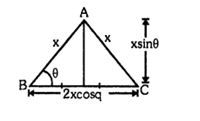
$A$ triangular garden is fenced on two sides,and the third side is a straight river bank. The two fenced sides have an equal length of $x$. What is the maximum area that can be enclosed by the garden?
A
$\sqrt{\frac{x^3}{8}}$
B
$\frac{1}{2}x^2$
C
$\pi x^2$
D
$\frac{3}{2}x^2$
Solution
(B) Let the two equal sides of the triangle be $x$ and the angle between them be $2\theta$.
From the geometry of the triangle,the height is $h = x \sin \theta$ and the base is $b = 2x \cos \theta$.
The area of the triangle is given by $A = \frac{1}{2} \times \text{base} \times \text{height}$.
$A = \frac{1}{2} \times (2x \cos \theta) \times (x \sin \theta) = x^2 \sin \theta \cos \theta$.
Using the identity $\sin 2\theta = 2 \sin \theta \cos \theta$,we get $A = \frac{1}{2} x^2 \sin 2\theta$.
To maximize the area $A$,we need to maximize $\sin 2\theta$.
The maximum value of $\sin 2\theta$ is $1$,which occurs when $2\theta = 90^\circ$ or $\theta = 45^\circ$.
Therefore,the maximum area is $A_{\max} = \frac{1}{2} x^2 (1) = \frac{1}{2} x^2$.
From the geometry of the triangle,the height is $h = x \sin \theta$ and the base is $b = 2x \cos \theta$.
The area of the triangle is given by $A = \frac{1}{2} \times \text{base} \times \text{height}$.
$A = \frac{1}{2} \times (2x \cos \theta) \times (x \sin \theta) = x^2 \sin \theta \cos \theta$.
Using the identity $\sin 2\theta = 2 \sin \theta \cos \theta$,we get $A = \frac{1}{2} x^2 \sin 2\theta$.
To maximize the area $A$,we need to maximize $\sin 2\theta$.
The maximum value of $\sin 2\theta$ is $1$,which occurs when $2\theta = 90^\circ$ or $\theta = 45^\circ$.
Therefore,the maximum area is $A_{\max} = \frac{1}{2} x^2 (1) = \frac{1}{2} x^2$.
0 likes
View Solution140
MediumMCQ
Statement-$I$: Let the function $f(x) = \begin{cases} -\frac{x}{2} & x < 0 \\ 7x + 8 & x \geq 0 \end{cases}$. Then $f(x)$ has a local minimum at $x = 0$.
Statement-$II$: If $f(a) < f(a - h)$ and $f(a) < f(a + h)$ for a sufficiently small $h > 0$,then $f(x)$ has a local minimum at $x = a$.
Statement-$II$: If $f(a) < f(a - h)$ and $f(a) < f(a + h)$ for a sufficiently small $h > 0$,then $f(x)$ has a local minimum at $x = a$.
A
Statement-$I$ is true,Statement-$II$ is true; Statement-$II$ is a correct explanation for Statement-$I$.
B
Statement-$I$ is true,Statement-$II$ is true; Statement-$II$ is not a correct explanation for Statement-$I$.
C
Statement-$I$ is true,Statement-$II$ is false.
D
Statement-$I$ is false,Statement-$II$ is true.
Solution
(D) For Statement-$I$: We examine the behavior of $f(x)$ near $x = 0$.
For $x < 0$,$f(x) = -\frac{x}{2}$. As $x \to 0^-$,$f(x) \to 0$.
For $x \geq 0$,$f(x) = 7x + 8$. As $x \to 0^+$,$f(x) \to 8$.
At $x = 0$,$f(0) = 8$.
Since $f(x)$ is negative for $x < 0$ and $f(0) = 8$,for any small $h > 0$,$f(-h) = \frac{h}{2} > 0$,but $f(0) = 8$. However,we need $f(0) < f(-h)$ for a local minimum,which is $8 < \frac{h}{2}$. This is false for small $h$. Thus,$x=0$ is not a local minimum.
Statement-$I$ is false.
For Statement-$II$: This is the standard definition of a local minimum at $x = a$. Thus,Statement-$II$ is true.
For $x < 0$,$f(x) = -\frac{x}{2}$. As $x \to 0^-$,$f(x) \to 0$.
For $x \geq 0$,$f(x) = 7x + 8$. As $x \to 0^+$,$f(x) \to 8$.
At $x = 0$,$f(0) = 8$.
Since $f(x)$ is negative for $x < 0$ and $f(0) = 8$,for any small $h > 0$,$f(-h) = \frac{h}{2} > 0$,but $f(0) = 8$. However,we need $f(0) < f(-h)$ for a local minimum,which is $8 < \frac{h}{2}$. This is false for small $h$. Thus,$x=0$ is not a local minimum.
Statement-$I$ is false.
For Statement-$II$: This is the standard definition of a local minimum at $x = a$. Thus,Statement-$II$ is true.
0 likes
View Solution141
DifficultMCQ
Find the maximum value of $f(x) = x^3 - 12x^2 + 45x$ in the interval $[0, 7]$.
A
$75$
B
$60$
C
$45$
D
$70$
Solution
(D) Let $f(x) = x^3 - 12x^2 + 45x$.
First,find the derivative $f'(x) = 3x^2 - 24x + 45 = 3(x^2 - 8x + 15) = 3(x - 3)(x - 5)$.
To find the critical points,set $f'(x) = 0$,which gives $x = 3$ and $x = 5$.
Now,evaluate the function $f(x)$ at the critical points and the endpoints of the interval $[0, 7]$:
$f(0) = (0)^3 - 12(0)^2 + 45(0) = 0$
$f(3) = (3)^3 - 12(3)^2 + 45(3) = 27 - 108 + 135 = 54$
$f(5) = (5)^3 - 12(5)^2 + 45(5) = 125 - 300 + 225 = 50$
$f(7) = (7)^3 - 12(7)^2 + 45(7) = 343 - 588 + 315 = 70$
Comparing these values,the maximum value of $f(x)$ on the interval $[0, 7]$ is $70$.
First,find the derivative $f'(x) = 3x^2 - 24x + 45 = 3(x^2 - 8x + 15) = 3(x - 3)(x - 5)$.
To find the critical points,set $f'(x) = 0$,which gives $x = 3$ and $x = 5$.
Now,evaluate the function $f(x)$ at the critical points and the endpoints of the interval $[0, 7]$:
$f(0) = (0)^3 - 12(0)^2 + 45(0) = 0$
$f(3) = (3)^3 - 12(3)^2 + 45(3) = 27 - 108 + 135 = 54$
$f(5) = (5)^3 - 12(5)^2 + 45(5) = 125 - 300 + 225 = 50$
$f(7) = (7)^3 - 12(7)^2 + 45(7) = 343 - 588 + 315 = 70$
Comparing these values,the maximum value of $f(x)$ on the interval $[0, 7]$ is $70$.
0 likes
View Solution142
DifficultMCQ
Find the minimum value of $64 \sec x + 27 \csc x$ for $0 < x < \frac{\pi}{2}$.
A
$91$
B
$25$
C
$125$
D
None of these
Solution
(C) Let $y = 64 \sec x + 27 \csc x$.
To find the minimum value,differentiate $y$ with respect to $x$:
$\frac{dy}{dx} = 64 \sec x \tan x - 27 \csc x \cot x$.
Set $\frac{dy}{dx} = 0$ for critical points:
$64 \sec x \tan x = 27 \csc x \cot x$.
Substituting trigonometric identities:
$64 \left(\frac{1}{\cos x}\right) \left(\frac{\sin x}{\cos x}\right) = 27 \left(\frac{1}{\sin x}\right) \left(\frac{\cos x}{\sin x}\right)$.
$\frac{\sin^3 x}{\cos^3 x} = \frac{27}{64} \Rightarrow \tan^3 x = \left(\frac{3}{4}\right)^3$.
Thus,$\tan x = \frac{3}{4}$.
For a right-angled triangle with opposite side $3$ and adjacent side $4$,the hypotenuse is $\sqrt{3^2 + 4^2} = 5$.
Therefore,$\sec x = \frac{5}{4}$ and $\csc x = \frac{5}{3}$.
Substituting these values into the original expression:
$y = 64 \left(\frac{5}{4}\right) + 27 \left(\frac{5}{3}\right) = 16(5) + 9(5) = 80 + 45 = 125$.
To find the minimum value,differentiate $y$ with respect to $x$:
$\frac{dy}{dx} = 64 \sec x \tan x - 27 \csc x \cot x$.
Set $\frac{dy}{dx} = 0$ for critical points:
$64 \sec x \tan x = 27 \csc x \cot x$.
Substituting trigonometric identities:
$64 \left(\frac{1}{\cos x}\right) \left(\frac{\sin x}{\cos x}\right) = 27 \left(\frac{1}{\sin x}\right) \left(\frac{\cos x}{\sin x}\right)$.
$\frac{\sin^3 x}{\cos^3 x} = \frac{27}{64} \Rightarrow \tan^3 x = \left(\frac{3}{4}\right)^3$.
Thus,$\tan x = \frac{3}{4}$.
For a right-angled triangle with opposite side $3$ and adjacent side $4$,the hypotenuse is $\sqrt{3^2 + 4^2} = 5$.
Therefore,$\sec x = \frac{5}{4}$ and $\csc x = \frac{5}{3}$.
Substituting these values into the original expression:
$y = 64 \left(\frac{5}{4}\right) + 27 \left(\frac{5}{3}\right) = 16(5) + 9(5) = 80 + 45 = 125$.
0 likes
View Solution143
DifficultMCQ
Find the semi-vertical angle of a right circular cone of a given slant height,if the volume of the cone is maximum.
A
$tan^{-1}(2)$
B
$tan^{-1}(\sqrt{2})$
C
$tan^{-1}(1/2)$
D
$tan^{-1}(1/\sqrt{2})$
Solution
(B) Let $l$ be the slant height and $\alpha$ be the semi-vertical angle of the right circular cone. Let $h$ be the height and $r$ be the radius of the base.
Then $h = l \cos \alpha$ and $r = l \sin \alpha$.
The volume $V$ of the cone is given by $V = \frac{1}{3} \pi r^2 h$.
Substituting the values of $r$ and $h$,we get $V = \frac{1}{3} \pi (l \sin \alpha)^2 (l \cos \alpha) = \frac{1}{3} \pi l^3 \sin^2 \alpha \cos \alpha$.
To find the maximum volume,differentiate $V$ with respect to $\alpha$:
$\frac{dV}{d\alpha} = \frac{1}{3} \pi l^3 [\sin^2 \alpha (-\sin \alpha) + \cos \alpha (2 \sin \alpha \cos \alpha)]$
$\frac{dV}{d\alpha} = \frac{1}{3} \pi l^3 [-\sin^3 \alpha + 2 \sin \alpha \cos^2 \alpha]$.
Setting $\frac{dV}{d\alpha} = 0$ for critical points:
$-\sin^3 \alpha + 2 \sin \alpha (1 - \sin^2 \alpha) = 0$
$\sin \alpha (2 - 3 \sin^2 \alpha) = 0$.
Since $\alpha \neq 0$,we have $2 - 3 \sin^2 \alpha = 0$,which implies $\sin^2 \alpha = \frac{2}{3}$.
Using $\cos^2 \alpha = 1 - \sin^2 \alpha = 1 - \frac{2}{3} = \frac{1}{3}$,we find $\tan^2 \alpha = \frac{\sin^2 \alpha}{\cos^2 \alpha} = \frac{2/3}{1/3} = 2$.
Thus,$\tan \alpha = \sqrt{2}$,or $\alpha = \tan^{-1}(\sqrt{2})$.
Checking the second derivative $\frac{d^2V}{d\alpha^2}$ confirms that the volume is maximum at this value.
Then $h = l \cos \alpha$ and $r = l \sin \alpha$.
The volume $V$ of the cone is given by $V = \frac{1}{3} \pi r^2 h$.
Substituting the values of $r$ and $h$,we get $V = \frac{1}{3} \pi (l \sin \alpha)^2 (l \cos \alpha) = \frac{1}{3} \pi l^3 \sin^2 \alpha \cos \alpha$.
To find the maximum volume,differentiate $V$ with respect to $\alpha$:
$\frac{dV}{d\alpha} = \frac{1}{3} \pi l^3 [\sin^2 \alpha (-\sin \alpha) + \cos \alpha (2 \sin \alpha \cos \alpha)]$
$\frac{dV}{d\alpha} = \frac{1}{3} \pi l^3 [-\sin^3 \alpha + 2 \sin \alpha \cos^2 \alpha]$.
Setting $\frac{dV}{d\alpha} = 0$ for critical points:
$-\sin^3 \alpha + 2 \sin \alpha (1 - \sin^2 \alpha) = 0$
$\sin \alpha (2 - 3 \sin^2 \alpha) = 0$.
Since $\alpha \neq 0$,we have $2 - 3 \sin^2 \alpha = 0$,which implies $\sin^2 \alpha = \frac{2}{3}$.
Using $\cos^2 \alpha = 1 - \sin^2 \alpha = 1 - \frac{2}{3} = \frac{1}{3}$,we find $\tan^2 \alpha = \frac{\sin^2 \alpha}{\cos^2 \alpha} = \frac{2/3}{1/3} = 2$.
Thus,$\tan \alpha = \sqrt{2}$,or $\alpha = \tan^{-1}(\sqrt{2})$.
Checking the second derivative $\frac{d^2V}{d\alpha^2}$ confirms that the volume is maximum at this value.
0 likes
View Solution144
DifficultMCQ
If $f(x) = \frac{\sin(x + a)}{\sin(x + b)}$,$a \neq b$,then $f$ is......
A
Minimum at $x = 0$.
B
Maximum at $x = 0$.
C
Neither maximum nor minimum at $x = 0$.
D
None of these.
Solution
(C) Given function is $f(x) = \frac{\sin(x + a)}{\sin(x + b)}$.
To find the critical points,we differentiate $f(x)$ with respect to $x$ using the quotient rule:
$f'(x) = \frac{\sin(x + b) \cos(x + a) - \sin(x + a) \cos(x + b)}{\sin^2(x + b)}$.
Using the trigonometric identity $\sin(A - B) = \sin A \cos B - \cos A \sin B$,we get:
$f'(x) = \frac{\sin((x + a) - (x + b))}{\sin^2(x + b)} = \frac{\sin(a - b)}{\sin^2(x + b)}$.
Since $a \neq b$,$\sin(a - b) \neq 0$. Therefore,$f'(x) \neq 0$ for any $x$ in the domain.
Since the derivative is never zero,the function $f(x)$ does not have any local maxima or local minima at $x = 0$ or anywhere else in its domain.
To find the critical points,we differentiate $f(x)$ with respect to $x$ using the quotient rule:
$f'(x) = \frac{\sin(x + b) \cos(x + a) - \sin(x + a) \cos(x + b)}{\sin^2(x + b)}$.
Using the trigonometric identity $\sin(A - B) = \sin A \cos B - \cos A \sin B$,we get:
$f'(x) = \frac{\sin((x + a) - (x + b))}{\sin^2(x + b)} = \frac{\sin(a - b)}{\sin^2(x + b)}$.
Since $a \neq b$,$\sin(a - b) \neq 0$. Therefore,$f'(x) \neq 0$ for any $x$ in the domain.
Since the derivative is never zero,the function $f(x)$ does not have any local maxima or local minima at $x = 0$ or anywhere else in its domain.
0 likes
View Solution145
DifficultMCQ
$P(x) = x^4 + ax^3 + bx^2 + cx + d$ is such that $x = 0$ is the only real root of $P'(x) = 0$. If $P(-1) < P(1)$,then in the interval $[-1, 1]$:
A
$P(-1)$ is the minimum,but $P(1)$ is not the maximum value of $P$.
B
$P(-1)$ is the minimum and $P(1)$ is the maximum value of $P$.
C
$P(-1)$ is not the minimum,but $P(1)$ is the maximum value of $P$.
D
$P(-1)$ is not the minimum and $P(1)$ is not the maximum value of $P$.
Solution
(B) Given $P(x) = x^4 + ax^3 + bx^2 + cx + d$.
Then $P'(x) = 4x^3 + 3ax^2 + 2bx + c$.
It is given that $x = 0$ is the only real root of $P'(x) = 0$.
Since $P'(0) = 0$,we have $c = 0$.
Thus,$P'(x) = 4x^3 + 3ax^2 + 2bx = x(4x^2 + 3ax + 2b)$.
Since $x=0$ is the only real root,the quadratic $4x^2 + 3ax + 2b = 0$ must have no real roots or a repeated root at $x=0$.
If $4x^2 + 3ax + 2b = 0$ has no real roots,then the discriminant $D = (3a)^2 - 4(4)(2b) = 9a^2 - 32b < 0$.
Since $P'(x)$ changes sign at $x=0$ (as it is a cubic with only one real root),$x=0$ is a point of local extremum.
For $x < 0$,$P'(x) < 0$ and for $x > 0$,$P'(x) > 0$,so $x=0$ is a local minimum.
Since $P(x)$ is a polynomial of degree $4$ with a positive leading coefficient,it is continuous on $[-1, 1]$.
The absolute minimum must occur at $x=0$ (since it is the only critical point).
Given $P(-1) < P(1)$,the maximum value on $[-1, 1]$ must occur at the endpoint $x=1$.
Therefore,$P(-1)$ is the minimum value and $P(1)$ is the maximum value of $P(x)$ on $[-1, 1]$.
Then $P'(x) = 4x^3 + 3ax^2 + 2bx + c$.
It is given that $x = 0$ is the only real root of $P'(x) = 0$.
Since $P'(0) = 0$,we have $c = 0$.
Thus,$P'(x) = 4x^3 + 3ax^2 + 2bx = x(4x^2 + 3ax + 2b)$.
Since $x=0$ is the only real root,the quadratic $4x^2 + 3ax + 2b = 0$ must have no real roots or a repeated root at $x=0$.
If $4x^2 + 3ax + 2b = 0$ has no real roots,then the discriminant $D = (3a)^2 - 4(4)(2b) = 9a^2 - 32b < 0$.
Since $P'(x)$ changes sign at $x=0$ (as it is a cubic with only one real root),$x=0$ is a point of local extremum.
For $x < 0$,$P'(x) < 0$ and for $x > 0$,$P'(x) > 0$,so $x=0$ is a local minimum.
Since $P(x)$ is a polynomial of degree $4$ with a positive leading coefficient,it is continuous on $[-1, 1]$.
The absolute minimum must occur at $x=0$ (since it is the only critical point).
Given $P(-1) < P(1)$,the maximum value on $[-1, 1]$ must occur at the endpoint $x=1$.
Therefore,$P(-1)$ is the minimum value and $P(1)$ is the maximum value of $P(x)$ on $[-1, 1]$.
0 likes
View Solution146
MediumMCQ
The curve $y = 2x^3 + ax^2 + bx + c$ passes through the origin,and the tangents at $x = -1$ and $x = 2$ are parallel to the $X$-axis. Then the values of $a, b,$ and $c$ are respectively:
A
$12, -3, 0$
B
$-3, -12, 0$
C
$-3, 12, 0$
D
$3, -12, 0$
Solution
(B) Since the curve passes through the origin $(0, 0)$,we have $0 = 2(0)^3 + a(0)^2 + b(0) + c$,which implies $c = 0$.
The derivative of the curve is $\frac{dy}{dx} = 6x^2 + 2ax + b$.
Given that the tangents at $x = -1$ and $x = 2$ are parallel to the $X$-axis,their slopes must be zero.
At $x = -1$: $6(-1)^2 + 2a(-1) + b = 0 \implies 6 - 2a + b = 0 \implies 2a - b = 6 \quad (1)$.
At $x = 2$: $6(2)^2 + 2a(2) + b = 0 \implies 24 + 4a + b = 0 \implies 4a + b = -24 \quad (2)$.
Adding equations $(1)$ and $(2)$:
$(2a - b) + (4a + b) = 6 - 24$
$6a = -18 \implies a = -3$.
Substituting $a = -3$ into equation $(1)$:
$2(-3) - b = 6 \implies -6 - b = 6 \implies b = -12$.
Thus,the values are $a = -3, b = -12, c = 0$.
The derivative of the curve is $\frac{dy}{dx} = 6x^2 + 2ax + b$.
Given that the tangents at $x = -1$ and $x = 2$ are parallel to the $X$-axis,their slopes must be zero.
At $x = -1$: $6(-1)^2 + 2a(-1) + b = 0 \implies 6 - 2a + b = 0 \implies 2a - b = 6 \quad (1)$.
At $x = 2$: $6(2)^2 + 2a(2) + b = 0 \implies 24 + 4a + b = 0 \implies 4a + b = -24 \quad (2)$.
Adding equations $(1)$ and $(2)$:
$(2a - b) + (4a + b) = 6 - 24$
$6a = -18 \implies a = -3$.
Substituting $a = -3$ into equation $(1)$:
$2(-3) - b = 6 \implies -6 - b = 6 \implies b = -12$.
Thus,the values are $a = -3, b = -12, c = 0$.
0 likes
View Solution147
DifficultMCQ
At which point in the interval $[0, 1]$ is the function $f(x) = x^{25}(1 - x)^{75}$ maximum?
A
$x = 0$
B
$x = 1/4$
C
$x = 1/2$
D
$x = 1/3$
Solution
(B) Let $f(x) = x^{25}(1 - x)^{75}$.
To find the critical points,we differentiate $f(x)$ with respect to $x$:
$f'(x) = 25x^{24}(1 - x)^{75} + x^{25} \cdot 75(1 - x)^{74}(-1)$
$f'(x) = 25x^{24}(1 - x)^{74} [(1 - x) - 3x]$
$f'(x) = 25x^{24}(1 - x)^{74} (1 - 4x)$.
Setting $f'(x) = 0$,we get critical points at $x = 0$,$x = 1$,and $x = 1/4$.
Evaluating the function at the critical points and endpoints:
$f(0) = 0^{25}(1 - 0)^{75} = 0$
$f(1) = 1^{25}(1 - 1)^{75} = 0$
$f(1/4) = (1/4)^{25}(1 - 1/4)^{75} = (1/4)^{25}(3/4)^{75} > 0$.
Since $f(x) \geq 0$ for all $x \in [0, 1]$ and the value at $x = 1/4$ is positive,the function attains its maximum at $x = 1/4$.
To find the critical points,we differentiate $f(x)$ with respect to $x$:
$f'(x) = 25x^{24}(1 - x)^{75} + x^{25} \cdot 75(1 - x)^{74}(-1)$
$f'(x) = 25x^{24}(1 - x)^{74} [(1 - x) - 3x]$
$f'(x) = 25x^{24}(1 - x)^{74} (1 - 4x)$.
Setting $f'(x) = 0$,we get critical points at $x = 0$,$x = 1$,and $x = 1/4$.
Evaluating the function at the critical points and endpoints:
$f(0) = 0^{25}(1 - 0)^{75} = 0$
$f(1) = 1^{25}(1 - 1)^{75} = 0$
$f(1/4) = (1/4)^{25}(1 - 1/4)^{75} = (1/4)^{25}(3/4)^{75} > 0$.
Since $f(x) \geq 0$ for all $x \in [0, 1]$ and the value at $x = 1/4$ is positive,the function attains its maximum at $x = 1/4$.
0 likes
View Solution148
MediumMCQ
The function $f(x) = \sin^p x \cos^q x$ has a maximum at:
A
$x = \tan^{-1} \sqrt{p/q}$
B
$x = \tan^{-1} \sqrt{q/p}$
C
$x = 0$
D
$x = \pi/2$
Solution
(A) Let $y = \sin^p x \cos^q x$.
Taking the natural logarithm on both sides,we get $z = \ln(y) = p \ln(\sin x) + q \ln(\cos x)$.
Differentiating with respect to $x$,we have $\frac{dz}{dx} = p \cot x - q \tan x$.
For critical points,set $\frac{dz}{dx} = 0$,which gives $p \cot x = q \tan x$,or $\tan^2 x = p/q$. Thus,$x = \tan^{-1} \sqrt{p/q}$.
To check for a maximum,we find the second derivative: $\frac{d^2z}{dx^2} = -p \csc^2 x - q \sec^2 x$.
Since $p, q > 0$,$\frac{d^2z}{dx^2} < 0$ for all $x$ in the domain,confirming that $x = \tan^{-1} \sqrt{p/q}$ is a point of local maximum.
Taking the natural logarithm on both sides,we get $z = \ln(y) = p \ln(\sin x) + q \ln(\cos x)$.
Differentiating with respect to $x$,we have $\frac{dz}{dx} = p \cot x - q \tan x$.
For critical points,set $\frac{dz}{dx} = 0$,which gives $p \cot x = q \tan x$,or $\tan^2 x = p/q$. Thus,$x = \tan^{-1} \sqrt{p/q}$.
To check for a maximum,we find the second derivative: $\frac{d^2z}{dx^2} = -p \csc^2 x - q \sec^2 x$.
Since $p, q > 0$,$\frac{d^2z}{dx^2} < 0$ for all $x$ in the domain,confirming that $x = \tan^{-1} \sqrt{p/q}$ is a point of local maximum.
0 likes
View Solution149
MediumMCQ
Find the point where $f(x) = 2\sin x + \cos 2x$ has a maximum value in the interval $0 \leq x \leq 2\pi$.
A
$x = \pi / 2$
B
$x = 3\pi / 2$
C
$x = \pi / 6$
D
None of these
Solution
(C) Given $f(x) = 2\sin x + \cos 2x$ for $0 \leq x \leq 2\pi$.
First,find the derivative: $f'(x) = 2\cos x - 2\sin 2x$.
Set $f'(x) = 0$ to find critical points:
$2\cos x - 4\sin x \cos x = 0$
$2\cos x(1 - 2\sin x) = 0$
This gives $\cos x = 0$ or $\sin x = 1/2$.
In the interval $[0, 2\pi]$,$\cos x = 0$ at $x = \pi/2, 3\pi/2$ and $\sin x = 1/2$ at $x = \pi/6, 5\pi/6$.
Now,find the second derivative: $f''(x) = -2\sin x - 4\cos 2x$.
Check the values:
At $x = \pi/6$: $f''(\pi/6) = -2(1/2) - 4\cos(\pi/3) = -1 - 4(1/2) = -3 < 0$ (Local Maximum).
At $x = \pi/2$: $f''(\pi/2) = -2(1) - 4\cos(\pi) = -2 + 4 = 2 > 0$ (Local Minimum).
At $x = 5\pi/6$: $f''(5\pi/6) = -2(1/2) - 4\cos(5\pi/3) = -1 - 4(1/2) = -3 < 0$ (Local Maximum).
At $x = 3\pi/2$: $f''(3\pi/2) = -2(-1) - 4\cos(3\pi) = 2 + 4 = 6 > 0$ (Local Minimum).
Comparing values at critical points: $f(\pi/6) = 2(1/2) + 1/2 = 1.5$,$f(5\pi/6) = 1.5$,$f(\pi/2) = 2(1) - 1 = 1$,$f(3\pi/2) = 2(-1) - 1 = -3$.
The maximum value is $1.5$ at $x = \pi/6$ and $x = 5\pi/6$.
First,find the derivative: $f'(x) = 2\cos x - 2\sin 2x$.
Set $f'(x) = 0$ to find critical points:
$2\cos x - 4\sin x \cos x = 0$
$2\cos x(1 - 2\sin x) = 0$
This gives $\cos x = 0$ or $\sin x = 1/2$.
In the interval $[0, 2\pi]$,$\cos x = 0$ at $x = \pi/2, 3\pi/2$ and $\sin x = 1/2$ at $x = \pi/6, 5\pi/6$.
Now,find the second derivative: $f''(x) = -2\sin x - 4\cos 2x$.
Check the values:
At $x = \pi/6$: $f''(\pi/6) = -2(1/2) - 4\cos(\pi/3) = -1 - 4(1/2) = -3 < 0$ (Local Maximum).
At $x = \pi/2$: $f''(\pi/2) = -2(1) - 4\cos(\pi) = -2 + 4 = 2 > 0$ (Local Minimum).
At $x = 5\pi/6$: $f''(5\pi/6) = -2(1/2) - 4\cos(5\pi/3) = -1 - 4(1/2) = -3 < 0$ (Local Maximum).
At $x = 3\pi/2$: $f''(3\pi/2) = -2(-1) - 4\cos(3\pi) = 2 + 4 = 6 > 0$ (Local Minimum).
Comparing values at critical points: $f(\pi/6) = 2(1/2) + 1/2 = 1.5$,$f(5\pi/6) = 1.5$,$f(\pi/2) = 2(1) - 1 = 1$,$f(3\pi/2) = 2(-1) - 1 = -3$.
The maximum value is $1.5$ at $x = \pi/6$ and $x = 5\pi/6$.
0 likes
View Solution150
DifficultMCQ
Let $a, b \in R$ be such that the function $f(x) = \ln|x| + bx^2 + ax, x \neq 0$ has extreme values at $x = -1$ and $x = 2$.
Statement-$1$: $f$ has a local maximum at $x = -1$ and $x = 2$.
Statement-$2$: $a = \frac{1}{2}$ and $b = -\frac{1}{4}$.
Statement-$1$: $f$ has a local maximum at $x = -1$ and $x = 2$.
Statement-$2$: $a = \frac{1}{2}$ and $b = -\frac{1}{4}$.
A
Statement-$1$ is true,Statement-$2$ is false.
B
Statement-$1$ is false,Statement-$2$ is true.
C
Statement-$1$ is true,Statement-$2$ is true; Statement-$2$ is a correct explanation for Statement-$1$.
D
Statement-$1$ is true,Statement-$2$ is true; Statement-$2$ is not a correct explanation for Statement-$1$.
Solution
(C) Given $f(x) = \ln|x| + bx^2 + ax$. The derivative is $f'(x) = \frac{1}{x} + 2bx + a$.
Since $f(x)$ has extreme values at $x = -1$ and $x = 2$,we must have $f'(-1) = 0$ and $f'(2) = 0$.
For $x = -1$: $-1 - 2b + a = 0 \implies a - 2b = 1$.
For $x = 2$: $\frac{1}{2} + 4b + a = 0 \implies a + 4b = -\frac{1}{2}$.
Subtracting the equations: $(a + 4b) - (a - 2b) = -\frac{1}{2} - 1 \implies 6b = -\frac{3}{2} \implies b = -\frac{1}{4}$.
Substituting $b = -\frac{1}{4}$ into $a - 2b = 1$: $a - 2(-\frac{1}{4}) = 1 \implies a + \frac{1}{2} = 1 \implies a = \frac{1}{2}$.
Thus,Statement-$2$ is true.
Now,$f''(x) = -\frac{1}{x^2} + 2b = -\frac{1}{x^2} - \frac{1}{2}$.
At $x = -1$,$f''(-1) = -1 - \frac{1}{2} = -\frac{3}{2} < 0$,so $f$ has a local maximum at $x = -1$.
At $x = 2$,$f''(2) = -\frac{1}{4} - \frac{1}{2} = -\frac{3}{4} < 0$,so $f$ has a local maximum at $x = 2$.
Thus,Statement-$1$ is true and Statement-$2$ is a correct explanation for Statement-$1$.
Since $f(x)$ has extreme values at $x = -1$ and $x = 2$,we must have $f'(-1) = 0$ and $f'(2) = 0$.
For $x = -1$: $-1 - 2b + a = 0 \implies a - 2b = 1$.
For $x = 2$: $\frac{1}{2} + 4b + a = 0 \implies a + 4b = -\frac{1}{2}$.
Subtracting the equations: $(a + 4b) - (a - 2b) = -\frac{1}{2} - 1 \implies 6b = -\frac{3}{2} \implies b = -\frac{1}{4}$.
Substituting $b = -\frac{1}{4}$ into $a - 2b = 1$: $a - 2(-\frac{1}{4}) = 1 \implies a + \frac{1}{2} = 1 \implies a = \frac{1}{2}$.
Thus,Statement-$2$ is true.
Now,$f''(x) = -\frac{1}{x^2} + 2b = -\frac{1}{x^2} - \frac{1}{2}$.
At $x = -1$,$f''(-1) = -1 - \frac{1}{2} = -\frac{3}{2} < 0$,so $f$ has a local maximum at $x = -1$.
At $x = 2$,$f''(2) = -\frac{1}{4} - \frac{1}{2} = -\frac{3}{4} < 0$,so $f$ has a local maximum at $x = 2$.
Thus,Statement-$1$ is true and Statement-$2$ is a correct explanation for Statement-$1$.
0 likes
View SolutionApplications of Derivatives — Maxima and Minima · Frequently Asked Questions
1Are these Applications of Derivatives questions useful for JEE and NEET?
Yes. All questions in this section are mapped to JEE Main and NEET exam patterns. Previous year questions from JEE Main, NEET, GUJCET and state-level exams are included with full solutions.
2Can I switch to Hindi or Gujarati for these questions?
Yes. Use the language tabs in the hero section or the sidebar to view the same questions and solutions in English, Hindi or Gujarati.
3How do I generate a question paper from this subtopic?
Use the Vedclass Exam Paper Generator — select the chapter and subtopic, set difficulty, and generate Sets A, B, C, D automatically. First 3 chapters of every subject are free.
Vedclass Products
For Students
Vedclass Test Series
Mock tests in real JEE/NEET style with performance analysis. 5-day free trial.
Start Free TrialFor Teachers
Exam Paper Generator
Generate Set A/B/C/D papers from this chapter in 2 minutes. 3 chapters free.
Try FreeFor Institutes
Online Exam Module
Live online exams with unlimited students, 360° analytics & white-label branding.
See DemoFor Teachers & Institutes
Generate a Applications of Derivatives Exam Paper in 2 Minutes
Select subtopic & difficulty — Sets A, B, C, D auto-generated with No Repeat logic.
First 3 chapters of every subject are free — no payment required.