
A English
Increasing and Decreasing function Questions in English
Class 12 Mathematics · Applications of Derivatives · Increasing and Decreasing function
389+
Questions
English
Language
100%
With Solutions
Showing 37 of 389 questions in English
351
EasyMCQ
The set of values of $x$ for which $f(x)=3x^4-8x^3-6x^2+24x-12$ is an increasing function,is
A
$(-\infty, -1) \cup (1, 2)$
B
$(-1, 1) \cup (2, \infty)$
C
$(-1, 1) \cup (1, 2)$
D
$(-1, 2) \cup (2, \infty)$
Solution
(B) To find the intervals where $f(x)$ is increasing,we find the derivative $f'(x)$ and set $f'(x) > 0$.
Given $f(x) = 3x^4 - 8x^3 - 6x^2 + 24x - 12$.
$f'(x) = 12x^3 - 24x^2 - 12x + 24$.
Factor out $12$: $f'(x) = 12(x^3 - 2x^2 - x + 2)$.
Factor by grouping: $f'(x) = 12[x^2(x - 2) - 1(x - 2)] = 12(x^2 - 1)(x - 2) = 12(x - 1)(x + 1)(x - 2)$.
For $f(x)$ to be increasing,$f'(x) > 0$,so $(x - 1)(x + 1)(x - 2) > 0$.
Using the wavy curve method (sign scheme) for the critical points $x = -1, 1, 2$:
For $x \in (-1, 1)$,$f'(x) > 0$.
For $x \in (2, \infty)$,$f'(x) > 0$.
Thus,the function is increasing on $(-1, 1) \cup (2, \infty)$.
Given $f(x) = 3x^4 - 8x^3 - 6x^2 + 24x - 12$.
$f'(x) = 12x^3 - 24x^2 - 12x + 24$.
Factor out $12$: $f'(x) = 12(x^3 - 2x^2 - x + 2)$.
Factor by grouping: $f'(x) = 12[x^2(x - 2) - 1(x - 2)] = 12(x^2 - 1)(x - 2) = 12(x - 1)(x + 1)(x - 2)$.
For $f(x)$ to be increasing,$f'(x) > 0$,so $(x - 1)(x + 1)(x - 2) > 0$.
Using the wavy curve method (sign scheme) for the critical points $x = -1, 1, 2$:
For $x \in (-1, 1)$,$f'(x) > 0$.
For $x \in (2, \infty)$,$f'(x) > 0$.
Thus,the function is increasing on $(-1, 1) \cup (2, \infty)$.
0 likes
View Solution352
EasyMCQ
The interval in which the function $f(x) = 2x^2 - \log x$,for $x > 0$ decreases is
A
$(2, 4)$
B
$(0, \frac{1}{4})$
C
$(\frac{1}{2}, \infty)$
D
$(0, \frac{1}{2})$
Solution
(D) Given function is $f(x) = 2x^2 - \log x$ for $x > 0$.
To find the interval where the function decreases,we find the derivative $f'(x)$.
$f'(x) = \frac{d}{dx}(2x^2 - \log x) = 4x - \frac{1}{x}$.
The function $f(x)$ is decreasing when $f'(x) < 0$.
$4x - \frac{1}{x} < 0$
$\Rightarrow \frac{4x^2 - 1}{x} < 0$.
Since $x > 0$,we can multiply by $x$ without changing the inequality sign:
$4x^2 - 1 < 0$
$\Rightarrow 4x^2 < 1$
$\Rightarrow x^2 < \frac{1}{4}$
$\Rightarrow |x| < \frac{1}{2}$.
This gives $x \in (-\frac{1}{2}, \frac{1}{2})$.
Given the condition $x > 0$,the interval is $x \in (0, \frac{1}{2})$.
Thus,the function decreases in the interval $(0, \frac{1}{2})$.
To find the interval where the function decreases,we find the derivative $f'(x)$.
$f'(x) = \frac{d}{dx}(2x^2 - \log x) = 4x - \frac{1}{x}$.
The function $f(x)$ is decreasing when $f'(x) < 0$.
$4x - \frac{1}{x} < 0$
$\Rightarrow \frac{4x^2 - 1}{x} < 0$.
Since $x > 0$,we can multiply by $x$ without changing the inequality sign:
$4x^2 - 1 < 0$
$\Rightarrow 4x^2 < 1$
$\Rightarrow x^2 < \frac{1}{4}$
$\Rightarrow |x| < \frac{1}{2}$.
This gives $x \in (-\frac{1}{2}, \frac{1}{2})$.
Given the condition $x > 0$,the interval is $x \in (0, \frac{1}{2})$.
Thus,the function decreases in the interval $(0, \frac{1}{2})$.
0 likes
View Solution353
EasyMCQ
The function $f(x) = x \cdot e^{x(1-x)}$ is
A
increasing in $\left[-\frac{1}{2}, 1\right]$
B
decreasing in $\left[-\frac{1}{2}, 1\right]$
C
increasing in $R$
D
decreasing in $R$
Solution
(A) Given the function $f(x) = x \cdot e^{x-x^2}$.
To find the intervals of increase or decrease,we find the derivative $f'(x)$.
Using the product rule and chain rule: $f'(x) = 1 \cdot e^{x-x^2} + x \cdot e^{x-x^2} \cdot (1-2x)$.
$f'(x) = e^{x-x^2} [1 + x(1-2x)] = e^{x-x^2} (1 + x - 2x^2)$.
Factor the quadratic expression: $1 + x - 2x^2 = -(2x^2 - x - 1) = -(2x+1)(x-1) = (2x+1)(1-x)$.
So,$f'(x) = e^{x-x^2} (2x+1)(1-x)$.
For the function to be increasing,$f'(x) \geq 0$.
Since $e^{x-x^2} > 0$ for all $x \in R$,the sign of $f'(x)$ depends on $(2x+1)(1-x)$.
$(2x+1)(1-x) \geq 0$ implies $-\frac{1}{2} \leq x \leq 1$.
Thus,the function is increasing in the interval $\left[-\frac{1}{2}, 1\right]$.
To find the intervals of increase or decrease,we find the derivative $f'(x)$.
Using the product rule and chain rule: $f'(x) = 1 \cdot e^{x-x^2} + x \cdot e^{x-x^2} \cdot (1-2x)$.
$f'(x) = e^{x-x^2} [1 + x(1-2x)] = e^{x-x^2} (1 + x - 2x^2)$.
Factor the quadratic expression: $1 + x - 2x^2 = -(2x^2 - x - 1) = -(2x+1)(x-1) = (2x+1)(1-x)$.
So,$f'(x) = e^{x-x^2} (2x+1)(1-x)$.
For the function to be increasing,$f'(x) \geq 0$.
Since $e^{x-x^2} > 0$ for all $x \in R$,the sign of $f'(x)$ depends on $(2x+1)(1-x)$.
$(2x+1)(1-x) \geq 0$ implies $-\frac{1}{2} \leq x \leq 1$.
Thus,the function is increasing in the interval $\left[-\frac{1}{2}, 1\right]$.
0 likes
View Solution354
DifficultMCQ
In the interval $(-3,3)$,the function $f(x) = \frac{x}{3} + \frac{3}{x}, x \neq 0$ is :
A
increasing
B
decreasing
C
neither increasing nor decreasing
D
partly increasing and partly decreasing
Solution
(B) Given $f(x) = \frac{x}{3} + \frac{3}{x}$.
First,we find the derivative $f'(x)$:
$f'(x) = \frac{1}{3} - \frac{3}{x^2} = \frac{x^2 - 9}{3x^2}$.
For the function to be decreasing,we need $f'(x) < 0$.
Since $3x^2 > 0$ for all $x \neq 0$,the sign of $f'(x)$ depends on the numerator $x^2 - 9$.
We have $x^2 - 9 < 0$ when $x^2 < 9$,which implies $|x| < 3$,or $x \in (-3, 3)$.
Since $f'(x) < 0$ for all $x \in (-3, 3) \setminus \{0\}$,the function $f(x)$ is decreasing on the interval $(-3, 3)$.
First,we find the derivative $f'(x)$:
$f'(x) = \frac{1}{3} - \frac{3}{x^2} = \frac{x^2 - 9}{3x^2}$.
For the function to be decreasing,we need $f'(x) < 0$.
Since $3x^2 > 0$ for all $x \neq 0$,the sign of $f'(x)$ depends on the numerator $x^2 - 9$.
We have $x^2 - 9 < 0$ when $x^2 < 9$,which implies $|x| < 3$,or $x \in (-3, 3)$.
Since $f'(x) < 0$ for all $x \in (-3, 3) \setminus \{0\}$,the function $f(x)$ is decreasing on the interval $(-3, 3)$.
0 likes
View Solution355
EasyMCQ
Observe the following statements:
$A: f(x) = 2x^3 - 9x^2 + 12x - 3$ is increasing outside the interval $(1, 2)$.
$R: f^{\prime}(x) < 0$ for $x \in (1, 2)$.
Then,which of the following is true?
$A: f(x) = 2x^3 - 9x^2 + 12x - 3$ is increasing outside the interval $(1, 2)$.
$R: f^{\prime}(x) < 0$ for $x \in (1, 2)$.
Then,which of the following is true?
A
Both $A$ and $R$ are true,and $R$ is not the correct reason for $A$.
B
Both $A$ and $R$ are true,and $R$ is the correct reason for $A$.
C
$A$ is true but $R$ is false.
D
$A$ is false but $R$ is true.
Solution
(A) Given function: $f(x) = 2x^3 - 9x^2 + 12x - 3$ $(i)$
Differentiating with respect to $x$:
$f^{\prime}(x) = 6x^2 - 18x + 12 = 6(x^2 - 3x + 2) = 6(x - 1)(x - 2)$ (ii)
For $f(x)$ to be increasing,$f^{\prime}(x) > 0$.
Thus,$f(x)$ is increasing outside the interval $(1, 2)$. Hence,statement $A$ is true.
For statement $R$,we check the condition for decreasing function: $f^{\prime}(x) < 0$.
Thus,$f^{\prime}(x) < 0$ for $x \in (1, 2)$. Hence,statement $R$ is true.
Since statement $A$ describes the increasing behavior and statement $R$ describes the decreasing behavior,$R$ is not the reason for $A$.
Therefore,both $A$ and $R$ are true,and $R$ is not the correct reason for $A$.
Differentiating with respect to $x$:
$f^{\prime}(x) = 6x^2 - 18x + 12 = 6(x^2 - 3x + 2) = 6(x - 1)(x - 2)$ (ii)
For $f(x)$ to be increasing,$f^{\prime}(x) > 0$.
| $6(x - 1)(x - 2) > 0$ |
| This holds when $x < 1$ or $x > 2$. |
Thus,$f(x)$ is increasing outside the interval $(1, 2)$. Hence,statement $A$ is true.
For statement $R$,we check the condition for decreasing function: $f^{\prime}(x) < 0$.
| $6(x - 1)(x - 2) < 0$ |
| This holds when $1 < x < 2$. |
Thus,$f^{\prime}(x) < 0$ for $x \in (1, 2)$. Hence,statement $R$ is true.
Since statement $A$ describes the increasing behavior and statement $R$ describes the decreasing behavior,$R$ is not the reason for $A$.
Therefore,both $A$ and $R$ are true,and $R$ is not the correct reason for $A$.
0 likes
View Solution356
DifficultMCQ
If $\log (1+x)-\frac{2x}{2+x}$ is increasing,then
A
$0 < x < \infty$
B
$-\infty < x < 0$
C
$-\infty < x < \infty$
D
$-1 < x < 2$
Solution
(A) Let $f(x) = \log(1+x) - \frac{2x}{2+x}$.
For the function to be defined,we must have $1+x > 0$,which implies $x > -1$.
Now,find the derivative $f'(x)$:
$f'(x) = \frac{1}{1+x} - \frac{(2+x)(2) - 2x(1)}{(2+x)^2}$
$f'(x) = \frac{1}{1+x} - \frac{4+2x-2x}{(2+x)^2} = \frac{1}{1+x} - \frac{4}{(2+x)^2}$
For the function to be increasing,$f'(x) > 0$:
$\frac{(2+x)^2 - 4(1+x)}{(1+x)(2+x)^2} > 0$
$\frac{4+x^2+4x - 4 - 4x}{(1+x)(2+x)^2} > 0$
$\frac{x^2}{(1+x)(2+x)^2} > 0$
Since $x^2 \ge 0$ and $(2+x)^2 > 0$ for $x \neq -2$,the inequality holds when $1+x > 0$ and $x \neq 0$.
Thus,$x > -1$ and $x \neq 0$.
For the function to be defined,we must have $1+x > 0$,which implies $x > -1$.
Now,find the derivative $f'(x)$:
$f'(x) = \frac{1}{1+x} - \frac{(2+x)(2) - 2x(1)}{(2+x)^2}$
$f'(x) = \frac{1}{1+x} - \frac{4+2x-2x}{(2+x)^2} = \frac{1}{1+x} - \frac{4}{(2+x)^2}$
For the function to be increasing,$f'(x) > 0$:
$\frac{(2+x)^2 - 4(1+x)}{(1+x)(2+x)^2} > 0$
$\frac{4+x^2+4x - 4 - 4x}{(1+x)(2+x)^2} > 0$
$\frac{x^2}{(1+x)(2+x)^2} > 0$
Since $x^2 \ge 0$ and $(2+x)^2 > 0$ for $x \neq -2$,the inequality holds when $1+x > 0$ and $x \neq 0$.
Thus,$x > -1$ and $x \neq 0$.
0 likes
View Solution357
EasyMCQ
If the tangent drawn to the curve $y=x^3-ax^2+x+1$ at each point $x \in R$ is inclined at an acute angle with the positive direction of the $X$-axis,then the set of all possible values of '$a$' is
A
$R-(-\sqrt{3}, \sqrt{3})$
B
$[-3, 3]$
C
$R$
D
$(-\sqrt{3}, \sqrt{3})$
Solution
(D) Given the curve $y = x^3 - ax^2 + x + 1$.
The slope of the tangent is given by $\frac{dy}{dx} = 3x^2 - 2ax + 1$.
Since the tangent makes an acute angle with the positive direction of the $X$-axis,the slope must be positive for all $x \in R$.
Thus,$3x^2 - 2ax + 1 > 0$ for all $x \in R$.
For a quadratic expression $Ax^2 + Bx + C > 0$ to be true for all $x \in R$,we must have $A > 0$ and the discriminant $D < 0$.
Here,$A = 3 > 0$,which is satisfied.
Now,we require $D = B^2 - 4AC < 0$.
Substituting the values,$(-2a)^2 - 4(3)(1) < 0$.
$4a^2 - 12 < 0$.
$a^2 - 3 < 0$.
$(a - \sqrt{3})(a + \sqrt{3}) < 0$.
Therefore,$a \in (-\sqrt{3}, \sqrt{3})$.
The slope of the tangent is given by $\frac{dy}{dx} = 3x^2 - 2ax + 1$.
Since the tangent makes an acute angle with the positive direction of the $X$-axis,the slope must be positive for all $x \in R$.
Thus,$3x^2 - 2ax + 1 > 0$ for all $x \in R$.
For a quadratic expression $Ax^2 + Bx + C > 0$ to be true for all $x \in R$,we must have $A > 0$ and the discriminant $D < 0$.
Here,$A = 3 > 0$,which is satisfied.
Now,we require $D = B^2 - 4AC < 0$.
Substituting the values,$(-2a)^2 - 4(3)(1) < 0$.
$4a^2 - 12 < 0$.
$a^2 - 3 < 0$.
$(a - \sqrt{3})(a + \sqrt{3}) < 0$.
Therefore,$a \in (-\sqrt{3}, \sqrt{3})$.
0 likes
View Solution358
MediumMCQ
If $f(x)=\sqrt{3} \sin x-\cos x-2 a x+b$ decreases for all values of $x$,then
A
$a \geq 1$
B
$a=1$
C
$a \leq 1$
D
$a < 1$
Solution
(A) Given the function $f(x)=\sqrt{3} \sin x-\cos x-2 a x+b$.
To find the condition for $f(x)$ to be decreasing,we first find its derivative $f^{\prime}(x)$.
$f^{\prime}(x)=\sqrt{3} \cos x+\sin x-2 a$.
We can rewrite this as $f^{\prime}(x)=2 \left( \frac{\sqrt{3}}{2} \cos x+\frac{1}{2} \sin x \right)-2 a$.
Using the identity $\sin(A+B) = \sin A \cos B + \cos A \sin B$,we get $f^{\prime}(x)=2 \sin \left(x+\frac{\pi}{3}\right)-2 a$.
For $f(x)$ to decrease for all $x$,we must have $f^{\prime}(x) \leq 0$ for all $x$.
$2 \sin \left(x+\frac{\pi}{3}\right)-2 a \leq 0$.
$2 a \geq 2 \sin \left(x+\frac{\pi}{3}\right)$.
$a \geq \sin \left(x+\frac{\pi}{3}\right)$.
Since the maximum value of $\sin \left(x+\frac{\pi}{3}\right)$ is $1$,for the inequality to hold for all $x$,we must have $a \geq 1$.
To find the condition for $f(x)$ to be decreasing,we first find its derivative $f^{\prime}(x)$.
$f^{\prime}(x)=\sqrt{3} \cos x+\sin x-2 a$.
We can rewrite this as $f^{\prime}(x)=2 \left( \frac{\sqrt{3}}{2} \cos x+\frac{1}{2} \sin x \right)-2 a$.
Using the identity $\sin(A+B) = \sin A \cos B + \cos A \sin B$,we get $f^{\prime}(x)=2 \sin \left(x+\frac{\pi}{3}\right)-2 a$.
For $f(x)$ to decrease for all $x$,we must have $f^{\prime}(x) \leq 0$ for all $x$.
$2 \sin \left(x+\frac{\pi}{3}\right)-2 a \leq 0$.
$2 a \geq 2 \sin \left(x+\frac{\pi}{3}\right)$.
$a \geq \sin \left(x+\frac{\pi}{3}\right)$.
Since the maximum value of $\sin \left(x+\frac{\pi}{3}\right)$ is $1$,for the inequality to hold for all $x$,we must have $a \geq 1$.
0 likes
View Solution359
EasyMCQ
The maximum interval in which the slopes of the tangents drawn to the curve $y=x^4+5x^3+9x^2+6x+2$ increase is
A
$\left[\frac{-3}{2}, -1\right]$
B
$\left[1, \frac{3}{2}\right]$
C
$R-\left[1, \frac{3}{2}\right]$
D
$R-\left(\frac{-3}{2}, -1\right)$
Solution
(D) Let $f(x) = y = x^4+5x^3+9x^2+6x+2$.
The slope of the tangent to the curve is given by $m(x) = \frac{dy}{dx} = 4x^3+15x^2+18x+6$.
For the slope $m(x)$ to be increasing,its derivative must be greater than or equal to zero,i.e.,$\frac{dm}{dx} = \frac{d^2y}{dx^2} \ge 0$.
Calculating the second derivative: $\frac{d^2y}{dx^2} = 12x^2+30x+18$.
Factoring the quadratic expression: $12x^2+30x+18 = 6(2x^2+5x+3) = 6(2x+3)(x+1)$.
We need $6(2x+3)(x+1) \ge 0$.
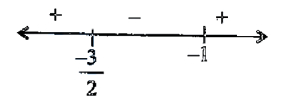
The critical points are $x = -\frac{3}{2}$ and $x = -1$.
Testing the intervals:
$1$) For $x \in (-\infty, -\frac{3}{2}]$,$\frac{d^2y}{dx^2} \ge 0$.
$2$) For $x \in [-\frac{3}{2}, -1]$,$\frac{d^2y}{dx^2} \le 0$.
$3$) For $x \in [-1, \infty)$,$\frac{d^2y}{dx^2} \ge 0$.
Thus,the slope increases in the interval $(-\infty, -\frac{3}{2}] \cup [-1, \infty)$,which can be written as $R - (-\frac{3}{2}, -1)$.
The slope of the tangent to the curve is given by $m(x) = \frac{dy}{dx} = 4x^3+15x^2+18x+6$.
For the slope $m(x)$ to be increasing,its derivative must be greater than or equal to zero,i.e.,$\frac{dm}{dx} = \frac{d^2y}{dx^2} \ge 0$.
Calculating the second derivative: $\frac{d^2y}{dx^2} = 12x^2+30x+18$.
Factoring the quadratic expression: $12x^2+30x+18 = 6(2x^2+5x+3) = 6(2x+3)(x+1)$.
We need $6(2x+3)(x+1) \ge 0$.
The critical points are $x = -\frac{3}{2}$ and $x = -1$.
Testing the intervals:
$1$) For $x \in (-\infty, -\frac{3}{2}]$,$\frac{d^2y}{dx^2} \ge 0$.
$2$) For $x \in [-\frac{3}{2}, -1]$,$\frac{d^2y}{dx^2} \le 0$.
$3$) For $x \in [-1, \infty)$,$\frac{d^2y}{dx^2} \ge 0$.
Thus,the slope increases in the interval $(-\infty, -\frac{3}{2}] \cup [-1, \infty)$,which can be written as $R - (-\frac{3}{2}, -1)$.
0 likes
View Solution360
MediumMCQ
If $f(x) = x + \log \left( \frac{x-1}{x+1} \right)$ is a well-defined real-valued function,then $f$ is
A
monotonically decreasing function
B
monotonically increasing function
C
increasing in $(1, \infty)$ and decreasing in $(-\infty, -1)$
D
decreasing in $(1, \infty)$ and increasing in $(-\infty, -1)$
Solution
(B) To determine the nature of the function $f(x) = x + \log \left( \frac{x-1}{x+1} \right)$,we first find its derivative $f'(x)$.
First,note that for the function to be well-defined,we require $\frac{x-1}{x+1} > 0$,which implies $x \in (-\infty, -1) \cup (1, \infty)$.
Now,differentiate $f(x)$ with respect to $x$:
$f'(x) = 1 + \frac{d}{dx} [\log(x-1) - \log(x+1)]$
$f'(x) = 1 + \left( \frac{1}{x-1} - \frac{1}{x+1} \right)$
$f'(x) = 1 + \frac{(x+1) - (x-1)}{(x-1)(x+1)}$
$f'(x) = 1 + \frac{2}{x^2 - 1}$
$f'(x) = \frac{x^2 - 1 + 2}{x^2 - 1} = \frac{x^2 + 1}{x^2 - 1}$
Since $x^2 + 1 > 0$ for all real $x$,the sign of $f'(x)$ depends on the denominator $x^2 - 1$.
For $x \in (1, \infty)$,$x^2 > 1$,so $x^2 - 1 > 0$,which means $f'(x) > 0$. Thus,$f$ is increasing in $(1, \infty)$.
For $x \in (-\infty, -1)$,$x^2 > 1$,so $x^2 - 1 > 0$,which means $f'(x) > 0$. Thus,$f$ is increasing in $(-\infty, -1)$.
Therefore,$f$ is a monotonically increasing function in its domain.
First,note that for the function to be well-defined,we require $\frac{x-1}{x+1} > 0$,which implies $x \in (-\infty, -1) \cup (1, \infty)$.
Now,differentiate $f(x)$ with respect to $x$:
$f'(x) = 1 + \frac{d}{dx} [\log(x-1) - \log(x+1)]$
$f'(x) = 1 + \left( \frac{1}{x-1} - \frac{1}{x+1} \right)$
$f'(x) = 1 + \frac{(x+1) - (x-1)}{(x-1)(x+1)}$
$f'(x) = 1 + \frac{2}{x^2 - 1}$
$f'(x) = \frac{x^2 - 1 + 2}{x^2 - 1} = \frac{x^2 + 1}{x^2 - 1}$
Since $x^2 + 1 > 0$ for all real $x$,the sign of $f'(x)$ depends on the denominator $x^2 - 1$.
For $x \in (1, \infty)$,$x^2 > 1$,so $x^2 - 1 > 0$,which means $f'(x) > 0$. Thus,$f$ is increasing in $(1, \infty)$.
For $x \in (-\infty, -1)$,$x^2 > 1$,so $x^2 - 1 > 0$,which means $f'(x) > 0$. Thus,$f$ is increasing in $(-\infty, -1)$.
Therefore,$f$ is a monotonically increasing function in its domain.
0 likes
View Solution361
MediumMCQ
$A$ real valued function $f:[4, \infty) \rightarrow R$ is defined as $f(x)=(x^2+x+1)^{(x^2-3x-4)}$,then $f$ is
A
monotonically decreasing function
B
monotonically increasing function
C
increasing in $(4,5)$ and decreasing in $(5, \infty)$
D
decreasing in $(4,5)$ and increasing in $(5, \infty)$
Solution
(B) Given $f(x) = (x^2+x+1)^{(x^2-3x-4)}$.
Taking the natural logarithm on both sides,we get $\ln(f(x)) = (x^2-3x-4) \ln(x^2+x+1)$.
Differentiating with respect to $x$:
$\frac{f'(x)}{f(x)} = (2x-3) \ln(x^2+x+1) + (x^2-3x-4) \cdot \frac{2x+1}{x^2+x+1}$.
For $x \in [4, \infty)$,$x^2+x+1 > 0$ and $x^2-3x-4 = (x-4)(x+1) \ge 0$.
Since $x \ge 4$,$(2x-3) > 0$ and $\ln(x^2+x+1) > 0$,and $(x^2-3x-4) \ge 0$ and $(2x+1) > 0$.
Thus,$f'(x) = f(x) [ (2x-3) \ln(x^2+x+1) + \frac{(x^2-3x-4)(2x+1)}{x^2+x+1} ] > 0$ for all $x > 4$.
Therefore,$f(x)$ is a monotonically increasing function.
Taking the natural logarithm on both sides,we get $\ln(f(x)) = (x^2-3x-4) \ln(x^2+x+1)$.
Differentiating with respect to $x$:
$\frac{f'(x)}{f(x)} = (2x-3) \ln(x^2+x+1) + (x^2-3x-4) \cdot \frac{2x+1}{x^2+x+1}$.
For $x \in [4, \infty)$,$x^2+x+1 > 0$ and $x^2-3x-4 = (x-4)(x+1) \ge 0$.
Since $x \ge 4$,$(2x-3) > 0$ and $\ln(x^2+x+1) > 0$,and $(x^2-3x-4) \ge 0$ and $(2x+1) > 0$.
Thus,$f'(x) = f(x) [ (2x-3) \ln(x^2+x+1) + \frac{(x^2-3x-4)(2x+1)}{x^2+x+1} ] > 0$ for all $x > 4$.
Therefore,$f(x)$ is a monotonically increasing function.
0 likes
View Solution362
MediumMCQ
For a real number $a$,if a real-valued function $f(x) = 4x^3 + ax^2 + 3x - 2$ is monotonic in its domain,then the range of $a$ is
A
$(-6, 6)$
B
Empty set
C
$(-2, 2)$
D
$(2, 4)$
Solution
(A) function $f(x)$ is monotonic if it is either non-increasing or non-decreasing for all $x \in \mathbb{R}$.
This implies that its derivative $f'(x)$ must not change sign.
Given $f(x) = 4x^3 + ax^2 + 3x - 2$,we find the derivative:
$f'(x) = 12x^2 + 2ax + 3$.
For $f(x)$ to be monotonic,$f'(x) \geq 0$ or $f'(x) \leq 0$ for all $x$.
Since the coefficient of $x^2$ is $12 > 0$,the parabola $f'(x)$ opens upwards,so we must have $f'(x) \geq 0$ for all $x$.
This condition holds if the discriminant $D \leq 0$.
The discriminant $D = (2a)^2 - 4(12)(3) = 4a^2 - 144$.
Setting $D \leq 0$ gives $4a^2 - 144 \leq 0$,which simplifies to $a^2 \leq 36$.
Thus,$-6 \leq a \leq 6$,or $a \in [-6, 6]$.
Comparing this with the given options,the interval $(-6, 6)$ is the most appropriate subset provided.
This implies that its derivative $f'(x)$ must not change sign.
Given $f(x) = 4x^3 + ax^2 + 3x - 2$,we find the derivative:
$f'(x) = 12x^2 + 2ax + 3$.
For $f(x)$ to be monotonic,$f'(x) \geq 0$ or $f'(x) \leq 0$ for all $x$.
Since the coefficient of $x^2$ is $12 > 0$,the parabola $f'(x)$ opens upwards,so we must have $f'(x) \geq 0$ for all $x$.
This condition holds if the discriminant $D \leq 0$.
The discriminant $D = (2a)^2 - 4(12)(3) = 4a^2 - 144$.
Setting $D \leq 0$ gives $4a^2 - 144 \leq 0$,which simplifies to $a^2 \leq 36$.
Thus,$-6 \leq a \leq 6$,or $a \in [-6, 6]$.
Comparing this with the given options,the interval $(-6, 6)$ is the most appropriate subset provided.
0 likes
View Solution363
MediumMCQ
The real valued function $f(x) = \frac{x^2}{2} - \log(x^2 + x + 1)$ is
A
Strictly decreasing in $(1, \infty)$
B
Strictly increasing in $(1, \infty)$
C
Strictly increasing in $(-\infty, 0)$
D
Strictly decreasing in $(0, \infty)$
Solution
(B) To determine the intervals of increase and decrease,we find the derivative $f'(x)$.
$f'(x) = \frac{d}{dx} \left( \frac{x^2}{2} - \log(x^2 + x + 1) \right) = x - \frac{2x + 1}{x^2 + x + 1}$.
$f'(x) = \frac{x(x^2 + x + 1) - (2x + 1)}{x^2 + x + 1} = \frac{x^3 + x^2 + x - 2x - 1}{x^2 + x + 1} = \frac{x^3 + x^2 - x - 1}{x^2 + x + 1}$.
Factoring the numerator: $x^2(x + 1) - 1(x + 1) = (x^2 - 1)(x + 1) = (x - 1)(x + 1)^2$.
So,$f'(x) = \frac{(x - 1)(x + 1)^2}{x^2 + x + 1}$.
Since $x^2 + x + 1 > 0$ and $(x + 1)^2 \ge 0$ for all real $x$,the sign of $f'(x)$ depends on $(x - 1)$.
$f'(x) > 0$ when $x > 1$,so the function is strictly increasing in $(1, \infty)$.
Thus,option $B$ is correct.
$f'(x) = \frac{d}{dx} \left( \frac{x^2}{2} - \log(x^2 + x + 1) \right) = x - \frac{2x + 1}{x^2 + x + 1}$.
$f'(x) = \frac{x(x^2 + x + 1) - (2x + 1)}{x^2 + x + 1} = \frac{x^3 + x^2 + x - 2x - 1}{x^2 + x + 1} = \frac{x^3 + x^2 - x - 1}{x^2 + x + 1}$.
Factoring the numerator: $x^2(x + 1) - 1(x + 1) = (x^2 - 1)(x + 1) = (x - 1)(x + 1)^2$.
So,$f'(x) = \frac{(x - 1)(x + 1)^2}{x^2 + x + 1}$.
Since $x^2 + x + 1 > 0$ and $(x + 1)^2 \ge 0$ for all real $x$,the sign of $f'(x)$ depends on $(x - 1)$.
$f'(x) > 0$ when $x > 1$,so the function is strictly increasing in $(1, \infty)$.
Thus,option $B$ is correct.
0 likes
View Solution364
MediumMCQ
If the interval in which the real-valued function $f(x) = \log \left(\frac{1+x}{1-x}\right) - 2x - \frac{x^3}{1-x^2}$ is decreasing is $(a, b)$,where $|b-a|$ is maximum,then $\frac{a}{b} =$
A
$-1$
B
$1$
C
$\frac{2}{3}$
D
$\frac{3}{2}$
Solution
(A) The domain of the function $f(x) = \log \left(\frac{1+x}{1-x}\right) - 2x - \frac{x^3}{1-x^2}$ is determined by $\frac{1+x}{1-x} > 0$,which implies $x \in (-1, 1)$.
First,we simplify the expression for $f(x)$:
$f(x) = \log(1+x) - \log(1-x) - 2x - \frac{x^3}{1-x^2}$.
Now,we find the derivative $f'(x)$:
$f'(x) = \frac{1}{1+x} + \frac{1}{1-x} - 2 - \frac{d}{dx} \left( \frac{x^3}{1-x^2} \right)$.
$f'(x) = \frac{(1-x) + (1+x)}{1-x^2} - 2 - \frac{3x^2(1-x^2) - x^3(-2x)}{(1-x^2)^2}$.
$f'(x) = \frac{2}{1-x^2} - 2 - \frac{3x^2 - 3x^4 + 2x^4}{(1-x^2)^2}$.
$f'(x) = \frac{2(1-x^2) - 2(1-x^2)^2 - (3x^2 - x^4)}{(1-x^2)^2}$.
$f'(x) = \frac{2 - 2x^2 - 2(1 - 2x^2 + x^4) - 3x^2 + x^4}{(1-x^2)^2}$.
$f'(x) = \frac{2 - 2x^2 - 2 + 4x^2 - 2x^4 - 3x^2 + x^4}{(1-x^2)^2} = \frac{-x^4 - x^2}{(1-x^2)^2} = -\frac{x^2(x^2+1)}{(1-x^2)^2}$.
Since $x^2(x^2+1) > 0$ for all $x \in (-1, 1) \setminus \{0\}$ and $(1-x^2)^2 > 0$,$f'(x) < 0$ for all $x \in (-1, 1)$.
Thus,the function is decreasing on the entire interval $(-1, 1)$.
Here,$a = -1$ and $b = 1$,so $\frac{a}{b} = \frac{-1}{1} = -1$.
First,we simplify the expression for $f(x)$:
$f(x) = \log(1+x) - \log(1-x) - 2x - \frac{x^3}{1-x^2}$.
Now,we find the derivative $f'(x)$:
$f'(x) = \frac{1}{1+x} + \frac{1}{1-x} - 2 - \frac{d}{dx} \left( \frac{x^3}{1-x^2} \right)$.
$f'(x) = \frac{(1-x) + (1+x)}{1-x^2} - 2 - \frac{3x^2(1-x^2) - x^3(-2x)}{(1-x^2)^2}$.
$f'(x) = \frac{2}{1-x^2} - 2 - \frac{3x^2 - 3x^4 + 2x^4}{(1-x^2)^2}$.
$f'(x) = \frac{2(1-x^2) - 2(1-x^2)^2 - (3x^2 - x^4)}{(1-x^2)^2}$.
$f'(x) = \frac{2 - 2x^2 - 2(1 - 2x^2 + x^4) - 3x^2 + x^4}{(1-x^2)^2}$.
$f'(x) = \frac{2 - 2x^2 - 2 + 4x^2 - 2x^4 - 3x^2 + x^4}{(1-x^2)^2} = \frac{-x^4 - x^2}{(1-x^2)^2} = -\frac{x^2(x^2+1)}{(1-x^2)^2}$.
Since $x^2(x^2+1) > 0$ for all $x \in (-1, 1) \setminus \{0\}$ and $(1-x^2)^2 > 0$,$f'(x) < 0$ for all $x \in (-1, 1)$.
Thus,the function is decreasing on the entire interval $(-1, 1)$.
Here,$a = -1$ and $b = 1$,so $\frac{a}{b} = \frac{-1}{1} = -1$.
0 likes
View Solution365
MediumMCQ
If $f(x) = kx^3 - 3x^2 - 12x + 8$ is strictly decreasing for all $x \in R$,then:
A
$k < -\frac{1}{4}$
B
$k > -\frac{1}{4}$
C
$k > \frac{1}{4}$
D
$k < \frac{1}{4}$
Solution
(A) Given the function $f(x) = kx^3 - 3x^2 - 12x + 8$.
For $f(x)$ to be strictly decreasing for all $x \in R$,we must have $f'(x) < 0$ for all $x \in R$.
Calculating the derivative: $f'(x) = 3kx^2 - 6x - 12$.
For a quadratic expression $ax^2 + bx + c$ to be strictly negative for all $x$,we require $a < 0$ and the discriminant $D < 0$.
Here,$a = 3k$,$b = -6$,and $c = -12$.
Condition $1$: $3k < 0 \Rightarrow k < 0$.
Condition $2$: $D = b^2 - 4ac < 0$.
$(-6)^2 - 4(3k)(-12) < 0$.
$36 + 144k < 0$.
$144k < -36$.
$k < -\frac{36}{144} \Rightarrow k < -\frac{1}{4}$.
Since $k < -\frac{1}{4}$ already satisfies $k < 0$,the final condition is $k < -\frac{1}{4}$.
For $f(x)$ to be strictly decreasing for all $x \in R$,we must have $f'(x) < 0$ for all $x \in R$.
Calculating the derivative: $f'(x) = 3kx^2 - 6x - 12$.
For a quadratic expression $ax^2 + bx + c$ to be strictly negative for all $x$,we require $a < 0$ and the discriminant $D < 0$.
Here,$a = 3k$,$b = -6$,and $c = -12$.
Condition $1$: $3k < 0 \Rightarrow k < 0$.
Condition $2$: $D = b^2 - 4ac < 0$.
$(-6)^2 - 4(3k)(-12) < 0$.
$36 + 144k < 0$.
$144k < -36$.
$k < -\frac{36}{144} \Rightarrow k < -\frac{1}{4}$.
Since $k < -\frac{1}{4}$ already satisfies $k < 0$,the final condition is $k < -\frac{1}{4}$.
0 likes
View Solution366
EasyMCQ
Let $R^* = R - \left\{ (2k - 1) \frac{\pi}{2} \mid k \in I \right\}$. The function $f: R^* \rightarrow R$ is defined as $f(x) = \tan x - x$,then $f(x)$ is
A
an increasing function
B
a decreasing function
C
minimum at $x = 0$
D
periodic function
Solution
(A) Given: $f(x) = \tan x - x$.
Differentiating with respect to $x$,we get $f'(x) = \sec^2 x - 1$.
We know that $\sec^2 x \geq 1$ for all $x$ in the domain $R^*$.
Therefore,$f'(x) = \sec^2 x - 1 \geq 0$.
Since the derivative $f'(x) \geq 0$ for all $x \in R^*$,the function $f(x)$ is an increasing function.
Hence,option $A$ is correct.
Differentiating with respect to $x$,we get $f'(x) = \sec^2 x - 1$.
We know that $\sec^2 x \geq 1$ for all $x$ in the domain $R^*$.
Therefore,$f'(x) = \sec^2 x - 1 \geq 0$.
Since the derivative $f'(x) \geq 0$ for all $x \in R^*$,the function $f(x)$ is an increasing function.
Hence,option $A$ is correct.
0 likes
View Solution367
EasyMCQ
Define $f(x) = \frac{1}{2}[|\sin x| + \sin x]$,$0 < x \leq 2\pi$. Then,$f$ is
A
increasing in $\left(\frac{\pi}{2}, \frac{3\pi}{2}\right)$
B
decreasing in $\left(0, \frac{\pi}{2}\right)$ and increasing in $\left(\frac{\pi}{2}, \pi\right)$
C
increasing in $\left(0, \frac{\pi}{2}\right)$ and decreasing in $\left(\frac{\pi}{2}, \pi\right)$
D
increasing in $\left(0, \frac{\pi}{4}\right)$ and decreasing in $\left(\frac{\pi}{4}, \pi\right)$
Solution
(C) Given,$f(x) = \frac{1}{2}[|\sin x| + \sin x]$ for $0 < x \leq 2\pi$.
Case $I$: When $0 < x \leq \pi$,$\sin x \geq 0$,so $|\sin x| = \sin x$.
Thus,$f(x) = \frac{1}{2}[\sin x + \sin x] = \sin x$.
The derivative is $f'(x) = \cos x$.
For $0 < x < \frac{\pi}{2}$,$f'(x) = \cos x > 0$,so $f(x)$ is increasing.
For $\frac{\pi}{2} < x < \pi$,$f'(x) = \cos x < 0$,so $f(x)$ is decreasing.
Case $II$: When $\pi < x \leq 2\pi$,$\sin x \leq 0$,so $|\sin x| = -\sin x$.
Thus,$f(x) = \frac{1}{2}[-\sin x + \sin x] = 0$.
Therefore,$f(x)$ is increasing in $\left(0, \frac{\pi}{2}\right)$ and decreasing in $\left(\frac{\pi}{2}, \pi\right)$.
Case $I$: When $0 < x \leq \pi$,$\sin x \geq 0$,so $|\sin x| = \sin x$.
Thus,$f(x) = \frac{1}{2}[\sin x + \sin x] = \sin x$.
The derivative is $f'(x) = \cos x$.
For $0 < x < \frac{\pi}{2}$,$f'(x) = \cos x > 0$,so $f(x)$ is increasing.
For $\frac{\pi}{2} < x < \pi$,$f'(x) = \cos x < 0$,so $f(x)$ is decreasing.
Case $II$: When $\pi < x \leq 2\pi$,$\sin x \leq 0$,so $|\sin x| = -\sin x$.
Thus,$f(x) = \frac{1}{2}[-\sin x + \sin x] = 0$.
Therefore,$f(x)$ is increasing in $\left(0, \frac{\pi}{2}\right)$ and decreasing in $\left(\frac{\pi}{2}, \pi\right)$.
0 likes
View Solution368
EasyMCQ
Observe the following statements $A$: $f(x)=2x^3-9x^2+12x-3$ is increasing outside the interval $(1,2)$. $R$: $f'(x) < 0$ for $x \in (1,2)$. Then,which of the following is true?
A
Both $A$ and $R$ are true,and $R$ is not the correct reason for $A$
B
Both $A$ and $R$ are true,and $R$ is the correct reason for $A$
C
$A$ is true but $R$ is false
D
$A$ is false but $R$ is true
Solution
(A) For the function $f(x) = 2x^3 - 9x^2 + 12x - 3$,the derivative is $f'(x) = 6x^2 - 18x + 12 = 6(x^2 - 3x + 2) = 6(x-1)(x-2)$.
For $f(x)$ to be increasing,we require $f'(x) > 0$,which implies $6(x-1)(x-2) > 0$. This inequality holds when $x < 1$ or $x > 2$. Thus,$f(x)$ is increasing outside the interval $(1,2)$. Hence,statement $A$ is true.
For statement $R$,we check the condition $f'(x) < 0$. This inequality holds when $6(x-1)(x-2) < 0$,which occurs for $x \in (1,2)$. Thus,statement $R$ is true.
Since statement $A$ describes the increasing behavior and statement $R$ describes the decreasing behavior,$R$ is not the reason for $A$. Therefore,both $A$ and $R$ are true,but $R$ is not the correct explanation for $A$.
For $f(x)$ to be increasing,we require $f'(x) > 0$,which implies $6(x-1)(x-2) > 0$. This inequality holds when $x < 1$ or $x > 2$. Thus,$f(x)$ is increasing outside the interval $(1,2)$. Hence,statement $A$ is true.
For statement $R$,we check the condition $f'(x) < 0$. This inequality holds when $6(x-1)(x-2) < 0$,which occurs for $x \in (1,2)$. Thus,statement $R$ is true.
Since statement $A$ describes the increasing behavior and statement $R$ describes the decreasing behavior,$R$ is not the reason for $A$. Therefore,both $A$ and $R$ are true,but $R$ is not the correct explanation for $A$.
0 likes
View Solution369
MediumMCQ
Assertion $(A)$: The function $f(x) = x - \log \left(\frac{1+x}{x}\right), x > 0$ has no maximum. Reason $(R)$: If a function $f(x)$ is strictly increasing in an interval $(a, b)$,then at any point in $(a, b)$,$f^{\prime}(x) \neq 0$. The correct option among the following is
A
$(A)$ is true,$(R)$ is true and $(R)$ is the correct explanation for $(A)$.
B
$(A)$ is true,$(R)$ is true but $(R)$ is not the correct explanation for $(A)$.
C
$(A)$ is true but $(R)$ is false.
D
$(A)$ is false but $(R)$ is true.
Solution
(A) Given function: $f(x) = x - \log \left(\frac{1+x}{x}\right), x > 0$.
Differentiating with respect to $x$:
$f^{\prime}(x) = \frac{d}{dx}(x) - \frac{d}{dx} \log \left(\frac{1+x}{x}\right) = 1 - \frac{x}{1+x} \cdot \frac{d}{dx} \left( \frac{1}{x} + 1 \right) = 1 - \frac{x}{1+x} \cdot \left( -\frac{1}{x^2} \right) = 1 + \frac{1}{x(1+x)}$.
Since $x > 0$,$x(1+x) > 0$,therefore $f^{\prime}(x) = 1 + \frac{1}{x(1+x)} > 1 > 0$ for all $x > 0$.
Since $f^{\prime}(x) > 0$ for all $x$ in the domain,the function $f(x)$ is strictly increasing and has no local maximum or minimum.
The Reason $(R)$ states that if a function is strictly increasing,then $f^{\prime}(x) \neq 0$. This is a standard property of strictly increasing functions.
Thus,both $(A)$ and $(R)$ are true,and $(R)$ correctly explains $(A)$.
Differentiating with respect to $x$:
$f^{\prime}(x) = \frac{d}{dx}(x) - \frac{d}{dx} \log \left(\frac{1+x}{x}\right) = 1 - \frac{x}{1+x} \cdot \frac{d}{dx} \left( \frac{1}{x} + 1 \right) = 1 - \frac{x}{1+x} \cdot \left( -\frac{1}{x^2} \right) = 1 + \frac{1}{x(1+x)}$.
Since $x > 0$,$x(1+x) > 0$,therefore $f^{\prime}(x) = 1 + \frac{1}{x(1+x)} > 1 > 0$ for all $x > 0$.
Since $f^{\prime}(x) > 0$ for all $x$ in the domain,the function $f(x)$ is strictly increasing and has no local maximum or minimum.
The Reason $(R)$ states that if a function is strictly increasing,then $f^{\prime}(x) \neq 0$. This is a standard property of strictly increasing functions.
Thus,both $(A)$ and $(R)$ are true,and $(R)$ correctly explains $(A)$.
0 likes
View Solution370
MediumMCQ
If $f(x) = \int_x^{x+1} e^{-t^2} dt$,then the interval in which $f(x)$ is decreasing is
A
$\left(-\frac{1}{2}, \infty\right)$
B
$(-\infty, 2)$
C
$(-\infty, 0)$
D
$(-2, 2)$
Solution
(A) Given $f(x) = \int_x^{x+1} e^{-t^2} dt$.
Using Leibniz's rule for differentiation under the integral sign,we have:
$f'(x) = e^{-(x+1)^2} \cdot \frac{d}{dx}(x+1) - e^{-x^2} \cdot \frac{d}{dx}(x)$
$f'(x) = e^{-(x+1)^2} - e^{-x^2}$
For $f(x)$ to be a decreasing function,we must have $f'(x) < 0$.
$e^{-(x+1)^2} - e^{-x^2} < 0$
$e^{-(x+1)^2} < e^{-x^2}$
Since the exponential function $e^u$ is strictly increasing,we have:
$-(x+1)^2 < -x^2$
Multiplying by $-1$ reverses the inequality:
$(x+1)^2 > x^2$
$x^2 + 2x + 1 > x^2$
$2x + 1 > 0$
$2x > -1$
$x > -\frac{1}{2}$
Thus,the interval in which $f(x)$ is decreasing is $\left(-\frac{1}{2}, \infty\right)$.
Using Leibniz's rule for differentiation under the integral sign,we have:
$f'(x) = e^{-(x+1)^2} \cdot \frac{d}{dx}(x+1) - e^{-x^2} \cdot \frac{d}{dx}(x)$
$f'(x) = e^{-(x+1)^2} - e^{-x^2}$
For $f(x)$ to be a decreasing function,we must have $f'(x) < 0$.
$e^{-(x+1)^2} - e^{-x^2} < 0$
$e^{-(x+1)^2} < e^{-x^2}$
Since the exponential function $e^u$ is strictly increasing,we have:
$-(x+1)^2 < -x^2$
Multiplying by $-1$ reverses the inequality:
$(x+1)^2 > x^2$
$x^2 + 2x + 1 > x^2$
$2x + 1 > 0$
$2x > -1$
$x > -\frac{1}{2}$
Thus,the interval in which $f(x)$ is decreasing is $\left(-\frac{1}{2}, \infty\right)$.
0 likes
View Solution371
MediumMCQ
$f(x) = \cos x - 1 + \frac{x^2}{2!}, x \in R$. Then $f(x)$ is
A
decreasing function
B
increasing function
C
neither increasing nor decreasing
D
constant $\forall x > 0$
Solution
(C) Given $f(x) = \cos x - 1 + \frac{x^2}{2!}$.
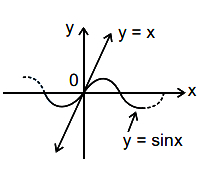
Taking the derivative with respect to $x$,we get $f'(x) = -\sin x + x$.
For $x > 0$,we know that $x > \sin x$,which implies $x - \sin x > 0$. Thus,$f'(x) > 0$ for $x > 0$.
For $x < 0$,we know that $x < \sin x$,which implies $x - \sin x < 0$. Thus,$f'(x) < 0$ for $x < 0$.
Since the derivative $f'(x)$ changes sign at $x = 0$,the function $f(x)$ is neither increasing nor decreasing on the entire domain $R$.
Taking the derivative with respect to $x$,we get $f'(x) = -\sin x + x$.
For $x > 0$,we know that $x > \sin x$,which implies $x - \sin x > 0$. Thus,$f'(x) > 0$ for $x > 0$.
For $x < 0$,we know that $x < \sin x$,which implies $x - \sin x < 0$. Thus,$f'(x) < 0$ for $x < 0$.
Since the derivative $f'(x)$ changes sign at $x = 0$,the function $f(x)$ is neither increasing nor decreasing on the entire domain $R$.
0 likes
View Solution372
EasyMCQ
Let $f(x)=x^{13}+x^{11}+x^{9}+x^{7}+x^{5}+x^{3}+x+19$. Then,$f(x)=0$ has
A
$13$ real roots
B
only one positive and only two negative real roots
C
not more than one real root
D
has two positive and one negative real root
Solution
(C) Given $f(x) = x^{13} + x^{11} + x^{9} + x^{7} + x^{5} + x^{3} + x + 19$.
Taking the derivative with respect to $x$:
$f'(x) = 13x^{12} + 11x^{10} + 9x^{8} + 7x^{6} + 5x^{4} + 3x^{2} + 1$.
Since all exponents of $x$ in $f'(x)$ are even and the coefficients are positive,$f'(x) \geq 1$ for all real $x$.
Thus,$f'(x) > 0$ for all $x \in \mathbb{R}$,which means $f(x)$ is a strictly increasing function.
$A$ strictly increasing function can intersect the $x$-axis at most once.
Therefore,$f(x) = 0$ has not more than one real root.
Taking the derivative with respect to $x$:
$f'(x) = 13x^{12} + 11x^{10} + 9x^{8} + 7x^{6} + 5x^{4} + 3x^{2} + 1$.
Since all exponents of $x$ in $f'(x)$ are even and the coefficients are positive,$f'(x) \geq 1$ for all real $x$.
Thus,$f'(x) > 0$ for all $x \in \mathbb{R}$,which means $f(x)$ is a strictly increasing function.
$A$ strictly increasing function can intersect the $x$-axis at most once.
Therefore,$f(x) = 0$ has not more than one real root.
0 likes
View Solution373
MediumMCQ
Let $\phi(x) = f(x) + f(2a - x)$,$x \in [0, 2a]$ and $f^{\prime \prime}(x) > 0$ for all $x \in [0, a]$. Then $\phi(x)$ is
A
increasing on $[0, a]$
B
decreasing on $[0, a]$
C
increasing on $[0, 2a]$
D
decreasing on $[0, 2a]$
Solution
(B) Given $\phi(x) = f(x) + f(2a - x)$.
Taking the derivative with respect to $x$,we get $\phi^{\prime}(x) = f^{\prime}(x) - f^{\prime}(2a - x)$.
We are given $f^{\prime \prime}(x) > 0$ for all $x \in [0, a]$,which implies that $f^{\prime}(x)$ is a strictly increasing function.
For $x \in [0, a]$,we have $x < 2a - x$.
Since $f^{\prime}(x)$ is strictly increasing,$x < 2a - x$ implies $f^{\prime}(x) < f^{\prime}(2a - x)$.
Therefore,$\phi^{\prime}(x) = f^{\prime}(x) - f^{\prime}(2a - x) < 0$ for all $x \in [0, a]$.
Since $\phi^{\prime}(x) < 0$ on $[0, a]$,$\phi(x)$ is a decreasing function on $[0, a]$.
Taking the derivative with respect to $x$,we get $\phi^{\prime}(x) = f^{\prime}(x) - f^{\prime}(2a - x)$.
We are given $f^{\prime \prime}(x) > 0$ for all $x \in [0, a]$,which implies that $f^{\prime}(x)$ is a strictly increasing function.
For $x \in [0, a]$,we have $x < 2a - x$.
Since $f^{\prime}(x)$ is strictly increasing,$x < 2a - x$ implies $f^{\prime}(x) < f^{\prime}(2a - x)$.
Therefore,$\phi^{\prime}(x) = f^{\prime}(x) - f^{\prime}(2a - x) < 0$ for all $x \in [0, a]$.
Since $\phi^{\prime}(x) < 0$ on $[0, a]$,$\phi(x)$ is a decreasing function on $[0, a]$.
0 likes
View Solution374
MediumMCQ
Let $\phi(x) = f(x) + f(1-x)$ and $f^{\prime \prime}(x) < 0$ in $[0, 1]$,then
A
$\phi$ is monotonic increasing in $\left[0, \frac{1}{2}\right]$ and monotonic decreasing in $\left[\frac{1}{2}, 1\right]$
B
$\phi$ is monotonic increasing in $\left[\frac{1}{2}, 1\right]$ and monotonic decreasing in $\left[0, \frac{1}{2}\right]$
C
$\phi$ is neither increasing nor decreasing in any sub-interval of $[0, 1]$
D
$\phi$ is increasing in $[0, 1]$
Solution
(A) Given $\phi(x) = f(x) + f(1-x)$.
To determine the monotonicity,we find the derivative $\phi^{\prime}(x) = f^{\prime}(x) - f^{\prime}(1-x)$.
Since $f^{\prime \prime}(x) < 0$,the function $f^{\prime}(x)$ is a strictly decreasing function.
If $x < \frac{1}{2}$,then $x < 1-x$,which implies $f^{\prime}(x) > f^{\prime}(1-x)$ because $f^{\prime}$ is decreasing.
Thus,$\phi^{\prime}(x) = f^{\prime}(x) - f^{\prime}(1-x) > 0$ for $x \in \left[0, \frac{1}{2}\right]$,so $\phi(x)$ is increasing in $\left[0, \frac{1}{2}\right]$.
If $x > \frac{1}{2}$,then $x > 1-x$,which implies $f^{\prime}(x) < f^{\prime}(1-x)$ because $f^{\prime}$ is decreasing.
Thus,$\phi^{\prime}(x) = f^{\prime}(x) - f^{\prime}(1-x) < 0$ for $x \in \left[\frac{1}{2}, 1\right]$,so $\phi(x)$ is decreasing in $\left[\frac{1}{2}, 1\right]$.
To determine the monotonicity,we find the derivative $\phi^{\prime}(x) = f^{\prime}(x) - f^{\prime}(1-x)$.
Since $f^{\prime \prime}(x) < 0$,the function $f^{\prime}(x)$ is a strictly decreasing function.
If $x < \frac{1}{2}$,then $x < 1-x$,which implies $f^{\prime}(x) > f^{\prime}(1-x)$ because $f^{\prime}$ is decreasing.
Thus,$\phi^{\prime}(x) = f^{\prime}(x) - f^{\prime}(1-x) > 0$ for $x \in \left[0, \frac{1}{2}\right]$,so $\phi(x)$ is increasing in $\left[0, \frac{1}{2}\right]$.
If $x > \frac{1}{2}$,then $x > 1-x$,which implies $f^{\prime}(x) < f^{\prime}(1-x)$ because $f^{\prime}$ is decreasing.
Thus,$\phi^{\prime}(x) = f^{\prime}(x) - f^{\prime}(1-x) < 0$ for $x \in \left[\frac{1}{2}, 1\right]$,so $\phi(x)$ is decreasing in $\left[\frac{1}{2}, 1\right]$.
0 likes
View Solution375
MediumMCQ
In the open interval $\left(0, \frac{\pi}{2}\right)$,which of the following is true for the expression $\cos x + x \sin x$?
A
$\cos x + x \sin x < 1$
B
$\cos x + x \sin x > 1$
C
No specific order relation can be ascertained between $\cos x + x \sin x$ and $1$
D
$\cos x + x \sin x < \frac{1}{2}$
Solution
(B) Let $f(x) = \cos x + x \sin x - 1$.
Find the derivative of $f(x)$ with respect to $x$:
$f'(x) = -\sin x + (1 \cdot \sin x + x \cos x) = x \cos x$.
For $x \in \left(0, \frac{\pi}{2}\right)$,both $x > 0$ and $\cos x > 0$.
Therefore,$f'(x) = x \cos x > 0$ for all $x \in \left(0, \frac{\pi}{2}\right)$.
Since $f'(x) > 0$,the function $f(x)$ is strictly increasing on the interval $\left(0, \frac{\pi}{2}\right)$.
As $f(x)$ is increasing,for any $x > 0$,we have $f(x) > f(0)$.
Calculate $f(0)$:
$f(0) = \cos(0) + 0 \cdot \sin(0) - 1 = 1 + 0 - 1 = 0$.
Thus,$f(x) > 0$ for all $x \in \left(0, \frac{\pi}{2}\right)$.
$\cos x + x \sin x - 1 > 0$
$\cos x + x \sin x > 1$.
Find the derivative of $f(x)$ with respect to $x$:
$f'(x) = -\sin x + (1 \cdot \sin x + x \cos x) = x \cos x$.
For $x \in \left(0, \frac{\pi}{2}\right)$,both $x > 0$ and $\cos x > 0$.
Therefore,$f'(x) = x \cos x > 0$ for all $x \in \left(0, \frac{\pi}{2}\right)$.
Since $f'(x) > 0$,the function $f(x)$ is strictly increasing on the interval $\left(0, \frac{\pi}{2}\right)$.
As $f(x)$ is increasing,for any $x > 0$,we have $f(x) > f(0)$.
Calculate $f(0)$:
$f(0) = \cos(0) + 0 \cdot \sin(0) - 1 = 1 + 0 - 1 = 0$.
Thus,$f(x) > 0$ for all $x \in \left(0, \frac{\pi}{2}\right)$.
$\cos x + x \sin x - 1 > 0$
$\cos x + x \sin x > 1$.
0 likes
View Solution376
MediumMCQ
Let $f(x) = \cos \left(\frac{\pi}{x}\right), x \neq 0$. Assuming $k$ is an integer,which of the following is true?
A
$f(x)$ increases in the interval $\left(\frac{1}{2k+1}, \frac{1}{2k}\right)$
B
$f(x)$ decreases in the interval $\left(\frac{1}{2k+1}, \frac{1}{2k}\right)$
C
$f(x)$ decreases in the interval $\left(\frac{1}{2k+2}, \frac{1}{2k+1}\right)$
D
$f(x)$ increases in the interval $\left(\frac{1}{2k+2}, \frac{1}{2k+1}\right)$
Solution
(A) Given $f(x) = \cos \left(\frac{\pi}{x}\right)$.
Taking the derivative with respect to $x$:
$f'(x) = -\sin \left(\frac{\pi}{x}\right) \cdot \left(-\frac{\pi}{x^2}\right) = \frac{\pi}{x^2} \sin \left(\frac{\pi}{x}\right)$.
For $f(x)$ to be increasing,$f'(x) > 0$.
Since $\frac{\pi}{x^2} > 0$ for all $x \neq 0$,we need $\sin \left(\frac{\pi}{x}\right) > 0$.
This occurs when $2k\pi < \frac{\pi}{x} < (2k+1)\pi$ for some integer $k$.
Dividing by $\pi$,we get $2k < \frac{1}{x} < 2k+1$.
Taking the reciprocal,the inequality reverses: $\frac{1}{2k+1} < x < \frac{1}{2k}$.
Thus,$f(x)$ increases in the interval $\left(\frac{1}{2k+1}, \frac{1}{2k}\right)$.
For $f(x)$ to be decreasing,$f'(x) < 0$,which implies $\sin \left(\frac{\pi}{x}\right) < 0$.
This occurs when $(2k+1)\pi < \frac{\pi}{x} < (2k+2)\pi$.
Dividing by $\pi$,we get $2k+1 < \frac{1}{x} < 2k+2$.
Taking the reciprocal,we get $\frac{1}{2k+2} < x < \frac{1}{2k+1}$.
Thus,$f(x)$ decreases in the interval $\left(\frac{1}{2k+2}, \frac{1}{2k+1}\right)$.
Taking the derivative with respect to $x$:
$f'(x) = -\sin \left(\frac{\pi}{x}\right) \cdot \left(-\frac{\pi}{x^2}\right) = \frac{\pi}{x^2} \sin \left(\frac{\pi}{x}\right)$.
For $f(x)$ to be increasing,$f'(x) > 0$.
Since $\frac{\pi}{x^2} > 0$ for all $x \neq 0$,we need $\sin \left(\frac{\pi}{x}\right) > 0$.
This occurs when $2k\pi < \frac{\pi}{x} < (2k+1)\pi$ for some integer $k$.
Dividing by $\pi$,we get $2k < \frac{1}{x} < 2k+1$.
Taking the reciprocal,the inequality reverses: $\frac{1}{2k+1} < x < \frac{1}{2k}$.
Thus,$f(x)$ increases in the interval $\left(\frac{1}{2k+1}, \frac{1}{2k}\right)$.
For $f(x)$ to be decreasing,$f'(x) < 0$,which implies $\sin \left(\frac{\pi}{x}\right) < 0$.
This occurs when $(2k+1)\pi < \frac{\pi}{x} < (2k+2)\pi$.
Dividing by $\pi$,we get $2k+1 < \frac{1}{x} < 2k+2$.
Taking the reciprocal,we get $\frac{1}{2k+2} < x < \frac{1}{2k+1}$.
Thus,$f(x)$ decreases in the interval $\left(\frac{1}{2k+2}, \frac{1}{2k+1}\right)$.
0 likes
View Solution377
MediumMCQ
The value of $K$ such that $f(x) = \sin x - \cos x - Kx + 5$ decreases for all positive real values of $x$ is given by
A
$K < 1$
B
$K \geq 1$
C
$K > \sqrt{2}$
D
$K < \sqrt{2}$
Solution
(B) Given $f(x) = \sin x - \cos x - Kx + 5$.
Differentiating with respect to $x$,we get $f'(x) = \cos x + \sin x - K$.
For the function to be decreasing for all $x > 0$,we must have $f'(x) \leq 0$ for all $x$.
This implies $\cos x + \sin x - K \leq 0$,or $K \geq \cos x + \sin x$.
We know that the maximum value of $\cos x + \sin x$ is $\sqrt{1^2 + 1^2} = \sqrt{2}$.
Therefore,for $K \geq \cos x + \sin x$ to hold for all $x$,$K$ must be greater than or equal to the maximum value of the expression $\cos x + \sin x$.
Thus,$K \geq \sqrt{2}$.
Differentiating with respect to $x$,we get $f'(x) = \cos x + \sin x - K$.
For the function to be decreasing for all $x > 0$,we must have $f'(x) \leq 0$ for all $x$.
This implies $\cos x + \sin x - K \leq 0$,or $K \geq \cos x + \sin x$.
We know that the maximum value of $\cos x + \sin x$ is $\sqrt{1^2 + 1^2} = \sqrt{2}$.
Therefore,for $K \geq \cos x + \sin x$ to hold for all $x$,$K$ must be greater than or equal to the maximum value of the expression $\cos x + \sin x$.
Thus,$K \geq \sqrt{2}$.
0 likes
View Solution378
EasyMCQ
If $f(x)=e^{x}(x-2)^{2}$,then
A
$f$ is increasing in $(-\infty, 0)$ and $(2, \infty)$ and decreasing in $(0, 2)$
B
$f$ is increasing in $(-\infty, 0)$ and decreasing in $(0, \infty)$
C
$f$ is increasing in $(2, \infty)$ and decreasing in $(-\infty, 0)$
D
$f$ is increasing in $(0, 2)$ and decreasing in $(-\infty, 0)$ and $(2, \infty)$
Solution
(A) Given function is $f(x)=e^{x}(x-2)^{2}$.
To find the intervals of increase and decrease,we find the derivative $f^{\prime}(x)$:
$f^{\prime}(x) = \frac{d}{dx}[e^{x}(x-2)^{2}]$
Using the product rule:
$f^{\prime}(x) = e^{x}(x-2)^{2} + e^{x} \cdot 2(x-2)$
$f^{\prime}(x) = e^{x}(x-2)[(x-2) + 2]$
$f^{\prime}(x) = x(x-2)e^{x}$
Now,we determine the sign of $f^{\prime}(x)$:
Since $e^{x} > 0$ for all $x \in \mathbb{R}$,the sign of $f^{\prime}(x)$ depends on $x(x-2)$.
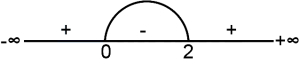
- For $x \in (-\infty, 0)$,$x < 0$ and $(x-2) < 0$,so $f^{\prime}(x) > 0$ (increasing).
- For $x \in (0, 2)$,$x > 0$ and $(x-2) < 0$,so $f^{\prime}(x) < 0$ (decreasing).
- For $x \in (2, \infty)$,$x > 0$ and $(x-2) > 0$,so $f^{\prime}(x) > 0$ (increasing).
Thus,$f$ is increasing in $(-\infty, 0)$ and $(2, \infty)$ and decreasing in $(0, 2)$.
To find the intervals of increase and decrease,we find the derivative $f^{\prime}(x)$:
$f^{\prime}(x) = \frac{d}{dx}[e^{x}(x-2)^{2}]$
Using the product rule:
$f^{\prime}(x) = e^{x}(x-2)^{2} + e^{x} \cdot 2(x-2)$
$f^{\prime}(x) = e^{x}(x-2)[(x-2) + 2]$
$f^{\prime}(x) = x(x-2)e^{x}$
Now,we determine the sign of $f^{\prime}(x)$:
Since $e^{x} > 0$ for all $x \in \mathbb{R}$,the sign of $f^{\prime}(x)$ depends on $x(x-2)$.
- For $x \in (-\infty, 0)$,$x < 0$ and $(x-2) < 0$,so $f^{\prime}(x) > 0$ (increasing).
- For $x \in (0, 2)$,$x > 0$ and $(x-2) < 0$,so $f^{\prime}(x) < 0$ (decreasing).
- For $x \in (2, \infty)$,$x > 0$ and $(x-2) > 0$,so $f^{\prime}(x) > 0$ (increasing).
Thus,$f$ is increasing in $(-\infty, 0)$ and $(2, \infty)$ and decreasing in $(0, 2)$.
0 likes
View Solution379
MediumMCQ
If $F(x) = \int_{0}^{x} \frac{\cos t}{1+t^{2}} dt$,where $0 \leq x \leq 2\pi$,then which of the following is true?
A
$F$ is increasing in $(\frac{\pi}{2}, \frac{3\pi}{2})$ and decreasing in $(0, \frac{\pi}{2})$ and $(\frac{3\pi}{2}, 2\pi)$
B
$F$ is increasing in $(0, \pi)$ and decreasing in $(\pi, 2\pi)$
C
$F$ is increasing in $(\pi, 2\pi)$ and decreasing in $(0, \pi)$
D
$F$ is increasing in $(0, \frac{\pi}{2})$ and $(\frac{3\pi}{2}, 2\pi)$ and decreasing in $(\frac{\pi}{2}, \frac{3\pi}{2})$
Solution
(D) Given the function $F(x) = \int_{0}^{x} \frac{\cos t}{1+t^{2}} dt$ for $0 \leq x \leq 2\pi$.
To determine the intervals of increase and decrease,we find the derivative $F'(x)$ using the Leibniz rule:
$F'(x) = \frac{\cos x}{1+x^{2}}$.
Since $1+x^{2} > 0$ for all $x$,the sign of $F'(x)$ depends solely on $\cos x$.
$F(x)$ is increasing when $F'(x) > 0$,which occurs when $\cos x > 0$. In the interval $[0, 2\pi]$,$\cos x > 0$ for $x \in (0, \frac{\pi}{2}) \cup (\frac{3\pi}{2}, 2\pi)$.
$F(x)$ is decreasing when $F'(x) < 0$,which occurs when $\cos x < 0$. In the interval $[0, 2\pi]$,$\cos x < 0$ for $x \in (\frac{\pi}{2}, \frac{3\pi}{2})$.
Thus,$F$ is increasing in $(0, \frac{\pi}{2})$ and $(\frac{3\pi}{2}, 2\pi)$ and decreasing in $(\frac{\pi}{2}, \frac{3\pi}{2})$.
To determine the intervals of increase and decrease,we find the derivative $F'(x)$ using the Leibniz rule:
$F'(x) = \frac{\cos x}{1+x^{2}}$.
Since $1+x^{2} > 0$ for all $x$,the sign of $F'(x)$ depends solely on $\cos x$.
$F(x)$ is increasing when $F'(x) > 0$,which occurs when $\cos x > 0$. In the interval $[0, 2\pi]$,$\cos x > 0$ for $x \in (0, \frac{\pi}{2}) \cup (\frac{3\pi}{2}, 2\pi)$.
$F(x)$ is decreasing when $F'(x) < 0$,which occurs when $\cos x < 0$. In the interval $[0, 2\pi]$,$\cos x < 0$ for $x \in (\frac{\pi}{2}, \frac{3\pi}{2})$.
Thus,$F$ is increasing in $(0, \frac{\pi}{2})$ and $(\frac{3\pi}{2}, 2\pi)$ and decreasing in $(\frac{\pi}{2}, \frac{3\pi}{2})$.
0 likes
View Solution380
DifficultMCQ
If $f$ is a real-valued differentiable function such that $f(x) f^{\prime}(x) < 0$ for all real $x,$ then
A
$f(x)$ must be an increasing function
B
$f(x)$ must be a decreasing function
C
$|f(x)|$ must be an increasing function
D
$|f(x)|$ must be a decreasing function
Solution
(D) Given,$f(x) f^{\prime}(x) < 0$. This implies that $f(x)$ and $f^{\prime}(x)$ have opposite signs for all $x \in R$.
Consider the function $g(x) = |f(x)|$.
Then $g(x)^2 = |f(x)|^2 = f(x)^2$.
Differentiating both sides with respect to $x$,we get $2g(x) g^{\prime}(x) = 2f(x) f^{\prime}(x)$.
Thus,$g^{\prime}(x) = \frac{f(x) f^{\prime}(x)}{g(x)} = \frac{f(x) f^{\prime}(x)}{|f(x)|}$.
Since $f(x) f^{\prime}(x) < 0$ and $|f(x)| > 0$ for all $x$ where $f(x) \neq 0$,it follows that $g^{\prime}(x) < 0$.
Therefore,$|f(x)|$ is a decreasing function.
Consider the function $g(x) = |f(x)|$.
Then $g(x)^2 = |f(x)|^2 = f(x)^2$.
Differentiating both sides with respect to $x$,we get $2g(x) g^{\prime}(x) = 2f(x) f^{\prime}(x)$.
Thus,$g^{\prime}(x) = \frac{f(x) f^{\prime}(x)}{g(x)} = \frac{f(x) f^{\prime}(x)}{|f(x)|}$.
Since $f(x) f^{\prime}(x) < 0$ and $|f(x)| > 0$ for all $x$ where $f(x) \neq 0$,it follows that $g^{\prime}(x) < 0$.
Therefore,$|f(x)|$ is a decreasing function.
0 likes
View Solution381
MediumMCQ
$f(x) = \begin{cases} 0, & x = 0 \\ x - 3, & x > 0 \end{cases}$. The function $f(x)$ is
A
increasing when $x \geq 0$
B
strictly increasing when $x > 0$
C
strictly increasing at $x = 0$
D
not continuous at $x = 0$ and so it is not increasing when $x > 0$
Solution
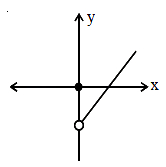
(B) The given function is $f(x) = \begin{cases} 0, & x = 0 \\ x - 3, & x > 0 \end{cases}$.
First,let us check the continuity at $x = 0$.
$f(0) = 0$.
$\lim_{x \to 0^+} f(x) = \lim_{x \to 0^+} (x - 3) = -3$.
Since $f(0) \neq \lim_{x \to 0^+} f(x)$,the function is discontinuous at $x = 0$.
Now,consider the interval $x > 0$. For any $x_1, x_2$ such that $0 < x_1 < x_2$,we have $f(x_1) = x_1 - 3$ and $f(x_2) = x_2 - 3$. Since $x_1 < x_2$,it follows that $x_1 - 3 < x_2 - 3$,which means $f(x_1) < f(x_2)$. Therefore,the function is strictly increasing for $x > 0$.
However,for the function to be increasing on the interval $[0, \infty)$,it must be continuous on $[0, \infty)$. Since it is discontinuous at $x = 0$,it is not increasing on $[0, \infty)$.
Thus,the function is strictly increasing when $x > 0$.
First,let us check the continuity at $x = 0$.
$f(0) = 0$.
$\lim_{x \to 0^+} f(x) = \lim_{x \to 0^+} (x - 3) = -3$.
Since $f(0) \neq \lim_{x \to 0^+} f(x)$,the function is discontinuous at $x = 0$.
Now,consider the interval $x > 0$. For any $x_1, x_2$ such that $0 < x_1 < x_2$,we have $f(x_1) = x_1 - 3$ and $f(x_2) = x_2 - 3$. Since $x_1 < x_2$,it follows that $x_1 - 3 < x_2 - 3$,which means $f(x_1) < f(x_2)$. Therefore,the function is strictly increasing for $x > 0$.
However,for the function to be increasing on the interval $[0, \infty)$,it must be continuous on $[0, \infty)$. Since it is discontinuous at $x = 0$,it is not increasing on $[0, \infty)$.
Thus,the function is strictly increasing when $x > 0$.
0 likes
View Solution382
EasyMCQ
The function $f(x) = ax + b$ is strictly increasing for all real $x$ if
A
$a > 0$
B
$a < 0$
C
$a = 0$
D
$a \leq 0$
Solution
(A) function $f(x)$ is strictly increasing if its derivative $f'(x) > 0$ for all $x$ in its domain.
Given the function $f(x) = ax + b$.
Taking the derivative with respect to $x$,we get $f'(x) = \frac{d}{dx}(ax + b) = a$.
For the function to be strictly increasing,we must have $f'(x) > 0$.
Substituting the derivative,we get $a > 0$.
Therefore,the function is strictly increasing if $a > 0$.
Given the function $f(x) = ax + b$.
Taking the derivative with respect to $x$,we get $f'(x) = \frac{d}{dx}(ax + b) = a$.
For the function to be strictly increasing,we must have $f'(x) > 0$.
Substituting the derivative,we get $a > 0$.
Therefore,the function is strictly increasing if $a > 0$.
0 likes
View Solution383
EasyMCQ
For what values of $x$ is the function $f(x) = x^4 - 4x^3 + 4x^2 + 40$ monotonically decreasing?
A
$0 < x < 1$
B
$1 < x < 2$
C
$2 < x < 3$
D
$4 < x < 5$
Solution
(B) To find the intervals where the function $f(x) = x^4 - 4x^3 + 4x^2 + 40$ is monotonically decreasing,we first find its derivative $f'(x)$.
$f'(x) = \frac{d}{dx}(x^4 - 4x^3 + 4x^2 + 40) = 4x^3 - 12x^2 + 8x$.
Next,we factor the derivative:
$f'(x) = 4x(x^2 - 3x + 2) = 4x(x - 1)(x - 2)$.
$A$ function is monotonically decreasing when $f'(x) < 0$.
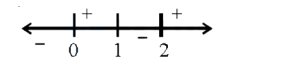
We analyze the sign of $f'(x) = 4x(x - 1)(x - 2)$ using the wavy curve method (sign scheme):
- For $x < 0$,$f'(x) < 0$.
- For $0 < x < 1$,$f'(x) > 0$.
- For $1 < x < 2$,$f'(x) < 0$.
- For $x > 2$,$f'(x) > 0$.
Thus,the function is monotonically decreasing for $x \in (-\infty, 0) \cup (1, 2)$.
Comparing this with the given options,the correct interval is $1 < x < 2$.
$f'(x) = \frac{d}{dx}(x^4 - 4x^3 + 4x^2 + 40) = 4x^3 - 12x^2 + 8x$.
Next,we factor the derivative:
$f'(x) = 4x(x^2 - 3x + 2) = 4x(x - 1)(x - 2)$.
$A$ function is monotonically decreasing when $f'(x) < 0$.
We analyze the sign of $f'(x) = 4x(x - 1)(x - 2)$ using the wavy curve method (sign scheme):
- For $x < 0$,$f'(x) < 0$.
- For $0 < x < 1$,$f'(x) > 0$.
- For $1 < x < 2$,$f'(x) < 0$.
- For $x > 2$,$f'(x) > 0$.
Thus,the function is monotonically decreasing for $x \in (-\infty, 0) \cup (1, 2)$.
Comparing this with the given options,the correct interval is $1 < x < 2$.
0 likes
View Solution384
EasyMCQ
Let $p(x)$ be a polynomial with real coefficients,$p(0) = 1$ and $p^{\prime}(x) > 0$ for all $x \in \mathbb{R}$. Then
A
$p(x)$ has at least two real roots
B
$p(x)$ has only one positive real root
C
$p(x)$ may have a negative real root
D
$p(x)$ has infinitely many real roots
Solution
(C) Given that $p^{\prime}(x) > 0$ for all $x \in \mathbb{R}$,the polynomial $p(x)$ is a strictly increasing function on the entire real line.
Since $p(x)$ is strictly increasing,it can have at most one real root.
We are given $p(0) = 1$.
Since $p(x)$ is strictly increasing and $p(0) = 1 > 0$,for any $x > 0$,$p(x) > p(0) = 1$,so $p(x)$ cannot have any positive real roots.
As $x \to -\infty$,$p(x) \to -\infty$ (assuming the degree is odd) or $p(x) \to c$ (if degree is even,but $p^{\prime}(x) > 0$ implies the degree must be odd for the limit to be $-\infty$).
Since $p(0) = 1$ and the function is continuous and strictly increasing,by the Intermediate Value Theorem,there must exist some $x_0 < 0$ such that $p(x_0) = 0$.
Thus,$p(x)$ has exactly one negative real root.
Since $p(x)$ is strictly increasing,it can have at most one real root.
We are given $p(0) = 1$.
Since $p(x)$ is strictly increasing and $p(0) = 1 > 0$,for any $x > 0$,$p(x) > p(0) = 1$,so $p(x)$ cannot have any positive real roots.
As $x \to -\infty$,$p(x) \to -\infty$ (assuming the degree is odd) or $p(x) \to c$ (if degree is even,but $p^{\prime}(x) > 0$ implies the degree must be odd for the limit to be $-\infty$).
Since $p(0) = 1$ and the function is continuous and strictly increasing,by the Intermediate Value Theorem,there must exist some $x_0 < 0$ such that $p(x_0) = 0$.
Thus,$p(x)$ has exactly one negative real root.
0 likes
View Solution385
DifficultMCQ
Let $f : R \rightarrow R$ be a twice differentiable function such that $f^{\prime\prime}(x) > 0$ for all $x \in R$ and $f^{\prime}(a-1) = 0$,where $a$ is a real number. Let $g(x) = f(\tan^{2}x - 2\tan x + a)$,$0 < x < \frac{\pi}{2}$. Consider the following two statements:
$(I)$ $g$ is increasing in $(0, \frac{\pi}{4})$
$(II)$ $g$ is decreasing in $(\frac{\pi}{4}, \frac{\pi}{2})$
Then,
$(I)$ $g$ is increasing in $(0, \frac{\pi}{4})$
$(II)$ $g$ is decreasing in $(\frac{\pi}{4}, \frac{\pi}{2})$
Then,
A
Neither $(I)$ nor $(II)$ is True
B
Only $(II)$ is True
C
Only $(I)$ is True
D
Both $(I)$ and $(II)$ are True
Solution
(A) Given $g(x) = f((\tan x - 1)^{2} + a - 1)$.
Taking the derivative,$g^{\prime}(x) = f^{\prime}((\tan x - 1)^{2} + a - 1) \cdot 2(\tan x - 1) \cdot \sec^{2}x$.
Since $f^{\prime\prime}(x) > 0$,$f^{\prime}(x)$ is a strictly increasing function.
We are given $f^{\prime}(a-1) = 0$.
If $(\tan x - 1)^{2} > 0$,then $(\tan x - 1)^{2} + a - 1 > a - 1$,which implies $f^{\prime}((\tan x - 1)^{2} + a - 1) > f^{\prime}(a - 1) = 0$.
For $x \in (0, \frac{\pi}{4})$,$\tan x < 1$,so $(\tan x - 1) < 0$. Thus $g^{\prime}(x) = (\text{positive}) \cdot (\text{negative}) \cdot (\text{positive}) < 0$. So $g$ is decreasing in $(0, \frac{\pi}{4})$.
For $x \in (\frac{\pi}{4}, \frac{\pi}{2})$,$\tan x > 1$,so $(\tan x - 1) > 0$. Thus $g^{\prime}(x) = (\text{positive}) \cdot (\text{positive}) \cdot (\text{positive}) > 0$. So $g$ is increasing in $(\frac{\pi}{4}, \frac{\pi}{2})$.
Therefore,neither statement $(I)$ nor $(II)$ is true.
Taking the derivative,$g^{\prime}(x) = f^{\prime}((\tan x - 1)^{2} + a - 1) \cdot 2(\tan x - 1) \cdot \sec^{2}x$.
Since $f^{\prime\prime}(x) > 0$,$f^{\prime}(x)$ is a strictly increasing function.
We are given $f^{\prime}(a-1) = 0$.
If $(\tan x - 1)^{2} > 0$,then $(\tan x - 1)^{2} + a - 1 > a - 1$,which implies $f^{\prime}((\tan x - 1)^{2} + a - 1) > f^{\prime}(a - 1) = 0$.
For $x \in (0, \frac{\pi}{4})$,$\tan x < 1$,so $(\tan x - 1) < 0$. Thus $g^{\prime}(x) = (\text{positive}) \cdot (\text{negative}) \cdot (\text{positive}) < 0$. So $g$ is decreasing in $(0, \frac{\pi}{4})$.
For $x \in (\frac{\pi}{4}, \frac{\pi}{2})$,$\tan x > 1$,so $(\tan x - 1) > 0$. Thus $g^{\prime}(x) = (\text{positive}) \cdot (\text{positive}) \cdot (\text{positive}) > 0$. So $g$ is increasing in $(\frac{\pi}{4}, \frac{\pi}{2})$.
Therefore,neither statement $(I)$ nor $(II)$ is true.
0 likes
View Solution386
DifficultMCQ
The function $f(x) = \tan x - 4x$ is strictly decreasing on $\rule{1cm}{0.15mm}$
A
$(-\frac{\pi}{3}, \frac{\pi}{3})$
B
$(-\frac{\pi}{6}, \frac{\pi}{6})$
C
$(-\frac{\pi}{4}, \frac{\pi}{4})$
D
$(-\frac{\pi}{2}, \frac{\pi}{2})$
Solution
(A) function $f(x)$ is strictly decreasing on an interval if its derivative $f'(x) < 0$ for all $x$ in that interval.
Given $f(x) = \tan x - 4x$.
Taking the derivative with respect to $x$,we get $f'(x) = \sec^2 x - 4$.
For the function to be strictly decreasing,we require $f'(x) < 0$.
$\sec^2 x - 4 < 0$
$\sec^2 x < 4$
Taking the square root on both sides,we get $|\sec x| < 2$.
Since $|\sec x| = 1/|\cos x|$,this implies $1/|\cos x| < 2$,which means $|\cos x| > 1/2$.
This inequality holds when $-\frac{\pi}{3} < x < \frac{\pi}{3}$.
Given $f(x) = \tan x - 4x$.
Taking the derivative with respect to $x$,we get $f'(x) = \sec^2 x - 4$.
For the function to be strictly decreasing,we require $f'(x) < 0$.
$\sec^2 x - 4 < 0$
$\sec^2 x < 4$
Taking the square root on both sides,we get $|\sec x| < 2$.
Since $|\sec x| = 1/|\cos x|$,this implies $1/|\cos x| < 2$,which means $|\cos x| > 1/2$.
This inequality holds when $-\frac{\pi}{3} < x < \frac{\pi}{3}$.
0 likes
View Solution387
DifficultMCQ
The interval in which $y = x^2 e^{-x}$ is decreasing is . . . . . . .
A
$(-\infty, 0) \cup (2, \infty)$
B
$(0, 2)$
C
$(2, \infty)$
D
$(-\infty, 0)$
Solution
(A) To find the interval where the function $y = x^2 e^{-x}$ is decreasing,we calculate its derivative $\frac{dy}{dx}$.
Using the product rule: $\frac{dy}{dx} = \frac{d}{dx}(x^2) \cdot e^{-x} + x^2 \cdot \frac{d}{dx}(e^{-x}) = 2x e^{-x} - x^2 e^{-x} = x e^{-x} (2 - x)$.
$A$ function is decreasing when $\frac{dy}{dx} < 0$.
Since $e^{-x} > 0$ for all real $x$,the inequality $\frac{dy}{dx} < 0$ simplifies to $x(2 - x) < 0$.
Multiplying by $-1$ reverses the inequality: $x(x - 2) > 0$.
This inequality holds when $x < 0$ or $x > 2$.
Thus,the function is decreasing on the interval $(-\infty, 0) \cup (2, \infty)$.
Using the product rule: $\frac{dy}{dx} = \frac{d}{dx}(x^2) \cdot e^{-x} + x^2 \cdot \frac{d}{dx}(e^{-x}) = 2x e^{-x} - x^2 e^{-x} = x e^{-x} (2 - x)$.
$A$ function is decreasing when $\frac{dy}{dx} < 0$.
Since $e^{-x} > 0$ for all real $x$,the inequality $\frac{dy}{dx} < 0$ simplifies to $x(2 - x) < 0$.
Multiplying by $-1$ reverses the inequality: $x(x - 2) > 0$.
This inequality holds when $x < 0$ or $x > 2$.
Thus,the function is decreasing on the interval $(-\infty, 0) \cup (2, \infty)$.
0 likes
View SolutionApplications of Derivatives — Increasing and Decreasing function · Frequently Asked Questions
1Are these Applications of Derivatives questions useful for JEE and NEET?
Yes. All questions in this section are mapped to JEE Main and NEET exam patterns. Previous year questions from JEE Main, NEET, GUJCET and state-level exams are included with full solutions.
2Can I switch to Hindi or Gujarati for these questions?
Yes. Use the language tabs in the hero section or the sidebar to view the same questions and solutions in English, Hindi or Gujarati.
3How do I generate a question paper from this subtopic?
Use the Vedclass Exam Paper Generator — select the chapter and subtopic, set difficulty, and generate Sets A, B, C, D automatically. First 3 chapters of every subject are free.
Vedclass Products
For Students
Vedclass Test Series
Mock tests in real JEE/NEET style with performance analysis. 5-day free trial.
Start Free TrialFor Teachers
Exam Paper Generator
Generate Set A/B/C/D papers from this chapter in 2 minutes. 3 chapters free.
Try FreeFor Institutes
Online Exam Module
Live online exams with unlimited students, 360° analytics & white-label branding.
See DemoFor Teachers & Institutes
Generate a Applications of Derivatives Exam Paper in 2 Minutes
Select subtopic & difficulty — Sets A, B, C, D auto-generated with No Repeat logic.
First 3 chapters of every subject are free — no payment required.