
A English
Increasing and Decreasing function Questions in English
Class 12 Mathematics · Applications of Derivatives · Increasing and Decreasing function
389+
Questions
English
Language
100%
With Solutions
Showing 48 of 389 questions in English
251
MediumMCQ
If $f(x) = x \cdot e^{x(1-x)}$,then $f(x)$ is
A
increasing in $R$
B
increasing in $\left(-\frac{1}{2}, 1\right)$
C
decreasing in $R$
D
decreasing in $\left[-\frac{1}{2}, 1\right]$
Solution
(B) Given $f(x) = x \cdot e^{x-x^2}$.
To find the intervals of increase or decrease,we compute the derivative $f'(x)$.
Using the product rule and chain rule: $f'(x) = 1 \cdot e^{x-x^2} + x \cdot e^{x-x^2} \cdot (1-2x)$.
$f'(x) = e^{x-x^2} [1 + x(1-2x)] = e^{x-x^2} [1 + x - 2x^2]$.
Factoring the quadratic expression: $1 + x - 2x^2 = -(2x^2 - x - 1) = -(2x+1)(x-1) = (2x+1)(1-x)$.
So,$f'(x) = e^{x-x^2} (2x+1)(1-x)$.
Since $e^{x-x^2} > 0$ for all $x \in R$,the sign of $f'(x)$ depends on $(2x+1)(1-x)$.
$f'(x) > 0$ when $(2x+1)(1-x) > 0$,which implies $-\frac{1}{2} < x < 1$.
Thus,$f(x)$ is increasing in the interval $\left(-\frac{1}{2}, 1\right)$.
To find the intervals of increase or decrease,we compute the derivative $f'(x)$.
Using the product rule and chain rule: $f'(x) = 1 \cdot e^{x-x^2} + x \cdot e^{x-x^2} \cdot (1-2x)$.
$f'(x) = e^{x-x^2} [1 + x(1-2x)] = e^{x-x^2} [1 + x - 2x^2]$.
Factoring the quadratic expression: $1 + x - 2x^2 = -(2x^2 - x - 1) = -(2x+1)(x-1) = (2x+1)(1-x)$.
So,$f'(x) = e^{x-x^2} (2x+1)(1-x)$.
Since $e^{x-x^2} > 0$ for all $x \in R$,the sign of $f'(x)$ depends on $(2x+1)(1-x)$.
$f'(x) > 0$ when $(2x+1)(1-x) > 0$,which implies $-\frac{1}{2} < x < 1$.
Thus,$f(x)$ is increasing in the interval $\left(-\frac{1}{2}, 1\right)$.
0 likes
View Solution252
MediumMCQ
The function $f(x) = \sin^4 x + \cos^4 x$ increases if
A
$0 < x < \frac{\pi}{8}$
B
$\frac{\pi}{4} < x < \frac{\pi}{2}$
C
$\frac{3\pi}{8} < x < \frac{\pi}{2}$
D
$\frac{\pi}{2} < x < \frac{5\pi}{8}$
Solution
(B) Given the function $f(x) = \sin^4 x + \cos^4 x$.
We can rewrite this as $f(x) = (\sin^2 x + \cos^2 x)^2 - 2\sin^2 x \cos^2 x = 1 - \frac{1}{2}(2\sin x \cos x)^2 = 1 - \frac{1}{2}\sin^2(2x)$.
To find where the function increases,we find the derivative $f'(x) = -\frac{1}{2} \cdot 2\sin(2x) \cdot \cos(2x) \cdot 2 = -\sin(4x)$.
The function increases when $f'(x) > 0$,which means $-\sin(4x) > 0$,or $\sin(4x) < 0$.
This occurs when $\pi < 4x < 2\pi$,which simplifies to $\frac{\pi}{4} < x < \frac{\pi}{2}$.
We can rewrite this as $f(x) = (\sin^2 x + \cos^2 x)^2 - 2\sin^2 x \cos^2 x = 1 - \frac{1}{2}(2\sin x \cos x)^2 = 1 - \frac{1}{2}\sin^2(2x)$.
To find where the function increases,we find the derivative $f'(x) = -\frac{1}{2} \cdot 2\sin(2x) \cdot \cos(2x) \cdot 2 = -\sin(4x)$.
The function increases when $f'(x) > 0$,which means $-\sin(4x) > 0$,or $\sin(4x) < 0$.
This occurs when $\pi < 4x < 2\pi$,which simplifies to $\frac{\pi}{4} < x < \frac{\pi}{2}$.
0 likes
View Solution253
EasyMCQ
$f(x) = \frac{x}{2} + \frac{2}{x}, x \neq 0$ is strictly decreasing in
A
$(-2, 0) \cup (0, 2)$
B
$(-2, 2)$
C
$(2, \infty)$
D
$(-\infty, -2)$
Solution
(A) Given function is $f(x) = \frac{x}{2} + \frac{2}{x}$.
To find the intervals where the function is strictly decreasing,we find the derivative $f'(x)$.
$f'(x) = \frac{d}{dx} (\frac{x}{2} + 2x^{-1}) = \frac{1}{2} - 2x^{-2} = \frac{1}{2} - \frac{2}{x^2}$.
For the function to be strictly decreasing,we require $f'(x) < 0$.
$\frac{1}{2} - \frac{2}{x^2} < 0 \implies \frac{x^2 - 4}{2x^2} < 0$.
Since $2x^2 > 0$ for all $x \neq 0$,the inequality holds when $x^2 - 4 < 0$.
$(x - 2)(x + 2) < 0$.
This inequality holds for $x \in (-2, 2)$.
Since $x \neq 0$,the function is strictly decreasing in the interval $(-2, 0) \cup (0, 2)$.
To find the intervals where the function is strictly decreasing,we find the derivative $f'(x)$.
$f'(x) = \frac{d}{dx} (\frac{x}{2} + 2x^{-1}) = \frac{1}{2} - 2x^{-2} = \frac{1}{2} - \frac{2}{x^2}$.
For the function to be strictly decreasing,we require $f'(x) < 0$.
$\frac{1}{2} - \frac{2}{x^2} < 0 \implies \frac{x^2 - 4}{2x^2} < 0$.
Since $2x^2 > 0$ for all $x \neq 0$,the inequality holds when $x^2 - 4 < 0$.
$(x - 2)(x + 2) < 0$.
This inequality holds for $x \in (-2, 2)$.
Since $x \neq 0$,the function is strictly decreasing in the interval $(-2, 0) \cup (0, 2)$.
0 likes
View Solution254
MediumMCQ
If $f(x) = \log(1+x) - \frac{2x}{2+x}$,then $f(x)$ is increasing in
A
$(-1, \infty)$
B
$(-\infty, \infty)$
C
$(0, \infty)$
D
$(1, \infty)$
Solution
(A) To determine where $f(x)$ is increasing,we find its derivative $f'(x)$.
Given $f(x) = \log(1+x) - \frac{2x}{2+x}$.
The domain of $f(x)$ is $x > -1$.
$f'(x) = \frac{d}{dx} [\log(1+x)] - \frac{d}{dx} [\frac{2x}{2+x}]$.
Using the quotient rule for the second term: $\frac{d}{dx} [\frac{2x}{2+x}] = \frac{(2+x)(2) - 2x(1)}{(2+x)^2} = \frac{4+2x-2x}{(2+x)^2} = \frac{4}{(2+x)^2}$.
So,$f'(x) = \frac{1}{1+x} - \frac{4}{(2+x)^2}$.
$f'(x) = \frac{(2+x)^2 - 4(1+x)}{(1+x)(2+x)^2} = \frac{4+4x+x^2-4-4x}{(1+x)(2+x)^2} = \frac{x^2}{(1+x)(2+x)^2}$.
For $f(x)$ to be increasing,we require $f'(x) > 0$.
Since $x^2 \ge 0$ and $(2+x)^2 > 0$ for all $x$ in the domain,$f'(x) > 0$ whenever $1+x > 0$,which means $x > -1$.
Thus,$f(x)$ is increasing in $(-1, \infty)$.
Given $f(x) = \log(1+x) - \frac{2x}{2+x}$.
The domain of $f(x)$ is $x > -1$.
$f'(x) = \frac{d}{dx} [\log(1+x)] - \frac{d}{dx} [\frac{2x}{2+x}]$.
Using the quotient rule for the second term: $\frac{d}{dx} [\frac{2x}{2+x}] = \frac{(2+x)(2) - 2x(1)}{(2+x)^2} = \frac{4+2x-2x}{(2+x)^2} = \frac{4}{(2+x)^2}$.
So,$f'(x) = \frac{1}{1+x} - \frac{4}{(2+x)^2}$.
$f'(x) = \frac{(2+x)^2 - 4(1+x)}{(1+x)(2+x)^2} = \frac{4+4x+x^2-4-4x}{(1+x)(2+x)^2} = \frac{x^2}{(1+x)(2+x)^2}$.
For $f(x)$ to be increasing,we require $f'(x) > 0$.
Since $x^2 \ge 0$ and $(2+x)^2 > 0$ for all $x$ in the domain,$f'(x) > 0$ whenever $1+x > 0$,which means $x > -1$.
Thus,$f(x)$ is increasing in $(-1, \infty)$.
0 likes
View Solution255
MediumMCQ
The function $f(x) = [x(x-2)]^2$ is increasing in the set
A
$(-\infty, 0) \cup (2, \infty)$
B
$(-\infty, 1)$
C
$(1, 2)$
D
$(0, 1) \cup (2, \infty)$
Solution
(D) Given the function $f(x) = [x(x-2)]^2 = (x^2 - 2x)^2$.
To find the intervals where the function is increasing,we find the derivative $f'(x)$.
$f'(x) = 2(x^2 - 2x)(2x - 2) = 4x(x-2)(x-1)$.
For the function to be increasing,we set $f'(x) > 0$.
$4x(x-1)(x-2) > 0$.
Using the wavy curve method (sign scheme) for the critical points $x = 0, 1, 2$:
- For $x \in (0, 1)$,$f'(x) < 0$.
- For $x \in (1, 2)$,$f'(x) > 0$.
- For $x \in (2, \infty)$,$f'(x) > 0$.
Wait,let's re-evaluate the sign scheme:
If $x > 2$,all factors $(x), (x-1), (x-2)$ are positive,so $f'(x) > 0$.
If $1 < x < 2$,$(x)$ is positive,$(x-1)$ is positive,$(x-2)$ is negative,so $f'(x) < 0$.
If $0 < x < 1$,$(x)$ is positive,$(x-1)$ is negative,$(x-2)$ is negative,so $f'(x) > 0$.
If $x < 0$,all factors are negative,so $f'(x) < 0$.
Thus,$f'(x) > 0$ in $(0, 1) \cup (2, \infty)$.
Therefore,the function is increasing in $(0, 1) \cup (2, \infty)$.
To find the intervals where the function is increasing,we find the derivative $f'(x)$.
$f'(x) = 2(x^2 - 2x)(2x - 2) = 4x(x-2)(x-1)$.
For the function to be increasing,we set $f'(x) > 0$.
$4x(x-1)(x-2) > 0$.
Using the wavy curve method (sign scheme) for the critical points $x = 0, 1, 2$:
- For $x \in (0, 1)$,$f'(x) < 0$.
- For $x \in (1, 2)$,$f'(x) > 0$.
- For $x \in (2, \infty)$,$f'(x) > 0$.
Wait,let's re-evaluate the sign scheme:
If $x > 2$,all factors $(x), (x-1), (x-2)$ are positive,so $f'(x) > 0$.
If $1 < x < 2$,$(x)$ is positive,$(x-1)$ is positive,$(x-2)$ is negative,so $f'(x) < 0$.
If $0 < x < 1$,$(x)$ is positive,$(x-1)$ is negative,$(x-2)$ is negative,so $f'(x) > 0$.
If $x < 0$,all factors are negative,so $f'(x) < 0$.
Thus,$f'(x) > 0$ in $(0, 1) \cup (2, \infty)$.
Therefore,the function is increasing in $(0, 1) \cup (2, \infty)$.
0 likes
View Solution256
MediumMCQ
If $f(x) = x^3 + bx^2 + cx + d$ and $0 < b^2 < c$,then in $(-\infty, \infty)$:
A
$f(x)$ is a strictly increasing function
B
$f(x)$ is bounded
C
$f(x)$ has a local maxima
D
$f(x)$ is a strictly decreasing function
Solution
(A) Given $f(x) = x^3 + bx^2 + cx + d$.
Taking the derivative with respect to $x$,we get $f'(x) = 3x^2 + 2bx + c$.
For $f(x)$ to be strictly increasing,we need $f'(x) > 0$ for all $x \in \mathbb{R}$.
The discriminant of the quadratic $f'(x)$ is $D = (2b)^2 - 4(3)(c) = 4b^2 - 12c$.
Since $b^2 < c$,we have $4b^2 < 4c$.
Thus,$D = 4b^2 - 12c < 4c - 12c = -8c$.
Since $0 < b^2 < c$,it implies $c > 0$. Therefore,$D < 0$.
Since the leading coefficient of $f'(x)$ is $3 > 0$ and $D < 0$,$f'(x) > 0$ for all $x \in \mathbb{R}$.
Hence,$f(x)$ is a strictly increasing function on $(-\infty, \infty)$.
Taking the derivative with respect to $x$,we get $f'(x) = 3x^2 + 2bx + c$.
For $f(x)$ to be strictly increasing,we need $f'(x) > 0$ for all $x \in \mathbb{R}$.
The discriminant of the quadratic $f'(x)$ is $D = (2b)^2 - 4(3)(c) = 4b^2 - 12c$.
Since $b^2 < c$,we have $4b^2 < 4c$.
Thus,$D = 4b^2 - 12c < 4c - 12c = -8c$.
Since $0 < b^2 < c$,it implies $c > 0$. Therefore,$D < 0$.
Since the leading coefficient of $f'(x)$ is $3 > 0$ and $D < 0$,$f'(x) > 0$ for all $x \in \mathbb{R}$.
Hence,$f(x)$ is a strictly increasing function on $(-\infty, \infty)$.
0 likes
View Solution257
MediumMCQ
The function $f(x) = \frac{\ln(\pi+x)}{\ln(e+x)}$ is
A
increasing on $(0, \infty)$.
B
increasing on $(0, \frac{\pi}{e})$,decreasing on $(\frac{\pi}{e}, \infty)$.
C
decreasing on $(0, \infty)$.
D
decreasing on $(0, \frac{\pi}{e})$,increasing on $(\frac{\pi}{e}, \infty)$.
Solution
(C) Let $f(x) = \frac{\ln(\pi+x)}{\ln(e+x)}$.
Using the quotient rule,$f'(x) = \frac{\ln(e+x) \cdot \frac{1}{\pi+x} - \ln(\pi+x) \cdot \frac{1}{e+x}}{[\ln(e+x)]^2}$.
Simplifying the numerator,we get $f'(x) = \frac{(e+x)\ln(e+x) - (\pi+x)\ln(\pi+x)}{(\pi+x)(e+x)[\ln(e+x)]^2}$.
Consider the function $g(t) = t \ln(t)$. Its derivative is $g'(t) = 1 + \ln(t)$. For $t > 1$,$g'(t) > 0$,so $g(t)$ is an increasing function.
Since $\pi > e > 1$,for $x > 0$,we have $\pi+x > e+x > e > 1$.
Because $g(t)$ is increasing,$g(\pi+x) > g(e+x)$,which implies $(\pi+x)\ln(\pi+x) > (e+x)\ln(e+x)$.
Therefore,$(e+x)\ln(e+x) - (\pi+x)\ln(\pi+x) < 0$.
Since the denominator is always positive for $x > 0$,$f'(x) < 0$ for all $x \in (0, \infty)$.
Thus,$f(x)$ is decreasing on $(0, \infty)$.
Using the quotient rule,$f'(x) = \frac{\ln(e+x) \cdot \frac{1}{\pi+x} - \ln(\pi+x) \cdot \frac{1}{e+x}}{[\ln(e+x)]^2}$.
Simplifying the numerator,we get $f'(x) = \frac{(e+x)\ln(e+x) - (\pi+x)\ln(\pi+x)}{(\pi+x)(e+x)[\ln(e+x)]^2}$.
Consider the function $g(t) = t \ln(t)$. Its derivative is $g'(t) = 1 + \ln(t)$. For $t > 1$,$g'(t) > 0$,so $g(t)$ is an increasing function.
Since $\pi > e > 1$,for $x > 0$,we have $\pi+x > e+x > e > 1$.
Because $g(t)$ is increasing,$g(\pi+x) > g(e+x)$,which implies $(\pi+x)\ln(\pi+x) > (e+x)\ln(e+x)$.
Therefore,$(e+x)\ln(e+x) - (\pi+x)\ln(\pi+x) < 0$.
Since the denominator is always positive for $x > 0$,$f'(x) < 0$ for all $x \in (0, \infty)$.
Thus,$f(x)$ is decreasing on $(0, \infty)$.
0 likes
View Solution258
EasyMCQ
If $f(x) = \frac{\log x}{x}$ $(x > 0)$,then it is increasing in
A
$(0, e)$
B
$(e, \infty)$
C
$(0, \infty)$
D
$(-\infty, \infty)$
Solution
(A) Given the function $f(x) = \frac{\log x}{x}$.
To determine where the function is increasing,we find its derivative $f'(x)$ using the quotient rule:
$f'(x) = \frac{x \cdot \frac{d}{dx}(\log x) - \log x \cdot \frac{d}{dx}(x)}{x^2} = \frac{x \cdot \frac{1}{x} - \log x \cdot 1}{x^2} = \frac{1 - \log x}{x^2}$.
For the function to be increasing,we require $f'(x) > 0$.
Since $x^2 > 0$ for all $x > 0$,the condition $f'(x) > 0$ implies $1 - \log x > 0$.
This simplifies to $1 > \log x$,which means $\log x < 1$.
Taking the exponential of both sides,we get $x < e^1$,or $x < e$.
Given the domain $x > 0$,the function is increasing in the interval $(0, e)$.
To determine where the function is increasing,we find its derivative $f'(x)$ using the quotient rule:
$f'(x) = \frac{x \cdot \frac{d}{dx}(\log x) - \log x \cdot \frac{d}{dx}(x)}{x^2} = \frac{x \cdot \frac{1}{x} - \log x \cdot 1}{x^2} = \frac{1 - \log x}{x^2}$.
For the function to be increasing,we require $f'(x) > 0$.
Since $x^2 > 0$ for all $x > 0$,the condition $f'(x) > 0$ implies $1 - \log x > 0$.
This simplifies to $1 > \log x$,which means $\log x < 1$.
Taking the exponential of both sides,we get $x < e^1$,or $x < e$.
Given the domain $x > 0$,the function is increasing in the interval $(0, e)$.
0 likes
View Solution259
EasyMCQ
The function $f(x) = 2x^3 - 6x + 5$ is an increasing function,if
A
$0 < x < 1$
B
$-1 < x < 1$
C
$x < -1$ or $x > 1$
D
$-1 < x < -\frac{1}{2}$
Solution
(C) Given the function $f(x) = 2x^3 - 6x + 5$.
To find the intervals where the function is increasing,we first find the derivative $f'(x)$.
$f'(x) = \frac{d}{dx}(2x^3 - 6x + 5) = 6x^2 - 6$.
$A$ function is increasing when $f'(x) > 0$.
So,$6x^2 - 6 > 0$.
Dividing by $6$,we get $x^2 - 1 > 0$,which factors as $(x - 1)(x + 1) > 0$.
Using the sign scheme for the inequality $(x - 1)(x + 1) > 0$,the expression is positive when $x > 1$ or $x < -1$.
Thus,the function is increasing for $x \in (-\infty, -1) \cup (1, \infty)$.
To find the intervals where the function is increasing,we first find the derivative $f'(x)$.
$f'(x) = \frac{d}{dx}(2x^3 - 6x + 5) = 6x^2 - 6$.
$A$ function is increasing when $f'(x) > 0$.
So,$6x^2 - 6 > 0$.
Dividing by $6$,we get $x^2 - 1 > 0$,which factors as $(x - 1)(x + 1) > 0$.
Using the sign scheme for the inequality $(x - 1)(x + 1) > 0$,the expression is positive when $x > 1$ or $x < -1$.
Thus,the function is increasing for $x \in (-\infty, -1) \cup (1, \infty)$.
0 likes
View Solution260
EasyMCQ
If $f(x) = x^3 - 6x^2 + 9x + 3$ is a monotonically decreasing function,then $x$ lies in:
A
$(3, \infty)$
B
$(1, 3)$
C
$[3, \infty)$
D
$[0, 3]$
Solution
(B) Given function: $f(x) = x^3 - 6x^2 + 9x + 3$.
Find the derivative: $f'(x) = 3x^2 - 12x + 9$.
For a function to be monotonically decreasing,the condition is $f'(x) < 0$.
So,$3x^2 - 12x + 9 < 0$.
Divide by $3$: $x^2 - 4x + 3 < 0$.
Factorize the quadratic expression: $(x - 3)(x - 1) < 0$.
Using the sign scheme for the inequality,the expression is negative between the roots $1$ and $3$.
Therefore,$x \in (1, 3)$.
Find the derivative: $f'(x) = 3x^2 - 12x + 9$.
For a function to be monotonically decreasing,the condition is $f'(x) < 0$.
So,$3x^2 - 12x + 9 < 0$.
Divide by $3$: $x^2 - 4x + 3 < 0$.
Factorize the quadratic expression: $(x - 3)(x - 1) < 0$.
Using the sign scheme for the inequality,the expression is negative between the roots $1$ and $3$.
Therefore,$x \in (1, 3)$.
0 likes
View Solution261
DifficultMCQ
Let $f(x) = \frac{x}{\sqrt{a^2+x^2}} - \frac{d-x}{\sqrt{b^2+(d-x)^2}}$,$x \in R$,where $a, b, d$ are non-zero real constants. Then
A
$f^{\prime}$ is not a continuous function of $x$.
B
$f$ is neither an increasing nor a decreasing function of $x$.
C
$f$ is an increasing function of $x$.
D
$f$ is a decreasing function of $x$.
Solution
(C) Given $f(x) = \frac{x}{\sqrt{a^2+x^2}} - \frac{d-x}{\sqrt{b^2+(d-x)^2}}$.
To determine if $f(x)$ is increasing or decreasing,we find its derivative $f'(x)$.
Using the quotient rule $\frac{d}{dx}(\frac{u}{v}) = \frac{u'v - uv'}{v^2}$,where $\frac{d}{dx}(\frac{x}{\sqrt{a^2+x^2}}) = \frac{1 \cdot \sqrt{a^2+x^2} - x \cdot \frac{x}{\sqrt{a^2+x^2}}}{a^2+x^2} = \frac{a^2+x^2-x^2}{(a^2+x^2)^{3/2}} = \frac{a^2}{(a^2+x^2)^{3/2}}$.
Similarly,for the second term,let $u = d-x$,then $\frac{d}{dx}(-\frac{u}{\sqrt{b^2+u^2}}) = -\frac{d}{du}(\frac{u}{\sqrt{b^2+u^2}}) \cdot \frac{du}{dx} = -\frac{b^2}{(b^2+u^2)^{3/2}} \cdot (-1) = \frac{b^2}{(b^2+(d-x)^2)^{3/2}}$.
Thus,$f'(x) = \frac{a^2}{(a^2+x^2)^{3/2}} + \frac{b^2}{(b^2+(d-x)^2)^{3/2}}$.
Since $a^2 > 0$ and $b^2 > 0$,the terms $(a^2+x^2)^{3/2}$ and $(b^2+(d-x)^2)^{3/2}$ are always positive.
Therefore,$f'(x) > 0$ for all $x \in R$.
Since $f'(x) > 0$,$f(x)$ is an increasing function of $x$.
To determine if $f(x)$ is increasing or decreasing,we find its derivative $f'(x)$.
Using the quotient rule $\frac{d}{dx}(\frac{u}{v}) = \frac{u'v - uv'}{v^2}$,where $\frac{d}{dx}(\frac{x}{\sqrt{a^2+x^2}}) = \frac{1 \cdot \sqrt{a^2+x^2} - x \cdot \frac{x}{\sqrt{a^2+x^2}}}{a^2+x^2} = \frac{a^2+x^2-x^2}{(a^2+x^2)^{3/2}} = \frac{a^2}{(a^2+x^2)^{3/2}}$.
Similarly,for the second term,let $u = d-x$,then $\frac{d}{dx}(-\frac{u}{\sqrt{b^2+u^2}}) = -\frac{d}{du}(\frac{u}{\sqrt{b^2+u^2}}) \cdot \frac{du}{dx} = -\frac{b^2}{(b^2+u^2)^{3/2}} \cdot (-1) = \frac{b^2}{(b^2+(d-x)^2)^{3/2}}$.
Thus,$f'(x) = \frac{a^2}{(a^2+x^2)^{3/2}} + \frac{b^2}{(b^2+(d-x)^2)^{3/2}}$.
Since $a^2 > 0$ and $b^2 > 0$,the terms $(a^2+x^2)^{3/2}$ and $(b^2+(d-x)^2)^{3/2}$ are always positive.
Therefore,$f'(x) > 0$ for all $x \in R$.
Since $f'(x) > 0$,$f(x)$ is an increasing function of $x$.
0 likes
View Solution262
EasyMCQ
If $f(x)=x^3-10x^2+200x-10$,then
A
$f(x)$ is decreasing in $(-\infty, 10]$ and increasing in $[10, \infty)$
B
$f(x)$ is increasing in $(-\infty, 10]$ and decreasing in $[10, \infty)$
C
$f(x)$ is increasing throughout the real line
D
$f(x)$ is decreasing throughout the real line
Solution
(C) Given function is $f(x) = x^3 - 10x^2 + 200x - 10$.
To determine the intervals of increase or decrease,we find the derivative $f'(x)$.
$f'(x) = \frac{d}{dx}(x^3 - 10x^2 + 200x - 10) = 3x^2 - 20x + 200$.
To check the sign of $f'(x)$,we analyze the quadratic expression $3x^2 - 20x + 200$.
The discriminant $D = b^2 - 4ac = (-20)^2 - 4(3)(200) = 400 - 2400 = -2000$.
Since $D < 0$ and the coefficient of $x^2$ (which is $3$) is positive,the quadratic $3x^2 - 20x + 200$ is always positive for all real values of $x$.
Since $f'(x) > 0$ for all $x \in \mathbb{R}$,the function $f(x)$ is strictly increasing throughout the real line.
To determine the intervals of increase or decrease,we find the derivative $f'(x)$.
$f'(x) = \frac{d}{dx}(x^3 - 10x^2 + 200x - 10) = 3x^2 - 20x + 200$.
To check the sign of $f'(x)$,we analyze the quadratic expression $3x^2 - 20x + 200$.
The discriminant $D = b^2 - 4ac = (-20)^2 - 4(3)(200) = 400 - 2400 = -2000$.
Since $D < 0$ and the coefficient of $x^2$ (which is $3$) is positive,the quadratic $3x^2 - 20x + 200$ is always positive for all real values of $x$.
Since $f'(x) > 0$ for all $x \in \mathbb{R}$,the function $f(x)$ is strictly increasing throughout the real line.
0 likes
View Solution263
EasyMCQ
The function $f(x) = 2x^3 - 9x^2 + 12x + 2$ is decreasing in
A
$1 < x < 2$
B
$x < 1$ or $x > 2$
C
$x < -1$ or $x > -2$
D
$-2 < x < -1$
Solution
(A) Given function: $f(x) = 2x^3 - 9x^2 + 12x + 2$.
Find the derivative: $f'(x) = 6x^2 - 18x + 12$.
For the function to be decreasing,we must have $f'(x) < 0$.
$6x^2 - 18x + 12 < 0$.
Divide by $6$: $x^2 - 3x + 2 < 0$.
Factor the quadratic expression: $(x - 1)(x - 2) < 0$.
Using the sign scheme for the inequality,the expression is negative between the roots $x = 1$ and $x = 2$.
Thus,the function is decreasing in the interval $(1, 2)$.
Find the derivative: $f'(x) = 6x^2 - 18x + 12$.
For the function to be decreasing,we must have $f'(x) < 0$.
$6x^2 - 18x + 12 < 0$.
Divide by $6$: $x^2 - 3x + 2 < 0$.
Factor the quadratic expression: $(x - 1)(x - 2) < 0$.
Using the sign scheme for the inequality,the expression is negative between the roots $x = 1$ and $x = 2$.
Thus,the function is decreasing in the interval $(1, 2)$.
0 likes
View Solution264
MediumMCQ
The set of all points,for which $f(x) = x^2 e^{-x}$ strictly increases,is
A
$(0, 2)$
B
$(2, \infty)$
C
$(-2, 0)$
D
$(-\infty, \infty)$
Solution
(A) Given $f(x) = x^2 e^{-x}$.
To find the interval where $f(x)$ is strictly increasing,we calculate the derivative $f'(x)$:
$f'(x) = \frac{d}{dx}(x^2) e^{-x} + x^2 \frac{d}{dx}(e^{-x}) = 2x e^{-x} - x^2 e^{-x} = x e^{-x}(2 - x)$.
For $f(x)$ to be strictly increasing,we must have $f'(x) > 0$.
Since $e^{-x} > 0$ for all real $x$,the inequality $x e^{-x}(2 - x) > 0$ simplifies to $x(2 - x) > 0$.
Multiplying by $-1$ reverses the inequality: $x(x - 2) < 0$.
This inequality holds when $x$ lies between the roots $0$ and $2$.
Thus,$x \in (0, 2)$.
To find the interval where $f(x)$ is strictly increasing,we calculate the derivative $f'(x)$:
$f'(x) = \frac{d}{dx}(x^2) e^{-x} + x^2 \frac{d}{dx}(e^{-x}) = 2x e^{-x} - x^2 e^{-x} = x e^{-x}(2 - x)$.
For $f(x)$ to be strictly increasing,we must have $f'(x) > 0$.
Since $e^{-x} > 0$ for all real $x$,the inequality $x e^{-x}(2 - x) > 0$ simplifies to $x(2 - x) > 0$.
Multiplying by $-1$ reverses the inequality: $x(x - 2) < 0$.
This inequality holds when $x$ lies between the roots $0$ and $2$.
Thus,$x \in (0, 2)$.
0 likes
View Solution265
MediumMCQ
If $f(x) = \frac{a \sin x + b \cos x}{c \sin x + d \cos x}$ is decreasing for all $x$,then
A
$ad - bc > 0$
B
$ad - bc < 0$
C
$ab - cd > 0$
D
$ab - cd < 0$
Solution
(B) Given $f(x) = \frac{a \sin x + b \cos x}{c \sin x + d \cos x}$.
For $f(x)$ to be decreasing,we must have $f'(x) < 0$.
Using the quotient rule,$f'(x) = \frac{(c \sin x + d \cos x)(a \cos x - b \sin x) - (a \sin x + b \cos x)(c \cos x - d \sin x)}{(c \sin x + d \cos x)^2}$.
Expanding the numerator:
$= (ac \sin x \cos x - bc \sin^2 x + ad \cos^2 x - bd \sin x \cos x) - (ac \sin x \cos x - ad \sin^2 x + bc \cos^2 x - bd \sin x \cos x)$.
$= ac \sin x \cos x - bc \sin^2 x + ad \cos^2 x - bd \sin x \cos x - ac \sin x \cos x + ad \sin^2 x - bc \cos^2 x + bd \sin x \cos x$.
$= ad(\sin^2 x + \cos^2 x) - bc(\sin^2 x + \cos^2 x)$.
$= ad - bc$.
Since the denominator $(c \sin x + d \cos x)^2$ is always positive,for $f'(x) < 0$,we require $ad - bc < 0$.
For $f(x)$ to be decreasing,we must have $f'(x) < 0$.
Using the quotient rule,$f'(x) = \frac{(c \sin x + d \cos x)(a \cos x - b \sin x) - (a \sin x + b \cos x)(c \cos x - d \sin x)}{(c \sin x + d \cos x)^2}$.
Expanding the numerator:
$= (ac \sin x \cos x - bc \sin^2 x + ad \cos^2 x - bd \sin x \cos x) - (ac \sin x \cos x - ad \sin^2 x + bc \cos^2 x - bd \sin x \cos x)$.
$= ac \sin x \cos x - bc \sin^2 x + ad \cos^2 x - bd \sin x \cos x - ac \sin x \cos x + ad \sin^2 x - bc \cos^2 x + bd \sin x \cos x$.
$= ad(\sin^2 x + \cos^2 x) - bc(\sin^2 x + \cos^2 x)$.
$= ad - bc$.
Since the denominator $(c \sin x + d \cos x)^2$ is always positive,for $f'(x) < 0$,we require $ad - bc < 0$.
0 likes
View Solution266
DifficultMCQ
If $f(x) = x e^{x(1-x)}, x \in R$,then $f(x)$ is
A
increasing in $\left[-\frac{1}{2}, 1\right]$
B
decreasing on $R$
C
increasing on $R$
D
decreasing in $\left[-\frac{1}{2}, 1\right]$
Solution
(A) Given $f(x) = x e^{x(1-x)}$.
Applying the product rule,$f'(x) = x \cdot e^{x(1-x)} \cdot \frac{d}{dx}(x-x^2) + e^{x(1-x)} \cdot 1$.
$f'(x) = x e^{x(1-x)}(1-2x) + e^{x(1-x)}$.
$f'(x) = e^{x(1-x)} [x(1-2x) + 1] = e^{x(1-x)} (x - 2x^2 + 1)$.
$f'(x) = e^{x(1-x)} (-2x^2 + x + 1) = -e^{x(1-x)} (2x^2 - x - 1)$.
$f'(x) = -e^{x(1-x)} (2x+1)(x-1) = e^{x(1-x)} (2x+1)(1-x)$.
For $f(x)$ to be increasing,$f'(x) \geq 0$.
Since $e^{x(1-x)} > 0$ for all $x \in R$,we need $(2x+1)(1-x) \geq 0$.
This inequality holds when $x \in \left[-\frac{1}{2}, 1\right]$.
Thus,$f(x)$ is increasing in $\left[-\frac{1}{2}, 1\right]$.
Applying the product rule,$f'(x) = x \cdot e^{x(1-x)} \cdot \frac{d}{dx}(x-x^2) + e^{x(1-x)} \cdot 1$.
$f'(x) = x e^{x(1-x)}(1-2x) + e^{x(1-x)}$.
$f'(x) = e^{x(1-x)} [x(1-2x) + 1] = e^{x(1-x)} (x - 2x^2 + 1)$.
$f'(x) = e^{x(1-x)} (-2x^2 + x + 1) = -e^{x(1-x)} (2x^2 - x - 1)$.
$f'(x) = -e^{x(1-x)} (2x+1)(x-1) = e^{x(1-x)} (2x+1)(1-x)$.
For $f(x)$ to be increasing,$f'(x) \geq 0$.
Since $e^{x(1-x)} > 0$ for all $x \in R$,we need $(2x+1)(1-x) \geq 0$.
This inequality holds when $x \in \left[-\frac{1}{2}, 1\right]$.
Thus,$f(x)$ is increasing in $\left[-\frac{1}{2}, 1\right]$.
0 likes
View Solution267
EasyMCQ
The function $f(x) = \sin^4 x + \cos^4 x$ is increasing in
A
$0 < x < \frac{\pi}{8}$
B
$\frac{\pi}{4} < x < \frac{\pi}{2}$
C
$\frac{3\pi}{8} < x < \frac{5\pi}{8}$
D
$\frac{5\pi}{8} < x < \frac{3\pi}{4}$
Solution
(B) Given $f(x) = \sin^4 x + \cos^4 x$.
We can rewrite this as $f(x) = (\sin^2 x + \cos^2 x)^2 - 2\sin^2 x \cos^2 x = 1 - \frac{1}{2}(2\sin x \cos x)^2 = 1 - \frac{1}{2}\sin^2 2x$.
Differentiating with respect to $x$,we get $f'(x) = -\frac{1}{2} \cdot 2\sin 2x \cdot \cos 2x \cdot 2 = -2\sin 2x \cos 2x = -\sin 4x$.
For $f(x)$ to be increasing,$f'(x) > 0$,so $-\sin 4x > 0$,which implies $\sin 4x < 0$.
The sine function is negative in the third and fourth quadrants,so $\pi < 4x < 2\pi$.
Dividing by $4$,we get $\frac{\pi}{4} < x < \frac{\pi}{2}$.
We can rewrite this as $f(x) = (\sin^2 x + \cos^2 x)^2 - 2\sin^2 x \cos^2 x = 1 - \frac{1}{2}(2\sin x \cos x)^2 = 1 - \frac{1}{2}\sin^2 2x$.
Differentiating with respect to $x$,we get $f'(x) = -\frac{1}{2} \cdot 2\sin 2x \cdot \cos 2x \cdot 2 = -2\sin 2x \cos 2x = -\sin 4x$.
For $f(x)$ to be increasing,$f'(x) > 0$,so $-\sin 4x > 0$,which implies $\sin 4x < 0$.
The sine function is negative in the third and fourth quadrants,so $\pi < 4x < 2\pi$.
Dividing by $4$,we get $\frac{\pi}{4} < x < \frac{\pi}{2}$.
0 likes
View Solution268
EasyMCQ
If $f(x)=x^3+b x^2+c x+d$ and $0 < b^2 < c$,then in $(-\infty, \infty)$
A
$f(x)$ has a local maxima.
B
$f(x)$ is strictly increasing function.
C
$f(x)$ is bounded.
D
$f(x)$ is strictly decreasing function.
Solution
(B) Given $f(x) = x^3 + bx^2 + cx + d$.
Taking the derivative with respect to $x$,we get $f'(x) = 3x^2 + 2bx + c$.
For $f(x)$ to be strictly increasing,we need $f'(x) > 0$ for all $x \in \mathbb{R}$.
The quadratic expression $3x^2 + 2bx + c$ is always positive if its discriminant $D < 0$ and the coefficient of $x^2$ is positive.
Here,$D = (2b)^2 - 4(3)(c) = 4b^2 - 12c = 4(b^2 - 3c)$.
Since $0 < b^2 < c$,it follows that $b^2 - 3c < c - 3c = -2c < 0$ (assuming $c > 0$).
More directly,since $b^2 < c$,then $3b^2 < 3c$,so $b^2 - 3c < -2b^2 < 0$.
Thus,$D < 0$,which implies $f'(x) > 0$ for all $x \in \mathbb{R}$.
Therefore,$f(x)$ is a strictly increasing function.
Taking the derivative with respect to $x$,we get $f'(x) = 3x^2 + 2bx + c$.
For $f(x)$ to be strictly increasing,we need $f'(x) > 0$ for all $x \in \mathbb{R}$.
The quadratic expression $3x^2 + 2bx + c$ is always positive if its discriminant $D < 0$ and the coefficient of $x^2$ is positive.
Here,$D = (2b)^2 - 4(3)(c) = 4b^2 - 12c = 4(b^2 - 3c)$.
Since $0 < b^2 < c$,it follows that $b^2 - 3c < c - 3c = -2c < 0$ (assuming $c > 0$).
More directly,since $b^2 < c$,then $3b^2 < 3c$,so $b^2 - 3c < -2b^2 < 0$.
Thus,$D < 0$,which implies $f'(x) > 0$ for all $x \in \mathbb{R}$.
Therefore,$f(x)$ is a strictly increasing function.
0 likes
View Solution269
MediumMCQ
Let $f(x) = \int \frac{x^2-3x+2}{x^4+1} \, dx$. Then the function decreases in the interval:
A
$(-\infty, -2)$
B
$(-2, -1)$
C
$(1, 2)$
D
$(2, \infty)$
Solution
(C) Given $f(x) = \int \frac{x^2-3x+2}{x^4+1} \, dx$.
By the Fundamental Theorem of Calculus,the derivative is $f'(x) = \frac{x^2-3x+2}{x^4+1}$.
For the function $f(x)$ to be decreasing,we must have $f'(x) < 0$.
Since $x^4+1 > 0$ for all real $x$,the condition $f'(x) < 0$ is equivalent to $x^2-3x+2 < 0$.
Factoring the quadratic expression,we get $(x-1)(x-2) < 0$.
The roots of the quadratic are $x=1$ and $x=2$.
Testing the intervals,the expression $(x-1)(x-2)$ is negative when $x \in (1, 2)$.
Therefore,the function decreases in the interval $(1, 2)$.
By the Fundamental Theorem of Calculus,the derivative is $f'(x) = \frac{x^2-3x+2}{x^4+1}$.
For the function $f(x)$ to be decreasing,we must have $f'(x) < 0$.
Since $x^4+1 > 0$ for all real $x$,the condition $f'(x) < 0$ is equivalent to $x^2-3x+2 < 0$.
Factoring the quadratic expression,we get $(x-1)(x-2) < 0$.
The roots of the quadratic are $x=1$ and $x=2$.
Testing the intervals,the expression $(x-1)(x-2)$ is negative when $x \in (1, 2)$.
Therefore,the function decreases in the interval $(1, 2)$.
0 likes
View Solution270
DifficultMCQ
The function $f(x)$ is defined by $f(x)=(x+2) e^{-x}$. Which of the following statements is true?
A
monotonically decreasing in $(-1, \infty)$ and monotonically increasing in $(-\infty, -1)$
B
decreasing for all $x$
C
increasing for all $x$
D
decreasing in $(-\infty, -1)$ and increasing in $(-1, \infty)$
Solution
(A) Given the function $f(x) = (x+2)e^{-x}$.
To determine the intervals of increase and decrease,we find the derivative $f'(x)$ using the product rule:
$f'(x) = \frac{d}{dx}(x+2) \cdot e^{-x} + (x+2) \cdot \frac{d}{dx}(e^{-x})$
$f'(x) = 1 \cdot e^{-x} + (x+2) \cdot (-e^{-x})$
$f'(x) = e^{-x}(1 - (x+2))$
$f'(x) = e^{-x}(1 - x - 2)$
$f'(x) = -e^{-x}(x+1)$
Now,we analyze the sign of $f'(x)$:
Since $e^{-x} > 0$ for all real $x$,the sign of $f'(x)$ depends on $-(x+1)$.
$1$. If $x < -1$,then $(x+1) < 0$,so $-(x+1) > 0$. Thus,$f'(x) > 0$,and the function is monotonically increasing in $(-\infty, -1)$.
$2$. If $x > -1$,then $(x+1) > 0$,so $-(x+1) < 0$. Thus,$f'(x) < 0$,and the function is monotonically decreasing in $(-1, \infty)$.
Therefore,the function is increasing in $(-\infty, -1)$ and decreasing in $(-1, \infty)$.
To determine the intervals of increase and decrease,we find the derivative $f'(x)$ using the product rule:
$f'(x) = \frac{d}{dx}(x+2) \cdot e^{-x} + (x+2) \cdot \frac{d}{dx}(e^{-x})$
$f'(x) = 1 \cdot e^{-x} + (x+2) \cdot (-e^{-x})$
$f'(x) = e^{-x}(1 - (x+2))$
$f'(x) = e^{-x}(1 - x - 2)$
$f'(x) = -e^{-x}(x+1)$
Now,we analyze the sign of $f'(x)$:
Since $e^{-x} > 0$ for all real $x$,the sign of $f'(x)$ depends on $-(x+1)$.
$1$. If $x < -1$,then $(x+1) < 0$,so $-(x+1) > 0$. Thus,$f'(x) > 0$,and the function is monotonically increasing in $(-\infty, -1)$.
$2$. If $x > -1$,then $(x+1) > 0$,so $-(x+1) < 0$. Thus,$f'(x) < 0$,and the function is monotonically decreasing in $(-1, \infty)$.
Therefore,the function is increasing in $(-\infty, -1)$ and decreasing in $(-1, \infty)$.

0 likes
View Solution271
MediumMCQ
The function $f(x) = \frac{\log(\pi + x)}{\log(e + x)}$ is
A
decreasing on $(0, \frac{\pi}{e})$,increasing on $(\frac{\pi}{e}, \infty)$
B
increasing on $(0, \frac{\pi}{e})$,decreasing on $(\frac{\pi}{e}, \infty)$
C
increasing on $(0, \infty)$
D
decreasing on $(0, \infty)$
Solution
(D) Given $f(x) = \frac{\log(\pi + x)}{\log(e + x)}$.
Applying the quotient rule,$f'(x) = \frac{\frac{1}{\pi + x} \log(e + x) - \log(\pi + x) \cdot \frac{1}{e + x}}{\{\log(e + x)\}^2}$.
$f'(x) = \frac{(e + x) \log(e + x) - (\pi + x) \log(\pi + x)}{(\pi + x)(e + x) \{\log(e + x)\}^2}$.
Let $g(x) = (e + x) \log(e + x) - (\pi + x) \log(\pi + x)$.
Then $g'(x) = \log(e + x) + 1 - (\log(\pi + x) + 1) = \log(e + x) - \log(\pi + x)$.
Since $\pi > e$,for $x > 0$,$\pi + x > e + x$,so $\log(\pi + x) > \log(e + x)$.
Thus,$g'(x) < 0$,which means $g(x)$ is a decreasing function.
Since $g(0) = e \log e - \pi \log \pi = e - \pi \log \pi < 0$ (as $e < \pi \log \pi$),and $g(x)$ is decreasing,$g(x) < 0$ for all $x > 0$.
Therefore,$f'(x) < 0$ for all $x \in (0, \infty)$,implying $f(x)$ is decreasing on $(0, \infty)$.
Applying the quotient rule,$f'(x) = \frac{\frac{1}{\pi + x} \log(e + x) - \log(\pi + x) \cdot \frac{1}{e + x}}{\{\log(e + x)\}^2}$.
$f'(x) = \frac{(e + x) \log(e + x) - (\pi + x) \log(\pi + x)}{(\pi + x)(e + x) \{\log(e + x)\}^2}$.
Let $g(x) = (e + x) \log(e + x) - (\pi + x) \log(\pi + x)$.
Then $g'(x) = \log(e + x) + 1 - (\log(\pi + x) + 1) = \log(e + x) - \log(\pi + x)$.
Since $\pi > e$,for $x > 0$,$\pi + x > e + x$,so $\log(\pi + x) > \log(e + x)$.
Thus,$g'(x) < 0$,which means $g(x)$ is a decreasing function.
Since $g(0) = e \log e - \pi \log \pi = e - \pi \log \pi < 0$ (as $e < \pi \log \pi$),and $g(x)$ is decreasing,$g(x) < 0$ for all $x > 0$.
Therefore,$f'(x) < 0$ for all $x \in (0, \infty)$,implying $f(x)$ is decreasing on $(0, \infty)$.
0 likes
View Solution272
EasyMCQ
The function $f(x)=2 x^3-9 x^2+12 x+29$ is monotonically increasing in the interval
A
$(-\infty, 1) \cup(2, \infty)$
B
$(-\infty, \infty)$
C
$(2, \infty)$
D
$(-\infty, 1)$
Solution
(A) Given function: $f(x)=2 x^3-9 x^2+12 x+29$
To find the intervals where the function is monotonically increasing,we find the derivative $f^{\prime}(x)$:
$f^{\prime}(x) = \frac{d}{dx}(2 x^3-9 x^2+12 x+29) = 6 x^2-18 x+12$
Factor the derivative:
$f^{\prime}(x) = 6(x^2-3 x+2) = 6(x-1)(x-2)$
For the function to be monotonically increasing,we require $f^{\prime}(x) > 0$:
$6(x-1)(x-2) > 0$
Using the sign scheme method on the number line with critical points $x=1$ and $x=2$:
- For $x < 1$,$f^{\prime}(x) > 0$ (positive)
- For $1 < x < 2$,$f^{\prime}(x) < 0$ (negative)
- For $x > 2$,$f^{\prime}(x) > 0$ (positive)
Thus,$f(x)$ is monotonically increasing in the interval $(-\infty, 1) \cup(2, \infty)$.
To find the intervals where the function is monotonically increasing,we find the derivative $f^{\prime}(x)$:
$f^{\prime}(x) = \frac{d}{dx}(2 x^3-9 x^2+12 x+29) = 6 x^2-18 x+12$
Factor the derivative:
$f^{\prime}(x) = 6(x^2-3 x+2) = 6(x-1)(x-2)$
For the function to be monotonically increasing,we require $f^{\prime}(x) > 0$:
$6(x-1)(x-2) > 0$
Using the sign scheme method on the number line with critical points $x=1$ and $x=2$:
- For $x < 1$,$f^{\prime}(x) > 0$ (positive)
- For $1 < x < 2$,$f^{\prime}(x) < 0$ (negative)
- For $x > 2$,$f^{\prime}(x) > 0$ (positive)
Thus,$f(x)$ is monotonically increasing in the interval $(-\infty, 1) \cup(2, \infty)$.
0 likes
View Solution273
EasyMCQ
If $f(x) = \frac{x}{\log x}$,then $f(x)$ is increasing in
A
$(0, \infty)$
B
$(e, \infty)$
C
$(-\infty, 0)$
D
$[e, \infty)$
Solution
(B) Given $f(x) = \frac{x}{\log x}$.
To find the interval where $f(x)$ is increasing,we calculate the derivative $f'(x)$:
$f'(x) = \frac{(\log x)(1) - (x)(\frac{1}{x})}{(\log x)^2} = \frac{\log x - 1}{(\log x)^2}$.
For $f(x)$ to be increasing,we must have $f'(x) > 0$.
Since $(\log x)^2 > 0$ for all $x > 0$ (and $x \neq 1$),the sign of $f'(x)$ depends on the numerator $\log x - 1$.
$\log x - 1 > 0 \Rightarrow \log x > 1 \Rightarrow x > e$.
Thus,$f(x)$ is increasing in the interval $(e, \infty)$.
Comparing this with the given options,the function is increasing in $(e, \infty)$.
To find the interval where $f(x)$ is increasing,we calculate the derivative $f'(x)$:
$f'(x) = \frac{(\log x)(1) - (x)(\frac{1}{x})}{(\log x)^2} = \frac{\log x - 1}{(\log x)^2}$.
For $f(x)$ to be increasing,we must have $f'(x) > 0$.
Since $(\log x)^2 > 0$ for all $x > 0$ (and $x \neq 1$),the sign of $f'(x)$ depends on the numerator $\log x - 1$.
$\log x - 1 > 0 \Rightarrow \log x > 1 \Rightarrow x > e$.
Thus,$f(x)$ is increasing in the interval $(e, \infty)$.
Comparing this with the given options,the function is increasing in $(e, \infty)$.
0 likes
View Solution274
EasyMCQ
For every value of $x \in [1, 3]$,the function $f(x) = \frac{1}{8^x}$ is
A
increasing for $x > 2$ and decreasing for $x \leq 2$.
B
neither increasing nor decreasing.
C
decreasing.
D
increasing.
Solution
(C) Given function is $f(x) = \frac{1}{8^x} = 8^{-x}$.
To determine the nature of the function,we find its derivative with respect to $x$:
$f'(x) = \frac{d}{dx}(8^{-x}) = 8^{-x} \cdot \ln(8) \cdot (-1)$.
$f'(x) = -\frac{\ln(8)}{8^x}$.
Since $8^x > 0$ for all $x \in [1, 3]$ and $\ln(8) > 0$,the expression $f'(x) = -\frac{\ln(8)}{8^x}$ is always negative for all $x \in [1, 3]$.
Since $f'(x) < 0$ for all $x \in [1, 3]$,the function $f(x)$ is a decreasing function on the interval $[1, 3]$.
To determine the nature of the function,we find its derivative with respect to $x$:
$f'(x) = \frac{d}{dx}(8^{-x}) = 8^{-x} \cdot \ln(8) \cdot (-1)$.
$f'(x) = -\frac{\ln(8)}{8^x}$.
Since $8^x > 0$ for all $x \in [1, 3]$ and $\ln(8) > 0$,the expression $f'(x) = -\frac{\ln(8)}{8^x}$ is always negative for all $x \in [1, 3]$.
Since $f'(x) < 0$ for all $x \in [1, 3]$,the function $f(x)$ is a decreasing function on the interval $[1, 3]$.
0 likes
View Solution275
EasyMCQ
The function $f(x) = \cot^{-1} x + x$ is increasing in the interval.
A
$(-\infty, \infty)$
B
$(0, 3)$
C
$(1, \infty)$
D
$(-1, \infty)$
Solution
(A) Given function is $f(x) = \cot^{-1} x + x$.
To find the interval where the function is increasing,we calculate the derivative $f'(x)$.
$f'(x) = \frac{d}{dx}(\cot^{-1} x) + \frac{d}{dx}(x) = -\frac{1}{1+x^2} + 1$.
Simplifying the expression: $f'(x) = \frac{-1 + (1+x^2)}{1+x^2} = \frac{x^2}{1+x^2}$.
Since $x^2 \geq 0$ for all $x \in \mathbb{R}$ and $1+x^2 > 0$,it follows that $f'(x) \geq 0$ for all $x \in \mathbb{R}$.
Since $f'(x) \geq 0$ for all $x \in \mathbb{R}$,the function $f(x)$ is strictly increasing on the entire real line $(-\infty, \infty)$.
To find the interval where the function is increasing,we calculate the derivative $f'(x)$.
$f'(x) = \frac{d}{dx}(\cot^{-1} x) + \frac{d}{dx}(x) = -\frac{1}{1+x^2} + 1$.
Simplifying the expression: $f'(x) = \frac{-1 + (1+x^2)}{1+x^2} = \frac{x^2}{1+x^2}$.
Since $x^2 \geq 0$ for all $x \in \mathbb{R}$ and $1+x^2 > 0$,it follows that $f'(x) \geq 0$ for all $x \in \mathbb{R}$.
Since $f'(x) \geq 0$ for all $x \in \mathbb{R}$,the function $f(x)$ is strictly increasing on the entire real line $(-\infty, \infty)$.
0 likes
View Solution276
MediumMCQ
The function $f(x) = \frac{\lambda \sin x + 6 \cos x}{2 \sin x + 3 \cos x}$ is increasing,if
A
$\lambda > 2$
B
$\lambda < 4$
C
$\lambda \geq 4$
D
$\lambda > 1$
Solution
(C) Given the function $f(x) = \frac{\lambda \sin x + 6 \cos x}{2 \sin x + 3 \cos x}$.
For the function to be increasing,we must have $f'(x) \geq 0$.
Using the quotient rule $\left( \frac{u}{v} \right)' = \frac{u'v - uv'}{v^2}$,we calculate $f'(x)$:
$f'(x) = \frac{(\lambda \cos x - 6 \sin x)(2 \sin x + 3 \cos x) - (\lambda \sin x + 6 \cos x)(2 \cos x - 3 \sin x)}{(2 \sin x + 3 \cos x)^2}$.
Expanding the numerator:
Numerator $= (2\lambda \sin x \cos x + 3\lambda \cos^2 x - 12 \sin^2 x - 18 \sin x \cos x) - (2\lambda \sin x \cos x - 3\lambda \sin^2 x + 12 \cos^2 x - 18 \sin x \cos x)$.
Simplifying the numerator:
Numerator $= 3\lambda \cos^2 x - 12 \sin^2 x + 3\lambda \sin^2 x - 12 \cos^2 x$.
Numerator $= 3\lambda(\sin^2 x + \cos^2 x) - 12(\sin^2 x + \cos^2 x) = 3\lambda - 12$.
Since the denominator $(2 \sin x + 3 \cos x)^2$ is always positive,$f'(x) \geq 0$ implies $3\lambda - 12 \geq 0$.
Therefore,$3\lambda \geq 12$,which gives $\lambda \geq 4$.
For the function to be increasing,we must have $f'(x) \geq 0$.
Using the quotient rule $\left( \frac{u}{v} \right)' = \frac{u'v - uv'}{v^2}$,we calculate $f'(x)$:
$f'(x) = \frac{(\lambda \cos x - 6 \sin x)(2 \sin x + 3 \cos x) - (\lambda \sin x + 6 \cos x)(2 \cos x - 3 \sin x)}{(2 \sin x + 3 \cos x)^2}$.
Expanding the numerator:
Numerator $= (2\lambda \sin x \cos x + 3\lambda \cos^2 x - 12 \sin^2 x - 18 \sin x \cos x) - (2\lambda \sin x \cos x - 3\lambda \sin^2 x + 12 \cos^2 x - 18 \sin x \cos x)$.
Simplifying the numerator:
Numerator $= 3\lambda \cos^2 x - 12 \sin^2 x + 3\lambda \sin^2 x - 12 \cos^2 x$.
Numerator $= 3\lambda(\sin^2 x + \cos^2 x) - 12(\sin^2 x + \cos^2 x) = 3\lambda - 12$.
Since the denominator $(2 \sin x + 3 \cos x)^2$ is always positive,$f'(x) \geq 0$ implies $3\lambda - 12 \geq 0$.
Therefore,$3\lambda \geq 12$,which gives $\lambda \geq 4$.
0 likes
View Solution277
MediumMCQ
$F(x) = \log |\sin x|$,where $x \in (0, \pi)$,is strictly increasing on
A
$\left(\frac{\pi}{2}, \pi\right)$ only
B
$(0, \pi)$ only
C
$\left(0, \frac{\pi}{2}\right)$ only
D
$\left(\frac{\pi}{4}, \frac{3\pi}{4}\right)$ only
Solution
(C) Given the function $f(x) = \log |\sin x|$ for $x \in (0, \pi)$.
Since $x \in (0, \pi)$,$\sin x$ is always positive,so we can write $f(x) = \log(\sin x)$.
To find the intervals where the function is strictly increasing,we calculate the derivative $f'(x)$:
$f'(x) = \frac{1}{\sin x} \cdot \cos x = \cot x$.
For the function to be strictly increasing,we must have $f'(x) > 0$.
Therefore,$\cot x > 0$.
In the interval $(0, \pi)$,$\cot x$ is positive when $x \in \left(0, \frac{\pi}{2}\right)$.
Thus,the function is strictly increasing on $\left(0, \frac{\pi}{2}\right)$.
Since $x \in (0, \pi)$,$\sin x$ is always positive,so we can write $f(x) = \log(\sin x)$.
To find the intervals where the function is strictly increasing,we calculate the derivative $f'(x)$:
$f'(x) = \frac{1}{\sin x} \cdot \cos x = \cot x$.
For the function to be strictly increasing,we must have $f'(x) > 0$.
Therefore,$\cot x > 0$.
In the interval $(0, \pi)$,$\cot x$ is positive when $x \in \left(0, \frac{\pi}{2}\right)$.
Thus,the function is strictly increasing on $\left(0, \frac{\pi}{2}\right)$.
0 likes
View Solution278
EasyMCQ
The function $f(x) = e^{-1/x}$ is strictly increasing for all $x$ where
A
$x$ is only a positive real number
B
$x$ is only a negative real number
C
$x$ is a real number
D
$x$ is a non-zero real number
Solution
(D) Given the function $f(x) = e^{-1/x}$.
To find the intervals where the function is strictly increasing,we calculate the derivative $f'(x)$:
$f'(x) = \frac{d}{dx}(e^{-1/x}) = e^{-1/x} \cdot \frac{d}{dx}(-x^{-1}) = e^{-1/x} \cdot (x^{-2}) = \frac{1}{x^2 e^{1/x}}$.
For the function to be strictly increasing,we must have $f'(x) > 0$.
Since $x^2 > 0$ for all $x \neq 0$ and $e^{1/x} > 0$ for all $x \neq 0$,the derivative $f'(x) = \frac{1}{x^2 e^{1/x}}$ is always positive for all $x$ in its domain.
The domain of the function $f(x) = e^{-1/x}$ is all real numbers except $x = 0$.
Therefore,the function is strictly increasing for all $x \in \mathbb{R} \setminus \{0\}$.
To find the intervals where the function is strictly increasing,we calculate the derivative $f'(x)$:
$f'(x) = \frac{d}{dx}(e^{-1/x}) = e^{-1/x} \cdot \frac{d}{dx}(-x^{-1}) = e^{-1/x} \cdot (x^{-2}) = \frac{1}{x^2 e^{1/x}}$.
For the function to be strictly increasing,we must have $f'(x) > 0$.
Since $x^2 > 0$ for all $x \neq 0$ and $e^{1/x} > 0$ for all $x \neq 0$,the derivative $f'(x) = \frac{1}{x^2 e^{1/x}}$ is always positive for all $x$ in its domain.
The domain of the function $f(x) = e^{-1/x}$ is all real numbers except $x = 0$.
Therefore,the function is strictly increasing for all $x \in \mathbb{R} \setminus \{0\}$.
0 likes
View Solution279
EasyMCQ
Find the interval in which the function $f(x) = \log x - \frac{2x}{x+2}$ is strictly increasing.
A
$x \in(-\infty, 1)$
B
$x \in(-1, \infty)$
C
$x \in(-\infty, 0)$
D
$x \in(0, \infty)$
Solution
(D) Given $f(x) = \log x - \frac{2x}{x+2}$.
The domain of the function is $x > 0$.
Differentiating with respect to $x$:
$f'(x) = \frac{1}{x} - \frac{(x+2)(2) - 2x(1)}{(x+2)^2}$
$f'(x) = \frac{1}{x} - \frac{4}{(x+2)^2}$
$f'(x) = \frac{(x+2)^2 - 4x}{x(x+2)^2} = \frac{x^2 + 4x + 4 - 4x}{x(x+2)^2} = \frac{x^2 + 4}{x(x+2)^2}$
Since $x^2 + 4 > 0$ and $(x+2)^2 > 0$ for all $x$ in the domain,$f'(x) > 0$ for all $x > 0$.
Therefore,the function is strictly increasing for $x \in (0, \infty)$.
The domain of the function is $x > 0$.
Differentiating with respect to $x$:
$f'(x) = \frac{1}{x} - \frac{(x+2)(2) - 2x(1)}{(x+2)^2}$
$f'(x) = \frac{1}{x} - \frac{4}{(x+2)^2}$
$f'(x) = \frac{(x+2)^2 - 4x}{x(x+2)^2} = \frac{x^2 + 4x + 4 - 4x}{x(x+2)^2} = \frac{x^2 + 4}{x(x+2)^2}$
Since $x^2 + 4 > 0$ and $(x+2)^2 > 0$ for all $x$ in the domain,$f'(x) > 0$ for all $x > 0$.
Therefore,the function is strictly increasing for $x \in (0, \infty)$.
0 likes
View Solution280
EasyMCQ
For every value of $x$,the function $f(x)=\frac{1}{a^{x}}, a>0$ is
A
decreasing
B
increasing
C
Constant
D
Neither increasing nor decreasing
Solution
(A) Given the function $f(x) = \frac{1}{a^x} = a^{-x}$,where $a > 0$.
To determine the nature of the function,we find its derivative with respect to $x$:
$f'(x) = \frac{d}{dx}(a^{-x}) = -a^{-x} \cdot \ln(a)$.
Since $a^x > 0$ for all $x$ and $a > 0$,the sign of $f'(x)$ depends on the value of $a$:
$1$. If $a > 1$,then $\ln(a) > 0$,which implies $f'(x) < 0$,so the function is strictly decreasing.
$2$. If $0 < a < 1$,then $\ln(a) < 0$,which implies $f'(x) > 0$,so the function is strictly increasing.
$3$. If $a = 1$,then $f(x) = 1$,which is a constant function.
Since the question asks for the nature of the function for every value of $x$ and $a > 0$ (without specifying $a > 1$),the function is not strictly increasing or decreasing for all $a$. However,in standard textbook contexts where $a$ is assumed to be a base such that $a > 1$,it is decreasing. Given the options,if $a > 1$,the function is decreasing.
To determine the nature of the function,we find its derivative with respect to $x$:
$f'(x) = \frac{d}{dx}(a^{-x}) = -a^{-x} \cdot \ln(a)$.
Since $a^x > 0$ for all $x$ and $a > 0$,the sign of $f'(x)$ depends on the value of $a$:
$1$. If $a > 1$,then $\ln(a) > 0$,which implies $f'(x) < 0$,so the function is strictly decreasing.
$2$. If $0 < a < 1$,then $\ln(a) < 0$,which implies $f'(x) > 0$,so the function is strictly increasing.
$3$. If $a = 1$,then $f(x) = 1$,which is a constant function.
Since the question asks for the nature of the function for every value of $x$ and $a > 0$ (without specifying $a > 1$),the function is not strictly increasing or decreasing for all $a$. However,in standard textbook contexts where $a$ is assumed to be a base such that $a > 1$,it is decreasing. Given the options,if $a > 1$,the function is decreasing.
0 likes
View Solution281
MediumMCQ
The function $f(x)=3x^{4}+16x^{3}-30x^{2}+10$ is increasing for
A
every real value of $x$
B
$x=0, x=1$ only
C
$x \in(-5,0) \cup(1, \infty)$
D
$x \in[0,1]$
Solution
(C) Given function: $f(x)=3x^{4}+16x^{3}-30x^{2}+10$
Find the derivative: $f'(x)=12x^{3}+48x^{2}-60x$
For the function to be increasing,we require $f'(x) > 0$:
$12x^{3}+48x^{2}-60x > 0$
Factor out $12x$:
$12x(x^{2}+4x-5) > 0$
Factor the quadratic expression:
$12x(x+5)(x-1) > 0$
To find the intervals,we identify the critical points: $x = -5, 0, 1$.
Testing the intervals:
For $x \in (-\infty, -5)$,$f'(x) < 0$.
For $x \in (-5, 0)$,$f'(x) > 0$.
For $x \in (0, 1)$,$f'(x) < 0$.
For $x \in (1, \infty)$,$f'(x) > 0$.
Thus,the function is increasing for $x \in (-5, 0) \cup (1, \infty)$.
Find the derivative: $f'(x)=12x^{3}+48x^{2}-60x$
For the function to be increasing,we require $f'(x) > 0$:
$12x^{3}+48x^{2}-60x > 0$
Factor out $12x$:
$12x(x^{2}+4x-5) > 0$
Factor the quadratic expression:
$12x(x+5)(x-1) > 0$
To find the intervals,we identify the critical points: $x = -5, 0, 1$.
Testing the intervals:
For $x \in (-\infty, -5)$,$f'(x) < 0$.
For $x \in (-5, 0)$,$f'(x) > 0$.
For $x \in (0, 1)$,$f'(x) < 0$.
For $x \in (1, \infty)$,$f'(x) > 0$.
Thus,the function is increasing for $x \in (-5, 0) \cup (1, \infty)$.
0 likes
View Solution282
MediumMCQ
The function $f(x) = x^3 - 3x$ is....
A
Increasing in $(-\infty, -1) \cup (1, \infty)$ and decreasing in $(-1, 1)$
B
Increasing in $(0, \infty)$ and decreasing in $(-\infty, 0)$
C
Decreasing in $(0, \infty)$ and increasing in $(-\infty, 0)$
D
Decreasing in $(-\infty, -1) \cup (1, \infty)$ and increasing in $(-1, 1)$
Solution
(A) Given the function $f(x) = x^3 - 3x$.
First,we find the derivative of the function with respect to $x$:
$f'(x) = \frac{d}{dx}(x^3 - 3x) = 3x^2 - 3$.
Factoring the derivative,we get:
$f'(x) = 3(x^2 - 1) = 3(x - 1)(x + 1)$.
To determine the intervals of increase and decrease,we find the critical points by setting $f'(x) = 0$:
$3(x - 1)(x + 1) = 0 \implies x = 1, x = -1$.
These points divide the real number line into three intervals: $(-\infty, -1)$,$(-1, 1)$,and $(1, \infty)$.
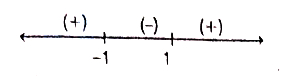
$1$. For $x \in (-\infty, -1)$,choose $x = -2$: $f'(-2) = 3((-2)^2 - 1) = 3(4 - 1) = 9 > 0$. Thus,$f(x)$ is increasing.
$2$. For $x \in (-1, 1)$,choose $x = 0$: $f'(0) = 3(0^2 - 1) = -3 < 0$. Thus,$f(x)$ is decreasing.
$3$. For $x \in (1, \infty)$,choose $x = 2$: $f'(2) = 3(2^2 - 1) = 3(3) = 9 > 0$. Thus,$f(x)$ is increasing.
Therefore,$f(x)$ is increasing in $(-\infty, -1) \cup (1, \infty)$ and decreasing in $(-1, 1)$.
First,we find the derivative of the function with respect to $x$:
$f'(x) = \frac{d}{dx}(x^3 - 3x) = 3x^2 - 3$.
Factoring the derivative,we get:
$f'(x) = 3(x^2 - 1) = 3(x - 1)(x + 1)$.
To determine the intervals of increase and decrease,we find the critical points by setting $f'(x) = 0$:
$3(x - 1)(x + 1) = 0 \implies x = 1, x = -1$.
These points divide the real number line into three intervals: $(-\infty, -1)$,$(-1, 1)$,and $(1, \infty)$.
$1$. For $x \in (-\infty, -1)$,choose $x = -2$: $f'(-2) = 3((-2)^2 - 1) = 3(4 - 1) = 9 > 0$. Thus,$f(x)$ is increasing.
$2$. For $x \in (-1, 1)$,choose $x = 0$: $f'(0) = 3(0^2 - 1) = -3 < 0$. Thus,$f(x)$ is decreasing.
$3$. For $x \in (1, \infty)$,choose $x = 2$: $f'(2) = 3(2^2 - 1) = 3(3) = 9 > 0$. Thus,$f(x)$ is increasing.
Therefore,$f(x)$ is increasing in $(-\infty, -1) \cup (1, \infty)$ and decreasing in $(-1, 1)$.
0 likes
View Solution283
EasyMCQ
If $f(x) = \frac{x}{x^2+1}$ is an increasing function,then the value of $x$ lies in:
A
$R$
B
$(-\infty, -1)$
C
$(1, \infty)$
D
$(-1, 1)$
Solution
(D) Given $f(x) = \frac{x}{x^2+1}$.
To find the interval where $f(x)$ is increasing,we find its derivative $f'(x)$ using the quotient rule:
$f'(x) = \frac{(x^2+1)(1) - x(2x)}{(x^2+1)^2} = \frac{x^2+1-2x^2}{(x^2+1)^2} = \frac{1-x^2}{(x^2+1)^2}$.
For $f(x)$ to be an increasing function,we must have $f'(x) > 0$.
Since $(x^2+1)^2$ is always positive for all real $x$,the condition $f'(x) > 0$ implies $1-x^2 > 0$.
This simplifies to $x^2 - 1 < 0$,which is $(x-1)(x+1) < 0$.
Solving this inequality,we get $x \in (-1, 1)$.
To find the interval where $f(x)$ is increasing,we find its derivative $f'(x)$ using the quotient rule:
$f'(x) = \frac{(x^2+1)(1) - x(2x)}{(x^2+1)^2} = \frac{x^2+1-2x^2}{(x^2+1)^2} = \frac{1-x^2}{(x^2+1)^2}$.
For $f(x)$ to be an increasing function,we must have $f'(x) > 0$.
Since $(x^2+1)^2$ is always positive for all real $x$,the condition $f'(x) > 0$ implies $1-x^2 > 0$.
This simplifies to $x^2 - 1 < 0$,which is $(x-1)(x+1) < 0$.
Solving this inequality,we get $x \in (-1, 1)$.
0 likes
View Solution284
EasyMCQ
If $f(x) = kx - \sin x$ is monotonically increasing,then
A
$k > 1$
B
$k > -1$
C
$k < 1$
D
$k < -1$
Solution
(A) function $f(x)$ is monotonically increasing if $f'(x) \geq 0$ for all $x \in R$.
Given $f(x) = kx - \sin x$.
Differentiating with respect to $x$,we get $f'(x) = k - \cos x$.
For $f(x)$ to be monotonically increasing,$f'(x) \geq 0$ for all $x \in R$.
$k - \cos x \geq 0 \implies k \geq \cos x$.
Since the maximum value of $\cos x$ is $1$,for $k \geq \cos x$ to hold for all $x$,$k$ must be greater than or equal to the maximum value of $\cos x$.
Therefore,$k \geq 1$.
Given $f(x) = kx - \sin x$.
Differentiating with respect to $x$,we get $f'(x) = k - \cos x$.
For $f(x)$ to be monotonically increasing,$f'(x) \geq 0$ for all $x \in R$.
$k - \cos x \geq 0 \implies k \geq \cos x$.
Since the maximum value of $\cos x$ is $1$,for $k \geq \cos x$ to hold for all $x$,$k$ must be greater than or equal to the maximum value of $\cos x$.
Therefore,$k \geq 1$.
0 likes
View Solution285
EasyMCQ
The function $f(x) = \log(1+x) - \frac{2x}{2+x}$ is increasing on
A
$(0, \infty)$
B
$(-\infty, 0)$
C
$(-\infty, \infty)$
D
None of these
Solution
(A) Given,$f(x) = \log(1+x) - \frac{2x}{2+x}$.
First,we find the derivative $f'(x)$ with respect to $x$:
$f'(x) = \frac{1}{1+x} - \frac{(2+x)(2) - 2x(1)}{(2+x)^2}$
$f'(x) = \frac{1}{1+x} - \frac{4 + 2x - 2x}{(2+x)^2}$
$f'(x) = \frac{1}{1+x} - \frac{4}{(2+x)^2}$
$f'(x) = \frac{(2+x)^2 - 4(1+x)}{(1+x)(2+x)^2}$
$f'(x) = \frac{4 + 4x + x^2 - 4 - 4x}{(1+x)(2+x)^2} = \frac{x^2}{(1+x)(2+x)^2}$.
For the function to be increasing,we require $f'(x) > 0$.
Since $x^2 \geq 0$ and $(2+x)^2 > 0$ for $x > -1$ (domain of $\log(1+x)$),the sign of $f'(x)$ depends on $(1+x)$.
Thus,$f'(x) > 0$ when $1+x > 0$,which means $x > -1$.
However,checking the options provided,$f'(x) > 0$ for all $x > 0$ is clearly satisfied.
Therefore,the function is increasing on $(0, \infty)$.
First,we find the derivative $f'(x)$ with respect to $x$:
$f'(x) = \frac{1}{1+x} - \frac{(2+x)(2) - 2x(1)}{(2+x)^2}$
$f'(x) = \frac{1}{1+x} - \frac{4 + 2x - 2x}{(2+x)^2}$
$f'(x) = \frac{1}{1+x} - \frac{4}{(2+x)^2}$
$f'(x) = \frac{(2+x)^2 - 4(1+x)}{(1+x)(2+x)^2}$
$f'(x) = \frac{4 + 4x + x^2 - 4 - 4x}{(1+x)(2+x)^2} = \frac{x^2}{(1+x)(2+x)^2}$.
For the function to be increasing,we require $f'(x) > 0$.
Since $x^2 \geq 0$ and $(2+x)^2 > 0$ for $x > -1$ (domain of $\log(1+x)$),the sign of $f'(x)$ depends on $(1+x)$.
Thus,$f'(x) > 0$ when $1+x > 0$,which means $x > -1$.
However,checking the options provided,$f'(x) > 0$ for all $x > 0$ is clearly satisfied.
Therefore,the function is increasing on $(0, \infty)$.
0 likes
View Solution286
EasyMCQ
The range of values of $x$ for which $f(x)=x^3+6x^2-36x+7$ is increasing is:
A
$(-\infty, -6) \cup (2, \infty)$
B
$(-6, 2)$
C
$(-\infty, -2) \cup (6, \infty)$
D
$(-6, 2]$
Solution
(A) Given function: $f(x) = x^3 + 6x^2 - 36x + 7$
Find the derivative: $f'(x) = 3x^2 + 12x - 36$
Factor the derivative: $f'(x) = 3(x^2 + 4x - 12) = 3(x + 6)(x - 2)$
For the function to be increasing,we require $f'(x) > 0$:
$3(x + 6)(x - 2) > 0$
$(x + 6)(x - 2) > 0$
Using the sign scheme for the quadratic inequality,the expression is positive when $x < -6$ or $x > 2$.
Thus,the range of values is $x \in (-\infty, -6) \cup (2, \infty)$.
Find the derivative: $f'(x) = 3x^2 + 12x - 36$
Factor the derivative: $f'(x) = 3(x^2 + 4x - 12) = 3(x + 6)(x - 2)$
For the function to be increasing,we require $f'(x) > 0$:
$3(x + 6)(x - 2) > 0$
$(x + 6)(x - 2) > 0$
Using the sign scheme for the quadratic inequality,the expression is positive when $x < -6$ or $x > 2$.
Thus,the range of values is $x \in (-\infty, -6) \cup (2, \infty)$.
0 likes
View Solution287
EasyMCQ
The equation $x^3+x-1=0$ has
A
no real root.
B
exactly two real roots.
C
exactly one real root.
D
all three real roots.
Solution
(C) Given equation is $f(x) = x^3+x-1 = 0$.
To determine the number of real roots,we analyze the derivative of the function $f(x)$.
The derivative is $f'(x) = 3x^2 + 1$.
Since $x^2 \geq 0$ for all $x \in \mathbb{R}$,it follows that $3x^2 + 1 \geq 1 > 0$ for all $x \in \mathbb{R}$.
Because $f'(x) > 0$ for all $x$,the function $f(x)$ is strictly increasing on the entire real line.
$A$ strictly increasing function can cross the $x$-axis at most once.
We observe the values of the function at specific points:
$f(0) = 0^3 + 0 - 1 = -1$
$f(1) = 1^3 + 1 - 1 = 1$
Since $f(0) < 0$ and $f(1) > 0$,by the Intermediate Value Theorem,there must exist at least one real root $x \in (0, 1)$ such that $f(x) = 0$.
Since the function is strictly increasing,this root is unique.
Therefore,the equation has exactly one real root.
To determine the number of real roots,we analyze the derivative of the function $f(x)$.
The derivative is $f'(x) = 3x^2 + 1$.
Since $x^2 \geq 0$ for all $x \in \mathbb{R}$,it follows that $3x^2 + 1 \geq 1 > 0$ for all $x \in \mathbb{R}$.
Because $f'(x) > 0$ for all $x$,the function $f(x)$ is strictly increasing on the entire real line.
$A$ strictly increasing function can cross the $x$-axis at most once.
We observe the values of the function at specific points:
$f(0) = 0^3 + 0 - 1 = -1$
$f(1) = 1^3 + 1 - 1 = 1$
Since $f(0) < 0$ and $f(1) > 0$,by the Intermediate Value Theorem,there must exist at least one real root $x \in (0, 1)$ such that $f(x) = 0$.
Since the function is strictly increasing,this root is unique.
Therefore,the equation has exactly one real root.
0 likes
View Solution288
MediumMCQ
If $f(x)=2x^3-15x^2-144x-7$,then $f(x)$ is strictly decreasing in
A
$(-8,3)$
B
$(-3,8)$
C
$(3,8)$
D
$(-8,-3)$
Solution
(B) Given the function $f(x)=2x^3-15x^2-144x-7$.
To find the intervals where $f(x)$ is strictly decreasing,we find the derivative $f'(x)$:
$f'(x) = \frac{d}{dx}(2x^3-15x^2-144x-7) = 6x^2-30x-144$.
For $f(x)$ to be strictly decreasing,$f'(x) < 0$:
$6x^2-30x-144 < 0$.
Dividing by $6$,we get $x^2-5x-24 < 0$.
Factoring the quadratic expression: $(x-8)(x+3) < 0$.
The roots are $x=8$ and $x=-3$.
The inequality holds for $x$ in the interval $(-3, 8)$.
Thus,$f(x)$ is strictly decreasing in $(-3, 8)$.
To find the intervals where $f(x)$ is strictly decreasing,we find the derivative $f'(x)$:
$f'(x) = \frac{d}{dx}(2x^3-15x^2-144x-7) = 6x^2-30x-144$.
For $f(x)$ to be strictly decreasing,$f'(x) < 0$:
$6x^2-30x-144 < 0$.
Dividing by $6$,we get $x^2-5x-24 < 0$.
Factoring the quadratic expression: $(x-8)(x+3) < 0$.
The roots are $x=8$ and $x=-3$.
The inequality holds for $x$ in the interval $(-3, 8)$.
Thus,$f(x)$ is strictly decreasing in $(-3, 8)$.
0 likes
View Solution289
EasyMCQ
The function $f(x) = (x + 2) e^{-x}$ is
A
decreasing in $(-\infty, -1)$ and increasing in $(-1, \infty)$
B
decreasing for all $x$
C
increasing in $(-\infty, -1)$ and decreasing in $(-1, \infty)$
D
increasing for all $x$
Solution
(C) Given $f(x) = (x + 2) e^{-x}$.
To determine the intervals of increase and decrease,we find the derivative $f'(x)$:
$f'(x) = (x + 2) \frac{d}{dx}(e^{-x}) + e^{-x} \frac{d}{dx}(x + 2)$
$f'(x) = (x + 2)(-e^{-x}) + e^{-x}(1)$
$f'(x) = e^{-x} [-(x + 2) + 1] = e^{-x}(-x - 1) = -e^{-x}(x + 1)$.
Since $e^{-x} > 0$ for all $x \in \mathbb{R}$,the sign of $f'(x)$ depends on $-(x + 1)$.
For $f(x)$ to be increasing,$f'(x) > 0 \Rightarrow -(x + 1) > 0 \Rightarrow x + 1 < 0 \Rightarrow x < -1$.
Thus,$f(x)$ is increasing in $(-\infty, -1)$.
For $f(x)$ to be decreasing,$f'(x) < 0 \Rightarrow -(x + 1) < 0 \Rightarrow x + 1 > 0 \Rightarrow x > -1$.
Thus,$f(x)$ is decreasing in $(-1, \infty)$.
Therefore,the correct option is $C$.
To determine the intervals of increase and decrease,we find the derivative $f'(x)$:
$f'(x) = (x + 2) \frac{d}{dx}(e^{-x}) + e^{-x} \frac{d}{dx}(x + 2)$
$f'(x) = (x + 2)(-e^{-x}) + e^{-x}(1)$
$f'(x) = e^{-x} [-(x + 2) + 1] = e^{-x}(-x - 1) = -e^{-x}(x + 1)$.
Since $e^{-x} > 0$ for all $x \in \mathbb{R}$,the sign of $f'(x)$ depends on $-(x + 1)$.
For $f(x)$ to be increasing,$f'(x) > 0 \Rightarrow -(x + 1) > 0 \Rightarrow x + 1 < 0 \Rightarrow x < -1$.
Thus,$f(x)$ is increasing in $(-\infty, -1)$.
For $f(x)$ to be decreasing,$f'(x) < 0 \Rightarrow -(x + 1) < 0 \Rightarrow x + 1 > 0 \Rightarrow x > -1$.
Thus,$f(x)$ is decreasing in $(-1, \infty)$.
Therefore,the correct option is $C$.
0 likes
View Solution290
DifficultMCQ
Let $f(x)=e^x-x$ and $g(x)=x^2-x, \forall x \in R$. Then the set of all $x \in R$,where the function $h(x)=(fog)(x)$ is increasing is
A
$\left[0, \frac{1}{2}\right] \cup [1, \infty)$
B
$\left[-1, -\frac{1}{2}\right] \cup \left[\frac{1}{2}, \infty\right)$
C
$[0, \infty)$
D
$\left[-\frac{1}{2}, 0\right] \cup [1, \infty)$
Solution
(A) Given $f(x) = e^x - x$ and $g(x) = x^2 - x$.
$h(x) = (fog)(x) = f(g(x)) = e^{x^2-x} - (x^2-x) = e^{x^2-x} - x^2 + x$.
Now,differentiate $h(x)$ with respect to $x$:
$h'(x) = e^{x^2-x}(2x-1) - 2x + 1$.
$h'(x) = (2x-1)(e^{x^2-x} - 1)$.
For $h(x)$ to be increasing,we require $h'(x) \geq 0$.
$(2x-1)(e^{x^2-x} - 1) \geq 0$.
Let $u = x^2-x$. Since $e^u - 1$ has the same sign as $u$,we have $(2x-1)(x^2-x) \geq 0$.
$(2x-1)x(x-1) \geq 0$.
Using the sign scheme for the critical points $0, \frac{1}{2}, 1$:
For $x \in [0, \frac{1}{2}]$,$(2x-1) \leq 0$ and $x(x-1) \leq 0$,so the product is $\geq 0$.
For $x \in [1, \infty)$,$(2x-1) > 0$ and $x(x-1) \geq 0$,so the product is $\geq 0$.
Thus,$h(x)$ is increasing for $x \in [0, \frac{1}{2}] \cup [1, \infty)$.
$h(x) = (fog)(x) = f(g(x)) = e^{x^2-x} - (x^2-x) = e^{x^2-x} - x^2 + x$.
Now,differentiate $h(x)$ with respect to $x$:
$h'(x) = e^{x^2-x}(2x-1) - 2x + 1$.
$h'(x) = (2x-1)(e^{x^2-x} - 1)$.
For $h(x)$ to be increasing,we require $h'(x) \geq 0$.
$(2x-1)(e^{x^2-x} - 1) \geq 0$.
Let $u = x^2-x$. Since $e^u - 1$ has the same sign as $u$,we have $(2x-1)(x^2-x) \geq 0$.
$(2x-1)x(x-1) \geq 0$.
Using the sign scheme for the critical points $0, \frac{1}{2}, 1$:
For $x \in [0, \frac{1}{2}]$,$(2x-1) \leq 0$ and $x(x-1) \leq 0$,so the product is $\geq 0$.
For $x \in [1, \infty)$,$(2x-1) > 0$ and $x(x-1) \geq 0$,so the product is $\geq 0$.
Thus,$h(x)$ is increasing for $x \in [0, \frac{1}{2}] \cup [1, \infty)$.
0 likes
View Solution291
EasyMCQ
The equation $x^3+x-1=0$ has
A
no real root.
B
exactly two real roots.
C
exactly one real root.
D
more than two real roots.
Solution
(C) Let $f(x) = x^3 + x - 1$.
Since $f(0) = -1 < 0$ and $f(1) = 1 > 0$,by the Intermediate Value Theorem,there exists at least one real root $c$ in the interval $(0, 1)$.
Alternatively,consider the derivative $f'(x) = 3x^2 + 1$.
Since $3x^2 + 1 > 0$ for all $x \in \mathbb{R}$,$f(x)$ is a strictly increasing function.
$A$ strictly increasing cubic function crosses the $X$-axis exactly once.
Therefore,the equation has exactly one real root.
Since $f(0) = -1 < 0$ and $f(1) = 1 > 0$,by the Intermediate Value Theorem,there exists at least one real root $c$ in the interval $(0, 1)$.
Alternatively,consider the derivative $f'(x) = 3x^2 + 1$.
Since $3x^2 + 1 > 0$ for all $x \in \mathbb{R}$,$f(x)$ is a strictly increasing function.
$A$ strictly increasing cubic function crosses the $X$-axis exactly once.
Therefore,the equation has exactly one real root.
0 likes
View Solution292
EasyMCQ
The length of the longest interval in which the function $f(x) = 3 \sin x - 4 \sin^3 x$ is increasing is:
A
$\frac{\pi}{3}$
B
$\frac{\pi}{2}$
C
$\frac{3\pi}{2}$
D
$\pi$
Solution
(A) Given $f(x) = 3 \sin x - 4 \sin^3 x$.
Using the identity $\sin 3x = 3 \sin x - 4 \sin^3 x$,we have $f(x) = \sin 3x$.
To find the interval where $f(x)$ is increasing,we find the derivative $f'(x) = 3 \cos 3x$.
For $f(x)$ to be increasing,$f'(x) \geq 0$,which implies $3 \cos 3x \geq 0$,or $\cos 3x \geq 0$.
The cosine function is non-negative in the interval $[-\frac{\pi}{2}, \frac{\pi}{2}]$.
Thus,$-\frac{\pi}{2} \leq 3x \leq \frac{\pi}{2}$.
Dividing by $3$,we get $-\frac{\pi}{6} \leq x \leq \frac{\pi}{6}$.
The length of this interval is $\frac{\pi}{6} - (-\frac{\pi}{6}) = \frac{2\pi}{6} = \frac{\pi}{3}$.
Using the identity $\sin 3x = 3 \sin x - 4 \sin^3 x$,we have $f(x) = \sin 3x$.
To find the interval where $f(x)$ is increasing,we find the derivative $f'(x) = 3 \cos 3x$.
For $f(x)$ to be increasing,$f'(x) \geq 0$,which implies $3 \cos 3x \geq 0$,or $\cos 3x \geq 0$.
The cosine function is non-negative in the interval $[-\frac{\pi}{2}, \frac{\pi}{2}]$.
Thus,$-\frac{\pi}{2} \leq 3x \leq \frac{\pi}{2}$.
Dividing by $3$,we get $-\frac{\pi}{6} \leq x \leq \frac{\pi}{6}$.
The length of this interval is $\frac{\pi}{6} - (-\frac{\pi}{6}) = \frac{2\pi}{6} = \frac{\pi}{3}$.
0 likes
View Solution293
EasyMCQ
For the function $f(x) = \sin 3x$,where $x \in [0, \frac{\pi}{2}]$,which of the following is true?
A
decreasing on $[0, \frac{\pi}{2}]$
B
increasing on $[0, \frac{\pi}{2}]$
C
decreasing on $[0, \frac{\pi}{6})$ and increasing on $(\frac{\pi}{6}, \frac{\pi}{2}]$
D
increasing on $[0, \frac{\pi}{6})$ and decreasing on $(\frac{\pi}{6}, \frac{\pi}{2}]$
Solution
(D) To determine the intervals of increase and decrease,we find the derivative of $f(x) = \sin 3x$.
$f'(x) = \frac{d}{dx}(\sin 3x) = 3 \cos 3x$.
For the function to be increasing,$f'(x) > 0$,so $3 \cos 3x > 0$,which implies $\cos 3x > 0$.
Since $x \in [0, \frac{\pi}{2}]$,$3x \in [0, \frac{3\pi}{2}]$.
$\cos 3x > 0$ when $3x \in [0, \frac{\pi}{2})$,which means $x \in [0, \frac{\pi}{6})$.
For the function to be decreasing,$f'(x) < 0$,so $3 \cos 3x < 0$,which implies $\cos 3x < 0$.
$\cos 3x < 0$ when $3x \in (\frac{\pi}{2}, \frac{3\pi}{2}]$,which means $x \in (\frac{\pi}{6}, \frac{\pi}{2}]$.
Thus,the function is increasing on $[0, \frac{\pi}{6})$ and decreasing on $(\frac{\pi}{6}, \frac{\pi}{2}]$.
Therefore,the correct option is $D$.
$f'(x) = \frac{d}{dx}(\sin 3x) = 3 \cos 3x$.
For the function to be increasing,$f'(x) > 0$,so $3 \cos 3x > 0$,which implies $\cos 3x > 0$.
Since $x \in [0, \frac{\pi}{2}]$,$3x \in [0, \frac{3\pi}{2}]$.
$\cos 3x > 0$ when $3x \in [0, \frac{\pi}{2})$,which means $x \in [0, \frac{\pi}{6})$.
For the function to be decreasing,$f'(x) < 0$,so $3 \cos 3x < 0$,which implies $\cos 3x < 0$.
$\cos 3x < 0$ when $3x \in (\frac{\pi}{2}, \frac{3\pi}{2}]$,which means $x \in (\frac{\pi}{6}, \frac{\pi}{2}]$.
Thus,the function is increasing on $[0, \frac{\pi}{6})$ and decreasing on $(\frac{\pi}{6}, \frac{\pi}{2}]$.
Therefore,the correct option is $D$.
0 likes
View Solution294
EasyMCQ
Which of the following functions is decreasing in the interval $\left(0, \frac{\pi}{8}\right)$?
A
$\tan 4x$
B
$\sin x$
C
$\cos 4x$
D
$-\cos x$
Solution
(C) To determine which function is decreasing in the interval $I = \left(0, \frac{\pi}{8}\right)$,we examine the derivative of each function:
$A) f(x) = \tan 4x \implies f'(x) = 4 \sec^2 4x$. Since $\sec^2 4x > 0$ for all $x \in I$,$f'(x) > 0$,so the function is increasing.
$B) f(x) = \sin x \implies f'(x) = \cos x$. Since $\cos x > 0$ for all $x \in \left(0, \frac{\pi}{8}\right)$,$f'(x) > 0$,so the function is increasing.
$C) f(x) = \cos 4x \implies f'(x) = -4 \sin 4x$. For $x \in \left(0, \frac{\pi}{8}\right)$,$4x \in (0, \frac{\pi}{2})$. In this interval,$\sin 4x > 0$,so $f'(x) = -4 \sin 4x < 0$. Thus,the function is decreasing.
$D) f(x) = -\cos x \implies f'(x) = \sin x$. Since $\sin x > 0$ for all $x \in I$,$f'(x) > 0$,so the function is increasing.
Therefore,the correct option is $C$.
$A) f(x) = \tan 4x \implies f'(x) = 4 \sec^2 4x$. Since $\sec^2 4x > 0$ for all $x \in I$,$f'(x) > 0$,so the function is increasing.
$B) f(x) = \sin x \implies f'(x) = \cos x$. Since $\cos x > 0$ for all $x \in \left(0, \frac{\pi}{8}\right)$,$f'(x) > 0$,so the function is increasing.
$C) f(x) = \cos 4x \implies f'(x) = -4 \sin 4x$. For $x \in \left(0, \frac{\pi}{8}\right)$,$4x \in (0, \frac{\pi}{2})$. In this interval,$\sin 4x > 0$,so $f'(x) = -4 \sin 4x < 0$. Thus,the function is decreasing.
$D) f(x) = -\cos x \implies f'(x) = \sin x$. Since $\sin x > 0$ for all $x \in I$,$f'(x) > 0$,so the function is increasing.
Therefore,the correct option is $C$.
0 likes
View Solution295
EasyMCQ
$y = x^2 e^{-x}$ is increasing on . . . . . . .
A
$(2, \infty)$
B
$(-2, 0)$
C
$(-\infty, \infty)$
D
$(0, 2)$
Solution
(D) To find the intervals where the function $y = f(x) = x^2 e^{-x}$ is increasing,we find its derivative $f'(x)$.
Using the product rule,$f'(x) = \frac{d}{dx}(x^2) \cdot e^{-x} + x^2 \cdot \frac{d}{dx}(e^{-x})$.
$f'(x) = 2x e^{-x} - x^2 e^{-x} = x(2 - x) e^{-x}$.
For the function to be increasing,we require $f'(x) > 0$.
Since $e^{-x} > 0$ for all real $x$,the sign of $f'(x)$ depends on $x(2 - x)$.
$x(2 - x) > 0$ implies $x(x - 2) < 0$.
This inequality holds when $x$ is between the roots $0$ and $2$.
Thus,the function is increasing on the interval $(0, 2)$.
Using the product rule,$f'(x) = \frac{d}{dx}(x^2) \cdot e^{-x} + x^2 \cdot \frac{d}{dx}(e^{-x})$.
$f'(x) = 2x e^{-x} - x^2 e^{-x} = x(2 - x) e^{-x}$.
For the function to be increasing,we require $f'(x) > 0$.
Since $e^{-x} > 0$ for all real $x$,the sign of $f'(x)$ depends on $x(2 - x)$.
$x(2 - x) > 0$ implies $x(x - 2) < 0$.
This inequality holds when $x$ is between the roots $0$ and $2$.
Thus,the function is increasing on the interval $(0, 2)$.
0 likes
View Solution296
EasyMCQ
The function $f(x) = \frac{x}{\log_x e}$ is increasing on the interval . . . . . . ,where $x \in \mathbb{R}^+ - \{1\}$.
A
$(-e, \infty)$
B
$(-\frac{1}{e}, 1) \cup (1, \infty)$
C
$(0, \infty) - \{1\}$
D
$(\frac{1}{e}, \infty)$
Solution
(D) Given the function $f(x) = \frac{x}{\log_x e}$.
Using the property $\log_x e = \frac{1}{\ln x}$,we can rewrite the function as:
$f(x) = x \cdot \ln x$.
To determine the interval where the function is increasing,we find the derivative $f'(x)$:
$f'(x) = \frac{d}{dx}(x \ln x) = 1 \cdot \ln x + x \cdot \frac{1}{x} = \ln x + 1$.
For the function to be increasing,we require $f'(x) > 0$:
$\ln x + 1 > 0$
$\ln x > -1$
$x > e^{-1}$
$x > \frac{1}{e}$.
Since the domain of the function is $x \in \mathbb{R}^+ - \{1\}$,the function is increasing on the interval $(\frac{1}{e}, 1) \cup (1, \infty)$. However,looking at the provided options,the most appropriate interval representing the increasing behavior is $(\frac{1}{e}, \infty)$ excluding the point $x=1$ where the function is undefined. Thus,the correct option is $D$.
Using the property $\log_x e = \frac{1}{\ln x}$,we can rewrite the function as:
$f(x) = x \cdot \ln x$.
To determine the interval where the function is increasing,we find the derivative $f'(x)$:
$f'(x) = \frac{d}{dx}(x \ln x) = 1 \cdot \ln x + x \cdot \frac{1}{x} = \ln x + 1$.
For the function to be increasing,we require $f'(x) > 0$:
$\ln x + 1 > 0$
$\ln x > -1$
$x > e^{-1}$
$x > \frac{1}{e}$.
Since the domain of the function is $x \in \mathbb{R}^+ - \{1\}$,the function is increasing on the interval $(\frac{1}{e}, 1) \cup (1, \infty)$. However,looking at the provided options,the most appropriate interval representing the increasing behavior is $(\frac{1}{e}, \infty)$ excluding the point $x=1$ where the function is undefined. Thus,the correct option is $D$.
0 likes
View Solution297
EasyMCQ
Where does $f(x) = x + \sqrt{1 - x}, 0 < x < 1$ decrease?
A
$\left(\frac{3}{4}, 1\right)$
B
$(0, 1)$
C
$\left(0, \frac{3}{4}\right)$
D
$\left(\frac{3}{4}, \infty\right)$
Solution
(A) To find where the function $f(x) = x + \sqrt{1 - x}$ decreases,we find its derivative $f'(x)$.
$f'(x) = \frac{d}{dx}(x) + \frac{d}{dx}((1 - x)^{1/2}) = 1 + \frac{1}{2}(1 - x)^{-1/2}(-1) = 1 - \frac{1}{2\sqrt{1 - x}}$.
For the function to decrease,we set $f'(x) < 0$.
$1 - \frac{1}{2\sqrt{1 - x}} < 0 \implies 1 < \frac{1}{2\sqrt{1 - x}}$.
Since $0 < x < 1$,$\sqrt{1 - x}$ is positive,so we can multiply by $2\sqrt{1 - x}$ without changing the inequality sign:
$2\sqrt{1 - x} < 1 \implies \sqrt{1 - x} < \frac{1}{2}$.
Squaring both sides:
$1 - x < \frac{1}{4} \implies 1 - \frac{1}{4} < x \implies x > \frac{3}{4}$.
Given the domain $0 < x < 1$,the function decreases on the interval $\left(\frac{3}{4}, 1\right)$.
Thus,the correct option is $A$.
$f'(x) = \frac{d}{dx}(x) + \frac{d}{dx}((1 - x)^{1/2}) = 1 + \frac{1}{2}(1 - x)^{-1/2}(-1) = 1 - \frac{1}{2\sqrt{1 - x}}$.
For the function to decrease,we set $f'(x) < 0$.
$1 - \frac{1}{2\sqrt{1 - x}} < 0 \implies 1 < \frac{1}{2\sqrt{1 - x}}$.
Since $0 < x < 1$,$\sqrt{1 - x}$ is positive,so we can multiply by $2\sqrt{1 - x}$ without changing the inequality sign:
$2\sqrt{1 - x} < 1 \implies \sqrt{1 - x} < \frac{1}{2}$.
Squaring both sides:
$1 - x < \frac{1}{4} \implies 1 - \frac{1}{4} < x \implies x > \frac{3}{4}$.
Given the domain $0 < x < 1$,the function decreases on the interval $\left(\frac{3}{4}, 1\right)$.
Thus,the correct option is $A$.
0 likes
View Solution298
EasyMCQ
The function $y = 6 - 9x - x^2$ is strictly increasing on the interval . . . . . . .
A
$(-\infty, -4.5)$
B
$(-4.5, \infty)$
C
$(-4.5, 0)$
D
$(0, 4.5)$
Solution
(A) To determine the interval where the function $y = f(x) = 6 - 9x - x^2$ is strictly increasing,we find its derivative:
$f'(x) = \frac{d}{dx}(6 - 9x - x^2) = -9 - 2x$.
For the function to be strictly increasing,we must have $f'(x) > 0$.
So,$-9 - 2x > 0$.
$-2x > 9$.
Dividing by $-2$ reverses the inequality: $x < -4.5$.
Thus,the function is strictly increasing on the interval $(-\infty, -4.5)$.
$f'(x) = \frac{d}{dx}(6 - 9x - x^2) = -9 - 2x$.
For the function to be strictly increasing,we must have $f'(x) > 0$.
So,$-9 - 2x > 0$.
$-2x > 9$.
Dividing by $-2$ reverses the inequality: $x < -4.5$.
Thus,the function is strictly increasing on the interval $(-\infty, -4.5)$.
0 likes
View SolutionApplications of Derivatives — Increasing and Decreasing function · Frequently Asked Questions
1Are these Applications of Derivatives questions useful for JEE and NEET?
Yes. All questions in this section are mapped to JEE Main and NEET exam patterns. Previous year questions from JEE Main, NEET, GUJCET and state-level exams are included with full solutions.
2Can I switch to Hindi or Gujarati for these questions?
Yes. Use the language tabs in the hero section or the sidebar to view the same questions and solutions in English, Hindi or Gujarati.
3How do I generate a question paper from this subtopic?
Use the Vedclass Exam Paper Generator — select the chapter and subtopic, set difficulty, and generate Sets A, B, C, D automatically. First 3 chapters of every subject are free.
Vedclass Products
For Students
Vedclass Test Series
Mock tests in real JEE/NEET style with performance analysis. 5-day free trial.
Start Free TrialFor Teachers
Exam Paper Generator
Generate Set A/B/C/D papers from this chapter in 2 minutes. 3 chapters free.
Try FreeFor Institutes
Online Exam Module
Live online exams with unlimited students, 360° analytics & white-label branding.
See DemoFor Teachers & Institutes
Generate a Applications of Derivatives Exam Paper in 2 Minutes
Select subtopic & difficulty — Sets A, B, C, D auto-generated with No Repeat logic.
First 3 chapters of every subject are free — no payment required.