
A English
Colloids, Emulsion, Gel and Their properties with application Questions in English
Class 12 Chemistry · Surface Chemistry · Colloids, Emulsion, Gel and Their properties with application
886+
Questions
English
Language
100%
With Solutions
Showing 49 of 886 questions in English
651
DifficultMCQ
Sodium stearate $CH_{3}(CH_{2})_{16}COO^{-}Na^{+}$ is an anionic surfactant which forms micelles in water. Choose the correct statement for it from the following:
A
It forms spherical micelles with $CH_{3}(CH_{2})_{16}-$ group pointing towards the center of the sphere.
B
It forms non-spherical micelles with $CH_{3}(CH_{2})_{16}-$ group pointing towards the center.
C
It forms spherical micelles with $CH_{3}(CH_{2})_{16}-$ group pointing towards the surface of the sphere.
D
It forms non-spherical micelles with $-COO^{-}$ group pointing outwards on the surface.
Solution
(A) Sodium stearate is an anionic surfactant. In water,it forms spherical micelles. The hydrophobic hydrocarbon tail,$CH_{3}(CH_{2})_{16}-$,points towards the center of the sphere to avoid contact with water,while the hydrophilic head,$-COO^{-}$,points towards the surface to interact with water.
0 likes
View Solution652
DifficultMCQ
Match List-$I$ with List-$II$:
Choose the most appropriate answer from the options given below:
| List-$I$ | List-$II$ |
|---|---|
| $a$. Cheese | $i$. dispersion of liquid in liquid |
| $b$. Pumice stone | $ii$. dispersion of liquid in gas |
| $c$. Hair cream | $iii$. dispersion of gas in solid |
| $d$. Cloud | $iv$. dispersion of liquid in solid |
Choose the most appropriate answer from the options given below:
A
$a-iv, b-iii, c-i, d-ii$
B
$a-iv, b-iii, c-ii, d-i$
C
$a-iv, b-i, c-iii, d-ii$
D
$a-iii, b-iv, c-i, d-ii$
Solution
(A) The classification of colloidal systems is as follows:
$a$. Cheese is a gel,which is a dispersion of liquid in solid $(iv)$.
$b$. Pumice stone is a solid foam,which is a dispersion of gas in solid $(iii)$.
$c$. Hair cream is an emulsion,which is a dispersion of liquid in liquid $(i)$.
$d$. Cloud is an aerosol,which is a dispersion of liquid in gas $(ii)$.
Therefore,the correct matching is $a-iv, b-iii, c-i, d-ii$.
$a$. Cheese is a gel,which is a dispersion of liquid in solid $(iv)$.
$b$. Pumice stone is a solid foam,which is a dispersion of gas in solid $(iii)$.
$c$. Hair cream is an emulsion,which is a dispersion of liquid in liquid $(i)$.
$d$. Cloud is an aerosol,which is a dispersion of liquid in gas $(ii)$.
Therefore,the correct matching is $a-iv, b-iii, c-i, d-ii$.
0 likes
View Solution653
MediumMCQ
Which of the following statements is incorrect?
A
In coagulation of a negative sol,flocculating power is in the order of $Al^{3+} > Ba^{2+} > Na^{+}$
B
In the flocculation of a positive sol,flocculating power is in the order,$Cl^{-} > SO_{4}^{2-} > PO_{4}^{3-} > [Fe(CN)_{6}]^{4-}$
C
Lyophilic colloids have greater affinity for solvents
D
Lyophilic sols are more stable than lyophobic sols
Solution
(B) According to the Hardy-Schulze rule,the flocculating power of an ion increases with the increase in the magnitude of the charge on the ion.
For a positive sol,the coagulating ions must be negative.
The correct order of flocculating power for a positive sol is $[Fe(CN)_{6}]^{4-} > PO_{4}^{3-} > SO_{4}^{2-} > Cl^{-}$.
Therefore,the statement in option $B$ is incorrect as it presents the reverse order.
For a positive sol,the coagulating ions must be negative.
The correct order of flocculating power for a positive sol is $[Fe(CN)_{6}]^{4-} > PO_{4}^{3-} > SO_{4}^{2-} > Cl^{-}$.
Therefore,the statement in option $B$ is incorrect as it presents the reverse order.
0 likes
View Solution654
EasyMCQ
Given below are two statements:
Statement $I:$ In the coagulation of a negative sol,the flocculating power of the three given ions is in the order - $Al^{3+} > Ba^{2+} > Na^{+}$
Statement $II:$ In the coagulation of a positive sol,the flocculating power of the three given salts is in the order - $NaCl > Na_{2}SO_{4} > Na_{3}PO_{4}$
In the light of the above statements,choose the most appropriate answer from the options given below:
Statement $I:$ In the coagulation of a negative sol,the flocculating power of the three given ions is in the order - $Al^{3+} > Ba^{2+} > Na^{+}$
Statement $II:$ In the coagulation of a positive sol,the flocculating power of the three given salts is in the order - $NaCl > Na_{2}SO_{4} > Na_{3}PO_{4}$
In the light of the above statements,choose the most appropriate answer from the options given below:
A
Both Statement $I$ and Statement $II$ are incorrect.
B
Statement $I$ is correct but Statement $II$ is incorrect.
C
Statement $I$ is incorrect but Statement $II$ is correct.
D
Both Statement $I$ and Statement $II$ are correct.
Solution
(B) According to the Hardy-Schulze rule,the coagulating power of an ion depends on its valency. The greater the valency of the flocculating ion,the greater is its power to cause precipitation.
Statement $I$ is correct: For a negative sol,the coagulating power of cations follows the order $Al^{3+} > Ba^{2+} > Na^{+}$ because the valency of the cation is directly proportional to the coagulating power.
Statement $II$ is incorrect: For a positive sol,the coagulating power depends on the valency of the anion. The order should be based on the valency of the anions $(Cl^- < SO_{4}^{2-} < PO_{4}^{3-})$. Therefore,the correct order of flocculating power for the salts should be $NaCl < Na_{2}SO_{4} < Na_{3}PO_{4}$.
Statement $I$ is correct: For a negative sol,the coagulating power of cations follows the order $Al^{3+} > Ba^{2+} > Na^{+}$ because the valency of the cation is directly proportional to the coagulating power.
Statement $II$ is incorrect: For a positive sol,the coagulating power depends on the valency of the anion. The order should be based on the valency of the anions $(Cl^- < SO_{4}^{2-} < PO_{4}^{3-})$. Therefore,the correct order of flocculating power for the salts should be $NaCl < Na_{2}SO_{4} < Na_{3}PO_{4}$.
0 likes
View Solution655
MediumMCQ
Given below are two statements:
Statement $I :$ Emulsions of oil in water are unstable and sometimes they separate into two layers on standing.
Statement $II :$ For stabilisation of an emulsion,excess of electrolyte is added.
In the light of the above statements,choose the most appropriate answer from the options given below:
Statement $I :$ Emulsions of oil in water are unstable and sometimes they separate into two layers on standing.
Statement $II :$ For stabilisation of an emulsion,excess of electrolyte is added.
In the light of the above statements,choose the most appropriate answer from the options given below:
A
Both Statement $I$ and Statement $II$ are correct.
B
Both Statement $I$ and Statement $II$ are incorrect.
C
Statement $I$ is correct but Statement $II$ is incorrect.
D
Statement $I$ is incorrect but Statement $II$ is correct.
Solution
(C) Statement $I$ is correct because emulsions are thermodynamically unstable systems,and oil droplets tend to coalesce and separate into two layers over time.
Statement $II$ is incorrect because adding an excess of electrolyte to an emulsion typically causes coagulation or breaking of the emulsion,not stabilization. Emulsions are stabilized by adding emulsifying agents (emulsifiers) like soaps,proteins,or gums,which form a protective film around the dispersed droplets.
Statement $II$ is incorrect because adding an excess of electrolyte to an emulsion typically causes coagulation or breaking of the emulsion,not stabilization. Emulsions are stabilized by adding emulsifying agents (emulsifiers) like soaps,proteins,or gums,which form a protective film around the dispersed droplets.
0 likes
View Solution656
MediumMCQ
Incorrect statement for Tyndall effect is ..... .
A
The refractive indices of the dispersed phase and the dispersion medium differ greatly in magnitude.
B
The diameter of the dispersed particles is much smaller than the wavelength of the light used.
C
During projection of movies in the cinemas hall,Tyndall effect is noticed.
D
It is used to distinguish a true solution from a colloidal solution.
Solution
(B) For the Tyndall effect to be observed,two main conditions must be met:
$1$. The diameter of the dispersed particles should not be much smaller than the wavelength of the light used.
$2$. The refractive indices of the dispersed phase and the dispersion medium must differ greatly in magnitude.
Therefore,the statement that the diameter of the dispersed particles is much smaller than the wavelength of the light used is incorrect.
$1$. The diameter of the dispersed particles should not be much smaller than the wavelength of the light used.
$2$. The refractive indices of the dispersed phase and the dispersion medium must differ greatly in magnitude.
Therefore,the statement that the diameter of the dispersed particles is much smaller than the wavelength of the light used is incorrect.
0 likes
View Solution657
EasyMCQ
Using very little soap while washing clothes does not serve the purpose of cleaning clothes because ..... .
A
soap particles remain floating in water as ions
B
the hydrophobic part of soap is not able to take away grease
C
the micelles are not formed due to concentration of soap,below its $CMC$ value
D
colloidal structure of soap in water is completely disturbed
Solution
(C) The cleaning action of soap is based on the formation of micelles.
Micelles are aggregates of soap molecules that form only when the concentration of soap in water reaches or exceeds the $Critical \text{ } Micelle \text{ } Concentration$ $(CMC)$.
If the concentration of soap is below the $CMC$,the soap molecules remain as individual ions or molecules and cannot effectively trap grease or dirt particles.
Therefore,using very little soap prevents micelle formation,rendering the cleaning process ineffective.
Micelles are aggregates of soap molecules that form only when the concentration of soap in water reaches or exceeds the $Critical \text{ } Micelle \text{ } Concentration$ $(CMC)$.
If the concentration of soap is below the $CMC$,the soap molecules remain as individual ions or molecules and cannot effectively trap grease or dirt particles.
Therefore,using very little soap prevents micelle formation,rendering the cleaning process ineffective.
0 likes
View Solution658
MediumMCQ
Match List-$I$ with List-$II$.
Choose the correct answer from the options given below:
| List-$I$ | List-$II$ |
|---|---|
| $A$. Lyophilic colloid | $I$. Liquid-liquid colloid |
| $B$. Emulsion | $II$. Protective colloid |
| $C$. Positively charged colloid | $III$. $FeCl_3 + NaOH$ |
| $D$. Negatively charged colloid | $IV$. $FeCl_3 + \text{hot water}$ |
Choose the correct answer from the options given below:
A
$A-II, B-I, C-IV, D-III$
B
$A-III, B-I, C-IV, D-II$
C
$A-II, B-I, C-III, D-IV$
D
$A-III, B-II, C-I, D-IV$
Solution
(A) . Lyophilic colloids act as protective colloids because they form a protective layer around lyophobic particles.
$B$. Emulsions are colloidal systems where both the dispersed phase and the dispersion medium are liquids (liquid-liquid colloid).
$C$. The reaction of $FeCl_3$ with hot water leads to the formation of a positively charged sol of hydrated ferric oxide $(Fe_2O_3 \cdot xH_2O)$.
$D$. The reaction of $FeCl_3$ with $NaOH$ (in excess) leads to the formation of a negatively charged sol due to the preferential adsorption of $OH^-$ ions on the surface of the precipitate.
Therefore,the correct matching is $A-II, B-I, C-IV, D-III$.
$B$. Emulsions are colloidal systems where both the dispersed phase and the dispersion medium are liquids (liquid-liquid colloid).
$C$. The reaction of $FeCl_3$ with hot water leads to the formation of a positively charged sol of hydrated ferric oxide $(Fe_2O_3 \cdot xH_2O)$.
$D$. The reaction of $FeCl_3$ with $NaOH$ (in excess) leads to the formation of a negatively charged sol due to the preferential adsorption of $OH^-$ ions on the surface of the precipitate.
Therefore,the correct matching is $A-II, B-I, C-IV, D-III$.
0 likes
View Solution659
MediumMCQ
Match List-$I$ with List-$II$.
Choose the correct answer from the options given below:
| List-$I$ | List-$II$ |
| $A$. Negatively charged sol | $I$. $Fe_{2}O_{3} \cdot xH_{2}O$ |
| $B$. Macromolecular colloid | $II$. $CdS$ sol |
| $C$. Positively charged sol | $III$. Starch |
| $D$. Cheese | $IV$. $A$ gel |
Choose the correct answer from the options given below:
A
$A-II, B-III, C-IV, D-I$
B
$A-II, B-I, C-III, D-IV$
C
$A-II, B-III, C-I, D-IV$
D
$A-I, B-III, C-II, D-IV$
Solution
(C) The correct matches are as follows:
$A$. Negatively charged sol: $CdS$ sol $(II)$
$B$. Macromolecular colloid: Starch $(III)$
$C$. Positively charged sol: $Fe_{2}O_{3} \cdot xH_{2}O$ $(I)$
$D$. Cheese: $A$ gel $(IV)$
Therefore,the correct sequence is $A-II, B-III, C-I, D-IV$.
$A$. Negatively charged sol: $CdS$ sol $(II)$
$B$. Macromolecular colloid: Starch $(III)$
$C$. Positively charged sol: $Fe_{2}O_{3} \cdot xH_{2}O$ $(I)$
$D$. Cheese: $A$ gel $(IV)$
Therefore,the correct sequence is $A-II, B-III, C-I, D-IV$.
0 likes
View Solution660
MediumMCQ
The Zeta potential is related to which property of colloids?
A
Colour
B
Tyndall effect
C
Charge on the surface of colloidal particles
D
Brownian movement
Solution
(C) The potential difference between the fixed layer and the diffused layer of charges on the surface of a colloidal particle is known as the Zeta potential or electrokinetic potential.
0 likes
View Solution661
DifficultMCQ
$A$ $42.12 \% (w/v)$ solution of $NaCl$ causes precipitation of a certain sol in $10 \, hours$. The coagulating value of $NaCl$ for the sol is $.....$
[Given : Molar mass : $Na = 23.0 \, g \, mol^{-1} ; Cl = 35.5 \, g \, mol^{-1}]$
[Given : Molar mass : $Na = 23.0 \, g \, mol^{-1} ; Cl = 35.5 \, g \, mol^{-1}]$
A
$36 \, m\,mol \, L^{-1}$
B
$36 \, mol \, L^{-1}$
C
$1440 \, mol \, L^{-1}$
D
$1440 \, m\,mol \, L^{-1}$
Solution
(A) The coagulating value is defined as the minimum concentration of an electrolyte in $m\,mol \, L^{-1}$ required to cause coagulation of a sol in $2 \, hours$.
$1$. Calculate the molar mass of $NaCl$: $M = 23.0 + 35.5 = 58.5 \, g \, mol^{-1}$.
$2$. Calculate the molarity of the given $42.12 \% (w/v)$ solution:
$42.12 \% (w/v)$ means $42.12 \, g$ of $NaCl$ in $100 \, mL$ of solution.
Concentration in $g \, L^{-1} = 42.12 \times 10 = 421.2 \, g \, L^{-1}$.
Concentration in $mol \, L^{-1} = \frac{421.2}{58.5} = 7.2 \, mol \, L^{-1} = 7200 \, m\,mol \, L^{-1}$.
$3$. The question asks for the coagulating value,which is the concentration required for coagulation. Given the data provided is insufficient to relate the time $(10 \, hours)$ to the standard definition $(2 \, hours)$ without a specific rate law or empirical relationship,the provided options suggest a calculation based on the concentration itself. However,based on standard textbook problems of this type,the answer is derived as $7200 \, m\,mol \, L^{-1}$. Since this is not an option,and the provided solution was 'Data insufficient',we maintain this assessment.
$1$. Calculate the molar mass of $NaCl$: $M = 23.0 + 35.5 = 58.5 \, g \, mol^{-1}$.
$2$. Calculate the molarity of the given $42.12 \% (w/v)$ solution:
$42.12 \% (w/v)$ means $42.12 \, g$ of $NaCl$ in $100 \, mL$ of solution.
Concentration in $g \, L^{-1} = 42.12 \times 10 = 421.2 \, g \, L^{-1}$.
Concentration in $mol \, L^{-1} = \frac{421.2}{58.5} = 7.2 \, mol \, L^{-1} = 7200 \, m\,mol \, L^{-1}$.
$3$. The question asks for the coagulating value,which is the concentration required for coagulation. Given the data provided is insufficient to relate the time $(10 \, hours)$ to the standard definition $(2 \, hours)$ without a specific rate law or empirical relationship,the provided options suggest a calculation based on the concentration itself. However,based on standard textbook problems of this type,the answer is derived as $7200 \, m\,mol \, L^{-1}$. Since this is not an option,and the provided solution was 'Data insufficient',we maintain this assessment.
0 likes
View Solution662
MediumMCQ
Which of the following is a correct statement?
A
Brownian motion destabilises sols.
B
Any amount of dispersed phase can be added to emulsion without destabilising it.
C
Mixing two oppositely charged sols in equal amount neutralises charges and stabilises colloids.
D
Presence of equal and similar charges on colloidal particles provides stability to the colloidal solution.
Solution
(D) Colloidal particles carry an electric charge,which is the primary factor for their stability.
Since all particles in a given colloidal solution carry the same type of charge,they repel each other,preventing them from coming close enough to aggregate or precipitate.
Therefore,the presence of equal and similar charges on colloidal particles provides stability to the colloidal solution.
Since all particles in a given colloidal solution carry the same type of charge,they repel each other,preventing them from coming close enough to aggregate or precipitate.
Therefore,the presence of equal and similar charges on colloidal particles provides stability to the colloidal solution.
0 likes
View Solution663
MediumMCQ
For micelle formation,which of the following statements are correct?
$A$. Micelle formation is an exothermic process.
$B$. Micelle formation is an endothermic process.
$C$. The entropy change is positive.
$D$. The entropy change is negative.
$A$. Micelle formation is an exothermic process.
$B$. Micelle formation is an endothermic process.
$C$. The entropy change is positive.
$D$. The entropy change is negative.
A
$A$ and $D$ only
B
$A$ and $C$ only
C
$B$ and $C$ only
D
$B$ and $D$ only
Solution
(C) Micelle formation is a spontaneous process driven by the hydrophobic effect.
During micelle formation,the hydrophobic tails of surfactant molecules aggregate,which leads to the release of water molecules previously ordered around the tails into the bulk solvent.
This release of water molecules results in a net increase in the entropy of the system,so $\Delta S > 0$.
Additionally,the process is endothermic,meaning $\Delta H > 0$.
Therefore,statements $B$ and $C$ are correct.
During micelle formation,the hydrophobic tails of surfactant molecules aggregate,which leads to the release of water molecules previously ordered around the tails into the bulk solvent.
This release of water molecules results in a net increase in the entropy of the system,so $\Delta S > 0$.
Additionally,the process is endothermic,meaning $\Delta H > 0$.
Therefore,statements $B$ and $C$ are correct.
0 likes
View Solution664
MediumMCQ
Given below are two statements: one is labelled as Assertion $A$ and the other is labelled as Reason $R$.
Assertion $A$: Finest gold is red in colour,as the size of the particles increases,it appears purple then blue and finally gold.
Assertion $R$: The colour of the colloidal solution depends on the wavelength of light scattered by the dispersed particles.
In the light of the above statements,choose the most appropriate answer from the options given below:
Assertion $A$: Finest gold is red in colour,as the size of the particles increases,it appears purple then blue and finally gold.
Assertion $R$: The colour of the colloidal solution depends on the wavelength of light scattered by the dispersed particles.
In the light of the above statements,choose the most appropriate answer from the options given below:
A
Both $A$ and $R$ are true and $R$ is the correct explanation of $A$
B
Both $A$ and $R$ are true but $R$ is $NOT$ the correct explanation of $A$
C
$A$ is true but $R$ is false
D
$A$ is false but $R$ is true
Solution
(A) The colour of a colloidal solution depends on the size and shape of the dispersed particles.
As the particle size of gold sol increases,the wavelength of light scattered by the particles changes,which results in a change in the observed colour (from red to purple to blue and finally to golden).
Therefore,Assertion $A$ is true.
Reason $R$ correctly explains that the colour of a colloidal solution depends on the wavelength of light scattered by the dispersed particles,which is a direct consequence of the particle size.
Thus,both $A$ and $R$ are true,and $R$ is the correct explanation of $A$.
As the particle size of gold sol increases,the wavelength of light scattered by the particles changes,which results in a change in the observed colour (from red to purple to blue and finally to golden).
Therefore,Assertion $A$ is true.
Reason $R$ correctly explains that the colour of a colloidal solution depends on the wavelength of light scattered by the dispersed particles,which is a direct consequence of the particle size.
Thus,both $A$ and $R$ are true,and $R$ is the correct explanation of $A$.
0 likes
View Solution665
MediumMCQ
Given below are two statements: one is labelled as Assertion $(A)$ and the other is labelled as Reason $(R)$.
Assertion $(A)$: Dissolved substances can be removed from a colloidal solution by diffusion through a parchment paper.
Reason $(R)$: Particles in a true solution cannot pass through parchment paper but the colloidal particles can pass through the parchment paper.
In the light of the above statements,choose the correct answer from the options given below.
Assertion $(A)$: Dissolved substances can be removed from a colloidal solution by diffusion through a parchment paper.
Reason $(R)$: Particles in a true solution cannot pass through parchment paper but the colloidal particles can pass through the parchment paper.
In the light of the above statements,choose the correct answer from the options given below.
A
Both $(A)$ and $(R)$ are correct and $(R)$ is the correct explanation of $(A)$.
B
Both $(A)$ and $(R)$ are correct but $(R)$ is not the correct explanation of $(A)$.
C
$(A)$ is correct but $(R)$ is not correct.
D
$(A)$ is not correct but $(R)$ is correct.
Solution
(C) Assertion $(A)$ is correct because dissolved substances (crystalloids) can pass through parchment paper,while colloidal particles cannot,allowing for purification via dialysis.
Reason $(R)$ is incorrect because particles in a true solution (crystalloids) can easily pass through parchment paper,whereas colloidal particles are too large to pass through it.
Therefore,$(A)$ is correct but $(R)$ is incorrect.
Reason $(R)$ is incorrect because particles in a true solution (crystalloids) can easily pass through parchment paper,whereas colloidal particles are too large to pass through it.
Therefore,$(A)$ is correct but $(R)$ is incorrect.
0 likes
View Solution666
MediumMCQ
$100 \; mL$ of $5 \% \; (w/v)$ solution of $NaCl$ in water was prepared in a $250 \; mL$ beaker. Albumin from the egg was poured into the $NaCl$ solution and stirred well. This resulted in a/an:
A
Lyophilic sol
B
Lyophobic sol
C
Emulsion
D
Precipitate
Solution
(A) Albumin is a protein,which is a macromolecule that forms a lyophilic sol when dispersed in a suitable solvent like water or dilute salt solutions.
Since albumin has a high affinity for the dispersion medium,it forms a lyophilic sol.
Since albumin has a high affinity for the dispersion medium,it forms a lyophilic sol.
0 likes
View Solution667
MediumMCQ
Among the following methods:
$(i)$ Addition of an electrolyte
$(ii)$ Electrophoresis
$(iii)$ Addition of a protective colloid
$(iv)$ Addition of an oppositely charged sol
the coagulation of a lyophobic sol can be carried out by:
$(i)$ Addition of an electrolyte
$(ii)$ Electrophoresis
$(iii)$ Addition of a protective colloid
$(iv)$ Addition of an oppositely charged sol
the coagulation of a lyophobic sol can be carried out by:
A
$(i)$ and $(iv)$ only
B
$(ii), (iii)$ and $(iv)$ only
C
$(iii)$ and $(iv)$ only
D
$(i), (ii)$ and $(iv)$ only
Solution
(D) The coagulation of a lyophobic sol involves the neutralization of the charge on the colloidal particles.
$(i)$ Addition of an electrolyte provides ions that neutralize the charge.
$(ii)$ Electrophoresis involves moving particles to an oppositely charged electrode,leading to discharge and coagulation.
$(iv)$ Addition of an oppositely charged sol leads to mutual coagulation.
$(iii)$ Addition of a protective colloid is used to stabilize lyophobic sols,not to coagulate them.
Therefore,the correct methods are $(i), (ii)$ and $(iv)$.
$(i)$ Addition of an electrolyte provides ions that neutralize the charge.
$(ii)$ Electrophoresis involves moving particles to an oppositely charged electrode,leading to discharge and coagulation.
$(iv)$ Addition of an oppositely charged sol leads to mutual coagulation.
$(iii)$ Addition of a protective colloid is used to stabilize lyophobic sols,not to coagulate them.
Therefore,the correct methods are $(i), (ii)$ and $(iv)$.
0 likes
View Solution668
DifficultMCQ
Statement $I:$ For colloidal particles,the values of colligative properties are of small order as compared to values shown by true solutions at the same concentration.
Statement $II:$ For colloidal particles,the potential difference between the fixed layer and the diffused layer of opposite charges is called the electrokinetic potential or zeta potential.
In the light of the above statements,choose the correct answer from the options given below.
Statement $II:$ For colloidal particles,the potential difference between the fixed layer and the diffused layer of opposite charges is called the electrokinetic potential or zeta potential.
In the light of the above statements,choose the correct answer from the options given below.
A
Statement $I$ is true but Statement $II$ is false
B
Statement $I$ is false but Statement $II$ is true
C
Both Statement $I$ and Statement $II$ are true
D
Both Statement $I$ and Statement $II$ are false
Solution
(C) Statement $I:$ Colloidal particles are aggregates of molecules. Due to their large size,the number of particles in a given mass of colloid is much smaller than the number of particles in the same mass of a true solution. Since colligative properties depend on the number of particles,they are of a smaller order for colloids compared to true solutions. This statement is true.
Statement $II:$ According to the Helmholtz double layer theory,the potential difference between the fixed layer and the diffused layer of opposite charges is known as the electrokinetic potential or zeta potential. This statement is true.
Statement $II:$ According to the Helmholtz double layer theory,the potential difference between the fixed layer and the diffused layer of opposite charges is known as the electrokinetic potential or zeta potential. This statement is true.
0 likes
View Solution669
DifficultMCQ
Which of the following salt solutions would coagulate the colloid solution formed when $FeCl_{3}$ is added to $NaOH$ solution,at the fastest rate?
A
$10 \ mL$ of $0.2 \ mol \ dm^{-3} \ AlCl_{3}$
B
$10 \ mL$ of $0.1 \ mol \ dm^{-3} \ Na_{2}SO_{4}$
C
$10 \ mL$ of $0.1 \ mol \ dm^{-3} \ Ca_{3}(PO_{4})_{2}$
D
$10 \ mL$ of $0.15 \ mol \ dm^{-3} \ CaCl_{2}$
Solution
(A) When $FeCl_{3}$ is added to $NaOH$ in excess,a negatively charged ferric hydroxide sol $[Fe(OH)_{3} \cdot OH^-]$ is formed.
According to the Hardy-Schulze rule,the coagulating power of an ion increases with the increase in the magnitude of its charge.
For a negatively charged sol,the coagulating power of cations follows the order: $Al^{3+} > Ca^{2+} > Na^+$.
Among the given options,$AlCl_{3}$ provides $Al^{3+}$ ions,which have the highest charge and thus the highest coagulating power,leading to the fastest rate of coagulation.
According to the Hardy-Schulze rule,the coagulating power of an ion increases with the increase in the magnitude of its charge.
For a negatively charged sol,the coagulating power of cations follows the order: $Al^{3+} > Ca^{2+} > Na^+$.
Among the given options,$AlCl_{3}$ provides $Al^{3+}$ ions,which have the highest charge and thus the highest coagulating power,leading to the fastest rate of coagulation.
0 likes
View Solution670
DifficultMCQ
Match List-$I$ and List-$II$.
Choose the correct answer from the options given below:
| List-$I$ | List-$II$ |
| $A$. Osmosis | $I$. Solvent molecules pass through semi permeable membrane towards solvent side. |
| $B$. Reverse osmosis | $II$. Movement of charged colloidal particles under the influence of applied electric potential towards oppositely charged electrodes. |
| $C$. Electro osmosis | $III$. Solvent molecules pass through semi permeable membrane towards solution side. |
| $D$. Electrophoresis | $IV$. Dispersion medium moves in an electric field. |
Choose the correct answer from the options given below:
A
$A-I, B-III, C-IV, D-II$
B
$A-III, B-I, C-IV, D-II$
C
$A-III, B-I, C-II, D-IV$
D
$A-I, B-III, C-II, D-IV$
Solution
(B) . Osmosis: Solvent molecules pass through a semi-permeable membrane towards the solution side $(III)$.
$B$. Reverse osmosis: Solvent molecules pass through a semi-permeable membrane towards the solvent side $(I)$.
$C$. Electro-osmosis: The dispersion medium moves in an electric field $(IV)$.
$D$. Electrophoresis: Movement of charged colloidal particles under the influence of an applied electric potential towards oppositely charged electrodes $(II)$.
Therefore,the correct matching is $A-III, B-I, C-IV, D-II$.
$B$. Reverse osmosis: Solvent molecules pass through a semi-permeable membrane towards the solvent side $(I)$.
$C$. Electro-osmosis: The dispersion medium moves in an electric field $(IV)$.
$D$. Electrophoresis: Movement of charged colloidal particles under the influence of an applied electric potential towards oppositely charged electrodes $(II)$.
Therefore,the correct matching is $A-III, B-I, C-IV, D-II$.
0 likes
View Solution671
MediumMCQ
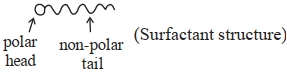
When surfactants are added to a non-polar solvent,how will the micelle structure look?
A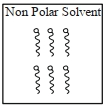
B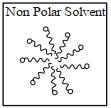
C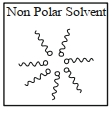
D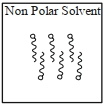
Solution
(A) In a non-polar solvent,the surfactant molecules form reverse micelles. The polar heads,which are hydrophilic,aggregate in the center to minimize contact with the non-polar solvent,while the non-polar tails,which are lipophilic,extend outwards into the non-polar solvent. This structure is represented by option $A$.
0 likes
View Solution672
DifficultMCQ
The number of colloidal systems from the following,which will have 'liquid' as the dispersion medium,is $.........$.
Gem stones,paints,smoke,cheese,milk,hair cream,insecticide sprays,froth,soap lather.
Gem stones,paints,smoke,cheese,milk,hair cream,insecticide sprays,froth,soap lather.
A
$4$
B
$6$
C
$5$
D
$9$
Solution
(C) colloidal system with a liquid dispersion medium is known as an emulsion (if the dispersed phase is liquid) or a sol (if the dispersed phase is solid).
Let us classify the given systems:
$1$. Gem stones: Solid sol (Solid in Solid)
$2$. Paints: Sol (Solid in Liquid)
$3$. Smoke: Aerosol (Solid in Gas)
$4$. Cheese: Gel (Liquid in Solid)
$5$. Milk: Emulsion (Liquid in Liquid)
$6$. Hair cream: Emulsion (Liquid in Liquid)
$7$. Insecticide sprays: Aerosol (Liquid in Gas)
$8$. Froth: Foam (Gas in Liquid)
$9$. Soap lather: Foam (Gas in Liquid)
The systems with liquid as the dispersion medium are: Paints,Milk,Hair cream,Froth,and Soap lather.
Total count = $5$.
Let us classify the given systems:
$1$. Gem stones: Solid sol (Solid in Solid)
$2$. Paints: Sol (Solid in Liquid)
$3$. Smoke: Aerosol (Solid in Gas)
$4$. Cheese: Gel (Liquid in Solid)
$5$. Milk: Emulsion (Liquid in Liquid)
$6$. Hair cream: Emulsion (Liquid in Liquid)
$7$. Insecticide sprays: Aerosol (Liquid in Gas)
$8$. Froth: Foam (Gas in Liquid)
$9$. Soap lather: Foam (Gas in Liquid)
The systems with liquid as the dispersion medium are: Paints,Milk,Hair cream,Froth,and Soap lather.
Total count = $5$.
0 likes
View Solution673
MediumMCQ
Coagulating value of electrolytes $AlCl_3$ and $NaCl$ for $As_2S_3$ are $0.09$ and $50.04$ respectively. The coagulating power of $AlCl_3$ is $x$ times the coagulating power of $NaCl$. The value of $x$ is $.......$.
A
$556$
B
$555$
C
$557$
D
$558$
Solution
(A) The coagulating power of an electrolyte is inversely proportional to its coagulating value.
$\text{Coagulating Power} (C.P.) = \frac{1}{\text{Coagulating Value} (C.V.)}$
Given:
$(C.V.)_{AlCl_3} = 0.09$
$(C.V.)_{NaCl} = 50.04$
Ratio of coagulating powers:
$\frac{(C.P.)_{AlCl_3}}{(C.P.)_{NaCl}} = \frac{(C.V.)_{NaCl}}{(C.V.)_{AlCl_3}}$
$\frac{(C.P.)_{AlCl_3}}{(C.P.)_{NaCl}} = \frac{50.04}{0.09} = 556$
Therefore,the coagulating power of $AlCl_3$ is $556$ times the coagulating power of $NaCl$. Thus,$x = 556$.
$\text{Coagulating Power} (C.P.) = \frac{1}{\text{Coagulating Value} (C.V.)}$
Given:
$(C.V.)_{AlCl_3} = 0.09$
$(C.V.)_{NaCl} = 50.04$
Ratio of coagulating powers:
$\frac{(C.P.)_{AlCl_3}}{(C.P.)_{NaCl}} = \frac{(C.V.)_{NaCl}}{(C.V.)_{AlCl_3}}$
$\frac{(C.P.)_{AlCl_3}}{(C.P.)_{NaCl}} = \frac{50.04}{0.09} = 556$
Therefore,the coagulating power of $AlCl_3$ is $556$ times the coagulating power of $NaCl$. Thus,$x = 556$.
0 likes
View Solution674
MediumMCQ
The enthalpy change for the adsorption process and micelle formation respectively are
A
$\Delta H_{\text{ads}} < 0$ and $\Delta H_{\text{mic}} > 0$
B
$\Delta H_{\text{ads}} < 0$ and $\Delta H_{\text{mic}} < 0$
C
$\Delta H_{\text{ads}} > 0$ and $\Delta H_{\text{mic}} < 0$
D
$\Delta H_{\text{ads}} > 0$ and $\Delta H_{\text{mic}} > 0$
Solution
(A) Adsorption is a spontaneous process accompanied by a decrease in surface energy,which releases heat,making it an exothermic process $(\Delta H_{\text{ads}} < 0)$.
Micelle formation is a spontaneous process driven by the increase in entropy of the system,but the process itself is endothermic $(\Delta H_{\text{mic}} > 0)$.
Micelle formation is a spontaneous process driven by the increase in entropy of the system,but the process itself is endothermic $(\Delta H_{\text{mic}} > 0)$.
0 likes
View Solution675
MediumMCQ
Ferric chloride is applied to stop bleeding because:
A
$Cl^{-}$ ions cause coagulation of blood.
B
Blood absorbs $FeCl_3$ and forms a complex.
C
$Fe^{3+}$ ions coagulate blood which is a negatively charged sol.
D
$FeCl_3$ reacts with the constituents of blood which is a positively charged sol.
Solution
(C) Blood is a colloidal system which is negatively charged.
According to the Hardy-Schulze rule,the coagulating power of an ion is directly proportional to its valency.
$Fe^{3+}$ ions,being highly positively charged,effectively neutralize the negative charge on the blood colloids,leading to coagulation and stopping the bleeding.
According to the Hardy-Schulze rule,the coagulating power of an ion is directly proportional to its valency.
$Fe^{3+}$ ions,being highly positively charged,effectively neutralize the negative charge on the blood colloids,leading to coagulation and stopping the bleeding.
0 likes
View Solution676
MediumMCQ
What happens when a lyophilic sol is added to a lyophobic sol?
A
Lyophilic sol is dispersed in lyophobic sol.
B
Film of lyophobic sol is formed over lyophilic sol.
C
Lyophobic sol is coagulated.
D
Film of lyophilic sol is formed over lyophobic sol.
Solution
(D) Lyophilic sols act as protective colloids for lyophobic sols. When a lyophilic sol is added to a lyophobic sol,the lyophilic particles form a protective film or layer around the lyophobic particles,thereby preventing their coagulation by electrolytes.
0 likes
View Solution677
MediumMCQ
Given below are two statements,one is labelled as Assertion $A$ and the other is labelled as Reason $R$.
Assertion $A$ : The diameter of colloidal particles in solution should not be much smaller than the wavelength of light to show Tyndall effect.
Reason $R$ : The light scatters in all directions when the size of particles is large enough.
In the light of the above statements,choose the correct answer from the options given below:
Assertion $A$ : The diameter of colloidal particles in solution should not be much smaller than the wavelength of light to show Tyndall effect.
Reason $R$ : The light scatters in all directions when the size of particles is large enough.
In the light of the above statements,choose the correct answer from the options given below:
A
$A$ is true but $R$ is false
B
$A$ is false but $R$ is true
C
Both $A$ and $R$ are correct and $R$ is the correct explanation of $A$
D
Both $A$ and $R$ are correct but $R$ is $NOT$ the correct explanation of $A$
Solution
(C) The Tyndall effect is observed when the diameter of the dispersed particles is not much smaller than the wavelength of the light used.
When the particle size is large enough (comparable to the wavelength of light),the light hits the particles and scatters in all directions,making the path of the light visible.
Therefore,both Assertion $A$ and Reason $R$ are correct,and $R$ provides the correct explanation for $A$.
When the particle size is large enough (comparable to the wavelength of light),the light hits the particles and scatters in all directions,making the path of the light visible.
Therefore,both Assertion $A$ and Reason $R$ are correct,and $R$ provides the correct explanation for $A$.
0 likes
View Solution678
MediumMCQ
$20 \ mL$ of $0.5 \ M \ NaCl$ is required to coagulate $200 \ mL$ of $As_2S_3$ sol in $2$ hours. The coagulating value of $NaCl$ is $...........$.
A
$50$
B
$40$
C
$30$
D
$20$
Solution
(A) The coagulating value is defined as the minimum concentration of an electrolyte in millimoles per liter $(mmol/L)$ required to cause coagulation of a sol in $2$ hours.
Given:
Volume of $NaCl$ solution = $20 \ mL$
Molarity of $NaCl$ solution = $0.5 \ M$
Volume of $As_2S_3$ sol = $200 \ mL$
Number of millimoles of $NaCl$ = $Molarity \times Volume \ (in \ mL) = 0.5 \times 20 = 10 \ mmol$.
These $10 \ mmol$ of $NaCl$ are required for $200 \ mL$ of sol.
For $1000 \ mL$ $(1 \ L)$ of sol,the required millimoles = $(10 / 200) \times 1000 = 50 \ mmol/L$.
Therefore,the coagulating value of $NaCl$ is $50$.
Given:
Volume of $NaCl$ solution = $20 \ mL$
Molarity of $NaCl$ solution = $0.5 \ M$
Volume of $As_2S_3$ sol = $200 \ mL$
Number of millimoles of $NaCl$ = $Molarity \times Volume \ (in \ mL) = 0.5 \times 20 = 10 \ mmol$.
These $10 \ mmol$ of $NaCl$ are required for $200 \ mL$ of sol.
For $1000 \ mL$ $(1 \ L)$ of sol,the required millimoles = $(10 / 200) \times 1000 = 50 \ mmol/L$.
Therefore,the coagulating value of $NaCl$ is $50$.
0 likes
View Solution679
MediumMCQ
Pumice stone is an example of
A
Foam
B
Sol
C
Gel
D
Solid sol
Solution
(D) Pumice stone is a type of colloid known as a solid sol.
In this system,the dispersed phase is $Gas$ and the dispersion medium is $Solid$.
In this system,the dispersed phase is $Gas$ and the dispersion medium is $Solid$.
0 likes
View Solution680
DifficultMCQ
$Statement-1$: Micelles are formed by surfactant molecules above the critical micellar concentration $(CMC)$.
$Statement-2$: The conductivity of a solution having surfactant molecules decreases sharply at the $CMC$.
$Statement-2$: The conductivity of a solution having surfactant molecules decreases sharply at the $CMC$.
A
$Statement-1$ is True,$Statement-2$ is True; $Statement-2$ is a correct explanation for $Statement-1$.
B
$Statement-1$ is True,$Statement-2$ is True; $Statement-2$ is $NOT$ a correct explanation for $Statement-1$.
C
$Statement-1$ is True,$Statement-2$ is False.
D
$Statement-1$ is False,$Statement-2$ is True.
Solution
(B) $Statement-1$ is True: Micelles are indeed formed by surfactant molecules only above the critical micellar concentration $(CMC)$ and the Kraft temperature $(T_k)$.
$Statement-2$ is True: At the $CMC$,individual surfactant ions aggregate to form large,bulky micellar particles. These large particles have lower mobility compared to individual ions,which leads to a sharp decrease in the molar conductivity of the solution.
Conclusion: While both statements are true,the decrease in conductivity is a consequence of micelle formation,not the reason why micelles form. Therefore,$Statement-2$ is not the correct explanation for $Statement-1$.
$Statement-2$ is True: At the $CMC$,individual surfactant ions aggregate to form large,bulky micellar particles. These large particles have lower mobility compared to individual ions,which leads to a sharp decrease in the molar conductivity of the solution.
Conclusion: While both statements are true,the decrease in conductivity is a consequence of micelle formation,not the reason why micelles form. Therefore,$Statement-2$ is not the correct explanation for $Statement-1$.
0 likes
View Solution681
MediumMCQ
Among the following,the surfactant that will form micelles in aqueous solution at the lowest molar concentration at ambient conditions is
A
$CH_3(CH_2)_{15}N^{+}(CH_3)_3Br^{-}$
B
$CH_3(CH_2)_{11}OSO_3^{-}Na^{+}$
C
$CH_3(CH_2)_6COO^{-}Na^{+}$
D
$CH_3(CH_2)_{11}N^{+}(CH_3)_3Br^{-}$
Solution
(A) The Critical Micelle Concentration $(CMC)$ of a surfactant decreases as the length of the hydrophobic hydrocarbon chain increases.
This is because a longer hydrophobic chain makes the surfactant molecule more hydrophobic,which decreases its solubility in water and increases its tendency to aggregate into micelles to minimize contact with water.
Comparing the chain lengths:
Option $A$: $16$ carbons
Option $B$: $12$ carbons
Option $C$: $7$ carbons
Option $D$: $12$ carbons
Since option $A$ has the longest hydrocarbon chain ($16$ carbons),it will have the lowest $CMC$ value.
This is because a longer hydrophobic chain makes the surfactant molecule more hydrophobic,which decreases its solubility in water and increases its tendency to aggregate into micelles to minimize contact with water.
Comparing the chain lengths:
Option $A$: $16$ carbons
Option $B$: $12$ carbons
Option $C$: $7$ carbons
Option $D$: $12$ carbons
Since option $A$ has the longest hydrocarbon chain ($16$ carbons),it will have the lowest $CMC$ value.
0 likes
View Solution682
DifficultMCQ
Among the electrolytes $Na_2SO_4$,$CaCl_2$,$Al_2(SO_4)_3$,and $NH_4Cl$,the most effective coagulating agent for $Sb_2S_3$ sol is
A
$Na_2SO_4$
B
$CaCl_2$
C
$Al_2(SO_4)_3$
D
$NH_4Cl$
Solution
(C) According to the Hardy-Schulze rule,the coagulating power of an electrolyte depends on the valency of the active ion (the ion carrying a charge opposite to that of the colloidal particles).
$Sb_2S_3$ sol is a negatively charged sol. Therefore,it is coagulated by the positively charged ions of the added electrolytes.
The positively charged ions in the given electrolytes are:
$Na^+$ (from $Na_2SO_4$),
$Ca^{2+}$ (from $CaCl_2$),
$Al^{3+}$ (from $Al_2(SO_4)_3$),
$NH_4^+$ (from $NH_4Cl$).
According to the Hardy-Schulze rule,the coagulating power increases with the increase in the magnitude of the charge on the ion. The order of coagulating power is $Al^{3+} > Ca^{2+} > Na^+ = NH_4^+$.
Since $Al^{3+}$ has the highest charge $(+3)$,$Al_2(SO_4)_3$ is the most effective coagulating agent for $Sb_2S_3$ sol.
Hence,option $C$ is correct.
$Sb_2S_3$ sol is a negatively charged sol. Therefore,it is coagulated by the positively charged ions of the added electrolytes.
The positively charged ions in the given electrolytes are:
$Na^+$ (from $Na_2SO_4$),
$Ca^{2+}$ (from $CaCl_2$),
$Al^{3+}$ (from $Al_2(SO_4)_3$),
$NH_4^+$ (from $NH_4Cl$).
According to the Hardy-Schulze rule,the coagulating power increases with the increase in the magnitude of the charge on the ion. The order of coagulating power is $Al^{3+} > Ca^{2+} > Na^+ = NH_4^+$.
Since $Al^{3+}$ has the highest charge $(+3)$,$Al_2(SO_4)_3$ is the most effective coagulating agent for $Sb_2S_3$ sol.
Hence,option $C$ is correct.
0 likes
View Solution683
AdvancedMCQ
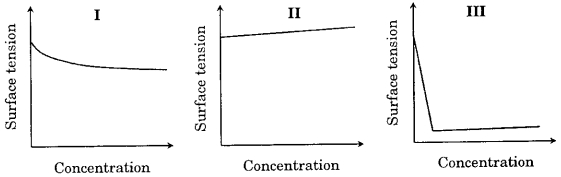
The qualitative sketches $I$,$II$,and $III$ given below show the variation of surface tension with molar concentration of three different aqueous solutions of $KCl$,$CH_3OH$,and $CH_3(CH_2)_{11}OSO_3^{-}Na^{+}$ at room temperature. The correct assignment of the sketches is
A
$I : KCl, II : CH_3OH, III : CH_3(CH_2)_{11}OSO_3^{-}Na^{+}$
B
$I : CH_3(CH_2)_{11}OSO_3^{-}Na^{+}, II : CH_3OH, III : KCl$
C
$I : KCl, II : CH_3(CH_2)_{11}OSO_3^{-}Na^{+}, III : CH_3OH$
D
$I : CH_3OH, II : KCl, III : CH_3(CH_2)_{11}OSO_3^{-}Na^{+}$
Solution
(D) The correct option is $D$ $(I: CH_3OH, II: KCl, III: CH_3(CH_2)_{11}OSO_3^{-}Na^{+})$.
$1$. $CH_3OH$ is a solute that decreases the surface tension of water as it disrupts the hydrogen bonding network of water,leading to a gradual decrease in surface tension with increasing concentration (Sketch $I$).
$2$. $KCl$ is an inorganic electrolyte. When added to water,it increases the intermolecular forces of attraction,leading to a slight increase in surface tension with increasing concentration (Sketch $II$).
$3$. $CH_3(CH_2)_{11}OSO_3^{-}Na^{+}$ is a surfactant (soap/detergent). It significantly lowers the surface tension of water until the critical micelle concentration $(CMC)$ is reached,after which the surface tension remains nearly constant or increases slightly (Sketch $III$).
$1$. $CH_3OH$ is a solute that decreases the surface tension of water as it disrupts the hydrogen bonding network of water,leading to a gradual decrease in surface tension with increasing concentration (Sketch $I$).
$2$. $KCl$ is an inorganic electrolyte. When added to water,it increases the intermolecular forces of attraction,leading to a slight increase in surface tension with increasing concentration (Sketch $II$).
$3$. $CH_3(CH_2)_{11}OSO_3^{-}Na^{+}$ is a surfactant (soap/detergent). It significantly lowers the surface tension of water until the critical micelle concentration $(CMC)$ is reached,after which the surface tension remains nearly constant or increases slightly (Sketch $III$).
0 likes
View Solution684
AdvancedMCQ
Consider the following statements related to colloids.
$(I)$ Lyophobic colloids are not formed by simple mixing of dispersed phase and dispersion medium.
$(II)$ For emulsions,both the dispersed phase and the dispersion medium are liquid.
$(III)$ Micelles are produced by dissolving a surfactant in any solvent at any temperature.
$(IV)$ Tyndall effect can be observed from a colloidal solution with dispersed phase having the same refractive index as that of the dispersion medium.
The option with the correct set of statements is
$(I)$ Lyophobic colloids are not formed by simple mixing of dispersed phase and dispersion medium.
$(II)$ For emulsions,both the dispersed phase and the dispersion medium are liquid.
$(III)$ Micelles are produced by dissolving a surfactant in any solvent at any temperature.
$(IV)$ Tyndall effect can be observed from a colloidal solution with dispersed phase having the same refractive index as that of the dispersion medium.
The option with the correct set of statements is
A
$(I)$ and $(II)$
B
$(II)$ and $(III)$
C
$(III)$ and $(IV)$
D
$(II)$ and $(IV)$
Solution
(A) $(I)$ Lyophobic colloids have no affinity between the dispersed phase and the dispersion medium,so they cannot be prepared by simple mixing; special methods are required.
$(II)$ Emulsions are defined as colloidal systems where both the dispersed phase and the dispersion medium are liquids.
$(III)$ Micelles are formed only above a specific concentration called the Critical Micelle Concentration $(CMC)$ and above a specific temperature called the Kraft temperature $(T_k)$.
$(IV)$ The Tyndall effect occurs only when there is a significant difference in the refractive indices of the dispersed phase and the dispersion medium.
Therefore,statements $(I)$ and $(II)$ are correct.
$(II)$ Emulsions are defined as colloidal systems where both the dispersed phase and the dispersion medium are liquids.
$(III)$ Micelles are formed only above a specific concentration called the Critical Micelle Concentration $(CMC)$ and above a specific temperature called the Kraft temperature $(T_k)$.
$(IV)$ The Tyndall effect occurs only when there is a significant difference in the refractive indices of the dispersed phase and the dispersion medium.
Therefore,statements $(I)$ and $(II)$ are correct.
0 likes
View Solution685
AdvancedMCQ
Choose the correct reason$(s)$ for the stability of the lyophobic colloidal particles.
$(A)$ Preferential adsorption of ions on their surface from the solution.
$(B)$ Preferential adsorption of solvent on their surface from the solution.
$(C)$ Attraction between different particles having opposite charges on their surface.
$(D)$ Potential difference between the fixed layer and the diffused layer of opposite charges around the colloidal particles.
$(A)$ Preferential adsorption of ions on their surface from the solution.
$(B)$ Preferential adsorption of solvent on their surface from the solution.
$(C)$ Attraction between different particles having opposite charges on their surface.
$(D)$ Potential difference between the fixed layer and the diffused layer of opposite charges around the colloidal particles.
A
$(B, D)$
B
$(B, C)$
C
$(A, D)$
D
$(C, D)$
Solution
(C) Lyophobic colloids are inherently unstable and are stabilized primarily by the presence of an electric charge on their surface.
$(A)$ The preferential adsorption of common ions from the solution creates a charged surface,which leads to electrostatic repulsion between particles,preventing aggregation.
$(D)$ The potential difference between the fixed layer and the diffused layer (known as the Zeta potential) provides the necessary repulsive force to maintain stability.
Therefore,both $(A)$ and $(D)$ are correct reasons for the stability of lyophobic colloidal particles.
$(A)$ The preferential adsorption of common ions from the solution creates a charged surface,which leads to electrostatic repulsion between particles,preventing aggregation.
$(D)$ The potential difference between the fixed layer and the diffused layer (known as the Zeta potential) provides the necessary repulsive force to maintain stability.
Therefore,both $(A)$ and $(D)$ are correct reasons for the stability of lyophobic colloidal particles.
0 likes
View Solution686
MediumMCQ
Molar conductivity $\left(\Lambda_m\right)$ of an aqueous solution of sodium stearate,which behaves as a strong electrolyte,is recorded at varying concentrations $(c)$ of sodium stearate. Which one of the following plots provides the correct representation of micelle formation in the solution? (Critical micelle concentration $(CMC)$ is marked with an arrow in the figures.)
A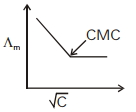
B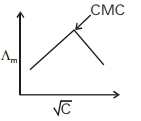
C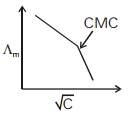
D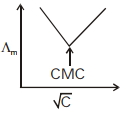
Solution
(A) Sodium stearate is a surfactant that behaves as a strong electrolyte at low concentrations.
As the concentration increases,the molar conductivity $\left(\Lambda_m\right)$ decreases due to the interionic attractions,similar to other strong electrolytes.
However,once the concentration reaches the Critical Micelle Concentration $(CMC)$,the individual ions aggregate to form large,bulky micelles.
These micelles have a much lower mobility compared to individual ions,leading to a sharp decrease in the rate of change of molar conductivity with respect to $\sqrt{c}$ after the $CMC$ point.
This results in a plot where the slope changes significantly at the $CMC$,which is best represented by the graph in option $A$.
As the concentration increases,the molar conductivity $\left(\Lambda_m\right)$ decreases due to the interionic attractions,similar to other strong electrolytes.
However,once the concentration reaches the Critical Micelle Concentration $(CMC)$,the individual ions aggregate to form large,bulky micelles.
These micelles have a much lower mobility compared to individual ions,leading to a sharp decrease in the rate of change of molar conductivity with respect to $\sqrt{c}$ after the $CMC$ point.
This results in a plot where the slope changes significantly at the $CMC$,which is best represented by the graph in option $A$.
0 likes
View Solution687
AdvancedMCQ
The correct statement$(s)$ related to colloids is(are):
$(A)$ The process of precipitating colloidal sol by an electrolyte is called peptization.
$(B)$ Colloidal solution freezes at a higher temperature than the true solution at the same concentration.
$(C)$ Surfactants form micelles above the critical micelle concentration $(CMC)$. $CMC$ depends on temperature.
$(D)$ Micelles are macromolecular colloids.
$(A)$ The process of precipitating colloidal sol by an electrolyte is called peptization.
$(B)$ Colloidal solution freezes at a higher temperature than the true solution at the same concentration.
$(C)$ Surfactants form micelles above the critical micelle concentration $(CMC)$. $CMC$ depends on temperature.
$(D)$ Micelles are macromolecular colloids.
A
$A, B$
B
$A, C$
C
$A, D$
D
$B, C$
Solution
(D) The process of precipitating a colloidal sol by an electrolyte is called coagulation or flocculation,not peptization. Peptization is the process of converting a precipitate into a colloidal sol. Hence,$(A)$ is false.
$(B)$ Colloidal particles have very high molar masses,so for a given mass concentration,the molar concentration is very low. Consequently,the depression in freezing point $(\Delta T_f)$ is very small for colloidal solutions compared to true solutions. Therefore,the freezing point of a colloidal solution is higher than that of a true solution. Hence,$(B)$ is true.
$(C)$ Surfactants form micelles only above the critical micelle concentration $(CMC)$. The $CMC$ is a characteristic property that depends on the nature of the surfactant and the temperature. Hence,$(C)$ is true.
$(D)$ Micelles are associated colloids,whereas macromolecular colloids are formed by large molecules like proteins or polymers. Hence,$(D)$ is false.
$(B)$ Colloidal particles have very high molar masses,so for a given mass concentration,the molar concentration is very low. Consequently,the depression in freezing point $(\Delta T_f)$ is very small for colloidal solutions compared to true solutions. Therefore,the freezing point of a colloidal solution is higher than that of a true solution. Hence,$(B)$ is true.
$(C)$ Surfactants form micelles only above the critical micelle concentration $(CMC)$. The $CMC$ is a characteristic property that depends on the nature of the surfactant and the temperature. Hence,$(C)$ is true.
$(D)$ Micelles are associated colloids,whereas macromolecular colloids are formed by large molecules like proteins or polymers. Hence,$(D)$ is false.
0 likes
View Solution688
MediumMCQ
How many of the following statements are correct $:$
$(i)$ When freshly prepared precipitate are converted into colloidal solution then process is called peptization.
$(ii)$ Lyophilic sol are mostly of inorganic nature.
$(iii)$ Lyophilic sol are highly solvated as particles have great affinity for solvent.
$(iv)$ Lyophobic sols are reversible sols so special methods are required to prepare them.
$(i)$ When freshly prepared precipitate are converted into colloidal solution then process is called peptization.
$(ii)$ Lyophilic sol are mostly of inorganic nature.
$(iii)$ Lyophilic sol are highly solvated as particles have great affinity for solvent.
$(iv)$ Lyophobic sols are reversible sols so special methods are required to prepare them.
A
Only $i$
B
$i$ and $iii$
C
$ii$ and $iv$
D
All of these
Solution
(B) Statement $(i)$ is correct: Peptization is the process of converting a freshly prepared precipitate into a colloidal sol by adding a suitable electrolyte.
Statement $(ii)$ is incorrect: Lyophilic sols are generally organic in nature (e.g.,starch,proteins,gums).
Statement $(iii)$ is correct: Lyophilic sols are highly solvated because the dispersed phase particles have a strong affinity for the dispersion medium.
Statement $(iv)$ is incorrect: Lyophobic sols are irreversible in nature and require special methods for preparation,whereas lyophilic sols are reversible.
Therefore,statements $(i)$ and $(iii)$ are correct.
Statement $(ii)$ is incorrect: Lyophilic sols are generally organic in nature (e.g.,starch,proteins,gums).
Statement $(iii)$ is correct: Lyophilic sols are highly solvated because the dispersed phase particles have a strong affinity for the dispersion medium.
Statement $(iv)$ is incorrect: Lyophobic sols are irreversible in nature and require special methods for preparation,whereas lyophilic sols are reversible.
Therefore,statements $(i)$ and $(iii)$ are correct.
0 likes
View Solution689
EasyMCQ
Peptization denotes
A
digestion of food
B
hydrolysis of proteins
C
breaking and dispersion into colloidal state
D
precipitation of solid from colloidal dispersion
Solution
(C) The process of converting a freshly prepared precipitate into a colloidal sol by adding a suitable electrolyte is known as peptization.
In this process,the precipitate particles adsorb ions from the electrolyte,which causes them to break down and disperse into the colloidal state.
In this process,the precipitate particles adsorb ions from the electrolyte,which causes them to break down and disperse into the colloidal state.
0 likes
View Solution690
EasyMCQ
Which of the following metal nanoparticles is used for coating the filter material that acts as an effective bacterial disinfectant?
A
Nickel
B
Silver
C
Gold
D
Copper
Solution
(B) Silver nanoparticles $(AgNPs)$ are widely known for their potent antimicrobial properties. They are frequently used to coat filter materials in water purification systems because they effectively kill bacteria and prevent biofilm formation,acting as an efficient bacterial disinfectant.
0 likes
View Solution691
EasyMCQ
Which of the following is the largest size nanomaterial?
A
Water (molecular level)
B
Glucose (molecular level)
C
Virus
D
Bacteria
Solution
(D) The size ranges are as follows:
- Water and Glucose are at the molecular scale,typically ranging from $0.1$ to $1 \ nm$.
- Viruses typically range from $20$ to $300 \ nm$.
- Bacteria are much larger,typically ranging from $0.2$ to $10 \ \mu m$ ($200$ to $10,000 \ nm$).
Therefore,among the given options,bacteria are the largest.
- Water and Glucose are at the molecular scale,typically ranging from $0.1$ to $1 \ nm$.
- Viruses typically range from $20$ to $300 \ nm$.
- Bacteria are much larger,typically ranging from $0.2$ to $10 \ \mu m$ ($200$ to $10,000 \ nm$).
Therefore,among the given options,bacteria are the largest.
0 likes
View Solution692
MediumMCQ
Sunscreen lotions contain nanoparticles of:
A
$Gold$
B
$Pt$
C
$TiO_2$
D
$Pd$
Solution
(C) Zinc oxide $(ZnO)$ and Titanium dioxide $(TiO_2)$ nanoparticles are commonly used in sunscreen lotions.
These compounds protect the skin against harmful $UV$ (ultraviolet) rays by absorbing or reflecting the radiation,thereby preventing skin damage.
These compounds protect the skin against harmful $UV$ (ultraviolet) rays by absorbing or reflecting the radiation,thereby preventing skin damage.
0 likes
View Solution693
MediumMCQ
Which of the following nanomaterials has two dimensions less than $100 \ nm$?
A
Nanowires
B
Microcapsules
C
Quantum dots
D
Nanorings
Solution
(A) Nanowires are one-dimensional nanostructures in which two dimensions are in the nanoscale $(< 100 \ nm)$.
Quantum dots are zero-dimensional structures in which all three dimensions are in the nanoscale $(< 100 \ nm)$.
Microcapsules are generally larger than the nanoscale range.
Nanorings are typically considered zero-dimensional or specific nanostructures depending on their geometry,but nanowires are the standard example of having two dimensions in the nanoscale.
Quantum dots are zero-dimensional structures in which all three dimensions are in the nanoscale $(< 100 \ nm)$.
Microcapsules are generally larger than the nanoscale range.
Nanorings are typically considered zero-dimensional or specific nanostructures depending on their geometry,but nanowires are the standard example of having two dimensions in the nanoscale.
0 likes
View Solution694
MediumMCQ
Identify the instrument used to find the structure of the surface of a material.
A
Scanning electron microscope
B
$X$-ray diffractometer
C
Transmission electron microscope
D
$UV$-visible spectrophotometer
Solution
(A) The Scanning Electron Microscope $(SEM)$ is the instrument used to examine the surface structure of materials at high magnification.
It works by scanning a focused beam of electrons across the surface of a sample.
The electrons interact with the atoms on the surface,producing signals that are used to create an image of the surface's topography,morphology,and composition.
It works by scanning a focused beam of electrons across the surface of a sample.
The electrons interact with the atoms on the surface,producing signals that are used to create an image of the surface's topography,morphology,and composition.
0 likes
View Solution695
MediumMCQ
Identify one-dimensional nanostructure from the following.
A
Nanowires
B
Nanoparticles
C
Thin films
D
Quantum dots
Solution
(A) One-dimensional nanostructures are materials that have two dimensions in the nanometer range and one dimension that is much larger, such as $Nanowires$.
$Nanoparticles$ are zero-dimensional, $Thin films$ are two-dimensional, and $Quantum dots$ are zero-dimensional nanostructures.
$Nanoparticles$ are zero-dimensional, $Thin films$ are two-dimensional, and $Quantum dots$ are zero-dimensional nanostructures.
0 likes
View Solution696
EasyMCQ
Which among the following is an example of a $2$-dimensional nanostructure?
A
Microcapsules
B
Nanowires
C
Thin films
D
Nanorings
Solution
(C) Nanomaterials are classified based on their dimensions.
$0$-dimensional nanostructures have all three dimensions in the nanoscale (e.g.,nanoparticles).
$1$-dimensional nanostructures have two dimensions in the nanoscale (e.g.,nanowires,nanotubes).
$2$-dimensional nanostructures have one dimension in the nanoscale (e.g.,thin films,coatings).
Therefore,thin films are an example of a $2$-dimensional nanostructure.
$0$-dimensional nanostructures have all three dimensions in the nanoscale (e.g.,nanoparticles).
$1$-dimensional nanostructures have two dimensions in the nanoscale (e.g.,nanowires,nanotubes).
$2$-dimensional nanostructures have one dimension in the nanoscale (e.g.,thin films,coatings).
Therefore,thin films are an example of a $2$-dimensional nanostructure.
0 likes
View Solution697
EasyMCQ
Identify a zero dimensional nano structure from the following.
A
Nanorods
B
Nanoparticles
C
Thin films
D
Fibres
Solution
(B) $(1)$ Nanorods: $1D$ structure: Elongated in one dimension (length),confined in the other two (width and height).
$(2)$ Nanoparticles: $0D$ structure: No elongation in any dimension,confined in all directions (usually spherical).
$(3)$ Thin films: $2D$ structure: Thin in one dimension (thickness) but extends in the other two (length and width).
$(4)$ Fibres: $1D$ structure: Elongated in one dimension (length),confined in the other two.
$(2)$ Nanoparticles: $0D$ structure: No elongation in any dimension,confined in all directions (usually spherical).
$(3)$ Thin films: $2D$ structure: Thin in one dimension (thickness) but extends in the other two (length and width).
$(4)$ Fibres: $1D$ structure: Elongated in one dimension (length),confined in the other two.
0 likes
View Solution698
EasyMCQ
Which among the following is an example of a one-dimensional nanostructure?
A
Nano rings
B
Nano tubes
C
Layers and coatings
D
Quantum dots
Solution
(B) One-dimensional nanomaterial: In one-dimensional nanomaterial,one dimension is outside the nanoscale range,while two dimensions are within the nanoscale range. This can be visualized as a wire. Examples of $1D$ nanomaterials include nanotubes,nanorods,and nanowires.
0 likes
View Solution699
DifficultMCQ
Which of the following techniques is used for the preliminary confirmation of nanoparticles?
A
$UV-visible$ spectroscopy
B
$X-ray$ diffraction $(XRD)$
C
Scanning electron microscopy $(SEM)$
D
Transmission electron microscopy $(TEM)$
Solution
(A) $UV-visible$ spectroscopy is commonly used for the preliminary confirmation of the synthesis of nanoparticles,especially metal nanoparticles,due to the phenomenon of Surface Plasmon Resonance $(SPR)$.
$SPR$ causes a characteristic absorption peak in the $UV-visible$ region,which serves as a quick and simple indicator of nanoparticle formation.
$SPR$ causes a characteristic absorption peak in the $UV-visible$ region,which serves as a quick and simple indicator of nanoparticle formation.
0 likes
View SolutionSurface Chemistry — Colloids, Emulsion, Gel and Their properties with application · Frequently Asked Questions
1Are these Surface Chemistry questions useful for JEE and NEET?
Yes. All questions in this section are mapped to JEE Main and NEET exam patterns. Previous year questions from JEE Main, NEET, GUJCET and state-level exams are included with full solutions.
2Can I switch to Hindi or Gujarati for these questions?
Yes. Use the language tabs in the hero section or the sidebar to view the same questions and solutions in English, Hindi or Gujarati.
3How do I generate a question paper from this subtopic?
Use the Vedclass Exam Paper Generator — select the chapter and subtopic, set difficulty, and generate Sets A, B, C, D automatically. First 3 chapters of every subject are free.
Vedclass Products
For Students
Vedclass Test Series
Mock tests in real JEE/NEET style with performance analysis. 5-day free trial.
Start Free TrialFor Teachers
Exam Paper Generator
Generate Set A/B/C/D papers from this chapter in 2 minutes. 3 chapters free.
Try FreeFor Institutes
Online Exam Module
Live online exams with unlimited students, 360° analytics & white-label branding.
See DemoFor Teachers & Institutes
Generate a Surface Chemistry Exam Paper in 2 Minutes
Select subtopic & difficulty — Sets A, B, C, D auto-generated with No Repeat logic.
First 3 chapters of every subject are free — no payment required.