
A English
Colloids, Emulsion, Gel and Their properties with application Questions in English
Class 12 Chemistry · Surface Chemistry · Colloids, Emulsion, Gel and Their properties with application
886+
Questions
English
Language
100%
With Solutions
Showing 50 of 886 questions in English
551
MediumMCQ
Assertion : Colloidal solutions are stable but colloidal particles do not settle down.
Reason : Brownian movement counters the force of gravity actively on colloidal particles.
Reason : Brownian movement counters the force of gravity actively on colloidal particles.
A
If both Assertion and Reason are correct and the Reason is a correct explanation of the Assertion.
B
If both Assertion and Reason are correct but Reason is not a correct explanation of the Assertion.
C
If the Assertion is correct but Reason is incorrect.
D
If both the Assertion and Reason are incorrect.
Solution
(A) The stability of colloidal solutions is primarily due to the Brownian movement of particles.
Brownian movement is caused by the continuous bombardment of colloidal particles by the molecules of the dispersion medium.
This random motion counters the force of gravity,preventing the particles from settling down,thereby ensuring the stability of the colloidal system.
Brownian movement is caused by the continuous bombardment of colloidal particles by the molecules of the dispersion medium.
This random motion counters the force of gravity,preventing the particles from settling down,thereby ensuring the stability of the colloidal system.
0 likes
View Solution552
MediumMCQ
Assertion : $Fe^{3+}$ can be used for coagulation of $As_2S_3$ sol.
Reason : $Fe^{3+}$ reacts with $As_2S_3$ to give $Fe_2S_3$.
Reason : $Fe^{3+}$ reacts with $As_2S_3$ to give $Fe_2S_3$.
A
If both Assertion and Reason are correct and the Reason is a correct explanation of the Assertion.
B
If both Assertion and Reason are correct but Reason is not a correct explanation of the Assertion.
C
If the Assertion is correct but Reason is incorrect.
D
If both the Assertion and Reason are incorrect.
Solution
(C) The $As_2S_3$ sol is negatively charged due to the preferential adsorption of $S^{2-}$ ions on its surface.
According to the Hardy-Schulze law,the coagulating power of an ion increases with the increase in the magnitude of its charge.
$Fe^{3+}$ ions are positively charged and effectively neutralize the negative charge of the $As_2S_3$ sol particles,leading to coagulation.
The reason provided,that $Fe^{3+}$ reacts with $As_2S_3$ to form $Fe_2S_3$,is chemically incorrect as coagulation is a surface phenomenon involving charge neutralization,not a chemical reaction forming $Fe_2S_3$.
According to the Hardy-Schulze law,the coagulating power of an ion increases with the increase in the magnitude of its charge.
$Fe^{3+}$ ions are positively charged and effectively neutralize the negative charge of the $As_2S_3$ sol particles,leading to coagulation.
The reason provided,that $Fe^{3+}$ reacts with $As_2S_3$ to form $Fe_2S_3$,is chemically incorrect as coagulation is a surface phenomenon involving charge neutralization,not a chemical reaction forming $Fe_2S_3$.
0 likes
View Solution553
DifficultMCQ
Which mixture of the solutions will lead to the formation of a negatively charged colloidal $[AgI]I^{-}$ sol?
A
$50 \ mL$ of $1 \ M AgNO_3 + 50 \ mL$ of $1.5 \ M KI$
B
$50 \ mL$ of $2 \ M AgNO_3 + 50 \ mL$ of $2 \ M KI$
C
$50 \ mL$ of $2 \ M AgNO_3 + 50 \ mL$ of $1.5 \ M KI$
D
$50 \ mL$ of $0.1 \ M AgNO_3 + 50 \ mL$ of $0.1 \ M KI$
Solution
(A) The formation of a negatively charged $[AgI]I^{-}$ sol occurs when iodide ions $(I^-)$ are preferentially adsorbed on the surface of $AgI$ particles.
This happens when $KI$ is present in excess relative to $AgNO_3$ in the reaction: $AgNO_3 + KI \rightarrow AgI + KNO_3$.
In option $A$,the moles of $KI$ are $50 \ mL \times 1.5 \ M = 75 \ mmol$,while the moles of $AgNO_3$ are $50 \ mL \times 1 \ M = 50 \ mmol$.
Since $KI$ is in excess,$I^-$ ions are adsorbed on the $AgI$ precipitate,resulting in a negatively charged $[AgI]I^-$ sol.
This happens when $KI$ is present in excess relative to $AgNO_3$ in the reaction: $AgNO_3 + KI \rightarrow AgI + KNO_3$.
In option $A$,the moles of $KI$ are $50 \ mL \times 1.5 \ M = 75 \ mmol$,while the moles of $AgNO_3$ are $50 \ mL \times 1 \ M = 50 \ mmol$.
Since $KI$ is in excess,$I^-$ ions are adsorbed on the $AgI$ precipitate,resulting in a negatively charged $[AgI]I^-$ sol.
0 likes
View Solution554
MediumMCQ
On which of the following properties does coagulating power of an ion depend?
A
The magnitude of the charge on the ion alone
B
Size of the ion alone
C
Both magnitude and sign of the charge on the ion
D
The sign of charge on the ion alone
Solution
(C) According to the $Hardy-Schulze$ rule,the coagulating power of an ion depends on both the magnitude and the sign of the charge on the ion.
Greater the magnitude of the charge on the ion,the higher is its coagulating power for a given colloidal solution.
Greater the magnitude of the charge on the ion,the higher is its coagulating power for a given colloidal solution.
0 likes
View Solution555
DifficultMCQ
The flocculation value of $HCl$ for arsenic sulphide sol is $30 \; mmol \; L^{-1}$. If $H_{2}SO_{4}$ is used for the flocculation of arsenic sulphide,the amount,in grams,of $H_{2}SO_{4}$ in $250 \; mL$ required for the above purpose is (molecular mass of $H_{2}SO_{4} = 98 \; g/mol$)
A
$0.37$
B
$0.67$
C
$0.87$
D
$0.63$
Solution
(A) The flocculation value depends on the coagulating ion. For a negatively charged arsenic sulphide sol,the coagulating ion is the cation $(H^+)$.
$1 \; mol$ of $H_{2}SO_{4}$ provides $2 \; mol$ of $H^+$ ions,whereas $1 \; mol$ of $HCl$ provides $1 \; mol$ of $H^+$ ions.
Therefore,the flocculation value of $H_{2}SO_{4}$ is half that of $HCl$,which is $15 \; mmol \; L^{-1}$.
For $250 \; mL$ $(0.25 \; L)$ of sol,the required amount of $H_{2}SO_{4}$ is $15 \; mmol/L \times 0.25 \; L = 3.75 \; mmol$.
Mass of $H_{2}SO_{4} = \text{moles} \times \text{molar mass} = 3.75 \times 10^{-3} \; mol \times 98 \; g/mol = 0.3675 \; g$.
Rounding to two decimal places,we get $0.37 \; g$.
$1 \; mol$ of $H_{2}SO_{4}$ provides $2 \; mol$ of $H^+$ ions,whereas $1 \; mol$ of $HCl$ provides $1 \; mol$ of $H^+$ ions.
Therefore,the flocculation value of $H_{2}SO_{4}$ is half that of $HCl$,which is $15 \; mmol \; L^{-1}$.
For $250 \; mL$ $(0.25 \; L)$ of sol,the required amount of $H_{2}SO_{4}$ is $15 \; mmol/L \times 0.25 \; L = 3.75 \; mmol$.
Mass of $H_{2}SO_{4} = \text{moles} \times \text{molar mass} = 3.75 \times 10^{-3} \; mol \times 98 \; g/mol = 0.3675 \; g$.
Rounding to two decimal places,we get $0.37 \; g$.
0 likes
View Solution556
DifficultMCQ
As per the Hardy-Schulze rule,the flocculation values of the following electrolytes for a ferric hydroxide sol are in the order:
A
$AlCl_{3} > K_{3}[Fe(CN)_{6}] > K_{2}CrO_{4} > KBr = KNO_{3}$
B
$K_{3}[Fe(CN)_{6}] < K_{2}CrO_{4} < AlCl_{3} < KBr < KNO_{3}$
C
$K_{3}[Fe(CN)_{6}] > AlCl_{3} > K_{2}CrO_{4} > KBr > KNO_{3}$
D
$K_{3}[Fe(CN)_{6}] < K_{2}CrO_{4} < KBr = KNO_{3} < AlCl_{3}$
Solution
(D) $Fe(OH)_{3}$ sol is a positively charged sol. Therefore,it is coagulated by the anions of the added electrolytes.
According to the Hardy-Schulze rule,the coagulating power of an ion increases with the increase in the magnitude of its charge.
The order of coagulating power of the anions is: $[Fe(CN)_{6}]^{3-} > CrO_{4}^{2-} > Cl^{-} = Br^{-} = NO_{3}^{-}$.
Since the coagulating power is inversely proportional to the flocculation value,the order of flocculation values is: $K_{3}[Fe(CN)_{6}] < K_{2}CrO_{4} < KBr = KNO_{3} < AlCl_{3}$.
According to the Hardy-Schulze rule,the coagulating power of an ion increases with the increase in the magnitude of its charge.
The order of coagulating power of the anions is: $[Fe(CN)_{6}]^{3-} > CrO_{4}^{2-} > Cl^{-} = Br^{-} = NO_{3}^{-}$.
Since the coagulating power is inversely proportional to the flocculation value,the order of flocculation values is: $K_{3}[Fe(CN)_{6}] < K_{2}CrO_{4} < KBr = KNO_{3} < AlCl_{3}$.
0 likes
View Solution557
Medium
What modification can you suggest in the Hardy-Schulze law?
Solution
(N/A) The Hardy-Schulze law states that 'the greater the valence of the flocculating ion added,the greater is its power to cause precipitation.'
This law considers only the charge carried by an ion,not its size. However,the smaller the size of an ion,the greater will be its polarising power.
Therefore,the Hardy-Schulze law can be modified in terms of the polarising power of the flocculating ion. The modified law states that 'the greater the polarising power of the flocculating ion added,the greater is its power to cause precipitation.'
This law considers only the charge carried by an ion,not its size. However,the smaller the size of an ion,the greater will be its polarising power.
Therefore,the Hardy-Schulze law can be modified in terms of the polarising power of the flocculating ion. The modified law states that 'the greater the polarising power of the flocculating ion added,the greater is its power to cause precipitation.'
0 likes
View Solution558
Medium
How are the colloidal solutions classified on the basis of physical states of the dispersed phase and dispersion medium?
Solution
(N/A) Colloidal solutions are classified based on the physical states (solid,liquid,or gas) of the dispersed phase and the dispersion medium. Since gas in gas mixtures form homogeneous solutions,they are not considered colloids. Thus,there are $8$ possible types of colloidal systems:
| $S. No.$ | Dispersed Phase and Dispersion Medium | Type of Colloid | Example |
| $1.$ | Solid in Solid | Solid Sol | Gemstone |
| $2.$ | Solid in Liquid | Sol | Paint |
| $3.$ | Solid in Gas | Aerosol | Smoke |
| $4.$ | Liquid in Solid | Gel | Cheese |
| $5.$ | Liquid in Liquid | Emulsion | Milk |
| $6.$ | Liquid in Gas | Aerosol | Fog |
| $7.$ | Gas in Solid | Solid Foam | Pumice stone |
| $8.$ | Gas in Liquid | Foam | Froth |
0 likes
View Solution559
Difficult
What are lyophilic and lyophobic sols? Give one example of each type. Why are hydrophobic sols easily coagulated?
Solution
(N/A) $(i)$ Lyophilic sols: Colloidal sols formed by mixing substances like gum,gelatin,or starch with a suitable dispersion medium are called lyophilic sols. These are reversible in nature,meaning they can be reconstituted by simply mixing the components again after separation.
$(ii)$ Lyophobic sols: Colloidal sols formed by substances like metals or their sulphides,which do not readily form sols with the dispersion medium,are called lyophobic sols. These require special methods for preparation and are irreversible in nature.
Hydrophobic (lyophobic) sols are easily coagulated because their stability depends solely on the presence of an electric charge on the colloidal particles. When this charge is neutralized by the addition of electrolytes,the particles aggregate and precipitate.
$(ii)$ Lyophobic sols: Colloidal sols formed by substances like metals or their sulphides,which do not readily form sols with the dispersion medium,are called lyophobic sols. These require special methods for preparation and are irreversible in nature.
Hydrophobic (lyophobic) sols are easily coagulated because their stability depends solely on the presence of an electric charge on the colloidal particles. When this charge is neutralized by the addition of electrolytes,the particles aggregate and precipitate.
0 likes
View Solution560
Difficult
What is the difference between multimolecular and macromolecular colloids? Give one example of each. How are associated colloids different from these two types of colloids?
Solution
(N/A) $(i)$ In multimolecular colloids,the colloidal particles are an aggregate of atoms or small molecules with a diameter of less than $1 \ nm$. The molecules in the aggregate are held together by van der Waal's forces of attraction. Examples include gold sol and sulphur sol.
$(ii)$ In macromolecular colloids,the colloidal particles are large molecules having colloidal dimensions. These particles have a high molecular mass. When these particles are dissolved in a liquid,a sol is obtained. Examples include starch,nylon,and cellulose.
$(iii)$ Associated colloids are substances that behave as normal electrolytes at low concentrations but form aggregated particles (micelles) at higher concentrations,thus behaving as colloidal solutions.
$(ii)$ In macromolecular colloids,the colloidal particles are large molecules having colloidal dimensions. These particles have a high molecular mass. When these particles are dissolved in a liquid,a sol is obtained. Examples include starch,nylon,and cellulose.
$(iii)$ Associated colloids are substances that behave as normal electrolytes at low concentrations but form aggregated particles (micelles) at higher concentrations,thus behaving as colloidal solutions.
0 likes
View Solution561
Difficult
How are colloids classified on the basis of
$(i)$ physical states of components
$(ii)$ nature of dispersed phase and
$(iii)$ interaction between dispersed phase and dispersion medium?
$(i)$ physical states of components
$(ii)$ nature of dispersed phase and
$(iii)$ interaction between dispersed phase and dispersion medium?
Solution
(N/A) Colloids are classified based on the following criteria:
$(i)$ Physical states of components: Based on the physical state (solid,liquid,or gas) of the dispersed phase and the dispersion medium,colloids are classified into eight types (gas-gas mixtures are not colloidal).
$(ii)$ Nature of the dispersion medium: Depending on the dispersion medium used,sols are named as follows:
$(iii)$ Interaction between dispersed phase and dispersion medium: Colloids are classified as $lyophilic$ (solvent-attracting) and $lyophobic$ (solvent-repelling) based on the affinity between the two phases.
$(i)$ Physical states of components: Based on the physical state (solid,liquid,or gas) of the dispersed phase and the dispersion medium,colloids are classified into eight types (gas-gas mixtures are not colloidal).
$(ii)$ Nature of the dispersion medium: Depending on the dispersion medium used,sols are named as follows:
| $Dispersion \ medium$ | $Name \ of \ sol$ |
| Water | Aquasol or Hydrosol |
| Alcohol | Alcosol |
| Benzene | Benzosol |
| Gas | Aerosol |
$(iii)$ Interaction between dispersed phase and dispersion medium: Colloids are classified as $lyophilic$ (solvent-attracting) and $lyophobic$ (solvent-repelling) based on the affinity between the two phases.
0 likes
View Solution562
Difficult
Explain what is observed:
$(i)$ When a beam of light is passed through a colloidal sol.
$(ii)$ An electrolyte,$NaCl$,is added to hydrated ferric oxide sol.
$(iii)$ Electric current is passed through a colloidal sol.
$(i)$ When a beam of light is passed through a colloidal sol.
$(ii)$ An electrolyte,$NaCl$,is added to hydrated ferric oxide sol.
$(iii)$ Electric current is passed through a colloidal sol.
Solution
(N/A) $(i)$ When a beam of light is passed through a colloidal solution,the scattering of light is observed. This phenomenon is known as the $Tyndall$ effect. The scattering of light illuminates the path of the beam within the colloidal solution.
$(ii)$ When $NaCl$ is added to hydrated ferric oxide sol,it dissociates into $Na^+$ and $Cl^-$ ions. Ferric oxide sol particles are positively charged. Therefore,they undergo coagulation in the presence of the negatively charged $Cl^-$ ions.
$(iii)$ Colloidal particles carry a net positive or negative charge. When an electric current is passed,these particles migrate towards the oppositely charged electrode. Upon contact with the electrode,they lose their charge and coagulate. This process is known as electrophoresis.
$(ii)$ When $NaCl$ is added to hydrated ferric oxide sol,it dissociates into $Na^+$ and $Cl^-$ ions. Ferric oxide sol particles are positively charged. Therefore,they undergo coagulation in the presence of the negatively charged $Cl^-$ ions.
$(iii)$ Colloidal particles carry a net positive or negative charge. When an electric current is passed,these particles migrate towards the oppositely charged electrode. Upon contact with the electrode,they lose their charge and coagulate. This process is known as electrophoresis.
0 likes
View Solution563
Difficult
What are emulsions? What are their different types? Give an example of each type.
Solution
(N/A) An emulsion is a colloidal system in which both the dispersed phase and the dispersion medium are liquids.
There are two main types of emulsions:
$(a)$ Oil-in-water $(O/W)$ type:
In this type,oil acts as the dispersed phase and water acts as the dispersion medium. Examples include milk and vanishing cream.
$(b)$ Water-in-oil $(W/O)$ type:
In this type,water acts as the dispersed phase and oil acts as the dispersion medium. Examples include cold cream and butter.
There are two main types of emulsions:
$(a)$ Oil-in-water $(O/W)$ type:
In this type,oil acts as the dispersed phase and water acts as the dispersion medium. Examples include milk and vanishing cream.
$(b)$ Water-in-oil $(W/O)$ type:
In this type,water acts as the dispersed phase and oil acts as the dispersion medium. Examples include cold cream and butter.
0 likes
View Solution564
Medium
What is demulsification? Name two demulsifiers.
Solution
(N/A) The process of breaking an emulsion into its constituent liquids is known as demulsification.
Examples of demulsifiers include surfactants,ethylene oxide,and long-chain alcohols.
Examples of demulsifiers include surfactants,ethylene oxide,and long-chain alcohols.
0 likes
View Solution565
Difficult
Action of soap is due to emulsification and micelle formation. Comment.
Solution
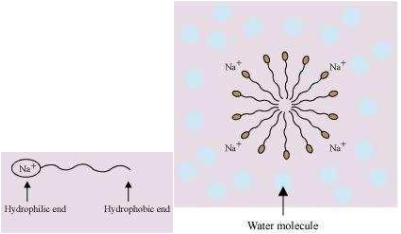
(N/A) The cleansing action of soap is due to emulsification and micelle formation. Soaps are basically sodium and potassium salts of long-chain fatty acids,$RCOO^-Na^+$. The end of the molecule to which the sodium is attached is polar in nature,while the alkyl-end is non-polar. Thus,a soap molecule contains a hydrophilic (polar) and a hydrophobic (non-polar) part.
When soap is added to water containing dirt,the soap molecules surround the dirt particles in such a manner that their hydrophobic parts get attached to the dirt molecule and the hydrophilic parts point away from the dirt molecule. This is known as micelle formation. Thus,the polar group dissolves in water while the non-polar group dissolves in the dirt particle. As these micelles are negatively charged,they do not coalesce and a stable emulsion is formed.
When soap is added to water containing dirt,the soap molecules surround the dirt particles in such a manner that their hydrophobic parts get attached to the dirt molecule and the hydrophilic parts point away from the dirt molecule. This is known as micelle formation. Thus,the polar group dissolves in water while the non-polar group dissolves in the dirt particle. As these micelles are negatively charged,they do not coalesce and a stable emulsion is formed.
0 likes
View Solution566
Difficult
Explain the following terms:
$(i)$ Electrophoresis
$(ii)$ Coagulation
$(iii)$ Dialysis
$(iv)$ Tyndall effect.
$(i)$ Electrophoresis
$(ii)$ Coagulation
$(iii)$ Dialysis
$(iv)$ Tyndall effect.
Solution
(N/A) $(i)$ Electrophoresis:
The movement of colloidal particles under the influence of an applied electric field is known as electrophoresis. Positively charged particles move to the cathode,while negatively charged particles move towards the anode. As the particles reach oppositely charged electrodes,they become neutral and get coagulated.
$(ii)$ Coagulation:
The process of settling down of colloidal particles,i.e.,conversion of a colloid into a precipitate,is called coagulation.
$(iii)$ Dialysis:
The process of removing a dissolved substance from a colloidal solution by means of diffusion through a membrane is known as dialysis. This process is based on the principle that ions and small molecules can pass through animal membranes,unlike colloidal particles.
$(iv)$ Tyndall effect:
When a beam of light is allowed to pass through a colloidal solution,it becomes visible like a column of light. This is known as the Tyndall effect. This phenomenon takes place as particles of colloidal dimensions scatter light in all directions.
The movement of colloidal particles under the influence of an applied electric field is known as electrophoresis. Positively charged particles move to the cathode,while negatively charged particles move towards the anode. As the particles reach oppositely charged electrodes,they become neutral and get coagulated.
$(ii)$ Coagulation:
The process of settling down of colloidal particles,i.e.,conversion of a colloid into a precipitate,is called coagulation.
$(iii)$ Dialysis:
The process of removing a dissolved substance from a colloidal solution by means of diffusion through a membrane is known as dialysis. This process is based on the principle that ions and small molecules can pass through animal membranes,unlike colloidal particles.
$(iv)$ Tyndall effect:
When a beam of light is allowed to pass through a colloidal solution,it becomes visible like a column of light. This is known as the Tyndall effect. This phenomenon takes place as particles of colloidal dimensions scatter light in all directions.
0 likes
View Solution567
Difficult
Give four uses of emulsions.
Solution
(N/A) Four uses of emulsions are as follows:
$(i)$ The cleansing action of soaps and detergents is based on the formation of emulsions.
$(ii)$ The digestion of fats in the intestines occurs through the process of emulsification.
$(iii)$ Many antiseptics and disinfectants form emulsions when added to water.
$(iv)$ The process of emulsification is widely used in the preparation of various medicines and pharmaceutical creams.
$(i)$ The cleansing action of soaps and detergents is based on the formation of emulsions.
$(ii)$ The digestion of fats in the intestines occurs through the process of emulsification.
$(iii)$ Many antiseptics and disinfectants form emulsions when added to water.
$(iv)$ The process of emulsification is widely used in the preparation of various medicines and pharmaceutical creams.
0 likes
View Solution568
Difficult
What are micelles? Give an example of a micellar system.
Solution
(N/A) Micelles are spherical aggregates formed by surfactant molecules (like soaps and detergents) in a solvent when their concentration exceeds the Critical Micelle Concentration $(CMC)$.
These molecules possess a dual nature: a long hydrophobic hydrocarbon tail and a hydrophilic polar head.
In water,they arrange themselves into spherical structures where the hydrophobic tails are directed towards the centre (away from water) and the hydrophilic heads are directed towards the outside (towards water).
Example: Sodium stearate $(C_{17}H_{35}COO^{-}Na^{+})$ in water.
These molecules possess a dual nature: a long hydrophobic hydrocarbon tail and a hydrophilic polar head.
In water,they arrange themselves into spherical structures where the hydrophobic tails are directed towards the centre (away from water) and the hydrophilic heads are directed towards the outside (towards water).
Example: Sodium stearate $(C_{17}H_{35}COO^{-}Na^{+})$ in water.
0 likes
View Solution569
Difficult
Explain the terms with suitable examples:
$(i)$ Alcosol
$(ii)$ Aerosol
$(iii)$ Hydrosol.
$(i)$ Alcosol
$(ii)$ Aerosol
$(iii)$ Hydrosol.
Solution
(N/A) $(i)$ Alcosol:
$A$ colloidal solution having alcohol as the dispersion medium and a solid substance as the dispersed phase is called an alcosol.
For example: colloidal sol of cellulose nitrate in ethyl alcohol is an alcosol.
$(ii)$ Aerosol:
$A$ colloidal solution having a gas as the dispersion medium and a solid or liquid as the dispersed phase is called an aerosol.
For example: smoke (solid in gas) or fog (liquid in gas).
$(iii)$ Hydrosol:
$A$ colloidal solution having water as the dispersion medium and a solid as the dispersed phase is called a hydrosol.
For example: starch sol or gold sol.
$A$ colloidal solution having alcohol as the dispersion medium and a solid substance as the dispersed phase is called an alcosol.
For example: colloidal sol of cellulose nitrate in ethyl alcohol is an alcosol.
$(ii)$ Aerosol:
$A$ colloidal solution having a gas as the dispersion medium and a solid or liquid as the dispersed phase is called an aerosol.
For example: smoke (solid in gas) or fog (liquid in gas).
$(iii)$ Hydrosol:
$A$ colloidal solution having water as the dispersion medium and a solid as the dispersed phase is called a hydrosol.
For example: starch sol or gold sol.
0 likes
View Solution570
Difficult
Comment on the statement that "colloid is not a substance but a state of substance".
Solution
(N/A) substance can behave as a colloid depending on the size of its particles. For example,common salt $(NaCl)$ acts as a crystalloid in water but behaves as a colloid in a benzene medium.
When the particle size of a substance ranges between $1 \, nm$ and $1000 \, nm$,it exhibits colloidal properties.
Therefore,a colloid is not a specific class of substances,but rather a state of matter that depends on the particle size. This state is intermediate between a true solution and a suspension.
When the particle size of a substance ranges between $1 \, nm$ and $1000 \, nm$,it exhibits colloidal properties.
Therefore,a colloid is not a specific class of substances,but rather a state of matter that depends on the particle size. This state is intermediate between a true solution and a suspension.
0 likes
View Solution571
Medium
Explain the cleansing action of soaps.
Solution
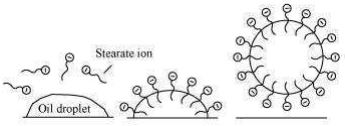
(N/A) Soap molecules form micelles around an oil droplet (dirt) in such a way that the hydrophobic parts of the stearate ions attach themselves to the oil droplet and the hydrophilic parts project outside the oil droplet. Due to the polar nature of the hydrophilic parts,the stearate ions (along with the dirt) are pulled into water,thereby removing the dirt from the cloth.
0 likes
View Solution572
Medium
Label the hydrophilic and hydrophobic parts in the following compounds.
$(i)$ $CH_3(CH_2)_{10}CH_2OSO_3^-Na^{+}$
$(ii)$ $CH_3(CH_2)_{15}N^{+}(CH_3)_3Br^{-}$
$(iii)$ $CH_3(CH_2)_{16}COO(CH_2CH_2O)_nCH_2CH_2OH$
$(i)$ $CH_3(CH_2)_{10}CH_2OSO_3^-Na^{+}$
$(ii)$ $CH_3(CH_2)_{15}N^{+}(CH_3)_3Br^{-}$
$(iii)$ $CH_3(CH_2)_{16}COO(CH_2CH_2O)_nCH_2CH_2OH$
Solution
(N/A) The molecules are surfactants,which contain a long non-polar hydrocarbon chain (hydrophobic part) and a polar or ionic head group (hydrophilic part).
$(i)$ $CH_3(CH_2)_{10}CH_2-$ is the hydrophobic part and $-OSO_3^-Na^+$ is the hydrophilic part.
$(ii)$ $CH_3(CH_2)_{15}-$ is the hydrophobic part and $-N^{+}(CH_3)_3Br^-$ is the hydrophilic part.
$(iii)$ $CH_3(CH_2)_{16}-$ is the hydrophobic part and $-COO(CH_2CH_2O)_nCH_2CH_2OH$ is the hydrophilic part.
$(i)$ $CH_3(CH_2)_{10}CH_2-$ is the hydrophobic part and $-OSO_3^-Na^+$ is the hydrophilic part.
$(ii)$ $CH_3(CH_2)_{15}-$ is the hydrophobic part and $-N^{+}(CH_3)_3Br^-$ is the hydrophilic part.
$(iii)$ $CH_3(CH_2)_{16}-$ is the hydrophobic part and $-COO(CH_2CH_2O)_nCH_2CH_2OH$ is the hydrophilic part.
0 likes
View Solution573
Difficult
Give information about colloids. Explain the classification of colloids.
Solution
(N/A) We know that solutions are homogeneous systems. We also know that sand in water when stirred gives a suspension,which slowly settles down with time. Between the two extremes of suspensions and solutions,we come across a large group of systems called colloidal dispersions or simply colloids.
$A$ colloid is a heterogeneous system in which one substance is dispersed as very fine particles in another substance called the dispersion medium.
The essential difference between a solution and a colloid is that of particle size. In a solution,the constituent particles are ions or small molecules. In a colloid,the dispersed phase may consist of particles of a single molecule (such as protein or synthetic polymer) or an aggregate of many atoms,ions,or molecules.
Colloidal particles are larger than simple molecules but small enough to remain suspended. Their range of diameters is between $1$ to $1000$ $nm$ ($10^{-9}$ to $10^{-6}$ $m$).
Colloidal particles have an enormous surface area per unit mass as a result of their small size. Consider a cube with $1$ $cm$ side. It has a total surface area of $6$ $cm^{2}$. If it were divided equally into $10^{12}$ cubes,the cubes would be the size of large colloidal particles and have a total surface area of $60,000$ $cm^{2}$ or $6$ $m^{2}$.
This enormous surface area leads to some special properties of colloids.
Colloids are classified on the basis of the following criteria: $(i)$ Physical state of dispersed phase and dispersion medium. $(ii)$ Nature of interaction between dispersed phase and dispersion medium. $(iii)$ Type of particles of the dispersed phase.
Classification based on physical state of dispersed phase and dispersion medium: Depending upon whether the dispersed phase and the dispersion medium are solids,liquids,or gases,eight types of colloidal systems are possible. $A$ gas mixed with another gas forms a homogeneous mixture and hence is not a colloidal system.
$A$ colloid is a heterogeneous system in which one substance is dispersed as very fine particles in another substance called the dispersion medium.
The essential difference between a solution and a colloid is that of particle size. In a solution,the constituent particles are ions or small molecules. In a colloid,the dispersed phase may consist of particles of a single molecule (such as protein or synthetic polymer) or an aggregate of many atoms,ions,or molecules.
Colloidal particles are larger than simple molecules but small enough to remain suspended. Their range of diameters is between $1$ to $1000$ $nm$ ($10^{-9}$ to $10^{-6}$ $m$).
Colloidal particles have an enormous surface area per unit mass as a result of their small size. Consider a cube with $1$ $cm$ side. It has a total surface area of $6$ $cm^{2}$. If it were divided equally into $10^{12}$ cubes,the cubes would be the size of large colloidal particles and have a total surface area of $60,000$ $cm^{2}$ or $6$ $m^{2}$.
This enormous surface area leads to some special properties of colloids.
Colloids are classified on the basis of the following criteria: $(i)$ Physical state of dispersed phase and dispersion medium. $(ii)$ Nature of interaction between dispersed phase and dispersion medium. $(iii)$ Type of particles of the dispersed phase.
Classification based on physical state of dispersed phase and dispersion medium: Depending upon whether the dispersed phase and the dispersion medium are solids,liquids,or gases,eight types of colloidal systems are possible. $A$ gas mixed with another gas forms a homogeneous mixture and hence is not a colloidal system.
| $No$. \text{Type of colloid} | \text{Dispersed phase} / \text{Dispersion medium} | \text{Examples} |
| $(1)$ \text{Solid sol} | \text{Solid} / \text{Solid} | \text{Coloured glasses,gem stones} |
| $(2)$ \text{Sol} | \text{Solid} / \text{Liquid} | \text{Paints,cell fluids} |
| $(3)$ \text{Aerosol} | \text{Solid} / \text{Gas} | \text{Smoke,dust} |
| $(4)$ \text{Gel} | \text{Liquid} / \text{Solid} | \text{Cheese,jellies} |
| $(5)$ \text{Emulsion} | \text{Liquid} / \text{Liquid} | \text{Milk,hair cream,butter} |
| $(6)$ \text{Aerosol} | \text{Liquid} / \text{Gas} | \text{Fog,mist,cloud,insecticide sprays} |
| $(7)$ \text{Solid sol} | \text{Gas} / \text{Solid} | \text{Pumice stone,foam rubber} |
| $(8)$ \text{Foam} | \text{Gas} / \text{Liquid} | \text{Froth,whipped cream,soap lather} |
1 likes
View Solution574
Difficult
Explain the mechanism of micelle formation by giving an example.
Solution
(N/A) Let us take the example of soap solution. Soap is a sodium or potassium salt of a higher fatty acid and may be represented as $RCOO^{-} Na^{+}$ (e.g.,sodium stearate $CH_{3}(CH_{2})_{16}COO^{-} Na^{+}$,which is a major component of many bar soaps).
When dissolved in water,it dissociates into $RCOO^{-}$ and $Na^{+}$ ions. The $RCOO^{-}$ ions consist of two parts:
$1$. $A$ long hydrocarbon chain $R$ (also called non-polar 'tail') which is hydrophobic (water-repelling).
$2$. $A$ polar group $COO^{-}$ (also called polar ionic 'head') which is hydrophilic (water-loving).
These ions aggregate at the surface of the water with their hydrophobic tails pointing away from the water and the hydrophilic heads pointing towards the water. At higher concentrations,these ions are pulled into the bulk of the solution and aggregate into a spherical shape with their hydrophobic tails pointing towards the center and the hydrophilic heads on the surface of the sphere. This aggregated structure is called a micelle.
When dissolved in water,it dissociates into $RCOO^{-}$ and $Na^{+}$ ions. The $RCOO^{-}$ ions consist of two parts:
$1$. $A$ long hydrocarbon chain $R$ (also called non-polar 'tail') which is hydrophobic (water-repelling).
$2$. $A$ polar group $COO^{-}$ (also called polar ionic 'head') which is hydrophilic (water-loving).
These ions aggregate at the surface of the water with their hydrophobic tails pointing away from the water and the hydrophilic heads pointing towards the water. At higher concentrations,these ions are pulled into the bulk of the solution and aggregate into a spherical shape with their hydrophobic tails pointing towards the center and the hydrophilic heads on the surface of the sphere. This aggregated structure is called a micelle.
0 likes
View Solution575
Difficult
Explain the cleansing action of soaps.
Solution
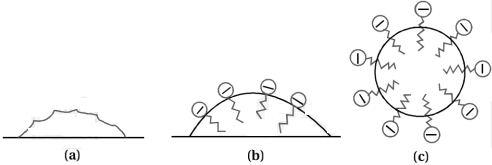
(N/A) micelle consists of a hydrophobic hydrocarbon-like central core. The cleansing action of soap is due to the fact that soap molecules form a micelle around the oil droplet in such a way that the hydrophobic part of the stearate ions is in the oil droplet and the hydrophilic part projects out of the grease droplet like bristles.
The polar groups can interact with water; the oil droplet surrounded by stearate ions is now pulled into the water and removed from the dirty surface. Thus,soap helps in the emulsification and washing away of oils and fats. The negatively charged sheath around the globules prevents them from coming together and forming aggregates.
The polar groups can interact with water; the oil droplet surrounded by stearate ions is now pulled into the water and removed from the dirty surface. Thus,soap helps in the emulsification and washing away of oils and fats. The negatively charged sheath around the globules prevents them from coming together and forming aggregates.
0 likes
View Solution576
Difficult
Explain chemical methods,Bredig's Arc method and peptization method for the preparation of colloids.
Solution
(N/A) Chemical methods : Colloidal dispersions can be prepared by chemical reactions leading to formation of molecules by double decomposition,oxidation,reduction or hydrolysis. These molecules then aggregate leading to formation of sols.
$As_{2}O_{3} + 3 H_{2}S \xrightarrow{\text{Double decomposition}} As_{2}S_{3 \text{ (sol)}} + 3 H_{2}O$
$SO_{2} + 2 H_{2}S \xrightarrow{\text{Oxidation}} 3 S_{\text{(sol)}} + 2 H_{2}O$
$2 AuCl_{3} + 3 HCHO + 3 H_{2}O \xrightarrow{\text{Reduction}} 2 Au_{\text{(sol)}} + 3 HCOOH + 6 HCl$
$FeCl_{3} + 3 H_{2}O \xrightarrow{\text{Hydrolysis}} Fe(OH)_{3 \text{ (sol)}} + 3 HCl$
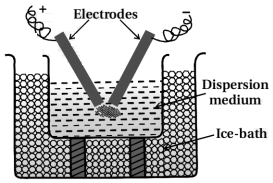
Electrical disintegration or Bredig's Arc method: This process involves dispersion as well as condensation. Colloidal sols of metals such as gold,silver,platinum etc.,can be prepared by this method. In this method,electric arc is struck between electrodes of the metal immersed in the dispersion medium. The intense heat produced vapourises the metal,which then condenses to form particles of colloidal size.
Peptization : Peptization may be defined as the process of converting a precipitate into colloidal sol by shaking it with dispersion medium in the presence of a small amount of electrolyte. The electrolyte used for this purpose is called peptizing agent.
This method is applied to convert a freshly prepared precipitate into a colloidal sol. During peptization the precipitate adsorbs one of the ions of the electrolyte on its surface. This causes the development of positive or negative charge on precipitates,which ultimately break up into smaller particles of the size of a colloid.
$As_{2}O_{3} + 3 H_{2}S \xrightarrow{\text{Double decomposition}} As_{2}S_{3 \text{ (sol)}} + 3 H_{2}O$
$SO_{2} + 2 H_{2}S \xrightarrow{\text{Oxidation}} 3 S_{\text{(sol)}} + 2 H_{2}O$
$2 AuCl_{3} + 3 HCHO + 3 H_{2}O \xrightarrow{\text{Reduction}} 2 Au_{\text{(sol)}} + 3 HCOOH + 6 HCl$
$FeCl_{3} + 3 H_{2}O \xrightarrow{\text{Hydrolysis}} Fe(OH)_{3 \text{ (sol)}} + 3 HCl$
Electrical disintegration or Bredig's Arc method: This process involves dispersion as well as condensation. Colloidal sols of metals such as gold,silver,platinum etc.,can be prepared by this method. In this method,electric arc is struck between electrodes of the metal immersed in the dispersion medium. The intense heat produced vapourises the metal,which then condenses to form particles of colloidal size.
Peptization : Peptization may be defined as the process of converting a precipitate into colloidal sol by shaking it with dispersion medium in the presence of a small amount of electrolyte. The electrolyte used for this purpose is called peptizing agent.
This method is applied to convert a freshly prepared precipitate into a colloidal sol. During peptization the precipitate adsorbs one of the ions of the electrolyte on its surface. This causes the development of positive or negative charge on precipitates,which ultimately break up into smaller particles of the size of a colloid.
0 likes
View Solution577
Difficult
Explain the purification of colloidal solutions.
Solution
(N/A) Colloidal solutions,when prepared,often contain excessive amounts of electrolytes and other soluble impurities. While traces of electrolytes are essential for the stability of the colloidal solution,larger quantities can cause coagulation. Therefore,it is necessary to reduce the concentration of these soluble impurities to a requisite minimum.
The process used for reducing the amount of impurities to a requisite minimum is known as the purification of colloidal solutions. The purification is carried out by the following methods:
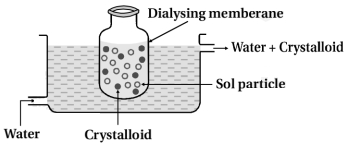
$(i)$ Dialysis: It is a process of removing a dissolved substance from a colloidal solution by means of diffusion through a suitable membrane. Particles (ions or smaller molecules) in a true solution can pass through an animal membrane (bladder),parchment paper,or cellophane sheet,whereas colloidal particles cannot.
$A$ bag of suitable membrane containing the colloidal solution is suspended in a vessel through which fresh water is continuously flowing. The molecules and ions diffuse through the membrane into the outer water,leaving behind a pure colloidal solution. The apparatus used for this purpose is called a dialyser.
$(ii)$ Electro-dialysis: Ordinarily,the process of dialysis is quite slow. It can be made faster by applying an electric field if the dissolved substance in the impure colloidal solution is an electrolyte. This process is named electro-dialysis.
The process used for reducing the amount of impurities to a requisite minimum is known as the purification of colloidal solutions. The purification is carried out by the following methods:
$(i)$ Dialysis: It is a process of removing a dissolved substance from a colloidal solution by means of diffusion through a suitable membrane. Particles (ions or smaller molecules) in a true solution can pass through an animal membrane (bladder),parchment paper,or cellophane sheet,whereas colloidal particles cannot.
$A$ bag of suitable membrane containing the colloidal solution is suspended in a vessel through which fresh water is continuously flowing. The molecules and ions diffuse through the membrane into the outer water,leaving behind a pure colloidal solution. The apparatus used for this purpose is called a dialyser.
$(ii)$ Electro-dialysis: Ordinarily,the process of dialysis is quite slow. It can be made faster by applying an electric field if the dissolved substance in the impure colloidal solution is an electrolyte. This process is named electro-dialysis.
0 likes
View Solution578
Medium
Provide information about the colligative properties and the color of colloidal solutions.
Solution
(N/A) Colligative Properties: Colloidal particles are larger aggregates,so the number of particles in a colloidal solution is comparatively small compared to a true solution. Hence,the values of colligative properties (osmotic pressure,lowering in vapour pressure,depression in freezing point,and elevation in boiling point) are of a smaller order compared to the values shown by true solutions at the same concentration.
Color: The color of a colloidal solution depends on the wavelength of light scattered by the dispersed particles. The wavelength of light further depends on the size and nature of the particles. For example,the finest gold sol appears red,while larger particles appear purple or blue.
Color: The color of a colloidal solution depends on the wavelength of light scattered by the dispersed particles. The wavelength of light further depends on the size and nature of the particles. For example,the finest gold sol appears red,while larger particles appear purple or blue.
0 likes
View Solution579
Advanced
Explain the Tyndall effect.
Solution
(N/A) If a homogeneous solution placed in the dark is observed in the direction of light,it appears clear. If it is observed from a direction at right angles to the direction of the light beam,it appears perfectly dark.
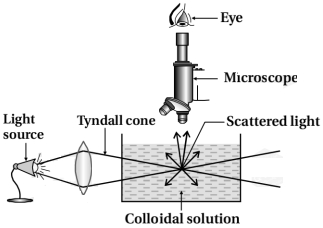
Colloidal solutions viewed in the same way may also appear reasonably clear or translucent by the transmitted light,but they show a mild to strong opalescence when viewed at right angles to the passage of light,i.e.,the path of the beam is illuminated by a bluish light.
This effect was first observed by Faraday and later studied in detail by Tyndall and is termed as the Tyndall effect. The bright cone of light is called the Tyndall cone.
The Tyndall effect is due to the fact that colloidal particles scatter light in all directions in space. The scattering of light illuminates the path of the beam in the colloidal dispersion.
The Tyndall effect can be observed during the projection of a picture in a cinema hall due to the scattering of light by dust and smoke particles present there. The Tyndall effect is observed only when the following two conditions are satisfied:
$(i)$ The diameter of the dispersed particles is not much smaller than the wavelength of the light used.
$(ii)$ The refractive indices of the dispersed phase and the dispersion medium differ greatly in magnitude.
The Tyndall effect is used to distinguish between a colloidal and a true solution. Zsigmondy,in $1903$,used the Tyndall effect to set up an apparatus known as an ultramicroscope. An intense beam of light is focussed on the colloidal solution contained in a glass vessel.
Colloidal solutions viewed in the same way may also appear reasonably clear or translucent by the transmitted light,but they show a mild to strong opalescence when viewed at right angles to the passage of light,i.e.,the path of the beam is illuminated by a bluish light.
This effect was first observed by Faraday and later studied in detail by Tyndall and is termed as the Tyndall effect. The bright cone of light is called the Tyndall cone.
The Tyndall effect is due to the fact that colloidal particles scatter light in all directions in space. The scattering of light illuminates the path of the beam in the colloidal dispersion.
The Tyndall effect can be observed during the projection of a picture in a cinema hall due to the scattering of light by dust and smoke particles present there. The Tyndall effect is observed only when the following two conditions are satisfied:
$(i)$ The diameter of the dispersed particles is not much smaller than the wavelength of the light used.
$(ii)$ The refractive indices of the dispersed phase and the dispersion medium differ greatly in magnitude.
The Tyndall effect is used to distinguish between a colloidal and a true solution. Zsigmondy,in $1903$,used the Tyndall effect to set up an apparatus known as an ultramicroscope. An intense beam of light is focussed on the colloidal solution contained in a glass vessel.
0 likes
View Solution580
Difficult
Give information about Brownian movement.
Solution
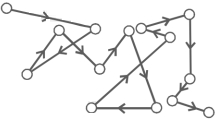
(N/A) When colloidal solutions are viewed under a powerful ultramicroscope,the colloidal particles appear to be in a state of continuous zig-zag motion all over the field of view.
This motion was first observed by the British botanist $Robert \ Brown$ and thus it is known as Brownian movement.
This motion is independent of the nature of the colloid but depends on the size of the particles and the viscosity of the solution. Smaller the size and lesser the viscosity,faster is the motion.
The Brownian movement has been explained to be due to the unbalanced bombardment of the particles by the molecules of the dispersion medium. The Brownian movement has a stirring effect which does not permit the particles to settle and thus is responsible for the stability of sols.
This motion was first observed by the British botanist $Robert \ Brown$ and thus it is known as Brownian movement.
This motion is independent of the nature of the colloid but depends on the size of the particles and the viscosity of the solution. Smaller the size and lesser the viscosity,faster is the motion.
The Brownian movement has been explained to be due to the unbalanced bombardment of the particles by the molecules of the dispersion medium. The Brownian movement has a stirring effect which does not permit the particles to settle and thus is responsible for the stability of sols.
0 likes
View Solution581
Difficult
Provide information about the charge on colloidal particles.
Solution
Colloidal particles always carry an electrical charge. The nature of this charge is the same on all the particles in a given colloidal solution and may be either positive or negative. The presence of equal and similar charges on colloidal particles is largely responsible for providing stability to the colloidal solution because the repulsive forces between charged particles having the same charge prevent them from coalescing or aggregating when they come closer to one another. The charge on the sol particles is due to one or more reasons,such as electron capture by sol particles during electrodispersion of metals,preferential adsorption of ions from the solution,and the formation of an electrical double layer.
| Positively charged Sols. | Negatively charged Sols. |
| $(1)$ Hydrated metallic oxides,e.g.,$Al_{2}O_{3} \cdot xH_{2}O$,$CrO_{3} \cdot xH_{2}O$ and $Fe_{2}O_{3} \cdot xH_{2}O$ etc. | $(1)$ Metals: e.g. Copper,silver,gold sols. |
| $(2)$ Basic dye stuffs e.g. Methylene blue sol. | $(2)$ Metallic sulphide,e.g.,$As_{2}S_{3}, Sb_{2}S_{3}, CdS$ sols. |
| $(3)$ Haemoglobin (Blood) | $(3)$ Acid dye stuffs e.g. eosin,congo red sols. |
| $(4)$ Oxides e.g. $TiO_{2}$ sol. | $(4)$ Sols of starch,gum,gelatin,clay,charcoal. |
0 likes
View Solution582
Difficult
Explain Electrophoresis.
Solution
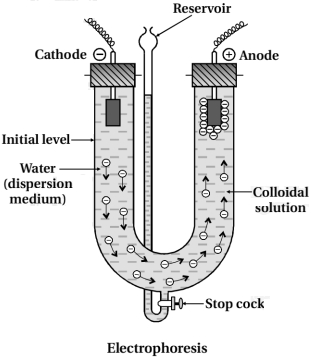
(N/A) The existence of charge on colloidal particles is confirmed by the electrophoresis experiment. When an electric potential is applied across two platinum electrodes dipping in a colloidal solution,the colloidal particles move towards one or the other electrode. The movement of colloidal particles under an applied electric potential is called electrophoresis.
Positively charged particles move towards the cathode,while negatively charged particles move towards the anode. This can be demonstrated by the experimental setup shown in the figure.
When electrophoresis,i.e.,the movement of particles,is prevented by some suitable means,it is observed that the dispersion medium begins to move in an electric field. This phenomenon is termed electroosmosis.
Positively charged particles move towards the cathode,while negatively charged particles move towards the anode. This can be demonstrated by the experimental setup shown in the figure.
When electrophoresis,i.e.,the movement of particles,is prevented by some suitable means,it is observed that the dispersion medium begins to move in an electric field. This phenomenon is termed electroosmosis.
0 likes
View Solution583
Difficult
Give information about coagulation or precipitation.
Solution
(N/A) The stability of the lyophobic sol is due to the presence of charge on colloidal particles. If the charge is removed,the particles come closer to each other to form aggregates (or coagulate) and settle down under the force of gravity.
The process of settling of colloidal particles is called coagulation or precipitation of the sol.
The coagulation of the lyophobic sols can be carried out in the following ways:
$(i)$ By electrophoresis: The colloidal particles move towards oppositely charged electrodes,get discharged,and precipitate.
$(ii)$ By mixing two oppositely charged sols: Oppositely charged sols,when mixed in almost equal proportions,neutralize their charge and get partially or completely precipitated. Mixing of hydrated ferric oxide ($+ve$ sol) and arsenious sulphide ($-ve$ sol) brings them into the precipitated form. This is called mutual coagulation.
$(iii)$ By boiling: When a sol is boiled,the adsorbed layer is disturbed due to increased collisions with the molecules of the dispersion medium. This reduces the charge on the particles and leads to settling down as a precipitate.
$(iv)$ By persistent dialysis: On prolonged dialysis,traces of the electrolyte present in the sol are removed almost completely,making the colloids unstable and leading to coagulation.
$(v)$ By addition of electrolytes: When an excess of an electrolyte is added,the colloidal particles are precipitated. The colloids interact with ions carrying a charge opposite to that present on themselves,causing neutralization. The ion responsible for this is called the coagulating ion. $A$ negative ion causes the precipitation of positively charged sols and vice versa.
According to the Hardy-Schulze rule,the greater the valence of the flocculating ion added,the greater is its power to cause precipitation. For a negative sol,the flocculating power order is: $Al^{3+} > Ba^{2+} > Na^{+}$. For a positive sol,the order is: $[Fe(CN)_{6}]^{4-} > PO_{4}^{3-} > SO_{4}^{2-} > Cl^{-}$.
The minimum concentration of an electrolyte in $millimoles$ per liter required to cause precipitation of a sol in two hours is called the coagulating value. The smaller the quantity needed,the higher the coagulating power of an ion.
The process of settling of colloidal particles is called coagulation or precipitation of the sol.
The coagulation of the lyophobic sols can be carried out in the following ways:
$(i)$ By electrophoresis: The colloidal particles move towards oppositely charged electrodes,get discharged,and precipitate.
$(ii)$ By mixing two oppositely charged sols: Oppositely charged sols,when mixed in almost equal proportions,neutralize their charge and get partially or completely precipitated. Mixing of hydrated ferric oxide ($+ve$ sol) and arsenious sulphide ($-ve$ sol) brings them into the precipitated form. This is called mutual coagulation.
$(iii)$ By boiling: When a sol is boiled,the adsorbed layer is disturbed due to increased collisions with the molecules of the dispersion medium. This reduces the charge on the particles and leads to settling down as a precipitate.
$(iv)$ By persistent dialysis: On prolonged dialysis,traces of the electrolyte present in the sol are removed almost completely,making the colloids unstable and leading to coagulation.
$(v)$ By addition of electrolytes: When an excess of an electrolyte is added,the colloidal particles are precipitated. The colloids interact with ions carrying a charge opposite to that present on themselves,causing neutralization. The ion responsible for this is called the coagulating ion. $A$ negative ion causes the precipitation of positively charged sols and vice versa.
According to the Hardy-Schulze rule,the greater the valence of the flocculating ion added,the greater is its power to cause precipitation. For a negative sol,the flocculating power order is: $Al^{3+} > Ba^{2+} > Na^{+}$. For a positive sol,the order is: $[Fe(CN)_{6}]^{4-} > PO_{4}^{3-} > SO_{4}^{2-} > Cl^{-}$.
The minimum concentration of an electrolyte in $millimoles$ per liter required to cause precipitation of a sol in two hours is called the coagulating value. The smaller the quantity needed,the higher the coagulating power of an ion.
0 likes
View Solution584
Difficult
Explain the coagulation of lyophilic sols and the protection of colloids.
Solution
(N/A) Coagulation of lyophilic sols: There are two factors responsible for the stability of lyophilic sols: the charge and the solvation of the colloidal particles. When these two factors are removed,a lyophilic sol can be coagulated. This is achieved by:
$(i)$ Adding an electrolyte.
$(ii)$ Adding a suitable solvent.
When solvents such as alcohol or acetone are added to hydrophilic sols,the dehydration of the dispersed phase occurs. Under these conditions,a small quantity of electrolyte can bring about coagulation.
Protection of colloids: Lyophilic sols are more stable than lyophobic sols because lyophilic colloids are extensively solvated; i.e.,the colloidal particles are covered by a sheath of the liquid in which they are dispersed.
Lyophilic colloids have a unique property of protecting lyophobic colloids. When a lyophilic sol is added to a lyophobic sol,the lyophilic particles form a layer around the lyophobic particles,protecting them from electrolytes. Lyophilic colloids used for this purpose are called protective colloids.
$(i)$ Adding an electrolyte.
$(ii)$ Adding a suitable solvent.
When solvents such as alcohol or acetone are added to hydrophilic sols,the dehydration of the dispersed phase occurs. Under these conditions,a small quantity of electrolyte can bring about coagulation.
Protection of colloids: Lyophilic sols are more stable than lyophobic sols because lyophilic colloids are extensively solvated; i.e.,the colloidal particles are covered by a sheath of the liquid in which they are dispersed.
Lyophilic colloids have a unique property of protecting lyophobic colloids. When a lyophilic sol is added to a lyophobic sol,the lyophilic particles form a layer around the lyophobic particles,protecting them from electrolytes. Lyophilic colloids used for this purpose are called protective colloids.
0 likes
View Solution585
EasyMCQ
What is the range of the diameters of colloidal particles?
A
$1 \ nm$ to $1000 \ nm$
B
$1 \ \mathring{A}$ to $10 \ \mathring{A}$
C
$1000 \ nm$ to $10000 \ nm$
D
$0.1 \ nm$ to $1 \ nm$
Solution
(A) Colloidal particles are defined as particles whose size lies between the size of true solutions and suspensions.
The range of diameters for colloidal particles is typically $1 \ nm$ to $1000 \ nm$ ($10^{-9} \ m$ to $10^{-6} \ m$).
The range of diameters for colloidal particles is typically $1 \ nm$ to $1000 \ nm$ ($10^{-9} \ m$ to $10^{-6} \ m$).
0 likes
View Solution586
EasyMCQ
Give an example of a solid sol in which the dispersed phase is solid.
A
Coloured gemstones
B
Butter
C
Paints
D
Smoke
Solution
(A) solid sol is a colloidal system where both the dispersed phase and the dispersion medium are solids.
In this system,a solid is dispersed in another solid.
An example of a solid sol is coloured gemstones,where metal ions or other solid impurities are dispersed within a solid mineral matrix.
In this system,a solid is dispersed in another solid.
An example of a solid sol is coloured gemstones,where metal ions or other solid impurities are dispersed within a solid mineral matrix.
0 likes
View Solution587
EasyMCQ
How is the dispersion medium in Aerosol?
A
Solid
B
Liquid
C
Gas
D
Colloid
Solution
(C) An aerosol is a colloidal system in which the dispersion medium is a gas.
In an aerosol,solid or liquid particles are dispersed in a gas.
Examples include smoke (solid in gas) and fog (liquid in gas).
In an aerosol,solid or liquid particles are dispersed in a gas.
Examples include smoke (solid in gas) and fog (liquid in gas).
0 likes
View Solution588
EasyMCQ
Give an example of a solid sol in which the dispersed phase is in a gaseous state.
A
Pumice stone
B
Butter
C
Paints
D
Smoke
Solution
(A) solid sol is a colloidal system where the dispersed phase is a gas and the dispersion medium is a solid.
An example of such a system is $Pumice \ stone$,where gas bubbles are trapped within a solid matrix.
An example of such a system is $Pumice \ stone$,where gas bubbles are trapped within a solid matrix.
0 likes
View Solution589
EasyMCQ
Smoke is which type of colloid?
A
Solid dispersed in gas
B
Gas dispersed in solid
C
Liquid dispersed in gas
D
Gas dispersed in liquid
Solution
(A) colloid is a heterogeneous system in which one substance is dispersed as very fine particles in another substance called the dispersion medium.
Smoke is an example of a colloid where solid particles (like carbon) are dispersed in a gas (like air).
Therefore,it is a solid dispersed in a gas.
Smoke is an example of a colloid where solid particles (like carbon) are dispersed in a gas (like air).
Therefore,it is a solid dispersed in a gas.
0 likes
View Solution590
EasyMCQ
Into how many parts are colloidal sols divided according to the nature of interaction between the dispersed phase and the dispersion medium?
A
$2$
B
$3$
C
$4$
D
$5$
Solution
(A) Based on the nature of interaction between the dispersed phase and the dispersion medium,colloidal sols are classified into $2$ types:
$1$. Lyophilic sols (solvent-loving)
$2$. Lyophobic sols (solvent-hating)
Therefore,the correct answer is $2$.
$1$. Lyophilic sols (solvent-loving)
$2$. Lyophobic sols (solvent-hating)
Therefore,the correct answer is $2$.
0 likes
View Solution591
EasyMCQ
What is the range of diameter of particles in multimolecular colloids?
A
$1 \ nm$ to $100 \ nm$
B
Less than $1 \ nm$
C
Greater than $1000 \ nm$
D
Between $100 \ nm$ and $1000 \ nm$
Solution
(A) Multimolecular colloids are formed by the aggregation of a large number of atoms or smaller molecules with diameters less than $1 \ nm$.
These aggregates have sizes in the colloidal range,which is typically between $1 \ nm$ and $1000 \ nm$.
These aggregates have sizes in the colloidal range,which is typically between $1 \ nm$ and $1000 \ nm$.
0 likes
View Solution592
EasyMCQ
What is the typical range for the $CMC$ (Critical Micelle Concentration) of soap in aqueous solution?
A
$10^{-4} \text{ to } 10^{-3} \text{ mol L}^{-1}$
B
$10^{-2} \text{ to } 10^{-1} \text{ mol L}^{-1}$
C
$10^{-6} \text{ to } 10^{-5} \text{ mol L}^{-1}$
D
$10^{-9} \text{ to } 10^{-8} \text{ mol L}^{-1}$
Solution
(A) The $CMC$ (Critical Micelle Concentration) is the concentration of a surfactant above which micelles are formed.
For soaps (which are sodium or potassium salts of long-chain fatty acids),the $CMC$ typically falls in the range of $10^{-4} \text{ to } 10^{-3} \text{ mol L}^{-1}$.
For soaps (which are sodium or potassium salts of long-chain fatty acids),the $CMC$ typically falls in the range of $10^{-4} \text{ to } 10^{-3} \text{ mol L}^{-1}$.
0 likes
View Solution593
EasyMCQ
What is the physical state of the dispersed phase in an emulsion?
A
Solid
B
Liquid
C
Gas
D
Plasma
Solution
(B) An emulsion is a colloidal system in which both the dispersed phase and the dispersion medium are liquids. Therefore,the dispersed phase in an emulsion is always a liquid.
0 likes
View Solution594
Difficult
Give information about Emulsion.
Solution
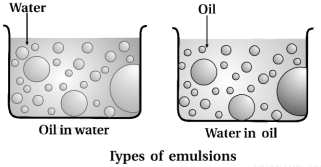
(N/A) These are liquid-liquid colloidal systems,i.e.,the dispersion of finely divided droplets in another liquid. If a mixture of two immiscible or partially miscible liquids is shaken,a coarse dispersion of one liquid in the other is obtained,which is called an emulsion.
Generally,one of the two liquids is water. There are two types of emulsions:
$(i)$ Oil dispersed in water ($o/w$ type)
$(ii)$ Water dispersed in oil ($w/o$ type)
In the first system,water acts as the dispersion medium. Examples of this type of emulsion are milk and vanishing cream. In milk,liquid fat is dispersed in water. In the second system,oil acts as the dispersion medium. Common examples of this type are butter and cream.
Emulsions of oil in water are unstable and sometimes they separate into two layers on standing. For the stabilisation of an emulsion,a third component called an emulsifying agent is usually added. The emulsifying agent forms an interfacial film between suspended particles and the medium. The principal emulsifying agents for $o/w$ emulsions are proteins,gums,natural and synthetic soaps,etc.,and for $w/o$ emulsions,they are heavy metal salts of fatty acids,long-chain alcohols,lampblack,etc.
Emulsions can be diluted with any amount of the dispersion medium. On the other hand,the dispersed liquid,when mixed,forms a separate layer. The droplets in emulsions are often negatively charged and can be precipitated by electrolytes. They also show Brownian movement and the Tyndall effect. Emulsions can be broken into constituent liquids by heating,freezing,centrifuging,etc.
Generally,one of the two liquids is water. There are two types of emulsions:
$(i)$ Oil dispersed in water ($o/w$ type)
$(ii)$ Water dispersed in oil ($w/o$ type)
In the first system,water acts as the dispersion medium. Examples of this type of emulsion are milk and vanishing cream. In milk,liquid fat is dispersed in water. In the second system,oil acts as the dispersion medium. Common examples of this type are butter and cream.
Emulsions of oil in water are unstable and sometimes they separate into two layers on standing. For the stabilisation of an emulsion,a third component called an emulsifying agent is usually added. The emulsifying agent forms an interfacial film between suspended particles and the medium. The principal emulsifying agents for $o/w$ emulsions are proteins,gums,natural and synthetic soaps,etc.,and for $w/o$ emulsions,they are heavy metal salts of fatty acids,long-chain alcohols,lampblack,etc.
Emulsions can be diluted with any amount of the dispersion medium. On the other hand,the dispersed liquid,when mixed,forms a separate layer. The droplets in emulsions are often negatively charged and can be precipitated by electrolytes. They also show Brownian movement and the Tyndall effect. Emulsions can be broken into constituent liquids by heating,freezing,centrifuging,etc.
0 likes
View Solution595
Easy
How many types of emulsions are there? Which are they?
Solution
(N/A) Emulsions are primarily classified into $2$ types based on the nature of the dispersed phase and the dispersion medium:
$1$. Oil in Water $(O/W)$ type: In this type,oil is the dispersed phase and water is the dispersion medium. Example: Milk,vanishing cream.
$2$. Water in Oil $(W/O)$ type: In this type,water is the dispersed phase and oil is the dispersion medium. Example: Butter,cold cream.
$1$. Oil in Water $(O/W)$ type: In this type,oil is the dispersed phase and water is the dispersion medium. Example: Milk,vanishing cream.
$2$. Water in Oil $(W/O)$ type: In this type,water is the dispersed phase and oil is the dispersion medium. Example: Butter,cold cream.
0 likes
View Solution596
MediumMCQ
Give examples of $O/W$ (oil-in-water) and $W/O$ (water-in-oil) emulsions.
A
Milk and Butter
B
Butter and Milk
C
Cream and Cold cream
D
None of these
Solution
(A) An $O/W$ (oil-in-water) emulsion is one where oil is the dispersed phase and water is the dispersion medium. Examples include $Milk$ and $Vanishing \text{ } cream$.
$A$ $W/O$ (water-in-oil) emulsion is one where water is the dispersed phase and oil is the dispersion medium. Examples include $Butter$ and $Cold \text{ } cream$.
$A$ $W/O$ (water-in-oil) emulsion is one where water is the dispersed phase and oil is the dispersion medium. Examples include $Butter$ and $Cold \text{ } cream$.
0 likes
View Solution597
EasyMCQ
Vanishing cream and milk are which type of examples of emulsions?
A
Oil in water $(O/W)$ type
B
Water in oil $(W/O)$ type
C
Both $A$ and $B$
D
None of these
Solution
(A) Emulsions are colloidal systems in which both the dispersed phase and the dispersion medium are liquids.
They are classified into two types:
$1$. Oil in water $(O/W)$ type: In this,oil is the dispersed phase and water is the dispersion medium. Examples include milk and vanishing cream.
$2$. Water in oil $(W/O)$ type: In this,water is the dispersed phase and oil is the dispersion medium. Examples include butter and cold cream.
Therefore,both vanishing cream and milk are examples of $O/W$ type emulsions.
They are classified into two types:
$1$. Oil in water $(O/W)$ type: In this,oil is the dispersed phase and water is the dispersion medium. Examples include milk and vanishing cream.
$2$. Water in oil $(W/O)$ type: In this,water is the dispersed phase and oil is the dispersion medium. Examples include butter and cold cream.
Therefore,both vanishing cream and milk are examples of $O/W$ type emulsions.
0 likes
View Solution598
Difficult
Give information about examples of colloids.
Solution
(N/A) Examples of colloids are as follows:
$(i)$ Blue colour of the sky: Dust particles along with water suspended in air scatter blue light,which reaches our eyes,making the sky appear blue.
$(ii)$ Fog,mist,and rain: When a large mass of air containing dust particles is cooled below its dew point,moisture condenses on these particles,forming fine droplets. These droplets are colloidal and float in the air as mist or fog. Clouds are aerosols with small water droplets suspended in air.
Condensation in the upper atmosphere causes these colloidal droplets to grow until they fall as rain. Rainfall can also occur when two oppositely charged clouds meet. Artificial rain can be induced by spraying electrified sand or a sol with a charge opposite to that of the clouds from an aeroplane.
$(iii)$ Food articles: Milk,butter,halwa,ice-cream,and fruit juices are all colloids.
$(iv)$ Blood: It is a colloidal solution of an albuminoid substance. The styptic action of alum and ferric chloride is due to the coagulation of blood,which forms a clot and stops bleeding.
$(v)$ Soils: Fertile soils are colloidal,with humus acting as a protective colloid. This nature allows soils to absorb moisture and nutrients.
$(vi)$ Formation of delta: River water is a colloidal solution of clay. Sea water contains electrolytes. When river water meets sea water,these electrolytes coagulate the clay,leading to its deposition and the formation of a delta.
$(i)$ Blue colour of the sky: Dust particles along with water suspended in air scatter blue light,which reaches our eyes,making the sky appear blue.
$(ii)$ Fog,mist,and rain: When a large mass of air containing dust particles is cooled below its dew point,moisture condenses on these particles,forming fine droplets. These droplets are colloidal and float in the air as mist or fog. Clouds are aerosols with small water droplets suspended in air.
Condensation in the upper atmosphere causes these colloidal droplets to grow until they fall as rain. Rainfall can also occur when two oppositely charged clouds meet. Artificial rain can be induced by spraying electrified sand or a sol with a charge opposite to that of the clouds from an aeroplane.
$(iii)$ Food articles: Milk,butter,halwa,ice-cream,and fruit juices are all colloids.
$(iv)$ Blood: It is a colloidal solution of an albuminoid substance. The styptic action of alum and ferric chloride is due to the coagulation of blood,which forms a clot and stops bleeding.
$(v)$ Soils: Fertile soils are colloidal,with humus acting as a protective colloid. This nature allows soils to absorb moisture and nutrients.
$(vi)$ Formation of delta: River water is a colloidal solution of clay. Sea water contains electrolytes. When river water meets sea water,these electrolytes coagulate the clay,leading to its deposition and the formation of a delta.
0 likes
View Solution599
Difficult
Give information about the applications of colloids.
Solution
(N/A) Colloids are widely used in the industry. Following are some examples:
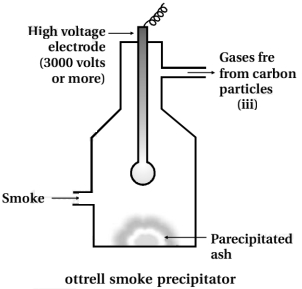
$(i)$ Electrical precipitation of smoke: Smoke is a colloidal solution of solid particles such as carbon,arsenic compounds,dust,etc.,in air. The smoke,before it comes out from the chimney,is led through a chamber containing plates having a charge opposite to that carried by smoke particles. The particles,on coming in contact with these plates,lose their charge and get precipitated. The particles thus settle down on the floor of the chamber. The precipitator is called a Cottrell precipitator.
$(ii)$ Purification of drinking water: The water obtained from natural sources often contains suspended impurities. Alum is added to such water to coagulate the suspended impurities and make water fit for drinking purposes.
$(iii)$ Medicines: Most medicines are colloidal in nature. For example,argyrol is a silver sol used as an eye lotion.
$(i)$ Electrical precipitation of smoke: Smoke is a colloidal solution of solid particles such as carbon,arsenic compounds,dust,etc.,in air. The smoke,before it comes out from the chimney,is led through a chamber containing plates having a charge opposite to that carried by smoke particles. The particles,on coming in contact with these plates,lose their charge and get precipitated. The particles thus settle down on the floor of the chamber. The precipitator is called a Cottrell precipitator.
$(ii)$ Purification of drinking water: The water obtained from natural sources often contains suspended impurities. Alum is added to such water to coagulate the suspended impurities and make water fit for drinking purposes.
$(iii)$ Medicines: Most medicines are colloidal in nature. For example,argyrol is a silver sol used as an eye lotion.
0 likes
View Solution600
EasyMCQ
Which is a colloidal solution containing carbon,arsenic compounds and dust in air?
A
Smoke
B
Fog
C
Cloud
D
Mist
Solution
(A) colloidal system where solid particles (like carbon,arsenic compounds,and dust) are dispersed in a gas (air) is known as $Smoke$.
In $Smoke$,the dispersed phase is $Solid$ and the dispersion medium is $Gas$.
In $Smoke$,the dispersed phase is $Solid$ and the dispersion medium is $Gas$.
0 likes
View SolutionSurface Chemistry — Colloids, Emulsion, Gel and Their properties with application · Frequently Asked Questions
1Are these Surface Chemistry questions useful for JEE and NEET?
Yes. All questions in this section are mapped to JEE Main and NEET exam patterns. Previous year questions from JEE Main, NEET, GUJCET and state-level exams are included with full solutions.
2Can I switch to Hindi or Gujarati for these questions?
Yes. Use the language tabs in the hero section or the sidebar to view the same questions and solutions in English, Hindi or Gujarati.
3How do I generate a question paper from this subtopic?
Use the Vedclass Exam Paper Generator — select the chapter and subtopic, set difficulty, and generate Sets A, B, C, D automatically. First 3 chapters of every subject are free.
Vedclass Products
For Students
Vedclass Test Series
Mock tests in real JEE/NEET style with performance analysis. 5-day free trial.
Start Free TrialFor Teachers
Exam Paper Generator
Generate Set A/B/C/D papers from this chapter in 2 minutes. 3 chapters free.
Try FreeFor Institutes
Online Exam Module
Live online exams with unlimited students, 360° analytics & white-label branding.
See DemoFor Teachers & Institutes
Generate a Surface Chemistry Exam Paper in 2 Minutes
Select subtopic & difficulty — Sets A, B, C, D auto-generated with No Repeat logic.
First 3 chapters of every subject are free — no payment required.