
A English
Colloids, Emulsion, Gel and Their properties with application Questions in English
Class 12 Chemistry · Surface Chemistry · Colloids, Emulsion, Gel and Their properties with application
886+
Questions
English
Language
100%
With Solutions
Showing 50 of 886 questions in English
601
EasyMCQ
What is the name given to the process where particles settle down on the floor of a chamber?
A
Sedimentation
B
Coagulation
C
Precipitation
D
Flocculation
Solution
(A) The process by which suspended particles in a fluid settle down under the influence of gravity is known as $Sedimentation$. In the context of colloidal chemistry,when particles aggregate and settle due to the addition of an electrolyte,it is often referred to as $Coagulation$ or $Flocculation$. However,the general term for particles settling on the floor of a chamber is $Sedimentation$.
0 likes
View Solution602
Medium
Which type of sol is argyrol? What are the uses of argyrol?
Solution
(N/A) Argyrol is a $silver$ sol,which is a type of colloidal solution where $silver$ particles are dispersed in a protein medium.
It is primarily used as an antiseptic in eye drops and for treating infections in mucous membranes.
It is primarily used as an antiseptic in eye drops and for treating infections in mucous membranes.
0 likes
View Solution603
EasyMCQ
What is obtained by the coagulation of latex?
A
Rubber
B
Plastic
C
Fiber
D
Resin
Solution
(A) Latex is a colloidal dispersion of rubber particles in water.
When latex is coagulated,typically by the addition of an acid like acetic acid or formic acid,the rubber particles aggregate to form a solid mass known as $Rubber$.
When latex is coagulated,typically by the addition of an acid like acetic acid or formic acid,the rubber particles aggregate to form a solid mass known as $Rubber$.
0 likes
View Solution604
Easy
What improvement can you suggest in the Hardy-Schulze rule?
Solution
(N/A) Schulze and Hardy observed that 'the greater the valency of the flocculating ion added,the greater is its power to cause precipitation.' This rule considers only the charge on the ion,not its size. The smaller the size of the ion,the greater is its polarising power. Thus,the Hardy-Schulze rule can be improved as follows: 'The greater the polarising power of the added flocculating ion,the greater is its precipitating power.'
0 likes
View Solution605
MediumMCQ
What type of solutions are formed on dissolving different concentrations of soap in water?
A
True solution at all concentrations
B
Colloidal solution at all concentrations
C
Electrolyte at low concentration and colloidal solution at higher concentration
D
Suspension at all concentrations
Solution
(C) Soap at a lower concentration behaves as an electrolyte,forming a true solution.
However,if the concentration exceeds the $CMC$ (Critical Micelle Concentration),the soap molecules aggregate to form a micelle,which behaves like a colloidal solution.
However,if the concentration exceeds the $CMC$ (Critical Micelle Concentration),the soap molecules aggregate to form a micelle,which behaves like a colloidal solution.
0 likes
View Solution606
EasyMCQ
What happens when gelatin is mixed with a gold sol?
A
The gold sol is coagulated.
B
The gold sol is stabilized.
C
The gold sol is precipitated.
D
No change occurs.
Solution
(B) Gelatin is a lyophilic colloid. When added to a lyophobic sol like gold sol,it forms a protective layer around the gold particles,thereby preventing their coagulation by electrolytes. This process is known as the stabilization of the sol.
0 likes
View Solution607
MediumMCQ
How does it become possible to cause artificial rain by spraying $AgI$ on the clouds?
A
It acts as a catalyst for the reaction between $O_2$ and $H_2$.
B
It causes the coagulation of charged cloud particles.
C
It increases the temperature of the clouds.
D
It reacts with water to form $HI$.
Solution
(B) Clouds are colloidal systems consisting of charged water droplets dispersed in air.
When $AgI$ (silver iodide) is sprayed over the clouds,it acts as an electrolyte.
This causes the coagulation of the charged colloidal water droplets,leading to the formation of larger droplets that fall as artificial rain.
When $AgI$ (silver iodide) is sprayed over the clouds,it acts as an electrolyte.
This causes the coagulation of the charged colloidal water droplets,leading to the formation of larger droplets that fall as artificial rain.
0 likes
View Solution608
MediumMCQ
Gelatin,which is a peptide,is added to ice creams. What is its role?
A
It acts as a sweetener.
B
It acts as an emulsifying agent.
C
It acts as a preservative.
D
It acts as a coloring agent.
Solution
(B) Gelatin is a protein (peptide) that acts as a stabilizer or emulsifying agent in ice creams.
It prevents the formation of large ice crystals,thereby maintaining the smooth texture of the ice cream.
It prevents the formation of large ice crystals,thereby maintaining the smooth texture of the ice cream.
0 likes
View Solution609
Easy
Why do we add alum to purify water?
Solution
(N/A) Water often contains negatively charged colloidal impurities. When alum $(K_2SO_4 \cdot Al_2(SO_4)_3 \cdot 24H_2O)$ is added to water,it dissociates to provide $Al^{3+}$ ions. These $Al^{3+}$ ions neutralize the charge on the colloidal particles,leading to their coagulation. The coagulated impurities settle down at the bottom and can be removed by filtration,resulting in purified water.
0 likes
View Solution610
MediumMCQ
What happens when an electric field is applied to a colloidal solution?
A
The colloidal particles move towards the oppositely charged electrode.
B
The colloidal particles move towards the same charged electrode.
C
The colloidal particles settle down at the bottom.
D
The colloidal particles remain unaffected.
Solution
(A) Colloidal particles carry a specific electric charge (either positive or negative).
When an electric field is applied,these particles migrate towards the electrode with the opposite charge.
This phenomenon is known as $electrophoresis$.
When an electric field is applied,these particles migrate towards the electrode with the opposite charge.
This phenomenon is known as $electrophoresis$.
0 likes
View Solution611
Medium
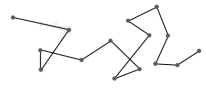
What causes Brownian motion in colloidal dispersion?
Solution
(N/A) Brownian motion is caused by the unbalanced bombardment of the colloidal particles by the molecules of the dispersion medium. These molecules are in constant,rapid motion,similar to molecules in a gas. As a result of these collisions,the colloidal particles acquire kinetic energy comparable to that of the dispersion medium molecules,leading to their characteristic zig-zag motion.
0 likes
View Solution612
MediumMCQ
$A$ colloid is formed by adding $FeCl_3$ in excess of hot water. What will happen if excess sodium chloride is added to this colloid?
A
The colloid will be stabilized.
B
The colloid will coagulate.
C
The colloid will become negatively charged.
D
No change will occur.
Solution
(B) Adding excess $FeCl_3$ to hot water produces a colloidal solution of hydrated ferric oxide,$Fe_2O_3 \cdot xH_2O$,which is a positively charged colloid.
When excess $NaCl$ is added,the $Cl^-$ ions from the electrolyte neutralize the positive charge on the colloidal particles.
This process leads to the coagulation of the colloidal sol.
When excess $NaCl$ is added,the $Cl^-$ ions from the electrolyte neutralize the positive charge on the colloidal particles.
This process leads to the coagulation of the colloidal sol.
0 likes
View Solution613
EasyMCQ
How do emulsifying agents stabilize the emulsion?
A
By increasing the surface tension of the medium.
B
By forming an interfacial film between the suspended particles and the dispersion medium.
C
By reacting with the dispersed phase to form a new compound.
D
By decreasing the viscosity of the emulsion.
Solution
(B) Emulsifying agents stabilize emulsions by forming an interfacial film between the suspended particles and the dispersion medium.
This film reduces the interfacial tension between the two immiscible liquids,thereby preventing the coalescence of droplets and maintaining the stability of the emulsion.
This film reduces the interfacial tension between the two immiscible liquids,thereby preventing the coalescence of droplets and maintaining the stability of the emulsion.
0 likes
View Solution614
Medium
Why are some medicines more effective in the colloidal form?
Solution
(N/A) Colloidal medicines are more effective because they have a large surface area and are therefore more easily assimilated by the body.
For example: Colloidal gold is used for intramuscular injection,and silver sol is used as an eye lotion.
For example: Colloidal gold is used for intramuscular injection,and silver sol is used as an eye lotion.
0 likes
View Solution615
Medium
Why does leather get hardened after tanning?
Solution
(N/A) Animal hides are colloidal in nature. When a hide that has positively charged particles is soaked in tannin,the negatively charged colloidal particles undergo mutual coagulation. This results in the hardening of leather. This process is known as Tanning.
0 likes
View Solution616
Medium
How does the precipitation of colloidal smoke take place in a Cottrell precipitator?
Solution
(N/A) The Cottrell precipitator is a device used to remove smoke from industrial gases.
Smoke is a colloidal dispersion of solid carbon particles in air.
These colloidal particles are electrically charged.
In the Cottrell precipitator,the smoke is passed through a chamber containing metal plates connected to a high-voltage source.
These plates act as electrodes.
When the smoke passes between these charged plates,the colloidal particles lose their charge upon coming in contact with the oppositely charged electrode.
Once the charge is neutralized,the particles aggregate and settle down due to gravity,leaving the clean gas to escape.
Smoke is a colloidal dispersion of solid carbon particles in air.
These colloidal particles are electrically charged.
In the Cottrell precipitator,the smoke is passed through a chamber containing metal plates connected to a high-voltage source.
These plates act as electrodes.
When the smoke passes between these charged plates,the colloidal particles lose their charge upon coming in contact with the oppositely charged electrode.
Once the charge is neutralized,the particles aggregate and settle down due to gravity,leaving the clean gas to escape.
0 likes
View Solution617
Medium
How will you distinguish between dispersed phase and dispersion medium in an emulsion?
Solution
(N/A) An emulsion can be diluted with any amount of the dispersion medium. However,if the dispersed phase is added,it will not mix and will form a separate layer. Thus,by adding the dispersion medium to the emulsion,the two phases can be distinguished.
0 likes
View Solution618
Medium
On the basis of the Hardy-Schulze rule,explain why the coagulating power of phosphate is higher than chloride.
Solution
(N/A) According to the Hardy-Schulze rule,the coagulating power of an ion is directly proportional to its valency (charge).
$PO_{4}^{3-}$ has a valency of $3$,whereas $Cl^-$ has a valency of $1$.
Since the valency of the phosphate ion $(3)$ is greater than that of the chloride ion $(1)$,the coagulating power of phosphate is higher than that of chloride.
$PO_{4}^{3-}$ has a valency of $3$,whereas $Cl^-$ has a valency of $1$.
Since the valency of the phosphate ion $(3)$ is greater than that of the chloride ion $(1)$,the coagulating power of phosphate is higher than that of chloride.
0 likes
View Solution619
MediumMCQ
Why does bleeding stop by rubbing moist alum?
A
Alum acts as an antiseptic.
B
Alum causes coagulation of blood proteins.
C
Alum reduces the temperature of the wound.
D
Alum acts as a blood thinner.
Solution
(B) Alum is a salt containing $Al^{3+}$ ions. When applied to a wound,these $Al^{3+}$ ions neutralize the negatively charged colloidal particles of blood. This process leads to the coagulation of blood,which helps in stopping the bleeding.
0 likes
View Solution620
Medium
What happens when dialysis is prolonged?
Solution
(N/A) The electrolytes present in the colloidal solution help in stabilizing the sol particles. On prolonged dialysis,these traces of electrolytes are removed completely from the solution. As a result,the stability of the colloidal system is lost,which leads to the coagulation of the sol particles.
0 likes
View Solution621
Medium
How does a delta form at the meeting place of sea and river water?
Solution
(N/A) River water contains colloidal particles of mud and clay,which carry a negative charge. Sea water contains various electrolytes such as $NaCl$ and $MgCl_2$. When river water meets sea water,the electrolytes present in the sea water neutralize the charge on the colloidal particles of mud and clay. This process is known as coagulation or flocculation. As a result,the mud and clay particles settle down at the river mouth,leading to the formation of a delta.
0 likes
View Solution622
Difficult
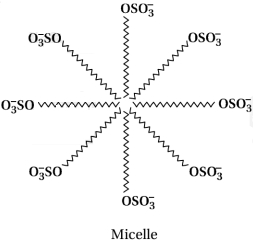
Draw the diagram showing micelle formation by the following detergent.
$CH_3(CH_2)_{10}CH_2OSO_3^-Na^{+}$
$CH_3(CH_2)_{10}CH_2OSO_3^-Na^{+}$
Solution
(N/A) Sodium lauryl sulphate,$CH_3(CH_2)_{10}CH_2OSO_3Na$,is an example of an anionic detergent.
When added to water,it dissociates as follows:
$CH_3(CH_2)_{10}CH_2OSO_3Na + H_2O \longrightarrow CH_3(CH_2)_{10}CH_2OSO_3^- + Na^+ + H_2O$
These anions are present on the surface with their $-OSO_3^-$ groups in water and the hydrocarbon part staying away from it,remaining at the surface.
At higher concentration,these anions are pulled into the bulk of the solution and form an aggregate of spherical shape with their hydrocarbon part pointing towards the centre and the $-OSO_3^-$ part outwards on the surface of the sphere.
When added to water,it dissociates as follows:
$CH_3(CH_2)_{10}CH_2OSO_3Na + H_2O \longrightarrow CH_3(CH_2)_{10}CH_2OSO_3^- + Na^+ + H_2O$
These anions are present on the surface with their $-OSO_3^-$ groups in water and the hydrocarbon part staying away from it,remaining at the surface.
At higher concentration,these anions are pulled into the bulk of the solution and form an aggregate of spherical shape with their hydrocarbon part pointing towards the centre and the $-OSO_3^-$ part outwards on the surface of the sphere.
0 likes
View Solution623
MediumMCQ
Why do painters add oil to paint when painting a wall with oil paint?
A
To increase the viscosity of the paint.
B
To decrease the surface tension of the paint.
C
To increase the surface tension of the paint.
D
To make the paint dry faster.
Solution
(B) Adding oil to the paint reduces its surface tension.
Due to lower surface tension,the paint spreads over a larger surface area.
As a result,less paint is required to cover a larger area,making the process more economical.
Due to lower surface tension,the paint spreads over a larger surface area.
As a result,less paint is required to cover a larger area,making the process more economical.
0 likes
View Solution624
EasyMCQ
Which of the following is used for the preparation of colloids?
A
Ostwald Process
B
Van Arkel Method
C
Bredig's Arc Method
D
Mond Process
Solution
(C) Bredig's Arc method is a specialized technique used for the preparation of colloidal solutions of metals like $Au$,$Ag$,and $Pt$.
0 likes
View Solution625
MediumMCQ
An ionic micelle is formed on the addition of:
A
sodium stearate to water
B
sodium stearate to acetone
C
liquid diethyl ether to aqueous $NaCl$ solution
D
sodium stearate to pure toluene
Solution
(A) An ionic micelle is a colloidal aggregate formed by amphiphilic molecules (surfactants) in a polar solvent,typically water,when their concentration exceeds the Critical Micelle Concentration $(CMC)$.
Sodium stearate $(C_{17}H_{35}COONa)$ is a soap,which is an ionic surfactant.
When added to water,the hydrophobic hydrocarbon tails aggregate together while the hydrophilic carboxylate heads face the water,forming an ionic micelle.
Therefore,the correct option is $A$.
Sodium stearate $(C_{17}H_{35}COONa)$ is a soap,which is an ionic surfactant.
When added to water,the hydrophobic hydrocarbon tails aggregate together while the hydrophilic carboxylate heads face the water,forming an ionic micelle.
Therefore,the correct option is $A$.
0 likes
View Solution626
MediumMCQ
Tyndall effect is observed when
A
The diameter of dispersed particles is much smaller than the wavelength of light used
B
The diameter of dispersed particles is much larger than the wavelength of light used
C
The diameter of dispersed particles is similar to the wavelength of light used
D
The refractive index of dispersed phase is greater than that of the dispersion medium
Solution
(C) The Tyndall effect is the scattering of light by particles in a colloid or a very fine suspension.
It is observed when the diameter of the dispersed particles is comparable to (similar to) the wavelength of the light used.
It is observed when the diameter of the dispersed particles is comparable to (similar to) the wavelength of the light used.
0 likes
View Solution627
MediumMCQ
$A$ sample of red ink (a colloidal solution) is prepared by mixing eosin dye,egg white,$HCHO$ and water. The component which ensures stability of the ink sample is :-
A
$HCHO$
B
Eosin dye
C
Egg white
D
Water
Solution
(C) $1$. Colloidal solution is a mixture in which tiny particles are suspended in a liquid substance. The suspended particles are known as the dispersed phase and the liquid substance is known as the dispersion medium.
$2$. Colloidal sols are classified as Lyophobic (liquid-hating) and Lyophilic (liquid-loving). Lyophilic sols are inherently more stable due to the high affinity between the dispersed phase and the dispersion medium.
$3$. Egg white contains albumin,which acts as a protective colloid and forms a lyophilic sol when mixed with water. This provides stability to the colloidal system.
$4$. Therefore,egg white ensures the stability of the red ink sample.
$5$. $HCHO$,eosin dye,and water do not possess the property of stabilizing the colloid in this mixture.
Thus,option $(C)$ is correct.
$2$. Colloidal sols are classified as Lyophobic (liquid-hating) and Lyophilic (liquid-loving). Lyophilic sols are inherently more stable due to the high affinity between the dispersed phase and the dispersion medium.
$3$. Egg white contains albumin,which acts as a protective colloid and forms a lyophilic sol when mixed with water. This provides stability to the colloidal system.
$4$. Therefore,egg white ensures the stability of the red ink sample.
$5$. $HCHO$,eosin dye,and water do not possess the property of stabilizing the colloid in this mixture.
Thus,option $(C)$ is correct.
0 likes
View Solution628
MediumMCQ
Match the following types of colloids with their examples:
| $i$. Foam | $a$. Smoke |
| $ii$. Gel | $b$. Cell fluid |
| $iii$. Aerosol | $c$. Jellies |
| $iv$. Emulsion | $d$. Rubber |
| $e$. Froth | |
| $f$. Milk |
A
$i-b, ii-c, iii-e, iv-d$
B
$i-d, ii-b, iii-e, iv-f$
C
$i-e, ii-c, iii-a, iv-f$
D
$i-d, ii-b, iii-a, iv-e$
Solution
(C) $i$. Foam is a colloidal system where gas is dispersed in a liquid,e.g.,Froth $(i-e)$.
$ii$. Gel is a colloidal system where liquid is dispersed in a solid,e.g.,Jellies $(ii-c)$.
$iii$. Aerosol is a colloidal system where solid or liquid is dispersed in a gas,e.g.,Smoke $(iii-a)$.
$iv$. Emulsion is a colloidal system where liquid is dispersed in a liquid,e.g.,Milk $(iv-f)$.
Therefore,the correct matching is $i-e, ii-c, iii-a, iv-f$.
$ii$. Gel is a colloidal system where liquid is dispersed in a solid,e.g.,Jellies $(ii-c)$.
$iii$. Aerosol is a colloidal system where solid or liquid is dispersed in a gas,e.g.,Smoke $(iii-a)$.
$iv$. Emulsion is a colloidal system where liquid is dispersed in a liquid,e.g.,Milk $(iv-f)$.
Therefore,the correct matching is $i-e, ii-c, iii-a, iv-f$.
0 likes
View Solution629
MediumMCQ
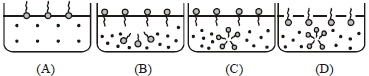
Identify the correct molecular picture showing what happens at the critical micellar concentration $(CMC)$ of an aqueous solution of a surfactant $(\circ \text{ polar head; } \sim \text{ non-polar tail; } \bullet \text{ water})$.
A
$(A)$
B
$(B)$
C
$(C)$
D
$(D)$
Solution
(C) Surfactants are molecules that contain both a hydrophilic (polar) head and a hydrophobic (non-polar) tail.
In an aqueous solution,at low concentrations,surfactant molecules exist as individual monomers.
As the concentration increases to the Critical Micellar Concentration $(CMC)$,the surfactant molecules begin to aggregate to form spherical structures called micelles.
In a micelle,the hydrophobic tails are directed towards the center (away from water),and the hydrophilic heads are directed towards the outside (in contact with water).
Looking at the provided options,image $(C)$ correctly depicts the formation of a micelle where the non-polar tails are clustered together in the center and the polar heads are facing the aqueous medium.
In an aqueous solution,at low concentrations,surfactant molecules exist as individual monomers.
As the concentration increases to the Critical Micellar Concentration $(CMC)$,the surfactant molecules begin to aggregate to form spherical structures called micelles.
In a micelle,the hydrophobic tails are directed towards the center (away from water),and the hydrophilic heads are directed towards the outside (in contact with water).
Looking at the provided options,image $(C)$ correctly depicts the formation of a micelle where the non-polar tails are clustered together in the center and the polar heads are facing the aqueous medium.
0 likes
View Solution630
MediumMCQ
Kraft temperature is the temperature
A
below which the formation of micelles takes place.
B
below which the aqueous solution of detergents starts freezing.
C
above which the formation of micelles takes place.
D
above which the aqueous solution of detergents starts boiling.
Solution
(C) The Kraft temperature $(T_{k})$ is defined as the minimum temperature above which the formation of micelles takes place in an aqueous solution of surfactants or detergents.
0 likes
View Solution631
MediumMCQ
Measuring Zeta potential is useful in determining which property of colloidal solution?
A
Size of the colloidal particles
B
Viscosity
C
Solubility
D
Stability of the colloidal particles
Solution
(D) The Zeta potential is the potential difference between the fixed layer and the diffused layer of ions surrounding a colloidal particle.
Greater the magnitude of the Zeta potential,the more stable the colloidal system will be,as it indicates stronger electrostatic repulsion between particles.
Greater the magnitude of the Zeta potential,the more stable the colloidal system will be,as it indicates stronger electrostatic repulsion between particles.
0 likes
View Solution632
MediumMCQ
In which of the following sols are the colloidal particles negatively charged?
A
Hydrated $Al_{2}O_{3}$
B
$TiO_{2}$
C
Haemoglobin
D
Starch
Solution
(D) The charge on colloidal particles is determined by the nature of the dispersed phase and the dispersion medium. Based on standard chemical classifications:
$1$. Hydrated $Al_{2}O_{3}$ is a positively charged sol.
$2$. $TiO_{2}$ is a positively charged sol.
$3$. Haemoglobin is a positively charged sol.
$4$. Starch is a negatively charged sol.
Therefore,the correct option is $D$.
$1$. Hydrated $Al_{2}O_{3}$ is a positively charged sol.
$2$. $TiO_{2}$ is a positively charged sol.
$3$. Haemoglobin is a positively charged sol.
$4$. Starch is a negatively charged sol.
Therefore,the correct option is $D$.
0 likes
View Solution633
MediumMCQ
When an excess of a very dilute aqueous solution of $KI$ is added to a very dilute aqueous solution of silver nitrate,the colloidal particles of silver iodide are associated with the Helmholtz double layer in the form of:
A
$AgI/Ag^{+}:I^{-}$
B
$AgI/K^{+}:NO_{3}^{-}$
C
$AgI/NO_{3}^{-}:Ag^{+}$
D
$AgI/I^{-}:K^{+}$
Solution
(D) When $KI$ is added in excess to $AgNO_{3}$,the $AgI$ particles preferentially adsorb $I^{-}$ ions from the dispersion medium to form a negatively charged colloidal sol,represented as $AgI/I^{-}$.
This primary layer of $I^{-}$ ions attracts counter ions $(K^{+})$ from the medium to form the Helmholtz double layer,which is represented as $AgI/I^{-}:K^{+}$.
This primary layer of $I^{-}$ ions attracts counter ions $(K^{+})$ from the medium to form the Helmholtz double layer,which is represented as $AgI/I^{-}:K^{+}$.
0 likes
View Solution634
EasyMCQ
Which of the following statements is incorrect about colloidal solutions?
A
Lyophobic sols are more stable than lyophilic sols.
B
Lyophilic colloids have a unique property of protecting lyophobic colloids.
C
Lyophilic colloids are more soluble than lyophobic colloids.
D
None of these
Solution
(A) Lyophilic sols are more stable than lyophobic sols because of the extensive solvation of the dispersed phase particles.
Therefore,the statement $(A)$ is incorrect because it claims that lyophobic sols are more stable.
Therefore,the statement $(A)$ is incorrect because it claims that lyophobic sols are more stable.
0 likes
View Solution635
MediumMCQ
Select the incorrect statement:
A
Micelles are associated colloids.
B
The electrical charge on a colloid particle is indicated by electrophoresis.
C
Formation of micelles takes place above Kraft temperature.
D
Formation of micelles takes place below $CMC$.
Solution
(D) Micelles are formed only above a particular concentration called Critical Micelle Concentration $(CMC)$ and above a particular temperature called Kraft temperature $(T_k)$.
Therefore,the statement that the formation of micelles takes place below $CMC$ is incorrect.
Therefore,the statement that the formation of micelles takes place below $CMC$ is incorrect.
0 likes
View Solution636
MediumMCQ
$A$ colloidal system consisting of a gas dispersed in a solid is called a/an:
A
solid sol
B
gel
C
aerosol
D
foam
Solution
(A) colloidal system where a gas is dispersed in a solid medium is known as a $solid \ sol$. Examples include pumice stone and rubber foam.
0 likes
View Solution637
MediumMCQ
Which of the following statements regarding colloidal solutions is $INCORRECT$?
A
$A$. $A$ colloidal solution shows colligative properties.
B
$B$. An ordinary filter paper can stop the flow of colloidal particles.
C
$C$. The flocculating power of $Al^{3+}$ is more than that of $Na^{+}$.
D
$D$. $A$ colloidal solution shows Brownian motion of colloidal particles.
Solution
(B) Colloidal solutions exhibit colligative properties due to the presence of particles,although the values are small compared to true solutions.
An ordinary filter paper has large pores that allow colloidal particles to pass through easily; therefore,it cannot stop the flow of colloidal particles.
According to the Hardy-Schulze rule,the flocculating power of an ion increases with the increase in the magnitude of its charge. Thus,$Al^{3+}$ has a much higher flocculating power than $Na^{+}$.
Colloidal particles exhibit Brownian motion due to the unbalanced bombardment of the particles by the molecules of the dispersion medium.
Therefore,statement $B$ is incorrect.
An ordinary filter paper has large pores that allow colloidal particles to pass through easily; therefore,it cannot stop the flow of colloidal particles.
According to the Hardy-Schulze rule,the flocculating power of an ion increases with the increase in the magnitude of its charge. Thus,$Al^{3+}$ has a much higher flocculating power than $Na^{+}$.
Colloidal particles exhibit Brownian motion due to the unbalanced bombardment of the particles by the molecules of the dispersion medium.
Therefore,statement $B$ is incorrect.
0 likes
View Solution638
EasyMCQ
For the coagulation of a negative sol,the species below,that has the highest flocculating power is:
A
$SO_{4}^{2-}$
B
$Ba^{2+}$
C
$Na^{+}$
D
$PO_{4}^{3-}$
Solution
(B) According to the Hardy-Schulze rule,the coagulating power of an ion is directly proportional to the magnitude of its charge.
For a negative sol,the coagulating species must be a cation.
Comparing the given cations: $Na^{+}$ (charge $+1$) and $Ba^{2+}$ (charge $+2$).
Since $Ba^{2+}$ has a higher charge than $Na^{+}$,it will have a higher flocculating power.
Therefore,$Ba^{2+}$ is the correct species.
For a negative sol,the coagulating species must be a cation.
Comparing the given cations: $Na^{+}$ (charge $+1$) and $Ba^{2+}$ (charge $+2$).
Since $Ba^{2+}$ has a higher charge than $Na^{+}$,it will have a higher flocculating power.
Therefore,$Ba^{2+}$ is the correct species.
0 likes
View Solution639
MediumMCQ
The charges on the colloidal $CdS$ sol and $TiO_2$ sol are,respectively :
A
positive and positive
B
positive and negative
C
negative and negative
D
negative and positive
Solution
(D) $CdS$ sol is a negatively charged sol.
$TiO_2$ sol is a positively charged sol.
Therefore,the charges are negative and positive,respectively.
$TiO_2$ sol is a positively charged sol.
Therefore,the charges are negative and positive,respectively.
0 likes
View Solution640
EasyMCQ
Most suitable salt which can be used for efficient clotting of blood will be :-
A
$NaHCO_3$
B
$FeSO_4$
C
$Mg(HCO_3)_2$
D
$FeCl_3$
Solution
(D) Blood is a negatively charged colloidal sol.
According to the Hardy-Schulze rule,the coagulating power of an electrolyte depends on the valency of the active ion (ion with charge opposite to that of the sol).
For a negatively charged sol,a positively charged ion is required for coagulation.
The coagulating power increases with the increase in the magnitude of the charge on the cation.
Comparing the cations: $Na^+$,$Fe^{2+}$,$Mg^{2+}$,and $Fe^{3+}$.
The $Fe^{3+}$ ion has the highest charge $(+3)$,therefore it has the maximum coagulating power for the negatively charged blood sol.
Thus,$FeCl_3$ is the most suitable salt for the clotting of blood.
According to the Hardy-Schulze rule,the coagulating power of an electrolyte depends on the valency of the active ion (ion with charge opposite to that of the sol).
For a negatively charged sol,a positively charged ion is required for coagulation.
The coagulating power increases with the increase in the magnitude of the charge on the cation.
Comparing the cations: $Na^+$,$Fe^{2+}$,$Mg^{2+}$,and $Fe^{3+}$.
The $Fe^{3+}$ ion has the highest charge $(+3)$,therefore it has the maximum coagulating power for the negatively charged blood sol.
Thus,$FeCl_3$ is the most suitable salt for the clotting of blood.
0 likes
View Solution641
EasyMCQ
Which one of the following statements is $FALSE$ for hydrophilic sols?
A
Their viscosity is of the order of that of $H_2O$.
B
The sols cannot be easily coagulated.
C
They do not require electrolytes for stability.
D
These sols are reversible in nature.
Solution
(A) The viscosity of hydrophilic sols is generally higher than that of the dispersion medium $(H_2O)$.
Hydrophilic sols are more stable due to strong interaction between the dispersed phase and the dispersion medium,making them difficult to coagulate.
Hydrophilic sols are reversible in nature,meaning they can be reformed by simply mixing the dispersed phase with the dispersion medium after coagulation.
They do not require electrolytes for stability; in fact,the addition of electrolytes can lead to coagulation.
Therefore,the statement that their viscosity is of the order of that of $H_2O$ is false.
Hydrophilic sols are more stable due to strong interaction between the dispersed phase and the dispersion medium,making them difficult to coagulate.
Hydrophilic sols are reversible in nature,meaning they can be reformed by simply mixing the dispersed phase with the dispersion medium after coagulation.
They do not require electrolytes for stability; in fact,the addition of electrolytes can lead to coagulation.
Therefore,the statement that their viscosity is of the order of that of $H_2O$ is false.
0 likes
View Solution642
EasyMCQ
The nature of charge on resulting colloidal particles when $FeCl_3$ is added to excess of hot water is:
A
Positive
B
Sometimes positive and sometimes negative
C
Neutral
D
Negative
Solution
(A) When $FeCl_3$ is added to excess of hot water,it undergoes hydrolysis to form hydrated ferric oxide,$Fe_2O_3 \cdot xH_2O$.
During this process,the colloidal particles preferentially adsorb $Fe^{3+}$ ions from the solution,resulting in the formation of a positively charged sol.
The representation is $Fe_2O_3 \cdot xH_2O / Fe^{3+}$.
Therefore,the nature of the charge is positive.
During this process,the colloidal particles preferentially adsorb $Fe^{3+}$ ions from the solution,resulting in the formation of a positively charged sol.
The representation is $Fe_2O_3 \cdot xH_2O / Fe^{3+}$.
Therefore,the nature of the charge is positive.
0 likes
View Solution643
MediumMCQ
The sol given below with negatively charged colloidal particles is:
A
$FeCl_{3}$ added to hot water
B
$KI$ added to $AgNO_{3}$ solution
C
$AgNO_{3}$ added to $KI$ solution
D
$Al_{2}O_{3} \cdot xH_{2}O$ in water
Solution
(C) When $AgNO_{3}$ solution is added to $KI$ solution,$AgI$ is formed as a precipitate.
$AgNO_{3(aq)} + KI_{(aq)} \rightarrow AgI_{(s)} + KNO_{3(aq)}$
The precipitated $AgI$ particles preferentially adsorb $I^{-}$ ions from the excess $KI$ present in the dispersion medium,resulting in a negatively charged colloidal sol $(AgI/I^{-})$.
Conversely,when $KI$ is added to $AgNO_{3}$ solution,$AgI$ particles adsorb $Ag^{+}$ ions,forming a positively charged colloidal sol $(AgI/Ag^{+})$.
$FeCl_{3}$ in hot water forms a positively charged $Fe_{2}O_{3} \cdot xH_{2}O$ sol,and $Al_{2}O_{3} \cdot xH_{2}O$ is also typically positively charged.
$AgNO_{3(aq)} + KI_{(aq)} \rightarrow AgI_{(s)} + KNO_{3(aq)}$
The precipitated $AgI$ particles preferentially adsorb $I^{-}$ ions from the excess $KI$ present in the dispersion medium,resulting in a negatively charged colloidal sol $(AgI/I^{-})$.
Conversely,when $KI$ is added to $AgNO_{3}$ solution,$AgI$ particles adsorb $Ag^{+}$ ions,forming a positively charged colloidal sol $(AgI/Ag^{+})$.
$FeCl_{3}$ in hot water forms a positively charged $Fe_{2}O_{3} \cdot xH_{2}O$ sol,and $Al_{2}O_{3} \cdot xH_{2}O$ is also typically positively charged.
0 likes
View Solution644
DifficultMCQ
Tyndall effect is more effectively shown by:
A
true solution
B
lyophilic colloid
C
lyophobic colloid
D
suspension
Solution
(C) The Tyndall effect is the scattering of light by particles in a colloid or a very fine suspension.
It is more effectively shown by lyophobic colloids because the particles in lyophobic colloids are relatively larger and have a greater refractive index difference compared to the dispersion medium,leading to more significant scattering of light.
It is more effectively shown by lyophobic colloids because the particles in lyophobic colloids are relatively larger and have a greater refractive index difference compared to the dispersion medium,leading to more significant scattering of light.
0 likes
View Solution645
DifficultMCQ
Lyophilic sols are more stable than lyophobic sols because:
A
there is a strong electrostatic repulsion between the negatively charged colloidal particles.
B
the colloidal particles have positive charge.
C
the colloidal particles have no charge.
D
the colloidal particles are solvated.
Solution
(D) Lyophilic sols are more stable than lyophobic sols because the colloidal particles in lyophilic sols are extensively solvated by the dispersion medium.
This solvation creates a protective layer around the particles,which prevents them from aggregating and precipitating,thereby increasing their stability.
This solvation creates a protective layer around the particles,which prevents them from aggregating and precipitating,thereby increasing their stability.
0 likes
View Solution646
DifficultMCQ
Match List-$I$ with List-$II$.
Choose the most appropriate answer from the options given below.
| List-$I$ (Colloid Preparation Method) | List-$II$ (Chemical Reaction) |
| $(a)$ Hydrolysis | $(i) \; 2 AuCl_{3} + 3 HCHO + 3 H_{2}O \rightarrow 2 Au(sol) + 3 HCOOH + 6 HCl$ |
| $(b)$ Reduction | $(ii) \; As_{2}O_{3} + 3 H_{2}S \rightarrow As_{2}S_{3}(sol) + 3 H_{2}O$ |
| $(c)$ Oxidation | $(iii) \; SO_{2} + 2 H_{2}S \rightarrow 3 S(sol) + 2 H_{2}O$ |
| $(d)$ Double Decomposition | $(iv) \; FeCl_{3} + 3 H_{2}O \rightarrow Fe(OH)_{3}(sol) + 3 HCl$ |
Choose the most appropriate answer from the options given below.
A
$(a)-(i), (b)-(iii), (c)-(ii), (d)-(iv)$
B
$(a)-(iv), (b)-(i), (c)-(iii), (d)-(ii)$
C
$(a)-(iv), (b)-(ii), (c)-(iii), (d)-(i)$
D
$(a)-(i), (b)-(ii), (c)-(iv), (d)-(iii)$
Solution
(B) The preparation of colloids by chemical methods involves various reactions:
$1$. Hydrolysis: $FeCl_{3} + 3 H_{2}O \rightarrow Fe(OH)_{3} (sol) + 3 HCl$. This corresponds to $(a)-(iv)$.
$2$. Reduction: $2 AuCl_{3} + 3 HCHO + 3 H_{2}O \rightarrow 2 Au (sol) + 3 HCOOH + 6 HCl$. This corresponds to $(b)-(i)$.
$3$. Oxidation: $SO_{2} + 2 H_{2}S \rightarrow 3 S (sol) + 2 H_{2}O$. This corresponds to $(c)-(iii)$.
$4$. Double Decomposition: $As_{2}O_{3} + 3 H_{2}S \rightarrow As_{2}S_{3} (sol) + 3 H_{2}O$. This corresponds to $(d)-(ii)$.
Thus,the correct matching is $(a)-(iv), (b)-(i), (c)-(iii), (d)-(ii)$.
$1$. Hydrolysis: $FeCl_{3} + 3 H_{2}O \rightarrow Fe(OH)_{3} (sol) + 3 HCl$. This corresponds to $(a)-(iv)$.
$2$. Reduction: $2 AuCl_{3} + 3 HCHO + 3 H_{2}O \rightarrow 2 Au (sol) + 3 HCOOH + 6 HCl$. This corresponds to $(b)-(i)$.
$3$. Oxidation: $SO_{2} + 2 H_{2}S \rightarrow 3 S (sol) + 2 H_{2}O$. This corresponds to $(c)-(iii)$.
$4$. Double Decomposition: $As_{2}O_{3} + 3 H_{2}S \rightarrow As_{2}S_{3} (sol) + 3 H_{2}O$. This corresponds to $(d)-(ii)$.
Thus,the correct matching is $(a)-(iv), (b)-(i), (c)-(iii), (d)-(ii)$.
0 likes
View Solution647
MediumMCQ
The right option for the statement "Tyndall effect is exhibited by",is :
A
$NaCl$ solution
B
Glucose solution
C
Starch solution
D
Urea solution
Solution
(C) The Tyndall effect is the scattering of light by particles in a colloid or a very fine suspension.
Among the given options,$NaCl$,glucose,and urea form true solutions,which do not exhibit the Tyndall effect.
Starch forms a colloidal solution,which scatters light and therefore exhibits the Tyndall effect.
Among the given options,$NaCl$,glucose,and urea form true solutions,which do not exhibit the Tyndall effect.
Starch forms a colloidal solution,which scatters light and therefore exhibits the Tyndall effect.
0 likes
View Solution648
DifficultMCQ
The conditions given below are in the context of observing Tyndall effect in colloidal solutions:
$A$. The diameter of the colloidal particles is comparable to the wavelength of light used.
$B$. The diameter of the colloidal particles is much smaller than the wavelength of light used.
$C$. The diameter of the colloidal particles is much larger than the wavelength of light used.
$D$. The refractive indices of the dispersed phase and the dispersion medium are comparable.
$E$. The dispersed phase has a very different refractive index from the dispersion medium.
Choose the most appropriate conditions from the options given below:
$A$. The diameter of the colloidal particles is comparable to the wavelength of light used.
$B$. The diameter of the colloidal particles is much smaller than the wavelength of light used.
$C$. The diameter of the colloidal particles is much larger than the wavelength of light used.
$D$. The refractive indices of the dispersed phase and the dispersion medium are comparable.
$E$. The dispersed phase has a very different refractive index from the dispersion medium.
Choose the most appropriate conditions from the options given below:
A
$A$ and $E$ only
B
$B$ and $E$ only
C
$A$ and $D$ only
D
$B$ and $D$ only
Solution
(A) The phenomenon of scattering of light by colloidal particles,which makes the path of the beam visible,is called the Tyndall effect.
$1$. The diameter of the dispersed phase particles must be comparable to the wavelength of light used to effectively scatter the light.
$2$. The refractive indices of the dispersed phase and the dispersion medium must differ significantly. If the refractive indices are similar,the scattering is negligible,and the Tyndall effect is not observed.
Therefore,conditions $A$ and $E$ are the necessary requirements for observing the Tyndall effect.
$1$. The diameter of the dispersed phase particles must be comparable to the wavelength of light used to effectively scatter the light.
$2$. The refractive indices of the dispersed phase and the dispersion medium must differ significantly. If the refractive indices are similar,the scattering is negligible,and the Tyndall effect is not observed.
Therefore,conditions $A$ and $E$ are the necessary requirements for observing the Tyndall effect.
0 likes
View Solution649
DifficultMCQ
$100 \ mL$ of $0.0018\%(w/v)$ solution of $Cl^{-}$ ion was the minimum concentration of $Cl^{-}$ required to precipitate a negative sol in one $h$. The coagulating value of $Cl^{-}$ ion is $.......$ (Nearest integer).
A
$2$
B
$1$
C
$3$
D
$4$
Solution
(B) The concentration is given as $0.0018\%(w/v)$,which means $0.0018 \ g$ of $Cl^{-}$ is present in $100 \ mL$ of the solution.
Coagulation value is defined as the minimum concentration of an electrolyte in millimoles per litre $(mmol/L)$ required to cause coagulation of a colloidal sol.
First,calculate the number of moles of $Cl^{-}$:
$Moles = \frac{\text{mass}}{\text{molar mass}} = \frac{0.0018 \ g}{35.5 \ g/mol} \approx 5.07 \times 10^{-5} \ mol$.
Convert moles to millimoles:
$Millimoles = 5.07 \times 10^{-5} \times 1000 = 0.0507 \ mmol$.
Since this amount is present in $100 \ mL$ $(0.1 \ L)$,the concentration in $mmol/L$ is:
$Concentration = \frac{0.0507 \ mmol}{0.1 \ L} = 0.507 \ mmol/L$.
The nearest integer value is $1$.
Coagulation value is defined as the minimum concentration of an electrolyte in millimoles per litre $(mmol/L)$ required to cause coagulation of a colloidal sol.
First,calculate the number of moles of $Cl^{-}$:
$Moles = \frac{\text{mass}}{\text{molar mass}} = \frac{0.0018 \ g}{35.5 \ g/mol} \approx 5.07 \times 10^{-5} \ mol$.
Convert moles to millimoles:
$Millimoles = 5.07 \times 10^{-5} \times 1000 = 0.0507 \ mmol$.
Since this amount is present in $100 \ mL$ $(0.1 \ L)$,the concentration in $mmol/L$ is:
$Concentration = \frac{0.0507 \ mmol}{0.1 \ L} = 0.507 \ mmol/L$.
The nearest integer value is $1$.
0 likes
View Solution650
DifficultMCQ
When silver nitrate solution is added to potassium iodide solution,then the sol produced is:
A
$AgNO_{3} / NO_{3}^{-}$
B
$AgI / I^{-}$
C
$KI / NO_{3}^{-}$
D
$AgI / Ag^{+}$
Solution
(B) When $AgNO_{3}$ solution is added to an excess of $KI$ solution,the $AgI$ precipitate adsorbs $I^{-}$ ions from the dispersion medium to form a negatively charged sol.
The reaction is: $AgNO_{3} (aq) + KI (excess) \longrightarrow AgI (sol) / I^{-} + KNO_{3} (aq)$.
The reaction is: $AgNO_{3} (aq) + KI (excess) \longrightarrow AgI (sol) / I^{-} + KNO_{3} (aq)$.
0 likes
View SolutionSurface Chemistry — Colloids, Emulsion, Gel and Their properties with application · Frequently Asked Questions
1Are these Surface Chemistry questions useful for JEE and NEET?
Yes. All questions in this section are mapped to JEE Main and NEET exam patterns. Previous year questions from JEE Main, NEET, GUJCET and state-level exams are included with full solutions.
2Can I switch to Hindi or Gujarati for these questions?
Yes. Use the language tabs in the hero section or the sidebar to view the same questions and solutions in English, Hindi or Gujarati.
3How do I generate a question paper from this subtopic?
Use the Vedclass Exam Paper Generator — select the chapter and subtopic, set difficulty, and generate Sets A, B, C, D automatically. First 3 chapters of every subject are free.
Vedclass Products
For Students
Vedclass Test Series
Mock tests in real JEE/NEET style with performance analysis. 5-day free trial.
Start Free TrialFor Teachers
Exam Paper Generator
Generate Set A/B/C/D papers from this chapter in 2 minutes. 3 chapters free.
Try FreeFor Institutes
Online Exam Module
Live online exams with unlimited students, 360° analytics & white-label branding.
See DemoFor Teachers & Institutes
Generate a Surface Chemistry Exam Paper in 2 Minutes
Select subtopic & difficulty — Sets A, B, C, D auto-generated with No Repeat logic.
First 3 chapters of every subject are free — no payment required.