
A English
Crystal packing Questions in English
Class 12 Chemistry · Solid State · Crystal packing
281+
Questions
English
Language
100%
With Solutions
Showing 50 of 281 questions in English
151
Medium
Write a short note on: Formula of a compound and number of voids filled.
Solution
(N/A) In close-packed structures such as $ccp$ or $hcp$,two types of voids are formed: tetrahedral voids and octahedral voids.
The number of octahedral voids present in a lattice is equal to the number of close-packed particles $(N)$,while the number of tetrahedral voids is twice the number of close-packed particles $(2N)$.
In ionic solids,the larger ions (usually anions) form the close-packed structure,while the smaller ions (usually cations) occupy the voids.
If the cation is small,it occupies tetrahedral voids; if it is larger,it occupies octahedral voids.
The fraction of octahedral or tetrahedral voids occupied in a given compound depends on the chemical formula of the compound. It is not necessary that all tetrahedral or octahedral voids are filled.
The number of octahedral voids present in a lattice is equal to the number of close-packed particles $(N)$,while the number of tetrahedral voids is twice the number of close-packed particles $(2N)$.
In ionic solids,the larger ions (usually anions) form the close-packed structure,while the smaller ions (usually cations) occupy the voids.
If the cation is small,it occupies tetrahedral voids; if it is larger,it occupies octahedral voids.
The fraction of octahedral or tetrahedral voids occupied in a given compound depends on the chemical formula of the compound. It is not necessary that all tetrahedral or octahedral voids are filled.
0 likes
View Solution152
Difficult
Calculate the number and position of tetrahedral and octahedral voids in a $ccp$ or $fcc$ structure.
Solution
(N/A) - $(A)$ Tetrahedral Voids: In a $ccp$ or $fcc$ lattice,the unit cell is divided into $8$ small cubes. Each small cube has atoms at alternate corners. If these are joined,they form a regular tetrahedron. Thus,there is one tetrahedral void in each small cube,totaling $8$ tetrahedral voids.
- In a $ccp$ structure,there are $4$ atoms per unit cell. Since the number of tetrahedral voids is twice the number of atoms,there are $4 \times 2 = 8$ tetrahedral voids.
- $(B)$ Octahedral Voids: There is one octahedral void at the body center of the cube. Additionally,there are octahedral voids at the center of each of the $12$ edges. Each edge center is shared by $4$ adjacent unit cells,so the contribution of each edge-centered void to a single unit cell is $\frac{1}{4}$.
- Total octahedral voids = $1$ (body center) $+ 12 \times \frac{1}{4}$ (edge centers) $= 1 + 3 = 4$.
- In a $ccp$ structure,there are $4$ atoms per unit cell. Since the number of tetrahedral voids is twice the number of atoms,there are $4 \times 2 = 8$ tetrahedral voids.
- $(B)$ Octahedral Voids: There is one octahedral void at the body center of the cube. Additionally,there are octahedral voids at the center of each of the $12$ edges. Each edge center is shared by $4$ adjacent unit cells,so the contribution of each edge-centered void to a single unit cell is $\frac{1}{4}$.
- Total octahedral voids = $1$ (body center) $+ 12 \times \frac{1}{4}$ (edge centers) $= 1 + 3 = 4$.
0 likes
View Solution153
MediumMCQ
$A$ compound is formed by two elements $X$ and $Y$. Atoms of the element $Y$ (anions) form an $hcp$ structure and atoms of the element $X$ (cations) occupy all the tetrahedral voids. Determine the formula of the compound.
A
$XY$
B
$X_2Y$
C
$XY_2$
D
$X_2Y_3$
Solution
(B) In an $hcp$ structure,the number of atoms of element $Y$ is $N$.
The number of tetrahedral voids is $2N$.
Since element $X$ occupies all the tetrahedral voids,the number of atoms of $X$ is $2N$.
The ratio of $X:Y$ is $2N:N$,which simplifies to $2:1$.
Therefore,the formula of the compound is $X_2Y$.
The number of tetrahedral voids is $2N$.
Since element $X$ occupies all the tetrahedral voids,the number of atoms of $X$ is $2N$.
The ratio of $X:Y$ is $2N:N$,which simplifies to $2:1$.
Therefore,the formula of the compound is $X_2Y$.
0 likes
View Solution154
MediumMCQ
Atoms of element $B$ form a $ccp$ lattice and atoms of element $A$ occupy $\frac{1}{2}$ of the tetrahedral voids. What is the formula of the compound formed by elements $A$ and $B$?
A
$A_2B$
B
$AB_2$
C
$A_4B$
D
$AB$
Solution
(D) Let the number of atoms of element $B$ in the $ccp$ lattice be $n$.
The number of tetrahedral voids is equal to $2n$.
Atoms of element $A$ occupy $\frac{1}{2}$ of the tetrahedral voids,so the number of atoms of $A = \frac{1}{2} \times 2n = n$.
The ratio of atoms $A:B = n:n = 1:1$.
Therefore,the formula of the compound is $AB$.
The number of tetrahedral voids is equal to $2n$.
Atoms of element $A$ occupy $\frac{1}{2}$ of the tetrahedral voids,so the number of atoms of $A = \frac{1}{2} \times 2n = n$.
The ratio of atoms $A:B = n:n = 1:1$.
Therefore,the formula of the compound is $AB$.
0 likes
View Solution155
MediumMCQ
Atoms of element $A$ occupy $\frac{1}{3}$ of the octahedral voids,while atoms of element $B$ form an $hcp$ structure. Determine the formula of the compound formed by $A$ and $B$.
A
$A_2B_3$
B
$A_3B_2$
C
$A_2B$
D
$AB_3$
Solution
(D) $1$. Let the number of atoms of element $B$ in the $hcp$ structure be $n$.
$2$. The number of octahedral voids is equal to the number of atoms forming the $hcp$ lattice,which is $n$.
$3$. Atoms of element $A$ occupy $\frac{1}{3}$ of the octahedral voids,so the number of atoms of $A = \frac{1}{3}n$.
$4$. The ratio of atoms $A : B = \frac{1}{3}n : n = 1 : 3$.
$5$. Therefore,the formula of the compound is $AB_3$.
$2$. The number of octahedral voids is equal to the number of atoms forming the $hcp$ lattice,which is $n$.
$3$. Atoms of element $A$ occupy $\frac{1}{3}$ of the octahedral voids,so the number of atoms of $A = \frac{1}{3}n$.
$4$. The ratio of atoms $A : B = \frac{1}{3}n : n = 1 : 3$.
$5$. Therefore,the formula of the compound is $AB_3$.
0 likes
View Solution156
MediumMCQ
In an ionic oxide,the oxide anions form an $hcp$ arrangement,while the metal cations occupy $\frac{2}{3}$ of the octahedral voids. Determine the formula of this oxide.
A
$M_2O_3$
B
$M_3O_2$
C
$MO_3$
D
$M_2O$
Solution
(A) Let the number of oxide ions $(O^{2-})$ in the $hcp$ arrangement be $N$.
Since the oxide ions form an $hcp$ lattice,the number of octahedral voids is equal to $N$.
The metal cations $(M^{n+})$ occupy $\frac{2}{3}$ of the octahedral voids,so the number of metal cations is $\frac{2}{3}N$.
The ratio of $M : O$ is $\frac{2}{3}N : N$,which simplifies to $2 : 3$.
Therefore,the formula of the oxide is $M_2O_3$.
Since the oxide ions form an $hcp$ lattice,the number of octahedral voids is equal to $N$.
The metal cations $(M^{n+})$ occupy $\frac{2}{3}$ of the octahedral voids,so the number of metal cations is $\frac{2}{3}N$.
The ratio of $M : O$ is $\frac{2}{3}N : N$,which simplifies to $2 : 3$.
Therefore,the formula of the oxide is $M_2O_3$.
0 likes
View Solution157
MediumMCQ
In a crystal lattice,$C$ anions form a cubic close-packed $(CCP)$ structure. Cations $(A)$ occupy $50\%$ of the tetrahedral voids and cations $(B)$ occupy $50\%$ of the octahedral voids. Determine the molecular formula of the compound.
A
$A_2BC_2$
B
$ABC_2$
C
$A_2B_2C$
D
$ABC$
Solution
(A) Let the number of $C$ anions in the $CCP$ structure be $N = 4$.
Number of octahedral voids = $N = 4$.
Number of tetrahedral voids = $2N = 8$.
Cations $(A)$ occupy $50\%$ of tetrahedral voids: $A = 0.50 \times 8 = 4$.
Cations $(B)$ occupy $50\%$ of octahedral voids: $B = 0.50 \times 4 = 2$.
Ratio $A:B:C = 4:2:4 = 2:1:2$.
Therefore,the molecular formula is $A_2BC_2$.
Number of octahedral voids = $N = 4$.
Number of tetrahedral voids = $2N = 8$.
Cations $(A)$ occupy $50\%$ of tetrahedral voids: $A = 0.50 \times 8 = 4$.
Cations $(B)$ occupy $50\%$ of octahedral voids: $B = 0.50 \times 4 = 2$.
Ratio $A:B:C = 4:2:4 = 2:1:2$.
Therefore,the molecular formula is $A_2BC_2$.
0 likes
View Solution158
MediumMCQ
In a crystalline solid with the formula $AB_2O_4$,the oxide ions are arranged in a cubic close-packed $(CCP)$ lattice,while the cations $A$ are present in tetrahedral voids and cations $B$ are present in octahedral voids. What are the percentages of tetrahedral and octahedral voids occupied by $A$ and $B$ respectively?
A
$12.5 \%$ and $50 \%$
B
$25 \%$ and $50 \%$
C
$50 \%$ and $25 \%$
D
$12.5 \%$ and $25 \%$
Solution
(A) In a $CCP$ lattice of $N$ oxide ions $(O^{2-})$,the number of octahedral voids is $N$ and the number of tetrahedral voids is $2N$.
Given the formula $AB_2O_4$,for $4$ oxide ions,there is $1$ $A$ ion and $2$ $B$ ions.
Number of tetrahedral voids = $2 \times 4 = 8$.
Number of octahedral voids = $4$.
Percentage of tetrahedral voids occupied by $A = (1 / 8) \times 100 = 12.5 \%$.
Percentage of octahedral voids occupied by $B = (2 / 4) \times 100 = 50 \%$.
Given the formula $AB_2O_4$,for $4$ oxide ions,there is $1$ $A$ ion and $2$ $B$ ions.
Number of tetrahedral voids = $2 \times 4 = 8$.
Number of octahedral voids = $4$.
Percentage of tetrahedral voids occupied by $A = (1 / 8) \times 100 = 12.5 \%$.
Percentage of octahedral voids occupied by $B = (2 / 4) \times 100 = 50 \%$.
0 likes
View Solution159
MediumMCQ
In an $fcc$ crystal lattice,atoms $A$ are at the corners of the cube and atoms $B$ are at the face centers. If one atom is removed from one of the face centers,find the formula of the compound.
A
$A_2B_5$
B
$A_4B_5$
C
$A_8B_5$
D
$A_2B_3$
Solution
(A) In an $fcc$ unit cell,the number of atoms $A$ at the corners is $8 \times \frac{1}{8} = 1$.
Initially,the number of atoms $B$ at the face centers is $6 \times \frac{1}{2} = 3$.
If one atom $B$ is removed from a face center,the remaining number of atoms $B$ is $3 - \frac{1}{2} = 2.5 = \frac{5}{2}$.
The ratio of $A:B$ is $1 : \frac{5}{2}$,which simplifies to $2 : 5$.
Therefore,the formula of the compound is $A_2B_5$.
Initially,the number of atoms $B$ at the face centers is $6 \times \frac{1}{2} = 3$.
If one atom $B$ is removed from a face center,the remaining number of atoms $B$ is $3 - \frac{1}{2} = 2.5 = \frac{5}{2}$.
The ratio of $A:B$ is $1 : \frac{5}{2}$,which simplifies to $2 : 5$.
Therefore,the formula of the compound is $A_2B_5$.
0 likes
View Solution160
EasyMCQ
What is the coordination number of a one-dimensional close-packed arrangement?
A
$1$
B
$2$
C
$3$
D
$4$
Solution
(B) In a one-dimensional close-packed arrangement,each sphere is in contact with two neighboring spheres.
Therefore,the coordination number is $2$.
Therefore,the coordination number is $2$.
0 likes
View Solution161
EasyMCQ
How many spheres form an octahedral void in a close-packed structure?
A
$4$
B
$6$
C
$8$
D
$12$
Solution
(B) An octahedral void is formed by the contact of $6$ spheres.
In a close-packed arrangement,these $6$ spheres are arranged such that $4$ spheres lie in one plane,$1$ sphere lies above this plane,and $1$ sphere lies below this plane,creating an octahedral geometry around the void.
In a close-packed arrangement,these $6$ spheres are arranged such that $4$ spheres lie in one plane,$1$ sphere lies above this plane,and $1$ sphere lies below this plane,creating an octahedral geometry around the void.
0 likes
View Solution162
EasyMCQ
Give two examples of metals that crystallize in the $hcp$ (hexagonal close-packed) structure.
A
$Mg$ and $Zn$
B
$Cu$ and $Ag$
C
$Fe$ and $Na$
D
$Al$ and $Pb$
Solution
(A) The $hcp$ (hexagonal close-packed) structure is a common crystal lattice found in many metals.
Examples of metals that crystallize in the $hcp$ structure include Magnesium $(Mg)$,Zinc $(Zn)$,Beryllium $(Be)$,and Titanium $(Ti)$.
Examples of metals that crystallize in the $hcp$ structure include Magnesium $(Mg)$,Zinc $(Zn)$,Beryllium $(Be)$,and Titanium $(Ti)$.
0 likes
View Solution163
EasyMCQ
In a $ccp$ arrangement,what is the number of octahedral voids per atom?
A
$1$
B
$2$
C
$4$
D
$6$
Solution
(A) In a $ccp$ (cubic close packing) or $fcc$ (face-centered cubic) arrangement,the number of atoms per unit cell is $Z = 4$.
The number of octahedral voids is equal to the number of atoms present in the lattice.
Therefore,the number of octahedral voids per atom is $1$.
The number of octahedral voids is equal to the number of atoms present in the lattice.
Therefore,the number of octahedral voids per atom is $1$.
0 likes
View Solution164
MediumMCQ
In a $ccp$ arrangement,the percentage of space occupied by spheres is ........ (in $\%$).
A
$52.4$
B
$68$
C
$74$
D
$47.6$
Solution
(C) In a $ccp$ (cubic close packing) or $fcc$ (face-centered cubic) arrangement,the packing efficiency is the fraction of the total volume of the unit cell that is occupied by the spheres.
For $ccp$ structures,the packing efficiency is calculated as $74 \%$.
For $ccp$ structures,the packing efficiency is calculated as $74 \%$.
0 likes
View Solution165
MediumMCQ
If the number of atoms in a unit cell is $2$,then the number of tetrahedral and octahedral voids will be ....... and ....... respectively.
A
$4$ and $2$
B
$2$ and $4$
C
$8$ and $4$
D
$4$ and $8$
Solution
(A) In a crystal lattice,if the number of atoms is $N$,then the number of octahedral voids is $N$ and the number of tetrahedral voids is $2N$.
Given that the number of atoms $(N)$ is $2$.
Therefore,the number of octahedral voids $= N = 2$.
The number of tetrahedral voids $= 2N = 2 \times 2 = 4$.
Thus,the number of tetrahedral and octahedral voids are $4$ and $2$ respectively.
Given that the number of atoms $(N)$ is $2$.
Therefore,the number of octahedral voids $= N = 2$.
The number of tetrahedral voids $= 2N = 2 \times 2 = 4$.
Thus,the number of tetrahedral and octahedral voids are $4$ and $2$ respectively.
0 likes
View Solution166
Easy
Define: Packing Efficiency.
Solution
(N/A) Even in the most efficient packing of constituent particles (atoms,molecules,or ions),there is always some free space in the form of voids.
Packing efficiency is the percentage of the total space filled by the particles.
Packing efficiency is the percentage of the total space filled by the particles.
0 likes
View Solution167
Difficult
Calculate the packing efficiency in a simple cubic unit cell.
Solution
(N/A) In a simple cubic unit cell,two spheres at the corners of the cube touch each other along the edge.
Let the edge length of the cube be $a$.
Let the radius of the sphere be $r$.
The relationship between the radius of the sphere and the edge length of the cube is given by:
$a = 2r$
The volume of the cubic unit cell is $a^{3} = (2r)^{3} = 8r^{3}$.
Since a simple cubic unit cell contains only $1$ atom,the volume of the occupied space is $\frac{4}{3} \pi r^{3}$.
$\text{Packing efficiency} = \frac{\text{Volume of one atom}}{\text{Volume of cubic unit cell}} \times 100$
$\text{Packing efficiency} = \frac{\frac{4}{3} \pi r^{3}}{8r^{3}} \times 100 = \frac{\pi}{6} \times 100$
$\text{Packing efficiency} \approx 52.4 \%$
Let the edge length of the cube be $a$.
Let the radius of the sphere be $r$.
The relationship between the radius of the sphere and the edge length of the cube is given by:
$a = 2r$
The volume of the cubic unit cell is $a^{3} = (2r)^{3} = 8r^{3}$.
Since a simple cubic unit cell contains only $1$ atom,the volume of the occupied space is $\frac{4}{3} \pi r^{3}$.
$\text{Packing efficiency} = \frac{\text{Volume of one atom}}{\text{Volume of cubic unit cell}} \times 100$
$\text{Packing efficiency} = \frac{\frac{4}{3} \pi r^{3}}{8r^{3}} \times 100 = \frac{\pi}{6} \times 100$
$\text{Packing efficiency} \approx 52.4 \%$
0 likes
View Solution168
Advanced
Calculate the packing efficiency in a body-centred cubic $(BCC)$ structure.
Solution
(N/A) In a body-centred unit cell,the spheres located at the corners do not touch each other but they are in contact with the body-centred atom.
In $\Delta EFD,$
$b^2 = a^2 + a^2 = 2 a^2$
$b = \sqrt{2} a$
In $\Delta AFD,$
$c^2 = a^2 + b^2 = a^2 + 2 a^2 = 3 a^2$
$c = \sqrt{3} a$
The length of the body diagonal $c$ is equal to $4 r$,where $r$ is the radius of the sphere,as all three spheres along the diagonal touch each other.
Therefore,$\sqrt{3} a = 4 r$
$a = \frac{4 r}{\sqrt{3}}$
Number of atoms in a $BCC$ unit cell = $2$.
Volume of two spheres = $2 \times \frac{4}{3} \pi r^3 = \frac{8}{3} \pi r^3$
Volume of the unit cell = $a^3 = (\frac{4 r}{\sqrt{3}})^3 = \frac{64 r^3}{3 \sqrt{3}}$
Packing efficiency = $\frac{\text{Volume of two spheres}}{\text{Volume of the unit cell}} \times 100$
Packing efficiency = $\frac{\frac{8}{3} \pi r^3}{\frac{64 r^3}{3 \sqrt{3}}} \times 100 = \frac{\sqrt{3} \pi}{8} \times 100 \approx 68\%$
In $\Delta EFD,$
$b^2 = a^2 + a^2 = 2 a^2$
$b = \sqrt{2} a$
In $\Delta AFD,$
$c^2 = a^2 + b^2 = a^2 + 2 a^2 = 3 a^2$
$c = \sqrt{3} a$
The length of the body diagonal $c$ is equal to $4 r$,where $r$ is the radius of the sphere,as all three spheres along the diagonal touch each other.
Therefore,$\sqrt{3} a = 4 r$
$a = \frac{4 r}{\sqrt{3}}$
Number of atoms in a $BCC$ unit cell = $2$.
Volume of two spheres = $2 \times \frac{4}{3} \pi r^3 = \frac{8}{3} \pi r^3$
Volume of the unit cell = $a^3 = (\frac{4 r}{\sqrt{3}})^3 = \frac{64 r^3}{3 \sqrt{3}}$
Packing efficiency = $\frac{\text{Volume of two spheres}}{\text{Volume of the unit cell}} \times 100$
Packing efficiency = $\frac{\frac{8}{3} \pi r^3}{\frac{64 r^3}{3 \sqrt{3}}} \times 100 = \frac{\sqrt{3} \pi}{8} \times 100 \approx 68\%$
0 likes
View Solution169
Advanced
Explain the calculation of packing efficiency in $hcp$ and $ccp$ structures with the help of a diagram.
Solution
(N/A) In $\triangle EFD$,
$AC^2 = b^2 = BC^2 + AB^2 = a^2 + a^2 = 2a^2$
$b = \sqrt{2}a$
If $r$ is the radius of the sphere,then $b = 4r = \sqrt{2}a$,or $a = \frac{4r}{\sqrt{2}} = 2\sqrt{2}r$.
We know that in $ccp$ structure,each unit cell effectively contains $4$ spheres.
Total volume of four spheres = $4 \times \frac{4}{3} \pi r^3$.
Volume of the unit cell = $a^3 = (2\sqrt{2}r)^3 = 16\sqrt{2}r^3$.
Packing efficiency = $\frac{\text{Volume occupied by four spheres in the unit cell} \times 100}{\text{Total volume of the unit cell}} \%$
$= \frac{4 \times (4/3) \pi r^3 \times 100}{16\sqrt{2}r^3} \% = 74 \%$.
$AC^2 = b^2 = BC^2 + AB^2 = a^2 + a^2 = 2a^2$
$b = \sqrt{2}a$
If $r$ is the radius of the sphere,then $b = 4r = \sqrt{2}a$,or $a = \frac{4r}{\sqrt{2}} = 2\sqrt{2}r$.
We know that in $ccp$ structure,each unit cell effectively contains $4$ spheres.
Total volume of four spheres = $4 \times \frac{4}{3} \pi r^3$.
Volume of the unit cell = $a^3 = (2\sqrt{2}r)^3 = 16\sqrt{2}r^3$.
Packing efficiency = $\frac{\text{Volume occupied by four spheres in the unit cell} \times 100}{\text{Total volume of the unit cell}} \%$
$= \frac{4 \times (4/3) \pi r^3 \times 100}{16\sqrt{2}r^3} \% = 74 \%$.
0 likes
View Solution170
Difficult
Fill in the blanks:
$(a)$ In $ccp$ structure,$a = \dots \dots r$.
$(b)$ In $hcp$ structure,packing efficiency $= \dots \dots \%$.
$(c)$ In $bcc$ structure,percentage of packing efficiency $= \dots \dots \%$.
$(a)$ In $ccp$ structure,$a = \dots \dots r$.
$(b)$ In $hcp$ structure,packing efficiency $= \dots \dots \%$.
$(c)$ In $bcc$ structure,percentage of packing efficiency $= \dots \dots \%$.
Solution
(N/A) In a $ccp$ (cubic close-packed) structure,the relationship between edge length $a$ and atomic radius $r$ is $a = 2\sqrt{2}r$.
$(b)$ The packing efficiency of an $hcp$ (hexagonal close-packed) structure is $74\%$.
$(c)$ The packing efficiency of a $bcc$ (body-centered cubic) structure is $68\%$.
$(b)$ The packing efficiency of an $hcp$ (hexagonal close-packed) structure is $74\%$.
$(c)$ The packing efficiency of a $bcc$ (body-centered cubic) structure is $68\%$.
0 likes
View Solution171
EasyMCQ
What is the formula for packing efficiency?
A
$\frac{\text{Volume of unit cell}}{\text{Volume of atoms in unit cell}} \times 100$
B
$\frac{\text{Volume of atoms in unit cell}}{\text{Volume of unit cell}} \times 100$
C
$\frac{\text{Volume of unit cell}}{\text{Volume of atoms in unit cell}}$
D
$\frac{\text{Volume of atoms in unit cell}}{\text{Volume of unit cell}}$
Solution
(B) Packing efficiency is defined as the percentage of total space occupied by the constituent particles (atoms) in a crystal lattice.
The formula is given by:
$\text{Packing Efficiency} = \frac{\text{Volume of atoms in unit cell}}{\text{Total volume of unit cell}} \times 100$.
The formula is given by:
$\text{Packing Efficiency} = \frac{\text{Volume of atoms in unit cell}}{\text{Total volume of unit cell}} \times 100$.
0 likes
View Solution172
MediumMCQ
In a compound,nitrogen atoms $(N)$ make a cubic close-packed lattice and metal atoms $(M)$ occupy one-third of the tetrahedral voids present. Determine the formula of the compound formed by $M$ and $N$.
A
$M_3N_2$
B
$M_2N_3$
C
$M_1N_3$
D
$M_3N_1$
Solution
(B) Let the number of $N$ atoms in the cubic close-packed (ccp) lattice be $4$.
Since the number of tetrahedral voids is twice the number of atoms in the lattice,the number of tetrahedral voids $= 2 \times 4 = 8$.
The metal atoms $(M)$ occupy one-third of these tetrahedral voids,so the number of $M$ atoms $= \frac{1}{3} \times 8 = \frac{8}{3}$.
The ratio of $M$ atoms to $N$ atoms is $M:N = \frac{8}{3}: 4$.
Multiplying both sides by $3$,we get $M:N = 8: 12$,which simplifies to $2: 3$.
Therefore,the formula of the compound is $M_2N_3$.
Since the number of tetrahedral voids is twice the number of atoms in the lattice,the number of tetrahedral voids $= 2 \times 4 = 8$.
The metal atoms $(M)$ occupy one-third of these tetrahedral voids,so the number of $M$ atoms $= \frac{1}{3} \times 8 = \frac{8}{3}$.
The ratio of $M$ atoms to $N$ atoms is $M:N = \frac{8}{3}: 4$.
Multiplying both sides by $3$,we get $M:N = 8: 12$,which simplifies to $2: 3$.
Therefore,the formula of the compound is $M_2N_3$.
0 likes
View Solution173
Advanced
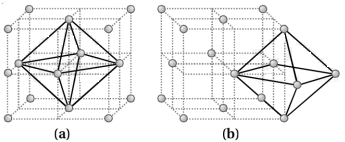
With the help of a labelled diagram,show that there are $4$ octahedral voids per unit cell in a cubic close-packed $(CCP)$ structure.
Solution
(N/A) In a cubic close-packed $(CCP)$ or face-centered cubic $(FCC)$ structure,the number of octahedral voids is equal to the number of atoms present in the unit cell.
$1$. The number of atoms per unit cell in $CCP$ is $4$.
$2$. One octahedral void is present at the body center of the cube. This void is entirely within the unit cell and is formed by $6$ atoms (one at each face center).
$3$. Additionally,there are $12$ octahedral voids located at the edges of the cube. Each edge-centered void is shared by $4$ adjacent unit cells. Therefore,the contribution of each edge-centered void to a single unit cell is $1/4$.
$4$. Total number of octahedral voids = (Number of voids at body center $\times 1$) + (Number of voids at edge centers $\times 1/4$)
$5$. Total number of octahedral voids = $(1 \times 1) + (12 \times 1/4) = 1 + 3 = 4$.
Thus,there are $4$ octahedral voids per unit cell in a $CCP$ structure.
$1$. The number of atoms per unit cell in $CCP$ is $4$.
$2$. One octahedral void is present at the body center of the cube. This void is entirely within the unit cell and is formed by $6$ atoms (one at each face center).
$3$. Additionally,there are $12$ octahedral voids located at the edges of the cube. Each edge-centered void is shared by $4$ adjacent unit cells. Therefore,the contribution of each edge-centered void to a single unit cell is $1/4$.
$4$. Total number of octahedral voids = (Number of voids at body center $\times 1$) + (Number of voids at edge centers $\times 1/4$)
$5$. Total number of octahedral voids = $(1 \times 1) + (12 \times 1/4) = 1 + 3 = 4$.
Thus,there are $4$ octahedral voids per unit cell in a $CCP$ structure.
0 likes
View Solution174
Advanced
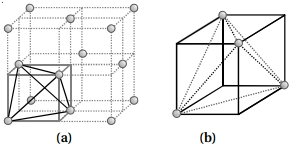
Show that in a cubic close packed $(ccp)$ structure,eight tetrahedral voids are present per unit cell.
Solution
(N/A) In a $ccp$ structure,the unit cell is divided into $8$ small cubes.
Each small cube has atoms at alternate corners [Fig. $(a)$].
In total,each small cube has $4$ atoms.
When these $4$ atoms are joined to one another,they form a regular tetrahedron.
Thus,there is one tetrahedral void in each small cube,resulting in $8$ tetrahedral voids in total per unit cell.
Since each of the eight small cubes contains one void,the total number of tetrahedral voids is $8$.
We know that a $ccp$ structure has $4$ atoms per unit cell. Thus,the number of tetrahedral voids is twice the number of atoms $(2 \times 4 = 8)$.
Each small cube has atoms at alternate corners [Fig. $(a)$].
In total,each small cube has $4$ atoms.
When these $4$ atoms are joined to one another,they form a regular tetrahedron.
Thus,there is one tetrahedral void in each small cube,resulting in $8$ tetrahedral voids in total per unit cell.
Since each of the eight small cubes contains one void,the total number of tetrahedral voids is $8$.
We know that a $ccp$ structure has $4$ atoms per unit cell. Thus,the number of tetrahedral voids is twice the number of atoms $(2 \times 4 = 8)$.
0 likes
View Solution175
EasyMCQ
Which of the following is the correct order of packing efficiency?
A
$HCP = FCC > BCC > SC$
B
$SC > BCC > HCP = FCC$
C
$BCC > SC > HCP < FCC$
D
$FCC = HCP > SC > BCC$
Solution
(A) The packing efficiency of $SC$ is $52 \%$,$BCC$ is $68 \%$,$HCP$ is $74 \%$,and $FCC$ is $74 \%$.
Therefore,the correct order of packing efficiency is $HCP = FCC > BCC > SC$.
Therefore,the correct order of packing efficiency is $HCP = FCC > BCC > SC$.
0 likes
View Solution176
EasyMCQ
The number of tetrahedral voids present in $0.5 \ mole$ of $hcp$ crystal structure is:
A
$3.6 \times 10^{23}$
B
$9 \times 10^{23}$
C
$3.6 \times 10^{24}$
D
$6.02 \times 10^{23}$
Solution
(D) In a crystal lattice,the number of tetrahedral voids $(TV)$ is twice the number of atoms $(N)$.
For an $hcp$ unit cell,the number of atoms per unit cell is $Z = 6$.
Therefore,the number of $TV$ per unit cell is $2 \times 6 = 12$.
In $1 \ mole$ of atoms,the number of $TV$ is $2 \times N_A$.
For $0.5 \ mole$ of $hcp$ crystal structure,the number of atoms is $0.5 \times N_A$.
Number of $TV = 2 \times (0.5 \times N_A) = 1 \times N_A = 6.022 \times 10^{23}$.
Wait,re-evaluating: The question asks for the total number of tetrahedral voids in $0.5 \ mole$ of the crystal structure. If we consider $0.5 \ mole$ of the $hcp$ lattice,it contains $0.5 \times N_A$ atoms. Since $TV = 2N$,the number of $TV = 2 \times (0.5 \times N_A) = N_A = 6.022 \times 10^{23}$.
For an $hcp$ unit cell,the number of atoms per unit cell is $Z = 6$.
Therefore,the number of $TV$ per unit cell is $2 \times 6 = 12$.
In $1 \ mole$ of atoms,the number of $TV$ is $2 \times N_A$.
For $0.5 \ mole$ of $hcp$ crystal structure,the number of atoms is $0.5 \times N_A$.
Number of $TV = 2 \times (0.5 \times N_A) = 1 \times N_A = 6.022 \times 10^{23}$.
Wait,re-evaluating: The question asks for the total number of tetrahedral voids in $0.5 \ mole$ of the crystal structure. If we consider $0.5 \ mole$ of the $hcp$ lattice,it contains $0.5 \times N_A$ atoms. Since $TV = 2N$,the number of $TV = 2 \times (0.5 \times N_A) = N_A = 6.022 \times 10^{23}$.
0 likes
View Solution177
MediumMCQ
In $FCC$,the distance between the nearest tetrahedral voids is:
A
$a/2$
B
$a$
C
$\frac{\sqrt{3}a}{2}$
D
$\frac{\sqrt{3}a}{4}$
Solution
(A) In an $FCC$ unit cell,there are $8$ tetrahedral voids located at a distance of $\frac{a}{4}$ from each corner along the body diagonal.
Each body diagonal has a length of $\sqrt{3}a$.
The distance between two nearest tetrahedral voids is the distance between two voids located on the same body diagonal,which is $\frac{a}{4} + \frac{a}{4} = \frac{a}{2}$.
Each body diagonal has a length of $\sqrt{3}a$.
The distance between two nearest tetrahedral voids is the distance between two voids located on the same body diagonal,which is $\frac{a}{4} + \frac{a}{4} = \frac{a}{2}$.
0 likes
View Solution178
DifficultMCQ
In a binary compound,atoms of element $A$ form a $hcp$ structure and those of element $M$ occupy $2/3$ of the tetrahedral voids of the $hcp$ structure. The formula of the binary compound is
A
$M_2 A_3$
B
$M_4 A_3$
C
$M_4 A$
D
$MA_3$
Solution
(B) In an $hcp$ structure,the number of atoms of element $A$ is $N = 6$.
The number of tetrahedral voids is $2N = 2 \times 6 = 12$.
Element $M$ occupies $2/3$ of the tetrahedral voids,so the number of $M$ atoms is $\frac{2}{3} \times 12 = 8$.
The ratio of $M:A$ is $8:6$,which simplifies to $4:3$.
Therefore,the formula of the compound is $M_4 A_3$.
The number of tetrahedral voids is $2N = 2 \times 6 = 12$.
Element $M$ occupies $2/3$ of the tetrahedral voids,so the number of $M$ atoms is $\frac{2}{3} \times 12 = 8$.
The ratio of $M:A$ is $8:6$,which simplifies to $4:3$.
Therefore,the formula of the compound is $M_4 A_3$.
0 likes
View Solution179
MediumMCQ
$Ga$ (atomic mass $70 \, u$) crystallizes in a hexagonal close packed structure. The total number of voids in $0.581 \, g$ of $Ga$ is $\dots \dots \dots \dots \dots \times 10^{21}$. (Round off to the Nearest Integer).
A
$14$
B
$13$
C
$15$
D
$15.9$
Solution
(C) In an $HCP$ structure,for every $1$ atom,there is $1$ octahedral void $(OV)$ and $2$ tetrahedral voids $(TV)$.
Therefore,the total number of voids per atom is $1 + 2 = 3$.
Number of moles of $Ga = \frac{\text{Mass}}{\text{Molar Mass}} = \frac{0.581 \, g}{70 \, g/mol} = 0.0083 \, mol$.
Number of $Ga$ atoms $= \text{moles} \times N_A = 0.0083 \times 6.022 \times 10^{23} \approx 4.998 \times 10^{21}$ atoms.
Total number of voids $= 3 \times \text{Number of atoms} = 3 \times 4.998 \times 10^{21} = 14.994 \times 10^{21}$.
Rounding to the nearest integer,we get $15 \times 10^{21}$.
Therefore,the total number of voids per atom is $1 + 2 = 3$.
Number of moles of $Ga = \frac{\text{Mass}}{\text{Molar Mass}} = \frac{0.581 \, g}{70 \, g/mol} = 0.0083 \, mol$.
Number of $Ga$ atoms $= \text{moles} \times N_A = 0.0083 \times 6.022 \times 10^{23} \approx 4.998 \times 10^{21}$ atoms.
Total number of voids $= 3 \times \text{Number of atoms} = 3 \times 4.998 \times 10^{21} = 14.994 \times 10^{21}$.
Rounding to the nearest integer,we get $15 \times 10^{21}$.
0 likes
View Solution180
MediumMCQ
The correct option for the number of tetrahedral and octahedral voids in a hexagonal primitive unit cell is:
A
$8, 4$
B
$6, 12$
C
$2, 1$
D
$12, 6$
Solution
(D) In a hexagonal close-packed $(HCP)$ unit cell,the number of atoms per unit cell $(Z)$ is $6$.
The number of octahedral voids $(OHV)$ is equal to the number of atoms per unit cell,so $OHV = Z = 6$.
The number of tetrahedral voids $(THV)$ is equal to twice the number of atoms per unit cell,so $THV = 2 \times Z = 2 \times 6 = 12$.
Therefore,the number of tetrahedral and octahedral voids are $12$ and $6$ respectively.
The number of octahedral voids $(OHV)$ is equal to the number of atoms per unit cell,so $OHV = Z = 6$.
The number of tetrahedral voids $(THV)$ is equal to twice the number of atoms per unit cell,so $THV = 2 \times Z = 2 \times 6 = 12$.
Therefore,the number of tetrahedral and octahedral voids are $12$ and $6$ respectively.
0 likes
View Solution181
MediumMCQ
$A$ compound formed by $Mg$,$Al$,and $O$ is found to have a cubic close-packed $(CCP)$ array of oxide ions,in which $Mg^{2+}$ ions occupy $\frac{1}{8}^{th}$ of the tetrahedral voids and $Al^{3+}$ ions occupy $\frac{1}{2}$ of the octahedral voids. The formula for the compound is:
A
$MgAl_4O_2$
B
$Mg_2Al_3O_2$
C
$MgAl_2O_4$
D
$MgAlO$
Solution
(C) Let the number of oxide ions $(O^{2-})$ in the $CCP$ lattice be $N = 4$.
Number of octahedral voids $(OV)$ = $N = 4$.
Number of tetrahedral voids $(TV)$ = $2N = 8$.
Given that $Mg^{2+}$ ions occupy $\frac{1}{8}^{th}$ of the tetrahedral voids:
Number of $Mg^{2+} = \frac{1}{8} \times 8 = 1$.
Given that $Al^{3+}$ ions occupy $\frac{1}{2}$ of the octahedral voids:
Number of $Al^{3+} = \frac{1}{2} \times 4 = 2$.
Thus,the ratio of $Mg : Al : O$ is $1 : 2 : 4$.
The formula of the compound is $MgAl_2O_4$.
Number of octahedral voids $(OV)$ = $N = 4$.
Number of tetrahedral voids $(TV)$ = $2N = 8$.
Given that $Mg^{2+}$ ions occupy $\frac{1}{8}^{th}$ of the tetrahedral voids:
Number of $Mg^{2+} = \frac{1}{8} \times 8 = 1$.
Given that $Al^{3+}$ ions occupy $\frac{1}{2}$ of the octahedral voids:
Number of $Al^{3+} = \frac{1}{2} \times 4 = 2$.
Thus,the ratio of $Mg : Al : O$ is $1 : 2 : 4$.
The formula of the compound is $MgAl_2O_4$.
0 likes
View Solution182
Medium
Explain three-dimensional close packing from two-dimensional hexagonal close packing. Explain the formation of face-centered cubic $(FCC)$ unit cell and hexagonal close packing $(HCP)$ in three dimensions.
Solution
(N/A) $1$. Three-dimensional close packing from two-dimensional hexagonal layers is achieved by stacking layers one above the other.
$2$. When the second layer $(B)$ is placed over the first layer $(A)$,it covers one set of triangular voids (tetrahedral voids). Placing the third layer over the second layer can lead to two patterns:
- $ABAB...$ pattern: The third layer spheres align with the first layer $(A)$,resulting in hexagonal close packing $(HCP)$.
- $ABCABC...$ pattern: The third layer spheres are placed over the octahedral voids of the second layer,resulting in cubic close packing $(CCP)$ or face-centered cubic $(FCC)$ structure.
$2$. When the second layer $(B)$ is placed over the first layer $(A)$,it covers one set of triangular voids (tetrahedral voids). Placing the third layer over the second layer can lead to two patterns:
- $ABAB...$ pattern: The third layer spheres align with the first layer $(A)$,resulting in hexagonal close packing $(HCP)$.
- $ABCABC...$ pattern: The third layer spheres are placed over the octahedral voids of the second layer,resulting in cubic close packing $(CCP)$ or face-centered cubic $(FCC)$ structure.
0 likes
View Solution183
Medium
Write a note on interstitial sites or voids.
Solution
(N/A) $(i)$ Tetrahedral Voids:
In a $fcc$ or $ccp$ structure,the unit cell is divided into eight small cubes. Each small cube has four atoms at alternate corners. When these four atoms are joined,they form a regular tetrahedron,enclosing one tetrahedral void. Thus,there are eight tetrahedral voids in a $fcc$ unit cell.
$(ii)$ Octahedral Voids:
In a $fcc$ structure,the body centre is surrounded by six atoms located at the centres of the faces. Joining these atoms forms a regular octahedron,resulting in one octahedral void at the body centre.
Additionally,there is one octahedral void at the centre of each of the $12$ edges of the cube. Each edge-centre void is shared between four adjacent unit cells. Therefore,only $\left(\frac{1}{4}\right)$ of each edge-centred octahedral void belongs to a particular unit cell. The total number of octahedral voids in a $fcc$ unit cell is $1 + (12 \times \frac{1}{4}) = 4$.
In a $fcc$ or $ccp$ structure,the unit cell is divided into eight small cubes. Each small cube has four atoms at alternate corners. When these four atoms are joined,they form a regular tetrahedron,enclosing one tetrahedral void. Thus,there are eight tetrahedral voids in a $fcc$ unit cell.
$(ii)$ Octahedral Voids:
In a $fcc$ structure,the body centre is surrounded by six atoms located at the centres of the faces. Joining these atoms forms a regular octahedron,resulting in one octahedral void at the body centre.
Additionally,there is one octahedral void at the centre of each of the $12$ edges of the cube. Each edge-centre void is shared between four adjacent unit cells. Therefore,only $\left(\frac{1}{4}\right)$ of each edge-centred octahedral void belongs to a particular unit cell. The total number of octahedral voids in a $fcc$ unit cell is $1 + (12 \times \frac{1}{4}) = 4$.
0 likes
View Solution184
EasyMCQ
Atoms of element $X$ form $hcp$ lattice and those of element $Y$ occupy $\frac{2}{3}$ of its tetrahedral voids. The percentage of element $X$ in the lattice is ..... . (Nearest integer)
A
$34$
B
$24$
C
$43$
D
$42$
Solution
(C) In an $hcp$ lattice,the number of atoms per unit cell is $6$.
Number of tetrahedral voids $= 2 \times \text{number of atoms} = 2 \times 6 = 12$.
Number of $Y$ atoms $= \frac{2}{3} \times 12 = 8$.
Total number of atoms in the lattice $= 6 (X) + 8 (Y) = 14$.
Percentage of element $X = \frac{6}{14} \times 100 = 42.85 \%$.
Rounding to the nearest integer,we get $43 \%$.
Number of tetrahedral voids $= 2 \times \text{number of atoms} = 2 \times 6 = 12$.
Number of $Y$ atoms $= \frac{2}{3} \times 12 = 8$.
Total number of atoms in the lattice $= 6 (X) + 8 (Y) = 14$.
Percentage of element $X = \frac{6}{14} \times 100 = 42.85 \%$.
Rounding to the nearest integer,we get $43 \%$.
0 likes
View Solution185
AdvancedMCQ
$A$ compound is formed by two elements $M$ and $N$. Element $N$ forms a hexagonal closed pack $(HCP)$ array with $2/3$ of the octahedral holes occupied by $M$. The formula of the compound is $....$
A
$M_4 N_3$
B
$M_2 N_3$
C
$M_3 N_2$
D
$M_3 N_4$
Solution
(B) In a hexagonal closed pack $(HCP)$ structure,the number of atoms per unit cell is $6$.
Since the number of octahedral voids is equal to the number of atoms in the close-packed structure,the number of octahedral voids is $6$.
Given that $M$ occupies $2/3$ of the octahedral voids,the number of $M$ atoms per unit cell is $\frac{2}{3} \times 6 = 4$.
The ratio of $M$ atoms to $N$ atoms is $4:6$,which simplifies to $2:3$.
Therefore,the formula of the compound is $M_2 N_3$.
Since the number of octahedral voids is equal to the number of atoms in the close-packed structure,the number of octahedral voids is $6$.
Given that $M$ occupies $2/3$ of the octahedral voids,the number of $M$ atoms per unit cell is $\frac{2}{3} \times 6 = 4$.
The ratio of $M$ atoms to $N$ atoms is $4:6$,which simplifies to $2:3$.
Therefore,the formula of the compound is $M_2 N_3$.
0 likes
View Solution186
DifficultMCQ
$A$ two-dimensional solid is made by alternating circles with radius $a$ and $b$ such that the sides of the circles touch. The packing fraction is defined as the ratio of the area under the circles to the area under the rectangle with sides of length $x$ and $y$. The ratio $r=b/a$ for which the packing fraction is minimised is closest to $.....$
A
$0.41$
B
$1.0$
C
$0.50$
D
$0.32$
Solution
(A) The packing fraction $(PF)$ is defined as the ratio of the area of the circles to the area of the rectangle.
$PF = \frac{\pi a^{2} + \pi b^{2}}{(2a + 2b)(2a)} = \frac{\pi(a^{2} + b^{2})}{4a(a + b)}$
Dividing by $a^{2}$,we get $PF = \frac{\pi(1 + r^{2})}{4(1 + r)}$,where $r = \frac{b}{a}$.
To minimize the packing fraction,we differentiate $PF$ with respect to $r$ and set it to zero:
$\frac{d(PF)}{dr} = \frac{\pi}{4} \left[ \frac{(1+r)(2r) - (1+r^{2})(1)}{(1+r)^{2}} \right] = 0$
$2r + 2r^{2} - 1 - r^{2} = 0$
$r^{2} + 2r - 1 = 0$
Using the quadratic formula $r = \frac{-B \pm \sqrt{B^{2} - 4AC}}{2A}$:
$r = \frac{-2 \pm \sqrt{4 - 4(1)(-1)}}{2} = \frac{-2 \pm \sqrt{8}}{2} = -1 \pm \sqrt{2}$
Since $r$ must be positive,$r = \sqrt{2} - 1 \approx 1.414 - 1 = 0.414$.
Thus,the value is closest to $0.41$.
$PF = \frac{\pi a^{2} + \pi b^{2}}{(2a + 2b)(2a)} = \frac{\pi(a^{2} + b^{2})}{4a(a + b)}$
Dividing by $a^{2}$,we get $PF = \frac{\pi(1 + r^{2})}{4(1 + r)}$,where $r = \frac{b}{a}$.
To minimize the packing fraction,we differentiate $PF$ with respect to $r$ and set it to zero:
$\frac{d(PF)}{dr} = \frac{\pi}{4} \left[ \frac{(1+r)(2r) - (1+r^{2})(1)}{(1+r)^{2}} \right] = 0$
$2r + 2r^{2} - 1 - r^{2} = 0$
$r^{2} + 2r - 1 = 0$
Using the quadratic formula $r = \frac{-B \pm \sqrt{B^{2} - 4AC}}{2A}$:
$r = \frac{-2 \pm \sqrt{4 - 4(1)(-1)}}{2} = \frac{-2 \pm \sqrt{8}}{2} = -1 \pm \sqrt{2}$
Since $r$ must be positive,$r = \sqrt{2} - 1 \approx 1.414 - 1 = 0.414$.
Thus,the value is closest to $0.41$.
0 likes
View Solution187
MediumMCQ
Atoms of an element $Z$ form a hexagonal closed packed $(hcp)$ lattice and atoms of element $X$ occupy all the tetrahedral voids. The formula of the compound is
A
$XZ$
B
$XZ_{2}$
C
$X_{2}Z$
D
$X_{4}Z_{3}$
Solution
(C) In an $hcp$ lattice,the number of tetrahedral voids is twice the number of atoms forming the lattice.
Let the number of atoms of element $Z$ be $n$.
Then,the number of tetrahedral voids $= 2n$.
Since element $X$ occupies all the tetrahedral voids,the number of atoms of $X = 2n$.
The ratio of atoms $X:Z = 2n:n = 2:1$.
Therefore,the formula of the compound is $X_{2}Z$.
Let the number of atoms of element $Z$ be $n$.
Then,the number of tetrahedral voids $= 2n$.
Since element $X$ occupies all the tetrahedral voids,the number of atoms of $X = 2n$.
The ratio of atoms $X:Z = 2n:n = 2:1$.
Therefore,the formula of the compound is $X_{2}Z$.
0 likes
View Solution188
DifficultMCQ
The packing efficiency in a body centered cubic $(bcc)$ structure is closest to $.... \, \%$
A
$74$
B
$63$
C
$68$
D
$52$
Solution
(C) The correct option is $(C)$.
For a $bcc$ lattice,the body diagonal is $c = \sqrt{3} a$.
Also,the atoms touch along the body diagonal,so $c = 4r$,where $r$ is the radius of the sphere.
Therefore,$\sqrt{3} a = 4r$,which gives $a = \frac{4r}{\sqrt{3}}$.
In a $bcc$ unit cell,the number of atoms per unit cell $(Z)$ is $2$.
The volume of the two spheres is $2 \times \frac{4}{3} \pi r^3 = \frac{8}{3} \pi r^3$.
The total volume of the unit cell is $a^3 = (\frac{4r}{\sqrt{3}})^3 = \frac{64r^3}{3\sqrt{3}}$.
Packing efficiency = $\frac{\text{Volume of two spheres}}{\text{Total volume of unit cell}} \times 100$
$= \frac{\frac{8}{3} \pi r^3}{\frac{64r^3}{3\sqrt{3}}} \times 100 = \frac{\sqrt{3} \pi}{8} \times 100 \approx 0.68 \times 100 = 68 \, \%$
For a $bcc$ lattice,the body diagonal is $c = \sqrt{3} a$.
Also,the atoms touch along the body diagonal,so $c = 4r$,where $r$ is the radius of the sphere.
Therefore,$\sqrt{3} a = 4r$,which gives $a = \frac{4r}{\sqrt{3}}$.
In a $bcc$ unit cell,the number of atoms per unit cell $(Z)$ is $2$.
The volume of the two spheres is $2 \times \frac{4}{3} \pi r^3 = \frac{8}{3} \pi r^3$.
The total volume of the unit cell is $a^3 = (\frac{4r}{\sqrt{3}})^3 = \frac{64r^3}{3\sqrt{3}}$.
Packing efficiency = $\frac{\text{Volume of two spheres}}{\text{Total volume of unit cell}} \times 100$
$= \frac{\frac{8}{3} \pi r^3}{\frac{64r^3}{3\sqrt{3}}} \times 100 = \frac{\sqrt{3} \pi}{8} \times 100 \approx 0.68 \times 100 = 68 \, \%$
0 likes
View Solution189
DifficultMCQ
$A$ mineral consists of a cubic close-packed structure formed by $O^{2-}$ ions,where half the octahedral voids are occupied by $Al^{3+}$ and one-eighth of the tetrahedral voids are occupied by $Mn^{2+}$. The chemical formula of the mineral is
A
$Mn_{3}Al_{2}O_{6}$
B
$MnAl_{2}O_{4}$
C
$MnAl_{4}O_{7}$
D
$Mn_{2}Al_{2}O_{5}$
Solution
(B) In a cubic close-packed $(CCP)$ structure,the number of $O^{2-}$ ions per unit cell is $4$.
The number of octahedral voids is equal to the number of $O^{2-}$ ions,which is $4$.
The number of tetrahedral voids is twice the number of $O^{2-}$ ions,which is $8$.
Number of $Al^{3+}$ ions = $\frac{1}{2} \times 4 = 2$.
Number of $Mn^{2+}$ ions = $\frac{1}{8} \times 8 = 1$.
Therefore,the ratio of $Mn : Al : O$ is $1 : 2 : 4$.
The chemical formula of the mineral is $MnAl_{2}O_{4}$.
The number of octahedral voids is equal to the number of $O^{2-}$ ions,which is $4$.
The number of tetrahedral voids is twice the number of $O^{2-}$ ions,which is $8$.
Number of $Al^{3+}$ ions = $\frac{1}{2} \times 4 = 2$.
Number of $Mn^{2+}$ ions = $\frac{1}{8} \times 8 = 1$.
Therefore,the ratio of $Mn : Al : O$ is $1 : 2 : 4$.
The chemical formula of the mineral is $MnAl_{2}O_{4}$.
0 likes
View Solution190
DifficultMCQ
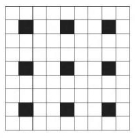
$A$ two-dimensional solid pattern formed by two different atoms $X$ and $Y$ is shown below. The black and white squares represent atoms $X$ and $Y,$ respectively. The simplest formula for the compound based on the unit cell from the pattern is
A
$X Y_{8}$
B
$X_{4} Y_{9}$
C
$X Y_{2}$
D
$X Y_{4}$
Solution
(A) The pattern consists of a repeating unit cell. By observing the grid,we can identify a repeating $3 \times 3$ unit cell.
In this $3 \times 3$ unit cell,there is $1$ black square (atom $X$) and $8$ white squares (atoms $Y$).
$\therefore$ Number of $X$ atoms per unit cell $= 1$
Number of $Y$ atoms per unit cell $= 8$
Thus,the simplest formula for the compound is $X Y_{8}$.
In this $3 \times 3$ unit cell,there is $1$ black square (atom $X$) and $8$ white squares (atoms $Y$).
$\therefore$ Number of $X$ atoms per unit cell $= 1$
Number of $Y$ atoms per unit cell $= 8$
Thus,the simplest formula for the compound is $X Y_{8}$.
0 likes
View Solution191
MediumMCQ
The packing efficiency of the face-centered cubic $(fcc)$,body-centered cubic $(bcc)$,and simple/primitive cubic $(pc)$ lattices follows the order:
A
$fcc > bcc > pc$
B
$bcc > fcc > pc$
C
$pc > bcc > fcc$
D
$bcc > pc > fcc$
Solution
(A) The packing efficiency of a cubic lattice is calculated by the formula:
$PE = \frac{\text{Volume occupied by spheres in lattice} \times 100}{\text{Total volume of the unit cell}}$
$1$. Packing efficiency of $fcc = 74\ \%$
$2$. Packing efficiency of $bcc = 68\ \%$
$3$. Packing efficiency of $pc = 52.4\ \%$
Thus,the packing efficiency follows the order: $fcc > bcc > pc$.
$PE = \frac{\text{Volume occupied by spheres in lattice} \times 100}{\text{Total volume of the unit cell}}$
$1$. Packing efficiency of $fcc = 74\ \%$
$2$. Packing efficiency of $bcc = 68\ \%$
$3$. Packing efficiency of $pc = 52.4\ \%$
Thus,the packing efficiency follows the order: $fcc > bcc > pc$.
0 likes
View Solution192
MediumMCQ
In a cubic close packed structure,the fractional contributions of an atom at the corner and at the face in the unit cell are,respectively:
A
$1/8$ and $1/2$
B
$1/2$ and $1/4$
C
$1/4$ and $1/2$
D
$1/4$ and $1/8$
Solution
(A) In a cubic unit cell,there are $8$ corners and $6$ faces.
Each atom at the corner is shared by $8$ adjacent unit cells,so its fractional contribution is $\frac{1}{8}$.
Each atom at the face center is shared by $2$ adjacent unit cells,so its fractional contribution is $\frac{1}{2}$.
Therefore,the fractional contributions are $\frac{1}{8}$ and $\frac{1}{2}$ respectively.
Each atom at the corner is shared by $8$ adjacent unit cells,so its fractional contribution is $\frac{1}{8}$.
Each atom at the face center is shared by $2$ adjacent unit cells,so its fractional contribution is $\frac{1}{2}$.
Therefore,the fractional contributions are $\frac{1}{8}$ and $\frac{1}{2}$ respectively.
0 likes
View Solution193
DifficultMCQ
An ionic compound is formed between a metal $M$ and a non-metal $Y$. If $M$ occupies half the octahedral voids in the cubic close-packed arrangement formed by $Y$,the chemical formula of the ionic compound is
A
$MY$
B
$MY_2$
C
$M_2Y$
D
$MY_3$
Solution
(B) In a cubic close-packed $(CCP)$ arrangement,the number of atoms per unit cell is $4$.
Since $Y$ forms the $CCP$ arrangement,the number of $Y$ atoms $= 4$.
The number of octahedral voids in a $CCP$ arrangement is equal to the number of atoms,which is $4$.
Given that $M$ occupies half of the octahedral voids,the number of $M$ atoms $= \frac{1}{2} \times 4 = 2$.
Thus,the ratio of $M:Y$ is $2:4$,which simplifies to $1:2$.
Therefore,the chemical formula of the ionic compound is $MY_2$.
Since $Y$ forms the $CCP$ arrangement,the number of $Y$ atoms $= 4$.
The number of octahedral voids in a $CCP$ arrangement is equal to the number of atoms,which is $4$.
Given that $M$ occupies half of the octahedral voids,the number of $M$ atoms $= \frac{1}{2} \times 4 = 2$.
Thus,the ratio of $M:Y$ is $2:4$,which simplifies to $1:2$.
Therefore,the chemical formula of the ionic compound is $MY_2$.
0 likes
View Solution194
MediumMCQ
In crystalline silicon,$Si$ atoms occupy all the $ccp$ sites and every alternate tetrahedral void. The value of packing efficiency is closest to $....\%$
A
$40$
B
$28$
C
$54$
D
$34$
Solution
(D) The correct option is $D$.
In a $ccp$ lattice,there are $4$ atoms per unit cell.
Silicon atoms occupy all $ccp$ sites ($4$ atoms) and every alternate tetrahedral void ($4$ atoms).
Total number of atoms per unit cell,$Z = 4 + 4 = 8$.
The distance between a corner $Si$ atom and a $Si$ atom at the tetrahedral void is $\frac{\sqrt{3}a}{4}$,which is equal to $2r$.
Thus,$2r = \frac{\sqrt{3}a}{4} \implies r = \frac{\sqrt{3}a}{8}$.
Packing Efficiency $(PE)$ = $\frac{Z \times \frac{4}{3} \pi r^3}{a^3} \times 100$.
Substituting the values: $PE = \frac{8 \times \frac{4}{3} \pi (\frac{\sqrt{3}a}{8})^3}{a^3} \times 100$.
$PE = \frac{8 \times \frac{4}{3} \pi \times \frac{3\sqrt{3}a^3}{512}}{a^3} \times 100 = \frac{\pi \sqrt{3}}{16} \times 100 \approx 34\%$.
In a $ccp$ lattice,there are $4$ atoms per unit cell.
Silicon atoms occupy all $ccp$ sites ($4$ atoms) and every alternate tetrahedral void ($4$ atoms).
Total number of atoms per unit cell,$Z = 4 + 4 = 8$.
The distance between a corner $Si$ atom and a $Si$ atom at the tetrahedral void is $\frac{\sqrt{3}a}{4}$,which is equal to $2r$.
Thus,$2r = \frac{\sqrt{3}a}{4} \implies r = \frac{\sqrt{3}a}{8}$.
Packing Efficiency $(PE)$ = $\frac{Z \times \frac{4}{3} \pi r^3}{a^3} \times 100$.
Substituting the values: $PE = \frac{8 \times \frac{4}{3} \pi (\frac{\sqrt{3}a}{8})^3}{a^3} \times 100$.
$PE = \frac{8 \times \frac{4}{3} \pi \times \frac{3\sqrt{3}a^3}{512}}{a^3} \times 100 = \frac{\pi \sqrt{3}}{16} \times 100 \approx 34\%$.
0 likes
View Solution195
DifficultMCQ
$A$ metal $M$ forms a hexagonal close-packed structure. The total number of voids in $0.02 \ mol$ of it is $......... \times 10^{21}$ (Nearest integer) (Given $N_{A} = 6.02 \times 10^{23}$)
A
$18$
B
$9$
C
$36$
D
$54$
Solution
(C) In a hexagonal close-packed $(hcp)$ structure,the number of octahedral voids is equal to the number of atoms $(N)$,and the number of tetrahedral voids is equal to $2N$.
Total number of voids per atom $= N + 2N = 3N$.
Given amount of metal $= 0.02 \ mol$.
Number of atoms $= 0.02 \times 6.02 \times 10^{23} = 1.204 \times 10^{22}$.
Total number of voids $= 3 \times (1.204 \times 10^{22}) = 3.612 \times 10^{22} = 36.12 \times 10^{21}$.
The nearest integer is $36$.
Total number of voids per atom $= N + 2N = 3N$.
Given amount of metal $= 0.02 \ mol$.
Number of atoms $= 0.02 \times 6.02 \times 10^{23} = 1.204 \times 10^{22}$.
Total number of voids $= 3 \times (1.204 \times 10^{22}) = 3.612 \times 10^{22} = 36.12 \times 10^{21}$.
The nearest integer is $36$.
0 likes
View Solution196
MediumMCQ
$A$ compound is formed by two elements $X$ and $Y$. The element $Y$ forms a cubic close-packed $(CCP)$ arrangement and the atoms of element $X$ occupy one-third of the tetrahedral voids. What is the formula of the compound?
A
$X_2Y_3$
B
$X_3Y$
C
$X_3Y_2$
D
$XY_3$
Solution
(A) Let the number of atoms of element $Y$ in the $CCP$ arrangement be $n = 4$.
Since the number of tetrahedral voids is twice the number of atoms in the $CCP$ arrangement,the number of tetrahedral voids $= 2 \times 4 = 8$.
Element $X$ occupies $1/3$ of the tetrahedral voids,so the number of $X$ atoms $= 1/3 \times 8 = 8/3$.
The ratio of $X:Y = 8/3 : 4 = 8:12 = 2:3$.
Therefore,the formula of the compound is $X_2Y_3$.
Since the number of tetrahedral voids is twice the number of atoms in the $CCP$ arrangement,the number of tetrahedral voids $= 2 \times 4 = 8$.
Element $X$ occupies $1/3$ of the tetrahedral voids,so the number of $X$ atoms $= 1/3 \times 8 = 8/3$.
The ratio of $X:Y = 8/3 : 4 = 8:12 = 2:3$.
Therefore,the formula of the compound is $X_2Y_3$.
0 likes
View Solution197
MediumMCQ
$A$ compound is formed by two elements $A$ and $B$. The element $B$ forms a cubic close-packed $(CCP)$ structure and atoms of $A$ occupy $\frac{1}{3}$ of the tetrahedral voids. If the formula of the compound is $A_x B_y$,then the value of $x+y$ is:
A
$4$
B
$5$
C
$2$
D
$3$
Solution
(B) In a $CCP$ structure,let the number of atoms of $B$ be $n$.
The number of tetrahedral voids is $2n$.
Atoms of $A$ occupy $\frac{1}{3}$ of the tetrahedral voids,so the number of atoms of $A = \frac{1}{3} \times 2n = \frac{2n}{3}$.
The ratio of $A:B = \frac{2n}{3} : n = 2:3$.
Therefore,the formula is $A_2 B_3$.
Comparing with $A_x B_y$,we get $x = 2$ and $y = 3$.
Thus,$x + y = 2 + 3 = 5$.
The number of tetrahedral voids is $2n$.
Atoms of $A$ occupy $\frac{1}{3}$ of the tetrahedral voids,so the number of atoms of $A = \frac{1}{3} \times 2n = \frac{2n}{3}$.
The ratio of $A:B = \frac{2n}{3} : n = 2:3$.
Therefore,the formula is $A_2 B_3$.
Comparing with $A_x B_y$,we get $x = 2$ and $y = 3$.
Thus,$x + y = 2 + 3 = 5$.
0 likes
View Solution198
MediumMCQ
What fraction of one edge-centred octahedral void lies in one unit cell of $fcc$?
A
$\frac{1}{12}$
B
$\frac{1}{2}$
C
$\frac{1}{3}$
D
$\frac{1}{4}$
Solution
(D) In an $fcc$ unit cell,octahedral voids are located at the body centre and at the centre of each edge.
There are $12$ edges in a cube,and each edge is shared by $4$ adjacent unit cells.
Therefore,the contribution of an octahedral void located at the edge centre to a single unit cell is $\frac{1}{4}$.
There are $12$ edges in a cube,and each edge is shared by $4$ adjacent unit cells.
Therefore,the contribution of an octahedral void located at the edge centre to a single unit cell is $\frac{1}{4}$.
0 likes
View Solution199
AdvancedMCQ
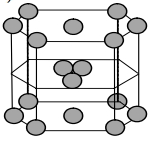
In hexagonal systems of crystals,a frequently encountered arrangement of atoms is described as a hexagonal prism. Here,the top and bottom of the cell are regular hexagons and three atoms are sandwiched in between them. $A$ space-filling model of this structure,called hexagonal close-packed $(HCP)$,is constituted of a sphere on a flat surface surrounded in the same plane by six identical spheres as closely as possible. Three spheres are then placed over the first layer so that they touch each other and represent the second layer. Each one of these three spheres touches three spheres of the bottom layer. Finally,the second layer is covered with a third layer that is identical to the bottom layer in relative position. Assume radius of every sphere to be $r$.
$1.$ The number of atoms on this $HCP$ unit cell is
$(A)$ $4$ $(B)$ $6$ $(C)$ $12$ $(D)$ $17$
$2.$ The volume of this $HCP$ unit cell is
$(A)$ $24 \sqrt{2} r^3$ $(B)$ $16 \sqrt{2} r^3$
$(C)$ $12 \sqrt{2} r^3$ $(D)$ $\frac{64 r^3}{3 \sqrt{3}}$
$3.$ The empty space in this $HCP$ unit cell is
$(A)$ $74 \%$ $(B)$ $47.6 \%$ $(C)$ $32 \%$ $(D)$ $26 \%$
Give the answer for questions $1, 2$ and $3.$
$1.$ The number of atoms on this $HCP$ unit cell is
$(A)$ $4$ $(B)$ $6$ $(C)$ $12$ $(D)$ $17$
$2.$ The volume of this $HCP$ unit cell is
$(A)$ $24 \sqrt{2} r^3$ $(B)$ $16 \sqrt{2} r^3$
$(C)$ $12 \sqrt{2} r^3$ $(D)$ $\frac{64 r^3}{3 \sqrt{3}}$
$3.$ The empty space in this $HCP$ unit cell is
$(A)$ $74 \%$ $(B)$ $47.6 \%$ $(C)$ $32 \%$ $(D)$ $26 \%$
Give the answer for questions $1, 2$ and $3.$
A
$(B, A, D)$
B
$(B, B, D)$
C
$(C, A, A)$
D
$(C, D, A)$
Solution
(B) $1.$ Total effective number of atoms $= 12 \times \frac{1}{6} + 2 \times \frac{1}{2} + 3 = 6$
$2.$ Height of unit cell $= 4r \sqrt{\frac{2}{3}}$
Base area $= 6 \times \frac{\sqrt{3}}{4}(2r)^2 = 6\sqrt{3}r^2$
Volume $= \text{height} \times \text{base area} = 4r \sqrt{\frac{2}{3}} \times 6\sqrt{3}r^2 = 24\sqrt{2}r^3$
$3.$ Packing fraction $= 74 \%$
Empty space $= 100 \% - 74 \% = 26 \%$
$2.$ Height of unit cell $= 4r \sqrt{\frac{2}{3}}$
Base area $= 6 \times \frac{\sqrt{3}}{4}(2r)^2 = 6\sqrt{3}r^2$
Volume $= \text{height} \times \text{base area} = 4r \sqrt{\frac{2}{3}} \times 6\sqrt{3}r^2 = 24\sqrt{2}r^3$
$3.$ Packing fraction $= 74 \%$
Empty space $= 100 \% - 74 \% = 26 \%$
0 likes
View Solution200
AdvancedMCQ
The $CORRECT$ statement$(s)$ for cubic close packed $(ccp)$ three dimensional structure is(are)
$(A)$ The number of the nearest neighbours of an atom present in the topmost layer is $12$
$(B)$ The efficiency of atom packing is $74 \%$
$(C)$ The number of octahedral and tetrahedral voids per atom are $1$ and $2$,respectively
$(D)$ The unit cell edge length is $2\sqrt{2}$ times the radius of the atom
$(A)$ The number of the nearest neighbours of an atom present in the topmost layer is $12$
$(B)$ The efficiency of atom packing is $74 \%$
$(C)$ The number of octahedral and tetrahedral voids per atom are $1$ and $2$,respectively
$(D)$ The unit cell edge length is $2\sqrt{2}$ times the radius of the atom
A
$B, C, D$
B
$B, C, A$
C
$B, D$
D
$B, C$
Solution
(A) The efficiency of atom packing is $74 \%$.
$(C)$ The number of octahedral and tetrahedral voids per atom are $1$ and $2$,respectively.
$(D)$ The unit cell edge length is $2\sqrt{2}$ times the radius of the atom.
Solution:
In a $ccp$ structure,the coordination number of an atom in the bulk is $12$. However,an atom in the topmost layer has fewer nearest neighbours (typically $9$),making statement $(A)$ incorrect.
Packing efficiency $= \frac{\text{Volume occupied by } 4 \text{ spheres in the unit cell } \times 100}{\text{Total volume of unit cell}} = 74 \%$. Thus,$(B)$ is correct.
In $ccp$,the number of octahedral voids is equal to the number of atoms $(N)$,and the number of tetrahedral voids is $2N$. Thus,the number of octahedral and tetrahedral voids per atom are $1$ and $2$,respectively. Thus,$(C)$ is correct.
For $fcc/ccp$ unit cells,the relation between edge length '$a$' and radius '$r$' is $4r = \sqrt{2}a$,which implies $a = 2\sqrt{2}r$. Thus,$(D)$ is correct.
Therefore,statements $(B)$,$(C)$,and $(D)$ are correct.
$(C)$ The number of octahedral and tetrahedral voids per atom are $1$ and $2$,respectively.
$(D)$ The unit cell edge length is $2\sqrt{2}$ times the radius of the atom.
Solution:
In a $ccp$ structure,the coordination number of an atom in the bulk is $12$. However,an atom in the topmost layer has fewer nearest neighbours (typically $9$),making statement $(A)$ incorrect.
Packing efficiency $= \frac{\text{Volume occupied by } 4 \text{ spheres in the unit cell } \times 100}{\text{Total volume of unit cell}} = 74 \%$. Thus,$(B)$ is correct.
In $ccp$,the number of octahedral voids is equal to the number of atoms $(N)$,and the number of tetrahedral voids is $2N$. Thus,the number of octahedral and tetrahedral voids per atom are $1$ and $2$,respectively. Thus,$(C)$ is correct.
For $fcc/ccp$ unit cells,the relation between edge length '$a$' and radius '$r$' is $4r = \sqrt{2}a$,which implies $a = 2\sqrt{2}r$. Thus,$(D)$ is correct.
Therefore,statements $(B)$,$(C)$,and $(D)$ are correct.
0 likes
View SolutionSolid State — Crystal packing · Frequently Asked Questions
1Are these Solid State questions useful for JEE and NEET?
Yes. All questions in this section are mapped to JEE Main and NEET exam patterns. Previous year questions from JEE Main, NEET, GUJCET and state-level exams are included with full solutions.
2Can I switch to Hindi or Gujarati for these questions?
Yes. Use the language tabs in the hero section or the sidebar to view the same questions and solutions in English, Hindi or Gujarati.
3How do I generate a question paper from this subtopic?
Use the Vedclass Exam Paper Generator — select the chapter and subtopic, set difficulty, and generate Sets A, B, C, D automatically. First 3 chapters of every subject are free.
Vedclass Products
For Students
Vedclass Test Series
Mock tests in real JEE/NEET style with performance analysis. 5-day free trial.
Start Free TrialFor Teachers
Exam Paper Generator
Generate Set A/B/C/D papers from this chapter in 2 minutes. 3 chapters free.
Try FreeFor Institutes
Online Exam Module
Live online exams with unlimited students, 360° analytics & white-label branding.
See DemoFor Teachers & Institutes
Generate a Solid State Exam Paper in 2 Minutes
Select subtopic & difficulty — Sets A, B, C, D auto-generated with No Repeat logic.
First 3 chapters of every subject are free — no payment required.