
A English
Crystal packing Questions in English
Class 12 Chemistry · Solid State · Crystal packing
281+
Questions
English
Language
100%
With Solutions
Showing 50 of 281 questions in English
51
MediumMCQ
An alloy of metals $A$,$B$,and $C$ is found to have $A$ constituting a $ccp$ lattice. If $B$ atoms occupy the edge centers and $C$ is present at the body center,the formula of the alloy is:
A
$A_4B_2C$
B
$A_4B_4C$
C
$A_4B_3C$
D
$ABC$
Solution
(C) In a $ccp$ lattice,the number of $A$ atoms per unit cell is $8 \times \frac{1}{8} + 6 \times \frac{1}{2} = 4$.
$B$ atoms occupy the edge centers. There are $12$ edges in a unit cell,and each edge center is shared by $4$ unit cells. Thus,the number of $B$ atoms is $12 \times \frac{1}{4} = 3$.
$C$ atoms are present at the body center. There is only $1$ body center per unit cell,which is not shared by any other unit cell. Thus,the number of $C$ atoms is $1 \times 1 = 1$.
Therefore,the ratio of $A:B:C$ is $4:3:1$,and the formula of the alloy is $A_4B_3C$.
$B$ atoms occupy the edge centers. There are $12$ edges in a unit cell,and each edge center is shared by $4$ unit cells. Thus,the number of $B$ atoms is $12 \times \frac{1}{4} = 3$.
$C$ atoms are present at the body center. There is only $1$ body center per unit cell,which is not shared by any other unit cell. Thus,the number of $C$ atoms is $1 \times 1 = 1$.
Therefore,the ratio of $A:B:C$ is $4:3:1$,and the formula of the alloy is $A_4B_3C$.
0 likes
View Solution52
MediumMCQ
If the anion $(A)$ forms a hexagonal closest packing and the cation $(C)$ occupies only $2/3$ of the octahedral voids in it,then the general formula of the compound is :-
A
$CA$
B
$CA_{2}$
C
$C_{2}A_{3}$
D
$C_{3}A_{2}$
Solution
(C) In a hexagonal closest packing $(hcp)$,the effective number of atoms per unit cell is $6$.
The number of octahedral voids is equal to the number of atoms in the packing,which is $6$.
The cation $(C)$ occupies $2/3$ of the octahedral voids,so the number of $C$ atoms $= 6 \times (2/3) = 4$.
The number of anion $(A)$ atoms is $6$.
Thus,the ratio of $C:A$ is $4:6$,which simplifies to $2:3$.
Therefore,the formula of the compound is $C_{2}A_{3}$.
The number of octahedral voids is equal to the number of atoms in the packing,which is $6$.
The cation $(C)$ occupies $2/3$ of the octahedral voids,so the number of $C$ atoms $= 6 \times (2/3) = 4$.
The number of anion $(A)$ atoms is $6$.
Thus,the ratio of $C:A$ is $4:6$,which simplifies to $2:3$.
Therefore,the formula of the compound is $C_{2}A_{3}$.
0 likes
View Solution53
MediumMCQ
In a cubic close packing,the unit cell has...
A
$4$ tetrahedral voids each of which is shared by four unit cells.
B
$4$ tetrahedral voids within the unit cell
C
$8$ tetrahedral voids each of which is shared by four unit cells
D
$8$ tetrahedral voids within the unit cells
Solution
(D) The cubic close packing (ccp) is equivalent to the face-centered cubic (fcc) structure.
In an fcc unit cell,the number of atoms per unit cell is $Z = 4$.
The number of tetrahedral voids is given by the formula $2 \times Z$.
Therefore,the number of tetrahedral voids $= 2 \times 4 = 8$.
These $8$ tetrahedral voids are located entirely within the body of the unit cell.
In an fcc unit cell,the number of atoms per unit cell is $Z = 4$.
The number of tetrahedral voids is given by the formula $2 \times Z$.
Therefore,the number of tetrahedral voids $= 2 \times 4 = 8$.
These $8$ tetrahedral voids are located entirely within the body of the unit cell.
0 likes
View Solution54
AdvancedMCQ
$A$ solid is made of two elements $X$ and $Y$. Atoms of $X$ are in $FCC$ arrangement and $Y$ atoms occupy all tetrahedral sites. What is the possible formula of the compound?
A
$XY_3$
B
$XY_4$
C
$XY$
D
$XY_2$
Solution
(D) In an $FCC$ unit cell,the number of $X$ atoms at corners and face centers is $4$.
There are $8$ tetrahedral voids in an $FCC$ unit cell.
Since $Y$ atoms occupy all tetrahedral sites,the number of $Y$ atoms is $8$.
The ratio of $X : Y$ is $4 : 8$,which simplifies to $1 : 2$.
Therefore,the formula of the compound is $XY_2$.
There are $8$ tetrahedral voids in an $FCC$ unit cell.
Since $Y$ atoms occupy all tetrahedral sites,the number of $Y$ atoms is $8$.
The ratio of $X : Y$ is $4 : 8$,which simplifies to $1 : 2$.
Therefore,the formula of the compound is $XY_2$.
0 likes
View Solution55
MediumMCQ
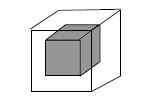
In an $FCC$ unit cell,a cube is formed by joining the centers of all the tetrahedral voids to generate a new cube. Then the new cube would contain effective voids as
A
$1$ Tetrahedral void,$1$ Octahedral void
B
$1$ Tetrahedral void only
C
$8$ Tetrahedral voids and $1$ Octahedral void
D
$1$ Octahedral void only
Solution
(A) In an $FCC$ unit cell,there are $8$ tetrahedral voids located at the corners of the smaller cube formed by joining the centers of these voids.
Since each of these $8$ tetrahedral voids is shared by $8$ such cubes,the effective number of tetrahedral voids within the new cube is $8 \times \frac{1}{8} = 1$.
Additionally,there is an octahedral void located at the body center of the original $FCC$ unit cell,which also corresponds to the body center of the new smaller cube.
Therefore,the new cube contains $1$ effective tetrahedral void and $1$ octahedral void.
Since each of these $8$ tetrahedral voids is shared by $8$ such cubes,the effective number of tetrahedral voids within the new cube is $8 \times \frac{1}{8} = 1$.
Additionally,there is an octahedral void located at the body center of the original $FCC$ unit cell,which also corresponds to the body center of the new smaller cube.
Therefore,the new cube contains $1$ effective tetrahedral void and $1$ octahedral void.
0 likes
View Solution56
DifficultMCQ
$A$ metal crystallises in an $FCC$ lattice with $ABCABC...$ packing. If the distance between the nearest neighbours is '$a$',then the distance between the centres of the nearest triangular voids of two consecutive layers is:
A
$\frac{a}{\sqrt{3}}$
B
$\frac{a}{2}$
C
$\frac{a}{\sqrt{2}}$
D
$\sqrt{\frac{2}{3}} a$
Solution
(C) In an $FCC$ lattice,the distance between nearest neighbours is $d = \frac{a_{edge}}{\sqrt{2}} = a$. Thus,the edge length of the unit cell is $a_{edge} = a\sqrt{2}$.
The triangular voids in $ABCABC...$ packing are the tetrahedral voids $(THV)$.
The distance between the centres of the nearest triangular voids of two consecutive layers corresponds to the distance between two adjacent tetrahedral voids.
In an $FCC$ unit cell,the distance between two adjacent tetrahedral voids is $\frac{a_{edge}}{2}$.
Substituting $a_{edge} = a\sqrt{2}$,we get: $\text{Distance} = \frac{a\sqrt{2}}{2} = \frac{a}{\sqrt{2}}$.
The triangular voids in $ABCABC...$ packing are the tetrahedral voids $(THV)$.
The distance between the centres of the nearest triangular voids of two consecutive layers corresponds to the distance between two adjacent tetrahedral voids.
In an $FCC$ unit cell,the distance between two adjacent tetrahedral voids is $\frac{a_{edge}}{2}$.
Substituting $a_{edge} = a\sqrt{2}$,we get: $\text{Distance} = \frac{a\sqrt{2}}{2} = \frac{a}{\sqrt{2}}$.
0 likes
View Solution57
DifficultMCQ
In a compound $AB_2O_4$,the oxide ions form a cubic close-packed $(CCP)$ lattice. The molar ratio of trivalent cations to bivalent cations is $2:1$. If all the bivalent ions occupy octahedral voids and trivalent ions occupy both tetrahedral and octahedral voids in equal numbers,then the fraction of octahedral voids that remain unoccupied is:
A
$1/4$
B
$3/4$
C
$1/2$
D
$7/8$
Solution
(C) In a $CCP$ lattice,the number of oxide ions $(O^{2-})$ per unit cell is $4$.
The number of octahedral voids $(O.V.)$ is $4$ and the number of tetrahedral voids $(T.V.)$ is $8$.
Given the formula $AB_2O_4$,there are $1$ bivalent ion $(A^{2+})$ and $2$ trivalent ions $(B^{3+})$ per $4$ oxide ions.
$A^{2+}$ ions occupy octahedral voids: $1$ $O.V.$ is occupied by $A^{2+}$.
$B^{3+}$ ions occupy both $T.V.$ and $O.V.$ in equal numbers. Let $x$ be the number of $B^{3+}$ ions in $T.V.$ and $x$ be the number of $B^{3+}$ ions in $O.V.$.
Total $B^{3+} = x + x = 2x = 2$,so $x = 1$.
Thus,$B^{3+}$ ions occupy $1$ $T.V.$ and $1$ $O.V$.
Total $O.V.$ occupied = (occupied by $A^{2+}$) + (occupied by $B^{3+}$) = $1 + 1 = 2$.
Total $O.V.$ available = $4$.
Unoccupied $O.V.$ = $4 - 2 = 2$.
Fraction of unoccupied $O.V.$ = $2/4 = 1/2$.
The number of octahedral voids $(O.V.)$ is $4$ and the number of tetrahedral voids $(T.V.)$ is $8$.
Given the formula $AB_2O_4$,there are $1$ bivalent ion $(A^{2+})$ and $2$ trivalent ions $(B^{3+})$ per $4$ oxide ions.
$A^{2+}$ ions occupy octahedral voids: $1$ $O.V.$ is occupied by $A^{2+}$.
$B^{3+}$ ions occupy both $T.V.$ and $O.V.$ in equal numbers. Let $x$ be the number of $B^{3+}$ ions in $T.V.$ and $x$ be the number of $B^{3+}$ ions in $O.V.$.
Total $B^{3+} = x + x = 2x = 2$,so $x = 1$.
Thus,$B^{3+}$ ions occupy $1$ $T.V.$ and $1$ $O.V$.
Total $O.V.$ occupied = (occupied by $A^{2+}$) + (occupied by $B^{3+}$) = $1 + 1 = 2$.
Total $O.V.$ available = $4$.
Unoccupied $O.V.$ = $4 - 2 = 2$.
Fraction of unoccupied $O.V.$ = $2/4 = 1/2$.
0 likes
View Solution58
AdvancedMCQ
$A$ crystalline solid is made of $X$,$Y$ and $Z$ elements. Atoms of $X$ form $FCC$ packing; atoms of $Y$ occupy octahedral voids while atoms of $Z$ occupy tetrahedral voids. What will be the simplest formula of the solid if atoms along one body diagonal are removed?
A
$X_5Y_4Z_8$
B
$XYZ$
C
$X_8Y_4Z_5$
D
$X_2YZ$
Solution
(A) In an $FCC$ unit cell:
Number of $X$ atoms (at corners and face-centres) $= 8 \times \frac{1}{8} + 6 \times \frac{1}{2} = 4$.
Number of $Y$ atoms (in octahedral voids) $= 4$.
Number of $Z$ atoms (in tetrahedral voids) $= 8$.
Along one body diagonal,there are two corner $X$ atoms,one octahedral void $(Y)$ at the body centre,and two tetrahedral voids $(Z)$.
Removing these atoms:
Number of $X$ atoms $= 4 - (2 \times \frac{1}{8}) = 4 - 0.25 = 3.75 = \frac{15}{4}$.
Number of $Y$ atoms $= 4 - 1 = 3$.
Number of $Z$ atoms $= 8 - 2 = 6$.
The ratio $X : Y : Z = \frac{15}{4} : 3 : 6$.
Multiplying by $4$,we get $15 : 12 : 24$.
Dividing by $3$,we get $5 : 4 : 8$.
Therefore,the simplest formula is $X_5Y_4Z_8$.
Number of $X$ atoms (at corners and face-centres) $= 8 \times \frac{1}{8} + 6 \times \frac{1}{2} = 4$.
Number of $Y$ atoms (in octahedral voids) $= 4$.
Number of $Z$ atoms (in tetrahedral voids) $= 8$.
Along one body diagonal,there are two corner $X$ atoms,one octahedral void $(Y)$ at the body centre,and two tetrahedral voids $(Z)$.
Removing these atoms:
Number of $X$ atoms $= 4 - (2 \times \frac{1}{8}) = 4 - 0.25 = 3.75 = \frac{15}{4}$.
Number of $Y$ atoms $= 4 - 1 = 3$.
Number of $Z$ atoms $= 8 - 2 = 6$.
The ratio $X : Y : Z = \frac{15}{4} : 3 : 6$.
Multiplying by $4$,we get $15 : 12 : 24$.
Dividing by $3$,we get $5 : 4 : 8$.
Therefore,the simplest formula is $X_5Y_4Z_8$.
0 likes
View Solution59
DifficultMCQ
$A$ metal having atomic mass $60.23 \ g/mol$ crystallises in $ABCABC$ close packing. Calculate the density of a single metal atom if the edge length of the unit cell is $10 \ \mathring{A}$. [Given: $N_A = 6.023 \times 10^{23}$]
A
$0.4$
B
$40$
C
$0.54$
D
$54$
Solution
(C) The $ABCABC$ packing corresponds to a face-centered cubic $(FCC)$ structure.
For an $FCC$ unit cell,the relation between edge length $(a)$ and atomic radius $(r)$ is $a = 2\sqrt{2}r$,so $r = \frac{a}{2\sqrt{2}}$.
Given $a = 10 \ \mathring{A} = 10 \times 10^{-8} \ cm$.
Radius $r = \frac{10 \times 10^{-8}}{2\sqrt{2}} \ cm$.
Volume of a single metal atom $V = \frac{4}{3} \pi r^3 = \frac{4}{3} \pi (\frac{10 \times 10^{-8}}{2\sqrt{2}})^3 \ cm^3$.
Mass of a single metal atom $m = \frac{\text{Atomic mass}}{N_A} = \frac{60.23}{6.023 \times 10^{23}} = 10^{-22} \ g$.
Density of the atom $\rho = \frac{m}{V} = \frac{10^{-22}}{\frac{4}{3} \pi (\frac{10 \times 10^{-8}}{2\sqrt{2}})^3} \approx 0.54 \ g/cm^3$.
For an $FCC$ unit cell,the relation between edge length $(a)$ and atomic radius $(r)$ is $a = 2\sqrt{2}r$,so $r = \frac{a}{2\sqrt{2}}$.
Given $a = 10 \ \mathring{A} = 10 \times 10^{-8} \ cm$.
Radius $r = \frac{10 \times 10^{-8}}{2\sqrt{2}} \ cm$.
Volume of a single metal atom $V = \frac{4}{3} \pi r^3 = \frac{4}{3} \pi (\frac{10 \times 10^{-8}}{2\sqrt{2}})^3 \ cm^3$.
Mass of a single metal atom $m = \frac{\text{Atomic mass}}{N_A} = \frac{60.23}{6.023 \times 10^{23}} = 10^{-22} \ g$.
Density of the atom $\rho = \frac{m}{V} = \frac{10^{-22}}{\frac{4}{3} \pi (\frac{10 \times 10^{-8}}{2\sqrt{2}})^3} \approx 0.54 \ g/cm^3$.
0 likes
View Solution60
MediumMCQ
Which of the following is correct for a two-dimensional closed-packed crystal?
A
The packing fraction of square packing is more than hexagonal packing.
B
The void fraction of hexagonal packing is more than square packing.
C
In square packing,each atom is surrounded by six trigonal planar voids.
D
In hexagonal close packing,each atom is surrounded by six trigonal planar voids.
Solution
(D) In $2D$ square packing,the coordination number is $4$ and the packing fraction is $\frac{\pi}{4} \approx 0.785$.
In $2D$ hexagonal packing,the coordination number is $6$ and the packing fraction is $\frac{\pi}{2\sqrt{3}} \approx 0.906$.
Since the packing fraction of hexagonal packing $(0.906)$ is higher than square packing $(0.785)$,the void fraction $(1 - \text{packing fraction})$ of hexagonal packing is lower than that of square packing.
In $2D$ hexagonal close packing,each atom is in contact with $6$ other atoms,creating $6$ trigonal planar voids around it.
In $2D$ hexagonal packing,the coordination number is $6$ and the packing fraction is $\frac{\pi}{2\sqrt{3}} \approx 0.906$.
Since the packing fraction of hexagonal packing $(0.906)$ is higher than square packing $(0.785)$,the void fraction $(1 - \text{packing fraction})$ of hexagonal packing is lower than that of square packing.
In $2D$ hexagonal close packing,each atom is in contact with $6$ other atoms,creating $6$ trigonal planar voids around it.
0 likes
View Solution61
MediumMCQ
The percentage of vacant space for $bcc$ unit cell is ............. $\%$
A
$32$
B
$68$
C
$52$
D
$74$
Solution
(A) In a $bcc$ (body-centered cubic) unit cell,the packing efficiency is $68\%$.
Therefore,the percentage of vacant space is calculated as:
$\text{Vacant space} = 100\% - \text{Packing efficiency}$
$\text{Vacant space} = 100\% - 68\% = 32\%$
Therefore,the percentage of vacant space is calculated as:
$\text{Vacant space} = 100\% - \text{Packing efficiency}$
$\text{Vacant space} = 100\% - 68\% = 32\%$
0 likes
View Solution62
MediumMCQ
The limiting radius ratio for a tetrahedral void is:
A
$0.414 - 0.732$
B
$0.225 - 0.414$
C
$0.155 - 0.225$
D
$0 - 0.155$
Solution
(B) The limiting radius ratio $(r/R)$ determines the coordination number and the type of void formed in a crystal lattice.For a trigonal void,the limiting radius ratio is $0.155$.For a tetrahedral void,the limiting radius ratio is $0.225$.For an octahedral void,the limiting radius ratio is $0.414$.For a cubic void,the limiting radius ratio is $0.732$.Therefore,the range for a tetrahedral void is $0.225$ to $0.414$.
0 likes
View Solution63
DifficultMCQ
In a structure of mixed oxide,oxide ions are in $CCP$. One-fifth of tetrahedral voids are occupied by divalent ion $(A^{2+})$ while half of the octahedral voids are occupied by trivalent ion $(B^{3+})$. The formula of the oxide is:
A
$A_4B_5O_{10}$
B
$A_2BO_4$
C
$AB_2O_4$
D
$A_5B_4O_{10}$
Solution
(A) In a $CCP$ structure,the number of oxide ions $(O^{2-})$ per unit cell is $4$.
Number of tetrahedral voids $(TV)$ = $2 \times 4 = 8$.
Number of octahedral voids $(OV)$ = $4$.
Number of $A^{2+}$ ions = $\frac{1}{5} \times 8 = \frac{8}{5}$.
Number of $B^{3+}$ ions = $\frac{1}{2} \times 4 = 2$.
The ratio of $A : B : O$ is $\frac{8}{5} : 2 : 4$.
Multiplying the ratio by $5$,we get $8 : 10 : 20$.
Simplifying the ratio by dividing by $2$,we get $4 : 5 : 10$.
Thus,the formula of the oxide is $A_4B_5O_{10}$.
Number of tetrahedral voids $(TV)$ = $2 \times 4 = 8$.
Number of octahedral voids $(OV)$ = $4$.
Number of $A^{2+}$ ions = $\frac{1}{5} \times 8 = \frac{8}{5}$.
Number of $B^{3+}$ ions = $\frac{1}{2} \times 4 = 2$.
The ratio of $A : B : O$ is $\frac{8}{5} : 2 : 4$.
Multiplying the ratio by $5$,we get $8 : 10 : 20$.
Simplifying the ratio by dividing by $2$,we get $4 : 5 : 10$.
Thus,the formula of the oxide is $A_4B_5O_{10}$.
0 likes
View Solution64
MediumMCQ
Potassium hexachloroplatinate $(K_2PtCl_6)$ adopts an antifluorite crystal structure. The corners and face centers of the cubic unit cell are occupied by :-
A
$Cl^{-}$ ions
B
$K^{+}$ ions
C
$Pt^{4+}$ ions
D
$(PtCl_6)^{2-}$ ions
Solution
(D) In an antifluorite structure,the lattice sites of the $ccp$ (cubic close packing) arrangement are occupied by the anions.
In the case of $K_2PtCl_6$,the complex ion $(PtCl_6)^{2-}$ acts as the anion.
Therefore,the corners and face centers of the cubic unit cell are occupied by $(PtCl_6)^{2-}$ ions.
In the case of $K_2PtCl_6$,the complex ion $(PtCl_6)^{2-}$ acts as the anion.
Therefore,the corners and face centers of the cubic unit cell are occupied by $(PtCl_6)^{2-}$ ions.
0 likes
View Solution65
MediumMCQ
If the anions $(A)$ form hexagonal closest packing and cations $(C)$ occupy only $2/3$ of the octahedral voids in it,then the general formula of the compound would be
A
$CA$
B
$CA_2$
C
$C_2A_3$
D
$C_3A_2$
Solution
(C) In a hexagonal closest packing $(HCP)$ lattice,the number of octahedral voids is equal to the number of atoms present in the lattice.
Let the number of anions $(A)$ be $N$.
Then,the number of octahedral voids is also $N$.
The cations $(C)$ occupy $2/3$ of the octahedral voids,so the number of cations is $(2/3)N$.
The ratio of $C:A$ is $(2/3)N : N$,which simplifies to $2:3$.
Therefore,the formula of the compound is $C_2A_3$.
Let the number of anions $(A)$ be $N$.
Then,the number of octahedral voids is also $N$.
The cations $(C)$ occupy $2/3$ of the octahedral voids,so the number of cations is $(2/3)N$.
The ratio of $C:A$ is $(2/3)N : N$,which simplifies to $2:3$.
Therefore,the formula of the compound is $C_2A_3$.
0 likes
View Solution66
MediumMCQ
In the spinel structure,oxide ions are cubical-closest packed where $1/8$ of tetrahedral voids are occupied by $A^{2+}$ cations and $1/2$ of octahedral voids are occupied by $B^{3+}$ cations. The general formula of the compound having spinel structure is
A
$A_2B_2O_4$
B
$AB_2O_4$
C
$A_2B_4O_2$
D
$A_4B_2O_2$
Solution
(B) In a cubic-closest packed $(CCP)$ structure,the number of oxide ions $(O^{2-})$ per unit cell is $4$.
The number of tetrahedral voids is $2 \times 4 = 8$.
The number of octahedral voids is $4$.
Given that $1/8$ of tetrahedral voids are occupied by $A^{2+}$ cations:
Number of $A^{2+} = 8 \times (1/8) = 1$.
Given that $1/2$ of octahedral voids are occupied by $B^{3+}$ cations:
Number of $B^{3+} = 4 \times (1/2) = 2$.
Therefore,the ratio of $A : B : O$ is $1 : 2 : 4$.
The general formula is $AB_{2}O_{4}$.
The number of tetrahedral voids is $2 \times 4 = 8$.
The number of octahedral voids is $4$.
Given that $1/8$ of tetrahedral voids are occupied by $A^{2+}$ cations:
Number of $A^{2+} = 8 \times (1/8) = 1$.
Given that $1/2$ of octahedral voids are occupied by $B^{3+}$ cations:
Number of $B^{3+} = 4 \times (1/2) = 2$.
Therefore,the ratio of $A : B : O$ is $1 : 2 : 4$.
The general formula is $AB_{2}O_{4}$.
0 likes
View Solution67
EasyMCQ
An octahedral void is surrounded by how many spheres?
A
$6$
B
$4$
C
$8$
D
$12$
Solution
(A) An octahedral void is formed by the arrangement of $6$ spheres in an octahedral geometry.
Therefore,it is surrounded by $6$ spheres.
Therefore,it is surrounded by $6$ spheres.
0 likes
View Solution68
DifficultMCQ
In a solid,oxide ions are arranged in $HCP$. Cations $A$ occupy one-sixth of $THV$ and cations $B$ occupy one-third of the $OHV$. The empirical formula of the compound is
A
$A_2BO_3$
B
$A_2B_2O_3$
C
$ABO_3$
D
$AB_2O_3$
Solution
(C) Let the number of oxide ions $(O^{2-})$ in the $HCP$ lattice be $N = 6$.
The number of $OHV$ (Octahedral Voids) is equal to the number of ions,so $OHV = 6$.
The number of $THV$ (Tetrahedral Voids) is twice the number of ions,so $THV = 2 \times 6 = 12$.
Cations $A$ occupy $\frac{1}{6}$ of $THV = \frac{1}{6} \times 12 = 2$.
Cations $B$ occupy $\frac{1}{3}$ of $OHV = \frac{1}{3} \times 6 = 2$.
The ratio of atoms $A : B : O$ is $2 : 2 : 6$,which simplifies to $1 : 1 : 3$.
Therefore,the empirical formula is $ABO_3$.
The number of $OHV$ (Octahedral Voids) is equal to the number of ions,so $OHV = 6$.
The number of $THV$ (Tetrahedral Voids) is twice the number of ions,so $THV = 2 \times 6 = 12$.
Cations $A$ occupy $\frac{1}{6}$ of $THV = \frac{1}{6} \times 12 = 2$.
Cations $B$ occupy $\frac{1}{3}$ of $OHV = \frac{1}{3} \times 6 = 2$.
The ratio of atoms $A : B : O$ is $2 : 2 : 6$,which simplifies to $1 : 1 : 3$.
Therefore,the empirical formula is $ABO_3$.
0 likes
View Solution69
MediumMCQ
$A$ face-centred cubic $(FCC)$ unit cell is made up of two types of atoms $A$ and $B$,in which $A$ occupies the corner positions and $B$ occupies the face centres. If atoms along one of the body diagonals are removed,what is the empirical formula of the remaining solid?
A
$AB_2$
B
$A_3B$
C
$A_7B_3$
D
$AB_4$
Solution
(D) In an $FCC$ unit cell,there are $8$ corners and $6$ face centres.
Initially,the number of atoms of $A$ at corners $= 8 \times \frac{1}{8} = 1$.
The number of atoms of $B$ at face centres $= 6 \times \frac{1}{2} = 3$.
One body diagonal passes through $2$ corners and the body centre. However,in an $FCC$ lattice,there are no atoms at the body centre.
When atoms along one body diagonal are removed,$2$ corner atoms are removed.
Remaining atoms of $A = 1 - (2 \times \frac{1}{8}) = 1 - \frac{1}{4} = \frac{3}{4}$.
Since no face-centred atoms lie on the body diagonal,the number of $B$ atoms remains $3$.
The ratio of $A:B = \frac{3}{4} : 3 = 3 : 12 = 1 : 4$.
Therefore,the empirical formula is $AB_4$.
Initially,the number of atoms of $A$ at corners $= 8 \times \frac{1}{8} = 1$.
The number of atoms of $B$ at face centres $= 6 \times \frac{1}{2} = 3$.
One body diagonal passes through $2$ corners and the body centre. However,in an $FCC$ lattice,there are no atoms at the body centre.
When atoms along one body diagonal are removed,$2$ corner atoms are removed.
Remaining atoms of $A = 1 - (2 \times \frac{1}{8}) = 1 - \frac{1}{4} = \frac{3}{4}$.
Since no face-centred atoms lie on the body diagonal,the number of $B$ atoms remains $3$.
The ratio of $A:B = \frac{3}{4} : 3 = 3 : 12 = 1 : 4$.
Therefore,the empirical formula is $AB_4$.
0 likes
View Solution70
MediumMCQ
$A$ compound forms a hexagonal close-packed $(HCP)$ structure. How many octahedral voids are present in $0.3 \, mol$ of it?
A
$1.08 \times 10^{23}$
B
$1.8066 \times 10^{23}$
C
$5.4 \times 10^{23}$
D
None of these
Solution
(B) In a close-packed structure,the number of octahedral voids is equal to the number of atoms present in the lattice.
Given,number of moles of the compound $= 0.3 \, mol$.
Number of atoms $= 0.3 \times 6.022 \times 10^{23} \, \text{atoms/mol} = 1.8066 \times 10^{23} \, \text{atoms}$.
Since the number of octahedral voids is equal to the number of atoms,the number of octahedral voids $= 1.8066 \times 10^{23}$.
Given,number of moles of the compound $= 0.3 \, mol$.
Number of atoms $= 0.3 \times 6.022 \times 10^{23} \, \text{atoms/mol} = 1.8066 \times 10^{23} \, \text{atoms}$.
Since the number of octahedral voids is equal to the number of atoms,the number of octahedral voids $= 1.8066 \times 10^{23}$.
0 likes
View Solution71
DifficultMCQ
In a solid compound,the oxide ions are arranged in $CCP$. Cations $A$ occupy $1/6^{th}$ of the tetrahedral voids and cations $B$ occupy one third of the octahedral voids. The probable formula of the compound is
A
$ABO_3$
B
$AB_2O_3$
C
$A_2BO_3$
D
$A_2B_2O_3$
Solution
(A) Let the number of oxide ions $(O^{2-})$ in the $CCP$ lattice be $N = 4$.
The number of tetrahedral voids is $2N = 2 \times 4 = 8$.
The number of octahedral voids is $N = 4$.
Cations $A$ occupy $1/6^{th}$ of the tetrahedral voids: $A = \frac{1}{6} \times 8 = \frac{4}{3}$.
Cations $B$ occupy $1/3^{rd}$ of the octahedral voids: $B = \frac{1}{3} \times 4 = \frac{4}{3}$.
The ratio of $A : B : O$ is $\frac{4}{3} : \frac{4}{3} : 4$.
Multiplying by $3/4$,we get the ratio $1 : 1 : 3$.
Therefore,the formula of the compound is $ABO_3$.
The number of tetrahedral voids is $2N = 2 \times 4 = 8$.
The number of octahedral voids is $N = 4$.
Cations $A$ occupy $1/6^{th}$ of the tetrahedral voids: $A = \frac{1}{6} \times 8 = \frac{4}{3}$.
Cations $B$ occupy $1/3^{rd}$ of the octahedral voids: $B = \frac{1}{3} \times 4 = \frac{4}{3}$.
The ratio of $A : B : O$ is $\frac{4}{3} : \frac{4}{3} : 4$.
Multiplying by $3/4$,we get the ratio $1 : 1 : 3$.
Therefore,the formula of the compound is $ABO_3$.
0 likes
View Solution72
MediumMCQ
In a face-centred cubic arrangement of $A$ and $B$ atoms,$A$ atoms are at the corners of the unit cell and $B$ atoms are at the face centres. If three of the $B$ atoms are missing from the face centres in the unit cell,what is the simplest formula of the compound?
A
$AB_3$
B
$A_3B_2$
C
$A_3B$
D
$A_2B_3$
Solution
(D) In a face-centred cubic $(FCC)$ unit cell:
Number of $A$ atoms at corners = $8 \times \frac{1}{8} = 1$.
Total number of face centres = $6$.
Number of $B$ atoms present = $6 - 3 = 3$.
Contribution of $B$ atoms at face centres = $3 \times \frac{1}{2} = \frac{3}{2}$.
Ratio of $A:B = 1 : \frac{3}{2} = 2 : 3$.
Therefore,the simplest formula of the compound is $A_2B_3$.
Number of $A$ atoms at corners = $8 \times \frac{1}{8} = 1$.
Total number of face centres = $6$.
Number of $B$ atoms present = $6 - 3 = 3$.
Contribution of $B$ atoms at face centres = $3 \times \frac{1}{2} = \frac{3}{2}$.
Ratio of $A:B = 1 : \frac{3}{2} = 2 : 3$.
Therefore,the simplest formula of the compound is $A_2B_3$.
0 likes
View Solution73
EasyMCQ
How many tetrahedral voids are occupied in diamond? (in percentage)
A
$25$
B
$50$
C
$75$
D
$100$
Solution
(B) In the diamond crystal structure,the carbon atoms form a face-centered cubic $(FCC)$ lattice.
There are $8$ tetrahedral voids in an $FCC$ unit cell.
In diamond,only $4$ of these $8$ tetrahedral voids are occupied by carbon atoms.
Therefore,the percentage of occupied tetrahedral voids is $(4/8) \times 100 = 50\%$.
There are $8$ tetrahedral voids in an $FCC$ unit cell.
In diamond,only $4$ of these $8$ tetrahedral voids are occupied by carbon atoms.
Therefore,the percentage of occupied tetrahedral voids is $(4/8) \times 100 = 50\%$.
0 likes
View Solution74
DifficultMCQ
In a close-packed structure of mixed oxides,the lattice is composed of oxide ions. One-eighth of the tetrahedral voids are occupied by divalent cations $(A^{2+})$,while one-half of the octahedral voids are occupied by trivalent cations $(B^{3+})$. The formula of the mixed oxide is:
A
$A_2BO_3$
B
$AB_2O_3$
C
$A_2BO_4$
D
$AB_2O_4$
Solution
(D) Let the number of $O^{2-}$ ions in the crystal lattice be $N$.
Then,the number of octahedral voids $= N$.
The number of tetrahedral voids $= 2N$.
Number of $A^{2+}$ ions occupying $1/8$ of tetrahedral voids $= \frac{1}{8} \times 2N = \frac{1}{4}N$.
Number of $B^{3+}$ ions occupying $1/2$ of octahedral voids $= \frac{1}{2} \times N = \frac{1}{2}N$.
The ratio of $A^{2+} : B^{3+} : O^{2-}$ is $\frac{1}{4}N : \frac{1}{2}N : N$.
Multiplying by $4$,we get the ratio $1 : 2 : 4$.
Therefore,the formula of the mixed oxide is $AB_2O_4$.
Then,the number of octahedral voids $= N$.
The number of tetrahedral voids $= 2N$.
Number of $A^{2+}$ ions occupying $1/8$ of tetrahedral voids $= \frac{1}{8} \times 2N = \frac{1}{4}N$.
Number of $B^{3+}$ ions occupying $1/2$ of octahedral voids $= \frac{1}{2} \times N = \frac{1}{2}N$.
The ratio of $A^{2+} : B^{3+} : O^{2-}$ is $\frac{1}{4}N : \frac{1}{2}N : N$.
Multiplying by $4$,we get the ratio $1 : 2 : 4$.
Therefore,the formula of the mixed oxide is $AB_2O_4$.
0 likes
View Solution75
MediumMCQ
An ionic solid is $HCP$ of $B^{2-}$ ions and $A^{x+}$ ions are in one-fourth of tetrahedral voids. The value of $x$ should be
A
$1$
B
$2$
C
$3$
D
$4$
Solution
(D) In an $HCP$ lattice,the number of $B^{2-}$ ions per unit cell is $N = 6$.
The number of tetrahedral voids is $2N = 2 \times 6 = 12$.
The $A^{x+}$ ions occupy one-fourth of the tetrahedral voids,so the number of $A^{x+}$ ions is $\frac{1}{4} \times 12 = 3$.
The formula of the compound is $A_3B_6$,which simplifies to $AB_2$.
For the compound to be electrically neutral,the total positive charge must equal the total negative charge: $3 \times (+x) + 6 \times (-2) = 0$.
$3x - 12 = 0$,which gives $3x = 12$,so $x = 4$.
The number of tetrahedral voids is $2N = 2 \times 6 = 12$.
The $A^{x+}$ ions occupy one-fourth of the tetrahedral voids,so the number of $A^{x+}$ ions is $\frac{1}{4} \times 12 = 3$.
The formula of the compound is $A_3B_6$,which simplifies to $AB_2$.
For the compound to be electrically neutral,the total positive charge must equal the total negative charge: $3 \times (+x) + 6 \times (-2) = 0$.
$3x - 12 = 0$,which gives $3x = 12$,so $x = 4$.
0 likes
View Solution76
EasyMCQ
The number of tetrahedral voids per unit $HCP$ cell is
A
$2$
B
$6$
C
$8$
D
$12$
Solution
(D) hexagonal close-packed $(HCP)$ unit cell contains $6$ atoms per unit cell.
The number of tetrahedral voids in a crystal lattice is equal to twice the number of atoms present in the unit cell.
Therefore,the number of tetrahedral voids $= 2 \times 6 = 12$.
The number of tetrahedral voids in a crystal lattice is equal to twice the number of atoms present in the unit cell.
Therefore,the number of tetrahedral voids $= 2 \times 6 = 12$.
0 likes
View Solution77
EasyMCQ
The total number of octahedral void$(s)$ per atom present in a cubic close packed structure is
A
$2$
B
$4$
C
$1$
D
$3$
Solution
(C) In a cubic close packed $(ccp)$ or face-centered cubic $(fcc)$ structure,the number of atoms per unit cell is $Z = 4$.
There is one octahedral void at the body center of the cube and $12$ octahedral voids at the edges,each shared by $4$ unit cells.
Number of octahedral voids at the body center $= 1$.
Number of octahedral voids at the edges $= 12 \times \frac{1}{4} = 3$.
Total number of octahedral voids per unit cell $= 1 + 3 = 4$.
Since there are $4$ atoms per unit cell,the number of octahedral voids per atom $= \frac{4}{4} = 1$.
There is one octahedral void at the body center of the cube and $12$ octahedral voids at the edges,each shared by $4$ unit cells.
Number of octahedral voids at the body center $= 1$.
Number of octahedral voids at the edges $= 12 \times \frac{1}{4} = 3$.
Total number of octahedral voids per unit cell $= 1 + 3 = 4$.
Since there are $4$ atoms per unit cell,the number of octahedral voids per atom $= \frac{4}{4} = 1$.
0 likes
View Solution78
DifficultMCQ
$A$ compound of formula $A_2B_3$ has the $hcp$ lattice. Which atom forms the $hcp$ lattice and what fraction of tetrahedral voids is occupied by the other atoms?
A
$hcp$ lattice $- B$,$\frac{1}{3}$ tetrahedral voids $- A$
B
$hcp$ lattice $- A$,$\frac{1}{3}$ tetrahedral voids $- B$
C
$hcp$ lattice $- B$,$\frac{2}{3}$ tetrahedral voids $- A$
D
$hcp$ lattice $- A$,$\frac{2}{3}$ tetrahedral voids $- B$
Solution
(A) In an $hcp$ lattice,the number of tetrahedral voids is twice the number of atoms forming the lattice.
Let the number of $B$ atoms forming the $hcp$ lattice be $N$.
Then,the number of tetrahedral voids $= 2N$.
Given the formula is $A_2B_3$,the ratio of atoms is $A:B = 2:3$.
If $B$ forms the $hcp$ lattice ($N$ atoms),then $A$ atoms occupy the tetrahedral voids.
Fraction of tetrahedral voids occupied by $A = \frac{\text{Number of } A \text{ atoms}}{\text{Number of tetrahedral voids}} = \frac{2N/3}{2N} = \frac{1}{3}$.
Thus,$B$ forms the $hcp$ lattice and $A$ occupies $\frac{1}{3}$ of the tetrahedral voids.
Let the number of $B$ atoms forming the $hcp$ lattice be $N$.
Then,the number of tetrahedral voids $= 2N$.
Given the formula is $A_2B_3$,the ratio of atoms is $A:B = 2:3$.
If $B$ forms the $hcp$ lattice ($N$ atoms),then $A$ atoms occupy the tetrahedral voids.
Fraction of tetrahedral voids occupied by $A = \frac{\text{Number of } A \text{ atoms}}{\text{Number of tetrahedral voids}} = \frac{2N/3}{2N} = \frac{1}{3}$.
Thus,$B$ forms the $hcp$ lattice and $A$ occupies $\frac{1}{3}$ of the tetrahedral voids.
0 likes
View Solution79
DifficultMCQ
Element '$B$' forms $ccp$ structure and '$A$' occupies half of the octahedral voids,while oxygen atoms occupy all the tetrahedral voids. The structure of bimetallic oxide is
A
$A_2B_2O$
B
$AB_2O_4$
C
$A_4B_2O$
D
$A_2BO_4$
Solution
(B) In a $ccp$ (cubic close-packed) structure,the number of atoms per unit cell is $Z = 4$.
$1$. Number of $B$ atoms $= 4$.
$2$. Number of octahedral voids $= 4$. Since '$A$' occupies half of the octahedral voids,the number of $A$ atoms $= 4 \times \frac{1}{2} = 2$.
$3$. Number of tetrahedral voids $= 2 \times Z = 2 \times 4 = 8$. Since oxygen atoms occupy all the tetrahedral voids,the number of oxygen atoms $= 8$.
The ratio of atoms $A:B:O$ is $2:4:8$,which simplifies to $1:2:4$.
Therefore,the formula of the bimetallic oxide is $AB_2O_4$.
$1$. Number of $B$ atoms $= 4$.
$2$. Number of octahedral voids $= 4$. Since '$A$' occupies half of the octahedral voids,the number of $A$ atoms $= 4 \times \frac{1}{2} = 2$.
$3$. Number of tetrahedral voids $= 2 \times Z = 2 \times 4 = 8$. Since oxygen atoms occupy all the tetrahedral voids,the number of oxygen atoms $= 8$.
The ratio of atoms $A:B:O$ is $2:4:8$,which simplifies to $1:2:4$.
Therefore,the formula of the bimetallic oxide is $AB_2O_4$.
0 likes
View Solution80
DifficultMCQ
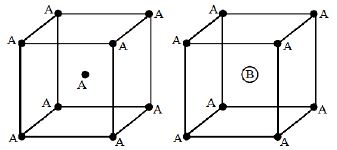
Consider the $bcc$ unit cells of the solid $1$ and $2$ with the position of atoms as shown below. The radius of atom $B$ is twice that of atom $A$. The unit cell edge length is $50\%$ more in solid $2$ than in $1$. What is the approximate packing efficiency in solid $2$? $........... \%$
A
$90$
B
$75$
C
$65$
D
$45$
Solution
(A) In a $bcc$ unit cell,the body diagonal is $\sqrt{3}a$,where $a$ is the edge length.
Along the body diagonal,the atoms are in contact: $2r_A + 2r_B = \sqrt{3}a$.
Given $r_B = 2r_A$,so $2r_A + 2(2r_A) = \sqrt{3}a$,which gives $6r_A = \sqrt{3}a$,or $a = 2\sqrt{3}r_A$.
The packing efficiency is given by the ratio of the volume of atoms to the volume of the unit cell.
Volume of atoms = $8 \times (\frac{1}{8}) \times \frac{4}{3}\pi r_A^3 + 1 \times \frac{4}{3}\pi r_B^3 = \frac{4}{3}\pi r_A^3 + \frac{4}{3}\pi (2r_A)^3 = \frac{4}{3}\pi r_A^3 (1 + 8) = 12\pi r_A^3$.
Volume of unit cell = $a^3 = (2\sqrt{3}r_A)^3 = 8 \times 3\sqrt{3} r_A^3 = 24\sqrt{3} r_A^3$.
Packing efficiency = $\frac{12\pi r_A^3}{24\sqrt{3} r_A^3} \times 100 = \frac{\pi}{2\sqrt{3}} \times 100 \approx \frac{3.14159}{3.464} \times 100 \approx 90.6\%$.
Since the packing efficiency depends only on the ratio of radii and the structure type,it is independent of the absolute edge length. Thus,the packing efficiency in solid $2$ is approximately $90\%$.
Along the body diagonal,the atoms are in contact: $2r_A + 2r_B = \sqrt{3}a$.
Given $r_B = 2r_A$,so $2r_A + 2(2r_A) = \sqrt{3}a$,which gives $6r_A = \sqrt{3}a$,or $a = 2\sqrt{3}r_A$.
The packing efficiency is given by the ratio of the volume of atoms to the volume of the unit cell.
Volume of atoms = $8 \times (\frac{1}{8}) \times \frac{4}{3}\pi r_A^3 + 1 \times \frac{4}{3}\pi r_B^3 = \frac{4}{3}\pi r_A^3 + \frac{4}{3}\pi (2r_A)^3 = \frac{4}{3}\pi r_A^3 (1 + 8) = 12\pi r_A^3$.
Volume of unit cell = $a^3 = (2\sqrt{3}r_A)^3 = 8 \times 3\sqrt{3} r_A^3 = 24\sqrt{3} r_A^3$.
Packing efficiency = $\frac{12\pi r_A^3}{24\sqrt{3} r_A^3} \times 100 = \frac{\pi}{2\sqrt{3}} \times 100 \approx \frac{3.14159}{3.464} \times 100 \approx 90.6\%$.
Since the packing efficiency depends only on the ratio of radii and the structure type,it is independent of the absolute edge length. Thus,the packing efficiency in solid $2$ is approximately $90\%$.
0 likes
View Solution81
DifficultMCQ
$A$ binary solid has a zinc blende structure with $B$ ions constituting the lattice and $A$ ions occupying $25\%$ of the tetrahedral holes. The formula of the solid is:
A
$AB$
B
$A_2B$
C
$AB_2$
D
$AB_4$
Solution
(C) In a zinc blende structure,the anions ($B$ ions) form a $ccp$ (cubic close-packed) lattice.
Number of $B$ ions per unit cell $= 4$.
The number of tetrahedral holes in a $ccp$ lattice is twice the number of atoms,which is $2 \times 4 = 8$.
Given that $A$ ions occupy $25\%$ of the tetrahedral holes.
Number of $A$ ions $= 25\% \times 8 = 0.25 \times 8 = 2$.
The ratio of $A:B = 2:4 = 1:2$.
Therefore,the formula of the solid is $AB_2$.
Number of $B$ ions per unit cell $= 4$.
The number of tetrahedral holes in a $ccp$ lattice is twice the number of atoms,which is $2 \times 4 = 8$.
Given that $A$ ions occupy $25\%$ of the tetrahedral holes.
Number of $A$ ions $= 25\% \times 8 = 0.25 \times 8 = 2$.
The ratio of $A:B = 2:4 = 1:2$.
Therefore,the formula of the solid is $AB_2$.
0 likes
View Solution82
AdvancedMCQ
Atom $(A)$ is present in $ccp$ form,atom $(B)$ is present in all the octahedral voids,and atom $(C)$ is present in all the tetrahedral voids. If all particles touching one of the body diagonal axes are removed,find the empirical formula of the solid.
A
$A_{15}B_{12}C_{24}$
B
$A_5B_2C_3$
C
$A_5B_4C_3$
D
$A_5B_4C_8$
Solution
(D) In a $ccp$ $(fcc)$ unit cell,there are $4$ atoms of $A$ (corners and face centers),$4$ octahedral voids $(B)$,and $8$ tetrahedral voids $(C)$.
Along one body diagonal,there are $2$ corners,$2$ tetrahedral voids,and $1$ octahedral void (at the body center).
Original atoms: $A = 4$,$B = 4$,$C = 8$.
After removing atoms along one body diagonal:
$A$ atoms: $2$ corners are removed. Remaining $A = 4 - (2 \times 1/8) = 4 - 1/4 = 15/4$.
$B$ atoms: $1$ octahedral void (body center) is removed. Remaining $B = 4 - 1 = 3$.
$C$ atoms: $2$ tetrahedral voids are removed. Remaining $C = 8 - 2 = 6$.
Formula: $A_{15/4}B_3C_6$.
Multiplying by $4$ to get the simplest integer ratio: $A_{15}B_{12}C_{24}$.
Dividing by $3$: $A_5B_4C_8$.
Along one body diagonal,there are $2$ corners,$2$ tetrahedral voids,and $1$ octahedral void (at the body center).
Original atoms: $A = 4$,$B = 4$,$C = 8$.
After removing atoms along one body diagonal:
$A$ atoms: $2$ corners are removed. Remaining $A = 4 - (2 \times 1/8) = 4 - 1/4 = 15/4$.
$B$ atoms: $1$ octahedral void (body center) is removed. Remaining $B = 4 - 1 = 3$.
$C$ atoms: $2$ tetrahedral voids are removed. Remaining $C = 8 - 2 = 6$.
Formula: $A_{15/4}B_3C_6$.
Multiplying by $4$ to get the simplest integer ratio: $A_{15}B_{12}C_{24}$.
Dividing by $3$: $A_5B_4C_8$.
0 likes
View Solution83
DifficultMCQ
The ratio of densities if the same element undergoes $FCC$ and $HCP$ close packing is:
A
$1$
B
$4/6$
C
$1.5$
D
$\sqrt{2}/\sqrt{3}$
Solution
(A) The density of a unit cell is given by the formula: $\rho = \frac{Z \times M}{N_A \times a^3}$.
For both $FCC$ (Face-Centered Cubic) and $HCP$ (Hexagonal Close Packing),the coordination number is $12$ and the packing efficiency is the same,which is $74\%$.
Since the element is the same,the molar mass $(M)$ and Avogadro's number $(N_A)$ are constant.
For $FCC$,the number of atoms per unit cell $(Z)$ is $4$ and the edge length $(a)$ is $2\sqrt{2}r$.
For $HCP$,the number of atoms per unit cell $(Z)$ is $6$,the height $(h)$ is $4\sqrt{2/3}r$,and the base area is $6\sqrt{3}r^2$.
In both structures,the atoms occupy the same volume fraction of the space. Because the packing efficiency is identical for both $FCC$ and $HCP$ $(74\%)$,the density of the crystal lattice formed by the same element in both arrangements will be identical.
Therefore,the ratio of densities is $1:1$ or $1$.
For both $FCC$ (Face-Centered Cubic) and $HCP$ (Hexagonal Close Packing),the coordination number is $12$ and the packing efficiency is the same,which is $74\%$.
Since the element is the same,the molar mass $(M)$ and Avogadro's number $(N_A)$ are constant.
For $FCC$,the number of atoms per unit cell $(Z)$ is $4$ and the edge length $(a)$ is $2\sqrt{2}r$.
For $HCP$,the number of atoms per unit cell $(Z)$ is $6$,the height $(h)$ is $4\sqrt{2/3}r$,and the base area is $6\sqrt{3}r^2$.
In both structures,the atoms occupy the same volume fraction of the space. Because the packing efficiency is identical for both $FCC$ and $HCP$ $(74\%)$,the density of the crystal lattice formed by the same element in both arrangements will be identical.
Therefore,the ratio of densities is $1:1$ or $1$.
0 likes
View Solution84
DifficultMCQ
Packing fraction of a layer in $2D$ hexagonal close packing arrangement is:
A
$\frac{\pi}{3\sqrt{2}}$
B
$\frac{\pi}{3\sqrt{3}}$
C
$\frac{\pi}{2\sqrt{3}}$
D
$\frac{\pi}{6}$
Solution
(C) In a $2D$ hexagonal close packing,each sphere is in contact with $6$ other spheres.
Consider a unit cell area formed by the centers of the spheres. The area of the hexagon formed by the centers of $6$ spheres around a central sphere is $6 \times (\frac{\sqrt{3}}{4} \times (2r)^2) = 6\sqrt{3}r^2$.
However,the effective area occupied by the spheres within this unit is $3 \times (\pi r^2)$.
The packing fraction is calculated as: $\text{Packing Fraction} = \frac{\text{Area occupied by spheres}}{\text{Total area of the unit cell}}$.
For $2D$ hexagonal packing,the packing fraction is $\frac{\pi}{2\sqrt{3}} \approx 0.906$.
Consider a unit cell area formed by the centers of the spheres. The area of the hexagon formed by the centers of $6$ spheres around a central sphere is $6 \times (\frac{\sqrt{3}}{4} \times (2r)^2) = 6\sqrt{3}r^2$.
However,the effective area occupied by the spheres within this unit is $3 \times (\pi r^2)$.
The packing fraction is calculated as: $\text{Packing Fraction} = \frac{\text{Area occupied by spheres}}{\text{Total area of the unit cell}}$.
For $2D$ hexagonal packing,the packing fraction is $\frac{\pi}{2\sqrt{3}} \approx 0.906$.
0 likes
View Solution85
DifficultMCQ
In an $FCC$ unit cell,what fraction of the edge length is not covered by atoms?
A
$0.134$
B
$0.293$
C
$0.23$
D
$0.345$
Solution
(B) In an $FCC$ unit cell,the atoms touch along the face diagonal.
The relationship between edge length $a$ and atomic radius $r$ is $4r = a\sqrt{2}$,which implies $r = \frac{a}{2\sqrt{2}}$.
Along the edge of the unit cell,two atoms are present at the corners,each contributing a radius $r$ to the edge length.
The total length covered by atoms along the edge is $2r$.
The uncovered length along the edge is $a - 2r$.
The fraction of the edge not covered is $\frac{a - 2r}{a} = 1 - \frac{2r}{a}$.
Substituting $r = \frac{a}{2\sqrt{2}}$ into the expression:
Fraction $= 1 - \frac{2(a / 2\sqrt{2})}{a} = 1 - \frac{1}{\sqrt{2}}$.
Since $\frac{1}{\sqrt{2}} \approx 0.707$,the fraction $= 1 - 0.707 = 0.293$.
The relationship between edge length $a$ and atomic radius $r$ is $4r = a\sqrt{2}$,which implies $r = \frac{a}{2\sqrt{2}}$.
Along the edge of the unit cell,two atoms are present at the corners,each contributing a radius $r$ to the edge length.
The total length covered by atoms along the edge is $2r$.
The uncovered length along the edge is $a - 2r$.
The fraction of the edge not covered is $\frac{a - 2r}{a} = 1 - \frac{2r}{a}$.
Substituting $r = \frac{a}{2\sqrt{2}}$ into the expression:
Fraction $= 1 - \frac{2(a / 2\sqrt{2})}{a} = 1 - \frac{1}{\sqrt{2}}$.
Since $\frac{1}{\sqrt{2}} \approx 0.707$,the fraction $= 1 - 0.707 = 0.293$.
0 likes
View Solution86
MediumMCQ
In a face-centred cubic $(FCC)$ lattice,where are the tetrahedral voids located?
A
Each face diagonal
B
Each cube diagonal
C
Body centre
D
Each edge centre
Solution
(B) In a face-centred cubic $(FCC)$ unit cell,there are $8$ corners and $6$ face centres.
Each corner atom contributes $1/8$ to the unit cell.
The total number of atoms per unit cell is $Z = (8 \times 1/8) + (6 \times 1/2) = 4$.
The number of tetrahedral voids is equal to $2Z$,which equals $2 \times 4 = 8$.
These $8$ tetrahedral voids are located on the body diagonals of the cube,at a distance of $1/4$ of the body diagonal length from each corner.
Each corner atom contributes $1/8$ to the unit cell.
The total number of atoms per unit cell is $Z = (8 \times 1/8) + (6 \times 1/2) = 4$.
The number of tetrahedral voids is equal to $2Z$,which equals $2 \times 4 = 8$.
These $8$ tetrahedral voids are located on the body diagonals of the cube,at a distance of $1/4$ of the body diagonal length from each corner.
0 likes
View Solution87
MediumMCQ
Which of the following crystal lattice will have a void fraction of $0.476$?
A
$bcc$
B
$fcc$
C
$hcp$
D
simple cubic
Solution
(D) The packing efficiency of a crystal lattice is the fraction of the total volume occupied by the atoms.
Void fraction is calculated as: $\text{Void fraction} = 1 - \text{Packing efficiency}$.
For a simple cubic lattice,the packing efficiency is $\frac{\pi}{6} \approx 0.524$.
Therefore,the void fraction is $1 - 0.524 = 0.476$.
Thus,the simple cubic lattice has a void fraction of $0.476$.
Void fraction is calculated as: $\text{Void fraction} = 1 - \text{Packing efficiency}$.
For a simple cubic lattice,the packing efficiency is $\frac{\pi}{6} \approx 0.524$.
Therefore,the void fraction is $1 - 0.524 = 0.476$.
Thus,the simple cubic lattice has a void fraction of $0.476$.
0 likes
View Solution88
MediumMCQ
In a face-centred cubic lattice,atom $A$ occupies the corner positions and atom $B$ occupies the face-centred positions. If one atom of $B$ is missing from one of the face-centred points,the formula of the compound is
A
$A_2B_5$
B
$A_2B$
C
$AB_2$
D
$A_2B_3$
Solution
(A) In a face-centred cubic $(FCC)$ lattice:
Number of atoms of $A$ at corners = $8 \times \frac{1}{8} = 1$.
Total number of face-centred positions in an $FCC$ unit cell is $6$.
Since one atom of $B$ is missing from one of the face-centred positions,the number of atoms of $B$ present = $6 - 1 = 5$.
Contribution of each face-centred atom to the unit cell = $\frac{1}{2}$.
Number of atoms of $B = 5 \times \frac{1}{2} = \frac{5}{2}$.
The ratio of atoms $A : B = 1 : \frac{5}{2} = 2 : 5$.
Therefore,the formula of the compound is $A_2B_5$.
Number of atoms of $A$ at corners = $8 \times \frac{1}{8} = 1$.
Total number of face-centred positions in an $FCC$ unit cell is $6$.
Since one atom of $B$ is missing from one of the face-centred positions,the number of atoms of $B$ present = $6 - 1 = 5$.
Contribution of each face-centred atom to the unit cell = $\frac{1}{2}$.
Number of atoms of $B = 5 \times \frac{1}{2} = \frac{5}{2}$.
The ratio of atoms $A : B = 1 : \frac{5}{2} = 2 : 5$.
Therefore,the formula of the compound is $A_2B_5$.
0 likes
View Solution89
MediumMCQ
The volume of the $HCP$ unit cell is
A
$24\sqrt{2} r^3$
B
$16\sqrt{2} r^3$
C
$12\sqrt{2} r^3$
D
$8\sqrt{2} r^3$
Solution
(A) The $HCP$ unit cell consists of $6$ atoms per unit cell.
The base of the $HCP$ unit cell is a regular hexagon with side length $a = 2r$.
The area of the base is $6 \times \frac{\sqrt{3}}{4} a^2 = 6 \times \frac{\sqrt{3}}{4} (2r)^2 = 6\sqrt{3} r^2$.
The height of the $HCP$ unit cell is $h = 4r \sqrt{\frac{2}{3}}$.
Volume $=$ Area of base $\times$ Height $= (6\sqrt{3} r^2) \times (4r \sqrt{\frac{2}{3}}) = 24\sqrt{3} \times \sqrt{\frac{2}{3}} r^3 = 24\sqrt{2} r^3$.
The base of the $HCP$ unit cell is a regular hexagon with side length $a = 2r$.
The area of the base is $6 \times \frac{\sqrt{3}}{4} a^2 = 6 \times \frac{\sqrt{3}}{4} (2r)^2 = 6\sqrt{3} r^2$.
The height of the $HCP$ unit cell is $h = 4r \sqrt{\frac{2}{3}}$.
Volume $=$ Area of base $\times$ Height $= (6\sqrt{3} r^2) \times (4r \sqrt{\frac{2}{3}}) = 24\sqrt{3} \times \sqrt{\frac{2}{3}} r^3 = 24\sqrt{2} r^3$.
0 likes
View Solution90
MediumMCQ
In antifluorite structure,the negative ions
A
Occupy tetrahedral voids
B
Occupy octahedral voids
C
Are arranged in $CCP$
D
Are arranged in $HCP$
Solution
(C) In the antifluorite structure,such as $Na_{2}O$,the anions $(O^{2-})$ form a $CCP$ (cubic close-packed) arrangement.
The cations $(Na^+)$ occupy all the tetrahedral voids present in the lattice.
The cations $(Na^+)$ occupy all the tetrahedral voids present in the lattice.
0 likes
View Solution91
MediumMCQ
In a crystalline solid,anion $B$ are arranged in $ccp$ lattice and cation $A$ occupy $50\%$ of the octahedral voids and $50\%$ of tetrahedral voids. What will be the formula of the crystalline solid?
A
$AB$
B
$A_3B_2$
C
$A_2B_2$
D
$A_2B_3$
Solution
(B) In a $ccp$ lattice,the number of effective atoms per unit cell is $4$.
Therefore,the number of $B$ atoms = $4$.
The number of octahedral voids = $4$.
The number of tetrahedral voids = $2 \times 4 = 8$.
Cation $A$ occupies $50\%$ of octahedral voids and $50\%$ of tetrahedral voids.
Number of $A$ atoms = $(0.50 \times 4) + (0.50 \times 8) = 2 + 4 = 6$.
The ratio of $A:B = 6:4 = 3:2$.
Thus,the formula of the crystalline solid is $A_3B_2$.
Therefore,the number of $B$ atoms = $4$.
The number of octahedral voids = $4$.
The number of tetrahedral voids = $2 \times 4 = 8$.
Cation $A$ occupies $50\%$ of octahedral voids and $50\%$ of tetrahedral voids.
Number of $A$ atoms = $(0.50 \times 4) + (0.50 \times 8) = 2 + 4 = 6$.
The ratio of $A:B = 6:4 = 3:2$.
Thus,the formula of the crystalline solid is $A_3B_2$.
0 likes
View Solution92
DifficultMCQ
In a close-packed arrangement,$A$ type of atoms are at corners,$B$ type of atoms are at face centers,$C$ type of atoms are at tetrahedral voids,and $D$ type of atoms are at octahedral voids. If all the atoms along any one body diagonal are removed,what will be the formula of the compound?
A
$AB_4C_8D_4$
B
$AB_8C_4D_4$
C
$AB_8C_4D_8$
D
None of these
Solution
(D) In a $fcc$ unit cell:
Number of $A$ atoms (corners) = $8 \times \frac{1}{8} = 1$.
Number of $B$ atoms (face centers) = $6 \times \frac{1}{2} = 3$.
Number of $C$ atoms (tetrahedral voids) = $8$.
Number of $D$ atoms (octahedral voids) = $4$.
Along one body diagonal,there are $2$ corners and $2$ tetrahedral voids.
Removing these:
$A = 1 - (2 \times \frac{1}{8}) = 1 - \frac{1}{4} = \frac{3}{4}$.
$B = 3$ (no change).
$C = 8 - 2 = 6$.
$D = 4$ (no change).
Formula: $A_{3/4}B_3C_6D_4$.
Multiplying by $4$: $A_3B_{12}C_{24}D_{16}$.
Number of $A$ atoms (corners) = $8 \times \frac{1}{8} = 1$.
Number of $B$ atoms (face centers) = $6 \times \frac{1}{2} = 3$.
Number of $C$ atoms (tetrahedral voids) = $8$.
Number of $D$ atoms (octahedral voids) = $4$.
Along one body diagonal,there are $2$ corners and $2$ tetrahedral voids.
Removing these:
$A = 1 - (2 \times \frac{1}{8}) = 1 - \frac{1}{4} = \frac{3}{4}$.
$B = 3$ (no change).
$C = 8 - 2 = 6$.
$D = 4$ (no change).
Formula: $A_{3/4}B_3C_6D_4$.
Multiplying by $4$: $A_3B_{12}C_{24}D_{16}$.
0 likes
View Solution93
MediumMCQ
In the closest packing of atoms,
A
the size of tetrahedral void is greater than that of octahedral void
B
the size of tetrahedral void is smaller than that of octahedral void
C
the size of tetrahedral void is equal to that of octahedral void
D
the size of tetrahedral void may be greater or smaller or equal to that of octahedral void depending upon the size of atoms
Solution
(B) For a tetrahedral void,the radius ratio is $\frac{r}{R} = 0.225$.
For an octahedral void,the radius ratio is $\frac{r}{R} = 0.414$.
Since $0.225 < 0.414$,the size of the tetrahedral void is smaller than that of the octahedral void.
For an octahedral void,the radius ratio is $\frac{r}{R} = 0.414$.
Since $0.225 < 0.414$,the size of the tetrahedral void is smaller than that of the octahedral void.
0 likes
View Solution94
MediumMCQ
In a solid $AB_2$,the coordination number of $A$ is $8$. It has a cubic close-packed $(ccp)$ lattice. Half of the $B$ atoms are,however,ejected from the solid. Now,the number of tetrahedral holes (voids) that remain filled is:
A
Equal to $2A$ atoms
B
Equal to $4A$ atoms
C
Equal to $9A$ atoms
D
Equal to $A$ atoms
Solution
(D) In a $ccp$ lattice,the number of atoms per unit cell is $4$.
The number of tetrahedral voids is $2 \times (\text{number of atoms}) = 2 \times 4 = 8$.
Initially,there are $8$ $B$ atoms occupying these $8$ tetrahedral voids.
Since half of the $B$ atoms are ejected,the number of $B$ atoms remaining is $8 / 2 = 4$.
Therefore,the number of tetrahedral voids that remain filled is $4$,which is equal to the number of $A$ atoms $(4)$.
Thus,the number of filled tetrahedral voids is equal to $A$ atoms.
The number of tetrahedral voids is $2 \times (\text{number of atoms}) = 2 \times 4 = 8$.
Initially,there are $8$ $B$ atoms occupying these $8$ tetrahedral voids.
Since half of the $B$ atoms are ejected,the number of $B$ atoms remaining is $8 / 2 = 4$.
Therefore,the number of tetrahedral voids that remain filled is $4$,which is equal to the number of $A$ atoms $(4)$.
Thus,the number of filled tetrahedral voids is equal to $A$ atoms.
0 likes
View Solution95
MediumMCQ
If $Z$ is the number of atoms in the unit cell that represents the closest packing sequence $ABCABC .....,$ the number of tetrahedral voids in the unit cell is
A
$Z$
B
$2Z$
C
$\frac{Z}{2}$
D
$\frac{Z}{4}$
Solution
(B) In a cubic close-packed $(CCP)$ or face-centered cubic $(FCC)$ system,the arrangement of layers follows the $ABCABC...$ pattern.
In this system,the number of atoms per unit cell $(Z)$ is $4$.
The number of tetrahedral voids in a crystal lattice is always twice the number of atoms present in the unit cell.
Therefore,if the number of atoms per unit cell is $Z$,the number of tetrahedral voids is $2Z$.
In this system,the number of atoms per unit cell $(Z)$ is $4$.
The number of tetrahedral voids in a crystal lattice is always twice the number of atoms present in the unit cell.
Therefore,if the number of atoms per unit cell is $Z$,the number of tetrahedral voids is $2Z$.
0 likes
View Solution96
AdvancedMCQ
Atoms $A$ are arranged in an $FCC$ system,and atoms $B$ occupy all the octahedral voids and half of the tetrahedral voids. The formula of the compound is:
A
$AB$
B
$A_2B$
C
$AB_2$
D
$A_3B$
Solution
(C) In an $FCC$ unit cell,the number of effective atoms is $n = 4$.
Number of octahedral voids $= n = 4$.
Number of tetrahedral voids $= 2n = 8$.
Atom $A$ is in the $FCC$ lattice,so the number of $A$ atoms $= 4$.
Atom $B$ occupies all octahedral voids $(4)$ and half of the tetrahedral voids $(8 / 2 = 4)$.
Total number of $B$ atoms $= 4 + 4 = 8$.
The ratio of $A:B = 4:8 = 1:2$.
Therefore,the formula of the compound is $AB_2$.
Number of octahedral voids $= n = 4$.
Number of tetrahedral voids $= 2n = 8$.
Atom $A$ is in the $FCC$ lattice,so the number of $A$ atoms $= 4$.
Atom $B$ occupies all octahedral voids $(4)$ and half of the tetrahedral voids $(8 / 2 = 4)$.
Total number of $B$ atoms $= 4 + 4 = 8$.
The ratio of $A:B = 4:8 = 1:2$.
Therefore,the formula of the compound is $AB_2$.
0 likes
View Solution97
EasyMCQ
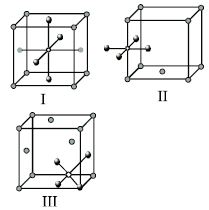
Identify the types of voids represented by the structures $I$,$II$,and $III$ in the given image.
A
$I$ and $II$ represent tetrahedral holes
B
$II$ and $III$ represent tetrahedral holes
C
$I$ and $II$ represent octahedral holes
D
$II$ and $III$ represent octahedral holes
Solution
(C) In structure $I$,the central void is surrounded by $6$ atoms (at the center of the unit cell),which represents an octahedral void.
In structure $II$,the void is at the edge center,surrounded by $6$ atoms,which also represents an octahedral void.
In structure $III$,the void is surrounded by $4$ atoms in a tetrahedral arrangement,which represents a tetrahedral void.
Therefore,$I$ and $II$ represent octahedral holes.
In structure $II$,the void is at the edge center,surrounded by $6$ atoms,which also represents an octahedral void.
In structure $III$,the void is surrounded by $4$ atoms in a tetrahedral arrangement,which represents a tetrahedral void.
Therefore,$I$ and $II$ represent octahedral holes.
0 likes
View Solution98
MediumMCQ
If $AB$ crystallizes in a zinc blende structure with $B^{-}$ ions at lattice points,what fraction of tetrahedral voids is occupied by $A^{+}$ ions? ............... $\%$
A
$25$
B
$100$
C
$50$
D
$75$
Solution
(C) In a zinc blende $(ZnS)$ structure,the anions $(B^{-})$ form a face-centered cubic $(fcc)$ lattice.
The number of $B^{-}$ ions per unit cell is $4$.
The number of tetrahedral voids in an $fcc$ lattice is $2 \times (\text{number of atoms}) = 2 \times 4 = 8$.
Since the formula is $AB$,the number of $A^{+}$ ions per unit cell must be $4$.
Therefore,the fraction of tetrahedral voids occupied by $A^{+}$ ions is $\frac{4}{8} = 0.5$,which is $50 \%$.
The number of $B^{-}$ ions per unit cell is $4$.
The number of tetrahedral voids in an $fcc$ lattice is $2 \times (\text{number of atoms}) = 2 \times 4 = 8$.
Since the formula is $AB$,the number of $A^{+}$ ions per unit cell must be $4$.
Therefore,the fraction of tetrahedral voids occupied by $A^{+}$ ions is $\frac{4}{8} = 0.5$,which is $50 \%$.
0 likes
View Solution99
MediumMCQ
In a closed packed array of $N$ spheres,the number of tetrahedral holes is
A
$N/2$
B
$N$
C
$4N$
D
$2N$
Solution
(D) In a closed packed array of $N$ spheres,the number of tetrahedral voids (holes) is $2N$ and the number of octahedral voids is $N$.
For example,an $fcc$ unit cell has $4$ atoms per unit cell.
It contains $4$ octahedral voids and $8$ tetrahedral voids,which follows the $N$ and $2N$ relationship respectively.
For example,an $fcc$ unit cell has $4$ atoms per unit cell.
It contains $4$ octahedral voids and $8$ tetrahedral voids,which follows the $N$ and $2N$ relationship respectively.
0 likes
View Solution100
MediumMCQ
$A$ solid has $CCP$ arrangement having atoms $A, B, C$. If $A$ atoms are present at face centres,$B$ at corners and $C$ atoms occupy $50\%$ tetrahedral voids,then the molecular formula of the solid will be:
A
$A_3 B C_4$
B
$A_3 B C_8$
C
$A_4 B C_3$
D
$A_3 B C_2$
Solution
(A) In a $CCP$ (cubic close packing) arrangement:
$1$. Number of atoms at corners $(B)$ = $8 \times (1/8) = 1$.
$2$. Number of atoms at face centres $(A)$ = $6 \times (1/2) = 3$.
$3$. Total number of tetrahedral voids = $2 \times (\text{number of atoms in } CCP) = 2 \times 4 = 8$.
$4$. Number of $C$ atoms occupying $50\%$ of tetrahedral voids = $0.50 \times 8 = 4$.
Therefore,the ratio of atoms is $A:B:C = 3:1:4$.
The molecular formula is $A_3 B C_4$.
$1$. Number of atoms at corners $(B)$ = $8 \times (1/8) = 1$.
$2$. Number of atoms at face centres $(A)$ = $6 \times (1/2) = 3$.
$3$. Total number of tetrahedral voids = $2 \times (\text{number of atoms in } CCP) = 2 \times 4 = 8$.
$4$. Number of $C$ atoms occupying $50\%$ of tetrahedral voids = $0.50 \times 8 = 4$.
Therefore,the ratio of atoms is $A:B:C = 3:1:4$.
The molecular formula is $A_3 B C_4$.
0 likes
View SolutionSolid State — Crystal packing · Frequently Asked Questions
1Are these Solid State questions useful for JEE and NEET?
Yes. All questions in this section are mapped to JEE Main and NEET exam patterns. Previous year questions from JEE Main, NEET, GUJCET and state-level exams are included with full solutions.
2Can I switch to Hindi or Gujarati for these questions?
Yes. Use the language tabs in the hero section or the sidebar to view the same questions and solutions in English, Hindi or Gujarati.
3How do I generate a question paper from this subtopic?
Use the Vedclass Exam Paper Generator — select the chapter and subtopic, set difficulty, and generate Sets A, B, C, D automatically. First 3 chapters of every subject are free.
Vedclass Products
For Students
Vedclass Test Series
Mock tests in real JEE/NEET style with performance analysis. 5-day free trial.
Start Free TrialFor Teachers
Exam Paper Generator
Generate Set A/B/C/D papers from this chapter in 2 minutes. 3 chapters free.
Try FreeFor Institutes
Online Exam Module
Live online exams with unlimited students, 360° analytics & white-label branding.
See DemoFor Teachers & Institutes
Generate a Solid State Exam Paper in 2 Minutes
Select subtopic & difficulty — Sets A, B, C, D auto-generated with No Repeat logic.
First 3 chapters of every subject are free — no payment required.